
Submitted:
03 June 2025
Posted:
04 June 2025
You are already at the latest version
Abstract
Administrative law is about articulating norms and promoting adoption and enforcement of human behaviour practices in areas where individual choice conflicts with the public good. Administrative law often has quazi-criminal features characterized by the prohibition and penalty duality of criminal law. Importantly violations of administrative law are penalized but not punished. Criminal law is sanctioning human behaviour of a type that calls for punishment to achieve proportional condemnation and retribution on behalf of civil society. Violation of administrative statutes results in a penalty, often a small monetary fine. Administrative penalties, resolved within the primary judicial system, are characterized by identifying specific undesirable behaviour amenable to simple and direct corrective action by a policing entity, such as the offence created when one exceeds the posted speed limit. Other simple violations with more indirect measurements such as the offence of driving under the influence of alcohol are manifested by “blowing” above 0.08% alcohol in expired respiratory air. These types of minor indiscretions, are addressed by Common Offence prosecution (tickets). Administrative penalties are used to respond to minor human misbehavior by accountable citizens, that can be measured with little room for contention. It allows for immediate response by the regulatory authority while respecting human rights and natural justice (pay or choose trial). In Canada, the welfare of livestock in transit is an administrative issue, livestock hauling is a legitimate behaviour within a fair regulatory frame. Livestock hauling is extra provincial and international and is regulated by the Health of Animals (Act) Regulations Part XII and enforced by the Canadian Food Inspection Agency. Violations have been addressed since 1985 via the Administrative Monetary Penalties Act, SC 1995, c 40. This Act creates a parallel administrative justice system to the Provincial Courts and is bound by standard Rule of Law with the right of appeal (but no right of trial). After over 30 years of failed industry consultation initiatives, a major revision to the humane transport provisions was proclaimed in 2020. A violative numerical threshold of overcrowding had not been articulated in the pre-2020 Regulations. Surprisingly, the new 2020 revision also failed to articulate numerical thresholds that clearly indicate an overcrowding violation for livestock transport in Canada. However, the International Animal Transporters Association maximal stocking density provisions were included by reference, making those standards enforceable law in Canada. This paper reviews the 20 cases from 2004 to 2024 where transporters appealed a sanction for overcrowding livestock transported by land. From the published appeal adjudication, this paper describes the narrative character of rational review of enforcement of the prohibition of overcrowding where there is no bright line definition of an offence. The paper postulates why both regulator and regulated may prefer to work in an intentionally inefficient institutional arrangement, preferring opacity to clarity in what constitutes an overcrowding violation in Law.
Keywords:
humane transport
; animal welfare
; overcrowding
; soft law
; symbolic law
; outcome-based regulation
; animal law
1. Introduction
In 2006, the World Organization for Animal Health (OIE) recommended animal transport times be kept to a minimum with sufficient space allowance for animals to lie down during transport, with consideration given for climate and ventilation capacity of transport vehicles [1] (now Terrestrial Code, Chapter 7.3). As a signatory to the OIE, Canadian scientists in 2008 believed that global livestock welfare transport standards would soon follow the 2006 international agreement [2]. Almost two decades later there still is no international consensus of the minimum space that should be allocated to a group of livestock in transport, a question that must have an objective scientific (numerical) solution. The concerned citizen can intuit that an animal needs some minimal space in transit to not experience stress and on longer trips, perhaps, to remain alive.
In Canada, the primary humane transportation of animals’ law is at the national level and been enforced for decades. This law went under complete revision in 2020. The current humane transportation of animals’ national law paradigm was introduced in 1977 in response to high visibility errors made in the then declining transportation of cattle by rail. The century of livestock transport by rail was replaced by road transport with no cattle transported by rail by the mid 1980’s [3]. In regulating rail transport, the regulator addressed a very small client base, primarily the Canadian National Railway and Canadian Pacific Railway. The livestock industry adoption of road transport extended the regulated pool to thousands of regulated entities.
In response to comprehensive shift in regulatory space, rail car v. truck trailer, the regulator initiated a consultation in 1992 which persisted unabated to a final resolution in 2020, a 28-year consultation period, evidence of a highly politicized arena [4]. Despite the long history and prolonged contention surrounding humane livestock transport, there has never been a scientific measure of overcrowding developed and recognized in law. Numerical thresholds are the norm in administrative law, from food holding temperature to maximal residue limits of chemicals found necessary to make possible enforcement and compliance.
Real world experience of animal handling and transport of meat pigs for example, provides intuitive conviction that upon occasion a small percentage of slaughter pigs arrive at the abattoir dead or severely disabled due to fatigue-hyperthermia, and this outcome could have been avoided by reducing the number of pigs in a compartment so that they could simultaneously lied down and rest. These dead on arrival and pathologically recumbent (pink and panting) individuals are easily identified and there is general agreement that dying from stress is experienced as unpleasant by the pig and this class of pigs have suffered during transit [5].
This paper reviews case adjudication in Canada where transporters are challenging an enforcement action, a monetary penalty, of the offence of livestock overcrowded in transit where there is no science-based measurement, no numerical threshold identified in law as violative. This paper will review how adjudication frames the offences without an objective measurement in a humane transport law in Canada. This paper will address the hypothesis that the lack of scientific/numerical threshold for enforcement of the prohibition of overcrowding of livestock in transit is a sub-optimal and a technically correctable regulatory situation. The paper will also postulate as to why the vague legal description of an overcrowding violation was expanded but not substantively addressed in the 2020 complete revision of the regulation.
The remainder of this paper is constructed into four parts. The first part is a brief history of the Canadian regulation of livestock in transport, the second provides a framework for differentiating the nature of “good” from other types of legislation. The third part is the methodology of review of an available series of decisions on appeal of violation and penalties of overcrowding in transit. The final section is an attempt to add value and increase the common understanding of problems in legislating animal welfare by focusing on the Canadian prohibition of overcrowding example.
2. Brief History of Livestock Transportation Regulation in Canada
British criminal law had been largely exported Ver Batum for the purposes of governing the British North American Colonies in 1800 [6]. The prevention of Cruelty to Animals Act c. 31, was adopted in British Canada in 1857 [7,8], which made it unlawful to bind sheep, calves and pigs for transport to market if more than 15 miles distant and to release them from physical restraint within half an hour of arrival at destination. Earlier animal protection provisions in policing acts of Lower-Canada 1845, allowed a Justice of the Peace to place an individual in the Common Gaol for up to a month for brutalizing draught animals in urban settings [9]. Pre-confederation townships, cities, towns and incorporated villages had delegated authority to create by-laws to respond to cruelty to animals and animals running at large [8]; two problems that remain concerns of society.
The British North America Act 1867 (Canadian Constitution), provides the federal government exclusive jurisdiction to legislate criminal offences in Canada, such as cruelty to animals [10]. The BNA 1867 or “confederation” was the administrative union of what is now Ontario, Quebec, Nova Scotia and New Brunswick. At confederation the 1857 colonial act respecting Cruelty to animals c.31 was incorporated as c.27 in Dominion criminal law. In 1875, c.42 An Act to prevent Cruelty to Animals While in Transit by Railway or other means of conveyance within the Dominion of Canada, was promulgated [11]. This act was focused on the prohibition of confining cattle being transported in rail cars, longer than 28 hours without feed water and rest (FWR). This Canadian rule mimics the concurrent USA 28-hour law that was written in 1873 but not in force until 1909 [12]. In 1887, the Canadian c.27 Animal Cruelty and c.42 Cruelty while in transit acts were incorporated into a single act c.172 [13]. These acts were further consolidated into the 1892 Criminal Code c.29 with Section 514 Transport of animals, addressing the FWR requirements [14].
The offence of overcrowding in transit appears in Section 387 of the 1954 Criminal Code [15], a large statute continuously under revision. Overcrowding in transit does not really fit the mens rea, evil intent requirement of criminal law, most commonly the result of incompetence, negligence or error. In 1975, Bill C-28 moved the regulatory oversight for humane transport of livestock from the Criminal Code to the Animal Contagious Diseases Act (CDA), making administrative offences of the previous criminal offences of animal mistreatment in transit. Another major conceptual difference between criminal law and administrative law is criminal law responds to an offence that has already happened, criminal statutes have no regulations because crimes are prohibited and there is no regulation that can make them tolerable. Administrative law bravely attempts to both prevent and respond to anti-social behaviour.
Malicious torture, acts of sadism toward animals and staged animal fighting remain prohibited in the Criminal Code. Bill C-28 also renamed the CDA the Animal Diseases Protection Act. This amendment expanded the regulatory powers of a previous exclusively disease control act [16,17] by providing legislative space to promulgate regulations “to provide for the humane treatment of animals”, Sec 32 [16]. The Animal Disease Protection Act is continued as the Health of Animals Act. SC 1990, c 21 (statutes of Canada, Chapter 21).
Minimizing the pain and suffering of livestock in transit, and the sanctioning of avoidable suffering is largely the domain of the national veterinary infrastructure. In Canada millions of animals move inter-provincially and internationally with no pre movement or roadside inspection for compliance. Federal inspectors are present at the most convenient point of contact to identify noncompliance, the unloading dock at federally inspected slaughter facilities. Over 95% of animals slaughtered for food in Canada are slaughtered at federal plants, producing products which are then eligible for interprovincial and international trade. Part XII, of Health of Animals Regulations, CRC, c 296, (Health of Animals Act), Transport of Animals is enforced by inspectors employed by the Canadian Food Inspection Agency (CFIA) who also provide the sanitary inspection services at federally registered abattoirs. Law enabling the identification and enforcement of animal protection is rare at the national level in Canada, a country with dual federalism [18]. The Canadian federal government has some features of the administrative state with the creation of empowered agencies, but most limits of individual freedom are created directly by provincial legislation. Under the Canadian Constitution the provinces have authority and obligation to fund and operate the Courts and Judicial institutions. The Criminal Code with a small section re Animal Cruelty is a national law, without an administrative agency where identification and prosecution of offences remains a local matter under the provincial uniformed police and judicial infrastructure.
Under dual federalism a problem of justice emerges in treating all citizens the same, when supporting federal administrative law such as international border control and in this case, the interprovincial movement of livestock. Justice requires that a prohibited food smuggling offence at an international airport in Québec is penalized equally with the same offence identified at a USA-Canada land crossing in British Columbia. The Canadian administrative state addressed this problem by creation of the Canadian Border Services Agency (CBSA). Effective federal policing of noncriminal offences has a problem of accessing provincial justice infrastructure for prosecution and sanctioning.
A provincial street level animal protection officer, delivering a provincial act, may initiate a prosecution by a Common Offence Notice (CON=ticket) or initiate a prosecution via the summary conviction process. The summary conviction process is described in the criminal code and assures protection of the rights of the accused. Each province empowers certain individuals, uniformed police and other individuals, to act as agents of the justice system to initiate prosecutions and has a CON system to assign a monetary penalty to deal with common offences, however, these provincial systems are not harmonized. The summary conviction system is harmonized as the process is articulated in the Criminal Code and the provincial offence summary conviction process and Criminal Code summary conviction process are identical and compete for Crown Council resources in the Provincial court system. Summary conviction is used for offences where there is no set fine and all provincial law and where there is a set-fine the officer can proceed by summary conviction if the fine is not proportional to the severity of the offence. In resource demand a provincial charge of starving your livestock requires the same process as a criminal code of animal cruelty.
The summary conviction process is straightforward but complex and burdensome, as it should be, to prevent frivolous police actions. Summary conviction requires enforcement officers to gather detailed information to be shared with Crown prosecutors. Independent Crown Prosecutors review the provided evidence and the draft charges, to determine whether any and which charges will be laid. When charges proceed, enforcement officers must present the approved information listing the charges and swear before the Justice as to the veracity of the information. The provincial judge or a justice of the peace witnesses the officers’ signature, endorses the document and initiates proceedings. Enforcement officers also prepare summons to be signed by the judge or the justice of the peace ordering the charged individuals to appear in court. The officer must also serve the summons to appear on the accused. If the charged individuals opt for a trial, enforcement officers must provide the required information and assistance to the Crown, with full disclosure to the defense in addition to being available to serve as the primary witness in court. Enforcement officers must have a significant level of autonomy as their line manager (a term sacred in the civil service) is not the Crown Prosecutor. The line manager must protect enforcement officers from departmental political pressure, in the pursuit of justice so that a farmer residing in the riding of the Minister of Agriculture is treated the same as farmers not in the Ministers riding. This risk of regulatory capture and politicizing of justice is a frequent criticism where animal protection officers are employed by departments of agriculture [19].
To adapt to the needs of non-criminal, administrative federal law, Agriculture Canada developed an Administrative Monetary Penalty system (AMPS), [Agriculture and Agri-Food Administrative Monetary Penalties Regulations, SOR/2000-187, (Agriculture and Agri-Food Administrative Monetary Penalties Act SC 1995, c 40)]. summary conviction process his legislation creates a monetary penalty system in parallel with the provincial CON and ticketing system. The delivery of statutory federal penalties via the provincial court infrastructure has an alternative to AMPS in the federal Contraventions Act program [20] and how federal departments choose one ticket-penalty system over the other is unclear. Further reading on the Contraventions Act, SC 1992, c 47 provides a rich sampler of the bureaucracy of the justice system in Canada and will not be mentioned further in this paper.
In the arena of food safety and animal welfare, penalties awarded by the Canadian Food Inspection Agency (CFIA) and the CBSA, can be appealed to the Canadian Agriculture Review Tribunal (CART), a legal “court like” organ created by the Act (SC 1995, c 40). Decisions of the CART are appealable to the Federal Court, which is consistent within the framework of Common Law and natural justice. The current and prior regulations related to the prohibition of overcrowding covering the period of this review are in Table 1.
3. Good Law
In common understanding, a “good” law, articulating a social policy or priority, has the intended purpose to bring about behavioral change in the group of people targeted, resulting in a more just society. Legislatures empower regulators to intervene where there is a public good to achieve and where the individual may have cause to do otherwise. A quality assurance program for the drafting of regulations has emerged in British Common Law, for this discussion the “Lon L. Fuller Standard” (LLF-8) [21,22]. The LLF-8 does not address the moral value of any legal instrument only the inherent quality principals that a law or regulation should conform to. The LLF-8 will be used as the quality standard for this discussion. The LLF-8 is not the only quality construct for evaluating just laws; a European variant holds to four critical dimensions; legal certainty, prevention of misuse of powers, equality before the law, and access to justice [23] which does not in any way conflict with the LLF-8, Table 2.
The rule “it is an offence to exceed the posted speed limit” meets the LLF-8 quality standard. Speed limits, a socially beneficial proscription, restricting the freedom of action of the individual, is applied to all drivers of vehicles (general), widely promulgated and visible by road signage, directing current and future driver’s behaviour. Speed limits are consistent with all other road safety human protection initiatives, compliance available by decreasing foot pressure on the vehicle throttle control, remaining constant in principle even in school zone and similar reductions, and can be enthusiastically and fairly enforced. The exceptional clarity of this law makes enforcement extremely easy, because an infraction can be objectively and legitimately measured by any one of several technologies including photo-radar systems. It is a bright line rule, while remaining subordinate to officer discretion, with the exception of the controversial photo-radar which penalizes vehicles not citizens. In addition, the licensed driver, the police and the courts all see this issue with the same perspective. A good law, it provides a method of measuring human behaviour against prohibited behaviour even in the absence of a negative outcome, can ratchet up penalties in proportion to offence severity and there is no need to kill someone to receive a CON-ticket.
3. Bad Law, Symbolic Law, Not Law at All
In the previous section the sentence, “In common understanding a good law, articulating a social policy or priority, has the intended purpose to bring about behavioral change in the group of people targeted” is misleading. Most reflective individuals presume that legislatures are restricted to committing public resources only to effective laws, laws directed at human behavioural change, such as thou shall not kill. From research in legislative and policy failure, emerged a stream of scholarly literature directed at what has been called symbolic law [24]. Legislation is symbolic when it has the appearance of proscribing or requiring certain behaviour, but does not or cannot, establish effective mechanisms for enforcing these obligations [25]. Symbolic law is legislation without real world impact. Symbolic legislation can be due to legislative incompetence but often is intentional obfuscation. Law can be a political action in response to lobbying pressure. Symbolic legislation was initially identified in environmental protection law [26]. Citizen concern over issues like climate change may demand legislative action to control extractive industries, but governments do not want to lose the income from royalties’ extractive industries provide; a symbolic law is a short-term political solution. Animal protection has citizen concern characteristics similar to climate change and resource extraction and is at risk to symbolic legislation [27]. A recent review in this journal described “the systemic failure by the state to effectively enforce animal welfare legislation” as an enforcement gap [28]. Reconceiving the enforcement gap in an animal protection system may have markers of symbolic legislation, law without effective enforcement. Enforcement gap may be intentional and the government apologist claim of resource restriction a misleading explanation.
Fuller [21] describes law as the “enterprise” of creating and maintaining a functioning society. There is a theory in the development of law that any and all statute development responds to two driving concepts, in varying proportion. The more intuitive driver is identified as prospective-substantive, where the drafters of the law want the machinery of justice to use the law to result in a change in human behaviour increasing societal wellness. The less intuitive driver is identified as political-strategic, where the law is symbolic and can be a conscious deception of the public, especially the groups organized and lobbying for the regulation [23]. Law without the promise of enforcement is effectively no law at all, a non-law [29].
There is a rival school of thought that is less critical of symbolic law. This view rests on the ability of law to have norm establishing functions; Law is expressive and communicates a meaning to society [30]. It is also argued that symbolic law can have a placebo effect in intentionally manipulating public perception to decrease the perception of both risk and increase the belief in the law’s effectiveness without a real change in the objective world. An example is the enhanced visibility of airport security post 911, where the increased visibility of airport security did nothing to decrease the real risk of terrorism nor make more effective crime prevention [31]. Other common populist examples include the belief that “tough on crime” laws change humane behaviour to make for safer streets [32] and that sex offender registration is protective, because it alters the individuals risk of reoffending and makes for safer neighborhoods, neither of which has any basis in fact [33,34].
Primarily political-strategic laws in animal protection may be common, resulting in no significant real increased protection of animals or measurable relation to offences and prosecution [35]. One can imagine an animal advocacy group campaigning for a particular legal goal such as recognition of animal sentience [36,37] which in the proscriptive-substantive paradigm has no significant impact on the legislative enterprise [38]. In the successful promulgation of ineffective legislation in animal protection, the lobby interests can claim a win (new Law is created) and increase their donations, and the government can claim a win for championing a moral virtue at no real cost to government; even Machiavellian animal use interests that normally oppose methods of production legislation may support a symbolic law.
4. Soft Law
“Soft Law” in simplest form are widely accepted norms that have no legal basis. It is a measure of rule by administerial discretion as opposed to court and justice rule. No real consensus of descriptive criteria for soft law has yet emerged [23] although it has been previously identified in Canada [39]. Hard law includes statutes, regulations and by-laws issued by regulators of professions and municipal authorities, as these powers are delegated by hard law statutes. Soft law includes just about all the other instruments that are issued by the executive to guide internal decision making, or legitimized by being used by the regulated party, including guidance documents [40], guidelines, codes, manuals, circulars, directives, bulletins, and other forms [39]. They are usually documents authored by the regulatory authority for use of the regulatory authority and those regulated.
The academic definitions of soft law include two types of characteristics. Firstly, soft law is somewhat defined by what it is not, as some essential elements are missing for soft law to be considered (proper) hard law; however, the close resemblance with hard law is what makes soft law differ from non-law. Rather than cross interrogating the wording, soft law is further defined by looking at the function it performs. Soft law may anticipate hard law (pre-law, as in the evolution of tobacco use restrictions in public), follow the adoption of hard law (post-law interpretive guidelines), or be considered as a substitute to hard law (para-law). In this paper, the Canadian Agriculture and Agri-Food Canada 2001 publication of the Recommended code of practice for the care and handling of farm animals: Transportation [41] is considered an exemplar of soft law in Canadian livestock regulation. This document has comprehensive livestock transport maximal crowding limits (Density Charts p. 36-44). Although claiming to be non-law this unedited, unchallenged an unimproved document is featured prominently in defending and prosecuting incidents of livestock loss in transit and may be functioning as para-law, see part 7 below. This application of soft law differentiates the Transport Code from the dozen or so other National Farm Animal Care species specific “care and handling” codes [42].
5. Mutant Law - Street Level – Judicial Review
One of the characteristics of British Common Law is that by design, it follows an evolutionary pattern of continual improvement. As decisions made in specific cases are decided and appealed, they become precedents for decisions in future cases. In addition, the law is delivered in the field by policing functionaries with a high degree of knowledge and discretion [43], which anticipates real world variability. Although still recognizable, law is often applied in significantly different form than the authors intended [44]. Police or inspector discretion is fundamental to the modern justice creating enterprise [45].
Decisions of the Canada Agriculture Review Tribunal (CART) are seldom appealed to the Federal Court, appeal is expensive, success unlikely and cost of winning will probably exceed the other choice, prompt payment of half of the fine. The improvement in common law however is dependent on appeals and all appeals have public utility. When administrative power is reviewed by the court of appeals it can effectively modify the law and change significantly how the administrator functions in the future. In 2009 a CART ruling related to a monetary penalty subsequent to the causation of avoidable pain and suffering in transportation of a severely lame pig was appealed to federal Court (Doyon v. Canada (Attorney General), 2009 FCA 152) [46]. The appellate judge ruled in favor of CART but, had further words regarding the administrative monetary penalty system (AMPS) implemented by the CFIA. The Appellate Judge referred to the system as draconian and highly punitive, where in Canadian legal constitutional norms administrative law is prohibited from being punitive. The AMPS punishes diligent individuals, even if they took every reasonable precaution to prevent the commission of the alleged violation. The Act denies individuals who committed a violation the right to make a mistake, even if the mistake could have been made by a reasonable person in the same circumstances. The AMPS encourages the innocent to assume guilt, by granting a 50% discount of penalty incentive if the penalty is paid quickly.
The Judge indicated: “[27] In short, the Administrative Monetary Penalty System has imported the most punitive elements of penal law while taking care to exclude useful defences and reduce the prosecutor’s burden of proof. Absolute liability, arising from an actus reus which the prosecutor does not have to prove beyond a reasonable doubt, leaves the person who commits a violation very few means of exculpating him- or herself. He went on to admonish the administration of the AMPS system; [28] Therefore, the decision-maker must be circumspect in managing and analysing the evidence and in analysing the essential elements of the violation and the causal link. This circumspection must be reflected in the decision-maker’s reasons for decision, which must rely on evidence based on facts and not mere conjecture, let alone speculation, hunches, impressions or hearsay.
6. Methods
The website of the Canadian Agricultural Review Tribunal [47] was searched using the word “overcrowding” and the violation section numbers of Table 1. In the 21 years between 2004 and 2024 there were 20 decisions available for review. The decisions were reviewed by careful reading and compared by length (number of words), whether or not they referred to the 2001 Transportation Code [41], whether the Chairperson used mathematical reasoning in coming to a decision and documented that reasoning in the decision, and the identification of chairperson deciding the file, Table 3.
7. Results
The 20 files of the species consisted of 1 incident of sheep, 3 cattle, 5 chicken and 11 pigs. The CART report of outcome in the year 2023-2024 indicates the Tribunal upheld the violation in 13 files and quashed the notice of violation in 1 (7%) [48]. In this series of adjudicating overcrowding, 30% (6 of 20) were quashed, 3 pig and one each of cattle, chicken and sheep. There were 8 authors (Chairperson) creating the final reports with most having 2 or less files with the exception of TSP with 7 decisions from 2004-2008 and DB with 5 from 2013-2017. Word length of decisions was considered a proxy for the risk of decisions becoming more litigious over time (Figure 1). Word numbers were counted by exporting the .pdf files into MS Word and using the word count function.
The decisions were read closely, in an attempt to identify common features and crucial decisions that have potential to act as precedent in future rulings. The 2001 Transport Code of practice [41] although consistently introduced in appeals as non-binding, was referred to in all decisions with the exception of 2016 CART 07, a broiler chicken violation where only one cage was overcrowded. The Transport Code sets standards of maximum floor pressure in units of mass/area; however, there was no numerical information cited in 9 of 20 decisions (Table 3). The value of science, taking measurements in the real world was challenged in Wendzina, 2007 RTA #60228, the Tribunal found;
The determination as to whether the animals were crowded during transport to such an extent as to be likely to cause injury or undue suffering is not a simple matter of applying the actual weights of the animals and the dimensions of the trailer to the loading density chart. (page 4, Conclusions first paragraph)
In determining whether there is overloading to such an extent as to be likely to cause injury or undue suffering, the type, age and condition of the animals at the time of loading, the number of walls in the trailer, the type and extent of floor covering in the trailer and the weather conditions at the time of loading and during transport are all significant factors to be weighed. (page 4, Conclusions third paragraph)
This ruling indicates that “overcrowding” in the absence of an articulated numerical rule is somewhat outside of the realm of science and enters the realm of legal and law enforcement judgement. Overcrowding for the practice of the Tribunal is unknowable until the Tribunal rules and it becomes a situationally dependent fact. The creation of fact, transformation objective science, the use of measurement in the real world, to a judicial decision was, confirmed by Para 50 of Finley, 2013 CART 42 even in the presence of objective measurement.
[50] The Tribunal finds that the Agency has established, on the balance of probabilities, that two of the three dead hogs were in compartments of the transport that were overcrowded, based on national code-referenced calculations, considered to provide indicia of overcrowding. Overcrowding remains a question of fact, to which various codes or standards may be referred to in support, but which ultimately becomes a determination based on the particular circumstances. (emphasis added)
The complete sentence above, Overcrowding remains a question of fact…is repeated in 2014 CART 33 [Para 60], 2016 Cart 27 [Para 27] and 2017 CART 16 [Para 34]. In Canada v. Bilodeau et Fils Ltée , 2017 FCA 5 (Bilodeau) [Para 10], ruling on a CART animal unfit to transport, the Federal Court of Appeal endorsed the view that codes of conduct (soft law) do not have legal force and do not bind the Tribunal [49]. In legal practice when regulating a continuous physical variable such as overcrowding it is not a requirement to measure anything. The absence of objective measurement has been previously documented as a regulatory problem in the regulation of sorcery and witchcraft [50].
In 2013 CART 34, the decision gives a nod to the Doyon decision by reproducing the admonishment paragraphs 27 and 28, but goes on to largely contradict Doyon by characterizing the requirement to “prove a violation” and identify the accused “on a balance of probabilities” and the person named in the notice of violation committed the violation as identified as a heavy burden on the agency [para 37] (emphasis added). Proving the essential who did what, is fundamental to any offence and not a “heavy burden”. However; this decision adopts the suggestion from Doyon of adopting a standard four element framework in the review of a decision of violation; 1 - an animal was transported in a crate on a truck; 2 - that crate on the truck was crowded; 3 – the crowding was to such an extent as to be likely to cause injury or undue suffering to any animal contained therein; and 4 - there was a causal link between the transportation, the crowding, the likelihood of injury or undue suffering of the animal(s) due to crowding.
In 2013 CART 42, the decision cites Doyon with very limited focus and states the Tribunal is mindful of the caution in relation to statutory interpretation expressed by the Federal Court of Appeal in Doyon, at paragraph 49, but does not acknowledge the overall imbalance in power arrangements of the whole of the process central to the Federal Appeal.
[49] As this provision triggers a substantial monetary penalty, we must guard against a liberal interpretation that extends the scope of the essential elements, which are already quite broad, given the fact that the person who has committed the violation has absolute liability, that the prosecutor has a considerably reduced burden of proof and that the person who has committed a violation risks higher penalties in the event of a subsequent violation (Doyon v. Canada).
In the five decisions between 2016 and 2023 Doyon is mentioned in passing or in reference to the four elements of a case. In the four 2024 cases there is no mention of the obligation for the Tribunal to consider in their decision the draconian and lopsided power relationships in the AMP process.
Where factual data was available in the Tribunal decision, it provided confirmatory evidence that the Transport Code bright line maximum [allowable floor pressure for market pigs creating a standing room only condition, under best possible weather and trip duration 3 hours or less] to be 287 kgm-2 was apparently reasonable if not considered factual. In 2023 CART 20, on a very hot day, 128 kg, market hogs: in compartment A loaded at 281 kgm-2, 3 of 24 died; and compartment B, loaded at 314 kgm-2, 2 of 18 died. In 2021 CART 16, dead and compromised pigs were all confined to the rear compartment loaded at 334 kgm-2. With 7 pigs dead, and 2 further pigs in the process of dying, the floor pressure was reduced to 267 kgm-2 of living pig, suggesting that the pigs are aware of an overcrowding threshold and will die to assert the point. In over 20 years since publication of the maximum crowding formulae in the Transport Code [51] there has been no serious scientific challenge to the standard in pigs, a source of shame to scientists and regulators tasked with continual improvement in the welfare of food animals.
8. Discussion
Overall, from the Tribunal process of review of livestock overcrowding in transport there is limited evidence to believe that the Doyon decision had a significant or lasting impact on the practice of the Tribunal in reviewing appeals. The apparent higher probability of winning an overcrowding appeal that other violations is insufficiently supported by data available in the public sphere but should be of interest to the tribunal holding the data.
LL Fuller describes law as the “enterprise” of subjecting human conduct to the governance of rules and describes the successful product of science as the ability to predict and control future events. Section 148[1] prohibits loading in a manner that would result in the conveyance or container becoming overcrowded, which is a future looking rule, which in theory could be facilitated by science. In comparing the two current overcrowding rules to the LLF-8, does predicting the future ask the impossible of the regulated? The enterprise of science is to understand the nature of reality so as to be able to avoid negative outcomes in the future. In this circular thought, rule 148[1] is theoretically made possible by science, but only if you recruit the wealth of objective knowledge and testable scientific theory that is open to empirical test and falsification [52].
In a rational prospective science hypothesis, for species that prefer to stand during transportation such as horses, there is some level of crowding, if exceeded, a recumbent horse would be unable to regain footing as the remaining horses would close over and prevent efforts of the downer to rise. Similarly, in species that are easily exhausted and prefer to lie down; at some level of crowding all pigs in a group would be unable to simultaneously lie down without piling on peers. There is a real-world numerical measurement of these conditions in the units of mass/area. Eschewing the option of including by reference, the Transport Code of Practice and numerical limits seems like an inefficient regulatory choice. In the 2020 amendment opportunity, the regulator attempts defining overcrowding by 148(1)(a) the animal cannot maintain its preferred position or adjust its body position in order to protect itself from injuries or avoid being crushed or trampled. This reads that pigs have preferences and are aware of consequences of current predicaments they find themselves in. This wording is strange in a context of a regulation based in the instrumental use of animals. The use of mathematics and numerical limits (objective data) in establishing the prohibited situation of “overcrowding” is a common but not a consistent praxis of the Tribunal, while eschewed by the primary regulator.
The demands of clarity with what the law prohibits or requires are clearly not met by the current rule. Prohibition of overcrowding with determination based on the particular circumstances cannot be reconciled with the requirement of clarity. The retention of the “likely to” clause in 148(1)(b) and (c) also requires the regulated to see into the future without any officially objective legal guidance. In this application of legal compulsion, is the rule actually compliable? Can regulated entities see into the future and avoid negative outcomes. It appears the law is asking the impossible of the regulated. In 2024 CART 27, this future looking aspect of the regulation was directly confronted and the decision read; The Agency has not convinced me on a balance of probabilities that it was likely that an animal would suffer, sustain an injury or die due to the number of animals in the container [Para 34].
In this series of appeals there is also evidence of lack of congruence between what written rule declares and how officials enforce the rule. In 2023 CART 20 at para [31];
[31] While I am sympathetic to Brussels’ concern about the apparent arbitrariness of the Agency’s decision to only investigate when more than three hogs arrive dead in a single load, the Tribunal has no mandate to specify that all breaches of the regulations be enforced…
In 2024 CART 06 at para 39, similar situation was documented;
[39] Inspector Amanda Murphy testified that the regulations in question are “outcome based”. She stated, repeatedly, that the Respondent will not pursue enforcement if an otherwise overcrowded trailer does not show any negative outcomes (like hyperthermia). Inspector Murphy’s testimony is consistent with section 15.2 of the Respondent’s Interpretive Guidance document.
The enforcement of overcrowding is only initiated where a significant number of animals die. The arbitrary threshold, the size of the pile of dead pigs, communicates to the regulated that, it is death due to overcrowding that is prohibited not overcrowding per se. There is no data available of the frequency of overcrowding on short hauls where stress is not of sufficient temporal duration to result in death of pigs.
The Veterinarian in Charge of the federal slaughter facility is the unfortunate street-level bureaucrat tasked with balancing the resources to inspect and document animal welfare and the resources to inspect and document food safety requirements. On shifts with a staff shortage, it is likely data collection at live receiving may suffer. In Canada, there is no roadside monitoring of livestock compartment floor pressure nor monitoring at assembly points, auction markets or provincial and uninspected abattoirs. The popular practice of comparative evaluation of animal protection of jurisdictions based on statute review only [53] is misleading at best.
CFIA self identifies as Canada’s largest science based regulator [54] yet, eschews numerical thresholds for the definition of an offence of overcrowding yet rely on soft law standards [41] in adjudication. The Transport Code was referred to in 19 of 20 decisions in this review. CFIA was the primary sponsor of the 2001 Code which remains available in electronic format and classified as “archived” under the current management of the National Farm Animal Care Council. There is no intention to review this code in the strategic planni8ng of the Council. The Council considers the CFIA interpretive guidance documents [55] to have replaced a great deal of the Transport Code with the exception of the load density graphs. The CFIA interpretive guidance documents do not provide any numerical violative limits of the mass of live animal per floor area of compartment [55].
The guidance on identifying individual animals unfit to travel Sec 139 [55] is quite extensive, while there are no numerical recommendations on overcrowding. A reasonable explanation for this is that overcrowding is symbolic legislation, intentionally worded for political not substantive ends. In most critical speculation there may have been no legislative intent to enforce the overcrowding provisions evidenced by making wording very difficult to comply with and difficult to prosecute, in comparison with a numerical threshold. Without being in the room while the decisions are made, it is impossible to judge the intent of the legislature or their advisors. Agencies by nature are at arm’s length from the legislative assembly and somewhat isolated from detailed challenge providing protection from political interference. Alternatively, sometime in the 30-year negotiations up to the recent revisions of the regulation it was decided that the issue of overcrowding was unlikely to be successfully negotiated with industry; any possible scientific and easily enforceable definition of overcrowding was traded for other concessions in the regulatory proposal.
The limitations of this study are significant. The internal workings of the government, where this paper attempts to peer, are opaque to the common citizen. No outsider is privy to the intent of the creation stages in the regulatory process. The data source used was limited to the transparency window made available by the current Tribunal publication policy. There is no public information to compare the proportion of animal welfare violations in the overall workings of the tribunal or the fraction of welfare violations that are issued due to overcrowding. There is also no data publicly available to document the proportion of violators that pay half the penalty, motivated not by a sense of remorse, but to avoid the cost and inconvenience of the appeal process, even when innocent. With the “soft” investigation threshold of some number of dead pigs on arrival (Amanda Murphys, provision of 15.2 of the Respondent’s Interpretive Guidance document in 2024 CART 06) there is no assurance that this internal policy is regularly enforced at street-level or how the number of violations would increase with a change in the dead pig pile trigger for investigation. This review would suggest that overcrowding is far more common than is indicated by the evidence available to the public.
5. Conclusions
Argument by analogy is one of the weakest systems of reflective thought but is useful in this discussion. Imagine enforcement of vehicle speeding, a mathematical construct describing a function of distance and time in a culture where individuals could not consistently attach a numerical function to time. Enforcement officers would be working on a project to modify human behaviour where every “speeding” incident was situationally dependent, no numerical definition of speeding. A vehicle transferring a set distance in a below recommended minimum time period would be only one of many factors to enter the deliberation to establish the “Fact” of speeding. Considerations would be, road conditions, time of day, weather, special circumstances such as a school zone, vehicles age and safety features for example. In this reality, the officer would need a high level of motivation to initiate a prosecution, such as the killing of a child in a school zone. Most would consider that this situation is an unfortunate but unavoidable inefficient regulatory delivery process. Vehicular speeding, an avoidable cause of human early mortality would seldom be identified or sanctioned, and behaviour change unaffected. The evidence available in this review suggests that there are symbolic aspects of the national livestock overcrowding prohibition whether by design or by the reality of enforcement.
This paper contributes to the general knowledge of the problems creating regulations in primary agriculture to eliminate avoidable suffering of food animals. The example most likely reflects the reality that regulations in livestock production are negotiated with this industry. Industry participation in welfare law increases compliance remains a hypothesis, as the drafting of law is generally opaque, and the alternative is counter factual.
There is limited data available, however, it appears that overcrowding violations are more likely to are overturned by CART. Animal welfare in agriculture is increasingly becoming part of bi-lateral trade negotiations [56] and the national veterinary infrastructures are failing if they are unable to respond to emerging phytosanitary and method of production certification for international trade.
Livestock production advocates in currently unregulated jurisdictions should be seeking scientific, objectively measurable, performance-based rules of species-specific definitions of overcrowding in transit before some other less efficient rule is implemented by regulatory experimenters.
Funding
This research was an unfunded personal project, facilitated by the generosity of the Journal editorial board, in waving publication costs. The statements, opinions and data contained in this document are solely those of the individual author.
Conflicts of Interest
The author was responsible for the recommended space allowance recommendations in the 2001 Transport Code of Practice [41] otherwise the author declares no conflict of interest.
Author Note
The author is grateful to Hazel Dalu for careful proofreading and valuable comments on a near final draft of this manuscript.
References
- OIE. Appendix 3.7.3 Guidelies for the transport of animals by land. 2006 OIE Terrstrial Animal Health Code Strasbourg,: Office Internationale des Epizooties 2006. p. 429-41.
- Bench C, Schaefer A, Faucitano L. The welfare of pigs during transport. In: Luigi Faucitano, Schaefer AL, editors. Welfare of pigs from birth to slaughter. Wageningen, The Netherlands: Wageningen Academic; 2008. p. 161-95.
- Loly, CM. The rise and fall of the cattle train in Canada. Winnipeg, MB: University of Manitoba; 1995.
- CFIA. A history of the changes to the transportation of animals requirements under the Health of Animals Regulations (HAR) Part XII Ottawa, ON: Government of Canada; 2024. Available online: https://inspection.canada.ca/en/animal-health/terrestrial-animals/humane-transport/timeline-humane-transport-regulations (accessed on 18 February 2019).
- Fitzgerald R, Stalder K, Matthews J, Schultz Kaster C, Johnson A. Factors associated with fatigued, injured, and dead pig frequency during transport and lairage at a commercial abattoir. J Anim Sci. 2009, 87, 1156–1166. [Google Scholar] [CrossRef] [PubMed]
- Doughty A, McArthur, DA. Documents relating to the constitutional history of Canada,1791-1818, vol. II1914:[xiii, 576 pages pp.]. Available online: https://www.canadiana.ca/view/oocihm.9_03421.
- Britian, G. An Act to prevent cruel and improper treatment of Cattle and other Animals, and to amend the Law relating to impounding the same 1857:[111-9 pp.]. Available online: https://www.canadiana.ca/view/oocihm.9_00925_5.
- Canada. The consolidated statutes of Canada : being the public general statutes which apply to the whole province as revised and consolidated by the commissioners appointed for that purpose.1859:[xiii, 1247 pages ; 32 cm. pp.]. Available online: https://www.canadiana.ca/view/oocihm.9_08189.
- Lower-Canada. An Ordinance for establishing an efficent system of Police in the Cities of Quebec and Montreal. Lower Canada The revised acts and ordinances of Lower-Canada [Internet]. 1845. Available online: https://www.canadiana.ca/view/oocihm.9_00928.
- Britian, G. The British North America act, 1867 and amending acts.1867. Available online: https://www.canadiana.ca/view/oocihm.9_04236.
- Canada. Acts of the Parliament of the Dominion of Canada ... second session of the third Parliament, begun and holden at Ottawa, on the fourth day of February, and closed by prorogation on the eighth day of April, 1875 : public general acts : 1875 (pt. 1) (Acts 1-56)1875. Available online: https://www.canadiana.ca/view/oocihm.9_08051_4_1.
- Goding H, Raub AJ. The 28 Hour Law Regulating the Interstate Transportation of Live Stock: Its Purpose, Requirements, and Enforcement: US Department of Agriculture; 1918.
- Canada. Acts of the Parliament of the Dominion of Canada, relating to criminal law, to procedure in criminal cases and to evidence : compiled from the Revised Statutes of Canada, which were ... brought into force on 1st March, 1887, under proclamation dated 24th January, 1887 ; with marginal references to corresponding Imperial Acts.1887. Available online: https://www.canadiana.ca/view/oocihm.9_02000.
- Canada. The Criminal Code: Acts of the Parliament of the Dominion of Canada ... second session of the seventh Parliament, begun and holden at Ottawa, on the twenty-fifth day of February and closed by prorogation on the ninth day of July, 1892 : public general acts : 1892 (pt. 1) (Acts 1-29)1892. Available online: https://www.canadiana.ca/view/oocihm.9_08051_21_1.
- Canada. Chapter 51 the Criminal Code1954. Available online: https://www.lareau-legal.ca/Martin1955two.pdf.
- Canada. Bill C-28 An Act to amend the Animal Contagious Diseases Act. House of Commons Bills, 30th Parliament, 1st Session : C23-C31 [Internet]. 1975; (C-28):[245-86 pp.]. Available online: https://parl.canadiana.ca/view/oop.HOC_30_1_C23_C31/256.
- Canada. Respecting:Bill C-28 An Act to amend the Animal Contagious Diseases Act. House of Commons Committees, 30th Parliament, 1st Session : Standing Committee on Agriculture, vol 2 no 36-66 [Internet]. 1975:[1347-403 pp.]. Available online: https://parl.canadiana.ca/view/oop.com_HOC_3001_1_2/1347.
- Whiting, TL. Policing farm animal welfare in federated nations: The problem of dual federalism in Canada and the USA. Animals 2013, 3, 1086–1122. [Google Scholar] [CrossRef] [PubMed]
- Saltelli A, Dankel DJ, Di Fiore M, Holland N, Pigeon M. Science, the endless frontier of regulatory capture. Futures 2022, 135, 102860. [Google Scholar] [CrossRef]
- Anon. Evaluation of the Contraventions Act Program - Final Report. In: Justice, editor. Ottawa, ON: Canada, Department of Justice; 2021.
- Fuller, LL. The morality of law (2nd ed). New Haven: Yale University Press; 1969.
- Murphy, C. Lon Fuller and the moral value of the rule of law. Law & Phil. 2005, 24, 239. [Google Scholar]
- Eliantonio M, Korkea-aho E. Soft law and courts: saviours or saboteurs of the rule of (soft) law? Research Handbook on Soft Law: Edward Elgar Publishing; 2023. p. 191-207.
- Van Klink, B. Symbolic legislation: an essentially political concept. Symbolic legislation theory and developments in biolaw. 2016, 19–35. [Google Scholar]
- Bielska-Brodziak A, Drapalska-Grochowicz M, Suska M. Symbolic protection of animals. Society Register. 2019, 3, 103–121. [Google Scholar]
- Newig, J. Symbolic environmental legislation and societal self-deception. Enviro Poli 2007, 16, 276–296. [Google Scholar] [CrossRef]
- Ferrere, M. The (symbolic) legislative recognition of animal sentience. Animal L. 2022, 28, 117. [Google Scholar]
- Rodriguez Ferrere, M. Animal welfare Underenforcement as a rule of law problem. Animals. 2022, 12, 1411. [Google Scholar] [CrossRef]
- Fuller, LL. Eight ways to fail to make law. Philosophy of law. 2000, 8–12. [Google Scholar]
- Sunstein, CR. On the expressive function of law. U Pa L Rev. 1996, 144, 2021–2053. [Google Scholar] [CrossRef]
- Aviram, A. The Placebo Effect of Law: Law’s Role in Manipulating Perceptions. Geo Wash L Rev. 2006, 75, 54. [Google Scholar]
- Kamin, S. Against a “War on Animal Cruelty” Lessons from the War on Drugs and Mass Incarceration. In: Lori Gruen JM, editor. Carceral Logics Human Incarceration and Animal Captivity: Cambridge University Press; 2022.
- McPherson, L. The Sex Offender Registration and Notification Act (SORNA) at 10 years: History, implementation, and the future. Drake L Rev. 2016, 64, 741. [Google Scholar]
- Cubellis MA, Walfield SM, Harris AJ. Collateral consequences and effectiveness of sex offender registration and notification: Law enforcement perspectives. Int’l J Offend Therapy & Comp Criminology. 2018, 62, 1080–1106. [Google Scholar]
- Suska, M. Becoming Symbolic: Some Remarks on the Judicial Rewriting of the Offence of Animal Abuse in Poland. Int J Semiot Law. 2024, 1–19. [Google Scholar] [CrossRef]
- Park, J. Yes, Chickens Have Feelings Too. The Recognition of Animals Sentience Will Address Outdated Animal Protection Laws for Chickens and Other Poultry in the United States. San Diego Int’l L J. 2020, 22, 335. [Google Scholar]
- Landi M, Anestidou L. Animal Sentience Should Be The Key For Future Legislation. Animal L. 2024, 30, 257. [Google Scholar]
- Lessard, M. Can Sentence Recognition Protect Animals? Lessons from Quebec’s Animal Law Reform. Animal L. 2021, 27, 57. [Google Scholar]
- Sossin L, Van Wiltenburg C. The puzzle of soft law. Osgoode Hall LJ. 2021, 58, 623–668. [Google Scholar] [CrossRef]
- Canada. Regulatory guidance and resources for the humane transport of animals Ottawa, ON: Canadian Food Inspection Agency; 2025. Available online: https://inspection.canada.ca/en/animal-health/terrestrial-animals/humane-transport/guidance-and-resources (accessed on 16 February 2023).
- CARC, C. Recommended code of practice for the care and handling of farm animals Transportation. Nepean, Ontario: Canadian Agri-Food Research Council; 2001. Available online: https://www.nfacc.ca/pdfs/codes/transport_code_of_practice.pdf.
- Sankoff, P. Canada’s experiment with industry self-regulation in agriculture: Radical innovation or means of insulation. Can J Comp & Contemp L. 2019, 5, 299. [Google Scholar]
- Hassan MS, Al Halbusi H, Ahmad AB, Abdelfattah F, Thamir Z, Raja Ariffin RN. Discretion and its effects: analyzing the role of street-level bureaucrats’ enforcement styles. International Review of Public Administration. 2023, 28, 480–502. [Google Scholar] [CrossRef]
- De Winter P, Hertogh M. Public servants at the regulatory front lines. Street-Level enforcement in theory and practice. The Palgrave handbook of the public servant. 2019, 1-20.
- Bronitt SH, Stenning P. Understanding discretion in modern policing. Criminal law journal. 2011, 35, 319–332. [Google Scholar]
- Letourneau, J.; Doyon v. Canada (Attorney General), 2009 FCA 1522009; A-513-08. Available online: https://canlii.ca/t/26kcr.
- CART. Decisions Ottawa, ON: Canada Agriculture Review Tribunal 2025 [Searchable Website]. Available online: https://decisions.cart-crac.gc.ca/cart-crac/en/ann.do.
- CART. 2023-2024 Annual Report. In: Tribunal CAR, editor. Ottawa, ON: Canada; 2024.
- FCA. FCA. Canada (Procureur général) c. L. Bilodeau et Fils Ltée, 2017 CAF 5 (Bilodeau)2017; (A-543-15). Available online: https://www.canlii.org/en/ca/fca/doc/2017/2017fca5/2017fca5.pdf.
- Forsyth, M. The regulation of witchcraft and sorcery practices and beliefs. Annu Rev Law Soc Sci. 2016, 12, 331–351. [Google Scholar] [CrossRef]
- Whiting TL, Brandt S. Minimum space allowance for transportation of swine by road. Can Vet J. 2002, 43, 207–212. [Google Scholar]
- Popper, KR. Science as falsification. Conjectures and refutations. 1963, 1, 33–39. [Google Scholar]
- Protection, WA. Animal Protection Index - Interactive Data Map London, UK: World Animal Protection, formerly The World Society for the Protection of Animals (WSPA), 2025 [Available online:. Available online: https://api.worldanimalprotection.org/.
- CFIA. News Release Canada’s largest science-based regulator marks 25 years of protecting food, plants and animals2022 2025-05-06. Available online: https://www.canada.ca/en/food-inspection-agency/news/2022/04/canadas-largest-science-based-regulator-marks-25-years-of-protecting-food-plants-and-animals.html.
- CFIA. Health of Animals Regulations: Part XII: Transport of Animals-Regulatory Amendment - Interpretive Guidance for Regulated Parties Ottawa ON: Canadian Food Inspection Agency; 2025. Available online: https://inspection.canada.ca/en/animal-health/terrestrial-animals/humane-transport/health-animals-regulations-part-xii (accessed on 27 November 2023).
- McCulloch, SP. Brexit and animal protection: Legal and political context and a framework to assess impacts on animal welfare. Animals. 2018, 8, 213. [Google Scholar] [CrossRef]
Figure 1.
Number of words in each decision reviewed and average number of words in the decisions (horizontal line). Of the three apparent outliers in 2013 and 2014, two were written by DB and 2013 CART 42 was the only file authored by BLR. Bars in red indicate the six cases where the notice of violation and monetary penalty were quashed on appeal. Obscured in the image is the 5-year hiatus from 2008 to 2013 when there were no appeals of violations related to overcrowding.
Figure 1.
Number of words in each decision reviewed and average number of words in the decisions (horizontal line). Of the three apparent outliers in 2013 and 2014, two were written by DB and 2013 CART 42 was the only file authored by BLR. Bars in red indicate the six cases where the notice of violation and monetary penalty were quashed on appeal. Obscured in the image is the 5-year hiatus from 2008 to 2013 when there were no appeals of violations related to overcrowding.
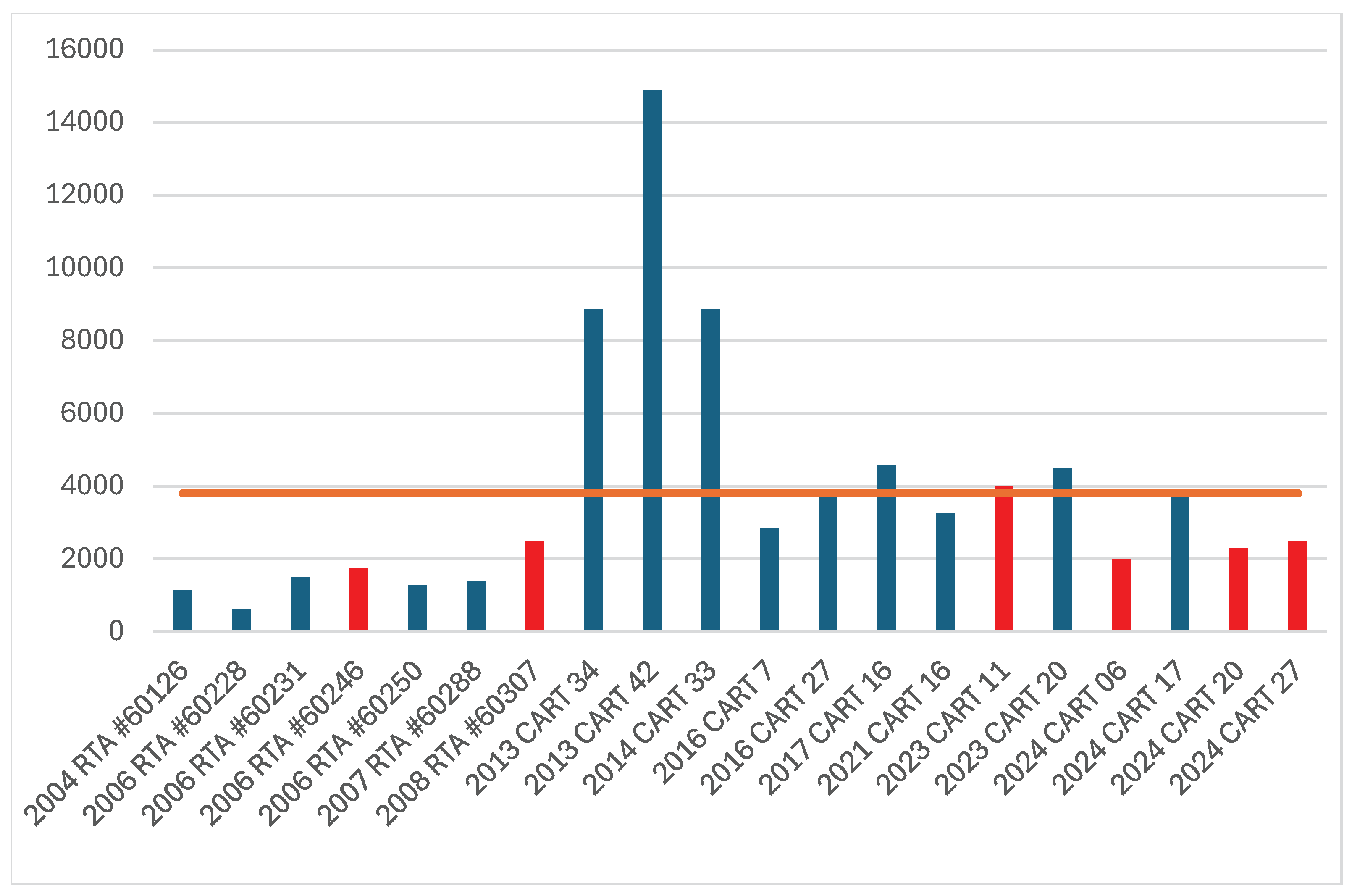

Table 1.
Change in the statuatory wording of the National Prohibition of Overcrowding.
| (Repealed) | Replaced 2020-04-22 |
| Prohibition of Overcrowding | Overcrowding |
| 140 (1) No person shall load or cause to be loaded any animal in any railway car, motor vehicle, aircraft, vessel, crate or container if, by so loading, that railway car, motor vehicle, aircraft, vessel, crate or container is crowded to such an extent as to be likely to cause injury or undue suffering to any animal therein. | 148 (1) No person shall load an animal, or cause one to be loaded, in a conveyance or container, other than a container that is used to transport an animal in an aircraft, in a manner that would result in the conveyance or container becoming overcrowded, or transport or confine an animal in a conveyance or container, or cause one to be transported or confined, in a conveyance or container that is overcrowded. |
| 2) No person shall transport or cause to be transported any animal in any railway car, motor vehicle, aircraft, vessel, crate or container that is crowded to such an extent as to be likely to cause injury or undue suffering to any animal therein. | (2) For the purposes of subsection (1), overcrowding occurs when, due to the number of animals in the container or conveyance, (a) the animal cannot maintain its preferred position or adjust its body position in order to protect itself from injuries or avoid being crushed or trampled; (b) the animal is likely to develop a pathological condition such as hyperthermia, hypothermia or frostbite; or (c) the animal is likely to suffer, sustain an injury or die. |
| 148.1 No person shall transport an animal by air, or cause one to be transported by air, unless it is transported in a container that meets the stocking density guidelines that are set out in the Live Animals Regulations, 44th edition, published by the International Air Transport Association, as amended from time to time. |
Table 2.
LLF-8, The Eight Fuller Characteristics of high-quality law and competent lawmaking.
| general | high specifying of the rules prohibiting or permitting behavior of certain kinds |
| widely promulgated |
publicly accessible rules as publicity of laws ensure citizens know what the law requires |
| prospective | specifying how individuals ought to behave in the future rather than prohibiting or sanctioning behavior that occurred in the past |
| clear | citizens should be able to identify what the laws prohibit, permit, or require |
| non-contradictory | one law cannot prohibit what another law permits |
| compliable | must not ask the impossible of the regulated |
| constant | the demands laws make on citizens should remain relatively constant, laws should not change frequently |
| congruence | there should be congruence between what written statute declares and how officials enforce those statutes. Congruence requires lawmakers to pass only laws that will be enforced and requires officials to enforce no more than is required by the laws. |
Table 3.
Summary of the decisions on appeal of violations due to overcrowding of livestock and poultry in transit.
Table 3.
Summary of the decisions on appeal of violations due to overcrowding of livestock and poultry in transit.
| Ref. No. | Reference | Words | Code | Math | Chair | Description | Sect. | Case turns on…. | Outcome | ||||||||||
| 2004 RTA #60126 |
F. Ménard Inc. v. Canada (CFIA) |
1137 | Y | N | TSB | August 4th, daily high of 29oC and high humidity, the Applicant loaded 115 hogs from several farms and transported them to the slaughterhouse. At the time of unloading 12 hogs were dead and the remainder of the lot were demonstrating symptoms related to heat stress. |
140(2) | The transporter did not decrease the floor pressure to the extent recommended by the Transport Code of Practice. | Notice upheld: The Applicant committed the violation and is liable for payment of the penalty in the amount of $2,000.00 to the Respondent within 30 days |
||||||||||
| 2006 RTA #60228 |
Transport Giannone- Garceau Inc. v. Canada (CFIA) |
624 | Y | Y | TSB | Applicant transported a load of chickens from Woodstock, ON to Drummondville, Quebec, (784 km) on the evening of Oct 4th and morning of October 5th. Eighty cages contained eight chickens each and five hundred and fifty-six cages contained seven chickens each. The chickens had an average live weight of 3.86 kilograms. A large number of dead birds were found in cages located in the centre of the trailer more than 10%. | 140(2) | The Transport Code recommends a maximum live weight loading density in cold weather of 63 kg/m2, equates to 7.4 chickens per cage in this case. | Notice upheld: The deaths (and undue suffering) of the chickens was caused by overcrowding in the circumstances and accordingly has established on a balance of probabilities that the Applicant committed the violation. Reduced the penalty from $4,400.00 to $2,200.00. |
||||||||||
| 2006 RTA #60231 |
René Nadeau v. Canada (CFIA) |
1497 |
Y |
Y |
TSB |
March 1st loaded 780 crates of 45 day old broiler chickens, to be transported to Grand River Poultry located in Beamsville, Ontario. At slaughter the birds were diverted to a second processor because they were too large for the processor settings. The weather conditions were fair and cool throughout transport, total travel time 26.5 hours. The Dead on arrival rate was 7.22%, 332 birds were condemned. . |
140(1) |
The recommended Code of practice for chickens the recommended maximum live weight loading floor pressure for crates in cold weather is 67.9 kgm- 2, whereas the density in this load was 71.8 kgm-2. | Notice upheld: Tribunal determined the Applicant committed the violation, by allowing these chickens to be crated and transported in the manner they were. and is liable for payment of the penalty of $2,000.00 to be paid within 30 days. |
||||||||||
| 2006 RTA #60246 |
Curtmar Farms Limited v. Canada (CFIA) |
1738 |
Y |
N |
TSB |
On March 6, two front compartments contained 12 calves in the upper section and 13 calves in the lower section on an overnight trip from Carbonear to Port aux Basques ND (866 km) took approximately ten to twelve hours and loaded on a ferry to Quebec. Weight of calves recorded but not area of compartment. |
140(1) |
Insufficient numerical data in the decision to calculate floor pressure. | Quashed: The evidence overcrowding is based almost entirely on the weight of the animals as estimated by the young and inexperienced driver, and which evidence has been put in considerable doubt by the direct evidence of the Applicant. |
||||||||||
| 2006 RTA #60250 |
Curtis Edwards v. Canada (CFIA) |
1266 | Y | N | TSB |
Loaded 45 cattle (cull dairy cows) at Prince Albert SK on Oct 26, and arrived at destination in Calgary AB on Oct. 27th, at noon, 741km distance. A downer animal was identified at Taber AB 701 km mark. This animal was Dead at arrival and 2 further animals were down. |
140(2) | The belly of the trailer contained one animal over the maximum recommended limit, and the back compartment contained 2 animals over the maximum recommended limit by reference to the Transport Code. |
Notice upheld: The Applicant committed the violation and is liable for payment of the penalty in the amount of $2,000.00 to the Respondent within 30 days. |
||||||||||
|
2007 RTA #60228 |
Timothy Wendzina v. Canada (CFIA) |
1398 |
Y |
N |
TSB |
March 1st, the Applicant transported a load of 38 dairy cattle (Holsteins with one Jersey) and a bull from the farm to XL Beef in Moose Jaw, SK approximately 250 km. The weather conditions were a temperature of -8oC, wind at 28 km/hr. gusting to 41 km/hr., windchill of -17 0C. It was overcast with light snow. On arrival there were multiple cows down in the belly of the trailer and ambulatory cattle had to be unloaded over top of one of them. Three animals were unable to stand, were recumbent, non- responsive, wet, covered in excrement, and killed on truck. |
140(2) |
The problem compartment was overcrowded by the Code standards, but dead cows were not weighed and other numerical facts do not appear in the decision. | Notice upheld: Tribunal determined the Applicant committed the violation and is liable for payment of a reduced penalty in the amount of $2,200.00. |
||||||||||
| 2008 RTA #60307 |
Brian’s Poultry Services Ltd. v. Canada (CFIA) |
2498 |
Y |
Y |
TSB |
On Oct 4, two loads of chicken; Load A 4,532 chickens (80 crates at 8 birds per crate and 556 crates at 7 birds per crate). The average weight per crate was 27.02 kg, 453 dead birds were found (10% of load). Load B 5,460 chickens (780 crates at 7 birds per crate). The average weight per cage was 26.88 kg 590 dead birds were found (10.8% of load). Both trucks travelled Woodstock ON to Drummondville PQ, 786 km |
140(1) |
BPS presented the Transport Code recommending the maximum live weight loading densities for chickens in crates in cold weather to be 63 kg/m2. Load A was 12.1% below the recommended maximum; and load B was 12.5% below the recommended maximum, Crate weight measured floor area of a crate not measured at inspection. |
Quashed: The Tribunal indicated that that death is evidence of suffering. Tribunal determined the Applicant did not commit the violation and is not liable for payment of the penalty. |
||||||||||
| 2013 CART 34 |
0830079 B.C. Ltd. v. Canada (CFIA) |
8864 |
Y |
N |
DB |
On July 25, transported 6,018 spent laying hens on 2 trailers: 3600 in Trailer A, 84 crates (28 chickens/crate) plus 48 crates (26 chickens/crate) and 2418 in trailer B, 96 crates (26 chickens/crate). At slaughter Trailer A had 703 DOA and Trailer B had 124 DOA. Size of crate not measured or not recorded in decision. |
142(2) |
Service contract stipulated 18 birds/crate. Code of practice recommended maximum was 19 bird/cage for trailer A and 18 bird/cage for trailer B. Actual number of birds loaded was 28 and 26 birds per cage. |
Notice upheld: On the balance of probabilities, the accused committed the violation and is liable to pay the respondent, the Canadian Food Inspection Agency, a monetary penalty of $3,000 within thirty (30) days (reduced from $6,000). |
||||||||||
|
2013 CART 42 |
Finley Transport Limited v. Canada (CFIA) |
14888 |
Y |
Y |
BLR |
August 5, afternoon 205 hogs loaded at Petrolia ON to Toronto ON slaughterhouse 278 km, at 300C; 3 dead on arrival one live unable to stand, dead in three different compartments. Pigs in respiratory distress, panting with oral froth. Recorded compartment floor space, pig weight not available assumed 230lb (105 kg). The 6 central compartments in the potbelly area of the trailer were loaded at 242 kgm-2. |
140(2) |
Finley did not adjust the number of pigs/compartments in response to the hot ambient temperatures. Ruled death was from heat exhaustion and death of this type is significantly foreseeable. | Notice upheld: Defence claimed preexisting heart conditions as cause of death. The Tribunal established, on the balance of probabilities, that the three hogs in question died from heat exhaustion due to overcrowding and orders t pay the Agency a monetary penalty of $6,000 within thirty (30) days |
||||||||||
| 2014 CART 33 |
Western Commercial Carriers Ltd. v. Canada (CFIA) |
8867 | Y | Y | DB | On July 1 the appellant transported 270, 113 kg pigs (best weather capacity of trailer though to be 280 pigs) in the early morning that day in Falher, AB and then driving the to Langley, BC (1,266 km). He arrived in Langley very early in the morning of July 2, 2013. At 07:00 that morning, as the pigs were unloaded at the slaughterhouse, 30 pigs were DOA and 1 distressed pig killed at unloading. |
140(1) | Did not reduce number loaded to 75% of his best weather load. Eight of the 12 compartments of the truck had dead hogs, with 4 compartments having 5 DOAs, no clustering within a compartment. Average floor pressure across 12 compartments was 251kgm-2 of live pig at loading. |
Notice upheld: On a balance of probabilities, the applicant, committed the alleged violation, and orders it to pay to the respondent, the amount of $6,000.00 within 30 days. |
||||||||||
|
2016 CART 07 |
TransVol Ltée v. Canada (Minister of |
2827 |
N |
N |
DB |
March 8 and 9 the appellant a commercial broiler chicken catching company loaded 7,340 birds into 734 cages, 10 birds each and 14 additional cages on the truckload left empty. The load arrived at slaughter in slightly more than |
140(1) |
TransVol does not contest the fact that the 20-bird cage was found on a truck, but rather it alleges that the particular cage in question was not filled or |
Notice upheld: On a balance of probabilities the applicant, TransVol Ltée., committed the alleged violation, and ordered it to pay, |
||||||||||
| Agriculture and Agri-Food Canada) | 1 hour. Upon arrival officials found 48 dead chickens and one cage containing 20 chickens with 6 dead. Only the one cage was considered overcrowded. | loaded onto the truck by its employees. It is impossible to cram 20 chickens weighing 2.37 kg into the type of cage used in this case; and some of the chickens must have been culls and weighed far less than the average 2.37 kg. |
the Canadian Food Inspection Agency, a monetary penalty in the amount of $7,800.00 within 30 days |
||||||||||||||||
| 2016 CART 27 |
Transport Robert Laplante & Fils Inc. v. Canada (CFIA) |
3696 | Y | N | DB |
On May 17, the applicant transported 237 pigs for 3 hours from farm to slaughter. Due to a miscalculation, he believed he had only loaded 232 pigs. On arrival 2 pigs were found DOA and 2 further pigs were stressed. |
140(2) | No numerical evidence, nor location of dead and compromised pigs was contained in the decision. | Notice upheld: On a balance of probabilities, the applicant, committed the alleged violation, and orders it to pay to the respondent, the amount of $6,600.00 within 30 days. |
||||||||||
| 2017 CART 16 |
Transport Eugène Nadeau v Canada (CFIA) |
4559 | Y | N | DB |
On May 14, an unusually hot day high 27.7 oC, the applicant transported 180 pigs coming from two barns about 70 km apart to the abattoir taking 9 hours (mechanical failure on road), arriving on May 15. At unloading 10 DOA on top deck, some of the surviving pigs appeared to be in distress. |
140(2) |
At the time of the incident the trailer compartments were measured and compared to the code maximum. No numerical evidence was recorded in the decision. |
Notice upheld: On a balance of probabilities, Transport Eugène Nadeau inc., committed the alleged violation. Ordered to pay the monetary penalty in the amount of $7,800.00 within 30 days. |
||||||||||
| 2021 CART 16 |
C.I. Hishon Transport Inc. v CFIA |
3251 | Y | Y | LB |
On July 13, 211 hogs weighing 125 kg were loaded into a trailer from three different farms located in relative proximity to each other in western Ontario. The load then made its 13-hour journey of about 725 km to the slaughterhouse facility in Saint-Esprit, Quebec. On arrival there were 7 dead and 2 in respiratory distress. |
140(2) |
Dead and compromised pigs were all confined to the rear compartment loaded at 334 kgm-2. With 7 pigs dead the floor pressure was reduced to 267 kgm-2 and 2 additional pigs were dying. |
Notice upheld: On a balance of probabilities The CFIA has demonstrated a causal link between Hishon Transport and the transport, the crowding, the actual injury and undue suffering confirmed the penalty in the amount of $7,800.00. |
||||||||||
|
2023 CART 11 |
Atkinson v CFIA |
4010 | Y | Y | MR | Brandon Manitoba 328 sheep to Slaughter in Ontario (no destination reported) three animals with injuries, each in separate compartments: a dead lamb, a downed cull ewe that was subsequently euthanized and a dead newborn lamb. |
148(1) |
Truckside calculations of floor pressure were presented as evidence. Inspectors were using transport Code of Practice standard, that evidence was not documented in the decision. Dead ewe was old and emaciated. |
Quashed - the Agency did not prove on the balance of probabilities overcrowding caused injury or undue suffering to the dead lamb or the downed cull ewe. |
||||||||||
| 2023 CART 20 |
Brussels Transport Ltd. v CFIA |
4482 |
Y |
Y |
PLF |
Denfield ON to Saint-Espirit PQ, 772 kilometers in 8.5 hours at 24-30oC. Of 170, 130 kg market hogs, five were found dead in 2 different compartments upon their arrival at slaughter: 3 of 24 (A) and 2 of 18(B). Other animals were observed in respiratory distress upon arrival. This federal slaughter facility documents and investigates loads with 3 or more DOA. |
148(1) |
The code requires reduction in crowding by 25% in hot weather. In Compartment A loaded at 238 kgm- 2 3 of 24 died; Compartment B, loaded at 314 kgm-2 , 2 of 18 died. The weather warrants a 25% reduction in floor pressure as recommended by the Code. |
Notice upheld. Brussels failed to reduce the density of hogs in two compartments by 25% in response to the hot, humid weather. Maximum loading pressure of market pigs in summer weather is 3/4 of 287 kgm-2 is 215 kgm-2 both compartments were overloaded, penalty of $13,000.00 confirmed. |
||||||||||
|
2024 CART 06 |
1230890 Ontario Limited v CFIA |
1993 |
Y |
Y |
EC |
Appellant confined 167, 128 kg, market hogs near Kerwood, ON, and transported them to Breslau, ON, 156 km at 270C, 1hr 29 min. Dead pigs were identified in 3 compartments. |
148(1) |
Adopted Ontario Pork recommendation that for ambient temperature from 240C to 280C reduce load by 15%. Tribunal compared the 10 compartments to the standing room only 287kgm-2. Compartments ranged from 103 to 245kgm-2. The most crowded compartment has reduced floor pressure by 14.6% and contained no dead pigs. |
Quashed - The Notice and its penalty of $10,000.00 are cancelled. Death by hyperthermia could not have been prevented by decreasing the crowding. Author Note: There is no ambient temperature where the transport of pigs is prohibited in Canada. |
||||||||||
| 2024 CART 17 |
Earl MacDonald and Son Transport Limited v CFIA |
3722 | Y | Y | GP | On August 10, 171 pigs were loaded and transported at 26-28 0C (840 km) in a triple axle potbelly trailer from Thamesville ON to Saint-Espirit PQ. In the rear compartment, 3 of 27 pigs loaded were dead on arrival. Some pigs were panting on arrival. but had no other abnormalities (hernia, lameness, etc.) and were placed in a pen to cool off under showers provided for this purpose. |
148(1) | Facts: 27 pigs. average 121 kg loaded in a compartment of 12.65 m2 a floor pressure of 258.3 kgm-2. Accepted maximum allowable floor pressure in standing room only pigs, to be 287 kgm-2. The Ontario Pork guide requires reduction by 15% in hot weather, or a maximum floor pressure of 244 kgm-2. The compartment was overloaded by 3 pigs. | Notice upheld: Violation occurred at the time of loading and did not require the death of pigs. Confirm the administrative monetary penalty provided for in Notice of Violation in the amount of $10,000. |
||||||||||
| 2024 CART 20 |
Vernla Livestock Inc. v CFIA |
2292 |
Y |
N |
PLF |
Two incidents where market pigs loaded 205 hogs on the 30th of Dec 2 pigs stressed and killed on arrival, and 260 hogs on 18th Jan 3 hogs DOA, 2 further hogs, were non-ambulatory on arrival and euthanized. First appeal where individual hog weight was estimated by the difference between loaded and empty trailer weight. |
148(1) |
Due to the number of animals in the container, an animal was likely to suffer, sustain an injury or die. This case is based on the likelihood of a future event. No floor pressure information was presented in the decision although CFIA calculations of floor pressure were accepted in evidence. |
Quashed: The Agency has the burden of proof. The Agency has not convinced me on a balance of probabilities that it was likely that an animal would suffer, sustain an injury or die due to the number of animals in the container. Penalty of $13,000.00 was cancelled. |
||||||||||
|
2024 CART 27 |
1230890 Ontario Limited v CFIA |
2487 |
Y |
Y |
MR |
On January 28, the Applicant loaded 270, 135 kg, market hogs at a farm and transported them to an abattoir. Eight compartments held 30 hogs each and 2 compartments held 15 hogs. The load arrived with 7 dead hogs and 3 non- ambulatory hogs distributed in 6 compartments. At unloading pigs were panting, an unusual presentation in winter. |
148(2) |
Due to the number of animals in the container, an animal was likely to suffer, sustain an injury or die. This case is based on the likelihood of a future event. It is not “outcome-based” as argued by the Agency. No floor pressure information was presented in the decision although CFIA calculations of floor pressure were accepted in evidence. |
Quashed: The Agency has the burden of proof. The Agency has not convinced me on a balance of probabilities that it was likely that an animal would suffer, sustain an injury or die due to the number of animals in the container. Penalty of $13,000.00 was cancelled. |
||||||||||
Note: Accepted soft law maximum allowable floor pressure in standing room only pigs, best possible weather and trip duration 3 hours or less to be 287 kgm-2. Where the word code is used in this tablet it refers to the 2001 Humane Transport code.
Disclaimer/Publisher’s Note: The statements, opinions and data contained in all publications are solely those of the individual author(s) and contributor(s) and not of MDPI and/or the editor(s). MDPI and/or the editor(s) disclaim responsibility for any injury to people or property resulting from any ideas, methods, instructions or products referred to in the content. |
© 2025 by the authors. Licensee MDPI, Basel, Switzerland. This article is an open access article distributed under the terms and conditions of the Creative Commons Attribution (CC BY) license (http://creativecommons.org/licenses/by/4.0/).
Copyright: This open access article is published under a Creative Commons CC BY 4.0 license, which permit the free download, distribution, and reuse, provided that the author and preprint are cited in any reuse.


