

Submitted:
21 November 2024
Posted:
22 November 2024
You are already at the latest version
Abstract
The study analysed the problem of overtourism in Szklarska Poreba and the Karkonosze Mts National Park [KNP] (Poland, Lower Silesia voivodeship), i.e. the protected area directly associated with the city and municipality of Szklarska Poreba. The aim of the study was 1.to determine whether the phenomenon of overtourism occurs in this area and 2. what is its intensity. Statistical data of the Central Statistical Office (CSO), statistical data collected by KNP and the Municipal Office in Szklarska Poręba regarding the number of inhabitants, number of tourists, number of beds, number of tickets sold to KNP facilities in 2010-2022 were analysed. The study used chamber methods (analysis of literature and acquired statistical data) and field methods (field inspection, field verification of source data, execution and analysis of field documentation). Data made available by the administration of the Karkonosze Mts National Park, the Municipal Office in Szklarska Poreba and the management of the Sudety Lift sp. z o.o. cable car in Szklarska Poreba were used. The data collected included:
- number of Karkonosze Mts National Park entrance tickets sold at the toll booths;
- number of nights spent in Szklarska Poreba;
- number of tourists using the tourist information office;
- the number of passengers using the cableway, separately in the summer and winter seasons.
As a result of the analysis, solutions were proposed in two categories of efficiency, i.e. 1. to be implemented in the KMtsPN area; 2. to be implemented by local authorities in the Szklarska Poręba Municipality. These solutions will bring, especially the areas of the commune, closer to acceptable conditions for ecosystem services and sustainable development.
Keywords:
overtourism
; spatial conflicts
; protected areas
; national parks
1. Introduction
Tourism for some is a barbarian invasion, for others a contemporary ritual. Some see it as a commercial venture, others as an interesting intercultural meeting ground. In many societies it has become an integral part of lifestyle, a sign of social status and a form of therapy. A characteristic feature of modern tourism is its massification and spatial expansion. It is covering more and more regions, including peripheral ones [1]. For years, it has also been associated with areas with different cultures and socio-political conditions, including areas with various types of conflict [2].
Over the past sixty years, tourism has been one of the fastest growing economic sectors in the world [3]. Until the COVID-19 pandemic, it was an important economic sector in many countries, especially in cities, creating both substantial income and many jobs. However, not all cities were able to cope with the rapidly increasing number of tourists. The increasing, even uncontrolled, number of tourist arrivals has overburdened municipal infrastructure in cities, increasing prices and the cost of living while decreasing the quality of life [3,4]. There has also been an increased use of natural resources and increased conflicts with residents [5,6].
At the beginning of the 21st century, the term overtourism appeared on social media and in the press [7]. Although it was relatively new, the phenomenon of overtourism itself was not new. Already in the 1970s, studies were conducted indicating the pressure of tourism on local communities and the natural environment. Reference can be model of changes in local people's attitudes towards tourists [8], or tourist area life cycle [9]. These works explicitly highlight the potential negative impacts of rapidly growing touristics [3]. However, none of them directly address the phenomenon of overtourism. Also since the 1970s, numerous publications have presented the problem of determining thresholds and tourist absorption.
Problems related to the phenomenon of overtourism have been addressed in various scientific publications for several decades [10]. The need to create a new form of tourism that could bring the greatest possible benefits to travellers, the local population and the tourism industry as a whole without causing damage to the natural and social environment was pointed out by [11]. Achieving this goal was, in his view, to be made possible by the emergence of a revolt by both tourists and the local population.
The negative impacts of tourism on the quality of life of the local population include, in particular, congestion, increased costs, higher crime rates and conflicts between tourists and locals, also known as adverse 'host-guest' relationships [12,13]. The developing conflicts between local people and incoming tourists using the example of mass tourism development in Malta is presented in a study edited by [14]. Problems of tourism and resource management in cities, including the impact of the tourism industry and increasing numbers of tourists on the transformation of the identity of local residents is discussed in a book by [15]. The need for a symbiotic relationship between visitors and hosts, the benefits and risks of tourism, and the possibilities of regulating its development have been written about by [16].
According to the definition adopted by the World Conference on Sustainable Tourism, held in Lanzarote (Canary Islands, 27-28 April 1995), in the Charter for Sustainable Tourism, 'development influenced by tourism should relate to the principle of sustainable development, meaning that it must take into account the sustainability of the functioning of nature, it must relate to the economy concerned, and it must ethically and socially be adapted to the norms of the community'. In contrast, a definition of overtourism was first provided by[17]. Another definition of the term given by the United Nations World Tourism Organisation (UNWTO) stated that overtourism is the impact of tourism on a destination or parts of a destination excessively, even negatively, affecting the perceived quality of life of residents and/or the quality of experience of visitors [4,6]. In contrast, a definition developed by the Responsible Tourism Partnership defines the phenomenon of overtourism as "destinations where hosts or visitors, locals or tourists believe that there are too many visitors and that the quality of life in the area or the quality of experience has unacceptably deteriorated". An expanded definition provided by [18] specifies that overtourism is "an excessive increase in the number of visitors, leading to overcrowding in areas where residents suffer from temporary and seasonal tourist peaks that have forced permanent changes in their lifestyle, access to amenities and overall well-being". Overtourism is also the acceleration and growth of tourism supply and demand, the exploitation of natural natural resources, the destruction of cultural attractions of tourist destinations and the negative impact on their social and economic environment [19]. Crisis situations arise due to the overexpansion of tourists, e.g. in Barcelona, Venice [5], the island of Zakynthos [20], or Iceland [21,22].
The occurrence of ouertourism is related to the increasing development of mass tourism and the growing number of challenges resulting from the intensity of tourism [23]. Overtourism is defined as the phenomenon of over-concentration of tourism and excessive growth in visitor numbers leading to overcrowding in tourist reception areas [10], with negative consequences for both local communities and tourists themselves [17]. Overtourism is the opposite of sustainable tourism [17], and can lead to social tensions between visitors and hosts, due to a reduction in the quality of life of permanent residents [7]. In each community, all of these attitudes usually occur simultaneously, but the proportions in which they occur [24]. In the literature, the Venetian syndrome is known as „the vicious circle of tourism development” [25]. The proliferation of overtourism can cause a loss of authenticity of places considered attractive for tourism (threatening cultural and natural heritage) and poses a high risk to the future attractiveness of destinations [4,17,26]. The social problem of residents leaving city centres and changing their place of residence and stay is also a problem, leading to gentrification of the historic centre (e.g. Krakow, Berlin, Barcelona) [27,28,29,30].
The proper delimitation of growth boundaries and sufficiently early management of success defined by the scale of popularity of an area is also particularly important because the effects of tourism overconcentration are easier to prevent than to counteract once they have occurred.Areas where the phenomenon of overtourism is most noticeable can be considered to have suffered from their own success.Significant popularity, which can be a source of pride from certain points of view, turns into a huge source of social conflict, including between those responsible for organising tourism and the local community [20,23,31]. Conflict takes on clearly antagonistic attitudes and opposes the arrival of more tourists in a given place, as their influx hinders the daily life of the locals [5,32]. Tourists consume existing resources in an area, organisers increase their income, but the repair of damage, renovation and ongoing maintenance of reception sites are dealt with by residents and local services, incurring significant financial losses [17]. On the other hand, the limited availability of sites due to excessive numbers of visitors at the same time causes dissatisfaction and frustration among tourists.
Prior to the COVID-19 pandemic, overtourism had become a major challenge for many tourist destinations.In addition to negative impacts on the physical environment and the quality of the tourist experience, overtourism has been characterised as a phenomenon that reduces the quality of life of local residents [7]. At the same time, tourism can also have a positive impact on the quality of life of residents, for example in the form of job creation, increased income and increased services that benefit both tourists and residents [33,34]. The concept of overtourism is thus based on the idea that there is a limit to tourism development at which the negative impacts of tourism begin to outweigh the positive ones [35,36].
Overtourism mainly manifests itself as crowding, which refers to the perception of the „confined aspects of limited space”, and can therefore be described as an emotional response to density [37]. As a result of crowding, residents of tourist destinations may lose their sense of belonging, feel alienated or frustrated towards outside visitors [21]. Crowding can occur in urban and residential areas, for example in the form of congested transport infrastructure and competition for access to services and amenities [7,21], but a feeling of congestion can also occur in natural areas, which are often important destinations for domestic tourism.In this case, congestion may limit the opportunities for locals to engage in domestic tourism, e.g. by ejecting them from tourist facilities [22]. Large numbers of foreign tourists may necessitate access restrictions for locals as well [38,39] and make locals feel as if they are competing with tourists for access to tourist and recreational facilities [40]. Such restrictions on the ability of locals to engage in domestic tourism have been shown to reduce their support for tourism [22,40,41]. It is generally acknowledged that, as a result of globalisation, cultural change and socio-economic modernisation, overtourism, widely varying in form and scale, has become a significant social phenomenon leading to the transformation of cities [5]. Although the phenomenon of overtourism figures prominently in the literature, research conducted on this issue has mainly focused on Western European and American cities, e.g. Venice, Barcelona, New York [7,17,18,42,43]. On the other hand, few publications deal with tourist cities in Central and Eastern Europe [44,45,46,47] and the impact of intensive tourism on local communities was most often shown in the studies conducted there. Moreover, the attitudes and opinions of foreigners living in tourist cities have rarely been presented or even ignored [48,49]. Using Prague (Czech Republic) as an example, it was shown that according to foreign residents of a tourist city, intensive tourist traffic is a problem that significantly reduces their quality of life in the city. Among the most frequently cited hindrances are inflated housing prices, crowding and the ever-increasing cost of living in Prague. Regulations of prices and rules for short-term rentals, dispersal of tourist traffic, promotion of other places and the use of fines and penalties are most often suggested as expected solutions [49]. Currently, the problem of depopulation of historic districts and changes in their functions and the creation of artificial enclaves saturated with tourist services, but at the same time losing the historic character of the place, is visible not only in Western European cities, but also concerns various places in Poland, both cities (e.g.Krakow, Zakopane, Kazimierz Dolny on the Vistula River), as well as protected areas (e.g. the area around Morskie Oko and Giewont in the Tatra Mts National Park, Śnieżka in the Karkonosze Mts National Park and many mountain hiking trails in the Carpathians and Sudetes). A special and quite controversial element of development facilitating access to protected areas and contributing, in turn, to increased congestion are cable cars and ski lifts. Among Polish national parks, infrastructure of this kind is particularly developed in the Karkonoski National Park and the Ttrzański National Park [50].
Overtourism is already a well-described phenomenon, mainly related to negative experiences resulting from the presence of too many tourists in certain places and times. However, such an approach is somewhat of a simplification, as the phenomenon of overtourism is much broader and more complex [7]. It affects not only the living conditions in a place, but also the experiences of residents, visitors and other stakeholders who are directly or indirectly involved in tourism [3,51]. It cannot only be seen in terms of overtourism in cities, but also as a social and ethical problem. Indeed, Overtourism is often associated with conflict in the broadest sense [5,52,53,54]. Closely related to this is the interpretation and at the same time criticism of the contemporary tourism industry, which is in many cases a disguised neo-colonialism [55]. The tourism economy has been hitting the natural environment and the poorest part of the world's population for years. We transform and occupy the space needed for tourism without taking responsibility for what happens to it afterwards. Indeed, it is not ethical for a privileged group benefiting from tourism to maintain its unsustainable lifestyle at the expense of other people. However, not all authors presenting the problems of overtourism and uncontrolled tourism development use the concept of overtourism [56,57]. The one of the first critical works on the development of mass tourism was a study by [58]. In it, the authors pointed to the imperial nature of tourism, a point also made a few years later by [59], who described it as a new form of migration of people from industrially developed and polluted centres to warm, less dynamic and clean peripheral areas. Subject to commercialisation, the interaction of tourists with the local population is superficial and marked by mutual prejudice [58].
It is presumed that overtourism can prompt local governments or managers of tourist attractions and entrepreneurs to take action towards sustainability. Its essence is the long-term prevention and minimisation of conflicts that may affect tourism development. Various tourism management techniques can be used to counteract the negative impacts of excessive tourism on tourist attractions [60]. A new trend in research dedicated to regional aspects of tourism development is research using the concept of conflict management [61,62]. However, managing the conflict caused by the phenomenon of overtourism is a huge challenge not only for tourism cities [47,63], but also for other types of destinations (destinations) attempting to implement sustainable tourism development strategies [19]. It is now recommended that in cities where tourism is an important economic sector, there should be a reorganisation of tourism and a change in management towards more sustainable management [64]. This is to avoid leading to pre-pandemic COVID-19 problems in the future [65]. Of current relevance in the discussion on the phenomenon of overtourism is the current global situation caused by the COVID-19 pandemic. On the one hand, it provoked the collapse of the tourism industry and caused a number of negative consequences [66], but the impact of the pandemic and the worldwide economic crisis will perhaps force countries and local authorities to pay more attention to tourism in rebuilding their economies [67] and this will be possible in a more stable political situation in many regions than at present. The discussion of a post-pandemic tourism vision [68] shows that the analysis of overtourism is gaining new relevance for sustainable urban tourism planning and management.
Most studies on overtourism and its impact on residents have focused on urban and populated areas [7,69,70], but residents can also be affected by overtourism occurring in naturally valuable areas [21,22,37]. Natural areas are often of particular importance to local residents as places for recreation and domestic tourism thus contributing to their quality of life [39]. However, prior to the COVID-19 pandemic, over-tourism was also a major challenge for many nature-based tourism destinations around the world and led to perceptions of reduced tourism opportunities for locals. The development of tourism in nature-based destinations can support domestic tourism, including through the expansion of infrastructure and accessibility or the development of tourist attractions of interest to both international and domestic tourists [33]. Overtourism can have a negative impact on the ability of local residents to enjoy domestic tourism and, for example, lead to the expulsion and displacement of domestic tourists from crowded tourist destinations [38,40].
The phenomenon of overturism also occurred in Iceland [21,22], where, prior to the COVID-19 pandemic, congestion became problematic in several popular tourist destinations and affected the experiences of both foreign [12,13] and domestic tourists [13,33,34]. More than 90 per cent of tourists claimed before the COVID-19 pandemic that one of the main reasons for visiting Iceland was to experience the country's nature, which is the main attraction of the country [7]. As international travel restrictions were established in Iceland, therefore, foreign tourist arrivals in 2020 decreased by 75% compared to the previous year (from 2 million in 2019 to less than 500,000 in 2020).However, there were no restrictions on domestic travel in Iceland in 2020.On the contrary, the Icelandic government actively encouraged the local population to travel domestically, and eventually 86% of the local population said they had travelled domestically in 2020 [36,41]. The COVID-19 pandemic brought an abrupt halt to over-tourism worldwide as travel restrictions were put in place, causing severe economic repercussions [67]. However, it is essential to develop and understand how to manage and plan for post-pandemic tourism [41].
2. Research Problem
The study analysed the problem of the phenomenon of overtourism in Szklarska Poreba and the Karkonosze Mts National Park (Poland, Lower Silesia Province), i.e. the protected area directly associated with the city and municipality of Szklarska Poreba. The aim of the study was 1.to determine whether the phenomenon of overtourism occurs in this area and 2. what is its intensity. Statistics of the Central Statistical Office (CSO), statistics collected by KMtsNP and the Municipal Office in Szklarska Poręba were analysed, concerning the number of inhabitants, number of tourists, number of beds, number of tickets sold to KMtsNP facilities in 2010-2022.
3. Methods - Data Sources
The study made use of chamber methods (analysis of literature and acquired statistical data) and field methods (field inspection, field verification of source data, execution and analysis of field documentation). Data prepared by the Accessibility Department of the Karkonosze Mts National Park, the Marketing Department of the Municipal Office in Szklarska Poreba, and the management of the Sudety Lift sp. z o.o. cable car in Szklarska Poreba were also used. The data obtained from the aforementioned institutions were as follows:
- -
- annual number of Karkonosze Mts National Park entrance tickets sold at the toll booths;
- -
- number of overnight stays based on the amount of local fees paid to the Town Hall of Szklarska Poręba;
- -
- number of tourists visiting the Tourist Information;
- -
- number of passengers entering Szrenica in the summer and winter seasons.
4. Study Area
The Karkonosze Mts National Park [next - KMtsNP] was established in 1959 [71], and is located in the Lower Silesian Province. The Park (area 5951.42 ha, area of the buffer zone 13 093 ha) provides protection for the most beautiful and scenically valuable areas such as gołoborza, glacial cirques, grassland communities, raised bogs, dwarf pine thickets. The park, to which admission is charged, has a very diverse and extensive tourist infrastructure for hikers, skiers and cyclists. The park covers the municipalities of: Karpacz (34%), Jelenia Góra (29%), Szklarska Poręba (17%), Podgórzyn (9%), Piechowice (95) and Kowary (2%). The town of Szklarska Poręba is located in the south-western part of Poland in the Lower Silesian Voivodship (Karkonosze County) (Figure 1). The town developed in the valley of the Kamienna River and its tributaries at an altitude of 440-886 m above sea level. It is surrounded by mountains: the Karkonosze Mountains in the south, the Jizera Mountains and the Black Mountain in the north and the Foothills in the east; it borders the Czech Republic in the south. The city is connected with other regions of the country by a well-developed road and rail infrastructure.
The town has a population of 5872 (CSO data, 2022) and an area of 75.44 km2, which translates into a population density of 77 persons /km2. The specific alpine climate is created by the nearby peat bogs of the Izera Mountains. Protected areas, mainly the Karkonosze Mts National Park, cover 14% of the municipality's area. There are historical buildings listed in the register of the National Institute.
5. Results
5.1. Tourism Development in Szklarska Poręba Community
The number of tourist accommodation places in the municipality of Szklarska Poręba was 7154 in 2023 (Figure 2) and a number that has been steadily increasing since 2015. Importantly, the number of accommodation facilities is decreasing. In 2021, this decrease can be linked to the business closure necessitated by the COVID-19 pandemic in 2020, during which tourists often opted to travel without staying overnight at a location; short day trips predominated. Among the accommodation facilities, hotels constitute the largest group, followed by guest houses, private accommodation (guest rooms) and hostels. A decline in the number of catering establishments is discernible after 2019. The pandemic situation necessitated the closure of many establishments as it was not profitable to maintain them without sufficient profits. The lack of catering facilities is evidenced by the long queues of people waiting for vacant places at lunchtimes or in the evenings.
Tourism in the Szklarska Poręba Community is developing at a rapid pace. For years, there has been a noticeable upward trend in the number of tourists here. The town welcomes crowds of tourists every year, regardless of the season, thanks to an extensive tourist base and many attractions based on the nature of the national park. Cycling routes total more than 200 km. A year-round chairlift connects the town with Szrenica, a mountain peak in the KMtsNP. It also operates as part of SkiArena Szrenica (a complex of ski runs). Tourist traffic, analysed between 2007 and 2022, has clearly increased (Table 1). In 2020, despite the COVID-19 pandemic, the number of nights provided was only slightly lower than in 2019. Since 2018, the number of bednights provided has been around 1 million per year. In 2021, the number of overnight stays is lower, reaching around 800,000, but the pandemic and the incomplete data analysed, omitting December, when tourist traffic is particularly high, must be taken into account. Despite the diverse and numerous offer of accommodation and eateries, it is noticeable that the infrastructure is overcrowded and increasingly inefficient during the peak tourist season. There is a shortage of accommodation and parking facilities. Traffic on the streets, especially during rush hour, is very difficult; traffic jams form and cars pose a danger to tourists on foot.
The number of visitors to the tourist information point was the highest in 2016 and decreased thereafter. By far the fewest people turned up in 2020, but in 2021 an increase in numbers is already visible. The decrease in visitors to the tourist information point from 2016, while at the same time the influx of tourists is increasing, can be linked to the development of the Internet, thanks to which almost everyone has access to relevant information via the Internet. Websites provide a wealth of information on places to visit, monuments, trails, entrance tickets. Technological progress contributes to a decrease in tourists visiting tourist information, but at the same time it is a factor that contributes to an increase in travellers, translating into the phenomenon of over-tourism.
In the case of foreign tourists, the number of nights provided, in the analysed interval 2011-2022, totalled approximately more 78,000 (Table 1). Until 2018, the number of foreign tourists remained at a similar level, and in 2019 and 2020, despite the pandemic, the figures were significantly higher than before. It can be seen that foreign tourist interest in this tourist region is increasing, despite the unfavourable conditions for travel and the imposed pandemic restrictions. It is expected that the trend of increasing visitor numbers will continue after the pandemic. A comparison of the number of chairlift customers between 2016 and 2022-2023 in the summer season for lift section I, which includes the entrance only to the intermediate station below the border of the Karkonosze Mts National Park, shows an increase up to 2017 (Table 1). In contrast, the number of entries in section II (KMtsNP area) is increasing year on year, regardless of the season (summer: V-X; winter: XII-IV).
5.2. Tourism Development in Karkonosze Mts National Park
There is a dense and numerous network of marked trails in the Karkonosze with a length of approximately 350 km. In the Karkonosze Mts National Park alone there are 32 trails with a total length of 112 km. Skiing tourism is served by two extensive complexes, namely Kopa and Szrenica, comprising over a dozen ski runs and lifts. The Park's strict protection zone contains a large concentration of technical infrastructure facilities, such as mountain huts and scientific and educational facilities. Almost 10.5 million tourists visited KMtsNP area between 2010 and June 2021 (Table 2, Figure 3). Data obtained from ticket sales show a threefold increase in the number of KMtsNP visitors in the last decade (2010: 500,000 tickets, 2021: 1.5 million tickets). Interestingly, in pandemic 2020, the number of tickets sold increased by 8.5 thousand compared to 2019, while in 2021 the increase compared to 2020 is 230 thousand. Perhaps tourists were more likely to choose Poland due to restrictions on foreign travel and the introduced tourist voucher. Perhaps the form of sales, i.e. the possibility from 2019 to purchase KMtsNP entrance tickets online, translates into increased interest. In the year of the introduction of online tickets, their sales amounted to 19,000, and two years later, i.e. in 2021, approximately 93,000.
Most tourists visit the following toll points in Szklarska Poreba: "Szklarka" and "Kamieńczyk Waterfall", "Szrenica Mountain" and "Kamieńczyk Gate" (Figure 4).
The number of people using the entrances in section two in the summer season (Table 3) has been increasing since 2016 except for 2023, but has remained at a similar level of between 120,000-140,000. The number of customers using the cable car entrances to the national park in the winter, has been clearly increasing since the 2015/2016 season, in 2020 the decrease was quite noticeable, but the 2020/21 season definitely exceeded the number of tourists in previous years. Despite the lack of data for the 2021/22 season, a high change from the previous season is expected. The winter season is attractive to tourists because of the winter sports opportunities. Interest among visitors in the lifts during this season is higher each year than in the summer season.
6. Conclusions and Implications
The phenomenon of overtourism in Poland is particularly noticeable in areas associated with protected areas - valuable in terms of nature or culture. These areas attract tourists due to their scenic, cultural and natural values. We are talking here about mountain areas, coastal areas or lake districts. Cities such as Kraków, Poznań or Warsaw are also places where tourist traffic is particularly noticeable. Every year, there is an increase in tourist traffic in their various, often distinctive periods, namely summer, winter and long weekends. Particular areas where this phenomenon is very noticeable are national parks. The impact of tourism on protected areas is associated with many negative consequences for the environment, such as synanthropisation of flora and fauna, degradation of biocenoses, fragmentation of communities and ecosystems, degradation of biodiversity or pollution of the environment, among others. Excessive concentration of tourism in protected areas is a phenomenon which requires intervention and taking decisive measures in such a way that tourism is sustainable and valuable environmental values are harmed as little as possible for the present and especially future generations.
More and more willingly and frequently in Poland, tourists are choosing to travel to places that will provide them with a break from their busy everyday lives. The motive for tourist trips then becomes learning about and discovering the richness of nature, as well as admiring beautiful landscapes. Protected areas are therefore attractive to an ever-increasing number of tourists. In Poland, in national parks, tourist traffic is concentrated in several areas of geographical space, i.e. in coastal parks - Wolin, mountain parks – Karkonosze Mts, Tatra Mts, Pieniny Mts and in suburban zones – Ojców Mts, Kampinos, Wielkopolska and Świętokrzyski [72]. At the same time, tourists' demands for attractiveness and quality of environment and recreation are increasing. The development of tourism in Poland should pursue a policy based on partially opening up protected areas to people. These should be places that allow for tranquillity, contemplation and at the same time are a sanctuary of the least altered nature. It is important that tourism in protected areas does not become massive, spontaneous or uncontrolled.
The area of the Karkonosze Mts National Park and the municipality of Szklarska Poręba are visited by an increasing number of tourists every year. The pace of tourism development should be subject to concise, clear limits. The development of the tourism sector is important, because with it comes the development of the village, however, with the phenomenon of overtourism, which is increasingly beginning to affect the KMtsNP, this sector should be subjected to greater rigour in the use of nature. Of course, we are aware that neither the KMtsNP nor the Sudetenland region is as popular as the Mediterranean coast, European city capitals or, in Poland, Krakow, Warsaw and Gdansk. Proportionally, however, taking into account the size of the area diagnosed in the article and the natural values, the phenomenon of over tourism raises serious concerns. At the same time, the use of the natural environment by tourist traffic should be limited enough to ensure maximum protection of nature for years to come [73]. At the same time, it is necessary to realise the expectations of tourists, who, however, should be made aware of the essence and sense of the introduced protective rigours by tourism animators. In the protective tasks for the years 2020-2021 for the Karkonosze Mts National Park [74], three conflict areas related to the development of tourism were distinguished, and within these planes the most unfavourable changes caused by excessive numbers of tourists are noted. These areas of conflict are: tourism infrastructure, hiking and downhill skiing. Importantly, the areas where tourism is concentrated in the Krkonoše are the areas in the strict protection zone, as this is where the most valuable landscape and natural values are concentrated. In the Karkonosze Mts National Park there is a very high accumulation of tourist infrastructure, which disturbs the mountain landscape through large-scale spatial forms. Unfortunately, the greater the development of tourism, the greater the pressure to expand and develop further technical infrastructure. A perfect example of the consumption of space for tourism purposes can be cited here - the "Gołębiewski" hotel - visible from almost all tourist routes, which plays an extremely important role in the process of landscape perception [75].
New tourist infrastructure should be located outside the protected area in a way that fits the prevailing natural conditions and takes into account harmony with nature. It is also important that ski lifts are located outside strictly protected areas, in areas that are less valuable in terms of environmental values. In order to preserve valuable landscapes, it is necessary to limit access and thus regulate the number of people using them. In Szklarska Poręba, it is necessary to ensure that residents can develop their tourism business, but at the same time take care of the natural values. The surroundings of Szklarska Poręba, rich in tourist infrastructure facilities, could also be used and tourists could be offered an alternative to go to the mountains in the form of organised trips to the Jelenia Góra Valley, for example to agro-tourism stables (Gostar or Rybnica), palaces and castles (the Castle of Silesian Legends in Pławna), spas (Cieplice, Świeradów-Czerawa). It is important that the benefits of tourism are a positive experience for both the local community and tourists.
An element that has significantly influenced the phenomenon of overtourism is the Covid-19 pandemic, which has significantly affected the tourism sector in 2020. Intense tourism and its various manifestations (business tourism, sightseeing, specialised tourism, etc.) came to a halt for a period of time. The result of the downturn was a negative economic impact felt by many countries in terms of general income, but also created economic problems affecting specific regions making their living from the tourism sector. In contrast, the natural environment has had a positive impact. The air, flora, fauna, water and soil, which had been subject to pollution and degradation year after year in many parts of the world by increased tourism (overtourism), were relieved for a period. It is undeniable, however, that by 2020 tourism was growing at a very fast pace and the phenomenon of overtourism was noticeable in many places. In Poland, when opportunities to travel abroad were limited, tourists increasingly and willingly opted for domestic tourism. Its destinations were massively visited protected areas, mainly national parks. Currently, when the situation is slowly stabilising and returning to normal, one may fear an acceleration of the pressure of tourism on the environment, as if to compensate for the economic stagnation of the tourism sector. It may be thought that the driving force is the isolation enforced by the pandemic, the restrictions on freedom of movement and the resulting difficulty in fulfilling the need for contact and leisure
One is the negative perception of tourists and residents. The city struggles with traffic problems, mainly during peak seasons and long weekends. Traffic jams form in the city, particularly troublesome during rush hour. This makes communication difficult for residents who, after all, live in the city - working, studying, shopping. Tourists are also unhappy when they have to wait a long time in line to get to the ski lift, to the car park at the trailhead. The town authorities are planning to remedy this problem by launching a Ski-bus (a bus operating in public transport rakes taking tourists up Szrenica to the ski slope) with a route designed to avoid traffic jams and encourage tourists, especially those staying overnight in the town, to set off for the ski slopes by public transport. Such a solution would reduce traffic jams, the problem of available parking spaces, and emissions from exhaust fumes into the environment.
Another consequence of too many tourists is the inefficiency of the catering facilities. Every day, at lunchtime, it is impossible to get to an inn or restaurant without waiting a minimum of 30 minutes in line. Szklarska Poreba, despite its rich tourist facilities, is becoming increasingly crowded with tourists. Walking along the main road in the town should be a pleasure, but it resembles moving along with the mass of other visitors and forces one to watch out for cars. This form of leisure in a tourist destination certainly does not bring the expected relaxation. The village is starting to resemble a big city, where well-known chain shops are put up against the local community and their small businesses. Proposed solutions to reduce excessive tourism in the Karkonosze Mts National Park and Szklarska Poreba are as follows:
A. Solutions dedicated to the management of the Karkonosze Mts National Park (protected area):
- -
- limit the number of tourists who can enter the protected area each day through a given ticket office and in the strict protection area, especially in the neighbourhood tourist hostel, attention should be paid to waste disposal,
- -
- place information boards along the hiking trails, highlighting the importance of the environmental and cultural values of the park,
- -
- secure tourist trails against their trampling and widening by tourists,
- -
- create a plan for making the area of the park and its surroundings accessible, so that its findings can be transferred to local planning. Plans for making the areas of the Karkonosze Mts National Park accessible should be created with the cooperation of all stakeholders: tourism organisers, local community and naturalists/ecologists.
B. Solutions dedicated to the municipality of Szklarska Poreba (reception area):
- -
- improve public transport and cycling by launching additional public transport and the creation of bicycle routes to nearby towns; this can reduce traffic jams in the city, exhaust emissions and noise from private cars of tourists
- -
- introduce high parking fees in the city centre
- -
- promote nearby resorts and towns and encourage visits outside the high season (peak summer season and peak winter season) through the development of resort and spa facilities; promote ecotourism and the creation of unique tourism products related to the culture and folklore of the region, implemented in Szklarska Poręba and surrounding towns.
References
- Durydiwka M. 2009. Ruch turystyczny – z centrum ku peryferiom. Prace i Studia Geograficzne, 42: 59-71.
- Weaver D. B. 2001. Ecotourism in the context of other tourism types. [in]: D. B. Weaver (ed), The Encyclopedia of Ecotourism, CABI Publishing, new York, pp. 73-83.
- Peeters P., Góssling S., Klijs J., Milano C., Novelli M., Postma A. 2018. Research for TRAN Committee — Overtourism: impact and possible policy responses. European Parliament, Poli cy Department for Structural and Cohesion Policies. Brussels.
- Koens K., Postma A., Papp B., Yeoman I. 2018. “Overtourism”? – Understanding and Managing Urban Tourism Growth beyond Perceptions World Tourism Organization. [CrossRef]
- Kowalczyk-Anioł J., Zmyślony P. 2017. Turystyka miejska jako źródło protestów społecznych: przykłady Wenecji i Barcelony. Turystyka Kulturowa, 2, ss. 7-36.
- UNWTO 2018. Overtourism? – Understanding and Managing Urban Tourism Growth beyond Perceptions, Executive Summary. Madrid. [CrossRef]
- Koens K., Postma A., Papp B. 2018. Is overtourism overused? Understanding the impact of tourism in a city context. Sustainability, 20, 4384. [CrossRef]
- Doxey G.V. 1975. A Causation theory of visitor-resident irritants, methodology and research in-ferences: The impact of tourism. [in]: Sixth Annual Conference Proceedings of the Travel Re search Association (pp. 195-198). San Diego: TTRA.
- Butler R. W. 1980. The concept of a tourist area cycle of evolution: Implications for management of resources. The Canadian Geographer 24 (1), pp. 5-12. [CrossRef]
- Milano C, Cheer J. M., Novelli M. 2018. Overtourism: a growing global problem. https://tJieconversationxom/overtourism-a-growing-global-problem-100029.
- Krippendorf J. 1987. The Holiday Makers. Understanding the impact of Leisure and Travel. Butterworth Heinemann, Oxford.
- Gursoy D.; Rutherford, D.G. 2004. Host attitudes toward tourism: An Improved Structural Model. Ann. Tour. Res. 2004, 37, 495-516.
- Sharpley R. 2014. Host perceptions of tourism: A review of the research. Tour. Manag., 42,37-49.
- Boissevain J. (ed) 1996.Coping with Tourists: European Reactions to Mass Tourism. Barghahn Books, New York and Oxford.
- Tyler D., Guerrier Y., Robertson M. 1998. Managing tourism in cities: policy, process and practice . John Wiley & Sons, Chichester.
- Bosselman F., Petersonjh C., McCarthy C. 1999. Managing tourism growth: issues and applications. Island Press Washington.
- Goodwin H. 2017. The challenge of overtourism. Responsible Tourism Partnership Worlang Pa per 4, 1.
- Milano C, Novelli M.. Cheer J.M. 2019. Overtourism and Tourismphobia: A Journey Through Four Decades of Tourism Developrnent, Planning and Local Concerns. Tourism Planning & Development, 16(4), pp. 353-357.
- Mihalic T. 2020. Conceptualising overtourism: A sustainability approach. Annals of Tourism Research, 84, 103025. [CrossRef]
- Lidzbarski T. 2020. Overtourism poza granicami sukcesu. Funkcje i dysfunkcje turystyki na greckiej wyspie Zakhyntos. Turystyka Kulturowa, 4: 7-46.
- Saepórsdóttir A.D., Hall, C.M., Wendt M. 2020a. From boiling to frozen? The rise and fali of international tourism to iceland in the era of overtourism. Environments 2020, 7, 59.
- Saepórsdóttir A.D., Hall C.M., Wendt M. 2020b. Overtourism in Iceland: Fantasy or reality? Sustainability, 72, 7375.
- Weber F., Stettler J., Priskin J., Rosenberg-Taufer B., Ponnapureddy S., Fux S., Camp M, Barth M. 2017. Tourism destinations under pressure. Challenges and innovative solutions, Lucerne University of Applied Sciences and Arts-Institute of Tourism ITW, Lucerna.
- Mika M. 2008. Przemiany pod wpływem turystyki na obszarach recepcji turystycznej, [w:] W. Kurek (red.), Turystyka, Wydawnictwo Naukowe PWN, Warszawa, ss. 406-482.
- Russo A.P. 2002. The “vicious circle” of tourism development in heritage cities. Annals of Tourism Research, 20, 1, pp. 165-182.
- Adie B.A., Falk M., Savioli M. 2020. Overtourism as a perceived threat to cultural heritage in Eu rope. Current Issues in Tourism 23(14), pp. 1737-1741. [CrossRef]
- Freytag T, Bauder M. 2018. Bottom-up touristification and urban transformations in Paris. Tourism Geographies, 20 (3), pp. 443-460. [CrossRef]
- Kowalczyk-Anioł J. 2018. Koncepcja gentryfikacji turystycznej i jej współczesne rozumienie. Pra ce Geograficzne, 154, ss. 35-54. [CrossRef]
- Wachsmuth D., Weisler A. 2018. Airbnb and the rent gap: Gentrification through the sharing econ omy. Environment and Planning A: Economy and Space 50(6), pp. 1147-1170. [CrossRef]
- Kruczek Z. 2018. Turyści vs. mieszkańcy. Wpływ nadmiernej frekwencji turystów na proces gentry fikacji miast historycznych na przykładzie Krakowa. Turystyka Kulturowa, 3, ss. 29-41.
- Kurek W., Mika M. 20089. Miejscowości turystyczne w dobie konkurencji (na przykładzie Polskich Karpat, [w:] G. Gołembski (red.), Turystyka jako czynnik wzrostu konkurencyjności regionów w dobie globalizacji. Wydawnictwo Akademii Ekonomicznej Poznań, 219–228.
- Niezgoda A. 2006. Obszar recepcji turystycznej w warunkach rozwoju zrównoważonego. Akademia Ekonomiczna w Poznaniu, Prace Habilitacyjne, 24.
- Andereck K.L., Nyaupane G.P. 2011. Exploring the nature of tourism and quality of life perceptions among residents. Travel Res., 50, 248-260.
- Andereck K.L., Valentine K.M., Vogt C.A., Knopf R.C. 2007. A Cross-cultural analysis of tourism and quality of life perceptions. Sustain. Tour.,15,483-502.
- Higgins-Desbiolles F., Camicelli S., Królikowski C., Wijesinghe G., Boluk K. 2019. Degrowing tourism: Rethinking tourism. Sustain. Tour. 2019, 27,1926-1944.
- Oklevik O., Góssling S., Hall C.M., Steen Jacobsen J.K., Gratte L.R., McCabe S. 2019. Overtourism, optimisation, and destination performance indicators: A case study of activities in Fjord Norway. Sustain. Tour., 27,1804-1824.
- Pecot M., Ricaurte-Quijano C. 2019. “Todos a Galapagos?”: Overtourism in wilderness areas of the global south. In: Overtourism: Excesses, Discontents and Measures in Travel and Tourism; Milano, C, Cheer J.M., Novelli M. (Eds.), CABI: Cambridge, UK, pp. 70-85.
- Lankford S.V., Pfister R.E., Knowles J., Williams A. 2003. An exploratory study of the impacts of tourism on resident outdoor recreation experiences. Park Recreat. Adm.,27, 30-49.
- Frick J., Degenhardt B., Buchecker M. 2007. Predicting local residents' use of nearby outdoor recreation areas through quality perceptions and recreational expectations. For. Snow Landsc. Res., 81, 31-41.
- Luck M., Seeler S. 2021. Understanding domestic tourists to support COVID-19 recovery strategies - The case of Aotearoa New Zealand. Responsible Tour. Manag. 2021, 7,10-20.
- Wendt M., Saepórsdóttir A.D., Waage E.R.H. 2022. A Break from Overtourism: Domestic Tourists Reclaiming Nature during the CPOVID-19 Pandemic. Tourism and Hospitality, 3: 788-802. [CrossRef]
- Capocchi A., Valione C. Pierotti M., Amaduzzi A. 2019. Overtourism: A Literature Review to Assess Implications and Future Perspectives. Sustainablity, 11 (12), pp. 3303. [CrossRef]
- Moreno-Gil S., Coca-Stefaniak J.A. 2020. Overtourism and the sharing economy: Tourism cities at a crossroads. International Journal of Tourism Cities, 6 (1), pp. 1-7. [CrossRef]
- Kruczek Z. 2019. Ways to Counteract theNegative Effects of Overtourism at Tourist Attractions and Destinations. Annales Universitatis Mariae Curie-Sklodowska. Sectio B, 74, pp. 45-57. [CrossRef]
- Pinke-Sziva I., Smith M., Olt G., Berezvai Z. 2019. Overtourism and the night-time economy: A case study of Budapest. International Journal of Tourism Cities, 5(1), pp. 1-16. [CrossRef]
- Szromek A.R., Kruczek Z., Walas B. 2020. The Attitude of Tourist Destination Residents towards the Effects of Overtourism – Kraków Case Study. Sustainability 12 (1), p. 228. [CrossRef]
- Zmyślony P, Kowalczyk-Anioł J.. Dembińska M. 2020. Deconstructing the Overtourism-Related Social Conflicts. Sustainability, 12 (4), p. 1695. [CrossRef]
- Jover J., Diaz-Parra I. 2020. Who is the city for? Overtourism, lifestyle migration and social sustain-ability. Tourism Geographies, 1-24.
- Kacprzak K. 2021. Overtourism w przestrzeni turystycznej Pragi w opinii zagranicznych rezydentów. Ann. Univ. Mariae Curie-Skłodowska Lublin, B, 76, pp. 29-44.
- Miazek P. 2020. Przyczyny zróżnicowania ruchu turystycznego w polskich parkach narodowych. Turyzm, 30, 1: 73-86.
- Kruczek Z.. Szromek A.R. 2020. The Identification of Values in Business Models of Tourism Enter prises in the Context of the Phenomenon of Overtourism. Sustainability, 12(4), p. 1457. [CrossRef]
- Tracz M., Bajgier-Kowalska M.. Wojtowicz B. 2019. Transformation in the Tourist Services and their Impact on the Perception of Tourism by the Residents of Kraków (Poland). Studies of the Industrial Geography Commission of the Polish Geographical Society, 35(1), pp. 164-178. [CrossRef]
- Zmyślony R, Kowalczyk-Anioł J. 2019. Urban tourism hypertrophy: Who should deal with it? The case of Kraków (Poland). International Journal of Tourism Cities 5(2), pp. 247-269.
- Kazimierczak M., Malchrowicz-Mośko E. 2021. Overtourism w etycznej perspektywie. Turystyka Kulturowa, 1(118), ss. 38-55.
- Dielemans J. 2011. Witajcie w raju. Reportaż o przemyśle turystycznym. Wydawnictwo Czarne, Wołowiec ( Välkommen till Paradiset: reportage om turistindustrin).
- Kowalczyk-Anioł J. 2019. Hipertrofia turystyki miejskiej – geneza i istota zjawiska. Konwersato rium Wiedzy o Mieście, 32 (4), ss. 7-18. [CrossRef]
- Almeida-Garcia F., Cortes-Macias R., Parzych K. 2021. Tourism impacts, tourism-phobia and gentrification in historie centers: The cases of Malaga (Spain) and Gdańsk (Poland). Sustainability (Switzerland), 13 (1) pp. 1-25. [CrossRef]
- Turner L., Ash J. 1975. The Golden Hordes. International Tourism and the Pleasure Peripher. Constable, Londyn.
- Nash D. 1978. Tourism as a form of imperialism. [in]: V. L. Smith (ed), Host and guest. The Antropology of Tourism, Basil Bleckwell, Oxford.
- Garrod B. 2003. Managing visitor impacts, [in:] Managing Visitor Attractions. New Directions, A. Fyall, B. Garrod, A. Leask (eds.), Butterworth-Heinemann, Oxford, pp. 124-139 (cyt za: M. Nowacki, 2014, Zarządzanie atrakcjami turystycznymi w świetle aktualnych badań. Folia Turistica, 31.).
- Almeidaa J., Costa C., Nunes da Silva F. 2017. A framework for conflict analysis in spatial planning for tourism. Tourism Management Perspectives, 24, pp. 94-106.
- Dredge D. 2010. Place change and tourism development conflict: Evaluating public interest. Tourism Management, 31(1), pp. 104-112.
- Macias Rodriguez D., Del Espino Hidalgo B., Perez Cano M.T. 2020. Destination central dis-trict: The representation of the conflict. International Journal of Tourism Cities.
- Atejlevic I. 2020. Transforming the (tourism) world for good and (re)generating the potential 'new normal’. Tourism Geographies, 22 (3), pp. 467-475. [CrossRef]
- Chaney D., Seraphin H. 2020. Covid-19 crisis as an unexpected opportunity to adopt radical changes to tackle overtourism. Anatolia. [CrossRef]
- UNWTO 2021 . Covid-19 and tourism. 2020: A year in review. www.unwto.org/covid-19-and-tourism-2020.
- Higgins-Desbiolles F. 2021. The “war over tourism”: Challenges to sustainable tourism in the tour ism academy after COVlD-19. Journal of Sustainable Tourism, 29 (4), pp. 551-569. [CrossRef]
- Góssling, S.. Scott, D.. Hall. C.M. 2020. Pandemics, tourism and global change: A rapid assessment of COVlD-19. Journal of Sustainable Tourism, 29 (1) pp. 1-20. [CrossRef]
- Smith M.K., Sziva L.R, Olt G. 2019. Overtourism and resident resistance in Budapest. Tour. Plan. Dev.,76,376-392.
- Visentin F., Bertocchi D. 2019. Venice: An analysis of tourism excesses in an overtourism icon. In: Overtourism: Excesses, Discontents and Measures in Travel and Tourism; Milano, C, Cheer J.M., Novelli M. (Eds.), CABI: Cambridge, UK, pp. 18-38.
- Rozporządzenie Rady Ministrów z dnia 9 listopada 2015 r. w sprawie Karkonoskiego Parku Narodowego (Dz. U. poz. 2002); wcześniej wydane akty prawne dotyczące Karkonoskiego Parku Narodowego (Dz. U. z 1959 r. Nr 17, poz. 90 oraz z 1996 r. Nr 64, poz. 306) zostały uchylone. [Ordinance of the Council of Ministers of 9 November 2015 on the Karkonosze National Park (Dz. U. pos. 2002); previously issued legal acts concerning the Karkonosze National Park (Dz. U. of 1959 No. 17, item 90 and of 1996 No. 64, item 306) have been repealed].
- Partyka J. 2010. Ruch turystyczny w polskich parkach narodowych. Folia Turistica – Turystyka i ekologia, 22: 9-25.
- Dudek A., Kowalczyk A. 2003. Turystyka na obszarach chronionych – szanse i zagrożenia. Prace i studia geograficzne, 32: 117-140.
- Zarządzenie Ministra Klimatu z dnia 13 stycznia 2020 r. w sprawie zadań ochronnych dla Karkonoskiego Parku Narodowego na lata 2020-2021. Dz. Urzęd. Ministra Klimatu, poz. 3. [Order of the Minister of Climate of 13 January 2020 on the protective tasks for the Karkonoski National Park for 2020-2021. Dz. Official. Minister of Climate, item 3].
- Myga-Piątek U., Jankowski G. 2009. Wpływ turystyki na środowisko przyrodnicze i krajobraz kulturowy – analiza wybranych przykładów obszarów górskich. Problemy Ekologii Krajobrazu, 25: 27-38.
Figure 1.
Location of the study area: Karkonosze Mts National Park and Szklarska Poręba Commune in relation to Lower Silesia Province. Source: own elaboration, QGIS.
Figure 1.
Location of the study area: Karkonosze Mts National Park and Szklarska Poręba Commune in relation to Lower Silesia Province. Source: own elaboration, QGIS.
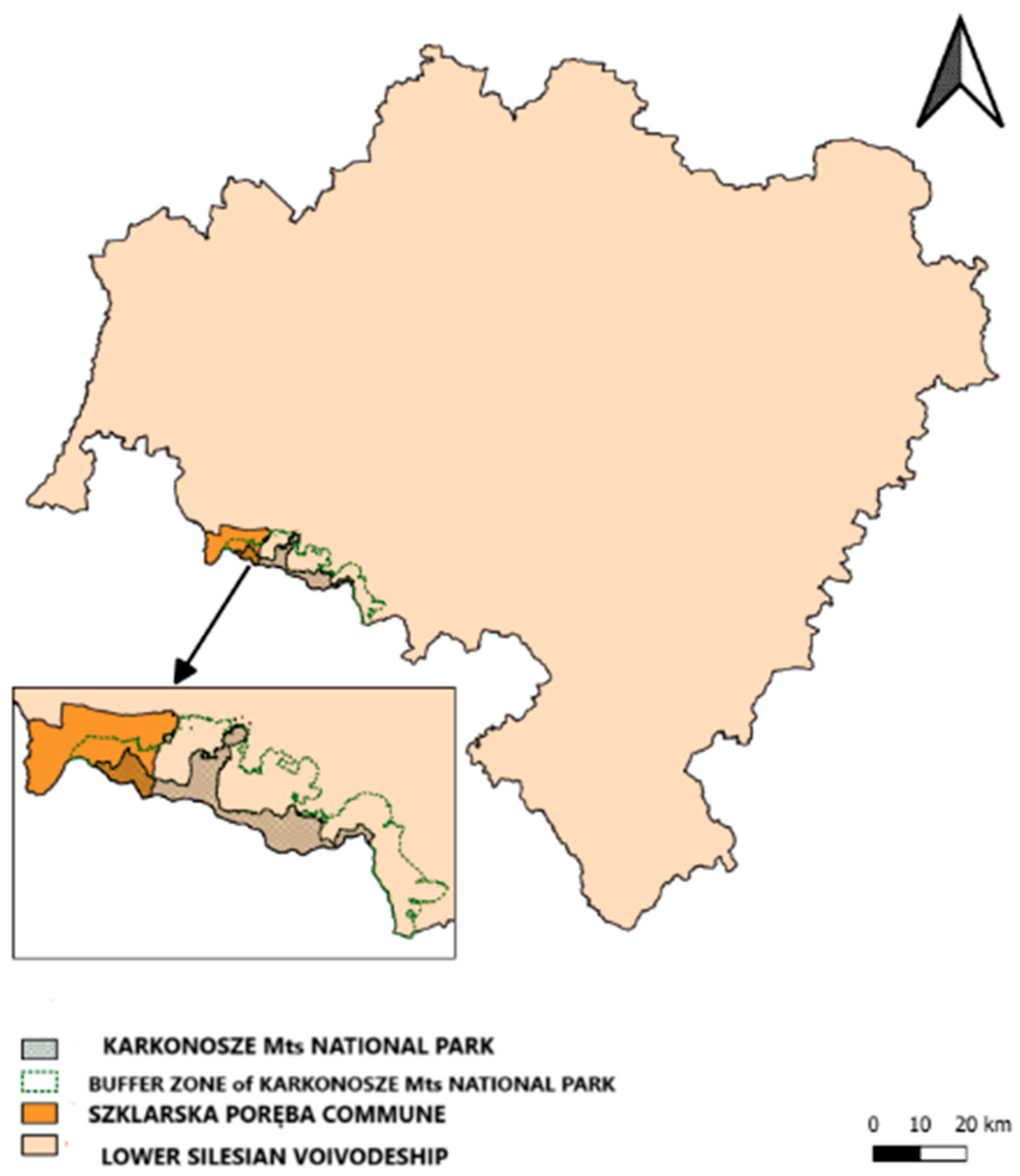
Figure 2.
Number of catering and accommodation facilities versus number of beds in Szklarska Poreba commune (own elaboration based on data available from the Local Data Bank, 2012-2023).
Figure 2.
Number of catering and accommodation facilities versus number of beds in Szklarska Poreba commune (own elaboration based on data available from the Local Data Bank, 2012-2023).
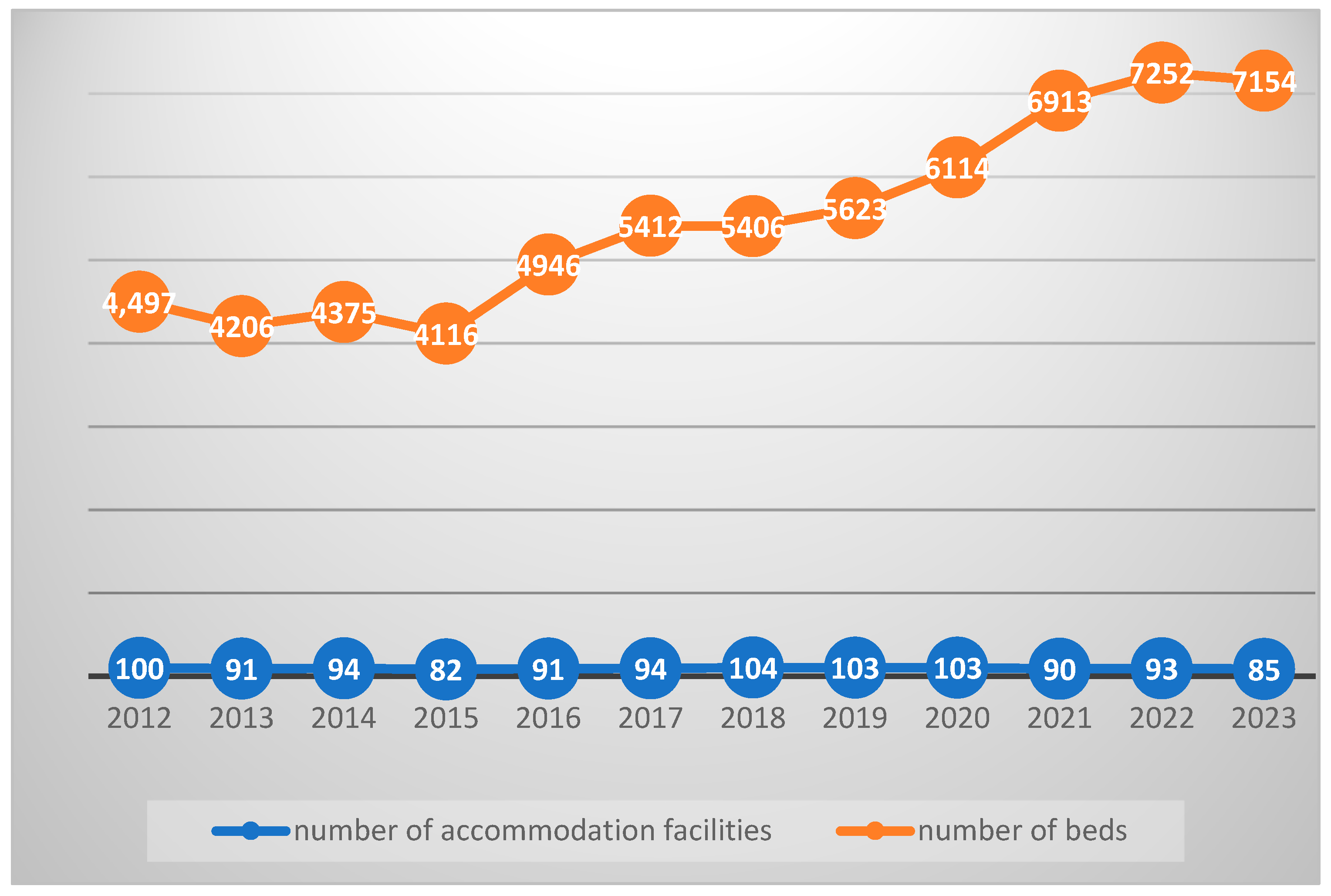
Figure 3.
Number of tickets sold to the Karkonosze National Park in 2010-2021 (as of 30 November) in relation to the number of inhabitants of Szklarska Poręba (own compilation based on data provided by the Karkonosze Mts National Park Accessibility Department).
Figure 3.
Number of tickets sold to the Karkonosze National Park in 2010-2021 (as of 30 November) in relation to the number of inhabitants of Szklarska Poręba (own compilation based on data provided by the Karkonosze Mts National Park Accessibility Department).
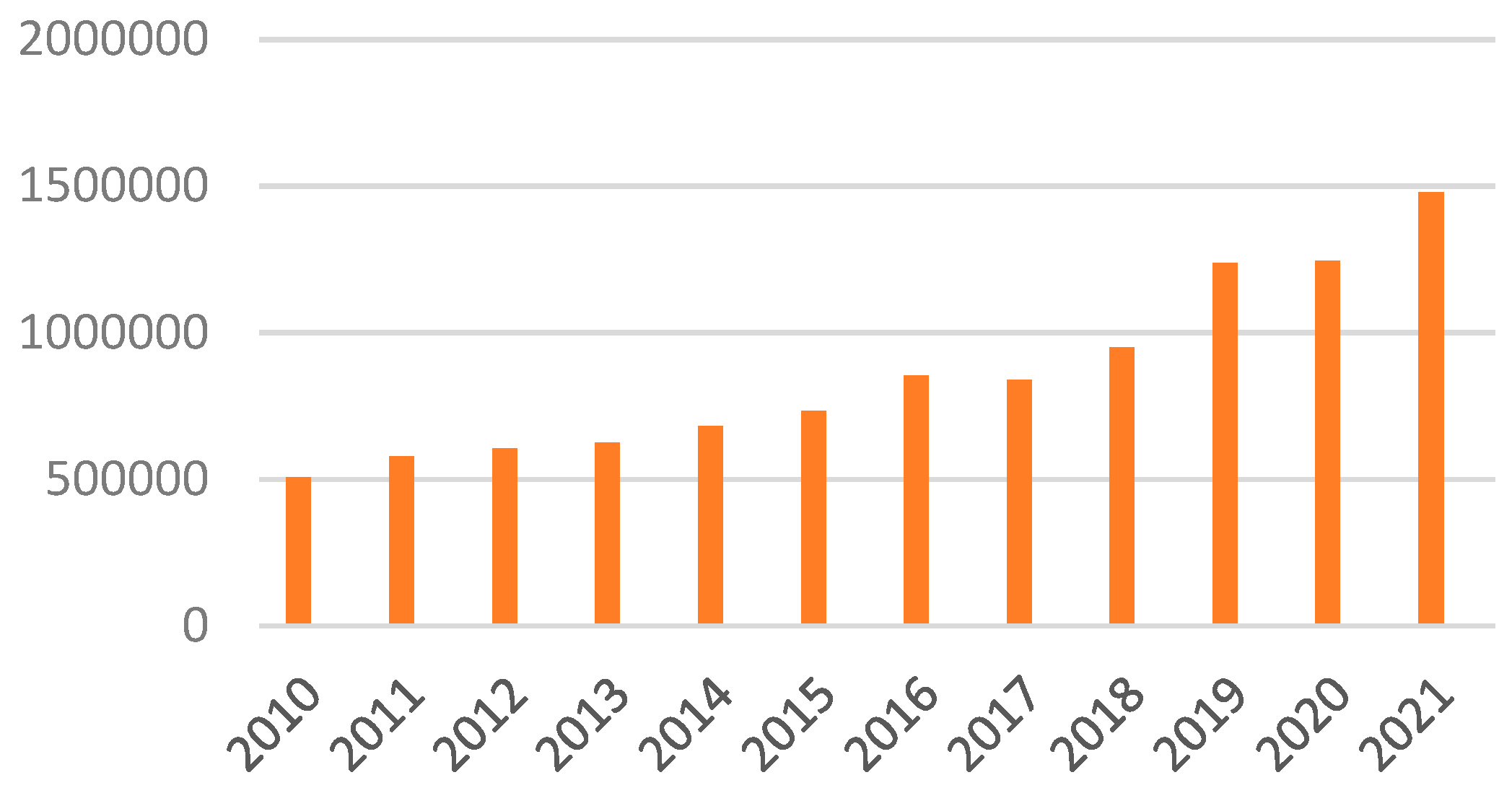
Figure 4.
The most popular tourist places in KMtsPN and its immediate vicinity - share in the total number of admission tickets sold (own compilation based on data provided by the KMtsPN Accessibility Department).
Figure 4.
The most popular tourist places in KMtsPN and its immediate vicinity - share in the total number of admission tickets sold (own compilation based on data provided by the KMtsPN Accessibility Department).
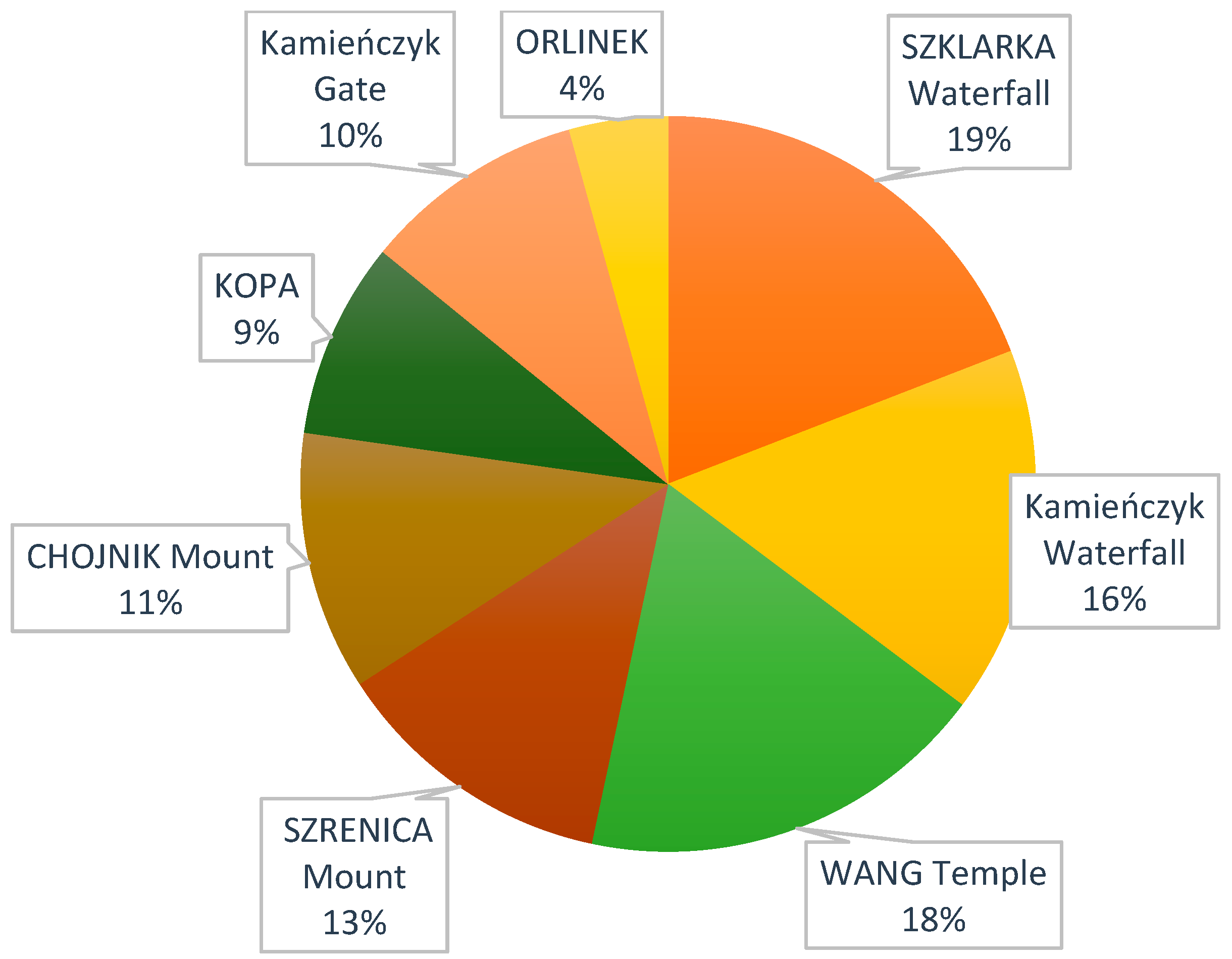

Table 1.
Number of nights spent by foreign tourists to total number of nights spent by tourists (own compilation based on data available from Szklarska Poręba Town Hall. https://miasto.szklarskaporeba.pl/urzad_miejski.html and https://bdl.stat.gov.pl/bdl/dane/podgrup/tablica).
Table 1.
Number of nights spent by foreign tourists to total number of nights spent by tourists (own compilation based on data available from Szklarska Poręba Town Hall. https://miasto.szklarskaporeba.pl/urzad_miejski.html and https://bdl.stat.gov.pl/bdl/dane/podgrup/tablica).
| year | 2011 | 2012 | 2013 | 2014 | 2015 | 2016 | 2017 | 2018 | 2019 | 2020 | 2021 | 2022 | total |
|---|---|---|---|---|---|---|---|---|---|---|---|---|---|
| tourists in general | 17 000 | 17 710 | 16 256 | 18 029 | 20 084 | 21 792 | 19 257 | 20 678 | 38 352 | 28 258 | 22 633 | 55 322 | 295 371 |
| foreign tourists | 6 956 | 6 897 | 6 864 | 6 829 | 6 703 | 6 651 | 6 681 | 6 611 | 6 633 | 5 968 | 5 873 | 5 872 | 78 538 |
Table 2.
Sale of admission tickets to tourist attractions in the Karkonosze National Park (own elaboration based on KNP data).
Table 2.
Sale of admission tickets to tourist attractions in the Karkonosze National Park (own elaboration based on KNP data).
| Month/year | 2020 | 2021 | 2022 | 2023 |
|---|---|---|---|---|
| JANUARY | 65 027 | 71 201 | 73 639 | 61 391 |
| FEBRUARY | 67 953 | 62 739 | 72 262 | 70 832 |
| MARCH | 16 407 | 35 545 | 47 723 | 39 927 |
| APRIL | 2 788 | 32 585 | 62 158 | 76 949 |
| MAY | 54 147 | 93 299 | 120 096 | 128 528 |
| JUNE | 118 534 | 165 022 | 160 021 | 169 659 |
| JULY | 281 699 | 296 740 | 258 336 | 272 714 |
| AUGUST | 286 812 | 306 905 | 282 816 | 273 183 |
| SEPTEMBER | 187 544 | 201 703 | 146 667 | 201 149 |
| OCTOBER | 92 099 | 144 846 | 152 270 | 108 171 |
| NOVEMBER | 33 639 | 66 483 | 72 031 | 55 850 |
| DECEMBER | 38588 | 43 506 | 32 742 | 46 921 |
| TOTAL | 1 245 237 | 1 520 574 | 1 480 761 | 1 505 274 |
Table 3.
Number of tickets sold on the chairlift to Mount Szrenica in Karkonosze NP - (own compilation based on data provided by Sudety Lift sp.z.o.o. ).
Table 3.
Number of tickets sold on the chairlift to Mount Szrenica in Karkonosze NP - (own compilation based on data provided by Sudety Lift sp.z.o.o. ).
| Month/year | 2016 | 2017 | 2018 | 2019 | 2020 | 2021 | 2022 | 2023 |
|---|---|---|---|---|---|---|---|---|
| JANUARY | 2994 | 3325 | 3393 | 3682 | 6487 | 9514 | 7247 | 6356 |
| FEBRUARY | 2723 | 4464 | 6466 | 5350 | 3593 | 7413 | 3835 | 6916 |
| MARCH | 3092 | 2322 | 3242 | 2538 | 1646 | 3747 | 5921 | 3429 |
| APRIL | 1975 | 5627 | 4138 | 6337 | 0* | 593 | 351 | 2707 |
| MAY | 17461 | 12413 | 20076 | 14118 | 4172 | 7350 | 14847 | 19647 |
| JUNE | 11495 | 13789 | 16102 | 20881 | 14985 | 20621 | 20950 | 22472 |
| JULY | 24359 | 33950 | 34118 | 32795 | 4008 | 39831 | 35536 | 34365 |
| AUGUST | 42869 | 43375 | 39891 | 43608 | 40978 | 42407 | 40850 | 38231 |
| SEPTEMBER | 21601 | 16623 | 21106 | 19234 | 28715 | 29900 | 19622 | 33331 |
| OCTOBER | 8423 | 11500 | 11905 | 8988 | 11085 | 0 | 16708 | 10266 |
| NOVEMBER* | - | - | - | - | - | - | - | - |
| DECEMBER | 2484 | 2548 | 2584 | 5499 | 1625 | 4202 | 4476 | no data |
* Lack of data in November and “zero” values indicate a maintenance break of the chairlift to Mount Szrenica.
Disclaimer/Publisher’s Note: The statements, opinions and data contained in all publications are solely those of the individual author(s) and contributor(s) and not of MDPI and/or the editor(s). MDPI and/or the editor(s) disclaim responsibility for any injury to people or property resulting from any ideas, methods, instructions or products referred to in the content. |
© 2024 by the authors. Licensee MDPI, Basel, Switzerland. This article is an open access article distributed under the terms and conditions of the Creative Commons Attribution (CC BY) license (http://creativecommons.org/licenses/by/4.0/).
Copyright: This open access article is published under a Creative Commons CC BY 4.0 license, which permit the free download, distribution, and reuse, provided that the author and preprint are cited in any reuse.


