

Submitted:
03 June 2025
Posted:
04 June 2025
You are already at the latest version
Abstract
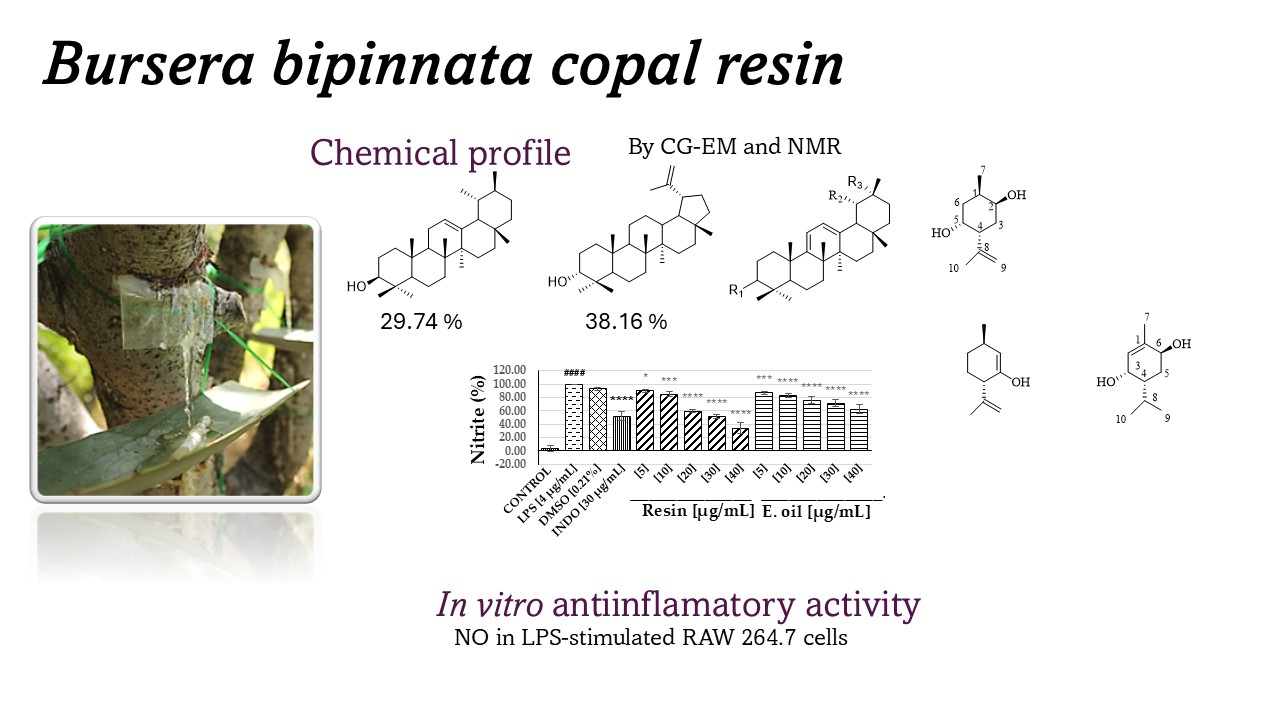
Bursera bipinnata is known as “copal chino, is a small tree that grows in steep areas and is part of the transitional populations of pine and oak forests and lowland deciduous forests. It is the taxon with the widest geographic distribution in México and considered a source of high-grade copal resin used in ceremonies and offerings. Also, B. bipinnata is considered to have great value in traditional medicine to treat ailments related to in-flammation. In this work, the anti-inflammatory effects of the volatile fraction and resin of B. bipinnata in LPS-stimulated RAW 264.7 macrophage cells were demonstrated. The resin extract was the best inhibitor with a 65.83 ± 8.53 % of inhibition of NO production with IC50 = 30 ± 3.3 µg/mL. In contrast, its volatile fraction showed a 37.43± 7.13 % of inhibition at 40 µg/mL. GC/MS and LC analysis of the total resin allowed the chemical characterization of eleven pentacyclic triterpenes with ursane, oleanane, and lupane skeletons, and eight monoterpenes. The structures of compounds (15, 17, 29-35) are reported for the first time from the resin of Bursera bipinnata. The anti-inflammatory activity of the most abundant constituents of the resin of B. bipinnata (α-amyrin (15), 3-epilupeol (17) and α-phellandrene (1) has been previously demonstrated which con-firms the activity showed by the resin as well as the traditional use of this important copal resin. The chemical profile of B. bippinata differs from that of other copal resins (e.g. B. copallifera) in the presence of a greater variety of triterpenes in the resin.
Keywords:
copal resin
; anti-inflammatory activity
; Bursera bipinnata
; pentacyclic triterpenes
; α-amyrin
; epi-lupeol
1. Introduction
The Bursera genus concentrates around 100 species throughout the American continent, of which 80 are distributed in México. Taxonomically they are divided into two sections: Bullokia or “cuajiotes” with exfoliating bark and Bursera, or “copales” with a non-exfoliating bark. According to Rzedowski, 2005, there are, around 41 species considered within the Bursera section (Bursera copallifera, B. cuneata, B. bicolor, B. bipinnata, B. glabrifolia, B. graveolens, and B. penicillata, among others) distributed in 26 states of México.
Species of the Copal section are very resinous, and their resins have a very characteristic aromatic smell of pine and lemon. The term copal derives from the Nahuatl word “copalli”, which describes several aromatic resins from our territory [1]. Copal was used by the cultures of pre-Columbian Mesoamerica for ceremonially burnt incense and also used as adhesives; many people still use copal in México and Central America as incense and has an important role in the economy of rural families [2,3,4,5]. Also, copal resins are used for medicinal purposes such as anti-inflammatory poultice, to plug dental cavities and to treat pneumonia [6].
Pentacyclic triterpenes are common secondary metabolites in the resins of Bursera species, which contain principally triterpenes with ursane, oleanane and lupane skeletons [7,8,9,10,11,12,13,14]. Indeed, phytochemical analysis of residues of copal resins in archaeological Aztec samples showed the presence of triterpenes, being 3-epilupeol, 3-epi-α-amyrin and α-amyrone the most abundant in these samples [10].
Bursera bipinnata (B. bipinnata) is commonly known as “copal chino, copal negro, copal santo, copalillo, jaboncillo” [1]. It is a low tree with grayish bark and many branches. It averages 6 m in height, and inhabits steep areas and is part of the transitional populations of pine and oak forests and lowland deciduous forests. It is found in areas between 800 and 1,600 m above sea level, with a generally warm, subhumid or dry climate. Among the Bursera species, B. bipinnata is the taxon with the widest geographic distribution in our territory. It is found mainly in Michoacán, Guerrero, Oaxaca, Puebla, and Morelos states of México, it is considered a source of high-grade copal resin which is collected by local people in the Morelos state and used for Mexican celebrations such as “día de muertos” (day of the Dead), and was a resin offered to the gods in Mesoamerican agricultural rituals. Also, B. bipinnata is considered to have great value in traditional medicine to treat rheumatoid arthritis, cold, cough stroke, dental pain, and to hasten wound healing [15,16]. There are few reports about the chemical constituents and pharmacological effects of B. bipinnata. Case et al. in 2003 [2] carried out the GC/MS analysis of the essential oil of a commercial copal resin identified as possible B. bipinnata; this analysis showed the presence in the oil of 14.52 % of α-copaene, and 13.75 % of germacrene D. Another GC/MS analysis on a derivatized commercial sample of the resin of B. bippinata identified nine triterpenes with oleanane, ursane and lupane skeletons, these were 3-epi-β-amyrin, 3-epi-α-amyrin, 3-epi-lupeol, β-amyrone, β-amyrin, α-amyrone, α-amyrin, lupenone, and lupeol [17]. Also, the flavonoids luteolin 7-O-β-D-glucopyranoside, and myricetin 3′-O-α-L-rhamnopyranoside were isolated from the methanolic extract of B. bipinnata leaves [18], and another study demonstrated the cytotoxic activity of the resin against breast carcinoma cells [19].
Despite the ethnomedicinal importance of B. bipinnata, there are no reports on its anti-inflammatory activity nor about the chemical compounds responsible for said activity. In this work a detailed investigation of the chemical composition of the resin and its volatile fraction obtained by supercritical CO2 extraction of B. bipinnata was carried out. Furthermore, the inhibitory effect on cell viability and NO production in LPS-stimulated RAW 264.7 macrophages were assessed.
2. Materials and Methods
2.1. Plant Material
The resin of B. bipinnata was collected by MBIBC Fidel Ocampo Bautista in the Sierra de Huautla Biosphere Reserve, in the municipality of Tepalcingo, Morelos, México. Botanical samples were identified as Bursera bipinnata (DC) Engl (Burseraceae) by MSc. Gabriel Flores Franco and was deposited in the HUMO Herbarium of the Biodiversity and Conservation Research Center (CIByC) of the Autonomous University of the State of Morelos, with Voucher number 31840.
2.2. Extraction of Volatiles
The volatile compounds from the resin (10 g) of B. bipinnata were extracted using two different procedures. One of them consisted in the use of the CO2 extraction system (MelloeX CO2 Extraction System, Alegre science), with a working pressure < 900 psi, 62 bar and a release pressure of 1,000 psi using 800 g of CO2 and stored at -20°C until its analysis by GC/MS. The second method consisted of dissolving the resin on EtOAc and to analyze by GC/MS.
2.3. Gas Chromatography/Mass Spectrometry (GC/MS) Analysis
Once the volatile compounds had been extracted, 2 mg of the sample were weighed and dissolved in 0.5 mL of HPLC-grade n-hexane, and analyzed by GC/MS. The EtOAc soluble fraction obtained from the resin and the subtraction 3B (vide infra) were also analyzed by GC/MS.
For qualitative analysis of volatile compounds obtained from dried resin of B. bipinnata, an HP Agilent Technologies 6890 gas chromatograph equipped with an MSD 5973 quadrupole mass detector (HP Agilent), capillary column HP-5MS (length: 30 m; inside diameter: 0.25 mm; film thickness: 0.25 microM) was used. The GC operational conditions were as follows: injection temperature 250 °C; temperature program: 40 °C kept for 1 min, and then raised to 280 °C at 10 °C/min; The helium carrier gas was set to the column (1 mL per minute at constant flow), The mass spectrometer was operated in positive electron impact mode with ionization energy of 70 eV. Detection was performed in selective ion-monitoring (SIM) mode and peaks were identified using target ions. Identifying organic compounds in volatile fraction and resin was based upon comparing experimentally obtained mass spectra with those available in Mass Spectral and Retention Index Libraries, NIST versión 1. 7a (The National Institute of Standards and Technology, Gaithersburg, MD, USA) with a score ≥ 80%). Relative area percents were used to determine the relative proportion of each compound.
2.4. General Information for Chemical Characterization
Compounds were isolated employing open-column chromatography (Silica gel (70–230 mesh, ASTM). The isolation procedures and purity of compounds were checked by thin layer chromatography (silica gel 60F254 plates (Merck, Darmstadt, Germany), visualized by means of UV light (366 and 254 nm) and sprayed with Ce(SO4)2 2(NH4)2SO4 2H2O (Sigma-Aldrich, Inc., Toluca, State of México, México), followed by heating. Melting points were obtained and uncorrected on a Thermo Scientific IA9000 melting point apparatus. Optical rotation was measured on a Perkin-Elmer 341 digital polarimeter (Perkin Elmer,Waltham, MA, USA).All 1D and 2D NMR experiments (1H, 13C, COSY, HSQC and HMBC) were recorded on a Varian INOVA-400 at 400 MHz, or a Bruker AVANCE III HD 500 at 500 MHz, or a Jeol ECZ600R 600 MHz (14.09 T), using acetone-d6 and CDCl3 with tetramethylsilane (TMS) as internal standard.
2.5. Resin Fractionation of Bursera bipinnata
The resin was allowed to dry at room temperature and was worked raw without prior treatment. Powdered resin (10 g) was dissolved with acetone (30 mL) at room temperature. The acetone extract was adsorbed on silica gel (8 g) and was fractionated in an open chromatographic column previously packed with silica gel (430 g, 70–230 mesh; Merck) and eluted with an n-heptane/acetone gradient system (95:05, 90:10, 85:15, 80:20 and 00:100, v/v). Fractions of 200 mL were collected to obtain 40 fractions and monitored by TLC (ALUGRAM® SIL G/UV254 silica gel plates). Fractions that showed similarity were grouped obtaining 5 subfractions: Fr-1 (1–7; 3.804 g), Fr-2 (8–16; 3.321 g), Fr-3 (17–25; 0.963 g), Fr-4 (26–33; 0.724 g), and Fr-5 (34–40; 0.372 g). Fr-2, Fr-3, and Fr- 4 fractions obtained from the main column were purified separately over silica gel using a gradient system; 98:02; 96:04; 94:06, and 90:10 (n-heptane/acetone). From Fr-2 were isolated α-amyrin (15) (0.963 g; 9 %), 3-epi-lupeol (17) (0.784 g; 8 %) and the mixture of 15 and 17 (3.426 g; 34 %). The fraction Fr-3 (963 mg) was subjected to successive chromatography on silica gel CC (35 g) using isocratic gradient n-hexane: acetone (90:10), from which two subfractions Fr-3A (647 mg) and Fr-3B (132 mg) were obtained. From Fr-3A, 3-epilupeol (17, 120 mg, 12%), α-amyrin (15, 267 mg, 27%) and 3β-Hydroxy-urs-12-en-11-one (29, 12 mg, 1%) were purified and identified. The Fr-3B subfraction showed a more complex mixture, so it was analyzed by gas chromatography coupled to mass spectrometry, identifying the compounds: trans-p-mentha-2,8-dienol (19, 7%), α-terpineol (20, 4%), L-carveol (21, 49%), R-(-)-carvone (22, 4%), p-menth-2,8-dienol (23), (-)-perillyl alcohol (24), 3-oxoolean-9(11),12-diene (25), 3-oxo-ursan-9(11),12-diene (26), 3β-acetate-ursan-9 (11),12-diene (27), 3β-acetate-ursan-12-en-11-one (28) and 3β-hydroxy-ursan-12-en-11-one (29) (GC/MS are in Figures S1–S3, Supplementary Material). The Fr-4 (0.724 g) was submitted to a chromatographic open column (70 x 10 mm) previously packed with 21 g of silica gel 60 (0.040-0.063 mm). An n-hexane/acetone (90:10) isocratic system was used as the mobile phase (the volume of all samples was 5 mL). Thirty-two fractions were obtained and grouped into four final subfractions according to their chemical composition: Fr-4A (520 g), Fr-4B (76 mg), Fr-4C (54 mg) and Fr-4D (32 mg). The Fr-4A, Fr-4B and Fr-4C subfractions were purified separately by open column chromatography. An isocratic system of n-hexane/acetone (90:10) was used, and the fractions obtained were 3 mL each. From Fr-4A subfraction, α-amyrin (15, 264 mg, 36%) was purified. From the Fr-4B the mixture of 3β-hydroxyolean-9 (11), 12-diene (30, 12 mg, 4%) and 3β-hydroxyursan-9 (11),12-diene (31) was obtained. Chromatographic purification of subfraction Fr-4C afforded 8 mg (2%) of a mixture constituted by urs-12-ene-3β-11α-diol (32) and olean-12-ene-3β-11α-diol (33). The compounds p-menth-1-ene-3,6-diol (34, 8 mg) and p-menthane-2,5-diol (35, 5 mg) were purified and identified from the Fr-4D subfraction.
2.6. Isolated Compounds
α-Amyrin (15): White amorphous solid. 1H-NMR (500 MHz, CDCl3) δH: 5.13 (1H, t, J = 3.8 and 7 Hz, H-12), 3.22 (1H, m, H-3), 1.95 (1H, t, J = 2.6 Hz, H-9), 1.88 (d, J = 3.6 Hz, H-18), 1.65 (m, H-2), 1.59 (m, H-22), 1.57 (t, H-19), 1.57 (t, H-5), 1.07(s, H-23), 1.07 (s, H-24), 0.95 (s, H-25); 1.02 (s, H-26), 0.99 (s, H-27), 0.94 (s, H-28), 0.91 (d, J = 7.6 Hz, H-29 and H-30). 13C-NMR (125 MHz, CDCl3) δC: 139.96 (C-13), 124.65 (C-12), 79.13 (C-3), 59.33 (C-18), 55.43 (C-5), 47.96 (C-9), 41.76 (C-14), 39.89 (C-22), 39.84 (C-19), 39.03 (C-8), 39.00 (C-20, C-4), 33.98 (C-1), 33.18 (C-10), 31.49 (C-7), 28.97 (C-17), 28.36 (C-28), 28.34 (C-2); 27.51 (C-15), 26.86 (C-24), 23.60 (C-27), 23.50 (C-11), 21.61 (C-30), 18.59 (C-29), 17.69 (C-6), 17.10 (C-26), 15.90 (C-23) and 15.85(C-25). These data match with those in the literature [20]. 1H, 13C-NMR and HSQC spectra are in Figures S4–S6 (Supplementary Material).
3-Epilupeol (17): White amorphous solid. 1H-NMR (400 MHz, CDCl3) δH: 4.68 (1H, d, J = 2.4 Hz, 29a), 4.56 (1H, d, J = 1.2 Hz, 29b), 3.38 (1H, t, J = 2.6 Hz, H-3), 2.37 (1H, td, J = 11, 5.6 Hz, H-19), 1.87 (2H, m, H-21), 1.68 (2H, m, H-2), 1.68 (3H, s, H-30), 1.67 (2H, t, H-22), 1.56 (2H, m, H-16), 1.44 (1H, m, H-18), 1.43 (1H, m, H-5), 1.39 (2H, m, H-1, H-15), 1.38 (6H, m, H-7, H-11, H-12,), 1.37 (2H, m, H-6), 1.28 (1H, m, H-13), 1.23 (1H, t, H-9), 1.06 (6H, s, CH3-23, CH3-24), 0.97 (3H, s, CH3-25), 0.95 (3H, s, CH3-26), 0.86 (3H, s, CH3-28), 0.84 (3H, s, CH3-27). 13C-NMR (100 MHz, CDCl3) δC: 151.23 (C-20), 109.51 (C-29), 76.47 (C-3), 50.45 (C-9), 49.25 (C-5), 48.53 (C-18), 48.25 (C-19), 43.25 (C-17), 43.13 (C-14), 41.18 (C-8), 40.21 (C-22), 38.26 (C-13), 37.73 (C-4), 37.53 (C-10), 35.82 (C-16), 34.38 (C-7), 33.48 (C-1), 30.09 (C-21), 28.46 (C-23), 27.62 (C-15), 25.64 (C-2), 25.36 (C-12), 22.36 (C-24), 21.02 (C-11), 19.51 (C-30), 18.51 (C-6), 18.23 (C-28), 16.19 (C-25), 16.14 (C-26) and 14.86 (C-27). These data match with those in the literature [13,21]. 1H, 13C-NMR and HSQC spectra are in Figures S7–S9 (Supplementary Material).
3β-Hydroxyursan-12-en-11-one (29): Colorless needles, mp 229-231°C [7] δH: 1H NMR (600 MHz, acetone-d6): 5.43 (1H, s, H-12), 3.28 (1H, t, J = 3.0 Hz, H-3), 2.40 (1H, s, H-9), 1.60 (1H, d, J = 4.1 Hz, H-18), 1.51 – 1.37 (m, 7H), 1.36 (s, 6H), 1.34 – 1.19 (m, 2H), 1.17 (s, 3H), 1.15 (s, 3H), 1.15 – 1.00 (m, 2H), 0.99 (s, 6H), 0.98 – 0.86 (m, 2H), 0.85 (s, 3H), 0.82 (6H, d, J = 6.2 Hz, H-29, H-30), 0.80 (s, 3H). 13C NMR (150 MHz, acetone-d6) δC: 199.22 (C-11), 164.62 (C-13), 131.12 (C-12), 78.41 (C-3), 62.22 (C-9), 54.95 C-5), 45.73, 44.38, 41.65, 40.08, 39.89, 39.78, 34.59, 33.52, 31.57, 29.21, 28.62, 28.18, 28.06, 27.92, 22.62, 21.37, 20.97, 18.99, 18.34, 17.71, 16.92, 16.33. These data match with those in the literature [22]. 1H, 13C-NMR and DEPT spectra are in Figures S10–S12 (Supplementary Material).
3β-Hydroxyolean-9(11),12-diene (30) and 3β-hydroxyursan-9(11),12-diene (31) δH: 1H NMR (600 MHz, acetone-d6) δ 5.57 (d, J = 3.7 Hz, 1H), 5.53 (d, J = 3.1 Hz, 1H), 5.23 (d, J = 3.7 Hz, 1H), 5.21 (d, J = 3.2 Hz, 1H), 3.59 – 3.02 (m, 2H). 13C NMR (150 MHz, acetone-d6) δC: 150.41 (C-9), 147.28 (C-9), 144.26 (C-13), 141.30 (C-13), 131.36 (C-12), 128.00 (C-12), 126.97 (C-11), 23.83 (C-11), 75.75 (C-3), 75.64 C-3), 59.02 (C-18), 50.54 (C-5), 50.35 (C-5), 46.96 (C-19) 46.82 (C-18), 44.05 (C-14), 42.82 (C-14), 42.17 (C-22), 40.44 C-20), 40.39 (C-19), 38.76 (C-1), 38.18 (C-10), 37.78 (C-22), 34.51 (C-21), 33.65 (C-29), 33.02 (C-7 and C-17), 31.61 (C-21 and C-20), 28.86 (C-28), 28.73 (C-24), 28.65 (C-15), 27.49 (C-2), 27.45 (C-16), 26.22 (C-16) (C-15), 25.65 (C-27), 25.28 (C-27), 23.97 (C-30), 22.90 (C-24), 22.22 (C- 26), 21.64 (C-30), 19.08 (C-26), 18.98 (C-23), 18.89 (C-25), 18.58 (C-6), 16.70 C-29), 15.25 (C-23). These data match with those in the literature [23,24,25,26]. 1H and 13C-NMR spectra are in Figures S13 and S14 (Supplementary material).
Urs-12-ene-3β, 11α-diol (32) and Olean-12-ene-3β,11β-diol (33): 1H NMR (500 MHz, CDCl3) δH: 5.24 (d, J = 3.8 Hz, 1H), 5.19 (d, J = 3.3 Hz, 1H), 4.26 (dd, J = 8.8, 3.3 Hz, 1H), 4.20 (dd, J = 8.2, 3.8 Hz, 1H), 2.11 – 1.26 (m, 24H), 1.25 (d, J = 6.7 Hz, H-18), 1.23 (s, 3H), 1.11 (s, 3H), 1.09 (s, 3H), 1.07 (s, 3H), 1.05 (s, 3H), 1.01 (d, J = 7.9 Hz, 3H), 0.97 (s, 3H), 0.91 (d, J = 6.3 Hz, 3H), 0.88 (s, 3H), 0.88 (s, 3H). 13C NMR (125 MHz, CDCl3) δC: 149.62(C-13), 146.23 (C-13), 124.90 (C-12), 121.42(C-12), 82.04 (C-3), 81.81 (C-3), 76.24 (C-11), 76.11 (C-11), 55.94 (C-18), 49.61 (C-9), 49.54 (C-9), 47.01 (C-5), 46.91 (C-5), 46.67 (C-19), 43.65 (C-8), 43.53 (C-8), 41.50 ((C-8), 41.46 (C-14), 39.50 (C-22), 39.45 C-19), 37.67 (C-20), 37.63 (C-1), 37.14 (C-4), 35.05 (C-10), 34.82 (C-22), 33.50 (C-21), 33.40 (C-20), 33.16 (C-21), 33.02 (C-7), 32.42 (C-17), 31.28 (C-7), 31.25 (C-17), 28.83 (C-2), 28.80 (C-2), 28.72 (C-16), 28.64 (C-16), 28.08C-28), 28.03 (C-30), 26.87 (C-15), 26.81 (C-27), 26.56 (C-28), 23.78 (C-23), 23.75(C-23), 22.29 (C-30), 18.49 (C-6), 18.38 (C-6), 18.30, 18.24 (C-29), 16.88 (C-26), 16.80 (C-26), 16.76 (C-25), 16.61 (C-25). These data match with those in the literature [21,26]. 1H, 13C -NMR and COSY spectra are in Figures S15–S17 of Supplementary Material.
p-Menth-1-ene-3,6-diol (34): crystalline solid; 1H NMR (600 MHz, acetone-d6); mp 110-112 °C; [α]20D -4.87 (c 0.6, acetone); δ 5.42 (m, H-2), 3.89 (t, J = 2.8 and 5.6 Hz, H-6), 3.82 (t, J = 7.6, 5.6 Hz, H-3), 2.15 (m, H-8), 1.72 (t, J = 2.1 and 3.5 Hz, CH3-7), 1.62 (m, H-4), 1.35 (m, H-5), 0.92 (d, J = 7 Hz, CH3-9), 0.8 (d, J = 7 Hz, CH3-10). 13C NMR (150 MHz, acetone-d6); δ 136.88 (C-2), 131.05 (C-1), 69.41 (C-6), 67.82 (C-3), 42.67 (C-4), 31.07 (C-5), 26.73 (C-8), 21.41 (C-10), 20.84 (C-7), 17.27 (C-9) [27]. 1H, 13C-NMR, DEPT, COSY, HSQC, HMBC and MS-FAB- spectra are in Figures S18–S223 of Supplementary Material.
p-Menth-8-ene-2,5-diol (35): crystalline solid; mp 81-83 °C; [α]20D +42(c 0.4, acetone); 1H NMR (600 MHz, acetone-d6) δH: 4.67 (d, J = 2.0 Hz, H-9a), 4.64 (d, J = 2.3 Hz, H-9b), 3.55 (sa, H-6), 3.31 (sa, H-2), 2.72 (td, J = 7.1, 3.5 Hz, H-4), 1.69 (s, CH3-10), 1.58-1.28 (m, Hs-3, H-1 and Hs-6), 0.81 (d, J = 7.8 Hz, CH3-7). 13C NMR (150 MHz, acetone-d6) δC: 151.49 (C-7), 108.56 (C-8), 75.74 (C-4), 74.06 (C-1), 47.90 (C-5), 38.37 (C-2), 35.14 (C-3), 34.40 (C-6), 21.11, 16.41 [28]. 1H, 13C-NMR, HSQC spectra and GC/MS chromatogram are in Figures S24–S27 of Supplementary Material.
2.6. In Vitro Anti-Inflammatory Activity
2.6.1. Cell Culture
Murine macrophage cell line RAW 264.7 (Tib-71tm from ATCC) was grown in DMEM/F12 medium supplemented with 10 % heat-inactivated FBS, GlutaMax, without antibiotics. Cells were plated and incubated in a humidified atmosphere containing 5 % CO2 at 37 °C. Cells were subcultured by scraping and seeding them in 25 cm2 flasks or 24-wells plates.
2.6.2. MTS Assay to Determine Cell Viability
RAW 264.7 cells were seeded in a 96-well plate (10,000 cells/well) with 0.1 mL of culture medium and incubated for 24 h. Next, the cells were treated with the resin and volatile fraction at various concentrations (5 - 40 µg/mL) or vehicle (DMSO, 0.21%, v/v) or etoposide (40 µg/mL) that served as a positive control. and incubated for 22 h. After 22 h, cell viability was determined by the MTS assay. Briefly, 20 µL of MTS solution (Promega) was added to each well and incubated for another 2 h. The optical density was measured at 490 nm in an ELISA plate reader.
2.6.3. Treatment of Macrophages with LPS
RAW 264.7 cells were seeded in a 96-well plate (20,000 cells/well) with 0.2 mL culture medium and incubated for 24 h. Subsequently, the cells were treated with resin and volatile fraction at 0-70 mM, concentration that do not affect cell viability, or vehicle (DMSO, 0.21%, v/v) or indomethacin (30 μg/mL), which served as a positive control, and were incubated for an hour. Next, the pro-inflammatory stimulus LPS was applied at 4 μg/mL to the wells that were treated with resin and volatile fraction, vehicle, and indomethacin, leaving wells with cells that were only treated with LPS (100% stimulus control) and wells with cells without any treatment (negative control) and incubated at 37 °C for 20 h. Finally, cell-free supernatants were collected and kept at -20 °C until NO quantification.
2.6.3. Determination of NO Concentration
Nitrite, the stable product of NO, was used as an indicator of NO production in the culture medium. Nitrite released in the culture medium was measured according to Griess reaction. Briefly, 50 μL of each cell culture supernatants were mixed in a 96-well plate with 100 μL of Griess reagent (50 μL of 1% sulfanilamide and 50 μL of 0.1% N-(1-naphtyl) ethylenediamine dihydrochloride in 2.5 % phosphoric acid) and incubated for 10 min at room temperature. The optical density at 540 nm (OD540) was measured with a microplate reader. Fresh culture medium was used as blank, and nitrite concentration in the samples was calculated by comparison with the OD540 of a standard curve of NaNO2 prepared in a fresh culture medium [29].
3. Results
3.1. In Vitro Anti-Inflammatory Activity of the Total Resin and Its Volatile Fraction of Bursera bipinnata
With the aim to assess the pharmacological potential of B. bipinnata, its volatile fraction and resin were evaluated for their in vitro inhibition of NO production in LPS-stimulated RAW 264.7 cells. Firstly, RAW 264.7 cells were treated with the resin and volatile fractions at various concentrations (5 - 40 µg/mL) or vehicle (DMSO, 0.21%, v/v) or etoposide (40 µg/mL) that served as a positive control. After 22 h incubation, cell viability was determined by the MTS assay. Results show that the resin and the volatile fraction (Figure 1) did not significantly decrease cell viability of macrophages at any of the tested concentrations compared to the etoposide treatment (positive control); therefore, the effect on the production of nitric oxide was evaluated at the same concentrations (5-40 µg/mL) (Figure 2). Cells were treated with/without volatile fraction or resin for 2 h and then stimulated with LPS (4 μg/mL) for 24 h. Then, the amount of nitrite was measured in the medium. The results showed that NO level was increased in LPS-stimulated RAW cells, and that the positive control (indomethacin) inhibited NO production by 48.16± 6.38 % at 30 μg/mL (p < 0.0001). This effect was decreased significantly, in a concentration-dependent manner, by treatment with the resin (P < 0.001), with a similar activity to that shown by indomethacin with an IC50 = 30 ± 3.3 µg/mL, the inhibition percentages are shown in Figure 2 and Table 1. The inhibitory effect of the resin was not due to cytotoxicity, since it did not affect cell viability of RAW 264.7 cells up to a concentration of 40 µg/mL (Figure 1). By the other hand, the anti-inflammatory activity of the volatile fraction, expressed as a percentage of NO inhibition, was lower than that of the total resin, reaching a 37.43 % of inhibition at 40 µg/mL; in contrast, the resin inhibited by 65.83 % at the same concentration.
3.2. Chemical Profiles
3.2.1. Volatile Compounds Present in the Resin of B. bipinnata
The chemical composition of the volatile fraction obtained by supercritical CO2 extraction from the resin of B. bipinnata is summarized in Table 2. A total of 18 volatile compounds were found, including seven monoterpenes (41%), seven sesquiterpenes (18.33%) and four triterpenes (34.48%). From these, eight were present in percentages greater than 5%: α-phellandrene (1, 24.42%), β-phellandrene (2, 8.27%), p-cymene (4, 6.72%), β-caryophyllene (9, 6.31%), cubenol (14, 8.05%), α-amyrin (15, 5.08%), β-amyrin (16, 6.28%), and lup-20(29)-en-3α-ol (17, 18.77%). It is noteworthy that α-phellandrene was the main component of the volatile fraction, and that four triterpenes represent the 34.48% of the relative content (chromatogram and structures in Figures S28 and S29 respectively of supplementary material).
On the other hand, for the total resin dissolved in EtOAc, 15 compounds were identified by GC/MS analysis (Table 2), those include one aromatic hydrocarbon (4.37 %), seven monoterpenes (12.69 %), two sesquiterpenes (2.33 %), one diterpene (1.12 %) and four triterpenes (79.48 %). The most abundant components were the triterpenes α-amyrin (15, 29.74%), and lup-20(29)-en-3α-ol (17, 38.16%) followed by β-amyrin (16, 10.41%), and α-phellandrene (1, 5.38%). In this case, the high content of triterpenes stands out compared to that found in the volatile fraction.
3.2.1. Phytochemical Analysis of B. bipinnata Resin
Successive open column chromatography of the total resin of B. bipinnata allowed the isolation and characterization of 19 compounds including the monoterpenes trans-p-Mentha-2,8-dienol (19), α-Terpineol (20), L-Carveol (21), R-(-)-Carvone (22), cis-p-Menth-2,8-dienol (23), (-)-Perillyl alcohol (24), p-Menth-1-ene-3,6-diol (34) and p-Menth-8-ene-2,5-diol (35), and the triterpenes α-Amyrin (15), 3-Epilupeol (17), 3-Oxoolean-9 (11),12-diene (25), 3-oxo-ursan-9 (11), 12-diene (26), 3β-acetate-ursan-9 (11),12-diene (27), 3β-acetate-ursan-12-en-11-one (28), 3β-Hydroxy-ursan-12-en-11-one (29), 3β-Hydroxyolean-9 (11), 12-diene (30), 3β-hydroxyursan-9 (11), 12-diene (31), urs-12-ene-3β, 11α-diol (32), and Olean-12-ene-3β, 11α-diol (33), (Figure 3). Compounds 19-28 and 30-31 were identified by comparing their mass spectra with those of The National Institute of Standards and Technology (NIST 1.7a) Library. The equipment used was a gas chromatograph equipped with a quadrupole mass detector in electron impact mode at 70 eV. Identification of compounds 29, 32-35 was based on spectral analysis and data comparison with values described in the literature [9,23,30,31,32,33,34].
4. Discussion
Accumulating evidence has demonstrated that NO is a crucial and versatile molecule in the development of acute and chronic inflammation and host defense mechanisms [35]. Likewise, high expression level of Nitric Oxide Synthase (iNOS) is associated with the presence of inflammation in tumors, and NO production by iNOS is a factor contributing to non-resolving tumor-promoting inflammation [36]. Therefore, identifying new agents capable of lowering the production of this proinflammatory agent is essential for the control of numerous inflammatory-related disorders and cancer attributed to macrophage activation [37].
The resin of B. bipinnata has been used in the traditional Mexican medicine to treat various inflammatory diseases [1,5,15,16].
In this work, we assessed the effect of the volatile fraction and total resin of B. bipinnata on the nitric oxide (NO) production in LPS-stimulated RAW264.7 cells. The results showed that the positive control (indomethacin) inhibited NO production by 48.16± 6.38 % at 30 µg/mL, while the total resin inhibited by 48.6± 3.57 % at the same concentration; even more, the NO production was reduced in a concentration-dependent manner (Figure 2). On the other hand, the application of the volatile fraction did not inhibit the production of NO by LPS at one concentration. The inhibitory effect on NO production of total resin was not due to cytotoxicity since it did not affect cell viability of RAW 264.7 cells up to a concentration of 40 µg/mL (Figure 1). Importantly, the vehicle DMSO (0.21%, v/v) did not show a significant decrease in both cell viability and NO production.
Despite the importance of this plant species, to date, no reports were found on the anti-inflammatory activity nor over the inhibitory activity of Bursera bipinnata on NO synthesis in LPS-activated RAW 264.7 cells. A survey in the literature showed that a few studies have been conducted on the Burseraceae family. For instance, the n-hexane leaf extract of B. simaruba showed antiinflamatory activity in the carrageenan induced paw edema model [38,39], and topical action on Croton oil-induced ear edema in mice [40]. A subsequent biodirected chemical study of this plant species culminated in the isolation of neophytadiene, ergost-5-en-3β-ol, 24S-stigmast-5,22E-dien-3β-ol, 24S-stigmast-5-en-3β-ol and α-amyrin [41]. In another study performed on the volatile fraction from the bark of nine Bursera species, only B. lancifolia inhibited the TPA-induced edema in mice by 16.71% at 0.31 mg per ear. GC/MS analysis showed that the sesquiterpenoids elemol, agarospirol and β-eudesmol were the most abundant components [42].
By the other hand, Acevedo et al., 2015 [43] reported the in vivo anti-inflammatory activity on the TPA-induced ear edema assay of the chloroform extracts from the bark of B. excelsa (IC50 = 0.26 ± 0.01 mg/mL), B. galeottiana (IC50 = 0.23 ± 0.02 mg/mL), and B. schlechtendalii (IC50 = 0.25 ± 0.02 mg/mL). This activity was statistically comparable to the positive control indomethacin (IC50 = 0.19 ± 0.02 mg /mL).
In a chemical and pharmacological study performed to the dichloromethane-acetone extract of the copal resin of B. copallifera, topical inhibitory effect on the TPA-induced auricular edema with ID50 = 0.071 mg/ear was described. Phytochemical analysis resulted in the isolation and characterization of six pentacyclic triterpenes: 3-epilupeol formiate, lupenone, α amyrin, 3-epilupeol and their acetates. The pharmacological study demonstrated that the anti-inflammatory activity showed by the resin can be attributed to the COX-2 inhibitory activity showed by the most abundant triterpenes α-amyrin and 3-epilupeol, together with the potent nitric oxide (NO) production inhibitory activity on RAW 264.7 macrophages, together with the moderate inhibitory activity of PLA2 enzyme displayed by all the natural triterpenes [13]. In another study, it was demonstrated that the MeOH extract of B. copallifera inhibited the ear edema with a IC50 = 4.4 µg/mL, this extract also inhibited cyclooxygenase-1 activity, the target enzyme for nonsteroidal anti inflammatory drugs [44].
In the present study, phytochemical analysis of the resin of B. bipinnata allowed the identification of eleven triterpenes and two monoterpene compounds which were characterized as α- amyrin (15), epilupeol (17), 3-oxo-olean-9(11), 12-diene (25), 3-oxo-ursan-9 (11), 12-diene (26), 3-acetate-ursan-9 (11), 12-diene (27), 3β-acetate-ursan-12-en-11-one (28), 3β-hydroxy-ursan-12-en-11-one (29), 3β-hydroxyolean-9(11), 12-diene (30), 3β-hydroxyursan-9(11), 12-diene (31), urs-12-ene-3β; 11α-diol (32), olean-12-ene-3β; 11β-diol (33), p-Menth-1-ene-3,6-diol (34) and p-Menth-8-ene-2,5-diol (35). Previous studies had already described the existence of α-amyrin (15) and 3-epilupeol (17) on a derivatized commercial sample of a resin identified as B. bipinnata, but this is the first report on the presence of triterpenes 25-33 in the resin of B. bipinnata. This triterpene profile also differs from that found in the resin of B. copallifera, another reputed anti-inflammatory copal resin, which contains α-amyrin and 3-epilupeol, lupenone, 3-epilupeol formiate, α-amyrin acetate and 3-epilupeol acetate [13].
Among the isolated compounds, it is worth noting the presence of high concentrations of α-amyrin (15) and 3-epilupeol (17), due to their multiple pharmacological effects. According to GC/MS, the triterpene content in the resin (79.48%) is more than double that found in the volatile fraction (34.98%). It is coincidental the high yields of α-amyrin (15) and 3-epilupeol (17) found in the resin of B. bipinnata in this work, with the content present in the anti-inflammatory resin of B. copallifera.
Indeed, both compounds have been reported with potential anti-inflammatory activity. In vitro studies showed that α-amyrin (15) inhibited NO production in LPS-stimulated RAW264.7 cells with IC50 = 8.98 ± 1.73 µm, while 3-epilupeol (17) did so with a IC50 = 15.50 ± 1.14 µM, as well as the in vivo inhibition of the TPA induced inflammation [13,45,46].
Furthermore, a number of in vivo and in vitro studies have demonstrated that topical skin application of α-amyrin inhibit TPA-induced inflammation through suppression of COX-2 expression, via inhibition of upstream protein kinases and blocking of NF-κB activation [46,47].
The chemical content of the volatile fraction obtained by supercritical CO2 extraction from the resin of B. bipinnata, was identified by GC/MS (Table 2 and Figure S1). α-Phellandrene (1, TR = 7.11 min, 24.42%), β-Phellandrene (2, TR = 7.46 min, 8.27%), p-Cymene (4, TR = 7.72 min, 6.72%) and 3-epilupeol (17, TR = 38.09 min, 18.77 %) were the main components. Among them, α-phellandrene is widespread in nature, in Boswellia sacra understands 42% of essential oil. It produced cholinesterase inhibition with an IC50 of 120.2 μg/mL [48]. In rats, α-phellandrene prevented mechanical nerve injury-induced and cold hyperalgesia, while also demonstrating an antidepressant effect [49]. While not demonstrating antimicrobial effects per se, phellandrene mildly stimulated macrophage proliferation in mice via Mac-3 and promoted function in vivo [50], suggesting the ability to suppress intracellular bacterial growth. ρ-Cymene (4) a cyclic monoterpene, common in thyme (Thymus vulgaris) (27.4%), was active against Bacteroides fragilis, C. albicans, and Clostridium perfringens [51]. It was sedative in mice at 0.04 mg in air, reducing motor activity to 47.3% of baseline [24].
Additionally, it statistically significantly reduced acetic acid-induced writhing and both phases of formalin-induced pain in mice at 50 mg/kg [25]. A study showed little antioxidant or antiproliferative effects [52]. β-Caryophyllene (9) is one bicyclic sesquiterpene most common in cannabis extracts and is nearly ubiquitous in the food supply. It present larvicidal activity against A. subpictus, a vector of malaria, A. albopictus, a vector of dengue, and C. tritaeniorhynchus, vector of Japanese encephalitis [53]. A recent publication extends its therapeutic potential to protection from alcoholic steatohepatitis via anti-inflammatory effects and alleviation of metabolic disturbances [54]. Successive open column chromatography of the total resin of B. bipinnata allowed the isolation and characterization of 19 compounds including the monoterpenes trans-p-Mentha-2,8-dienol (19).
5. Conclusions
In this study, the anti-inflammatory activity of the resin of B. bipinnata was demonstrated. The evaluation of NO inhibition of the resin and its volatile fraction showed that the resin was the active part of the plant. Also, this study showed that extraction with EtOAc makes efficient the obtaining of the anti-inflammatory triterpenes from the resin in comparison to the supercrital CO2 extraction. Phytochemical analysis of this resin allowed the identification of eleven triterpenes and two monoterpene compounds, of which α- amyrin (15), and 3-epilupeol (17), represent more than 67.90% of the resin. The chemical profile of the resin of B. bipinnata was different from that reported for B. copallifera, another copal resin reputed for its anti-inflammatory properties. However, they coincided in the presence in high concentrations of the anti-inflammatory triterpenes alpha-amyrin (15) and epilupeol (17) whose anti-inflammatory activity has been previously demonstrated by our research team [13], and then it is probable that they were the responsible of the anti-inflammatory activity displayed by the resin of B. bipinnata. These results explain the traditional use of B. bippinata for the treatment of disorders associated to inflammation. This is the first report on the presence of triterpenes 25-33 and the monoterpenes 34 and 35 in the resin of B. bipinnata.
Supplementary Materials
The following supporting information can be downloaded at the website of this paper posted on Preprints.org.
Author Contributions
Conceptualization, Silvia Marquina, Mayra Antunez-Mojica, Judith González-Christen and Laura Alvarez; Data curation, Judith González-Christen and Fidel Ocampo-Bautista; Formal analysis, Antonio Romero, Fidel Ocampo-Bautista, Ninfa Nolasco-Quintana and Araceli Guerrero-Alonso; Funding acquisition, Laura Alvarez; Investigation, Antonio Romero; Methodology, Antonio Romero, Ninfa Nolasco-Quintana and Araceli Guerrero-Alonso; Project administration, Judith González-Christen and Laura Alvarez; Resources, Judith González-Christen and Laura Alvarez; Software, Silvia Marquina, Mayra Antunez-Mojica, Ninfa Nolasco-Quintana and Araceli Guerrero-Alonso; Supervision, Silvia Marquina and Judith González-Christen; Validation, Silvia Marquina, Antonio Romero, Fidel Ocampo-Bautista, Ninfa Nolasco-Quintana and Araceli Guerrero-Alonso; Writing—original draft, Silvia Marquina, Mayra Antunez-Mojica and Laura Alvarez; Writing—review & editing, Silvia Marquina, Mayra Antunez-Mojica and Laura Alvarez.
Funding
This research was funded by Financial support was provided by Consejo Nacional de Ciencia y Tecnología (Grant LN321131).
Acknowledgments
The authors thank Laboratorio Nacional de Estructura de Macromoléculas for the NMR spectra, and Consejo Nacional de Ciencia y Tecnología for financial support.
Conflicts of Interest
The authors declare no competing interests.
References
- Montúfar LA (2016) Copal de Bursera bipinnata. Una resina mesoamericana de uso ritual. Trace 70, cemca 45-77, ISSN: 0185-6286.
- Case RJ, Tucker AO, Maciarello MJ, Wheeler KA (2003) Chemistry and Ethnobotany of Commercial Incense Copals, Copal Blanco, Copal Oro, and Copal Negro, of North America. Econ Bot 57:189–202. [CrossRef]
- Rzedowski J, Medina-Lemos R, Calderón de Rzedowski G (2005) Inventario del conocimiento taxonómico, así como de la diversidad y del endemismo regionales de las especies mexicanas de Bursera (Burseraceae). Acta Botánica Mexicana, 70: 85–111. [CrossRef]
- Purata SEV (2008) Uso y Manejo de Los Copales Aromáticos: Resinas y Aceites. Colección Manejo campesino CONABIO/RAISES México:1-60.
- Argueta A, Cano LM, Rodarte ME (1994) Atlas de las Plantas de la Medicina Tradicional Mexicana. México: Biblioteca Digital de la Medicina Tradicional Mexicana. http://www.medicinatradicionalmexicana.unam.mx/apmtm/termino.php?l=3&t=bursera-bipinnata.
- Gigliarelli G, Becerra JX, Curini M, Marcotullio MC (2015) Chemical Composition and Biological Activities of Fragrant Mexican Copal (Bursera spp.). Molecules 20:22383–22394. [CrossRef]
- Crowley KJ (1964) Some Terpenic Constituents of Bursera graveolens (H. B.K.) Tr. Et Pl.var. villosula Cuatr. Journal of Chemistry Society: 4254-4256. [CrossRef]
- Syamasundar KV, Mallavarapu GR, Krishna EM (1991) Triterpenoids of the Resin of Bursera delpechiana. Phytochemistry 30:362–3. [CrossRef]
- Peraza-Sánchez SR, Salazar-Aguilar NE, Peña Rodríguez LM (1995) A New Triterpene from the Resin of Bursera simaruba. J Nat Prod 58:271–4. [CrossRef]
- Lucero-Gómez P, Mathe C, Vieillescazes C, Bucio L, Belio I, Vega R (2013) Analysis of Mexican reference standards for Bursera spp. resins by Gas Chromatography-Mass Spectrometry and application to archaeological objects. J Archaeol Sci 41:679–90. [CrossRef]
- Álvarez AL, Habtemariam S, Parra F (2015) Inhibitory effects of Lupene-derived Pentacyclic Triterpenoids from Bursera simaruba on HSV-1 and HSV-2 in vitro replication. Nat Prod Res 29:2322–2327. [CrossRef]
- Curini M, Di Sano C, Zadra C, Gigliarelli G, Rascón-Valenzuela LA, Robles RE, Marcotullio MC (2015) Diterpenoids and Triterpenoids from the Resin of Bursera microphylla and Their Cytotoxic Activity. J Nat Prod 78:1184–1188. [CrossRef]
- Romero-Estrada A, Maldonado MA, González-Christen J, Marquina S, Garduño-Ramírez ML, Rodríguez-López V, Alvarez L (2016) Anti-inflammatory and antioxidative effects of six pentacyclic triterpenes isolated from the Mexican copal resin of Bursera copallifera. BMC Complement Altern Med 16: 422. [CrossRef]
- Sánchez-Monroy MB, León-Rivera I, Llanos-Romero R E, García-Bores AM, Guevara-Fefer P (2020) Cytotoxic activity and triterpenes content of nine Mexican species of Bursera. Natural Product Research. [CrossRef]
- Monroy C, Castillo P (2007) Plantas medicinales utilizadas en el estado de Morelos. México: Centro de Investigaciones Biológicas/Universidad Autónoma del Estado de Morelos.
- Dorado O, Maldonado B, Arias D, Sorani V, Ramírez R, Leyva E, Valenzuela D (2005) Programa de Conservación y Manejo Reserva de la Biosfera Sierra de Huautla. Comisión Nacional de Áreas Naturales Protegidas SEMARNAT, México. ISBN 968-817-744-X.
- Lucero-Gómez P, Mathe C, Vieillescazes C, Bucio-Galindo L, Belio-Reyes I, Vega-Aviña R (2014) Archaeobotanic: HPLC molecular profiles for the discrimination of copals in Mesoamerica. Application to the study of resin materials from objects of Aztec offerings. Archeosciences 38:119–133. [CrossRef]
- Hernández JD, García L, Hernández A, Alvarez R, Román LU (2002) Glicósidos de luteolina y miricetina de Burseraceae. Rev Soc Quím Méx 46: 295-300.
- Lautié E, Quintero R, Fliniaux MA, Villarreal ML (2008) Selection methodology with scoring system: application to Mexican plants producing podophyllotoxin related lignans. Journal of Ethnopharmacology 120:402–412. [CrossRef]
- Chib R, Kumar M, Rizvi M, Sharma S, Pandey A, Bani S, Andotra SS, Taneja SC, Shah B A (2014). Anti-inflammatory terpenoids from Boswellia ovalifoliolata. RSC Adv 4:8632–8637. [CrossRef]
- Romero-Estrada A, Boto A, González-Christen J, Romero-Estudillo I, Garduño-Ramírez ML, Razo-Hernández RS, Marquina S, Maldonado-Magaña A, Columba-Palomares MC, Sánchez-Carranza JN, Alvarez L (2022). Synthesis, Biological Evaluation, and Molecular Docking Study of 3-Amino and 3-Hydroxy-seco A Derivatives of α-Amyrin and 3-Epilupeol as Inhibitors of COX-2 Activity and NF-kB Activation. J Nat Prod 85: 787-803. [CrossRef]
- Herath HM, Athukoralage PS (1998). Oleanane Triterpenoids from Gordonia ceylanica. Natural Product Sciences 4(4): 253-256.
- Reyes CP, Jiménez IA, Bazzocchi IL (2017) Pentacyclic Triterpenoids from Maytenus cuzcoina. Natural Product Communications 12:675-678. [CrossRef]
- Ito K, Ito M (2013). The sedative effect of inhaled terpinolene in mice and its structure-activity relationships. Journal of Natural Medicines 67:833–837. [CrossRef]
- Quintans-Junior L, Moreira JC, Pasquali MA, Rabie SM, Pires AS, Schroder R, Rabelo TK, Santos JP, Lima PS, Cavalcanti SC, Araujo AA, Quintans JS, Gelain DP (2013). Antinociceptive activity and redox profile of the monoterpenes (+)-camphene, p-cymene, and geranyl acetate in experimental models. ISRN Toxicology, 2013, 459530. [CrossRef]
- Bechkri S, Magid AA, Voutquenne-Nazabadioko L, Berrehal D, Kabouche A, Lehbili M, Lakhal H, Abedini A, Gangloff SC, Morjani H, Kabouche Z (2019). Triterpenes from Salvia argentea var. aurasiaca and their antibacterial and cytotoxic activities. Fitoterapia 139:104296. [CrossRef]
- Stolow RD, Sachdev K (1965) The p-Menth-1-ene-3,6-diol: Correlation of absolute configuration with optical rotation. Tetrahedron 21:1889-1895. [CrossRef]
- Stolow RD, Sachdev K (1971) Absolute Configurations of the p-Menthane-2,5-diones and p-Menthane-2,5-diols. J Org Chem 36:960-966. [CrossRef]
- Yang G, Lee K, Lee M, Ham I, Choi HY (2012) Inhibition of lipopolysaccharide induced nitric oxide and prostaglandin E2 production by chloroform fraction of Cudrania tricuspidata in RAW 264.7 macrophages. BMC Complement Alter Med 12:250. [CrossRef]
- Matsunaga S, Tanaka R, Akaji M (1988) Triterpenoids from Euphorbia maculata, Phytochemistry 27:535-537. [CrossRef]
- Tanaka R, Matsunaga S (1988) Triterpene dienols and other constituents from the bark of Phyllanthus flexuous, Phytochemistry 27:2273-2277. [CrossRef]
- Yan HY, Wang KW (2017) Triterpenoids from Microtropis fokienensis. Chem Nat Compd 53:784–786. [CrossRef]
- Morikawa T, Oominami H, Matsuda H, Yoshikawa M (2011) New terpenoids, olibanumols D–G, from traditional Egyptian medicine olibanum, the gumresin of Boswellia carterii. J Nat Med 65:129–134. [CrossRef]
- Ikuta A, Morikawa A (1992). Triterpenes from Stauntona hexaphylla callus tissues. Journal of Natural Products 55:1230–1233. [CrossRef]
- Tripathi P, Tripathi P, Kashyap L, Singh V (2007) The role of nitric oxide in infammatory reactions. FEMS Immunol Med Microbiol 51:443–452. [CrossRef]
- Drehmer D, Mesquita LJP, Speck HCA, Alves-Filho JC, Hussell T, Townsend PA, Moncada S (2022). Nitric oxide favours tumour-promoting inflammation through mitochondria-dependent and -independent actions on macrophages. Redox Biology 54:102350. [CrossRef]
- Kobayashi Y (2010) The regulatory role of nitric oxide in proinflammatory cytokine expression during the induction and resolution of inflammation. J Leukoc Biol 88:1157–1162. [CrossRef]
- Noguera B, Díaz E, García MV, San Feliciano A, López-Perez JL, Israel A (2004) Anti-inflammatory activity of leaf extract and fractions of Bursera simaruba (L.) Sarg (Burseraceae). Journal of Ethnopharmacology 92:129–133. [CrossRef]
- Abad MJ, Bermejo P, Carretero E, Martinez-Acitores C, Noguera B, Villar A (1996) Antiinflammatory activity of some medicinal plant extracts from Venezuela. Journal of Ethnopharmacology 55:63- 68. [CrossRef]
- Sosa S, Balick MJ, Arvigo R, Esposito RG, Pizza C, Altinier G, Tubaro A (2002) Screening of the topical anti-inflammatory activity of some Central American plants. Journal of Ethnopharmacology 81:211–215. [CrossRef]
- Carretero ME, López-Pérez JL, Tillet S, Abad MJ, Bermejo P, Israel A, Noguera B (2008) Preliminary study of the anti-inflammatory activity of hexane extract and fractions from Bursera simaruba (Linneo) Sarg. (Burseraceae) leaves. Journal of Ethnopharmacology 116:11–15. [CrossRef]
- Zúñiga B, Guevara-Fefer P, Herrera J, Contreras JL, Velasco L, Pérez FJ, Esquivel B (2005) Chemical composition and antiinflammatory activity of the volatile fractions from the bark of eight Mexican Bursera species. Planta Medica 71:825-828. [CrossRef]
- Acevedo M, Nuñez P, Gónzalez-Maya L, Cardoso-Taketa A, Villarreal ML (2015) Cytotoxic and Anti-inflammatory Activities of Bursera species from Mexico. J Clin Toxicol 5:1-8 pages. [CrossRef]
- Columba-Palomares MC, Villarreal ML, Marquina S, Romero-Estrada A, Rodríguez-López V, Zamilpa A, Alvarez L (2018) Antiproliferative and Anti-inflammatory Acyl Glucosyl Flavones from the Leaves of Bursera copallifera. J Mex Chem Soc 62:214-224. [CrossRef]
- Yasukawa K, Yu SY, Yamanouchi S, Takido M, Akihisa T, Tamura T (1995) Some lupane-type triterpenes inhibit tumor promotion by 12-Otetradecanoylphorbol-13-acetate in two-stage carcinogenesis in mouse skin. Phytomedicine 4:309–313. [CrossRef]
- Medeiros R, Otuki MF, Avellar MCW, Calixto JB (2007) Mechanisms underlying the inhibitory actions of the pentacyclic triterpene α-amyrin in the mouse skin inflammation induced by phorbol ester 12-O-tetradecanoylphorbol-13-acetate. European Journal of Pharmacology 559:227–235. [CrossRef]
- Otuki MF, Vieira-Lima F, Malheiros A, Yunes RA, Calixto JB (2005) Topical antiinflammatory effects of the ether extract from Protium kleinii and Alpha amyrin pentacyclic triterpene. Eur J Pharmacol 507:253–9. [CrossRef]
- Bonesi M, Menichini F, Tundis R, Loizzo MR, Conforti F, Passalacqua NG, Statti GA, Menichini F (2010). Acetylcholinesterase and butyrylcholinesterase inhibitory activity of Pinus species essential oils and their constituents. Journal of Enzyme Inhibition and Medicinal Chemistry 25:622–628. [CrossRef]
- Piccinelli AC, Santos JA, Konkiewitz EC, Oesterreich SA, Formagio AS, Croda J, Ziff EB, Kassuya AL (2015). Antihyperalgesic and antidepressive actions of (R)-(+)-limonene, alpha-phellandrene, and essential oil from Schinus terebinthifolius fruits in a neuropathic pain model. Nutritional Neuroscience, 18(5), 217–224. [CrossRef]
- Lin JJ, Lin JH, Hsu SC, Weng SW, Huang YP, Tang NY, Lin JG, Chung JG (2013). Alpha- phellandrene promotes immune responses in normal mice through enhancing macrophage phagocytosis and natural killer cell activities. In Vivo 27(6), 809–814.
- Carson CF, Riley TV (1995). Antimicrobial activity of the major components of the essential oil of Melaleuca alternifolia. The Journal of Applied Bacteriology 78:264–269. [CrossRef]
- Fitsiou E, Anestopoulos I, Chlichlia K, Galanis A, Kourkoutas I, Panayiotidis MI, Pappa A (2016). Antioxidant and antiproliferative properties of the essential oils of Satureja thymbra and Satureja parnassica and their major constituents. Anticancer Research, 36(11), 5757–5763. [CrossRef]
- Govindarajan M, Rajeswary M, Hoti SL, Bhattacharyya A, Benelli G (2016). Eugenol, alpha-pinene and beta-caryophyllene from Plectranthus barbatus essential oil as eco-friendly larvicides against malaria, dengue and Japanese encephalitis mosquito vec-tors. Parasitology Research, 115(2), 807–815. [CrossRef]
- Varga ZV, Matyas C, Erdelyi K, Cinar R, Nieri D, Chicca A, Nemeth BT, Paloczi J, Lajtos T, Corey L, Hasko G, Gao B, Kunos G, Gertsch J, Parcher P, (2018). Beta-caryophyllene protects against alcoholic steatohepatitis by attenuating inflammation and metabolic dysregulation in mice. British Journal of Pharmacology 175:320-334. [CrossRef]
Figure 1.
Effect of resin volatile fraction of B. bipinnata on the cell viability of RAW 264.7 macrophages. Values are expressed as the mean ± DE of three independent experiments (n=3). The significant difference was determined using an ANOVA followed by Dunnett’s multiple comparison test. DMSO, ETOP (etoposide), resin and volatile fraction compared to the control group (**** p ˂ 0.0001). Control = cells without treatment, defined as 100% viability.
Figure 1.
Effect of resin volatile fraction of B. bipinnata on the cell viability of RAW 264.7 macrophages. Values are expressed as the mean ± DE of three independent experiments (n=3). The significant difference was determined using an ANOVA followed by Dunnett’s multiple comparison test. DMSO, ETOP (etoposide), resin and volatile fraction compared to the control group (**** p ˂ 0.0001). Control = cells without treatment, defined as 100% viability.
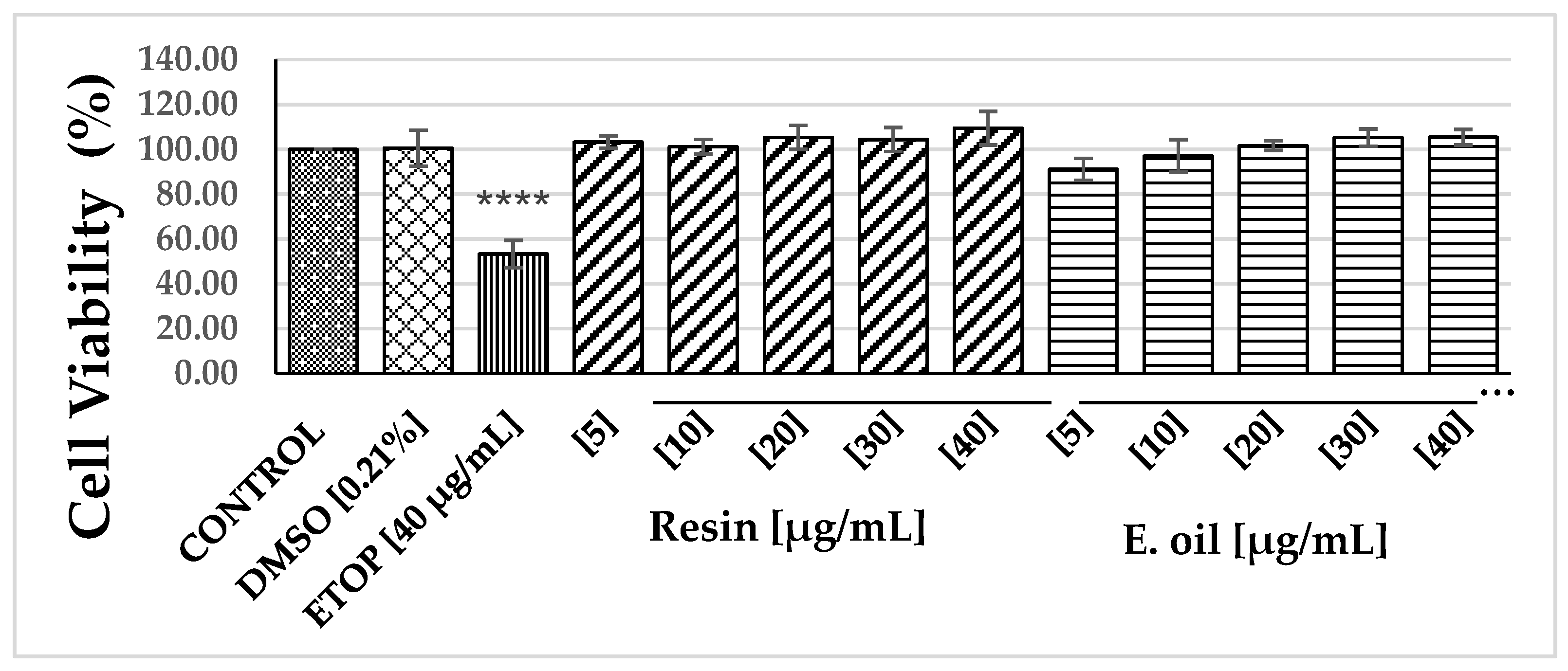
Figure 2.
Effect of the resin and volatile fraction from B. bipinnata on the production of nitric oxide (NO) in RAW 264.7 macrophages stimulated with LPS. Values are expressed as the mean ± SD of three independent experiments (n=3). The significant difference was determined using an ANOVA followed by Dunnett’s multiple comparison test. LPS compared to control group (#### p ˂ 0.0001), and DMSO, INDO (indomethacin), resin and volatile fraction compared to LPS group (* p ˂ 0.05 or ** p ˂ 0.01 or *** p ˂ 0.001 or **** p ˂ 0.0001). Control = cells without stimulus.
Figure 2.
Effect of the resin and volatile fraction from B. bipinnata on the production of nitric oxide (NO) in RAW 264.7 macrophages stimulated with LPS. Values are expressed as the mean ± SD of three independent experiments (n=3). The significant difference was determined using an ANOVA followed by Dunnett’s multiple comparison test. LPS compared to control group (#### p ˂ 0.0001), and DMSO, INDO (indomethacin), resin and volatile fraction compared to LPS group (* p ˂ 0.05 or ** p ˂ 0.01 or *** p ˂ 0.001 or **** p ˂ 0.0001). Control = cells without stimulus.
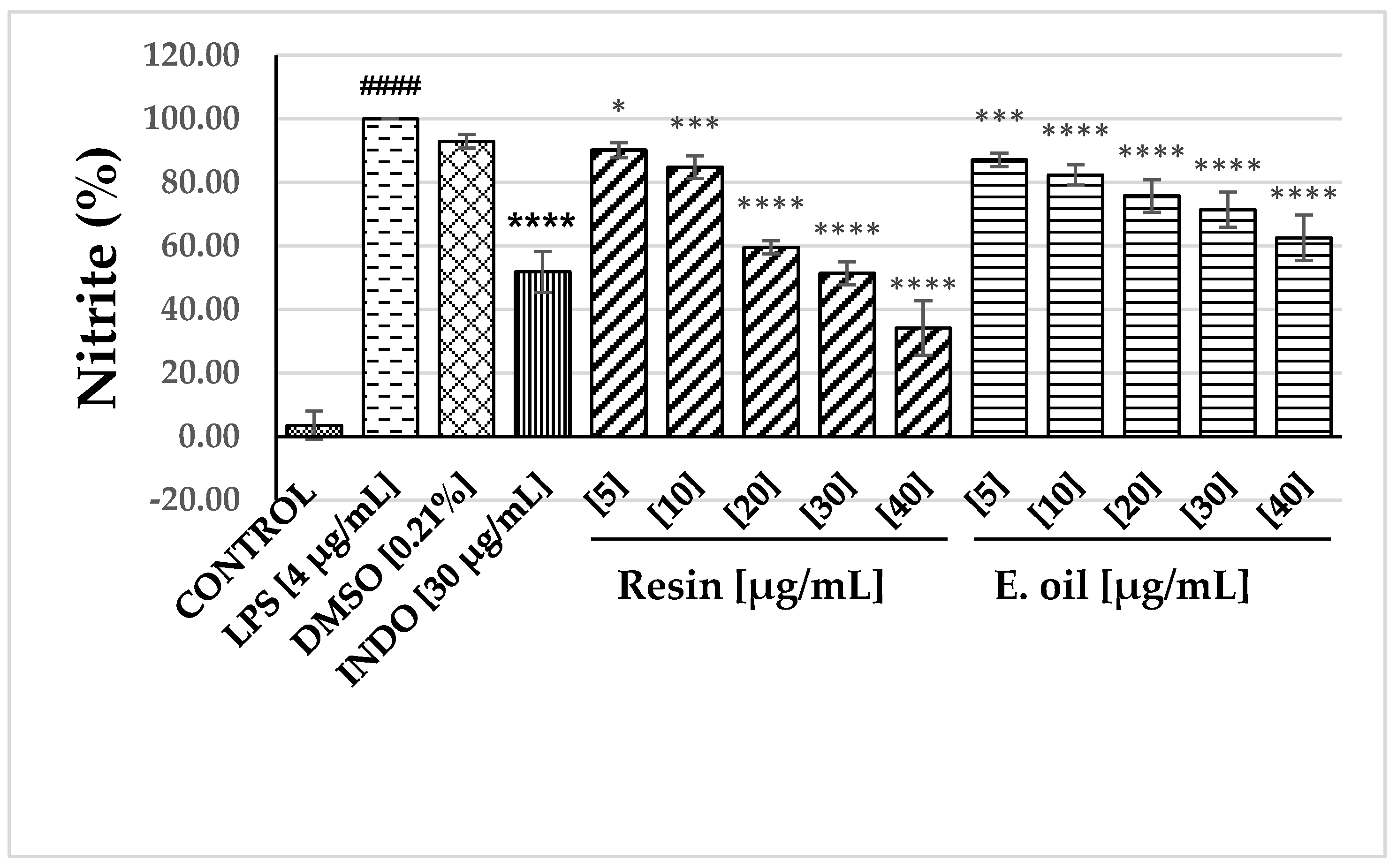
Figure 3.
Chemical structures of compounds isolated from the total resin of B. bipinnata.
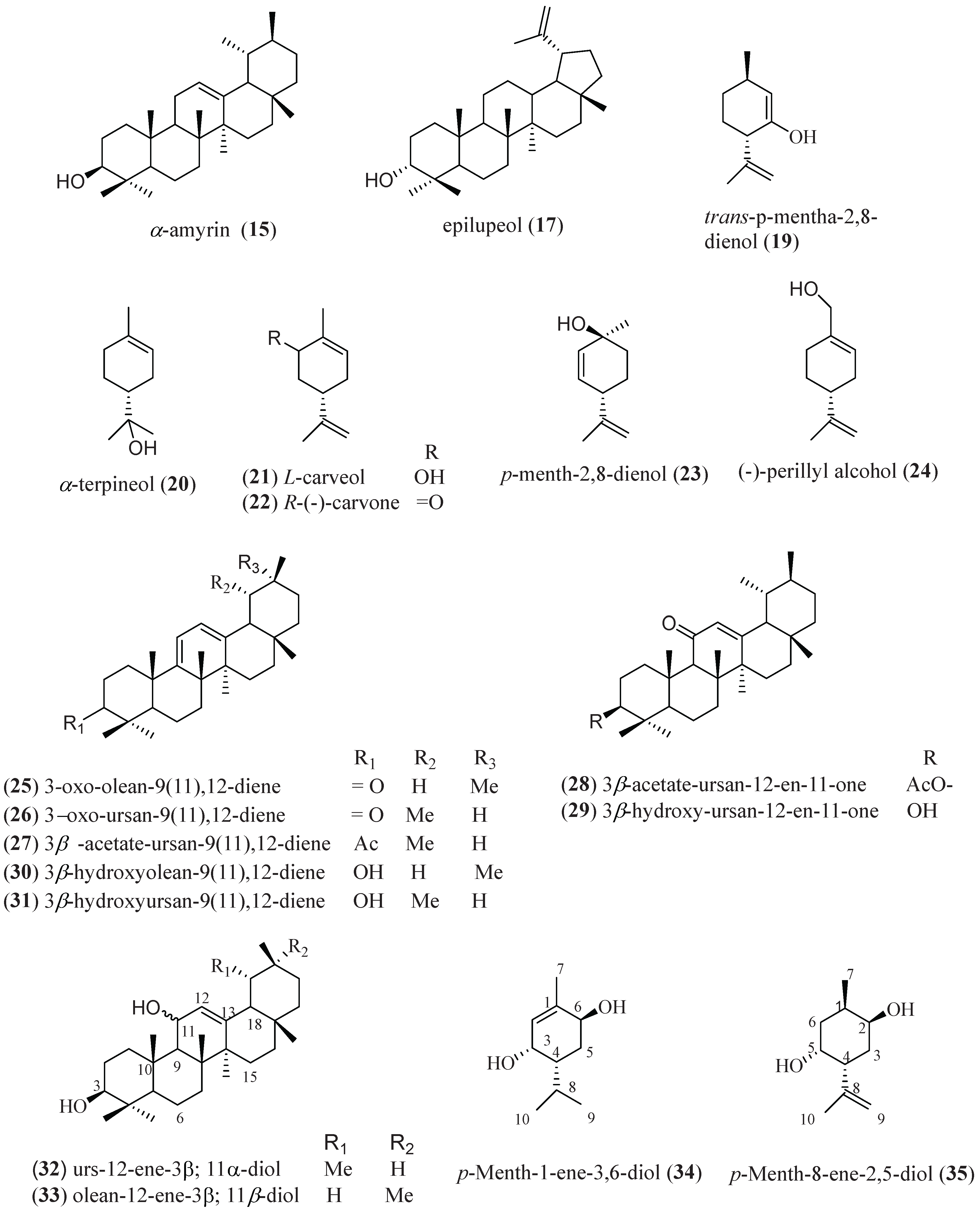

Table 1.
Inhibitory effect of the resin and volatile fraction of B. bipinnata on nitric oxide production in RAW 264.7 macrophages stimulated with LPS.
Table 1.
Inhibitory effect of the resin and volatile fraction of B. bipinnata on nitric oxide production in RAW 264.7 macrophages stimulated with LPS.
| % inhibition | |||||
|---|---|---|---|---|---|
| Concentration | [5 µg/mL] | [10 µg/mL] | [20 µg/mL] | [30 µg/mL] | [40 µg/mL] |
| Resin | 9.86± 2.37 | 15.21±3.57 | 40.42± 2.11 | 48.6± 3.57 | 65.83± 8.53 |
| Volatile fraction | 12.96±2.09 | 17.64±3.23 | 24.23± 5.11 | 28.56± 5.50 | 37.43± 7.13 |
| Indomethacin | - | - | - | 48.16± 6.38 | - |
The results were obtained from three independent experiments. Data are represented as the mean ± DE.
Table 2.
Chemical composition of B. bipinnata resin and its volatile fraction.
| Volatile fraction (supercrital CO2 extraction) | Resin (EtOAc) | |||||||||
|---|---|---|---|---|---|---|---|---|---|---|
| No | Compounds | TR (min) | Relative Content (%)1 |
Molecular Formula |
Mass spectra Match (%)2 |
Compounds | TR (min) | Relative Content (%)1 |
Molecular Formula |
Mass spectra Match (%)2 |
| 1 | α-Phellandrene | 7.11 | 24.42 | C10H16 | 136 | α-Phellandrene | 6.873 | 5.38 | C10H16 | 136 |
| 2 | β-Phellandrene | 7.46 | 8.27 | C10H16 | 136 | m-Cymene | 7.189 | 4.37 | C10H14 | 134 |
| 3 | Carene | 7.23 | 0.18 | C10H16 | 136 | ψ-Limonene | 7.254 | 2.19 | C10H16 | 136 |
| 4 | p-Cymene | 7.72 | 6.72 | C10H14 | 134 | 4(10)-Thujen-3-ol | 9.928 | 0.98 | C10H16O | 134 |
| 5 | Terpinolene | 8.35 | 0.38 | C10H16 | 136 | exo-2-Hydroxycineole acetate | 11.623 | 2.36 | C12H20O3 | 126 |
| 6 | Thujone | 9.84 | 0.55 | C10H16O | 152 | p-Menthane | 11.806 | 0.85 | C10H16O2 | 135 |
| 7 | Carvone | 9.62 | 0.48 | C10H16O | 152 | Unnamed | 12.7 | 0.54 | ND | 207 |
| 8 | β-Copaene | 12.57 | 0.54 | C15H24 | 204 | Caryophyllene | 12.91 | 1.78 | C15H24 | 204 |
| 9 | β-Caryophyllene | 13.21 | 6.31 | C15H24 | 204 | p-Menthan-3-one | 13.015 | 0.39 | C10H16O2 | 207 |
| 10 | β-Caryophyllene oxide | 15.45 | 0.44 | C15H24O | 220 | Caryophyllene oxide | 14.973 | 0.55 | C15H24O | 205 |
| 11 | Bicyclosesquiphellandrene | 14.13 | 1.03 | C15H24 | 204 | α-Phellandrene, dimer | 17.272 | 1.12 | C20H32 | 136 |
| 12 | 1-Hydroxy-1,7-dimethyl-4-isopropyl-2,7-cyclodecadiene | 14.44 | 1.33 | C15H26O | 222 |
β-Amyrin |
35.9 |
10.41 |
C30H50O |
426 |
| 13 | Calamenene | 14.49 | 0.63 | C15H22 | 202 | 3-Epilupeol | 36.275 | 38.16 | C30H50O | 426 |
| 14 | Cubenol | 17.60 | 8.05 | C15H26O | 222 | α-Amyrin | 37.109 | 29.74 | C30H50O | 426 |
| 15 | α-Amyrin | 38.53 | 5.08 | C30H50O | 426 | 3-Epilupeol-acetate | 41.786 | 1.17 | C32H52O2 | 468 |
| 16 | β-Amyrin | 36.96 | 6.28 | C30H50O | 426 | |||||
| 17 | 3-Epilupeol | 38.09 | 18.77 | C30H50O | 426 | |||||
| 18 | 3-Epilupeol-acetate | 38.64 | 4.35 | C32H52O2 | 468 | |||||
1 Relative abundance concerning volatile fraction. 2 Score ≥ 80%, compared to mass spectra available in the NIST 1.7a library.
Disclaimer/Publisher’s Note: The statements, opinions and data contained in all publications are solely those of the individual author(s) and contributor(s) and not of MDPI and/or the editor(s). MDPI and/or the editor(s) disclaim responsibility for any injury to people or property resulting from any ideas, methods, instructions or products referred to in the content. |
© 2025 by the authors. Licensee MDPI, Basel, Switzerland. This article is an open access article distributed under the terms and conditions of the Creative Commons Attribution (CC BY) license (http://creativecommons.org/licenses/by/4.0/).
Copyright: This open access article is published under a Creative Commons CC BY 4.0 license, which permit the free download, distribution, and reuse, provided that the author and preprint are cited in any reuse.


