

Submitted:
02 June 2025
Posted:
03 June 2025
You are already at the latest version
Abstract
The Big Bang theory believes that hydrogen element was synthesized in the early stages of the Big Bang. Through the analysis of gravitons and energy in supernova explosions, this paper believes that the energy density in supernova explosions can form leptons, the polymerization of leptons can form nucleons, and the action of nucleons can form hydrogen and helium rich molecular clouds. Through the analysis of this article, it can be explained that the abundance of hydrogen and helium in the universe's nebula is basically the same as the probability of supernova formation in the universe.
Keywords:
elementary particles
; hydrogen and helium synthesis
; elemental abundance
1. Big Bang Cosmology and the Currently Popular Mechanism of Star Evolution
The most influential theory in modern cosmology is the Big Bang cosmology[1]. This theory believes that the Big Bang began at 15 billion years ago with infinite size, infinite density, infinite temperature, infinite curvature of time and time. 10^-43 seconds after the Big Bang, the universe emerged from the background of quantum fluctuations. 10^-35 seconds after the Big Bang, the surge began, and quarks, bosons and leptons formed. At this stage, the universe soared by 10^30 times. 10^-12 seconds after the Big Bang, protons and neutrons and their antiparticles formed, and bosons, neutrinos, electrons, quarks and gluons stabilized. 10^-4 seconds after the Big Bang, leptons (electrons, neutrinos and corresponding antiparticles) separated. 0.01 seconds after the Big Bang, the temperature of the universe was about 100 billion degrees. The universe was dominated by photons, electrons, and neutrinos, and protons and neutrons accounted for only one billion. 0.1 second after the Big Bang, the temperature of the universe was about 30 billion degrees, and the ratio of neutrons and protons dropped from 1.0 to 0.61. One second after the Big Bang, the temperature of the universe was about 10 billion degrees, neutrinos escaped, and positive and negative electron annihilation reaction appeared. 10-100 seconds after the Big Bang, the temperature of the universe is between 10^10K and 10^9K. At this time, the synthesis of the original nucleus (Taichu nucleus synthesis) [2] begins, protons and neutrons combine to form deuterated nuclei, and then tritium, helium 3 and helium 4, and helium 4 gradually accumulates, resulting in very little lithium 7. After 100 seconds of the Big Bang, the universe cooled down below 10^9 Kelvin and the particle transformation stopped. The results of Taichu nucleation synthesis are expressed in mass as 75% H-1, 25% He-4, 0.01% deuterium, and trace lithium. At this time, the density of baryons only accounts for 2% to 5% of the matter required by the universe, and dark matter and dark energy fill the universe. After 35 minutes after the Big Bang, the temperature of the universe was about 300 million degrees, and the original nucleus synthesis process stopped. 10^11 seconds after the Big Bang (104 years), the temperature is about 10^5 Kelvin. In the early history of the universe, light dominated various forms of energy. As the universe expands, the wavelength of electromagnetic radiation is lengthened, and the corresponding photon energy decreases. The radiation energy density and scale decrease, and the energy density of matter decreases. Ten thousand years later, the universe began to be dominated by matter. 300,000 years after the Big Bang, the temperature of the universe was about 3,000 degrees, and neutral atoms were formed. Since then, the main components of the universe are cosmic matter dominated by gaseous molecules. From the Big Bang cosmology, it can be seen that matter in the universe comes from energy and is related to temperature.
Evolution mechanism of stars [3]: Generally speaking, small-mass stars with less than 3 times the mass of the Sun are small-mass stars, medium-mass stars with more than 8 times the mass of the Sun are medium-mass stars with greater than 8 times the mass of the Sun are large-mass stars.
Small and medium-sized stars originate from interstellar matter. Interstellar matter fills the universe. Among various gaseous interstellar media, small-molecule clouds are only a few times the mass of the sun, which is an area formed by isolated stars, while large-molecule clouds can reach millions of times the mass of the sun. Where interstellar matter is relatively concentrated, interstellar matter is affected by gravity and will collapse into a denser nebula. In addition to being filled with a large amount of gas, molecular clouds also have a lot of interstellar dust. When the density of nebula reaches a certain level, it will split into several clumps. The higher density is called the molecular nucleus. A molecular cloud cluster can split into very many small clumps, and each small clump can form stars. The collapse of the clump causes the central temperature to continue to increase, the radiation pressure to increase, and finally reach an equilibrium state. At this time, a protostar was born. There are accretion disks around the protostar, and the protostar enriches itself in the form of disc accretion. Because the molecular clouds rotate, the accretion disk can throw too large substances out to form a jet. As the accretion progresses, the mass of the protostar becomes larger and larger, the brightness begins to increase, and the temperature increases. Meanwhile, the stellar winds of the protostar are strong, and it can blow away the surrounding matter, thereby slowing mass growth. At the same time, the protostar is also shrinking, heating up internal matter. When the matter around the protostar is almost blown away, the protostar evolves into the pre-sequence star, which can be observed in the optical band. Here, the entire star body is in a convective state, the internal temperature rises to 1 million, and the nuclear reaction (mainly deuterium as fuel) begins in the center. Deuterium is very small in the center, and convection will bring the deuterium on the surface to the core. At this time, the star body stops shrinking, and the radiation pressure and gravity reach equilibrium. After deuterium is used up, the radiation pressure decreases, the main sequence front star shrinks, and the core temperature rises. After the core temperature rises to 7 million, hydrogen begins to be used as fuel. At this time, the brightness of the star before the main sequence remains unchanged and the surface temperature rises. After the nuclear reaction of hydrogen stabilizes, the star body stops shrinking. At this time, a star was truly born, and it officially entered the main sequence from then on.
Massive star formation: Massive star formation begins in the infrared dark cloud stage. After that, the core part begins to collapse and heat, forming a medium-mass celestial body and starts a thermonuclear reaction, while undergoing violent accretion. Accruescent causes the molecular cloud temperature to rise, and there is also a vague jet. The accretion continues. After the ultra-tight ionization hydrogen stage begins, the medium-mass celestial bodies in the core have burned hydrogen on a large scale because the core temperature is already very high. The surrounding accretionary substances have not been completely absorbed, and the violent stellar winds can’t wait to break them apart. The star is also filled with hydrogen ions ionized due to the high temperature. Due to gravity, ionized hydrogen cannot be too far away from the star, and the accretion can continue for a period of time. Since then, the stars have become larger and larger. The stellar wind is getting stronger and stronger, blowing away a large amount of matter, the density of the ionized hydrogen region is getting higher and higher, and the range is increasing. However, as the material around the star is blown away, the star’s volume no longer expands, and the density of the ionized hydrogen region decreases as the range expands, thus forming a normal ionized hydrogen region. The strong stellar wind and radiation from massive stars can change the structure of the surrounding space, and shock waves caused by expansion can compress interstellar medium. These factors interact with each other can eventually lead to the re-collapse of the interstellar medium, triggering the formation of more stars. Due to the short lifespan of massive stars, they may become supernovas when new stars are immature, but the huge energy of supernova can lead to the formation of stars and form heavy elements.
Main sequence evolution: The characteristic of star evolution in main sequence is that nuclear fusion with hydrogen as fuel inside stars. For stars in the main sequence stage, their mass is only slightly lost. The chemical composition of the main sequence star is basically the same: hydrogen accounts for 70%-75%, helium accounts for 24%-25%, and the rest are heavy elements. According to statistics, in the Milky Way, the number of main sequence stars accounts for about 90% of the number of stars.
After the main sequence: When the hydrogen of the thermonuclear reaction in a star is gradually converted into helium, hydrogen fusion cannot be maintained. At this time, a star has passed the long main sequence and has arrived at its old age. At this time, if the temperature reaches 10^8 or above, helium burns to generate oxygen elements. When the temperature reaches 8×10^8, carbon and oxygen are burned to form four elements: magnesium, silicon, phosphorus and sulfur. When the temperature is 3.5×10^9, the magnesium nucleus and the silicon nucleus undergo a photofission reaction to generate aluminum, neon, and oxygen elements, and simultaneously emit protons, neutrons and helium nuclei (α particles). The helium nucleus and silicon produce sulfur, argon, calcium, titanium, chromium, iron and nickel elements through the alpha process. The formation of iron and silicon marks the star’s dying.
The hydrogen in the late core of small-mass stars has been burned out. The core shrinks, the temperature increases, triggers helium fusion, and even helium flashes. At the same time, the core radiates excess heat energy to the outside, causing the outer material to be pushed away, causing the core to shrink and the outer layer to expand. After the core starts fusion, the hydrogen fusion starts again under radiative heating because there is still unused hydrogen on the periphery of the core. At this time, the core of the star is helium fusion, and the outer edge of the core is hydrogen fusion, so the star is rejuvenated. The energy generated by the core causes the outer layer of the star to continue to expand, forming a red giant. When the helium in the red giant is exhausted, carbon and oxygen remain, and the star shrinks rapidly under the action of gravity, and the helium around the core continues to burn. After the star completely loses its vitality, the action of gravity causes the core density to become higher and higher. When the density reaches 6×10^7 grams per cubic centimeter, due to the degenerate pressure of electrons, the substance is no longer compressed, while the temperature remains at 50,000 yuan, and the volume is very small. At this time, a white dwarf star is formed in the core. At the same time, the star shell is free from its constraints and expands to a large extent, forming a planetary nebula. Planetary nebula continues to expand, forming interstellar matter.
In the late stage of a medium-mass star, if the mass of a star is 2.3 to 8.5 times the mass of the sun, after the hydrogen in the core is burned, the core shrinks a little and enters the helium combustion stage smoothly. If the mass of a star is close to 3 times the mass of the sun or less, then its surface temperature is 5,000 yuan, which is a red giant; if the mass exceeds 7 times the mass of the sun, the surface temperature will reach 10,000 yuan, which is a giant but not red at this time. After the helium in the center is burned, the core shrinks again. This triggers carbon combustion, and the core temperature rises again, but carbon combustion will soon be burned. Carbon flashes can cause the star to be unstable and even cause explosions to destroy the star. If you survive this, a medium-mass star will eventually become a white dwarf.
In the late stages of massive stars, the hydrogen layer of massive stars can account for more than 80% of the diameter. The carbon combustion of massive stars can proceed smoothly. While the core carbon is burning, the hydrogen and helium in the shell are also burning. After the carbon in the core part is burned, the temperature has reached more than 1 billion yuan, and oxygen combustion begins. If the temperature is as high as 2 billion yuan, silicon can also start to burn. Considering extreme cases, the stars at this time have become giant “onion heads”: the core part is composed of plasma iron, and the outer part is composed of various shells, each layer undergoing different types of nuclear reactions. At this time, the star had expanded very largely and became a red super giant. For a star with a mass of 25 times the sun, hydrogen can last for 7 million years, helium can be burned for 500,000 years, carbon can be burned for 600 years, oxygen can be burned for 1 month, and silicon can only be burned for 1 day. Massive stars will end their lives in a supernova explosion.
From the above process, we can see that the star was born from the collapse of gas and dust in nebula or molecular clouds. After the star was born, the main time was in the main sequence star stage. At this time, nuclear fusion with hydrogen as fuel was underway inside the star. As the hydrogen fuel is exhausted, the stars pass through the red (super) giant stage. Finally, in the explosion, a white dwarf or neutron star forms in the center of the red (super) giant, and the shell forms a second-generation interstellar material. It can be seen that the hydrogen and helium elements in the second-generation interstellar material have basically been exhausted. It is generally believed that the energy released by a supernova explosion is more than the sum of energy released by a star in his lifetime.
From the traditional star evolution mechanism, it can be seen that the second generation of interstellar matter mainly comes from the shell of the red supergiant and the matter of supernova explosion, and the abundance of hydrogen in these matter is already very low. In this way, the probability of producing stars from the second generation of interstellar matter will greatly decrease. At this time, we should observe that the abundance of the second generation of interstellar matter should be significantly reduced than the first generation of interstellar matter. B The Big Bang theory believes that the universe is expanding at an accelerated speed, so the interstellar matter that is farthest from the earth should be the first generation of interstellar matter. As the distance from us decreases, the interstellar matter in the universe should be the second and third generations. . . . Interstellar matter. With different generations of interstellar matter, the abundance of hydrogen and helium in interstellar matter should gradually decrease. As the abundance of hydrogen and helium gradually decreases, the probability of (super) nova formation should be significantly reduced, and the number of stars should be significantly reduced. However, astronomical observations show that the elemental abundance of stars is basically the same as that of interstellar matter: hydrogen accounts for 70%-75%, helium accounts for 24%-25%. Regardless of the distance between the interstellar matter in the universe, the probability of forming stars is not significantly different, and the average number of stars is not significantly different. The Milky Way hydrogen element distribution map [4] called for more than 1 million observations and 10 billion data points. The results show that the gas clouds and the glittering stars that spread across the Milky Way are mainly composed of hydrogen elements.
The only way to explain this phenomenon is to continuously supplement hydrogen in interstellar matter. “Analysis of internal factors of the distribution law of element abundance value and its impact on the survival of the universe” [5] article believes that the various interstellar matter existing in the motion orbit of the stars and the large number of hydrogen elements and elementary particles carried in the two symmetrical and almost perfect spiral arms formed by the stars, which should be the main source of hydrogen elements for stars to supplement. The problem with this theory is that it cannot explain the problem of hydrogen abundance in the most common elliptical galaxies.
2. Inference About the Fact That Matter Particles Are All Twilight Clouds
For a long time, why are the size and mass of protons and neutrons slightly different, why are the mass of electrons so small, why does the energy level transition emit photons, and what is gravitons? This article has been plaguing us. Based on the basic concept that both neutrons and protons can emit gravitons, and electrons can emit photons, it is inferred that the most basic particle of matter is a nitrino, with a mass of a nitrino of 1.473×10^-50kg. A large number of nitrinos run along a shell with a radius of 0.8×10^-15m to form neutrons and uncharged neutral particles; a large number of nitrinos along a shell with a radius of 0.80104×10^-15m Running to form protons and positively charged particles, the positively charged particles as a whole has a positive charge; a large number of nipples run along the shell with a radius of 1.47×10^-12m to form electrons and negatively charged particles, and a negatively charged particle as a whole has a negative charge; neutrons and protons emit microns (gravitons), and gravitons propagate along the peaks of the sine wave to form gravitational energy waves, and the wavelength of the gravitational energy wave is 1.6-1.60208×10^-15m; electrons emit microns (photons), and photons propagate along the peaks of the spiral to form electromagnetic waves, and the wavelength of the electromagnetic wave is the shell diameter of the electrons around the nucleus. Neutrons, protons, electrons and other particles are all nitrino clouds composed of different numbers of nitrinos. Neutrons, protons and electrons whose radius and number match the number of nitrino clouds are long-lived particles, and other particles whose radius and number of nitrino clouds are short-lived particles. The inference that particles are all twilight clouds can be explained well: 1. The size of neutrons, protons, electrons, charges, and slight mass differences; 2. Gravity (nuclear force), electromagnetic force; 3. Why are there so many basic particles in traditional concepts; 4. The lifespan of particles; 5. The fact that there are particularly many material particles and few antimatter particles; 6. The conservation of mass and energy in Einstein’s mass-energy equation.
2.1. Preface
In 1897, British physicist Thomson discovered electrons while studying cathode rays. In 1932, Chadwick discovered neutrons in an experiment of bombarding nuclei with α particles. At this time, people believed that matter is composed of protons, neutrons, and electrons. In 1915, Einstein proposed the concept of photons, which was later confirmed by Miligan and Compton and others. In 1956, neutrinos proposed by Pauli were discovered. In 1932, Anderson observed the positrons predicted by Dirac in cosmic rays, which constituted the initial elementary particles [6]. At this stage, quantum mechanics and quantum field theory were established. In 1937, leptons such as muons, μ neutrinos, and electron neutrinos were found in cosmic rays. In 1947, π± mesons and singular particles were discovered, and in 1950, π0 mesons were discovered. After the 1950s, with the development of particle accelerators and other equipment, antiparticles of various particles were discovered one after another; a large number of resonant state particles with extremely short lifespans were discovered. The large number of discoveries of fundamental particles have led to the establishment of quantum electrodynamics and the establishment of fundamental particle quark models. In the quark model, the charge and baryon numbers of particles are fractions. In 1973, Hoft, Gross and others developed the theory of quantum chromodynamics. J/ψ particles were discovered in 1974, leptons and τ neutrinos were discovered in 1975, and Υ particles were discovered in 1979. In this stage, the unified theory of electroweakness was established and improved, and W± and Z0 particles were discovered in 1983. Currently, the mainstream theory that describes the structure of elementary particles is the quark model, but the quark model has fractional charge problems and the inability to explain the fine mass differences of various particles.
String theory and circle quantum theory are also related to basic particles of matter. In 1968, Venezino proposed string theory [7], which believed that the basic unit of nature is very small linear “string”. Different vibrations and movements of the strings produce various elementary particles. String theory believes that there is a “membrane”. In 1990, Edward Wedton proposed an M theory (superstring theory) with 11-dimensional space. String theory and superstring theory believe that the only difference between particles and particle types is the frequency difference of string vibration. Currently, string theory and superstring theory have a lot of solutions to any problem, and the predictions it makes that are different from other theories are untested, meaning it should be classified more as a mathematical framework.
Circle quantum gravity theory [8] is a quantum gravity theory developed by Abbe Ashitica, Lee Schmolin, Carlo Lovalli and others. Under this theory, space-time description is a space-time geometry paved with a spin network woven in a context independent and relativistic cycle. Each edge and each node in the network are one Planck length and Planck volume respectively. Under the Planck scale, space-time geometry is full of random quantum fluctuations. Under this theory, time and space are discrete.
The current mainstream particle models do not consider the relationship between propagator and baryon.
2.2. Microns
We know that both neutrons and protons can absorb and emit gravitons [9], and it can be inferred that neutrons and protons are composed of a large number of gravitons. Electrons [10] can absorb and emit photons, and it can be inferred that electrons are composed of a large number of photons. We also know that gravitons emitted by neutrons and protons propagate along the peaks of the sine wave to form gravitational energy waves in space. The wavelength of the gravitational energy wave is 1.6×10⁻¹⁵m. From this, it can be inferred that neutrons and protons composed of a large number of gravitons are graviton clouds with a radius of about 0.8×10⁻¹⁵m; when gravitons and gravitons meet, the direction of gravitons will deflect, and this average deflection angle should be fixed. In the graviton cloud, there are many gravitons, and the chance of graviton collisions are high, and the radius of graviton clouds can be smaller; in the graviton cloud, there are few gravitons, and the chance of graviton collisions are small, and the radius of graviton clouds must be larger. Neutrons are stable, indicating that the number of gravitons that make up the neutrons match the radius of the neutron cloud. The mass of a proton is a little smaller than a neutron and has a larger radius. The proton is stable, which means that the number of gravitons that make up the proton is also matched by the radius of the proton cloud. Electromagnetic waves are sine waves that propagate along the peaks of microphotons. Electrons are stable long-lived particles. It can be inferred that the radius of electrons and the number of microphotons that make up electrons are matched. Microphotons emitted by electrons form electromagnetic waves of different wavelengths in space. It can be inferred that the entire electron formed by a photon cloud composed of a large number of photons is still running around shells of different radii. Both electromagnetic waves and gravitational energy waves propagate at the speed of light. It can be inferred that the mass of microgravitons and microphotons is equal. We collectively call microgravitons and microphotons a microphoton. We can think that the microgravitons are the only fundamental particles that make up matter.
2.2.1. The Mass of the Micron
We regard electromagnetic waves as sine waves that propagate along the peaks of microphotons. The speed of electromagnetic wave propagation is the speed of light c=299792458m/s, and the energy carried by an electromagnetic wave packet is the Planck constant h=6.62607015×10^(-34)J·s. If all the energy carried by the microphoton is converted into kinetic energy [11], the mass mp of the microphoton is:
1MeV/c^2=1.783×10-30kg,
Similarly, we regard gravitational energy waves as sine waves propagating along the peaks of microgravitators. The speed of gravitational energy wave propagates at the speed of light, and the energy carried by a wave packet of gravitational energy wave is the Planck constant h. If all the energy carried by the micrograviton is converted into kinetic energy, the mass mg of the micrograviton is:
It can be seen that the mass of microphotons and microgravitons is the same, but the wavelength and frequency of electromagnetic waves and gravitational energy waves are different. We regard microphotons and microgravitons as a kind of particle and call them “twisters”, as shown in Figure 1. This article believes that “trino” is the only fundamental particle that constitutes all other particles, and the mass of the fibron is:
2.2.2. The Size of the Micron
Gravitationalons can interact with gravitons, two gravitational energy waves
Intersecting can deflect as much as two light rays intersect [12]. Many gravitational energy waves intersect can form a nitrino cloud. We regard neutrons as nitrino clouds formed by nitrinos circling each other. The mass of neutrons is
The number of neutrons containing truncated numbers is:
The radius of the neutron cloud is the radius of the neutron rn=0.8×10^-15m, 1.1358×10^23 truncated on this layer of the truncated cloud, and the radius of the truncated is rm consistent with:
It can be seen that the radius of the trunnions should be less than 4.7475×10^-27m. Planck length is a meaningful minimum measurable length. Planck’s length [13] is equal to 1.6×10^-35m, and the diameter of the fibron should be greater than Planck’s length. Neutrons are nitrino clouds with a radius of 0.8×10^-15m, and the gap between nitrinos should also be based on a certain distance. Therefore, the radius of the nitrinos is selected here to be Planck’s length rm=1.6×10^-35m (the size of the nitrinos needs to be determined based on experimental observation data, which is just a hypothesis). Judging from the current particle structure, the radius of a neutron is the minimum radius that a neutron can form a nitrino cloud, which requires further calculation based on the size of the nitrino and the average deflection angle of the nitrinos around each other.
2.2.3. Average Deflection Angle of the Microns Winding
Neutrons are 1.1358×10^23 nitrinos wound around to form a stable nitrino cloud with a radius of 0.8×10^-15m. The average deflection angle between the nipples and the nipples is:
2.3. Neutral Particles
A typical particle of a neutron cloud is a neutron. The neutron cloud is not charged. Its cloud radius is 0.8×10^-15m, and the number of matching nitros is 1.1358×10^23. With different mass, the running speed of neutral particles is different, and the mass of neutrinos is very small and can move at close to the speed of light. Among neutral particles, gravitons are stable particles, and the cloud radius of the neutron is more matched with the number of neutrons containing nitrinos, so neutrons are long-lived particles, while the rest are short-lived particles. Common neutral particles and properties are shown in Table 1.
The particle name, classification, mass, and average lifespan in the table are statistics based on existing data. The number of nitrinos and the ratio of particles to neutrons (including the number of nitrinos) are the control parameters added in this article.
2.3.1. Neutron
Neutrons are 1.1358×10^23 nitrinos wound around to form a stable nitrino cloud with a radius of 0.8×10^-15m. A neutron collides with a neutron (neutron absorbs a neutron), and the neutrons merge into a radius of 0.8×10^-15m, making the neutron cloud an excited state. In the next cycle, the neutron (the neutron cloud with a radius of 0.8×10^-15m) emits a neutron back to the ground state, so that the neutron remains equilibrium and stable. Neutrons’ micron density:
2.3.2. Gravitational
Gravitationalons are single nipples emitted by neutrons or protons. They propagate along the peak of the sine wave in space to form gravitational energy waves. The wavelength of the gravitational energy wave is 1.6-1.60208×10^-15m. One wave packet of the gravitational energy wave carries the energy of the Planck constant h. Both the graviton and the gravitational energy wave waves are neutral and not charged. Gravitational energy waves are too small to observe. Gravitational energy waves are not reflected or refracted when they encounter nucleons like electromagnetic waves. Gravitational energy waves can interact with any nucleon, so we cannot observe them either. Fortunately, we can observe neutrinos and gamma particles, which should be nitrino groups, that is, graviton groups, and their properties are similar to those of gravitons.
2.3.3. Gamma Rays
γ rays [14], also known as γ particle flow, are rays released when the nuclear energy level transitions and detonates. γ rays come from the nucleus. In the process of radioactive decay, nuclear fission, fusion, etc. in the nucleus, γ photons are often generated with them when electrons are generated and decayed. At the same time, gamma photons are often generated when higher particles collide, decay, and positive and negative particles are annihilated. For example, when electrons and positrons are annihilated, a pair of gamma photons are generated. Traditionally, gamma rays are electromagnetic waves with wavelengths shorter than 0.1 angstroms (1 angstroms = 10^-10m), energy is higher than 124keV, and frequency exceeds 30EHz (3×10^19Hz). When gamma rays interact with matter, they appear as particles. Gamma rays have strong penetration power. When gamma photons with energy greater than 1.02MeV pass by the nucleus, gamma photons are converted into an electron and a positron.
Explanation: It can be considered that γ rays are a nitrino cloud formed by a certain number of nitrinos with a radius of 1.6-1.60208×10^-15m. The γ rays are not charged and their running speed should be less than the speed of light. Since a nitrino is easy to interact with nucleons, and γ rays are a group of nitrinos. The probability of a group of nitrinos acting on nucleons at the same time becomes much smaller, so the probability of the γ rays acting on nucleons is much smaller than that of gravitons. Gamma particles are not charged and are different from photons, so gamma particles should be classified as a cloud of titons formed by multiple gravitons.
2.4. Positively Charged Particles
A positively charged nitrino cloud, a typical particle is a proton, and the positively charged nitrino cloud is a positive charge as a whole, and its radius is 0.80104×10^-15m. The number of protons contains 1.134×10^23, which are long-lived particles that match the radius of the cloud, and the rest are short-lived particles. The nitrino cloud formed by a small number of nitrinos is not charged, and the nitrino cloud with a number of greater than the number of positrons has a positive charge as a whole. Therefore, there are no particularly light combined particles such as neutrinos in the positively charged particles. Common positively charged particles are shown in Table 2.
The name, classification, mass, and average lifespan of particles in the table are statistics based on existing data. The number of nipples and ratio to protons (including number of nipples) are the control parameters added in this article.
2.4.1. Proton
The mass of the proton is 1.672621637×10^-27kg, and the proton is slightly lighter than the neutron. The number of tits in a proton is:
The deflection angle between the gravitational line and the gravitational line is a fixed value. For small balls with small radius and large curvature, there are more collisions. For large balls with large radius and small curvature, the number of collisions can be less. Suppose the product of the radius and the number of collisions is a constant.
Suppose the number of nitrinos in the neutron is nn, the neutron radius is rn, the number of nitrinos in the proton is np, and the radius of the proton is rp. For protons and neutrons:
The radius of the proton cloud is 8.0104×10^−16m, which meets the measured value (the diameter of the proton is about 1.6~1.7×10^−15m). The radius of the proton cloud is slightly larger than that of the neutron, and the wavelength of the gravitational energy wave emitted by the proton is:
Protons lose some of the nipples, and there is a need for the nipples to return, so the protons carry a positive charge as a whole (the formation of charge needs to be further discussed, as people thought in the past, can be regarded as the intrinsic property of the proton). However, since the tiny (graviton) emitted from protons is basically the same as the tiny (graviton) emitted from neutrons, the tiny (graviton) emitted from protons is not charged, and each wave packet of the gravitational energy wave formed is not charged.
Charge is the overall property of a ball of particles, and a ball of particles only carries one charge.
The number of protons containing littlenies matches the radius of the proton cloud, forming a stable structure, so protons are long-lived particles. At this time, protons are like neutrons. A neutron collides with a neutron (proton absorbs a neutron), and the neutrons merge into the nitrino cloud, making the nitrino cloud an excited state. In the next cycle, the proton emits a nitrino back to the ground state, so that the protons maintain equilibrium and stability. Like neutrons, the tiny velocity emitted from the proton cloud propagates in space with sine waves, forming gravitational energy waves. Of course, the nipples that hit protons also propagate in space by gravitational energy waves, with a wavelength of 1.60208×10^-15m. The density of the microns in the proton is
2.4.2. Positron and Its Annihilation
Positrons [15] have positive charges, and their mass is equal to electrons. It was first predicted theoretically by Dirac. In 1930, Mr. Zhao Zhongyao was the first to discover positrons when he was studying antimatter phenomena. In 1932 Anderson announced the discovery of positrons. The mass of positrons is 9.1×10⁻³¹kg, and the power is g=+1.6×10⁻¹⁹ Coulombs.
Positrons can be considered as a nitrino cloud with a radius of 0.80204×10^-15m and containing 6.17807×10^19 nitrinos. It has a positive charge as a whole. Since the radius does not match the number of nitrinos contained, the positron is an unstable short-lived particle.
The traditional view is that electrons and positrons appear in pairs, and positrons are antiparticles of electrons. From the analysis in this article, it can be seen that in most cases, electrons and positrons do not appear in pairs. For example, a neutron can decay into a proton, an electron and a neutrino. At this time, the positively charged protons and negatively charged electrons are generated at the same time, and the mass of protons and electrons is different. They are not a pair of matter and antimatter particles, but are both matter particles. Positrons appear by chance, which is much less likely than electrons to appear, which is consistent with the current actual observations and can also explain the fact that there is particularly much matter in the universe and very little antimatter.
Annihilation is the phenomenon that when a basic particle in the traditional sense meets its antiparticles, the two particles “disappear” together and convert into new basic particles and are accompanied by energy radiation. A common annihilation phenomenon is annihilation phenomenon that occurs when positrons meet electrons, and a pair of gamma photons will appear. Energy is also matter. The energy we are talking about now is actually the energy carried by invisible gravitons and gamma rays.
From the above analysis, it can be seen that the positron is a nitrino cloud with a radius of 0.80208×10^-15m and contains 6.17807×10^19 nitrinos. The electron is a nitrino cloud with a radius of 1.4708×10^-12m and contains 6.17807×10^19 nitrinos. When the positive and negative electrons meet, under the action of electromagnetic force, these two groups of nitrino clouds form a radius of 0.8×10^-15m, which is γ photon.
2.5. Negatively Charged Particles
A typical particle with a negatively charged micronuclear cloud is an electron. The negatively charged particle has a negative charge as a whole, and its radius is 1.4708×10^-12m. Common negatively charged particles are shown in Table 3.
The name, classification, mass, and average lifespan of particles in the table are statistics based on existing data. The number of nipples and ratio to protons (including number of nipples) are the control parameters added in this article.
2.5.1. Electronics
Electrons are partially nitrinos separated from neutrons. Electrons are the earliest discovered basic particles of traditional concepts. They are commonly represented by the symbol e, with a negative charge, with a charge of 1.602176634×10⁻¹⁹ Coulombs and a mass of 9.10956×10⁻³¹kg.
Electron contains the number of titons:
The electron cloud radius is re,
6.17807×10^19 nitrinos are wound around to form a nitrino cloud with a radius of 1.4708×10^-12m. This nitrino cloud forms an electron. The electron has the expectation of merging with the proton to return to the neutron. An electron carries a negative charge as a whole. The electrons formed by the nucleus cloud run around different energy levels of the atomic nucleus to form different electrons. Photons emitted from electrons are circling according to the radius of the electron cloud, and on the other hand, they are propagating according to the diameter (wavelength) of the electrons orbiting the atomic nucleus, forming a path in which the photons run on the spiral line. This path conforms to the path of the propagator in electromagnetic waves. The wavelength of a complete wave packet of an electromagnetic wave is much larger than the wavelength of a neutron wave packet, so a complete wave packet of a photon also carries a negative charge. The density of the electrons containing the tween is:
The electronic clouds taken by scientists are shown in Figure 2 [16]. The concept of electronic cloud [17] has long been proposed by scholars. In 1926, the Austrian scholar Schrödinger made appropriate mathematical processing of the motion of electrons based on the de Broglie’s relationship and proposed the Schrödinger equation of the second-order partial differential. If the solution to this equation is represented by three-dimensional coordinates as graphs, it is an electron cloud. The electrons move at high speed in a space with a diameter of about 10^-10 m. The size of the electron is too small to determine its direction and trajectory. Only electron cloud can be used to describe the number of chances of it appearing in a certain space outside the nucleus. Electronic clouds have different shapes, represented by the symbols s, p, d, and f: the s electron cloud is spherical and runs on a spherical surface with the same radius; the p electron cloud is spindle-shaped and distributed along three coordinate axes; the electron clouds of d and f are more complex in shape. Although the traditional concept of electron cloud may represent the probability of an electron appearing in space, according to observations, electron clouds exist.
2.5.2. Photons
When electrons transfer from high energy to low energy state, the lost energy will be converted into photons. Light is composed of photons. The essence of light is electromagnetic waves. Electromagnetic waves are divided into radio waves, infrared, visible light, ultraviolet light, and X-rays.
a. Radio waves are generally excited by free electrons in the conductor and emitted when the energy decreases.
b. Infrared, visible light, and ultraviolet rays are generated when the valence electrons of atoms are excited to the high energy level and transition to the low energy level.
c. X-rays are generated by excitation-transition of the inner electrons of the atom.
Photons are single nipples emitted by electrons that propagate in space along the peak of the sine wave to form electromagnetic waves. The wavelength of the electromagnetic wave is greater than 2×1.4708×10^-12m. A wave packet of the electromagnetic wave carries the energy of the Planck constant h, and a wave packet of the electromagnetic wave (often called a photon) carries a negative charge. The linear propagation of photons forms an electric field, the circular propagation of photons forms a magnetic field, and the cycloid propagation of photons forms an electromagnetic field [18].
2.6. Gravity and Electromagnetic Force
2.6.1. Gravity (Nuclear Force)
Gravity is the process in which baryons such as neutrons and protons emit gravitons. Gravitational energy waves propagate in space to form gravitational energy waves. Gravitational energy waves resonate with other nucleons to achieve energy transfer. The wavelength of gravitational energy waves is 1.6-1.60208×10^-15m. Inside the nucleus, the energy transferred by adjacent nuclei per unit time can cover the nuclear binding energy. At the microscopic distance, the nuclear force is gravity. At a size less than 1.6-1.60208×10^-15m, the nuclear force (gravity) is significantly reduced, and at infinitely small distances, there is no gravity.
2.6.2. Electromagnetic Force
Electromagnetic force is the force between charged particles or photons. Particles with the same charge repel each other and particles with the same charge attract each other. A single composite particle carries a negative charge, and the photons form electromagnetic waves during the propagation process, and one wave of the electromagnetic wave carries a negative charge.
2.7. Decay and Resonance State of Particles
2.7.1. Decay of Particles
Decay [19] refers to the process in which radioactive elements emit particles and turn into another element, such as radium after radium releases α particles and turns into radon. Unstable (ie, radioactive) nuclei may become more stable after radiating particles and energy. These emitted particles or energy are collectively referred to as radiation. The radiation emitted from the unstable nucleus can be alpha particles, beta particles, gamma rays or neutrons.
During the α decay, one nucleus releases an α particle (a helium nucleus formed by two neutrons and two protons) and converts into a new nucleus with a mass reduction of 4 and a nuclear charge reduction of 2. Inside the nucleus, protons and neutrons are not uniformly distributed, but combine into a ball. The easiest group to form is the “α group” composed of two protons and two neutrons. Many groups of “α clusters” have an unreasonable and stable structure. With the change of time, the “α clusters” in the nucleus gradually adjust their position and state, making the entire nucleus stable. In the end, the adjustment makes other “α clusters” stabilize, while a group of “α clusters” and other gravity decrease, and finally get rid of the gravity with other “α clusters” and release an α particle. Nuclear force is the manifestation of gravity at microscopic distance [20], and gravity can completely cover the binding energy between nucleons. With the different number of nucleons, the average binding energy between nucleons also changes. The element with the highest average binding energy of nucleons is iron. When the number of nucleons is higher than that of iron, the nucleus becomes unstable. The nucleus tends to release nucleons to stabilize the nucleus, and α decay will occur.
β decay is divided into β+ decay (releases positrons) and β- decay (releases electrons). In β-decay, a neutron is converted into a proton, an electron and an anti-electron neutrino.
According to the above analysis, the neutron is a nitrino cloud with a radius of 0.8×10^-15m and a nitrino cloud containing 1.1358×10^23 nitrinos. The proton is a nitrino cloud with a radius of 0.80104×10^-15m and a nitrino cloud containing 1.1343657×10^23 nitrinos. Under some perturbation, the neutron releases 6.17807×10^19 nitrinos to form electrons, 1.1343657×10^23 nitrinos to form protons, and the remaining nitrinos are released as anti-electron neutrinos. In this way, the number of anti-electron neutrinos containing is: 8.5955×10^19. Converted to mass as 0.711McV/c^2, this result is in line with the experimental results throughout the decay. The total number of nitrinos before and after decay remains unchanged, that is, the sum of mass remains unchanged; the number of charge remains unchanged; the sum of energy before and after decay remains unchanged, which only turns the binding energy in the neutrinos into the energy carried by the neutrinos.
In β+ decay, a proton absorbs energy into a neutron, a positron and an electron neutrino. β+ decay cannot occur alone because it must absorb energy. In the case where all β+ decays can occur, electron capture reactions are usually also accompanied. Due to the relatively insufficient electrons, a proton is converted into a neutron and emits a decay of β+ rays (a positron e+ and a neutrino v).
According to the above analysis, the neutron is a nitrino cloud with a radius of 0.8×10^-15m and a nitrino cloud containing 1.1358×10^23 nitrinos. The proton is a nitrino cloud with a radius of 0.80104×10^-15m and a nitrino cloud with 1.1343657×10^23 nitrinos. Under some disturbance, if the proton becomes a neutron, the number of nitrinos must be supplemented. Therefore, only when electrons are captured can β+ decay occur.
Gamma radiation is usually produced with other forms of radiation, such as alpha rays, beta rays. Regardless of the change, the total number of fibrons should remain unchanged before and after the change. When an atomic nucleus decays or beta decays, the number of excess tits is always released in the form of gamma particles (γ radiation).
2.7.2. Resonant State Particles
In 1951, Fermi et al. discovered that when collide with π meons and nucleons, a significant resonance phenomenon appears when the total energy of the center of mass is around 1,236 megaelectron volts. In the mid-1960s, the number of newly discovered resonance states [21] has reached dozens. There are certain quantum numbers such as charge, spin, and isotropic rotation, and there are also certain mass; it is just that because the lifetime of the resonant state is too short and the energy level has a certain natural width, which is manifested as the mass distribution of the resonant state is within a certain range near a certain certain value. Therefore, the differences in resonance state and common particles are derived from different average lifetimes. Most resonant states are particles that decay through strong interactions, with extremely short lifespans and are unstable particles. The resonant state particles are usually composite particles containing baryons or mesons.
This article believes that all particles are trunk clouds of trunks rotate around different radii. With different radii, particles appear as neutral, positively charged and negatively charged particles. As the number of trunks is different, different particles such as baryons, mesons, and leptons will appear. Particles whose radius of the particle cloud and the number of containing the nitrinos will form many, various short-lived particles, including resonant particles formed by baryons and mesons. It can be expected that more short-lived particles may be found in the future. Any new particle inferred by traditional theory will always appear under different circumstances, but the time of discovery will be different.
2.7.3. Conservation of Mass in Einstein’s Mass-Energy Equation
In the special theory of relativity, Einstein proposed the mass-energy equation [22] E=mc², which is a definite equivalent relationship between mass and energy. In the formula E represents energy, m represents mass, and c represents the speed of light. This equation is mainly used to explain the mass loss in nuclear change reactions and to calculate the energy of particles in high-energy physics. The mass-energy equation can also be expressed by ΔE=Δmc². In the above formula, Δm is usually a change in the static mass of the object, that is, a mass loss, and ΔE is a change in the static energy of the object.
In mass-energy equations, the traditional view is that mass loss turns into energy. In fact, the observable nitrino groups that make up the object diverge into space in a single nitrino or very small nitrino groups-γ rays. These nitrinos convert the binding energy between the original particles into the kinetic energy of single nitrinos or very small nitrino groups-γ rays. During the entire nuclear transformation process, the total number of nitrinos does not change, that is, the mass of the object does not change (the traditional view ignores the mass of individual nitrinos and γ ray particles that cannot be observed), and the total energy does not change (the traditional view ignores the binding energy of the nucleons that are lost in mass).
Einstein’s mass-energy equation does not destroy the law of conservation of mass and energy.
2.8. FAQs and Explanations
2.8.1. Why Do Baryons, Mesons, Leptons and Propagators Have Different Qualities, Especially the Slight Differences in the Mass of Neutrons and Protons?
Explanation: The number of microns in various particles contains different numbers.
2.8.2. The Qualities of Protons, Mesons, Leptons and Antielectrons Are Different, So Why Do They All Carry a Positive Charge?
Explanation: Charge is the overall property of a particle. The radius of a positively charged micron cloud is 0.80204×10^-15m. A small-mass cloud is like a neutrino, and gravitons are not charged. As for the mass limits of charged and uncharged particles and why the small-mass cloud is not charged, it needs further research.
2.8.3. The Qualities of Baryons, Mesons, Leptons and Electrons Are Different, So Why Do They All Carry a Negative Charge?
Explanation: Charge is the overall property of a particle. The radius of the negatively charged micron cloud is 1.47×10^-12m. This radius is much larger than the neutron radius. There is hope to return to the expectations of neutrons, so the radius of 1.47×10^-12m is the entire nitrino cloud carrying a negative charge. The 6.17807×10^19 ripples matching this radius wind each other to form stable electrons, and the electrons run around different orbits to form extranuclear electrons.
2.8.4. Why Do Particles Have the Difference Between Long Lifespan and Short Lifespan?
Explanation: When a nipples meet, their direction of operation will deflect, and this deflection angle is a fixed value. Neutrons, protons, electrons and other particles are all nitrino clouds composed of different numbers of nitrinos. Neutrons, protons and electrons whose radius and number match the number of nitrino clouds are long-lived particles, and other particles whose radius and number of nitrino clouds are short-lived particles.
2.8.5. How Does Gravity (Nuclear Force) Occur?
Explanation: Neutrons and protons emit nipples (gravitationaltons). Gravitationalons propagate in space with gravitational energy waves. When the gravitational energy wave propagates, they resonate with other nucleons, resulting in energy transfer, and forming gravity. Between adjacent nucleons, the energy transmitted by gravitational energy waves can completely cover the nuclear binding energy. The nuclear force is gravity. At a distance smaller than the diameter of the nucleon, the gravity decreases rapidly, and there is no gravity at infinitely small distances.
2.8.6. How Does Electromagnetic Force Occur?
Explanation: Electromagnetic force is the electron emits a small number (photon), and the photon carries a negative charge. Photons propagate in space with electromagnetic waves, interact with other charged particles, forming gravitational or repulsive forces.
2.8.7. It Is Reported That More than 400 Particles and Resonant State Particles Have Been Discovered Now. Why Are There So Many?
Explanation: Traditional elementary particles and resonant state particles are both trunk clouds composed of different numbers of trunks. With different situations, especially the energy and particle speeds of each collision of the particle collider will appear, short-lived particles containing different numbers of trunks will appear. It is difficult to have two or more particles containing the same number of trunks. The trunk cloud containing different numbers of trunks will form different particles, so resonant state particles will be found more and more.
2.8.8. When Matter and Antimatter Particles Meet, They Can Annihilate Each Other. Why Are There Too Many Matter in the Universe and Very Little Antimatter?
Explanation: Matter and antimatter particles are generally a pair of particles with the same mass and different charges. However, most matter particles and antimatter particles do not occur at the same time. For example, a neutron can decay into a proton, an electron and a neutrino. At this time, positively charged protons and negatively charged electrons are generated at the same time. The mass of protons and electrons is different. They are not a pair of matter and antimatter particles, but both matter particles. Positrons are just occasionally generated when protons are bombarded by other particles. When electrons and positrons meet, they can annihilate each other. It is just that electrons and positrons lose charges at the same time under the action of electromagnetic force to form gamma particles.
2.9. Summary
This paper infers that the most basic particle of matter is a nipples, with a mass of a nipples of 1.473×10^-50kg. The nipples run along the spherical layer with a radius of 0.8×10^-15m to form uncharged neutral particles. 1.1358×10^23 nipples run along the spherical layer with a radius of 0.8×10^-15m to form stable neutrons; the nipples run along the spherical layer with a radius of 0.80104×10^-15m to form positively charged particles. The positive particles are in the whole, and 1.13436571×10^23 nipples run along the spherical layer with a radius of 0.80104×10^-15m to form stable protons; the nipples run along the spherical layer with a radius of 1.47×10^-12m to form negatively charged particles, the negative particles carry a negative charge as a whole, and 6.17807×10^19 nipples run along the spherical layer with a radius of 1.47×10^-12m to form stable electrons; neutrons and protons emit microns (gravitons), and gravitons propagate along the peaks of the sine wave to form gravitational energy waves, and the wavelength of the gravitational energy wave is 1.6-1.60208×10^-15m; the electrons emit microns (photons), and the photons propagate along the peaks of the spiral to form electromagnetic waves, and the wavelength of the electromagnetic wave is equal to the diameter of the electrons running around the nucleus. Neutrons, protons, electrons and other particles are all nitrino clouds composed of different numbers of nitrinos. Neutrons, protons and electrons whose radius and number match the number of nitrino clouds are long-lived particles, and other particles whose radius and number of nitrino clouds are short-lived particles. The structure of matter envisioned in this article can be explained well: 1. The size of neutrons, protons, electrons, charges, and slight mass differences; 2. Gravity (nuclear force), electromagnetic force; 3. Why there are so many basic particles in traditional concepts; 4. The lifespan of particles; 5. The fact that there are particularly many material particles and few antimatter particles; 6. The conservation of mass and energy in Einstein’s mass-energy equation.
3. The Energy Density and Formation of Hydrogen and Helium Elements of Supernova Explosion
The inference that the elementary particles of matter are the gigantic clouds explain the relationship between matter and energy in terms of quantity. This inference believes that energy is the kinetic energy carried by a single gigantic. Gravitational and photon are both separate trunks. Matter is a cloud of tits formed by a large number of tits. Let’s analyze the energy density and the possibility of hydrogen in supernova explosions.
3.1. Energy in Supernova Explosion
The most studied and most common star is the sun [23]. The sun emits gravitons and photons every moment, with a radius of 6.955×10^8m (as for the photosphere); its mass is about 1.989×10³⁰kg. The sun uses nuclear fusion to release light and heat into space. The sun is a yellow dwarf star (the spectrum is G2V), with a lifespan of approximately 10 billion years, and the sun is currently about 4.57 billion years. The surface temperature of the sun is about 6000K, and the distance from the ground is 1.496×10^11 m. The sun has reached middle age in its main sequence evolutionary stage, and nuclear fusion at this stage is the core of fusion of hydrogen into helium. The sun is composed of the core, radiation area, troposphere, photosphere, chromosphere, and coronal layer. Every second, 600 million tons of hydrogen is reacted to 596 million tons of helium through thermonuclear fusion, and releases energy equivalent to 4 million tons of hydrogen. The solar radiation energy is the sum of solar energy emitted by the sun every second, which is about 3.86×10^26 joules, and the number of microns (photons) is:
The number of gravitons [24] (can be regarded as dark energy) emitted by the planet outside the ball is:
The sun can also absorb gravitons in the universe. Whether the number of gravitons emitted and absorbed can maintain balance remains to be further studied. The ratio of the sum of gravitons emitted by the sun (which can be regarded as dark energy) to the solar energy is:
It can be seen that the sun emits much more gravitons per second than photons. On the surface of the sun, the sun emits littlenies to form an annular sphere. The density of the littlenies in the spherical layer 1 meter adjacent to the sphere is:
Supernova explosions [25] are a violent explosion that some stars experience when their evolution is near the end. The explosions are extremely bright, and the sudden electromagnetic radiation during the process can often illuminate the entire galaxy where it is located and can last for weeks to months before gradually decaying. During this period, the energy radiated by a supernova can be comparable to the sum of the energy radiated by the sun during its lifetime. The stars will throw most or even almost all of their matter outwards at speeds up to one tenth of the speed of light and radiate a shock wave to the surrounding interstellar matter at a shock velocity of 5,000-20,000km/s (3% speed of light). This shock wave leads to a shell-like structure composed of expanded gas and dust. At this time, the temperature can reach 150 billion degrees Celsius.
Table 4 is the energy estimate table emitted during the (super) nova explosion.
It is seen from the table that these energies are between 1.5-100foe, 1foe=1×10^44joule. The energy emitted by the supernova explosion is:
The number of synthesised twitters is:
Supernova explosions are a potentially powerful source of gravitational waves in galaxies [26]. The gravitons emitted at this time (can be regarded as dark energy) are manifested as gravitational waves. The energy of gravitational waves is very huge, comparable to the energy generated during the Big Bang. On February 11, 2016, the US LIGO (Laser Interferometric Gravitational Wave Observatory) announced that humans have directly detected gravitational waves (GW150914) for the first time [27]. The source of the gravitational wave this time is the merger of two black holes 1.3 billion light years away from the Earth. Two black holes with initial masses of 29 and 36 solar masses combined into a 62 solar mass black hole, and the energy of the remaining three solar masses radiates outward in the form of gravitational waves. The strongest gravitational wave to date GW190521[28] merged two black holes to create a black hole with a mass of about 142 solar masses, and released energy equivalent to releasing about 8 solar masses in the form of gravitational waves.
The energy of the three sun’s mass is released in the form of gravitational waves, and its power is equivalent to the sum of the luminous power of all galaxies in the universe. The energy of the 3 sun mass is:
The number of synthesised twitters is:
It can be seen that in a supernova explosion, the energy we measured is much smaller than the energy (dark energy) carried by gravitons. The energy released in a supernova explosion is mainly dominated by the energy (dark energy) carried by gravitons.
The density of the nipples emitted when a supernova explodes should be proportional to its brightness. It is generally believed that the energy radiated by a supernova can be comparable to the sum of the energy radiated by the sun in its lifetime. If the supernova explosion lasts for 1 month, the density of the fibronectrons emitted when the supernova explosion is:
3.2. (Super)Duration of Nova Explosion
Supernova explosions usually last for several weeks to several months before gradually decaying and becoming invisible. By analyzing the spectral and light change curve of SN2016aps [29], astronomers found that SN2016aps is very bright, and its absolute visual magnitude reaches -22.35, which is equivalent to 2 trillion times the brightness of the sun. SN2016aps is very long-lived, and its light change curve lasts about 600 days. SN2016aps contains a large amount of hydrogen. The immortal supernova “iPTF14hls” [30] has been three years since the discovery of AT2021lwx, but it is still exploding.
3.3. Temperature When Supernova Explodes
The temperature [31] of a supernova burst can reach 150 billion degrees Celsius (1.5×10^11). This extremely high temperature occurs in the core of the star. When the explosion occurs, the temperature of the core is extremely high, far exceeding a million times the temperature of the sun’s surface. The temperature of the material clouds formed by the outbreak of Casino A[32] is very high, about 28 million degrees Celsius. The temperature inside a star can reach 1 billion k, and the theoretical maximum limit on the temperature of the core is 6 billion k. The temperature of the supernova core [33] reaches +50 billion degrees Celsius, and some supernova are destined to become neutron stars. Such a star’s temperature will be maintained at +10^11 (100 billion) degrees Celsius.
3.4. Possible Process of Material Formation in Supernova Explosion
Through the above analysis, when a supernova explodes, the temperature of the star can reach the temperature of element synthesis in the Big Bang cosmology. Any explosion is a process of breaking matter into energy (single nipples), so the first step of explosion is to break matter into energy (single nipples) to emit it. In a supernova explosion, the density of the microns can reach 1.006×10^57. The inferred that the leptons (electrons) are 4.636×10^54, the density of protons is 5.289×10^67, and the density of neutrons is 5.296×10^67. According to the fact that the material particles are nipples clouds formed by the mutually wound of the microns, the formation process of hydrogen elements can be inferred. Figure 3 is a schematic diagram of the formation process of hydrogen elements in the supernova explosion.
Figure, the formation steps of hydrogen element in supernova explosion are as follows: a. Leptons and meons can be directly formed in the nipples in supernova explosion; b. The leptons propagate at the speed of light, and the mass of the leptons formed in the big explosion will become larger and the speed will slow down. Later, the leptons will continue to gather with the leptons to form meons; c. The mass of the meon is larger and the speed is slower, and the later leptons, leptons and meons will continue to gather to form baryons; d. After the formation of baryons, gravitational force (nuclear force: the force between the nucleons and the nucleons) are generated, and weak force (force between electrons and nucleons) is generated. Gravitation pulls the baryons back to the surface of the nebula, and the interaction between the nucleons and electrons forms hydrogen element, and the aggregation of hydrogen element forms helium element. In this way, the hydrogen and helium elements in the second generation of interstellar matter are supplemented, and the hydrogen abundance in the cosmic interstellar matter remains basically unchanged, so that the second generation of interstellar matter can continue to form stars.
Some of the particles formed in supernova explosions will always escape from the nebula and disperse into the universe. As the particle mass is not used, the transmission speed is also different. The smaller mass arrives first to the earth, and the larger mass arrives later to the earth. The order of their arrival to the earth: gravitons (gravitational waves) and photons; gamma rays and neutrinos; leptons; mesons; baryons; other composite particles. For unstable particles, they will decompose into or polymerize them in long-distance transmission. Therefore, only stable protons, helium atoms or electrons can be observed in cosmic rays, and a small number of gamma ray particles, neutrinos, positrons, muons and π meons can be observed. This is a proof that hydrogen elements can be synthesized in supernova explosions.
The famous process of energy conversion into matter in reality is the Brett-Wheeler process [34]. In 1934, scientists Brett and Wheeler proposed that it is possible to form electrons and positrons by means of impact. In 2021, RHIC-STAR, a large international cooperation group based on the STAR experiment on the relativistic heavy ion collider (RHIC) of Brookhaven National Laboratory in the United States, consists of 706 scientific researchers from 67 units in 13 countries, including the research team of the High Energy Nuclear Physics Research Group of the University of Science and Technology of China and Shandong University. RHIC-STAR’s research team used relativistic heavy ion collision to find the Brett-Wheeler generation process, and found more than 6,000 positive and negative electron pairs in massive data. By analyzing the pairing mass and angular distributions of these candidate cases and comparing them with theoretical calculations, it was confirmed that these positive and negative electron pairs originated from the Brett-Wheeler process.
4. Discussion
There are a large number of gravitons and photons emitted on the surface of a star. Whether hydrogen elements can also be formed on the surface of a star needs further discussion.
5. Conclusion
Based on the relationship between propagator and baryon and the process of action of basic force, this paper infers that the most fundamental particles of matter are nipples (photons and gravitons). Different numbers of nipples formed by winding each other along different radii form traditional fundamental particles. The neutrons, protons, and electrons whose radius and number of nipples are long-lived particles, and other particles whose radius and number of nipples are short-lived particles. The material structure conceived in this article provides a good interpretation of the relationship between matter and energy. On this basis, through the analysis of gravitons and energy in supernova explosions, this paper believes that the energy density in supernova explosions can form leptons, the polymerization of leptons can form nucleons, and the nucleons can form molecular clouds rich in hydrogen elements under gravitational action. Through the analysis in this article, the reason why the abundance of hydrogen and helium in stars and cosmic nebula can be explained well. Explain the fact that the probability of supernova generation and perseverance distribution in the universe is basically consistent.
References
- Baidu Encyclopedia. Big Bang Cosmology.[EB/OL].[2024-3-18], https://baike.baidu.com/item/%E5%A4%A7%E7%88%86%E7%82%B8%E5%AE%87%E5%AE%99%E8%AE%BA/7461819?fr=ge_ala.
- Baidu Encyclopedia. Original core synthesis. [EB/OL].[2024-3-18], https://baike.baidu.com/item/%E5%8E%9F%E5%88%9D%E6%A0%B8%E5%90%88%E6%88%90/4250655?fr=ge_ala.
- Baidu Encyclopedia.Star.[EB/OL].[2024-3-18], https://baike.baidu.com/item/%E6%81%92%E6%98%9F/493?fr=ge_ala.
- Three-body mystery. Astronomers draw an amazing distribution map of hydrogen elements in the Milky Way. [EB/OL]. [2024-3-18], https://www.sohu.com/a/116667545_341698.
- Peng Xiaotao. Analysis of internal factors of element abundance value distribution law and its impact on cosmic survival. [EB/OL].[2024-3-18], https://zhuanlan.zhihu.com/p/125105950?utm_id=0.
- Baidu Encyclopedia. Elementary Particles.[EB/OL].[2024-3-18], https://baike.baidu.com/item/%E5%9F%BA%E6%9C%AC%E7%B2%92%E5%AD%90/79521?fr=ge_ala.
- Baidu Encyclopedia. String Theory.[EB/OL].[2024-3-18], https://baike.baidu.com/item/%E5%BC%A6%E7%90%86%E8%AE%BA/1055975?fr=ge_ala.
- Baidu Encyclopedia. Circle Quantum Gravity Theory. [EB/OL].[2024-3-18], https://baike.baidu.com/item/%E5%9C%88%E9%87%8F%E5%AD%90%E5%BC%95%E5%8A%9B%E8%AE%BA/1000420?fr=ge_ala.
- Chen Junli, Kang Yaohui. Gravitational, gravitational field and graviton—inference on the frequency of gravitational energy waves [J]. Astronomy and Astrophysics, 2022, 10(1):1-10. https://doi.org/10.12677/AAS.2022.101001.
- Baidu Encyclopedia.Photo.[EB/OL].[2024-3-18], https://baike.baidu.com/item/%E5%85%89%E5%AD%90/242675?fr=ge_ala.
- Baidu Encyclopedia.Kinetic Energy.[EB/OL].[2024-3-18], https://baike.baidu.com/item/%E5%8A%A8%E8%83%BD/1678605?fr=ge_ala.
- Chen Junli. Alternative explanation of gravitational lens observation results in MACSJ0025.4-1222 and bullet head (1E0657-56) galaxy cluster [J]. Modern Physics, 2024, 14(1):25-37. https://doi.org/10.12677/MP.2024.141004.
- Baidu Encyclopedia. Planck length.[EB/OL].[2024-3-18], https://baike.baidu.com/item/%E6%99%AE%E6%9C%97%E5%85%8B%E9%95%BF%E5%BA%A6/2050744?fr=ge_ala.
- Baidu Encyclopedia.γ ray.[EB/OL].[2024-3-18], https://baike.baidu.com/item/%CE%B3%E5%B0%84%E7%BA%BF/287815?fr=ge_ala.
- Baidu Encyclopedia. Positron.[EB/OL].[2024-3-18], https://baike.baidu.com/item/%E6%AD%A3%E7%94%B5%E5%AD%90/734843?fr=ge_ala.
- Dake Mathematics Life Studio. New Thoughts on Quantum Mechanics. [EB/OL]. [2024-3-18], https://www.sohu.com/a/393807401_348129.
- Baidu Encyclopedia. Electronic Cloud.[EB/OL].[2024-3-18], https://baike.baidu.com/item/%E7%94%B5%E5%AD%90%E4%BA%91/1838145?fr=ge_ala.
- Chen Junli. Properties and propagation forms of photons in electric fields, magnetic fields and electromagnetic fields[J]. Hans Preprint, 2023, 8(1):1-11. https://doi.org/10.12677/HANSPrePrints.2023.81002.
- Baidu Encyclopedia. Decay.[EB/OL].[2024-3-18], https://baike.baidu.com/item/%E8%A1%B0%E5%8F%98/13826090?fr=ge_ala.
- Chen Junli. On the fact that nuclear force is the manifestation of gravity at microscopic distance [J]. Modern Physics, 2023, 13(5):113-124. https://doi.org/10.12677/MP.2023.135012.
- Baidu Encyclopedia. Resonance State.[EB/OL].[2024-3-18], https://baike.baidu.com/item/%E5%85%B1%E6%8C%AF%E6%80%81/4960199?fr=ge_ala.
- Baidu Encyclopedia. Mass-energy equation.[EB/OL].[2024-3-18], https://baike.baidu.com/item/%E8%B4%A8%E8%83%BD%E6%96%B9%E7%A8%8B/1884527?fr=ge_ala.
- Baidu Encyclopedia.Sun [EB/OL].[2024-3-18], https://baike.baidu.com/item/%E5%A4%AA%E9%98%B3/24010?fr=ge_ala.
- Chen Junli, Kang Yaohui. An attempt to correct the universal gravitational formula from the proportion of the planet to the extrasphere gravitons - the ratio of extrasphere gravitons in deflection gravitational theory [J], Astronomy and Astrophysics, 2023, 11(3): 27-39, https://doi.org/10.12677/AAS.2023.113003.
- Baidu Encyclopedia, Supernova explosion [EB/OL].[2024-3-18], https://baike.baidu.com/item/%E8%B6%85%E6%96%B0%E6%98%9F%E7%88%86%E5%8F%91/10195482?fr=aladdin.
- Gravitational Waves-Baidu Encyclopedia.[EB/OL].[2024-3-18], https://baike.baidu.com/item/%E5%BC%95%E5%8A%9B%E6%B3%A2/726380?fr=ge_ala.
- Institute of High Energy Physics, Chinese Academy of Sciences. General Relativity, Black Holes and Gravitational Waves.[EB/OL].[2024-3-18], https://mp.weixin.qq.com/s?__biz=MzA3NDQwMDUxMg==&mid=2651461914&idx=1&sn=8a0e5fd2d35e301917ae7b5af1125bf8&chksm=84feef75b389666306271a5bb6ea055a4f99b2cbc72d701d8889fe63426554681737d30f29bf&scene=27.
- compiled by Zhou Yu. Gravitational wave detector discovered the strongest black hole merger event to date [J]. Science News, 2021(S01):30-30.https://www.cas.cn/kj/202009/t20200904_4758211.shtml.
- Wang Shanqin. Is the highest supernova in history discovered? Is it a mysterious type of supernova that has been searched for for a long time? [EB/OL].[2024-3-18], https://m.thepaper.cn/baijiahao_7100901.
- Wang Shanqin. Scientists discovered the strangest supernova ever! This time I really want to rewrite the textbook.[EB/OL].[2024-3-18], https://www.guokr.com/article/442476/.
- The temperature of a supernova explosion. [EB/OL] [2024-3-18] B4A21D7kfss%2Ben1D9OLGKCGSNYHTQ7HSF1W%2F27%2BC5OTSXB8YHVYHHSHSWKDB0BVWO9IK%2BZU5GM5F4EGUGMIDNXDQRNBC9HIYIXA0EQE5GP 9xqy8Z5FP4%2Frycmkdpnesnxo48bt%2FN4GVAVAGWGZDI9K%2BTL0O7Z5SB4pug25ZY92%2Bam5GIUUUUSEGPH13ZA86QOVQ%2B1D8H0%3D & Fru M = dqa & lid = ab166fba001167c6 & word =%e8%b6%85%e6%96%b0%e6%98%9F%e7%88%86%e7%82%b8%e6%97%b6%e7%9a%84%e6%b8%a9%e5%ba%a6.
- What does a supernova explosion look like? 28 million degrees Celsius, the jet material spans 10 light years.[EB/OL].[2024-3-18], https://baijiahao.baidu.com/s?id=1632589198863175480&wfr=spider&for=pc.
- From the earth, the universe and then to the hasron collider, explore the highest temperature in the universe.[EB/OL].[2024-3-18], https://baijiahao.baidu.com/s?id=1634302719890685673&wfr=spider&for=pc.
- Science and Technology Daily. Chinese scientists have observed the production of matter/antimatter pairs derived from pure energy for the first time. [EB/OL]. [2024-3-18], https://www.cas.cn/cm/202108/t20210805_4801163.shtml.
Figure 1.
Micron.
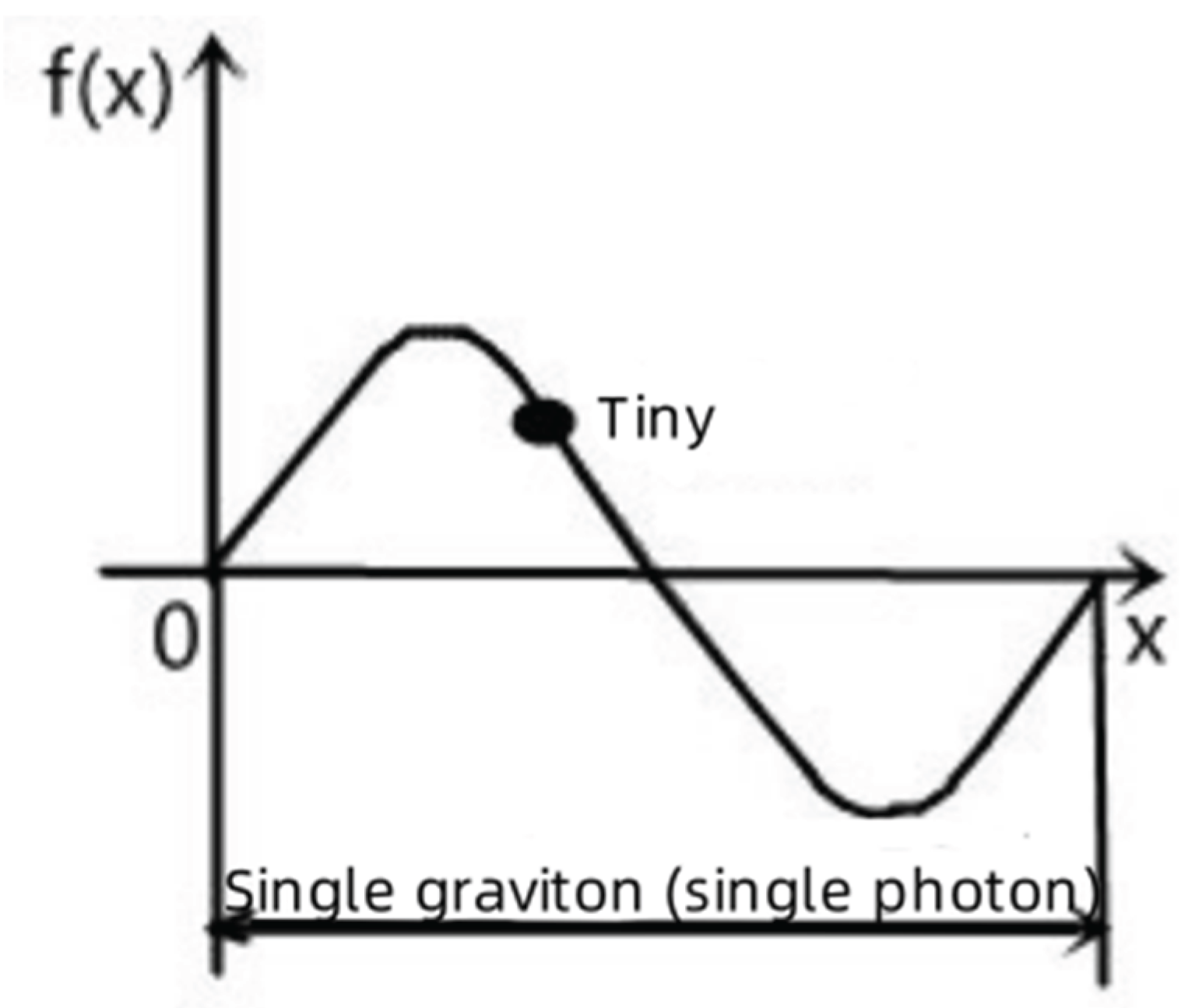
Figure 2.
Electronic cloud image taken by scientists.
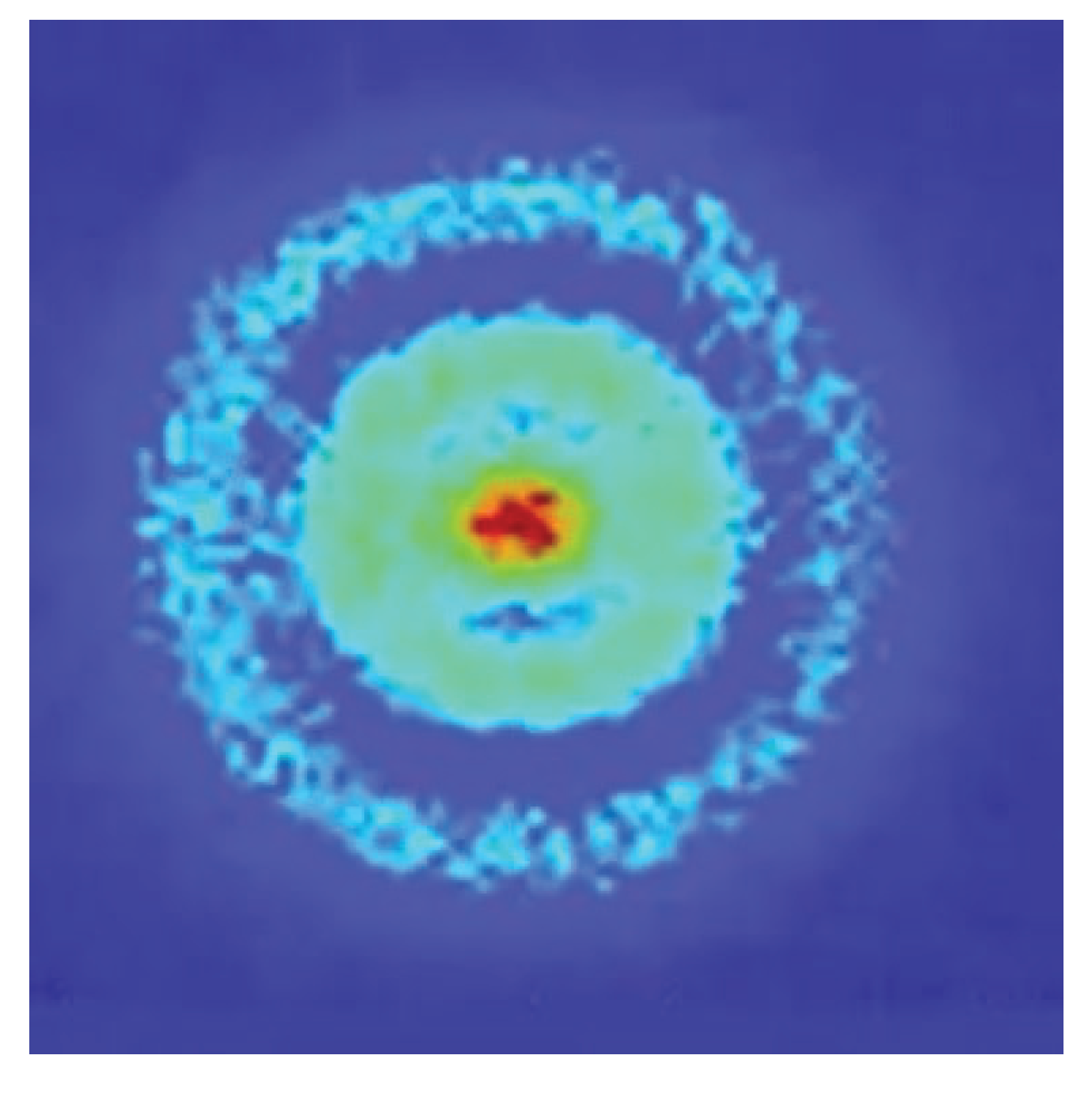
Figure 3.
The formation process of hydrogen element.
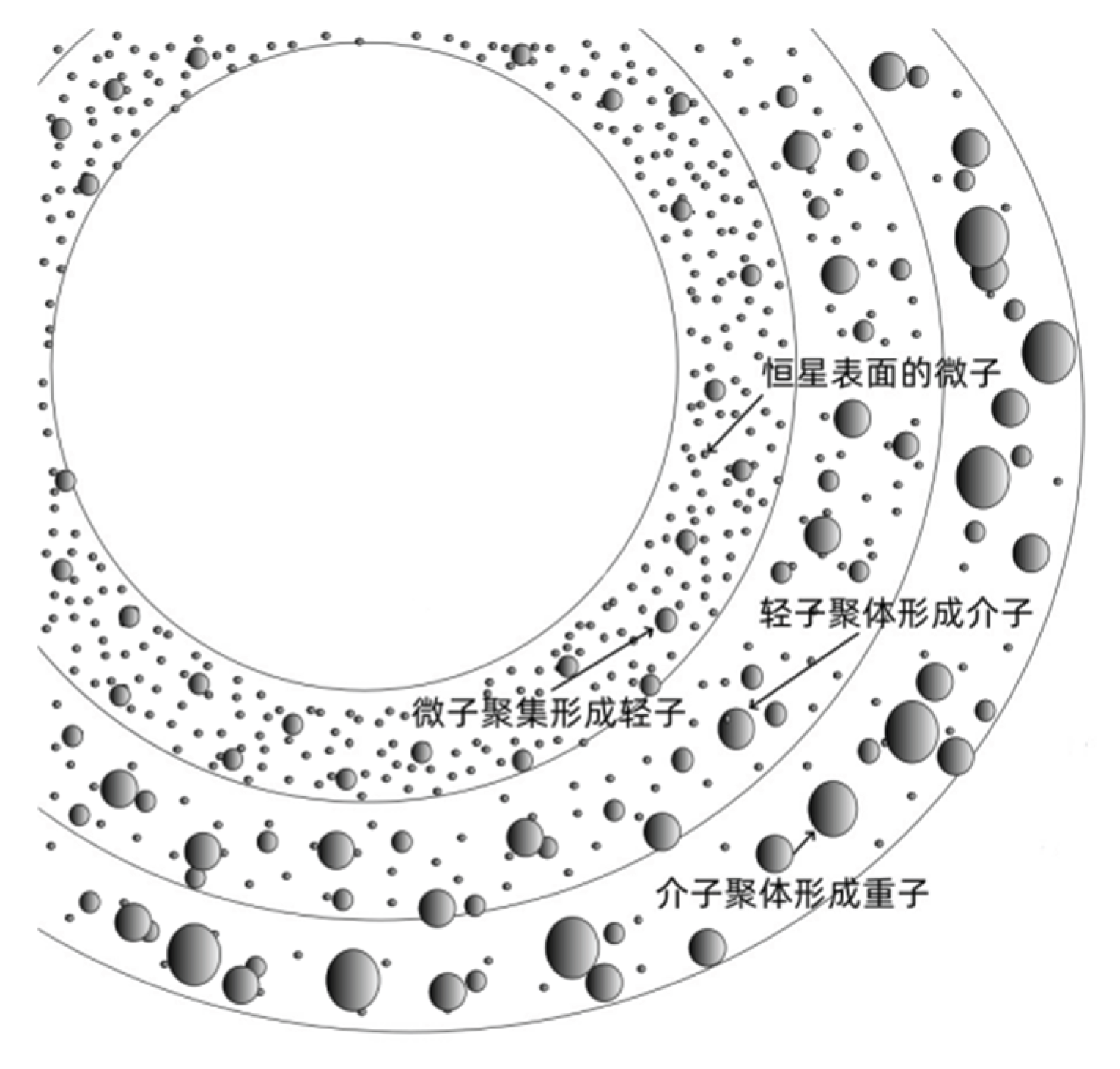

Table 1.
Common neutral particles (cloud radius is 0.8×10^-15m, and the number of truncated numbers matching the cloud radius is 1.1358×10^23).
Table 1.
Common neutral particles (cloud radius is 0.8×10^-15m, and the number of truncated numbers matching the cloud radius is 1.1358×10^23).
| name | Classification | quality(MeV) | Number of tits | Ratio to neutron | Average lifespan (s) |
| Ξ0 | Shigeko | 1314.7 | 1.590×10^23 | 1.399 | 3×10^-10 |
| Σ0 | Shigeko | 1192.5 | 1.442×10^23 | 1.269 | <10^-14 |
| Λ | Shigeko | 1115.6 | 1.349×10^23 | 1.187 | 2.5×10^-10 |
| n neutron | Shigeko | 939.55 | 1.136×10^23 | 1 | 930 |
| η | meson | 548.8 | 6.636×10^22 | 0.584 | |
| K0 | meson | 497.8 | 6.020×10^22 | 0.530 | 8.6×10^-11 |
| K0 Antiparticles | meson | 497.8 | 6.020×10^22 | 0.530 | 8.6×10^-11 |
| π0 | meson | 135.0 | 1.632×10^22 | 0.144 | 10^-6 |
| gamma rays (particle flow) | Boson | 8.270×10^-21 | |||
| μ neutrino | Lepto | <6.179×10^12 | |||
| Anti-μ neutrino | Lepto | <6.179×10^12 | |||
| τ neutrino | Lepto | <6.179×10^12 | |||
| Inverse τ neutrino | Lepto | <6.179×10^12 | |||
| Electron neutrinos | Lepto | <6.179×10^12 | |||
| Anti-electron neutrino | Lepto | <30eV | <6.179×10^12 | ||
| Gravitational | Boson | 8.270×10^-21 | 1 | Stablize |
Table 2.
Common positively charged particles (cloud radius is 0.80104×10^-15m, the number of particles matching the cloud radius is 1.134×10^23).
Table 2.
Common positively charged particles (cloud radius is 0.80104×10^-15m, the number of particles matching the cloud radius is 1.134×10^23).
| name | Classification | Quality (MeV) | Number of tits | Ratio to protons | Average lifespan (s) |
| Σ+ | Shigeko | 1189.4 | 1.438×10^23 | 1.268 | 8×10^-10 |
| P Proton | Shigeko | 938.26 | 1.135×10^23 | 1 | Stablize |
| K+ | meson | 493.8 | 5.971×10^22 | 0.526 | 1.2×10^-8 |
| π+ | meson | 139.6 | 1.688×10^22 | 0.149 | 2.6×10^-8 |
| Positron | Lepto | 0.511 | 6.179×10^19 | 5.446×10^-4 | |
| Antimuon | Lepto | ||||
| Inverse tau | Lepto |
Table 3.
Common negatively charged particles (cloud radius is 1.4708E-12m, the number of particles matching the cloud radius is 6.179E19).
Table 3.
Common negatively charged particles (cloud radius is 1.4708E-12m, the number of particles matching the cloud radius is 6.179E19).
| name | Classification | Quality (MeV) | Number of tits | Ratio to electrons | Average lifespan (s) |
| Ξ- | Shigeko | 1321.2 | 1.598×10^23 | 2.586×10^3 | 1.7×10^-10 |
| Σ- | Shigeko | 1197.3 | 1.448×10^23 | 2.343×10^3 | 1.5×10^-10 |
| K- | meson | 493.8 | 5.971×10^22 | 9.663×10^2 | 1.2×10^-8 |
| π- | meson | 139.6 | 1.688×10^22 | 2.732×10^2 | 2.6×10^-8 |
| Μ Miaozi | Lepto | 106 | 1.282×10^22 | 2.074×10^2 | 2.2×10^-6 |
| τ | Lepto | ||||
| e | Lepto | 0.511 | 6.179×10^19 | 1 | Stablize |
| Photons | Boson | 8.270×10^-21 | 1 |
Table 4.
The energy of supernova.
| Supernova | the total energy (foe) | the thrown nickel (sun mass) | the neutrino Energy (foe) | the kinetic Energy (foe) | The electromagnetic Radiation (foe) |
| Type Ia | 1.5 | 0.4 – 0.8 | 0.1 | 1.3 – 1.4 | ~0.01 |
| core collapse | 100 | (0.01) – 1 | 100 | 1 | 0.001 – 0.01 |
| extreme supernova | 100 | ~1 | 1–100 | 1–100 | ~0.1 |
| unstable | 5–100 | 0.5 – 50 | low? | 1–100 | 0.01 – 0.1 |
Disclaimer/Publisher’s Note: The statements, opinions and data contained in all publications are solely those of the individual author(s) and contributor(s) and not of MDPI and/or the editor(s). MDPI and/or the editor(s) disclaim responsibility for any injury to people or property resulting from any ideas, methods, instructions or products referred to in the content. |
© 2025 by the authors. Licensee MDPI, Basel, Switzerland. This article is an open access article distributed under the terms and conditions of the Creative Commons Attribution (CC BY) license (http://creativecommons.org/licenses/by/4.0/).
Copyright: This open access article is published under a Creative Commons CC BY 4.0 license, which permit the free download, distribution, and reuse, provided that the author and preprint are cited in any reuse.


