

Submitted:
30 May 2025
Posted:
03 June 2025
You are already at the latest version
Abstract
Salinity stress, exacerbated by extreme weather patterns, significantly threatens global watermelon [Citrullus lanatus (Thunb.) Matsum & Nakai] production. Watermelon, a moderately salt-sensitive crop, exhibits re-duced germination, stunted growth, and impaired fruit quality under saline conditions. As freshwater re-sources are receding and agriculture's dependency on irrigation leads to soil salinization, we need sustainable mitigation strategies for food security. Recent advances highlight the potential of using salt-tolerant rootstocks and breeding salt-resistant watermelon varieties as long-term genetic solutions for salinity. Conversely, agro-nomic interventions such as drip irrigation and soil amendments offer practical, short-term strategies to re-duce salt stress impact. Plant growth-promoting microbes (PGPM) have emerged as promising biological tools to enhance watermelon tolerance to salt stress. These beneficial microbes improve plant resilience by modu-lating root architecture, enhancing nutrient and water uptake, producing phytohormones, and reducing oxi-dative damage by activating antioxidant pathways. PGPM can manage osmotic adjustment by accumulating compatible solutes, establishing symbiotic relationships, and strengthening the plant's physiological and mo-lecular responses to salinity. This review is the first to highlight the complex relationship between soil salinity and watermelon production. It explores the various mitigation strategies, highlighting the potential of PGPM as eco-friendly bio-inoculants for sustainable watermelon management in salt-affected soils.
Keywords:
Salinity
; Climate change
; Citrullus lanatus (Thunb.) Matsum & Nakai
; PGPM
; abiotic stress
; watermelon
1. Introduction
Climate change–induced environmental stresses are significant challenges in the 21st century, directly impacting ecosystems, agriculture, and global food security. Rising temperatures, altered precipitation patterns, and increased soil salinization exacerbate osmotic and ionic imbalances in plants, leading to oxidative stress, reduced photosynthetic efficiency, and impaired metabolic functions [1,2]. Climate change-induced incidences, such as the severity of extreme weather events, alteration in precipitation patterns, soil degradation, and pathogen outbreaks [3,4]. Climate change also increased the spread of pests and diseases, further threatening plant health and productivity [5]. For instance, rising temperatures and CO2 levels can enhance drought stress while influencing pest populations and disease dynamics [2]. Changes in precipitation patterns contribute to water stress, through prolonged droughts or excessive rainfall, which impair plant physiological processes, including photosynthesis and nutrient uptake [6]. An increase in temperatures disrupts plant physiological processes, such as photosynthesis, respiration, and reproductive development, and reduces yields and compromises the quality of crops [7].
Plants, being sessile organisms, are particularly vulnerable to a range of biotic and abiotic stresses. Biotic stresses, caused by pathogens, insects, and herbivores, further challenge plant survival and yield by triggering complex defence responses [8]. Abiotic stresses, including drought, salinity, extreme temperatures, heavy metals, and oxidative stress, directly impact plant growth and productivity by disrupting physiological and biochemical processes [9,10]. Among these stresses, salinity stress has emerged as a critical concern, particularly in arid and semi-arid regions where soil salinization is intensifying due to irrigation practices and sea-level rise [11]. Soil salinity is a major abiotic stress that significantly impedes plant growth and development worldwide. An excessive accumulation of soluble salts, mainly sodium chloride (NaCl), in the soil results in soil salinity. The excess salt in plant tissues disrupts various physiological and biochemical processes within plants, leading to detrimental effects [12,13]. Soil salinization is a major environmental and agricultural issue affecting approximately 831 million hectares of land globally [14]. Excessive salt, especially sodium (Na), deteriorates soil quality and reduces crop productivity [15]. Salt stress is exacerbated by factors such as industrial pollution, poor irrigation, and a growing human population, placing pressure on the agricultural sector to produce more food from saline soils [16]. It varies in severity depending on salt concentration, crop species, growth stage, and duration [17]. Saline-alkali land has high Na+ levels that cause hypertonic conditions, limiting water and nutrient uptake by plants. To avoid damage to vital processes, plants accumulate excess Na+ in vacuoles, but high Na+ is toxic. Initially, osmotic stress affects water balance, followed by ionic stress, where Na+ uptake impairs K+ uptake, causing nutrient imbalances. Salt stress also leads to oxidative stress due to reactive oxygen species (ROS) such as singlet oxygen (1O2), hydroxyl radical (⋅OH), hydrogen peroxide (H2O2), and superoxide ions (O2⋅–) [18]. ROS disrupts subcellular structures such as chloroplasts, mitochondria, and membranes, damaging macromolecules (proteins, lipids, DNA, carbohydrates) and triggering cell death [19]. Plants activate antioxidant systems to combat oxidative stress, but excessive ROS can damage photosystem I (PSI) and II (PSII) in thylakoid membranes. Lipid peroxidation caused by ROS formation leads to membrane damage, organelle dysfunction, and increased markers of oxidative stress, such as protein oxidation and malondialdehyde (MDA) accumulation [20,21].
Watermelon belongs to the Cucurbitaceae, native to tropical areas of Africa near the Kalahari Desert [22]. Watermelon is a popular fruit crop celebrated for its high water content, nutritional benefits, and economic value [23]. It thrives in tropical and subtropical climates, flourishing in well-drained soils with ample moisture and sunlight [24]. China is the world’s largest producer of watermelon, with an annual output of 60.4 million tons, and in the USA, 1.5 million tons in 2025 (FAO, 2025). However, the cultivation of watermelon is increasingly threatened by abiotic stresses, especially salinity. Salt stress has detrimental effects on watermelon, negatively impacting seed germination, vegetative growth, and physiological processes, reducing fruit yield and quality [25]). Watermelon is considered moderately salt-sensitive, with growth and yield declining when soil salinity exceeds 2–3 dS.m-1. Yield decrease due to salinity, 10% at EC 2.5 dS.m−1, 10% at 3.3, 25% at 3.5, and 50% at 4.5 dS.m−1 [26]. This review focuses on salt stress’s effect on watermelon growth and development, and strategies to mitigate its impact.
2. Search Methodology
An iterative search approach was employed, utilizing Google Scholar, the World Wide Web, and citation searching for relevant papers to identify studies done on watermelon under salinity stress. The research articles were searched from 2020 to 2024 regarding studies on salinity stress in watermelon. The search words were watermelon, growth, salinity stress, adaptation to salinity, agriculture, and salinity. For specific information, such as salinity and agriculture, soil salinity, and crop production, we searched research articles older than 2020.
3. Effects of Salt Stress on Watermelon Growth and Development:
3.1. Seed Germination and Early Growth
High salinity levels significantly hinder watermelon seed germination and early seedling vigor. The osmotic imbalance caused by salt stress makes it difficult for seeds to absorb water, which delays or even prevents germination [27]. Early seedling growth is compromised, leading to stunted root and shoot development. Seedling production is the most important stage in the fruit production [28]. A study by [29] was conducted to evaluate the effect of salinity and salicylic acid on the germination of cucumber (Cucumis sativus cv. Super Dominus) and watermelon (C. lanatus cv. Crimson Sweet) seeds using a completely randomized design with three replications. The treatments included four salinity levels (0, 2, 4, 6 dS.m-1 sodium chloride) and three concentrations of salicylic acid (0, 0.5, 1 mM). The results indicated that salinity significantly inhibited seed germination and seedling growth. At the highest salinity level (6 dS.m-1), cucumber and watermelon seeds showed the lowest germination rates (18.79 and 10.33, respectively), germination percentages (86.65% for cucumber and 69.63% for watermelon), and seed vigor indices (17.93 for cucumber and 9.59 for watermelon).
A study evaluated the effect of different levels of irrigation water salinity on the emergence and initial development of ‘Crimson Sweet’ watermelon and found negative effects on both emergence and initial growth, but the reductions were lower during emergence and evaluated the impact of different levels of irrigation water salinity on the emergence in watermelon seedlings and recorded a decrease in emergence percentage (%) as the level of irrigation water salinity increased in the substrate from 0.17 to 5.5 dS.m-1 [30]. These findings suggest high salinity levels significantly impair seed germination and early seedling development in watermelon. Salt stress creates osmotic imbalances that reduce water uptake, delaying or inhibiting germination.
3.2. Vegetative Growth:
Salt stress reduces leaf area, stem elongation, and overall biomass accumulation and directly affects plant vegetative growth. The accumulation of sodium (Na+) and chloride (Cl−) ions within plant tissues disrupts cellular functions and leads to nutrient imbalances [31]. This disruption results in stunted growth and diminished photosynthetic efficiency. A 2022 study examined the effects of salt stress on the germination, development, and physiology of musk melon (Kalash, Durga), bottle gourd (Crystal long, Nuefield), and squash (Green round, Squash malika). Seeds were exposed to saline solutions (0–6.0 dS.m−1), with germination monitored for 7 days and growth parameters assessed after 30 days. Results showed that bottle gourd varieties had the highest germination rates (93.42% and 85.56%), while musk melons (Kalash and Durga) had the lowest (58.36% and 54.54%). Increased salinity significantly reduced shoot and root lengths across all cucurbits. Bottle gourd varieties outperformed others in growth metrics, including leaf count, leaf area, and biomass. Chlorophyll content declined with salinity, with Nuefield retaining the highest levels. Musk melon varieties accumulated the most Na+ and Cl−, while bottle gourd varieties had the least. Overall, bottle gourd exhibited the highest salt tolerance, while musk melon was the most sensitive. The best-performing varieties under salt stress for this experiment were Nuefield (bottle gourd), Squash malika (squash), and Kalash (musk melon), while Crystal long, Green round, and Durga were the most affected [32].
In a study by [33], the authors evaluated the salt stress responses of the watermelon cultivar Crimson Tide and seven gourd genotypes under increasing salinity levels (0–16 dS.m−1) over 30 days. Measured parameters included stem length, shoot and root dry weight, leaf ion concentrations (Na+, Ca2+, K+), and Ca2+/Na+ and K+/Na+ ratios. Salinity significantly reduced plant growth across all genotypes, with gourds generally outperforming watermelon, except for Luffa cylindrica and Benincasa hispida. Sodium (Na+) accumulation increased in all genotypes, with L. cylindrica showing the highest levels and Birecik, the lowest. C. maxima, B. hispida, and L. cylindrica accumulated more Na+ than watermelon and other gourds. Higher Ca2+/Na+ and K+/Na+ ratios correlated with greater dry weight, while increased Na+ negatively impacted biomass. Cucurbita and Lagenaria genera exhibited greater salt tolerance than L. cylindrica, B. hispida, and watermelon.
In 2024, a study evaluated 48 watermelon genotypes under salt stress in a hydroponic greenhouse system using Hoagland nutrient solution. Salt stress was gradually applied by increasing NaCl levels to an EC of 8 dSm-1 over six days, followed by a 21-day exposure. Control plants were maintained at 1.5 dSm-1 without added salt. Most genotypes showed a reduction in growth parameters, such as the most significant decreases in plant height (19.7%) and fresh stem weight (50.3%). However, certain genotypes such as W3, W4, W8, W9, and W19 increased values in traits such as root length and leaf number, indicating potential tolerance mechanisms. Photosynthetic pigments (chlorophyll a and b, carotenoids) decreased, while SPAD values and PAR efficiency slightly increased, suggesting some physiological adjustment. W36 was highly sensitive, whereas W4, W14, and W64 maintained or improved pigment levels [34].
These findings suggest that salinity at germination and the seedling stage negatively impacts watermelon crop growth and development.
3.3. Reproductive Development:
High salinity in soil delays flowering, reduces fruit set, and affects pollen viability and fertilization processes, resulting in lower fruit yield and quality [35]. Prolonged salt exposure can cause fruit cracking and lower sugar content, affecting the market value of the crop.
A study by [36], show that salinity decreased the number of inflorescences in two tomato (Solanaceae) species (S. lycopersicum and S. chilense); however, in S. lycopersicum only the number of flowers per inflorescence and sepal length decreased. External salt supply decreased pollen production, and increased pollen viability ultimately reduced the stamen length. The fruit set was not affected by salinity. However, fruit weight and size decreased in S. lycopersicum. S. chilense inflorescences and fruits accumulated more sodium than S. lycopersicum. Sodium was located in the male floral organs of S. chilense and in the non-reproductive floral organs of S. lycopersicum. In studies on another plant, salt stress experienced during the reproductive phase dramatically impedes pollen development and viability, as shown by in vitro pollen viability and germination tests from petunia, maize, and carrot plants grown under saline conditions [37,38,39,40]. Reduced seed set due to hampered pollen fertility was also reported in rice [41,42] and wheat [43] grown in saline soils. Direct experimental evidence was reported for a decisive role of pollen quality in maintaining fertility and yield under salinity conditions was obtained in barley: The lower yield of a salt-sensitive cultivar was overcome by cross-pollination with pollen from a salt-tolerant cultivar [44,45].
3.4. Physiological and Biochemical Responses:
The watermelon plant developed various adaptive mechanisms in response to salt stress, such as osmotic adjustment, ion exclusion, and antioxidant defence systems. However, prolonged exposure to high salinity levels can overwhelm these mechanisms, leading to oxidative stress and subsequent cellular damage [46]. Another study aimed to assess the salt tolerance of six watermelon genotypes (Crimson, Charleston Gray, Anarkali, Chairman, Sugar Baby, and Champion) under varying salinity levels (1.5, 3, 4.5, and 6 dS.m-1 NaCl). At the highest salinity (6 dS.m−1 NaCl), complete mortality was observed in Chairman and Champion, while other cultivars showed varied mortality rates (e.g., Crimson at 57%). Genotype Charleston Gray performed best across most growth parameters, including root and shoot length, biomass, and leaf number. Champion showed the most pronounced reduction in these traits, indicating its salt sensitivity. Salt stress reduced shoot and root lengths, with the highest root length observed at 3 dS.m−1 NaCl, especially in Charleston Gray [47].
Furthermore, plant fresh and dry weights were significantly reduced at higher salinity levels, with Charleston Gray maintaining relatively higher values than other cultivars. Chlorophyll content, nitrogen, and protein contents were also affected by salinity, with Charleston Gray showing better retention of these traits. The study concluded that salt stress severely affects watermelon growth, with salt-tolerant genotypes such as Charleston Gray maintaining better growth and biomass accumulation. These results agree with previous studies that indicated salt stress reduces growth, root size, and biomass in various crops A study on 22 watermelon genotypes, including a salt-tolerant C. colocynthis accession, examined the effects of salt stress in an unheated greenhouse. Salt stress was induced with NaCl at 0, 25, 50, and 100 mmol kg−1, with the highest level applied in stages to prevent acute effects. Results showed that salt stress significantly reduced growth in shoot length, fresh and dry weight decreasing by 61.44%, 60.75%, and 75.48%, respectively, under 100 mmol kg−1 NaCl. These findings align with previous studies in other crops, highlighting the detrimental impact of salinity on plant development [48].
3.5. Yield and Quality:
Salt stress significantly reduces watermelon yield and fruit quality. The accumulation of salts in the soil limits fruit size, lowers sugar content, and decreases the overall nutritional value of the fruit (Yetisir et al., 2006). These negative effects are more pronounced under prolonged or severe salinity conditions. The addition of NaCl in the nutrient solution caused a reduction in all production variables compared to the control treatment, regardless of K and Ca concentrations. These reductions were around 46.39, 20.01, 19.25, and 17.35% for production, longitudinal diameter of fruit, transverse diameter of fruit, and pulp thickness, respectively [49]. Reduced vitamin C content in mini watermelon (Sugar Baby) was observed.
In an experiment, mini-watermelon plants were irrigated with five water mixtures composed of varying proportions of tap water (TW; EC = 0.54 dSm-1) and reject brine (RB; EC = 9.50 dSm-1), creating salinity levels ranging from 0.54 to 6.90 dS.m-1 (M1–M5). These mixtures were applied in an open hydroponic system using four substrates: coconut fibre (S1), washed sand (S2), and two sand–rice straw blends (S3 and S4). As salinity increased, fruit weight declined, with the sharpest drop (48.86%) seen in coconut fibre under the highest salinity (M5). In contrast, sand and mixed substrates showed smaller reductions (21–27%), with no significant differences between the control (M1) and low-salinity treatment (M2) in these substrates. Fruit size (longitudinal and transverse diameters) decreased with increasing salinity, although no significant interaction was found between substrates and water mixtures. Coconut fiber consistently produced the largest fruits, with 11–14% larger diameters than washed sand. Pulp pH showed a significant interaction (p < 0.01), being highest in S1 and declining with increasing RB, especially in S1 and S3 [50]. [51] studied the impact of saline water on the yield and quality of two Chinese Cucurbit species, melon (C. melo cv. Huanghe) and watermelon (C. lanatus. convar megulaspemus). The melon yields decreased with an increase in water salinity. However, concentrations of glutamic acid content increased, but the concentration of most amino acids did not change. The watermelon yields significantly decreased with an increase in water salinity. However, fruit number, firmness, crude protein content, and essential amino acid levels significantly increased with water salinity. Salt stress increased total soluble solids and Na+ concentrations, while Ca2+ and Cl- concentrations were unaffected significantly in both Cucurbit species.

Table 1.
Effect of salinity on Watermelon growth and development.
| Growth stages | Studies | References |
|---|---|---|
| Seed germination and Early growth | Cucumber (C. sativus cv. Super Dominus) and watermelon (C. lanatus cv. Crimson Sweet) | [29] |
| Crimson sweet watermelon | [30] | |
| Zucchini (C. moschata; C. maxima; C. moschata) genotypes, | [52] | |
| Vegetative growth | Musk melon (Kalash, Durga), bottle gourd (Crystal long, Nuefield), and squash (Green round, Squash malika) | [32] |
| Watermelon cultivar Crimson Tide and seven gourd genotypes | [33] | |
| 48 watermelon genotypes | [34] | |
| Reproductive development | S. lycopersicum and S. chilense | [36] |
| Maize | [38,39] | |
| Carrot | [40] | |
| Rice | [41,42] | |
| Wheat | [43] | |
| Physiological and Biochemical Responses | Watermelon | [47,48] |
| Spartina alterniflora | [53] | |
| Pisum sativum | [54] | |
| Yield and Quality | Mini-watermelon | [25] |
| Melon (C. melo cv. Huanghe) and watermelon (C. lanatus. convar megulaspemus | [51] |
4. Strategies to Mitigate Salt Stress in Watermelon
Several strategies are used to enhance salinity tolerance in watermelon, such as using salt-tolerant rootstocks, breeding salt-resistant varieties, and employing agronomic practices such as drip irrigation and soil amendments [55]. Additionally, applying biostimulants and plant growth regulators has shown promise in improving watermelon’s resilience to salt stress [56].
4.1. Use of Salt-Tolerant Rootstocks
Currently, a fast and efficient way for horticultural crops to cope with biotic and abiotic stresses, under the prism of sustainable crop management, is through vegetable grafting. Grafting technique combines the desirable fruit traits of a scion (top plant) with the stress tolerance of a rootstock (bottom plant) [57,58]. Root characteristics are significant in determining salt tolerance in melon plants and salt-sensitive and salt-tolerant potato genotypes [59]. In contrast, [60] reported the role of scion genotypes in the growth of grafted tomato plants, regardless of the salinity in the growing media, whereas rootstock has little influence. Another study on tomatoes suggests that the characteristics of the rootstock conferring salt tolerance also depend on the shoot genotype’s salt tolerance [61]. Moreover, research on cucumbers also suggested the role of the shoot genotype on the salt tolerance of grafted cucumber seedlings [62]. Santa-Cruz et al. (2002) found an increase in growth and fruit yield when a salt-sensitive tomato cultivar ‘Moneymaker’ was grafted onto a tolerant rootstock ‘Pera’ and irrigated with water containing 50 mM NaCl as compared to self-grafted plants. The eggplant cultivar ‘Suqiqie’ (Solanum melongena L.) was improved under saline stress conditions when ‘Torvum Vigor’ (S. torvum Swartz) was used as rootstock [63] results showed that under saline conditions of 80 mM NaCl, the stem elongation inhibition of grafted seedlings was significantly lower than that of own-root seedlings. Moreover, the growth of grafted seedlings was more vigorous than that of own root seedlings, especially in roots.
Grafting of solanaceous crops gives better results than self-rooted plants when grown under saline conditions. [64] observed that when watermelon (‘Fantasy’) was grafted onto ‘Strongtosa’ rootstock (C. maxima Duch.× C. moschata Duch.), it showed lower reductions in shoot weight and leaf area on salinity than in ungrafted plants. Moreover, other experiments demonstrated that grafted ‘Crimson Tide’ watermelon C. lanatus (Thunb.) Matsumet Nakai] onto C. maxima and two Lagenaria siceraria rootstocks resulted in higher growth performance than ungrafted plants under saline conditions (8.0 dSm-1. Reduction in shoot dry weight was 41% in ungrafted plants while it varied from 22% to 0.8% in grafted plants under the same saline conditions [65]. Grafting these genotypes onto rootstocks capable of inducing salt tolerance to the scion can be used as one possible way to reduce the detrimental effects of salt stress on high-yielding cultivars [66]. Another study showed that Cucurbita (C. maxima and C. moschata) and Lagenaria (Lagenaria siceraria) rootstocks perform better than watermelon, Luffa cylindrica, and Benincasa hispida under salinity stress by avoiding physiological damage by accumulation of Na+ ion in leaves (Yetisir and Uygur, 2009). Watermelon salt tolerance can be improved by grafting watermelon onto salt-tolerant gourd (Lagenaria spp. and Cucurbita spp.) rootstock. Nongrafted watermelon plants show fewer adverse effects in plant growth parameters such as leaf surface area, leaf numbers, and total dry matter, which were negatively affected by salt stress, than control plants grown under normal conditions. Grafted plants performed better than nongrafted plants in plant growth parameters under saline conditions.
Citirex and Altinbas, two melon (C. melo L.) cultivars, were grafted onto commercial Cucurbita rootstocks (Kardosa and Nun9075) and grown at two electrical conductivity levels 1.5 dS.m−1 for control and 8.0 dS.m−1 for salt stress. Under the hypertonic salt stress, statistically significant negative correlations existed between leaf proline and shoot dry biomass, leaf MDA, leaf, and root ion leakages and leaf Na+. Also, under salt stress, growth and biomass production of grafted melons improved by enhancing physiological (high leaf area and photosynthesis), biochemical (low leaf proline and MDA), and nutritional (low leaf Na+ and ion leakage and high K+ and Ca++ contents). Citirex/Nun9075 and Citirex/Kardosa graft combinations exhibited the highest growth performance. Both Cucurbita cultivars have high rootstock potential for salt stress tolerance in melon [67].
The study investigated the effects of Osmo priming as a method to enhance salt stress tolerance in melon (C. melo L.) seeds exposed to different salinity levels. Seeds were soaked for 22 hours at 25°C in the dark, either in distilled water (hydropriming) or a 0.5% KNO3 solution (Osmo priming). After drying, the seeds were placed in plastic boxes with blotter paper containing NaCl solutions at osmotic pressures of 0.0 MPa (control), -0.3 MPa (mild stress), and -0.6 MPa (severe stress). Unprimed dry seeds served as the control. The results showed that seed priming with water and KNO3 effectively alleviates the negative effects of saline stress during the early stages of plant growth. However, under severe salt stress, hydropriming was more beneficial, resulting in higher germination and better initial growth compared to Osmo priming. Unprimed seeds should be avoided in saline-affected areas, as they lead to poor germination rates and reduced seedling growth [68].
A greenhouse experiment evaluated the growth, yield, fruit quality, gas exchange, and mineral composition of watermelon (‘Tex’), either ungrafted or grafted onto ‘Macis’ and ‘Ercole’ rootstocks, under two salinity levels (2.0 and 5.2 dS.m−1) using Nutrient Film Technique (NFT). Salinity reduced total yield due to a decrease in mean fruit mass rather than fruit number, while grafting increased total yield by 81% compared to ungrafted plants. Salinity improved fruit quality across all grafting combinations by increasing dry matter, total soluble solids, glucose, fructose, and sucrose, though grafting itself had no significant effect on sugar content. Grafted plants had higher juice electrical conductivity, but salinity increased peel percentage and decreased pulp percentage in grafted plants. Grafting significantly increased leaf area (149% larger than ungrafted), while salinity reduced it by 38%. Salinity also decreased stomatal conductance (gs) by 39% and lowered CO2 assimilation (ACO2), particularly in ungrafted ‘Tex’ plants, with ACO2 inversely correlated with leaf Na+ and Cl− concentrations. Grafting enhanced potassium accumulation in stems and leaves, with ‘Tex/Ercole’ exhibiting the highest potassium levels, though salinity reduced potassium content, especially in ungrafted plants [31].
4.2. Breeding Salt-Resistant Varieties
Breeding involves modifying the genetic make-up of current types to improve their qualifications, efficacy, utility, and cost-effectiveness. A promising development in crop breeding is the development of F1 hybrids that vary from cultivars regarding superior output, plant uniformity concerning the fruit color, quality, fruit sizes, ripening date, freshness, and resilience to abiotic and biotic challenges [69]. There are no reports of the application of ZNF (Zinc Finger Nucleases) or TALENs (Transcription Activator-like Effector Nucleases) in cucurbits. However, CRISPR/Cas9 has been applied successfully in the study of the control of cucumber fruit set [70]. Furthermore, a study from Zhu et al. (2018) [71] found that watermelon plants treated with a salt solution had higher levels of the transport protein HKT1;5, which is responsible for salt tolerance in plants. Additionally, watermelon plants have also been found to have a high level of antioxidant enzymes, which help to protect a plant from the detrimental effects of stress factors. Therefore, watermelon plants exposed to salt stress had higher levels of antioxidant enzymes such as peroxidase, superoxide dismutase, and catalase [72]. By using qRT-PCR, it was possible to ascertain the relative expressions of genes linked to chlorophyll degradation, drought tolerance, and transcription factors (WRKY70-such as and MYB96-such as), as well as ROS scavenging systems (Catalase Cu–Zn Superoxide dismutase, Glutathione reductase, and ascorbate peroxide) [73].
Another study evaluated the salt tolerance of 121 watermelon germplasm resources at the seedling stage to identify salt-tolerant types for breeding purposes. Seedlings were cultured in Hoagland’s nutrient solution with or without 150 mmol/L NaCl, and traits such as shoot fresh weight, shoot dry weight, stem diameter, root length, root surface area, and SPAD value were measured after 8 days. Significant genetic variation was observed among accessions under salt stress, and correlation and principal component analyses highlighted shoot fresh weight and root length as key indicators of salt tolerance. Membership function analysis classified the germplasm into four groups: highly salt-sensitive, weakly salt-sensitive, moderately tolerant, and salt-tolerant. Three accessions (Zaohua, PI490377, and Zhongshihong) were identified as salt-tolerant, while three others (PI186489, PI494532, and Dahongzi) were highly sensitive. These findings provide valuable materials for breeding salt-tolerant watermelon varieties and for further research on salt tolerance mechanisms [74].
Six melon genotypes, including four winter and two summer melon landraces were evaluated, under increasing salinity levels (0, 30, 60, and 90 mM NaCl). Salt stress reduced relative water content (RWC) and membrane stability index (MSI), with salt-tolerant genotypes (Ghobadlu and Suski-e-Sabz) maintaining higher levels. Oxidative stress indicators (H2O2 and MDA) increased with salinity, particularly in salt-sensitive genotypes (Samsuri and Kashan), while Ghobadlu and Suski-e-Sabz exhibited stronger antioxidant enzyme activity, mitigating ROS damage. These tolerant genotypes also accumulated more osmolytes (proline and soluble carbohydrates), aiding stress resistance. Photosynthetic pigments declined under salinity, but Ghobadlu, Suski-e-Sabz, and Galia F1 retained higher levels, supporting better photosynthetic efficiency. Biomass production decreased by 16.8%, 28.2%, and 41.5% at 30, 60, and 90 mM NaCl, respectively, with Ghobadlu, Suski-e-Sabz, and Galia F1 showing superior growth. A principal component analysis and cluster analysis grouped these three as salt-tolerant, while Samsuri, Kashan, and Khatouni were classified as salt-sensitive. The findings highlight Δ13C as a reliable selection tool for salt tolerance, and Ghobadlu and Suski-e-Sabz as promising candidates for breeding salt-tolerant melon cultivars [75].
According to a study, the tolerance of different watermelon genotypes under saline conditions was found. Twenty-two watermelon genotypes and accessions were grown in 0 mmol kg-1 as the control, 25, 50, and 100 mmol kg-1 NaCl for saline stress conditions and stress indices were calculated over the plant dry weights under the 100 mmol kg-1 salinity level to assess the salt tolerance of the genotypes. Stress intensity was calculated as 0.76, indicating the highest dose of extreme salt stress on the plants. The G04, G14, and G21 genotypes showed the highest K/Na and Ca/Na ratios in the plant tissue and were salt tolerant. The decrease in dry mass at severe salt stress is 75.48%. The GMP (geometric mean productivity) and STI (stress tolerance index) indices indicated that G04, G14, and G21 could be prominent sources to develop salt tolerance varieties [48].
A study [34] reported that under salt stress (8 dSm−1), the average root length of watermelon genotypes declined from 61.73 cm (control) to 55.85 cm, indicating an 8.16% reduction in root development. Chlorophyll a and b levels decreased by 17.1 and 13.6%, respectively, though specific genotypes (e.g., W7, W15, and W28) exhibited an increase in these parameters, suggesting potential tolerance mechanisms. Molecular marker analysis revealed that ISSR, SSR, and SRAP technologies effectively differentiate salt-tolerant and salt-sensitive genotypes. Notably, the ISSR-DBDACA7.540 band showed a strong association with photosynthetically active radiation (PAR) and MDA, achieving the highest regression coefficient (42.7%). These findings emphasize the varying salt stress responses among watermelon genotypes and highlight the critical role of molecular markers in evaluating and improving stress tolerance.
The genetic resources identified from all these studies can be utilized to select the salt-tolerant genotypes and incorporate them into breeding programs to develop more resilient watermelon varieties.
4.3. Agronomic Practices Such as Drip Irrigation and Soil Amendment
Incorporating organic matter into the soil has been shown to enhance water-holding capacity and improve soil structure, thereby reducing salt accumulation [76]. Efficient irrigation practices, such as drip irrigation and sensor-based water application, have been found to minimize water loss through evaporation and leaching, thus preventing salt build-up [12]. Excess salts in the root zone can be leached by applying water over crop requirements, but proper drainage is essential to avoid waterlogging. Applying specific soil amendments, such as gypsum or lime, can alleviate salinity stress by displacing sodium ions and balancing soil pH, respectively [77].
The effects of an apple–watermelon agroforestry system versus a watermelon sole-cropping system under three irrigation levels (105 mm, 210 mm, and 315 mm) were examined over three years in the arid region of central Ningxia, China. The research assessed how these systems influence resource availability and watermelon performance. Findings revealed that the agroforestry system extended the watermelon growth period, increased the leaf area index, and gradually enhanced shade intensity. However, it generally resulted in lower soil moisture, leaf photosynthetic rates, and yields than sole cropping. Notably, agroforestry slightly improved average fruit weight and total soluble solids, under both low and high irrigation levels. Path analysis indicated that improved soil water content in the agroforestry system boosted yield under certain conditions [78].
A study [79] reported a linear decrease in the percentage of emergence (20.27, 16.66, and 15.27% ) in three zucchini (Cucurbita moschata; C. maxima; C. moschata) genotypes, with increasing irrigation water salinity ECw.
A greenhouse experiment examined the effects of salt stress on mini watermelon (Sugar Baby) production. Salinity was induced with NaCl (5.0 dS.m−1) and supplemented with potassium (50%) and calcium (100%). Plants were grown in a coconut fiber-sand substrate (1:1) with drip irrigation, manual pollination, and pruning. Data collected included fruit weight, dimensions, rind thickness, pulp firmness, soluble solids, vitamin C, titratable acidity, and colorimetric properties. Results showed that NaCl significantly reduced fruit production (-46.39%), longitudinal (-20.01%) and transverse (-19.25%) fruit diameters, and rind thickness (-17.35%) due to osmotic stress. Potassium and calcium supplementation improved yield (+46.12% and +17.38%) and fruit size. Pulp firmness increased under salinity, stabilizing cell walls, while vitamin C content declined with salinity (-39.13%). Salinity enhanced fruit color intensity and lycopene content, making the fruits darker red (Hue < 50), preferred by consumers. At the same time, salinity reduced yield, and vitamin C, potassium, and calcium improved fruit quality by enhancing firmness and color [80].
A study on Sugar Baby watermelon evaluated six salinity management strategies and two nitrogen doses (50% and 100%) using a randomized block design. Plants were grown in 20 L lysimeters with sandy loam soil and irrigated with low (0.8 dS.m−1) or high (3.2 dS.m−1) salinity water, applied at different growth stages. Physiological traits, including stomatal conductance, transpiration, CO2 assimilation, and water-use efficiency, were measured at 75 days after sowing (DAS), while fruit yield parameters were recorded at 85 DAS. Results showed that salinity significantly reduced all physiological variables, with the greatest declines observed when stress was applied at the vegetative/flowering and fruit maturation stages. Stomatal conductance dropped by 35.02% at fruit maturation due to salt accumulation, while CO2 assimilation was lowest under high salinity, such as due to osmotic stress. Water-use efficiency improved with 50% nitrogen, which also increased fruit mass (1,055.9 g), 18.27% higher than with 100% nitrogen. Salinity during early growth stages led to smaller fruit diameters, whereas 50% nitrogen enhanced photosynthesis and fruit size. In conclusion, salinity at critical growth stages severely impacted physiology and yield, while moderate nitrogen application (50%) improved fruit quality and stress tolerance [81].
4.4. Application of Biostimulants and Plant Growth Regulators
4.4.1. Biostimulants
Biostimulants in modern sustainable agricultural practices are emerging as a promising approach to enhance crop performance. Biostimulants are substances or combinations of naturally occurring organic compounds that promote plant growth, particularly under challenging environmental conditions [82]. Biostimulants come in various forms, including botanical extracts such as seaweed extract, protein hydrolysates, vitamins, amino acids, anti-transpirants, non-microbiological products, humic acid, fulvic acid, and their products. Unlike fertilizers or manures, they are applied in small quantities, which sets them apart from these inputs [83].
Per the Fertilizer Amendment Order of 2021, biostimulants are defined as materials, microbes, combinations designed primarily to improve nutrient absorption, enhance growth, increase yield and quality, and help plants withstand stress. Importantly, these do not include plant growth enhancers or pesticides controlled by the 1968 Insecticide Act. In a study, two biostimulants, Ascophyllum nodosum (Asc) seaweed and a silicon-based (Si), were tested on watermelon. Three salinity treatments, i.e., 0 mM, 50 mM, and 100 mM NaCl were given to watermelon seedlings, and the foliar spray of biostimulants was done. Relative water content was increased by Asc in the high salinity level. The plant area, shoot dry weight, and leaf number were decreased with an increase in salinity level. However, total root length and surface area were increased by 50 mM salt, as well as Asc in some cases. The OJIP transient of the photosynthetic apparatus was also assessed. Following the application of Asc, certain OJIP parameters decreased under high salinity conditions. Overall, it is concluded that Asc induced a positive phenotypic response after salt stress, whereas silicon (Si) did not mitigate the effects of salinity stress in transplanted watermelon [84].
Another study reported that salt-stressed watermelon plants exhibited the most favourable morphological and biochemical responses when treated with a combination of silicon (4 mM), Glomus mosseae, and Gigaspora gigantea. This treatment also led to reduced osmotic activity, electrolyte leakage, and peroxide content. Treatments involving silicon (4 mM) with either G. mosseae or G. gigantea individually showed similarly significant improvements across most evaluated traits, outperforming treatments with either mycorrhizal species alone. Additionally, the antioxidant capacity of watermelon was notably enhanced under salinity stress when inoculated with the AMF–silicon combination. Overall, the joint application of arbuscular mycorrhizal fungi (AMF) and silicon appears to be an effective strategy for alleviating salinity stress in watermelon [85].
Melatonin (MT) is an extensively studied biomolecule with dual functions, serving as an antioxidant and a signaling molecule. Trichoderma Harzianum (TH) is widely recognized for its effectiveness as a biocontrol agent against many plant pathogens. However, the interplay between seed priming and MT (150 μm) in response to NaCl (100 mM) and its interaction with TH was investigated. The study aimed to evaluate the potential of MT and TH, alone and in combination, to mitigate salt stress in watermelon plants. The results demonstrated that treatments with MT and TH individually mitigated adverse effects of salt stress. Notably, the combined application of MT and TH produced a pronounced positive impact by enhancing plant growth, photosynthetic activity, gas exchange parameters, chlorophyll fluorescence indices, and ion homeostasis (with decreased Na+ and increased K+ levels) [86].
MT and TH effectively reduced oxidative stress by suppressing hydrogen peroxide accumulation under both saline and non-saline conditions, as evidenced by decreased lipid peroxidation and electrolyte leakage. The combination also significantly alleviated salt-induced oxidative damage through the activation of antioxidant defence mechanisms, including the AsA-GSH (Ascorbate-Glutathione) cycle, glyoxalase pathway, accumulation of osmolytes, and the upregulation of stress-responsive genes. Furthermore, transmission electron microscopy (TEM) confirmed the preservation of chloroplast ultrastructure under salt stress [86].
4.4.2. Plant Growth-Promoting Microbes and ISR (Induced Systemic Resistance)
The plant’s microbiome plays a significant role in its growth and development. The soil microbe-plant interactions are complex and are significant in plants’ growth and development [87]. Around 10 billion microbes are found in 1 gram of rhizosphere soil and plant roots [88]. Plant roots release exo-metabolites that enrich the rhizosphere with carbon, fostering a microbiome that reciprocally aids the plant through nutrient supply, pathogen suppression, and phytohormone modulation [89]. These microbes, which can be bacteria, fungi, and viruses, exhibit several plant growth-promoting traits such as phosphate solubilization, Indole-3-acetic acid (IAA), Nitrogen fixation, siderophore, catalase, ammonia production, ACC deaminase and protease activity and help plant’s growth and development [90,91]. The bacteria and fungi associated with the plant’s rhizosphere affect the host plant’s immunity, nutrient acquisition, stress tolerance, and pathogen abundance [92]. Plants recruit plant growth-promoting bacteria to deal with salinity stress. [93]. In a study [94], the isolation of PGPR from the rhizosphere of native plant Ceanothus velutinus exhibited several plant growth-promoting traits such as the ability to fix nitrogen, siderophore production, and phosphate solubilization.
The study explored the effects of salinity-tolerant bacteria isolated from saline agricultural soils on the growth of cucumber (C. sativus cv. Royal) seedlings. Fifty bacterial isolates were screened for their tolerance to salinity and drought and their abilities to solubilize phosphate and produce plant growth-promoting compounds such as auxin, siderophores, and hydrogen cyanide. Among them, isolates K4, K14, K15, and C8 showed the highest resistance to salinity and drought in vitro. Notably, isolates C8 and K15 exhibited the greatest auxin production (2.95 and 2.87 µg mL−1, respectively) and significant siderophore production (14% and 11%). In addition, C8 and K14 demonstrated strong phosphate solubilization activity, with values of 184.64 and 122.11 µg mL−1, respectively. Statistical analysis indicated that these four potent isolates significantly improved all measured growth parameters in cucumber plants under salinity stress over a six week. Specifically, plant height increased by 41%, fresh and dry biomass by 35% and 7%, respectively, and the leaf area index by 85%. The most effective isolate, C8, was identified as Bacillus subtilis through 16S rDNA sequencing [95].
These findings support using beneficial microbes to enhance crop productivity in saline soils as a sustainable strategy.
Table 2.
Mitigation strategies for salt stress.
| Strategies | Study | Refences |
|---|---|---|
| Use of salt-tolerant rootstocks | Potato | [59] |
| Tomato | [60,61] | |
| Egg plant | [63] | |
| Watermelon | [31,33,64,65,67,96] | |
| Melon | [67,68] | |
| Breeding salt-resistant varieties | Watermelon | [34,48,71,74,75] |
| Agronomic practices | Watermelon | [78,79,97] |
| Zucchini | [79] | |
| Mini-watermelon | [80,81] | |
| Biostimulants | Watermelon | [84,85,86] |
| Plant-Growth-Promoting Microbes | Cucumber | [95] |
5. Challenges and Future Perspectives
Salt stress is a vital question to address in breeding economic crops for resistance, severely inhibiting plant growth and development, influencing yield and quality. To tackle the issue of plant salt stress, future efforts should focus on two directions: Firstly, actively utilizing whole-genome analysis and transcriptome sequencing technologies to mine salt-tolerant genes from germplasm resources, exploring practical research on applying gene editing, agrobacterium infection, virus-induced gene silencing, and nanoparticle technologies for the functional validation of salt tolerance genes in cucurbit crops and secondly, utilizing biotechnological methods, such as transgenic engineering, as well as through soil improvement and irrigation adjustments.
While the increasingly refined reference genomes of cucurbit plants and the continuous development of modern molecular biology tools have made it possible to study the salt response mechanisms of these species, challenges such as time-consuming genetic transformation systems and low transformation rates mean that the molecular mechanisms of salt tolerance, such as in cucurbits are continuously lacking and primarily understood at the physiological and biochemical levels. Therefore, promoting the development of an effective genetic transformation system is a crucial avenue for exploring the molecular mechanisms of salt tolerance in cucurbit crops. In addition, grafting and applying exogenous nanomaterials and hormones can be used to alleviate salt stress in Cucurbitaceae. Nevertheless, the donor’s application rate and the rootstock selection require further investigation tailored to specific plant species and growth stages.
Moreover, plant growth-promoting bacteria remain an underexplored tool in salt stress mitigation. Particularly under abiotic stresses, despite of their proven potential to mitigate plant stress, their application in managing salinity stress in crops such as watermelon has received limited research attention. Future studies should focus on elucidating the underlying mechanisms by which PGPB confer salt tolerance in watermelon, alongside efforts to develop effective and crop-specific microbial formulations.
6. Conclusions
Climate change exacerbates abiotic and biotic stresses by enhancing and altering extreme weather events, accelerating soil degradation and pathogen outbreaks. Plants, being sessile, are particularly vulnerable to biotic and abiotic stresses, such as drought, floods, soil salinity, extreme temperatures, and heavy metal toxicity, which disrupt key physiological and biochemical processes, impairing growth and reducing productivity. Salinity is a critical threat, particularly for crops such as watermelon. The problem is intensifying in many agricultural regions due to climate change, improper irrigation practices, and the progressive salinization of soils. Excessive salt, especially Na+, degrades soil quality and inhibits plant development by hampering seed germination, vegetative growth, and essential physiological functions, ultimately decreasing fruit yield and quality. Several strategies can be employed to improve salt tolerance in watermelon, such as the use of grafting for salt-tolerant rootstocks, breeding salt-resistant cultivars, agronomic interventions such as drip irrigation and soil amendments, and applying biostimulants and plant growth regulators. Root traits are pivotal in determining salt tolerance in melons and salt-sensitive and salt-tolerant genotypes of other crops. Breeding programs aim to enhance crop performance by modifying the genetic makeup of existing varieties to improve traits such as stress tolerance, efficiency, and cost-effectiveness. In addition, biostimulants and plant growth-promoting microbes, including AMF, play a vital role in plant health and development. Through the release of exo-metabolites, plant roots create a carbon-rich environment that fosters microbial colonization. In return, these beneficial microbes support plant growth by facilitating nutrient acquisition, suppressing pathogens, and modulating phytohormone levels.
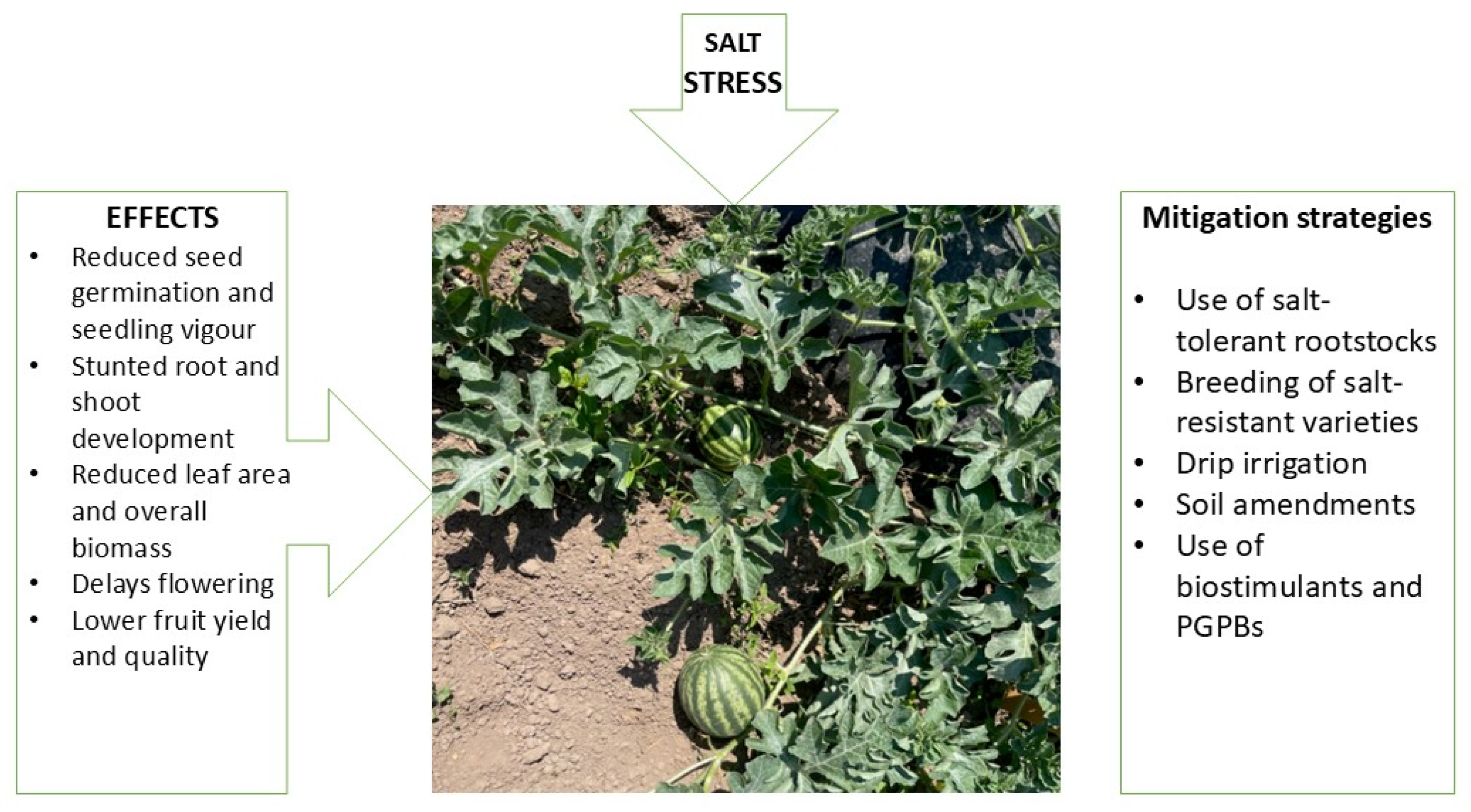
Figure 1.
Impact of Salt Stress on watermelon and mitigation strategies.
Author Contributions
A.K. and S.K. conceived the concept. S.K. wrote the original draft. A.K. and MO edited and reviewed this article. All authors have read and agreed to the published version of the manuscript.
Funding
This research received no external funding. This work is the product of the final assignment in a graduate-level course in Plant Stress Physiology.
Conflicts of Interest
The authors declare no conflicts of interest.
References
- Hasanuzzaman M, Oku H, Nahar K, Bhuyan MHMB, Mahmud JA, Baluska F, et al. Nitric oxide-induced salt stress tolerance in plants: ROS metabolism, signaling, and molecular interactions. Plant Biotechnology Reports. 2018;12(2):77-92. [CrossRef]
- Zhu J-K. Abiotic Stress Signaling and Responses in Plants. Cell. 2016;167(2):313-24. [CrossRef]
- Furtak K, Wolińska A. The impact of extreme weather events as a consequence of climate change on the soil moisture and on the quality of the soil environment and agriculture – A review. CATENA. 2023;231:107378. [CrossRef]
- Zandalinas SI, Fritschi FB, Mittler R. Global Warming, Climate Change, and Environmental Pollution: Recipe for a Multifactorial Stress Combination Disaster. Trends in Plant Science. 2021;26(6):588-99. [CrossRef]
- Deutsch CA, Tewksbury JJ, Tigchelaar M, Battisti DS, Merrill SC, Huey RB, et al. Increase in crop losses to insect pests in a warming climate. Science. 2018;361(6405):916-9. [CrossRef]
- Chaves MM, Flexas J, Pinheiro C. Photosynthesis under drought and salt stress: regulation mechanisms from whole plant to cell. Annals of Botany. 2008;103(4):551-60. [CrossRef]
- Hatfield JL, Prueger JH. Temperature extremes: Effect on plant growth and development. Weather and Climate Extremes. 2015;10:4-10. [CrossRef]
- Glazebrook, J. Contrasting Mechanisms of Defense Against Biotrophic and Necrotrophic Pathogens. Annual Review of Phytopathology. 2005;43(Volume 43, 2005):205-27. [CrossRef]
- Mittler R, Zandalinas SI, Fichman Y, Van Breusegem F. Reactive oxygen species signalling in plant stress responses. Nature Reviews Molecular Cell Biology. 2022;23(10):663-79. [CrossRef]
- Hasanuzzaman M, Nahar K, Alam MM, Roychowdhury R, Fujita M. Physiological, Biochemical, and Molecular Mechanisms of Heat Stress Tolerance in Plants. International Journal of Molecular Sciences. 2013;14(5):9643-84. PubMed PMID. [CrossRef]
- Mazhar S, Pellegrini E, Contin M, Bravo C, Nobili M. Impacts of salinization caused by sea level rise on the biological processes of coastal soils - A review. Frontiers in Environmental Science. 2022;10. [CrossRef]
- Munns R, Tester M. Mechanisms of Salinity Tolerance. Annual Review of Plant Biology. 2008;59(Volume 59, 2008):651-81. [CrossRef]
- Sandhu D, Kaundal A. Dynamics of Salt Tolerance: Molecular Perspectives. In: Gosal SS, Wani SH, editors. Biotechnologies of Crop Improvement, Volume 3: Genomic Approaches. Cham: Springer International Publishing; 2018. p. 25-40.
- Butcher K, Wick AF, DeSutter T, Chatterjee A, Harmon J. Soil Salinity: A Threat to Global Food Security. Agronomy Journal. 2016;108(6):2189-200. [CrossRef]
- Yu Z, Duan X, Luo L, Dai S, Ding Z, Xia G. How Plant Hormones Mediate Salt Stress Responses. Trends in Plant Science. 2020;25(11):1117-30. [CrossRef]
- Hayat K, Jochen B, Farooq J, Saiqa M, Sikandar H, Fazal H, et al. Combating soil salinity with combining saline agriculture and phytomanagement with salt-accumulating plants. Critical Reviews in Environmental Science and Technology. 2020;50(11):1085-115. [CrossRef]
- Munns R, Millar AH. Seven plant capacities to adapt to abiotic stress. Journal of Experimental Botany. 2023;74(15):4308-23. [CrossRef]
- Hasanuzzaman M, Bhuyan MHMB, Parvin K, Bhuiyan TF, Anee TI, Nahar K, et al. Regulation of ROS Metabolism in Plants under Environmental Stress: A Review of Recent Experimental Evidence. International Journal of Molecular Sciences. 2020;21(22):8695. PubMed PMID. [CrossRef]
- Gill SS, Tuteja N. Reactive oxygen species and antioxidant machinery in abiotic stress tolerance in crop plants. Plant Physiology and Biochemistry. 2010;48(12):909-30. [CrossRef]
- Demidchik, V. Mechanisms of oxidative stress in plants: From classical chemistry to cell biology. Environmental and Experimental Botany. 2015;109:212-28. [CrossRef]
- Soares C, Carvalho MEA, Azevedo RA, Fidalgo F. Plants facing oxidative challenges—A little help from the antioxidant networks. Environmental and Experimental Botany. 2019;161:4-25. [CrossRef]
- Naz A, Butt MS, Sultan MT, Qayyum MM, Niaz RS. Watermelon lycopene and allied health claims. Excli j. 2014;13:650-60. Epub 20140603. PubMed PubMed Central PMCID: PMCPMC4464475. [PubMed]
- Asfaw MD. Review on watermelon production and nutritional value in Ethiopia. J Nutr Sci Res. 2022;7:173.
- Frelier J, Cummins D, Motsenbocker C. Sustainable Gardening for School and Home Gardens: Cantaloupe and Watermelon. 2021.
- da Silva SS, de Lima GS, de Lima VLA, Gheyi HR, Soares LAdA, Oliveira JPM, et al. Production and quality of watermelon fruits under salinity management strategies and nitrogen fertilization. 2020.
- Kotuby-Amacher J, Koenig R, Kitchen B. Salinity and plant tolerance. Electronic Publication AG-SO-03, Utah State University Extension, Logan. 2000.
- Yetisir H, Caliskan ME, Soylu S, Sakar M. Some physiological and growth responses of watermelon [Citrullus lanatus (Thunb.) Matsum. and Nakai] grafted onto Lagenaria siceraria to flooding. Environmental and experimental botany. 2006;58(1-3):1-8.
- Lessa CIN, de Sousa GG, Sousa HC, da Silva FDB, Gomes SP, de Araújo Viana TV. Agricultural ambience and salt stress in production of yellow passion fruit seedlings. Comunicata Scientiae. 2022;13:e3703-e.
- Taheri S, Barzegar T, Zadeh AZ. Effect of salicylic acid pre-treatment on cucumber and watermelon seeds germination under salinity stress. 2016.
- de Albuquerque RIBEIRO A, de Lima SALES MA, ELOI WM, MOREIRA FJC, de Lima SALES FA. Emergência e crescimento inicial da melancia sob estresse salino. Revista Brasileira de Engenharia de Biossistemas. 2012;6(1):30-8.
- Colla G, Roupahel Y, Cardarelli M, Rea E. Effect of salinity on yield, fruit quality, leaf gas exchange, and mineral composition of grafted watermelon plants. HortScience. 2006;41(3):622.
- Naseer MN, Rahman FU, Hussain Z, Khan IA, Aslam MM, Aslam A, et al. Effect of salinity stress on germination, seedling growth, mineral uptake and chlorophyll contents of three Cucurbitaceae species. Brazilian Archives of Biology and Technology. 2022;65:e22210213.
- YETİŞİR H, Uygur V. Plant growth and mineral element content of different gourd species and watermelon under salinity stress. Turkish Journal of Agriculture and Forestry. 2009;33(1):65-77.
- Coşkun ÖF, Toprak S, Mavi K. Genetic Diversity and Association Mapping for Salinity Tolerance in Watermelon (Citrullus Lanatus L.). Journal of Crop Health. 2025;77(2):73.
- Sakata Y, Ohara T, Sugiyama M, editors. The history and present state of the grafting of cucurbitaceous vegetables in Japan. III International Symposium on Cucurbits 731; 2005.
- Bigot S, Pongrac P, Šala M, van Elteren JT, Martínez J-P, Lutts S, et al. The halophyte species Solanum chilense Dun. maintains its reproduction despite sodium accumulation in its floral organs. Plants. 2022;11(5):672.
- Reddy P, Goss JA. Effect of salinity on pollen I. Pollen viability as altered by increasing osmotic pressure with NaCl, MgCl2, and CaCl2. American Journal of Botany. 1971;58(8):721-5.
- Dhingra H, Varghese T. Effect of salt stress on viability, germination and endogenous levels of some metabolites and ions in maize (Zea mays L.) pollen. Annals of Botany. 1985;55(3):415-20.
- El-Sayed H, Kirkwood R. Effects of NaCl salinity and hydrogel polymer treatments on viability, germination and solute contents in maize (Zea mays) pollen. 1992.
- Kiełkowska A, Grzebelus E, Lis-Krzyścin A, Maćkowska K. Application of the salt stress to the protoplast cultures of the carrot (Daucus carota L.) and evaluation of the response of regenerants to soil salinity. Plant Cell, Tissue and Organ Culture (PCTOC). 2019;137:379-95.
- Abdullah Z, Khan MA, Flowers T. Causes of sterility in seed set of rice under salinity stress. Journal of Agronomy and Crop Science. 2001;187(1):25-32.
- Gerona MEB, Deocampo MP, Egdane JA, Ismail AM, Dionisio-Sese ML. Physiological responses of contrasting rice genotypes to salt stress at reproductive stage. Rice Science. 2019;26(4):207-19.
- Abdullah Z-u-N, Ahmad R, Ahmed J. Salinity induced changes in the reproductive physiology of wheat plants. Plant and cell Physiology. 1978;19(1):99-106.
- Hirasawa T, Sato K, Yamaguchi M, Narita R, Kodama A, Adachi S, et al. Differences in dry matter production, grain production, and photosynthetic rate in barley cultivars under long-term salinity. Plant Production Science. 2017;20(3):288-99.
- Kodama A, Narita R, Yamaguchi M, Hisano H, Adachi S, Takagi H, et al. QTLs maintaining grain fertility under salt stress detected by exome QTL-seq and interval mapping in barley. Breeding science. 2018;68(5):561-70.
- Huang Y, Bie Z, He S, Hua B, Zhen A, Liu Z. Improving cucumber tolerance to major nutrients induced salinity by grafting onto Cucurbita ficifolia. Environmental and Experimental Botany. 2010;69(1):32-8.
- Ali M, Ayyub C, Shaheen MR, Qadri RWK, Khan I, Azam M, et al. Characterization of Water Melon (Citrullus lanatus) Genotypes under High Salinity Regime. American Journal of Plant Sciences. 2015;6(19):3260.
- Ekbic E, Cagıran C, Korkmaz K, Kose MA, Aras V. Assessment of watermelon accessions for salt tolerance using stress tolerance indices. Ciência e Agrotecnologia. 2017;41(6):616-25.
- Suárez-Hernández ÁM, Vázquez-Angulo JC, Grimaldo-Juárez O, Duran CC, González-Mendoza D, Bazante-González I, et al. Produção e qualidade de melancia enxertada, em solo salino. Horticultura Brasileira. 2019;37:215-20.
- Silva JSd, Sá FVdS, Dias NdS, Ferreira M, Jales GD, Fernandes PD. Morphophysiology of mini watermelon in hydroponic cultivation using reject brine and substrates. Revista Brasileira de Engenharia Agrícola e Ambiental. 2021;25(6):402-8.
- Zong L, Tedeschi A, Xue X, Wang T, Menenti M, Huang C. Effect of different irrigation water salinities on some yield and quality components of two field-grown Cucurbit species. Turkish Journal of Agriculture and Forestry. 2011;35(3):297-307.
- Adriana S, Sá F, Souto L, Maria S, Romulo M, Geovani L, et al. Tolerance of Varieties and Hybrid of Pumpkin and Squash to Salt Stress. Journal of Agricultural Science. 2017;10:38-. [CrossRef]
- Brown C, Pezeshki S, DeLaune R. The effects of salinity and soil drying on nutrient uptake and growth of Spartina alterniflora in a simulated tidal system. Environmental and Experimental Botany. 2006;58(1-3):140-8.
- Ahmad P, Jhon R. Effect of salt stress on growth and biochemical parameters of Pisum sativum L. (Einfluss von Salzstress auf Wachstum und biochemische Parameter von Pisum sativum L.). Archives of Agronomy and Soil Science. 2005;51(6):665-72.
- Colla G, Rouphael Y, Leonardi C, Bie Z. Role of grafting in vegetable crops grown under saline conditions. Scientia Horticulturae. 2010;127(2):147-55. [CrossRef]
- Rouphael Y, Cardarelli M, Schwarz D, Franken P, Colla G. Effects of drought on nutrient uptake and assimilation in vegetable crops. Plant responses to drought stress: from morphological to molecular features. 2012:171-95.
- Gaion LA, Braz L, Carvalho R. Grafting in Vegetable Crops: A Great Technique for Agriculture. International Journal of Vegetable Science. 2017;24:1-18. [CrossRef]
- Hashem A, Bayoumi YA, El-Shafik A, El-Zawily E-S, Tester M, Rakha MT. Interspeci fi c Hybrid Rootstocks Improve Productivity of Tomato Grown under High-temperature Stress. HortScience. 2024;59:129-37.
- Shaterian J, Georges F, Hussain A, Waterer D, De Jong H, Tanino KK. Root to shoot communication and abscisic acid in calreticulin (CR) gene expression and salt-stress tolerance in grafted diploid potato clones. Environmental and Experimental Botany. 2005;53(3):323-32.
- Chen G, Fu X, Herman Lips S, Sagi M. Control of plant growth resides in the shoot, and not in the root, in reciprocal grafts of flacca and wild-type tomato (Lysopersicon esculentum), in the presence and absence of salinity stress. Plant and Soil. 2003;256:205-15.
- Santa-Cruz A, Martinez-Rodriguez MM, Perez-Alfocea F, Romero-Aranda R, Bolarin MC. The rootstock effect on the tomato salinity response depends on the shoot genotype. Plant Science. 2002;162(5):825-31.
- Zhu J, Bie Z, Huang Y, Han X. Effect of grafting on the growth and ion concentrations of cucumber seedlings under NaCl stress. Soil Science and Plant Nutrition. 2008;54(6):895-902.
- Liu ZhengLu LZ, Zhu YueLin ZY, Wei GuoPing WG, Yang LiFei YL, Zhang GuWen ZG, Hu ChunMei HC. Metabolism of ascorbic acid and glutathione in leaves of grafted eggplant seedlings under NaCl stress. 2007.
- Goreta S, Bucevic-Popovic V, Selak GV, Pavela-Vrancic M, Perica S. Vegetative growth, superoxide dismutase activity and ion concentration of salt-stressed watermelon as influenced by rootstock. The Journal of Agricultural Science. 2008;146(6):695-704.
- Yetisir H, Uygur V. Responses of grafted watermelon onto different gourd species to salinity stress. Journal of Plant Nutrition. 2010;33(3):315-27.
- Edelstein M, Ben-Hur M, Cohen R, Burger Y, Ravina I. Boron and salinity effects on grafted and non-grafted melon plants. Plant and Soil. 2005;269:273-84.
- Ulas A, Aydin A, Ulas F, Yetisir H, Miano TF. Cucurbita rootstocks improve salt tolerance of melon scions by inducing physiological, biochemical and nutritional responses. Horticulturae. 2020;6(4):66.
- Oliveira CEdS, Steiner F, Zuffo AM, Zoz T, Alves CZ, Aguiar VCBd. Seed priming improves the germination and growth rate of melon seedlings under saline stress. Ciência Rural. 2019;49(7):e20180588.
- Napolitano M, Terzaroli N, Kashyap S, Russi L, Jones-Evans E, Albertini E. Exploring heterosis in melon (Cucumis melo L.). Plants. 2020;9(2):282.
- Mitra D, Shnaider Y, Bar-Ziv A, Brotman Y, Perl-Treves R, editors. First fruit inhibition and CRISPR-Cas9 inactivation of candidate genes to study the control of cucumber fruit set. VI International Symposium on Cucurbits 1294; 2019.
- Zhu H, Zhao S, Lu X, He N, Gao L, Dou J, et al. Genome duplication improves the resistance of watermelon root to salt stress. Plant Physiology and Biochemistry. 2018;133:11-21. [CrossRef]
- Yanyan Y, Shuoshuo W, Min W, Biao G, Qinghua S. Effect of different rootstocks on the salt stress tolerance in watermelon seedlings. Horticultural plant journal. 2018;4(6):239-49.
- Mo Y, Wang Y, Yang R, Zheng J, Liu C, Li H, et al. Regulation of plant growth, photosynthesis, antioxidation and osmosis by an arbuscular mycorrhizal fungus in watermelon seedlings under well-watered and drought conditions. Frontiers in Plant Science. 2016;7:644.
- Gao B-w, Sun D-x, Yuan G-p, An G-l, Li W, Liu J-p, et al. Identification of salt tolerance of 121 watermelon (Citrullus lanatus L.) germplasm resources. 2022.
- Sarabi B, Bolandnazar S, Ghaderi N, Ghashghaie J. Genotypic differences in physiological and biochemical responses to salinity stress in melon (Cucumis melo L.) plants: Prospects for selection of salt tolerant landraces. Plant physiology and biochemistry. 2017;119:294-311.
- Fan R, Zhang B, Li J, Zhang Z, Liang A. Straw-derived biochar mitigates CO2 emission through changes in soil pore structure in a wheat-rice rotation system. Chemosphere. 2020;243:125329.
- Qadir M, Quillérou E, Nangia V, Murtaza G, Singh M, Thomas RJ, et al., editors. Economics of salt-induced land degradation and restoration. Natural resources forum; 2014: Wiley Online Library.
- Qiang X, Sun Z, Li X, Li S, Yu Z, He J, et al. The impacts of planting patterns combined with irrigation management practices on soil water content, watermelon yield and quality. Agroforestry Systems. 2024;98(4):979-94.
- Santos AdS, Sá FdS, Souto LS, Silva MdN, Moreira RC, Lima Gd, et al. Tolerance of varieties and hybrid of pumpkin and squash to salt stress. 2018.
- Alves AdS, Oliveira FdAd, Silva DDd, Santos STd, Oliveira RR, Góis HMdM. Production and quality of mini watermelon under salt stress and K+/Ca2+ ratios. Revista Brasileira de Engenharia Agrícola e Ambiental. 2023;27(6):441-6.
- Silva SSd, Lima GSd, Lima VLAd, Gheyi HR, Soares LAdA, Lucena RCM. Gas exchanges and production of watermelon plant under salinity management and nitrogen fertilization. Pesquisa Agropecuária Tropical. 2019;49:e54822.
- Rouphael Y, Colla G. Biostimulants in agriculture. Frontiers Media SA; 2020. p. 40.
- Singh M, Subahan GM, Sharma S, Singh G, Sharma N, Sharma U, et al. Enhancing Horticultural Sustainability in the Face of Climate Change: Harnessing Biostimulants for Environmental Stress Alleviation in Crops. Stresses. 2025;5(1):23.
- Bantis F, Koukounaras A. Ascophyllum nodosum and silicon-based biostimulants differentially affect the physiology and growth of watermelon transplants under abiotic stress factors: The case of salinity. Plants. 2023;12(3):433.
- Bijalwan P, Jeddi K, Saini I, Sharma M, Kaushik P, Hessini K. Mitigation of saline conditions in watermelon with mycorrhiza and silicon application. Saudi Journal of Biological Sciences. 2021;28(7):3678-84.
- Ghani MI, Yi B, Rehmani MS, Wei X, Siddiqui JA, Fan R, et al. Potential of melatonin and Trichoderma harzianum inoculation in ameliorating salt toxicity in watermelon: Insights into antioxidant system, leaf ultrastructure, and gene regulation. Plant Physiology and Biochemistry. 2024;211:108639.
- Lugtenberg B, Kamilova F. Plant-growth-promoting rhizobacteria. Annual review of microbiology. 2009;63(1):541-56.
- Yadav G, Vishwakarma K, Sharma S, Kumar V, Upadhyay N, Kumar N, et al. Emerging significance of rhizospheric probiotics and its impact on plant health: current perspective towards sustainable agriculture. Probiotics and plant health. 2017:233-51.
- Bulgarelli D, Rott M, Schlaeppi K, Ver Loren van Themaat E, Ahmadinejad N, Assenza F, et al. Revealing structure and assembly cues for Arabidopsis root-inhabiting bacterial microbiota. Nature. 2012;488(7409):91-5.
- Ganesh J, Hewitt K, Devkota AR, Wilson T, Kaundal A. IAA-producing plant growth promoting rhizobacteria from Ceanothus velutinus enhance cutting propagation efficiency and Arabidopsis biomass. Frontiers in Plant Science. 2024;15. [CrossRef]
- Mohanty P, Singh PK, Chakraborty D, Mishra S, Pattnaik R. Insight into the role of PGPR in sustainable agriculture and environment. Frontiers in Sustainable Food Systems. 2021;5:667150.
- Coats VC, Rumpho ME. The rhizosphere microbiota of plant invaders: an overview of recent advances in the microbiomics of invasive plants. Frontiers in microbiology. 2014;5:368.
- Acharya BR, Gill SP, Kaundal A, Sandhu D. Strategies for combating plant salinity stress: the potential of plant growth-promoting microorganisms. Frontiers in Plant Science. 2024;Volume 15 - 2024. [CrossRef]
- Ganesh J, Singh V, Hewitt K, Kaundal A. Exploration of the rhizosphere microbiome of native plant Ceanothus velutinus–an excellent resource of plant growth-promoting bacteria. Frontiers in Plant Science. 2022;13:979069.
- Fotoohiyan Z, Samiei F, Sardoei AS, Kashi F, Ghorbanpour M, Kariman K. Improved salinity tolerance in cucumber seedlings inoculated with halotolerant bacterial isolates with plant growth-promoting properties. BMC Plant Biology. 2024;24(1):821.
- Yetisir H, Uygur V. Plant Growth and Mineral Element Content of Different Gourd Species and Watermelon under Salinity Stress. Turkish Journal of Agriculture and Forestry. 2009;33:65-77. [CrossRef]
- Freire MHdC, Sousa GGd, de Souza MV, de Ceita ED, Fiusa JN, Leite KN. Emergência e acúmulo de biomassa em plântulas de cultivares de arroz irrigadas com águas salinas. Revista Brasileira de Engenharia Agrícola e Ambiental. 2018;22:471-5.
Disclaimer/Publisher’s Note: The statements, opinions and data contained in all publications are solely those of the individual author(s) and contributor(s) and not of MDPI and/or the editor(s). MDPI and/or the editor(s) disclaim responsibility for any injury to people or property resulting from any ideas, methods, instructions or products referred to in the content. |
© 2025 by the authors. Licensee MDPI, Basel, Switzerland. This article is an open access article distributed under the terms and conditions of the Creative Commons Attribution (CC BY) license (https://creativecommons.org/licenses/by/4.0/).
Copyright: This open access article is published under a Creative Commons CC BY 4.0 license, which permit the free download, distribution, and reuse, provided that the author and preprint are cited in any reuse.


