

Submitted:
30 May 2025
Posted:
04 June 2025
Read the latest preprint version here
Abstract
The Changzhou toxic land case, which has experienced numerous complexities, has undergone first and second trials and is currently pending review by the Supreme People’s Court (SPC). It has become a microcosm of the legal liability challenges regarding soil pollution in China. This case involves multiple controversies spanning four key dimensions: the principle of non-retroactivity of law, statute of limitations, public-private liability subjects, and implementation of responsibility. From a jurisprudential perspective, there is urgent need to clarify the retroactivity principle and classification of litigation time limit rules, enhance the soil pollution remediation system coordinating public and private law mechanisms, and strengthen accountability mechanisms within the systematization of environmental litigation. Accordingly, the proposed solutions operate on two levels. Conceptually, it is imperative to establish the legal liability framework for soil pollution in the Ecological Environment Code, ensuring its articulation with other subsections of the pollution control code and legal liability code, while constructing specific provisions through effectiveness systems, responsibility systems, and litigation systems. Practically, specific to the Changzhou case, three measures are proposed: First, adopt the “true retroactivity” principle while differentiating types of litigation time limit rules; Second, delineate environmental legal responsibilities between the Xinbei district government and the three chemical plants, with particular consideration to eligibility criteria for responsible parties and exemption grounds; Finally, advance effective soil remediation through public-private partnerships, thereby systematically addressing retrial dilemmas via coordinated administrative enforcement, regulatory oversight, and judicial proceedings.
Keywords:
legal responsibility for soil pollution
; lex retro non agit
; public-private collaboration
; environmental public interest litigation
; eco-environmental code
1. Introduction
Economic development and environmental pollution are inextricably intertwined, coexisting as inseparable companions. As a critical component of the ecological civilization legal framework, the environmental legal liability system constitutes a vital subject for the sustainable development of human society and the economy. Compared to general environmental pollution, soil contamination exhibits distinct characteristics: greater latency and persistence, more diverse manifestations, broader impacts, longer duration, and more complex pollution pathways and media [1,2]. Moreover, unlike conventional environmental legal liability, soil pollution liability subjects are often tied to specific land users, developers, or owners, involving significantly higher remediation costs and greater technical challenges [3]. Taking soil pollution caused by toxic elements as an example, soil in over 5 million locations worldwide has been contaminated, causing serious impacts on agricultural production, with China experiencing the most severe pollution situation [4,5]. In August 2024, the Decision of the Central Committee of the Communist Party of China on Further Comprehensive Deepening of Reforms and Advancing Chinese Modernization, adopted at the Third Plenary Session of the 20th Central Committee, explicitly proposed “codifying the Ecological Environment Code” [6]. The legal liability section, as an essential component of this code, serves not only as the cornerstone of related environmental laws but also as the linchpin for legal implementation. Against the backdrop of codifying the Ecological Environment Code, the unique complexity of soil pollution liability raises a pressing question for advancing ecological civilization in the new era: how to accurately identify and effectively enforce legal responsibility for soil pollution.
Although compared with other countries along the “the Belt and Road”, China’s land environment is relatively good. However, due to rapid economic development and population base, China has a high demand for land use, which still poses a serious risk of soil environmental pollution [7]. The identification and enforcement of legal liability for soil pollution constitute an urgent academic proposition demanding response within the legal framework of ecological civilization in the new era. The Changzhou toxic land case epitomizes the practical challenges in implementing soil pollution liability in China. This case involves convoluted and multifaceted legal liability categories, while current theoretical research remains fragmented and insufficiently focused. Existing studies have explored specific dimensions: some delve into the scope of responsibility for soil pollution remediation [8] or improving statute of limitations rules for environmental litigation [9]; some have sorted out China’s legal system and departmental policies for soil pollution prevention and control, covering specific areas such as responsibility system, funding mechanism, information disclosure, and public participation [10]; some have analyzed the relationship between soil pollution prevention and control in China and promoting sustainable use of agricultural land from the perspectives of legislation and judiciary [11]; some have evaluated the policy models that governments may adopt by comparing soil pollution environmental laws in the United States, Germany, and Japan [12] or introduced the formulation and implementation of the Soil and Environmental Protection Act (SECA) in South Korea [13]; some are studying the criminal responsibility or legal framework for soil pollution in Western Europe, Russia and Ukraine [14,15,16] or Spain’s soil pollution control measures [17]; some have also analyzed the relationship between soil and agriculture, biodiversity, and climate change in the European Green Deal [18] or compared the compensation liability for damages caused by soil pollution to individuals in some European countries [19]; some also focus on the issues such as land tenure security or soil pollution and agriculture in sub Saharan Africa [20,21] or the negative impact of land degradation on animal husbandry in sub Saharan Africa [22]; some explore the main causes of land pollution in Nigeria and the land pollution remediation strategies adopted [23] or the legal policies for soil pollution prevention and control in the Kingdom of Saudi Arabia [24]. However, most research remains confined to preliminary stages of policy response and legal analysis, failing to extract generalized academic propositions or theoretical paradigms from the case’s dilemmas, and lacking comprehensive, systematic, and jurisprudential argumentation. Overall, constrained by space or subject limitations, most existing studies fail to provide in-depth arguments regarding the legal theories and normative principles underpinning liability for soil pollution. They do not conduct comprehensive analysis or systematic argumentation by integrating typical judicial cases, remaining instead at the preliminary level of merely describing systems and phenomena. Furthermore, current research has not adequately explored the positioning and configuration of legal liability for soil pollution within the broader framework of environmental law. It is precisely this gap that constitutes the primary objective of this paper: to build upon the aforementioned research, striving to summarize insights and address these deficiencies.
This study commences with the multidimensional dilemmas of legal liability for soil pollution evident in China’s environmental governance practices, systematically elucidating its jurisprudential foundations and normative logic. It aims to establish a coherent regulatory and practical framework for soil pollution liability while proposing pathways to resolve case-specific impasses. As the first comprehensive exploration of retroactivity, litigation time limits, hierarchical prioritization of liable entities, typological coordination of responsibilities, and judicial safeguards for soil pollution liability, this paper constructs a tripartite systematic argumentation spanning effectiveness, accountability, and litigation mechanisms. Its contributions hold significant theoretical and practical value for both codifying China’s Ecological Environment Code and advancing environmental law enforcement and judicial application. Specifically, on the one hand, this paper clarifies the functional positioning and content logic of legal liability for soil pollution in the Ecological Environment Code, thus filling the research gap of previous single perspective to a certain extent. On the other hand, it responds to the current dilemma of the Changzhou toxic land case retrial, clarifies the responsibility sequence and types of the Xinbei district government and three chemical plants, and proposes a public-private collaborative mechanism for soil pollution remediation, providing some reference for the retrial of the Supreme People’s Court.
2. Methodology
The methodological significance of case analysis far surpasses that of a simple “exemplification” technique. It constitutes a core method with profound epistemological value and strategic research importance across numerous fields such as social sciences, management, law, and education. Case analysis embodies the dialectical unity of induction and deduction, exploration and verification. It expands the boundaries of social science research, enabling the study of important yet “non-mainstream” phenomena that cannot be standardized, quantified, or observed on a large scale. For example, some scholars take Shanghai Suzhou River as an example to explore the challenges and future directions of revitalizing waterfront industrial heritage [25]. It acknowledges that “uniqueness” itself is a significant source of knowledge, rather than merely “noise” in statistics. Therefore, case analysis provides a unique and powerful cognitive tool for addressing the complexity, contextuality, processuality, and subjectivity inherent in the social world.
The core proposition examined in this paper is the ascertainment and realization of legal liability for soil pollution. General theoretical issues can be distilled from the dilemmas presented in typical cases, thereby facilitating the search for universal legal solutions. The Changzhou toxic land case serves as an epitome of the practical challenges in establishing legal liability for soil pollution in China. Having remained unresolved for nearly a decade, it warrants in-depth investigation into the implicit legal liability propositions it embodies. This constitutes the primary rationale for employing case analysis methodology in this study.
This paper primarily employs case analysis methodology to conduct jurisprudential examinations of representative cases. This section will delineate the factual and normative specifics of the case. Spanning from the 2016 environmental civil public interest litigation initiated by conservation groups to the Supreme People’s Court’s retrial proceedings in August 2022, the Changzhou toxic land case has been shrouded in legal ambiguities regarding soil pollution liability. A systematic review of the first and second-instance judgments is imperative to clarify the case’s factual matrix, contentious issues, and legal complexities, thereby laying the groundwork for subsequent analyses of core liability challenges, theoretical underpinnings, and implementation pathways for soil pollution accountability (Figure 1).
2.1. First-Instance Judgment
In May 2016, the Friends of Nature (FON) and the China Biodiversity Conservation and Green Development Foundation (CBCGDF) filed an environmental civil public interest lawsuit, demanding that three defendant chemical companies assume environmental legal liability under three categories: (1) eliminating environmental pollution and bearing remediation costs, with monetary compensation substituting physical remediation if restoration proved infeasible; (2) issuing a public apology; and (3) covering litigation expenses, including appraisal and assessment fees (Figure 2). Regrettably, while the Jiangsu Provincial Intermediate People’s Court acknowledged that the defendants’ pollution posed risks to public interests, it dismissed all claims in its judgment [26]. The court ruled that the government’s ongoing remediation efforts negated the defendants’ liability and deemed the plaintiffs’ evidence insufficient to meet the stringent “clear and convincing” standard for proving environmental torts.
The core legal dispute in the first-instance judgment centered on whether governmental environmental governance responsibility absolves polluters’ legal liability, with the defendants and the court asserting that the companies no longer held land use rights for the contaminated site, that remediation obligations had been contractually transferred to third parties, and that the ongoing government-supervised restoration rendered additional liability unnecessary. While severe soil and groundwater contamination was undisputed—with the Xinbei district government commissioning third-party entities like jiangsu shengtai co., ltd. and the Changzhou environmental monitoring center for remediation under municipal directives—the court controversially relied on article 8 of the repealed Opinions on Strengthening Soil Pollution Prevention and Control (MEE, Huanfa [2008] No. 48), a low-hierarchy departmental regulatory document, and the non-binding Soil Pollution Prevention and Control Action Plan. Article 8 limited governmental liability to cases where polluters no longer existed or were historically unidentifiable, conditions unmet by the defendants: Changlong co., a state-owned enterprise successor, argued the government should bear liability under the “polluter pays” principle, while Changyu and Huada co., former collective-owned enterprises, shifted responsibility to their original collective organizations. These claims were jurisprudentially untenable, as state-owned and collective enterprises retain private-law attributes (e.g., profit-driven operations) under both “dual-nature” and “single-nature” theories, and the defendants had continued polluting for over a decade post-ownership restructuring, incurring unaddressed remediation obligations.
2.2. Second-Instance Judgment and Retrial
Following the first-instance judgment, the Friends of Nature (FON) and the China Biodiversity Conservation and Green Development Foundation (CBCGDF) appealed to the Jiangsu Provincial High People’s Court in 2017. Their claims largely mirrored the original demands, though “eliminating environmental pollution” was revised to “restoration to original condition,” while ecological remediation costs were omitted. The appellants contested the lower court’s and defendants’ assertion that governmental environmental governance responsibility negated polluter liability, arguing that public administrative duties and judicial accountability differ in legal nature and are non-interchangeable. They maintained that the government’s incurred and potential future expenses should be borne by the defendants. Additionally, the appellants characterized the defendants’ land reserve agreements—purportedly transferring land use rights—as administrative contracts, asserting that the relationship between the defendants and the land reserve center was one of “regulated-regulator,” a position they claimed was validated by Supreme People’s Court Administrative Case No. 947 (2016). However, under article 58 of the Land Administration Law, the contract could legally effectuate the transfer of land use rights, as the Land Reserve Center’s execution of administrative agreements constituted government-authorized actions with statutory authority, establishing administrative rights and obligations. This rendered the appellants’ interpretation flawed and raised a critical question: Should prior land users remain liable for pre-transfer contamination? The appellants further alleged procedural and substantive errors in the first-instance judgment, including improper allocation of the burden of proof, flawed trial procedures, and unreasonable litigation cost rulings. The respondents countered that local governments held legitimacy, justification, and rationality in ecological remediation under the environmental law principle of “beneficiary-pays,” and argued that the below-market-price administrative agreements implicitly included obligations for “pollution control.”
The second-instance court confirmed the ongoing contamination of soil and groundwater alongside the government’s remediation efforts, framing two core disputes: whether the respondents were liable for environmental pollution torts, requiring examination of corporate ownership restructuring, land reserve agreements, and historical factors to determine their legal status; and whether they should assume environmental risk control and remediation obligations, involving the prioritization and interaction between polluter liability and governmental duties, including cost-transfer feasibility. In Judgment No. 232, Su Min Zhong (2017), the court adopted a compromise by distinguishing these liabilities: while affirming the respondents’ tort liability, it exempted them from remediation obligations due to ongoing government efforts, ordering only symbolic remedies—public apologies in national media and appellants’ burden of legal fees—while paradoxically avoiding substantive remediation costs [27]. This reasoning raised jurisprudential contradictions: if polluters were legally liable, why exempt them from remediation, thereby obscuring the nature of environmental liability? If contamination persisted, why exclude polluters from shared fiscal responsibility, failing to clarify the interplay between governmental and polluter duties? By dismissing remediation costs as “uncertain”, the court arguably prioritized procedural rigidity over public interest, leaving unresolved how polluter accountability aligns with sustainable governance principles.
The trials and judgments in both the first and second instances of the Changzhou toxic land case reveal a complex web of unresolved legal issues, entangled with ambiguities, multiple liable entities, and diverse responsibility categories, underscoring the urgent need to clarify fundamental questions regarding environmental legal liability. Key challenges include: ill-defined conceptual boundaries of environmental liability, exemplified by overlapping terminologies such as environmental pollution tort liability, pollution risk control and remediation obligations, and governmental environmental governance duties; conflicting interfaces between polluters’ legal liability and governmental remediation responsibilities, particularly disputes over whether governmental actions negate polluter liability and whether ecological restoration costs should be borne by polluters; unclear exemption criteria for polluters’ liability, including unresolved considerations of ownership restructuring, land reserve agreements, and historical factors; ambiguous legal nature of ecological restoration obligations and their relationship with traditional liability frameworks; and procedural uncertainties in environmental civil public interest litigation, such as whether burden of proof, trial procedures, litigation cost allocation, and statute of limitations should differ from conventional civil litigation due to the public welfare nature and unique complexities of environmental cases.
Accordingly, in early 2019, the Friends of Nature(FON) and China Biodiversity Conservation and Green Development Foundation (CBCGDF) petitioned the Supreme People’s Court for a retrial, citing unclear fundamental facts and erroneous application of law. In March 2020, the Supreme People’s Court accepted the case for review, commenced trial proceedings in August 2022, and the matter has currently remained under adjudication [28].
3. Results
Building on the factual reconstruction and legal analysis of the Changzhou toxic land case, the core issues in soil pollution liability can be systematically differentiated and examined, primarily manifested in retroactivity of law, statute of limitations, and liability determination. On one hand, the principle of non-retroactivity remains ambiguously regulated, with uncertainties over whether the three-year litigation time limit applies; on the other hand, the hierarchy of responsibility between public and private entities is undefined, while liability types and enforcement mechanisms remain diverse and intertwined.
3.1. The Myth of Legal Retroactivity and the Statute of Limitations
3.1.1. Incomplete Regulation of the Principle of Non-Retroactivity
The retroactivity of law constitutes a recurring fundamental issue in determining soil pollution remediation liability, primarily centering on whether newly enacted laws can apply to pre-enactment pollution acts where contamination occurred prior to the law’s implementation but persisted thereafter. In the Changzhou toxic land case, pervasive legal ambiguities in statutory application are compounded by retroactivity—a foundational and threshold issue that directly impacts subsequent judicial determinations, including the identification, allocation, and enforcement of environmental remediation responsibilities.
Soil typically serves as a critical sink for terrestrial pollutants, and soil contamination exhibits multifaceted characteristics such as multi-source origins, cumulative effects, latency, persistence, unpredictability, and irreversibility. These attributes result in the temporal dislocation of legal facts in soil pollution cases, where evolving environmental legal relationships often span transitions between old and new laws, inevitably invoking foundational jurisprudential questions of retroactivity. While article 104 of Legislative Law establishes the principle of non-retroactivity alongside exceptions for beneficial retroactive application, its implementation requires distinguishing between statutory laws and judicial interpretations, as well as substantive and procedural laws. In China, the Provisions on the Temporal Effect of the Civil Code determines the applicability of the Civil Code based on the timing of legal facts. Notably, the Soil Pollution Prevention and Control Law does not explicitly address retroactivity but indirectly implies pre-enactment remediation obligations for land users under article 71(2). The 2019 Draft Measures for Determining Liability of Soil Polluters on Construction Land (Trial for Soliciting Comments) specified liability retroactivity to post-1979 (post-Environmental Protection Law), yet this clause was omitted in the 2021 Interim Measures for Determining Liability of Soil Polluters on Construction Land. Similar ambiguities persist in the Measures for Determining Liability of Soil Polluters on Agricultural Land (Trial). Consequently, the absence of systematic retroactivity provisions in China’s soil remediation legal framework has led to judicial dilemmas, including unclear applicability targets and ambiguous adjudicative criteria.
The Changzhou toxic land case, initiated in 2016 with its first-instance trial, entered retrial proceedings post-2022, with the entire litigation process yet to conclude. Throughout this period, issues have arisen regarding the application of newly enacted or revised laws, including the Soil Pollution Prevention and Control Law, the Civil Code, and the Interpretation on Applying Punitive Damages in Ecological and Environmental Tort Disputes. Both the first-instance and second-instance courts acknowledged the public-interest nature of the subject matter, recognizing that ecological and environmental benefits belong to all citizens. These benefits, characterized by their public, holistic, and spillover attributes, differ fundamentally from traditional private interests, necessitating special consideration of the increasing difficulty and cost of ecological remediation over time. In the retrial, the court must balance legal stability and environmental public interest, weighing the parties’ litigation expectations and legal reliance. China lacks explicit provisions on whether the principle of non-retroactivity applies to judicial interpretations, with prevailing debates divided between retroactive application to the effective date of the interpreted law versus post-promulgation applicability. For procedural law, the principle of applying new procedural laws generally governs, except for jurisdictional finality, allowing ongoing cases to adopt the latest procedural interpretations.
When the Soil Pollution Prevention and Control Law was enacted in August 2018, remediation efforts for the contaminated site had already commenced in 2016. Although restoration remains in its second phase (2021–2035) and the defendants’ violations had ceased by 2018, retroactive application of the law was deemed inappropriate, as reaffirmed in the December 2018 second-instance judgment. However, under the exception to non-retroactivity—which prioritizes timely protection of environmental public interest—the identification of liable entities and enforcement mechanisms for soil pollution appears to conflict with the current judicial stance.
3.1.2. Unclear Applicability Premises of the Three-Year Statute of Limitations
Another critical issue in this case is whether the eight-year duration since the 2016 lawsuit has exceeded the statute of limitations. Article 66 of the Environmental Protection Law stipulates a three-year limitation period for environmental damage claims but fails to clarify its applicability to private-interest versus public-interest environmental cases. In private environmental tort cases, the Civil Code enumerates special circumstances exempt from statutory time limits. However, China lacks explicit provisions on the statute of limitations for environmental public interest litigation. In the Changzhou toxic case, the first-instance defendant Changyu company argued that the plaintiffs should have filed suit within three years of discovering the pollution, claiming the action was time-barred. The first-instance court sidestepped the statute of limitations issue, dismissing the claims based on ongoing governmental remediation. During the second instance, the respondents maintained the time-bar defense, but the appellate court ruled that the defendants failed to prove public disclosure of environmental damage reports, thereby deeming the action timely.
However, the appellate court’s rationale for affirming compliance with the statute of limitations fails to withstand rigorous scrutiny. Had the three chemical plants proactively disclosed environmental damage through media within the three-year period, the second-instance judgment’s logic would paradoxically preclude judicial accountability mechanisms against the polluters. This approach not only undermines timely redress of ecological interests but also encourages unethical practices where polluting entities exploit statutory time limits post-environmental harm. Furthermore, the mechanistic application of the three-year limitation rule conflates private-interest environmental tort litigation with public-interest environmental claims, imposing a uniform standard that risks oversimplification and obstructs comprehensive protection of ecological rights.
3.2. Practical Dilemmas in Legal Liability for Soil Pollution
3.2.1. The Disorderly Allocation of Responsibilities Between Public and Private Entities
Since the environmental protection organization filed an environmental civil public interest lawsuit in 2016, the Changzhou toxic land case has gone through first and second trials, and until August 2022, when the Supreme People’s Court initiated a retrial of the case, the fundamental issue of the priority of environmental legal liability subjects has been in urgent need of clarification.
Compared to traditional legal responsibilities, environmental legal responsibilities are aimed at environmental interests with public attributes, requiring the government to play a leading role in environmental governance responsibilities and the supplementary role of judicial relief models. There is no unified theoretical basis for government environmental responsibility in academia, mainly existing in theories such as public goods theory and agency theory [29]. The government’s environmental responsibility can be divided into its environmental supervision and governance functions, as well as the legal responsibility it should bear for not performing its duties in accordance with the law. It is fulfilled through environmental legislation, environmental administration, and environmental justice to fulfill its pre responsibility, and through civil liability, administrative liability, and criminal liability to pursue post responsibility [29].
In the Changzhou toxic land case, one of the main legal disputes lies in the competition between the legal responsibility of private entities and the environmental responsibility of public power, that is, how to coordinate the relationship between the principle of liability for damages and the government’s governance responsibility. In the Changzhou toxic land case, the government’s risk control and ecological restoration of contaminated land should be considered as a duty based on public management and service functions. The second instance judgment also pointed out that the government’s restoration behavior does not conflict with the principle of polluter responsibility. At this point, it is necessary to distinguish whether the government’s repair actions belong to obligations or responsibilities. The former is more of a functional requirement granted by the law, while the latter is the responsibility that should be borne after violating obligations. At this level, regardless of the logical starting point, restoring the ecological environment seems to be an inevitable action of the government. However, it is mixed with the responsibility of polluters for remediation, so it cannot be generalized. Therefore, this is not only a theoretical issue involving the legal nature of the responsibility of polluters to repair and the responsibility of the government to repair, but also a technical issue of the implementation mechanism of the cooperation between public power and private entities to govern the environment.
China’s current environmental legislation addresses liable entities for soil pollution remediation only in limited contexts. For instance, the Interim Measures for Soil Environmental Management of Contaminated Sites (Draft for Soliciting Comments) identifies responsible parties as polluters and land use right holders, while the Guidelines for Environmental Site Assessment and Remediation of Industrial Enterprises (Trial) outlines four scenarios of liability, including property rights transfers, corporate restructuring, and bankruptcy. However, these documents hold low legal hierarchy and fail to comprehensively address broader ecological restoration beyond soil remediation. In practice, government-led ecological restoration often shifts polluter liability onto public authorities. Consequently, governments must proactively hold polluters accountable rather than relying solely on the traditional civil law principle of “polluter-pays”, which necessitates clarifying the hierarchy between environmental tort liability and state compensation liability. This requires distinguishing remediation obligations from restoration obligations in soil pollution cases, establishing public funding mechanisms, and informing the codification of legal liability frameworks.
Regarding remediation models, the high complexity and technical demands of ecological restoration often lead polluters or governments to engage third parties through public-private partnerships (PPPs) or enterprise-enterprise collaborations, both governed by contractual civil rights and obligations. Yet China lacks explicit legal provisions defining liability allocation, procedural norms, oversight mechanisms, or compliance verification in third-party remediation, creating regulatory gaps that hinder accountability and efficacy.
In essence, in the process of environmental legal responsibility shifting from punishment to full process governance and risk prevention, the legal responsibility compilation of the Ecological Environment Code needs to clarify the legal nature of different responsibilities and the order of responsibilities between public and private entities, shifting from traditional confrontation between parties to collaborative governance with environmental public interests as the common goal. In the Changzhou toxic land case, although the three chemical companies were the main cause of sustained environmental pollution, they were not the only reason. In the Changzhou toxic land case, both the administrative and prosecutorial organs were not actively performing their duties and acted independently. The local government’s failure to prevent environmental pollution before it occurs is in stark contrast to its proactive misplacement in repairing environmental damage. Not only did it fail to prevent environmental damage, but it also allowed companies to evade their environmental legal responsibilities.
Unfortunately, as the supervisory body for the implementation of the law, the procuratorial organs have neither urged the environmental administrative organs to perform their duties in a timely manner in accordance with the law, nor supported the prosecution of Friends of Nature (FON), indirectly leading to the continuous damage of environmental public welfare. After the establishment of the administrative public interest litigation system in the Administrative Litigation Law in 2017, there seems to be no relevant evidence to indicate that the procuratorate has initiated pre litigation prosecutorial advice or consultation procedures. At present, the case is still in the trial stage, and issues such as the order of environmental legal responsibility and the size of responsibility still need to be resolved.
3.2.2. Convergence of Environmental Legal Liability Types in Case Proceedings
In the case of environmental pollution in tengger desert that shocked China and foreign countries, it not only involves the responsibility of the polluter of the park company, but also fundamentally lies in the supervision of the environmental administrative authority [30]. For the handling of administrative staff, in addition to disciplinary actions, criminal responsibility has also been pursued for staff suspected of dereliction of duty and dereliction of duty. In addition, in August 2023, lujiazui company filed a lawsuit against suzhou iron and steel group, third-party environmental assessment agencies, and administrative departments with the Jiangsu Provincial High People’s Court, which also involved the ecological environment restoration responsibility of polluters, the joint liability of third-party environmental assessment agencies, and the national compensation responsibility for suzhou environmental administrative departments’ illegal exercise of powers or inaction, including party and government sanctions, civil liability, administrative penalties, and criminal penalties.
The Civil Code and the Interpretation on Several Issues Concerning the Application of Law in Ecological and Environmental Tort Dispute Cases establish general civil liability mechanisms, such as restoration to original condition and public apology. Friends of Nature (FON) and the China Biodiversity Conservation and Green Development Foundation (CBCGDF) argued that the three chemical companies should bear obligations including ecological restoration, remediation costs, and public apology; however, the second-instance court upheld only the apology while omitting polluters’ remediation duties or costs. Concurrently, the Civil Code and its judicial interpretations have extended punitive damages to ecological torts, innovating beyond traditional civil liability frameworks.
However, scholarly debates remain polarized, with affirmative, negative, and restrictive theories on the applicability of punitive mechanisms [31]. Judicial activism in environmental governance has further diversified, as courts and procuratorates nationwide explore alternative restoration methods such as carbon sink purchases, labor substitution, reforestation, fish stock replenishment, and public education campaigns. Yet their legal basis and implementation hierarchy remain contested. For instance, articles 16 and 22 of the Interpretation on Several Issues Concerning the Application of Law in Forest Resource Civil Disputes recognize forestry carbon sinks as both security interests and substitutes for ecological compensation. Judicial innovations have expanded further: the (2022) Min 0802 Xing Chu No. 290 judgment treated defendants’ payment for forest carbon sink losses as a mitigating factor in sentencing, invoking article 6 of the Interpretation on Several Issues Concerning the Application of Law in Environmental Pollution Criminal Cases. While pioneering, such practices lack clarity in superior legal foundations, applicability criteria, and procedural standards.
4. Discussion
To address the practical dilemmas highlighted in the Changzhou toxic land case, the jurisprudential rationale underlying soil pollution liability can be articulated through three dimensions. First, clarifying the principle of retroactivity and categorizing statute of limitations rules, while delineating their specialized application in soil pollution liability contexts. Second, establishing public-private collaboration in remediation by prioritizing administrative enforcement while leveraging private-law mechanisms as complementary tools. Third, under the systematization of environmental litigation, defining the legal nature and normative hierarchy of environmental public interest litigation to ensure procedural coherence and substantive equity.
4.1. Special Application of the Principle of Retroactivity and Statute of Limitations
4.1.1. The Principle of Retroactivity in Environmental Law
To clarify the retroactivity of law in the Changzhou toxic land case, it is essential to examine the foundational principles of non-retroactivity and its unique implications for soil pollution remediation liability. Retroactivity, as a core jurisprudential concept, originates from the early legal doctrine of pre-enactment publicity and predictability, which underpins the binding force of statutory law. Drawing from John Locke’s Two Treatises of Government, the maxim “new laws shall not infringe vested property rights” provides theoretical grounding for non-retroactivity. The German Rechtsstaat (rule-of-law state) philosophy elevates legal certainty as a paramount tenet of governance, while the principle of protecting legitimate expectations mandates non-retroactivity to preserve behavioral predictability and societal trust in legal order.
The retroactive effect of law is a component of temporal effectiveness, and the law referred to here should be in the formal sense of origin, such as the statutory law of the continental legal system and the case law of the Anglo American legal system, with the “effectiveness” or “enforcement” of law as the time boundary point rather than “publication” [32]. The definition of retroactivity of law varies in theoretical circles, but its connotation is roughly the same. Some argue that the retroactive effect of law refers to the question of whether a new law can be applied to events and behaviors that occurred before it came into effect. If it can be applied, the law has retroactive effect; if it cannot be applied, it has no retroactive effect.
In jurisdictions such as the United States, legislative norms generally support retroactive application in determining liability for soil pollution remediation [33]. But the European Liability Directive considers non retroactivity applicable to historical damages [34]. Legal facts are categorized as instantaneous or continuous, with social rule-of-law states prioritizing public interest protection. Consequently, the scope of retroactivity—traditionally a doctrine limiting new laws’ temporal reach—is narrowed to align with societal welfare imperatives. The persistence of continuous facts creates an intermediate zone between retroactivity and non-retroactivity: “untrue retroactivity” , where new laws apply to concluded pre-enactment facts but produce prospective legal effects only. The German Federal Constitutional Court adopted this dichotomy of “true retroactivity” and “untrue retroactivity” in rulings under the revised German Code of Civil Procedure [33]. Similarly, French jurist Roubier’s “principle of immediate effect of new laws” delineates three categories: immediate application of new laws, exceptional retroactive force, and continuation of old laws [32].
Current legal doctrine holds that “true retroactivity” should be prohibited in principle and permitted exceptionally to preserve legal stability and predictability, whereas “untrue retroactivity” should be permitted in principle and prohibited exceptionally to ensure the immediate effect of new laws. An absolute prohibition on retroactivity contravenes societal progress and lacks substantive fairness, necessitating exceptions where public interest justifies retroactive application to override citizens’ legitimate expectations.In the context of soil pollution remediation liability, the complexity, latency, and prolonged nature of polluting acts or events—coupled with the multiplicity of polluters, contamination facts, and causal relationships—require that the totality of legal constitutive facts serve as the benchmark for retroactivity determinations. Regarding temporal demarcation in this field, the objective existence of pollution rather than its discovery should define the critical timeline. If pollution is discovered post-enactment of a new law, the law applies automatically without retroactivity concerns; if discovered pre-enactment, the legal constitutive facts ostensibly appear complete, suggesting non-retroactivity. However, if contamination persists into the post-enactment period, new constitutive facts supersede the ostensibly complete pre-enactment facts, creating conceptual gaps where subjective discovery dictates retroactivity applicability. This paradox unreasonably subordinates ecological protection to procedural formalism, undermining systemic equity.
4.1.2. Typological Differentiation of Statute of Limitations Rules
China’s statute of limitations system, akin to the extinctive prescription in German and Japanese civil codes, functions fundamentally as a restriction rather than a denial of substantive rights. Its purpose lies in reconciling conflicts between private rights of legitimate claimants and societal public interests, thereby ensuring systemic optimization. Whether a claim exceeds the statutory time limit cannot be uniformly determined; it is imperative to differentiate based on the nature of the claims involved.
Article 196 of the Civil Code explicitly exempts claims for “cessation of infringement, removal of obstructions, and elimination of dangers” from the statute of limitations. This exception applies specifically to private-interest environmental liability, rooted in the nature of remedial claims in rem or absolute right claims under property law. Such claims target existing obstructions or imminent threats, precluding the possibility of creating a perceived “absence of rights” to third parties. Since no third party can reasonably develop legitimate expectations regarding the nonexistence of these property-related claims, their exemption from statutory time limits does not impair third-party assessments of the obligor’s financial credibility.
Article 179 of the Civil Code designates “issuing a public apology” as a form of civil liability and explicitly exempts it from the statute of limitations under article 995. This exemption arises from the inherent nature of remedies for personality rights infringements, such as apologies and reputation restoration, which protect personal dignity and spiritual interests—a principle underscored by their codification in “Book IV: Personality Rights” of the Civil Code. Similarly, article 18 of the Judicial Interpretation on Environmental Civil Public Interest Litigation affirms public apology as a recognized form of environmental liability, addressing non-material environmental interests such as the psychological and physical well-being derived from healthy living and production environments. In judicial practice, remedies for environmental spiritual interests—including the right to clean air, right to tranquility, and right to clean water—extend beyond apologies to encompass elimination of adverse effects, reputation restoration, compensation for mental damages, and solatium. These mechanisms collectively aim to redress both tangible and intangible harms caused by environmental violations [35].
Furthermore, articles 1234–1235 of the Civil Code pertain to public law liability and specialized environmental legal liabilities within civil law, corresponding to specialized environmental litigation such as environmental civil public interest litigation, ecological and environmental damage compensation litigation, and marine natural resources and ecological environment public interest litigation. These provisions must be distinguished from traditional environmental civil liability and private-interest litigation, as they are attributable to environmental harm and human harm, respectively. Comparatively, article 109 of the German Civil Code prescribes limitation periods of 10 to 30 years for non-personal injury damages [36], while the Russian Federal Environmental Protection Law establishes a maximum limitation period of 20 years. For citizens in affected areas suffering private environmental rights violations due to soil pollution, they may file environmental civil private-interest lawsuits seeking restoration to original condition and compensation for damages under traditional private law, subject to the standard three-year statute of limitations. Conversely, for public-interest environmental liability, differentiated treatment is required to construct a comprehensive, coherent, specific, and tiered system of limitation periods tailored to ecological and environmental litigation.
4.2. Soil Pollution Remediation System Under Public-Private Collaboration
4.2.1. Leveraging the Leading Role of Administrative Enforcement
Based on the fundamental principle of “polluter pays” in environmental law, the responsibilities of polluters to remediate ecosystems and compensate for ecological losses, as stipulated in articles 1234-1235 of the Civil Code, can be fulfilled through voluntary action, administrative enforcement, or judicial mechanisms. However, relying solely on administrative agencies is insufficient to address the complexity and long-term nature of ecological restoration. It is necessary to promote functional coordination between public and private law in ecological and environmental protection, requiring collaboration between public authorities and private societal entities. This is exemplified in practices such as consultations and remediation by third-party professional agencies, which align with the evolving trend of “privatization of public law” and “publicization of private law.” The integrated development of public and private law grants administrative agencies dual flexibility in selecting both the responsible entities and the forms of action when safeguarding environmental public interests [37]. This facilitates the rational allocation of the hierarchy of environmental legal liability, forms of liability, and types of litigation, thereby enhancing the institutional efficacy of environmental legal liability realization mechanisms.
Foreign legislative experiences also reflect the integrated development of public and private law. For instance, the United Kingdom explicitly allows administrative entities to negotiate ecological remediation with private entities through “Enforcement undertakings” [37], while the United States’ Comprehensive Environmental Response, Compensation, and Liability Act (Superfund Act) demonstrates synergistic integration of public and private law in implementing ecological damage liability mechanisms [38]. Regarding “response actions”, the Environmental Protection Agency (EPA) first attempts to reach settlement agreements with potentially responsible parties [39]. If unsuccessful, it may resort to unilateral administrative orders or civil judicial injunctions. In practice, administrative orders are often prioritized over litigation. For natural resource damage compensation, mechanisms include settlement negotiations and consent decrees judicially confirmed after negotiations [37] Throughout these processes, administrative agencies consistently play a pivotal role. Some scholars characterize this framework as “administrative enforcement cloaked in civil litigation”, viewing its essence as “quasi-public law liability” [40].
4.2.2. Realizing Public Law Obligations Through Private Law Mechanisms
Ecological and environmental remediation liability carries public law characteristics, yet its implementation may employ hybrid public-private mechanisms. Ecological damage encompasses ecological, environmental, and resource values, thereby distinguishing the protected interests of environmental legal liability from traditional personal injury, property damage, or emotional distress claims. Undeniably, ecological remediation obligations inherently belong to the public law domain, requiring administrative agency leadership and prioritized administrative enforcement. Under Dutch and U.S. legal frameworks, administrative agencies play a critical role in initiating and overseeing environmental remediation processes. Scholars have proposed a sustainable ecological zone plan under US law, which leverages the joint efforts of federal and state governments, private landowners, non-governmental organizations, and other entities to alleviate issues of multiple land uses and pollution [41]. Future systems should establish an ecological damage relief framework with public law as the foundation supplemented by private law. Specifically, through the “publicization of private law”, environmental public law obligations are fulfilled via referral and transformation clauses in the Civil Code that leverage private law frameworks. Conversely, under the “privatization of public law”, environmental public law obligations primarily utilize private law auxiliary means to better execute remediation responsibilities—a manifestation of public-private collaboration.
In China, when mandatory administrative enforcement proves ineffective or reaches a deadlock, administrative authorities may proactively engage in consultations with polluters as the traditional regulatory model centered on “power control” and “dominance” no longer aligns with social governance innovation demands, necessitating a transition toward participatory governance and collaborative co-management rooted in deliberative democracy theory—a reflection of private law’s autonomy principle achieved through bilateral agreements on ecological liability [42]. While consultation agreements nominally position administrative agencies as equal parties, their public-interest nature evidenced by remediation obligations’ public law attributes and parties’ administrative identity requires alignment with environmental public interests. Failed or protracted negotiations oblige governments to promptly file ecological damage compensation lawsuits.
Third-party remediation—a critical private-law mechanism for fulfilling public law obligations—remains legally undefined, though practical innovations like guangdong’s “ecological remediation administrator model” in soil litigation and guangzhou’s draft Implementation Measures for Ecological Remediation Administrators demonstrate progress. Future frameworks must clarify administrative leadership, prosecutorial supervision, judicial safeguards, and neutral institutions’ expertise, establishing comprehensive third-party remediation rules covering entity selection, implementation standards, and post-remediation evaluations while developing tiered remediation objectives—differentiating baseline restoration, human health risk thresholds, and ecological risk tolerances—to guide context-specific liability systems tailored to environmental characteristics.
4.3. Liability Mechanisms Under a Systematic Environmental Litigation Framework
4.3.1. Clarifying the Legal Nature of Environmental Public Interest Litigation
Clarifying the legal nature of environmental public interest litigation serves as the foundational premise for defining the hierarchical priorities among various environmental litigation types. With the evolution of modern judicial activism, civil public interest litigation—as a form of social activism—advances distributive justice and reflects the expanding functional scope of civil litigation.
China’s 2017 amendments to the Civil Procedure Law incorporated procuratorial civil public interest litigation, while the Judicial Interpretation on Environmental Civil Public Interest Litigation progressively established preventive procuratorial civil public interest litigation mechanisms. Civil public interest litigation diverges from traditional civil litigation in objectives and procedural structures, with some scholars characterizing it as a sui generis legal action [43] and others viewing it as a specialized judicial mechanism compensating for administrative enforcement gaps. In China, eligible plaintiffs include environmental NGOs and procuratorial organs, with NGOs holding priority over procuratorial bodies in initiating lawsuits. Nevertheless, regardless of the plaintiff, courts—as the de facto dominators of civil public interest litigation under current frameworks—retain strengthened judicial authority, exercising superficial “representational rights” to activate proceedings [44]. For instance, article 9 of the Judicial Interpretation on Environmental Civil Public Interest Litigation confirms courts’ dominant role in procedural oversight, indirectly distinguishing it from traditional litigant autonomy in civil cases. Similarly, article 18 of the Interpretation on Procuratorial Public Interest Litigation reinforces this judicial-centric model.
This judicial dominance stems from the absence of substantive preclusion mechanisms for environmental NGOs or procuratorial organs when initiating civil public interest litigation, allowing it to operate parallel to administrative public interest litigation. In contrast, U.S. citizen suit provisions under environmental statutes mandate pre-litigation notice requirements and allow diligent enforcement by administrative agencies to preclude private actions, thereby positioning administrative power as the frontline guardian of public welfare [45].
Unlike remedial-focused civil public interest litigation, administrative public interest litigation safeguards public welfare through judicial oversight of governmental agencies, emphasizing preventive functions. The establishment of such lawsuits does not require actual harm as a prerequisite, as their purpose lies in averting potential damage. Since the 2017 amendment to the Administrative Procedure Law introduced administrative public interest litigation, developing refined objective litigation mechanisms has become a priority. Although preventive norms—as part of enhancing administrative public interest litigation—remain legislatively undefined, practice primarily achieves interaction between prosecutorial and administrative powers through pre-litigation procedures, using enforcement supervision to protect public interests. Indian public interest litigation similarly targets unlawful administrative actions and omissions, permitting lawsuits only against state entities when public interests are compromised, while German environmental NGOs’ group litigation follows analogous principles.
China’s Administrative Procedure Law and its judicial interpretations institutionalize “procuratorial recommendations” as pre-litigation procedures for administrative public interest litigation, playing critical filtering roles in judicial practice—including preventive litigation addressing “significant risks of public interest harm.” However, unclear boundaries between prosecutorial and administrative authority create uncertainties regarding the timing of prosecutorial intervention. This ambiguity stems from undefined scopes of “significant risks” and the inherent discretionary power of procuratorial organs, ultimately reflecting the unresolved functional positioning and division of responsibilities between these two powers. Premature prosecutorial involvement could disrupt administrative management of social order and activities, whereas delayed intervention might fail to timely safeguard public interests already facing substantial risks.
4.3.2. Clarifying the Hierarchical Priorities of Environmental Public Interest Litigation
While articles 16-17 of China’s Provisions on the Trial of Ecological and Environmental Damage Compensation Cases (Provisional) prioritize ecological damage compensation litigation over civil public interest litigation, they omit clarification on its relationship with administrative public interest litigation. Similarly, legal instruments such as the Judicial Interpretation on Procuratorial Public Interest Litigation and the Procuratorate Public Interest Case Handling Rules lack explicit coordination mechanisms between civil and administrative public interest litigation. In practice, China’s procuratorial public interest litigation system exhibits a “civil-centric, administrative-marginalized” imbalance. The institutional misalignment between administrative and judicial authority not only escalates procedural costs but also conflicts with constitutional mandates defining their respective roles. The public interest cases during pre-litigation phases highlights the indispensability of collaborative governance between procuratorial and administrative bodies in protecting public welfare.
Procuratorial and judicial institutions should uphold administrative primacy by prioritizing preventive administrative public interest pre-litigation procedures—compelling agencies to proactively address environmental risks—while assigning civil public interest litigation a secondary, remedial function. This hierarchy, however, acknowledges that both litigation forms ultimately serve complementary roles in rectifying administrative enforcement failures. Notably, the U.S. system parallels this approach, treating environmental civil and administrative public interest litigation as supplementary safeguards while positioning regulatory enforcement as the primary mechanism—a tripartite framework emphasizing administrative leadership [46].
Beyond the hierarchical priorities within procuratorial public interest litigation, the relationship between ecological and environmental damage compensation litigation and environmental civil public interest litigation remains a longstanding foundational debate. The legal nature of ecological damage compensation remains contentious in academia, with divergent theories including state interest litigation, private interest litigation, public interest litigation, and hybrid litigation doctrines [47]. Scholars are equally divided on whether ecological damage compensation litigation constitutes a form of environmental civil public interest litigation. Cheng Duowei and others argue that while both share aligned legal objectives, their theoretical foundations differ—positioning ecological damage compensation litigation as a specialized civil litigation [48]. These theoretical ambiguities have engendered practical confusion between the two litigation types.
Functionally, both litigation forms serve as mechanisms or procedural stages for administrative agencies to fulfill duties. As evidenced by the Ecological and Environmental Damage Compensation System Reform Plan and the Ecological and Environmental Damage Compensation Management Regulations, ecological damage compensation litigation operates as an institutional arrangement enabling administrative bodies to better execute constitutional environmental obligations under national policy mandates. Meanwhile, natural resource asset damage compensation litigation—grounded in state ownership of natural resources—diverges fundamentally from public interest litigation in remedial targets and standing bases. Consequently, it should be differentiated from ecological damage compensation litigation and established as a distinct litigation category, coexisting as a specialized judicial mechanism.
5. Conclusions and Policy Recommendations
The Changzhou toxic land case, a legally intricate case in China’s environmental liability domain, has remained unresolved for over seven years since environmental NGOs initiated litigation, enduring first-instance, second-instance, and retrial proceedings without conclusion. Its practical dilemmas reflect systemic issues in soil pollution liability theory, legislation, and practice.
Through critical analysis of the case’s rulings, this paper identifies unresolved challenges: inadequate retroactivity of laws and statute of limitations rules in soil pollution liability, ambiguous prioritization between public and private entities’ responsibilities, and disconnects between regulatory frameworks and enforcement. This paper rigorously analyzes the jurisprudential underpinnings of the case, offering normative and practical conclusions to construct liability realization pathways. Firstly, leveraging the codification of the Ecological Environment Code, soil pollution liability provisions should be systematically positioned through coordinated effectiveness frameworks, comprehensive liability systems, and integrated litigation mechanisms to harmonize with other code chapters. Secondly, addressing soil pollution’s uniqueness requires optimizing the non-retroactivity principle with phased exceptions, applying differentiated statute of limitations rules as liability prerequisites, and clarifying the Xinbei district government’s distinct responsibilities versus the three chemical plants. Thirdly, refining public-private remediation mechanisms by strengthening administrative enforcement, supervisory protocols, and judicial remedies balances environmental restoration with social stability—transforming case-specific lessons into actionable reforms for China’s environmental governance.
5.1. Normative Construction of Soil Pollution Legal Liability
5.1.1. Codification Positioning of Soil Pollution Legal Liability
The current academic discourse predominantly focuses on the codification methodology, structural framework, liability attributes, and positioning of the legal liability chapter within China’s Ecological Environment Code, with insufficient attention to integrating soil pollution legal liability into the code. A consensus has formed that legal liabilities should be distributed across specialized chapters and general provisions. Soil pollution liability, as an intersection of the pollution control and legal liability chapters, necessitates systematic positioning. It prioritizes prevention in the pollutant source control subchapter based on the Water Pollution Prevention and Control Law and Air Pollution Prevention and Control Law and centering remediation in the soil pollution control subchapter grounded in the Soil Pollution Prevention and Control Law—provides critical guidance. This paper supports distinguishing soil pollution liability from other pollution obligations, reflecting legislative realities and its uniqueness in functional positioning, retroactivity principles, liable entity scope, and liability hierarchy. Additionally, coherence must be strengthened between the soil pollution liability subchapter and the code’s general principles, legal liability, and other chapters through bridging norms, alongside harmonizing it with other pollution control subchapters.
5.1.2. Codification of Soil Pollution Legal Liability
Firstly, although China’s Soil Pollution Prevention and Control Law remains silent on retroactivity, systematic, subjective purposive, and objective teleological interpretations of related norms indicate the legislature’s implicit affirmation of retroactive soil pollution remediation liability—albeit constrained by the principle of proportionality and the protection of legitimate expectations. Specifically, for pollution acts occurring before new legislation takes effect but persisting afterward, genuine retroactivity applies: remediation liability arises upon pollution occurrence and is confirmed post-enactment, even if polluting entities have ceased operations or undergone structural changes. This creates an irreconcilable tension between strong retroactive liability and polluters’ reliance interests formed under prior legal regimes.
Consequently, the principle of genuine retroactivity should govern soil pollution remediation claims, distinguishing ecological restoration costs and compensation demands from traditional personal injury or property damage claims. Corresponding liability caps and mitigation mechanisms must be established, prioritizing proportionality to avoid excessive infringement on polluters’ legitimate expectations. Simultaneously, as soil pollution infringes environmental public interests—with liability extending beyond compensation to achieving restoration goals—and given administrative agencies’ expertise and leadership in remediation, such liability should be classified as public law obligations. Thus, the non-retroactivity principle in soil pollution liability reflects not only the protection of public reliance interests but also the safeguarding of environmental rights, requiring balanced application through refined restrictive rules that differentiate liability types and retroactivity criteria.
In the future codification of the Ecological Environment Code, it is imperative to categorize retroactive liability subjects, scopes of retroactive liability, the nature and extent of polluting acts, and temporal boundaries of retroactivity, distinguishing between comprehensive versus partial retroactivity, phased retroactivity versus statute of limitations truncation, and highly hazardous toxic substances versus other pollutants, while refining liability caps, mitigation clauses, exemptions, and enhancing the retroactivity framework for soil pollution remediation obligations through judicial interpretations. Given soil pollution liability’s uniqueness, the code should establish new statute of limitations rules based on a dualistic legal structure, improving supplementary provisions for subjective-objective determination of commencement points and interruption grounds, differentiating standing bases and applicable scopes between environmental public and private interest litigation, clarifying distinctions among plaintiffs (environmental NGOs, administrative agencies, procuratorates) and specialized litigation types (environmental civil public interest litigation, environmental administrative public interest litigation, ecological damage compensation litigation) to ensure liability precision and procedural-substantive alignment.
Secondly, article 4(2) of Soil Pollution Prevention and Control Law uniquely extends the polluter-pays principle by imposing pollution prevention and remediation obligations on land use right holders, distinguishing it from sectoral laws like the Air Pollution Prevention and Control Law and Solid Waste Pollution Prevention and Control Law. Administrative liability typically centers on “conduct-based liability”, yet exceptions impose “status liability” on non-actors based on their control over hazardous substances, rooted in the socialization of property rights—a concept Wang Mingyuan links to civil law’s evolution toward liability socialization and private law’s publicization. Comparatively, jurisdictions classify liable entities as polluters or site controllers: Germany’s Soil Protection Act, for instance, holds polluters, their universal successors, current/former landowners, and property-abandoning entities liable. However, China’s law ambiguously omits prioritization between conduct-based and status liability or liability allocation among multiple parties. Codifying the Ecological Environment Code should clarify hierarchies: polluters bear primary liability, land users supplement, agencies safeguard, and procuratorates supervise, while developing rules for compensation recovery, liability transfers, land-type differentiation, soil reuse protocols, pollution assessments, risk evaluations, and remediation verification to systematize enforcement.
Thirdly, the implementation of ecological remediation responsibilities requires establishing a tiered public-private collaboration mechanism within the Ecological Environment Code, clarifying administrative agencies’ roles as coordinators, guarantors, and supervisors. Where identifiable responsible parties exist for ecological damage, priority should be given to environmental civil private interest litigation to hold polluters accountable for tort liabilities. For scenarios lacking directly responsible parties, the focus shifts to ecological remediation obligations and compensation liabilities. Given the public law nature of remediation duties, China’s remedial hierarchy and judicial design must prioritize administrative efficiency, positioning administrative enforcement as the primary mechanism—a approach mirrored in Section 10 of Germany’s Environmental Damage Act and the U.S. natural resource damage compensation system. For example, the US Environmental Protection Agency has resolved negotiations with responsible parties through administrative rather than judicial actions in over 60% of cases [49].
Administrative authorities, within statutory mandates, identify liable parties and damage facts through investigations, follow due process including notifications and hearings, and issue administrative orders requiring polluters to fulfill environmental obligations—ranging from ceasing violations to mitigating harms—complementing administrative penalties. Crucially, administrative enforcement should prioritize timely ecological restoration over punitive measures, assisting polluters through guidance, technical support, and funding rather than passive inaction. Ecological damage investigations, assessments, and remediation plans must comply with administrative technical standards and undergo regulatory oversight to ensure accountability and efficacy.
Finally, it is imperative to enhance the coordination between litigation norms in the legal liability chapter of the Ecological Environment Code and the Civil Procedure Law, Administrative Procedure Law, and relevant judicial interpretations. article 97 of the Soil Pollution Prevention and Control Law currently establishes referral clauses for environmental public interest litigation. However, existing laws such as the Environmental Protection Law, Civil Procedure Law, Administrative Procedure Law, and judicial interpretations lack clarity or entirely omit provisions on the legal nature and prioritization of litigation types in ecological matters. On September 8, 2023, the 14th NPC Standing Committee’s Legislative Agenda included the drafting of the Procuratorial Public Interest Litigation Law as a Tier-1 project, with considerations for a broader Public Interest Litigation Law [50]. The Central Political and Legal Affairs Commission’s Legislative Plan for Legal Affairs (2023-2027) explicitly mandated this legislation. By December 20, 2023, the NPC Supervisory and Judicial Affairs Committee formally initiated legislative procedures for the Procuratorial Public Interest Litigation Law, establishing a leading group and drafting a legislative framework, positioning it to become the world’s first procuratorate-specific public interest litigation statute [52].
As previously noted, China’s procuratorial civil public interest litigation, dominated by judicial authority, remains inherently ex-post remedial and supplementary to administrative enforcement, unlike administrative public interest litigation’s role in proactive oversight. Administrative public interest litigation should foster constructive interaction between prosecutorial and administrative powers, balancing collaborative governance with proportionality. Concurrently, integrating ecological damage compensation consultations with civil public interest litigation while prioritizing damage compensation claims over public natural resource asset litigation is essential. Moving forward, the legal liability chapter should incorporate a dispute resolution section clarifying functional positioning and initiation hierarchies for environmental litigation types, improving coordination between civil and administrative dispute mechanisms, and harmonizing the Ecological Environment Code with procedural laws and forthcoming legislation like the Procuratorial Public Interest Litigation Law.
5.2. Practical Pathways for Soil Pollution Legal Liability
5.2.1. Differentiated Application of Retroactivity and Statute of Limitations
In the Changzhou toxic land case, although the three chemical plants relocated around 2008 and ceased polluting activities, contamination persisted, with 5% of soil remaining unremediated during the first-instance trial and ongoing government-led remediation during the second-instance proceedings, leaving risks unmitigated. Consequently, the 2017 first-instance judgment and December 2018 second-instance judgment applied newly effective laws. In 2019, the China Biodiversity Conservation and Green Development Foundation’s (CBCGDF) retrial petition to the Supreme People’s Court contended that local remediation constituted emergency measures rather than comprehensive treatment, necessitating judicial verification of completion [28]. Two scenarios arise: First, if contamination endures, the constitutive facts remain continuous, exempting non-retroactivity principles and mandating new law application. Second, if remediation is verified as complete, the applicability of the Civil Code, Soil Pollution Prevention and Control Law, and Judicial Interpretation on Procuratorial Public Interest Litigation to restoration cost claims requires balancing public environmental interests against polluters’ diminished reliance interests through proportionality, legitimate expectation protection, and non-retroactivity principles.
In the Changzhou toxic land case, the claims of the first-instance plaintiffs can be categorized into three types: elimination of environmental pollution, assumption of ecological restoration and compensation liabilities, and issuance of a public apology. Regarding private environmental interests affected by pollution in the original site and surrounding soil and groundwater, specific affected parties may file environmental civil tort lawsuits, which are not subject to the statute of limitations. Environmental public interests and private interests represent different facets of environmental rights; halting private interest infringements inherently mitigates public interest harms. Consequently, the claim for eliminating environmental pollution in the Changzhou case is exempt from statutory time limits. Simultaneously, article 995 of the Civil Code explicitly excludes “public apologies” from the statute of limitations. The Judicial Interpretation on Environmental Civil Public Interest Litigation extends “public apologies” from personal rights-related mental damages to environmental public interests. Practitioners of the Supreme People’s Court recognize that the spiritual dimension of environmental public interests reflects society’s collective well-being derived from a healthy ecological environment rather than individual-specific benefits, though applicability is restricted to cases involving unlawful emissions. Thus, the apology claim in the Changzhou case also remains unaffected by statutory time limits.
In addition, the claims for ecological restoration and compensation—encompassing “ecological remediation costs, alternative restoration expenses, environmental damage investigation fees, damage assessment fees, and remediation plan formulation costs”—correlate with articles 1234–1235 of the Civil Code. As an environmental civil public interest litigation initiated by conservation organizations against polluters, the restoration and compensation liabilities for environmental public harm embody a public-law nature rather than a creditor’s rights attribute. Consequently, the statute of limitations for such claims should be specially tailored rather than mechanically applying the standard three-year period.
5.2.2. Identification of Soil Pollution Liability for Public and Private Entities
A. Distinguishment of environmental liability types for the Xinbei district government
On one hand, the environmental liability of the Xinbei district government can be phased based on the pollution formation process, enabling stage-specific identification of statutory duty violations and corresponding environmental administrative liability in the Changzhou toxic land case. According to the first-instance and second-instance judgments, the three chemical plants’ polluting acts—including industrial solid waste stockpiling and landfilling, wastewater discharge, and chemical waste dumping—resulted in soil and groundwater contamination.
Prior to the contamination incidents, under articles 7(1) and 8(1) of the Solid Waste Pollution Prevention and Control Law, the Xinbei district government of Changzhou bore responsibility for solid waste pollution within its jurisdiction, with environmental authorities mandated to supervise and manage daily operations of the three chemical plants, as further specified in articles 5(1) and 6(1) of the Soil Pollution Prevention and Control Law, article 4(2) and articles 9(1) and 9(3) of the Water Pollution Prevention and Control Law. However, court findings in the Changzhou toxic land case revealed that the three chemical plants engaged in non-compliant production and waste management practices at their original sites, including illegal dumping of waste liquids during relocation that severely contaminated the soil, directly violating article 19 of the Soil Pollution Prevention and Control Law, article 85 of the Water Pollution Prevention and Control Law, and articles 5(2) and 20 of the Solid Waste Pollution Prevention and Control Law. These violations exposed administrative agencies’ failure to fulfill routine supervisory duties, constituting actionable negligence in statutory oversight obligations.
Following the contamination, the involved land parcel was acquired and physically transferred by the Xinbei land reserve center through negotiated storage in 2009. The Land Reserve Management Measures and Jiangsu Provincial Land Reserve Management Implementation Measures explicitly mandated regulatory authorities to verify, assess, and remediate land designated for reserve storage under the “reserve entry standards”, while article 7 of the Jiangsu State-Owned Land Reserve Measures and article 13 of the Changzhou Municipal Land Reserve Management Measures required land reserve institutions to conduct ownership verification and commission evaluations. However, the Xinbei land reserve center raised no objections during the land transfer process, and the land administration departments, as administrative supervisory authorities, failed to fulfill their oversight duties in accordance with article 3 of both the Jiangsu State-Owned Land Reserve Measures and Changzhou Municipal Land Reserve Management Measures, unequivocally constituting administrative inaction.
The three chemical plants violated articles 17, 102, 112, and 120 of the Solid Waste Pollution Prevention and Control Law; articles 18, 86, 91, and 92 of the Soil Pollution Prevention and Control Law; and articles 83 and 85 of the Water Pollution Prevention and Control Law through the storage, discharge, abandonment, leakage, and seepage of toxic and hazardous solid waste, resulting in soil and groundwater contamination at the original site. Administrative authorities imposed multiple penalties for excessive pollutant discharge, unauthorized operations without environmental approvals, and illegal hazardous waste storage and disposal. However, they neglected violations including the dumping, stockpiling, and abandoning of solid waste during the factories’ relocation, as well as post-relocation leakage and residual toxic substances, failing to comprehensively address the plants’ administrative liabilities. Measures were restricted to administrative penalties, excluding corrective actions such as rectification orders, remediation deadlines, or production suspension mandates, leaving ecological interests persistently damaged. The administrative authorities’ fulfillment of duties and outcomes fell short of legal requirements, constituting incomplete administrative action.
During pollution remediation, under the “polluter-pays principle” of the Environmental Protection Law, article 1234 of the Civil Code, and articles 94-95 of the Soil Pollution Prevention and Control Law, the three chemical plants, as primary responsible parties, should proactively assume soil pollution risk control and remediation obligations. In practice, they failed to conduct required remediation or submit remediation plans and effectiveness evaluations to ecological environment authorities for filing. Administrative agencies should have ordered corrective actions, supervised, and assisted the plants in remediation efforts. Should the plants prove incapable, the government could commission professional agencies to conduct remediation and later recover costs from them. However, authorities bypassed enforcing polluter-initiated remediation, directly implemented emergency measures, and failed to demand reimbursement for ecological restoration, compensation, or investigation, testing, appraisal, and assessment expenses—constituting an unlawful exercise of authority.
On the other hand, given China’s unique context of joint party-government accountability and dual responsibility for single positions, the Xinbei district government’s determination and assumption of liability must balance party disciplinary responsibilities with national legal obligations.
Regarding the methods for the Xinbei district government to assume environmental responsibilities, article 67 of the Environmental Protection Law stipulates that superior governments and environmental authorities shall propose disciplinary actions against non-compliant subordinates to appointment or supervisory bodies, while article 68 prescribes administrative liabilities for governments, departments, and personnel—including demerits, major demerits, demotions, dismissals, or removals—with parallel provisions in article 80 of the Water Pollution Prevention and Control Law, article 85 of the Soil Pollution Prevention and Control Law, and article 101 of the Solid Waste Pollution Prevention and Control Law. Environmental legal accountability must align with norms under ecological governance frameworks. The Measures for Accountability of Party and Government Leaders for Ecological and Environmental Damage (Trial Implementation) details accountability scenarios for supervisory departments and personnel, enshrines lifetime accountability, and diversifies disciplinary forms such as admonishment, public apology orders, position transfers, resignation requests, or dismissal mandates, thereby operationalizing the environmental protection target responsibility and evaluation systems established under article 26 of the Environmental Protection Law and article 5 of the Soil Pollution Prevention and Control Law.
Simultaneously, leveraging central ecological and environmental protection inspections, advancing local party and government leadership accountability mechanisms, and bridging legal duties with political accountability could forge a comprehensive, interlinked responsibility framework to ensure administrative bodies and personnel with ecological oversight duties fulfill obligations lawfully (see Table 1).
B. Determination of environmental legal liability for the three chemical plants
Firstly, the qualifications of liable entities must be clarified. Potential soil pollution liability subjects in this case primarily involve three chemical companies—the Changzhou municipal government and the Changzhou Xinbei land reservecenter. Changlong, Changyu, and Huada companies were restructured from state-owned or collective enterprises into private entities in 2000, 1995, and 2005 respectively, signing land reserve contracts with the Xinbei land reserve center around 2010, with land use rights subsequently transferred. article 3 of the Land Reserve Management Measures confirms that the Xinbei and reserve center is not an administrative organ but a public institution affiliated with government land management authorities. In litigation, the affiliated or authorizing administrative agencies should therefore be designated as defendants.
The three chemical companies and the Xinbei land reserve center maintain a relationship as former and current land use right holders. However, the execution of the land reserve agreement and subsequent land utilization must be subject to regulatory oversight by land and resources authorities rather than allowing arbitrary transfer of remediation responsibilities through mutual agreement. Consequently, the appellee’s defense asserting the transfer of pollution remediation liability for subsurface contamination to the reserve party is invalid. Under articles 45 to 48 of the Soil Pollution Prevention and Control Law, soil polluters bear the obligation to remediate environmental damage and cover costs for soil contamination investigations, assessments, remediation, and post-management. Remediation duties shift sequentially to land use right holders, local government departments, or relevant parties only when liable entities cannot be identified. In this case, although contamination at the site dates back to the 1970s when the three chemical enterprises operated as state-owned entities prior to restructuring, the persistent soil pollution and environmental harm post-restructuring remain indisputable. Therefore, the three chemical enterprises unequivocally qualify as liable entities for soil pollution.
Under article 68 of the Soil Pollution Prevention and Control Law, the three chemical enterprises, as liable entities for soil pollution, remain responsible for remediation even after their land use rights are reclaimed by the government. article 9 of the Contaminated Land Soil Environmental Management Measures, issued in December 2016, designates land use right holders as responsible parties for activities related to contaminated sites. Article 10, Paragraph 2 stipulates that successors inheriting the original entity’s debts and obligations assume liability, rendering claims to pursue predecessors of the three chemical companies or attribute liability to the government legally unfounded. Article 10, Paragraph 3 assigns residual liability to the government when liable entities are unidentified, aligning with article 45, Paragraph 2 of the Soil Pollution Prevention and Control Law but conflicting with article 68—the former prioritizes governmental liability as a last resort, while the latter advances its priority, creating an apparent contradiction. Article 10, Paragraph 4 clarifies that land transfer does not automatically transfer remediation liability unless mutually agreed, and the second-instance judgment explicitly states that government land reserves do not constitute statutory grounds for exemption or mitigation of liability. Therefore, the three chemical companies retain non-exempt liability.
Secondly, it is essential to clarify the grounds for liability exemption. The Changzhou toxic land case primarily involves polluters’ environmental remediation obligations versus governmental environmental governance responsibilities, with the Xinbei land reserve center’s liability temporarily excluded. The core issue lies in coordinating polluters’ remediation duties with governmental governance obligations, which directly determines the allocation and recovery of ecological restoration costs. Polluters’ remediation liability originates from the “polluter-pays” principle under article 5 of the Environmental Protection Law, the Judicial Interpretation on Environmental Civil Public Interest Litigation, and related statutes. Articles 1229 to 1233 of the Civil Code address private-interest disputes in environmental torts, while articles 1234 and 1235 establish ecological restoration obligations and compensation for environmental damage, essentially empowering the state to enforce polluters’ legal liability through judicial authority to achieve ex post facto redress for public environmental interests.
However, the government’s environmental governance liability stems from article 26 of the Constitution, which mandates the state to protect living and ecological environments by investigating and supervising land development and pollution, compelling liable entities to conduct remediation, and assuming residual liability when polluters are unidentified or incapable. In the Changzhou toxic land case, the government voluntarily undertook soil remediation obligations originally borne by the three chemical enterprises. Yet article 68 of the Soil Pollution Prevention and Control Law lacks provisions enabling the government to seek reimbursement from the original land use right holders, rendering the arrangement where the government foots the bill for corporate pollution legally and logically questionable. The appellees argued during the second instance that the below-market transfer price in the land reserve agreement indirectly reimbursed the government’s remediation costs, thereby transferring liability. However, the judgment remains flawed: shifting remediation liability from polluters to the government through administrative agreements to offset public expenditures conflates the distinct legal nature of polluters’ obligations and governmental duties. From the perspective of ecological restoration costs, the land transfer price under administrative agreements fundamentally differs from remediation expenses in nature, purpose, and scale, leading to misinterpretations and distortions of private-public legal relations, institutional objectives, and operational mechanisms—ultimately derailing their intended legal trajectory.
Finally, it is imperative to refine the classification of liability types. For the environmental legal obligations of Changlong company, Changyu company, and Huada company, distinctions can be drawn between traditional and specialized environmental liabilities based on their normative centrality: the former encompasses environmental civil liability and environmental administrative liability, while the latter refers specifically to soil pollution remediation obligations. Categorized by protected interests, environmental civil liability addresses private environmental interests, whereas environmental administrative liability and soil pollution remediation obligations safeguard public environmental interests. From a private-public law dichotomy, environmental civil tort liability falls under private law, while public law divides into administrative liability for violating environmental regulations and criminal liability for infringing legally protected environmental interests. Normatively, priority should be given to protecting judicial remedies for private parties harmed by pollution. For pollution lacking identifiable victims, the public law nature of soil remediation obligations requires administrative agencies to proactively engage in remediation through enforcement, guidance, and other measures to expedite ecological recovery. Should polluters prove incapable, authorities must assume interim remediation responsibilities and subsequently pursue accountability against the liable parties.
Concretely, determining the environmental legal liabilities and corresponding obligations of the three chemical plants requires analyzing case-specific facts and statutory provisions. If their pollution of soil, groundwater, and surrounding ecosystems caused harm to private environmental rights, they must bear civil tort liability under articles 1229-1233 of the Civil Code and the Judicial Interpretation on Punitive Damages in Ecological Environmental Tort Cases, with remedies including cessation of infringement, elimination of hazards, restoration, apologies, and compensation. Their operational and relocation activities—involving unapproved actions, excessive emissions, illegal solid waste storage, and toxic substance dumping—violated articles 102 and 112 of the Solid Waste Pollution Prevention Law and articles 86, 91, and 92 of the Soil Pollution Prevention and Control Law. These administrative violations, characterized by objective harm and subjective fault, incur obligations to cease misconduct, rectify violations, pay fines, forfeit illicit gains, or suspend operations.
Regarding soil and groundwater contamination, articles 1234-1235 of the Civil Code and article 94 of the Soil Pollution Prevention and Control Law mandate ecological damage remediation and compensation. Should the plants fail to remediate within a reasonable period, the Xinbei district government may conduct or commission repairs at their expense. Additionally, the plants must cover losses from lost ecological services during the damage-remediation period, permanent ecological impairment, and related investigation and assessment costs. However, expecting full financial responsibility from the plants is often impractical, as governments frequently assume these burdens in practice. This underscores the urgent need to establish a national ecological restoration fund system and refine hybrid accountability mechanisms for environmental legal liabilities. (See Table 2)
5.3. Judicial Reflections and Solutions for the Changzhou Toxic Land Case
5.3.1. Public-Private Collaboration in Soil Pollution Remediation
Regarding the Changzhou toxic land case, environmental organizations have petitioned the Supreme People’s Court for retrial to hold the three chemical plants accountable for ecological remediation—a proceeding currently ongoing. The core dilemma in implementing remediation obligations stems from mischaracterizing its public law nature by placing judicial remedies ahead of administrative enforcement, thereby inverting the hierarchy of ecological damage compensation claims and distorting the function of environmental public interest litigation.
A viable solution lies in adopting an administrative-led public-private collaborative mechanism that prioritizes regulatory enforcement while reserving judicial action as a last resort. Guided by the principle of separating yet coordinating disciplinary and legal accountability under the Soil Pollution Prevention and Control Law, Environmental Protection Law, Civil Service Law, Administrative Sanctions Law and Measures for Accountability of Party and Government Leaders for Ecological and Environmental Damage (Trial Implementation), the Xinbei district government and its officials must bear distinct legal and political responsibilities for various failures, potentially facing disciplinary sanctions, administrative penalties, or party disciplinary measures imposed by appointing authorities, supervisory commissions, party inspection agencies, or party organizations. The environmental administrative liability and ecological remediation obligations assigned to the three plants—both public law responsibilities—share interchangeable substantive and procedural elements. Administrative liability fulfillment could be integrated into remediation obligations through a hybrid mechanism integrating public-private collaboration with coordinated administrative and judicial measures.
In an ideal framework, when the three chemical plants pollute soil, groundwater, and surrounding ecosystems at their Changzhou site, administrative authorities should prioritize enforcement under the Solid Waste Pollution Prevention and Control Law, Soil Pollution Prevention and Control Law, and Water Pollution Prevention and Control Law to impose administrative liability—compelling cessation of violations, levying fines, ordering corrective measures within deadlines, or mandating operational suspension or permit revocation. Should the polluters prove incapable of remediation, the Changzhou ecological environment bureau may initiate remediation directly or through third-party agencies under article 1234 of the Civil Code, article 85 of the Water Pollution Prevention and Control Law, article 113 of the Solid Waste Pollution Prevention and Control Law, and article 94 of the Soil Pollution Prevention and Control Law, aligning with functionalist trends in public-private cooperation.
Beyond administrative actions, authorities may activate ecological damage compensation negotiation procedures to engage obligors through flexible dialogue, accelerating remediation and liability fulfillment. Failed negotiations warrant ecological damage compensation lawsuits to enforce obligations judicially. Even if environmental organizations or prosecutors trigger judicial remedies requiring court-ordered remediation, administrative leadership remains critical during judgment execution. Private parties harmed by the pollution may file environmental tort claims under articles 1229-1233 of the Civil Code and related judicial interpretations—invoking special liability criteria, remedies, statutes of limitations, and punitive damages—to seek restoration, compensation, or apologies. Should the plants prove incapable, the government assumes remediation and compensation obligations under the State Compensation Law, with eligible environmental agencies exercising administrative recourse against responsible personnel.
5.3.2. Resolving Retrial Challenges Through Systemic Thinking
While limited by scope, this paper concentrates on analyzing the complex Changzhou toxic land case through a systematic lens—examining its factual context, core legal issues, and jurisprudential implications to inform retrial recommendations. Systemic thinking, rooted in Western ecological holism and Marxist ecological philosophy while integrated with Chinese realities, coherently manifests in Xi Jinping Thought on the Rule of law and Xi Jinping Thought on Rcological Civilization. This methodology demands comprehensive macro-level integration and the establishment of a layered logical framework, serving as a guiding principle to address retrial dilemmas by systematically coordinating administrative enforcement, regulatory oversight, and judicial processes throughout case resolution.
During the administrative enforcement phase, the Xinbei district government exhibited negligent oversight over the three chemical plants’ operations, failed to fully execute statutory duties post-pollution, and neglected to compel remediation obligations or seek cost recovery from the polluters—instead unlawfully shifting remediation costs to public funds. Regarding the district government and ecological environment bureau’s administrative inaction and abuse of authority perpetuating environmental harm, the Xinbei district people’ s procuratorate or Changzhou municipal people’s procuratorate should assert jurisdiction under Article 25(4) of the Administrative Procedure Law, Article 21 of the Judicial Interpretation on Procuratorial Public Interest Litigation and the Procuratorate Public Interest Case Handling Rules. This involves clarifying supervisory responsibilities, jurisdictional scope, and violations through pre-litigation administrative public interest proceedings, with litigation initiated upon continued noncompliance. For such governance failures, Friends of Nature’s (FON) environmental civil public interest lawsuit serves as private-law redress for public-law deficiencies, whereas procuratorial organs should intervene as supporting litigants or file supplementary claims where necessary.
In practice, however, administrative authorities neither compelled the three chemical plants to remediate the environment nor initiated ecological damage compensation litigation, while procuratorial organs failed to pursue environmental civil or administrative public interest lawsuits. The practical challenges in the Changzhou toxic land case reflect historical contingencies intertwined with legal system evolution. Occurring in 2016, the case predated the national piloting of China’s ecological environmental damage compensation system in 2018 and coincided with the nascent experimental phase of administrative public interest litigation initiated in July 2015—both frameworks remained underdeveloped with ambiguous statutory foundations. Comparatively, the 2014 revised Environmental Protection Law and subsequent Judicial Interpretation on Environmental Civil Public Interest Litigation provided clearer legal grounding for environmental organizations’ litigation rights. As asserted in the retrial petition, the government’s remediation constituted emergency measures rather than systematic governance, with ecological restoration costs properly attributable to the three polluting enterprises. Applying the “genuine retroactivity” principle to environmental remediation obligations—particularly soil contamination liabilities—both historically constrained mechanisms become legally actionable and substantively applicable during retrial proceedings.
Regarding ecological environmental remediation obligations, such responsibilities should fundamentally be addressed through administrative enforcement mechanisms. The Changzhou toxic land case, however, bypassed administrative environmental penalties or enforcement orders by proceeding directly to judicial proceedings. In this context, the retrial court must conduct evidentiary review of remediation outcomes to differentiate restoration status across contaminated zones. Where remediation fails to meet ecological recovery standards, judgments should compel the three chemical plants to fulfill remediation obligations. Where full restoration proves impracticable, courts should endorse diversified alternative remediation approaches and third-party remediation mechanisms. Concurrently, administrative authorities should provide financial and technical support while exercising oversight, potentially convening public hearings involving responsible entities, procuratorial agencies, technical experts, and stakeholders to ensure judicial transparency and validate remediation efficacy.
Administrative authorities and the three chemical plants may negotiate remediation methods and cost allocations under Articles 1234 and 1235 of the Civil Code on equal terms, with negotiation procedures and terms subject to oversight by procuratorial agencies and public scrutiny to prevent arbitrary imposition or disposition of public law liabilities. Should negotiations fail, authorities must promptly initiate ecological damage compensation litigation. Where administrative inaction perpetuates environmental harm, procuratorial organs should employ pre-litigation recommendations, roundtable discussions, or hearings to urge duty-bound entities to engage in remediation dialogues. Persistent non-compliance warrants differentiated responses: environmental administrative public interest lawsuits should be filed against authorities that intentionally neglect obligations despite capability, whereas leniency should extend to those genuinely hindered by objective constraints—such as insufficient enforcement capacity, historical factors, geographical dispersion, or multi-jurisdictional complexities—provided they have exhausted administrative remedies. Prosecutorial support through collaborative problem-solving rather than indiscriminate litigation is essential to avoid judicial overreach and unenforceable rulings.
Soil contamination has emerged as a critical threat to China’s ecological security, where the establishment and refinement of legal liability frameworks concern not only environmental protection objectives but also social equity and sustainable development. It extracts the theoretical essence of soil pollution liability from thesurface of the Changzhou toxic land case, proposing institutional countermeasures through systemic mechanism analysis.
Future research should prioritize three dimensions: First, case-driven normative investigations that dissect landmark cases to expose legislative gaps and institutional deficiencies, systematically examining their jurisprudential foundations while integrating comparative insights from advanced regimes like the U.S. Comprehensive Environmental Response, Compensation, and Liability Act—notably its polluter accountability mechanisms and soil remediation fund models. Second, typological studies on soil contamination liabilities, distinguishing them from general environmental pollution by developing differentiated liability categorization rules through legal applicability and accountability perspectives—for instance, establishing demarcation frameworks between historical contamination responsibilities and current pollution obligations while clarifying scenario-specific duties across stakeholders. Third, interdisciplinary exploration intersecting ecological civilization principles and environmental law, particularly positioning soil remediation liabilities within the codification of China’s Ecological Environment Code and advancing implementation pathways. Critical focus areas include institutionalizing ecocentric governance paradigms through legal instruments and embedding the core value of human-nature symbiosis into legislative frameworks to operationalize green development imperatives.
Funding
This research was funded by Major Project of National Social Science Fund, grant number 23ZDA073.
Data Availability Statement
The raw data supporting the conclusions of this article will be made available by the authors on request.
Acknowledgments
The author would like to express gratitude to the journal editorial team and anonymous reviewers who worked on this paper. At the same time, the author sincerely thanks Professor Wang Mingyuan from Tsinghua University Law School and Professor Qin Tianbao from Wuhan University Law School as mentors for their valuable revision suggestions on this article.
Conflicts of Interest
The author declares no conflict of interest.
References
- Koul B., Taak P. Soil pollution: causes and consequences. Biotechnological Strategies for Effective Remediation of Polluted Soils. Springer, Singapore, 2018.
- Petrović Z., Manojlović D., Jović V. Legal protection of land from pollution. Екoнoмика пoљoпривреде, 2014, 3, 723-738. https://cyberleninka.ru/article/n/legal-protection-of-land-from-pollution (дата oбращения: 29.05.2025).
- Scullion, J. Remediating polluted soils. Naturwissenschaften 2006, 93, 51–65. [Google Scholar] [CrossRef]
- Khan S., Naushad M., Lima E C., Zhang S X., Shaheen S M., Rinklebe J. Global soil pollution by toxic elements: current status and future perspectives on the risk assessment and remediation strategies – a review. Journal of Hazardous Materials, 2021, 417, 1-23. [CrossRef]
- Drenguis D, D. Reap what you sow: soil pollution remediation reform in China. Washington International Law Journal 2014, 23, 171–201. https://digitalcommons.law.uw.edu/wilj/vol23/iss1/7.
- Xinhua News Agency. Decision of the Central Committee of the Communist Party of China on Further Comprehensively Deepening Reform and Promoting Chinese path to Modernization. Available online: https://china.huanqiu.com/article/4IhSggVkMuj (accessed on 16 Jan 2025).
- He Y J., Wu D F., Li S C., Zhou P. Ecological and environmental risk warning framework ofland use/cover change for the belt and road initiative. Land, 2024, 13, 1-18. [CrossRef]
- Cho, E R. The liability on the damage of soil pollution. Korean Society of Soil and Ground-water Environment 2005, 10, 1–9. https://koreascience.kr/article/JAKO200509408769726.page.
- Globerman S., Schwindt R. Economics of retroactiveliability for contaminated sites. University of British Columbia Law Review, 1995, 29, 27-62. https://heinonline.org/HOL/P?
- Zhao, Y.H. Contaminated land in china the legal regime and itsweakest links. University of Pennsylvania Asian Law Review 2020, 16, 150–212. https://heinonline.org/HOL/P?h=hein.journals/etalr16&i=152.
- Feng L., Luo G Y., Loppolo G., Zhang X H., Liao W J. Prevention and control of soil pollution toward sustainable agricultural land use in China: analysis from legislative and judicial perspectives. Land Use Policy, 2025, 151, 1-10. [CrossRef]
- Hall M W., Miyaji K. In search of new risk management strategies using a comparative eval-uation of environmental laws for soil contamination in the United States, Germany and Japan. IEEE Inte-rnational Engineering Management Conference (IEEE Cat. No.04CH37574) , 2004, 1, 27-31. [CrossRef]
- Yoon, Y. The impacts and implications of CERCLA on the Soil Environmental Conservation Act of the Republic of Korea. Transnational Environmental Law 2017, 6, 11–29. [Google Scholar] [CrossRef]
- Movchan R., Kamensky D. Criminal liability for soil pollution in Western Europe and Ukraine: a comparative study. Soil Security, 2024, 14, 1-9. [CrossRef]
- Yakovlev A S., Evdokimova M V. Approaches to the regulation of soil pollution in Russia and foreign countries. Eurasian Soil Science, 2022, 55, 641–650. [CrossRef]
- Ciobanu D. Soil Pollution and contamination, the lagal framework and actual trends in environmental policies. Annals of the University Dunarea de Jos of Galati: Fascicle II, Mathematics, Physics, Th-eoretical Mechanics, 2013, 36, 102-106. https://research.ebsco.com/linkprocessor/plink?id=0ee780ff-62bd-3ead-8228-f9e7fe21d1f5.
- Ramón F., Lull C. Legal measures to prevent and manage soil contamination and to increase food safety for consumer health: The case of Spain. Environmental Pollution, 2019, 250, 883-891. [CrossRef]
- Montanarella L., Panagos P. The relevance of sustainable soil management within the European Green Deal. Land Use Policy, 2021, 100, 1-6. [CrossRef]
- Betlem G., Faure M. Environmental toxic torts in europe: some trends in recovery of soil clean-up costs and damages for personalinjury in the netherlands, belgium, england and germany. GeorgetownInternational Environmental Law Review, 1998, 10, 855-890. https://heinonline.org/HOL/Page?handle=hein.journals/gintenlr10&id=863&collection=journals&index=.
- Chigbu U E., Babalola T O. Unhiding the “land rights” and “land wrongs” in sub-Saharan Afr-ica: An interpretive scoping review. Land Use Policy, 2025, 154, 1-13. [CrossRef]
- Tindwa H J., Singh B R. Soil pollution and agriculture in sub-Saharan Africa: State of the knowledge and remediation technologies. Front. Soil Sci, 2022, 2, 1-11. [CrossRef]
- Slayi M., Zhou L., Dzvene A R., Mpanyaro Z. Drivers and consequences of land degradation on livestock productivity in Sub-Saharan Africa: a systematic literature review. Land, 2024, 13, 1-22. [CrossRef]
- Sam K., Zabbey N., Onyena A P. Implementing contaminated land remediation in Nigeria: Insights from the Ogoni remediation project. Land Use Policy, 2022, 115, 1-12. [CrossRef]
- Hegazy S M A., Abdellaoui S., Ghannay T., Aboukhewat M G. Sustainable development and combating soil pollution in the Kingdom of Saudi Arabia (a foundational legal study). Journal of Human Security, 2024, 20, 87-93. [CrossRef]
- Zhu Y C., Li Z Y. ‘Sharing’ as a critical framework for waterfront heritage regeneration: a case study of Suzhou Creek, Shanghai. Land, 2024, 13, 1-19. [CrossRef]
- (2016) Su 04 Min Chu No. 214 Ci-vil Judgment. Available online: https://cserl.chinalaw.org.cn/portal/article/index/id/375/cid/10.html (accessed on 18 Jan 2025).
- (2017) Su Min Zhong No. 232 Civil Judgment. Available online: https://www.thepaper.cn/newsDetail_forward_2781385 (accessed on 18 Jan 2025).
- The Supreme People’s Court will conduct a retrial of the “Changzhou toxic land case” on the morning of August 18th. Available online: https://mp.weixin.qq.com/s?__biz=MzAxOTExMzM4Mg==&mid=2649701660&idx=5&sn=ab6197230714a51ed320497fde3c2584&chksm=83d069d5b4a7e0c3e7b3119c8aa107d681205c036bfc339dd9f93efd64e9224408c7f25b157c&scene=21#wechat_redirect (accessed on 25 Jan 2025).
- Zhu, G H. Research on government environmental responsibility in China’s environmental go-vernance. China Social Sciences Press, Beijing. 2017.
- The Supreme People’s procuratorate has listed four cases of environmental pollution in Tengger Desert. Available online: https://www.spp.gov.cn/ztk/2015/sthj/dxal/201506/t20150616_99520.shtml (accessed on 25 Jan 2025).
- Qin, T B., Yuan Y S G. On the restricted application of punitive damages in environmental civil public interest litigation. Journal of Nanjing University of Technology (Social Sciences Edition), 2022, 21, 32-49+111. [CrossRef]
- Sun X H. Research on the traceability of law. China Legal Publishing House, Beijing. 2008.
- Wang H H. Retroactive liability in China’s soil pollution law: lessons from theoretical and comparatite analysis. Transnationa Environmental Law, 2020, 9, 593-616. [CrossRef]
- Vozza D. Historical pollution and long-term liability: a global challenge needing an international approach? In: Centonze, F., Manacorda, S. (eds) Historical Pollution. Springer, Cham. 2017.
- Peng Y Q. The current situation and improvement of judicial protection of spiritual interests in environmental infringement: an empirical analysis based on 16 judicial documents. Journal of Sichuan Police College, 2022, 34, 108-121. [CrossRef]
- Gao S P. Several issues in the legislation of statute of limitations for litigation. Legal Forum, 2015, 30, 28-36. https://kns.cnki.net/kcms2/article/abstract?v=qQX4xeHgc6sBa5EEutyUtTFAKY9xRbP8wfZirlddcQZwhgkLE-HZqK_GvH14pJoH2bSb5qShSvpZvVXUYxlfUe3pt8oA2FlnXItnP2_2xt_TWF9ZBi22yDDj9sq-k10O1kb7E_LfFVA7Z7LZeYODDiIl6DFz8teoG0rDSN03U7Z2ZrXWkwi4hs5E8WUY3YwwRQDtsOjlfk0=&uniplatform=NZKPT&language=CHS.
- Cheng Y. Selection of implementation mechanism for legal liability for ecological damage. China Social Sciences Press, Beijing. 2021.
- Persico C., Figlio D., Roth J. The developmental consequences of superfund sites. Journal of Labor Economic, 2020, 38, 1055-1097. [CrossRef]
- Hu J. The administrative leadership essence and enlightenment of ecological environment dam-age relief from the perspective of comparative law. Comparative Law Research, 2023, 3, 102-117. https://link.cnki.net/urlid/11.3171.D.20230606.1435.004.
- Zhang B. The nature and positioning of the government compensation system for ecological environment damage. Modern Law, 2020, 42, 78-93. https://kns.cnki.net/kcms2/article/abstract?v=qQX4xeHgc6uX6OcpZbEwjioVYbkdkDZcXLFsKEy-W-3r4Vhbb4wttz9DYvPNkzej-1NzFpKyie6vVIZIadR356VA6u9ROYcQm0XebskJWoPI_X5rDzAHUMoPy9pq26eJ7R8pWg3h-hyiDd9bVkqWuWcjCKl7bDos2BCp3cyuzIad370GOsLOfJwLChTLX-6Zz0AZjAsI-IA=&uniplatform=NZKPT&language=CHS.
- Darracq E G., Brooks J J., Darracq A K. A national vision for land use planning in the Unit-ed States. Land, 2025, 14, 1-34. [CrossRef]
- Qin T B., Yang R K. On the path construction of positive interaction between procuratorial power and administrative power in administrative public interest litigation: from the perspective of impro-ving pre litigation procedures. Journal of Jiangsu Administrative College, 2023, 4, 122-129. https://kns.cnki.net/kcms2/article/abstract?v=qQX4xeHgc6sD-yOXdmtUTDqVbcqbZMS9y78fK17bBN80y40KRrUvZP8lvX78rSVWX2EDjc6rxr7euPmtt3t-2y6yMFtS8o9x5vy9iXOiJkiyfkPr7GWAOrSLofLyxJor9HSjxUajk7kHVauKNy5GZsmq9GNOxSx-zDt_mKAxSNi0poVaF4VJsWiEp7XTWhDtGBo7wAFs7MI=&uniplatform=NZKPT&language=CHS.
- Lv Z M. Analysis of environmental public interest litigation. Legal and Commercial Research, 2008, 6, 131-137. [CrossRef]
- Wang M Y. On the development direction of environmental public interest litigation in China: an analysis based on the theory of the relationship between administrative and judicial powers. Chinese Law, 2016, 1, 49-68. [CrossRef]
- Craig R K. Notice letters and notice pleading: the federal rules of civil procedure and the suff-iciency of environmental citizen suit notice. Oregon Law Review, 1999, 78, 105-202. https://heinonline.org/HOL/P?h=hein.journals/orglr78&i=115.
- Adelman D E., Glicksman R L. The limits of citizen environmental litigation. Natural Resources & Environment, 2019, 33, 17-21. DOI: 27010525.
- Wang S Y., Li H Q. On the litigation of ecological environment damage compensation in China. Learning and Practice, 2018, 11, 68-75. [CrossRef]
- Cheng D W., Wang C F. The system positioning and improvement path of ecological environm-ent damage compensation system. Journal of the National Academy of Administration, 2016, 5, 81-85+143. [CrossRef]
- Judy M L., Probst K N. Superfund at 30. Vermont Journal of Environmental Law, 2009, 11, 191-248. https://heinonline.org/HOL/P?h=hein.journals/vermenl11&i=195.
- Legislative Plan of the 14th Standing Committee of the National People’s Congress. Available online: http://www.npc.gov.cn/npc/c2/c30834/202309/t20230908_431613.html (accessed on 15 Feb 2025).
- World’s first! China’s procuratorial public interest litigation law form-ally starts legislative process. Available online: https://content-static.cctvnews.cctv.com/snow-book/index.html?item_id=15039571181457722818&toc_style_id=feeds_default&share_to=wechat&track_id=827e16ea -5b0e-4b51-98be-834986422fb8 (accessed on 15 Feb 2025).
Figure 1.
Figure 1. This is a figure. In April 2016, an environmental public welfare organization filed a lawsuit with the Changzhou Intermediate People’s Court; In February 2017, the plaintiff appealed against the first instance judgment to the Jiangsu Provincial High People’s Court; In 2022, the Supreme People’s Law will officially launch the retrial procedure for the Changzhou toxic land case to address the subsequent legal liability issues related to soil pollution.
Figure 1.
Figure 1. This is a figure. In April 2016, an environmental public welfare organization filed a lawsuit with the Changzhou Intermediate People’s Court; In February 2017, the plaintiff appealed against the first instance judgment to the Jiangsu Provincial High People’s Court; In 2022, the Supreme People’s Law will officially launch the retrial procedure for the Changzhou toxic land case to address the subsequent legal liability issues related to soil pollution.
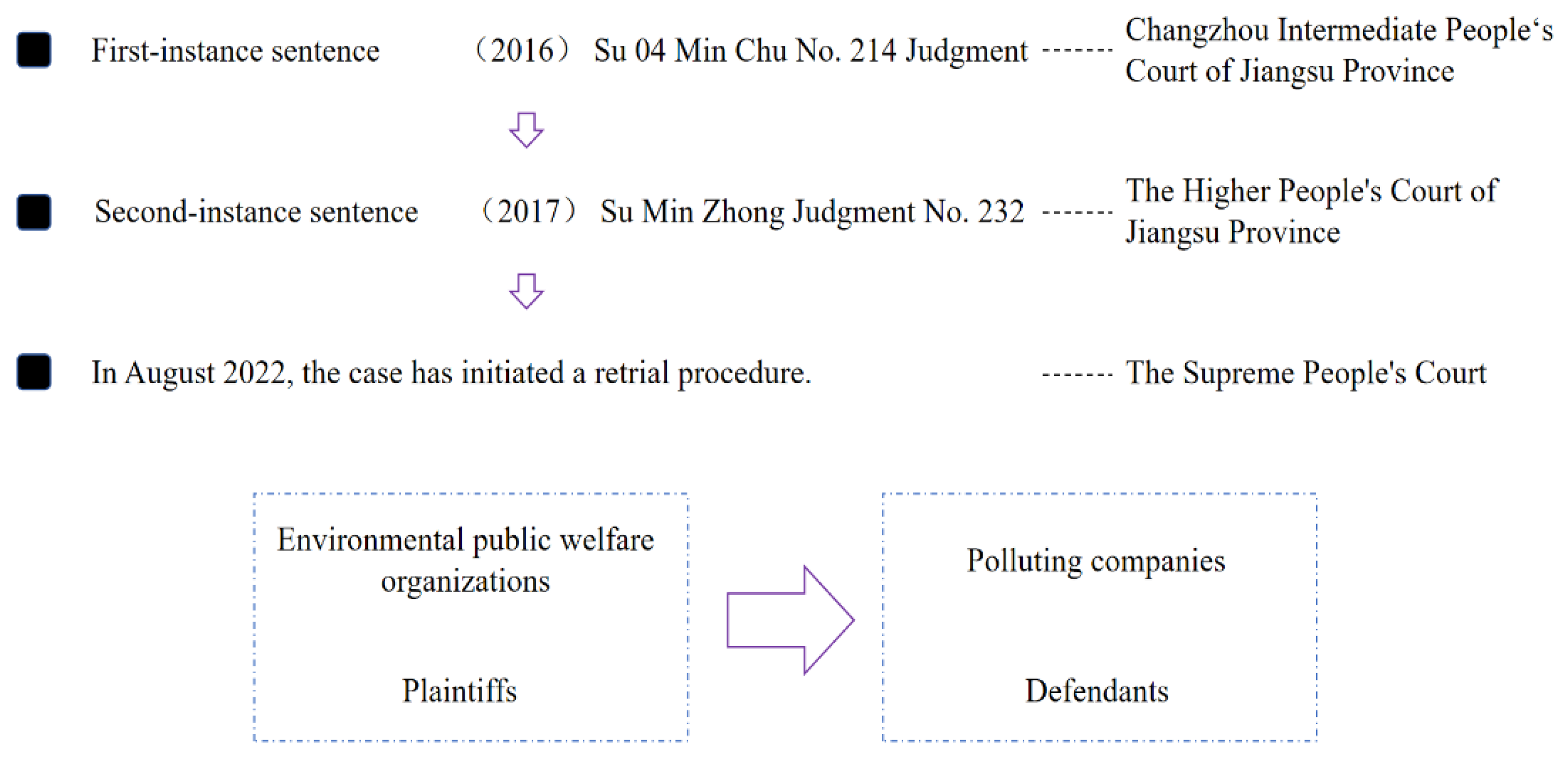
Figure 2.
Figure 2. This is a figure. Nearly 500 students from Changzhou Foreign Language School in Jiangsu Province were found to have abnormal blood indicators, decreased white blood cells, and other symptoms. Some students were diagnosed with malignant diseases such as lymphoma and leukemia. After investigation, it was found that the culprit of this incident was pointed to a chemical site north of the school. The original image is sourced from Xinhua News Agency.
Figure 2.
Figure 2. This is a figure. Nearly 500 students from Changzhou Foreign Language School in Jiangsu Province were found to have abnormal blood indicators, decreased white blood cells, and other symptoms. Some students were diagnosed with malignant diseases such as lymphoma and leukemia. After investigation, it was found that the culprit of this incident was pointed to a chemical site north of the school. The original image is sourced from Xinhua News Agency.
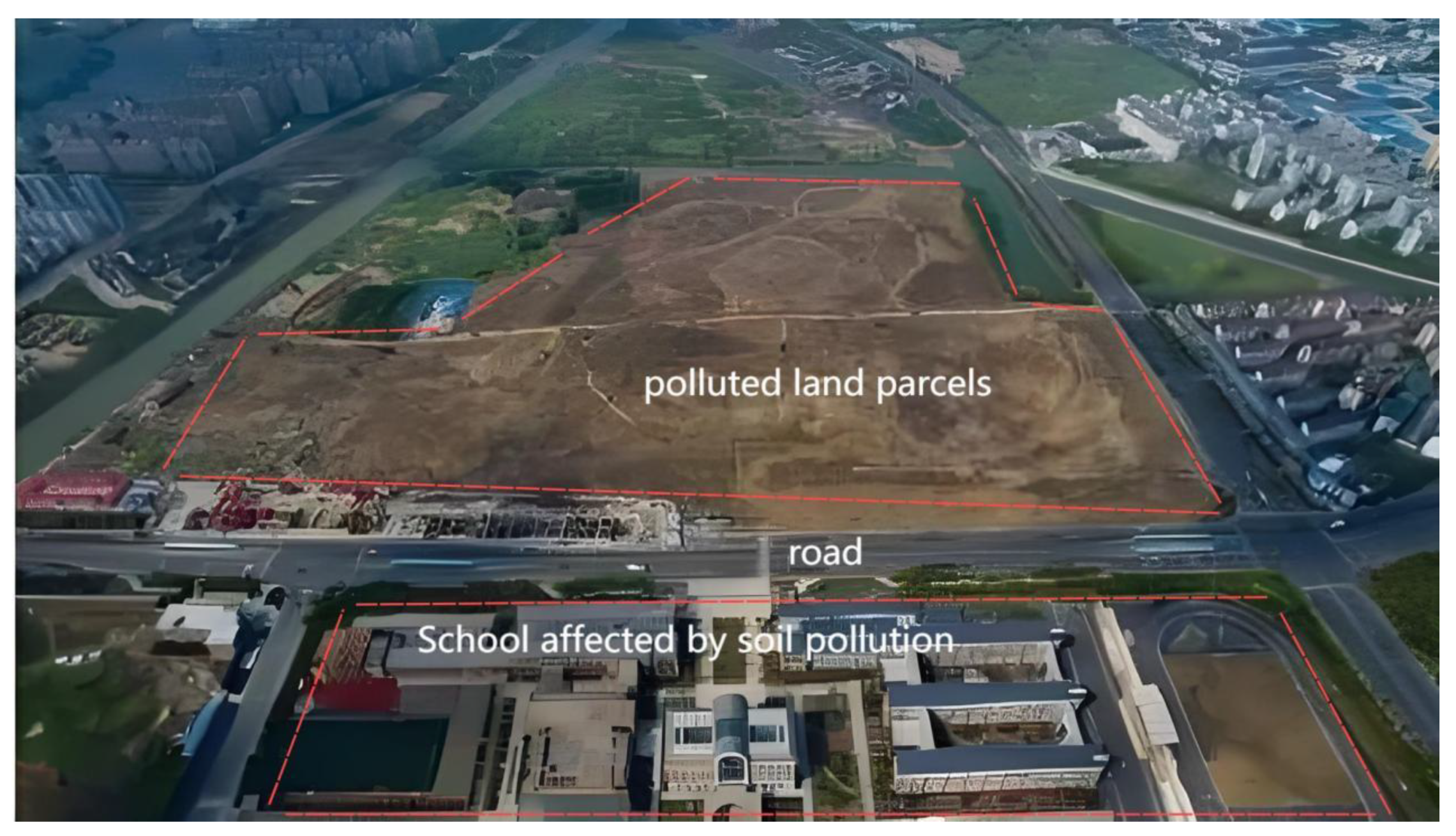

Table 1.
This is a table. The table shows differentiation of environmental liability types for the Xinbei district government.
Table 1.
This is a table. The table shows differentiation of environmental liability types for the Xinbei district government.
| stage | government responsibilities | legal basis | types of illegal performance of duties | ways to assume environmental responsibility |
| before pollution occurs | supervise and administrate | article 7, article 8, etc. of the Solid Waste Pollution Prevention and Control Law; article 5, article 6, etc. of the Soil Pollution Prevention and Control Law; article 4, article 9, etc. of the Water Pollution Prevention and Control Law | incomplete action | administrative responsibility; political responsibility |
| after pollution occurs | conduct investigation and evaluation when collecting and storing land; imposing administrative penalties, ordering corrections, etc. on polluting behavior | the Land Reserve Management Measures, Jiangsu Provincial Land Reserve Management Implementation Measures, Jiangsu State-Owned Land Reserve Measures, Changzhou Municipal Land Reserve Management Measures, etc; chapter 8 of the Solid Waste Pollution Prevention and Control Law, chapter 6 of the Soil Pollution Prevention and Control Law, etc | nonfeasance;incomplete action | |
| during pollution remediation | urge polluters to repair the environment, assume supervision and backup responsibilities | article 1234 of the Civil Code; article 5 of the Environmental Protection Law; articles 94, 95, etc. of the Soil Pollution Prevention and Control Law | Illegally exercising powers |
Table 2.
This is a table. The table shows the determination of legal and environmental responsibilities of three chemical plants.
Table 2.
This is a table. The table shows the determination of legal and environmental responsibilities of three chemical plants.
| environmental civil legal liability | environmental administrative legal responsibility | responsibility for soil pollution remediation | |
| interest foundation | private environmental benefits | environmental public welfare | environmental public welfare |
| specific type | environmental infringement liability | the administrative legal responsibility that the counterparty should bear for violating environmental administrative norms | environmental public law responsibility based on public interest damage |
| responsibility attribute | private law liability | public law responsibility | Public law responsibility |
| natural order | the government’s order to rectify takes priority over the remediation responsibility of polluters, and the remediation responsibility of polluters takes priority over the government’s backup remediation responsibility | ||
| responsibility mode | stop infringement, eliminate obstruction, eliminate danger, restore the original state, compensate for damages, apologize, etc | stop illegal activities, impose administrative penalties, order correction, etc | restoration of ecological environment and compensation for ecological environment damage |
| legal basis | articles 1229-1233 of the Civil Code and related judicial interpretations | article 102, article 112, etc. of the Solid Waste Pollution Prevention and Control Law | articles 1234-1235 of the Civil Code, article 94 of the Soil Pollution Prevention and Control Law, etc |
Disclaimer/Publisher’s Note: The statements, opinions and data contained in all publications are solely those of the individual author(s) and contributor(s) and not of MDPI and/or the editor(s). MDPI and/or the editor(s) disclaim responsibility for any injury to people or property resulting from any ideas, methods, instructions or products referred to in the content. |
© 2025 by the authors. Licensee MDPI, Basel, Switzerland. This article is an open access article distributed under the terms and conditions of the Creative Commons Attribution (CC BY) license (http://creativecommons.org/licenses/by/4.0/).
Copyright: This open access article is published under a Creative Commons CC BY 4.0 license, which permit the free download, distribution, and reuse, provided that the author and preprint are cited in any reuse.