

Submitted:
30 May 2025
Posted:
30 May 2025
You are already at the latest version
Abstract
School readiness during early childhood is crucial for future academic success. Existing guidelines recommend a comprehensive approach. This concurrent validation study developed a School Readiness Index (SRI) with five readiness domains: early learning skills, approach to learning, cognitive skills, socioemotional development, and physical health. Through a cross-sectional comparative design, the school readiness skills of 119 Puerto Rican children (63 males, 56 females) ages 54-65 months were assessed using standardized tests (e.g., Batería IV Woodcock-Muñoz and NIH Toolbox Cognition Battery), parental questionnaires (e.g., Ages and Stages Questionnaire-3), and physical health assessments. Each measure was scored and classified using a binary coding system (0 and 1) based on participant abilities (e.g., 1 for expected performance, 0 if below expectations). A composite SRI score was calculated using 25 indicators. Discriminant validity was assessed by comparing children’s registration status in the special education program (SEP). Sex, household income, and maternal education are key determinants of school readiness. Children registered in the SEP had significantly lower composite scores than those not registered, supporting the SRI’s discriminant validity. The SRI is a reliable tool for identifying Hispanic children from Puerto Rico who may benefit from additional support. Inclusive and multidisciplinary assessment strategies are essential.
Keywords:
school readiness
; early education
; school readiness index
; early childhood development
; developmental assessment
1. Introduction
The dynamic interplay between children, families, and schools determines how children use their abilities, skills, and attitudes for a seamless and successful transition to formal education, defined as school readiness (Williams et al., 2019). For the child, school readiness encompasses physical and emotional well-being, social and behavioral development, cognitive skills, and an effective approach to learning. Assessment practices should consider these multifaceted aspects while exploring aspects beyond academic performance (Daily et al., 2010). School readiness predicts lifelong physical well-being, general knowledge, socioemotional well-being, and academic success in emerging adulthood (Fitzpatrick et al., 2020). Notably, early literacy development has been associated with improved health outcomes. Individuals with higher literacy rates tend to exhibit better physical health, engage in healthier behaviors, have lower cardiometabolic risk, and experience lower levels of anxiety and depression (Bleil et al., 2024; Shulman et al., 2024). Therefore, readiness must be addressed as a health-relevant, measurable outcome with potential long-term health consequences at the individual and population levels (Janus & Offord, 2007). Most importantly, readiness assessment work-in-progress by educators is prioritizing measurement challenges as an opportunity to mobilize investment and support for children from diverse backgrounds (Kaminski et al., 2023). Readiness assessment represents a pathway to providing early intervention and special education services, as mandated by the Individuals with Disabilities Education ACT (IDEA) (Individuals with Disabilities Education Act, 2004).
A fundamental guidance for assessing children’s school readiness is based on the National Education Goals Panel’s 1991 developmental trajectories and domains (National Education Goals Panel, 1991; Williams et al., 2019). The domains include physical well-being and sensory-motor development, socioemotional development (e.g., self-regulation, attention, and impulse control), language development (e.g., listening, speaking, and literacy skills), general knowledge and cognition (e.g., early literacy), and approaches to learning (e.g., enthusiasm, curiosity, and culture) (National Education Goals Panel, 1991; Williams et al., 2019). These domains lay the foundation for selecting and developing valid measures of children’s school readiness that identify strengths and needs as predictors of future success and in the context of social determinants of health (Duncan et al., 2007; Ghandour et al., 2024; Ghandour et al., 2021; Hughes et al., 2015). The 2016 National Survey of Children’s Health (NSCH) analyzed 18 items in four school readiness domains, showing that 42.2% of preschoolers (ages 3-5) were “on-track” or healthy and ready to learn (HRL) (Ghandour et al., 2021). Of note, factors such as special health care needs status/type, screen time, adverse childhood experiences, and neighborhood amenities influenced children’s readiness. A follow-up study using 2022 NSCH data analyzed 27 items for five school readiness domains (Ghandour et al., 2024), showing an increase to 63.6% of preschool children “on-track.” These findings support the influence of previously mentioned factors on children’s readiness and identified others, such as male sex and parental education. It is worth noting that although valid, the NSCH data is based on parental reports in the absence of health and education professional perspectives.
Other school readiness assessments combine multiple tools to gather data from parents, teachers, and children’s test scores. The Early Development Instrument (EDI), a teacher-completed measure of school readiness for Canadian children, assesses five domains using 103 items from existing instruments, key informant interviews (educators and early childhood experts), and focus groups (Janus & Offord, 2007). The EDI has acceptable psychometric properties as a population-level measure of school readiness. Notably, consistent with other studies (Brandlistuen et al., 2021; Hughes et al., 2015), male children scored significantly lower than females in all domains. However, a study exploring three school readiness domains (school-entry academic, attention, and socioemotional skills) among six longitudinal data sets as predictors of later achievement (Duncan et al., 2007) found no significant differences due to sex. Interestingly, unlike other studies linking disparities to household income (Gill et al., 2024; Hair et al., 2015), the authors found no significant differences in school readiness based on socioeconomic status. Despite varying measurements and data collection methods (e.g., parents, teachers, school administrators, home visits, and test scores), a meta-analysis determined that school-entry math, reading, and attention skills were the strongest predictors of later achievement, while socioemotional skills were insignificant.
Integrating a multidisciplinary team of health professionals into school readiness assessment can enrich previous approaches relying on parent and teacher reports, especially for vulnerable populations like the Pediatric Outcomes of Prenatal Zika Exposure (POPZE) cohort study participants (Alvarado-Domenech et al., 2022). POPZE assesses the developmental skills of Spanish-speaking children born during the Puerto Rico 2016-2017 Zika epidemic with and without the prenatal exposure. Children aged 54-65 months were assessed for school readiness skills guided by the theoretical framework of the American Academy of Pediatrics (AAP) technical report on school readiness and aligning with the school readiness developmental domains identified by the National Education Goals Panel (National Education Goals Panel, 1991; Williams et al., 2019). Data to inform five school readiness domains is collected from a collaborative, multidisciplinary team comprising of parents, pediatricians, psychologists, a pediatric audiologist, and other specialists in human behavior. The main objective of this study is to describe the methods used to develop the School Readiness Index (SRI) in Hispanic Puerto Rican children and test its discriminant validity. The team hypothesizes that children with special needs will score significantly lower than children without, and significant differences will be found based on child sex, household income, and maternal education.
2. Materials and Methods
2.1. Participants
Study participants include children from the POPZE cohort study, which enrolled children born during the Zika epidemic and subsequent post-epidemic periods in Puerto Rico between May 2016 and August 2018 (Alvarado-Domenech et al., 2022). The current study focused on assessing the children’s school readiness skills when they reached 54 to 65 months. A total of 119 participants were enrolled in the study, comprising 63 males and 56 females, with an average age of 57.69 ± 3.73 months. The maternal average age was 32.26 ± 5.93 years. Additional sociodemographic characteristics are presented in Table 1. Notably, most mothers were married or cohabitating (74.8%), and nearly half (49.6%) were employed. Furthermore, 48.7% of the households had an annual income of $15,000 or more. In addition, most participants had public health insurance (73.9%). Parents also reported their child’s registration status in the Special Education Program of the Puerto Rico Department of Education. It is worth noting that 32.8% of the children were enrolled under the provisions of the Individuals with Disability Educational Act (Individuals with Disabilities Education Act, 2004). This study underwent review and approval by the Ponce Medical School Foundation Institutional Review Board (IRB approval number 1903008631; May 20, 2019). Parents provided written informed consent for their participation and their child’s participation in the study.
2.2. Assessment Procedures
The team conducted a comprehensive assessment to compute the SRI. Participant’s assessments were individually performed in two in-person visits. During the first visit, in a timeframe of approximately three (3) hours, trained study personnel screened the child’s vision and assessed their motor skills. Advanced clinical psychology doctoral students, supervised by an experienced licensed clinical psychologist, administered the psychometric tests to assess academic and cognitive skills. Parents or legal guardians completed questionnaires on the child’s development. The visit concluded with a comprehensive physical and neurological evaluation by the study pediatrician, with findings recorded in the Child Investigation Form (CIF), a structured form developed by the study team. A shorter second visit was for the child’s audiological evaluation by a licensed pediatric audiologist.
2.3. Measures
The team used valid and standardized tests and questionnaires in Spanish (Figure 1; Supplementary Table S1) to assess specific developmental areas of cognition, language, motor skills, socioemotional skills, psychological health, sensory function, basic learning skills, and the home environment’s role in fostering child development. The administration and scoring procedures followed the guidelines outlined in the relevant technical manuals. The clinical psychologist principal investigator scored and interpreted each instrument administered. Results from each measure were collected and entered in the REDCap 13.1.27 (Harris et al., 2019; Harris et al., 2009) secure web application hosted by the Ponce Medical School Foundation dba. Ponce Research Institute.
2.3.1. Batería IV Woodcock-Muñoz: Pruebas de Aprovechamiento (Brief Academic Battery)
The Woodcock-Muñoz Brief Academic Battery (W-M, α = 0.96 – 0.97) (Wendling et al., 2019; Woodcock et al., 2019) assesses brief academic skills such as reading, writing, and math. Administered by trained/advanced psychology students, the Brief Academic Battery includes letter and word identification, spelling, and applied problems subtests. For each area, total scores are transformed to age-equivalent performance (AE) following established test norms.
2.3.2. Home Observation Measurement of the Environment – Short Form (HOME-SF)
The HOME-SF (α = 0.66 – 0.90) (Bradley & Caldwell, 1979; Mott, 2004) assesses parental activities with the child stimulating the child’s cognition (6 items) and providing emotional support (5 items). The team revised the question “Does the child have the use of a CD player, tape deck, or tape recorder, or record player at home and at least five records or tapes?” to reflect current media access: “Does the child have access to a smartphone, tablet, videogames, or computer that allows him/her to listen to music, watch videos or movies, and play games?” Scoring procedures for screen time (television) were revised based on the American Academy of Pediatrics guidelines for children’s digital media use (Council on Communications and Media et al., 2016). Instead of four hours as adequate, the new limit was set to one hour. Higher scores indicate a higher level of parental stimulation of a child’s cognitive development and emotional support.
2.3.3. NIH Toolbox Early Childhood Cognition Battery (NIHTB-Cog)
The NIHTB-Cog (Denboer et al., 2014) is a web-based test used to evaluate a child’s cognitive abilities. The Spanish version of the NIHTB-Cog (intra-class correlation coefficient (ICC) = 0.76 – 0.96) has been validated to assess attention and executive functions, episodic memory, and language (Bauer et al., 2013; Gershon et al., 2013; Zelazo et al., 2013). Administered by trained/advanced psychology students through the NIH Toolbox iPad app, the NIHTB-Cog has been validated in the Hispanic population (Casaletto et al., 2016; Fox et al., 2021) and generates age-corrected norm-based standard scores. A score below 85 indicates performance at least one standard deviation below the norm.
2.3.4. NIH Toolbox Parent Proxy Emotion Battery (NIHTB-EM)
The NIHTB-EM (α = 0.66 – 0.82) (Salsman et al., 2013) assesses parental perception of their child’s psychological well-being (positive peer interaction), social relationships (positive affect and empathic behavior), and negative affect (anger and anxiety). These Likert-type scales measure how often or true the child shows these behaviors. Parental reports are entered into the NIH Toolbox iPad app, where scores are transformed into t-scores. For negative behaviors (i.e., anger and anxiety), a t-score ≥60 implies at least one standard deviation above the norm. For positive socioemotional skills (e.g., positive peer interaction, positive affect, and empathic behavior), a t-score ≤40 represents at least a standard deviation below the norm.
2.3.5. Ages and Stages Questionnaire, Third Edition (ASQ-3)
The ASQ-3 (Squires et al., 2009) assesses parental perception of a child’s development across various domains, including communication, gross motor, fine motor, problem-solving, and personal-social domains. A score at or below the age-based cutoff score indicates a potential risk of developmental delay.
2.3.6. Ages and Stages Questionnaire: Social-Emotional, Second Edition (ASQ:SE-2)
The ASQ:SE-2 (α = 0.90) (Squires et al., 2002) assesses parental perception of a child’s socioemotional responses. A score above the age-specific cutoff score (70) indicates a potential risk for socioemotional difficulties in the child.
2.3.7. Peabody Developmental Motor Scale, Second Edition (PDMS-2)
The PDMS-2 (α = 0.96 – 0.98) (Folio & Fewell, 2000) assesses fine and gross motor skills. Of note, since the PDMS-2 instructions are not available in Spanish, the team standardized its administration. Trained study personnel adhered to the PDMS-2 age-appropriate items, scoring, and classification guidelines. A cutoff total score below 90 in the total motor quotient indicates that a child’s motor performance is at least one standard deviation below the norm.
2.3.8. Instrument-Based Vision Screening
The instrument-based vision screening is conducted using the Welch Allyn Spot Vision Screener (Baxter, n.d.; Donahue & Nixon, 2016). This device assesses the vision in both eyes to identify asymmetry, such as in amblyopia, and other potential risks for vision problems that warrant further evaluation. The sensitivity for detecting amblyopia risk factors is 89.5%, and the specificity is 76.7% (Peterseim et al., 2020). Trained study personnel position the child three feet from the device and ask them to focus on its light and sounds. During this period, the device captures measurements, including refractive error, eye alignment, and other parameters. This non-invasive instrument records the data and provides information on abnormal or asymmetric visual acuity, as well as risks for myopia, hyperopia, and astigmatism. The results from the instrument are categorized as either “Pass,” indicating no referral is required, or “Fail/Refer,” indicating the need for additional evaluation.
2.3.9. Audiological Evaluation
The audiological evaluation is conducted in person by a licensed pediatric audiologist in accordance with the American Academy of Audiology guidelines (American Academy of Audiology, 2011). A detailed interview obtains information about past medical history, birth history related to hearing, specific otologic history, exposure to loud noises, and any past symptoms that may be indicative of hearing difficulties. The audiological screening components are outlined below, with pass or fail criteria applicable to each component.
- Otoscopy. The external auditory canal and the tympanic membrane are examined in each ear to identify any abnormalities, blockages, or infections. To pass this component, the child could not have an occluded ear canal with cerumen (i.e., 50% or more of cerumen occupying the ear canal).
- Distortion product otoacoustic emissions (DPOAEs). The otoacoustic emissions test evaluates the function of the inner ear by measuring the sounds of the cochlea in response to a received stimulus from the cochlear outer hair cells. The test is conducted using the Sentiero Advance from Path Medical (Path Medical, 2022), utilizing the screening protocol of 2000 Hz to 5000 Hz. To pass this component, DPOAEs must fulfill the absolute amplitude and signal-to-noise criteria for each frequency.
- Pure tone and/or warble-tone screening. Screening is conducted using the Maico MA 25 audiometer (MAICO, n.d.-b; Path Medical, 2022). The participant wears headphones to discern varying frequencies and intensity levels in each ear. The screening procedure uses a conditioned play audiometry strategy with tested frequencies of 1000 Hz, 2000 Hz, and 4000 Hz tested intensity of 20 dB HL for each frequency and ear.
- Automated auditory brainstem response (ABR) testing. The ABR test assesses the integrity of the peripheral vestibulocochlear cranial nerve (CN VIII) using the easyScreen by Maico (MAICO, n.d.-a). Given the objectives and population of this study, to pass this test, the subjects needed a reliable auditory electrophysiological response to a chirp stimulus at 20 dB eHL, with correction factors applied and utilizing an alternating stimulus polarity.
- Unfortunately, tympanometry screening could not be performed due to lack of equipment. However, if middle ear effusion was suspected after performing and failing otoscopy and DPOAEs, a referral for medical consultation and/or management was recommended. After medical consultation and/or management, subjects were re-assessed.
2.3.10. Pediatrician Assessment (POPZE Child Investigation Form; CIF)
The pediatrician assessment entails a comprehensive, standardized medical history and examination of a child’s physical and neurological health. The study pediatrician conducts the in-person assessment at the study clinic and collects the child’s past health history, developmental milestones, and recent health/disease events (i.e., nutrition, temperament, sleep, preventive and acute healthcare visits, hospital admission, surgery, education, and specialized services) from the parent/caregiver. Data is recorded in the Child Investigation Form, a standardized age-appropriate form developed by the study team.
Upon the completion of the evaluation, two pediatricians from the research team assess the relevant physical health outcomes that determine whether the child is classified as “Healthy” or “Not Healthy.” The clinical impression of the pediatricians is based on a comprehensive review of the medical history for evidence of severe or chronic conditions, hospitalizations, or surgeries; anthropometric measures for evidence of obesity; and significant abnormal physical or neurologic findings that could impair function. The following Not-Healthy status criteria are used for internal consistency:
- Number of hospitalizations: This clinical criterion refers to an increased risk of repeated hospital admissions (two or more) that could be attributed to chronic or persistent health conditions such as asthma, or frequent and severe infections.
- Significant hospitalizations: This clinical criterion refers to the severity and duration of hospital admission and the possibility of long-term developmental, sensory, and/or chronic illnesses or consequences, such as meningitis or other serious diagnoses. The criteria include repeated or serious surgical procedures.
- Body mass index (BMI) > 95 percentile: This criterion follows the Centers for Disease Control and Prevention (CDC) definition of obesity as having a BMI at or above the 95th percentile for age and sex (Centers for Disease Control and Prevention, 2018).
- Physical findings at 54-65 months: Using clinical criteria, the pediatricians assess the physical findings at the 54–65-month visit to identify evidence of chronic or debilitating illnesses that could interfere with the child’s well-being and function. Findings in the neuromotor system are correlated with the results of the PDMS-2 (Folio & Fewell, 2000) and ASQ-3 (Squires et al., 2009) (fine/gross motor domains) assessments and are deemed significant in the presence of fine or gross motor developmental delay. Discrepancies between the clinical evaluators are addressed through case discussion, leading to a consensus. In the hypothetical situation that consensus is not reached, the process indicates that a third pediatrician expert will be consulted to evaluate the findings.
2.4. Defining the SRI
The SRI is grounded in the integration of five evidence-based developmental domains: (1) Early Learning skills (EL), (2) Approach to Learning (AL), (3) Cognitive Skills (CS), (4) Socioemotional development (SE), and (5) Physical Health (PH) (Figure 1; Supplementary Table S1). EL evaluates early academic skills and questions regarding the child’s verbal abilities. AL evaluates attitudes and motivation within the home environment regarding the child’s cognitive stimulation and emotional support. CS assesses problem-solving, memory, attention, executive functions, and language abilities. SE assesses social skills, emotional regulation, and interpersonal interactions. PH evaluates physical and neurological examination, motor skills, and sensory screening.
2.4.1. Scoring the SRI
The initial calculation of the SRI was based on results derived from tests and procedures conducted in alignment with established assessment guidelines. These results were evaluated against pre-defined cutoff points to determine whether the child’s performance was as expected (“On-track”) or below expectations (“At-risk”).
To ensure standardization, each assessed variable was operationalized into a binary outcome, categorizing the child’s performance as either “On-track” or “At-risk” (See Supplementary Table S1). Specifically, the skills measured were scored using a binary system: a score of 1 indicated the presence of the skill or attribute, classifying the child as “On-track,” whereas a score of 0 indicated its absence, classifying the child as “At-risk.” For each assessment instrument, the thresholds used to determine whether a child was “On-track” or “At-risk” were based on established benchmarks for risk or developmental delay (Denboer et al., 2014; Folio & Fewell, 2000; Salsman et al., 2013; Squires et al., 2002; Squires et al., 2009). In cases where no established benchmarks were available, the lower tertile of the score distribution was used to define risk (e.g., most extreme tertile = “At-risk,” rest of the distribution “On-track”). We elected to use tertiles over more extreme cut points (e.g., quartiles, quintiles) to preserve statistical power while still retaining focus on the risk end of the distribution.
The SRI integrates results from ten different assessment instruments. The binary scoring system simplifies the process of simultaneously evaluating multiple aspects of school readiness. Each domain of school readiness was assigned a total score, ranging from 2 to 6, contingent on the number of skills assessed. A summative approach was employed to compute an overall composite score. Binary scores from all five domains were aggregated to produce an unweighted total score, with a maximum possible score of 25 points. The following sections provide a detailed description of the scoring procedures specific to each domain.
Early Learning Skills (EL) Domain
The EL domain encompasses six areas of interest (Supplementary Table S1). Three of these areas are assessed through the W-M letter and word identification, spelling, and applied problems subtests (Wendling et al., 2019; Woodcock et al., 2019). For each area, the team evaluates the difference between the child’s age-equivalent performance (AE) and their chronological age (CA). This comparison determines whether the participant is “On-track” (1 point) or “At-risk” (0 points). Specifically, a participant is considered “On-track” if their AE performance aligns with or surpasses their CA. Conversely, they are classified as “At-risk” if their AE performance lags their CA by 12 months or more (AE – CA ≤ -12). For example, if a 60-month-old child demonstrates AE performance equivalent to that of a 45-month-old child in a particular area (45 – 60 = -15), the child is categorized as “At-risk.” Conversely, if the same child demonstrated AE performance equivalent to a 49-month child (49 – 60 = -11), the child is considered “On-track” since the difference is less than -12. Notably, performance aligns with the child’s CA (60 – 60 = 0) or exceeds, such as that of a 65-month child (65 – 60 = 5), warrants an “On-track” classification. This scoring system clearly delineates a number line, designating any deviation -12 or more to the left as “At-risk” and positions to the right as “On-track.”
The EL domain encompasses three additional areas of interest pertaining to the participant’s verbal expression, considering parental responses on standardized questions on the children’s ability to (1) be understood by others, (2) express themselves, and (3) organize their ideas. This information was derived from the Clinical Assessment documented in the Child Investigation Form. For each of these abilities, a score of 1 is assigned if the participant demonstrates the ability; otherwise, a score of 0 is assigned. A total EL score is determined by summing the scores from the W-M subtests and the verbal expression questions, with a maximum possible score of six (6) points.
Approach to Learning (AL) Domain
This domain assesses the home environment using the HOME-SF (Bradley & Caldwell, 1979; Mott, 2004) questions, which evaluate cognitive stimulation and emotional support (Supplementary Table S1). If a participant’s total score for cognitive stimulation falls within the first tertile, they are classified as “At-risk” (0 points); otherwise, they are classified as “On-track” (1 point). Similarly, if a participant’s total score for emotional support falls within the first tertile, they are also classified as “At-risk” (0 points); otherwise, they are classified as “On-track” (1 point). A total AL score is calculated by summing the cognitive stimulation and emotional support scores, with a maximum possible score of two (2) points.
Cognitive Skills (CS) Domain
The CS domain evaluates attention and executive functions, episodic memory, and language using the NIHTB-Cog (Bauer et al., 2013; Gershon et al., 2013; Zelazo et al., 2013). The standard score for each area is classified as “On-track” or “At-risk” based on a cutoff point of 86 (Supplementary Table S1). Participants with standard scores above 86 are considered “On-track” (1 point), while those below the cutoff score are considered “At-risk” (0 points). The domain also assesses language development using the ASQ-3 Communication domain (Squires et al., 2009). Participants on or above the age-specific cutoff score are considered “On-track” (1 point), while those below the cutoff score are considered “At-risk” (0 points). The points evaluated in the CS domain are added for a total score of five (5) points.
Socioemotional Development (SE) Domain
The SE assesses the socioemotional skills of the participants using the ASQ:SE-2 (Squires et al., 2002) and the NIHTB-EM (Salsman et al., 2013) (Supplementary Table S1). For the ASQ:SE-2, if the total score exceeds the age-specific cutoff score (70), it is considered an “At-risk” skill (0 points); otherwise, it is classified “On-track” (1 point). Similarly, for the NIHTB-EM, t-scores on positive socioemotional skills (i.e., positive peer interaction, positive affect, and empathic behavior) are categorized based on a cutoff of 40. If the evaluated results are at or above the cutoff, they are considered “On-track” (1 point). Conversely, if the total t-score is below 40, it is classified “At-risk” skill (0 points). A cutoff t-score of 60 is used on measures of negative affect (i.e., anger and anxiety) to classify the participant’s skills as “On-track” (less than 60 = 1 point) or “At-risk” (at or above 60 = 0 points). The areas evaluated by the SE domain are summed to obtain a maximum total score of 6 points.
Physical Health (PH) Domain
This domain encompasses a standardized pediatrician assessment that evaluates the participant’s health status. The assessment categorizes participants into two groups: “Healthy” (1 point) or “Not Healthy” (0 points) (For a detailed description, please refer to section 2.2.10). To enhance the assessment, the PH also incorporates fine and gross motor developmental outcomes from the ASQ-3 (Squires et al., 2009) and the PDMS-2 (Folio & Fewell, 2000) results. For ASQ-3 gross motor, results exceeding the age-specific cutoff score are designated as “On-track” (1 point), while those below the cutoff score are considered “At-risk” (0 points). Similarly, the total score for ASQ-3 fine motor skills is categorized as “On-track” (1 point) or “At-risk” (0 points) based on the age-specific cutoff score. For the PDMS-2, total motor quotient scores of 90 or higher are classified as “On-track” (1 point), while those below 90 are classified as “At-risk” (0 points).
The domain encompasses results from vision and audiological screenings (as outlined in 2.2.8 and 2.2.9) to identify sensory deficits or potential risk factors that may impact participants’ learning readiness. For each screening test, participants who obtain a “pass” result are classified as “On-track” (1 point); otherwise, they are classified as “At-risk” (0 points). An overall score for the PH domain is computed from each measured area, resulting in six (6) possible points (Supplementary Table S1).
2.4.2. Interpretation of the SRI
The composite score can be interpreted as a continuous variable, where higher scores indicate greater school readiness. However, the developmental domain and individual skill approach offer the most effective opportunity for individualized analysis, which can benefit children by identifying their strengths and areas for improvement in school readiness.
2.5. Data Analyses
Descriptive statistics were calculated for the sociodemographic characteristics of the study population. Categorical variables were analyzed using descriptive analyses, including frequencies and percentages, while continuous variables were described by measures of central tendency. Pearson correlation tests examined the bivariate associations among all SRI domains and composite score. Then, a two-step analysis examined the associations between sociodemographic characteristics and the composite score. The initial step involved a simple linear regression for each sociodemographic variable and its association with the composite score. The subsequent step involved a multivariable linear regression to test the adjusted associations between household annual income, maternal education, child’s sex, and registration status in the Special Education Program with the composite score. Household annual income was dichotomized as $14,999 or less versus $15,000 or higher. Maternal education was dichotomized as certificate, high school or less versus associate degree or more. Analyses were conducted with an alpha level of 0.05. Data management and data analysis were conducted with IBM SPSS Statistics 28.0.0.0.
3. Results
3.1. SRI Developmental Domains and Composite Scores
The SRI tool evaluated five developmental domains in Hispanic Puerto Rican children enrolled in the POPZE study: Early Learning skills (EL), Approach to Learning (AL), Cognitive Skills (CS), Socioemotional development (SE), and Physical Health (PH). When assessing the overall sample, the mean score for EL was 3.7 ± 1.6 (out of 6 points) (Supplementary Table S2). The mean score for AL was 1.3 ± 0.8 out of a maximum of 2 points. The average score for CS was 3.8 ± 1.4 (out of 5 points). The SE average score was 4.3 ± 1.5 (out of 6 points), and the PH mean score was 4.8 ± 1.3 (out of 6 points). The average composite score for the overall sample was 18.0 ± 4.5 out of 25 points, with 75% of participants having less or equal to 21 total points. Of interest, when examining specific elements within the EL domain, 64.7% of parents responded that the child was able to organize and express ideas, and 81.5% reported their child could retell a story in a logical order (Supplementary Table S3).
3.2. Relationships Among the SRI Composite Scores, Domains, and Determinants of Health
Pearson correlation analysis and univariate and multivariable linear regressions were performed to discern the unique and collective contributions of various factors to the variation observed in the domain-specific scores. As expected, the SRI composite score was positively correlated with its component domains; correlations ranged from (r = 0.46 to r = 0.77, all p < 0.01; Supplementary Table S4). Moderate positive correlations were also observed between each SRI domain, ranging from r = 0.20 to r = 0.60; p ≤ 0.05. Marginally significant correlations were observed for SE with EL domains (r = 0.15, p = 0.096) and PH with AL domains (r = 0.17, p = 0.08). These significant but moderate correlations suggest that each domain is related to the others yet contributes unique and additional information to the overall composite SRI score, supporting the construct validity of the SRI to measure the school readiness construct in Hispanic Puerto Rican children effectively.
Univariate models revealed statistically significant relationships between the SRI composite score and the participant’s sex, annual household income, and whether the participant was registered in the Special Education Program (SEP) of the Puerto Rico Department of Education (Table 2). Female children had significantly higher composite scores than males (B = -1.89, SE = 0.80, p = 0.02). Children of higher household annual income had significantly higher SRI composite scores than their counterparts (B = 1.73, SE = 0.81, p = 0.03). Also, children registered in the SEP had significantly lower SRI scores (B = 4.47, SE = 0.77, p<0.001). These results suggest that the child’s performance in the SRI may be influenced by the child’s sex, socioeconomic status, and SEP registration status.
The results of the multivariate regression models exploring associations between SRI composite score and SEP registration status, adjusted by child sex and household annual income, are listed in Table 3. The final model included significant predictors determined by a stepwise selection procedure. The model reveals that SEP registration status was significantly associated with participant’s SRI composite score (B = 4.17, SE = 0.77, p<0.001). The model also showed that household annual income (B = 1.34, SE = 0.71, p = 0.06) and sex (B = -1.16, SE = 0.81, p = 0.11) were no longer significantly associated with the SRI score. Based on the findings, participants who were not registered in SEP had, on average, a 4.17 unit increase in SRI scores compared to those registered, after adjusting for predictors. These findings suggest that SEP status is a more significant determinant of the child’s composite score, supporting the SRI’s ability to differentiate among children with and without support service needs within this population.
4. Discussion
This study presents a valid and comprehensive tool to evaluate school readiness in Hispanic Puerto Rican children at entry level up to five years of age (65 months) that combines multisource validated psychological and psychometric instruments, parent questionnaires, and clinical provider assessments. The SRI-based assessment provides a holistic approach that is helpful for parents, educators, and health providers in identifying a child’s school readiness strengths and needs and providing them with the necessary support to ensure a successful transition into the formal academic experience. It considers five school readiness domains assessed independently: early learning skills, approach to learning, cognitive skills, socioemotional development, and physical health. Twenty-five skills/attributes are captured among these domains, allowing for a more thorough understanding of the child’s abilities, while highlighting areas that may require strengthening for school success.
The SRI assessment can guide decision-making in systems responsible for the health and developmental needs of children across Puerto Rico and other populations. A composite score of up to 25 points provides a screenshot of the study population’s overall performance, enabling the identification of the proportion of children who require assistance or intervention. The analyses of POPZE participants’ outcomes revealed an overall mean score of 18 points, suggesting that these children might require additional support and closer mentoring to maximize their potential. Furthermore, domain-specific analysis might facilitate resource allocations based on areas of greatest need. For instance, the POPZE children encountered significant challenges in the early learning domain. Consequently, families, educational systems, and clinical providers should prioritize efforts to address early literacy and pre-academic skills.
Findings from regression analyses support the validity of the SRI by differentiating between children enrolled in the Special Education Program and those not registered. This finding highlights the utility of the composite score and domain-specific outcomes for early screening and identifying children who require support. The observed correlation among the domains suggests that each domain contributes unique and additional information to the overall index, supporting the SRI construct validity. Consequently, combining the domains provides a more comprehensive understanding compared to examining them in isolation. This comprehensive approach enables a richer interpretation of the collective impact of various domains on the overall construct.
Most States have adopted school readiness assessments at kindergarten entry to inform instruction, while a few States include intervention, individualized plans, and remediation to improve children’s readiness skills (Garver, 2020). In this role, the centralization of Special Education Programs is critical to ensure fair, equitable, and high-quality education and services for children including those with disabilities (Individuals with Disabilities Education Act, 2004). However, early identification of children’s needs is often challenging; therefore, all children could benefit from school readiness assessments for opportunities to thrive.
Many parents are unable to recognize early learning difficulties in their children, and these challenges often become apparent at higher grade levels, when academic demands increase. School readiness assessments help identify areas of need at early life stages to channel timely interventions for better outcomes (National Education Goals Panel, 1991). The purpose of the SRI assessment is not diagnostic but seeks to offer recommendations that benefit Puerto Rican children. Disclosing results and actively involving parents in the process is key to fostering understanding, collaboration and ensuring tailored support for each child’s development and attainment of school readiness.
It is vital to recognize that children’s functioning is not static. Given the dynamic nature of child development and brain neuroplasticity, early interventions open the door to significant improvements in children’s functioning. Early investment in supporting school readiness skill development can result in better life-course physical and psychosocial health and employment opportunities (Doyle et al., 2009). However, social determinants of health, such as gender, maternal education, and household income, need to be considered. Consistent with previous findings of preschool children (Brandlistuen et al., 2021; Ghandour et al., 2024; Hughes et al., 2015; Janus & Offord, 2007), female participants in this study demonstrated better school readiness competencies than males. Children with higher household income and maternal education had better school readiness scores than their counterparts, as identified in other studies (Ghandour et al., 2024; Gill et al., 2024; Hair et al., 2015), although others found no significant differences related to income (Duncan et al., 2007). Individuals with higher education tend to have higher incomes, which can lead to better developmental outcomes for preschool children (Waldfogel et al., 2023). Families with socioeconomic advantages can provide enrichment experiences to children and have access to resources, including high-quality educational or childcare centers, better nutrition, and materials and equipment that stimulate the optimum development of children. Given that the prevalence of special health care needs is disproportionately higher in children from poor and disadvantaged families (Houtrow et al., 2022), social policies are warranted to buffer and reduce disparities.
School readiness not only impacts academic success but also shapes the child’s life course. The SRI assessment includes critical skills for setting a strong foundation for future educational success (Duncan et al., 2007; Entwisle et al., 2005; Fitzpatrick et al., 2020; National Education Goals Panel, 1991). The SRI composite score stands out as a comprehensive tool that distinguishes itself from previously developed indices (Duncan et al., 2007; Ghandour et al., 2024; Ghandour et al., 2021; Janus & Offord, 2007). It accomplishes this by integrating assessments from both clinical psychology professionals and pediatric clinical providers, synthesizing their collective expertise into a unified measure. The active involvement of health professionals, especially pediatricians, becomes crucial in this narrative. Recognizing brain neuroplasticity, they can be catalysts for early interventions that benefit children, establishing a path towards equality from the beginning.
This study has strengths and limitations. Notably, the study excels in its multidisciplinary approach and the seamless integration of professional assessments. Despite the lack of specific norms for certain tests, the availability of assessment tools in both English and Spanish allows comparisons with other populations. Also, individual skill-focused outcomes benefits children by providing the opportunity to identify strengths and needs for school readiness. The SRI’s binary scoring system, which has been implemented in other indexes, enhances accessibility making the interpretation of results straightforward and accessible to a broad range of concerned individuals and organizations, including parents and educators (Brumley et al., 2019; Evans et al., 2013). However, using a binary score can limit the comparisons across studies when the study population differs (Widaman, 2023). Also, the summative approach employed by the SRI does not discern underlying factors contributing to readiness and assigns equal weight to all components, thereby potentially overlooking their contributions to the index (Brumley et al., 2019; Evans et al., 2013; Widaman, 2023). Future exploratory analyses will be conducted to assess possible influential factors. For example, the impact of prenatal Zika virus exposure on learning readiness is the object of a separate manuscript. Another limitation of the study is that some of the test results are based on perceptions of parents and professionals who completed the instruments. However, it is important to note that most of these instruments have been validated, which helps mitigate potential bias. Furthermore, implementing a comprehensive school readiness evaluation using an SRI-based assessment requires substantial financial resources and time, which may limit its feasibility for large-scale use. Moreover, in disadvantaged areas, the availability of multidisciplinary teams, crucial for a thorough assessment, may be limited, further restricting the SRI application.
5. Conclusions
The assessment of school readiness skills is crucial for the early identification of children’s strengths and needs, ultimately promoting their successful future academic and occupational performance. Developed in accordance with established domains from the literature, the SRI integrates data from validated assessment instruments administered by a multidisciplinary team, providing a holistic assessment of the child’s functioning. The findings validate the SRI’s composite score efficacy in assessing school readiness and identifying children who require early intervention, underscoring its discriminatory power. The inclusion of health professionals in the assessment processes enriches previous methods that predominantly rely on parent and teacher reports, therefore supporting vulnerable populations.
Supplementary Materials
The following supporting information can be downloaded at website of this paper posted on Preprints.org, Table S1: Operationalization of tools/measures per domain and skill element for school readiness assessment of 54 – 65-month-old children; Table S2. School readiness assessment scores by domain and school readiness index (SRI) composite; Table S3. School readiness results by domain and skill element in children ages 54 – 65 months; Table S4. Correlations among school readiness assessment domain scores and School Readiness Index (SRI) score.
Author Contributions
MR-R: Writing – original draft, Writing – review & editing, Conceptualization, Investigation, Data curation, Methodology, Supervision, Formal analysis, Project administration, Validation, Funding acquisition, Visualization. KM-R: Writing – original draft, Writing – review & editing, Software, Data curation, Methodology, Formal analysis, Validation, Visualization. AAA: Writing – review & editing, Conceptualization, Methodology. MB-R: Writing – review & editing, Investigation, Data curation. NER-R: Writing – review & editing, Investigation. FJR-S: Writing – review & editing, Investigation. OO-R: Writing – review & editing, Investigation. LIA-D: Writing – original draft, Writing – review & editing, Conceptualization, Investigation, Data curation, Methodology, Supervision, Formal analysis, Project administration, Validation, Funding acquisition, Visualization.
Funding
Funding for this study was provided by the National Institutes of Health (NIH), National Institute of Minority Health and Health Disparities (NIMHD) (Grants U54MD007579 and R25MD007607). The NIH-NIMHD had no role in the design and conduct of the study; collection, management, analysis, and/or interpretation of the data; preparation, review, or approval of the manuscript; and the decision to submit the manuscript for publication. The content is solely the responsibility of the authors and does not necessarily represent the official views of the NIH. The authors have no conflicts of interest relevant to this article to disclose.
Institutional Review Board Statement
The study was conducted in accordance with the Declaration of Helsinki and approved by the Institutional Review Board of Ponce Medical School Foundation (IRB approval number 1903008631; May 20, 2019).
Informed Consent Statement
Informed consent was obtained from all subjects involved in the study.
Data Availability Statement
The data that support the findings of this study are available from the corresponding author upon reasonable request.
Acknowledgments
The team thanks the children and their families for participating in this study. We are also grateful to Dr. Lillian Rivera for her critical review of the manuscript critically and valuable intellectual input. We thank Centro Médico Episcopal San Lucas for supporting the collection of newborn data, and Jomil M. Torres Aponte for confirming maternal Zika virus infection status.
Conflicts of Interest
The authors declare no conflicts of interest. The funders had no role in the design of the study; in the collection, analyses, or interpretation of data; in the writing of the manuscript; or in the decision to publish the results.
References
- Alvarado-Domenech, L. I., Rivera-Amill, V., Appleton, A. A., Rosario-Villafañe, V., Repollet-Carrer, I., Borges-Rodríguez, M.,…Rodríguez-Rabassa, M. (2022). Early Childhood Neurodevelopmental Outcomes in Children with Prenatal Zika Virus Exposure: A Cohort Study in Puerto Rico. J Pediatr, 247, 38-45 e35. [CrossRef]
- American Academy of Audiology. (2011). Childhood Hearing Screening (Clinical Practice Guidelines, Issue). Available online: https://www.audiology.org/wp-content/uploads/2021/05/ChildhoodScreeningGuidelines.pdf_5399751c9ec216.42663963.pdf.
- Bauer, P. J., Dikmen, S. S., Heaton, R. K., Mungas, D., Slotkin, J., & Beaumont, J. L. (2013). III. NIH Toolbox Cognition Battery (CB): measuring episodic memory. Monogr Soc Res Child Dev, 78(4), 34-48. [CrossRef]
- Baxter. (n.d.). Welch Allyn Spot Vision Screener. Retrieved Septemer 12, 2023. Available online: https://www.hillrom.com/en/products/spot-vision-screener/.
- Bleil, M. E., Roisman, G. I., Hamilton, D. T., Magro, S. W., Appelhans, B. M., Gregorich, S. E.,…Pianta, R. C. (2024). Which aspects of education are health protective? a life course examination of early education and adulthood cardiometabolic health in the 30-year study of early child care and Youth Development (SECCYD). BMC Public Health, 24(1), 1092. [CrossRef]
- Bradley, R. H., & Caldwell, B. M. (1979). Home observation for measurement of the environment: a revision of the preschool scale. Am J Ment Defic, 84(3), 235-244.
- Brandlistuen, R. E., Flatø, M., Stoltenberg, C., Helland, S. S., & Wang, M. V. (2021). Gender gaps in preschool age: A study of behavior, neurodevelopment and pre-academic skills. Scand J Public Health, 49(5), 503-510. [CrossRef]
- Brumley, L. D., Brumley, B. P., & Jaffee, S. R. (2019). Comparing cumulative index and factor analytic approaches to measuring maltreatment in the National Longitudinal Study of Adolescent to Adult Health. Child Abuse & Neglect, 87, 65-76. [CrossRef]
- Casaletto, K. B., Umlauf, A., Marquine, M., Beaumont, J. L., Mungas, D., Gershon, R.,…Heaton, R. K. (2016). Demographically Corrected Normative Standards for the Spanish Language Version of the NIH Toolbox Cognition Battery. J Int Neuropsychol Soc, 22(3), 364-374. [CrossRef]
- Centers for Disease Control and Prevention. (2018). About Child & Teen BMI. U.S. Department of Health & Human Services. Retrieved 02/24. Available online: https://www.cdc.gov/healthyweight/assessing/bmi/childrens_bmi/about_childrens_bmi.html.
- Council on Communications and Media, Hill, D., Ameenuddin, N., Levine, A., Boyd, R., Mendelson, M. D.,…Swanson, W. S. (2016). Media and Young Minds. Pediatrics, 138(5). [CrossRef]
- Daily, S., Burkhauser, M., & Halle, T. (2010). A review of School Readiness Practices in the States: Early Learning Guidelines and Assessments. 1(3). Available online: https://nces.ed.gov/programs/slds/pdf/10_III_IVb.pdf.
- Denboer, J. W., Nicholls, C., Corte, C., & Chestnut, K. (2014). National Institutes of Health Toolbox Cognition Battery. Arch Clin Neuropsychol, 29(7), 692-694.
- Donahue, S. P., & Nixon, C. N. (2016). Visual System Assessment in Infants, Children, and Young Adults by Pediatricians. Pediatrics, 137(1), 28-30. [CrossRef]
- Doyle, O., Harmon, C. P., Heckman, J. J., & Tremblay, R. E. (2009). Investing in early human development: timing and economic efficiency. Econ Hum Biol, 7(1), 1-6. [CrossRef]
- Duncan, G. J., Dowsett, C. J., Claessens, A., Magnuson, K., Huston, A. C., Klebanov, P.,…Japel, C. (2007). School readiness and later achievement. Dev Psychol, 43(6), 1428-1446. [CrossRef]
- Entwisle, D. R., Alexander, K. L., & Olson, L. S. (2005). First Grade and Educational Attainment by Age 22: A New Story [doi:10.1086/428444]. American Journal of Sociology, 110, 1458-1502. [CrossRef]
- Evans, G. W., Li, D., & Whipple, S. S. (2013). Cumulative risk and child development. Psychol Bull, 139(6), 1342-1396. [CrossRef]
- Fitzpatrick, C., Boers, E., & Pagani, L. S. (2020). Kindergarten Readiness, Later Health, and Social Costs. Pediatrics, 146(6). [CrossRef]
- Folio, M. R., & Fewell, R. R. (2000). PDMS-2: Peabody Developmental Motor Scales. In (Vol. Second Edition). Austin, TX: ProEd.
- Fox, R. S., Manly, J. J., Slotkin, J., Devin Peipert, J., & Gershon, R. C. (2021). Reliability and Validity of the Spanish-Language Version of the NIH Toolbox. Assessment, 28(2), 457-471. [CrossRef]
- Garver, K. (2020). The “Why” Behind Kindergarten Entry Assessments. In. NIEER Newsletter: National Institute for Early Education Research.
- Gershon, R. C., Slotkin, J., Manly, J. J., Blitz, D. L., Beaumont, J. L., Schnipke, D.,…Weintraub, S. (2013). IV. NIH Toolbox Cognition Battery (CB): measuring language (vocabulary comprehension and reading decoding). Monogr Soc Res Child Dev, 78(4), 49-69. [CrossRef]
- Ghandour, R. M., Hirai, A. H., Moore, K. A., Paschall, K., LaForett, D. R., Reddington, E., & Kogan, M. D. (2024). School Readiness Among United States Children: Results From the 2022 National Survey of Children’s Health. Acad Pediatr. [CrossRef]
- Ghandour, R. M., Hirai, A. H., Moore, K. A., Robinson, L. R., Kaminski, J. W., Murphy, K.,…Kogan, M. D. (2021). Healthy and Ready to Learn: Prevalence and Correlates of School Readiness among United States Preschoolers. Acad Pediatr, 21(5), 818-829. [CrossRef]
- Gill, R., Karim, M. E., Puyat, J. H., Guhn, M., Janus, M., Gagné Petteni, M.,…Gadermann, A. M. (2024). Childhood poverty and school readiness: Differences by poverty type and immigration background. SSM Popul Health, 25, 101563. [CrossRef]
- Hair, N. L., Hanson, J. L., Wolfe, B. L., & Pollak, S. D. (2015). Association of Child Poverty, Brain Development, and Academic Achievement. JAMA Pediatr, 169(9), 822-829. [CrossRef]
- Harris, P. A., Taylor, R., Minor, B. L., Elliott, V., Fernandez, M., O’Neal, L.,…Duda, S. N. (2019). The REDCap consortium: Building an international community of software platform partners. Journal of Biomedical Informatics, 95, 103208. [CrossRef]
- Harris, P. A., Taylor, R., Thielke, R., Payne, J., Gonzalez, N., & Conde, J. G. (2009). Research electronic data capture (REDCap)—A metadata-driven methodology and workflow process for providing translational research informatics support. Journal of Biomedical Informatics, 42(2), 377-381. [CrossRef]
- Houtrow, A., Martin, A. J., Harris, D., Cejas, D., Hutson, R., Mazloomdoost, Y., & Agrawal, R. K. (2022). Health Equity for Children and Youth With Special Health Care Needs: A Vision for the Future. Pediatrics, 149(Suppl 7). [CrossRef]
- Hughes, C., Daly, I., Foley, S., White, N., & Devine, R. T. (2015). Measuring the foundations of school readiness: Introducing a new questionnaire for teachers – The Brief Early Skills and Support Index (BESSI). British Journal of Educational Psychology, 85(3), 332-356. [CrossRef]
- Individuals with Disabilities Education Act. (2004). IDEA Statue. Retrieved January 13, 2024. Available online: https://sites.ed.gov/idea/statuteregulations/.
- Janus, M., & Offord, D. R. (2007). Development and psychometric properties of the Early Development Instrument (EDI): A measure of children’s school readiness. Canadian Journal of Behavioural Science / Revue canadienne des sciences du comportement, 39(1), 1-22. [CrossRef]
- Kaminski, J. W., Barrueco, S., Kelleher, K. J., Hoagwood, K., Edwards, A., & Fox, E. G. (2023). Vital Signs for Pediatric Health: School Readiness. NAM Perspect, 2023. [CrossRef]
- MAICO. (n.d.-a). easyScreen: ABR + OAE Combined in One Hearing Screening Device. Retrieved February 10, 2024. Available online: https://www.maico-diagnostics.com/products/oae-testing/easyscreen.
- MAICO. (n.d.-b). MA 25: A Light and Small Portable Audiometer for Basic Screening. Retrieved February 10, 2024. Available online: https://www.maico-diagnostics.com/products/audiometers/ma-25.
- Mott, F. L. (2004). The Utility of the HOME-SF Scale for Child Development Research in a Large National Longitudinal Survey: The National Longitudinal Survey of Youth 1979 Cohort. Parenting, 4(2-3), 259-270. [CrossRef]
- National Education Goals Panel. (1991). Striving for Excellence: The National Education Goals. Washington, DC: June 2024.
- Path Medical. (2022). Sntiero Advanced: Quick Start Guide. Retrieved February 10, 2024. Available online: https://www.pathme.de/download/quick-guides/EN/100800-18_Sentiero-Advanced-ASSR-Quick-Start-Guide_Rev2.pdf.
- Peterseim, M. M. W., Trivedi, R. H., Feldman, S., Husain, M., Walker, M., Wilson, M. E., & Wolf, B. J. (2020). Evaluation of the Spot Vision Screener in School-Aged Children. J Pediatr Ophthalmol Strabismus, 57(3), 146-153. [CrossRef]
- Salsman, J. M., Butt, Z., Pilkonis, P. A., Cyranowski, J. M., Zill, N., Hendrie, H. C.,…Cella, D. (2013). Emotion assessment using the NIH Toolbox. Neurology, 80(11 Suppl 3), S76-86.
- Shulman, K., Baicker, K., & Mayes, L. (2024). Reading for life-long health. Front Pediatr, 12, 1401739. [CrossRef]
- Squires, J., Briker, D., & Twombly, E. (2002). The Ages and Stages Questionnaires: Social-Emotional (ASQ: SE) User’s Guide. Paul H.
- Squires, J., Twombley, E., Bricker, D., & Potter, L. (2009). Ages and stages questionnaires (ASQ): A parent-completed child monitoring system. In (Third Edition ed.). Baltimore, MD: Brookes.
- Waldfogel, J., Kwon, S. J., Wang, Y., Washbrook, L., Casoni, V. P., Olczyk, M.,…Akabayashi, H. (2023). Inequalities in Resources for Preschool-Age Children by Parental Education: Evidence from Six Advanced Industrialized Countries. Eur J Popul, 39(1), 37. [CrossRef]
- Wendling, B., Mather, N., & Schrank, F. (2019). Examiner’s Manual. Bateria IV Woodcock Muñoz: Pruebas de aprovechamiento. In. Itasca, Il: Houghton Mifflin Harcourt.
- Widaman, K. F. (2023). Interrogating the validity of cumulative indices of environmental and genetic risk for negative developmental outcomes. Development and Psychopathology, 35(3), 1171-1187. [CrossRef]
- Williams, P. G., Lerner, M. A., Childhood, C. O. E., & Health, C. O. S. (2019). School Readiness. Pediatrics, 144(2). [CrossRef]
- Woodcock, R., Alvarado, C., Shrank, F., McGrew, K., Mather, N., & Muñoz-Sandoval, A. (2019). Batería IV Woodcock-Muñoz. Houghton Mifflin Harcourt.
- Zelazo, P. D., Anderson, J. E., Richler, J., Wallner-Allen, K., Beaumont, J. L., & Weintraub, S. (2013). II. NIH Toolbox Cognition Battery (CB): measuring executive function and attention. Monogr Soc Res Child Dev, 78(4), 16-33. [CrossRef]
Figure 1.
Domains of School Readiness: Tools/Measures and Skill Elements Assessed. Abbreviations: W-M: Batería IV Woodcock-Munoz: Pruebas de aprovechamiento; HOME-SF: Home Observation Measurement of the Environment – Short Form; NIHTB-Cog: NIH Toolbox Early Childhood Cognition Battery; ASQ-3: Ages and Stages Questionnaire-3; ASQ-SE-2: Ages and Stages Questionnaire: Social-Emotional, Second Edition; NIHTB-EM: NIH Toolbox Parent Proxy Emotion Battery; PDMS-2: Peabody Developmental Motor Scale, Second Edition; DPOAEs: Distortion product otoacoustic emissions; ABR: Auditory brainstem response screening.
Figure 1.
Domains of School Readiness: Tools/Measures and Skill Elements Assessed. Abbreviations: W-M: Batería IV Woodcock-Munoz: Pruebas de aprovechamiento; HOME-SF: Home Observation Measurement of the Environment – Short Form; NIHTB-Cog: NIH Toolbox Early Childhood Cognition Battery; ASQ-3: Ages and Stages Questionnaire-3; ASQ-SE-2: Ages and Stages Questionnaire: Social-Emotional, Second Edition; NIHTB-EM: NIH Toolbox Parent Proxy Emotion Battery; PDMS-2: Peabody Developmental Motor Scale, Second Edition; DPOAEs: Distortion product otoacoustic emissions; ABR: Auditory brainstem response screening.
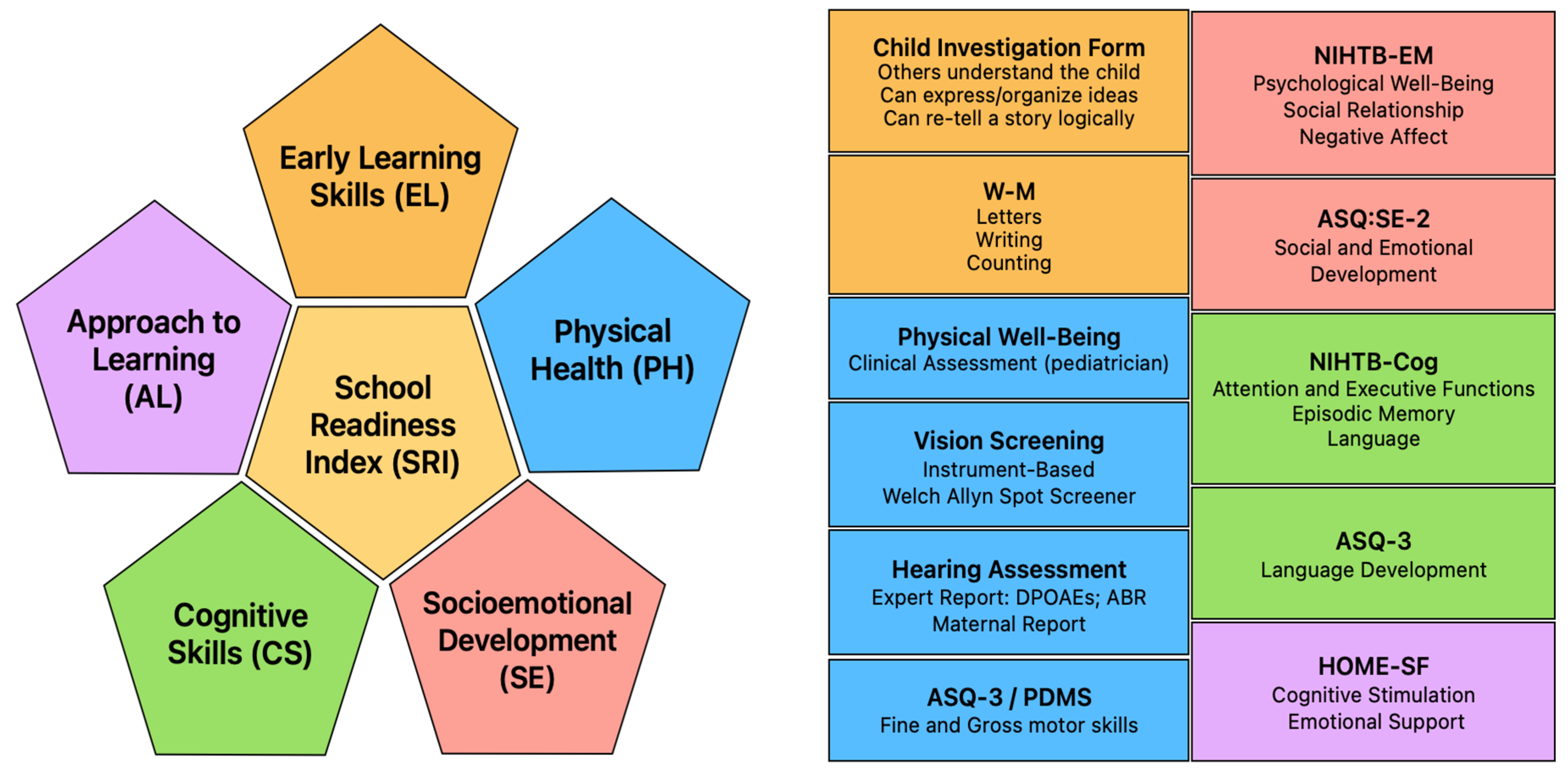

Table 1.
Sociodemographic characteristics of study participants.
| Characteristics | Values | |
|---|---|---|
| N | % | |
| Participant sex | ||
| Male | 63 | 52.9 |
| Female | 56 | 47.1 |
| Special Education Program | ||
| Registered | 39 | 32.8 |
| Not registered | 80 | 67.2 |
| Annual household income | ||
| $14,999 or less | 61 | 51.3 |
| $15,000 or higher | 58 | 48.7 |
| Health insurance | ||
| Public | 88 | 73.9 |
| Private | 31 | 26.1 |
| Maternal civil status | ||
| Married or cohabitating | 89 | 74.8 |
| Other | 30 | 25.2 |
| Maternal education attainment | ||
| Certificate, high school or less | 51 | 42.9 |
| Associate degree or more | 68 | 57.1 |
| Maternal employment status | ||
| Employed | 59 | 49.6 |
| Unemployed | 60 | 50.4 |
Table 2.
Simple linear regression results for sociodemographic variables and SRI composite score for children ages 54 – 65 months.
Table 2.
Simple linear regression results for sociodemographic variables and SRI composite score for children ages 54 – 65 months.
| 95% Confidence Interval | pe | |||||
|---|---|---|---|---|---|---|
| Model | Measure | Estimate | SE | LL | UL | |
| SLRM #1 | Intercept | 18.98 | 0.58 | 17.83 | 20.14 | <0.001 |
| Participant sexa | -1.89 | 0.80 | -3.48 | -0.3 | 0.02 | |
| SLRM #2 | Intercept | 17.09 | 0.62 | 15.87 | 18.31 | <0.001 |
| Maternal educationb | 1.56 | 0.82 | -0.06 | 3.18 | 0.06 | |
| SLRM #3 | Intercept | 17.14 | 0.56 | 16.03 | 18.25 | <0.001 |
| Annual household incomec | 1.73 | 0.81 | 0.13 | 3.32 | 0.03 | |
| SLRM #4 | Intercept | 14.98 | 0.63 | 13.73 | 16.23 | <0.001 |
| Registered in Special Education Programd | 4.47 | 0.77 | 2.94 | 5.99 | <0.001 | |
Note. SLRM = Simple Linear Regression Model; SE = Standard Error; LL = lower limit; UL = upper limit. a0 = Female, 1 = Male; b0 = Certificate, High School or less, 1 = Other; c0 = $14,999 or less, 1 = $15,000 or higher; d0 = Yes, 1 = No. ep-value was evaluated at a 0.05 alpha.
Table 3.
Association between SRI composite score and special education program registration status, adjusted by annual household income and child sex.
Table 3.
Association between SRI composite score and special education program registration status, adjusted by annual household income and child sex.
| Measure | Estimate | SE | 95% Confidence Interval | pd | |
|---|---|---|---|---|---|
| LL | UL | ||||
| Intercept | 15.13 | 0.85 | 13.46 | 16.81 | <0.001 |
| Participant sexa | -1.16 | 0.72 | -2.58 | 0.27 | 0.11 |
| Annual household incomeb | 1.34 | 0.71 | -0.08 | 2.75 | 0.06 |
| Registration in special education programc | 4.18 | 0.77 | 2.66 | 5.69 | <0.001 |
Note. SE = Standard Error; LL = lower limit; UL = upper limit. a0 = Female, 1 = Male; b0 = $14,999 or less, 1 = $15,000 or higher; c0 = Yes, 1 = No. dp-value was evaluated at a 0.05 alpha. Constant = 15.13, F = 13.87, p<0.001, R2 = 0.266.
Disclaimer/Publisher’s Note: The statements, opinions and data contained in all publications are solely those of the individual author(s) and contributor(s) and not of MDPI and/or the editor(s). MDPI and/or the editor(s) disclaim responsibility for any injury to people or property resulting from any ideas, methods, instructions or products referred to in the content. |
© 2025 by the authors. Licensee MDPI, Basel, Switzerland. This article is an open access article distributed under the terms and conditions of the Creative Commons Attribution (CC BY) license (https://creativecommons.org/licenses/by/4.0/).
Copyright: This open access article is published under a Creative Commons CC BY 4.0 license, which permit the free download, distribution, and reuse, provided that the author and preprint are cited in any reuse.