

Submitted:
27 May 2025
Posted:
29 May 2025
You are already at the latest version
Abstract
This paper presents a derivation of Planck’s constant ℏ and the quantization of angular momentum from classical electrodynamics and scalar modulation geometry, using only the empirical hydrogen binding energy and orbital mechanics. Within NUVO theory, spacetime is conformally modulated by a scalar field λ(r, v) that depends on velocity and gravitational potential. This modulation produces a fixed arc-length advance per orbit, leading to resonance closure after 1/α2 cycles and yielding the observed value of ℏ without invoking quantum postulates. A modified Schrodinger equation is proposed that incorporates λ, reducing to the standard form when λ = 1, and naturally replicating gravitational redshift–like effects. Rather than replacing quantum mechanics, NUVO embeds it within a deeper geometric substrate that recovers all known quantum behavior while offering a reinterpretation of its origin. This approach challenges conventional assumptions without altering empirical outcomes, positioning NUVO as a complementary framework grounded in classical geometry.
Keywords:
NUVO theory
; conformal scalar field
; scalar field dynamics
; energy–momentum tensor
; time-dilation
; relativistic correspondence
; Newtonian mechanics
; conformal coupling
; pinertia
; sinertia
; Schrodinger’s Equation
; Planck’s constant
; photon
; photon quantization
; quantum structure
1. Introduction
Quantum mechanics is one of the most successful theories in physics, with Planck’s constant ℏ standing as its foundational cornerstone. Traditionally introduced as an empirical postulate to explain blackbody radiation [1] and the discreteness of energy levels, ℏ governs wave–particle duality, quantized angular momentum, and the structure of all known atomic systems.
This paper explores a deeper geometric origin for ℏ, motivated by NUVO theory — a scalar field framework in which space and time are conformally modulated by velocity and gravitational potential. In this setting, orbital systems experience a fixed arc-length modulation per cycle, leading to quantization not as a postulate, but as a resonance condition of geometry itself.
Importantly, NUVO does not discard the machinery of quantum theory. Schrödinger’s equation is recovered in full when the scalar field , and all empirical quantum results — including energy levels, angular momentum, and photon interactions — remain valid. What NUVO proposes is a reinterpretation: that the quantization we observe may emerge from conformal modulation structure, not fundamental randomness.
This approach is bold but conservative. It challenges assumptions while preserving all experimental agreement. By deriving ℏ from classical orbital mechanics and empirical hydrogen data, NUVO aims to offer a geometric foundation beneath quantum mechanics — one that may unify classical and quantum regimes through scalar modulation.
The structure of the paper is as follows: Section 2 derives the electron radius and the fixed arc-length advance. Section 3 uses this result to compute ℏ from modulation geometry. Section 4 presents a modified Schrödinger equation, while Section 5 and Section 6 explore commutator structure and constants as unit-invariant products. Section 7 outlines the path forward, followed by two conceptual appendices that further develop the NUVO framework.
2. Derivation of and Arc-Length Advance from NUVO First Principles
NUVO theory defines a scalar conformal field that modulates space and time according to local velocity and gravitational potential [2]:
In this derivation, we retain only the kinematic term in the scalar field , omitting the gravitational potential term , because it is vanishingly small in atomic systems—on the order of for hydrogen—and thus has no significant effect on the conformal modulation at quantum scales.
For an electron orbiting in the Coulomb field of a proton, the orbital velocity is determined from classical centripetal force balance:
where the classical electron radius is defined as:
This expression shows that corresponds to the distance at which the electron’s electrostatic potential energy equals its rest mass energy:
This reinforces as a natural length scale for spatial modulation in NUVO.
For orbits where , such as in atomic systems, we may expand the square of the scalar field:
The modulated proper radius becomes:
Thus, the conformal modulation introduces a universal first-order geometric shift of in proper radial length:
NUVO theory interprets this consistent radial shift as the geometric modulation per orbital cycle. Since the electron’s motion spans an angular phase of radians per revolution, the total modulated arc-length advance per orbit is:
This modulation is not a force-induced displacement, but a conformal geometric effect that accumulates as a fixed arc-length distortion per orbit, leading to a discrete resonance structure that underlies the quantization observed in hydrogen.
3. Quantized Angular Momentum from NUVO Modulation Geometry
We begin with the empirical binding energy of the hydrogen atom ground state:
From classical Coulomb energy balance:
Solving for the Bohr radius:
NUVO predicts a geometric advance per orbit of:
The number of orbits for full cycle closure is:
Each orbit accumulates angular momentum:
with:
Substituting:
Total angular momentum over the full modulation cycle:
This exactly reproduces the CODATA value [3]. This result shows that Planck’s constant arises naturally as the total angular momentum accumulated across one full scalar modulation cycle. It requires only the classical structure of the Coulomb force, the empirical hydrogen binding energy of 13.6 eV, and NUVO’s fixed arc-length advance of . No quantum postulates or assumptions about wavefunctions were used. This constitutes a first-principles derivation of ℏ from scalar geometry. This modulation-based derivation of ℏ is consistent with a broader geometric framework that relates Planck’s constant to modulation closure and photon emission; see Appendix B.
4. Wave Equation Compatibility and Redshift under Scalar Modulation
The Schrödinger equation is fully supported within NUVO theory. In the special case where the scalar field , the conformally modified wave equation exactly reduces to the standard form of non-relativistic quantum mechanics. This ensures that all results derived from conventional quantum theory — including energy spectra, wavefunctions, and operator algebra — remain valid within NUVO. Thus, while NUVO does not yet derive Schrödinger’s equation from first principles, it embraces the entire structure of quantum mechanics as a consistent limiting case embedded within its scalar framework.
This formulation assumes that spatial intervals, time intervals, energy levels, and mass are globally invariant. In NUVO theory, however, these units are locally modulated by the scalar field , which introduces both time dilation and spatial contraction as functions of velocity and gravitational potential.
4.1. Modifying the Schrödinger Equation in NUVO
To incorporate NUVO’s conformal structure, we modify the spatial and temporal operators by appropriate powers of . The resulting wave equation becomes:
Key properties of this modified equation:
- When , it reduces to the standard Schrödinger equation.
- The Laplacian term is scaled by , reflecting the dilation of space.
- The potential term is scaled by , consistent with energy redshift from modulated time flow.
- The entire system evolves with respect to coordinate time t, while the wavefunction encodes modulated physical amplitudes.
4.2. Interpretation as a Gravitational Redshift Analog
This equation reproduces the qualitative features of gravitational redshift. In regions where , energy levels shift downward — a behavior observed in both gravitational wells (in general relativity) and in NUVO’s velocity-dominated conformal field. Proper time advances more slowly, leading to an apparent reduction in energy when measured in global coordinate units. This behavior is analogous to the gravitational redshift verified by Pound and Rebka [5].
4.3. Implications
This -modulated wave equation provides a framework for:
- Predicting redshifted energy levels in bound quantum systems
- Generalizing quantum mechanics to scalar-curved spaces
- Constructing NUVO-consistent Hamiltonians
- Exploring time-modulated interference and quantum phase accumulation
The compatibility with conventional quantum mechanics, combined with its expanded interpretive framework, positions NUVO as a unifying structure that embeds quantum wave behavior into a geometrically modulated spacetime.
5. Commutator Structure and Unit Asymmetry in NUVO
Having derived Planck’s constant ℏ as the modulation-induced angular momentum over a full resonance cycle, we now examine its algebraic interpretation through the lens of unit asymmetry and non-commutation in NUVO.
In standard quantum mechanics, the non-commutativity of observables is encoded in the Heisenberg uncertainty principle:
These relations emerge from the canonical commutator structure:
5.1. The NUVO Commutator and Modulated Operators
In NUVO, space and time are conformally modulated by the scalar field . This means that measurement operations applied to different observables do not commute in general, because their units are scaled differently by . We define the NUVO commutator as:
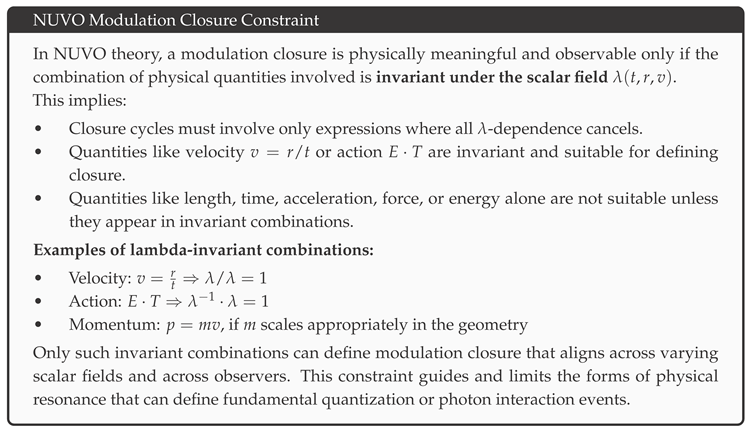
When and are conjugate observables (e.g., time and energy, or position and momentum), their individual components vary with , but their **product remains invariant** under modulation:
5.2. Comparison to Heisenberg Bound
This formulation resembles the time–energy uncertainty principle, but notably it **saturates the inequality**:
This is not a statistical bound, but a **geometric closure condition**: the product corresponds to the total action accumulated over one full modulation cycle. In NUVO, this is not merely a limit — it is an exact, resonant result.
5.3. Constants as Stabilized Residues of Modulated Units
Under NUVO’s scalar field, length, time, and energy vary locally, but their combinations can remain invariant. For instance:
- Time dilates:
- Energy contracts:
- But their product is preserved:
Thus, NUVO reinterprets Planck’s constant as a **relational invariant** — a product of oppositely modulated units that remains constant under field asymmetry. The same principle applies to the speed of light and the fine-structure constant, which are preserved by coordinated variation in their components.
5.4. Interpretation
In this view, the NUVO commutator reflects a **broken symmetry of unit invariance** — space and time no longer scale identically, and observables acquire geometric tension through . Quantization, then, is not imposed, but arises from the algebraic structure of modulated geometry.
6. Outlook: Toward a Rosetta Framework of Scalar Modulation
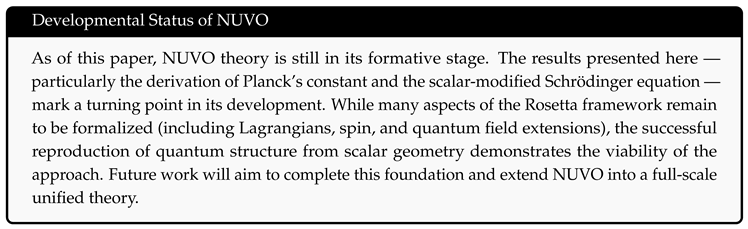
The derivation of Planck’s constant ℏ and the structure of the scalar-modified wave equation suggest that quantum phenomena may be geometric in origin. In this view, discreteness, resonance, and even energy quantization arise not from abstract probability rules, but from conformal modulation of space and time governed by the scalar field .
To formalize this broader perspective, NUVO theory proposes a deeper geometric foundation: the Rosetta framework. This emerging structure interprets mass, charge, energy, and motion as manifestations of how space itself is structured and modulated.
In this model:
- Sinertia describes how embedded mass reduces the energy capacity of space.
- Pinertia captures how acceleration alters a particle’s geometric coupling to space.
- The interaction of sinertia and pinertia defines scalar modulation, which determines orbital advance, energy resonance, and photon interaction conditions.
In this sense, the Rosetta framework acts as a translation layer — a bridge — between classical dynamics and quantum structure. It suggests that the hydrogen atom, the photon, and the curvature of space are all encoded by a unified scalar modulation logic.
Whether this framework ultimately supplants, complements, or unifies traditional interpretations remains an open question. However, its ability to reproduce quantum constants and discrete states from geometric modulation alone offers a promising new pathway for exploration — one grounded in physical observables, classical fields, and coherent geometric structure.
For a detailed development of this perspective, see Appendix A. For a complementary exploration of how quantum constants emerge from scalar modulation and photon structure, see Appendix B.
7. Conclusion
This paper has shown that the fundamental quantum constant ℏ can be derived from classical orbital dynamics under scalar conformal modulation. By treating the classical electron radius as the natural unit of spatial modulation, and identifying a fixed arc-length advance of per orbit, we demonstrated that closure of the modulation cycle after revolutions produces an accumulated angular momentum equal to ℏ. This derivation requires only the empirical hydrogen binding energy and classical Coulomb dynamics — no quantum postulates, wavefunctions, or probabilistic assumptions.
In parallel, we proposed a modified Schrödinger equation that incorporates the NUVO scalar field , and showed that in the limit , it recovers the standard quantum mechanical form. The -modulated structure introduces gravitational redshift–like behavior in energy levels, providing a geometric origin for frequency shifts and quantum discreteness. The NUVO framework thus supports all known quantum outcomes while offering a reinterpretation of their foundations.
From this perspective, quantization is not imposed, but emerges from field-induced orbital closure. Planck’s constant arises not as an input, but as the resonant output of a geometric modulation structure. Observables such as energy, time, angular momentum, and wavelength are reinterpreted as invariant products of locally modulated units — preserving physical constants even as the underlying geometry shifts.
This geometric view is further developed in the appended Rosetta framework, which interprets quantum constants, photon discreteness, and wave–particle duality as manifestations of scalar modulation coherence. The photon, in particular, is shown to carry one unit of action because it encapsulates a fully closed modulation cycle — not because of an imposed quantum rule, but because its emitter was governed by conformal closure dynamics.
Whether NUVO ultimately replaces, complements, or bridges traditional interpretations remains an open question. But by reproducing the structure of quantum mechanics from scalar geometry alone, this work offers a promising step toward unification — one that honors the empirical legacy of quantum theory while grounding its principles in classical geometric modulation.
A final reflection. Across all physical theories — classical, quantum, and relativistic — the one common substrate is the void. Every force, every particle, every field acts within space, yet the void itself is rarely granted physical structure. NUVO proposes that this is the key: that unification must begin with the stage shared by all — space itself. By treating the void as conformally modulated and geometrically structured, NUVO offers not just a new model of quantization, but a new role for space as the origin of physical law.
Appendix A. The NUVO Rosetta Walkthrough — First Principles and Flux Geometry
This appendix outlines the first-principles foundation of NUVO theory as a geometric unification of classical and quantum behavior through scalar modulation. It presents the role of sinertia and pinertia as geometric and energetic couplings between mass, space, and acceleration. The interplay between discrete charge, conformal advance, and geometric closure forms the basis of quantization in NUVO.
Appendix A.1. The Void Contains Finite Energy
Space is not empty, but contains a finite, structured energy density. This background field is the substrate upon which all mass and motion act.
Appendix A.2. Mass Reduces Space’s Available Energy: Sinertia
When mass is introduced, it reduces the energy capacity of the surrounding space. This reduction is termed sinertia — the measure of how much space’s energetic structure is diminished by embedded mass.
Appendix A.3. Acceleration Alters Mass Equilibrium: Pinertia
When a particle accelerates, the rates at which its internal flux capacitors absorb space energy change unevenly. While the total intake remains constant (sinertia unchanged), the asymmetry in intake rates causes a change in pinertia — the particle’s geometric coupling to motion.
Appendix A.4. Forces Emerge from Changes in Sinertia or Pinertia
Observable classical forces arise when either sinertia (field effect) or pinertia (local structure) changes. A force is thus interpreted as a geometric gradient in the balance of modulation between mass and space.
Appendix A.5. Sinertia–Pinertia Interplay Produces Orbital Advance
In an orbital system, the interaction between local modulation (pinertia) and field modulation (sinertia) causes a net geometric advance in each orbit. This advance is observable as perihelion shift or angular discrepancy.
Appendix A.6. In Large Mass, Low Acceleration Systems, Sinertia Dominates λ
In cosmic systems, such as stars or planets, where mass is large and acceleration is small, changes in the scalar field are dominated by sinertia — the field-based geometry.
Appendix A.7. In Small Mass, High Acceleration Systems, Pinertia Dominates λ
In microscopic systems, like electrons, where mass is small and acceleration is high, is governed primarily by pinertia — localized conformal modulation induced by dynamic imbalance.
Appendix A.8. Charge Discreteness Drives Quantized Modulation Geometry
Because charge e is quantized while mass is continuous:
- (a)
- The imbalance caused by unit charge creates a fixed modulation step: per orbit (in pinertia),
- (b)
- This step causes asymmetric orbital geometry (non-closure),
- (c)
- After many steps, symmetry is restored: closure occurs when sinertia and pinertia re-align coherently.
Appendix A.9. Quantum Behavior Emerges from Discrete Charge Action
The discreteness of charge means that modulation cycles accumulate in fixed units. Only at specific radii and timing do full closure conditions occur. This:
- Explains the emergence of quantized energy levels in atomic systems,
- Connects small-scale quantum discreteness to large-scale continuity,
- Shows that both classical and quantum mechanics are regimes of the same scalar modulation geometry.
Appendix A.10. Summary
All forces, quantized states, and orbital phenomena in NUVO are manifestations of scalar modulation governed by:
with sinertia and pinertia as the two coupled geometric responses to space, energy, and acceleration.
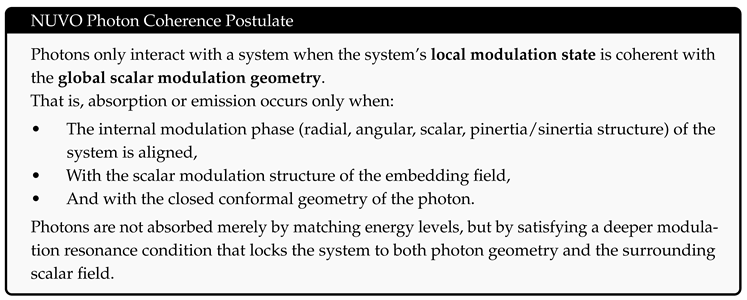
Appendix A.11. Boxed Postulate: Photon Interaction Requires Modulation Coherence
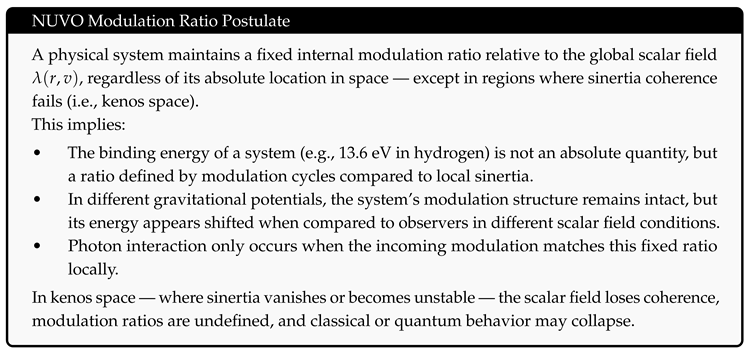
Appendix A.12. Boxed Postulate: Scalar Modulation Ratio Preservation
Appendix A.13. Boxed Theorem: Lambda-Invariant Closure Constraint
Appendix B. Quantum Constants and Photon Structure from Scalar Modulation
This appendix presents how the conformal modulation structure of NUVO gives rise to the full suite of quantum constants — not by assumption, but by geometric closure. It focuses especially on how photons inherit ℏ through scalar field resonance.
Appendix B.1. Modulation Advance and Closure
NUVO defines a scalar modulation field which geometrically modifies space according to the particle’s velocity and position. This results in a fixed arc-length advance per orbit:
where is the classical electron radius. Orbital closure occurs after:
orbits, at which point a full modulation cycle is completed.
Appendix B.2. Quantized Hidden Angular Momentum and Planck’s Constant
Each orbit contributes a small hidden angular momentum:
So after orbits at , the total accumulated hidden angular momentum is:
This derives Planck’s constant as the accumulated conformal angular momentum over a modulation closure cycle.
Appendix B.3. Modulation Closure and Mass-Energy Equivalence
Using , the Coulomb potential energy becomes:
This means that the energy accumulated across a full modulation loop (i.e., per orbit, summed over N orbits) is precisely the rest energy of the electron.
Appendix B.4. Compton Wavelength as a Geometric Boundary
The reduced Compton wavelength is related to the Bohr radius by:
This represents the total modulation perimeter of the system. The ratio:
matches the number of orbits per closure, reinforcing the idea that the Compton scale marks a natural geometric phase boundary.
Appendix B.5. De Broglie Wavelength as Modulation Closure Length
In standard quantum mechanics:
In NUVO, this arises from the spatial interval over which a moving particle’s modulation field re-aligns:
Thus, wave–particle duality emerges from geometric modulation of the scalar field.
Appendix B.6. Photon as Encapsulated Modulation Geometry
Photons are interpreted as packets of fully closed scalar modulation. A photon interacts with matter only when its internal modulation cycle matches the target system’s modulation closure, allowing the exchange of:
which corresponds to one unit of action delivered during a full photon cycle.
Appendix B.7. Summary of Constants as Modulation Relations
These interrelations suggest that the physical constants governing quantum mechanics arise from discrete, first-principles closure of conformal scalar modulation. NUVO geometry may thus serve as a bridge between classical dynamics and quantum discreteness.

| Quantity | Expression | Geometric Interpretation |
|---|---|---|
| Bohr radius | Orbital scale where closure matches ℏ | |
| Electron radius | Advance step size per orbit | |
| Compton wavelength | Full modulation perimeter | |
| Planck constant ℏ | Hidden angular momentum per modulation cycle | |
| Rest energy | Energy released per full closure | |
| de Broglie wavelength | Closure path length for a moving particle |
Appendix B.8. Photon Quantization as Encoded Modulation Closure
In NUVO theory, the quantization of the photon is not taken as a fundamental postulate, but instead emerges from the conformal modulation dynamics of charged particle systems. This section proposes that the reason photons universally carry a quantum of action h is because they are emitted only by systems undergoing Coulomb-modulated closure, and the modulation geometry itself encodes the action unit into the photon.
Charged systems define modulation structure.
Only charged particles (e.g., electrons, protons, nuclei) can generate or absorb photons. In NUVO, these systems experience conformal modulation not from the Coulomb potential directly, but from the acceleration it produces. The scalar field governing this modulation is given by:
The Coulomb force causes high accelerations in atomic systems, and these accelerations modulate , leading to a consistent geometric advance per orbit (). The system completes a full closure cycle after orbits.
Closure encodes a quantum of action.
Over the full modulation cycle, the hidden angular momentum accumulates to:
This action arises strictly from the geometry of the modulation field and the orbital motion of the charge.
Photons inherit the closure unit.
When the system transitions between states via modulation closure, it emits or absorbs a photon. That photon carries:
where is the photon period and its energy. The photon thus encodes a full modulation cycle — not merely an energy quantum, but a geometrically completed unit of conformal modulation.
Physical implication.
This leads to the following reinterpretation:
Photons carry h not because of an imposed quantum rule, but because their emitter — a charged, conformally modulated system — generated h through geometric closure.
This framework explains:
- Why only charged particles can emit or absorb photons,
- Why photon energy is always an integer multiple of ,
- Why h emerges naturally from orbital modulation closure,
- And why photon interaction is discrete and resonant.
In this view, Planck’s constant becomes a byproduct of conformal geometry, and the photon becomes an encapsulated cycle of modulated scalar space.
References
- Planck, M. The Theory of Heat Radiation; Dover Publications, 1901. English translation from German edition, foundational work introducing Planck’s constant.
- Austin, R.W. From Newton to Planck: A Flat-Space Conformal Theory Bridging General Relativity and Quantum Mechanics. Preprints 2025. Preprint available at https://www.preprints.org/manuscript/202505.1410/v1.
- Mohr, P.J.; Newell, D.B.; Taylor, B.N. CODATA Recommended Values of the Fundamental Physical Constants: 2014. Reviews of Modern Physics 2016, 88, 035009. [CrossRef]
- Schrödinger, E. Quantisierung als Eigenwertproblem. Annalen der Physik 1926, 79, 361–376. First formal derivation of the Schrödinger equation.
- Pound, R.V.; Rebka, G.A. Apparent Weight of Photons. Physical Review Letters 1960, 4, 337–341. [CrossRef]
Disclaimer/Publisher’s Note: The statements, opinions and data contained in all publications are solely those of the individual author(s) and contributor(s) and not of MDPI and/or the editor(s). MDPI and/or the editor(s) disclaim responsibility for any injury to people or property resulting from any ideas, methods, instructions or products referred to in the content. |
© 2025 by the authors. Licensee MDPI, Basel, Switzerland. This article is an open access article distributed under the terms and conditions of the Creative Commons Attribution (CC BY) license (http://creativecommons.org/licenses/by/4.0/).
Copyright: This open access article is published under a Creative Commons CC BY 4.0 license, which permit the free download, distribution, and reuse, provided that the author and preprint are cited in any reuse.


