
Submitted:
26 May 2025
Posted:
27 May 2025
You are already at the latest version
Abstract
The purpose of this research is to assess the impact of land ownership on agricultural productivity and suggest suitable actions that may enhance agricultural productivity and contribute to economic growth in Sub Saharan Africa. For so doing, the paper re-views literature discussing the impacts of recent land policies reforms on land tenure security and agricultural productivity in Sub Saharan Africa. By reviewing fifty-five studies, this paper focuses on the assumption that recent land policies reforms lead to land tenure security and enhance investment in a more productive agriculture. The re-view shows that this assumption is controversial for at least four reasons. First, most available studies do not show empirical evidence to support the above-mentioned effect. Second, there are suggestions those recent land policies reforms promote challenges for investing in agricultural inputs and improving productivity. Third, challenges in accessing to a secured land remain critical despite policies reforms and forth, number of farmers remain vulnerable to land customary land systems. The findings suggest a suitable mix of adaptive land and agriculture policies that enhance agricultural productivity and contribute to economic growth in Africa.
Keywords:
Tenure Security
; Agricultural Productivity
; Policies Reforms
; Land Ownership
; Sub Saharan Africa
1. Introduction
Land tenure and agricultural productivity remain critical issues in Africa, where low-income farmers face significant challenges in accessing land, investing in agricultural inputs, and improving productivity. To cope with the issue, land reform has been a pivotal strategy for enhancing agricultural productivity and addressing historical inequalities. Despite policy strategies and reforms that aim to address the challenges and promote sustainable agricultural development, their effects on agricultural productivity remain challenging and the ways in which the existing land tenure systems affect farmer incentives still need clarification. Moreover, low-income farmers remain highly vulnerable to land tenure problems.
A collection of case studies examines recent land reforms in Gambia[58], Burkina-Faso [24,70], Benin [122,126], Ghana [11,17,26], Ethiopia [33,34], Kenya [102], Rwanda [99], Zambia [119], Madagascar [16], Zimbabwe [93] and South Africa [21,23]. It provides insights into the processes and impacts of land redistribution and land administration reforms. The following controversial and diverging hypotheses sustain this research.
Benin [121,126], Burkina Faso [13] and Ghana [9] have a long history of land tenure insecurity, with many farmers relying on customary systems and informal land rights. The farmers’ low investment in agriculture over years has led to low agricultural productivity. However, while recent land reform has secured land tenure and improved incentive of some farmers, it has threatened ‘de facto’ tenure security or even lead to the loss of tenure security for others.
Conversely, Zimbabwe’s experience with land reform has been more challenging [93]. The country’s Fast Track Land Reform Program led to a significant decline in agricultural output, particularly in export crops like tobacco. This decline is due to the redistribution of land to individuals lacking farming experience and resources.
Research comparing land reforms in Zambia and Zimbabwe indicates that Zambia’s 1995 land reform led to significant improvements in agricultural productivity and economic growth, while Zimbabwe faced challenges due to the implementation strategies of its land reform policies [119].
In Kenya, the Swynnerton Plan, implemented in 1954, which aimed to intensify agricultural development by consolidating land holdings and promoting cash crop production showed significant implications for land tenure and agricultural productivity [102].
The above illustration and many more provide a comprehensive overview of the multifaceted relationship between land reform and agricultural productivity in Africa, encompassing historical initiatives, policy analyses, and contemporary debates. It prompts the assumption that recent land policies reforms may lead to land tenure security and enhance investment in a more productive agriculture. Therefore, the present research aims to assess the impact of land ownership on agricultural productivity.
2. Materials and Methods
A systematic literature review among fifty-five studies highlights the impact of recent policy strategies and reforms on farmers in general and low-income farmers in particular, either while discussing the presumptions that are stated or implied in the majority of the literature. Because this work is a review, we took inspiration for our review techniques from [115,118] research paper.
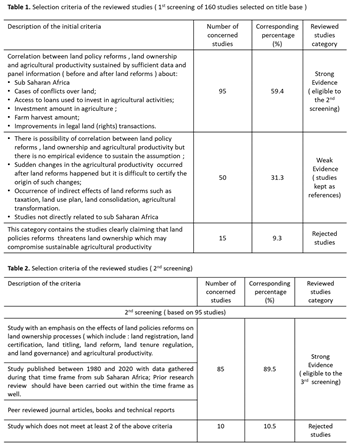
To emphasize existing assumptions and research findings on those theories, a thorough search of the literature was undertaken. Subsequently, we used the same literature to determine gaps of investigation on the subjects. The review followed four stages: (1) literature search, (2) data quality assessment, (3) result analysis and interpretation, and (4) discussion. Table 1 below shows the assessment criteria of the evidence on the impact of land policies reforms on land tenure security and agricultural productivity while Table 2 presents inclusion criteria of the reviewed studies.
2.1. Methodology for Searching the Literature
The following search query was created utilizing a list of key phrases that were used in the computer-based literature search approach: ‘’ Land Policies Reforms’’ ‘’Land Tenure’’; ’Tenure security’’; ‘’Land Ownership’’; ‘’Agricultural Productivity’’. Several possible permutations of the search query’s composing keywords were applied to various search databases. Databases including SCOPUS, Web of Science, and Elsevier, GOOGLE SCHOLAR were included in the search as well as data from libraries to which the authors are subscribed. Many materials were produced by the initial search efforts, but not all of them were helpful.
Next, we establish the parameters for this review. For the review, three categories of papers were taken into consideration: (1) Books, (2) peer-reviewed journal articles, and (3) technical reports (also known as grey literature) issued by global organizations. For the review, only English-language materials that dealt with land reforms, land tenure, land tenure security, and agricultural productivity were taken into consideration.
Studies whose methodological quality was challenging to evaluate systematically (mostly national reports and conference papers) were excluded using a priori methodological quality judgment criteria [22]. The evaluation period was set from 1980 to 2020 since 160 studies seem to be related to the recent history and evolution of evolutionary theory of property rights [23,24,25]. Indeed, in many developing nations, contentious discussions about land reform began in the period.
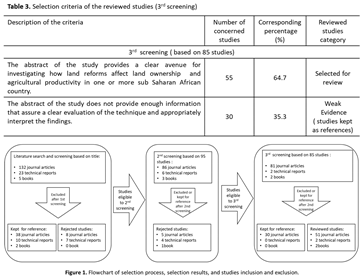
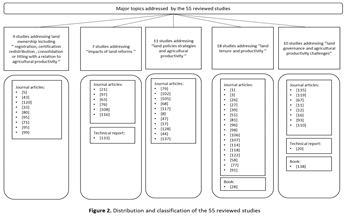
The following data was methodically entered into a data extraction form: (1) Document type, (2) title, (3) research field, (4) nation, sub-region, or region; (5) definition, significance, or opinions regarding the impacts of land reforms on agricultural productivity (6) the online library from which the document was obtained, (7) the citation, and (8) the date of the search. After exploring 160 studies, we considered fifty-five for this paper (Tables 1, 2 and 3). Among these, 52 are journal articles, one technical report and two books (Figures 1 and 2). Tables 1–3 show the selection criteria of the reviewed studies from the first to third screening while Figures 1 and 2 describe the selection process, selection results, and the distribution of the fifty-five reviewed studies.
2.2. Evaluation of the Assessed Studies’ Content
For the review, we used a narrative synthesis methodology to assess a wide range of subjects pertaining to land registration, land reform, land ownership, land tenure activities, and consequences, and agricultural productivity covered by the fifty-five studies that are the subject of this article.
At first, we confirmed inclusion criteria of the fifty-five studies to emphasize the effects of land policies reforms on agricultural productivity. In so doing, we examined the trend of agricultural productivity in the countries concerned by this research over the last 3 decades. At this stage, it appeared that securing land ownership (through land redistribution, land tenure reforms and land restitution) played an important role throughout the land policies reforms process.
Then, we determined and evaluated in details the presumptions of how land ownership have affected agricultural productivity. More specifically, for the fifty-five studies concerned by this research, we methodically checked the evidence of the following key factors which trend might have increased or decreased after the occurrence of land reforms processes and particularly after acquiring land ownership in the last three decades:
- Number of conflicts over land in the last three decades;
- Significance of having access to finance for agricultural investment;
- Importance of the investment amount in agriculture;
- Importance of farm harvest amount;
- Improvements in land transactions system.
The assessment based on the key factors allowed setting remarks on the assumption. The following sections discuss the controversial correlation between land ownership and agricultural productivity as the major outcome of this research.
3. Results
3.1. State of Agricultural Productivity in the Reviewed Studies Areas over the Last Decades
Land reform and agricultural productivity are critical issues in Africa, where low-income farmers face significant challenges in accessing land, investing in agricultural inputs, and improving productivity. The continent’s agricultural sector is a vital component of its economy, providing food security and income for millions of people. However, the sector is also plagued by inefficiencies, including land tenure insecurity, limited access to credit and markets, and inadequate investment in agricultural infrastructure.
In particular, land reform has been a contentious issue with many countries struggling to address the legacy of colonial-era land ownership patterns and the resulting inequalities in land access and ownership. In many cases, small elite hold land, while the majority of farmers lack secure tenure and are unable to invest in their land or access credit and markets. In many African countries, colonial-era land policies resulted in unequal land distribution, where colonial settlers owned large tracts of fertile land while indigenous communities were left with limited access to productive land. Even after independence, these inequalities persisted, often fueling social unrest and limiting economic growth.
Agricultural productivity is also a significant challenge in Africa, with many farmers struggling to produce enough food to meet the demands of a growing population. This is due in part to limited access to inputs such as seeds, fertilizers, and irrigation, as well as inadequate agricultural infrastructure and limited investment in research and development. Recent policy strategies and reforms aimed to address these challenges and promote sustainable agricultural development. These reforms include initiatives to improve land tenure security, increase access to credit and markets, and invest in agricultural infrastructure and research and development.
Recent initiatives highlight ongoing efforts to address land reform and agricultural productivity in Africa. The following examples underscore the importance of integrated approaches that combine land reform with technological support, infrastructure development, and policy coordination to enhance agricultural productivity in Africa.
A comparative analysis of land reform efforts in South Africa and Zimbabwe [93] highlights the challenges and outcomes of redistributive policies. The study emphasizes the importance of context-specific approaches to land reform.
Research comparing land reforms in Zambia and Zimbabwe indicates that Zambia’s 1995 land reform led to significant improvements in agricultural productivity and economic growth, while Zimbabwe faced challenges due to the implementation strategies of its land reform policies.
The Swynnerton Plan, implemented in 1954, aimed to intensify agricultural development in Kenya by consolidating land holdings and promoting cash crop production among African farmers [91,102]. This policy had significant implications for land tenure and agricultural productivity.
In the late 1990s, Ethiopia started a land tenure reform program that was first implemented in Tigray, the country’s northernmost region. The process of land certification and registration brought about by the reform is anticipated to improve farm households’ incentives to make long-term land-related investments by strengthening their tenure security [33,39]. Nearly 50% of the nation’s GDP came from the agricultural sector at the time of the reform, up from 70% in 2021 [39]. The agricultural industry was almost entirely dependent on small-scale farmers, who were extremely sensitive to unfavorable climatic and weather occurrences because they relied on rainfall and operated in regions with sloping and frequently damaged terrain.
The current study, conducted thirty years later, demonstrates the program’s beneficial and long-lasting benefits on agricultural productivity and climate change mitigation. With a population growth rate of almost three percent each year, Burkina Faso is one of the nations with the fastest rates of population increase in the world. Given that Burkina Faso’s agricultural productivity is still very low, this trend has implications for food security. The World Bank’s report “Securing Africa’s Land for Shared Prosperity” outlines ten steps for improving land governance. These recommendations aim to revolutionize agricultural production and reduce poverty by addressing issues such as land tenure security and administrative reforms. Across Africa, there is a growing movement against industrial-scale agriculture, promoting agro ecology and small-scale farming. This approach emphasizes biodiversity, traditional methods, and environmental sustainability, with farmers in countries like Ethiopia, South Africa, Lesotho, Uganda, and others leading the way.
Benin’s land reform and agricultural productivity are closely linked. The country’s agricultural sector is a vital component of its economy, providing food security and income for millions of people. However, the sector is also plagued by inefficiencies, including land tenure insecurity, limited access to credit and markets, and inadequate investment in agricultural infrastructure. To understand the impact of Benin’s land reform and agricultural productivity, a case study of the country’s agricultural sector was published in 2023 [122]. The study focused on the following areas: the impact of land reform on agricultural productivity; the role of land ownership security in promoting agricultural investment; the relationship between land tenure insecurity and poverty. The study found that land reform has had a positive impact on agricultural productivity. The formalization of land ownership through the creation of a land registry has improved the security of land ownership and provided farmers with access to credit and markets.
The above references provide a comprehensive overview of the multifaceted relationship between land reform and agricultural productivity in Africa, encompassing historical initiatives, policy analyses, and contemporary debates. They highlight that securing land ownership (through land redistribution, land tenure reforms and land restitution) played an important role throughout the land policies reforms process.
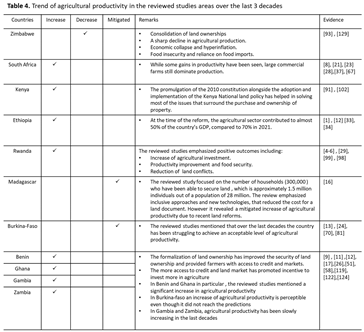
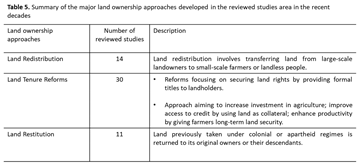
The review of the fifty-five studies sustaining the present research shows that based on their historical contexts, African countries have adopted varying approaches to land reforms policies, and socio-economic conditions that can be classified into three major land ownership process groups: (a) land redistribution, (b) land tenure reforms, and (c) land restitution. The trend of agricultural productivity in the reviewed studies areas over the last 3 decades is described in Table 4 while Table 5 presents the major land ownership process groups.
3.2. Evidence of the Correlation Between Land Ownership and Agricultural Productivity in the Reviewed Studies Areas
The nature and degree of the relationship between ownership and agricultural performance have been formally evaluated in a number of studies conducted in African settings during the 1990s (e.g., [58] in Gambia; [11,17,26] in Ghana, [12] in Uganda, Ghana and Ethiopia, [91] in Kenya and [99] in Rwanda). With very few exceptions, it was discovered that land rights had no discernible impact on whether farmers invested in land improvement, applied inputs that increased yield, obtained credit, or increased land productivity. As illustration, studies involving Ghana [11], Kenya [102], and Rwanda [98] found “no connection between cross-sectional disparities in land rights and productivity”. The authors contend that in Rwanda, where the right to bequeath was a major factor in determining some forms of land improvements, the links were the most noticeable. Short-term agreements were typically used to rent or borrow Rwandese plots that could not be bequeathed. The renter had no reason to invest as a result. Furthermore, there did not seem to be a strong connection between land rights and the usage of formal loans. In addition, there was no discernible correlation between land rights and crop productivity in Kenya. The study discovered that yields were not significantly impacted by the existence of land titles. These findings run counter to the commonly accepted belief that titling and tenure security increase yields and raised doubts about the power of land registration and titling initiatives.
Controversially, although there is little evidence to support the connections between land ownership and income, productivity, or access to credit, there is compelling evidence that land ownership has a positive impact on agricultural investments according to a recent literature analysis [122]. According to Li and Zhang [82], land policy reforms have typically improved agricultural output in Africa and can offer a practical long-term answer to food security.
On the other side, in sub-Saharan Africa, where customary tenure is prevalent, land titling remains important challenge and titling are best suited for people who can meet requirements, like collateral and deposits or down payments, as well as the market-based interest rates required to obtain formal credit. This has happened in Uganda, where Kamusiime and Rugadya [65] assert that instead of giving farm households a chance to escape poverty, the change in customary tenure represented by systematic delineation increased tenure instability.
Tenure insecurity would also adversely affect the relationship between the right to lease out land and agricultural productivity, according to [39,81,110]. According to these empirical findings, informal land rights—that is, landowners’ subjective opinions about what they may and cannot do with their plots—have varying effects on production, while formal land rights—that is, land titles—have no effect at all. The auhors argue that a successful land reform program is predicated on a feasible land administration that is based on excellent governance, suitable resources, equity, quality, commitment, and cultural sensitivity.This suggests that land tenure systems are safe, free from corruption, adaptable, and inclusive. The existence of a systematic relationship between land ownership and productivity in small-scale agriculture is also questioned by other studies [93].
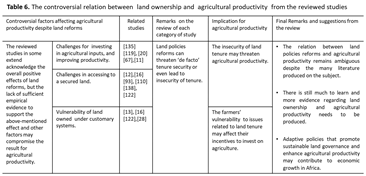
Overall, the relationship discussed in this paper is controversial and indicates that there is still much to learn and more evidence regarding land ownership and agricultural productivity needs to be produced (Table 6).
4. Discussion
4.1. The lack of Sufficient Empirical Evidence to Support the Principal Assumption
Land reforms has become more significant in the research on agricultural productivity during the past forty years. According to the fundamental argument explored by this research, farmers make investments to increase the productivity of their agricultural system while being legally protected by a secured ownership (through land redistribution, land tenure reforms, land restitution) (tabkle 5). Indeed, [15] argue that land transactions supported by land registration and land restitution serve as the foundation for land tenure reforms. The data acquired through registration is a component of a system that may be accessible to buyers, sellers, and renters, hence increasing market transparency. Moreover, confidence may be ensured when obtaining bank loans through land registration and the ensuing legal structure. Since land and agriculture are the primary sources of income in many sub saharan african countries, the loans could be used to fund related companies and agricultural endeavors. According to early research, land ownership is enhanced by the guarantee provided by a tenure-registration document. Farmers without secured ownership are likely to have poorer investments and land improvements, [58,59,60]. The ability of land tenure reforms to increase perceived tenure security is another consequence that has been highlighted and debated in the literature [48,54], fifty-five and 57]. More recent studies examine the advantages of land registration initiatives –leading to land ownership - over a longer period of time, attempting to show a connection between agricultural productivity and the security of land tenure [60,61,65]. According to studies in Ethiopia [33,34] and Benin [122] land certification has increased agricultural investment and enhanced tenure security. The studies came to the conclusion that enhancing tenure security can have a favorable impact on investment choices, particularly in the early phases of formalization. The authors claim that households are choosing to invest in long-term and perennial cash crops rather than subsistence crops because of increased tenure security brought about by program demarcation operations [33,34,122]. Overall, the paper focuses on the assumption that recent land policies reforms lead to land tenure security and enhance investment in a more productive agriculture. However, the review shows that the lack of sufficient empirical evidence to support the above-mentioned effect and other factors may compromise the result for agricultural productivity.
4.2. Challenges for Investing in Agricultural Inputs, and Improving Productivity
According to [46,51], it is unclear, whether or not legally recognized land tenure affects agricultural output, or even how much that type of tenure promotes more productive agriculture. Despite the recentely occurred land reforms in designated sub saharan African countries, 5 of the reviewed studies emphasized challenges for investing in agricultural inputs, and improving productivity. More specifically, some studies revealed that the high illiteracy and population migrations have disfavorable effects on land investment, indicating that enhancing agricultural production involves more than just land tenure. It is suggested that combining land tenure and sustainable investment methods which involve sociological constraints may result in resolving the challenges.
4.3. Challenges in Accessing to a Secured Land
The majority of the reviewed literature mentions how recent land reforms have affected the security of land tenure, but there are no studies that specifically address the connections between agricultural productivity and land ownership. Moreover, six of the reviewed studies emphasized challenges in accessing to a secured land. Through this research, we discovered that there is a dearth of research on how land ownership itself affects agricultural productivity and the security of land tenure. Although it may have a significant influence on farmers’ decisions and, consequently, agricultural output, the process of land ownership—including the procedures and strategies employed for land registraton, land titling, land redistribution, and land certification—is therefore poorly understood. For instance, some scholars emphasize that a more thorough definition of the term “tenure security” itself is required before it is possible to make a legitimate claim about whether land registration will increase investment and production. It is necessary to identify the factors that affect such security in addition to property titles. Land registration is, in fact, a complicated social intervention rather than merely a technical issue. Therefore, to get the desired outcomes from land titling, historically developed social relations and situations must be taken into account.
4.4. Vulnerability of Land Owned Under Customary Systems
Several research on tenure and its effects on agricultural productivity have indicated that tenure can encourage agricultural investment. However, a growing body of recent data indicates that the contrary might also be true. At least three of the reviewed studies emphasized vulnerability of landowners under customary systems. In rural Burkina Faso for example, [13] demonstrate that stronger land rights has a good impact on agricultural investment while weaker land rights have a negative impact. In addition, the availability of multiple land system approaches contributes to the complexity. Therefore, understanding land policies impact on farmer incentives in a diverse population where formal and informal land rights coexist is very challenging. Indeed, it is quite difficult to understand how a group of farmers with formal and/or informal rights to lands are affected by land tenure concerns in terms of their incentives. The main problem, from the above remain latent rights, with great insecurity and increased conflict levels. Despite the rapid economic development occurred in many countries in the last decades, significant land redistribution pressure due to unresolved land concerns, a weak agricultural framework, and widespread societal conflicts, have seriously compromised agricultural productivity.Important elements to address ownership issues are overlooked by the research methodologies we discovered during our review. It is suggested that academics should give more attention to significant elements that affect tenure security, such as the significance of specific local customs like customary land rights and developmental initiatives like land taxation and land consolidation.
5. Conclusions
This paper reviews and points out challenges and opportunities of land ownership for agricultural productivity and show that there is a reasonable need for more study on the topic. These claim that land policy reforms would provide land tenure security, resulting in land ownership, which would enable farmers to use their land parcels to obtain bank loans and make investments in modern farming technologies and systems to boost yields at a reduced production costs. In other words, farmers are more inclined to invest in agriculture that is more productive when they own a secured land. The review emphasizes that while land ownership can encourage investment and improve yields, the overall impact varies depending on implementation and local contexts.
The number of studies that specifically address the relationships between land ownership and agricultural productivity are limited, despite the fact that land tenure systems are frequently discussed in the literature as affecting agricultural productivity. Thus, the impact of the land ownership on agricultural productivity is in many cases studied not enough documented. In addition to that, the problematic on the real correlation between land ownership and agricultural productivity remain at high controversies.
Even though the study advances knowledge of how land policies reforms influences land tenure security - leading to agricultural productivity -, the intricacy of how land ownership affects the connections between land tenure security and agricultural productivity, is beyond the scope of the methodologies employed in the majority of the studies in our evaluation. The findings are relevant for suggesting adaptive policies that promote sustainable land governance, ultimately aiming to design interventions that enhance agricultural productivity and contribute to economic growth in Africa. According to these, a mixed methods approach is required, combining growing fluxes of spatial and time-series data from various sources with trials and, when practical, randomization. When paired with simulations, household-farm panel data gathered over an extended period can also yield important insights into the relationships.
Author Contributions
S.G.N.E. conducted the literature search, developed the methodology, analyzed the results, drafted the manuscript, and finalized it. H.N. supervised the entire study, provided suggestions on the draft manuscript, and conducted proofreading. All authors have read and agreed to the published version of the manuscript
Funding
This research received no external funding.
References
- Abab, S.A.; Senbeta, F.; Negash, T.T. The Effect of Policy and Technological Innovations of Land Tenure on Small Landholders’ Credit-Worthiness: Evidence from Ethiopia. Land 2023, 12, 10fifty-five.
- Abdulai,A.;Owusu,V.;Goetz,R.Land tenure differences and investment in land improvement measures:Theoretical and empirical analyses. J.Dev.Econ.2011,9666–9678.
- Adetomiwa, K.; Iseoluwa, A.E.; Babatunde, O.S. Land Tenure, Land Property Rights and Adoption of Bio-Fortified Cassava in Nigeria: Policy Implications. J. Land Rural Stud. 2021, 9, 223–240.
- Ali,D.A.;Deininger,K.;Duponchel,M.New ways to assess and enhance land registry sustainability: Evidence from Rwanda.WorldDev.2017,99,377–394.
- Ali, D.A.; Deininger, K.; Mahofa, G.; Nyakulama, R. Sustaining land registration benefits by addressing the challenges of reversion to informality in Rwanda. Land Use Policy 2019, 104317.
- Ali, D.A.; Deininger, K.; Goldstein, M. Environmental and gender impacts of land tenure regularization in Africa: Pilot evidence from Rwanda. J. Dev. Econ. 2014, 110, 262–275.
- Alston, L.; Mueller, B. Towards a more evolutionary theory of property rights. Iowa Law Rev. 2015, 100, 22fifty-five –2273.
- Antwi, M.; Nxumalo, K.K.S. Impact of Proactive Land Acquisition Strategy (PLAS) Projects on Human Capital Livelihood of Beneficiaries in the Dr Kenneth Kaunda District in South Africa. J. Agric. Sci. 2014, 6, 12.
- Arko-Adjei, A. Adapting Land Administration to the Institutional Framework of Customary Tenure: The Case of Peri-Urban Ghana. Ph.D. Thesis, Delft University of Technology, Delft, The Netherlands, 2011; p. 44.
- Atwood, D.A. Land registration in Africa: The impact on agricultural production. World Dev. 1990, 18659–18671.
- Ayamga, M.; Dzanku, F. The land rights and farm. investment ghana: The missing link in the operationalisation of tenure security. In Proceedings of the 4th International Conference of the African Association of Agricultural Economists, Hammamet, Tunisia, 22–25 September 2013.
- Baltissen, G.; Betsema, G. Linking Land Governance and Food Security in Africa. Outcomes from Uganda, Ghana, Ethiopia. 2016. Available online: https://www.landgovernance.org/assets/20160831-LANDac_Reflection paper1.pdf (accessed on 21 December 2019).
- Bambio, Y.; Agha, B.S. Land tenure security and investment: Does strength of land right really matter in rural Burkina Faso? World Dev. 2018, 111, 130–147.
- Barrett, C.B.; Bachke, M.E.; Bellemare, M.F.; Michelson, H.C.; Narayanan, S.; Walker, T.F. Smallholder participation in contract farming: Comparative evidence from five countries. World Dev. 2012, 40, 715–730.
- Barrows, R.; Roth, M. Land tenure and investment in African agriculture: Theory and evidence. J. Mod. Afr. Stud. 1990, 28, 265–297. [Google Scholar] [CrossRef]
- Bellemare, M.F. The productivity impacts of formal and informal land rights: Evidence from Madagascar. Land Econ. 2013, 89, 19. [Google Scholar] [CrossRef]
- Besley, T. Property Rights and Investment Incentives: Theory and Evidence from Ghana. J. Political Econ. 1995, 103, 903–937. [Google Scholar] [CrossRef]
- Biaou, G. Régime Foncier, Crédit Rural et Utilisation des Ressources Productives; in les Exploitations Agricoles du Département du Mono au Bénin. Ph.D. Thesis, Université de Cocody, Abidjan, Côte d’Ivoire, 1998.
- Bibi, F.; Rahman, A. An Overview of Climate Change Impacts on Agriculture and Their Mitigation Strategies. Agriculture 2023, 13, 1508. [Google Scholar] [CrossRef]
- Bienabe, E.; Coronel, C.; Lecoq, J.; Liagre, L. Linking Smallholder Farmers to Markets: Lessons Learnt from Literature Review and Analytical Review of Selected Projects; World Bank: Washington, DC, USA, 2004. [Google Scholar]
- Binswanger-Mkhize, H. From failure to success in South African land reform. Afr. J. Agric. Resour. Econ. 2014, 9, 253–269. [Google Scholar]
- Boboya, J. A policy paper on how land tenure systems and the access/utilization of land could be addressed to facilitate rural development in Africa. J. Mod. Afr. Stud. 2015, 28, 265–297. [Google Scholar]
- Bradstock, A. Changing livelihoods and land reform: Evidence from the Northern Cape province of South Africa. World Dev. 2005, 33, 1979–1992. [Google Scholar] [CrossRef]
- Brasselle, A.-S.; Gaspart, F.; Platteau, J.-P. Land tenure security and investment incentives: Puzzling evidence from Burkina Faso. J. Dev. Econ. 2002, 67, 373–418. [Google Scholar] [CrossRef]
- Bruce, J. The Variety of Reform: A Review of Recent Experience with Land Reform and the Reform of Land Tenure, with Particular Reference to the African Experience. In Institutional Issues in Natural Resource Management; Marcussen, H.S., Ed.; International Development Studies: Roskilde, Denmark, 1993; Volume 9, pp. 13–56. [Google Scholar]
- Bugri, J.T. The dynamics of tenure security, agricultural production and environmental degradation in Africa: Evidence from stakeholders in north-east Ghana. Land Use Policy 2008, 25, 271–285. [Google Scholar] [CrossRef]
- Chand,S. ; Yala, C. Land tenure and productivity: Farm-level evidence from Papua New Guinea. Land Econ. 2009, 85, 442–453.
- Chanock, M. Paradigms, Policies and Property: A review of the customary law of land tenure. In Law in Colonial Africa; Mann, K., Roberts, R., Eds.; Heinemann Educational Books, Inc.: Portsmouth, UK, 1991; ISBN 0-852fifty-five -602-052.
- Chigbu, U.E.; Ntihinyurwa, P.D.; de Vries, W.T.; Ngenzi, E.I. Why tenure responsive land-use planning matters: Insights for land use consolidation for food security in Rwanda. Int. J. Environ. Res. Public Health 2019, 16, 1354. [Google Scholar] [CrossRef] [PubMed]
- Chimhowu, A.O. Tinkering on the Fringes? Redistributive Land Reforms and Chronic Poverty in Southern Africa; Working Paper 58; Institute for Development Policy and Management (IDPM) CPRC: Manchester, UK, 2006. [Google Scholar]
- Courleux, F. Réguler Les Marchés Fonciers Agricoles: Les Principaux Arguments Économiques. 2019. Available online: https://www.agriculture-strategies.eu/wp-content/uploads/2019/11/191127-Réguler-les-marchés-fonciers-agricoles-VFinale.pdf (accessed on 15 October 2023).
- Cooper,H. M.SynthesizingResearch:AGuideforLiteratureReviews,3rded.; Cooper, H.M., Ed.; SagePublications: Thousand Oaks, CA, USA, 1998. [Google Scholar]
- Deininger, K.; Ali, D.A.; Alemu, T. Impacts of land certification on tenure security, investment, and land market participation: Evidence from Ethiopia. Land Econ. 2011, 87, 312–334. [Google Scholar] [CrossRef]
- Deininger,K. ; Ali,D.A.; Holden,S.; Zevenbergen,J.Rural land certification in Ethiopia: Process, initial impact, and implications for other African countries. World Dev. 2008, 36, 1786–1812.
- Deininger, K.; Chamorro, J.S. Investment and equity effeccts of land regularisation: The case of Nicaragua. Agric. Econ. 2004, 30, 101–116. [Google Scholar]
- Deininger, K.; Jin, S. Tenure security and land-related investment: Evidence from Ethiopia. Eur. Econ. Rev. 2006, 50, 1245–1277. [Google Scholar] [CrossRef]
- Department of Agriculture, Forestry and Fisheries. A Framework for the Development of Smallholder Farmers through Cooperative Development; DAFF: Pretoria, South Africa, 2012. [Google Scholar]
- ECA/SDD. Land Tenure Systems and Their Impacts on Food Security and Sustainable Development in Africa; Economic Commission for Africa’s Sustainable Development Division (SDD): Addis Ababa, Ethiopia, 2004. [Google Scholar]
- Ege, S. Land tenure insecurity in post-certification Amhara, Ethiopia. Land Use Policy 2017, 64, 56–63. [Google Scholar] [CrossRef]
- FAO. Agricultural Mechanization in Sub-Saharan Africa. Guidelines for preparing a strategy; Integrated Crop Management: Rome, Italy, 2013; Volume 22. [Google Scholar]
- FAO. Sustainability Assessment of Food and Agriculture Systems Guidelines Version 3.0. 2014. Available online: http://www.fao.org/3/i3957e/i3957e.pdf (accessed on 11 May 2021).
- Feder, G.; Feeny, D. Land Tenure and Property Rights: Theory and Implications for Development Policy. World Bank Econ. Rev. 1991, 5, 135–153. [Google Scholar] [CrossRef]
- Feder, G.; Nishio, A. The benefits of land registration and titling: Economic and social perspectives. Land Use Policy 1998, 15, 25–43. [Google Scholar] [CrossRef]
- Feder, G.; Noronha, R. Land rights systems and agricultural development in sub-saharan Africa. World Bank Res. Obs. 1987, 2, 143–169. Land 2020, 9. [CrossRef]
- Feder,G.; Onchan,T.; Chalamwong,Y.LandPoliciesand Farm Productivity in Thailand; Johns Hopkins University Press: Baltimore, MD, USA, 1988.
- Fenske, J. Land tenure and investment incentives: Evidence from west Africa. J. Dev. Econ. 2011, 95, 13–156. [Google Scholar] [CrossRef]
- Ferris, S.; Robbins, P.; Best, R.; Seville, D.; Buxton, A.; Shriver, J.; Wei, E. Linking Small Holder Farmers to Markets and the Implications for Extension and Advisory Services. 2014. Available online: https://meas.illinois.edu/wp-content/uploads/2015/04/Ferris-et-al-2014-Linking-Farmers-to-Markets.-MEAS-Brief.pdf (accessed on 11 February 2021).
- Fort,R.Thehomogenizatione ectoflandtitlingoninvestmentincentives: Evidence from Peru. NjasWagening. J. Life Sci. 2008, fifty-five, 325–343.
- Gautam,M.;Ahmed,M.Too small to be beautiful? The farm size and productivity relation ship in Bangladesh. Food Policy 2018.
- Ghebru, H. Is There a Merit to the Continuum Tenure Approach? A Case of Demand for Land Rights Formulation in Rural Mozambique. In Proceedings of the 2015 Conference, Milan, Italy, 9–14 August 2015. [Google Scholar]
- Ghebru, H.; Lambrecht, I. Drivers of perceived land tenure (in)security: Empirical evidence from Ghana. Land Use Policy 2017, 66, 293–303. [Google Scholar] [CrossRef]
- Gignoux, J.; Macours, K.; Wren-Lewis, L. Evaluating the Impact of Land Administration Programs on Agricultural Productivity and Rural Development; Inter-American Development Bank (IDB): Washington, DC, USA, 2013. [Google Scholar]
- Goldstein, M.; Houngbedji, K.; Kondylis, F.; O’Sullivan, M.; Selod, H. Formalization without certification? Experimental evidence on property rights and investment. J. Dev. Econ. 2018, 132, 57–74. [Google Scholar]
- Hanstad, T. Designing Land Registration Systems for Developing Countries. Am. U. Int’l L. Rev. 1997, 13, 647. [Google Scholar]
- Hanstad, T. Designing land registration systems for developing countries. Am. Univ. Int. Law Rev. 1998, 13, 56. [Google Scholar]
- Han,W.; Zhang, X.; Zhang, Z. The role of land tenure security in promoting rural women’s empowerment: Empirical evidence from rural China. Land Use Policy 2019, 86, 280–289 .
- Hart, C. Doing a Literature Review: Releasing the Social Science Research Imagination; Sage: London, UK, 2007. [CrossRef]
- Hayes, J.; Roth, M.; Zepeda, L. Tenure security, investment and productivity in gambian agriculture: A generalized probity analysis. Am. J. Agric. Econ. 1997, 79, 369–382 .
- Higgins, D.; Balint, T.; Liversage, H.; Winters, P. Investigating the impacts of increased rural land tenure security: A systematic review of the evidence. J. Rural Stud. 2018, 61, 34–62 .
- Holden,S.T.; Deininger, K.; Ghebru, H. Impacts of low-cost land certification on investment and productivity. Am. J. Agric. Econ. 2009, 91, 359–373.
- Holden, S.T.; Ghebru, H. Land tenure reforms, tenure security and food security in poor agrarian economies: Causal linkages and research gaps. Glob. Food Secur. 2016, 10, 21–28.
- Holden, S.T.; Otsuka, K. The roles of land tenure reforms and land markets in the context of population growth and land use intensification in Africa. Food Policy 2014, 48, 88–97.
- Hull, S.; Babalola, K.; Whittal, J. Theories of Land Reform and Their Impact on Land Reform Success in Southern Africa. Land 2019, 8, 172. [Google Scholar] [CrossRef]
- Joel, T.K.E.; Bergaly, K.C. Land Tenure Security, Credit Access and Agricultural Productivity in Cameroon; AERC: Luxembourg, 2020. [Google Scholar]
- Kamusiime, H.; Rugadya, M.; Obaikol, E. Capital Creation, Transfer or Reversal; Assessing the Outcomes of Systematic Demarcation of Customary Tenure in Uganda; Land Research Series: Kampala, Uganda, 2005; Volume 6. [Google Scholar]
- Kariuki, J.G. The Future of Agriculture in Africa; The Pardee Papers; Boston University: Boston, MA, USA, 2011; Volume 15. [Google Scholar]
- Khapayi, M.; Cilliers, P. Factors limiting and preventing emerging farmers to progress to commercial agricultural farming in the King Williams Town area of the Mpumalanga Province, South Africa. S. Afr. J. Agric. Ext. 2016, 44, 25–41. [Google Scholar]
- Khan, H.; Khan, I.U. From growth to sustainable development in developing countries: A conceptual framework. Environ. Econ. 2012, 1, 23–31. [Google Scholar]
- Keovilignavong, O.; Suhardiman, D. Linking land tenure security with food security: Unpacking farm households’ perceptions and strategies in the rural uplands of Laos. Land Use Policy, 2019; 90, 104260.
- Keudem, G.G.L.; Savadogo, K.; Keudem, G.G.L.; Savadogo, K. Land Tenure Security and Agricultural Production in the Rural Areas of Burkina Faso. AJAR 2023, 19, 1083–1099. [Google Scholar]
- Kepe, T.; Tessaro, D. Trading-o: Rural food security and land rights in South Africa. Land Use Policy 2014, 36, 267–274. [Google Scholar] [CrossRef]
- Kirsten, J.; Machethe, C.; Ndlovu, T.; Lubambo, P. Performance of land reform projects in the North West Province of South Africa: Changes over time and possible causes. Dev. S. Afr. 2016, 33, 442–458. [Google Scholar] [CrossRef]
- Krier, J. Evolutionary theory and the origin of property rights. Cornell Law Rev. 2009, 95, 139. [Google Scholar]
- Kunz, Y.; Hein, J.; Mardiana, R.; Faust, H. Mimicry of the legal: Translating de jure land formalization processes into de facto local action in jambi province, Sumatra. Austrian J. South. East. Asian Stud. 2016, 9, 127–146. [Google Scholar]
- Lahiff, E.; Cousins, B. Smallholder Agriculture and Land Reform in South Africa; Institute of Development Studies Bulletin: Brighton, UK, 2005; Volume 36, pp. 127–131. [Google Scholar]
- Lavigne Delville, P. La reforme fonciere rurale au Benin. Émergence et mise en question d’une politique instituante dans un pays sous régime d’aide. Rev. Française Sci. Polit. 2010, 60, 467–491. [Google Scholar] [CrossRef]
- Lavigne Delville, L.P. Tenure security, formalization of rights, land regulation institutions and investments. For a broader conceptual framework. Land Tenure J. 2010, 1, 5–33. [Google Scholar]
- Lawin, G.; Tamini, L. Tenure security and farm effciency analysis correcting for biases from observed and unobserved variables: Evidence from Benin. J. Agric. Econ. 2017, 70. [Google Scholar]
- Lawry, S.; Samii, C.; Hall, R.; Leopold, A.; Hornby, D.; Mtero, F. The impact of land property rights interventions on investment and agricultural productivity in developing countries: A systematic review. J. Dev. E. 2017, 9, 61–81 .
- Lemel, H. Land titling: Conceptual, empirical and policy issues. Land Use Policy 1988, 5, 273–290. [Google Scholar] [CrossRef]
- Linkow, B. Causes and Consequences of Perceived Land Tenure Insecurity: Survey Evidence from Burkina Faso. Land Econ. 2016, 92, 308–327. [Google Scholar] [CrossRef]
- Li, H.; Zhang, X. A spatial explicit assessment of food security in Africa based on simulated crop production and distribution. J. Clean. Prod. 2017, 147, 628–636. [Google Scholar] [CrossRef]
- Lund,C. African Land Tenure: Questioning Basic Assumptions; International Institute For Environment and Development: London, UK, 2000. [Google Scholar]
- Lund, C.; Rachman, N. Occupied! Property, citizenship and peasant movements in rural java: Property, citizenship and peasant movements in java. Dev. Chang. 2016, 47, 1316–1337.
- Ma,X.; Heerink, N.; Feng, S.; Shi, X. Land tenure security and technical e ciency: New insights from a case study in northwest China. Environ. Dev. Econ. 2017, 23, 305–327.
- Ma,X.; Heerink, N.; van Ierland, E.; Lang, H.; Shi, X. Decisions by Chinese households regarding renting in arable land—The impact of tenure security perceptions and trust. China Econ. Rev. 2019, 101328.
- Maxwell, D.; Wiebe, K. Land tenure and food security: Exploring dynamic linkages. Dev. Chang. 1999, 30, 825–849. [Google Scholar] [CrossRef]
- Maxwell,D.G.; Wiebe, K.D. Land Tenure and Food Security: A Review of Concepts, Evidence, and Methods,1998. Available online: http://ageconsearch.umn.edu/record/12752/files/ltcrp129.pdf (accessed on 3 January 2020).
- Meinzen-Dick,R.; Quisumbing,A.; Doss,C.; Theis,S.Women’s land rights as a path way to poverty reduction Framework and review of available evidence. Agric. Syst. 2019; 172, 72–82. [CrossRef]
- Michler, J.D.; Shively, G.E. Land tenure, tenure security and farm effciency: Panel evidence from the Philippines. J. Agric. Econ. 2015, 66, 1fifty-five –169. [CrossRef]
- Migot-Adholla, S.E.; Place, F.; Oluoch-Kosura, W. Security of Tenure and Land Productivity in Kenya; Research Report from the Department of Agricultural Economics: Nairobi, Kenya, 1994. [Google Scholar]
- Migot, A.; Peter, H.; Benoît, B.; Frank, P. Indigenous land rights systems in sub-saharan Africa: A constraint on productivity? World Bank Econ. Rev. 1991, 5.
- Moor, G.M.; Nieuwoudt, W.L. Tenure security and productivity in small-scale agriculture in Zimbabwe: Implications for South Africa. Dev. South. Afr. 1998, 15, 609–620. [Google Scholar] [CrossRef]
- Murtazashvili, I.; Murtazashvili, J. Can community-based land adjudication and registration improve household land tenure security? Evidence from Afghanistan. Land Use Policy 2016, fifty-five, 230–239.
- Mukarati, J.; Mongale, I.P.; Makombe, G. Land redistribution and the South African economy. Agric. Econ. Czech 2020, 66, 46–54. [Google Scholar] [CrossRef]
- Ncube, D. Collateral: The sword of damocles of the small-scale farmers; land tenure issues in Africa. Open Agric. J. 2018, 12, 46–63. [Google Scholar] [CrossRef]
- Netshipale, J.A.; Oosting, J.S.; Raidimi, E.N.; Mashiloane, M.L.; de Boer, I.J.M. Land reform in South Africa: Beneficiary participation and impact on land use in the Waterberg District. Wagening. J. Life Sci. 2017, 83, 57–66. [Google Scholar] [CrossRef]
- Niyoniringiye, F. Contribution of Land Tenure Regularization on Agricultural Investments: A Case Study of Large Scale Farmers in Eastern Province of Rwanda. 2014. Available online: http://essay.utwente.nl/84296/ (accessed on 27 July 2024).
- Nilsson, P. The role of land use consolidation in improving crop yields among farm households in Rwanda. J. Dev. Stud. 2018. [CrossRef]
- Nkwae, B. Conceptual Framework For Modelling and Analysing Peri-Urban Land Problems in Southern Africa. Ph.D. Thesis, University of New Brunswick, Fredericton, NB, Canada, 2006. [Google Scholar]
- Odhiambo, W. Improving Tenure Security for the Rural Poor; LEP Working Paper 3; FAO: Rome, Italy, 2006. [Google Scholar]
- Odhiambo,W. Measuring and Analysing Agricultural Productivity in Kenya: A Review of Approaches; Nyangito, H., Ed.; Kenya Institute for Public Policy Research and Analysis: Nairobi, Kenya, 2003. [Google Scholar]
- Paltasingh, K.R. Land tenure security and adoption of modern rice technology in Odisha, eastern India: Revisiting Besley’s hypothesis. Land Use Policy 2018, 78, 236–244. [Google Scholar] [CrossRef]
- Payne, G.; Mitchell, J.; Kozumbo, L.; English, C.; Baldwin, R. Legitimate Land Tenure and Property Rights: Fostering Compliance and Development Outcomes. 2015. Available online: https://assets.publishing.service. (accessed on 3 January 2019).
- Place, F. Land tenure and agricultural productivity in Africa: A comparative analysis of the economics literature and recent policy strategies and reforms. World Dev. 2009, 37, 1326–1336. [Google Scholar] [CrossRef]
- Place, F.; Hazell, P. Productivity effects of indigenous land tenure systems in sub-saharan Africa. Am. J. Agric.Econ. 1993, 75, 10–19. [Google Scholar] [CrossRef]
- Place,F.; Roth, M.; Hazell, P. Land Tenure Security and Agricultural Performance in Africa: Overview of Research Methodology. 1994. Availableonline: https://pdfs.semanticscholar.org (accessed on 14 May2019).
- Platteau, J.-P. The evolutionary theory of land rights as applied to sub-saharan Africa: A critical assessment. Dev. Chang. 2008, 27, 29–86. [Google Scholar] [CrossRef]
- Popay, J.; Roberts, H.; Sowden, A.; Petticrew, M.; Arai, L.; Rodgers, M.; Du y, S. Guidance on the Conduct of Narrative Synthesis in Systematic Reviews: A Product from the Esrc Methods Programme; Lancaster University: Lancaster, UK, 2006. [Google Scholar]
- Pritchard, M.F. Land, power and peace: Tenure formalization, agricultural reform, and livelihood insecurity in rural Rwanda. Land Use Policy 2013, 30, 186–196. [Google Scholar] [CrossRef]
- Rao, F.; Spoor, M.; Ma, X.; Shi, X. Land tenure (in)security and crop-tree intercropping in rural Xinjiang, China. Land Use Policy 2016, 50, 102–114. [Google Scholar] [CrossRef]
- Rao, F.; Spoor, M.; Ma, X.; Shi, X. Perceived land tenure security in rural Xinjiang, China: The role of official land documents and trust. China Econ. Rev. 2017.
- Rockson, G.; Bennett, R.; Groenendijk, L. Land administration for food security: A research synthesis. Land Use Policy 2013, 32, 337–342. [Google Scholar] [CrossRef]
- Roth, M.; Haase, D. Land Tenure Security and Agricultural Performance in Southern Africa. 1998. Available online: http://citeseerx.ist.psu.edu/viewdoc/download?doi=10.1.1.465.647&rep=rep1&type=pdf (accessed on 12 April 2019).
- Santos,F.; Fletschner, D.; Savath, V.; Peterman, A. Can government-allocated land contribute to food security? Intrahousehold analysis of west bengal’s microplot allocation program. World Dev. 2014, 64, 860–872.
- Sakho-Jimbira, S.; Hathie, I. The Future of Agriculture in Sub Saharan Africa. Policy Brief No. 2. Southern Voice. 2020.
- Schindler, J.; Graef, F.; König, H. Methods to assess farming sustainability in developing countries. A review. Agron. Sustain. Dev. 2015, 35, 1043–1057. [Google Scholar] [CrossRef]
- Simbizi, M.C.D.; Bennett, R.M.; Zevenbergen, J. Land tenure security: Revisiting and refining the concept for Sub-Saharan Africa’s rural poor. Land Use Policy 2014, 36, 231–238. [Google Scholar] [CrossRef]
- Sitko, N.J.; Chamberlin, J.; Hichaambwa, M. Does smallholder land titling facilitate agricultural growth?: An analysis of the determinants and e ects of smallholder land titling in Zambia. World Dev. 2014, 64. [Google Scholar]
- Singirankabo, U.A.,andMaurits W. E.,: Relations between Land Tenure Security and Agricultural Productivity: Exploring the Effect of Land Registration. Land, 2020.
- Serge G.N.Ekpodessi and Hitoshi Nakamura (2023), Impact of Insecure Land Tenure on Sustainable Housing Development: A Case Study of Urban Housing Lands in the Republic of Benin, West Africa. Sustainability2023, vol. 15(21), pages 1-29, October.
- Serge, G.N. Ekpodessi and Hitoshi Nakamura (2022), Impact of Insecure Land Tenure on the Sustainable Agricultural Development: A Case Study of Agricultural Lands in The Republic of Benin, West Africa. Sustainability 2022, 14, 14041. [Google Scholar]
- Sjaastad, E.; Bromley, D.W. Indigenous land rights in sub-saharan Africa: Appropriation, security and investment demand. World Dev. 1997, 25, 549–562. [Google Scholar] [CrossRef]
- Smith, R.E. Land tenure, fixed investment, and farm productivity: Evidence from Zambia’s Southern province. World Dev. 2004, 32, 1641–1661. [Google Scholar] [CrossRef]
- Seekings, J.; Nattrass, N. Class, Race and Inequality in South Africa. South Africa; Yale University Press: New Haven, CT, USA, 2005. [Google Scholar]
- Serge G.N. Ekpodessi and Hitoshi Nakamura (2018), Land Use and Management in Benin Republic: an Evaluation of the Effectiveness of Land Law 2013-01. Land Use Policy 78: 61- 69.
- Tahsin, Y.; McLaughlin, J. Cadastre: Geo-Information Innovations in Land Administration; Springer International Publishing: Cham, Switzerland, 2017. [Google Scholar]
- Teka, K.; Van Rompaey, A.; Poesen, J. Assessing the role of policies on land use change and agricultural development since 1960s in Northern Ethiopia. Land Use Policy 2013, 30, 944–951. [Google Scholar] [CrossRef]
- Tibesigwa, B.; Visser, M. Assessing Gender Inequality in Food Security among Small-holder Farm Households in urban and rural South Africa. World Dev. 2016, 88, 33–49. [Google Scholar] [CrossRef]
- Törhönen, M.-P. Sustainable land tenure and land registration in developing countries, including a historical comparison with an industrialised country. Comput. Environ. Urban. Syst. 2004, 28, 545–586. [Google Scholar] [CrossRef]
- Twerefou, D.; Osei-Assibey, E.; Agyire-Tettey, F. Land tenure security, investments and the environment in Ghana. J. Dev. Agric. Econ. 2011, 3, 261–273. [Google Scholar]
- Van Gelder, J.-L. What tenure security? The case for a tripartite view. Land Use Policy 2010, 2, 7449–7456. [Google Scholar]
- Van den Brink, R.; Thomas, G.; Binswanger, H.; Bruce, J.; Byamugisha, F. Consensus, Confusion, and Controversy. In Selected Land Reforms Issues in Sub-Saharan Africa; World Bank Working Paper nº 71; The World Bank: Washington, DC, USA, 2006. [Google Scholar]
- Verburg, P.H.; Mertz, O.; Erb, K.-H.; Haberl, H.; Wu, W. Land system change and food security: Towards multi-scale land system solutions. Curr. Opin. Environ. Sustain. 2013, 5, 494–502. [Google Scholar] [CrossRef] [PubMed]
- Von Loeper, W.; Musango, J.; Brent, A.; Drimie, S. Analysing challenges facing smallholder farmers and conservation agriculture in South Africa: A system dynamics approach. S. Afr. J. Econ. Manag. Sci. 2016, 19, 747–773. [Google Scholar] [CrossRef]
- Wannasai, N.; Shrestha, R.P. Role of land tenure security and farm household characteristics on land use change in the prasae watershed, Thailand. Land Use Policy 2008, 25, 214–224. [Google Scholar] [CrossRef]
- Weiner, D.; Levin, R. The Agrarian Question and Politics in the New South Africa: Review of African Political Economy. The Politics of Reconstruction in South Africa, Mozambique and the Horn; Taylor & Francis, Ltd.: Abingdon, UK, 1993; pp. 29–45. [Google Scholar]
- WorldBank. Working with Smallholders: A Handbook for Firms Building Sustainable Supply Chains; International Finance Corporation: Washington, DC, USA, 2018. [Google Scholar]
- Zimmerman, F.J. Barriers to participation of the poor in South Africa’s Land Redistribution. World Dev. 2000, 28, 1439–1460. [Google Scholar] [CrossRef]
Disclaimer/Publisher’s Note: The statements, opinions and data contained in all publications are solely those of the individual author(s) and contributor(s) and not of MDPI and/or the editor(s). MDPI and/or the editor(s) disclaim responsibility for any injury to people or property resulting from any ideas, methods, instructions or products referred to in the content. |
© 2025 by the authors. Licensee MDPI, Basel, Switzerland. This article is an open access article distributed under the terms and conditions of the Creative Commons Attribution (CC BY) license (http://creativecommons.org/licenses/by/4.0/).
Copyright: This open access article is published under a Creative Commons CC BY 4.0 license, which permit the free download, distribution, and reuse, provided that the author and preprint are cited in any reuse.