
Submitted:
13 September 2026
Posted:
14 September 2026
You are already at the latest version
Abstract
This work, building upon T.N. Lockyer's Vector Particle Physics (1992), presents a simplified geometric model for the proton and neutron, enabling the calculation of the proton-to-electron mass ratio (\(m_p / m_e\)) with no freely adjustable parameter fitted to the experimental nucleon mass and a remarkable accuracy of seven significant digits (\(m_p / m_e \approx 1836.1521964\), relative error $-2.6 \times 10^{-7}$) compared to the CODATA value of 1836.15267343. The neutron-to-electron mass ratio (\(m_n / m_e \approx 1838.68982960\), error \(3.35 \times 10^{-6}\)) yields six significant digits.The purpose of this work is not to challenge the existence of quarks or the validity of Quantum Chromodynamics (QCD), which remains the established theory describing the strong interaction and has been extensively validated experimentally. Rather, the article examines whether Lockyer's geometric model provides an alternative or complementary description of nucleon mass and internal structure. In particular, the model appears to suggest that the internal structure attributed to the proton and neutron under ordinary conditions may not be identical to the effective structure revealed in high-energy scattering processes. This possible distinction is presented as a question for further investigation rather than as an established physical result.
Keywords:
geometric particle model
; proton structure
; mass ratio calculation
; fundamental physical constants
; quantum chromodynamics
; electromagnetic mass model
; compton wavelength
; fine structure constant
1. Introduction
Quantum Chromodynamics (QCD) provides the established theoretical framework for describing the strong interaction in terms of quarks and gluons. It successfully accounts for a wide range of experimental observations, including the behavior of hadrons in high-energy processes. Nothing in the present work is intended to dispute the existence of quarks, gluons, or the validity of QCD.
The purpose of this article is more limited. It examines a geometric model originally proposed by Thomas N. Lockyer in Vector Particle Physics [1]. Lockyer proposes a description of nucleons based on leptonic constituents and confined electromagnetic energy, with masses associated with momentum carried by photons in nested energy layers.
The present work formalizes and simplifies Lockyer’s model by eliminating a corrective term considered unnecessary and ad hoc, inspired by quantum electrodynamics (QED). This simplification improves the accuracy of the proton-to-electron mass ratio calculation from six to seven significant digits.
The resulting numerical agreement is interesting in its own right, but it should not be interpreted as a proof that the Lockyer model is a replacement for QCD. Rather, it motivates the question of whether an additional geometric or effective description might coexist with the standard quark-gluon description, possibly corresponding to a different physical regime or level of description.
An important point concerns the meaning of “internal structure.” In high-energy scattering experiments, nucleons exhibit quark and gluon degrees of freedom whose properties are successfully described by QCD. Lockyer’s model, however, appears to describe the nucleon as a set of nested, lower-energy structures. This raises the possibility that the internal organization represented by such a model could depend on the physical regime in which the nucleon is observed. In particular, the model seems to imply that the structure of an isolated, low-energy proton or neutron need not be represented in exactly the same way as the structure resolved in very high-energy collisions.
This is not a claim that the quarks observed in high-energy experiments are “not really there.” Instead, it raises a more specific question: could the quark-gluon description revealed by high-energy scattering and a geometric description of the bound nucleon represent different effective aspects of the same physical object? Establishing whether such an interpretation is physically meaningful would require a substantially more complete theoretical framework and comparison with experimental data.
2. Brief Description of Lockyer’s Model
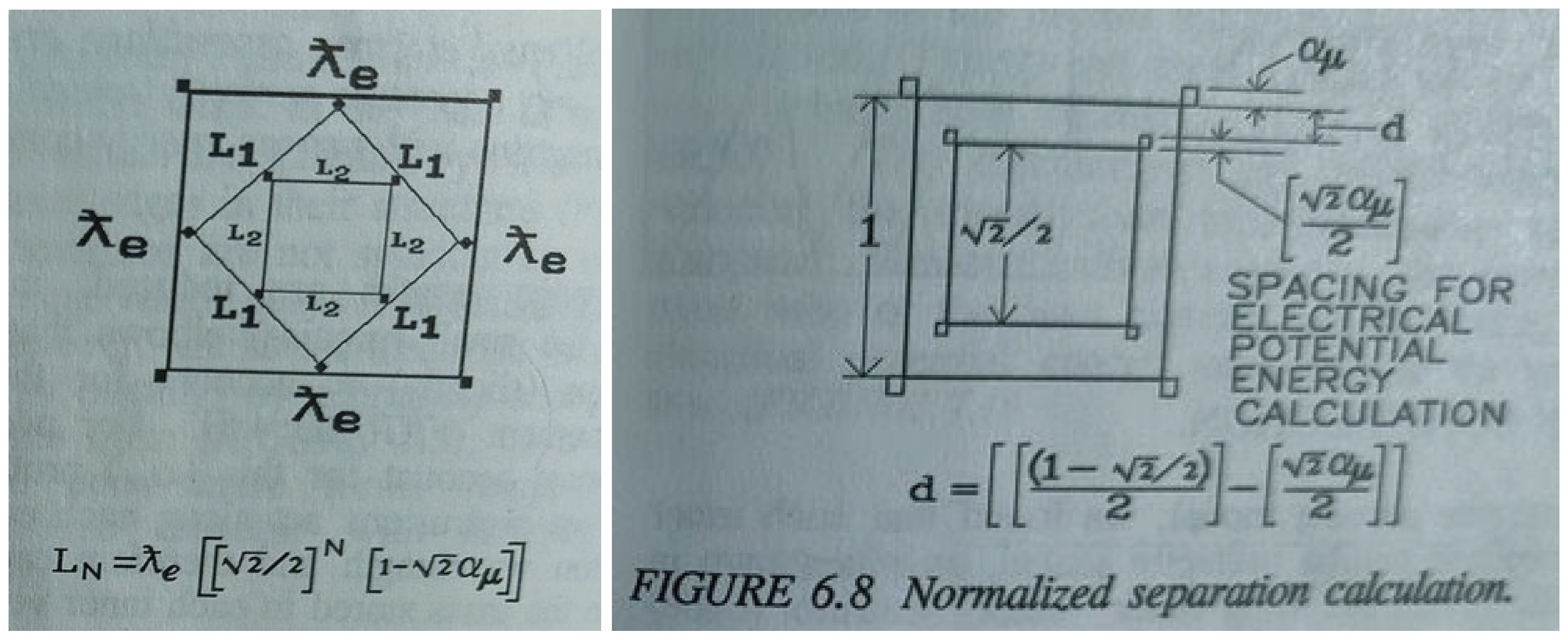
Lockyer’s model conceptualizes the positron as a cube whose edges have a length based on the reduced Compton wavelength ().
The proton is modeled as a positron (level 1) containing 18 nested energy layers (levels 2–19). The edge of the positron “cube” has a length shortened by a factor deduced from the electron’s magnetic moment, using only physical constants. For the complete description of Lockyer’s original model, refer to the bibliography [1,2].
Projected onto a plane perpendicular to the rotation axis giving the magnetic moment, the cube appears as a square.
Each “square” of the inner layers is inscribed with a 45° rotation relative to its containing square, and consequently sees its dimensions reduced by a factor of :
The rest mass originates from the momentum of photons () confined in the rotating layers, with energy contributions:
Figure 1.
Illustrations reproduced from Lockyer, Vector Particle Physics (1992).
The mass contributions per level i (1 to 19) are:
The neutron, in turn, adds an electron (mass , charge ) sharing level 1 with the positron (mass , charge ), and doubles the energy of level 2.
It is important to emphasize that this construction is a feature of Lockyer’s model and is not being proposed here as a modification of the established quark-gluon description of the nucleon. In particular, the present calculation does not attempt to eliminate quarks from QCD. It simply investigates what follows numerically from the assumptions of the geometric model.
3. Calculations
The proton mass ratio is:
The neutron mass ratio includes the doubling of the first two levels:
Implementation details are in Appendix A.
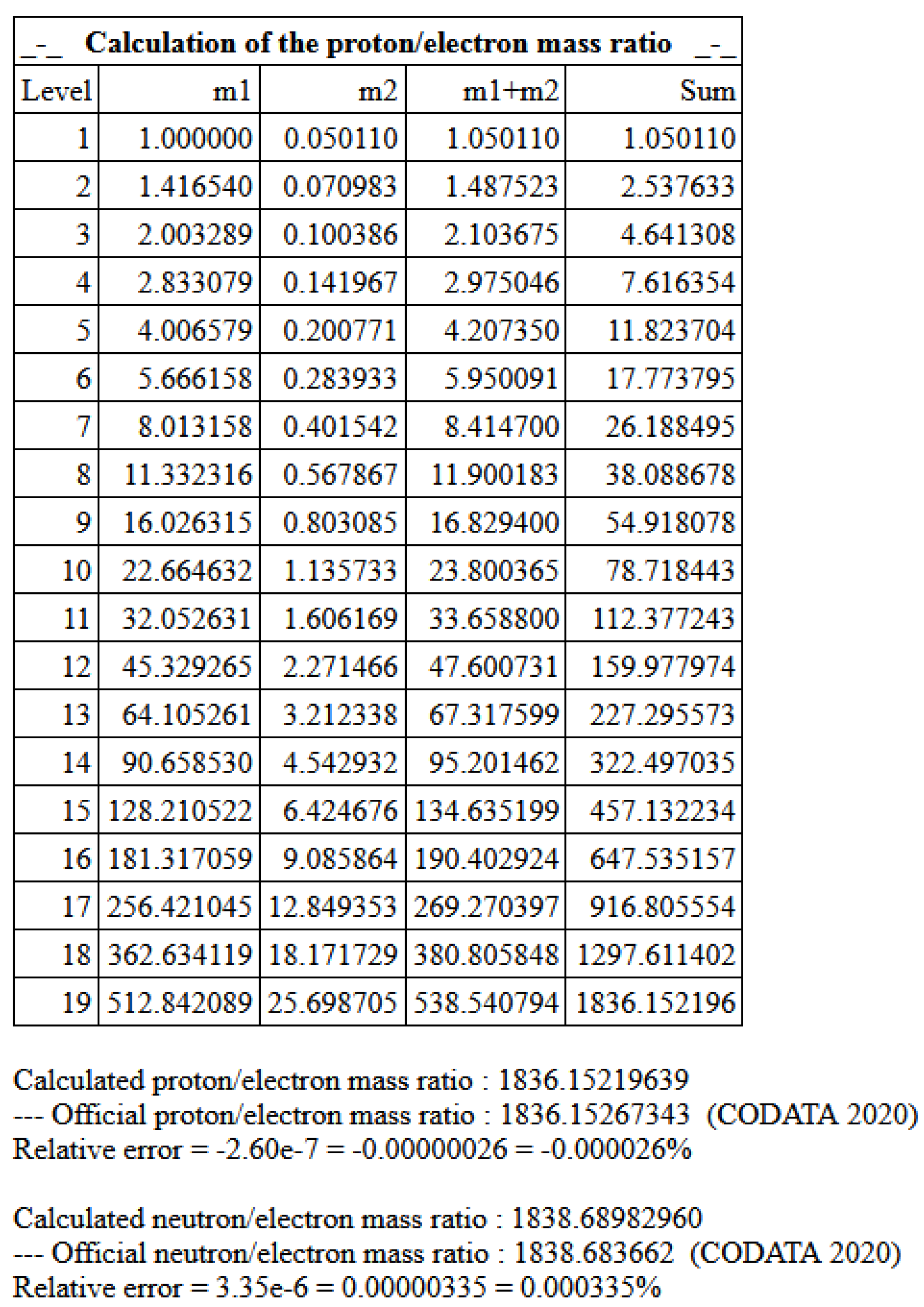
The JavaScript implementation yields:
- Proton: , error relative to CODATA 1836.15267343 (seven significant digits).
- Neutron: , error relative to CODATA 1838.68366173 (six significant digits).
Note: The contribution of each line () is exactly equal to the previous one multiplied by .
4. Results and Discussion
Figure 2.
JavaScript code result, showing mass contributions per level.
The numerical accuracy of the model is particularly noteworthy because the calculation contains no freely adjustable parameter fitted to the experimental nucleon mass. Once the fundamental physical constants and the geometrical relations of the model are specified, the proton and neutron mass ratios follow directly from the calculation. The only geometrical scaling factor involved in the successive levels is , which follows from the stated 45° rotation of each nested square. Thus, the agreement with the measured mass ratios is not obtained by tuning an arbitrary numerical coefficient to reproduce the experimental values.
The numerical agreement alone does not establish the physical validity of the underlying model and the present calculation should not be regarded as evidence against QCD. QCD explains nucleons in terms of quark and gluon degrees of freedom and remains indispensable for describing high-energy phenomena. The question raised here is whether the geometric structure proposed by Lockyer could represent an additional effective description of the nucleon at lower energies.
The geometric structure itself is an idealization and is not necessarily the most important aspect to retain, as other structures, and other theoretical explanations, could lead to the same calculation.
5. Implications and Future Work
In high-energy scattering experiments, the proton and neutron are resolved through quark and gluon degrees of freedom, in agreement with QCD. At lower energies, however, a nucleon could be a stable composite object whose observable properties can be described using effective degrees of freedom that need not correspond one-to-one with the fundamental QCD degrees of freedom.
Future work should therefore investigate:
- Explore a semi-classical approximation of the strong force within the geometric model.
- Derive the condition for the 18 nested energy levels.
- Explain the energy ratio of between successive levels.
- Determine whether the geometric structure can be derived from, or consistently embedded within, an effective description of QCD.
- Investigate whether the proposed structure should be interpreted as a low-energy configuration distinct from the partonic structure resolved in high-energy scattering.
- Compare the model’s predictions with experimentally measured electromagnetic, hadronic, and scattering observables beyond the proton and neutron masses.
- Attempt to extend the model to calculate the masses of the muon and tauon.
6. Conclusions
The purpose of this work is not to challenge the existence of quarks or the validity of Quantum Chromodynamics. QCD remains the established and experimentally successful framework for the strong interaction.
Instead, this article examines the geometric model proposed by T.N. Lockyer and shows that, after a simplification of the original formulation, it produces remarkably accurate numerical values for the proton-to-electron and neutron-to-electron mass ratios using a small number of fundamental constants and a geometric factor of .
The significance of this result should therefore be stated cautiously. The numerical agreement is not sufficient to establish Lockyer’s model as a physical theory, nor does it constitute evidence against QCD. It does, however, motivate the question of whether an alternative geometric or effective description of nucleon structure might coexist with the fundamental quark-gluon description.
In particular, the model seems to imply that the internal organization of a proton or neutron in a low-energy, isolated state could differ in its effective description from the quark and gluon structure resolved during high-energy collisions. Such a possibility would not require rejecting the existence of quarks. Rather, it would suggest that different physical regimes may reveal different effective descriptions of the same underlying object.
Whether such an interpretation can be made mathematically consistent with QCD, and whether it leads to experimentally testable predictions beyond the numerical mass ratios presented here, remains an open question.
The most valuable outcome of the present work is therefore not a claim to replace the standard model of particle physics, but a proposal for further investigation: determine whether the simple geometric relationships appearing in Lockyer’s model are merely numerical coincidences, or whether they can be connected to a deeper and experimentally meaningful description of nucleon structure.
Appendix A. JavaScript Implementation
The following code calculates and :
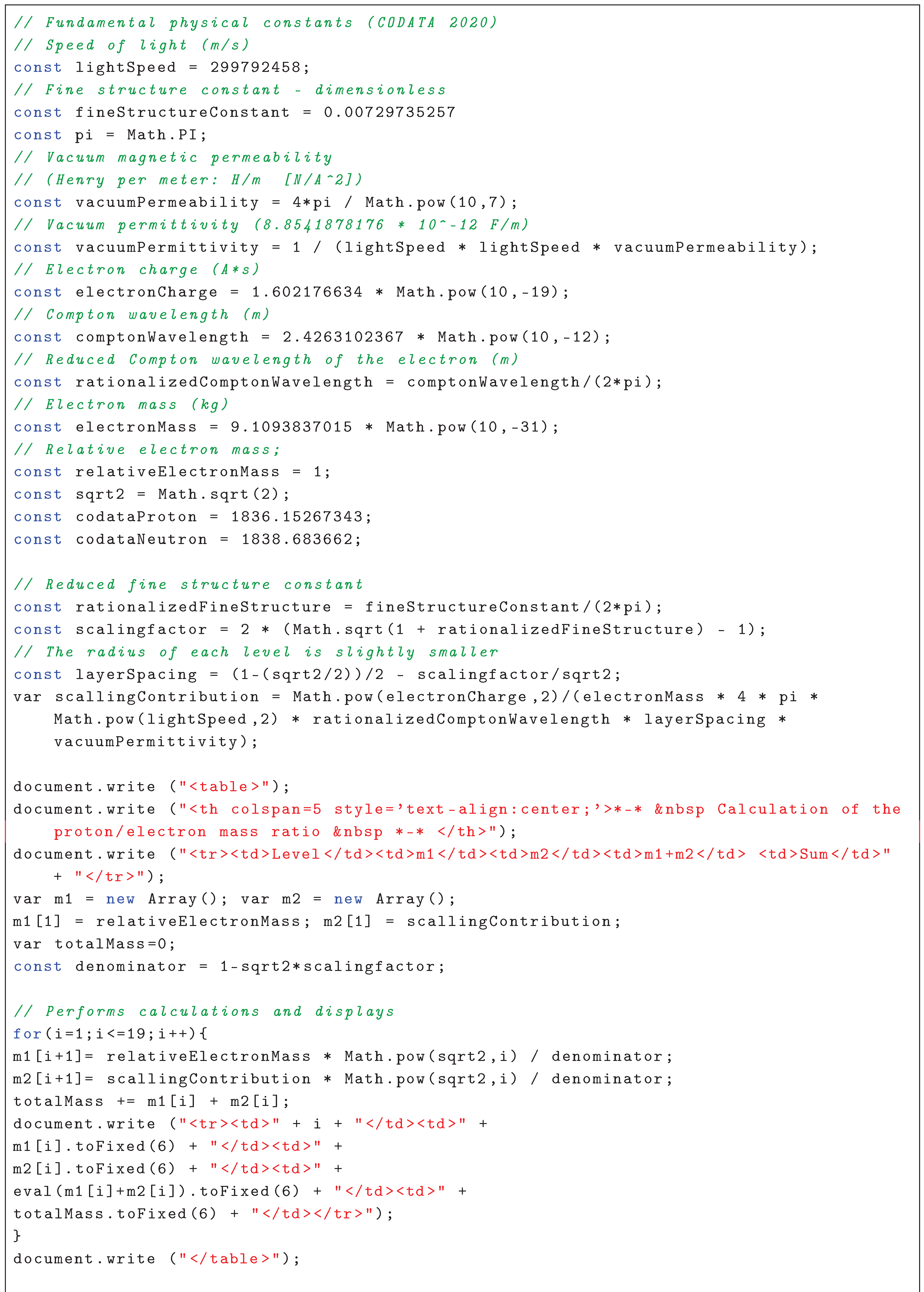
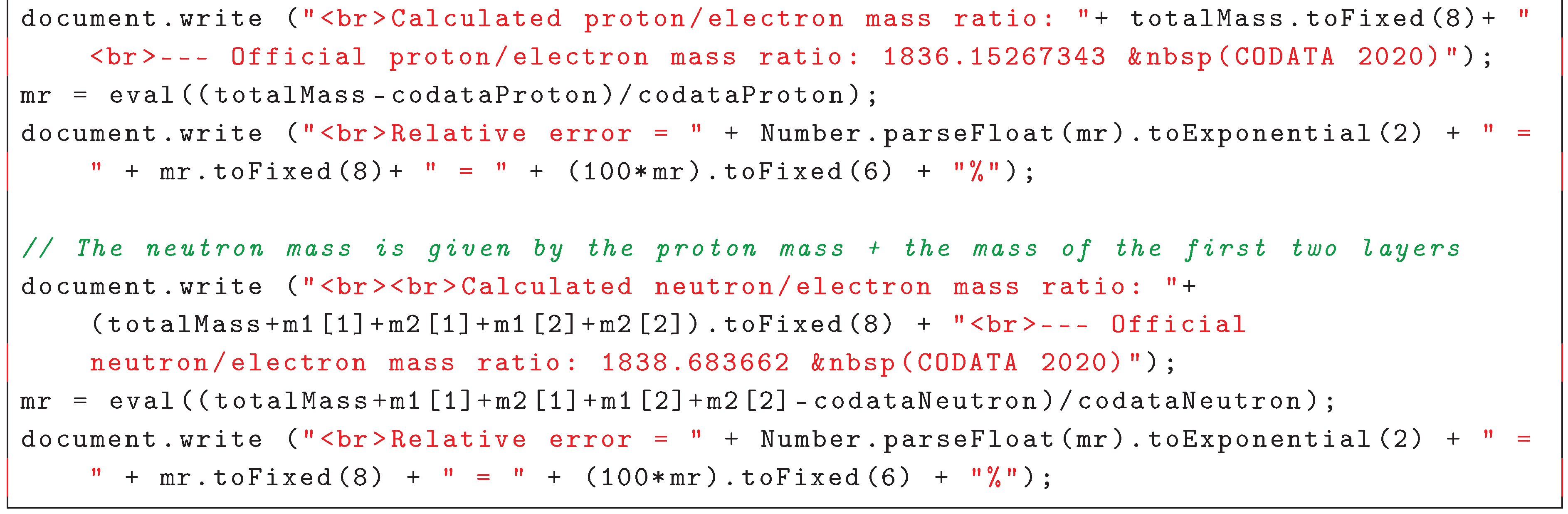
For verification purposes, first create an empty HTML page using the following structure, save it with any name of your choice, for example "ProtonCalculation.html", then insert the complete JavaScript code provided above between the script tags.
<!DOCTYPE html>
<html>
<head>
    <meta charset="UTF-8">
    <title>Proton and Neutron Mass Ratio Calculation</title>
</head>
<body>
</body>
<script>
//      Paste the complete JavaScript code here
</script>
</html>
Save the completed HTML file and open it with any web browser. The JavaScript code will then be executed automatically, displaying the calculated mass contributions for the 19 levels, followed by the calculated proton-to-electron and neutron-to-electron mass ratios and their respective relative errors. This procedure provides a simple and reproducible way to independently verify the numerical calculations presented in this work.
Note concerning copy-and-paste from the PDF: The JavaScript code displayed above is syntactically correct in the original source document. However, depending on the PDF viewer or PDF extraction software used to copy the code, additional spaces may occasionally be inserted inside HTML tags (for example, <table> may be copied as < table >). Such modifications are introduced during the copy-and-paste process. If this occurs, the inserted spaces must be removed before the HTML file can be executed correctly by a web browser.
References
- T. N. Lockyer, Vector Particle Physics, TNL Press, 1992, ISBN: 0963154605.
- Thomas. N. Lockyer, Fundamental Physical Constants Derived From Particle Geometric Structures, TNL Press, 2007, ISBN: 0-9631546-4-8.
- CODATA, Recommended Values of the Fundamental Physical Constants, 2020.
Disclaimer/Publisher’s Note: The statements, opinions and data contained in all publications are solely those of the individual author(s) and contributor(s) and not of MDPI and/or the editor(s). MDPI and/or the editor(s) disclaim responsibility for any injury to people or property resulting from any ideas, methods, instructions or products referred to in the content. |
© 2026 by the authors. Licensee MDPI, Basel, Switzerland. This article is an open access article distributed under the terms and conditions of the Creative Commons Attribution (CC BY) license (http://creativecommons.org/licenses/by/4.0/).
Copyright: This open access article is published under a Creative Commons CC BY 4.0 license, which permit the free download, distribution, and reuse, provided that the author and preprint are cited in any reuse.