

Submitted:
24 May 2025
Posted:
26 May 2025
You are already at the latest version
Abstract
With the rapid development of information technology, Financial Shared Service Centers (FSSC) have gradually become a core model in corporate financial management. Meanwhile, Large Language Models (LLMs), as an important technology in the field of natural language processing, have been widely applied across various industries. This paper aims to explore the application of LLMs in FSSCs, analyzing their impact on financial data processing, intelligent analysis, report generation, and customer service. Through case studies, this paper demonstrates how LLMs improve financial processing efficiency and optimize customer service experience, while also addressing challenges in data privacy, model accuracy, and technical implementation. Finally, the paper offers strategic recommendations for the intelligent transformation of FSSCs and looks ahead to the future development potential of LLMs in this field.
Keywords:
Financial Shared Service Center
; Large Language Model
; Natural Language Processing
; Financial Data Processing
1. Introduction
With the acceleration of global economic integration, enterprises face increasingly complex challenges in financial management and cost control. The Financial Shared Service Center (FSSC) has gradually become an essential tool for modern enterprises to address financial management issues. By centralizing the financial affairs within an organization, FSSCs enhance resource utilization efficiency, reduce operational costs, and improve financial transparency and accuracy. However, as business diversification and informatization continue to grow, traditional financial management models face bottlenecks in handling large-scale, complex data. The challenge for FSSCs is how to effectively enhance financial processing through automation and intelligent systems.Simultaneously, the rapid development of artificial intelligence, particularly in Large Language Models (LLMs) for natural language processing, is providing new solutions for various industries. LLMs, through deep learning algorithms and massive data training, are capable of understanding and generating natural language text, demonstrating powerful capabilities in semantic analysis, text generation, and data processing. In recent years, an increasing number of enterprises have explored the application of LLMs in FSSCs to automate and enhance the processing of financial data, thereby improving efficiency and decision-making accuracy.This paper will explore the application of LLMs in FSSCs, analyzing their potential and actual effects in financial data processing, intelligent analysis, report generation, and customer service. It will also discuss the challenges that may arise during the application of LLMs, such as technical, privacy, and compliance issues, and propose strategies to address these challenges. Through in-depth case studies, the paper aims to provide theoretical support and practical guidance for the intelligent transformation of FSSCs[1].
2. Overview of Financial Shared Service Centers
2.1. Definition and Development of FSSCs
The Financial Shared Service Center (FSSC) is a service model that centrally manages and uniformly processes the financial functions of multiple business departments within an enterprise. The core concept is to achieve the standardization, automation and informatization of financial processes through intensive management, thereby improving the efficiency of financial management, reducing operating costs, enhancing data transparency, and improving the accuracy and real-time nature of financial decisions. The financial shared service center integrates the scattered financial functions within an enterprise and centrally handles various financial affairs, including accounting processing, report generation, and financial analysis, aiming to provide more efficient and high-quality financial services for the enterprise[2,3,4].The origin of the financial shared Service Center can be traced back to the early 1990s. At that time, many multinational companies around the world began to optimize their business processes globally, and the financial shared service model gradually emerged as one of the innovative management methods. Initially, this model was mainly applied in large multinational enterprises. By centralizing the management of financial affairs in different regions around the world, enterprises reduced redundant work, lowered operating costs, and enhanced the uniformity and standardization level of financial work[5,6,7]. With the development of technology, especially the popularization of information technology and the Internet, the application of financial shared service centers has been continuously expanding. It is no longer limited to multinational companies; an increasing number of domestic enterprises have also begun to adopt this model to adapt to the rapidly changing market environment and complex financial management needs.During its development process, the financial shared service center has undergone an evolution from simple financial outsourcing to integrated management. The initial financial shared service center mainly focused on basic financial accounting and accounting processing. However, with the advancement of technology, especially the application of big data, artificial intelligence and cloud computing technologies, the financial shared service center has gradually developed towards intelligence and automation, and has gradually covered advanced functions such as financial analysis and decision support. Nowadays, the financial shared service center is not merely a tool to support daily financial operations, but also an important support platform for enterprise strategic decision-making. It can provide data-driven insights for enterprises and enhance their overall financial management level.Overall, the development process of the financial shared service center has been accompanied by the expansion of enterprise scale, the improvement of informatization level and the renewal of management concepts. It has gradually transformed from the traditional financial management model to a more intelligent, efficient and information-based comprehensive financial service platform[9,10].
2.2. Operational Model and Core Functions of FSSCs
The operational model of a Financial Shared Service Center (FSSC) primarily revolves around the centralized management of financial processes, which is accomplished through the use of standardization, automation, and informatization. This model aims to streamline financial operations by consolidating various financial tasks across departments into one centralized service hub. The goal is to optimize resource allocation, reduce operational costs, and enhance the transparency and efficiency of financial management. By centralizing key functions, organizations can ensure greater consistency, improve accuracy in reporting, and achieve economies of scale.In practice, many FSSCs implement a hybrid operational model, combining both centralized and decentralized approaches. This allows them to leverage the advantages of centralized financial management while also providing the flexibility for specific departments to retain some level of autonomy in managing their local financial activities[11]. Integration of modern information technology, such as Enterprise Resource Planning (ERP) systems, cloud computing, and advanced data analytics, further enhances the capabilities of FSSCs by ensuring seamless communication and data exchange across departments and locations.The core functions of FSSCs cover a wide range of financial operations, including accounting processing, report generation, financial analysis, tax management, and customer/supplier management. Accounting processing typically involves the accurate recording and reconciliation of financial transactions, ensuring compliance with regulatory standards. Report generation involves creating financial statements, such as balance sheets and income statements, for management decision-making. Financial analysis and decision support provide critical insights into the company’s financial health, enabling informed business strategies. Tax management ensures timely compliance with tax regulations, while customer and supplier management focuses on optimizing accounts receivable and payable, enhancing cash flow and supplier relationships.Moreover, these core functions are significantly enhanced by the adoption of technology. The integration of cloud computing enables real-time data access and collaboration, while big data and artificial intelligence allow for more sophisticated financial forecasting, anomaly detection, and automation of routine tasks. This technology-driven approach not only increases operational efficiency but also supports the strategic goals of the organization by delivering actionable insights for better decision-making and long-term growth. Through this intelligent automation, FSSCs are well-positioned to contribute to the overall digital transformation of a company’s financial management system[12].
2.3. Current Status and Challenges of FSSCs
In recent years, FSSCs have been widely implemented in Chinese enterprises, especially in large state-owned and multinational corporations, becoming crucial tools for improving financial management, reducing operational costs, and enhancing decision-making support. However, despite the positive impact on financial management, FSSCs still face several challenges, including data governance, technical security, compliance with regulations, and the need for skilled talent.As FSSCs continue to evolve towards intelligent and automated systems, these challenges must be addressed through effective measures to ensure the continuous optimization and development of these centers[13,14,15].
3. Basic Concepts and Application Prospects of Large Language Models
Large Language Models (LLMs) are a type of deep learning-based natural language processing technology. By learning from vast amounts of text data, they are capable of understanding and generating natural language. The core principle of LLMs is based on neural networks, particularly the Transformer architecture, which enables the model to exhibit powerful capabilities in language understanding and generation tasks. Compared to traditional rule-based methods, LLMs learn the deep structure and semantics of language through training on large datasets, generating more natural and fluent text. As a result, LLMs are proficient in a variety of natural language processing tasks, including translation, question answering, and text generation, where they perform exceptionally well.One important characteristic of LLMs is their adaptability. By fine-tuning the model, LLMs can be customized for different tasks and scenarios. In recent years, models such as GPT series (e.g., GPT-3, GPT-4) and BERT have achieved significant success. These models can understand complex contexts, generate contextually relevant text, and perform excellently in various natural language processing tasks. This capability allows LLMs to handle basic text processing tasks as well as more complex scenarios involving semantic reasoning and context understanding.The application prospects of LLMs are vast, especially in fields like intelligent customer service and automated support. LLMs can efficiently handle natural language conversations, becoming a core component of intelligent customer service systems[16,17]. By automatically responding to customer inquiries and reducing human intervention, LLMs can enhance the efficiency and quality of customer service while lowering costs. Additionally, in information extraction and text analysis, LLMs can quickly extract key information from large amounts of text and perform in-depth analysis. For example, in the financial sector, LLMs can intelligently analyze financial reports and provide data-driven support for business decision-making. Moreover, LLMs excel in machine translation, accurately translating one language into another, especially when handling complex contexts or specialized domains. In content generation, LLMs can generate articles, news reports, and advertisements based on set themes or frameworks, greatly improving creative efficiency, and have already been widely applied in marketing and media industries. LLMs also show tremendous potential in education and training, generating personalized learning materials based on user needs and providing real-time feedback to help students solve learning problems.Despite the broad application prospects of LLMs, several challenges remain. First, the training and inference processes of these models require substantial computational resources, which poses a challenge for most enterprises and research institutions. Second, the issues of model interpretability and transparency remain a focal point in both academia and industry, especially in sensitive fields or decision-making scenarios. Lastly, data privacy and security are also significant challenges in the application of LLMs. Ensuring the security of data while efficiently applying these models remains a challenge that needs to be addressed.Overall, as technology continues to progress and optimize, LLMs will play an increasingly important role across industries, driving the innovation and development of artificial intelligence technology[18,19].
4. Application of Large Language Models in Financial Shared Service Centers
The potential of Large Language Models (LLMs) in Financial Shared Service Centers (FSSCs) is immense, especially in improving the efficiency, accuracy, and intelligence of key financial processes. The primary goal of FSSCs is to centralize and automate financial tasks across departments, increasing work efficiency, reducing human errors, and optimizing the financial decision-making process. LLMs, as powerful natural language processing technologies, can effectively support these objectives, particularly in data processing, analysis, report generation, and customer service[20]. First, the application of LLMs in financial data processing can significantly enhance work efficiency. Traditional financial data processing often requires extensive manual input and review, which is time-consuming and prone to errors. LLMs can automate the parsing, classification, and organization of financial data, quickly extracting key information from large amounts of raw data. For example, models can automatically identify important financial information from invoices, bills, contracts, and other documents, categorize and summarize it, and generate preliminary financial reports[21,22,23]. This not only increases data processing speed but also greatly reduces errors caused by manual operations.In terms of financial intelligent analysis, LLMs can handle complex financial texts and perform deep analysis, providing valuable insights for financial decision-making. For instance, in financial report analysis, LLMs can analyze historical financial data, identify trends, and predict future financial conditions. They can even automatically generate financial analysis reports through natural language generation technology, helping financial personnel quickly understand the company's financial situation. This automated financial analysis not only improves efficiency but also ensures the objectivity and consistency of the analysis results. LLMs can also be applied to the automatic generation of financial reports. Generating financial reports typically involves tedious data compilation and document writing, requiring significant time and effort from financial personnel. By utilizing LLMs, the required information can be automatically extracted from various financial data sources to generate formatted financial statements and management reports, saving considerable time. Additionally, the model can adjust the content of the reports to meet specific needs, such as adding trend analysis or risk alerts, making the reports more aligned with actual business requirements.In customer service, LLMs can play a crucial role in the customer support systems of FSSCs. FSSCs often provide financial support services to internal departments, such as answering financial-related inquiries and processing financial tasks. LLMs can automatically respond to common financial questions through intelligent customer service systems, reducing the burden on human agents and providing more efficient and accurate service. Moreover, the model can handle complex financial issues and generate personalized solutions, improving the quality and responsiveness of customer service[24].Furthermore, LLMs can assist in compliance management within FSSCs. During financial compliance audits, LLMs can automatically identify and analyze compliance risks in financial documents, detect potential compliance issues in real-time, and provide corresponding solutions, thus reducing compliance risks.Overall, the application of LLMs in FSSCs not only optimizes basic financial processes such as data handling, analysis, and report generation, but also enhances customer service quality and compliance management. With continued technological advancements, LLMs will play a larger role in driving the intelligent transformation of financial management in FSSCs[25,26].
5. Application Cases and Data Analysis
5.1. Application Cases of Large Language Models in Financial Shared Service Centers
As the application of Large Language Models (LLMs) deepens across various industries, many enterprises are beginning to integrate this technology into their Financial Shared Service Centers (FSSCs) to enhance financial processing efficiency and accuracy. Below are several typical application cases that demonstrate how LLMs are being leveraged in FSSCs.A global multinational company applied LLMs in its FSSC to automate the review of invoices and bills. Traditional bill processing required extensive manual review, which was time-consuming and error-prone. After introducing LLMs, the system could automatically extract invoice information from emails, PDFs, and other formats, recognizing key details such as the vendor, amount, and date, and matching it with the company's procurement and payment systems. This significantly reduced the time required for invoice review and processing, minimized human intervention, and improved data accuracy and consistency.Additionally, a financial institution integrated LLMs into its FSSC for automatic financial report generation. The process of generating financial reports is typically cumbersome and time-consuming, requiring manual data consolidation and report writing. By applying LLMs, the system could automatically extract relevant data from the company's financial database and generate financial statements based on predefined templates, while also generating analysis and interpretations of the financial data to help management quickly understand the financial status and key risk areas. This not only saved a considerable amount of time but also improved the quality and consistency of the reports.In a manufacturing company’s FSSC, the integration of LLMs for tax compliance auditing also yielded significant results. When conducting tax filings, the company faced complex tax regulations and compliance requirements. LLMs were able to automatically identify and analyze tax compliance information in financial documents, check for compliance with relevant laws and policies, and provide real-time feedback. This automated compliance check significantly reduced tax risks and helped the company manage its tax affairs more efficiently.These cases demonstrate that the application of LLMs in FSSCs not only enhances the automation of financial data processing but also improves the intelligent analysis of financial reports, optimizes tax compliance management, and greatly boosts overall work efficiency and accuracy. With continued technological advancements, LLMs will play an even larger role in FSSCs, driving financial management toward greater automation and intelligence[27].
5.2. Data Analysis: Comparison of Benefits Before and After the Application of Large Language Models
After the introduction of large language models (LLMs) in Financial Shared Service Centers (FSSCs), significant improvements were seen in financial processing efficiency and customer service response time. The following data comparison illustrates the changes in benefits brought by the application of LLMs.
According to Figure 1, there has been a significant improvement in financial processing efficiency. Before the application of LLMs, traditional financial processing took an average of 2 hours per invoice, including steps like data entry, review, and comparison. After the introduction of LLMs, with automated data extraction and review processes, the time required for processing invoices was drastically reduced to 30 minutes. Additionally, the system could automatically recognize and classify financial documents, reducing human intervention and increasing the monthly invoice processing volume from 2,000 to 3,000, a 50% increase. The error rate also significantly decreased from 5% to 1%, indicating that automation greatly improved data accuracy.
Table 1 shows a significant improvement in customer service response time after the application of LLMs. Before the application, the average response time for customer inquiries in the FSSC was 45 minutes, and only simple financial questions could be answered. After the introduction of LLMs, the customer service system was able to respond in real-time and handle most financial queries, reducing the response time to just 10 minutes, a 77.78% improvement. Additionally, the model was able to answer common questions more accurately, with accuracy increasing from 85% to 95%. This not only improved response efficiency but also significantly boosted customer satisfaction, increasing from 78% to 92%.In conclusion, the data comparison in Table 1 and Table 2 clearly demonstrates the benefits of applying large language models in FSSCs. Both financial processing efficiency and customer service response time have significantly improved, driving the intelligent development of financial management and customer service.
6. Challenges and Solutions in the Application of Large Language Models
Although the application of large language models in FSSCs shows great promise, there are still some challenges in practice. First, data privacy and security are critical concerns. Financial data typically includes sensitive information, and ensuring data security and privacy protection is crucial in the application of LLMs[28]. This can be addressed by implementing encryption technologies and strict access control measures to enhance data protection and ensure compliance.Second, the accuracy and interpretability of the models remain a challenge. While LLMs can handle complex tasks, their decision-making process often lacks transparency, making it difficult to fully explain their reasoning. To address this, explainable AI technologies can be introduced to improve model interpretability, with continuous optimization and monitoring to ensure the reliability and consistency of the model outputs.Another challenge is the adaptability and integration of technology. LLMs need to be integrated with existing financial systems and processes to ensure smooth data flow. This can be achieved by adopting flexible API interfaces and customized technical solutions to ensure seamless integration between the LLM and financial systems.Finally, personnel skills and training are also critical. FSSCs require personnel with relevant technical backgrounds to manage and optimize the application of LLMs. Enterprises can address this by offering internal training and introducing technical expertise to improve employees' technical capabilities, ensuring effective application of LLMs in financial management.In conclusion, despite the challenges in applying large language models in FSSCs, these issues can be effectively addressed through enhanced data security, improved model interpretability, optimized system integration, and comprehensive staff training, thereby driving the intelligent transformation of financial management[29].
7. Conclusion
The application of large language models in Financial Shared Service Centers has demonstrated significant potential, particularly in improving financial processing efficiency, optimizing customer service, and enhancing intelligent analysis capabilities. By automating financial data processing, generating intelligent reports, and providing real-time customer support, LLMs can effectively improve the accuracy and efficiency of financial management. However, challenges such as data privacy, model interpretability, technical adaptability, and staff training still need to be addressed. To overcome these challenges, enterprises can strengthen data protection, enhance model transparency, optimize system integration, and invest in staff training to ensure the successful application of LLMs. As technology continues to progress, LLMs will play an even greater role in FSSCs, driving the intelligent and automated transformation of financial management.
References
- Yang, H., Lu, Q., Wang, Y., Liu, S., Zheng, J., & Xiang, A. (2025). User Behavior Analysis in Privacy Protection with Large Language Models: A Study on Privacy Preferences with Limited Data. arXiv preprint arXiv:2505.06305.
- Tang, Xirui, et al. "Research on heterogeneous computation resource allocation based on data-driven method." 2024 6th International Conference on Data-driven Optimization of Complex Systems (DOCS). IEEE, 2024.
- Yin Z, Hu B, Chen S. Predicting employee turnover in the financial company: A comparative study of catboost and xgboost models. Applied and Computational Engineering, 2024, 100: 86-92.
- Qi, Zhen, et al. "Detecting and Classifying Defective Products in Images Using YOLO." arXiv preprint arXiv:2412.16935 (2024).
- Shi X, Tao Y, Lin S C. Deep Neural Network-Based Prediction of B-Cell Epitopes for SARS-CoV and SARS-CoV-2: Enhancing Vaccine Design through Machine Learning. arXiv preprint arXiv:2412.00109, 2024.
- Xiang A, Zhang J, Yang Q, et al. Research on splicing image detection algorithms based on natural image statistical characteristics. arXiv preprint arXiv:2404.16296, 2024.
- Mo K, Chu L, Zhang X, et al. Dral: Deep reinforcement adaptive learning for multi-uavs navigation in unknown indoor environment. arXiv preprint arXiv:2409.03930, 2024.
- Tan, Chaoyi, et al. "Generating Multimodal Images with GAN: Integrating Text, Image, and Style." arXiv preprint arXiv:2501.02167 (2025).
- Tan, Chaoyi, et al. "Real-time Video Target Tracking Algorithm Utilizing Convolutional Neural Networks (CNN)." 2024 4th International Conference on Electronic Information Engineering and Computer (EIECT). IEEE, 2024.
- Xiang A, Huang B, Guo X, et al. A neural matrix decomposition recommender system model based on the multimodal large language model. Proceedings of the 2024 7th International Conference on Machine Learning and Machine Intelligence (MLMI). 2024: 146-150.
- Ge, Ge, et al. "A review of the effect of the ketogenic diet on glycemic control in adults with type 2 diabetes." Precision Nutrition 4.1 (2025): e00100.
- Lv, Guangxin, et al. "Dynamic covalent bonds in vitrimers enable 1.0 W/(m K) intrinsic thermal conductivity." Macromolecules 56.4 (2023): 1554-1561.
- Lin, Xueting, et al. "Enhanced Recommendation Combining Collaborative Filtering and Large Language Models." arXiv preprint arXiv:2412.18713 (2024).
- Yang, Haowei, et al. "Research on the Design of a Short Video Recommendation System Based on Multimodal Information and Differential Privacy." arXiv preprint arXiv:2504.08751 (2025).
- Guo H, Zhang Y, Chen L, et al. Research on vehicle detection based on improved YOLOv8 network. arXiv preprint arXiv:2501.00300, 2024.
- Xiang A, Qi Z, Wang H, et al. A multimodal fusion network for student emotion recognition based on transformer and tensor product. 2024 IEEE 2nd International Conference on Sensors, Electronics and Computer Engineering (ICSECE). IEEE, 2024: 1-4.
- Yang, Haowei, et al. "Optimization and Scalability of Collaborative Filtering Algorithms in Large Language Models." arXiv preprint arXiv:2412.18715 (2024).
- Yu Q, Wang S, Tao Y. Enhancing anti-money laundering detection with self-attention graph neural networks. SHS Web of Conferences. EDP Sciences, 2025, 213: 01016.
- Yang, Haowei, et al. "Analysis of Financial Risk Behavior Prediction Using Deep Learning and Big Data Algorithms." arXiv preprint arXiv:2410.19394 (2024).
- Diao, Su, et al. "Ventilator pressure prediction using recurrent neural network." arXiv preprint arXiv:2410.06552 (2024).
- Wang, H. , Zhang, G., Zhao, Y., Lai, F., Cui, W., Xue, J.,... & Lin, Y. (2024, December). Rpf-eld: Regional prior fusion using early and late distillation for breast cancer recognition in ultrasound images. In 2024 IEEE International Conference on Bioinformatics and Biomedicine (BIBM) (pp. 2605-2612). IEEE.
- Shih K, Han Y, Tan L. Recommendation System in Advertising and Streaming Media: Unsupervised Data Enhancement Sequence Suggestions. arXiv preprint arXiv:2504.08740, 2025.
- Wang T, Cai X, Xu Q. Energy Market Price Forecasting and Financial Technology Risk Management Based on Generative AI. Applied and Computational Engineering, 2024, 100: 29-34.
- Huang B, Lu Q, Huang S, et al. Multi-modal clothing recommendation model based on large model and VAE enhancement. arXiv preprint arXiv:2410.02219, 2024.
- Yin J, Wu X, Liu X. Multi-class classification of breast cancer gene expression using PCA and XGBoost. Theoretical and Natural Science, 2025, 76: 6-11.
- Min, Liu, et al. "Financial Prediction Using DeepFM: Loan Repayment with Attention and Hybrid Loss." 2024 5th International Conference on Machine Learning and Computer Application (ICMLCA). IEEE, 2024.
- Ziang H, Zhang J, Li L. Framework for lung CT image segmentation based on UNet++. arXiv preprint arXiv:2501.02428, 2025.
- Li, Xiangtian, et al. "Artistic Neural Style Transfer Algorithms with Activation Smoothing." arXiv preprint arXiv:2411.08014 (2024).
- Shen, Jiajiang, Weiyan Wu, and Qianyu Xu. "Accurate prediction of temperature indicators in eastern china using a multi-scale cnn-lstm-attention model." arXiv preprint arXiv:2412.07997 (2024).
Figure 1.
Comparison of Financial Processing Efficiency Before and After Application.
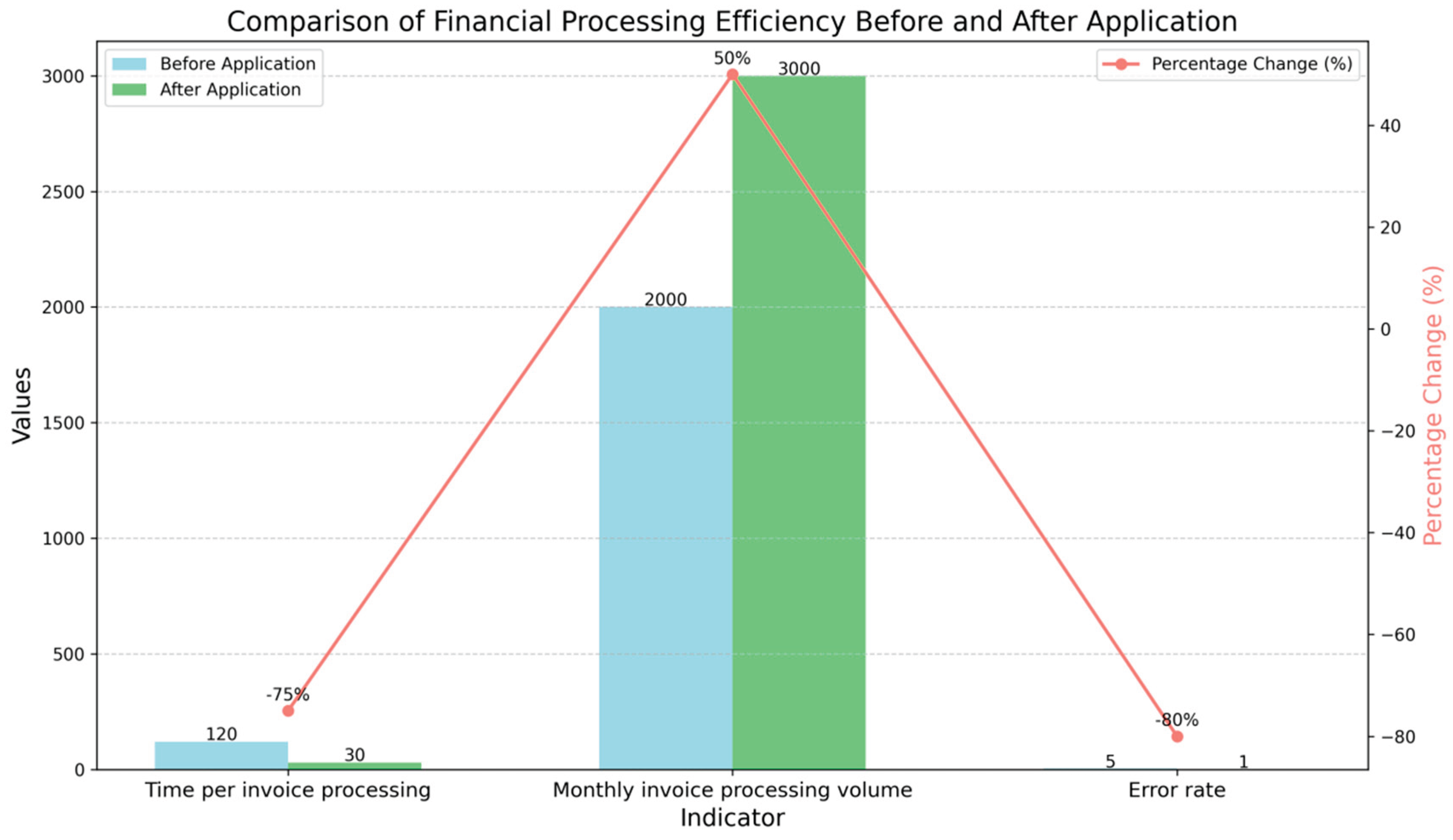

Table 1.
Comparison of Customer Service Response Time.
| Indicator | Before Application | After Application | Percentage Change |
| Response time per inquiry | 45 minutes | 10 minutes | -77.78% |
| Accuracy of answering common questions | 85% | 95% | +11.76% |
| Customer satisfaction | 78% | 92% | +17.95% |
Disclaimer/Publisher’s Note: The statements, opinions and data contained in all publications are solely those of the individual author(s) and contributor(s) and not of MDPI and/or the editor(s). MDPI and/or the editor(s) disclaim responsibility for any injury to people or property resulting from any ideas, methods, instructions or products referred to in the content. |
© 2025 by the authors. Licensee MDPI, Basel, Switzerland. This article is an open access article distributed under the terms and conditions of the Creative Commons Attribution (CC BY) license (http://creativecommons.org/licenses/by/4.0/).
Copyright: This open access article is published under a Creative Commons CC BY 4.0 license, which permit the free download, distribution, and reuse, provided that the author and preprint are cited in any reuse.


