

Submitted:
23 May 2025
Posted:
26 May 2025
Read the latest preprint version here
Abstract
A growing number of emerging adults in the United States face disconnection from education, employment, and structured training, often resulting in a loss of direction, identity, and belief in future possibilities. This paper introduces Infinite Hope, a conceptual framework that integrates Snyder's Hope Theory with Simon Sinek's infinite mindset to address re-engagement among disconnected youth. Drawing on interdisciplinary literature and over 70 peer-reviewed sources, the framework combines goal setting, agency, and pathways thinking with values-driven principles such as existential flexibility, courageous leadership, and purpose alignment. Through this synthesis, Infinite Hope offers a psychologically grounded and ethically anchored model for cultivating long-term motivation, resilience, and self-authorship. Two visual models illustrate the framework's cognitive and developmental structure. The paper outlines implications for youth-serving professionals, researchers, and policymakers, emphasizing the need to design environments that promote meaning, identity alignment, and future-oriented growth. Infinite Hope reframes disconnection not as a static condition but as a developmental interruption that young people can transform through belief, purpose, and sustained support. In doing so, it offers both a theory and a call to reimagine youth development beyond compliance and toward lasting transformation.
Keywords:
Agency
; Disconnected youth
; Emerging adulthood
; Hope Theory
; Infinite mindset
; PYD
; Simon Sinek
; Youth Re-engagement
1. Introduction
1.1. The Landscape of Disconnection
A growing number of emerging adults in the United States are no longer actively participating in education, employment, or structured training programs. This paper concentrates on individuals between 18 and 25, a developmental period marked by identity exploration, increased autonomy, and preparation for adult roles (Arnett, 2000; Schwartz et al., 2013). Disconnection during this critical window has become a pressing national concern, carrying substantial developmental, economic, and social implications. Lewis (2022) reports that 4.1 million youth ages 16 and 24 currently lack engagement in school and work. This paper centers on the upper band of that range, where the urgency to address disconnection remains acute. These young adults often face a complex web of structural barriers that inhibit their access to academic progression, sustainable employment, reliable mental health care, and consistent adult support systems (Bridgeland & Milano, 2012; Bintliff, 2011; Brookings, 2022).
Although disconnection frequently correlates with poverty, marginalization, or exposure to trauma, no single socioeconomic or racial group experiences it exclusively. Rather, disconnection represents a broader developmental disruption destabilizing multiple life areas. Many disconnected emerging adults encounter instability in housing, experience gaps in health care access, and live with limited protection from environmental or interpersonal harm. These conditions place them at elevated risk for psychological strain, manifesting as anxiety, depressive symptoms, and social isolation. For some, the compounded stress and uncertainty undermine their capacity to imagine or pursue a coherent future, further entrenching feelings of hopelessness or disorientation (Napier et al., 2024; Bell, 2020; Bhattacharya, 2011).
Still, it is important to recognize that disconnection does not equal disengagement of spirit. Even under adverse conditions, many emerging adults demonstrate resilience, vision, and a drive to reconnect with meaningful opportunities (Belfield et al., 2012; Guthrie et al., 2014). As Booker and Johnson (2024) argue, traditional measurements often fail to capture the internal strengths that motivate youth to persist. These lived experiences point to the need for a more expansive developmental framework that sees potential in participation and the capacity to reimagine and re-engage with life on new terms.
1.2. Disconnection as a Developmental Interruption
Emerging adulthood, typically defined as the period between ages 18 and 25, marks a distinct developmental stage characterized by increased autonomy, identity exploration, and the search for direction and purpose (Arnett, 2000; Arnett, 2014). During this formative phase, young people begin to make consequential decisions related to career trajectories, intimate relationships, educational pursuits, and the refinement of personal values (Schwartz et al., 2005; Côté, 2006). The successful navigation of this stage requires both psychological readiness and access to structural supports that facilitate exploration, goal-setting, and eventual self-authorship.
The developmental arc of emerging adulthood can destabilize when this progress becomes interrupted, whether by external forces or internal uncertainty. The absence of meaningful engagement in education, employment, or community life frequently leads to emotional stagnation, diminished agency, and a growing disconnect between present actions and future aspirations. Rather than progressing through the expected tasks of emerging adulthood, many young people find themselves suspended in developmental limbo, unable to fully commit to or envision long-term goals (Reis et al., 2024; Fonseca et al., 2019).
These interruptions do not occur by chance. Young people from historically marginalized communities face intensified challenges during emerging adulthood because structural forces actively shape their environment. Systemic racism, neighborhood disinvestment, environmental instability, and poverty that span multiple generations collectively constrain access to opportunity (Gomez and Cammarota, 2022; Booker et al., 2022). These forces often intersect and intensify, forming what Motley et al. (2024) describe as a disconnection trap. This cycle develops when limited access to meaningful opportunities erodes self-confidence, weakens goal setting, and diminishes a young person's belief in their future.
Developmental theorists increasingly recognize that institutions designed to support young people, such as schools, workforce systems, and social service agencies, sometimes fail to account for the lived realities of those navigating intersecting barriers. In some cases, these institutions exacerbate existing inequities by emphasizing compliance over connection or performance over purpose (Fike & Mattis, 2023; Melkman & Sulimani-Aidan, 2025). Rather than serving as reliable developmental anchors, they can reinforce disengagement and inadvertently communicate that certain lives matter less within the broader social and economic landscape.
Addressing disconnection as a developmental interruption, rather than merely a logistical or behavioral issue, reorients research and practice toward more holistic and human-centered responses. Interventions that center identity formation, agency development, and hope cultivation offer promising alternatives to deficit-based models and punitive policy approaches. These models recognize that re-engagement is about bringing young people back into systems and helping them reimagine their place within them.
1.3. Hope and the Infinite Mindset as Pathways to Re-Engagement
This paper introduces a novel integration of Snyder's Hope Theory and Simon Sinek's infinite mindset to explain how disconnected emerging adults can re-engage with their futures. Researchers have not yet synthesized these frameworks, previously explored independently, to directly inform re-engagement strategies. This multidimensional model fills that gap and advances the field by combining motivational psychology with adaptive leadership philosophy. It contributes three key advancements: 1) it synthesizes two complementary yet previously unlinked theories, 2) it proposes a psychologically and ethically grounded re-engagement framework for practice, and 3) it offers evaluative metrics prioritizing long-term engagement over short-term compliance or credential attainment.
Snyder's Hope Theory, introduced in 1994, defines hope as a dynamic cognitive process composed of three interrelated elements: goal setting, pathway generation, and agency. These components create an internal motivational framework that enables individuals to pursue goals despite adversity (Snyder et al., 2002; Gallagher and Lopez, 2009). High levels of hope consistently link to academic persistence, emotional resilience, and sustained personal effort (Marques et al., 2011; Scioli et al., 2011). Among disconnected populations, diminished hope does not signal a lack of aspiration. Instead, it reflects the erosion of perceived agency and a weakened belief in options or outcomes (Valle et al., 2006; Booker et al., 2022).
Empirical studies and applied interventions continue to affirm the critical role of hope in shaping positive developmental outcomes. When young people begin to lose sight of their goals or question their capacity to reach them, intentional strategies can reignite a hopeful mindset. Approaches that focus on strengthening a young person's sense of agency, identifying specific and achievable goals, and reshaping personal narratives to emphasize possibility and future direction can effectively rebuild both purpose and a sense of control over one's life (Cheavens et al., 2006; Booker and Johnson, 2024). These strategies do more than address surface-level disengagement. They work to rebuild the psychological foundations that sustain hope.
However, hope does not thrive on motivation alone. Reclaiming it requires more than a moment of inspiration; it demands the construction of a resilient worldview that can endure prolonged uncertainty and resist the corrosive effects of structural inequity. For emerging adults facing compounding barriers, hope must become both a mindset and a method. Hope must intrinsically develop as an intentional practice supported by systems, relationships, and environments that believe in their future alongside them.
Simon Sinek's infinite mindset, grounded in Carse's (1986) distinction between finite and infinite games, provides this worldview. Sinek (2019) outlines five core principles (i.e., advancing a just cause, building trusting teams, embracing existential flexibility, learning from worthy rivals, and leading with courage) that offer a philosophical and ethical foundation for long-term adaptability. Each principle complements a core component of Hope Theory. Existential flexibility supports pathway thinking by affirming that multiple strategies can lead to meaningful goals. Courage enhances agency by reinforcing the importance of action amid uncertainty. A just cause enriches goal setting by grounding personal aims in shared values and collective impact.
This convergence of principles and mechanisms gives rise to the core construct of this paper: Infinite Hope. Defined as the synergistic state where an infinite mindset sustains agency and pathway thinking, Infinite Hope transcends optimism. It blends internal motivation with value-aligned purpose, equipping emerging adults to pursue goals and remain anchored in meaning and direction throughout their journey.
The following sections explore the theoretical foundations of Hope Theory and the infinite mindset in greater depth. Two integrated visual models will illustrate this synthesis, emphasizing conceptual overlap and showing layered developmental progression. Together, these frameworks reveal how Infinite Hope functions as a psychological catalyst and an ethical compass for helping emerging adults reconnect with their futures, identities, and aspirations.
2. Method
2.1 Conceptual Methodology
The development of this conceptual framework draws from empirical research, theoretical models, and applied practices across psychology, education, youth development, and leadership studies. The central aim involves integrating Snyder's Hope Theory (1994) and Sinek's infinite mindset (2019) into a unified model that addresses the re-engagement of disconnected emerging adults. Rather than introducing new empirical findings, this framework interprets and connects existing scholarship to propose an innovative, practice-informed approach grounded in contemporary theory and lived experience.
The literature review employed a narrative synthesis methodology (see Table 1) to gather interdisciplinary insights and support the development of a conceptually grounded framework. The review focused on scholarship published between 2000 and 2025, encompassing a broader temporal scope to capture foundational, emerging, and contemporary perspectives. This approach allowed for the integration of long-standing theoretical contributions and more recent empirical developments relevant to emerging adulthood, hope theory, and mindset-based interventions.
Academic databases used for the search included ProQuest Central, EBSCOhost Academic Search Premier, Google Scholar, PsycINFO, ERIC, Scopus, and Web of Science. Additional peer-reviewed sources were located through citation tracing and targeted manual reviews of key psychology, education, youth development, and leadership studies journals. The review prioritized English-language works that examined youth and young adults ages 18 to 25 who lacked engagement in education, employment, or formal training systems.
Search terms included combinations of the following keywords and constructs: "Hope Theory,” "agency,” "goal setting,” "purpose,” "meaning-making,” "infinite mindset,” "identity development,” "disconnected youth,” "emerging adulthood,” "institutional disconnection,” "collective hope," and "narrative identity." Including psychological and philosophical constructs allowed for a richer understanding of how internal frameworks such as worldview, motivation, and identity influence the long-term re-engagement of emerging adults.
The review process evaluated over 175 sources in total. A curated selection of 72 articles and books met the criteria for inclusion based on their theoretical contributions, methodological rigor, and relevance to applied practice. This set featured key works by Snyder (2000), Booker and Johnson (2024), Napier et al. (2024), and Motley et al. (2024), each offering critical insight into how identity disruption, systemic barriers, and institutional failure shape hope. Carse's (1986) philosophical distinction between finite and infinite games and Sinek's (2019) operationalization of the infinite mindset further provided conceptual grounding for the long-term worldview necessary to support sustainable re-engagement.
The selected literature spans topics including psychological resilience (Cheavens et al., 2006), employment and purpose (Hong et al., 2014; Marrone, 2005), narrative identity formation (Reis et al., 2024), and structural inequity (Bell, 2020; Bhattacharya, 2011). This interdisciplinary collection of sources informs the development of a conceptual model that moves beyond surface-level indicators such as attendance or credential attainment. Instead, the framework centers on meaning-making, identity formation, and future orientation as essential mechanisms for lasting connection and growth among disconnected emerging adults.
2.2. Literature Integration and Theoretical Anchoring
Hope Theory provides the psychological structure of the proposed model. Snyder (1994) developed the theory to emphasize goal setting, pathway generation, and agency as central mechanisms of motivation and future-oriented thinking. These components form a cognitive and motivational framework that equips emerging adults to overcome adversity and pursue self-directed growth. The theory offers insight into how young people can recover motivation and regain direction after experiencing prolonged disconnection.
Simon Sinek's infinite mindset extends this psychological model into a values-driven and ethically anchored worldview. Drawing from James Carse's concept of infinite games, Sinek (2019) presents the infinite mindset as a long-term approach to purpose, adaptability, and leadership grounded in five guiding principles: advancing a just cause, building trusting teams, embracing existential flexibility, learning from worthy rivals, and leading with courage. These principles amplify Hope Theory by reinforcing adaptability, reinforcing agency, and anchoring goals in personal and collective purpose.
Together, these frameworks create an integrated and mutually reinforcing model. Existential flexibility enhances pathways thinking by validating multiple approaches to goal achievement. Courage strengthens agency by encouraging meaningful action even amid uncertainty. Commitment to a just cause increases goal setting by connecting personal vision with higher-order values. By combining these elements, the model of Infinite Hope affirms that emerging adults can reclaim direction, identity, and purpose by integrating cognitive strategy and philosophical orientation.
2.3. Scope and Relevance of Literature
The selected literature spans multiple fields, including developmental psychology, educational leadership, youth development, social work, and community-based program evaluation. This interdisciplinary scope reflects disconnected emerging adults' complex and layered challenges and the equally multifaceted strategies required to support their re-engagement. The review draws from foundational texts and contemporary research to trace the evolution and application of Hope Theory and mindset-oriented frameworks across time and context.
Core theoretical foundations include Snyder's cognitive theory of hope (1994, 2002), which emphasizes the importance of agency and pathway thinking in goal-directed behavior; Zimbardo and Boyd's time perspective theory (1999), which links an individual's temporal orientation to motivation and life choices; Dweck's theory of growth mindset (2006), which highlights the impact of beliefs about personal ability on resilience and learning; and Sinek's infinite mindset (2019), which encourages sustained purpose, existential flexibility, and long-term thinking as essential elements of adaptive leadership and goal persistence.
In addition to these foundational theories, the review incorporates recent peer-reviewed studies and program evaluations, investigating how agency, resilience, mentoring relationships, goal orientation, and critical hope shape the experiences of marginalized or disconnected youth. Notable contributions include Booker and Johnson (2024), whose work explores identity disruption and narrative repair among Black emerging adults; Hope (2022), who examines hope-based mentoring interventions; Manrique-Millones et al. (2021), who analyze resilience-building strategies in global youth contexts; and Syvertsen et al. (2021), who assess civic identity development and support structures among opportunity youth. Research published between 2023 and 2024 expands the evidence base on youth mental health, decision-making, mentoring practices, and the systemic barriers that hinder the transition to stable adulthood.
This body of literature reveals both strong theoretical convergence and growing practical urgency. The integration of Hope Theory with infinite mindset principles strengthens academic insight while offering a coherent framework for intervention. By connecting psychological constructs such as agency, narrative identity, and future orientation with actionable strategies, the synthesis provides scholars and practitioners with tools to support sustained engagement across educational, workforce, and community-based settings. The review affirms that cultivating hope is not a peripheral concern—it is a central component of development that enables disconnected young people to move from survival to possibility.
3. Conceptual Integration
3.1. Empirical Grounding
A substantial body of research affirms the central role of hope in fostering positive developmental outcomes during emerging adulthood. Young people with elevated levels of hope demonstrate stronger academic performance, greater emotional regulation, and sustained persistence through adversity (Gallagher and Lopez, 2009; Marques et al., 2011). These individuals articulate meaningful goals, identify multiple strategies for achieving them, and sustain the motivation necessary for progress. For those experiencing disconnection, hope often diminishes, not due to an absence of aspiration, but in response to repeated systemic barriers that compromise their belief in future possibilities (Booker et al., 2022; Valle et al., 2006).
Recent empirical contributions have further enriched this understanding. Ciarrochi et al. (2023) identified agency and pathway thinking as crucial mediators between trauma exposure and psychological recovery in emerging adults. Hope and Spencer (2022) found that hope functions as a protective buffer and a generative force among Black youth navigating systemic racism. These youth employed identity-affirming hope strategies to cultivate resilience and develop civic engagement. Similarly, Hope et al. (2023) revealed that youth of color with heightened critical consciousness maintained elevated hope over time, indicating a synergistic relationship between justice-oriented awareness and sustained belief in personal efficacy.
Contextual support plays a vital role in shaping these trajectories. Poteat et al. (2023) demonstrated that participation in Gender-Sexuality Alliance groups was positively associated with increased weekly levels of hope and psychological well-being. These affirming environments provided youth with validation, belonging, and emotional replenishment. Such findings reinforce that hope does not reside solely within the individual; it is cultivated in spaces that affirm identity, promote agency, and nurture the freedom to reimagine oneself.
These studies reinforce the view that hope is not a fixed characteristic or an abstract sentiment. Instead, it emerges through relationships, identities, and the cumulative influence of experiences and environments. When emerging adults encounter structures that support vision and purpose through mentoring, safe spaces, and intentional programming, hope becomes both an activating force and a guiding compass. These moments fuel progress and awaken a clearer vision of who a person has the potential to become.
3.2. Integrated Model of Infinite Hope
The Infinite Hope framework draws from a robust foundation of empirical research and theoretical insight. It combines two powerful developmental approaches, Snyder's cognitive theory of hope and Sinek's infinite mindset, to create a unified model that addresses the inner capacities and outward expressions of purpose-driven growth. The model uses two distinct visualizations to demonstrate how this synthesis takes shape.
Figure 1 presents a three-circle Venn diagram that illustrates how the core elements of Snyder's theory – goals, pathways, and agency – intersect with Sinek's principles of the infinite mindset – just cause, existential flexibility, and courageous leadership. This alignment is not simply symbolic. Each intersection represents a dynamic relationship that transforms individual capacities into integrated strengths. For example, when goals align with a just cause, they expand beyond personal ambition and gain ethical and communal resonance. Purpose becomes not just a destination but a compass. Similarly, pathways gain adaptability when shaped by existential flexibility. This quality encourages young people to revise strategies and respond to change without abandoning their overall direction. Finally, agency becomes more resilient when reinforced by courageous leadership, taking initiative, making values-based decisions, and continuing forward despite risk or uncertainty.
Together, these intersections do more than suggest conceptual compatibility. They demonstrate developmental synergy. Each pairing enables hope to function as a coping mechanism and a transformative process rooted in values and directed by vision. Hope evolves from something an individual holds to something an individual lives. This transformation becomes especially meaningful for emerging adults who have experienced instability, disconnection, or systemic marginalization. When supported by these integrations, they begin to author their stories with clarity and conviction.
Figure 2 introduces a concentric circles model representing this integration's developmental progression. The outer ring depicts the foundational skills that form the basis of hope and mindset development – setting goals, imagining future possibilities, managing setbacks, and cultivating self-belief. These competencies reflect the beginning stages of intentional growth and motivational engagement. In the middle ring, these individual skills increase through the sustained application of infinite mindset principles. At this stage, young people move from setting goals to grounding those goals in meaning; they begin to adapt pathways with greater flexibility and lead themselves with courage and intention. At the model's center lies Infinite Hope, a stable, internal state characterized by identity alignment, ethical clarity, and consistent, values-based action.
Figure 2 illustrates the layered development of Infinite Hope as a process that unfolds over time. The outer ring represents foundational capacities – goal setting, future envisioning, and internal motivation – that initiate movement and build early momentum. These skills create the conditions for hope to take root. The middle ring shows how these initial competencies gain depth when combined with principles from the infinite mindset, including adaptability, long-term vision, and values-based action. As emerging adults internalize these combined practices, they move closer to the model's smallest circle, Infinite Hope.
At its core, Infinite Hope is not a sudden realization or isolated experience but a stable internal state shaped through reflection, practice, and meaningful engagement. Growth occurs when environments offer more than encouragement. They must provide structured opportunities for self-discovery, narrative reconstruction, and identity alignment. As young people move inward through each layer, building skills, embracing purpose, and leading with courage, they begin to view themselves not as stuck in disconnection but as active authors of their unfolding journey. Infinite Hope, as represented, becomes a lived and durable reality rooted in purpose, guided by vision, and sustained by intentional action.
3.3. Implications for Practice and Program Design
The Infinite Hope framework challenges youth-serving professionals to fundamentally reimagine what it means to engage young people who have become disconnected from education, employment, or community life. Engagement must begin with meaning, not mandates. Youth-centered programs must cultivate belief, support agency, and center purpose as a lived experience to achieve effectiveness.
Recent studies support this shift. Wells et al. (2024) found that young adults reported greater clarity and self-efficacy when receiving emotional and structural support from trusted mentors. These findings suggest that mentorship succeeds not through transactional exchanges but through relationships grounded in trust, reflection, and shared vision. Similarly, Wray-Lake et al. (2022) demonstrated that participatory partnerships, where youth helped design and lead research initiatives, fostered renewed hope, stronger identity alignment, and increased agency. These insights reinforce the idea that healing and growth emerge through collaboration, not control.
Programs rooted in the Infinite Hope philosophy must design environments that affirm cultural identity, honor lived experience, and foster ethical clarity. Whether through Gender-Sexuality Alliances (Poteat et al., 2023), youth activist collectives (Nairn et al., 2024), or trauma-informed learning spaces (Ciarrochi et al., 2023), these environments support young people by helping them connect personal narratives to shared purpose. They provide more than services. They create a sense of belonging. They validate the emotional weight of struggle while supporting the intellectual and social skills needed to navigate beyond it.
These commitments also call for rethinking how programs are evaluated and funded. Traditional outcome measures, such as credential completion, behavioral compliance, or hours attended, provide only a partial view of success. New assessments must reflect more substantive developmental outcomes. These include increased agency, growth in goal clarity, alignment with personal and collective values, and demonstrated capacity to act purposefully. Wilmot and Shernoff (2023) found that programs centered on purpose-driven development significantly increased learner motivation, resilience, and retention. Such findings underscore the need to measure what matters most: internal transformation.
Infinite Hope offers more than a framework. It presents a developmental philosophy rooted in purpose, possibility, and self-authorship. Emerging adults do not return from disconnection because someone instructs them to do so. They return because they begin to remember who they are, rediscover what they value, and re-engage with their lives honestly and intentionally. Infinite Hope bridges who they were and who they are becoming. It equips them to walk that bridge with courage, clarity, and conviction.
4. Discussion
4.1. Rethinking Disconnection as Developmental Interruption
Disconnection reflects more than a gap in education or employment. It often marks a rupture in identity and direction. Young people navigating disconnection face not only the loss of opportunity but also the erosion of agency, clarity, and purpose. Traditional approaches to re-engagement have focused on outputs like credential attainment or job placement. These outcomes matter but cannot address the profound injuries to self-concept and narrative coherence. As Flennaugh et al. (2017), Booker et al. (2022), and Napier et al. (2024) argue, disconnection reshapes a young person's internal landscape, making it harder to imagine, plan, or believe in a future.
Reframing disconnection as a developmental interruption shifts the focus from fixing deficits to restoring identity. This perspective asks not what young people lack, but what they have lost and how to help them reclaim it. Many emerging adults still carry the desire to grow. Programs that help them rebuild belief in their capacity to change do more than deliver services. They invite healing. Reconnection emerges not from rigid mandates but from supportive relationships, trust, and opportunities to rediscover direction and strength.
4.2. The Hope Framework: Reclaiming Motivation and Finding Direction
Hope Theory offers a structured approach to helping young people move from disruption to direction. Rather than centering outcomes alone, it emphasizes the cognitive and emotional processes that support purposeful action. Young people who develop hope identify meaningful goals, consider multiple strategies to achieve them, and believe in their capacity to act. This process creates momentum. As motivation increases, youth begin to see themselves not as stuck but capable of shaping their futures.
Programs grounded in hope theory foster this development through practices such as narrative reframing, goal-setting exercises, and future-planning activities. These tools help youth externalize their vision, manage setbacks, and take steps toward long-term aspirations. Recent studies show that cultivating agency and pathway thinking equips young people to navigate adversity with greater emotional regulation and persistence (Ciarrochi et al., 2023; Valle et al., 2006; Marques et al., 2011).
More than an emotion, hope operates as a renewable strength. It is a quality that can be practiced, reinforced, and refined. Moreover, young people reclaim authorship over their stories when programs intentionally support this growth. They begin to see their experiences through a lens of possibility and growth. Through hope, they build the capacity to move forward and lead their lives with vision, purpose, and confidence.
4.3. Infinite Mindset: Shaping Identity Through Enduring Purpose
The Infinite Mindset offers more than a philosophical perspective. It provides a durable framework for young people navigating uncertainty and reconnection. While hope explains how emerging adults begin to move forward, the Infinite Mindset explains why they continue. Grounded in Sinek's five principles – advancing a just cause, building trusting teams, embracing existential flexibility, learning from worthy rivals, and leading with courage – this mindset shifts the focus of success away from short-term performance and toward long-term alignment with values (Sinek, 2019). These principles invite young people to reframe success not as a destination but as a way of living rooted in purpose, adaptability, and contribution.
Each principle speaks directly to the developmental needs of disconnected emerging adults. A just cause offers clarity of purpose that transcends compliance or transactional goals. Trusting relationships create psychological safety, which is essential for youth who have experienced instability. Existential flexibility supports the ability to pivot when plans change rather than interpreting disruption as failure. Learning from rivals reinforces growth through collaboration rather than competition. Leading with courage affirms that meaningful progress often requires action in the face of fear or uncertainty.
This framework is more than conceptual. It appears in practice. Nairn et al. (2024) document how youth activist groups operate as advocacy engines and incubators of identity-aligned purpose. Participants did not organize to accomplish a task. They engage to express values, repair injustice, and model ethical leadership. These collective actions revealed the transformative potential of Infinite Mindset principles applied in real-time.
Poteat et al. (2023) observed similar outcomes in their study of Gender Sexuality Alliance groups. Youth participating in these communities reported measurable increases in weekly hope and well-being. Their gains did not result from group membership alone. These outcomes emerged because the youth engaged with purpose, received validation, and entered environments aligned with their beliefs. Young people did not simply feel seen within these contexts but began seeing themselves differently.
These findings demonstrate how Infinite Mindset principles extend and strengthen hope. When youth attach their aspirations to ethical vision and navigate adversity with adaptability and courage, they transform their outlook and identity. Infinite thinking does not replace the mechanisms of hope. It animates them. It moves agency from an action into an ethos. It redefines resilience as a daily discipline rather than a reactive stance.
The Infinite Mindset becomes a sustaining force by grounding goals in meaning, anchoring motivation in values, and reinforcing identity through action. It does not promise immediate achievement. It promises clarity, direction, and the ability to keep going. For disconnected emerging adults, that promise may be what they need most. Their journey becomes more than recovery. It becomes a reawakening of belief in self, possibility, and a future that draws one back with hope.
4.4. Integration as a Pathway to Growth
Infinite Hope emerges when hope's core mechanisms align with the infinite mindset's purpose-driven principles. Goals acquire lasting relevance when rooted in a just cause. Pathways become more adaptable and resilient when shaped by existential flexibility. Agency gains depth and momentum when guided by courageous leadership. These combinations do more than enhance motivation. They also lay the foundation for transformation. Rather than simply bouncing back, young people can move forward with renewed clarity, intentionality, and belief.
Programs and environments prioritizing reflection, identity work, and meaningful action make this transformation possible. The concentric circles model (Figure 2) captures this developmental progression. Young adults begin by learning foundational skills such as setting goals, visualizing futures, and building motivation. Over time, with repeated opportunities to apply and refine those skills within supportive spaces, they advance toward deeper integration. Through this layering, they arrive at a place where identity and purpose align.
Research confirms the significance of this journey. Wilmot and Shernoff (2023) found that young people remain committed to programs when they see a direct connection between daily tasks and long-term aspirations. Engagement increases not from pressure or compliance but from ownership. Similarly, Nairn et al. (2024) demonstrated how youth activist groups promote enduring engagement by scaffolding collective hope through shared purpose and trust. Their findings show that growth emerges not from mandates but from meaning.
Supportive environments play a vital role in youth development. Poteat et al. (2023) observed that young people involved in Gender Sexuality Alliance groups experienced consistent growth in well-being and hope when they found belonging in identity-affirming spaces. These communities helped youth build confidence, cultivate reflection, and take meaningful steps toward future goals.
Programs focused on development rather than performance create the ideal conditions for Infinite Hope to take root. They do more than support developmental benchmarks. They create opportunities for personal growth and narrative renewal. Within these environments, emerging adults start to reframe their identities. Rather than internalizing failure or marginalization, they construct new pathways based on potential and purpose. Young people discover Infinite Hope through the process of envisioning and enacting their future selves.
4.5. Evolving Positive Youth Development Frameworks
Positive Youth Development (PYD) has reshaped the field of adolescent development by framing youth as assets and emphasizing their strengths rather than treating them as problems. Through its emphasis on competence, confidence, connection, character, caring, and contribution, the six Cs of PYD promote a strengths-based approach that values relationships, engagement, and social contribution as core developmental outcomes (Lerner et al., 2005; Lerner et al., 2009). However, many of PYD's underlying assumptions reflect conditions of relative stability. These assumptions often fail to account for the lived experiences of disconnected youth who have not had consistent access to safety, mentorship, or opportunity. For these young people, the foundational supports that PYD presumes (e.g., adult guidance, institutional trust, and psychological safety) must be actively cultivated rather than taken for granted.
Hope Theory and the infinite mindset expand the PYD framework by addressing growth's internal and existential dimensions. These models recognize that thriving must often be preceded by surviving and that development is as much about recovering belief in one's direction as it is about external achievement. Where PYD focuses on developmental outcomes, Hope Theory provides the cognitive mechanisms that help youth re-engage with the future, and the infinite mindset frames that re-engagement in terms of long-term purpose and ethical alignment. Together, these frameworks strengthen PYD by embedding it within a model of transformation that is especially relevant for youth who have experienced systemic exclusion, trauma, or prolonged instability.
Programs grounded in Infinite Hope do not wait for excellence to emerge before offering support. They create the emotional, cognitive, relational, and ethical conditions for excellence to grow. In these environments, young people reclaim both direction and identity, not solely because of intervention, but through a process of becoming that affirms their agency and expands their understanding of what is possible.
4.6. Research and Measurement Priorities
Advancing Infinite Hope as both a credible framework and a transformative practice calls for reimagining how change is measured, understood, and validated in the lives of emerging adults. Although useful, standard metrics such as program credential attainment and job placement provide a limited view. These indicators capture surface-level achievements but often miss the persistent internal transformations that drive long-term resilience, purpose, and self-determined growth.
Researchers must prioritize the development of comprehensive tools that assess the core psychological dimensions of Infinite Hope, including existential flexibility, identity alignment, agency development, and clarity of purpose. These constructs represent the foundational capacities that allow young people to remain adaptable in uncertainty, align their beliefs with their behaviors, and take meaningful steps toward goals that matter to them. Measuring these internal processes provides a more accurate account of progress, particularly among youth navigating complex social and economic barriers.
Qualitative and mixed methods approaches offer powerful tools for better exploring the dimensions of youth development. Through interviews, reflective journals, narrative inquiry, and participatory research, scholars uncover how young people make sense of their experiences and how their mindset evolves. These methods trace transformation from within, capturing the shifts in perspective, hope, and self-concept that drive lasting behavioral change. They also add critical depth to quantitative findings by amplifying the voices of participants and revealing the personal meaning behind the data.
Longitudinal research is vital in connecting these psychological shifts to tangible life outcomes. Studies that follow participants across extended periods can examine how growth in mindset and purpose correlates with increased stability in education, employment, mental health, and civic engagement. Rather than treating hope and agency as abstract traits, this research treats them as active, measurable forces shaping real-world trajectories.
Booker and Johnson (2024) affirm the importance of attending to these internal shifts, noting that the most meaningful outcomes may never appear on a transcript or resume. The essence of transformation often resides in how young people begin to think differently, envision broader futures, and choose to lead with intention. Research that captures these dimensions does more than validate a framework. It affirms the lived truth that profound, lasting change begins within. By elevating these inner landscapes, Infinite Hope emerges as a promising model for youth development and a necessary lens for designing programs, policies, and practices that honor the full humanity of those they aim to serve.
4.7. Shaping Practice with Vision and Integrity
Programs committed to re-engaging disconnected youth must equip their staff with more than instructional expertise. Effective practice requires professionals who can guide, mentor, and inspire with authenticity and purpose. Youth-serving practitioners must develop a specific set of competencies that go beyond curriculum delivery. These include values clarification, identity coaching, and purpose facilitation. Each skill equips adults to guide young people in exploring who they are, what they care about, and how they imagine their future.
When practitioners learn how to model reflection, ask powerful questions, and create emotionally safe environments, they support youth in redefining their self-concept and broadening their sense of possibility. This kind of developmental support invites young people into a process of self-authorship, where they begin to construct meaning, test ideas, and pursue goals aligned with their values rather than someone else's expectations. Programs rooted in Infinite Hope depend on staff who embody this mindset and understand that inspiration is not an emotional push but a relational invitation to growth.
Evaluation systems must evolve in tandem with practice. Evaluative practices focusing solely on task completion or behavioral compliance miss the ongoing transformation that youth may be experiencing. Instead, programs must assess indicators such as narrative clarity, goal evolution, identity alignment, and expressions of agency. These are the markers of true re-engagement. When youth participate in programs that emphasize meaning, they show up not simply to fulfill obligations but with emotional, intellectual, and personal investment. They begin to act not because someone tells them to but because they choose to become the kind of people who lead with intention.
4.8. Policy and Systems Transformation
Current research and real-world practice point to a fundamental shift in understanding how young people reconnect with education, employment, and community life. Mandates alone do not create sustainable engagement. What brings young people back is meaning, experiences that restore belief in their potential, trust in relationships, and hope for a future worth pursuing. Reconnection grows not from compliance but from conviction. Policy must now evolve to reflect this truth and support environments that nurture purpose from within.
Systems must move beyond compliance frameworks and instead nurture environments that support identity development, purpose formation, and agency expression. Funding structures should prioritize programs that occupy youth and engage them at the level of self-concept and motivation. Resources should support interventions that build relational trust, promote ethical clarity, and foster intentional growth. These conditions create the foundation where Infinite Hope can take root and grow.
Accountability structures also need redefinition. Success cannot be measured solely by output data or short-term milestones. Effective systems assess whether young people have reconnected with a sense of direction, are acting with greater self-determination, and have begun to see their stories as unfinished but full of potential. Wilmot and Shernoff (2023) found that purpose-centered programming significantly increased engagement and long-term retention, signaling the need for evaluation metrics that align with youth development theory rather than institutional convenience.
Infinite Hope offers more than a programmatic model. It offers a moral and developmental compass. Institutions that adopt this approach do not simply serve young people but walk beside them. They recognize that reconnection is not a transaction; it is a transformation. When systems invest in that transformation, they become part of a larger story in which young people return and rise.
4.9. Limitations and Future Directions
While Infinite Hope presents a promising conceptual model, further research is needed to test its practical application and scalability across diverse contexts. Most of the findings referenced rely on qualitative or small-scale studies, which offer depth but may not reflect the complexities of broader populations or institutional systems. Broader implementation studies, including randomized or quasi-experimental designs, would help determine how well the framework translates into large systems across geographic, demographic, and cultural settings.
Longitudinal research will also be essential in assessing whether the internal changes associated with Infinite Hope (i.e., increased agency, purpose alignment, and existential flexibility) result in measurable and sustained improvements in educational, economic, and psychosocial outcomes. Without long-term tracking, it remains unclear whether short-term gains in mindset or engagement can lead to lasting transformation.
Another limitation lies in the current reliance on secondary data and theoretical synthesis. The model would benefit from primary data collection and cross-sectoral piloting in educational, workforce, and community-based settings. Future research should also examine how different populations respond to the core elements of Infinite Hope.
Additionally, the success of this model depends on the capacity of practitioners and systems to implement it with fidelity. Variability in training, resources, and institutional culture may influence outcomes significantly. Therefore, Future work should explore how practitioners, educators, and youth interpret, challenge, and adapt the model. Their lived experiences and feedback will be vital in refining, validating, and evolving Infinite Hope as a usable tool for equity and transformation.
5. Conclusions
Disconnection among emerging adults reaches far beyond institutional gaps. It reflects a deeply personal experience that affects how young people see themselves and understand their place in the world. Many navigate systems that fail to recognize their value, suppress their voice, and overlook their potential. Beneath the absence of opportunity lies something more profound—the absence of meaning, direction, and acknowledgment. Even in this quiet space of disconnection, aspiration remains. Young people continue to hope, even when they do not yet have the language or the support to act on it. Re-engagement must offer more than access. It must rebuild belief.
Hope Theory provides a foundation strong enough to carry that belief. It equips young people with the psychological tools of goal setting, pathway thinking, and agency. These tools do more than support forward movement; they help transform possibility into action. When young people begin to set meaningful goals, identify viable paths, and trust their ability to act, momentum returns. Their sense of direction grows stronger.
The mindset known as infinite thinking reinforces this foundation. It invites young people to align their goals with a purpose that extends beyond themselves. It teaches them that persistence is not just about pushing through difficulty. It is about staying rooted in purpose and adjusting course without abandoning direction. In this mindset, setbacks no longer serve as signs of failure. They become a natural and expected part of growth.
Together, Hope Theory and infinite thinking form the framework of Infinite Hope. This model presents disconnection not as a fixed identity but as a temporary phase within a much larger narrative. It encourages practitioners and programs to move beyond routine service delivery. Instead, they must lead with trust, walk with presence, and create spaces where identity, meaning, and development can take shape.
Infinite Hope is more than a conceptual framework. It offers a call to action. A disconnected young person is not lost. That individual may be waiting for affirmation, direction, or a single act of belief that sparks movement. Hope opens the path to return. Infinite thinking sustains the journey. Together, they do more than support achievement. They support transformation.
The future does not wait for perfection. It responds to belief and possibility. Infinite Hope makes room for that possibility to take root. One decision. One connection. One moment of belief at a time.
References
- Arnett, J. J. (2000). Emerging adulthood: A theory of development from the late teens through the twenties. American Psychologist, 55(5), 469–480. [CrossRef]
- Belfield, C. R. , Levin, H. M., & Rosen, R. (2012). The economic value of opportunity youth. Corporation for National and Community Service.
- Bell, C. A. (2020). Reimagining youth disconnection: Displacement, power, and belonging. Educational Researcher, 49(7), 499–508. [CrossRef]
- Booker, K. C., & Johnson, A. E. (2024). Reclaiming resilience: Black emerging adults and the journey to re-engagement. Emerging Adulthood. [Advance online publication].
- Booker, K. C. , Johnson, A. E., & Young, S. N. (2022). Disconnection and re-engagement: Black emerging adults and the power of hope. Journal of Adolescent Research, 37(3), 370–392. [CrossRef]
- Carse, J. P. (1986). Finite and infinite games: A vision of life as play and possibility. Free Press.
- Cheavens, J. S. , Feldman, D. B., Gum, A., Michael, S. T., & Snyder, C. R. (2006). Hope therapy in a community sample: A pilot investigation. Social Indicators Research, 77(1), 61–78. [CrossRef]
- Feldman, D. B. , & Snyder, C. R. (2005). Hope and the meaningful life: Theoretical and empirical associations between goal-directed thinking and life meaning. Journal of Social and Clinical Psychology, 24(3), 401–421. [CrossRef]
- Fernandes-Alcantara, A. L. (2019). Disconnected youth: A look at 16- to 24-year-olds who are not working or in school (CRS Report R40535). Congressional Research Service.
- Fike, K. J., & Mattis, J. S. (2023). Sociocultural foundations of hope in Black youth. Journal of Youth and Adolescence, 52(4), 655–671. [CrossRef]
- Flennaugh, T. K., Cooper, R., & Hurd, N. M. (2017). Understanding the developmental risks of disconnection for Black youth. Urban Education, 52(10), 1231–1256. [CrossRef]
- Gallagher, M. W. , & Lopez, S. J. (2009). Positive expectancies and mental health: Identifying the unique contributions of hope and optimism. The Journal of Positive Psychology, 4(6), 548–556. [CrossRef]
- Gomez, L. M. , & Cammarota, J. (2022). Reframing disconnection: Critical youth studies in the margins. Youth & Society, 54(5), 579–601. [CrossRef]
- Hill, P. L., & Burrow, A. L. (2012). Viewing purpose through a developmental lens. Review of General Psychology, 16(2), 177–185. [CrossRef]
- Iwasaki, Y. (2015). The role of youth engagement in positive youth development and social justice youth development for high-risk, marginalized youth. International Journal of Adolescence and Youth, 21(3), 267–278. [CrossRef]
- Lerner, R. M. , et al. (2005). Positive youth development, participation in community youth development programs, and community contributions of fifth-grade adolescents. The Journal of Early Adolescence, 25(1), 17–71. [CrossRef]
- Lewis, K. (2022). Lost youth: Measuring disconnection in America. Social Science Research Council.
- Manrique-Millones, D. , et al. (2021). Rebuilding trust: Youth re-engagement and mentorship programs in post-pandemic communities. Youth & Society. [CrossRef]
- Marques, S. C. , Pais-Ribeiro, J. L., & Lopez, S. J. (2011). The role of positive psychology constructs in predicting mental health and academic achievement in children and adolescents: A two-year longitudinal study. Journal of Happiness Studies, 12(6), 1049–1062. [CrossRef]
- Motley, N. S., et al. (2024). The disconnection trap: Structural barriers and psychological outcomes in emerging adulthood. Emerging Adulthood. [Advance online publication].
- Napier, T. R., et al. (2024). Reconsidering risk: Disconnection and resilience among marginalized emerging adults. Journal of Youth Studies. [Advance online publication].
- Nurmi, J. E. (2005). Thinking about and acting upon the future: Development of future orientation across the lifespan. In A. Strathman & J. Joireman (Eds.), Understanding behavior in the context of time (pp. 31–57). Lawrence Erlbaum.
- Palmer, R. T. , et al. (2023). Opportunity youth and postsecondary equity: Policy, practice, and promise. Education Policy Analysis Archives. [CrossRef]
- Schwartz, S. J. , Côté, J. E., & Arnett, J. J. (2005). Identity and agency in emerging adulthood: Two developmental routes in the individualization process. Youth & Society, 37(2), 201–229. [CrossRef]
- Scioli, A. , Ricci, M., Nyugen, T., & Scioli, E. R. (2011). Hope: Its nature and measurement. Psychology of Religion and Spirituality, 3(2), 78–97. [CrossRef]
- Sinek, S. (2019). The infinite game. Portfolio Penguin.
- Smith, E. P. , Osgood, D. W., Caldwell, L., Hynes, K., & Perkins, D. F. (2016). Measuring program quality: Evidence of the scientific validity of a quality assessment tool. Journal of Youth and Adolescence, 45(6), 1204–1217. [CrossRef]
- Snyder, C. R. (1994). The psychology of hope: You can get there from here. Free Press.
- Snyder, C. R. , Rand, K. L., & Sigmon, D. R. (2002). Hope Theory: A member of the positive psychology family. In C. R. Snyder & S. J. Lopez (Eds.), Handbook of positive psychology (pp. 257–276). Oxford University Press.
- Sulimani-Aidan, Y. , & Melkman, E. P. (2022). The role of hope in the lives of at-risk youth: A qualitative perspective. Children and Youth Services Review, 134, 106352. [CrossRef]
- Syvertsen, A. K., et al. (2021). Opportunity Reboot: Evaluating a re-engagement model for opportunity youth. The Forum for Youth Investment. https://forumfyi.org/knowledge-center/opportunity-reboot-evaluation/.
- Valle, M. F., Huebner, E. S., & Suldo, S. M. (2006). An analysis of hope as a psychological strength. Journal of School Psychology, 44(5), 393–406. [CrossRef]
- Zimbardo, P. G. , & Boyd, J. N. (1999). Putting time in perspective: A valid, reliable individual-differences metric. Journal of Personality and Social Psychology, 77(6), 1271–1288. [CrossRef]
Figure 1.
Three-circle Venn diagram illustrates how integrating Pathways with Existential Flexibility, Agency with Courageous Leadership, and Goals with a Just Cause converges to create Infinite Hope among emerging adults.
Figure 1.
Three-circle Venn diagram illustrates how integrating Pathways with Existential Flexibility, Agency with Courageous Leadership, and Goals with a Just Cause converges to create Infinite Hope among emerging adults.
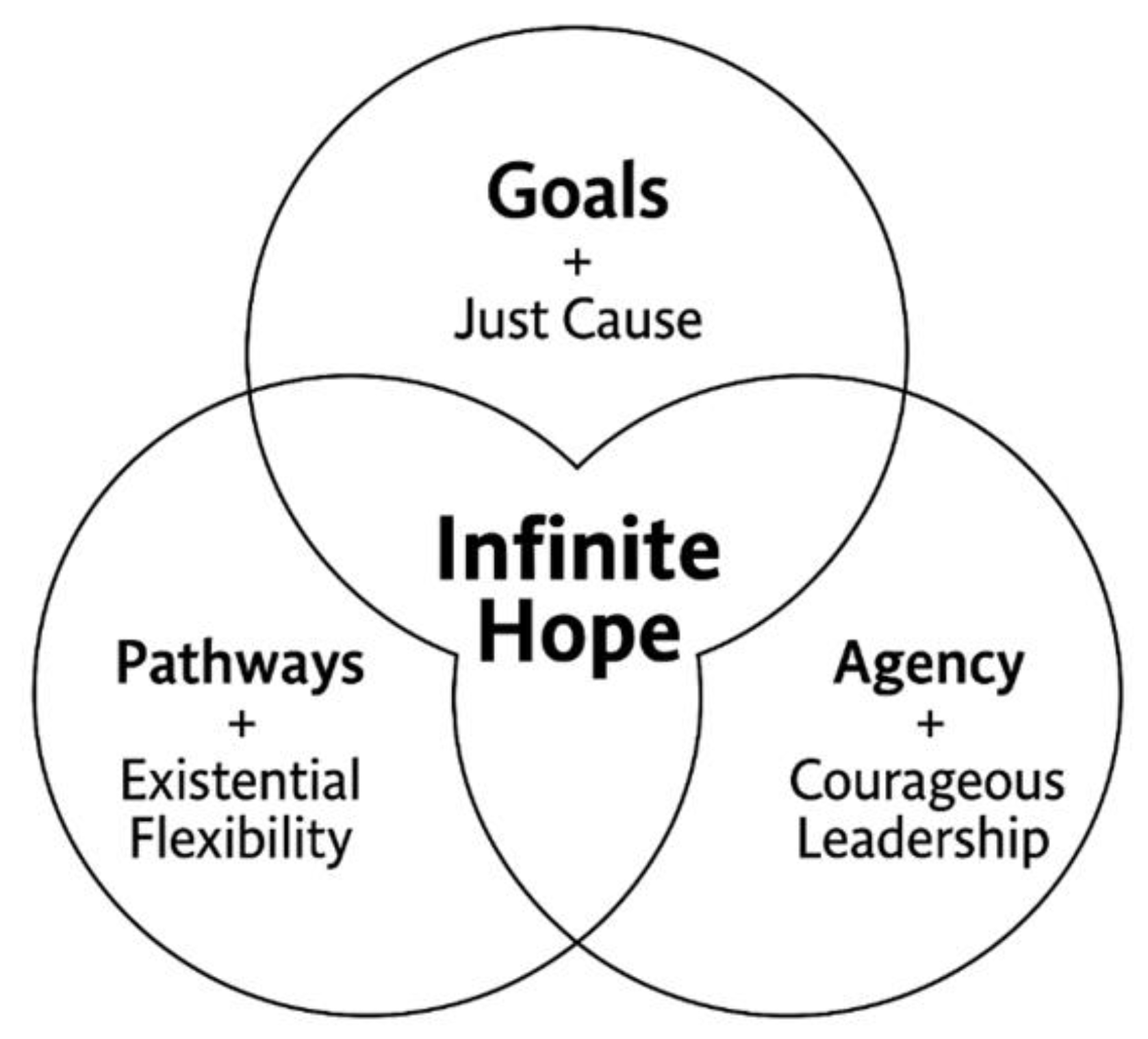
Figure 2.
The concentric circles model depicts the progression from individual hope and mindset elements (outer ring) through integrated processes (middle ring) to the phenomenon of Infinite Hope (center).
Figure 2.
The concentric circles model depicts the progression from individual hope and mindset elements (outer ring) through integrated processes (middle ring) to the phenomenon of Infinite Hope (center).
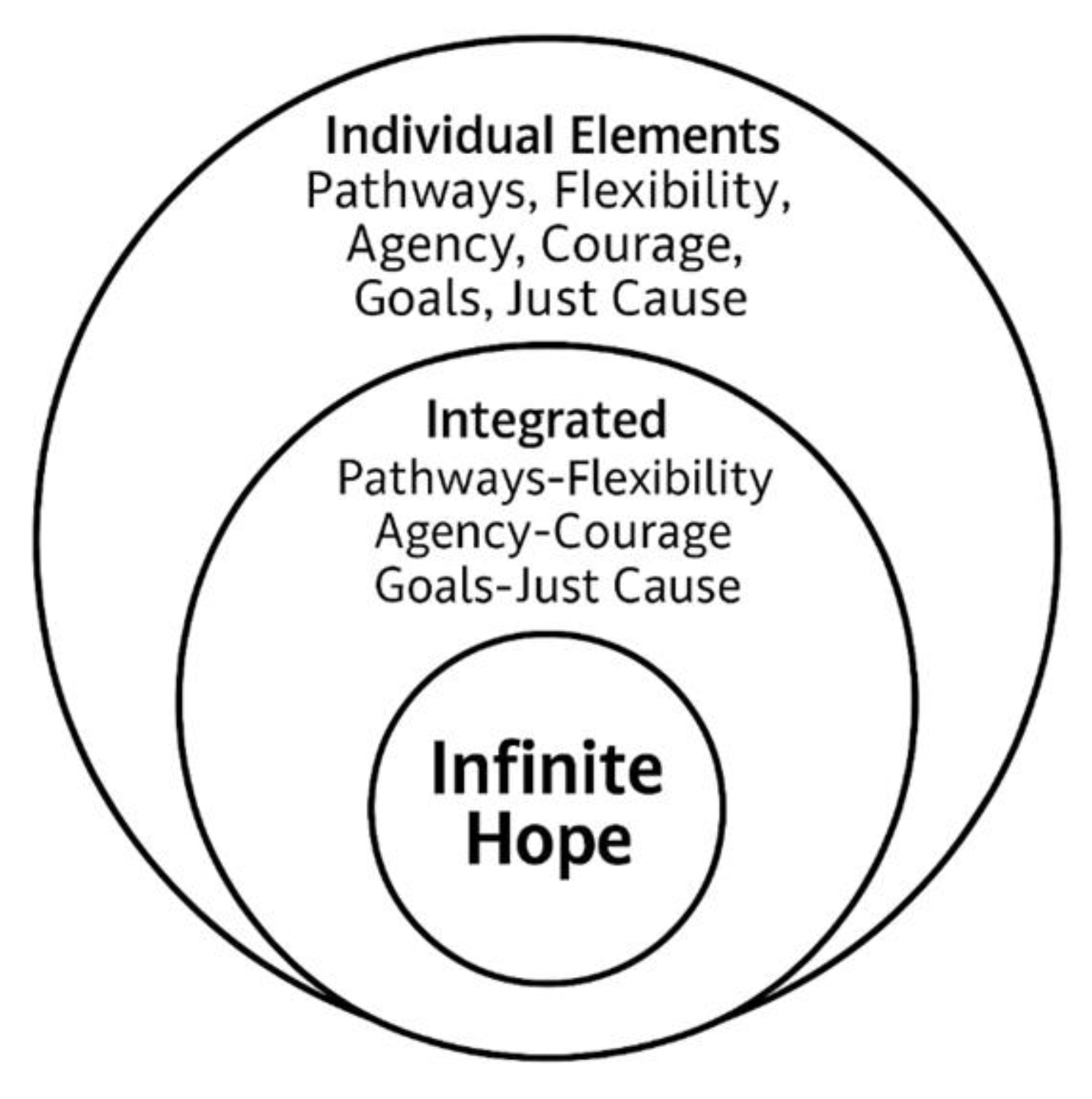

Table 1.
Narrative-review search strategy (PRISMA-lite format)
| PRISMA-lite element | Operational detail drawn from the manuscript |
|---|---|
| Review purpose | Integrate Snyder's Hope Theory with Sinek's Infinite Mindset to build the Infinite Hope conceptual framework for re-engaging disconnected emerging adults. |
| Time window searched | 2000 – 2025 (inclusive) |
| Databases queried | ProQuest Central; EBSCOhost Academic Search Premier; Google Scholar; PsycINFO; ERIC; Scopus; Web of Science |
| Supplementary search procedures | Forward-backward citation tracing; targeted manual scans of leading journals in psychology, education, youth development, and leadership studies |
| Primary search terms (Boolean combinations) | "Hope Theory" OR agency OR "goal setting" OR purpose OR meaning making OR "infinite mindset" OR "identity development" OR "disconnected youth" OR "emerging adulthood" OR "institutional disconnection" OR "collective hope" OR "narrative identity" |
| Language and population filters | English-language studies focusing on youth / emerging adults aged 18 – 25 who are disengaged from education, employment, or training |
| Records identified | 175 sources screened for title/abstract relevance |
| Full texts assessed | 92 articles and books subjected to qualitative appraisal of theoretical contribution and methodological rigor |
| Included in synthesis | 72 sources (key authors include Snyder 1994 / 2002; Carse 1986; Sinek 2019; Booker & Johnson 2024; Napier et al. 2024; Motley et al. 2024) |
| Exclusion reasons (typical) | Outside age range; non-English; opinion pieces without empirical or theoretical grounding; duplicate coverage of data already represented by a more comprehensive source |
| Outcome of review | Interdisciplinary evidence base- psychological resilience, narrative identity, employment and purpose, and structural inequity – used to construct the Infinite Hope model (Section 2.2 – 2.3). |
Disclaimer/Publisher’s Note: The statements, opinions and data contained in all publications are solely those of the individual author(s) and contributor(s) and not of MDPI and/or the editor(s). MDPI and/or the editor(s) disclaim responsibility for any injury to people or property resulting from any ideas, methods, instructions or products referred to in the content. |
© 2025 by the authors. Licensee MDPI, Basel, Switzerland. This article is an open access article distributed under the terms and conditions of the Creative Commons Attribution (CC BY) license (http://creativecommons.org/licenses/by/4.0/).
Copyright: This open access article is published under a Creative Commons CC BY 4.0 license, which permit the free download, distribution, and reuse, provided that the author and preprint are cited in any reuse.


