

Submitted:
07 August 2026
Posted:
10 August 2026
You are already at the latest version
Abstract
The western populist radical right has turned culture oriented. With this comes an increased focus on religion, particularly Christianity. Previous studies tend to see the relationship between the populist radical right and Christian theology as a case of hijacking where religion is abused. This review article takes another perspective and analyses the relationship between Christian theology and practice on the one hand, and the populist radical right politics as strategy and style in governance. The analysis centres around five interlinked core traits of nasty politics. It is found that the strategies and styles applied by populist radical right leaders and parties in Europe as well as the US, as manifested in the core traits, are well established in Christian theology and practice. Power over thought, dualistic polarisation and persuasion are found more generally in different mainstream Christian theologies and practices. Punishment and disruption are less articulated in mainstream Christianity but are central in American evangelical Christianity. The study adds new knowledge, first from its focus on politics as strategy and style rather than politics as ideology, second from its identification of Christian influence not only within a country, but from other countries and continents through an international networked movement.
Keywords:
Christianity
; climate politics
; islamophobia
; nasty politics
; radical right
1. A Far-Right Turn in the Name of Christ?
This article is born out of concerns in the public debate how it comes that populist radical right1 leaders, claiming to advocate Christian values, of which Agape (Love) is the most central, systematically use hatred, threats and different kinds of violence to mobilise followers and govern people and societies by silencing and ostracising political opponents. US president Donlad J. Trump, associated with the radical right evangelical Christians, is well-known for publicly denigrating people and violating numerous democratic norms such as legitimacy and accountability in delivery and content of his speeches (e.g., Jamieson & Taussig, 2017; McIntosh, 2020; Ross & Rivers, 2020; Valcore et al., 2023; Vargiu et al., 2024). He actively incited violent riots at the storming of Capitolium on 6 January 2021, an act that is considered ‘state terrorism’ sine it resulted in seven deaths, over a hundred injured law enforcement officers, and over USD30 million in damage (Piazza, 2020; Zeitzoff, 2023). In October 2025, Trump signed a national security strategy saying that anyone speaking, acting or holding beliefs that are anti-American, including anti-capitalist, anti-fascist and pro-LGBTQI, will be considered a domestic terrorist.
In Sweden, the populist ethnonationalist party Sweden Democrats (SD), the second largest party in the Swedish parliament since elections in 2022, collaborates with the conservative and Christian democrat government with the aim to upgrade ‘the Swedish’ in line with the evangelical Lutheran faith (von Malmborg, 2026). At the same time SD politicians criticise and force the government to reduce financial support to free media, science and civil society. They also use hate speech and strategic lawsuits to dehumanise, eliminate and silence immigrants, journalists, scientists and demonstrators advocating nature rights, human rights, gender rights, children’s rights, social justice and international solidarity (von Malmborg, 2024, 2026). Consequently, a widespread culture of silence is growing in Swedish state agencies, in local and regional authorities and in media. People are afraid to speak up to save their jobs. If you are critical to the right-wing government’s policies and governance style you may be branded as an ‘activist’, a ‘domestic terrorist’. You may be prosecuted in court with potential imprisonment. You may lose your job. Your organisation may be suspended from financial support. You may be deported. You may not become a citizen or lose your citizenship if you are an immigrant, even retroactively.
1.1. A ‘Third Wave of Autocratisation’
These are examples from a world that witness a ‘third wave of autocratisation’ with rising political powers of populist radical right parties (Lührmann & Lindberg, 2019; V-Dem Institute, 2025). On a global level, there are fewer liberal democracies than autocracies for the first time in over 20 years, and nearly three in four people in the world now live in autocracies, which is the highest since 1978 (V-Dem Institute, 2025). With Trump/Vance and the MAGA movement in power, the US is no longer considered a liberal democracy, only an electoral democracy (V-Dem Institute, 2026). In Europe, populist radical right parties have increased their votes in every election to national parliaments in Europe since the 1980s (Arzheimer & Berning, 2019; Manucci, 2020; Mudde, 2021; Aktas, 2024; V-Dem Institute, 2024). In Hungary, Viktor Orbán, leader of the ethnonationalist populist party Fidesz, was prime minister from 2010–2026 and turned Hungary into what democracy scholars describe as the worst example of autocratisation in the world (e.g., Meléndez & Rovira Kaltwasser, 2021; Mudde, 2021; Boese et al., 2022; Silander, 2024; V-Dem Institute, 2024). Since EU-elections in 2024 populist radical right parties hold 27 per cent of the seats in the European Parliament, which have made conservative and Christian democratic parties turn far-right instead of seeking agreement with the social democrats as they used to (Keil, 2026).
Political scientists claim that the rise of illiberal and antidemocratic politics and subsequent autocratisation in the west is a democratic response to a dysfunctional liberal democracy and mainstream political parties’ inabilities to handle significant transformations or crises of society with social, economic, political and security challenges leaving a void filled by anti- or post-democratic actions becoming the ‘new normal’ (Mouffe, 2005; Mair, 2013; Brown, 2019; Mudde, 2021; Krzyżanowski et al., 2021, 2023). A democratic response in the sense that illiberal and antidemocratic parties gain political power through democratic elections. Explicitly authoritarian parties are unusual in established liberal democracies. It is more common with anti-liberal or ‘semi-loyal’ actors who claim to stand up for democracy but do not fully adhere to the liberal-democratic norms and institutions that limit executive power, uphold the freedoms of citizens and the rule of law (Laebens & Lührmann, 2021; Lührmann, 2021; Merkel & Lührmann, 2021; Schedler, 2023). More specifically, Wendy Brown (2019) and others argue that the rise of the populist radical right takes place within the contours of neoliberalism’s multifaceted attack on liberal democratic values. From the 1990s, neoliberalism has repelled demands for social justice by appealing to the freedom and morality of the market as a source of individual freedom. It sought to de-democratise the state, the economy, and society and restore the patriarchal family. Brown, and later Naomi Klein (2024) and Quinn Slobodian (2025) argue that neoliberalism from the very beginning flirted with authoritarian ideals in conflict with a robust liberal democracy. While Klein (2024) portrays neoliberalism and radical right authoritarianism as doppelgangers, Slobodian (2025) portrays the relationship as if the immune system of neoliberalism and capitalism turns against itself and creates the autoimmune disease that we call populist radical right. The radical right is not opposed to neoliberalism; it is growing within it. Particularly in the US, neoliberal fetishism for individual freedom, legitimisation of inequality, and intensification of nihilism has created an apocalyptic populism that is willing to destroy the world rather than endure a future in which white male supremacy disappears (Brown, 2019). Klein and Taylor (2026) refer to the phenomenon as ‘end times fascism’.
1.2. Christianity as a Cultural Identity Marker
Ideologically, populism, being right or left, is seen as a thin-centred ideology largely lacking in content, consistency, depth and scope beyond its distinction between the homogenous, pure ‘people’, i.e., the popular, and their ‘enemies’, i.e., the corrupt ‘elite’ or the ‘others’ (Mudde, 2004; Laclau, 2005; Abts & Rummens, 2007). The ‘people’, as understood by populists, do not encompass the entirety of the population. It is an idealisation of a people rather than the people (Olivas Osuna, 2021). The notion of ‘people’ is the central tenet of radical populism, but an empty signifier and must be constructed (Laclau, 2005, 2014). It needs content to esşblish an identity – something more than just being the anti-enemy or anti-elite ‘people-as-underdog’ (De Cleen & Stavrakakis, 2017). Since populism is protean, the ‘people’, the Volk, can be constructed and sustained in many ways through the rhetorical stories told by political leaders of a Volksgeist (peoplehood) that travels from a distant, and often forgotten, mythological past (Smith, 2003; Laclau, 2014; Katsambekis, 2022; Poletti Lundström, 2022; Taş, 2022).
To adopt an ethical content for motivating, justifying, and making the thin ideology thick, radical right populism is traditionally combined with ideas from biologism and ethnonationalism – the longing for a racially homogenous nation state (Mudde & Rovira Kaltwasser, 2013). Adopting identity markers such as race, ethnicity and gender, the populist radical right focused on the idea of ‘white male supremacy’ from World War II and onwards to the 1990s (Aktas, 2024). Inspired by Alain de Benoist’s ideas of a ‘French New Right’ and later a ‘European cultural renaissance’ (Arvidsson, 2019; Sedgwick, 2023), as well as the US populist radical right movement established in response to the liberal 1968 movement (Hunter, 1991), populist radical right parties in Western Europe have turned increasingly culture-oriented, with Hungary as the worst example (Lochocki, 2018; Lamour, 2022; Poletti Lundström, 2022; Beuter & Kortmann, 2023; May & Czymara, 2024).
Being culture-oriented, they adhere to the Breitbart Doctrine that ‘politics is downstream of culture’. This implies that culture, in a broad sense, rules politics more than politics rules culture. Accordingly, western populist radical right parties claim that the national culture is what defines a nation and its people. Based on works of British nationalist political philosopher Roger Scruton (2004), western populist radical right parties now act in concert to counter oikophobia, i.e., the contempt for one’s own culture and cultural heritage (cf. Lehmann, 2013; Niklasson & Hølleland, 2018; Blokker, 2022; Volk, 2022; Bleik, 2026). European radical right parties have also turned to the US populist radical right, intertwined with the evangelical ecosystem of churches, schools, law schools and finance, and thinktanks like the Heritage Foundation, for intellectual support in developing a metapolitical practice (politics on politics) and political discourse, strategy and style, including narratives on a culture war to end the ‘left-liberal hegemony’, which is claimed to breed oikophobia and corrupt culture (Bures, 2023; Lo Mascolo, 2024). To be considered a citizen and legitimate member of a national society, one may have different skin colour but one must align with Christian culture, focusing on beliefs, values and behaviours told to be legitimate by the leaders.
With focus on culture, religion has become an important identity marker in contemporary radical right populist cultural discourse (Hunter, 1991). Religion as a moral belief system with claims to truth about the world lies at the heart of culture and said to provide a convincing moral claim to trigger the self-righteous indignation necessary to construct, define and mobilise the authentic ‘people’ against the alien ‘other’ (Arato & Cohen, 2017). Populist radical right parties such as Fidesz in Hungary, Alternative for Germany (AfD), Austrian Party for Freedom (FPÖ), Dutch Freedom Party (PVV), Fratelli d’Italia (FdI), Sweden Democrats (SD), Reform UK as well as the Tea Party and MAGA movements in the US have long claimed that they defend Christian identity and values. To them, the identity of people in terms of Christian culture is tantamount. For instance, the influence of Catholic, eastern orthodox and particularly evangelic Lutheran Christianity on European populist radical right politics is notable in structuring antagonism towards Islam and the alleged ‘islamisation’ of the European space (Montgomery & Winter, 2015; Wodak, 2015; Mudde, 2017; Zúquete, 2017; Minkenberg, 2018; Arvidsson, 2019; Poletti Lundström, 2022; Vaughan, 2024). The politicisation of religion and the sacralisation of politics (Zúquete, 2017), found in western populist radical right parties’ view on the relation between politics and religion, are two discursive ideal types around which Viktor Orbán constructed his Christian-based narratives (Lamour, 2022). This is also evident in Sweden (Vahter & Jakobson, 2025), where the populist ethnonationalist SD is the second largest party in the national parliament since 2022 and supports the current conservative Tidö government on the condition that they largely dictate and can veto government policies in areas said to ‘undergo a rapid paradigm shift’, of which climate, crime and migration are deemed high priority (Rothstein, 2023; von Malmborg, 2026). As part of its politicisation of religion, SD has increased its focus on transcendental religion and its campaigning in elections in the Church of Sweden.
1.3. Nasty Politics of the Populist Radical Right
Besides dividing society in the ‘people’ and the ‘others’, radical right populism largely holds an authoritarian or even totalitarian view on political governance, i.e., politics as strategy and style used to gain and maintain political power to change and govern people and society and eradicate the ‘left-liberal hegemony’ (cf. Moffitt & Tormey, 2014; Moffitt, 2016; Müller, 2017; Ostiguy, 2017; Olivas Osuna, 2021; Mudde, 2024). Different strategies and tactics of authoritarian or totalitarian governance are used to define the ‘people’ and the ‘others’, but also to mobilise people to the ingroup and eliminate the outgroup. Historically, we can think of fascism in Hitler’s Nazi-Germany, Mussolini’s Italy and Franco’s Spain (Paxton, 2004), but few scholars would use the concept of fascism to describe contemporary populist radical right authoritarianism or totalitarianism.
Instead, the concept of nasty politics with nasty rhetoric is used to analyse political leaders’ strategic and systematic acts of hate speech and other hateful and threatening acts, including administrative, economic, legal or even physical violence for political purposes, but also state budgeting, and governance of state authorities and state-owned companies, to denigrate, delegitimise, dehumanise and silence political opponents (Zeitzoff, 2023). Recent studies of populist radical right governance in the US and Sweden shows that nasty politics and rhetoric is not a marginal issue, but really at the core of the populist radical right’s culture war on the so-called ‘left-liberal hegemony’ (Zeitzoff, 2023; von Malmborg, 2024, 2026; Nieman, 2025). It is an explicit strategy of populist radical right leaders now in power in these countries to invoke an iconoclastic paradigm shift in culture, politics and governance by silencing and eliminating political opponents. The contemporary radical right use different rhetoric and methods from those of the twentieth century (cf. Laclau, 2014; Mondon & Winter, 2020; Mudde, 2024).
1.4. Aim and Outline of the Paper
As elaborated in sections 2.1-2, most research has analysed the influence of religion and Christianity on western populist radical right politics in terms of cultural identity marker and ideological content. In comparison, the relationship between Christianity and politics of the populist radical right as strategy and style related to governance of people and societies is left out or dealt with only briefly in previous studies of radical right civilisationism and the populist radical right’s relation to religion (Brown, 2019; Mudde, 2019; Stewart, 2020; Klein & Taylor, 2026).
In his study of Christianity as a nodal point of Viktor Orbán’s populist radical right discourse in Hungary and internationally, Lamour (2022) found that Christianity not only was central in shaping a strategically adjusted ‘us vs. them’ antagonism and key in organising a hegemonic struggle in the public sphere around ‘Christian Democracy’ as a floating signifier, but also a basis for his populist, nativist, and authoritarian positioning. The two first points confirm many previous studies, but the finding on authoritarian positioning indicates that Christianity is used also to influence the populist radical right’s approach to governance, i.e., how they govern and why they govern in this way. Adding to the growing literature on interrelations between Christianity and radical right populism, this paper aims at analysing the similarities between the nasty politics of contemporary populist radical right in the west and Christianity’s influence on politics as strategy and style (cf. Moffitt & Tormey, 2014).
Next section reflects on previous research on interrelationships between Christianity and the populist radical right. It also elaborates the aim and outline of the study. Section 3 presents the theoretical context of the populist radical right’s culture war and the role of emotional governance and nasty politics to win such a war. Section 4 analyses how the core traits of nasty politics are manifested in populist radical right politics and governance and in Christian theology, culture and practice as strategies and styles to govern people and change society. Similarities and relationships between the core traits in radical right populism and Christianity are analysed and discussed in section 5, while section 6 draws conclusions on the influence of Christianity on populist radical right politics as strategy and style.
2. Research on Christianity and the Populist Radical Right
Scholars from different disciplines have analysed the interrelationship between Christianity and the populist radical right (see e.g., Marzouki et al., 2016; Arato & Cohen, 2017; Strømmen & Schmiedel, 2000; Fridlund, 2021; Morieson, 2021; Poletti Lundström, 2022; Lo Mascolo, 2024). Most studies claim that the populist radical right hijacks Christianity, while a few find that Christian theologies can fit well with radical right populism.
2.1. Rivalry and Hijacking of Christianity
Many scholars have analysed and generally criticised the populist radical right’s reference to religion and Christianity to define national culture (see e.g., Montgomery & Winter, 2015; Marzouki et al., 2016; Moffitt, 2017; Strømmen & Schmiedel, 2000; Morieson, 2021; Strømmen, 2021; Beuter & Kortmann, 2023; Lo Mascolo, 2024; Engelhardt, 2026). Most of these critical studies describe the relation between religion and radical right populism, between theology and political ideology as a competitive relationship in terms of legitimacy and ultimate authority. They are incompatible rivals, with religion being exploited by populist radical right parties who leave out the Christian ethos.
For instance, the ontology of populism is secular, while that of monotheistic salvation Christianity is not (cf. Brubaker, 2012). Populists focus on the sovereign people and, once in power, the leader as the acting sovereign representative put in the place of the people. Christianity, on the other hand, focuses on a transcendent sovereign deity, an otherworldly lawgiver whose earthly high priests are religious figures, not politicians. From the perspective of Christian theologians of churches, the near deification of the sovereign people and of their leader as the quasi-sanctified vessel and instrument (prophet), of their message (good news), is tantamount to idolatry, thus blasphemy from a theologian point of view (Arato & Cohen, 2017). Moreover, the conflation of the flag and the cross by populist identity politics not only entails belonging without believing, it has a secularising logic (Roy, 2016).
Critical scholars thus argue that opportunistic radical right parties hijack, exploit and abuse religion in an unfair way to fulfil different roles in different populist discourses, e.g., to define ‘the people’, ‘friends’ and ‘enemies’ in nations (Brubaker, 2016; Gorski, 2017). The populist radical right’s use of religion for political purposes is perceived as inappropriate and must be considered to clash with theological tradition when populists cherry-pick bits and pieces (DeHanas & Shterin, 2018). Radical right populists take what they find and need from a given religious tradition as long as it can serve their political purposes, e.g., they use the Scriptures symbols rather than texts to be read and interpreted (Strømmen, 2021). Thus, many scholars claim that populist radical right adheres to ‘Christendom’ or ‘Christianism’ – the invocation of a civilisational discourse requiring the return to and protection of Christian or Judeo-Christian spiritual foundations of the religious heritage of the West as a whole – rather than Christianity (cf. Montgomery & Winter, 2015; Roy, 2016; Gorski, 2017).
With such an analysis, SD’s reference to membership in the Church of Sweden as a basis for Swedish citizenship is a reference to Christianity as a cultural symbol rather than a strict religious affiliation (Moffitt, 2017). Christianity is used to fill the empty signifier with content. SD and KD refer to Christian or Judeo-Christian values to define ‘Sweden’ and ‘Swedish culture’ with a simple and easily recognisable set of symbols, codes of conduct and attitudes that can easily be used to distinguish friends from foes, the ‘people’ from the ‘others’ (Fridlund, 2025). In the run-up to Swedish general elections in September 2026, SD claims that you cannot be Muslim and Swedish, using Christendom rather than Christianity to block the ‘Islamisation’ of Swedish public space.
The questioning of populist radical right policies’ compliance with Christian values is also found in the public debate. Internationally, Pope Leo XIV denounced political communication and rhetoric based on prejudice, resentment, fanaticism, hatred, and aggression.2 Before becoming Pope Leo XIV, Cardinal R.F. Prevost dismantled J.D. Vance’s, a convertite to Catholicism, claim that Christians should love their family first, then their neighbours, then their community, then their citizens, and lastly the rest of the world. He stressed that Jesus does not ask us to rank our love for others,3 and claimed that Vance’s claim was a profound distortion of catholic Christian theology. In Sweden, the views of SD on religion and Christianity have been described as corrupt and in conflict with the values of the Church of Sweden (Gerle, 2010; Halldorf, 2026). Later, not only oppositional politicians but also theologians and high representatives of different Christian churches were critical to party leaders of SD and KD who thanked the Israeli government for “doing the dirty work with Muslims” as a response to Israel’s genocide in Gaza. While SD and KD claim that new legislation implying (i) the strictest migration legislation in the EU, with a sharp reduction of asylum immigrants, (ii) deportation of children and teenagers born in Sweden by immigrants to countries they have never been to, and (iii) retroactive revocation of permanent residence permits for people not living according to ‘Swedish standards’, is coherent with Christian values, the critique towards SD and KD referring to Christian values intensified. Their views on religion and Christianity and their interpretations of the Bible have been described as corrupt and in conflict with Christian values by several bishops and the archbishop of the Church of Sweden, the bishop of the Swedish Catholic Church, as well as leaders of the Pentecostal Church of Sweden and the Equmenian Church of Sweden.
The fact that Swedish church leaders from a wide range of Christian denominations are now raising their voices against the Tidö parties’ migration policy is both a sign of continuity and of something new. Religious leaders have always driven public opinion on social issues they have seen as particularly distressing, including in relation to politics. What is new in this wave of debate is how they formulate themselves. Since populist radical right politicians have introduced religion as an argument, Christian clerics can also let their voices be heard – not through secular euphemisms, but with theological arguments.
2.2. Affinities Between Christianity and the Populist Radical Right
While not denouncing that the radical right may hijack Christianity for some purposes, Fridlund (2021) finds that many scholarly and clerical analyses describing the populists’ hijacking of religion rest on unspoken premises about what religion is and how theology works. They make a distinction between Christian civilisation and culture on the one hand, and Christian faith and Christian life on the other, he claims. Radical right populists’ emphasis on culture is presented as suspect since many scholars (of religion) regard Christian faith as something more religious, more genuine, more profound than a Christian culture. On the contrary, Swedish historian of religion Stefan Arvidsson (2019) argues that since culture contains existential, socially constructed and strong emotional aspects, there is no major difference between culture and religion. Religion as heritage rather than belief (Lehmann, 2013). This is particularly true as the transcendental religion’s focus on humans as embedded in social, worldly and cosmic contexts has been replaced by more immanent ‘religion’, where modern people live in a disenchanted world, a secular society and without contact with cosmos (Pettersson, 2009). But church-oriented religion is often as important for secularised peoples’ perceptions on various moral issues as it is in countries where transcendental religion has a much stronger position (Wilson, 2016; Sacks, 2025). Thus, transcendental religion cannot be ruled out when trying to understand socio-cultural practice. Some scholars also reveal how secularism and religion are intertwined, and what is called secularism in western societies is culture marinated in Protestant Christianity (Norocel & Pettersson, 2022; Svenungsson, 2023). This explains why populist right-wing parties in Western Europe stress the unique status and role of evangelical Christianity in their various societies (Calvinist in Switzerland, the Netherlands and the UK, and Lutheran in Germany, Scandinavia and the Baltics), but deem Islam not to fit in.
Regarding the widespread view that the populist radical right hijacks and abuses Christianity, Hinlicky (2025) provides important insights into the iterations of Lutheran theology. He argues that theological dissociation of the Reformist doctrine of justification from the doctrines of reconciliation and the redemption of creation opens for disappearance of the doctrines of God and Satan and with it the apocalyptic frame of early Christian theology. This in turn opens for anthropological reduction and political abuse by partisan power zealotries. The doctrine of Satan can easily become pretext for demonising opponents, while the doctrines of reconciliation, redemption and God can easily be substituted with “a partisan political agenda to launch some holy war against a tangibly ‘godless’ power in place of the precious proclamation of the justification of the ungodly by the costly grace of the crucified Christ” (Hinlicky, 2025, p. 218). What Hinlicky pinpoints is a deficit in the neo-platonist Western doctrines of justification and God, that we no longer use the word ‘God’ as a proper name of the creator, but only as a title. The God of the gospel is named “freely and joyfully as the eternal Father who pours out his Spirit upon his only begotten Son so that we, united with the Son by the endowment of the same Spirit, return praise and thanksgiving to the Father forever” (p. 220).
It is an indispensable part of all theology to emphasise certain things at the expense of others. And there is not one Christian theology. Thus, it is misleading to distinguish between Christian faith and Christian culture in analyses of how Christianity influences the populist radical right (Jödicke et al. 2013; Fridlund, 2014). A religion or a political ideology cannot survive if it does not interact with others and cannot claim to be above everything (else) in every situation. For instant, different versions of Christianity has developed in tandem with different empires, crossbreeding each other. First the Roman empire, later the German and British empires. The Reformation led not only to development of Protestantism but had great influence also on the development of the Catholic church (Rahner, 2017). In addition, one must not forget that the Reformation was not only based on theological critique of the Roman church, but also a critique of the central role the Roman church played in Europe, acting as the main force for unity and pacification among the diverse and competing forms of political authority that characterised the late medieval and early modern period (Edwards, 2007). The Reformation was political as much as religious. Thus, Fridlund argues, Christian theology cannot be held irresponsible in general when it comes to how populist discourses are formed. He concludes that analyses that include religion as a factor that shapes populist radical right politics will gain from entering dialogue with theology to better understand what is at stake and in what way an argument can be made (Fridlund, 2021). Which theology or theologies are we talking about? Christian theologians must be aware of the potential populist slant when developing their understanding of Christian belief and practice.
Arato and Cohen (2017) also call for more critical analysis and argue that there are structural similarities which could explain the affinity between western populism and religion. They mention an elective affinity with certain Christian ideas or tropes, often apocalyptic. The portrayal of the world as a disaster and the country as lost in the wilderness, talk of an existential crisis and the need to ward it off, the theme of an impending doom, the need to ward off evil others, to purge the people of corrupting blood, and of sacrifice, are all tropes borrowed from Christianity by the populist radical right (Arato & Cohen, 2017).
Analysing more in-depth different Christian theologies and their influence on the populist radical right in Germany and Sweden, Fridlund (2021) finds that Christian theology and practice can work very well and very smoothly together with or as part of populist discourses on essential points. Brown (2019) comes to the same conclusion regarding the populist radical right in the US. Some Christian theologies, particularly evangelical theologies, lead to, or at least opens for, much of what the populist radical right stands for. The reformist tradition contains thought figures, threads of thought, reasoning and understandings that can nourish and support populist radical right populist discourse and practice.
Fridlund (2021) mentions the reformist theologies developed by Calvin in the 16th century and later developed by German theologians Hirsch and Althaus in the 1930s. Particularly Hirsch and Althaus perceive humanity as being made up of different communities of people. Each people has a unique vocation that can only be realised by the people themselves, and each people has a responsibility to nurture the special qualities entrusted to the people (Lind, 1975). To Hirsch and Althaus, contradictions between peoples and races are simply an expression of the diversity of God’s creation (Lind, 1975). To Hirsch, it is not possible to contrast German folk tradition with evangelical faith. Evangelical Christianity, he argues, has always been influenced by German tradition, but also that the reverse is true (Lind, 1975). Scott (2017) further this discussion by analysing the relationships between nationalism and early reformation in Germany (Lutheran evangelicalism, further influencing the reformation in the Baltics and Scandinavia) as well as Switzerland (Calvinist evangelicalism, further influencing the reformation in the Netherlands, England and Scotland and the development of the Anglican church). Berggren (2007) also finds that evangelical Lutheranism opens for an integration of Christian and fascist worldviews, especially with the respect to the concept of ‘clerical fascism’. In all, Christian theology can be a constructive resource in critical analyses of populist politics that do not focus in the two as rivals.
Similarly, brothers Markus Lundström and Tomas Poletti Lundström (2026) have recently analysed the links between the Pentecostal church in Sweden and the Swedish radical right. They show how Lewi Pethrus, founder of the Swedish Pentecostal movement and the Christain Democratic party admired Hitler. Pethrus argued on theological grounds that the Nazis’ treatment of Jews was part of God’s plan.
Analysing why Christians sometimes ally with radical right populists, e.g., in mobilising against Islam, Roy (2016) finds that it is part of a project aimed at (re)Christianising a post-secular society in which Christian religious symbols and values become omnipresent and trigger a new spiritual dynamism within the churches animated by new generations of believers. Compared to Europe, religion is more alive in the US, with evangelical Christians now constituting the populist radical right core of the Republican party. Following a Deuteronomistic theology brought with the Puritans, the Christian conservative right has long worked to infiltrate the Republican party, although without taking leading positions (Gorski, 2017). While leaders in the American evangelical movement supported Trump early on, sophisticated theologians did not, and the former can be seen as political-religion entrepreneurs rather than serious religious thinkers (Goldberg, 2017; Gorski, 2017). Others show that Trump was ‘hijacked’ by the evangelicals, particularly their ‘legal army’ Alliance Defending Freedom (ADF), the Tea Party and other groups in the conservative religious right before and during his first term as president (Williamson et al., 2011; Marzouki, 2016; Goldberg, 2017).
As discussed by Wendy Brown (2019), American evangelicalism claim that the secular, egalitarian and inclusive society and liberal democratic state threatens the liberty of Christians in public and commercial life, and acts broadly, including financing training of lawyers, to (re)Christianise culture by challenging US political and legal institutions, e.g., to dismantle abortion legislation, transgender protection and battle same-sex marriage (cf. Hackworth, 2012). The Trump administration eventually embraced the commitments and strategies of ADF. Centring civil liberties and illiberal views on peoples’ rights as vehicles for expanding conservative Christian morality into the public sphere, evangelicalism politicise and weaponise morality, which according to Brown (2019) alters the meaning of morality and the mode of governance. People are no longer free to voluntarily conform to morality but are forced to adopt and align with conservative Christian morality.
A similar development is seen in Europe, where the populist radical right systematically uses a conservative reading of Christianity and reference to Christian traditionalism as a source of moral legitimacy and demarcation tool towards Islam as well as cultural liberalism (Akkerman, 2015; Marzouki et al., 2016; Sedgwick, 2023; Engelhardt, 2026), and Orbán tried to redefine Christian democracy (Lamour, 2022). As analysed by Svenungsson (2020), anthropologists and historians have drawn attention to cultural and ideological bias of religion, revealing its roots in early modern European history. Analysing the relationships between religion and politics, we must rethink how we use religion as a category for organising social and political life. If religion is “seen as part of specific discursive practices, then we need to critically ponder the implications of the ways in which we map certain customs, behaviours and motifs as ‘religious’ and others as ‘secular’” (Svenungsson, 2020, p. 785).
2.3. Christianity and the Populist Radical Right’s Political Governance
Previous research shows that Christian theology and culture may influence the content of populist radical right ideology and policies, symbolically or materially. As indicated by Brown (2019), it may also influence the strategies and performative style of governance of the populist radical right. For instance, both Christianity and the populist radical right focus on the wisdom of a higher ‘deity’ as the only source of knowledge, the ‘Only Truth’, and they convince their followers to align with this ‘Only Truth’ to reach ‘salvation’. In convincing people that the populist radical right world view is the only true one, they use Christian tropes and ideas in the emotional narratives communicated by a charismatic leader, e.g., the portrayal of the world as a disaster, talk of an existential crisis (even if there is no real crisis) and the need to ward off evil others (Arato & Cohen, 2017). By weaponising morality, religious identity politics helps moralising the ‘people’ and demonising the ‘others’ as immoral (Brown, 2019).
2.4. Notes on Method and Theoretical Frames
Sharing the perspectives of Arato, Cohen and Fridlund that Christianity can influence radical right populism materially, and looking deeper into the radical right’s weaponisation of Christian morality highlighted by Brown, this review article analyses theoretically the similarities between Christianity and the populist radical right’s nasty politics, i.e., ideologically and culturally induced political strategies and performative styles used by populist radical right leaders and parties in their governance to gain and maintain power in a culture war to eradicate the ‘left-liberal hegemony’ and disrupt status quo in society (cf. Hunter, 1991; Laclau, 2005; Mouffe, 2005; Pappas, 2012; Olivas Osuna, 2021; Pasieka, 2022; Bures, 2023; Worth, 2024).
More specifically, the article explores and analyses the similarities between Christian theology, Christian culture and Christian practice on the one hand, and the strategies and performative styles used by populist radical right leaders and parties in relation to five core traits of nasty politics to govern people and societies:
- Power over thought
- Dualistic polarisation
- Persuasion
- Punishment
- Disruption
These core traits are identified from previous research on nasty politics in Israel, Sweden, the US and the Ukraine (e.g., Zeitzoff, 2023; Nieman, 2025; von Malmborg, 2026), and from research deconstructing populism (Olivas Osuna, 2021). Nasty politics is contextualised and described in section 3, while the core traits are described and analysed in section 4. For each core trait, the characteristics of populist radical right politics and governance with the same topics in Christian theology and practice, as analysed by theologians and scholars of history, anthropology and sociology of religion. As claimed by scholars of anthropology and sociology of religion, Christianity cannot only be defined from theology, but also from how theology is used (e.g., Lehmann, 2013; Barker, 2014; Bialecki, 2014; Robbins, 2014).
Fridlund (2021) finds that many scholars and clerics analysing the links between populism and religion are unspecific about what religion is and how theology works when they criticise the radical right populists for abusing Christianity. Defining what is meant by ‘religion’ and ‘Christianity’ is not an easy task. This study acknowledges that there is not one Christianity or Christian theology. Having developed out of competing versions of early Christianity, the Roman catholic church overthrew other versions of early Christianity, e.g., Gnosticism, and dominated spiritual life in Europe for well over a thousand years, until the early 16th century, when Martin Luther and his allies in the protestant Reformation broke away from Catholicism and translated the bible into the language of the people (Abramson, 2012). The result was a veritable explosion of new ideas and churches with conflicting opinions about the interpretation of various biblical texts. Founders of various Protestant Christian churches have, like populist radical right leaders, cherry-picked their favourite parts and attached importance to the selected texts of the bible that they believe fit their own purposes in relation to their personal views on the nature of Christian social institutions, social and political processes, space-creating practices, and constructions of gender (Robbins, 2014). But the leaders have also drawn on their personal views on the institutionalisation of religion in the contemporary world and their various political-economic situations throughout history (Hann, 2014). This explains why many theologies and interpretations of the Bible conflict with each other and sometimes go against Jesus’s main message of Christian agape as interpreted in Catholicism, Eastern orthodox Christianity and Protestantism. As a result, Christianity has developed into a religion with several churches and a plethora of opinions on what are the most important points of faith. Thus, radical right populists cannot be said to simply misuse and abuse the Christian theology, belief or tradition, because there is none.
Analysing the Scripture as a source of morality for ‘Christian’ populist radical right politicians, it must neither be ignored that the Bible is a collection of texts written with political overtones by different authors in different places at different times and in different contexts (e.g., Abramson, 2012; Wright, 2023; Shepherd, 2024). Many of these have later been revised with political overtones in different contexts, and then brought together into a whole, also in a particular context and with political overtones. New research in the history of religion suggests that the Old Testament, the Hebrew Bible (Tanakh), was written for the political purpose of supporting the Jewish Maccabees’ struggle for Jerusalem by creating a nation, ‘Israel’, and political propaganda about a people with a national identity (Abramson, 2012; Wright, 2023). The first ‘Christian’ texts were later written to spread the message of the law of Moses, the Messiah, the holy war and a theocratic world domination. In the early second century (CE), at the behest of Roman Emperor Hadrian, the Gospel of the Messiah (Diatessaron) was written to pacify the warlike Jewish Christians in the war against Rome with the message that Jesus was the Messiah they fought for, and that he had already fulfilled all the prophecies in the Tanakh. At the end of the second century (CE), Irenaeus of Lyons created Roman Christianity’s own historiography through the New Testament and the biblical canon, the Epistles, as well as Paul as Christ’s Apostle to the nations. The purpose was to take power over Roman Christianity (Wright, 2023). At the same time, gnostic texts like the Gospel of Thomas, written in the first century CE, were hidden as they presented a version of Jesus that did not fit with the canonical gospels and the letters of Paul Pétrement, 1990; Valantasis, 2009; Patterson, 2012). Recent studies of the development of modern Christianity suggest that institutionalised Christianity is a doctrinal religion developed to control and discipline people. While Jesus, as described in the Gospel of Thomas, asks people to practice what he practiced and to change their way of life, the canonical gospels of the Bible and the Pauline letters told people to believe in Jesus and his divine status (Wright, 2023). Once Jesus is made the object of worship, external theological object, rather than the model for practice to access your own interior, a problem is created that requires an institution with authorised custodians to solve. The architecture of institutional Christianity – the hierarchy, the priesthood, the councils, the sacraments, the creeds etcetera – follows the creators of what came to be Roman Catholicism.
Tanakh, the New Testament as well as the Koran are social constructions, created with specific purposes, and should be interpreted as such. Paul always wrote his letters to a certain group of people who lived in a certain situation and in a certain culture, often very different from our own culture here and now (Wright, 2023). And his texts often try to solve some problem or crisis in the church to which he is addressing. They are not universal texts. The same holds true for Reformist theologies, which were written for religious as well as political purposes and have had a large influence on modern political philosophy (Edwards, 2007).
Defining ‘Christianity’ in this study, I draw on theologies and practices of the institutionalised Christian churches, particularly Pauline, Lutheran, Calvinist and Anglican as these are dominant in Western Europe and the US, but also theologies and practices of Christian mysticism and western esoterism, the latter developed in dialectics with mainstream Christianity. I also draw on literature in history of religion, sociology of religion, anthropology of religion, history of science, and political science. As for biblical texts, the Pauline writings are of particular relevance since Apostle Paul is considered Christianity’s first theologian and his many texts in the New Testament have played an important role in the development and spread of early Christianity and he was one of the first missionaries spreading the Gospel to non-Jews (Wright, 2023). In addition, the Corinthians and the Book of Revelation have shown to be particularly important for the radical right evangelicals and the MAGA movement in the US, and thus indirectly for the contemporary populist radical right in Western Europe.
To come up with a solid and convergent4 understanding of the influence of Christianity on the nasty politics of the populist radical right, different scholarly texts and interpretations are triangulated.
3. Culture War, Emotional Governance and Nasty Politics
3.1. A populist Radical Right Culture War
Analysing the growth and development of the American alt-right from mid-1960s and onwards, sociologist James Davison Hunter (1991) found that the moral conflicts between the antiliberal, anti-pluralist and autocratic ideology of the populist radical right on the one hand, and the pluralist ideology of liberals (broadly speaking) on the other, are so large5 that the populist radical right couldn’t win the battle with arguments based on facts and logic. They required an ‘enemy’ to fight emotionally to gain hegemony and create a culturally homogenous society (Hunter, 1991). Thus, they waged a culture war on the ‘left-liberal hegemony’ that they claimed is corrupting the Christian culture of the US. To Hunter, a culture war is a metapolitical practice – a symbolic politics – where the basic battle line is between the orthodox worldview of the radical right, which holds on to an external, definable and transcendent authority, and the liberalist progressivist worldview defined by the spirit of the modern age, a spirit of rationalism and subjectivism. While the populist radical right tells people to hold on to traditionalist ‘common sense’, liberals invite people to hold on to modernist rationality (Sedgwick, 2023). While the culture war is not won overnight, the aim is to realise an iconoclastic paradigm shift, a disruption, eradicating every sign and memory of the ‘left-liberal hegemony’ and exchanging them with new norms and institutions of the radical right that will cater for prosperity of the pure ‘people’ (cf. Hunter, 1991; Mudde, 2017; Prusac-Lindhagen, 2024).
As analysed by Mouffe (2013), the political strategies of the contemporary radical right in Europe draws largely on the writings of Nazi philosopher Carl Schmitt (1926, 1932), about the tension between the liberal logic on ‘difference’ and the democratic logic on ‘equivalence’, implying that unitary equality and equity can never be fulfilled without a possibility of inequality and inequity. Equality and equity can only be fulfilled in democracies, for the people that belong to a specific polity, the demos. From this analysis, Schmitt argued for authoritarian rule and that pluralism of ideas would shatter people and the state. Thus, Schmitt claimed, is democracy only for a homogeneous people, where the state must differentiate between ‘friends’ and ‘enemies’, and potentially ‘eliminate or eradicate heterogeneity’. The populist radical right answer to a crisis of liberal democracy is authoritarian ‘democracy’ where everyone thinks the same. There must be a cultural hegemony with a new set of emotion rules based on ‘common sense’.
Analysing fascist Italy, Antonio Gramsci (1971) explains how the cultural hegemony of the fascist rulers created emotion rules that are transferred to the dominated, who in turn interpret and accept these as ‘common sense’. To Gramsci, common sense (senso commune in Italian) is a troubling thing, not necessarily wisdom. It is the accumulated sediment of ‘taken for granted’ beliefs, contradictory narratives, half-absorbed certainties that essentially structure how ordinary people make sense of their world, often without ever quite examining how that sediment got there or whose interests it serves. Senso comune is a chaotic aggregate of disparate conceptions in which you can find anything you want. This is precisely the point also of contemporary radical right populists and central to emotional governance (Pasieka, 2022; Bures, 2023; Worth, 2024).
3.2. Emotional Governance
Emotional governance is central in reproduction of structural power and power relations between the ‘people’ and the ‘enemies’ (cf. Foucault, 1977; Mathiesen, 1978; Durnová, 2018). Emotional governance is used by leaders to change and govern peoples’ emotions and beliefs with emotion rules (Hochschild, 1983), and to enhance governance influence by altering the distribution of formal authority in cultural and institutional processes (von Malmborg, 2024). It is used more or less explicitly by leaders in emotional regimes to create and maintain, from the top down, cementing emotions and emotion rules (Hochschild, 1983; Wettergren, 2012; Flam, 2024), which aim to give individuals a sense of what is considered appropriate (right) and inappropriate (wrong) thoughts and behaviour and the circumstances in which certain emotions become acceptable. Paying attention to collective emotions as patterns of relationships and belonging (Kinnvall & Svensson, 2022), emotional governance “affords individuals with a sense of what is regarded as appropriate and inappropriate behaviour and the circumstances in which certain emotions (e.g., fear, hatred, and contempt) become acceptable” (Crawford, 2014, p. 536).
To challenge the status quo, partisans, political parties or social movements must counteract the dominant cemented emotions in an emotional regime by defining subversive counter-feelings directed at the opponents (Wettergren & Jamieson, 2006; Wettergren, 2012; Kleres & Wettergren, 2017) They must emotionally reinterpret and normatively reformulate specific aspects of social ‘reality’, demanding new, obligatory and dominant emotions and emotion rules for their members, their opponents and other relevant aspects of reality. Such subversive counter-feelings often include hatred, anger, distrust and contempt, creating dissatisfaction with the prevailing system. Injustices in the system can create destabilising feelings of cynicism and resignation, while moral outrage and anger, but also hope, defined as the sense of future possibilities, separate from self-confidence, faith and trust, can create cohesion and mobilise more members. But emotions of anger is normally reserved for those in power, why a countermovement and its members who challenge the status quo must reclaim the right to feel and show anger (Wettergren, 2012).
3.3. Nasty Politics and ‘Othering’ in Emotional Governance
To challenge status quo of the ‘left-liberal hegemony’ and gain and maintain new cultural hegemony, the populist radical right needs a new set of subversive emotion rules. Following the path of Schmitt and with Gramsci’s, Laclau’s and Mouffe’s theories on cultural hegemony, leaders of the contemporary populist radical right use nasty politics with rhetoric, narratives and discourse with demagogic language or images to affect emotions, perceptions of knowledge, belief, value, and action (Kalyvas, 2000; Roberts-Miller, 2019). These narratives are determined by viscerally experienced sentiments and a physically imagined sense of rightness or wrongness to perniciously polarise society in the homogenous good ‘people’ and the corrupt and evil ‘enemies’, the ‘others’ (Shah, 2024; Young, 2024).
Dissemination of conspiracy theories with emotional narratives of ‘disaster’ or ‘anxiety’ is a core tactics of nasty politics and the populist radical right (Kinnvall & Svensson, 2022; Törnberg & Chueri, 2025). These refer to a fictional fantasy of a constant crisis, rather than an actual crisis, that threatens to destroy the nation and the national culture. These threats are symbolic (Stephan & Stephan, 2017), perceived as an intrusion upon the worldviews and dominant status in society of particularly white male Christians. Research in psychology shows that symbolic threats predict hatred, which in turn predicts aggressive tendencies and hurting behaviour (Martínez et al., 2022). In comparison, realistic threats, i.e., threats to safety, goals or resources, give rise to anger and dislike (Stephan & Stephan, 2017), which predicts tendencies of wanting to change the ‘enemy’, not hurt it (cf. Martínez et al., 2022). While hate is a destructive force, anger is constructive (cf. Opotow & McClelland, 2007).6 Furthermore, compared to realistic threats, symbolic threats may be experienced as stable in time based on negative and non-malleable dispositional attributions towards the outgroup (e.g., Hutcherson & Gross, 2011), eliciting proportional enduring hate feelings with the prospective function of keeping individuals prepared to keep hating for longer periods (cf. Roseman & Steele, 2018). Renström et al. (2023) found that individuals reacting to threats with hate or more aggressive emotions, are more prone to affective polarisation and intergroup differentiation with increased reliance on stereotypes.
The conspiracy theories also include fake emotional narratives that these ‘crises’ and ‘disasters’ are caused by long-term mismanagement by the corrupt left-liberal ‘elite’ or other unwanted groups, such as immigrants, particularly Muslims, and advocates of ambitious climate policy (Aalberg & de Vreese, 2016; Hultman et al., 2019; Tenove, 2020; Vihma et al., 2021; Hunger & Paxton, 2022; Pawlec, 2022; Ketola & Odmalm, 2023; White, 2023; Abraham, 2024). Populist radical right leaders like Donald J. Trump, Viktor Orbán and Jimmie Åkesson portray themselves as the right leaders (Katechon) saviour of the nation and the ‘people’ and present simple quick-fix solutions like ‘stop immigration’, ‘subsidise fossil fuels’ or ‘send 13-year-old kids to prison’ to complex problems like unemployment, criminality and poverty. They further claim that the ‘enemy’, sometimes referred to as ‘Antichrist’,7 should be punished for their crimes against the good ‘people’ and its perceived grievances and social ills (Mudde, 2017). Aiming to silence and eliminate the ‘enemies’, narratives with symbolic threats to the ‘people’ are important in emotional governance by the populist radical right, as these invoke a feeling of hatred towards the ‘enemies’, a destructive will to destroy and eliminate.
Another core tactic of nasty politics is the use of nasty rhetoric with hateful, hate-filled and hate-fuelled narratives, usually based on fiction rather than facts, in speeches, texts, pictures or videos and sometimes violence to dehumanise, scare and silence the ‘others’ (Moffitt & Tormey, 2014; Moffitt, 2016; Cassese, 2021; Lührmann et al., 2020; Mudde, 2021; Pawlec, 2022; Zeitzoff, 2023; von Malmborg, 2026). These tactics are interlinked and used as a strategy to create as well as punish the ‘enemy’. Nasty rhetoric, covering soft and hard state repression, is designed to denigrate, deprecate, delegitimise and dehumanise people (Whillock & Slayden, 1995; Moffitt & Tormey, 2014; Moffitt, 2016; Cassese, 2021; Zeitzoff, 2023). Taking a socio-cultural and performative approach to populism, Ostiguy (2017) highlights the importance of affects in populism. He defines populism as the ‘flaunting of “the low”’ (p. 73), referring to an antagonistic, uninhibited and coarse style adopted by personalistic leaders. Likewise, Moffitt refers to the role of ‘bad manners’ in populist performative style (Moffitt & Tormey 2014; Moffitt 2016).
Insults and accusations brand ‘unwanted’ people and groups with negative stereotypes and illegitimate identities such as ‘vermin’, ‘paedophiles’, ‘terrorist’ and ‘communists’, while intimidations, incitements, administrative suspension, economic, legal and sometimes physical violence intends to scare people and make them silent (von Malmborg, 2026). Nasty rhetoric works holistically, where different types and expressions of nasty rhetoric do not happen in isolation, but tend to happen together and not necessarily sequentially (Zeitzoff, 2023). More threatening and aggressive rhetoric happening alongside less aggressive rhetoric. In other words, more overt forms of hate can go hand in hand with implicit, subtle forms that link up to more overt forms, but also somewhat hide and disguise (cf. McIntosh, 2020). What starts with different expressions of hate (insults and accusations) is linked to different forms of threats (intimidations and incitements), one more aggressive than the other, and further to psychological, economic, legal or physical violence. As stated by German linguist Victor Klemperer (2002, p. 15), “words can be like tiny doses of arsenic: they are swallowed unnoticed, appear to have no effect, and then after a little time the toxic reaction sets in after all”, which was later described by Hannah Arendt (1971) as the banality of evil. As for violence, “speech can and does inspire crime” (Cohen-Almagor et al., 2018, p. 38; Schweppe & Perry, 2021).
Nasty rhetoric creates prejudice against the ‘enemies’ that they are inferior, insensitive to punishment and free game. Thus, it is also used to mobilise followers among the good ‘people’, who often expands hate speech on- and offline for a combination of ideological reasons, social gratification and affective dysfunction and lack of empathy (Dunbar, 2022; Walther & Rice, 2025; von Malmborg, 2026). The deprecation used by radical right populists is a perlocutionary message and permission to the good ‘people’ to hate and use violence towards the ‘enemies’ because of their negative identities and related ‘threats’ posed to the safe, clean, Arcadian, white world that the populist radical right leader cherishes (Valcore et al., 2023). Hatred towards the outgroup becomes normalised, which can lead to persecution of marginalised groups, denial of rights based on group identities, or even acts of violence against others (Jacobs & Potter, 2000).
Psychologists find that people adhering to right-wing authoritarianism are significantly more likely to produce online hate than people with a social liberal orientation (Dellagiacoma et al., 2024). Psychoanalyst Sally Weintrobe (2021) argues in line with Wendy Brown (2019) that many wealthy people in wealthy countries, often neoliberal conservatives, are stuck in a state of exceptionalism, i.e., a specific psychological state in late capitalism where people seize to compromise. If reality or conspiratory fiction in any way challenges that perception, it is the threatening challenge that needs to be denied. Therefore, individuals or groups who tell difficult, challenging things needs to be ostracised.
Hate speech and violence is not only directed towards specific individuals or groups branded as ‘enemies’ but extends to all people in a society. Nasty politics has an intended message effect aiming to keep people in line with the new emotion rules and prevent them from participating in the public and democratic discourse (cf. Bell & Perry, 2014; Hagerlid, 2020; Ilse & Hagerlid, 2025; Marwick, 2025). People refraining from expressing opinions countering those of the populist radical right will meet less risk of being targeted with hate and violence themselves (cf. Hochschild, 1983; Wettergren, 2012; Crawford, 2014; Flam, 2024).
Nasty politics follows the very same logic as the process of Othering, central to the imperialist West’s colonisation of people and communities in Africa, Asia and the Americas, but also to the imperialist aspirations of the German, Italian and Japanese fascists during the 1920s to 40s (Fanon, 1963; Said, 1978). This process is also central to populists’ creation of the ‘people’ (Laclau, 2005, 2014). The result is a forced exclusion of the ‘other’, that can be seen as an antonym of belonging. Where belonging implies acceptance and inclusion of the ‘people’, otherness implies intolerance and exclusion of the ‘others’. It affects how people perceive and treat people who are part of the ‘normal’ ingroup, compared to those who belong to the ‘abnormal’ outgroup. This kind of politics as strategy and style, with a polarised thinking about people and human relationships and built on the idea that you can easily control the people with violence and threats of violence, dehumanises entire groups of people and can then be leveraged to drive change in institutions, governments, and societies. Consequently, the ‘others’ are marginalised, seen as less worthy, without human dignity, and with less respect and they should not have the same social, economic or legal rights as the good ‘people’ in society. It permeated Nazi Germany’s propaganda machine and is recognised in the actions of the ICE forces in the US under the second Trump administration. It is also recognised in Sweden and other European nations where, for instance, the son of the Swedish migration minister is found to be a member of a neo-Nazi fight club, and neo-Nazi groups can walk freely in the streets without SD and the Tidö government commenting it in other words than ‘bad company’. Simultaneously, they are accusing non-violent climate and pro-Palestine demonstrants of being threats to democracy and deport teenagers with immigrant backgrounds as soon as they turn 18 (von Malmborg, 2026).
4. Comparing Nasty Politics in Radical Right Populism and Christianity
The nasty politics of the contemporary populist radical right could be interpreted as fascism (cf. Paxton, 2004; Eatwell, 2017), but it also shares similarities with the strategies of western imperialist colonialism during the renaissance and onwards (cf. Fanon, 1963; Said, 1978). Thus, it is asserted that there are deeper cultural roots to nasty politics; roots that may be found in Christianity (Brown, 2019; Stewart, 2020; Klein & Taylor, 2026). Christianity has formed western cultures and societies for almost two millennia through festivities such as public holidays, Christian customs such as wedding and funeral ceremonies, celebrations, and moral values (Roy, 2013). This section explores and analyses the similarities between populist radical right politics as strategy and performative style and Christian theology, culture and practice regarding five core traits of nasty politics applied to govern people and societies. Table 1 summarises the main findings from the analysis of each trait discussed below.
4.1. Power over Thought
The first core trait of nasty politics refers to the authority, structuration and epistemology of gaining and exercising power over peoples’ thoughts (cf. Haugaard, 2021; Olivas Osuna, 2021). Power-over is often dominating, referring to situations when an agent, e.g., a political leader, makes others do something that they would not otherwise do (Dahl, 1957). As observed by Weber (1968), political authority is related to sociability and depends upon belief, which is cognitive and meaning related. To make people do what you want, you must make them share the same beliefs as you do, which also includes views on knowledge and ‘truth’ and the structuration of who has authority to claim the ‘truth’.
Regarding politics as strategy and style, ideologies can be differentiated by the way they conceive of the public interest, i.e., what people want politics do deal with, as this shapes the way governance is conceived and the role of different sources of knowledge within (Held, 2006; Caramani, 2017). Different conceptions are associated with different visions of governance models, with specific beliefs on human epistemic conditions, anthropology, and economic and institutional ideal designs (Held, 2006).
4.1.1. The Populist Radical Right and Knowledge
Radical right populism is based on a substantive conception of the public interest which focuses on content (Held, 2006; Caramani, 2017). This contrasts with the view on public interest of its main ideological antagonist, liberal democracy where the public interest builds on the aggregation and coexistence of various political visions and is represented by processes and rules of the game, i.e., competition between different interests and groups in political society (Rawls, 1993; Held, 2006).
Rhetorically, the populist argument is based on politics as an “expression of the volonté générale (general will) of the people” (Mudde, 2004, p. 543). However, while sometimes talking the language of the ‘people’, populist leaders are not responsive to popular will and do not follow opinion to get voters. Their thin ideology is based on a unitary and non-pluralist vision of society’s public interest, the Only Truth, that one or more chosen or self-appointed populist leaders or ideologists are the only rightful and legitimate interpreters of. Thus, the ‘public interest’ is a putative will of the ‘people’ and rather the ‘will of the populist leaders’ (Arato & Cohen, 2017; Caramani, 2017; Mudde, 2017; Bitonti, 2020). Central to populism, people must align with this ‘Only Truth’ to become ‘sacred’ and true members of society, the Volk. In that sense, the ‘Only Truth’, presented as ‘common sense’, is a monistic wisdom and will of the populist leaders as a higher ‘deity’ rather than the true collective will of the population (Held, 2006).
The very aim of the metapolitical culture war with its hegemonic struggle is for the populist radical right to gain power over thought to shape peoples’ norms and values and their understanding of themselves through the ‘Only Truth’ (cf. Bengtsson & Nathansson, 2018; Lamour, 2022). Populist leaders see no value in reasoning with others why they act on their own will as a constituent prince and manipulate their audience to identify with them (Kalyvas, 2000; Caramani, 2017; White, 2023). Individuals’ interests or rights may be sacrificed for the good of society (Popper, 1945). Drawing on the theories of Gramsci (1971) as well as Schmitt (1926), Kalyvas (2000) outlines the hegemonic sovereignty as an expansive and positing ‘democratic’ constituent prince, aiming, through founding, total decisions, at the overall, radical, explicit, and lucid institution of society.
Modern science invented during the renaissance has become a definitive part of contemporary culture and play a key role in liberal democracy and market economies. Opposing the principles of liberalism and liberal democracy, the populist radical right includes not only people and communities in the dualistic polarisation of politics and society (see section 4.2), but also the institutions of modernity and liberal democracy, e.g., the rule of law and the role of science as a source of knowledge. The populist radical right conceives of science and scientists as a threat to the Only Truth and the power over thought and they are usually sceptical to or even denying scientific knowledge (Agius et al., 2021; Lewandowsky, 2021). The same holds true for knowledge and reasoned opinions of experts in national agencies as well as industry and civil society. An illustrative example from Sweden is that the Tidö parties consistently choose to reduce the time periods for public consultations on policy proposals (from stipulated three months to one or two months, sometimes as short as one day), they often discriminate certain interest groups from public consultations, and they go forward with radical policy changes in migration and climate policy despite massive criticism from the public, researchers and experts in referral bodies (von Malmborg, 2024). This has been criticised by democracy experts in political science and law studies, lawyers, the Legal Council and the Constitutional Council in Sweden, but the Tidö parties do not bother.
Think also of Donald Trump who is supposedly anointed by Jesus to create the Apocalypse,8 and that he always knows everything about everything. Populist leaders present a propagandistic picture of the reality they believe in. To radical right populists, their ‘divine’ knowledge and will represent the Aristotelean intellect and Cartesian mind, as compared to the bodily ‘opinions’ of experts.
4.1.2. Christianity and Knowledge
Immanuel Kant (1793) claimed that instutionalised ‘cult religions’ as well as ‘religions of good life conduct’, thrive in the tension between the awareness of human being as the sole source of moral worth and a realistic assessment of the obstacles to their complete moral emancipation. Religion, including different kinds of Christianity, aim to guide people on their journey to moral emancipation. Despite not talking about the public interest in political terms as a basis for public policy, Christian theology and practice aim at guiding believers towards complete moral emancipation. This is very much like identifying and acting upon the ‘public interest’. In Christian political theology, as in other fundamental religious movements, the links between religion and public policy are very tight.
However, both ‘cult religions’ and ‘religions of good life conduct’ share a belief in the ‘Only Truth’ of Christian theology and institutionalised Christian churches, with God as the only source of ‘divine’ knowledge. As for moral knowledge, many biblical texts stress that believers must align their thoughts with the teachings of Christ to influence their own spiritual and moral life, shaping character, guiding actions, and determining one’s relationship with God. 2. Corinthians 10:5 speaks of the necessity of controlling one’s thoughts:
We demolish arguments and every pretention that sets itself up against the knowledge of God, and we take captive every thought to make it obedient to Christ.
People shall also be open to God taking power over their thoughts. In Romans 12:2, Paul tells “Do not be conformed to the present age but be transformed by the renewal of your mind.” French philosopher and Christian anarchist Jacques Ellul interprets the main message of Paul’s as that people should not obey the trends, customs and currents of thought that exist in the society in which they live. As Ellul (1988, p. 80) puts it, we (the people):
should not submit to the ‘form’ of them but that we [the people] should be transformed, that we should receive a new form by the renewing of the mind, that is, by starting from a new point, namely, the will of God and love.
Further insights to the denunciation of knowledge and authority other than the ‘Only Truth’ can be drawn from scholars who find that anarchism and denunciation of state authority is inherent in Christianity and the message of the Gospel (Ellul, 1988; Eddebo, 2017). When the gospels were written, the state restricted humans with laws and taxes. According to the Scriptures, human government can have no authority. God alone could be considered the supreme authority, providing the ‘Only Truth’. Ellul (1988) finds evidence for Jesus’s disdain with state authority in Matthew 4:8–9 and Luke 4:6–7, when Satan tempted Jesus to be ruler of all kingdoms of the world by offering Jesus the power and the glory of these kingdoms in return of prostrating himself and worship Satan. Ellul (1988) finds more evidence in the book of Revelation, which he interprets as a challenge to political power (p. 73):
The state is a means by which to concentrate wealth and it enriches its clients. We see the same thing today in the form of public works and arms production. Political power makes alliance with the power of money. When Babylon collapses, all the kings of the earth lament and despair and the capitalists weep.
Ellul’s interpretation is based on the knowledge that political authorities had all power over people in the Roman empire. In this context, Revelation, written as political propaganda (Abramson, 2012; Wright, 2023), promised the pure and simple destruction of the Roman political government’s power and domination in every form, stated to be enemies of God. God judges political power, calling it the great harlot, and we can expect from it neither justice, nor truth, nor any good – only destruction (Ellul, 1988).
As for sources of knowledge other than the divine ‘Only Truth’, Matthew 23 describes how Jesus denounced the scribes and the Pharisees, who in modern liberal societies can be interpreted as clergies, as the main source of knowledge. In Matt. 23:1–2, Jesus speaks to the crowd and his disciples:
The scribes and Pharisees have taken their seat on the chair of Moses. […] For they preach but they do not practice. They tie up heavy burdens and lay them on people’s shoulders, but they will not lift a finger to move them.
Jesus continues to denounce the scribes and the Pharisees in Matt. 23:23, 25 and 27, calling them hypocrites, being corrupt and standing in the way for peoples’ salvation, very much in line with the populist radical right narrative claiming that the corrupt ‘elite’ is the cause of society’s problems:
Woe to you scribes and Pharisees, you hypocrites. You lock the kingdom of heaven before human beings. You do not enter yourselves, nor do you allow entrance to those trying to enter. […] You cleanse the outside of cup and dish, but inside they are full of plunder and self-indulgence. […] You are like whitewashed tombs, which appear beautiful on the outside, but inside are full of dead men’s bones and every kind of filth.
Protestant theologian Rudolf Sohm’s reading of the Corinthians in late 19th century laid the ground for a theory of charismatic leadership, downplaying the role of learned men and wisdom, the sophists and sophistry (Iordanoglu, 2017), which can be considered as teachers in modern society.
When modern science started to develop in Europe, based on scholasticism that harmonised Aristotelean metaphysics and catholic theology and utilised dialectic reasoning to extend knowledge (Gracia et al., 2008), there were disputes about the rightful way to ‘create’ knowledge in societies – ‘science’ or theology. This dispute was ‘solved’ by Descartes, introducing a dualism between body and mind, where ‘science’ can deal with the body, and mind is handled by religion.
The narrative of the history of science has become a key element in explaining how we have arrived where we are today. Based on a few causes célèbres (celebrity cases), history of science has long contributed to a widespread myth of an endemic conflict between science and religion, particularly western Christianity (Russell, 1989). This conflict has been described as “some scientists and religious believers see themselves as locked in mortal combat: science and religion are thus at war with each other, and that war will continue until one of them is eradicated” (McGrath, 2010, p. 1). More recent research counters this myth, showing that the science–Christianity relationship exhibits all of the variety and complexity with which we are familiar in other realms of human endeavour, e.g., conflict, compromise, accommodation, dialogue, alienation, the making of common cause and going of separate ways (Lindberg, 2010; de Felipe & Jeeves, 2017). However, Luther was critical and polemical toward the dominance of Aristotelian scholastic philosophy and dialectic reasoning when it was used in matters of faith and immaterial topics (Grosshans, 2017; Kaufmann, 2017). To Luther, the Bible is the only source of divinely revealed knowledge on the Gospel. Challenging the authority and office of the pope and bishops, Luther recalled Jesus’s criticism of the scribes.
Jesus praised that the Temple is within each person, but as analysed by Lea Ypi (2017) both Kant (1793) and Karl Marx found that people facing adversity turned to God through his intermediaries, the clergy. To Marx (1844, p. 72), institutionalised Christianity’s projections to God through the clergy offers comfort as the “soul of soulless circumstances”. Kant (1793) was also worried that the belief in external support of this kind cultivates a passive attitude among people, which relies on institutional intermediaries and so-called representatives of God to compensate for human lack of initiative. This entrenches institutional domination practices that promise human salvation while only stifling the active search for the good (Ypi, 2017). According to Kant (1793, p. 200), it consolidates “the dominion that the clergy has usurped over minds by pretending to have exclusive dominion on the means of grace”.
4.2. Dualistic Polarisation
Bipolar or dualistic polarisation is the second core trait of nasty politics. Conceptions of ‘affective’ and ‘ideological’ polarisation with subtypes of beneficial versus harmful or pernicious polarisation compete against each other in describing political, public, social or other conflicts between two poles (Schedler, 2023). Pernicious polarisation is often associated with the prevalence of confrontation over cooperation, moderation and compromise, which together with other pathologies leads to ‘democratic backsliding’ (Haggard & Kaufman, 2021; McCoy, 2023). Ever since Sartori’s (1976) seminal work on partisan polarisation, most scholars in political science address polarisation as a structural phenomenon on the levels of polities, rather than a relational phenomenon addressing the dynamics of conflicts on a policy arena.
As discussed by Schedler (2023), political polarisation appears not primarily as a political phenomenon but a sociopsychological one along two dimensions – a moral polarisation between contending actors as well as their ensuing affective polarisation. Social groups facing each other in conflict are prone to develop negative attitudes toward each other: negative emotions (antipathy) as well as negative perceptions (prejudice) (Iyengar & Westwood, 2015; Kalmoe et al., 2017; McCoy et al., 2018). The polarisation is relational, not structural.
4.2.1. Good and Evil to the Populist Radical Right
A main trait to radical right populist scripture-practices and a key strategy of nasty politics is the reinforcement of dualistic polarisation of different groups, the ‘people’ and the ‘others’ (Strømmen, 2021; Zeitzoff, 2023). Adhering to authoritarianism or totalitarianism, radical right populists despise the pluralism of liberal democracy. Reducing the number of views and antagonists in politics to two initially equally strong antagonistic poles makes it easier for them to gain power over thought. They group all adversaries into one heterogenous community that they can attack in the culture war. The two poles cannot be considered social groups in conflict, but rather ‘imagined political communities’ (Anderson, 1983).
Political science literature on radical right populism often refers to Manichaeism or Manichean dualism to figuratively describe the dualistic polarisation entrenched with nasty rhetoric (e.g., Arato & Cohen, 2017; Klein, 2020; Zulianello & Ceccobelli, 2020; Somer et al., 2021). Manichaeism was a major religious movement from the late third century (CE) teaching a strict dualistic theology that postulates the ongoing struggle between a good spiritual world and an evil material world, with universe as the battleground between two equally strong opposing powers, in the universe; the good Father of Greatness and the evil Prince of Darkness (Mendelson, 2018). As claimed by Arato and Cohen (2017, p. 291), a “Manichean imaginary supports the friend/enemy concept of politics that demonizes evil others”.
Nasty politics focuses on politics as strategy and style in governance, not on political content. However, contemporary radical right populists in both in Europe and the US are polarising politics and society in four particular policy areas; i.e., (i) family policy, including gender policy, rights of women and LGBTQI rights (Akkerman, 2015; Brown, 2019; Hagerlid, 2020; Norocel & Pettersson, 2022; Weeks & Allen, 2023; Svatoňová & Doerr, 2024), (ii) climate change policy (Marquardt et al., 2022; White, 2023; Cunningham et al., 2024; von Malmborg, 2024, 2026; Weise & Camut, 2025; Coffé et al., 2026; Klein & Taylor, 2026), (iii) migration policy, including anti-Muslim racism and islamophobia (Yılmaz, 2012; Berecz & Devinat, 2017; Sager & Öberg, 2017; Lutz, 2019; Norocel & Pettersson, 2022; Hellströn, 2023; Hägerbäck & Norocel, 2024; Ardin, 2026) and (iv) international relations policy on Israel and the Middle East (Krause et al., 2022; May & Czymara, 2023; Mudde, 2024). These are described as priority issues and can be seen as battlefields in the populist radical right’s culture war. People adhering to or supporting the populist radical right’s preference for (i) Christian family values (advocating traditional families with a husband, wife and children, anti-abortion legislation, that a person can only have the sex (s)he was born with, exclusionary attitudes towards LGBTQI people), (ii) climate scepticism and non-ambitious climate policy, (iii) restricted migration, especially for people from Muslim countries, and (iv) jews, Israel and Zionism against Muslims, Palestinians and Palestine) are considered good ‘people’ and part of the Volk. On the contrary, everyone holding adversary views or having conflicting political opinions in these policy areas (e.g., gay people, trans persons, climate activists, Palestine activists and Muslims) are considered and labelled enemies to the nation that must be ostracised or eliminated (cf. Weintrobe, 2021; Schedler, 2023).
In a pluralist society and polity, people can have different ideological views on these themes, sometimes sharing the view of the radical right, sometimes not. But at its extreme, prototypical polarisation spells the end of overlapping conflicts in different policy areas. In the overarching process of political realignment taking place in the culture war of the populist radical right, polarisation creates a dividing line between them that rearranges, subordinates, or supersedes all other political divisions, why the normal multiplicity of differences in a society aligns along a single dimension and people conceive politics and society in terms of ‘Us’ versus ‘Them’ (McCoy et al., 2018). No matter if we analyse the dualistic polarisation induced by the populist radical right from an ideological or affective perspective, pernicious polarisation can be associated with the presence of existential-threat perceptions that lead to a specific type of democratic norm transgression: the treatment of adversaries as political enemies (intolerance). In addition to opposing the government, the populist radical right opposes the very system of government, the principles of liberal democracy (Schedler, 2023).
4.2.2. Good and Evil in Christianity
Compared to Manichaeism, Christianity is not based on a dualistic theology. It is monotheistic, professing a belief that creation was not the result of violence and combat between good and evil or between amoral supernatural powers, but the result of an all-good powerful God who made and sustains a good cosmos. God is good and any act in opposition to his will is evil. But there is no equally powerful evil deity in eternal conflict with God’s goodness. In keeping with Jewish teaching, Christianity teaches that evil entered through disobedience and Satan is a created evil being that opposes God’s will. (Taliaferro, 2018).
This does not imply that Christian theology does not take seriously the belief that there are life-denying forces, cruelty, suffering, death itself, all of which are deemed to be evil. The conflict between good and evil has existed in Christian theology since the Old Testament battle between Cain and Abel. To early Christians and different ‘modern’ forms of Christianity, the world has become dreadfully corrupt since its creation and that people need to be saved from it. There is an apocalyptic imagination to conceive of the world in Christianity that draws on Jewish traditions (McGinn, 1994; Brown, 2015). There is an eschatological dualism between good and evil in Christianity. This dualism originated in the writings of John and Paul, which were held as sacred scripture by early Christians. 1. John 5:19 declares, “We know that we are God’s children, and that the whole world lies under the power of the evil one”. Apostle Paul emphasised different cosmic dimensions and powers of evil described as ‘archon’ or the figure of Satan in his writings and integrated them in his worldview in a way that are directly related to the Pauline churches and Paul’s missionary efforts (see e.g., Pétrement, 1990; Brown, 2015; van Kooten, 2017; Gombis, 2018). But Satan and other powers of evil are not explicitly connected in Pauline cosmology, but rather in his eschatology. As analysed by Brown (2015), biblical and Second Temple Jewish traditions and texts refer to Satan as the origin of evil, the accuser, a ruler, and a tempter, whereas some of these roles reflect distinguishable Satan traditions in Judaism. During the Second Temple period, the Satan figure developed from a less defined role among the divine council to an apocalyptic archenemy of God. Satan should not be understood as the enemy of all humanity, but a figure that specifically opposes God’s chosen people, Israel, and plotted against key Jewish figures like Job and Moses at decisive moments in the history Israel, e.g., the binding of Isaac and the Exodus (Brown, 2015, p. 60). Brown finds parallels in the gospels of the New Testament (e.g., Matt 4:1–11 par. Mark 1:12–13 Luke 4:1–13; John 13:2), characterising Satan as the opposer to the mission of God. However, there is insufficient evidence to associate the human predicament with the figure of Satan in Pauline theology. Instead, Paul sees humanity in need of redemption from the dominion of death (e.g., Rom 5–6), which he never directly associates with Satan. This, Brown argues, indicates that early Christians believed that Satan targeted key servants of God who played pivotal roles in God’s plan, and did so at decisive moments within salvation history.
Brown’s analysis also strengthens English poet John Milton’s (1667) interpretation of Satan (Lucifer) in Paradise Lost, as God’s antagonist by bringing the light that provided humans with knowledge that could question the divine knowledge of God and liberate them. This portrait of Satan as the liberator of people was further developed by English poet William Blake (1793). According to Poole (2010), American Christians are more prone to believe in Satan than their counterparts in Europe. Among Americans, the evangelical Christians stand out, and they believe they are in constant daily combat with Satan and his demonic minions. Poole describes Satan’s stronghold over America as intrinsic to the American self, unable and unwilling to take responsibility and accountability for its own acts of aggression and violence. It is easier to blame an evil force. Notably, the US emerged as a nation in the period of Enlightenment when powerful religious movements like the American evangelicalism emerged and grew to challenge modernity (Poole, 2010). The evangelicals advocated spiritual rebirth and spiritual warfare to the forefront of American consciousness, and with this, an obsession with Satan and his power.
The American evangelicals also combined the biblical ‘conquest narrative’ with ‘dispensational millenariarism’, glued together with a rhetoric of blood sacrifice to an angry God, being a metaphor of blood that allows for the alchemical transformation of religious boundaries into racial ones, and thereby a synthesis of religious and ethnic nationalism (Gorski, 2017). In the conquest narrative, brought into America with the Puritans’ wars against native peoples (Bailey, 2011), the Israelite nation (or New England as the Promised Land) is formed through acts of violence and exclusion, not through acts of covenanting. The red thread is blood: blood spilled on the battlefield, blood spattered on the altars, and blood passed on from parents to children. Later, blood rhetoric would be used by both sides in the Civil War and by modern-day proponents of American intervention in the Middle East (Stout, 2006; McDougall, 2016).
Given the social and political context in eastern Mediterranean in the centuries before and in the common era, political authorities of the Roman empire had all power over people and used propaganda to seduce people. For authors of the Scriptures, the state and its propaganda were two powers that derive from evil, and their texts advocated the destruction of power and domination in every form, which are specifically stated to be enemies of God (Ellul, 1988). In Colossians 2:13–15, when Paul says that Jesus has conquered evil and death, he also says that Christ has “stripped of their power all the dominions and authorities and made a public spectacle of them, in triumphing over them by the cross.”
4.3. Persuasion
The polarised thinking about good and evil people central to nasty politics, and the conflict between the good God and the evil Satan in Christianity, has been and is still used in political propaganda for the people of ‘Israel’, against the Roman empire, against Jews, and against Islam, Palestinians, climate activists and trans persons to name a few. To create effective propaganda, nasty politics includes persuasion based on polarising emotional storytelling and rhetoric of charismatic leaders, demagogues (Polletta et al., 2011; Taş, 2022). The storytelling is based on conspiracy theories and hate speech to spin a good yarn containing heroes, villains and plotlines promising change (Nordensvärd & Ketola, 2021) to gain power over thought.
4.3.1. Charisma and Manipulation in Radical Right Populism
The discourse of the populist radical right, describing a nation in (fictional) crisis caused by evil ‘others’ and populist leaders as heroes that will save the nation, includes rhetoric that stress pathos and ethos more than logos. In addition, the rhetoric is often incoherent and sometimes contradictory (Slotta, 2020), full of vague concepts used on purpose (Fridlund, 2025). The aim is to present inclusionary and exclusionary emotion rules of the nation, arousing emotions such as prejudice, pity, hate or anger, but also fear, anxiety and distress. Adversaries, the evil ‘others’, are targeted with insults, accusations, intimidations, incitement and sometimes violence, vilified, delegitimised, dehumanised and excluded from the ‘people’ and the nation.
In the key battlefields of the current culture war, populist radical right leaders in Europe and the US accuse the LGBTQI movement and feminists for lower birth rates, thus threatening the rise of population and future tax base. Muslims are accused of an invasive ‘islamisation’ of the western world, wanting to erase Christianity and adopt sharia laws, while protestors to Israels genocide in Gaza are accused of being antisemites wanting to destroy Israel and all jews. Climate scientists are accused of presenting alarmistic propaganda about climate change and activists are accused of being anti-democratic terrorists for using civil disobedience (von Malmborg, 2026). As for climate politics, the populist radical right leaders have changed their rhetoric over time. Initially, they were sceptical to or denying scientific knowledge, questioning the existence of climate change or that it is anthropogenically induced, while others denied its consequences (Hobson & Niemeyer, 2012). After the Paris Agreement on climate change in 2015, which saw the rise of the global climate justice movement with Fridays for Future (FFF) and Extinction Rebellion (XR), the charismatic populist radical right world leaders such as Donald Trump and Jair Bolsonaro, but also Jimmie Åkesson, party-leader of SD in Sweden, claims that climate policy is a threat to economic growth and people’s freedom and way of life (Marquardt & Lederer, 2022; Marquardt et al., 2022; White, 2023; Brulle et al., 2024). This as a response to scientifically based claims of, e.g., FFF and XR that the whole capitalistic economic system of today is wrongly inverted (Bailey et al., 2011; Davidson, 2012) and that the climate emergency can only be halted by economic degrowth (Euler, 2018; Heikkurinen, 2021). The degrowth argument of climate justice advocates was perceived of as an intrusion upon the petro-masculine worldviews and dominant status of male white Christians in society (Daggett, 2018; Vowles & Hultman, 2021a). When climate justice activists did not end their demonstrations and civil disobedience, the radical right started to accuse them of being anti-democratic and totalitarian (von Malmborg, 2026)
In Sweden, SD and the Tidö government presented fictional disaster narratives based on a combination of anti-establishment rhetoric, knowledge resistance and emotional communication of doubt, industrial/breadwinner petro-masculinities, anti-feminism and ethnonationalism (Hultman et al., 2019; Jylhä et al., 2020; Agius et al., 2021; Vihma et al., 2021), to polarise climate politics into a dualistic discourse of the good ‘people’ vs. the evil ‘elite’, accusing the ‘left-liberal conspiracy’ including former governments (particularly the red-green governments in 2014–2022), the EU, established media, climate scientists and climate justice activists for being a threat to and ‘enemies’ of Sweden and the Swedish. In this sense, they also politicised religion and persuaded KD to diverge from the Christian democratic path of the 20th century with Christianity as a civilisational heritage to heal conflicts in a secular and politically liberal era, to a path that rejects liberal democracy (cf. Kalyvas & van Kersbergen, 2010; Lamour, 2022). In addition, SD and the Tidö government portray themselves as the heroic good guys (cf. Hellström & Nilsson, 2010), to save the nation with non-emotional climate policies based on facts (von Malmborg, 2026). Mainly attracting white older men, SD looks back with nostalgia to a great national past during the oil-fueled record years of the 1950s and 60s when men had lifelong jobs in industry and sole access to society’s positions of power (Vowles & Hultman, 2021a). This reference to nostalgia (Kenny, 2018) and a mythical past (cf. Taş, 2022) is similar to the narrative of Trump/Vance and the MAGA movement, imposing high trade tariffs on exports to the US to, as they claim, protect and stimulate American industrial production to bloom like it did in the late 19th century. When signing the US exit from the Paris Agreement, Trump also looked back with nostalgia, claiming that US oil companies now can ‘drill baby, drill’ to extract more fossil fuels like in the old days.
In mid 2010s, Swedish climate denialists and the populist radical right movement, including SD that was yet a party without political influence, accused established media of censoring the climate debate and being climate alarmist propaganda centres. Similarly, the populist radical right accused established media of belonging to the ‘left-liberal conspiracy’. SD and other ethnonationalist groups built their own ecosystem of digital media news sites, blogs, video channels and anonymous troll accounts in social media, which did not have to relate to the rules of press ethics (Vowles & Hultman, 2021b). In May 2024 it was revealed that SD’s communications office, inspired by Donald Trump and directed by party leader Åkesson, runs a ‘troll factory’. Using anonymous ‘troll accounts’ in social media, SD has deliberately and systematically spread misinformation and conspiracy theories to shape opinion, manipulate voters and incite outgroups by spreading insults, hate and threats. Åkesson has shamelessly confirmed that SD use and will continue to use ‘troll accounts’, particularly on TikTok, to avoid getting public accounts reported and closed due to their frequent use of hate and threats. A characteristic feature of the manipulative rhetoric used by populist radical right leaders is the use of hyperbole and outright lies and disinformation in accusations and intimidations on behalf of their ‘enemies’ (Tenove, 2020; Pawelec, 2022). Climate justice activists using their liberal democratic rights of freedom of expression and freedom to demonstrate, or of civil disobedience, are accused of being anti-democratic and totalitarian by the prime minister and prosecuted for sabotage instead of disobedience of law enforcement (von Malmborg, 2026). The escalation of hard state repression is cheered by the minister of justice. The previous red-green government in Sweden have been accused for more than four years of ideologically deciding to close old nuclear power plants, while in fact it was the companies owning the nuclear plants that decided to close them. The reactors closed were small and the owners deemed it unprofitable to invest in new safety upgrades required globally after the Fukushima incident.
A similar tendency is seen in politics on the Israel/Palestine conflict. People who criticise the Israeli far-right government for genocide in Gaza and raise their voices in solidarity of Palestine have consistently been accused of antisemitic activism and being members of Hamas (Ardin & Irving, 2025). The criticism of activists has often been speculative and about symbols constructed as unequivocal evidence of antisemitism, without other explanations being explored. At the same time, expressions of antisemitism tend to be trivialised if they come from others than just the Palestine movement, e.g., right-wing and radical right politicians using hate speech towards Jews.
In all, this reinforces the image that the concepts of ‘climate activism’, ‘Palestine activism’ and ‘antisemitism’ are used dishonestly as ideological tools to achieve political results. In these ways, the climate justice movement and the Palestine movement are singled out as extremists or even terrorists and made a scapegoat for Europe’s guilt of capitalism and colonialism (cf. Ardin & Irving, 2025). The persuasive rhetoric of the populist radical right manipulates and reinterprets the meaning of words and concepts based on ideological and cultural-political propaganda (von Malmborg, 2026). This applies to concepts with a normative, ethical or ideological meaning that are central in a liberal democracy (e.g., democracy, accountability, legitimacy, justice and freedom). It also applies to concepts describing people’s identity and agency to maintain and develop a liberal democracy (e.g., engagement, activism and education). Radical right populists often emphasise that they act to defend democracy, but they do not fully adhere to the liberal-democratic norms such as legitimacy, accountability and justice, nor the institutions that limit executive power, uphold the freedoms of citizens and the rule of law (Lührmann, 2021; Schedler, 2023; von Malmborg, 2024, 2026). People are easily manipulated when you pretend to use a language they understand but speak another which they do not understand (Bloch, 1971; Mathiesen, 1978). Democratic principles and concepts are hijacked so that people will believe that a populist radical right party is democratic in the liberal sense. But the concepts are fragmented and have lost their original meaning and are given completely new meanings that few members of society understand (cf. Mendoza-Denton, 2020). With a populist radical right party holding powers in Sweden in almost four years, legitimacy has little to do with public acceptance but shall now be understood as ‘according to the will of the Tidö parties’. Climate justice is now understood as ‘justice for those who use fossil fuels’; Democracy means ‘autocracy’; Activist has changed from an ‘engaged citizen advocating change’ to ‘criminal’; Learning now means education. Meanwhile, the original meanings of words such as radical, saboteur and terrorist are devalued. If pro-Palestine demonstrators or climate justice activists, sitting in a square singing, are branded as radical, and activists performing a non-violent act of civil disobedience are branded as saboteurs or terrorists, what should we then call the real saboteurs and terrorists harming property and people? Being vague on definitions of central concepts is a way for populists to gain support (Fridlund, 2025).
4.3.2. Charisma and Manipulation in Christianity
Young (2024) analysed charisma in the rhetoric of Christian groups as well as the populist radical right in the US. Traditionally, the concept of charisma is used in studies of mass communication and rhetoric to make sense of demagoguery, i.e., the effect of a particular rhetorical culture (Roberts-Miller, 2019). But Young distinguished populist from esoteric charisma that harbours an untold history of rhetoric, borne in the term’s modern appropriation from an ancient controversy on sophistic eloquence that underscores the rhetorical significance of the Corinthian epistles and the presence of sophists and sophistry in the early Christian church. This appropriation was highlighted in the works of protestant theologian, historian and lawyer Rudolf Sohm, “to write a history that undermined the catholic church’s conceit as the oldest and ‘first’ church” (Young, 2024, p. 5). Sohm argued “that the first apostles ruled, not through the force of law, but through the exercise of their divine ‘gifts’ that marked them as the appointed ones”, i.e., charisma (Haley, 1980; Young, 2024, p. 5). Sohm’s protestant reading of the Corinthians in the late nineteenth century invented two basic aspects of the notion of charisma. First, a mystical basis for legitimacy of power, as opposed to a legal one. Second, the identification of that legitimacy with a gentle, self-effacing style of leadership – “authority that mystifies itself as service” – that Paul prescribed in his famous homiletic on Christian agape (Lowrie & Sohm, 1904, p. 147).
Paul the Apostle
The stakes of Paul’s opposition to sophist eloquence in the Corinthian epistles are, in the first place, a defence of his own oratorical deficiencies compared to his rivals and critics. Those stakes can be inferred from the following passage in 1 Cor. 2:4-5:
And my speech and my preaching was not with enticing words of man’s wisdom, but in demonstration of the Spirit and of power: that your faith should not stand in the wisdom of men, but in the power of God.
The argument of the Corinthian epistles builds the import of this political rivalry into Paul’s own anti-sophistic theology and philosophy of speech. Young (2024, p. 7) summarises the rivalry identified and described by Paul:
Figuring eloquence as a charisma allows Paul to leverage two elements of first-century Corinthian culture, sophistry and patronage, against each other. To say that speech and knowledge are kinds of spiritual charismata is to argue that the value of their exercise consists in an advertisement of the divine patronage that they evidence. This refiguration, consequently, changes the quality, shape, and meaning of virtuoso speech, but it does not abolish it. Paul simply promotes an enigmatic set of rhetorical performances – the charismata– over theatrical displays of sophistic reasoning.
Sohm’s reading of the Corinthians results in charisma as a bridge between the sophistic eloquence and Paul’s new, distinctly Christian eloquence. With this figure, Paul recodes the meaning of eloquence in Corinthian culture and encourages a new relationship with it. Eloquence and persuasive reasoning based on knowledge and wisdom are devalued by Paul because they bear traces of the speaker’s human effort (Lowrie & Sohm, 1904). According to Young (2024), Paul’s charismatic eloquence is used in a show of not trying to convince with good arguments, of ‘playing by not playing’, but of signifying by enigmatic, mystical utterances one’s proximity to a spiritual force that transcends earthly speech and reason. This strategy works by simulating an iconoclasm of a certain type of rhetorical appeal, but that is itself still an appeal. What the sophists had concluded, and Paul deployed and refined was that language is not merely a vehicle for reality. Language is reality. Master the word and you master the mind of people. Charismatic displays of ‘spirit and power’ have replaced ‘persuasive words of wisdom’, but the goal remains – to persuade. Paul paints the picture of an ideal, spiritual wisdom as a contrast to the secular rhetorical practice. An interesting take on this is Milton’s portrayal of Satan in Paradise Lost with a potential Christian-epic heroism signalled by his ability to rally through sophisticated eloquent rhetoric, and a persuasive leader-follower dynamic between Satan and his rebels (Steadman, 1976).
Paul and Weber’s Charismatic Rulership
Building on Sohm’s work, and his own reading of the Corinthians, German sociologist Max Weber developed a social theory of authority and how authority is legitimised with three types of rulership: bureaucratic, traditional and charismatic. This typology rationalised religion in terms of modern sociology. To Marxists and Enlightenment thinkers, religion was the realm of myth and superstition that modern science had debunked from social function (Weber, 1946). He saw spirituality as a social mechanism that legitimises authority. Weber believed society was undergoing a world-historical process of ‘rationalisation’ and ‘disenchantment’ in which the social functions of spirituality were gradually displaced by modernity. In this scheme, the charismatic institutions of ‘primitive’ societies evolved into traditional and bureaucratic institutions. For Weber, Paul’s anti-sophistic philosophy of rhetoric in the Corinthians suffused (i) charisma as an appeal intrinsic to iconoclasm, a revolutionary force, whose power consists in the violation of convention, and (ii) the identification of charisma with the supernatural and with performances of ‘magic’ that advertise divine election (Young, 2024). Weber (1946, p. 329) defines charisma as a:
certain quality of an individual personality, by virtue of which he is set apart from ordinary men and treated as endowed with supernatural, superhuman, or at least specifically exceptional powers or qualities [that] are not accessible to the ordinary person, but are regarded as of divine origin or as exemplary, and on the basis of them the individual concerned is treated as a leader.
The rationale of charismatic rulership is (p. 249-250):
devotion to the extraordinary and unheard-of, to what is strange to all rule and tradition and which therefore is viewed as divine. It is devotion born of distress and enthusiasm. Genuine charismatic domination therefore knows of no abstract legal codes and statutes and of no ‘formal’ way of adjudication. Its ‘objective’ law emanates concretely from the highly personal experience of heavenly grace and from the god-like strength of the hero. […] Hence, its attitude is revolutionary and transvalues everything; it makes a sovereign break with all traditional or rational norms: ‘It is written, but I say unto you’.
Charisma and Martin Luther
Employment of charisma was important for the leaders of the Reformation in 16th century Germany. In addition to new formal doctrinal and moral demands, ecclesiastical leaders and preaching clergy of Lutheranism and Calvinism but also reformed Catholicism developed emotional tenors for their members, explicitly and implicitly providing their listeners with distinct models of a mood to be cultivated (Karant-Nunn, 2010). The aim was to get their parishioners to make an emotional investment in their faith.
Presenting a cultural study of the Reformation, Karant-Nunn argues that strict adherence to doctrine and upright demeanour did not constitute an adequate piety. The truly devout had to engage their hearts in their faith. As analysed by Rosenwein (2016), emotions had a central place in 16th century cultures. Karant-Nunn (2017) argues that Martin Luther was a narcissistic man of temperament with an inclination toward outbursts of anger, partly conditioned in the patriarchal culture in Saxony, and that he fulfils the Weberian definition of a charismatic leader. Edwards (1975) has demonstrated that his rants were not merely occasional but recurring events throughout his life. His anger was partly related to fear of the vengeance of an angry God. Luther took seriously the warnings on all sides that the Deity would allow no infraction to go unpunished. Luther was preoccupied with the wrath of God and felt the threat towards him in person. He found, however, that ordinary parishioners did not respond with self-discipline to a nonpunitive Deity. In response, he remarked in a speech given 14 June 1523 that the peasants needed to be afraid of God (Luther, 1883, TR 3:146, no. 3025):
One should preach a God to the peasants who punishes the world with pestilence, hunger, inflation, and wars, so that the peasants [sic] are tamed and have to be afraid.
Whilst being hateful himself, Luther also preached that being angry with your brother was as much as to kill him (Karant-Nunn, 2017). This is echoed in 1 John 3:15, telling that to be in a wrathful frame of mind toward someone is the same as to be a homicide. Because anger and hatred are so widespread in the world, we could say that the world is full of murderers. But as Karant-Nunn claims, this teaching is for the laity only. Judges, preachers, teachers, the prince and the pater familias possess the right to show anger and hate. In that sense, Luther distinguished between personal anger, which is blameworthy, and official, detached anger, which is applied to a guilty party with full impartiality and thus not culpable. This view is still deeply held in western societies, since anger is normally reserved for those in power, why a countermovement and its members who challenge the status quo must reclaim the right to feel and show anger (Wettergren, 2012).
In addition to charismatic manipulation, Luther understood the potential of the art of printing in propaganda and used the printing press to mass-produce copies of his texts (Edwards Jr, 1994). The implications of the media revolution did not only enhance the popular acceptance of the Reformation. As argued by Cole (1984), the Reformation itself seems almost unthinkable without taking into consideration the printed pages of Luther’s sermons, essays, addresses, pamphlets and biblical translations.
Charisma in Western Esoterism
The rationale of charismatic rulership can be seen as a sort of ceremonial magic, i.e., Magick, the science and art of causing change to occur in conformity with ones will, which is central in western esoteric philosophy and occultism (Crowley, 1912; von Stuckrad, 2003; Bogdan & Starr, 2012; Asprem, 2013). Rejecting what he perceived as repressive morals of conservative evangelical Christianity, Aleister Crowley (1909) developed Thelemism as a new religion centred on individual will, self-development, and liberation, heavily informed by Christian occultism and evolutionist perspectives shaping theology in late 19th century (Kaczynski, 2010; Hedenborg White, 2021). Central to Thelemism is the “Law of Thelema” and its, which according to Wheeler (2019) is similar to passages in Matt. 6:10, Luke 11:2, Luke 22:42, and 1 Cor. 7:36.:
Do what thou wilt shall be the whole of the Law.Love is the law, love under will.
Authors of Crowley biographies (Wilson, 1987; Sutin, 2000) consider Thelemism as a liberal or even libertarian philosophy for self-fulfilment, opposing fundamentalist Christianity and focusing on the central role of the individual and her pursuit of self-fulfilment which arises when our actions align with our own desires and instincts, sometimes with a sense of love, compassion and empathy towards others – be it human beings, animals, plants or ecosystems – sometimes not (cf. Wheeler, 2019). In that sense, Crowley follows the teachings of Luther and other reformists that religion is for one and each person to follow her own beliefs.
In contrast, theologians and scholars of western esoterism argue that the Thelemism can be used as a recipe for an authoritarian or even fascistic worldview and politics (see e.g., Churton, 2014, 2017; Lachman, 2014; Pasi, 2014; Wheeler, 2019). Despite rejecting the evangelical church, Crowley was a firm believer of the idea of an interventionist God actively shaping human history (Bogdan, 2015). Crowley revealed Saint Augustine of Hippo as one of only two named sources of inspiration (Wheeler, 2019), the same Augustine who inspired Martin Luther to break with the Roman church. Augustine used the phrase, “Love, and do what thou wilt” in his Homily Number 7 on the First Epistle of John, delivered in the context of the Donatist controversy in year 407 CE. Augustine used a rhetorical appeal to love to legitimise state persecution of heretics.
An authoritarian interpretation of Augustine and Crowley holds that “if one is filled with love, one cannot go far wrong” (Wheeler, 2019, p. 21). In other words, if you argue with emotional and spiritual appeal about love, of saving the threatened ‘people’, you can manipulate and persuade them and you can hate and violate the ‘others’. Goodrick-Clarke (2004) and Staudenmaier (2014) also find links between Nazi fascist ideology and politics and western esoterism, especially common enemies such as materialism, intellectualism and liberalism, and shared positive goals such as commitment to fundamental spiritual renewal and the conviction of a crucial historical mission to renew and regenerate the people in a reconquest. With their closed and hierarchical organisation in strict hierarchies and fascination with and worship of ‘masters’, the great leader, it is not far off to see western esoterism as ‘cult religions’ in the sense of Kant and Marx – a club for the initiated. They therefore find it difficult, if at all, to break away from an ‘Us vs. Them’ thinking. This thinking is reinforced by the belief in superhumans in certain philosophies, such as Rudolf Steiner’s Anthroposophy, who placed him close to the German Nazis. The cult-like setup also indicates the human being as a vessel for the divine leader, annihilating herself, very much like the theological anthropology of Luther (Rittgers, 2017).
In all, both Goodrick-Clarke and Staudenmaier argue that occult myths, symbols and fantasies have had an impact on the development of reactionary, authoritarian and Nazi styles of thought, but that they should be seen in the light of widespread cultural currents in the German/Austrian area of the time. However, such myths and fantasies can achieve a causal status once they have been institutionalised in beliefs, values, and social groups, i.e., normalised as ‘common sense’. The Christian doctrine of the original sin, that people must be conditioned and thus disciplined to be renewed, is one such myth that have been institutionalised in western societies (Staudenmaier, 2014).
Charismatic Leadership in Christian Mission
Research in sociology and anthropology of Christianity provides more evidence to the influence of Christianity on radical right populism as a political discourse, strategy and style. These strands of research address how Christian institutions and organisations relate to culture and how they bring about social change, e.g., through Christian mission (cf. Barker, 2014; Robbins, 2007, 2014). In mission, Christianity is a revolutionary, iconoclastic force (Robbins, 2014). Sociology of Christianity has been deeply influenced by Weber’s (1968) contributions on the church–sect dynamic (Bialecki, 2014) on the links between the protestant ethic and the spirit of capitalism which developed with Calvinism (Weber, 1905). This is particularly the case along mission frontiers closely associated with imperialist colonialism (cf. Fanon, 1963; Said, 1978). In contrast, anthropology of Christianity has “treated the institutional aspects of missions and churches as something apart from their religious core and effects– as more or less secular expressions of a historically contingent ‘civilizing mission’ that contributed to a ‘colonization of consciousness’” (Barker, 2014, p. S180). This is pure iconoclastic persuasion to gain ‘power over thought’ (cf. Fanon, 1963; Said, 1978). Hann stresses that protestant and Roman catholic churches, acting as ‘global sects’ in a de-terriotorialised market competition to take power over thought, are not in possession of distinct ontologies –but are rather differentiated by their patterns “for institutionalizing religion in the contemporary world” and their different political-economic situations across history (Hann, 2014, p. S190). Setting out from the revolution of the Axial Age (600 BCE to 600 CE), Robbins (2009) postulates protestant notions of the Godhead as the pinnacle of Christian notions of the transcendent, while Catholicism retains a hankering for the immanent as Jesus lived as a man on this earth.
4.4. Punishment
Punishment of the evil ‘Others’ is key core trait of nasty politics. The ‘enemy’ should be punished for their crimes against the good ‘people’ and its perceived grievances and social ills (Mudde, 2017). The dualistic polarisation with smearing, hatred and dehumanisation of ‘enemies’ creates prejudice that they are inferior, insensitive to punishment and free game. Nazi philosopher Schmitt (1926, 1932) argued that ‘democracy’ is only for a homogeneous people, and that the state must differentiate between ‘friends’ and ‘enemies’, eliminate or eradicate the enemies. We all know of the Nazi genocide, the racial laws in the US and apartheid in South Africa. And we see it again in Gaza.
4.4.1. Dehumanisation and the Populist Radical Right
A core tactic of nasty politics is the use of nasty rhetoric with insults, accusations, intimidation, incitement and hard state repression to hurt and silence their enemies (Zeitzoff, 2023; von Malmborg, 2026). It serves to polarise society but also to punish everyone with different identities or political opinions than the populist radical right leaders holding the ‘Only Truth’ and undertaking the ‘divine’ plan to realise a pure and homogenic society. In the end, there shall be only one legitimate group in society – an authoritarian or totalitarian society. Expressions of nasty rhetoric are designed to dehumanise people in the outgroup (Cassese, 2021; Zeitzoff, 2023).
In Sweden, the prime minister, cabinet ministers and other leading Tidö politicians attack scientists, civil servants, journalists, activists and other people for having wrong opinion or identity. To exemplify, nasty rhetoric in Sweden in the last couple of years portray climate scientists as opinion leaders to be executed by death squads sent to universities, climate journalists as left-liberal propagandists and climate alarmists that shall be raped, climate activists as saboteurs and anti-democratic terrorists that shall be sent to prison and executed, Muslim people as Islamists to be deported, pro-Palestinian activists as animals, dirt and antisemites, and all politicians and influencers left to the populist radical right as dangerous leftists (von Malmborg, 2026). Climate justice activism in Sweden and other European countries, such as Austria, France, Germany, Spain and the UK, is increasingly criminalised by populist radical right parties in power and activists are facing court trials that can be considered strategic lawsuits or other kinds of hard state repression to get them out of way from public debates on climate policy (Berglund et al., 2024). Moreover, civil society organisations working for democracy from all sorts of angles are denigrated and delegitimised and, once branded as an ‘enemy’ to the nation, these organisations are denied state financial support (Ardin, 2026). Strategic lawsuits on activists and denial of financial support to civil society organisations reduce the civic space (Forst, 2024).
When used by leading politicians like the Swedish prime minister and President Trump, nasty rhetoric is normalised and legitimised. Deprecation is a perlocutionary message and permission from the leaders to their followers to hate and use violence (Cohen-Almagor et al., 2018; Schweppe & Perry, 2021; Valcore et al., 2023). Delegitimising and dehumanising rhetoric gives rise to emotions of vindictiveness, disgust and hate among their followers, and calls for retribution and execution (cf. Wahlström et al., 2021; Martínez et al., 2022; Pretus et al., 2022). Similar findings have been reported in studies of hate crime in the US, where defensive hate crime offenders react to a perceived intrusion upon their dominant status in society, e.g., fear of lost status or economic distress (McDevitt et al., 2002). Dehumanising, nasty rhetoric and conspiracy theories provoke hatred among followers, not anger. Political leaders’ legitimation of more aggressive hate and violent actions by appealing to higher loyalties is complemented by a “denial of injury by framing violence as ‘educational’ and denial of the victim through dehumanization or by framing violence as ‘just retribution’” (Wahlström et al., 2021, p. 3307). In all, nasty politics with denigrating and deprecating rhetoric is a powerful tactic used by populist radical right politicians to persuade followers to expanding and aggravating nasty rhetoric and violent actions to scare and silence the opponents (Anastasio et al., 2021; Valcore et al., 2023; Zeitzoff, 2023).
In addition to scaring adversarial people to silence and squeezing the civic space, dehumanising rhetoric erodes human dignity and thus the fundamentals of basic reputation that entitle the targets to be treated as equals in the ordinary operations of society (Seglow, 2016; Vatter, 2020). It is an attack on fundamental human rights and freedoms, such as freedom of expression, the free formation of opinion and right to demonstration (Bousquet, 2022). In Sweden, climate justice activists have been denied citizenship for not living a respectable life according to ‘Swedish’ standards set unilaterally by the populist radical right.
4.4.2. Punishment in Christianity
Sin and Retribution
The kinds of human wrongdoing in Christianity that most people think and know of is sin, meaning an immoral act, disobedience of the divine law and a transgression of God. The biblical doctrine of sin includes several types of sin, which all lead to separation from God. The most mythical sin is the original sin, inherited from the fall of man from the Garden of Eden following the disobedience of Adam and Eve as forebears and prototypes of all humans. Humans are born with a tainted nature and inability to abstain from sin coming with birth. Thus, they must be disciplined and conditioned to meet the requirements of the divine law and ‘Only Truth’ to become sacred. In addition, there is, e.g., concupiscene, venial sin, mortal sin, seven deadly sins, and eternal sin. In contrast to mortal sins, venial sins are considered as sins of weakness that do not drive the Holy Spirit from the heart, do not extinguish faith. Human acts of wrongdoing in terms of sin or disobedience are punished through retribution, reflecting God’s justice and emphasising that every action has just repercussions dictated by divine law.
The Scripture provides several perspectives on retribution, both in the Old and the New Testament. But the New Testament intertwines justice with mercy and introduces a shift in understanding retribution. This turn emphasises forgiveness rather than strict retaliation. The Pauline letter to the Romans reinforces the idea of leaving vengeance to God. It teaches that individuals should not take revenge, suggesting that divine justice is more appropriate and effective (Rom 12:19): “Beloved, never avenge yourselves, but leave it to the wrath of God, for it is written, ‘Vengeance is mine, I will repay, says the Lord.’”. Forgiveness and redemption play crucial roles in the biblical narrative of retribution. When you embrace forgiveness, you choose to release the hold of past grievances.
Schism, Heresy and Excommunication
Other kinds of wrongdoing, performed by unbelievers rather than believers, are schism and heresy, which are intertwined. Scholars of anthropology of Christianity have analysed notions of schism as a kind of change, wrapped up as they are in collective efforts to preserve tradition and to protect the church from a corrupting outside world in thrall to the Antichrist (see e.g., Bialecki, 2014; Handman, 2014; Hann, 2014; Humphrey; 2014).
In Christianity, the charge of schism is distinguished from that of heresy. The offence of heresy concerns differences of belief or rejection of a doctrine that a Church considers to be essential, while the offence of schism concerns the rejection of communion with the authority of that Church. However, schisms frequently involve mutual accusations of heresy. In Roman catholic teaching, every heresy is a schism, while there may be some schisms free of the added guilt of heresy. Western Protestantism, however, usually prefers heresy over schism as schisms are seen as more fatal, tearing and dividing the body of Christ.
Luther is well-known for his torrents of dehumanising insults and accusations, expressing his anger and hate towards his theological opponents based on a long since dualistic polarisation between the true and false Church (Karant-Nunn, 2017). His evil enemies included, i.a., the Roman church and the Papacy, Jews and Jewish rabbis, Turks, but also his evangelic opponents in the Reformation like Karlstadt, Meurner, Müntzer and Zwingli, i.e., “the false brethren” (Edwards Jr., 1975; Sider, 2001). Luther used charismatic rhetoric based on pathos and ethos, at the time referred to as grobian or ruffian rhetoric, asserting his own authority while attacking his opponents in person with accusations and insults often referring to the devil, urine, feces, donkey’s farts, devil’s dirt, anuses and other invectives (Edwards Jr., 1975; Karant-Nunn, 2017; Stauffer, 2023). The aim was to mobilise followers but also to punish his enemies (Stauffer, 2023). He wrote pamphlets about the German Peasants’ War, that one must “smite, slay, and stab, secretly or openly […] a rebel […] just as one must kill a mad dog” (Goldman & Tomba, 2025, p. 3), and about putting Jews in concentration camps (Kalimi, 2023), thus inciting physical as well as cultural violence. And he was successful. For instance, he had Karlstadt censored and Müntzer beheaded. Analysing the Wittenburg Movement, Preus (1974) and Sider (2001) argue that the hateful and often violent rhetoric and performative style of Luther, but also other reformists, was less on the content of the Reformation, but more so on divergent views on strategy, tactics and timing of it. Thus, a conflict on governance rather than theology.
In England, Puritans drawing on Calvinism, followed a Deuteronomistic theology and aimed to made church and state one in the same. When migrating to New England to begin their ‘holy commonwealth’, they used excommunication as the most powerful form of social disciplining, banishing, imprisoning, fining, torturing, and executing those that did not align with Puritan beliefs (Brown, 1994). To the Puritans, excommunication was not only a punishment of schism and heresy, but most forms of sin.
Analysing the history of Lutheran missionisation, Handman (2014) explores how schism is rooted in critique of existing churches and their practices, a kind of critique that is generated based on ‘the ethical demands of Christianity’. Such critique of existing church groups and practices has two consequences. First, it leads to excommunication of a rejected group, i.e., the religious censoring to exclude from the church those members who have behaviours or teachings contrary to the beliefs of a Christian community, protecting righteous members of the church from further abuses. Second, it leads to unification, both of the ingroup and of the rejected outgroup, the latter either in a new church or with a reformed version of the one formerly left behind. As such, schism stands as a key Christian process of group (re)formation, forming the ingroup and the outgroup. The same kind of process of critical group dissolution and reformation are identified by Bialecki (2014), understanding it as rooted in Christian tendencies to endorse ideals that can never be fully realised, hence leaving room for internal critique (cf. Niebuhr, 1957). Addressing the ‘macromaterialities’ of ecclesiastical and secular power relations, Hann (2014) concludes that tension and schism between transcendent and immanent religion was not a product of the Axial Age but is omnipresent in what Alexis de Tocqueville called ‘habits of the heart’ of all human societies.
4.5. Disruption
The fifth and final core trait of nasty politics is the focus on transformative change of society and politics, the disruption, after which the righteous people will live in glory while the enemies will continue to live in misery.
4.5.1. Iconoclasitic Paradigm Shift of the Populist Radical Right
The discourse of the populist radical right includes saviourism, describing a nation or society in crisis caused by evil ‘others’. The world has become corrupt, but it was created to be perfect and contains a capacity for perfection which will be realised by the heroic populist leaders that will save the nation. The specific narratives on the good society in a utopian future differs between countries but often includes reference to nostalgia and a mythical past (cf. Kenny, 2018; Taş, 2022). Reference is also made to the homogenous nation with a pure, clean ‘people’. In Sweden, SD supports the current conservative Tidö government since 2022 on the condition that they largely dictate and can veto government policies in areas said to ‘undergo a rapid paradigm shift’, e.g., climate, crime and migration (Rothstein, 2023; von Malmborg, 2026) with cheap fuel, no criminals, no political opponents and no Muslims. The evil ‘enemies’ will be separated from the good righteous ‘people’. In the US, this is taken even further by President Donald Trump and the MAGA movement in collaboration with reactionary tech-oligarchs and American Christian fundamentalists, explicitly referring to the apocalypse, the second coming of Christ and the biblical Rapture.
The culture war initiated by the populist radical right, aiming for apocalypse, is not won overnight. The polarisation of politics and society into ‘people’ and the ‘others’, as well as the punishment of the ‘others’, is a strategy of radical right populists to enforce an iconoclastic paradigm shift, a disruption of status quo, to gain hegemony in the power over thought (cf. Hunter, 1991; Mudde, 2017; Prusac-Lindhagen, 2024; Skovmøller & Danbolt, (2024). It is iconoclasm, a revolutionary presentation whose departure from worldly norms is evidence of divine patronage (Weber, 1946), in the sense that every sign and memory of the ‘left-liberal hegemony’, that they believe is damaging society since the late 1960s, shall be eradicated and exchanged with new norms and institutions of the populist radical right. Radical right populists and their mobilised followers punish the alleged enemy but also symbolic institutions of pluralistic liberal democracy, e.g., independent science, independent media and civil society, in order to silence them, to erase their ability to express themselves, contribute to and take part in pluralistic and free-spirited discourse, or even to erasing them from history (cf. Prusac-Lindhagen, 2024; von Malmborg, 2026). The new creation has come: The old has gone, the new is here! Iconoclasm in antique Egypt, Greece, and Rome often manifested itself in the destruction of’ body parts for various senses – eyes, ears, nose, mouth, and hands – on statues of past leaders (Minor, 2024).
These apocalyptic thoughts of and acts undertaken by the contemporary populist radical right are referred to as ‘end times fascism’ by Naomi Klein and Astra Taylor (2026). They describe end-times-fascism as the ideology, strategy and style of an apocalyptic alliance of actors who strive to make the world unliveable and then seek to protect themselves from the fallout – whether by repairing to luxurious private islands, rocketing off to Mars, or bunkering the nation to keep their enemies at bay. In a time of ceaseless peril, openly supremacist movements including the populist radical right are positioning their relatively wealthy states as armed bunkers. These bunkers are brutal in their determination to expel and imprison unwanted humans (even if that requires indefinite confinement in extra-national penal colonies). In Sweden, like in the US, the government rent prisons in other countries to house criminals.
4.5.2. Apocalyptic Eschatology
The apocalyptic of Paul and the Reformists
Paul’s reference to Satan is closely linked to his apocalyptic thought and theology condensed in three main points around: (i) historical dualism, (ii) universal cosmic expectation, and (iii) the imminent end of the world (Brown, 2015). Paul’s apocalyptic is a transposition and profound modification of Jewish apocalyptic eschatology (Beker, 1980, 1982). It hardly uses traditional apocalyptic terminology with reference to ‘this age’ and ‘the age to come’ or speculations on timetables. Paul believed he was living near the end of the present age and that the new age had dawned through the death, resurrection, and exaltation of Jesus (Beker, 1980, 1982; Brown, 2015). Paul views the death and resurrection of Jesus as the fulcrum of his apocalyptic theology but interprets them dialectically so that life is not just life after death, but also life amid death (Beker, 1982). Paul thus finds himself at the juncture of the two ages, a unique moment in history in which the ‘evil powers’ have already been proleptically judged and thereby ‘disarmed’ of their full power. Thus, in one sense, all evil powers and malevolent figures, especially the ‘apocalyptic power alliance’, have been defeated through the crucifixion and resurrection of Christ. However, in another sense, they remain at work in the world until the end of the present age.
To Paul, the juncture of the old and new ages was characterised by intensified activity of evil powers in the world, so much so that he refers to Satan as ‘the god of this age’ who possesses the ability to ‘blind’ the minds of unbelievers (2 Cor. 4:4). Satan’s capacity to prevent unbelievers from comprehending the gospel demonstrates the genuine threat posed by Satan to the plan of God (Brown, 2015). This perspective on Satan’s fate is evidenced by the underlying logic of 2 Cor. 11:13–15, where Paul accuses those he refers to as ‘false apostles’ of working for Satan by appearing as servants of righteousness. As mentioned, a similar rhetoric was used by Luther, demonising his opponents both within and outside the evangelical Reformation (Karant-Nunn, 2017).
With major human and nature disasters such as wars, famine, diseases and increasing population growth that created dire conditions in the late 15th to mid-17th centuries, the apocalypse was central people in general and to Luther and other reformists in the early modern Europe (Cunningham & Grell, 2001). But the views on the apocalypse and its social meaning differed between confessions and regions (Barnes, 2002). As analysed by Backus (2000), Catholics generally accepted the canonicity of the Book of Revelation but distrusted it, whereas Protestants were more actively devoted to defending it as a source of historical and prophetic insight. For instance, the Apocalypse was the one part of Luther’s 1522 New Testament for which he sanctioned woodcut illustrations. In addition, Backus demonstrates that Calvinists combined a restrained and traditional form of exegesis with strong polemics against the papal Antichrist, while Zwingli’s Protestantism took a far more historical, less spiritualised, approach to the Book of Revelation. Their orientation was not fundamentally eschatological but tended to stress the use of Revelation for daily ethical and pastoral purposes. Neither of them interpreted the Apocalypse as specifically about their own day, except for what it revealed about the Roman Antichrist.
For Lutherans, the Book of Revelation was primarily a prophetic mirror for their own times, the end-time of the world. Luther saw the Reformation itself as a final burst of the gospel truth preceding the Last Judgment. Backus’s (2000) analysis concludes that Lutherans in the mid to late 16th century drew conclusions from the book that more clearly reinforced the sense of the present age as a time of universal crisis. As discussed by Barnes (2002), Lutherans put great effort in inculcating an intense and focused apocalyptic expectancy that reflected a programme of ‘social disciplining’ to enforce a moral and social order that was fundamental to the consolidation of authority in the early modern state. However, Lutheran confessionalisation proceeded more through the self-disciplining of individual Christians than through outward legal and political measures, at least until the 1620s (Leppin, 1999; Barnes, 2002). In their calls for repentance in the face of the coming end, Lutheran scholars in the late 16th and early 17th centuries sought to effectuate obedience to the spiritual Law and worldly authority through a personal internalisation of new ethical and social norms. Luther’s doctrine of justification refocused on the person and work of the incarnate Jesus Christ, which in turn re-articulated the doctrine of the Holy Spirit, as a distinct divine agent who is at work in believers just as he worked in Jesus (Hinlicky, 2025). Luther’s evangelical doctrine of justification is liable to anthropological reduction when the apocalyptic revelation of the righteousness of God is eclipsed. This is the militant righteousness of God in Christ intending the reconciliation of the world of malice and injustice for the sake of the redemption of the groaning creation. As Hinlicky argues, this apocalyptic interpretation of justification requires a new demonology that the Christian battle is not against flesh and blood but a spiritual battle against a dark and superhuman malice of envy, Satan, that animates every side of human conflict. Otherwise, doctrines of reconciliation and redemption are likewise anthropologically reduced, not to existential angst, but to partisan power zealotries.
Where apocalyptic visions tended to be focused less on the imminent end of the world than on the promise of a penultimate resolution within history, social disciplining became a distinct, uniform programme for moving toward historical fulfilment (Barnes, 2002). Thus, it comes as no surprise that the most ambitious schemes for social transformation through education tended to come from Calvinist millenarians such as Johann Heinrich Alsted, who developed Calvinist apocalyptic in the early 17th century. With age and disillusionment after witnessing wars and witch-hunting, Alsted developed a fully millenarian doctrine with clear biblical support that also drew on late Renaissance traditions that might be loosely labelled ‘neo-platonic’, ‘hermetic’ or ‘magical’ (Hotson, 2000). Alsted’s apocalyptic awareness was far more than an expression of anxiety in reaction to a world of disaster. His neo-platonic and hermetic pursuits can be understood as an early and relatively superficial expression of an underlying sense of worldly confidence that reflected a characteristically Calvinist emphasis on God’s abiding promises to the elect. Thus, millenarianism was a tendency inherent in Calvinism that was much less likely to appear in the other mainline confessional cultures of the Reformation era (Barnes, 2002).
Dispensational Premillenarianism
Millenarianism has developed as a subcategory of apocalypticism and eschatology since the first centuries CE. It describes the idea, expressed in the Book of Revelation, of a future earthly kingdom of the saints, with Jerusalem at its centre, before the last judgment, and broadly to describe general expectations of imminent radical betterment on Earth that this idea has sparked throughout Christian history (Svenungsson, 2022). The major Christian churches have denounced millenarianism in the post-Reformation era, but it thrives in some modern Christian churches and large segments of the population, especially in times of political upheavals. Of relevance in relation to the populist radical right, millenarianism was important in the emergence of the American fundamentalist Christianity, where a supernaturalist worldview that finds the terminal events of human history foretold in the prophetic and apocalyptic portions of the Hebrew and Christian scriptures profoundly shaped the national experience (Boyer, 2003; Svenungsson, 2022). Drawing on teachings of John Nelson Darby, original member of the Plymoth Brethren and father of dispensationalism (futurism) who visited the US multiple time in the late 19th century, a dark variant of millenarian expectations emerged in the US, i.e., dispensational premillenarianism. In this vision, the book of Revelation is a coded account of future events, where it is believed that Christ’s return is imminent and cataclysmic, thus engendering a more pessimistic view of human reform efforts. Dispensational premillenarianism has remained a vital element in American evangelical Christianity throughout the twentieth century and on into the twenty-first, and they interpret the biblical Rapture as the point when the faithful will be lifted up to a golden city in heaven, while the damned are left to endure the apocalyptic final battle down on earth (Boyer, 2003; Ehrman, 2003; Aguzzi, 2017; Ziegler, 2018). Through mass-media such as TV, film, mass-printed paperbacks and social media, the fascination with apocalyptic millenarianism and rapture theories, together with the American Satan, has enjoyed an upsurge in the past fifty years and included in political theology linked to the populist radical right (Poole, 2010; Svenungsson, 2022).
5. Interpreting the Influence of Christianity
The idea of saving the people is central to Christianity, particularly Protestantism, as well as the populist radical right. Both talk about a world or nation in crisis and a battle between good and evil that should be won to realise a new world order full of glory for the righteous Christians or the pure ‘people’. Like Jewish and evangelical Lutheran eschatology and apocalypticism speaks about the great battle between good and evil, where all evil forces are defeated forever, populist radical right leaders talk about a culture war leading to an iconoclastic paradigm shift, a transformative and disruptive change, where every sign and memory of the alleged ‘left-liberal hegemony’ are erased to facilitate imminent radical betterment on Earth.
The Lutheran apocalyptic outlook was a tool of social discipline, but it also expressed a basic religious, ethical, and cultural orientation that developed in the wake of Luther’s Reformation (Leppin, 1999; Barnes, 2002). As argued by Leppin, the functional aspect of Luther’s apocalyptic effected a pattern of social obedience and discipline, mainly after 1620. But the most ambitious programmes for social discipline tended to come from Calvinist millenarians, that combined the apocalyptic with underlying sense of worldly confidence and emphasis on God’s abiding promises to the elect (Hotson, 2000; Barnes, 2002). Calvinism influenced the Reformation in the Netherlands, England and Scotland, that also saw the birth of Puritans (Holland, 2019).
Evangelical Christians in the American conservative religious right, grown out of the Puritans, follow the teachings of dispensational premillenarianism, believing in a future apocalypse and the second coming of Christ as expressed in the Book of Revelation. The Judgment Day and the Rapture, which will occur with the Apocalypse after the creation of an earthly kingdom of the saints, the nation of Israelites, with Jerusalem at its centre. The evangelical Christians advocated this perspective in US politics already in the 1970s, with TV preacher and Republican politician Pat Robertson as one of the Christian right’s foremost representatives. Later on, they have heavily influenced or even hijacked the American populist radical right and Donald J. Trump before and during his first presidential term (Williamson et al., 2011; Marzouki, 2016; Goldberg, 2017), and even more so before and during his second term with the rise of ‘end times fascism’ (Klein & Taylor, 2026).
To Naomi Klein and Astra Taylor, both the priority-pass corporate state such as the US and mass-market bunker nations like Sweden share a great deal in common with the Christian fundamentalist interpretation of the biblical Apocalypse, the Judgement Day and the Rapture, when the faithful will supposedly be lifted up to a golden city in heaven, while the damned are left to endure an apocalyptic final battle on earth. The Italian populist radical right’s fascination for the Apocalypse, the Judgement Day and the Rapture was described by Italian philosopher and novelist Umberto Eco (1995), reflecting upon his childhood under Mussolini. He states that fascism typically has an ‘Armageddon complex’ – a fixation on vanquishing enemies in a grand final battle. Similarly, Sally Weintrobe depicts the fascination of libertarians and neoliberal economists, closely allied with populist radical right fascism, for what she calls a “Noah’s Arkism twenty-first-century style” (Weintrobe, 2021, p. 251). As analysed by Wendy Brown (2019), Naomi Klein (2024) and Quinn Slobodian (2025), neoliberalism gradually turning into fascism has hollowed out the institutions and social imagination central to Enlightenment and liberal democracy and has destroyed coherence and trust by manufactured confusion.
To Klein and Taylor (2026), the apocalyptic end-times-fascists are not only preparing for the end of the world as a manifestation of messianic prophecy with its cleansing cataclysm. They are themselves also frenetically accelerating it by denying the need for climate action, the rampages of a resource- and job-consuming artificial intelligence, and the purported existential threat of immigration and cultural replacement. Rather than avoiding this conflagration, they welcome it, convinced they will be among the saved on the other side. Since climate change appears to bring earth and humanity into a global ecological, economic, social and human poly-crisis in the near future, if no action is taken now, the populist radical right refuses to take climate action and denounce climate science, climate justice activists and ambitious climate policy. Having referred to Christian values, they are increasingly referring to Judeo-Christian values, and support Netanyahu and the Israeli radical right government in its genocide on Palestinians as well as its war on Lebanon and Iran. Both climate inaction and tireless support to Israel can be considered as conscious acts to prepare for the second coming of Christ and the Rapture, a form of Zionist Apocalytic.
To realise ‘God’s’ plan, both the populist radical right and Christian theology rely on the idea of a ‘deity’ or ‘divine’ leader – either an all-knowing populist leader or an all-knowing God – who provides the Only Truth that people should follow to become saved and sacred. Knowledge provided by science or administrations is denounced or denied. In addition, both the populist radical right and institutionalised Christianity, including Western esoteric churches, appear as ‘cult religions’ with strict hierarchies where the opportunity for people to develop their own minds and understandings of the world and emancipate are deprived of us (cf. Ypi, 2017). To leaders of the populist radical right, people should not be concerned with the worldly material topics of public policy. To leaders of Christian churches, people should not be concerned with the sensual and spiritual topics of religion. The responsibilities for political and spiritual development respectively are institutionalised in the authoritarian governance and the Christian churches, who tell the people to do what they are told (either by the populist radical right leaders, or the clergy as projections of God), and everything will be fine. What remains after this conditioning rhetoric to socially discipline people is a void structured by disbelief where trust, reality and shared vision are broken down (cf. Mair, 2013).
This makes me think of the Holy Trinity as a chimera. God as the Father and Jesus Christ as the Son, well. But the Holy Spirit? Although Jesus as well as Martin Luther claimed that the spirit is in every person and could give people knowledge to develop spiritually, to emancipate, the institutionalised Christian churches have in practice placed the Holy Spirit beyond the reach of people. Spirituality is considered dangerous and is reserved for the church and the clergy. In this way, the Holy Spirit of Christianity corresponds to the putative ‘will of the people’ for radical right populists – a trope that, in order to socially discipline and condition or rather mislead and divide, gives the impression that people have their own will and drive to develop cognitively and spiritually through their own work. This was also the view of Luther, although he knew that most people did not have it to find and develop according to their own will (Karant-Nunn, 2017). It is similar to the idea that preaching of love can justify hateful acts (cf. Wheeler, 2019). For instance, Gardell (2015) found that perpetrators of anti-Muslim hate crime in Sweden claimed to act out of love. You love the ingroup and hate the outgroup. You love your football team, you hate the other ones, especially the ones from the same city.
Following Manichean dualism and Christian theology on the conflict between good and evil and the Satan as the opposer of God’s plan, the concept of religion provides radical right populist parties with a demarcation, dualistic polarisation, between a homogenic pure ‘people’ and the evil ‘others’. Manichaeism and Christianity provide an essential exclusionary mechanism aimed at imagined outgroups, that for the populist radical right not only include Islam and Muslims based on an alleged threat of ‘Islamisation’ of the world (e.g., Montgomery & Winter, 2015; Wodak, 2015; Mudde, 2017; Zúquete, 2017; Minkenberg, 2018; Poletti Lundström, 2022; Vaughan, 2024), but all adversaries to the populist radical right project, including ‘left-liberal’ politicians, scientists, journalists and activists, who are all claimed to be, in varying degrees, conspiratorial, antidemocratic, fanatical, or extremist or even Antichrist. Notably, the belief in Satan is much more widespread among American Christians, particularly evangelicals, who have had large influence on the European populist radical right over the last decades. The Bible also provides arguments for not trusting the state and the government, which are often included in the radical right’s imagined ‘others’.
The views of charismatic rhetoric and rulership, drawn from Paul’s philosophy of speech and Christian charisma, applied and developed by Luther, further developed by Weber and Crowley and used by Christian missionaries, are strikingly similar to the charismatic manipulation used by populist radical right leaders to persuade people and mobilise followers. Emotional (not necessarily coherent) narratives of (fictive) ‘disasters’ and ‘crises’, caused by the evil ‘enemies’ sometimes referred to as Antichrist, are combined with heroic policy proposals based on the ‘objective’ law of the ‘Only Truth’ – ‘common sense’ – based on the highly personal experience of ‘heavenly grace’ and on the ‘godlike strength’ of the populist hero (Weber, 1946), are communicated to the people by the all-knowing charismatic populist leader, in breach of media ethical rules as well as liberal democratic norms (von Malmborg, 2024). As Weber notes, the real charismatic domination knows no abstract legal codes and statutes and no formal way of judging. Therefore, its attitude is revolutionary and iconoclastic and re-evaluates everything. It sovereignly breaks with all traditional or rational norms.
In accordance with Paul’s and Luther’s charismatic eloquence, the populist radical right leaders are not trying to convince with good arguments and ‘persuasive words of wisdom’, as in modernist, secular rhetorical practice. Instead, they use enigmatic, mystical utterances in their argumentation to signify a proximity to a spiritual force that transcends earthly speech and reason. The charismatic demagoguery of populist radical right leaders displays ‘spiritual’ wisdom and power, thus using Magick to change in conformity with their will, the ‘putative popular will’. If you argue with emotional and spiritual appeal about love, of saving the threatened ‘people’, you can manipulate and persuade them and you can hate and violate the ‘others’ (cf. Gardell, 2015). And obviously, enough people buy it as the populist radical right has attracted more voters since the 1980s (Arzheimer & Berning, 2019; Mudde, 2021; Aktas, 2024).
In most Christian theologies, sin refers to the relationship between Christian believers and God, thus the punishment of ingroup members doing wrong. The destructive nature of punishment in nasty politics used by the populist radical right finds little resemblance with the mainstream Christian views on punishment of sinners, i.e., retaliation, redemption and atonement. There is no room for forgiveness. Despite the populist radical right being authoritarian, believing in the ‘Only Truth’, punishment in nasty politics is not about punishing ingroup members for being sinners. The use of nasty politics is about punishing non-believers in the ‘Only Truth’, infidels and heretics, i.e., the outgroup enemies. As for social and cultural change in Christianity, anthropologists of Christianity have explored the extent to which some types of Christianity promote radical discontinuity in the lives of converts – demanding that they reject their former cultural commitments and ways of living (Chua, 2012; Daswani, 2013). This follows the political strategy and style of the Reformation and is well in line with how the populist radical right views immigrants, especially from non-Cristian countries: they must abandon their former religious-cultural commitments. In Sweden, SD claims that you cannot be Swedish if you are a Muslim. This tradition of work also figures importantly the role of disruption and iconoclasm in relation to schism, revolution, and language (Handman, 2014; Humphrey, 2014; Schieffelin, 2014).
Thus, the punishment of ‘enemies’ to the populist radical right bears more resemblance with schism and heresy, resulting in excommunication – extensively practiced by the Puritans who build on Calvinism. Schisms are not only about splits within a religious community, but also in non-religious organisations or movements or, more broadly, in society and politics, e.g., political parties or political coalitions, or nations. Nasty politics can be interpreted as schism leading to excommunication. As for the western populist radical right, the leaders initiated a schism with its culture war on the ’left-liberal hegemony’, with battle fields in climate politics, family politics and human rights. Both left-liberals and radical right populists accused the other part of heresy. Initially, the radical right populists were considered as schismatics and sort of excommunicated from politics – no other party wanted to collaborate or even talk to them (Rydgren & van der Meiden, 2019; Widfeldt, 2023; Enocksson, 2025). Once the populist radical right parties grew in popularity, conservatives and Christian democrats deemed it necessary to collaborate with them to gain power. The portraying of advocates of LGBTQI rights, womens’ rights, climate justice activists, pro-Palestine activists, Muslims, but also scientists and journalists working with these topics as the ‘enemy’ or even Antichrist, the new schismatics, included narratives on punishment as social disciplining (cf. Foucault, 1977) in emotional governance. The punishment of non-disciplined people is censorship and silencing from the public debate and eroding of human dignities and equal rights – excommunication of schismatics and heretics. Luther applied the same strategy towards his evangelical opponents, e.g., Karlstadt who got all his books censored. And the ultimate reason they are punished is that they advocate knowledge, ideas and actions that are criticising or hindering the fulfilment of God’s plan about the sacred land, the Apocalypse, the second coming of Christ, and the Rapture.
As discussed above and illustrated in Figure 1, the five traits are interrelated and feed back in a non-linear way, with manipulative persuasion through charisma as political style at the centre. Without persuasive lies and fake narratives about the state of society, nature, politics etcetera, the populist radical right would never succeed.
This interpretation of the Christian influence on the populist radical right’s political strategies and style may be undisputed for the populist radical right in the US, where religion is closely linked to politics and present in peoples’ day-to-day lives. But is it valid also for the populist radical right in Europe, where most countries are secularised? I argue that it is. So far, studies of the relationship between Christian and the populist radical right in Europe has addressed Christian theologies as applied in European home countries of specific populist radical right parties (see e.g., Montgomery & Winter, 2015; Wodak, 2015; Zúquete, 2017; Minkenberg, 2018; Strømmen & Schmiedel, 2020; Strømmen, 2021; Lamour, 2022; Paynter & Power, 2024; Vaughan, 2024). Thus, most studies have overlooked the fact that the populist radical right in Europe is strongly influenced and even supported by its peers in the US; ideology-wise, strategy-wise and style-wise. The populist radical right discourse on cultural hegemony and culture war, and the political strategies and styles to win this war, are imported to Europe from the US (Bures, 2023; Lo Mascolo, 2024; Worth, 2024). Populist radical right parties in Europe are networked and collaborate in a populist radical right European project (Keil, 2026). In all, European versions of Christianity may have been hijacked and abused symbolically by the European populist radical right, but American evangelical Christianity has a more material impact on European populist radical right politics as strategy and style. Ironically, the teachings of the Puritans that migrated from England to New England used excommunication to discipline people and banished, imprisoned, fined, tortured, and executed those that did not align with Puritan beliefs, are now brought back to Europe (Brown, 1994).
6. Conclusions
The western populist radical right has turned increasingly culture oriented. With this comes an increased focus on religion, particularly Christianity. Previous studies tend to see the relationship between the populist radical right and Christian theology as incompatible, a case of hijacking, where opportunistic populist radical right parties claim to advocate Christian values but exploit and abuse religion symbolically in an unfair way to fulfil different roles in different populist discourses, e.g., to define and divide the good ‘people’ from the evil ‘enemies’ (e.g., Brubaker, 2016; Strømmen, 2021). More critical research claims that many studies are unspecific on the meaning of ‘religion’ and ‘theology’ and argues that certain Christian theologies can work very well with populist radical right ideology (Fridlund, 2021).
While most research addresses the relationship between Christian theology and the populist radical right in terms of cultural identity marker and ideological content, this article has analysed the relationship between Christian theology and practice on the one hand, and the populist radical right politics as strategy and style related to governance of people and societies on the other. This perspective is largely left out or dealt with only briefly in previous studies of the populist radical right’s relation to religion (Brown, 2019; Stewart, 2020; Klein & Taylor, 2026), but can give important insights into the hateful, threatening and sometimes violent workings of the radical right populists in contemporary western societies. The analytical concept of nasty politics and its five core traits to govern people and societies are used as framework for the analysis.
The analysis, while not claiming to find causal relationships, finds that the strategies and styles used by populist radical right leaders and parties in Europe as well as the US, as manifested in the core traits, are well established in Christian theology and practice. The first three core traits, i.e., ‘power over thought’, ‘dualistic polarisation’ and ‘persuasion’, are found more generally in different mainstream Christian theologies and practices. As a disclaimer, ‘power over thought’ and ‘dualistic polarisation’ are found in all monotheistic religions and patriarchal hierarchic systems of governance. It is not specific to Christianity.
Radical right populism and Christianity have in common a unitary view on authority, a belief in ‘divine’ knowledge (‘Only Truth’), and a will to take power over thought and thereby control the thinking and behaviour of people to be righteous and reach salvation/saviour. Like God is the creator and the only true authority, populist radical right authoritarian leaders know what people want and are the only ones to legitimately judge good from evil. Dualistic polarisation between good and evil is key in the political or religious governance of the people. If people, or groups of people, do as told, the ‘divine’ leaders will save the ‘popular’ from the material world, which according to Christians as well as populist radical right leaders have become corrupted by evil enemies. Persuasion based on ‘magick’ with spiritual and emotional narratives told by a charismatic leader, rather than sophistic eloquence and reason, is central to both populist radical right and Christian leaders to manipulative and take power over thought. In addition, the populist radical right has been as successful as Luther and other leaders of the Reformation in utilising new media for purposes of propaganda. Indeed, the Reformation went hand in hand with the printing press, and the radical right’s transformative change of politics and governance goes hand in hand with social media and AI.
Core traits like ‘punishment’ and ‘disruption’ and how they are applied by the populist radical right, are less articulated in mainstream Christian theologies and practices. But they have a strong role in American evangelical Christianity. The alleged enemies to the populist radical right and the church are punished for schism and heresy with excommunication, being rejected from the ingroup, silenced and not able to take part in the congregation, political discussions or society with equal rights. To American evangelical Christianity, the world was created to be perfect and therefore contained within itself the capacity for perfection, which would be realised at the second coming of Christ, after the Apocalypse, the Judgement Day and the Rapture, ensuing separation of the righteous from the wicked, i.e., the good from the evil. In a similar way, populist radical right leaders argue that an iconoclastic paradigm shift, a transformative change and disruption of status quo, doing away with liberal democracy, pluralism, strong climate policy and belief in human equal rights as advocated by the ‘corrupt elite’, but also with Muslims, would recreate to the ‘people’ a mythological great national past.
A group of fundamental conservative Christians, born out of the Puritan church, has worked strategically over centuries to make the church and the state the same, and they used brutal methods to discipline and punish people not aligning with their beliefs. Evangelical Christians have heavily influenced or even hijacked the American populist radical right and Donald J. Trump. They have also influenced that European populist radical right, who turned to its peers in the US to develop its politics, as ideology, discourse, strategy, and performative style. The populist radical right discourse on cultural hegemony and culture war to eradicate the ‘left-liberal hegemony’ and political strategies and styles to win this war are largely imported to Europe from the US.
In all, it is concluded that Christianity has influenced the politics of the contemporary populist radical right. Not necessarily on political ideology and content, but on politics as strategy and style. The populist radical right’s strategies and styles related to social disciplining, punishment and social change, disruption, are less influenced by Catholicism, mainstream Protestantism or Orthodox Christianity, but more by American evangelical Christianity born from puritan Calvinism. This holds for the populist radical right in the US as well as Europe. This conclusion is based on the application of a broader approach than previous studies on interrelationships between religion and politics, addressing relationships between churches and parties in the same country, thus omitting the importance of international relations and networks of contemporary radical right populist parties and movements.
As for future research, the findings and conclusions of this study, particularly that American evangelical Christianity has been and still is influential for the populist radical right in Europe, it is of interest to know how this influence takes place. Do the charismatic populist radical right leaders in Europe, using manipulation and punishment to socially discipline people, share the beliefs in the Apocalypse, the Judgement Day and the Rapture? Or are they themselves manipulated and disciplined by charismatic leaders in the US to take on a performative style with hatred, threats and violence towards LGBTQI, gender, climate justice, human rights, pro-Palestine activists and Muslims to help their peers in America to fulfil God’s plan and get financial and intellectual support in return?
Funding
The article is based on research in the project “Legitimacy and Climate Policy”, funded by the Swedish Energy Agency (Grant No. P2022-00877).
Acknowledgments
The author is grateful to Naja Rehn, Helle Klein, Anna Ardin and Mattias Gardell for valuable discussions about religion and radical right populism and valuable comments on previous drafts that helped to improve the paper. The author is also grateful to valuable comments by Petra Carlsson Redell and Tomas Poletti Lundström.
References
- Aalberg, T.; De Vreese, C. Introduction: Comprehending populist political communication. In Populist Political Communication in Europe; Aalberg, T., Esser, F., Reinemann, C., De Vreese, C., Strömbäck, J., Eds.; Routledge: London, 2016; pp. 3–11. [Google Scholar]
- Abraham, A. Hating an outgroup is to render their stories a fiction: A BLINCS model hypothesis and commentary. Imagination, Cognition and Personality 2024, 0(0). [Google Scholar] [CrossRef]
- Abramson, P.R. Politics in the Bible; Routledge: London, 2012. [Google Scholar]
- Abts, K.; Rummens, S. Populism versus democracy. Political Studies 2007, 55(2), 405–424. [Google Scholar] [CrossRef]
- Agius, C.; Bergman Rosamond, A.; Kinnvall, C. Populism, ontological insecurity and gendered nationalism: Masculinity, climate denial and Covid-19. Politics, Religion & Ideology 2021, 21(4), 432–450. [Google Scholar] [CrossRef]
- Aguzzi, S.D. Israel, the Church, and Millenarianism: A Way Beyond Replacement Theology; Routledge: London, 2017. [Google Scholar]
- Akkerman, T. Gender and the radical right in Western Europe: a comparative analysis of policy agendas. Patterns of Prejudice 2015, 49(1-2), 37–60. [Google Scholar] [CrossRef]
- Aktas, M. The rise of populist radical right parties in Europe. International Sociology 2024, 39(6), 591–605. [Google Scholar] [CrossRef]
- Anderson, B. Imagined Communities: Reflections on the Origin and Spread of Nationalism; Verso: London, 1983. [Google Scholar]
- Arato, A.; Cohen, J.L. Civil society, populism and religion. Constellations 2017, 24, 283–295. [Google Scholar] [CrossRef]
- Ardin, A. “They call us extremists”; Discursive repression and shrinking democratic space for CSOs in Sweden. Islamophobia Studies Journal 2026, 9(2), 219–238. [Google Scholar] [CrossRef]
- Ardin, A.; Irving, M. Gaza och kampen om folkmordsbegreppet. Clarté – Tidskrift för socialistisk kultur 2025, 2025/3, 37–41. Available online: https://www.diva-portal.org/smash/get/diva2:2008275/FULLTEXT01.pdf.
- Arendt, H. Thinking and moral considerations: A lecture. Social Research 1971, 38(3), 417–446. Available online: https://www.jstor.org/stable/40970069.
- Arvidsson, S. Religion and Politics under Capitalism; Routledge: London, 2019. [Google Scholar]
- Arzheimer, K.; Berning, C.C. How the Alternative for Germany (AfD) and their voters veered to the radical right, 2013-2017. Electoral Studies 2019, 60, 102040. [Google Scholar] [CrossRef]
- Asprem, E. Arguing with Angels: Enochian Magic and Modern Occulture; State University of New York Press: Albany, NY, 2013. [Google Scholar]
- Backus, I. Reformation Readings of the Apocalypse: Geneva, Zurich, and Wittenberg; Oxford University Press: Oxford, 2000. [Google Scholar]
- Bailey, R.A. Race and Redemption in Puritan New England; Oxford University Press: Oxford, 2011. [Google Scholar]
- Bailey, I.; Gouldson, A.; Newell, P. Ecological modernisation and the governance of carbon: A critical analysis. Antipode 2011, 43, 682–703. [Google Scholar] [CrossRef]
- Barker, J. The one and the many: Church-centered innovations in a Papua New Guinean community. Current Anthropology 2014, 55(S10), S172–S181. [Google Scholar]
- Barnes, R.B. Varieties of apocalyptic experience in Reformation Europe. The Journal of Interdisciplinary History 2002, 33(2), 261–274. [Google Scholar] [CrossRef]
- Beker, J.C. Paul the Apostle: The Triumph of God in Life and Thought; Fortress Press: Philadelphia, PA, 1980. [Google Scholar]
- Beker, J.C. Paul’s Apocalyptic Gospel: The Coming Triumph of God; Fortress Press: Philadelphia, PA, 1982. [Google Scholar]
- Bell, J.G.; Perry, B. Outside looking in: The community impacts of anti-lesbian, gay, and bisexual hate crime. Journal of Homosexuality 2014, 62(1), 98–120. [Google Scholar] [CrossRef] [PubMed]
- Bengtsson, H.A.; Nathansson, C. Kulturpolitikens liv efter döden; Bokförlaget Atlas: Stockholm, 2018. [Google Scholar]
- Berecz, T.; Devinat, C. Relevance of cyberhate in Europe and current topics that shape online hate speech, International Network Against Cyber Hate (INACH). 2017. Available online: https://www.inach.net/wp-content/uploads/FV-Relevance_of_Cyber_Hate_in_Europe_and_Current_Topics_that_Shape_Online_Hate_Speech.pdf.
- Berggren, L. Completing the Lutheran reformation: Ultra-nationalism, Christianity and the possibility of ‘clerical fascism’ in interwar Sweden. Totalitarian Movements and Political Religions 2007, 8(2), 303–314. [Google Scholar] [CrossRef]
- Berglund, O.; Brotto, T.F.; Pantazis, C.; Rossdale, C.; Cavalcanti, R.P. Criminalisation and Repression of Climate and Environmental Protest; University of Bristol: Bristol, 2024; Available online: https://bpb-eu-w2.wpmucdn.com/blogs.bristol.ac.uk/dist/f/1182/files/2024/12/Criminalisation-and-Repression-of-Climate-and-Environmental-Protests.pdf.
- Beuter, C.; Kortmann, M. Similar yet not the same: Right-wing populist parties’ stances on religion in Germany and the Netherlands. Politics and Religion 2023, 16(2), 374–392. [Google Scholar] [CrossRef]
- Bialecki, J. After the denominozoic: Evolution, differentiation, denominationalism. Current Anthropology 2014, 55(S10), S193–S204. [Google Scholar] [CrossRef]
- Bitonti, A. Where it all starts: Lobbying, democracy and the public interest. Journal of Public Affairs 2020, 20, e2001. [Google Scholar] [CrossRef]
- Blake, W. The Marriage of Heaven and Hell, 1994 ed.; Dover Publications: Toronto, ON, 1793. [Google Scholar]
- Bloch, E. Kritik der Propaganda. In Vom Hasard zur Katastrophe. Politische Aufsätze aus den Jahren 1934-1939; Bloch, E., Ed.; Suhrkamp Verlag: Frankfurt am Main, 1972. [Google Scholar]
- Blokker, J.M. Heritage and the ‘Heartland’: Architectural and urban heritage in the discourse and practice of the populist far right. Journal of European Studies 2022, 52(3-4), 219–237. [Google Scholar] [CrossRef]
- Boese, V.A.; Lundstedt, M.; Morrison, K.; Sato, Y.; Lindberg, S.I. State of the world 2021: Autocratization changing its nature? Democratization 2022, 29(6), 983–1013. [Google Scholar] [CrossRef]
- Bogdan, H. Aleister Crowley: A prophet for a modern age. In The Occult World; Partridge, C., Ed.; Routledge: New York, 2015; pp. 293–302. [Google Scholar]
- Bogdan, H.; Starr, M.P. Aleister Crowley and Western Esotericism; Oxford University Press: Oxford, 2012. [Google Scholar]
- Bousquet, C. Words that harm: Defending the dignity approach to hate speech regulation. Canadian Journal of Law & Jurisprudence 2022, 35(1), 31–57. [Google Scholar] [CrossRef]
- Boyer, P.S. The growth of fundamentalist Apocalyptic in the United States. In The Continuum History of Apocalypticism; Continuum: New York, 2003; pp. 516–544. [Google Scholar]
- Brown, D.C. The keys of the Kingdom: Excommunication in colonial Massachusetts. The New England Quarterly 1994, 67(4), 531–566. [Google Scholar] [CrossRef]
- Brown, D.R. The Good of This Age: Satan in the Churches and Letters of Paul; Mohr Siebeck: Tüübingen, DE, 2015. [Google Scholar]
- Brown, W. the Ruins of Neoliberalism: The Rise of Antidemocratic Politics in the West; Columbia University Press: New York, 2019. [Google Scholar]
- Brubaker, R. Religion and nationalism: four approaches. Nations and Nationalism 2012, 18(1), 2–20. [Google Scholar] [CrossRef]
- Brubaker, R. New Christianist secularism in Europe. The Immanent Frame. 11 October 2016. Available online: https://blogs.ssrc.org/tif/2016/10/11/a-new-christianist-secularism-in-europe/.
- Brulle, R.J.; Roberts, T.; Spencer, M.C. Climate Obstruction across Europe; Oxford University Press: Oxford, 2024. [Google Scholar]
- Bures, E. The intellectual as culture warrior: Metapolitics and the European new right. Fascism 2023, 12(1), 1–26. [Google Scholar] [CrossRef]
- Cantrell, D.J. Love, anger, and social change. Drexel Law Review 2019, 12, 47–92. Available online: https://scholar.law.colorado.edu/faculty-articles/1259.
- Caramani, D. Will vs. reason: The populist and technocratic forms of political representation and their critique to party government. American Political Science Review 2017, 111(1), 54–67. [Google Scholar] [CrossRef]
- Cassese, E.C. Partisan dehumanization in American politics. Political Behavior 2021, 43, 29–50. [Google Scholar] [CrossRef]
- Chua, L. The Christianity of Culture: Conversion, Ethnic Citizenship, and the Matter of Religion in Malaysian Borneo; Palgrave Macmillan: New York, 2012. [Google Scholar]
- Churton, T. Aleister Crowley: The Beast in Berlin; Inner Traditions: Rochester, 2014. [Google Scholar]
- Churton, T. Aleister Crowley in America; Inner Traditions: Rochester, 2017. [Google Scholar]
- Goodrick-Clarke, N. The Occult Roots of Nazism; Tauris Parke: London, 2004. [Google Scholar]
- Coffé, H.; Crawley, S.; Givens, J. Growing polarisation: ideology and attitudes towards climate change. West European Politics 2026, 49(1), 1–29. [Google Scholar] [CrossRef]
- Cohen-Almagor, R. Taking North American white supremacist groups seriously: The scope and challenge of hate speech on the internet. International Journal for Crime, Justice, and Social Democracy 2018, 7(2), 38–57. [Google Scholar] [CrossRef]
- Cole, R.G. Reformation printers: Unsung heroes. Sixteenth Century Journal 1984, 15(3), 327–339. [Google Scholar] [CrossRef]
- Crawford, N.C. Institutionalizing passion in world politics: Fear and empathy. International Theory 2014, 6(3), 535–557. [Google Scholar] [CrossRef]
- Crowley, A. The Book of the Law: Liber Al Vel Legis; Red Wheel/Weiser: San Francisco, CA, 1909. [Google Scholar]
- Crowley, A. Magick: Liber ABA; Red Wheel/Weiser: San Francisco, CA, 1912. [Google Scholar]
- Cunningham, A.; Grell, O.P. The Four Horsemen of the Apocalypse: Religion, War, Famine and Death in Reformation Europe; Cambridge University Press: New York, 2001. [Google Scholar]
- Cunningham, K.; Hix, S.; Dennison, S.; Laermont, I. A Sharp Right Turn: A Forecast for the 2024 European Parliament Elections; European Council on Foreign Relations: Berlin, 2024; Available online: https://ecfr.eu/publication/a-sharp-right-turn-a-forecast-for-the-2024-european-parliament-elections/.
- Daggett, C. Petro-masculinity: Fossil fuels and authoritarian desire. Millennium: Journal of International Studies 2018, 47(1), 25–44. [Google Scholar] [CrossRef]
- Dahl, R.A. The concept of power. Behavioral Science 1957, 2(3), 201–215. [Google Scholar] [CrossRef]
- Daswani, G. On Christianity and ethics: Rupture as ethical practice in Ghanaian Pentecostalism. American Ethnologist 2013, 40(3), 467–479. [Google Scholar] [CrossRef]
- Davidson, S. The insuperable imperative: A critique of the ecologically modernizing state. Capitalism Nature Socialism 2012, 23(2), 31–50. [Google Scholar] [CrossRef]
- De Cleen, B.; Stavrakakis, Y. Distinctions and articulations: A discourse theoretical framework for the study of populism and nationalism. Javnost: The Public 2017, 24(4), 301–319. [Google Scholar] [CrossRef]
- De Felipe, P.; Jeeves, M.A. Science and Christianity conflicts: Real and contrived. Perspectives on Science and Christian Faith 2017, 69(3), 131–147. Available online: https://www.academia.edu/111273875/Science_and_Christianity_Conflicts_Real_and_Contrived.
- Dellagiacoma, L.; Geschke, D.; Rothmund, T. Ideological attitudes predicting online hate speech: the differential effects of right-wing authoritarianism and social dominance orientation. Frontiers in Social Psychology 2024, 2, early view. [Google Scholar] [CrossRef]
- DeHanas, D.N.; Shterin, M. Religion and the rise of Populism. Religion, State & Society 2018, 46(3), 177–185. [Google Scholar] [CrossRef]
- Dunbar, E.W. Indoctrination to Hate: Recruitment Techniques of Hate Groups and How to Stop Them; Praeger: Santa Barbara, CA, 2022. [Google Scholar]
- Durnová, A. Understanding emotions in policy studies through Foucault and Deleuze. Politics and Governance 2018, 6(4), 95–102. [Google Scholar] [CrossRef]
- Eatwell, R. Populism and fascism. In The Oxford Handbook of Populism; Rovira Kaltwasser, C., Taggart, P., Ochoa-Espejo, P., Ostiguy, P., Eds.; Oxford University Press: Oxford, 2017; pp. 363–383. [Google Scholar]
- Eco, U. Ur-Fascism: Freedom and liberation are an unending task. The New York Review. 22 June 1995. Available online: https://www.nybooks.com/articles/1995/06/22/ur-fascism/.
- Eddebo, J. Babylon will be found no more: On affinities between Christianity and Anarcho-Primitivism. Journal of Religion & Society 2017, 19, 1–17. Available online: http://moses.creighton.edu/JRS/toc/2017.html.
- Edwards, M.U., Jr. Luther and the False Brethren; Stanford University Press: Stanford, CA, 1975. [Google Scholar]
- Edwards, M.U., Jr. Printing, Propaganda, and Martin Luther; Fortress Press: Minneapolis, MN, 1994. [Google Scholar]
- Edwards, J. The Radical Attitude and Modern Political Theory; Palgrave Macmillan: London, 2007. [Google Scholar]
- Ehrman, B. Lost Christianities: The Battles for Scripture and the Faiths We Never Knew; Oxford University Press: Oxford, 2003. [Google Scholar]
- Ellul, J. Anarchy and Christianity; Eerdmans: Grand Rapic, MI, 1988. [Google Scholar]
- Engelhardt, L. Polarising the Christian West: Us and them in far-right parties’ rhetoric. Party Politics early view. 2026. [Google Scholar] [CrossRef]
- Enocksson, M. Den Svenska Radikalhögern; Ordfront Förlag: Stockholm, 2025. [Google Scholar]
- Euler, J. The commons: A social form that allows for degrowth and sustainability. Capitalism Nature Socialism 2018, 30(2), 158–175. [Google Scholar] [CrossRef]
- Fanon, F. The Wretched of the Earth; Penguin Books: London, 1963. [Google Scholar]
- Fischer, A.; Halperin, E.; Canetti, D.; Jasini, A. Why we hate. Emotion Review 2018, 10(4), 309–320. [Google Scholar] [CrossRef]
- Flam, H. Introduction: the sociology of emotion. In Research Handbook on the Sociology of Emotion; Flam, H., Ed.; Edward Elgar: Cheltenham, UK, 2024; pp. 1–36. [Google Scholar]
- Forst, M. State repression of environmental protest and civil disobedience: a major threat to human rights and democracy, Position Paper by UN Special Rapporteur on Environmental Defenders under the Aarhus Convention, February 2024; United Nations Economic Commission for Europe: Geneva, 2024; Available online: https://unece.org/sites/default/files/2024-02/UNSR_EnvDefenders_Aarhus_Position_Paper_Civil_Disobedience_EN.pdf.
- Foucault, M. Discipline and Punish: The Birth of the Prison; Penguin: London, 1977. [Google Scholar]
- Freeden, M. After the Brexit referendum: Revisiting populism as an ideology. Journal of Political Ideologies 2017, 22(1), 1–11. [Google Scholar] [CrossRef]
- Fridlund, P. Double religious belonging and some commonly held ideas about dialogue and conversion. Mission Studies 2014, 31, 255–279. [Google Scholar] [CrossRef]
- Fridlund, P. Populism, religion and theology. Statsvetenskaplig Tidskrift 2021, 123(3), 561–585. Available online: https://journals.lub.lu.se/st/article/view/23732/20998.
- Fridlund, P. Populism as idea. Statsvetenskaplig Tidskrift 2025, 127(1), 127–148. Available online: https://journals.lub.lu.se/st/article/view/27914.
- Gardell, M. What’s love got to do with it? Ultranationalism, islamophobia, and hate crime in Sweden. Journal of Religion and Violence 2015, 3(1), 91–115. [Google Scholar] [CrossRef]
- Gerle, E. Farlig förenkling – Religion och politik utifrån Sverigedemokraterna och Humanisterna; Nya Doxa: Nora, 2010. [Google Scholar]
- Goldberg, M. 2017) Donald Trump, the religious rights Trojan horse, The New York Times. 27 January 2017. Available online: https://www.nytimes.com/2017/01/27/opinion/sunday/donald-trump-the-religious-rights-trojan-horse.html.
- Goldman, L.; Tomba, M. Introduction: Thomas Müntzer and the German peasants’ war at 500 Years. History of the Present 2025, 15(1), 1–9. [Google Scholar] [CrossRef]
- Gombis, T. Saint Paul. In The History of Evil in Antiquity; Angier, T., Meister, C., Taliaferro, C., Eds.; Routledge: London, 2018; pp. 47–58. [Google Scholar]
- Gorski, P. Why evangelicals voted for Trump: A critical cultural sociology. American Journal of Cultural Sociology 2017, 5, 338–354. [Google Scholar] [CrossRef]
- Gramsci, A. Hegemony of western culture over the world culture’. In Selections from the Prison Notebooks; Hoare, Q., Smith, G.N., Eds.; International Publishers: New York, 1971. [Google Scholar]
- Gracia, J.J.E.; Noone, T.B. A Companion to Philosophy in the Middle Ages; Wiley: London, 2008. [Google Scholar]
- Grosshans, H.P. Reason and philosophy in Martin Luther’s thought. In Oxford Research Encyclopedia of Religion; Barton, J., Ed.; Oxford Academic: New York, 2017. [Google Scholar] [CrossRef]
- Hackworth, J. Faith Based: Religious Neo-Liberalism and the Politics of Welfare in the U.S.; University of Georgia Press: Athens, GA, 2012. [Google Scholar]
- Hägerbäck, F.; Norocel, O.C. Migration and welfare: Differential grievabilities in the Swedish right-wing continuum. Nordic Journal of Migration Research 2024, 14(2), 1–17. [Google Scholar] [CrossRef]
- Hagerlid, M. Swedish women’s experiences of misogynistic hate crimes: The impact of victimization on fear of crime. Feminist Criminology 2021, 16(4), 504–525. [Google Scholar] [CrossRef]
- Haggard, S.; Kaufman, R. Backsliding: Democratic Regress in the Contemporary World; Cambridge University Press: Cambridge, UK, 2021. [Google Scholar]
- Haley, P. Rudolph Sohm on Charisma. The Journal of Religion 1980, 60(2), 185–197. [Google Scholar] [CrossRef] [PubMed]
- Halldorf, J. Makten och det Heliga; Fri Tanke: Stockholm, 2026. [Google Scholar]
- Halperin, E.; Russell, A.; Dweck, C.; Gross, J.J. Anger, hatred, and the quest for peace: Anger can be constructive in the absence of hatred. Journal of Conflict Resolution 2011, 55(2), 274–291. [Google Scholar] [CrossRef]
- Handman, C. Becoming the body of Christ: Sacrificing the speaking subject in the making of the colonial Lutheran church in New Guinea. Current Anthropology 2014, 55(S10), S205–S215. [Google Scholar] [CrossRef]
- Hann, C. The heart of the matter: Christianity, materiality, and modernity. Current Anthropology 2014, 55(S10), S182–S192. [Google Scholar] [CrossRef] [PubMed]
- Haugaard, M. The four dimensions of power: conflict and democracy. Journal of Political Power 2021, 14(1), 153–175. [Google Scholar] [CrossRef]
- Hedenborg White, M. Rethinking Aleister Crowley and Thelema: New perspectives. Aries: Journal for the Study of Western Esotericism 2021, 21, 1–11. [Google Scholar]
- Heikkurinen, P. The nature of degrowth: Theorising the core of nature for the degrowth movement. Environmental Values 2021, 30(3), 367–385. [Google Scholar] [CrossRef]
- Held, D. Models of Democracy; Polity Press: Cambridge, UK, 2006. [Google Scholar]
- Hellström, A. The populist divide in far-right political discourse in Sweden: Anti-immigration claims in the Swedish socially conservative online newspaper Samtiden from 2016 to 2022. Societies 2023, 13(5), 108. [Google Scholar] [CrossRef]
- Hellström, A.; Nilsson, T. ‘We Are the Good Guys’: Ideological positioning of the nationalist party Sverigedemokraterna in contemporary Swedish politics. Ethnicities 2010, 10(1), 55–76. [Google Scholar] [CrossRef]
- Hinlicky, P.R. From modernism through postmodernism to apocalyptic. Lutheran Quarterly 2025, 39(2), 213–221. [Google Scholar] [CrossRef]
- Hobson, K.; Niemeyer, S. “What sceptics believe”: The effects of information and deliberation on climate change scepticism. Public Understanding of Science 2012, 22(4), 396–412. [Google Scholar] [CrossRef] [PubMed]
- Hochschild, A.R. The Managed Heart: Commercialization of Human Feeling; University of California Press: Berkeley, 1983. [Google Scholar]
- Holland, T. Dominion: The Making of the Western Mind; Little, Brown: London, 2019. [Google Scholar]
- Hotson, H. Paradise Postponed: Johann Heinrich Alsted and the Birth of Calvinist Millenarianism; Kluwer Academic Publishers: Dordrecht, NL, 2000. [Google Scholar]
- Hultman, M.; Björk, A.; Viinikka, T. The far right and climate change denial. In The Far Right and the Environment: Politics, Discourse and Communication; Forchtner, B., Ed.; Routledge: London, 2019; pp. 121–136. [Google Scholar]
- Humphrey, C. Schism, event, and revolution: the Old Believers of Trans-Baikalia. Current Anthropology 2014, 55(S10), S216–S225. [Google Scholar] [CrossRef] [PubMed]
- Hunger, S.; Paxton, F. What’s in a Buzzword? A systematic review of the state of populism research in political science. Political Science Research and Methods 2022, 10(3), 617–633. [Google Scholar] [CrossRef]
- Hunter, J.D. Culture Wars: The Struggle to Define America; Basic Books: New York City, 1991. [Google Scholar]
- Hutcherson, C.A.; Gross, J.J. The moral emotions: A social-functionalist account of anger, disgust, and contempt. Journal of Personality and Social Psychology 2011, 100(4), 719–737. [Google Scholar] [CrossRef] [PubMed]
- Ilse, P.B.; Hagerlid, M. ‘My trust in strangers has disappeared completely’: How hate crime, perceived risk, and the concealment of sexual orientation affect fear of crime among Swedish LGBTQ students. International Review of Victimology 2025, 31(1), 39–58. [Google Scholar] [CrossRef]
- Iordanoglu, D. Sofisterna; Ruin: Stockholm, 2017. [Google Scholar]
- Iyengar, S.; Westwood, S.J. Fear and loathing across party lines: New evidence on group polarization. American Journal of Political Science 2015, 3, 690–707. [Google Scholar] [CrossRef]
- Jacobs, J.B.; Potter, K. Hate Crimes: Criminal Law and Identity Politics; Oxford University Press: Oxford, 2000. [Google Scholar]
- Jamieson, K.H.; Taussig, D. Disruption, demonization, deliverance, and norm destruction: The rhetorical signature of Donald J. Trump. Political Science Quarterly 2017, 132(4), 619–650. [Google Scholar] [CrossRef]
- Jödicke, A.; Bächtiger, A.; Könemann, J. Religious reasons in the public sphere: An empirical study of religious actors’ argumentative patterns in Swiss direct-democratic campaigns. European Political Science Review 2013, 5(1), 105–131. [Google Scholar] [CrossRef]
- Jylhä, K.M.; Strimling, P.; Rydgren, J. Climate change denial among radical right-wing supporters. Sustainability 2020, 12(23), 10226. [Google Scholar] [CrossRef]
- Kaczynski, R. Perdurabo: The Life of Aleister Crowley, 2nd ed.; North Atlantic Books: Berkeley, 2010. [Google Scholar]
- Kalimi, I. The position of Martin Luther toward Jews and Judaism: Historical, social, and theological avenues. The Journal of Religion 2023, 103(4), 431–481. [Google Scholar] [CrossRef]
- Kalmoe, N. P.; Gubler, J. R.; Wood, D. A. Toward conflict or compromise? How violent metaphors polarize partisan issue attitudes. Political Communication 2017, 35(3), 333–352. [Google Scholar] [CrossRef]
- Kalyvas, A. Hegemonic sovereignty: Carl Schmitt, Antonio Gramsci and the constituent prince. Journal of Political Ideologies 2000, 5(3), 343–376. [Google Scholar] [CrossRef]
- Kalyvas, S.N.; van Kersbergen, K. Christian Democracy. Annual Review Political Science 2010, 13, 183–209. [Google Scholar] [CrossRef]
- Kant, I. (1793) Religion within the Boundaries of Mere Reason and Other Writings; Cambridge University Press: Cambridge, 1998. [Google Scholar]
- Karant-Nunn, S.C. Reformation of Feeling: Shaping the Religious Emotions in Early Modern Germany; Oxford University Press: Oxford, 2010. [Google Scholar]
- Karant-Nunn, S.C. The wrath of Martin Luther: Anger and charisma in the reformer. The Sixteenth Century Journal 2017, 48(4), 909–926. [Google Scholar] [CrossRef]
- Katsambekis, G. Constructing ‘the people’ of populism: A critique of the ideational approach from a discursive perspective. Journal of Political Ideologies 2022, 27(1), 53–74. [Google Scholar] [CrossRef]
- Kaufmann, T. Luther and Lutheranism. In The Oxford Handbook of the Protestant Reformations; Rublack, U., Ed.; Oxford University Press: Oxford, 2017; pp. 146–166. [Google Scholar]
- Keil, D. Europeanisation of the populist far-right: The political crisis of the EU and the emergence of a populist far-right European project. European Politics and Society 2026, 1–13. [Google Scholar] [CrossRef]
- Kenny, M. Back to the populist future?: understanding nostalgia in contemporary ideological discourse. In Re-energizing Ideology Studies; Freeden, M., Ed.; Routledge: London, 2018; pp. 133–150. [Google Scholar]
- Ketola, M.; Odmalm, P. The end of the world is always better in theory: The strained relationship between populist radical right parties and the state-of-crisis narrative. In Political Communication and Performative Leadership; Lacatus, C., Meibauer, G., Löfflmann, G., Eds.; Palgrave Macmillan: London, 2023; pp. 163–177. [Google Scholar]
- Kinnvall, C.; Svensson, T. Exploring the populist ‘mind’: Anxiety, fantasy, and everyday populism. The British Journal of Politics and International Relations 2022, 24(3), 526–542. [Google Scholar] [CrossRef]
- Klein, E. Why We’re Polarized; Avid Reader Press: New York, 2020. [Google Scholar]
- Klein, N. Doppleganger: A Trip into the Mirror World; Penguin Random House: Toronto, 2024. [Google Scholar]
- Klein, N.; Taylor, A. End Times Fascism: And the Fight for the Living World; Farrar, Straus & Giroux: New York, 2026. [Google Scholar]
- Klemperer, V. The Language of the Third Reich: LTI, Lingua Tertii Imperii: A Philologist’s Notebook; Continuum: London, 2002. [Google Scholar]
- Kleres, J.; Wettergren, Å. Fear, hope, anger, and guilt in climate activism. Social Movement Studies 2017, 16(5), 507–519. [Google Scholar] [CrossRef]
- Krause, W.; Cohen, D.; Abou-Chadi, T. Does accommodation work? Mainstream party strategies and the success of radical right parties. European Journal of Political Research 2022, 11(1), 172–179. [Google Scholar] [CrossRef]
- Krzyżanowski, M.; Ekman, M.; Nilsson, P.E.; Gardell, M.; Christensen, C. Uncivility, racism, and populism: Discourses and interactive practices in anti- & post-democratic communication. Nordicom Review 2021, 42, 3–15. [Google Scholar] [CrossRef]
- Krzyżanowski, M.; Wodak, R.; Bradby, H.; Gardell, M.; Kallis, A.; Krzyżanowska, N.; Mudde, C.; Rydgren, J. Discourses and practices of the ‘New Normal’. Journal of Language and Politics 2023, 22(4), 415–437. [Google Scholar] [CrossRef]
- Lachman, G. Aleister Crowley: Magick, Rock and Roll, and the Wickedest Man in the World; Tarcher: New York, 2014. [Google Scholar]
- Laclau, E. On Populist Reason; Verso: London, 2005. [Google Scholar]
- Laclau, E. The Rhetorical Foundations of Society; Verso: London, 2014. [Google Scholar]
- Laebens, M.G.; Lührmann, A. What halts democratic erosion? The changing role of accountability. Democratization 2021, 28(5), 908–928. [Google Scholar] [CrossRef]
- Lamour, C. Orbán Urbi et Orbi: Christianity as a nodal point of radical-right populism. Politics and Religion 2022, 15, 317–343. [Google Scholar] [CrossRef]
- Lehmann, D. Religion as heritage, religion as belief: Shifting frontiers of secularism in Europe, the USA and Brazil. International Sociology 2013, 28(6), 645–662. [Google Scholar] [CrossRef]
- Leppin, V. Antichrist und Jüngster Tag: Das Profil apokalyptischer Flugschriftenpublizistik im deutschen Luthertum 1548–1618; Gütersloher Verlagshaus: Gütersloh, DE, 1999. [Google Scholar]
- Lewandowsky, S. Liberty and the pursuit of science denial. Current Opinion in Behavioral Science 2021, 42, 65–69. [Google Scholar] [CrossRef]
- Lind, M. Kristendom och Nazism: Frågan om kristendom och nazism belyst av olika ställningstaganden i Tyskland och Sverige 1933–1945; H. Ohlsson: Lund, SE, 1975. [Google Scholar]
- Lindberg, D.C. The fate of science in Patristic and Medieval Christendom. In The Cambridge Companion to Science and Religion; Harrison, P., Ed.; Cambridge University Press: Cambridge, UK, 2010; pp. 21–38. [Google Scholar]
- Lochocki, T. The Rise of Populism in Western Europe: A Media Analysis on Failed Political Messaging; Springer: Berlin, 2018. [Google Scholar]
- Lo Mascolo, G. The Christian Right in Europe: Movements, Networks, and Denominations; Columbia University Press: New York, 2024. [Google Scholar]
- Lowrie, W.; Sohm, R. The Church and its Organization in Primitive and Catholic Times: An Interpretation of Rudolph Sohm’s Kirchenrecht; Longmans, Green and Co.: New York, 1904. [Google Scholar]
- Lührmann, A. Disrupting the autocratization sequence: Towards democratic resilience. Democratization 2021, 28, 1017–1039. [Google Scholar] [CrossRef]
- Lührmann, A.; Lindberg, S.I. A third wave of autocratization is here: what is new about it? Democratization 2019, 26(7), 1095–1113. [Google Scholar] [CrossRef]
- Lührmann, A.; Gastaldi, L.; Hirndorf, D.; Lindberg, S.I. Defending Democracy Against Illiberal Challengers: A Resource Guide; V-Democracy Institute/University of Gothenburg: Gothenburg, 2020; Available online: https://www.v-dem.net/documents/21/resource_guide.pdf.
- Lundström, M.; Poletti Lundström, T. Sista brevet till Hitler: En berättelse om Sverige och pingstfolket; Polaris: Stockholm, 2026. [Google Scholar]
- Luther, M. Martin Luthers Werke: Kritische Gesammtausgabe, Schriflen; Hermann Böhlaus: Weimar, 1883. [Google Scholar]
- Lutz, P. Variation in policy success: radical right populism and migration policy. West European Politics 2019, 42(3), 517–544. [Google Scholar] [CrossRef]
- Mair, P. Ruling the Void: The Hollowing of Western Democracy; Verso: London, 2013. [Google Scholar]
- Manucci, L. Forty years of populism in the European Parliament. População e Sociedade 2020, 35, 25–42. [Google Scholar] [CrossRef]
- Marx, K. Towards a critique of Hegel’s Philosophy of Right: An introduction. In Selected Writings, 2000; McLellan, Ed.; Oxford University Press: Oxford, 1844; pp. 71–82. [Google Scholar]
- Marzouki, N. The Tea Party and religion. In Saving the People: How Populists Hijack Religion; Marzouki, N., McDonnell, D., Roy, O., Eds.; Oxford University Press: Oxford, 2016; pp. 149–167. [Google Scholar]
- Marzouki, N.; McDonnell, D.; Roy, O. Saving the People: How Populists Hijack Religion; Oxford University Press: Oxford, 2016. [Google Scholar]
- Marquardt, J.; Lederer, M. Politicizing climate change in times of populism: An introduction. Environmental Politics 2022, 31(5), 735–754. [Google Scholar] [CrossRef]
- Marquardt, J.; Oliveira, C.; Lederer, M. Same, same but different? How democratically elected right-wing populists shape climate change policymaking. Environmental Politics 2022, 31(5), 777–800. [Google Scholar] [CrossRef]
- Martínez, C.A.; van Prooijen, J.-W.; Van Lange, P.A.M. A threat-based hate model: How symbolic and realistic threats underlie hate and aggression. Journal of Experimental Social Psychology 2022, 103, 104393. [Google Scholar] [CrossRef]
- Marwick, A.E. Morally motivated networked harassment as normative reinforcement. Social Media + Society 2021, 7(2), 20563051211021378. [Google Scholar] [CrossRef]
- Mathiesen, T. Den Dolda Disciplineringen; Bokförlaget Korpen: Gotheburg, SE, 1978. [Google Scholar]
- May, A.C.; Czymara, C.S. Careless whisper: Political elite discourses activate national identities for far-right voting preferences. Nations and Nationalism 2024, 30(1), 90–109. [Google Scholar] [CrossRef]
- McCoy, J. Hyper-polarization and the security of democracy. In Handbook on Democracy and Security; Wilson, S., Seltzer, N., Eds.; Edward Elgar Publishing: Cheltenham, 2023; pp. 165–187. [Google Scholar]
- McCoy, J.; Rahman, T.; Somer, M. Polarization and the global crisis of democracy: Common patterns, dynamics, and pernicious consequences for democratic polities. American Behavioral Scientist 2018, 62, 16–42. [Google Scholar] [CrossRef]
- McDevitt, J.; Levin, J.; Bennett, S. Hate crime offenders: An expanded typology. Journal of Social Issues 2002, 58, 303–317. [Google Scholar] [CrossRef]
- McDougall, W. The Tragedy of U.S. Foreign Policy. How America’s Civil Religion Betrayed the National Interest; Yale University Press: New Haven, CT, 2016. [Google Scholar]
- McGinn, B. Antichrist: Two Thousand Years of the Human Fascination with Evil; Harper Collins: New York, 1994. [Google Scholar]
- McGrath, A. Science and Religion: A New Introduction, 2nd ed.; Wiley–Blackwell: Malden, MA, 2010. [Google Scholar]
- McIntosh, J. Introduction: The Trump era as a linguistic emergency. In Language in the Trump Era: Scandals and Emergencies; McIntosh, J., Mendoza-Denton, N., Eds.; Cambridge University Press: Cambridge, UK, 2020; pp. 1–44. [Google Scholar]
- Meléndez, C.; Rovira Kaltwasser, C. Negative partisanship towards the populist radical right and democratic resilience in Europe. Democratization 2021, 28(5), 949–969. [Google Scholar] [CrossRef]
- Mendelson, M. Manichaeism. In The History of Evil in Antiquity; Angier, T., Meister, C., Taliaferro, C., Eds.; Routledge: London, 2018; pp. 77–92. [Google Scholar]
- Mendoza-Denton, N. “Ask the gays”: How to use language to fragment and redefine the public sphere. In Language in the Trump Era: Scandals and Emergencies; McIntosh, J., Mendoza-Denton, N., Eds.; Cambridge University Press: Cambridge, UK, 2020; pp. 47–51. [Google Scholar]
- Merkel, W.; Lührmann, A. Resilience of democracies: responses to illiberal and authoritarian challenges. Democratization 2021, 28(5), 869–884. [Google Scholar] [CrossRef]
- Milton, J. Paradise Lost, 2004 ed.; Oxford University Press: Oxford, 1667. [Google Scholar]
- Minkenberg, M. Religion and the radical right. In The Oxford Handbook of the Radical Right; Rydgren, J., Ed.; Oxford University Press: Oxford, 2018; pp. 366–393. [Google Scholar]
- Minor, A. Iconoclasm. In Iconoclasm: Art as a Battleground; Minor, A., Manley, A., Eds.; Ny Carlsberg Glyptotek: Copenhagen, 2024; pp. 9–24. [Google Scholar]
- Moffitt, B. The Global Rise of Populism: Performance, Political Style, and Representation; Stanford University Press: Stanford, CA, 2016. [Google Scholar]
- Moffitt, B. Liberal illiberalism? The reshaping of the contemporary populist radical right in Northern Europe. Politics and Governance 2017, 5(4), 112–122. [Google Scholar] [CrossRef]
- Moffitt, B.; Tormey, S. Rethinking populism: Politics, mediatisation and political style. Political Studies 2014, 62(2), 381–397. [Google Scholar] [CrossRef]
- Mondon, A.; Winter, A. Reactionary Democracy: How Racism and the Populist Far-Right Became Mainstream; Verso: London, 2020. [Google Scholar]
- Montgomery, K.A.; Winter, R. Explaining the religion gap in support for radical right parties in Europe. Politics and Religion 2015, 8(2), 379–403. [Google Scholar] [CrossRef]
- Morieson, N. Religion and the Populist Radical Right: Secular Christianism and Populism in Western Europe; Vernon Press: Wilmington, DE, 2021. [Google Scholar]
- Mouffe, C. The ‘End of Politics’ and the challenge of right-wing populism. In Populism and the Mirror of Democracy; Panizza, F., Ed.; Verso: London, 2005; pp. 50–71. [Google Scholar]
- Mouffe, C. Agonistics: Thinking the World Politically; Verso: London, 2013. [Google Scholar]
- Mudde, C. The populist Zeitgeist. Government and Opposition 2004, 39(4), 541–563. [Google Scholar] [CrossRef]
- Mudde, C. Introduction to the populist radical right. In The Populist Radical Right. A Reader; Mudde, C., Ed.; Routledge: London, 2017; pp. 1–10. [Google Scholar]
- Mudde, C. The Far Right Today; Polity Press: Cambridge, UK, 2019. [Google Scholar]
- Mudde, C. Populism in Europe: An illiberal democratic response to undemocratic liberalism. Government and Opposition 2021, 56(4), 577–597. [Google Scholar] [CrossRef]
- Mudde, C. The far-right and the 2024 European elections. Inter Economics 2024, 59(2), 61–65. Available online: https://www.intereconomics.eu/contents/year/2024/number/2/article/the-far-right-and-the-2024-european-elections.html.
- Mudde, C.; Rovira Kaltwasser, C. Populism. In The Oxford Handbook of Political Ideologies; Freeden, M., Sargent, L.T., Stears, M., Eds.; Oxford University Press: Oxford, 2013; pp. 493–512. [Google Scholar]
- Müller, J.W. Populism and constitutionalism. In The Oxford Handbook of Populism; Rovira Kaltwasser, C., Taggart, P., Ochoa-Espejo, P., Ostiguy, P., Eds.; Oxford University Press: Oxford, 2017; pp. 590–606. [Google Scholar]
- Niebuhr, H.R. The Social Sources of Denominationalism; Meridian: New York, 1957. [Google Scholar]
- Nieman, D.G. The Path to Paralysis: How American Politics Became Nasty, Dysfunctional, and a Threat to the Republic; Anthem Press: London, 2025. [Google Scholar]
- Niklasson, E.; Hølleland, H. The Scandinavian far-right and the new politicisation of heritage. Journal of Social Archaeology 2018, 18(2), 121–148. [Google Scholar] [CrossRef]
- Nordensvärd, J.; Ketola, M. Populism as an act of storytelling: analyzing the climate change narratives of Donald Trump and Greta Thunberg as populist truth-tellers. Environmental Politics 2022, 31(5), 861–882. [Google Scholar] [CrossRef]
- Norocel, O.C.; Pettersson, K. Imbrications of gender and religion in Nordic radical right populism. Identities 2022, 29(4), 429–446. [Google Scholar] [CrossRef]
- Olivas Osuna, J.J. From chasing populists to deconstructing populism: A new multidimensional approach to understanding and comparing populism. European Journal of Political Research 2021, 60(4), 829–853. [Google Scholar] [CrossRef]
- Opotow, S.; McClelland, S.I. The intensification of hating: A theory. Social Justice Research 2007, 20(1), 68–97. [Google Scholar] [CrossRef]
- Ostiguy, P. A socio-cultural approach. In The Oxford Handbook of Populism; Rovira Kaltwasser, C., Taggart, P., Ochoa-Espejo, P., Ostiguy, P., Eds.; Oxford University Press: Oxford, 2017; pp. 73–97. [Google Scholar]
- Pappas, T.S. Populism Emergent: A Framework for Analyzing its Contexts, Mechanics, and Uutcomes; Robert Schuman Centre for Advanced Studies Working Papers, 2012/01; European University Institute: Fiesole, IT, 2012; Available online: http://cadmus.eui.eu/bitstream/handle/1814/20114/RSCAS_2012_01b.pdf?sequence=1&isAllowed=y.
- Pasi, M. Aleister Crowley and the Temptation of Politics; Routledge: Abingdon, 2014. [Google Scholar]
- Pasieka, A. Theft of Gramsci? On the radical right, radical left, and common sense. Dialect Anthropology 2022, 46, 417–436. [Google Scholar] [CrossRef] [PubMed]
- Patterson, S.J. The Gospel of Thomas and the historical Jesus. In The Oxford Handbook of Early Christian Apocrypha; Gregory, A., Tuckett, C., Eds.; Oxford University Press: Oxford, 2012; pp. 233–249. [Google Scholar]
- Pawelec, M. Deepfakes and democracy (theory): How synthetic audio-visual media for disinformation and hate speech threaten core democratic functions. Digital Society 2022, 1, 19. [Google Scholar] [CrossRef] [PubMed]
- Paxton, R.O. Anatomy of Fascism; Knopf: New York, 2004. [Google Scholar]
- Paynter, H.; Power, M. The Church, the Far Right, and the Claim to Christianity; SCM Press: London, 2024. [Google Scholar]
- Pétrement, S. A Separate God: The Origins and Teachings of Gnosticism; Harper: San Francisco, CA, 1990. [Google Scholar]
- Pettersson, T. Religion och samhällspraktik: en jämförande analys av det sekulariserade Sverige. Socialvetenskaplig tidskrift 2009, 16(3/4), 233–264. [Google Scholar] [CrossRef]
- Piazza, J. A. Politician hate speech and domestic terrorism. International Interactions 2020, 46(3), 431–453. [Google Scholar] [CrossRef]
- Poletti Lundström, T. Trons försvarare: Idéer om religion i svensk radikalnationalism 1988–2020; Uppsala University Press: Uppsala, 2022. [Google Scholar]
- Polletta, F.; Chen, P.C.B.; Gardner, B.G.; Motes, A. The sociology of storytelling. Annual Review of Sociology 2011, 37(1), 109–130. [Google Scholar] [CrossRef]
- Poole, W.S. Satan in America: The Devil We Know; Rowman & Littlefield: Lanham, ML, 2010. [Google Scholar]
- Popper, K.R. The Open Society and Its Enemies; Routledge: London, 1945. [Google Scholar]
- Pretus, C.; Ray, J.L.; Granot, Y.; Cunningham, W.A.; Van Bavel, J.J. The psychology of hate: Moral concerns differentiate hate from dislike. European Journal of Social Psychology 2022, 53(2), 336–353. [Google Scholar] [CrossRef]
- Preus, J.S. Carlstadt’s Ordinaciones and Luther’s Liberty: A Study of the Wittenberg Movement 1521-22; Harvard University Press: Cambridge, MA, 1974. [Google Scholar]
- Prusac-Lindhagen, M. Excluded from history: The ultimate humiliation in Roman times. In Iconoclasm: Art as a Battleground; Minor, A., Manley, A., Eds.; Ny Carlsberg Glyptotek: Copenhagen, 2024; pp. 49–76. [Google Scholar]
- Rahner, J. A closer look: How I changed my mind about Luther and the Reformation during the last decade. The Sixteenth Century Journal 2017, 48(4), 945–949. [Google Scholar] [CrossRef]
- Rawls, J. Political Liberalism; Columbia University Press: New York, 1993. [Google Scholar]
- Renström, E.A.; Bäck, H.; Carroll, R. Threats, emotions, and affective polarization. Political Psychology 2023, 44(6), 1337–1366. [Google Scholar] [CrossRef]
- Rittgers, R.K. The word-prophet Martin Luther. The Sixteenth Century Journal 2017, 48(4), 951–976. [Google Scholar] [CrossRef]
- Robbins, J. Continuity thinking and the problem of Christian culture: Belief, time, and the anthropology of Christianity. Current Anthropology 2007, 48(1), 5–38. [Google Scholar] [CrossRef] [PubMed]
- Robbins, J. Is the trans- in transnational the trans- in transcendent? On alterity and the sacred in the age of globalization. In Transnational Transcendence: Essays on Religion and Globalization; Csordas, T.J., Ed.; University of California Press: Berkeley, 2009; pp. 55–72. [Google Scholar]
- Robbins, J. The Anthropology of Christianity: Unity, diversity, new directions. An introduction to Supplement 10. Current Anthropology 2014, 55(S10), S157–S171. [Google Scholar] [CrossRef] [PubMed]
- Roberts-Miller, P. Demagoguery, charismatic leadership, and the force of habit. Rhetoric Society Quarterly 2019, 49(3), 233–247. [Google Scholar] [CrossRef]
- Roseman, I.J.; Steele, A.K. Concluding commentary: Schadenfreude, Gluckschmerz, jealousy, and hate – What (and when, and why) are the emotions? Emotion Review 2018, 10(4), 327–340. [Google Scholar] [CrossRef]
- Rosenwein, B.H. Generations of Feeling: A History of Emotions, 600–1700; Cambridge University Press: Cambridge, UK, 2016. [Google Scholar]
- Ross, A.S.; Rivers, D.J. Donald Trump, legitimisation and a new political rhetoric. World Englishes 2020, 39, 623–637. [Google Scholar] [CrossRef]
- Rothstein, B. The shadow of the Swedish right. Journal of Democracy 2023, 34(1), 36–49. [Google Scholar] [CrossRef]
- Roy, O. Beyond populism. In Saving the People: How Populists Hijack Religion; Marzouki, N., McDonnell, D., Roy, O., Eds.; Hurst & Company: London, 2016; pp. 185–202. [Google Scholar]
- Russell, C.A. The conflict metaphor and its social origins. Science and Christian Belief 1989, 1(1), 3–26. Available online: https://www.cis.org.uk/serve.php?filename=scb-1-1-russell.pdf.
- Rydgren, J.; van der Meiden, S. The radical right and the end of Swedish exceptionalism. European Political Science 2019, 18, 439–455. [Google Scholar] [CrossRef]
- Sacks, J. The Persistence of Faith: Religion, Morality and Society in a Secular Age; Bloomsbury Continuum: London, 2025. [Google Scholar]
- Sager, M.; Öberg, K. Articulations of deportability: Changing migration policies in Sweden 2015/16. Refugee Review 2017, 3, 2–14. Available online: https://espinetwork.com/wp-content/uploads/2017/11/2-Sager-%C3%96berg.pdf.
- Said, E.W. Orientalism; Penguin Books: London, 1978. [Google Scholar]
- Sartori, G. Parties and Party Systems: A Framework for Analysis; ECPR Press: Colchester, UK, 1976. [Google Scholar]
- Schedler, A. Rethinking political polarization. Political Science Quarterly 2023, 138(3), 335–359. [Google Scholar] [CrossRef]
- Schieffelin, B.B. Christianizing language and the displacement of culture in Bosavi, Papua New Guinea. Current Anthropology 2014, 55(S10), S226–S237. [Google Scholar] [CrossRef] [PubMed]
- Schmitt, C. The Crisis of Parliamentary Democracy, 1985 ed.; MIT Press: Cambridge, MA, 1926. [Google Scholar]
- Schmitt, C. The Concept of the Political, 1976 ed.; Rutgers University Press: New Brunswick, NJ, 1932. [Google Scholar]
- Schweppe, J.; Perry, B. A continuum of hate: Delimiting the field of hate studies. Crime, Law and Social Change 2021, 77, 503–528. [Google Scholar] [CrossRef]
- Scott, T. The problem of nationalism in the early reformation. Renaissance and Reformation / Renaissance et Réforme 2017, 40(4), 161–177. [Google Scholar] [CrossRef]
- Scruton, R. England and the Need for Nations; Civitas: London, 2004; Available online: https://www.civitas.org.uk/pdf/EnglandAndTheNeedForNations.pdf.
- Sedgwick, M. Traditionalism; Pelican Books: London, 2023. [Google Scholar]
- Seglow, J. Hate speech, dignity and self-respect. Ethical Theory and Moral Practice 2016, 19, 1103–1116. [Google Scholar] [CrossRef]
- Shah, T.M. Emotions in politics: A review of contemporary perspectives and trends. International Political Science Abstracts 2024, 74(1), 1–14. [Google Scholar] [CrossRef]
- Shepherd, M.B. An Introduction to the Making and Meaning of the Bible; Eerdmans: Grand Rapids, MI, 2024. [Google Scholar]
- Sider, R.J. Karlstadt’s Battle With Luther: Documents in a Liberal-Radical Debate; Wipf & Stock: Eugene, OR, 2001. [Google Scholar]
- Silander, D. Problems in Paradise? Changes and Challenges to Swedish Democracy; Emerald: Leeds, UK, 2024. [Google Scholar]
- Skovmøller, A.; Danbolt, M. The image of a toppled statue: Iconoclasm and collctive memory. In Iconoclasm: Art as a Battleground; Minor, A., Manley, A., Eds.; Ny Carlsberg Glyptotek: Copenhagen, 2024; pp. 25–48. [Google Scholar]
- Slobodian, Q. Hayek’s Bastards: The Neoliberal Roots of the Populist Right; Random House: London, 2025. [Google Scholar]
- Slotta, J. The significance of Trump’s incoherence. In Language in the Trump Era: Scandals and Emergencies; McIntosh, J., Mendoza-Denton, N., Eds.; Cambridge University Press: Cambridge, UK, 2020; pp. 52–62. [Google Scholar]
- Smith, A.D. The ‘sacred’ dimension of nationalism. Millennium: Journal of International Studies 2000, 29(3), 791–814. [Google Scholar] [CrossRef]
- Smith, R.M. Stories of Peoplehood: The Politics and Morals of Political Membership; Cambridge University Press: Cambridge, 2003. [Google Scholar]
- Somer, M.; McCoy, J.L.; Luke, R.E. Pernicious polarization, autocratization and opposition strategies. Democratization 2021, 28, 929–948. [Google Scholar] [CrossRef]
- Staudenmaier, P. Between Occultism and Nazism; Brill: Leiden, NL, 2014. [Google Scholar]
- Stauffer, I. Grobian trouble: Grobianism and “invectivity” in Thomas Murner and Martin Luther. Journal of Early Modern Christianity 2023, 10(1), 73–88. [Google Scholar] [CrossRef]
- Steadman, J.M. The idea of Satan as the hero of “Paradise Lost. Proceedings of the American Philosophical Society 1976, 120(4), 253–294. Available online: http://www.jstor.org/stable/986321.
- Stephan, W.G.; Stephan, C.W. Intergroup threats. In The Cambridge Handbook of the Psychology of Prejudice; Sibley, C.G., Barlow, F.K., Eds.; Cambridge University Press: Cambridge, 2017; pp. 131–148. [Google Scholar] [CrossRef]
- Stewart, B. The rise of far-right civilizationism. Critical Sociology 2020, 46(7-8), 1207–1220. [Google Scholar] [CrossRef]
- Stout, H.S. Upon the Altar of the Nation: A Moral History of the American Civil War; Viking: New York, 2006. [Google Scholar]
- Strømmen, H.; Schmiedel, U. The Claim to Christianity: Responding to the Far Right; SCM Press: London, 2020. [Google Scholar]
- Strømmen, H.M. Sacred scripts of populism: Scripture-practices in the European far-right. In The Spirit of Populism: Political Theologies in Polarized Times; Schmiedel, U., Ralston, J., Eds.; Brill: Leiden, NL, 2021; pp. 85–100. [Google Scholar]
- Sutin, L. Do What Thou Wilt; St Martin’s: New York, 2000. [Google Scholar]
- Svatoňová, E.; Doerr, N. How anti-gender and gendered imagery translate the Great Replacement conspiracy theory in online far-right platforms. European Journal of Politics and Gender 2024, 7(1), 83–101. [Google Scholar] [CrossRef]
- Svenungsson, J. The return of religion or the end of religion? On the need to rethink religion as a category of social and political life. Philosophy and Social Criticism 2020, 46(7), 785–809. [Google Scholar] [CrossRef]
- Svenungsson, J. Millenarianism. In St Andrews Encyclopaedia of Theology; Wolfe, B.N., Ed.; University of St Andres: St Andrews, UK, 2022; Available online: https://www.saet.ac.uk/Christianity/Millenarianism.
- Svenungsson, J. Religion and secularity as supersessionist categories. Zeitschrift für Religion, Gesellschaft und Politik 2023, 7, 751–763. [Google Scholar] [CrossRef]
- Taliaferro, C. Early Christian thought. In The History of Evil in Antiquity; Angier, T., Meister, C., Taliaferro, C., Eds.; Routledge: London, 2018; pp. 35–45. [Google Scholar]
- Taş, H. The chronopolitics of national populism. Identities 2022, 29(2), 127–145. [Google Scholar] [CrossRef]
- Tenove, C. Protecting democracy from disinformation: Normative threats and policy responses. The International Journal of Press/Politics 2020, 25(3), 517–537. [Google Scholar] [CrossRef]
- Thorp, H.H. Convergence and consensus. Science 2025, 388(6745), 339. [Google Scholar] [CrossRef] [PubMed]
- Törnberg, P.; Chueri, J. When do parties lie? Misinformation and radical-right populism across 26 countries. The International Journal of Press/Politics early view. 2025. [Google Scholar] [CrossRef]
- V-Dem Institute. Democracy Winning and Losing at the Ballot: Democracy Report 2024; University of Gothenburg: Gothenburg, SE, 2024; Available online: https://v-dem.net/documents/43/v-dem_dr2024_lowres.pdf.
- V-Dem Institute. Democracy Report 2025: 25 Years of Autocratization – Democracy Trumped? University of Gothenburg: Gothenburg, SE, 2025; Available online: https://v-dem.net/documents/61/v-dem-dr__2025_lowres_v2.pdf.
- V-Dem Institute. Democracy Report 2026: Unravelling the Democratic Era? University of Gothenburg: Gothenburg, SE, 2026; Available online: https://v-dem.net/documents/75/V-Dem_Institute_Democracy_Report_2026_lowres.pdf.
- Vahter, M.; Jakobson, M.L. The moral rhetoric of populist radical right: The case of the Sweden Democrats. Journal of Political Ideologies 2025, 30(3), 793–814. [Google Scholar] [CrossRef]
- Valantasis, R. The Gospel of Thomas; Routledge: London, 1997. [Google Scholar]
- Valcore, J.; Asquith, N.L.; Rodgers, J. “We’re led by stupid people”: Exploring Trump’s use of denigrating and deprecating speech to promote hatred and violence. Crime, Law and Social Change 2023, 80, 237–256. [Google Scholar] [CrossRef] [PubMed]
- van Doorn, J. Anger, feelings of revenge, and hate. Emotion Review 2018, 10(4), 321–322. [Google Scholar] [CrossRef]
- van Kooten, G. Paul’s Stoic onto-theology and ethics of good, evil and ‘indifferents’: A response to anti-Metaphysical and nihilistic readings of Paul in modern philosophy. In Saint Paul and Philosophy: The Consonance of Ancient and Modern Thought; van der Heiden, G.J., van Kooten, G., Cimino, A., Eds.; De Gruyter: Berlin, 2017; pp. 133–164. [Google Scholar]
- Vargiu, C.; Nai., A.; Valli, C. Uncivil yet persuasive? Testing the persuasiveness of political incivility and the moderating role of populist attitudes and personality traits. Political Psychology 2024, 45(6), 1157–1176. [Google Scholar] [CrossRef]
- Vatter, M. Dignity and the foundation of human rights: Toward an averroist genealogy. Politics and Religion 2020, 13(2), 304–332. [Google Scholar] [CrossRef]
- Vaughan, K.R. Religion, secularization, and far-right support in the Netherlands, Hungary, and Italy. International Sociology 2024, 39(6), 650–671. [Google Scholar] [CrossRef]
- Vihma, A.; Reischl, G.; Andersen, A.N. A climate backlash: Comparing populist parties’ climate policies in Denmark, Finland, and Sweden. The Journal of Environment & Development 2021, 30(3), 219–239. [Google Scholar] [CrossRef]
- Volk, S. Conceptualising Europe from the far right: The mobilisation of intellectual heritage in Germany. Journal of European Studies 2022, 52(3-4), 238–254. [Google Scholar] [CrossRef]
- von Malmborg, F. Strategies and impacts of policy entrepreneurs: Ideology, democracy, and the quest for a just transition to climate neutrality. Sustainability 2024, 16(12), 5272. [Google Scholar] [CrossRef]
- von Malmborg, F. Use and Harms of Nasty Politics in Swedish Climate Politics: Frome Climate Change Crime to Democracy Crime; Researchers Desk: Stockholm, 2026. [Google Scholar]
- von Stuckrad, K. Western Esotericism: A Brief History of Secret Knowledge; Routledge: London, 2003. [Google Scholar]
- Vowles, K.; Hultman, M. Dead white men vs. Greta Thunberg: Nationalism, misogyny, and climate change denial in Swedish far-right digital media. Australian Feminist Studies 2021a, 36(110), 414–431. [Google Scholar] [CrossRef]
- Vowles, K.; Hultman, M. Scare-quoting climate: The rapid rise of climate denial in the Swedish far-right media ecosystem. Nordic Journal of Media Studies 2021b, 3(1), 79–95. [Google Scholar] [CrossRef]
- Wahlström, M.; Törnberg, A.; Ekbrand, H. Dynamics of violent and dehumanizing rhetoric in far-right social media. New Media & Society 2021, 23(11), 3290–3311. [Google Scholar] [CrossRef]
- Walther, J.B.; Rice, R.E. Social Processes of Online Hate; Routledge: Oxon, 2025. [Google Scholar]
- Weber, M. 1904.
- Weber, M. From Max Weber: Essays in Sociology; Oxford University Press: Oxford, 1946. [Google Scholar]
- Weber, M. Economy and Society: An Outline of Interpretive Sociology; Bedminster: New York, 1968. [Google Scholar]
- Weeks, A.C.; Allen, P. Backlash against “identity politics”: far right success and mainstream party attention to identity groups. Politics, Groups, and Identities 2023, 11(5), 935–953. [Google Scholar] [CrossRef]
- Weintrobe, S. Psychological Roots of the Climate Crisis: Neoliberal Exceptionalism and the Culture of Uncare; Bloomsbury Academic: New York, 2021. [Google Scholar]
- Weise, Z.; Camut, N. (2025) Let’s kill the Green Deal together, far-right leader urges EU’s conservatives, Politico. 27 January 2025. Available online: https://www.politico.eu/article/lets-kill-eu-green-deal-together-france-far-right-leader-tells-center-right-jordan-bardella/.
- Wettergren, Å. Emotionssociologi; Gleerups: Malmö, 2012. [Google Scholar]
- Wettergren, Å.; Jamieson, A. (Eds.) Sociala rörelser: politik och kultur; Studentlitteratur: Lund, 2006. [Google Scholar]
- Wheeler, G.J. “Do what thou wilt”: the history of a precept. Religio 2019, 27(1), 17–44. Available online: https://hdl.handle.net/11222.digilib/141542.
- Whillock, R.K.; Slayden, D. Hate Speech; Sage: Thousand Oaks, CA, 1995. [Google Scholar]
- White, J. What Makes Climate a Populist Issue? Grantham Research Institute on Climate Change and the Environment Working Paper 401; London School of Economics and Political Science: London, 2023; Available online: https://www.lse.ac.uk/granthaminstitute/wp-content/uploads/2023/09/working-paper-401-White.pdf.
- Widfeldt, A. The far-right Sweden. In The Routledge Handbook of Far-Right Extremism in Europe; Kondor, K., Littler, M., Eds.; Routledge: London, 2023; pp. 193–206. [Google Scholar]
- Williamson, V.; Skocpol, T.; Coggin, J. The Tea Party and the remaking of Republican conservatism. Perspectives in Politics 2011, 9(1), 25–43. [Google Scholar] [CrossRef]
- Wilson, C. Aleister Crowley: The Nature of the Beast; Aquarian: London, 1987. [Google Scholar]
- Wilson, B.R. Religion in Secular Society: Fifty years On; Oxford University Press: Oxford, 2016. [Google Scholar]
- Wodak, R. The Politics of Fear: What Right-Wing Populist Discourses Mean; Sage: Los Angeles, CA, 2015. [Google Scholar]
- Worth, O. Hegemonic struggle and right-wing populism. In The Elgar Companion to Antonio Gramsci; Carroll, W.K., Ed.; Edward Elgar: Cheltenham, 2024; pp. 388–405. [Google Scholar]
- Wright, J.L. Why the Bible Began: An Alternative History of Scripture and its Origins; Cambridge University Press: Cambridge, 2023. [Google Scholar]
- Yılmaz, F. Right-wing hegemony and immigration: How the populist far-right achieved hegemony through the immigration debate in Europe. Current Sociology 2012, 60(3), 368–381. [Google Scholar] [CrossRef]
- Young, M. Towards a rhetorical theory of charisma: Corinthians, cults, and demagogic criticism. Quarterly Journal of Speech 2024, 111, early view. [Google Scholar] [CrossRef]
- Ypi, L. From revelation to revolution: The critique of religion in Kant and Marx. Kantian Review 2017, 22(4), 661–681. [Google Scholar] [CrossRef]
- Zeitzoff, T. Nasty Politics: The Logic of Insults, Threats and Incitement; Oxford University Press: Oxford, 2023. [Google Scholar]
- Ziegler, P.G. Militant Grace: The Apocalyptic Turn and the Future of Christian Theology; Baker Academic: Grand Rapids, MI, 2018. [Google Scholar]
- Zulianello, M.; Ceccobelli, D. Don’t call it climate populism: on Greta Thunberg’s technocratic ecocentrism. The Political Quarterly 2020, 91(3), 623–631. [Google Scholar] [CrossRef]
- Zúquete, J.P. Populism and Religion. In The Oxford Handbook of Populism; Rovira Kaltwasser, C., Taggart, P., Espejo, P.O., Ostiguy, P., Eds.; Oxford University Press: Oxford, 2017; pp. 445–466. [Google Scholar]
| 1 | As discussed by Aktas (2024), there are many labels for populist parties to the right, e,g, ‘fascist’, ‘neo-fascist’, ‘neo-Nazi’, ‘radical right’, ‘far-right’, ‘extreme right’ ‘nativist’, ‘populist’, ‘right-wing populist’, ‘populist radical right’, ‘nationalist populist’, ‘racist’, ‘anti-immigrant’, ‘anti-foreigner’, or ‘anti-establishment’. I use the terms ‘populist radical right’ or ‘radical right’ in short for denoting a party or parties, and ‘radical right populism’ to denote the ideology since I address populist parties at the radical, far-right end of the political spectrum. They are usually racist and ethno-nationalistic, with anti-immigration sentiments (Mudde, 2004). Some may be neo-Nazi or neo-fascist, I understand far-right extremism as violent, and is more appropriate for movements than formal parties. Populist far-right could be used as a synonym to populist radical right. In addition, the concept of ‘populism’ is not used traditionally used by individuals and movement labelled as populists. It is an analytical status attributed by external analysts (Freeden, 2017). |
| 2 | See article in Independent, 12 May 2025. https://www.independent.co.uk/news/world/americas/us-politics/trump-credit-conclave-pope-leo-xiv-election-b2749213.html
|
| 3 | See article in National Catholic Reporter, 1 February 2025. https://www.ncronline.org/opinion/guest-voices/jd-vance-wrong-jesus-doesnt-ask-us-rank-our-love-others
|
| 4 | In a recent editorial, Editor-in-Chief of the leading scientific journal Science, Dr. Holden Thorp (2025, p. 339) considers that scientists should not talk about scientific consensus, but that scientists should look for convergent evidence. Convergent evidence “honours science’s norms of critique and correction by scientists being invited to discussions of the extent of existing knowledge and multiple ways in which is it was developed rather than on what a lay audience is likely to hear as a ‘case closed’ appeal to authority”. |
| 5 | Many scholars have described and analysed differences between the populist radical right and liberalism as ideologies (see e.g. Held, 2006; Caramani, 2017; Bitonti, 2020). |
| 6 | Hate refers to a strong, intense, enduring, and destructive emotional experience intended to harm or eliminate its targets (Opotow & McClelland, 2007; Fischer et al., 2018; Martínez et al., 2022). Compared to hate, anger is a more short-living and constructive emotion posited as a necessary catalysing force that moves a person into action to change the offender after being targeted by perceived wrongdoings (Halperin et al., 2011; Fischer et al., 2018; van Doorn, 2018; Cantrell, 2019). |
| 7 | Greta Thunberg is often referred to as Antichrist by radical right populists. |
| 8 |
Figure 1.
Relationship between core traits of populist radical right politics as inherited from Christianity.
Figure 1.
Relationship between core traits of populist radical right politics as inherited from Christianity.
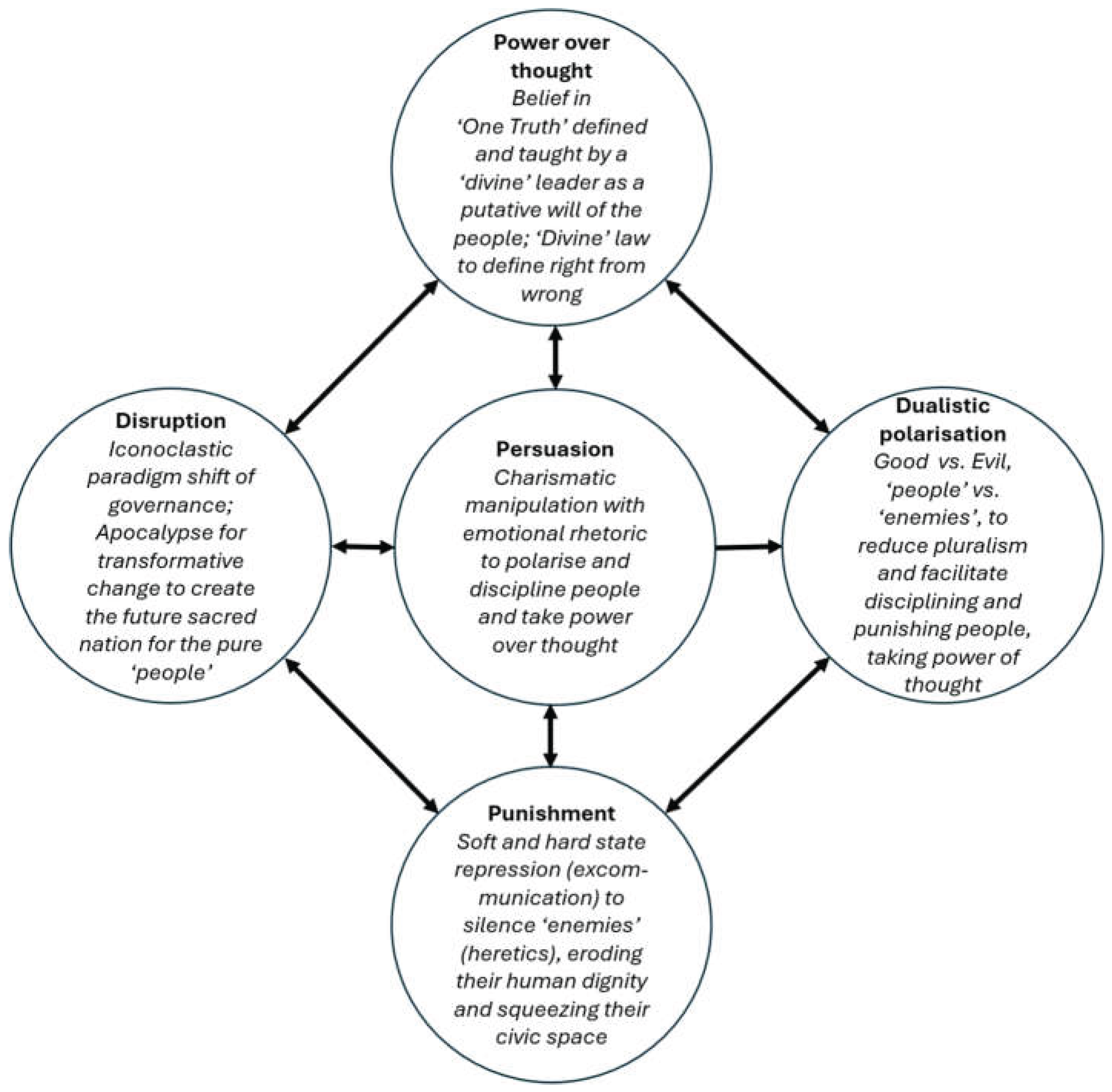

Table 1.
Similarities between the populist radical right and Christianity regarding core traits of nasty politics.
Table 1.
Similarities between the populist radical right and Christianity regarding core traits of nasty politics.
| Core trait | Populist radical right | Christianity |
|---|---|---|
| Power over thought | Totalitarian ideology providing the ‘Only Truth’; Anti-pluralism; Scepticism or denial of science; Cult-like ideology; Opportunity for people to develop their own minds is circumscribed; People should do as told by the ‘divine’ populist leaders. | Monotheistic religion providing the ‘Only Truth’; Anti-pluralism; Scepticism to science on immaterial issues; Cult-like religion; Opportunity for people to develop their own minds is circumscribed; People should do as told by the clergy, i.e., Gods intermediaries. |
| Dualistic polarisation | Manichean dualism; Affective polarisation; Ideological polarisation; Good/Evil; People/Others; Us/Them | Dualistic polarisation between: Good/Evil; God/Satan; God/State; Religion/Science; Mind/Body |
| Persuasion | Charismatic leadership; Demagoguery; Manipulation; Magic | Charisma; Demagoguery; Manipulation; Ceremonial magic |
| Punishment | Directed to ‘enemies’; Soft and hard state repression; Physical violence; Silencing; Elimination | (Revenge); Schism; Hersey; Excommunication; Judgement Day |
| Disruption | Saviourism; Paradigm shift; Iconoclasm; Apocalypse | Eschatology; Salvation; Millenarianism; Apocalypse; Rapture; |
Disclaimer/Publisher’s Note: The statements, opinions and data contained in all publications are solely those of the individual author(s) and contributor(s) and not of MDPI and/or the editor(s). MDPI and/or the editor(s) disclaim responsibility for any injury to people or property resulting from any ideas, methods, instructions or products referred to in the content. |
© 2026 by the author. Licensee MDPI, Basel, Switzerland. This article is an open access article distributed under the terms and conditions of the Creative Commons Attribution (CC BY) license.
Copyright: This open access article is published under a Creative Commons CC BY 4.0 license, which permit the free download, distribution, and reuse, provided that the author and preprint are cited in any reuse.