

Submitted:
20 May 2025
Posted:
21 May 2025
You are already at the latest version
Abstract
The success of the vision ultimately depends on policy and regulation, to manage the way in which AVs are implemented in urban areas if they are not to lead to a worsening of the urban environment, accessibility, and health. This thoughtful implementation should address all potential challenges through integrated planning of transportation, land use, and digital systems.
Keywords:
autonomous vehicles
; urban transport vision
; urban planning paradigm
; accessibility
; transport and urban planning
; sustainability
1. Introduction
Autonomous Vehicles (as per SAE standard J3016) [1] promise safer roads, smarter cities, and more efficient economies. So far such promises are found more in developers’ expectations than in proven realities. It is very difficult to obtain economic and safe vehicles that perform well without intervening on the other crucial factors influencing them (such as infrastructures and communications). For example, Stephen E. Shladover, among the first to research the topic in the 1990s, states that “electronic chauffeurs that can handle any driving conditions with no human input are decades away” [2]. Whenever such vehicles hit the market with the full potential of their innovative and disruptive power, they will be able to force industries to rethink longstanding practices and offer new opportunities for innovation and inclusion. The interplay of emerging technologies, transport and urban planning, and evolving consumer expectations significantly alters or displaces existing technologies, markets, or industries, creating new sectors and business models. AVs radically disrupt the status quo, change how products and services are consumed and the way the market is structured, and create new markets.
Their success depends on expanding their deployment from limited test phases to widespread use across various environments and applications, to reach millions (or billions) of users efficiently and rapidly. The AVs have to be scalable, that is, able to handle an increasing amount of work and number of users, and must be cheaper, easier to produce, and widely available. When that happens, new opportunities will emerge while older technologies or methods become obsolete. Scaling AVs involves a multifaceted approach that encompasses technological advancements, infrastructure development, regulatory frameworks, economic viability, public acceptance, and effective fleet management. As these elements come together, the potential for widespread deployment of AVs becomes more achievable.
This leads to widespread changes in business models, value chains, and competitive landscapes, that significantly alter industries by displacing existing technologies, transforming business models and creating new market opportunities. As these technologies continue to evolve, their cross-industry effects are likely to become even more pronounced, driving further innovation and economic transformation far beyond its initial application, triggering economic, social, regulatory, and environmental shifts. Understanding these cascading effects helps businesses, policymakers, and individuals adapt and harness the benefits while mitigating risks.
Although the promise is enormous, the full potential of the technology cannot be realized until significant regulatory, ethical, and technical challenges have been met and overcome. A supportive regulatory environment is crucial. As AV technology evolves, regulations must adapt to ensure safety while facilitating innovation. Currently, regulations lag behind technological advancements.
Different Rules in Different Places: Each state in the U.S. has its own laws about how AVs can operate. For example, California has strict rules, while Arizona is much more lenient. Before they can be used on public roads, AVs must go through numerous safety tests, sometimes time-consuming and different from state to state. This makes it hard for AV companies to expand in multiple locations.
Furthermore, removal of the driver involves a responsibility shift. Today responsibility for more than 90% most accidents is attributed to a human driver. Removing the driver, thus lowering the accident rate by less than a factor 10 (no developers believe this threshold is within reach), would shift the responsibility of hundreds of thousands of deaths per year from billions of drivers to a few car-making companies. If some of the safety features (necessary to maintain performance) have to do with communications, telecom companies may share responsibility, which they are reluctant to accept. This responsibility shift is today a greater barrier to diffusion of these vehicles than technological progress, legal frameworks, or the market. [3]
The broad deployment of AVs also needs better infrastructure. Many roads and traffic systems are not yet designed for AVs. Upgrading infrastructure to support AV technology is essential, but requires significant investment and coordination among stakeholders.
Building public trust in AV technology is essential for adoption. This requires demonstrating reliability and safety through extensive testing and transparent communication capabilities. Incidents involving AVs can lead to public fear and skepticism. If people do not believe that these vehicles are safe, they may resist their use, making it harder for companies to gain acceptance.
AVs are being deployed primarily in nations with strong governmental backing and regulatory oversight, advanced road infrastructure, a vibrant innovation ecosystem, and widespread consumer acceptance. Industry players are concentrating on specific market segments that deliver an optimal mix of technological feasibility, economic viability, and regulatory compliance [4].
While waiting for fully autonomous driving, legacy automotive manufacturers are intensifying their efforts to differentiate themselves by promoting advanced driver assistance systems (ADAS) to the swiftly evolving market landscape.
The paper is organized in fourth parts. In the first part examines the progress in the implementation of AVs currently being tested around the world. The second part is an evaluation based on an extensive literature of the impact of AVs on anomalies of urban transportation in the environment (resource depletion, pollution, urban sprawl), society (health, equity) and economy (congestion). The third part proposes a desirable urban transportatin vision and a paradigm shift consisting in the decline of car ownership dependence and the rise of access to mobility services with shared AVs. The last part is an evaluation of the new vision and paradigm based on the literature, qualitative assessment and currently testing applications and projects.
2. Progress in the Implementation of AVs
There are several AV companies currently in operation around the world operating AVs with SAE Level 4: High Driving Automation. This automated driving system (ADS) can perform all aspects of the Dynamic Driving Task, including steering, braking, accelerating, and monitoring the driving environment, within a specific Operational Design Domain (ODD). This means the vehicle can drive itself completely under certain defined conditions. The ODD defines the specific conditions under which the Level 4 system is designed to operate.
These conditions can include:
- Geographic areas: Restricted to certain geofenced zones, like a city center, a specific campus, or designated highways.
- Environmental conditions: May be limited by weather (e.g., not designed for heavy snow or fog), time of day, or road types.
- Speed limitations.
Outside of its ODD, the Level 4 system will not operate. Within the ODD, no human intervention or attention is required. The human is essentially a passenger and can engage in other activities like working, reading, or sleeping. The vehicle is responsible for monitoring the driving environment and performing all driving tasks.
Level 4 vehicles may or may not be equipped with a steering wheel and pedals. If they are present, a human could potentially drive the vehicle outside of the ADS’s ODD. However, when the ADS is engaged within its ODD, these controls are not needed by the system.
The principal early market segments and niche applications for AV Level 4 deployment in urban transport are as follows:
- Robotaxis (Autonomous Ride-Hailing Services): Offer on-demand, driverless transportation for urban commuters, tourists, people without personal vehicles, and even people who live in cities where personal car parking is expensive; trials have had limited geographical coverage and careful verification of the suitability of the infrastructures. With high demand for ride-hailing services in congested urban areas, these autonomous vehicles promise operational cost savings (not yet achieved) by eliminating labor costs [5].
- Autonomous Shuttles and Public Transit: Targeting specific routes in environments such as university campuses, corporate parks, airports, and specific urban “first/last-mile” corridors. By functioning in established or partially regulated areas, they minimize complexity and safety concerns, promoting smoother deployment and quicker public acceptance [6]. Although these services have been implemented since the late 1990s, they are not yet able to exit the initial demonstration phase. Nevertheless, most of them are still in operation after decades.
- Middle-Mile and Last-Mile Delivery: As e-commerce continues to grow, the pressure on supply chains to cut costs and increase efficiency is mounting. Autonomous solutions for both middle-mile (between distribution centers and fulfillment hubs) and last-mile (direct to consumer) delivery promise reduced labor costs and enhanced operational efficiency [7].
SAE Level 5 Full Driving Automation can perform all aspects of the Dynamic Driving Task (DDT) under all roadway and environmental conditions that a human driver could manage. Unlike Level 4, a Level 5 system is not restricted by an ODD. Level 5 is the ultimate goal of autonomous driving. Currently, true Level 5 vehicles are not commercially available and are still in the advanced research and development stages. Achieving reliable Level 5 automation is an immense technical challenge due to the vast number of unpredictable scenarios in real-world driving.
Table 1 lists some notable examples of current implementation.
Vehicle autonomy level 3/4/5 penetration is forecast to grow in major economies (Figure 1). The future of AV ride-hailing also seems promising (Figure 2).
Two companies, Nvidia and Mobileye, are promising to make the way consumers experience AVs safer, more comfortable, and more enjoyable.
Nvidia has developed an end-to-end, software-defined platform that integrates decades of expertise in high-performance computing, imaging, and AI. This platform is built to support scalable autonomous vehicle development. The platform offers both hardware and software components, enabling comprehensive solutions for automotive manufacturers and ensuring seamless integration across various systems.
Mobileye’s breakthrough was leveraging a single, cost-effective camera sensor to power advanced driver-assistance systems (ADAS), highlighting the potential of computer vision in vehicle automation. With driver assistance solutions deployed in over 125 million vehicles, Mobileye’s technology has demonstrated robust real-world applicability and reliability. Mobileye’s systems are integrated into urban traffic environments across major cities, reflecting its technical prowess in both sensor technology and complex traffic integration. Working with more than 50 automotive OEMs, Mobileye’s technology is seamlessly embedded into vehicles, advancing the shift toward fully automated driving systems.
Several autonomous vehicles (AVs) are currently being tested around the world. U.S. cities have been at the forefront of AV trials thanks to diverse road environments, favorable weather, and robust partnerships between tech companies and academic institutions. Here follow some examples.
Phoenix, Arizona: Phoenix has become one of the world’s best-known testing grounds for autonomous ride-hailing services. Companies such as Waymo have leveraged the relatively predictable desert driving conditions and variable traffic to fine tune their self-driving systems.
San Francisco and the Bay Area: The Bay Area is a hotbed of AV innovation. Companies including Cruise, Zoox, and others conduct extensive on-road testing under complex urban conditions. Their work in this region helps address the challenges of navigating congested streets and unpredictable traffic scenarios. The accident that terminated Cruise ride-hailing demonstration in San Francisco and the Cruise foray into the A-Taxi business (the company was almost bankrupt when General Motors saved it and redirected its technology development program) demonstrates how technology alone cannot suffice; other aspects need to be addressed. Any human driver would have had the same accident, and yet it demonstrated how technology simply cannot address all issues, not without decreasing significantly the vehicle performances.
Pittsburgh, Pennsylvania: With close ties to local research institutions such as Carnegie Mellon University, Pittsburgh has evolved into a critical site for AV research and pilot projects. This collaboration helps accelerate advances in computer vision, machine learning, and vehicle safety.
Asian cities have embraced AV technology as part of broader smart mobility initiatives. European cities as well as key urban centers in the Middle East are joining the AV revolution.
Singapore: Singapore’s government has been decisively proactive, launching initiatives to integrate autonomous shuttle services into its public transport framework. The city-state’s controlled urban environment and supportive regulatory framework make it an ideal spot for piloting cutting-edge mobility solutions.
Chinese Megacities (e.g., Beijing, Shanghai): Large cities in China are experimenting with AV technology in the form of autonomous taxis and delivery robots. These projects are part of extensive government-supported pilot programs aimed at reducing congestion and pollution while boosting efficiency on crowded urban roads.
Tokyo and South Korea: Both Tokyo and selected areas in South Korea have seen collaborative projects between tech firms and local authorities that focus on testing AVs in busy metropolitan corridors and dedicated test zones.
Europe and the Middle East: European cities as well as key urban centers in the Middle East are joining the AV revolution.
Munich and other European cities: In Germany, Munich is among the cities leveraging their strong automotive heritage to pilot programs testing autonomous systems in public transit, logistics, and private vehicle trials. Similarly, research projects in cities across Sweden (e.g., Gothenburg) and academic campuses in the United Kingdom (such as Oxford) demonstrate the region’s commitment to safe, scalable AV solutions.
Dubai, United Arab Emirates: Dubai is striving not only to attract international business but also to reimagine urban transportation with autonomous taxis and shuttles integrated into a broader smart-city initiative. The Dubai Roads and Transport Authority has been instrumental in rolling out pilot schemes that showcase futuristic mobility.
3. Impacts of AVs on Anomalies of Urban Transport
Table 3 lists the anomalies of urban transport based on automobility, multimodality, and accessibility visions and paradigms [13].
How effectively AVs can address urban transport anomalies depends mainly on the way they are used—privately owned (PAV), hailed (HAV), or shared (SAV).
PAV use is similar to that of a traditional car—the flexibility to use it whenever, wherever, and however one wants, constrained only by other vehicles. Parking is not a problem since the AV can park by itself after reaching the destination, even at some distance. It can go to a recharge station or drive around until the passengers are ready to resume travel.
HAV can be summoned on demand, much like hailing a taxi or ordering a ride through a ride-sharing app today. With on-demand access and a simple tap on a smartphone, an autonomous vehicle arrives, ready to go. The HAV maximizes its utilization, reducing the total number of vehicles needed. AI predicts demand patterns, strategically positioning vehicles to minimize waiting. Accessibility for all enhances mobility for those who for one reason or another cannot or do not drive.
SAVs are used collectively rather than owned and used individually, like a sophisticated, automated carpool system. The utilization of the vehicle increases further. Hailing and sharing increase the efficiency in use and the cost-effectiveness of transport by car. By The paying only when they need transport, users can save on the costs associated with owning a car or having a driver.
The potential of AVs to solve the problems of an automobility city depends largely on the choices and policies that cities and other stakeholders make regarding the design, operation, and integration of AVs within the urban system. AVs are not a silver bullet, but rather a tool that can be used for different purposes and outcomes. Progress in vehicle efficiency and functionality does not necessarily translate to net positive outcomes. Here, the interactions between AV and the anomalies are examined at two levels, vehicle and type of use (PAV, HAV, or SAV).
SAV impact scenarios can vary significantly depending on implementation approaches and policy frameworks. SAVs could increase vehicle travel by making transportation more convenient and reducing operating costs, potentially encouraging longer commutes and more sprawled development [14]. Conversely, they could facilitate vehicle sharing, allowing households to reduce vehicle ownership and overall vehicle travel [14].
The impacts of an Autonomous Vehicle
AVs increase resource depletion due to additional equipment such as cameras, sonar, and radar and a variety of devices to ensure passenger comfort, entertainment and smart work [15]. The resource depletion will also depend on the durability and maintenance of AVs. AVs are ideal for durability testing thanks to their precision and reliability. These properties reduce dynamic forces and increase durability and performance over time.
AVs optimize driving patterns and traffic flow, smoothing speed variations, which reduces fuel consumption by 15% to 20% compared with conventional vehicles [16]. AVs are battery electric vehicles, more efficient than gasoline-powered cars. The net energy reduction in the U.S has been estimated at 11% to 55%, depending on drivetrain electrification [17]. However, these figures do not account for newly generated trips or the inevitable average occupancy decrease. While AV can and must be designed to be more energy efficient, their use leads to unknown effects. The U.S. Environmental Protection Agency estimated that impact of AV on energy consumption, depending on the scenario, can range from minus 60% to plus 120% [18].
The ecological aspects of autonomous driving, including potential CO2 avoidance, are compromised by the increase in resource consumption related to autonomous vehicles [19,20].
As technology matures and infrastructure adapts to support AVs, they are expected to play a significant role in creating safer roads globally, but it is a widely debated issue.
A study on the safety of Waymo’s robotaxi was conducted with Swiss Re to analyze collision-related liability claims from 25.3 million fully autonomous miles [21]. The study uses auto liability claims to aggregate statistics as a proxy for at-fault collisions to determine overall safety performance, expanding previous research published by Waymo. Swiss Re compared Waymo’s liability claims with human driver baselines based on its internal data from over 500,000 claims and over 200 billion miles of exposure.
The study found that the Waymo robotaxi had nine property damage claims and two bodily injury claims. A human driver would be expected to have 78 property damage and 26 bodily injury claims. The robotaxi thus had significantly better performance, with a reduction of 88% in property damage claims and 92% in bodily injury claims. However, it is questionable whether such apparent improvement in the safety records is due to overall technological performance or to impeding some of the human behaviors that are the main cause of accidents and injuries. Michael L. Sena, at the 6th Smart Driving car Summit in Princeton, argued that “Waymo and other companies developing driverless vehicle capabilities claim that safety is their primary goal. Waymo uses insurance claims data to prove that its cars are safer than all other cars. I have said that there is not enough data to make a case for Waymo vehicles in driverless mode being safer than cars driven by humans because Waymo cars drive in very controlled operational design domains at very low speeds. By definition, they cannot be driven by a person under the influence of alcohol or drugs; they are limited in their speeds to at or below speed limits, and the cars do not move unless people are wearing seat belts. These are the three main reasons for crashes and deaths” [22]. Additionally, a thorough examination of the crash records of the most advanced automation technologies [23] highlights how, while solving some safety issues, they generate new ones. When the same data are analyzed in comparison to human driving accidents removing drink and drive and over speeding the figures are in the same order of magnitude [22].
Even compared with newer vehicles (2018–2021 models) equipped with more robust advanced driver assistance systems (ADAS), such as automated emergency braking, forward collision warning, and lane-keeping assistance, Waymo showed an 86% reduction in property damage claims and a 90% reduction in bodily injury claims.
Such reduction may be overestimated, as discussed just few lines above, because the ODD where Wamo vehicles have operated are extremely simplified with respect to the average ODDs human drivers have to drive-in and the operational speed controlled. A more realistic expectation can be that damages caused by AVs can be in the same range, up to a maximum reduction of 50%.
A new study from Waymo [24] performed a retrospective safety assessment of SAE Level 4 Automated Driving Systems (ADSs) deployed on public roads by Waymo’s Riders Only (RO) crash rate compared to human benchmarks, including disaggregated by crash type. The study found that Alphabet’s Waymo driverless ride-hailing service is safer than human drivers in many real-world conditions. While the study was authored by Waymo engineers, it’s set to be published in the journal Traffic Injury Prevention, which means it’s been peer-reviewed by the scientific community for its methods.
Over 56.7 million miles of Rider-Only (RO) driving were analyzed through January 2025. The data shows a statistically significant lower crash rate compared to key benchmarks in categories such as Any-Injury-Reported, Airbag Deployment, and Suspected Serious Injury+ crashes.
Among different types of crashes, Vehicle-to-Vehicle (V2V) intersection collisions saw the biggest reduction. There was a 96% decrease in Any-Injury-Reported crashes with a confidence interval of 87%–99%, and a 91% decrease in Airbag Deployment crashes with a confidence interval: 76%–98%.
Other crash types—including cyclist, motorcycle, pedestrian, secondary crashes, and single-vehicle incidents—also showed statistically significant reductions in the Any-Injury-Reported category. Importantly, no statistically significant negative effects were found across any of the 11 crash type groups.
The crash type breakdown applied in the current analysis provides unique insight into the direction and magnitude of safety impact being achieved by a currently deployed ADS system. This results gives an objective evaluation of the safety impact of ADS technology for stakeholders, regulators, and other ADS companies.
The intrinsic safety of the AVs should reduce the need for heavier vehicles, such as SUVs, with consequent reduction of resource depletion and energy consumption; even if this is not the direction in which the vehicle development is going. Today’s AV weight the same or even more than the conventional vehicle, to reduce the weight the re must be 80 % of avehicles.
With the ability to park or reposition themselves without passengers, PAVs can reduce the need for extensive parking infrastructure. PAVs can drop off passengers and park in less-congested areas or even return home if not needed immediately. This shift allows cities to repurpose parking spaces for parks or mixed-use developments, promoting more efficient land use [25]. The negative side effect is that it encourages a less active lifestyle. However, such positive expectation can be counterbalanced by the fact that if less parking-seeking traffic is generated and lower parking costs are requested to private-vehicle users more people will use the private car creating more congestion and requiring wider space-consuming infrastructures. A simulation made by the University of Florence on the effects privately used AV with no parking need would have on Florence showed an increase in congestion and in space consumption from cars.
AVs are generally engineered to deliver a smooth driving experience. Their systems are designed to optimize acceleration, braking, and steering through precise algorithms and sensor data, minimizing abrupt movements and sudden changes in speed. However, it’s important to note that the smoothness of the ride can vary depending on several factors. The specific control strategies deployed, road conditions, and the environment in which the vehicle operates all influence the consistency of smooth driving. In some cases, the focus on safety and rapid decision-making in complex traffic scenarios might result in maneuvers that feel less smooth when compared to ideal conditions. Yet, continuous improvements and sophisticated decision-making algorithms are aimed at ensuring that smooth driving remains a core benefit of autonomous vehicle technology.
Beyond the technical aspects, smooth driving isn’t just about comfort, a more pleasant travel experience for passengers, it can contribute to better fuel efficiency and reduced pollution in particular particles produced by tires, contributing to better air quality in urban areas, which is critical for public health.
But the overall impact might be limited. In experiments made by the Berkeley university [26] comparing manual driving, autonomous Adaptive Cruise Control (ACC) and Cooperative ACC (CACC), ACC can cause less smooth driving cycles and bigger traffic jams than human drivers. Only CACC has positive effects on smoothing vehicle behaviour and increasing lane capacity The claim that smooth driving significantly lowers particulate pollution from tires is more complex. Tire wear—and the particles it produces—is influenced by various factors such as road conditions, tire composition, vehicle load, and overall driving dynamics. Even if smoother acceleration and braking reduce aggressive tire degradation, the reduction in tire particle emissions may not be very substantial. The smoother traffic flow, reduced headways and platooning, and communication between vehicles, traffic signals, and infrastructure can increase road capacity depending on AV adoption, the extent of coordination between vehicles, and infrastructure changes. The capacity increase is attributed to several factors:
- Shorter following distances (space headways) between AVs;
- Lower driving reaction times;
- V2V (Vehicle-to-Vehicle) and V2I (Vehicle-to-Infrastructure) communications.
Some research on urban road networks showed that when AV penetration reached 100%, road capacity increased by approximately 40% [27]. Another study found that pure AV traffic flow could increase road capacity from about 2200 pcu/h/lane (passenger car units per hour per lane) for manual vehicles to about 3600 pcu/h/lane, representing a 63.6% increase [28] with safer conditions. These results depend on connected vehicles, which share data and infrastructure wirelessly. But AV can slow down travel time through intersections if they are not connected. Studies have shown that a traffic stream composed of 100% nonconnected AVs could decrease lane-group capacity by up to 20% [29]. This reduction in capacity leads to longer queues at signalized intersections and increased travel times.
The Impacts of the Way Autonomous Vehicles Are Used
The implementation of autonomous vehicles presents a complex balance of resource consumption, energy efficiency, safety improvements, and social benefits. While AVs require additional technological components that increase resource depletion, they also offer significant improvements in safety, traffic efficiency, and accessibility. The environmental impact depends on multiple factors, including the types of technologies employed, the energy sources used, and the way these vehicles are used and integrated into existing transportation systems.
PAVs have the worst impact on resource depletion because the number of vehicles privately owned is affected only slightly by automation. An exception is that a PAV in a family with more than one conventional vehicle could reduce the number of total vehicles owned by the household. The extent of this reduction depends, however, on several factors. AVs can be used more efficiently than traditional cars because they can operate independently, serving multiple family members. While conventional vehicles spend a significant amount of time parked, an AV can be in near-constant use, serving various needs throughout the day. For example, an AV could drop one family member at work and then return home to transport another, reducing the need for multiple vehicles in a household [32,33]. The PAV can be also hailed or shared with great benefits for utilization efficiency. Privately owned AVs used for hailing and sharing within a family or small group provide less reduction in fleet size than fully shared models. For instance, one PAV might replace 2.5 traditional vehicles due to limited sharing [6]. With intelligent routing and scheduling, the AV can optimize trips, reducing overlap and waiting times. On the other hand, if the family has varied travel needs (e.g., a large vehicle for weekend outings, a specialized vehicle for certain tasks, or simply a backup), or if multiple trips are required simultaneously, additional vehicles may still be necessary [34,35] and the reduction compromised.
This reduction is less significant than what is observed with hailed and shared AVs. The latter can replace up to 10 or more conventional vehicles thanks to higher utilization rates [36].
The better performances of AVs in traffic may certainly lead to induced demand, more and longer trips. AVs might incentivize people who desire lower-density locations to live farther from city centers, encouraging them to travel longer distances [36]. This suggests AVs may increase vehicle travel in suburban and rural areas while reducing it in urban areas. The net impacts will largely depend on transport and land use development policies, with current policies likely to increase vehicle travel and sprawl by 10–30% [17].
The convenience offered by AVs may lead to an increase in total travel demand, which increases the environmental impact [37].
In essence, the impact of autonomous vehicles on urban transport anomalies will be determined by the interaction among technology, user behavior, and the regulatory environment. Policies that encourage shared usage, sustainable design, and equitable access can help ensure that the benefits extend across all segments of urban life rather than merely reinforcing existing anomalies [38].
4. A Desirable Urban Transport Vision and a Paradigm Shift with SAVs
Leveraging the potential of AVs to address urban transport anomalies requires a rethinking of both the physical structure of our cities and the policies that govern mobility. Below are several concrete urban planning strategies and policy frameworks designed to maximize the benefits of AVs on resource depletion, congestion, sprawl, equity, and the environment.
This desirability is defined as a reduction in anomalies for sustainable urban transport. The next section presents a backcasting approach proposing a desirable urban transport future with AVs, as well as the barriers that have to be overcome to move toward such a future. The paper concludes that transport governance will be essential and that greater focus has to be placed on individual and societal perspectives shaping mobility.
A previous paper [39], based on the European project CityMobil2, analyzed how AV deployment could fundamentally restructure transport networks, urban spatial configurations, and mobility services. Through a detailed examination of automated road transport systems (ARTS), changing demographic patterns, and emerging mobility-as-a-service (MaaS) models, the study presents a compelling case for AVs as catalysts for creating safer, more efficient, and socially inclusive cities. The analysis particularly emphasizes the synergistic relationship among vehicle automation, shared mobility ecosystems, and urban design innovations that collectively could reduce private vehicle ownership by 40–60% in European cities while reclaiming 15–25% of urban space currently dedicated to parking infrastructure. The vision was based on AVs for urban passengers and freight distribution, and a shift of paradigm, consisting in the decline of car ownership dependence and the rise of access to mobility services [39].
A critical step is to reconsider our vision of urban transport from traffic and mobility to accessibility [13]. Accessibility refers to the quantity of desired destinations, opportunities, or amenities that can be reached within a given time frame. It encompasses not just physical mobility but also the ease with which people can access essential services, employment, education, healthcare, and social activities.
Access is provided through three interconnected systems: digital connectivity, active transport with spatial proximity, and motorized multimodal transport [40]. Digital connectivity enables remote access to services and opportunities via internet, reducing the need for physical travel. Active transport with spatial proximity promotes walking and cycling by designing compact, mixed-use urban areas where amenities are close at hand. A motorized multimodal transport with a transit-centric focus provides digital integration of diverse transport modes (MaaS) and grounds them in well-equipped mobility hubs (MH); it reinforces transit with a strong presence of SAVs as the backbone of urban mobility to end dependence on the individually owned automobile.
The emerging paradigm recognizes that what people truly need is reliable access to their needs through proximity, digital connectivity, and transport services rather than ownership of transportation assets. The SAV paradigm shift involves moving from a driver-centered transportation model to a service-centered one. Autonomous technology removes the driver from the equation, which not merely eliminates a task but transforms the entire transportation relationship into a multimodal service interaction.
Beyond their technological novelty, SAVs make an important contribution to the paradigm shift for its potential to alter multiple aspects of our transportation systems, urban environments, and social behaviors.
Public attitudes toward privately owned AVs and SAVs has become increasingly critical for manufacturers, policymakers, and transport planners. Despite significant technical advancements, the adoption of autonomous vehicles faces considerable hurdles that are primarily psychological rather than technical in nature.
People’s attitudes toward future technologies play a critical role in technology adoption, development priorities, and policy decisions. However, measuring these attitudes accurately presents numerous methodological challenges that can significantly impact research validity and reliability [41].
The objectives transcend mere efficiency to address broader sustainability challenges for creating cities that are environmentally responsible and friendly, livable, equitable, socially inclusive, economically viable, and resilient.
The balance between private and shared AVs is the 20% solution whereby privately owned AV are limited to 20% of the total fleet, consistent with research findings on optimal transportation outcomes. According to the ETH Zurich study, “a decline in individual traffic can only be expected if autonomous vehicles are mainly reserved for public transport, and not for private cars.”
The key objectives that collectively form a sustainable vision for urban transport, encompass overcoming the wide range of social, economic, and environmental anomalies of urban transport in Table 1.
The Proposed Transport System Architecture combines several emerging mobility concepts, including MaaS, MH of different levels of complexity, and three networks of public transport, dominated by station-based Sharing Autonomous Electric Vehicles (SAEVs) that together could fundamentally transform urban transport (Figure 3).
The figure represents the interconnected nature of modern urban transport solutions and highlights the critical role of MaaS as central connection points in the system and the station-based SAEV system as part of a public transport network connected to MHs.
The integration of SAEVs, with mass transit, microtransit, and micromobility in a mobility-as-a-service (MaaS) platform and mobility hubs, redefines how cities approach mobility, sustainability, and spatial design. This disrupts traditional models centered on private car ownership and fixed-route transit systems, creating a dynamic ecosystem where multimodal accessibility supersedes vehicle ownership as the primary mobility aspect.
MaaS is all about providing users with a seamless, integrated mobility solution that bundles various modes—mass transit, shared microtransit and micro-mobility (bikes, scooters)—into a single, accessible service.
The extensive mobility data gathered by MaaS platforms—ranging from real-time traffic conditions and vehicle sensor data to user travel patterns—can be processed by GenAI to optimize and enhance the overall service. For instance, AI can analyze this data to:
- Optimize routes and reduce travel times by dynamically adjusting to traffic congestion and road conditions.
- Forecast travel demand and adjust fleet allocation, accordingly, ensuring that vehicles are available where and when needed.
- Provide personalized travel recommendations by learning individual user preferences and habits.
- Enhance safety and reduce maintenance costs through predictive analytics that anticipate vehicle issues before they occur.
By leveraging these insights, service providers can create a more efficient, cost-effective, and user-friendly transportation network, ultimately contributing to smoother urban mobility and reduced environmental impact.
Mobility hubs function as the physical manifestation of MaaS, with a strong digital infrastructure backbone enabling seamless integration of various transportation options. The system would prioritize shared autonomous electric vehicles while limiting individually owned autonomous vehicles to 20% of the fleet, potentially addressing numerous inefficiencies in current transport systems.
Mobility hubs would serve as the backbone of this transportation ecosystem, offering not just vehicle pickup and dropoff points but comprehensive mobility services. These hubs would integrate various transportation modes and potentially include complementary amenities like cafes, bike repair shops, and other services. The implementation of a strong and memorable branding for mobility hubs wouldl support better awareness, acceptance, and recognition among users.
The first of the three networks that form the transportation ecosystem, Mass Transit is composed of the traditional high-capacity fixed transit lines, train, light rail, modern trams along dedicated tracks, and bus rapid transit. AVs can be part of this level. These are the arteries of the city, moving large numbers of people swiftly along the most popular corridors. They are reliable and frequent and form the backbone of urban mobility. They connect such key destinations as downtown areas, business districts, and major residential zones and serve as the primary hubs where other modes converge, making transfers seamless, quick, and easily accessible on a single platform.
The second network, Microtransit, is served by on-demand public transport service using small vehicles that operate on dynamically scheduled routes. Unlike traditional fixed-route transit, microtransit adjusts its routes and schedules in real time based on current passenger demand. This flexibility makes it particularly useful for serving low-density areas or addressing first/last-mile gaps by offering a cost-effective and efficient complement to conventional transit systems.
The third network, Micromobility, comprises active transport, e-scooters, e-bikes, and e-mopeds to promote healthy and eco-friendly travel. Bicycles and scooters are integral parts of multimodal networks with dedicated bike lanes, ample parking, and rental services. They are often used for short trips and may be combined with public transport. For example, bike-sharing stations might be located near transit hubs to facilitate easy transfers.
Providing these alternatives not only meets diverse mobility needs but also helps ease the shift away from an overly car-centric society, mitigating the feeling that rationing and pricing car traffic is a sort of punishment.
SAVs will dominate the second level, fully integrated in a sharing approach (car sharing combined with ridesharing) where the benefits of SAV are more likely to be realized and the negative side effects counterbalanced.
Without the need for human drivers, SAVs can significantly reduce labor costs, a major expense in traditional microtransit services. Vehicle size can for the same reason be small, only six seats for intimacy and comfort. A smaller vehicle tends to create a more personal and relaxed atmosphere. With only six seats, each passenger feels less like just another number in a crowd. This type of setting mirrors the comfort of riding in a personal car, a semiprivate space, a more enjoyable journey. Large vehicles can feel impersonal and noisy, especially when fully occupied. The hum of a bus filled with 100 passengers might contribute to stress and sensory overload, while a smaller electric vehicle driverless vehicles usually offers a quieter, more controlled environment.
AVs could be redesigned with passengers in mind, emphasizing ease of access, especially for older or disabled riders. The interiors should emphasize privacy and comfort over extreme performance, exchanging power and speed for comfort and stability.
The model of SAV services has been inspired by elevators. The first driverless shared mode of transport, they provide service at stops on each floor, on demand, and shared trips when appropriate [42]. To avoid a widespread door-to-door service in high-density areas with negative consequences for road capacity, for lack of physical activity and for facilitating sharing, the SAVs service is based on fixed station2station, located less than a 5–10 minute walk from any place.
Station-based sharing refers to a model where shared vehicles have specific designated locations for pickup and drop-off. This system would be anchored by mobility hubs—physical locations strategically positioned throughout urban areas that serve as transfer points between different transport modes
The station-based approach offers significant advantages over free-floating vehicle sharing. It provides more predictable vehicle availability and better utilization of urban space, as vehicles are concentrated in designated areas rather than scattered throughout the city. This system ensures that shared vehicles are neatly organized in specific spots, which is particularly important in densely populated urban environments where space is at a premium. Additionally, the station-based model provides users with greater certainty about vehicle availability.
The service has on-demand scheduling and is congestion-responsive. When customers arrive, they indicate the destination, receive information on the vehicle, available or arriving, and should wait a maximum of 10 minutes before the vehicle departs, depending availability and congestion. During rush hour it tries to use the AV capacity and avoid excessive use of road capacity, a tradeoff between increased waiting times and reduced travel times. On the other hand, there is a certain compensation. Although the service waits to fill the vehicle, when demand is high, the wait is shorter.
For people with mobility problems, and in low-density areas, the service should be door to door.
The Station2Station-based SAV represents a profound shift in the evaluation of urban transport. The time spent walking to reach SAV stations has traditionally been viewed as a disutility in transport cost-benefit analyses—something to be minimized [43]. This perspective, however, overlooks the significant health benefits that accrue from this physical activity, particularly in a pleasant walking environment. Incorporating health benefits requires a broader cost-benefit analysis framework and ensures that transport planning aligns with wider societal goals [44,45]. Ultimately, by valuing the health benefits of walking in our cost-benefit analyses, we are not merely optimizing transportation systems but investing in healthier individuals, stronger communities, and more livable cities. Few studies have examined the effects of AVs on walking [46,47] and active transport in general [48,49].
The impact of AV service for individuals with mobility problems extends far beyond the practical aspects of transport to encompass significant psychological and social benefits. One of the most profound effects is the restoration of independence and togetherness. AVs can restore independence by providing transport options that do not require reliance on family members, caregivers, or limited public services.
Social isolation represents a serious health concern for elderly and disabled populations, with restricted mobility contributing significantly to this problem. Research has described this as an “epidemic of loneliness” that autonomous vehicles can help address by facilitating greater community participation. By providing reliable, accessible transport, AVs enable individuals to maintain social connections, attend community events, and participate in activities that support mental health and well-being.
The ability to travel spontaneously, without advance scheduling requirements, represents another important psychological benefit especially for nonsystematic trips. On the other hand, systematic trips to and from work or school do need advance booking to guarantee the trip and timely service. Current paratransit and specialized transportation services often require booking days in advance, eliminating the possibility of impromptu outings or responding to unexpected opportunities. The on-demand nature of AV services restores this aspect of normal life, allowing for greater flexibility and responsiveness to changing circumstances or desires; combining the service with advance booking reassures users who must arrive on time.
Employment opportunities also expand significantly with improved transport access. Many disabled individuals face employment barriers directly related to transportation limitations. Autonomous vehicles can help bridge this gap by providing reliable transportation to workplaces, potentially increasing economic participation and reducing the income disparity currently experienced by many people with disabilities.
Platoon Technology
Small AVs can strike at the core of urban transport with platooning technology, a complement to traditional transit systems, or could eventually replace them.
Platoon technology allows electronically linked AVs to maintain close proximity at high speeds with enhanced safety and aerodynamics. Compact AVs (2–12 passengers) that can travel independently or in platoons, on-demand services have the potential for higher lane capacity due to reduced gaps between vehicles.
AVs equipped with advanced sensors and communications systems can react instantaneously, allowing them to reduce following distances.
To determine the maximum flow rate of platoons of connected autonomous vehicles (CAVs) that are four meters long with six comfort seats on a lane three meters wide, the dynamics of traffic flow and how platooning technology enhances lane capacity need to be addressed.
The key variables involved are:
- Vehicle length (L): 4 m;
- Distance in meters (d) between the rear of one vehicle and the front of the following vehicle;
- Total space occupied per vehicle (s),
- S = L + d;
- Speed (v) of the platoon (in meters per second, m/s);
- Time Headway (h): Time interval between two consecutive vehicles passing a point (in seconds).
The flow rate (q), number of vehicles passing a point per hour, can be calculated using:
q = 3600/h
Where:
3600 is the number of seconds in an hour
Since
h = s/v
The flow rate is:
q = 3600×v/s
The flow with a safety and environmentally friendly speed of 30 km/h (≈ 8 m/s) and a distance of 1 m
s = L + d = 4 + 1 = 5 m
h = s/v = 5/8 = 0.625 s
q = 3600/h = 3600/0.625 = 5,760 vehicles/hour
This is equivalent to up to 34,560 passengers/hour traveling in absolute comfort, as in an automobile. Higher speeds reduce time headway for a given gap length, further increasing flow rates. With a speed of 90 km/h, the flow is ≈18,000 vehicles/hour.
These calculations provide theoretical maximums with dedicated lanes for platoons of CAVs to maximize efficiency by minimizing interference, but several real-world factors influence these flow rates:
- Reaction Times and Safety Buffers: AVs can react faster than human drivers, but system latency and safety protocols may require slightly larger gaps than theoretical minimums;
- Regulatory Limits: Traffic laws may impose minimum following distances for safety, affecting achievable flow rates;
- Communications Reliability: Effective platooning relies on uninterrupted communication between vehicles; any disruptions can cause increased gaps;
- Roadway Conditions: Variations in road surfaces, weather, and terrain can impact safe platooning speeds and gaps.
Diffused Transit-Oriented Development with SAVs: A Solution for Low-Density Suburbs
Transit-oriented development (TOD) has traditionally focused on creating dense, mixed-use neighborhoods around major transit nodes, with the densest development occurring within 400¬800 m, considered an appropriate scale to encourage walking, reduce reliance on private cars, and create vibrant urban centers. The traditional density thresholds in the U.S. range from 24 to 70 dwellings per hectare [50]. Development typically concentrates within a 400 m radius of transit stations, a comfortable walking distance for most users [51]. Research from suburban centers demonstrates that compactness is a critical factor in the commercial success of station areas [52].
When the area has a lower overall density, as in suburban or lower-density urban settings, these transit-friendly, mixed-use, and pedestrian-oriented features are diffused along entire transit corridors or across multiple transit nodes. These diffused TODs work within existing density constraints while strategically intensifying development at key nodes and improving connectivity between them [53].
Low densities significantly limit the potential ridership base that can support transit services, creating a challenging environment for traditional TOD implementation. When population concentration is insufficient, transit service frequency and quality may decline, undermining the central transit-oriented premise of the development model.
The walkability principle fundamental to urban TOD also becomes problematic. With greater distances between destinations and lower overall densities, the typical 400–800 m walkshed approaches to TOD station areas prove inadequate. Suburban residents often access transit through modes other than walking, including bicycling, driving, or connecting transit services, necessitating different infrastructure priorities than urban TOD implementations.
SAVs and Mobility-on-Demand (MoD) platforms are emerging as a transformative force with significant potential to address the “last mile” connectivity challenges that have historically limited transit effectiveness in suburban environments [54]. These self-driving vehicles, operating as on-demand services, could fundamentally alter how residents access transit stations and navigate their communities without private vehicle ownership, effectively extending transit networks into areas where traditional fixed-route service would be economically infeasible.
The operational flexibility of SAVs represents a particular advantage for suburban transit integration. Unlike fixed-route transit services that struggle with efficiency in low-density environments, autonomous vehicles can dynamically adjust to demand patterns, serving dispersed origins and destinations while maintaining economic viability. This adaptability makes them potentially valuable components in a diffused transit-oriented development strategy, where they can function as feeders to transit stations and provide on-demand local circulation.
It can reduce the heavy automobile dependency of these areas and can provide convenient access to transit to more or less half the inhabitants not served at present. Research indicates that a properly implemented SAEV system would require only 10–14% of the vehicles currently used in private ownership models to provide comparable transportation service.
A notable example of this innovative approach is provided by the Vinnova project [55], “Transit-Oriented Development – Mobility Hubs and Shared Autonomous Vehicles (SAVs).”
The project explores the practical application of SAV technology in establishing a network of mobility hubs that extend the effective catchment area of transit stations. By connecting these hubs through autonomous vehicle services, the project aims to overcome first/last-mile challenges—a core element of the proposed diffused TOD model.
In a diffused TOD model incorporating SAVs, several mechanisms could be employed to overcome the limitations of traditional transit:
- Extended Catchment Areas: SAVs can significantly extend the effective catchment area of transit stations beyond the conventional quarter-mile walking radius. The Vinnova project illustrates this by piloting SAV services that provide seamless first/last-mile connections between residential areas and mobility hubs, thereby making transit a viable option for residents living at greater distances from central stations
- Distributed Mobility Hubs: Instead of concentrating development solely around major transit stations, a network of smaller mobility hubs—similar to those developed in the Vinnova project—can be established throughout suburban areas. These hubs not only facilitate connections between SAVs and higher-capacity transit but also serve as centers for community services and amenities, promoting localized economic activity.
- Dynamic and Flexible Service: SAVs offer a level of flexibility that fixed-route transit cannot match. They can dynamically adjust to real-time demand patterns, provide direct connections when needed, and consolidate trips through shared rides. This dynamic service model, as demonstrated by the Vinnova initiative, is particularly valuable in low-density areas where conventional fixed-route service often proves inefficient.
The Vinnova project serves as a valuable case study by demonstrating that integrated mobility solutions can be both technically feasible and socially acceptable. It provides empirical evidence that even in low-density suburban contexts, the combination of diffused TOD and SAVs can enhance accessibility and promote more efficient land use. However, the project’s early-stage findings also underscore the importance of ensuring equitable access, particularly for lower-income or mobility-challenged populations, as well as the need for supportive land use policies.
The Case of Trenton NJ
A station-based system SAEV will be implemented in Trenton NJ. On February 11, 2022, the New Jersey Department of Transportation (NJDOT) allocated a grant of $5,000,000 from the Local Transportation Project Fund to the City of Trenton for the implementation of the Trenton Mobility and Opportunity: Vehicles Equity System (MOVES) project [56]. This funding is intended to facilitate the deployment of an advanced autonomous vehicle transportation system, designed to serve approximately 90,000 residents and commuters. The project’s core objectives, strategic goals, and operational features were detailed in a Request for Expressions of Interest (RFEI) issued in December 2021.
The proposed system architecture comprises 100 autonomous electric shuttle vehicles and 50 strategically located kiosks. This configuration is engineered to operate exclusively under an on-demand model—eschewing fixed routes and predetermined schedules—to better adapt to dynamic urban mobility needs. The shuttle vehicles are designed in compliance with accessibility standards, accommodating up to eight passengers per trip.
Kiosk (station) installations will be concentrated in high-density residential and commercial areas such that more than 90% of Trenton’s population is within a five-minute walking radius. The system enables users to initiate service requests via mobile applications, while on-site interfaces at each kiosk provide an alternative access point for individuals without mobile device connectivity. A map of Trenton with the kiosks and the two phases of system implementation is provided in Figure 4.
In collaboration with Princeton University and the Corporation for Automated Road Transportation Safety (CARTS), NJDOT conducted an extensive public outreach initiative to inform the RFEI process. This outreach identified several critical conditions that currently impede transportation efficacy in Trenton:
- Approximately 70% of households possess one or no personal vehicles.
- Historical land use decisions combined with infrequent bus services compel senior citizens to endure circuitous routes, prescheduled access-a-ride services, or lengthy pedestrian journeys to fulfill everyday mobility needs.
- A pervasive national bus-driver shortage has left high-school students living within two miles of their institutions without adequate transit options.
The insights garnered from these public engagements informed the formulation of five primary strategic goals (safety, equity, affordability, and sustainability) for the MOVES program:
- Autonomous vehicles are expected to enhance overall traffic safety by eliminating human errors, such as distracted driving and speeding. Recognizing the initial challenge in acclimating to driverless mobility, the system will incorporate the presence of vetted safety hosts during the initial two-year rollout to guide and support users. Furthermore, the operational deployment will be confined to predetermined operational design domains on public roads.
- A significant segment of Trenton’s population resides in areas of persistent poverty, with limited vehicle ownership and a disproportionate share of income allocated to transportation costs; the system is designed to address these disparities. The service framework is developed to be inclusive, ensuring equitable access to mobility for all residents, particularly those facing economic or physical challenges.
- The project is being structured to ensure fiscal sustainability and cost efficiency for both riders and taxpayers. Fare structures will be set at levels comparable to existing transit services, yet significantly lower than conventional ride-hailing or taxi fares. In addition, the establishment of public-private partnerships is expected to promote cost reductions through scaling efficiencies and innovative funding models.
- In response to New Jersey’s mandate to discontinue the sale of gasoline-powered vehicles by 2035, the fleet of autonomous vehicles will be fully electric. The integration of this technology, alongside the on-demand service model, is projected to decrease average vehicle occupancy rates, limit total vehicle miles traveled, and reduce greenhouse gas emissions associated with urban mobility.
Each of these strategic objectives is designed to systematically address current limitations within Trenton’s transportation framework, thereby advancing a more resilient, safe, and adaptive urban mobility environment.
The Vision Aligns with Advanced Urban Planning Theories and Practices
The integration of SAEVs with mass transit, microtransit, and micromobility in a MaaS platform and mobility hubs represents a fundamental transformation in urban transportation planning, redefining how cities approach mobility, sustainability, and spatial design. This disrupts traditional models centered on private car ownership and fixed-route transit systems, creating a dynamic ecosystem where multimodal accessibility supersedes vehicle ownership.
The connectivity of MaaS with the multimodal transport network enables the collection of rich mobility data. Urban planners and policymakers can use this data to design better transportation networks, optimize routes, manage and predict travel demand, implement dynamic traffic management systems, and enhance user experience. This informed decision-making can lead to safer, more efficient, and resilient urban environments.
The multimodal transport network is a key component of smart cities, utilizing real-time data and AI-driven analytics. This data-driven approach and the use of AI ensures that the transport network can adapt to changing conditions and better serve the city’s residents. It contributes to urban resilience by offering flexible and diverse transport options that can adapt to different scenarios.
MaaS envisions a shift from personal vehicle ownership to shared, on-demand mobility services that can be accessed through a single platform. The integration of various transport modes ensures that residents can easily access amenities, promoting a sense of community and reducing urban sprawl.
The multimodal transport network fits seamlessly with TOD by providing high-capacity fixed-transit options that serve as the backbone for these communities. On-demand microtransit and autonomous vehicles further enhance accessibility, ensuring that even those living slightly farther from transit hubs can easily connect to the main network.
The proposed vision must be flexible and resilient to uncertainty by considering different future scenarios—such as technological advancements, demographic shifts, and the impacts of climate change—and assessing how various approaches might perform under these conditions. By adopting adaptable strategies, the system implemented can remain effective over time, contributing to long-term sustainability goals.
Combining Car-Sharing and Ride-Sharing Even Before Full Automation as a Headstart
A benefit of automating shared vehicles is their capacity to reposition themselves when not in use. Even a single customer on board can drive (that is, supervise), solving most of the responsibility and legal issues related to automation and allowing the service to operate without delay. Vehicles can be repositioned through careful scheduling of the trip (the driver of the next pool can be picked up before the driver of the previous one parks the vehicle) or by operators with foldable scooters who can rapidly reach a vehicle and reposition it when needed. Automation, platooning, or convoying (the vehicles in the convoy are mechanically connected to one another for backup, safety, and legal reasons) can help enlarge the operational area. But as long as there is demand to and from the main hub at the same time of day, which occurs when the urban settlement combine residences and workplaces, repositioning or automation is not needed to provide the same service. This can be a game changer in peripheral urban areas.
The University of Florence, in the framework of Italy’s National Sustainable Mobility project (MOST), has demonstrated that successfully in the town of Sesto Fiorentino and has started up a spinoff company to deploy the service commercially.
The service, called TUSS (The Ultimate Sharing Service), can, if successful, create the market for the quick broad diffusion of such services. This will help change the urban settlements and citizen behavior, which will in turn facilitate the adoption of the right kind of automated-vehicle transport service.
5. The Impacts on the Anomalies
The significant role of SAVs in the paradigm shift can solve the disappointing anomalies of urban transport and offers a fruitful research program in extended fields.
Manufacturing Resource Conservation
A shared autonomous fleet requires substantially fewer vehicles to meet the same mobility demands as privately owned vehicles.
The Rise of Shared Autonomous Electric Fleets, an industry report [57], provides a comprehensive look at how combining electrification with autonomous ridesharing can lower the number of vehicles needed for effective mobility service in urban areas. It reinforces the findings of academic studies by highlighting real-world barriers and opportunities in fleet optimization.
Recent research examines SAEV fleets and how leveraging high utilization and dynamic routing can allow urban mobility to be maintained with a fraction of the vehicles currently owned [58].
A SAEV fleet is not confined by parking lots and owner schedules; it can serve multiple trips back-to-back. This operational efficiency is the core reason why simulation studies and these academic reports suggest that meeting demand through autonomous sharing might require only a fraction (some estimates even cite reductions of 80% or more) of the vehicles currently on the road (Table 4).
The table is an illustrative synthesis based on findings reported in various studies [59] and industry analyses of electric vehicle systems.
To calculate the fleet size requirements with simplified reasoning, a vehicle’s effective “service hours” per day with its utilization rate are considered. For instance, with 24 available hours:
- Private ownership at 15% average utilization yields about 3.6 active hours per vehicle.
- Traditional ridesharing at, say, 35% gives around 8.4 active hours per vehicle.
- SAEVs with dynamic routing at, say, 80% yield about 19.2 active hours per vehicle.
- To meet a given total daily service demand, would be needed roughly:
- Private: Demand ÷ 3.6 active hours
- RideSharing: Demand ÷ 8.4 active hours ≈ (3.6/8.4) ≈ 0.43× the private fleet size
- SAEV: Demand ÷ 19.2 active hours ≈ (3.6/19.2) ≈ 0.19× the private fleet size
These simple ratios (about 43% and 19%) explain the range of numbers given in the table.
Despite the dramatic fleet size reduction, research indicates that SAEVs can maintain high service quality [60]. SAEV fleets can successfully serve 96–98% of trip requests with average wait times of 7–10 minutes per trip.
This dramatic reduction in the total number of vehicles would significantly decrease resource consumption for manufacturing.
Maximum Utilization: Increased vehicle usage efficiency (moving from under 5% active usage to potentially 90% or more) means each manufactured vehicle serves far more users over its lifespan.
Sustainable Production: Focusing on electric propulsion and shared design can drive innovations in recycling and long-life components, reducing overall material extraction.
Beyond environmental impacts, SAEVs operate at 41% of the lifecycle cost of private EVs, achieving significant economic savings. A fully integrated SAEV system could meet trip demand with only 9% of the current fleet size and 1.3% of the charging infrastructure needed for private EVs, potentially reducing green-house gas emissions by 70% compared with gasoline vehicles [61,62]. Even considering potential rebound effects—where increased mobility might raise overall demand—a 71% increase in mobility could still allow the fleet size to drop to 13% of current levels [63,64].
Energy Efficiency Improvements
Being electric, shared, and capable of simultaneous route planning, AVs can both save fuel and reduce emissions. The ability to optimize routes, eliminate unnecessary trips, and maximize vehicle occupancy contributes to greater energy efficiency. Additionally, controlled charging of electric vehicles can reduce peak charging demand compared with uncontrolled scenarios, further improving the overall energy efficiency of the system.
The energy consumption patterns of shared electric autonomous vehicles differ significantly from those of privately owned vehicles. Conventional vehicles spend approximately 95% of the time parked, meaning the resources embedded in their construction remain largely unutilized [65]. Shared autonomous vehicles, by contrast, could achieve much higher utilization rates, improving the overall energy efficiency of the transportation system per vehicle manufactured.
The integration of shared electric vehicles into the broader energy system presents both challenges and opportunities. As power generation transitions from fossil fuels to renewable sources like wind and solar, the intermittency of these energy sources becomes a critical consideration [66]. Battery storage will be essential for managing this intermittency, but the competition between stationary storage needs and mobile applications in vehicles could strain limited battery manufacturing capacity.
Charging patterns for shared autonomous electric fleets would likely differ substantially from individual ownership models. While personal vehicles typically charge in the evening when owners return home, potentially overloading residential electrical infrastructure, autonomous shared vehicles could be programmed to charge in their stations during off-peak hours or when renewable energy generation is highest. This flexibility could help balance grid loads and maximize the use of renewable energy.
Vehicle-to-grid (V2G) technology offers additional potential benefits in a shared autonomous electric vehicle ecosystem. This technology enables bidirectional power flow, allowing vehicle batteries to supply electricity back to the grid during peak demand periods. In a shared station-based fleet model, vehicles not currently in service could provide this grid-support function, creating value during otherwise idle periods. Smart grid technologies would be essential for managing this complex interplay between vehicles and the electrical infrastructure, providing intelligent metering and advanced control systems.
Emissions Reduction Potential
Shared autonomous electric vehicles (SAEVs) reduce transportation-related greenhouse gas emissions and improve urban air quality. Research shows that individually owned battery electric vehicles (BEVs) emit about 96 grams of CO₂ per kilometer, while shared autonomous BEVs can lower this to 69 grams CO₂ per kilometer. Models further predict a 41% reduction in the carbon footprint by 2050 if one shared vehicle replaces ten private vehicles [65].
The reduction in greenhouse gases arises from several factors. First, manufacturing emissions are spread over more passenger-kilometers due to higher vehicle utilization. Second, autonomous systems can optimize driving patterns—anticipating stops, managing speed, and reducing unnecessary acceleration—thus enhancing energy efficiency. Third, improved routing minimizes empty travel, although unscheduled movements between pickups can partially offset the benefits if not well managed.
In terms of local pollution, electric propulsion powered by renewable energy virtually eliminates tailpipe emissions such as nitrogen oxides (NOx) and particulate matter, which are major contributors to urban air quality issues. While non-exhaust emissions (from tires, brakes, and road wear) still occur, factors like regenerative braking and controlled speed limits help mitigate these effects.
Even considering potential rebound effects—where increased mobility might raise overall demand—a 71% increase in mobility could still allow the fleet size to drop to 13% of current levels [66].
Urban Space Utilization
The proposed transport system minimizes parking needs and optimizes the use of urban land.
With a constantly circulating shared fleet and vehicles parked only when strategically required at mobility hubs and stations, the need for extensive parking infrastructure declines dramatically. This shift frees up valuable land that can be repurposed into green areas, housing, or community spaces, thereby enhancing the urban fabric [67].
There is the opportunity for urban regeneration through space reclamation and urban design.
Road lanes might be reclaimed as cycling paths and walkways, maximizing connections between residents and nature. This type of reclamation could make urban areas more attractive, potentially countering the appeal of suburban sprawl
Station-based sharing models not only optimize space usage by reducing the parking footprint of vehicles—currently almost always parked—but also facilitate the creation of multipurpose mobility hubs. This approach reduces urban clutter and maximizes parking infrastructure by treating parking as a systemwide utility. The result is a more predictable and structured environment that simplifies maintenance and infrastructure integration.
These hubs encourage active mobility and serve as community gathering points while supporting sustainable urban planning concepts such as the “15-minute city” and superblocks.
Although implementing such a system requires considerable initial investment and careful land allocation, the long-term benefits—ranging from lower lifecycle costs to improved urban design—are substantial. With dedicated mobility hubs that consolidate parking and charging facilities, cities can not only reduce vehicle clutter but also stimulate broader urban redevelopment and improved public spaces.
In summary, station-based SAEVs offer a compelling solution to urban space challenges. By reducing parking needs, reclaiming urban land, and integrating seamlessly with existing infrastructure, these systems pave the way for more efficient, organized, and livable cities.
Public Health
Researchers and public health experts warn that unlimited door-to-door autonomous vehicle (AV) services could inadvertently reduce physical activity by eliminating short, healthful walking trips [68]. While these services offer undeniable convenience for those with mobility challenges, their widespread use among the general population may encourage sedentary habits, contribute to increased vehicle-miles traveled, and worsen urban congestion and environmental impacts.
In contrast, a station-based SAV system presents a promising alternative that integrates seamlessly with MaaS platforms and Mobility Hubs. Such a model enhances overall public health by embedding active mobility into daily routines. Instead of door-to-door pickups, users access strategically located transit hubs, ensuring that a short walk punctuates their journey. This incidental exercise not only helps maintain daily physical activity but also contributes to reduced obesity and related health issues.
Moreover, SAV systems inherently promote road safety by minimizing human error, as fleet operators can maintain rigorous safety standards and optimize vehicle routes. Fewer vehicles in circulation—especially when combined with electric-powered fleets—lead to reduced idling and lower greenhouse gas emissions. These benefits, from enhanced urban efficiency to improved overall air quality, underscore the public health advantages of moving away from door-to-door AV services, except where specifically needed for vulnerable populations.
Urban planners and policymakers must therefore design regulatory frameworks that reserve the most convenient door-to-door options solely for those who truly require them while favoring station-based mobility solutions for the wider community. By doing so, we stay true to the dual aims of embracing technological innovation and preserving environments that promote active, healthy lifestyles.
Enhanced Accessibility
One of the most significant benefits of the proposed system is improved access to transportation for currently underserved populations. SAEVs would provide mobility options, with door-to-door solutions, for people with disabilities, the elderly, the young, or others with mobility problems. This democratization of mobility represents a major step forward in transportation equity.
A fleet available to everyone ensures that mobility is treated as a service, extending access to all socioeconomic groups. Dynamic pricing, subscriptions, or public subsidies can be designed to make the service accessible to a wide range of users.
Interfaces and service models can be tailored to support diverse populations, including the most vulnerable.
Traffic Flow Considerations and Induced Demand Challenge
Autonomous vehicles can improve traffic flow by avoiding both traffic jams and accidents, making trips safer for everyone. The ability of autonomous vehicles to communicate with each other and with infrastructure could enable more efficient movement, maintaining shorter gaps and steady speeds.
Integrated MaaS platforms can balance demand between transport modes, through incentivization and real-time routing adjustments.
The station based SAEV system controls service frequency based on real-time occupancy and traffic conditions is an effective strategy to mitigate the tendency for induced demand and the resulting congestion. By dynamically adjusting the number of vehicles in operation, a station-based SAEV system can minimize the risk of running underutilized or excessive vehicles that contribute to traffic and unnecessary travel. This approach encourages higher vehicle occupancy and prevents oversupply, a common driver of induced demand.
However, while this dynamic control is a strong tool, it may not be enough on its own to fully avoid congestion. Induced demand is not solely a function of supply; it is also deeply influenced by user behavior. As services become more accessible and convenient, even tightly regulated systems might experience an increase in demand over time. To address this, station-based SAEV systems are most successful when combined with complementary measures such as dynamic pricing, incentives for using multimodal transit options, and well-planned urban infrastructure that promotes pedestrian and active mobility.
In essence, the strategy of modulating service frequency based on occupancy and traffic conditions can significantly curb induced demand and congestion. Yet, for a robust, long-term solution, policymakers and urban planners must integrate this approach within a broader, holistic framework that also considers pricing policies, multimodal integration, and proactive infrastructure design. This multifaceted approach better ensures that the benefits of autonomous vehicle technology enhance urban mobility without inadvertently promoting sedentary or congested environments.
Urban Sprawl Concerns
The system based on shared autonomous electric vehicles (SAEVs), organized around station-based SAEV, mobility hubs, with MaaS integration and limited private ownership, does have potential to address urban sprawl, but this potential is heavily contingent on implementation details and complementary policies.
The station-based system creates natural focal points for development that could counter sprawling tendencies. Mobility hubs represent more than just transportation infrastructure; they shape the spatial development of regions, cities, and areas. These hubs can serve as anchors for transit-oriented development (TOD), which has been identified as a key strategy for countering sprawl by fostering more efficient land use patterns
An Avoid-Shift-Improve framework, can create more compact, accessible urban forms and can contributes to sustainable urban development rather than sprawl:
- Avoid/Reduce: Improving efficiency through integrated land-use planning to reduce travel needs.
- Shift/Maintain: Encouraging shifts toward more environmentally friendly transport modes.
- Improve: Enhancing operational efficiency of transport modes, hub and station based, and TOD.
This framework emphasizes that transportation solutions alone are insufficient; they must be integrated with land-use planning that brings residential, work, and leisure districts closer together to reduce transportation demand.
The focus on station-based SAEV aligns with scenarios showing reduced traffic and more efficient space utilization.
However, without these complementary measures, the convenience of autonomous travel could instead facilitate longer commutes and more dispersed development. The system’s success in addressing urban sprawl ultimately depends on whether it serves as a tool for more compact, integrated urban development or merely as a means to make longer-distance travel more comfortable.
The tension between these outcomes highlights the need for holistic planning that considers transportation and land use as deeply interconnected systems rather than separate domains. With appropriate policies and careful implementation, the proposed transportation system could indeed help address the challenge of urban sprawl—but this outcome is far from guaranteed by the technology alone.
Public Transport Demand
The proposed system weaves together several modes of transport—SAVs that operate station-based, well-connected mobility hubs, comprehensive MaaS options, along with traditional mass transit, on-demand microtransit, and flexible micro mobility. The system can cover a significant majority of urban trips.
Urban travel patterns reveal that most journeys are short. In a busy city, most trips are only a few kilometers long, making them ideal for SAEVs or micromobility options like bikes and scooters. This is one reason why experts suggest that a well-integrated system can potentially address up to 80% of trips.
In essence, while the exact figure can vary based on local data and system design, the 80% figure is supported by:
- Empirical observations: Studies of urban travel show that a significant majority of trips are short—often less than a few kilometers—which naturally lends itself to solutions emphasizing shared mobility and on-demand services.
- Simulation studies: Transportation models incorporate realistic trip distribution data, and when mobility hubs cover areas within a critical radius (typically a few hundred meters), they are capable of efficiently serving most first/last mile travel.
- Integrated Planning Approaches: Real-world examples, such as those seen in European and Asian cities, demonstrate that the thoughtful integration of multiple mobility modes (including traditional and emerging services) can cover most of the typical urban travel needs.
Several studies and planning documents provide a strong rationale for why integrated systems are seen as capable of serving up to 80% of trips in many urban environments.
A study [69] explains that many urban trips are inherently short due to high population density, and these trips typically fall well within the catchment areas of strategically located mobility hubs. Empirical studies mentioned in the literature often find that when short trips (which can be as much as 80% of urban travel) are factored in, a well-coordinated system can address most daily trips.
In summary, the research and planning around integrated urban mobility suggest that with well-coordinated components—SAVs, mobility hubs, and an array of on-demand services—it is indeed possible to serve some 80% of urban trips. The actual number, however, will depend on local travel patterns, regulatory frameworks, infrastructure investments, and the ability to integrate seamlessly across different modes of transport.
TOD Concepts for Suburban and Rural Contexts
Diffused TOD with SAVs presents a promising solution to the transportation problems in low-density suburban areas, its success will depend on thoughtful implementation. The Vinnova project reinforces that a balance between flexibility and sufficient concentration of development is key. Some degree of compactness remains important for transit-oriented development even in suburban settings. Future planning should thus focus on finding the right balance between diffusion and concentration, leveraging the unique capabilities of shared autonomous vehicles while ensuring that the mobility network remains inclusive and efficient.
The Potential of Reclaimed Areas to Mitigate Digital Connectivity Rebound Effects
The proposed transport system could reuse vast urban areas currently dedicated to parking and roadways, to be converted to urban greening and active mobility infrastructure. It could help address the complex travel behaviors that emerge from digital connectivity while respecting the persistent nature of Marchetti’s constant [70].
Parking lots have been one of the fastest-growing land uses over the past three to four decades, covering extensive urban areas with impervious asphalt. Most are significantly overbuilt to accommodate peak usage that rarely occurs. With the continuing shift toward online shopping, numerous parking spaces in shopping malls rarely see vehicles, yet outdated municipal codes continue to require large-capacity parking lots in retail developments. The solution is to transform parking lots with large canopy trees to reduce urban heat loads and air and water pollution and to mitigate the adverse effects of climate change on our communities [71].
The transition to a SAEV-based transportation system would allow for more dramatic reclamation of urban space. This reclaimed area could be transformed through urban greening initiatives:
- Converting parking lots to public parks and green spaces;
- Replacing portions of roadways with linear parks and green corridors;
- Implementing bioswales and rain gardens that manage stormwater while creating aesthetic environments;
Marchetti’s constant reveals a fundamental aspect of human behavior: people have maintained approximately one hour of daily travel time throughout history, regardless of transportation technology advances. This constant has profound implications for urban planning and transportation systems.
This principle suggests that “people gradually adjust their lives to their conditions (including location of their homes relative to their workplace) such that the average travel time stays approximately constant” even as transportation evolves [74].
This creates a fundamental challenge: transportation improvements tend to extend travel distances rather than save time, potentially fueling urban sprawl.
Converting reclaimed urban spaces to support active mobility could help mitigate rebound effects:
- Developing dedicated cycling and pedestrian infrastructure in former parking areas;
- Creating connected networks of active transportation routes;
- Designing urban spaces that make walking and cycling more attractive than driving.
Cities with effective active mobility programs have demonstrated remarkable results. Portland, Oregon, increased bicycle use fivefold between 1990 and 2009 through procycling programs.
The reclaimed spaces can be designed to complement digital connectivity rather than having their effects offset by rebound behaviors:
- Creating attractive local destinations that reduce the need for longer trips;
- Integrating MaaS platforms with physical mobility hubs;
- Using digital technologies to optimize the use of shared spaces and transportation options.
The proposed transport system’s impact on urban space utilization would indeed be transformative. By reclaiming significant portions of cities currently dedicated to parking and roadways and converting them to green spaces and active mobility infrastructure, cities can address multiple challenges simultaneously:
- Reducing environmental impacts of excessive parking and roadway infrastructure;
- Creating attractive local destinations that may help mitigate the tendency to maximize travel distances within Marchetti’s constant;
- Supporting active mobility options that provide health benefits while reducing fossil fuel consumption;
- Integrating digital connectivity in ways that complement rather than counteract sustainable urban design.
This balanced approach acknowledges the reality of human behavior patterns, like Marchetti’s constant, while creating urban environments that channel those behaviors in more sustainable directions. By thoughtfully redesigning our urban spaces, we can create cities that are not only more environmentally sustainable but also more livable, healthy, and resilient in the face of technological changes.
6. Conclusion
The proposed urban transport system based on shared autonomous electric vehicles organized around station-based systems and mobility hubs has significant potential to address transport anomalies. By approaching this transformation with careful consideration of all impacts, cities can harness the power of shared autonomous electric vehicles to create more sustainable, equitable, and efficient transportation systems for the future.
The system would substantially reduce resource depletion for vehicle manufacturing by requiring a much smaller fleet to meet mobility needs. Greenhouse gas emissions and pollution would be drastically reduced through electrification and more efficient vehicle utilization. Land use consumption for parking would decrease significantly, potentially transforming urban landscapes. Traffic flow capacity could improve through optimized routing and vehicle communication, though induced demand poses a significant challenge that must be addressed through complementary policies. The system would democratize car access for underserved populations while potentially supporting public transportation rather than competing with it.
However, the risk of encouraging urban sprawl remains significant without proper land use policies. The success of this transport vision ultimately depends on policy and regulation, to manage the way in which AVs are implemented into urban areas, if they are not to lead to a worsening of the urban environment, accessibility and health. This thoughtful implementation should address all potential challenges through integrated planning of transportation, land use, and digital systems.
Autonomous vehicles (AVs) are not merely a new mode of transport. They are a catalyst that could fundamentally reshape how urban systems manage long-standing challenges. The analysis has shown that their effects on such issues as the depletion of resources, congestion, urban sprawl, equity, and the environment are deeply intertwined with how we design, regulate, and integrate them into our cities.
References
- SAE, Taxonomy and Definitions for Terms Related to On-Road Motor Vehicle Automated Driving Systems, 2014. SAE Standard J3016.
- Shladover, S.E. The truth about “self-driving” cars. Sci. Am. 2016, 314, 52–57. Published online: 17 May 2016. [CrossRef]
- Alessandrini, A.; Domenichini, L.; Branzi, V. The role of infrastructures for a Safe Transition to Automated Driving. 2021. ISBN 978-0-12-822901-9. [CrossRef]
- Rahman, M.M.; Thill, J.-C. What Drives People’s Willingness to Adopt Autonomous Vehicles? A Review of Internal and External Factors. Sustainability 2023, 15, 11541. [Google Scholar] [CrossRef]
- Zhang, Xiang, et al. “Evolution of technology investment and development of robotaxi services.” Transportation Research Part E: Logistics and Transportation Review 2024, 188: 103615.
- Diba, D.S.; Gore, N.; Pulugurtha, S.S. Integrating Autonomous Shuttles: Insights, Challenges, and Strategic Solutions from Practitioners and Industry Experts’ Perceptions. Future Transp. 2025, s5, 9. [Google Scholar] [CrossRef]
- Alverhed, E.; Hellgren, S.; Isaksson, H.; et al. Autonomous last-mile delivery robots: a literature review. Eur. Transp. Res. Rev. 2024, 16, 4. [Google Scholar] [CrossRef]
- Bishop, R. With Cruise in Rear-View Mirror, Robotaxis Power on Across the Globe. Forbes, January 2, 2025. https://www.forbes.com/sites/richardbishop1/2025/01/02/with-cruise-in-rear-view-mirror-robotaxis-power-on-across-the-globe/.
- Law, M. Top 10: Autonomous vehicle companies. Technology Magazine September 13, 2023. https://technologymagazine.com/top10/top-10-autonomous-vehicle-companies.
- Davidson, N. Here’s Where Governments Are Testing Self-Driving Vehicles. Government Technology. 2023. https://www.govtech.com/biz/data/heres-where-governments-are-testing-self-driving-vehicles.
- Tran, B. Autonomous Vehicle Testing: Top Countries and Cities Leading the AV Revolution (Latest Stats). 2025. https://patentpc.com/blog/autonomous-vehicle-testing-top-countries-and-cities-leading-the-av-revolution-latest-stats.
- Woven City. Weaving the Future. https://www.woven-city.global.
- Filippi, F. Visions, Paradigms, and Anomalies of Urban Transport. Future Transp. 2024, 4, 938–967. [Google Scholar] [CrossRef]
- Litman, T. Autonomous Vehicle Implementation Predictions Implications for Transport Planning. Victoria Transport Policy Institute, 2024. https://www.vtpi.org/avip.pdf.
- Smith, G.M. Types of ADAS Sensors in Use Today. Dewesoft, 2023. https://dewesoft.com/blog/types-of-adas-sensors.
- Gawron, J.H.; Keoleian, G.A.; De Kleine, R.D.; Wallington, T.J.; Kim, H.C. Life Cycle Assessment of Connected and Automated Vehicles: Sensing and Computing Subsystem and Vehicle Level Effects. Environ Sci Technol. 2018, Mar 6;52(5), 3249–3256. [CrossRef] [PubMed]
- Al-Jumaili, M.H.; Özok, Y.E. New control model for autonomous vehicles using integration of Model Predictive and Stanley based controllers. Sci Rep 2024, 14, 19872. [Google Scholar] [CrossRef] [PubMed]
- Brown, K.E.; Dodder, R. Energy and emissions implications of automated vehicles in the U.S. energy system Transp Res D Transp Environ. 2019; 77: 132–147. [CrossRef]
- Meyer, A. CO2 Avoidance or Resource Depletion: How Ecological Is Autonomous Driving? SustAIn 2023 https://sustain.algorithmwatch.org/en/co2-avoidance-or-resource-depletion-how-ecological-is-autonomous-driving/.
- Heiberg, S.; Emond, E.; Allen, C.; Raya, D.; Gadhamshetty, V.; Dhiman, S.S.; Ravilla, A.; Celik, I. Environmental Impact Assessment of Autonomous Transportation Systems. Energies 2023, 16, 5009. [Google Scholar] [CrossRef]
- Nolan, S. Waymo’s AVs Safer Than Human Drivers, Swiss Re Study Finds. EV Magazine (2025). https://evmagazine.com/self-drive/waymos-avs-safer-than-human-drivers-swiss-re-study-finds.
- Sena, M.L. The Real Case for Driverless Mobility, presented May 30, 2024, at the 6th SmartDrivingCars Summit May 29–31, 2024, Princeton, NJ.
- Cummings, M.L. Identifying Research Gaps through Self-Driving Car Data Analysis. IEEE Transactions on Intelligent Vehicles. [CrossRef]
- Kusano, K. D.; Scanlon, J. M.; Chen, Y.; McMurry, T. L.; Gode, T. and Victor, T. Comparison of Waymo Rider-Only crash type to human benchmarks at 56,7 million miles. Accepted for publication in Traffic Injury Prevention (2025). https://www.researchgate.net/publication/391461988_Comparison_of_Waymo_Rider-Only_Crash_Rates_by_Crash_Type_to_Human_Benchmarks_at_567_Million_Miles.
- Bridgelalla, R.; Stubbing E. Forecasting the effects of autonomous vehicles on land use. Technological Forecasting & Social Change, 2021.
- Milanés, V.; Shladover, S. E. Modeling cooperative and autonomous adaptive cruise control dynamic responses using experimental data. Transport. Res. Part C: Emerg. Technol. 2014.
- Park, J.E.; Byun, W.; Kim, Y.; Ahn, H.; Shin, D.K. The Impact of Automated Vehicles on Traffic Flow and Road Capacity on Urban Road Networks. J. Adv. Transp. 2021, 2021, 8404951. [Google Scholar] [CrossRef]
- Chen, J.; Li, J.; Zhang, N.; Zhuo, X. , et al. Research on Road Capacity in the Scenarios of Autonomous Vehicles in China, SAE Technical Paper 2020, 01, 5223. [Google Scholar] [CrossRef]
- Hajbabaie, A.; Tajalli, M.; Bardaka, E. Effects of Connectivity and Automation on Saturation Headway and Capacity at Signalized Intersections. Transportation Research Record, 2023, 2678(5), 31-46. [CrossRef]
- Kornhauser, A.; Sena, M. The Real Case for Driverless Mobility: Putting Driverless Vehicles to Use for Those Who Really Need a Ride. Elsevier Publisher (2024).
- The Polis Traffic Efficiency and Mobility Working Group. Road Vehicle Automation and Cities and Regions. 2018.
- Othman, K. Exploring the implications of autonomous vehicles: a comprehensive review. Innov. Infrastruct. Solut. 2022, 7(2), 165. [Google Scholar] [CrossRef] [PubMed Central]
- Zhang, W.; Guhathakurta, S.; Khalil, E.B. The impact of private autonomous vehicles on vehicle ownership and unoccupied VMT generation. Transportation Research Part C: Emerging Technologies, 2018, 90, 156–165. Available online: https://www.sciencedirect.com/science/article/pii/S0968090X18303188. [CrossRef]
- Khayati, Y.; Kang, J.E.; Karwan, M.; Murray, C. Household use of autonomous vehicles with ride sourcing, Transportation Research Part C: Emerging Technologies, 2021, 125, 102998. Available online: https://www.sciencedirect.com/science/article/abs/pii/S0968090X21000309. [CrossRef]
- The evolution of shared autonomous vehicles (SAV). PwC Whitepaper. 2024.
- Booth, L.; Karl, C.; Farrar, V.; Pettigrew, S. Assessing the Impacts of Autonomous Vehicles on Urban Sprawl. Sustainability 2024, 16, 5551. [Google Scholar] [CrossRef]
- Silva, Ó.; Cordera, R.; González-González, E.; Nogués, S. Environmental impacts of autonomous vehicles: A review of the scientific literature. Science of the Total Environment, 2022, 830, 154615. [Google Scholar] [CrossRef] [PubMed]
- Golbabaei, F.; Yigitcanlar, T.; Bunker, J. The role of shared autonomous vehicle systems in delivering smart urban mobility: A systematic review of the literature. International Journal of Sustainable Transportation, 2020, 15(10), 731–748. [CrossRef]
- Alessandrini, A.; Campagna, A.; Delle Site, P.; Filippi, F.; Persia, L. Automated Vehicles and the Rethinking of Mobility and Cities, Transportation Research Procedia, 2015, 5, 145–160. [CrossRef]
- Lyons, G.; Marchau, V.; Paddeu, D.; Rye, T.; Adolphson, M.; Attia, M.; Bozovic, T.; Bylund, J.; Calvert, T.; Chatterjee, K.; Comi, A., Cragg, S., Fancello, G., Lenferink, S., Mladenovič, L., Piras, F., Svensson, T., Witzell, J. Triple Access Planning for Uncertain Futures – A Handbook for Practitioners. March. 2024. https://uwerepository.worktribe.com/output/11751967/.
- Julsrud, T.E.; Kallbekken, S.; Aasen, M. Can shared autonomous vehicles become a sustainable mode of mobility in the future? Insights from a practice-based study of urban dwellers in Norway. Journal of Environmental Policy & Planning, 2023, 25(6), 703–722. [CrossRef]
- Kornhauser, A. Envisioning Autonomous Transit Networks. MIT Mobility Forum. Presentation 80, 2023. https://www.mmi.mit.edu/forum.
- Guo X.; Zhao J. Design of transit-centric multimodal urban mobility system with autonomous mobility-on-demand. 2024. arXiv preprint. arXiv:2404.05885.
- Litman, T. Evaluating Transportation’s Economic Benefits, Issues, and Policies. Access: Victoria Transport Policy Institute: Victoria, BC, Canada. 2021.
- Chisholm, L. , et al. Assessing the Health Benefits of Active Transportation in Urban Environments: A Systematic Review. Journal: Journal of Urban Health 2022, 99(2), 156–167.
- Booth, L.; Norman, R.; Pettigrew, S. The potential implications of autonomous vehicles for active transport. J. Transp. Health 2019, 15, 100623. [Google Scholar] [CrossRef]
- Pettigrew, S. The potential effects of autonomous vehicles on walking. Glob. Health Promot. 2021, 29, 60–67. [Google Scholar] [CrossRef] [PubMed]
- Shatu, F.; Kamruzzaman, M. Planning for active transport in driverless cities: A conceptual framework and research agenda. J. Transp. Health 2022, 25, 101364. [Google Scholar] [CrossRef]
- Soteropoulos, A.; Berger, M.; Ciari, F. Impacts of automated vehicles on travel behaviour and land use: An international review of modelling studies. Transp. Rev. 2019, 39, 29–49. [Google Scholar] [CrossRef]
- Hrelja, R.; Olsson, L.; Pettersson-Löfstedt, F.; Rye, T. Transit Oriented Development (TOD). A Literature Review K2 Research. 2020. https://www.k2centrum.se/sites/default/files/fields/field_uppladdad_rapport/k2_research_2020_2_0.pdf.
- Yildirim, Y.; Jones Allen, D.; Albright ,A. The Relationship between Sound and Amenities of Transit-Oriented Developments. Int. Journal of Environment Research Public Health. 2019 Jul 7;16(13):2413. Available online: https://pmc.ncbi.nlm.nih.gov/articles/PMC6650841/. [CrossRef]
- Naesun, P.; Dao, Q.A.; Ieda, H. What Makes TOD Success? Analysis of Japanese Suburban Center TOD by Comparison of Tachikawa Station and Machida Station. Proceedings of the Eastern Asia Society for Transportation Studies, 2011, 8. https://www.jstage.jst.go.jp/article/eastpro/2011/0/2011_0_145/_pdf.
- Bertolini, L. The next 30 years: planning cities beyond mobility? European Planning Studies, 2018, 31.11, 2354–2367. [CrossRef]
- Schlenther, T.; Lu, C.; Meinhardt, S.; Rakow, C.; Nagel, K. Autonomous mobility-on-demand in a rural area: Calibration, simulation and projection based on real-world data, Case Studies on Transport Policy. 2025. Available online: https://www.sciencedirect.com/science/article/pii/S2213624X25000550. [CrossRef]
- Vinnova. Transit-Oriented Development: Mobility Hubs and Shared Autonomous Vehicles (SAVs). 2023. https://www.vinnova.se/en/p/transit-oriented-development-tod-mobility-hubs-and-shared-autonomous-vehicles-savs/.
- New Jersey Department of Transportation. Trenton MOVES and the SmartDrivingCARS Summit. NJDOT Technology Transfer. https://www.njdottechtransfer.net/2022/05/25/trenton-moves/.
- KPMG. The rise of electric, shared and autonomous fleets. 2019. https://assets.kpmg.com/content/dam/kpmgsites/uk/pdf/2019/08/the-rise-of-electric-shared-and-autonomous-fleets.pdf.
- Dlugosch, O.; Brandt, T.; Neumann, D. Combining analytics and simulation methods to assess the impact of shared, autonomous electric vehicles on sustainable urban mobility. Information & Management, 2022, 59.5, 103285. ISSN 0378-7206. [CrossRef]
- Fagnant, D.J.; Kockelman, K. Preparing a nation for autonomous vehicles: opportunities, barriers and policy recommendations, Transportation Research Part A: Policy and Practice, 2015, 77, 167–181. ISSN 0965-8564. [CrossRef]
- Chen, T.D.; Kockelman, K.M.; Hanna, J.P. Operations of a shared, autonomous, electric vehicle fleet: Implications of vehicle & charging infrastructure decisions, Transportation Research Part A: Policy and Practice, 2016, 94, 243–254. ISSN 0965-8564. [CrossRef]
- Sheppard, C.J.R.; Jenn, A.T.; Greenblatt, J.B.; Bauer, G.S.; Gerke, B.F. Private versus Shared, Automated Electric Vehicles for U.S. Personal Mobility: Energy Use, Greenhouse Gas Emissions, Grid Integration, and Cost Impacts. Environ Sci Technol. 2021. [CrossRef] [PubMed]
- [53] Onat, N.C.; Mandouri, J.; Kucukvar, M.; et al. Rebound effects undermine carbon footprint reduction potential of autonomous electric vehicles. Nature Communication 2023, 14, 6258. [Google Scholar] [CrossRef] [PubMed]
- Hoekstra, A. Hogeveen, P.; Labee, P. How shared autonomous electric vehicles could slash resource use and make cities more enjoyable. 2022 Conference on Sustainable Urban Mobility. https://link.springer.com/chapter/10.1007/978-3-031-23721-8_55.
- Hillberg, P.; Hall, S. How carmakers’ switch to electric vehicles will strain supply of battery minerals. World Economic Forum. June 25, 2021. https://www.weforum.org/stories/2021/06/carmakers-switch-to-electric-vehicles-strain-supply-of-battery-minerals/.
- Morfeldt, J.; Johansson, D.J.A. Impacts of shared mobility on vehicle lifetimes and on the carbon footprint of electric vehicles. Nature Communication 2022,13, 6400. [CrossRef]
- European Environment Agency. EEA Report No. 13/2018. Electric vehicles from life cycle and circular economy perspectives. 2018. Transport and Environment Reporting Mechanism (TERM). www.eea.europa.eu%2fpublications%2felectric-vehicles-from-life-cycle%2fat_download%2ffile/RK=2/RS=1fUcr0EKxjlvBRFpMPH5mjAGols-.
- Kendall, L. The impact of autonomous vehicles on urban planning. 2022. https://www.chapmantaylor.com/insights/the-impact-of-autonomous-vehicles-on-urban-planning.
- Pettigrew, S. The potential effects of autonomous vehicles on walking. Glob Health Promot. 2022, 29(2), 60–67. [Google Scholar] [CrossRef] [PubMed]
- Mahmoud, A.; Chouaki, T.; Puchinger, J. The Integration of Innovative Mobility into the Urban Transport Network: A Literature Review. Transportation Research, Economics and Policy, in Mira-Bonnardel, S.; Antonialli, F.; Attias, D. (ed.), The Robomobility Revolution of Urban Public Transport, Springer, 2021.
- Marchetti, C. Anthropological invariants in travel behavior. Technol. Forecast. Soc. Chang. 1994, 47, 75–88. [Google Scholar] [CrossRef]
- Green Parking Lots: Mitigating Climate Change and the Urban Heat Island. PennState Extension. 2022. https://extension.psu.edu/green-parking-lots-mitigating-climate-change-and-the-urban-heat-island.
- NPDES: Stormwater Best Management Practice—Green Parking. Environmental Protection Agency (2021). https://www.epa.gov/system/files/documents/2021-11/bmp-green-parking.pdf.
- Metz, D. The myth of travel time saving. Transp. Rev. 2008, 28, 321–336. [Google Scholar] [CrossRef]
Figure 1.
Autonomy penetration in key regions. Source: Company data, Goldman Sachs Research.
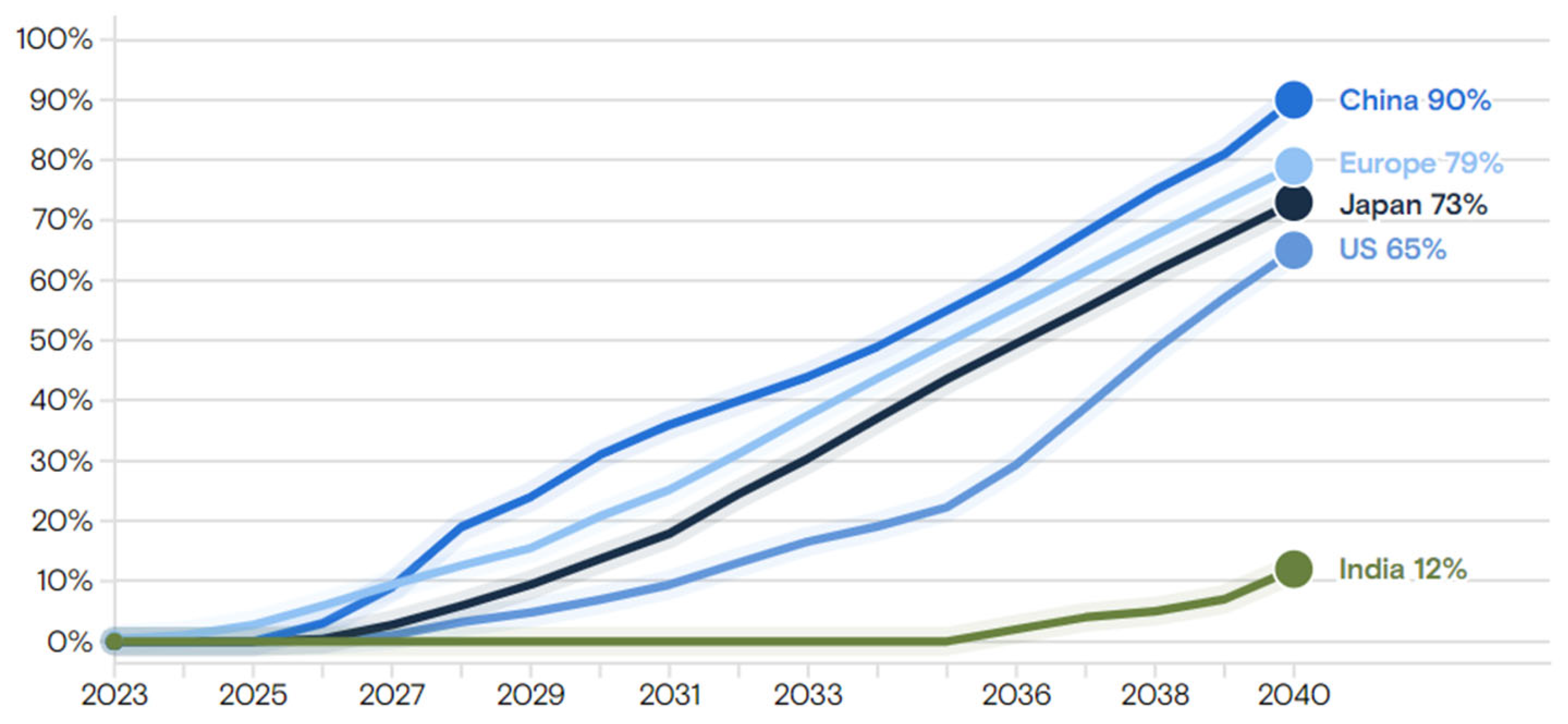
Figure 2.
Waymo weekly paid rides (fully autonomous vehicles). Sources: Alphabet Q3 2024 Earnings Call.
Figure 2.
Waymo weekly paid rides (fully autonomous vehicles). Sources: Alphabet Q3 2024 Earnings Call.
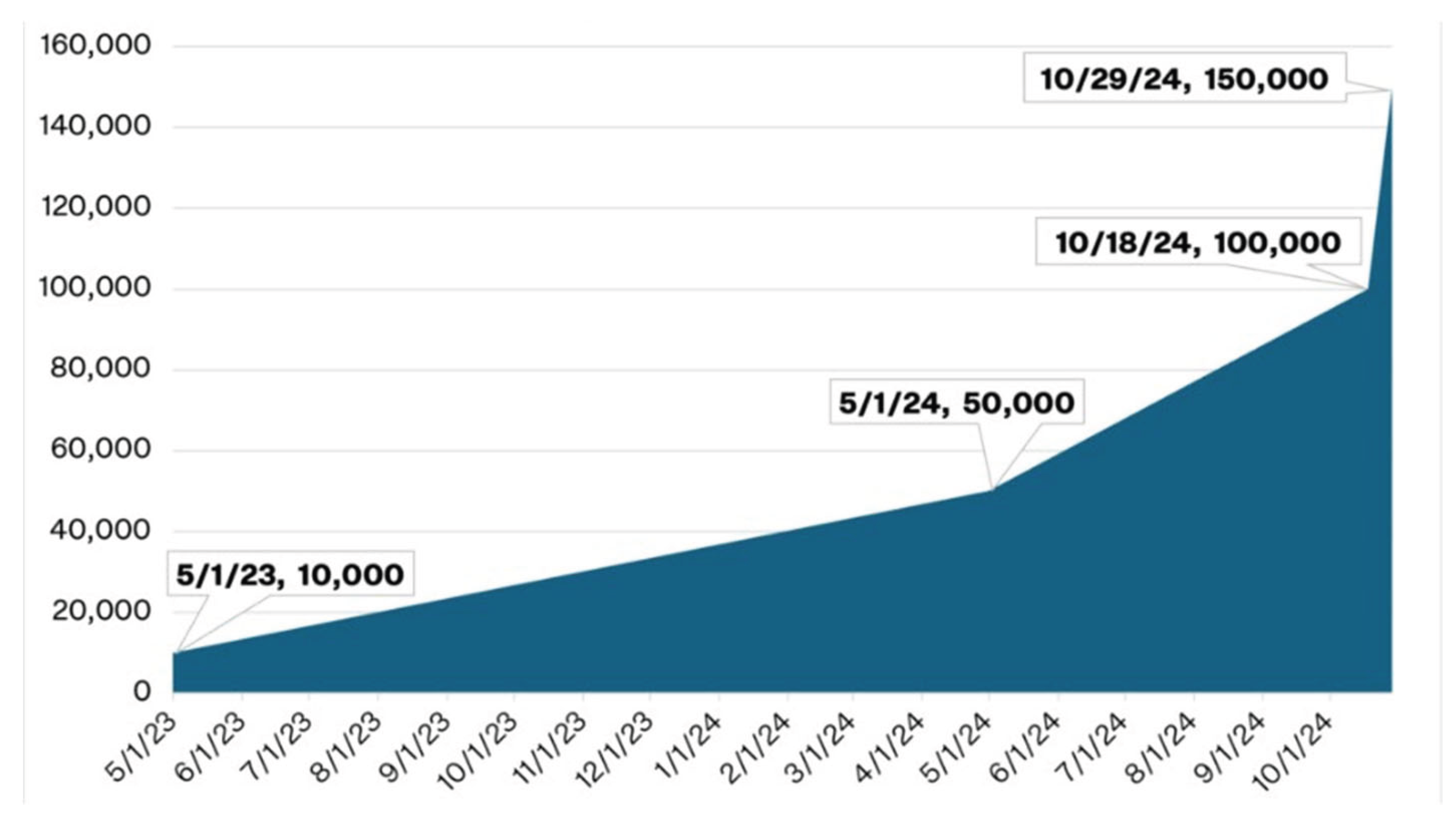
Figure 3.
The components of the urban transport system.
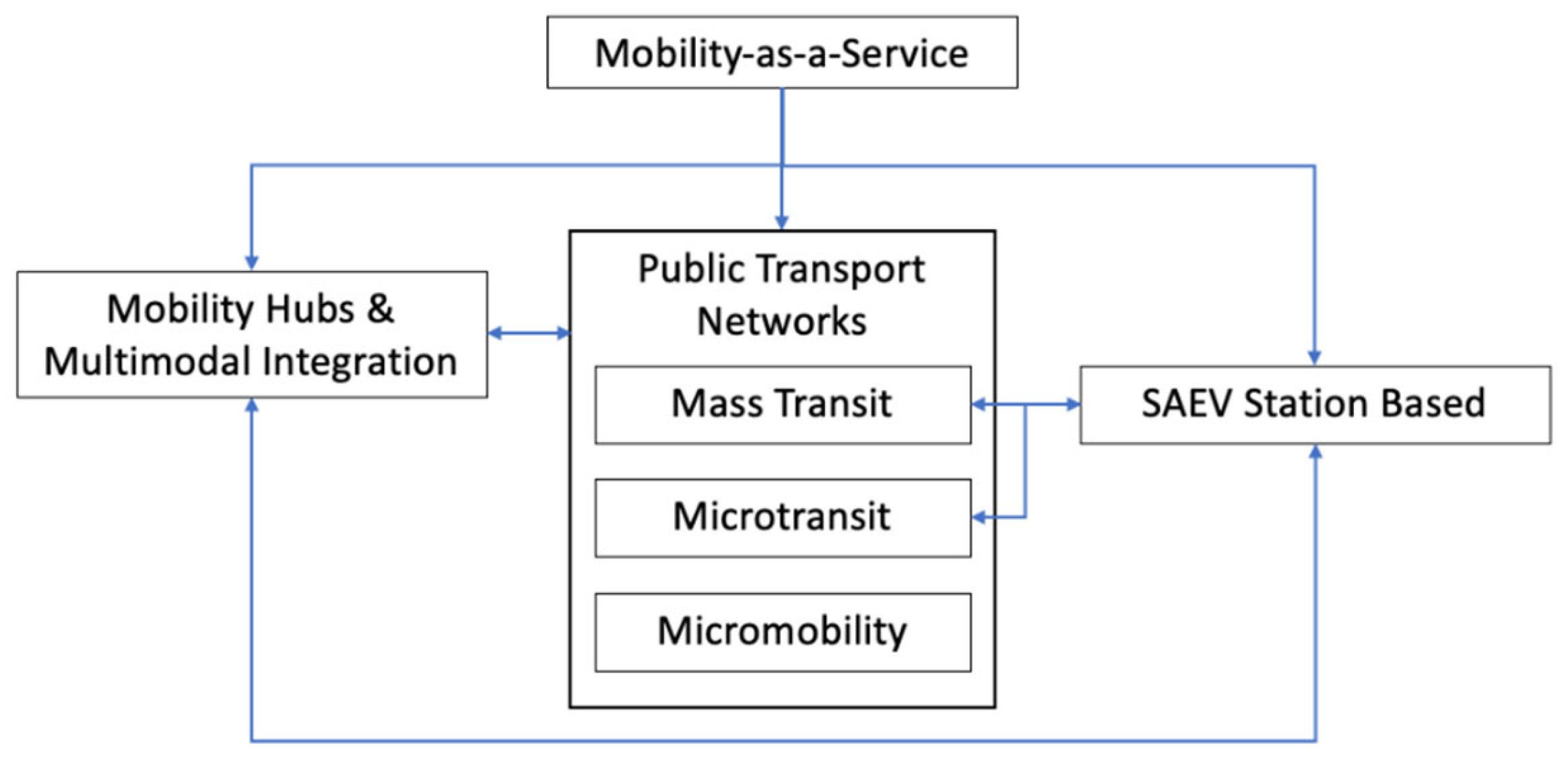
Figure 4.
The Trenton MOVES project with SAEV kiosk (station) based system. Source: https://www.cartsmobility.com.
Figure 4.
The Trenton MOVES project with SAEV kiosk (station) based system. Source: https://www.cartsmobility.com.
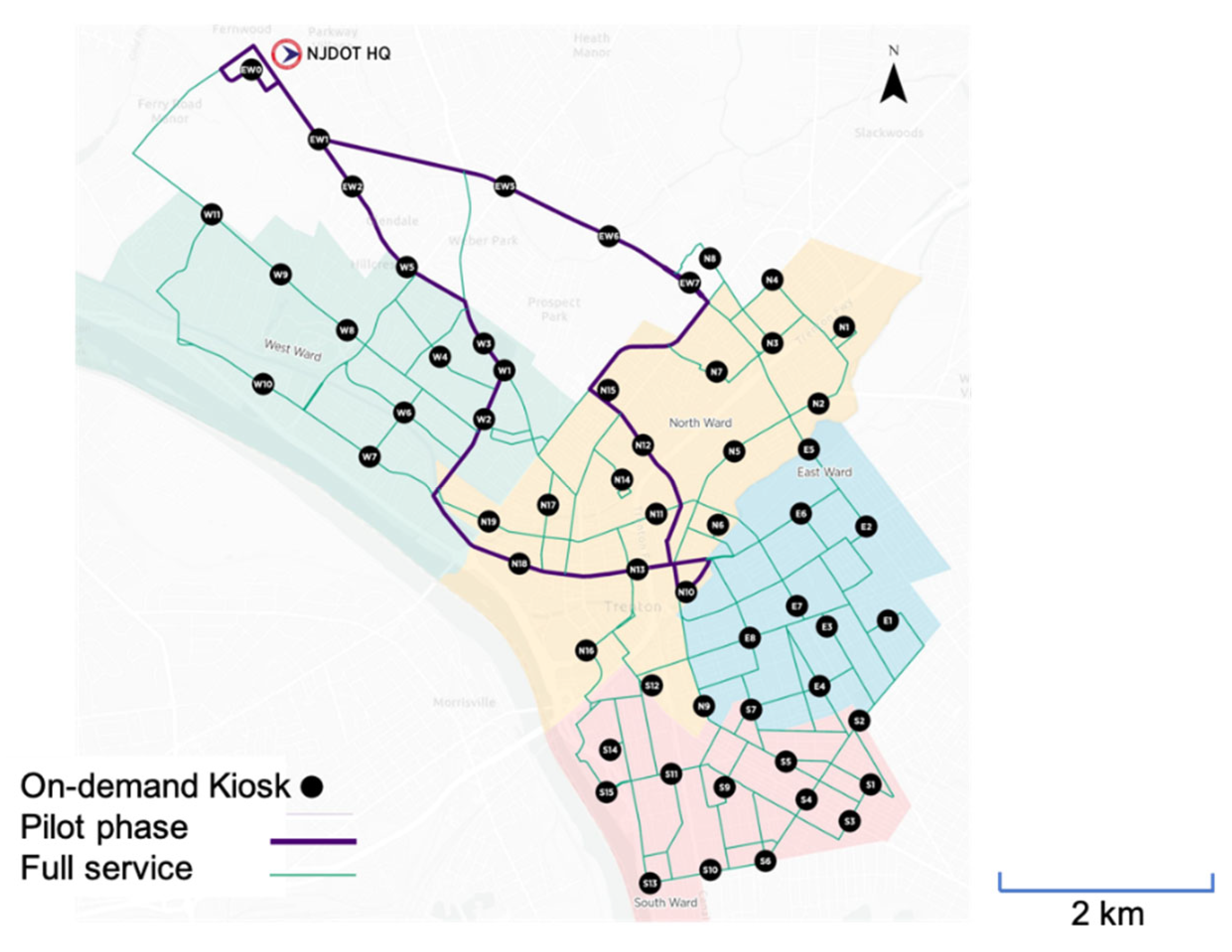

Table 1.
Main autonomous vehicle companies.
| Company | Situation |
|---|---|
| Waymo | Founded in 2009 as a Google project, it is a division of Alphabet for development of robotaxis. its 700 vehicles serve 150,000 ride-hailing trips per week in Austin, Los Angeles, Phoenix, and San Francisco. |
| Baidu | A Chinese multinational technology company, in 2017 it launched Apollo Project to develop robotaxis and robobuses, which tested 40 million km on public roads in China with Level 4 SAE automation scale. In 2022 it tested AVs without safety operators in Beijing. |
| Aptiv | It partnered with Lyft to deploy autonomous ride-hailing in Las Vegas. |
| Aurora | Founded by former leaders from Google, Tesla, and Uber’s autonomous vehicle programs, it is working on self-driving technology for passenger and freight trucks. It has partnerships with Volvo and PACCAR. |
| Pony.ai | A Chinese company founded in late 2016, based in Beijing and Guangzhou, China, and Silicon Valley in the U.S. It is testing AVs in cities in China and the U.S. in autonomous mobility and services. |
| May Mobility |
An autonomous shuttle vehicle startup founded in 2017, it has delivered over 335,000 rides in public transit applications in the U.S. and Japan. |
| Motional | A joint venture between Hyundai Motor Group and Aptiv formed in 2020, it is developing Level 4 autonomous vehicles for ride-hailing and on-demand delivery. Over the past five years, it has conducted more than 125,000 autonomous rides in Las Vegas via the Lyft network and began serving Uber passengers in December 2022. It is now using all-electric Hyundai IONIQ 5 robotaxis with plans to expand to major U.S. cities. |
| Zoox | Founded in 2014, it has gn an independently operated subsidiary of Amazon since 2020. Zoox is creating a complete, integrated platform for autonomous ride-hailing services. In 2023, its robotaxi took its first completely autonomous trip on open public roads, the first time in history that a purpose-built robotaxi with no manual controls had driven autonomously with passengers on open public roads. |
Table 2.
Cities in the world currently testing AVs.
| San Francisco, USA | A leading hub for AV development, with companies like Waymo and Cruise operating significant SAV fleets. These vehicles are integrated into ride-hailing services, offering driverless rides in certain areas of the city. The city is a critical testing ground, providing valuable insights into the integration of SAVs into dense areas. |
| Phoenix, USA | Waymo has been operating SAVs in the Phoenix metropolitan area since 2018. It offers fully autonomous ride-hailing services in the Tempe, Mesa, and Gilbert areas. Phoenix’s simple road network and favorable regulatory environment are ideal for testing and deploying SAVs. |
| Oslo, Norway | Oslo has integrated SAVs with existing metro and bus services to improve accessibility in areas with lower transit coverage. In Groruddalen, a fleet of 15–20 autonomous shuttles operates on demand to fill gaps in the public transit network, particularly for first/last-mile connectivity. |
| Beijing, China | Beijing has embraced SAV technology as part of its broader push toward smart city initiatives. Companies like Baidu operate autonomous ride-hailing services in designated areas of the city, showcasing China’s rapid advancements in autonomous driving technology. |
| Stockholm, Sweden |
Stockholm has conducted studies and pilot projects to assess the impact of SAVs on urban mobility. Research suggests that deploying SAV fleets could significantly reduce the number of vehicles and parking spaces required while improving transportation efficiency. |
| Dubai, U.A.E. | Dubai is striving not only to attract international business but also to reimagine urban transportation with autonomous taxis and shuttles integrated into a broader smart city initiative. |
| Woven City (Toyota Project), Japan |
Toyota’s Woven City at the base of Mount Fuji is a purpose-built smart city designed to test autonomous vehicle technologies, including SAVs. This experimental city allows researchers to explore how such vehicles can operate seamlessly in a controlled environment [12]. |
Table 3.
Anomalies of Urban Transport.
| Resource depletion for manufacturing | This refers to the gradual exhaustion of natural resources throughout the car’s lifecycle, from production to disposal, which is enormous and growing with the increase of size and weight (SUV). It includes fossil fuels, minerals, freshwater, forests, soil fertility, biodiversity, and land. |
| Energy, GHG emissions, pollution | Cars consume fossil fuels and contribute to GHG emissions, exacerbating climate change and pollution. Emissions from their exhaust, brake and tire wear, and resuspension all increase with vehicle weight, like electric vehicles, as does the noise they produce through tire-road friction and ICE. |
| Land use consumption |
The enormous use of urban space by cars presents a range of challenges that affect the overall quality of life in cities. As urbanization increases, the space allocated to roads and parking competes with such other needs as active and public transport, green spaces, pedestrian areas, and housing. |
| Public health | Cars in urban areas have significant public health impacts, primarily through air pollution, noise pollution, and sedentariness related to car dependency. Motor vehicle accidents are a leading cause of injury and death worldwide. Lacking the physical protection cars provide, pedestrians, cyclists, and motorcyclists are particularly vulnerable to automobile accidents. |
| Traffic flow capacity |
Traffic flow capacity is a major challenge for urban planning and transport systems due to the limited road capacity of car flow and the high volume of demand. |
| Congestion and induced traffic demand |
The expansion of road capacity results in an initial reduction in congestion, but over time, as improved conditions make driving more attractive, a paradoxical effect occurs—more people use cars, increasing traffic volume. Sprawl increases, and traffic returns to previous levels or worse. |
| Urban sprawl | This is the uncontrolled and often haphazard expansion of urban areas into surrounding rural or undeveloped land. It typically involves low density and car dependence. It can bring traffic congestion as well as impacts on the environment and on local wildlife and biodiversity. |
| Car access | This refers to the ability of individuals to own, operate, or use cars. While access can provide significant personal mobility and convenience, it has limitations that can affect individuals and even societal goals. |
| Car usage time | The limited use of an individually owned car—where a car is parked for 95% of the time—presents a number of inefficiencies for both individuals and society. |
| Public transport | Despite efforts to use a multimodal approach to reduce dependence on cars, the car has remained by far the most common form of transport in the EU. |
| Rebound effect of digital accessibility | The gains in travel time provided by digital accessibility have rebound effects on travel for different purposes. |
| TOD concepts for suburban and rural contexts | The challenges for TOD are to make it work in less dense and more spread out urban fabrics and to connect entire rural and urban regions, not just urban cores. |
Table 4.
System type and reduced fleet numbers.
| System type | Utilization rate | Fleet size requirement |
|---|---|---|
| Private ownership | ~10–20% | 100% (baseline) |
| Traditional ridesharing | ~30–40% | 40–50% |
| SAEV with dynamic routing | ~70–90% | 15–25% |
Note: These numbers are indicative and vary by city, demand patterns, and technology integration.
Disclaimer/Publisher’s Note: The statements, opinions and data contained in all publications are solely those of the individual author(s) and contributor(s) and not of MDPI and/or the editor(s). MDPI and/or the editor(s) disclaim responsibility for any injury to people or property resulting from any ideas, methods, instructions or products referred to in the content. |
© 2025 by the authors. Licensee MDPI, Basel, Switzerland. This article is an open access article distributed under the terms and conditions of the Creative Commons Attribution (CC BY) license (http://creativecommons.org/licenses/by/4.0/).
Copyright: This open access article is published under a Creative Commons CC BY 4.0 license, which permit the free download, distribution, and reuse, provided that the author and preprint are cited in any reuse.