
Submitted:
20 May 2025
Posted:
21 May 2025
You are already at the latest version
Abstract
The growing demand for renewable energy has underscored the importance of wind power, with wind turbines playing a pivotal role in sustainable electricity generation. However, wind turbine blades are exposed to various challenges, particularly flow-induced vibrations (FIVs), including vortex-induced vibrations, flutter, and galloping, which significantly impact the performance, efficiency, reliability, and lifespan of turbines. This review presents an in-depth analysis of wind turbine blade technology, covering the fundamental principles of operation, aerodynamic characteristics, material selection, and failure mechanisms. It examines the effects of these vibrations on blade integrity and turbine performance, highlighting the need for effective vibration suppression techniques. The paper also discusses current advancements in maintenance strategies, including active and passive vibration control methods, sensor networks, and drone-based inspections, aimed at improving turbine reliability and reducing operational costs. Furthermore, emerging technologies, such as artificial intelligence (AI)-driven prognostic assessments and novel materials for vibration damping, are explored as potential solutions to enhance turbine performance. The review emphasizes the importance of continued research in addressing the challenges posed by FIVs, particularly for offshore turbines operating in harsh environments.
Keywords:
Flow-induced vibrations
; wind turbine blade
; failure
; maintenance
; aerodynamic efficiency
1. Introduction
Rapid technological advancements are fueling growing energy demand, posing a significant challenge to meeting global needs sustainably [1,2,3]. Traditional energy sources (Figure 1a), such as fossil fuels and biomass, pose significant environmental risks and are incompatible with the greenhouse gas reduction goals set by the Kyoto Protocol [4,5]. In contrast, renewable energy sources (e.g., solar, wind, and biomass) provide a cleaner, more sustainable alternative, driving increased research and investment in their development, and gaining considerable attention for their numerous benefits over conventional energy sources. Over the past five years, renewables have received greater budgetary support than coal and other conventional sources (Figure 1b). Wind energy has emerged as a focal point for researchers and the energy business due to its lower carbon dioxide emissions (Figure 1c) and abundant global availability [6,7,8].
The historical use of wind energy for various tasks dates back centuries. Windmills and watermills (Figure 2a, b) were employed in Egypt, Persia, Mesopotamia, and China as early as the seventh century. Examples include King Hammurabi's vertical axis machines in Babylon and the Sistan Windmills (644 A.D.) in Persia, [9]. This marked the beginning of the wind-driven machine industry, which has evolved into the third-largest source of energy production globally, following hydropower and solar. In ancient times, wind was used for grinding grain, sawing timber, pressing oil, shredding tobacco, and pumping water, as shown in Figure 2c [10,11].
The evolution of the wind industry can be divided into five major periods: traditional (before 1750), empirical (1750-1900), establishment (1900-1960), growth (1960-1980), and modern (1980-present) [12]. While wind energy was utilized for various purposes, electricity generation from wind turbines became prevalent in the late 19th century. Charles Brush, an American engineer, developed the first automatic 12 kW wind turbine in 1888, powering his home in Ohio for twenty years. In the 1920s, Marcellus Jacobs built small wind turbines with three-bladed rotors resembling modern designs, incorporating battery storage for home power systems [9]. Poul La Cour followed, constructing approximately one hundred 20-35 KW wind turbines with generators in Denmark [9,13,14]. Germans developed complex horizontal-axis wind turbines with bearings at the rotor hub. Professor Ulrich Hutter created wind turbines using airfoil sections, fiberglass, and plastic blades to reduce weight and improve efficiency [15] (Figure 2d). By the early 1930s, Russians constructed larger-scale utility wind turbines up to 100 KW [16]. These advancements led to experimental wind plants in the USA, Germany, and Denmark from 1935-1970, demonstrating the viability of larger-scale wind turbines.
Wind turbine technology has evolved from smaller vertical-axis designs to the larger, more efficient horizontal-axis turbines that are now widely used around the globe. Many onshore and offshore regions are suitable for wind turbine installations, with some coastal cities in Europe, Asia, and America relying on wind energy as a major electricity source. The Global Wind Energy Council (GWEC) reported that 2023 was a record year for wind turbine installations, with a global addition of 117 GW of new capacity, nearly 50% more than the previous year [17]. This included 106 GW onshore and 10.8 GW offshore. At the UN Climate Change Conference (COP28), 200 countries agreed to triple renewables by 2030 to generate 11,000 GW, increasing installation capacity to 320 GW [17]. Given the critical role of wind turbines in sustainable energy production, ensuring their smooth and reliable operation is essential for the continued growth and success of the industry.
Consequently, considerable research has been dedicated to enhancing turbine efficiency and improving component safety. Rotor blades, gearboxes, generators, and towers are primary components of onshore and offshore wind turbines and are prone to failure [18,19,20]. Figure 3 shows the different components of onshore and offshore wind turbine and their failure percentage. Clearly, blades and generators account for the largest share of failures in wind turbine systems. Blades interacting with incoming wind convert wind kinetic energy into mechanical torque for electricity generation. However, they are subjected to harsh operating conditions, including extreme temperatures, intense solar radiation, and seismic activity, which can impact their performance and longevity [21,22,23]. Additionally, wind turbine blades endure extraordinary events, such as lightning strikes and bird collisions [24,25,26,27], while also bearing substantial inertial, gravitational, aerodynamic, and fatigue loads [28,29]. Furthermore, they are designed with multiple airfoil sections, extending from the root to the tip [30,31]. Their complex design makes their performance critical to the reliability of the entire generator system [32]. Blade failures can disrupt the balanced rotation, causing violent vibrations and potential collapse of the entire turbine structure [33].
Recent wind turbine blade damage incidents have resulted in significant economic losses. In December 2024, a turbine blade failed at Sneddon Law Wind Farm in Scotland. Other incidents in 2024 include a blade failure at the Dogger Bank offshore wind farm in the UK and a blade collapse at the Hoa Binh Wind Power Project No. 5 in Vietnam, resulting in an estimated loss of US$8.1 million. Similar incidents occurred in 2022 and 2023, such as the Ørsted Wind Farm Blade Failure in May 2023 and the Vestas Wind Turbine failure in Germany in June 2022. In autumn 2021, a storm damaged wind farms in Germany and France, including severe damage to the blades of an Enercon E-138 EP3 4.2 MW fan at Nattheim Wind Farm (Figure 4a). In January 2018, a blade broke on a wind turbine in Liaoning, China (Figure 4b). Similarly, in other applications where similar blades are used, severe accidents and loss of life have occurred due to blade failure. For instance, the main rotor blade of an AH-1 Cobra helicopter in South Korea unexpectedly broke and detached (Figure 4c), while Southeast Atlantic Airlines Flight 529 was destroyed when damaged propeller blades led to a catastrophic failure (Figure 4d). This crash tragically resulted in the death of eight people, including seven passengers and the captain.
Megawatt-class wind turbines are now the mainstay of the wind power market [34], with blades moving towards larger diameters and lighter masses, particularly in deep-sea wind turbines, where blade lengths can reach 120 meters [23,35,36]. For example, the GE Haliade-X, the world's largest wind turbine, has a height of 260 m, a power capacity of 14 megawatts, a rotor diameter of 220 m, and a blade length of 107 m [37]. These large-diameter blades are susceptible to vibrations due to pendulum motions, wind-induced instability, and inertial forces [38]. When bending, heaving, and pitching motions are coupled, strong classical flutter can occur, which is rapid, destructive, and must be avoided in wind turbine design and operation [20,27,39,40]. Reducing wind turbine damage caused by vibration and improving wind energy utilization efficiency are, therefore, critical for the development of wind power generation. This paper provides a review of wind turbine blade technology, including principles of operation, aerodynamics, material selection, design, analysis of flow-induced vibrations (vortex-induced vibrations, flutter, galloping), failure modes, maintenance, and vibration mitigation techniques.
2. Types of Wind Turbines
Wind turbines can be differentiated and named based on several criteria, including the orientation of their rotation axis (horizontal or vertical), the type of torque they produce (lift or drag), their location (onshore or offshore), and their rated power generation capacity (Figure 5). Based on the orientation of their rotation axis, wind turbines are classified as either horizontal axis wind turbines (HAWTs) (Figure 6a, b) or vertical axis wind turbines (VAWTs) (Figure 7a, b). Their performance, suitability, and efficiency are sensitive to locations. The most popular HAWT design has blades that revolve on a horizontal axis, just like a conventional windmill (Figure 6c). Similar to airplane wings [41], these aerodynamically designed blades generate lift and efficiently convert wind energy into rotational motion. High efficiency is achieved, particularly in regions with higher wind speeds and stable wind direction. However, their complex blade design requires precise engineering and optimal wind alignment, often necessitating yaw devices to adjust the rotor's orientation. While their higher energy output under ideal conditions justifies their complexity, this also leads to increased production and maintenance costs. In contrast, the blades of VAWTs are typically simpler in design—either curved or straight—and are arranged in configurations such as helical or Darrieus-style [42] (Figure 7c). VAWTs rotating around a vertical axis are highly adaptable to turbulent or variable wind conditions. Their design allows them to capture wind from any direction. While VAWTs typically have lower efficiency due to slower rotational speeds and higher drag forces, their small size and unidirectional capabilities offer significant advantages in certain applications. Furthermore, VAWTs distribute stress more evenly, reducing blade fatigue and extending the lifespan of the turbine blades. Their simple mechanical design, along with ease of installation and maintenance, makes them an ideal choice for energy extraction in spaces with limited room or less consistent wind.
However, selecting the appropriate turbine for a specific location requires considering factors such as energy needs and environmental conditions. Both turbine types offer distinct advantages: HAWTs excel in stable wind conditions, offering higher efficiency and energy output, while VAWTs are more adaptable to dynamic and complex wind patterns, with the added benefit of easier maintenance. The choice of turbine is typically based on the operating site and the expected atmospheric variables. Given the larger-scale applications of HAWTs in both onshore and offshore environments, this paper focuses on the HAWT blade, as more research is currently directed towards this type of wind turbine blade.
3. Principle of Wind Turbine Blade
The principle of wind turbine blades is grounded in the conversion of kinetic energy from the wind into mechanical energy through the process of aerodynamic lift and drag. The efficiency of this energy conversion depends on various factors, including the blade's shape, size, material, and the wind conditions at the turbine’s location. Understanding the fundamental principles behind wind turbine blades is crucial for optimizing their design and performance in harnessing renewable wind energy.
3.1. Aerodynamics
Wind turbine blades rotate due to fundamental fluid mechanics principles, primarily the Bernoulli effect and Newton's Third Law [47]. When wind strikes the blade at a pitch angle, it is deflected, generating a force that pushes the blade away from the deflected wind. To maximize energy extraction and aerodynamic efficiency, an optimal pitch angle is crucial [48]. Without an appropriate pitch, the blades would only experience drag, a backward force. Figure 8 illustrates the wind stream and the forces acting on the blade elements, including lift and drag, induced by the interaction between the blade and the incoming wind flow. Wind turbine blades are designed to engage with the wind at an angle, enabling effective deflection and rotation (Figure 8b) [49,50].
Blade design incorporates tapering, twisting, and multiple airfoil sections [52]. Figure 9a–d displays the various blade sections used from the root to the tip, while Figure 9e provides the schematics of the blade. The airfoil shape, with a curved upper surface and a relatively flatter lower surface, creates a pressure difference as air flows over it. The higher velocity over the curved upper surface results in lower pressure, while the lower velocity on the flat lower surface results in higher pressure (Figure 9f). This pressure differential generates lift, which drives the blade's rotation [53,54,55].
Lift generation is influenced by blade shape, the angle of the blade relative to the incoming flow, and airspeed. To maximize energy conversion, blades are designed to maximize lift and minimize drag. The lift force acts perpendicular to the incoming flow, while the drag force acts parallel. The lift-to-drag ratio is a critical consideration in blade design to optimize energy extraction [56], with turbines ideally operating at the maximum ratio [52]. The angle of attack (α), the angle between the blade and the incoming flow, significantly impacts lift [57,58]. Increasing the angle of attack increases lift, but exceeding an optimal angle leads to stall, reducing lift [59,60,61,62]. Therefore, various methods are employed to determine the best angle of attack for a specific airfoil [63] to maximize power output [64,65]. Another key aerodynamic parameter is the tip-speed ratio. The tip speed is calculated as
where radius r is the distance from the hub to the blade tip, and ω is the angular velocity. The blade tip travels much faster than the blade root because the tip covers a larger circumference in the same amount of time; the root, being closer to the hub, has a smaller radius and thus a lower speed. The tip speed ratio (TSR) is calculated as the ratio between the tip speed and the wind speed.
Here, U∞ is the freestream wind speed. A higher TSR (> 1.0) indicates that the blade tip moves faster than the incoming wind, which can increase lift but may also lead to a corresponding increase in drag. Therefore, blade designs aim for an optimal tip speed ratio, generally recommended to be between 6 and 8, though the ideal value depends on various factors [66,67], including pitch control and blade loading. Thus, TSR is a crucial parameter in blade aerodynamics.
3.2. Design and Geometry
Wind turbine blade design is a complex and critical process that balances structural integrity and geometric optimization to enhance performance, dependability, and lifespan prediction (Figure 9g). Designs incorporate various airfoils, typically from the NACA and SERL series, to ensure an ideal angle of attack across the blade span, with variations in chord length, twist angle, and thickness from root to tip [68,69]. Airfoil selection is crucial, guided by the need to optimize the lift-to-drag ratio, reduce sensitivity to surface roughness, and meet design objectives like high power coefficients and minimized chord length [69].
Longer blades are favored to enhance the kinetic energy conversion efficiency of wind turbines [70]. However, longer blades present additional challenges, including the need for complex and expensive composite materials to ensure sufficient strength and the need to withstand supplementary loading and aerodynamic forces due to the increased span [42,71]. Figure 10 presents a typical cross-sectional schematic diagram of a wind turbine blade, illustrating internal layers such as balsa wood, spar caps, and skin laminates. It also highlights how various segments of the blade bear flapwise and edgewise loads under compression and tension. The diagram further emphasizes the role of adhesive joints and material layers in distributing loads throughout the blade structure. The number of blades directly influences aerodynamic performance and balanced rotation, impacting turbine speed. The use of three blades facilitates smooth rotation, making it a common selection criterion [72].
Adjustable pitch control extends turbine lifespan by enabling blades to adapt to changing wind speeds, optimizing energy conversion while mitigating drag and fatigue effects [74,75]. Meticulous wind turbine design integrates practical considerations, such as weight optimization and fatigue resistance, with aerodynamic principles, like maximizing lift and minimizing drag, to ensure efficient energy conversion and structural integrity [76]. When combined with advanced materials, these blade designs provide long-term stability and efficient energy extraction.
3.3. Materials Used in Blade Construction
The selection of materials for wind turbine blades is influenced by several factors, including weight, durability, strength, low density, ease of processing, recyclability, and cost, to ensure long-term performance under varying load conditions and fatigue [77]. Over the years, various materials have been used for blade manufacturing, but the most common options today include fiberglass-reinforced polyester or epoxy resin, E-glass fiber, and carbon fiber composites (Table 1). Carbon fiber composites are preferred in high-performance applications due to their exceptional mechanical properties and lightweight nature [78]. However, their high cost limits their broader use. Modern materials are designed to offer superior strength-to-weight ratios, excellent corrosion resistance, and improved fatigue performance, making them ideal for meeting the structural and aerodynamic demands of large modern turbine blades. Materials like balsa wood or foam are often used in sandwich structures to increase stiffness while keeping the weight low.
To lighten blades and increase durability, advanced research focuses on the structural use of bamboo timber to significantly reduce manufacturing costs [79,80]. This could improve the economic viability of wind turbines, leading to lower electricity costs [81]. Significant challenges remain before bamboo wood can be considered a viable alternative on a larger scale, particularly regarding the lifespan of bamboo blades and their resistance to demanding environmental and operational conditions.
Material selection is also influenced by environmental factors, such as recyclability and resistance to ultraviolet (UV) degradation. Several tools are used to select appropriate materials for different wind and environmental conditions to enhance blade lifespan according to site requirements [82]. Furthermore, developments in biocomposites and hybrid materials are emerging as sustainable alternatives for optimized performance with minimized environmental impact.

| Period | Types | Description | Advantages |
| Early years: 1970 −1980 | Wood | Laminated wood was used in early wind turbine blades, often in small-scale turbines. | Readily available and easy to shape. |
| 1980 − 1990 | Fiberglass | Fiberglass became the most commonly used material due to its light weight and high strength. Composites are often made with epoxy or polyester resins. | High strength-to-weight ratio, corrosion, and resistance. |
| 1990 −2000 | Wood–epoxy composites | The incorporation of wood fibers and epoxy marked a significant advancement over conventional wood construction, resulting in increased strength and extended lifespan. | Cost-effective, better mechanical properties. |
| 2000 −present | Carbon fiber reinforced plastics; Glass fiber reinforced Plastics |
Carbon fiber composites, combined with resins, offer high performance and low weight. Glass fibers are also used in blade manufacturing due to their low cost and ease of production. | Good mechanical properties, low cost. Environmentally friendly, sustainable. |
| Recent developments: 2010 − present |
Natural Fiber Composites | Natural fiber composites, such as those made from hemp, flax, and jute, are receiving increasing attention due to their moderate mechanical properties and sustainability benefits. | Environmentally friendly, sustainable. |
| Present & Emerging: 2020 − present |
Biocomposites (natural fibers + bio-based resins); Thermoplastic composites; Bamboo composites |
Biocomposites, which combine natural fibers (like flax and bamboo) with bio-based resins (such as PLA and plant oil epoxy), offer sustainability, recyclability, and lightweight advantages. While thermoplastics like polypropylene (PP) and polyamide (PA) are being explored for recyclable wind turbine blades, bamboo fibers are particularly valued for their resilience. |
High recyclability and faster manufacturing times. Sustainable, low-cost, good mechanical performance. |
4. Flow-Induced Vibrations
4.1. Basic Principles and Types of Flow-Induced Vibrations
When a flowing fluid interacts with a structure, it can generate instabilities or oscillations, altering the structure's shape or position. These oscillations are termed flow-induced vibrations (FIV) [86,87,88,89]. FIVs originate from unsteady flow-induced forces, changing the structure's state, location, or stress distribution [90,91]. Common types of FIV include vortex-induced vibration (VIV), galloping, and flutter, as shown in the first columns of Figure 11 [92,93,94,95,96,97]. The VIV results from excitation due to lock-in, while galloping is excited by movement-induced instability [98,99,100] (Qin et al. 2017, 2018, 2019). Flutter is generated when the bending, heaving, and pitching vibrations are coupled with each other. The VIV is prevalent in cylindrical structures like pipelines, wind turbine blades, and cables, whereas galloping is more common in square cylinders, bridge decks, and tall buildings [101,102,103,104,105,106]. Particularly, blades may undergo all three types of FIV, while cables may experience VIV and flutter (Figure 11).
Vortex-induced vibrations: VIV occurs when fluid flow creates alternating vortices in a structure's wake, generating forces that excite its natural vibration modes [93,107]. In cylindrical structures, vortex shedding leads to fluctuating pressure forces, with oscillation frequency and vibration amplitude primarily governed by the shedding frequency, which depends on the structure's geometry, flow velocity, and Reynolds number [108,109]. VIV intensifies when the structure's natural frequency matches the vortex shedding frequency, causing a phenomenon known as "lock-in," where vibration amplitude increases dramatically, leading to potential damage or failure [110,111]. The structure's damping characteristics and its interaction with fluid dynamics also influence VIV. In wind turbines, if the blade's natural frequency aligns with the vortex shedding frequency, it leads to significant increases in vibration amplitude, causing severe fatigue, material degradation, and even failure [112,113,114]. This amplifies vibrations, reducing efficiency and compromising blade safety.
Galloping vibrations: Galloping is an instability that occurs in slender bodies when aerodynamic forces induce sustained oscillations [115,116]. In wind turbines, galloping can arise from asymmetrical flow conditions, causing unstable aerodynamic forces that continuously excite blade motion, often triggered by blade deformation and fluctuating wind directions or low wind speeds [117].
Flutter vibrations: The interaction between aerodynamic stresses and structural dynamics can lead to flutter, where self-induced oscillations amplify aerodynamic loads and blade movement. In wind turbines, as wind velocity increases, torsional and bending modes can couple, forming flutter, particularly in lightweight and flexible blades operating at high tip speeds. Flutter can cause destructive vibrations, leading to blade failure [94,118,119]. Factors such as blade geometry, material properties, and operating conditions influence flutter formation [120,121]. Researchers use numerical and experimental methods, including active and passive control techniques and airfoil optimization, to predict and mitigate flutter [122].
Stall- and wake-induced vibrations: Stall-induced vibrations are another key instability in wind turbines, occurring when the blade operates near or beyond its stall angle, causing unbalanced flow separation and low-frequency oscillating aerodynamic forces that induce structural vibrations [123,124]. Along with these vibration mechanisms, some external factors can also play their role in FIVs, such as blade-wake interactions [125], turbulent wind conditions, and tower shadow effects [126,127], making FIV a critical aspect to consider in the design and operation of wind turbines.
4.2. Impact of Vibrations on Turbine Performance and Longevity
FIVs are the primary contributors to wind turbine blade failures, significantly impacting the aerodynamic performance, strength, and operational lifespan of wind turbine components, as shown in Figure 12a [128]. Moreover, components like drive trains, rotors, and structural elements are also susceptible to FIV and may fail due to wear, tear, or misalignments [129,130]. Excessive and unwanted vibrations from FIV increase aerodynamic stresses, altering the aerodynamic interaction of blades with incoming wind. This reduces power generation efficiency by disrupting the ideal angle of attack and causing premature flow separation [131]. Structural fatigue becomes a major concern due to repeated stress cycles from VIV, flutter, and stall- and wake-induced vibrations. These accelerate material deterioration, leading to the initiation and propagation of cracks in critical blade areas [132,133] (Sutherland, 1999). Fatigue damage is more likely in offshore wind turbines, where turbulence and wave currents exacerbate loading effects [134]. Due to FIV, lifespans of blade/tower, bearing/gearbox, and offshore turbines are reduced by 20%, 27% and 35%, respectively (Figure 12a).
Moreover, continuous vibrations contribute to increased maintenance costs and downtime, resulting in substantial economic losses (Figure 12b). This endangers the financial viability of wind energy projects on larger, commercial scales and hinders the prospects for new wind turbine installations [135]. Resonance effects, as seen in past turbine failures with inadequate damping, can sometimes cause catastrophic blade failures. This underscores the need for enhanced monitoring and maintenance. Indeed, maintenance or replacements can incur significant costs, as turbine shutdowns increase electricity production costs. Researchers have explored various methods to mitigate these vibrations, such as adjusting the pitch angle and employing passive and active dampers.
These interventions can reduce the impact of unwanted vibrations on turbines. Reducing these vibrations can significantly enhance the performance and lifespan of wind turbine blades [136]. In order to enhance the performance, lifecycle, and smooth operation of wind turbine blades, a complete awareness of FIVs is required, specifically in turbulent wind conditions, like offshore wind environments [137].
5. Vibration Mitigation Strategies
In the design and maintenance of wind turbine blades, failures caused by flow-induced vibrations are a key concern, as explained above. Exorbitant vibrations can cause fatigue, premature failures, and reduced efficiency. Researchers investigated and proposed multiple tactics to mitigate these vibrations and improve the effectiveness of wind turbine blades.
5.1. Active and Passive Vibration Control Methods
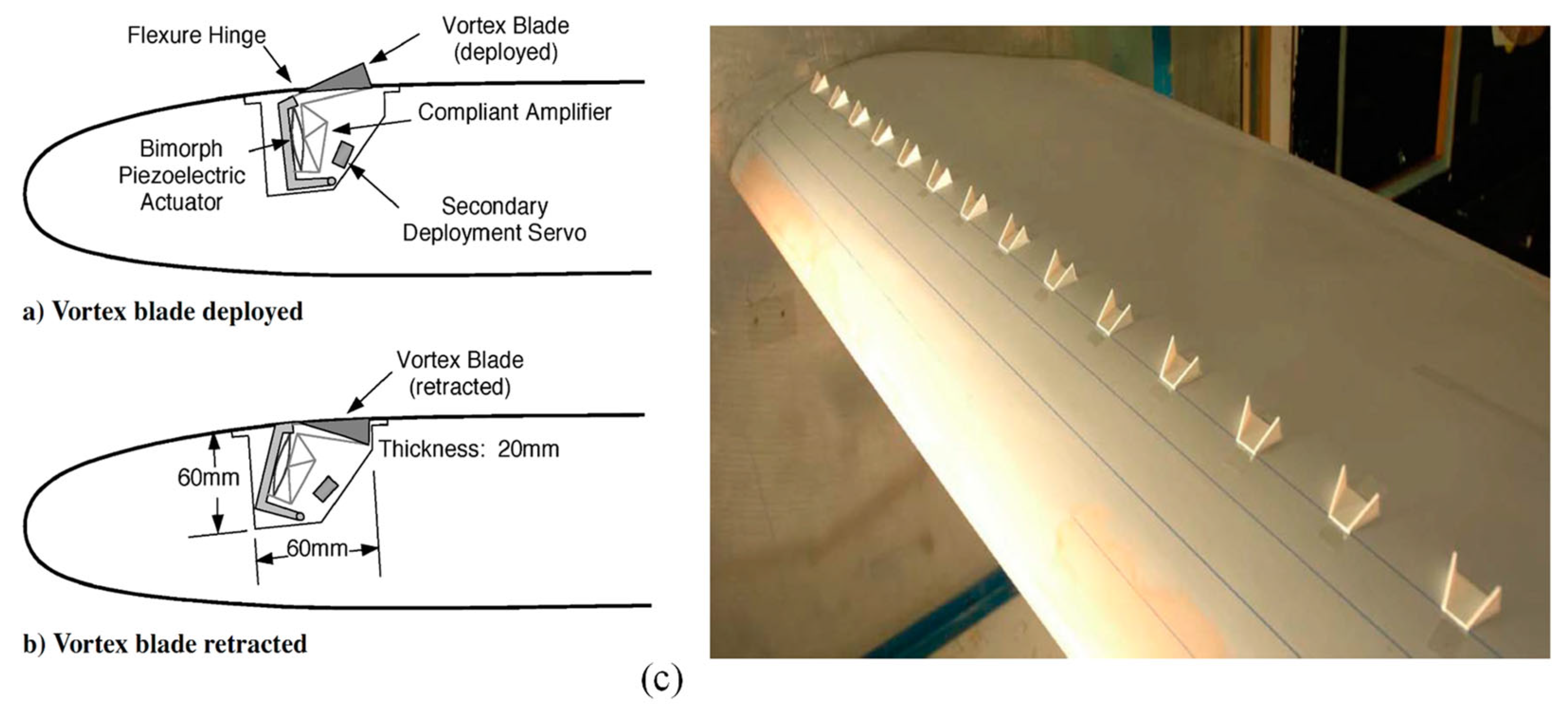
It is essential to lower the vibration amplitudes to operate turbines at their full potential, maximize the extracted power, and maintain the strength of wind turbine blades. The solution involves leveraging active and passive vibration mitigation technologies, as detailed in Figure 13 [135,138]. Passive control methods involve fixed modifications to the blade. These include trailing edge modifications, such as serrations and Gurney flaps, leading-edge modifications such as tubercled edges, and surface modifications like vortex generators, suction holes, and blowing holes. Biomimicry, including bionic wings, also falls under passive blade shape control. They are placed or merged on the surface of the structures (Figure 14) to absorb and dissipate vibrational energy [139]. Besides mitigating vibrations, passive devices boost blade rigidity, fatigue strength, and operating efficiency.
Active controllers, on the other hand, use external energy or adaptive mechanisms to change blade characteristics during operation, vigorously negating oscillations in real-time by utilizing actuators, sensors, and sophisticated regulatory algorithms [140]. Flow control devices with active blowing and suction, smart materials with piezoelectric actuators, and morphing blades with shape adaptation are examples of active control (Figure 13). Individual blade pitch control (IBPC), active trailing edge flaps, and plasma actuators also allow for real-time adjustments.
Figure 13.
Active and passive control techniques of wind turbines.
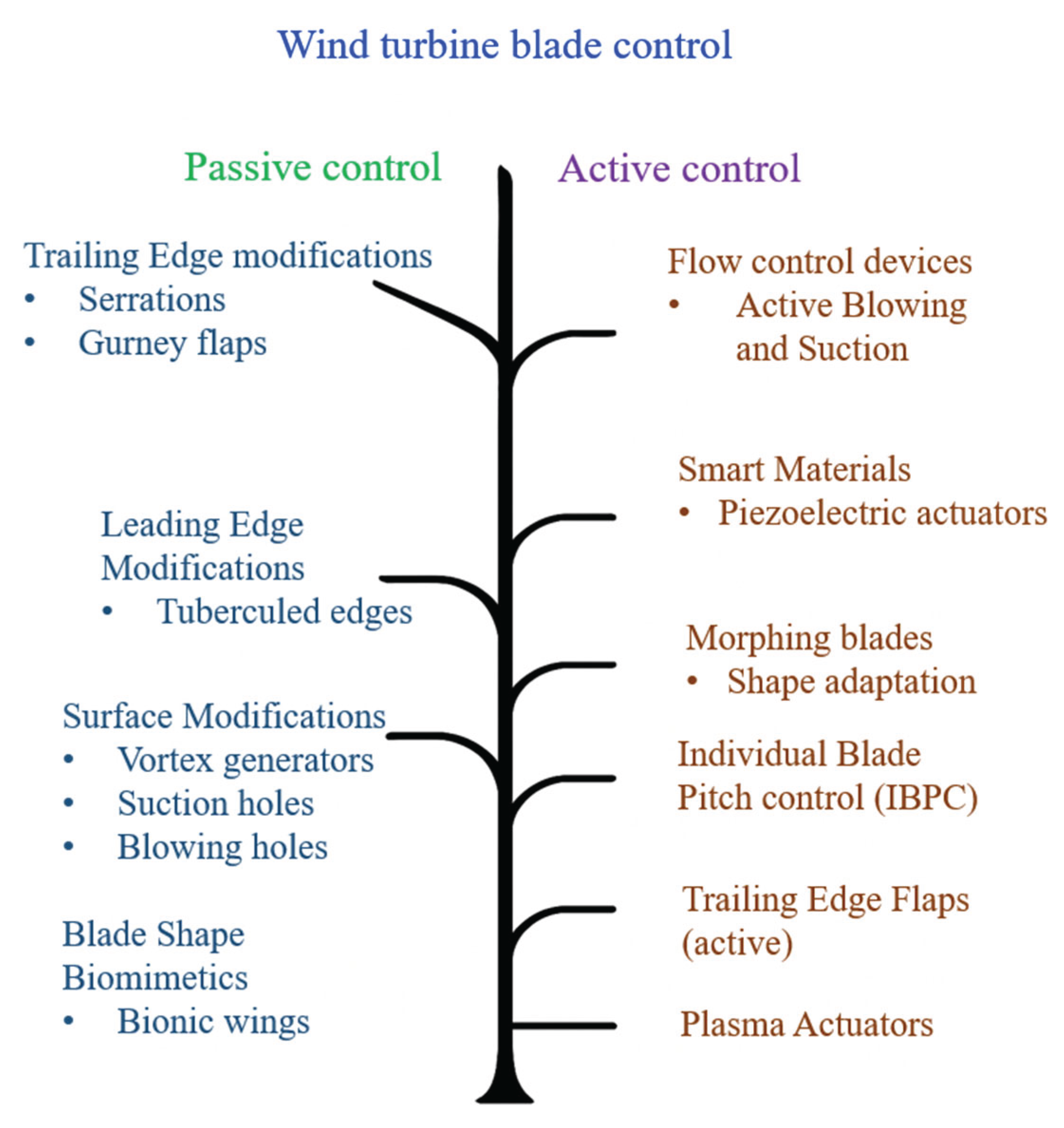
Figure 14.
(a, b) High-frequency micro-vortex-generator schematic. (c) Solid Vortex Generator configuration mounted on the surface at 20% of the trailing edge [141].
Figure 14.
(a, b) High-frequency micro-vortex-generator schematic. (c) Solid Vortex Generator configuration mounted on the surface at 20% of the trailing edge [141].
As wind turbines increase in size and complexity, advancements in vibration suppression become critical for stable, uninterrupted operation, enhancing efficiency and overall performance, especially in harsh offshore environments. The choice between active and passive control, or a combination of both, depends on the specific requirements of the wind turbine and its operating environment. Passive damping devices address baseline oscillations, while active control systems manage complex vibrations. Combining both approaches is an area of research for improved suppression [142].
5.2. Design Modifications and Innovative Materials for Vibration Reduction
One effective strategy to reduce vibration amplitudes is blade geometry modifications, including the thickness and profile of blades. The blades with adjustable tips or optimized twist angles significantly decrease VIV [119]. These design modifications enhance aerodynamic performance and lower the risk of fatigue damage from cyclic loads [123]. Increasing the toughness and strength of blades helps further reduce vibrations and the strain transmitted to structural components. Strengthening the blade root and improving junctions between the hub and blade enhance system resilience against vibrations, distributing vibrational energy evenly to minimize stress concentrations that may lead to failure.
Structural damping elements, such as viscoelastic materials or damping composites, effectively dissipate vibrational energy [143]. Integrating advanced materials into improved physical and aerodynamic designs provides a comprehensive approach to minimizing vibrations in turbine blades. Additionally, various coatings improve vibration absorption and overall blade performance. Surfaces are often coated with damping or friction-reducing materials to minimize aerodynamic dispersion and delay resonance conditions [144]. Composite coatings embedded with fibers or particles can enhance blade stiffness and reduce vibrations [145]. Restorative coatings are also practical for mitigating minor surface deterioration caused by vibrations, automatically repairing small cracks or defects to extend operational life. By combining innovative materials with advanced coatings, wind turbine blades can achieve better performance, increased longevity, and reduced vibration even under harsh weather conditions [146]. As demand for renewable energy sources rises, the development and applications of these technologies are crucial for maintaining the long-term reliability and efficiency of wind turbines.
5.3. Recent Innovations and Research in Vibration Mitigation
The suppression of unwanted vibrations in turbine blades has significantly benefited from recent advancements in vibration-damping techniques, enhancing both blade longevity and energy efficiency. One innovative approach is the design of a two-dimensional nonlinear tuned mass damper inerter (2D-NTMDI) [147,148]. This system integrates a mass with springs, dashpots, and inerters aligned along two axes to effectively reduce structural responses in multiple directions. This provides nonlinear forces to counteract vibrations and may increase fatigue life by more than 35% when applied to a 5 MW turbine blade, demonstrating its value in improving blade durability under dynamic loads [147,149]. Another attractive technique is to use a one-way cable pendulum damper to lessen vibrations on massive wind turbine blades. This damping device has demonstrated remarkable success in reducing edgewise vibrations, which are often the source of blade fatigue and structural damage. Because it diminishes these vibrations and improves the overall reliability of the blades while also increasing their working lifespan, the cable pendulum damper is a helpful instrument for modern wind energy systems [150]. Shunt-damping techniques have also shown promise in reducing edgewise vibrations, particularly in smaller blades. This technique offers a more adaptable and efficient solution to control vibration in smaller turbines than traditional tuned mass dampers [151]. Furthermore, finite element analysis (FEA) has emerged as a productive technique for learning more about blade vibration behavior. FEA helps designers identify basic stress areas and refine blade designs to reduce vibrations and enhance overall performance by simulating various working conditions.
6. Failure Mechanisms in Wind Turbine Blades
Numerous failure mechanisms harm wind turbine blade performance, safety, and life cycle. A thorough understanding of these failure mechanisms is essential for designing robust blades capable of withstanding harsh operating conditions, particularly in offshore and high-wind environments.
6.1. Types of Failures
In wind turbine blades, vibrations can expedite the failure, applying cyclic strains to the blade structure, gradually increasing the stress concentration in critical regions such as the blade root and leading edges (Figure 15a – c). These oscillations exacerbate the buildup of fatigue damage in these areas, where the material is already subjected to high aerodynamic forces and fluctuating stress. Repeated loading accelerates the development and propagation of microcracks in the composite material [114].
Fatigue failure: Stress and fatigue of turbine blades gradually build up over time. Fatigue damage is one of the most common and important failure mechanisms in turbine blades (Figure 16). This kind of failure happens when load cycles are applied repeatedly, which causes microcracks to start and spread throughout the material [133,155]. Examples of failures, damage, and defects that occur on wind turbine blades are illustrated in Figure 17. The figure presents various impairments, including scrapping, pitting, paint peeling, and cracking, specifically in critical areas such as the leading and trailing edges, where aerodynamic forces frequently fluctuate. If these cracks are not detected early, they may eventually cause a catastrophic failure by weakening the blade structural integrity as it progressively extends. Materials like fiberglass and carbon composites, which are commonly used for wind turbine blades, are particularly vulnerable to fatigue because they are prone to delamination and fracture under cyclic stress. The breakage phase may be accelerated by the repetitive stress that results in this delamination, since it may weaken the adhesive bond between composite layers [156].
Crack failure: Cracking is another important failure type that frequently occurs after fatigue-induced degradation. The microcracks created by the fatigue damage get severe on every cycle and extend to a physical formation of cracks, which later on reach up to a dangerous level and could become the reason for the failure of components over time. Moreover, cracks can be further widened or spread due to several reasons, like collision damage, working fluctuations, and environmental degradation. Blades can be damaged due to these cracks, or even failure can happen if they are not identified and repaired promptly. Crack formation is common in high-stress areas such as the leading edge (Figure 16), but predicting the specific location is challenging due to various factors, such as the loading intensity, turbine design, and materials alignment [157].
Atmospheric destruction: Along with mechanical stresses, atmospheric destruction also affects negatively and can be the reason for the buildup of cracks and blade failure [28]. As shown in Figure 16, air moisture, fluctuations in temperature, external factors, and Ultraviolet (UV) light exposure for a long time can also damage the material alloy [158,159], especially on the farthest surface. For instance, UV light leads to material erosion and can undermine mechanical properties by breaking the chemical connection in the material's resin matrix. Consistent modifications in the temperature at different times of day and night can induce thermal strain that intensifies material corrosion, and absorbing moisture can lead to swelling and cause material separation [26,160]. All of these factors can shorten the life of turbine blades, intensifying the need for regular checkups or even replacements [159,161].
6.2. Failure Detection Method
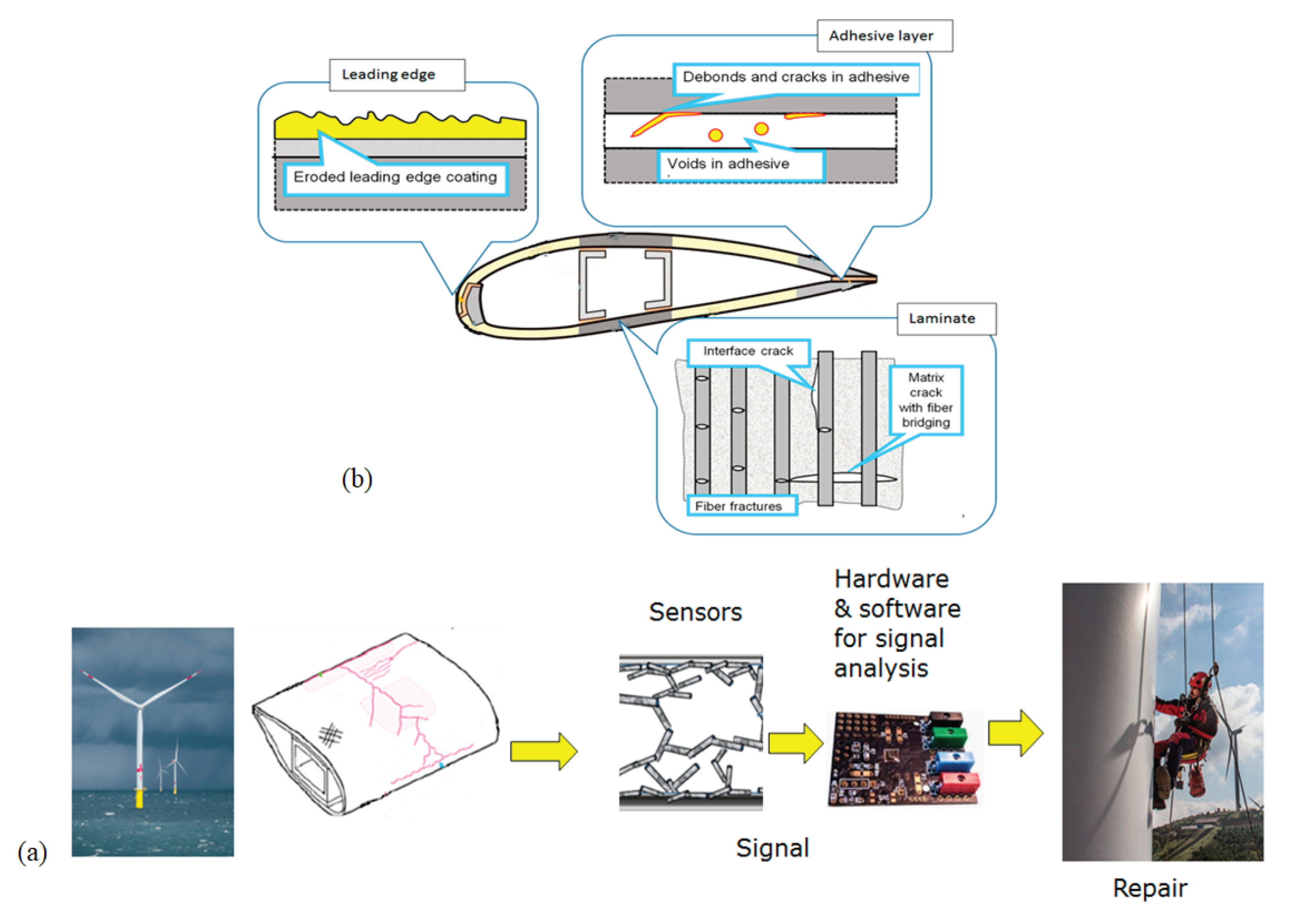
To decrease failure risk and improve reliability during operation, wind turbine monitoring and prognostic maintenance methods employ advanced surveillance systems. One such method is called structural health monitoring (SHM), which utilizes different types of sensors such as noise emanation sensors, vibration detection sensors, and strain gauges (Figure 18). Real-time data of blade dynamics is gathered with the help of these sensors. Probable resonance conditions and blade fluctuations are predicted based on this data.
Close monitoring of blade structural characteristics enables operators to take timely corrective actions, preventing blades from reaching dangerous or near-failure conditions. This capability extends the lifespan of turbine blades and other key wind turbine components (Figure 19a). This active method decreases interruption and the cost of maintenance, and also increases safety [162].
Nondestructive testing (NDT) techniques, such as thermography and ultrasonic testing (Figure 18), can detect internal cracks or delamination (Figure 19b) that are difficult to identify during routine inspections. To identify fluctuations in temperature on the exterior of turbine blades, thermography utilizes thermal or infrared imaging, which can specify the foundational structural flaws, such as material partitioning or cracks. High-frequency sound waves are used in ultrasonic testing to identify damage by analyzing returned signals. This and other advanced monitoring techniques allow operators to evaluate the internal condition of blades non-destructively and predict future issues. Integrating these NDT methods into maintenance improves turbine reliability and safety by addressing hidden problems [163,164].
7. Preventive Maintenance Techniques
Wind turbines require continuous maintenance to operate efficiently and maximize energy production, given their exposure to extreme conditions and dynamic stresses. Preventive maintenance solves possible problems in the beginning, at the initial state, making sure the turbine’s reliability and smooth operation in its life span [166].
Regular monitoring: Continuous inspection, enabled by condition monitoring (CM), is key to detecting early signs of deterioration in major wind turbine components (blades, gearbox, generator, bearings). CM uses sensors to gather and analyze data, identifying electrical, mechanical, and structural failure symptoms for prompt action, ensuring continuous turbine operation and minimizing downtime (Figure 20). Surface monitoring is also crucial for identifying erosion, especially on the leading edge of blades vulnerable to environmental factors [153,167]. Moisture, debris, icing, rain, hail, and insect strikes can increase skin drag and surface roughness, significantly impacting aerodynamic efficiency and potentially causing up to 50% power generation losses [168]. Inspections also target cracks or delamination in composite materials, which develop over time due to environmental and loading stresses (Figure 15d).
Lubrication: Regularly lubricating the mechanical parts (e.g. pitch control systems and bearings) is another essential part of preventive maintenance [169]. To retain the best possible blade performance, adequate lubrication lowers friction, stops wear, and guarantees the seamless operation of these systems.
Protective Coatings: Wind turbine manufacturers use protective coatings to shield blades from harsh weather, UV rays, and corrosive materials [170,171]. These coatings, such as polyurethane and epoxy, act as a barrier against environmental factors, enhancing blade lifespan by resisting erosion, moisture, freezing, and UV degradation. By preserving aerodynamic performance and reducing maintenance, these coatings contribute to reliable and economical energy production [172,173]. Figure 21 illustrates a detailed design for damage repair of a seaward wind turbine blade operating in harsh conditions (from damage to repairment) [174]. Figure 21(a, b) shows blade deformation and spar cap damage, with blade cross sections and profiles in Figure 21(c, d). Patching methods are shown in Figure 21(e, f), and the repair process on a real turbine blade are presented in Figure 21(g, h).
In short, preventive maintenance prolongs wind turbine’s life, lowers repair costs, and minimizes downtime by proactively addressing these problems. If not managed properly and timely, the operation and maintenance cost in a 20-year life cycle can account for 25 to 30 percent of the overall energy cost or 75 to 90 percent of the installation cost [166].
8. Early Damage Detection
Advanced monitoring techniques, such as Structural Health Monitoring (SHM), significantly improve early detection of wind turbine blade weakening, reducing the risk of failures. SHM systems use sensors (strain gauges, piezoelectric devices, fiber optics, accelerometers) to monitor parameters like temperature, vibrations, strains, and acoustic emissions [176,177]. This enables operators to identify irregularities (microcracks, delamination, unusual vibrations) before they become critical, enhancing safety, reliability, and uptime while extending working life [73]. Active vibration monitoring, using methods like operational deflection shapes (ODS), natural frequency analysis, and frequency response functions (FRF), identifies anomalies that can cause separation, breakage, or resonance, potentially leading to blade failure [178,179]. These systems, combined with machine learning and neural networks, enable early recognition of anomalies, allowing timely maintenance and preventing system failures [180]. Predictive maintenance methods further enhance this by estimating future failures, optimizing maintenance schedules, and minimizing unplanned downtime.
9. Inspection and Repair Strategies
Regular inspections and immediate repair are necessary to identify and resolve any potential problems and maintain the maximum efficiency throughout its operational lifetime. A variety of techniques are used to keep an eye on the blade state, but the most popular ones are thermography, ultrasonography, and visual inspections (both aerial and ground-based) [156]. Visual inspections, whether conducted from the ground or in the air, offer an easy and affordable method of evaluating the blade’s external condition. A schematic diagram of unmanned aerial inspections can be seen in Figure 22e. Nevertheless, more sophisticated methods like thermography, which measures temperature changes on the blade’s surface, and ultrasonography, which may spot internal structural problems, are also crucial for finding hidden flaws. Drone-based inspections have been increasingly popular in recent years because of their safe and effective means of inspecting turbine blades at high altitudes. Different types of drones used in such inspections are depicted in Figure 22(a, b, c) [181]. Technicians concentrate on spotting typical wear, surface defects, and cracks, particularly in high-stress locations like the blade’s joints and leading edges. By using these methods, the integrity of the wind turbine blade could be routinely examined, ensuring long-term operation and reducing the likelihood of unscheduled malfunctions.
The maintenance strategy depends on the severity and type of crack. Minor issues (small chips or cracks) can be resolved with adhesive materials that restore strength with minimal disruption. Severe damage (extensive cracking or large tears impacting aerodynamic efficiency) may require partial or full blade replacement to maintain performance and safety. Post-maintenance, thorough inspection is crucial to ensure proper alignment, firmness, and stability, directly impacting aerodynamic performance. Researchers are exploring innovative restoration methods and materials to enhance the effectiveness and longevity of blade repairs, aiming for robust, long-term solutions that reduce maintenance costs and downtime.
10. Challenges and Advancements in Maintenance Technologies
Maintaining wind turbines is a challenging task due to several factors, including their large size, remote locations (especially in deep-sea wind farms several miles off the coast), and exposure to harsh weather conditions. One of the most difficult aspects of maintenance is detecting subsurface damage, which is often not visible during regular inspections. Such damage may remain undetected for extended periods, gradually undermining the aerodynamic performance of the turbines and potentially leading to severe issues, including failure. This can significantly increase repair costs and downtime. Additionally, the thorough inspections required to detect such issues demand specialized instruments and skilled technicians, which raises operational costs and reduces power generation efficiency. Wind farm owners are particularly concerned about turbine downtime, as it directly impacts energy production costs and the economic viability of the turbines.
To address these challenges, innovations in maintenance strategies are emerging. Advancements such as modern sensor networks, drone-based inspections [183] (Figure 22d), and AI-guided prognostic assessments are transforming turbine monitoring and maintenance [184]. Drones equipped with infrared cameras, for example, can detect irregularities more quickly than human observers and reach difficult-to-access areas. For real-time monitoring, technologies like the Internet of Things (IoT)—which includes multiple sensors—are being used to identify early signs of potential failures. Furthermore, autonomous drones equipped with laser scanning technology have significantly sped up monitoring processes [183]. These developments enhance the overall efficiency and extend the lifespan of turbines. Additionally, advances in materials, such as regenerative composites and coatings that can repair microscopic surface defects, have reduced the need for manual inspections. When combined with comprehensive monitoring systems, these innovations aim to lower maintenance costs.
11. Conclusions
This review paper provides an extensive analysis of wind turbine blade technology, focusing on the principles of blade operation, aerodynamics, material selection, flow-induced vibrations (FIV), failure mechanisms, and the methods of vibration suppression and maintenance. As wind turbines become increasingly pivotal in the global energy landscape, ensuring their efficiency and reliability, particularly for offshore and onshore installations, remains crucial to their successful operation and long-term viability. The study highlights the significant challenges associated with maintaining wind turbines, such as the detrimental impact of FIVs, including vortex-induced vibrations (VIV), flutter, and galloping, on blade performance and turbine lifespan.
Recent advancements in understanding the mechanisms behind FIVs have led to the development of a wide array of vibration mitigation strategies. Both passive and active methods, including aerodynamic modifications, mechanical damping, and control-based techniques, have shown promising results in enhancing turbine blade performance and minimizing vibration-induced failures. However, despite these advancements, several challenges remain in deep-sea wind farms, where extreme weather and turbulent wind conditions exacerbate the challenges posed by FIVs.
The future of wind turbine technology lies in the integration of material science, structural mechanics, and innovative vibration suppression methods. Research into real-time monitoring and prognostic maintenance using machine learning and artificial intelligence is expected to significantly improve predictive maintenance, further reducing operational costs and downtime. Moreover, a more comprehensive understanding of FIVs and their mitigation in extreme environments is essential to harnessing the full potential of wind energy.
As wind turbines continue to evolve in size and complexity, particularly with offshore deployments, further experimental studies and the development of more efficient prediction models are necessary. Collaboration between academia, industry, and governments could be vital to advancing the development of optimized wind turbine blades capable of withstanding the challenging conditions of modern wind power generation. The continued focus on reducing vibration-related issues should be central to the sustainable growth of wind energy as a key renewable resource in the global energy mix.
Author Contributions
“Conceptualization, M.M.A. and T.M.N.; methodology, M.M.A. and T.M.N.; formal analysis, M.M.A. and T.M.N; investigation, M.M.A. and T.M.N; data curation, M.M.A. and T.M.N; writing—original draft preparation, M.M.A. and T.M.N; writing—review and editing, M.M.A. and T.M.N; supervision, M.M.A.; project administration, M.M.A..; funding acquisition, M.M.A. and T.M.N.
Funding
The authors wish to acknowledge support from NSFC through grant 12472235.
Data Availability Statement
The original contributions presented in this study are included in the article. Further inquiries can be directed to the corresponding author.
Conflicts of Interest
The authors declare no conflicts of interest.
References
- Armaroli, N.; Balzani, V. The future of energy supply: challenges and opportunities. Angewandte Chemie International Edition 2007, 46, 52–66. [Google Scholar] [CrossRef] [PubMed]
- Dincer, F. The analysis on wind energy electricity generation status, potential and policies in the world. Renewable and Sustainable Energy Reviews 2011, 15, 5135–5142. [Google Scholar] [CrossRef]
- Rehman, S.; Al-Hadhrami, L.M.; Alam, M.M. Pumped hydro energy storage system: A technological review. Renewable and Sustainable Energy Reviews 2015, 44, 586–598. [Google Scholar] [CrossRef]
- Herzog, A.V.; Lipman, T. E.; Kammen, D.M. Renewable energy sources. Encyclopedia of life support systems (EOLSS). Forerunner Volume-Perspectives and overview of life support systems and sustainable development 2001, 76. [Google Scholar]
- Ritchie, H. What are the safest and cleanest sources of energy?. Our World in Data. 2020 Feb 10.
- Tummala, A.; Velamati, R.K.; Sinha, D. K.; Indraja, V.; Krishna, V.H. A review on small scale wind turbines. Renewable and Sustainable Energy Reviews 2016, 56, 1351–1371. [Google Scholar] [CrossRef]
- Rehman, S.; Aliyu, K.N.; Alhems, L.M.; Mohandes, M.A.; Himri, Y.; Allouhi, A.; Alam, M.M. A comprehensive global review of building integrated photovoltaic power systems. FME transactions 2021, 49(2), 253–268. [Google Scholar] [CrossRef]
- Vasudevan, M.; Natarajan, N.; Kumar, E.S. Tamizharasu, S., Rehman, S., Alhems, L. M., & Alam, M. M. Environmental and Socio-Economic Aspects of Public Acceptance of Wind Farms in Tamil Nadu, India–Key Observations and a Conceptual Framework for Social Inclusion. Polish Journal of Environmental Studies 2023, 32, 3339–3353. [Google Scholar]
- Allamehzadeh, H. Wind energy history, technology and control. In2016 IEEE Conference on Technologies for Sustainability (SusTech) 2016 Oct 9 (pp. 119-126). IEEE.
- Gipe P, Möllerström E. An overview of the history of wind turbine development: Part I—The early wind turbines until the 1960s. Wind Engineering 2022, 46, 1973–2004.
- Ragheb, M. History of harnessing wind power. In Wind Energy Engineering 2017 Jan 1 (pp. 127-143). Academic Press.
- Baker, C. Wind engineering—Past, present and future. Journal of Wind Engineering and Industrial Aerodynamics 2007, 95, 843–870. [Google Scholar] [CrossRef]
- Dodge, DM. Illustrated history of wind power development. Darell M. Dodge; 2001.
- Alam M.M.; Rehman, S.; Meyer. J.P.; Al-Hadhrami, L,M. Review of 600–2500 kW sized wind turbines and optimization of hub height for maximum wind energy yield realization. Renewable and Sustainable Energy Reviews 2011, 15, 3839–49.
- Ragheb, M. Historical Wind Generators Machines. Historical Wind Generators Machines. pdf. 2009.
- Soter, S.; Wegener, R. Development of induction machines in wind power technology. 2007 IEEE International Electric Machines & Drives Conference 2007. 10.1109/IEMDC.2007.383648.
- Global Wind Energy Council (GWEC). Global Wind Report 2024; GWEC: Brussels, Belgium, 2024; Available online: https://gwec.net/global-wind-report-2024/ (accessed on 15 Feb 2025).
- Márquez, F.P.G.; Pérez, J.M.P.; Marugán, A.P.; Papaelias, M. Identification of critical components of wind turbines using FTA over the time. Renewable Energy 2016, 87, 869–883. [Google Scholar] [CrossRef]
- Rezamand, M.; Kordestani, M.; Carriveau, R.; Ting, D.S.; Orchard, M.E.; Saif, M. Critical wind turbine components prognostics: A comprehensive review. IEEE Transactions on Instrumentation and Measurement 2020, 69, 9306–28. [Google Scholar] [CrossRef]
- Su, B.; Guo, T.; Alam, M.M. A review of wind energy harvesting technology: Civil engineering resource, theory, optimization, and application. Applied Energy 2025, 389, 125771. [Google Scholar] [CrossRef]
- Söker, H. Loads on wind turbine blades. In Advances in Wind Turbine Blade Design and Materials 2013 (pp. 55-78). Woodhead Publishing.
- Yang, B.; Sun, D. Testing, inspecting and monitoring technologies for wind turbine blades: A survey. Renewable and Sustainable Energy Reviews 2013, 22, 515–26. [Google Scholar] [CrossRef]
- Alam, M.M. A review of wind turbine blade morphing: power, vibration, and noise. Fluid Dynamics & Material Processing 2025, 21, 657–695. [Google Scholar]
- Carroll, J.; McDonald, A.; McMillan, D. Failure rate, repair time and unscheduled O&M cost analysis of offshore wind turbines. Wind energy 2016, 19, 1107–1119. [Google Scholar]
- Chen, X. Fracture of wind turbine blades in operation—Part I: A comprehensive forensic investigation. Wind energy 2018, 21, 1046–1063. [Google Scholar] [CrossRef]
- Mishnaevsky, J.L. Repair of wind turbine blades: Review of methods and related computational mechanics problems. Renewable energy 2019, 140, 828–39. [Google Scholar] [CrossRef]
- Mishnaevsky, L. Root causes and mechanisms of failure of wind turbine blades: Overview. Materials 15, 2959.
- Katsaprakakis, D.A.; Papadakis, N.; Ntintakis, I. A comprehensive analysis of wind turbine blade damage. Energies 2021, 14, 5974. [Google Scholar] [CrossRef]
- Söker, H. Loads on wind turbine blades. In Advances in Wind Turbine Blade Design and Materials 2013, (pp. 55-78). Woodhead Publishing.
- Muheisen, A.H.; Yass, M.A. Irthiea IK. Enhancement of horizontal wind turbine blade performance using multiple airfoils sections and fences. Journal of King Saud University-Engineering Sciences. 2023, 35, 69–81. [Google Scholar] [CrossRef]
- Nabhani, A.; Tousi, N.M.; Coma, M.; Bugeda, G. Bergadà, J.M. Large-scale horizontal axis wind turbine aerodynamic efficiency optimization using active flow control and synthetic jets. Energy 2025, 319, 134940. [Google Scholar] [CrossRef]
- Adeyeye, K.A.; Ijumba, N.; Colton; J. The effect of the number of blades on the efficiency of a wind turbine. IOP Conference Series: Earth and Environmental Science 2021, 801, 012020, IOP Publishing.
- Zhang, L.A.; Guo, Y.; Wang, J.; Huang, X.; Wei, X.; Liu, W. Structural failure test of a 52.5 m wind turbine blade under combined loading. Engineering failure analysis 2019, 103, 286–93. [Google Scholar] [CrossRef]
- Roberts D. These huge new wind turbines are a marvel. They’re also the future. vox. com. 2019 May 20.
- Rehman, S.; Al-Hadhrami, L.M.; Alam, M.M. Pumped hydro energy storage system: A technological review. Renewable and Sustainable Energy Reviews 2015, 44, 586–598. [Google Scholar] [CrossRef]
- Hernandez Crespo, B. Damage Sensing in Blades. In MARE-WINT: New Materials and Reliability in Offshore Wind Turbine Technology; Ostachowicz, W., McGugan, M., Schröder-Hinrichs, J.-U., Luczak, M., Eds.; Springer: Cham, Switzerland, 2016; pp. 25–52. [Google Scholar]
- O’Neill, S. Giant Turbines Poised to Claim Offshore Wind. Engineering 2021, 7, 894–896. [Google Scholar] [CrossRef]
- Rehman, S., Alhems, L.M., Alam, M. M., Wang, L., and Toor, J. A review of energy extraction from wind and ocean: technologies, merits, efficiencies, and cost. Ocean Engineering 2023, 267, 113192. [CrossRef]
- Holierhoek, J. An overview of possible aeroelastic instabilities for wind turbine blades. Wind Engineering 2013, 37, 421–440. [Google Scholar] [CrossRef]
- Jiang Z, Karimirad M, Moan T. Dynamic response analysis of wind turbines under blade pitch system fault, grid loss, and shutdown events. Wind Energy 2014, 17, 1385–409. [CrossRef]
- Gharbia, Y., Derakhshandeh, J.F., Alam, M. M., and Amer, A.M.F. Developments in wingtip vorticity mitigation techniques: a comprehensive review. Aerospace 2024, 11, 36. [CrossRef]
- Thapa, M.; Missoum, S. Surrogate-Based Stochastic Optimization of Horizontal-Axis Wind Turbine Composite Blades. Structural and Multidisciplinary Optimization 2022, 65, 41. [Google Scholar] [CrossRef]
- McKenna R, vd Leye PO, Fichtner W. Key challenges and prospects for large wind turbines. Renewable and Sustainable Energy Reviews 2016, 53, 1212–1221. [Google Scholar] [CrossRef]
- Sayed ET, Olabi AG, Alami AH, Radwan A, Mdallal A, Rezk A, Abdelkareem MA. Renewable energy and energy storage systems. Energies 2023, 16, 1415. [Google Scholar] [CrossRef]
- Boztaş A, Demirbaş O, Şahin ME. Investigation of vertical axis wind turbines and the design of their components. Turkish Journal of Electromechanics and Energy 2021, 6, 64–72. [Google Scholar]
- Gohar GA, Manzoor T, Ahmad A, Hameed Z, Saleem F, Ahmad I, Sattar A, Arshad A. Design and comparative analysis of an INVELOX wind power generation system for multiple wind turbines through computational fluid dynamics. Advances in Mechanical Engineering 2019, 11, 1–15. [Google Scholar]
- Kennedy, I.R.; Hodzic, M.; Crossan, A.N.; Crossan, N.; Acharige, N.; Runcie, J.W. Estimating Maximum Power from Wind Turbines with a Simple Newtonian Approach. Archives of Advanced Engineering Science 2023, 1, 38–54. [Google Scholar] [CrossRef]
- Arini, N.R.; Muhammad, G.; Pratilastiarso, J.; Tridianto, E.; Sumantri, B.; Nugroho, S. Prediction on the Maximum Lift Force of Twisted Clark Y Wind Turbine Blade with 30° Winglet Tip in Various Pitch Angles Using CFD Method. In Proceedings of the IOP Conference Series: Earth and Environmental Science, Bristol, UK 2022, 1121, 012010. [Google Scholar] [CrossRef]
- Masud, M.H.; Hemal, M.F.; Ahmed, M.M.; Taki, M.F.; Himel, M.H.; Ananno, A.A.; Dabnichki, P. Effect of Aerodynamics on Wind Turbine Design. In Wind Energy Storage and Conversion: From Basics to Utilities; Inamuddin, Altalhi, T., Luqman, M., Eds.; Wiley-Scrivener: Beverly, MA, USA, 2024; pp. 207–245. [Google Scholar]
- Belfkira, Z.; Mounir, H.; El Marjani, A. New Investigation of Mechanical Properties of a Horizontal Axis Wind Turbine Blade Based on a Hybrid Composites with Kenaf Fibers. SN Applied Sciences 2020, 2, 1–8. [Google Scholar] [CrossRef]
- Genov, J. Some Aspects of the Influence of the Vertical Wind Speed Gradient on the Blade Aerodynamics Loads in High Class Wind Generators. In Proceedings of the MATEC Web of Conferences 2018, 234, 04006. [Google Scholar] [CrossRef]
- Almukhtar, A.H. Effect of Drag on the Performance for an Efficient Wind Turbine Blade Design. Energy Procedia 2012, 18, 404–415. [Google Scholar] [CrossRef]
- Eastlake, C.N. An Aerodynamicist's View of Lift, Bernoulli, and Newton. The Physics Teacher 2002, 40, 166–173. [Google Scholar] [CrossRef]
- Karthikeyan, U.; Hussain, J. Enhancing the Efficiency of Wind Energy Conversion Systems Using Novel Airfoil-Based Small Scale Wind Turbine. Matéria (Rio de Janeiro) 2025, 30, e20240827. [Google Scholar] [CrossRef]
- Liu, T. Evolutionary Understanding of Airfoil Lift. Advances in Aerodynamics 2021, 3, 37. [Google Scholar] [CrossRef]
- Debbache, M.; Hazmoune, M.; Derfouf, S.; Ciupageanu, D.A.; Lazaroiu, G. Wind Blade Twist Correction for Enhanced Annual Energy Production of Wind Turbines. Sustainability 2021, 13, 6931. [Google Scholar] [CrossRef]
- Zhou, Y.; Alam, M.M.; Yang, H.X.; Guo, H.; Wood, D.H. Fluid Forces on a Very Low Reynolds Number Airfoil and Their Prediction. International Journal of Heat and Fluid Flow 2011, 32, 329–339. [Google Scholar] [CrossRef]
- Wang, S.; Zhou, Y.; Alam, M.M.; Yang, H. Turbulent Intensity and Reynolds Number Effects on an Airfoil at Low Reynolds Numbers. Physics of Fluids 2014, 26, 111702. [Google Scholar] [CrossRef]
- Alam, M.M.; Zhou, Y.; Yang, H.X.; Guo, H.; Mi, J. The Ultra-Low Reynolds Number Airfoil Wake. Experiments in Fluids 2010, 48, 81–103. [Google Scholar] [CrossRef]
- Wang, L.; Alam, M.M.; Zhou, Y. Experimental Study of a Passive Control of Airfoil Lift Using Bioinspired Feather Flap. Bioinspiration & Biomimetics 2019, 14, 066005. [Google Scholar]
- Wang, L.; Alam, M.M.; Rehman, S.; Zhou, Y. Effects of Blowing and Suction Jets on the Aerodynamic Performance of Wind Turbine Airfoil. Renewable Energy 2022, 196, 52–64. [Google Scholar] [CrossRef]
- Karthikeyan, U.; Hussain, J. Enhancing the Efficiency of Wind Energy Conversion Systems Using Novel Airfoil-Based Small Scale Wind Turbine. Matéria (Rio de Janeiro) 2025, 30, e20240827. [Google Scholar] [CrossRef]
- Zhong, W.; Shen, W.Z.; Wang, T.G.; Zhu, W.J. A New Method of Determination of the Angle of Attack on Rotating Wind Turbine Blades. Energies 2019, 12, 4012. [Google Scholar] [CrossRef]
- Rezaeiha, A.; Pereira, R.; Kotsonis, M. Fluctuations of Angle of Attack and Lift Coefficient and the Resultant Fatigue Loads for a Large Horizontal Axis Wind Turbine. Renewable Energy 2017, 114, 904–916. [Google Scholar] [CrossRef]
- Thumthae, C., & Chitsomboon, T. Optimal angle of attack for untwisted blade wind turbine. Renewable energy 2009, 34, 1279–1284.
- Bakırcı, M., & Yılmaz, S.. Theoretical and computational investigations of the optimal tip-speed ratio of horizontal-axis wind turbines. Engineering Science and Technology, an International Journal 2018, 21, 1128–1142.
- Yurdusev, M., Ata, R., & Çetin, N. Assessment of optimum tip speed ratio in wind turbines using artificial neural networks. Energy 2006, 31, 2153–2161.
- Jasa, J.; Glaws, A.; Bortolotti, P.; Vijayakumar, G.; Barter, G. Wind Turbine Blade Design with Airfoil Shape Control Using Invertible Neural Networks. IOP Conference Series: Physics and Engineering 2022, 2265, 042052, IOP Publishing. [Google Scholar] [CrossRef]
- Zhu, W. J., Shen, W. Z., & Sørensen, J. N. Integrated airfoil and blade design method for large wind turbines. Renewable energy 2014, 70, 172–183.
- Lucena, J. d. A. Y. Recent advances and technology trends of wind turbines. Recent Advances in Renewable Energy Technologies 2021, 177–210. [Google Scholar]
- Karthikeyan, N.; Anand, R.; Suthakar, T.; Barhate, S. Materials, Innovations and Future Research Opportunities on Wind Turbine Blades—Insight Review. Environmental Progress & Sustainable Energy 2019, 38, e13046. [Google Scholar]
- Adeyeye, K.A.; Ijumba, N.; Colton, J. The Effect of the Number of Blades on the Efficiency of a Wind Turbine. IOP Conference Series: Earth and Environmental Science 2021, 801, 012020, IOP Publishing. [Google Scholar] [CrossRef]
- Kong, K., Dyer, K., Payne, C., Hamerton, I., & Weaver, P. M. Progress and trends in damage detection methods, maintenance, and data-driven monitoring of wind turbine blades–A review. Renewable Energy Focus 2023, 44, 390–412.
- Gambier, A. Pitch Control of Three Bladed Large Wind Energy Converters—A Review. Energies 2021, 14, 8083. [Google Scholar] [CrossRef]
- Namik, H., & Stol, K. Individual blade pitch control of floating offshore wind turbines. Wind Energy: An International Journal for Progress and Applications in Wind Power Conversion Technology 2010, 13, 74–85.
- Schubel, P.J.; Crossley, R.J. Wind Turbine Blade Design. Energies 2012, 5, 3425–3449. [Google Scholar] [CrossRef]
- Thomas, L.; Ramachandra, M. Advanced Materials for Wind Turbine Blade—A Review. Materials Today: Proceedings 2018, 5, 2635–2640. [Google Scholar] [CrossRef]
- Singh, V.K.; Thomas, T.T.; Warudkar, V. Structural Design of a Wind Turbine Blade: A Review. International Journal of ChemTech Research 2013, 5, 2443–2448. [Google Scholar]
- Brøndsted, P.; Holmes, J.W.; Sørensen, B.F.; Sun, Z. Bamboo Based Composites for Wind Turbine Blades. Materials Research Division, Risø DTU, The Technical University of Denmark, 2009.
- Wibawa, Y.M.; Irawan, A.P.; Djamil, S.; Abdullah, M.Z. Development of Wind Turbine Blade Using Bamboo Fiber Composite Material. AIP Conference Proceedings 2023, 2680. AIP Publishing. [Google Scholar]
- Qin Y, Xu J, Zhang Y. Bamboo as a potential material used for wind turbine bladesTechnological and socio-Economic Planning-Technical Report, Roskilde University, 2009, 1-55.
- Rashedi, A.; Sridhar, I.; Tseng, K.J. Multi-Objective Material Selection for Wind Turbine Blade and Tower: Ashby’s Approach. Materials & Design 2012, 37, 521–532. [Google Scholar]
- Dathu, K.P.; Hariharan, R. Design of Wind Turbine Blade Material for Higher Efficiency. Materials Today: Proceedings 2020, 33, 565–569. [Google Scholar]
- Firoozi, A.A.; Firoozi, A.A.; Hejazi, F. Innovations in Wind Turbine Blade Engineering: Exploring Materials, Sustainability, and Market Dynamics. Sustainability 2024, 16, 8564. [Google Scholar] [CrossRef]
- Veers, P.S.; Ashwill, T.D.; Sutherland, H.J.; Laird, D.L.; Lobitz, D.W.; Griffin, D.A.; Mandell, J.F.; Musial, W.D.; Jackson, K.; Zuteck, M.; Miravete, A. Trends in the Design, Manufacture and Evaluation of Wind Turbine Blades. Wind Energy: An International Journal for Progress and Applications in Wind Power Conversion Technology 2003, 6, 245–259. [Google Scholar] [CrossRef]
- Bhatt, R.; Alam, M.M. Vibration of a Square Cylinder Submerged in a Wake. Journal of Fluid Mechanics 2018, 853, 301–332. [Google Scholar] [CrossRef]
- Alam, M.M. A Note on Flow-Induced Force Measurement of Oscillating Cylinder by Loadcell. Ocean Engineering 2022a, 245, 110538. [Google Scholar] [CrossRef]
- Alam, M.M. New Scaling of Critical Damping and Reduced Frequency for Mechanically Excited Systems. Sound & Vibration, 2025b; 59, 2600. [Google Scholar]
- Alam, M.M. Flow-Induced Vibrations of Various Bluff Bodies: A Review of Blockage and Wall Effects. Journal of Fluids and Structures 2025c, 136, 104328. [Google Scholar] [CrossRef]
- Nakamura, T.; Kaneko, S.; Inada, F.; Kato, M.; Ishihara, K.; Nishihara, T.; Mureithi, N.W.; Langthjem, M.A. (Eds.) Flow-Induced Vibrations: Classifications and Lessons from Practical Experiences; Butterworth-Heinemann: Oxford, UK, 2013. [Google Scholar]
- Alam, M.M.; Meyer, J.P. Global Aerodynamic Instability of Twin Cylinders in Cross Flow. Journal of Fluids and Structures 2013, 41, 135–145. [Google Scholar] [CrossRef]
- Bashir, M.; Rajendran, P.; Khan, S.A. Energy Harvesting from Aerodynamic Instabilities: Current Prospect and Future Trends. In IOP Conference Series: Materials Science and Engineering 2018, 290, 012054, IOP Publishing. [Google Scholar] [CrossRef]
- Lo, J.C.; Hourigan, K.; Thompson, M.C.; Zhao, J. The Effect of Structural Damping on Flow-Induced Vibration of a Thin Elliptical Cylinder. Journal of Fluid Mechanics 2023, 974, A5. [Google Scholar] [CrossRef]
- Rostami, A.B.; Armandei, M. Renewable Energy Harvesting by Vortex-Induced Motions: Review and Benchmarking of Technologies. Renewable and Sustainable Energy Reviews 2017, 70, 193–214. [Google Scholar] [CrossRef]
- Sun, W.; Jo, S.; Seok, J. Development of the Optimal Bluff Body for Wind Energy Harvesting Using the Synergetic Effect of Coupled Vortex Induced Vibration and Galloping Phenomena. International Journal of Mechanical Sciences 2019, 156, 435–445. [Google Scholar] [CrossRef]
- Wu, Y.; Cheng, Z.; McConkey, R.; Lien, F.S.; Yee, E. Modelling of Flow-Induced Vibration of Bluff Bodies: A Comprehensive Survey and Future Prospects. Energies 2022, 15, 8719. [Google Scholar] [CrossRef]
- Alam, M.M. Effects of Mass and Damping on Flow-Induced Vibration of a Cylinder Interacting with the Wake of Another Cylinder at High Reduced Velocities. Energies 2021, 14, 5148. [Google Scholar] [CrossRef]
- Qin, B.; Alam, M.M.; Zhou, Y. Two Tandem Cylinders of Different Diameters in Crossflow: Flow-Induced Vibration. Journal of Fluid Mechanics 2017, 829, 621–658. [Google Scholar] [CrossRef]
- Qin, B.; Alam, M.M.; Ji, C.; Liu, Y.; Xu, S. Flow-Induced Vibration of Two Cylinders of Different Natural Frequencies. Ocean Engineering 2018, 155, 189–200. [Google Scholar] [CrossRef]
- Qin, B.; Alam, M.M.; Zhou, Y. Free Vibrations of Two Tandem Elastically Mounted Cylinders in Cross-Flow. Journal of Fluid Mechanics 2019, 861, 349–381. [Google Scholar] [CrossRef]
- Kim, S.; Alam, M.M.; Sakamoto, H.; Zhou, Y. Flow-Induced Vibration of Two Circular Cylinders in Tandem Arrangement. Part 2: Suppression of Vibrations. Journal of Wind Engineering and Industrial Aerodynamics 2009, 97, 312–319. [Google Scholar] [CrossRef]
- Chen, W.; Ji, C.; Alam, M.M.; Xu, D.; An, H.; Tong, F.; Zhao, Y. Flow-Induced Vibrations of a D-Section Prism at a Low Reynolds Number. Journal of Fluid Mechanics 2022, 941, A52. [Google Scholar] [CrossRef]
- Chen, W.; Alam, M.M.; Li, Y.; Ji, C. Two-Degree-of-Freedom Flow-Induced Vibrations of a D-Section Prism. Journal of Fluid Mechanics 2023, 971, A5. [Google Scholar] [CrossRef]
- Liu, J.; Alam, M.M.; Zhu, H.; Islam, M.; Zhou, Y.; Zeinoddini, M. Flow-Induced Vibrations of a Wake Cylinder at a Low Mass-Damping Ratio. Ocean Engineering 2025, 322, 120530. [Google Scholar] [CrossRef]
- Zhu H, Zhong J, Shao Z, Zhou T, Alam MM. Fluid-structure interaction among three tandem circular cylinders oscillating transversely at a low Reynolds number of 150. Journal of Fluids and Structures 2024, 130, 104204. [Google Scholar] [CrossRef]
- Zhou Q, Cao S, Alam MM, Han B. Aerodynamics of a 5: 1 rectangular cylinder under transient accelerated and decelerated winds. Journal of Wind Engineering and Industrial Aerodynamics 2025, 258, 106023. [Google Scholar] [CrossRef]
- Nejadali, J. Design Improvement of the Small-Scale Vortex-Induced Bladeless Wind Turbine Considering the Characteristic Length of the Oscillating Structure. Iranian Journal of Science and Technology, Transactions of Mechanical Engineering 2024, 48, 1839–50. [Google Scholar] [CrossRef]
- Zdravkovich, M.M. Flow around Circular Cylinders: Volume 2: Applications; Oxford University Press: Oxford, UK, 1997. [Google Scholar]
- Alam, M.M. Fluid Force, Moment, and Torque Measurements of Oscillating Prism and Cylinder Using Loadcell. Physics of Fluids 2022, 34, 127108. [Google Scholar] [CrossRef]
- Williamson CH, Roshko A. Vortex formation in the wake of an oscillating cylinder. Journal of fluids and structures 1988, 2, 355–81. [Google Scholar] [CrossRef]
- Wu Y, Huang Y, Zhao J. In-line flow-induced vibration of rotating elliptical cylinders. Journal of Fluids and Structures 2024, 130, 104186. [Google Scholar] [CrossRef]
- Ali, U. Study of Heat Transfer and Flow-Induced Vibrations of Circular Cylinders in Cross Flow. Doctoral Dissertation, Khalifa University of Science, 2024.
- Heinz JC, Sørensen NN, Zahle F, Skrzypiński W. Vortex-induced vibrations on a modern wind turbine blade. Wind Energy 2016, 19, 2041–2051. [Google Scholar] [CrossRef]
- Williamson CH, Govardhan R. Vortex-induced vibrations. Annual Review of Fluid Mechanics 2004, 36, 413–455. [Google Scholar] [CrossRef]
- Li X, Lyu Z, Kou J, Zhang W. Mode competition in galloping of a square cylinder at low Reynolds number. Journal of Fluid Mechanics 2019, 867, 516–555. [Google Scholar] [CrossRef]
- Lin C, Alam MM. Intrinsic features of flow-induced stability of a square cylinder. Journal of Fluid Mechanics 2024, 988, A50. [Google Scholar] [CrossRef]
- Simiu E, Scanlan RH. Wind effects on structures: fundamentals and applications to design. New York: John Wiley; 1996.
- Wang J, Geng L, Ding L, Zhu H, Yurchenko D. The state-of-the-art review on energy harvesting from flow-induced vibrations. Applied Energy 2020, 267, 114902. [Google Scholar] [CrossRef]
- Hansen MO, Sørensen JN, Voutsinas S, Sørensen N, Madsen HA. State of the art in wind turbine aerodynamics and aeroelasticity. Progress in Aerospace Sciences 2006, 42, 285–330. [Google Scholar] [CrossRef]
- Pourazarm P, Caracoglia L, Lackner M, Modarres-Sadeghi Y. Stochastic analysis of flow-induced dynamic instabilities of wind turbine blades. Journal of Wind Engineering and Industrial Aerodynamics 2015, 137, 37-45.
- Zheng Q, Gao Z, Zhao B, Bai Y, Su R, Han X, Zhao F, Dong X, Wang J. Experimental study on the influence of centroid position of wind turbine section on flutter. Heliyon 2024, 10, e37039. [Google Scholar] [CrossRef] [PubMed]
- Herath MT, Lee AK, Prusty BG. Design of shape-adaptive wind turbine blades using Differential Stiffness Bend–Twist coupling. Ocean Engineering 2015, 95, 157–165. [Google Scholar] [CrossRef]
- Hansen, MH. Improved modal dynamics of wind turbines to avoid stall-induced vibrations. Wind Energy 2003, 6, 179–195. [Google Scholar] [CrossRef]
- Hansen, MH. Aeroelastic instability problems for wind turbines. Wind Energy 2007, 10, 551–577. [Google Scholar] [CrossRef]
- Ferrer E, Willden RH. Blade–wake interactions in cross-flow turbines. International Journal of Marine Energy 2015, 11, 71–83. [Google Scholar] [CrossRef]
- Reiso, M. The tower shadow effect in downwind wind turbines. Doctoral dissertation, Norwegian University of Science and Technology (NTNU), Trondheim, Norway, 2013.
- Alam, M. M., Chen, G., Zhou, Y., Wang, L., Wang, J., Islam, M. Flow-induced vibration of a cantilevered cylinder in the wake of another. Journal of Fluids and Structures 2023, 120, 103901. [CrossRef]
- Asghar, U.; Aziz, I.; Sher, F. Modelling and simulation of flow induced vibrations in vertical axis wind turbine blade. In Proceedings of the 14th International Bhurban Conference on Applied Sciences and Technology (IBCAST), Islamabad, Pakistan, 10 January 2017. [Google Scholar]
- Struggl S, Berbyuk V, Johansson H. Review on wind turbines with focus on drive train system dynamics. Wind Energy 2015, 18, 567–90. [Google Scholar] [CrossRef]
- Xu Z, Wei J, Zhang S, Liu Z, Chen X, Yan Q, Guo J. A state-of-the-art review of the vibration and noise of wind turbine drivetrains. Sustainable Energy Technologies and Assessments 2021, 48, 101629.
- Burton, T.; Jenkins, N.; Sharpe, D.; Bossanyi, E. Wind Energy Handbook; John Wiley & Sons: Chichester, UK, 2011. [Google Scholar]
- Qin, B., Alam, M. M., Ji, C., Liu, Y. and Xu, S. Flow-induced vibration of two cylinders of different natural frequencies. Ocean Engineering 2018, 155, 189–200. [CrossRef]
- Sutherland, H. J. On the fatigue analysis of wind turbines; Sandia National Laboratories: Albuquerque, NM, USA, 1999; Report No. SAND99-0089. [Google Scholar]
- Jonkman, J. M. Dynamics modeling and loads analysis of an offshore floating wind turbine; University of Colorado at Boulder: Boulder, CO, USA, 2007. [Google Scholar]
- Van Kuik, G. A.; Peinke, J.; Nijssen, R.; Lekou, D.; Mann, J.; Sørensen, J. N.; Ferreira, C.; van Wingerden, J. W.; Schlipf, D.; Gebraad, P.; Polinder, H. Long-term research challenges in wind energy – a research agenda by the European Academy of Wind Energy. Wind Energy Science 2016, 1, 1–39. [Google Scholar] [CrossRef]
- Rahman M, Ong ZC, Chong WT, Julai S, Khoo SY. Performance enhancement of wind turbine systems with vibration control: A review. Renewable and Sustainable Energy Reviews 2015, 51, 43-54.
- Cano Bravo, R.A. Vortex-Induced Motions of a Semi-Submersible Floating Offshore Wind Turbine. Master's Thesis, Norwegian University of Science and Technology (NTNU), Trondheim, Norway, 2024. [Google Scholar]
- Liu, T.; Cui, Q.; Xu, D. Wind Turbine Composite Blades: A Critical Review of Aeroelastic Modeling and Vibration Control. Fluid Dynamics & Materials Processing 2025, 21, 1–36. [Google Scholar]
- Xie F, Aly AM. Structural control and vibration issues in wind turbines: A review. Engineering Structures 2020, 210, 110087. [Google Scholar] [CrossRef]
- Fitzgerald B, Basu B. Vibration control of wind turbines: recent advances and emerging trends. International Journal of Sustainable Materials and Structural Systems 2020, 4, 347–72. [Google Scholar] [CrossRef]
- Awada A, Younes R, Ilinca A. Review of vibration control methods for wind turbines. Energies 2021, 14, 3058. [Google Scholar] [CrossRef]
- Staino A, Basu B. Emerging trends in vibration control of wind turbines: a focus on a dual control strategy. Philosophical Transactions of the Royal Society A: Mathematical, Physical and Engineering Sciences 2015, 373, 20140069. [Google Scholar] [CrossRef] [PubMed]
- Zhou XQ, Yu DY, Shao XY, Zhang SQ, Wang S. Research and applications of viscoelastic vibration damping materials: A review. Composite Structures 2016, 136, 460–80. [Google Scholar] [CrossRef]
- Wang JH, Shieh WL. The influence of a variable friction coefficient on the dynamic behavior of a blade with a friction damper. Journal of Sound and Vibration 1991, 149, 137–45. [Google Scholar] [CrossRef]
- Pathak SM, Kumar VP, Bonu V, Mishnaevsky Jr L, Lakshmi RV, Bera P, Barshilia HC. Development of cellulose-reinforced polyurethane coatings: A novel eco-friendly approach for wind turbine blade protection. Energies 2023, 16, 1730. [Google Scholar] [CrossRef]
- Olajiga OK, Obiuto NC, Adebayo RA, Festus-Ikhuoria IC. Advanced Materials for Wind Energy: Reviewing Innovations and Challenges in the USA. International Journal of Advances in Engineering and Management 2024, 6, 454-65.
- Jahangiri V, Sun C, Babaei H. Application of a new two dimensional nonlinear tuned mass damper in bi-directional vibration mitigation of wind turbine blades. Engineering Structures 2024, 302, 117371. [Google Scholar] [CrossRef]
- Zhang Z, Høeg C. Inerter-enhanced tuned mass damper for vibration damping of floating offshore wind turbines. Ocean Engineering 2021, 223, 108663. [Google Scholar] [CrossRef]
- Jahangiri, V.; Sun, C. A novel two-dimensional nonlinear tuned mass damper inerter and its application in vibration mitigation of wind turbine blade. arXiv 2022, arXiv, 2206.14328.
- Li, W.; Qiao, L.; Li, G.; Du, Y. Vibration control of large wind turbine blades with unidirectional cable pendulum damper. International Journal of Structural Stability and Dynamics 2023, 23, 2350082. [Google Scholar] [CrossRef]
- Biglari, H.; Fakhari, V. Edgewise vibration reduction of small size wind turbine blades using shunt damping. J. Vib. Control 2020, 26, 186–199. [Google Scholar] [CrossRef]
- Sareen, A.; Sapre, C.A.; Selig, M.S. Effects of leading edge erosion on wind turbine blade performance. Wind Energy 2014, 17, 1531–1542. [Google Scholar] [CrossRef]
- Gaudern, N. A practical study of the aerodynamic impact of wind turbine blade leading edge erosion. In Proceedings of the Journal of Physics: Conference Series 2014, 524, 012031, IOP Publishing. [Google Scholar] [CrossRef]
- McGugan, M.; Mishnaevsky Jr, L. Damage mechanism based approach to the structural health monitoring of wind turbine blades. Coatings 2020, 10, 1223. [Google Scholar] [CrossRef]
- Bangaru, A.K. Early stage fatigue damage mechanisms in composite material used for wind turbine rotor blades. Doctoral Thesis, Technical University of Denmark (DTU), 2021.
- Zhang, Z. – Shu, Z. Unmanned aerial vehicle (UAV)–assisted damage detection of wind turbine blades: A review. Energies 2024, 17, 3731. [Google Scholar] [CrossRef]
- Miao, X.Y. – Chen, X. Structural transverse cracking mechanisms of trailing edge regions in composite wind turbine blades. Composite Structures 2023, 308, 116680. [Google Scholar] [CrossRef]
- Dai K, Bergot A, Liang C, Xiang WN, Huang Z. Environmental issues associated with wind energy–A review. Renewable Energy 2015, 75, 911–921. [Google Scholar] [CrossRef]
- Li, M. Temperature and moisture effects on composite materials for wind turbine blades. Doctoral dissertation, Montana State University–Bozeman, College of Engineering, 2000.
- Olabi, A. G., Wilberforce, T., Elsaid, K., Sayed, E. T., Salameh, T., Abdelkareem, M. A., Baroutaji, A. A review on failure modes of wind turbine components. Energies 2021, 14, 5241. [CrossRef]
- Guo, Z. Overview of wind turbines and the effects of aging on performance. Bachelor’s Dissertation, Luleå University of Technology, 2024.
- Hossain ML, Abu-Siada A, Muyeen SM. Methods for advanced wind turbine condition monitoring and early diagnosis: A literature review. Energies 2018, 11, 1309. [Google Scholar] [CrossRef]
- Martin RW, Sabato A, Schoenberg A, Giles RH, Niezrecki C. Comparison of nondestructive testing techniques for the inspection of wind turbine blades' spar caps. Wind Energy 2018, 21, 980–96. [Google Scholar] [CrossRef]
- Raišutis R, Jasiūnienė E, Šliteris R, Vladišauskas A. The review of non-destructive testing techniques suitable for inspection of the wind turbine blades. Ultragarsas/Ultrasound 2008, 63, 26–30. [Google Scholar]
- McGugan M, Mishnaevsky Jr L. Damage mechanism based approach to the structural health monitoring of wind turbine blades. Coatings 2020, 10, 1223. [Google Scholar] [CrossRef]
- Márquez FP, Tobias AM, Pérez JM, Papaelias M. Condition monitoring of wind turbines: Techniques and methods. Renewable energy 2012, 46, 169-78.
- Sareen A, Sapre CA, Selig MS. Effects of leading edge erosion on wind turbine blade performance. Wind energy 2014, 17, 1531–42. [Google Scholar] [CrossRef]
- Dalili N, Edrisy A, Carriveau R. A review of surface engineering issues critical to wind turbine performance. Renewable and Sustainable energy reviews 2009, 13, 428–38. [Google Scholar] [CrossRef]
- Peng H, Zhang H, Shangguan L, Fan Y. Review of tribological failure analysis and lubrication technology research of wind power bearings. Polymers 2022, 14, 3041. [Google Scholar] [CrossRef] [PubMed]
- Dashtkar A, Hadavinia H, Sahinkaya MN, Williams NA, Vahid S, Ismail F, Turner M. Rain erosion-resistant coatings for wind turbine blades: A review. Polymers and Polymer Composites 2019, 27, 443–75. [Google Scholar] [CrossRef]
- Pathak SM, Kumar VP, Bonu V, Mishnaevsky Jr L, Lakshmi RV, Bera P, Barshilia HC. Enhancing wind turbine blade protection: Solid particle erosion resistant ceramic oxides-reinforced epoxy coatings. Renewable Energy 2025, 238, 121681.
- Keegan MH, Nash DH, Stack MM. On erosion issues associated with the leading edge of wind turbine blades. Journal of Physics D: Applied Physics 2013, 46, 383001.
- Mishnaevsky Jr L, Branner K, Petersen HN, Beauson J, McGugan M, Sørensen BF. Materials for wind turbine blades: An overview. Materials 2017, 10, 1285.
- Minoofar G, Kandeloos AJ, Koochaki MS, Momen G. Progress in icephobic coatings for wind turbine protection: Merging chemical innovation with practical implementation. Crystals 2025, 15, 139. [Google Scholar] [CrossRef]
- Li H, Lu X, Xin W, Guo Z, Zhou B, Ning B, Bao H. Repair parameter design of outer reinforcement layers of offshore wind turbine blade spar cap based on structural and aerodynamic analysis. Energies 2023, 16, 712. [Google Scholar] [CrossRef]
- Li H, Zhou W, Xu J. Structural health monitoring of wind turbine blades. In Wind Turbine Control and Monitoring: Bianchini A, Santos T, editors.; IntechOpen: London, UK, 2014; pp. 231–265. [Google Scholar]
- Du Y, Zhou S, Jing X, Peng Y, Wu H, Kwok N. Damage detection techniques for wind turbine blades: A review. Mechanical Systems and Signal Processing 2020, 141, 106445. [Google Scholar] [CrossRef]
- Abdullah, A.; Civera, M. Review of vibration-based damage assessment in wind turbines. Master's thesis, Politecnico di Torino, Italy, 2024.
- Al-Hinai AH, Varaprasad KC, Kumar VV. Comprehensive review of vibration-based analysis for wind turbine condition monitoring. Mechanical Engineering for Society and Industry 2024, 4, 12466.
- Ciang CC, Lee JR, Bang HJ. Structural health monitoring for a wind turbine system: a review of damage detection methods. Measurement science and technology 2008, 19, 122001. [Google Scholar] [CrossRef]
- Heo SJ, Na WS. Review of Drone-Based Technologies for Wind Turbine Blade Inspection. Electronics 2025, 14, 227. [Google Scholar] [CrossRef]
- Shafiee M, Zhou Z, Mei L, Dinmohammadi F, Karama J, Flynn D. Unmanned aerial drones for inspection of offshore wind turbines: A mission-critical failure analysis. Robotics 2021, 10, 26.
- Memari M, Shakya P, Shekaramiz M, Seibi AC, Masoum MA. Review on the advancements in wind turbine blade inspection: Integrating drone and deep learning technologies for enhanced defect detection. IEEE 2024, 12, 33236-33282.
- Barbosa NB, Nunes DD, Santos AÁ, Machado BA. Technological advances on fault diagnosis in wind turbines. A patent analysis. Applied Sciences 2023, 13, 1721.
Figure 1.
(a) The comparison of different energy resources based on safety and cleanliness (Data Source: IEA). (b) The comparison of investment in renewables with other energy resources (Data Source: IEA). (c) Carbon dioxide emission comparisons of wind with other resources.
Figure 1.
(a) The comparison of different energy resources based on safety and cleanliness (Data Source: IEA). (b) The comparison of investment in renewables with other energy resources (Data Source: IEA). (c) Carbon dioxide emission comparisons of wind with other resources.
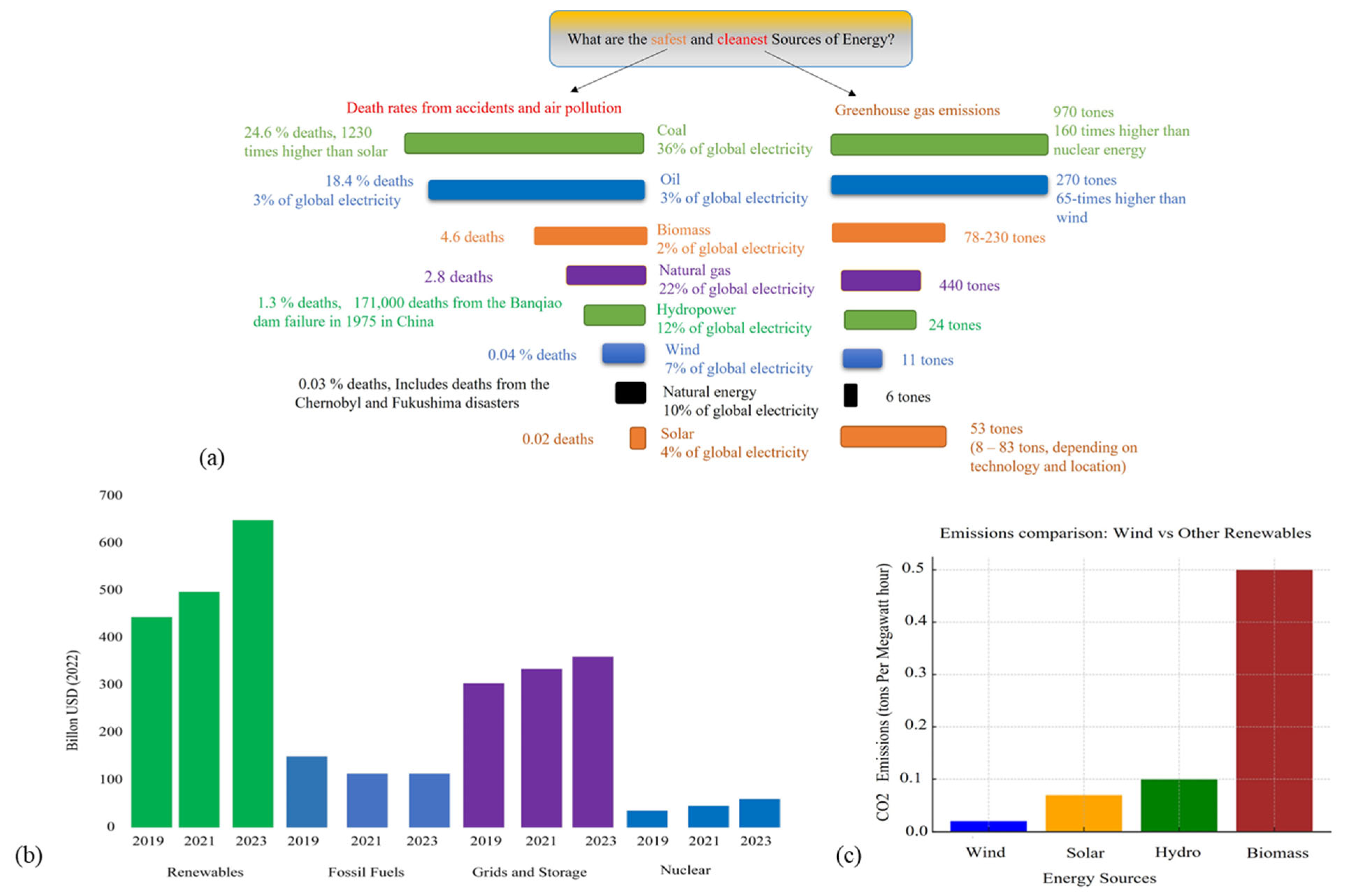
Figure 2.
(a) An early horizontal-axis windmill on the Mediterranean coast. (b) Water pumping windmill in the American Midwest. (c) A typical 16th-century windmill installed in Southern Madrid, Spain. Adopted with permission from [11]. (d) Ulrich Hutter’s wind Turbine.
Figure 2.
(a) An early horizontal-axis windmill on the Mediterranean coast. (b) Water pumping windmill in the American Midwest. (c) A typical 16th-century windmill installed in Southern Madrid, Spain. Adopted with permission from [11]. (d) Ulrich Hutter’s wind Turbine.
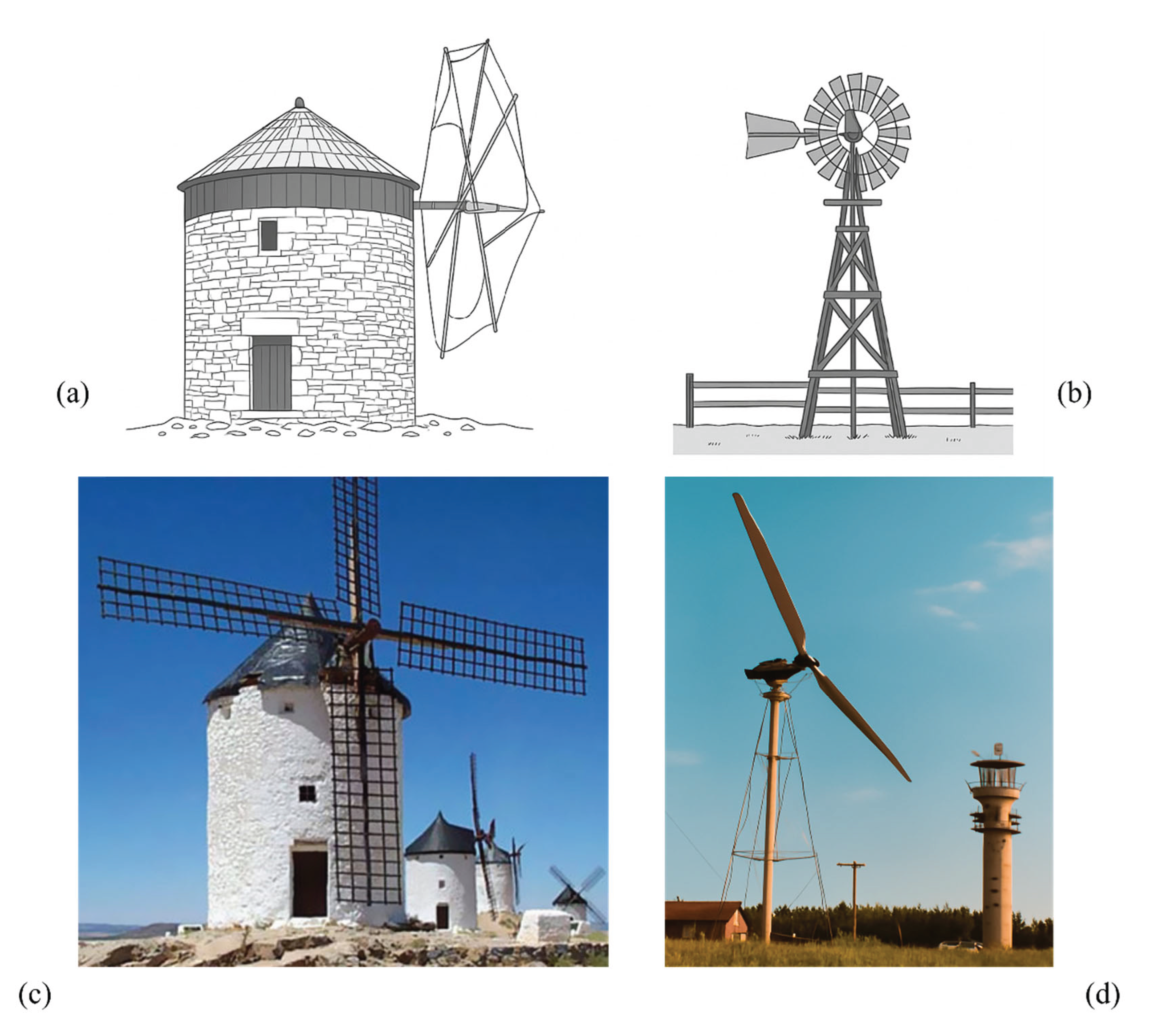
Figure 3.
Onshore and Offshore wind turbine’s components and the average percentage failure rate of the different turbine components.
Figure 3.
Onshore and Offshore wind turbine’s components and the average percentage failure rate of the different turbine components.
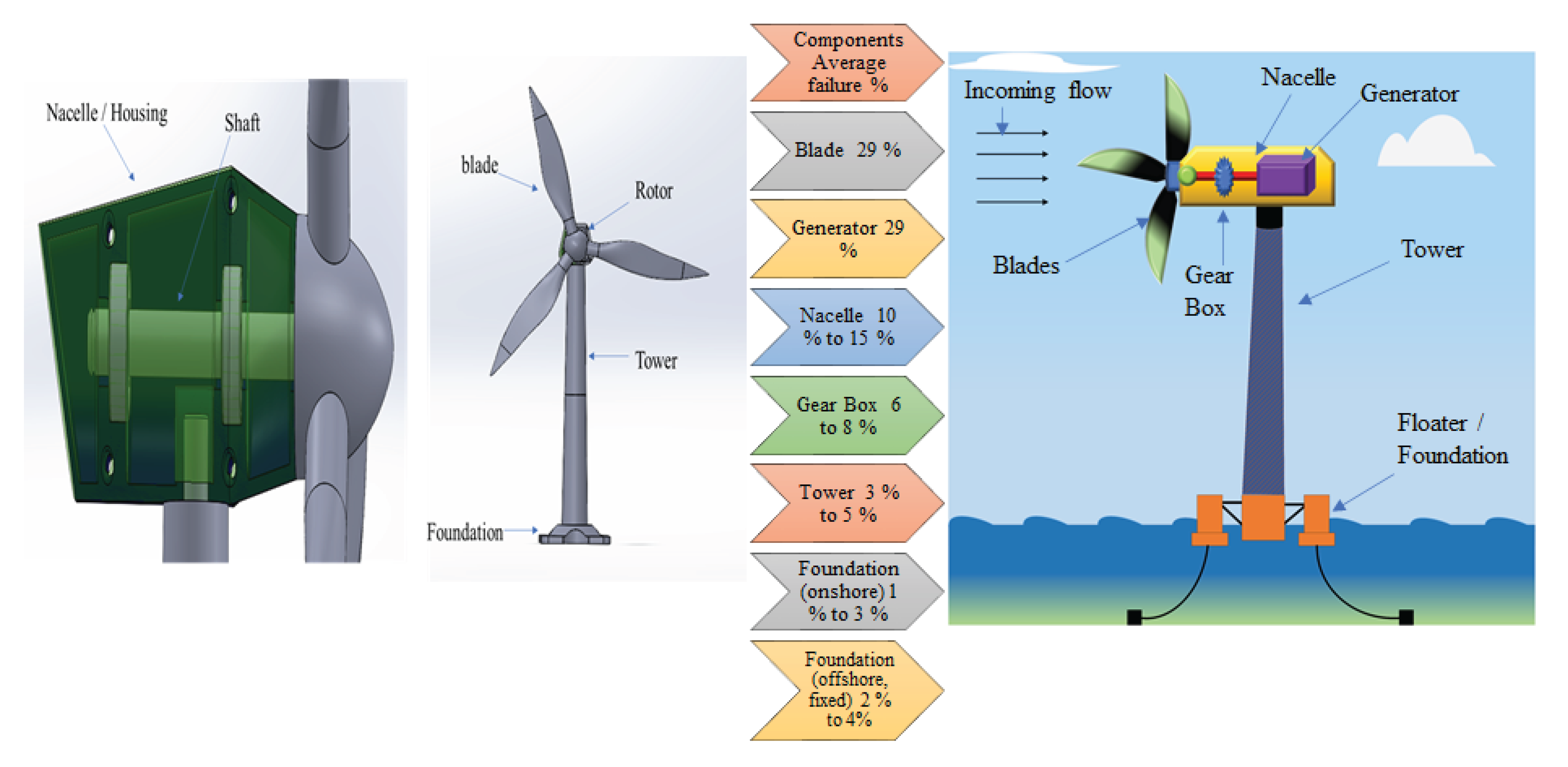
Figure 4.
(a) Seriously damaged blades, due to storm, of an Enercon E-138 EP3 4.2MW wind turbine in Nattheim wind farm in southern Germany. (b) Broken blade of a wind turbine in Liaoning when the wind speed was about 7m/s. (c) The main rotor blade of an AH-1 armed helicopter in South Korea suddenly broke and fell off. (d) Damaged propeller blades destroyed Southeast Atlantic Airlines Flight 529.
Figure 4.
(a) Seriously damaged blades, due to storm, of an Enercon E-138 EP3 4.2MW wind turbine in Nattheim wind farm in southern Germany. (b) Broken blade of a wind turbine in Liaoning when the wind speed was about 7m/s. (c) The main rotor blade of an AH-1 armed helicopter in South Korea suddenly broke and fell off. (d) Damaged propeller blades destroyed Southeast Atlantic Airlines Flight 529.
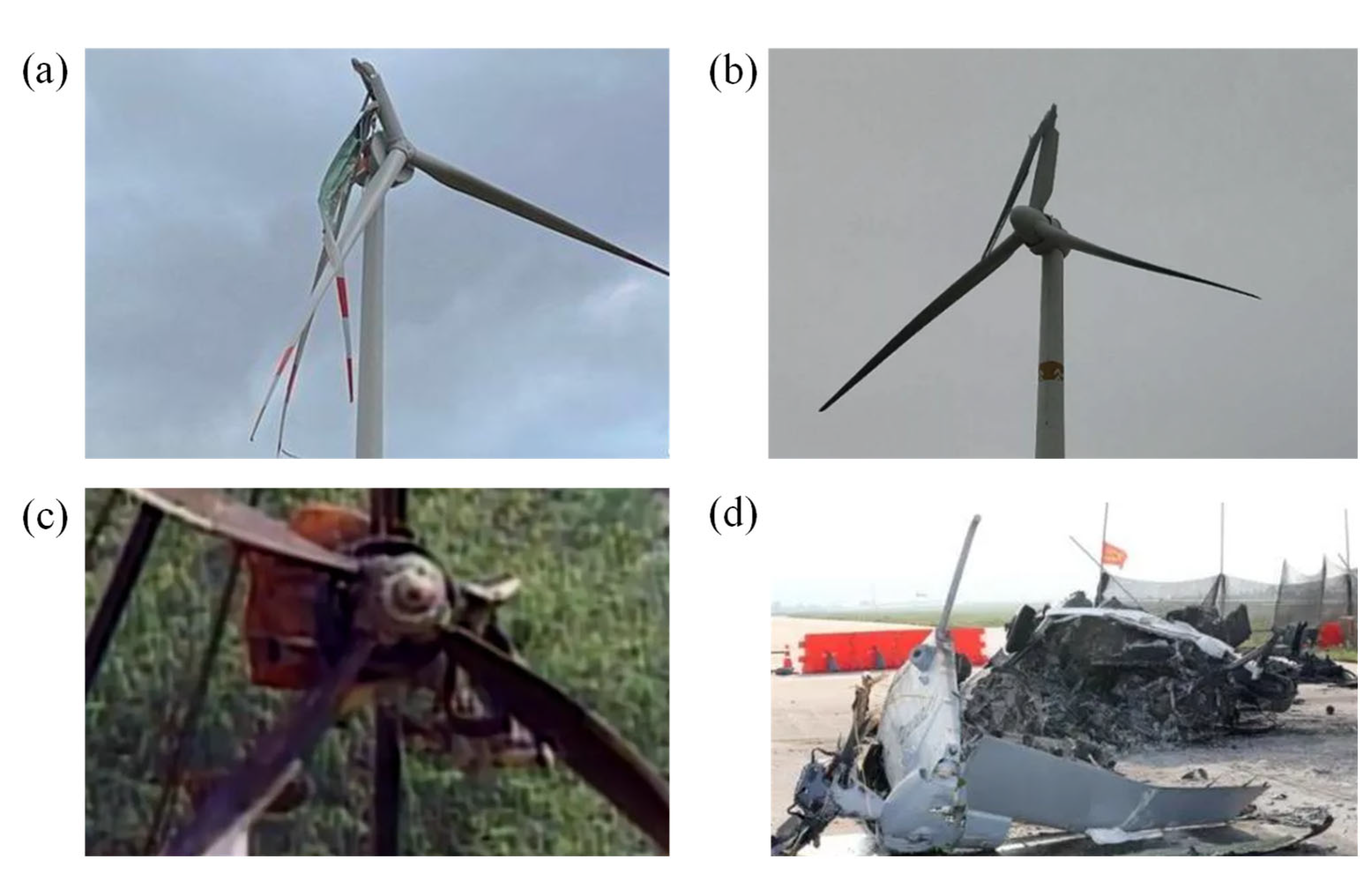
Figure 5.
Classification of wind turbine based on rotation axis, torque produced, location, and power generation capacity [23].
Figure 5.
Classification of wind turbine based on rotation axis, torque produced, location, and power generation capacity [23].
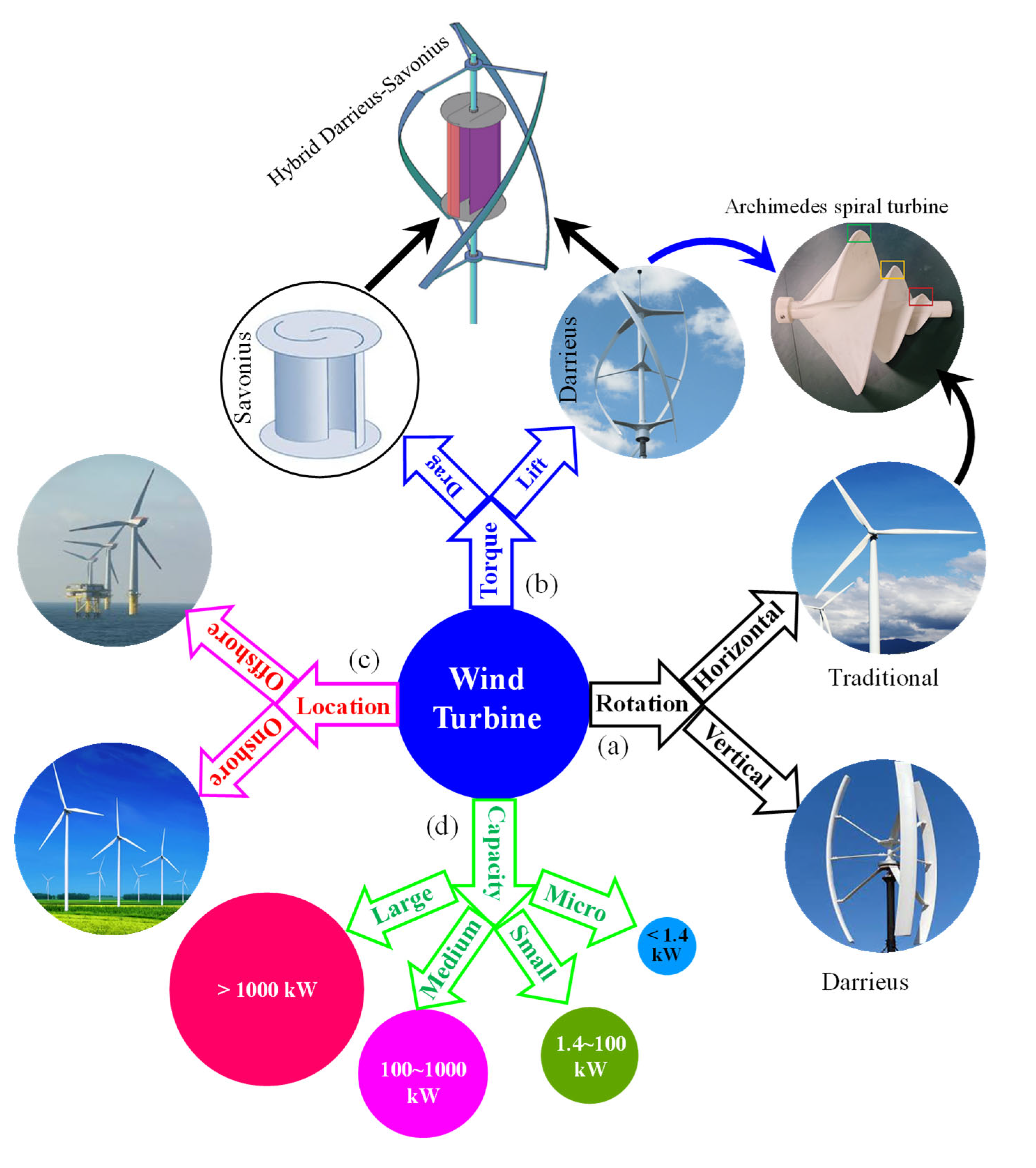
Figure 6.
(a) Standard horizontal-axis wind turbine, three-bladed design and description of its components. Adopted with permission from [43]. (b) A typical horizontal-axis wind turbine (HAWT) [44]. (c) Schematic of Horizontal axis wind turbine blade. .
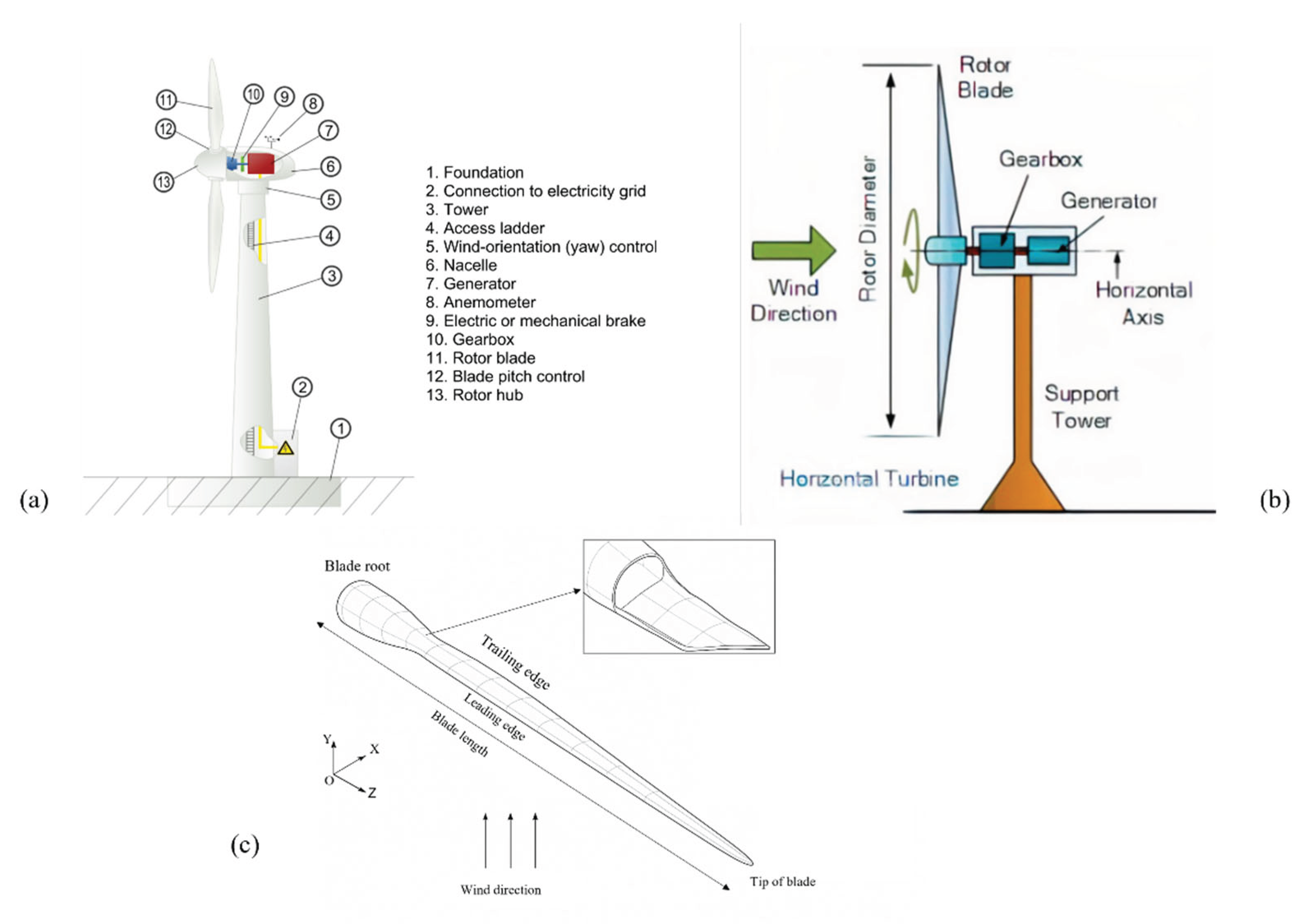
Figure 7.
(a) A typical vertical-axis wind turbine (VAWT) [44]. (b) The general structure of the vertical axis wind turbine and its components [45]. (c) Typical blade of vertical-axis wind turbine [46].
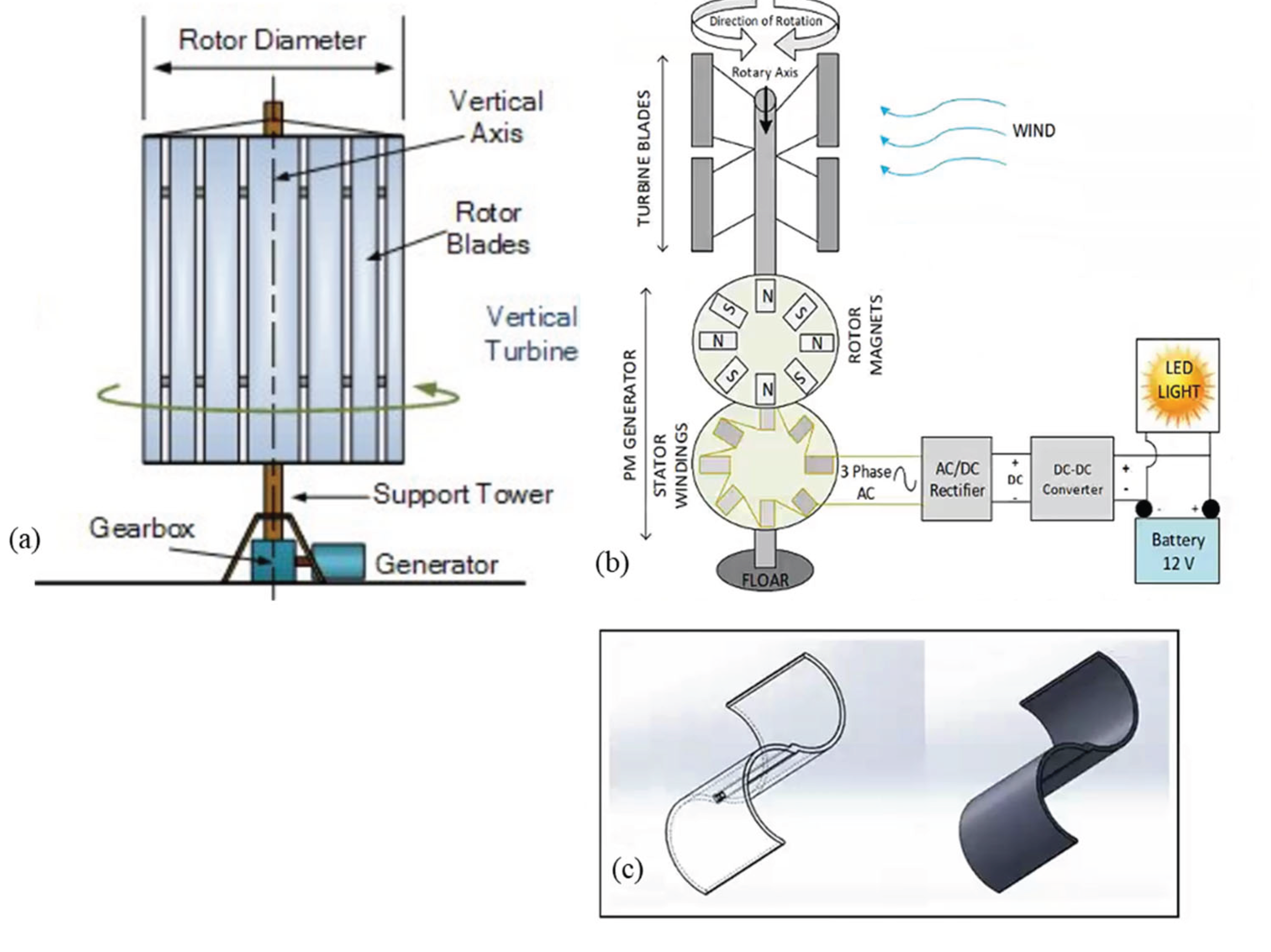
Figure 8.
(a) Wind stream and induced forces acting on the blade elements [51]. (b) Interaction of the incoming wind flow with the blade at an angle.
Figure 8.
(a) Wind stream and induced forces acting on the blade elements [51]. (b) Interaction of the incoming wind flow with the blade at an angle.
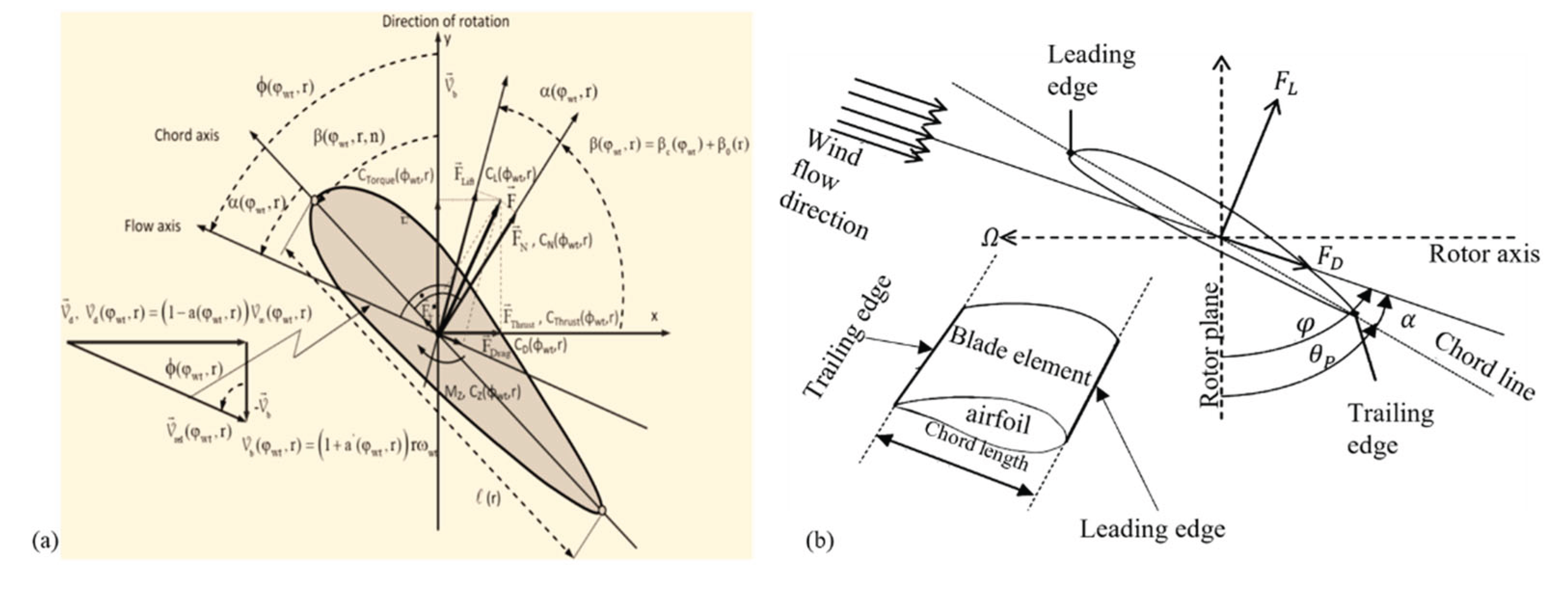
Figure 9.
Airfoil shapes: (a) NACA 0012; (b) NACA 4415; (c) NACA 4412; and (d) NACA 2412. (e) Schematic of the blade elements. (f) Typical components of wind turbine blade [28]. (g) Flow around an airfoil section showing pressure changes.
Figure 9.
Airfoil shapes: (a) NACA 0012; (b) NACA 4415; (c) NACA 4412; and (d) NACA 2412. (e) Schematic of the blade elements. (f) Typical components of wind turbine blade [28]. (g) Flow around an airfoil section showing pressure changes.
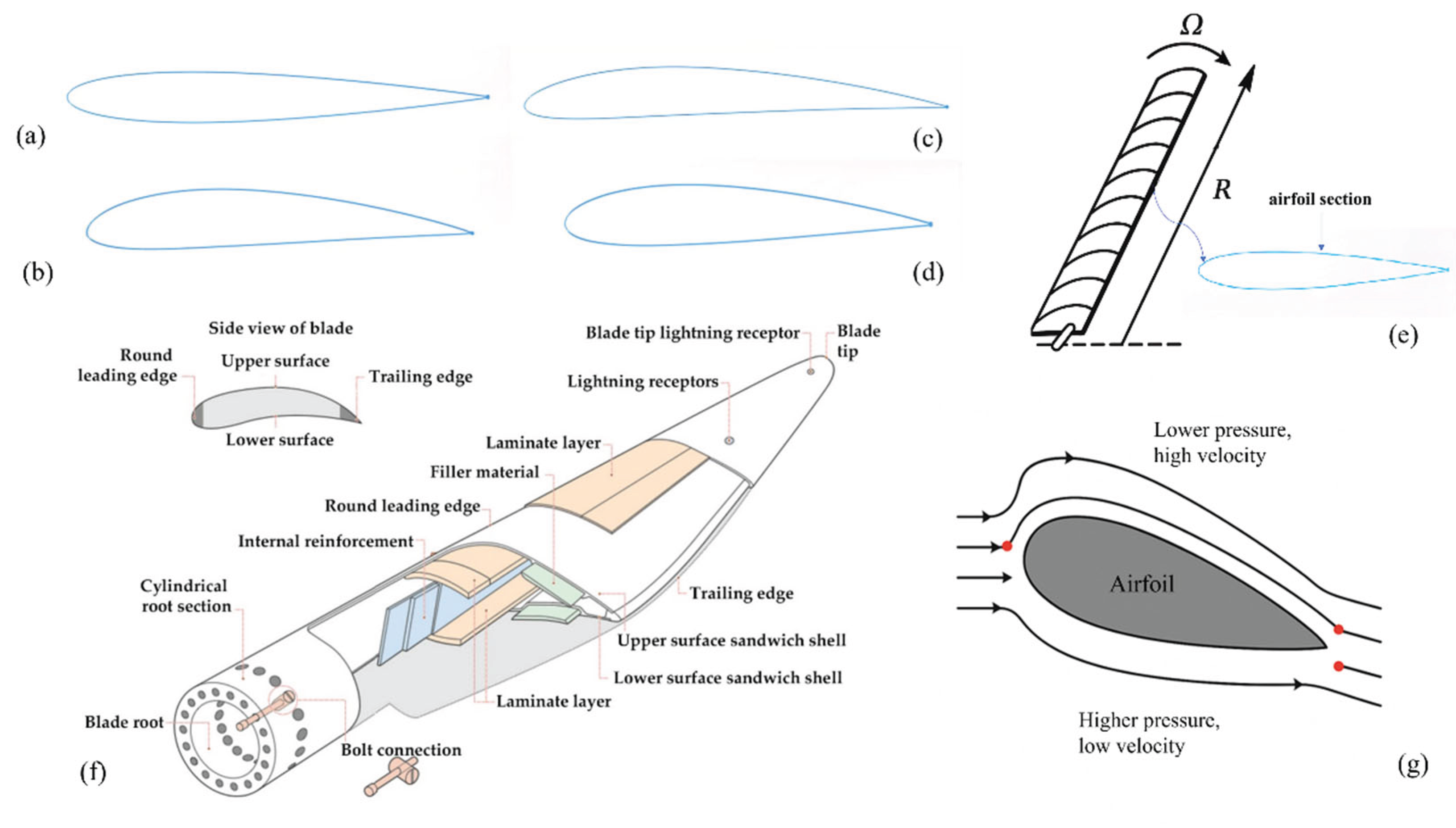
Figure 10.
Schematic diagram of a wind turbine blade section; a cross-section of the Clipper C96 wind turbine blade [73].
Figure 10.
Schematic diagram of a wind turbine blade section; a cross-section of the Clipper C96 wind turbine blade [73].
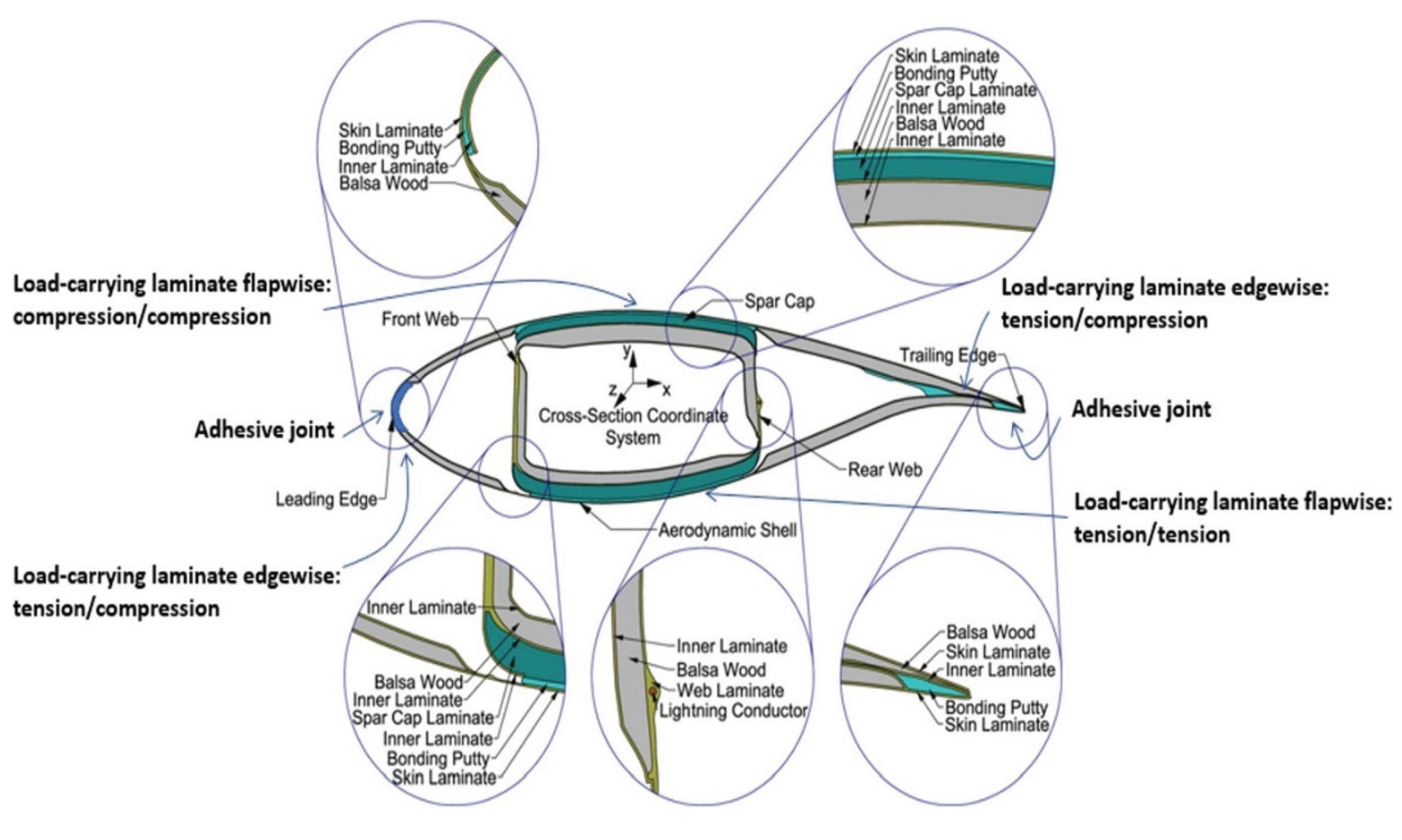
Figure 11.
Relationship between vibration types and turbine components.
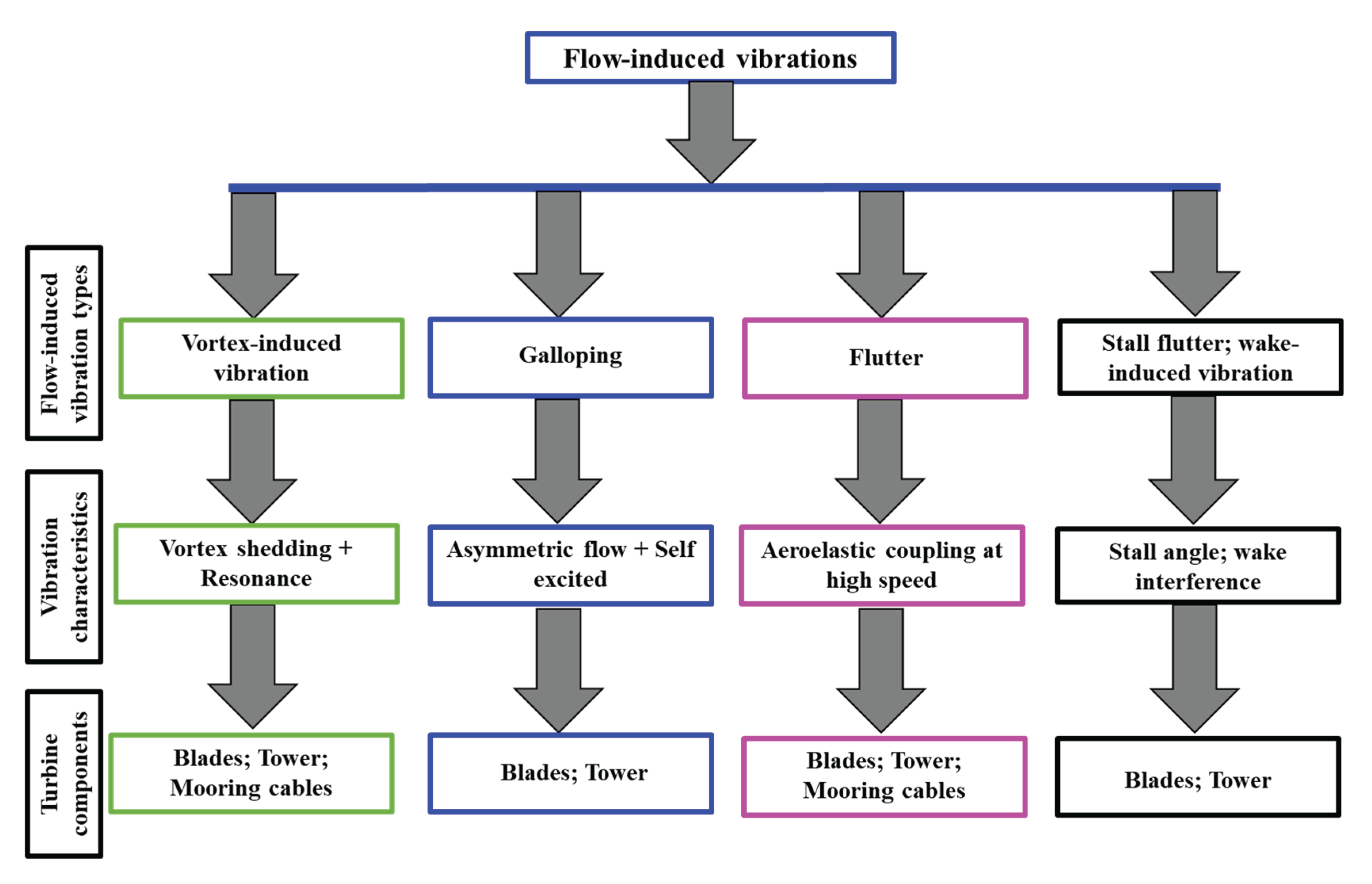
Figure 12.
(a) Percent of lifespan reduced due to flow-induced vibrations in wind turbine components and offshore wind turbines. (b) Repair, operation and Maintenance (O & M) costs due to flow-induced vibration of wind turbines (Data source: TWI).
Figure 12.
(a) Percent of lifespan reduced due to flow-induced vibrations in wind turbine components and offshore wind turbines. (b) Repair, operation and Maintenance (O & M) costs due to flow-induced vibration of wind turbines (Data source: TWI).
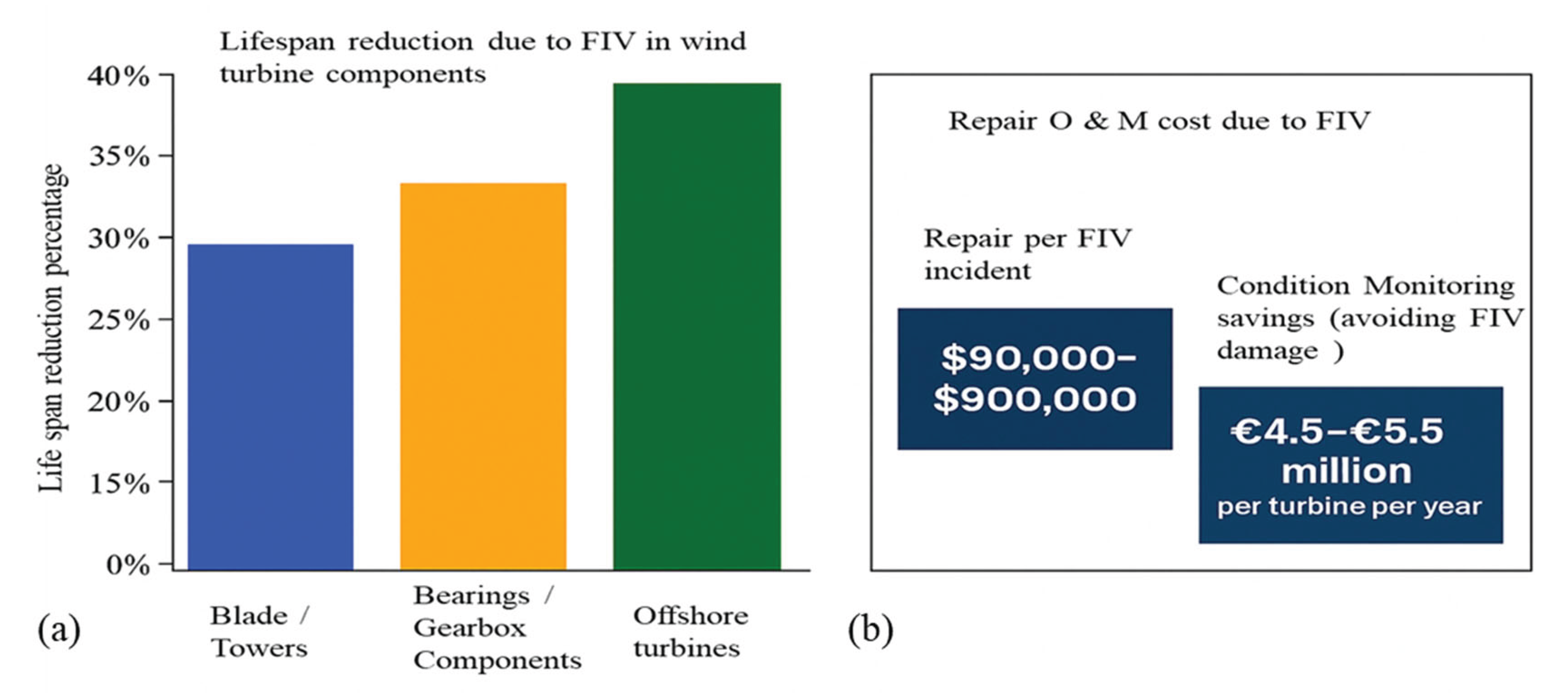
Figure 15.
Photographs of wind turbine blade erosion. (a) Pits and gouges, (b) leading edge delamination, adopted with permission from [152], (c) examples of leading-edge corrosion [153], and (d) eroded blade and mechanism of blade erosion (photo Jakob I. Bech) [154].
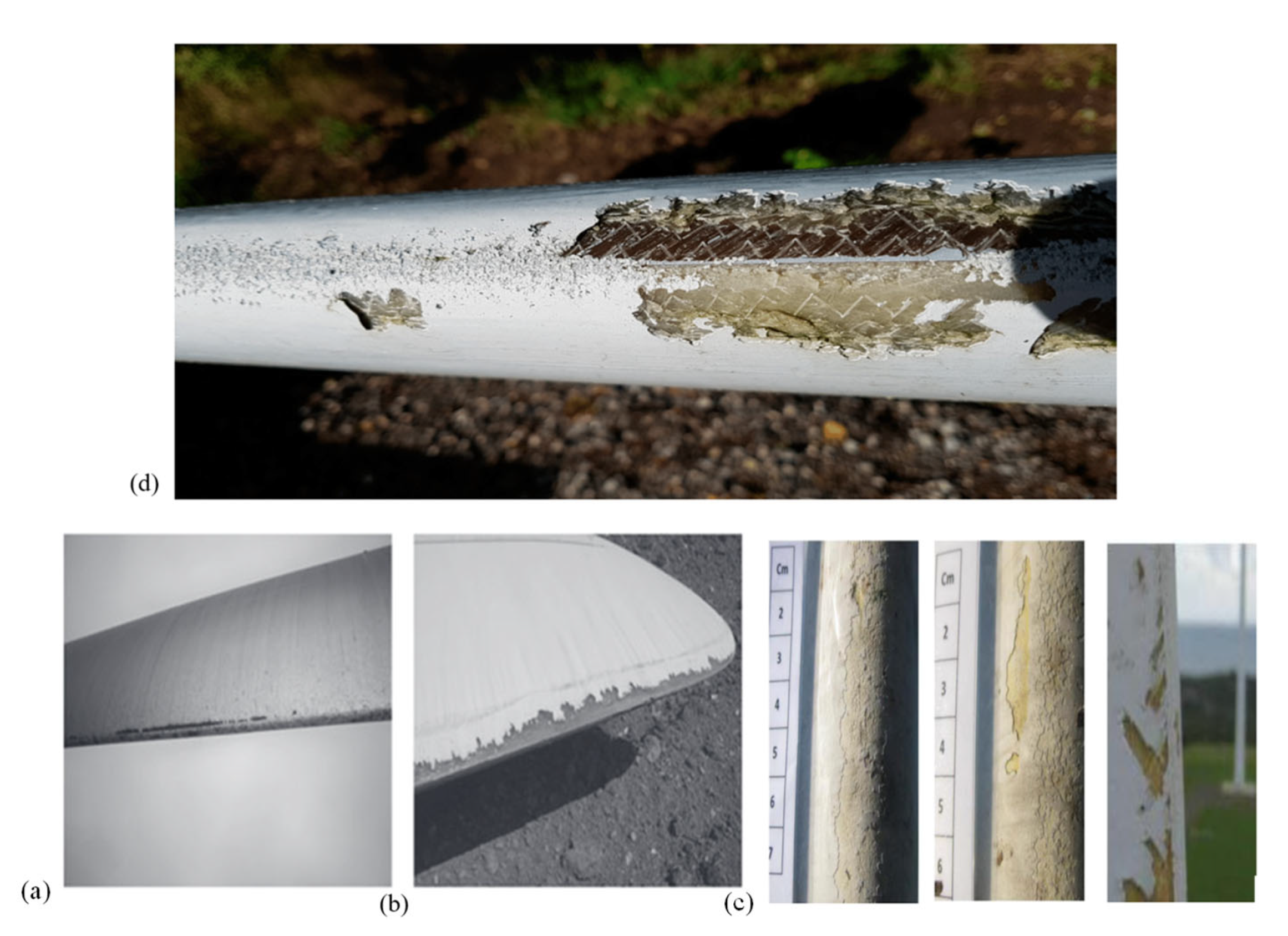
Figure 16.
Different failure types in wind turbines, showing the most susceptible part and materials for such failures.
Figure 16.
Different failure types in wind turbines, showing the most susceptible part and materials for such failures.
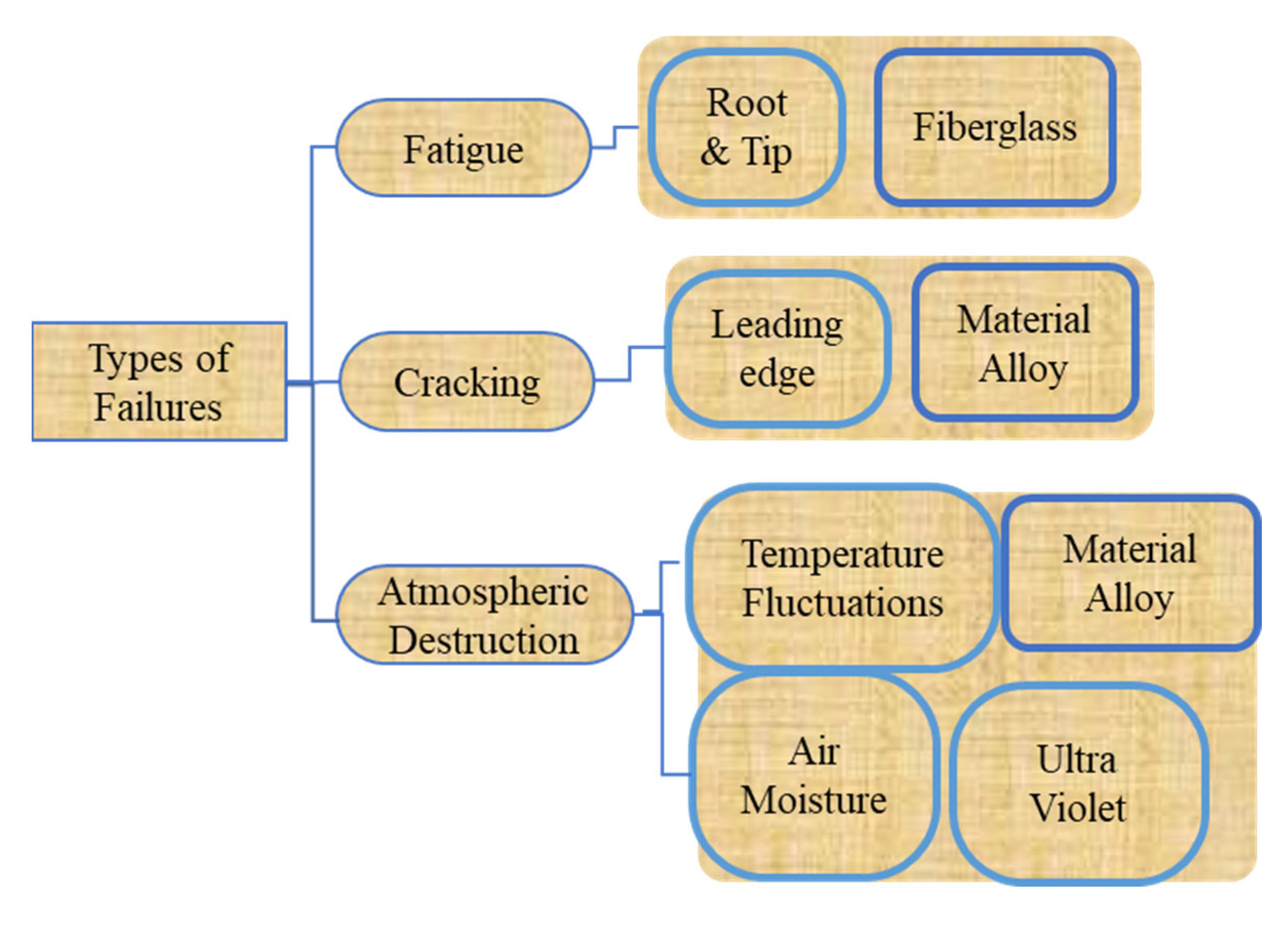
Figure 17.
Examples of damage and defect types identified on a wind turbine blade [73].
Figure 17.
Examples of damage and defect types identified on a wind turbine blade [73].
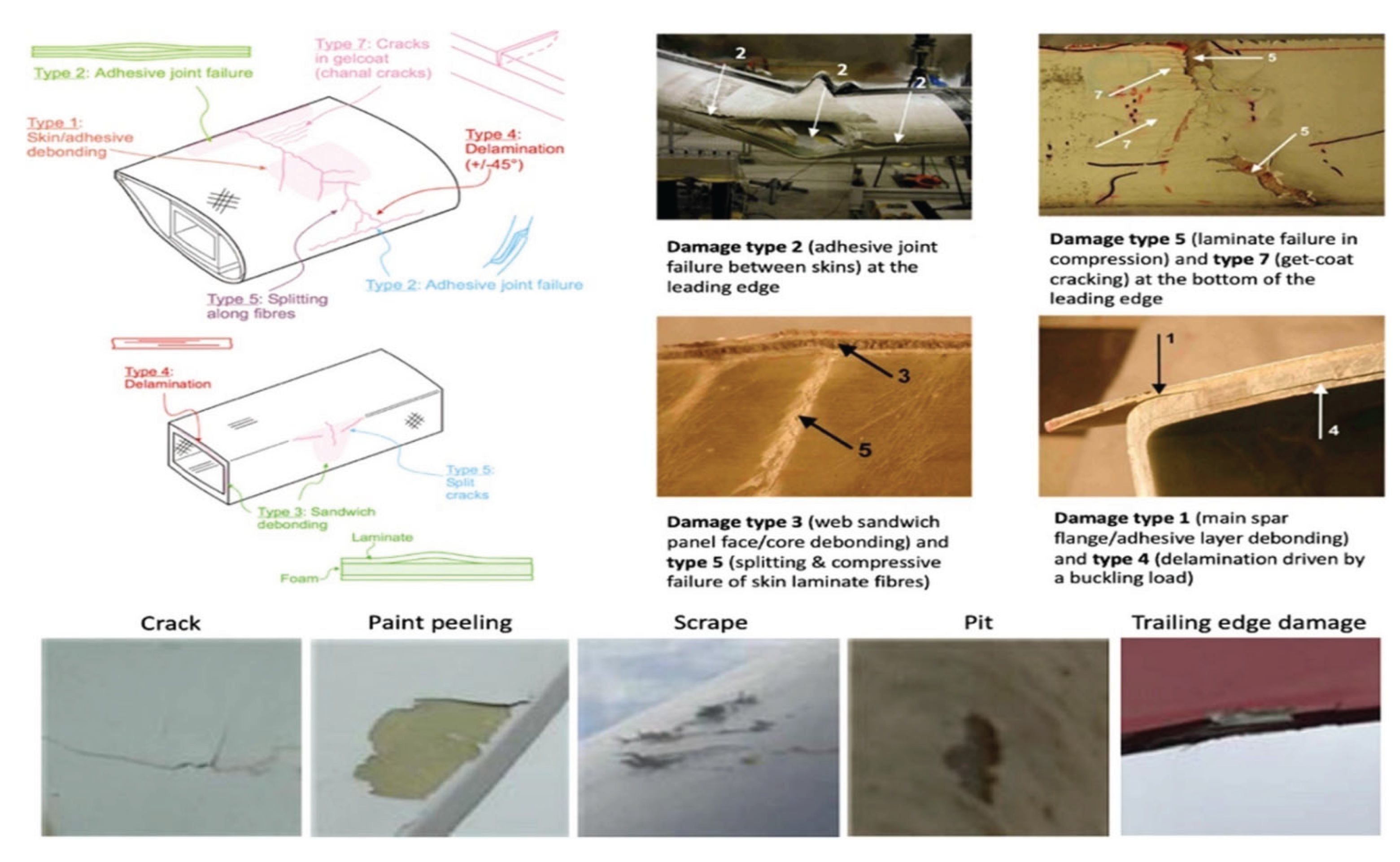
Figure 18.
Failure detection techniques of wind turbine and their advantages.
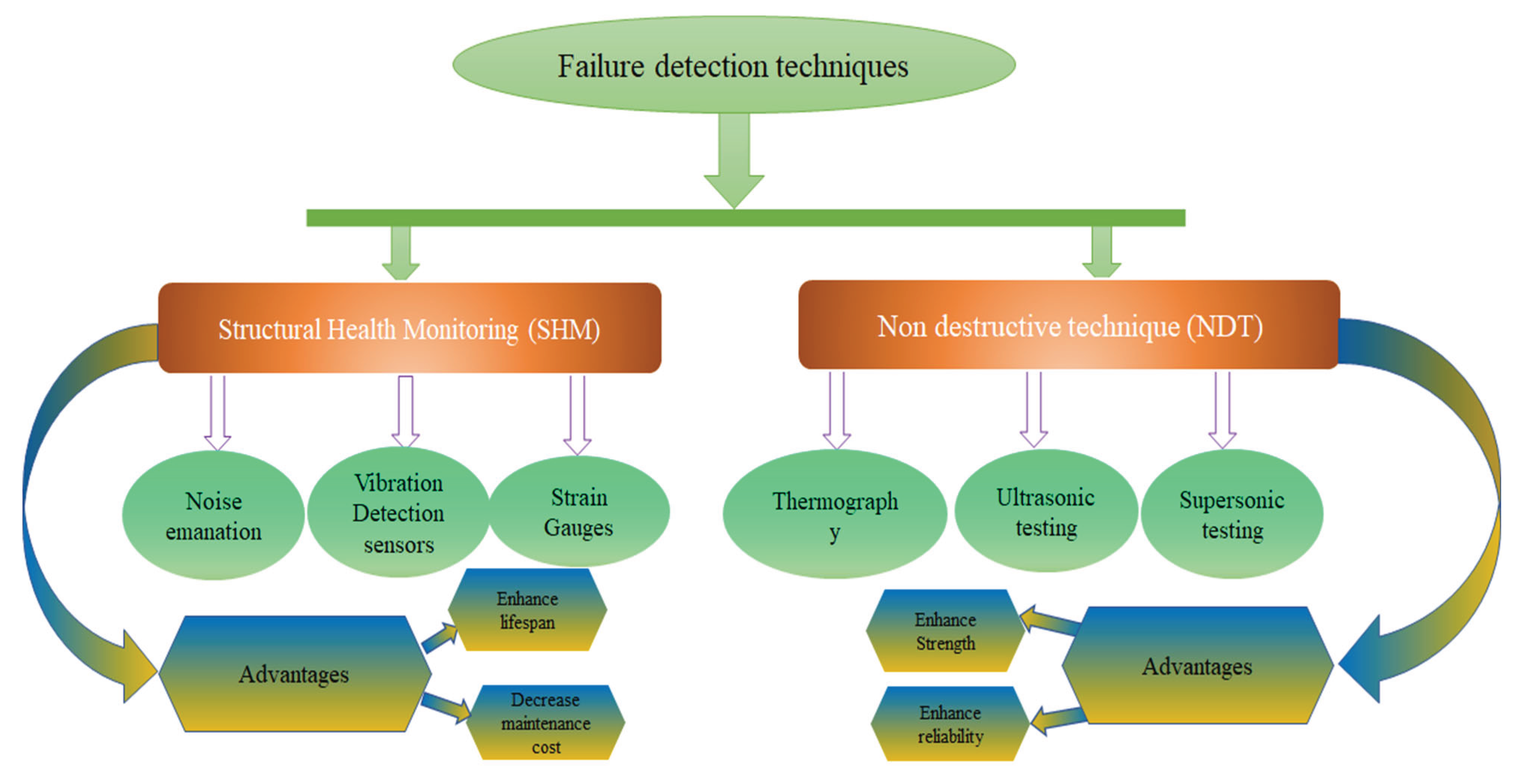
Figure 20.
Different preventive maintenance techniques used in wind turbines.
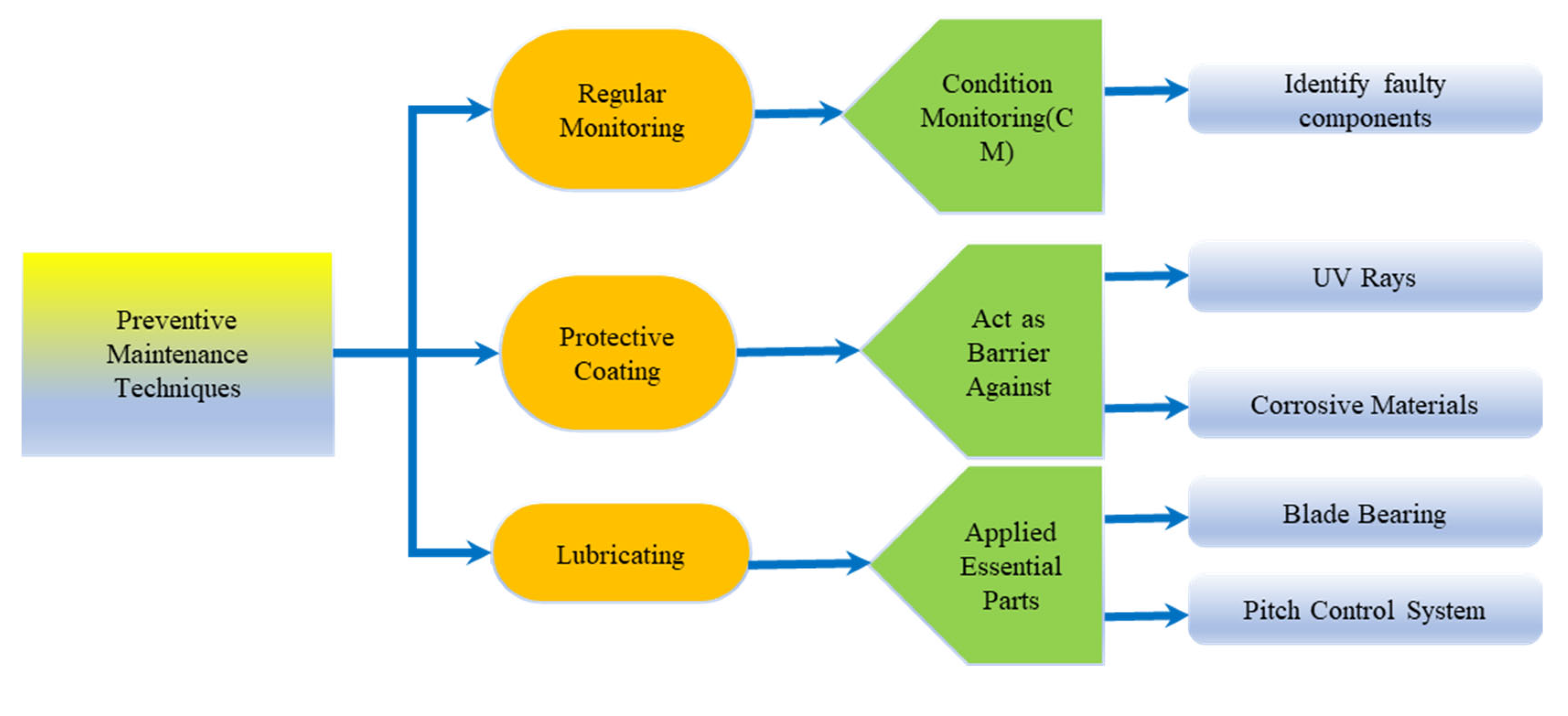
Figure 21.
Damage repair design of offshore WT blades structures: (a) nonlinear deformation of blades in complex offshore wind environments; (b) spar cap damage of full-size blades; (c) blade cross-section structure; (d) blade profiles; (e) implementation of stepped-lap scarf repair method under high altitude operation; (f) schematic diagram of repair patch and ORLs; (g) repair process; (h) design of repair parameters for ORLs [175].
Figure 21.
Damage repair design of offshore WT blades structures: (a) nonlinear deformation of blades in complex offshore wind environments; (b) spar cap damage of full-size blades; (c) blade cross-section structure; (d) blade profiles; (e) implementation of stepped-lap scarf repair method under high altitude operation; (f) schematic diagram of repair patch and ORLs; (g) repair process; (h) design of repair parameters for ORLs [175].
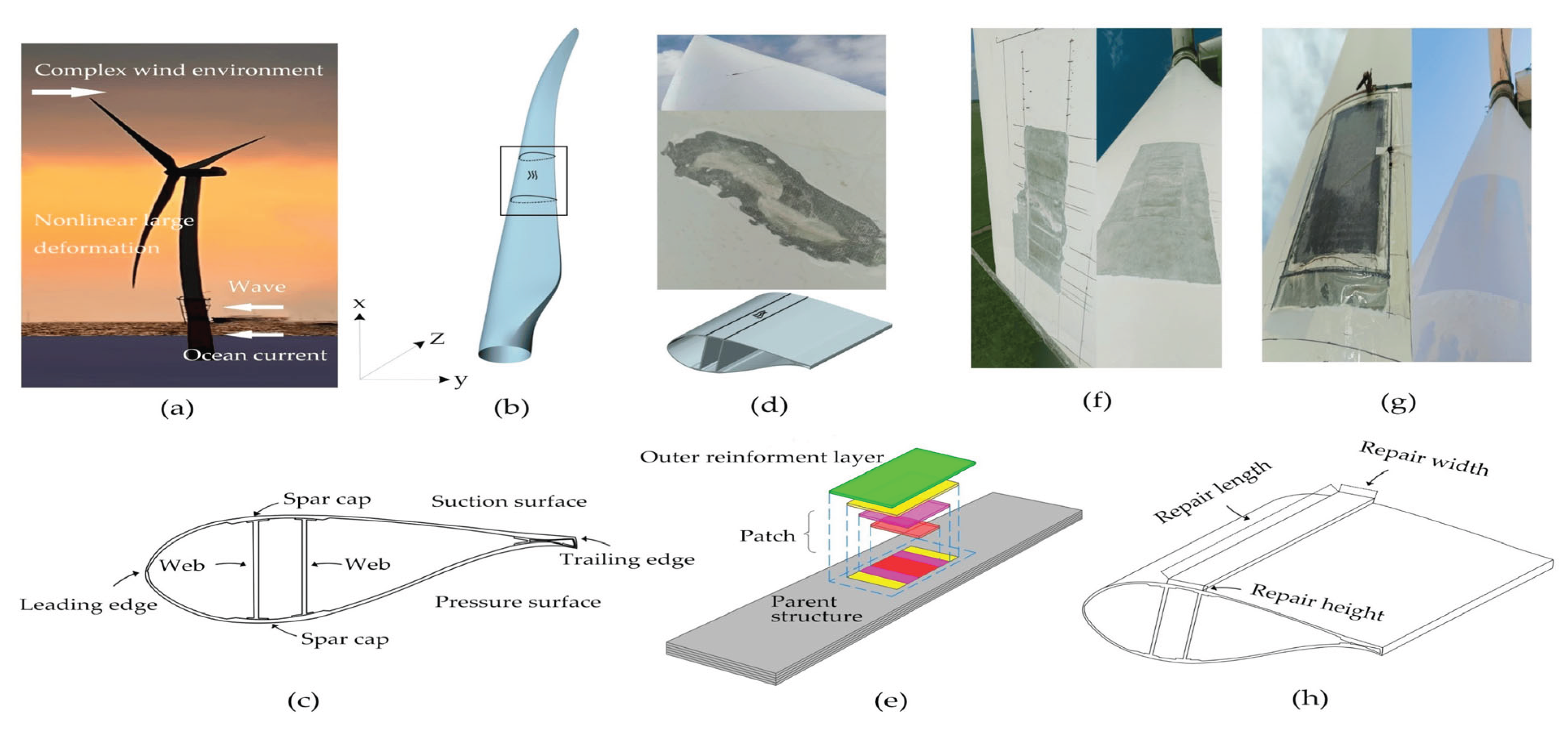
Figure 22.
(a) Multirotor, (b) fixed-wing, and (c) single-rotor drones. (d) Robotic platforms for the inspection of offshore wind farms. (e) The schematic working principle of unmanned aerial drones [182].
Figure 22.
(a) Multirotor, (b) fixed-wing, and (c) single-rotor drones. (d) Robotic platforms for the inspection of offshore wind farms. (e) The schematic working principle of unmanned aerial drones [182].
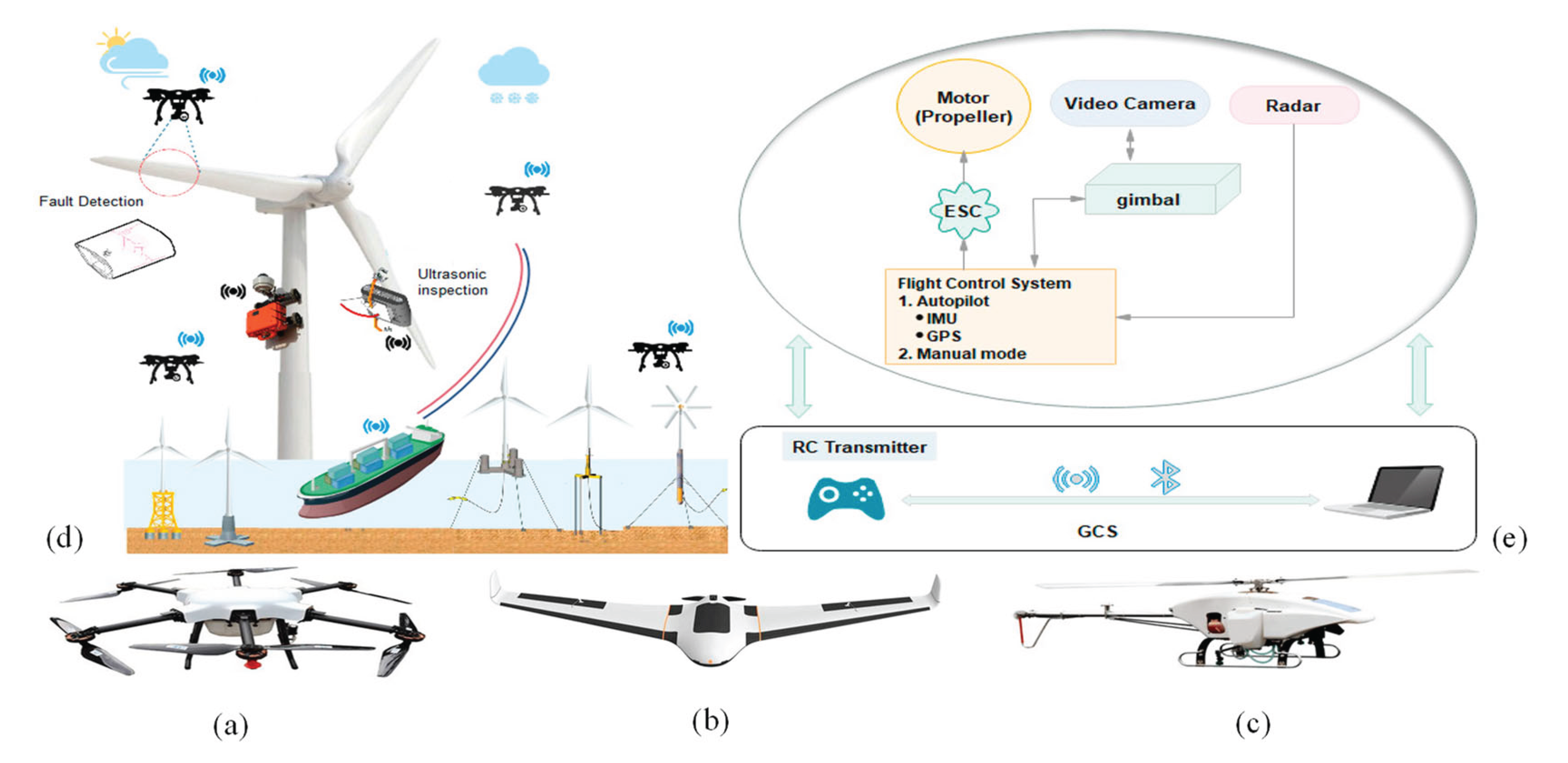
Disclaimer/Publisher’s Note: The statements, opinions and data contained in all publications are solely those of the individual author(s) and contributor(s) and not of MDPI and/or the editor(s). MDPI and/or the editor(s) disclaim responsibility for any injury to people or property resulting from any ideas, methods, instructions or products referred to in the content. |
© 2025 by the authors. Licensee MDPI, Basel, Switzerland. This article is an open access article distributed under the terms and conditions of the Creative Commons Attribution (CC BY) license (http://creativecommons.org/licenses/by/4.0/).
Copyright: This open access article is published under a Creative Commons CC BY 4.0 license, which permit the free download, distribution, and reuse, provided that the author and preprint are cited in any reuse.


