

Submitted:
19 May 2025
Posted:
20 May 2025
You are already at the latest version
Abstract
We can define the Universe as all that exists or all we can ever see. Each of the definitions will open doors for different theories. For example, is our Universe unique to our solar system? Are there other universes? Does our Universe parallel to another universe or inside another Universe? We can ask many questions related to our Universe. Observers have predicted theories about the Universe, such as Bubble, Oscillating, Holographic, Electric, Parallel Universe (Multiverse), Inflationary multiverse, Quantum multiverse, and Brane multiverse. Some of the Universe types are briefly explained and compared in this article. This article aims to predict a new Universe theory in the literature. The observers' data shows that Earth rotates around the Sun while the solar system rotates inside the Milky Way Galaxy. We also know that galaxies rotate around themselves and float inside the Universe. Our article predicted that our Universe is rotating and floating inside a shared space, which we called Henry's Universe.We can define the Universe as all that exists or all we can ever see. Each of the definitions will open doors for different theories. For example, is our Universe unique to our solar system? Are there other universes? Does our Universe parallel to another universe or inside another Universe? We can ask many questions related to our Universe. Observers have predicted theories about the Universe, such as Bubble, Oscillating, Holographic, Electric, Parallel Universe (Multiverse), Inflationary multiverse, Quantum multiverse, and Brane multiverse. Some of the Universe types are briefly explained and compared in this article. This article aims to predict a new Universe theory in the literature. The observers' data shows that Earth rotates around the Sun while the solar system rotates inside the Milky Way Galaxy. We also know that galaxies rotate around themselves and float inside the Universe. Our article predicted that our Universe is rotating and floating inside a shared space, which we called Henry's Universe.
Keywords:
Universe
; Multiverse
; Brane Universe
; Parallel Universe
; Henry's Universe
Introduction
We are living on a small planet inside space. When we look at the sky, we can see a thousand stars every night. How are the stars’ lights reaching us? How many of them are there? How our solar system and the Milky Way galaxy are floating inside the Universe? Are there more universes? If there are other universes, how can we define them? We are asking many more questions related to the Universe. Furthermore, observers are trying to find the answers to these questions, such as Bubble (Hawking 1982; Auci 2021), Oscillating (Markov 1984; Gorkavyi 2021), Holographic (McFadden 2010; Jalazadeh 2021), Electric (Thornhill 2007), Parallel Universe (Multiverse) (Tegmark, M., 2003), Inflationary multiverse (Garriga, J. et al. 2006), Quantum multiverse (Nomura, Y., 2012), and Brane multiverse (Araujo, E.S.) (Vukotic, B., 2021; Ghaffarnejad, H., 2022).
Although the word “universe” literally means all that exists, the longer we have studied the world, the larger it appears to have become (Kydd, A. H. 2022). Therefore, we have changed the term usage from geocentric to Cosmo centric view (Robinson, J. 2022).
Nowadays, most cosmologists accept the Big bang theory, in which the Universe started in a state of significant compression some 14 billion years ago (Krechet, V. G., 2022). Here, one can never see further than the distance light has traveled since the Big Bang, the horizon of the observable Universe (Anninos, D., 2022). However, it would be perverse to claim that nothing exists beyond this distance. Observers would expect other unobservable expanding domains that are still part of our Big Bang (Rafelski, J., 2022). Big Bang theory is also another research topic by itself. However, we would like to mention that Big Bang was at the end of one Universe, such as dying stars and reborn. Were there other colonies in the previous universe destroyed before Big Bang?
Recent developments in cosmology and particle physics have proposed radical theories related to different Big Bang predictions that might be entirely disengaged from ours (Gaztanaga E. et al., 2022). On the other hand, there are many motivations for invoking the multiverse. For example, our Universe generated the inevitable outcome of the physical process (Martins 2020); our Universe appears to be fine-tuned for life and consciousness (Linde 2017); everything that can happen in physics happens. Therefore, the multiverse arises in many contexts, and one needs to distinguish between these in assessing the idea.
Current Multiverse Theories
The creation of the Universe has many theories. Some observers claim that the Universe already exists (Manning et al. 2015; Lebowitz 1984; Lagos et al. 2014; Wheeler 1982; Sataloff, Johns, and Kost 1954), and some claim that the Universe was created with the big bang (NASA 2020; Porter Molly, Watzke Megan 2020; Zbiral 2016). We live in a vast –still unknown space of either universe theories. The Universe is vast, so we cannot further see our latest telescope and technologies (Domínguez and Gaite 2001; Wikipedia contributors 2020; Asor Rosa 1997; Suntola 2018). The Universe could be finite (Peebles 1981) or infinite (Nolan 1999), and still, we are not sure yet. We are located inside the colossal Universe and can see only in the observable area. For example, an ant on Earth may imagine that Earth is vast and infinite (Figure 1). Giordano Bruno speculated that the Universe might be infinite with an infinite number of inhabited worlds in the 16th century (Karolides, J Nicholas. Bald, Margaret. Sova 2013). Our Universe contains many solar systems is becoming a common idea in the 18th century (Sataloff, Johns, and Kost 1954). Edmund Fournier D’Albe, an Irish Physicist, suggested that there might be infinite universes at different scales by the early 20th century(O 1933).
Cosmologists and Physicists created many models related to the universe size, such as closed, open, or flat (Can be seen in Figure 2) (Linder 2003; Bahcall 2015; Barrow, Galloway, and Tipler 1986; Ratra 2017; Bucher, Goldhaber, and Turok 1995).
Observers started new ideas about the expansion of the Universe after Einstein’s general relativity theory (Einstein and Straus 1946; Böhmer 2016; NASA 2020). In 1929, Edwin Hubble proved that the Universe was expanding rapidly (Hubble 1929; Pappas 2020). However, his calculation was ten times higher than our recent calculations, but his expansion was right (Kirshner 2004). Thus, the Universe is expanding; the Universe’s shape is either closed or open, as shown in Figure 3 (Riess 2020). A fundamental assumption is that their dimensional space is closed for a holistic view of space as an energy system. For example, a three-dimensional” surface” of a four-dimensional sphere requires the fourth dimension with the three-dimensional space (Suntola 2018). Either way, the Universe can expand in closed or open Universe models.
A new theory is necessary when existing theories grow in complexity, fail to predict matching observations or produce a coherent picture of reality. Physicist Alan Guth speculated that the eternal chaotic inflation theory builds from cosmic inflation theory that generates multiple universes. He formulated cosmic inflation to solve several deep problems in the cosmology of our Universe — for example, why was the early Universe too homogeneous (Guth 1981; Guth and Weinberg 1983)
As we know, our Earth is rotating around the Sun (Song et al. 2005; Jarosz and Szczygielska, n.d.; Sataloff, Johns, and Kost 1954). The solar system that includes our Earth and Sun rotates inside the Milky Way galaxy (Jarosz and Szczygielska, n.d.). The galaxies, along with stars, are floating inside the Universe. The Universe depends on the open or closed version; the galaxies will float inside the indefinite or definite size of the Universe. Instead of one universe theory, many universe theory ideas are becoming respectable among scientists-physicists- who tend to push ideas to the limits of what is conceivable. There are almost too many other potential universes. Physicists have proposed several candidate forms of “multiverse,” each made possible by different physics laws (Martins 2020). Parallel/alternative universes (Figure 4) are among the many universe ideas that doppelgangers live much like, perhaps almost identical to ours. This idea tickles our ego and awakens our fantasies, which is double why the multiverse theories, however far-out they seem, enjoy so much popularity. For example, some books and movies are related to parallel universes, such as The Man in the High Castle, Sliding Doors, and Fringe.
Another model of the Universe is the inflationary “balloon” theory. In this scenario, our observable domain is a tiny part of a single bubble that underwent an extra-fast accelerated expansion phase at some early time because of a scalar field (Guth 1981). Inflation implies that the observable domain is a tiny patch of a much larger universe-some versions and predicts that there could be many other bubbles corresponding to other universes with different properties spread out in space. A variant of this idea is “eternal” inflation, in which the Universe is continually self-reproducing so that there is an infinite number of bubbles extending in both space and time (Figure 5) (Linde 2017; Vilenkin 1983).
Finally, yet importantly, in one version of multiverse theory, as can be seen in Figure 6, our Universe could correspond to a four-dimensional” brane” embedded in a higher dimensional “bulk” (Gauntlett 2001; Randall and Sundrum 1999b; 1999a). In this case, there might be many other branes, and collisions between the branes might even generate a Big Bang of the kind that initiated the expansion of our Universe. Thus, this method might repeatedly give the cyclic model a form (Paul J . Steinhardt and Neil Turok 2006).
Besides these theories, the Oscillatory Universe (Durrer and Laukenmann 1996; Markov 1984; Kragh 2009), Holographic Universe (Afshordi et al. 2017), Quantum Cosmology Universe (Gorobey and Lukyanenko 2015; Yurov and Yurov 2019), Electric Universe (Peratt 2012), Patchwork Universe (Bojowald 2007), and Cosmic Natural Selection Universe (Ellis 1999) are some of the other universe theories in the literature.
Our Multiverse Prediction Theory-
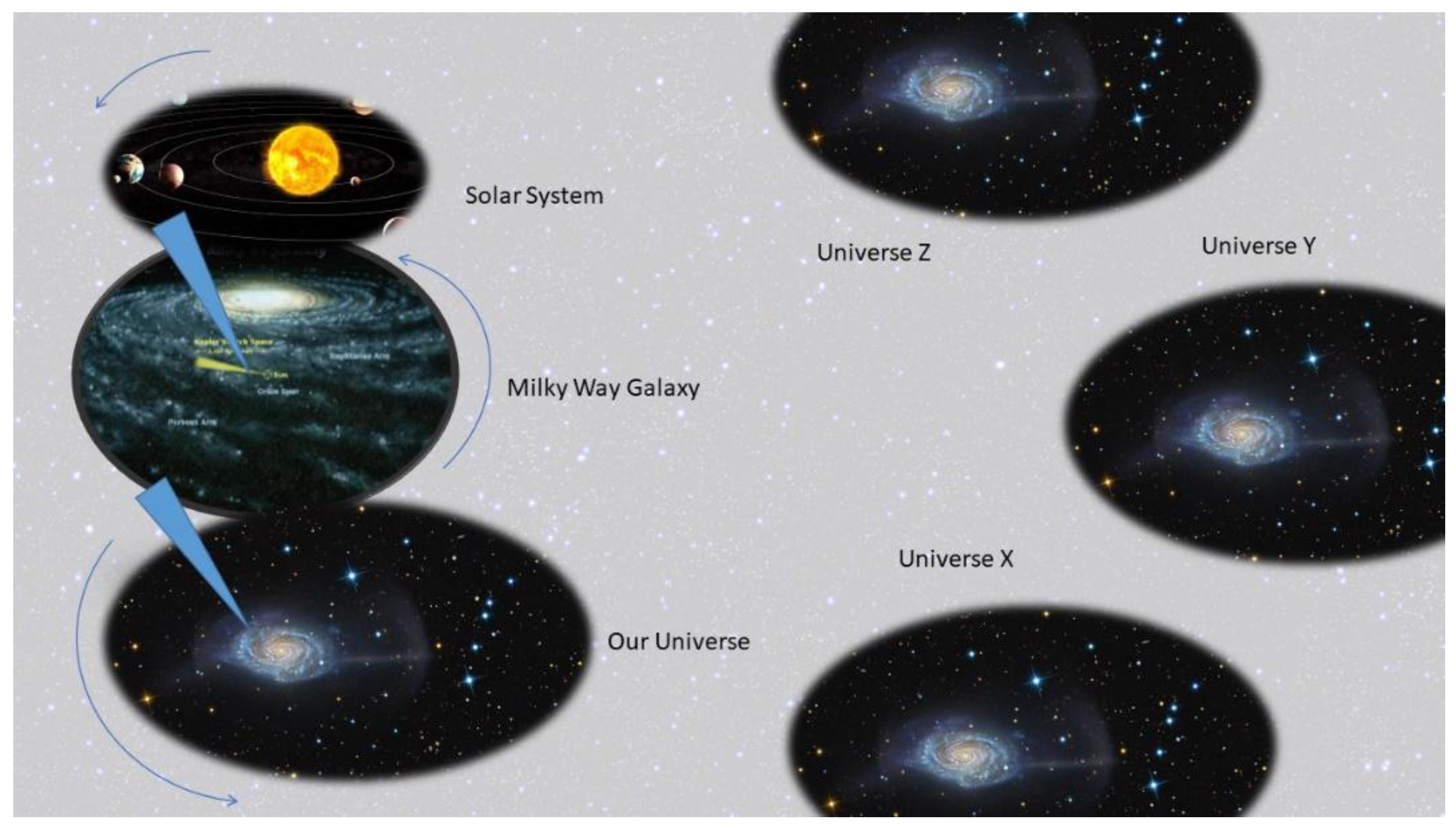
With the fractal theory, everything is similar, from large to small. For example, the Earth rotates around the Sun inside the solar system, inside the Milky Way Galaxy. Thus, galaxies float inside our Universe. We applied this rule and predicted that our Universe is rotating and floating like galaxies inside space with other universes.
An inflationary, Brane, or flat Universes separated from each other with different dimensions to the best of our knowledge. In our model, our Universe is rotating and floating inside space like galaxies, as shown in Figure 7.
With this proposal, many universes are floating inside one space. As an example of stars born in our Universe, our Universe could be born in that space dimension with a possible big bang theory. There could be twins planet that looks like Earth in other universes or some wormhole between universes.
Conclusions
The suggestion, entirely different from our view of the Big Bang, is much more challenging. This multiverse proposal usually arises from attempts to understand how our Universe originated. However, cosmologists have begun to address this question with remarkable success in the last few decades. Therefore, if one has a model for generating our big bang, it is not surprising to produce other big bangs. The problem is that physicists have widely different views on how the different universes might arise, so there are competing models for the multiverse.
From this point of view, here, we showed a different view of the multiverse proposal. In our model, universes have been created with the big bang theory in one shared space. However, instead of the other multiverse theories, such as parallel or brane universes, universes rotate around themselves and float inside space. Universes are the limited size but expanding and flat shape of such galaxies. Of course, readers will need to draw their conclusions, but we hope to convey the nature of the controversy.
References
- Afshordi, Niayesh, Claudio Corianò, Luigi Delle Rose, Elizabeth Gould, and Kostas Skenderis. 2017. “From Planck Data to Planck Era: Observational Tests of Holographic Cosmology.” Physical Review Letters 118 (4): 41301. [CrossRef]
- Anninos, D., Denef, F., Law, Y. T., & Sun, Z. 2022. Quantum de Sitter horizon entropy from quasicanonical bulk, edge, sphere and topological string partition functions. Journal of High Energy Physics, 2022(1), 1-155.
- Araújo, E. S., & Krüeger, W. Inflation and Multiverses.
- Auci, M., 2021. Multi-Bubble Universe Model: A Quantum-Relativistic Gravitational Theory of Space-Time. Journal of Modern Physics, 12(03), p.179.
- Asor Rosa, Alberto. 1997. “La Nuova Critica,” xiii–xxix.
- Bahcall, Neta A. 2015. “Hubble ’ s Law and the Expanding Universe.” PNAS 112 (11): 3173–75. [CrossRef]
- Barrow, John D, Gregory J Galloway, and Frank J Tipler. 1986. “The Closed-Universe Recollapse Conjecture.” Monthly Notices of the Royal Astronomical Society 223 (4): 835–44.
- Böhmer, Christian G. 2016. “Einstein Field Equations.” Introduction to General Relativity and Cosmology, 67–110. [CrossRef]
- Bojowald, Martin. 2007. “The Dark Side of a Patchwork Universe,” 1–24. [CrossRef]
- Bucher, Martin, Alfred S Goldhaber, and Neil Turok. 1995. “Open Universe from Inflation.” Physical Review D 52 (6): 3314.
- Domínguez, A., and J. Gaite. 2001. “Influence of the Cosmological Expansion on Small Systems.” Europhysics Letters 55 (4): 458–64. [CrossRef]
- Durrer, Ruth, and Joachim Laukenmann. 1996. “The Oscillating Universe: An Alternative to Inflation.” Classical and Quantum Gravity 13 (5): 1069–87. [CrossRef]
- Einstein, A., and E. G. Straus. 1946. “Corrections and Additional Remarks to Our Paper: The Influence of the Expansion of Space on the Gravitation Fields Surrounding the Individual Stars.” Reviews of Modern Physics 18 (1): 148–49. [CrossRef]
- Ellis, George F R. 1999. “The Different Nature of Cosmology.” Cosmology 40 (August): 420–23.
- Gauntlett, Jerome. 2001. “Brane New World.” Nature 411 (6841): 986–88. [CrossRef]
- Garriga, J., Schwartz-Perlov, D., Vilenkin, A., & Winitzki, S. (2006). Probabilities in the inflationary multiverse. Journal of Cosmology and Astroparticle Physics, 2006(01), 017.
- Gaztanaga, E., & Fosalba, P. (2022). A peek outside our Universe. Symmetry, 14(2), 285.
- Ghaffarnejad, H. (2022). Wave optics and weak gravitational lensing of lights from spherically symmetric static scalar vector tensor Brans Dicke wormholes. General Relativity and Gravitation, 54(1), 1-28.
- Gorkavyi, N.N. and Tyul’bashev, S.A., 2021. Black Holes and Neutron Stars in an Oscillating Universe. Astrophysical Bulletin, 76(3), pp.229-247.
- Gorobey, N N, and A S Lukyanenko. 2015. “On the Initial State of the Universe in Quantum Cosmology.” St. Petersburg Polytechnical University Journal: Physics and Mathematics 1 (2): 207–11. [CrossRef]
- Guth, Alan H. 1981. “Inflationary Universe: A Possible Solution to the Horizon and Flatness Problems.” Physical Review D 23 (2): 347–56. [CrossRef]
- Guth, Alan H, and Erick J Weinberg. 1983. “Could the Universe Have Recovered from a Slow First-Order Phase Transition?” Nuclear Physics B 212 (2): 321–64. [CrossRef]
- Hawking, S.W., 1982. The development of irregularities in a single bubble inflationary universe. Physics Letters B, 115(4), pp.295-297.
- Hubble, E. 1929. “A Relation between Distance and Radial Velocity among Extra-Galactic Nebulae.” Proceedings of the National Academy of Sciences 15 (3): 168–73. [CrossRef]
- Jalalzadeh, S., Nejad, S.A. and Moniz, P.R., 2021. On the Hydrogen Atom in the Holographic Universe. Physica Scripta.
- Jarosz, Jerzy, and Aneta Szczygielska. n.d. “We Live on Earth – the Rotating System.” In Veletrh Nápadů Učitelů Fyziky 12, 147–51.
- Karolides, J Nicholas. Bald, Margaret. Sova, B Dawn. 2013. 120 Banned Books. Checkmark Books.
- Kirshner, Robert P. 2004. “Hubble ’ s Diagram and Cosmic Expansion” 101 (1).
- Kragh, H. 2009. “Continual Fascination: The Oscillating Universe in Modern Cosmology.” Science in Context 22 (4): 587–612. [CrossRef]
- Krechet, V. G., Oshurko, V. B., & Kisser, A. E. (2022). Models of the Universe Developing from the Infinitely Distant Past. Gravitation and Cosmology, 28(1), 59-69.
- Kydd, A. H. (2022). Our place in the universe: Alexander Wendt and quantum mechanics. International Theory, 14(1), 130-145.
- Lagos, C. D.P., C. M. Baugh, M. A. Zwaan, C. G. Lacey, V. Gonzalez-Perez, C. Power, A. M. Swinbank, and E. van Kampen. 2014. “Which Galaxies Dominate the Neutral Gas Content of the Universe?” Monthly Notices of the Royal Astronomical Society 440 (1): 920–41. [CrossRef]
- Lebowitz, Michael. 1984. “Creating Characters in a Story-Telling Universe.” Poetics 13: 171–94.
- Linde, Andrei. 2017. “A Brief History of the Multiverse.” Reports on Progress in Physics 80 (2). [CrossRef]
- Linder, Eric V. 2003. “Exploring the Expansion History of the Universe.” Physical Review Letters 90 (9): 4. [CrossRef]
- Manning, Erin, Brian Massumi, Erin Manning, and Brian Massumi. 2015. “A Perspective of the Universe.” Thought in the Act, no. January 2013: 23–30. [CrossRef]
- Markov, M A. 1984. “Problems of a Perpetually Oscillating Universe.” Annals of Physics 155 (2): 333–57. [CrossRef]
- Martins, Carlos. 2020. The Universe Today. Edited by Martin Beech. Springer. [CrossRef]
- McFadden, P.L. and Skenderis, K., 2010, April. The holographic universe. In Journal of Physics: Conference Series (Vol. 222, No. 1, p. 012007). IOP Publishing.
- NASA & ESA, 1999. Possible models of the expanding Universe. Accessed on 27 October, 2021. https://esahubble.org/images/opo9919k/.
- NASA & GSFC, 2013. Will the Universe expand forever? Accessed on 27 October, 2021. https://wmap.gsfc.nasa.gov.
- NASA. 2020. “Tests of Big Bang: Expansion.” Tests of Big Bang: Expansion. 2020. https://map.gsfc.nasa.gov/universe/bb_tests_exp.html.
- Nolan, Brien C. 1999. “A Point Mass in an Isotropic Universe: III. The Region R ≤ 2m.” Classical and Quantum Gravity 16 (10): 3183–91. [CrossRef]
- Nomura, Y. 2012. Static quantum multiverse. Physical Review D, 86(8), 083505.
- O, T. 1933. “E. Edmund Fournier D’Albe.” Nature, no. 1075: 125–26.
- Pappas, Stephanie. 2020. “The Day Edwin Hubble Realized Our Universe Was Expanding.” Live Science. 2020. https://www.livescience.com/64527-edwin-hubble-universe-expanding.html.
- Paul J . Steinhardt and Neil Turok. 2006. “Why the Cosmological Constant Is Small and Positive.” Science 312 (5777): 1180–83. https://www.jstor.org/stable/3846257.
- Peebles, P. J.E. 1981. “The Mass of the Universe.” Annals of the New York Academy of Sciences 375 (1): 157–68. [CrossRef]
- Peratt, Anthony L. 2012. “Electric Space:Evolution of the Plasma Universe.” Astrophyiscs and Space Science 66 (244): 89–103.
- Porter Molly, Watzke Megan. 2020. “Universe ’ s Expansion May Not Be The Same In All Directions.” NASA. 2020. https://www.nasa.gov/mission_pages/chandra/news/universe-s-expansion-may-not-be-the-same-in-all-directions.html.
- Rafelski, J. Modern Special Relativity, 2022.
- Randall, Lisa, and Raman Sundrum. 1999a. “Out of This World Supersymmetry Breaking.” Nuclear Physics B 557 (1–2): 79–118.
- Randall, L. and Sundrum, R., 1999. An alternative to compactification. Physical Review Letters, 83(23), p.4690.Ratra, Bharat. 2017. “Inflation in a Closed Universe.” Physical Review D 96 (10): 103534.
- Riess, Adam G. 2020. “The Expansion of the Universe Is Faster than Expected.” Nature Reviews Physics 2 (1): 10–12. [CrossRef]
- Robinson, J. 2022. Sustainability as transmutation: an alchemical interpretation of a transformation to sustainability. Sustainability Science, 17(2), 661-672.
- Sataloff, Robert T, Michael M Johns, and Karen M Kost. 1954. “On the Formation of Galaxies in a Steady State Universe.” Royal Astronomical Society 115: 1–14.
- Song, Inseok, B. Zuckerman, Alycia J. Weinberger, and E. E. Becklin. 2005. “Extreme Collisions between Planetesimals as the Origin of Warm Dust around a Sun-like Star.” Nature 436 (7049): 363–65. [CrossRef]
- Suntola, Tuomo. 2018. The dynamic universe toward a unified picture of physical reality.
- Tegmark, M. 2003. Parallel universes. Scientific American, 288(5), 40-51.
- Thornhill, W. and Talbott, D., 2007. The Electric Universe (pp. 2-4). Portland, Oregon: Mikamar Publishing.
- Vilenkin, Alexander. 1983. “Birth of Inflationary Universes.” Physical Review D 27 (12): 2848–55.
- Vukotić, B., & Gordon, R. 2021. Life in the Milky Way: The Panspermia Prospects. Planet Formation and Panspermia: New Prospects for the Movement of Life through Space, 41-51.
- Wheeler, John Archibald. 1982. “The Computer and the Universe.” International Journal of Theoretical Physics 21 (6–7): 557–72. [CrossRef]
- Wikipedia contributors. 2020. “Observable Universe.” Wikipedia, The Free Encyclopedia. 2020. https://en.wikipedia.org/wiki/Observable_universe.
- Yurov, A. V., and V. A. Yurov. 2019. “The Day the Universes Interacted: Quantum Cosmology without a Wave Function.” European Physical Journal C 79 (9). [CrossRef]
- Zbiral, Guido. 2016. “Considerations on the Unification of Quantum Physics with the General Theory of Relativity.” Journal of Modern Physics 07 (10): 1160–65. [CrossRef]
Figure 1.
An illustration of the size of the Universe by the ant’s view of Earth-(a) earth has a closed shape (3-D) and (b) open shape (map -2D). “An ant located somewhere on the Earth can see the planet as infinite from its point of view; on the contrary, Earth has a limited size. Is our observable Universe as same as the ant’s view, so we imagine our Universe is infinite?”.
Figure 1.
An illustration of the size of the Universe by the ant’s view of Earth-(a) earth has a closed shape (3-D) and (b) open shape (map -2D). “An ant located somewhere on the Earth can see the planet as infinite from its point of view; on the contrary, Earth has a limited size. Is our observable Universe as same as the ant’s view, so we imagine our Universe is infinite?”.
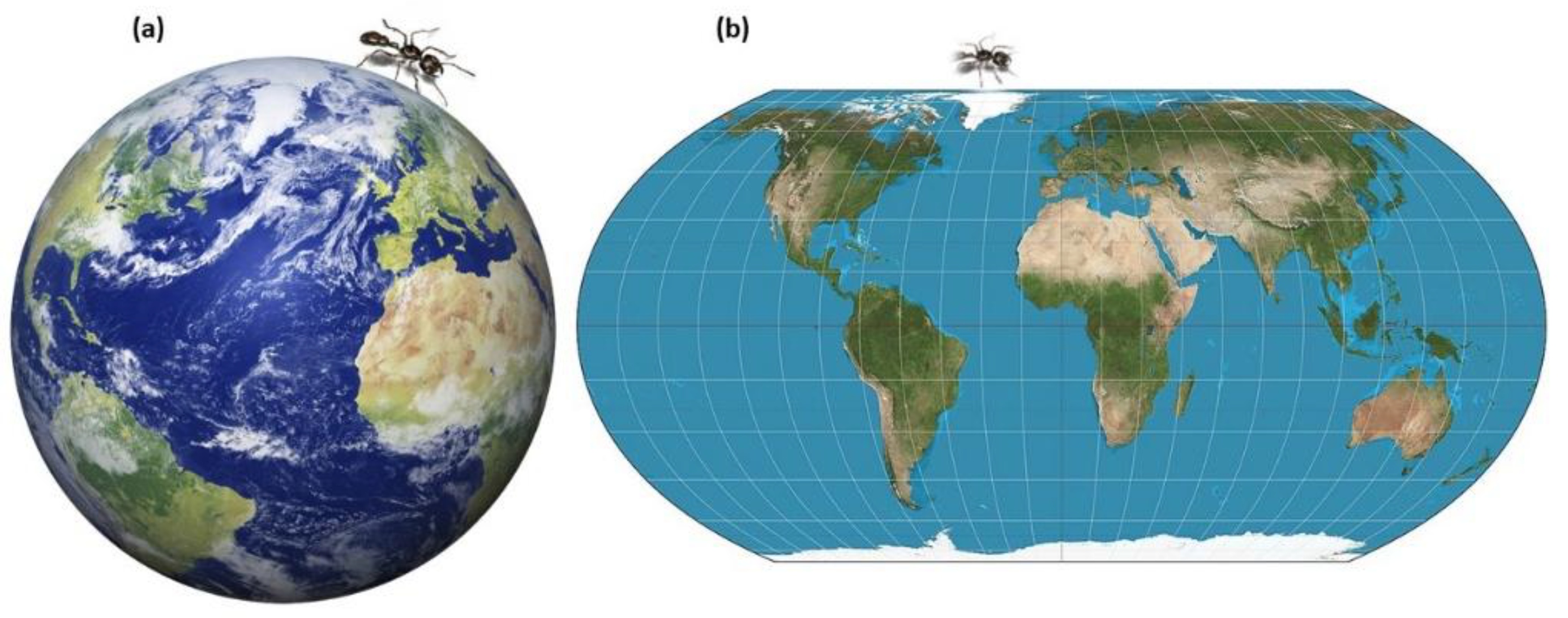
Figure 2.
The Universe’s shape: closed, open, and flat (Credit to NASA & GSFC 2013).
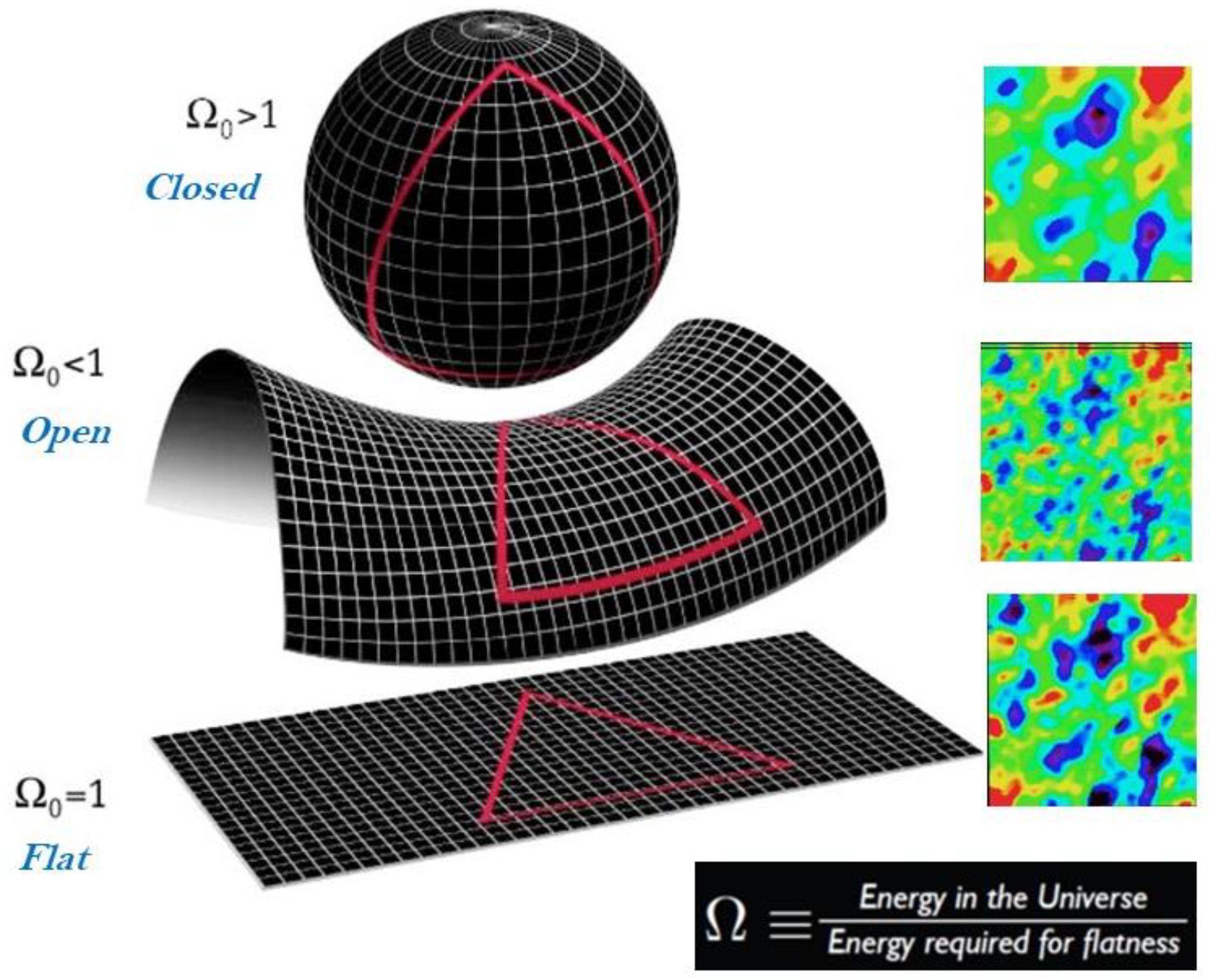
Figure 3.
The expansion of the Universe in the open or closed (Credit to NASA & ESA, 1999 ).
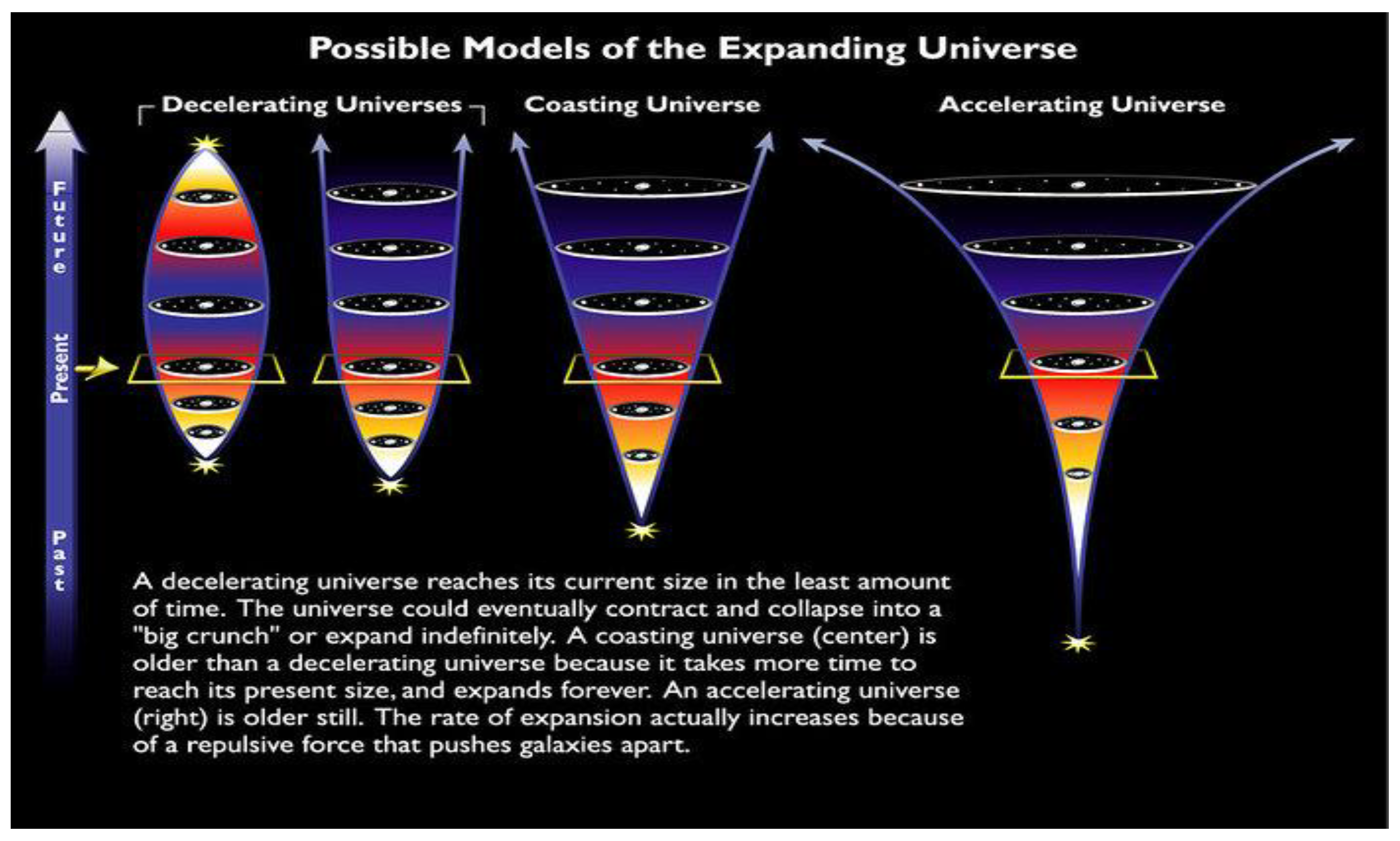
Figure 4.
An illustration of the alternative (parallel) Universe model.
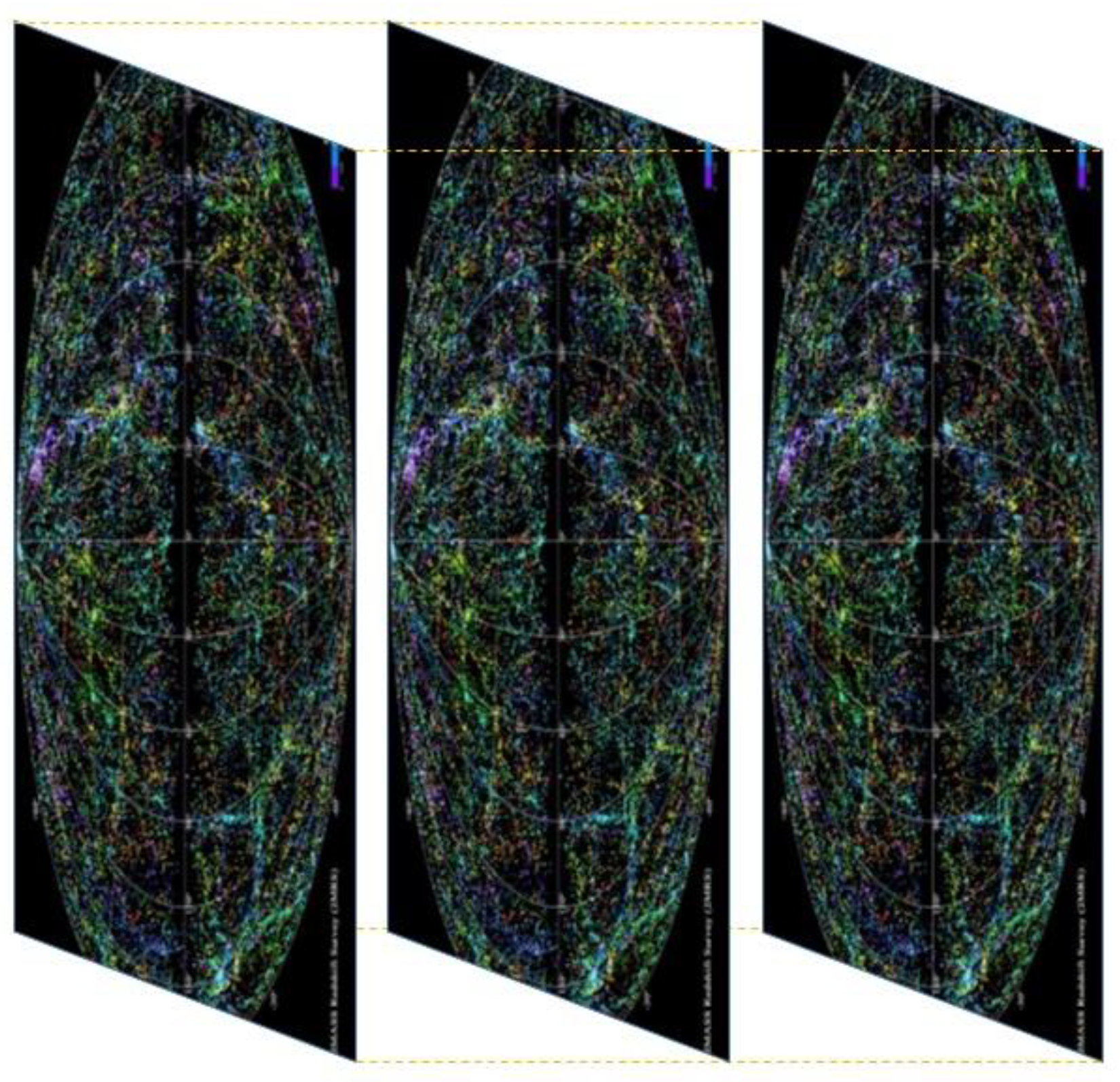
Figure 5.
An illustration of the inflation (balloon) Universe model.
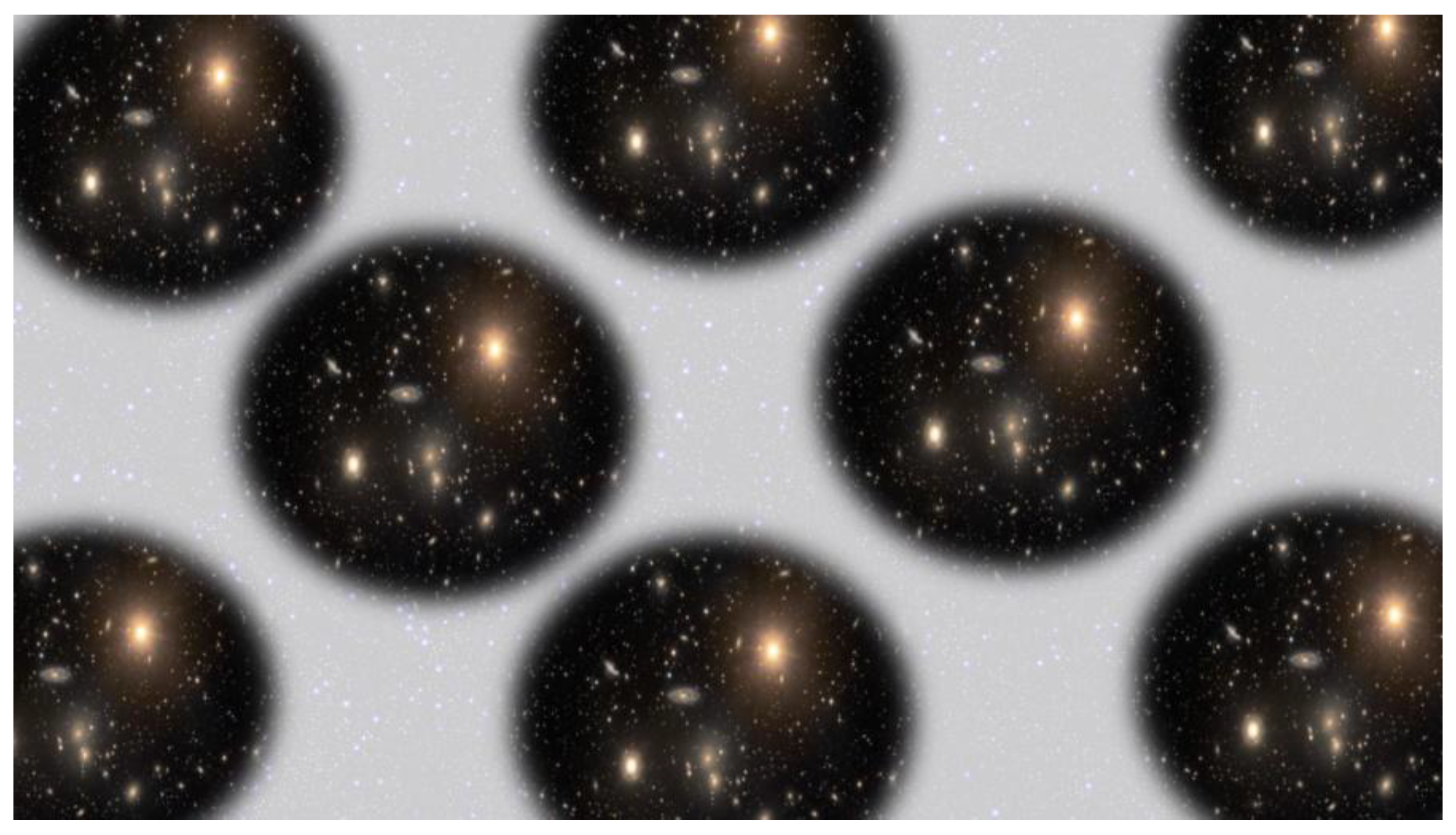
Figure 6.
An illustration of the Brane Universe model (Credit to NASA) https://svs.gsfc.nasa.gov/10137.
Figure 6.
An illustration of the Brane Universe model (Credit to NASA) https://svs.gsfc.nasa.gov/10137.
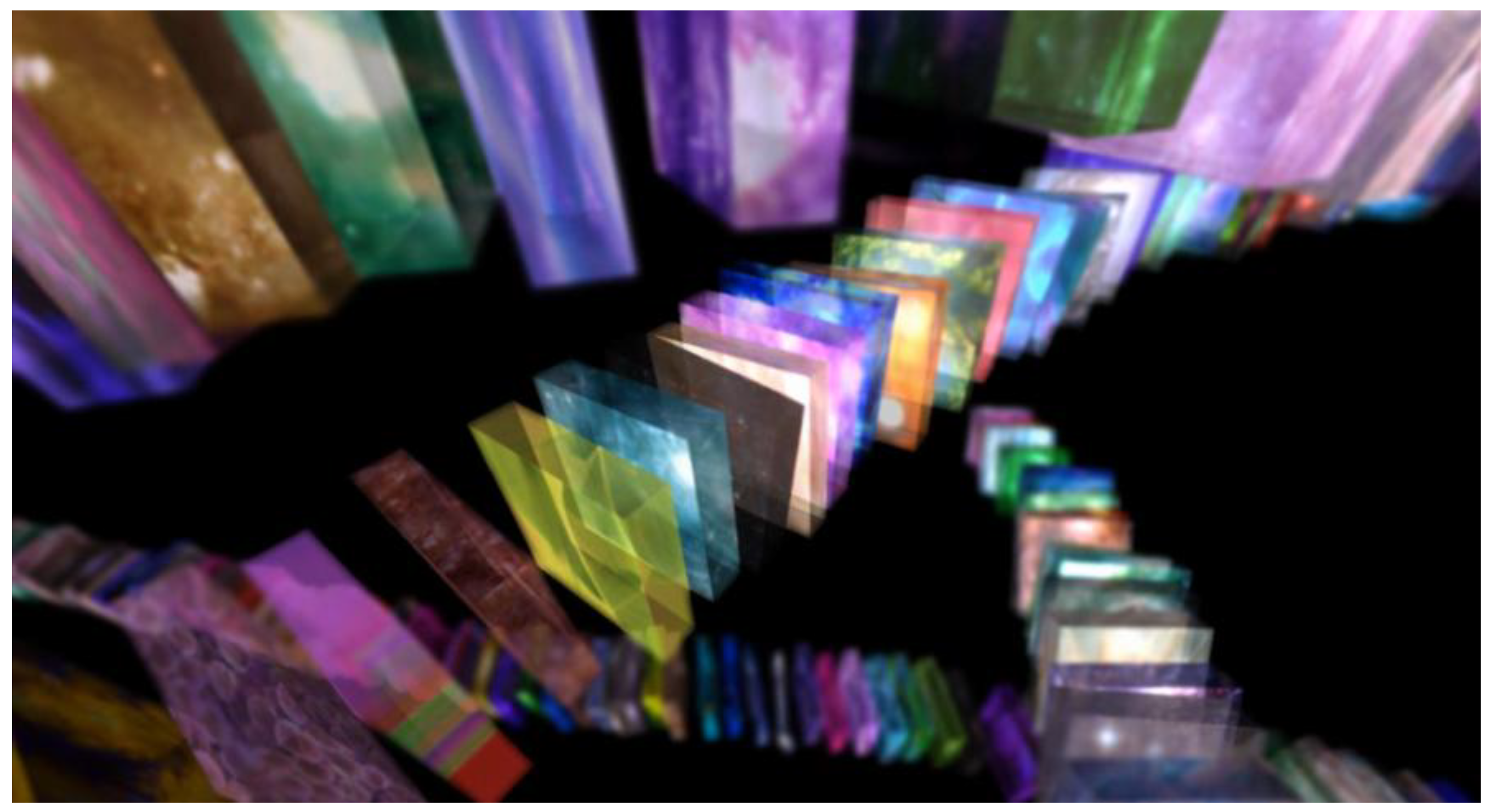
Figure 7.
An illustration for the rotating and floating Universes in a different dimension-space, a Henry’s Universe model.
Figure 7.
An illustration for the rotating and floating Universes in a different dimension-space, a Henry’s Universe model.
Disclaimer/Publisher’s Note: The statements, opinions and data contained in all publications are solely those of the individual author(s) and contributor(s) and not of MDPI and/or the editor(s). MDPI and/or the editor(s) disclaim responsibility for any injury to people or property resulting from any ideas, methods, instructions or products referred to in the content. |
© 2025 by the authors. Licensee MDPI, Basel, Switzerland. This article is an open access article distributed under the terms and conditions of the Creative Commons Attribution (CC BY) license (http://creativecommons.org/licenses/by/4.0/).
Copyright: This open access article is published under a Creative Commons CC BY 4.0 license, which permit the free download, distribution, and reuse, provided that the author and preprint are cited in any reuse.


