

Submitted:
15 May 2025
Posted:
15 May 2025
You are already at the latest version
Abstract
Yale School of Medicine (YSM) has consistently been at the forefront of promoting equity and inclusiveness within the realms of research and patient care. Using YSM’s official data on Asian female faculty members (2001–2024) and students (2014–2024) as a starting point, this review traces a historical narrative spanning over a century (1924–2024), shedding light on the remarkable achievements and enduring challenges faced by Asian females at YSM. The journey begins with trailblazers such as Dr. Chenghui Ge, the first Chinese woman to earn a DrPH at YSM in 1926, and Dr. Gueh Djen Hsiung, who became Yale’s first Asian female department director in 1960. Their pioneering contributions laid the foundation for future generations of Asian women in medicine. In more recent decades, this article highlights the enduring impact of leaders from YSM and spotlights emerging young physicians and scientists trained in Yale’s residency programs and clinical or research fellowships, who are making progress in the early stages of their careers, showcasing the ongoing evolution of Asian female representation at YSM. Beyond celebrating these milestones, this review amplifies the voices of YSM’s Asian women, addressing persistent challenges such as identity-based discrimination, cultural barriers, the "glass ceiling" in leadership roles, and the balancing act of family responsibilities. By documenting these achievements and struggles, this digital collection aims to share YSM’s progress and lessons learned while advocating for greater awareness of how cultural identity shapes academic and professional advancement.
Keywords:
Asian Women
; Woman in Medicine
; Yale School of Medicine
; Health Equity
1. Leadership for Asian women in YSM: a Historical Overview with Supporting Data
Medicine encompasses both the scientific study of human health and disease, as well as the practical application of diagnosing, treating, and caring for patients to promote recovery and improve overall well-being. Yet it is a highly rewarding profession that has direct impacts on lives and gains social respect and trust, Asians are underrepresented in medical leadership, known as the "bamboo ceiling," which might stem from cultural norms conflicting with American assertiveness expectations [1]. Furthermore, Asian women, especially some first-generation immigrants, might face dual biases, often being perceived as "porcelain dolls" and more likely to be excluded from the power structure [2]. Despite the growing presence of Asian women in M.D. programs, faculty representation has not kept pace. The proportion of Asian women among total medical school enrollees rose from 23.2% in 2019-2020 to 26.2% in 2023-2024 [3], while Asian women’s share of total faculty was 9.6% and accounted for only 5.3% of all full professors [4], suggesting that while more Asian women are entering the field of medicine, structural barriers may limit their career advancement.
Like any historical medical library in the United States, the Harvey Cushing/John Hay Whitney Medical Library at Yale School of Medicine (YSM) has been lined up with portraits mainly of caucasian male celebrities. While the exhibition 100 Years of Women at Yale School of Medicine [5] celebrates the achievements of women in medicine, it highlights only two Asian women: Gueh Djen (Edith) Hsiung (1918-2006), a pioneer faculty in diagnostic virology, and Nita Ahuja, M.D, first female chair of the Department of Surgery. No Asian female names appeared in Women Physicians Over the Centuries published in Yale Medicine Magazine (2018) [6]. Luckily, the YSM Cell Biology Department mentioned Asian female Associate Professors Dr. Shangqin Guo and Dr. Min Wu in the article Celebrating Women’s History Month 2022 [7]. In 2024, despite Asian women comprising 14.2% of Yale M.D. students and 11.8% of YSM faculty (Figure 1), their achievements and advocacy remain underrepresented in historical narratives. This underscores the importance of documenting the stories of Asian women at YSM as a vital yet often marginalized group in the institution's history.
In the past decade, the data from YSM highlights a significant trend in the representation of Asian women within the Asian student population in the M.D. & Medical Programs [8]. From 2014 to 2024, Asian women have consistently made up approximately 50% of the Asian student population (Figure 1A). When considering their representation in the total M.D. In medical Program enrollment, Asian women accounted for 13.8% ~ 18.1% (Figure 1A). In contrast, the representation of Asian females among YSM employees has historically been lower than that of students while showing a gradual increase from 6.7% in 2012 to 11.8% in 2024 (Figure 1B) [9]. These quantitative findings have sparked our interest in exploring the contributions of Asian women who have made history at Yale Medicine. In this narrative historical review, we will journey from the early 20th century to the present, tracing the generations of women’s roles at Yale Medicine. We aim to rediscover the forgotten pioneers, examine the barriers they faced, and highlight how they led initiatives and raised their voices to pave the roads to academic success.
In this historical review of Asian females in YSM, we aim to start from the early pioneers at YSM who were like a needle in a haystack in the mid-20th century, then highlight the faculties who have cut through the weeds and made ground-breaking progress from the late 20th century to today, and feature the young generation who are stepping into the spotlight and currently making history.
2. Pioneering Paths: Remembering Yale's Asian Female in Medicine in Early and Mid-20th-century
The groundbreaking achievements of Asian women in medicine since the early 20th century have often been overlooked by history, with limited publicly available records documenting their contributions. In this lesser-known chapter of history, we spotlight Dr. Chenghui Ge and Dr. Gueh Djen Hsiung, whose stories illuminate the resilience and brilliance of Asian women who sailed across the Pacific Ocean, overcame immense challenges, and achieved excellence in medical sciences at Yale.
Chenghui Ge: From Yale’s First Chinese Woman DrPH to Wartime Healer
Chenghui Ge, M.D. (葛成慧, 1893–1970), also known as Zen Way Koh (recorded at Yale [10]) or Zung-wei Koh (recorded at the University of Michigan, UMich [11]), was a pioneering figure from a business family in Jiading, China [12]. She first studied at Shanghai Women Medical College and was largely inspired by her elder brother Chengxun Ge, a surgeon who studied abroad in Japan and became the president of Peking National Medical School from 1915 to 1916, later renamed Peking University Health Science Center [13].
Dr. Ge made history as the first Chinese student known in Yale Public Health. She earned a Master of Public Health (MPH) in 1924 and a Doctor of Public Health (DrPH) degree from YSM’s Public Health Department (now Yale School of Public Health) in 1926. Notably, to secure a Chinese scholarship amid the prevailing gender bias of the time, she initially concealed her gender during the admission process [14] and was recorded as “male” in Yale’s official documents (stated as “Zen Way Koh, M.D. earned the MPH in 1924 and DrPH in 1926. He is the first known public health student from China.”) [10].
After returning to China, Dr. Ge served at hospitals in Shanghai. In 1930, she was awarded the prestigious Barbour Scholarship at UMich [11], where she then collaborated with Prof. Reuben Leon Kahn (1887-1979), the inventor of the Kahn test for syphilis [14]. She later authored several influential textbooks, including Clinical Bacteriology, Public Health, and Midwifery, solidifying her legacy as one of the pioneers of modern medicine in China. In 1935, Dr. Ge was appointed president of the Zhejiang Provincial Maternity School, where she spearheaded significant reforms in the institution [15]. During the Second Sino-Japanese War, she relocated to Chongqing and worked in the government’s education department, primarily responsible for developing medical education plans and editing textbooks. Amidst the turmoil of war, she also tirelessly applied her exceptional medical skills to treat wounded soldiers. During this period, Dr. Ge noticed the struggles of her female colleagues who had to balance work and childcare. In response, she proposed and established a kindergarten and a home economics training program, alleviating many of the challenges faced by working mothers and demonstrating her unwavering commitment to both medical and social progress [15].
After the war ended, she returned to her hometown Jiading to care for her ailing mother, as she was the only surviving child in her family [15]. In 1947, she founded the Jiading District Central Hospital, originally known as Puji Hospital, which became a cornerstone of healthcare in her hometown. Dr. Ge dedicated her life to practicing medicine and performing acts of kindness. She never married and, unfortunately, passed away in 1970. After her passing, her family discovered a hidden autobiography titled A Record of Life's Trivialities (《一生琐记》) [16]. Her legacy as a trailblazer in both clinical practice and education continues to inspire future generations.
Gueh Djen Hsiung: From Polio Pioneer to Global Mentor in Virology
Gueh Djen (Edith) Hsiung, Ph.D. (熊菊貞, 1918-2006) was born in Hubei, China, and graduated from Ginling College in Chengdu, China [5]. After World War II, she earned her Ph.D. in Microbiology (1951) from Michigan State University (MSU) with Prof. Henrik Joakim Stafseth (1890-1968). Despite her ambition to attend medical school in the United States, she was rejected by Yale University at the age of 35, deemed too old for admission. Undeterred, she secured a postdoctoral fellowship at Yale, working with Dr. Joseph Melnick on poliovirus and related enteroviruses. There, she refined her skill in identifying viruses through cytopathic effect (CPE), a technique that later became the gold standard in diagnostic virology. At Yale, she also collaborated extensively with Prof. Dorothy M. Horstmann, a trailblazer in polio research who made history as the first woman to be appointed full professor at the YSM in 1961.
In 1960, Dr. Hsiung was appointed the first Director of the Diagnostic Virology Laboratory at Yale New Haven Hospital (YNHH) [17]. She authored the widely acclaimed textbook Diagnostic Virology first in 1964. By 1967, she had risen to become the chief of the Virology Research Laboratory at the Veterans Administration Medical Center (VAMC) in West Haven and a professor in Yale's Department of Laboratory Medicine, where she was promoted to full professor in 1974. In 1985, she established the National Virology Reference Laboratory at VAMC, serving VA hospitals across the nation, and became its inaugural Director.
Throughout her career, Dr. Hsiung received numerous accolades for her groundbreaking work. Among her many awards were the Becton-Dickinson Award from the American Society for Microbiology in 1983 and an Honorary Doctor of Science degree from MSU [18]. These honors underscored her significant contributions to the field of virology and her enduring influence on scientific research. Dr. Hsiung retired as Professor Emeritus at YSM, leaving behind a legacy as a world-renowned virologist. Throughout her career, she published more than 240 scientific papers, cementing her impact on the field of virology.
Besides being a renowned scientist, Dr. Hsiung was a devoted mentor to countless trainees, both at Yale and in mainland China and Taiwan [17]. She conducted annual training sessions at the National Cheng Kung University in Taiwan, where she played a pivotal role in establishing a virology laboratory. This facility proved critical in addressing regional epidemics such as SARS and avian flu. Dr. Hsiung’s legacy also includes a touching personal story of friendship and generosity. During her time at MSU, she formed a close friendship with her roommate, Dr. Margaret Everett Kimball (1924-2011) [19]. Dr. Hsiung endowed the Hsiung-Kimball Undergraduate Award at MSU to honor the Kimball family for hosting her during her Ph.D. study. Her pioneering contributions to both clinical practice and academic research have left a lasting impact that continues to shape and influence the field of virology.
3. Paving the Way: Celebrating Today’s Asian Women as Groundbreaking Leaders
In the history of YSM, Asian women are breaking barriers, redefining leadership, and driving transformative change in science and medicine. Here we selected some representatives of Asian women leaders in YSM. Their enduring dedication and leadership have left an indelible mark on the institution, inspiring future generations of medical professionals.
Young Choi: Traveling across the Pacific to be a Leader in Immunopathology
Dr. Young Choi (also known as Young Choi Kim) is a Professor Emeritus of Pathology at YSM and the Director of Clinical Laboratories at Bridgeport Hospital, where she has dedicated over 24 years to advancing pathology and laboratory medicine [20]. Dr. Choi received her M.D. from Seoul National University in 1966 and commenced her medical training in the United States. Following her residency, she joined the Albert Einstein College of Medicine in 1972, achieving the rank of full Professor by 1995 [21]. During her tenure, she established the Immunopathology Laboratory, initiated an Immunopathology Fellowship program approved by the American Board of Pathology, and created the Molecular Pathology Laboratory. She also held leadership roles at Bronx-Lebanon Hospital Center, including Chairman of Pathology and Laboratory Medicine (1990–1999) and Director of the Pathology Residency Program. In 2001, Dr. Choi joined Bridgeport Hospital as Chairwoman of Pathology and Laboratory Medicine. Concurrently, Dr. Choi has been a Professor of Pathology at YSM since 2001, serving as Co-Vice Chair of Pathology from 2001 to 2010. Her work at Yale and Bridgeport Hospital has significantly enhanced diagnostic services and patient care in the community.
Adeeba Kamarulzaman: Fighting Against HIV/AIDS Internationally
Since its founding in 1988, the International AIDS Society (IAS) has played a pivotal role in advancing scientific understanding, promoting evidence-based interventions, and fostering international collaboration [22]. In 2020, Dr. Adeeba Kamarulzaman, a renowned Malaysian physician and scientist, became the first Asian President of the IAS, where she championed diversity, achieving a majority-female Governing Council [23]. Dr. Kamarulzaman is both an Adjunct Associate Professor at YSM and the Dean of the Faculty of Medicine at Universiti Malaya [24]. She has been working to support AIDs research both within Malaysia and internationally. As a graduate of Monash University, she established the Infectious Diseases Unit at Universiti Malaya Medical Centre and founded the Centre of Excellence for Research in AIDS (CERiA) in 2008 [23]. She has been a key advocate for harm reduction measures to combat HIV among people who inject drugs in Malaysia, serving as President of the Malaysian AIDS Council (2006-2010) and Chairwoman of the Malaysian AIDS Foundation [23]. Her work continues to shape global health, particularly in HIV/AIDS research and policy.
Nita Ahuja: the First Asian Female Chair in Surgery at YSM
Women have been markedly underrepresented in surgical leadership positions. According to 2020 research, only 28 out of 354 academic surgical department chairs in the United States are women. [25]. In 2018, Dr. Nita Ahuja became the first female chair of surgery at YSM [26]. Born in India and raised in Maryland, she earned her M.D. from Duke University (1993) and specialized in surgical oncology at Johns Hopkins University (JHU) since 1994. Dr. Ahuja is renowned for her expertise in gastrointestinal cancers [26]. Dr. Ahuja is a strong advocate for advancing women in medical leadership and addressing the "leaky pipeline" phenomenon, where women are underrepresented in higher leadership roles within the medical field [27]. Dr. Ahuja mentioned: “If there’s one woman, she’s an outlier…once you make it past a tipping point, it becomes the norm [27].” Her dedication extends beyond supporting women in surgery to promoting general diversity in leadership. She emphasizes that diversity is not about attributing specific qualities to any one group but rather about embracing a wide range of perspectives, which strengthens an organization’s ability to adapt and thrive [27]. Dr. Ahuja champions diversity and inclusion and was elected to the board of Yale’s Asian Faculty Association in 2023 [28]. Through her work and advocacy, Dr. Ahuja inspires and empowers women and general diversity in surgery.
Maryam Lustberg: A Leader in Breast Cancer Patient Care and Survivorship Study
Dr. Maryam Lustberg is a Professor of Medicine (Medical Oncology), the Director of the Center for Breast Cancer at Smilow Cancer Hospital, and Chief of Breast Medical Oncology at Yale Cancer Center (since 2021) [29]. Born in Iran and raised in Maryland, Dr. Lustberg is a distinguished leader in breast cancer research and survivorship care [30]. Dr. Lustberg earned her M.D. from the University of Maryland (2003), completed her residency there, and trained in medical and breast oncology at Ohio State University, where she later joined the faculty (2010) [29]. Recognized for her patient-focused care, she has been named one of Forbes' top breast medical oncologists and listed in Castle Connolly’s “Regional Top Doctors” and “Exceptional Women in Medicine” (2020). She is currently in the ASCO Leadership Development Program [31]. She serves on ASCO’s Education and Patient Care Committees and the Neuropathy Expert Guideline Panel, while actively engaging in patient advocacy and clinical trial participation initiatives. She is President-Elect of MASCC, sits on its Board of Directors, and is an Associate Editor for the Journal of Cancer Survivorship [32].
Akiko Iwasaki: A Visionary in Viral Immunology and Long COVID
Dr. Akiko Iwasaki is a Professor of Immunobiology and Molecular, Cellular, and Developmental Biology at YSM and an Investigator at the Howard Hughes Medical Institute [33]. Born in Japan, she moved to Canada at 16, earning her bachelor’s degree in 1994 and her Ph.D. in immunology in 1998 from the University of Toronto. After postdoctoral training at the NIH, she established her lab at Yale in 2000. Dr. Iwasaki’s research focuses on immune defense against viruses and mucosal vaccine development. She co-led the Yale COVID-19 Recovery Study, investigating long COVID and pioneering animal models to study its mechanisms. She has been elected to the National Academy of Sciences (2018), National Academy of Medicine (NAM) (2019), European Molecular Biology Organization (2021), and American Academy of Arts and Sciences (2021). In 2022, she was awarded Yale’s highest honor, the Sterling Professorship, becoming the first Asian female faculty member in the biomedical field to receive this distinction [34].
Looking forward, more Asian women are proceeding on their journey to become directors, chiefs, chairs, or department leaders. In 2024, Dr. Pooja Khatri was named Chair of the Department of Neurology at YSM and Chief of Neurology at the YNHH System, with her role taking effect on April 1, 2025 [35]. In the future, we can anticipate a growing presence of Asian female leaders across various departments at YSM, paving the way for their better representation.
4. A Legacy of Excellence: The Broader Impact of Asian Women at YSM
Some Asian females have played a crucial role in the growth and advancement of YSM. Through their contributions to academic excellence, clinical progress, and research innovation, they have helped shape the institution’s success. Their unwavering commitment and influence have left a lasting impact, inspiring future generations of medical professionals.
Numerous female medical professionals have been traveling from Asian countries to Yale to find better opportunities. Dr. Malini Harigopal earned an M.D. degree from Gandhi Medical College [36] in 1985, and in the same year, Dr. Nadia Ameen got her MBBS from the University of West Indies [37]. After continuing medical training in the U.S., Dr. Harigopal became a Professor Adjunct in Pathology and Director of the Immunohistochemistry Lab in Pathology [36] and received the HPV Investigation Award from the American Society of Cytopathology in 2016. Meanwhile, Dr. Ameen is a Professor of Pediatrics (Gastroenterology) and Cellular and Molecular Physiology, earning the NASPGHAN Award for the Study of Disorders Associated with Carbohydrate Malabsorption in 2020 [37]. Dr. Uma Krishnamurti got her M.D. at the University of Delhi in 1990, and now is the Director of Breast Pathology [38]. Same in 1990, Dr. Xiaomei Cong got a Bachelor of Medical Science from Peking University [39]. She is now Associate Dean of Research at Yale School of Nursing and Deputy Director at Yale Center for Clinical Investigation. Soon later, Dr. Farzana Pashankar got an M.D. at Poona University in 1992, and she has now become a Professor of Pediatrics and Director of multiple Hematology and Oncology programs [40].
In 1993, the trajectories of several distinguished faculty members intersected at YSM, marking a pivotal moment in their long journey starting from where they were born. Dr. Tong Wang is a Professor of Cellular and Molecular (C&M) Physiology, studying electrolyte transport in kidney tubules [41]. She got her M.D. in Beijing Medical University in 1974, and an Honorary Master degree from Yale in 2008 [42]. Dr. Wang previously worked in the Department of Physiology and Biophysics, University of Illinois, Chicago College of Medicine [43], and was a Postdoctoral Fellow at Yale in 1993, the same year Dr. Li Wen joined YSM as a Postdoctoral Fellow [44]. Dr. Wen was promoted to Assistant Professor in 1998. She is now a Professor of Medicine in Endocrinology, and the Director of the Core Laboratory of Yale Center for Clinical Investigation (YCCI) [45]. She earned her M.D. at Capital University of Medicine, China (1983) and her M.D./Ph.D. at King’s College London in 1992 [44]. The same year, Dr. Young-Shin Kim became a Resident at Yonsei University College of Medicine. Dr. Kim further came to the U.S. as a clinical fellow at YSM in 1993 [46]. After earning her MPH at Yale, she went on to obtain her Ph.D. at the University of California at Berkeley in 2005, which was 17 years after her M.D. degree in 1988 from Yonsei University [46]. In 2014, she won the U.S. Presidential Science Award, when she was an Associate Professor Adjunct at the Child Study Center [47].
Some of them have crossed career paths, like Dr. Emily Ai-hua Wang and Dr. Mina Xu, who graduated from Harvard University with BA in 1977 and 1980, respectively. Their paths almost overlapped again at the University of California San Francisco, where Dr. Xu earned her M.D. in 2006, and Dr. Wang started her residency the same year. Now their journey merges again: Dr. Wang is a Professor of Medicine and Public Health who was elected to NAM, and also the Director of SEICHE Center for Health and Justice [48]. Dr. Mina Xu is a Professor of Pathology and the Director of Hematopathology and Expert Consultation Practice [49].
There are more Asian Women being leaders in YSM, including Dr. Peggy Myung Vice Chair of Research and Associate Professor of Dermatology and Pathology [50], Dr. Christine Won, the Medical Director of Yale Centers for Sleep Medicine and Director of the Yale Women’s Sleep Health Program [51], Dr. Rachel Liu, the Director of Point-of-Care Ultrasound Education [52] and Dr. Denise Mohess, Co-Chief in the Section of Geriatrics and Director of Age-Friendly Care and beyond [53]. Dr. Rajita Sinha, a distinguished leader in psychiatry and neuroscience, was the founding director of the Yale Interdisciplinary Stress Center in 2007 [54]. At the Women in Psychiatry Faculty Mentoring Lunch in 2016, Dr. Rajita Sinha offered insightful perspectives on building an academic career [55].
The achievements of Asian female faculties at YSM extend far beyond the institution, strengthening its academic and clinical academia climate that inspires future generations. Their commitment to excellence, diversity, and innovation has built a legacy, paving the way for the next generations trained at YSM.
5. Training and Mentoring: A New Generation of Female Physicians and Scientists Trained by YSM
Building on the foundation laid by their predecessors, YSM continues to cultivate new generations of Asian female physicians and scientists. As a symbolic program, the Yale Traditional Internal Medicine Residency Program has fostered a diverse environment where Asian female medical trainees can thrive to become established physicians, researchers, and leaders, and reach their career goals.
With leadership like Dr. Shaili Gupta, the Associate Program Director, the unique climate of Yale’s internal medicine residency has benefited from her dedication to professional development and medical education [56]. Over the past years, Dr. Gupta has mentored the residents, including the Asian female young doctors, guiding them in research and career development. Dr. Maryam Mooghali earned her M.D. from Shiraz University of Medical Sciences (2018) and later pursued a Master’s in eHealth at McMaster University (2021) [57]. She has led studies on FDA approval processes for cancer drugs and continues to investigate cost-effective solutions in healthcare delivery, some results of which have been published in JAMA. Dr. Renée Maria Saliby hails from Beirut, Lebanon, and earned her medical degree at Saint Joseph University (2021) [58]. Now a PGY-1 in the Traditional Internal Medicine Residency Program, she was inspired to become a physician due to her own medical challenges, including severe asthma and scoliosis. Dr. Saliby envisions a career in academic medicine, engaging in translational research and mentorship. Dr. Ayesha Butt completed her MBBS at Aga Khan University (2021) and served as a Postdoctoral Associate at Yale Cancer Center from 2021 to 2023 under Dr. Alfred Ian Lee [59]. Currently an Internal Medicine Resident at Yale, she continues to explore rare diseases and cost-effective studies in medicine.
The alumni of the Yale Traditional Internal Medicine Residency Program also include distinguished Asian female physicians, some of whom have chosen to serve as faculty at YSM. Dr. Grace Lee is now an Assistant Professor of Medicine specializing in endocrinology, who completed her residency (2010) and fellowship (2013) at Yale [60]. Dr. Thuy Tran is an Assistant Professor of Medicine (Medical Oncology) at Yale [61]. Completing her residency (2015) and fellowship (2019) at Yale, she leads clinical trials aimed at improving immune resistance in melanoma. Dr. Jing Du completed her M.D. at Shanghai Jiao Tong University and her Ph.D. in Biochemistry at the University of South Carolina [62]. She completed her medical training at Yale and is now an Instructor of Medicine specializing in breast cancer. Dr. Ke Xu completed her medical degree at West China College of Medicine, Sichuan University (2007) and later began her residency at Yale (2011) [63]. She is now a Professor of Psychiatry and Director of Stress Epigenetics at the Yale Stress Center. Her work in social epigenomics continues to influence medical understanding of stress-related conditions. For the Ph.D. programs, Dr. Hongying (Hoy) Shen earned her Ph.D. from YSM in 2013 and is now an Assistant Professor in C&M Physiology at YSM [64].
YSM has paved the way for many Asian female medical trainees, from internal medicine to oncology, endocrinology, and psychiatry subspecialties. These distinguished figures exemplify Yale’s commitment to supporting them with excellence and mentorship in healthcare.
6. Elevating Voices: Asian Women Leading Health Equity Initiatives and Combating Anti-Asian Racism
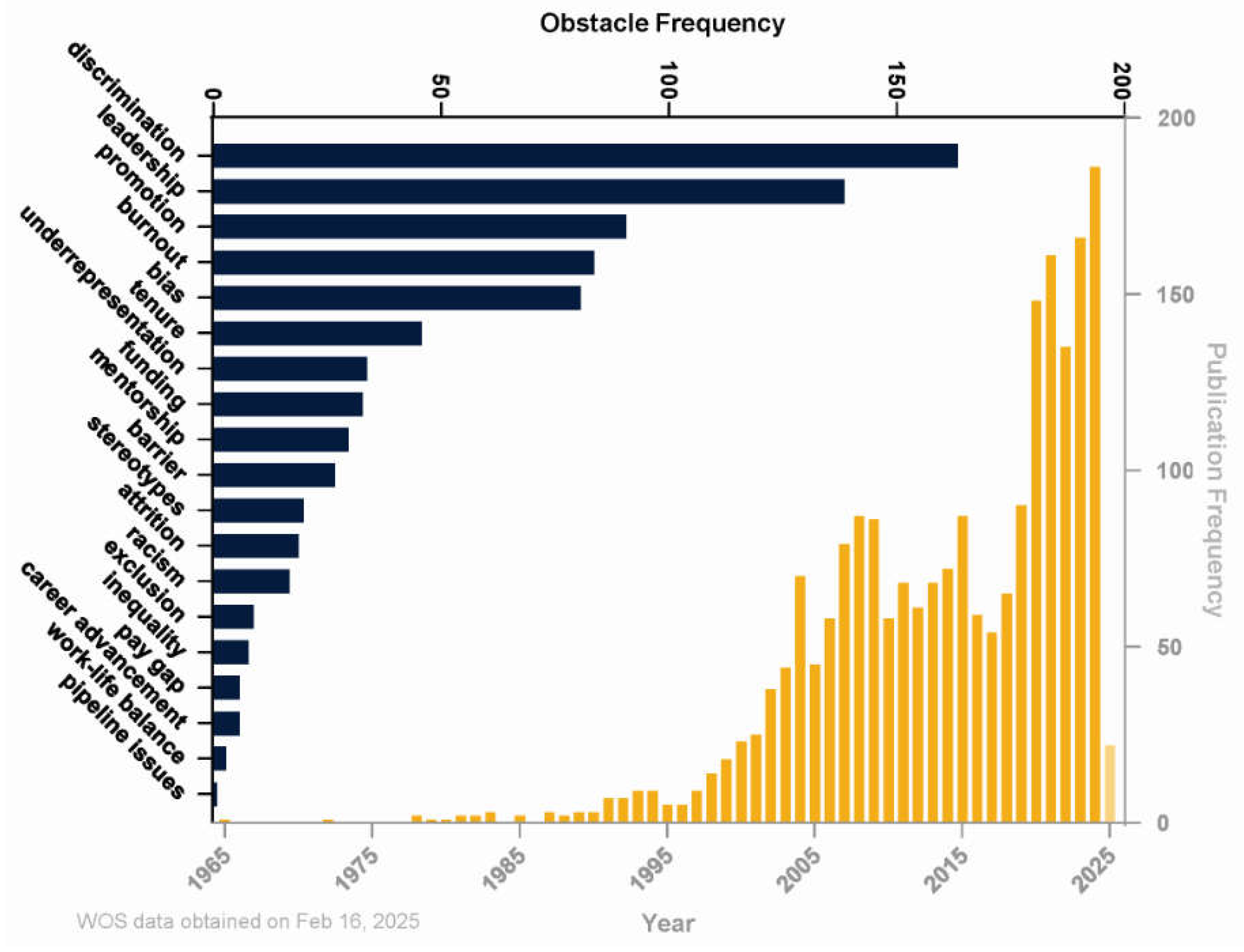
There are many career barriers faced by Asian female medical professionals, with discrimination, leadership challenges, promotion hurdles, burnout, and bias being the most frequently discussed obstacles in publications on the Web of Science, dated from 1965 to 2025. Other notable challenges include underrepresentation, tenure difficulties, funding limitations, lack of mentorship, stereotypes, and attrition, while issues such as racism, exclusion, inequality, pay gap, career advancement struggles, work-life balance, and pipeline issues are also documented but with lower frequency. The timeline of publications reveals that research on these barriers was scarce before 1990 but began to rise in the late 1990s and saw a sharp increase after 2019, which suggests growing academic and societal awareness of these challenges, highlighting the persistent structural and institutional obstacles that hinder career progression for Asian women in medicine. In response to this structural bias, Yale medical students, residents and faculties have started initiatives and advocacies to improve the climate for Asian female professionals.
YSM’s Initiatives to Address Asian Racism and Improve Faculty Climate are Commendable, but More Must be Done to Foster an Inclusive Environment.
Asian women at YSM are making significant strides in advocating for health equity and addressing the unique challenges faced by underrepresented communities, particularly within the Asian American population. For example, Mytien Nguyen is an M.D.-Ph.D. student at YSM [65]. As a self-identified Black Vietnamese, first-generation, low-income (FGLI) student [66], she is a passionate advocate for health equity and a co-founder of the National First Gen & Low-Income Medicine Association [67]. In 2022, she published a first-author paper highlighting the increased likelihood of medical students who experience mistreatment or discrimination and left medical school [68]. One of her co-authors, Dr. Sarwat Chaudhry, a Professor of Medicine, is a prominent leader in efforts to diversify the physician and physician-scientist workforce [69]. Ms. Nguyen is dedicated to improving the representation of Asian Americans in the U.S. medical system. In 2024, she published a first-author paper to advocate for more detailed data to improve healthcare and medical training for this diverse group [70].
Besides Ms. Nguyen, more YSM Asian females have been supporting the Asian community. For example, as an advocate against Asian American and Pacific Islander (AAPI) hate, especially towards the elderly, Dr. Ke Xu has called for societal change in response to the rise in anti-Asian violence during the COVID-19 pandemic [71]. Also, Dr. Eunice Yuen, an Assistant Professor of Psychiatry at Yale with a Ph.D. in neuroscience, has also navigated these systemic barriers [72]. In 2020, Dr. Yuen founded CHATogether, a program using educational videos to address mental health conflicts in Asian American families [73].
Together, these women are driving change, not only in the medical field but also in combating racial injustices and mental health stigmas, uplifting their communities, and inspiring future generations of advocates.
Confronting the "Porcelain Doll" Stereotype and the Invisibility Cloak: Systemic Barriers for Asian Women in Medicine
Asian women in medicine navigate a dual challenge: the "porcelain doll" stereotype, which frames them as fragile and voiceless, and the "invisibility cloak," which renders their professional contributions unseen [74]. These systemic barriers hinder their recognition and advancement in the field. Dr. Sirikanya (Sanya) Chiraroekmongkon, M.D., a psychiatry resident at Yale, has openly confronted these challenges. Growing up in an FGLI family, she experienced the "porcelain doll" stereotype firsthand, which hyper-visibilizes Asian women as exotic objects while silencing their voices. This duality is further exacerbated by the "invisibility cloak," as she recounts being sexualized and dismissed by patients, such as when one remarked, "What’s a girl like you doing here?" while refusing to acknowledge her as a physician. Institutional responses often prioritize "empathy" over addressing the underlying misogyny and racism perpetuating these barriers.
As an advocate for FGLI Asian American women, Dr. Chiraroekmongkon mentors students at Yale, guiding them through the intersectional challenges of being Asian, female, and FGLI in higher education [75]. Her work underscores the unique struggles of Asian American women, who are frequently overlooked in diversity discussions. She also draws strength from her own FGLI mentors, Dr. Yun Feng and Dr. Eunice Yuen, who have supported her journey [75]. Through her advocacy and mentorship, Dr. Chiraroekmongkon is dismantling stereotypes and creating pathways for future generations.
7. Summary
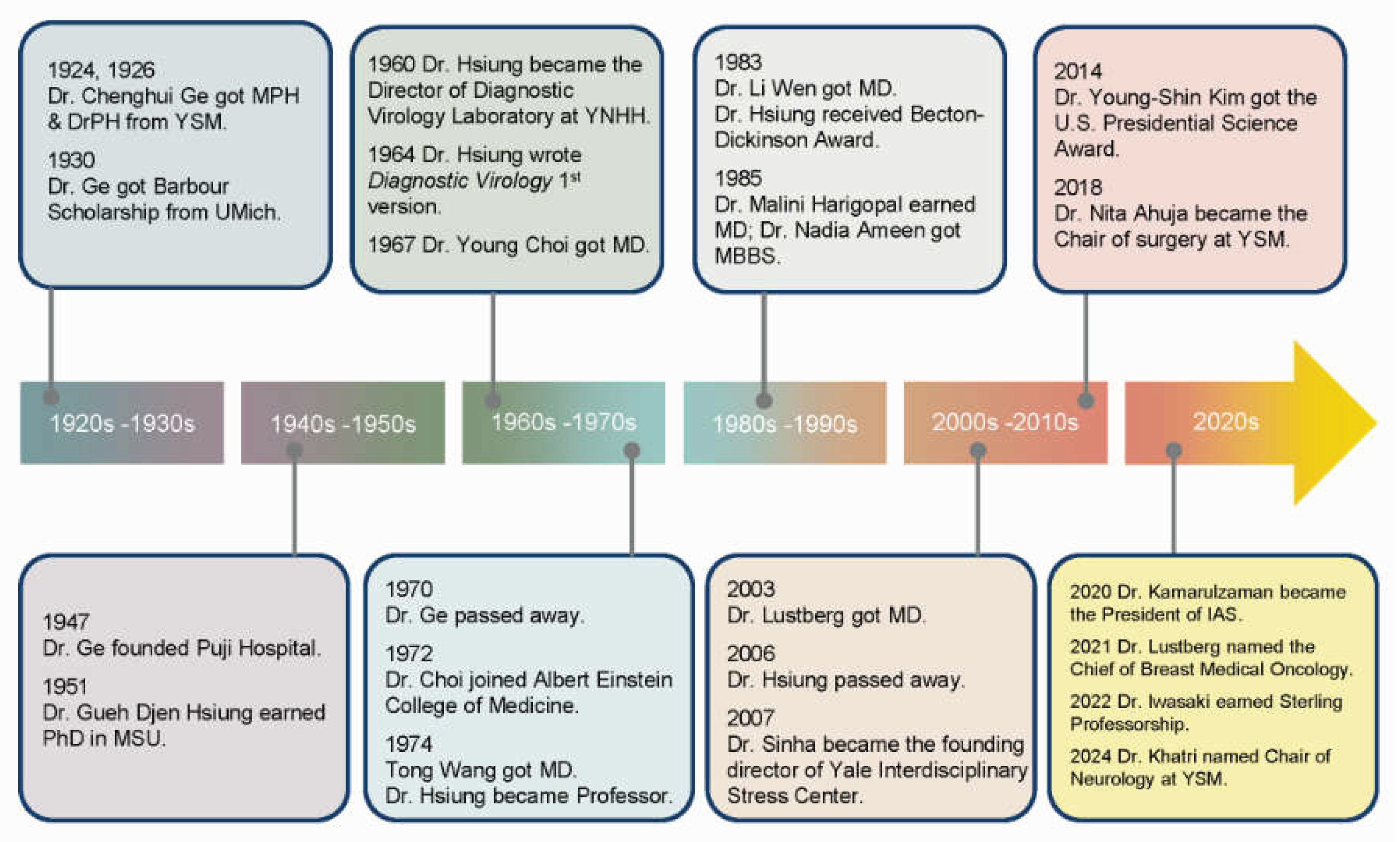
This review has presented a timeline of Asian women at YSM who are marked by resilience and leadership (Figure 3). We begin by recognizing the early pioneers of the early 20th century, whose presence was exceedingly scarce. We then highlight the faculty members who, from the late 20th century to the present, have navigated challenges and achieved groundbreaking progress. Finally, we feature the emerging generation, who are stepping into the spotlight and actively shaping history today.
Figure 2.
Combined visualization of most mentioned obstacles for Asian females in U.S. medicine and the distribution of related publications over time. The left panel displays obstacle types (left y-axis) and their mentioned frequency (top x-axis), while the right panel illustrates publication frequency (right y-axis) by year (bottom x-axis). For the time distribution, 14 papers mislabeled as 1800 were excluded to avoid confusion. Data obtained from Web of Science on Feb 16, 2025, so the data from 2025 was incomplete and marked in a lighter color.
Figure 2.
Combined visualization of most mentioned obstacles for Asian females in U.S. medicine and the distribution of related publications over time. The left panel displays obstacle types (left y-axis) and their mentioned frequency (top x-axis), while the right panel illustrates publication frequency (right y-axis) by year (bottom x-axis). For the time distribution, 14 papers mislabeled as 1800 were excluded to avoid confusion. Data obtained from Web of Science on Feb 16, 2025, so the data from 2025 was incomplete and marked in a lighter color.
By capturing both the achievements and challenges faced by Asian female medical professionals, this digital collection seeks to highlight YSM’s progress and the lessons it has learned. At the same time, it advocates for a deeper understanding of how cultural identity influences academic and professional growth. YSM is expected to remain committed to fostering a future where diversity is embraced, leadership knows no bounds, and every Asian woman has the opportunity to reach her fullest potential. Through similar commitments, more medical schools can ensure their impact continues to inspire and transform the field of medicine for years to come.
7.1. Limitations of the study
This study primarily relied on publicly available information, which limited the depth of our analysis. Due to the constraints of ethics approval, time and resources, we were unable to conduct detailed interviews or engage in more comprehensive data collection methods. As a result, we sincerely apologize that our research may have overlooked significant contributions made by other inspiring Asian women at YSM, including faculty, staff, students, and alumnae. For instance, Dr. SreyRam Kuy (MS from YSM in 2009), is known as the first female Cambodian refugee to work as a surgeon in the U.S. [79]. Her story, along with those of countless other YSM alumnae, underscores the broader impact of Asian women in medicine beyond the confines of Yale. Future research should aim to provide a more inclusive and comprehensive understanding of the diverse and far-reaching achievements of Asian women in medicine, both within and beyond YSM.
7.2. Methods
All data and statements in this study were sourced from publicly available databases and literature, as explicitly referenced in the citations and figure captions.
List of Abbreviations
| YSM: | Yale School of Medicine |
| YNHH: | Yale New Haven Hospital |
| DrPH: | Doctor of Public Health |
| MPH: | Master of Public Health |
| UMich: | University of Michigan |
| MSU: | Michigan State University |
| CPE: | Cytopathic Effect |
| VAMC: | Veterans Administration Medical Center |
| IAS: | International AIDS Society |
| CERiA: | Centre of Excellence for Research in AIDS |
| ASCO: | American Society of Clinical Oncology |
| MASCC: | Multinational Association of Supportive Care in Cancer |
| NIH: | National Institutes of Health |
| NAM: | National Academy of Medicine |
| C&M: | Cellular and Molecular |
| YCCI: | Yale Center for Clinical Investigation |
| YNHH: | Yale New Haven Health |
| FGLI: | First-Generation, Low-Income |
| AAPI: | Asian American and Pacific Islander |
| CHATogether: | Cultural Healing and Awareness Together |
| FDA: | Food and Drug Administration |
| JAMA: | Journal of the American Medical Association |
| PGY-1: | Post-Graduate Year 1 |
| SEICHE: | Social Equity and Inclusion in Clinical Health and Education |
| STEM: | Science, Technology, Engineering, and Mathematics |
Acknowledgment
We sincerely appreciate the guidance about topic selection from Melissa Grafe, Ph.D., and the continuous support from YJBM chief editors Hayley Serpa, Shivesh Shourya, and our editor Sam Suh. We would also like to extend our sincere appreciation to Mark D. Siegel, M.D., and Shaili Gupta, MBBS, from the Yale Traditional Internal Medicine Residency, for their advice and insights. Xuezhu Wang is grateful to YSM/YNHH for offering her the Medical Oncology rotation at YNHH/Smilow Cancer Center in October 2024. Generative AI (GPT 4.0, DeepSeek V3) was employed to enhance the readability and linguistic quality of the manuscript, while all final content was meticulously reviewed, verified, and approved by the authors to ensure accuracy and integrity.
Author Contributions
Q.Y. initiated the idea. X.W. and Q.Y. conducted the research and wrote the manuscript. No funding was provided to the authors.
References
- Navigating the Intersectional Bamboo and Glass Ceilings: Empowering Asian American Women in Medical Leadership – APAMSA [Internet]. [cited 2025 Mar 16]. Available from: https://www.apamsa.org/navigating-the-intersectional-bamboo-and-glass-ceilings-empowering-asian-american-women-in-medical-leadership/.
- Why Are There So Few Asian Clinicians in Leadership Positions? [Internet]. [cited 2025 Feb 21]. Available from: https://opmed.doximity.com/articles/why-are-there-so-few-asian-clinicians-in-leadership-positions.
- 2024 FACTS: Enrollment, Graduates, and M.D.-Ph.D. Data [Internet]. AAMC. [cited 2025 Mar 16]. Available from: https://www.aamc.org/data-reports/students-residents/data/facts-enrollment-graduates-and-M.D.-Ph.D..
- Faculty Roster: U.S. Medical School Faculty [Internet]. AAMC. [cited 2025 Mar 16]. Available from: https://www.aamc.org/data-reports/faculty-institutions/report/faculty-roster-us-medical-school-faculty.
- 100 Years of Women at Yale School of Medicine · Introduction · 100 Years of Women at Yale School of Medicine · Yale University Library Online Exhibitions [Internet]. [cited 2025 Mar 6]. Available from: https://onlineexhibits.library.yale.edu/s/100-years-women-ysm/page/home.
- Women physicians over the centuries [Internet]. [cited 2025 Feb 23]. Available from: https://medicine.yale.edu/news/yale-medicine-magazine/article/women-physicians-over-the-centuries/.
- Tran ML. Celebrating Women’s History Month 2022 [Internet]. [cited 2025 Mar 7]. Available from: https://medicine.yale.edu/news-article/celebrating-womens-history-month-2022/.
- Yale School by Race and Gender (W004, W010) [Internet]. [cited 2025 Mar 16]. Available from: https://app.powerbi.com/view?r=eyJrIjoiZDY4OTgzMzYtYjIyNy00ODg5LTgxMmItNzAyODhjMjk2MjkwIiwidCI6ImRkOGNiZWJiLTIxMzktNGRmOC1iNDExLTRlM2U4N2FiZWI1YyIsImMiOjF9.
- Faculty Race and Gender by School (W106) [Internet]. [cited 2025 Mar 16]. Available from: https://app.powerbi.com/view?r=eyJrIjoiZWUzZmY1NTAtNTdkYy00M2U2LWFjOWQtNmY4MzJlNDdmMzQ4IiwidCI6ImRkOGNiZWJiLTIxMzktNGRmOC1iNDExLTRlM2U4N2FiZWI1YyIsImMiOjF9.
- Yale School of Public Health Historical Timeline | Yale School Of Public Health [Internet]. [cited 2025 Mar 6]. Available from: https://ysph.yale.edu/about-school-of-public-health/history/school-timeline/.
- Barbour Scholars, 1914 to Present » Rackham Graduate School: University of Michigan [Internet]. Rackham Graduate School: University of Michigan. [cited 2025 Mar 8]. Available from: https://rackham.umich.edu/rackham-life/diversity-equity-and-inclusion/barbour-scholars/barbour-scholars-1914-to-present/.
- Female doctor lays hospital’s foundation | Shanghai Daily [Internet]. [cited 2025 Feb 23]. Available from: https://archive.shine.cn/district/jiading/Female-doctor-lays-hospitals-foundation/shdaily.shtml.
- Chengxun Ge, Peking University Health Science Center葛成勋_北京大学医学部 [Internet]. [cited 2025 Mar 16]. Available from: https://www.bjmu.edu.cn/xbgk/lrld/yczr/efe62287a7274ffab03430b397580bff.htm.
- Jingxian L. Hard Study Finally Pays Off: A Brief Look at Those Jiading Natives Who Attended Prestigious Schools. 苦读终有所成:略数那些读名校的嘉定人. Jiadingbao [Internet]. 2012 Mar 26 [cited 2025 Feb 23]; Available from: https://mobile.epaper.routeryun.com/index.php/home/article/index/appkey/49/date/2012-03-26/page/29234/aid/179243.html.
- Qiu-dong G. Great Physicians Excel in Skill and Sincerity, Striving for the Ultimate Good—Ge Chenghui. 大医精诚,止于至善——葛成慧. Jiadingbao [Internet]. 8th ed. 2017 Apr 25 [cited 2025 Mar 6]; Available from: http://www.jiadingbao.cn/Page/index/pageid/284680.html#284680.
- Mingyuan Z. The manuscript of Ge Chenghui’s autobiography, “A Record of Life’s Trivialities,” has been unveiled. 葛成慧自传《一生琐记》手稿面世. Jiadingbao [Internet]. 2023 Jul 1 [cited 2025 Mar 6]; Available from: http://www.jiadingbao.cn/Article/index?aid=215796.
- Committed virologist, veteran of the Chinese Civil War [Internet]. [cited 2025 Mar 6]. Available from: https://medicine.yale.edu/news/yale-medicine-magazine/article/committed-virologist-veteran-of-the-chinese-civil-war/.
- Gueh-Djen (Edith) Hsiung (1918-2006) - Find a... [Internet]. [cited 2025 Mar 6]. Available from: https://www.findagrave.com/memorial/16567791/gueh-djen_(edith)-hsiung.
- The story of the Virologist, the Vaccine, and the Goat [Internet]. The Burmeister Lab: Studying Microbial Evolution and Extinction. [cited 2025 Mar 6]. Available from: http://arburmeister.weebly.com/2/post/2015/05/the-story-of-the-virologist-the-vaccine-and-the-goat.html.
- Young Choi, M.D. [Internet]. [cited 2025 Mar 8]. Available from: https://medicine.yale.edu/profile/young-choi/.
- (11) Young Choi Kim | LinkedIn [Internet]. [cited 2025 Mar 8]. Available from: https://www.linkedin.com/in/ychoikim/.
- We are the IAS [Internet]. [cited 2025 Mar 8]. Available from: https://www.iasociety.org/we-are-the-ias.
- Adeeba Kamarulzaman of Malaysia announced as the first Asian President of IAS – the International AIDS Society [Internet]. [cited 2025 Mar 6]. Available from: https://www.iasociety.org/news-release/adeeba-kamarulzaman-malaysia-announced-first-asian-president-ias-international-aids.
- Center for Implementation Science Malaysian Implementation Science Training (MIST) Program [Internet]. [cited 2025 Mar 6]. Available from: https://medicine.yale.edu/internal-medicine/infdis/research/hiv-aids/mist/.
- Columbus AB, Lu PW, Hill SS, et al. Factors Associated With the Professional Success of Female Surgical Department Chairs. JAMA Surg. 2020;155(11):1028–1033.
- Nita Ahuja, M.D., MBA, FACS [Internet]. [cited 2025 Mar 6]. Available from: https://medicine.yale.edu/profile/nita-ahuja/.
- Honoring the tradition [Internet]. [cited 2025 Mar 8]. Available from: https://medicine.yale.edu/news/yale-medicine-magazine/article/honoring-the-tradition/.
- Reitman E. Asian Faculty Association at Yale Elects Nita Ahuja as Board Member [Internet]. [cited 2025 Mar 6]. Available from: https://medicine.yale.edu/news-article/surgery-asian-faculty-association-nita-ahuja/.
- Maryam Lustberg, M.D., MPH [Internet]. [cited 2025 Mar 6]. Available from: https://medicine.yale.edu/profile/maryam-lustberg/.
- April Physician of the Month: Maryam Lustberg [Internet]. The James - OSUCCC. [cited 2025 Mar 6]. Available from: https://cancer.osu.edu/blog/maryam-lustberg-is-our-april-physician-of-the-month.
- Staff TAP. Maryam Lustberg, M.D., MPH, Accepts Leadership Roles at Smilow Cancer Hospital, Yale Cancer Center [Internet]. [cited 2025 Mar 16]. Available from: https://ascopost.com/issues/may-10-2021/maryam-lustberg-M.D.-mph-accepts-leadership-roles-at-smilow-cancer-hospital-yale-cancer-center/.
- kaushal. MASCC President Elect and Board Member Maryam Lustberg Named Director of The Breast Center and Chief of Breast Medical Oncology [Internet]. MASCC. 2021 [cited 2025 Mar 16]. Available from: https://mascc.org/mascc-president-elect-and-board-member-maryam-lustberg-named-director-of-the-breast-center-and-chief-of-breast-medical-oncology/.
- Akiko Iwasaki, Ph.D. [Internet]. [cited 2025 Mar 6]. Available from: https://medicine.yale.edu/profile/akiko-iwasaki/.
- Zhang B. Akiko Iwasaki named Sterling Professor [Internet]. Yale Daily News. 2022 [cited 2025 Feb 23]. Available from: https://yaledailynews.com/blog/2022/03/01/akiko-iwasaki-named-sterling-professor/.
- Pooja Khatri, M.D., Named Neurology Chair [Internet]. [cited 2025 Mar 8]. Available from: https://medicine.yale.edu/news-article/pooja-khatri-M.D.-named-neurology-chair/.
- Malini Harigopal, M.D. [Internet]. [cited 2025 Mar 13]. Available from: https://medicine.yale.edu/profile/malini-harigopal/.
- Nadia Ameen, MBBS [Internet]. [cited 2025 Mar 13]. Available from: https://medicine.yale.edu/profile/nadia-ameen/.
- Uma Krishnamurti, M.D., MBBS, Ph.D. [Internet]. [cited 2025 Mar 8]. Available from: https://medicine.yale.edu/profile/uma-krishnamurti/.
- Xiaomei Cong, Ph.D., RN, FAAN < Yale School of Medicine [Internet]. [cited 2025 Mar 8]. Available from: https://medicine.yale.edu/profile/xiaomei-cong/.
- Farzana Pashankar, M.D., MRCP, MBBS [Internet]. [cited 2025 Mar 8]. Available from: https://medicine.yale.edu/profile/farzana-pashankar/.
- Tong Wang, M.D. [Internet]. [cited 2025 Mar 13]. Available from: https://medicine.yale.edu/profile/tong-wang/.
- Tong Wang (0000-0001-7054-2540) - ORCID [Internet]. [cited 2025 Mar 13]. Available from: https://orcid.org/0000-0001-7054-2540.
- Wang T, Chan YL. Neural control of distal tubular bicarbonate and fluid transport. Am J Physiol. 1989;257(1 Pt 2):F72-76.
- (18) Li Wen | LinkedIn [Internet]. [cited 2025 Mar 13]. Available from: https://www.linkedin.com/in/li-wen-009b4933/.
- Li Wen, M.D., Ph.D. [Internet]. [cited 2025 Mar 13]. Available from: https://medicine.yale.edu/profile/li-wen/.
- Young-Shin Kim, M.D., MPH, Ph.D. [Internet]. [cited 2025 Mar 13]. Available from: https://medicine.yale.edu/profile/young-shin-kim/.
- Two researchers win U.S. presidential science award [Internet]. [cited 2025 Mar 13]. Available from: https://medicine.yale.edu/news-article/two-researchers-win-us-presidential-science-award/.
- Emily Wang, M.D., MAS [Internet]. [cited 2025 Mar 8]. Available from: https://medicine.yale.edu/profile/emily-wang/.
- Mina Xu, M.D. [Internet]. [cited 2025 Mar 8]. Available from: https://medicine.yale.edu/profile/mina-xu/.
- Peggy Myung, M.D., Ph.D. [Internet]. [cited 2025 Mar 8]. Available from: https://medicine.yale.edu/profile/peggy-myung/.
- Christine Won, M.D., MSc, BA [Internet]. [cited 2025 Mar 6]. Available from: https://medicine.yale.edu/profile/christine-won/.
- Rachel Liu, BAO, MBBCh, FACEP, FAIUM [Internet]. [cited 2025 Mar 6]. Available from: https://medicine.yale.edu/myysm/profile/rachel-liu/.
- Denise Mohess, MBBS [Internet]. [cited 2025 Mar 8]. Available from: https://medicine.yale.edu/profile/denise-mohess/.
- Rajita Sinha, Ph.D. [Internet]. [cited 2025 Mar 8]. Available from: https://medicine.yale.edu/profile/rajita-sinha/.
- Department launches Women in Psychiatry Faculty Mentoring Lunch Series [Internet]. [cited 2025 Mar 8]. Available from: https://medicine.yale.edu/news-article/department-launches-women-in-psychiatry-faculty-mentoring-lunch-series/.
- Shaili Gupta, MBBS < Yale School of Medicine [Internet]. [cited 2025 Mar 16]. Available from: https://medicine.yale.edu/profile/shaili-gupta/.
- Maryam Mooghali, M.D., MSc [Internet]. [cited 2025 Mar 16]. Available from: https://medicine.yale.edu/profile/maryam-mooghali/.
- Renee Maria Saliby [Internet]. [cited 2025 Mar 16]. Available from: https://medicine.yale.edu/profile/reneemaria-saliby/.
- Ayesha Butt, MBBS [Internet]. [cited 2025 Mar 16]. Available from: https://medicine.yale.edu/profile/ayesha-butt/.
- Grace Lee, M.D. [Internet]. [cited 2025 Mar 16]. Available from: https://medicine.yale.edu/profile/grace-lee/.
- Thuy Tran, M.D., Ph.D. [Internet]. [cited 2025 Mar 16]. Available from: https://medicine.yale.edu/profile/thuy-tran/.
- Jing Du, M.D., Ph.D. < Yale School of Medicine [Internet]. [cited 2025 Mar 16]. Available from: https://medicine.yale.edu/profile/jing-du/.
- Ke Xu, M.D. [Internet]. [cited 2025 Mar 6]. Available from: https://medicine.yale.edu/profile/ke-xu/.
- Hongying Shen, Ph.D. [Internet]. [cited 2025 Mar 16]. Available from: https://medicine.yale.edu/profile/hongying-shen/.
- Mytien Nguyen [Internet]. [cited 2025 Mar 14]. Available from: https://medicine.yale.edu/profile/mytien-nguyen/.
- Mytien Nguyen (@MytienTNguyen) / X [Internet]. X (formerly Twitter). 2024 [cited 2025 Mar 14]. Available from: https://x.com/mytientnguyen.
- Mytien Nguyen – APAMSA [Internet]. [cited 2025 Mar 14]. Available from: https://www.apamsa.org/mytien-nguyen/.
- Nguyen M, Chaudhry SI, Desai MM, et al. Association of Mistreatment and Discrimination With Medical School Attrition. JAMA Pediatrics. 2022;176(9):935–937.
- Sarwat Chaudhry, M.D. [Internet]. [cited 2025 Mar 14]. Available from: https://medicine.yale.edu/profile/sarwat-chaudhry/.
- Nguyen M, Boatright D, Fancher TL. Disaggregating Asian American Data to Enhance Medical Education and Patient Care. JAMA Network Open. 2024;7(11):e2444485.
- Xu K. Essay: Stopping AAPI Hate toward the Elderly [Internet]. [cited 2025 Mar 6]. Available from: https://medicine.yale.edu/lab/kexu/news-article/essay-stopping-aapi-hate-toward-the-elderly/.
- Eunice Yuen, M.D., Ph.D. [Internet]. [cited 2025 Mar 6]. Available from: https://medicine.yale.edu/profile/eunice-yuen/.
- CHATing about problems before they turn toxic [Internet]. [cited 2025 Mar 6]. Available from: https://medicine.yale.edu/news/yale-medicine-magazine/article/chating-about-problems-before-they-turn-toxic/.
- Chiraroekmongkon S. The Invisibility Cloak: Narrative From an Asian American Woman Physician-in-Training. PS. 2024;75(1):92–93.
- Sisson J. Chiraroekmongkon to share lived experience as mentor to first-generation, low-income students [Internet]. [cited 2025 Mar 6]. Available from: https://medicine.yale.edu/news-article/sellers-fgli-mentorship/.
- Houston S. Akiko Iwasaki: Women in STEM. J Exp Med. 2020;217(3):e20200242.
- Zhibing Z. Meet Dr. Jean-Ju Chung – Society for the Study of Reproduction [Internet]. 2023 [cited 2025 Mar 8]. Available from: https://ssr.org/blog/meet-dr-jean-ju-chung/.
- Mangla A. PROFILES: Prominent Asian researchers in STEM at Yale [Internet]. Yale Daily News. 2021 [cited 2025 Mar 6]. Available from: https://yaledailynews.com/blog/2021/05/02/profiles-prominent-aapi-researchers-in-stem-at-yale/.
- Indra Krishnamoorthy Nooyi (India) [Internet]. Office of International Students & Scholars. 2019 [cited 2025 Mar 6]. Available from: https://oiss.yale.edu/women-at-yale-50-150/indra-krishnamoorthy-nooyi-india.
Figure 1.
Longitudinal Trends in the Representation of Asian Women in M.D. Programs and Faculty at YSM. A. Trends in the representation of female students among the Asian population in the M.D. & Medical Programs at YSM, 2014–2024. Data sourced from Yale School by Race and Gender (W004, W010), 2024, Office of Institutional Research. The percentage of Asian female students within the Asian student population remained consistently around 50% over the past decade, peaking at 55% in 2019 (86 out of 155) and slightly declining to 47% in 2024 (69 out of 132). The proportion of Asian women in the total M.D. & Medical Programs enrollment increased from 13.8% in 2014 to 18.1% in 2019, followed by a decrease to 14.2% in 2024. The inclusion of Gender Non-Conforming (GNC) students began in 2022, with one student reported each year from 2022 to 2024. International students were not included in the Asian subgroup. B. Trends in the representation of female employees in the Asian population at YSM, 2012–2024. Data sourced from Yale Faculty Race and Gender by School (W106), 2024, Office of Institutional Research. The number of Asian female employees increased from 202 in 2012 to 422 in 2024, while the number of Asian female Yale Appointees, non-Employees, increased from 1 in 2012 to 60 in 2024. The proportion of Asian women in the total Yale School of Medicine (YSM) population followed a gradual upward trend, rising from 6.7% in 2012 to 11.8% in 2024.
Figure 1.
Longitudinal Trends in the Representation of Asian Women in M.D. Programs and Faculty at YSM. A. Trends in the representation of female students among the Asian population in the M.D. & Medical Programs at YSM, 2014–2024. Data sourced from Yale School by Race and Gender (W004, W010), 2024, Office of Institutional Research. The percentage of Asian female students within the Asian student population remained consistently around 50% over the past decade, peaking at 55% in 2019 (86 out of 155) and slightly declining to 47% in 2024 (69 out of 132). The proportion of Asian women in the total M.D. & Medical Programs enrollment increased from 13.8% in 2014 to 18.1% in 2019, followed by a decrease to 14.2% in 2024. The inclusion of Gender Non-Conforming (GNC) students began in 2022, with one student reported each year from 2022 to 2024. International students were not included in the Asian subgroup. B. Trends in the representation of female employees in the Asian population at YSM, 2012–2024. Data sourced from Yale Faculty Race and Gender by School (W106), 2024, Office of Institutional Research. The number of Asian female employees increased from 202 in 2012 to 422 in 2024, while the number of Asian female Yale Appointees, non-Employees, increased from 1 in 2012 to 60 in 2024. The proportion of Asian women in the total Yale School of Medicine (YSM) population followed a gradual upward trend, rising from 6.7% in 2012 to 11.8% in 2024.
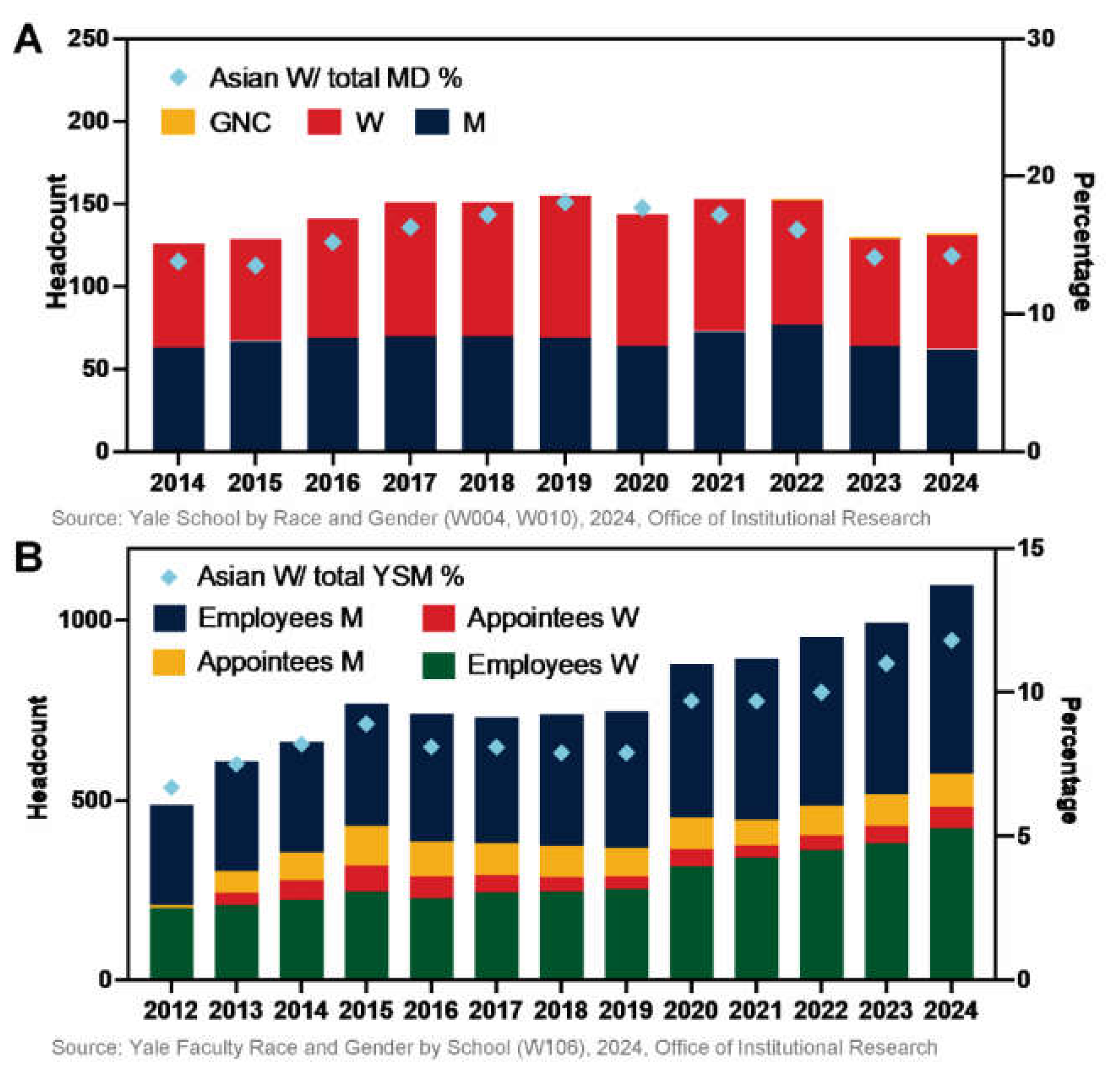
Figure 3.
Historical achievements of Asian women in YSM: a representative timeline, 1924-2024. Details and references for all events are provided in the main text.
Figure 3.
Historical achievements of Asian women in YSM: a representative timeline, 1924-2024. Details and references for all events are provided in the main text.
Disclaimer/Publisher’s Note: The statements, opinions and data contained in all publications are solely those of the individual author(s) and contributor(s) and not of MDPI and/or the editor(s). MDPI and/or the editor(s) disclaim responsibility for any injury to people or property resulting from any ideas, methods, instructions or products referred to in the content. |
© 2025 by the authors. Licensee MDPI, Basel, Switzerland. This article is an open access article distributed under the terms and conditions of the Creative Commons Attribution (CC BY) license (http://creativecommons.org/licenses/by/4.0/).
Copyright: This open access article is published under a Creative Commons CC BY 4.0 license, which permit the free download, distribution, and reuse, provided that the author and preprint are cited in any reuse.


