

Submitted:
14 May 2025
Posted:
16 May 2025
You are already at the latest version
Abstract
This study explores nanostores’ identity—micro, independent grocery retailers through a systemic, stakeholder-informed lens to promote their survivability and competitiveness. Moving beyond traditional operational descriptions, it introduces a multidimensional framework that examines what nanostores do (X), how they do it (Y), and why they matter (Z), complemented by the TASCOI tool, as identity statements. Based on survey data collection and thematic analysis from nanostore stakeholder responses in Mexico City, the research categorises identity statements into six 2×2 matrices across four dimensions: operational, functional, relational, and adaptive. This produces twenty-four archetypes that capture nanostores’ diversity, complexity, and adaptability. Findings reveal that nanostores are not a homogeneous category. They simultaneously exhibit characteristics of multiple archetypes, blending retail function, social embeddedness, and entrepreneurial adaptation. The study contributes to nanostore and micro-enterprise literature by operationalising identity description and offers practical insights for supporting diverse shop types through context-sensitive policy and business strategies. While the study ensures internal validity and reliability through systematic coding and stakeholder feedback, it acknowledges limitations in generalisability. Future research may build on this work through comparative studies, longitudinal tracking, and direct engagement with nanostore owners and their communities to further understand identity dynamics and resilience in evolving retail landscapes.
Keywords:
Corner Shops
; Emerging Markets
; Grocery Retail
; Micro Business Enterprises
; Systems Thinking.
1. Introduction
This work systemically explores nanostores’ identity beyond micro-independent grocery retailers, overcoming functionalistic and reductionist operational descriptions [1]. Nanostores, also known as corner shops, mom-and-pop stores, or neighbourhood shops, represent a significant segment of the retail landscape, especially in developing countries and emerging economies [2]. Around fifty million nanostores exist globally, representing a major branch of the traditional retail channel with over fifty per cent of grocery sales in many developing countries [3]. Despite the growth of modern retailers and organised chains, nanostores play a crucial role in supplying fast-moving consumer goods to a broad consumer base, particularly those in emerging market economies [4,5]. Nanostores’ identity, as the set of distinctive characteristics that differentiate them from other retail formats, is fundamental to understanding their resilience, challenges, and opportunities in competitive markets. Therefore, this paper explores nanostores’ identity as micro-independent grocery retailers, identifying the key elements that define them, the limitations and gaps in their conceptualisation, and further steps to address their main challenges.
Despite the increasing academic attention, there are gaps and limitations in the nanostores’ identity description. The literature uses various terms to refer to nanostores (e.g., small traditional retailers, mom-and-pop shops, kiranas, sari-sari outlets, dukas, tienditas, pulperias, or bodegas), reflecting the diversity of geographical, socioeconomic, informal nature, and cultural contexts in which they operate [3,6,7,8,9,10,11]. While they share common characteristics, regional particularities make a single, universally accepted nanostore conceptualisation difficult [12].
Most nanostore descriptions focus on tangible aspects such as size and assortment [13], without sufficiently investigating the intangible aspects of their identity, such as their social capital [6], their community role [14], and their relationship with customers [7]. Nevertheless, nanostores’ identity is not static. They are evolving and adapting to changes in the retail environment, incorporating new practices, technologies and strategies [15], under different circumstances depending on infrastructure, human behaviour, competition, and poor policymaking. Existing nanostore descriptions often do not capture this dynamic and the potential hybridisation with elements of more modern retail formats.
Therefore, within the category of nanostores, there is considerable heterogeneity in size, location, assortment, technology readiness, management, and services adopted/adapted depending on the area where they operate, the viewpoints and interests of their owners, and their resource availability [11,12,13,16]. General characterisations may not adequately capture this internal and external diversity. While some research provides a basic nanostore definition, their partial or fragmented explanation does not fully integrate their operations, customer relationships, community role, context, and competitiveness [6].
Consequently, a deeper and more nuanced exploration and understanding of nanostores’ identity is needed, going beyond purely operational, functional retail and physical aspects. This gap as a research problem that limits understanding nanostores’ resilience, competitive strategies, and socio-economic impact necessitates deeper investigation. Responding to this void, the research questions (RQs) addressing this work are:
RQ1: How can nanostores’ identity be explored to recognise key elements and characteristics beyond transactional retail and physical aspects?
RQ2: How can we effectively address the variations arising from geographical, socioeconomic, cultural, behavioural, and operational contexts?
Accordingly, this study aims to develop an all-inclusive and dynamic description of nanostore identity by adopting a systemic perspective that integrates situated stakeholders’ viewpoints, including nanostore owners, customers, suppliers, and competitors. By examining stakeholders’ perspectives on nanostores’ activities, means, and purposes, covering both tangible and intangible dimensions, this research seeks to uncover how these elements interact within the broader retail environment, shaping nanostores’ identity.
This framework addresses the heterogeneity, adaptability, and socio-economic importance of traditional retail in dynamic markets, providing actionable insights for business strategies, policy development, and future research.
2. Literature Review
Recent literature on nanostores reveals these micro grocery retail establishments as complex hybrid entities that straddle commercial, familial, and social spheres. As predominantly family-run operations, nanostores typically employ 1-2 family members and serve dual residential-commercial purposes, with women often playing central roles as proprietors supported by relatives [6,13,17]. Their physical constraints —frequently operating in spaces under 40m2, sometimes as small as 15m2— necessitate innovative space management, with most employing counter-service formats, though some evolve into compact self-service models [3,17]. These spatial limitations directly constrain inventory breadth, typically focusing on fast-moving consumer goods like staple foods and household essentials. However, assortments vary significantly by neighbourhood socioeconomic profile and consumer needs, as well as depending on budget constraints faced by the nanostore owners [4,12,16].
The operational dynamics of nanostores demonstrate remarkable contextual adaptability [12]. In high-income areas, businesses often use digital tools for payments and inventory management, whereas in medium-income zones, they provide additional services such as credit and home delivery [5,12]. By contrast, low-income neighbourhood variants prioritise affordability and basic assortments, though all share common supply chain vulnerabilities that lead to frequent stockouts [3,17]. Their geographic distribution patterns reveal market stratification —dense concentrations in mid-income zones, sparse presence in low-income areas, and near-absence in affluent neighbourhoods where modern retail dominates [12,18,19]. This spatial organisation underscores their role as hyperlocal provisioning nodes, with proximity constituting a primary competitive advantage [5].
Beyond economic functions, nanostores serve as critical social infrastructure. Their practice of extending informal credit (i.e., “fiado”) to trusted customers embeds them within local informal economies [17]. As community hubs, they facilitate information exchange, foster social cohesion, and often become de facto neighbourhood institutions [6,14]. This dual commercial-social identity manifests in owner-customer relationships characterised by personalisation and mutual understanding, with many shops adapting offerings and curating assortments to specific community needs [5,9,12].
The identity of nanostores resists singular classification, instead comprising multiple intersecting dimensions. They are simultaneously constrained grocery micro-retailers struggling with risk aversion; spatial and supply chain limitations; adaptive businesses that modify operations across economic contexts; family-based survival enterprises blending domestic and commercial spheres; and social establishments reinforcing community resilience [12,17]. This complexity suggests that effective engagement with nanostores —whether through data-driven policymaking, supply chain partnerships, or community development initiatives— requires a nuanced understanding of their multifunctional nature. Future research should examine how these various identity dimensions interact across different behavioural, cultural and economic contexts, and how formal systems might better support (rather than disrupt) their hybrid socioeconomic value [12,14,17]. Such an approach would move beyond simplistic retail categorisations to properly acknowledge nanostores as dynamic, contextually embedded establishments at the intersection of commerce and community.
2.1. A Multidimensional Framework of Nanostores’ Identity
Figure 1 synthesises a framework with the key dimensions of nanostore identity derived from the literature review, categorising them as operational, functional, relational, and adaptive. Each dimension interacts dynamically to define the unique role of nanostores in retail landscapes and communities.
The operational dimension encompasses the physical & operational characteristics of nanostores. This refers to their size & format and close/distant location (e.g., urban/suburban/rural location) [3,17]. It also considers the operational roles, activities, and decision-making of shopkeepers and staff conducting retail operations [5,9,16]. Supply chain constraints, inventory management, cash-flow management, and supply efficiencies are also part of the operational identity [13]. From this perspective, looking at the operational dimension of nanostores informs about logistic and supply strategies, in-store operations, product inventories, space optimisation, resource allocation, and supplier negotiations.
The functional dimension points to the business and retail nanostores’ roles in driving customer responsiveness. This considers nanostores as micro family businesses and income sources, serving different socioeconomic levels (e.g., low, medium and high-income), degrees of accessibility (e.g., good vs poor), customer niches (e.g., affordability, proximity and convenience), and hyperlocal responsiveness (e.g., product search and home delivery services) [5,12,19]. Moreover, the functional dimension covers product assortments of curated grocery products or additional services tailored to local demand and income levels [4,16]. The functional dimension informs about, for instance, differentiation and pricing strategies (e.g., leveraging proximity and product assortments), integrated services (as total customer solutions), and business support requirements (e.g., digital literacy enhancement, partnerships, infrastructure, and funding).
The relational dimension refers to nanostores’ social and community roles, including customer bonds (i.e., trust-based relationships), informal credit (i.e., “fiado”), and personalised services (e.g., personal shopping) [9], community hubs (i.e., space for social interaction, information exchange, and local cohesion) [6,14], and informal economy pillars (i.e., providing a financial safety net for low-income customers) [17]. The relational dimension emphasises the potential of nanostores to foster loyalty ties and establish community partnerships, such as offering service payments. Additionally, they can engage in community development initiatives, like selling products from local smallholder farmers and promoting goods or services from local stakeholders to support employment. Nanostores can also play a role in health and sustainability initiatives, such as improving access to healthy food.
Finally, the adaptive dimension sheds light on the resilience & evolution capability of nanostores. This involves their business model flexibility by location [3,17], hybridisation (e.g., blending traditional retail with digital tools [5], and survival strategies (e.g., leveraging social capital to counter modern retail competition) [11]. The adaptive dimension informs about innovation support capacity (e.g., e-commerce integration) and resilience-building capability (e.g., supplier collaborations and cooperation strategies with other nanostores) to face existing market environment challenges and opportunities.
Therefore, the framework suggests that nanostore identity is shaped by the interplay of the four dimensions, resulting in six-dimensional combinations. Accordingly, twenty-four nanostore archetypes can be visualised in 2x2 matrices to plot how dimensions interact in particular contexts [20,21,22,23,24,25,26,27,28]. The proposed archetypes are presented as follows:
- Operational-Functional (Table 1): Structure and functional capabilities drive sales and business survivability.
This interplay demonstrates how retail businesses’ success depends on both structural advantages (like location and space) and functional effectiveness (e.g., business model adaptation).
Shops with strong structures and advanced functionality become Thriving Hubs—optimising space, stock, offerings and customer experience. Those with strong structure but basic functionality are Stable but Limited, missing growth opportunities due to undifferentiated offerings and lack of tailored customer strategies. Businesses with weak structures but high adaptability become Hustle Heroes, overcoming limitations through customisation and agility, despite their constrained operations (e.g., reduced spaces and limited stocks). Meanwhile, At-Risk Shops, both with weak structure and basic functionality, are cluttered, under-resourced shops that struggle with inefficiencies and are vulnerable to failure.
Functional adaptability can compensate for structural weaknesses, while strong structure alone is insufficient without functional effectiveness. This interplay helps identify which businesses need support and what interventions, whether improving functionality or optimising structure, could enhance their accessibility and long-lasting resilience capacity.
- 2.
- Functional-Relational (Table 2): Functional capability and relations strengthen customer responsiveness and competitiveness.
The functional-relational intersection reveals four distinct archetypes that emerge from functional effectiveness and relational depth, demonstrating unique customer engagement, customer development, and business feasibility patterns.
Trust-Driven Functionals represent the finest configuration, successfully blending strong functional performance with deep customer relationships through personalised service, trust-based practices like informal credit systems, and local sourcing initiatives. These shops build strong customer loyalty by fulfilling practical needs and social expectations while growing community engagement upstream collaterally.
In contrast, Effective but Impersonal shops maintain competent functional performance with well-curated product selections but fail to develop meaningful customer relationships, resulting in transactional interactions that limit customer retention and affect customer experience despite their functional strengths. Community Safeguards demonstrate an alternative survival strategy, compensating for basic functional limitations through strong community ties and social support roles, though this makes them vulnerable to broader market pressures. The most vulnerable archetype, Fragile Outposts, struggles with deficiencies in both dimensions, lacking both distinctive product offerings and customer relationships, which leads to high closure risks in competitive markets.
This interplay highlights the importance of interventions designed to strengthen nanostores and train their owners to enhance the strategic perspective of their business models. Integrated approaches that address business operations and community relationships may yield the most sustainable improvements. The framework also helps explain why some stores thrive despite functional limitations and others fail despite the competent execution of basic retail functions.
- 3.
- Relational-Adaptive (Table 3): Relational and adaptive capability translate into community embeddedness and socioeconomic roles driving innovation.
The relational-adaptive matrix identifies four nanostore archetypes with distinct community integration and resilience patterns. Community Pillars exemplify ideal synergy, blending deep social ties (e.g., credit systems, local gatherings) with proactive adaptation (e.g., tech adoption and model innovation) to serve as dual commercial and social hubs. In contrast, Traditional Bonds rely solely on historical trust while resisting change and innovation, rendering them increasingly obsolete despite strong community roots.
Transaction-Focused shops prioritise operational agility (e.g., cost leadership, digital tools) but neglect relational depth, limiting loyalty and social-bonding resilience. Given the low level of trust they develop with their patronage, these shops are reactive to the market. The most vulnerable, Isolated Outposts lack high dynamic adaptation and deep community ties, operating with outdated practices and anonymous clientele that heighten closure risks.
Sustained resilience requires balancing social embeddedness with adaptability. The framework underscores that interventions must address relational and adaptive dimensions to strengthen nanostores, as neither operational competence nor community goodwill alone ensures longevity in fiercely competitive and evolving markets. This duality explains why some stores endure as neighbourhood members while others fail despite functional adequacy. The latter shows the importance of trust-based relationships and the social dimension that has not been explored in the literature on this topic.
- 4.
- Adaptive-Operational (Table 4): Adaptive and operational capabilities provide operational adaptability.
The interaction between adaptive capacity and operational constraints produces four distinct nanostore archetypes with varying survival strategies. Modernising Expanders combine strong adaptability with structural advantages, leveraging technology adoption and diffusion (e.g., digital payments, inventory apps) and prime locations to innovate and optimise resources. However, higher costs may challenge survivability. Resilient Improvisers thrive in constrained environments through hyperlocal responsiveness and technology adoption, yet face instability from constrained operations, stockouts and informal supply chains. These nanostores have great vision but fail to perform the daily operations effectively.
Conversely, Static Underperformers waste their operational potential by resisting modernisation and clinging to outdated methods and traditional practices despite having adequate space, technology readiness, customer-centric behaviour, and location advantages. Meanwhile, Vulnerable Traditionalists, hindered by rigid cash-only models, poor assortments, weak service offerings, and other structural limitations, struggle with inefficiencies operationally and strategically, and rely on dwindling loyalists, making them most prone to closure without intervention.
Adaptability offsets structural limitations while resistance to change amplifies operational weaknesses. Nanostore’s survivability depends on inherent operational strengths and the capacity to evolve within dynamic retail landscapes.
- 5.
- Operational-Relational (Table 5): Operational and relational capabilities develop competitive resilience.
The operational-relational matrix identifies four nanostore archetypes with distinct competitive trajectories. Unshakeable Nodes emerge as the most resilient, synergising prime locations and ample inventories with deep community bonds to create loyal customer bases that prefer them over supermarkets. Their dual strengths enable value-added services and institutional neighbourhood status. They rely on developing strong relationships with customers and suppliers, promoting collaboration to proactively achieve strategic and operational effectiveness.
Convenience Plays demonstrate how structural advantages alone provide only temporary protection. While accessible locations and stocked shelves ensure short-term survivability, their transactional relationships leave them vulnerable to chain competitors that can replicate their functional benefits at scale. Long-term survival requires cultivating deeper community ties and solid bases of customers and other stakeholders. Oasis Shops reveals how relational capital mitigates structural weaknesses. As essential providers in underserved areas, they maintain community dependence despite poor locations and limited stock, though growth remains constrained without operational improvements due to insufficient resources. The most vulnerable, Deserted Outposts, lack operational merits and customer relationships. Their isolation and generic offerings accelerate the decline in competitive markets, highlighting how neither dimension alone ensures survivability.
Successful nanostores transform structural assets into community value, while vulnerable ones overlook this synergy. Strategic interventions should therefore address these dimensions in tandem, helping stores evolve toward the Unshakeable Node ideal where physical and social advantages reinforce each other. This approach will also allow nanostores to develop a strategic, social-driven roadmap while driving efficient daily activities, which create a proper combination of agility, adaptability, and alignment strategies.
- 6.
- Functional-Adaptive (Table 6): Adaptive and functional capabilities (e.g., tailored assortments and accessibility) allow for innovation adoption.
The functional-adaptive matrix reveals four distinct approaches to innovation adoption in traditional retail. Retail Pioneers lead through comprehensive modernisation, combining updated technologies with niche business models, though their ambitious transformations risk overextension in resource-limited settings. Nimble Basics adopt a more selective strategy, focusing adaptive efforts on high-impact, context-specific innovations that maximise their limited operational capacity by prioritising the most promising strategies.
Conversely, Struggling Functionals possess adequate resources but lack adaptive agility, resulting in misaligned innovations that fail to meet market needs in the long term. The most vulnerable, Static Survivors, resist all changes with basic functional effectiveness, relying on inertia until market forces threaten their survival.
These four archetypes promote customised innovation strategies that consider each operational environment. Ultimately, retail innovation success is redefined as the capability for contextual implementation rather than simply adopting and diffusing technology or innovation.
3. Methodology
Nanostores can be regarded as purposeful systems—social and economic entities formed through the synergistic integration of human intentions, resources, and recurrent interactions [29,30,31]. Nanostores perform dynamic nodes within broader interaction networks, serving in operational, functional, relational, and adaptive dimensions.
Drawing on systems theory [32,33], nanostores can be described through an identity exploration using the X-Y-Z statements —i.e., what they do (X), how they function (Y), and why they matter (Z). In addition, the TASCOI tool can help examine nanostores’ transformation, actors, suppliers, customers, owners, and interveners. The identity statement X-Y-Z and the TASCOI tools can be used as follows:
-
Identity Statements (X-Y-Z).
- X (What they do): Operational/functional traits (e.g., family-operated grocery nano-retailers).
- Y (How they function): Relational/adaptive roles (e.g., provide proximity-based access to essentials via personalised service).
- Z (Why they matter): Socioeconomic and environmental impact (e.g., provide family livelihood, supply household essentials, and support social cohesion).
-
TASCOI Framework: Maps stakeholder roles in their ecosystem.
- Transformation (e.g., goods → sales),
- Actors (e.g., shopkeepers, family members),
- Suppliers (e.g., grocery supply vendors),
- Customers (e.g., neighbours and households as grocery consumers),
- Owners (e.g., families), and
- Interveners (e.g., other nanostores, convenience stores, supermarkets or external constraints).
This dual lens captures nanostores’ duality—external behaviours (e.g., product offerings and sales) in retail markets and communities and internal structures (e.g., retail operations) driving performance, as organisational systems [34].
3.1. Research Design
To explore nanostores’ identity, this study employs a research design that examines various identity dimensions through identity statements X-Y-Z and the TACOI tool. Accordingly, the study focuses on a specific urban context (i.e., Mexico City’s tienditas) to capture localised nuances from a multi-stakeholder perspective. The methodology considers a qualitative mixed-methods approach, combining surveys with stakeholders (owners, customers, suppliers) and capturing their observational reports [35,36].
The research design considered a methodology consisting of three stages: (i) RQs formulation, (ii) literature review, (iii) data collection, (iv) data organisation and analysis, and (v) results reporting. The RQs were presented in Section 1, while the literature review on nanostore identity was introduced in Section 2. This section outlines the data collection methods, data organisation and analysis procedure, and results interpretation and reporting rationale (see Figure 2), as follows:
- Data Collection:
A survey was designed using the X-Y-Z Identity Statements and the TASCOI tool, which were translated into seventeen questions in three sections. The first section referred to the stakeholder role. Second, questions covered stakeholders’ reports on their activities or tasks (concerning nanostores), needs and requirements, and performance expectations. Third, questions regarded X-Y-Z and the TASCOI.
Data was collected by twenty-five people (i.e., data collectors) from relevant stakeholders in thirty-four nanostores, obtaining two hundred sixty-one questionnaire responses across Mexico City. However, only one hundred seventy-eight responses (68%) were complete. Other responses were deemed unclear, irrelevant, or non-informative answers (e.g., “I don’t know” or “I’m not sure”). Nevertheless, among the one-hundred-seventy-eight usable entries, some responses included valid but overly general statements like “it sells products” or “to earn money,” which, although true, lacked detail to be meaningfully categorised into more specific types. These entries were sometimes excluded from the frequency breakdown to preserve analytical quality and avoid skewing results. Additionally, some responses were split across multiple sub-dimensions but only counted once.
Most of the surveys were collected in the Eastern, Southern and Western boroughs of the Mexico City metropolitan area (i.e., Álvaro Obregón, Benito Juárez, Iztacalco, Iztapalapa, Magdalena Contreras, Coyoacán, Tlalpan, and Xochimilco). Respondents fell under the category of actor, supplier, customer, owner, and intervener (i.e., competitor). When visiting the premises, relevant stakeholders were selected by convenience and opportunity, approaching those within the nanostores. The collected data was later shared with nanostore owners for feedback and validation.
Nanostore stakeholders were sampled by convenience and opportunity across different income-level neighbourhoods and geographies in Mexico City. The total stakeholders involved were nanostore owners, customers, and suppliers.
- 2.
- Data Organisation and Analysis
The second stage involved data organisation and analysis, familiarising with the collected data and preparing it for analysis employing a deductive thematic analysis aligned with the RQ and this study’s theoretical approach to nanostores [37]. In this research stage, two distinct and widely used thematic analysis techniques were applied: structural and content coding. Structural coding involves creating codes for signifying various questions/topics outlined in the survey questions [38]. This deductive approach emphasises the identification of codes derived from theory. The critical structural codes [39] comprised the X-Y-Z and the TASCOI categories.
In contrast, content-coding takes a more inductive approach, allowing for the discovery of codes not anticipated by the theoretical framework [96]. Techniques such as “repetition” and “silence/missing data” were utilised, where repetition involved recognising recurring concepts, and silence/missing data involved exploring what was omitted. These methods were complemented by examining content that represented something unusual or unexpected. The main goal was to outline the connection between theory, data collection, evidence generation, and the interpretation of results [38].
Therefore, collected data was organised and summarised through thematic analysis using X-Y-Z codes to extract data and produce identity statements to capture stakeholders’ perceptions. The analysis results followed the output structure: What nanostores do (X), through (Y), with purpose (Z), as indicated in Table 7. Variations in X-Y-Z definitions were obtained, categorised, described and frequency-counted.
Second, a cross-analysis was conducted by mapping X-Y-Z identity statements and TASCOI elements to identify variations among nanostores’ archetypes.
- 3.
- Results Reporting
Results are presented in Section 4 as summarised tables and descriptions of identity statements and TASCOI elements, illustrating variations and characterisations of stakeholders’ views on nanostores and the archetypes.
X-Y-Z identity statements and TASCOI results are discussed in Section 5 in light of the RQs and this work’s research aim. The results’ interpretation helped to recognise contextualised findings of nanostores in Mexico City. In addition, results highlight variations in nanostore identity descriptions across archetypes and links to the existing literature. These findings are a stepping stone for uncovering how to support and manage nanostores considering a systemic perspective on their multi-dimensional identity in situated contexts.
Additionally, results were compared with the existing literature to address validity, identifying coincidences and deviations [35,36,40]. Validity also considered a comparison and cross-validation among stakeholders’ responses to identify authentic representations of nanostore identities. Reliability was ensured through a step-by-step methodology for consistent data collection, organisation and analysis, and reporting. However, the study acknowledges limitations in transferability, recognising that stakeholders’ views may not generalise or apply to other contexts, situations, instances, or subjects, necessitating further data collection and validation in future nanostore investigations. Additional limitations and future work are discussed in Section 5.
In summary, this methodology’s expected outcomes offer a nuanced identity framework tailored to the study context alongside recommendations that align with the lived realities of nanostores. Moreover, this methodology acknowledged limitations and the need for future research. This methodology connects theoretical identity descriptions with grounded, participatory research to capture nanostores’ identity in action.
4. Results
The study aimed to develop a systematic, inclusive, and dynamic description of nanostores’ identity by adopting a systemic perspective that integrates stakeholders’ viewpoints. Data collected from stakeholders (including owners, customers, suppliers, and competitors) was summarised through thematic analysis using X-Y-Z and TASCOI codes to extract data and produce identity statements capturing their perceptions. Below are the statements extracted from the responses in Section 4.1.
4.1. Full Mapping of the Nanostore Archetypes Using Identity Statements (X–Y–Z) and TASCOI
Following identity statements X-Y-Z and TASCOI elements, descriptions of the twenty-four archetypes across the six matrixes in Section 2 are presented here. Each archetype represents a particular configuration of what nanostores do (X), how they operate (Y), and why they matter (Z), complemented by a TASCOI characterisation of transformation processes, actors, suppliers, customers, owners, and interveners. The tables presented show the archetypes in the proposed framework. Each table states the archetypes, the X-Y-Z statements, the response frequency (i.e., number of responses that resemble the X-Y-Z description for the archetype), nanostore frequency (i.e., number of nanostores that belong to this archetype), and an endorsement from a nanostore owner stating the essence of their business model.
In the Operational–Functional matrix (see Table 8), nanostores with strong structures and advanced functionality (Thriving Hubs) were described as:
Selling groceries and essentials (X) by maintaining organised spaces and product variety (Y) to ensure dependable service and income (Z).
Those with strong structures but basic functionality (Stable but Limited) maintained standard sales routines without innovation. Weaker structures with adaptive behaviour (Hustle Heroes) reflected dynamic sourcing and pricing to survive. Minimal structure and basic functionality (At-Risk Shops) were associated with sporadic sales and resource scarcity. TASCOI mappings (see Table A1, Table A2, Table A3 and Table A4 in Appendix A) indicate that thriving and hustling archetypes transformed product offers into reliable or flexible services. In contrast, passive and struggling archetypes exhibited stagnant or vulnerable transformation patterns.
In the Functional–Relational matrix (see Table 9), nanostores with advanced functionality and deep relational ties (Trust-Driven Functionals) refer to:
Selling curated goods (X) with personal, trust-based service (Y) to build loyalty and sustain income (Z).
Shops with functional efficiency but shallow relational ties (Effective but Impersonal) offered convenience without fostering customer bonds. Basic functional shops relied on community trust (Community Safeguards), while fragile ones combined minimal offerings and weak relationships (Fragile Outposts). TASCOI archetypes (see Table A5, Table A6, Table A7 and Table A8) show strong actor engagement and loyal customers in trust-driven types, contrasted by transactional interactions and declining client bases in fragile shops.
In the Relational–Adaptive matrix (see Table 10), deep relational and adaptive capacity (Community Pillars) are manifested through:
Selling diversified products (X), through evolving services (Y), providing community anchoring and engagement (Z).
Shops maintaining traditional ties without adaptation (Traditional Bonds) operated based on historical trust. Transaction-focused shops adopted technological practices without relational depth, and isolated outposts exhibited minimal community links and low adaptation. TASCOI profiles (see Table A9, Table A10, Table A11 and Table A12) illustrate that strong community integration coincides with active owner roles and service evolution, while isolation stems from rigid practices and limited external interaction.
In the Adaptive–Operational matrix (see Table 11), dynamic adaptation combined with strong operational capacity (Modernising Expanders) involved:
Selling curated products (X) with technological tools (Y) to attract clients and maintain competitiveness (Z).
Improvising resilience (Resilient Improvisers) counterbalanced operational constraints through agile practices. In contrast, Static Underperformers and Vulnerable Traditionalists reflected rigid operations and minimal change. TASCOI mappings (see Table A13, Table A14, Table A15 and Table A16) distinguish between entrepreneurial actors leveraging digital suppliers and passive owners reliant on traditional wholesalers.
In the Operational–Relational matrix (Table 12), nanostores integrating strong operational structures with deep community ties (Unshakeable Nodes) offered:
Selling comprehensive assortments (X), through relational services (Y), acting as neighbourhood anchors (Z).
Convenience-based shops and oasis-type shops capitalised on accessibility and necessity, respectively, whereas deserted outlets lacked both operational and relational strength. TASCOI descriptions (see Table A17, Table A18, Table A19 and Table A20) highlight the interplay of owner engagement and supplier relations in sustaining competitive resilience.
In the Functional–Adaptive matrix (Table 13), high functional and adaptive capacities (Retail Pioneers) led to:
Selling modern goods (X), through dynamic operations based on innovation and digital tools (Y), to grow business aspirations (Z).
Nimble basics adapt offerings rapidly, whereas struggling functionals and static survivors failed to align with community needs or resisted innovation. TASCOI mappings (see Table A21, Table A22, Table A23 and Table A24) describe entrepreneurial or reactive owner behaviour and the influence of technology trends and customer feedback.
The frequency analysis (see Table 14) showed that archetypes associated with Operational–Functional combinations were most common, followed by Functional–Relational and Relational–Adaptive matrices. These results make sense considering the focus on daily effectiveness and customer responsiveness that nanostores possess to survive, followed by growing loyalty under diverse circumstances. Each nanostore often reflected a hybrid identity, connecting different archetypical traits simultaneously across matrices. TASCOI analyses confirmed that identity variations are contingent upon actor engagement, supplier relationships, customer bonds, owner initiatives, and intervening forces like market competition or technological change.
Finally, nanostores can be linked to multiple archetypes. A single nanostore may have an activity X that aligns with one archetype, a modality Y that fits another, and a purpose Z that reflects yet a third. This allows for hybrid configurations, where shops simultaneously exhibit characteristics from multiple archetypes, such as combining strong relational ties with high adaptability. This is why results from Table 14 do not match the number of nanostores and respondents. Thus, applying these principles fosters a more nuanced and realistic understanding of how nanostores relate to the archetype framework, acknowledging that many operate at the intersection of various dimensions.
5. Discussion
5.1. Findings
The study’s comprehensive mapping of twenty-four nanostore archetypes through the X-Y-Z identity statements and TASCOI framework reveals the complex diversity of these micro retailers across operational, functional, relational and adaptive dimensions. Rather than representing a homogeneous group, nanostores exhibit varied identity configurations that reflect distinct combinations of practices (what they do), operational methods (how they do it), and underlying purposes (why they exist).
The analyses identify clear patterns among archetypes. High-performing categories like Thriving Hubs and Community Pillars demonstrate strong coherence across all dimensions, characterised by active owner engagement, stable supplier networks, and deep community ties. In contrast, vulnerable archetypes such as Fragile Outposts and Static Survivors show limited capacity for transformation and weak external connections. The TASCOI framework proves valuable in uncovering how different stakeholders - from suppliers to customers - shape each shop’s identity and operations in ways traditional retail classifications often overlook.
Three key insights emerge from the findings. First, the most prevalent and successful nanostores combine strong functional capabilities with adaptive capabilities and relational depth, beyond basic retail operations. Nanostores focusing on operational, functional and adaptive capabilities highlight their business retail nature. Additionally, nanostores focusing on operational, adaptive and relational capabilities highlight their customer and community-driven improvements and innovation. Alternatively, nanostores focusing on operational, functional and relational capabilities stress their business resilience and competitiveness through customer and community closeness. Nanostores, stressing operational, functional, and adaptive capabilities, favour improvements and innovation to strengthen retail operations and their business model. Second, nevertheless, shops displaying multiple vulnerabilities could jeopardise their survival because of low levels of capabilities. There is a concerning minority of this type of nanostore found in this research. Third, each archetype’s strength depends on the products sold and the entire network of relationships and practices surrounding the business.
This systems perspective moves beyond simplistic categorisation to reveal how contextual factors like technology adoption, supplier reliability, and community embeddedness collectively determine a nanostore trajectory. The full interaction of the identity dimensions, their six interplays, and the resulting twenty-four archetypes are presented in Figure 3 as a framework for nanostore identity conceptualisation.
The research demonstrates that effective support strategies must account for this complexity. While some shops thrive through innovation and strong community ties, others require fundamental operational improvements. The findings suggest policymakers and business developers should tailor interventions to specific archetype needs, whether through technology integration for Modernising Expanders or basic training for Vulnerable Traditionalists. This nuanced understanding of nanostores as dynamic, context-dependent systems offers valuable guidance for fostering their continued relevance in evolving retail landscapes. More purposeful interventions may target the development of particular dimensions absent in a community to improve socioeconomic conditions in the population and stakeholders to increase the availability of healthy products, a wider assortment, more affordable services, etc.
In summary, the TASCOI-based exploration reveals that each shop type is not just defined by what it sells, but by a complex interplay of people, relationships, practices, and context. By understanding who transforms, how they interact with others, and what external forces shape their evolution, we can better support, differentiate, and empower nanostores. The TASCOI helps shift the focus from “What kind of shop is this?” to “What system sustains or undermines this shop?”. This systemic lens is essential for policymakers, retail innovators, NGOs, and researchers aiming to design targeted interventions that resonate with the lived realities of nanostore landscapes.
5.2. Theoretical and Practical Implications
This study highlights theoretical contributions by expanding our understanding of nanostores’ (and other small and micro-enterprises) identity beyond purely operational and commercial aspects. The findings demonstrate that nanostores function as complex socio-economic establishments where relational networks and adaptive capacities are just as crucial as physical operations [9,41]. This challenges traditional “brick and mortar” retail perspectives and aligns with place-based theories that emphasise social embeddedness [11,25,27]. The X-Y-Z/TASCOI framework provides a novel systematic approach to analysing how nanostores negotiate their identity through dynamic interactions between operational logic, community relationships, and adaptive responses to contextual pressures. This supports process-oriented organisational theories that view business viability as socially constructed rather than purely market-driven [29,30,32].
The practical implications are significant for multiple stakeholders. For policymakers and development practitioners, the research suggests moving beyond generic policymaking, regulations, and inventory or financial support toward tailored interventions that address specific archetype needs. High-performing nanostores may benefit from digital integration programs, while vulnerable types like Fragile Outposts require foundational support in inventory management and operational training. The framework enables targeted assistance by identifying critical leverage points —whether strengthening supplier networks for Resilient Improvisers or fostering community ties for Isolated Outposts. Urban planners could leverage nanostores’ community roles in neighbourhood development strategies, while consumer goods companies might partner with them to extend product distribution.
Notably, the findings argue against one-size-fits-all approaches, instead advocating for context-sensitive solutions that recognise nanostores’ dual economic-social functions. By considering the entire ecosystem of relationships and practices that support various archetypes, support programs can enhance business viability and community value growth more effectively. This balanced perspective offers a roadmap for sustaining nanostores as adaptive, embedded institutions in evolving retail landscapes with long-term, adaptable, customised strategies.
5.3. A Discussion on Validity, Reliability and Transferability
This research demonstrates both strengths and limitations in terms of validity, reliability, and transferability, reflecting the inherent challenges of qualitative, interpretive work based on descriptive data from multiple observers. The study establishes strong content and constructs validity through structured identity elements and the TASCOI framework. The latter provides clear conceptual lenses for organising and interpreting data while ensuring theoretical grounding for the nanostore archetypes. The multidimensional approach examining what nanostores do, how they operate, and why they exist adds internal coherence. Simultaneously, the systemic view offered by TASCOI roles enhances the credibility of the findings. However, the validity could be affected by relying on third-party observations rather than direct accounts from owners, potentially introducing interpretation bias.
In assessing reliability, the methodology’s use of multiple observations per nanostore helps ensure consistency and reduces individual observer bias, with recurring patterns across respondents reinforcing the stability of findings. Yet, like most qualitative research, reliability remains somewhat constrained by the subjective nature of coding and interpretation, where different research teams might produce alternative categorisations due to the open-ended data format and varying response quality. The research utilised systematic coding methods, defined categories clearly, and held consensus discussions to address these limitations.
The research provides valuable insights and detailed descriptions of nanostore identities and roles, making it particularly relevant for similar socio-economic contexts. The archetypes and TASCOI profiles provide adaptable tools for studying informal retail elsewhere. However, the specific findings’ generalisability is naturally limited by the original study’s unique geographical, cultural and economic context. Readers must carefully consider contextual similarities before direct application.
Overall, the work provides conceptually valid and contextually rich findings with moderate reliability, serving best as a structured, multidimensional framework bridging theory and practice. While already valuable, its validity, reliability and transferability could be further strengthened through direct owner interviews, application in diverse settings, and longitudinal follow-up studies. The research makes a meaningful contribution by systematically examining nanostore identities while transparently acknowledging the boundaries of its methodological approach.
5.4. Limitations and Future Work
This study has several limitations that must be acknowledged. The archetype classification relies on interpreted survey responses rather than direct observation or longitudinal tracking, which may affect the precision of boundary cases. While the TASCOI framework provides valuable systemic insights, its abstract nature might overlook some nuances of individual shop operations. Data collection through multiple observers introduced variability in interpretation due to differing writing styles and levels of detail, and the reliance on reported perceptions rather than observed behaviours may create some disconnect between stated and actual practices.
These limitations point to valuable directions for future research. Longitudinal studies could track how nanostore identities evolve amid digital transformation and economic changes. More direct research methods, including owner interviews and ethnographic case studies, would strengthen the validation of the archetypes. Comparative studies across different regions and neighbourhood types could reveal which identity aspects are context-specific versus universal. Incorporating quantitative performance metrics would help establish clearer links between identity configurations and business outcomes like resilience and profitability. Finally, deeper integration of customer and supplier perspectives would enhance understanding of how relational dynamics shape nanostore operations and community value. These extensions would validate the current framework and provide more nuanced insights for practical applications.
5. Conclusions
This research provides a comprehensive and structured understanding of nanostore identity by integrating two complementary analytical frameworks: the X–Y–Z identity model and the TASCOI stakeholder tool. Through analysing one hundred and seventy-eight valid responses describing thirty-four nanostores, the study identifies twenty-four archetypes across six identity matrices, capturing the diversity of nanostore practices, modalities, and purposes. This approach addresses the research questions by showing how nanostores can be described beyond operational characteristics, how their identities can be systematically categorised, and how individual shops may simultaneously relate to multiple archetypes due to their embedded, adaptive, and relational nature.
This study’s main contributions include nanostore identity operationalisation through empirically grounded identity statements, a multidimensional archetype typology, and the TASCOI framework. These tools offer theoretical insights into nanostore identity and practical guidance for stakeholders designing context-sensitive interventions.
However, the study has several limitations. The data relies on indirect observation and interpretation by third-party surveyors, which may introduce subjectivity and limit direct owner perspectives. The research is also contextually bounded, which affects the generalisability of findings. Future work should aim to incorporate longitudinal and participatory methods, expand to other regions for comparative analysis, and explore the relationship between archetypes and performance indicators such as resilience, profitability, or community impact. These extensions would help further validate the archetypes and deepen the understanding of nanostore identity as a dynamic and context-dependent phenomenon.
Author Contributions
Conceptualization, D.E.S.-N.; Methodology, D.E.S.-N.; Validation, D.E.S.-N., E.V.-P. and C.M.-A.; Formal analysis, D.E.S.-N.; Investigation, D.E.S.-N.; Resources, D.E.S.-N.; Data curation, D.E.S.-N.; Writing—original draft, D.E.S.-N.; Writing—review & editing, D.E.S.-N., E.V.-P. and C.M.-A.; Visualization, D.E.S.-N.; Supervision, D.E.S.-N.; Project administration, D.E.S.-N.; Funding acquisition, D.E.S.-N. All authors have read and agreed to the published version of the manuscript.
Funding
The APC was funded by Universidad Panamericana, Facultad de Ingeniería, Mexico City, Mexico.
Institutional Review Board Statement
Ethical review and approval were waived for this study due to the review board deeming it “Research without risk”, i.e., studies using retrospective documentary research techniques and methods, as well as those that do not involve any intervention or intended modification of physiological, psychological, and social variables of study participants, among which the following are considered: questionnaires, interviews, review of clinical records, and others, in which they are not identified or sensitive aspects of their behaviour are not addressed.
Informed Consent Statement
Not applicable.
Data Availability Statement
The data presented in this study are available upon request from the corresponding author (D.E.S.-N.).
Conflicts of Interest
The authors declare no conflicts of interest. The funding bodies played no role in the study’s design, data collection, analysis, interpretation, manuscript writing, or decision to publish the results.
Appendix A
- Operational–Functional Matrix → Business Survivability.

Table A1.
Thriving Hubs TASCOI.
| Archetype | Thriving Hubs |
|---|---|
| T | Transforms a wide range of goods into personalised service experiences (e.g., informal credit, home delivery, combo deals). |
| A | Owner and family-run operation with well-defined practices and division of labour. |
| S | Major suppliers with regular delivery schedules. |
| C | Loyal neighbourhood customers who trust and prefer the shop over chains. |
| O | The owner actively manages supply, inventory, pricing, and customer relationships. |
| I | Influenced by competition from supermarkets and convenience chains, but differentiates through community embeddedness. |
Table A2.
Stable but Limited TASCOI.
| Archetype | Stable but Limited | |
|---|---|---|
| T | Sells a stable but narrow range of essential goods with minimal variation. | |
| A | The owner operates alone, doing routine stockings and having limited customer interaction. | |
| S | Small suppliers or wholesalers visit periodically. | |
| C | Walk-in clients who value proximity over service or variety. | |
| O | Owner with limited interest in growth, mainly sustaining household income. | |
| I | Minimal external influence, occasionally shaped by local supply shortages. |
Table A3.
Hustle Heroes TASCOI.
| Archetype | Hustle Heroes |
|---|---|
| T | Continuously shifts product mix based on opportunity and short-term availability. |
| A | A highly proactive owner who negotiates, sources, sells, and adapts. |
| S | Multiple informal sources like markets, cash-and-carry, and local distributors. |
| C | Clients with tight budgets are looking for affordable and changing offers. |
| O | The owner assumes full financial and operational risk, often improvising. |
| I | Strongly influenced by price fluctuations, supplier availability, and customer demand shifts. |
Table A4.
At-Risk Shops TASCOI.
| Archetype | At-Risk Shops |
|---|---|
| T | Offers minimal transformation with frequent stockouts and irregular service. |
| A | Passive or overburdened owner with weak practices and declining engagement. |
| S | Irregular supply with dependency on credit or inconsistent deliveries. |
| C | Decreasing or irregular customer base, often only familiar clients. |
| O | The owner is overwhelmed by external constraints or economic difficulties. |
| I | Threatened by nearby formal retail, lack of capital, or community change. |
- 2.
- Functional–Relational Matrix → Customer Responsiveness
Table A5.
Trust-Driven Functionals TASCOI.
| Archetype | Trust-Driven Functionals |
|---|---|
| T | Delivers basic goods and credit services with strong interpersonal engagement (fiado, emotional support). |
| A | A caring, attentive shopkeeper who knows clients personally and adapts to their needs. |
| S | Branded and local suppliers who support regular delivery or flexible terms. |
| C | Loyal, known customers with whom trust is reciprocal and long-term. |
| O | The owner is deeply embedded in the community and balances profit and care. |
| I | Cultural norms and social obligations (e.g., helping during hardship, community reputation). |
Table A6.
Effective but Impersonal TASCOI.
| Archetype | Effective but Impersonal |
|---|---|
| T | Moves a broad assortment efficiently, without social or emotional engagement. |
| A | Task-focused sellers may be employees or hands-off owners. |
| S | Established delivery network with corporate suppliers. |
| C | Anonymous, transaction-oriented buyers. |
| O | The owner focused on operational efficiency and cost control. |
| I | Influenced by chain competition, they emulate their structure to compete. |
Table A7.
Community Safeguards TASCOI.
| Archetype | Community Safeguards |
|---|---|
| T | Provides essential products with extended support services (e.g., credit, delayed payment, donations). |
| A | Trusted elder or empathetic shopkeeper supporting vulnerable clients. |
| S | Small suppliers with flexible payment arrangements or trust-based delivery. |
| C | Elderly, unemployed, or financially constrained locals. |
| O | The owner assumes the role of protector/provider more than an entrepreneur. |
| I | Neighbourhood hardship and social crises (e.g., unemployment, illness). |
Table A8.
Fragile Outposts TASCOI.
| Archetype | Fragile Outposts |
|---|---|
| T | Very limited transformation; the shop is open with little engagement or evolution. |
| A | Detached or burned-out owner, often passive. |
| S | Rare or failing suppliers, inconsistent replenishment. |
| C | Almost none; occasional passersby or a loyal few. |
| O | The owner lacks motivation and is waiting for change or closure. |
| I | Isolation, economic decay, and disconnection from supply networks. |
- 3.
- Relational–Adaptive Matrix → Community Embeddedness.
Table A9.
Community Pillars TASCOI.
| Archetype | Community Pillars |
|---|---|
| T | Blends products and local services (e.g., bill payments, recharges) in response to community needs. |
| A | Engaged, respected owner actively responding to neighbours’ demands. |
| S | Brand suppliers and local service providers (e.g., telecom, utilities). |
| C | The broad neighbourhood base relies on shops for essentials and extra services. |
| O | The owner steers the shop as a service hub and social reference point. |
| I | Influenced by community needs, social responsibility, and neighbourhood identity. |
Table A10.
Traditional Bonds TASCOI.
| Archetype | Traditional Bonds |
|---|---|
| T | Stable sale of long-trusted goods and practices; resists change. |
| A | Elderly or legacy owners maintain traditional practices. |
| S | Long-term relationships with a few known suppliers. |
| C | Multi-generational loyal customers. |
| O | The owner sees the shop as a heritage or family tradition. |
| I | Cultural attachment to continuity and identity preservation. |
Table A11.
Transaction-Focused TASCOI.
| Archetype | Transaction-Focused |
|---|---|
| T | Quick, impersonal sales through digital and efficient tools. |
| A | Tech-savvy operators or younger staff trained in speed and minimal talk. |
| S | Digital suppliers, logistics companies, and app-based orders. |
| C | Time-sensitive buyers seeking fast turnaround. |
| O | The owner invests in tools, not relationships. |
| I | Influenced by digitalisation and chain shop competition. |
Table A12.
Isolated Outposts TASCOI.
| Archetype | Isolated Outposts |
|---|---|
| T | The basic provision of remote goods is logistically challenging. |
| A | Solo operator with logistical challenges. |
| S | Unreliable or distant wholesalers. |
| C | Remote households without alternatives. |
| O | The owner maintains presence despite hardship. |
| I | Isolation, lack of infrastructure, and low market density. |
- 4.
- Adaptive–Operational Matrix → Operational Responsiveness.
Table A13.
Modernising Expanders TASCOI.
| Archetype | Modernising Expanders |
|---|---|
| T | Combines standard assortment with digital tools and loyalty initiatives. |
| A | Owner as innovator and strategist. |
| S | Digitalised or app-based wholesale providers. |
| C | Early adopters or youth customers engaged by modern service. |
| O | Owner with a growth and formalisation mindset. |
| I | Technology trends, training programs, and fintech inclusion. |
Table A14.
Resilient Improvisers TASCOI.
| Archetype | Resilient Improvisers |
|---|---|
| T | Improvises mix and layout daily to meet local preferences. |
| A | Flexible, streetwise shopkeeper. |
| S | A mix of wholesalers, local farms, and informal resellers. |
| C | Clients who ask and suggest what to stock. |
| O | The owner is a creative entrepreneur with a survival focus. |
| I | Local shocks, seasonality, price volatility. |
Table A15.
Static Underperformers TASCOI.
| Archetype | Static Underperformers |
|---|---|
| T | Outdated, routine offering with no innovation. |
| A | Passive or overconfident owner. |
| S | Conservative or reduced supplier list. |
| C | Declining foot traffic, old regulars. |
| O | The owner is resistant to change. |
| I | Ignorance of market changes or denial of the need to adapt. |
Table A16.
Vulnerable Traditionalists TASCOI.
| Archetype | Vulnerable Traditionalists |
|---|---|
| T | Shrinking operation with limited restock and declining sales. |
| A | Tired, ageing owner. |
| S | Debt-constrained local suppliers. |
| C | Few loyal but ageing clients. |
| O | The owner is stuck between pride and a lack of resources. |
| I | Lack of intergenerational transfer, poverty traps. |
- 5.
- Operational–Relational Matrix → Competitive Resilience
Table A17.
Unshakeable Nodes TASCOI.
| Archetype | Unshakeable Nodes |
|---|---|
| T | Combining relational trust and stable variety to retain loyalty. |
| A | Highly trusted and visible owner. |
| S | Established regional suppliers. |
| C | The core of long-term daily customers. |
| O | The owner performs central relational and economic roles. |
| I | Peer shops, word-of-mouth, informal networks. |
Table A18.
Convenience Plays TASCOI.
| Archetype | Convenience Plays |
|---|---|
| T | Sells essentials based on location and extended hours. |
| A | Owner/operator offering long schedules and minimal interaction. |
| S | Convenience suppliers and pre-packaged brands. |
| C | Pass-through or last-minute shoppers. |
| O | The owner targets volume through convenience, not relationships. |
| I | Competing convenience points and customer impatience. |
Table A19.
Oasis Shops TASCOI.
| Archetype | Oasis Shops |
|---|---|
| T | Minimal but essential stock in the underserved territory. |
| A | Caretaker-like owner serving basic needs. |
| S | Infrequent deliveries from distant wholesalers. |
| C | The entire neighbourhood depends on shop access. |
| O | The owner feels a sense of obligation and presence. |
| I | No competition, rural distance, and unmet market needs. |
Table A20.
Deserted Outlets TASCOI.
| Archetype | Deserted Outlets |
| T | Stock remains, but transformation is rare or passive. |
| A | The owner opens but does not promote or engage. |
| S | Backlogged or stagnant inventory. |
| C | Almost no regulars. |
| O | The owner is waiting for a change or closure. |
| I | Abandonment due to urban changes or past crises. |
- 6.
- Functional–Adaptive Matrix → Innovation Adoption
Table A21.
Retail Pioneers TASCOI.
| Archetype | Retail Pioneers |
|---|---|
| T | Innovative formats, bundling, and digital marketing. |
| A | Entrepreneurial owner seeking an edge. |
| S | Online wholesale, promo platforms. |
| C | Tech-literate customers and early adopters. |
| O | The owner reinvests in learning, visibility, and service. |
| I | Start-up culture, digital tools, and training programs. |
Table A22.
Nimble Basics TASCOI.
| Archetype | Nimble Basics |
|---|---|
| T | Quickly adapts basic assortment to daily needs. |
| A | An attentive shopkeeper tuned into daily patterns. |
| S | Flexible, small-scale providers. |
| C | Neighbours who give constant feedback. |
| O | The owner listens and reacts fast with no bureaucracy. |
| I | Seasonal demand, customer word-of-mouth. |
Table A23.
Struggling Functionals TASCOI.
| Archetype | Struggling Functionals |
|---|---|
| T | Attempts to innovate but mismatch community demands. |
| A | The owner tries hard but lacks insight or tools. |
| S | Mid-size suppliers, trial partnerships. |
| C | The community is not convinced or unwilling to shift habits. |
| O | The owner is trying to transition but is misaligned with the market. |
| I | Poor training, low digital literacy, broken fit. |
Table A24.
Static Survivors TASCOI.
| Archetype | Static Survivors |
|---|---|
| T | Basic, unchanging service sustained by habit. |
| A | Low-risk settled owner. |
| S | Long-term trusted supplier. |
| C | Routine customers are often elderly or low-income. |
| O | The owner avoids complexity or upgrades. |
| I | Low competition, long-standing presence. |
References
- Ackoff, R.L. Creating the Corporate Future: Plan or Be Planned For; Wiley: New York, 1981; ISBN 978-0-471-09009-0. [Google Scholar]
- Escamilla González Aragón, R.; C. Fransoo, J.; Mejía Argueta, C.; Velázquez Martínez, J.; Gastón Cedillo Campos, M. Nanostores: Emerging Research in Retail Microbusinesses at the Base of the Pyramid. Academy of Management Global Proceedings 2020, 161.
- Fransoo, J.C.; Blanco, E.; Mejia-Argueta, C. Reaching 50 Million Nanostores: Retail Distribution in Emerging Megacities; CreateSpace Independent Publisher Platform, 2017; ISBN 978-1-9757-4200-3.
- D’Andrea, G.; Lopez-Aleman, B.; Stengel, A. Why Small Retailers Endure in Latin America. International Journal of Retail & Distribution Management 2006, 34, 661–673. [Google Scholar] [CrossRef]
- Paswan, A.; Pineda, M. de los D.S.; Ramirez, F.C.S. Small versus Large Retail Stores in an Emerging Market—Mexico. Journal of Business Research 2010, 63, 667–672. [Google Scholar] [CrossRef]
- Coen, S.E.; Ross, N.A.; Turner, S. “Without Tiendas It’s a Dead Neighbourhood”: The Socio-Economic Importance of Small Trade Stores in Cochabamba, Bolivia. Cities 2008, 25, 327–339. [Google Scholar] [CrossRef]
- Kinlocke, R.; Thomas-Hope, E. Characterisation, Challenges and Resilience of Small-Scale Food Retailers in Kingston, Jamaica. Urban Forum 2019, 30, 477–498. [Google Scholar] [CrossRef]
- Minkler, M.; Estrada, J.; Dyer, S.; Hennessey-Lavery, S.; Wakimoto, P.; Falbe, J. Healthy Retail as a Strategy for Improving Food Security and the Built Environment in San Francisco. Am J Public Health 2019, 109, S137–S140. [Google Scholar] [CrossRef]
- Pathak, A.A.; Kandathil, G. Strategizing in Small Informal Retailers in India: Home Delivery as a Strategic Practice. Asia Pac J Manag 2020, 37, 851–877. [Google Scholar] [CrossRef]
- Radebe, B. RE-INVENTING THE CORNER STORE 2025.
- Sarkar, D.N.; Kundu, K.; Chaudhuri, H.R. Developing a Conceptual Model of Small Independent Retailers in Developing Economies: The Roles of Embeddedness and Subsistence Markets. AMS Rev 2016, 6, 176–193. [Google Scholar] [CrossRef]
- Rangel-Espinosa, M.F.; Hernández-Arreola, J.R.; Pale-Jiménez, E.; Salinas-Navarro, D.E.; Mejía Argueta, C. Increasing Competitiveness of Nanostore Business Models for Different Socioeconomic Levels. In Supply Chain Management and Logistics in Emerging Markets; Yoshizaki, H.T.Y., Mejía Argueta, C., Mattos, M.G., Eds.; Emerald Publishing Limited, 2020; pp. 273–298 ISBN 978-1-83909-333-3.
- Ortega-Jimenez, C.H.; Amador-Matute, A.M.; Parada-Lopez, J.S. Logistics and Information Technology: A Systematic Literature Review of Nanostores from 2014 to 2023. In Proceedings of the Proceedings of the 21th LACCEI International Multi-Conference for Engineering, Education and Technology (LACCEI 2023): “Leadership in Education and Innovation in Engineering in the Framework of Global Transformations: Integration and Alliances for Integral Development”; Latin American and Caribbean Consortium of Engineering Institutions, 2023.
- Everts, J. Consuming and Living the Corner Shop: Belonging, Remembering, Socialising. Social & Cultural Geography 2010, 11, 847–863. [Google Scholar] [CrossRef]
- Baron, S.; Harris, K.; Leaver, D.; Oldfield, B.M. Beyond Convenience: The Future for Independent Food and Grocery Retailers in the UK. The International Review of Retail, Distribution and Consumer Research 2001, 11, 395–414. [Google Scholar] [CrossRef]
- Ortega-Jiménez, C.H.; Amador-Matute, A.; Parada López, J.; Zavala-Fuentes, D.; Sevilla, S. A Meta-Analysis of Nanostores: A 10-Year Assessment. In Proceedings of the Proceedings of the 2nd LACCEI International Multiconference on Entrepreneurship, Innovation and Regional Development (LEIRD 2022): “Exponential Technologies and Global Challenges: Moving toward a new culture of entrepreneurship and innovation for sustainable development”; Latin American and Caribbean Consortium of Engineering Institutions, 2022.
- Boulaksil, Y.; Fransoo, J.; Koubida, S. Small Traditional Retailers in Emerging Markets. BETA publicatie: working papers; Vol. 460. Technische Universiteit Eindhoven. 2014.
- Mora-Quiñones, C.; Cárdenas-Barrón, L.; Velázquez-Martínez, J. Karla Gámez-Pérez The Coexistence of Nanostores within the Retail Landscape: A Spatial Statistical Study for Mexico City. Sustainability 2021, 13, 10615. [Google Scholar] [CrossRef]
- Salinas-Navarro, D.E.; Vilalta-Perdomo, E.; Michel-Villarreal, R. Empowering Nanostores for Competitiveness and Sustainable Communities in Emerging Countries: A Generative Artificial Intelligence Strategy Ideation Process. Sustainability 2024, 16, 11244. [Google Scholar] [CrossRef]
- Boulaksil, Y.; Fransoo, J.C.; Blanco, E.E.; Koubida, S. Nanostores in Morocco’s Urban Areas. In Reaching 50 Million Nanostores; Fransoo, J.C., Blanco, E.E., Mejia Argueta, C., Eds.; CreateSpace Independent Publishing Platform, 2017; pp. 73–90 ISBN 978-1-9757-4200-3.
- Charman, A. Micro-Enterprise Predicament in Township Economic Development: Evidence from Ivory Park and Tembisa. SAJEMS 2017, 20. [Google Scholar] [CrossRef]
- Das Nair, R. The Internationalisation of Supermarkets and the Nature of Competitive Rivalry in Retailing in Southern Africa. Development Southern Africa 2018, 35, 315–333. [Google Scholar] [CrossRef]
- Fransoo, J.C.; Escamilla, R.; Ge, J. Nanoretail Operations in Developing Markets. In Tutorials in Operations Research: Smarter Decisions for a Better World; Babich, V., Dewan, P., Pender, J., Alderson, D., Greenberg, H.J., Eds.; INFORMS, 2024; pp. 275–297 ISBN 979-8-9882856-2-5.
- Gano-An, J.C.; Gempes, G.P. The Success and Failures of Sari-Sari Stores: Exploring the Minds of Women Micro-Entrepreneurs. HOLISTICA – Journal of Business and Public Administration 2020, 11, 25–51. [Google Scholar] [CrossRef]
- Goswami, P.; Mishra, M.S. Would Indian Consumers Move from Kirana Stores to Organized Retailers When Shopping for Groceries? Asia Pacific Journal of Marketing and Logistics 2009, 21, 127–143. [Google Scholar] [CrossRef]
- Granovetter, M. Society and Economy: Framework and Principles; The Belknap press of Harvard University press: Cambridge, Mass, 2017; ISBN 978-0-674-97521-7. [Google Scholar]
- Pantano, E.; Pizzi, G.; Scarpi, D.; Dennis, C. Competing during a Pandemic? Retailers’ Ups and Downs during the COVID-19 Outbreak. Journal of Business Research 2020, 116, 209–213. [Google Scholar] [CrossRef]
- Reardon, T.; Berdegué, J.A. The Rapid Rise of Supermarkets in Latin America: Challenges and Opportunities for Development. Development Policy Review 2002, 20, 371–388. [Google Scholar] [CrossRef]
- Espejo, R. What Is Systemic Thinking? System Dynamics Review (Wiley) 1994, 10, 199–212. [Google Scholar] [CrossRef]
- Espejo, R.; Bowling, D.; Hoverstadt, P. The Viable System Model and the Viplan Software. Kybernetes 1999, 28, 661–678. [Google Scholar] [CrossRef]
- Self-Organization and Management of Social Systems: Insights, Promises, Doubts, and Questions; Ulrich, H., Probst, G., Eds.; Springer series in synergetics; Springer-Verlag: Berlin; New York, 1984; ISBN 978-0-387-13459-8.
- Beer, S. Diagnosing the System for Organizations; Classic Beer Series; Wiley, 1985; ISBN 978-0-471-90675-9.
- Checkland, P.; Scholes, J. Soft Systems Methodology: A 30-Year Retrospective; New ed.; Wiley: Chichester, Eng.; New York, 1999; ISBN 978-0-471-98605-8.
- D. E. Salinas Navarro Performance in Organisations, An Autonomous Systems Approach; Lambert Academic Publishing: Saarbrücken, Germany, 2010; ISBN 978-3-8383-4887-2.
- de Zeeuw, G. Three Phases of Science: A Methodological Exploration. Working Paper 7. Centre for Systems and Information Sciences, University of Humberside 1996, 7.
- Vahl, M. Doing Research in the Social Domain. In Systems for Sustainability; Stowell, F.A., Ison, R.L., Armson, R., Holloway, J., Jackson, S., McRobb, S., Eds.; Springer US: Boston, MA, 1997; pp. 147–152. ISBN 978-1-4899-0267-2. [Google Scholar]
- Braun, V.; Clarke, V. Using Thematic Analysis in Psychology. Qualitative Research in Psychology 2006, 3, 77–101. [Google Scholar] [CrossRef]
- Guest, G.; MacQueen, K.; Namey, E. Applied Thematic Analysis; SAGE Publications, Inc.: 2455 Teller Road, Thousand Oaks California 91320 United States, 2012; ISBN 978-1-4129-7167-6.
- Saunders, M.N.K.; Lewis, P.; Thornhill, A. Research Methods for Business Students; 4th ed.; Financial Times/Prentice Hall: Harlow, England; New York, 2007; ISBN 978-0-273-70148-4.
- LeCompte, M.D.; Goetz, J.P. Problems of Reliability and Validity in Ethnographic Research. Review of Educational Research 1982, 52, 31–60. [Google Scholar] [CrossRef]
- Sangvikar, B.; Kolte, A.; Pawar, A. Competitive Strategies for Unorganised Retail Business: Understanding Structure, Operations, and Profitability of Small Mom and Pop Stores in India. International Journal on Emerging Technologies 2019, 10, 253–259. [Google Scholar]
Figure 1.
Nanostore identity dimensions (authors’ elaboration).
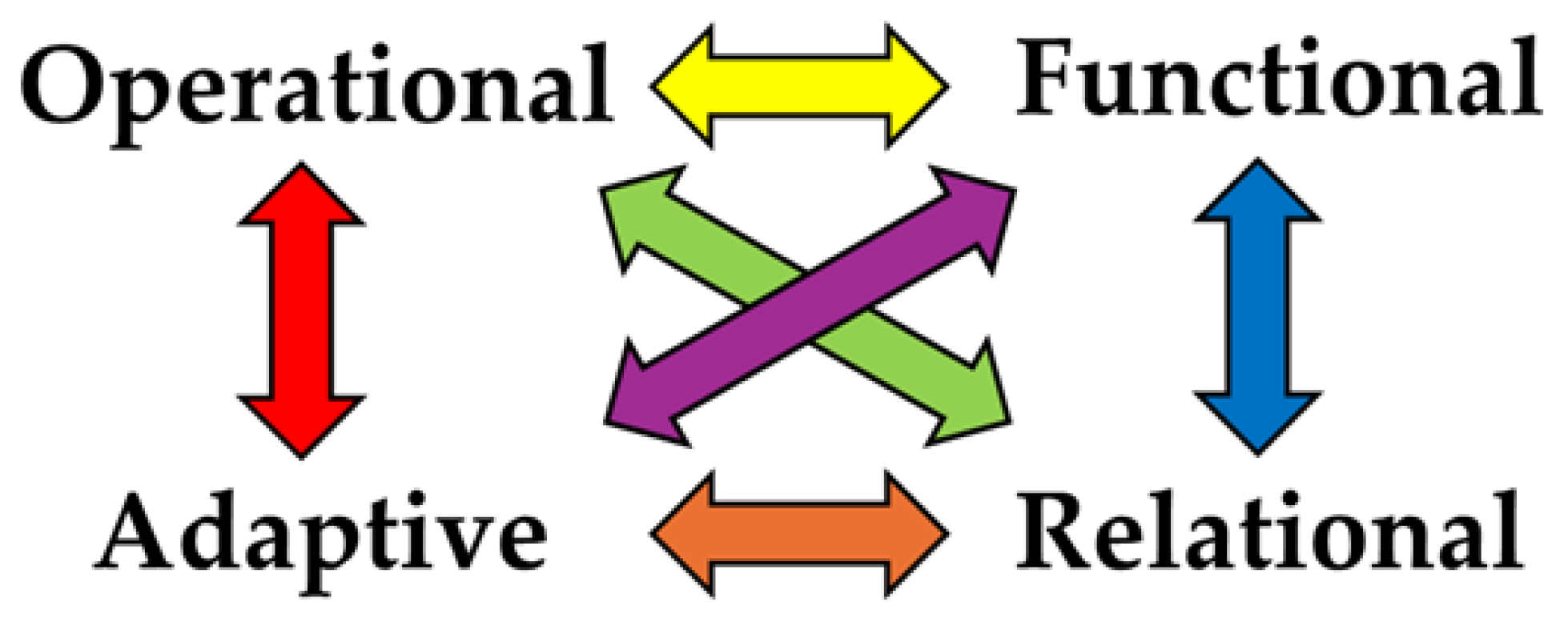
Figure 2.
The Research Methodology (authors’ elaboration).
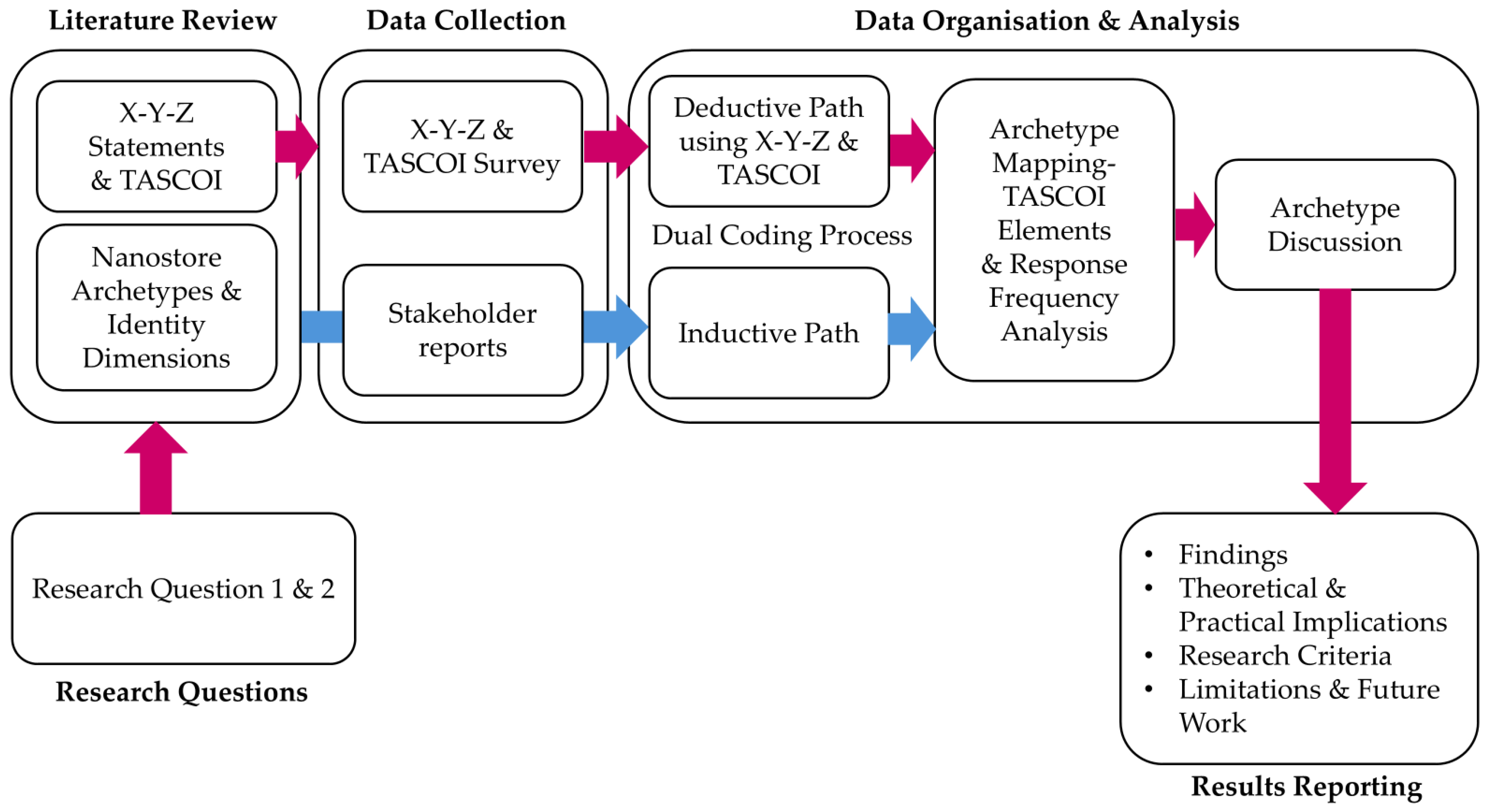
Figure 3.
A framework for nanostore identity conceptualisation (own elaboration).
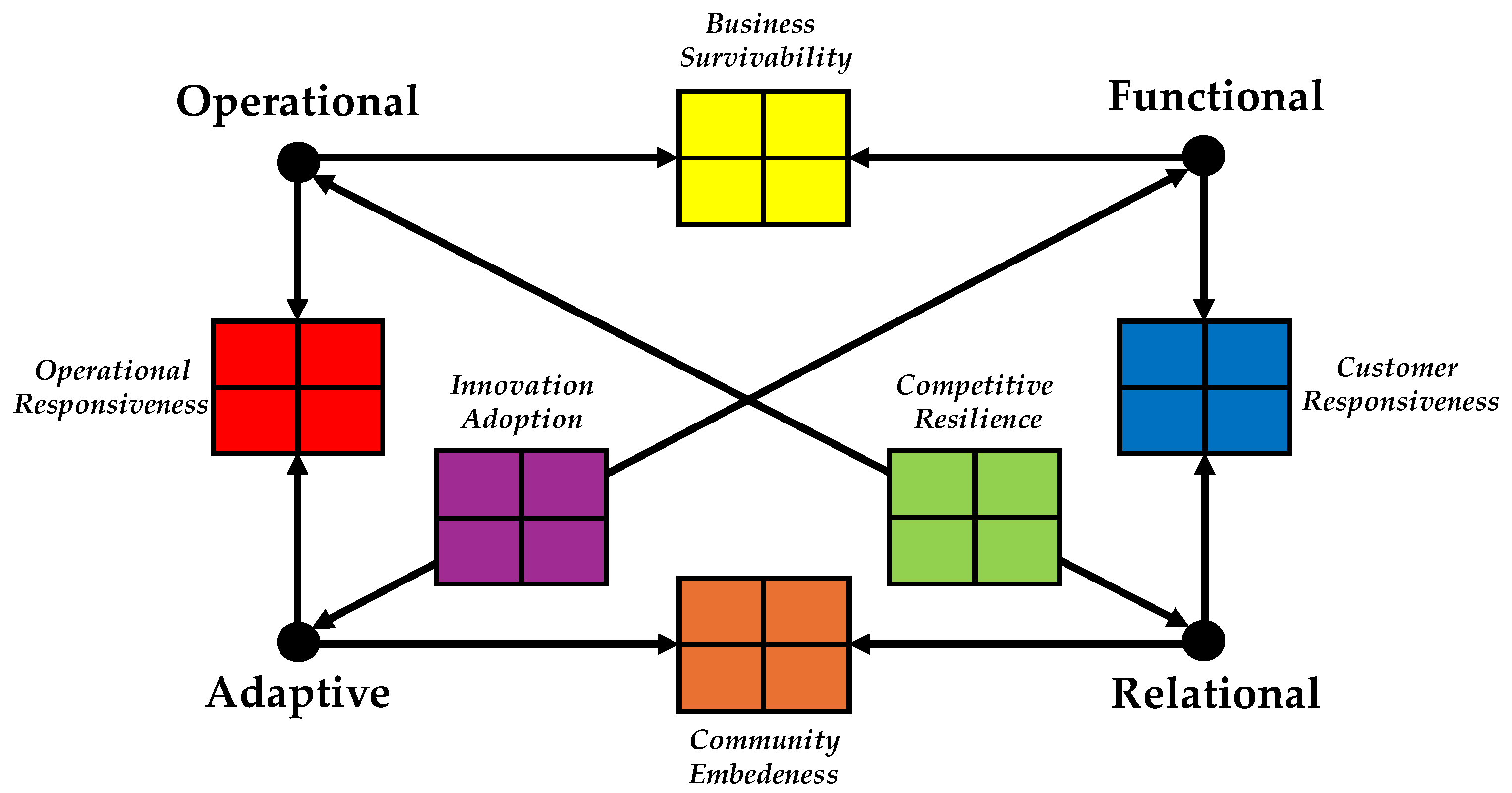
Table 1.
Business Survivability Matrix.
| Advanced Functional Effectiveness | Basic Functional Effectiveness | |
|---|---|---|
| Strong Structure | Thriving Hubs/Quick Wins | Stable but Limited/Overlooked Potential |
| Weak Structure | Hustle Heroes | At-Risk Shops |
Table 2.
Customer Responsiveness Matrix.
| Deep Relational | Shallow Relational | |
|---|---|---|
| Advanced Functional Effectiveness | Trust-Driven Functionals | Effective but Impersonal |
| Basic Functional Effectiveness | Community Safeguards | Fragile Outposts |
Table 3.
Community Embeddedness Matrix.
| Dynamic Adaptive Capacity | Static Adaptive Capacity | |
|---|---|---|
| Deep Relational | Community Pillars | Traditional Bonds |
| Shallow Relational | Transaction-Focused | Isolated Outposts |
Table 4.
Operational Responsiveness Matrix.
| Strong Operational Constraints | Weak Operational Constraints | |
|---|---|---|
| Dynamic Adaptive Capacity | Modernising Expanders | Resilient Improvisers |
| Static Adaptive Capacity | Static Underperformers | Vulnerable Traditionalists |
Table 5.
Competitive Resilience Matrix.
| Deep Relational | Shallow Relational | |
|---|---|---|
| Strong Structure | Unshakeable Nodes | Convenience Plays |
| Weak Structure | Oasis Shops | Deserted Outlets |
Table 6.
Innovation Adoption Matrix.
| Advanced Functional Effectiveness | Basic Functional Effectiveness | |
|---|---|---|
| Dynamic Adaptive | Retail Pioneers | Nimble Basics |
| Static Adaptive | Struggling Functionals | Static Survivors |
Table 7.
X-Y-Z and TASCOI Elements.
| X-Y-Z and TASCOI Elements | Guiding Questions |
|---|---|
| X | What do they do? |
| Y | How do they function? |
| Z | Why do they matter? |
| Actor | Who operates the shop? |
| Supplier | Who supplies products or services? |
| Transformation | How do shops adapt products/services to neighbourhood needs? |
| Owner | Who is accountable? |
| Customer | Who benefits? |
| Interveners | Who sets the nanostore context? |
Table 8.
Operational–Functional Matrix → Business Survivability.
| Archetype | X (What they do) | Y (How they do it) | Z (Why they do it) | Response Freq. | Nanostore Freq. | Example |
|---|---|---|---|---|---|---|
| Thriving Hubs | Sell groceries, basic goods | Stock shelves well, maintain variety, and organise space | Maintain income, provide dependable service | 18 | 5 | “We always have the products people need, well organised and visible.” |
| Stable but Limited | Sell standard products | Use traditional methods, no innovation | Maintain a routine income | 13 | 3 | “We sell the basics; people come because it’s convenient.” |
| Hustle Heroes | Sell diverse products with limited space | Source from multiple suppliers, and adapt pricing | Survive economically, remain useful | 12 | 3 | “I offer what’s possible and adjust prices as needed.” |
| At-Risk Shops | Sell whatever is available | Minimal organisation, frequent stockouts | Try to stay open, low resources | 7 | 2 | “I just sell whatever I have; sometimes I run out of stock.” |
Table 9.
Functional–Relational Matrix → Customer Responsiveness.
| Archetype | X | Y | Z | Response Freq. | Nanostore Freq. | Example |
|---|---|---|---|---|---|---|
| Trust-Driven Functionals | Sell tailored goods | Serve with credit and personal attention | Build loyalty and ensure income | 14 | 3 | “Clients come because I let them pay later and I have what they like.” |
| Effective but Impersonal | Provide a good assortment | Efficient but distant service | Offer convenience | 6 | 1 | “We have variety, but I don’t talk to the customers.” |
| Community Safeguards | Sell essentials | Trust-based service, informal credit | Support community needs | 10 | 2 | “Some people buy on credit, I know them, they always come back.” |
| Fragile Outposts | Sell basic items sporadically | Poor relational ties, generic offers | Try to survive | 5 | 1 | “I just open in case someone needs something.” |
Table 10.
Relational–Adaptive Matrix → Community Embeddedness.
| Archetype | X | Y | Z | Response Freq. | Nanostore Freq. | Example |
|---|---|---|---|---|---|---|
| Community Pillars | Sell multiple useful items | Evolve based on local demands, offer credit, and adapt hours | Support neighbours, grow business | 11 | 2 | “I added tortillas and cell phone recharges (top-ups) because that’s what people asked for.” |
| Traditional Bonds | Sell staple goods | Same routine for years, trusted by customers | Maintain social role | 7 | 1 | “I’ve always done it this way. People like it that way.” |
| Transaction-Focused | Offer tailored products | Use tech tools, fast service | Increase efficiency | 6 | 1 | “We take orders by WhatsApp, but I don’t talk much to clients.” |
| Isolated Outposts | Sell basics occasionally | Limited contact, no adaptation | Keep the business open, avoid closure | 5 | 1 | “No one comes. I just open daily.” |
Table 11.
Adaptive–Operational Matrix → Operational Responsiveness.
| Archetype | X | Y | Z | Response Freq. | Nanostore Freq. | Example |
|---|---|---|---|---|---|---|
| Modernising Expanders | Sell a curated product mix | Use digital payments, tech support | Attract new clients, stay competitive | 6 | 1 | “We use an app and offer promos for regular clients.” |
| Resilient Improvisers | Sell small stock, adapt constantly | Mix supplier sources, improvise displays | Meet customer demands, survive | 9 | 2 | “We’re small but stock what people ask for — we improvise daily.” |
| Static Underperformers | Sell usual products | Rely on outdated practices | Maintain habits, avoid risk | 6 | 1 | “I sell the same things as always. It’s enough.” |
| Vulnerable Traditionalists | Sell minimal inventory | No tech, limited stock | Try to maintain a minimal income | 7 | 1 | “I don’t change because I don’t have suppliers.” |
Table 12.
Operational–Relational Matrix → Competitive Resilience.
| Archetype | X | Y | Z | Response Freq. | Nanostore Freq. | Example |
|---|---|---|---|---|---|---|
| Unshakeable Nodes | Offer a full assortment | Long hours, strong customer relationships | Provide a trusted alternative to supermarkets | 10 | 2 | “People prefer coming here. They know me.” |
| Convenience Plays | Provide daily items | Proximity, efficient service, and no social bonds | Compete with chains on access | 7 | 1 | “We’re close, but I don’t deal with fiado or chatting.” |
| Oasis Shops | Sell a few goods | Far location, only the nearby shop | Serve isolated communities | 5 | 1 | “Even if I don’t sell much, people rely on it.” |
| Deserted Outlets | Sell rarely | Remote, low interaction | Habitual operation, low motivation | 5 | 1 | “We open out of habit now. Business is slow.” |
Table 13.
Functional–Adaptive Matrix → Innovation Adoption.
| Archetype | X | Y | Z | Response Freq. | Nanostore Freq. | Example |
|---|---|---|---|---|---|---|
| Retail Pioneers | Offer modern goods, promos | Use apps, social media | Innovate, differentiate, grow | 5 | 1 | “We have digital payments and offer promotions online.” |
| Nimble Basics | Offer basics based on demand | Minor adjustments, daily learning | Satisfy needs, stay relevant | 9 | 2 | “We bring in what people ask for.” |
| Struggling Functionals | Test new products | Poor fit with customers | Grow but miss the mark | 6 | 1 | “I tried to bring new items, but people didn’t buy them.” |
| Static Survivors | Sell standard items | No adaptation or feedback loop | Sustain simple operation | 5 | 1 | “We don’t change anything. It’s simple.” |
Table 14.
Frequency Summary by Identity Matrix.
| Matrix (Dimension Pair) | Nanostore Freq. | Total Responses Frequency |
|---|---|---|
| Operational–Functional | 13 | 50 |
| Functional–Relational | 7 | 35 |
| Relational–Adaptive | 5 | 29 |
| Adaptive–Operational | 5 | 28 |
| Operational–Relational | 5 | 27 |
| Functional–Adaptive | 5 | 25 |
| Total Cases | 34 | 194 |
Disclaimer/Publisher’s Note: The statements, opinions and data contained in all publications are solely those of the individual author(s) and contributor(s) and not of MDPI and/or the editor(s). MDPI and/or the editor(s) disclaim responsibility for any injury to people or property resulting from any ideas, methods, instructions or products referred to in the content. |
© 2025 by the authors. Licensee MDPI, Basel, Switzerland. This article is an open access article distributed under the terms and conditions of the Creative Commons Attribution (CC BY) license (http://creativecommons.org/licenses/by/4.0/).
Copyright: This open access article is published under a Creative Commons CC BY 4.0 license, which permit the free download, distribution, and reuse, provided that the author and preprint are cited in any reuse.


