

Submitted:
12 May 2025
Posted:
13 May 2025
You are already at the latest version
Abstract
Background/Objectives: Malnutrition is a key contributor to poor outcomes in older adults with fragility fractures, increasing risk of complications, functional decline, prolonged hospital stays, mortality, and healthcare costs. Substantial evidence limited to hip fracture supports early, interdisciplinary nutrition care. However, global audits reveal that most hip fracture patients do not receive recommended interventions. This quality improvement (QI) project aimed to co-create and test a pathway and toolkit to help apply evidence-based nutrition care in different fragility fracture settings globally. Methods: The SIMPLER Pathway and toolkit (SIMPLER) were developed through a multiphase, co-creation QI initiative (2018–2025), guided by the Knowledge-to-Action framework. Global experts and clinical teams synthesized evidence, identified the “know-do” gap, and adapted SIMPLER to context through iterative action-reflection cycles. The Model for Improvement guided team building, goal setting, testing changes, and measuring outcomes at pilot sites. Results: Over 100 co-creation activities between 2018 and 2025 engaged staff and patients to shape and refine SIMPLER. A global clinician survey (n=308, 46 countries), two bi-national audits (n=965, 63 hospitals), and qualitative interviews (n=15) confirmed a widespread evidence-practice gap. The pathway and toolkit were pilot-tested in five hospitals across four countries, with action-reflection cycles enabling continuous refinement of prioritized nutrition improvements tailored to local context. Following endorsement in late 2024, 46 healthcare services in 23 countries have formally committed to implementing SIMPLER. Conclusion: The SIMPLER Nutrition Pathway provides a scalable, adaptable framework to support delivery of evidence-based nutrition care in fragility fracture settings. A global evaluation is underway.
Keywords:
hip fracture
; fragility fracture
; nutritional support
; malnutrition
; implementation
; hospitals
; improvement
; quality improvement
; protocol
1. Introduction
Background
Fragility fractures are fractures resulting from low-energy trauma—mechanical forces that would not normally lead to a fracture, such as a fall from standing height or less. In 2019, the burden of disability associated with fractures reached 25.8 million years lived with disability (YLDs), marking a 65% increase since 1990 [1]. The most affected sites are the spine, hip, distal forearm, and proximal humerus. The World Health Organization identifies hip and vertebral fractures as the most serious types of fragility fractures, given their strong association with increased morbidity, mortality, and healthcare burden [1].
Hip fracture patients are often identified as the most nutritionally vulnerable group within the fragility fracture population and among older adults more generally [2,3]. Consequently, most nutrition-focused research, guidelines, and care standards in fragility fracture are centered on hip fracture [4,5,6,7,8,9]. As a result, hip fracture services often serve as the main focus for nutrition research and improvement works, with the aim of translating findings to all fragility fracture care over time.
Up to one-half of hip fracture patients are malnourished on admission and without timely intervention; single site research suggests this may increase to two thirds of inpatients by the time of discharge [8,9,10,11]. Malnutrition is a strong predictor of poor outcomes for people who experience hip fracture including delayed mobility, complications, increased length of stay, 12-month mortality and higher healthcare costs [2,12,13,14]. This association appears independent of body mass index [15].
Most nutrition screening tools have poor sensitivity in hip fracture inpatients. This can lead to the underdiagnosis and undertreatment of malnutrition [8,9,16,17,18,19]. Consequently, all hip fracture patients should receive interdisciplinary, multicomponent care until they are assessed as well nourished, clinically stable, no longer at risk of nutritional deterioration, and meeting their post-operative, post-trauma nutritional requirements [8,11,18,19,20,21]. Multicomponent nutrition care actions commonly include avoiding prolonged fasting, offering high quality, nutrient dense food choices, oral nutritional supplements, tailored nutrition information for patients and carers, and clinical handover to ongoing care providers if malnutrition or risk of malnutrition are not resolved at discharge [18,22,23,24,25,26]. However, across global regions, early, interdisciplinary, multicomponent nutrition care is not routinely provided to older adults with hip fracture [11,27,28].
This manuscript outlines the background and rationale for the SIMPLER Nutrition Pathway and Toolkit. It also describes the co-creation methods used in its development and field testing. The results describe the quality improvement methodology, stakeholder engagement strategies, and implementation processes used during the co-creation phase. They also introduce the final version of the SIMPLER Nutrition Pathway for Fragility Fractures, now presented in peer-reviewed literature for global adoption. Effectiveness outcomes, including patient-level impacts, are being reported separately.
2. Materials and Methods
The SIMPLER Nutrition Pathway for Fragility Fractures and associated toolkit resources were co-created and field tested as a non-linear, multiphase quality improvement initiative. The implementation approach was informed by the Knowledge to Action Framework (KTA), with quality improvement guided by the Model for Improvement and principles of co-creation [29,30,31].
Implementation Approach
The KTA framework was chosen as a widely used implementation process model. This model integrates a knowledge creation and synthesis cycle with an iterative action cycle that helps users translate evidence into practice. The knowledge creation cycle refines evidence through synthesis, product development, and tailoring for end-users. The action cycle guides the systematic implementation, adaptation, and sustainability of knowledge in real-world settings. It also supports continuous refinement and stakeholder engagement to translate knowledge into sustainable, scalable practice improvements.
The knowledge creation cycles applied structured global database, grey literature and relevant organizational website searches. Knowledge from primary studies, systematic, non-systematic, scoping and narrative reviews, and meta-analyses informed the development of the knowledge tools/products (i.e., SIMPLER).
At the same time, multiple action cycle phases guided the implementation and iterative refinement of SIMPLER. The Identify Problem/Determine the Know-Do Gap phase targeted identification of the gap between nutrition care recommendations and real-world practice. This phase applied patient, clinician and facility level audits, surveys, interviews, and focus groups, workshops, and expert question and answer panels at hospital, national, global region, and global levels.
In the Identify, Review, Select Knowledge phase, key evidence sources from the knowledge creation cycle were refined and tailored to develop the initial SIMPLER pathway and implementation approach. Consensus approval from the FFN (Fragility Fracture Network www.fragilityfracturenetwork.org) SIMPLER Implementation Committee and pilot sites to these were then obtained before pilot implementation. Pilot sites then applied Adapt Knowledge to Local Context phases with support from an implementation specialist, the FFN Implementation Committee and Site Network members to select, tailor and implement SIMPLER into their local settings. This included processes to Assess Barriers and Enablers to Knowledge [SIMPLER] Use, Monitor Knowledge Use, and Evaluate Outcomes phases. These phases applied mixed methods approaches to data collection including audits, patient reported measures, semi-structured qualitative interviews, site support meetings, surveys, webinars, and workshops.
The final co-creation phase focused on Sustaining Knowledge Use. Endorsement was obtained from all pilot sites at a face-to-face meeting in Istanbul, Türkiye in October 2024. An expression of interest for new adopter sites to implement SIMPLER was distributed using a snowball approach. A flyer with a link to an electronic form requesting a formal expression of interest was circulated to FFN membership and promoted at the FFN Regional Congresses and at the Australian and New Zealand Hip Fracture Registry ‘HipFest’.
Quality Improvement Approach
The Model for Improvement [31,30], was selected for its structured, iterative approach to guiding the SIMPLER healthcare improvement process at pilot sites. Like the KTA, this model was chosen as it actively solicits stakeholder engagement, data-driven decision-making, and continuous learning to implement measurable and sustainable quality improvement actions that can be tailored to diverse settings. Teams were supported by an expert facilitator and toolkit resources to apply the following key improvement steps during piloting: forming a team (or teams), setting aims, establishing measures, selecting changes, implementing changes, and sustaining and spreading improvements. Processes for establishing measures and identifying changes applied small-scale, test-retest Plan-Do-Study-Act (PDSA) cycles prior to full implementation.
Co-Creation and Co-Production Approach
Across global contexts, the terms co-creation, co-production, and co-design are often used interchangeably, with overlapping definitions. However, all acknowledge the complex relationships between academics, clinicians, patients, researchers, and other stakeholders working together to generate and adapt knowledge, develop ideas, and drive improvement. This quality improvement program primarily followed principles associated with co-creation and co-production; for simplicity, the term “co-creation” is used throughout the manuscript. Co-creation is the collaborative development of knowledge, tools, or solutions through partnerships between stakeholders—including academics, patients, clinicians, policymakers, and field experts [32]. Co-production explores the role of patients as active contributors in a shared process (e.g., shared decision making) and focuses on how best to support their interactions with healthcare staff and systems [33]. In line with Greenhalgh et al., we placed individual experiences at the heart of the co-creation process. Academic researchers were engaged as ‘knowledge brokers’ and together with implementation facilitators, linking knowledge generators with change champions and end users to facilitate translation of evidence into clinical practice [34,35]. Levels of patient and care partner engagement varied considerably across the diverse range of sites and improvement actions [36].
3. Results
These results describe the co-creation and pilot implementation process for the SIMPLER Nutrition Pathway, including rationale, development, and field testing, and introduce the Pathway and Toolkit. Effectiveness outcomes are being reported separately.
Across the course of implementation, processes were overseen by the FFN Education Committee Nutrition Advisory Board, the Global SIMPLER Implementation Steering Committee, SIMPLER Pilot Site Champions and local site teams. More than 100 targeted co-creation engagement processes were undertaken between 2018 and 2024 across FFN groups in Asia-Pacific, Europe, and the Americas (Table 1).
Knowledge Creation cycle
Key knowledge sources identified during the knowledge creation cycle are referenced throughout this manuscript. A scoping review and narrative review will be published separately.
Knowledge-to-Action Cycle
A key focus of the Identify Problem/Determine the Know-Do Gap phase cycles was to pinpoint the discrepancy between care recommendations and real-world practice across global regions. Findings from two bi-national patient-level and facility-level audits (n=965 patients; 63 participating hospitals) were triangulated by a global survey of 308 clinicians from 46 countries to confirm that nutrition guidelines were routinely unmet [37,38,39,40]. These quantitative findings were corroborated by numerous other data sources, including qualitative interviews with 15 interprofessional leaders in field, pilot site participants, and in two global interprofessional workshop conducted in 2018 and in 2024 (estimated combined attendance 300 participants). This confirmed a substantial and clinically significant evidence-to-practice gap and the need for change.
The Identify/Review/Select Knowledge phase synthesized key knowledge sources to create the initial SIMPLER pathway, protocol and toolkit resources. This draft received full consensus approval for pilot implementation from the FFN SIMPLER Implementation and Site Network committees in early 2024 [41,42].
Following a call for expressions of interest to FFN members, five hospitals across four countries were selected as pilot sites after establishing their local teams and setting aims. Throughout 2024, pilot sites participated in email communications, face-to-face and online meetings, workshops, and focus groups to refine the SIMPLER pathway, protocol, and toolkit resources. Sites were supported by structured engagement and implementation processes (Table 1), including regular meetings with an implementation specialist experienced in nutrition care improvements across international settings. This approach facilitated continuous, iterative site-led adaption to local context while simultaneously informing improvements to the pathway, protocol, and toolkit resources.
The final phase of implementation, Sustaining Knowledge Use focused on approval of the final versions for sustained and scaled-up knowledge use. A focus group was convened at the FFN meeting in Istanbul, Türkiye, bringing together representatives from pilot sites and co-leads of the Implementation Steering Committee. Unanimous consensus was reached on the final pathway. Focus group members noted that, while it offered structured guidance and core examples, implementing sites would need to adapt and co-create the pathway, protocol, and toolkit to suit their local contexts. Following the circulation of an expression of interest for new SIMPLER sites, 46 healthcare services from 23 countries across 5 of the 6 World Health Organization global regions[43] had committed, at time of writing, to implementing and evaluating SIMPLER in their settings.
Introducing SIMPLER
The SIMPLER Nutrition Pathway for Fragility Fractures is illustrated in Figure 1. SIMPLER has been adapted from the SIMPLE Approach with permission and acknowledgement to Queensland Health [22,23]. SIMPLER also includes concepts and constructs from numerous existing nutrition models, pathways, and processes [26,44,45,46,47,48,49]. The SIMPLER pathway is primarily designed to address protein-energy malnutrition and undernutrition in the older adult. However, its adaptable framework allows it to be effectively applied elsewhere, for example in secondary fracture prevention settings to identify and support individuals at risk of nutrition-related bone disease.
The following section provides a brief overview and rationale for the key components of the SIMPLER Pathway, as developed and refined through the co-creation and knowledge-to-action phases.
a The SIMPLER Pathway for inpatients with hip fracture is applied and adapted with permission from Queensland Health [23,50] and is provided here for educational purposes only. It must be customized to local contexts and governance requirements prior to implementation. b Most screening tools have demonstrated poor sensitivity in hip fracture inpatients; this can result in underdiagnosis and undertreatment of malnutrition. Consider routinely treating all hip fracture patients at risk of malnutrition until diagnosed as malnourished or not [8,9,16,17,18,19]. For other fragility fracture patients, consider using a validated screening tool such as the Mini-Nutritional Assessment Short Form[51], Malnutrition Screening Tool[52], or Malnutrition Universal Screening Tool[47]. Other high risk conditions, for example delirium may be considered by treating teams ‘at risk’ until assessed otherwise. c Using a validated diagnostic tool for example, the Global Leadership Initiative on Malnutrition (GLIM) criteria[53], International Classification of Diseases (ICD) criteria[54], the Subjective Global Assessment[55], the Mini-Nutritional Assessment Short Form (score <8)[51,56]. This may be performed after supportive interventions are commenced. d Within 72 hours (target <24 hours) of presentation with a hip fracture. Highly recommended ‘core’ interventions are detailed in the toolkit as the ‘SIMPLER Six’. For detailed examples of additional SIMPLE(R) supportive nutrition care interventions, consider the Multimodal, multidisciplinary nutritional care in acute hip fracture model[11], Orthogeriatrics Nutrition care chapter [57], Interdisciplinary Nutritional Management and Care for Older Adults Textbook [25], The SIMPLE Approach systematized, interdisciplinary care opportunities[58,59] (for local adaptation), and synthesized literature sources [4,5,6,7,19,40,44,46,47,48,60,61]. eAcross global settings, access to nutrition specialists such as Dietitians, Nutritionists, Medical Nutrition Specialists and suitably trained Nurse practitioners varies considerably. Whether access to specialist nutrition care is routinely available, and/or what the referral requirements are for specialist care, are highly dependent on local resources and care processes.
S - Screening
The grey diamond box provides guidance on nutrition screening. This triages patients to the three categories of care (Figure 1). The SIMPLER Pathway prioritizes early, interdisciplinary, multicomponent “Supportive Nutrition Care” (Orange) for all hip fracture patients, regardless of nutrition risk score, level of adiposity, or usual intake. This helps teams to align care with evidence-based guidelines and standards recognizing that while most at-risk older inpatients do not require specialist nutrition care, they do routinely require timely, multidisciplinary, multicomponent, ‘supportive’ nutrition actions [8,9,18,19,23]. This approach also recognizes the limited availability of timely access to nutrition specialists in many global settings [22,23,62,63]. Supportive nutritional care should continue until patients are assessed as well-nourished and not at risk of malnutrition, with adequate intake to meet post-operative, post-trauma requirements.
The small proportion of hip fracture patients who require immediate specialist input should be referred for “Specialist Nutrition Care” in line with local referral processes (Red). Similarly, a small proportion of patients may be assessed as well nourished, not at risk of becoming malnourished, and are already demonstrating adequate protein and energy intake to meet post-injury requirements. These patients, and other fragility fracture patients screened as ‘not at risk’, should be triaged to “Standard Nutrition Care” (Green). Standard care should still provide high quality, nutrient dense food and fluid choices, therapeutic diets, mealtime support, and regular re-screening [18,49].
For other fragility fracture patients, the pathway supports local selection of validated screening tools (e.g., the Mini-Nutritional Assessment Short Form [51], Malnutrition Screening Tool [52], Canadian Nutrition Screening Tool [64] or Malnutrition Universal Screening Tool [47]). It also encourages teams to consider routinized identification and supportive care for other high-risk individuals (e.g., those with delirium or periprosthetic fractures). The pathway also facilitates nutrition rescreening and reassessment, ensuring appropriate transitions between standard (green), supportive (orange), and specialist (red) nutrition care as needed[22,65].
I – Interdisciplinary nutrition assessment and reassessment
Those screened as at risk should receive a thorough nutrition assessment. The rationale and opportunities for interdisciplinary nutrition assessment and reassessment processes are described elsewhere [2,7,15,18,19,49,66,67,68,69,70,71]. Unless specialist care is required, supportive nutrition care processes may be commenced prior to assessment.
M – Make the diagnosis, inform the patient/carer and document
After nutrition assessment, a key action is to ensure that all those identified as at risk receive a nutrition diagnosis. This should be documented in the medical record. The most reported nutritional diagnosis in hip fracture is malnutrition (undernutrition, protein-energy malnutrition). The misclassification, under-identification and under-documentation of malnutrition is common, particularly in those who are overweight or obese [16,72,73]. A diagnosis of malnutrition should be made by applying a validated diagnostic tool. Examples of these include, but are not limited to, the Global Leadership Initiative on Malnutrition (GLIM) criteria [53], International Classification of Diseases (ICD) criteria [54], the Subjective Global Assessment[55], and the Mini-Nutritional Assessment Short Form (score <8) [51,56]. Examples of additional nutrition diagnoses commonly observed in clinical practice across hip fracture and other fragility fracture settings, mapped to the International Dietetics and Nutrition Terminology, are provided elsewhere [57,66,74,75,76].
To support informed consent and shared decision-making, individuals screened as at risk should be informed of their screening results and any subsequent assessments. This should include communicating any relevant diagnoses, which can also help improve adherence to nutrition interventions [77,78]. Unfortunately, in many settings, patients and/or their carers report being unaware of their risk status and/or nutrition diagnostic results [23,62]. Again, any diagnoses made should be documented in the treatment record.
P – Plan supportive interventions with the patient
Care planning, including person-centered goal setting, is an essential component of fragility fracture care and rehabilitation [79]. Actively engaging individuals in their recovery can support care approaches that are in line with their personal values, needs, and functional priorities. This can increase engagement, motivation, and adherence to treatment, and ultimately improve patient and healthcare outcomes. In some situations, following shared decision making and informed processes, patients and their care partners may actively and appropriately choose to focus on food and fluids for comfort, for example where a focus is on care at the end of life. In many settings, processes to engage patients in care planning and goal setting components are under-implemented [23,38,62,80,81].
L – impLement supportive interventions
A range of nutrition interventions can be implemented at the individual, unit, hospital, or policy level [26,46,49]. As no single intervention effectively addresses malnutrition in hip fracture care, interdisciplinary, multicomponent approaches are recommended [23,25,57,59]. The SIMPLER Pathway and protocol provide a structured framework for teams to test, select, and implement targeted nutrition interventions for patients with or at risk of malnutrition who do not require specialized care. Priority core improvement opportunities, integrating evidence from primary research, systematic reviews, meta-analyses, clinical guidelines, and care standards are presented as “The SIMPLER Six Improvement Opportunities” (Table 2). Local implementation teams may choose to prioritize additional or alternative evidence-based interventions.
E – Evaluate nutrition care provided
SIMPLER supports implementation teams to consider, test and choose a small set of nutrition process measures to apply at baseline and post-implementation to; i) identify key areas for improvement, and ii) identify whether changes made are likely to have led to an improvement. Additional measures within the scope of a quality improvement activity may be conducted during implementation to guide implementation and sustainment. Table 4 provides examples of core nutrition care process measures informed by primary research, systematic reviews and meta-analysis, evidence-based guidelines and care standards, and clinician consensus [6,8,18,19,23,41,42]. Examples are given for audit, patient / carer reported, and treating clinician estimate examples. Examples of implementation measures aligned with the RE-AIM (Reach, Effectiveness, Adoption, Implementation, Maintenance) framework [41] are provided in Supplement 1 (Supplement 1: SIMPLER RE-AIM Implementation Measures).
R – Review, reform, and redesign practice.
The SIMPLE actions above are directed towards facilitating supportive nutrition care processes. The final key SIMPLER action is to review, reform and redesign practice. Examples of opportunities for teams to consider when reviewing, reforming or redesigning practice is outlined in Supplementary Materials (S2: Table S: Opportunities for teams to consider when reviewing, reforming or redesigning practice).
The SIMPLER Protocol and Toolkit
“The SIMPLER Nutrition Pathway for Fragility Fractures – Implementation Protocol Template for Local Tailoring and Co-Creation” is a field-tested, co-created protocol template designed to support treating teams across diverse global settings in selecting, tailoring, and implementing SIMPLER. The protocol provides a structured approach to support sites to implement SIMPLER, aligned with the model for improvement: forming teams, setting aims, selecting measures, testing interventions, and evaluating outcomes [30]. The Pathway, protocol and toolkit resources are available on the Fragility Fracture Network website, www.fragilityfracturenetwork.org, or on request from the contact author. [Editor / reviewer note: these will not be published online until this manuscript / pre-print has been accepted].
3. Discussion
Across global settings, a major gap remains between nutritional recommendations and real-world practice for older adults with fragility fractures, particularly those with hip fracture [37,38,39,40]. This manuscript presents a novel, field-tested, expert-endorsed, and locally adaptable pathway that serves as a template for adopting sites to implement and evaluate nutrition improvements to close the evidence-to-practice gap.
A primary challenge to making nutrition care SIMPLER on a global scale is the diversity of contexts in which those with hip fracture and other fragility fractures are treated. Consequently, the final pathway and implementation protocol avoids a prescriptive, algorithmic, ‘one size fits all’ approach, with a requirement for local sites to adapt to context, preferably applying principles of co-creation and/or similar processes [32,36,93,94,95]. For example, there are no gold standards for nutrition screening and diagnosis; recommending a specific screening or diagnostic tool was quickly identified as a key barrier to applying the tool in other settings where different tools were applied [16,17,96]. Similarly, requiring detailed assessment and intervention by specialists, for example dietitians or medical nutrition experts, was considered unrealistic across many global settings where timely access to nutrition specialists is not available [23,40]. Attempts to define food, fluid, and oral nutrition supplement prescriptions and dosages that could be realistically offered across global contexts was also not considered realistic or feasible across a large-scale implementation program [41,42,97,98].
Implementing and evaluating change into complex healthcare systems is challenging [99,100]. Identifying the evidence-practice gap, reaching consensus, and identifying new adopter sites ready to implement will not guarantee meaningful, scalable, or sustainable improvement [101]. The second key challenge is ‘how’ to implement. SIMPLER teams must carefully unpack the ‘black box’ of implementation if improvements are likely to be sustained and spread [102,103]. This paper applies the KTA as a primary implementation model and the Model for Improvement for guiding quality improvement processes. However, across the course of implementation, numerous concepts and constructs from other theories, models and frameworks were integrated across action-reflection cycles. Given the proliferation of theories, models, and frameworks in the overlapping fields of implementation science, knowledge translation, and complexity science, adopting sites should engage implementation support practitioners or specialists where available [104,105,106,107]. Sites should also consider joining networks of like-minded people or communities of practice, including those who have started their SIMPLER journey for peer support [108].
A third key challenge is measurement. The final core measures provided and approved were iteratively developed across many engagement processes and aligned to existing evidence. However, those listed in Table 4 are not prescriptive. Although acknowledged as ‘core’ measures, the pathway supports sites to select, test and adapt measures where required, and are also free to choose from these or other measures depending on context. Sites should take care to avoid over-measurement and/or over-interpretation of findings. Those implementing SIMPLER should be mindful of the distinction between quality improvement or implementation outcomes and clinical, treatment, healthcare, or cost-effectiveness outcomes [100,109]. In most cases, for the selected improvement opportunities provided, research methods to demonstrate efficacy or effectiveness are not required, as these already have a strong evidence base. Instead, teams are encouraged to focus on mixed-methods data that can be collected during routine clinical care—data that are appropriate, feasible, and useful both for identifying improvement priorities and assessing whether changes have led to improvement. [30,110].
A final challenge is the need to recognize national and international differences in the level of oversight required for quality assurance, improvement, and knowledge translation activities. Confusion and differences may arise regarding when and where SIMPLER implementation crosses over from quality improvement to research [111]. Others have observed that it can be unhelpful to try and clearly separate quality assurance or improvement processes from research, and these and similar processes exist on a continuum of activity that can evolve over time from one form to another [111]. Given the observed differences across settings, sites should ensure that prior to implementation, local quality and/or ethics approvals are in place to ensure adherence to, relevant governance, policy, professional, regulatory, and resource requirements.
This manuscript purposely reports the development and field-testing process, implementation fidelity, uptake, and sustainability of SIMPLER in a small number of sites. This is a key limitation. Future works will present implementation processes applied across globally diverse settings, and present mixed methods implementation outcomes evaluation.
4. Conclusions
Malnutrition is one of the strongest predictors of poor outcomes after hip fracture. Despite strong evidence supporting change, there remains a gap between nutritional recommendations and practice. The SIMPLER Nutrition Pathway and Protocol for Fragility Fractures provides a novel opportunity to support local sites to co-create implementation efforts which can close this evidence to practice gap. With strong demand for adoption already demonstrated across diverse global settings, we invite you to consider tailoring SIMPLER to your setting and evaluating improvement efforts to bridging the evidence-to-practice gap.
Author Contributions
Conceptualization, J.B., O.G.G.; methodology A.J., E.S., F.F., J.B., J.S-T., K.H., O.G.G., R.M.; resources, J.B., E.S., F.F., K.H., O.G.G., R.M; writing—original draft preparation J.J.B; writing—review and editing, A.J., E.S., F.F., J.B., J.S-T., K.H., O.G.G., R.M.; visualization, J.B.; project administration, J.B., O.G.G., R.M.; funding acquisition, J.B., F.F., K.H., O.G.G., R.M. All authors have read and agreed to the published version of the manuscript.
Funding
The Fragility Fracture Network is acknowledged for providing administration and project support for SIMPLER implementation across global settings. FFN receives corporate advisory council and project funding from industry partners including Nutricia. Industry partners, including Nutricia, have had no control or influence over the content of the pathway, protocol, or toolkit resources.
Institutional Review Board Statement
This protocol was developed and presented in line with a quality improvement approach aligned with the Australian Government NHMRC Document “Ethical Considerations in Quality Assurance and Evaluation Activities”. Individual Institutional Review board approval has not been sought for the protocol, as prior to implementation and evaluation, individual sites must locally register their tailored, co-designed protocol either as a quality improvement activity or research depending on their tailored protocol design and local contextual requirements.
Acknowledgments
This protocol has been adapted from The SIMPLER pathway and toolkit permission and acknowledgement to Metro North Health, Queensland Health. The SIMPLER pathway, protocol, and all toolkit resources may be used and adapted freely under a creative commons agreement, with acknowledgement to The Prince Charles Hospital, Metro North Hospital and Healthcare Service, Australia. Special thanks to all members of the Fragility Fracture Network SIMPLER Implementation Steering Committee and participating pilot sites.
Conflicts of Interest
J.B. is the current co-chair of the FFN Fragility Fracture Recovery Research special interest group, a member of the FFN global scientific committee, and a member of the FFN executive committee, and has received funding from FFN for travel support and project funding from the University of Iceland to develop the SIMPLER Pathway and associated resources. A.J., F.F., J.B., J.S-T., K.H., O.G.G are members of the Fragility Fracture Network Board / Executive. Funders had no role in the design of the study; in the collection, analyses, or interpretation of data; in the writing of the manuscript; or in the decision to publish the results.
Abbreviations
The following abbreviations are used in this manuscript:
| MDPI | Multidisciplinary Digital Publishing Institute |
| DOAJ | Directory of open access journals |
| FFN | Fragility Fracture Network |
| KTA | Knowledge-To-Action (KTA) |
| PDSA | Plan-Do-Study-Act |
| RE-AIM | Reach, Effectiveness, Adoption, Implementation, Maintenance |
References
- World Health Organization. Fragility fractures. Available online: https://www.who.int/news-room/fact-sheets/detail/fragility-fractures (accessed on 2 May 2025).
- Chiavarini, M.; Ricciotti, G.M.; Genga, A.; Faggi, M.I.; Rinaldi, A.; Toscano, O.D.; D’Errico, M.M.; Barbadoro, P. Malnutrition-Related Health Outcomes in Older Adults with Hip Fractures: A Systematic Review and Meta-Analysis. Nutrients 2024, 16, 1069. [Google Scholar] [CrossRef]
- Inoue, T.; Maeda, K.; Nagano, A.; Shimizu, A.; Ueshima, J.; Murotani, K.; Sato, K.; Tsubaki, A. Undernutrition, Sarcopenia, and Frailty in Fragility Hip Fracture: Advanced Strategies for Improving Clinical Outcomes. Nutrients 2020, 12. [Google Scholar] [CrossRef] [PubMed]
- Takahashi, K.; Momosaki, R.; Yasufuku, Y.; Nakamura, N.; Maeda, K. Nutritional Therapy in Older Patients With Hip Fractures Undergoing Rehabilitation: A Systematic Review and Meta-Analysis. Journal of the American Medical Directors Association 2020, 21, 1364–1364.e1366. [Google Scholar] [CrossRef]
- Lai, W.Y.; Chiu, Y.C.; Lu, K.C.; Huang, I.T.; Tsai, P.S.; Huang, C.J. Beneficial effects of preoperative oral nutrition supplements on postoperative outcomes in geriatric hip fracture patients: A PRISMA-compliant systematic review and meta-analysis of randomized controlled studies. Medicine (Baltimore) 2021, 100, e27755. [Google Scholar] [CrossRef] [PubMed]
- Chen, B.; Zhang, J.H.; Duckworth, A.D.; Clement, N.D. Effect of oral nutritional supplementation on outcomes in older adults with hip fractures and factors influencing compliance. Bone Joint J 2023, 105-b, 1149–1158. [Google Scholar] [CrossRef]
- Volkert, D.; Beck, A.M.; Cederholm, T.; Cereda, E.; Cruz-Jentoft, A.; Goisser, S.; de Groot, L.; Großhauser, F.; Kiesswetter, E.; Norman, K.; et al. Management of Malnutrition in Older Patients-Current Approaches, Evidence and Open Questions. Journal of clinical medicine 2019, 8. [Google Scholar] [CrossRef] [PubMed]
- Australian Commission on Safety and Quality in Healthcare. Hip Fracture Clinical Care Standard. Available online: https://www.safetyandquality.gov.au/standards/clinical-care-standards/hip-fracture-care-clinical-care-standard (accessed on 23 January 2025).
- Scottish Government. Scottish standards of care for hip fracture patients. 2024.
- Foo, M.X.E.; Wong, G.J.Y.; Lew, C.C.H. A systematic review of the malnutrition prevalence in hospitalized hip fracture patients and its associated outcomes. JPEN. Journal of parenteral and enteral nutrition 2021, 45, 1141–1152. [Google Scholar] [CrossRef]
- Bell, J.J.; Bauer, J.D.; Capra, S.; Pulle, R.C. Multidisciplinary, multi-modal nutritional care in acute hip fracture inpatients - results of a pragmatic intervention. Clinical Nutrition 2014, 33, 1101–1107. [Google Scholar] [CrossRef]
- Malafarina, V.; Reginster, J.-Y.; Cabrerizo, S.; Bruyère, O.; Kanis, J.A.; Martinez, J.A.; Zulet, M.A. Nutritional Status and Nutritional Treatment Are Related to Outcomes and Mortality in Older Adults with Hip Fracture. Nutrients 2018, 10, 555. [Google Scholar] [CrossRef]
- Bell, J.J.; Pulle, R.C.; Crouch, A.M.; Kuys, S.S.; Ferrier, R.L.; Whitehouse, S.L. Impact of malnutrition on 12-month mortality following acute hip fracture. ANZ J Surg 2016, 86, 157–161. [Google Scholar] [CrossRef] [PubMed]
- Nikkel, L.E.; Fox, E.J.; Black, K.P.; Davis, C.; Andersen, L.; Hollenbeak, C.S. Impact of comorbidities on hospitalization costs following hip fracture. J Bone Joint Surg Am 2012, 94, 9–17. [Google Scholar] [CrossRef] [PubMed]
- Bell, J.J.; Pulle, R.C.; Lee, H.B.; Ferrier, R.; Crouch, A.; Whitehouse, S.L. Diagnosis of overweight or obese malnutrition spells DOOM for hip fracture patients: A prospective audit. Clinical nutrition (Edinburgh, Scotland) 2021, 40, 1905–1910. [Google Scholar] [CrossRef]
- Bell, J.J.; Bauer, J.D.; Capra, S.; Pulle, R.C. Quick and easy is not without cost: implications of poorly performing nutrition screening tools in hip fracture. Journal of the American Geriatrics Society 2014, 62, 237–243. [Google Scholar] [CrossRef] [PubMed]
- Bell, J.J.; Bauer, J.D.; Capra, S.; Pulle, R.C. Concurrent and predictive evaluation of malnutrition diagnostic measures in hip fracture inpatients: a diagnostic accuracy study. European journal of clinical nutrition 2014, 68, 358–362. [Google Scholar] [CrossRef]
- Volkert, D.; Beck, A.M.; Cederholm, T.; Cruz-Jentoft, A.; Goisser, S.; Hooper, L.; Kiesswetter, E.; Maggio, M.; Raynaud-Simon, A.; Sieber, C.C.; et al. ESPEN guideline on clinical nutrition and hydration in geriatrics. Clinical Nutrition 2019, 38, 10–47. [Google Scholar] [CrossRef]
- Volkert, D.; Beck, A.M.; Cederholm, T.; Cruz-Jentoft, A.; Hooper, L.; Kiesswetter, E.; Maggio, M.; Raynaud-Simon, A.; Sieber, C.; Sobotka, L.; et al. ESPEN practical guideline: Clinical nutrition and hydration in geriatrics. Clinical nutrition (Edinburgh, Scotland) 2022, 41, 958–989. [Google Scholar] [CrossRef]
- Correa-Pérez, A.; Abraha, I.; Cherubini, A.; Collinson, A.; Dardevet, D.; de Groot, L.; de van der Schueren, M.A.E.; Hebestreit, A.; Hickson, M.; Jaramillo-Hidalgo, J.; et al. Efficacy of non-pharmacological interventions to treat malnutrition in older persons: A systematic review and meta-analysis. The SENATOR project ONTOP series and MaNuEL knowledge hub project. Ageing research reviews 2019, 49, 27–48. [Google Scholar] [CrossRef]
- Avenell, A.; Smith, T.O.; Curtain, J.P.; Mak, J.C.; Myint, P.K. Nutritional supplementation for hip fracture aftercare in older people. Cochrane Database Syst Rev 2016, 11, CD001880. [Google Scholar] [CrossRef]
- Bell, J.J.; Young, A.; Hill, J.; Banks, M.; Comans, T.; Barnes, R.; Keller, H.H. Rationale and developmental methodology for the SIMPLE approach: A Systematised, Interdisciplinary Malnutrition Pathway for impLementation and Evaluation in hospitals. Nutrition & dietetics: the journal of the Dietitians Association of Australia 2018, 75, 226–234. [Google Scholar] [CrossRef]
- Bell, J.J.; Young, A.M.; Hill, J.M.; Banks, M.D.; Comans, T.A.; Barnes, R.; Keller, H.H. Systematised, Interdisciplinary Malnutrition Program for impLementation and Evaluation delivers improved hospital nutrition care processes and patient reported experiences – An implementation study. Nutrition & Dietetics 2021, 78, 466–475. [Google Scholar] [CrossRef]
- Neaves, B.; Bell, J.J.; McCray, S. Impact of room service on nutritional intake, plate and production waste, meal quality and patient satisfaction and meal costs: A single site pre-post evaluation. Nutrition & Dietetics 2022, 79, 187–196. [Google Scholar] [CrossRef]
- Geirsdóttir, Ó.G.; Bell, J.J. Interdisciplinary Nutritional Management and Care for Older Adults: An Evidence-Based Practical Guide for Nurses; Springer International Publishing: Cham, 2021; p. 271. [Google Scholar]
- Swan, W.I.; Vivanti, A.; Hakel-Smith, N.A.; Hotson, B.; Orrevall, Y.; Trostler, N.; Beck Howarter, K.; Papoutsakis, C. Nutrition Care Process and Model Update: Toward Realizing People-Centered Care and Outcomes Management. Journal of the Academy of Nutrition and Dietetics 2017, 117, 2003–2014. [Google Scholar] [CrossRef]
- Olofsson, B.; Stenvall, M.; Lundstrom, M.; Svensson, O.; Gustafson, Y. Malnutrition in hip fracture patients: an intervention study. Journal of Clinical Nursing 2007, 16, 2027–2038. [Google Scholar] [CrossRef]
- Hoekstra, J.C.; Goosen, J.H.M.; de Wolf, G.S.; Verheyen, C.C.P.M. Effectiveness of multidisciplinary nutritional care on nutritional intake, nutritional status and quality of life in patients with hip fractures: a controlled prospective cohort study. Clinical Nutrition 2011, 30, 455–461. [Google Scholar] [CrossRef] [PubMed]
- Graham, I.D.; Logan, J.; Harrison, M.B.; Straus, S.E.; Tetroe, J.; Caswell, W.; Robinson, N. Lost in knowledge translation: time for a map? J Contin Educ Health Prof 2006, 26, 13–24. [Google Scholar] [CrossRef]
- Institute for Healthcare Improvement. How to Improve: Model for Improvement. Available online: https://www.ihi.org/resources/Pages/HowtoImprove/default.aspx (accessed on 12 April 2024).
- Langley GL, M.R. , Nolan KM, Nolan TW, Norman CL, Provost LP.,. Improvement Guide: A Practical Approach to Enhancing Organizational Performance (2nd edition); Jossey-Bass Publishers: San Francisco, 2009. [Google Scholar]
- Greenhalgh, T.; Jackson, C.; Shaw, S.; Janamian, T. Achieving Research Impact Through Co-creation in Community-Based Health Services: Literature Review and Case Study. Milbank Q 2016, 94, 392–429. [Google Scholar] [CrossRef]
- Robert, G.; Locock, L.; Williams, O.; Cornwell, J.; Donetto, S.; Goodrich, J. Co-Producing and Co-Designing. 2022. [Google Scholar] [CrossRef]
- Chew, S.; Armstrong, N.; Martin, G.P. Understanding knowledge brokerage and its transformative potential: a Bourdieusian perspective. Evidence & Policy 2022, 18, 25–42. [Google Scholar] [CrossRef]
- Young, A.; Keller, H.; Barnes, R.; Bell, J. Clinicians as novice facilitators: a SIMPLE case study. Journal of Health Organization and Management 2019, 33, 78–92. [Google Scholar] [CrossRef]
- Participation., I.A.f.P. Public Participation Spectrum. Available online: https://iap2.org.au/resources/spectrum/ (accessed on 25 January).
- Bell, J.J.; Mitchell, R.J.; Harris, I.A.; Seymour, H.; Armstrong, E.; Harris, R.; Fleming, S.; Hurring, S.; Close, J. Oral Nutritional Supplementation in Older Adults with a Hip Fracture-Findings from a Bi-National Clinical Audit. Healthcare (Basel) 2024, 12. [Google Scholar] [CrossRef]
- ANZ Hip Fracture Registry. ANZ HFR Nutrition Sprint Audit. Available online: https://anzhfr.org/sprintaudits/ (accessed on day month year).
- Australian and New Zealand Hip Fracture Registry. Preoperative Fasting Sprint Audit. Available online: https://anzhfr.org/sprintaudits/ (accessed on 23 January 2025).
- Bell, J.; Turabi, R.; Olsen, S.U.; Sheehan, K.J.; Geirsdóttir, Ó.G. Interdisciplinary Oral Nutrition Support and Supplementation After Hip Fracture Surgery in Older Adult Inpatients: A Global Cross-Sectional Survey (ONS-STUDY). Nutrients 2025, 17, 240. [Google Scholar] [CrossRef] [PubMed]
- Fragility Fracture Network SIMPLER Implementation Steering Committee. SIMPLER Nutrition Measures and Actions recommended for implementation - consensus from the Fragility Fracture Network (Global) Implementation Steering Committee. 2024.
- Fragility Fracture Network SiMPLER Site Champions Network. Core SIMPLER Nutrition Care Measures and Actions: consensus from the Fragility Fracture Network SiMPLER Site Champions Network (unpublished data). 2024.
- World Health Organisation. Countries. Available online: https://www.who.int/countries (accessed on 21 March 2025).
- Keller, H.; Laur, C.; Atkins, M.; Bernier, P.; Butterworth, D.; Davidson, B.; Hotson, B.; Nasser, R.; Laporte, M.; Marcell, C. Update on the Integrated Nutrition Pathway for Acute Care (INPAC): post implementation tailoring and toolkit to support practice improvements. Nutrition journal 2018, 17, 1–6. [Google Scholar] [CrossRef] [PubMed]
- Keller, H.H.; Valaitis, R.; Laur, C.V.; McNicholl, T.; Xu, Y.; Dubin, J.A.; Curtis, L.; Obiorah, S.; Ray, S.; Bernier, P.; et al. Multi-site implementation of nutrition screening and diagnosis in medical care units: Success of the More-2-Eat project. Clinical nutrition (Edinburgh, Scotland) 2019, 38, 897–905. [Google Scholar] [CrossRef] [PubMed]
- Writing Group of the Nutrition Care Process/Standardized Language Committee. Nutrition care process and model part I: the 2008 update. J Am Diet Assoc 2008, 108, 1113–1117. [Google Scholar] [CrossRef]
- Elia, M. Screening for malnutrition: A Multidisciplinary Responsibility. Development and Use of the Malnutrition Universal Screening Tool (MUST) for Adults; BAPEN: Redditch, 2003. [Google Scholar]
- Isenring, E.A.; Bauer, J.D.; Banks, M.; Gaskill, D. The Malnutrition Screening Tool is a useful tool for identifying malnutrition risk in residential aged care. Journal of Human Nutrition & Dietetics 2009, 22, 545–550. [Google Scholar] [CrossRef]
- Cederholm, T.; Barazzoni, R.; Austin, P.; Ballmer, P.; Biolo, G.; Bischoff, S.C.; Compher, C.; Correia, I.; Higashiguchi, T.; Holst, M.; et al. ESPEN guidelines on definitions and terminology of clinical nutrition. Clinical Nutrition 2017, 36, 49–64. [Google Scholar] [CrossRef]
- The Prince Charles Hospital - Metro North Hospital and Health Service. SIMPLER Toolkit. Available online: https://tpch.qld.libguides.com/simpler (accessed on 23 January 2025).
- Kaiser, M.J.; Bauer, J.M.; Ramsch, C.; Uter, W.; Guigoz, Y.; Cederholm, T.; Thomas, D.R.; Anthony, P.; Charlton, K.E.; Maggio, M.; et al. Validation of the Mini Nutritional Assessment short-form (MNA-SF): a practical tool for identification of nutritional status. J Nutr Health Aging 2009, 13, 782–788. [Google Scholar] [CrossRef]
- Ferguson, M.; Capra, S.; Bauer, J.; Banks, M. Development of a valid and reliable malnutrition screening tool for adult acute hospital patients. Nutrition 1999, 15, 458–464. [Google Scholar] [CrossRef]
- Cederholm, T.; Jensen, G.L.; Correia, M.; Gonzalez, M.C.; Fukushima, R.; Higashiguchi, T.; Baptista, G.; Barazzoni, R.; Blaauw, R.; Coats, A.; et al. GLIM criteria for the diagnosis of malnutrition - A consensus report from the global clinical nutrition community. Clinical nutrition (Edinburgh, Scotland) 2019, 38, 1–9. [Google Scholar] [CrossRef]
- World Health Organisation. International Classification of Diseases 11th Revision. Available online: https://icd.who.int/en (accessed on 23 July 2024).
- Detsky, A.S.; McLaughlin, J.R.; Baker, J.P.; Johnston, N.; Whittaker, S.; Mendelson, R.A.; Jeejeebhoy, K.N. What is subjective global assessment of nutritional status? Jpen: Journal of Parenteral & Enteral Nutrition 1987, 11, 8–13. [Google Scholar]
- Nestle. MNA(R) Forms. Available online: https://www.mna-elderly.com/mna-forms (accessed on 23 June 2024).
- Bell, J.J.; Geirsdóttir, Ó.G.; Hertz, K.; Santy-Tomlinson, J.; Skúladóttir, S.S.; Eleuteri, S.; Johansen, A. Nutritional Care of the Older Patient with Fragility Fracture: Opportunities for Systematised, Interdisciplinary Approaches Across Acute Care, Rehabilitation and Secondary Prevention Settings. In Orthogeriatrics; Springer: Cham, 2020; pp. 311–329. [Google Scholar]
- Rushton, A.; Young, A.; Keller, H.; Bauer, J.; Bell, J. Delegation Opportunities for Malnutrition Care Activities to Dietitian Assistants—Findings of a Multi-Site Survey. Healthcare 2021, 9, 446. [Google Scholar] [CrossRef] [PubMed]
- Rushton, A.; Elmas, K.; Bauer, J.; Bell, J.J. Identifying Low Value Malnutrition Care Activities for De-Implementation and Systematised, Interdisciplinary Alternatives—A Multi-Site, Nominal Group Technique Approach. Nutrients 2021, 13, 2063. [Google Scholar] [CrossRef]
- ten Cate, D.; Ettema, R.G.A.; Huisman-de Waal, G.; Bell, J.J.; Verbrugge, R.; Schoonhoven, L.; Schuurmans, M.J.; Group, t.B.C.R. Interventions to prevent and treat malnutrition in older adults to be carried out by nurses: A systematic review. Journal of Clinical Nursing 2020, 29, 1883–1902. [Google Scholar] [CrossRef]
- Rushton, A.; Edwards, A.; Bauer, J.; Bell, J.J. Dietitian assistant opportunities within the nutrition care process for patients with or at risk of malnutrition: a systematic review. Nutrition & Dietetics 2021, 78, 69–85. [Google Scholar] [CrossRef]
- Bell, J.J.; Rushton, A.; Elmas, K.; Banks, M.D.; Barnes, R.; Young, A.M. Are Malnourished Inpatients Treated by Dietitians Active Participants in Their Nutrition Care? Findings of an Exploratory Study of Patient-Reported Measures across Nine Australian Hospitals. Healthcare 2023, 11. [Google Scholar] [CrossRef]
- Gomes, K.; Bell, J.; Desbrow, B.; Roberts, S. Lost in Transition: Insights from a Retrospective Chart Audit on Nutrition Care Practices for Older Australians with Malnutrition Transitioning from Hospital to Home. Nutrients 2024, 16, 2796. [Google Scholar] [CrossRef]
- Keller, H.H.; Xu, Y.; Dubin, J.A.; Curtis, L.; Laur, C.V.; Bell, J. Improving the standard of nutrition care in hospital: Mealtime barriers reduced with implementation of the Integrated Nutrition Pathway for Acute Care. Clinical nutrition ESPEN 2018, 28, 74–79. [Google Scholar] [CrossRef]
- Roberts, S.; Marshall, A.P.; Bromiley, L.; Hopper, Z.; Byrnes, J.; Ball, L.; Collins, P.F.; Kelly, J. Patient-Led, Technology-Assisted Malnutrition Risk Screening in Hospital: A Feasibility Study. Nutrients 2024, 16. [Google Scholar] [CrossRef] [PubMed]
- Bell, J. Nutrition Screening and Assessment in Hip Fracture. In Handbook of Famine, Starvation, and Nutrient Deprivation: From Biology to Policy; Preedy, V., Patel, V.B., Eds.; Springer International Publishing: Cham, 2018; pp. 1–22. [Google Scholar]
- Arkley, J.; Dixon, J.; Wilson, F.; Charlton, K.; Ollivere, B.J.; Eardley, W. Assessment of Nutrition and Supplementation in Patients With Hip Fractures. Geriatr Orthop Surg Rehabil 2019, 10, 2151459319879804–2151459319879804. [Google Scholar] [CrossRef]
- Holst, M.; Beck, A.M. Nutritional Assessment, Diagnosis, and Treatment in Geriatrics. In Interdisciplinary Nutritional Management and Care for Older Adults: An Evidence-Based Practical Guide for Nurses; Geirsdóttir, Ó.G., Bell, J.J., Eds.; Springer International Publishing: Cham, 2021; pp. 31–50. [Google Scholar]
- Norman, K.; Haß, U.; Pirlich, M. Malnutrition in Older Adults-Recent Advances and Remaining Challenges. Nutrients 2021, 13. [Google Scholar] [CrossRef]
- Bellanti, F.; Lo Buglio, A.; Quiete, S.; Vendemiale, G. Malnutrition in Hospitalized Old Patients: Screening and Diagnosis, Clinical Outcomes, and Management. Nutrients 2022, 14. [Google Scholar] [CrossRef] [PubMed]
- Dent, E.; Wright, O.R.L.; Woo, J.; Hoogendijk, E.O. Malnutrition in older adults. Lancet (London, England) 2023. [Google Scholar] [CrossRef]
- Bell, J.J.; Bauer, J.; Capra, S.; Pulle, C.R. Barriers to nutritional intake in patients with acute hip fracture: time to treat malnutrition as a disease and food as a medicine? Can J Physiol Pharmacol 2013, 91, 489–495. [Google Scholar] [CrossRef]
- Ng, W.L.; Collins, P.F.; Hickling, D.F.; Bell, J.J. Evaluating the concurrent validity of body mass index (BMI) in the identification of malnutrition in older hospital inpatients. Clinical Nutrition 2019, 38, 2417–2422. [Google Scholar] [CrossRef] [PubMed]
- American Dietetic Association. International dietetics and nutritional terminology (IDNT) Reference Manual. Standardized language for the Nutrition Care Process; 2010; Volume 3.
- Bell, J. Nutrition in orthopaedics; Hickson, M., Smith, S., Eds.; British Dietetic Association: UK, 2017; in press. [Google Scholar]
- Academy of Nutrition and Dietetics. Nutrition Care Process Terminology (NCPT): Reference Manual; Academy of Nutrition and Dietetics: Chicago, IL, 2021. [Google Scholar]
- Barry, M.J.; Edgman-Levitan, S. Shared Decision Making — The Pinnacle of Patient-Centered Care. New England Journal of Medicine 2012, 366, 780–781. [Google Scholar] [CrossRef]
- Truglio-Londrigan, M.; Slyer, J.T. Shared Decision-Making for Nursing Practice: An Integrative Review. Open Nurs J 2018, 12, 1–14. [Google Scholar] [CrossRef]
- Boeykens, D.; Boeckxstaens, P.; De Sutter, A.; Lahousse, L.; Pype, P.; De Vriendt, P.; Van de Velde, D.; on behalf of the Primary Care, A. Goal-oriented care for patients with chronic conditions or multimorbidity in primary care: A scoping review and concept analysis. PLOS ONE 2022, 17, e0262843. [Google Scholar] [CrossRef]
- Kang, E.; Kim, M.Y.; Lipsey, K.L.; Foster, E.R. Person-Centered Goal Setting: A Systematic Review of Intervention Components and Level of Active Engagement in Rehabilitation Goal-Setting Interventions. Archives of Physical Medicine and Rehabilitation 2022, 103, 121–130.e123. [Google Scholar] [CrossRef]
- Crawford, L.; Maxwell, J.; Colquhoun, H.; Kingsnorth, S.; Fehlings, D.; Zarshenas, S.; McFarland, S.; Fayed, N. Facilitators and barriers to patient-centred goal-setting in rehabilitation: A scoping review. Clinical Rehabilitation 2022, 36, 1694–1704. [Google Scholar] [CrossRef]
- Australian and New Zealand College of Anaesthetists. PG07 Guideline on pre-anaesthesia consultation and patient preparation 2024. Available online: https://www.anzca.edu.au/getattachment/d2c8053c-7e76-410e-93ce-3f9a56ffd881/PG07-Guideline-on-pre-anaesthesia-consultation-and-patient-preparation (accessed on 23 January 2025).
- Bell, J.J.; Bauer, J.D.; Capra, S. The Malnutrition Screening Tool versus objective measures to detect malnutrition in hip fracture. Journal of Human Nutrition & Dietetics 2013, 26, 519–526. [Google Scholar] [CrossRef]
- Volkert, D.; Kiesswetter, E.; Cederholm, T.; Donini, L.M.; Eglseer, D.; Norman, K.; Schneider, S.M.; Ströbele-Benschop, N.; Torbahn, G.; Wirth, R.; et al. Development of a Model on Determinants of Malnutrition in Aged Persons: A MaNuEL Project. Gerontol Geriatr Med 2019, 5, 2333721419858438. [Google Scholar] [CrossRef] [PubMed]
- Druml, C.; Ballmer, P.E.; Druml, W.; Oehmichen, F.; Shenkin, A.; Singer, P.; Soeters, P.; Weimann, A.; Bischoff, S.C. ESPEN guideline on ethical aspects of artificial nutrition and hydration. Clinical nutrition (Edinburgh, Scotland) 2016, 35, 545–556. [Google Scholar] [CrossRef]
- Australian Commission on Safety and Quality in Healthcare. Comprehensive Care Standard. Available online: https://www.safetyandquality.gov.au/standards/nsqhs-standards/comprehensive-care-standard#background-to-this-standard (accessed on 23 January 2025).
- Australian and New Zealand Hip Fracture Registry. Data Dictionary Master, Version 17, October 2024. Available online: https://anzhfr.org/wp-content/uploads/sites/1164/2024/11/ANZHFR-Data-Dictionary-v17_October-2024-1.pdf (accessed on 23 January 2025).
- Cass, A.R.; Charlton, K.E. Prevalence of hospital-acquired malnutrition and modifiable determinants of nutritional deterioration during inpatient admissions: A systematic review of the evidence. Journal of human nutrition and dietetics: the official journal of the British Dietetic Association 2022, 35, 1043–1058. [Google Scholar] [CrossRef] [PubMed]
- Hirsch, K.R.; Wolfe, R.R.; Ferrando, A.A. Pre- and Post-Surgical Nutrition for Preservation of Muscle Mass, Strength, and Functionality Following Orthopedic Surgery. Nutrients 2021, 13. [Google Scholar] [CrossRef] [PubMed]
- Weimann, A.; Braga, M.; Carli, F.; Higashiguchi, T.; Hübner, M.; Klek, S.; Laviano, A.; Ljungqvist, O.; Lobo, D.N.; Martindale, R.; et al. ESPEN guideline: Clinical nutrition in surgery. Clinical Nutrition 2017. [Google Scholar] [CrossRef]
- Rasmussen, N.M.L.; Belqaid, K.; Lugnet, K.; Nielsen, A.L.; Rasmussen, H.H.; Beck, A.M. Effectiveness of multidisciplinary nutritional support in older hospitalised patients: A systematic review and meta-analyses. Clinical nutrition ESPEN 2018, 27, 44–52. [Google Scholar] [CrossRef]
- Schuetz, P.; Sulo, S.; Walzer, S.; Vollmer, L.; Brunton, C.; Kaegi-Braun, N.; Stanga, Z.; Mueller, B.; Gomes, F. Cost savings associated with nutritional support in medical inpatients: an economic model based on data from a systematic review of randomised trials. BMJ Open 2021, 11, e046402. [Google Scholar] [CrossRef]
- Australian Healthcare; Hospitals Association. Experience-based Co-design Toolkit. (accessed on 23 June 2024).
- Meloncelli, N.; Young, A.; Christoffersen, A.; Rushton, A.; Zhelnov, P.; Wilkinson, S.A.; Scott, A.M.; de Jersey, S. Co-designing nutrition interventions with consumers: A scoping review. Journal of human nutrition and dietetics: the official journal of the British Dietetic Association 2022. [Google Scholar] [CrossRef]
- Agency for Clinical Innovation. Co-Design Toolkit. Available online: https://aci.health.nsw.gov.au/projects/co-design/library-of-related-resources (accessed on 21 March 2025).
- Elia, M.; Stratton, R.J. Considerations for screening tool selection and role of predictive and concurrent validity. Current opinion in clinical nutrition and metabolic care 2011, 14, 425–433. [Google Scholar] [CrossRef]
- Proctor, E.K.; Powell, B.J.; McMillen, J.C. Implementation strategies: recommendations for specifying and reporting. Implementation Science 2013, 8, 139. [Google Scholar] [CrossRef]
- Bowen, D.J.; Kreuter, M.; Spring, B.; Cofta-Woerpel, L.; Linnan, L.; Weiner, D.; Bakken, S.; Kaplan, C.P.; Squiers, L.; Fabrizio, C.; et al. How we design feasibility studies. Am J Prev Med 2009, 36, 452–457. [Google Scholar] [CrossRef] [PubMed]
- Skivington, K.; Matthews, L.; Simpson, S.A.; Craig, P.; Baird, J.; Blazeby, J.M.; Boyd, K.A.; Craig, N.; French, D.P.; McIntosh, E.; et al. A new framework for developing and evaluating complex interventions: update of Medical Research Council guidance. BMJ 2021, 374, n2061. [Google Scholar] [CrossRef]
- Proctor, E.; Silmere, H.; Raghavan, R.; Hovmand, P.; Aarons, G.; Bunger, A.; Griffey, R.; Hensley, M. Outcomes for implementation research: conceptual distinctions, measurement challenges, and research agenda. Adm Policy Ment Health 2011, 38, 65–76. [Google Scholar] [CrossRef]
- Greenhalgh, T.; Wherton, J.; Papoutsi, C.; Lynch, J.; Hughes, G.; A’Court, C.; Hinder, S.; Fahy, N.; Procter, R.; Shaw, S. Beyond Adoption: A New Framework for Theorizing and Evaluating Nonadoption, Abandonment, and Challenges to the Scale-Up, Spread, and Sustainability of Health and Care Technologies. J Med Internet Res 2017, 19, e367. [Google Scholar] [CrossRef]
- Laur, C.; Valaitis, R.; Bell, J.; Keller, H. Changing nutrition care practices in hospital: a thematic analysis of hospital staff perspectives. BMC Health Serv Res 2017, 17, 498. [Google Scholar] [CrossRef]
- Laur, C.; Bell, J.; Valaitis, R.; Ray, S.; Keller, H. The Sustain and Spread Framework: strategies for sustaining and spreading nutrition care improvements in acute care based on thematic analysis from the More-2-Eat study. BMC health services research 2018, 18, 1–11. [Google Scholar] [CrossRef] [PubMed]
- Albers, B.; Metz, A.; Burke, K. Implementation support practitioners – a proposal for consolidating a diverse evidence base. BMC Health Services Research 2020, 20, 368. [Google Scholar] [CrossRef]
- Wang, Y.; Wong, E.L.-Y.; Nilsen, P.; Chung, V.C.-h.; Tian, Y.; Yeoh, E.-K. A scoping review of implementation science theories, models, and frameworks — an appraisal of purpose, characteristics, usability, applicability, and testability. Implementation Science 2023, 18, 43. [Google Scholar] [CrossRef] [PubMed]
- Braithwaite, J. Changing how we think about healthcare improvement. Bmj 2018, 361, k2014. [Google Scholar] [CrossRef]
- Braithwaite, J.; Churruca, K.; Long, J.C.; Ellis, L.A.; Herkes, J. When complexity science meets implementation science: a theoretical and empirical analysis of systems change. BMC Med 2018, 16, 63. [Google Scholar] [CrossRef]
- Fragility Fracture Network. FFN Board Members. Available online: https://fragilityfracturenetwork.org/board-members/ (accessed on day month year).
- Curran, G.M.; Bauer, M.; Mittman, B.; Pyne, J.M.; Stetler, C. Effectiveness-implementation hybrid designs: combining elements of clinical effectiveness and implementation research to enhance public health impact. Med Care 2012, 50, 217–226. [Google Scholar] [CrossRef] [PubMed]
- French Simon, D.; Green Sally, E.; O’connor Denise, A.; McKenzie Joanne, E.; Francis Jill, J.; Michie, S.; Buchbinder, R.; Schattner, P.; Spike, N.; Grimshaw Jeremy, M. Developing theory-informed behaviour change interventions to implement evidence into practice: a systematic approach using the Theoretical Domains Framework. Implementation Science 2012, 7, 38. [Google Scholar] [CrossRef] [PubMed]
- National Health and Medical Research Council, N. Ethical Considerations in Quality Assurance and Evaluation Activities. Available online: https://www.nhmrc.gov.au/sites/default/files/documents/attachments/ethical-considerations-in-quality-assurance-and-evaluation-activites.pdf (accessed on 28 April).
Figure 1.
The SIMPLER Nutrition Pathway for Fragility Fractures.
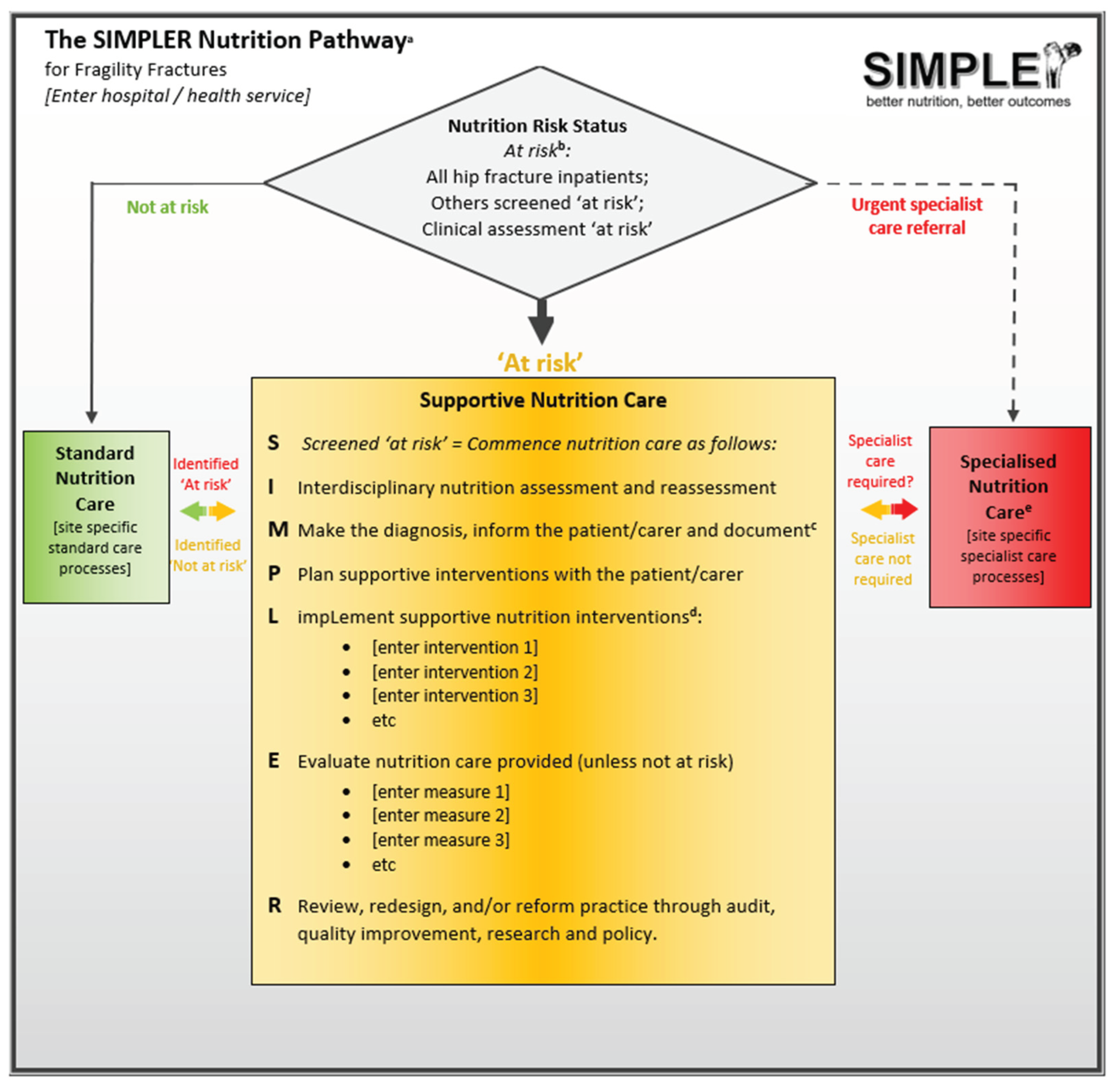

Table 1.
SIMPLER co-creation engagement processes.
| Process | Region: n |
|---|---|
| Semi-structured healthcare professional interviews (number of interview sets) | Global: 2 |
| Interprofessional workshops (number of workshops) | Global: 2 Asia Pacific: 4 Europe: 3 North America: 1 |
| Interprofessional focus group meetings (number of meetings) | Global: 4 North America: 1 Europe: 3 Asia-Pacific: 1 |
| Site support meetings (number of meetings) | Asia Pacific: 6 Europe: 14 South America: 2 |
| Webinars (number of webinars) | Asia Pacific: 3 Europe: 3 |
| Plenary / keynote / symposia /platform presentations (number of presentations) |
Global: 4 Asia-Pacific 10 Europe: 12 North America: 2 South America: 1 |
| Web-based surveys, polls, and consensus processes (number conducted) |
Global: 5 Asia Pacific: 1 |
| Patient level audits | Asia Pacific: 2 |
| YouTubes, PodCasts | Global:6 AsiaPacific: 7 |
| Web-based and face to face Education Modules and Lectures (number conducted) |
Global: 1 Europe: 1 Asia-Pacific: 1 |
| Strategic meeting presentations (FFN Executive / Board, Regionalisation, Education, Scientific Committees; Special Interest Advisory Boards (number of presentations) | Global: 6 Europe: 4 Asia-Pacific: 3 |
Table 2.
Evidence informed SIMPLER Nutrition Improvement Opportunities (The SIMPLER Six).
| Improvement opportunities | Evidence-informed rationale |
|---|---|
| 1. Avoid unnecessary, prolonged or repeat fasting | Unnecessary, prolonged, or repeated fasting is harmful and should be avoided [8,9,19,41,42,82]. |
| 2. Offer information about nutrition [risk] statusa | Up to one in two hip fracture patients are malnourished on admission to hospital; hip fracture patients rarely meet post operative nutritional requirements in the absence of early, interdisciplinary, multicomponent interventions [8,11,18,19,25,57]. Evidence suggests malnutrition screening tools have limited criterion validity in hip fracture; therefore all hip fracture patients should be treated as ‘at risk’ of malnutrition, and offered information about their nutrition risk status, until a systematic nutrition assessment is performed by a trained person [8,9,16,18,19,41,42,83]. This assessment should apply a tool validated for the purposes of diagnosing protein / energy malnutrition, as well as identifying ongoing nutrition risk factors, for example inadequate low intake, high requirements, or nutrient availability issues [51,53,55,84]. Following assessment, patients (or carers where appropriate) should be offered diagnostic advice regarding whether they are malnourished or remain at risk of malnutrition [18,19,85]. |
| 3. Offer information about nutrition interventionsa | Interdisciplinary, multicomponent interventions should be offered to all hip fracture patient unless assessed ‘not at risk’ or not in line with patient treatment preferences [8,9,18,19,41,42,86]. This should include provision of information or education to support informed consent, shared decision-making regarding treatment choices, and adherence to interdisciplinary, multicomponent interventions [85,86]. |
| 4. Offer high quality, high protein / energy food and fluids, with regular intake assessmenta |
All hip fracture inpatients, unless assessed as well-nourished and not at risk of malnutrition, should be offered high quality, appropriately textured, high protein / energy food and fluids, fortified food, additional snacks and/or finger foods to support adequate dietary intake [7,8,9,18,19,25,57]. Consumption of these should be assessed to support corresponding adjustment of interventions [18,19]. |
| 5. Offer oral nutritional supplements,* with regular intake assessmenta | All hip fracture inpatients, unless assessed as well-nourished and not at risk of malnutrition, should be offered oral nutritional supplements, in combination with dietary information/counselling and food fortification, to improved patient and healthcare outcomes [4,5,6,18,19]. Intake of these should be regularly assessed [18,19]. |
| 6. Offer malnutrition [risk] status and treatment plan to be provided to preferred post-hospital health care providerb | Ongoing nutrition care should be offered to all inpatients who remain at risk of malnutrition or malnourished at time of discharge from hospital [18,19]. Where consent is provided, a referral should be made to the patients preferred health care provider which includes their nutrition status and treatment plan [86]. |
Evidence strength varies across SIMPLER actions and reflects a combination of systematic reviews, expert consensus, and guideline recommendations. aWithin 72 hours of presentation (target 24 hours) with a hip fracture; unless already assessed well-nourished / not at risk. bOn or after discharge from hospital; unless assessed well-nourished / not at risk. cIf patient unable to answer, ask carer or treating nurse. dCompleted by interprofessional team members *Oral nutrition supplements are defined as protein and energy nutrient-dense products purposed to increase dietary intake when diet alone is likely to be inadequate to meet nutritional requirements. These may include energy and protein enriched drinks (e.g., milk, soy, protein-fortified juice flavours), powders, soups, and/or desserts [87].
Table 4.
Example SIMPLER Core Nutrition Care Measures for Hip Fracture patients.
| Core measure | Audit Source: medical record, bed chart, and/or discharge documentation |
Patient / carerc reported measure Source: Standardized PREM collected by designated person |
Treating cliniciand estimate example Source: Clinician survey (paper and/or electronic versions) |
|---|---|---|---|
| Unnecessary, prolonged or repeat fasting? [8,9,18,19,39,82,88,89,90] | Fasted for more than about 6 hours before surgery, or fasted more than once? (No; Yes or not documented) |
Were your fasted for more than about 6 hours before your surgery, or fasted more than once? (No; Yes or not documented) |
What percentage of all hip fracture patients you have cared for in the past month are fasted for more than about 6 hours before surgery, or fasted more than once? 0-25 | 25-50 | 50-75 | 75-100 |
| Awareness of nutrition [risk] status? a [7,8,9,18,19,23,26,41,42,46,86] | Documented nutrition assessment and provision of malnutrition [risk] assessment to patient / caregiver? a (Yes; No or not documented) |
Anybody who is 65 or older who has had hip fracture surgery should have a nutritional assessment. Have you been provided with the results of your nutritional assessment? (Yes; No or don’t know) |
What percentage of all hip fracture patients you have cared for in the past month have had a nutrition [risk] assessment and are aware of their nutrition [risk] status? 0-25 | 25-50 | 50-75 | 75-100 |
| Provided with information / education about nutrition? a [7,8,18,19,23,26,41,42,46,59,60,61,91] | Documented provision of information / education about nutrition? a (Yes; No or not documented) |
Have you received any information or education about nutrition since you have been in hospital? (Yes; No or don’t know) | What percentage of all hip fracture patients you have cared for in the past month are provided with information / education about nutrition? 0-25 | 25-50 | 50-75 | 75-100 |
| Provided high protein / energy food and fluids and intake is regularly assessed? a[18,19,23,41,42,60,91] |
Documented evidence of provision of high protein / energy food and fluid choices and assessment of food and fluid intake? a (Yes; No or not documented) |
Are you receiving high quality, high protein food and fluid choices, and has anybody asked you how much you have been eating? (Yes; No or don’t know) |
What percentage of all hip fracture patients you have cared for in the past month have received high protein/energy foods and have had their intake assessed within 72 hours of surgery? 0-25 | 25-50 | 50-75 | 75-100 |
| Provided with oral nutritional supplements* and intake is regularly assessed? a [4,5,6,18,19,41,42,60,91,92] |
Documented evidence of provision of supplements and assessment of supplement intake? a (Yes; No or not documented) |
Are you receiving oral nutrition supplements and have you been asked about your intake of these? (Yes; No or don’t know) |
What percentage of all hip fracture inpatients you have cared for in the past month have been provided oral nutritional supplements and have had their intake of these assessed within 72 hours of surgery and weekly thereafter? 0-25 | 25-50 | 50-75 | 75-100 |
| Malnutrition [risk] status and nutrition plan provided to a post-hospital health care professional? b [8,18,19,23,41,42,86] |
Evidence of malnutrition [risk] status and nutrition plan in hospital discharge summary / discharge letter or other discharge documentation? (Yes; No or not documented) |
Has anybody asked you if they can give your nutrition diagnosis and plan to your preferred post-hospital health care provider? (Yes; No or don’t know) |
What percentage of malnourished (or still at risk) hip fracture patients have had their malnutrition (risk) status documented in their medical discharge summary and have a nutrition treatment plan included in their discharge paperwork? 0-25 | 25-50 | 50-75 | 75-100 |
aWithin 72 hours of presentation with a hip fracture and weekly thereafter; unless already assessed well-nourished / not at risk. bOn or after discharge from hospital; unless assessed well-nourished / not at risk. cIf patient unable to answer, ask carer or treating nurse. dCompleted by interprofessional team members *Oral nutrition supplements are defined as protein and energy nutrient-dense products purposed to increase dietary intake when diet alone is likely to be inadequate to meet nutritional requirements. These may include energy and protein enriched drinks (e.g., milk, soy, protein-fortified juice flavours), powders, soups, and/or desserts.
Disclaimer/Publisher’s Note: The statements, opinions and data contained in all publications are solely those of the individual author(s) and contributor(s) and not of MDPI and/or the editor(s). MDPI and/or the editor(s) disclaim responsibility for any injury to people or property resulting from any ideas, methods, instructions or products referred to in the content. |
© 2025 by the authors. Licensee MDPI, Basel, Switzerland. This article is an open access article distributed under the terms and conditions of the Creative Commons Attribution (CC BY) license (http://creativecommons.org/licenses/by/4.0/).
Copyright: This open access article is published under a Creative Commons CC BY 4.0 license, which permit the free download, distribution, and reuse, provided that the author and preprint are cited in any reuse.