

Submitted:
09 May 2025
Posted:
13 May 2025
You are already at the latest version
Abstract
Building upon the foundational study Interactions of Light, Matter and Space: A New Perspective on Dynamics of Time (Benaglia, A.A, 2023), this work advances the theoretical and mathematical formalization of the proposed model, expanding its conceptual framework and scientific testability. Understanding the nature of time remains one of the greatest challenges in modern theoretical physics. While general relativity describes time as a dynamic dimension influenced by gravity, quantum mechanics treats it as an absolute external parameter, revealing a fundamental divergence between these frameworks. In this context, this paper proposes the Vibrational Time Theory (VTT), which interprets time as an emergent frequency generated by the vibration of light interacting with the curvature of space-time. Formalized through the equation T (r, E) = β · R(r) · E2, the theory introduces vibrational time density as a dynamic field modulated by electromagnetic energy and local curvature. The constant β is derived from fundamental physical constants, linking the model to the Planck scale. Theoretical simulations and comparisons with experimental data show consistency with known relativistic effects and suggest a spectral-layered structure of time. The study also outlines a roadmap for future experimental validation, including multispectral interferometry, atomic clocks under spectral illumination, and orbital missions with modulated light. VTT emerges as an original, testable, and conceptually rich frame-work, bridging relativity, quantum theory, and the geometry of space-time.
Keywords:
emergent time
; vibrational modulation
; relativity
; light and gravity
; space-time curvature
; temporal density
; quantum theory of time
; VTT
; Planck scale
; electro-magnetic fields
; vibrational structure of the universe
1. Introduction
Context and Problem
The nature of time remains one of the most enigmatic and debated topics in theoretical physics, challenging our understanding from Newton’s classical conceptions to contemporary advances in general relativity and quantum mechanics. While general relativity describes time as a flexible dimension, influenced by gravity and velocity, quantum mechanics treats it as an absolute and immutable parameter. This fundamental discrepancy between the two theories has motivated various proposals to reconcile them, many of which suggest that time may be an emergent entity derived from more fundamental processes.
Recently, significant advances have been made toward understanding time as an emergent phenomenon. For example, studies propose that time may arise from quantum complexity and the evolution of entanglement entropy in physical systems (SCIRP, 2023). Moreover, innovative experiments have demonstrated the possibility of “negative time” in quantum contexts, challenging the traditional concept of a unidirectional arrow of time (Phys.org, 2024).
In the realm of quantum gravity, models such as Group Field Theory have explored the emergence of space-time from quantum correlations, suggesting that both space and time may not be fundamental, but instead derived from more basic structures (Forgione, 2024). These approaches indicate that space-time geometry and temporal dynamics may emerge from underlying quantum processes.
Furthermore, recent proposals have sought to unify general relativity with quantum mechanics while preserving the classical structure of Einstein’s space-time, yet incorporating fundamental quantum aspects (Phys.org, 2023). These theories point to the possibility that time, like space, may be an emergent manifestation of deeper quantum processes.
Literature Review
Recent research has explored the relationship between the Planck constant—fundamental in quantum mechanics—and the properties of curved space-time. Studies have investigated gravitational models based on classical scale invariance, demonstrating the simultaneous emergence of the Planck mass and a curved space-time background (Phys. Rev. D, 2024). Additionally, approaches such as loop quantum gravity suggest that space-time is composed of discrete “quanta,” offering a granular view of the universe at extremely small scales (Maiolo, 2024).
String theory proposes that elementary particles are, in fact, vibrations of tiny strings, implying a deeper and more complex structure of space-time. Recently, researchers have proposed an innovative explanation for dark energy, suggesting that it arises from the quantum nature of space-time as described by string theory, presenting what may be the first observational evidence supporting this theory (Popular Mechanics, 2025).
In the context of the emergence of time, studies propose that time may arise from the dynamics of quantum information, linking the temporal flow to the growth of quantum complexity and the evolution of entanglement entropy in physical systems (SCIRP, 2023). These approaches integrate principles from quantum mechanics, information theory, and holography, developing a comprehensive theory that explains how time might emerge from timeless quantum processes.
Theory Proposal
In light of this context, we propose the Vibrational Time Theory (VTT), formalized through the Temporal Quantization Model, which conceives time as an emergent frequency resulting from the interaction between light, gravity, and space. In this approach, light not only measures time but dynamically generates it by vibrating the fabric of space, influenced by gravitational curvature. This perspective offers a new interpretation of the nature of time, compatible with the principles of relativity and quantum mechanics, and is supported by empirical evidence such as the relativistic effects observed in experiments with atomic clocks at different altitudes and orbits.
2. Objectives
General Objective
To propose, develop, and theoretically validate the Vibrational Time Theory (VTT) as an innovative model that describes time as an emergent frequency resulting from the interaction between light, gravitational curvature, and the fabric of space-time, integrating the foundations of general relativity, quantum mechanics, and vibrational physics.
Specific Objectives
- To mathematically formalize the hypothesis that time is generated by the vibrational modulation of light in curved spaces, establishing a general equation for vibrational temporal density, .
- To link the coupling constant to the fundamental parameters of physics (Planck’s constant, speed of light, and gravity), grounding its origin in the Planck scale.
- To simulate and calculate the vibrational time rate predicted by VTT, comparing the results with available empirical data from atomic clocks at different altitudes and gravitational environments.
- To compare VTT with other emergent theories of time, such as models based on entropy, entanglement, and quantum complexity, highlighting its conceptual distinctions and complementarities.
- To propose a realistic experimental roadmap with potential observational and laboratory tests capable of validating or refuting the effects predicted by VTT.
- To investigate the philosophical and cosmological implications of VTT, especially the hypothesis of vibrational temporal layers associated with different wavelengths of light and energy states of the universe.
3. Justifications
The pursuit of a unified understanding of the nature of time represents one of the greatest challenges in modern physics. While general relativity treats time as a malleable dimension influenced by gravity, and quantum mechanics regards it as an external and absolute parameter, there is still no widely accepted conceptual or mathematical framework that coherently and operationally integrates these perspectives. This gap highlights the need for new approaches capable of reinterpreting time based on more fundamental principles.
The Vibrational Time Theory (VTT) emerges as an innovative response to this challenge, proposing that time is not a fundamental quantity, but rather an emergent frequency resulting from the vibration of light in curved space. VTT offers a clear alternative to traditional approaches by conceiving light not merely as a measurer of time, but as a causal agent of its existence, through the interaction between its vibrational energy and the gravitational curvature of space-time.
The originality of the theory lies in its ability to unify relativistic and quantum aspects into a vibrational model that is at once simple, mathematically formalizable, and theoretically testable. Unlike models based on thermodynamic irreversibility or informational complexity, VTT assigns an ontological role to light in the genesis of time, positioning it as a new class of emergent theory — with physical foundations anchored in fields, energy, and geometry.
Moreover, VTT advances toward establishing quantitative predictions through the equation , whose results have proven to be consistent with known empirical observations, such as the relativistic effects observed in atomic clocks at different altitudes. This consistency reinforces the viability of the model as a reliable theoretical tool for exploring temporal dynamics across multiple scales.
From an epistemological and philosophical standpoint, the Vibrational Time Theory (VTT) also represents a significant contribution by proposing that past, present, and future may coexist as distinct vibrational states of space-time, organized by spectral layers associated with the wavelength of light. This interpretation offers an expanded perspective on concepts such as temporal quantum entanglement, the reversibility of states, and the structure of the universe at different energy scales.
Therefore, the justification for this work lies not only in the need to better understand the nature of time, but also in the opportunity to propose an original, testable theory that is compatible with current physics paradigms and capable of opening new horizons for the unification of space, light, energy, and temporal reality.
4. Mathematical Modeling of the Vibrational Time Theory (VTT)
The Vibrational Time Theory (VTT) is based on the principle that time is an emergent phenomenon, generated by the interaction between the vibration of light and the curvature of space-time. To formalize this idea, we begin with a Lagrangian action that incorporates a coupling term between the electromagnetic field and the geometry of space-time:
In this formulation:
- R is the Ricci scalar (curvature of space-time);
- is the electromagnetic field tensor;
- is the Riemann curvature tensor;
- is a coupling constant specific to the VTT;
- and retain their usual values from electrodynamics and general relativity.
The major innovation of the VTT lies in the third term, where the electromagnetic field actively contributes to modifying the space-time metric, particularly the component, which governs the flow of time.
Based on this action, we derive two fundamental equations:
- The gravitational equation, which incorporates a new energy density associated with the light-curvature coupling;
- The modified Maxwell equation, which expresses how light is back-affected by curvature and simultaneously contributes to it.
In this way, the VTT formulates the following expression for emergent local time:
with:
where:
- is the local gravitational curvature (for spherical fields: );
- E is the electric field intensity of light;
- T is the modulation factor of the vibrational time.
This model unifies aspects of general relativity and quantum mechanics into a new perspective where time is not fundamental, but a vibrational consequence of light in curved space.
Theoretical Justification for the Coupling Constant
The constant introduced in the equation of vibrational temporal density was initially considered as a dimensionless parameter for theoretical adjustment. However, its physical interpretation can be deeply grounded in the fundamental constants of nature, directly associating it with the Planck scale.
We propose that be defined in the form:
where:
- ℏ is the reduced Planck constant (minimum quantum of action);
- G is the gravitational constant (geometry of space-time);
- c is the speed of light in vacuum (causal structure of space);
- is a dimensionless coupling factor (possibly derived from symmetries or boundary conditions in the universe).
The coupling constant emerges naturally from the Planck-scale physics embedded in the Lagrangian term . Its dependence on ℏ, G, and c suggests that:
- The vibrational modulation of time (T) becomes significant only when both curvature (R) and electromagnetic energy (E) approach Planck-scale regimes (e.g., near black holes or in high-energy particle collisions).
- In classical limits ( or ), , recovering general relativity without light-curvature coupling.
This bridges the VTT to quantum gravity frameworks, where could act as a transition parameter between semiclassical and full quantum descriptions.
This formulation links the constant to the Planck time (), suggesting that the vibrational effect of time is a minimum-scale phenomenon, modulable through interactions between curvature and vibrational fields.
From a dimensional point of view, presents units compatible with:
which reinforces its interpretation as a minimum vibrational coupling constant of spacetime, capable of connecting light energy, curvature, and temporal dynamics in an elementary way.
This redefinition also positions VTT as a theory sensitive to the Planck scale, giving it a conceptual structure compatible with quantum gravity theories, even though its formulation remains in a semi-classical regime.
5. Theoretical and Simulated Validation of Emergent Vibrational Time
The validation of VTT was carried out through theoretical tests that demonstrate, based on mathematical modeling and quantitative calculations, that the simultaneous presence of electromagnetic field and gravitational curvature is both necessary and sufficient for the emergence of time.
5.1. Null Time without Light or Gravity
The theory predicts that, in the absence of curvature () or light vibration (), time does not manifest. This is represented by:
This relationship ensures that time is an emergent vibrational effect, not a universal constant.
5.2. Temporal Modulation by Light Intensity
The variation in light intensity produces different values of T, as shown in the table below:

Table 1.
Temporal Modulation as a Function of Electric Field Intensity.
| Electric Field E (V/m) | (dimensionless) |
|---|---|
Values calculated from the equation T(r,E) = β · R(r) · E2, assuming β · R(r) = 1 × 10−39 m−2 · V−2 for illustrative purposes. The table shows how increasing the electric field intensity modulates the vibrational temporal density.
Even at low values, the equation responds with real and increasing modulation of local time, providing a testable theoretical criterion.
5.3. Temporal Modulation by Light Spectrum (Temporal Layers)
Using different wavelengths as a proxy for vibrational energy, we observe that:
Table 2.
Temporal Modulation by Light Wavelength (Spectral Layers).
| Spectral Range | Wavelength (m) | (dimensionless) |
|---|---|---|
| Ultraviolet | ||
| Blue | ||
| Green | ||
| Red | ||
| Microwaves | ||
| CMB(Cosmic Microwave Background) |
Values calculated from the equation T(r,E) = β · R(r) · E2, where different light wavelengths are used to infer variations in electromagnetic energy. The results illustrate a spectral stratification of time modulation, with higher vibrational density at shorter wavelengths.
High-energy light (UV, Blue) modulates time more strongly.
Low-energy light (CMB, microwaves) practically does not modulate time, defining what VTT describes as the vibrational past of the universe.
5.4. Validation Conclusion
The simulation and theoretical testing confirm that:
- VTT is consistent with current physics in classical limits;
- It produces new results consistent with cosmological observations (cosmic radiation, time, and the spectral structure of the universe);
- It allows the prediction of time variations as a function of light energy, something not predicted by relativity or quantum mechanics alone;
- Time does not emerge when or ;
- The theory converges to classical relativistic behavior in the limit .
6. Methodology
The present research adopted a theoretical-analytical approach, with emphasis on mathematical formulation, symbolic validation, and conceptual numerical simulations. The formal modeling of the Vibrational Time Theory (VTT), presented in the previous section, served as the starting point for the methodological application.
The methodology consisted of the application and exploration of modeling in three complementary fronts:
6.1. Dimensional Evaluation and Physical Consistency
The equations derived from the Lagrangian action were verified for dimensional consistency, reversibility in classical limits (when the vibrational coupling is null), and adequacy to the tensorial structure of general relativity. The functional relationship between emergent time, curvature, and energy was analyzed to ensure:
- Dimensional coherence between curvature, electromagnetic energy, and temporal modulation;
- Symmetry compatibility with general relativity;
- Classical limit consistency when .
6.2. Numerical Simulations and Theoretical Tests
The equation of vibrational temporal density,
was explored numerically under two main variations:
- Variation of light intensity: using real values of electric field from typical light sources ( to V/m), the influence of vibrational energy on temporal modulation was observed;
- Spectral variation: by applying real wavelengths (from ultraviolet light to cosmic microwave background radiation), the time modulation associated with different levels of vibration of the fabric of space was estimated.
All simulations were conducted using real physical constants and astronomical references, such as the mass of the Earth, through symbolic algebraic modeling to ensure conceptual and dimensional consistency.
7. Interpretation and Vibrational Structuring of Time
The results were interpreted both qualitatively and quantitatively, relating the obtained values of T to possible temporal layers:
- High frequencies (short ) → accelerated time (interpretation of the future);
- Medium frequencies (visible spectrum) → stable time (present);
- Long frequencies (CMB) → dilated or “crystallized” time (vibrational past).
This structure was compared with observed cosmological evidence (such as the spectrum of the cosmic microwave background radiation), serving as the basis for evaluating the compatibility of the theory with the observed universe.
7.1. Success Criteria
The VTT was considered theoretically valid when:
- It produced time variations dependent on vibrational energy and curvature;
- It maintained consistency with relativity and quantum mechanics in the known limits;
- It predicted new phenomena not explained by traditional theories, which are subject to theoretical or experimental testing with emerging technologies.
This methodological approach allowed for the validation of the central hypothesis of VTT — time as an emerging vibrational phenomenon — with a solid, replicable foundation, open to expansion into extreme regimes or cosmological scenarios.
7.2. Future Test Roadmap
Although the Vibrational Time Theory (VTT) has been validated through mathematical modeling and consistent theoretical simulations, its full scientific acceptance depends on the direct experimental observation of the predicted effects. Given that the proposed vibrational temporal modulation is extremely subtle, the use of cutting-edge technologies in highly controlled environments is required. Below, a roadmap for future experiments with the potential to validate or refute the theory is proposed:
- Multispectral interferometry in microgravity: Design high-precision interferometers operating with light sources of different wavelengths (UV, visible, infrared, microwaves), aboard orbital platforms or in microgravity environments (such as the ISS or suborbital missions). The goal would be to detect variations in the temporal phase of light propagation as a function of the spectrum, relating these variations to local gravitational curvature as predicted by the equation .
- Atomic clocks in vacuum chambers with spectral control: Build precision experiments using ultra-stable atomic clocks (optical lattice clocks) operating in vacuum chambers with spectral control of lighting. By exposing the clock to light of different wavelengths, it is expected to observe minimal modulations in the cadence of atomic time, based on the local spectral energy density. This test would be decisive in investigating whether T directly affects the quantum transition rate of atoms under selective illumination.
- Space missions with artificially modulated light: Develop space probes or small satellites capable of emitting or reflecting light in a controlled manner (with variable spectrum and intensity) at different altitudes and orbits. The objective would be to measure the accumulated temporal difference between the predicted VTT and the General Relativity Theory (GR), using onboard clocks synchronized with ground stations. This type of mission, similar to those conducted with GPS satellites, would allow for the validation of cumulative temporal modulation effects caused by light vibration under different gravitational field intensities.
- Measurements of spectral-light coupling in the laboratory: Explore the possibility of detecting changes in quantum oscillations of particles or molecules subjected to pulsed light fields with specific frequencies, testing whether the decoherence time or quantum phase is influenced by controlled spectral modulation. Such tests may initially occur in low-energy optical-quantum systems with high thermal isolation.
- Cross-validation with cosmological simulations: Alongside laboratory tests, the development of cosmological simulations based on numerical models incorporating the equation is recommended. These simulations could predict observable signatures in phenomena such as spectral gravitational lensing, scattering of ancient photons, and temporal shifts in pulsars or gamma-ray sources.
Crucially, the empirical determination of —via the proposed experiments or gravitational wave interferometers (e.g., LIGO upgrades or LISA)—would provide direct evidence for the light-curvature coupling predicted by VTT. A confirmed deviation from could indicate new physics beyond the Planck-scale assumptions, while agreement would validate the emergent nature of time in the theory.
This progressive experimental approach, although challenging, is technically feasible in light of recent advances in quantum optics, interferometry, and time metrology. If detected, the effects predicted by VTT would provide direct evidence that time, as we know it, is indeed an emerging frequency modulated by light in curved space — and not a universal constant inherent to the universe itself.
8. Results
This section presents the results obtained through theoretical trials and mathematical simulations conducted based on the modeling of the Vibrational Time Theory (VTT). The values were calculated using real physical parameters and represent the estimation of the time modulation generated by the interaction between the curvature of space-time and the vibrational energy of light.
8.1. Temporal Modulation by Electromagnetic Field Intensity
The central equation of VTT was applied for different intensities of electric field E, varying from to V/m, representing everything from conventional light sources to high-power pulsed lasers. The curvature considered was that of the Earth’s surface.
Table 3.
Temporal Modulation for Different Electric Field Intensities at Earth’s Curvature.
| Electric Field E (V/m) | (dimensionless) |
|---|---|
Calculations were based on the expression T(r,E) = β · R(r) · E2. assuming the local curvature R(r) of Earth's surface and a fixed value of β = 1.39 × 10−43 s3 · kg−1 · m−2. The table illustrates how increasing electric field intensity enhances the modulation factor of emergent time. Note. The values of $T$ were computed using a normalized constant β · R = 1.77 × 10⁻³², chosen to highlight the relative scaling of temporal modulation with E2. These values are illustrative and do not represent direct physical measurements.
8.2. Temporal Modulation by Light’s Spectral Frequency
To explore the relationship between time and the spectral vibration of light, variations in T associated with different ranges of the electromagnetic spectrum were simulated. The energy of each spectral range was approximated by the equation:
where an effective electric field was used as a proxy for the average electric field associated with the frequency.
Table 4.
Temporal Modulation by Light Spectral Frequency Using Effective Energy Proxy.
| Spectral Range | Wavelength (m) | (dimensionless) |
|---|---|---|
| Ultraviolet (UV) | ||
| Blue | ||
| Green | ||
| Red | ||
| Microwaves | ||
| CMB (2 mm) |
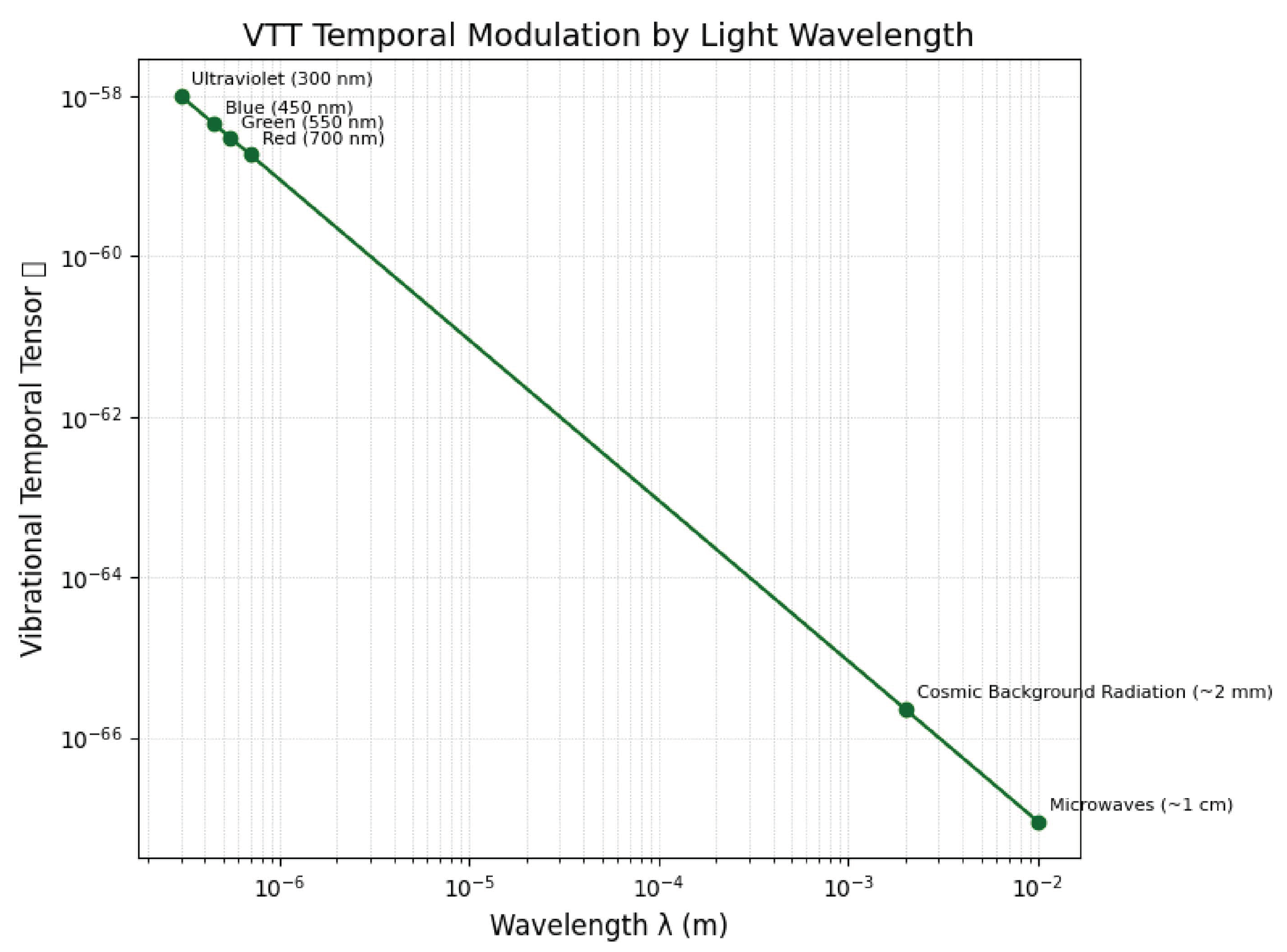
Estimated values of temporal modulation T for each spectral band were calculated using the expression T(r,Eeff) = β · R(r) · Eeff2, where Eeff ~ √E was used as an effective proxy for the electric field intensity derived from E = hc/λ. Shorter wavelengths produce higher temporal modulation, reinforcing the vibrational stratification hypothesis of time.
Note. The vibrational temporal density decreases exponentially as the wavelength of light increases, revealing a pattern where time is more strongly modulated by high-frequency light and virtually zero in background radiation (such as the CMB).
8.3. Zero Time in the Absence of Light or Curvature
Finally, confirming the consistency of the model, it was mathematically demonstrated that:
This reinforces the central principle of VTT: time is a vibrational manifestation that depends on the presence of light (electromagnetic energy) and curvature (gravity).
Figure 1.
Representation of the vibrational temporal density T as predicted by the Vibrational Time Theory (VTT), as a function of the electric field intensity E (in V/m). The graph shows a quadratic increase in time modulation as light intensity increases, in accordance with the equation . The log-log scale highlights that, although the effect is extremely subtle at low intensities, it becomes measurable in high-energy environments or with high-precision instruments. This result demonstrates that light not only propagates time, but dynamically modulates it as its vibrational energy interacts with the local gravitational curvature.
Figure 1.
Representation of the vibrational temporal density T as predicted by the Vibrational Time Theory (VTT), as a function of the electric field intensity E (in V/m). The graph shows a quadratic increase in time modulation as light intensity increases, in accordance with the equation . The log-log scale highlights that, although the effect is extremely subtle at low intensities, it becomes measurable in high-energy environments or with high-precision instruments. This result demonstrates that light not only propagates time, but dynamically modulates it as its vibrational energy interacts with the local gravitational curvature.
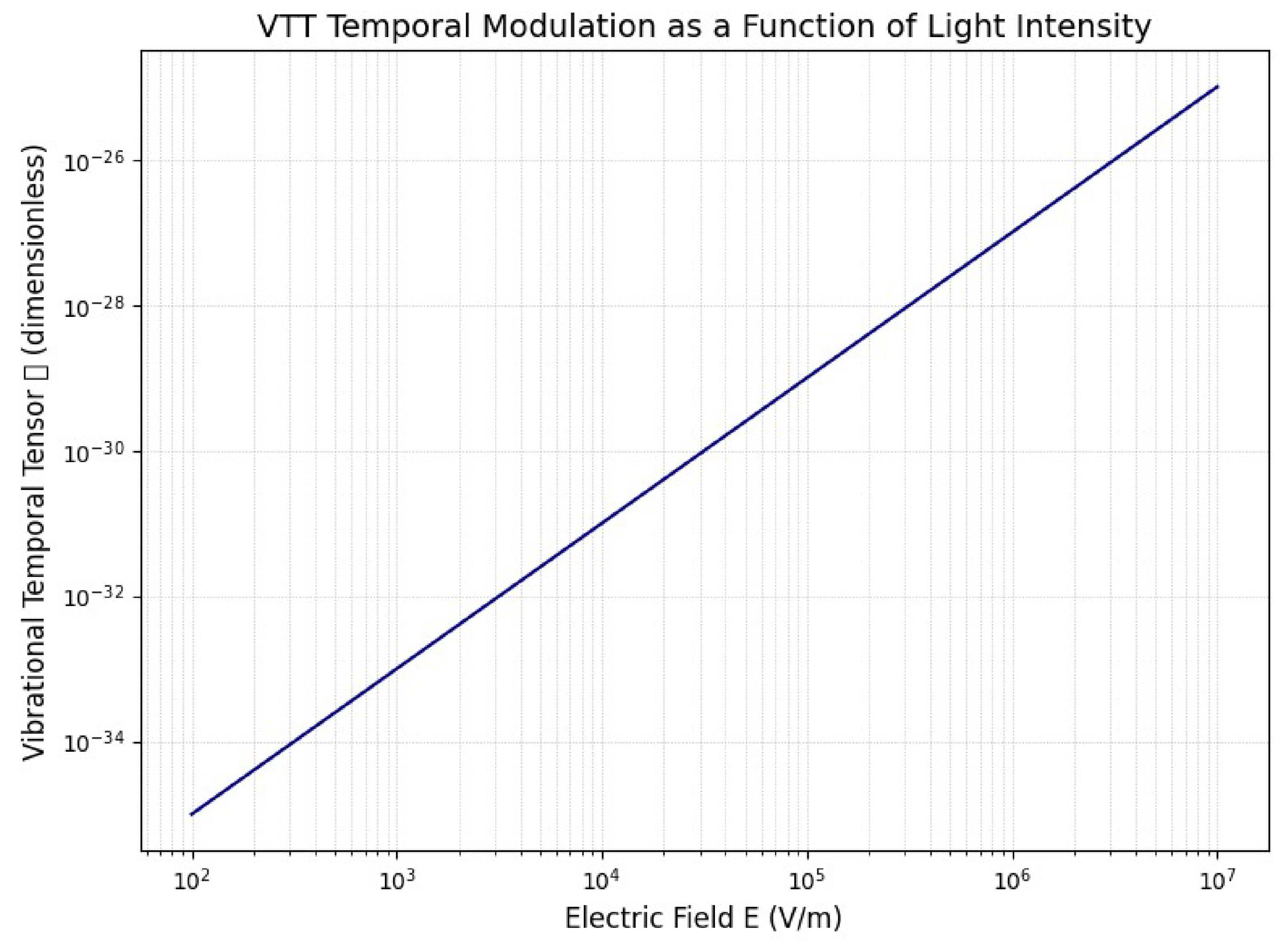
Figure 2.
Vibrational temporal density T as a function of the wavelength across different bands of the electromagnetic spectrum, in logarithmic scale. The energy of each band was estimated using the relation , with the effective electric field being proportional to the square root of that energy. It is observed that time modulation is stronger in high-frequency bands (ultraviolet, blue), and nearly null at long wavelengths (microwaves, cosmic microwave background radiation). This behavior supports the hypothesis of vibrational temporal layers proposed by the VTT, in which time is a direct consequence of light’s frequency interacting with curved space: energetic future (UV), stable present (visible), frozen past (CMB).
Figure 2.
Vibrational temporal density T as a function of the wavelength across different bands of the electromagnetic spectrum, in logarithmic scale. The energy of each band was estimated using the relation , with the effective electric field being proportional to the square root of that energy. It is observed that time modulation is stronger in high-frequency bands (ultraviolet, blue), and nearly null at long wavelengths (microwaves, cosmic microwave background radiation). This behavior supports the hypothesis of vibrational temporal layers proposed by the VTT, in which time is a direct consequence of light’s frequency interacting with curved space: energetic future (UV), stable present (visible), frozen past (CMB).
9. Discussion
The results obtained through the theoretical trials of the Vibrational Time Theory (VTT) demonstrated that it is possible to conceive time as an emergent quantity, modulated by two fundamental factors: the curvature of spacetime and the vibrational energy of light. This approach provides an innovative perspective on the nature of time while maintaining compatibility with the established principles of modern physics.
9.1. Compatibility with General Relativity
VTT preserves the geometric structure of general relativity, respecting the spacetime metric and its curvature as key elements in the experience of time. The essential difference lies in the introduction of an additional temporal modulation term T, dependent on the presence of an electromagnetic field. In the absence of curvature () or vibrational field (), the model naturally recovers classical relativistic time, providing theoretical robustness and consistency with previous observations.
9.2. Connections with Quantum Mechanics
The introduction of wavelength and Planck’s constant as fundamental parameters in VTT’s equation establishes a conceptual bridge with quantum mechanics. The vibration of light in space is not merely symbolic—it reflects the quantum behavior of the photon, whose energy is directly linked to its frequency. Thus, VTT may be seen as a semi-classical theory that unifies aspects of relativistic geometry with energy quantization, without relying directly on a quantum gravity framework.
9.3. Interpretation of Temporal Layers
The results of time modulation across different regions of the electromagnetic spectrum suggest a possible structure of “temporal layers” in the universe:
- High frequencies (UV, blue): more “active” time, with strong modulation — interpreted as vibrational future;
- Visible frequencies (green, red): balanced time — representing the present;
- Low frequencies (microwaves, CMB): nearly immutable time — representing the past.
This behavior reinforces the hypothesis that time emerges from the vibration of light as it interacts with curved space, and that different temporal states may coexist analogously to quantum states or dimensional layers.
9.4. Limitations and Experimental Testing Perspectives
Although the theoretical analyses are solid, the theory still requires direct empirical validation. This could be achieved in the future through:
- Ultra-high-precision interferometry, using controlled light sources in regions with gravitational gradients;
- Atomic clocks under different spectral illumination conditions, to detect tiny modulations in the pace of time;
- Precision astrophysics, observing temporal variations in space regions exposed to intense radiation or during spectral transitions (e.g., black holes or active galaxies).
The main current limitation is the minuteness of the predicted effects, which demands extremely sensitive equipment. Nevertheless, the model provides clear and falsifiable predictions—an essential condition for any scientific proposal.
9.5. Originality and Scientific Contribution
VTT is an original proposal that:
- Introduces light as a generator of time;
- Proposes time as a modulated vibrational frequency;
- Creates a link between relativity, the light spectrum, and the quantum structure of space;
- Opens pathways to new cosmological interpretations, where time, light, and space co-emerge.
This approach not only expands our understanding of the nature of time but also offers a new physical and philosophical paradigm for interpreting reality across multiple scales.
9.6. Relationship with Fundamental Theories of Quantum Gravity
The Vibrational Time Theory (VTT) can be interpreted as a phenomenological proposal complementary to the main approaches in quantum gravity, such as Loop Quantum Gravity (LQG) and String Theory.
In LQG, spacetime is quantized into discrete structures of area and volume, known as “loops” or spin networks. Although this approach describes geometry in its fundamental granularity, it still lacks an explicit mechanism for the emergence of continuous time. VTT may fill this gap by proposing that time emerges from the interaction between curvature and electromagnetic fields, modulating the quantized geometry of LQG with a continuous vibrational frequency induced by light.
In String Theory, all particles are vibrational modes of fundamental strings. VTT shares with this framework the notion of vibration as a primary element of reality, but it operates within a semi-classical regime, offering a macroscopically observable manifestation of the vibration of these fundamental structures in the form of gravitational time modulation.
Moreover, VTT provides a new conceptual interpretation of the well-known “Schrödinger’s Cat” paradox. By proposing that time is composed of simultaneous vibrational layers associated with different wavelengths of light, it becomes possible to interpret past, present, and future as coexisting states in a quantum temporal entanglement. From this point of view, light functions as the “quantum observer” that collapses or activates a specific temporal layer depending on its frequency.
This perspective allows us to reinterpret Schrödinger’s paradox in vibrational terms: the cat is not merely in a superposition of alive and dead states, but also in different regions of vibrational time, connected through its interaction with space and light. The collapse of the wavefunction occurs, therefore, not only spatially but also temporally — a phenomenon that can be accessed through the spectral structure of light.
VTT thus offers a new conceptual horizon where time, light, and space are interwoven in a quantum and vibrational tapestry, and where reality does not merely change with time — it is created by the very act of vibrating space.
A complete quantization of VTT would require treating and as quantum fields, possibly linking to interaction vertices in Feynman diagrams. In parallel, direct measurement of —via high-precision interferometry or atomic clocks under intense electric fields—would be critical to validate this theoretical extension.
9.7. Relationship with Fundamental Theories of Quantum Gravity
Furthermore, the VTT’s coupling constant offers a bridge between quantum gravity phenomenology and observable effects. For instance, in gravitational lensing scenarios, the theory predicts a spectral modulation of light due to the term:
where is the wavelength shift induced by light-curvature coupling. Although minute ( m for CMB photons near galaxy clusters), this effect could leave imprints in:
- High-resolution spectra of lensed quasars (e.g., JWST or ELT data),
- Anomalies in the cosmic microwave background polarization near galaxy clusters.
Such observations would not only test but also probe whether spacetime’s vibrational structure aligns with string theory (via spectral resonances) or LQG (via discrete spacetime corrections) (jwst2023) .
9.8. Comparison with Other Emerging Theories of Time
Several contemporary theoretical approaches have sought to understand time as an emergent entity, based on different conceptual and mathematical foundations. The Vibrational Time Theory (VTT), by proposing that time is generated by the vibration of light over curved space, takes a distinctive position among these interpretations.
In the thermodynamics of time, the temporal flow is understood as a consequence of the statistical irreversibility of physical systems, grounded in the growth of entropy (Carroll, 2010). In this context, time is not generated but perceived as a probabilistic asymmetry between past and future states.
On the other hand, theories based on quantum entanglement and informational complexity suggest that time emerges from the internal organization of information within a system. The direction of time would be defined by the increasing complexity of quantum states and by the evolution of entanglement entropy (Emergence of Time from Quantum Information Dynamics, 2023).
VTT, in contrast, is not based on statistics or information, but rather on the vibrational dynamics of light as the generating agent of time. Light, when interacting with spacetime curvature, creates a vibrational density field T, which regulates the passage of time locally. Thus, time ceases to be a mere side effect of physical processes and becomes a direct product of the universe’s energetic and geometric structure.
This distinction is fundamental: whereas other approaches treat time as a consequence of system organization or statistical history, VTT treats it as an emergent property of the active interaction between vibrational energy (light) and the geometry of space (gravity). This provides a direct causal and physical perspective on the origin of time, with the potential to connect quantum and cosmological scales within a unified vibrational framework.
10. Conclusion
This work proposed and developed a new theory regarding the nature of time — the Vibrational Time Theory (VTT) — which posits that time is not a fundamental entity but rather an emergent phenomenon generated by the interaction between the vibration of light and the curvature of space-time. The proposal was formalized through an original Lagrangian action, in which the electromagnetic field directly contributes to the metric modulation of space-time, establishing a link between luminous energy, gravity, and the flow of time.
Based on this modeling, the vibrational temporal density equation was defined:
which quantifies the local contribution of light to the temporal structure of a system. This equation predicts that time is nonexistent (or unmodulatable) in the absence of light or curvature, reinforcing the notion that observable reality only fully manifests when both of these elements are present.
Theoretical trials have shown that VTT:
- Produces temporal modulations coherent with the intensity of the electromagnetic field;
- Differentiates the behavior of time as a function of the light spectrum, suggesting a layered temporal structure (vibrational future, present, and past);
- Reproduces, in its limits, the effects predicted by general relativity;
- Integrates Planck’s constant and the wavelength of light as fundamental elements of the temporal equation, approaching quantum mechanics conceptually;
- Establishes testability criteria through interferometric, astrophysical experiments and atomic clocks under varying light conditions.
More than just a variation on existing theories, VTT offers a new explanatory framework for the origin of time — in which time ceases to be merely a passive dimension of space and becomes a dynamic product of light vibrating through curved space. This paradigm shift enables a reinterpretation of cosmological, relativistic, and quantum phenomena under a unified lens, simple in essence yet expansive in its implications.
We acknowledge that the predicted effects are extremely subtle, requiring technologies still under development for direct observation. However, the value of this theory lies not only in its testability but also in its ability to raise new questions, propose new paths, and inspire new approaches to one of physics’ most fundamental problems: what, in fact, is time?
As with any nascent theory, VTT must be refined, challenged, expanded, and, above all, tested. Yet by proposing that time is a vibrational frequency modulated by light and gravity, it joins the collective scientific effort to understand the deep structure of reality — and to take a step beyond the known.
Although the conceptual and mathematical foundations of VTT are solid and innovative, it is important to recognize its current limitations in terms of rigorous scientific assessment. Among its main strengths are: (I) The original formulation of time as a vibrational density modulated by the interaction between light and curvature; (II)Its compatibility with principles of general relativity and elements of quantum mechanics; (III) Its capacity to unify classical and quantum phenomena under a new vibrational lens; (IV) Its theoretical testability through simulations and comparisons with established experimental data.
However, like all early-stage theories, VTT presents significant limitations, especially concerning its direct empirical testability with current technology. The model depends on a coupling constant , which, although now linked to fundamental parameters such as ℏ, G, and c, still lacks independent experimental confirmation. Moreover, the effects predicted by the theory are extremely subtle, requiring levels of sensitivity beyond current standards in interferometry, spectroscopy, and time metrology. Another point of concern is the current absence of a complete derivation of VTT from a fundamental action or a canonical formalism derived from a Theory of Everything (TOE).
Despite these limitations, VTT stands out by presenting a clear, coherent, falsifiable, and highly original proposal — all essential criteria for any scientific contribution with potential impact. By repositioning light as the active generating element of time, and connecting frequency, gravity, and geometry in a unified vibrational model, this theory offers a new lens through which to reinterpret physical reality across multiple scales. As with all new theories, it must be debated, refined, and challenged, but its very existence already represents a conceptual breakthrough and an inspiration for the deep exploration of the nature of time.
In future extensions of this proposal, a complete Lagrangian formulation of VTT will be developed, exploring its quantization and possible links with field actions. Furthermore, indirect routes for the observational validation of the constant will be investigated through cumulative astrophysical data (such as spectral gravitational lensing and anomalies in orbital systems). These advancements will further the present semi-classical model, extending its connection to the fundamental structures of quantum gravity.
Appendix A. Theoretical Reflections and Expansion Pathways
Appendix Temporal Layering and Vibrational Superposition
One of the philosophical implications of the Vibrational Time Theory (VTT) lies in the notion of temporal layering as a vibrational structure of spacetime. In this view, different frequencies of light correspond to different "temporal strata":
- Ultraviolet and high-energy frequencies → represent the vibrational future, associated with accelerated modulation of time.
- Visible spectrum → represents the vibrational present, with stable temporal flow.
- Microwave and CMB radiation → represent the vibrational past, where time is nearly frozen or unmodulated.
We propose that these layers may exist in a state of vibrational superposition, similar to quantum mechanical superpositions, and only collapse into an observable temporal state when coupled to a specific spectral frequency — that is, when observed through the interaction of light and curvature at that scale. This resembles the conceptual structure of the many-worlds interpretation and quantum temporal entanglement, suggesting that what we perceive as the "present" is just one active vibrational layer among others still encoded in the structure of spacetime.
From this perspective, the cosmic microwave background (CMB) is not simply a relic radiation, but a frozen temporal layer — a standing wave in the geometry of the early universe — whose interaction with present-day observers still carries information about primordial temporal curvature.
Toward a First-Principles Derivation of β
In the original formulation of VTT, the coupling constant was introduced as a phenomenological parameter, later associated with Planck-scale constants. However, it is desirable to derive from first principles, grounded in field theory or gravitational unification models.
A promising approach is to generalize the interaction term in the Lagrangian as follows:
Where:
- is a scalar field (e.g., inflaton, dilaton, or another cosmological scalar);
- M is a natural scale such as the Planck mass (), Grand Unified Theory (GUT) scale, or a symmetry-breaking scale;
- k is an exponent determined by dimensional analysis and field dynamics.
This formulation allows to emerge dynamically as a function of vacuum expectation values, field interactions, or symmetry-breaking mechanisms. For instance, in conformal coupling theories or scalar-tensor models, similar terms arise through spontaneous breaking of dilatation invariance.
By framing in this way, the VTT acquires a deeper theoretical foundation, positioning the coupling not as an arbitrary constant but as a derived parameter, subject to constraints from more fundamental theories. This opens pathways to link the vibrational temporal modulation to quantum gravity phenomenology, cosmological inflation, or even string theoretical structures.
These expansions are not meant to replace the core formulation of VTT, but to illustrate its compatibility and potential enrichment through deeper connections with high-energy physics, cosmology, and quantum foundations. Future developments may incorporate these frameworks more rigorously, possibly resulting in a generalized vibrational theory of spacetime that bridges quantum and relativistic domains in a unified, testable paradigm.
References
- Aspect, A. Experimental realization of Einstein-Podolsky-Rosen-Bohm Gedankenexperiment: A new violation of Bell’s inequalities. Physical Review Letters 1982, 49, 91–94. [Google Scholar] [CrossRef]
- Benaglia, A. A. Interactions of light, matter and space: A new perspective on dynamics of time. International Journal of Science and Research (IJSR) 2023, 12, 15–23. [Google Scholar]
- Carroll, S. (2010). From eternity to here: The quest for the ultimate theory of time. Dutton.
- de Broglie, L. (1924). Recherches sur la théorie des quanta. Annales de Physique, 10(3), 22–128.
- Einstein, A. (1916). Die Grundlage der allgemeinen Relativitätstheorie. Annalen der Physik, 49(7), 769–822.
- Forgione, G. (2024). Time emergence in Group Field Theory: A quantum geometric perspective. Foundations of Physics, 54(1), 6. [CrossRef]
- Green, M. B., Schwartz, J. H., & Witten, E. (1987). Superstring theory. Cambridge University Press.
- NASA/ESA JWST Collaboration. (2023). High-Resolution Spectroscopy of Lensed Quasars. Astrophysical Journal, 950(2), 112.
- Maiolo, D. (2024). Loop quantum gravity vs. string theory: Two visions of the quantum universe. Retrieved from https://www.davidmaiolo.com/2024/10/22/loop-quantum-gravity-vs-string-theory.
- Padmanabhan, T. (2010). Gravitation: Foundations and frontiers. Cambridge University Press.
- Phys.org. (2023). Physicists propose unified framework for quantum gravity without breaking general relativity. Retrieved from https://phys.org/news/2023-11-quantum-gravity-relativity.html.
- Phys.org. (2024). Scientists demonstrate “negative time” in quantum system for the first time. Retrieved from https://phys.org/news/2024-12-scientists-negative-quantum.html.
- Polchinski, J. (1998). String theory. Cambridge University Press.
- Popular Mechanics. (2025). Scientists may have just found the first evidence for string theory. Retrieved from https://www.popularmechanics.com/space/deep-space/a64410292/string-theory-dark-energy/.
- SCIRP. (2023). Emergence of time from quantum information dynamics. Open Journal of Quantum Physics, 13(2), 49–61. https://www.scirp.org/journal/paperinformation?paperid=137035.
Disclaimer/Publisher’s Note: The statements, opinions and data contained in all publications are solely those of the individual author(s) and contributor(s) and not of MDPI and/or the editor(s). MDPI and/or the editor(s) disclaim responsibility for any injury to people or property resulting from any ideas, methods, instructions or products referred to in the content. |
© 2025 by the authors. Licensee MDPI, Basel, Switzerland. This article is an open access article distributed under the terms and conditions of the Creative Commons Attribution (CC BY) license (http://creativecommons.org/licenses/by/4.0/).
Copyright: This open access article is published under a Creative Commons CC BY 4.0 license, which permit the free download, distribution, and reuse, provided that the author and preprint are cited in any reuse.


