

Submitted:
10 May 2025
Posted:
12 May 2025
You are already at the latest version
Abstract
Over 35 years of history, the field of gene therapy has undergone much progress. The initial concept, the replacement of dysfunctional genes with the correct ones, was advanced to the next stages and reached the level of precise genome editing. Dozens of gene therapy products based on viral and non-viral delivery platforms have been approved, marking the dawn of the gene therapy era. These viral vector strategies rely on adenoviruses, adeno-associated viruses, lentivirus-derived tools, and so on. From the middle of the gene therapy transition, despite the challenges and serious negative consequences, the lentiviral vector has emerged as a cornerstone and demonstrated its benefits from basic science to gene therapy. Therefore, we outlined the importance of lentiviral vectors in the gene therapy era by focusing on the role of the lentiviral vectors in clinical usage, derivation, and development of the next-generation platforms, as well as pseudotyping.
Keywords:
gene therapy
; lentiviral vector development
; pseudotyping
1. Gene Therapy Era and Lentiviral Vectors
The United States (US) Food and Drug Administration (FDA) broadly defines human gene therapy as a therapeutic technique that modifies or manipulates the expression of a gene or alters the biological properties of living cells. The guidance also included gene therapy products to achieve a therapeutic or prevention effect by the transcription or translation of transferred genetic material or altering human genetic sequences [1]. According to the European Medicines Agency (EMA) regulatory document, gene therapy medicinal products contain recombinant nucleic acid or a substance used to regulate, repair, replace, add, or delete a genetic sequence for therapeutic, prevention, and diagnostic purposes. Its effect is directly related to the genetic sequence or its expression product [2]. Both the FDA and EMA guidelines widely consider recombinant nucleic acids (e.g., plasmids DNA, RNA), genetically modified microorganisms (e.g., viruses, bacteria, fungi), engineered site-specific nucleases, and ex vivo genetically modified human cells to be human gene therapy products, except for vaccines against infectious diseases [1,2]. At the end of 2024, 55 gene therapy products have been approved, excluding non-genetically engineered cell therapy and vector vaccines, and we have categorized them into three developmental stages (Figure 1).
In 1989, Rosenberg and his colleagues demonstrated the feasibility of using autologous human cells transduced with a retroviral vector derived from murine leukemia virus (MLV) for gene therapy [3], and this marked the beginning of the gene therapy era. The original gene therapy concept was to treat hereditary disorders caused by faulty genes by delivering a functional copy of the gene to the affected cells using non-viral and viral vectors [4,5,6]. Therefore, the first therapeutic clinical trial that the autologous infusion of T cells with the retroviral vector-mediated adenosine deaminase (ADA) gene transfer was conducted in two children with Severe Combined Immunodeficiency due to the adenosine deaminase deficiency (ADA-SCID) monogenic disease in 1990 [7,8]. Gene therapy holds great promise, and since then, hundreds of gene therapy clinical trials have been conducted worldwide using potential viral and non-viral gene delivery methods, laying the foundation for further development. For instance, clinical trials were conducted in the early 1990s using cationic liposomes complexed with complementary DNA in the United Kingdom (UK) [9] and in the US [10], and human Adenovirus serotype 5 (Ad5) viral vector in the US [11] and France [12], and human Adeno-associated virus serotype 2 (AAV2) viral vector in the US [13] to introduce a functional copy of the cystic fibrosis membrane conductance regulator (CFTR) gene into the airway epithelium of patients with cystic fibrosis caused by the CFTR gene mutation for therapeutic purposes, respectively. However, these attempts did not provide sustained lung function for cystic fibrosis patients due to the ineffective gene transfer and inhibition of the AAV2, cationic lipofection, and Ad5 by bronchial secretion and local immune response [14,15,16]. Unfortunately, in 1999, the first notorious adverse effect of gene therapy was the death of an 18-year-old male with partial ornithine transcarbamylase (OTC) deficiency due to the severe immune reaction after an intraarterial infusion of human adenovirus type 5, deleted in E1 and E4, and contained human OTC cDNA [17]. Afterward, at the end of 2002, patients treated for X-linked SCID (X-SCID) using the ex vivo genetically modified autologous CD34+ hematopoietic stem cells (HSCs) with MLV-derived retroviral vector-based transfer of IL2RG expression cassette, started to develop lymphoid T-cell leukemia [18]. The gene therapy-related secondary malignancy was caused by insertional activation of the proto-oncogenes LMO-2, BMI1 and CCND2, almost half of the patients [19,20]. These initial clinical trials revealed serious treatment-related toxicities, including inflammatory responses to the vectors, and secondary malignancy resulting from the viral vector-mediated activation of proto-oncogenes, and similar trials were halted by the governments of the French and the US [21]. Therefore, the early attempts, with all the setbacks and lessons learned, can be considered the first stage of human gene therapy development [22].
The second-stage of gene therapy was initiated in early 2000s by stimulating more basic research in virology, immunology, cell biology, model development, and targeted diseases, led to the development of improved gene therapy products and their successful application in gene therapy [23]. While the UK Gene Therapy Advisory Committee was inviting feedback on the use of the MLV-derived retroviral vectors, particularly regarding potential improvements that self-inactivating (SIN) vectors as an alternative form of retroviral vector [21], the first clinical trial using human immunodeficiency virus 1 (HIV-1)-derived lentiviral vector was started at the January of 2003 in the US, offering safer and more efficient viral vector [24]. The MLV-derived retroviral vector integration sites around the transcription start, and the HIV-1-derived lentiviral vector insertions were significantly reduced in that region and evenly distributed throughout the rest of the gene region [25] and lentiviral vectors can transduce both dividing and non-dividing cells [26], suggesting a safer and more suitable choice than the retroviral vectors. From 2010, the use of the lentiviral vectors in gene therapy clinical trials has increased dramatically and it overcomes retroviral vectors [27]. Lentiviral vectors both integrative and non-integrative are used in clinical trials for various therapeutic applications, particularly ex vivo transduction, including hereditary genetic disease by introducing functional genes to HSCs, and cancers by delivering chimeric antigen receptor (CAR), and tumor specific T-cell receptor (TCR) to the T cells as well as utilized in RNA and protein delivery to the target cells [28]. Subsequently, the first regulatory approval of the lentiviral vector gene therapy product occurred in 2017, HIV-1-derived lentiviral vector-mediated chimeric antigen receptor (CAR)–T cells targeting CD19 to treat B cell malignancies [29]. Moreover, three decades after the early venture to treat cystic fibrosis by gene therapy, current CFTR-targeting therapy involves lentiviral vector, the first human trial began in 2024 by utilizing Simian immunodeficiency virus (SIV)-derived lentiviral vector pseudotyped with Sendai virus (SeV) fusion (F) and hemagglutinin-neuraminidase (HN) envelope proteins [30]. The SeV-F/HN pseudotyped SIV-derived lentiviral vector is ideal for introducing transgenes into airway cells due to the high affinity for α2,3 sialylated N-acetyllactosamine (LacNAc) [31,32].
In the case of AAV vectors, the discovery of natural serotypes beyond AAV5, such as AAV8, 9, and rh74, the development of engineered capsids that evade immune responses, and the design of vectors for prolonged transgene expression, as well as improved safety have taken this to the next generations and AAV gene therapy products have begun to receive official approval since 2012 [33]. Furthermore, the earliest antisense oligonucleotides (ASO) that entered clinical trials consist of a phosphodiester or phosphorothioate backbone without any modifications [34]. They were transformed with modifications including 2‘-O-Methyl (2’-O-Me), 2‘-O-Methoxyethyl (2’-O-MOE), and 2’-Flouro (2’-F), as well as chemically modification of the furanose ring bringing next-generation oligonucleotides, demonstrated clinical efficacy and safety and gained also approval [35,36]. Further, potential viral and non-viral methods for gene transfer are still being explored, such as a novel Anellovector that is under development from the human native Anelloviridae viruses which do not cause any known diseases [37]. The majority of the gene therapy products have advanced to the next generation at this stage and reached official approval, offering safer and more effective approaches to delivering genetic material (DNA or RNA) or proteins into human cells for therapeutic purposes.
From 2010s, the precise replacement or editing of the mutated gene with the exact correction appeared potential with the achievement and development of admirable gene editing tools based on engineered site-specific nucleases such as Zinc-finger nuclease (ZNF) [38], Transcription Activator-Like Effector Nuclease (TALEN) [39,40] and Clustered Regularly Interspaced Short Palindromic Repeats (CRISPR)/CRISPR-associated protein (Cas) (CRISPR/Cas) [41]. Moreover, site-specific nucleases based next-generational base editing [42] and prime editing [43] tools that edit DNA without double-strand break evolved promptly and play crucial role in the area [44,45]. In this short period, the CRISPR/Cas genetically modified cell therapy that received official approval in 2023 [46] is astonishing. Additionally, gene therapy needs to be highly effective, with minimal toxicity and low cost [47]. Delivering the CRISPR/Cas system to target cells is challenging, one of the important delivery tools is a lentiviral vector in both in vitro and in vivo applications [48,49,50]. Essentially, the lentiviral vector is used to deliver CRISPR/Cas to cells in two main ways. First, integrative and non-integrative lentiviral vectors that simply carry CRISPR/Cas and sgRNA expression cassette have become an important tool in biomedical research [50,51]. Another method is to utilize lentivirus-like particles that are packaged with engineered site-specific nucleases or cargo proteins [49,52,53,54]. Currently, in vivo gene editing therapy trials employ lentivirus-like particles to deliver the CRISPR/Cas system [55], suggesting that the potential of recombinant lentiviral vectors is never obsolete.
The gene therapy is believed to be the medicine of the 21st century [56], and has made tremendous progress in recent years, promising treatments for a variety of diseases, with 6,333 clinical trials registered by the end of 2024 [57]. Additionally, 21 non-viral and 34 viral gene therapy products are approved (Figure 1), and Supplementary Table S1 shows a detailed overview. Notably, 14 are lentiviral vector gene therapy, highlighting the significance of its position within the area. The lentiviral vectors have emerged as precious tools as they have entered clinical application from the second-stage of the gene therapy era and demonstrated their benefits.
2. Clinical Use of Lentiviral Vectors
The first lentiviral vector clinical trial Phase 1 conducted in 2003, assessed the safety of autologous CD4+ T cells that were ex vivo transduced using HIV-1 derived lentiviral vector encodes 937 base antisense against the HIV envelope. The trial involved five patients with HIV-1 who had previously experienced treatment failures with antiretroviral therapy. Among the participants, three patients demonstrated significant reductions in viral load, along with stable or increased CD4+ T cell counts [58,59]. Also, total 65 subjects in Phase 1 and 2, no adverse events related to the therapy were recorded [60]. Over the past two decades, lentiviral vectors have emerged as powerful tool, there have been remarkable advances in the clinical application of the vectors, highlighting their enormous potential for gene therapy era for a wide range of inherited and acquired diseases.
We comprehensively summarized 701 registered clinical trials of the lentiviral vector-based gene therapies shown in Supplementary Table S2. Of those, 209 clinical trials are lentiviral vector-mediated gene transfer therapies, with lentivirus-like particles used to deliver CRISPR/Cas in ocular diseases in 4 clinical trial registries, 44 trials are for T cell receptor (TCR) cell therapy, and the rest of the registries involves chimeric antigen receptor (CAR) cell therapy. The major human diseases in the clinical trials include neurological, ocular, hematological, metabolic, cancer, immunological, skin, viral infection, and lung diseases as well as long-term follow-up for the viral vector gene therapies (Figure 2).
Recently, gene therapy, especially the cutting-edge therapeutic approaches CAR-T and TCR-T cell therapy, has achieved remarkable success in treating cancers that have failed conventional treatments [61,62,63]. The concept is that genetic modification of T cells can increase their ability to specifically target cancer cells [64,65]. The CAR-T or TCR-T cell therapy involves collecting T cells from patients or donors, selecting suitable subclass (e.g., Treg, CD3, CD4, CD8, CD4/CD8), and ex vivo genetic modification by transducing them with lentiviral vector carrying CAR gene or TCR gene expression cassette, expansion, and quality control of the transduced cells, as well as cryopreservation of the CAR-T or TCR-T cells. The cryopreserved cells can be stored for up to several months, ready for infusion into the patients to fight against cancer [66,67]. The CAR-T directly targets cancer cells via CAR that consists of cancer antigen-specific external single-chain variable fragment (scFV), a transmembrane domain, intracellular signaling domain and costimulatory domain from receptors (e.g., CD28, OX40, CD137), while TCR-T recognizes intracellular specific antigens presented by major histocompatibility complex (MHC) molecules of cancer cells through the transduced natural TCR (α-and β-chains non-covalently linked to the CD3 complex on the surface), which leads to activating T cells and destroying cancer cells [68,69].
The TCR-T cell therapy is considered valuable against solid tumors. For example, it is effective for melanoma and synovial sarcoma by targeting the New York esophageal squamous cell carcinoma (NY-ESO-1) antigen [70], effective for synovial sarcoma, ovarian cancer, and head and neck cancer treatment by recognizing melanoma antigen gene A4 (MAGE-A4) antigen [71,72], and promising against hepatocellular carcinoma (HCC) via identification of alpha-fetoprotein (AFP) antigen [73]. Moreover, mesothelin (MESO) targeting TCR-T cell therapy is encouraging and is under clinical trials for various cancers including mesothelioma, lung cancer, ovarian cancer, and other solid tumors [74].
The CAR-T cell therapy is outstanding in treating hematologic malignancies, with approximately 80% malignancy response of complete or partial remission [47]. Several CAR-T gene therapy products are available that recognize and destroy CD19 positive B cell malignancies, notable in treating specific B-cell non-Hodgkin lymphomas, B-cell ALL, and CLL [75,76,77,78,79,80,81]. Furthermore, plasma cell–associated protein B-cell maturation antigen (BCMA) specific CAR-T cells are effective to treat multiple myeloma [82,83,84,85,86]. In the clinic trial, CAR-T cell therapy directed various tumor-associated antigens (TAAs), such as CD19/CD20, C-type lectin-like molecule-1 (CLL-1), CD22, CD133, and CD171 [87,88,89,90,91,92].
Lentiviral vector mediated gene transfer into CD34+ HSCs has been engaged in treating several genetic disorders, including anemia sickle cell disease and β thalassemia caused by HBB gene mutation, Fanconi anemia caused by FANCA gene mutation, metachromatic leukodystrophy (MLD) caused by ARSA gene mutation, Cerebral adrenoleukodystrophy (CALD) caused by ABCD1 gene mutation, Hemophilia A caused by F8 gene mutation, and Wiskott-Aldrich Syndrome (WAS) caused by WAS gene mutation [93,94,95,96,97,98,99]. Moreover, lentiviral vector-based gene therapy products directly injected into the target tissue that tyrosine hydroxylase (TH), aromatic L-amino acid decarboxylase (AADC), and GTP-cyclohydrolase 1 (CH1) gene delivery in brain striatum for Parkinson’s disease[100], endostatin and angiostatin gene transfer via subretinal injection in the eye to treat neovascular age-related macular degeneration (AMD)[101], and ABCA4 gene delivery to the patient eye with Stargardt Disease [102], resulted well-tolerated, and sustained transgene expression.
Even though these successful stories, the lentiviral vector-mediated gene therapy follows some adverse effects that cytokine release syndrome, neurotoxicity, severe infection, and prolonged cytopenia in the short term as well as the theoretical risk of insertional secondary malignancy in the long term. Besides, in vivo CRISPR/Cas-mediated gene editing therapy trials utilize the lentivirus-like particles to treat ocular diseases including primary open-angle glaucoma with MYOC gene mutations and refractory herpetic viral keratitis [55], expanding its potential.
Overall, the clinical applications of lentiviral vectors can be divided into five main uses; (I) correction of faulty or mutated genes by delivering a functional copy to ex vivo HSCs, (II) delivery of CAR or TCR to the ex vivo T cells, (III) in vivo direct gene transfer, (IV) ASO or shRNA delivery, and (V) delivery of gene editing tools, indicating broad-range utilization of lentiviral vectors in the field.
3. The Derivation of Lentiviral Vectors
Acquired immunodeficiency syndrome (AIDS) was first recognized as a new disease in 1981 [103] and soon Luc Montagnier and his colleagues discovered that the cause of the AIDS is a novel virus in the Retroviridae family, which was officially named human immunodeficiency virus (HIV) in 1986 [104]. There are two main types, HIV-1 and HIV-2 are positive-sense single-stranded RNA (ssRNA) virus with reverse-transcriptase (RT). The HIV-1 is which is approximately 9.7 kb and contains several cis-acting elements and 9 open reading frames that allow to produce three main (gag, gag/pol, and envelope polyprotein precursor), two regulatory (tat and rev) and four accessory (vif, vpr, vpu, and nef) proteins [105] (Figure 3A).
Besides, MLV-derived gamma retroviral vector from the Retroviridae family first developed in early 1980s, based on transient transfection of separated plasmid vectors into producer cells [106,107], have an ability to transduce dividing cells and to integrate transgene into host genome [108]. It can be pseudotyped by heterologous envelope proteins, such as vesicular stomatitis virus glycoprotein G (VSV-G) resulting in a high titer and broad tropism [109]. As mentioned earlier the retroviral vector entered gene therapy in the 1990s [3,7].
The first-generation LV system was developed in 1996 by Naldini and colleagues using the same principles as those used in the retroviral vectors as above, and capable of transducing both dividing and non-dividing cells [110], offered exciting new potential for inserting genes into the genome of non-proliferating cells. The system contains three plasmid vectors as illustrated in Figure 3B, (I) packaging plasmid encodes all of the proteins excluding HIV envelope protein and vpu accessory protein, the HIV-1 packaging signal and cis-acting elements were deleted from the untranslated region, (II) envelope plasmid encodes VSV-G protein or heterologous envelope protein, and (III) transfer plasmid carrying transgene expression cassette under an internal promoter flanked by HIV-1 long terminal repeat (LTR), contains HIV-1 packaging signal and required cis-elements[110].
The second-generational LV system was subsequently developed in 1997 by Zufferey [111] and colleagues, in which vif, vpr, vpu, and nef accessory proteins were eliminated (Figure 3C). Although these accessory proteins confer a survival advantage to lentivirus replication in vivo, they are not vital for viral growth in vitro [112].
Just a year after that, third-generational LV system was reported in 1998 about the same time by Miyoshi [113] and Dull [112] with their colleagues, respectively. In this generation, (I) regulatory and accessory proteins were completely eliminated from the packaging plasmid vector, (II) envelope plasmid encodes VSV-G protein or heterologous envelope protein, (III) transfer vector contains CMV promoter-driven truncated 5'-LTR, required cis-acting elements, transgene expression cassette, partially deleted self-inactivating LTR (SIN-LTR) and polyadenylation (pA) sequences, as well as (IV) separated regulatory plasmid vector that translates only rev protein. The deletion in SIN-LTR disrupts the promoter and enhancer activity and further improves safety [112]. Additionally, the third-generation eventually became a versatile tool [28] after the subsequent improvement of the transfer vector construct. Firstly, inclusion of the posttranscriptional regulatory element of woodchuck hepatitis virus (WPRE) before the self-inactivating LTR (SIN-LTR) [114], and secondly, insertion of the central polypurine tract/central termination sequence (cPPT/CTS) between the rev-responsive element (RRE) and an internal promoter sequence [115] (Figure 3D). The WPRE significantly improved gene expression by enhancing mRNA processing and export in both intronless and spliced mRNAs, regardless of the cell cycle state of the transduced cells [114]. Nuclear localization of the DNA flap after reverse-transcription of the viral genome is dependent on the cPPT/CTS, allowing the lentiviral vector efficiently infect to the host cells, especially non-dividing cells [115,116] compared with the MLV-derived retroviral vector that rely on mitosis [117]. Finally, the third-generation lentiviral vector system appeared as a cornerstone in gene and protein delivery technology, utilized from basic science to gene therapy [28].
4. Current Issues and Development of Next-Generation Lentiviral Vectors
The third-generation lentiviral vector system is still a state of the art, even two decades after it obtained current form and is utilized in gene therapy [28]. Although CAR-T has remarkable triumph against blood cancer [82], there is concern due to the possibility of insertional oncogenesis [118]. Furthermore, the US FDA investigated CAR-T therapy-related secondary malignancy and revealed 33 cases among the 30,000 people who had been treated with it, as the first quarter of 2024 [119], follows debate over whether the danger is original blood cancer or the cutting-edge therapy. However, the benefits outweighed the risks and saved thousands of lives [120]. In hundreds of clinical trials over two decades, using the lentiviral vector in gene therapy, no serious complications were reported until recently. Unfortunately, 7 of 67 patients, who suffered CALD a rare genetic disorder that damages the brain and spinal cord caused by ABCD1 gene mutation, developed hematological malignancies after lentiviral vector-mediated ex vivo genetically modified autologous HSCs infusion [121], which demonstrates the importance of lentiviral vector design and the need to develop the next generation to eliminate the risk of treatment-related secondary complications. Simultaneously, several next-generation lentiviral vector platforms are being developed and are ready for deployment.
The first next-generation lentiviral vector named Lenti-X fourth-generation, commercially available around the end of the 2010s, was a product of Takara Bio Inc (Japan), and is widely used in basic research [122,123,124,125]. Transfer and envelope plasmid vectors has remained intact in the Lenti-X, and to produce ultra-high titers of lentiviral vector a complicated packaging system was introduced compared with the previous generation (Figure 4A,B). The new system contains Tetracycline-controlled transactivator (tTA), binds to the tetracycline response element (TRE) in the promoter region, leading to gene expression absence of Tetracycline/Doxycycline [126], which is illustrated in Figure 4B by Tet-off under CMV promoter. Moreover, packaging construct encodes gag/pol was divided in two separated plasmids that (I) TRE promoter-driven gag and protease (PR) expression cassette, and (II) vpr accessory, RT, and integrase (IN) under LTR from HIV-2, ensuring safety and reduce the risk of replication-competent lentivirus (RCL). However, tat regulatory is reincluded, and along with rev it is controlled by the TRE promoter to achieve efficient production.
Soon, Vink and his colleagues developed the LTR1 fourth-generation lentiviral vector system by rearranging the cis-acting elements in the transfer plasmid vector that controls the complex replication process of the lentiviral genome in the host, and they demonstrated that the new generation can produce sufficient titers for the preclinical gene therapy in a hemophilia B mouse model [127,128]. The packaging, envelope, and regulatory plasmid vectors are the same as previous version. Interestingly, the elimination of the packaging signal and RRE element in the integrated provirus became possible by moving the cis-acting elements behind SIN-LTR, which led to minimizing the natural HIV-1 genome in the host cells, offering more safety (Figure 4C).
Another novel platform, the TetraVecta fourth-generation lentiviral vector system was launched by Oxford Biomedica (UK) in 2023 and presents enhanced safety, quality, and large payload capacity by introducing systematic 4 modifications on the transfer plasmid [129,130] as illustrated in Figure 4D. Firstly, 2KO modification at the major splicing donor (MSD) site, optimized MSD-inactivating sequences, along with a new class of vRNA enhancer based on modified U1 snRNA [130], provides unspliced viral genomic RNA (vgRNA) during the production. Because the HIV-1 splicing at the MSD site is dependent on U1 snRNA [131,132]. Moreover, approximately 95% the vgRNA undergoes mRNA splicing during the production [133]. Secondly, by removing viral sequences with the RRE element, allowing approximately 1 kb of additional space for the payload. The system became REV independent and no need regulatory plasmid vector. Thirdly, introducing bacterial tryptophan RNA-binding attenuation protein (TRAP) sequence near the transcriptional starting site of the transgene called transgene repression in vector production (TRiP) system, inhibits translation during the viral vector production [134,135], and is beneficial for CAR-T cell production or cytotoxic payloads. The last refinement is bidirectional pA sequences (supA) at the SIN-LTR, which is 50-fold stronger than the prior, updating transcriptional insulation [129,130].
It is generally known that third-generation lentiviral vector systems adopt roughly 20% of the HIV-1 genome sequence, which integrates into the host genome along with the transgene. The next-generation systems substantially decreased the HIV-1 genome sequence in the integrated provirus down to approximately 5% for LTR1 and 10% for TetraVecta platforms. On average, the fourth-generation systems have their unique features and aim to advance in enhancing safety, quality, production efficiency, and payload capacity, as well as minimizing viral backbone and toxicity.
5. Structure of the Lentiviral Particle and Its Pseudotyping
The mature HIV-1 virion is a spherical particle, approximately 100 nm, surrounded by a lipid membrane with glycoproteins containing conical capsid, viral genomic ssRNA, and proteins [136]. Since the lentiviral vector is derived from HIV-1, it resembles the virion structure (Figure 5A), however, the incorporation of regulatory and accessory proteins depends on the lentiviral vector generation.
The protease PR is incorporated into particles as part of the monomer Gag/Pol polyprotein and then dimerizes to become active during viral budding, leading to the maturation of viral particles [137]. The capsid is a protein shell known as p24 that surrounds ribonucleoprotein (RNP) particles, includes two copies of viral genomic ssRNA, ncRNAs (e.g., 7SL RNA [138,139], tRNA lys [140,141]), viral enzymes (IN and RT), and viral nucleocapsid protein. Cyclophilin A (CypA) is a host cell protein that incorporated and binds to the HIV-1 capsid [142]. Moreover, cytoskeletal proteins from the host cell, such as actin, myosin, and ezrin, are incorporated into the particle [143]. Although regulatory and accessory proteins could be incorporated, vpr is predominant in the viral particle that critical for viral replication in the target cells [144]. Furthermore, depending on the host cell type, different types of proteins from the host are incorporated into the viral particles to varying degrees [145]. The matrix (MA) protein is inside the lipid membrane, crucial in the viral replication, maturation, and structure of the particle [146]. The outer layer of the viral particle is a lipid membrane with envelope proteins. Interestingly, HIV-1 gp120 - gp41 envelope protein is incorporated in the envelope membrane along with cellular molecules such as MHC class I and II, CD molecules (e.g., CD54, CD63, CD11), and integrins (e.g., integrin α4β7) [145,147,148]. The host cell molecules assembled in the envelope play a role in evading the immune response and facilitating cell-to-cell transmission [145,147,148]. The HIV-1 enters cells using the envelope proteins, via endocytosis and fusion with intracellular compartments [149]. Then, lentiviral genome integrates into the genome of the target cell through a sequential process that reverses transcription by RT and tRNA lys, enters into the nucleus via the nuclear pore complex (NCP), and usage of viral IN and cellular LEDGF/p75 with co-factors [141,150].
Noteworthy, the gp120-gp41 envelope protein can be replaced with heterologous glycoproteins that common technique recognized as pseudotyping, analogous to adapting attire for different contexts [151,152]. The viral envelope glycoproteins of enveloped viruses can be incorporated into lentiviral vectors through several approaches, including the use of a wild-type, a truncated form, modified cytoplasmic tail, or an engineered envelope protein [31,153,154,155]. A single-envelope protein pseudotyping is the most familiar scenario, such as VSV-G, MLV-A, MLV-E, and RD114[155]. Additionally, dual or multiple pseudotyping is possible, two or more envelope proteins can be incorporated into a single lentiviral particle that is phenotypically unmixed (e.g., F/HN-SIV, H/F-LV, SH/G/F-LV, L/M/S-LV) [31,156,157,158] and mixed (e.g., V/F-LV, V/HN-LV, V/F/HN-LV) [153,154]. The heterologous envelope proteins are well adopted in lentiviral vectors for phenotypically unmixed pseudotyping, the compatible combination is required for the phenotypically mixed pseudotyping [154,159]. We illustrated currently applied pseudotyping for the HIV-1-derived lentiviral vectors (Figure 5B).
Envelope proteins from Retroviridae family viruses: HIV-1 envelope protein gp120-gp41 binds CD4 receptor and co-receptors (CCR5 and CXCR4), infecting CD4+ cells, for HIV-1 investigation or gene delivery to the target cells [160,161]. Murine leukemia virus amphotropic (MLV-A) envelope proteins (4070A recognizes Pit2 and 10A1 binds both Pit1 and Pit2) and murine leukemia virus ecotropic (MLV-E) envelope protein that binds CAT1, expands tropism, including murine and human cells [162,163,164,165]. Gibbon Ape Leukemia Virus envelope protein (GALV) targets GLVR-1 pseudotyping, efficiently transduces human T and B cells [166]. RD114 is a feline endogenous retroviruses-derived envelope protein that targets the ASCT2 receptor confers high infectivity in CD34+ cells [167]. Avian sarcoma leukosis virus (ASLV) envelope proteins allow effective transduction of lentiviral vectors for the neurons via recognizing TVA and TVB receptors [168]. Jaagsiekte sheep retrovirus (JSRV) envelope protein pseudotyping is suitable for lung epithelial cell transduction [169]. Modified foamy viral envelope protein had benefits for the gene transfer efficiency in CD34+ cells [170]. While Baboon endogenous virus (BaEV)-envelope protein pseudotyped lentiviral vector is effective in cytokine-stimulated NK cells [171], Koala retrovirus (KoRV) envelope protein pseudotyping is predominant in freshly isolated immune cells [172].
Envelope proteins from Rhabdoviridae family viruses: The VSV-G envelope glycoprotein targets low-density lipoprotein receptor (LDL-R) is the most popular pseudotyping used in both research and clinical applications due to the broad tropism, efficient packaging, stability, and robustness [110,155,173], and it is inactivated by human serum [174]. Moreover, the envelope glycoprotein G of this family viruses, such as Rabies virus (RABV), Chandipura vesiculo virus (CNV), Piry vesiculo virus (PRV), Maraba virus (MARV), Cocal virus (COCV) and Mokola virus (MOKV) can be used in lentiviral pseudotyping, provides neuronal target delivery, reduced immunogenicity, and increased specificity [165,175,176,177,178].
Envelope protein Baculoviridae family viruses: The Baculovirus GP64 envelope glycoprotein pseudotyping for the lentiviral vector is an alternative option to replace standard VSV-G pseudotyping in general usage due to its reduced immunity, lower toxicity, high stability, and broad tropism [179,180,181]. Heparan sulfate proteoglycan receptors and lipid rafts are recognized potential targets of the GP64 envelope protein [182].
Envelope proteins from Paramyxovirinae subfamily viruses (Paramyxoviridae family): The modified hemagglutinin (H) and fusion (F) glycoprotein phenotypically unmixed dual-pseudotyped lentiviral vectors (H/F-LV) of the measles virus, a promising tool to introduce transgenes into immune cells and unstimulated CD34+ cells [183,184,185,186]. The phenotypically unmixed dual-pseudotyped lentiviral vectors with Sendai virus modified HN and truncated F glycoproteins are ideal tools for delivering transgenes into airway cells, currently employed in clinical trials [30,31,32]. Moreover, lentiviral vector can be pseudotyped with HN and F of the human parainfluenza virus [187,188]. Besides, some highly pathogenic Nipah and Hendra viruses are restricted to the biosafety level-4 (BSL-4), the henipaviruses F and G envelope glycoproteins pseudotyped lentiviral vector system is a practical and risk-reduced technique for virology and biomedical research [189]. The modified F and wild-type G envelope proteins of the Nipah virus incorporated efficiently into the lentiviral vector, targets ephrinB2+ cells, promising delivery platform in vivo or in vitro [190].
Envelope proteins from Pneumovirinae subfamily virus (Paramyxoviridae family): The human respiratory syncytial virus (RSV) is a contagious, cause of infection in the lungs and respiratory tract [191]. Phenotypically unmixed heterologous triple-pseudotyped lentiviral vector (SH/G/F-LV) using the RSV envelope proteins SH, G, and F, is profitable in RSV virology [157].
Envelope proteins from Hepadnaviridae family virus: Phenotypically unmixed heterologous triple-pseudotyped lentiviral vector (L/M/S-LV) using L, M, and S envelope proteins of hepatitis B virus (HBV) is potential for liver-specific gene therapy and helps to elucidate HBV's attachment and entry mechanisms [158].
Envelope proteins from Orthomyxoviridae family viruses: Lentiviral vector can be pseudotyped with Hemagglutinin (HA) and neuraminidase (NA) envelope proteins from influenza viruses and is alternative attractive sources for influenza virology to evaluate neutralizing antibodies and viral entry [192,193].
Envelope proteins from Filoviridae family viruses: The severe hemorrhagic fever outbreak caused by Ebola and Marburg viruses can lead to organ failure and death, which are BSL-4 pathogens [194,195,196]. Therefore, the utilization of lentiviral vectors pseudotyped with the GP1 and GP2 envelope protein from the threatening pathogens provides safer tools and allows for underlying viral pathogenesis and efficient gene delivery [165,197,198,199].
Envelope proteins from Coronaviridae family viruses: Spike (S) and E envelope proteins from SARS-CoV-1, MERS-CoV, or SARS-CoV-2 viruses pseudotyped lentiviral vectors could greatly contribute to the investigation of viral entrance mechanism and the evaluation of neutralizing antibodies, and the development of therapeutic approach or vaccines [200,201].
Envelope proteins from Togaviridae family viruses: It comprises some zoonotic viruses, including chikungunya virus (CHIKV), Sindbis virus (SINV), ross river virus (RRV), and Semliki Forest virus (SFV), causes a variety of symptoms from fever, headache to rash [202,203,204,205,206]. The generation and usage of the lentiviral vectors pseudotyped with E1 and E2 envelope protein from the family viruses lead to a better understanding of basic virology and immune responses involved in infection [207,208,209,210,211].
Envelope proteins from Flaviviridae family viruses: The family viruses consist of important human pathogens, including zika virus (ZIKV), dengue virus (DENV), yellow fever virus (RFV), hepatitis C (HCV), and Japanese encephalitis virus (JEV) [212,213,214,215]. Pseudotyped lentiviral vectors using the envelope glycoprotein E1 and E2 (e.g., ZIKV, HCV, JEV) benefits to investigate attachment and entrance of the pathogens, to develop vaccines, and alter tropism [216,217,218].
Some viruses belong to the Bunyavirales order cause zoonotic diseases, such as Rift Valley Fever Virus (RVFV) from the Phenuiviridae family, Crimean-Congo Hemorrhagic Fever Virus (CCHFV) from the Nairoviridae family, and Andes virus (ANDV) from the Hantaviridae family [219,220,221]. Lentiviral vectors pseudotyped with the Gn and Gc glycoproteins from those viruses are utilized to study the viruses and to develop vaccines and treatments [222,223,224]. Moreover, several viruses from Arenaviridae family (Bunyavirales order), including Lassa virus (LASV), Lujo virus (LUJV), Junín virus (JUNV), Machupo virus (MACV), Guanarito virus (GTOV), Tacaribe virus (TCRV), Chapare virus (CHAPV) and Sabiá virus, are responsible for causing zoonotic diseases and are classified as BSL-3 and BSL-4 pathogens [196,225,226,227]. Hence, lentiviral vectors pseudotyped with GP1 and GP2 envelope proteins from the zoonotic viruses are precious tools in the biomedical area [226,228]. In addition, non-pathogenic Arenaviridae family viruses, Lymphocytic choriomeningitis virus (LCMV), and Pichinde virus (PICV) envelope proteins are also used to pseudotype lentiviral vectors for virology research and tropism-altering purposes [165,229,230,231].
Envelope proteins fused with scFV or nanobody: Using engineered envelope proteins for the lentiviral vectors (e.g., VSV-G glycoprotein fused with scFV or with nanobody, and Sindbis E1 and E2 glycoprotein fused with scFV or nanobody) demonstrated the highly specific target delivery in both in vivo and in vitro [232,233,234,235].
Eventually, pseudotyped lentiviral vectors with phenotypically unmixed or mixed heterologous envelope glycoproteins and engineered envelope proteins have several advantages, such as expanding or altering viral tropism, enhancing stability, improving transduction efficiency, specifying target delivery, lowering risk, and reducing immune response, which benefits in particular gene therapy, vaccine development, basic science, and virology research.
6. Conclusions
Viruses have an innate ability to replicate by transferring genetic information and proteins into cells. Among viral vector platforms based on the delivery ability, lentiviral vectors have demonstrated capabilities in clinical applications due to their capacity to integrate genetic information into host cells' DNA with minimal side effects, which outweighs the disadvantages. Ultimately, the development of next-generation vectors focused on the viral genome and the pseudotyping possibility with the heterologous or engineered envelope glycoproteins have made it a versatile and beneficial tool in various applications, emphasizing its prime.
Supplementary Materials
The following supporting information can be downloaded at the website of this paper posted on Preprints.org, Table S1: Regulatory approved gene therapy products by the end of 2024; Table S2: Current gene therapy clinical trials employing lentiviral vector for human diseases.
Author Contributions
Conceptualization, B.-E.J.; visualization, B.-E.J.; writing—original draft preparation, B.-E.J.; writing—review and editing, B.-E.J., M.M., and M.E.; supervision, M.E. All authors have read and agreed to the published version of the manuscript.
Funding
This work received no specific funding from any funding agency.
Institutional Review Board Statement
Not applicable.
Informed Consent Statement
Not applicable.
Data Availability Statement
All data supporting this review article are available in the Supplementary Files linked above.
Acknowledgments
We are deeply grateful to the entire team at the Department of Stem Cells and Human Disease Models for their invaluable support and encouragement during the development of this work.
Conflicts of Interest
The authors declare no conflicts of interest.
Abbreviations
| AAV | Adeno-associated virus |
| Ad | Adenovirus |
| ADA | Adenosine deaminase |
| ADA-SCID | Severe combined immunodeficiency due to the adenosine deaminase deficiency |
| AFP | Alpha-fetoprotein |
| AIDS | Acquired immunodeficiency syndrome |
| AMD | Age-related macular degeneration |
| ASO | Antisense oligonucleotides |
| BCMA | B-cell maturation antigen |
| CA | Capsid |
| CALD | Cerebral adrenoleukodystrophy |
| CAR | Chimeric antigen receptor |
| Cas | CRISPR-associated protein |
| CFTR | Cystic fibrosis membrane conductance regulator |
| CMV | Cytomegalovirus |
| cPPT/CTS | Central polypurine tract/central termination sequence |
| CRISPR | Clustered regularly interspaced short palindromic repeats |
| DNA | Deoxyribonucleic acid |
| EMA | European Medicines Agency |
| F | Fusion |
| FDA | Food and Drug Administration |
| HBB | Hemoglobin subunit beta |
| HCC | Hepatocellular carcinoma |
| HIV | Human immunodeficiency virus |
| HN | Hemagglutinin-neuraminidase |
| HSCs | Hematopoietic stem cells |
| HSV | Herpes Simplex Virus |
| IL2RG | Interleukin 2 receptor subunit gamma |
| IN | Integrase |
| LTR | Long terminal repeat |
| MA | Matrix |
| MAGE-A4 | Melanoma antigen gene A4 |
| MERS-CoV | Middle east respiratory syndrome coronavirus |
| MESO | Mesothelin |
| MHC | Major Histocompatibility Complex |
| MLD | Metachromatic leukodystrophy |
| MLV | Murine leukemia virus |
| mRNA | Messenger RNA |
| NC | Nucleocapsid |
| NY-ESO-1 | New York esophageal squamous cell carcinoma |
| OTC | Ornithine transcarbamylase |
| PR | Protease |
| RNA | Ribonucleic acid |
| RRE | Rev response element |
| RT | Reverse-transcriptase |
| SARS-CoV | Severe acute respiratory syndrome coronavirus |
| scFV | Single-chain variable fragment |
| SeV | Sendai virus |
| sgRNA | single guide RNA |
| shRNA | short hairpin RNA |
| SIN-LTR | Self-inactivating LTR |
| SIV | Simian immunodeficiency virus |
| ssRNA | single-stranded RNA |
| TALEN | Transcription activator-like effector nuclease |
| TCR | T-cell receptor |
| TRE | Tetracycline response element |
| vgRNA | viral genomic RNA |
| vRNA | viral RNA |
| VSV-G | Vesicular stomatitis virus glycoprotein G |
| WAS | Wiskott-Aldrich Syndrome |
| WPRE | Woodchuck Hepatitis Virus Post-Transcriptional Regulatory Element |
| X-SCID | X-linked severe combined immunodeficiency |
| ZNF | Zinc-finger nuclease |
References
- U.S. Food and Drug Administration. Long Term Follow-Up After Administration of Human Gene Therapy Products Guidance for Industry https://www.fda.gov/media/113768/download (accessed Jan 28, 2025).
- European Medicines Agency. Guideline on the quality, non-clinical and clinical aspects of gene therapy medicinal products https://www.ema.europa.eu/en/documents/scientific-guideline/guideline-quality-non-clinical-and-clinical-aspects-gene-therapy-medicinal-products_en.pdf (accessed Jan 28, 2025).
- Rosenberg, S. A.; Aebersold, P.; Cornetta, K.; Kasid, A.; Morgan, R. A.; Moen, R.; Karson, E. M.; Lotze, M. T.; Yang, J. C.; Topalian, S. L.; et al. Gene Transfer into Humans — Immunotherapy of Patients with Advanced Melanoma, Using Tumor-Infiltrating Lymphocytes Modified by Retroviral Gene Transduction. N. Engl. J. Med., 1990, 323, 570–578. [Google Scholar] [CrossRef] [PubMed]
- Friedmann, T. A Brief History of Gene Therapy. Nat. Genet., 1992, 2, 93–98. [Google Scholar] [CrossRef]
- Wirth, T.; Parker, N.; Ylä-Herttuala, S. History of Gene Therapy. Gene, 2013, 525, 162–169. [Google Scholar] [CrossRef]
- Landhuis, E. The Definition of Gene Therapy Has Changed. Nature, 2021. [CrossRef]
- Blaese, R. M.; Culver, K. W.; Miller, A. D.; Carter, C. S.; Fleisher, T.; Clerici, M.; Shearer, G.; Chang, L.; Chiang, Y.; Tolstoshev, P.; et al. T Lymphocyte-Directed Gene Therapy for ADA − SCID: Initial Trial Results After 4 Years. Science (80-. )., 1995, 270, 475–480. [Google Scholar] [CrossRef]
- Muul, L. M. Persistence and Expression of the Adenosine Deaminase Gene for 12 Years and Immune Reaction to Gene Transfer Components: Long-Term Results of the First Clinical Gene Therapy Trial. Blood, 2003, 101, 2563–2569. [Google Scholar] [CrossRef]
- Caplen, N. J.; Alton, E. W. F. W.; Mddleton, P. G.; Dorin, J. R.; Stevenson, B. J.; Gao, X.; Durham, S. R.; Jeffery, P. K.; Hodson, M. E.; Coutelle, C.; et al. Liposome-Mediated CFTR Gene Transfer to the Nasal Epithelium of Patients with Cystic Fibrosis. Nat. Med., 1995, 1, 39–46. [Google Scholar] [CrossRef]
- Zabner, J.; Cheng, S. H.; Meeker, D.; Launspach, J.; Balfour, R.; Perricone, M. A.; Morris, J. E.; Marshall, J.; Fasbender, A.; Smith, A. E.; et al. Comparison of DNA-Lipid Complexes and DNA Alone for Gene Transfer to Cystic Fibrosis Airway Epithelia in Vivo. J. Clin. Invest., 1997, 100, 1529–1537. [Google Scholar] [CrossRef]
- Crystal, R. G.; McElvaney, N. G.; Rosenfeld, M. A.; Chu, C.-S.; Mastrangeli, A.; Hay, J. G.; Brody, S. L.; Jaffe, H. A.; Eissa, N. T.; Danel, C. Administration of an Adenovirus Containing the Human CFTR CDNA to the Respiratory Tract of Individuals with Cystic Fibrosis. Nat. Genet., 1994, 8, 42–51. [Google Scholar] [CrossRef]
- Bellon, G.; Michel-Calemard, L.; Thouvenot, D.; Jagneaux, V.; Poitevin, F.; Malcus, C.; Accart, N.; Layani, M. P.; Aymard, M.; Bernon, H.; et al. Aerosol Administration of a Recombinant Adenovirus Expressing CFTR to Cystic Fibrosis Patients: A Phase I Clinical Trial. Hum. Gene Ther., 1997, 8, 15–25. [Google Scholar] [CrossRef]
- Flotte, T.; Carter, B.; Conrad, C.; Guggino, W.; Reynolds, T.; Rosenstein, B.; Taylor, G.; Walden, S.; Wetzel, R. A Phase I Study of an Adeno-Associated Virus-CFTR Gene Vector in Adult CF Patients with Mild Lung Disease. Johns Hopkins Children’s Center, Baltimore, Maryland. Hum. Gene Ther., 1996, 7, 1145–1159. [Google Scholar] [CrossRef]
- Virella-Lowell, I.; Poirier, A.; Chesnut, K. A.; Brantly, M.; Flotte, T. R. Inhibition of Recombinant Adeno-Associated Virus (RAAV) Transduction by Bronchial Secretions from Cystic Fibrosis Patients. Gene Ther., 2000, 7, 1783–1789. [Google Scholar] [CrossRef] [PubMed]
- Fasbender, A.; Zabner, J.; Zeiher, B.; Welsh, M. A Low Rate of Cell Proliferation and Reduced DNA Uptake Limit Cationic Lipid-Mediated Gene Transfer to Primary Cultures of Ciliated Human Airway Epithelia. Gene Ther., 1997, 4, 1173–1180. [Google Scholar] [CrossRef] [PubMed]
- Knowles, M. R.; Hohneker, K. W.; Zhou, Z.; Olsen, J. C.; Noah, T. L.; Hu, P.-C.; Leigh, M. W.; Engelhardt, J. F.; Edwards, L. J.; Jones, K. R.; et al. A Controlled Study of Adenoviral-Vector–Mediated Gene Transfer in the Nasal Epithelium of Patients with Cystic Fibrosis. N. Engl. J. Med., 1995, 333, 823–831. [Google Scholar] [CrossRef]
- Raper, S. E.; Chirmule, N.; Lee, F. S.; Wivel, N. A.; Bagg, A.; Gao, G.; Wilson, J. M.; Batshaw, M. L. Fatal Systemic Inflammatory Response Syndrome in a Ornithine Transcarbamylase Deficient Patient Following Adenoviral Gene Transfer. Mol. Genet. Metab., 2003, 80, (1–2). [Google Scholar] [CrossRef] [PubMed]
- Hacein-Bey-Abina, S.; von Kalle, C.; Schmidt, M.; Le Deist, F.; Wulffraat, N.; McIntyre, E.; Radford, I.; Villeval, J.-L.; Fraser, C. C.; Cavazzana-Calvo, M.; et al. A Serious Adverse Event after Successful Gene Therapy for X-Linked Severe Combined Immunodeficiency. N. Engl. J. Med., 2003, 348, 255–256. [Google Scholar] [CrossRef]
- Hacein-Bey-Abina, S.; Von Kalle, C.; Schmidt, M.; McCormack, M. P.; Wulffraat, N.; Leboulch, P.; Lim, A.; Osborne, C. S.; Pawliuk, R.; Morillon, E.; et al. LMO2 -Associated Clonal T Cell Proliferation in Two Patients after Gene Therapy for SCID-X1. Science (80-. )., 2003, 302, 415–419. [Google Scholar] [CrossRef]
- Hacein-Bey-Abina, S.; Garrigue, A.; Wang, G. P.; Soulier, J.; Lim, A.; Morillon, E.; Clappier, E.; Caccavelli, L.; Delabesse, E.; Beldjord, K.; et al. Insertional Oncogenesis in 4 Patients after Retrovirus-Mediated Gene Therapy of SCID-X1. J. Clin. Invest., 2008, 118, 3132–3142. [Google Scholar] [CrossRef]
- Edelstein, M. L.; Abedi, M. R.; Wixon, J. Gene Therapy Clinical Trials Worldwide to 2007—an Update. J. Gene Med., 2007, 9, 833–842. [Google Scholar] [CrossRef]
- Friedmann, T. The Road toward Human Gene Therapy-A 25-Year Perspective. Ann. Med., 1997, 29, 575–577. [Google Scholar] [CrossRef]
- Dunbar, C. E.; High, K. A.; Joung, J. K.; Kohn, D. B.; Ozawa, K.; Sadelain, M. Gene Therapy Comes of Age. Science (80-. )., 2018, 359. [Google Scholar] [CrossRef]
- Dropulic, B.; Humeau, L.; Slepushkin, V.; Lu, X.; Manilla, P.; Rebello, T.; Afable, C.; Lacy, K.; Ybarra, C.; Levine, B.; et al. Establishing Safety in the Clinic for the First Lentiviral Vector To Be Tested in Humans. Blood, 2004, 104, 411–411. [Google Scholar] [CrossRef]
- Cattoglio, C.; Pellin, D.; Rizzi, E.; Maruggi, G.; Corti, G.; Miselli, F.; Sartori, D.; Guffanti, A.; Di Serio, C.; Ambrosi, A.; et al. High-Definition Mapping of Retroviral Integration Sites Identifies Active Regulatory Elements in Human Multipotent Hematopoietic Progenitors. Blood, 2010, 116, 5507–5517. [Google Scholar] [CrossRef] [PubMed]
- Philippe, S.; Sarkis, C.; Barkats, M.; Mammeri, H.; Ladroue, C.; Petit, C.; Mallet, J.; Serguera, C. Lentiviral Vectors with a Defective Integrase Allow Efficient and Sustained Transgene Expression in Vitro and in Vivo. Proc. Natl. Acad. Sci., 2006, 103, 17684–17689. [Google Scholar] [CrossRef]
- Johnson, N. M.; Alvarado, A. F.; Moffatt, T. N.; Edavettal, J. M.; Swaminathan, T. A.; Braun, S. E. HIV-Based Lentiviral Vectors: Origin and Sequence Differences. Mol. Ther. - Methods Clin. Dev., 2021, 21, 451–465. [Google Scholar] [CrossRef]
- Wolff, J. H.; Mikkelsen, J. G. Delivering Genes with Human Immunodeficiency Virus-Derived Vehicles: Still State-of-the-Art after 25 Years. J. Biomed. Sci. 2022 291, 2022, 29, 1–22. [Google Scholar] [CrossRef]
- Braendstrup, P.; Levine, B. L.; Ruella, M. The Long Road to the First FDA-Approved Gene Therapy: Chimeric Antigen Receptor T Cells Targeting CD19. Cytotherapy, 2020, 22, 57–69. [Google Scholar] [CrossRef]
- Davies, J. C.; Polineni, D.; Boyd, A. C.; Donaldson, S.; Gill, D. R.; Griesenbach, U.; Hyde, S. C.; Jain, R.; McLachlan, G.; Mall, M. A.; et al. Lentiviral Gene Therapy for Cystic Fibrosis: A Promising Approach and First-in-Human Trial. Am. J. Respir. Crit. Care Med., 2024, 210, 1398–1408. [Google Scholar] [CrossRef]
- Kobayashi, M.; Iida, A.; Ueda, Y.; Hasegawa, M. Pseudotyped Lentivirus Vectors Derived from Simian Immunodeficiency Virus SIVagm with Envelope Glycoproteins from Paramyxovirus. J. Virol., 2003, 77, 2607–2614. [Google Scholar] [CrossRef]
- Munday, R. J.; Coradin, T.; Nimmo, R.; Lad, Y.; Hyde, S. C.; Mitrophanos, K.; Gill, D. R. Sendai F/HN Pseudotyped Lentiviral Vector Transduces Human Ciliated and Non-Ciliated Airway Cells Using α 2,3 Sialylated Receptors. Mol. Ther. - Methods Clin. Dev., 2022, 26, 239–252. [Google Scholar] [CrossRef]
- Wang, J.-H.; Gessler, D. J.; Zhan, W.; Gallagher, T. L.; Gao, G. Adeno-Associated Virus as a Delivery Vector for Gene Therapy of Human Diseases. Signal Transduct. Target. Ther., 2024, 9, 78. [Google Scholar] [CrossRef]
- Azad, R. F.; Driver, V. B.; Tanaka, K.; Crooke, R. M.; Anderson, K. P. Antiviral Activity of a Phosphorothioate Oligonucleotide Complementary to RNA of the Human Cytomegalovirus Major Immediate-Early Region. Antimicrob. Agents Chemother., 1993, 37, 1945–1954. [Google Scholar] [CrossRef] [PubMed]
- Hu, B.; Zhong, L.; Weng, Y.; Peng, L.; Huang, Y.; Zhao, Y.; Liang, X.-J. Therapeutic SiRNA: State of the Art. Signal Transduct. Target. Ther., 2020, 5, 101. [Google Scholar] [CrossRef] [PubMed]
- Lauffer, M. C.; van Roon-Mom, W.; Aartsma-Rus, A. Possibilities and Limitations of Antisense Oligonucleotide Therapies for the Treatment of Monogenic Disorders. Commun. Med., 2024, 4, 6. [Google Scholar] [CrossRef] [PubMed]
- Liou, S.; Boggavarapu, R.; Cohen, N. R.; Zhang, Y.; Sharma, I.; Zeheb, L.; Mukund Acharekar, N.; Rodgers, H. D.; Islam, S.; Pitts, J.; et al. Structure of Anellovirus-like Particles Reveal a Mechanism for Immune Evasion. Nat. Commun., 2024, 15, 7219. [Google Scholar] [CrossRef]
- Tebas, P.; Stein, D.; Tang, W. W.; Frank, I.; Wang, S. Q.; Lee, G.; Spratt, S. K.; Surosky, R. T.; Giedlin, M. A.; Nichol, G.; et al. Gene Editing of CCR5 in Autologous CD4 T Cells of Persons Infected with HIV. N. Engl. J. Med., 2014, 370, 901–910. [Google Scholar] [CrossRef]
- Ding, Q.; Lee, Y.-K.; Schaefer, E. A. K.; Peters, D. T.; Veres, A.; Kim, K.; Kuperwasser, N.; Motola, D. L.; Meissner, T. B.; Hendriks, W. T.; et al. A TALEN Genome-Editing System for Generating Human Stem Cell-Based Disease Models. Cell Stem Cell, 2013, 12, 238–251. [Google Scholar] [CrossRef]
- Qasim, W.; Amrolia, P. J.; Samarasinghe, S.; Ghorashian, S.; Zhan, H.; Stafford, S.; Butler, K.; Ahsan, G.; Gilmour, K.; Adams, S.; et al. First Clinical Application of Talen Engineered Universal CAR19 T Cells in B-ALL. Blood, 2015, 126, 2046–2046. [Google Scholar] [CrossRef]
- Ran, F. A.; Hsu, P. D.; Wright, J.; Agarwala, V.; Scott, D. A.; Zhang, F. Genome Engineering Using the CRISPR-Cas9 System. Nat. Protoc., 2013, 8, 2281–2308. [Google Scholar] [CrossRef]
- Komor, A. C.; Kim, Y. B.; Packer, M. S.; Zuris, J. A.; Liu, D. R. Programmable Editing of a Target Base in Genomic DNA without Double-Stranded DNA Cleavage. Nature, 2016, 533, 420–424. [Google Scholar] [CrossRef]
- Anzalone, A. V.; Randolph, P. B.; Davis, J. R.; Sousa, A. A.; Koblan, L. W.; Levy, J. M.; Chen, P. J.; Wilson, C.; Newby, G. A.; Raguram, A.; et al. Search-and-Replace Genome Editing without Double-Strand Breaks or Donor DNA. Nature, 2019, 576, 149–157. [Google Scholar] [CrossRef]
- Ashmore-Harris, C.; Fruhwirth, G. O. The Clinical Potential of Gene Editing as a Tool to Engineer Cell-based Therapeutics. Clin. Transl. Med., 2020, 9. [Google Scholar] [CrossRef] [PubMed]
- Lu, Y.; Xue, J.; Deng, T.; Zhou, X.; Yu, K.; Deng, L.; Huang, M.; Yi, X.; Liang, M.; Wang, Y.; et al. Safety and Feasibility of CRISPR-Edited T Cells in Patients with Refractory Non-Small-Cell Lung Cancer. Nat. Med., 2020, 26, 732–740. [Google Scholar] [CrossRef] [PubMed]
- Philippidis, A. CASGEVY Makes History as FDA Approves First CRISPR/Cas9 Genome Edited Therapy. Hum. Gene Ther., 2024, 35, (1–2). [Google Scholar] [CrossRef]
- Brudno, J. N.; Maus, M. V.; Hinrichs, C. S. CAR T Cells and T-Cell Therapies for Cancer. JAMA, 2024, 332, 1924. [Google Scholar] [CrossRef]
- Lino, C. A.; Harper, J. C.; Carney, J. P.; Timlin, J. A. Delivering CRISPR: A Review of the Challenges and Approaches. Drug Deliv., 2018, 25, 1234–1257. [Google Scholar] [CrossRef]
- Choi, J. G.; Dang, Y.; Abraham, S.; Ma, H.; Zhang, J.; Guo, H.; Cai, Y.; Mikkelsen, J. G.; Wu, H.; Shankar, P.; et al. Lentivirus Pre-Packed with Cas9 Protein for Safer Gene Editing. Gene Ther., 2016, 23, 627–633. [Google Scholar] [CrossRef]
- Uchida, N.; Drysdale, C. M.; Nassehi, T.; Gamer, J.; Yapundich, M.; DiNicola, J.; Shibata, Y.; Hinds, M.; Gudmundsdottir, B.; Haro-Mora, J. J.; et al. Cas9 Protein Delivery Non-Integrating Lentiviral Vectors for Gene Correction in Sickle Cell Disease. Mol. Ther. - Methods Clin. Dev., 2021, 21, 121–132. [Google Scholar] [CrossRef]
- Sanjana, N. E.; Shalem, O.; Zhang, F. Improved Vectors and Genome-Wide Libraries for CRISPR Screening. Nat. Methods, 2014, 11, 783–784. [Google Scholar] [CrossRef]
- Cai, Y.; Bak, R. O.; Krogh, L. B.; Staunstrup, N. H.; Moldt, B.; Corydon, T. J.; Schrøder, L. D.; Mikkelsen, J. G. DNA Transposition by Protein Transduction of the PiggyBac Transposase from Lentiviral Gag Precursors. Nucleic Acids Res., 2014, 42, e28–e28. [Google Scholar] [CrossRef]
- Cai, Y.; Bak, R. O.; Mikkelsen, J. G. Targeted Genome Editing by Lentiviral Protein Transduction of Zinc-Finger and TAL-Effector Nucleases. Elife, 2014, 3. [Google Scholar] [CrossRef]
- Strebinger, D.; Frangieh, C. J.; Friedrich, M. J.; Faure, G.; Macrae, R. K.; Zhang, F. Cell Type-Specific Delivery by Modular Envelope Design. Nat. Commun., 2023, 14, 5141. [Google Scholar] [CrossRef] [PubMed]
- Zhao, Q.; Wei, L.; Chen, Y. From Bench to Bedside: Developing CRISPR/Cas-Based Therapy for Ocular Diseases. Pharmacol. Res., 2025, 213, 107638. [Google Scholar] [CrossRef] [PubMed]
- Verma, I. M.; Weitzman, M. D. GENE THERAPY: Twenty-First Century Medicine. Annu. Rev. Biochem., 2005, 74, 711–738. [Google Scholar] [CrossRef] [PubMed]
- Meng, X.; Du, Y.; Liu, C.; Zhai, Z.; Pan, J. GTO: A Comprehensive Gene Therapy Omnibus. Nucleic Acids Res., 2025, 53, D1393–D1403. [Google Scholar] [CrossRef]
- MacGregor, R. R. Clinical Protocol. A Phase 1 Open-Label Clinical Trial of the Safety and Tolerability of Single Escalating Doses of Autologous CD4 T Cells Transduced with VRX496 in HIV-Positive Subjects. Hum. Gene Ther., 2001, 12, 2028–2029. [Google Scholar]
- Levine, B. L.; Humeau, L. M.; Boyer, J.; MacGregor, R. R.; Rebello, T.; Lu, X.; Binder, G. K.; Slepushkin, V.; Lemiale, F.; Mascola, J. R.; et al. Gene Transfer in Humans Using a Conditionally Replicating Lentiviral Vector. Proc. Natl. Acad. Sci. U. S. A., 2006, 103, 17372–17377. [Google Scholar] [CrossRef]
- McGarrity, G. J.; Hoyah, G.; Winemiller, A.; Andre, K.; Stein, D.; Blick, G.; Greenberg, R. N.; Kinder, C.; Zolopa, A.; Binder-Scholl, G.; et al. Patient Monitoring and Follow-up in Lentiviral Clinical Trials. J. Gene Med., 2013, 15, 78–82. [Google Scholar] [CrossRef]
- Yu, W.-L.; Hua, Z.-C. Chimeric Antigen Receptor T-Cell (CAR T) Therapy for Hematologic and Solid Malignancies: Efficacy and Safety—A Systematic Review with Meta-Analysis. Cancers (Basel)., 2019, 11, 47. [Google Scholar] [CrossRef]
- Yu, X.-J.; Liu, C.; Hu, S.-Z.; Yuan, Z.-Y.; Ni, H.-Y.; Sun, S.-J.; Hu, C.-Y.; Zhan, H.-Q. Application of CAR-T Cell Therapy in B-Cell Lymphoma: A Meta-Analysis of Randomized Controlled Trials. Clin. Transl. Oncol., 2024. [CrossRef]
- Yarza, R.; Bover, M.; Herrera-Juarez, M.; Rey-Cardenas, M.; Paz-Ares, L.; Lopez-Martin, J. A.; Haanen, J. Efficacy of T-Cell Receptor-Based Adoptive Cell Therapy in Cutaneous Melanoma: A Meta-Analysis. Oncologist, 2023, 28, e406–e415. [Google Scholar] [CrossRef]
- Gross, G.; Waks, T.; Eshhar, Z. Expression of Immunoglobulin-T-Cell Receptor Chimeric Molecules as Functional Receptors with Antibody-Type Specificity. Proc. Natl. Acad. Sci., 1989, 86, 10024–10028. [Google Scholar] [CrossRef]
- Blüthmann, H.; Kisielow, P.; Uematsu, Y.; Malissen, M.; Krimpenfort, P.; Berns, A.; von Boehmer, H.; Steinmetz, M. T-Cell-Specific Deletion of T-Cell Receptor Transgenes Allows Functional Rearrangement of Endogenous α- and β-Genes. Nature, 1988, 334, 156–159. [Google Scholar] [CrossRef] [PubMed]
- Ramesh, P.; Hui, H. Y. L.; Brownrigg, L. M.; Fuller, K. A.; Erber, W. N. Chimeric Antigen Receptor T-cells: Properties, Production, and Quality Control. Int. J. Lab. Hematol., 2023, 45, 425–435. [Google Scholar] [CrossRef] [PubMed]
- Blache, U.; Popp, G.; Dünkel, A.; Koehl, U.; Fricke, S. Potential Solutions for Manufacture of CAR T Cells in Cancer Immunotherapy. Nat. Commun., 2022, 13, 5225. [Google Scholar] [CrossRef] [PubMed]
- June, C. H.; O’Connor, R. S.; Kawalekar, O. U.; Ghassemi, S.; Milone, M. C. CAR T Cell Immunotherapy for Human Cancer. Science (80-. )., 2018, 359, 1361–1365. [Google Scholar] [CrossRef]
- Golikova, E. A.; Alshevskaya, A. A.; Alrhmoun, S.; Sivitskaya, N. A.; Sennikov, S. V. TCR-T Cell Therapy: Current Development Approaches, Preclinical Evaluation, and Perspectives on Regulatory Challenges. J. Transl. Med., 2024, 22, 897. [Google Scholar] [CrossRef]
- Robbins, P. F.; Kassim, S. H.; Tran, T. L. N.; Crystal, J. S.; Morgan, R. A.; Feldman, S. A.; Yang, J. C.; Dudley, M. E.; Wunderlich, J. R.; Sherry, R. M.; et al. A Pilot Trial Using Lymphocytes Genetically Engineered with an NY-ESO-1-Reactive T-Cell Receptor: Long-Term Follow-up and Correlates with Response. Clin. Cancer Res., 2015, 21, 1019–1027. [Google Scholar] [CrossRef]
- Hong, D. S.; Van Tine, B. A.; Biswas, S.; McAlpine, C.; Johnson, M. L.; Olszanski, A. J.; Clarke, J. M.; Araujo, D.; Blumenschein, G. R.; Kebriaei, P.; et al. Autologous T Cell Therapy for MAGE-A4+ Solid Cancers in HLA-A*02+ Patients: A Phase 1 Trial. Nat. Med., 2023, 29, 104–114. [Google Scholar] [CrossRef]
- Chandora, K.; Chandora, A.; Saeed, A.; Cavalcante, L. Adoptive T Cell Therapy Targeting MAGE-A4. Cancers (Basel)., 2025, 17, 413. [Google Scholar] [CrossRef]
- Ozer, M.; Goksu, S. Y.; Akagunduz, B.; George, A.; Sahin, I. Adoptive Cell Therapy in Hepatocellular Carcinoma: A Review of Clinical Trials. Cancers (Basel)., 2023, 15, 1808. [Google Scholar] [CrossRef]
- Hassan, R.; Butler, M.; O’Cearbhaill, R. E.; Oh, D. Y.; Johnson, M.; Zikaras, K.; Smalley, M.; Ross, M.; Tanyi, J. L.; Ghafoor, A.; et al. Mesothelin-Targeting T Cell Receptor Fusion Construct Cell Therapy in Refractory Solid Tumors: Phase 1/2 Trial Interim Results. Nat. Med., 2023, 29, 2099–2109. [Google Scholar] [CrossRef]
- Schuster, S. J.; Bishop, M. R.; Tam, C. S.; Waller, E. K.; Borchmann, P.; McGuirk, J. P.; Jäger, U.; Jaglowski, S.; Andreadis, C.; Westin, J. R.; et al. Tisagenlecleucel in Adult Relapsed or Refractory Diffuse Large B-Cell Lymphoma. N. Engl. J. Med., 2019, 380, 45–56. [Google Scholar] [CrossRef] [PubMed]
- Locke, F. L.; Miklos, D. B.; Jacobson, C. A.; Perales, M.-A.; Kersten, M.-J.; Oluwole, O. O.; Ghobadi, A.; Rapoport, A. P.; McGuirk, J.; Pagel, J. M.; et al. Axicabtagene Ciloleucel as Second-Line Therapy for Large B-Cell Lymphoma. N. Engl. J. Med., 2022, 386, 640–654. [Google Scholar] [CrossRef] [PubMed]
- Wang, Y.; Jain, P.; Locke, F. L.; Maurer, M. J.; Frank, M. J.; Munoz, J. L.; Dahiya, S.; Beitinjaneh, A. M.; Jacobs, M. T.; Mcguirk, J. P.; et al. Brexucabtagene Autoleucel for Relapsed or Refractory Mantle Cell Lymphoma in Standard-of-Care Practice: Results From the US Lymphoma CAR T Consortium. J. Clin. Oncol., 2023, 41, 2594–2606. [Google Scholar] [CrossRef]
- Abramson, J. S.; Solomon, S. R.; Arnason, J.; Johnston, P. B.; Glass, B.; Bachanova, V.; Ibrahimi, S.; Mielke, S.; Mutsaers, P.; Hernandez-Ilizaliturri, F.; et al. Lisocabtagene Maraleucel as Second-Line Therapy for Large B-Cell Lymphoma: Primary Analysis of the Phase 3 TRANSFORM Study. Blood, 2023, 141, 1675–1684. [Google Scholar] [CrossRef]
- Ying, Z.; Yang, H.; Guo, Y.; Li, W.; Zou, D.; Zhou, D.; Wang, Z.; Zhang, M.; Wu, J.; Liu, H.; et al. Relmacabtagene Autoleucel (Relma-cel) CD19 CAR-T Therapy for Adults with Heavily Pretreated Relapsed/Refractory Large B-cell Lymphoma in China. Cancer Med., 2021, 10, 999–1011. [Google Scholar] [CrossRef]
- Wang, Y.; Lv, L.; Song, Y.; Wei, X.; Zhou, H.; Liu, Q.; Xu, K.; Yan, D.; Zhang, C.; Liu, S.; et al. Inaticabtagene Autoleucel in Adult Relapsed or Refractory B-Cell Acute Lymphoblastic Leukemia. Blood Adv., 2025, 9, 836–843. [Google Scholar] [CrossRef]
- Roddie, C.; Sandhu, K. S.; Tholouli, E.; Logan, A. C.; Shaughnessy, P.; Barba, P.; Ghobadi, A.; Guerreiro, M.; Yallop, D.; Abedi, M.; et al. Obecabtagene Autoleucel in Adults with B-Cell Acute Lymphoblastic Leukemia. N. Engl. J. Med., 2024, 391, 2219–2230. [Google Scholar] [CrossRef]
- Sheykhhasan, M.; Ahmadieh-Yazdi, A.; Vicidomini, R.; Poondla, N.; Tanzadehpanah, H.; Dirbaziyan, A.; Mahaki, H.; Manoochehri, H.; Kalhor, N.; Dama, P. CAR T Therapies in Multiple Myeloma: Unleashing the Future. Cancer Gene Ther., 2024, 31, 667–686. [Google Scholar] [CrossRef]
- Munshi, N. C.; Anderson, L. D.; Shah, N.; Madduri, D.; Berdeja, J.; Lonial, S.; Raje, N.; Lin, Y.; Siegel, D.; Oriol, A.; et al. Idecabtagene Vicleucel in Relapsed and Refractory Multiple Myeloma. N. Engl. J. Med., 2021, 384, 705–716. [Google Scholar] [CrossRef]
- Martin, T.; Usmani, S. Z.; Berdeja, J. G.; Agha, M.; Cohen, A. D.; Hari, P.; Avigan, D.; Deol, A.; Htut, M.; Lesokhin, A.; et al. Ciltacabtagene Autoleucel, an Anti–B-Cell Maturation Antigen Chimeric Antigen Receptor T-Cell Therapy, for Relapsed/Refractory Multiple Myeloma: CARTITUDE-1 2-Year Follow-Up. J. Clin. Oncol., 2023, 41, 1265–1274. [Google Scholar] [CrossRef]
- Keam, S. J. Equecabtagene Autoleucel: First Approval. Mol. Diagn. Ther., 2023, 27, 781–787. [Google Scholar] [CrossRef] [PubMed]
- Dhillon, S. Zevorcabtagene Autoleucel: First Approval. Mol. Diagn. Ther., 2024, 28, 501–506. [Google Scholar] [CrossRef] [PubMed]
- Wei, J.; Han, X.; Bo, J.; Han, W. Target Selection for CAR-T Therapy. J. Hematol. Oncol., 2019, 12, 62. [Google Scholar] [CrossRef] [PubMed]
- Wang, Y.; Chen, M.; Wu, Z.; Tong, C.; Dai, H.; Guo, Y.; Liu, Y.; Huang, J.; Lv, H.; Luo, C.; et al. CD133-Directed CAR T Cells for Advanced Metastasis Malignancies: A Phase I Trial. Oncoimmunology, 2018, 7, e1440169. [Google Scholar] [CrossRef]
- Kulczycka, M.; Derlatka, K.; Tasior, J.; Lejman, M.; Zawitkowska, J. CAR T-Cell Therapy in Children with Solid Tumors. J. Clin. Med., 2023, 12, 2326. [Google Scholar] [CrossRef]
- Larson, S. M.; Walthers, C. M.; Ji, B.; Ghafouri, S. N.; Naparstek, J.; Trent, J.; Chen, J. M.; Roshandell, M.; Harris, C.; Khericha, M.; et al. CD19/CD20 Bispecific Chimeric Antigen Receptor (CAR) in Naive/Memory T Cells for the Treatment of Relapsed or Refractory Non-Hodgkin Lymphoma. Cancer Discov., 2023, 13, 580–597. [Google Scholar] [CrossRef]
- Frank, M. J.; Baird, J. H.; Kramer, A. M.; Srinagesh, H. K.; Patel, S.; Brown, A. K.; Oak, J. S.; Younes, S. F.; Natkunam, Y.; Hamilton, M. P.; et al. CD22-Directed CAR T-Cell Therapy for Large B-Cell Lymphomas Progressing after CD19-Directed CAR T-Cell Therapy: A Dose-Finding Phase 1 Study. Lancet, 2024, 404, 353–363. [Google Scholar] [CrossRef]
- Zhang, X.; Lv, H.; Xiao, X.; Bai, X.; Liu, P.; Pu, Y.; Meng, J.; Zhu, H.; Wang, Z.; Zhang, H.; et al. A Phase I Clinical Trial of CLL-1 CAR-T Cells for the Treatment of Relapsed/Refractory Acute Myeloid Leukemia in Adults. Blood, 2023, 142 (Supplement 1), 2106–2106. [Google Scholar] [CrossRef]
- Locatelli, F.; Thompson, A. A.; Kwiatkowski, J. L.; Porter, J. B.; Thrasher, A. J.; Hongeng, S.; Sauer, M. G.; Thuret, I.; Lal, A.; Algeri, M.; et al. Betibeglogene Autotemcel Gene Therapy for Non–β 0 /β 0 Genotype β-Thalassemia. N. Engl. J. Med., 2022, 386, 415–427. [Google Scholar] [CrossRef]
- Fumagalli, F.; Calbi, V.; Natali Sora, M. G.; Sessa, M.; Baldoli, C.; Rancoita, P. M. V; Ciotti, F.; Sarzana, M.; Fraschini, M.; Zambon, A. A.; et al. Lentiviral Haematopoietic Stem-Cell Gene Therapy for Early-Onset Metachromatic Leukodystrophy: Long-Term Results from a Non-Randomised, Open-Label, Phase 1/2 Trial and Expanded Access. Lancet, 2022, 399, 372–383. [Google Scholar] [CrossRef]
- Eichler, F.; Duncan, C. N.; Musolino, P. L.; Lund, T. C.; Gupta, A. O.; De Oliveira, S.; Thrasher, A. J.; Aubourg, P.; Kühl, J.-S.; Loes, D. J.; et al. Lentiviral Gene Therapy for Cerebral Adrenoleukodystrophy. N. Engl. J. Med., 2024, 391, 1302–1312. [Google Scholar] [CrossRef]
- Kanter, J.; Chawla, A.; Thompson, A. A.; Kwiatkowski, J. L.; Parikh, S.; Mapara, M. Y.; Rifkin-Zenenberg, S.; Aygun, B.; Kasow, K. A.; Gupta, A. O.; et al. Lovotibeglogene Autotemcel Gene Therapy for Sickle Cell Disease: 60 Months Follow-Up. J. Sick. Cell Dis., 2024, 1 (Supplement_1). [Google Scholar] [CrossRef]
- Magnani, A.; Semeraro, M.; Adam, F.; Booth, C.; Dupré, L.; Morris, E. C.; Gabrion, A.; Roudaut, C.; Borgel, D.; Toubert, A.; et al. Long-Term Safety and Efficacy of Lentiviral Hematopoietic Stem/Progenitor Cell Gene Therapy for Wiskott–Aldrich Syndrome. Nat. Med., 2022, 28, 71–80. [Google Scholar] [CrossRef]
- Czechowicz, A. D.; Sevilla, J.; Booth, C.; Zubicaray, J.; Rio, P.; Navarro, S.; Cherry, K.; O’Toole, G.; Xu-Bayford, J.; Ancliff, P.; et al. Lentiviral-Mediated Gene Therapy for Patients with Fanconi Anemia [Group a]: Updated Results from Global RP-L102 Clinical Trials. Blood, 2024, 144 (Supplement 1), 7463–7463. [Google Scholar] [CrossRef]
- Srivastava, A.; Abraham, A.; Aboobacker, F.; Singh, G.; Geevar, T.; Kulkarni, U.; Selvarajan, S.; Korula, A.; Dave, R. G.; Shankar, M.; et al. Lentiviral Gene Therapy with CD34+ Hematopoietic Cells for Hemophilia A. N. Engl. J. Med., 2025, 392, 450–457. [Google Scholar] [CrossRef] [PubMed]
- Palfi, S.; Gurruchaga, J. M.; Ralph, G. S.; Lepetit, H.; Lavisse, S.; Buttery, P. C.; Watts, C.; Miskin, J.; Kelleher, M.; Deeley, S.; et al. Long-Term Safety and Tolerability of ProSavin, a Lentiviral Vector-Based Gene Therapy for Parkinson’s Disease: A Dose Escalation, Open-Label, Phase 1/2 Trial. Lancet, 2014, 383, 1138–1146. [Google Scholar] [CrossRef]
- Campochiaro, P. A.; Lauer, A. K.; Sohn, E. H.; Mir, T. A.; Naylor, S.; Anderton, M. C.; Kelleher, M.; Harrop, R.; Ellis, S.; Mitrophanous, K. A. Lentiviral Vector Gene Transfer of Endostatin/Angiostatin for Macular Degeneration (GEM) Study. Hum. Gene Ther., 2017, 28, 99–111. [Google Scholar] [CrossRef]
- Parker, M. A.; Erker, L. R.; Audo, I.; Choi, D.; Mohand-Said, S.; Sestakauskas, K.; Benoit, P.; Appelqvist, T.; Krahmer, M.; Ségaut-Prévost, C.; et al. Three-Year Safety Results of SAR422459 (EIAV-ABCA4) Gene Therapy in Patients With ABCA4-Associated Stargardt Disease: An Open-Label Dose-Escalation Phase I/IIa Clinical Trial, Cohorts 1-5. Am. J. Ophthalmol., 2022, 240, 285–301. [Google Scholar] [CrossRef]
- Centers for Disease Control (CDC). Kaposi’s Sarcoma and Pneumocystis Pneumonia among Homosexual Men--New York City and California. MMWR. Morb. Mortal. Wkly. Rep., 1981, 30, 305–308. [Google Scholar]
- Shampo, M. A.; Kyle, R. A. Luc Montagnier—Discoverer of the AIDS Virus. Mayo Clin. Proc., 2002, 77, 506. [Google Scholar] [CrossRef]
- Ocwieja, K. E.; Sherrill-Mix, S.; Mukherjee, R.; Custers-Allen, R.; David, P.; Brown, M.; Wang, S.; Link, D. R.; Olson, J.; Travers, K.; et al. Dynamic Regulation of HIV-1 MRNA Populations Analyzed by Single-Molecule Enrichment and Long-Read Sequencing. Nucleic Acids Res., 2012, 40, 10345–10355. [Google Scholar] [CrossRef] [PubMed]
- Mann, R.; Mulligan, R. C.; Baltimore, D. Construction of a Retrovirus Packaging Mutant and Its Use to Produce Helper-Free Defective Retrovirus. Cell, 1983, 33, 153–159. [Google Scholar] [CrossRef] [PubMed]
- Morgenstern, J. P.; Land, H. Advanced Mammalian Gene Transfer: High Titre Retroviral Vectors with Multiple Drug Selection Markers and a Complementary Helper-Free Packaging Cell Line. Nucleic Acids Res., 1990, 18, 3587–3596. [Google Scholar] [CrossRef]
- Miller, D. G.; Adam, M. A.; Miller, A. D. Gene Transfer by Retrovirus Vectors Occurs Only in Cells That Are Actively Replicating at the Time of Infection. Mol. Cell. Biol., 1990, 10, 4239–4242. [Google Scholar] [CrossRef]
- Burns, J. C.; Friedmann, T.; Driever, W.; Burrascano, M.; Yee, J. K. Vesicular Stomatitis Virus G Glycoprotein Pseudotyped Retroviral Vectors: Concentration to Very High Titer and Efficient Gene Transfer into Mammalian and Nonmammalian Cells. Proc. Natl. Acad. Sci., 1993, 90, 8033–8037. [Google Scholar] [CrossRef]
- Naldini, L.; Blömer, U.; Gallay, P.; Ory, D.; Mulligan, R.; Gage, F. H.; Verma, I. M.; Trono, D. In Vivo Gene Delivery and Stable Transduction of Nondividing Cells by a Lentiviral Vector. Science (80-. )., 1996, 272, 263–267. [Google Scholar] [CrossRef]
- Zufferey, R.; Nagy, D.; Mandel, R. J.; Naldini, L.; Trono, D. Multiply Attenuated Lentiviral Vector Achieves Efficient Gene Delivery in Vivo. Nat. Biotechnol., 1997, 15, 871–875. [Google Scholar] [CrossRef]
- Dull, T.; Zufferey, R.; Kelly, M.; Mandel, R. J.; Nguyen, M.; Trono, D.; Naldini, L. A Third-Generation Lentivirus Vector with a Conditional Packaging System. J. Virol., 1998, 72, 8463–8471. [Google Scholar] [CrossRef]
- Miyoshi, H.; Blömer, U.; Takahashi, M.; Gage, F. H.; Verma, I. M. Development of a Self-Inactivating Lentivirus Vector. J. Virol., 1998, 72, 8150–8157. [Google Scholar] [CrossRef]
- Zufferey, R.; Donello, J. E.; Trono, D.; Hope, T. J. Woodchuck Hepatitis Virus Posttranscriptional Regulatory Element Enhances Expression of Transgenes Delivered by Retroviral Vectors. J. Virol., 1999, 73, 2886–2892. [Google Scholar] [CrossRef]
- Follenzi, A.; Ailles, L. E.; Bakovic, S.; Geuna, M.; Naldini, L. Gene Transfer by Lentiviral Vectors Is Limited by Nuclear Translocation and Rescued by HIV-1 Pol Sequences. Nat. Genet., 2000, 25, 217–222. [Google Scholar] [CrossRef] [PubMed]
- Zennou, V.; Petit, C.; Guetard, D.; Nerhbass, U.; Montagnier, L.; Charneau, P. HIV-1 Genome Nuclear Import Is Mediated by a Central DNA Flap. Cell, 2000, 101, 173–185. [Google Scholar] [CrossRef] [PubMed]
- Roe, T.; Reynolds, T. C.; Yu, G.; Brown, P. O. Integration of Murine Leukemia Virus DNA Depends on Mitosis. EMBO J., 1993, 12, 2099–2108. [Google Scholar] [CrossRef]
- Berg, P.; Ruppert-Seipp, G.; Müller, S.; Maurer, G. D.; Hartmann, J.; Holtick, U.; Buchholz, C. J.; Funk, M. B. CAR T-Cell-Associated Secondary Malignancies Challenge Current Pharmacovigilance Concepts. EMBO Mol. Med., 2025, 17, 211–218. [Google Scholar] [CrossRef]
- Willyard, C. Do Cutting-Edge CAR-T-Cell Therapies Cause Cancer? What the Data Say. Nature, 2024, 629, 22–24. [Google Scholar] [CrossRef]
- FDA Investigating CAR-Related T-Cell Malignancies. Cancer Discov., 2024, 14, 9–10. [CrossRef]
- Duncan, C. N.; Bledsoe, J. R.; Grzywacz, B.; Beckman, A.; Bonner, M.; Eichler, F. S.; Kühl, J.-S.; Harris, M. H.; Slauson, S.; Colvin, R. A.; et al. Hematologic Cancer after Gene Therapy for Cerebral Adrenoleukodystrophy. N. Engl. J. Med., 2024, 391, 1287–1301. [Google Scholar] [CrossRef]
- Kim, C. Y.; Zhang, X.; Witola, W. H. Small GTPase Immunity-Associated Proteins Mediate Resistance to Toxoplasma Gondii Infection in Lewis Rat. Infect. Immun., 2018, 86. [Google Scholar] [CrossRef]
- Johnson, S.; Karpova, Y.; Guo, D.; Ghatak, A.; Markov, D. A.; Tulin, A. V. PARG Suppresses Tumorigenesis and Downregulates Genes Controlling Angiogenesis, Inflammatory Response, and Immune Cell Recruitment. BMC Cancer, 2022, 22, 557. [Google Scholar] [CrossRef]
- Alvandi, Z.; Opas, M. C-Src Kinase Inhibits Osteogenic Differentiation via Enhancing STAT1 Stability. PLoS One, 2020, 15, e0241646. [Google Scholar] [CrossRef]
- Zhang, X.; Liu, Y.; Liu, J.; Bailey, A. L.; Plante, K. S.; Plante, J. A.; Zou, J.; Xia, H.; Bopp, N. E.; Aguilar, P. V.; et al. A Trans-Complementation System for SARS-CoV-2 Recapitulates Authentic Viral Replication without Virulence. Cell, 2021, 184, 2229–2238.e13. [Google Scholar] [CrossRef] [PubMed]
- Gossen, M.; Bujard, H. Tight Control of Gene Expression in Mammalian Cells by Tetracycline-Responsive Promoters. Proc. Natl. Acad. Sci., 1992, 89, 5547–5551. [Google Scholar] [CrossRef] [PubMed]
- Vink, C. A.; Counsell, J. R.; Perocheau, D. P.; Karda, R.; Buckley, S. M. K.; Brugman, M. H.; Galla, M.; Schambach, A.; McKay, T. R.; Waddington, S. N.; et al. Eliminating HIV-1 Packaging Sequences from Lentiviral Vector Proviruses Enhances Safety and Expedites Gene Transfer for Gene Therapy. Mol. Ther., 2017, 25, 1790–1804. [Google Scholar] [CrossRef] [PubMed]
- Berkhout, B. A Fourth Generation Lentiviral Vector: Simplifying Genomic Gymnastics. Mol. Ther., 2017, 25, 1741–1743. [Google Scholar] [CrossRef]
- Wright, J.; Alberts, B.; Mitrophanous, K.; Clarkson, N.; Farley, D.; Kazarian, K.; Hove, S. THE TETRAVECTATM SYSTEM: A NEW TOOL KIT ENHANCING LENTIVIRAL VECTOR PRODUCTION FOR THE NEXT GENERATION OF GENE THERAPIES. Cytotherapy, 2024, 26, S208. [Google Scholar] [CrossRef]
- Wright, J.; Alberts, B. M.; Hood, A. J.; Nogueira, C.; Miskolczi, Z.; Vieira, C. R.; Chipchase, D.; Lamont, C. M.; Goodyear, O.; Moyce, L. J.; et al. Improved Production and Quality of Lentiviral Vectors By Major-Splice-Donor Mutation and Co-Expression of a Novel U1 Snrna-Based Enhancer. 2024. [CrossRef]
- Mueller, N.; van Bel, N.; Berkhout, B.; Das, A. T. HIV-1 Splicing at the Major Splice Donor Site Is Restricted by RNA Structure. Virology, 2014, 468–470, 609–620. [Google Scholar] [CrossRef]
- Pollack, R. A.; Jones, R. B.; Pertea, M.; Bruner, K. M.; Martin, A. R.; Thomas, A. S.; Capoferri, A. A.; Beg, S. A.; Huang, S.-H.; Karandish, S.; et al. Defective HIV-1 Proviruses Are Expressed and Can Be Recognized by Cytotoxic T Lymphocytes, Which Shape the Proviral Landscape. Cell Host Microbe, 2017, 21, 494–506.e4. [Google Scholar] [CrossRef]
- Sertkaya, H.; Ficarelli, M.; Sweeney, N. P.; Parker, H.; Vink, C. A.; Swanson, C. M. HIV-1 Sequences in Lentiviral Vector Genomes Can Be Substantially Reduced without Compromising Transduction Efficiency. Sci. Rep., 2021, 11, 12067. [Google Scholar] [CrossRef]
- Antson, A. A.; Dodson, E. J.; Dodson, G.; Greaves, R. B.; Chen, X.; Gollnick, P. Structure of the Trp RNA-Binding Attenuation Protein, TRAP, Bound to RNA. Nature, 1999, 401, 235–242. [Google Scholar] [CrossRef]
- Maunder, H. E.; Wright, J.; Kolli, B. R.; Vieira, C. R.; Mkandawire, T. T.; Tatoris, S.; Kennedy, V.; Iqball, S.; Devarajan, G.; Ellis, S.; et al. Enhancing Titres of Therapeutic Viral Vectors Using the Transgene Repression in Vector Production (TRiP) System. Nat. Commun., 2017, 8, 14834. [Google Scholar] [CrossRef]
- Human Immunodeficiency Virus (HIV). Transfus. Med. Hemotherapy, 2016, 43, 203–222. [CrossRef] [PubMed]
- Tabler, C. O.; Wegman, S. J.; Chen, J.; Shroff, H.; Alhusaini, N.; Tilton, J. C. The HIV-1 Viral Protease Is Activated during Assembly and Budding Prior to Particle Release. J. Virol., 2022, 96. [Google Scholar] [CrossRef] [PubMed]
- Itano, M. S.; Arnion, H.; Wolin, S. L.; Simon, S. M. Recruitment of 7SL RNA to Assembling HIV-1 Virus-like Particles. Traffic, 2018, 19, 36–43. [Google Scholar] [CrossRef] [PubMed]
- ONAFUWA-NUGA, A. A.; TELESNITSKY, A.; KING, S. R. 7SL RNA, but Not the 54-Kd Signal Recognition Particle Protein, Is an Abundant Component of Both Infectious HIV-1 and Minimal Virus-like Particles. RNA, 2006, 12, 542–546. [Google Scholar] [CrossRef]
- Huang, Y.; Mak, J.; Cao, Q.; Li, Z.; Wainberg, M. A.; Kleiman, L. Incorporation of Excess Wild-Type and Mutant TRNA(3Lys) into Human Immunodeficiency Virus Type 1. J. Virol., 1994, 68, 7676–7683. [Google Scholar] [CrossRef]
- Kleiman, L.; Jones, C. P.; Musier-Forsyth, K. Formation of the TRNA Lys Packaging Complex in HIV-1. FEBS Lett., 2010, 584, 359–365. [Google Scholar] [CrossRef]
- Franke, E. K.; Yuan, H. E. H.; Luban, J. Specific Incorporation of Cyclophilin A into HIV-1 Virions. Nature, 1994, 372, 359–362. [Google Scholar] [CrossRef]
- Ott, D. E.; Coren, L. V; Kane, B. P.; Busch, L. K.; Johnson, D. G.; Sowder, R. C.; Chertova, E. N.; Arthur, L. O.; Henderson, L. E. Cytoskeletal Proteins inside Human Immunodeficiency Virus Type 1 Virions. J. Virol., 1996, 70, 7734–7743. [Google Scholar] [CrossRef]
- Müller, B.; Tessmer, U.; Schubert, U.; Kräusslich, H.-G. Human Immunodeficiency Virus Type 1 Vpr Protein Is Incorporated into the Virion in Significantly Smaller Amounts than Gag and Is Phosphorylated in Infected Cells. J. Virol., 2000, 74, 9727–9731. [Google Scholar] [CrossRef]
- Linde, M. E.; Colquhoun, D. R.; Ubaida Mohien, C.; Kole, T.; Aquino, V.; Cotter, R.; Edwards, N.; Hildreth, J. E. K.; Graham, D. R. The Conserved Set of Host Proteins Incorporated into HIV-1 Virions Suggests a Common Egress Pathway in Multiple Cell Types. J. Proteome Res., 2013, 12, 2045–2054. [Google Scholar] [CrossRef]
- Kaushik, R.; Ratner, L. Role of Human Immunodeficiency Virus Type 1 Matrix Phosphorylation in an Early Postentry Step of Virus Replication. J. Virol., 2004, 78, 2319–2326. [Google Scholar] [CrossRef] [PubMed]
- Burnie, J.; Guzzo, C. The Incorporation of Host Proteins into the External HIV-1 Envelope. Viruses, 2019, 11, 85. [Google Scholar] [CrossRef] [PubMed]
- Guzzo, C.; Ichikawa, D.; Park, C.; Phillips, D.; Liu, Q.; Zhang, P.; Kwon, A.; Miao, H.; Lu, J.; Rehm, C.; et al. Virion Incorporation of Integrin A4β7 Facilitates HIV-1 Infection and Intestinal Homing. Sci. Immunol., 2017, 2. [Google Scholar] [CrossRef]
- Miyauchi, K.; Kim, Y.; Latinovic, O.; Morozov, V.; Melikyan, G. B. HIV Enters Cells via Endocytosis and Dynamin-Dependent Fusion with Endosomes. Cell, 2009, 137, 433–444. [Google Scholar] [CrossRef]
- Engelman, A. N.; Singh, P. K. Cellular and Molecular Mechanisms of HIV-1 Integration Targeting. Cell. Mol. Life Sci., 2018, 75, 2491–2507. [Google Scholar] [CrossRef]
- Cronin, J.; Zhang, X.-Y.; Reiser, J. Altering the Tropism of Lentiviral Vectors through Pseudotyping. Curr. Gene Ther., 2005, 5, 387–398. [Google Scholar] [CrossRef]
- Duvergé, A.; Negroni, M. Pseudotyping Lentiviral Vectors: When the Clothes Make the Virus. Viruses, 2020, 12, 1–23. [Google Scholar] [CrossRef]
- Shinohara, T.; Kanatsu-Shinohara, M. Transgenesis and Genome Editing of Mouse Spermatogonial Stem Cells by Lentivirus Pseudotyped with Sendai Virus F Protein. Stem Cell Reports, 2020, 14, 447–461. [Google Scholar] [CrossRef]
- Jargalsaikhan, B.-E.; Muto, M.; Been, Y.; Matsumoto, S.; Okamura, E.; Takahashi, T.; Narimichi, Y.; Kurebayashi, Y.; Takeuchi, H.; Shinohara, T.; et al. The Dual-Pseudotyped Lentiviral Vector with VSV-G and Sendai Virus HN Enhances Infection Efficiency through the Synergistic Effect of the Envelope Proteins. Viruses, 2024, 16, 827. [Google Scholar] [CrossRef]
- Dautzenberg, I. J. C.; Rabelink, M. J. W. E.; Hoeben, R. C. The Stability of Envelope-Pseudotyped Lentiviral Vectors. Gene Ther., 2021, 28, (1–2). [Google Scholar] [CrossRef]
- Frecha, C.; Costa, C.; Nègre, D.; Gauthier, E.; Russell, S. J.; Cosset, F.-L.; Verhoeyen, E. Stable Transduction of Quiescent T Cells without Induction of Cycle Progression by a Novel Lentiviral Vector Pseudotyped with Measles Virus Glycoproteins. Blood, 2008, 112, 4843–4852. [Google Scholar] [CrossRef] [PubMed]
- Haid, S.; Grethe, C.; Bankwitz, D.; Grunwald, T.; Pietschmann, T. Identification of a Human Respiratory Syncytial Virus Cell Entry Inhibitor by Using a Novel Lentiviral Pseudotype System. J. Virol., 2016, 90, 3065–3073. [Google Scholar] [CrossRef] [PubMed]
- Chai, N.; Chang, H. E.; Nicolas, E.; Gudima, S.; Chang, J.; Taylor, J. Assembly of Hepatitis B Virus Envelope Proteins onto a Lentivirus Pseudotype That Infects Primary Human Hepatocytes. J. Virol., 2007, 81, 10897–10904. [Google Scholar] [CrossRef]
- Hatziioannou, T.; Russell, S. J.; Cosset, F.-L. Incorporation of Simian Virus 5 Fusion Protein into Murine Leukemia Virus Particles and Its Effect on the Co-Incorporation of Retroviral Envelope Glycoproteins. Virology, 2000, 267, 49–57. [Google Scholar] [CrossRef]
- Bour, S.; Geleziunas, R.; Wainberg, M. A. The Human Immunodeficiency Virus Type 1 (HIV-1) CD4 Receptor and Its Central Role in Promotion of HIV-1 Infection. Microbiol. Rev., 1995, 59, 63–93. [Google Scholar] [CrossRef]
- Chen, B. Molecular Mechanism of HIV-1 Entry. Trends Microbiol., 2019, 27, 878–891. [Google Scholar] [CrossRef]
- Stitz, J.; Buchholz, C. J.; Engelstädter, M.; Uckert, W.; Bloemer, U.; Schmitt, I.; Cichutek, K. Lentiviral Vectors Pseudotyped with Envelope Glycoproteins Derived from Gibbon Ape Leukemia Virus and Murine Leukemia Virus 10A1. Virology, 2000, 273, 16–20. [Google Scholar] [CrossRef]
- Schambach, A.; Galla, M.; Modlich, U.; Will, E.; Chandra, S.; Reeves, L.; Colbert, M.; Williams, D. A.; von Kalle, C.; Baum, C. Lentiviral Vectors Pseudotyped with Murine Ecotropic Envelope: Increased Biosafety and Convenience in Preclinical Research. Exp. Hematol., 2006, 34, 588–592. [Google Scholar] [CrossRef]
- Tomás, H. A.; Mestre, D. A.; Rodrigues, A. F.; Guerreiro, M. R.; Carrondo, M. J. T.; Coroadinha, A. S. Improved GaLV-TR Glycoproteins to Pseudotype Lentiviral Vectors: Impact of Viral Protease Activity in the Production of LV Pseudotypes. Mol. Ther. - Methods Clin. Dev., 2019, 15, 1–8. [Google Scholar] [CrossRef]
- Watson, D. J.; Kobinger, G. P.; Passini, M. A.; Wilson, J. M.; Wolfe, J. H. Targeted Transduction Patterns in the Mouse Brain by Lentivirus Vectors Pseudotyped with VSV, Ebola, Mokola, LCMV, or MuLV Envelope Proteins. Mol. Ther., 2002, 5, 528–537. [Google Scholar] [CrossRef]
- Mirow, M.; Schwarze, L. I.; Fehse, B.; Riecken, K. Efficient Pseudotyping of Different Retroviral Vectors Using a Novel, Codon-Optimized Gene for Chimeric GALV Envelope. Viruses, 2021, 13, 1471. [Google Scholar] [CrossRef] [PubMed]
- Sandrin, V.; Boson, B.; Salmon, P.; Gay, W.; Nègre, D.; Le Grand, R.; Trono, D.; Cosset, F.-L. Lentiviral Vectors Pseudotyped with a Modified RD114 Envelope Glycoprotein Show Increased Stability in Sera and Augmented Transduction of Primary Lymphocytes and CD34+ Cells Derived from Human and Nonhuman Primates. Blood, 2002, 100, 823–832. [Google Scholar] [CrossRef] [PubMed]
- Matsuyama, M.; Ohashi, Y.; Tsubota, T.; Yaguchi, M.; Kato, S.; Kobayashi, K.; Miyashita, Y. Avian Sarcoma Leukosis Virus Receptor-Envelope System for Simultaneous Dissection of Multiple Neural Circuits in Mammalian Brain. Proc. Natl. Acad. Sci., 2015, 112. [Google Scholar] [CrossRef] [PubMed]
- Liu, S.-L.; Halbert, C. L.; Miller, A. D. Jaagsiekte Sheep Retrovirus Envelope Efficiently Pseudotypes Human Immunodeficiency Virus Type 1-Based Lentiviral Vectors. J. Virol., 2004, 78, 2642–2647. [Google Scholar] [CrossRef]
- Sun, Z.; Li, Y.; Li, J.; Cai, S.; Zeng, Y.; Lindemann, D.; Pollok, K. E.; Hanenberg, H.; Clapp, D. W. A Modified Foamy Viral Envelope Enhances Gene Transfer Efficiency and Reduces Toxicity of Lentiviral FANCA Vectors in Fanca-/- HSCs. Blood, 2009, 114, 696–696. [Google Scholar] [CrossRef]
- Colamartino, A. B. L. L.; Lemieux, W.; Bifsha, P.; Nicoletti, S.; Chakravarti, N.; Sanz, J.; Roméro, H.; Selleri, S.; Béland, K.; Guiot, M.; et al. Efficient and Robust NK-Cell Transduction With Baboon Envelope Pseudotyped Lentivector. Front. Immunol., 2019, 10, 2873. [Google Scholar] [CrossRef]
- Renner, A.; Stahringer, A.; Ruppel, K. E.; Fricke, S.; Koehl, U.; Schmiedel, D. Development of KoRV-Pseudotyped Lentiviral Vectors for Efficient Gene Transfer into Freshly Isolated Immune Cells. Gene Ther., 2024, 31, (7–8). [Google Scholar] [CrossRef]
- Finkelshtein, D.; Werman, A.; Novick, D.; Barak, S.; Rubinstein, M. LDL Receptor and Its Family Members Serve as the Cellular Receptors for Vesicular Stomatitis Virus. Proc. Natl. Acad. Sci., 2013, 110, 7306–7311. [Google Scholar] [CrossRef]
- DePolo, N. J.; Reed, J. D.; Sheridan, P. L.; Townsend, K.; Sauter, S. L.; Jolly, D. J.; Dubensky, T. W. VSV-G Pseudotyped Lentiviral Vector Particles Produced in Human Cells Are Inactivated by Human Serum. Mol. Ther., 2000, 2, 218–222. [Google Scholar] [CrossRef]
- Hislop, J. N.; Islam, T. A.; Eleftheriadou, I.; Carpentier, D. C. J.; Trabalza, A.; Parkinson, M.; Schiavo, G.; Mazarakis, N. D. Rabies Virus Envelope Glycoprotein Targets Lentiviral Vectors to the Axonal Retrograde Pathway in Motor Neurons. J. Biol. Chem., 2014, 289, 16148–16163. [Google Scholar] [CrossRef]
- Cannon, J. R.; Sew, T.; Montero, L.; Burton, E. A.; Greenamyre, J. T. Pseudotype-Dependent Lentiviral Transduction of Astrocytes or Neurons in the Rat Substantia Nigra. Exp. Neurol., 2011, 228, 41–52. [Google Scholar] [CrossRef] [PubMed]
- Trobridge, G. D.; Wu, R. A.; Hansen, M.; Ironside, C.; Watts, K. L.; Olsen, P.; Beard, B. C.; Kiem, H.-P. Cocal-Pseudotyped Lentiviral Vectors Resist Inactivation by Human Serum and Efficiently Transduce Primate Hematopoietic Repopulating Cells. Mol. Ther., 2010, 18, 725–733. [Google Scholar] [CrossRef] [PubMed]
- Hu, S.; Mohan Kumar, D.; Sax, C.; Schuler, C.; Akkina, R. Pseudotyping of Lentiviral Vector with Novel Vesiculovirus Envelope Glycoproteins Derived from Chandipura and Piry Viruses. Virology, 2016, 488, 162–168. [Google Scholar] [CrossRef] [PubMed]
- Kumar, M.; Bradow, B. P.; Zimmerberg, J. Large-Scale Production of Pseudotyped Lentiviral Vectors Using Baculovirus GP64. Hum. Gene Ther., 2003, 14, 67–77. [Google Scholar] [CrossRef]
- Schauber, C.; Tuerk, M.; Pacheco, C.; Escarpe, P.; Veres, G. Lentiviral Vectors Pseudotyped with Baculovirus Gp64 Efficiently Transduce Mouse Cells in Vivo and Show Tropism Restriction against Hematopoietic Cell Types in Vitro. Gene Ther., 2004, 11, 266–275. [Google Scholar] [CrossRef]
- Milani, M.; Canepari, C.; Assanelli, S.; Merlin, S.; Borroni, E.; Starinieri, F.; Biffi, M.; Russo, F.; Fabiano, A.; Zambroni, D.; et al. GP64-Pseudotyped Lentiviral Vectors Target Liver Endothelial Cells and Correct Hemophilia A Mice. EMBO Mol. Med., 2024, 16, 1427–1450. [Google Scholar] [CrossRef]
- Kataoka, C.; Kaname, Y.; Taguwa, S.; Abe, T.; Fukuhara, T.; Tani, H.; Moriishi, K.; Matsuura, Y. Baculovirus GP64-Mediated Entry into Mammalian Cells. J. Virol., 2012, 86, 2610–2620. [Google Scholar] [CrossRef]
- Amirache, F.; Lévy, C.; Costa, C.; Mangeot, P. E.; Torbett, B. E.; Wang, C. X.; Nègre, D.; Cosset, F. L.; Verhoeyen, E. Mystery Solved: VSV-G-LVs Do Not Allow Efficient Gene Transfer into Unstimulated T Cells, B Cells, and HSCs Because They Lack the LDL Receptor. Blood, 2014, 123, 1422–1424. [Google Scholar] [CrossRef]
- Humbert, J.-M.; Frecha, C.; Bouafia, F. A.; N′Guyen, T. H.; Boni, S.; Cosset, F.-L.; Verhoeyen, E.; Halary, F. Measles Virus Glycoprotein-Pseudotyped Lentiviral Vectors Are Highly Superior to Vesicular Stomatitis Virus G Pseudotypes for Genetic Modification of Monocyte-Derived Dendritic Cells. J. Virol., 2012, 86, 5192–5203. [Google Scholar] [CrossRef]
- Lévy, C.; Amirache, F.; Costa, C.; Frecha, C.; Muller, C. P.; Kweder, H.; Buckland, R.; Cosset, F.-L.; Verhoeyen, E. Lentiviral Vectors Displaying Modified Measles Virus Gp Overcome Pre-Existing Immunity in In Vivo-like Transduction of Human T and B Cells. Mol. Ther., 2012, 20, 1699–1712. [Google Scholar] [CrossRef]
- Lévy, C.; Amirache, F.; Girard-Gagnepain, A.; Frecha, C.; Roman-Rodríguez, F. J.; Bernadin, O.; Costa, C.; Nègre, D.; Gutierrez-Guerrero, A.; Vranckx, L. S.; et al. Measles Virus Envelope Pseudotyped Lentiviral Vectors Transduce Quiescent Human HSCs at an Efficiency without Precedent. Blood Adv., 2017, 1, 2088. [Google Scholar] [CrossRef] [PubMed]
- Jung, C.; Grzybowski, B. N.; Tong, S.; Cheng, L.; Compans, R. W.; LeDoux, J. M. Lentiviral Vectors Pseudotyped with Envelope Glycoproteins Derived from Human Parainfluenza Virus Type 3. Biotechnol. Prog., 2004, 20, 1810–1816. [Google Scholar] [CrossRef] [PubMed]
- Jung, C.; Le Doux, J. M. Lentiviruses Inefficiently Incorporate Human Parainfluenza Type 3 Envelope Proteins. Biotechnol. Bioeng., 2008, 99, 1016–1027. [Google Scholar] [CrossRef]
- Khetawat, D.; Broder, C. C. A Functional Henipavirus Envelope Glycoprotein Pseudotyped Lentivirus Assay System. Virol. J., 2010, 7, 312. [Google Scholar] [CrossRef]
- Palomares, K.; Vigant, F.; Van Handel, B.; Pernet, O.; Chikere, K.; Hong, P.; Sherman, S. P.; Patterson, M.; An, D. S.; Lowry, W. E.; et al. Nipah Virus Envelope-Pseudotyped Lentiviruses Efficiently Target EphrinB2-Positive Stem Cell Populations In Vitro and Bypass the Liver Sink When Administered In Vivo. J. Virol., 2013, 87, 2094–2108. [Google Scholar] [CrossRef]
- Abdelrahman, D. N.; Abdullahi, F. L.; Abdu-Raheem, F.; Abicher, L. T.; Adelaiye, H.; Badjie, A.; Bah, A.; Bista, K. P.; Bont, L. J.; Boom, T. T.; et al. Respiratory Syncytial Virus Infection among Children Younger than 2 Years Admitted to a Paediatric Intensive Care Unit with Extended Severe Acute Respiratory Infection in Ten Gavi-Eligible Countries: The RSV GOLD—ICU Network Study. Lancet Glob. Heal., 2024, 12, e1611–e1619. [Google Scholar] [CrossRef]
- Biuso, F.; Palladino, L.; Manenti, A.; Stanzani, V.; Lapini, G.; Gao, J.; Couzens, L.; Eichelberger, M. C.; Montomoli, E. Use of Lentiviral Pseudotypes as an Alternative to Reassortant or Triton X-100-treated Wild-type Influenza Viruses in the Neuraminidase Inhibition Enzyme-linked Lectin Assay. Influenza Other Respi. Viruses, 2019, 13, 504–516. [Google Scholar] [CrossRef]
- Ferrara, F.; Del Rosario, J. M. M.; da Costa, K. A. S.; Kinsley, R.; Scott, S.; Fereidouni, S.; Thompson, C.; Kellam, P.; Gilbert, S.; Carnell, G.; et al. Development of Lentiviral Vectors Pseudotyped With Influenza B Hemagglutinins: Application in Vaccine Immunogenicity, MAb Potency, and Sero-Surveillance Studies. Front. Immunol., 2021, 12. [Google Scholar] [CrossRef]
- Jacob, S. T.; Crozier, I.; Fischer, W. A.; Hewlett, A.; Kraft, C. S.; Vega, M.-A. de La; Soka, M. J.; Wahl, V.; Griffiths, A.; Bollinger, L.; et al. Ebola Virus Disease. Nat. Rev. Dis. Prim., 2020, 6, 13. [Google Scholar] [CrossRef]
- Shifflett, K.; Marzi, A. Marburg Virus Pathogenesis – Differences and Similarities in Humans and Animal Models. Virol. J., 2019, 16, 165. [Google Scholar] [CrossRef]
- Cutts, T.; Leung, A.; Banadyga, L.; Krishnan, J. Inactivation Validation of Ebola, Marburg, and Lassa Viruses in AVL and Ethanol-Treated Viral Cultures. Viruses, 2024, 16, 1354. [Google Scholar] [CrossRef] [PubMed]
- Fe Medina, M.; Kobinger, G. P.; Rux, J.; Gasmi, M.; Looney, D. J.; Bates, P.; Wilson, J. M. Lentiviral Vectors Pseudotyped with Minimal Filovirus Envelopes Increased Gene Transfer in Murine Lung. Mol. Ther., 2003, 8, 777–789. [Google Scholar] [CrossRef]
- Sinn, P. L.; Hickey, M. A.; Staber, P. D.; Dylla, D. E.; Jeffers, S. A.; Davidson, B. L.; Sanders, D. A.; McCray, P. B. Lentivirus Vectors Pseudotyped with Filoviral Envelope Glycoproteins Transduce Airway Epithelia from the Apical Surface Independently of Folate Receptor Alpha. J. Virol., 2003, 77, 5902–5910. [Google Scholar] [CrossRef]
- Cao, Z.; Jin, H.; Wong, G.; Zhang, Y.; Jiao, C.; Feng, N.; Wu, F.; Xu, S.; Chi, H.; Zhao, Y.; et al. The Application of a Safe Neutralization Assay for Ebola Virus Using Lentivirus-Based Pseudotyped Virus. Virol. Sin., 2021, 36, 1648–1651. [Google Scholar] [CrossRef]
- Almasaud, A.; Alharbi, N. K.; Hashem, A. M. Generation of MERS-CoV Pseudotyped Viral Particles for the Evaluation of Neutralizing Antibodies in Mammalian Sera; 2020; pp 117–126. [CrossRef]
- Sampson, A. T.; Heeney, J.; Cantoni, D.; Ferrari, M.; Sans, M. S.; George, C.; Di Genova, C.; Mayora Neto, M.; Einhauser, S.; Asbach, B.; et al. Coronavirus Pseudotypes for All Circulating Human Coronaviruses for Quantification of Cross-Neutralizing Antibody Responses. Viruses, 2021, 13, 1579. [Google Scholar] [CrossRef]
- Ryu, W.-S. Other Positive-Strand RNA Viruses. In Molecular Virology of Human Pathogenic Viruses; Elsevier, 2017; pp 177–184. [CrossRef]
- Khongwichit, S.; Chansaenroj, J.; Chirathaworn, C.; Poovorawan, Y. Chikungunya Virus Infection: Molecular Biology, Clinical Characteristics, and Epidemiology in Asian Countries. J. Biomed. Sci., 2021, 28, 84. [Google Scholar] [CrossRef]
- Gylfe, Å.; Ribers, Å.; Forsman, O.; Bucht, G.; Alenius, G.-M.; Wållberg-Jonsson, S.; Ahlm, C.; Evander, M. Mosquitoborne Sindbis Virus Infection and Long-Term Illness. Emerg. Infect. Dis., 2018, 24, 1141–1142. [Google Scholar] [CrossRef]
- Mathiot, C. C.; Grimaud, G.; Garry, P.; Bouquety, J. C.; Mada, A.; Daguisy, A. M.; Georges, A. J. An Outbreak of Human Semliki Forest Virus Infections in Central African Republic. Am. J. Trop. Med. Hyg., 1990, 42, 386–393. [Google Scholar] [CrossRef]
- Flies, E. J.; Lau, C. L.; Carver, S.; Weinstein, P. Another Emerging Mosquito-Borne Disease? Endemic Ross River Virus Transmission in the Absence of Marsupial Reservoirs. Bioscience, 2018, 68, 288–293. [Google Scholar] [CrossRef]
- Kahl, C. A.; Marsh, J.; Fyffe, J.; Sanders, D. A.; Cornetta, K. Human Immunodeficiency Virus Type 1-Derived Lentivirus Vectors Pseudotyped with Envelope Glycoproteins Derived from Ross River Virus and Semliki Forest Virus. J. Virol., 2004, 78, 1421–1430. [Google Scholar] [CrossRef]
- Kahl, C. A.; Pollok, K.; Haneline, L. S.; Cornetta, K. Lentiviral Vectors Pseudotyped with Glycoproteins from Ross River and Vesicular Stomatitis Viruses: Variable Transduction Related to Cell Type and Culture Conditions. Mol. Ther., 2005, 11, 470–482. [Google Scholar] [CrossRef] [PubMed]
- Morizono, K.; Ku, A.; Xie, Y.; Harui, A.; Kung, S. K. P.; Roth, M. D.; Lee, B.; Chen, I. S. Y. Redirecting Lentiviral Vectors Pseudotyped with Sindbis Virus-Derived Envelope Proteins to DC-SIGN by Modification of N-Linked Glycans of Envelope Proteins. J. Virol., 2010, 84, 6923–6934. [Google Scholar] [CrossRef] [PubMed]
- Kishishita, N.; Takeda, N.; Nuegoonpipat, A.; Anantapreecha, S. A Safe and Convenient Chikungunya-Pseudotyped Lentiviral Vector for Epidemiological Studies on Chikungunya Virus in Thailand. Int. J. Infect. Dis., 2012, 16, e262. [Google Scholar] [CrossRef]
- Kishishita, N.; Takeda, N.; Anuegoonpipat, A.; Anantapreecha, S. Development of a Pseudotyped-Lentiviral-Vector-Based Neutralization Assay for Chikungunya Virus Infection. J. Clin. Microbiol., 2013, 51, 1389–1395. [Google Scholar] [CrossRef] [PubMed]
- Eckels, K. H.; Putnak, R. Formalin-Inactivated Whole Virus and Recombinant Subunit Flavivirus Vaccines; 2003; pp 395–418. [CrossRef]
- Lazear, H. M.; Diamond, M. S. Zika Virus: New Clinical Syndromes and Its Emergence in the Western Hemisphere. J. Virol., 2016, 90, 4864–4875. [Google Scholar] [CrossRef]
- Manns, M. P.; Buti, M.; Gane, E.; Pawlotsky, J.-M.; Razavi, H.; Terrault, N.; Younossi, Z. Hepatitis C Virus Infection. Nat. Rev. Dis. Prim., 2017, 3, 17006. [Google Scholar] [CrossRef]
- Ryu, W.-S. Flaviviruses. In Molecular Virology of Human Pathogenic Viruses; Elsevier, 2017; pp 165–175. [CrossRef]
- Liu, J.; Mao, Y.; Li, Q.; Qiu, Z.; Li, J. J.; Li, X.; Liang, W.; Xu, M.; Li, A.; Cai, X.; et al. Efficient Gene Transfer to Kidney Using a Lentiviral Vector Pseudotyped with Zika Virus Envelope Glycoprotein. Hum. Gene Ther., 2022, 33, (23–24). [Google Scholar] [CrossRef]
- Bartosch, B.; Dubuisson, J.; Cosset, F.-L. Infectious Hepatitis C Virus Pseudo-Particles Containing Functional E1–E2 Envelope Protein Complexes. J. Exp. Med., 2003, 197, 633–642. [Google Scholar] [CrossRef]
- Liu, H.; Wu, R.; Yuan, L.; Tian, G.; Huang, X.; Wen, Y.; Ma, X.; Huang, Y.; Yan, Q.; Zhao, Q.; et al. Introducing a Cleavable Signal Peptide Enhances the Packaging Efficiency of Lentiviral Vectors Pseudotyped with Japanese Encephalitis Virus Envelope Proteins. Virus Res., 2017, 229, 9–16. [Google Scholar] [CrossRef]
- Nair, N.; Osterhaus, A. D. M. E.; Rimmelzwaan, G. F.; Prajeeth, C. K. Rift Valley Fever Virus—Infection, Pathogenesis and Host Immune Responses. Pathogens, 2023, 12, 1174. [Google Scholar] [CrossRef]
- Hawman, D. W.; Feldmann, H. Crimean–Congo Haemorrhagic Fever Virus. Nat. Rev. Microbiol., 2023, 21, 463–477. [Google Scholar] [CrossRef] [PubMed]
- Martínez, V. P.; Di Paola, N.; Alonso, D. O.; Pérez-Sautu, U.; Bellomo, C. M.; Iglesias, A. A.; Coelho, R. M.; López, B.; Periolo, N.; Larson, P. A.; et al. “Super-Spreaders” and Person-to-Person Transmission of Andes Virus in Argentina. N. Engl. J. Med., 2020, 383, 2230–2241. [Google Scholar] [CrossRef] [PubMed]
- Cifuentes-Muñoz, N.; Darlix, J.-L.; Tischler, N. D. Development of a Lentiviral Vector System to Study the Role of the Andes Virus Glycoproteins. Virus Res., 2010, 153, 29–35. [Google Scholar] [CrossRef] [PubMed]
- Li, Y.; Zhao, Y.; Wang, C.; Zheng, X.; Wang, H.; Gai, W.; Jin, H.; Yan, F.; Qiu, B.; Gao, Y.; et al. Packaging of Rift Valley Fever Virus Pseudoviruses and Establishment of a Neutralization Assay Method. J. Vet. Sci., 2018, 19, 200. [Google Scholar] [CrossRef]
- Vasmehjani, A. A.; Salehi-Vaziri, M.; Azadmanesh, K.; Nejati, A.; Pouriayevali, M. H.; Gouya, M. M.; Parsaeian, M.; Shahmahmoodi, S. Efficient Production of a Lentiviral System for Displaying Crimean-Congo Hemorrhagic Fever Virus Glycoproteins Reveals a Broad Range of Cellular Susceptibility and Neutralization Ability. Arch. Virol., 2020, 165, 1109–1120. [Google Scholar] [CrossRef]
- Hastie, K. M.; Melnik, L. I.; Cross, R. W.; Klitting, R. M.; Andersen, K. G.; Saphire, E. O.; Garry, R. F. The Arenaviridae Family: Knowledge Gaps, Animal Models, Countermeasures, and Prototype Pathogens. J. Infect. Dis., 2023, 228 (Supplement_6), S359–S375. [Google Scholar] [CrossRef]
- Larson, R. A.; Dai, D.; Hosack, V. T.; Tan, Y.; Bolken, T. C.; Hruby, D. E.; Amberg, S. M. Identification of a Broad-Spectrum Arenavirus Entry Inhibitor. J. Virol., 2008, 82, 10768–10775. [Google Scholar] [CrossRef]
- Schountz, T. Unraveling the Mystery of Tacaribe Virus. mSphere, 2024, 9. [Google Scholar] [CrossRef]
- Shimojima, M.; Ströher, U.; Ebihara, H.; Feldmann, H.; Kawaoka, Y. Identification of Cell Surface Molecules Involved in Dystroglycan-Independent Lassa Virus Cell Entry. J. Virol., 2012, 86, 2067–2078. [Google Scholar] [CrossRef]
- Beyer, W. R.; Westphal, M.; Ostertag, W.; von Laer, D. Oncoretrovirus and Lentivirus Vectors Pseudotyped with Lymphocytic Choriomeningitis Virus Glycoprotein: Generation, Concentration, and Broad Host Range. J. Virol., 2002, 76, 1488–1495. [Google Scholar] [CrossRef]
- Kumar, N.; Wang, J.; Lan, S.; Danzy, S.; McLay Schelde, L.; Seladi-Schulman, J.; Ly, H.; Liang, Y. Characterization of Virulence-Associated Determinants in the Envelope Glycoprotein of Pichinde Virus. Virology, 2012, 433, 97–103. [Google Scholar] [CrossRef] [PubMed]
- Shao, J.; Liu, X.; Ly, H.; Liang, Y. Characterization of the Glycoprotein Stable Signal Peptide in Mediating Pichinde Virus Replication and Virulence. J. Virol., 2016, 90, 10390–10397. [Google Scholar] [CrossRef] [PubMed]
- Dreja, H.; Piechaczyk, M. The Effects of N-Terminal Insertion into VSV-G of an ScFv Peptide. Virol. J., 2006, 3, 69. [Google Scholar] [CrossRef] [PubMed]
- Goyvaerts, C.; De Groeve, K.; Dingemans, J.; Van Lint, S.; Robays, L.; Heirman, C.; Reiser, J.; Zhang, X.-Y.; Thielemans, K.; De Baetselier, P.; et al. Development of the Nanobody Display Technology to Target Lentiviral Vectors to Antigen-Presenting Cells. Gene Ther., 2012, 19, 1133–1140. [Google Scholar] [CrossRef]
- Ahani, R.; Roohvand, F.; Cohan, R. A.; Etemadzadeh, M. H.; Mohajel, N.; Behdani, M.; Shahosseini, Z.; Madani, N.; Azadmanesh, K. Sindbis Virus-Pseudotyped Lentiviral Vectors Carrying VEGFR2-Specific Nanobody for Potential Transductional Targeting of Tumor Vasculature. Mol. Biotechnol., 2016, 58, 738–747. [Google Scholar] [CrossRef]
- Luong, Q. T.; Morizono, K.; Chen, I. S.; De Vos, S. Construction of Lentiviruses Pseudotyped with Sindbis E2-Single Chain Antibody (SCA) Fusions or Membrane-Anchored SCAs for Targeted Therapies in Lymphoma. Blood, 2009, 114, 3571–3571. [Google Scholar] [CrossRef]
Figure 1.
Developmental stages of the gene therapy era and approved products. The first-stage gene therapy products originated from the first-generation delivery platforms and oligonucleotides. The second-stage products are based on a second or more advanced generational delivery platforms and oligonucleotides. The third-stage product includes precise genome editing tools.
Figure 1.
Developmental stages of the gene therapy era and approved products. The first-stage gene therapy products originated from the first-generation delivery platforms and oligonucleotides. The second-stage products are based on a second or more advanced generational delivery platforms and oligonucleotides. The third-stage product includes precise genome editing tools.
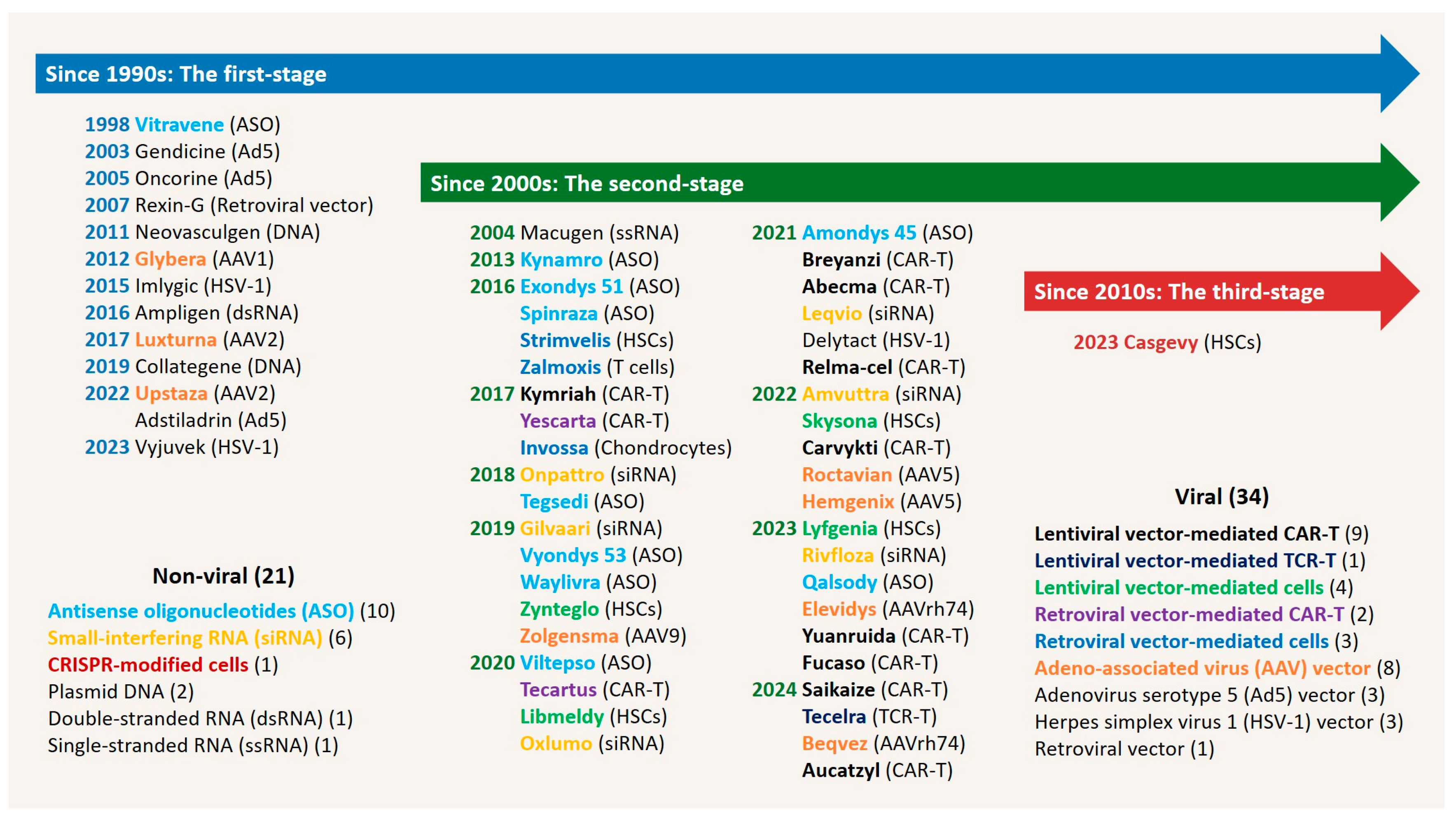
Figure 2.
Clinical applications of lentiviral vectors in major human diseases. The application covers various diseases, including neurological, ocular, hematological, metabolic, cancer, immunological, skin, viral infection, and lung diseases as well as long-term follow-up for the lentiviral vector gene therapy, as detailed in Supplementary Table S2.
Figure 2.
Clinical applications of lentiviral vectors in major human diseases. The application covers various diseases, including neurological, ocular, hematological, metabolic, cancer, immunological, skin, viral infection, and lung diseases as well as long-term follow-up for the lentiviral vector gene therapy, as detailed in Supplementary Table S2.
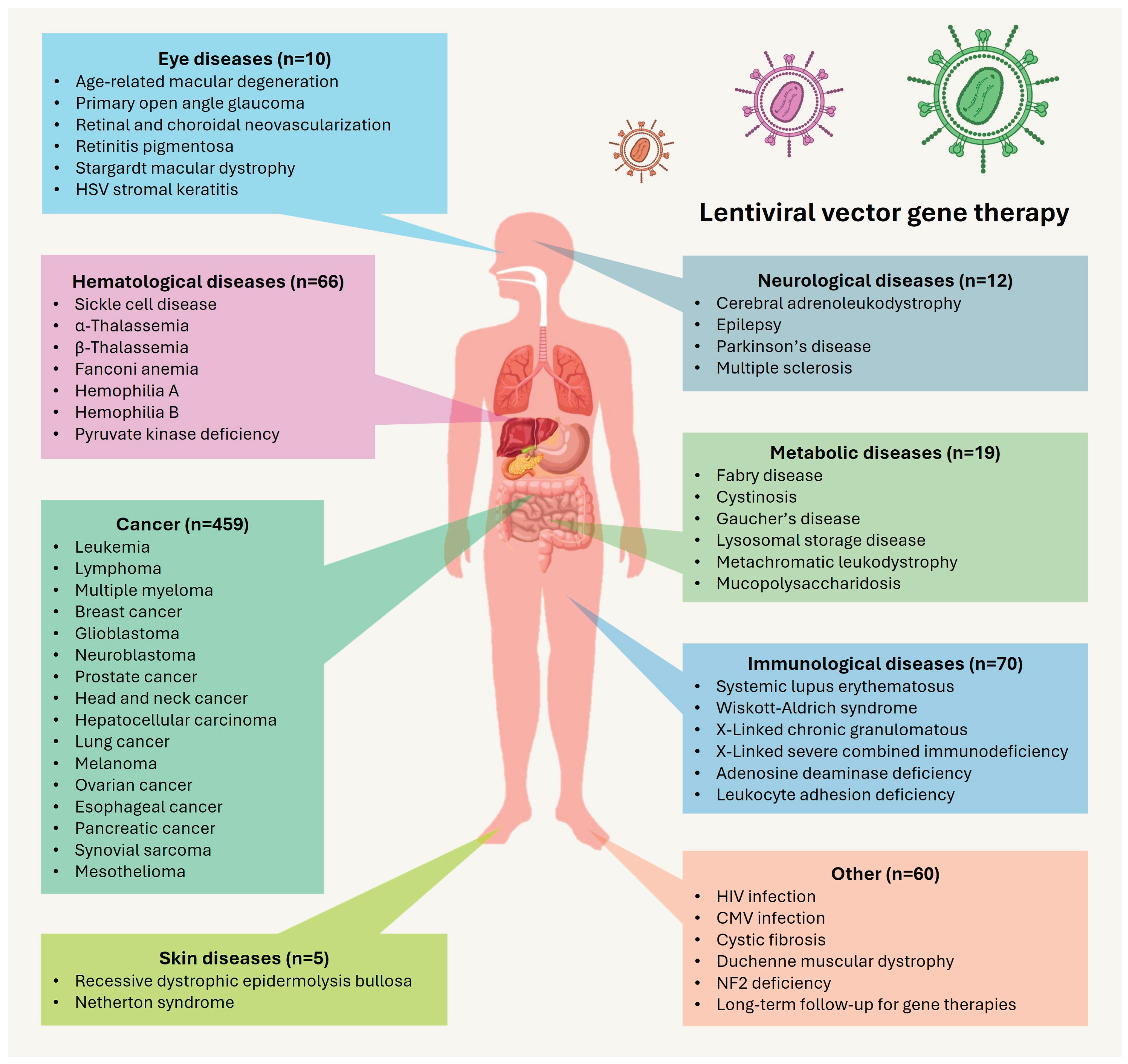
Figure 3.
Schematic illustration of HIV-1 genome and three generations of lentiviral vectors. (A) The HIV-1 genome is flanked by LTR and encodes three structural genes (gag, pol, and env), regulatory (rev and tat), and accessory (vif, vpr, vpu, and nef) genes. The gag precursor contains the core viral proteins, the matrix (MA), capsid (CA), nucleocapsid (NC), and p6 proteins, while the gag/pol precursor contains the protease (PR), reverse-transcriptase (RT), and integrase (IN) proteins. (B) First-generation vector system. Packaging plasmid includes all HIV-1 genes in a single vector except for envelope and vpu proteins. Separated envelope plasmid provides envelope protein. The transfer plasmid contains a transgene expression cassette flanked by the HIV-1 LTRs. (C) Second-generation vector system. Packaging plasmid contains all HIV-1 genes in a single vector without accessory proteins. Separated envelope plasmid provides envelope protein. The transfer plasmid contains a transgene expression cassette flanked by the HIV-1 LTRs. (D) Third-generation vector system. Packaging plasmid contains only gag/pol sequence with RRE element. Separated envelope plasmid provides envelope protein. The transfer plasmid includes CMV promoter-driven truncated 5'-LTR, required cis-acting elements, transgene expression cassette, WPRE element and partially deleted self-inactivating LTR (SIN-LTR) with polyadenylation (pA), and separated rev expression plasmid vector.
Figure 3.
Schematic illustration of HIV-1 genome and three generations of lentiviral vectors. (A) The HIV-1 genome is flanked by LTR and encodes three structural genes (gag, pol, and env), regulatory (rev and tat), and accessory (vif, vpr, vpu, and nef) genes. The gag precursor contains the core viral proteins, the matrix (MA), capsid (CA), nucleocapsid (NC), and p6 proteins, while the gag/pol precursor contains the protease (PR), reverse-transcriptase (RT), and integrase (IN) proteins. (B) First-generation vector system. Packaging plasmid includes all HIV-1 genes in a single vector except for envelope and vpu proteins. Separated envelope plasmid provides envelope protein. The transfer plasmid contains a transgene expression cassette flanked by the HIV-1 LTRs. (C) Second-generation vector system. Packaging plasmid contains all HIV-1 genes in a single vector without accessory proteins. Separated envelope plasmid provides envelope protein. The transfer plasmid contains a transgene expression cassette flanked by the HIV-1 LTRs. (D) Third-generation vector system. Packaging plasmid contains only gag/pol sequence with RRE element. Separated envelope plasmid provides envelope protein. The transfer plasmid includes CMV promoter-driven truncated 5'-LTR, required cis-acting elements, transgene expression cassette, WPRE element and partially deleted self-inactivating LTR (SIN-LTR) with polyadenylation (pA), and separated rev expression plasmid vector.
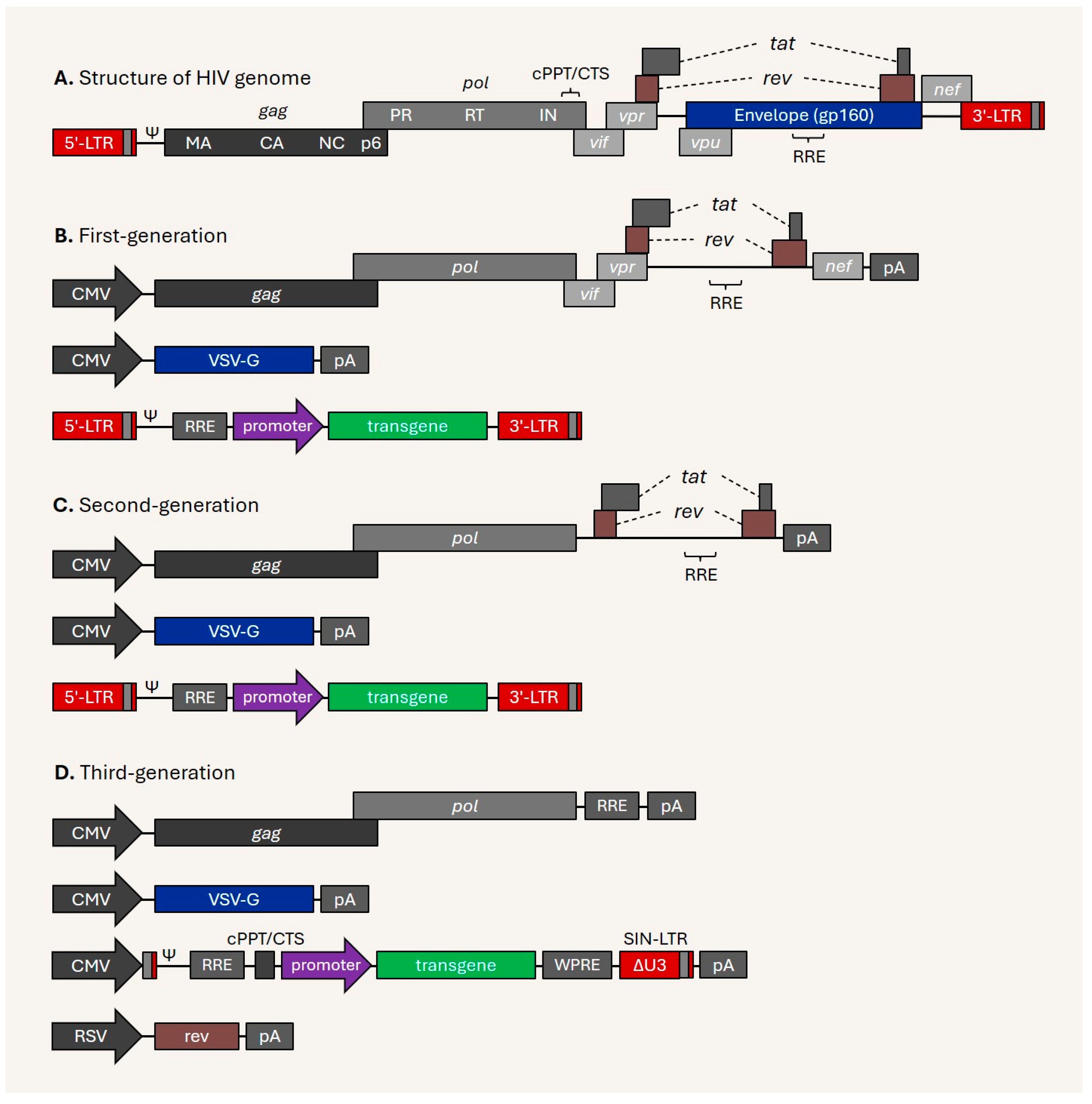
Figure 4.
Schematic illustration of the third-generation lentiviral vector and the next-generation vectors. (A) Third-generation vector system with 4 plasmid vectors, and integrated provirus. (B) Lenti-X fourth-generation vector system with 6 plasmid vectors, and integrated provirus. (C) LTR1 fourth-generation vector system with 4 plasmid vectors, and integrated provirus. (D) TetraVecta fourth-generation vector system with 3 plasmid vectors, and integrated provirus.
Figure 4.
Schematic illustration of the third-generation lentiviral vector and the next-generation vectors. (A) Third-generation vector system with 4 plasmid vectors, and integrated provirus. (B) Lenti-X fourth-generation vector system with 6 plasmid vectors, and integrated provirus. (C) LTR1 fourth-generation vector system with 4 plasmid vectors, and integrated provirus. (D) TetraVecta fourth-generation vector system with 3 plasmid vectors, and integrated provirus.
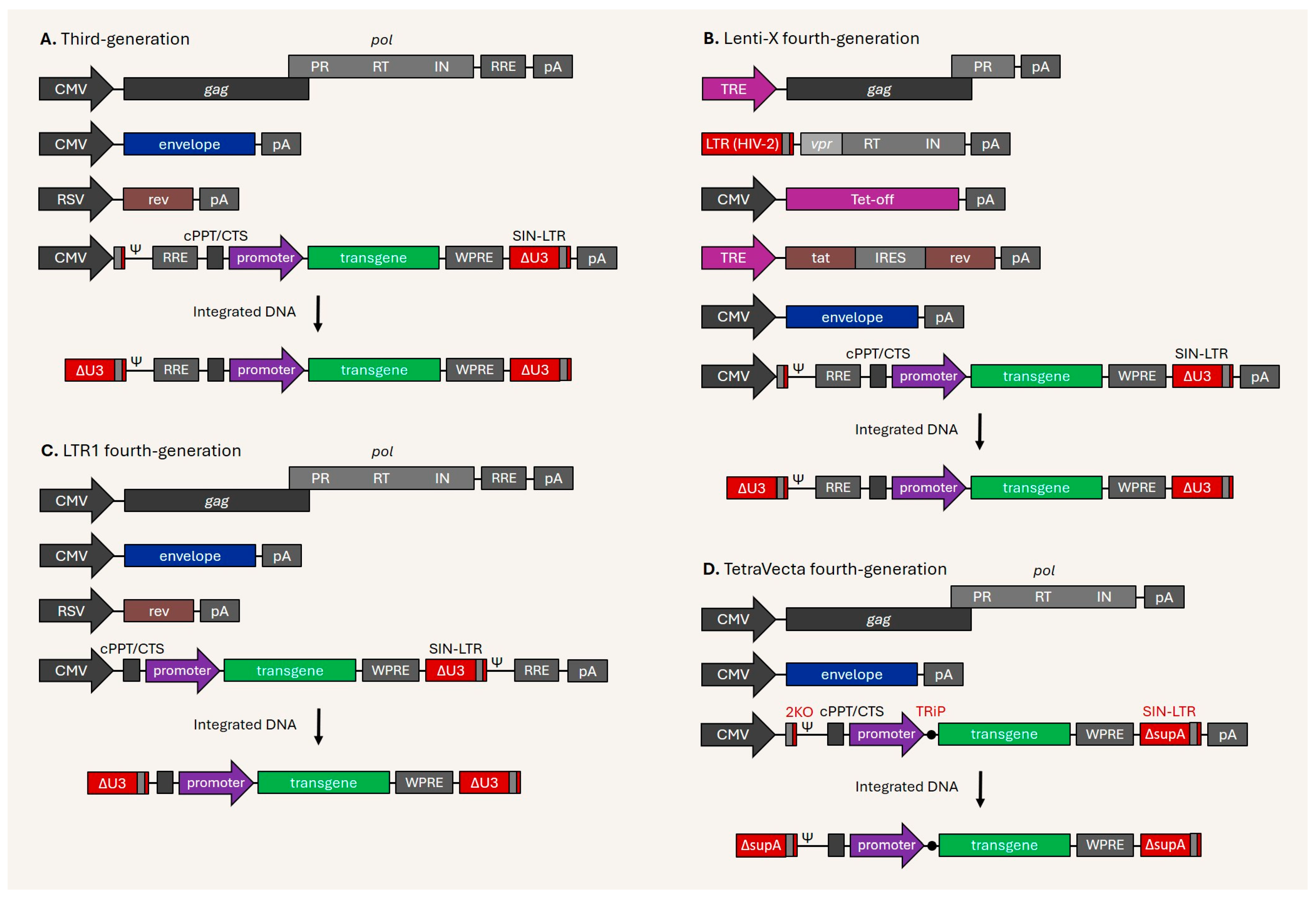
Figure 5.
Lentiviral particle structure and its pseudotyping. (A) The structure of the mature HIV-1 virion, resembles a lentiviral vector particle. The two copy of viral genomic ssRNA are encapsulated by capsid (CA) along with nucleocapsid (NC), reverse transcriptase (RT), integrase (IN), and tRNA lys, which are surrounded by a lipid membrane and matrix protein (MA) with incorporated envelope and receptor proteins. Also, protease (PR), viral, and host cell proteins are assembled in the particle. (B) An order, family, or subfamily of viruses that encode envelope glycoproteins which are employed to pseudotype lentiviral vectors, as well as engineered envelope proteins.
Figure 5.
Lentiviral particle structure and its pseudotyping. (A) The structure of the mature HIV-1 virion, resembles a lentiviral vector particle. The two copy of viral genomic ssRNA are encapsulated by capsid (CA) along with nucleocapsid (NC), reverse transcriptase (RT), integrase (IN), and tRNA lys, which are surrounded by a lipid membrane and matrix protein (MA) with incorporated envelope and receptor proteins. Also, protease (PR), viral, and host cell proteins are assembled in the particle. (B) An order, family, or subfamily of viruses that encode envelope glycoproteins which are employed to pseudotype lentiviral vectors, as well as engineered envelope proteins.
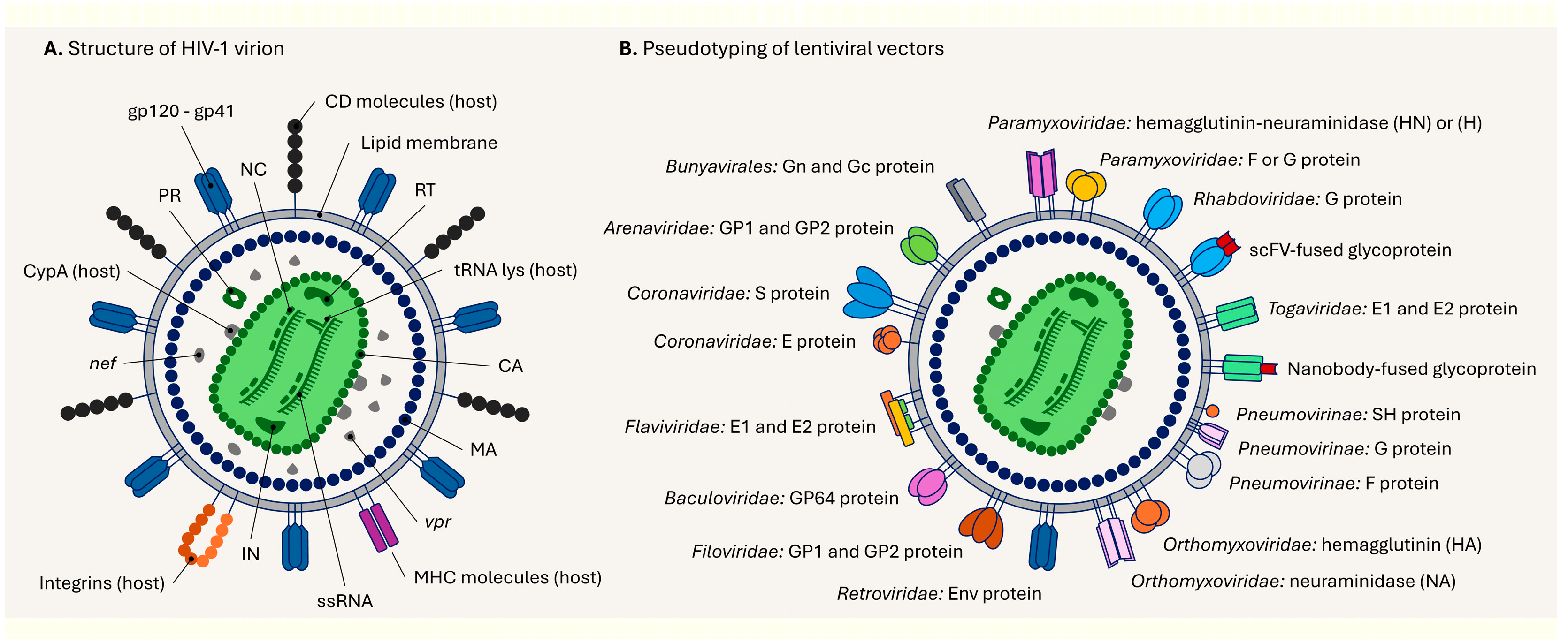
Disclaimer/Publisher’s Note: The statements, opinions and data contained in all publications are solely those of the individual author(s) and contributor(s) and not of MDPI and/or the editor(s). MDPI and/or the editor(s) disclaim responsibility for any injury to people or property resulting from any ideas, methods, instructions or products referred to in the content. |
© 2025 by the authors. Licensee MDPI, Basel, Switzerland. This article is an open access article distributed under the terms and conditions of the Creative Commons Attribution (CC BY) license (http://creativecommons.org/licenses/by/4.0/).
Copyright: This open access article is published under a Creative Commons CC BY 4.0 license, which permit the free download, distribution, and reuse, provided that the author and preprint are cited in any reuse.


