

Submitted:
09 May 2025
Posted:
12 May 2025
You are already at the latest version
Abstract
Diesel particulate matter, primarily ultrafine particles (UFP), defined as particles smaller than 0.1 µm, are released by diesel-powered vehicles, especially those used in heavy-duty hauling, and are linked to serious health hazards. While much of the existing research on traffic-related air pollution focuses on urban environments, limited attention has been paid to how complex the topography influences the concentration of UFPs, particularly in areas with significant truck traffic. With a focus on Morgantown, West Virginia, an area distinguished by steep topography, this study investigates how travel over two different terrain conditions effect UFP concentrations close to roadways. Specifically, we sought to determine if truck count can be used as a surrogate allowing for varying topography for the concentration of UFPs. This study shows that “TRUCK COUNT” does result in a linear relationship and yields a possible surrogate measure of lung dose of UFP number concentration.
Keywords:
Ultrafine particles
; diesel engines
; diesel particulate matter
; topography
; complex terrain
; air pollution
; exposure
; health risks
; prevention measures
1. Introduction
1.1. Background
Globally, air pollution is now one of the main environmental health concerns [1]. The emissions generated by burning fossil fuels not only affect the environment by causing global warming but human exposure to particulate matter also increases the risk of respiratory complications [1]. With respect to known air pollutants, Marcella et al. add that ultrafine particles (UFPs), particles smaller than 0.1 µm (100 nm), are regarded as harmful among known air pollutants, owing to their unique features and ability to cause adverse health outcomes [2]. Unlike larger particles, Ali et al. argue that UFPs have a high surface area-to-mass ratio, enabling them to penetrate deep into the human respiratory system [3]. According to Calderón-Garcidueñas and Ayala, the use of fossil fuels, particularly diesel in truck engines, accounts for the greatest percentage of UFPs emitted into the environment, especially in urban settings where concentrations are much higher along busy highways and airports [4]. In addition to the contribution of diesel trucks, the concentration levels of UFPs in a particular area are influenced by factors such as traffic density and driving conditions. The site's topography, defined by the uphill and downhill movement of trucks, truck size, truck speed, and loading condition may also affect UFP concentrations. These topographical features influence the concentration, distribution and emission of ultrafine particles and could potentially add complexity to the assessment of community exposures.
There is little research on how the uphill movement, downhill movement, loading condition, speed and size of heavy diesel trucks affects the spread and concentration of UFPs in the environments given their increasing relevance and the health hazards they pose. The current study therefore aims to investigate the intersection of these factors with an overall objective of determining the influence of topography on the health and environmental impact of UFP near roadways with high diesel truck traffic.
Research on the health effects of air pollution has shown that long-term exposure to ultrafine particles poses a high risk of cardiovascular and respiratory health problems [5]. Prolonged exposure to ultrafine particles can also increase irritation of the airways, which in patients with existing conditions like asthma could lead to exacerbation in children, while in adults, it increases the risk of mortality from ischemic heart diseases [6]. As noted earlier, UFPs are significantly smaller in size when compared to other particulate matters, a unique feature that allows them to penetrate deep into the alveolar regions of the lungs [7]. Apart from the respiratory effects of deposition in the lungs, this quality lets UFPs enter the bloodstream, where they create significant cardiovascular health issues and other systematic problems [7]. The associated health risks make UFP exposure a growing public health concern, especially in areas that not only experience high density traffic but also have different topographical features that increase UFP concentrations and, in turn, result in a higher risk of exposure [8].
As per Moreira et al., an essential step in addressing the above issue is the need to develop simplified methodologies for measuring UFP concentrations [9]. Currently, most investigations must rely on complex data collection processes and expensive equipment that makes research into the subject prohibitive. Linking UFP levels to diesel truck traffic counts offers an inexpensive option, especially for regions with minimal monitoring infrastructure [10]. Such an approach has the potential to enable more targeted mitigation strategies, such as traffic management or the implementation of green infrastructure, to reduce exposure. Regions with unique features such as Morgantown, WV, that have steep inclines, and complex terrain present ideal locations for investigations into the influence of topography on the dispersion of UFPs.
To address the issue of determining UFP concentrations in Appalachian regions like Morgantown that have varying complex topographies, the current study seeks to address the critical knowledge gaps in our understanding of UFP emissions in such regions. The findings from the data analyzed here will offer critical guidance into UFP exposure prevention through optimal urban planning strategies like better zoning and location of busy highways far from complex topographical locations.
This research aims to enhance the estimation of ultrafine particle (UFP) concentrations in complex topographical regions by creating a simplified cost-effective methodology that associates heavy diesel truck traffic with UFP levels. This study will provide more information on the relationship between UFP concentration and traffic emissions, offering critical insights for air pollution mitigation, transportation planning, air quality legislation, and public health risk evaluation.
Overview of the Studied Appalachian Region
This Appalachian region is characterized by its mountainous terrain and high truck traffic presents unique challenges for air pollution monitoring [11]. Steep landscapes can lead to increased UFP pollutants emitted by diesel trucks as the truck move uphill and downhill in steep terrains, leading to high UFP concentration. This phenomenon poses a significant risk to communities near transportation corridors and industrial activities, such as mining and unconventional natural gas drilling (UNGD) [8]. The combination of increased traffic from diesel-powered vehicles, and rugged terrain creates a complex environmental scenario that remains underexplored in air quality research [11].
Current methodologies for monitoring UFP concentrations rely on advanced instruments and sophisticated modeling techniques, which, while accurate, are often expensive and impractical for widespread use in resource-limited settings [12]. This limitation hinders efforts to assess community-level exposure risks and implement effective mitigation strategies. Moreover, the lack of studies examining the interplay between heavy diesel truck traffic, traffic pattern, topography, truck speed, engine size, truck loading condition in rural and semi-urban regions limits the ability to generalize findings from urban areas to Appalachian regions [12].
Communities in the Appalachian region, often economically disadvantaged and reliant on industries which may contribute to air pollution, face compounded risks from UFP exposure [13]. The absence of cost-effective, scalable methods for monitoring and correlating UFP levels with traffic patterns and topographical factors leaves these communities vulnerable to long-term health effects without adequate regulatory policy or preventative measures [13].
This study seeks to address these critical gaps by developing a simplified, cost-effective methodology to estimate UFP concentrations in relation to heavy diesel truck traffic volume, specifically in areas with both flat and complex terrain. In this study, topography is significant because diesel trucks movement uphill and downhill, engine size, loading condition, and truck speed in complex terrain affects UFP concentration. Trucks that climb steep inclines need more engine power, which increases fuel burning and raises UFP concentrations in complex terrain. For instance, by establishing a correlation between UFP levels, traffic patterns, and topographical features, the research aims to provide actionable data for policymakers, urban planners, and public health professionals. The findings will support the development of targeted interventions to reduce air pollution exposure, mitigate health risks, and enhance the quality of life for populations in challenging topographical environments. This work is particularly relevant as regions like Appalachia continue to experience industrial growth and increased transportation activity, intensifying the need for effective air quality management solutions. The central aim of this paper is to develop a correlation equation between heavy-duty truck traffic volume and ultra-fine particulate matter concentration (as determined by the number concentration and real-time size distribution measurements).
1.2. The Physics of Ultrafine Particles
Ultrafine particulate matter (UFP) are airborne particles less than 0.1 μm (100 nm) in diameter [2]. Recent studies on air pollution have shown that ultrafine particles have physical properties that are significantly different from larger PM particles [14]. Kwon et al. for instance, explored the unique physicochemical properties of ultrafine particles to determine the potential health risks from prolonged exposure [14]. The researchers reviewed existing literature on UFPs, including physical characteristics compared to larger particles in urban settings. Kwon et al. also note that UFPs are generated in vast quantities and have a high surface area, which, when coupled with their small size, translates to increased risk of exposure as they can penetrate airway tissues, thereby increasing the risk of health complications like asthma and COPD [7].
Findings by Vaze et al. also affirm the unique physical properties of UFPs [15]. The study analyzed the physicochemical properties of PM in parking garages at a New Jersey hospital during the summer and winter seasons. Real-time monitoring revealed high concentrations of UFPs, 48.7 nm, with 3137.87 (±774.57) particles/cm3, and according to Rajagopal et al., accounted for between 60 and 80 percent of the mass of particulate matter [15, 16].
1.3. Sources and Concentrations of Ultrafine Particles
With the rising concerns around environmental and health effects of air pollution, Smichowski and Gómez note that there has been growing attention toward particulate matter, especially strategies aimed at minimizing sources and related activities [17]. As per Groma and colleagues, combustion sources, especially the operation of heavy diesel engines, account for a greater percentage of ultrafine particles generated in urban settings [18]. The researchers conducted a 10-day-long intensive measurement of particulate matter at a busy urban location in Budapest, Hungary. Sample analysis using the aethalometer model and positive matrix factorization revealed six leading sources, three of which were directly related to traffic emissions, key among them being heavy-duty truck engines [18]. Specifically, traffic-related emissions were found to be the leading source of most harmful particles, accounting for approximately 31% of total submicron PM generation throughout the study period [18].
A global review by Hopke et al. shows that concentration of ultrafine particles is much higher near traffic highways and airports, which affirms findings of previous studies [19]. The review found that UFP concentrations within an 8- to 10-kilometer radius of airports are four to five times higher than typical background levels [19]. A similar trend was observed in urban settings where proximity to busy traffic highways or regions with industrial activities had higher concentrations of UFPs when compared to residential areas with low traffic [19]. A national-scale empirical model of UFP concentrations in the United States developed by Saha et al. also reveals a similar trend whereby busy highway traffic, commercial land use, and urbanicity-related variables account for much of the spatial variability in UFP concentrations throughout the continental US [20]. This analysis of ∼6 million census blocks across the U.S. from 2016 to 2017 showed that UFP concentrations could be found to range between 1800 and 26,600 particles/cm3, often located near highways, airports, and industrial regions [20].
1.4. Respiratory Deposition of Ultrafine Particles
Exposure to UFPs generally occurs through inhalation, making respiratory complications like asthma one of the key health risks. A 2021 computational fluid dynamics (CFD) study by Dong et al. found that for particles less than 10 nm, Brownian diffusion remains the dominant particle deposition mechanism [21]. The researchers employed two respiratory tract models, the Kitaoka (KG model) and a CT-based patient-specific airway, while UFP deposition efficiency was measured by comparing ICRP data published by The International Commission on Radiological Protection. Findings showed that respiratory deposition of particles less than 10 nm was significantly higher when compared to >10 nm particles, highlighting the health implications of UFP exposure [21].
On the other hand, Zhai et al. used a high-mass-resolution single-particle aerosol mass spectrometer to assess the respiratory deposition of UFPs among residents of urban Shenzhen, China, during the summer [22]. These researchers found that particles consisting primarily of elemental carbon (0.05–0.1 μm) were the dominant components of UFP emissions, a factor that significantly increases deposition and respiratory health complications. Compared to general particulate matter, Zhai et al. found that residents are exposed to 0.1 μm particles with a daily dose of ∼2.08 ± 0.67 billion particles, which significantly increases the risk of such particles being deposited into deeper sections of the respiratory tract due to their small size. Elemental carbon (EC) particles, which are significantly small, were also found to account for approximately 85.7% of UFPs inhaled by residents of the region, further demonstrating the potential deposition of such particles into deeper sections of the respiratory tract. Research indicates that UFPs can penetrate deep into the lungs, including the alveolar region, where they can cause inflammation and oxidative stress [3]. A review study by Vallabani et al. investigated the toxicity and health effects of ultrafine particles and found that, compared to larger particles, >PM 2.5, exposure to UFPs is associated with increased pulmonary inflammation [23]. Robinson et al. for instance, examined the risk of UFP exposure among urban school children using a sample of 8–11-year-old schoolchildren attending 25 elementary schools in Queensland, Australia [24]. Increased exposure to UFPs in this group was associated with lung inflammation and diminished capacity, characterized by greater lung stiffness.
A common health implication is asthma, which, according to Agache et al., is a chronic respiratory condition that affects airways in the lungs [25]. Exposure to UFPs can cause asthma by triggering inflammation and narrowing of the airways, which, according to Anderson et al., will over time result in difficulty breathing and sensitivity of the airways [26]. Turner and colleagues, for instance, conducted a one-week sampling campaign using a sample of adolescents with and without asthma [27]. Measurements of lung function by these investigators using the ATS/ERS criteria revealed a significant decline in lung function and exacerbation of asthma symptoms among those with preexisting diagnoses. Wright et al. also explored the potential effects of ambient UFP exposure among infants and found that prenatal UFP exposure led to increased risk of asthma development in children [28]. Sivakumar and Kurian, for instance, exposed Female Wistar rats to particulate matter for 21 days and found that the specimen developed a wide range of cardiovascular complications, including heart muscle hypertrophy, vascular calcification, and alterations in cardiac electrophysiology [29].
A meta-analysis of several studies by Lachowicz and Gać also concluded that exposure to UFPs was associated with a higher risk of cardiovascular events, such as heart attacks and strokes [30]. These findings showed that individuals exposed to UPF exhibited an increase in blood pressure, which returned to baseline a few hours after exposure was eliminated. As well, persistent exposure to UFPs could therefore result in worsening cardiovascular complications like hypertension, thrombosis, or arrhythmias.
Qi et al. also reports the hidden dangers of UFP exposure, especially given the fact that respiratory health risks seem to attract more attention compared to systemic health complications [31]. The study specifically investigated the association between long-term exposure to UFPs and mortality in New York State (NYS), and findings showed that long-term UFPs exposure significantly increases the risk of non-accidental mortality, with cerebrovascular and pulmonary heart diseases being leading causes of death [31]. Even in short-term exposure cases, Zhang et al. found that UFP exposure was associated with increased heart rate variability (HRV), which is a major cardiovascular health risk factor [32].
1.5. Topographic Influences
Topography plays a significant role in the concentration of ultrafine particles (UFPs), influencing their distribution and concentration in the environment because of the complicated effects of truck size, loading condition, speed, uphill and downhill movement of trucks on UFP emissions. In complex terrains, higher UFP concentrations occur because of increased fuel burning caused by trucks requiring more engine power to ascend steep inclines.
As Carnerero Quintero notes, mountainous regions with rugged terrains are prone to trap pollutants near the ground, leading to elevated concentrations [33]. A study by Tran et al. found that UFP concentrations near diesel truck routes in hilly areas were significantly higher than in flat terrains [34].
A literature review study by Lv, Wu, and Zang, for instance, found that particulate matter tends to accumulate in steep regions [35]. Truck traffic near steep terrains enhances the emission of UFPs. Understanding these interactions is crucial for developing effective strategies to mitigate UFP pollution. This includes designing urban environments that minimize the adverse effects of topography on air quality, as well as implementing targeted emission controls and green spaces to improve ventilation and reduce particle buildup.
2. Materials and Methods
This study aimed to investigate the influence of topography and truck traffic on ultrafine particle (UFP) concentrations through near-roadway air quality monitoring and data-driven analysis in Morgantown, West Virginia. Morgantown, WV, was chosen as a surrogate site for this study due to its diverse topographical characteristics, which provides a natural setting to analyze the influence of terrain on ultrafine particle (UFP) concentrations and truck emissions. The city's unique mix of steep inclines, valleys, and flat terrains makes it an ideal location to investigate how topography affects near-roadway air pollution dispersion.
2.1. Justification for Using Morgantown, WV, as a Surrogate Site
Morgantown includes both steep and flat terrain within a compact urban area, allowing for controlled comparisons between different roadway conditions. This natural variation helps isolate the impact of topographic complexity on air pollution without introducing confounding variables from multiple cities. Morgantown serves as a major transportation corridor, with heavy diesel trucks frequently traveling through the region, making it a suitable site to study the impact of truck emissions on UFP accumulation. High truck traffic density provides a real-world setting for assessing how emissions behave in different terrains. Many urban areas in the U.S. feature a combination of complex and flat terrains with heavy truck traffic (e.g., Appalachia). Morgantown provides a surrogate model for studying how emissions behave in different topographic scenarios, offering insights that can be applied to similar locations anywhere.
2.2. Study Locations
2.2.1. Brockway Avenue (Surrogate for Rough and Complex Topography)
The first site targeted by the investigators was Brockway Avenue, which is located between Decker's Creek and Cobun Avenue in the southern part of Morgantown. The Brockway Avenue corridor is currently zoned for low-density commercial use and is an area with steep slopes in some locations. This site features steep inclines and irregular road geometry, creating an environment where UFP concentration may be influenced by traffic condition, loading condition, engine size and truck speed. The elevation of Brockway Avenue is about 305 m (1000.66 feet) with a barometric pressure of 98 kPa. The steep inclines coupled with low elevation and surrounding real estate projects make Brockway Avenue a suitable location for analyzing the impact of topography on UFP concentration. The site serves as a model location for areas with mountainous or hilly topographies, where emissions might accumulate differently than in flat areas.
2.2.2. Beechurst Avenue (Surrogate for Flat Topography)
The second location sampled was Beechurst Avenue, located in the heart of Downtown Morgantown. The avenue is situated next to West Virginia University and thus is mostly a state-maintained road. This location represents flat road conditions with heavy diesel truck traffic, allowing for the analysis of direct exhaust emissions without significant elevation effects. The area is relatively flat, with the Monongahela River nearby, which makes it an ideal location for investigating the effect of flat topography on exhaust emission and UFP concentration. The area also includes a mixture of high-rise commercial and residential buildings, even though the ground is generally flat, with no notable hills or steep inclines. As per recent data, the elevation of Beechurst Avenue is about 280 meters above sea level. These features mean that the location has the potential to serve as a baseline for comparing how UFP concentrations behave in a level urban setting versus a complex terrain.
2.2.3. Air Quality Monitoring and Instrumentation
NanoScan SMPS was deployed to continuously measure UFP concentrations and size distributions in real-time at each site. This instrument provides high-resolution particle sizing within the 10–420 nm range, with a sampling interval of one minute [36] It accomplishes this by integrating a TSI Scanning Mobility Particle Sizer (SMPS™) spectrometer into a portable unit approximately the dimensions of a basketball [37]. A bipolar aerosol charger, powered by a long-column differential mobility analyzer (DMA), maintains particles within a defined charge distribution, facilitating precise categorization of size and number based on electrical mobility [37, 38] . Studies have consistently shown that NanoScan SMPS Nanoparticle Sizer 3910 (TSI, Shoreview, MN) (referred to simply as the NanoScan) is well-suited for applications that involve sampling and analysis of particulate matter composition and concentrations in the air.
Yuan et al. for instance, conducted a study to validate the accuracy of scanning mobility particle analyzers based on models developed by the COMSOL software [39]. A differential mobility analyzer (DMA) consisting of a semi-ellipsoidal gas flow conditioner, a multi-hole ring, and an anti-turbulent slit was used to enhance particle size resolution. The study findings show that instruments such as the NanoScan that employ a long-column differential mobility analyzer (DMA) have higher accuracy and are suitable for sampling and measuring particle size and concentrations in a specific location.
For the current study, the NanoScan monitor was positioned at approximately 1.5 meters above ground level, aligning with the breathing zone for pedestrians and commuters [38]. The instrument at each site was positioned upwind, ideally at the center of the location. This ensured direct exposure of the sampling inlet to the air stream and that samples were collected from suitably representative locations. Before the collection of field data, all units were calibrated according to TSI guidelines.
2.3. The TSI MODEL 3910 NanoScan SMPS
The NanoScan is an advanced particle size analyzer used for quantifying ultrafine particle concentrations across diverse environmental and industrial settings [40]. The 3910 model is noted for its high sensitivity and precision in quantifying particles ranging from 5 to 1,000 nanometers, making it a vital instrument for researchers and professionals in environmental science, occupational health, and air quality monitoring [38, 40]. In addition to its abilities, the TSI MODEL 3910 is also known for its small size, battery operation and portability, which is a major advantage for field studies.
One of the key features of the NanoScan is its high sensitivity and precision. As noted by Singh and Kuang, the NanoScan employs scanning mobility particle sizing (SMPS), a mobility principle that allows it to detect and count individual particles[37]. This has been a recent development, especially in the measurement of ultrafine particles, which are significantly smaller in size and thus difficult to detect [41]. The NanoScan utilizes SMPS technology to effectively analyze and measure UFP concentrations globally. The high sensitivity enabled us to detect concentrations of ultrafine particles, which was crucial for the precise evaluation of air quality at each site.
The NanoScan is also able to capture and measure a wide range of particle sizes [42]. According to Shirman et al., the model can measure particles as small as 10 nm in diameter all the way to 420 nm in diameter, which makes it a suitable instrument for UFP classification and concentration measurement [43]. The NanoScan’s dynamic range enables it to accommodate various particle sizes and concentrations, including the measurement of ultrafine particle concentrations required in this study [42].
The NanoScan also allows for real-time data collection, which is an essential component of ultrafine particle concentration analysis [42]. As noted by Liati et al., a considerable portion of UFPs is generated by internal combustion engines, whose use varies significantly depending on location and time of day [44]. The NanoScan features an advanced computer system for real-time data logging, facilitating continuous monitoring of ultrafine particle concentrations [42].
2.4. Traffic Data Collection and Classification
2.4.1. Traffic Patterns Analysis
The generation and accumulation of ultrafine particles is directly related to traffic conditions. As such, part of the study activities was to collect traffic data to help determine and classify these heavy diesel trucks and their contribution to UFP concentration. For this study, we employed a video-based traffic monitoring system that was positioned to capture truck traffic at the two sites where the study was conducted. This exercise facilitated the provision of real-time traffic data on truck movement, truck speed, engine size and loading condition, enabling a thorough analysis of traffic patterns. Data collection occurred over a six-day period at each location to account for variations in traffic patterns. The prolonged sampling duration yielded a more comprehensive dataset for statistical examination. One of the primary metrics evaluated during the exercise was the truck count every 15 minutes. Truck density and patterns in traffic flow were found by counting the number of trucks that passed through the monitoring location at 15-minute intervals. The sampling period, which ran from 6:00 AM to 10:00 AM, coincided with high traffic volumes brought on by industrial activity and early commutes. This time was chosen to determine the peak concentration of ultrafine particles from diesel truck emissions.
Truck categorization was done with the help of the school of engineering, theses characterization was based on engine type, loading condition, traffic pattern, speed, and in addition to truck count, truck size by distinguishing between small, medium, and large diesel-powered trucks. Due to their differing emission profiles, small, medium, and large diesel-powered trucks were easier to distinguish according to this classification [45]. For instance, larger trucks with more powerful engines may tend to produce higher levels of ultrafine particles (UFPs), highlighting the need for greater focus in terms of UFP exposure prevention measures and are specifically defined by the EPA.
The School of Engineering’s, Mechanical and Aerospace Engineering Department expert advice was used for engine categorization from video footage to increase the accuracy of emission source identification. Experts classified theoretical engine exhaust potential based on EPA regulation requirements.
This standardized method ensured data consistency and enhanced the reliability of UFP source attribution. Older, less efficient engines are associated with higher emissions of ultrafine particles (UFPs) in comparison to newer, more advanced models. This facilitated the distinction among source categories, enhancing the reliability of UFP source attribution. To show the strength of relationships between dependent variables (UFP concentrations) and independent factors (traffic, terrain), we produced scatterplots and performed correlation analysis. The graphical plots (Figure 2 and Figure 3) show a visual representation of the data, helping with the identification of potential linear correlations to quantify the strength and direction of relationships among variables. These trucks were coming from a source of materials to a shipping port so that their direction of travel on the street indicated whether they were loaded or empty, changing the power needed by the engine to drive the truck at a particular speed that could be measured by timing the transit of the vehicle across the video screen on the recording.
2.4.2. Configuration and Inputs for the Deposition Modelling
We utilized the Stahlhofen et al. model to enhance our understanding of the dose estimate associated with ultrafine particle (UFP) exposure in each study location [46]. This model has been used previously to help in accounting for dose estimation [47].
During data collection, the following parameters were configured in the deposition model. The first was particle size distribution based on input from NanoScan using size bins within the 10–420 nm range. Due to variations in elevation and topographic features, distinct distributions were employed for Brockway and Beechurst avenues, reflecting the differences in UFP concentrations and exposure risk. The second parameter was breathing conditions, which affect the uptake and retention of particles in tissues [48]. A tidal volume of 700 mL was employed, accompanied by a respiratory rate of 7 breaths per minute and with nasal breathing, reflecting standard resting conditions.
2.5. Statistical Analysis and Data Processing
We subjected the data to statistical analysis utilizing JMP Pro and Microsoft Excel to investigate the relationships between truck traffic, topography, and UFP concentration. Multiple sources were used in obtaining these data sets, including a video-based traffic monitoring system and as well as the NanoScan. We evaluated the concentration and distribution among study locations using descriptive statistical analysis after data collection and preparation.
Descriptive statistics were used to examine UFP concentration distribution over several sites, including mean, mode, standard deviation, scatterplot and dual-axis time series plot. This sets the standard for the comparison of UFP values and the finding of notable differences. Traffic data was combined with UFP concentrations using descriptive statistics to enable a complete knowledge of normal traffic patterns at every site and their effect on UFP exposure.
We utilized linear regression modeling to evaluate the impact of topographic elevation on UFP concentrations. This study involved modeling UFP concentration as the dependent variable and truck count as the independent variable. The coefficient of determination (R²) and p-values were employed to evaluate the strength and significance of the relationship. Additionally, dual-axis time series plots were developed to visualize the relationship between truck traffic and UFP concentrations over the study period. As evidenced in (Figure 1), the x-axis represents the number of trucks recorded during the study period, while the y-axis represents computed changes in UFP concentrations. This graphic depiction helped to clearly spot trends and patterns that might not be obvious from raw data. A p-value < 0.05 was considered statistically significant.
Figure 1.
Time series plot showing the truck traffic count and UFP concentration over an ongoing monitoring period (in minutes) at the Brockway location. Clear spikes in UFP concentrations (red line) closely corresponded to variations in truck traffic (blue line). This indicated that truck activity might be a major contributor to near-roadway UFP pollution.
Figure 1.
Time series plot showing the truck traffic count and UFP concentration over an ongoing monitoring period (in minutes) at the Brockway location. Clear spikes in UFP concentrations (red line) closely corresponded to variations in truck traffic (blue line). This indicated that truck activity might be a major contributor to near-roadway UFP pollution.
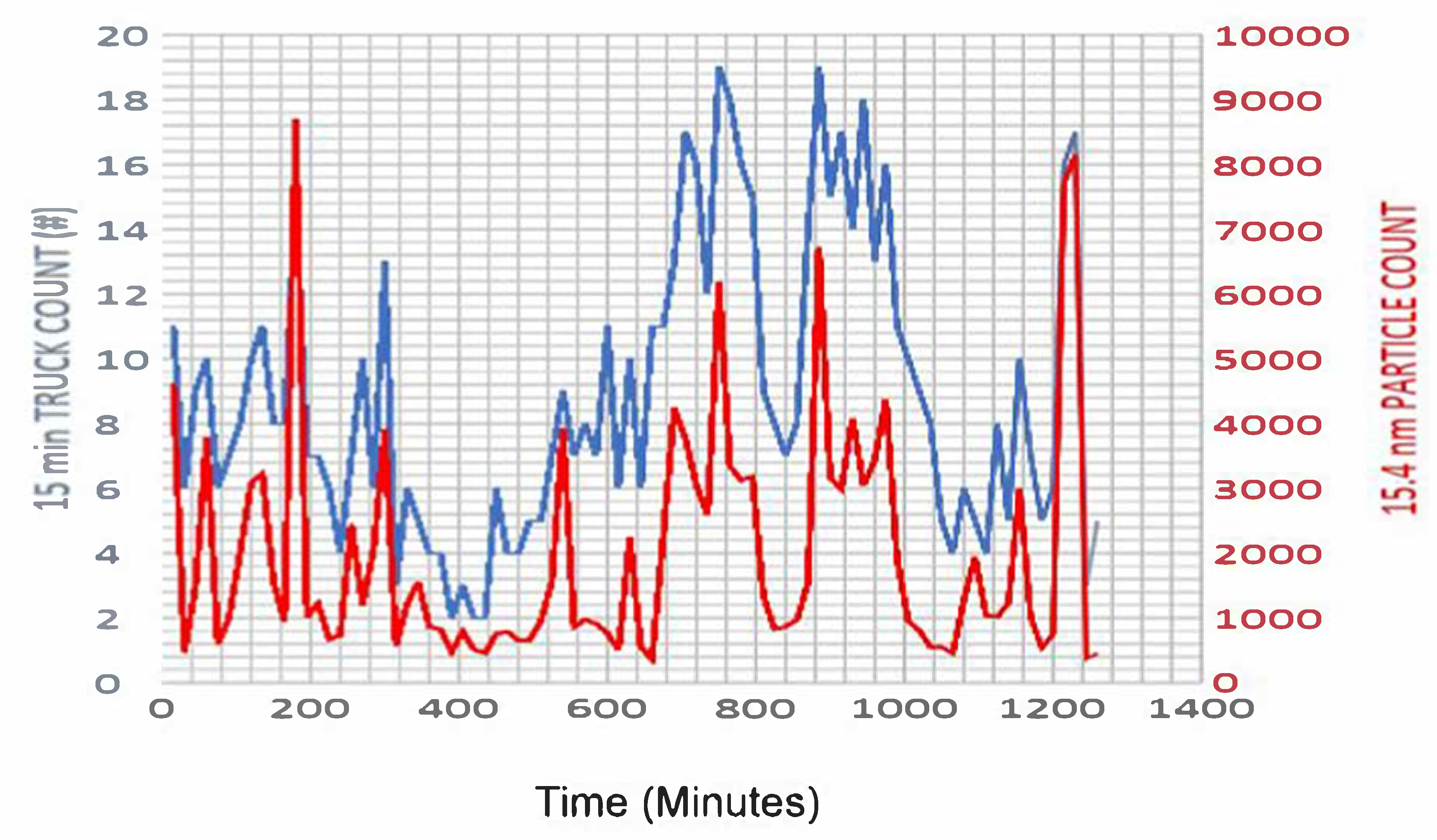
Figure 2.
Particle number size distributions simultaneously collected during sampling from NanoScan data for UFPs that are generally below 0.1µm [44]. The particle distribution was bimodal for both locations and similar at both locations with a geometric mean count diameters of 0.07 µm (geometric standard deviation of 2.0) and 0.016 µm (geometric standard deviation of 1.52) for Brockway and geometric mean count diameters of 0.06 µm (geometric standard deviation of 1.34) and 0.015 µm or 15 nm (geometric standard deviation of 1.9).
Figure 2.
Particle number size distributions simultaneously collected during sampling from NanoScan data for UFPs that are generally below 0.1µm [44]. The particle distribution was bimodal for both locations and similar at both locations with a geometric mean count diameters of 0.07 µm (geometric standard deviation of 2.0) and 0.016 µm (geometric standard deviation of 1.52) for Brockway and geometric mean count diameters of 0.06 µm (geometric standard deviation of 1.34) and 0.015 µm or 15 nm (geometric standard deviation of 1.9).
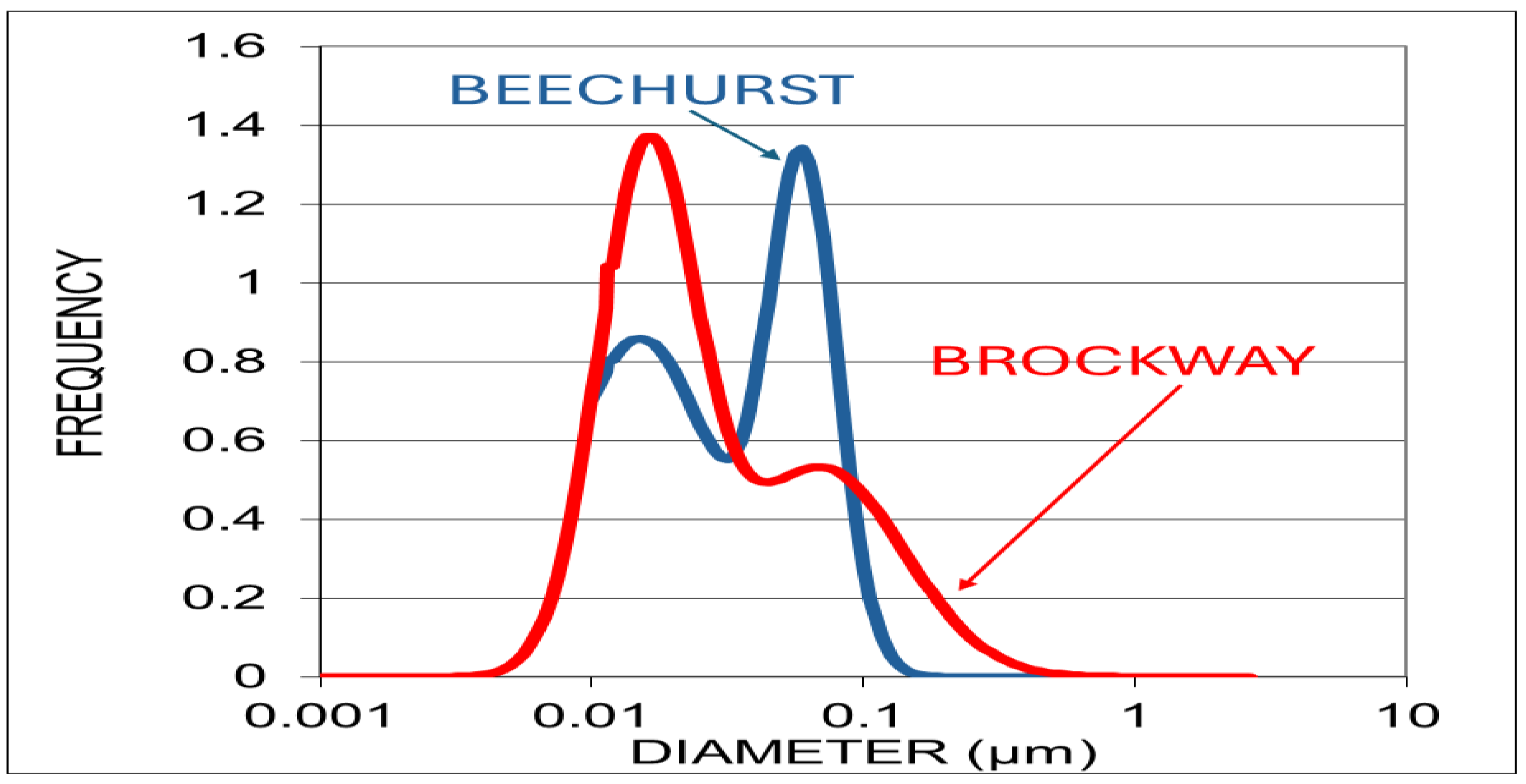
Figure 3.
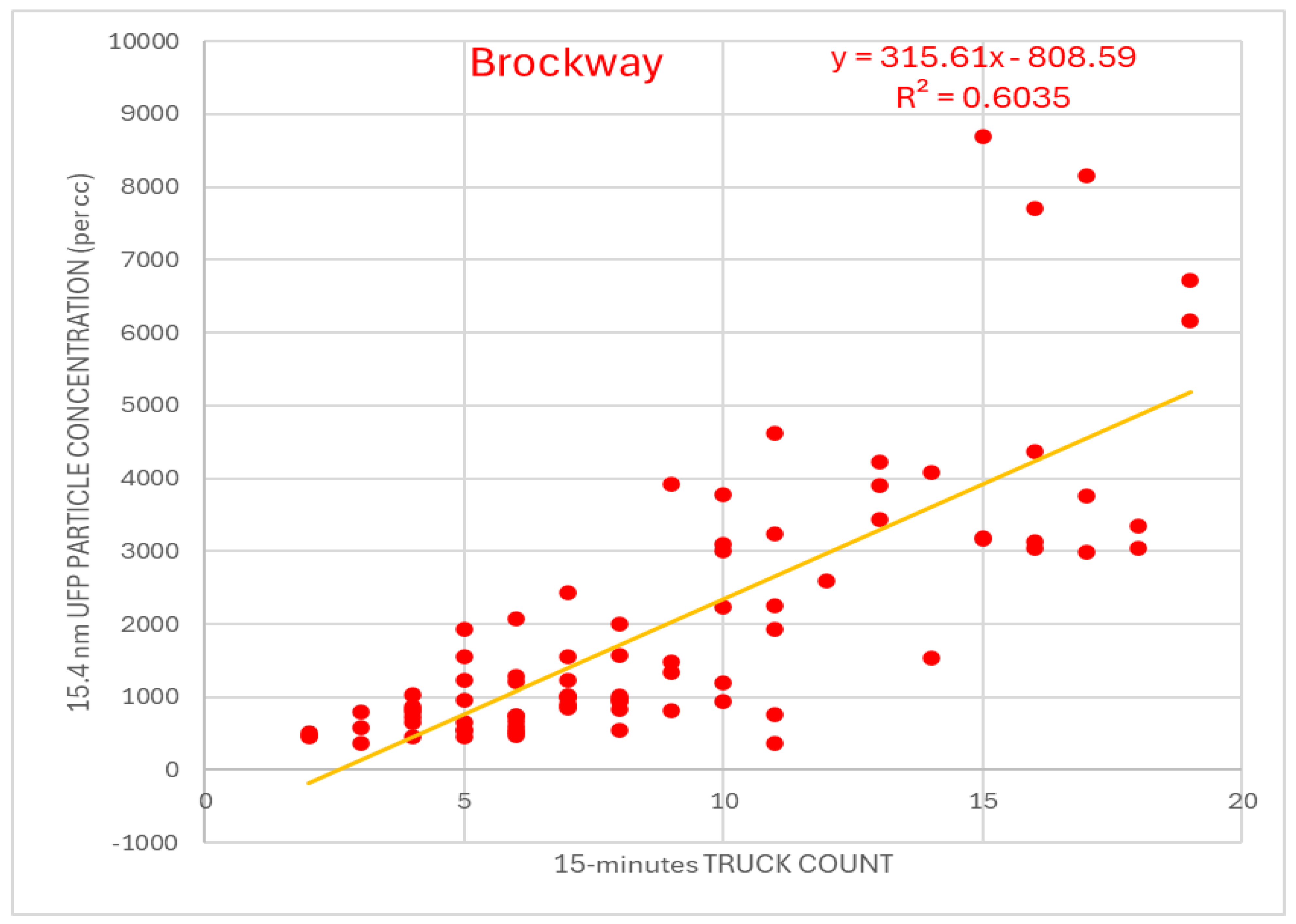
Linear regression relationship between truck count (x-axis) UFP concentration (y-axis). This regression analysis model for the Brockway site 15.4 nm particle count (per cc) vs. Truck Count, accounting for variability in terrain, resulted in an R square value of 0.6035 and a linear regression model for 15.4 nm particle count (per cc) vs truck count. The graph illustrates a distinct upward trend, suggesting that UFP concentration rises in correlation with increased truck counts. The steep terrain at Brockway likely may also facilitate pollutant retention, resulting in increased localized accumulation of ultrafine particles.
Figure 3.
Linear regression relationship between truck count (x-axis) UFP concentration (y-axis). This regression analysis model for the Brockway site 15.4 nm particle count (per cc) vs. Truck Count, accounting for variability in terrain, resulted in an R square value of 0.6035 and a linear regression model for 15.4 nm particle count (per cc) vs truck count. The graph illustrates a distinct upward trend, suggesting that UFP concentration rises in correlation with increased truck counts. The steep terrain at Brockway likely may also facilitate pollutant retention, resulting in increased localized accumulation of ultrafine particles.
2.6. MPPD Data Analysis
The deposition analysis was done using regional deposition fractions. Specifically, the percentage of particles deposited in the thoracic, tracheobronchial, and alveolar regions of the respiratory tract were analyzed to determine dose [46]. Dose response estimation based on lung deposition data was used to estimate potential health risks associated with exposure at each of the two locations.
3. Results
3.1. Time-Series Plot Analysis of Temporal Trends in Truck Traffic and UFP Levels
At the simplest level, the investigation looked at simultaneous trends in truck traffic count and particle number count for the smallest particle size, assuming it would be the size most likely attributable to diesel particulate matter at the site where engine exhaust was also the most visible. Figure 1 strongly indicated there might likely be a correlation for those variables alone.
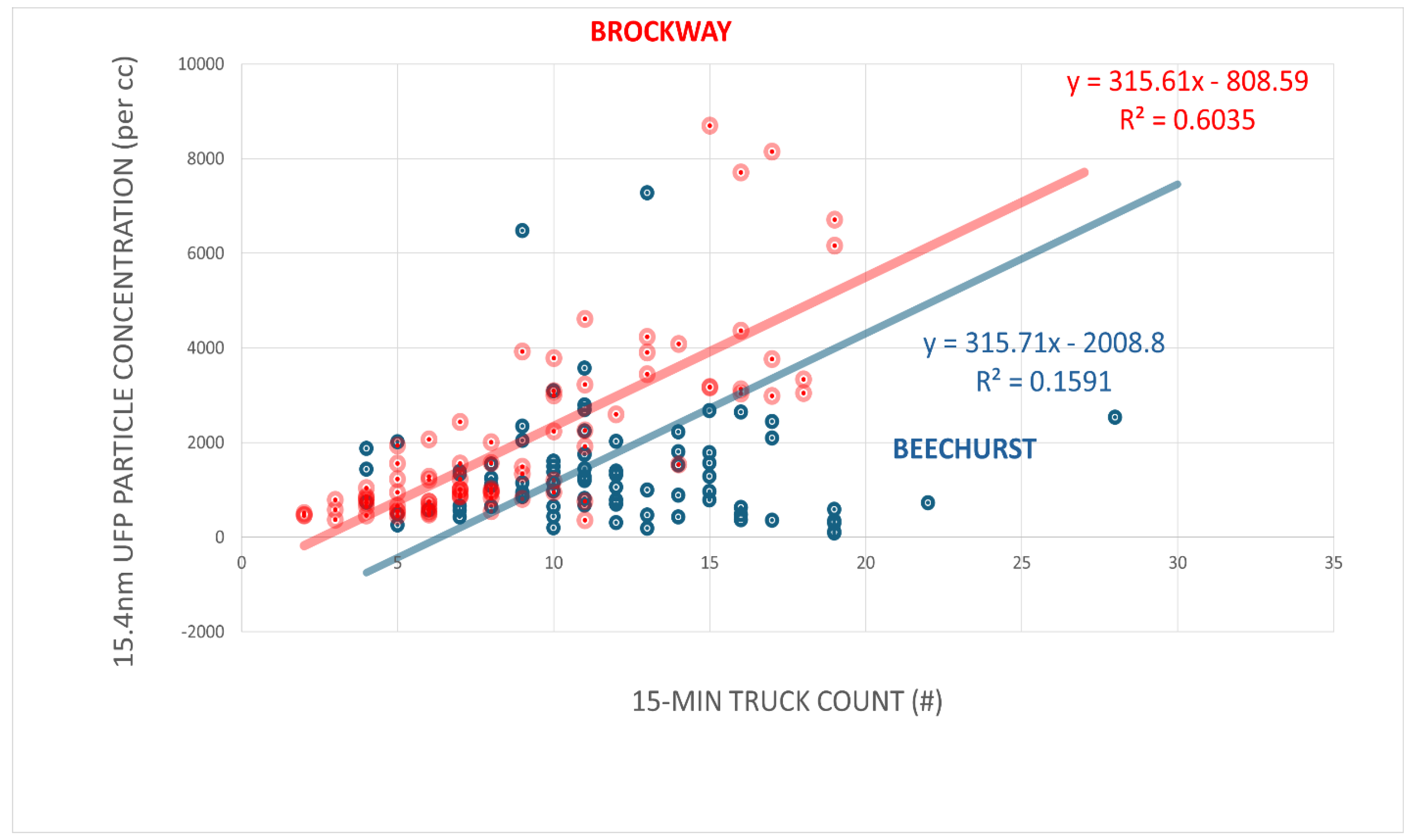
At Brockway and Beechurst, the particle size distribution modes were characterized by a proportion of smaller particles, with a dominant peak near 0.015 µm (Figure 2). Selection of this size channel of the UFP aerosol was thus considered as a likely indicator of the related truck traffic in this investigation. This suggests that a substantial fraction of the UFPs present at this location are freshly emitted nucleation-mode particles, likely originating from diesel truck emissions [49]. Thus, a considerable portion of generated UFPs (60%) in Brockway appears to be attributed to diesel trucks (Figure 3). The F-statistics, which measures how well the model explains variance relative to unexplained variables, returned a reading of 124.82, which suggests that the model is highly significant overall with an extremely small p-value (<0.0001). As with the first site, a positive correlation was observed between truck count and UFP concentration at the Beechurst site (Figure 4). The plot illustrates a positive correlation, suggesting that an increase in truck count is associated with a rise in UFP concentration. The regression analysis indicates that, despite a lower slope at Beechurst compared to Brockway, an increase in truck traffic correlates with elevated UFP concentrations. In contrast to Brockway, where pollutant entrapment is more pronounced due to the terrain, the flatter topography at Beechurst allows for enhanced dispersion, resulting in relatively lower peak UFP levels than Brockway (Figure 5).
3.2. Analysis of Particle Size Distribution at Brockway and Beechurst and Its Implication for Lung Dose Estimation Using a Deposition Model
The risk due to variation in particle size related lung deposition exposure (Figure 2) is indicated for both sites by the broader bimodal distribution, with both sites having two significant peaks, similar in size but differing in proportion, relative to the total distribution. The first peak (~15.4 nm) represents smaller, perhaps more freshly emitted and less agglomerated UFPs, likely from diesel combustion and the most likely choice for indicating the presence of diesel traffic in subsequent analyses. The second peak (~0.07 µm - 0.1 µm) suggests the presence of larger, accumulation-mode (perhaps agglomerated) particles representing a lesser impact proportionately for Brockway (40% of total) and a greater relative impact at Beechurst (60% of total). The thoracic deposition rate (the sum of alveolar and tracheobronchial deposition) was approximately 62% for Beechurst, with alveolar deposition dose approximately 30% of the total number concentrations occurring at the levels shown in Figure 5 and, also, 62% for thoracic deposition at Brockway and 31% for alveolar deposition.
4. Discussion
The study's findings provide reasonable evidence to conclude that further study may be warranted to better understand how the number of trucks may be a significant factor in determining the concentration of UFP close to roads. A difference between Brockway and Beechurst, the two sampling locations, was noted for the 15.4 nm particle count size bin on the NanoScan. Truck activity is responsible for 60.35% of the variation in UFP concentration at Brockway according to the correlation between truck count and 15.4 nm UFP particle concentration (Figure 2). This result is consistent with previous studies showing that emissions from diesel engines are the main source of ultrafine particles, especially in regions with high truck traffic [50].
The study's central hypothesis that heavy-duty diesel truck activity increases UFP levels in near-road environments is, nonetheless, also supported by the Beechurst results, which show a positive correlation between truck count and UFP concentrations. By demonstrating that truck traffic is a strong predictor of local air pollution, a crucial component in evaluating the public health concerns associated with diesel emissions, this study advances the larger research goal.
Due to significant roadway variations, the correlation at Beechurst is weaker than at Brockway. The extent of UFP pollution elevation caused by terrain is one important issue. The movement of diesel trucks at Brockway uphill and downhill in steep terrain affects UFP emissions, and accumulation therefore topography is significant in this research. Trucks need greater engine power when they ascend steep slopes, which causes more fuel combustion and higher UFP concentrations in complex terrains. Increased loading of on-road trucks directly influences engine operation by raising the torque demand required to maintain truck momentum. This higher torque demand necessitates greater fuel injection rates and may also alter injection timing, both of which significantly affect the combustion process and emission [51].
Beechurst benefits from easier truck mobility and smoother traffic flow due to its flat topography and improved road conditions because the flat terrain promotes natural air flow and helps to efficiently dilute emissions. Enhanced road conditions permit better dispersion of pollutants. UFP pollutants are dispersed more effectively than in Brockway, which has rougher roads and a more complex topography. The overall concentration of ultrafine particles (UFPs) is lower even though truck emissions continue to contribute to UFP concentrations.
The way traffic flows at Beechurst is another important element. Due to crossings, traffic lights, and congestion, the site probably sees a more varied mix of cars, fluctuating speeds, and stop-and-go traffic because of its open location. Under these circumstances, the contributions of trucks to UFP levels may be sporadically offset by emissions from other sources, including passenger cars and public transit, resulting in variable emission patterns.
Despite these variations, Beechurst's positive correlation nevertheless supports the study's methodology and emphasizes the steady influence of diesel truck emissions on UFP pollution. The results highlight how crucial it is to take site-specific topographical aspects into account when assessing the quality of the air close to roads.
There is a Multiple-Path Particle Dosimetry (MPPD) model yielding similar estimates provided by Stahlhofen et al. that offers a vital framework for analyzing the deposition of ultrafine particulate matter (UFP) across various regions of the human respiratory system [46]. The results from Brockway and Beechurst, as indicated by their respective particle size distributions, have significant implications for inhalation exposure and potential health risks. The similarity in particle size distributions between these two locations suggests a potentially easy applicability in the source characterization using the techniques of UFP, described herein, as well as atmospheric transformation processes, and dispersion mechanisms, all of which directly impact where and how these particles deposit within the lungs.
These smaller particles exhibit higher deposition efficiency in the alveolar region of the lungs, which is the deepest portion of the respiratory tract where gas exchange occurs. Due to their small size, these particles have a greater likelihood of translocating across the alveolar epithelium into the bloodstream, leading to systemic health effects such as oxidative stress, cardiovascular disease, and neuroinflammation [52]. The MPPD model predicts that a significant proportion of these sub-30 nm particles will evade upper airway filtration and penetrate deep into the lung tissue, thereby increasing the risk of adverse respiratory and cardiovascular outcomes.
In understanding the need to actually spend the extra effort to calculate dose it appears that Beechurst exhibits a particle size distribution that is slightly shifted toward larger UFPs, with a peak around 0.03 µm. This shift suggests that the aerosols at Beechurst have undergone some degree of atmospheric aging, possibly through coagulation or agglomeration that led to particle increase in size. The appearance of these larger UFPs in the 30-100 nm range might then be believed to have different deposition characteristics compared to smaller UFPs. According to the lung dose model, these particles might be considered more likely to deposit in the tracheobronchial and extra thoracic regions, meaning they are more effectively removed by mucociliary clearance mechanisms before reaching the deep lung [53]. However, when performing the actual calculations this is not a true difference in dose between the two sites. Deposition is nearly identical as is dose (note the lack of significant difference between the two regression lines in Figure 5). The initial appearance does not eliminate health concerns. Dose is the bottom line, and it should be calculated. The minor differences in deposition patterns between Brockway and Beechurst highlight the possibility that significant differences of site-specific factors may not result in actual health risk differences. In essence, by integrating particle size distribution lung deposition data with the MPPD-type models, researchers can improve the accuracy of exposure assessments and develop more targeted mitigation strategies.
In general, the application of a lung deposition model to the Brockway and Beechurst data provides valuable insights into the respiratory deposition dynamics of UFPs in different topographical settings. Understanding these patterns is essential for developing effective public health policies aimed at minimizing exposure risks and mitigating the long-term health effects associated with fine particulate pollution.
5. Conclusions
The findings of this study demonstrate that diesel truck count does result in a linear relationship and yields a possible surrogate measure of lung dose of UFP number concentration using video information alone after some consideration of truck engine loading and speed. However, the findings also show that topography significantly influences UFP concentration as trucks move uphill and downhill in complex terrain environments. Valleys and complex terrain contribute to higher retention of UFPs due to truck speed, road condition, and traffic conditions compared to flatter regions where the road condition and topography are more likely to produce dilution. For future studies that plan to address the issue of UFP exposure, the findings also show that the integration of truck count and UFP monitoring can provide a cost-effective methodology that can be applied with only a few hours of preliminary sampling at various roadway settings and including dose estimation from particle size estimates to better understand and mitigate public health risks from diesel emissions.
With respect to the current study, particle size distribution analysis revealed that both Brockway and Beechurst have similar amounts of deposition and dose. This makes it potentially possible that video imaging and truck count may be useful for determining localized exposures to heavy duty trucking along regular truck routes. The integration of the NanoScan particle size distribution data with the lung deposition model provided a detailed assessment of how ultrafine particles deposited dose in the human respiratory tract. These findings may help in understanding site-specific inhalation risks and inform targeted air pollution control strategies. In general, by applying a physiologically relevant lung deposition model, this study enhances the accuracy of exposure assessments and supports health risk evaluation for populations exposed to diesel-related UFP emissions.
Future Directions
As evidenced in the above findings, Appalachian settings especially those in developed nations like the United States are currently well placed to make reliable estimations on current UFP levels and appropriate measures need to be taken to control exposure. However, measurement and tracking of UFPs remain a major challenge, largely due to a lack of technical standardization and clear guidelines. The lack of clear guidelines tends to hamper policy development, highlighting the need for future research to create comprehensive new UFP particle formation and, in turn, better standards for regulation. As part of this initiative, we collaborated with the mechanical engineering department to work on analyzing how engine size, loading conditions, truck speed, and uphill or downhill movement affect ultrafine particle (UFP) concentration across varying topographies using multivariate analyses. Evidence on the role of topography, as noted earlier, is still limited despite the inherent health risks associated with UFP exposure in low-lying areas. Concentrations of ultrafine particles in complex terrains and inclines can be significantly higher should weather conditions develop to trap the UFP, an issue that must be taken into consideration when assessing regional exposure risk and potential public health issues of these particles. This multidisciplinary approach will help us to further understand the role of traffic conditions such as uphill and downhill truck movement, truck characteristics such as engine size, speed, and loading condition in UFP emissions and their distribution in different topographical settings.
We are planning to conduct a health effects study to assess the impact of these particles on public health, with the goal of establishing an epidemiological dose-exposure limit. More research into UFP emissions in different environments is essential in accurately determining the level of exposure and potential health risks. More importantly, the research will provide valuable insights for developing strategies to mitigate UFP pollution in areas with diverse topographical features.
Funding
This research received no external funding.
Informed Consent Statement
Not applicable.
Conflicts of Interest
There are no conflicts of interest.
Abbreviations
The following abbreviations are used in this manuscript:
UFP UltraFine Particle (i.e. less than 0.1 µm)
References
- Fuller, R.; et al. Pollution and health: a progress update. The Lancet Planetary Health 2022, 6, e535–e547. [Google Scholar] [CrossRef] [PubMed]
- Marcella, S.; et al. Size-based effects of anthropogenic ultrafine particles on activation of human lung macrophages. Environ Int 2022, 166, 107395. [Google Scholar] [CrossRef] [PubMed]
- Ali, M.U.; et al. Pollution characteristics, mechanism of toxicity and health effects of the ultrafine particles in the indoor environment: Current status and future perspectives. Critical Reviews in Environmental Science and Technology 2022, 52, 436–473. [Google Scholar] [CrossRef]
- Calderón-Garcidueñas, L.; Ayala, A. Air Pollution, Ultrafine Particles, and Your Brain: Are Combustion Nanoparticle Emissions and Engineered Nanoparticles Causing Preventable Fatal Neurodegenerative Diseases and Common Neuropsychiatric Outcomes? Environ Sci Technol 2022, 56, 6847–6856. [Google Scholar] [CrossRef]
- Presto, A.A.; Saha, P.K.; Robinson, A.L. Past, present, and future of ultrafine particle exposures in North America. Atmospheric Environment: X 2021, 10, 100109. [Google Scholar] [CrossRef]
- Bergmann, M.L.; et al. Short-term exposure to ultrafine particles and mortality and hospital admissions due to respiratory and cardiovascular diseases in Copenhagen, Denmark. Environ Pollut 2023, 336, 122396. [Google Scholar] [CrossRef]
- Kwon, H.-S.; Ryu, M.H.; Carlsten, C. Ultrafine particles: unique physicochemical properties relevant to health and disease. Experimental & Molecular Medicine 2020, 52, 318–328. [Google Scholar]
- McCawley, M.A. Does increased traffic flow around unconventional resource development activities represent the major respiratory hazard to neighboring communities?: knowns and unknowns. Curr Opin Pulm Med 2017, 23, 161–166. [Google Scholar] [CrossRef]
- Moreira, F.M.R.d.S. Ultrafine particles: world characterization, occupational assessment and effects on human health. 2023, Universidade Fernando Pessoa.
- Lewis, A. ; D. Carslaw, and S. Moller, Ultrafine Particles (UFP) in the UK. 2018.
- Christian, W.J.; et al. Adult asthma associated with roadway density and housing in rural Appalachia: the Mountain Air Project (MAP). Environmental Health 2023, 22, 28. [Google Scholar] [CrossRef]
- Chauhan, B.V.S.; et al. Review on Sampling Methods and Health Impacts of Fine (PM2.5, ≤2.5 µm) and Ultrafine (UFP, PM0.1, ≤0.1 µm) Particles. Atmosphere 2024. 15. [CrossRef]
- DeBolt, C.L.; et al. Lung Disease in Central Appalachia: It's More than Coal Dust that Drives Disparities. Yale J Biol Med 2021, 94, 477–486. [Google Scholar]
- Ohlwein, S.; et al. Health effects of ultrafine particles: a systematic literature review update of epidemiological evidence. Int J Public Health 2019, 64, 547–559. [Google Scholar] [CrossRef] [PubMed]
- Vaze, N.; et al. Assessment of the Physicochemical Properties of Ultrafine Particles (UFP) from Vehicular Emissions in a Commercial Parking Garage: Potential Health Implications. Toxics 2024, 12. [Google Scholar] [CrossRef] [PubMed]
- Rajagopal, K.; Ramachandran, S.; Mishra, R.K. Seasonal variation of particle number concentration in a busy urban street with exposure assessment and deposition in human respiratory tract. Chemosphere 2024, 366, 143470. [Google Scholar] [CrossRef] [PubMed]
- Smichowski, P.; Gómez, D. An overview of natural and anthropogenic sources of ultrafine airborne particles: analytical determination to assess the multielemental profiles. Applied Spectroscopy Reviews 2023, 59, 1–27. [Google Scholar] [CrossRef]
- Groma, V.; et al. Sources and health effects of fine and ultrafine aerosol particles in an urban environment. Atmospheric Pollution Research 2022, 13, 101302. [Google Scholar] [CrossRef]
- Hopke, P.K.; Feng, Y.; Dai, Q. Source apportionment of particle number concentrations: A global review. Sci Total Environ 2022, 819, 153104. [Google Scholar] [CrossRef]
- Saha, P.K.; et al. High-Spatial-Resolution Estimates of Ultrafine Particle Concentrations across the Continental United States. Environ Sci Technol 2021, 55, 10320–10331. [Google Scholar] [CrossRef]
- Dong, J.; et al. Transport and deposition of ultrafine particles in the upper tracheobronchial tree: a comparative study between approximate and realistic respiratory tract models. Comput Methods Biomech Biomed Engin 2021, 24, 1125–1135. [Google Scholar] [CrossRef]
- Zhai, J.; et al. Chemically Resolved Respiratory Deposition of Ultrafine Particles Characterized by Number Concentration in the Urban Atmosphere. Environ Sci Technol 2024, 58, 16507–16516. [Google Scholar] [CrossRef]
- Vallabani, N.V.S.; et al. Toxicity and health effects of ultrafine particles: Towards an understanding of the relative impacts of different transport modes. Environ Res 2023, 231, 116186. [Google Scholar] [CrossRef]
- Robinson, P.D.; et al. Ultrafine particle exposure and biomarkers of effect on small airways in children. Environmental Research 2022, 214, 113860. [Google Scholar] [CrossRef] [PubMed]
- Agache, I.; et al. Advances and highlights in asthma in 2021. Allergy 2021, 76, 3390–3407. [Google Scholar] [CrossRef] [PubMed]
- Andersen, M.H.G.; et al. Occupational exposure and markers of genetic damage, systemic inflammation and lung function: a Danish cross-sectional study among air force personnel. Scientific Reports 2021, 11, 17998. [Google Scholar] [CrossRef]
- Turner, A.; et al. Personal exposure to average weekly ultrafine particles, lung function, and respiratory symptoms in asthmatic and non-asthmatic adolescents. Environment International 2021, 156, 106740. [Google Scholar] [CrossRef]
- Wright, R.J.; et al. Prenatal Ambient Ultrafine Particle Exposure and Childhood Asthma in the Northeastern United States. Am J Respir Crit Care Med 2021, 204, 788–796. [Google Scholar] [CrossRef]
- Sivakumar, B.; Kurian, G.A. , Exposure to real ambient particulate matter inflicts cardiac electrophysiological disturbances, vascular calcification, and mitochondrial bioenergetics decline more than diesel particulate matter: consequential impact on myocardial ischemia-reperfusion injury. Environmental Science and Pollution Research 2023, 30, 97518–97530. [Google Scholar]
- Lachowicz, J.I.; Gać, P. Short- and Long-Term Effects of Inhaled Ultrafine Particles on Blood Pressure: A Systematic Review and Meta-Analysis. Journal of Clinical Medicine 2024, 13. [Google Scholar] [CrossRef]
- Qi, Q.; et al. Hidden danger: The long-term effect of ultrafine particles on mortality and its sociodemographic disparities in New York State. J Hazard Mater 2024, 471, 134317. [Google Scholar] [CrossRef]
- Zhang, S.; et al. Short-term effects of ultrafine particles on heart rate variability: A systematic review and meta-analysis. Environmental Pollution 2022, 314, 120245. [Google Scholar] [CrossRef]
- Carnerero Quintero and, C. ; Dynamics of ultrafine particles and tropospheric ozone episodes. 2021, Universitat Politècnica de Catalunya, 2021. [Google Scholar] [CrossRef]
- Tran, K.L. ; Air pollution in different microenvironments in Vietnam. PhD by Publication, Queensland University of Technology. 2022, Queensland University of Technology.
- Lv, W. ; Y. Wu, and J. Zang A Review on the Dispersion and Distribution Characteristics of Pollutants in Street Canyons and Improvement Measures. Energies, 2021. 14. [CrossRef]
- Goodsite, M.E.; et al. Urban Air Quality: Sources and Concentrations, in Air Pollution Sources, Statistics and Health Effects, M.E. Goodsite, M.S. Johnson, and O. Hertel, Editors. 2021, Springer US: New York, NY. p. 193-214.
- Kuang, A.S.C. ; Scanning Mobility Particle Sizer (SMPS) Instrument Handbook. 2024: U.S. Department of Energy, Atmospheric Radiation Measurement user facility, Richland, Washington. DOE/SC-ARM-TR-147.
- Kaleb Duelge, G.M.; Hackley, V.A. Michael Zachariah, Accurate Nanoparticle Size Determination using Electrical Mobility Measurements in the Step and Scan Modes. Aerosol Science and Technology 2022, 56. [Google Scholar]
- Yuan, Y.; et al. Design and Experimental Validation of a High-Resolution Nanoparticle Differential Mobility Analyzer. Instruments and Experimental Techniques 2023, 66, 649–660. [Google Scholar] [CrossRef]
- Henderson, M.R. ; Characterization of Scanning Mobility Particle Sizers for Use with Nanoaerosols. 2018: University of South Florida.
- Jakubiak, S.; Oberbek, P. Determination of the Concentration of Ultrafine Aerosol Using an Ionization Sensor. Nanomaterials, 2021. 11. [CrossRef]
- TSI, NANOSCAN SMPS Nanoparticle Sizer Model 3910, Expanding Nanoparticle Measurement Capabilities. 2023.
- Shirman, T.; Shirman, E.; Liu, S. Evaluation of Filtration Efficiency of Various Filter Media in Addressing Wildfire Smoke in Indoor Environments: Importance of Particle Size and Composition. Atmosphere, 2023. 14. [CrossRef]
- Liati, A.; et al. Ultrafine particle emissions from modern Gasoline and Diesel vehicles: An electron microscopic perspective. Environ Pollut 2018, 239, 661–669. [Google Scholar] [CrossRef] [PubMed]
- Nazneen, et al. Assessment of seasonal variability of PM, BC and UFP levels at a highway toll stations and their associated health risks. Environ Res 2024, 245, 118028. [Google Scholar] [CrossRef] [PubMed]
- Stahlhofen, W.; Rudolf, G.; James, A.C. Intercomparison of Experimental Regional Aerosol Deposition Data. Journal of Aerosol Medicine 1989, 2, 285–308. [Google Scholar] [CrossRef]
- Hewett, P. ; Limitations in the Use of Particle Size-Selective Sampling Criteria in Occupational Epidemiology. Applied Occupational and Environmental Hygiene 1991, 6, 290–300. [Google Scholar] [CrossRef]
- A. Borisova, K.R.; Pavlovska, I.; Martinsone, Ž.; Mārtiņsone, I. Multiple Path Particle Dosimetry Model Concept and its Application to Determine Respiratory Tract Hazards in the 3D Printing. ETR 2023, 2, 23–27. [Google Scholar] [CrossRef]
- Balmes, J.R. and N.N. Hansel, Tiny Particles, Big Health Impacts. Am J Respir Crit Care Med 2024, 210, 1291–1292. [Google Scholar] [CrossRef]
- Campagnolo, D.; et al. In-vehicle airborne fine and ultra-fine particulate matter exposure: The impact of leading vehicle emissions. Environment International 2019, 123, 407–416. [Google Scholar] [CrossRef]
- Kittelson, D.B. ; Ultrafine particle emission & control strategies, in South Coast Air Quality Management District Conference on Ultrafine Particles: The Science, Technology, and Policy Issues. 2006: Wilshire Grand Hotel, Los Angeles.
- Hussain, R.; et al. Air pollution, glymphatic impairment, and Alzheimer's disease. Trends Neurosci 2023, 46, 901–911. [Google Scholar] [CrossRef]
- Dong, J.; et al. Ultrafine particle deposition in a realistic human airway at multiple inhalation scenarios. Int J Numer Method Biomed Eng 2019, 35, e3215. [Google Scholar] [CrossRef]
Figure 4.
Scatter plot demonstrating the lower overall concentrations at the flatter, more open, Beechurst site and the slightly less but still statistically significant (p<0.0002) linear regression correlation between truck count and UFP concentration (15.4 nm particle count per cc).
Figure 4.
Scatter plot demonstrating the lower overall concentrations at the flatter, more open, Beechurst site and the slightly less but still statistically significant (p<0.0002) linear regression correlation between truck count and UFP concentration (15.4 nm particle count per cc).
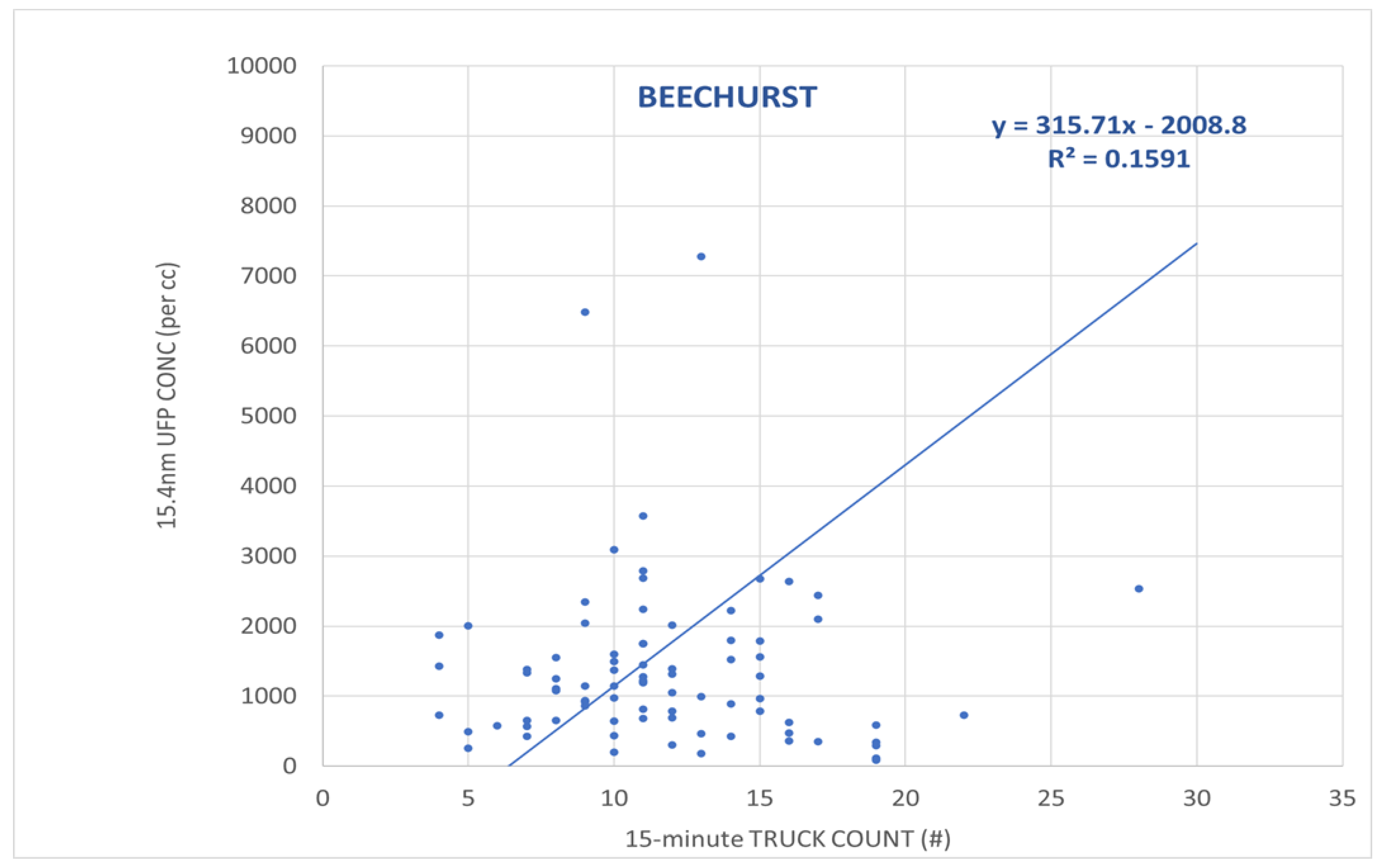
Figure 5.
The linear regression plot shows similar slopes for both sites but potentially slight topographic and subsequent engine load impacts on 15.4 nm UFP concentrations at Beechurst (blue) and Brockway (red).
Figure 5.
The linear regression plot shows similar slopes for both sites but potentially slight topographic and subsequent engine load impacts on 15.4 nm UFP concentrations at Beechurst (blue) and Brockway (red).
Disclaimer/Publisher’s Note: The statements, opinions and data contained in all publications are solely those of the individual author(s) and contributor(s) and not of MDPI and/or the editor(s). MDPI and/or the editor(s) disclaim responsibility for any injury to people or property resulting from any ideas, methods, instructions or products referred to in the content. |
© 2025 by the authors. Licensee MDPI, Basel, Switzerland. This article is an open access article distributed under the terms and conditions of the Creative Commons Attribution (CC BY) license (http://creativecommons.org/licenses/by/4.0/).
Copyright: This open access article is published under a Creative Commons CC BY 4.0 license, which permit the free download, distribution, and reuse, provided that the author and preprint are cited in any reuse.


