

Submitted:
09 May 2025
Posted:
12 May 2025
You are already at the latest version
Abstract
In the 21st century, climate change poses complex challenges to society, including long-term shifts in temperature and precipitation, sea-level rise, and intensified climate extremes such as floods, cyclones, and wildfires. Climate vulnerability refers to a community’s susceptibility to adverse climate impacts, shaped by factors such as exposure to climate hazards, risk sensitivity, and adaptive capacity. In contrast, community resilience denotes a community’s ability to anticipate, absorb, adapt, and recover from climate shocks. Existing literature has primarily focused on the role of social capital in enhancing community resilience. The primary objective of this study is to explore the interplay between social capital and climate vulnerability – specifically, how different degrees of climate vulnerability shape social capital formation and influence its utilization. Using a comparative research design, this study explores two communities in West Bengal, India, with different degrees of climate vulnerability: Brajaballavpur (high-climate-prone) and Jemua (low-climate-prone). Through ethnographic field surveys, participatory rural appraisal (PRAs), focus group discussions (FGDs), and key informant interviews (KIIs), the study finds that high-climate-prone regions exhibit stronger bonding and bridging social capital, fostering collective action and mutual support, while low-climate-prone regions rely more on linking social capital, facilitating access to external resources and institutional support. These findings highlight the interplay between social capital and climate vulnerability, emphasizing the need for con-text-specific adaptation strategies. The study contributes to the discourse on climate adaptation by illustrating how social networks evolve in response to climate risks, with implications for strategic interventions to strengthen inclusive and equitable resilience mechanisms.
Keywords:
Climate change
; Collective action
; Resilience
; Disaster preparedness
; Governance
1. Introduction
Climate change presents multifaceted threats to human society, ranging from long-term shifts in temperature and precipitation to immediate risks like sea-level rise and extreme weather events such as floods and cyclones [1,2]. While there’s no universal solution to these challenges, enhancing resilience and adaptive capacity emerges as a critical strategy. In recent years, substantial efforts have been made to formulate disaster prevention policies and foster disaster-resistant communities, focusing mainly on physical infrastructure and preparedness. However, limited attention has been paid to the social dynamics within these communities and their role in fostering resilience [3]. Addressing climate change impacts requires more than technical solutions; it demands a comprehensive socio-political approach that acknowledges the interconnectedness of social systems with local responses, initiatives, and decision-making processes. Moreover, recognizing the importance of collective social memory is crucial for shaping effective adaptation strategies.
Climate risks to communities can be understood through two key lenses: vulnerability and resilience [4]. From an ecological perspective, vulnerability comprises three elements: the extent of exposure to disturbance, the impact of the disturbance, and the system’s ability to adapt [5]. It reflects the short-term fragility of a system to environmental risks. Conversely, resilience refers to a system’s long-term capacity to handle change, encompassing resistance to shocks, recovery ability, and adaptability to new conditions [6]. Resilience is not static; instead, it denotes a system’s flexibility in responding to hazards. While it may not return to its original state, a resilient system adjusts to new conditions more effectively in the sense of ‘bouncing forward’ [7] p. 65. This entails utilizing ‘learning processes’ and ‘social memory’ to create a more resilient community post-disruption rather than solely aiming to restore the pre-disruption state [2] p. 6.
Community resilience hinges on several factors, including the diversity of its capital (human, economic, physical, cultural, political, social, etc.), efficient resource utilization for recovery, cohesive teamwork, identification of barriers and facilitators, and connections with other communities [2,8]. The ability of a community to rebound from disasters relies heavily on its pre-disaster context, with existing inequalities, marginalized populations, and weak social bonds posing obstacles to resilience [9]. The decision-making process for adaptation and resilience underscores the interdependence of agents, social institutions, and research frameworks across human ecology, geography, economics, anthropology, political science, climate research, and disaster management. Societies inherently possess the capacity to adapt to disruptions like climate change, with collective action playing a pivotal role in fostering resilience [10].
In coping with climate catastrophes, social ties and the accumulated social capital within those ties play a pivotal role in recovery and adaptation. When governmental assistance is lacking post-disaster, social capital becomes a crucial substitute for state aid [10]. Numerous empirical studies underscore the importance of social capital and networks in disaster management. Social capital is utilized during emergencies to obtain financial support, non-financial resources, and essential services such as search and rescue, sheltering, emotional support, and information [11,12,13]. Social capital encompasses the resources available to individuals through their social connections, ranging from information and support to access to opportunities and collective action. It refers to the networks, norms, and social trust that facilitate coordination and cooperation among individuals within a community. The genesis of social capital as a formal concept can be traced back to the works of early sociologists like Émile Durkheim and Max Weber, who highlighted the importance of social networks and community ties in shaping social behavior. However, the term “social capital” was first explicitly articulated by L.J. Hanifan in 1916, describing the goodwill, fellowship, and mutual support among rural communities in the United States [14].
The concept of social capital gained significant traction in the late 20th century, particularly through the influential works of Pierre Bourdieu, James Coleman, and Robert Putnam. Bourdieu (1986) explored social capital in terms of the benefits individuals derive from their social networks and the ways in which it intersects with economic and cultural capital [15]. Coleman (1988) further expanded the idea by illustrating how social capital facilitates educational attainment through trust and norms within social structures [16]. The most popular contemporary interpretation comes from Robert Putnam (2000), who examined social capital’s role in community engagement and civic participation, notably in his book “Bowling Alone” [17]. Putnam distinguished between bonding (within-group) and bridging (between-group) social capital, emphasizing their roles in fostering social cohesion and collective action. Over the years, social capital has become a prominent point of discussion in various types of literature, such as entrepreneurship, institutional economics, labor economics, education, public health, and climate research (especially in building community resilience).
Informal collective decision-making during crises and utilizing social networks for disaster preparedness and response strategies during non-crisis periods often compensate for the absence of state planning. Moreover, collective learning and social memory within social ties empower individuals to perceive adaptation to climate risks as within their control, enhancing their capacity to mitigate and adapt [18]. While disasters devastate physical, human, and economic capital, social capital remains relatively intact, thus significantly enhancing community resilience and risk reduction capacities.
While existing research has largely focused on how social capital is important in enhancing resilience in communities vulnerable to climate threats, our study focuses on how varying levels of climate vulnerability influence the structure and function of social capital. Climate vulnerability refers to the susceptibility of a community to adverse climate-related impacts. It is influenced by various factors, such as the degree of exposure to climate catastrophes, sensitivity, and the adaptive capacity of the community to cope with climate-related dangers. Community resilience, on the other hand, refers to the ability of a community to anticipate, absorb, adapt, and recover from climate shocks. This distinction is especially crucial to the study because vulnerability and resilience, although interconnected, are conceptually distinct. Thus, the primary objective of this study is to explore the interplay between social capital and climate vulnerability – specifically, how different degrees of climate vulnerability shape social capital formation and influence its utilization within communities. Our study does not conflate these terms but instead seeks to highlight how social capital functions differently depending on the degree of climate vulnerability of a community and explores how climate vulnerability influences social capital rather than simply positioning social capital as a mechanism to build community resilience. Thus, to further clarify the research objectives of the study, we discuss community resilience as an outcome or a response to climate vulnerability, while climate vulnerability in itself is discussed as a contextual factor that influences social interactions and social capital. In our study, we move beyond the ‘social capital as a solution’ narrative and look at how the degree of climate vulnerability influences social capital. This comparative framework enriches the existing discourse on social capital and resilience by highlighting that social capital is not a one-size-fits-all solution – and its function varies based on contextual factors like geographic isolation, governance structures, and political dynamics. We shift the discussion beyond perceiving social capital as an asset that communities leverage in the face of climate vulnerability; we view it as dynamic and evolving, influenced by climate risk exposure. This nuanced perspective highlights how pre-existing vulnerabilities shape the purpose, utilization, effectiveness, governance, collective action, and resilience-building potential of social capital.
Figure 1.
Diagrammatic representation of the study objective: To explore the interplay of climate vulnerability and social capital (highlighted by a double-headed arrow).
Figure 1.
Diagrammatic representation of the study objective: To explore the interplay of climate vulnerability and social capital (highlighted by a double-headed arrow).
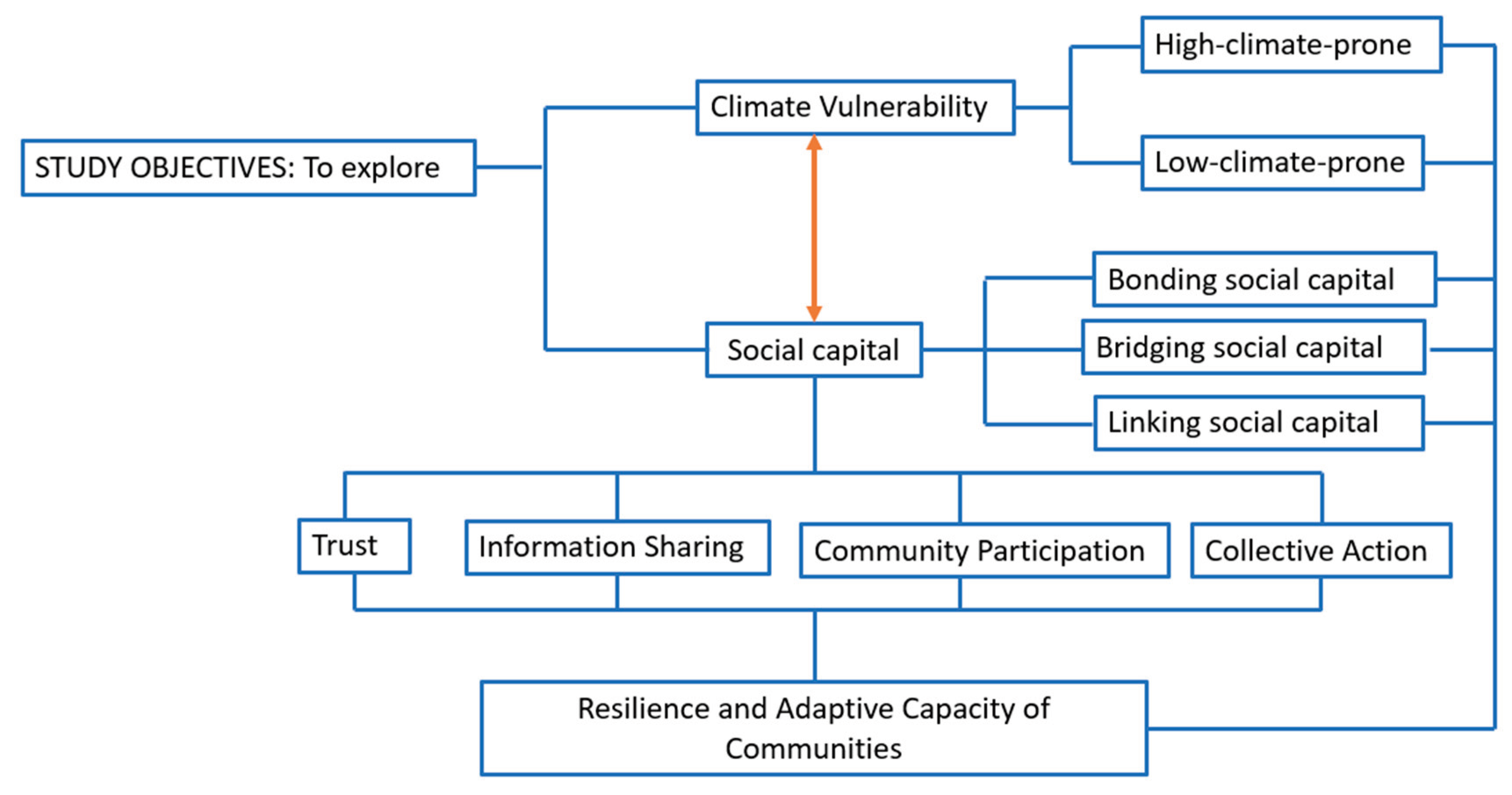
In the following sections, we present our conceptual framework, which focuses on two main components: (a) the distinction between high- and low-climate-prone regions and (b) the forms and roles of social capital. We then elaborate on the interconnectedness of physical and social vulnerabilities by examining the dynamics between geographic characteristics and social capital. In the subsequent sections, we outline the study areas, methods used for data collection, and the findings that highlight specific differences in social capital between high and low-climate-prone regions. Finally, we discuss the broader implications of our study, emphasizing how an understanding of the nuanced interplay between climate vulnerability and social capital can guide better disaster resilience and adaptation strategies.
2. Conceptual Framework
2.1. Climate Vulnerability: High Climate-Prone Regions vs. Low Climate-Prone Regions
IPCC (2023) defines vulnerability as the propensity of being adversely affected by a climate-related disaster and explains the differences in how societies experience the same hazard [19]. It encompasses factors such as sensitivity or susceptibility to damage and the limited ability to cope and adapt to changing conditions. Vulnerability involves various aspects of exposure, including the presence of people, livelihoods, species, ecosystems, infrastructure, and economic, social, and cultural assets in areas that are at risk. Moreover, it is influenced by the actions, decisions, and capabilities of social actors, making it adaptable to interventions such as policy reforms or development aid [20]. Understanding climate-related disasters requires more than just examining natural phenomena; it involves social, political, and economic factors that play a crucial role. While climate events may act as triggers, the extent of their impact depends on how communities organize and adapt post-disaster. Vulnerabilities following a catastrophe include physical risks from unsafe living conditions and social vulnerabilities rooted in existing inequalities based on caste, class, religion, gender, and age, all of which affect the community’s ability to adapt and build resilience [1].
Addressing the challenges of vulnerability and resilience has been a key focus for the global community, particularly in supporting climate strategies in developing countries. These concepts are frequently used in policy discussions, where resilience and vulnerability are viewed as two sides of the same coin [21]. Resilience refers to the ability of a community or system to recover from stress and return to stability while also emphasizing the capacity to adapt, evolve, and respond to a range of internal and external disruptions [22]. Though initially used in fields like psychology, sociology, and engineering, resilience became well-established in discussions on global environmental change through the work of Holling (1973), who defined it as the ability of an ecosystem to maintain its core functions despite disruptions [23]. This concept was expanded by the Socio-Ecological System (SES) theory, which views ecosystems as dynamic, complex, and adaptable by envisioning nature and society as interconnected, co-evolving systems. Within this framework, resilience is the ability of a system to self-organize, adapt, and withstand disruptions without losing its core functionality [24].
Research on vulnerability and resilience has grown significantly, especially in response to climate change impacts [25,26]. While earlier studies mainly focused on vulnerability, there is now an increasing emphasis on resilience as a positive and proactive concept that can be integrated into broader development goals. The key idea is that similar climate events can have different impacts depending on where and when they occur [27]. Understanding these variations requires analyzing how the interaction between natural events and specific societal characteristics determines the level of effect [28]. Vulnerability and resilience frameworks help connect the biophysical aspects of climate susceptibility with social and economic factors that either mitigate or worsen the effects of environmental changes [29]. They also consider the economic, social, political, and cultural resources available for adaptation, along with the trade-offs linked to various environmental conditions [30]. Addressing the underlying causes of vulnerability, rather than just its symptoms, can inform effective policy decisions. Similarly, understanding resilience helps guide resource allocation to strengthen existing systems or develop new areas of support.
Physical and social vulnerabilities often intersect at individual, household, and community levels, as seen in the Pressure and Release (PAR) model by Wisner et al. (2004), which highlights the human factors in disasters. This model views disasters as outcomes of social structures and decisions that affect access to power, resources, and safety, influenced by cultural and social networks [31]. Some regions are more vulnerable due to their proximity to climate hazards such as floods, droughts, and water-borne diseases or because of damaged infrastructure. For this study, regions with high susceptibility to climate disasters are termed high-climate-prone regions, while low-climate-prone regions are those less frequently exposed to extreme events. However, it’s important to note that the distinction between these categories is not rigid, as vulnerability varies across the globe, with some areas facing greater climate challenges due to local factors and adaptive measures.

Table 1.
Characteristics of High climate-prone regions and Low climate-prone regions.
| Characteristics | High climate-prone regions | Low climate-prone regions |
|---|---|---|
| Frequency and Severity of Extreme events | High climate-prone regions experience a higher frequency and greater severity of extreme weather events, such as hurricanes, cyclones, floods, and droughts. | Low climate-prone regions experience fewer extreme weather events with lower intensity, making them less vulnerable to catastrophic disasters. |
| Sea-level Rise | Coastal areas in high climate-prone regions are more susceptible to sea-level rise, leading to increased coastal erosion risks and inundation. | These regions usually have stable sea levels, reducing the risk of coastal erosion and inundation. |
| Temperature Fluctuations | These regions often face extreme temperature variations, including heat waves and cold snaps, impacting ecosystems, agriculture, and human health. | Temperature variations are generally milder. |
| Precipitation Variability | High climate-prone regions may witness erratic rainfall patterns, including prolonged periods of rainfall or extended droughts, that significantly disrupt water resources and agriculture. | Rainfall patterns are usually predictable. |
| Biodiversity Impact | Climate change can disrupt ecosystems in high climate-prone areas, leading to shifts in species distributions and endangering biodiversity. | Ecosystems in low climate-prone areas are less likely to face drastic shifts in species distribution. |
| Human Displacement | There are higher levels of climate-induced human displacement, including migration, due to environmental factors. | Climate-induced displacement is less common in low climate-prone regions. |
| Infrastructure Vulnerability | Infrastructure such as buildings and transportation networks, as well as educational and health infrastructure, are more susceptible to damage from extreme weather events, leading to increased disruptions and repair costs. | Infrastructure usually withstands the occasional extreme weather event. |
| Economic Impact | The economy of high climate-prone regions is often more vulnerable to climate-related losses in agriculture, tourism and other sectors. | The economy of low climate-prone regions is generally more stable and less susceptible to climate-related losses. |
| Health Risks | Climate-related health risks, such as the spread of vector-borne diseases, skin infections, allergies, heat-related illnesses, etc., are more prevalent. | Climate-related health risks like the spread of vector-borne diseases, skin infections, allergies, heat-related illnesses, etc., are less prevalent. |
As awareness of human-induced climate change grows [37,38], there is increasing interest in how local communities can adapt and become more resilient to climate-related stresses [39]. The interplay between geography, human interactions, and social networks is essential for understanding how people build resilient communities. Research on community resilience has expanded, highlighting various social, psychological, and technical factors that influence how communities respond to and recover from climate [40,41]. Building resilience requires more than just technical solutions; it involves understanding social dynamics, local knowledge, and communication that foster collective action [42]. Studies have shown that social capital—the networks, trust, and norms within a community—plays a critical role in shaping disaster preparedness and recovery efforts [13].
To further explore the role of social capital in community resilience to climate disasters, the following section will provide a deeper understanding of this concept and how it can be utilized to enhance adaptive capacity and collective action during crises.
2.2. Social Capital
Social capital is a relatively recent addition to the social sciences; as early as 1916, Hanifan coined the term within the context of community involvement in a successful schooling system [14]. As researchers and social theorists continue to employ and reconceptualize social capital, a multitude of ideas have come to represent components or even the concept of social capital. For example, some researchers operationalize social capital in terms of a range of variables, including social norms, trust, civic engagement, and social cohesion, while others operationalize social capital in terms of levels of social support.
Though definitions of social capital vary among theorists and researchers, it is broadly understood as the economic or social value gained by individuals or groups through resources accessible via social relationships or networks. This concept is generally broken down into three main dimensions: cognitive, relational, and structural. The cognitive dimension encompasses shared meanings and understandings among individuals; the relational dimension includes trust, friendship, respect, and reciprocity built through past interactions; and the structural dimension concerns the network patterns of relationships between actors [43].
Social capital, rooted in Pierre Bourdieu’s idea that it’s not what you know but whom you know that matters, constitutes a collective asset comprising social relations, shared norms, and trust that foster cooperation and collective action for mutual benefits [44]. Social relations and the accrued social capital require maintenance; reciprocity declines over time, and norms depend on regular communication [16]. Individuals with diverse social networks and civic engagements are better positioned to address vulnerability and build resilience, accessing a wealth of information, resources, and opportunities.
This study organizes social capital into three categories: bonding, bridging, and linking social capital. This categorization is especially suitable as it focuses on a single category of social ties -whether bonding, bridging, or linking- in the understanding of local vulnerability and resilience conditions. Moreover, any framework that attempts to capture the multifaceted relationships that individuals have with others and the myriad ways that these ties provide assistance during crises and shocks will need to include all three categories of social capital
The most common among the types of social ties is a connection to someone similar, a phenomenon that sociologists label as homophily, which means relatives, closest friends, and contacts that share the same language, ethnicity, culture, and class. Individuals sharing similar characteristics in homogeneous networks build and maintain social capital through cohesion [45]. Social scientists term this kind of connection as bonding social capital. During disasters, bonding ties with neighbors, friends, and kin can be lifesaving, as these individuals not only understand the crises but also are motivated to come to assist in times of crisis.
The next type of connection comes from weaker or thin ties to people with whom we spend less time and have less in common. The connections, known as bridging social capital, are important when searching for jobs [46] or information and opportunities beyond immediate contacts. Bridging ties may be especially useful during and after the disaster as these network members may be geographically distant from survivors and, therefore, better situated to provide aid. Bonding and bridging serve as horizontal frameworks for connections [12].
Linking social capital, the third and final type of social capital, sits between regular people and someone in power or authority. These ties facilitate the flow of services and assistance from well-resourced organizations, whether public or private [47]. Where bonding and bridging ties are horizontal in nature, linking social capital is vertical. Linking social capital is essential for the connection between disaster victims and those who control resources and knowledge about access to various available resources at different levels of governmental organizations [48].
2.3. Vulnerability, Resilience, and Social Capital
Building climate resilience communities remains among the most desirable outcomes at the central, state, and local levels in mitigating climate vulnerability. With this understanding, social ties, cohesion, and community engagement become critical components in determining the collective action and mobilization of a neighborhood during and after a shock. A number of studies have documented that social ties and social cohesion positively impact disaster outcomes and recovery processes [12,49,50]. In this sense, social capital is crucial to the lived experience of coping with risk [51], with social ties and cohesion assisting survivors in a number of ways [52]. Even before a disaster or crisis occurs, residents in vulnerable areas must decide whether to stay or evacuate, and their decisions are heavily influenced by their social network [53]. Then, following a disaster, survivors must decide whether or not to return to a damaged home or business to rebuild. Strong ties to neighbors and a sense of place—both components of social capital—help pull survivors back to rebuild, whatever the cost. Also, beyond the decision to return or exit a damaged community, many of the challenges facing survivors in the recovery period are collective action problems [12]. A final way that social capital accelerates recovery is through mutual aid or informal insurance. Survivors, with strong ties to the community before the event are positioned to offer aid and to receive it, whether a place to stay or information and opportunities for recovery and rehabilitation. Social capital contributes to building disaster resilience by promoting cooperation and collaboration among individual social networks along with engagement with community and regional-level organizations in the disaster management system.
In the broader context of climate vulnerability and resilience, social capital plays a central role in determining how communities adapt and thrive amidst adversity. Social networks can mitigate vulnerability by promoting collective action, mutual aid, and efficient resource distribution. Communities with strong social capital are often better positioned to mobilize quickly, coordinate efforts, and articulate a shared vision for recovery, which is critical in managing the complex challenges that arise after a disaster. Conversely, when social capital is fragmented or unequally distributed, it can lead to inefficiencies, exclusion, and reduced trust, weakening the overall resilience of the community.
Thus, current literature highlights the pivotal role of social capital in shaping community responses to climate vulnerability. Studies have extensively shown that bonding social capital strengthens local resilience by fostering kinship networks, mutual aid, and collective action during crises [12,51]. In contrast, bridging and linking social capital enable long-term adaptation by connecting communities to external resources, governmental aid, and institutional support [17].However, while social capital is widely recognized as essential for resilience-building, scholars have also pointed out its limitations and unintended consequences. Political patronage, exclusionary networks, and disparities in resource access can reinforce pre-existing social inequalities, particularly in highly vulnerable communities [15,54]. Additionally, the functionality of social capital is highly context-dependent, as varying climate risks influence how social networks are formed, activated, and sustained [7].
Despite these insights, research remains limited on how climate vulnerability shapes the structure, function, and effectiveness of social capital over time. This study addresses this gap by examining the dynamic interplay between climate vulnerability and social capital, offering a comparative perspective on how communities with differing climate exposures develop and utilize social networks for adaptation and survival. In our study, we hypothesize that different degrees of climate vulnerability shape differences in how social capital is formed, maintained, and utilized in everyday life. For this purpose, we use a comparative research design to explore the cases two distinct study areas – Brajaballavpur (high-climate-prone) and Jemua (low-climate-prone region) in West Bengal, India. In the following section, we discuss in further detail the methodology of this study.
3. Methodology
3.1. Study Area
The selection of study areas was carefully guided by the need to compare regions with contrasting levels of climate vulnerability and geographic characteristics. Two villages were chosen for this study: Brajaballavpur in the South 24 Parganas district of the Indian Sundarbans and Jemua in Paschim Bardhhaman. Each area was selected based on specific criteria that align with the study’s objective of exploring the interplay between climate vulnerability and social capital.
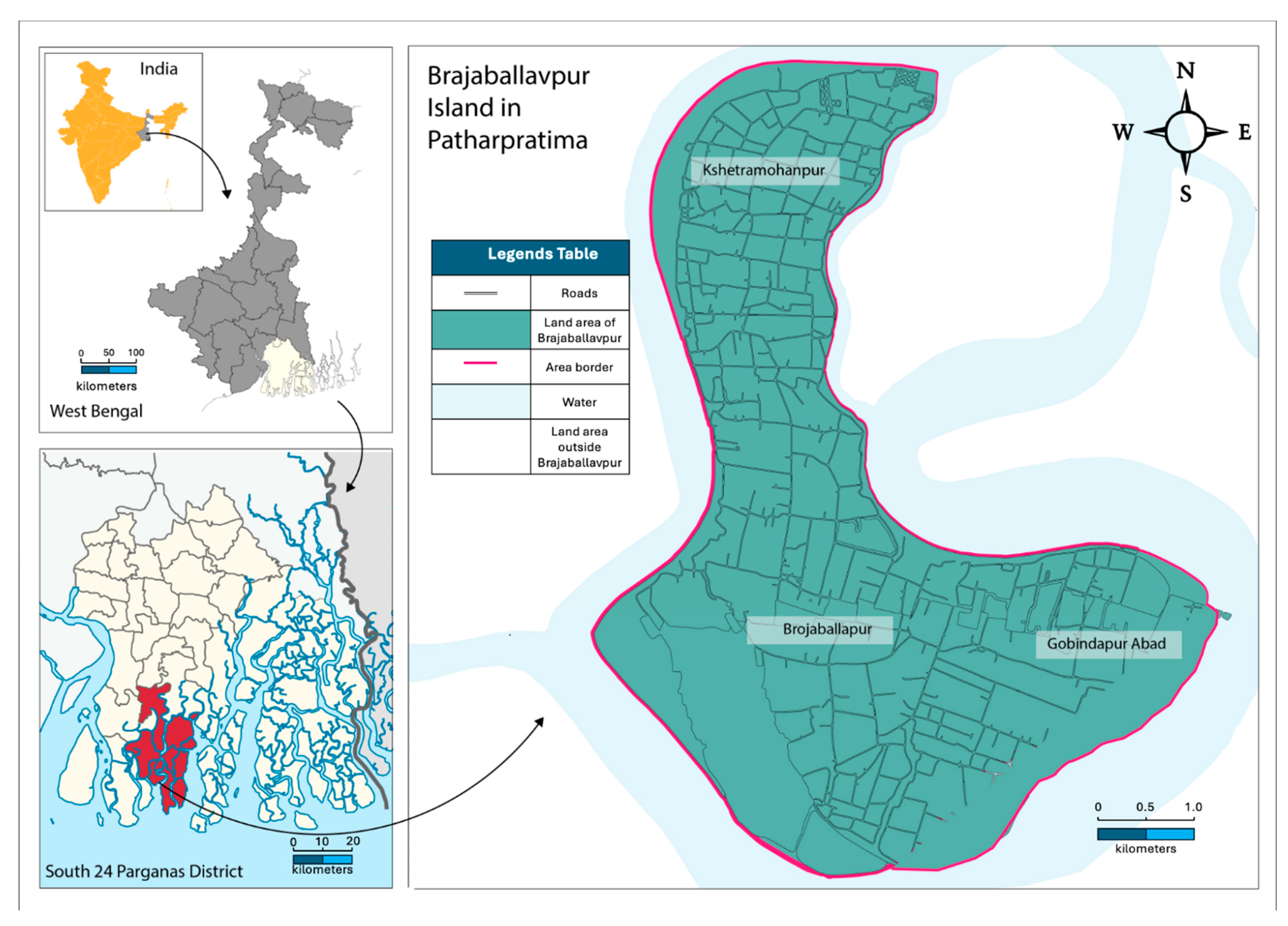
Selection of Brajaballavpur: Brajaballavpur (21°46’14.39”N 88°20’8.40”E), located in the Indian Sundarbans, was selected as the study site representing a high-climate-prone region. Being an island at the mouth of the Bay of Bengal, Brajaballavpur is particularly susceptible to the impacts of climate change, including cyclones, sea-level rise, and saline water intrusion. Due to the ‘isola effect’ [55], island geographies have specific vulnerabilities stemming from their isolated location. These isolated islands face challenges such as unreliable connectivity to the mainland and increased exposure to natural disasters, making them highly vulnerable to threats like sea-level rise, severe cyclonic storms, and saline water incursion that disrupt their fragile socio-ecological systems [55]. The study focuses on the villages of Gobindapur Abad, Brojaballavpur, and Kshetra Mohanpur, all located on Brajaballavpur island under the Patharpratima administrative block. The precarious connectivity of this island to the mainland, especially during the cyclone season, exacerbates its vulnerability, as tidal fluctuations can isolate the island, making it difficult to access external support or evacuate during emergencies. This geographic isolation has led the community to develop strong internal ties as a survival mechanism in the face of recurrent climate threats. Thus, the isolation and the resulting socio-ecological challenges make Brajaballavpur an ideal location to study how communities adapt and respond to high climate vulnerability. By examining how residents cope with unreliable connectivity and heightened exposure to climate-induced risks, the study aims to gain insights into the social capital within such high-risk, climate-vulnerable settings.
Figure 2.
Island geography of Brajaballavpur in Patharpratima administrative block, South 24 Parganas, West Bengal.
Figure 2.
Island geography of Brajaballavpur in Patharpratima administrative block, South 24 Parganas, West Bengal.
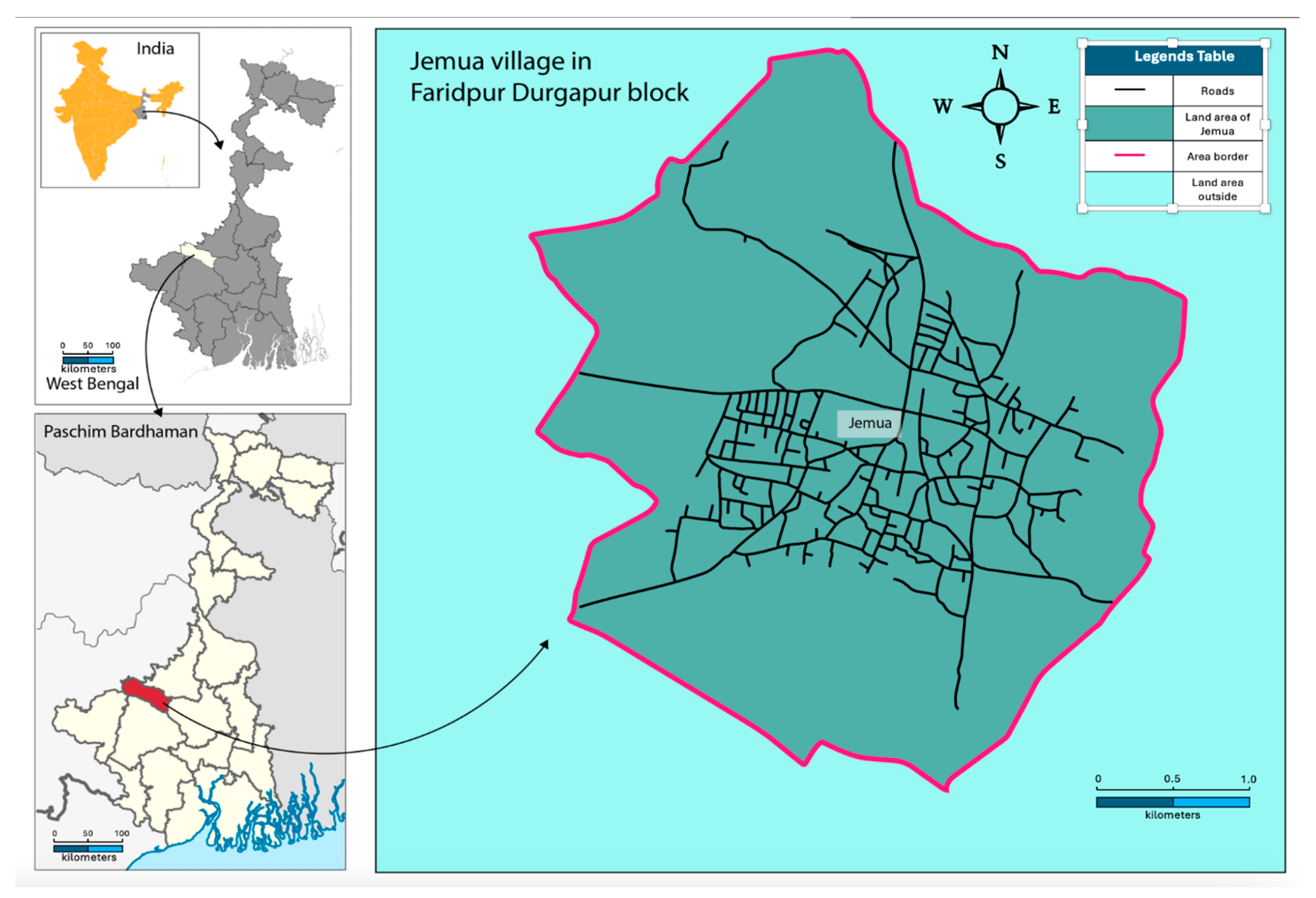
Selection of Jemua: Jemua (23°33’24”N 87°22’9” E), located in the Faridpur-Durgapur block of Paschim Bardhhaman, was selected as a ‘low-climate-prone region’. Unlike Brajaballavpur, Jemua is further inland, land-locked, and benefits from better connectivity to urban centers, and reduced exposure to extreme weather events. The Paschim Bardhhaman district, known primarily for its urban-mining industrial landscape, is characterized by low climate vulnerability. While Jemua experiences occasional fluctuations in weather conditions, it faces minimal stressors from the natural environment. Aside from groundwater depletion during peak summer months, the region does not encounter significant climate-related challenges. The selection of Jemua provides an ideal comparison to the more climate-vulnerable setting of Brajaballavpur, allowing for a comparative understanding of how climate vulnerability impacts social capital. The area’s relatively lower climate vulnerability makes it a valuable point of reference to examine how social capital functions in regions with fewer climate-related disruptions. By focusing on Jemua, the study can also explore how less frequent climate risks influence community interactions, resource distribution, and preparedness measures, offering insights into the differences in resilience strategies between high and low-climate-prone regions.
Figure 3.
Land-locked geography of Jemua in Faridpur-Durgapur block, Paschim Bardhaman, West Bengal.
Figure 3.
Land-locked geography of Jemua in Faridpur-Durgapur block, Paschim Bardhaman, West Bengal.
3.2. Data Collection Methods
This study has a comparative research design that employs a triangulation of methods like ethnographic field surveys, Participatory Rural Appraisal (PRAs), including focus group discussions (FGDs), and key informant interviews (KIIs) to compare social capital dynamics in high-climate-prone and low-climate-prone regions of West Bengal, India. The data collection process for this study spanned over a period of a year (2022-2023) and was conducted with necessary permissions from local administrative authorities (Panchayat Office, Brajaballavpur and Panchayat Office, Jemua). During the approval process, researchers provided a comprehensive overview of the study, detailing its objectives, non-invasive nature, and minimal risk to participants. Particular emphasis was placed on anonymity, confidentiality, voluntary participation, and informed consent, ensuring that all ethical considerations were thoroughly addressed. Additionally, the researchers clarified that any findings from the study would be used strictly for academic and research purposes, reinforcing transparency and accountability.
Upon securing official permissions, the research team engaged in long-term rapport-building with community members, fostering mutual trust and understanding to encourage voluntary participation. Before data collection, informed consent was obtained from each respondent, with a detailed explanation of the research objectives, methodologies, and data collection process. This ensured that participants had a clear understanding of their role in the study and the measures taken to protect their rights and privacy. Furthermore, to further facilitate the data collection process, the researchers were accompanied by resource persons from the village communities, who played a crucial role in bridging communication gaps, providing cultural insights, and ensuring community members felt comfortable participating in the study.
To gather comprehensive and qualitative insights, the study employed a range of data collection methods tailored to the specific contexts of each area. These methods included:
- Ethnographic Field Surveys: The ethnographic surveys for this study were designed to provide an in-depth, immersive understanding of how social capital functions in communities with varying levels of climate vulnerability using integrated participant observation, and informal conversations, to capture the nuances of everyday social interactions, governance structures, and community resilience strategies. This was a pre-requisite to the data collection process as it provided us with a direction of inquiry for the subsequent phases of data collection, like FGDs and KIIs.
- Participatory Rural Appraisals (PRAs): PRAs were conducted to map community resources, social networks, and climate adaptation strategies through interactive and visual methods. The key components of PRAs included:
- Social and Resource Mapping: Community members collectively identified key social institutions, climate risks, and available resources, helping to visualize local power structures and access to aid.
- Transect Walks: Researchers and participants walked through different parts of the village to observe infrastructure, environmental conditions, and socio-economic divisions. These walks facilitated spatial analysis of social capital distribution.
- Timeline: Community elders and long-term residents described historical climate patterns, major disasters, and how social ties evolved in response to climate threats.
- Focus Group Discussions (FGDs): Using a semi-structured questionnaire FGDs were organized to capture the perspectives of various socio-economic groups within each community. In Brajaballavpur, these discussions focused on understanding community responses to climate catastrophes, aspects of collective action, recovery, and rehabilitation processes, while in Jemua, they explored broader issues of involvement of community members in decision-making processes, development, and governance.
- Key Informant Interviews (KIIs): Interviews were conducted with local leaders, panchayat workers, and village elders to gather insights on climate vulnerabilities, socio-political dynamics, and coping strategies in each area. In Brajaballavpur, these interviews were essential for understanding the challenges posed by the isolation of the island and the role of mutual reliance, collective action, and access to external aid, whereas, in Jemua, they highlighted how political affiliation and local governance influenced resource access.
The study uses a purposive sampling design for the various aspects of the data collection process. Respondents for KIIs were identified based on the insights they could provide on the various themes of social interactions during the crisis and non-crisis times, aspects of governance and administration, disaster preparedness, recovery and rehabilitation, and participation in the decision-making processes. For FGDs, we identified respondents who could engage in proactive discussions about the aforementioned themes while including any respondents who participated voluntarily during the discussions. The selection was also guided by factors such as age, gender, occupation, caste, and political affiliation to capture a comprehensive view of social capital dynamics in the high-climate-prone region of Brajaballavpur (Sundarbans), data was collected from a total of 44 participants. This included 30 participants engaged through PRAs and 5 FGDs (each group consisting of 5-8 individuals) and 14 key informants selected based on their roles in the community (e.g., local leaders, village elders, and community members). In the low-climate-prone region of Jemua (Paschim Bardhhaman), 41 participants were engaged, with 30 through PRAs and 4 FGDs (each group consisting of 7-8 individuals) and 11 key informant interviews.
All the respondents participating in the study are adults (18 years of age or above). The study included participants from various age groups to capture a broad spectrum of experiences and perceptions of social capital and climate vulnerability. For the FGDs, the researchers attempted to constitute members from the three broad age groups they identified: 18-35, 36-60, and above 60. The justification for the above-mentioned age groups was to gain a diverse understanding of how the members of the community experience and perceive their social relationships and social capital in the face of climate vulnerability. While the relatively younger generation (18-36 years) perceives the themes of climate vulnerability and social capital in the present context, the elderly (60+ years) contribute valuable insights based on not just lived experiences but also social memory and social learning of past events. The middle-aged (36-60) group is crucial to connecting these experiences and providing a comprehensive insight into intergenerational perceptions of social capital.
While we ensured gender inclusivity in the data collection process, it must be acknowledged that women of rural India still hesitate to participate in discussions with male community members. In the data collection process, the female respondents were much more proactive in their responses in informal settings (like congregating at the community tap/handpump or while engaging in household chores like washing clothes or herding cattle). In contrast, male respondents were the majority in more formal settings of the data collection process. The gender distribution of the participants was approximately 60 percent male respondents and 40 percent female respondents. One FGD was specifically conducted for the women of the village communities (in both Brajaballavpur and Jemua) in an informal setting to ensure their comfort and participation in the data collection process.
3.3. Analysis
The study uses thematic analysis to systematically explore the formation and utilization of social capital in shaping community responses to different degrees of climate vulnerability. Given the qualitative and exploratory nature of the study, thematic analysis is the most appropriate analytical method, as it enables a systematic identification of patterns, inferences, and insights from the rich qualitative data collected through ethnographic field surveys, PRAs, FGDs, and KIIs. The research objectives of the study necessitate an in-depth, contextual understanding of human interactions, perceptions, and lived experiences—something that quantitative methods of analysis may fail to capture adequately. Using thematic analysis, we can identify and explore recurring themes and patterns in social capital formation and utilization across two different regions with different levels of climate vulnerability. It allows for a comparative understanding and represents the dynamic and social processes that constitute the basis of this study.
The data was then transcribed and categorized into key thematic areas, including aspects of social interactions, trust, community participation, resource and information sharing, and collective action. This approach enabled the identification of recurring patterns and allowed for a comparative assessment of how social capital operates in high- and low-climate-prone regions. Finally, these themes were construed into a comprehensive narrative highlighting the interplay of social capital and climate vulnerability, as is discussed in the following section.
4. Results
4.1. The Indian Sundarbans
Since its early settlement, the Sundarbans have grappled with climatic upheavals like cyclones and shifting river courses. Scientific evidence indicates significant climate changes in the last four decades, profoundly affecting the lives, homes, and livelihoods of local communities, especially those on the islands. Recent supercyclones like Amphan (2020) and severe storms like Bulbul (2019) and Yaas (2021) have caused widespread damage, displacement, and destruction, with Amphan being noted as the biggest displacement worldwide due to a natural calamity in 2020 [56]. Over the years, the area has also witnessed deteriorating water quality and groundwater salinization, leading to shifts in agricultural practices toward aquaculture, albeit with long-term soil and farmland suitability concerns [57,58].
The sinking of the Sundarbans delta, leading to sea-level rise, has been ongoing since the 1980s, resulting in the disappearance of several islands and triggering widespread displacement and migration. Food insecurity, stemming from diminishing landmass, low productivity, crop losses, population pressure, and limited job opportunities, drives large-scale migration in the region. Climate-related catastrophes necessitate migration for survival, prompting those with resources to relocate. However, those lacking such means are left to struggle for daily survival.
From field observations in Brajaballavpur island, located in the Patharpratima administrative block, it is evident that high climate vulnerability is a stark reality. The island consists of three villages—Gobindapur Abad, Brojaballabpur, and Kshetra Mohanpur—each characterized by dispersed settlements mainly inhabited by Scheduled Castes (SC), Scheduled Tribes (ST), Hindus, Muslims, and Christians. During our field visits, it was observed that while neighborhoods are often divided based on surnames, the villages are not entirely homogeneous; there is a mixing of socio-economic households, reflecting diverse social interactions.
Despite facing numerous challenges, on account of its geographical isolation, frequent climate catastrophes, and incidences of man-animal conflicts, community members consistently rely on each other for safety, support, and survival. This sense of mutual dependence is a critical aspect of their daily lives, especially during and after climate events when external aid may be delayed due to the island’s isolation. However, it was also observed that political affiliations play a significant role in shaping social dynamics. Those aligned with the ruling political party tend to have better access to resources and opportunities, whereas those with opposing political ideologies may often find themselves marginalized. This political divide affects not just economic opportunities but also the distribution of aid and services, revealing a complex interplay between social cohesion and political affiliation on the island. However, in the wake of consecutive cyclones—Bulbul (2019), Amphan (2020), and Yaas (2021)—striking the remote Sundarbans amidst a pandemic, the local community rallied together, transcending differences in caste, class, religion, and politics. Climate catastrophes serve as social equalizers in these close-knit communities, impacting everyone. Proactive members from various socio-economic backgrounds form primary response teams, making collective decisions. Without access to external assistance, community members take the lead in organizing rescue efforts and providing essential aid to those in need, ensuring that they can sustain one another through difficult periods. This self-reliance and solidarity were apparent in their swift and coordinated actions, underscoring the importance of internal networks in times of crisis.
- “After the cyclone, the water takes time to recede. During this time, there was no outside help for days,” one resident shared during the Focus Group Discussion. “We had to form our own rescue teams, and we all did what we could. People brought food, cleared debris, and checked on our neighbors—it was all hands on deck”.
- “Sure, we have our differences, but when the cyclone strikes, none of those matters. You know it is the people of the village who will pull you out of trouble, not some outsider. After all we’ve been through, those bonds don’t just disappear”, pointed out another resident when asked about whether ideological differences impact community response.
- “Some parts of the village are more affected than others during the cyclones. Just because I am not from that neighborhood does not mean that I will not help in the aftermath. In all these years, we have learned that no one else will reach us as quickly as our own people. That is why we find the strength to face the storms every year. We know that if all of us help one another, we can survive,” mentioned another resident.
This reliance on one another is not merely a short-term response to crises but a reflection of long-term mutual dependence and trust that has been cultivated over the years within the community. Even during non-crisis times, this sense of solidarity and cooperation is evident, as residents regularly support each other in everyday matters, reinforcing the bonds that become crucial during emergencies. This is not to say that conflict is absent in Brajaballavpur; political, social, and economic tensions do exist. However, what stands out is that, despite these conflicts, the community members set aside their differences and come together when facing common challenges, particularly during and after climate events. This enduring sense of unity and resilience illustrates the strength of their social ties, which serve as a lifeline in times of need.
As one village elder mentioned during a KII, “We know the weather could turn any day, and that sense of relying on each other is always there, whether we’re dealing with a big storm or just everyday life. In the Sundarbans, life is not easy, but it is even harder if we have to fend for ourselves. There are very few means, but we have tried to always share what we have in times of need.”
The loss of livelihood in the aftermath of cyclonic storms and the COVID-19 pandemic resulted in many people turning to the forest and river for sustenance. As a result, incidences of man-animal conflict increase [59,60]. In the Sundarbans, the loss of life to nature is so common that it has become the ‘collective agony’ of each community member, strengthening their social ties. Thus, the people of these communities rely strongly on their bonding capital to survive and sustain themselves. They share very strong ties and function as a unit, capitalizing on the bonding and bridging social capital among the community members.
- “Many people came back to the village during COVID. For many households, it meant that they had no livelihood. This resulted in any able-bodied members of the household going to the forest and the sea for livelihood. It is a high-risk, high-profit venture. If you are lucky, you can feed your family. If you are not, you do not come back. Many who go to the forest know this very well, yet they choose to go because they do not hae any options left.” Village official (Brajaballavpur), KII.
During field visits, participants from the community repeatedly expressed how their lives are marked by the constant threat of natural disasters and how these experiences are not isolated but collective in nature. When a tragedy occurs—whether it is a loss due to a cyclone or an encounter with wildlife—it affects not just the immediate family but the entire community. For example, during discussions, locals shared how rescue efforts, mourning rituals, and collective rebuilding in the aftermath of disasters brought people closer, reinforcing their reliance on one another. These observations were further substantiated by the shared narratives and cultural practices observed in the field.
- “When there is an unfortunate accident, it’s not just that family who mourns,” says a Respondent during the FGD, “We all grieve together. When we get to know that someone from the village has been taken, we try to conduct a rescue or at least retrieve the body. Most of the time, it’s the latter. That, too, takes days. Sometimes there is no body or not much left of the body to bring back. Then there is the matter of compensation. It is a lengthy process, and most of the time, the family is not aware of the process. If we do not help them, they will starve. How can we let that happen to our own people?”
Moreover, the people of these communities are connected through a shared culture backed by the worship of the reigning goddess Bonbibi, the guardian of all those who ‘do the forest’ (Jalais, 2010) or depend on the forest for their livelihood. Bonbibi is revered as the guardian of the forest and protector of all who enter the Sundarbans to gather resources or earn their livelihood, regardless of their religious background. This syncretism is evident in how the narratives around Bonbibi are shared and celebrated by diverse groups—both Hindus and Muslims participate in her worship. Such practices highlight a unique and harmonious blending of religious traditions, making it a unifying cultural force across the region. This syncretic faith fosters a sense of collective identity that goes beyond traditional social divisions, reinforcing community solidarity. During times of crisis, such as cyclones or economic hardship, this bond becomes a crucial element of resilience. The reverence for Bonbibi is not merely a religious observance but an expression of mutual dependence and shared vulnerability—it acts as a social glue that binds the community together, enabling cooperative action and support during difficult times.
- “We are all Bonbibi’s children. In this place, she is the mother that protects and blesses us all. Her kindness keeps us alive and provides us with the means to sustain ourselves. What mother would like to see her children fighting amongst themselves?” points out a village elder when discussing the importance of Bonbibi in village dynamics in a KII.
Let us look at Figure 4 for a visual understanding of the type of social capital (bonding, bridging, linking social capital) between community members in a high-climate-prone region versus a low-climate-prone region. For ease of understanding, each small dark-colored circle represents an individual, while the arrows represent their ties to another individual. These ties can represent bonding capital (between members of the same para, caste, or religion) or bridging capital (between members of different para, caste, or religion) based on the position of the individual in the community. A cluster of these dark-colored circles represents the village community. The arrows between two such clusters constitute the bridging ties between the two villages. These bridging ties are used for information and resource sharing, disaster preparedness, and rescue and rehabilitation. Brajaballavpur consists of three villages: Brojaballabpur, Gobindapur Abad, and Kshetra Mohanpur.
We see that within the village, the nodes (representing community members from the local community) are connected through strong ties. The villages themselves are connected through bridging social capital. Bridging social capital between the two villages allows for knowledge exchange for disaster risk reduction passing of early warning information and also aids significantly in rescue and relief. Linking social capital facilitates connections with influential figures such as community leaders, government officials, and NGOs. The line in the middle of the figures demarcates the villages from the external agents and represents a power gradient/social hierarchy (individuals in local and state authorities, NGOs, private organizations, etc.). The light-colored circles represent external agents as individuals or members of an external organization that, although not part of the village community, are involved in various processes within the village community in terms of administration, governance, relief, and aid provision, implementation of government benefits and schemes and long-term intervention strategies, conservation, etc. These individual members may be connected to one another with horizontal and vertical ties across different administrative levels but are usually connected to individuals from the village through vertical ties (linking social capital). In most cases, the individuals from the village community who are connected to these external agents are village leaders, panchayat members, or powerful political party members. Thus, these figures are also a diagrammatic representation of various individuals or actors within the network structure of the community and how their position in the network structure can confer certain advantages or disadvantages.
However, the disruption of connectivity during cyclones hampers the immediate utilization of these connections. Consequently, linking social capital is limited in immediate post-cyclone responses but is valuable for long-term infrastructure development and disaster preparedness initiatives. (as illustrated in Figure 4).
The aftermath of a catastrophe reveals more about the social and political aspects of disasters than the cyclone itself [62]. In Sundarbans, vulnerabilities stem not just from cyclones but also from governmental neglect, corruption, and power dynamics. Although both large and small-scale disasters occur here, attention tends to focus more on the former, disregarding the impact of the latter. Nevertheless, even minor disasters disrupt lives and worsen vulnerabilities. Consequently, community members rely heavily on each other for support, fostering strong trust and reciprocity. They draw on collective experiences and the social memory of past disasters to build resilience and aid each other during crises and beyond. The strong reliance on bonding social capital in the Indian Sundarbans is evident, particularly in the aftermath of cyclonic storms. However, this dependence can lead to mental distress when displacement or rehabilitation occurs due to the loss of social support networks. While people in the Sundarbans have indeed adapted to frequent climate-related disruptions and have built strong bonding social capital, this very dependence on close-knit community ties is also a source of vulnerability when disrupted. Here, bonding capital plays a crucial role in everyday life, particularly during and after climate-related events, and residents rely on each other for emotional support, resource sharing, and collective decision-making, all of which are vital for recuperation and resilience. When people migrate, whether due to climate-induced displacement or in search of better opportunities, they lose access to this essential support system. The process of migration can lead to a sense of isolation, loss of identity, and disconnection from a familiar social environment, which in turn can cause psychological distress. Thus, this distress is not merely about the physical act of moving; it is deeply rooted in the disruption of social relationships that have long been relied upon for survival and well-being and the shared sense of belonging and mutual aid that comes with being part of a close-knit community.
- “Those who can, they have migrated already. Those who remain behind either do not have the means or simply do not want to migrate. This land provides us with everything we need. We are connected to it. Whatever we have is our own. Here, if we need something, we can ask our neighbor. For weddings and funerals, all of us are there for one another. Can we find this in the big cities?” Mentions a participant from the Focus Group Discussion.
- “I do not want to leave because here, everyone knows me. If I have to go to the hospital or the market, I always find someone or the other who would offer a ride. Life in the big cities is very hard because you do not know anyone, and no one knows you.”, points out another participant.
Linking social capital, on the other hand, plays a less immediate role in the aftermath of cyclonic storms. However, it remains indispensable for long-term recovery, disaster preparedness, and sustainable development. For instance, successful disaster mitigation and resilience-building efforts often depend on external support for infrastructure projects, resource mobilization, and policy interventions. Communities with strong linking social capital can leverage these connections to gain access to funding, technical assistance, and capacity-building programs that are essential for rebuilding and fortifying against future climate threats. Examples include the construction of better embankments, improved housing, early warning systems, and more robust healthcare facilities—initiatives that require collaboration between local communities and external actors. However, linking social capital also comes with potential challenges. One significant issue is the unequal distribution of resources, which can arise when access to external support is mediated through local power dynamics. Those who have stronger ties to authority figures, political leaders, or influential organizations may be able to channel resources and opportunities disproportionately to themselves or their close associates. This can lead to the marginalization of vulnerable groups, such as members of the lower castes, religious minorities, and economically disadvantaged households, who may not have the same level of access or influence. As a result, linking social capital, while beneficial, can inadvertently exacerbate existing inequalities and social divisions within a community. For instance, after a cyclonic storm, government relief funds or NGO aid might be distributed through local political leaders who prioritize their own networks, leaving marginalized groups with limited or no access to much-needed resources. This unequal distribution not only undermines immediate recovery efforts but also deepens vulnerabilities, making it harder for these groups to prepare for and cope with future climate catastrophes.
- “Relief comes to our village much later. And it always comes through channels. Sometimes, if you are not aware or do not know the right people, you may not receive any relief material.” Points out a participant in the Focus Group Discussion.
- “Permanent roads and infrastructure are essential if we want to rebuild after a cyclone. Any temporary structures get washed away. We have been asking for a proper road in the neighborhood for a very long time, but nothing has happened yet. Our nearest healthcare facility is in Patharpratima. We have to depend on the availability of the ferry and the tides of the river to consult a doctor. Imagine the situation if someone gets seriously ill or injured during the cyclone season. We do not have anything to do then.” Adds another participant.
- “After a cyclone, most of our things are lost or have been washed away. We usually survive on very little food and water. Thus, relief becomes very important for us to sustain and, later on, rebuild our lives. Everyone in the village needs it in some form or the other, and usually, the relief that we get is not enough for everybody. We have to assess who needs it more than the others. However, if someone gets some of the relief material and another person does not, they think that it’s deliberate on our part. It is a tough job sometimes, but someone has to do it.” Responds a member of the Panchayat in a KII.
4.2. Paschim Bardhaman
Bardhhaman, located in West Bengal, India, was divided into Purba Bardhaman and Paschim Bardhaman districts in April 2019. It is surrounded by Birbhum, Murshidabad, Nadia, Hooghly, Bankura, and Purulia districts of West Bengal and the Dhanbad district of Jharkhand. Bardhaman experiences hot summers with seasonal thunderstorms, rainfall, and mild winters. Therefore, it falls into the category of low-climate-prone regions, as discussed earlier in this paper.
The study was conducted in Jemua, located in the Faridpur-Durgapur tehsil of Paschim Bardhhaman. Jemua comprises approximately 1,368 households and is situated about 16 km away from the nearest town, Durgapur. The village is nucleated, with dwellings clustered together. While Jemua does not experience extreme weather events, summers are typically hot, leading to the depletion of groundwater levels. This often sparks conflicts among various socio-economic groups in the village.
The population distribution in a village is not entirely random; instead, it reflects social hierarchies, with individuals of similar social status often residing together. This segregation is evident in Jemua, where higher caste members cluster on one side of the village while lower caste members reside on the other. Neighborhoods, or “paras,” are distinctly categorized based on caste, resulting in homogeneity within each area. Disparities in development are also noticeable, with the most developed area inhabited by higher caste Brahmins and the least developed area being the Adivasi para (ST).
The physical layout of the village mirrors its social structure and the type of social capital among different socio-economic groups. In higher caste areas, households are generally spaced out and enclosed by distinct boundary walls, creating a sense of separation and individuality. These physical barriers are symbolic of a more individualistic social organization, where bonding social capital is strong primarily among immediate neighbors but tends to weaken with the increased physical distance between households. Residents in these areas engage in resource and information sharing on an occasional basis, primarily for general well-being, but there is less frequent and intensive mutual aid compared to other parts of the village. In contrast, observations in lower caste neighborhoods, particularly those inhabited by Scheduled Tribes (STs), showed a clustered arrangement of houses without distinct boundary walls. This layout reflects a more communal and cohesive social structure, where the lack of physical barriers fosters closer social bonds and constant interaction among residents. This physical proximity is not just a feature of their living arrangements but a manifestation of stronger bonding social capital, where people frequently rely on each other for emotional support, resource sharing, and collective action. For instance, during field visits, it was common to see neighbors sharing meals, helping with household chores, and pooling resources for communal activities. This close-knit structure was particularly evident among STs, who often depend on each other for sustenance, especially in times of crisis, highlighting a strong sense of collective identity and solidarity.
Furthermore, it was observed that the clustered living arrangement among lower caste groups enables rapid mobilization during emergencies. Without the physical and social barriers seen in higher caste areas, these communities can quickly organize and coordinate efforts for mutual aid, whether it’s during a cyclone, a health emergency, or a social gathering. This contrasts with the more individualized approach seen in higher caste areas, where such coordination may be more limited and less spontaneous.
- “Mostly, we talk to our immediate neighbors and the households opposite to ours. Usually, we are so occupied throughout the day that we barely get time to chat. Sometimes in the evenings, we might get together, but it does not happen every day.” Mentions a respondent from the higher-caste paras when asked about their day-to-day interaction with their neighbors during an FGD.
- “We do not really ask our neighbors for anything unless, of course, it’s a serious problem. It does not look nice, I think. However, sometimes, if I make something in surplus, I share some of it with my neighbors, and they do the same. That is what keeps us together, I think.” Mentions another respondent from the higher caste paras when asked about their dependency on their neighbors in an FGD.
- “We rely on our neighbors for everything. Sometimes even for basic things like salt.” Mentions a respondent from the lower-caste para.
The physical and social dynamics of the village thus reveal how bonding social capital operates differently across socio-economic groups. In higher caste areas, it is more localized and selective, while in lower caste areas, particularly among STs, it is broad, inclusive, and deeply embedded in everyday life. This distinction is critical to understanding how communities in Brajaballavpur organize, adapt, and respond to challenges, with each social group leveraging their unique forms of social capital to navigate their environment and circumstances.
Field observations in Jemua revealed that bridging social capital plays a significant role in connecting members of different socio-economic groups, primarily through shared political affiliations. In Jemua, individuals with affiliations to dominant political parties or influential figures act as intermediaries, linking their community members to employment, education, healthcare, and government welfare programs. Moreover, individuals who have established strong political connections or hold leadership roles within local party structures often enjoy significant advantages. For example, those with ties to local leaders are more likely to secure job opportunities, access to healthcare services, and educational scholarships. This reflects the importance of political networks in bridging different groups within the community and highlights how social capital is leveraged to navigate the local socio-economic landscape.
- As one community member expressed, “If you know someone in the party, doors open faster. Getting help with school admissions or even a job depends on who you know.”
However, this bridging capital is not uniformly distributed. Observations indicated that benefits often accrue to those who are already in relatively better socio-economic positions, as they are more likely to have the social skills, resources, and connections needed to establish and maintain these political ties. As a result, individuals from lower socio-economic backgrounds or marginalized groups without these connections may find themselves excluded from the same opportunities. This selective distribution of benefits can perpetuate existing inequalities within the village, even as bridging social capital provides advantages to certain groups.
- It’s not fair,” said one resident from a lower-caste para. “Those without connections don’t get the same help, even when they need it more. You have to run behind the officials with your papers, and even then, there is no saying how much time it might take for things to be processed. However, for those with connections, you just need a phone call, and your request will be taken care of.”
- “We have been requesting for a tube well in our part of the village for months now. We are always being sent back saying that when there would be funds available, our requests would be given priority, but we are still waiting.” Expresses another resident.
- “Our households are eligible for construction of household latrines under the state government scheme for sanitation. It has been a while since I placed my application. I have seen many households in the higher-caste paras get their latrine despite them having the means to construct their own household latrine. However, in my case, they always respond that my turn has not come yet and that I need to wait even longer.” Says one resident from a lower-caste para in a KII.
- “This kind of government work takes time.” Responds a Panchayat official in a KII. “Just because someone has placed an application does not mean that they will immediately get a household latrine. We try to allot the construction based on a lot of assessment which requires quite a lot of planning.”
Another significant observation was that, despite the presence of bridging social capital through political networks, festivities and celebrations in Jemua often remained exclusive to specific social groups. Events such as religious festivals, weddings, and cultural gatherings were typically organized within distinct caste or community lines, with limited participation from outside these groups. For instance, higher-caste households would host events that were primarily attended by members of their own caste, while lower-caste groups and Scheduled Tribes (STs) held their own separate gatherings. This segregation of social events suggests that, while bridging social capital exists in practical contexts (like accessing services or resources), it does not translate into a broader social cohesion that brings diverse groups together on a more personal or cultural level.
- “We are mostly not invited to the festivities or celebrations that happen in the higher-caste paras. Some people from our para might be invited, but most are not.” Says one resident from the lower-caste paras in an FGD.
- “We do not know people from the higher-caste paras that well to invite them to our celebrations.” Says another resident.
Political affiliations facilitated interactions and connections across socioeconomic lines, but these relationships were often transactional and focused on mutual benefits rather than deep-rooted social cohesion. As observed, participants would engage in these networks to gain access to resources but would still revert to their distinct social and cultural groups outside of these contexts. Bridging social capital in Jemua, thus, helps connect individuals across different socio-economic backgrounds through political affiliations, it primarily serves functional and pragmatic purposes. It enables access to crucial resources, but it does not foster widespread community cohesion. Instead, the exclusivity of social events and the transactional nature of political networks underscore a community where bridging connections are essential for survival and advancement but do not lead to a deeper integration across social divides. This dynamic creates a complex social environment where alliances and access are critical, yet traditional social boundaries remain largely intact. Bridging ties between Jemua and the nearby village Paranganj are relatively weak, and the villages typically operate independently. Information exchange is infrequent, with occasional sharing of job and education opportunities, healthcare services, and government benefits. However, these exchanges are limited to select individuals and are often leveraged during political events, thereby highlighting the role of bridging ties in political affiliation.
From field observations, it became clear that the village leaders in Jemua, including the Pradhan, Gram Panchayat members, and ruling party officials, hold significant linking social capital that connects them to state authorities, political leaders, NGOs, and private organizations. These leaders are able to leverage their connections to attract and secure resources for infrastructural projects, such as building roads, schools, healthcare facilities, and improving utilities. Additionally, they play a crucial role in facilitating employment opportunities and implementing poverty alleviation programs by tapping into government schemes and collaborating partnerships with external agencies. This ability to bridge the local community with broader networks of power and resources makes linking social capital a valuable asset for driving development initiatives in the village.
- ‘Our connections to the party leadership have facilitated many development initiatives in the village, and we are very grateful. We always prioritize the needs of the village in our discussions with the party leadership.’ Says a Panchayat official in a KII about development initiatives and the role of political parties and external agencies.
However, there is a more nuanced and complex picture of how this linking social capital operates in practice. Despite its potential to benefit the wider community, decision-making around these development projects and resource distribution is often centralized among a select group of individuals, typically from higher castes. These leaders, who have stronger connections with influential figures outside the village, are usually in a position to control which projects are prioritized and who benefits from them. For instance, it was observed that certain infrastructural projects, such as road construction or the allocation of funds for new schools, were often directed towards areas populated by higher-caste households, reflecting a clear bias in resource distribution
This centralization of power and the exclusion of lower-caste members from decision-making processes were evident during field interactions. Several lower-caste residents expressed feelings of marginalization, noting that they were rarely consulted on important matters and had limited access to the benefits that came from external collaborations facilitated by village leaders. For example, during interviews, SC and ST villagers shared accounts of being left out of meetings where development plans were discussed or having their applications for assistance ignored, even when resources were available.
- “Some people from our para are Panchayat Members, but that is only for show. Most of the time, they are not called for meetings, and their opinions are not taken into consideration during the decision-making processes.” Says one respondent from the lower-caste paras in a KII.
- “Our problems and concerns are only important during the elections. After the elections, things go back to being the same.”, says another respondent.
- “It is a matter of great pride that we have members from different communities and genders in our Panchayat. We always strive to make the decisions collectively, and everyone’s ideas and thoughts are given equal importance.” Says a village official belonging to a higher-caste para when asked about inclusivity and participation in the decision-making processes of the village in a KII.
Moreover, this inequitable distribution of resources and opportunities has fostered tensions between socio-economic groups. Field data indicated that this imbalance often led to conflicts, which were at times exacerbated by political affiliations. For instance, political leaders who were aligned with the ruling party would sometimes use their power to favor their supporters, often at the expense of those aligned with opposition groups or those without any political backing. This unequal distribution of benefits has often led to friction, as villagers perceive the benefits of linking social capital as being reserved for a privileged few rather than equitably shared. While linking social capital has undoubtedly brought development to the village, it has also deepened existing social hierarchies, creating disruptions in trust and cohesion across different caste and socio-economic groups. Lower-caste groups, feeling systematically excluded, are less likely to engage in collective village activities, and there is a marked divide between those who have access to external networks through political leaders and those who do not. Thus, field data underscores that while linking social capital can be a powerful tool for development, its benefits are not automatically inclusive. The case of Jemua demonstrates that without inclusive and transparent governance, the advantages of linking social capital can be skewed to reinforce existing power structures, leading to greater inequality and social discord.
Figure 5 illustrates the distribution of bonding and bridging social capital within the village clusters. The horizontal ties denote bonding social capital, shared among members of the same para or neighborhood, which, unlike Brajaballavpur, is characterized by caste, class, and religion. Vertical ties represent bridging social capital, connecting members of different groups. The figure highlights a socio-political hierarchy where not all members can access bridging social capital benefits equally. Political affiliation is crucial in forming these vertical connections, favoring those aligned with the dominant political group. In contrast, members of opposing political affiliations are left out or marginalized, which constitutes the downside of the social capital in Jemua. Moreover, even though these linkages in bridging social capital exist among members of the same village or community, they can quickly transform into linking social capital within the same community when there is a considerable discrepancy in power and authority between the members. This can result in exclusive decision-making processes involving a selected few while the majority is left out, as illustrated by Figure 5.
From the discussion above, we see that high-climate-prone communities tend to develop stronger bonding social capital, reinforcing the understanding that shared risk fosters close-knit support networks and collective action. This finding aligns with previous studies, which argue that in times of crisis, communities with strong social ties are better able to coordinate response efforts and mobilize resources for survival and recovery. In Brajaballavpur, the high-climate-prone region, the presence of dense kinship networks and informal social support systems facilitate collective action, disaster preparedness, and immediate post-disaster recovery. However, while bonding social capital enhances resilience by fostering trust and cooperation, it may also create insular networks and dependency that could result in mental distress for members who have to migrate in the aftermath of cyclonic storms.
Conversely, in Jemua, the low-climate-prone region, we found high levels of linking social capital, which enabled residents to access institutional support, economic resources, and political networks. This finding aligns with Cutter et al. (2014), who emphasize the role of governance structures and social networks in facilitating long-term climate adaptation [7]. Linking social capital—ties to government agencies, NGOs, and policymakers—played a key role in securing adaptation funding and infrastructural development. Bridging capital between members of different groups across paras, caste, class, and religion can help in accessing information and resources, but we also observe that bridging capital can turn to linking social capital if there is too much difference in power between the members. However, while bridging and linking social capital provide communities with access to external resources, they can also be highly unevenly distributed, benefiting certain groups more than others, depending on the position of the members within the social structure of the community.
Finally, while social capital is often regarded as a positive driver of community resilience, our study also explores aspects of its limitations and exclusionary tendencies, particularly in politically fragmented communities. Access to social capital is not always equal and can be monopolized by elites or restricted along caste, class, religious, and political lines, reinforcing existing inequalities. Our findings reveal that in both study regions, political affiliations played a significant role in determining access to government aid and external support, often marginalizing those outside dominant networks. These insights challenge the prevailing “social capital as a solution” narrative in present discourse, urging a more critical examination of how climate vulnerability shapes the structure and function of social networks. Using a comparative framework, this study enriches the existing discourse on social capital and climate vulnerability, demonstrating that its role is highly context-dependent—influenced by factors such as geographic isolation, governance structures, and political dynamics. Rather than viewing social capital as a resource that communities inherently leverage, we conceptualize it as fluid and evolving, shaped by varying degrees of climate vulnerability. This nuanced perspective underscores how pre-existing vulnerabilities influence the formation, accessibility, governance, and resilience-building potential of social capital, ultimately determining its effectiveness in climate adaptation efforts.
5. Conclusion and Discussion
This study examines the interplay between climate vulnerability and social capital, demonstrating how varying degrees of climate vulnerability influence the structure, function, and accessibility of social networks in two communities in West Bengal, India. Our findings confirm that climate vulnerability is a key determinant of social capital formation and utilization. In highly vulnerable communities, bonding social capital emerges as a survival mechanism, fostering close-knit support networks that facilitate immediate disaster response and recovery, while bridging and linking social capital helps in information and resource exchange, disaster preparedness, and long-term interventions. In contrast, communities with lower climate vulnerability rely more on linking social capital, which provides access to external resources, institutional support, and governance. Our study also explores the downside of social capital—it is not inherently inclusive and can be politically mediated, unevenly distributed, and influenced by social hierarchies, limiting access to crucial resources for marginalized groups. These distinctions in social capital on the basis of climate vulnerability are summarized in Table 2.
One of the central insights our research highlights is that climate change affects communities in diverse ways, shaped by distinct cultural, social, and environmental factors. In the case of West Bengal, we have focused on the region’s unique cultural and social dynamics, which significantly influence how local communities navigate and adapt to climate-related challenges. While we do not claim that our findings are universally applicable to all regions in India or globally, it is crucial to recognize that the case of West Bengal offers valuable insights into the complex relationship between climate vulnerability and social capital. The resilience strategies and social capital dynamics observed in this study illustrate broader patterns that hold relevance for other regions facing similar climate threats. These findings shed light on how social networks, trust, and collective action can foster adaptation in vulnerable communities. Although shaped by the region’s specific socio-cultural context, the underlying principles of how social capital mitigates climate vulnerability offer a framework that can be adapted to other settings with comparable socio-environmental conditions.
Additionally, the interdisciplinary relevance of this study lies in its intersection between climate science, social science, and public policy. The study bridges gaps between these disciplines by examining the interplay between social capital and climate vulnerability, offering insights into how social factors shape resilience to climate change. This interdisciplinary approach is crucial for developing holistic strategies that address the physical and social dimensions of climate adaptation and disaster resilience. Moreover, the study’s findings can inform policy decisions across various sectors, including environmental management, community development, and disaster risk reduction, highlighting the importance of interdisciplinary collaboration in tackling complex challenges posed by climate change.
Our research, therefore, contributes meaningfully to the growing discourse on climate resilience by offering a nuanced understanding of the interplay between social structures and environmental challenges. It provides a framework that not only enhances local adaptation strategies but also informs global climate resilience efforts, particularly in regions where social capital plays a critical role in shaping community responses to climate change. This study adds to the body of knowledge that can help inform more effective, context-sensitive climate resilience strategies across diverse geographical and cultural landscapes. This study, however, does not diminish the importance of government and disaster management institutions in addressing climate vulnerability, nor does it advocate for one social structure over another. Instead, it underscores how variations in climate vulnerability influence community social capital. It highlights differences in trust, community engagement, information sharing, and collective action between high and low-climate-prone regions. Political affiliation is a primary basis for bridging and linking social capital in both areas during non-crisis periods. Further exploration into the nature, causes, and effects of these affiliations is warranted but lies beyond the scope of this paper.
Lastly, we discuss some limitations of our research approach, which, although sufficient for the scope and objectives of this study, still allows more room for further empirical exploration of the interplay of climate vulnerability and social capital. The study uses a triangulation of methods, including ethnographic surveys, participant observation, participatory rural appraisal (PRAs), village mapping, transect walks, focus group discussions (FGDs), and key informant interviews. The data collected is thus qualitative, which, while suitable for providing an in-depth understanding of the social capital of the community members and climate vulnerability, limits the generalizability of the study and its applicability to other regions with different socio-political and environmental contexts. We believe there is a consistent pattern in the type of social capital in high-climate-prone and low-climate-prone regions worldwide; further research is needed to explore similar dynamics in varied geographic and socio-cultural settings adequately. Moreover, the study has a relatively small sample size, which, although adequate for the qualitative insights necessary to address the research objectives of the study, limits its representativeness. While we have taken substantial measures to ensure representativeness in the current sample size, we also acknowledge that a larger sample size and a mixed methods approach (using qualitative and quantitative data) might have provided a more generalizable understanding of the interplay of social capital and climate vulnerability. We consider this aspect of our methodological limitation a future scope for this study. Also, there is a temporal limitation associated with the methodology of the study. The data collection process for the study occurred over a specific timeframe (2022-2023), meaning that the study captures only a specific snapshot of social dynamics. Social structures, dynamics, and interplay with climate vulnerabilities evolve over time. A longitudinal approach can adequately track these changes more effectively. However, a longitudinal approach is beyond the scope of this study at the moment. While we acknowledge these methodological limitations, our study significantly contributes to understanding the interplay between social capital and climate vulnerability. We identify the incorporation of mixed-method approaches, broader geographic comparisons, and longitudinal studies as avenues for future research on this discourse.
Author Contributions
Conceptualization, SM, MSI, and SR.; methodology, SM; writing—original draft preparation, SM; writing—review and editing, MSI, SR; supervision, SR, MSI; project administration, SM, SR. All authors have read and agreed to the published version of the manuscript.
Conflict of Interest
The authors declare no conflict of interest.
References
- Islam, M. S.; Lim, S. H. When “Nature” Strikes: A Sociology of Climate Change and Disaster Vulnerabilities in Asia. Nature and culture 2015, 10 (1), 57–80. [CrossRef]
- Kais, S. M.; Islam, M. S. Community Capitals as Community Resilience to Climate Change: Conceptual Connections. International journal of environmental research and public health 2016, 13 (12), 1211-. [CrossRef]
- Dynes, R. (2002). The importance of social capital in Disaster Response. Disaster Research Center Paper.
- Bergstrand, K.; Mayer, B.; Brumback, B.; Zhang, Y. Assessing the Relationship Between Social Vulnerability and Community Resilience to Hazards. Social indicators research 2015, 122 (2), 391–409. [CrossRef]
- Kasperson, J. X.; Kasperson, R. E.; Turner, B. L.; Hsieh, W.; Schiller, A. Vulnerability to Global Environmental Change. In The Social Contours of Risk; Routledge, 2005; Vol. II, pp 245–285. [CrossRef]
- Hanson, C.; Parry, M.; Canziani, O.; Palutikof, J.; van der Linden, P. Climate Change 2007; Impacts, Adaptation and Vulnerability; Cambridge University Press: New York, NY, 2007.
- Cutter, S. L.; Ash, K. D.; Emrich, C. T. The Geographies of Community Disaster Resilience. Global environmental change 2014, 29, 65–77. [CrossRef]
- Cutter, S. L.; Burton, C. G.; Emrich, C. T. Disaster Resilience Indicators for Benchmarking Baseline Conditions. Journal of homeland security and emergency management 2010, 7 (1), 44–45. [CrossRef]
- Wickes, R.; Zahnow, R.; Taylor, M.; Piquero, A. R. Neighborhood Structure, Social Capital, and Community Resilience: Longitudinal Evidence from the 2011 Brisbane Flood Disaster. Social science quarterly 2015, 96 (2), 330–353. [CrossRef]
- Adger, W. N.; Voss, M. Social Capital, Collective Action, and Adaptation to Climate Change. In Der Klimawandel; VS Verlag für Sozialwissenschaften: Wiesbaden, 2010; pp 327–345. [CrossRef]
- Aldrich, D. P. Power of People: Social Capital’s Role in Recovery from the 1995 Kobe Earthquake. Natural hazards (Dordrecht) 2011, 56 (3), 595–611. [CrossRef]
- Aldrich, D. P. Building Resilience: Social Capital in Post-Disaster Recovery. In Chicago and London: University of Chicago Press, 2012, pp. xii, 232; 2012; pp xii–xii.
- Aldrich, D. P.; Meyer, M. A. Social Capital and Community Resilience. The American behavioral scientist (Beverly Hills) 2015, 59 (2), 254–269. [CrossRef]
- Hanifan, L. J. The Rural School Community Center. The Annals of the American Academy of Political and Social Science 1916, 67 (1), 130–138. [CrossRef]
- Bourdieu, P. The Forms of Capital. Journal of Economic Sociology 1986, 3 (5), 241–258.
- Coleman, J. S. Foundations of Social Theory. In Cambridge, MA: Belknap Press of Harvard U Press, 1990. xvi+993 pp; 1990; pp xvi–xvi.
- Putnam, R. D. Bowling Alone: The Collapse and Revival of American Community. In CSCW 2000 : computer supported cooperative work : ACM 2000 Conference on Computer Supported Cooperative Work, December 2-6, 2000, Philadelphia, PA, USA; ACM: New York, NY, USA, 2000; pp 357–357. [CrossRef]
- Thomas, K.; Hardy, R. D.; Lazrus, H.; Mendez, M.; Orlove, B.; Rivera-Collazo, I.; Roberts, J. T.; Rockman, M.; Warner, B. P.; Winthrop, R. Explaining Differential Vulnerability to Climate Change: A Social Science Review. Wiley interdisciplinary reviews. Climate change 2019, 10 (2), e565-. [CrossRef]
- Lee, H.; Calvin, K.; Dasgupta, D.; Krinner, G.; Mukherji, A.; Thorne, P.; Trisos, C.; Romero, J.; Aldunce, P.; Ruane, A. C. CLIMATE CHANGE 2023 Synthesis Report Summary for Policymakers, Intergovernmental Panel on Climate Change, Goddard Space Flight Center, 2024.
- Buhaug, H.; von Uexkull, N.; Tomich, T.; Gadgil, A. Vicious Circles: Violence, Vulnerability, and Climate Change. Annual review of environment and resources 2021, 46 (1), 545–568. [CrossRef]
- Bates, S.; Angeon, V.; Ainouche, A. The Pentagon of Vulnerability and Resilience: A Methodological Proposal in Development Economics by Using Graph Theory. Economic modelling 2014, 42, 445–453. [CrossRef]
- McGill, R. Urban Resilience: An Urban Management Perspective. Journal of urban management 2020, 9 (3), 372–381. [CrossRef]
- Holling, C. S. Resilience and Stability of Ecological Systems; International Institute for Applied Systems Analysis: Laxenburg, Austria, 1973.
- Meerow, S.; Newell, J. P.; Stults, M. Defining Urban Resilience: A Review. Landscape and urban planning 2016, 147, 38–49. [CrossRef]
- Jacobson, C. Community Climate Resilience in Cambodia. Environmental research 2020, 186, 109512–109512. [CrossRef]
- Shepherd, P. M.; Dissart, J.-C. Reframing Vulnerability and Resilience to Climate Change through the Lens of Capability Generation. Ecological economics 2022, 201, 107556-. [CrossRef]
- Kelman, I.; Gaillard, J. C.; Lewis, J.; Mercer, J. Learning from the History of Disaster Vulnerability and Resilience Research and Practice for Climate Change. Natural hazards (Dordrecht) 2016, 82 (Suppl 1), 129–143. [CrossRef]
- Reghezza-Zitt, M.; Rufat, S. Disentangling the Range of Responses to Threats, Hazards and Disasters. Vulnerability, Resilience and Adaptation in Question. Cybergeo 2019, 2019. [CrossRef]
- Vázquez-González, C.; Ávila-Foucat, V. S.; Ortiz-Lozano, L.; Moreno-Casasola, P.; Granados-Barba, A. Analytical Framework for Assessing the Social-Ecological System Trajectory Considering the Resilience-Vulnerability Dynamic Interaction in the Context of Disasters. International journal of disaster risk reduction 2021, 59, 102232-. [CrossRef]
- Ran, J.; MacGillivray, B. H.; Gong, Y.; Hales, T. C. The Application of Frameworks for Measuring Social Vulnerability and Resilience to Geophysical Hazards within Developing Countries: A Systematic Review and Narrative Synthesis. The Science of the total environment 2020, 711, 134486–134486. [CrossRef]
- Blaikie, P.; Cannon, T.; Davis, I.; Wisner, B.; Cline-Cole. “At Risk: Natural Hazards, People’s Vulnerability and Disasters” (By Piers Blaikie, Terry Cannon, Ian Davis and Ben Wisner) (Book Review). Disasters 1997, 21 (2), 185–185.
- Ziervogel, G.; Bharwani, S.; Downing, T. E. Adapting to Climate Variability: Pumpkins, People and Policy. Natural resources forum 2006, 30 (4), 294–305. [CrossRef]
- Mertz, O.; Halsnæs, K.; Olesen, J. E.; Rasmussen, K. Adaptation to Climate Change in Developing Countries. Environmental management (New York) 2009, 43 (5), 743–752. [CrossRef]
- Cutter, S. L.; Finch, C. Temporal and Spatial Changes in Social Vulnerability to Natural Hazards. Proceedings of the National Academy of Sciences - PNAS 2008, 105 (7), 2301–2306. [CrossRef]
- Barnett, J.; O’Neill, S. Maladaptation. Global environmental change 2010, 20 (2), 211–213. [CrossRef]
- Special Report on Managing the Risks of Extreme Events and Disasters to Advance Climate Change Adaptation: Summary for Policymakers: A Report of Working Groups I and II of the IPCC; Intergovernmental Panel on Climate Change: Geneva, 2012.
- Goss, M.; Swain, D. L.; Abatzoglou, J. T.; Sarhadi, A.; Kolden, C. A.; Williams, A. P.; Diffenbaugh, N. S. Climate Change Is Increasing the Likelihood of Extreme Autumn Wildfire Conditions across California. Environmental research letters 2020, 15 (9), 94016-. [CrossRef]
- Steg, L. Limiting Climate Change Requires Research on Climate Action. Nature climate change 2018, 8 (9), 759–761. [CrossRef]
- Elmqvist, T.; Andersson, E.; Frantzeskaki, N.; McPhearson, T.; Olsson, P.; Gaffney, O.; Takeuchi, K.; Folke, C. Sustainability and Resilience for Transformation in the Urban Century. Nature sustainability 2019, 2 (4), 267–273. [CrossRef]
- Urquiza, A.; Amigo, C.; Billi, M.; Calvo, R.; Gallardo, L.; Neira, C. I.; Rojas, M. An Integrated Framework to Streamline Resilience in the Context of Urban Climate Risk Assessment. Earth’s Future 2021, 9 (9). [CrossRef]
- Umamaheswari, T.; Sugumar, G.; Krishnan, P.; Ananthan, P. S.; Anand, A.; Jeevamani, J. J. J.; Mahendra, R. S.; Amali Infantina, J.; Srinivasa Rao, C. Vulnerability Assessment of Coastal Fishing Communities for Building Resilience and Adaptation: Evidences from Tamil Nadu, India. Environmental science & policy 2021, 123, 114–130. [CrossRef]
- Maclean, K.; Cuthill, M.; Ross, H. Six Attributes of Social Resilience. Journal of environmental planning and management 2014, 57 (1), 144–156. [CrossRef]
- Baycan, T.; Öner, Ö. The Dark Side of Social Capital: A Contextual Perspective. The Annals of regional science 2023, 70 (3), 779–798. [CrossRef]
- Lee, B. C. The Impact of Social Capital and Social Networks on Tourism Technology Adoption for Destination Marketing and Promotion: A Case of Convention and Visitors Bureaus, ProQuest LLC, 2011.
- Magis, K. Community Resilience: An Indicator of Social Sustainability. Society & natural resources 2010, 23 (5), 401–416. [CrossRef]
- Granovetter, M. The Strength of Weak Ties: A Network Theory Revisited. Sociological theory 1983, 1, 201–233. [CrossRef]
- Kyne, D.; Aldrich, D. P. Capturing Bonding, Bridging, and Linking Social Capital through Publicly Available Data. Risk, hazards & crisis in public policy 2020, 11 (1), 61–86. [CrossRef]
- Pfefferbaum, B.; Van Horn, R. L.; Pfefferbaum, R. L. A Conceptual Framework to Enhance Community Resilience Using Social Capital. Clinical social work journal 2017, 45 (2), 102–110. [CrossRef]
- Shoji, M.; Takafuji, Y.; Harada, T. Formal Education and Disaster Response of Children: Evidence from Coastal Villages in Indonesia. Natural hazards (Dordrecht) 2020, 103 (2), 2183–2205. [CrossRef]
- Smiley, K. T.; Howell, J.; Elliott, J. R. Disasters, Local Organizations, and Poverty in the USA, 1998 to 2015. Population and environment 2018, 40 (2), 115–135. [CrossRef]
- Adger, W. N.; Klein, R. J. T.; Huq, S.; Smith, J. B. Social Aspects of Adaptive Capacity. In Climate Change, Adaptive Capacity And Development; World Scientific Publishing Company: Singapore, 2003; pp 29–49. [CrossRef]
- Hawkins, R. L.; Maurer, K. Bonding, Bridging and Linking: How Social Capital Operated in New Orleans Following Hurricane Katrina. The British journal of social work 2010, 40 (6), 1777–1793. [CrossRef]
- Metaxa-Kakavouli, D.; Maas, P.; Aldrich, D. P. How Social Ties Influence Hurricane Evacuation Behavior. Proceedings of the ACM on human-computer interaction 2018, 2 (CSCW), 1–16. [CrossRef]
- Pelling, M.; High, C. Understanding Adaptation: What Can Social Capital Offer Assessments of Adaptive Capacity? Global environmental change 2005, 15 (4), 308–319. [CrossRef]
- Petzold, J.; Ratter, B. M. Climate Change Adaptation under a Social Capital Approach – An Analytical Framework for Small Islands. Ocean & coastal management 2015, 112, 36–43. [CrossRef]
- Basu, J. Amphan havoc worst in world this year: UK report. Telegraphindia.com. https://www.telegraphindia.com/west-bengal/calcutta/amphan-havoc-worst-in-world-this-year-uk-report/cid/1801824.
- Mitra, A.; Gangopadhyay, A.; Dube, A.; Schmidt, A. C. K.; Banerjee, K. Observed Changes in Water Mass Properties in the Indian Sundarbans (Northwestern Bay of Bengal) during 1980–2007. Current science (Bangalore) 2009, 97 (10), 1445–1452.
- Dubey, S. K., Chand, B. K., Trivedi, R. K., Mandal, B., & Rout, S. K. Evaluation on the prevailing aquaculture practices in the Indian Sundarban delta: an insight analysis. Journal of Food, Agriculture & Environment 2016, 14(2), 133-141.
- Sarkar, C.; Hazarik, Silpi Sikha; Singh, B. The Impact of COVID-19 Lockdown Period on Man and Wildlife Conflict in India. Ssrn.com. https://ssrn.com/abstract=3712831.
- Pramanik, M.; Szabo, S.; Pal, I.; Udmale, P.; O’Connor, J.; Sanyal, M.; Roy, S.; Sebesvari, Z. Twin Disasters: Tracking COVID-19 and Cyclone Amphan’s Impacts on SDGs in the Indian Sundarbans. Environment : science and policy for sustainable development 2021, 63 (4), 20–30. [CrossRef]
- Sanyal, S.; Routray, J. K. Social Capital for Disaster Risk Reduction and Management with Empirical Evidences from Sundarbans of India. International journal of disaster risk reduction 2016, 19, 101–111. [CrossRef]
- Jalais, A.; Mukhopadhyay, A. Of pandemics and storms in the Sundarbans. American Ethnologist Website 2020.
Figure 4.
Diagrammatic representation of bonding, bridging, and linking social capital in Brajaballavpur (modified from [61]).
Figure 4.
Diagrammatic representation of bonding, bridging, and linking social capital in Brajaballavpur (modified from [61]).
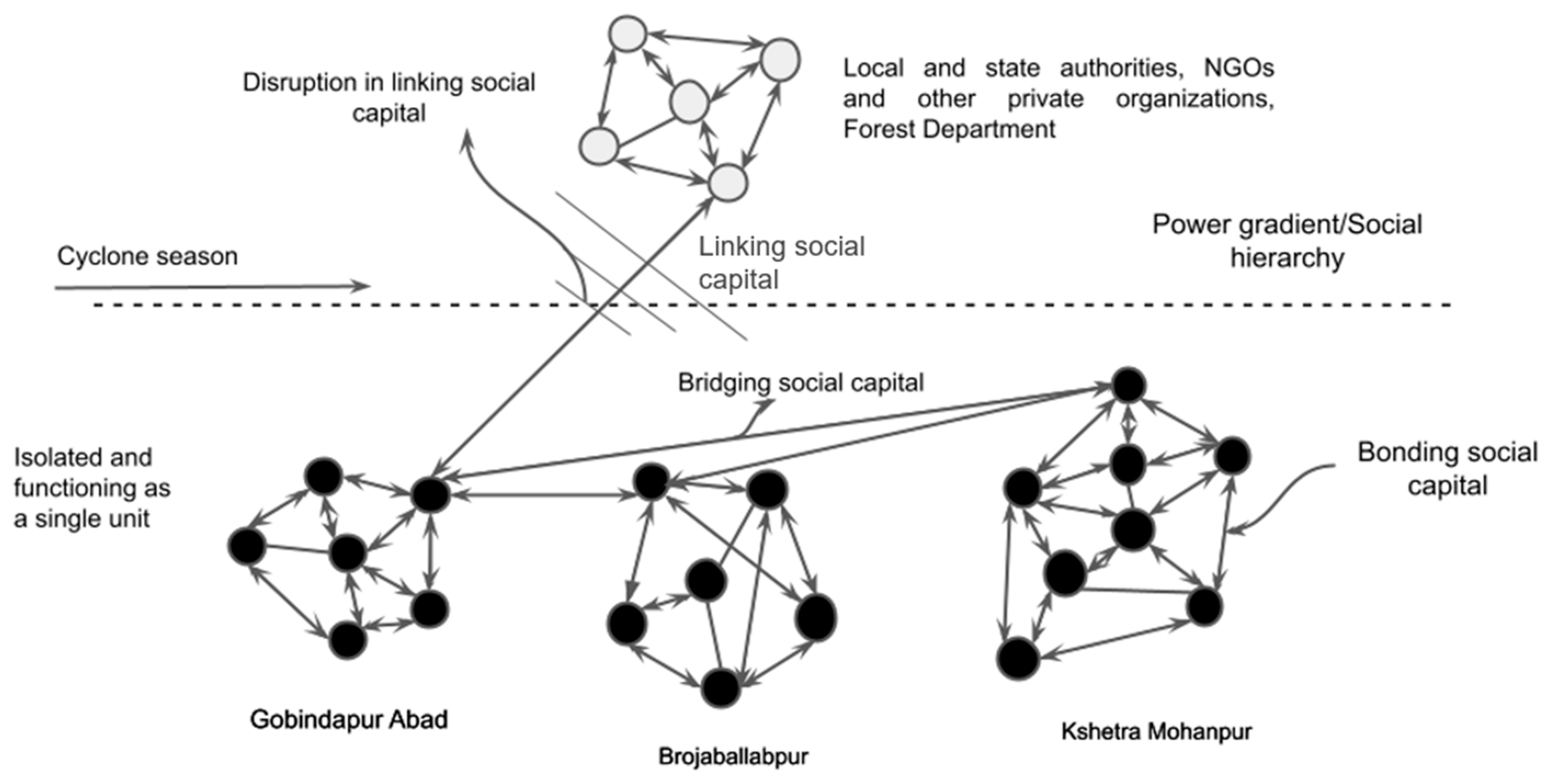
Figure 5.
Diagrammatic representation of bonding, bridging, and linking social capital in Jemua (modified from [61]).
Figure 5.
Diagrammatic representation of bonding, bridging, and linking social capital in Jemua (modified from [61]).
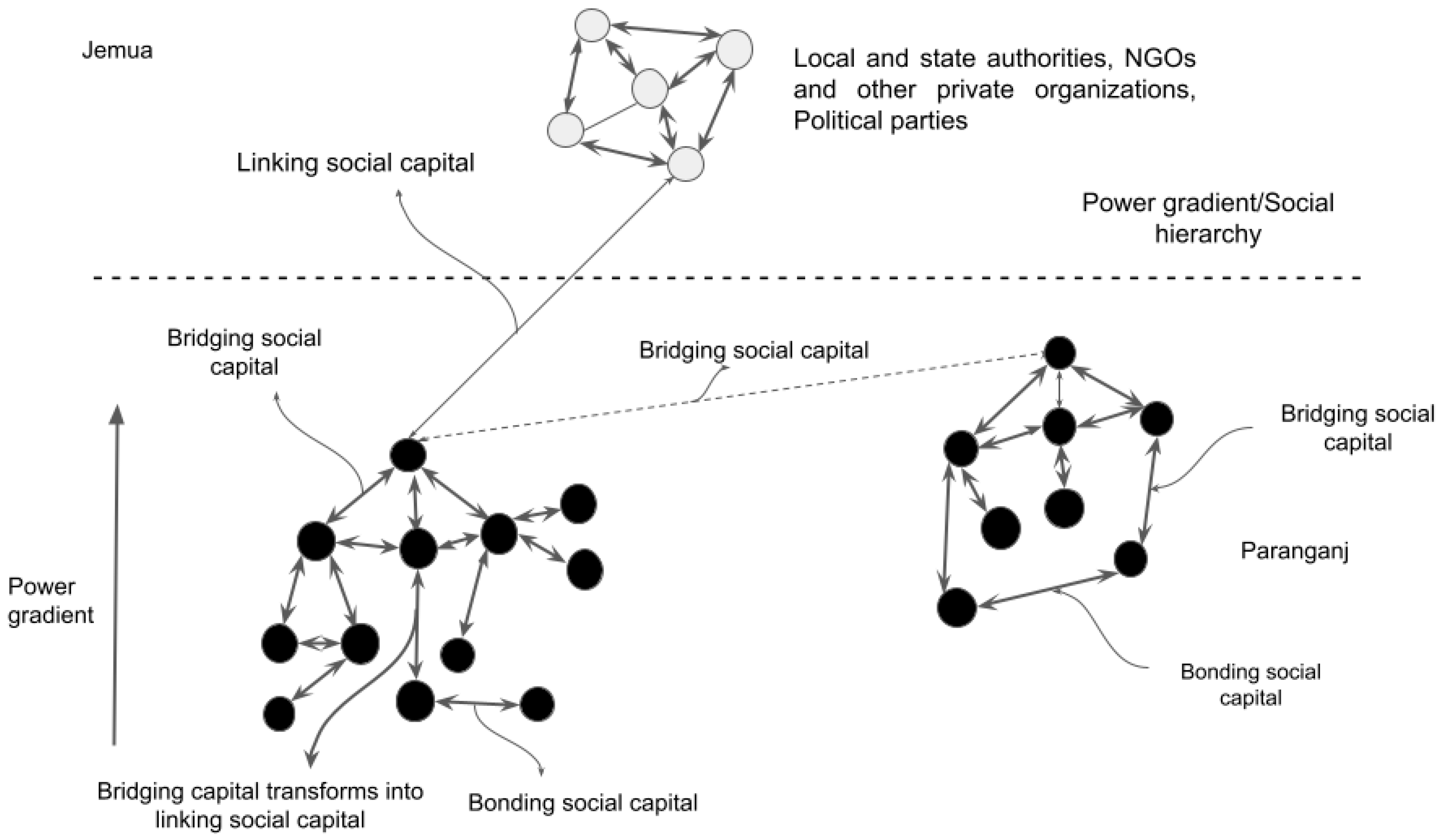
Table 2.
Differences in various aspects of social capital between Brajaballavpur (high climate-prone region) and Jemua (low climate-prone region).
Table 2.
Differences in various aspects of social capital between Brajaballavpur (high climate-prone region) and Jemua (low climate-prone region).
| Characteristic | High Climate-Prone | Low Climate-Prone |
|---|---|---|
| Geography | Island | Land-locked |
| Settlement Pattern | Dispersed | Nucleated |
| Constitution | Paras are divided based on surnames but are not homogenous that way. | Paras are divided based on caste and are distinctly homogenous. |
| Experiences extreme weather events | Yes | No |
| Degree of trust and social cohesion among the community members across various socioeconomic groups | High | Low |
| Community Engagement and participation | High: Greater involvement of the local community in the decision-making process and disaster-preparedness initiatives. | Low: The Decision-making process is usually exclusive to a selected few. |
| Social memory and learning processes | Used for building resilience and adaptive capacity | Maintaining governance structures. |
| Collective Action | Extensive and more frequent collaboration between the members of the village. | Limited and less frequent collaboration between the members of the village. |
| Reliance on information networks | High reliance on information networks for climate forecasts, disaster warnings (during crisis times), educational/employment opportunities, healthcare access, other government schemes, and benefits during non-crisis times. | High reliance on information networks for educational/employment opportunities, healthcare access, other government schemes, and benefits during non-crisis times. |
| Bonding Social Capital | Bonding social capital is strong among the members of the entire village community due to the necessity for mutual support during and after climate-related catastrophes. | Bonding social capital is strong among members of the same socio-economic group or para. |
| Bridging Social Capital | Strong bridging capital among the three villages due to the necessity for knowledge and information exchange for disaster risk reduction passing of early warning information and also aids significantly in rescue and relief. | Low: Bridging capital with nearby villages is low and is only used for occasional information exchange. Mainly, it is used to secure votes during elections. Bridging capital exists between some members of different socioeconomic groups across the social hierarchy. |
| Linking social capital | Low; Disruption of connectivity results in disruption of linking social capital; Linking social capital is usually beneficial for long-term interventions like construction of roads and embankments, provision of electricity, water supply, health, and educational infrastructure, better disaster preparedness | High; Linking social capital is used for accessing government benefits and schemes, education and livelihood opportunities, healthcare access, etc. |
| Primary Role of Social Capital | Climate resilience | Development and Governance |
| Challenges | Strong bonding capital can result in mental distress when members are displaced/rehabilitated after a climate catastrophe. Linking social capital can result in unequal distribution and access to resources. | Bridging and linking social capital can result in inequities in resource access. |
Disclaimer/Publisher’s Note: The statements, opinions and data contained in all publications are solely those of the individual author(s) and contributor(s) and not of MDPI and/or the editor(s). MDPI and/or the editor(s) disclaim responsibility for any injury to people or property resulting from any ideas, methods, instructions or products referred to in the content. |
© 2025 by the authors. Licensee MDPI, Basel, Switzerland. This article is an open access article distributed under the terms and conditions of the Creative Commons Attribution (CC BY) license (http://creativecommons.org/licenses/by/4.0/).
Copyright: This open access article is published under a Creative Commons CC BY 4.0 license, which permit the free download, distribution, and reuse, provided that the author and preprint are cited in any reuse.


