

Submitted:
07 May 2025
Posted:
08 May 2025
You are already at the latest version
Abstract
The report presents a discussion regarding food requirements in the Anthropocene epoch, examining the im-pact on global population growth. It recalls the recently introduced Super-Malthus and Verhulst-type scal-ings, the carrying capacity concept, and the Condorcet equation linking the mentioned properties. The exten-sion of the latter, introducing the per capita relative growth rate, is proposed. The report focuses particularly on the last 2 centuries, i.e., the Industrial Revolutions epoch with the global population boost. The Condor-cet-based analysis indicates the transition to the development phase with significant sensitivity to current global limitations, including the carrying capacity, after 1965. The report particularly focuses on the most important factor shaping the carrying capacity over the millennia, i.e., food, with special attention to preser-vation-related innovations. Global, even pandemic, threats resulting from current preservation technologies are indicated. It creates the call for an innovative change. The unique possibilities of high-pressure processing (HPP) are presented in this context, including the newly found next-generation innovation: colossal baro-caloric effect (CBE) coupled HPP. After millennia of focusing on securing sufficient food amount, the possibil-ity of food processing in line with the expectations of the sustainable society of the 5th Industrial Revolutions era appears.
Keywords:
global population
; Industrial Revolutions
; carrying capacity
; food
; innovations
; high pressure processing (HPP)
1. Introduction
Twelve thousand years ago, the last Ice Age - lasting ~100,000 years - terminated. Global Warming freed Eurasia and North America from the ice sheets. The mild climate and, vast uninhabited areas, rich food resources yielded exceptional opportunities for hunter-gatherers. The Anthropocene epoch began [1]. During only 12 millennia, the global population rose from (10 000 BCE) to in May 2025 [2,3,4]. This population success was significantly due to the access to ‘infinite’ food resources for an ever-increasing population.
Food is a source of energy and health. Providing it for oneself, family, group, … was and still is the goal and challenge of every person, every day. So, the question arises about the impact of this essential resource on the global population in the Anthropocene.
The answer might seem extremely puzzling due to the huge and multidimensional scope of changes and heterogeneity. However, such data can be hidden in the global population growth scaling patterns, significantly shaped by access to food resources.
Over the millennia, the exponential pattern of global population growth dominated. It is also called geometric growth, with the growth rate directly proportional to its current size or alternatively related to the same relative percentage in each time following time period [2,3,4]. Recently, explicit evidence for such a trend was shown even in a period that was particularly significant for the modern world, from the mid-medieval times till the onset of the Enlightenment. However, ca. 2 centuries ago, the qualitatively new ’boosted’ scaling pattern emerged, namely [2,3]:
where is for the global population, is the time since the Anthropocene epoque dawn, 12 000 BCE; , is the extrapolated singular ‘Dooms-year’, is the relative distance form metric; is for the Malthus population growth parameter, and means the relaxation time.
Sojecka and Drozd-Rzoska obtained the above result by introducing the Super-Malthus scaling equation and the distortions-sensitive analysis, briefly discussed below [2,3,4]. Notably, exponential dynamics is common in nature, from microbiology [5,6,7,8] and biology [9,10,11] to dynamics of physical processes [12,13,14], chemical reactions [15,16], nuclear reactions, and nuclear fission reactors. [17,18,19]. For the latter, the name ‘chain reaction’ is used to describe the rising impact of neutrons in subsequent steps [20]. However, in the last two centuries, the growth of the human global population has been essentially stronger, as shown in Eq. (1) and refs. [2,3,4].
Providing food for a growing population has been a source of concern and a challenge for millennia [21,22]. Despite the global population boost over the past 200 years, the growing needs have been met qualitatively, and an abundance previously unknown has also emerged. It can be linked to the Industrial Revolutions epoch, which began two centuries ago [23,24,25,26]. Its essence is the development and mass implementation of groundbreaking technological innovations, in feedback assistance of socio-economic ‘innovations’ supporting and organizing the development. This progress was so rapid that the world changed beyond recognition during one man's lifetime. An example is the qualitative changes in the world during the reign of two symbolic figures: Emperor of Austria Franz Josef I (1848–1916) and Queen of the United Kingdom Victoria I (1837–1901) [27].
In agriculture, productivity was greatly increased due to innovative processing and logistics technologies. The rising amount and assortment influenced demands. But it is 'elastic' only to a certain level. Finally, a relative decrease in food prices and lower expenditure have to appear. The funds of consumers released in this way could be spent on other goods and services, stimulating broader economic development. These processes also caused a qualitative decrease in employment. In highly developed countries, only about 10% of all employees work in agriculture [28,29,30]. A further significant decrease can be expected, e.g., due to using Artificial Intelligence (AI) for fieldwork. For instance, the future can be associated with autonomous agricultural machines, cultivating fields and controlled with the support of Artificial Intelligence. Such a picture of the future is shown, for example, in Christopher Nolan's phenomenal film 'Interstellar' (2014). The recalled ‘feedback mechanism’ between science, technology, and socio-economy, is specific to the Industrial Revolutions times. In this innovations-driven epoch, the development of methods to ensure health safety and extended shelf-life of food, with the minimum possible impact on products' native forms, was essential. Of particular importance are the works of Louis Pasteur (1863), who recognized spontaneously developing parasitic microorganisms as a crucial hazardous factor to health and product quality [31]. He solved the problem by discovering ‘thermal pasteurization’, i.e., heating the product to , for a few minutes [32]. In the second half of the 19th century, also chemical preservation additives started to be broadly implemented for preserving long-term microbiological safety [33]. In those times, the foundations of refrigerators and coolers were also developed, so their mass-scale implementation was possible in the first half of the 20th century [34]. The pioneering works of Pierre Curie and Marie Curie-Skłodowska led to the use of irradiation as a physical factor destructive for microorganisms,…. [35,36,37].
These food preservation methods have led to an extraordinary abundance and diversity of foodstuffs on hypermarket shelves. The development was essential for extending the logistics chain, often reaching a global scale.
However, in recent decades, the dark side of these innovative methods of food preservation has been revealed. The accumulation of parasitic side effects has even led to dangerous and harmful global-scale pandemics related to obesity, numerous allergies, and certain types of cancer [38,39,40,41,42,43,44].
This problem is closely associated with the rich offer of so-called ultra-processed food, which contains few or no wholesome ingredients, often chemically modified and with artificial additives to make it edible, tasty, and addictive. Their list is huge. These include numerous carbonated drinks, sweet or salty packaged snacks, ice cream, chocolate, sweets (confectionery), mass-produced bread and rolls, margarine and spreads, cookies (biscuits), numerous energy cakes and bars, energy drinks, milk drinks, ‘fruit’ yogurts and ‘fruit’ drinks, cocoa drinks, meat, and chicken extracts and prepared sauces, infant formula, milk substitutes and other products for children, ‘quasi-healthy’ and ‘slimming’ products such as powdered or ‘fortified’ meals and meal substitutes, as well as many ready-to-heat products, including pre-prepared cakes, pasta dishes and pizza, poultry and fish ‘nuggets’ and ‘sticks’, sausages, burgers, hot dogs and other reconstituted meat products, and powdered and packaged ‘instant’ soups, dumplings and desserts. is an offer of products at surprisingly low prices, which may immediately raise suspicions of a connection with the so-called ‘junk food’ [45].
This type of ‘food’ is often supplemented by a large addition of chemical preservatives mentioned above. Studies have shown that ultra-processed foods increase the risk of obesity by 55%, sleep disorders by 41%, anxiety disorders by 53%, type 2 diabetes by 40%, and depression and premature death by 20%. It also presents strong evidence of a 50% increase in the risk of death from cardiovascular disease. It is estimated that 70% of all food in the US is ultra-processed. Its consumption is responsible for ~6% in Brazil or Chile but ~14% in the US or England [45,46]. Then, it is not surprising that food waste reaches globally [47,48].
Reducing these losses is the simplest and environment-friendly way to increase the global food supply. Avoiding catastrophic impacts of ‘junk food’ and food preservatives side effects is also essential for the health and well-being of societies. All these can also mean incalculable benefits for the world economy.
In the current times of the 5th Industrial Revolutions, it is not important only to ensure quantity and variety of foods, and support logistic requirements. Offering food without mentioning harmful ‘side effects’ has become essential.
The answer to these challenges and even civilizational needs is the concept of 'High Quality Foods' defined as 'food produced using specific agricultural production methods, in particular in terms of food safety, traceability, authenticity, labeling, nutritional and health values, as well as respect for the environment and animal welfare, the sustainability of agricultural production and distinctive qualities, in particular quality and taste' [49,50,51]. The fundamental problem is the implementation of these impressive expectations in practice.
Such hope can be provided by innovative methods of preserving and processing food using a different conceptual basis than the abovementioned canon.
Below, high-pressure preservation/processing (HPP) for foods is presented. It is also called ’cold pasteurization‘ or ‘radicalization.’ It has already passed the market test and seems to meet all expectations as the next-generation technology for high-quality foods [7,8,52,53,54,55,56,57,58,59,60,61,62,63]. Original solutions for the next-generation HPP sterilization are also shown.
The preliminary first part of the report shows the conceptual background of the above issues through a new discussion regarding food needs and requirements developed in the Anthropocene. It focuses on the carrying capacity concept as its key metric, including some new interpretations.
2. Materials and Methods
This report recalls the results of recent authors’ studies regarding global population growth since the Anthropocene onset. They explored the essentially new set of population data based on the collection from a few sources, followed by numerical filtering to obtain an analytic set for which the derivative analysis was possible. The latter revealed subtle local features hidden when using direct data analysis [2,3,4,7,8,12,13]. This part of the report focuses on the Malthus, Verhulst, and Super-Malthus approaches [12,13]. These reports do not discuss other approaches to the global population challenge; these topics are discussed in refs. [2,3,4]. The given report supplements the reasonings presented in refs. [2,3], focusing on conclusions regarding food resources in subsequent periods. The hallmarks of the Industrial Revolutions epoch uniqueness are indicted, with a particular focus on innovative methods of food preservation and processing, focused on sustainable society requirements.
High-Pressure Preservation/Processing (HPP) features are presented It includes possible next-generation solutions, introduced and feasibility–tested by the authors: HPP – ‘hot’ and ‘cold’ sterilization [7,8]. It is related to the authors’ research and development experiences in the given field [see: https://young4softmatter.pl/].
3. Results
3.1. Global Population, Carrying Capacity, and Condorcet Criterion
The 17th century was the time of the Scientific Method shaping [64,65], the conceptual base of the emerging Industrial Revolution epoch. It stresses the meaning of critically analyzed observations, hypotheses formulation, experimental verifications, output data analysis expressed via analytic equations, and critical conclusions. Isaac Newton's great works significantly supported its universal recognition [65,66]. He used it to discover impressive universal laws of nature expressed by functional scaling equations. An example can be the Laws of Dynamics or the Law of Gravity in physics. The latter links seemingly distant phenomena such as an apple falling from a tree and movements of planets or comets ‘in the sky’. Isaac Newton introduced differential analysis to show in-depth model assumptions and derive final scaling equations [65,66].
In 1798, Thomas Malthus recalled Isaak Newton grand legacy inspiration when introducing the first analytic model describing human populations growth ( [67]):
where is the Malthus growth rate parameter, is the time since the onset and the prefactor is related to .
Equation (2) presents differential equations showing the Malthus model base. Its left part is for the original dependence, and the right part shows it via the per capita relative growth rate (RGR) [3,4]. Malthus also indicated the meaning of available food resources for the population growth, introduced via a supplementary equation that assumes a linear growth [67]:
Finally, Malthus concluded [67]: ‘The population increases in geometrical ratio and the subsistence rises only linearly, which finally leads to times of vice and misery’, leading to the Malthus Trap (Catastrophe), when the quantity of food becomes increasingly insufficient for the growing population. Malthus advised population constraints or extra rise in subsistence (food) to escape the trap disaster. Unfortunately, the simplistic escape concept, namely robbery or conquest of other countries, has often been implemented [68,69,70].
A few decades later, Pierre François Verhulst (1838) introduced another scaling relation in which food is explicitly included in the basic model dependence, namely [71,72,73]:
where the parameter ; is the Verhulst parameter showing the impact of necessary resources, originally food, and the carrying capacity: .
Equation (5) is for the derivative-based presentation of model assumptions: the left part recalls original Verhulst works and the right-hand part shows it via RGR parameter, with carrying capacity concept, introduced a century ago by Pearl and Reed [72,73]. It can be interpreted as the maximal population in a given system, allowed for available resources. Equation (6) shows the Verhulst model equation for population growth description, resulting from Equation (5).
The comparison of Equations (2) and (5) can suggest that one can consider the apparent growth rate: . It shows that for the Verhulst model behavior, first follows the Malthus pattern (Equations (2) and (3)); next the continuous decrease of the apparent growth rate occurs. Finally, the stationary phase related to and takes place. It is often noted the bimodal behavior [74,75].
Note that the above behavior is valid for systems with constant resources (food) amount despite population growth. This is a system with renewable resources. For systems with non-renewable resources, their amount decreases with the population's growth. In such a case, there is maximum instead of the stationary phase, and subsequently, the population diminishes.
There are numerous population growth models [74,75,76,77,78,79,80,81,82,83,84,85], critically discussed in refs. [2,3]. In this report, we focus on the Malthus and Verhulst models, remaining a significant reference [86,87,88,89,90,91,92,93,94], and yielding a possibility to the distortions-sensitive analysis detecting subtle, local changes [2,3,4].
Figure 1 presents global population evolutions since the Anthropocene onset. It is based on data developed by the authors [2,3] recently. They have been obtained via numerical filtering of global population data from a few sources. The plot is explores a semi-log scale, for which the basic Malthus behavior is visualized via a linear dependence, namely following Eq. (2): , and .
The plot reveals the simple Malthus's behavior for the enormous period of the first 9 millennia in the Anthropocene. It means that the global population has risen following a simple ‘geometric’ growth pattern, as described by the Malthus model (Equations (2) and (3)). It also suggests no food/resources restrictions, following the Malthus model discussion.
The Malthusian growth accelerates, ca. 4.6x, when passing the crossover correlated with the transition from the Early to the Late Neolithic epoch, as shown by changes in the slope of lines in Figure 1. It happened soon after the Doggerland flood and the North Sea formation [95], which has to be coupled with s a rise in sea levels, a further retreat of ice sheet remnants, and climate warming. Figure 1 shows that this pattern extends even beyond the Bronze Age, i.e., the times of the first great civilizations in ancient Egypt, the Middle East, the Mediterranean, China, and India.
Significant irregularities in changes appear in Antiquity times. For the authors, this should not be linked to food shortages. This was the time of the formation of great empires, of which the Roman Empire was the most famous. Almost 1/3 of the global population lived there at the time. For , from Julius Caesar's epoch to the Western Empire fall, the global population remained constant at [96,97]. It might suggest reaching the above-mentioned 'stationary phase' in the Verhulst model scaling, related to the limited available food. For the authors, the dominant cause was different and probably unique in history. The Empire's economy was primarily based on exploring slaves as a 'human energy source', on an enormous scale. For example, in the giant silver mines in the La Tinto region (present-day Spain), where tens of thousands of slaves worked. Their average survival time was only [97,98]. The Empire's weakening and 'barbarian' neighbors civilizational progress effectively limited the 'supply' of this 'raw material', so cruelly exploited. The global population began to grow again after the fall of the Roman Empire.
Starting with the advent of the Medieval times, permanent population growth occurred, as visible in Figure 1. For portraying the visible nonlinear pattern, the Super-Malthus (S-M) relation with time-dependent growth rate was proposed in ref. [2]. It is given in the left-hand part of the relation below:
Notable that for the S-M relation simplifies to the basic Malthus Equation (3). The next unique feature of this S-M relation is the time-dependent relaxation time, . This magnitude, commonly used for testing dynamics in physics [12,13,14], enables a direct estimation of the time required for 50% changes from the population at a given moment, namely: . Nevertheless, direct parameterization of changes via this S-M Equation (7) (left part) can be puzzling, since it requires in prior knowledge of or evolutions.
Nevertheless, one can use it for calculating temporal changes of the relaxation, as shown in the right-hand part of Equation (7). The evolution of this magnitude is shown in the inset in Figure 1. For such a plot the horizontal line is related to the basic Malthus Equation (3), with , or . Such behavior has been visible since the middle of Medieval times (~1100) till the Enlightenment period onset (~1700), with a distortion coinciding with the Black Death pandemic impact times [2,3,4]. For the authors, the extension of this ‘distortion’ into the 16th century can be related to the enormous population catastrophe in South America resulting from the Spanish conquest.
Since the year ~1710 till nowadays, emerges the linear trend described via , as evidenced in the inset in Figure 1. Substituting it to S-M Equation (7) (left part), one obtains the unique crossover to the constrained critical scaling equation, given in Equation (1) (right part). It has been derived and extensively discussed in refs. [2,3].
How did food resources and their availability influence the population development during this period?
Generally, such discussion over a long period has to be puzzling due to huge civilization changes, cultural diversity, wars, and conquests, … However, the Malthus-type trend for the first period indicated in the inset in Figure 1 (1100 – 1719) suggests no essential global food availability problem, following the above discussion regarding the Malthus and Verhulst model. Of course, numerous famines or local population catastrophes are known during this period, but their global impact is relatively weak.
The measure of food availability can be the standardized income of a well-defined but relatively numerous group of employees, optimally in a country where such distortive factors as wars, conquest, and changes of borders … are negligible. Such conditions can be considered in England, for which almost constant earnings of building workers from to is evidenced Only later does a systematic increase in earnings appear [99,100,101]. For the authors, this can suggest a large 'rent of benefits' for industrialists in the 1st Industrial Revolution epoch since the enormous increase in productivity in those times had a negligible impact on wages, the relative size of which had remained unchanged since the Middle Ages.
The Verhulst model approach might seem beyond the global population growth shown in Figure 1. However, one may consider a Verhulst-type equation associated with a set of associated with crossing subsequent barriers, occurring well before approaching the stationary phase. The effective portrayal of global population data since the Anthropocene onset was considered by Lehman et al. [102], who linked the crossover of subsequent eco- and bio-barriers. The problems and challenges of such an approach were further discussed in ref. [3]. Worth recalling here is the report by Cohen [79], who suggested that the basic Verhulst model dependence (left side of Equation 5) can indicate the following link between population growth and carrying capacity (metric of available resources). He named it the Condorcet equation [79]:
where the coefficient ‘’ is for the Condorcet parameter.
The above relation also contains the next Cohen’s suggestion to explain time dependence of the Condorcet parameter, namely , where , via the ‘dilution’ of the system-characteristic constant by the rising population. Cohen suggested that can be a metric of the total available resources, for instance. Starting from, the parameter decreases in each subsequent time , i.e., . Finally, it reaches , yielding the Verhulst model's stationary state. For carrying capacity, food resources, and consequently population diminishes. When , each additional person in the population introduces additional values to the system carrying capacity above their own needs, thus yielding conditions to accelerate population growth, even a boost to infinity. Here, Cohen [79] tried to provide a link to von Foerster et al. Doomsday equation suggests an infinite global population 2026 (!) [74]. When publishing in 1960 it offered an impressing simple scaling equation of changes since 400 BCE [76]. However, this scaling failed when more past data became available and when approaching the hypothetical Doomsday in 2026 [2,3,75].
Cohen in ref. [79] It offers an inspiring picture, although it is still heuristic since the basic premise of Equation (8) related to determining a numerical value of the Condorcet parameter c in subsequent stages of population growth remained challenging.
A preliminary response to this problem can be concluded from the recent reports of the authors devoted to the critical discussion of Verhulst-type scaling for the global population growth [3,4]. First, following ref. [102] by Lehman et al., and the discussion of its analytic counterpart in refs. [3,4], the general prevalence of the model analysis focused on the per capita relative growth rate (RGR) was shown [3,4]. Next the analysis directly resulted from the Verhulst model reference derivative Equation (5), explored via the plot vs. , revealed significant inconsistencies between model expectations and ‘empirical’ global population data [3,4]. It led to showing the prevalence of portrayal via the empowered Super Malthus relation introduced in ref. [2]:
It can be considered as the alternative to the S-M relation discussed above (Equations (1) and (7), which better estimates general trends. The distortions-sensitive analysis, in fact recalling test focused on Equation (9), enables more subtle insight. It enabled insight into a subtle ‘bending up’ discrepancy from the general trend visible in the inset in Figure 1. Finally, it has been shown that in Industrial Revolutions epoch, the following behavior took place: from till : , and later, till nowadays: . At the indicated crossover the transition from to still lasting domain described by took place. [2,4]. This unique crossover even stronger manifests for dependence, linking it to the global population [3,4]. Notable that the empowered exponential behavior is relatively common for complex physical systems, where the exponent is related to the ‘amplified’ development, associated with the ‘ordered nucleation centers’ and ‘internal energy’ creation. The stretched-exponential case is related to multichannel energy dissipation and is observed dominantly disordered system [2].
Considering these, we can see that the basic Cohen’s equation (8) contains the RGR factor. Following this, one can consider the following generalized Condorcet equation linking carrying capacity and population changes:
where is the general effective metric of the system carrying capacity i.e., the new Condorcet parameter. For instance it is expressed via the exponent for portrayal via the empowered Super-Malthus Equation (9).
The above discussion allows for a discussion of the planetary carrying capacity necessary for the development of the global population based on the values of exponent , which have been given since the beginning of the Anthropocene in ref. [2]. Over the millennia until the dominant trend is described by the exponent . This means that both population and resources increase ‘geometrically’, according to the simplest scaling relation of the Malthus model (Equations (2) and (3)). This may indicate that from the Neolithic Times to the Enlightenment onset, the most important resource remained food resources, and on a global average, each new member of the global population was able to introduce into the system as many new resources as needed. The ‘disruption’ in changes in Antiquity times is commented in more detailed in ref. [2].
Since the Industrial Revolution's onset, the boosted population growth, which follows the Condorcet relation, is associated with boosted carrying capacity, related to . In this unique epoch, subsequent groundbreaking technological innovations solve cumulated problems that could hinder further development. The scientific and technological breakthroughs opened up areas of exploitation of previously unexploited raw materials, significantly increasing global carrying capacity. An example is the 1st Industrial Revolution period, the Steam Age. It was first driven by wood as an energy source until large areas of Europe were deforested. The problem was solved by the exploitation of hard coal. When it turned out to be insufficient for new and necessary applications, from the mid-19th century, the use of oil and electricity as an energy source became important. The latter again increased the demand for coal as the most essential raw material for generating electricity. Within the years 1965-1968, the scaling of the global population changes has changed associated with the qualitative change of the Condorcet parameters . This may mean a spontaneous reaction of the complex system of the global population to the global-scale constraints associated with approaching total carrying capacity limits. During this period, the world became a ‘global village’, and immediate contact between any two places on Earth became possible. There appeared to be a tangible limitation of available space for everyone, and the consequences of massively violated ecological constraints led to the already ongoing ecological catastrophe, including the great catastrophe of Global Warming. The answer to this great challenge, perhaps the greatest in human history, seems to be the tasks of the 5th Industrial Revolution.
The 5th Industrial Revolution is currently underway [23,24]. It is most often defined descriptively as a period of incorporating concepts of (i) sustainability, (ii) human-centeredness, and (iii) concern for the environment…. matched with AI development. This is a descriptive definition and different from the earlier stages of IR, where dominant breakthrough technology and/or scientific innovations were explicitly addressed. However, the term sustainability seems to include issues (ii) and (iii). Maybe the term 5th Industrial Revolution – sustainable development via new generation energy sources, material engineering, and AI implementation would better agree with the subsequent IR stages names.
Although the successive stages of the Industrial Revolution era opened up new ‘raw material’ resources or ‘carrying capacity’ [3,79] without recalling the dominant food resource in previous eras, it remained critically important, and its growth was also created by technological progress. This is the implementation of new technologies in agriculture, directly producing food, but also new food preservation technologies ensuring the health and safety of products and solving the great problem of increasingly complex logistics with a dramatically growing population. This was related to the discovery and mass implementation of new food preservation and processing methods. Of particular importance here were the great discoveries of Louis Pasteur [31], who identified the microbiological source of health hazards in food or beverages related to the presence of parasitic bacteria, fungi, or Yeats and indicated a way to reduce the hazard to a safe level by heating to a temperature of [32]. Then came various chemical preservatives added to products [33], cooling and freezing [34], and radiation [35,36]. Therefore, the response to the great challenge of the gigantic population growth was characteristic of the New Brave World [103] of the Industrial Revolutions times: mass implementation of innovative technologies. Nowadays, the food problem may seem to be solved globally. The supermarket shelves show previously unknown assortment at prices accessible to the typical consumer. But this great success also has a dark side. New methods of food preservation and processing have proven to be the source of the pandemic on a global scale. New food preservation and processing methods can also be considered a significant cause of food waste, reaching globally [49,50,51]. Reducing it is the simplest and most environmentally beneficial way to significantly increase available food resources and carrying capacity.
For the Industrial Revolutions epoch, the fundamental response to the following significant challenges is the implementation of breakthrough technologies. [23,24,25,26,27,28]. Below, we present the current state of the art and emerging possibilities for solving the food quality challenge and creating high-quality foods with explicit pro-health properties and pro-environment features. This is the high-pressure reservation/processing (HPP), which nowadays enables ‘cold’ pressure-assisted pasteurization, and for emerging innovations[5,7,8,52,53,54,55,56,57,58,59,60,61,62,63], sterilization is also used [7,8].
3.2. High Pressure Preservation / Processing of Food
Already in the Middle Pleistocene, pre-humans began to prepare food using fire [104,105]. This improved digestive properties but also reduced the impact of harmful microorganisms or worms. It, therefore, had a pro-health effect. It also extended durability, i.e., the time of consumption. These are the basic goals of all food preservation methods up to today. In subsequent times, increasingly complex methods appeared. This was probably fumigation and then pre-smoking [104,105]. Then, probably methods using natural environmental conditions such as low temperatures (freezing) or wind and low humidity (pre-freeze-drying) [106]. In the Anthropocene, more complex methods of food preservation appeared, mainly related to the processing of its form. For milk, it was sour milk, yogurts, butter, and buttermilk or cheeses, for which records appear as early as [106,107,108]. Then, it was pickling, marinating, using salt and honey (sugar), … Increasingly complex recipes were also developed for the long-term use of meat in the form of hams or sausages [108]. It is also, in fact, the result of implementing ‘innovative technologies’ developed by generations of trial-error approaches and the extraordinary talents of generations of cooks. This huge set of products shapes today’s cuisine, which can be included in the category of ‘high-quality foods’ without exception, as long as natural products are used, as in the old days.
The Industrial Revolution began only 2 centuries ago. During that time, the global population has increased from to . It was also a time of previously unknown growth in agricultural productivity resulting from implementing broadly understood technological, biotechnological, and socio-economic innovations. On a global scale, a significant surplus of food appeared, and in the majority of countries, stores with previously unknown abundance and variety of products. Numerous and massive centers related to the implementation of new technologies have appeared. For this ‘New Brave World’, the supply of food, in adequate quantities and at least acceptable quality, has become a particularly significant task. In addition to the direct increase in agricultural production, it has become important to extend the product's shelf life and safety in increasingly complex logistics conditions. There has also been an increasing range of new and highly processed food products. There has been a need for a new generation of food preservation methods that ensure the health safety of the product with minimal impact on its ‘native’ form. They are thermal pasteurization and sterilization, a wide range of chemical preservatives, cooling and freezing [32,33,34,35,36,37,38]. These methods, whose references date back to the 19th century, are important factors in the current ‘abundance’ of food. However, these methods have become increasingly obvious over the past few decades that their mass implementation has led to new and dangerous problems on a global scale, namely [38,39,40,41,42,43,44,45,46]:
- ✓
- Thermal pasteurization ensures microbiological safety, but at the same time, it often reduces the nutritional, vitamin, and bioactive properties of the products
- ✓
- Chemical additives appeared to be directly related to pandemics of obesity, some types of cancer, allergies, skin problems, and intestinal problem
- ✓
- Cooling and freezing are excellent preservation methods, but using technological solutions supports Global Warming.
- ✓
- irradiation can effectively extend shelf life and improve safety by killing pathogens and insects. However, there are problems related to nutrient degradation and changes in taste and texture.
High-pressure preservation (HPP) technology, implemented for over 3 decades, offers a positive impact on the product without the above negative impacts, namely [7,8,52,53,54,55,56,57,58,59,60,61,62,63]:
- shelf-life extension to even up to 180 days!
- high microbiological safety
- fresh product taste, flavor, and texture
- fresh product vitamin composition
- bioactive and nutritional properties maintenance
- no chemical preservatives
- activation/deactivation of selected enzymes
- salt- and sugar limited/free products
- for ‘fluid’ and ‘solid foods
- application to packed food, reducing the risk of secondary contamination
- environment-friendly technology: (i) limited requirements for electric energy- (ii) practical lack of waste during processing, (iii) reduction of ‘expired products’ amount, and then disposal problems
- ‘clean label’, innovative technology
The HPP technology implemented on the market consists of the impact of high-pressure for 3 to 15 minutes, generally at room temperature. Figure 2 shows HPP facility with the pressure chamber working volume operating at arbitrary pressure up to . It shows the main pressure chamber body and automated system for closing and opening the chamber and loading the product. The pressure is supplied from an external high-pressure large-volume pump. The automated system is controlled from a panel in an adjacent, safety-isolated room.
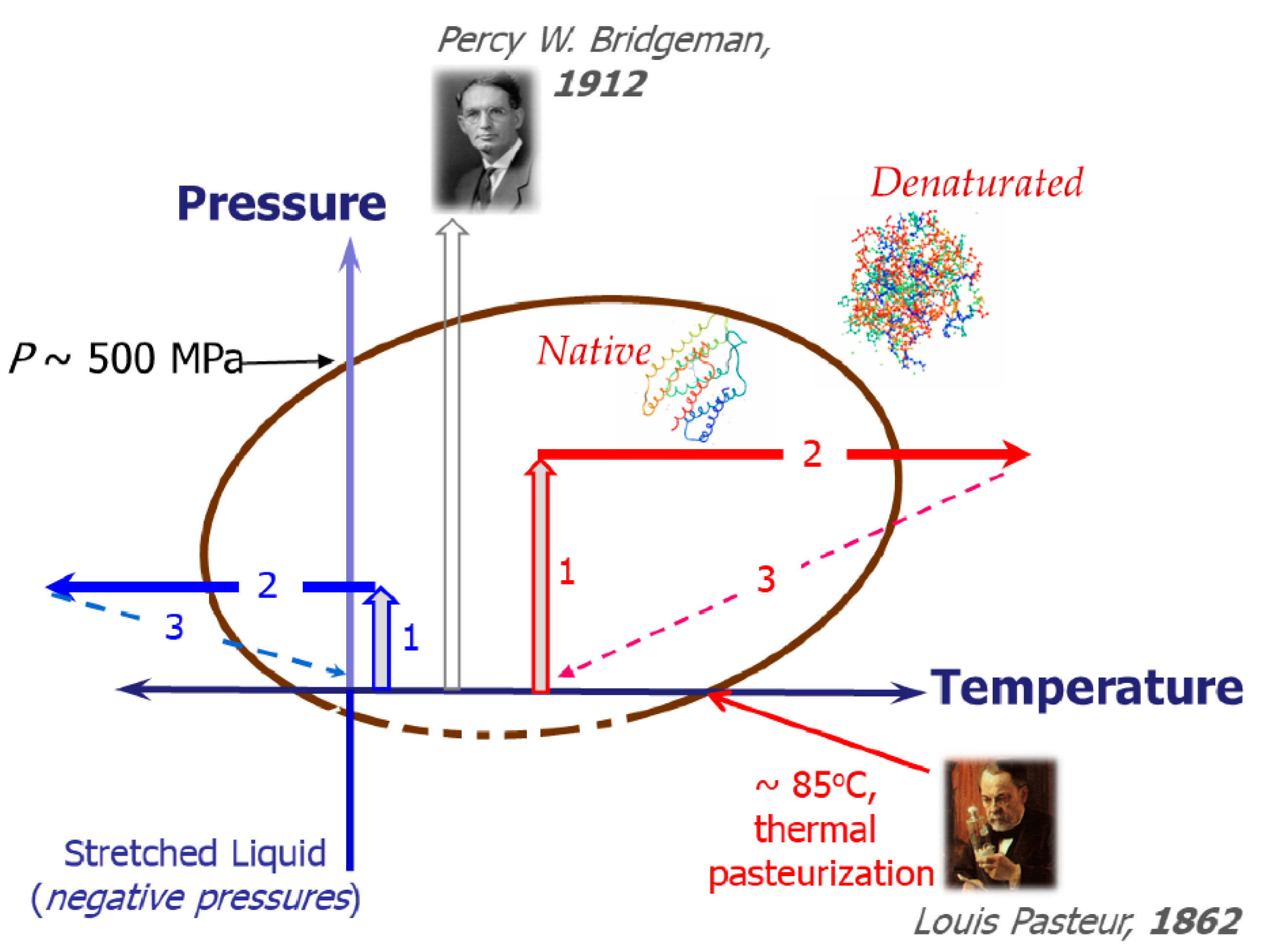
Figure 3 shows the conceptual basis of HPP technology, showing an elliptical curve in the pressure-temperature () plane describing the limits of protein denaturation. The first point on this curve was observed by Louis Pasteur (1863), which gave rise to the technology of thermal pasteurization of food. It consists of reaching the denaturation limit (‘clumping’) of protein structures, which occurs at a temperature of . Such thermal treatment of the product leads to the denaturation of proteins in the parasitic organisms present, from worms to microorganisms. Today, the denaturation curve is associated with a 5-decade () reduction in the number of microorganisms [32] when presented on a logarithmic scale leads to the jargon term 5-log reduction.
The next point in the above curve can be linked to Percy W. Bridgeman compressing of the egg albumin under room temperature [109,110]. Smeller and Heremans plotted the denaturation via modeling using the Clausius-Clapeyron equation [111,112,113,114], implemented for the given process [115,116]:
where is for the denaturation temperature at the given pressure and is for the latent heat, volume change and entropy change when passing curve.
In ref. [116] the eliptic curve was obtained by assuming pressure-dependent evolution of , , . It is worth recalling here that the Clausius-Clapeyron equation was originally introduced for the melting-freezing discontinuous transition, i.e., . Thus, Smeller and Heremans essentially considered denaturation as a specific discontinuous phase transition.
The vertical arrows in Figure 3 shows standard paths related to HPP technology. Most often it is related to near-room temperature compressing, but generally operations in the range from to are considered. Notable that the thermal processing, recalled the thermal pasteurization, is related exclusively to passing the denaturation curve under atmospheric pressure.
The effect of pressure on food and unwanted microorganisms is more complex. At room temperature, compression to usually causes rupture of cell membranes surrounding microorganisms and/or organelles inside, associated with relatively weak intra-structural interactions. This is the most commonly used mechanism in HPP technology. It leads to a 3-5 decades (3-5 log) reduction of parasitic microorganisms while maintaining all the special advantages of this technology listed above [7,52]. An example here is the thermal pasteurization of milk, creating a product with a different taste than native milk and reduced bio-nutritional values. 'Cold' pressure pasteurization at room temperature, with compressing to creates pasteurized milk with the taste and all the advantages of 'native' milk. The compression of milk to , associated with achieving the denaturation curve and subsequent decompression, leads to a deeper reduction in the number of microorganisms, a change in taste, and a reduction in bio-nutritional values but a significantly lesser extent than in the case of thermal treatment at atmospheric pressure [7,52].
Thermal pasteurization, which is commonly used today, significantly reduces but does not eliminate unwanted microorganisms. A pasteurized product, therefore, has a naturally limited shelf life related to microbiological safety.
For many food products, technological sterilization is used [32], which consists of heating the product for the shortest possible time - optimally a few/a dozen seconds - to temperatures in the range of . This is not full sterilization, as it requires much higher temperatures and times and is used, for example, in medicine. However, technological sterilization of food allows for extending the product's shelf life that is safe for health to a year or more. It is also possible and used to 'support' this shelf life by minimizing the addition of chemical preservatives or the appropriate pH of the product [32].
3.3. Compression – Related Sterilization
Sterilization with the support of high-pressure compression is a problematic issue for HPP processors on a pilot or industrial scale (see Figure 2). Commercially available is a solution where the food product after heating to is placed in a thermally insulated container (adiabatic conditions), which is then moved to a high-pressure chamber where compression to takes place. This is adiabatic compression, leading to a change in the internal energy of the product and, as a consequence, a temperature increase of . The product under pressure reaches an effective temperature of and after decompression occurs, which lowers its temperature again to and at this temperature the product is removed from the chamber [117,118].
For such a technological concept, significantly deeper 'technological sterilization' should be expected than with the standard thermal procedure described above. However, for the ‘pressure assisted sterilization’ technology described above, the product is at an elevated temperature for a very long time, above the denaturation limit determined by the curve. Together with the compression and decompression time in the high-pressure chamber, this can be even several dozen minutes. Therefore, a significant reduction in nutritional value and bioactivity must occur. This is no longer mild HPP technology like for ‘cold, pressure’ pasteurization, with the avoided features mentioned above.
Recently, the authors of this paper have presented two innovative concepts that limit or even eliminate the above disadvantages and give hope for pressure-assisted sterilization with ‘mild-impact’ features. It involves using the so-called Colossal Barocaloric Effect (CBE) [119,120] ], recently discovered in some materials from the Soft Matter family, especially the so-called Plastic Crystals. A strongly discontinuous phase transition is described by the Clausius-Clapeyron relation (Equation (10)), with colossal latent heat value. In adiabatic conditions (thermally insulated container), in the standard situation of the system where , this means the release of heat into the interior of the adiabatic container where the line is exceeded due to compression. As a result, there is a strong increase in temperature in the container where the element containing the material exhibiting the CBE phenomenon is placed. Upon decompression, there is a corresponding immediate decrease in temperature. This process is shown in Figure 3 with two red arrows, showing subsequent stages of the innovative CBE-assisted compression-related sterilization. There are also Soft Matter systems with the strongly discontinuous phase transition where compressing decreases the transition temperature, i.e., they are related to condition: this is the base of the inverse barocaloric effect [121]. For such systems, compression causes the absorption of heat energy from the environment under adiabatic conditions, which means a decrease in temperature. Decompression of course means the release of heat to the environment, when passing the line of discontinuous phase transitions, and an increase in its temperature. Such a ‘reversed CBE’ process creates a unique possibility of crossing the denaturation line when the temperature is reduced, and therefore a new type of ‘truly cold’ pasteurization or sterilization of food. The stages of this process are shown by two perpendicular blue arrows in Figure 3.
The feasibility analysis of the above CBE-assisted HPP solutions is given in refs. [7,8]. Notable that they offer a precisely controlled, solely by the applied pressure value, time of acting the process-significant (high or low) temperature. Moreover, it can be implemented in existing HPP industrial-scale processors. For product operations, the significant fact is that the product introduced to the chamber can be at near–room temperature, and it is the same when the product is removed.
4. Conclusions
12 thousand years ago, the Anthropocene began. Thanks to increasingly favorable climatic conditions, homo sapiens gained extraordinary development opportunities. People exhibit exceptional inclinations towards strong and multidimensional mutual interactions. Consequently, and, as for any non-homogeneous complex system with such characterizations, one can expect the spontaneous appearance of 'heterogenic structures,' which in this case can only mean the organized clusters of people. Recent discoveries in Göbekli Tepe and Çatalhöyük (present-day Turkey) revealed surprisingly large and highly developed quasi-urban centers could dated even to ~ 9,000 BCE.
For every person, both in the Neolithic era and today, the most crucial goal of each subsequent day is to provide food for themselves and their family. The answer to the question of how these needs were shaped in the Anthropocene, the ‘era’ of humans, is puzzling and ambiguous due to variable geographical, climatic, and cultural conditions… However, one may expect that such a message can be indirectly deduced from an appropriate scaling description of global population changes.
This issue is discussed in the first part of this paper from the perspective of Malthus [67], Verhulst [71], the super-Malthusian extension modeling [2,3], and the concept of carrying capacity introduced by Pearl and Reed [72,73]. Attention is drawn to its use via the 'Condorcet' relation concept, proposed by Cohen (1995) [79] - linking carrying capacity with global population changes. In this report, the extension of this relation is proposed, using the results of the authors' recent work, which allows for the direct estimation of the Condorcet coefficient metric with the support of the Super-Malthusian description [2,3,4]. The presented analysis indicates that from the beginning of the Anthropocene to the end of the 17th century a simple geometric growth of the global population dominated, although with a variable time constant () in different periods. Disturbances appear in the times of Antiquity or the Black Death times. they are commented on in refs. [2,3,4] and above in the given report.
The analysis using the 'Condorcet model' suggests that the resources (food) needed for the Malthus-type growth increase at the same rate as the population.
Two centuries ago, an extraordinary acceleration in the global population growth has started. Despite this boost, no Malthusian Catastrophe, or a generic global food shortage occurred. On the contrary, there a kind of food surplus took place. Moreover, food prices began to fall, and employment in agriculture was reduced even below 10% of the total number of employees in many countries.
The last 200 years are the times of a new era of Industrial Revolutions. For the first time in history, massively implemented breakthrough inventions and technologies, supported by modern science based on the conceptual-philosophical basis of the Scientific Method, solved civilizational challenges. This would not be possible without feedback interactions with the subsequently implemented ‘socio-economic innovations’ changing societies and managers.
At that time, the concept of carrying capacity ceased to be dominated by food, an energy source directly addressed to every person. Also, raw materials and energy sources became important for the increasingly pervasive ‘technology’ of subsequent Industrial Revolution epochs. There was also a huge impact of a resource rarely considered in earlier eras: shortages of raw materials, energy, or pollution permanently devastating the planet, its climate, and biosphere. The discussion in recent reports [2,3,4,7,8], briefly recalled above, shows that the complex system of the global population has been spontaneously sensing and reacting to this existential problem since the mid-1960s.
However, the current abundance of the most important resource for humans – food, might be illusory. It is mainly based on food preservation methods that have a devastating, even pandemic, effect on society. There is also an exceptionally unfavorable connection with popular industrial highly processed food, referred to as ‘junk food.’
However, it is possible to answer these civilizational challenges within the general scheme of the Industrial Revolution era – development and implementation of Innovative Technologies.
This paper presents the basics of such a technology: High Pressure Preservation/Processing (HPP). The currently existing version of High Pressure ‘Cold’ Pasteurization has already passed the market validation test. It is a market for HPP products worth ~600 million USD, based on several hundred industrial-scale HPP processors and the industry offering solutions in this area [122]. The characteristics of products after HPP processing show a surprising coincidence of customer and producer needs, namely the quality of the fresh product, without preservatives, with extended durability. The inherent waste reduction is important for the environment, as are the disposal costs. There is also an option to extend this technology HPP – pressure assisted sterilization, with CBE concept support – discussed above and in refs. [7,8] It seems possible, therefore, to offer food in a scheme perfectly in keeping with the goals of a ‘sustainable society’ and even to fulfill the great desire of the father of medicine, Hippocrates of Kos (460-375 BCE) [123]: ‘Let food be thy medicine and medicine be thy food’.
Author Contributions
Conceptualization, methodology, investigation, data curation, writing, and editing: A.A. Sojecka; Methodology, formal analysis, writing: A. Drozd-Rzoska; Resources, project administration, funding acquisition, writing: S.J. Rzoska. All authors have read and agreed to the published version of the manuscript.
Funding
Studies were realized in frames of the National Science Center (NCN, Poland), OPUS grant, ref. 2022/45/B/ST5/04005, headed by S.J. Rzoska.
Institutional Review Board Statement
Not applicable.
Informed Consent Statement
Not applicable.
Data Availability Statement
Experimental data are available from the authors at reasonable request.
Acknowledgments
The authors are grateful to the National Science Center (NCN, Poland), OPUS grant, ref. 2022/45/B/ST5/04005, for the possibility of carrying out the research presented in the given report.
Conflicts of Interest
The authors declare no conflicts of interest. The funders had no role in the design of the study, in the collection, analyses, or interpretation of data, in the writing of the manuscript, or in the decision to publish the results.
References
- McCorriston, J.; Field, J. A New Introduction to World Prehistory. Thames & Hudson: London, UK, 2020. [Google Scholar]
- Sojecka, A.A.; Drozd-Rzoska, A. Global population: from Super-Malthus behavior to Doomsday criticality. Sci. Rep. 2024, 14, 9853. [Google Scholar] [CrossRef] [PubMed]
- Sojecka, A.A.; Drozd-Rzoska, A. Verhulst-type equation and the universal pattern for global population growth. PLoS ONE 2025. in print. [Google Scholar]
- Sojecka, A.A.; Drozd-Rzoska, A. Society & Science: Doomsday criticality for the global society. Proc. of 12th Socratic Lectures 2025, 12, 155–165. [Google Scholar] [CrossRef]
- Sokołowska, B.; Skąpska, S.; Niezgoda, J.; Rutkowska, M.; Dekowska, A.; Rzoska, S. J. Inactivation and sublethal injury of Escherichia coli and Listeria innocua by high hydrostatic pressure in model suspensions and beetroot juice. High Pressure Res. 2014, 34, 147–155. [Google Scholar] [CrossRef]
- Nema, P.K.; Sehrawat, R.; Ravichandran, C.; Kaur, B.P.; Kumar, A.; Tarafdar, A. Inactivating food microbes by high-pressure processing and combined nonthermal and thermal treatment: a review. J. Food Qual. 2022, 2022, 5797843. [Google Scholar] [CrossRef]
- Sojecka, A.A.; Drozd-Rzoska, A.; Rzoska, S.J. Food preservation in the Industrial Revolution epoch: innovative high pressure processing (HPP, HPT) for the 21st-century sustainable society. Foods 2024, 13, 3028. [Google Scholar] [CrossRef]
- Sojecka, A.A. ; Drozd-Rzoska Society & Science: High pressures for innovative pro-health foods. Proc. of 12th Socratic Lectures 2025, 12, 88–100. [Google Scholar] [CrossRef]
- Young, R.M. Malthus and the evolutionists: the common context of biological and social theory. Past & Present 1969, 43, 109–145. [Google Scholar]
- Kooijman, S.A.L.M.; Lika, K.; Starrlight, A.; Nina Marn, N.; Kooi, B.W. The energetic basis of population growth in animal kingdom. Ecological Modelling 2020, 428, 109055. [Google Scholar] [CrossRef]
- Loring, P.A. Coral reefs: moving beyond Malthus. Current Biology 2022, 32, R569–R571. [Google Scholar] [CrossRef]
- Rzoska, S. J.; Drozd-Rzoska, A.; Mukherjee, P.K.; Lopez, D.O.; Martinez-Garcia, J.C. Distortions-sensitive analysis of pretransional behavior in n-octyloxycyanobiphenyl (8OCB). J. Phys. Cond. Matter 2013, 25, 245105. [Google Scholar] [CrossRef]
- Drozd-Rzoska, A.; Rzoska, S.J.; Zioło, J. Anomalous temperature behavior of nonlinear dielectric effect in supercooled nitrobenzene. Phys. Rev. E 2008, 77, 041501. [Google Scholar] [CrossRef] [PubMed]
- Rzoska, S. J.; Paluch, M.; Drozd-Rzoska, A.; Paluch, M.; Janik, P.; Zioło, J.; Czupryński, K. Glassy and fluidlike behavior of the isotropic phase of mesogens in broad-band dielectric. Europ. Phys. J. E 2001, 7, 387–392. [Google Scholar] [CrossRef]
- Niven, R. K. q-Exponential structure of arbitrary-order reaction kinetics. Chem. Engn. Sci. 2006, 61, 3785–3790. [Google Scholar] [CrossRef]
- Zhang, Y.; Song, P.; Fu, Q.; et al. Single-molecule chemical reaction reveals molecular reaction kinetics and dynamics. Nat. Commun. 2014, 5, 4238. [Google Scholar] [CrossRef] [PubMed]
- Akhiezer, A.I.; Belozorov, D.P.; Rofe-Beketov, F.S.; Davydov, L.N.; Spolnik, Z.A. On the theory of propagation of chain nuclear reaction. Physica A 1999, 273, 272–285. [Google Scholar] [CrossRef]
- Sharon, M.; Sharon, M. Nuclear Chemistry. Springer: Berlin, Germany, 2021. [Google Scholar]
- Pyeon, C.H.; Chiba, G.; Endo, T.; Watanabe, K. Basics of nuclear reactor physics. In Reactor Laboratory Experiments at Kyoto University Critical Assembly; Springer: Singapore, 2025. [Google Scholar]
- Fox, K. The Chain Reaction: Pioneers of Nuclear Science (Lives in Science). Franklin Watts: London, UK, 1998. [Google Scholar]
- Willett, W.; Rockström, J.; Loken, B. , et al. Food in the Anthropocene: the EAT–Lancet Commission on healthy diets from sustainable food systems. The Lancet 2019, 393, 447–492. [Google Scholar] [CrossRef]
- Fanzo, J.; Hood, A.; Davis, C. Eating our way through the Anthropocene. Physiology & Behavior 2020, 222, 112929. [Google Scholar]
- Allen, R.C. The Industrial Revolution: A Very Short Introduction. OUP Oxford: Oxford, UK, 2017. [Google Scholar]
- Martin, A. Industry 5.0. Introductory Guide to the 5th Industrial Revolution. Editoriale Delfino: Milano, Italy, 2023. [Google Scholar]
- Hassoun, A.; SJagtap, S.; Trollman, H.; Garcia-Garcia, G.; Abdullah, A.A.; Goksen, G.; Bader, F.; Ozogul, F.; Barba, F.J.; Cropotova, A.; Munekata, J.P.E.S.; Lorenzo, J.M. Food processing 4.0: Current and future developments spurred by the fourth industrial revolution. Food Control 2023, 145, 109507. [Google Scholar] [CrossRef]
- Golovianko, M.; Terziyan, V.; Branytskyi, V.; Malyk, D. Industry 4.0 vs. Industry 5.0: co-existence, transition, or a hybrid. Procedia Comp. Sci. 2023, 217, 102–113. [Google Scholar] [CrossRef]
- Coccia, M.; Driving forces of technological change: The relation between population growth and technological innovation. Analysis of the optimal interaction across countries. Technol. Forecast. Soc. Change 2014, 82, 52–65. [Google Scholar] [CrossRef]
- Galor, O. From Malthusian Stagnation to Modern Growth. Am. Econ. Rev. 1999, 89, 150–154. [Google Scholar] [CrossRef]
- Peterson, R. Behind the Curve: Can Manufacturing Provide Inclusive Growth; Peterson Inst. for Int. Economics: Washington DC, USA, 2024. [Google Scholar]
- Berdegué, J.A.; Trivelli, C.; Vos, R. Employment impacts of agrifood system innovations and policies: A review of the evidence. Global Food Security 2025, 44, 100832. [Google Scholar] [CrossRef]
- Hunter, N. Louis Pasteur. Raintree Publishers: Oxford, UK, 2014. [Google Scholar]
- Teixeira, A.A. Thermal food preservation techniques (pasteurization, sterilization, canning and blanching). In Conventional and Advanced Food Processing Technologies; Bhattacharya, S., Ed.; Wiley: NY, USA, 2014; chapter 6. [Google Scholar]
- Msagati, T.A.M. The Chemistry of Food Additives and Preservatives. Wiley-Blackwell: NY, USA, 2012. [Google Scholar]
- Bald, W.B. Food Freezing: Today and Tomorrow; Springer: Berlin, Germany, 2012. [Google Scholar]
- Thomas, M.H. Use of ionizing radiation to preserve food. In Nutritional Evaluation of Food Processing; Karmas, E., Harris, R.S., Eds.; Springer: Dordrecht, 1988. [Google Scholar]
- Josh, J. An overview of irradiation as a food preservation technique. Nov. Res. Microbiol. J. 2020, 4, 779–789. [Google Scholar]
- Rodica, R.I. Marie Sklodowska Curie: Her Contribution to Science. Lightning Source Inc.: La Vergne (TN), USA, 2017.
- Sen, M. Food Chemistry: The Role of Additives, Preservatives and Adulteration; Wiley and Sons: NY, USA, 2022. [Google Scholar]
- Muhsin, N.M.B.; et al. , Review on the Impact of Chemical Preservatives on Health, J. Clinical Trials and Regulations 2022, 4, 26–32. [Google Scholar]
- Anand, S.P.; Sati, N. Artificial preservatives and their harmful effects: looking toward nature for safer alternatives. Int. J. Pharm. Sci. Res. 2013, 7, 2496–2501. [Google Scholar]
- Reardon, S. Food preservatives linked to obesity and gut disease. Nature 2015. [Google Scholar] [CrossRef]
- Kobets, T.; Smith, B.P.C.; Williams, G.M. Food-borne chemical carcinogens and the evidence for human cancer risk. Foods 2022, 11, 2828. [Google Scholar] [CrossRef] [PubMed]
- Simmons, A.L.; Schlezinger, J.J.; Corkey, B.E. What are we putting in our food that is making us fat? Food Additives, contaminants, and other putative contributors to obesity. Curr. Obes. Rep. 2014, 3, 273–285. [Google Scholar] [CrossRef]
- Nyambok, E.; Robinson, C. The role of food additives and chemicals in food allergy. Ann. Food Proces. & Preserv. 2016, 1, 1006. [Google Scholar]
- Monteiro, C.A. Reasons to avoid ultra-processed foods. BMJ 2024, 384, 439. [Google Scholar] [CrossRef] [PubMed]
- Nilson, E.A.F.; Delpino, F.M.; Batis, C.; et al. Premature Mortality Attributable to Ultraprocessed Food Consumption in 8 Countries. Am. J. Prev. Med. 2025, 25, 0749–3797. [Google Scholar] [CrossRef] [PubMed]
- Food Waste Index Report 2024. Think Eat Save: Tracking Progress to Halve Global Food Waste. UNEP, NY, USA, 2024. Available at https://go.nature.com/4dD9dHG 3.
- Jeremić, M.; Matkovski, B.; Đokić, D.; Jurjević, Ž. Food loss and food waste along the food supply chain – an international perspective. Prob. Sust. Develop. 2024, 19, 81–90. [Google Scholar] [CrossRef]
- Ministry of Agriculture and Rural Development, Poland (Ministerstwo Rolnictwa i Rozwoju Wsi, Polska): Food Promotion Strategy. P. 5, 2017. https://www.gov.pl/web/rolnictwo/stanowiska-2017. Access 05.05.2025.
- United Nations, FAO: Sustainable Food System. Concept and Framework. Food and Agriculture Organization of the United Nations. https://openknowledge.fao.org/.
- European Union: Knowledge Centre for Food Fraud and Quality. https://knowledge4policy.ec.europa.eu/food-fraud-quality/topic/food-quality_en. Access 05.05.2025.
- Houška, M.; Silva, F.V.M.; Evelyn; Buckow, R.; Terefe, N.S.; Tonello, C. High pressure processing applications in plant foods. Foods 2022, 11, 223. [Google Scholar] [CrossRef]
- Amsasekar, A.; Mor, R.S.; Kishore, A.; Singh, A.; Sid, S. Impact of high pressure processing on microbiological, nutritional and sensory properties of food: a review. Nutr. Food Sci. 2022, 52, 996–1017. [Google Scholar] [CrossRef]
- Nath, K.G.; Pandiselvam, R.; Sunil, C.K. High-pressure processing: effect on textural properties of food- a review. J. Food Engn. 2023, 351, 111521. [Google Scholar] [CrossRef]
- Silva, F.V.M.; Evelyn. Pasteurization of food and beverages by high pressure processing (HPP) at room temperature: inactivation of Staphylococcus aureus, Escherichia coli, Listeria monocytogenes, Salmonella, and other microbial pathogens. Appl. Sci. 2023, 13, 1193. [Google Scholar] [CrossRef]
- Lim, S.H.; Chin, N.L.; Sulaiman, A.; Tay, C.H.; Wong, T.H. Microbiological, physicochemical and nutritional properties of fresh cow milk treated with industrial high-pressure processing (HPP) during storage. Foods 2023, 12, 592. [Google Scholar] [CrossRef]
- Goraya, R.K.; Singla, M.; Kaura, R.; Singh, C.B.; Singh, A. Exploring impact of high pressure processing on the characteristics of processed fruit and vegetable products: a comprehensive review. Crit. Rev. Food. Sci. 2024, 1–24. [Google Scholar] [CrossRef]
- Xiao, T.; Li, Y.; Hu, L.; Zhu, S.; Ramaswany, H.S.; Yu, Y. High pressure sub-zero concept for improving microbial safety and maintaining food quality: background fundamentals, equipment issues and applications. Food Rev. Int. 2024, 40, 1–21. [Google Scholar] [CrossRef]
- Keyata, E.O.; Bikila, A.M. Effect of high-pressure processing on nutritional composition, microbial safety, shelf life and sensory properties of perishable food products: a review. J. Agric. Food. Nat. Res. 2024, 2, 69–78. [Google Scholar]
- Waghmare, R. High pressure processing of fruit beverages: A recent trend. Food and Humanity 2024, 2, 100232. [Google Scholar] [CrossRef]
- Gazda, P.; Glibowski, P. Advanced technologies in food processing—development perspective. Appl. Sci. 2024, 14, 3617. [Google Scholar] [CrossRef]
- Yang, P.; Liao, X. High pressure processing plus technologies: Enhancing the inactivation of vegetative microorganisms. Adv. Food Nutr. Rev. 2024, 110, 145–195. [Google Scholar]
- Zuo, H.; Wang, B.; Zhang, J.; Zhong, Z.; Tang, Z. Research progress on bacteria-reducing pretreatment technology of meat. Foods 2024, 13, 2361. [Google Scholar] [CrossRef] [PubMed]
- Gauch, H.G. Scientific Method in Brief. Cambridge Univ. Press.: Cambridge, UK, 2012.
- Anstey, P.R. The methodological origins of Newton’s queries. Stud. Hist. Phil. Sci. Part A. 2004, 35, 247–269. [Google Scholar] [CrossRef]
- Brewster, D. The Life of Sir Isaac Newton. Diamond Publishers: Croydon, UK, 2017.
- Malthus, T. An Essay on the Principle of Population (first published in 1798). In Rethinking the Western Tradition; Stimson, S.C., Ed.; de Gruyter: Amsterdam, The Netherlands, 2013. [Google Scholar]
- Macfarlane, A. The Malthusian Trap. In: The Savage Wars of Peace. Palgrave Macmillan: London, UK, 2003.
- Markert, J. The Malthusian fallacy: prophecies of doom and the crisis of social security. Soc. Sci. J. 2005, 42, 555–568. [Google Scholar] [CrossRef]
- Valenze, D. The Invention of Scarcity: Malthus and the Margins of History. Yale Univ. Press: New Heaven, CT, USA, 2023.
- Verhulst, P.F. Deuxieme memoire sur la loi d’accroissement de la population. Memoires de l’Academie Royale des Sciences, des Lettres et des Beaux-Arts de Belgique 2022, 20, 1–32. [Google Scholar] [CrossRef]
- Pearl, R. The growth of populations. Quarter. Revi. Biol. 1927, 2, 532–548. [Google Scholar] [CrossRef]
- Pearl R, Reed L. On the rate of growth of the population of the United States since 1790 and its mathematical representation. Proc. Natl. Acad. Sci. USA. 1920, 6, 275–288. [CrossRef]
- Kapitza, S.P. On the theory of global population growth. Physics Uspekhi 2010, 53, 1287–1337. [Google Scholar] [CrossRef]
- Bacaër, N. A Short History of Mathematical Population Dynamics. Springer: Heidelberg, Germany, 2011.
- von Foerster, H.; Mora, P.M.; Amiot, L.W. Doomsday: Friday 13 November, A.D. 2026. Science 1960, 132, 1291–1295. [Google Scholar] [CrossRef]
- Taagepera, R. People, skills, and resources: an interaction model for world population growth. Technol. Forecast. Soc. Changes 1979, 13, 13–30. [Google Scholar] [CrossRef]
- Volterra, V. Variations and fluctuations of the number of individuals in animal species living together. J. Cons. Int. pour l’exploration de la Mer 1928, 3, 3–51. [Google Scholar] [CrossRef]
- Cohen, J.E. Population growth and Earth’s human carrying capacity. Science 1995, 269, 341–346. [Google Scholar] [CrossRef] [PubMed]
- Kendall, B. E.; Fox, G. A.; Fujiwara, M.; Nogeire, T.M. Demographic heterogeneity, cohort selection, and population growth. Ecology 2011, 92, 1985–1995. [Google Scholar] [CrossRef]
- Lima, M. & Berryman, A. A. Positive and negative feedbacks in human population dynamics: Future equilibrium or collapse? Oikos 2011, 120, 1301–1310. [Google Scholar]
- Lueddeke, G. R. Global Population Health and Well- Being in The 21st Century: Toward New Paradigms, Policy, and Practice. Springer: Berlin, Germany, 2015.
- Dias, A.; D’Hombres, M.; Ghisetti, B.; Pontarollo, C.; Dijkstra, N. The determinants of population growth: literature review an empirical analysis. Working Papers-10. Joint Research Centre, European Commission, Brussels, Belgium, 2018.
- Herrington, G. Update to limits to growth: Comparing the World3 model with empirical data. J. Indust. Ecol. 2020, 25, 614–626. [Google Scholar] [CrossRef]
- Bystroff, C. Footprints to Singularity: A global population model explains late 20th century slow-down, and predicts peak within ten years. PLoS ONE 2021, 16, e0247214. [Google Scholar] [CrossRef]
- Galor, O. Population, Technology, and growth: from Malthusian stagnation to the demographic transition and beyond. Am. Econom. Rev. 2000, 90, 816–828. [Google Scholar] [CrossRef]
- Markert, J. The Malthusian fallacy: prophecies of doom and the crisis of social security. Soc. Sci. J. 2005, 42, 555–568. [Google Scholar] [CrossRef]
- Weil, D.N.; Wilde, J. How relevant is Malthus for economic development today? Am. Econ. Rev. 2010, 100, 378–382. [Google Scholar] [CrossRef]
- Kaack, L.H.; Katul, G.G. Fifty years to prove Malthus right. Proc. Natl. Acad. Sci. USA 2013, 110, 4161–4416. [Google Scholar] [CrossRef] [PubMed]
- Smith, P. Malthus is still wrong: we can feed a world of 9-10 billion, but only by reducing food demand. Proc. Nutr. Soc. 2015, 74, 187–190. [Google Scholar] [CrossRef]
- Zheng, Yi. Malthus’ population theory is still wrong. Chin. Sci. Bull. 2017, 62, 233–2345. [Google Scholar]
- Kallis, G. Limits: Why Malthus Was Wrong and Why Environmentalists Should Care. Stanford Univ. Press: Stanford, CA, USA, 2019.
- Montano, B.; Garcia-López, M. S. Malthusianism of the 21st century. Environ. Sustain. Indicator 2020, 6, 100032. [Google Scholar] [CrossRef]
- Valenze, D. The Invention of Scarcity: Malthus and the Margins of History; Yale Univ. Press: New Heaven, CT, USA, 2023. [Google Scholar]
- Walker, J.; Gaffney, V.; Fitch, S.; Muru, M.; Fraser, A.; Bates, M.; Bates, R. A great wave: the Storegga tsunami and the end of Doggerland? Antiquity 2020, 94, 1409–1425. [Google Scholar] [CrossRef]
- Bowman, A.; Wilson, A. Quantifying the Roman Economy: Methods and Problems. Oxford Univ. Press: Oxford, UK, 2009.
- Garnsey, P. The Roman Empire: Economy, Society and Culture. Univ. California Press: Los Angeles, USA, 2014.
- Pliny (the Elder), Naturalis Historia. Legare Street Press, Hungerford , UK, 2022:; first edition 77–70 AD, Rome.
- Malanima, P. When did England overtake Italy? Medieval and early modern divergence in prices and wages. Europ. Rev. Econ. 2013, 17, 45–70. [Google Scholar] [CrossRef]
- De Zwart, P. The long-run evolution of global real wages. J. Econom. Surv. 2025, 99, 489–516. [Google Scholar] [CrossRef]
- Clark, G. The Condition of the Working Class in England, 1209–2004. J. Polit. Econ. 2005, 113, 1307–1340. [Google Scholar] [CrossRef]
- Lehman, C.; Loberg, S.; Wilson, M.; Girham, E. Ecology of the Anthropocene signals hope for consciously managing the planetary ecosystem. Proc. Natl. Acad. Sci. USA (PNAS) 2021, 118, e2024150118. [Google Scholar] [CrossRef]
- Huxley, A. Brave New World. Penguin Random House: London, UK, 2004.
- Andrews, P.; Martin, L. Hominoid dietary evolution. Phil. Trans. Royal Soc. London B 1991, 334, 199–209. [Google Scholar]
- MacDonald, K.; Sherrjon, F.; van Vee, E.; Roebroeks, W. Middle Pleistocene fire use: The first signal of widespread cultural diffusion in human evolution. Proc. Natl. Acad. Sci. USA 2021, 118, e2101108118. [Google Scholar] [CrossRef]
- Craig, O.; Saul, H.; Lucquin, A.; et al. Earliest evidence for the use of pottery. Nature 2013, 496, 351–354. [Google Scholar] [CrossRef]
- Akhila, P.P.; Sunooj, K.V.; Aaliya, B.; Navaf, M.M. Historical developments in food science and technology. J. Nutr. Res. 2022, 10, 36–41. [Google Scholar] [CrossRef]
- Alt, K.W.; Al-Ahmed, A.; Woelber, J.P. Nutrition and health in human evolution–past to present. Nutrients 2022, 14, 3594. [Google Scholar] [CrossRef] [PubMed]
- Bridgeman, P.W. The coagulation of albumen by pressure. J. Biol. Chem. 1912, 19, 511–512. [Google Scholar] [CrossRef]
- Bridgeman, P.W. General Survey of Certain Results in the Field of High-Pressure Physics. Nobel Prize in Physics Lecture. Available online: https://www.nobelprize.org/uploads/2018/06/bridgman-lecture.pdf (accessed on 20 June 2024).
- Clapeyron, M.C. Mémoire sur la puissance motrice de la chaleur. J. l'École Polytechnique 1834, 23, 153–190. [Google Scholar]
- Clausius, R. Ueber die bewegende Kraft der Wärme und die Gesetze, welche sich daraus für die Wärmelehre selbst ableiten lassen [On the motive power of heat and the laws which can be deduced therefrom regarding the theory of heat]. Annalen der Physik 1850, 155, 500–524. [Google Scholar] [CrossRef]
- Debenedetti, P.G. Metastable Liquids: Concepts and Principles. Cambridge Univ. Press: Cambridge, UK, 1997.
- Imre, A.R.; Drozd-Rzoska, A.; Horvath, A.; Kraska, T.; Rzoska, S.J. Solid-fluid phase transitions under extreme pressures including negative ones. J. Non-Cryst. Solids 2008, 354, 4157–4162. [Google Scholar] [CrossRef]
- Smeller, L.; Heremans, K. Some thermodynamic and kinetic consequences of the phase diagram of protein denaturation. In High Pressure Research in Bioscience and Biotechnology; Heremans, K., Ed.; Leuven Univ. Press: Leuven, Belgium, 1997; pp. 55–58. [Google Scholar]
- Heremans, K.; Smeller, L. Proteins in structure and dynamics at high pressure. Biochim. Biophys. Acta (BBA) Protein Struct. Molec. Enzymol. 1998, 1386, 353–370. [Google Scholar] [CrossRef]
- Govaris, A.; Pexara, A. Inactivation of foodborne viruses by high-pressure processing (HPP). Foods 2021, 10, 215. [Google Scholar] [CrossRef] [PubMed]
- Hyperbaric Company: HPP Blog. High Pressure Thermal Processing (HPTP). 2014. Available online: https://www.hiperbaric.com/en/high-pressure-thermal-processing-hptp/ (accessed on 10 June 2024).
- Li, B.; Kawakita, Y.; Ohira-Kawamura, S.; Sugahara, T.; Wang, H.; Wang, J.; Chen, Y.; Kawaguchi, S.I.; Kawaguchi, S.; Ohara, K.; et al. Colossal barocaloric effects in plastic crystals. Nature 2019, 567, 506–510. [Google Scholar] [CrossRef]
- Lloveras, P.; Aznar, A.; Barrio, M.; Negrier, P.; Popescu, C.; Planes, A.; Manosa, L.; Stern-Taulats, E.; Avramenko, A.; Mathur, N.D.; et al. Colossal barocaloric effects near room temperature in plastic crystals of neopentylglycol. Nat. Commun. 2019, 10, 1803. [Google Scholar] [CrossRef]
- Zhang, Z.; Li., K.; Li, S.; et al. Thermal batteries based on inverse barocaloric effect. Sci. Adv. 2023, 9, eadd0374. [Google Scholar] [CrossRef] [PubMed]
- Global Growth Insight. High pressure Processing (HPP) food market size by 2032. Available at: https://www.globalgrowthinsights.com/market-reports/high-pressure-processing-hpp-food-market-100548. Access 06.05.2025.
- Adams, F. On Ancient Medicine, Hippocrates of Kos; Dalcassian Publishing Company: Glasgow, UK, 2023. [Google Scholar]
Figure 1.
Global population changes since the Anthropocene onset. The size of points reflects the error estimations. Different colors are for subsequent cultural periods: grey is for Neolithic (in light grey, and late in dark grey), brown is for the Bronze Age, darker blue is for Antiquity times, violet is for the subsequent period Medieval to Enlightenment onset, and the light blue is for modern times (Industrial Revolutions: IR). Characteristic dates are indicated. Note the semi-log scale for visualizing the basic Malthus equation via a linear dependence. The inset is for the relaxation time changes, determined using Super-Malthus Eq. (7); for such presentation, the basic Malthus evolution is expressed via the horizontal line. The plot was prepared using the author's data [2,3].
Figure 1.
Global population changes since the Anthropocene onset. The size of points reflects the error estimations. Different colors are for subsequent cultural periods: grey is for Neolithic (in light grey, and late in dark grey), brown is for the Bronze Age, darker blue is for Antiquity times, violet is for the subsequent period Medieval to Enlightenment onset, and the light blue is for modern times (Industrial Revolutions: IR). Characteristic dates are indicated. Note the semi-log scale for visualizing the basic Malthus equation via a linear dependence. The inset is for the relaxation time changes, determined using Super-Malthus Eq. (7); for such presentation, the basic Malthus evolution is expressed via the horizontal line. The plot was prepared using the author's data [2,3].
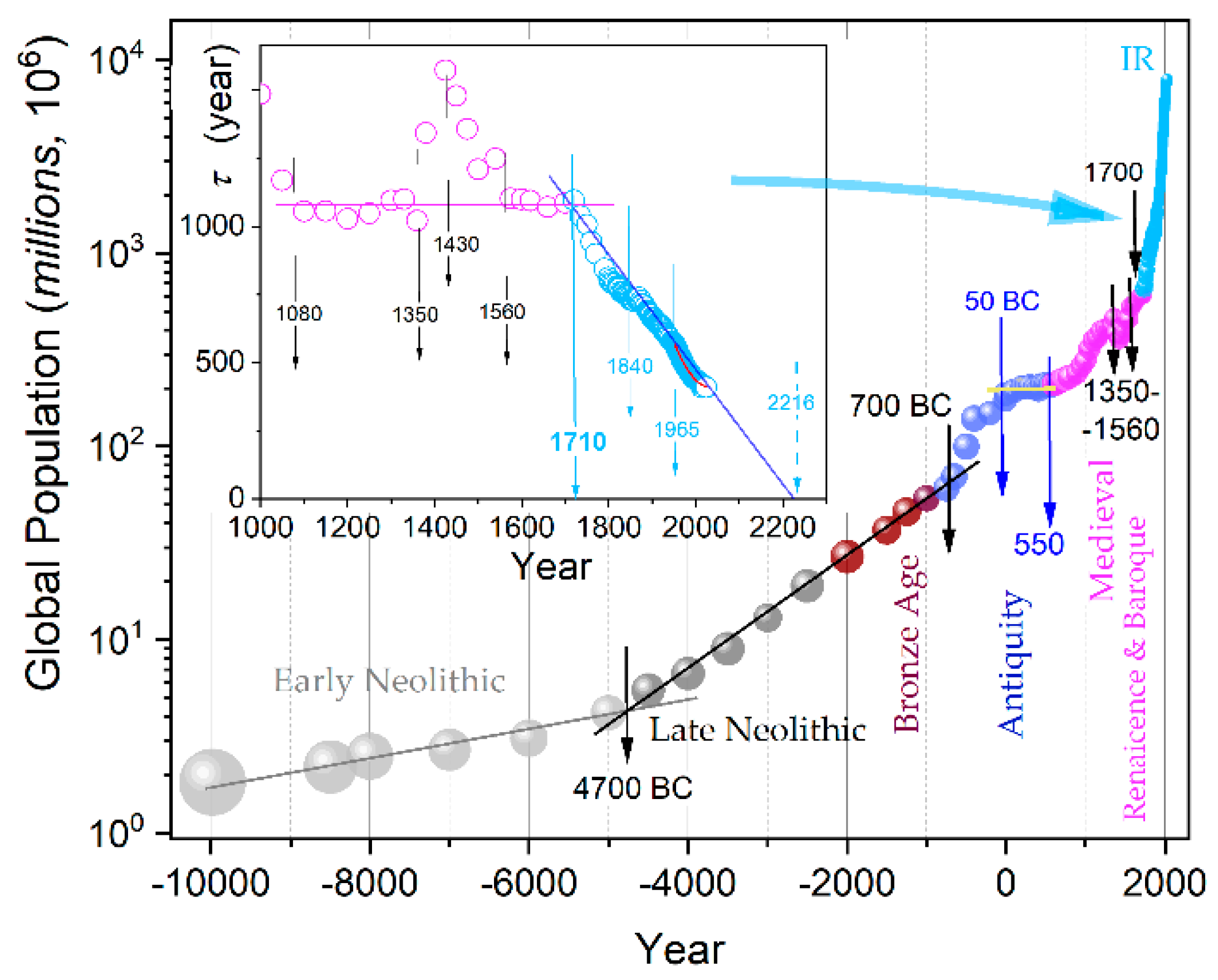
Figure 2.
HPP processor with the large volume pressure chamber (), max pressure . The central part shows the pressure chamber, and in the right part, the system for closing/opening the chamber and product replacement. It is part of the HPP pilot line in the X-PressMatter Lab of IHPP PAS (Warsaw, Poland). Designed & constructed by UnipressEquipment (IHPP PAS, Poland).
Figure 2.
HPP processor with the large volume pressure chamber (), max pressure . The central part shows the pressure chamber, and in the right part, the system for closing/opening the chamber and product replacement. It is part of the HPP pilot line in the X-PressMatter Lab of IHPP PAS (Warsaw, Poland). Designed & constructed by UnipressEquipment (IHPP PAS, Poland).
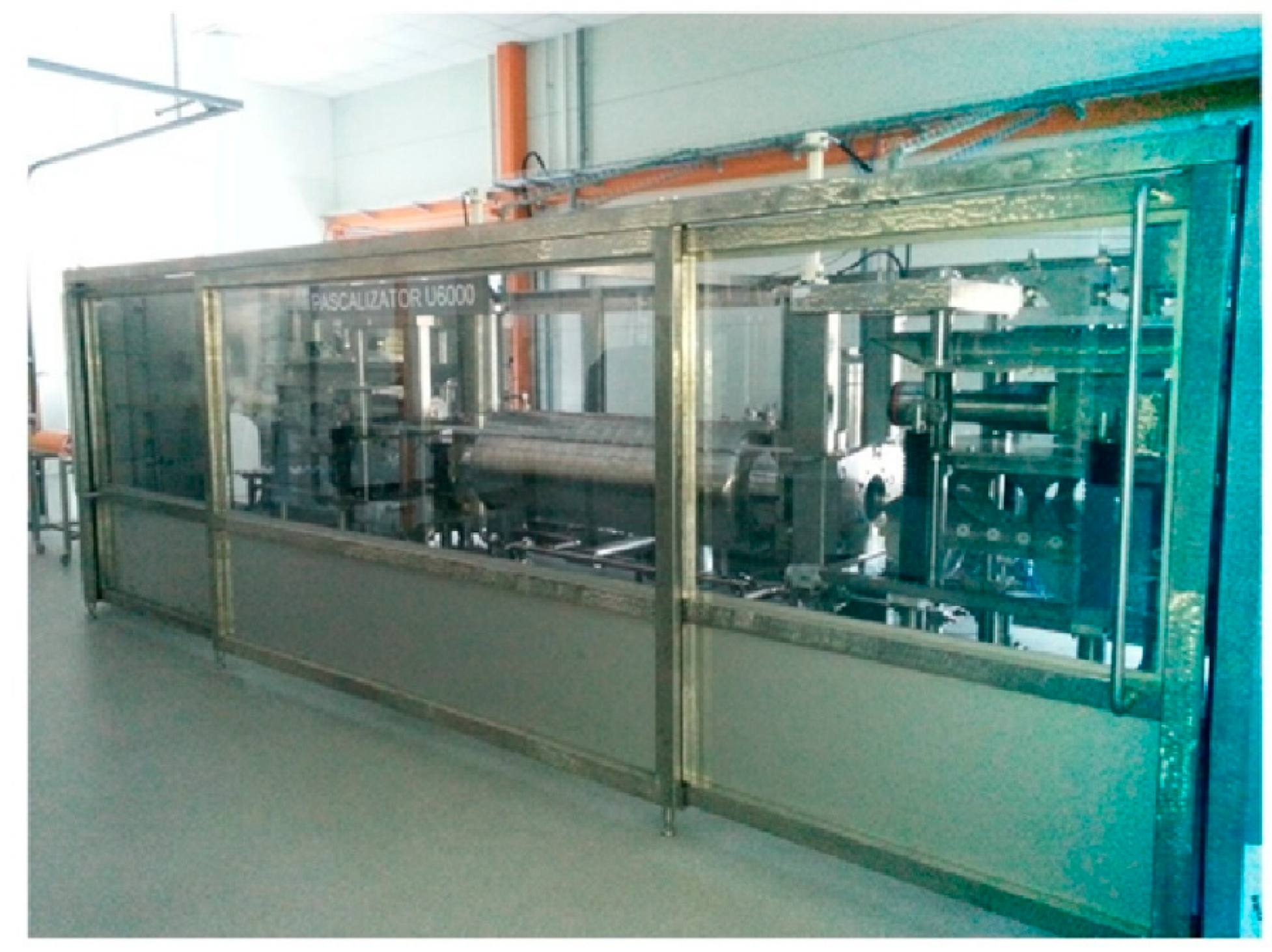
Figure 3.
The denaturation/pasteurization curve in the pressure-temperature () plane. The form of the native and denatured protein is shown. Links to discoveries by Louis Pasteur (thermal pasteurization under atmospheric pressure) and Percy W. Bridgeman for the first denaturation under isothermal compressing (white egg) are indicated. The plot also contains paths showing innovative Colossal Barocaloric Effect (CBE) supported solutions: (1) compressing, (2) CBE-based temperature changes, (3) decompression, and return to ambient conditions. The red color is related to the CBE support with , where ‘heat’ is released on compressing, and the blue one is for the CBE-support with , where ‘cool’ is released on compressing; is for the discontinuous phase transition, melting or order-disorder type, being the base of the Barocaloric Effect phenomenon.
Figure 3.
The denaturation/pasteurization curve in the pressure-temperature () plane. The form of the native and denatured protein is shown. Links to discoveries by Louis Pasteur (thermal pasteurization under atmospheric pressure) and Percy W. Bridgeman for the first denaturation under isothermal compressing (white egg) are indicated. The plot also contains paths showing innovative Colossal Barocaloric Effect (CBE) supported solutions: (1) compressing, (2) CBE-based temperature changes, (3) decompression, and return to ambient conditions. The red color is related to the CBE support with , where ‘heat’ is released on compressing, and the blue one is for the CBE-support with , where ‘cool’ is released on compressing; is for the discontinuous phase transition, melting or order-disorder type, being the base of the Barocaloric Effect phenomenon.
Disclaimer/Publisher’s Note: The statements, opinions and data contained in all publications are solely those of the individual author(s) and contributor(s) and not of MDPI and/or the editor(s). MDPI and/or the editor(s) disclaim responsibility for any injury to people or property resulting from any ideas, methods, instructions or products referred to in the content. |
© 2025 by the authors. Licensee MDPI, Basel, Switzerland. This article is an open access article distributed under the terms and conditions of the Creative Commons Attribution (CC BY) license (http://creativecommons.org/licenses/by/4.0/).
Copyright: This open access article is published under a Creative Commons CC BY 4.0 license, which permit the free download, distribution, and reuse, provided that the author and preprint are cited in any reuse.