

Submitted:
05 May 2025
Posted:
06 May 2025
You are already at the latest version
Abstract
Disorders of Gut-Brain interaction (DGBIs) in children have been associated with alterations in motility, intestinal sensitivity, microbiota, and psychosocial factors. Meanwhile, autism spectrum disorders (ASD) show a high prevalence of gastrointestinal symptoms, suggesting a significant gut-brain interaction. Although this relationship has been documented internationally, there is a lack of studies addressing it in Latin America. In this context, the Functional International Digestive Epidemiological Research Survey – FINDERS, composed of pediatric gastroenterologists from the Latin American Society for Pediatric Gastroenterology, Hepatology, and Nutrition - LASPGHAN, developed a database based on a structured questionnaire that includes sociodemographic, clinical, nutritional, and family-related variables, complemented by the Questionnaire for Pediatric Gastrointestinal Symptoms Rome IV (QPGS-IV), previously validated to identify DGBIs. This approach allows for accurate characterization of DGBIs presence in children with ASD. The database provides a consistent and replicable tool that can be used in future research to further explore the DGBIs-ASD relationship in various global contexts. Identifying different factors could contribute to more personalized diagnosis and therapeutic interventions in this age group.
Keywords:
Disorders of Gut-Brain Interaction
; Autism Spectrum Disorders
; Gastrointestinal Symptoms
; Schoolchildren
; Adolescents
; FINDERS
1. Summary
Disorders of Gut-Brain Interaction (DGBIs) in the pediatric population have been linked to various physiological and functional alterations [1]. These conditions reflect the complex and bidirectional communication between the central nervous system and the digestive tract [2]. In parallel, children with autism spectrum disorders (ASD) have been observed to present a high frequency of gastrointestinal symptoms, including abdominal pain, constipation, diarrhea, and bloating [3]. This high coexistence of digestive manifestations in children with autism supports the hypothesis of a deep and significant interaction between the gut and brain, where imbalances in one system can amplify or modify the clinical presentation in the other [4]. Understanding this relationship is essential for the comprehensive therapeutic approach to these patients.
The database constructed in this study offers multiple benefits for future research. By including sociodemographic, familial, clinical, and nutritional variables, it allows for detailed analyses of the association between individual, familial, and clinical factors in the pediatric population. Furthermore, it facilitates comparisons between children with and without ASD, as well as the identification of patterns or risk factors associated with DGBIs. Its structure also enables the design of longitudinal or cohort studies, the evaluation of regional differences, and the exploration of hypotheses related to sociodemographic and health variables, thus strengthening research in neurodevelopment and pediatric gastroenterology. Currently, an article is being published that used the database collected and described in the present study [5].
1.1. Autism Spectrum Disorders (ASD)
ASD are neurodevelopmental conditions characterized by persistent difficulties in social interaction and communication, as well as by restricted and repetitive patterns of behavior, interests, or activities [6]. According to the Diagnostic and Statistical Manual of Mental Disorders – DSM-5, Fifth Edition, published by the American Psychiatric Association, these symptoms must be present from the earliest stages of development and significantly affect daily functioning [7].
Clinical manifestations are heterogeneous and may include children with intellectual disabilities and limited language ability, as well as those with significantly above average intellectual and language function who have difficulties with social communication [8]. Children with autism often suffer from gastrointestinal symptoms associated with dysbiotic states and leaky gut [3]. Gastrointestinal symptoms include constipation, diarrhea, recurrent abdominal pain/bloating, and reflux.
1.2. Disorders Gut-Brain Interaction (DGBIs)
DGBIs are common in children of all ages and encompass a variety of disorders characterized by chronic, recurrent symptoms related to the gastrointestinal tract, which cannot be associated with structural or biochemical abnormalities [2]. The pathophysiology of these disorders is complex, involving bidirectional dysregulation of the Gut-Brain Interaction [9]. It also includes microbial dysbiosis in the gut, altered mucosal immune function, visceral hypersensitivity, and abnormal gastrointestinal motility [2].
In children aged 4 to 18 years old, they are classified according to their symptoms into: 1) functional nausea and vomiting disorders (including cyclic vomiting syndrome, functional vomiting and nausea, adolescent rumination syndrome, and aerophagia), 2) functional abdominal pain disorders (such as functional dyspepsia, irritable bowel syndrome, abdominal migraine, and functional abdominal pain not otherwise specified), and 3) defecation disorders (including functional constipation and non-retentive fecal incontinence) [9,10].
Worldwide studies have shown a prevalence of 23.0% for presenting some DGBI in schoolchildren and adolescents [11].
1.3. Rome Criteria
There are no biomarkers available for the diagnosis of DGBIs [9,10]. Diagnosis is based only on symptoms reported by the child and their parents or caregivers [12]. Given the lack of markers that allow for an accurate diagnosis, the Rome Criteria were created to improve the understanding and evaluation of these disorders, avoiding the need for numerous diagnostic tests and facilitating acceptance of the diagnosis by the patient and their family [1].
These Criteria were first published in 1990, initially applied only to adults with gastrointestinal symptoms [13,14]. It was not until 1999 that the second version was released, which included pediatric patients, and since then, these criteria have been updated every 10 years [13,14]. Currently, the Rome IV Criteria (2016) are active, classified according to age group into infants and toddlers, and schoolchildren and adolescents. These are based on single symptoms or a combination of symptoms within anatomical regions [15].
1.4. Functional International Digestive Epidemiological Research Survey – FINDERS
The Functional International Digestive Epidemiological Research Survey - FINDERS, founded in 2010, is composed of a group of pediatric gastroenterologists belonging to the DGBI Working Group of the Latin American Society of Pediatric Gastroenterology, Hepatology and Nutrition - LASPGHAN, with the main objective of studying these disorders at the Latin and Ibero-American level [16]. To this end, the group mainly conducts prevalence and analytical studies, aimed to identifying associations between these disorders and the different demographic, clinical and social characteristics of the populations evaluated.
2. Data Description
This data description article presents the survey administered to participants and the resulting dataset. Several publications based on this data collection are currently in preparation. Researchers specializing in pediatric DGBIs and ASD may benefit from the detailed description of the methodology used and the questionnaire management, which may facilitate the development of future research in this field. Furthermore, this database is available for other authors use in subsequent studies.
2.1. Informed Consent for Parents and/or Caregivers of Children with ASD
Prior to the beginning of the research, a document was prepared describing the purpose of the study, the procedures to be followed, the use and handling of data, the potential risks and benefits of participation, the voluntary nature of participation in the study, and the mechanisms established to ensure the confidentiality of the data collected. This document, intended to be signed by the parents and/or caregivers, also included the contact information of the principal investigators. Signature of the document constituted consent to voluntarily participate in the study and the commitment to comply with the details explained (Supplementary material 2). Those who agreed to participate in the study received a unique identification number.
2.2. Target Population
For this descriptive, observational, prevalence study, parents of children between 4 and 18 years old, of either gender, diagnosed with ASD according to the DSM-V, who consulted the gastroenterology or neurology pediatric services in different Latin American countries were invited to participate.
The inclusion criteria included children between 4 and 18 years old who had consulted the pediatric gastroenterology or neurology departments with a diagnosis of ASD, according to DSM-V criteria; as well as parents and/or caregivers with basic literacy skills who had previously signed informed consent.
Exclusion criteria included: inability of parents and/or caregivers to communicate, illiteracy, prior diagnosis of chromosomal abnormalities, anatomical malformations of the gastrointestinal tract, inflammatory bowel disease, celiac disease, or food allergies. Critically ill patients with sepsis, shock, or multiple organ failure, among others, were also excluded, as were those whose parents and/or caregivers refused to participate in the study.
2.3. Description of the Countries Included
Six Latin American countries participated in the study, each with its distinct cultural, social, and historical contexts enriching the regional analysis. The countries envolved were Argentina, Panama, Costa Rica, Mexico, El Salvador, and Colombia. Below is a brief description of each.
Argentina, located in South America, is known for its strong cultural identity, especially in tango, literature, and soccer. It is the second largest country in South America, with an area of 3.76 million km². The official language is Spanish, with regional variations. Its population is predominantly urban, concentrated in Buenos Aires and other large cities such as Cordoba and Rosario [17]. Across the country, as of October 31, 2023, the registry presented 114389 certified individuals with ASD, and of these, 41644 were children [18].
Panama is a strategic country due to its Canal, which connects the Atlantic Ocean with the Pacific, which has boosted its economy oriented towards trade and financial services. Its area is 75517 km². The official language is Spanish, although indigenous languages and English are also spoken in commercial areas. Panama combines modern cities like Panama City with rural regions and indigenous regions. It is divided into 10 provinces and 5 regions [19]. In 2024, 2766 students with ASD were registered [20].
Costa Rica is recognized for its political stability, commitment to peace, and biodiversity. It covers an area of 51100 km². Its official language is Spanish, although there are English-speaking communities and indigenous languages. It is divided into seven provinces [21]. Currently, there is inaccurate data on the prevalence of autism, with an estimate of approximately 64000 children between 4 and 18 years old are diagnosed with ASD [22].
Mexico is a megadiverse country, the birthplace of ancient civilizations such as the Mayans and the Aztecs. It covers an area of approximately 1.97 million km². Although Spanish is the primary language, Mexico officially recognizes 66 indigenous languages. It is organized into 32 federal entities. Its economy is the second largest in Latin America, based on trade, oil, tourism, and manufacturing [23]. A 2016 study by Autism Speaks and the Mexican Autism Clinic identified that 1 in 115 children had autism, with the majority occurring in boys (a ratio of 4 boys to 1 girl) [24].
El Salvador is the smallest country in Central America, notable for its vibrant culture, marked by its indigenous history, colonization process, and recent recovery from a civil war. It has an area of 21041 km². The official language is Spanish. It is organized into 14 departments. Its economy is based on remittances, agriculture, and services [25]. Currently, there are no updated official statistics on the number of people with autism, as the Ministry of Health does not keep a specific record of ASD diagnoses, and only has data on related medical consultations, which were 611 in 2017. The Salvadoran Autism Association estimates that around 1000 people have been identified with ASD, although this figure likely does not reflect reality due to possible misdiagnoses and the lack of an official census of people with disabilities [22].
Colombia, located in the northernmost part of South America, is characterized by its cultural, climatic, and ethnic diversity. It covers an area of 1141 billion km². The official language is Spanish, along with 65 recognized indigenous languages. After decades of armed conflict, in recent years the country has promoted peace processes and economic development based on services, mining, agriculture, and tourism [26]. According to the World Health Organization (WHO), one in every 160 children has autism. In Colombia, there are no official statistics showing how many people suffer from this disorder, although an estimated 115000 cases are present nationwide [27].
These countries (Figure 1) not only share a common language and historical ties, but also represent a diversity in political structures, social dynamics and local cultures, factors that are fundamental to interpreting the results obtained in the FINDERS study.
2.4. Demographic Variables
Table 1 presents a detailed description of the variables considered in the questionnaire. The first section of the instrument, addressed to the parents and/or caregivers of participating children, is designed to collect basic sociodemographic information. This includes variables such as date of birth; age (recorded in completed years); age group; sex; race; origin; and type of educational institution attended (public or private). These variables allow for an adequate characterization of the participating population and the exploration of possible associations between sociodemographic factors and the presence of symptoms related to DGBIs. Furthermore, they serve as a basis for future comparisons across different contexts and population groups in subsequent studies.
2.5. Clinical Variables
Among the clinical variables included (Table 2), relevant aspects of the participants' medical and perinatal history were considered. These included the method of birth (delivery or cesarean section), which may be related to initial microbial colonization of the intestine; prematurity, which has been associated with various alterations in neurological and gastrointestinal development; and the type of medical consultation (public or private). Likewise, the presence of a history of associated pathologies, as well as current or previous medication use, was investigated. Information on previous hospitalizations was also included as an indirect indicator of the severity of past clinical conditions. Finally, the level of autism was recorded according to the DSM-V, which classifies the severity of ASD based on the level of support required by the child, allowing these variables to be correlated with the presence and type of reported gastrointestinal symptoms.
2.6. Nutritional Variables
Regarding nutritional variables, information was collected on the children's most recent body weight, expressed in kilograms, as well as their last recorded height, measured in centimeters. These data were essential for calculating key anthropometric indicators that allow assessing the children's nutritional status. In particular, the body mass index (BMI) and height-for-age were calculated using the standards established by the WHO as references. These measurements allowed for the identification of potential nutritional disorders, such as malnutrition and risk of overweight or obesity, and were essential tools for analyzing child growth and development (Table 3).
2.7. Family Variables
For the family variables analyzed, summarized in Table 4, information related to the child's position in the family structure was included, specifically whether they were an only child or a firstborn. Family living status was also explored, asking whether the participant lived with one parent, both parents, or neither. For the purposes of the analysis, cases in which participants did not live with either parent were considered a possible indicator of separated/divorced parents. Finally, family history of illness was investigated, with an emphasis on the presence of autism diagnoses within the family, with the aim of identifying possible hereditary factors.
2.8. Questionnaire for Pediatric Gastrointestinal Symptoms Rome IV (QPGS-IV)
The Rome Criteria are widely accepted as the main method for defining and diagnosing DGBIs, through a questionnaire structured by sections according to the symptoms present in different anatomical regions [15], allowing the classification of disorders based on age group [1] (Supplementary material 3).
Table 5 presents a summary of the questionnaire [13,14], organized by sections, which describes the diagnoses that can be established from the questions corresponding to each section. In addition, the Cronbach's Alpha value obtained in a previous study conducted by us in a child population diagnosed with ASD is included [5].
2.9. Questionnaire Interpretation
For proper interpretation of the QPGS-IV, a detailed analysis of each item and the corresponding responses is essential. The Rome Foundation has established specific guidelines for scoring children and adolescents. In this context, Table 6 summarizes the criteria established for diagnosing a DGBIs [13,14].
3. Methods
Data collection via surveys took place between March 1, 2021, and February 28, 2023. Potential participants were recruited from the gastro pediatric and neurology outpatient clinics, as well as from specialized ASD foundations in the different countries invited to participate. The research was approved by the Ethic Committee of Argentina (Faculty of Medicine, Universidad de Buenos Aires, July 12, 2021), Colombia (Law 007-2021, Hospital Universitario del Valle “Evaristo García”, March 12, 2021), and El Salvador (CNEIS/2022/19, September 20, 2022). Participants were not financially compensated for their participation. The process was carried out in accordance with the 1975 Declaration of Helsinki [28].
3.1. Sample Size
Taking into account the reports by Buie, et al. [4] and Holingue, et al. [29], who described a prevalence of gastrointestinal symptoms in children with ASD ranging from 9.0% to 91.0%, and considering that in 2019, approximately 3000 children were admitted to the Emergency Department of the Hospital Universitario del Valle “Evaristo García” in Cali, Colombia, the sample size required for a proportion was calculated. This calculation was performed with a margin of error of 5% and a significance level (α) of 0.05:
n= N x Z2 x p x q /d2 x (N - 1) + Z2 x p x q
n = 3000 x 1.962 x 0.03 x 0.97 / 0.052 x (3000 - 1) + 1.962 x 0.03 x 0.97
n = 3000 x 3.8416 x 0.03 x 0,97 / 0.0025 x 2999 + 3.8416 x 0.03 x 0.97
n = 3000 x 0.1117 / 7.4975 + 0.1117
n = 335.37 / 7.6092
n = 44.07
Where n is the sample size, N is the total population (3000 children who consulted the Emergency Department), Z is the z value for the 95% confidence level (1 – alpha) (Z = 1.96), p the expected prevalence of children with ASD with any gastrointestinal symptom (p=0.03), q= 1-p (0.97) and d the absolute precision (0.05). A percentage of 15.0% was added to the sample size assuming some incongruent or inconclusive data and/or losses, for a total sample size of 51 children.
3.2. Data Collection
Parents or guardians of participants were recruited from specialized pediatric gastroenterology and neurology clinics, and from foundations dedicated to the care of children with ASD. Data collection was conducted using the QPGS-IV, supplemented with sociodemographic, nutritional, and family questions, administered by a physician via digital forms (Google Forms). The study was conducted in Spanish, and, on average, most participants completed the survey in approximately 30 minutes.
3.3. Data Handling
A database was designed in the Excel program, into which the collected information was entered, using double keying. Quality control was also performed on the collected information, verifying its accuracy and the correct completion of the questionnaires. The data were subsequently exported to Stata v. 16 for analysis.
A descriptive analysis of the general characteristics of the population and measures of central tendency and dispersion were performed according to the variable studied. The results were presented as frequency (percentages) and mean (standard deviation). Data were analyzed using Pearson's chi-square test or Fisher's exact test when required. Univariate, bivariate, and multivariate multiple regression analyses were performed to investigate potential effects on the variables of interest and the ASD diagnosis. Associations were calculated as odds ratios (OR) with their 95% confidence intervals (95%CI). A p<0.05 was considered statistically significant.
3.4. Identifying and Handling Biases
To reduce training and coding bias, the surveys were administered by trained physicians, who also reviewed 10% of the cases. Selection bias was controlled by the pediatric neurologist's diagnostic impression according to DSM-V and ICD-10. To mitigate recall bias, the child's guardian's ability and credibility were assessed during the interview. The pediatric gastroenterologist performed the differential diagnosis to control for confounding bias, identifying functional or organic digestive disorders.
3.5. Strengths and Weaknesses
The main strengths of our database include its prospective design, standardized methods, low dropout rate, use of validated questionnaires, sample size, and its implementation in several cities, which favored diversity and external validity. Furthermore, adequate comprehension of the questionnaires by parents or guardians was ensured. However, the study has some limitations, such as the dependence on parents or guardians for symptom reporting, which could introduce biases in perception or subjective interpretation. Also, the selection of children attending gastroenterology or neurology consultations could limit its representativeness of the general pediatric population with autism. Finally, detailed information on potentially influential factors, such as dietary intake, physical activity, and sedentary time, was not collected, which would have allowed for exploring potential regional differences.
Supplementary Materials
The following supporting information can be downloaded at the website of this paper posted on Preprints.org. Dataset, Informed Consent, Questionnaire for Pediatric Gastrointestinal Symptoms Rome IV.
Author Contributions
Conceptualization, CAV, CAR, CJO, DAV, CZ, JF, RB, AZ, RC, CG, FAR and RZ; Methodology, CAV, CAR, CJO, DAV, CZ, JF, RB, AZ, RC, CG, FAR and RZ; Software, CAV and DAV; Validation, CAV and DAV; Formal analysis, CAV and DAV; Investigation, CAV, CAR, CJO, DAV, CZ, JF, RB, AZ, RC, CG, FAR and RZ; Resources, CAV, CAR, DAV, CZ, JF, RB, AZ, RC, CG, FAR and RZ; Data curation, CAV, DAV and MCJ; Writing—original draft preparation, CAV, DAV and MCJ; writing—review and editing, CAV, CAR, CJO, DAV, MCJ, CZ, JF, RB, AZ, RC, CG, FAR and RZ; Visualization, CAV and DAV; Supervision, CAV, DAV and MCJ; Project administration, CAV and DAV. All authors have read and agreed to the published version of the manuscript.
Funding
This research received no external funding.
Institutional Review Board Statement
The study was conducted in accordance with the Declaration of Helsinki and approved by the Institutional Review Board of Hospital Universitario del Valle “Evaristo Garcia” in Cali, Colombia (Act 007-2021.12th March 2021), by Argentina (Facultad de Medicina, Universidad de Buenos Aires, 12th July 2021), and El Salvador (CNEIS/2022/19th September 2022).
Informed Consent Statement
Informed consent was obtained from all subjects involved in the study. Can be obtained through the supplementary material.
Data Availability Statement
The dataset is available as Supplementary Material. The dataset is licensed under CC BY-NC-ND 4.0, which means that reusers have to give credit to the creator. It allows reusers to copy and distribute the material in any medium or format in unadapted form and for noncommercial purposes only.
Acknowledgments
No support of any kind, including administrative, technical, or in-kind donations, was received for the completion of this work.
Conflicts of Interest
The authors declare no conflicts of interest.
Abbreviations
The following abbreviations are used in this manuscript:
| DGBIs | Disorders of Gut-Brain interaction |
| ASD | Autism Spectrum Disorders |
| FINDERS | Functional International Digestive Epidemiological Research Survey |
| QPGS-IV | Questionnaire for Pediatric Gastrointestinal Symptoms Rome IV |
| DSM-V | Diagnostic and statistical manual of mental disorders |
| BMI | Body Mass Index |
| HA | Height for Age |
| OR | Odds Ratio |
| 95% CI | 95% Confidential Interval |
References
- Koppen, I.J.; Nurko, S.; Saps, M.; Di Lorenzo, C.; Benninga, M.C. The pediatric Rome IV criteria: what’s new?. Expert Rev Gastroenterol Hepatol 2017, 11, pp. 193–201. doi: 10.1080/17474124.2017.1282820. [CrossRef]
- Black, C.J.; Drossman, D.A.; Talley, N.J.; Ruddy, J.; Ford, A.C. Functional gastrointestinal disorders: advances in understanding and management. Lancet 2020, 396, pp. 1664–1674. doi: 10.1016/S0140-6736(20)32115-2. [CrossRef]
- Dargenio, V.N.; Dargenio, C.; Castellaneta, S.; De Giacomo, A.; Laguardia, M.; Schettini, F.; et al. Intestinal barrier dysfunction and microbiota-gut-brain axis: Possible implications in the pathogenesis and treatment of autism spectrum disorder. Nutrients 2023, 15, pp. 1620. doi: 10.3390/nu15071620. [CrossRef]
- Buie, T.; Campbell, D.B.; Fuchs, G.J.; Furuta, G.T.; Levy, J.; Vandewater, J.; et al. Evaluation, diagnosis, and treatment of gastrointestinal disorders in individuals with ASDS: a consensus report. Pediatrics 2010, 125, pp. S1–S18. doi: 10.1542/peds.2009-1878C. [CrossRef]
- Velasco-Benítez, C.A.; Rojas-Cerón, C.A.; Ortiz-Rivera, C.J.; Velasco-Suárez, D.A.; Juvinao-Quintero, M.A.; Zubiri, C.; et al. Disorder of Gut-Brain Interaction in Schoolchildren and Adolescents with Developmental Disabilities. Preprint 2025. doi: 10.20944/preprints202504.0161.v1. [CrossRef]
- Hyman, S.L.; Levy, S.E.; Myers, S.M. Identification, Evaluation, and Management of Children With Autism Spectrum Disorder. Pediatrics 2020, 145, pp. e20193447. doi: 10.1542/peds.2019-3447. [CrossRef]
- American Psychiatric Association; DSM-5 Task Force. Diagnostic and statistical manual of mental disorders: DSM-5™. 5th ed.; American Psychiatric Publishing, Inc: Washington, DC, 2013.
- Hirota, T.; King, B.H. Autism Spectrum Disorder: A Review. JAMA 2023, 329, pp. 157–168. doi: 10.1001/jama.2022.23661. [CrossRef]
- Alonso-Bermejo, C.; Barrio, J.; Fernández, B.; García-Ochoa, E.; Santos, A.; Herreros, M.; et al. Functional gastrointestinal disorders frequency by Rome IV criteria. An Pediatr (Engl Ed) 2022, 96, pp. 441–447. doi: 10.1016/j.anpede.2021.05.013. [CrossRef]
- Hyams, J.S.; Di Lorenzo, C.; Saps, M.; Shulman, R.J.; Staiano, A.; van Tilburg, M. Childhood Functional Gastrointestinal Disorders: Child/Adolescent. Gastroenterology 2016, 150, pp. 1456–1468. doi: 10.1053/j.gastro.2005.08.063. [CrossRef]
- Velasco-Benítez, C.A.; Collazos-Saa, L.I.; García-Perdomo, H.A. A systematic review and meta-analysis in schoolchildren and adolescents with functional gastrointestinal disorders according to Rome IV Criteria. Arq Gastroenterol 2022, 59, pp. 304–313. doi: 10.1590/S0004-2803.202202000-53. [CrossRef]
- Bonilla, S.; Saps, M. Los acontecimientos de la vida temprana predisponen a la aparición de trastornos gastrointestinales funcionales infantiles. Rev Gastroenterol Mex 2013, 78, pp. 82–91.
- Drossman, D.A.; Chang, L.; Kellow, J.; Chey, W.D.; Tack, J.; Whitehead, W.E., eds. Rome IV Diagnostic Questionnaires and Tables for Investigators and Clinicians. 1st ed.; Rome Foundation: Raleigh, NC, 2016: pp. 192-221 doi: 10.1053/j.gastro.2016.02.014. [CrossRef]
- Nurko, S.; Di Lorenzo, C., eds. Rome IV Pediatric Functional Gastrointestinal Disorders – Disorders of Gut-Brain Interaction. 1st ed.; Rome Foundation: Raleigh, NC, 2016.
- Hreinsson, J.P.; Törnblom, H.; Tack, J.; Drossman, D.A.; Whitehead, W.E.; Bangdiwala, S. Factor Analysis of the Rome IV Criteria for Major Disorders of Gut-Brain Interaction (DGBI) Globally and Across Geographical, Sex, and Age Groups. Gastroenterology 2023, 164, pp. 1211–1222. doi: 10.1053/j.gastro.2023.02.033. [CrossRef]
- Velasco-Benítez, C. Trastornos Digestivos Funcionales En Pediatría. 1st ed.; Grupo Distribuna: Bogotá, Colombia, 2022. pp. 4–5.
- Instituto Geográfico Nacional de Argentina. Introducción a la Geografía de la República Argentina. Buenos Aires, 2023.
- Agencia Nacional de Discapacidad. Personas con certificado único de discapacidad con condiciones de salud vinculadas a trastornos del espectro autista. Buenos Aires: Agencia Nacional de Discapacidad, 2023.
- Oficina de Información Diplomática del Ministerio de Asuntos Exteriores, Unión Europea y Cooperación. Ficha país: Panamá, 2024.
- Instituto Panameño de Habilitación Especial. Uniendo esfuerzos para concienciar sobre el Autismo. Panamá, 2024.
- Oficina de Información Diplomática del Ministerio de Asuntos Exteriores, Unión Europea y Cooperación. Ficha país: Costa Rica, 2025.
- Alvarado, J.; Contreras, L.; Cruz, C. Experiencias familiares, estrategias de afrontamiento y salud de madres y padres de niñez con autismo. ECA 2021, 76, pp. 89–111. doi: 10.51378/eca.v76i764.4576. [CrossRef]
- Oficina de Información Diplomática del Ministerio de Asuntos Exteriores, Unión Europea y Cooperación. Ficha país: México, 2025.
- Fundación Teletón México. Panorama del autismo en México y el mundo, 2024.
- Oficina de Información Diplomática del Ministerio de Asuntos Exteriores, Unión Europea y Cooperación. Ficha país: El Salvador, 2024.
- Oficina de Información Diplomática del Ministerio de Asuntos Exteriores, Unión Europea y Cooperación. Ficha país: Colombia, 2024.
- Rojas, K.J. En Colombia no hay estadísticas oficiales acerca del autismo. Bogotá: Edición Médica, 2021.
- World Medical Association. Declaration of Helsinki: ethical principles for medical research involving human subjects. Adopted by the 29th WMA General Assembly, Tokyo, Japan, October 1975.
- Holingue, C.; Newill, C.; Lee, L.C.; Pasricha, P.J.; Fallin, M.D. Gastrointestinal symptoms in autism spectrum disorder: a review of the literature on ascertainment and prevalence. Autism Res 2018, 11, pp. 24–36. doi: 10.1002/aur.1854. [CrossRef]
Figure 1.
Map of Latin America and the included countries.
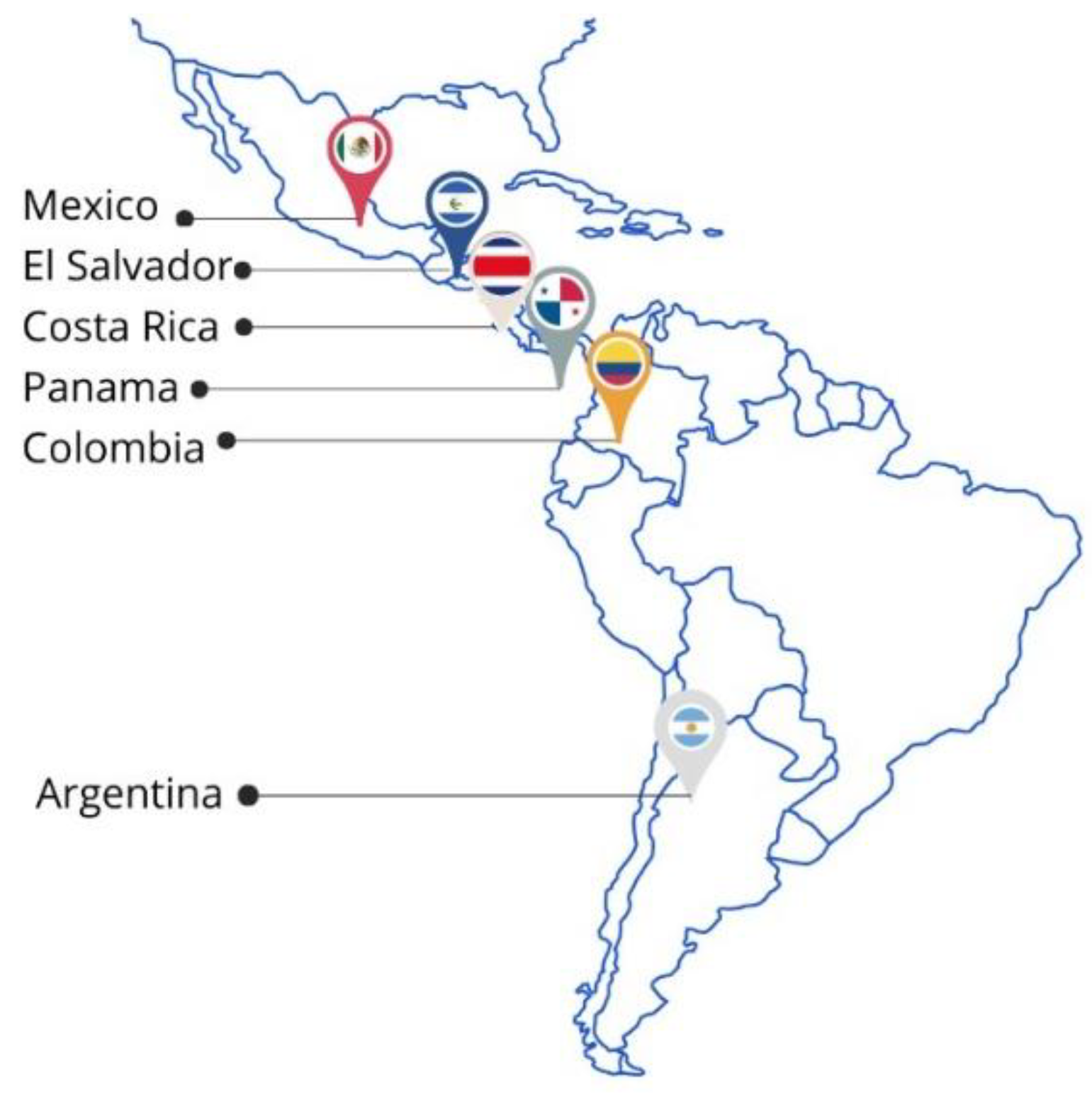

Table 1.
Sociodemographic variables included in the questionnaire.
| Variable Name | Field Name | Value | Definition | Variable Type |
|---|---|---|---|---|
| Current date | current_date | day/month/year | Current date from which the questionnaire is answered | Quantitative – Interval |
| Subject identification | subject_ID | Initials of the country/number of patient | Subject identification number | Qualitative – Ordinal |
| Date of Birth | birth_date | day/month/year | Chronological data indicating the day, month, and year the participant was born | Quantitative – Interval |
| Age | age_years | 4–18 years | Age in completed years at the time of enrollment in the study. Calculated by subtracting the date of birth from the current date | Quantitative – Ratio |
| Age Group | age_group | 0 = Preschool 1 = School-age 2 = Adolescent |
Classification by age group: preschool (4–8 years old), school-age (9–12 years old), and adolescent (13–18 years old) | Qualitative – Ordinal categorical |
| Sex | sex | 0 = Female 1 = Male |
Biological characteristics that distinguish participants based on reproductive and genetic attributes | Qualitative – Nominal categorical |
| Race | race | 0 = Mixed race 1 = Indigenous 2 = White 3 = Afrodescendant |
Socio-cultural category used to classify people based on physical characteristics such as skin color, facial features, or hair type | Qualitative – Nominal categorical |
| Country of Origin | country_1 | 0 = Argentina 1 = Panama 2 = Costa Rica 3 = Mexico 4 = El Salvador 5 = Colombia |
Geographic, cultural, or ethnic origin of the participant | Qualitative – Nominal categorical |
| Type of Educational Institution | type_school | 0 = Public 1 = Private |
Classification according to the nature of the educational institution attended by participants: public or private | Qualitative – Nominal categorical |
Table 2.
Clinical variables included in the questionnaire.
| Variable Name | Field Name | Value | Definition | Variable Type |
|---|---|---|---|---|
| Cesarean Birth Method | c_section | 0 = No 1 = Yes |
Surgical technique in which the baby is delivered from the mother's uterus through an incision in the abdominal wall and uterus | Qualitative – Nominal categorical |
| Prematurity | premature | 0 = No 1 = Yes |
Birth occurring before 37 weeks of gestation | Qualitative – Nominal categorical |
| Type of Medical Consultation | consultation_type | 0 = Public 1 = Private |
Classification of the medical care service received by the patient, according to the sector of the providing institution | Qualitative – Nominal categorical |
| Comorbidities | comorbidities | 0 = No 1 = Yes |
Presence of one or more additional diseases or medical conditions that coexist with the participant's main condition | Qualitative – Nominal categorical |
| Medication Use | medications | 0 = No 1 = Yes |
Intake, administration, or use of one or more drugs by the participant, either occasionally, continuously, or under medical indication | Qualitative – Nominal categorical |
| Hospitalizations | hospitalizations | 0 = No 1 = Yes |
Admission of the participant to a healthcare center or hospital for 24 hours or more to receive specialized medical care | Qualitative – Nominal categorical |
| Level of Autism According to DSM-V | autism_level | 0 = Level 1 1 = Level 2 2 = Level 3 3 = Don’t know |
Degree of ASD severity, assessing the level of support required in social communication and restricted, repetitive behaviors | Qualitative – Nominal categorical |
Table 3.
Nutritional variables included in the questionnaire.
| Variable Name | Field Name | Value | Definition | Variable Type |
|---|---|---|---|---|
| Date of the weight and height | date_weight_height | day/month/year | Date on which it was weighed and stemmed | Quantitative – Interval |
| Weight | weight | Weight in kilograms | Measurement of the participant’s body mass, commonly expressed in kilograms (kg) | Quantitative – Continuous |
| Height | height | Height in centimeters | Measurement of the participant’s stature from feet to head, usually expressed in centimeters (cm) | Quantitative – Continuous |
| Body Mass Index (BMI) diagnosis | dx_bmi | 0= Normal 1= Obesity 2= Overweight risk 3= Overweight 4= malnutrition 5= Severe malnutrition |
BMI-for-height interpretation according to WHO charts for children aged 4 to 18 years: Obesity: > +2 SD; Overweight: +1 to +2 SD; Normal: +1 to -2 SD; malnutrition: < -2 SD; Severe malnutrition: < -3 SD | Qualitative – Nominal categorical |
| Height-for-Age diagnosis | dx_ha | 0 = Normal 1= Short height 2 = Severe short height 3 = Tall height |
Height-for-age interpretation based on WHO growth charts for children aged 4 to 18 years: Normal: -2 to +3 SD; Short stature: -2 to -3 SD; Severe short stature: < -3 SD; Tall stature: > +3 SD | Qualitative – Nominal categorical |
Table 4.
Family variables included in the questionnaire.
| Variable Name | Field Name | Value | Definition | Variable Type |
|---|---|---|---|---|
| Only Child | only_child | 0 = No 1 = Yes |
Participant who has no siblings | Qualitative – Nominal categorical |
| First-born | first_born | 0 = No 1 = Yes |
Participant who is the first-born among their siblings | Qualitative – Nominal categorical |
| Separated/Divorced Parents | separated_divorced_parents | 0 = No 1 = Yes |
Situation in which the participant does not live with either parent | Qualitative – Nominal categorical |
| Family History of Illness | family_history_illness | 0 = No 1 = Yes |
Presence of one or more diseases or medical conditions in the participant’s family | Qualitative – Nominal categorical |
| Family History of Autism | family_autism | 0 = No 1 = Yes |
Presence of an autism diagnosis in a family member of the participant | Qualitative – Nominal categorical |
Table 5.
Sections of the QPGS-IV with their respective Cronbach's Alpha.
| Section | Explanation | Cronbach's Alpha | Interpretation |
|---|---|---|---|
|
Section A Pain and discomfort above the belly button |
This section of the questionnaire explores gastrointestinal symptoms located above the umbilical region, specifically functional dyspepsia and its subtypes: postprandial dyspepsia and epigastric dyspepsia; some questions for diagnosing irritable bowel syndrome and functional abdominal pain not otherwise specified | 0.7331 | High |
|
Section B Pain and discomfort in, around, or below the belly button |
This section assesses gastrointestinal symptoms located around or below the umbilical region. In particular, it helps establish the diagnosis of irritable bowel syndrome, abdominal migraine, and functional abdominal pain not otherwise specified | 0.470 | Moderate |
|
Section C Bowel movements (“poop”, “number 2”) |
This section evaluates the child's bowel movement patterns to diagnose defecation disorders such as functional constipation and non-retentive fecal incontinence | 0.6535 | High |
|
Section D Nausea and vomiting |
This section explores symptoms associated with functional nausea and vomiting disorders, including cyclic vomiting syndrome, nausea, functional vomiting, and adolescent rumination syndrome | 0.6110 | High |
|
Section E Other symptoms |
Inquires about symptoms related to aerophagia | 0.6367 | High |
Table 6.
Scoring instructions for Parent-Report Form for the QPGS-IV for Children and adolescents.
| H1. Functional Nausea and Vomiting Disorders |
| H1a. Cyclic Vomiting Syndrome |
| (D8) Two or more episodes of repeated vomiting in the past 6 months, AND (D8b) Presence of nausea (“Yes”), AND (D8c) Vomit free intervals is “Several weeks” or longer. |
| H1b. Functional Nausea and Functional Vomiting |
|
H1b1. Functional Nausea (D1) Nausea “2 times a week” or more in the past 2 months, AND (D2) Nausea for 2 months or longer, AND (D3) Nausea not usually related to meal (“No”), AND (D4) No vomiting during nausea episode (“No”), AND (D4a) If comorbid pain is present during nause episode, nausea is more bothersome than pain. H1b2. Functional Vomiting (D5) Vomiting on average one or more times per week, AND (D6) Vomiting for 2 months or longer, AND (D7) Vomiting is not self-induced (“Never” or “Once in a while”), AND Child does not meet criteria for rumination. |
| H1c. Adolescent Rumination Syndrome |
| (D9) Food comes back up “Several times a week” or “Every day”, AND (D9a) Episodes occur shortly after eating (“Yes”). AND (D9b) Episodes do not occur during sleep (“No”), AND (D9c) Episodes are not accompanied by nausea or vomiting (“No”). |
| H1d. Aerophagia |
| [(E1) Belching “Several times a week” or “Every day”, OR (E2) Flatus “Several times a week” or “Every day”] AND (E3) Abdominal distension “Several times a week” or “Every day”, AND (E4) Swallowing air “Several times a week” or “Every day”. |
| H2. Abdominal Pain Disorders |
| H2a. Functional Dyspepsia |
| Functional dyspepsia is diagnosed if child qualifies for postprandial distress syndrome or epigastric pain syndrome or both. H2a1. Postprandial Distress Syndrome [(A3) Fullness “4 days a month” or more often, OR (A4) Satiation “4 days a month” or more often], AND (A7) Duration of upper abdominal pain or discomfort is “2 months” or longer. H2a2. Epigastric Pain Syndrome [(A1) Upper abdominal pain “4 days a month” or more often, OR (A2) heartburn “4 days a month” or more often], AND (A7) Duration of upper abdominal pain or discomfort is “2 months” or longer, AND (A8) Not related to a bowel movement: “Never” or “Once in a while”, AND (A9-12) Not associated with change in stool form or frequency: “Never” or “Once in a while”. |
| H2b. Irritable Bowel Syndrome |
| (B1 or A1) Abdominal pain “4 days a month” or more often, AND (B3 or A7) Abdominal pain is “2 months” or longer, AND (B2a) Not exclusively associated with eating (“No”), AND (B2b) For girls, not exclusively associated with menses (“No” or “No applicable”), AND [At least one (A8-A12) OR (B4-B8) Bowel symptoms “Sometimes” or more often], AND (B9) For those who use laxatives (B9 is “Yes”), question (B9a) Elimination of symptoms with laxatives must be answered “Never”, “Once in a while”, or “Sometimes” (i.e., NOT answered “Most of the time” or “Always”). |
| H2c. Abdominal Migraine |
| (B10) Severe pain causing restriction in daily activities (“Yes”), AND (B10a) Pain lasts 1 hour or more, AND (B10b) In the past 6 months, 2 or more episodes of severe pain, AND [(B10c) Two or more of the following during pain episodes:
|
| H2d. Functional Abdominal Pain-NOS |
| Lower abdominal location (B1 OR A1) Abdominal pain “4 days a month” or more often, AND (B3 OR A7) Abdominal pain is “2 months” or longer, AND (B2a) Pain is not exclusively associated with eating (“No”), AND (B2b) In girls, pains is not exclusively associated with menses (“No” or Not” applicable”), AND Does not meet criteria for the other functional gastrointestinal disorders associated with abdominal pain (e.g., functional dyspepsia, irritable bowel syndrome, abdominal migraine). |
| H3. Functional Defecation Disorders |
| H3a. Functional constipation |
| Two or more of the following: (C1) Two or fewer stools per week, OR [Either (C2) hard (“type 2”) or very hard stools (“type 1”) OR (C3) Painful stool] OR (C4) Passage of very large stools, OR (C5) Stool retention “1 time a week” or more often, OR (C6) History of large fecal mass in rectum, OR (C7) Soiling “Once a week” or more often. If child meets criteria for irritable bowel syndrome, pain should improve with laxative use (B9a= “Most of the time” or Always”). |
| H3b. Non-Retentive Fecal Incontinence |
| (C7) Soiling “1 time a week” or more often, AND (C7a) Amount of stool is small or large (not just a stain), AND (C7b) Soiling for 1 month or longer, AND (C5) No evidence of fecal retention (C5=Never), AND Does not meet criteria for functional constipation. |
Disclaimer/Publisher’s Note: The statements, opinions and data contained in all publications are solely those of the individual author(s) and contributor(s) and not of MDPI and/or the editor(s). MDPI and/or the editor(s) disclaim responsibility for any injury to people or property resulting from any ideas, methods, instructions or products referred to in the content. |
© 2025 by the authors. Licensee MDPI, Basel, Switzerland. This article is an open access article distributed under the terms and conditions of the Creative Commons Attribution (CC BY) license (http://creativecommons.org/licenses/by/4.0/).
Copyright: This open access article is published under a Creative Commons CC BY 4.0 license, which permit the free download, distribution, and reuse, provided that the author and preprint are cited in any reuse.


