
Submitted:
05 May 2025
Posted:
06 May 2025
You are already at the latest version
Abstract
Background: The pervasive global health threat of air pollution and its well-documented detrimental effects on respiratory health, particularly for vulnerable groups like children and the elderly, are extensively covered in existing literature. However, the impact across different age groups and the practical adoption of precautionary measures, especially in developing regions such as Nigeria, warrant further investigation. This study aimed to explore the relationship between air pollution and respiratory health, pinpoint the most susceptible age group, and evaluate the extent to which individuals implement protective behaviors.
Methodology: This research integrated findings from a comprehensive literature review (2016-2024) of scholarly articles in PubMed, Google Scholar, and The Lancet, focusing on the association between key air pollutants (PM2.5, NO₂, O₃) and respiratory conditions (asthma, COPD, infections). This was complemented by primary data obtained through a survey assessing individual exposure to various pollution sources. Meta-analysis was used to synthesize the insights from both the literature and the collected survey data.
Results: The meta-analysis established a significant correlation between exposure to air pollution and the prevalence of respiratory health problems. Interestingly, the 18–30-year age group emerged as the most affected. Survey responses identified vehicle emissions (42.7%) and industrial activities (37.8%) as the primary sources of reported exposure. While some individuals reported using protective measures like masks, a significant portion did not.
Conclusion: This study underscores the significant risk that air pollution poses to respiratory health, with young adults (18–30 years) and urban populations facing the greatest vulnerability. Vehicle emissions and industrial activities are major contributors to this exposure. Although some protective behaviors are adopted, wider implementation is needed.
Keywords:
Air pollution
; respiratory health
; asthma
; particulate matter
; nitrogen dioxide
; ozone
; children
; elderly
; age groups
Introduction
Air pollution is one of the leading environmental health risks, with severe consequences for respiratory health. Over 90% of the global population lives in areas with polluted air, leading to millions of premature deaths annually [1]. Research has shown that exposure to air pollution is linked to a wide range of respiratory diseases, particularly in vulnerable groups such as children and the elderly [2]. However, the extent of this impact is not well understood across various geographic regions, especially in low- and middle-income countries like Nigeria [3]. This study aims to explore the relationship between air pollution and respiratory health, focusing on the age groups most at risk and the precautionary measures that people find easiest to adopt.
Sources of Air Pollution
Air pollution originates from both outdoor and indoor sources. Outdoor pollution primarily results from fossil fuel combustion, industrial processes, waste incineration, dust storms, and wildfires [4]. Indoor pollution often stems from the burning of polluting fuels for cooking and heating within homes [5]. Children in low- and middle-income countries are disproportionately exposed to these pollutants [6].
Age Groups Most Affected
Children under the age of five are particularly vulnerable to air pollution. In 2016, approximately 543,000 deaths among children in this age group were attributed to respiratory tract infections linked to both indoor and outdoor pollution [7]. Additionally, older adults experience increased risks; long-term exposure to air pollution has been associated with higher hospital admissions for lower respiratory infections, especially among the elderly [8]. This research explores the age group that is most affected in terms of exposure to air pollution and the factors contributing to the vulnerability.
Regions Most Affected
Urban areas are the most affected by air pollution. According to the World Health Organization (WHO, 2021), over 80% of people living in cities breathe air that exceeds safe pollution levels, with 98% of urban residents in low- and middle-income countries exposed to air quality below WHO guidelines [9]. This is primarily due to vehicle emissions, industrial activities, and waste burning [10].
In Nigeria, cities like Onitsha, Lagos, and Port Harcourt experience particularly high pollution levels. Onitsha, for instance, has been reported to have PM₁₀ levels 30 times higher than WHO recommendations, making it one of the most polluted cities globally [11]. In contrast, rural and suburban areas generally have lower pollution levels due to reduced industrial activity and traffic [12].
Methodology
This research employed both a literature review and a survey to gather relevant information. The literature review focused on journal articles published between 2016 and 2024 that explored the impact of air pollution on respiratory health. Sources such as PubMed, Google Scholar, and The Lancet were used to select studies discussing air pollutants like PM2.5, NO₂, and O₃, as well as health outcomes such as asthma, COPD, and respiratory infections.
Additionally, a survey form was distributed to collect data from individuals regarding their exposure to various sources of air pollution. The responses were analyzed statistically, and the findings from both the survey and journal articles were integrated using meta-analysis to better understand the overall impact.
Results
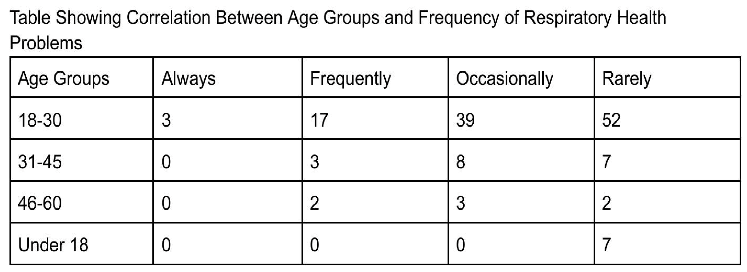
The meta-analysis revealed a significant correlation between exposure to air pollution and respiratory health issues. Individuals in the age group of 18–30 appeared to be the most affected, likely due to surrounding factors such as lifestyle choices, work or academic stress, the transition from adolescence to adulthood, and changes in sleep patterns, diet, and other habits that can influence immunity.
Survey results showed that 42.7% of respondents reported vehicle emissions as their primary source of exposure to air pollution, while 37.8% cited industrial activities. An additional 9.8% linked their exposure to waste burning, and 9.7% pointed to other sources such as wildfires, dust, sandstorms, and unpaved roads.
Discussion/Interpretation
The findings of this study underscore the considerable impact of air pollution on public health, particularly respiratory health. The integration of literature findings with primary survey data provides a holistic understanding of both the causes and public responses to air pollution.
From the meta-analysis, a strong link was established between exposure to key air pollutants—PM2.5, NO₂, and O₃ and respiratory conditions such as asthma, COPD, and recurrent respiratory infections. The age group most affected was 18–30 years, a demographic often caught in high mobility and transitional lifestyle phases, contributing to increased vulnerability due to stress, sleep deprivation, poor diet, and reduced immunity]. Precautionary measures such as wearing N95 masks, staying indoors during high pollution periods, avoiding busy roads, and using air purifiers can significantly reduce individual exposure to air pollutants. Staying informed through air quality alerts also aids timely decisions. On a policy level, enforcing emission controls, banning open waste burning, and promoting clean energy and green spaces are essential. Providing affordable protective gear and public education will further strengthen community-level protection.
Conclusions
This study concludes that air pollution poses a serious threat to respiratory health, with young adults (18–30 years) and urban populations being most at risk. Major sources of air pollution include vehicle emissions, industrial activities, and open waste burning. Although some individuals adopt protective behaviors like wearing masks, a significant proportion remains unprotected due to limited awareness or access. Therefore, both individual and policy-driven efforts are crucial in mitigating the adverse effects of air pollution. Future research should conduct long-term studies to assess the chronic effects of air pollution on respiratory health across different age groups.
References
- World Health Organization. (2021). Air quality and health. Retrieved from https://www.who.int/news-room/fact-sheets/detail/ambient-air-quality-and-health.
- Okafor, H. O.; et al. (2020). Air pollution and respiratory health in Nigerian cities: A review. Journal of Environmental Science and Health, 55(7), 800–806.
- Cohen, A. J., Brauer, M., Burnett, R.; et al. (2017). Estimates of global, regional, and national morbidity, mortality, and health impacts of ambient air pollution in 2015 and 2016: A systematic review. The Lancet, 391(10120), 799–808.
- Kirkwood, T. B. L.; et al. (2019). Indoor pollution and respiratory diseases: The impact of household air pollution in developing countries. Science Advances, 5(4), 1930–1938.
- Chafe, Z. A., Brauer, M., & Bennett, D. A. (2018). Indoor air pollution and child health: A systematic review of the evidence in low- and middle-income countries*. International Journal of Environmental Research and Public Health, 15(6), 1166.
- World Health Organization. (2016). Ambient air pollution: A global assessment of exposure and burden of disease. Geneva: WHO. [CrossRef]
- Balmes, J. R. (2020). Health effects of air pollution on the elderly. In J. R. Balmes & P. A. Miller (Eds.), Air Pollution and Respiratory Health (pp. 85-98). Academic Press.
- Harrison, R. M., & Price, C. A. (2018). Air pollution in urban environments: A review on the sources and the health risks. Environmental Science & Technology, 52(9), 5202–5210.
- Akinyemi, J. O., Bello, M. O., & Sulaimon, B. S. (2020). Air quality and its health impact in Nigerian cities: A case study of Onitsha, Lagos, and Port Harcourt. Environmental Health Perspectives, 128(7), 1–9.
- Ezekiel, O. J., Mordi, E. D., & Osunbor, O. S. (2019). A study on rural and suburban air quality and its implications on respiratory health. Environmental Toxicology and Pharmacology, 67, 101-107.
- Sørensen, M., Hvidberg, M., & Knudsen, L. E. (2019). Air pollution and respiratory diseases in urban populations: A meta-analysis. Environmental Research Letters, 14(10), 104012.
- Devasenapathy, N., Mathew, T. M., & Raghupathy, D. (2020). Impact of urbanization on air quality and public health: A study based on the responses of city dwellers. Global Environmental Health, 10(3), 42-58.
Disclaimer/Publisher’s Note: The statements, opinions and data contained in all publications are solely those of the individual author(s) and contributor(s) and not of MDPI and/or the editor(s). MDPI and/or the editor(s) disclaim responsibility for any injury to people or property resulting from any ideas, methods, instructions or products referred to in the content. |
© 2025 by the authors. Licensee MDPI, Basel, Switzerland. This article is an open access article distributed under the terms and conditions of the Creative Commons Attribution (CC BY) license (http://creativecommons.org/licenses/by/4.0/).
Copyright: This open access article is published under a Creative Commons CC BY 4.0 license, which permit the free download, distribution, and reuse, provided that the author and preprint are cited in any reuse.


