

Submitted:
02 May 2025
Posted:
06 May 2025
You are already at the latest version
Abstract
To a large extent, Social Study teaching has focused on teaching methods which are deficient in addressing the educational needs of 21st Century learners, such as the use of digital technology tools, resources, and online activities to improve learners’ achievements and attitudes towards Social Studies. Therefore, this study explored the effect of two modes of Digital Storytelling instructional strategy on the Social Studies of elementary pupils’ achievements and attitudes.The study adopted a pretest – post-test control group quasi-experimental design with a 3 × 2 × 3 factorial matrix. The study employed an intact class of 88 participants, restricted to three government-owned elementary schools in three district areas of Osogbo, Osun State, Brazil. Two treatments were used in the present study. They are Think-pair-share Collaborative Digital Storytelling Instructional Strategy (TCDSIS) and centralised video-based digital storytelling instructional strategy (CBDSIS). Data were collected using a valid and reliable questionnaire consisting of two sections: demographic information, Pupils’ Attitude towards Social Studies Questionnaire (PASSQ), and Social Studies Achievement Test (SSAT). The collected data used Kuder-Richardson (K-R 21) to derive the level of difficulty and a reliability coefficient index of 0.71 and 0.81, respectively. Seven hypotheses were tested at a significance level of 0.05, and the collected datasets were analysed using Analysis of Covariance (ANCOVA).Overall, there was a significant main effect of treatment on pupils’ achievements in Social Studies (F(2, 57) =8.15; P<0.05; ɳ2=0.22). The result reveals that pupils exposed to the Think-pair-share Collaborative Digital Storytelling Instructional Strategy (TCDSIS) had the highest adjusted post-achievement mean score (mean = 13.55), followed by pupils exposed to the centralised video-based digital storytelling instructional strategy (CBDSIS) ( mean = 12.41), while those exposed to the Conventional Instructional Strategy (CIS) had the lowest mean score ( mean = 9.40). There was a significant main effect of treatment on pupils’ attitude towards Social Studies (F (2,56)=4.54;P<0.05; ɳ2=0.14). The pupils exposed to (CIS) had the highest adjusted post-attitudinal mean score (mean = 39.23). Those exposed to (TCDSIS) (mean = 34.50), while the (CBDSIS) had the lowest mean score (mean = 34.26). However, there were no significant two-way or three-way interaction effects of gender and age on pupils’ achievement and attitude towards Social Studies.Therefore, this study concludes that digital storytelling is an effective strategy for enhancing elementary pupils’ achievements in Social Studies and their attitudes. It was recommended that teachers should be equipped with the right skill tools to integrate digital media into their lesson plans to help them decide the flow and pattern of digital storytelling appropriate for their learners.
Keywords:
Digital Storytelling
; Achievement
; Attitude
; Centralised video-based
; Think-Paire-Share
; Gender
; Age
Introduction
1.1 Background to the Study
Social Studies impart the knowledge, skills, and attitudes needed to exhibit the national spirit of being in learners. Invariably, it is an integrated subject with its origin, not directly from Nigeria; it was adopted from other countries. It can be traced to countries such as the United States of America and Great Britain. According to Drake and Reid (2018), an integrated subject implies a form of character education, financial literacy, critical literacy, and environmental awareness mandated in the subject-based curriculum. However, the integrated curriculum features a common theme in different subject areas, yet it is distinct in its approach. For example, the theme of “identity” could be explored in geography (mapping), history (nationality), literature (characterisation), and science (classification). Social Studies as an integrated subject includes other subjects such as Law, Philosophy, Political Science, Psychology, Religion, Sociology, Economics, Anthropology, and Archaeology. Adedoja and Abimbade (2016) opined that Social Studies are concerned with the realities of human existence on earth and asserted that students are expected to learn about humankind, such as social, political, economic, religious, and artistic behaviour. Penner (2019) sees these multiple perspectives in the Social Studies discipline differently by asserting that while the value of Social Studies in promoting citizenship, literacy, and critical thinking skills is often stated, Social Studies fade in importance when compared to many other subjects.
Research has shown that the main purpose of social studies was for ‘National Integration’ and wiping out memories of the civil war. In Nigeria, Okoro (2019) revealed that Social Studies was introduced into the school curriculum to inculcate national consciousness, unity in diversity, and national tolerance and respect for others. He further argued that Nigeria also used Social Studies as an instrument for social transformation to address national issues and moral decadence in society. The National Policy on Education (FRN, 2013) in agreement with this assertion, stated that education should develop an individual into a morally sound, patriotic and effective citizen. Pryor, Pryor, and Kang (2016) assert that Social Studies is to help young people develop the ability to make informed and reasonable decisions for the public good, as citizens of a culturally diverse, democratic society in an interdependent world. This can be achieved through educational activities that are centred on maximum development and self-fulfilment. Li (2016) revealed positive outcomes when he employed a learner-centred approach, such that independent learning in the web environment encouraged students to have self-paced learning which allowed them to focus better, understand better, and be motivated because they could plan their own learning process. Penner (2019) revealed that the goals and end products of Social Studies are to prepare learners to be well-informed citizens. While Pryor, Pryor, and Kang (2016) described Social Studies as teaching students today how to be productive members of a democratic society, they further revealed that Social Studies has had the educational mission of preparing the nation’s next generation to participate in a democratic society.
Social Studies has since been recognised as a major subject in elementary and middle schools in Osun State. Recently, the discipline has evolved into other subjects studied in Nigeria, such as Civic Education at the senior secondary school level, while Social Studies retained its relevance to the needs and aspirations of societal sanity in the early years of learning at elementary levels and middle secondary schools in Osun State. Goals involve developing individual learners in knowledge, skills, and attitude, as stated above, as a fundamental basis of what education is to present to every learner within the four walls of a school and beyond.
Okoro (2019) opined that the effectiveness and efficiency of the teaching-learning process are very much dependent on the teaching strategies used by instructors. Social Studies and what constitutes it as an area of enquiry are complex and difficult to define (Case and Abbott, 2013). The Social Studies discipline is then said to be defaced with an unresolved problem, such as failure in terms of the purpose of its incorporation into the Nigerian school curriculum. It is unscholarly to rely on personal experiences; rather, it is necessary to do so critically (Smith, 2013). The unachieved purpose of Social Studies may be as a result of teaching strategies or methodology which most Social Studies learners refer to as being “boring” or they lack interest for reasons best known to them. Based on the reflection on learners’ attitude to Social Studies subject matter Smith (2014) referred to such unresolved as the self-imposed epistemological demand to reshape student conceptions of Social Studies “text”. Given the conceptual depth and brightness of definitions for the field itself, it seemed to take on greater levels of import and frustration.
According to Ajani (2018), teachers cannot rely only on the entry knowledge they begin their teaching careers. This implies that learning strategies must be constantly improved. Abbah, Umar and Hussain (2018) cited Mezieobi and Joof, attributing the poor performance to the use of inappropriate strategies by the instructor in teaching and learning activities. In this regard,Adedoja and Abimbade(2016) stressed that in Sub-Sahara Africa, learning strategies are mainly characterised by traditional teaching methods, where teachers are seen as the “know all and be all’. Furthermore,Abimbade, Akinyemi, and Bello (__) opined that traditional teaching strategies are teacher-centred and characterised by direct instruction. Iwuamadi (2013) emphasised using an appropriate method of teaching to foster learning. It is generally believed that learners are fascinated by technological tools, and they learn much faster and better when digital media are used or integrated into the teaching-learning processes because they can hear and see what is being taught on the screens.
The researcher’s aim is not to argue on the existing conceptual framework, value, importance, methodology, and techniques used to disseminate Social Studies concepts in the classroom, but rather to develop a viable method for students to learn the subject effectively while improving their attitude and achievement via technological integration in classroom settings. Sofadekan (2012) agreed that when techniques are appropriately used by specialists in the Social Studies field to a point where they give meaning to teaching, the teaching technique can determine the extent of achievement or otherwise of the instructional objectives. These methods and techniques include presentation, creative activities, discussion, dramatisation, and problem-solving methods. Each method embodies various techniques, such as lecturing, storytelling, drawing, brainstorming, role-play, and field trips. Thus, innovative instructional strategies, regardless of their use, should focus more on mastery and pair-to-pair learning strategies (Animola and Bello, 2019). Okoyefi and Nzewi (2013) showed that the right learning strategies should be able to arouse learners’ interest in Social Studies education.
Therefore, this study investigates the effect of a think-pair-share collaborative digital storytelling instructional strategy and a centralised video-based digital storytelling instructional strategy. Learning is achieved through the development process and has specified patterns. Education is a widespread occurrence in organised societies, and it states that teachers seek to solve problems through various learning techniques, both human and non-human resources. Social Studies education has faced many challenges in the past and even in today’s educational system. Prominent among these numerous challenges are the teaching and learning strategies used by teachers to aid learning processes in Social Studies classrooms.
This study adopts the use of digital storytelling which connotes storytelling through technological media. Teaching involves storytelling. What then is the storytelling? Kratka, (2015) is of the view that storytelling contains a reflection of our perception of the experience of a body of knowledge while Animola and Bello (2019), revealed that teachers telling stories reflect teaching strategies known as expository, explanatory, lecture method, field trip method etc. Storytelling informs the narrative of an event or happenstance that informs learning within the classroom or outdoor events, methods, or strategies that the instructor tends to adopt in the course of teaching. The National Storytelling Network (2011) highlights storytelling as the art of using language, vocalisation, and/or physical movement and gestures to reveal the elements and images of a story. Digital storytelling which deals with the use of digital media to tell stories, with media elements such as graphical images, videos, sounds, and animations, organised together by leveraging educational tools (such as Camtasia, PowerPoint, and Movie Maker) and implemented through various channels, such as projectors, televisions, radio, smart mobile devices, blogs/websites, print media, laptops, and desktop computers. This could be a solution to some of the problems encountered in teaching and learning Social Studies. Rubin (2016) further revealed that multimedia elements are brought together with the use of digital software, to narrate stories that focus on a specific theme or topic and tone of the message.
Hence, digital stories are most likely found to be relatively short in length, ranging between 2 and 10 minutes, and processed in a digital format that can be accessed on a desktop computer, laptop, or smart device capable of playing video files. The pedagogical benefits of digital storytelling, suggesting that digital media can provide the forum and space for students to reflect in a presentational form and in this, more efficiently address changes in self-perception and/or attitude (Perry, Stoner, Schleser, Stoner, Wadsworth, Tarrant, 2015 and Hamilton, Rubin, Tarrant, Mikkel 2019). Over the years, Digital storytelling has gained recognition among researchers and educational practitioners and is currently practiced in various places, including schools, libraries, community centres, museums, businesses, and medical and nursing schools. The major teaching strategies associated with activity methods are discussion, simulation, and collaborative learning strategies, among others (Okoro, 2019).
Collaborative learning strategies have existed for a long time. Some scholars have addressed the discourse as cooperative (Kreijns, Kirschner, & Jochems, 2003; Roberts, 2004; Sung, Yang, & Lee, 2017), while scholars such as Dillenbourg (1999) and Slavin (1997) tried to differentiate conceptually narrative and collaborative learning, according to Adedoja and Olasunkanmi (2015), encompassed educational approaches that promote joint efforts among learner-learners and learners-teachers interaction in a learning process. Van Leeuwen, and Janssen (2019) opined that when collaborative concepts and cooperative concepts are interchanged, it is often based on theidea that cooperative learning involves division of labour, while collaborative learning is seen as the mutual engagement of participants. This study is in agreement with Van Leeuwen and Janssen, who conceptualised the terms collaborative learning and cooperative learning to be used interchangeably for the sake of simplicity and clarity. Think-pair-share (TPS) is a learning strategy of several techniques from Cooperative Learning (Sutrisno et al., 2019).They further revealed that TPS was designed and developed by Lyman and associated with other collaborative strategies to encourage classroom participation among learners. TPS collaborative digital storytelling instructional strategy can be considered a pedagogical model based on a small workgroup and student interaction where students build their own learning, searching for a common objective (Johnson and Johnson in Saborit, Fernández-Río, Estrada, Méndez-Giménez, and Alonso, 2016). Fatimah (2015) believes that cooperative learning think-pair-share is an easy method to implement during learning. Despite being a teaching practice that began in the 1980s, it is considered to be one of the most innovative approaches in the current educational landscape (Surian and Damini, 2014). David and Johnson quoted by Sutrisno et al (2019), revealed that this strategy involves a collaborative model with three steps. In the first step, the individual learner is given the opportunity to “think” about questions posed by the instructor. In the second step, learners are paired into groups and exchange perspectives. Step three, each group member (learner) shares insights with other group members and other groups during the course of inter-group discussion when needed. Learners come together to work towards a common goal which is to bring about permanent changes in their behaviour by exchanging and sharing ideas, information, knowledge, resources, tools, products, and results. The TPS collaborative digital storytelling instructional learning strategy contradicts a centralised video-based digital storytelling instructional strategy. Centralised video-based instructional strategies inform a type of video-based learning where the teacher in a conventional teaching strategy relies on digital stories in video format as an instructional teaching aid related to the focused topic being treated in class. Videos have over the years been regarded as the main means by which content creation is created, produced and implemented for the “millennials and iGeneration” (iGeneration implies birth between 1995 and 2007, meaning that as of 2016 they were between ages 9 and 21 years) (Mitrovic, Dimitrova, Lau, Weerasinghe and Mathews 2017).
Centralised video-based digital storytelling allows students to brainstorm, pay attention, observe and interpret a script, and develop an interesting story from their own perspective and understanding. While taking a centralised video-based storytelling class, different technological tools and programs, such as podcasts, infographics, and other types of presentations, make it easy for instructors to create digital stories for a better understanding of students, which could be used as teasers to amplify their curiosity about a topic or idea or to link prior knowledge to new knowledge. Schroeder (2014) found that video-based learning has been implemented in a wide spectrum of instructional settings, including flipped classrooms. In recent learning activities, online learning has found this a valuable tool from Massive Open Online Courses (MOOCS) to informal learning using YouTube, (Kurtz, Tsimerman, Steiner-Lavi(2014), Guo, Kim Rubin (2014), and Vieira, Lopes, Soares (2014) and other digital storytelling video platforms on the internets (such as Storify, StoryBook, Historypin, Storybird, Cowbird, Animoto, ZooBurst, ComicMaster, Project, Picture Book Maker, and Stop Frame Animator) as highlighted by Ribeiro (2015).Digital storytelling has become a global phenomenon. Therefore, it can be used to enhance learners’ academic achievement in Social Studies.
Achievement of learners mostly at the elementary school level is not only a pointer to the effectiveness or otherwise of schools but is also a major determinant of the future of youths in particular and the nation in general (Dev 2016). Scholars such as Adesina (2003), Çatak, Kaya and Erol (2016), Çatak (2019) and Sel and Sözer (2019) have it that, it was the general feeling that most students felt inadequate in Social Studies subject area, the feeling of prejudice and negative judgment that may stem from either teachers, families or students themselves, and the misconception of construct which results to students complaining that Social Studies was complex and difficult to understand. The attitude exhibited by learners could then result in poor performance in the subject area, as seen in their annual results sheets. Scholars have revealed the effects of negative attitudes toward learning on the achievement of learners of all ages. Adedoja and Olasunkanmi (2015) asserted that learners’ attitudes toward any learning process remain a germane issue from age to age, even in the digital era. However, Pruet, Ang, and Farzin (2016) defined attitude as the evaluation of a specific target and behaviour of individuals in the environment, and it is also an inclination obtained after learning and a consistent behaviour due to the incurring feel and opinion after the recognition and evaluation of events and objects. The multimedia teaching approach has generally been found to have better effects on students’ learning attitude as revealed in an investigation carried out by Weng, Ho, Yang, and Weng (2019). This indicates that the digital storytelling approach to learning enhances learners’ achievement and attitudes. Scholars have pointed out that isolated learning strategies have been faulty. To support this claim that isolated teaching may be the cause, where teachers speak more of the content to the learners and do not implement the learner-centred approach, Sychterz (2015) revealed that such isolation deters student engagement and divorces them from their natural inclination to synthesise connections and develop critical thinking skills. Teachers tend to expose learners to rote memorisation, such as names, dates, and places, and implementing activities that discourage critical thinking in the classroom. The academic outcome could then be attributed to many factors, among which teaching strategies were found to be inadequate, leading to mass failure in both teachers who conducted tests and standardised examinations, among others. These factors include examination malpractice, learners’ mindset, and negative attitudes toward the subject or towards the teacher.
However, centralised video-based digital storytelling and think-pair-share collaborative digital storytelling instructional strategy served as the two modes of digital storytelling approach, which are invariably applicable in a wide range of settings, with all age groups and genders in diverse disciplines. Learning involves going through specific patterns that enhance the teaching process of a young child, thereby testing the significant differences in age and gender of the participants in terms of attitude and academic achievement. Blackwell et al. (2015) provided insight into a scholastic revelation that researchers have long agreed that girls have superior language abilities than boys. Until now, no one has clearly provided a biological basis that may account for these differences, even though Zoghi et al. (2013) argued that research has evidently shown that female learners usually achieve higher grades than male learners. Vanston and Strother (2016) opined that male learners tend to have a larger visual cortex than female learners. Gender is widely regarded as a significant factor, which plays a dominant role in learning, as well as influences the academic achievement of learners (Sarwar, Khan, and Manzoor, 2019).
Age remains an important factor in this study because of the nature of the learners involved. One example is the belief that academic success is strongly and positively related to a student’s age at entrance to school or compared to the age of classmates (Grissom, 2004). Voyles (2011) revealed that numerous studies regarding school entrance age and student success have been published, but scholars have yet to come to agree on the extent to which learners’ age reflects their school achievement. Hence, Grissom (2011) and Voyles (2011) revealed that students who were slightly older than their peers performed better academically than their younger classmates, but students who were older because of previous retentions and other factors actually performed worse academically than their peers. Guo, Tompkins, Justice, and Petscher (2014) explained how that managing a classroom with children of different ages and meeting the diverse needs of children is a challenging task for teachers. Scholars have indicated the importance of age as a factor when the investigation is essential in early childhood and elementary learning.
Over the years, research on digital storytelling has revolved around the subject matter of students’ engagement, technological integration, reflective learning, project-based learning, and collaborative/cooperative learning, among others. Moreover, it is regarded as the core of constructivist learning strategies which form the learning theory base of the study. This research involved the selection of three government-owned schools in an L.G.A within Osogbo, State of Osun. The study critically examined the basic method of teaching which this study basically centred on, primarily looking at the effect of digital storytelling, think-pair-share collaborative strategy, centralised-video-based digital storytelling strategy, and conventional instructional teaching strategy, also known as teacher-centred. The effective academic achievement embedded in the modes as an articulated learning strategy in Social Studies and the significant effects and interaction, as opposed to conventional teaching strategies, were investigated.
1.2 Statement of the Problem
Social Studies in schools have been implemented for many years, with little success in terms of inculcating the values of good citizenship among younger children. Teachers are mostly perceived to implement learning activities that focus more on conventional teaching strategies, such as the teacher expository method categorised by dictation and note-taking, which are not very interactive. Most Social Studies learners refer to these as boring or uninteresting for reasons best known to them. The situation is worsened by the fact that some teachers may not be able to use Web 2.0 to impart knowledge. Recent studies have focused on pre-service Social Studies teachers’ training and subsequent use of a combination of tools such as WebQuests, games, internet resources, PowerPoint, Microsoft Publisher, Inspiration, Timeline, and digital/video cameras. However, all of these serve a primary function of facilitating students’ access to content and teachers’ delivery of content. Unfortunately, to a large extent, Social Studies teachers have focused on teaching strategies which are deficient in addressing the educational needs of 21st-century learners, such as the use of digital technology, tools, resources, and online learning activities. Hence, the need to examine the effect of think-pair-share collaborative digital storytelling instructional strategy and centralized video-based digital storytelling instructional strategy of pupils’ achievement and attitude towards Social Studies
1.3. Research Hypotheses
The following null hypotheses were tested at a significance level of 0.05:
Ho1: There is no significant main effect of treatment on
- i.
- pupils’ achievement in Social Studies
- ii.
- pupils’ attitude towards Social Studies
Ho2: There is no significant main effect of age on
- i.
- pupils’ achievement in Social Studies
- ii.
- pupils’ attitude towards Social Studies
Ho3: There is no significant main effect of gender on
- i.
- pupils’ achievement in Social Studies
- ii.
- pupils’ attitude towards Social Studies
Ho4: There is no significant interaction effect of treatment and gender on
- i.
- pupils’ achievement in Social Studies
- ii.
- pupils’ attitude towards Social Studies
Ho5: There is no significant interaction effect of treatment and age on
- i.
- pupils’ achievement in Social Studies
- ii.
- pupils’ attitude towards Social Studies
Ho6: There is no significant interaction effect of gender and age on
- i.
- pupils’ achievement in Social Studies
- ii.
- pupils’ attitude towards Social Studies
Ho7: There is no significant interaction effect of treatment, gender and age on
- i.
- pupils’ achievement in Social Studies
- ii.
- pupils’ attitude towards Social Studies
1.4 Scope of the Study
The study was restricted to three government-owned elementary schools in three districts of Osogbo, Osun State. This study focused on 4th-grade elementary school students offering Social Studies. The study covered three levels of treatment: centralised-video-based digital storytelling instructional strategy, ‘think-pair-share’ collaborative digital storytelling instructional strategy, and conventional instructional strategy. Gender and age formed the bases on which the moderating variable was mapped to examine their effect on academic achievement, considering the level of learners being investigated. The content selected for the study was drug abuse, with subthemes ranging from (i) synthetic and naturally occurring substances or drugs, (ii) nature of drug abuse, and (iii) identifying drug abusers, treatments, and rehabilitation. The concepts were drawn from the content of four primary Social Studies curricula. The pupils’ learning outcomes and attitudes toward Social Studies were articulated to test the effectiveness of the treatments.
1.5. Significance of the Study
The study contributed to identifying the effects of the use of the think-pair-share collaborative digital storytelling instructional strategy and the centralised video-based digital storytelling instructional strategy to improve the academic achievement of elementary school pupils’ learning and attitudes towards Social Studies. That is, individual learners will have a sense of fulfilment knowing fully well that they can confidently influence their learning and improve the level of teamwork with other peers while collaboration is at the centre of their decision making. Learners’ attitudes are expected to be positively influenced in a way that arouses national consciousness, unity in diversity, national tolerance, and respect for others. This study contributes to Social Studies teachers’ awareness of the effects of digital storytelling and media integration when planning and setting learning goals. This will, in turn, enable learners to develop the right techniques to collaborate while learning effortlessly and meaningfully. The study revealed the important sets of skills needed by major actors, teachers, and other stakeholders, such as educational policymakers, administrators, learning experts, and curriculum designers to implement the program. It also enlightened development experts on the need to appropriately integrate the right technological tools into the Social Studies curriculum that could inspire learners’ interest, engagement, and motivation to perform excellently through digital storytelling. More importantly, as a result of this, the learner develops cognitively, psychologically, and socially such that the learner’s ability to lead among peers is enhanced. The study also serves as the right pointer for digital literacy education at the lower elementary level of education. Finally, the findings serve as a scientific basis to show the effective use of digital storytelling and the impact of other moderator variables on achievement in relation to their level of participation with regard to the age and gender of pupils in Social Studies.
1.6. Operational Definition of Terms
Centralised Video-based Digital Storytelling: This is a teacher-led instructional strategy involving instructors’ ability to interact with multimedia gadgets such as phones and laptops to aid classroom instructions and pupils’ learning.
Digital Storytelling Package:An instructional digital storytelling package designed with animated 3D motion graphics, graphical images, pictures, and background sounds, a voiceover to illustration concept drawn from the curriculum via recommended textbook of grade four pupils.
Think-pair-share Collaborative Digital Storytelling: This is a deliberate grouping of pupils to aid interaction that involves critical thinking and shared learning toward a common academic goal.
Pupils’ Achievement in Social Studies:The outcome of an instructional endeavour in Social Studies concept as a result of pupils being exposed to an instructional digital storytelling package. This was measured using the Social Studies Achievement Test.
Pupils’ attitude towards Social Studies: A way of thinking or disposition that affects pupils’ behaviour in learning Social Studies concepts when interacting with digital storytelling instructional packages. This is measured using Pupils Attitude to Social Studies Questionnaire
Elementary School Pupils: State of Osun primary schools is usually referred to as elementary schools, classified into grades one to four. These are primary school pupils, classified into grade one to grade four classes particularly in the State of Osun, Nigeria. This differs from school formation observed in other states in Nigeria
Literature Review
This review focuses on the effect of two modes of digital storytelling strategy on lower elementary school pupils’ academic achievement in Social Studies. The following subthemes were extensively discussed to validate the available research areas:
2.1 Theoretical Framework
2.1.1 Piagetian CognitivistTheory
2.1.2 Constructivist Learning Theory
2.1.3 ASSURE Model of Instructional Design for Integrating Instructional Package in the
Classroom
2.2 Conceptual Framework
2.2.1 Digital Storytelling in Social Studies discipline
2.2.2 Pupils’ achievement in Social Studies
2.2.3 Pupils attitude towards Social Studies.
2.2.4 Think-Pair-Share collaborative strategy and Digital Storytelling Instructional Strategy
2.2.5 Centralized Video-based Digital Storytelling Instructional Strategy
2.2.6Age and Instructional Strategy.
2.2.7Gender and Instructional Strategy.
2.3 Empirical Review
2.3.1 Gender and Achievement.
2.3.2 Gender and Attitude
2.3.3 Age and Achievement
2.3.4 Age and Attitude
2.4 Literature Appraisal
2.1 Theoretical Framework
2.1.1 Piagetian Cognitivist Theory
The theory deals with the nature of knowledge itself and how humans gradually acquire, construct, and use it. Piaget's theory is mainly known as the developmental stage theory. Piaget was interested in how children of different ages made different kinds of mistakes while solving such problems. He also believed that children are not like young adults who may know less; they just think and say words in a different way. By Piaget’s thinking that children have great cognitive abilities, he came up with four different cognitive development stages: sensorimotor, preoperational, concrete operational, and formal operational periods. Highlighting the symbolic function in his theory, the sub-stage is when children are able to understand, represent, remember, and picture objects in their minds without having the object in front of them. The intuitive thought sub-stage is when children tend to propose the questions of "Why?" and "How come?" In this stage, children want to understand everything. Piaget’s cognitive development is the progressive reorganisation of mental processes resulting from biological maturation and environmental experience. He believed that children construct an understanding of the world around them, experience discrepancies between what they already know and what they discover in their environment, and adjust their ideas accordingly. Moreover, Piaget believes that cognitive development is at the centre of the human organism.
The Relevance of Cognitive Development Theory to the Study
This theory reflects each stage of child development and how children manage to develop their cognitive skills. For example, Piaget believed that children experience the world through actions, representing things with words, thinking logically, and reasoning. Storytelling reflects images in the mind of the child; thus, when a story is made, regardless of age, toddlers smile and affirm stories being told while growing. This reflects Piaget’s theoretical perspective, which focuses on the operational and figurative transformation of human development. This theory proposes that at age seven, the child's sensory-motor anatomy is well-developed and can acquire skills faster. The role of digital storytelling is to bridge the gap between conventional teaching styles and storytelling. Digital storytelling brings the story to half its real form, with a combination of pictures in 3D, line drawings, animations, soft background sounds, and real videos to aid better storytelling. This makes knowledge operational in nature, appealing to connections that exist in learners' minds. Instructional designers highlight the psychological implementation and development model to help transform the state of learning into learning instructions. Children of different ages behaved differently in class. Each of these student behavioural patterns is in accordance with either their environmental configuration or the result of parental upbringing. Hence, pupil behaviour in the classroom affects how much and how well students learn. Each pupil had a different assimilation method. One of the most common and easiest ways of assimilation among pupils is multimedia learning, in which digital storytelling is incorporated. This serves as a medium to better enhance thought and imaginations, different from the reality of learners’ awareness levels, and it keeps the information as fresh as possible for a long period of time. It also engages pupils in learning without boredom.
2.1.2 Constructivist Learning Theory
Constructivism is a learning perspective in psychology that argues on the construction of knowledge that humans generate meanings from their experiences as propounded by Jean Piaget, the likes of Lev Vygotsky, John Dewey, and Mary Montessori. Constructivism is a theory that focuses on observation and scientific studies of how people learn. Cunningham (2009) revealed that schools, for the most part, rejected Dewey's participatory approach to learning, preferring the decontextualised, non-experiential, and generalised knowledge found in textbooks,and that modern technology and the use of ICT to construct collaborative learning might return to the Darwinian idea of participatory and experiential approaches to learning. Krutka and Carpenter (2016) perceived the theoretical construct as the most effective means of fostering intrinsic motivation, intelligence, the disposition for social cooperation, and an appreciation of aesthetic experience, and for helping students develop the habits of mind necessary to continually reconstruct their understanding and to direct the course of subsequent experiences. Learners construct their own knowledge and understanding of the world by experiencing things and reflecting on their own experiences. Constructivism as a learner-centred approach proposes that the learning environment should enhance several views or interpretations of realities, knowledge construction, context-rich, and experience-based activities.
The relevance of the Constructivists Theory to the Study
The strategies in this study using digital storytelling will create conducive self-paced learning environments that will task learners' ability to engage in critical thinking and enhance problem skills in learners with facilities that will be provided, thus enhancing knowledge construction and retention in the two-mode digital storytelling learning strategy. Constructivism focuses on how well learners construct knowledge, not how learners bid or attempt to reproduce knowledge. This is because true knowledge emanates from acquired experience. Mental structures and beliefs are used to interpret objects and events, respectively. The most vital tenet of constructivism is that it affords learners the ability to create authentic educational activities that engage the mind and the ability to think about effective strategies to construct their own level of awareness. The curriculum should be deliberate on how learners influence their own knowledge, while the teacher serves as a facilitating guide. Digital storytelling, centralised or in a collaborative sense, affords learners the opportunity to direct their own level of participation, problem-solving, and experiences as learners and their environment affect each other positively; Krutka and Carpenter (2016) revealed that teachers are flexible; sometimes they are the givers of knowledge but often are the facilitators. This theory will make relevant skills available to pupils to engage in activities that will enhance the acquisition of desired learning goals.
2.1.3 ASSURE Model of Instructional Design for Integrating Instructional Package into the Classroom
Most teachers understand that integrating technology into the curriculum is the best way to make a positive difference to education. While many specific strategies can be used to integrate technology into learning instructions, the ASSURE instructional model has been considered more appropriate for achieving the learning goals of this study. The ASSURE model was developed by Heinich, Molenda, Russell, and Smaldino in 1999, and is an instructional model for planning a lesson and the technology that will enhance it. The ASSURE model contains six steps, and the letters in the ASSURE form an acronym. This model is relevant in this study, as it forms the basis on which the instructional package is carefully integrated into class activities. The ASSURE model provides bases on which learners’ characteristics, background, environment, and learning style are well considered before looking into the appropriate technology to be used in the class. The ASSURE acronyms are explained in detail below.
The “A” stands for Analyse the learner: Who the learners are? This step is important because keeping the learner in mind will help ensure that the learning process is planned to a fault for finding materials and resources that will be most appropriate and useful to the learners. Knowing who the learners are involved in (e.g. demographics, prior knowledge, learning styles, and academic abilities) on a multitude of levels, and using this knowledge in every lesson plan.
The first “S” stands for State objectives: it involves a curriculum to teach in the classroom, with specific objectives that will become the focus of individual lessons. What are the objectives? What are the outcomes of lessons that learners will know or learn? Etc.
The second “S” is Select media and materials: When choosing the media and materials to help teach a lesson, the instructor will first choose a method for delivering instruction. For example, the instructor might decide that having learners work in small cooperative groups is most appropriate, or might determine that a lesson is best taught using a tutorial. Select the media that best supplements or enhances the chosen teaching method. Media can include technological solutions (for example, CD-ROMs, DVDs, calculators, software, Internet resources, and videos), print resources, such as textbooks, or any combination of the various media types.
The “U” stands for Utilise media and materials: at this stage, we identify the specific media and materials to help meet learning objectives. In this step, the lesson is taught and the media and materials are implemented. This step should also have a backup plan in place.
The “R” stands for Require learner participation: students are going to find learning more meaningful when they are actively involved in the learning process and not sitting there passively. One major goal of this research study was to determine how learning can be made effective and collaborative. This extends to finding relevant strategies to implement group engagement via thinking, problem-solving, creating, and analysing.
The “E” stands for Evaluate and revise: This is one of the most important steps, but is often overlooked. At this stage, the instructional package is evaluated with the proper strategy, activity, and media, which are pivotal in making learning effective.
The ASSURE model is only one strategy to adequately incorporate innovation into an educational program, the model filled in as a manual for instructional developers of digital stories, so it has not to miss ventures as enunciated by the researcher. Models such as those mentioned above have been discovered to be essential to instructional improvement. It illuminates the instructional developer the sight of who the learner is, where he or she comes from, and what interest or make learning activity engaging to the learner. The research process adheres to the cognizance and caution resource guidelines made available by this model in designing effective learning packages.
2.2 Conceptual Framework
2.2.1 Digittal Storytelling in Social Studies
The practice of storytelling is a participatory experience geared towards transmitting meaning in a bid to impart pedagogical or didactic lessons (Conference, 2016). In the past, the authentic vehicle used for influencing morals, preserving historical achievements, and the vital part of instruction was through oral traditions and storytelling (Ogbu 2018). Ogbu vehemently pained on the level of moral decadence in our society, when it revealed that “Certain questions arise: are there certain cultural cues or traditions we lose with the passing of each ‘iroko’ tree in our society? Has modern civilisation and the influence of Western culture changed our perspectives? Or is the problem with how we are able to teach and communicate to our children (means and methods), the values we hold dear, and those that are sacrosanct? pp 148”. Kojian Okolie-Osemene (2016) revealed that the crime rate has been on the incline and has caused us to wonder about the possibility of these issues coming at the heels of broken moral compasses.
However, storytelling has been assessed for critical literacy skills and the learning of theatre-related terms by the nationally recognised storytelling and creative drama organisation Neighbourhood Bridges in Minneapolis. Storyteller researchers in Europe propose that the social space created preceding oral storytelling in schools may trigger sharing(Seker2016) further studies on the role of storytelling in the Metis community have shown promise in furthering research on the Metis and their shared communal atmosphere during storytelling events. Seker focused on the idea of witnessing a storyteller as a vital way to share and partake in the Metis community, as members of the community would stop everything else they were doing in order to listen to or "witness" the storyteller and allow the story to become a "ceremonial landscape”, or shared reference, for everyone present. This was a powerful tool for the community to engage and teach new learners to share references to the values and ideologies of the Metis. Through storytelling, Metis cemented the shared reference of personal or popular stories and folklore, which members of the community can use to share ideologies. In the future, Seker noted that Metis elders wished for the stories being told to be used for further research into their culture, as stories were a traditional way to pass down vital knowledge to younger generations.For the stories we read, the "neuro-semantic encoding of narratives happens at levels higher than individual semantic units and that this encoding is systematic across both individuals and languages. “This encoding seems to appear most prominently in the default mode network. (Dehghani, Boghrati, Man, Hoover, Gimbel, Vaswani, and Kaplan 2017).
Another group of scholars whose main focus revealed the strength of storytelling in teaching mathematics,Abah, Iji, and Abakpa (2018), are of the view that stories narrated by teachers and students during story-time are meant to convey historical messages, encourage the students to academic valour, and deter the cultivation of wrong attitudes and deviant behaviours. Hourani (2015) expands further, that students may not be intrigued with the moral, cultural values in stories, they unconsciously assimilate these values by means of narration and role-playing. Abah et al add that “stories take students on a journey that inspires them to learn about themselves and the world around them” pp 166.
Abah (2016) observed that there is an indication that very few elements of history are embedded in classroom instruction, considering how general history as a subject has fared in the development of curriculum in Nigeria. Hence, Abah et al. (2018) found in an embedded storytelling strategy in mathematics revealed in their outcome that stories are often told to illustrate learning points and motivate learners into action within the instructional context; however, the findings showed that storytelling encourages discussion, improves listening skills, creates enthusiasm or excitement, and drastically develops learners’ creativity level. Fouze and Amit (2018) support this claim by affirming that stories from within students’ culture and previous knowledge contribute greatly to the students’ learning process, help them better understand the study material, raise their motivation, and ultimately, improve their achievement.
Studies have long argued that teachers who use digital storytelling more effectively encourage their students to engage in discussions, participate, and make content more comprehensible (Alismail, 2015). According to Sandaran and Kia (2013), digital stories are new versions of storytelling. Narrating has a rich custom, and has advanced and extended to accept dynamic, contemporary nearness crosswise over settings and capacities. Developing digital strategies is changing the idea of narrating and opening up new conceivable outcomes for collaboratively oriented methodologies. These techniques support repositioning students as co-makers of information, who are accomplices in the meaning of issues, definition of hypotheses, and use of arrangements in the learning condition.
The simplification, interactivity, and affordability of technology have led to the rapid and diverse expansion of participatory storytelling strategies. In 1990, Lambert developed digital storytelling in the virtual world as the co-founder of the Center for Digital Storytelling (CDS) (Alismail, 2015). Digital storytelling has been shown to be a valuable tool to help teachers encourage their students to engage in discussions, participate in instruction, and support the comprehension of content (Kosara and Mackinlay, 2013). This study tested an instructional model designed to empower students in early childhood classrooms as emerging digital storytellers.
There are many ways teachers choose to integrate computer systems, projectors, and other smart devices, as seen in Barrow et al. ’s (2017) conceptualisation. It has been observed that bringing iPads and other mobile devices into classroom instruction impacts student learning. Mobile technology in the classroom should be conceptualised around learners’ mobility, with seamless learning as the primary goal. That is, once conceived as distinct, independent learning experiences should be bound together to create a continuous learning environment. (Sharples, Pea 2014 and Barrow et al 2017). The omnipresence of digital stories and instruments that can be utilised to control data and improve learners’ education is increasing each day. Over the past decade, the deluge of devices, spaces, and practices (i.e. smartphones, digital cameras, editing software, authoring tools, and electronic news sources such as blogs) has urged instructors to use many more approaches and newer media and devices to assist learners in building their own learning curves and to present and offer them all more viably. It is said that digital narrative can offer numerous advantages to learners as they have the chance to figure out how to create their own digital stories. Barrow et al. (2017), in their findings on the use of photo blogs in the Social Studies elementary school pupils class activity, asserted that learners’ benefits of using blogs and photo blogs as an instructional technique include (a) providing an online space for students and (b) promoting increased participation in class.
Kuo, Belland, and Kuo (2017) observed the “increasing of students’ motivation to learn the subject content”. It was noted that students are more likely to engage in blogging activities, incorporating materials and topics of interest to them (Li, Bado, Smith, and Moore, 2013). In other words, learners can upgrade their insight and scholarly aptitudes as they are approached to investigate a subject, search for pictures, record their voice, and then select a specific perspective engaging with digital media. In this examination, our emphasis was on the utilisation of digital storytelling as a vehicle to assist elementary learners with building competence with respect to media gadgets and strengthening collaborations with their pairs beyond the classroom. Yet, within these changing dynamics, there are questions about the use of digital media, where most educational organisations have placed a strict ban on digital media within schools. Welch (2015), Welch and Dooley (2013) supporting these views, observed that most students have experiences with these literacy practices while others do not. They further discovered that too many children in schools do not have the opportunity to participate in digital literacy practices and tools in early childhood education (Burnett, 2010; Flewitt et al., 2015). There is a need for increased understanding of the role of educational technologies in early childhood educational contexts (Blackwell et al., 2015). However, even though Digital Storytelling has existed for a long time, the construct became prominent in the educational arena in the 90s as Joe Lambert developed digital storytelling in the virtual world as the co-founder of the Centre for Digital Storytelling (CDS) (Alismail, 2015).
Since then, the CDS has been influential in developing and disseminating the Seven Elements of Digital Storytelling, such as (a) point of view, (b) a dramatic question, (c) emotional content, (d) the gift of voice, (e) effect of the soundtrack, (f) economy, and (g) pacing. These seven key elements according to Lambert aids teachers in creating digital stories with their students as revealed by (Lambert 1990, Robin 2008 and Alismail 2015). Creating digital stories in education brings with it a number of variables that impact instruction and student interaction.
Hence, literature has contended that instructors should utilize digital storytelling to help innovate learning by urging them to sort out and express their thoughts and information in an individual and significant manner (Robin 2008, Burnett 2010, Dooley 2013, Blackwell et al. and Welch, Alismail, and Flewitt et al., 2015 and Kuo 2017). For instance, Kosara and Mackinlay (2013) expressed this discourse as an “emerging digital storyteller”. In their view, the instructional model focuses on social-emotional development and identifies student voices through writing and digital content construction in the early childhood education context. The concept highlights the place of knowledge construction, critical thinking, and problem-solving learning strategies as means exhibited by early childhood learners by deciding their own learning pace, constructs, and realities.
Digital storytelling provides teachers with a powerful collaborative tool that can be used in their classrooms. This tool can be used to encourage teachers to prepare their own stories for their students and connect with pairs in other schools to build their own collaborative learning spaces (Alismail, 2015). Children are now surrounded by a plethora of screens that may concern adults, yet they may also be a hallmark of our networked society. Digital storytelling has been shown to be a powerful collaboration tool used by teachers to support student collaboration and communication. The tools and practices included in digital storytelling have been useful, as teachers encourage students to prepare their own stories for their pairs and connect with others in and out of school. Given the emerging challenges and opportunities that exist, and the potential for applications of these technologies as educational tools, there is an urgent need to explore how current and future human-computer interactions will impact learners (Read & Markopoulos, 2013; Hess & Saxberg, 2013). Educators make the assumption that developers, researchers, and organisations are delivering technologies that will improve student learning outcomes without negatively impacting individuals (Punchoojit and Hongwarittorrn, 2015). These new developments and technologies also need to be matched with best practices and contemporary paradigms in educational psychology to best scaffold learners.
Teachers can create digital stories inspired by the content of the subject taught to further enlighten them with a fascinating digital illustration or have students express mastery of the content in digital stories. The most powerful example of the use of digital storytelling may be instances in which students are asked to create their own narratives either individually or as members of a small group. Similarly, Alexander (2011) and Seker (2016) claimed that the process of creating a digital story can be group based and helpful in implementing collaborative learning for students. According to Smeda and Sharda (2014), digital stories are an efficient pedagogical tool that increases students’ motivation, while providing a learning environment that fosters the process of story creation through collation, reflection, and interpersonal communication.
The creation of digital stories begins with the selection of an appropriate subject. Three main titles can guide the authors in selecting subjects. The use of digital storytelling in education also increases research-based learning skills for students who think about creating their own stories. Educators can show the digital stories they have created as an example for students planning to create their own stories. After viewing examples of stories, students can be assigned assignments in which they are first asked to research a topic. They will then be expected to select their own appropriate title. Within the scope of the chosen title, work based on information is carried out while considering the seven elements of digital storytelling. According to Smeda, Dakichand Sharda (2014), digital stories are an efficient pedagogical tool that increases the motivation of students, while providing a learning environment for the students in the process of story creation which engages the students through collaboration, reflection, and interpersonal communication. Instructors guide learners on how to use programs such as Movie Maker, Plotagon, and Camtasia, which help with the preparation of storytelling elements. Students who create, tell, and convey their own stories also have the opportunity to become more self-aware. In addition, digital stories can be used to increase the motivation of students, in particular, to read and write, allowing them to personalise the learning experience, gain in-depth and meaningful reading experiences, and provide them with information and skills about the technical aspects of language (Ware and Warschauer, 2005; Ohler, 2013).
The inclusion of digital stories as a complementary tool in curricula can contribute to effective teaching and learning. Robin, (2006) and Smeda et al., (2014). Digital stories also help concretise abstract concepts, transform conceptual content in a more understandable way, and convey content in an interesting manner. Tran (2014) enumerated five relevant elements of cooperative learning: 1) positive interdependence, 2) promotive interaction, 3) individual accountability, 4) teaching interpersonal and social skills, and 5) quality of group processing.
2.2.2 Pupils’ Achievement in Social Studies
Ajani (2013) raised concerns for quality education in the Nigerian education system and opined that quality education is derived from the needs and earnings of teachers to improve the academic outcomes of learners in schools. These vast expectations from teachers make them repositioned for in-service professional development activities that can increase the knowledge, skills, and attitudes necessary for optimum performance for learners. Social Studies, as stated earlier, is a very broad discipline that cuts across other fields such as Geography, History, Law, Philosophy, Political Science, Psychology, Religion, Sociology, Economics, Anthropology, and Archaeology. Abbah et al. (2018) further justified the inclusion of these various subject areas in Social Studies. They declared that most of the life decisions an individual takes have to do with events of the past (history), physical and cultural objects (geography), power struggle (Political Science), satisfaction with unlimited resources (economics), and understanding the values, customs, and cultures of groups and relationships among men in general (sociology/anthropology). The primary purpose of Social Studies is to help young learners develop the ability to make informed and reasoned decisions about the public good as citizens of a culturally diverse, democratic society in an interdependent world. According to Abimbola (2004), Danlandi (2009) and Abbah et al (2018) an individual exists in a world in which he is surrounded by people, objects, institutions, and events. These environmental factors all have roles to play in him, as he struggles to survive. Social Studies education, therefore, draws its contents from social science subjects and from the environment in which the child exists and integrates them in order to help the child develop complete knowledge and reflective thinking.
However, studies have recognised various elements that might be responsible for students' poor academic outcomes and the university specifically. Some of these components incorporate learners' traits, quality of students admitted into universities, parental attitude toward their children’s education, government's lack of sufficient attention and support for training, government's conflicting and clashing educational policies, the tone of the school (discipline) as set by the school authority, deficient support, improper administration and initiative, and disengagement with the economy (Materu 2007; Agharuwhe and Ugborugbo 2009; Shabani 2013; Okebukola 2014; Adeyemi 2017). In comparison with cooperative learning techniques, lecture-based teaching has been reported to be less effective in meeting the demands of high rates of cognitive and academic outcomes (Slavin, 2011, cited by Tran, 2014). According to Ajao, cited in Adeyemi (2017), students’ academic achievement has been connected with the instructor’s adequacy in terms of teaching and learning. Thus, teachers appear to have a significant impact on learners' academic accomplishments. Educators likewise assume the critical role of interpreting instructive strategies into activities and learning encounters at the classroom level. The disparity in academic achievement among learners is evident from day one, when learning is initiated and maintained until the university level. Unless preschool learning and early primary school assistance are provided, underperforming pupils are rarely able to catch up.
According to Robin in Aktas and Yurt (2017), digital stories have six basic elements: perspective, interesting questions, emotional content, use of sound, economy, and speed. In addition, Aktas and Yurt (2017) opined that programs such as Windows MovieMaker, MS PowerPoint, MS Photostory, Imovie, and Scratch can be used to create digital stories. There are also several websites that help learners create digital stories in the web environment and support teamwork in this process (Kocamanand Karoğlu, 2015). Aktas and Yurt (2017) conducted a study to test the effectiveness of digital storytelling on academic achievement; however, the results showed that there was a significant difference in the experimental group, exposed to practiced digital storytelling, compared to the control group, who were exposed to the existing traditional curriculum. The achievement test scores obtained from the study by students in both groups increased as a result of digital storytelling treatments. However, the scores in the experimental group were higher. Scholars’ findings suggest that digital storytelling has a positive effect on student achievement.
The approach is an educational method in which a group of learners share ideas and thoughts to learn and improve themselves through progressive togetherness channelled towards academic success (Saborit et al. 2016). Social Studies, a discipline by nature, includes many abstract concepts. Meanwhile, the use of digital stories in teaching Social Studies should be considered an effective way to concretise abstract concepts, increase continuance in learning, make learning appeals to multiple senses, and develop creative thinking.
2.2.3 Pupils attitude towards Social Studies
According to Nunnally, inAbbal et al (2018) “Attitudes are predisposition to react negatively or positively in some degree towards a class of objects, ideas, institutions or positively in some degree towards a class of objects, ideas, institutions or people”, Abbah et al expand further, that predisposition implies the state of readiness to respond in some preferential manner towards a specific object event or idea. For instance, a student is faced with different issues, and so as to adapt to the issues and to fulfil their needs, the student builds an ideal attitude towards objects and individuals that fulfil their needs. In this manner, the students’ questions regarding the overall merit of social studies education in meeting their future needs could be a delight in the advancement of positive attitudes towards social studies education. Abbah et al (2018).
However, Social studies as a school subject strongly emphasises the development of the affective domain that can guarantee the promotion of unity in diversity. It tends to inculcate in students the ideal values (honesty, integrity, etc.), national consciousness, awareness, positive attitudes of togetherness, comradeship, and cooperation despite diversity in race, desires, beliefs, aspirations, religion, and the desire to fit in and gain pair acceptance, which can have powerful influences on adolescent behaviour (Wentzel, 2017).To attain these objectives, schools require teachers (as role models) to take the lead in changing the focus of social studies lessons from academic to socialisation. Through the verbal and visual presentation of instructions or information to pupils, who are expected to develop a common set of understanding, appropriate skills, competencies, attitudes, and actions that increase human interaction, coexistence, relationship, and societal development (FRN, 2013).
Januarsi and Khafid (2019) observed in their findings, revealed the impact of the problem-based learning model had over the think-pair-share collaborative instructional strategy in effecting attitudinal changes in learners. However, this research claim was strongly supported by Rahmatin and Azinar (2017) and Fitrianawati (2016), who employed the same strategy in their investigations.
Hence, the attitude of pupils toward the concept of the social studies interdisciplinary approach which prompted the drafting of social studies teachers from composite disciplines such as government, geography, history philosophy, sociology, economics, etc., has heightened the plurality of instructional methods and techniques, unclear duties/roles, and ambiguity of assignment that hampers an in-depth teaching of concepts, modes of thinking, and analysis of contemporary issues which have greatly influenced the interest of learners and the abstractness of the subject. Digital storytelling has been shown to be a powerful collaboration tool used by teachers to support student collaboration and communication. The tools and practices included in digital storytelling have been useful, as teachers encourage students to prepare their own stories for their pairs and connect with others in and out of school. Teachers can create digital stories inspired by the content or have students express mastery of the content in digital stories.
2.2.4 Think-Pair-Share Collaborative Digital Storytelling Instructional Strategy
The think-pair-share approach engages learners to think silently about a question, pair up, and discuss their possible responses and answers. Learners’ pairs think and share their responses with other pairs, teams, or the entire group (Othman and Othman, 2012). Chen and Chiu outline three functional sequences needed in the incorporation of Think- pair-share in instructional design as an individual, intra-group, and inter-group. Shelby-Caffey, Úbéda, and Jenkins (2014) describe a digital storytelling project that was used to teach the fifth-grade processes to create a movie based on a recommended class novel. In their view, one of the projects examined an experiment carried out on fifth-grade students, showing that students went from passive observers to active learners. Fifth-grade students first participated in a shared reading of a novel and then used digital storytelling, engaging in what instructors had assigned participants to do, such that the learning process involved active participants taking control of their learning. The researchers summarised that the reward for their investigation was incredible and worth every minute invested in the study.
In educational settings, different technological tools and programs, such as podcasts, infographics, and other types of presentations, make it easy for instructors to create digital stories (McLellan 2007; Bower 2015). Digital stories weave “the art of telling stories with a variety of digital multimedia, such as images, audio, and video” (Robin, 2015). It accommodates the opportunity for the teacher to pose a question, for students to think and share in pairs, and for each pair to share back to the whole class and by so doing, collaborate with pairs. Thus far, pair collaboration has elaborated on learning contribution processes. Thus, think-pair-share promotes a variety of responses, including analytic, comparative, inferential, and evaluative reasoning, and plays a positive role in improving students’ oral communicative skills and enhancing their motivation to learn better (Raba, 2017).
However, Januarsi and Khafid (2019) revealed that various studies have proven the effectiveness of problem-based learning models and think pair share models separately, but there is no comparison between the effectiveness of both models to ascertain to what extent the effectiveness of both strategies could be rated. Meanwhile, Januarsi and Khafid (2019) observed that the experimental group of the problem-based learning model showed higher learning outcomes when compared to the experimental groups exposed to collaborative think-pair-share learning strategies. The findings of Januarsi and Khafid (2019) were in agreement with the outcome of Fitrianawati (2016), who revealed that the problem-based learning model is more effective in improving student learning outcomes than the think-pair-share model. Research conducted by Hidayat and Muhson (2018) showed that the think-pair-share collaborative instructional strategy was more effective than the conventional instructional strategies employed by instructors. This strategy could then be said to be very effective in enhancing student learning outcomes and improving collaboration.
This strategy can be said to be based on the adage that no one is an island of knowledge. Sutrisno et al (2019), Opined that TPS technique is a method that has been developed to enable learners to think about a given topic, to be formulated into ideas by all learners, and then the ideas are shared to the “group members”, and other learners within a predefined grouping
2.2.5 Centralized Video-based Digital Storytelling instructional Strategy
Digital storytelling and centralised video-based learning are combined strategies. Storytelling is always a social phenomenon involving the narrator and listener. Hence, a separate perspective is drawn between story production and story consumption when decoded; thus, narrative transportation evolves in the receiver’s mind (Van et al., Visconti and Wetzels 2014). It is a story receiver who experiences narrative transportation, aside from understanding the qualitative structure of digital story videos. In addition, to explore the experience of the receiver in the consumption phase of the story, the digital story is decoded and consumed. (Pera and Viglia, 2016). The creation of digital stories in the classroom is a powerful instructional technique, but the strategy is more helpful when it is individualised for students, even though the joint/group classroom activity encourages intra-group discussion and the contribution of students.
However, digital storytelling, defined as video communication that incorporates vivid images and sounds with rich narratives, can be a meaningful learning experience for a variety of content areas, ranging from kindergarten to university levels (Lambert, 2013; Robin, 2008; Shelton, Archambault, & Hale, 2017). Digital stories are portable as they are documented and shared via digital texts and tools when these materials are communicated to learners in a more intimate environment, which speeds up the learning process. This allows teachers to document the work process and product of the learner by observing his/her attentiveness and interaction during the class while allowing the students to express themselves. Even with these opportunities to embed digital storytelling in educational settings, questions remain about the role and place of digital screens and devices in early childhood education. Mentoring students in digital storytelling may seem overwhelming in early childhood educational settings, but the focus should be on core learning objectives, building capacity over time, and supported by plans for mentoring and the targeted professional development of teachers. This guidance is identified in the joint position statement of the National Association for the Education of Young Children and the Fred Rogers Center for Early Learning and Children’s Media at Saint Vincent College (2012).Grant and Basye (2014) defined the digital learning approach as a tool for pupils, helping them realise student-centred learning models by allowing learners to take ownership, accountability, and responsibility through a process. When used for personalised learning and teaching, ICT can transform the process and organisation of education.
Digital storytelling is an especially good technology tool for use in instructional settings, as it combines research, creation, analysis, and combining visual images with written text (Cherry, 2017). Robin, Pierson (2005) and Cherry (2015) expand on this by indicating that integration of visual elements with written text both enhances and accelerates student comprehension. Thus, digital storytelling production is particularly compelling because of its emotional and multimodal nature, which combines rich narrative stories and stimulating images that are salient, memorable, and compelling enough to aid learning and interest in learners.
2.2.6 Age and Instructional Strategy.
Age is not considered to be a factor in determining the learning capability of every human. Younger learners, such as early childhood or elementary school students, were not excluded from this category. Their achievement, reaction, behaviour, rate of assimilation, relation with their pairs, the extent to which they exercise their minds and brains, and functions of age, even though in some cases, students assimilate faster and comprehend easier when younger, and research has shown that learning cuts across every age with no limitation. Pupils giving expressions during class activities when it comes to school and learning can exert great influence, so the attitudes and actions of teachers and families can also play a vital role. However, other studies, as revealed by Aransi (2018), opined that there is no appropriate age for learners to enter school because they fact that learners do not all experience growth at the same pace. He further stated that early childhood education programs should be planned and focused on handling school tasks rather than on age. While John, Jackson, and Simiyu (2015) support this claim by stating that the chronological age of learners had a significant bearing on his/her academic performance such that the younger learners had the potential to perform better than their oldest counterparts in a teacher-made test. This is to collaborate with the perspective of Aransi et al. (2018) that early childhood should base its focus on school tasks rather than the age of the learner, which when looking at the younger learner could outsmart the other counterparts.
Hence, Azuka and Kurumeh (2015), in support of the above assertion, examined the effect of emotional intelligence skills, which enable students to thrive to improve their academic achievement, mostly in geometry. They further revealed that students’ emotional skills and intellectual status are a function of their age, which in turn determines their readiness for school, academic performance, and productivity. Another argument focuses on the aspect of productivity: with increasing age, working individuals tend to exhibit relatively high performance levels, but this exhibition of high performance is restricted to a certain age gap; however, there is a claim that with increasing age, performance tends to decline. (Kotur and Anbazhagan, 2014).
2.2.7 Gender and Instructional Strategy.
Gender is one of the personal variables that have been related to the differences found in research studies, and scholars have attributed the study to motivation, academic achievement, interest, and perceptions. Research on gender differences in cognitive processes, academic achievement, interest, stereotypical perceptions of everyday behaviours, and the ability to perform various tasks have been neglected (Dev 2016). Virtually everyone concerned with education places a premium on academic achievement, and studies have demonstrated the existence of different trait patterns in male and female individuals. Thus, female learners tend to place more emphasis on effort when exhibiting the relevant skills needed to aid positive academic outcomes, and researchers have often investigated the significant effect of gender. Male and female learners are likely to exhibit the same traits in learning situations. Researchers have found narratives relevant to various studies of learners’ pair groups.
Learners’ academic outcomes and social lives are closely intertwined in school (Liem, 2016; Shim and Finch, 2014); thus, male learners usually attribute successes to stable internal causes such as efforts, thus showing their peculiarities which enables them to enhance their own image of themselves, while the differences in the scholastic achievements of males and females are generally attributed to biological, social, and cultural causes, and these influences have clear ramifications for the cognitive development of girls and boys.
Viviline, Enose, and Dorothy (2013) identified vital elements that could influence disparity in academic achievement of learners ranging from school levies, indiscipline, family problems, the entry behaviour of the child, lack of interest in the girls’ side to complete their work, the attitude some parents have towards the girl child compared to the boy child, and lack of required school materials such as books as predictors of girls’ academic achievement. Similarly, Ahmad and Yusuf (2013) pointed out elements such as poverty, involvement in household activities, investments in boys’ education, early marriage, absence of proper security, lack of child interest, parents’ death, school distance, disrespect, and stubbornness expected from female students, and religious beliefs as some of the psychosocial factors which influence high dropout rates among female students compared to their male counterparts. In terms of personal characteristics, some students find themselves in school late in life. (Aransi2018).
2.3 Empirical Review
2.3.1 Gender and Achievement
Cooperative learning has proven to be efficient in various branches of learning, such as social science, math, and the arts (Cheung & Slavin, 2013; Hossain & Tarmizi, 2013; Lehrer andLesh,2013). However, a recent meta-analysis of 65 studies found different results between the subjects (Kyndt et al., 2013). Saborit et al (2016) concluded that subjects with non-linguistic exercises such as Maths show more positive effects than linguistic subjects such as Literature or Social Science. He further explained that math tasks are usually more hierarchical, and that help from other students may favour faster progress. In pair learning activities, students learn faster when some start from superior stages of knowledge, which is beneficial for the less brilliant students (Van-Blankenstein, Dolmans, Vander-Vleuten, and Schmidt, 2013). Stressing the importance of collaborative instructional strategies.
There are persistent gender gaps in school achievement, with girls outperforming boys worldwide (OECD, 2015; Stout and Geary, 2015). Not only are girls ahead of boys in language and literacy skills, but they also achieve better grades in stereotypically masculine subjects, such as maths and science (Voyer & Voyer, 2014). In addition, boys report lower levels of school engagement relative to girls in international studies (Lam, Jimerson, Kikas, Cefai, Veiga, Nelson, Zollneritsch, 2012).
Despite the proliferation of research on achievement goals, only a small subset of studies have reported gender differences (Butler & Hasenfratz, 2017), and few have examined how these differences in achievement goals may translate into gender differences in engagement and achievement. Mentoring students in digital storytelling may seem overwhelming in early childhood educational settings, but the focus should be on student learning objectives, building capacity over time, and supported by plans for mentoring and the targeted professional development of teachers. This perspective has mostly been supported and identified by a statement by the National Association for the Education of Young Children and the Fred Rogers Center for Early Learning and Children’s Media at Saint Vincent College, 2012
However, previous studies tend to show that adolescent girls are more mastery-oriented than boys (Bugler et al., 2015; NieandLiem, 2013), although some studies have found no such gender differences in maths. There is also a trend for adolescent boys to report higher levels of achievement goal pursuit, although several studies have observed no differences at all (NieandLiem, 2013). As previously mentioned, mastery and performance goals have been linked to different outcomes. Since boys tend to prioritise performance over mastery goals, gender differences in academic goal pursuit may partially underlie gender differences in engagement and achievement. Indeed, adolescent boys reported higher levels of performance goals as well as lower levels of self-regulated learning and persistence.
Hence, pupils differ in learning because of the function of their upbringing, exposure, and parental support. Personal qualities deal with gender differences; although the literacy rate among males and females seems to be favouring female counterparts, it is quite interesting to observe that girls are securing better ranks than boys in almost all competitive examinations (Nuthanap, 2007); Aremu (2019). Digital storytelling techniques improve students’ academic achievement, critical thinking ability, and learning impetus. While Olagunju and Babayemi (2014) stressed that science education researchers have played a strong conviction on further dept on gender-related studies, they conceptualised the issue of gender as a broad analytical phenomenon, such that further research should be carried out on the gender construct.
2.3.2 Gender and Attitude
An attitude is a state of readiness that allows an individual to perceive phenomena in certain ways and act accordingly; attitudes are also dynamic and have motivational qualities. However, students’ attitudes toward a subject are fairly accurate measures of their interest in the subject. Attitudes are also an important parameter of the state of education and a significant predictor of students’ future choices. If a given subject is to continue to have public support at the local, state, or federal level, attitudes toward this subject should be positive and enhanced using appropriate measures of interest learning. Smeda et al (2014) identify an increase in various skills of learners through the use of digital storytelling technologies. Digital storytelling enhances several learners’ skills, including writing, regardless of the gender sensitivity of learners, designs, library and research, technology, and communication.
Hence, Nnamani and Oyibe (2016) investigated the effects of individualised instructional methods on social studies students. The design of the study was quasi-experimental research design while the population of the study comprised two thousand seven hundred and ninety-three (2,793) junior secondary school two (JSS II) students drawn from public secondary schools. The findings of the study revealed that the mean achievement scores of secondary school students taught Social Studies using individualised instructional methods were higher than the mean achievement scores of those taught Social Studies using conventional methods, while female secondary school students taught Social Studies using individualised instructional methods and obtained higher mean scores than male students taught social studies using conventional methods. In addition, the findings of the study revealed significant effects of individualised instructional methods on the mean achievement of students in Social Studies in urban and rural secondary schools. The Findings suggest that social studies teachers should re-assess their classroom instructional practice because there is a need for them to shift from instructional practice, which makes learners passive to practice that engages learners actively in the instructional processes.
Products created in digital storytelling transcend traditional classroom assignments, as they allow students to explore the identity and meaning of their own experiences through multiple avenues (Alonso et al., 2013).
For instance, in a study of adolescents from the UK, boys placed lower value on learning and schoolwork and were more interested in demonstrating their ability and outperforming others. This pattern of motivation, in turn, predicts gender differences in maladaptive classroom behaviours (Bugler et al., 2015).
Furthermore, Aremu (2019) found that gender has a significant effect on pupil attitude when exposed to a digital storytelling package, while pupils revealed no significant effect on achievement outcomes based on gender. The study concludes that perhaps the strategy implemented by the researcher was suitable for both sexes, both male and female, affording them equal learning conditions to participate effectively. However, examination performance of girls and boys, as well as the few classroom research studies conducted, revealed that all types of gender identities are constructed in the classroom. However, the world powers are busy making claims and clamours on gender equality and the likes of inclusive education, bridging the digital divide between males and their female counterparts. As can be seen from the actions of the United Nations’ movements for more than a decade, digital gender divides have been the focus of a number of large international policy and strategy initiatives. A vivid example is the World Summit for the Information Society and the Agenda 2030 adopted by UN member states which identified ICTs as key factors for improving gender equality and ensuring development, empowerment, and participation (Livingstone et al., Banaji and Stoilova 2017). Scott (2015) stated that ICTs is a toolset that fosters learner knowledge by promoting active learning experiences.
2.3.3 Age and Achievement
The investigation carried out by Hattie (2013) pointed out significant differences based on the educational stage in which strategies could be implemented into a learning solution. Hence, in the context of Kyndt et al. (2013), who revealed that previous studies have shown that the cooperative approach produces better results at primary levels (6 and 12 years) than secondary levels (12 and 18 years). However, pupils aged 6 and 12 years were found in grades 3, 4, and 5, respectively. Understanding the causes of differences in academic outcomes based on age gaps is crucial, especially at younger ages, as they may lead to differences in later course-taking, occupational choices, and labour market outcomes (Lavy and Sand, 2015).
The results confirm that the profile of the respondents, in terms of age, has a significant relationship with their performance level in mathematics. It also implies that as people grow older, they develop skills and knowledge in mathematics outside the school. They accumulated more experience in the environment and society than in children. Moreover, the study by Voyles (2011) indicated that students’ age had a statistically significant impact on academic achievement for students in their first and third year on the mathematics portion of the assessment. Older students within the cohort scored higher on mathematics assessments at higher academic levels than did younger students.
2.3.4 Age and Attitude
Digital stories can be used in the classroom as teasers to pique students’ curiosity about a topic or idea, or to link prior knowledge to new knowledge using digital stories to provide a reason or to introduce a larger topic. This is referred to as a major form by which instructors can stories that inform, instruct, and delve more deeply into an issue (Simmons, 2006; Bower, 2015). Most recent studies had not factored the concept of age in their investigation mostly in Nigeria context, however, Foley’s research study in (2013) investigated a series of questions related to the use of digital storytelling in primary grade classrooms, including: “How might digital storytelling influence primary grade students’ perceptions of themselves as writers?” Foley’s results showed that first and second-grade students who participated in digital storytelling began to perceive themselves as more competent writers, were motivated to work on and complete their stories, and felt empowered by using computers to enhance their stories with multimedia. In addition, some students were able to use the digital storytelling assignment to tap into other creative talents, such as creating their own visual images, taking photographs of their stories, adding colours, transitions, and recorded narration. Foley’s findings investigated the benefits and challenges resulting from a group of pre-school teachers who worked with younger kindergarten-age students to create digital stories. Using a guided practice model, these teachers helped very young students complete a variety of tasks, including selecting appropriate story topics, discussing story elements, creating artwork, and collaboratively developing final digital stories. The teachers in this study reported that students who participated in the digital storytelling activity behaved better in class. A variety of studies have indicated that digital storytelling enriches the learning environment, curriculum, and learning experiences; develops technical presentation, research organisation, and writing skills; enhances learning motivation and problem-solving capacities; and develops academic achievement, attitude, motivation, and learning strategies (Yamac and Ulusoy 2017).
Scott (2015) emphasizes the importance of ICT and courses designed from a constructivist approach and outlines the value of such design as facilitating learning skill for the enlightenment of student experientially through the individualized mode of digital learning. Furthermore, ICT’s most important role in education is related to learners’ increased motivation and engagement levels. HoweverYa-Ting, Yang, Wan-Chi and Wu, (2012). It was revealed that digital storytelling as an instructional strategy deserves transformative technology-supported pedagogy. Thus, the integrated technology being implemented into any form of instruction must be transformative in nature, regardless of learners’ age, maturation, or level of awareness. However, technologically driven content insertion should be pedagogically organised to impact knowledge and transform learners’ attitudes by optimising their performance level.
2.3.5 Think-Pair-Share Collaborative Strategy and Achievement
Pardeshi (2016) revealed that for instructors to keep learners actively engaged in the class, one of the active teaching-learning strategies to take advantage of is Think-Pair-Share (TPS). However, scholars have investigated the TPS concept in various concepts and combined it with numerous instruction strategies, focusing on active engagement and clarity of concept. This study implemented a one group pretest-posttest technique. The results revealed a 100% engagement level, whereas conceptual clarity showed a 70% improvement. Hence,the strategy allows students to internalise a given topic; helplearners have a self-conception of ideas and the ability to share such ideas with their peers. The researcher then concluded that learning strategy promotes classroom participation by encouraging a high degree of student response.
Ajaja and Mezieobi (2018) investigated the effect of cooperative learning strategies on students’ achievement in Social Studies. This study aimed to examine the effect of cooperative learning strategies on students’ achievement in Social Studies. The study considered a total of one hundred and twenty-two (122) selected from two secondary schools. The results of the study showed that students performed highly using cooperative learning instructional strategies, irrespective of their ability level. The results also indicated that both male and female students benefitted equally from the cooperative learning strategy. The collaborative learning strategy was found to be effective in improving students’ achievement, social interaction skills, and fostering meta-cognition in students.
Sri (2016) examined the difference model Think Pair Share on achievement and understanding of concepts in student learning and relationships with the understanding of the concept of learning achievement. Data were collected through tests, observations, and statistical and descriptive analyses. The results showed that there is a difference between the concept of understanding the experimental class and the control class, and there is a difference in achievement between the experimental class and control class; there is a relationship between the understanding of the concept of learning and the achievement of the experimental class.
In another development, Didik (2018) investigated the influence of the think-pair-share approach on ninth-grade students’ reading achievement. This classroom action research study was conducted in 35 public secondary schools. A purposive sampling method was used to select participants. The naturalistic observation technique and narrative reading text in the selected meetings were used for data collection. After a series of reading activities, a twenty-number multiple-choice test was administered to all respondents. Data were analysed using a mixed analysis, a self-reflective spiral model, and descriptive statistics. Think-pair-sharing stimulated students’ participation and performance in reading, which increased functional communication, discussion, decision making, and conflict reduction in group learning. The findings also showed that students’ mean reading performance was 63,85 in the first cycle and increased to 66,00 in the second cycle. These cyclical outputs fulfil the minimal passing grade criteria. This study concludes that applying think-pair-share as a suitable alternative learning approach helps students develop collaborative skills.
Another study carried out by Ahmad (2016) to identify the effect of (think Pair Share) and (Sequenced Questions) strategies on fifth primary students’ achievement and retention at sciences revealed Statistically Significant differences in favour of the experimental groups the First and the second Ines in achievement and retention.
Similarly, Ribhi (2017) studied the impact of the (think – pair – share) strategy on the achievement of third-grade students in the sciences in the educational district of Irbid. Using the semi-experiment in this study, the sample consisted of (120) third-grade students in the educational district of Irbid, which were distributed into two groups: the control group which consisted of (30) male and (30) female students; and the experimental group which consisted of (30) male and (30) female students. The findings of the study show that there are statistically significant differences in the grades of students due to group variables at the significance level (0.05), and the differences were in favour of the experimental group, and there were statistically significant differences due to gender at the significance level (0.05). The study recommended the entry (think – pair – share) strategy within the teaching strategies used by students during the teaching and the involvement of teachers in training courses on (think – pair – share) strategy.
Salman (2015) this research aims to know the effectiveness of strategies in each "active learning (role playing, strategy (think-pair-share) in Collecting pupils grade 5 in Arabic grammar material/"researcher has formulated that there is statistically significant difference at the level indication (0.05) between average pupils first pilot group who studied strategy role-playing, and the average And rewarded the researcher groups search, and use appropriate statistical methods, the researcher found the effectiveness of strategy role-playing in grade 5 pupils collection of Arabic grammar, and their impact on the left to choose the role of pupils and strengthened language abilities and self-confidence The effectiveness of the strategy (think-pair-share) in improving the collection of the pupils and retaining them and instilled in their minds through individual reflection and sharing with others and put the researcher some proposals and recommendations that are described by the research.
In addition, Sultani (2015) explored the effect of a strategy for Lehman (Think - Pair - share ) in the collection of fifth grade schoolgirls and the level of ambitions in science general; the study sample consisted of pupils in School Aleem fifth grade primary school for the academic year 2013-2014 and reached their number (80) schoolgirls. The results of the research are as follows: the presence of statistically significant differences at the level (0.05) between the average score for the collection of students who are studying using a strategy (Think - Pair - co), and the average score for the collection of students who are studying in the usual way in the science public.
2.3.6 Think-Pair-Share Collaborative Strategy and Attitude
Think-pair-share is a classroom-based active learning strategy, in which students work on a problem posed by the instructor, first individually, then in pairs, and finally as a class wide discussion (Pardeshi, 2016). Instructors get very busy paying quality attention to content and linear interaction techniques, neglecting the learner-teacher-learner interaction triangle. Thus, there was one group of interactions between teachers and students. (Komaland Kanchan, 2015).
Kothiyal,Majumdar, Murthy, and Iyer (2013) examined student engagement in the three phases of think-pair-share, using a real-time classroom observation protocol that they developed. Focuses were predominant in behaviour display, engagement, and discussion. Their investigation found that 83% of the students, on average, were fully or mostly engaged. Learners’ behaviour was writing the predominant solution to a problem (think), discussing with neighbour or writing (pair), and following class discussion (share). Showing a triangulated result with the survey data on student perceptions. The study revealed that 62.3% of the students reported being highly engaged during the think phase and 71.83% during the pair phase, while the share phase was 68.43%. In the think phase, the predominant behaviour was writing (47%), followed by the pair phase with a dominant behaviour of talking (30%) and writing (23%), both of which were active and desirable behaviours. Finally, in the share phase, the predominant behaviour was ‘following instructor discussion’ at (60%), a passive desirable behaviour, followed by ‘writing notebook at (10%) an active desirable behaviour.
Students’ attitudes towards learning a subject remain important to scholars. Cheryl et al. (2018) examined the effects of collaborative learning on students’ understanding of probability and their attitudes towards mathematics. The participants were 15 Year 10 students selected by convenience sampling from a secondary school in Brunei Darussalam. In total, six intervention lessons with the application of the think-pair-share strategy were conducted. Data collection methods included a series of tests (pre- and post-tests and delayed post-tests), surveys, student interviews, and lesson observations. The findings revealed improvements in the students’ test scores, and they were able to retain their knowledge after a period of time. The triangulated data showed that students demonstrated an increase in their self-efficacy, participation, understanding, and enjoyment levels after the intervention. Their enjoyment of learning probability was derived from their ability to communicate with their peers. The students showed more enthusiasm and participation in the class as the lessons progressed.
The study concluded that TPS is a suitable instructional strategy for incorporating active learning techniques. Group formation in Think-Pair-Share is done informally; students typically turn to their neighbours and begin discussing the task at hand, as introduced by Lyman in 1981. However, the benefit of Think-Pair-Share is that it offers a mechanism of formative assessment Black and William in (Kothiyal et al, 2013)
2.3.7 Centralised Video-based Strategy and Achievement
Digital storytelling has a variety of applications in the classroom, including telling personal stories, narrating past events, or as a means of teaching on a particular topic. The concept of centralised video-based learning was operationalised as a relatively new contextual construct adopted in this study. Hathaway and Norton, (2012), Norton and Hathaway, (2010) Shelton, Archambault, and Hale (2017) opined that there is something special about digital storytelling when compared and combined to traditional video production projects designed to empower teachers to integrate media production in their classroom.
Video-Based Learning (VBL) has a long history of use in educational design research. In the past decade, interest in VBL has increased as a result of new forms of online education, such as flipped classrooms, and most prominently, MOOCs. . VBL has unique features that make it an effective Technology-Enhanced Learning (TEL) approach. Ahmed, Mohamed, and Ulrik (2014) critically analyzed the current research of VBL published in 2003-2013 to build a deep understanding on what are the educational benefits and effectiveness that VBL has on teaching and learning. 67 peer reviewed papers were selected and categorised into four main dimensions: effectiveness, teaching methods, design, and reflection. In light of the discussion of current research in terms of these categories, it was revealed that the future vision and research opportunities of VBL that support self-organised and network learning enhance learning outcomes.
Dignath and Büttner (2008) found a positive impact of group work in secondary school, but a negative effect in primary school. In a qualitative study, Dignath and Büttner (2018) revealed that a teacher admitted being inexperienced with student-directed learning. Hence, Achieving the goal of meaningful technology integration, such as using technology to support 21st century teaching and learning (Arntzen and Krug 2011, Ertmer 2005, Kimmons, Miller, Amador, Desjardins, and Hall. 2015, Tondeur, Van Braak, Ertmer, and Ottenbreit-Leftwich 2017). Teachers’ personal pedagogical beliefs play a key role in their pedagogical decisions regarding whether and how to integrate technology into classroom practices. Thus, technology-related factors do not solely depend on teachers.
2.3.8 Centralised Video-based Strategy and Attitude
The concept of a centralised video-based strategy was scarcely used by scholars to define any form of video-based learning or methodology. According to Mohd Shah and Abdullah (2014), learning reflects upon two elements–‘motivation and attitude’–needed to carry on learning processes. Choi and Johnson (2005) found a significant effect of vide-based instruction compared to conventional teaching strategies. The results showed that learners' motivation in terms of attention was positively influenced when compared, and that video-based strategies were more memorable than traditional text-based learning strategies.
The video-based learning concept, as revealed by Hennessy (2014), complies with the consensus that such activities need to be located in the familiar everyday practice of teaching, while Calandra and Rich (2014) stressed that video technology continues to grow in affordability and usability. The centralised video-based learning approach largely reflects how learners perceive their attitudes and academic performance. Balcikanli (2011) looked at the video-based learning concept from a totally different approach such as Youtube which required internet connect, Balcikanli exposed learners to take advantage of YouTube in enhancing language proficiency, skills and cultural competency independently. The research revealed that learners found the approach comfortable and gave them the opportunity to control their studies by learning at their own pace. This approach revealed a positive attitude. This finding was largely supported by Shariff and Shah’s (2019) primary research which aimed to investigate pupils’ perceptions of using YouTube videos to enhance their learning and autonomous learning, involving 50 pupil participants, finding that pupils had positive perceptions. Hence, the investigation showed that pupils could reflect a positive attitude towards video-based learning as self-learning was strongly acknowledged by the participants.
Hence, centralised video-based learning revealed that investigation is an effective approach to positively influencing learners. The success of the learning process can be seen from changes in behaviour and student learning outcomes when properly utilised by instructors and learners.
2.4 Literature Appraisal
This study focused on the scholarly friendly use of digital stories as a tool to aid and enhance teachers’ instructional endeavours in elementary schools. The reviews highlight theoretical, conceptual, and empirical studies on the effect of digital storytelling on elementary school pupils’ academic achievement and attitudes in Social Studies classrooms. The study adopted two theories based on the nature of the investigation, involving two developed instructional strategies and a technological integration model. Piagetian cognitivism and constructivism theories were clearly discussed in relation to the present study.
The study revealed the important role of digital storytelling as an effective strategy to enhance teachers’ efforts in the classroom to better cognitive expressions to pupils in the context that best interprets instructional content; however, the place of social studies amplifies the moral life of an educated fellow from early years of study, impacting positive attitude in learners to help them make informed and reasonable decisions for public good and national consciousness, tolerance, and respect for others. However, no study has been conducted in Nigeria to determine the academic outcome and attitudinal effect of digital storytelling in social studies. Meanwhile, research has revealed that social studies scholars have explored various learner-centred strategies, leaving out the technological trend of 21st century ICTs integration in learning.
Digital storytelling is a method which allows teachers to use technology in the classroom efficiently and is shown to be a powerful collaboration tool that teachers have used to support student collaboration and communication to create good interaction among learners and the topic being taught. In this respect, it plays an important role in the integration of education with technology and contributes to human development in many ways, such as expanding imagination, developing creativity, aesthetic sense, and developing social and psychological sensitivity, considering their age and gender. The strategy adopted in this study reflects the knowledge gap in recent scholarly investigations, both in the adopted strategy and moderating variables in determining the academic achievement of elementary school pupils, which had not been properly investigated in the literature. Hence, the investigation focused on digital storytelling as an effective media to aid the instructional strategy used by teachers in teaching the concept of social studies to impact the academic achievement and attitudes of learners in the subject area.
Research Methodology
This chapter focuses on the methods used to obtain data during research.
3.1 Research Design
The research design included a pre-test, post-test, control group, and quasi-experimental design. The schematic of the research design is as follows:
Q1 X1 Q4 - - - - - - - - - (E1)
Q2 X2 Q5 - - - - - - - - - (E2)
Q3 C Q6 - - - - - - - - - (C)
where Q1, Q2, and Q3 represent the pretests for experimental groups 1 and 2, and the control group, respectively. Q4, Q5, and Q6 represent the post-tests for experimental groups 1 and 2 and the control group, respectively.
X1 represented the treatment for experimental group 1 involving the Think-Pair-share Collaborative Digital Storytelling Instructional Strategy (TCDSIS).
X2 represented the treatment for experimental group 2 involving a centralised video-based digital storytelling instructional strategy (CBDSIS).
Crepresents the control group involving the (CIS).

Table 3.1.
Study employed a 3 × 2 × 3 factorial matrix, as presented in Table 1.
| Treatment | Age | Gender | |
| Think-pair-share Collaborative Digital Storytelling Instructional Strategy (TCDSIS) | Male | Female | |
| 8 – 10 | |||
| 11 – 13 | |||
| 14 Above | |||
| Centralized-video Based Digital Storytelling Instructional Strategy (CBDSIS) | 8 – 10 | ||
| 11 – 13 | |||
| 14 Above | |||
| Conventional Instructional Strategy. (CIS) | 8 – 10 | ||
| 11 – 13 | |||
| 14 Above | |||
3.2 Variables of the Study
3.2.1 Independent variables
Instructional Strategy
- ii.
- Think-pair-share collaborative digital storytelling instructional strategy
- i.
- Centralized-video based digital storytelling instructional strategy
- iii.
- Conventional instructional strategy
3.2.2 Moderator variables:
- i.
- Gender
- ii.
- Age
3.2.3 Dependent Variables:
- i.
- Pupils’ academic achievement in Social studies
- ii.
- APupils attitude towards Social studies Concept
3.3 Sample and Sampling Technique
The research participants in this study were all elementary school students in Osogbo. Government public elementary schools were randomly selected from three district zones, of which three were purposively selected from the selected schools from the entire population.
This study employed a simple random sampling technique, adopted for the study at three levels: Experimental Group (1), Experimental Group (2), and the Control Group for the study as the control group. The researcher focused on the local government district area in Osogbo, Osun State. They are the Osogbo Central, Osogbo South, and Olorunda local government areas. Purposive sampling techniques were employed in the study, and schools were randomly selected in three districts of local government areas for a total of three schools. However, one intact class was assigned to each of the experimental and control groups.
The research participants were male and female pupils between the ages of 8 and 14, and a total of 88 pupils were found in the intact classes of both the experimental and control groups. However, three Social Studies teachers and three class assistants were engaged in the field experiment.
- i)
- The selection was based on the following requirements:
- ii)
- The relative distance between selected schools must be government-owned to avoid interference.
- iii)
- Technological integration is allowed in schools, such as tablet devices, laptops, and smartphones.
- iv)
- Accessibility: Schools’ willingness to participate in the research study procedures.
- v)
- Facilities such as classroom structures, tables, and chairs provide room for group-based learning.
- vi)
- School with 4th-grade elementary classes. This is because academic education influences a child’s future, and its foundation is laid at the early education level. Success and failure at this level influences academic achievement throughout a child’s life.
- vii)
- Availability of qualified Social Studies teachers with minimum qualification for NCE.
3.4 Research Instruments
- i)
- Social Studies Achievement Test (SSAT)
- ii)
- Pupils’ Attitude towards Social Studies Questionnaire (PASSQ)
- iii)
- Teacher’s Guide for Think-pair-share Collaborative Digital Storytelling Instructional Strategy
- iv)
- Teacher’s Guide for Centralized-video Based Digital Storytelling Instructional Strategy
- v)
- Teachers Guide for Conventional Instructional Strategy
- vi)
- Digital Storytelling Instructional Package
- vii)
- Evaluation Rubric of the Digital Storytelling Instructional Package
3.4.1 Social Studies AchievementTest (SSAT)
The test item consists of sections A and B; section A consists of question items to collect background information of participants (pupils), while section B aspect of the work consists of fifteen (15) multiple-choice items to examine treatment effects. These questions were drawn from the classic Social Studies for Primary Book 5 Text, Universal Basic Education Edition, as stipulated in the curriculum approved by the State of Osun, to validate the effect of the treatment on pupils’ achievement. The test items were administered to social studies teachers and experts in the field of social studies for face and content validity. Kuder-Richardson (K-R 21) was used to derive the level of difficulty and a reliability coefficient index of 0.71.
Table 3.2.
Table of Specification for Pupil Academic AchievementTest (PAAT).
| S/N | Topic | Timespent | Comprehension | Analysis | Application | Question on each topic |
| 1 | Drug Abuse: Synthetic and Naturally Occurring Substance/Drugs | 2 | 1 | 1 | 1 | 3 |
| 2 | Consequences of Drug Abuse | 2 | 3 | 1 | 3 | 7 |
| 3 | Prevention of Drug Abuse | 2 | 2 | 1 | 2 | 5 |
| Total | 6 | 6 | 3 | 6 | 15 | |
3.4.2 Pupils’ Attitude towards Social Studies Questionnaire (PASSQ)
The questionnaire was adapted from Kosoko to investigate the pupils’ attitudes towards the concept of social studies. The questionnaire was twenty (10) items rated on a three (3) point Likert scale (Yes-3, Not sure-2, and No-1) for positive items, while the negative items were rated as No-3, Not sure-2, and Yes-1. To ensure the reliability of the instruments, a pilot study was conducted with ((30) respondents who were not part of the main study. Cronbach Alpha was used to establish the reliability coefficient at 0.81, this revealed that the instrument was reliable.
3.4.3 Teachers’ Guide to the Use of the Digital Storytelling Instructional Package (TGUDIP)
The guide is designed and structured to equip instructors and research assistants with the knowledge of digital storytelling and the know-how of digital storytelling instructional strategy. The researcher enlightened the instructor of the essential items contained in the guide. This would enable the instructor to understand the pros and cons of digital storytelling and the role teachers will play during classroom implementation
3.4.4 Teacher’s Guide for Think-pair-share Collaborative Digital Storytelling Instructional Strategy (TGTCDSIS)
This is the instructional guide for social studies instructors to effectively implement the strategy specified by the researcher in the treatment of one group. The instructional guide will enable social study instructors to coordinate the human and non-human materials needed for the study. Learners were exposed to the treatment, broken into groups, and paired with one another to implement the strategy. This involves a group of pupils working together to reach a common goal in learning activities in stages, as specified in the Instructional Guide. The collaborative model creates a learning environment for pupils to think together, brainstorming on story documents during activities, and sharing their ideas in pairs, while assisting one another as peers in discussing the method used to acquire answers to questions in the activity sheet; pupils were also allowed to work with one another in paired groups. The strategy equipped pupils with the necessary skills to decide their learning path, pace, and improve learners’ motivation and attitude with pupils’ assigned moderators.
3.4.5 Teacher’s Guide for Centralized-video Based Digital Storytelling Instructional Strategy (TGCBDSIS)
This is the instructional guide for social studies instructors to effectively implement the strategy specified by the researcher in the two treatment groups. The instructional guide was structured to enable social study instructors to coordinate the human and non-human materials needed for the study. The most important key factors of the guide were the specified functions of teachers and learners. The instructional guide specifically stated the stages at which the task was carried out. The teacher’s and pupils’ roles were specified as well. The instructional guide helped equip teachers with how the class activities were moderated. The strategy equipped pupils with the necessary skills to decide their learning path and pace, and improved learners’ motivation and attitude with the teacher as a moderator.
3.4.6 Teachers Guide for Conventional Instructional Strategy(TGCIS)
This is the conventional style of teaching, where teachers do not make an extra effort to create an engaging learning environment and content. This method involves the teacher being a sage on stage, the sole author, and the giver of knowledge. Researchers have found that this method undermines creativity in learners and helps them shape or contribute to learning goals.
3.4.7 Digital Storytelling Instructional Package
This is the designed instruction package to be used for the experimental group, which was designed to investigate the effectiveness of the two modes of digital storytelling developed by the researcher. The package consisted of animated motion images, pictures, text, and audio to address the topics being treated. The package was designed to incorporate objective and activity sheets used to complement the instructional package.
The procedure for developing instructional packages commenced with scriptwriting which involved curriculum content in each of the subthemes from the selected topic. Three scripts were written based on the schools’ recommended textbooks. The story development involved pictures, animation, text, charts,background music, and voiceover.
Instructional Development Prototype 1
The first prototype of the instructional package was developed and presented to a few Educational Technologists and the project supervisor for it to be constructively criticised, and recommendations were made regarding what needed to be added and subtracted. The recommendations are as follows:
- i)
- Recommendations were made for proper alignment of the instructional objective to meet the needs of the learners involved, for simplicity and clarity.
- ii)
- Recommendations were suggested on the kind of pictures and video content being incorporated into the story to be localised for learning to align with the learner’s immediate environmental realities.
- iii)
- Observers identified a number of typographical errors in the instructional package to be corrected.
- iv)
- Recommendations were also made on the story sequence, an error observed in the scripting.
- v)
- Observers of the story package commended the efforts of the research and agreed that the instructional digital storytelling package would go a long way in affecting sound learning in the classroom.
The recommendations made were critically examined and necessary corrections were effected as listed above, ranging from proper alignment of the stated instructional objective in the package to the story sequence from the scripting, as previously observed.
Instructional Development Prototype 2
The researcher commenced with the story scripting and traced out the errors as observed by experts, using videoscribe software to effect the recommendations made on the non-alignments of objectives; real pictures illustrating content were properly cropped and incorporated into the story prototype. This was to ensure that the digital storytelling package connected with the learners and matched up with the objective of the research study. However, all recommendations mentioned above by instructional experts were religiously carried out, and plans were made for experts to evaluate the learning curve of the instructional package using a rating scale called rubrics.
3.4.8 Evaluation Rubric of the Digital Storytelling Instructional Package
The evaluation rubric consists of ten checklist rating items to evaluate the digital storytelling package, such as the quality of the package and appropriateness of the instructional item. Experts in the field of Educational Technology, project supervisors, and subject teachers in the field of social studies were given a rating rubric item to evaluate the story package. The minimum and maximum points from the rubric were between 10 and 40, respectively. For example, 10 and 19 were rated below appropriate, 20 and 29 were rated on average appropriate, while 30 and 40 were rated appropriately. The educational technologist experts and the researcher’s supervisor evaluated the instrument via an evaluation rubric to ascertain the reliability and validity of the instructional package.
Feedback from Educational Technology Experts
The Educational Technologists reviewed the instructional package prototype two with positive feedback, which revealed that it was an improved version of the prototype,while Social Studies teachers were allowed to validate the instructional package if it was appropriate for the level of learners being investigated in the study. Social Studies teachers who reviewed the story scripting affirmed that the package scripting did not deviate from the curriculum content as specified in the textbooks approved by Universal Basic Education (UBE).
However, the rubric evaluation of prototype 2 carried out when compared with the instructional package prototype 1, upon which recommendations were made, showed tremendous improvement as rubric results were appropriate with a 32 point rating from experts. Experts recommend that the digital storytelling instructional package is suitable for use in the study, while the researcher supervisor gave approval to proceed to the next phase of the research.
3.5 Procedure for the Study
Digital storytelling comes with principles that describe the process of using digital media to tell stories with media elements such as graphical images, videos, sounds, and animations, where pupils are self-dependent on their own idea of learning concepts with the teacher as a guide. Scholars have shown the vital role of digital media in the curriculum content embedded in storytelling to afford learners ample opportunities to learn through storytelling which excites elementary learners. The researcher followed the appropriate rules governing digital story creation, providing a prototype of the digital story package for expert evaluation. The stories were created around selected topics in the Grade 4 elementary school pupils’ Social Studies curriculum. Topics were selected to reflect positive changes in behaviour. The instruments before been implemented on treatment were pilot tested on a sample of 30 pupils, after which the reliability coefficient (r) of 0.81Cronbach Alpha and Kuder-Richardson (K-R 21) for item difficulty was derived.
3.6 Procedure for the Study
The primary schools to be involved in the research work were visited to seek their approval and consent to participate via school management, social studies teachers, and pupils who would participate in the study.
Table 3.3.
Procedure in Creating Digital Storytelling Package
| Steps in creating DST | Description | Researcher’s Tasks |
| Script Writing | Stories were created around the various selected topic in such a way that the curriculum content to be learnt by the pupils is well captured | The storytelling pattern to be used for the selected topic in drug abuse were an outline and given to storytelling experts to formulate based on the curriculum content and given to other experts for comments and feedback. |
| Storyboard | The graphical elements are put together with a well-articulated illustration, sequenced visual representation. This sequence will enable developers to identify what tools and media elements to integrate. | The storyboard were used to depict the media elements needed to formulate the story with the media element in mind. |
| Materials search and organising folders | The media elements needed to organise the media storytelling areorganised into folders for easy access. | Folders are created, named and organised with the right media element into the individual folder as the purposed its meant to serve. |
| Conventional Instructional Strategy (CIS) | The technological tools needed to make digital storytelling package were selected at this phase | The software to be used to implement storytelling elements such as videos, voiceover, images and charts are; Camtasia software, TextAloud software, and VideoScribe Software. While Audacity software was used to edit the voice pace and noise control. |
| Save and publish the project | The media elements after being articulated into a digital story were saved on external drive and laptop for easy access when needed. | The digital story was saved and published into an accessible format (WMV) supported by laptop device, DVD players and Smartphone. |
| Presentation, Review and feedback Phase | The digital package needs to be reviewed by experts and teachers in the social studies discipline for further recommendation to be made. | Educational Technology experts and Social studies teachers and colleagues were allowed to watch the stories to retrieve useful comments and recommendation to make the digital story package more engaging. The purpose of this is to validate the ease of use of the instructional package. |
| Evaluation | Rubric according to scholars has been suggested as the best evaluation technique of digital storytelling instructional package. | Experts opinion were assessed using a rubric checklist. |
Time Plan for the Implementation Phase
1st Week: Training of teachers on the procedures of digital storytelling strategy implementation and organisation of classroom activities.
2nd Week: Administration of pre-test to the selected public primary schools in both the experimental and control groups before the treatments, such as:
- a).
- Questionnaire on Pupils’ Attitude towards Social Studies Education (QPAS)
- b).
- Grade-4 Pupil AchievementTest (GPAT)
3rd – 5th Week: Digital instructional delivery to both treatment groups, such as
- a).
- Centralized-video Based Digital Storytelling Instructional Strategy
- b).
- Think-Pair-Share Collaborative Digital Storytelling Instructional Strategy
- c).
- The pupils in the control group were exposed to the content using the conventional instructional strategy.
6th Week: Administration of the post-test to the pupils in the various selected schools, such as
- a).
- Questionnaire on Pupils’ Attitude towards Social Studies Education (QPAS)
- b).
- Pupil Academic Achievement Test (PAAT)
The instructional delivery phase was implemented in two modes: think-pair-share collaborative digital storytelling instructional strategy and centralised-video-based digital storytelling instructional strategy. The collaborative participants were divided into smaller groups and took the form of a closed group interaction moderated by a pupil with an extroverted trait and a higher benchmark score in the pre-test. The centralised video-based class was allowed to interact with the package and the instructor as a guide. The teachers moderated the learning processes in the Centralised-video-Based, while the teachers and research assistants were allowed to observe the processes in the Think-pair-share collaborative strategies.
Table 3.4.
General Procedure for Classroom Activities of the Two-mode Digital Storytelling Classroom Implementation.
Table 3.4.
General Procedure for Classroom Activities of the Two-mode Digital Storytelling Classroom Implementation.
| Think-Pair-Share Collaborative Digital Storytelling | Centralized-video Based Digital Storytelling | Conventional Instructional Strategy | |
| Teachers Task | The teacher creates an enabling environment for pupils and mode of class activities to be carried out, with the assessment of pupils entry behaviour, organization of smart devices to be used to access the digital package. | ||
| Phase one: Introduction/ Demonstration | Pupils need to ensure adequate attention to teachers leading through the classroom activities as regards grouping. | Pupils are to be guided by the teacher via the digital storytelling instructional package, pupils would be guided by research assistance as they interact with the DST package. | Teacher assess pupils previous knowledge on the subject matter, while the teacher gets feedback from pupils. |
| Teachers | Teacher divides the class into a story circle and providesa guideline. While he ensures pupils are engaging with the instructional process with necessary interaction. The teacher is to also present the subject matter concept to the pupils | ||
| Story circle/Presentation One | The circle leader is appointed at the phase of the class activity | The student interacts with worksheet given to them and responds to activity posed to them via the package. | The teacher introduces the basic concepts to pupils. |
| Teacher | The teacher guides the pupils in groups by providing the instructional package, observe the process and assist pupils where needs are. The teacher also writes on the chalkboard and explain concept were needed | ||
| Pupil | The pupils interact with the instructional package with a question posed to them to think on, that transcends to the discussion process where the pupils get to share their insight on the subject matter being discussed. | The pupils interact with package and takedown important points from the package. | Pupils give listening ears to teacher and respond to intermittent questions being asked. |
| Teacher | Research assistance allows the pair interaction through the circle leaders. Teacher moderate the class activity with emphases on the instructional package content and read to pupils what is written on the board for the conventional group | ||
| Pupil | Pupil focuses on pair review on instructional story package collectively. | Pupil respond to teachers moderation and discussion process as moderated by the teacher | Pupil responds by reading along with the teacher. |
| Teacher | Teacher observe the process and moderate the summary of lessons on the centralized-video based while at the conventional group teacher summaries the lesson by making necessary clarifications and recap. | ||
| Pupils | Pupils summarize the collaborative process | Pupils give affirmative feedback to the teacher’s comments and summary. | Pupils give affirmative feedback to the teacher’s comments and summary. |
| Evaluation | The pupil responds to the evaluation items at the end of the interaction process | ||
Treatment Procedure (Week 3-6)
Description: This template will provide instructors with easier ways to integrate the think-pair-share collaborative digital storytelling instructional strategy. The digital storytelling instructional package was used to teach Social Studies of grade 4 pupils’ Social Studies concepts drawn from their curriculum.
Step I: Introduction
The teacher introduces the concept to the pupils on how they will learn via the instructional package and guides them to be observed and adhere to. The teacher will collectively moderate the entire group as a guide and explain to pupils the individual roles they will play during the class activity, and will be asked to write out specific instruction questions on their activity worksheets as specified by the digital storytelling instructional package.
Step II: Dramatic Questions. (Thinking Tank)
Pupils will first be exposed to the dramatic questions, while the teacher moderates the class activity by asking questions in relation to the subject matter being discussed, while pupils brainstorm on the dramatice questions.
Step III: Learning Phase: (Paired Circle)
In this phase, pupils are allowed to interact with the digital storytelling instructional package and respond to the activities on the instructional package with regard to the subject matter concept being addressed.
- Pupils will be paired, about 5 to 6 pupils in each of the groups
- Instructional media would be made available to each of the paired pupils.
- After pair reviews, pupils will reflect and ruminate over the instructional package and then individually share insight with their own group members
- Each paired group was moderated by an assigned leader chosen by pupils.
- Assigned leaders were in charge of the instructional media.
Step IV: Feedback phase
The assigned group leaders submitted the instructional activity worksheets to the teacher for classwork assessment.
Step V: Summary and Evaluation phase
The teacher clarifies concepts and recaps on major key points, and the pupils were asked evaluation questions earlier stated from the dramatic question to ascertain the occurrence of learning.
Experimental Group II (Centralized Video-based Digital Storytelling instructional Strategy)
This group of Grade 4 Social Studies pupils was exposed to a centralised video-based digital storytelling instructional strategy to present the social studies concept in the classroom. The following steps were involved.
Step I: Pre-class phase
The instructor prepares the learning environment and the digital storytelling instructional package and media needed to affect the learning activities. Instructional worksheets were distributed to the pupils.
Step III: Introduction phase
The teacher moderates the class by centrally implementing the instructional digital storytelling package.
Step IV: Learning Phase
At this stage, the teacher harmonises the digital storytelling package with the subject matter concept being addressed as related to the subject matter being discussed, while pupils interact and respond to the teachers’ questions.
Step V: Feedback phase
The pupils were asked to write specific instruction questions on their activity worksheets. Pupils will be centrally exposed to the digital storytelling instructional package with the instructor highlighting major guidelines to the pupils, and the instructional activity worksheets will be withdrawn from the pupils.
Step VI: Summary and Evaluation phase
The teacher clarifies concepts and recaps on major key points, and the pupils are asked to create their own story as classwork.
Control Group (Conventional Instructional Strategy)
The grade four pupils in the control group were exposed to the same content as the participants in the treatment circle using the conventional instructional strategy with the following steps:
- The instructor act as the sole originator of contents
- Evaluate previous lessons to ensure pupils’ entry skills.
- Writing on the chalkboard while the pupils take notes.
- Explain concepts, illustrations, memes, dramatises, and the use of body gestures to teach.
- Conclude the lesson by evaluating the class activities and assign assignments to prepare pupils for the next class.
3.7 Methods of Data Analysis
The collected data were analysed using Analysis of Covariance (ANCOVA) of the post-test scores derived from the fieldwork, with pre-test scores as covariates. The demographic data were presented by exploring the frequency count/simple percentage statistical analysis due to the role of age and gender in the study. The Estimated Marginal Mean (EMM) was used to estimate the magnitude of performance outcomes at the post-test level. Bonferroni Post-Hoc analysis was also considered to determine the rationale of the cause-effect of variables responsible for the significant main effect in the study. The hypotheses of this study were tested at a significance level of 0.05.
Result and Interpretation
This chapter presents the results of the study in the order of the research questions raised, as well as the discussion of the results. Section A contains the demographic analysis and Section B contains the analysis of the research hypotheses.
4.1 Demographic Data Analysis
SECTION A: Analysis of Demographic Characteristics
Table 4.1.
Gender Distribution of Pupils.
| Pupils Gender | Frequency | Percentage |
| Male | 27 | 30.7 |
| Female | 61 | 69.3 |
| Total | 88 | 100 |
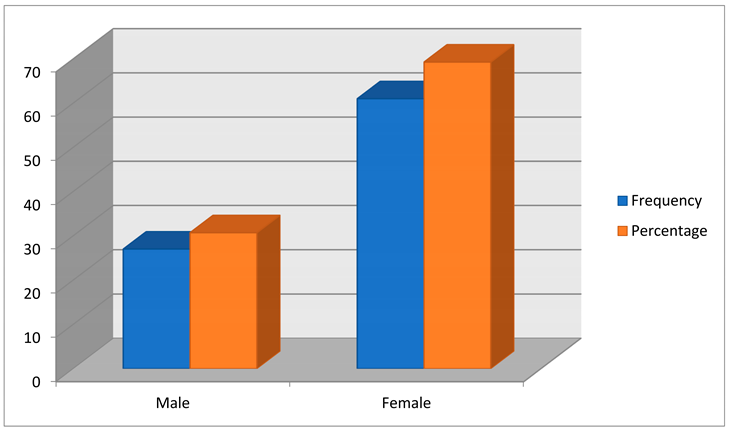
Table 4.1 shows that there were 27 male (30.7 %) and 61 female children (69.3 %). This shows that female students were more represented in this study.
Table 4.2.
Age Distribution of Children.
| Age Range | Frequency | Percentage |
| Ages 8 – 10 | 30 | 34.1 |
| Ages 11 - 13 | 49 | 55.6 |
| Age 14 above | 9 | 10.2 |
| Total | 88 | 100 |
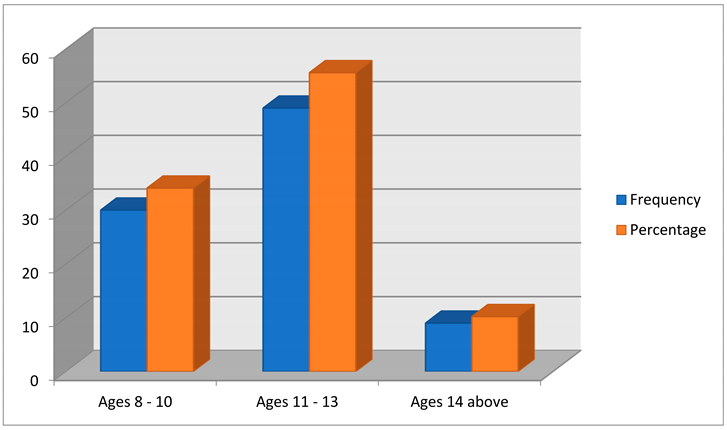
Table 4.2 shows that there were 30 pupils between the ages of 8, 9, and 10 years, accounting for 34.1%, while 49 pupils were between the ages of 11, 12, and 13 years, accounting for 655. %, revealed to be the highest age range of the sampled population. The age of 14 years accounted for nine students in total, with a 10.2 % value of the sampled population. This implies that the age range of children most represented in the study was within the age bracket of 11 and 13 years.
4.2: Testing the Null Hypotheses
H01:There is no significant main effect of treatment on students’ academic achievement in Social Studies.
Table 4.3.
Analysis of Covariance (ANCOVA) of post-achievement by treatment, sex, and age.
| Source | Type III Sum of Squares | df | Mean Square | F | Sig. | Partial Eta Squared |
| Corrected Model | 744.694a | 30 | 24.823 | 3.529 | .000 | .650 |
| Intercept | 395.564 | 1 | 395.564 | 56.237 | .000 | .497 |
| Prescore One Way Interaction |
141.799 | 1 | 141.799 | 20.159 | .000 | .261 |
| Treatment | 114.606 | 2 | 57.303 | 8.147 | .001 | .222 |
| Gender | .564 | 1 | .564 | .080 | .778 | .001 |
| Age Two Way Interaction |
86.949 | 7 | 12.421 | 1.766 | .112 | .178 |
| Treatment * Gender | 7.746 | 2 | 3.873 | .551 | .580 | .019 |
| Treatment * Age | 14.416 | 9 | 1.602 | .228 | .989 | .035 |
| Gender * Age Three Way Interaction |
52.592 | 5 | 10.518 | 1.495 | .206 | .116 |
| Treatment * Gender * Age | 4.232 | 3 | 1.411 | .201 | .896 | .010 |
| Error | 400.931 | 57 | 7.034 | |||
| Total | 12037.000 | 88 | ||||
| Corrected Total | 1145.625 | 87 | ||||
| a. R Squared = .650 (Adjusted R Squared = .466) *denoted significant at p<0.05 | ||||||
Table 4.3 shows that there was a significant main effect of treatment on pupils’ academic achievement in Social Studies (F(2,57)=8.15;P<0.05; ɳ2=0.22). The effect size was 22%. This means that there was a significant difference in the mean post-achievement scores of Social Studies grade four elementary school pupils. Thus, Hypothesis 1a was rejected. To determine the magnitude of the significant main effect across treatment groups, the results are presented in Table 4.3.1.
Table 4.3.1.
Estimated Marginal Means for Post-Achievement by Treatment and Control Group
| Treatment | Mean | Std. Error | 95% Confidence Interval | |
| Lower Bound | Upper Bound | |||
| Think-pair-share Collaborative Digital Storytelling Instructional Strategy (TCDSIS) | 13.552a,b | .660 | 12.231 | 14.873 |
| Centralized-video Based Digital Storytelling Instructional Strategy (CBDST) | 12.406a,b | .756 | 10.892 | 13.919 |
| Conventional Instructional Strategy (CIS) | 9.401a,b | .580 | 8.240 | 10.562 |
Table 4.3.1 reveals that pupils exposed to the Think-pair-share Collaborative Digital Storytelling Instructional Strategy (TCDSIS) had the highest adjusted post-achievement mean score (13.55), followed by pupils exposed to the centralised video-based digital storytelling instructional strategy (CBDSIS) (12.41), while those exposed to the Conventional Instructional Strategy (CIS) had the lowest mean score (9.40). This order is TCDSIS> CBDSIS < CIS. In order to determine the sources of significance, Table 4.3.2 presents the pairwise comparisons of Bonferroni post hoc analysis.
Table 4.3.2.
Bonferere Post hoc Analysis of Post-Achievement by Treatment and Control
| Treatments | N | Conventional strategy | Think-pair-share | Centralized-video based digital storytelling |
| Conventional Strategy (CS) | 40 | * | * | |
| Centralized-video Based Digital Storytelling Instructional Strategy (CBDSIS) | 22 | * | ||
| Think-pair-share Collaborative Digital Storytelling Instructional Strategy (TCDSIS) | 26 | * |
Table 4.3.2 revealed that pupils exposed to the Think-pair-share Collaborative Digital Storytelling Instructional Strategy (TCDSIS) were significantly better than those exposed to the centralised video-based digital storytelling instructional strategy (CBDSIS), and those exposed to (CBDSIS) did significantly better than those exposed to the Conventional Instructional Strategy (CIS). This implies that (TCDSIS) and (CBDSIS) were the main sources of significant differences in the treatment.
H01b: There is no significant main effect of treatment on pupils’ attitudes towards Social Studies.
Table 4.4.
Analysis of Covariance (ANCOVA) of Post-Attitude by Treatment, Gender and Age
| Source | Type III Sum of Squares | df | Mean Square | F | Sig. | Partial Eta Squared |
| Corrected Model | 2267.350a | 31 | 73.140 | 2.591 | .001 | .589 |
| Intercept | 1538.017 | 1 | 1538.017 | 54.487 | .000 | .493 |
| Prescore | 1.245 | 1 | 1.245 | .044 | .834 | .001 |
| Preattitude One-way interaction |
921.438 | 1 | 921.438 | 32.643 | .000 | .368 |
| Treatment | 256.482 | 2 | 128.241 | 4.543 | .015 | .140 |
| Gender | 1.919 | 1 | 1.919 | .068 | .795 | .001 |
| Age Two-way interaction |
88.426 | 7 | 12.632 | .448 | .868 | .053 |
| Treatment * Gender | 59.069 | 2 | 29.534 | 1.046 | .358 | .036 |
| Treatment * Age | 191.199 | 9 | 21.244 | .753 | .660 | .108 |
| Gender * Age Three-way interaction |
62.756 | 5 | 12.551 | .445 | .815 | .038 |
| Treatment * Gender * Age | 6.396 | 3 | 2.132 | .076 | .973 | .004 |
| Error | 1580.730 | 56 | 28.227 | |||
| Total | 118545.000 | 88 | ||||
| Corrected Total | 3848.080 | 87 | ||||
| a. R Squared = .589 (Adjusted R Squared = .362) | ||||||
Table 4.4 shows that there was a significant main effect of treatment on pupils’ attitude towards Social Studies (F(2,56)=4.54;P<0.05; ɳ2=0.14). The effect size was 14%. This means that there was a significant difference in the post-attitudinal mean score of the pupils’ attitudes towards Social Studies. Thus, Hypothesis 1b was rejected. To determine the magnitude of the significant main effect across the treatment groups, the estimated marginal means of the treatment groups were determined; the results are presented in Table 4.4.1.
Table 4.4.1.
Estimated Marginal Means for Post-Attitude by Treatment and Control Group.
| Treatment | Mean | Std. Error | 95% Confidence Interval | |
| Lower Bound | Upper Bound | |||
| Think-pair-share Collaborative Digital Storytelling Instructional Strategy (TCDSIS) | 34.455a,b | 1.326 | 31.799 | 37.112 |
| Centralized-video Based Digital Storytelling Instructional Strategy (CBDSIS) | 34.257a,b | 1.531 | 31.190 | 37.323 |
| Conventional Instructional Strategy (CIS) | 39.230a,b | 1.164 | 36.898 | 41.562 |
Table 4.4.1 reveals that pupils exposed to the Conventional Instructional Strategy (CIS) had the highest adjusted post-attitudinal mean score (39.23), followed by pupils exposed to the Think-pair-share Collaborative Digital Storytelling Instructional Strategy (TCDSIS) (34.50), while the centralised-video-based digital storytelling instructional strategy (CBDSIS) had the lowest mean score (34.26). This order is represented as TCDSIS>CBDSIS> CIS
In order to determine the sources of significance, Table 4.4.2 presents the pair wise comparisons of Bonferere Post hoc Analysis
Table 4.4.2.
Bonferere Post hoc Analysis of Post-Attitude by Treatment and Control Group
| Treatments | N | Conventional strategy | Think-pair-share | Centralized-video based digital storytelling |
| Conventional Instructional Strategy (CIS) | 40 | * | * | |
| Centralized-video Based Digital Storytelling Instructional Strategy (CBDSIS) | 22 | * | ||
| Think-pair-share Collaborative Digital Storytelling Instructional Strategy (TCDSIS) | 26 | * |
Table 4.4.2 shows that the sources of significance are as follows:
- control and think-pair-share collaborative digital storytelling instructional strategy
- control and centralized-video based digital storytelling instructional strategy
This means that those exposed to the conventional instructional strategy performed significantly better than those exposed to the think-pair-share collaborative digital storytelling instructional strategy and those exposed to centralised video-based digital storytelling.
H02a: Age has no significant main effect on pupils’ academic achievement in Social Studies.
Table 4.3 shows that age had no significant main effect on pupils’ academic achievement in Social Studies (F(7,57)=1.77; P >0.05; partial ɳ2=0.18). Thus, Hypothesis 2a was not rejected. This indicates that age has no effect on pupils’ academic achievement in Social Studies.
H02b: Age has no significant main effect on pupils’ attitudes towards Social Studies.
Table 4.4 shows that there was no significant main effect of age on pupils’ attitudes towards Social Studies (F(7,56)=0.05; P >0.05; partial ɳ2=0.05). Therefore, Hypothesis 2b was not rejected.
H03a: Gender has no significant main effect on pupils’ academic achievement in Social Studies.
Table 4.3 shows that there was no significant main effect of gender on pupils’ academic achievement in Social Studies (F(1,57)=0.08; P >0.05; partial ɳ2=0.00). Hence, Hypothesis 3a was not rejected. This implies that gender had no effect on pupils’ academic achievement in Social Studies.
H03b: Gender has no significant main effect on pupils’ attitudes towards Social Studies.
Table 4.4 revealed that there was no significant main effect of gender on Pupils’ attitude towards Social Studies (F(1,56)=0.07; P >0.05; partial ɳ2=0.00). Therefore, Hypothesis 3b was not rejected. This implies that gender had no effect on pupils’ attitudes towards Social Studies.
H04a:There is no significant interaction effect between treatment and gender on pupils’ academic achievement in Social Studies.
Table 4.3 shows that there was no significant two-way interaction effect of treatment and gender on pupils’ academic achievement in Social Studies (F(2,57)=0.55;P>0.05; ɳ2=0.02). Therefore, null hypothesis 4a is not rejected. This implies that gender had no effect on pupils’ academic achievement in Social Studies.
H04b: There is no significant interaction effect between treatment and gender on pupils’ attitudes towards Social Studies.
Table 4.3 shows that there was no significant two-way interaction effect of treatment and gender on students’ attitudes towards Social Studies (F(2,56)=0.23; P >0.05; partial ɳ2=0.04). Therefore, null hypothesis 4b was not rejected. This implies that treatment and gender had no effect on pupils’ attitudes towards Social Studies.
H05a:There is no significant interaction effect between treatment and age on pupils’ academic achievement in Social Studies.
Table 4.3 revealed that there was no significant two-way interaction effect of treatment and age on pupils’ academic achievement in Social Studies (F(9,57)=0.23; P >0.05; partial ɳ2=0.04). Thus, the null hypothesis 5a is not rejected. This implies that treatment and age had no effect on pupils’ academic achievement in Social Studies
H05b: There is no significant interaction effect of treatment and age on pupils’ attitude towards Social Studies
Table 4.4 shows that there was no significant two-way interaction effect of treatment and age on students’ attitudes towards Social Studies (F(9,56)=0.75; P >0.05; partial ɳ2=0.11). Therefore, null hypothesis 5b was not rejected. This implies that treatment and age had no effect on students’ attitudes towards Social Studies.
H06a: Gender and age have no significant interaction effect on pupils’ academic achievement in Social Studies.
Table 4.3 shows that there was no significant two-way interaction effect of gender and age on pupils’ academic achievement in Social Studies (F(5,57)=0.23; p >0.05; partial ɳ2=0.04). Hence, null hypothesis 6a was not rejected.
H06b: There is no significant interaction effect of gender and age on pupils’ attitudes towards Social Studies.
Table 4.4 shows that there was no significant two-way interaction effect of gender and age on pupils’ attitude towards Social Studies (F(5,56)=1.50;P>0.05; ɳ2=0.12). Therefore, null hypothesis 6b was not rejected.
H07a:There is no significant interaction effect of treatment, gender, or age on pupils’ academic achievement in Social Studies.
Table 4.3 shows that there was no significant interaction effect of treatment, gender and age on pupils’ academic achievement in Social Studies (F(3,57)=0.23;P>0.05; ɳ2=0.12). Therefore, null hypothesis 7a was not rejected.
H07b:There is no significant interaction effect of treatment, gender, or age on pupils’ attitudes towards Social Studies.
Table 4.4 shows that there was no significant interaction effect of treatment, gender and age on pupils’ attitude towards Social Studies (F3,56)=0.08;P>0.05; ɳ2=0.00). Therefore, null hypothesis 7b was not rejected.
4.3 Summary of Findings
The findings of this study are summarised below.
- There was a significant main effect of treatment on pupils’ academic achievement in Social Studies. The effect size was 22%. The think-pair-share collaborative digital storytelling instructional strategy had the highest adjusted post-mean score of (13.55), followed by the centralised-video-based digital storytelling instructional strategy (12.41). This implies that think-pair-share collaborative and centralised video-based strategies were the main sources of significant differences in treatment.
- There was a significant main effect of treatment on pupils’ attitudes towards Social Studies. The effect size was found to be 14%. The post-attitude towards Social Studies score of pupils exposed to think-pair-share collaboration was not different from their counterparts in the centralised-video-based strategy. Reflection on the research outcome shows that the think-pair-share collaborative and centralised-video-based strategies contributed to the significant difference in treatment.
- There were no significant main effects of gender on pupils’ academic achievement and attitude towards Social Studies.
- There were no significant main effects of age, pupils’ academic achievement, or attitude towards Social Studies.
- There were no significant two-way interaction effects of treatment and gender on pupils’ academic achievement and attitudes towards Social Studies.
- 6. There were no significant two-way interaction effects of age on pupils’ academic achievement or attitudes towards Social Studies.
- There were no significant two-way interaction effects of gender and age on pupils’ academic achievement and attitudes towards Social Studies.
- 8. There were no significant three-way interaction effects of treatment, gender, or age on pupils’ academic achievement and attitude towards Social Studies.
Discussion, Recommendations and Conclusion
This chapter presents a discussion of the findings of the study, conclusion, and recommendations.
5.1 Discussion of Findings
5.1.1 Treatment and pupils’ academic achievement in Social Studies
The results revealed that pupils taught with the think-pair-share collaborative digital storytelling instructional strategy had the highest achievement scores, followed by those taught with the centralised-video-based digital storytelling instructional strategy. This indicates that digital storytelling strategies have a significant effect on Social Studies pupils’ academic achievement. Pupils in the two experimental groups showed a higher level of performance when compared to their counterparts in the control group exposed to the conventional instructional strategy. The effectiveness of the experimental strategies, as stated above, may be due to the fact that pupils had a learning path that they described themselves as revealed in the think-pair-share collaborative strategy. Such methods create a reflective and engaging form of learning in the mind of the learner; thus, in their own terms and knowing that the strategy was designed with learners’ abilities in the right perspective to collaborate in groups and out of groups. It may also be due to the fact that it creates a learning environment conducive to learning and promotes the highest levels of motivation, learning and achievement for all learners. The inclusion of digital stories, according to Smeda et al. (2014), serves as a complementary tool to curricula and contributes to effective teaching and learning. Januarsi and Khafid (2019). Those who investigated the effect of problem-based learning and think-pair-share findings did not agree with the findings of this study. The effect of the think-pair-share collaborative instructional strategy when combining digital storytelling strategy with centralised video-based digital storytelling and conventional strategies may not explain the disparity in the learning outcome. Notwithstanding, the fact is that digital storytelling resonates more with younger learners in elementary schools since digital stories allow active participation, encourage learners’ interest, and have the privilege of influencing learners’ achievement goals.
Piaget believes that cognitive development is at the centre of the human body. At each stage of child development, Piagetian cognitive theory realised how children managed to develop their cognitive skills through actions, representing abstract things with words and logical thinking. Digital storytelling reflects images in the mind of a child, and toddlers smile when stories are created. The effect of pupil involvement in digital storytelling helps learners develop and build cognitive structures to understand and respond to physical experiences in the immediate environment, which may result in improved learning goals.
The research outcome is in line with the findings of Smeda et al. (2014), who revealed that digital storytelling strategy increases students’ communication abilities as a result of cooperation and collaboration between groups (think-pair-share), compared to centralised video-based digital storytelling. The think-pair-share collaborative strategy involves learners’ helping each other with technical and difficulty in learning while the teacher plays the role of a ‘guide on the side’ while the centralised-video based strategy presents the teacher as a ‘guide on the stage’, but not as a sage on the stage. Thus, collaboration is key in any learning environment, as learners learn best and perform better when they have the opportunity to work with peers; that is, weak and slow learners get help from strong and fast learners within groups. This does not imply that one learner is smarter than the other, but the ability to work in groups as pairs provides learners with the privilege to bring out individual best through collective performance.
The findings also show that the centralised video-based digital storytelling instructional strategy was more effective than the conventional instruction strategy. This finding is consistent with Aremu’s (2019) teacher-led digital storytelling strategy, which was revealed to be more effective than the conventional strategy, and Bello’s (2019) study, reflecting a positive outcome on the achievement of the learners; however, he claimed that the inherent potential of digital storytelling to actively engage students and stimulate their interest could have been responsible for the improvement in students’ achievement in the study. The level of interaction and engagement prevalent in the digital storytelling strategy made of picture collections, 3D animation, sound, and moving letters could have contributed a great deal to the academic achievement of pupils, that is, the teacher’s role which was meant to help pupils by organising, guiding, and providing support by making informed meaning from the digital story package.
5.1.2 Treatment and pupils’ attitude towards Social Studies
The results revealed a significant main effect of treatment on pupils’ attitudes towards Social Studies. This implies that the digital storytelling strategy had a significant influence on students’ attitudes towards Social Studies. One of the major difficulties found in the teaching and learning of Social Studies in the background to this study is that learners perceived the discipline to be abstract in nature, while most learners, as discovered from findings, felt that the subject area is too difficult to comprehend. This influenced learners to have a negative attitude towards the subject matter of Social Studies.
The highest attitudinal changes were found in the conventional instructional strategy compared to the other two modes investigated in this study. The result implication was alarming, and the researcher was curious to make further findings on what could have influenced the higher-level attitude in the control group towards Social Studies. Further findings revealed that the instructor in the control group had six “6” major things influencing pupils’ learning outcomes and motivation:
1) The control group class activities were slated during the early hours of the day, while the experimental group had their sessions at noon after their break period, during which they lacked the zeal and concentration to learn which might have influenced the resulting outcome.
2) The instructor used the pupils’ mother tongue as a major means of communicating the learning content, as revealed by the research assistant.
3) The instructor admitted having made the learning interesting.
4) The instructor used positive reinforcement to gain pupils attention during the class activity by promising to give gifts to those that will show more interest to learn,
5) The instructor used deception to influence pupils’ attitudes toward learning, and the teacher promised that the government would give out scholarships to the most performing pupils.
6) The instructor makes jokes to ease the learning process.
The findings showed that the think-pair-share collaborative digital storytelling strategy revealed a higher mean score of pupils’ attitudes towards Social Studies compared to the centralised video-based digital storytelling strategy with the lowest mean value. This result is consistent with Aremu (2019), who examined the effects of pupil- and teacher-led digital storytelling on pupils’ attitudes and achievements. The study reported that treatment had a positive effect on students’ attitudes and achievement.
Considering the impact of collaboration as an effective instructional strategy to influence learners attitude, Krutka and Carpenter (2016) perceived constructivism as “the most effective means of fostering intrinsic motivation, intelligence, and disposition for social cooperation, that is, learning is drawn from experiences. However, the positive impact of storytelling combined with multimedia elements that digitise learning content into digital storytelling has been found to stimulate interest and motivate learners’ engagement. Aremu (2019). It was revealed that the efficacy of these two experimental strategies may be due to the fact that they engage pupils to create new ideas, interact by discussing the ideas created from the story, and then organising their ideas in a more meaningful manner; however, the Aremu investigation on attitude is concise with the research outcome on pupils’ attitude towards Social Studies subject matter.
5.1.3 Gender and pupils’ academic achievement and attitude towards Social Studies
The findings from the study reported that there was no significant main effect of gender on pupils’ academic achievement and attitudes towards Social Studies. Gender was found to have no significant main effect on pupils’ academic achievement and attitudes towards Social Studies. Thus, gender had no significant influence on pupils’ attitudes and academic achievement in both the experimental and control groups after being exposed to the treatment.
The finding of no significant main effect of gender on pupils’ attitudes towards Social Studies was in agreement with the findings of Olagunju and Babayemi (2014) that gender had no significant main effect on attitude. This simply implies that regardless of gender, pupils will learn as long as the right strategy is affected by learning.
Digital storytelling is a constructivist construct which gives learners the opportunity to design their learning path, that is, storytelling using digital media elements, such as graphical pictures, charts media, and smart gadgets. Learning has to take place whether male or female; the most important thing in any learning environment is the learning aid provided by instructors which should not be gender-biased in nature. Attitude is a state of readiness that allows individuals to perceive phenomena in certain ways. They are dynamic and can be used to inform learning. The learning environment of every activity must reflect the level of interest that motivates learners’ readiness to learn. Since attitudes toward the subject are a fairly accurate measure of learners’ interest in the Social Studies subject matter, it is a vital parameter of the state of education and a significant predictor of learners’ future choices.
Gender had no significant effect on pupils’ academic achievement in Social Studies. This result is consistent with an investigation conducted by Abiola (2014), who revealed that gender had no significant main effect on students’ achievement. This implies that the findings are consistent with the results of this study, with no significant effect.
5.1.4 Age and pupils’ academic achievement and attitude towards Social Studies
The findings showed no significant main effect of age on Social Studies pupils’ academic achievement and attitude towards Social Studies. Pupils’ age had no influence on academic achievement or attitude toward the subject matter. The influence on academic achievement and attitude was found to be significant as a result of the adopted instructional strategy implemented in the study, such as digital storytelling combined with two other modes: think-pair-share collaborative and centralised-video-based instructional strategies. However, age did not have any significant effects in the investigation. As such, digital storytelling could have been said to bridge the gap in the comprehension of pupils regardless of their maturation stage. These findings are in support of Aransi (2018), who revealed that there is no appropriate age for learners to be enrolled in school and that age should not be the determinant for planning learning activities. Rather, school tasks should focus on the school programs. However, Abubakar, Adegoke, and Aransi (2018) revealed a positive correlation between age and academic achievement in mathematics among students of Colleges of Education, where age was revealed to be significant and was also found to be a major influencer of the academic achievement of the participants in the study.
Digital storytelling has been found to provide support such as students’ understanding of subject area knowledge, increasing overall academic achievement, and improving higher-order thinking, social, language, reflective, and artistic skills (Abiola 2014).
5.1.5 Treatment and gender on pupils’ academic achievement and attitude towards Social Studies
The study revealed no interaction effect of treatment, gender, pupils’ academic achievement, and attitude towards Social Studies. This implies that treatment and gender have no effect on student achievement in Social Studies. Digital storytelling provides opportunities for collaboration. However, Abiola (2014) revealed that both digital storytelling collaborative strategies have an impact on student achievement and attitude. This implies that the treatment effect was suitable based on the gender investigated in the study.
5.1.6 Treatment and age on pupils’ academic achievement and attitude towards Social Studies.
The study indicated that there was no significant interaction effect of treatment and age on pupils’ attitudes towards Social Studies. This indicates that treatment and age had no interaction effect on pupils’ academic achievement and attitude towards studies. Hence, this strategy is appropriate for use as an effective instructional strategy, regardless of the learners’ age. The most important aspect, as revealed by the theory, is that learning is based on maturation, not on the age of the learner, thereby revealing no combined effect. Digital storytelling has been found to bridge this gap. Hence, digital collaborative learning environments have been shown to foster meta-reflection and higher-level cognition among learners, as well as cultivate the spirit of collaboration and support positive social relationships with other learners. (Chen et al., 2015).
5.1.7 Gender and age on pupils’ academic achievement and attitude towards Social Studies.
The study indicated that there was no significant two-way interaction effect of gender and age on pupils’ attitudes towards Social Studies. This indicates that gender and age had no combined effect on pupils’ academic achievement and attitudes towards Social Studies. However, a previous study by Eze et al. (2015) is not consistent with the findings of this study. They stated that age and gender had a significant difference in academic performance among university students, while age and gender had no linear relationship with academic performance in their study. Meanwhile, Aremu’s findings (2019) revealed no significant effect of digital storytelling treatment on pupils’ attitudes, which matches the findings of this study.
5.1.8 Treatment, gender and age on pupils’ academic achievement and attitude towards Social Studies
The results showed that the three-way interaction effects of treatment, gender, and age on pupils’ academic achievement and attitudes towards Social Studies were not significant. This implies that the combined effect of treatment, gender, and age revealed no level of influence on pupils’ academic achievement and attitudes towards Social Studies.
5.2 Conclusion
Digital storytelling instructional packages have proven to be successful in improving the attitude and increasing the academic achievement of learners. The strategy implemented in the study was found to be effective in improving the Social Studies of elementary school pupils’ academic achievement and their attitude towards Social Studies. The use of digital stories in the classroom is a powerful instructional technique that has the potential to transform learning and attitudes, as revealed in this study. However, Social Studies teachers must be equipped with the necessary skills to enable them to use the practical strategy embedded in digital storytelling as an instructional strategy. This will help teachers speak less and do more within the classroom, as this strategy has been identified as a learner-centred approach to learning.
5.3 Educational Implication of Findings
The findings have shown a high level of collaboration when learners are invariably paired together; however, the weak and slow learners find a shield to prioritise learning goals, as learning has been designed to accommodate interest, increasing their chances of being actively involved and participating in their own unique way of learning. Digital storytelling provides an enabling environment where pupils take the control needed, where teachers help and act as a guide to learners making positive decisions. Stories capture attention, gear interest, and motivation for learning. This study embarked on influencing learners’ academic achievement and attitudes towards Social Studies. The strategy reported positive results in terms of achievement and attitude. The two modes of digital storytelling used in the study, Think-pair-share collaborative and Centralised-video-based digital storytelling, reflect activity-based instructional strategy with the learner at the centre of learning and decision making. In addition, the strategy helped learners develop teamwork and leadership skills during the learning process which later positively reflected their achievement and attitude towards Social Studies.
5.4 Recommendation
Based on the outcome and discussion, the following recommendations were made:
- 1)
- Digital storytelling requires the ability to write original stories appropriate to the course content. In this process, teachers should act as guides and carry out work to relieve the anxiety of writing, connecting content, and activity-based learning for learners.
- 2)
- Teachers should be equipped with the appropriate skill tools to integrate digital media into their lesson plans. This will help them decide the appropriate flow and pattern of digital storytelling for their learners.
- 3)
- Teachers should enhance and spice up their learning environment through centralised video-based digital storytelling. This enables them to capture learners' interests.
- 4)
- This research has shown the power of the think-pair-share collaborative digital storytelling strategy. Teachers should help introvert learners’ functions within groups when paired. This provides a learning environment that caters to pupils who would prefer to function among their peers.
- 5)
- The government should introduce a digital media skills integration training program for pre-service teachers and a form of re-training for in-service teachers based on the two modes of digital storytelling through workshops and conferences for Social Studies teachers in elementary schools.
5.5 Limitation of the Study
The following are the constraints of this study:
- 1)
- This study focused on elementary school pupils in government-owned public elementary schools in Osun State, within the study area.
- 2)
- This study examined the effect of age and gender as key moderators in determining academic achievement and attitude towards Social Studies, neglecting other factors, such as parental influence, economic background, societal factors, and teachers’ ICT level of awareness.
- 3)
- The investigation was limited to the think-pair-share collaborative and centralised video-based digital storytelling strategy that formed the two-mode discussed in the study.
- 4)
- The study was limited to elementary school pupils, and teachers were not cognizant.
5.6 Suggestion for Further Studies
Based on the above limitations, the following suggestions were made for further study.
Further studies should consider motivation as a vital factor or as a dependent variable, considering its effects on the control group’s attitude level, despite not being factored into the study.
- 1)
- The study should be extended to investigating pre-service and in-service teachers’ level of awareness, perception, and competency in implementing digital storytelling instructional strategy in-class activities.
- 2)
- This strategy could be advanced to secondary schools and tertiary education levels for future investigation.
- 3)
- Further research could focus on the interaction effect of moderators such as the level of participation, parental level of education and economic background, and perception.
- 4)
- Finally, further studies could focus on practical sessions with students by equipping them with digital media tools to enable learners to develop their own digital storytelling learning packages.
Supplementary Materials
The following supporting information can be downloaded at the website of this paper posted on Preprints.org.
References
- Abah, J. A. 2016. Recency bias in the era of big data: The need to strengthen the history of mathematics in Nigerian schools. Advances in Multidisciplinary Research Journal, 2.4:241-248.
- Abah, J., Iji, C., Abakpa, B., 2018. Blown Away in the Wind of Change: Can Extinct School Folktales be Awakened through Mathematics Storytelling in Nigerian Basic Education?
- Abbah, U. Abbah, U., Umar, M.A., Hussain, A. B., 2018. Assessment of students’ attitudes Towards teaching and learning social studies in Nigeria’s Colleges of Education. Global Journal of Applied, Management, and Social Sciences, 15.
- Abimbade, O., Akinyemi, A., Bello, L., & Olusegun, M. H. (___) Comparative effects of individualised computer-based instruction and a modified conventional strategy on students’ academic Achievement in Organic Chemistry.
- Abiola, L. A. 2014. The effect of digital storytelling on kindergarten pupils’ moral instruction achievement in basic schools in Oyo State. IOSR Journal of Research and Method in Education, 4.5:26-34.
- Abubakar, R. B. and Adegboyega, B. I. 2012. Age and gender are the determinants of academic achievement in college mathematics. Asian Journal of Natural and Applied Sciences: 1.2:121-127.
- Adedoja G. O. and Olasunkanmi I. A. 2015. Pre-service teachers’ awareness of and attitudes towards User-Generated Content as a collaborative learning tool. Ibadan Journal of Educational Studies, IJES. 12.
- Adedoja, G. O. and Oluwadara, A. (2016). Influence of age and training on planning instruction by pre-service social studies teachers using mobile phones Science and Education, 3.1: 1-6.
- Adeoye, H. 2010.Emotional intelligence and self-efficacy are determinants of academic achievement in English among students in senior secondary schools in Oyo State. Ife Psychologia.
- Adesina, A. D. O. 2003. Correlations of gender, socioeconomic background, and performance among junior secondary school students using the Sn advance organiser learning strategy. An unpublished M. A. (ed.) Curriculum Studies Thesis submitted to the Department of Special Education and Curriculum Studies, Obafemi Awolowo University, Ile-Ife, Nigeria.
- Adeyemi, S. B. 2017. Lecturer Variables as Predictors of Academic Performance in Universities. Journal of Social Sciences, 50.1:3-14.
- Agharuwhe A. A, and Ugborugbo N. M. 2009. Teachers’ effectiveness and students’ academic performance in public secondary schools in the delta state, Nigeria. Journalof Stud Home Comm Science, 3.2:107-113.
- Ahmad K. and Yusuf N. B. M. 2013. Parents’ perspectives on female students’ dropout in Nigeri. Asian Journal of Education and e-Learning; 1.4:250-261.
- Ahmed M. Y., Mohamed, A. C., and Ulrik, S. 2014. Video-Based Learning: A Critical Analysis of The Research Published in 2003-2013 and Future Visions. The Sixth International Conference on Mobile, Hybrid, and Online Learning, 112-117.
- Ajaja, R., andMezieobi, S. A. 2018. Effect of cooperative learning strategy on students’ performance in social studies. International Journal of Education and Evaluation, 4.9:96-103.
- Ajani O. A. 2018. Need for in-service professional development of teachers to improve students’ academic performance in Sub-Saharan Africa. Arts Social Sciences.
- Akello, A. J. 2015. Impact of teacher characteristics on student academic achievement in Kisumu Central Sub-County, Kenya. Journal of Educational Policy and Entrepreneurial Research, 2.8:47-56.
- Aktas, E., & Yurt, S. U. (2017). The effects of digital stories on academic achievement, learning motivation, and retention among University Students. International Journal of Higher Education, 6.1:180-196.
- Alismail, H. A. 2015. Integrating Digital Storytelling in Education. Journal of Education and Practice, 6.9:126-129.
- Animola, O. V., & Bello, T. O. (2019). Comparative effectiveness of mastery and peer-to-peer learning strategies in improving junior secondary school students’ learning outcomes in basic science. Asian Journal of Advanced Research and Reports.
- Aransi, W. O. 2018. Impact of age and gender on high school students’ academic performance in economics: A case study analysis. International journal for innovative research multidisciplinary field, 4.1:8-15.
- Aremu, A., andAdebagbo, A. 2019. Digital games for teaching and learning mathematics in Nigerian schools. Globalised Curriculum Methods for Modern Mathematics Education.
- Aremu, V. I, 2019. Teacher-Led, Pupils-Led Digital Storytelling Strategiesand Primary School Pupils’ Learning Outcomes in Christian Religious Studies In Lagos State, Nigeria. University of Ibadan.
- Azuka B. F and Kurumeh M. S. 2015Effects of Emotional Intelligence Skills Acquisition on Students’ Achievement in Senior Secondary School Geometry in Keffi Education Zone, Nasarawa State, Nigeria. Asian Journal of Education and E-learning. 3.4:243-257.
- Balcikanli, C. (2011). Long Live, YouTube: L2 Stories about YouTube in Language Learning. In: Annals of Language and Learning: Proceedings of the 2009 International Online Language Conference (p. 91). Irvine, CA: Universal Publishers.
- Barrow, E., Anderson, J., and Horner, M. 2017. The role of photoblogs in social studies classrooms: Learning about the people of the Civil War. Contemporary Issues in Technology and Teacher Education, 17.4:504-521.
- Bello, L. K. 2019. Development of a digital storytelling package and students’ learning outcomes in map reading in Ibadan Metropolis, Nigeria. University of Ibadan.
- Blackwell, C. K., Wartella, E., Lauricella, A. R., and Robb, M. 2015. Technology in the Lives of Educators and Early Childhood Programs: Trends in access, use, and Professional Development from 2012 to 2014. Evanston, IL: Center for Media and Human Development, Northwestern University.
- Bleidorn, W., Arslan, R. C., Denissen, J. J., Rentfrow, P. J., Gebauer, J. E., Potter, J., and Gosling, S. D. 2016. Age and gender differences in self-esteem: A cross-cultural window. Journal of personality and social psychology, 111.3:396.
- Boland, A., Cherry, G. and Dickson, R. 2017. Conducting a systematic review: Student’s guide. Sage.
- Bower, M. 2015. A typology of Web 2.0, Learning Technologies. Educause 47:763–777.
- Brown, T., andMezieobi, S. 2017. Cooperative learning methods and junior secondary students’ attitudes Towards citizenship education in social studies in the state of rivers, Nigeria. British Journal of Education, 5.4:1-8.
- Bugler, M., McGeown, S. P., St Clair-Thompson, H. 2015. Gender differences in adolescents’ academic motivation and classroom behaviour. Educational Psychology, 35.5:541-556.
- Bumgarner, B.L. 2012. Digital storytelling in writing: A case study of student teachers’ attitudes toward teaching with technology.
- Butler, R., andHasenfratz, L. 2017. Gender and competence motivation. In A. J. Elliot, C. S. Dweck, and D. S. Yeager (Eds.) Handbook of Competence and Motivation. New York: Guilford Press. 2:489–511.
- Cabello, R., Sorrel, M. A., Fernández-Pinto, I., Extremera, N., and Fernández-Berrocal, P. 2016. Age and gender differences in emotional intelligence ability in adults: a cross-sectional study. Developmental Psychology, 52.9:1486.
- Calandra, B. and Rich, P. J. (Eds.). 2014. Digital Video for Teacher Education: Research and Practice. Routledge.
- Case, R., and Abbott, M. 2008. Purposeful teaching in elementary social studies. In R. Case and P. Clark (Eds.) The anthology of social studies: Issues and strategies for elementary school teachers. Vancouver, BC: Pacific Educational Press.1:8–17.
- Case, R., & Abbott, M. (2013). Creating meaningful goals for elementary social studies. In R. Case and P. Clark (Eds.) The anthology of social studies: Issues and strategies for elementary teachers. Vancouver, BC: Pacific Educational Press.
- Çatak M., Kaya M. F., and Erol H. 2016. Affective prejudices regarding students ' social studies courses. USBESV.
- Çatak, M. 2019. Judgments and prejudices of students against their failure in social studies classes Journal of Education and Training Studies, 7.6: 14-23.
- Cener, E., Acun, I., andDemirhan, G. 2015. Impact of ICT on student achievement and attitudes in social studies. Journal of Social Studies Education Research, 6.1:190-207.
- Chen, C. H. Wang, K. C. Wang, and Y. Lin. H. 2015. Comparison of solitary and collaborative modes of game-based learning on students' science learning and motivation. Journal of Educational Technology and Society, 18.2:237-248.
- Cheryl, L., Hui-Chuan, L, Masitah, S.2018. Utilising the Think-Pair-Share Technique for Learning Probability. International Journal on Emerging Mathematics Education (IJEME), 2.1:49-64.
- Cheung, A. and Slavin, R. 2013. The effectiveness of educational technology applications for enhancing mathematics achievement in K-12 classrooms: A meta-analysis. Educational Research.
- Choi, H. J. and Johnson, S. D. (2005). The effect of context-based video instruction on learning and motivation in online courses. The American Journal of Distance Education, 19.4:215-227.
- Conference, P. O. 2016. 21st Century Tensions and transformation in Africa. 21st Century Tensions.
- Cunningham, C. A. 2009. Transforming schooling through technology: twenty-first-century approaches to participatory learning. Education and Culture 25.2:46-61.
- Dayter, D., andMühleisen, S. 2016. Telling stories about the self in digital contexts: Same, same, but different?. Open Linguistics, 2.1.
- Dehghani, M., Boghrati, R., Man, K., Hoover, J., Gimbel, S. I., Vaswani, A.,... and Kaplan, J. T. 2017. Decoding the neural representation of story meanings across languages. Human brain mapping, 38.12:6096-6106.
- Demirer, V. 2013. Use and effects of e-storytelling in primary education (Doctoral Thesis, Necmettin Erbakan University Institute of Educational Sciences, Konya, Turkey).
- Dev, M. 2016. Factors Affecting the Academic Achievement: A Study of Elementary School Students of NCR Delhi, India. Journal of Education and Practice, 7.4:70-74.
- Dewey, J. 1916. Democracy and Education: An Introduction to the Philosophy of Education. New York: Macmillan.
- Díaz-Morales, J. F., andEscribano, C. 2015. Social jetlag, academic achievement, and cognitive performance: understanding gender/sex differences. Chronobiology international, 32(6), 822-831.
- Didik, R. S. 2018. Investigating the influence of the think-pair-share approach on students’ reading achievement. Lingua Cultura, 12.2:195-202.
- Dillenbourg, P. 1999. What do you mean by collaborative learning? In P. Dillenbourg (Ed.). Collaborative learning: Cognitive and computational approaches. Oxford, UK: Elsevier.
- Dogan, B. and Robin, B. 2009. Educational uses of digital storytelling: Creating digital storytelling contests for K-12 students and teachers.
- Drake, S. M. and Reid, J. L. 2018. Integrated curriculum as an effective way to teach 21st century capabilities. Asia Pacific Journal of Educational Research, 1.1:31-50.
- Evans, R. W. 2004. The social studies wars: What should we teach the children?New York: Teachers’ College Press.
- Eze, T. I., Ezenwafor, J. I and Obi M. N. 2015. Effects of Age and Gender on Academic Achievement of Vocational and Technical Education (VTE) Students of Nigerian University. Journal of Emerging Trends inEducational Research and Policy Studies, 6.1:96-101.
- Fatimah, Nuraini. 2015. ImplementasCooperative Learning Tipe Think-Pair-Shared dalamPembelajaranBercerita di SekolahMenengahPertama, JurnalPenelitian Humaniora,16.2:90-98.
- Federal Republic of Nigeria (FRN) 2013. National policy on education. Lagos: Nigerian Educational Research Council (NERDC) Press.
- Fitrianawati, M., and Hartono. 2016. PrbandinganKeefektifan PBL berseting TGT dan GI ditinjaudariPrestasiBelajar, KemampuanBerfikirKreatif dan Toleransi. JurnalRiset Pendidikan Matematika, 3.1:55-65.
- Flewitt, R., Messer, D., andKucirkova, N. 2015. New directions for early literacy in the digital age: The iPad. Journal of Early Childhood Literacy, 15.3:289-310.
- Foley, L. M. 2013. Digital storytelling in primary-grade classrooms (unpublished doctoral dissertation) at Arizona State University.
- Fortin, N. M., Oreopoulos, P., and Phipps, S. 2015. Leaving boys behind gender disparities in high academic achievement. Journal of Human Resources, 50.3:549-579.
- Fouze, A. Q. and Amit, M. (2018). Development of mathematical thinking through integration of the ethnomathematics folklore game into math instruction. Eurasia Journal of Mathematics, Science and Technology Education, 14.2):617-630.
- Frost, K. A., Franzoi, S. L., Oswald, D. L., and Shields, S. A. 2018. Revising the Body Esteem Scale with a US college student sample: Evaluation, validation, and use for the BES-R. Sex Roles, 78.1,2:1-17.
- Grant, P., andBasye, D. 2014. Personalised learning: A guide for engaging students with technology. International Society for Technology in Education.
- Grissom, J.B. 2004. Age and achievement. Education Policy Analysis Archives 12:49.
- Guo, P., J., Kim, J., Rubin, R. 2014. How Video Production Affects Student Engagement: An Empirical Study of MOOC Videos. Proc. 1st ACM Conf. Learning at Scale.
- Guo, Y., Tompkins, V., Justice, L., Petscher, Y. 2014. Classroom age composition and vocabulary development among at-risk preschoolers. Early Education and Development, 25:1016–1034.
- Hamilton Ali, Rubin Donald, Tarrant Michael, Mikkel Gleason. 2019. Digital Storytelling as a Tool for Fostering Reflection45.2:323-330.
- Hathaway, D. and Norton, P. 2012. Video production: Bridging teacher education and classroom practice. Journal of Technology and Teacher Education, 20.2:127–149.
- Hattie, J. 2013. Visible learning: A synthesis of over 800 meta-analyses related to achievement. New York: Routledge.
- Hennessy, S. 2014. Bridging Between Research and Practice: Supporting Professional Development Through Collaborative Studies of Classroom Teaching with Technology. Springer Science and Business Media.
- Hess, F. M., & Saxberg, B. (2013). Breakthrough leadership in the digital age: using learning science to reboot schooling. Corwin Press.
- Hidayat, T. M. and Muhson, A. (2018). The impact of think pair share and two stay two stray learning models on learning outcomes and cooperative ability. Dinamika Pendidikan, 13.1:119-129.
- Hill, F., Mammarella, I. C., Devine, A., Caviola, S., Passolunghi, M. C., andSzűcs, D. 2016. Maths anxiety in primary and secondary school students: Gender differences, developmental changes, and anxiety specificity. Learning and Individual Differences, 4.48:45-53.
- Hossain, A., andTarmizi, R. A. 2013. Effects of cooperative learning on students' achievement and attitudes in secondary mathematics. Procedia-Social and Behavioral Sciences, 2.93:473-477.
- Hourani, R. B. 2015. Folktales, children’s literature, and national identity in the United Arab Emirates. The Looking Glass 18.1.
- Hung, C. M., Hwang, G. J., and Huang, I. 2012. A project-based digital storytelling approach for improving students' learning motivation, problem-solving competence, and learning achievement. Educational Technology and Society, 15.4:368-379.
- Igbokwe, C. O. 2015. Recent curriculum reforms at the basic education level in Nigeria aimed at catching them young to create change. American Journal of Educational Research, 3.1:31-37.
- Iwuamadi, F.N. 2013. Effective Teaching of Social Studies(a Contemporary Approach). Owerri: Clear Image Publishers.
- Januarsi, D., Florentinus, T. S., andKhafid, M. 2019. The Effectiveness of PBL and TPS Models on Learning Outcomes and Confidence Attitudes. Journal of Primary Education, 48-54.
- John M. M Jackson T and Simiyu, C. 2015. Effect of students’ age on academic motivation and performance among High School Students in Kenya. Asian Journal of Education and e-Learning; 3.5:337-342.
- Johnson, D. W., and Johnson, R. T. 2009. Educational psychology success story: Social interdependence theory and cooperative learning. Educational Researcher, 38.5:365e379.
- Kagan, S., andKagan, M. 2009. Kagan's cooperative learning. San Clemente, CA: Kagan Publishing.
- Kahraman, Ö. 2013. The effect of using teaching materials prepared by the digital storytelling method in the engagement phase of the learning cycle on physics course achievement and motivation level. (Doctoral Thesis, Balikesir University Institute of Science, Balıkesir, Turkey).
- Kirman, J. M. 2008. Elementary social studies: Creative classroom ideas (4th ed.).. Toronto: Pearson’s Prentice Hall.
- Klein, J.2004. Who is most responsible for the gender differences in scholastic achievements: pupils or teachers? Educational Research, 46.2:183 –193.
- Kocaman Karoglu, A. (2015). Telling stories digitally: An experiment with preschool children. Educational Media International.
- Kosara, R. and Mackinlay, J. 2013. Storytelling: The next step in visualisation. Computer, 46.5:44-50.
- Kotur, B. R and Anbazhagan, S. 2014 Influence of Age and Gender on the Performance. Journal of Business and Management; 16.5:97-103.
- Kratka, J. 2015. Tacit knowledge of the stories of expert teachers. Procedia-Social and Behavioral Sciences, 4.171:837-846.
- Kreijns, K., Kirschner, P. A., andJochems, W. 2003. Identifying the pitfalls of social interaction in computer-supported collaborative learning environments: A review of research. Computers in Human Behavior, 2.19:335–353.
- Krutka, D. G, and Carpenter, J. P. 2016. Participatory learning through social media: How and why do social study educators use Twitter? Contemporary Issues in Technology and Teacher Education, 16.1:38-59.
- Kuo, Y., Belland, B. R., andKuo, Y. 2017. Learning through blogging: students’ perspectives in collaborative blog-enhanced learning communities. Educational Technology and Society.
- Kurtz, G., Tsimerman, A., Steiner-Lavi, O., 2014. The flipped classroom approach: Answer to future learning? European J. of Open, Distance and E-learning, 17.2:172-182.
- Kyndt, E., Raes, E., Lismont, B., Timmers, F., Cascallar, E., andDochy, F. 2013. A metaanalysis of the effects of face-to-face cooperative learning. Do recent studies falsify or verify earlier findings? Educational Research Review, 10:133-149.
- Lam, S.; Jimerson, S.; Kikas, E.; Cefai, C.; Veiga, F. H.; Nelson, B.; Zollneritsch, J. 2012. Do girls and boys perceive themselves as equally engaged in school? The results of an international study from 12 countries. Journal of SchoolPsychology, 4.50:77–94.
- Lambert, J. 2013. Digital storytelling: Capturing lives, creating community (4th ed.). New York, NY: Routledge.
- Lavy, Victor and Edith Sand, 2015.On the Origins of Gender Human Capital Gaps: Short- and Long-Term Consequences of Teachers Stereotypical Biases," NBER Working Paper.
- Lehrer, R., andLesh, R. 2013. Mathematical learning. InW. M. Reynolds, and G. E. Miller (Eds.), Handbook of psychology. Hoboken, NJ: Wiley and Sons.7:283-320.
- Li, K., Bado, N., Smith, J., and Moore, D. 2013. Blogging for teaching and learning: An examination of experience, attitudes, and levels of thinking. Contemporary Educational Technology, 4, 172-186.
- Liem, G. A. D. 2016. Academic and social achievement goals: Their additive, interactive, and specialized effects on school functioning. British Journal of Educational Psychology, 86.1:37-56.
- Lim, J., and Meer, J. 2017. The Impact of Teacher–Student Gender Matches Random Assignment Evidence from South Korea. Journal of Human Resources, 52.4:979-997.
- Livingstone, S., Nandi, A., Banaji, S., andStoilova, M. 2017. Young adolescents and digital media: uses, risks, and opportunities in low-and middle-income countries: a rapid evidence review.
- Lou, Y., Abrami, P. C., Spence, J. C., Poulsen, C., Chambers, B., andd’Apollonia, S. 1996. Within-class grouping: A meta-analysis. Review of Educational Research, 66.4:423-458.
- Martirosyan, N. M., Hwang, E., andWanjohi, R. 2015. Impact of English proficiency on academic performance of international students. Journal of International Students, 5.1:60-71.
- Materu P. 2007. Higher Education Quality Assurance in Sub-Saharan Africa. Washington, DC: WorldBank.
- Maxim, G. W. 2003. Dynamic social studies for elementary classrooms. (7th ed.). Upper Saddle River, NJ: Pearson Education.
- Mitrovic, A., Dimitrova, V., Lau, L., Weerasinghe, A., and Mathews, M. 2017. Supporting constructive video-based learning: requirements elicitation from exploratory studies.
- Mohd Shah, P. and Abdullah, H. I. 2014. Motivation and Attitudes towards Learning English among Undergraduates in National University of Malaysia (UKM). International Journal of English and Education, 3:209-277.
- Mullender-Wijnsma, M. J., Hartman, E., de Greeff, J. W., Bosker, R. J., Doolaard, S., and Visscher, C. 2015. Improving academic performance of school-age children by physical activity in the classroom: 1-year program evaluation. Journal of School Health, 85.6:365-371.
- National Association for the Education of Young Children and the Fred Rogers Center for Early Learning and Children’s Media at Saint Vincent College. 2012. Technology and Interactive Media as tools in early Childhood Programs Serving Children from Birth Through age 8. Joint Position Statement.
- National Storytelling Network. 2011. National Storytelling Network. Retrieved from http://www.storynet.org/.
- Nie, Y., andLiem, G. A. D. 2013. Extending antecedents of achievement goals: The double-edged sword effect of social-oriented achievement motive and gender differences. Learning and Individual Differences, 23:249–255.
- Nnamani, S. C., andOyibe, O. A. 2016. Gender and academic achievement of secondary school students in social studies in Abakaliki urban of Ebonyi State. British Journal of Education, 4.8:72-83.
- Norton, P. and Hathaway, D. 2010. Video production as an instructional strategy: Content learning and teacher practice. Contemporary Issues in Technology and Teacher Education, 2.10:145–166.
- Nuthanap, G. 2007. Gender analysis of academic achievement among high school students. http://etd.uasd.edu/ft/th 9534.pdf.
- OECD2015. The ABC of Gender Equality in Education: Aptitude, Behaviour, Condense, PISA, OECD Publishing, http://dx.doi.org/10.1787/9789264229945-en. Paredes, Valentina, A teacher like me or a student like me? Role model versus teacher bias elect," Economics of Education Review, 2014, 39.2:38-49.
- OECD2015. Where are the gender gaps in education and employment? In Educationat a Glance: OECD Indicators. Paris: OECD Publishing.
- OFCOM 2017. Children and parents: media use and attitudes report. London, OFCOM.https://www.ofcom.org.uk/research-and-data/media-literacy.
- Ogbu, S. U. 2018. Onstructing the Role of Storytelling in The Preservation of Indigenous Nigerian Traditions. Advances in Social Sciences Research Journal, 5.1.
- Okebukola P. 2014. When Will the Glory Days of Nigerian Universities be Here Again? Text of FoundationDay Lecture Presented at Osun State University,Osogbo.
- Okoro, C. U. 2019. Activity-Based Learning Strategies and Academic Achievement of Social Studies Students in Obio/Akpor Local Government Area. International Journal of Education and Evaluation, 5.1:19-24.
- Okoyefi, Q. O, Nzewi, U. M. 2013.Effect of 4 Mode Application (4MAT) instructional model on students, achievement and interest in Basic science. In O. Abonyi (Ed.) 54th Annual conference proceedings of Science Teachers association of Nigeria. Ibadan. HEBN Publishers Plc.
- Olagunju, A. M., andBabayemi, J. O. 2014 Effects of Enhanced Explicit Teaching (Explicit Teaching+ Peer-tutoring) Strategy and Gender on Students’ Attitude to Basic Science.
- Olowoporoku, O. A. 2017. Assessment of household disaster management literacy in Osogbo, Nigeria. In 7th Environmental Design and Management International Conference (EDMIC) held at Obafemi Awolowo University Ile Ife.
- Osiki, J. O. 2001. Effects of remedial training programme on the management of learning acquisition defectiveness and poor study habits problems of selected subjects in a community grammar school. Nigerian Journal of Applied Psychology, 6.2:107 –115.
- Othman, F. H., andShuqair, K. M. 2013. Effectiveness of the Remedial Courses on Improving EFL/ESL Students' Performance at University Level in the Arab World. International Journal of Higher Education, 2.3:132-138.
- Oxford Advanced Learner’s Dictionary of Current English. 8th ed. 2010. Oxford: Oxford University Press. (OALD8).
- Parry, B., Scott, F., Woodfall, A., Cannon, M. 2019. Guest editorial: Young Children’s engagement with digital media. Media Education Research Journal, 8.2:5-9.
- Penner, Anna, 2019. "Steam And Social Studies: Creating An Integrated Classroom" School of Education Student Capstone Projects. https://digitalcommons.hamline.edu/hse_cp/288.
- Pera, R., andViglia, G. 2016. Exploring how digital video storytelling builds relationship experiences. Psychology and Marketing, 33.12:1142-1150.
- Perry, L., Stoner, L., Schleser, M., Stoner, K. R., Wadsworth, D., Page, R., and Tarrant, M. A. 2015. Compare.
- Piaget, J. 1970. Science of education and the psychology of the child. New York: Orion Press.
- Pons, R. M., Prieto, M. D., Lomeli, C., Bermejo, M. R., andBulut, S. 2014. Cooperative learning in mathematics: A study on the effects of the parameter of equality on academic performance. Anales de Psicología, 30.3:832e840.
- Pruet, P., Ang, C. S., andFarzin, D. 2016. Understanding tablet computer usage among primary school students in underdeveloped areas: Students’ technology experience, learning styles and attitudes. Computers in Human Behavior, 55:1131-1144.
- Pryor, B. W., Pryor, C. R., and Kang, R. 2016. Teachers’ thoughts on integrating STEM intosocial studies instruction: Beliefs, attitudes, and behavior decisions, Journal of Social.
- Punchoojit, L., andHongwarittorrn, N. 2015. Research ethics in human-computer interaction: a review of ethical concerns in the past five years. In 2015 2nd National Foundation for Science and Technology Development Conference on Information and Computer Science (NICS).
- Qin, Z., Johnson, D. W., and Johnson, R. T. 1995. Cooperative versus competitive efforts and problem solving. Review of Educational Research, 65.2:129-143.
- Raba, A. A. A. 2017. The influence of think-pair-share (TPS) on improving students’ oral communication skills in EFL classrooms. Creative Education, 8.01:12.
- Rahmatin, E., andAzinar, M. 2017. Factors Related to Regularity of Care Support and Treatment (CST) Service Visit in Tb-HIV Coinfected Patients at Lung Health Center in Semarang Region. Public Health Perspective Journal.
- Read, J. C., and Markopoulos, P. 2013. Child-computer interaction. International Journal of Child-Computer Interaction, 1.1:2-6.
- Ribeiro, S. 2015. Digital storytelling: An integrated approach to language learning for the 21st century student. Teaching English with Technology, 15.2:39-53.
- Ribhi K.2017. The Effect of (Think – Pair – Share) Strategy on the Achievement of Third Grade Student in Sciences in the Educational District of Irbid. Journal of Education and Practice, 8.9:88-95.
- Roberts, T. S. 2004. Online collaborative learning: Theory and practice. IGI Global.
- Robin, B. 2006. Digital storytelling: a powerful technology tool for the 21st century classroom. Theory into practice. Columbus, OH. The college of Education and Human Ecology, The Ohio State University.
- Robin, B. 2016. The power of digital storytelling to support teaching and learning. Digital Education Review, 30.3:17-29.
- Robin, B. R. 2008. Digital storytelling: A powerful technology tool for the 21st century classroom. Theory into Practice, 47.3:220–228.
- Saborit, J. A. P., Fernández-Río, J., Estrada, J. A. C., Méndez-Giménez, A., and Alonso, D. M. 2016. Teachers' attitude and perception towards cooperative learning implementation: Influence of continuing training. Teaching and teacher education, 59.4:438-445.
- Sadik, A. 2008. Digital storytelling: a meaningful technology-integrated approach for engaged student learning. Educational technology research and development, 56.4:487-506.
- Salman, H. M. 2015. the effectiveness of strategies in each "active learning (role playing, strategy (think-pair-share) in Collecting pupils grade 5 in Arabic grammar material. Journal of Humanities. 2.22:787- 804.
- Sandaran, S. C., and Kia, L. C. 2013. The use of digital stories for listening comprehension among primary Chinese medium school pupils: Some preliminary findings. SainsHumanika.
- Sarwar, S., Khan, F., and Manzoor, S. 2019. Gender Oriented Performance of Language Learners: Examining the Case of Business Schools in Karachi. In Proceedings of INTED2019 Conference.
- Schonfeld, D. J., Adams, R. E., Fredstrom, B. K., Weissberg, R. P., Gilman, R., Voyce, C., and Speese-Linehan, D. 2015. Cluster-randomized trial demonstrating impact on academic achievement of elementary social-emotional learning. School Psychology Quarterly, 30.3:406.
- Schroeder M. A. 2014. The state of video-based learning: A review and future perspectives. Int. J. Adv. Life Sci, Springer, Cham.6.3/4:122-135. 224-237.
- Scott, D. W. 2015. Multivariate density estimation: theory, practice, and visualization. John Wiley and Sons.
- Seker, B. S. 2016. An Evaluation of Digital Stories Created for Social Studies Teaching. Journal of Education and Practice, 7.29:18-29.
- Sel, B., and Sözer, M. A. 2019. The Effect of Conceptual Change Texts on the Level of Conceptual Understanding of Students. International Electronic Journal of Elementary Education, 11.4:383-391.
- Shabani J. 2013. Report of the Africa Regional Study on Challenges to Higher Education in Africa. Paris.
- Shariff, S. B. M., and Shah, P. M. 2019. Pupils Perception of Using YouTube and Autonomous Learning. Creative Education, 10.13: 3509-3520.
- Sharples, M., and Pea, R. 2014. Mobile learning. In R. K. Sawyer (Ed.), The Cambridge handbook of the learning sciences. New York, NY: Cambridge University Press.
- Shelby-Caffey, C., Úbéda, E., and Jenkins, B. 2014. Digital storytelling revisited: An educator’s use of innovative literacy practice. The Reading Teacher, 68.3:91–199.
- Shelton, C. C., Archambault, L. M., and Hale, A. E. 2017. Bringing digital storytelling to the elementary classroom: video production for preservice teachers. Journal of Digital Learning in Teacher Education, 33.2:58-68.
- Slavin, R. E. 1997. Educational psychology: Theory and practice (5th ed.). Needham Heights, MA: Allynand Bacon.
- Smeda, N., Dakich, E., and Sharda, N. 2014. The effectiveness of digital storytelling in the classrooms: a comprehensive study. Smart Learning Environments, 1.1:6.
- Smith, B. 2013. Currere and critical pedagogy: Thinking critically about self-reflective methods. Transnational Curriculum Inquiry, 10.2:3–16.
- Smith, B. 2014. Teaching a" Social Studies without Guarantees": Disrupting Essentialism, Ameliorating Exclusions and Planting Seeds. Critical Literacy: Theories and Practices.
- Smith, L. Sinclair, K.E. Chapman, E.S. 2002. Students’ Goals, Self-Efficacy, Self-Handicapping, and Negative.
- Sofadekan, A. O. 2012. Social studies education in Nigeria: the challenge of building a nation (Doctoral dissertation, Brunel University School of Sport and Education PhD Theses).
- Soni, A., and Kumari, S. G. 2016. Factors influencing students’ mathematics achievement and their choice to study further mathematics (Doctoral dissertation).
- Sri, S. 2016. Think Pair Share Effect of Understanding the Concept and Achievement. Proceeding The 2nd International Conference On Teacher Training and Education Sebelas Maret University 2.1:783-787.
- Stoet, G., and Geary, D. C. 2015. Sex differences in academic achievement are not related to political, economic, or social equality.
- Sung, Y.-T., Yang, J.-M., and Lee, H.-Y. 2017. The effects of mobile computer-supported collaborative learning: A meta-analysis and critical synthesis. Review of Educational Research. [CrossRef]
- Surayya, L., Subagia, I. W., andTika, I. N. 2014. Pengaruh model pembelajaran think pair share terhadaphasilbelajaripaditinjaudariketerampilanberpikirkritissiswa. Jurnal Pendidikan dan Pembelajaran IPA Indonesia, 4.1:1-11.
- Surian, A., andDamini, M. 2014. “Becoming” a cooperative learner-teacher.[“Llegar a ser “un aprendiz-maestro cooperativo]. Anales de Psicología/Annals of Psychology, 30.3:808-817.
- Sutrisno, B., Rasyid, Y., andRahmat, A. 2019. Beyond the Use of Think Pair Share towards the Personality Type Students in Essay Writing. In Eleventh Conference on Applied Linguistics (CONAPLIN 2018). Atlantis Press.
- Sychterz, T. 2015. The Transformative Power of Children’s Literature in the Classroom. Adolescents Rewrite their Worlds: Using Literature to Illustrate Writing Forms. Transformation in Africa. Deakin University.
- Tran, V. D. 2014. The effects of cooperative learning on the academic achievement and knowledge retention. International journal of higher education, 3.2:131-140.
- Udo, M. F., andUdofia, T. M. 2014. Effects of mastery learning strategy on students’ achievement in symbols, formulae and equations in chemistry. Journal of educational research and reviews, 2.3:28-35.
- Ukoji, V. N., andOkolie-Osemene, J. 2016. A Study of Crime Reporting in Nigeria. Nigeriawatch.org.
- Van Blankenstein, F. M., Dolmans, D. H., Van der Vleuten, C. P., and Schmidt, H. G. 2013. Relevant prior knowledge moderates the effect of elaboration during small group discussion on academic achievement. Instructional Science, 41.4:729-744.
- Van Laer, T., De Ruyter, K., Visconti, L.M., andWetzels, M. 2014. The extended transportation-imagery model: A meta-analysis of the antecedents and consequences of consumers' narrative transportation. Journal of Consumer Research, 40.5:797-817.
- Van Leeuwen, A., and Janssen, J. 2019. A systematic review of teacher guidance during collaborative learning in primary and secondary education. Educational Research Review.
- Vanston, J. E., and Strother, L. 2016. Sex Differences in the Human Visual System. Journalof Neuroscience Research, doi: 10.1002/jnr.23895. 95.1-2:617-625.
- Vieira, I., Lopes, A. P., Soares, F. 2014. The potential benefits of using videos in higher education. Proc. Edulearn14 Conference, IATED Publications, pp. 0750-0756.
- Viviline C. N, Enose M.W. S and Dorothy C. S 2013. Determinants of Girl Students’ Academic Achievement in Mixed Day and Boarding Secondary Schools in Kericho District: An Analytical Study. International Research Journals: Vol. 4.7:543-554.
- Voyer, D., andVoyer, S. D. 2014. Gender differences in scholastic achievement: A Meta-analysis. Psychological Bulletin, https://doi.org/10.1037/a0036620. 140.4:1174–1204.
- Voyles, Margaret Jennifer, 2011. Student Academic Success As Related To Student Age And Gender. The University of Tennessee at Chattanooga. Retrieved from http://scholar.utc.edu/cgi/viewcontent.cgi?article=1085andcontext=theses.
- Welch, M. M., and Dooley, C. M. 2013. Are Your Students Really Participating? Learning and Leading with Technology, 40.7:28-30.
- Weng, F., Ho, H. J., Yang, R. J., and Weng, C. H. 2019. The influence of learning style on learning attitude with multimedia teaching materials. Eurasia Journal of Mathematics Science and Technology Education, 15.1:1-9.
- Wentzel, K. R. 2017. Peer relationships, motivation, and academic performance at school.
- Wright, I. 2005. Elementary social studies: A practical approach to teaching and learning (6th ed.). Toronto: Pearson Education Canada.
- Yamaç, A., andUlusoy, M. 2017. The effect of digital storytelling in improving the third graders' writing skills. International electronic journal of elementary education, 9.1:59-86.
- Yang, Y. T. C., and Wu, W. C. I. 2012. Digital storytelling for enhancing student academic achievement, critical thinking, and learning motivation: A year-long experimental study. Computers and education, 59.2:339-352.
- Yu, J., and McLellan, R. 2019. Beyond academic achievement goals: The importance of social achievement goals in explaining gender differences in self-handicapping. Learning and Individual Differences, 69.2:33-44.
- Zoghi, M., Kazemi, S. A., and Kalani, A. 2013. The effect of gender on language learning. Journal of Novel Applied Sciences, 2.4:1124-1128.
Disclaimer/Publisher’s Note: The statements, opinions and data contained in all publications are solely those of the individual author(s) and contributor(s) and not of MDPI and/or the editor(s). MDPI and/or the editor(s) disclaim responsibility for any injury to people or property resulting from any ideas, methods, instructions or products referred to in the content. |
© 2025 by the authors. Licensee MDPI, Basel, Switzerland. This article is an open access article distributed under the terms and conditions of the Creative Commons Attribution (CC BY) license (http://creativecommons.org/licenses/by/4.0/).
Copyright: This open access article is published under a Creative Commons CC BY 4.0 license, which permit the free download, distribution, and reuse, provided that the author and preprint are cited in any reuse.


