

Submitted:
30 April 2025
Posted:
02 May 2025
You are already at the latest version
Abstract
Geothermal energy is a low-carbon and reliable energy resource capable of generating both heat and electricity from the Earth’s internal thermal energy. While geothermal development has traditionally been focused on onshore sites, offshore geothermal resources are attracting growing interest due to advancements in technology, the search for alternative baseload power, and the opportunity to repurpose decommissioned petroleum infrastructures. Recent efforts include utilizing abandoned oil and gas fields to adapt existing infrastructure for geothermal use, as well as exploring high-temperature geothermal zones such as submarine volcanoes and hotspots. Despite these initiatives, research output, including scientific publications and patents, remains relatively limited, suggesting that offshore geothermal technology is still in its early stages. Countries like Italy, Indonesia, and Turkey are actively investigating geothermal resources in volcanic marine areas, while North Sea countries and USA are assessing the feasibility of converting mature oil and gas fields into geothermal energy sites. These diverse strategies underscore the regional geological and infrastructure conditions in shaping development approaches. Although expertise from the oil and gas industry can accelerate technological progress in marine geothermal energy, economic challenges remain. Therefore, improving cost-competitiveness is crucial for offshore geothermal to become a viable low-carbon alternative energy resource.
Keywords:
geothermal
; offshore
; renewable energy
1. Introduction
Over the past few decades, the global adoption of low-carbon energy has grown significantly [1,2]. Among the various low-carbon energy sources, geothermal resources stand out great potential worldwide as a reliable, and efficient option for heat and electricity generation. Geothermal energy is derived from the Earth's internal thermal energy, which can reach temperatures between 90 to over 200 °C [3]. Despite its proven benefits and potential, geothermal energy has often been overshadowed by other renewable sources like solar and wind, which are weather dependent. Nevertheless, it is poised to play a pivotal role in the global transition to sustainable energy systems, complementing other renewable energy technologies [1].
On ground geothermal technology and estimation resources are well-established and have more than one century of development. Expanding exploitation of offshore geothermal resources, particularly in offshore volcanic and production hot water of petroleum fields, remains a challenge and represents a new frontier in renewable energy development [4]. Offshore geothermal energy, traditionally overlooked as a viable energy source, is gaining traction due to rising energy prices, solutions to deal with offshore petroleum decommissioning infrastructure and advancements in technology [5] and has gained significant attention in the energy industry over the past decade as a promising renewable energy [5,6,7,8,9]. These untapped potential marine resources could present competitive opportunities for companies with expertise in subsurface and offshore operations looking for expanding renewables businesses attending greenhouse gases mitigation. Hence, offshore geothermal represents a new emerging exploration frontier in renewable energy towards ocean [5,10].
In the context of climate crisis and energy demand, limiting the consequences of human-induced global warming requires, among other strategies, actions for reducing greenhouse gas emissions through transitioning to renewable energy sources, improving energy efficiency, and implementing sustainable land management practices [11]. This must be balanced with increasing energy demand and population growth, thus harnessing the vast potential of geothermal ocean resources can contribute to meeting energy needs while reducing dependence on fossil fuels, thereby addressing environmental concerns. Actually, at COP28 in 2023, 195 signatories’ countries reached a landmark agreement indicating a gradual shift away from fossil fuels and towards renewable energy sources. The accord emphasizes the crucial need to accelerate climate action, one point out was triple global renewable energy capacity and double the global average annual rate of energy efficiency improvements by the year 2030. This agreement marks a significant, albeit non-binding, step towards achieving global climate goals [12]. Following the same climate change solutions, COP29 proposal endorsed the renewables energy launching the Global Energy Storage and Grids Pledge and Energy Storage Pledge [13].
The IPCC 6th Assessment Report (AR6) compiled global energy transition scenarios, performed by Integrated Assessment Model (IAM). On that geothermal energy is among the renewable energy alternatives capable of mitigating greenhouse gas emissions by 2030. It has the potential to contribute to the reduction of greenhouse gases by up to 1.0 GtCO2-eq year-1, with costs ranging around $50-100 per tCO2-eq year-1, making it one of affordable renewable energy sources [11]. Likewise, according to IRENA, geothermal energy “can and should play a greater role in meeting global energy needs”, counteracting climate changes and moving towards a green energy economy, for both electricity and heating and cooling [1]. According to World Bank, the average CO2 emission by geothermal power plants worldwide is 122 gCO2-eqkWh-1, which is from natural plutonic Earth gases, and not related to combustion [14]. When analyzing project life cycle emissions, estimates for different energy sources vary significantly. For general geothermal projects life cycle emissions range from 11 to 78 gCO2-eqkWh-1. In comparison, solar photovoltaic (PV) systems exhibit a broader range, from 9 to 300 gCO2-eqkWh-1 and onshore wind between 8 and 124 gCO2-eqkWh-1 [15].
Another geothermal energy characteristic is that it holds an unconventional advantage as it offers low carbon both heat and electric power generation capabilities, along with the potential for making a variety of cascading uses such as direct hot water (steam), cold generation (e.g. through absorption cycles) and electricity. In addition, more recently, a diverse array of innovations has been developed for thermal energy like subsurface storage combined or not with CO2 capture and critical mineral brine water mining [16].
Despite being a resource still in the process of being widely explored, geothermal energy exploitation has an ancient history, beginning with its direct use for bathing and cooking for civilizations like Romans, New Zealanders and Turks. This evolved into indirect applications for mechanical power in mining, and ultimately for electricity generation at the end of XIX century [3]. The first successful generation of electricity from geothermal energy took place in Italy in 1904, marking a significant milestone in renewable energy sources. This was followed in 1913 by the establishment of Larderello Power Plant, the world's first commercial geothermal power plant, which had a capacity of 250 kilowatts (kW) and supplied electricity to the local railway system and nearby villages [17].
Geothermal onshore power plants are renowned for their high capacity factors, which significantly surpass those of many other renewable energy sources. Over the past decade, the global geothermal fleet has demonstrated notable capacity factors, averaging between 70% and 80%, being able to reach up to 95% [18,19,20]. Moreover, the capacity factor is highly constant over the years, as historically reported by geothermal output from United States plants [21]. In fact, certain countries have reported national averages exceeding 90% during specific years, with notable examples including New Zealand, Iceland, Italy, and Ethiopia, where geothermal resources are particularly abundant and effectively harnessed [19]. In Chile the capacity factor of the first country’s geothermal power plant reaches 84% [20]. In New Zealand, geothermal energy surpassed natural gas as a source of electricity in 2014, becoming the second-largest contributor to the country's electricity generation. Only hydropower exceeds geothermal energy in providing a reliable and sustainable energy supply [22].
This remarkable performance is largely due to the inherent geological characteristics of geothermal energy, which allows for continuous heat flux and reliable electricity generation, unlike intermittent sources such as solar photovoltaic systems, which typically operate at capacity factors of only 10-15% or wind onshore with 25-40% [2,19]. When comparing energy output, a typical geothermal power plant can generate five to six times more energy than a solar PV installation of equivalent capacity [19].
While coal and combined-cycle natural gas power plants can achieve similar capacity factors to geothermal facilities, their global averages tend to be lower, around 60% and 50% respectively, because these fossil fuel plants often adjust their output in response to daily or seasonal demand fluctuations and the variability of renewable energy generation [2,19]. A typical geothermal power plant is highly flexible in its operation, capable of adjusting its output multiple times per day. It can ramp its power generation from as low as 10% to 100% of its normal capacity, making it a reliable option for balancing energy supply and demand [23]. Consequently, onshore geothermal power plants stand out as a source of dispatchable renewable electricity, providing a baseload energy supply that can complement and integrate the energy supply expansion of variable energy sources like solar and wind into the broader energy grid [19,24].
Conventional use of geothermal energy contributed with 5 exajoules to the global primary energy supply in 2023, representing a 0.8% of overall demand, including as direct uses as heat and cooling. Modern bioenergy currently fulfills approximately 7% of global primary energy demand, exceeding the contributions of hydropower, wind, and solar power, which individually account for between 1.0% to 2.,2%. Thus, geothermal energy remains the fourth least-utilized renewable energy source [25].
In 2025, approximately 296 geothermal power plants are running worldwide harnessing the Earth's internal heat to generate electricity [26,27,28]. These plants are typically operating in regions characterized by high geothermal gradients, often located within sedimentary basins or volcanic arcs, where geologic activity facilitates access to high geothermal gradient resources.
The global map distribution of these facilities reveals a notable concentration in the West of United States, Europe, and Asia, as depicted in Figure 1. Notably, when examining installed capacity, the United States stands out as a leader in geothermal energy production, joined by regions in Asia and Eastern Europe. The five largest geothermal facilities in terms of installed capacity are situated across diverse counties. The United States boasts the most significant facility, The Big Geysers, with 1,163 MW. Following this is the Makban plant in the Philippines, with a capacity of 458 MW. Indonesia's Surulla facility ranks third at 330 MW, while Iceland's Hellisheidi comes next with a capacity of 303 MW. Lastly, Kenya's Olkaria I rounds out the list with 278 MW. These facilities exemplify the global spread for geothermal energy harnessing, sited in distinct countries and continents. In South America, there are currently two operational power plants, one in Chile and another in Bolivia [29,30]. In contrast, Africa boasts a total of ten operational power plants, reflecting the continent's approach to energy development [26,27,28].
Following the analysis of geothermal power plants in operation in the world, according to the geothermal power plant database [26,27,28], the global landscape of geothermal energy installed capacity displays considerable variation across its 296 operational plants (Figure 2). When statistically analyzing the installed capacity distribution worldwide, a significant dispersion is observed, ranging from as low as around 1 MW to as high as 1.1 GW (Figure 2). Despite this wide range, the statistical distribution is relatively narrow in terms of central tendency, most of them are under 100 MW. The average capacity is around 55 MW. The P25 sits at approximately 12 MW, while the P75 is around 70 MW, indicating that half of the geothermal plants globally have installed capacities between these two values. This statistical insight, shown in Figure 2, suggests that, despite the presence of outliers with very high capacities, most geothermal facilities typically operate within a 12-70 MW capacity range.
When analyzing the growth evolution from top 7 countries (United States, Indonesia, Philippines, Turkey, New Zealand, Mexico and Kenya) depicted in Figure 3, based on IRENA statistical data set [32], the United States leads 2023 the global rankings in total installed geothermal capacity, showing 2,673 MW. This leadership is supported by a well-established infrastructure, with operational plants dating back to the 1960s, reflecting consistent growth over the decades [33]. Significant milestones in the United States geothermal capacity evolution include increments peaks in 1983, 2012 and 2018 [33].
Indonesia ranks second, with an installed capacity of 2,567 MW, showcasing remarkable growth due to its substantial geothermal resources, attributed to its tectonically active region. Indonesia made significant progress along this period, with crescent and consistent increase, in 2017 added 275 MW, cementing its status as an emerging leader in the geothermal sector [34]. The Philippines, with an installed capacity of 1,952 MW, experienced substantial growth during the 1980s, with production peaks of 692.53 MW in 1979 and 324.5 MW in 1983. However, since the 1990s, the growth rate has stagnated, with minimal additions in recent years [35]. Turkey, with a capacity of 1,696.46 MW, has made notable strides in expanding its geothermal production, particularly after 2012. The year 2017 marked a significant achievement, with an addition of 343 MW, reflecting the country’s investments in technology and infrastructure to harness its geothermal resources as part of long-term strategy and action plans to accelerate emissions mitigation [36]. Finally, New Zealand, with an installed capacity of 1,050 MW, is a pioneer in geothermal energy utilization and double the installed capacity over the past 23 years [22].
However, while geothermal energy is a proven and reliable baseload resource on land, expanding the harness of geothermal resource towards offshore has often face challenges related to subsurface geological complexity, offshore operational environment, top side equipment and costs [37]. Offshore geothermal energy may represent a largely untapped energy resource with the potential to enhance energy sustainability and deal with well-established marine petroleum infrastructure [38]. By harnessing heat from subsurface of the ocean, it offers a consistent and reliable energy supply, complementing intermittent sources like wind or solar. Geothermal could also be exploited in abandoned petroleum fields, in a brownfield project, repurposing and taking advantage of nearly oil and gas infrastructure decommission. On the other hand, it could be a greenfield project, exploring high geothermal gradients areas such as submarines volcanoes [39].
Offshore geothermal energy represents an emerging renewable source distinct from conventional onshore geothermal exploitation, offering novel opportunities for industries experienced in offshore operations. Majors oil and gas companies that have offshore experience, along with oil and gas services companies, are well-positioned to leverage existing offshore data sets like seismic, gravimetry, magnetotelluric, petroleum wells completions, subsurface technologies, top side infrastructure, operational expertise, and technological capabilities to address the unique challenges of harnessing geothermal energy in marine environments [37]. Although there is none offshore geothermal plant operating in the world, advanced research and pilot projects have begun in countries such as Italy, Iceland, Azores, Indonesia, Norway, and United States.
Therefore, this paper aims to provide a comprehensive review and brings to light hotspots and challenges for the emerging opportunities of geothermal resources sited in the offshore ambient in a global perspective. Such analysis is original, due to the scarce scientific literature on the subject, and particularly relevant for energy businesses companies considering expanding and diversifying their portfolio. It is also worthwhile for policymakers aiming at developing proper regulatory frameworks for this emerging way to harness geothermal resources. Furthermore, several offshore oil and gas facilities are approaching to begin their decommissioning process. Therefore, repurposing these infrastructures for geothermal energy could represent an alternative solution for greenhouse gas emission mitigation and electricity and heat (cold) supply.
2. Method
To conduct this study, a structured methodology, as outlined in the flow chart in Figure 4, was applied.
The process began with a comprehensive literature and patent search focused on the harnessing of energy from geothermal sources in offshore environments. To ensure a foundation for the research, a database of academic published articles on the development of offshore geothermal energy was compiled using the Scopus paper database [40]. Scopus was selected for its widespread use and multidisciplinary scope, which provided access to a broad range of relevant academic works. For the patent search, two repositories were employed: the United States Patent and Trademark Office (USPTO) [41], managed by the U.S. Department of Commerce, and SpaceNET, a patent repository associated with the European Patent Office (EPO) [42]. Both databases were chosen for their reliability and comprehensive coverage of intellectual property worldwide. The search process employed boolean operators to enhance flexibility and precision, allowing for the expansion or narrowing of search parameters. Keywords such as “geothermal,” “hydrothermal,” “offshore,” “ocean,” “marine,” and “seabed” were strategically combined to identify a wide range of relevant documents while minimizing unrelated results. To maintain focus on recent advancements, only articles and patents published after the year 2000 were included.
Following the initial collection of documents, treatment through a filtering process was conducted to eliminate irrelevant, tangentially related, or duplicate materials by examining their titles and abstracts. This step ensured that the final dataset was both concise and highly relevant to the study’s objectives. Subsequently, a statistical and bibliometric analysis was performed to identify the evolution within the field of offshore geothermal energy applications. This analysis provided insights into the growth of research and innovation in the sector. To supplement the primary bibliographic and patent research, a secondary seek phase was undertaken to explore existing offshore geothermal projects, particularly those in marine regions with high geothermal temperature gradients and those which are trying to integrate oil and gas production opportunities for a synergy with geothermal energy. This research step highlighted the potential for geothermal in marine volcanoes, vents and prospective generation or co-generation of electricity using oil and gas infrastructures, as well as pointing out the preliminary results, challenges and hotspots in global offshore geothermal development.
3. Results
3.1. Typical Offshore Geothermal Resources
Offshore geothermal energy exploitation can be mainly approached through two primary resource types, one related to oceanic crust and another with sedimentary basin [10]. The first involves harnessing high-temperature energy sources beneath oceanic crustal regions, particularly in proximity to volcanic formations, knolls and hydrothermal vents. This method exploits the natural geothermal activity of these underwater geologic features. The second approach involves harness energy from hot reservoirs and water/brine produced from sedimentary reservoirs at offshore oil and gas fields, particularly those that are near decommissioning, nonetheless not only repurposing existing infrastructure but also enhancing energy efficiency through co-generation processes [43].
Global geothermal gradient data derived from the literature and databases [43,44,45] reveals notable regions of elevated geothermal activity within the oceanic environment. As illustrated in Figure 5, the global distribution of geothermal gradients surpassing 100°C/km highlights several regions of the globe (red dots). The South Atlantic, for instance, exhibits multiple locations with gradients exceeding 50°C/km, with certain zones, particularly around volcanic islands, demonstrating values above 100°C/km (Figure 5A). Similarly, the Tyrrhenian Sea, west of Italy, presents several points exceeding the 100°C/km, where ongoing investigations are exploring the potential for geothermal energy extraction (Figure 5B). Furthermore, the Pacific belt, extending from Indonesia to northern Japan, is punctuated by numerous locations displaying geothermal gradients exceeding 100°C/km, suggesting a widespread and potentially exploitable geothermal resource (Figure 5C).
To effectively develop offshore geothermal resources in oceanic crust, a complete understanding of the heat flow is essential. Unlike the complex, sialic composition of continental crust found onshore, oceanic crust is primarily composed of mafic rocks and exhibits distinct thermal characteristics [45]. This difference is highlighted by the mean heat flow values: approximately 101 mW/m² over oceanic crust compared to 65 mW/m² over continental crust, according to global study from [45]. Consequently, oceanic crust generally has higher geothermal gradients. This typical thermal characteristic underscores the significant, yet largely untapped, potential of oceanic crust as a viable source of geothermal energy [45,46]. Geothermal systems in proximity to magma complex are typically classified as high-temperature and high-enthalpy resources due to the elevated temperatures they exhibit [3,47]. Specifically, these systems are characterized by temperatures exceeding 200°C, a threshold that significantly contributes to their overall energy content and potential for efficient power generation and direct utilization. This high thermal energy is derived from the magmatic heat source and transferred through conductive and convective processes to surrounding geological formations [47].
Sedimentary basins situated on oceanic crust and hotspots, for instance, can be considered high-temperature areas with gradients potentially exceeding 50°C/km due to proximity to magmatic bodies. The mean geothermal gradient within oceanic crust reaches approximately 75°C/km, significantly higher than the global average of 25-30°C/km, and can surpass 100°C/km in certain zones, although typical gradients range from 50-75°C/km [48].
Specific geological settings like Ocean Ridges demonstrate exceptionally high heat flow, where temperatures exceeding 300°C can be encountered at relatively shallow depths, underscoring the significant thermal energy potential inherent in these offshore environments compared to continental settings [45].
Other offshore sources of geothermal energy, technically and economically able to be feasible, concern the use of heat and water/brine from sedimentary reservoirs, especially those that can combine synergy with oil and gas production. Most petroleum fields produce significantly more water than hydrocarbons, particularly as the mature fields that can represent 98% fluid production [49]. According to a 2020 report, production water has reached 250 million barrels per day globally [50]. Under geological conditions, the extracted water can be hot enough for harness in geothermal plants. As explained, sedimentary basins seated on oceanic crusts have more energy beneath and consequently much better geothermal gradients, a fact that explains the presence of hot reservoir and water. The proposition of utilizing existing oil infrastructure for co-generation during the useful life of oil production or after the decommissioning of oil fields is being developed with a view to commissioning it for geothermal production [51]. Since the temperature are considered lower compared with volcanic areas, varying from 90 to 150°C, those types of geothermal resources are usually classified as low-temperature and low-enthalpy [3,47]. Therefore, to repurpose oil and gas wells instead of abandoning them can be considered as an unconventional geothermal method under development [52].
Besides resource availability, a significant advancement in geothermal energy marking a potential breakthrough for high-enthalpy offshore geothermal applications was announced in 2014, with the successful development of the world's first magma-enhanced geothermal system in Iceland [53]. Engineers achieved deep drilling into molten magma, enabling controlled release of superheated, high-pressure steam at temperatures above 840 degrees Fahrenheit (449 oC). This breakthrough set a world record for geothermal heat and demonstrates the potential for power generation from offshore geothermal resources [54]. This new methodology could represent an opportunity to implement geothermal projects in volcanic areas as pointed out in Figure 5.
3.2. Literature and Patent Survey Analysis
The analysis of the evolution of publications related to offshore geothermal energy reveals an intriguing trajectory, marked by fluctuations in annual output number of studies but with gradual progression over the years. The bibliometric investigation not only indicated the evolution in quantity but also measured the technology diffusion. Initially, it exhibited a modest beginning, with only one publication per year, reflecting its nascent phase and the limited attention it garnered in the early 2000s. However, starting from 2006, the number of publications began to rise steadily, reaching a peak of nine in 2018. This upward trend underscored the growing recognition of offshore geothermal energy as an energy exploration frontier in both technological and scientific advancements [38,39,55]. From 2021 onwards, another period of growth in related publications has been observed, further highlighting the escalating interest in this source of energy, which is mostly improved by the attention in energy transition developments and more recently associate an opportunity for decommissioning petroleum fields [7].
This increasing focus can be attributed to the dissemination of cutting-edge innovations, whether technological, methodological, or operational, which are critical for advancing the innovation to take advantage of alternative energy sources. Figure 6 provides a pictorial representation output, illustrating the annual evolution of publications alongside the cumulative growth between 2000 and 2025, showing techno-scientific knowledge and the intensifying efforts show up studies regarding offshore geothermal energy, even though it is a frontier since power plant costs compared to onshore are significantly high [37].
The analysis of indexed keywords within offshore geothermal energy research reveals a discernible evolution in thematic publications. Early investigations predominantly concentrated on fundamental aspects, such as resource qualification, heat flow dynamics, geological structures characterization, geothermal temperature gradient and the technical feasibility of extracting thermal energy from high-temperature geological structures, including volcanoes, seamounts, knolls, and hydrothermal vents. However, since 2018, an outstanding increase in keywords related to the petroleum industry emerged. Specifically, the number of publications with keyword index “offshore well production” or “boreholes” has increased. This suggests a strategic study within both academic and corporate research on this matter (Figure 7). This thematic shift also indicates a growing interest in exploring the potential for repurposing existing offshore oil and gas infrastructure, whether through decommissioning initiatives or by leveraging geothermal energy from associated water production, reflecting a more pragmatic and integrated approach to offshore geothermal energy development. This is evident in Figure 7, which illustrates the bibliometric relationship between keyword indices derived from the paper survey. The grapho employs a color gradient where blue denotes keywords associated with older papers, while red signifies those associated with more recent. Thus, this keyword grapho approach provides a concise and intuitive way to analyze the occurrence and temporal distribution of offshore geothermal research and state-of-art.
The visualization of country-level papers publication and citation networks co-occurrence shows the concentration of research activity internationally (Figure 8). The relative size of bubbles, as exemplified by the prominence of the United States and China, signifies the number of published papers. These two countries concentrate the number of publications. Furthermore, lines color denotes the degree of co-citation among countries, effectively highlighting international research emerging network hubs within the field.
The patent survey between 2000 and 2025 revealed fifteen publications, highlighting trends in innovation and technological development towards offshore geothermal energy recovery. The patent portfolio involves an array of innovations centered on oceanic thermal energy conversion (Table 1). These innovations include specialized methods, integrated systems, supportive auxiliary devices, marine heat exchangers, subsea geothermal systems, and equipment designed to efficiently capture and utilize thermal gradients present within the ocean environment for energy generation.
Figure 9 depicts the patent publication evolution since 2000. The year 2023 appears to have initiated a period of resumption research, evidenced by an increase in patent publications related to this field throughout 2024, with the high year for the period analyzed.
Geographically, the analysis underscores United States's influence, accounting for 46% of the published patents. The China contributes 40%, while South Korea registers 13%, indicating a concentrated landscape of national innovation drivers. This dominance highlights the escalating role of United States and China in technological advancement in geothermal energy.
In addition, an examination of the institutions filing these patents reveals a range of contributors. Universities and research institutes collectively account for 40%, emphasizing the continued importance of academic research in driving innovation. Petroleum and oil services companies contribute 33%, indicative of ongoing technological development within the petroleum sector. Individuals’ applicants represent the remaining 27%, showcasing the role of independent inventors in the innovation geothermal ecosystem. Temporally, 2024 has five publications, the highest number of publications for a year since 2000.
The presence of petroleum and oil service companies, such as CGG, Schlumberger (rebranded SLB) and the Chinese National Offshore Oil Company (CNOOC), further highlights the petroleum sector's contribution to patent activity (Table 1). This suggests an effort within these companies to secure intellectual property rights related to their knowledge, positioning in anticipation of knowledge transfer from the traditional oil and gas sector to geothermal energy, mainly in subsurface issues and offshore operations [56]. The frequent presence of oil and gas companies, alongside service providers, in geothermal energy patent registrations highlights the advantageous application of shared subsurface exploration techniques. Specifically, the application of geological and geophysical investigative methodologies for subsurface exploration, drilling and production is a shared competence. As evidenced by the American Energy Agency's report examining patents from 1978 to 2018, major oil corporations such as Chevron, Halliburton, and Schlumberger are prominent applicants, reflecting the transferability of geological and geophysical expertise [33]. In sum, analyzing patent publications offer a view of a dynamic and geographically innovation landscape, characterized by the increasing prominence role of China in technological advancement in geothermal energy and the continued relevance of both academic research and corporate investment.
However, compared to the number of patents related to conventional geothermal energy, offshore geothermal technology appears to be in an earlier stage of innovation [39]. According to the IRENA Renewable Energy Patent Landscape [57], geothermal energy has accumulated over 14,000 patents published by the European Patent Office (EPO), reflecting its relatively advanced development. In contrast, the limited number of patents in the domain of offshore geothermal energy highlights the significant technological and economic barriers associated with harnessing geothermal heat in offshore environments. While conventional geothermal systems have benefited from decades of improvement and development [3], offshore applications face unique challenges, such as extreme operating conditions, higher development costs, and complex infrastructure requirements [58]. These obstacles hinder the rapid advancement of offshore geothermal technology, in spite of its high-quality energy resources, featuring the need for further research and investment to overcome the current limitations [37].
Through this bibliometric review, offshore geothermal energy, despite being a relatively unexplored and unconventional energy model, has emerged as a potential energy frontier. The offshore geothermal has shown significant growth in recent years, as evidenced by the increasing number of patents and scientific publications in technical conferences and scientific journals, where researchers are exploring the potential of harnessing geothermal resources. The challenges, such as high costs, technical complexities, and environmental concerns, have not deterred academic innovation in this theme.
3.3. Geothermal Energy Recovery from Low-Temperature in Oil and Gas Fields
Geothermal co-production offers an option of generating geothermal energy from existing active oil and gas wells. This process leverages the naturally occurring hot water found within these wells, extracting its heat to produce electricity or thermal energy for immediate use or storage. Crucially, co-production employs a closed-loop system where the extracted water is reinjected back into the reservoir, minimizing environmental impact and resulting in near zero additional carbon footprint [59]. This approach allows for the simultaneous production of both hydrocarbons and geothermal energy from a single well, effectively maximizing resource utilization and promoting a more sustainable energy landscape.
A schematic overview of repurposing petroleum is presented in Figure 10 [52]. Fluid co-production involves extracting oil and hot water or brine from multiple wells in a single field and separating them at a central facility. The separated water is directed to a surface Organic Rankine Cycle (ORC) unit for electricity generation or to a heat exchanger for thermal energy production. After cooling, the water is reinjected into the reservoir to prevent groundwater contamination and maintain reservoir pressure, ensuring sustainable oilfield operations. This process optimizes resource utilization while minimizing environmental impact. The techniques in question also can operate within a closed-loop system, such as the GreenFire Energy's “greenLoop” technology, as demonstrated in the “Wells2Watts” project [60], or through CeraPhi's approach utilizing a single-well closed-loop configuration [52].
Since abandoned petroleum wells typically exhibit low to medium temperatures, generally below 180°C, the application of Organic Rankine Cycle (ORC) technology presents a viable and effective solution for harnessing thermal energy in such settings [61]. The use of specialized working fluids with lower boiling points than water allows the ORC system to convert thermal energy from low-medium temperature gradients that were previously deemed inadequate for electric power generation. This capability makes ORC particularly well-suited for repurposing abandoned petroleum wells, aligning with ongoing efforts to utilize depleted oil fields as sources of geothermal energy [62]. Consequently, the implementation of ORC technology not only offers an alternative means of energy recovery but also contributes to the sustainable management and value of existing low-to-medium enthalpy subsurface resources [63,64]. In this case, an important challenge impacting the utilization of geothermal energy from abandoned petroleum wells lies in selecting an optimal working fluid for ORC systems operating at low-to-medium enthalpy levels. Different working fluids exhibit varying performance depending on the heat source temperature, which directly influences efficiency and power output. This variation is critical for determining the feasibility of harnessing geothermal energy from wells characterized by relatively low temperatures. Recent analyses have evaluated multiple organic fluids, assessing their net power generation, thermal efficiency, and exergy performance across a range of heat source temperatures [65]. The findings revealed that R141b achieved the highest net thermal efficiency and exergy. However, it also presented significant environmental concerns, such as elevated Global Warming Potential (GWP) and Ozone Depletion Potential (ODP). In contrast, Butane delivered the greatest enhanced net power generation. Considering environmental impact alongside performance, R1233zde and R1224ydz emerged as promising alternatives, offering a balanced compromise between efficiency and reduced ecological footprint [65,66].
The United States Geothermal Technologies Office (GTO), from The United States Department of Energy (DOE), has demonstrated the technical and economic feasibility of power generation from low geothermal resources at temperatures below 150°C. In a collaborative effort to explore the feasibility of geothermal energy cogeneration within existing petroleum infrastructure, the DOE partnered with the Rocky Mountain Oilfield Testing Center (RMOTC) established a program focused on evaluating low-temperature power generation utilizing waste heat from oil field water streams. This initiative, formalized through a Cooperative Research and Development Agreement between Ormat Nevada, Inc. and both the DOE and RMOTC, culminated in the deployment of a pilot plant at the Teapot Dome Oil Field, also designated as Naval Petroleum Reserve No. 3 (NPR-3), situated north of Casper, Wyoming, were the commercial petroleum production start in the early 1920s. The core technology employed was an air-cooled, factory-integrated, skid-mounted 250 kW Ormat Organic Rankine Cycle (ORC) power plant, engineered to harness the thermal energy of 40,000 water barrels per day at 76°C to vaporize the working fluid, isopentane. Projections estimated a gross power output of 180 kW, resulting in a net power output of 132 kW. Operated from September 2008 to February 2009, the unit generated 586 MWh of power before being decommissioned due to unforeseen operational challenges, providing valuable insights into the potential and limitations of this innovative approach to energy production. The gross power potential estimated from 130,000 water barrels per day at 104°C would be 76 MW. This pilot plant demonstrates a synergistic integration of geothermal heat-to-power conversion within the oil and gas industry, offering a practical application of recovered thermal energy. Importantly, the plant's operation does not compete with or impede hydrocarbon production activities, representing a value-added, parallel energy generation system [67].
In April 2011, China's first low-temperature geothermal power plant utilizing co-produced fluids from an oil field was put into operation in the LB Reservoir of the Huabei oil field. The plant, which ran for several months, leveraged the area's geothermal gradient of 3.5°C/100m and average formation temperature of 120°C, extracting fluids with temperatures ranging from 110°C to 120°C from eight wells. Given the high water cut of 97.8% in the co-produced fluids, the plant employed a 400 kW binary screw expander system to generate electricity. By the end of 2011, the cumulative energy generated by this pilot project reached approximately 310,000 kWh, demonstrating the potential for low-temperature geothermal energy extraction from oil fields. This show that China is increasingly focusing on novel approaches to harness geothermal energy. In particular interest is surging in utilizing hot fluids co-produced from oil and gas reservoirs, alongside other unconventional geothermal resources, to stimulate power generation [68,69].
In 2017 the DOE has established over again a project and funding with primary objective to demonstrate the technical and economic feasibility of generating electricity from low-temperature geothermal fluids using binary power generation technology [70]. The project was leaded by the University of Dakota. For that, the project used petroleum infrastructure and abandoned wells. The target of this study was the Williston Sedimentary Basin in North Dakota, which has achieved a significant milestone in geothermal energy development with the first commercial enterprise to co-produce electricity from geothermal resources at an oil and gas well. Located in the Cedar Hills Red River B oil field, this project utilizes two 125 kW Organic Rankine Cycle (ORC) engines installed in the water stream between wellheads and heat exchangers. With formation temperatures ranging from 90 to 150°C, the project processes approximately 29,500 barrels per day of 98°C fluid, which is then injected back into the Red River Formation (Ordovician). Utilizing two horizontal wells for enhanced oil recovery (EOR), the project generates electricity while simultaneously optimizing oil extraction [70].
Still according to the DOE estimations, useless oil and gas wells across the country represent an untapped energy resource with a potential to generate up to 100 GW of electricity-producing capacity. These abandoned wells can serve as sites for geothermal energy production, as the infrastructure already in place may allow easier access to the Earth's natural thermal energy. Utilizing these wells as geothermal sources presents an opportunity to reduce dependence on traditional renewable energy and decrease greenhouse gas emissions associated with unclean energy generation [64]. Moreover, current estimations point out that globally there are between 20 to 30 million petroleum wells abandoned or near to be [71,72].
For selecting the hydrocarbon wells for integration with geothermal power cycles—such as dry steam, flash steam, or binary cycle plants—, their petroleum recoveries should have fallen below the established economic limit, meaning that traditional oil extraction is no longer financially viable. Before repurposing these wells, it is essential to thoroughly estimate key reservoir properties, including the amount of residual thermal energy, water density, pressure, and the recoverable factor, which indicates the proportion of usable energy that can be practically extracted. This assessment provides the necessary data to determine the feasibility and potential efficiency of power cycle integration, ensuring that the conversion from petroleum to geothermal applications is both technically and economically justified [64].
Optimal conditions for repurpose petroleum wells include wells with depths around 4 kilometers and bottom-hole temperatures exceeding 70°C, preferably containing hydrothermal siliciclatic rocks or hot rock geological settings. Besides power equipments parameters, the potential for successful conversion depends on several critical factors, such as reservoir porosity, permeability, and thermal conductivity, with preference given to wells that originally produced oil or water rather than gas. Well characteristics like vertical orientation, larger casing diameter, and excellent well integrity are crucial for successful transformation. Additionally, the geothermal potential can be assessed by evaluating well productivity, with high fluid rates above 860 m³/day indicating favorable conversion prospects. Marginal or inactive wells are particularly suitable candidates, and the presence of nearby heat or electricity demand further enhances the project's viability. Surface infrastructure, including existing facilities and utility connections can significantly reduce implementation costs and complexity in repurposing hydrocarbon wells for geothermal energy generation [59].
A standardized methodology for identifying and assessing geothermal energy resources in decommissioned petroleum wells was detailed by Nian et al., 2018 [73]. This accessible approach integrates multiple critical factors, such as the geological and reservoir properties of candidate wells, their production histories, and necessary economic considerations. Through this comprehensive analysis, the methodology supports the evaluation of recovering low-temperature waste heat from former oil and gas wellbores. Its further aids in selecting the most effective recovery techniques, finding optimal sites, and determining the appropriate timeframes for development. The methodology’s practicality and reliability were demonstrated with its successful application in the Villafortuna oil field in Trecate, Italy, providing valuable insights and serving as a reference for deploying similar geothermal energy initiatives in other decommissioned fields [73].
Oil and gas industry data can be valuable resources for geothermal exploration and development, offering multiple technical insights for potential project planning. Rock thermal conductivity values are particularly crucial, which can be derived from existing well logs such as formation resistivity, gamma ray, and density measurements. Well integrity and completion data provide essential information including completed zones, perforated intervals with specific depths and formations, casing diameters, and comprehensive completion histories. While geothermal wells share significant structural similarities with petroleum wells, they have unique characteristics, especially regarding casing configurations. Casing sizes are typically determined by specific formation conditions and the characteristics of produced fluids like water or steam. Industry standard practices include using fully cemented strings and potentially implementing liners in the lower sections of production casings, which can optimize well performance and reliability in geothermal applications [59].
Retrofitted preexisting abandoned production well presents a significant opportunity to reduce the costs linked with developing a new geothermal field, as demonstrated by Davoodi et al., [63]. Notably, drilling activities alone account for approximately 51% of total project expenditure, making them the most expensive phase of such developments [74]. Studies by Davoodi et al., [63] have shown that by omitting the drilling stage, the overall cost budget can be reduced by around 44%. In addition to direct savings, repurposing wells also lowers capital and administrative expenses by decreasing the need for managing multiple service contracts and reducing the number of drilling operations required. Typically, drilling operations involve similar cost structures across different fields, with major expenses arising from drilling rigs, cementing, directional drilling, casing installation, drill-bit choices, and drilling fluids, which together contribute roughly 80% of the total drilling budget. Therefore, leveraging existing wells not only streamlines project management but also leads to substantial cost savings [63].
However, repurposing abandoned oil wells presents a complex set of challenges, primarily centered on ensuring the structural integrity of wells that were built using outdated technologies. These older wells often lack the robustness required to withstand modern operational pressures and may be susceptible to chemical reactions or structural failures. Successfully adapting such wells for new applications demands advanced materials, thorough diagnostic evaluations, and detailed economic assessments to determine feasibility. The overall cost and technical approach are shaped by factors like the well’s location, depth, and the intended new technology. Additionally, the process must navigate a landscape of regulatory requirements and potential government incentives, both of which affect financial viability. Broad stakeholder engagement is essential, particularly in regions where economies are heavily reliant on oil and gas, as social and economic concerns must be addressed. Finally, environmental considerations, such as mitigating risks from orphaned wells and managing the challenges posed by varying geothermal gradients, are crucial to ensuring the long-term success and safety of well repurposing projects [63,71].
Limitation when considering offshore platforms was also pointed out by Nord et al., 2012 [75] regarding the space and weight of equipment for co-generation of electrical energy in petroleum platforms, this could be a challenge for retrofit in offshore operational ambient.
4. Offshore Geothermal Opportunities
Thousands of petroleum wells have been drilled in regions such as the North Sea Basin, the Gulf of Mexico, East Africa, and Brazil, many of which are now approaching the stage of abandonment [5,9,75]. A significant number of these wells produce more hot water than hydrocarbons, revealing an untapped potential for geothermal energy. Essentially, the existing infrastructure represents a nearly complete geothermal system, with the primary missing component being the installation of power plants on top petroleum infrastructure. Although there are currently no operational offshore geothermal power plants, numerous projects and pilot studies have been developed over the years to explore the feasibility of converting or co-generating these wells into sustainable sources of geothermal energy.
In 1998, Norway explored the possibility of producing electricity from geothermal energy at the Ula Field in the Norwegian North Sea, located at a water depth of 70 meters[75,76]. The field, discovered in 1976 and commencing production in 1986, primarily produces oil from sandstone formations in the Upper Jurassic Ula Formation, with the reservoir situated at a depth of 3,345 meters. Additionally, production occurs from parts of the underlying Triassic reservoir at around 3,450 meters depth. The Ula Field produces approximately 800 m3 of water at 130 °C daily, offering a geothermal potential estimated at 10 MW[75,76] . This initiative marked Norway as a pioneer in offshore geothermal feasibility studies. However, with production currently in its late life phase and challenges in gas supply for water alternating gas (WAG) injection, the operator plans to cease production by 2028. In January 2025, the field produced 4,000 barrels of oil equivalent per day compared to 17,000 barrels of water per day [77]. This indicates a notable production ratio where oil output is significantly lower than water production, which is common in mature fields undergoing water flooding. Despite the recognized geothermal potential, there have been no developments or implementation of geothermal energy reuse reported for the Ula Field to date.
Another field that has estimated geothermal potential is Ekofisk, whose production compose the well-known Brent blend benchmark. The field is located in the Norwegian North Sea at a water depth of approximately 70 meters, is another site identified for its geothermal potential. Discovered in 1969, the initiated test production in 1971, followed by regular oil production starting in 1972. Ekofisk produces oil primarily from naturally fractured chalk reservoirs, specifically the Late Cretaceous Tor Formation and the early Paleocene Ekofisk Formation [78]. Preliminary assessments by Turboden have estimated that the field could generate around 7 MW of geothermal electricity applying ORC binary power plant. This estimate is based on a water flow rate of 444 l/s at a temperature of 110°C, highlighting Ekofisk’s potential as a source for low-carbon energy production alongside its ongoing oil extraction activities [75]. At the same stage, Kristin Field is in the tail phase of oil production. With water production at 160 °C, it was estimated at least 1 MW gross generation from thermal water [75].
In addition to those offshore fields, there are 14 other mature offshore fields in the Norwegian North Sea with production water temperatures exceeding 84°C that have the potential to produce geothermal energy using existing infrastructure (Table 2). These fields could be utilized for geothermal energy extraction without the need to deepen the wells, making it a technically feasible option with additional retrofit. Furthermore, if these pre-existing wells were deepened, the amount of geothermal energy generated could increase significantly due to the relatively high geothermal gradient of approximately 50°C/km in the region. This gradient indicates that deeper wells could access even hotter water, thereby enhancing the efficiency and output of geothermal energy production from these offshore sites [75]. The transition from hydrocarbon extraction to geothermal energy production represents a significant shift in the energy landscape, particularly in places like the North Sea. As mature oil and gas fields approach the end of their productive life, innovative approaches are being explored to repurpose existing infrastructure for geothermal energy development. This strategy not only addresses the challenges of energy transition but also leverages the North Sea's established assets to support a low-carbon future, ensuring a more sustainable and efficient use of resources [79]. Beyond the Norwegian part of then the North Sea, United Kingdom portion areas also exhibit a geothermal gradient exceeding 50°C/km. Notably, the Elgin and Franklin fields have production water temperatures reaching 196°C [80].
The temperature gradient in the North Sea has been substantiated not only through data derived from petroleum wells, but also by comprehensive regional geological studies [81]. A three-dimensional thermal model was constructed to assess the present thermal conditions beneath the northern North Sea and adjacent continental regions, aiming to investigate the regional thermal regime. The model indicates that the mainland generally presents lower temperatures at a depth of 2km, although some areas exceed 90°C. However, at a depth of 7 km, the geothermal temperature is projected to reach up to 200°C, with most of the region exhibiting temperatures above 130°C .
In 2023, recent attempts to implement pilot studies have gained significant attention-in the North Sea, the Aquarius North Sea Geothermal Consortium, led by ZeGen Energy, successfully completed a 12-month geothermal assessment project for TotalEnergies. This study, finalized last year, comprehensively evaluated the potential for geothermal energy in offshore environments by integrating subsurface, wells, and topside elements. The findings provide critical insights and guidance for incorporating geothermal power into offshore renewable energy portfolios, marking a significant step toward advancing sustainable energy solutions [82].
The Gulf of Mexico, a traditional oil and gas prone basin, historically characterized by intensive oil and gas extraction activities, could represent a significant opportunity for geothermal energy exploitation through the repurposing of existing infrastructure. With a legacy of over 53,000 drilled wells, including approximately 30,000 abandoned, and more than 7,000 established platforms, the region offers a substantial foundation for geothermal retrofit projects [9]. Production data analysis, coupled with geothermal gradient mapping within the American sector of the Gulf, suggests the feasibility of converting offshore petroleum wells and platforms into geothermal electricity production facilities, encompassing both shallow and deep-water fields possessing adequate flow rates and temperature profiles. Initial geothermal resource assessments conducted as early as 1970 highlighted the offshore potential of the Gulf [83]. Observed geothermal gradients demonstrate considerable heterogeneity, reaching peaks of up to 100°C/km, concentrated within zones of maximum pressure gradient alteration, while the 120°C isogeotherm, signifying a consistent temperature of 120°C, typically located between 2.500 and 5.000 meters below sea level, coinciding with the upper boundary of the geopressured zone. Furthermore, a maximum temperature of 273°C has been documented at a depth of 5.859 meters at the initial studies in the 1970s, providing initial critical data for characterizing subsurface thermal and pressure regimes within the Gulf of Mexico's geological formations [83].
Geothermal energy potential studies performed in the Galveston Bay, area of the Gulf of Mexico, has been assessed based on data from seven offshore wells. While the geothermal gradient observed, ranging from 28 to 32°C/km, is relatively low, the depth of the wells, ranging from 4,2km to 3,2km, allows for intersection with reservoirs aquifer exhibiting temperatures between 96 and 130°C. Production rates are substantial, with one well registering 8,000 barrels of water per day and an estimated bottom-hole temperature of 102°C, potentially generating between 262,980 and 569,790 kWh annually at this water production rate. However, despite the technical feasibility, economic analyses indicate that the project is currently uncompetitive with the cost of conventionally sourced electricity in the region [5].
A geothermal gradient map was created for the Gulf of Mexico (Figure 11) in order to explore the feasibility of using medium-temperature oil and gas water production for clean power generation. Three specific areas were then chosen for detailed temperature gradient estimation (Figure 12 color dots). Analysis reveals a significant variation in geothermal gradients across the region. Moving from east to west, the gradient shifts from 25 to 30 °C/km off the Alabama coast to a lower range of 15–25°C/km off eastern Louisiana, before increasing considerably to 30–60°C/km off the coast of Texas. This spatial variability suggests differing potentials for geothermal energy extraction within the Gulf of Mexico [84].
Italy has a long history as a pioneer in geothermal energy, being home to the world’s first commercial geothermal power plant exploiting high-temperature resources on land [17]. In recent years, however, the country has focused on the innovative concept of harnessing high-temperature geothermal energy from submarine volcanoes [43,85,86]. The first country attempt to test the offshore geothermal also is Italy, which conducted by Unione Geotermica Italiana, Marsili Project [39]. The Southern Tyrrhenian submarine volcanic district, a relatively young geological basin that formed from the Upper Pliocene to the Pleistocene, has emerged as a new area of interest for geothermal research and development. This region, characterized by tectonic extension and the formation of numerous seamounts, has been extensively studied over the past decades, yielding a wealth of geological, geophysical, and geochemical data. The presence of magmatic bodies beneath the seafloor provides significant heat sources for both deep and shallow geothermal reservoirs [85]. Advances in offshore exploration technologies, originally developed for oil and gas industry operations, now could enable reliable and competitive assessment of the geothermal potential within these high-enthalpy offshore submarine systems. According to recent studies, the southern Tyrrhenian Sea represents a promising target for the future of geothermal energy in Italy, largely due to its elevated geothermal heat flow [86].
Feasibility studies in the Tyrrhenian Sea have focused on the Marsili seamount (Figure 12), situated about 100 km off Italy’s coast, which stands as the largest volcanic structure in both Europe and the Mediterranean. This massive underwater volcano, rising 3,500 meters from the seafloor to just 489 meters below sea level, spans approximately 60 km in length and 20 km in width. Its geological characteristics, including a Curie isotherm depth of 4–5 km below the crest and base temperatures exceeding 600°C, suggest the presence of significant magmatic heat sources, making Marsili a promising candidate for geothermal energy exploitation. Estimates indicate that Marsili could support a total installed capacity of up to 800 MWe, potentially delivering between 5.5 - 6.4 TWh of electricity annually, an amount that could substantially boost Italy’s renewable energy portfolio [85,86].
Following with detailed studies, based on preliminary and theoretical evaluations, the Marsili geothermal field could deliver significant power output by utilizing supercritical fluids at approximately 400°C and 10 bar pressure, with mass flow rates ranging from 20 to 100kg/s per interconnected well group. These operational parameters suggest a theoretical power output between 10 and 50 MWe per wells group, aligning with early capacity estimates and paralleling conditions observed in large onshore geothermal fields like The Geysers in the United States. From an energy density perspective, a 1 km³ basalt body beneath the reservoir, at 1,000°C, holds an estimated 690 TWh of thermal energy if cooled to sea temperature, given a density of 3.1 kg/m³ and a specific heat capacity of 840 J/kg°C. Cost projections, following trends in recent large geothermal plants, place the overnight investment at roughly 4,000 USD/kW. Using this cost and the projected energy output over 30 years, the levelized cost of electricity (LCOE) for the Marsili field is estimated to be around 0.040 USD/kWh, highlighting its potential economic viability [85,86].
Another volcanic area investigated for geothermal energy recovery is located in Indonesia. Boasting the world’s second-largest installed geothermal capacity, has become a significant focus for offshore geothermal potential, particularly in regions associated with high-enthalpy springs and volcanic activity [34,39,43]. One prominent area under investigation is the Sangihe Archipelago, located north of Sulawesi Island. This archipelago lies along a volcanic arc that has resulted from the ongoing subduction of the Philippine plate beneath the Micro-Sunda plate, a geological process that not only shapes the region’s landscape but also enriches it with geothermal energy resources. The relatively young age of this volcanic arc enhances its suitability for high-enthalpy geothermal development, as youthful volcanic regions typically exhibit more accessible and vigorous geothermal systems[39].
The presence of seamounts serves as further evidence of substantial subsurface heat flow and geothermal potential. Preliminary assessments of these offshore resources employ a range of geophysical and geological methods, including bathymetric mapping to understand seafloor structures, gravity measurements to detect subsurface density anomalies, magnetic surveys to identify variations in rock magnetism, and broader regional geological studies. Findings from these surveys have revealed distinct features such as volcanic arc alignments, outer-arc ridge structures, and the occurrence of hot springs, surface manifestations indicative of underlying geothermal systems. By integrating the results of these varied analytical approaches, researchers have been able to pinpoint likely zones of geothermal activity, often marked by combinations of significant elevation, high gravity values suggesting dense, hot rocks beneath the surface, and low geomagnetic readings which may indicate hydrothermal alteration [39]. Collectively, these early investigative efforts highlight Indonesia’s promising potential for harnessing offshore geothermal energy in tectonically active, volcanically influenced regions like the Sangihe Archipelago [39,43]. North Tech Energy is partnering with Indonesian developers and turbine producers to establish small offshore geothermal power stations. This collaboration aims to harness Indonesia’s abundant geothermal resources by deploying compact, efficient power generation units at sea [43,87].
Other countries and initiatives have considered electricity generated from offshore geothermal plants, which include India, Portugal, Italy, Philippines, Japan, and Russia, along with Central America and the Caribbean [10] . The analysis of various configurations for power production from offshore geothermal resources in the geothermal field Reykjanes, Iceland, has been developed looking increment geothermal potential [10]. Alternatives investigations are underway in the near-shore Pacific region to explore geothermal energy as a reliable and renewable base-load power source for U.S. Naval operations [88].
4.1. Petroleum and Offshore Geothermal Exploration Subsurface Technology Synergy
Exploring offshore geothermal resources relies heavily on the expertise and technology developed for offshore oil and gas exploration and production. Decades of investment and developments in maritime subsurface research have equipped the oil industry with advanced tools and methods for subsurface prospections. As a result, efforts to identify and characterize offshore geothermal resources will inevitably draw on the established technologies, operational experience, and service providers of oil and gas companies. For instance, geophysical techniques such as seismic and potential field methods, which are widely used in oil and gas exploration, play a crucial role in the effective characterization of geothermal resources beneath the seafloor. This transfer of technology and experience is expected to accelerate the development of offshore geothermal energy by reducing technical risks and exploration costs. This synergy and technology transfer have been documented in several reports and pointed out [19,89]. Here we show some examples of geophysical and geological studies to characterize offshore geothermal fields.
Seismic data attends as an essential tool for offshore geothermal characterization, similar to their application in petroleum exploration. In the Gulf of Candarli, Turkey, seismic reflection data combined with petrophysical measurements have been utilized to develop a three-dimensional pore-pressure temperature model, also named as a static temperature cube [90]. This 3D petrophysical modeling approach has been chosen as the primary method for seismic interpretation correlation and then for comprehensive subsurface integration data. Interval seismic velocities obtained at shot points were converted into point data and imported into specialized software to create detailed velocity models. These models were then validated against expected lithological formations in the area to ensure geological accuracy. Subsequently, the velocity data were transformed into static temperature estimates using the formula proposed by Ryan et al., [91], whose method has been shown to closely match temperature profiles observed in geothermal fields such as those in the West Indies.
This methodology offers a reliable framework to correlate seismic velocity with petrothermal properties, thereby improving the precision of subsurface temperature predictions. The results from this study suggest that the Gulf of Candarli exhibits low to medium geothermal gradients (Figure 13), with subsurface temperatures potentially reaching around 100°C, indicating moderate geothermal potential in the region [90].
Another advanced seismic use for geothermal focuses on the use of energy from earthquake as a seismic source. In the regional study, Mulumulu et al., [92] demonstrates the application of passive seismology to create geothermal 3D models that connect onshore and offshore thermal fields in the Aegean region of Turkey. Ambient noise tomography (ANT), a passive and non-destructive seismological imaging technique, is employed to explore the crustal structure at a relatively low cost. By cross-correlating ambient noise signals recorded at various seismic stations across the region, the shear wave velocity of the crust is measured to depths of up to 18 km. Turkey, known for its intense seismic activity, provides abundant data through which these measurements are derived. The resulting velocity models help identify low-velocity zones that are potentially favorable for geothermal resources, thereby guiding future geothermal exploration campaigns. Enhancing the understanding of crustal structure is critical for developing offshore geothermal energy by revealing the geological relationships that control the distribution of geothermal reservoirs. A 3D conceptual model showed in Figure 14 was constructed from shear wave velocity (Vs) computations combined with previously reported P-wave velocity (Vp) and Vp/Vs anomalies, effectively linking onshore geothermal fields with offshore areas and supporting planning for upcoming geothermal projects [92].
The Sciacca basin, situated in the southern region of western Sicily, is the home of geothermal resources known as the Sciacca Geothermal Field, which is closely associated with the Sciacca Fault System. To better understand the characteristics of this geothermal field towards offshore in this area, Civile et al., [93] conducted a high-resolution seismic reflection interpretation. The results of this study led to the hypothesis that active fault zones play a crucial role in enabling the upward movement of geothermal fluids from deeper underground. These faults maintain open fractures and dynamically preserve effective permeability within the geothermal reservoir, thereby facilitating the continuous flow and accessibility of thermal fluids (Figure 15). This insight is important for assessing geothermal potential and for future resource management in the region [93].
5. Final Remarks
Offshore geothermal energy is a feasible low-carbon energy source. Despite its potential, the technology remains largely in the concept phase, with limited progress made in terms of demonstration or commercial production. The exploration of geothermal energy in offshore environments faces challenges, resulting in relatively slow advancement compared to onshore geothermal developments or others renewable energy sources. This paper review emphasizes the potential of harnessing medium-temperature hot water produced during offshore oil and gas operations for efficient clean power generation. Additionally, it explored the opportunities presented by high-enthalpy thermal fields associated with submarine volcanic areas, which could offer significant geothermal energy resources in the offshore ambient.
Analyzing the number of patents published over the last 25 years revealed a low count, especially compared to those related to renewable energies from intermittent sources. This highlights the need for increased investments and incentives in unconventional geothermal resources. Although there are more published articles, many remain focused on conceptual studies. A combined increase in research and patent activities could significantly benefit the development of offshore geothermal resources.
The technology for exploring and exploiting offshore geothermal fields is well established. Most of the technologies originate from the petroleum industry and on shore traditional geothermal harness. However, some improvement and transfer technology shall be required.
The primary factor limiting the expansion of offshore geothermal energy production is economics limitations. High upfront costs, uncertain resource assessments, and the financial risks associated with deepwater drilling make these projects less attractive compared to more established renewable energy sources. Consequently, economic challenges continue to hinder the large-scale development of offshore geothermal energy, even though the technical capabilities exist to support it. Additionally, the protection of the marine environment during exploration activities is essential and should be carried out carefully. Many near shore areas are designated as protected zones to preserve biodiversity and prevent damage from human activities and are not allowed for economic exploration. Another limitation in implementing co-generation of electrical energy on petroleum platforms is the space and weight of the required equipment. Offshore platforms have strict constraints on available space and load capacity, making it challenging to retrofit existing installations with additional machinery.
For offshore geothermal resource exploration, the use of multidisciplinary data is essential in accurately estimating geothermal potentials. An integrated approach that combines various types of data— including bathymetry, elevation, residual gravity, seismic and geomagnetic measurements—provides a comprehensive understanding of the subsurface conditions and helps identify promising geothermal sites.
High enthalpy areas associated with volcanic activity and hot spots are widely distributed throughout the globe, making them a significant and promising source of geothermal energy. This broad geographic distribution offers an advantage for countries aiming to develop clean energy solutions, particularly in offshore environments where such high-temperature resources can be harnessed. The availability of geothermal resources with high temperatures enables efficient geothermal energy conversion, which could potentially lead to competitive production costs compared to other energy sources in the future.
Hydrocarbon reservoirs store substantial thermal energy mainly due to their large size and amount of hot water production. Nonetheless, most have temperatures below 150°C. At these relatively low temperatures, the thermal energy quality is low, limiting the efficiency of energy recovery and the range of extraction methods require advanced technology. Using organic fluids with lower boiling points than water can be a significant breakthrough for low-enthalpy electric conversion.
Oil industry companies and mostly those with substantial offshore experience possess notable competitive advantages. Their expertise in subsurface characterization, sea drilling, subsea technologies, and complex project management provides them with the skills required to develop and operate offshore geothermal facilities. Additionally, these companies already have established infrastructure and supply chains, allowing for a more efficient transition into geothermal energy compared to traditional land geothermal firms that are less familiar with offshore environments.
Although oil and gas reservoirs offer significant potential for energy development, current technologies for generating electricity from this heat are mostly in pilot stages and have not yet been widely applied. The main technical challenge is the low efficiency of heat exchange processes, which restricts the scalability and practical use of these methods.
Advances in both practical projects and theoretical knowledge are essential to fully realize the potential of unconventional geothermal energy within the oil and gas sector. This emerging technology not only enhances the production of low-carbon power, thereby reducing the sector's carbon footprint, but also can offer a sustainable approach to extend the operational lifespan of existing infrastructure. By integrating geothermal solutions, petroleum operators and service companies can minimize the costly and complex process of decommissioning mature fields. Additionally, these innovations help optimizing resource utilization and enable the delay of field closures, ultimately improving the economic and environmental outcomes for the industry. Continued research and development in this area are critical to overcoming current challenges and unlocking the full benefits of unconventional geothermal energy.
Funding
This research received no external funding. As an examining study, it is important to emphasize that open access software like VOSviewer was employed throughout [94].
Data Availability Statement
The datasets generated during and/or analyzed during the current study are available from the corresponding author on reasonable request.
Acknowledgments
The author Paulo H. Gulelmo Souza thanks Petróleo Brasileiro S.A. – PETROBRAS to support his M.Sc. Degree. The authors thanks reviewers for helpful comments.
Conflicts of Interest
The authors declare no conflicts of interest.
Abbreviations
The following abbreviations are used in this manuscript:
| COP | Conference of the Parties |
| eq | Equivalent |
| Gt | Giga Tons |
| GW | Giga watt |
| IPCC | Intergovernmental Panel on Climate Change |
| IRENA | International Renewable Energy Agency |
| MW | Mega Watt |
| MWe | Mega Watt electric |
| mW/m2 | Milli Watt per square meter |
| Wh | Watt hora |
References
- IRENA and IGA. Global Geothermal Market and Technology Assessment; International Renewable Energy Agency ; International Geothermal Association: Abu Dhabi, 2023.
- IEA. World Energy Outlook 2024; 2024.
- Stober, I.; Bucher, K. Geothermal Energy: From Theoretical Models to Exploration and Development; Springer-Verlag, 2013; ISBN 978-3-642-13352-7.
- Karason, B.; Gudjonsdottir, M.S.; Valdimarsson, P.; Thorolfsson, G. Utilization of Offshore Geothermal Resources for Power. In Proceedings of the Thirty-Eighth Workshop on Geothermal Reservoir Engineering; Stanford, California, 2013.
- Batir, J.F.; Gentry, E.N.; Boak, J.; McDowell, B.; Soroush, H. New Life for Old Offshore Platforms – Where Is Geothermal an Option? In Proceedings of the Offshore Technology Conference; OTC, May 2022.
- Pilko, R.M.; Rita Hart-Wagoner, N.; Energy Partners, B.; Van Horn, A.J.; Scherer, J.A. Repurposing Oil & Gas Wells and Drilling Operations for Geothermal Energy Production. In Proceedings of the Offshore Technology Conference; OTC, August 2021.
- Rashid, F.; Singh, D. Energy Transitioning Journey of Decommissioning Oil and Gas Wells: A Geothermal Perspective. Mar Pet Geol 2024, 164. [CrossRef]
- Shawky, A.; El-Anbaawy, M.I.; Soliman, R.; Shaheen, E.N.; Osman, O.A.; Hafiez, H.E.A.; Shallaly, N.A. Utilization of Abandoned Oil Well Logs and Seismic Data for Modeling and Assessing Deep Geothermal Energy Resources: A Case Study. Science of the Total Environment 2024, 946. [CrossRef]
- Robinson, R.; Englemann, G.; Saterlee, K. Repurposing Gulf of Mexico Oil and Gas Facilities for the Blue Economy. In Proceedings of the Offshore Technology Conference; OTC, May 2022.
- Batir, J.; Gentry, E.; Soroush, H. Review of Offshore Geothermal Projects: Past Projects and Current Ideas. In Proceedings of the Offshore Technology Conference; OTC, April 2024.
- IPCC. Climate Change Mitigation of Climate Change. Working Group III. Contribution to the Sixth Assessment Report; 2022.
- COP 28 - Conference of the Parties. Outcome of the First Global Stocktake; United Arab Emirates, Abu Dhabi, 2023.
- COP 29 - Conference of the Parties. Summary of Global Climate Action at COP 29; Azerbaijan, Bakur, 2024.
- The World Bank - ESMAP Greenhouse Gases from Geothermal Power Production; 2016.
- Amponsah, N.Y.; Troldborg, M.; Kington, B.; Aalders, I.; Hough, R.L. Greenhouse Gas Emissions from Renewable Energy Sources: A Review of Lifecycle Considerations. Renewable and Sustainable Energy Reviews 2014, 39, 461–475. [CrossRef]
- Loschetter, A.; Kervévan, C.; Stead, R.; Le Guénan, T.; Dezayes, C.; Clarke, N. Integrating Geothermal Energy and Carbon Capture and Storage Technologies: A Review. Renewable and Sustainable Energy Reviews 2025, 210. [CrossRef]
- Parri, R.; Lazzeri, F.; Cataldi, R. Larderello: 100 Years of Geothermal Power Plant Evolution in Italy. In Geothermal Power Generation: Developments and Innovation; Elsevier Inc.: 2016; pp. 537–590, ISBN 9780081003442.
- IEA. Technology Roadmap: Geothermal Heat and Power; 2011.
- IEA. The Future of Geothermal Energy; 2024.
- Gutiérrez-Negrín, L.C.A. Evolution of Worldwide Geothermal Power 2020–2023. Geothermal Energy 2024, 12. [CrossRef]
- Mines, G.; Richard, C.; Nathwani, J.; Hanson, H.; Wood, R. Geothermal Plant Capacity Factors. In Proceedings of the Fourtieth Workshop on Geothermal Reservoir Engineering; Stanford, California, January 2015.
- McLean, K.; Montague, T.; Alcaraz, S.; Daysh, S.; Doorman, P.; Luketina, K.; Tsui, K.; White, B.; Zarrouk. S 2020-2023 New Zealand Country Update. In Proceedings of the World Geothermal Congress; Beijing, China., 2023.
- Matek, B.; Gawell, K. The Benefits of Baseload Renewables: A Misunderstood Energy Technology. Electricity Journal 2015, 28, 101–112. [CrossRef]
- Biserčić, A.; S. Bugarić, U. Reliability of Baseload Electricity Generation from Fossil and Renewable Energy Sources. Energy Power Eng 2021, 13, 190–206. [CrossRef]
- IEA. The Future of Geothermal Energy; 2024.
- Global Energy Monitor. Global Geothermal Power Tracker Available online: https://globalenergymonitor.org/projects/global-geothermal-power-tracker/ (accessed on 11 January 2025).
- Datasette. Global Power Plants Datasettes Available online: https://global-power-plants.datasettes.com/global-power-plants (accessed on 22 January 2025).
- Global Energy Observatory. Power Plants - Geothermal Available online: https://globalenergyobservatory.org/list.php?db=PowerPlants&type=Geothermal (accessed on 19 January 2025).
- Gutiérrez-Negrín, L.C.A. Evolution of Worldwide Geothermal Power 2020–2023. Geothermal Energy 2024, 12. [CrossRef]
- Villarroel-Camacho, D. Geothermal Energy in Bolivia-Update and Perspectives. In Proceedings of the World Geothermal Congress; World Geothermal Congress: Beijing, China., 2023.
- ESRI. ESRI Physical Available online: https://server.arcgisonline.com/ArcGIS/rest/services/World_Physical_Map/MapServer/tile/{z}/{y}/{x} (accessed on 31 March 2025).
- IRENA. IRENASTAT Online Data Query Tool Available online: https://pxweb.irena.org/pxweb/en/IRENASTAT/IRENASTAT__Power%20Capacity%20and%20Generation/Country_ELECSTAT_2024_H2.px/ (accessed on 6 April 2025).
- DOE - U.S. Department of Energy The Influence of Geothermal Patents Funded by the U.S. Department of Energy’s Geothermal Energy Technologies Office and Other DOE Offices; 2021.
- Pambudi, N.A.; Ulfa, D.K. The Geothermal Energy Landscape in Indonesia: A Comprehensive 2023 Update on Power Generation, Policies, Risks, Phase and the Role of Education. Renewable and Sustainable Energy Reviews 2024, 189. [CrossRef]
- Peñarroyo, F.S. The Philippines: Antecedents and Perspectives of the Third Largest Geothermal Power Market. In Geothermal Power Generation; Elsevier, 2025; pp. 747–773.
- Korucan, A.; Derin-Gure, P.; Celebi, B.; Baker, D.; Vander Velde, M. Opportunities and Challenges of Geothermal Energy in Turkey. Energy for Sustainable Development 2024, 79. [CrossRef]
- Pedamallu, L.; Rodrigues, N.; Hiriart, G.; Cruz, J. Economics of Offshore Geothermal Energy and Mineral Extraction.; European Geothermal Congress: Den Haag, The Netherlands, June 2019; pp. 11–14.
- Bolton, R.; Crossley, R.; Fowler, A.; Peter-Borie, M.; Drumm, E.; Williams, M. Offshore Geothermal: A Major Resource for a Stressed Planet. In Proceedings of the International Petroleum Technology Conference, IPTC 2024; IPTC, 2024.
- Prabowo, T.R.; Fauziyyah, F.; Suryantini; Bronto, S. A New Idea: The Possibilities of Offshore Geothermal System in Indonesia Marine Volcanoes. In Proceedings of the IOP Conference Series: Earth and Environmental Science; Institute of Physics Publishing, January 10 2018; Vol. 103.
- SCOPUS. SCOPUS- Abstract and Citation Database Available online: https://www.scopus.com/home.uri (accessed on 4 February 2025).
- The United States Patent and Trademark Office. USPTO. Available online: https://www.uspto.gov (accessed on 9 February 2025).
- The European Patent Office The European Patent Office (EPO) Available online: https://worldwide.espacenet.com/ (accessed on 9 February 2025).
- Sircar, A.; Bist, N.; Yadav, K. A Comprehensive Review on Exploration and Exploitation of Offshore Geothermal Energy. Marine Systems and Ocean Technology 2023, 17, 135–146. [CrossRef]
- The International Heat Flow Commission (IHFC). Global Heat Flow Database. Available online: https://ihfc-iugg.org/products/global-heat-flow-database/data (accessed on 13 March 2025).
- Kolawole, F.; Evenick, J.C. Global Distribution of Geothermal Gradients in Sedimentary Basins. Geoscience Frontiers 2023, 14. [CrossRef]
- Nash, S.S.; Friend, P.L.; Brommer, M. A Fully Integrated and Updated Geothermal Gradient Atlas of the World. In Proceedings of the Offshore Technology Conference; OTC, 2022.
- Elders, W.A.; Moore, J.N. Geology of Geothermal Resources. In Geothermal Power Generation: Developments and Innovation; Elsevier Inc., 2016; pp. 7–32 ISBN 9780081003442.
- Kolawole, F.; Evenick, J.C. Global Distribution of Geothermal Gradients in Sedimentary Basins. Geoscience Frontiers 2023, 14. [CrossRef]
- Al-Ghouti, M.A.; Al-Kaabi, M.A.; Ashfaq, M.Y.; Da’na, D.A. Produced Water Characteristics, Treatment and Reuse: A Review. Journal of Water Process Engineering 2019, 28, 222–239. [CrossRef]
- Salem, F.; Thiemann, T. Produced Water from Oil and Gas Exploration—Problems, Solutions and Opportunities. J Water Resour Prot 2022, 14, 142–185. [CrossRef]
- Pasturel, K.; Barres-Montel, V.; Harrar, W.; Watt, K. An Integrated Technical Framework for Assessing Offshore Geothermal Opportunities in and Around Existing Oil and Gas Assets. In Proceedings of the SPE Offshore Europe Conference Proceedings; Society of Petroleum Engineers (SPE), 2023; Vol. 2023-September.
- Khodayar, M.; Björnsson, S. Conventional Geothermal Systems and Unconventional Geothermal Developments: An Overview. Open Journal of Geology 2024, 14, 196–246. [CrossRef]
- UPI. Iceland Drilling Creates World’s First Magma-Based Geothermal System. Available online: https://www.upi.com/Science_News/2014/01/24/Iceland-drilling-creates-worlds-first-magma-based-geothermal-system/UPI-38371390602799/ (accessed on 1 April 2025).
- Toralde, J. Offshore Geothermal Energy Utilization: An Idea Whose Time Has Come? In Proceedings of the Offshore Technology Conference Asia; OTC: Kuala Lumpur, Malaysia, March 2014; pp. 25–28.
- Armani, F.B.; Paltrinieri, D. Perspectives of Offshore Geothermal Energy in Italy. In Proceedings of the EPJ Web of Conferences; 2013.
- Ati, N.; Kostadinov, D.; Diederik. N Strategies for OFSE Companies Confronting the Energy Transition; 2021.
- IRENA. Patents Evolution Available online: https://www.irena.org/Data/View-data-by-topic/Innovation-and-Technology/Patents-Evolution (accessed on 19 February 2025).
- Bolton, R.; Crossley, R.; Peter-Borie, M.; Fowler, A.; Jones, A. The Future of Offshore Geothermal Energy: Responsible Exploration and Development. In Proceedings of the 5th EAGE Conference and Exhibition on Global Energy Transition - GET2024; EAGE: Rotterdam, Netherlands., 2024.
- Kovács, S.; Walker, G. Repurposing Oil and Gas Wells to Geothermal: Clean Energy to Carbon Neutral. In Proceedings of the EAGE GET 2022; European Association of Geoscientists & Engineers, 2022.
- Wells2Watts Geothermal Energy Consortium Discovering Geothermal Ground Truths through Wells2Watts Available online: https://www.bakerhughes.com/company/energy-forward/discovering-geothermal-ground-truths-through-wells2watts (accessed on 4 April 2025).
- Wieland, C.; Schifflechner, C.; Dawo, F.; Astolfi, M. The Organic Rankine Cycle Power Systems Market: Recent Developments and Future Perspectives. Appl Therm Eng 2023, 224. [CrossRef]
- Schifflechner, C.; Kuhnert, L.; Irrgang, L.; Dawo, F.; Kaufmann, F.; Wieland, C.; Spliethoff, H. Geothermal Trigeneration Systems with Organic Rankine Cycles: Evaluation of Different Plant Configurations Considering Part Load Behaviour. Renew Energy 2023, 207, 218–233. [CrossRef]
- Davoodi, S.; Al-Shargabi, M.; Wood, D.A.; Slivkin, S.; Shishaev, G.; Rukavishnikov, V.S. Geothermal Energy Recovery from Abandoned Petroleum Wells: A Review of the Challenges and Opportunities. Sustainable Energy Technologies and Assessments 2024, 68.
- Meenakshisundaram, A.; Tomomewo, O.S.; Aimen, L.; Bade, S.O. A Comprehensive Analysis of Repurposing Abandoned Oil Wells for Different Energy Uses: Exploration, Applications, and Repurposing Challenges. Clean Eng Technol 2024, 22. [CrossRef]
- Lin, C.H.; Septyan, I. Investigations of Organic Rankine Cycle with Various Working Fluids on Geothermal Energy for Development of Distributed Generation in Indonesia. J Therm Anal Calorim 2024. [CrossRef]
- Wu, X.; Wang, K. Harvesting Geothermal Energy from Mature Oil Reservoirs Using Downhole Thermoelectric Generation Technology. In Utilization of Thermal Potential of Abandoned Wells: Fundamentals, Applications and Research; Elsevier, 2022; pp. 61–73 ISBN 9780323906166.
- Milliken, M. Geothermal Resources At Naval Petroleum Reserve-3 (NPR-3), Wyoming. In Proceedings of the Thirty-Second Workshop on Geothermal Reservoir Engineering; Stanford University: Stanford, California, 2007.
- Xin, S.; Liang, H.; Hu, B.; Li, K. Electrical Power Generation From Low Temperature Co-Produced Geothermal Resources At Huabei Oilfield. In Proceedings of the Thirty-Seventh Workshop on Geothermal Reservoir Engineering; Stanford: Stanford, California., 2012.
- Ebrahimi, D.; Javadi, M.H.; Nouraliee, J.; Kolahi, M.R.; Amidpour, M. A Brief Survey on Case Studies in Geothermal Energy Extraction from Abandoned Wells. In Utilization of Thermal Potential of Abandoned Wells: Fundamentals, Applications and Research; Elsevier, 2022; pp. 75–96 ISBN 9780323906166.
- Gosnold, W.; Mann, M.; Salehfar, H. Electric Power Generation from Low to Intermediate Temperature Resources; 2017.
- Noorollahi, Y.; Naseer, M.; Siddiqi, M. Utilization of Thermal Potential of Abandoned Wells; Noorollahi, Y., Naseer, M., Siddiqi, M., Eds.; Elsevier, 2022; ISBN 978-0-323-90616-6.
- Gosnold, W.; Mann, M.; Salehfar, H. The UND-CLR Binary Geothermal Power Plant. In Proceedings of the GRC Transactions; 2017; Vol. 41.
- Nian, Y. Le; Cheng, W.L. Insights into Geothermal Utilization of Abandoned Oil and Gas Wells. Renewable and Sustainable Energy Reviews 2018, 87, 44–60.
- Cano, N.A.; Céspedes, S.; Redondo, J.; Foo, G.; Jaramillo, D.; Martinez, D.; Gutiérrez, M.; Pataquiba, J.; Rojas, J.; Cortés, F.B.; et al. Power from Geothermal Resources as a Co-Product of the Oil and Gas Industry: A Review. ACS Omega 2022, 7, 40603–40624. [CrossRef]
- Wheeler, W.; Zuta, J. Is O&G Drilling and Well Competence Needed for Geothermal Resource Extraction? In Proceedings of the GEAN 2024 Meeting; Stavanger, Norway., 2024.
- Energi Aktuelt. Kan Produsere Geotermisk Elektrisitet i Nordsjøen Til 45 Øre/KWh. Energi Aktuelt 2023.
- Norwegian Offshore Directorate. Ula Field Production Report. Available online: https://factpages.sodir.no/en/field/pageview/all/43800# (accessed on 9 April 2025).
- Norwegian Petroleum. EKOFISK Field. Available online: https://www.norskpetroleum.no/en/facts/field/ekofisk/ (accessed on 11 April 2025).
- Heriot-Watt University Repurposing Oil and Gas Infrastructure, a Geothermal Revolution in the North Sea? Available online: https://www.hw.ac.uk/news/2024/repurposing-oil-and-gas-infrastructure-a-geothermal-revolution-in-the-north-sea-1 (accessed on 1 March 2025).
- Lockett. G Offshore. 2018.
- Maystrenko, Y.P. Regional Temperature Distribution beneath the Northern North Sea and Adjacent Norwegian Mainland Based on Lithosphere-Scale 3D Thermal Modelling. In Proceedings of the Proceedings World Geothermal Congress; 2015; pp. 19–25.
- Cariaga, C. ThinkGeo Energy. 2023.
- Jones, P.H. Geothermal Resources of the Northern Gulf of Mexico Basin. Geothermics 1970, 2. [CrossRef]
- Christie, C.H.; Nagihara, S. Geothermal Gradients of the Northern Continental Shelf of the Gulf of Mexico. Geosphere 2016, 12, 26–34. [CrossRef]
- Italiano, F.; De Santis, A.; Favali, P.; Rainone, M.L.; Rusi, S.; Signanini, P. The Marsili Volcanic Seamount (Southern Tyrrhenian Sea): A Potential Offshore Geothermal Resource. Energies (Basel) 2014, 7, 4068–4086. [CrossRef]
- Paltrinieri, D.; Favali, P.; Italiano, F.; Signanini, P.; Caso, C.; Armani, F.B. The Marsili Seamount Offshore Geothermal Reservoir: A Big Challenge for an Energy Transition Model. Energies (Basel) 2022, 15. [CrossRef]
- ThinkGeo Energy. Icelandic North Tech Energy Engages on Drilling Work for PT Geo Dipa Energy in Indonesia. Available online: https://www.thinkgeoenergy.com/icelandic-north-tech-energy-engages-on-drilling-work-for-pt-geo-dipa-energy-in-indonesia/#:~:text=Through%20its%20Indonesian%20subsidiary%20PT%20North%20Tech%20Drilling,work%20at%20two%20geothermal%20working%20areas%20in%20Indonesia. (accessed on 1 April 2025).
- Al Waibel; Adam Jones Near-Offshore Oceanic Geothermal Resources Developed from On-Shore Directional Drilling. In Proceedings of the Offshore Technology Conference; OTC: Houston, 2024.
- Smith, M. Oil and Gas Technology and Geothermal Energy Development; 2023.
- Uyanik, A. Determination of Offshore Geothermal Energy Potential of Gulf of Candarli Using Pore Pressure and Temperature Cubes. In Proceedings of the 81st EAGE Conference & Exhibition 2019 London, UK; 2019.
- Ryan, G.A.; Shalev, E. Seismic Velocity/Temperature Correlations and a Possible New Geothermometer: Insights from Exploration of a High-Temperature Geothermal System on Montserrat, West Indies. Energies (Basel) 2014, 7, 6689–6720. [CrossRef]
- Mulumulu, E.; Polat, O.; Chávez-García, F.J. 3-D Shallow Crustal Structure and Offshore Geothermal Potential of the Aegean Region of Turkey from Ambient Noise Tomography. J Asian Earth Sci 2025, 278. [CrossRef]
- Civile, D.; Baradello, L.; Accaino, F.; Zecchin, M.; Lodolo, E.; Ferrante, G.M.; Markezic, N.; Volpi, V.; Burca, M. Fluid-Related Features in the Offshore Sector of the Sciacca Geothermal Field (SW Sicily): The Role of the Lithospheric Sciacca Fault System. Geosciences (Switzerland) 2023, 13. [CrossRef]
- Nees Jan van Eck; Ludo Waltman. VOSviewer. 2025.
Figure 1.
The global map distribution of geothermal plants shows significant variation in installed capacity across different regions. A) Individual power plants units. B) The size of the circles corresponds directly to the installed capacity of each facility. C) Classification by sector indicates the grouping of the number of these plants. D) Heat map providing a visual representation of the installed capacity. Projection UTM. Elaborated by the authors based on data from: base map ESRI Physical [31]; power plant data [26,27,28].
Figure 1.
The global map distribution of geothermal plants shows significant variation in installed capacity across different regions. A) Individual power plants units. B) The size of the circles corresponds directly to the installed capacity of each facility. C) Classification by sector indicates the grouping of the number of these plants. D) Heat map providing a visual representation of the installed capacity. Projection UTM. Elaborated by the authors based on data from: base map ESRI Physical [31]; power plant data [26,27,28].
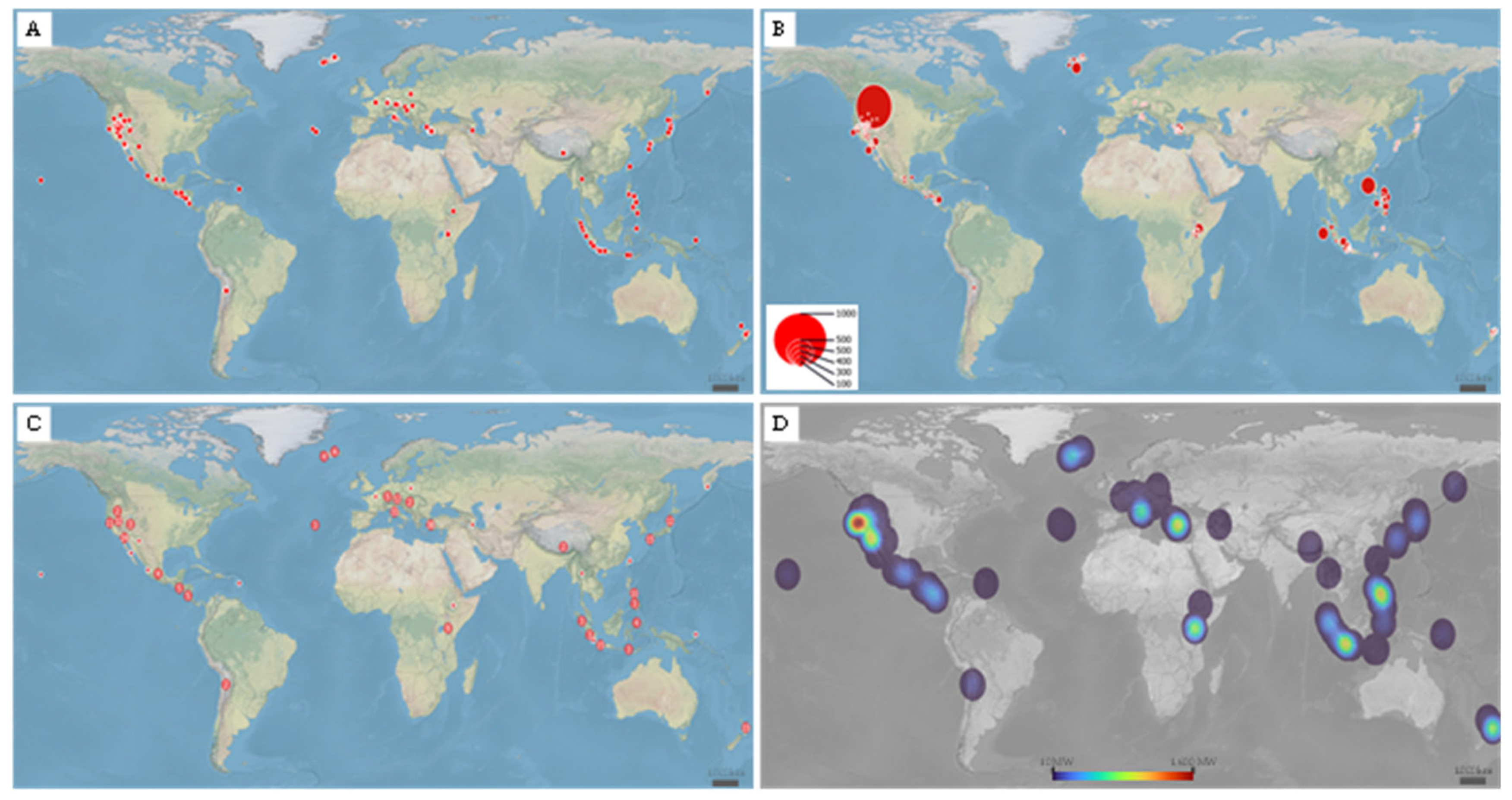
Figure 2.
Statistical distribution of installed capacities (MW) of geothermal power plants in operation in the world, log graphic and box plot. Mean 55,3 MW, P75 69,8 MW, P50 26,4 MW and P25 11,8. Elaborated by the authors based on data from [26,27,28].
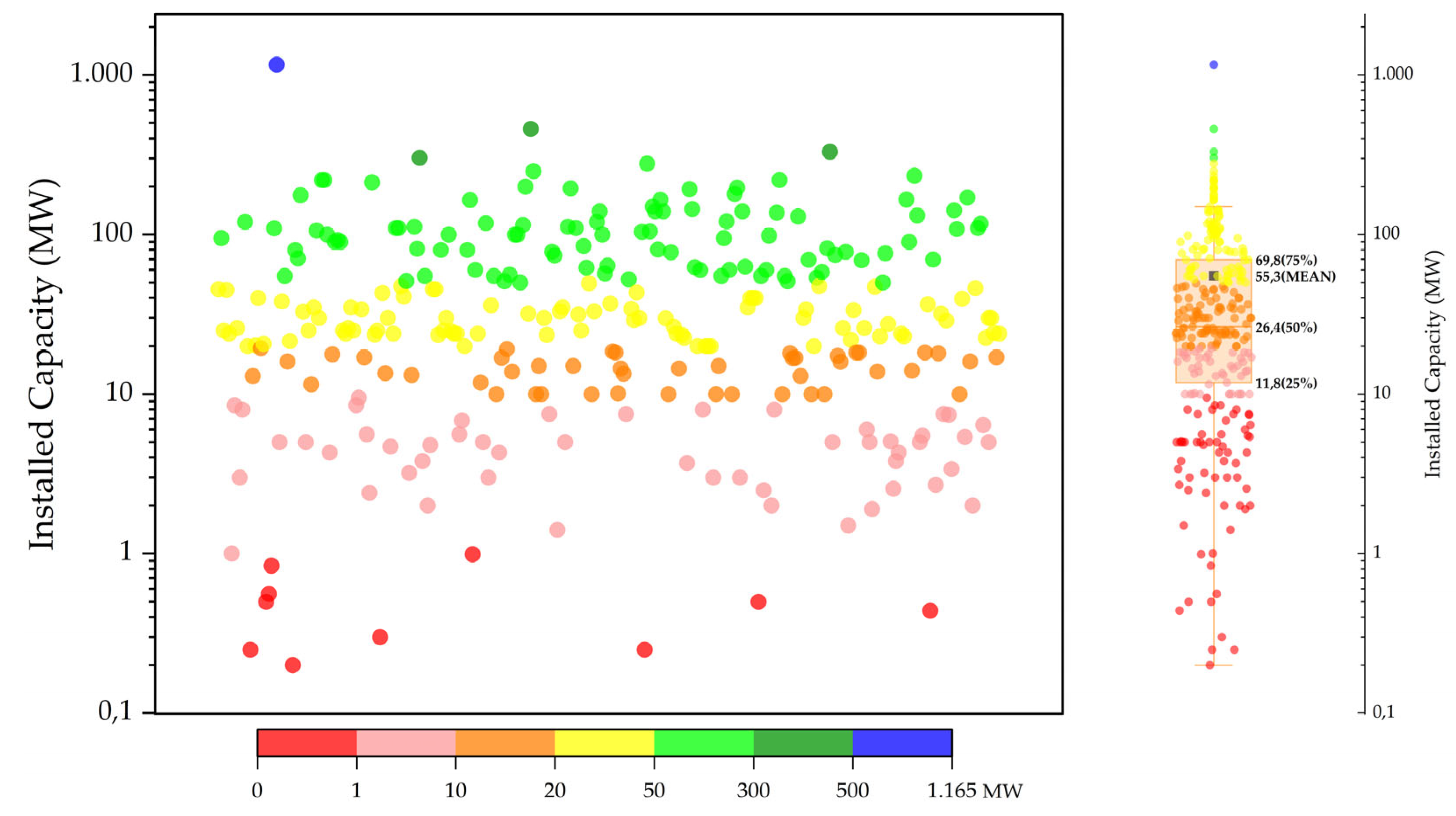
Figure 3.
Geothermal installed capacities (MW) evolution for top 7 countries since 2000. Elaborated by the authors based on data from: IRENA [32].
Figure 3.
Geothermal installed capacities (MW) evolution for top 7 countries since 2000. Elaborated by the authors based on data from: IRENA [32].
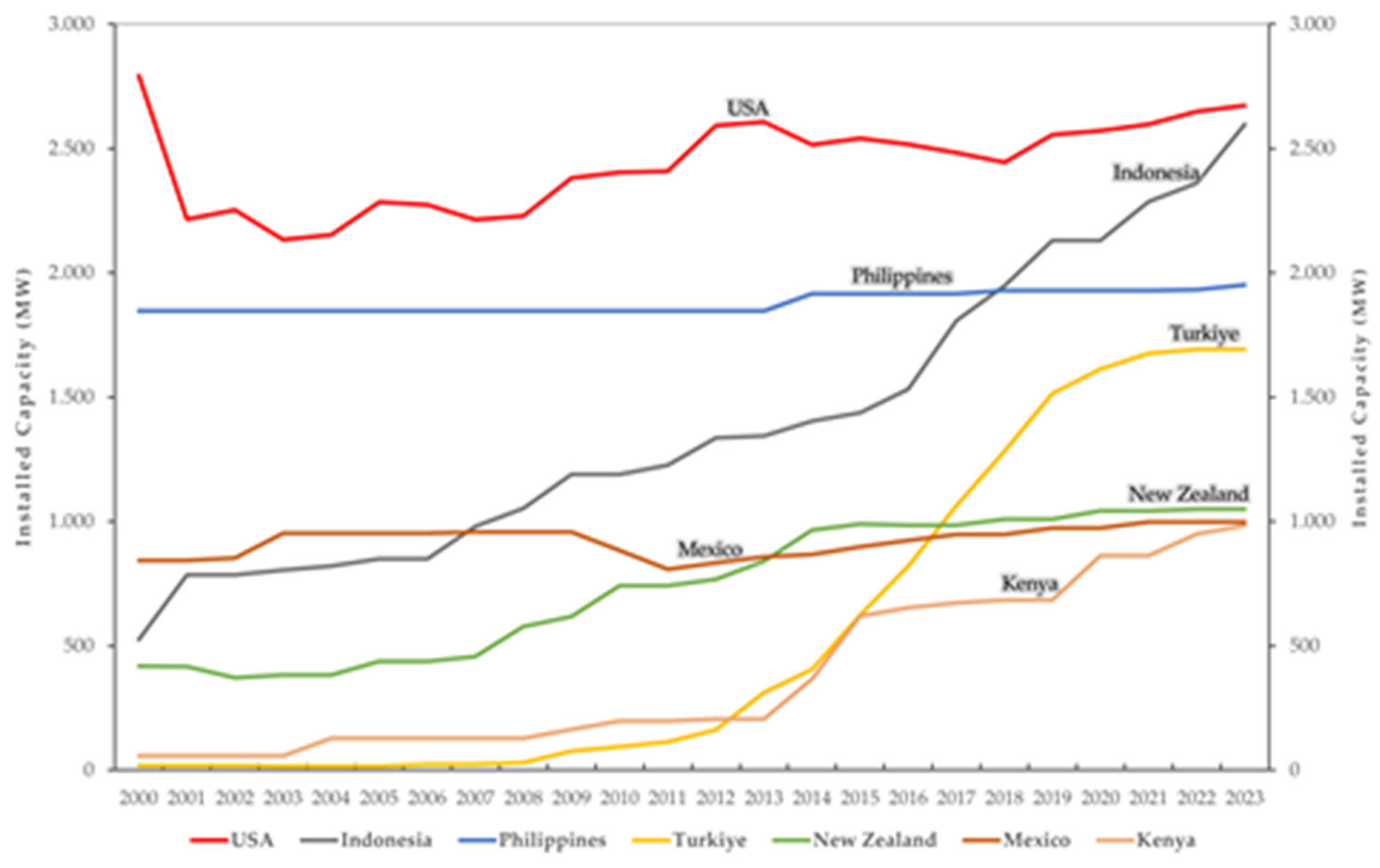
Figure 4.
Flow chart methodology applied in this study.
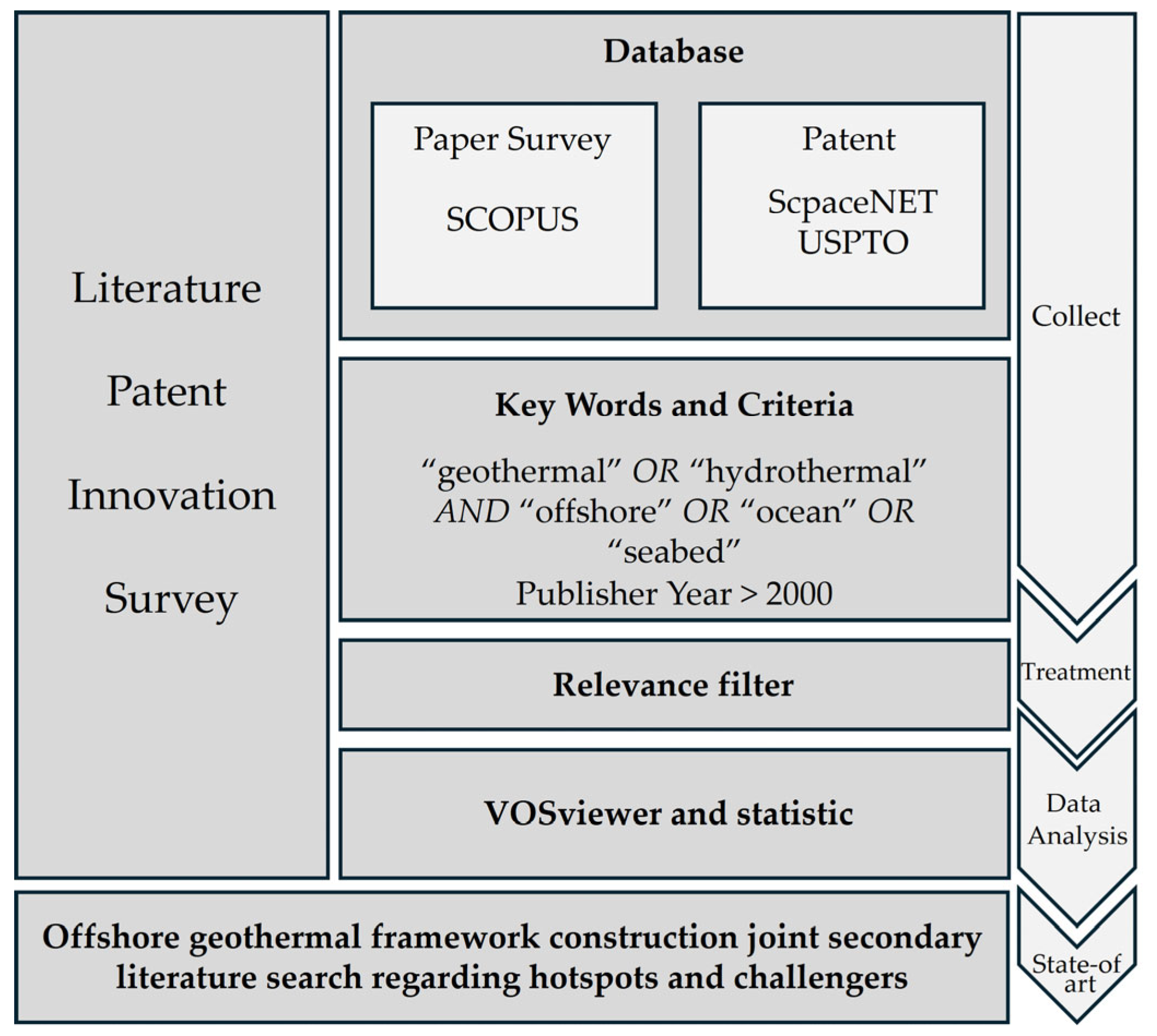
Figure 5.
Global geothermal gradient distribution considering variations above 50°C/km. High concentration of gradients above 100°C/km in South Atlantic Margin (A), Tyrrhenian Sea, Italy (B) and Pacific (C). UTM projection and base map from ESRI Physical [31]. Elaborated by the authors based on data from: [43,44,45].
Figure 5.
Global geothermal gradient distribution considering variations above 50°C/km. High concentration of gradients above 100°C/km in South Atlantic Margin (A), Tyrrhenian Sea, Italy (B) and Pacific (C). UTM projection and base map from ESRI Physical [31]. Elaborated by the authors based on data from: [43,44,45].
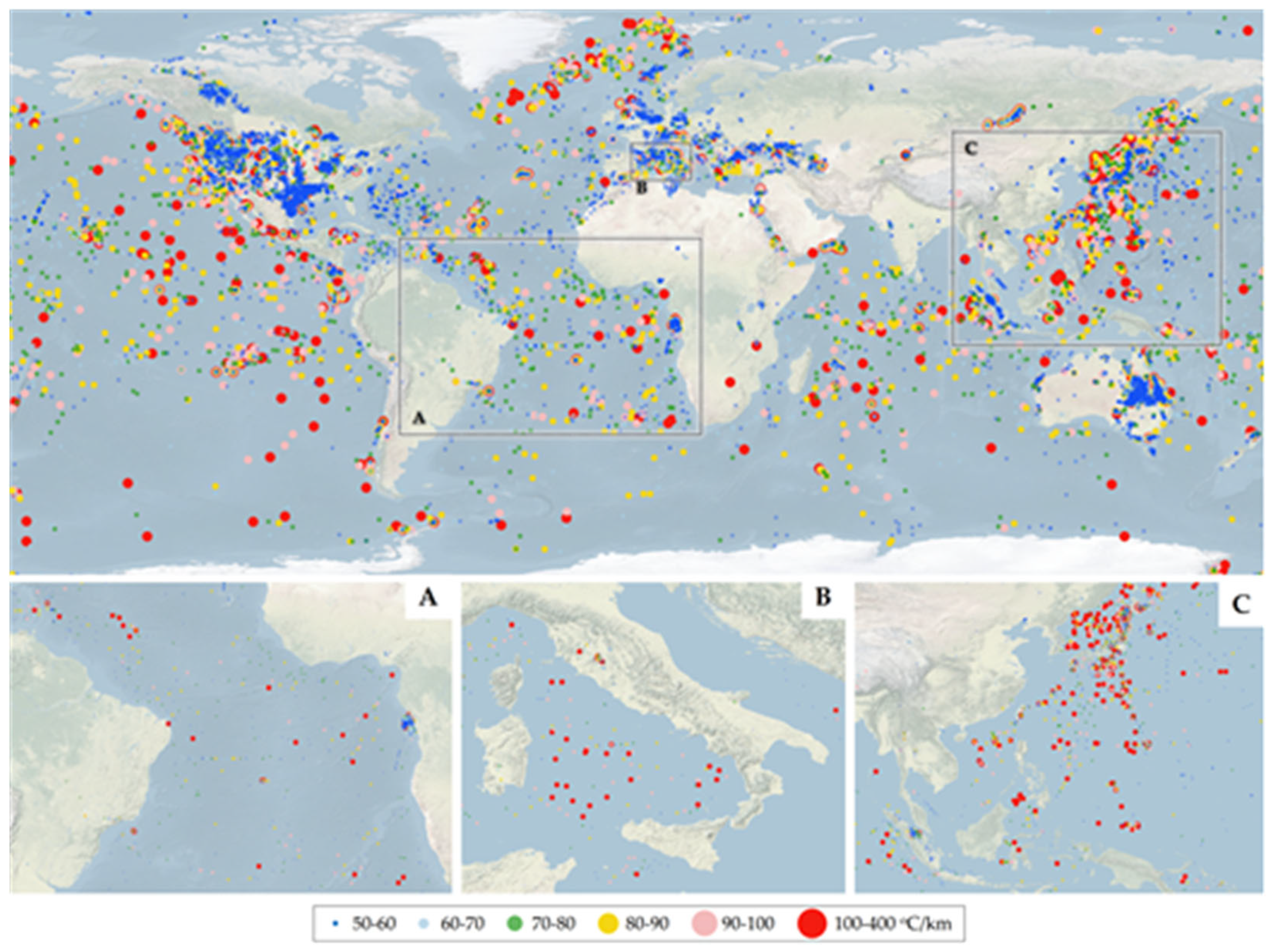
Figure 6.
Papers published revealing annual evolution and annual accumulative recovery from SCOPUS survey related to offshore geothermal energy [40]. Accessed on 10 February 2025.
Figure 6.
Papers published revealing annual evolution and annual accumulative recovery from SCOPUS survey related to offshore geothermal energy [40]. Accessed on 10 February 2025.
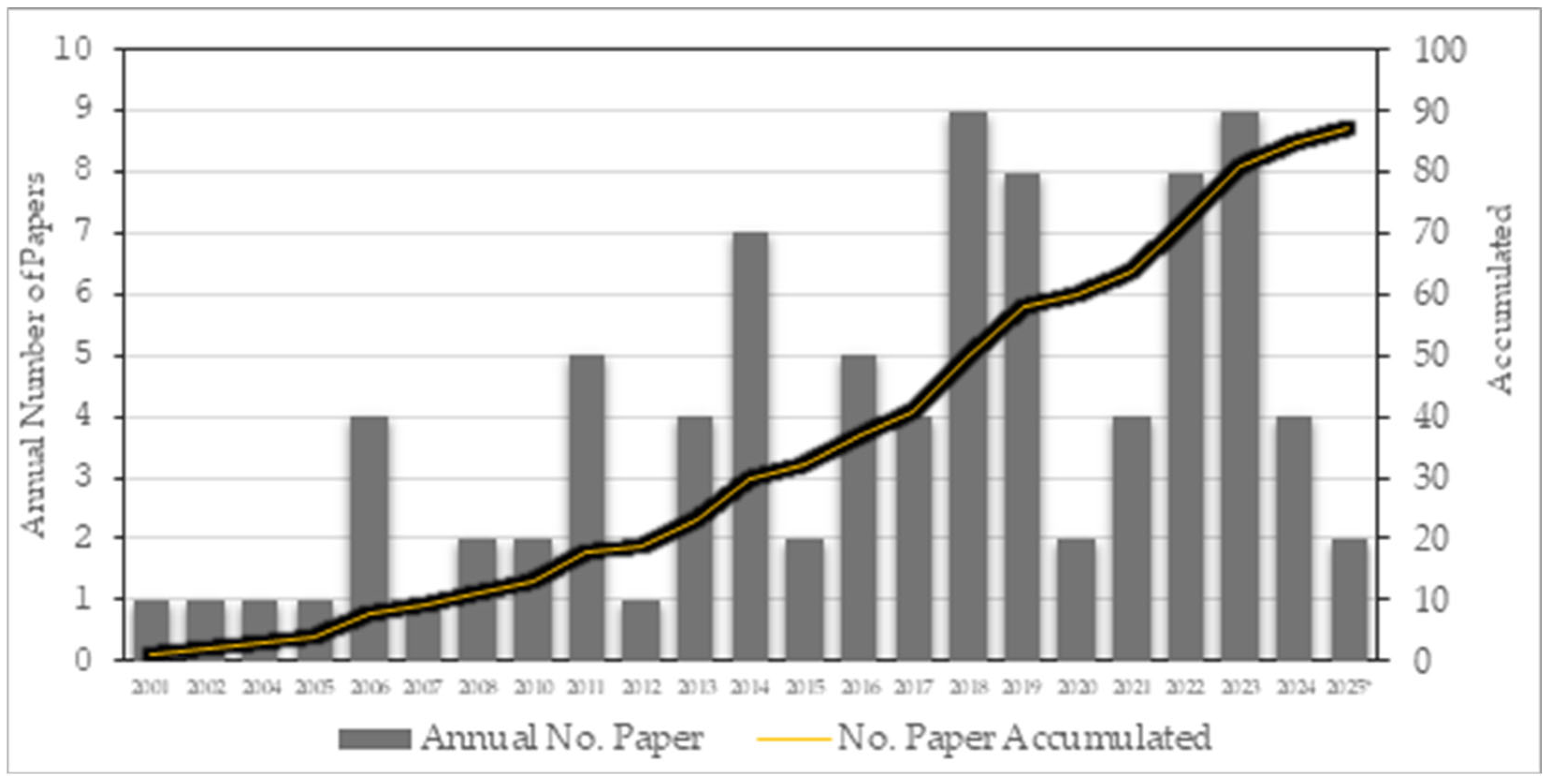
Figure 7.
Paper index keywords relationships are shown through a network correlation. The size of each bubble corresponds to the frequency of the keyword's occurrence. The color gradient, ranging from blue to red, indicates the average year of publication associated with each keyword, with blue representing older publications and red reflecting ones that are more recent. The network connection is linked by color lines.
Figure 7.
Paper index keywords relationships are shown through a network correlation. The size of each bubble corresponds to the frequency of the keyword's occurrence. The color gradient, ranging from blue to red, indicates the average year of publication associated with each keyword, with blue representing older publications and red reflecting ones that are more recent. The network connection is linked by color lines.
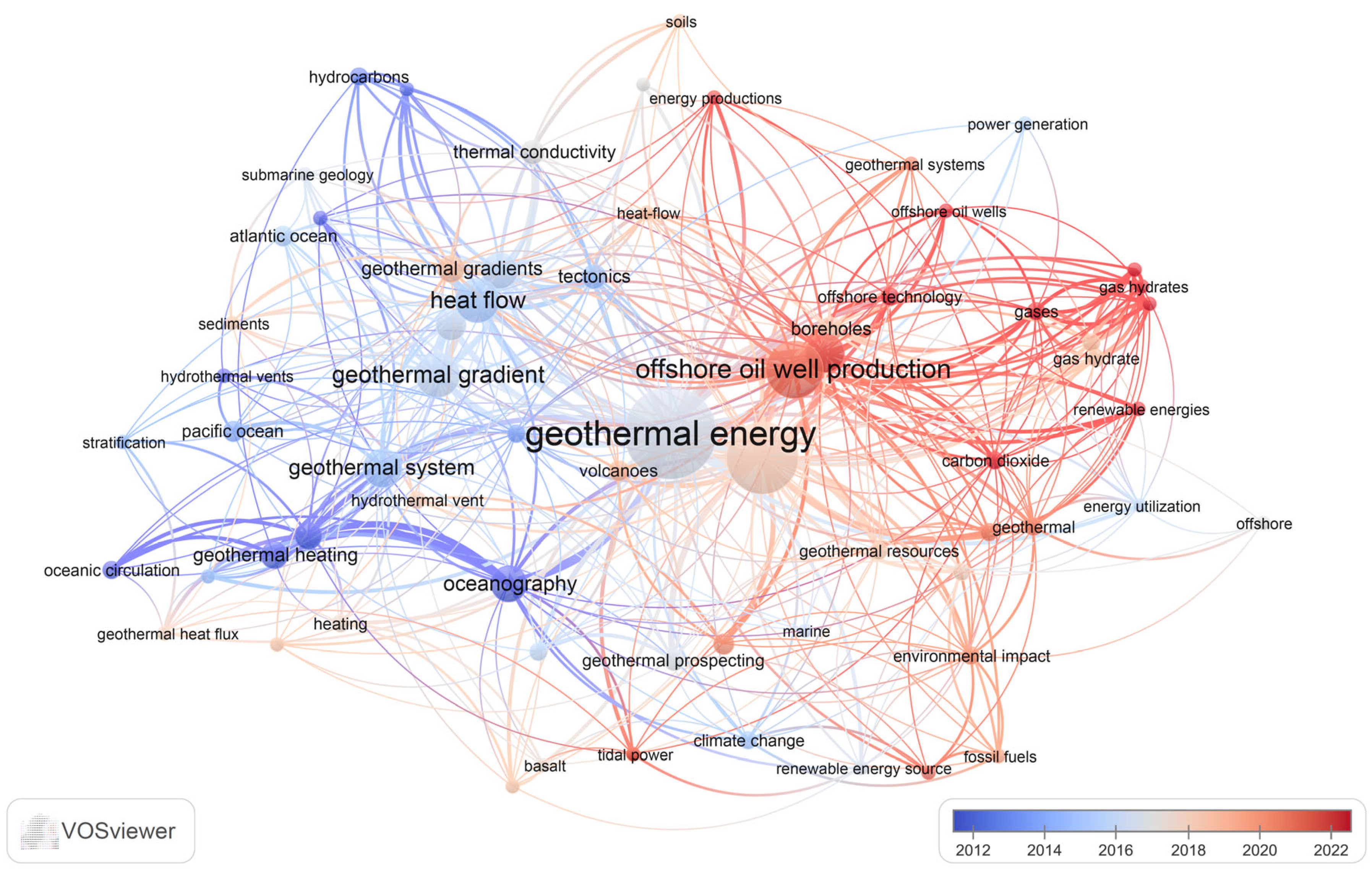
Figure 8.
Paper concentration of research clusters by country and citation network. This indicates most actively contributing to the papers publisher and highlights the international citation regarding offshore geothermal energy.
Figure 8.
Paper concentration of research clusters by country and citation network. This indicates most actively contributing to the papers publisher and highlights the international citation regarding offshore geothermal energy.
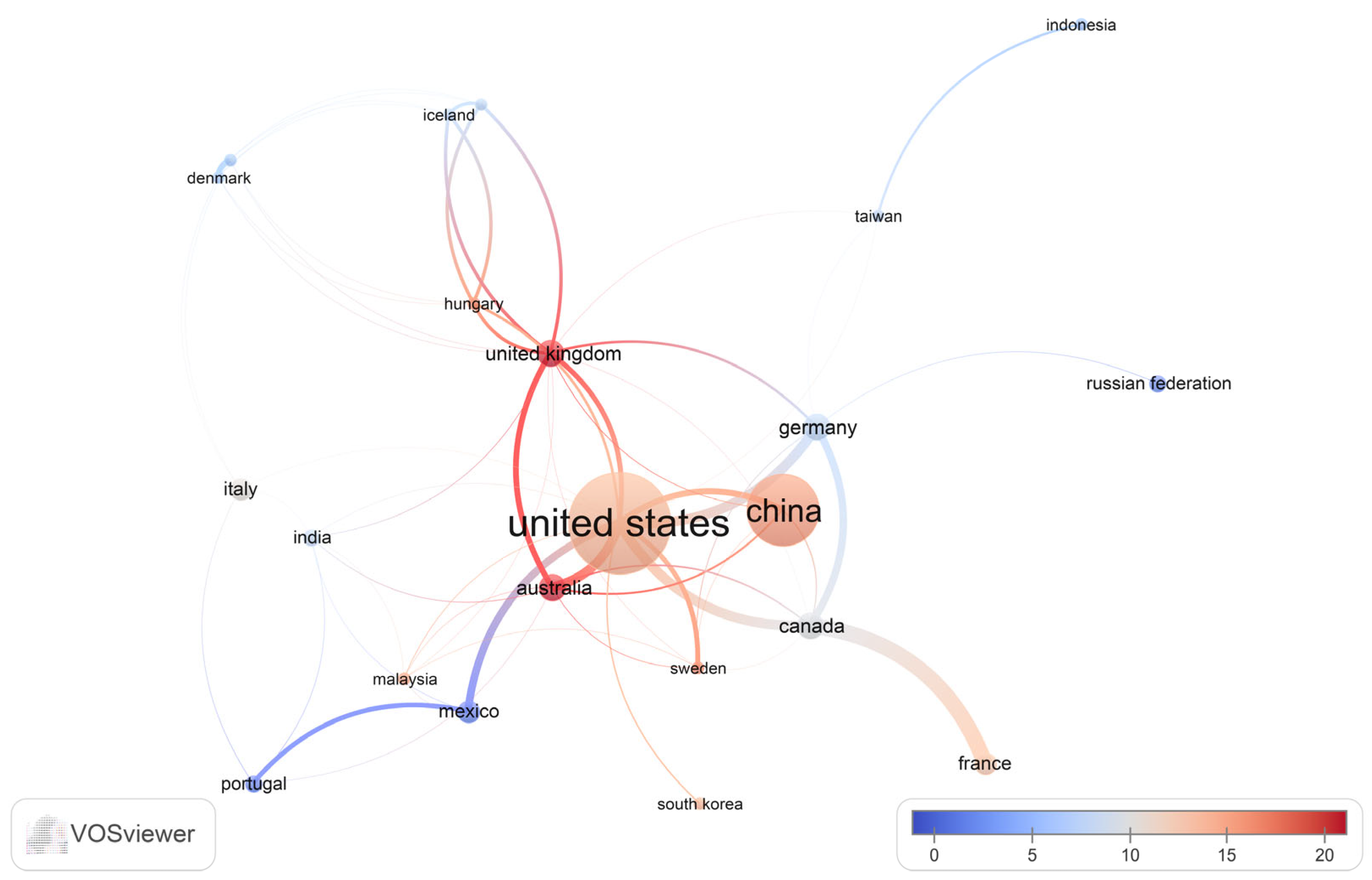
Figure 9.
Annual evolution of offshore geothermal energy patents publication numbers, based on European Patent Office - EPO database [42] and The United States Patent and Trademark Office - USPTO [41]. Accessed on 10 February 2025.
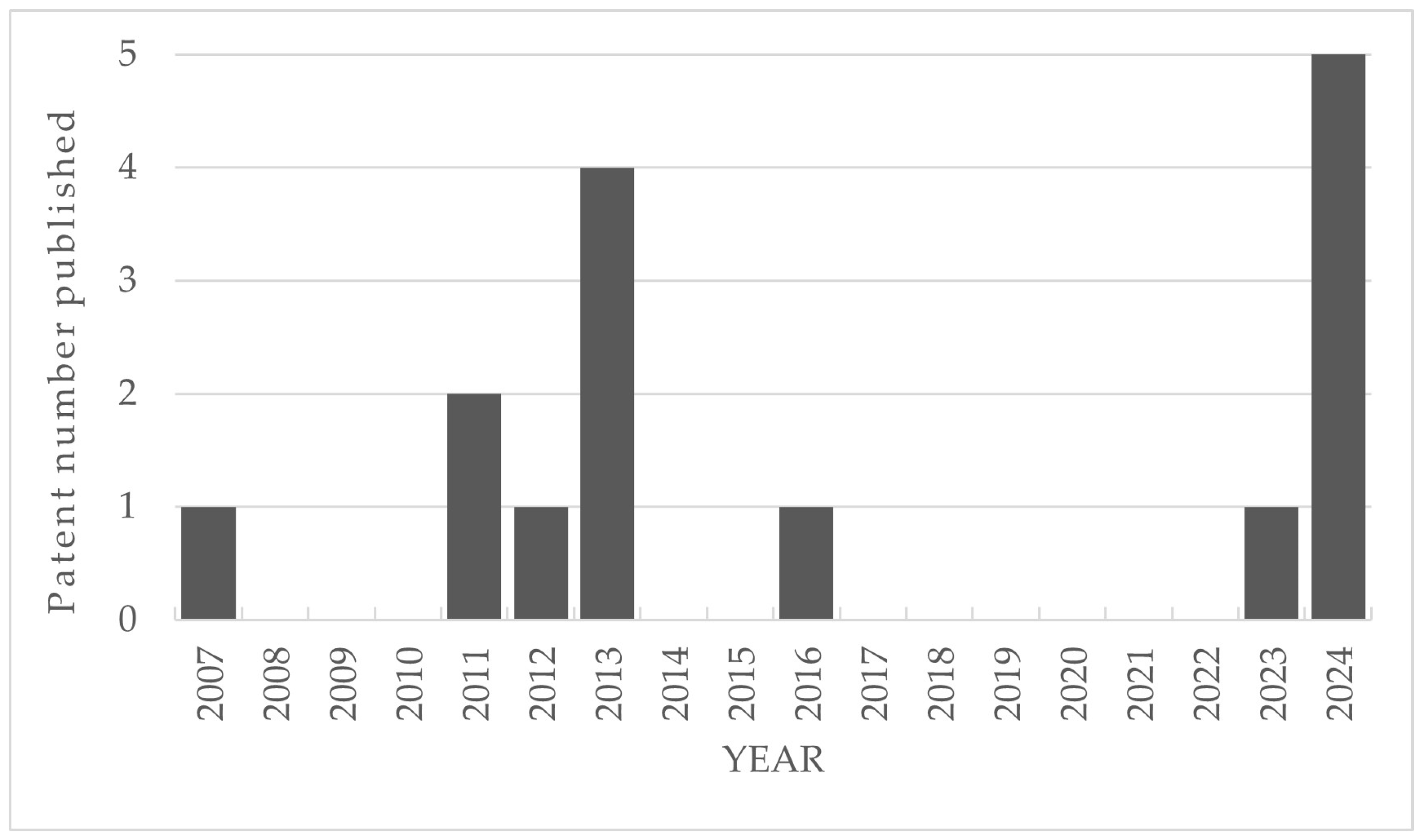
Figure 10.
Schematic unconventional geothermal development in hydrocarbon wells and reservoirs. Techniques for harnessing energy include fluid co-production across multiple hydrocarbons or establishing closed-loop systems within a single well. Source image [52], used under a Creative Commons CC-BY-NC 4.0.
Figure 10.
Schematic unconventional geothermal development in hydrocarbon wells and reservoirs. Techniques for harnessing energy include fluid co-production across multiple hydrocarbons or establishing closed-loop systems within a single well. Source image [52], used under a Creative Commons CC-BY-NC 4.0.

Figure 11.
Gulf of Mexico geothermal gradient map and well data for three areas (colors dots). Dashed black lines indicate the edge of the continental shelf. Different colors of these circles simply indicate that they are different wells. Isopachs of the Pleistocene sediments are shown as white dashed lines. Source image [84], used under specific copyright permission from publisher.
Figure 11.
Gulf of Mexico geothermal gradient map and well data for three areas (colors dots). Dashed black lines indicate the edge of the continental shelf. Different colors of these circles simply indicate that they are different wells. Isopachs of the Pleistocene sediments are shown as white dashed lines. Source image [84], used under specific copyright permission from publisher.
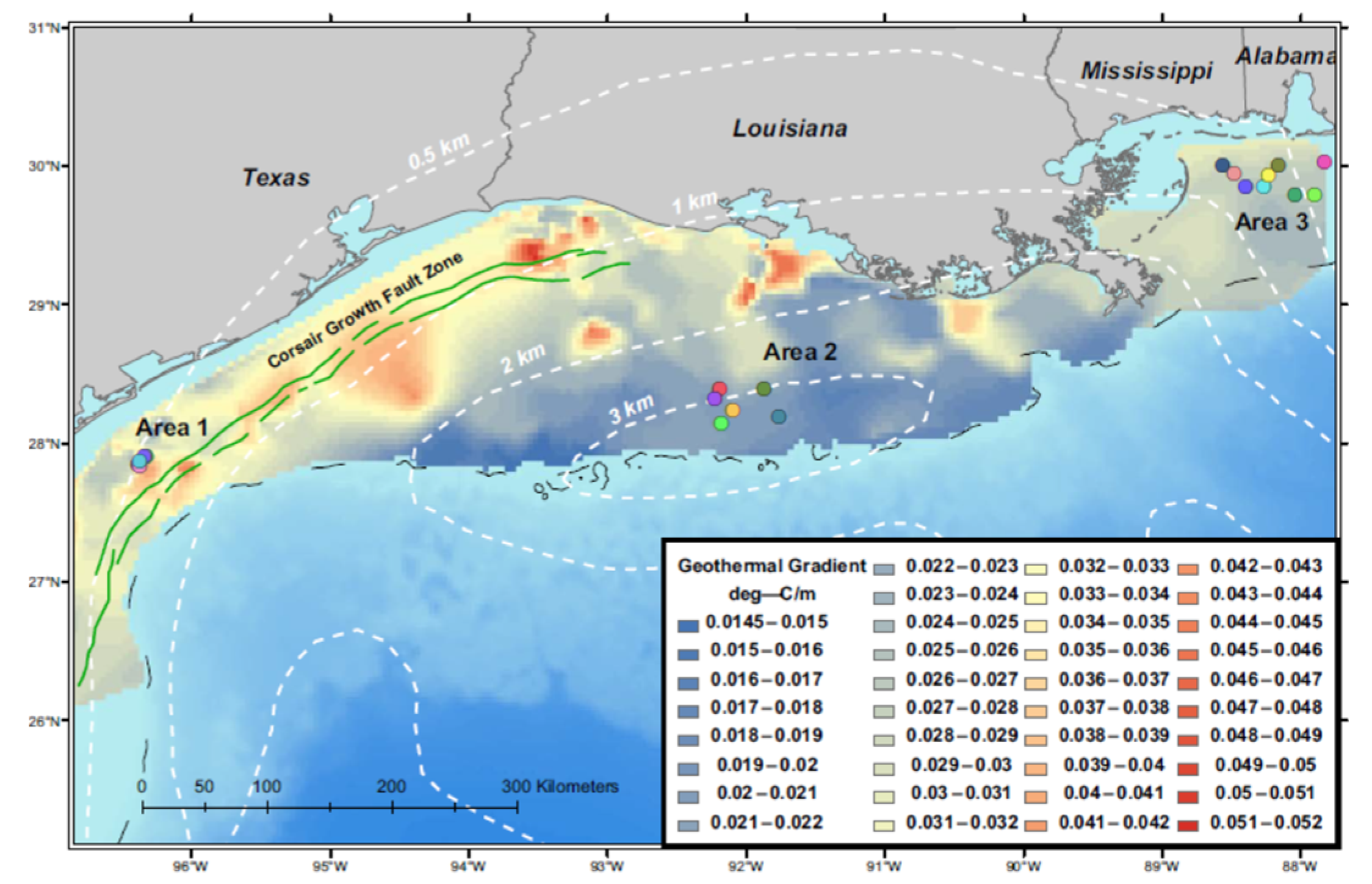
Figure 12.
Location of the Marsili Seamount. A) Bathymetry of South-Eastern Tyrrhenian Basin. M: Marsili; MB: Marsili Basin; P: Palinuro; A: Alcione; L: Lametini; Sc: Stromboli Canyon; Eo: Eolo; En: Enarete; S: Sisifo. B) bathymetry of Marsili seamount. Red dashed lines: linear structures; violet dotted lines: main circular cones and terraces; yellow dashed line: major landslide. C) Magnetic anomaly reduced to pole map of Marsili volcano (values in nT). Source image [85,86], used under a Creative Commons CC-BY.
Figure 12.
Location of the Marsili Seamount. A) Bathymetry of South-Eastern Tyrrhenian Basin. M: Marsili; MB: Marsili Basin; P: Palinuro; A: Alcione; L: Lametini; Sc: Stromboli Canyon; Eo: Eolo; En: Enarete; S: Sisifo. B) bathymetry of Marsili seamount. Red dashed lines: linear structures; violet dotted lines: main circular cones and terraces; yellow dashed line: major landslide. C) Magnetic anomaly reduced to pole map of Marsili volcano (values in nT). Source image [85,86], used under a Creative Commons CC-BY.
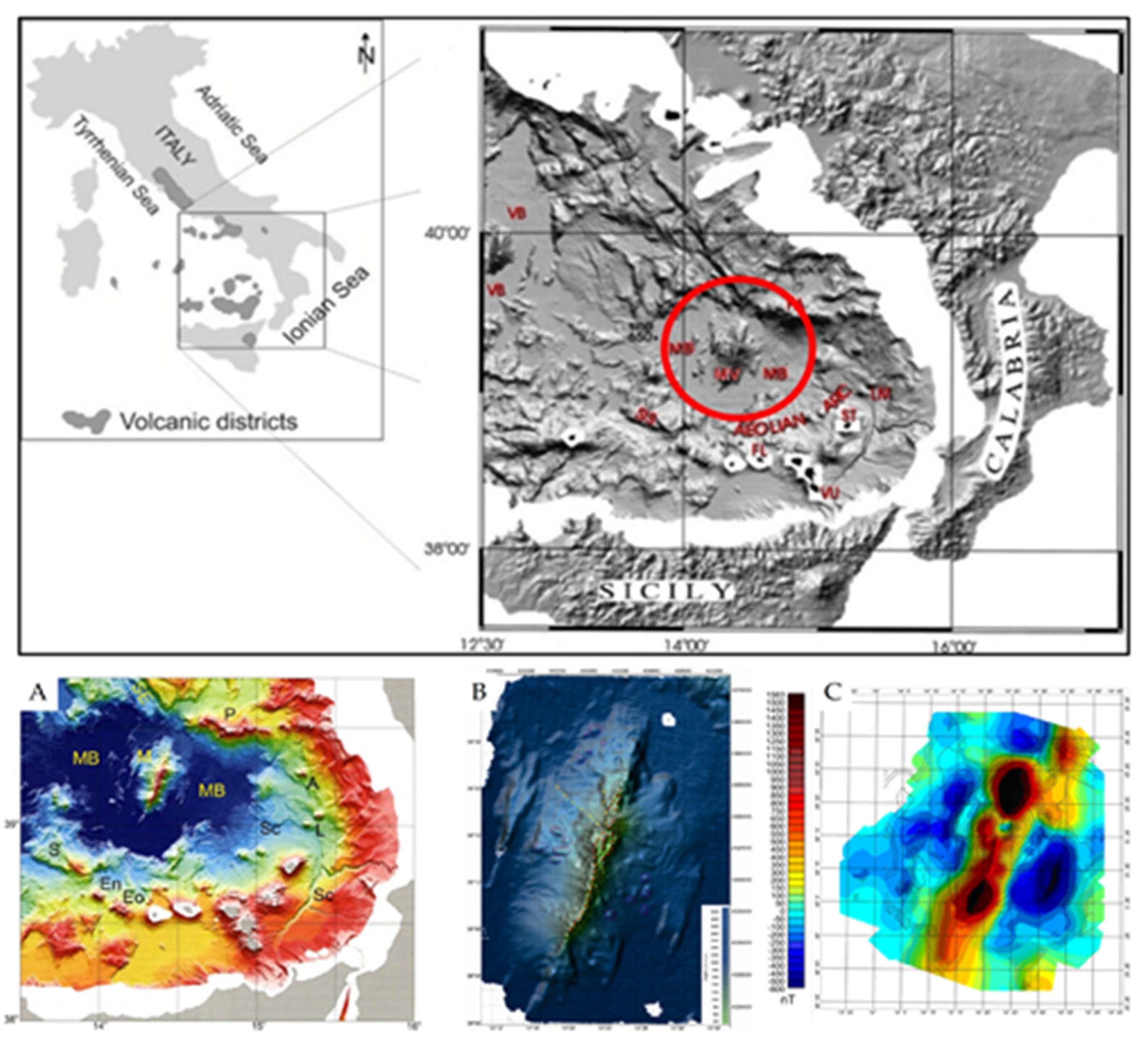
Figure 13.
Seismic and petrophysical modelling results for offshore geothermal characterization in the Gulf of Candarli, Turkiye [90]. A) Reflected Pore Pressure Cube on the seismic section showing the pressure anomalies near volcanic edifices. B) Reflected Temperature Cube indicating temperature anomalies around the extinct volcano and lava flows. Source image [90], used under specific copyright permission from publisher.
Figure 13.
Seismic and petrophysical modelling results for offshore geothermal characterization in the Gulf of Candarli, Turkiye [90]. A) Reflected Pore Pressure Cube on the seismic section showing the pressure anomalies near volcanic edifices. B) Reflected Temperature Cube indicating temperature anomalies around the extinct volcano and lava flows. Source image [90], used under specific copyright permission from publisher.
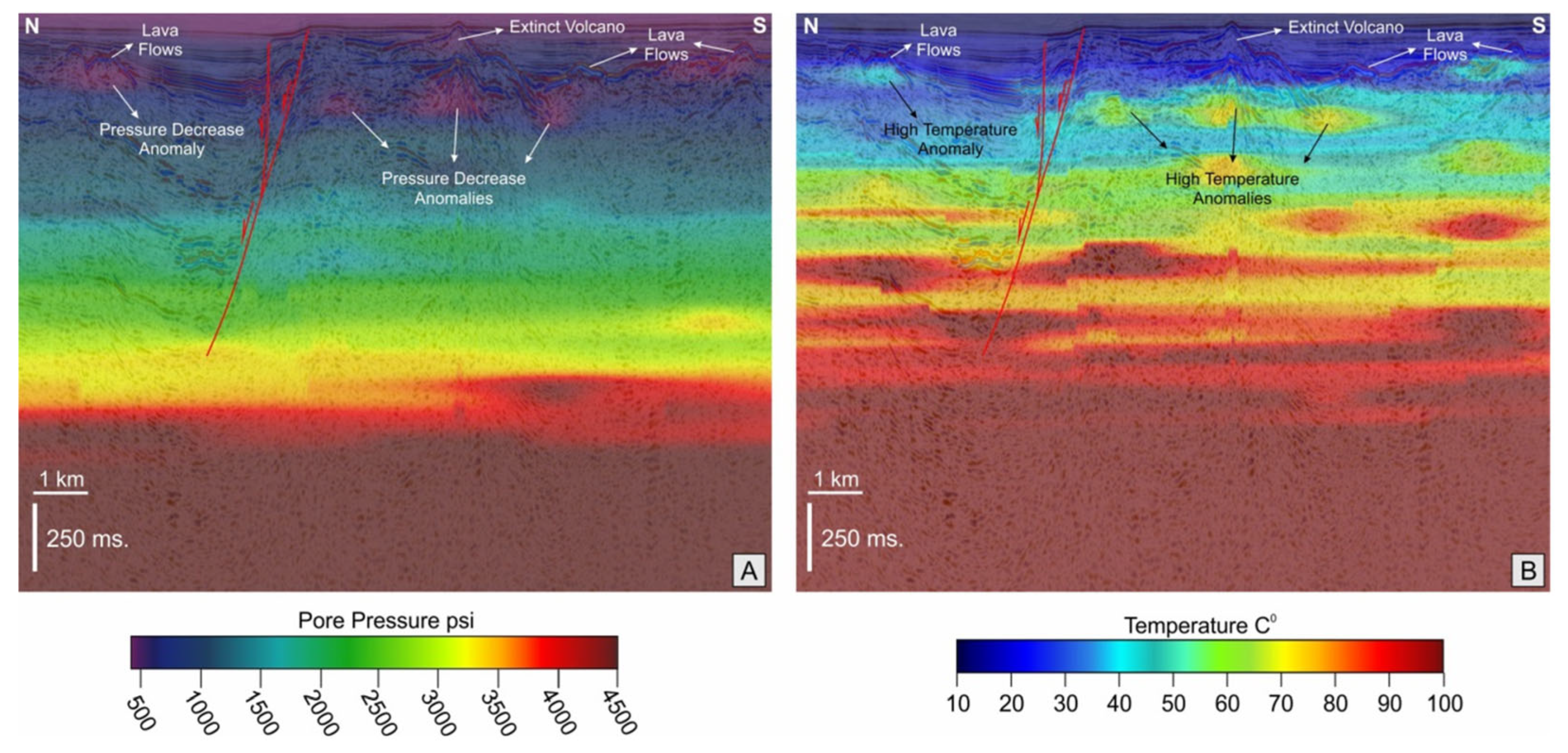
Figure 14.
Application of passive seismic for construction 3D model linking onshore geothermal fields and offshore in Aegean region in Turkey. Vs and Vp diagram and profile view. Source image [92], used under license number 6015961157792.
Figure 14.
Application of passive seismic for construction 3D model linking onshore geothermal fields and offshore in Aegean region in Turkey. Vs and Vp diagram and profile view. Source image [92], used under license number 6015961157792.
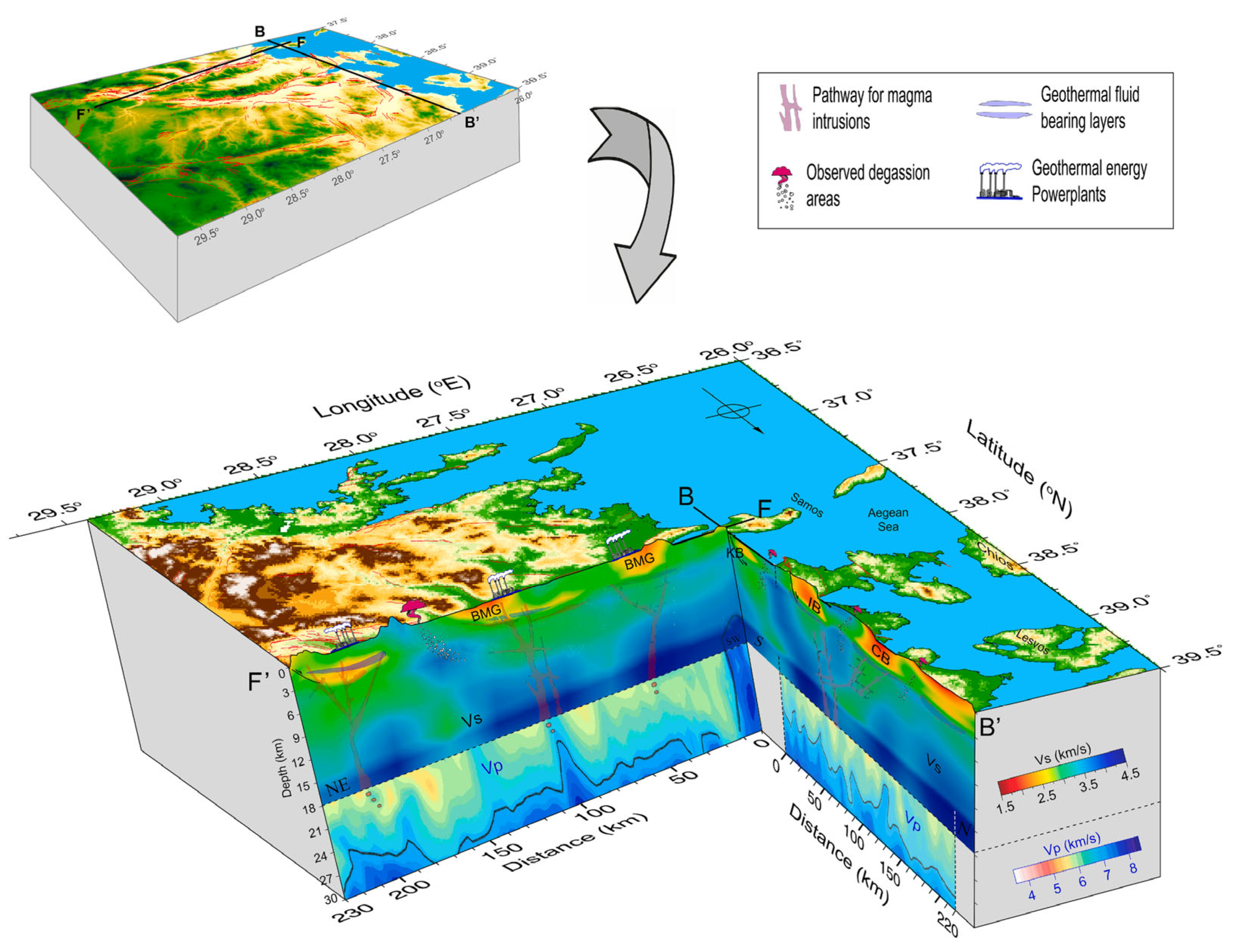
Figure 15.
Sciacca offshore geothermal field characterization by reflection seismic data showing the faults relations and ascending fluids carriers. A) Location map. B) Schematic fault model of the positive flower structure associated with the NNE–striking left-lateral. Source image [93], used under a Creative Commons CC-BY.
Figure 15.
Sciacca offshore geothermal field characterization by reflection seismic data showing the faults relations and ascending fluids carriers. A) Location map. B) Schematic fault model of the positive flower structure associated with the NNE–striking left-lateral. Source image [93], used under a Creative Commons CC-BY.
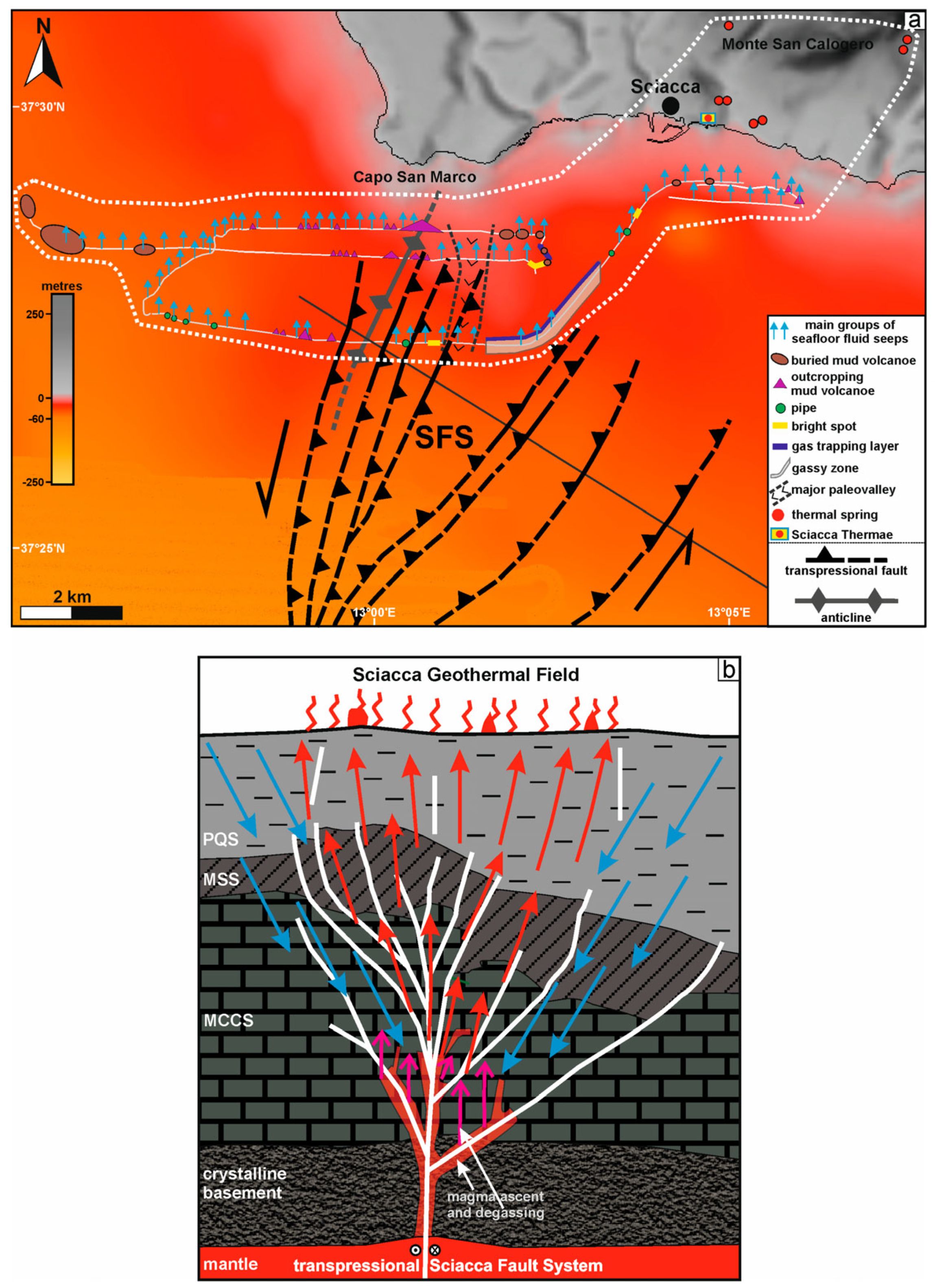

Table 1.
Patents recovery in the survey related to geothermal offshore energy obtained from European Patent Office - EPO database and The United States Patent [42] and Trademark Office – USPTO [41] identifying existing innovations for advancing this renewable energy option. Accessed on 10 February 2025.
Table 1.
Patents recovery in the survey related to geothermal offshore energy obtained from European Patent Office - EPO database and The United States Patent [42] and Trademark Office – USPTO [41] identifying existing innovations for advancing this renewable energy option. Accessed on 10 February 2025.
| S.Nº | Patent Title | Applicant | Country | Year Publication |
Database |
|---|---|---|---|---|---|
| 1. | Marine Geothermal Exploration System | Guangzhou Marine Geol Survey | China | 2011 | EspaceNET |
| 2. | Deep Ocean Hydrothermal Sequence Sampler | Univ. Zhejiang | China | 2007 | EspaceNET |
| 3. | Device For Measuring Geothermal Amount Of Ocean | Korea Inst. Ocean. Sci. & Tech. | South Korea | 2016 | EspaceNET |
| 4. | Optimal Selection Method For Offshore Geothermal Resource Target Area | CNOOC | China | 2024 | EspaceNET |
| 5. | Ocean Geothermal Power System Using Multi-Step Reheating Rankine Cycle | Korea Ocean Res. Dev. Inst. | South Korea | 2013 | EspaceNET |
| 6. | Marine Geothermal Power Generation System With Turbine Engines | Shifferaw Tessema Dosho | USA | 2013 | EspaceNET |
| 7. | Self-Powered Observation Apparatus Based On Submarine Hydrothermal Solution | Univ. Zhejiang | China | 2023 | EspaceNET |
| 8. | Ocean Thermal Energy And Geothermal Energy Combined Power Generating System | Univ. Jimei | China | 2012 | EspaceNET |
| 9. | Geothermal Power Generation System With Turbine Engines And Marine Gas Capture System | Shifferaw Tessema Dosho | USA | 2013 | EspaceNET |
| 10. | Geothermal Power Generation System With Turbine Engines And Marine Gas Capture System | Shifferaw Tessema Dosho | USA | 2013 | EspaceNET |
| 11. | Geothermal Energy And Wind Power Coupled Offshore Oil And Gas Platform Combined Power Generation System | CNOOC1 | China | 2024 | EspaceNET |
| 12. | System To Extract Hydrothermal Energy From Deepwater Oceanic Sources And To Extract Resources From Ocean Bottom | Marshall Bruce | USA | 2011 | EspaceNET |
| 13. | Geothermal Power Systems And Methods For Subsea Systems | Schlumberger2 | USA | 2024 | USPTO |
| 14. | Geothermal Power Systems And Methods For Subsea Systems | Schlumberger2 | USA | 2024 | USPTO |
| 15. | Geothermal Plant For Extracting Energy From A Geothermal Reservoir Located Below The Ocean Bottom | CGG | USA | 2024 | USPTO |
1 CNOOC-Chinese National Offshore Oil Company; 2 Registered as OneSea, an subsidiary of Schlumberger (rebranded to SLB).
Table 2.
North Sea Norwegian mature fields, geothermal gradient and water production temperature. Source from [75].
Table 2.
North Sea Norwegian mature fields, geothermal gradient and water production temperature. Source from [75].
| Field | Geothermal Gradient avg. °C/km | Temperature °C | Reservoir depth m |
|---|---|---|---|
| Belder | 52.9 | 94 | 1,773 |
| Grane | 46.8 | 83 | 1,775 |
| Fram H-Nord | 46.5 | 121 | 2,601 |
| Johan Sverdrup | 46.1 | 84 | 1,820 |
| Tambar | 45.1 | 186 | 4,128 |
| Edvard Grieg | 44.7 | 95 | 2,125 |
| Ver | 44.3 | 123 | 2,770 |
| Dvalin | 39.9 | 164 | 4,100 |
| Gyda | 38.6 | 154 | 4,000 |
| Morvin | 38.6 | 167 | 4,320 |
| Embla | 37.7 | 151 | 4,000 |
| Valemon | 37.8 | 152 | 4,010 |
| Kvitebjorn | 37.5 | 142 | 3,790 |
| Martin Linge | 34.9 | 149 | 4,275 |
Disclaimer/Publisher’s Note: The statements, opinions and data contained in all publications are solely those of the individual author(s) and contributor(s) and not of MDPI and/or the editor(s). MDPI and/or the editor(s) disclaim responsibility for any injury to people or property resulting from any ideas, methods, instructions or products referred to in the content. |
© 2025 by the authors. Licensee MDPI, Basel, Switzerland. This article is an open access article distributed under the terms and conditions of the Creative Commons Attribution (CC BY) license (http://creativecommons.org/licenses/by/4.0/).
Copyright: This open access article is published under a Creative Commons CC BY 4.0 license, which permit the free download, distribution, and reuse, provided that the author and preprint are cited in any reuse.