

Submitted:
06 May 2025
Posted:
08 May 2025
Read the latest preprint version here
Abstract
This article introduces the Energy Restoration by Planetary Fields (ERPF) theory, proposing a new paradigm for energy conversion in oceanic flows. Unlike classical models, which consider as available only the kinetic energy associated with the intercepted sectional area—bounded, for example, by the Betz limit—ERPF treats the ocean as an open, dynamic system where the kinetic energy of large, incompressible water masses—characterized by high density and volumetric stability—is continuously restored by planetary field forces. This inherent inertia allows a resonant converter, dynamically coupled to the flow, to extract energy from the momentum of the surrounding volume even when operating from a single location. Although the harvested energy may be significant at the device scale, it corresponds to a minute fraction of the system’s total momentum and is rapidly restored by the continuous action of gravity, Earth’s rotation, and thermohaline gradients. The paper presents the UCEC (Current Energy Collecting Unit), a turbine specifically designed for this operation, achieving highly efficient energy conversion with minimal environmental impact. Theoretical foundations, geometric innovations, and an experimental validation plan are discussed, offering a novel path toward sustainable and large-scale ocean energy harvesting.
Keywords:
Ocean Current Energy
; ERPF Theory
; Incompressible Flow
; Energy Harvesting
; Hydrokinetic Turbines
; UCEC Device
; Planetary Forces
; Renewable Marine Energy
1. Introduction
The global demand for renewable energy sources with high energy density, low intermittency, and reduced environmental impact has intensified the search for new approaches to energy conversion. Among the available natural sources, ocean currents represent a vast, yet largely untapped potential [1], characterized by physical properties that fundamentally distinguish them from other energy-generating flows, such as wind and channelled river streams.
Technologies currently applied to energy generation from marine currents are largely derived from wind turbines, whose principles were originally conceived for low-density, compressible fluids. However, the ocean—being a nearly incompressible and highly dense medium—responds differently to the presence of energy conversion devices. This fundamental difference necessitates the development of new theoretical models that consider the continuous, dense, and dynamically restored nature of marine flows.
International reports highlight the growing global interest in the sustainable exploitation of ocean currents as a renewable energy source [2].
In this context, the Energy Restoration by Planetary Fields (ERPF) theory is proposed, conceiving ocean currents as open energy systems, continuously generated and sustained by planetary field forces such as gravity, Earth’s rotation, thermal and salinity gradients, and atmospheric pressure. These forces not only maintain the motion of large water masses but also act as the fundamental cause of their formation and dynamics [3], ensuring the continuous replenishment of kinetic energy throughout the system—even after local extraction.
Building upon this principle, the Current Energy Collecting Unit (UCEC, from the Portuguese Unidade Coletora de Energia de Corrente) is introduced: an innovative submerged turbine designed to operate in resonance with the flow. Unlike conventional turbines, which extract energy primarily from the intercepted cross-sectional area, the UCEC interacts dynamically with the surrounding volume of water. Even when operating from a single location, it can extract a significant amount of kinetic energy by coupling with the movement of the upstream and circumjacent masses. Despite the magnitude of energy harvested, it represents only a minute fraction of the total kinetic energy associated with this extended volume. The UCEC achieves this by imposing a 90-degree deflection of the velocity vector along its blades, converting linear momentum into rotational torque with minimal disruption to the global flow. This novel approach paves the way for a new class of sustainable, efficient, and regenerative marine energy technologies.
2. Physical Foundations
The Energy Restoration by Planetary Fields (ERPF) theory proposes a new approach to energy conversion in oceanic systems by conceiving currents as open systems, generated and sustained by planetary field forces—such as gravity, Earth’s rotation, thermal and salinity gradients, and atmospheric pressure. In contrast to classical models—which consider the available energy to be only the kinetic component incident on the flow’s cross-sectional area and associate its extraction with the consequent local deceleration of the fluid caused by turbines—the ERPF framework accounts for the collective behavior of large volumes of incompressible water, whose high density and volumetric stability enable the immediate transmission of forces to the point of extraction. This makes it possible to harvest energy associated with the motion of a much broader volume than that traditionally considered by classical models, without relying on the direct deceleration of the fluid at the extraction site.
Although these field forces are extremely subtle when acting on individual particles, their combined effect over vast oceanic masses results in forces strong enough to continuously sustain the system’s original global linear momentum. This effect can be compared to the action of a weak magnetic field on a colossal number of magnetic dipoles. While the force on each individual dipole is minimal, a hypothetical energy source of sufficient magnitude, if evenly distributed, could produce a slight simultaneous deflection in all elements—small at each point, but with a high total energy cost. Still, despite its weakness, the magnetic field would react on each dipole with a restoring torque, realigning them to their original orientation and reinvesting, as a whole, the same amount of energy initially required to cause the deflection. This analogy illustrates that an ideal device could, from a single location, extract a significant amount of energy associated with the motion of a large volume, inducing a discrete global disturbance—small enough to be swiftly neutralized by the field forces that ensure the persistence of the system’s motion.
Water incompressibility plays a central role in this behavior. Unlike compressible media such as air—in which particles can approach each other without fully transmitting their inertia—water maintains its volumetric integrity even under variations in depth, velocity, or pressure [4]. As a result, the force exerted by each particle is not limited to its own motion but also carries the contribution of all upstream particles, transmitting their inertia cumulatively to the extraction point. This ensures that the energy extracted locally actually corresponds to a fraction of the collective motion of the entire surrounding volume.
Furthermore, one of the most fundamental consequences of water incompressibility is the impossibility of significantly reducing its velocity at a single point without causing mass accumulation. This derives from the law of mass conservation, which requires that the same volume of fluid entering a region must also exit it, when the fluid is incompressible. In wind systems, this is addressed through the compressibility of air: as it passes through a turbine, the air can decelerate and its density increases slightly, adjusting to conserve mass even with reduced velocity. In the ocean, however, such adaptation is not feasible. Water cannot be compressed to allow a reduction in flow speed after passing through an extraction device. In conventional three-blade devices, what is observed is the opposite: to preserve flow continuity, the fluid accelerates between the blades, generating a pressure drop—a phenomenon analogous to the Venturi effect. As a result, a significant portion of the water mass flows through the device without effective energy conversion, representing a structural inefficiency in resource utilization.
This means that conventional models—such as those developed for wind turbines and later applied to marine current turbines [5]—which rely on flow deceleration and calculate extractable energy based solely on the cross-sectional area, cannot be directly applied to incompressible fluids such as seawater. They lead to physical inconsistencies that render them inefficient or unrealistic for the maximum harnessing of ocean energy.
In light of this, the formulation of a new paradigm for energy conversion in oceanic systems becomes justified. The ERPF theory proposes abandoning the conceptual limits established by classical models—such as the Betz limit [6]—and adopting a framework based on volumetric continuity and the constant replenishment of energy by planetary field forces. This new understanding paves the way for technologies capable of extracting energy efficiently and regeneratively, while respecting the dynamic integrity of the ocean and its fundamental physical properties.
3. Theoretical Model of the ERPF
The theoretical formulation of the Energy Restoration by Planetary Fields (ERPF) theory begins with the recognition that the ocean, as an incompressible fluid system operating in a steady-state regime, presents an energy availability that transcends the limitations of local approaches. The global movement of oceanic masses is both originated and continuously sustained by planetary field forces, including gravity, Earth's rotation, and thermal and salinity gradients.
Rather than treating the available energy as confined solely to the impact front of a turbine or a specific section of the flow, the ERPF framework proposes considering the entire moving mass volume as a reservoir of kinetic energy that is continuously restored by these natural mechanisms.
The theoretically available power for conversion can be expressed by:
where represents the kinetic energy contained within a water volume , and is the time interval considered for the conversion. In the theoretical limit where energy replenishment occurs immediately after extraction—as predicted by the continuous action of planetary forces—time tends toward zero, and the resulting power would theoretically tend toward infinity. However, in reality, the energy replenishment rate is finite, constrained by the intensity and spatial distribution of the restoring forces, thus making the available power high but physically limited. Nevertheless, this scenario highlights the virtually inexhaustible nature of oceanic energy when the system is considered as a whole.
Conversely, the fraction of energy effectively converted will depend on the efficiency of the interaction between the conversion device and the flow. The extracted shaft power of the turbine, for instance, can be described by:
where τ is the torque applied to the shaft, ω is the angular velocity of rotation, and is the total geometric efficiency factor of the system, which accounts for friction losses, structural dissipations, and limitations in coupling with the flow.
To evaluate the performance of a system based on the ERPF paradigm, a dimensionless index κ is proposed, defined as:
where represents an idealized power level sustained by the natural system. Since it involves a system restored by external forces, it is expected that κ < 1, reflecting inherent conversion losses but complementing the traditional power coefficient commonly used in wind turbines. The index κ thus serves as an intrinsic efficiency metric for mechanical conversion, independent of the locally incident kinetic energy.
This theoretical approach establishes the foundations for understanding marine energy systems as dynamically balanced restored flows, proposing a new conceptual framework for analysing available power and efficiency in devices designed to operate in resonance with the environment.
4. Geometry of the UCEC as a Technological Solution
The Current Energy Collecting Unit (UCEC) was developed as a response to the limitations of models inherited from wind engineering, by adopting an original geometric approach to energy conversion in incompressible fluids.
Its design is based on direct vectorial interaction with oceanic flow: rather than exploiting attack angles or pressure gradients, the UCEC converts the linear momentum of the current through controlled angular deflection along the blades.
The following sections present the main elements of this innovative geometry, highlighting its three-dimensional representation, construction criteria, operational principles in resonance with the flow, and environmental features, including compatibility with marine fauna and the regenerative potential of the ecosystem.
4.1. Geometric Representation of the UCEC
The geometry of the UCEC is designed to ensure the integral vectorial conversion of oceanic flow into torque, while maintaining the integrity of the flow and maximizing the interaction between fluid and structure.
Two complementary approaches are presented below to illustrate the characteristics of this innovative geometry:
4.1.1. Vectorial Curvature and Fluid Trajectory
The following Figure 1, Figure 2, Figure 3 and Figure 4, extracted from the U.S. patent US 12,168,969 B2 [7], demonstrate:
- The vectorial curvature imposed on the flow by each blade;
- The 90° angular deflection along the blade profiles;
- The adaptation of the flow into the turbine's internal format.
Figure 1.
Side view of the UCEC, showing the flow direction and the distribution of internal components.
Figure 1.
Side view of the UCEC, showing the flow direction and the distribution of internal components.

Figure 2.
(a) Top view of an individual blade, showing its curved profile relative to the center of the rotor, accompanied by a (b) longitudinal sectional view in perspective, highlighting the 90° curvature of the blades relative to the flow direction.
Figure 2.
(a) Top view of an individual blade, showing its curved profile relative to the center of the rotor, accompanied by a (b) longitudinal sectional view in perspective, highlighting the 90° curvature of the blades relative to the flow direction.
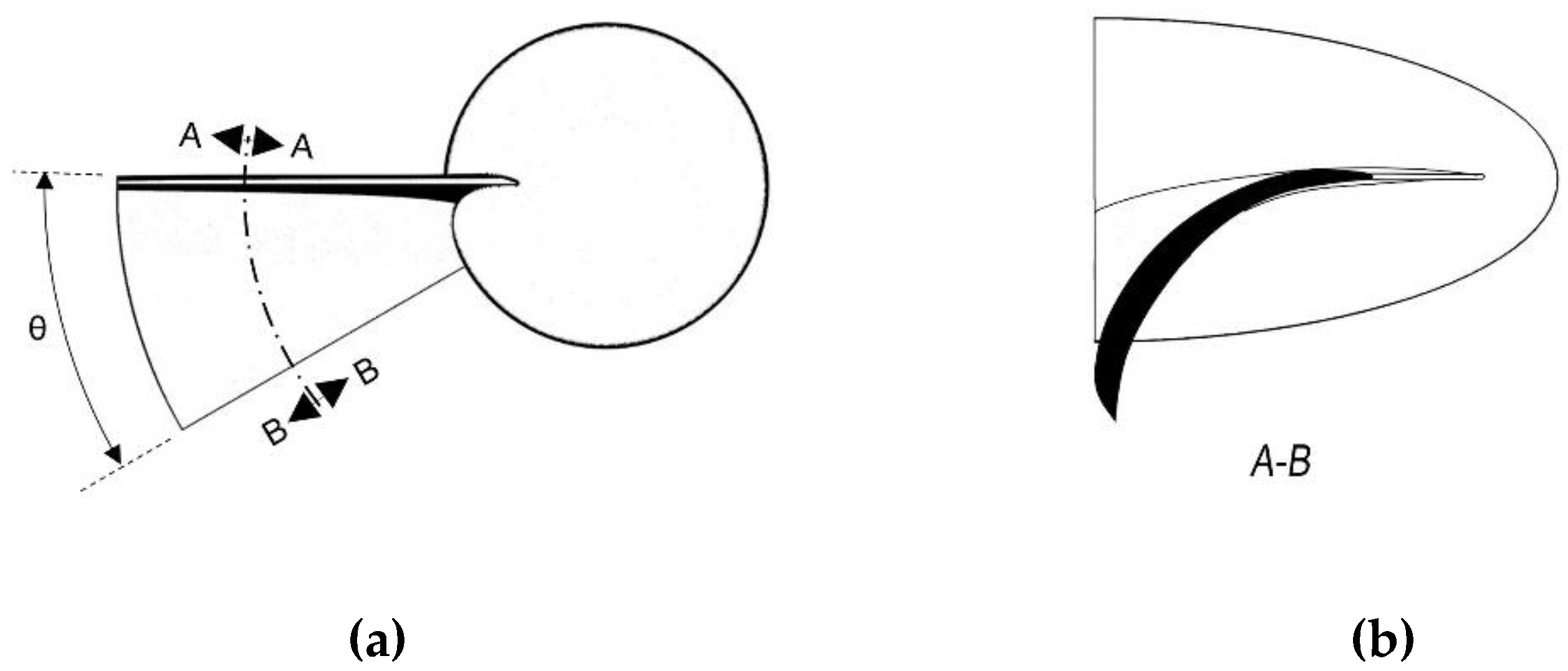
Figure 3.
Radial variation of the blade curvature.
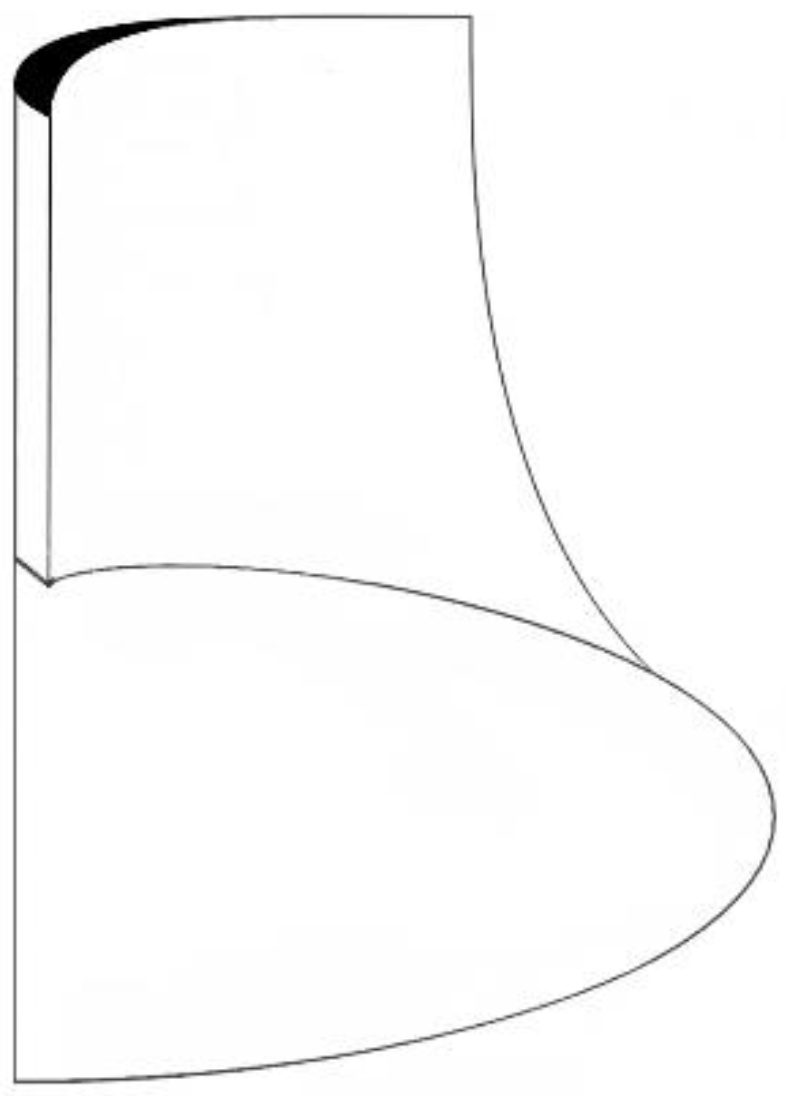
Figure 4.
Elliptical projection highlighting the 90° deflection as an idealized fluid trajectory under resonant rotation.
Figure 4.
Elliptical projection highlighting the 90° deflection as an idealized fluid trajectory under resonant rotation.
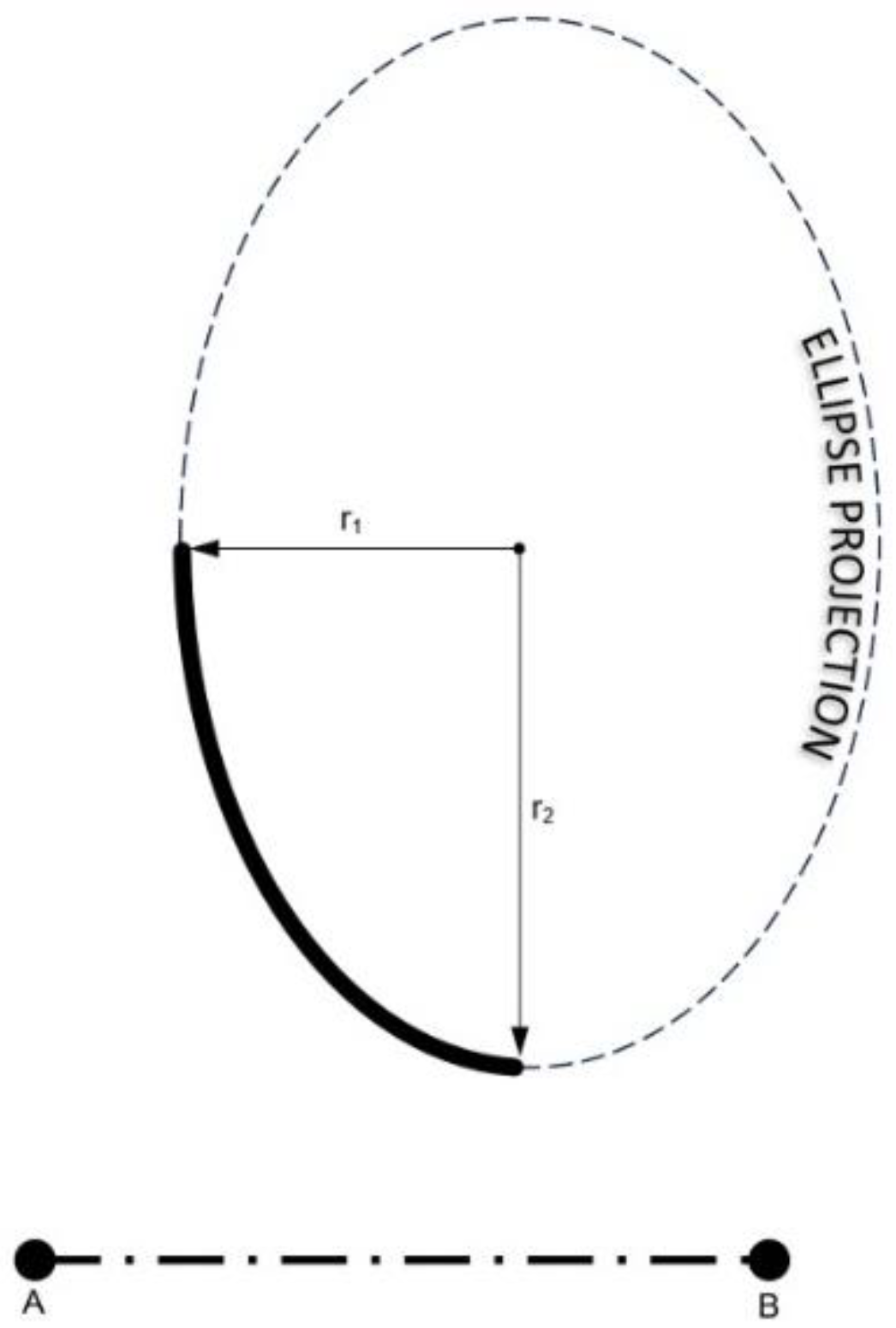
It is observed that in Figure 1, Figure 2 and Figure 3, the direction of blade curvature differs between Figure 1, Figure 2 and Figure 3. This difference arises from the fact that Figure 1 represents a counterclockwise rotation configuration, whereas Figure 2 and Figure 3 illustrate a clockwise rotation.
As described in the patent, the choice of rotation direction is a design decision without impact on energy conversion efficiency. Once defined, the UCEC rotor operates unidirectionally and is not reversible. In the event of a flow reversal, the turbine structure is designed to passively realign itself, maintaining the correct orientation facing the incoming current.
In addition to three-dimensional visualizations, the following Figure 5 illustrates, in a plan view, the vectorial behavior of the flow along the UCEC blades.
The curvature imposed on the velocity vector and its decomposition into an orthogonal component are observed, highlighting the moment transfer mechanism characteristic of the turbine geometry.
This graphic representation facilitates the understanding of the flow trajectory within the rotor, emphasizing the continuous adaptation of the flow to the blade configuration.
4.1.2. Full Occupation and Venturi Effect
The geometry of the UCEC is designed to maximize the vectorial conversion of oceanic currents into torque, ensuring the complete utilization of the incident flow.
To achieve this goal, the blades are evenly distributed around the central hub, fully occupying the useful cross-sectional area of the turbine. The number of blades may vary according to the design, but each blade occupies an equal angular arc, so that the sum of all blade openings corresponds to 360 degrees—forming a closed mesh of vectorial deflection.
This configuration ensures that any volume of water crossing the turbine section must necessarily interact with the blades, promoting the efficient transfer of the flow’s linear momentum to the rotational axis.
Additionally, the external duct presents a gradual convergence toward the active region of the turbine, promoting a Venturi effect [8] that accelerates the flow as it approaches the blades. This directed acceleration enhances the fluid-structure interaction and improves hydraulic coupling, concentrating the energy conversion work within the active area.
4.2. Structural Characteristics
The Current Energy Collecting Unit (UCEC) was designed with a focus on structural robustness, durability in marine environments, and modularity for simplified maintenance. Although the final selection of materials and components is still under optimization, the proposed design involves the use of corrosion-resistant metal alloys, high-performance composite materials, and construction solutions that allow scalable manufacturing.
The structural development of the UCEC was also guided by the recommended practices for maritime operations modelling and analysis established by DNV-GL [9].
The turbine body and its convergent duct are designed to withstand significant hydrodynamic loads, ensuring stability during continuous operation in ocean currents.
The rotor, composed of blades with three-dimensional vectorial curvature, will be mounted on a main shaft coupled to low-friction bearings, with sealing systems adapted for submerged operation.
The modularity of the assembly aims to facilitate field disassembly for inspections and component replacement, reducing operational costs and increasing the feasibility of the technology on a large scale.
The system will be designed to allow integration with various types of electric generation platforms, whether floating or fixed, adapting to the installation requirements of different coastal and oceanic environments.
4.3. Resonant Operation and Generated Torque
The UCEC operates based on a dynamic coupling principle between the vectorial curvature imposed on the flow and the rotation of the turbine’s hub.
This coupling is made possible because the blades induce a significant deflection in the flow’s velocity vector, generating reactive forces distributed tangentially along the circular paths described by the blades around the shaft.
The composition of these forces results in a net torque that drives the hub’s rotation and transmits power to the shaft.
The rotation, in turn, modifies the interaction between the flow and the blade surfaces. In an ideal scenario without resistance to motion, the fluid would adjust perfectly to the geometry of the blades, following their curved trajectory in the blades’ own reference frame. However, in the fixed reference frame, the flow would maintain its rectilinear trajectory, undergoing no effective deflection and therefore generating no significant reactive force.
When connected to an electrical generator or other load system, however, the UCEC encounters resistance to rotation.
This resistance prevents the rotor from fully following the natural trajectory of the flow, and it is precisely this difference between ideal and actual motion that generates effective deflection of the flow, promoting energy transfer in the form of torque.
This behavior establishes a condition of operational resonance: the turbine rotates in synchrony with the flow dynamics but in a regime where the angular deflection of the flow is partially dissipated as shaft torque.
The more efficient this coupling between the turbine geometry and the current regime, the greater the generated torque and the higher the extracted power.
This continuous vectorial conversion—with minimal disturbance to the flow and maximum transfer of linear momentum to the shaft—distinguishes the UCEC from all other hydrokinetic or wind turbines.
By operating in resonance with the medium, the turbine minimizes losses from turbulence, stagnation, or vortex formation, achieving an ideal energy extraction regime fully compatible with the principles of the ERPF theory.
4.4. Environmental Compatibility and Marine Fauna Interaction
Studies on the environmental effects of marine energy highlight that low-intrusion devices, such as the UCEC, can minimize impacts on marine fauna [10].
The geometry of the UCEC also offers remarkable environmental advantages, both in the way it interacts with the flow and through the positive effects it can induce within marine ecosystems.
Unlike traditional turbines with thin blades and aggressive attack angles—which slice through the fluid during rotation and pose collision risks to marine organisms—the UCEC features a continuous distribution of blades with harmonic vectorial curvature.
This configuration creates a coherent movement effect between the water and the structure: inside the turbine, the fluid rotates along with the rotor, as if the volume of water were being carried by a rotating field.
Thus, for organisms located within the turbine’s active section—such as fish—the movement of the blades becomes imperceptible, drastically reducing the risk of impact.
This characteristic is particularly relevant for the preservation of marine fauna, as it allows energy conversion to occur without imposing abrupt physical barriers or creating zones of intense shear within the flow.
Moreover, the UCEC’s support and anchoring structures—whether fixed or floating—offer potential for acting as artificial reefs [11].
As observed with shipwrecks or purposefully submerged structures, these bases can become substrates for the colonization of benthic organisms and fish, contributing to the regeneration of local biodiversity [12].
These properties make the UCEC not only an energy-efficient turbine but also a regenerative technology, capable of uniquely integrating energy production with environmental conservation within the hydrokinetic sector.
5. Experimental Validation and Technological Projections
The Energy Restoration by Planetary Fields (ERPF) theory will be tested through laboratory experiments using the Current Energy Collecting Unit (UCEC) in a controlled environment that simulates the dynamics of ocean currents.
These experiments aim to verify whether the UCEC’s geometry, combined with the hypothesis of continuous energy replenishment by planetary field forces, enables efficient conversion of the mechanical energy of the flow into shaft torque.
The tests will be conducted in an elongated tank filled with still water. The UCEC will be mounted on a mobile structure (dynamometric carriage) traveling over side rails, propelled by electric motors operating at controlled speeds. This movement generates a relative flow between the water and the turbine, simulating realistic conditions of a steady ocean current.
During the experiments, constant carriage speeds will be maintained, and different rotational speeds of the turbine will be tested.
The power delivered by the motors to the moving system will be recorded and compared with the mechanical power extracted at the turbine shaft, measured by torque and angular velocity sensors.
Within this experimental framework, the motor effectively acts as the external force restoring the flow, analogous to the planetary forces in the real ocean environment. It is expected that, with high efficiency, the power extracted by the turbine will closely match the power applied to the system, demonstrating the feasibility of conversion based on a continuously restored flow.
It is acknowledged, however, that the laboratory environment presents inherent limitations, such as tank boundary effects, scale variations, and characteristics of the relative flow, which may introduce small distortions compared to open-field behavior. These factors will be considered in the critical analysis of the results.
The following evaluation parameters will be used:
Power coefficient (CP)
Tip speed ratio (λ)
where:
- is the shaft torque;
- is the angular velocity;
- is the water density;
- U is the upstream flow velocity;
- A is the projected area at the turbine inlet (considering the duct);
- R is the rotor radius.
Measurements will follow the protocols of the International Towing Tank Conference (ITTC – 7.5-02-07-03.9 – Model Tests for Current Turbines) [13].
A CFD model (Computational Fluid Dynamics) [9] will also be developed and calibrated with experimental data to predict turbine performance under different scales and conditions.
In addition to ITTC guidelines, measurements will also comply with the recommended practices of the International Electrotechnical Commission (IEC) for marine current turbine evaluation [14].
The integration between CFD models and empirical data is a common practice in offshore engineering, recognized by institutions such as IEA-OES and DNV-GL as a strategic tool for validating and scaling new ocean technologies.
If the results confirm CP > 1, this would imply that the measured shaft power of the UCEC exceeds the kinetic energy available in the flow section, thus validating the ERPF hypothesis: that energy is restored by external forces and not limited to the incident kinetic energy.
Such a result would challenge the classical paradigm of flow energy conversion and establish a new class of sustainable, high-efficiency ocean turbines.
Although the power coefficient CP continues to be calculated based on the locally incident kinetic energy, its meaning within the ERPF context is fundamentally altered
A CP > 1 does not imply a violation of energy conservation but instead indicates the continuous action of restoring forces within the system.
Similarly, the index κ, proposed to assess efficiency in restored systems, remains conceptually valid but is impractical to measure precisely, since the globally restored power associated with the vast moving oceanic masses—whose motion is continuously generated and sustained by planetary field forces—is physically immeasurable.
Thus, the experiments will use CP primarily as a traditional comparative reference, while the concept of κ will serve as a theoretical guide for the new interpretation of energy efficiency in restored flows.
5.1. Limitations and Outlook
While the proposed laboratory experiments are designed to assess the mechanical performance of the UCEC turbine and explore the practical implications of the ERPF theory, it is important to note that such tests are constrained by controlled environmental conditions and scale. The extrapolation of laboratory results to full-scale oceanic applications must therefore be carried out cautiously. Additional studies—including open-water trials and long-term monitoring—will be necessary to fully validate the volumetric energy restoration behavior predicted by the ERPF framework. This work aims to serve as a theoretical and experimental foundation upon which further research can build.
6. Discussion
If validated by the proposed experimental tests, the Energy Restoration by Planetary Fields (ERPF) theory represents a rupture with traditional paradigms of energy conversion in flow systems.
By considering the continuous replenishment of kinetic energy by planetary field forces, ERPF challenges established limits—such as the Betz limit—and proposes that appropriately designed devices may achieve power coefficients greater than unity, provided they operate within a restored flow regime.
The UCEC emerges as the only currently known technological solution capable of translating ERPF principles into a functional system.
Unlike conventional turbines [5,15], which extract energy by decelerating the flow and leave large bypass areas, the UCEC ensures that the entire mass of incident water interacts with the rotor, fully occupying the effective cross-sectional area of the flow.
This full occupation, combined with the Venturi effect induced by the convergent duct and the angular deflection imposed by the blades, enables maximum exploitation of the available energy without compromising the global flow dynamics.
By operating in resonance with the medium, the UCEC not only interacts harmoniously with the flow but also maximizes energy transfer with minimal losses, thereby enhancing the system's overall efficiency.
The proposed laboratory tests, using a dynamometric carriage to simulate steady currents, will allow direct comparison between the mechanical power extracted by the turbine and the electrical power consumed by the motors—considering the latter as an external restoring force analogous to planetary field forces.
This methodology will allow testing the hypothesis that externally restored energy can be almost entirely captured under near-ideal conditions.
Beyond its energy advantages, the UCEC also differentiates itself through its positive ecological impact.
Its geometry avoids cutting zones and allows the fluid to rotate coherently with the rotor, significantly reducing the risk of collisions with marine organisms. Additionally, the turbine structure can serve as a base for artificial reefs, promoting the regeneration of local biodiversity.
To facilitate the visualization of the conceptual and operational differences between traditional models and the ERPF paradigm implemented with the UCEC, the following comparative Table 1 summarizes the main parameters:
The experimental validation will allow precise assessment of the vectorial conversion efficiency and the hydrodynamic parameters associated with the UCEC.
The results obtained will provide not only evidence of the system's energy performance but also fundamental inputs for computational modelling and the design of energy farms based on this technology.
The success of these tests would mark a major milestone in consolidating the UCEC as a technically viable proposal aligned with the ERPF model.
The convergence of geometric innovation, energy efficiency, and environmental compatibility proposed by the UCEC aligns with the latest guidelines for the advancement of sustainable ocean technologies, as highlighted in IEA-OES reports [2].
7. Conclusion
The theoretical foundations developed in this article propose a substantial revision of classical paradigms for energy conversion in fluid systems. The Energy Restoration by Planetary Fields (ERPF) theory introduces a new framework by recognizing that the same planetary forces responsible for generating ocean currents also continuously restore the energy extracted by conversion devices. This insight challenges conventional assumptions—such as the Betz limit—that treat available energy as finite and locally bounded.
The Current Energy Collecting Unit (UCEC), designed under this framework, presents a novel vectorial energy conversion approach, ensuring complete flow interaction and continuous transformation of linear momentum into shaft torque in an efficient and environmentally compatible manner. If laboratory tests confirm power coefficients exceeding 1, the UCEC may represent a disruptive advance in marine energy systems.
Although open-water trials will still be required to assess large-scale behavior, the upcoming laboratory experiments constitute a decisive step toward validating the ERPF theory. Confirming the hypothesis of restored systems may open a new scientific and technological frontier, with far-reaching implications for ocean engineering, applied physics, and the global energy transition.
8. Patents
The theoretical foundations presented in this manuscript—formulated as the Energy Restoration by Planetary Fields (ERPF) theory—preceded and directly inspired the invention of a new type of hydrokinetic turbine, the Current Energy Collection Unit (UCEC). The unique geometry and operational principle of the UCEC, developed in alignment with the ERPF model, have been protected through multiple patent filings. These patents, all granted or pending under the author’s name, reflect the innovative design introduced in this work:
- Brazil / INPI: Patent No. BR 102020007224-2 B1 — Unidade Coletora de Energia de Corrente; granted on 26 October 2021.
- Japan / JPO: Patent No. 特許第7539484号 — 流体エネルギ捕集ユニット; granted on 15 August 2024.
- USA / USPTO: Patent No. US 12,168,969 B2 — Current Energy Collection Unit; granted on 17 December 2024.
- Pending patent applications have also been filed in the following jurisdictions:
- Europe / EPO: Application No. 217856616.0.
- Canada / CIPO: Application No. 3174859.
- Mexico / IMPI: Application No. MX/a/2022/012723.
- China / CNIPA: Application No. SCT226021-7.
Author Contributions
The author confirms that he was solely responsible for the conceptualization, methodology, investigation, data curation, writing—original draft preparation, writing—review and editing, and visualization of this manuscript. All work was carried out independently by the author.
Funding
This research received no external funding.
Institutional Review Board Statement
Not applicable.
Informed Consent Statement
Not applicable.
Data Availability Statement
No new data were created or analyzed in this study. Data sharing is not applicable to this article.
Acknowledgments
The author gratefully acknowledges the encouragement and support of his family during the research and development of this work. Special thanks are due to attorneys Dr. Giselda M. C. Menten and Dr. Luiz Eduardo de Almeida for their legal guidance throughout the patenting and regulatory processes. The prototyping and experimental efforts were supported by sponsors Thales Barizon, Murilo Reggiani, and Rodrigo Nakao, whose contributions are gratefully recognized.
Conflicts of Interest
The author declares no conflict of interest.
Abbreviations
The following abbreviations are used in this manuscript:
| CIPO | Canadian Intellectual Property Office |
| CFD | Computational Fluid Dynamics |
| CNIPA | China National Intellectual Property Administration |
| DNV-GL | Det Norske Veritas – Germanischer Lloyd (Maritime Certification Body) |
| EPO | European Patent Office |
| ERPF | Energy Restoration by Planetary Fields |
| IEA-OES | International Energy Agency – Ocean Energy Systems |
| IMPI | Instituto Mexicano de la Propiedad Industria |
| INPI | Instituto Nacional da Propriedade Industrial (Brazil) |
| ITTC | International Towing Tank Conference |
| JPO | Japan Patent Office |
| UCEC | Current Energy Collecting Unit |
| USPTO | United States Patent and Trademark Office |
References
- Pelc R, Fujita RM. Renewable energy from the ocean. Marine Policy 26 (2002): 471–479. [CrossRef]
- IEA-OES. Annual Report 2020 – Ocean Energy Systems. International Energy Agency – Ocean Energy Systems (2020).
- Garrett C, Cummins P. The efficiency of a turbine in a tidal channel. Journal of Fluid Mechanics 588 (2007): 243–251. [CrossRef]
- Gill AE. Atmosphere-Ocean Dynamics. Academic Press (1982).
- Bahaj AS, Myers L. Fundamentals applicable to the utilisation of marine current turbines for energy production. Renewable Energy 28 (2004): 2205–2211. [CrossRef]
- Betz A. Das Maximum der theoretisch möglichen Ausnutzung des Windes durch Windmotoren. Zeitschrift für das gesamte Turbinenwesen 26 (1920): 307–309.
- Queiroz MO. Current Energy Collecting Unit. US Patent 12,168,969 B2 (2024).
- Lamb H. Hydrodynamics, 6th ed. Cambridge University Press (1932).
- DNV-GL. Recommended Practice DNVGL-RP-E103: Modelling and analysis of marine operations. DNV-GL (2020).
- Copping A, Hanna L, Whiting J, Geerlofs S, Grear M, Blake K, Sather N. Environmental Effects of Marine Renewable Energy Development around the World: Annex IV Final Report. Pacific Northwest National Laboratory (2014).
- Baine M. Artificial reefs: A review of their design, application, management and performance. Ocean & Coastal Management 44 (2001): 241–259. [CrossRef]
- Johnsack JA, Sutherland DL. Artificial reef research: a review with recommendations for future priorities. Bulletin of Marine Science 37 (1985): 11–39.
- International Towing Tank Conference (ITTC). Model Tests for Current Turbines – Recommended Procedures and Guidelines 7.5-02-07-03.9. ITTC (2021).
- International Electrotechnical Commission (IEC). IEC TS 62600-200: Marine energy – Wave, tidal and other water current converters – Part 200: Electricity producing tidal energy converters – Power performance assessment. IEC (2018).
- O’Rourke F, Boyle F, Reynolds A. Tidal energy update 2009. Applied Energy 87 (2010): 398–409.
Figure 5.
Plan view scheme showing the vectorial deflection imposed by the UCEC blades. The 90° curvature of the flow is evidenced by the decomposition of the velocity vector , emphasizing the principle of vectorial energy conversion.
Figure 5.
Plan view scheme showing the vectorial deflection imposed by the UCEC blades. The 90° curvature of the flow is evidenced by the decomposition of the velocity vector , emphasizing the principle of vectorial energy conversion.
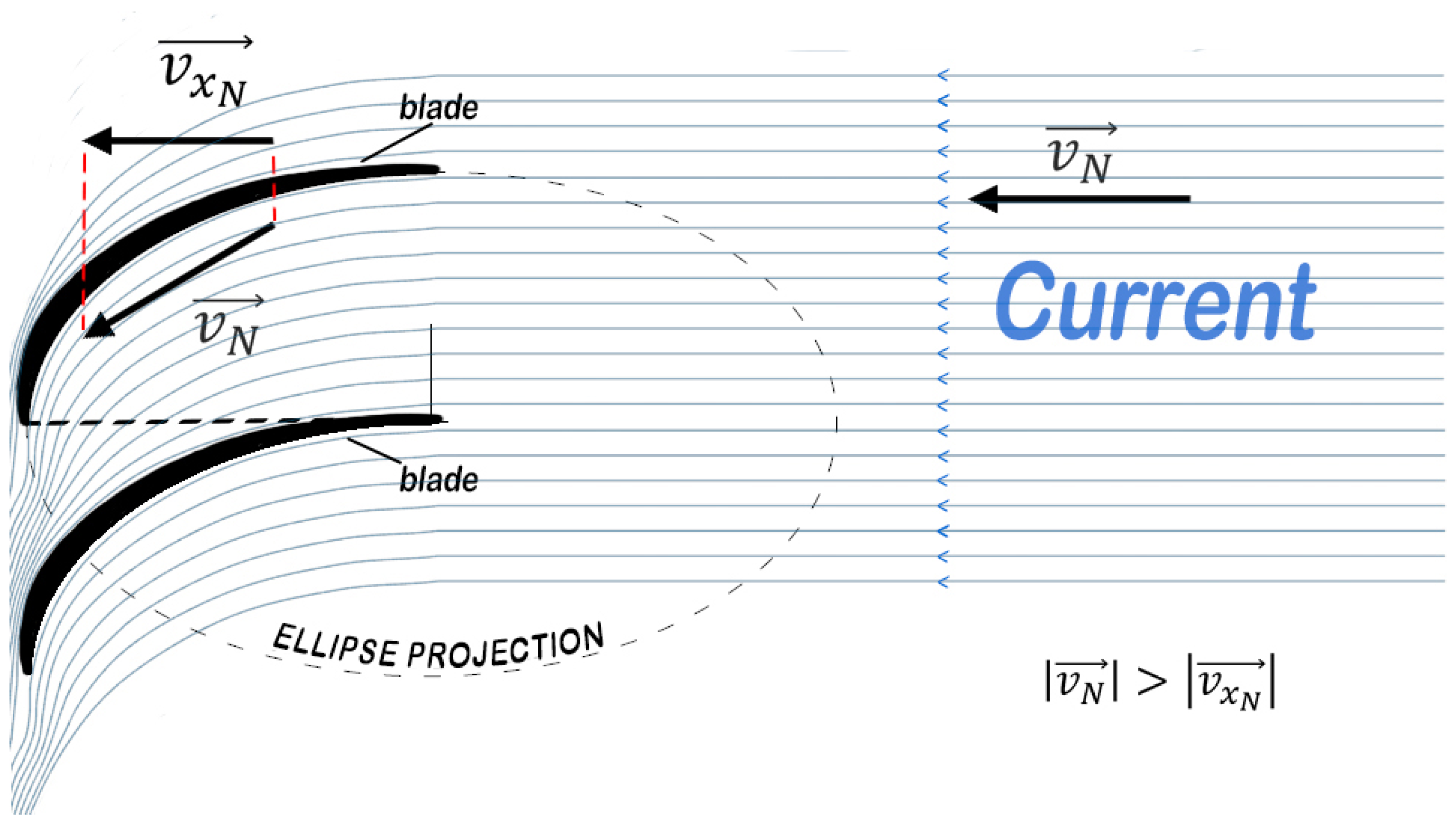
Figure 6.
Frontal view of the UCEC, showing the total occupation of the cross-sectional area by blades in a continuous angular distribution.
Figure 6.
Frontal view of the UCEC, showing the total occupation of the cross-sectional area by blades in a continuous angular distribution.
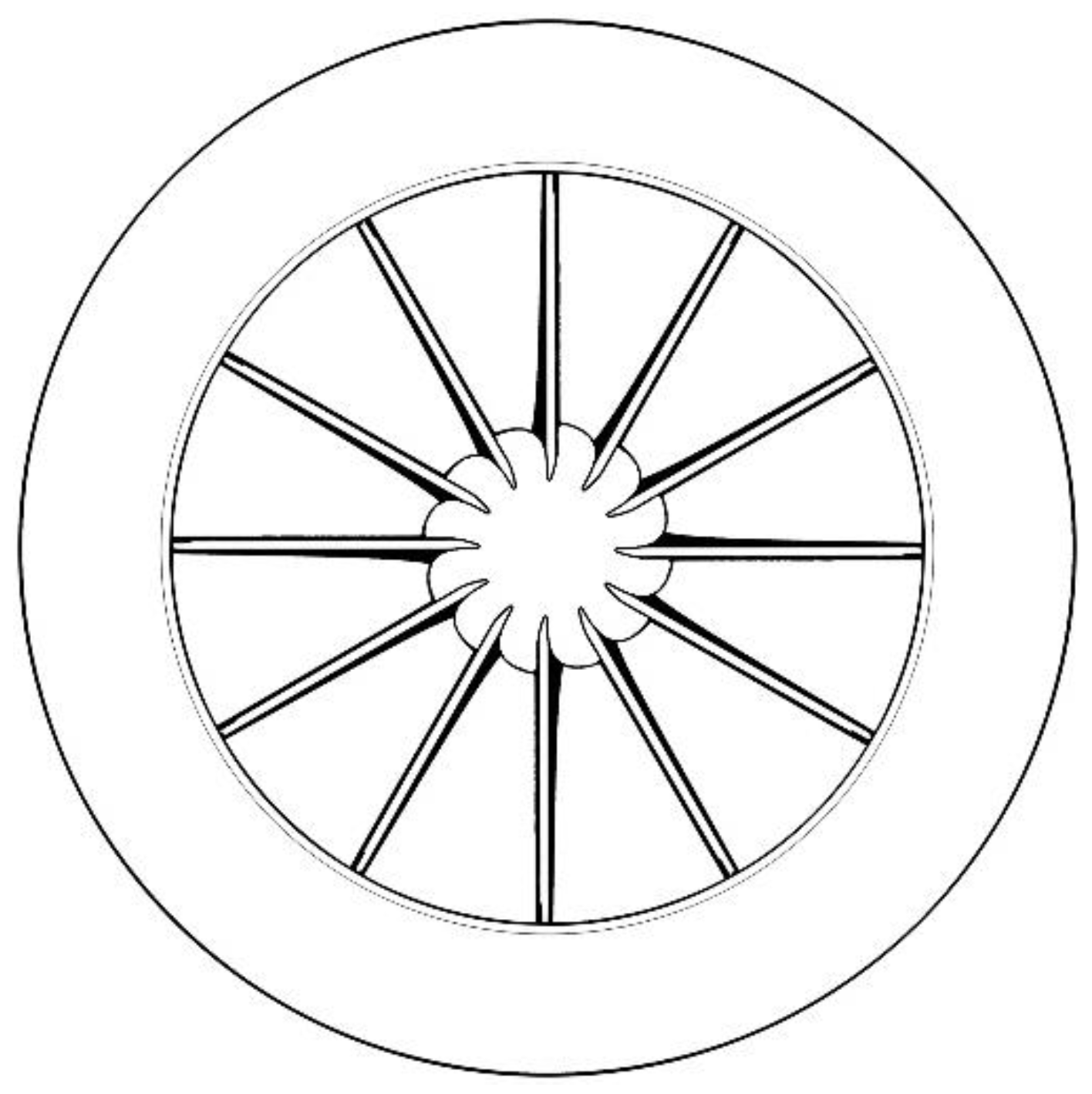
Figure 7.
Three-dimensional rendering simulating a parallel light beam projected over the rotor, with the shadow evidencing the absence of bypass zones.
Figure 7.
Three-dimensional rendering simulating a parallel light beam projected over the rotor, with the shadow evidencing the absence of bypass zones.
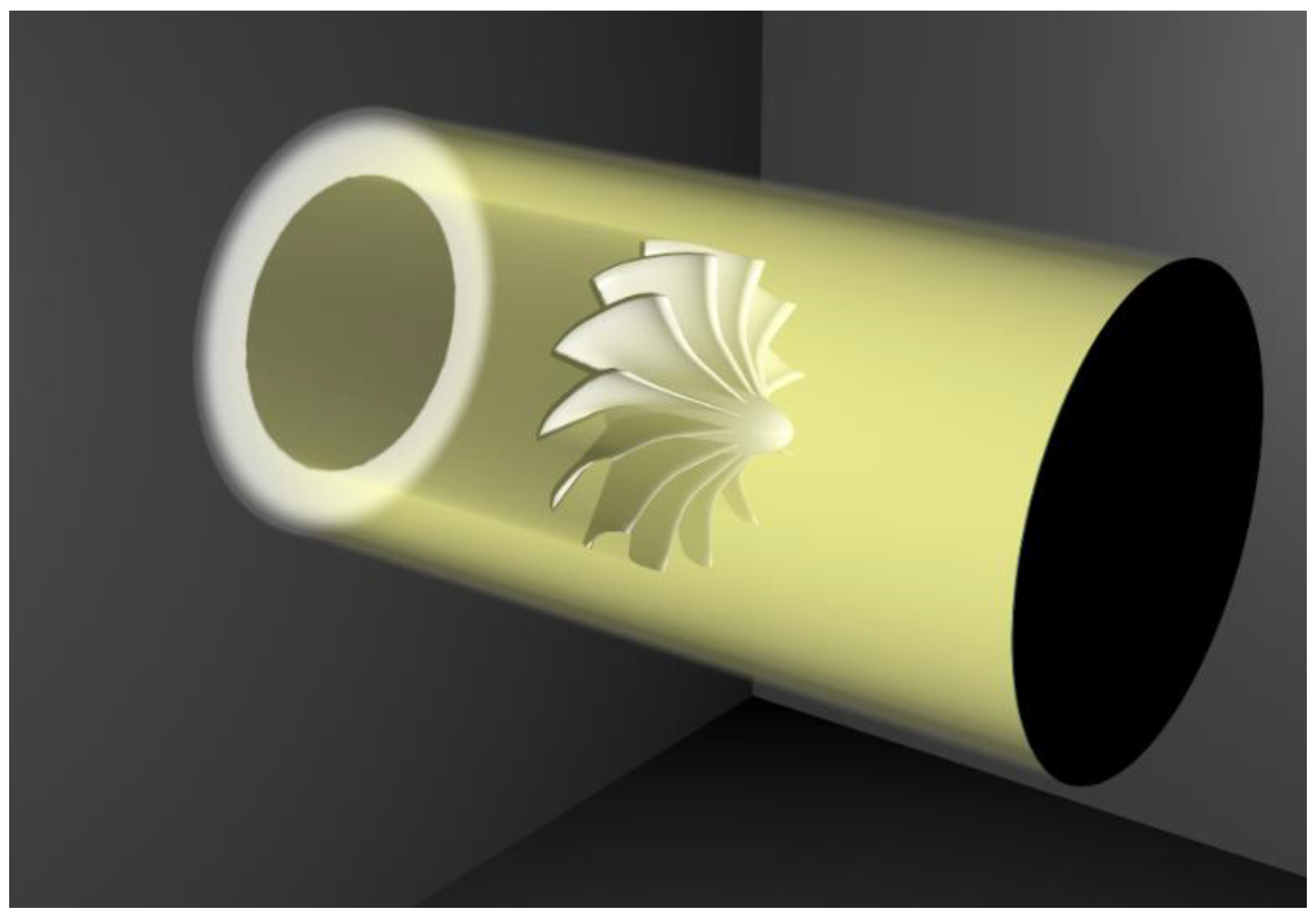

Table 1.
Classical vs. ERPF Energy Conversion Models.
| Characteristic | Conventional Models (Wind/Submerged) | ERPF Model with UCEC |
| Operating Medium | Air (compressible) / Water (partially incompressible) | Ocean water (incompressible) |
| Energy Extraction | Local flow speed reduction | Vectorial redirection of the flow |
| Theoretical Efficiency Limit | ≤ 59.3% (Betz Limit) | Potentially > 100% (κ < 1, CP>1) |
| Energy Replenishment | Not considered (finite incident energy) | Sustained by global environmental forces |
| Flow Disturbance | High deceleration and turbulence | Minimal vectorial disturbance |
| Cross-Section Occupation | Partial (bypass zones) | Full (vectorial deflection mesh) |
| Ecological Impact | Disruptive (collision risk with fauna) | Regenerative and safe for fauna |
Disclaimer/Publisher’s Note: The statements, opinions and data contained in all publications are solely those of the individual author(s) and contributor(s) and not of MDPI and/or the editor(s). MDPI and/or the editor(s) disclaim responsibility for any injury to people or property resulting from any ideas, methods, instructions or products referred to in the content. |
© 2025 by the authors. Licensee MDPI, Basel, Switzerland. This article is an open access article distributed under the terms and conditions of the Creative Commons Attribution (CC BY) license (http://creativecommons.org/licenses/by/4.0/).
Copyright: This open access article is published under a Creative Commons CC BY 4.0 license, which permit the free download, distribution, and reuse, provided that the author and preprint are cited in any reuse.


