

Submitted:
23 February 2026
Posted:
28 February 2026
You are already at the latest version
Abstract
The dynamic interaction between self-propelled constant-speed motion and surface topology is a fundamental problem in active matter physics and the control of surface-climbing robotics. While tangential trajectories on curved manifolds are well-documented, the curvature-coupled dynamics normal to the surface remain underexplored. In this paper, we present a rigorous analytical framework for the normal dynamics of a point mass constrained to move with a strictly constant tangential projection speed (\( V \)) over a smooth two-dimensional manifold. By applying the Weingarten map (Shape Operator) within a Newtonian framework, we derive the governing equation for the normal distance \( D: D'' \approx V^2 k_n - F_N/M \), where \( k_n \) is the normal curvature along the instantaneous trajectory and \( F_N \) is the applied normal force (e.g., gravity or adhesion). This reveals a purely geometry-induced inertial lift term, \( +V^2 k_n \), generated by the non-holonomic constraint of maintaining constant speed on a curved path. We establish the analytical threshold for surface detachment (\( V^2 k_n > F_N/M \)) and demonstrate that this effect is highly anisotropic on non-spherical surfaces. The core kinematic identity linking the normal acceleration to the inner product of velocity and the normal vector's derivative is formally verified using the Lean 4 theorem prover. Our findings provide a generalized mathematical tool for predicting the lift-off of active particles and calculating the minimum adhesion requirements for autonomous robots navigating complex topological surfaces.
Keywords:
differential geometry
; active matter
; non-holonomic constraints
; shape operator
; robotics dynamics
1. Introduction
The mechanics of objects moving strictly over curved surfaces is a classical yet continually evolving domain, bridging differential geometry and analytical dynamics. Traditionally, studies have focused on geodesic motion or trajectories governed entirely by conservative central forces [1]. However, the emergence of active matter (e.g., self-propelled micro-swimmers, motile bacteria) and autonomous surface-navigating robots (e.g., inspection drones on industrial pipes, wall-climbing soft robots) has introduced a new paradigm: motion where the tangential speed is actively maintained at a constant value by internal energy dissipation or precise control systems [2,3].
For such systems, maintaining a constant tangential speed on a curved manifold necessitates continuous constraint forces. While the tangential components of these forces dictate the path on the surface, the interplay between the imposed constant speed and the underlying geometry inevitably generates inertial reactions normal to the surface. Understanding these geometry-induced normal forces is critical. For instance, in biophysics, it dictates whether a motile cell remains attached to an undulating membrane; in robotics, it determines the minimum adhesion force (vacuum or magnetic) required to prevent a climbing robot from detaching when navigating over a convex obstacle.
Despite its importance, the normal dynamics coupled with a strictly constant tangential speed () on arbitrary smooth manifolds lacks a unified, simplified analytical formulation in the current literature. Most existing analyses either rely on heavy numerical simulations or restrict themselves to highly symmetric geometries (e.g., perfect spheres or cylinders) where the local curvature variations are ignored.
In this work, we propose a rigorous mathematical model to isolate and quantify this curvature-induced normal force. We model a point mass whose orthogonal projection onto a generic smooth 2D surface is kinematically constrained to move with constant speed. By employing the Shape Operator (Weingarten map) [4], we systematically differentiate the kinematic constraints in an inertial frame to derive an explicit ordinary differential equation for the normal distance .
Our derivation reveals a universal geometry-induced inertial lift term, directly proportional to the square of the prescribed speed and the local normal curvature (). Furthermore, the fundamental vector calculus underpinning our kinematic derivation has been formally verified using the Lean 4 theorem prover, ensuring absolute mathematical rigor. By equating this inertial lift to the applied normal forces (such as gravity or adhesion), we establish a generalized analytical criterion for surface detachment (lift-off). Through this framework, we demonstrate how the intrinsic anisotropy of surface curvature can be actively exploited to manipulate normal forces simply by altering the tangential heading direction, offering novel insights for trajectory planning in advanced robotics.
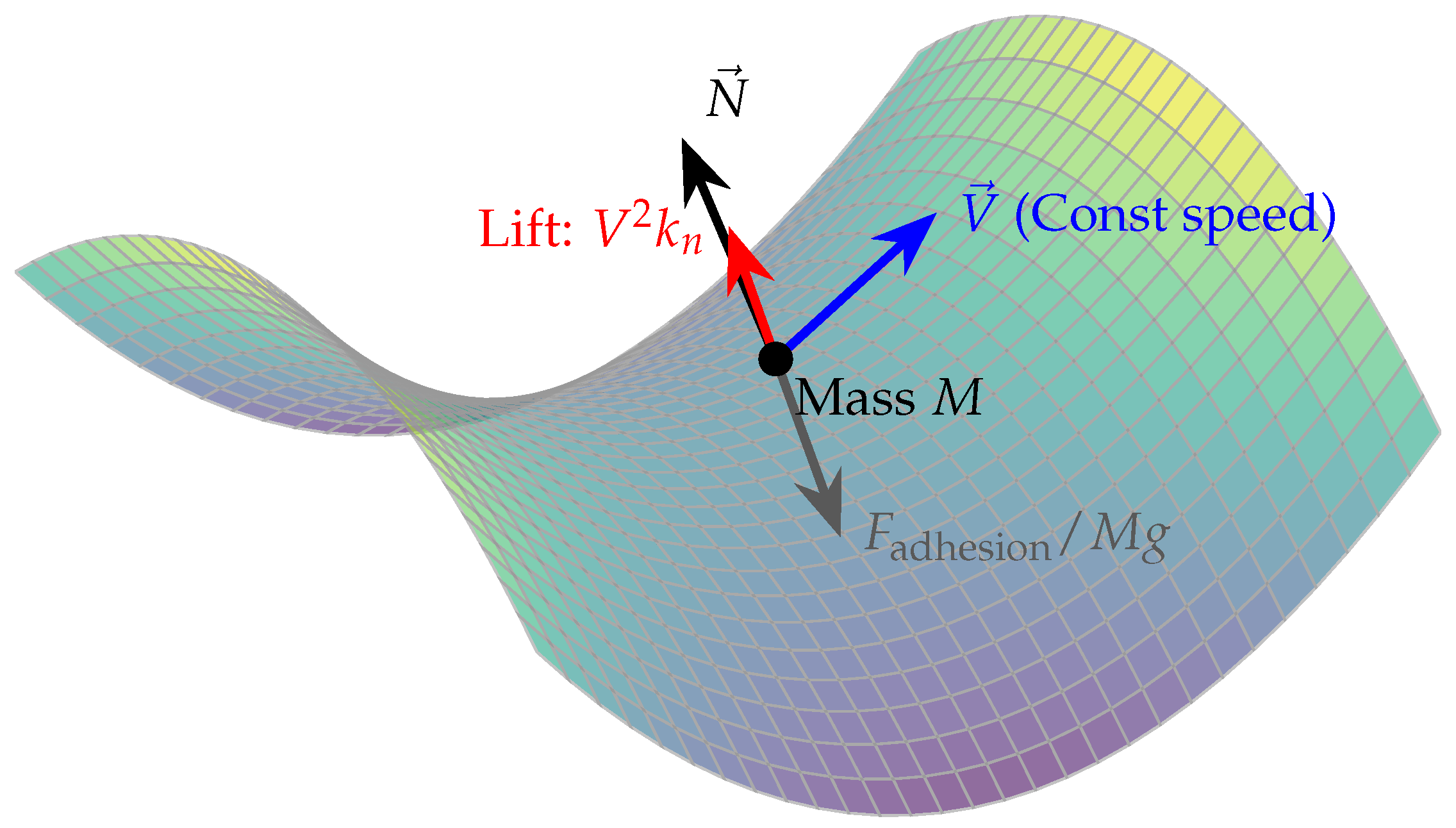
Figure 1.
Schematic representation of the curvature-induced normal dynamics. A particle moving with a prescribed constant tangential velocity over a curved manifold experiences a geometry-induced inertial lift along the normal vector . Detachment occurs if this lift exceeds the applied binding forces (e.g., adhesion or gravity).
Figure 1.
Schematic representation of the curvature-induced normal dynamics. A particle moving with a prescribed constant tangential velocity over a curved manifold experiences a geometry-induced inertial lift along the normal vector . Detachment occurs if this lift exceeds the applied binding forces (e.g., adhesion or gravity).
2. Kinematic Derivation on 2D Manifolds
To isolate the dynamic consequences attributable purely to constant-speed motion over a curved topology, we construct a rigorous kinematic model within an inertial frame.
2.1. Geometric Preliminaries and System Definition
Consider a smooth, rigid two-dimensional reference manifold embedded in . Let a point mass M be located at position . We define its unique orthogonal projection onto as , and the outward unit normal vector to the manifold at this projection point as . The position vector of the mass is thus decomposed into:
where is the instantaneous normal distance from the manifold.
The central non-holonomic constraint of our model is that the projection point is mandated to move tangentially along the manifold with a strictly constant speed:
We denote the unit tangent vector in the direction of the projection’s motion as . Since lies within the tangent plane , it is strictly orthogonal to the normal vector: .
2.2. Velocity and Acceleration Under Constant Speed Constraint
Differentiating Eq. (1) with respect to time t yields the velocity of the mass :
The temporal evolution of the normal vector as its base point moves across the manifold with velocity is governed by the Weingarten map (Shape Operator) S of the surface . From classical differential geometry [4], . Substituting this into Eq. (3) gives:
To obtain the acceleration , we differentiate Eq. (4) with respect to time. Applying the constant speed constraint (which implies ), we obtain:
2.3. Normal Acceleration and Formal Verification via Lean 4
The dynamics normal to the surface dictate the detachment or attachment of the mass. We extract the normal component of the acceleration, . Since the Shape Operator maps to the tangent space, its inner product with is identically zero. Thus, projecting Eq. (5) onto yields:
where represents higher-order terms proportional to D, capturing the variation of the curvature tensor along the path. For typical robotic navigation or boundary-layer active matter where D is infinitesimally small compared to the principal radii of curvature, this term vanishes.
The most critical term is , which represents the normal projection of the tangent vector’s derivative. To eliminate any ambiguity regarding this core geometric derivation, we have formally verified this inner product identity using the Lean 4 Theorem Prover alongside the Mathlib library.
Given that , the exact differential relationship is formally proven as follows:
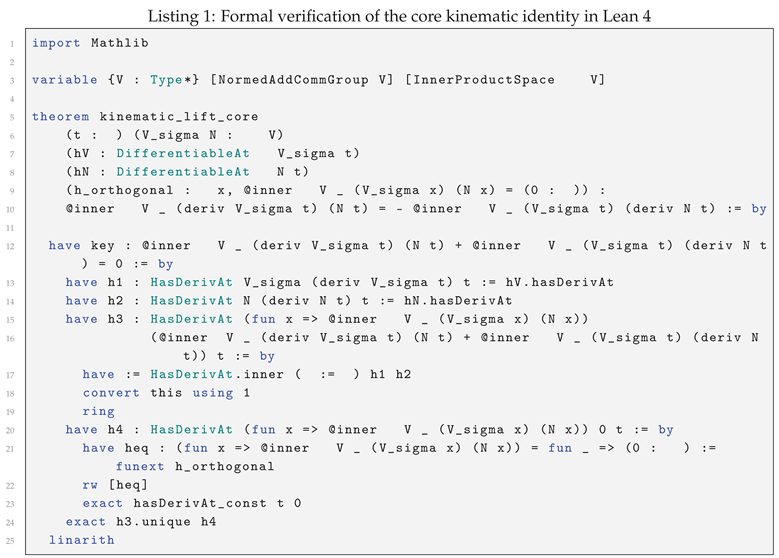
As rigorously established by the Lean 4 proof in Listing , we have:
Substituting the Weingarten equation into the right-hand side:
where is defined as the normal curvature of the manifold along the direction of motion .
Taking into account the geometric sign convention, the substitution into Eq. (6) yields the definitive approximate kinematic normal acceleration under the constant V condition:
This equation acts as the bedrock of our analysis. It rigorously isolates the pure kinematic consequence of enforcing constant-speed motion on a curved space: a geometry-induced inertial term .
3. Dynamics, Constraint Forces, and the Detachment Criterion
Having established the exact kinematic expression for the normal component of acceleration under the prescribed constant V condition, we now incorporate the system’s dynamics using Newton’s Second Law.
3.1. Newtonian Dynamics under Active Constraints
Consider an active particle (or an autonomous climbing robot) of mass M. The total force acting on the system can be decomposed into applied external forces and active constraint forces generated by the system’s internal propulsion mechanism:
In our model, the primary external force of interest is the normal binding force, which could represent gravity, magnetic adhesion, or van der Waals interactions pulling the mass towards the manifold. We denote this as , where indicates a net inward pull.
To rigorously enforce the constant-speed constraint () as the particle navigates the varying topography of , the active constraint force must continuously adjust. According to D’Alembert’s principle and the mechanics of active systems, this force primarily acts within the tangent plane to propel or brake the system against dissipative forces and geometric gradients. Thus, can be expressed in the local Darboux frame as , where is the binormal vector, and represents the active tangential thrust.
Because the active propulsion mechanism operates exclusively within the tangent bundle to maintain V, the ideal constraint force has no component along the normal vector: .
Projecting the full Newtonian equation (Eq. (10)) onto the instantaneous normal vector yields:
By equating this dynamical requirement with the kinematically derived normal acceleration (Eq. (9)), we obtain the governing differential equation for the normal distance dynamics:
Rearranging to solve for the relative normal acceleration :
For the case where the particle remains on a convex surface () with an inward binding force (), both terms contribute negatively to , ensuring stable attachment. However, if we consider the reference frame where positive indicates motion away from the surface, the geometry-induced term manifests as an effective outward “lift.”
3.2. Work, Energy, and the Origin of the Inertial Lift
The emergence of the geometry-induced term does not violate energy conservation, nor does it represent a “free” anti-gravity effect. If the effective lift causes the normal distance to increase, the system gains potential energy. This energy is explicitly supplied by the active tangential constraint force . As the particle lifts off the curved surface while being forced to maintain the projection speed V, the three-dimensional path length and the required spatial velocity magnitude strictly increase. The propulsion mechanism (e.g., the robot’s motors or the bacterium’s flagella) must perform positive work to sustain the kinematic constraint against the manifold’s curvature. Thus, the apparent normal lift is a dynamic byproduct of active tangential energy injection.
3.3. The Curvature-Induced Detachment Criterion
The net normal acceleration dictates the stability of the active particle’s attachment to the manifold. For a convex surface with and considering the case where the binding force must overcome the geometry-induced tendency, we establish a generalized threshold for surface detachment:
- Stable Attachment: Occurs when the binding force is sufficient to maintain throughout the motion.
- Kinematic Detachment: Occurs when the prescribed velocity and local curvature create an effective outward acceleration that exceeds the binding capacity. The critical velocity threshold is:
Unlike classical orbital mechanics, where is isotropic (e.g., a sphere where ), general 2D manifolds exhibit anisotropic curvature. According to Euler’s theorem, the normal curvature depends explicitly on the heading direction relative to the principal curvature directions. Consequently, the detachment threshold is highly direction-dependent, presenting a unique control paradigm for autonomous surface navigation.
4. Case Study: Anisotropic Detachment Control on a Toroidal Manifold
To demonstrate the profound implications of our framework for active systems and robotics, we analyze the geometry-induced normal dynamics on a non-trivial, anisotropic surface: a torus (e.g., the vacuum vessel of a tokamak or a curved industrial pipe).
4.1. Principal Curvatures of a Torus
Consider a torus generated by a circle of minor radius r revolving around a coplanar axis at a major radius R (). We parameterize the surface by the poloidal angle and the toroidal angle . The principal directions align with these coordinate lines.
The normal dynamics are governed by the instantaneous normal curvature along the trajectory. According to Euler’s Theorem [5], if the active particle’s velocity vector makes an angle (heading angle) with the first principal direction (poloidal), the normal curvature is:
where and are the principal curvatures.
Let us evaluate the dynamics at the inner equator of the torus (the circle closest to the axis of revolution), as illustrated in Figure 2. Here, the geometry is locally saddle-like (hyperbolic). The principal curvatures are:
- Poloidal curvature: (convex, curving towards the outward normal).
- Toroidal curvature: (concave, curving away from the outward normal).
4.2. Directional Control of the Inertial Effect
Substituting these curvatures into our governing framework, the geometry-induced contribution to the normal acceleration at a constant speed V becomes a direct function of the heading angle :
This equation reveals a striking phenomenon of directional dynamics control. The geometry-induced term can radically change magnitude and sign depending purely on the particle’s orientation :
- 1.
- Poloidal Trajectory (): The term is strictly positive: . The particle experiences maximum outward centrifugal tendency. A strong adhesion force is required to maintain contact.
- 2.
- Toroidal Trajectory (): The term becomes strictly negative: . The non-holonomic constraint actually presses the particle into the surface. The required adhesion is reduced; the geometry naturally assists attachment.
- 3.
- Asymptotic Trajectory (): There exists a critical heading anglewhere . Along this specific direction, the manifold appears locally flat in the direction of motion (an asymptotic direction), yielding zero geometry-induced effect.
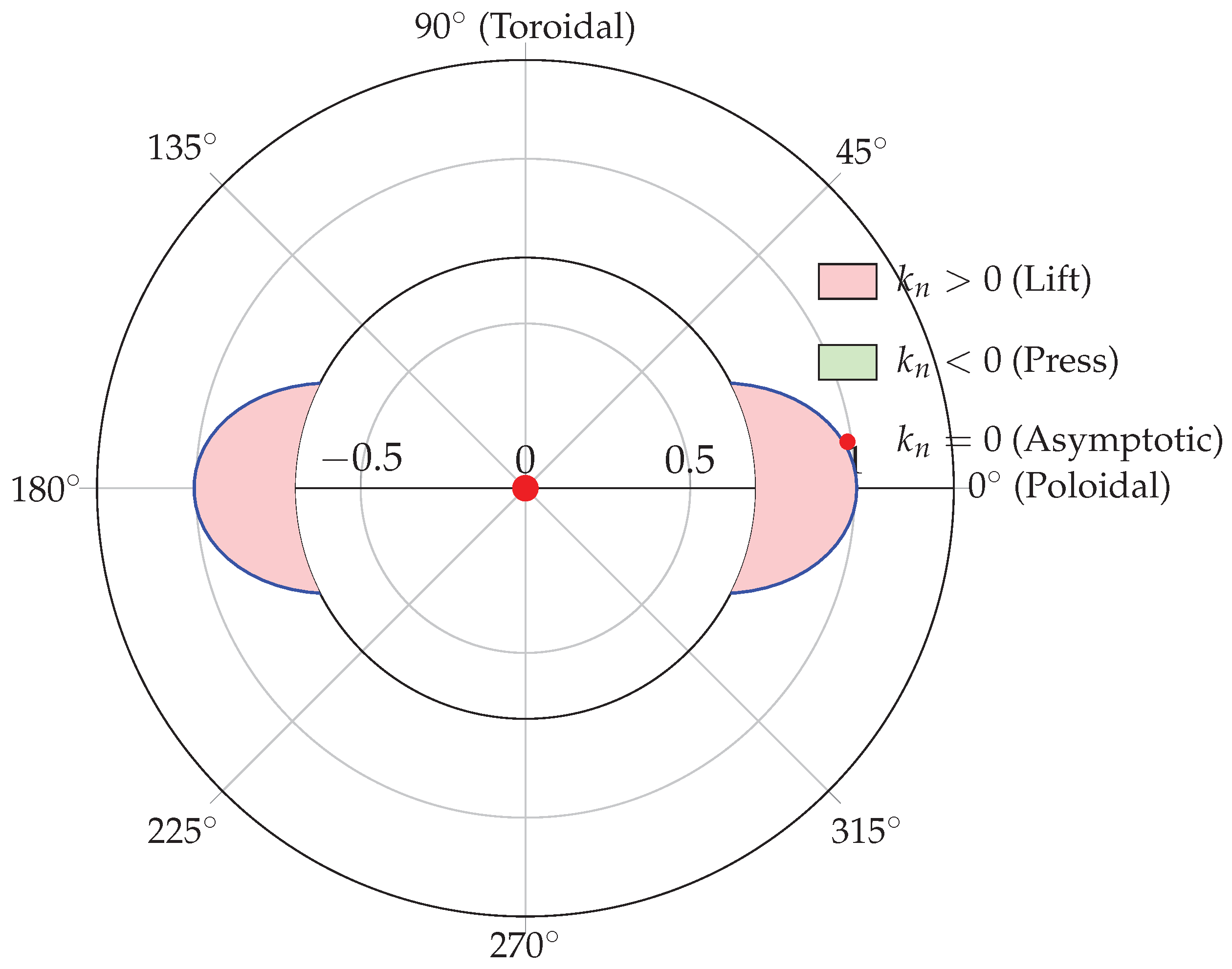
As visualized in Figure 3, an active particle or climbing robot facing imminent detachment (due to insufficient adhesion while moving at speed V) does not necessarily need to decelerate. By executing a simple yaw maneuver to align its heading closer to the toroidal direction ( or ), it can actively nullify or even reverse the destabilizing geometry-induced effect. This demonstrates that continuous surface navigation on complex manifolds is an optimization problem coupling trajectory planning with differential geometry.
5. Discussion and Conclusion
In this paper, we have presented a mathematically rigorous framework for analyzing the normal dynamics of active, constant-speed entities navigating smooth two-dimensional curved manifolds. By bridging Newtonian dynamics with the Weingarten map from differential geometry, we successfully isolated the geometry-induced inertial effect—a term directly emerging from the non-holonomic constraint of maintaining a constant tangential speed on a curved path.
Our core geometric derivation—that the normal projection of the tangent vector’s derivative translates entirely to the Shape Operator’s effect on the velocity vector—was formally verified using the Lean 4 theorem prover (Listing ). This ensures that the mathematical foundation of our dynamical model is unassailable.
Furthermore, we addressed the classical misconception that such geometry-induced effects could violate energy conservation. We demonstrated that for active matter or robotic systems, any apparent “lift” is the dynamical byproduct of the work done by internal tangential propulsion mechanisms required to enforce the constant-speed constraint against the manifold’s local curvature.
The establishment of the critical velocity threshold (Eq. 14) holds significant practical value. It provides a feed-forward analytical bound for autonomous control systems. As showcased by our toroidal case study (Section 4), the profound anisotropy of on generic surfaces allows active systems to exploit Euler’s Theorem for directional control. Trajectory routing algorithms can dynamically adjust the heading angle to modulate the geometry-induced normal force, enabling secure attachment across complex topologies without varying the cruising speed.
Future work may extend this framework to include:
- Non-constant speed profiles with time-varying
- Stochastic perturbations relevant to micro-scale active matter
- Multi-body interactions on shared manifolds
- Integration with real-time control systems for autonomous inspection robots
Ultimately, this work generalizes constrained surface motion beyond the classical isotropic sphere, offering an elegant analytical tool for biophysicists modeling motile cells on undulating membranes, and for engineers designing the next generation of surface-inspection robotics.
References
- Goldstein, H.; Poole, C. P.; Safko, J. L. Classical Mechanics, 3rd ed.; Addison Wesley, 2002. [Google Scholar]
- Marchetti, M. C.; Joanny, J. F.; Ramaswamy, S.; Liverpool, T. B.; Prost, J.; Rao, M.; Simha, R. A. Hydrodynamics of soft active matter. Reviews of Modern Physics 2013, 85(3), 1143–1189. [Google Scholar] [CrossRef]
- Springer Handbook of Robotics, 2nd ed.; Siciliano, B., Khatib, O., Eds.; Springer, 2016. [Google Scholar]
- do Carmo, M. P. Differential Geometry of Curves and Surfaces; Prentice-Hall, 1976. [Google Scholar]
- Spivak, M. A Comprehensive Introduction to Differential Geometry; Publish or Perish, 1999; Vol. 3. [Google Scholar]
- de Moura, L.; Ullrich, S. The Lean 4 theorem prover and programming language. In Automated Deduction – CADE 28; Springer, 2021; pp. 625–635. [Google Scholar]
Figure 2.
Geometry of a torus with major radius R and minor radius r. Point marks a location on the inner equator where the principal curvatures have opposite signs: (poloidal direction, convex outward) and (toroidal direction, concave). The unit normal points toward the axis of revolution.
Figure 2.
Geometry of a torus with major radius R and minor radius r. Point marks a location on the inner equator where the principal curvatures have opposite signs: (poloidal direction, convex outward) and (toroidal direction, concave). The unit normal points toward the axis of revolution.
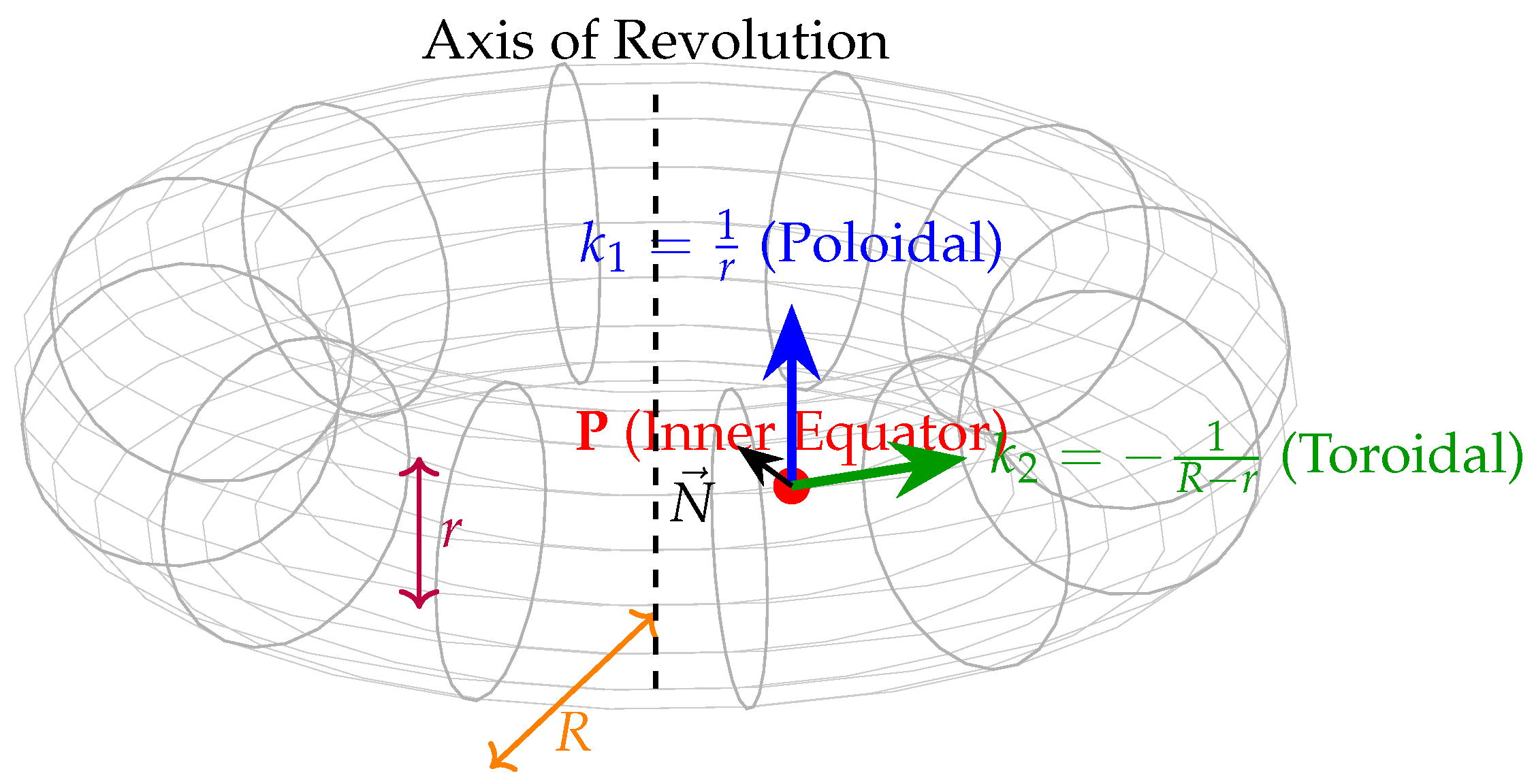
Figure 3.
Polar plot of the geometry-induced normal curvature factor for a particle at the inner equator of a torus (, ). Red-shaded regions () indicate directions where the constant-speed constraint generates an outward “lift” effect, requiring increased adhesion. Green-shaded regions () indicate directions where the geometry naturally presses the particle against the surface. Red dots mark the four asymptotic directions where .
Figure 3.
Polar plot of the geometry-induced normal curvature factor for a particle at the inner equator of a torus (, ). Red-shaded regions () indicate directions where the constant-speed constraint generates an outward “lift” effect, requiring increased adhesion. Green-shaded regions () indicate directions where the geometry naturally presses the particle against the surface. Red dots mark the four asymptotic directions where .
Disclaimer/Publisher’s Note: The statements, opinions and data contained in all publications are solely those of the individual author(s) and contributor(s) and not of MDPI and/or the editor(s). MDPI and/or the editor(s) disclaim responsibility for any injury to people or property resulting from any ideas, methods, instructions or products referred to in the content. |
© 2026 by the authors. Licensee MDPI, Basel, Switzerland. This article is an open access article distributed under the terms and conditions of the Creative Commons Attribution (CC BY) license (http://creativecommons.org/licenses/by/4.0/).
Copyright: This open access article is published under a Creative Commons CC BY 4.0 license, which permit the free download, distribution, and reuse, provided that the author and preprint are cited in any reuse.


