

Submitted:
25 April 2025
Posted:
25 April 2025
You are already at the latest version
Abstract
Mangrove forests are one of the ecosystems with the richest biodiversity and the highest functional value of ecosystem services in the world. For mangrove research, it is particularly important to facilitate mangrove mapping, plant species classification, biomass and carbon sink estimation using remote sensing technologies. Recently, more and more studies have combined unmanned aerial vehicles and remote sensing technology to estimate plant traits and the biomass of mangrove forests. Various multispectral and hyperspectral data are used to establish various vegetation indexes for plant classification, and data models for biomass estimation and carbon sink calculation. This study systematically reviews the use of remote sensing and unmanned aerial vehicles in mangrove studies during the past three decades based on 2,424 peer-reviewed papers. By synthesizing these studies, we identify the pros and cons of different indices and models developed from remote sensing technologies by sorting out past cases. Specifically, we review the use of remote sensing technologies in mapping the past and present area, plant species composition, biomass of mangrove forests and examines the threats to the degradation of mangrove forests. Our findings reveal that there is increasing integration of machine learning and remote sensing to facilitate mangrove mapping and species identification. Moreover, multiples sources of remote sensing data tend to be combined to improve species classification accuracy and enhance the precision of mangrove biomass estimates when integrated with field-based data.

Keywords:
mangrove forests
; remote sensing
; carbon sinks
; biomass
; unmanned aerial vehicles
; degradation
1. Introduction
Mangroves are ecosystems located along tropical and subtropical coastlines, renowned for their exceptionally high value in providing ecosystem services [1]. These services include carbon sequestration and long-term burial, providing nursery habitats for various benthic organisms and nearshore fisheries, stabilizing coastlines, supporting ecological restoration, and promoting sustainable eco-tourism [2,3]. Mangroves serve as the first natural barrier against natural disasters such as cyclones, tsunamis and extreme tidal surges [4]. Moreover, mangroves possess immense potential for carbon sequestration, storage and export, offering invaluable contributions to mitigating the impacts of climate change [5,6]. In recent decades, global climate change and human activities in coastal regions have driven the conversion of mangroves into various other land use types, such as agricultural land, aquaculture ponds, and urban development [7].
Mangrove biomass is a crucial indicator for assessing mangrove productivity, ecosystem functions, and sustainable development. Although field-based measurements provide accurate estimates on mangrove biomass, they often require substantial investments of labour and logistic support, and cannot provide timely estimates. Consequently, an increasing number of studies have been estimating mangrove biomass by using satellite remote sensing technology [8]. It offers broad coverage, quick access, and low costs for the precise measurement [9,10], mapping [11,12], and monitoring of mangrove biomass [13]. Combining remote sensing with machine learning models enables efficient and accurate estimation of mangrove biomass and carbon sequestration over different spatio-temporal scales [14]. In earlier studies, satellite remote sensing typically relies on passive sensing technologies, which are often affected by weather conditions, cloud cover, tidal conditions, and satellite orbital constraints. These constraints make it challenging to obtain high-quality satellite imagery [15]. However, the acquisition and utilization of mangrove-related imagery and spectral information have reached unprecedented precision and efficiency [16,17] with the integration of active remote sensing, Light Detection And Ranging (LiDAR) technology, multispectral and hyperspectral imaging, as well as the synergistic use of satellites and Light Detection And Ranging (LiDAR).
Globally, extensive research has been done on mangrove biomass and carbon sequestration, with a noticeable increasing trend in recent years. As our understanding of mangroves deepens, an increasing number of blue carbon studies have emerged. The term blue carbon was coined in 2009 and has since gained recognition and importance [18]. Given the widespread global distribution of mangroves and the varying conditions across countries, research projects and methodologies also exhibit significant diversity.
Remote sensing tools can integrate field survey data more effectively to establish allometric equations for accurately estimating the aboveground carbon storage of mangroves. Multispectral and hyperspectral remote sensing imagery, synthetic aperture radar (SAR), and LiDAR can successfully map the distribution and species composition of mangrove ecosystems. These technologies offer advantages such as cost-effectiveness, controllable accuracy, and are able to cover larger areas more efficiently compared to traditional field surveys [19,20]. Remote sensing and unmanned aerial vehicles (UAVs) have significant potential in monitoring changes in mangrove extent [21,22], assessing various plant characteristics [23,24] (e.g., tree height and leaf area index) and predicting the degradation of mangrove forests [25]. However, these advanced technologies also have inherent limitations. The spectral similarity among different mangrove species makes species identification challenging, and the high density of vegetation overlap further exacerbates this difficulty [26].
Earlier satellite remote sensing data cover large areas and are relatively easy to acquire. However, the spatial resolution of these satellites is generally not very high, and data are often limited by the satellite’s fixed orbit and operational cycle. Mangroves typically grow in intertidal regions, makes it challenging to obtain satellite imagery at low tide conditions. In contrast, drones have emerged as a promising alternative for mapping mangroves due to their flexibility, portability, and high data quality [31,32]. The high spatial resolution offered by drone imagery bridges the gap between large-scale satellite monitoring and on-the-ground field surveys, providing a crucial link for advancing species classification and mapping mangrove extent [30,33,34].
For example, Zhu et al. [35] combined Landsat-8 imagery with Multiple Altimeter Beam Experimental Lidar (MABEL) data to generate a tree height map with a spatial resolution of 30 meters. Wang et al. [36] estimated the total height and above-ground biomass (AGB) of mangroves in Hainan Island by integrating field plot data, UAV-LiDAR data, and Sentinel-2 imagery. At present, most research relies on satellite imagery as the primary data source, with drone data serving as a supplementary tool. However, both types of data can be combined to supplement each other, improving the accuracy of estimating mangrove biomass, species classification, and carbon stock predictions.
Earlier satellite remote sensing often relied on manual interpretation, which was prone to significant errors and subjective biases from interpreters. However, advancements in technology over recent decades have transformed this approach. The integration of unmanned aerial vehicle (UAV) technology with machine learning algorithms and supervised classification methods has enabled more accurate classification of mangrove species and improved mangrove mapping. Despite these advancements, a review of the literature reveals that few studies have systematically summarized the application of UAV data and machine learning algorithms in mangrove ecosystem research. In particular, there is a notable gap in studies focusing on two key areas: the accuracy of mangrove species classification using different machine learning algorithms and the assessment of mangrove degradation.
To address this research gap, this review summarizes past studies related to estimate mangrove biomass, plant traits, species composition, as well as mangrove mapping based on satellite and drone remote sensing. The objectives of this study include: 1) Reviewing the advancements in predicting mangrove biomass and carbon dynamics using remote sensing and drone LiDAR technologies, and summarizing their pros and cons. 2) Summarizing the performance of mainstream machine learning algorithms in mangrove species classification and compares their respective strengths and limitations. 3) Investigating the causes of mangrove degradation through remote sensing technologies. 4) Highlighting the development and future trends of integrating new technologies, such as remote sensing, drones, and machine learning in mangrove ecological research. This review underscores the critical role of satellite and drone remote sensing in global mangrove studies and establishes the importance of remote sensing technologies in studying mangroves. Meanwhile, this study summarizes the current limitations of remote sensing technologies and discusses the potential for integrating drone technology with remote sensing, highlighting how their combined use could enhance the accuracy of estimating mangrove biomass and mapping mangroves.
2. Materials and Methods
2.1. Data Collection
The analytical data for this study were collected from the online database ‘Web of Science’. The specific search terms include the article retrieval period (from January 1, 1990, to October 1, 2024), article topics, and article language. Detailed information is provided in Table 1.
The Web of Science (WoS) primarily covers fields such as natural sciences, engineering, and medicine and includes a large number of English-language journals. As a result, it is a suitable database for this study. However, WoS also has certain limitations. Specifically, it contains relatively few non-English publications, particularly those in Russian and French, which may lead to the omission of important regional research findings. Additionally, WoS relies on searches based on titles, abstracts, and keywords, rather than the full text of articles, which may limit the precision of retrieval results. To mitigate these limitations, this study employs topic-based search queries, ensuring that the selected search terms are as broad as possible to maximize the number of relevant articles retrieved.
2.2. Data Analysis
A total of 2,424 articles were retrieved, including 2,060 journal articles (84.983%), 68 review papers (2.805%) and 358 conference papers (14.769%). From 1990 to 2024, there has been a continuous increase in the number of papers in the area of mangrove remote sensing. Figure 1 indicates that the number of publications from 2010 to 2024 is 2,124 (87.62%), whereas it was only 300 (12.38%) from 1990 to 2009. This stark contrast highlights that papers published after 2010 dominate studies on remote sensing of mangroves. As a result, this review primarily focuses on recent publications to elaborate on the applications of remote sensing in mangrove research. In terms of both publication quantity and citation frequency, papers on mangroves based on UAV and satellite remote sensing are currently increasing. These data indirectly confirm the feasibility and vast potential of remote sensing technologies in mangrove research.
In terms of the author nationalities, China plays a disproportionately important role in studying mangroves using remote sensing technologies. Scholars from China (647 articles from mainland China, 4 from Hong Kong and 30 from Taiwan) ranked first during 1990 - 2024, followed by scholars from the United States and India (Figure 2). Although the area of mangroves in China is approximately 30,000 hectares, accounting for only 0.2% of the global mangrove area [37], this does not dampen the enthusiasm of Chinese researchers.
The growing number of studies on remote sensing of mangroves is closely linked to China’s carbon peak and carbon neutrality goals. This is because mangrove ecosystems have become a research hotspot, primarily due to their carbon sequestration capacity, which is an order of magnitude greater than that of terrestrial forests. Notably, Asia has emerged as the primary region for mangrove ecosystem research. This is attributed to two key factors: on one hand, Southeastern Asian countries have extensive mangrove coverage, and on the other hand, they host the highest diversity of mangrove species globally, making the region the center of global mangrove distribution [37]. These unique characteristics have attracted researchers from around the world to Asia, particularly Southeastern Asian countries, to study mangrove ecosystems.
2.3. Technical Approach
A review of the papers indicates that mangrove ecosystem research generally follows a similar technical approach (Figure 3). This approach typically integrates satellite remote sensing data, UAV data, and field survey data, followed by visualization of the data through specialized software. Increasingly, researchers are combining traditional software with machine learning methods. This is because machine learning techniques are more effective in overcoming the subjectivity of visual interpretation, thus improving the accuracy of the output products. Although machine learning offers significant advantages in handling large-scale datasets, the models and parameters developed are typically applicable only to specific study areas. This results in a lack of portability for these models and parameters, meaning that for each new research area, the models must be re-established, and parameters must be set according to the specific conditions of that area.
3. Predicting Mangrove Biomass and Carbon Dynamics
Recently, the capacity of mangroves to store large amounts of carbon has gained significant attention [5,38,39,40]. Donato et al. [38] estimated that soil carbon stocks account for 49-98% of the total carbon stored in mangroves. Therefore, accurately estimating the spatial distribution of mangrove soil carbon stocks is a critical step in assessing the impacts of climate change and human activities on mangrove carbon storage, and evaluating the climate mitigation potential of these ecosystems [41].
Jardine et al. [42] developed a predictive model based on soil carbon stocks compiled from the meta-analysis of Chmura et al. [43], Kristensen et al. [44], and Donato et al. [38]. These three studies collectively include data from over 900 samples collected from 28 countries/regions, which accounts for 64.4% of the global mangrove area. Jardine et al. [42] used both parameter-based predictive models and machine learning algorithms. They identified annual precipitation as the most significant predictor for soil carbon stocks, followed by distance from the equator and geographic region. Based on their model predictions, Jardine et al. [42] generated a high-resolution, spatially explicit global dataset of mangrove soil carbon concentrations. This dataset contributes to ongoing mangrove conservation efforts and provides important scientific input for future conservation initiatives.
Numerous studies related to mangrove biomass and carbon stock estimation have been undertaken, typically through field surveys [45,46,47]. However, field survey methods are only applicable to specific locations or local-scale studies. At the global scale, mangrove biomass and carbon sequestration are typically estimated from upscaling methods, wherein the average mangrove biomass density obtained from field surveys is multiplied by the total mangrove area [48]. Additionally, geographic information system (GIS) systems collect geospatial data through remote sensing, GPS, field surveys, sensors, and databases. These geospatial data collected by geographic information system (GIS) technologies can be utilized to estimate mangrove biomass and carbon stocks [49,50]. Advances in geospatial technologies have enabled the increasing availability of georeferenced datasets with fine spatial resolution, suitable for large spatial scales. When integrated with field survey data, these geospatial datasets provide robust support for the estimation of mangrove biomass and carbon storage.
Giri et al. [51] produced the first global mangrove map using remote sensing data by combining automated and manual classification techniques applied to over 1,000 Landsat scenes acquired between 1997 and 2000. Although this effort resulted in a global-scale map, the product did not provide highly accurate information and represented only a single temporal snapshot, failing to capture the critical spatiotemporal dynamics of mangrove ecosystems. Hutchison et al. [52] proposed a climate-based model to estimate global mangrove biomass based on temperature and precipitation data for mangrove regions. In addition to climate-based models, allometric models can be employed to estimate mangrove biomass and carbon sequestration by using canopy height as a key allometric variable [45,53]. This approach is particularly useful because canopy height can be obtained from satellite sensors, significantly reducing data acquisition challenges. For instance, Fatoyinbo et al. [49] applied an allometric model to estimate mangrove biomass in Africa based on canopy height, which was extracted through an overlay analysis of GIS-based Shuttle Radar Topography Mission (SRTM) data and mangrove extent data classified from Landsat imagery.
Even though remote sensing technology has brought great convenience to research, field surveys still remain the most fundamental and accurate method for obtaining aboveground biomass (AGB) measurements of mangroves at local scales [54,55,56,57,58]. However, when applied to larger scales, this approach is both time-consuming and costly [59,60]. Additionally, due to the muddy terrain and unique structural characteristics of mangroves, field surveys in these regions are much more challenging than in other terrestrial ecosystems.
In Table 2, we compared the advantages and disadvantages of traditional field surveys with those of UAVs and remote sensing. While field surveys are indispensable for mangrove research, remote sensing offers a cost-effective means of acquiring large-scale optical data. When properly processed, these data can supplement field survey measurements and improve estimates of mangrove biomass and carbon sequestration. However, certain inherent limitations remain. For instance, Saenger et al. [45] highlighted the problems of the upscaling approach, which estimates AGB from field sample averages and then extrapolates to larger areas by multiplying the total mangrove coverage. This method can introduce significant discrepancies between the estimated and actual biomass. Despite these problems, remote sensing is useful due to the advantages if offers in generating large-scale biomass maps with lower economic and labor costs. Another challenge lies in the use of allometric models, which are essentially regression-based empirical formulas and inherently contain a degree of error. When these models are applied to large spatial scales, the cumulative effect of such errors can significantly impact the accuracy of estimating biomass and carbon sequestration. Although these uncertainties are inevitable, advancements in remote sensing and the integration of high-precision UAV imagery are expected to enhance the accuracy of assessing mangrove biomass and carbon stocks.
In summary, the use of satellite remote sensing and unmanned aerial vehicles (UAVs) has significantly advanced research on mangrove carbon sequestration. Satellite imagery allows for systematic, periodic monitoring of vast mangrove regions, making it particularly suitable for regional or global carbon stock assessments. UAVs, on the other hand, can capture centimeter-level imagery and LiDAR data, which greatly improves the accuracy of estimating canopy height, structure, and biomass. However, these indirect methods of data acquisition also present considerable limitations. For instance, there is an inherent subjectivity in data interpretation, particularly in species classification and biomass modeling. Moreover, current remote sensing techniques struggle to extract information on low-stature mangrove species or understory vegetation, which affects the overall accuracy of carbon stock estimation.
4. Mangrove Mapping and Species Identification
There are various methods for studying mangrove mapping and classification. Early traditional techniques that required field-based classification were challenging, inefficient, and time-consuming due to dense canopies of mangrove forests and the muddy conditions [61]. This direct field-based approach can also be disruptive to mangrove trees. In contrast, remote sensing technology allows for the collection of ground spectral information without direct contact [62]. Additionally, it can be integrated with machine learning algorithms, overcoming the limitations of traditional methods such as visual interpretation, pixel-based classification, and object-based classification. These methods are often subjective, inefficient, or fail to capture spatial information effectively [63,64]. Machine learning algorithms have become a powerful tool in research [65,66] with their ability to handle complex data and extract non-linear relationships.
4.1. Support Vector Machine (SVM)
The SVM method is a machine learning approach based on Vapnik–Chervonenkis Dimension theory and the structural risk minimizing principle [67]. It attempts to locate an optimal hyperplane that maximizes the margin between two classes in high-dimensional space, and has been applied in remote sensing image classification [68,69,70]. For two linearly separable samples, this classifier classifies data by finding an optimal hyperplane that separates all of the data points of one class from those of another class. The hyperplane only needs a few samples to be determined and constructs support vectors. For two non-linearly separable samples, the classifier maps the vector from the low- to high-dimensional space using a kernel function [71]. The SVM applies well and can transform non-linear problems to linear problems by constructing a discrimination function in high-dimensional space. Therefore, it is not influenced by sample dimensions and can avoid the curse of dimensionality [72].
From Table 3, it is evident that the SVM classification model generally achieves an overall accuracy of over 70%, indicating that the SVM method is relatively reliable for classifying mangrove species. Moreover, in many experiments, the overall accuracy exceeds 90%, demonstrating very high classification performance. A review of the literature reveals that classification accuracy is strongly correlated with the mangrove species in the experimental area and the type of satellite data used. For single data types, the classification accuracy of hyperspectral imagery generally exceeds that of multispectral imagery, due to the higher spectral resolution of hyperspectral data. Multiple experiments have also demonstrated that combining multi-source satellite imagery can, to some extent, improve classification accuracy. For example, Zhen et al. [28] used the SVM method to classify mangrove species in their study area using Radarsat-2 and Landsat-8 as data sources. The results showed that when using Radarsat-2 imagery alone, the overall accuracy was only 53.4% with a Kappa coefficient of 0.46. When using Landsat-8 imagery alone, the overall accuracy increased to 83.5% with a Kappa coefficient of 0.80. However, when the two datasets were combined, the overall accuracy reached 95%, and the Kappa coefficient increased to 0.95.
The advantages of SVM [73] include: 1) Better classification performance when dealing with high-dimensional and complex data, 2) High generalization capacity, 3) High flexibility in choosing different kernel functions to fit different data structures. On the other hand, disadvantages of SVM include: 1) High computational complexity and long training time, 2) More sensitive to the choice of parameters and kernel functions, 3) Not applicable to large-scale datasets.
4.2. Random Forest (RF)
The RF regression algorithm is a nonparametric statistical estimation method that explores the complex nonlinear relationships between dependent and predictive variables [78]. The basic theory of RF regression model involves the building of numerous decision trees [79], and subsequently calculating the final predicted value by averaging the predicted values of all trees [80].
RF is the most widely used machine learning algorithm in mangrove remote sensing research due to its mature technology and high classification accuracy. As seen in Table 4, studies using RF typically achieve overall classification accuracies above 80%, with some even reaching 95% or 98%. These results highlight that RF has significant potential for species classification, achieving exceptionally high classification precision in certain specific study areas. For instance, Shen et al. [81] performed mangrove species classification using data from Sentinel-2, Sentinel-1, and ALOS-2. Sentinel-2 provided optical remote sensing data, while Sentinel-1 and ALOS-2 were radar remote sensing satellites. The overall classification accuracies achieved by these three different data sources were 92.67%, 39.67%, and 30.33%, respectively. This comparison clearly demonstrates that SAR data, when used alone, often cannot yield ideal classification results for mangrove species.
The advantages of RF [82] include the following: 1) Its ability to handle overfitting and improve accuracy, 2) flexibility in both classification and regression problems, 3) the capacity to handle both categorical and continuous values, and 4) the capability to manage large datasets with higher dimensions. On the other hand, the disadvantages of RF include: 1) sensitivity to small changes in the data, 2) complex computations, and 3) poor adaptation to high-dimensional sparse data.
4.3. Extreme Gradient Boosting (XGBoost)
XGBoost is a gradient tree boosting method developed by Chen and Guestrin in [87] that has some improvements over regular GBM. Some of the unique features of XGBoost that make it more powerful are regularization (i.e., helping to avoid overfitting), a tree pruning parameter by using Maximum Tree Depth (MTD) to specify tree depth initially and pruning tree backward instead of pruning on loss criteria. These advantages lead to better computation performance and parallelism which is the design of block structure for parallel learning to enable faster computation [88]. The XGBoost algorithm is relatively new and has not yet been widely studied in remote sensing image classification tasks that combine spectral and spatial features. In mangrove research, it is still in the early stages of application. However, as shown in Table 5, the overall classification accuracy of mangrove species using this algorithm can exceed 90%, which is higher than that of RF and SVM algorithms. This indicates the tremendous potential of the XGBoost algorithm in mangrove species classification research.
The advantages of RF [82] include the following: 1) Its ability to handle overfitting and improve accuracy, 2) flexibility in both classification and regression problems, 3) the capacity to handle both categorical and continuous values, and 4) the capability to manage large datasets with higher dimensions. On the other hand, the disadvantages of RF include: 1) sensitivity to small changes in the data, 2) complex computations, and 3) poor adaptation to high-dimensional sparse data.
4.4. Other Machine Learning Methods
In addition to machine learning algorithms such as SVM, RF, and XGBoost, many other algorithmic models have also been applied in remote sensing-based mangrove research (Table 6). While these algorithms are not yet as widely adopted as the more established methods, they demonstrate unique strengths and potential in addressing specific challenges within mangrove studies. This untapped potential highlights the need for further exploration and development by researchers to fully leverage their capabilities in this field.
Over the past two decades, several decision-tree-based boosting algorithms have been introduced, paving the way for data analysis. Adaptive boosting (AdaBoost), Gradient boosting machine (GBM), XGBoost, and Light gradient boosting machine (LightGBM) are among the methods that fall under the category of Boosting techniques in ML. XGBoost and LightGBM methods are examples of next-generation ML algorithms and have been used in RS in recent years [92,93,94].
Currently, in remote sensing-based mangrove research using satellites and UAVs, there is no specific method that can be definitively identified as the best for mangrove species classification. This is because many factors can influence classification accuracy, and variations in locations, species composition, data types. The algorithms used also make it difficult to establish a direct comparison of classification accuracy across studies. SVM and RF were once the most widely used algorithms for mangrove species classification [29,95]. However, both RF and SVM have limited processing capabilities when applied to hyperspectral images or training samples with high noise levels. In contrast, XGBoost not only offers high accuracy and efficient computation but also has the advantage of handling imbalanced datasets, providing superior performance compared to RF [87].
Overall, classifications based on the combination of optical and radar data achieve higher accuracy compared to models trained on single datasets. When using the same machine learning algorithm, the classification accuracy is directly related to the data type, with hyperspectral data generally outperforming multispectral data, which in turn surpasses SAR data. Although radar remote sensing can provide more accurate spatial information with its strong penetration capabilities and useful polarization information, the classification accuracy is often suboptimal when using SAR data alone.
The utilization of various remote sensing data has significantly expanded the scope of mangrove research while reducing the difficulty of data acquisition. Remote sensing methods have largely replaced traditional field sampling, minimizing human interference with mangrove ecosystems and greatly facilitating mangrove research.
4.5. Accuracy Assessment of Machine Learning Algorithms
After applying various machine learning algorithms in mangrove-related research, accuracy assessment is required to evaluate the accuracy and reliability of the results. A confusion matrix is a visual tool commonly used for image classification accuracy assessment, as it compares the consistency between the actual ground truth and the model’s classification results to determine the relevant coefficients. This method is particularly valuable in remote sensing-based mangrove research, where data from satellites and UAVs are analyzed. The confusion matrix generally includes four key accuracy metrics, i.e., producer accuracy, user accuracy, overall accuracy, and the Kappa coefficient. These metrics provide a comprehensive evaluation of model performance. Some studies suggest that when both producer accuracy and user accuracy are greater than 85%, the identification of a species can be considered reliable [78]. Conversely, Wang et al. [29] mentioned that the producer accuracy and user accuracy for three mangrove species were both below 75%, indicating lower reliability in species identification.
As shown in Table 7, optical remote sensing combined with machine learning algorithms (RF, SVM) can achieve high classification accuracy, typically ranging from 80% to 95%. In contrast, classification accuracy using SAR data is generally lower. However, integrating different sensors (optical sensors, UAV-LiDAR, SAR) can significantly enhance classification accuracy. RF is generally the optimal choice, particularly when supported by high-resolution data (Sentinel-2, UAV-LiDAR), where classification accuracy can exceed 90%. Other emerging machine learning algorithms, such as XGBoost and LightGBM, demonstrate classification accuracy comparable to RF. Nevertheless, as these algorithms are still in the developmental stage, their widespread adoption remains limited compared to the well-established RF algorithm, and available comparative data are relatively scarce. Looking ahead, the development of emerging machine learning algorithms and their integration with high-resolution UAV and satellite remote sensing data will undoubtedly be a key research focus and direction in the future.
By comparing the overall accuracy and Kappa coefficient of different data combinations or models, one can assess the classification accuracy of mangrove species for specific experiments using various models or data combinations. For instance, Wang et al. [83] compared the accuracy of UAV-LiDAR and Sentinel-2 data when used separately and in combination. When combined, the overall accuracy reached 85.6% and 91.61% in two different research sites, respectively. In contrast, the overall accuracy for Sentinel-2 data alone was 80% and 80.42%, while for UAV-LiDAR data alone, the overall accuracy was 77.6% and 75.52%. Their experiment showed that the combination of both datasets provided higher accuracy. However, due to the different experimental locations, the overall accuracy for the same data combination varied, likely because of differences in mangrove species at both sites. These findings demonstrate that the combined use of both datasets leads to an improvement in classification accuracy compared to using either dataset individually.
Yang et al. [27] conducted an experiment using the same data and four machine learning algorithms to evaluate their performance in mangrove species classification. Their findings revealed that in both multispectral and hyperspectral data sources, a consistent ranking of algorithm performance was obtained: LightGBM (OA=80.96%/97.15%) > RF (OA=80.5%/95.73%) > XGBoost (OA=80.37%/94.26%) > AdaBoost (OA=63.05%/82.96%). These results highlighted that hyperspectral data generally provides more effective spectral information for mangrove species classification than multispectral data within the same study area, significantly improving classification accuracy. However, it is important to note that this trend may vary for specific species, depending on their unique spectral characteristics.
Overall, the combination of hyperspectral data with LightGBM or XGBoost is among the most effective approaches currently used for mangrove species classification. While RF remains a robust and reliable option, particularly suitable for studies with moderate sample sizes or relatively balanced class distributions, future advancements could focus on integrating multiple algorithms (such as through ensemble learning) and incorporating field sampling to enhance model generalizability. A major challenge is that current machine learning models often perform well within specific study areas or datasets but struggle to generalize across different regions. Additionally, classification accuracy is often limited when relying on a single data source. To address these limitations, combining multispectral, hyperspectral, SAR, and LiDAR data can offer richer biophysical information, improving the discrimination of spectrally similar mangrove species. Furthermore, incorporating ecological priors—such as species distribution patterns, environmental preferences, and zonation dynamics—into the machine learning pipeline can improve interpretability and ecological validity, fostering more robust and meaningful classifications.
5. Mangrove Degradation
With the increasing recognition of the ecological functions of mangrove ecosystems across various sectors of the society [96], particularly following the 2004 Indian Ocean tsunami, a global surge in the protection and restoration of mangroves was initiated. These efforts have resulted in a significant reduction in the rate of global mangrove loss, with the rate of decrease in global mangrove extent slowing from 1%-2% per year to 0.16%-0.39% [97,98,99]. This marks a critical turning point in global mangrove conservation efforts.
Mangroves provide a wide range of valuable ecosystem goods and services, playing a particularly crucial role for residents of Small Island Developing States (SIDS), who heavily depend on these ecosystems for their livelihoods and well-being. For these communities, mangroves serve as a vital source of energy, construction materials for housing, and medical resources [100]. However, in SIDS, mangrove expansion is often constrained by limited land availability, coastal development, and insufficient sediment supply [101], which exacerbates their vulnerability to environmental changes. Beyond SIDS, mangrove ecosystems globally are facing mounting environmental challenges. These challenges are compounded by rising sea levels, ocean acidification, and the increasing frequency of extreme marine events—such as El Niño, La Niña, and nuclear wastewater discharge [102]. Given these threats, large-scale monitoring of mangrove degradation and mortality has become increasingly critical.
Wang et al. [37] found that in recent years, the global extent of mangroves has significantly decreased, with land reclamation and aquaculture ponds being the primary drivers. In addition to these drivers, urbanization, pollution, and extreme climate events have also contributed to the widespread decline and even mortality of mangrove ecosystems. Thomas et al. [103] further highlighted that between 1996 and 2010, no regions within the global mangrove range remained completely intact, with human disturbances or mangrove clearance observed at each site. The most common causes of human-induced changes were the conversion of mangroves into aquaculture ponds or agriculture land which account for 11.2% of all mangrove losses, particularly in Southeast Asia. Deforestation was another significant cause, almost exclusively occurring in Southeast Asia. These regions experienced the majority of losses and degradation, largely due to the widespread prevalence of aquaculture activities.
Rossi et al. [104] reported large-scale mangrove dieback in Abaco Island, as observed by local fishermen. They constructed a time series of live mangrove vegetation coverage and maximum annual Normalized Difference Vegetation Index (NDVI) NDVI from 1989 to 2013 to determine the onset of mangrove dieback. Their results suggested that herbivory might have facilitated the spread of the disease responsible for the dieback at the studied site. Carruthers et al. [106] found that extreme sea level rise led to mangrove dieback in the Maldives. The average rise in sea level caused prolonged exposure of mangroves to seawater, resulting in a significant influx of saltwater which likely increased pore water salinity [108]. As salinity exceeded the tolerance threshold of the mangroves, sediment accumulation decreased while soil inundation increased, and salinity stress further intensified. Carruthers et al. [106] suggested that this mechanism created a positive feedback loop, which could have contributed to the observed mangrove tree mortality.
From Table 8, it is evident that while there has been considerable research on mangrove dieback within specific regions, many studies did not attribute mangrove dieback to a single cause. Instead, it is likely that multiple factors are contributing to mangrove dieback. The primary causes most frequently mentioned in these studies include local herbivory [104], hurricane landfalls [110], storms and gusts [111], iron toxicity [112], sea level rise [113], drought [114], and herbicides [115]. Therefore, the underlying mechanisms of mangrove dieback remain complex and multifaceted, requiring further investigation. Many scholars have systematically investigated mangrove dieback events, and introduced new survey methods that differ from traditional field surveys. These include the use of NDVI monitoring, the creation of mangrove boundary maps from remote sensing images for comparing dieback areas, and the integration of machine learning algorithms with multi-factor analyses. Undoubtedly, remote sensing technology has facilitated large-scale mapping and increasingly detailed identification of conservation issues. Moreover, powerful datasets are continuously being developed and regularly updated, enabling practitioners to monitor conservation efforts more effectively [105].
Overall, mangrove degradation is rarely attributable to a single cause; it is typically the result of multiple interacting ecological factors. Recent technological advances, however, have transformed monitoring capabilities: the application of UAV and satellite remote sensing has significantly simplified the tracking of mangrove degradation while enabling large-scale, continuous observation. Crucially, when integrated with field-based ecological surveys and local ecological knowledge of mangrove species, these technologies allow for more precise identification of degradation drivers. Moving forward, research on mangrove degradation should prioritize remote sensing as a core tool, systematically complemented by on-the-ground ecological investigations, to establish a robust scientific foundation for sustainable mangrove conservation and management.
6. Gaps and Uncertainties
The use of UAVs and satellite remote sensing has significantly simplified mangrove ecosystem research, thereby greatly advancing studies in this field. These technologies have demonstrated positive contributions in various aspects, including species classification, species identification, degradation monitoring, and biomass assessment. However, several research gaps and challenges persist. For instance, species classification models and the parameter settings of machine learning algorithms often rely on researchers’ subjective judgment, as there is no universally accepted standard in the field. This lack of standardization makes it difficult to transfer models developed in one study to another. Additionally, the diversity of datasets influences research variability, and higher-precision remote sensing data generally lead to more accurate classifications. For example, hyperspectral data typically yield higher classification accuracy than multispectral data when using the same algorithm.
Despite facilitating progress in mangrove research, UAV and remote sensing data also have limitations. This is primarily because these methods rely on non-contact data acquisition and spectral information, which poses challenges in capturing certain ecological features. For example, field investigations of mangrove ecosystems reveal that many low-growing mangrove species exist, yet their biological information is often poorly represented in remote sensing data. Although UAVs help overcome the low spatial resolution of satellite imagery, they still have limited effectiveness in collecting biological data on understory vegetation within mangrove forests.
A review of existing studies reveals that research on aboveground biomass in mangrove ecosystems largely relies on allometric growth equations. The typical workflow involves species classification, followed by the use of LiDAR technology to generate three-dimensional models of mangroves and obtain tree height and other structural parameters. These data, combined with field measurements, enable large-scale biomass estimations. However, research on belowground biomass using UAVs and satellite remote sensing is still in its early stages. A significant challenge lies in extracting soil-related data from spectral information, which remains technically complex. Moving forward, to ensure that UAV and satellite remote sensing technologies continue to play an irreplaceable role in mangrove ecology, it is essential to develop more effective machine learning algorithms, acquire higher-resolution optical remote sensing data, integrate multi-source data, and extract additional information (such as soil data) from optical remote sensing data. These challenges represent critical and unavoidable issues in this research field.
In studies on mangrove degradation, remote sensing technologies offer a convenient means for large-scale monitoring. However, the causes of degradation are often multifaceted, involving local ecological conditions, global climate change, sea-level rise, and other interacting factors. As a result, this complexity makes it difficult to pinpoint the exact causes of degradation solely through remote sensing analysis.
This study synthesizes findings from previously published academic papers. However, the reliance on a single database may introduce certain limitations. Furthermore, in summarizing machine learning algorithms for mangrove species classification, this study focuses primarily on mainstream algorithms, while less commonly used machine learning methods are not extensively covered, which represents another limitation. To address these gaps, future research should incorporate multiple databases to enhance the comprehensiveness of the study and strive to include a broader range of machine learning algorithms.
7. Conclusions
This study reviews various remote sensing techniques used in studying mangroves, with a particular focus on satellite and UAV-based remote sensing technologies. The use of machine learning algorithms for mangrove species classification, including but not limited to SVM, RF, XGBoost has been explored, with emphasis on the accuracy of classification results and the effectiveness of different data sources. The results indicate that combining multiple types of remote sensing data (e.g., multispectral, hyperspectral, and SAR data) with machine learning algorithms can significantly improve classification accuracy. While SAR data provides better 3D information compared to optical imagery, its classification accuracy is generally lower when used alone. These data can also be used to monitor mangrove dieback. However, mangrove dieback is often due to multiple factors, making it a complex phenomenon to study and address.
The accurate identification of mangrove species and delineation of their distribution range are crucial for estimating mangrove carbon stocks. Precise species classification and the determination of mangrove boundaries enable effective monitoring of changes in mangrove area. The application of satellite and UAV-based remote sensing has significantly advanced research in mangrove ecology, enhancing our understanding of mangrove ecosystems at both the regional and global scales. As complicated classification algorithms are increasingly developed and applied, future classification in mangrove species is expected to be improved. Future studies can more effectively map mangrove species distribution and identify dominant species in specific regions by selecting appropriate machine learning models, data types, and combining them with field sampling data. This approach will not only aid in mangrove conservation and restoration but also inform effective ecological management strategies.
Author Contributions
W.X., X.O., X.X., Y.H., Y.Z., Z.X., B.K. and Z.Y. contributed to the conception and design of the study. W.X. and X.O. analyzed the data and wrote the initial version of the ms. X.O. critically revised the ms. All authors have read and agreed to the published version of the manuscript.
Funding
This study is supported by the National Natural Science Foundation of China (Grant Nos. 52239005, 52271280), Nansha Key Scientific and Technological Project, Guangdong Province (NO. 2023ZD012), ANSO collaborative research (ANSO-CR-KP-2022-11), Guangdong Provincial Key Laboratory Project (2019B121203011), and PI project of Southern Marine Science and Engineering Guangdong Laboratory (Guangzhou) (GML2022009).
Data Availability Statement
Data are available upon request sent to Xiaoguang Ouyang.
Conflicts of Interest
There are no conflict of interest in this study.
Abbreviations
The following abbreviations are used in this manuscript:
| LiDAR | Light Detection and Ranging |
| UAV | Unmanned Aerial Vehicle |
| SAR | Synthetic Aperture Radar |
| MABEL | Multiple Altimeter Beam Experimental Lidar |
| AGB | Above Ground Biomass |
| WOS | Web of Science |
| GIS | Geographic Information System |
| SRTM | Shuttle Radar Topography Mission |
| SVM | Support Vector Machine |
| RF | Random Forest |
| XGBoost | Extreme Gradient Boosting |
| AdaBoost | Adaptive boosting |
| GBM | Gradient boosting machine |
| LightGBM | Light gradient boosting machine |
| SIDS | Small Island Developing States |
| NDVI | Normalized Difference Vegetation Index |
References
- Cao, J.J.; Liu, K.; Liu, L.; Zhu, Y.H.; Li, J.; He, Z. Identifying Mangrove Species Using Field Close-Range Snapshot Hyperspectral Imaging and Machine-Learning Techniques. Remote Sens. 2018, 10, 2047. [CrossRef]
- Ho, D.T.; Lamers, P.; Nawaz, S.; Sugiyama, M.; Fiorini, A.C.O.; Yu, Z.; Holmes, H.; Gadikota, G.; Breyer, C.; Macintosh, A.; et al. Navigating the obstacles of carbon-negative technologies. One Earth 2024, 7, 1471–1476. [CrossRef]
- Mukherjee, N.; Sutherland, W.J.; Dicks, L.; Hugé, J.; Koedam, N.; Dahdouh-Guebas, F. Ecosystem Service Valuations of Mangrove Ecosystems to Inform Decision Making and Future Valuation Exercises. PLOS ONE 2014, 9, e107706. [CrossRef]
- Alongi, D. M. (2008). Mangrove forests: resilience, protection from tsunamis, and responses to global climate change. Estuarine, coastal and shelf science, 76(1), 1-13.
- Ouyang, X.; Maher, D.T.; Santos, I.R. Climate change decreases groundwater carbon discharges in global tidal wetlands. One Earth 2024, 7, 1442–1455. [CrossRef]
- Ouyang, X.; Lee, S.Y. Improved estimates on global carbon stock and carbon pools in tidal wetlands. Nat. Commun. 2020, 11, 1–7. [CrossRef]
- Hati, J.P.; Samanta, S.; Chaube, N.R.; Misra, A.; Giri, S.; Pramanick, N.; Gupta, K.; Majumdar, S.D.; Chanda, A.; Mukhopadhyay, A.; et al. Mangrove classification using airborne hyperspectral AVIRIS-NG and comparing with other spaceborne hyperspectral and multispectral data. Egypt. J. Remote. Sens. Space Sci. 2021, 24, 273–281. [CrossRef]
- Wang, L.; Jia, M.; Yin, D.; Tian, J. A review of remote sensing for mangrove forests: 1956–2018. Remote. Sens. Environ. 2019, 231. [CrossRef]
- Hirata, Y.; Tabuchi, R.; Patanaponpaiboon, P.; Poungparn, S.; Yoneda, R.; Fujioka, Y. Estimation of aboveground biomass in mangrove forests using high-resolution satellite data. J. For. Res. 2014, 19, 34–41. [CrossRef]
- Huang, Z.; Tian, Y.; Zhang, Q.; Huang, Y.; Liu, R.; Huang, H.; Zhou, G.; Wang, J.; Tao, J.; Yang, Y.; et al. Estimating mangrove above-ground biomass at Maowei Sea, Beibu Gulf of China using machine learning algorithm with Sentinel-1 and Sentinel-2 data. Geocarto Int. 2022, 37, 15778–15805. [CrossRef]
- Hu, L.; Xu, N.; Liang, J.; Li, Z.; Chen, L.; Zhao, F. Advancing the Mapping of Mangrove Forests at National-Scale Using Sentinel-1 and Sentinel-2 Time-Series Data with Google Earth Engine: A Case Study in China. Remote. Sens. 2020, 12, 3120. [CrossRef]
- Li, W.; Gong, P. Continuous monitoring of coastline dynamics in western Florida with a 30-year time series of Landsat imagery. Remote. Sens. Environ. 2016, 179, 196–209. [CrossRef]
- Li, S.; Zhu, Z.; Deng, W.; Zhu, Q.; Xu, Z.; Peng, B.; Guo, F.; Zhang, Y.; Yang, Z. Estimation of aboveground biomass of different vegetation types in mangrove forests based on UAV remote sensing. Sustain. Horizons 2024, 11. [CrossRef]
- Roy, A.D.; Arachchige, P.S.P.; Watt, M.S.; Kale, A.; Davies, M.; Heng, J.E.; Daneil, R.; Galgamuwa, G.P.; Moussa, L.G.; Timsina, K.; et al. Remote sensing-based mangrove blue carbon assessment in the Asia-Pacific: A systematic review. Sci. Total. Environ. 2024, 938, 173270. [CrossRef]
- Tian, Y.; Jia, M.; Wang, Z.; Mao, D.; Du, B.; Wang, C. Monitoring Invasion Process of Spartina alterniflora by Seasonal Sentinel-2 Imagery and an Object-Based Random Forest Classification. Remote. Sens. 2020, 12, 1383. [CrossRef]
- Salum, R.B.; Souza-Filho, P.W.M.; Simard, M.; Silva, C.A.; Fernandes, M.E.B.; Cougo, M.F.; Do Nascimento, W.; Rogers, K. Improving mangrove above-ground biomass estimates using LiDAR. Estuarine, Coast. Shelf Sci. 2020, 236, 106585. [CrossRef]
- Tran, T.V.; Reef, R.; Zhu, X. A Review of Spectral Indices for Mangrove Remote Sensing. Remote. Sens. 2022, 14, 4868. [CrossRef]
- Nellemann, C., Corcoran, E., Duarte, C.M., Vald’es, L., De Young, C., Fonseca, L., Grimsditch, G. (2009). Blue Carbon. A Rapid Response Assessment. United Nations Environment Programme, GRID-Arendal. https://www.grida.no/publications/145.
- Hossain, M.; Bujang, J.; Zakaria, M.; Hashim, M. The application of remote sensing to seagrass ecosystems: an overview and future research prospects. Int. J. Remote. Sens. 2014, 36, 61–114. [CrossRef]
- Rondon, M.; Ewane, E.B.; Abdullah, M.M.; Watt, M.S.; Blanton, A.; Abulibdeh, A.; Burt, J.A.; Rogers, K.; Ali, T.; Reef, R.; et al. Remote sensing-based assessment of mangrove ecosystems in the Gulf Cooperation Council countries: a systematic review. Front. Mar. Sci. 2023, 10, 1241928. [CrossRef]
- He, Y.; Zhang, T.; You, S.; Luo, Z.; Zhang, X.; Zhang, R. Remote Sensing Monitoring of Mangrove Variation in Jiulong River Estuary of Fujian From 1978 to 2018. IGARSS 2020 - 2020 IEEE International Geoscience and Remote Sensing Symposium. LOCATION OF CONFERENCE, United StatesDATE OF CONFERENCE; pp. 6654–6657.
- Jamaluddin, I.; Chen, Y.-N.; Ridha, S.M.; Mahyatar, P.; Ayudyanti, A.G. Two Decades Mangroves Loss Monitoring Using Random Forest and Landsat Data in East Luwu, Indonesia (2000–2020). Geomatics 2022, 2, 282–296. [CrossRef]
- Fu, B.; Jiang, L.; Yao, H.; Wei, Y.; Jia, M.; Sun, W.; Yang, Y.; Deng, T. Retrieval performance of mangrove tree heights using multiple machine learning regression models and UAV-LiDAR point clouds. Int. J. Digit. Earth 2024, 17. [CrossRef]
- Li, Q.; Wong, F.K.K.; Fung, T.; Brown, L.A.; Dash, J. Assessment of Active LiDAR Data and Passive Optical Imagery for Double-Layered Mangrove Leaf Area Index Estimation: A Case Study in Mai Po, Hong Kong. Remote. Sens. 2023, 15, 2551. [CrossRef]
- Halder, B.; Pereira, P. Climate change impacts assessment on Bangladesh Mangrove Forest using high-resolution datasets and Google Earth Engine. J. Coast. Conserv. 2024, 28, 1–18. [CrossRef]
- Yin, D.; Wang, L. Individual mangrove tree measurement using UAV-based LiDAR data: Possibilities and challenges. Remote. Sens. Environ. 2019, 223, 34–49. [CrossRef]
- Yang, Y.; Meng, Z.; Zu, J.; Cai, W.; Wang, J.; Su, H.; Yang, J. Fine-Scale Mangrove Species Classification Based on UAV Multispectral and Hyperspectral Remote Sensing Using Machine Learning. Remote. Sens. 2024, 16, 3093. [CrossRef]
- Zhen, J.; Liao, J.; Shen, G. Mapping Mangrove Forests of Dongzhaigang Nature Reserve in China Using Landsat 8 and Radarsat-2 Polarimetric SAR Data. Sensors 2018, 18, 4012. [CrossRef]
- Wang, X.; Tan, L.; Fan, J. Performance Evaluation of Mangrove Species Classification Based on Multi-Source Remote Sensing Data Using Extremely Randomized Trees in Fucheng Town, Leizhou City, Guangdong Province. Remote. Sens. 2023, 15, 1386. [CrossRef]
- Chen, R.; Zhang, R.; Zhao, C.; Wang, Z.; Jia, M. High-Resolution Mapping of Mangrove Species Height in Fujian Zhangjiangkou National Mangrove Nature Reserve Combined GF-2, GF-3, and UAV-LiDAR. Remote. Sens. 2023, 15, 5645. [CrossRef]
- Li, Z.; Zan, Q.; Yang, Q.; Zhu, D.; Chen, Y.; Yu, S. Remote Estimation of Mangrove Aboveground Carbon Stock at the Species Level Using a Low-Cost Unmanned Aerial Vehicle System. Remote. Sens. 2019, 11, 1018. [CrossRef]
- Zimudzi, E.; Sanders, I.; Rollings, N.; Omlin, C.W. Remote sensing of mangroves using unmanned aerial vehicles: current state and future directions. J. Spat. Sci. 2019, 66, 195–212. [CrossRef]
- Pham, T.D.; Yokoya, N.; Bui, D.T.; Yoshino, K.; Friess, D.A. Remote Sensing Approaches for Monitoring Mangrove Species, Structure, and Biomass: Opportunities and Challenges. Remote. Sens. 2019, 11, 230. [CrossRef]
- Deng, L.; Chen, B.; Yan, M.; Fu, B.; Yang, Z.; Zhang, B.; Zhang, L. Estimation of Species-Scale Canopy Chlorophyll Content in Mangroves from UAV and GF-6 Data. Forests 2023, 14, 1417. [CrossRef]
- Zhu, X.; Wang, C.; Nie, S.; Pan, F.; Xi, X.; Hu, Z. Mapping forest height using photon-counting LiDAR data and Landsat 8 OLI data: A case study in Virginia and North Carolina, USA. Ecol. Indic. 2020, 114. [CrossRef]
- Wang, D.; Wan, B.; Qiu, P.; Zuo, Z.; Wang, R.; Wu, X. Mapping Height and Aboveground Biomass of Mangrove Forests on Hainan Island Using UAV-LiDAR Sampling. Remote. Sens. 2019, 11, 2156. [CrossRef]
- Wang, W., Shi, J. B., & Chen, L. Z. (2021). Research of Conservation and Restoration Strategy of Mangrove Wetlands in China. China Environmental Science Press, Beijing.
- Donato, D.C.; Kauffman, J.B.; Murdiyarso, D.; Kurnianto, S.; Stidham, M.; Kanninen, M. Mangroves among the most carbon-rich forests in the tropics. Nat. Geosci. 2011, 4, 293–297. [CrossRef]
- Pendleton, L.; Donato, D.C.; Murray, B.C.; Crooks, S.; Jenkins, W.A.; Sifleet, S.; Craft, C.; Fourqurean, J.W.; Kauffman, J.B.; Marbà, N.; et al. Estimating Global “Blue Carbon” Emissions from Conversion and Degradation of Vegetated Coastal Ecosystems. PLOS ONE 2012, 7, e43542. [CrossRef]
- Siikamäki, J.; Sanchirico, J.N.; Jardine, S.L. Global economic potential for reducing carbon dioxide emissions from mangrove loss. Proc. Natl. Acad. Sci. 2012, 109, 14369–14374. [CrossRef]
- Howard, J.; Sutton-Grier, A.; Herr, D.; Kleypas, J.; Landis, E.; Mcleod, E.; Pidgeon, E.; Simpson, S. Clarifying the role of coastal and marine systems in climate mitigation. Front. Ecol. Environ. 2017, 15, 42–50. [CrossRef]
- Jardine, S.L.; Siikamäki, J.V. A global predictive model of carbon in mangrove soils. Environ. Res. Lett. 2014, 9. [CrossRef]
- Chmura, G.L.; Anisfeld, S.C.; Cahoon, D.R.; Lynch, J.C. Global carbon sequestration in tidal, saline wetland soils. Glob. Biogeochem. Cycles 2003, 17. [CrossRef]
- Kristensen, E.; Bouillon, S.; Dittmar, T.; Marchand, C. Organic carbon dynamics in mangrove ecosystems: A review. Aquat. Bot. 2008, 89, 201–219. [CrossRef]
- Saenger, P.; Snedaker, S.C. Pantropical trends in mangrove above-ground biomass and annual litterfall. Oecologia 1993, 96, 293–299. [CrossRef]
- Stringer, C.E.; Trettin, C.C.; Zarnoch, S.J.; Tang, W. Carbon stocks of mangroves within the Zambezi River Delta, Mozambique. For. Ecol. Manag. 2015, 354, 139–148. [CrossRef]
- Kauffman, J. B., & Donato, D. C. (2012). Protocols for the measurement, monitoring and reporting of structure, biomass and carbon stocks in mangrove forests (Vol. 86). Bogor, Indonesia: Cifor.
- Tang, W.; Zheng, M.; Zhao, X.; Shi, J.; Yang, J.; Trettin, C.C. Big Geospatial Data Analytics for Global Mangrove Biomass and Carbon Estimation. Sustainability 2018, 10, 472. [CrossRef]
- Fatoyinbo, T.E.; Simard, M. Height and biomass of mangroves in Africa from ICESat/GLAS and SRTM. Int. J. Remote. Sens. 2012, 34, 668–681. [CrossRef]
- Tang, W.; Feng, W.; Jia, M.; Shi, J.; Zuo, H.; Trettin, C.C. The assessment of mangrove biomass and carbon in West Africa: a spatially explicit analytical framework. Wetl. Ecol. Manag. 2015, 24, 153–171. [CrossRef]
- Giri, C.; Ochieng, E.; Tieszen, L.L.; Zhu, Z.; Singh, A.; Loveland, T.; Masek, J.; Duke, N. Status and distribution of mangrove forests of the world using earth observation satellite data. Glob. Ecol. Biogeogr. 2011, 20, 154–159. [CrossRef]
- Hutchison, J.; Manica, A.; Swetnam, R.; Balmford, A.; Spalding, M. Predicting Global Patterns in Mangrove Forest Biomass: Global patterns in mangrove biomass. Conserv. Lett. 2014, 7, 233–240. [CrossRef]
- Manyika, J. (2011). Big data: The next frontier for innovation, competition, and productivity. McKinsey Global Institute, 1.
- Tamai, S., Nakasuga, T., Tabuchi, R., & Ogino, K. (1986). Standing biomass of mangrove forests in southern Thailand. Journal of the Japanese Forestry Society, 68(9), 384-388.
- Slim, F.; Gwada, P.; Kodjo, M.; Hemminga, M. Biomass and litterfall of Ceriops tagal and Rhizophora mucronata in the mangrove forest of Gazi Bay, Kenya. Mar. Freshw. Res. 1996, 47, 999–1007. [CrossRef]
- Ross, M.S.; Ruiz, P.L.; Telesnicki, G.J.; Meeder, J.F. Estimating above-ground biomass and production in mangrove communities of Biscayne National Park, Florida (U.S.A.). Wetl. Ecol. Manag. 2001, 9, 27–37. [CrossRef]
- Soares, M.L.G.; Schaeffer-Novelli, Y. Above-ground biomass of mangrove species. I. Analysis of models. Estuarine, Coast. Shelf Sci. 2005, 65, 1–18. [CrossRef]
- Komiyama, A.; Ong, J.E.; Poungparn, S. Allometry, biomass, and productivity of mangrove forests: A review. Aquat. Bot. 2008, 89, 128–137. [CrossRef]
- Mitra, A.; Sengupta, K.; Banerjee, K. Standing biomass and carbon storage of above-ground structures in dominant mangrove trees in the Sundarbans. For. Ecol. Manag. 2011, 261, 1325–1335. [CrossRef]
- Comley, B.W.T.; McGuinness, K.A. Above- and below-ground biomass, and allometry, of four common northern Australian mangroves. Aust. J. Bot. 2005, 53, 431–436. [CrossRef]
- Tian, Y.; Huang, H.; Zhou, G.; Zhang, Q.; Tao, J.; Zhang, Y.; Lin, J. Aboveground mangrove biomass estimation in Beibu Gulf using machine learning and UAV remote sensing. Sci. Total. Environ. 2021, 781. [CrossRef]
- Rogan, J.; Chen, D. Remote sensing technology for mapping and monitoring land-cover and land-use change. Prog. Plan. 2004, 61, 301–325. [CrossRef]
- Heenkenda, M.K.; Joyce, K.E.; Maier, S.W.; Bartolo, R. Mangrove Species Identification: Comparing WorldView-2 with Aerial Photographs. Remote. Sens. 2014, 6, 6064–6088. [CrossRef]
- Kamal, M.; Phinn, S. Hyperspectral Data for Mangrove Species Mapping: A Comparison of Pixel-Based and Object-Based Approach. Remote. Sens. 2011, 3, 2222–2242. [CrossRef]
- Pu, R.; Landry, S. A comparative analysis of high spatial resolution IKONOS and WorldView-2 imagery for mapping urban tree species. Remote. Sens. Environ. 2012, 124, 516–533. [CrossRef]
- Wang, D.; Wan, B.; Qiu, P.; Su, Y.; Guo, Q.; Wu, X. Artificial Mangrove Species Mapping Using Pléiades-1: An Evaluation of Pixel-Based and Object-Based Classifications with Selected Machine Learning Algorithms. Remote. Sens. 2018, 10, 294. [CrossRef]
- Andrew, A.M. An Introduction to Support Vector Machines and Other Kernel-based Learning Methods. Kybernetes 2001, 30, 103–115. [CrossRef]
- Yao, Y. J., Zhang, Z. X., Qin, Q. M., & Qiu, Y. F. (2008). Study on wetland information extraction of remote sensing images based on support vector machine. J. Application Research of Computers, 25(4), 989-991.
- Wang, Z., Sun, J., Yu, Z., & Bu, Y. (2016). Review of remote sensing image classification based on support vector machine. Comput. Sci, 43(8).
- Zhang, C., Zang, S. Y., Jin, Z., & Zhang, Y. H. (2011). Remote sensing classification for Zhalong Wetlands based on support vector machine. Wetland Science, 9(3), 263-269.
- Buser, B. (1992). A training algorithm for optimal margin classifier. In Proc. 5th Annual ACM Workshop on Computational Learning Theory, 1992 (pp. 144-152).
- Ding, H. Y., & Bian, Z. F. (2008). Theory of support vector machine and its applications in remote sensing image processing. Comput. Eng. Des, 5, 62.
- Foody, G.M.; Mathur, A. A relative evaluation of multiclass image classification by support vector machines. IEEE Trans. Geosci. Remote Sens. 2004, 42, 1335–1343. [CrossRef]
- Fu, C.; Song, X.; Xie, Y.; Wang, C.; Luo, J.; Fang, Y.; Cao, B.; Qiu, Z. Research on the Spatiotemporal Evolution of Mangrove Forests in the Hainan Island from 1991 to 2021 Based on SVM and Res-UNet Algorithms. Remote. Sens. 2022, 14, 5554. [CrossRef]
- Vidhya, R.; Vijayasekaran, D.; Farook, M.A.; Jai, S.; Rohini, M.; Sinduja, A. Improved Classification of Mangroves Health Status Using Hyperspectral Remote Sensing Data. ISPRS - Int. Arch. Photogramm. Remote. Sens. Spat. Inf. Sci. 2014, XL-8, 667–670. [CrossRef]
- Li, Q.; Wong, F.K.K.; Fung, T. Mapping multi-layered mangroves from multispectral, hyperspectral, and LiDAR data. Remote. Sens. Environ. 2021, 258. [CrossRef]
- Saputra, R., Gaol, J. L., & Agus, S. B. (2021). Study of mangrove coverage change based on object (OBIA) using satellite imagery in Dompak Island Province of Kepulauan Riau.
- Belgiu, M.; Drăguţ, L. Random forest in remote sensing: A review of applications and future directions. ISPRS J. Photogramm. Remote Sens. 2016, 114, 24–31. [CrossRef]
- Zhao, C.; Qin, C.-Z.; Wang, Z.; Mao, D.; Wang, Y.; Jia, M. Decision surface optimization in mapping exotic mangrove species (Sonneratia apetala) across latitudinal coastal areas of China. ISPRS J. Photogramm. Remote. Sens. 2022, 193, 269–283. [CrossRef]
- Breiman, L. (2001). Random forests. Machine learning, 45, 5-32.
- Shen, Z.; Miao, J.; Wang, J.; Zhao, D.; Tang, A.; Zhen, J. Evaluating Feature Selection Methods and Machine Learning Algorithms for Mapping Mangrove Forests Using Optical and Synthetic Aperture Radar Data. Remote. Sens. 2023, 15, 5621. [CrossRef]
- Jafarzadeh, H.; Mahdianpari, M.; Gill, E.; Mohammadimanesh, F.; Homayouni, S. Bagging and Boosting Ensemble Classifiers for Classification of Multispectral, Hyperspectral and PolSAR Data: A Comparative Evaluation. Remote. Sens. 2021, 13, 4405. [CrossRef]
- Wang, D.; Wan, B.; Qiu, P.; Tan, X.; Zhang, Q. Mapping mangrove species using combined UAV-LiDAR and Sentinel-2 data: Feature selection and point density effects. Adv. Space Res. 2022, 69, 1494–1512. [CrossRef]
- Nagarajan, P.; Rajendran, L.; Pillai, N.D.; Lakshmanan, G. Comparison of machine learning algorithms for mangrove species identification in Malad creek, Mumbai using WorldView-2 and Google Earth images. J. Coast. Conserv. 2022, 26, 1–13. [CrossRef]
- Chan-Bagot, K.; Herndon, K.E.; Nicolau, A.P.; Martín-Arias, V.; Evans, C.; Parache, H.; Mosely, K.; Narine, Z.; Zutta, B. Integrating SAR, Optical, and Machine Learning for Enhanced Coastal Mangrove Monitoring in Guyana. Remote. Sens. 2024, 16, 542. [CrossRef]
- Miraki, M.; Sohrabi, H.; Immitzer, M. Tree Species Mapping in Mangrove Ecosystems Using UAV-RGB Imagery and Object-Based Image Classification. J. Indian Soc. Remote. Sens. 2023, 51, 2095–2103. [CrossRef]
- Chen, T., & Guestrin, C. (2016, August). Xgboost: A scalable tree boosting system. In Proceedings of the 22nd acm sigkdd international conference on knowledge discovery and data mining (pp. 785-794).
- Zhong, L.; Hu, L.; Zhou, H. Deep learning based multi-temporal crop classification. Remote. Sens. Environ. 2019, 221, 430–443. [CrossRef]
- Ou, J.; Tian, Y.; Zhang, Q.; Xie, X.; Zhang, Y.; Tao, J.; Lin, J. Coupling UAV Hyperspectral and LiDAR Data for Mangrove Classification Using XGBoost in China’s Pinglu Canal Estuary. Forests 2023, 14, 1838. [CrossRef]
- Zhen, J.; Mao, D.; Shen, Z.; Zhao, D.; Xu, Y.; Wang, J.; Jia, M.; Wang, Z.; Ren, C. Performance of XGBoost Ensemble Learning Algorithm for Mangrove Species Classification with Multisource Spaceborne Remote Sensing Data. J. Remote. Sens. 2024, 4, 1–16. [CrossRef]
- Zhu, Y.; Liu, K.; Liu, L.; Wang, S.; Liu, H. Retrieval of Mangrove Aboveground Biomass at the Individual Species Level with WorldView-2 Images. Remote. Sens. 2015, 7, 12192–12214. [CrossRef]
- Georganos, S.; Grippa, T.; Vanhuysse, S.; Lennert, M.; Shimoni, M.; Kalogirou, S.; Wolff, E. Less is more: optimizing classification performance through feature selection in a very-high-resolution remote sensing object-based urban application. GIScience Remote. Sens. 2017, 55, 221–242. [CrossRef]
- Ustuner, M.; Sanli, F.B. Polarimetric Target Decompositions and Light Gradient Boosting Machine for Crop Classification: A Comparative Evaluation. ISPRS Int. J. Geo-Information 2019, 8, 97. [CrossRef]
- Abdi, A.M. Land cover and land use classification performance of machine learning algorithms in a boreal landscape using Sentinel-2 data. GIScience Remote. Sens. 2019, 57, 1–20. [CrossRef]
- Rahmandhana, A.D.; Kamal, M.; Wicaksono, P. Spectral Reflectance-Based Mangrove Species Mapping from WorldView-2 Imagery of Karimunjawa and Kemujan Island, Central Java Province, Indonesia. Remote. Sens. 2022, 14, 183. [CrossRef]
- Costanza, R.; de Groot, R.; Sutton, P.; van der Ploeg, S.; Anderson, S.J.; Kubiszewski, I.; Farber, S.; Turner, R.K. Changes in the global value of ecosystem services. Glob. Environ. Chang. 2014, 26, 152–158. [CrossRef]
- Hamilton, S.E.; Casey, D. Creation of a high spatio-temporal resolution global database of continuous mangrove forest cover for the 21st century (CGMFC-21). Glob. Ecol. Biogeogr. 2016, 25, 729–738. [CrossRef]
- Lewis, R. R. (2001, April). Mangrove restoration-Costs and benefits of successful ecological restoration. In Proceedings of the Mangrove Valuation Workshop, Universiti Sains Malaysia, Penang (Vol. 4, No. 8).
- Richards, D.R.; Friess, D.A. Rates and drivers of mangrove deforestation in Southeast Asia, 2000–2012. Proc. Natl. Acad. Sci. USA 2016, 113, 344–349. [CrossRef]
- Ruslan, N.F.N.; Goh, H.C.; Hattam, C.; Edwards-Jones, A.; Moh, H.H. Mangrove ecosystem services: Contribution to the well-being of the coastal communities in Klang Islands. Mar. Policy 2022, 144. [CrossRef]
- Lovelock, C.E.; Cahoon, D.R.; Friess, D.A.; Guntenspergen, G.R.; Krauss, K.W.; Reef, R.; Rogers, K.; Saunders, M.L.; Sidik, F.; Swales, A.; et al. The vulnerability of Indo-Pacific mangrove forests to sea-level rise. Nature 2015, 526, 559–563. [CrossRef]
- Harris, R.M.B.; Beaumont, L.J.; Vance, T.R.; Tozer, C.R.; Remenyi, T.A.; Perkins-Kirkpatrick, S.E.; Mitchell, P.J.; Nicotra, A.B.; McGregor, S.; Andrew, N.R.; et al. Biological responses to the press and pulse of climate trends and extreme events. Nat. Clim. Chang. 2018, 8, 579–587. [CrossRef]
- Thomas, N.; Lucas, R.; Bunting, P.; Hardy, A.; Rosenqvist, A.; Simard, M. Distribution and Drivers of Global Mangrove Forest Change 1996–2010. PLoS ONE 2017, 12, e0179302. [CrossRef]
- Rossi, R.; Archer, S.; Giri, C.; Layman, C. The role of multiple stressors in a dwarf red mangrove (Rhizophora mangle) dieback. Estuarine, Coast. Shelf Sci. 2020, 237. [CrossRef]
- Bryan-Brown, D.N.; Connolly, R.M.; Richards, D.R.; Adame, F.; Friess, D.A.; Brown, C.J. Global trends in mangrove forest fragmentation. Sci. Rep. 2020, 10, 7177. [CrossRef]
- Carruthers, L.; Ersek, V.; Maher, D.; Sanders, C.; Tait, D.; Soares, J.; Floyd, M.; Hashim, A.S.; Helber, S.; Garnett, M.; et al. Sea-level rise and extreme Indian Ocean Dipole explain mangrove dieback in the Maldives. Sci. Rep. 2024, 14, 1–10. [CrossRef]
- Asbridge, E.; Bartolo, R.; Finlayson, C.; Lucas, R.; Rogers, K.; Woodroffe, C. Assessing the distribution and drivers of mangrove dieback in Kakadu National Park, northern Australia. Estuarine, Coast. Shelf Sci. 2019, 228. [CrossRef]
- Dittmann, S.; Mosley, L.; Stangoulis, J.; Nguyen, V.L.; Beaumont, K.; Dang, T.; Guan, H.; Gutierrez-Jurado, K.; Lam-Gordillo, O.; McGrath, A. Effects of Extreme Salinity Stress on a Temperate Mangrove Ecosystem. Front. For. Glob. Chang. 2022, 5. [CrossRef]
- Ghosh, S.; Proisy, C.; Muthusankar, G.; Hassenrück, C.; Helfer, V.; Mathevet, R.; Andrieu, J.; Balachandran, N.; Narendran, R. Multiscale Diagnosis of Mangrove Status in Data-Poor Context Using Very High Spatial Resolution Satellite Images: A Case Study in Pichavaram Mangrove Forest, Tamil Nadu, India. Remote. Sens. 2022, 14, 2317. [CrossRef]
- Lagomasino, D.; Fatoyinbo, T.; Castañeda-Moya, E.; Cook, B.D.; Montesano, P.M.; Neigh, C.S.R.; Corp, L.A.; Ott, L.E.; Chavez, S.; Morton, D.C. Storm surge and ponding explain mangrove dieback in southwest Florida following Hurricane Irma. Nat. Commun. 2021, 12, 1–8. [CrossRef]
- Servino, R.N.; Gomes, L.E.d.O.; Bernardino, A.F. Extreme weather impacts on tropical mangrove forests in the Eastern Brazil Marine Ecoregion. Sci. Total. Environ. 2018, 628-629, 233–240. [CrossRef]
- Sippo, J.Z.; Santos, I.R.; Sanders, C.J.; Gadd, P.; Hua, Q.; Lovelock, C.E.; Santini, N.S.; Johnston, S.G.; Harada, Y.; Reithmeir, G.; et al. Reconstructing extreme climatic and geochemical conditions during the largest natural mangrove dieback on record. Biogeosciences 2020, 17, 4707–4726. [CrossRef]
- Lovelock, C.E.; Feller, I.C.; Reef, R.; Hickey, S.; Ball, M.C. Mangrove dieback during fluctuating sea levels. Sci. Rep. 2017, 7, 1–8. [CrossRef]
- Duke, N. C., Kovacs, J. M., Griffiths, A. D., Preece, L., Hill, D. J., Van Oosterzee, P., ... & Burrows, D. (2017). Large-scale dieback of mangroves in Australia’s Gulf of Carpentaria: a severe ecosystem response, coincidental with an unusually extreme weather event. Marine and Freshwater Research, 68(10), 1816-1829. [CrossRef]
- Duke, N.C.; Bell, A.M.; Pederson, D.K.; Roelfsema, C.M.; Nash, S.B. Herbicides implicated as the cause of severe mangrove dieback in the Mackay region, NE Australia: consequences for marine plant habitats of the GBR World Heritage Area. Mar. Pollut. Bull. 2005, 51, 308–324. [CrossRef]
Figure 1.
Publications and Citations related to mangrove remote sensing from 1990 to 2024.
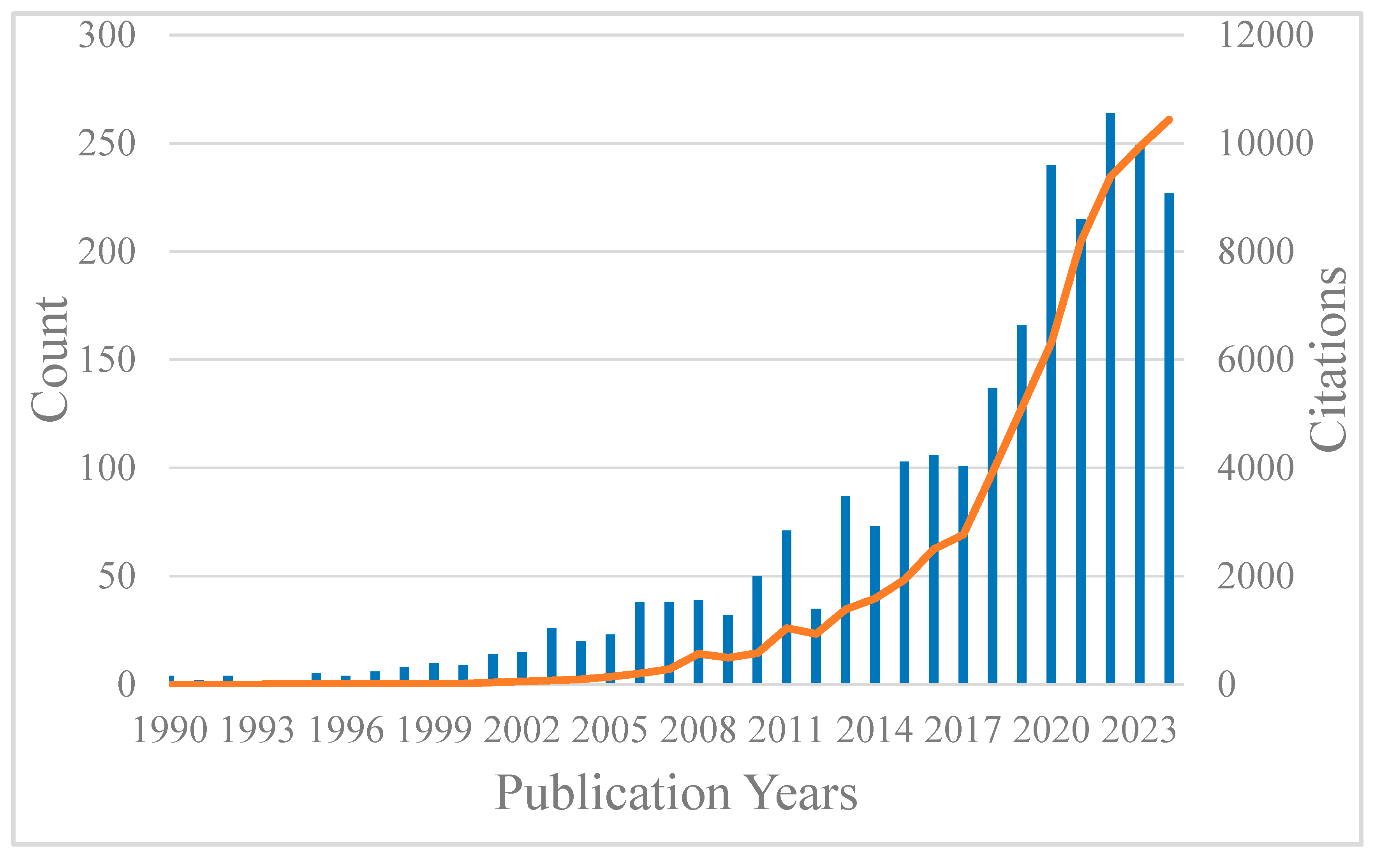
Figure 2.
Cumulative numbers of publications based on UAV and satellite remote sensing across top 10 countries (panel a), the publication numbers by continent (panel b).
Figure 2.
Cumulative numbers of publications based on UAV and satellite remote sensing across top 10 countries (panel a), the publication numbers by continent (panel b).
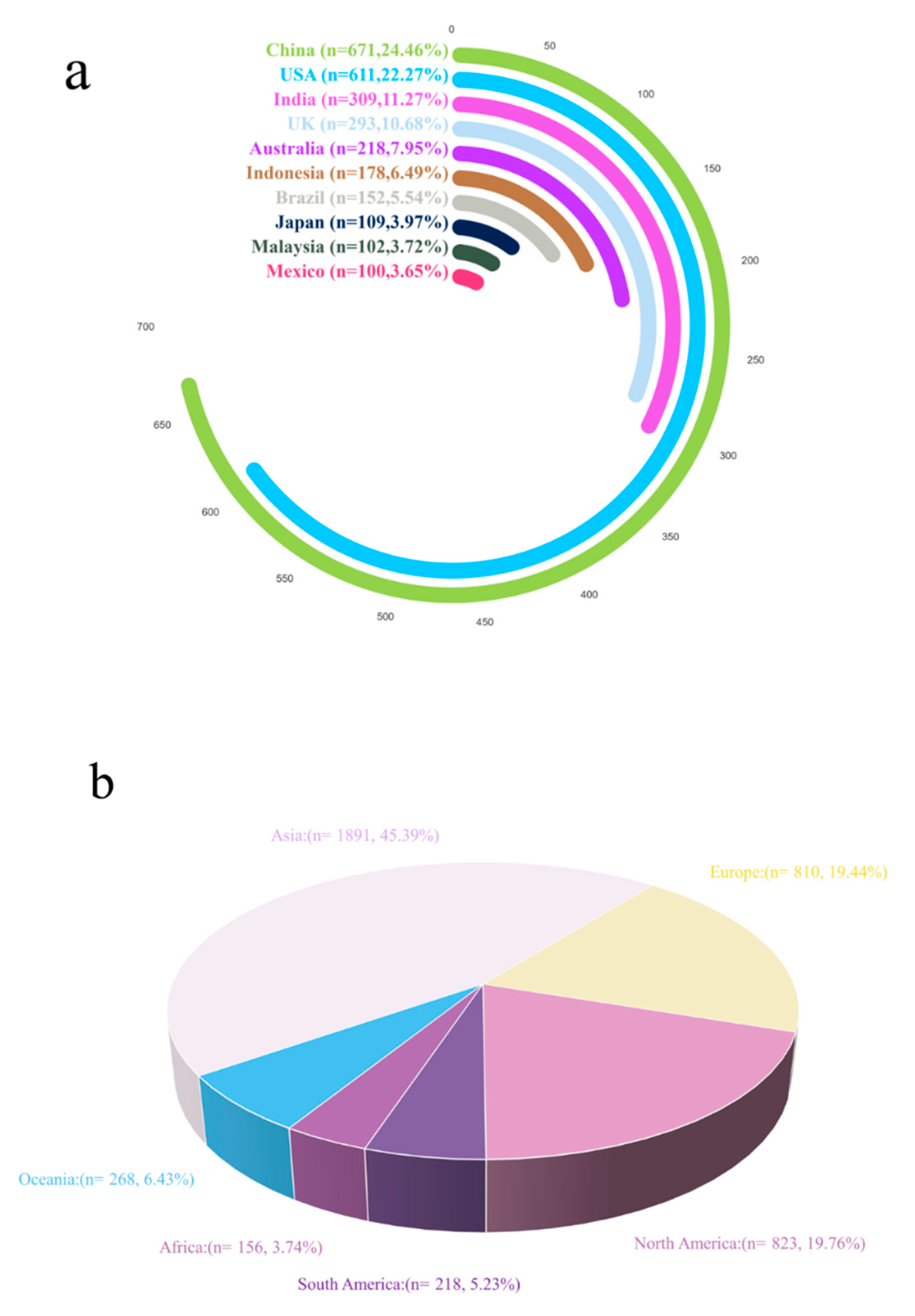
Figure 3.
Technical approach for mangrove ecosystem research based on satellite and UAV remote sensing.
Figure 3.
Technical approach for mangrove ecosystem research based on satellite and UAV remote sensing.
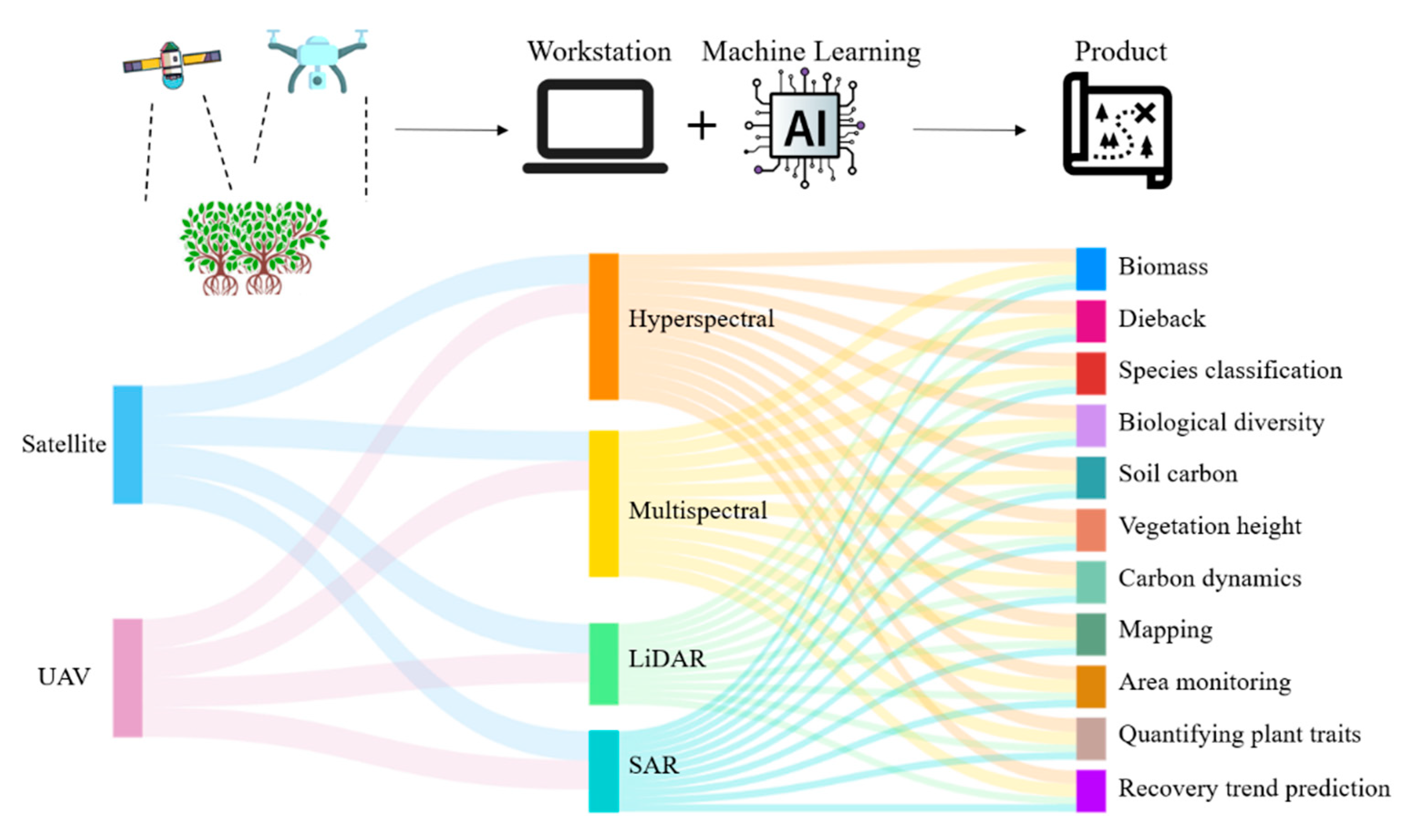

Table 1.
Detailed search information.
| Criteria | Search terms |
| Topic | “Mangrove AND UAV” OR “Mangrove AND Unmanned Aerial Vehicle” OR “Mangrove AND remote sensing” OR “Mangrove AND multispectral” OR “Mangrove AND hyperspectral” OR “Mangrove AND Landsat” OR “Mangrove AND Gaofen” OR “Mangrove AND GF” OR “Mangrove AND sentinel” OR “Mangrove AND LiDAR” |
| Publication Date | January 1990 to October 2024 |
| Language | English |
Table 2.
Comparison between traditional field investigation and unmanned aerial vehicles and remote sensing.
Table 2.
Comparison between traditional field investigation and unmanned aerial vehicles and remote sensing.
| Traditional field investigation | UAV-LiDAR & RS |
| Able to measure diameter at brest height, tree height and biomass of individual tree | Limited by resolution, difficult to obtain detailed information on individual plants |
| Destructive | Non-destructive |
| Small-scale, limited by logistics and time, only covers local sites | Large scale, suitable for regional or global monitoring |
| Affected by tides, weather, and terrain; some areas are difficult to access | Affected by cloud cover and atmospheric interference, especially in tropical and coastal regions |
| High cost, due to labor, transportation, and equipment expenses | Low cost (some satellite data is free), but high-resolution data may be paid |
| Suitable for small-scale, high-precision studies such as species identification and soil analysis | Suitable for large-scale, long-term monitoring such as mangrove range changes and ecosystem health assessment |
Table 3.
Summary of species classification results by SVM.
| Study Area | Study Time | Data | Species | OA | Kappa | Reference |
| Sundarbans Biosphere Reserve, India (40%) and Bangladesh (60%) | 2021 | Landsat 8 OLI (multispectral 30m), Hyperion (hyperspectral 30m), Sentinel-2 data (multispectral) |
AA, AM, AO, AR, BC, BG, CD, CE, EA, PP, SA | 76.42% 81.98% 79.81% |
0.71 0.78 0.75 |
[7] |
| Dongzhaigang, China | 2018 | Radarsat-2 (SAR), Landsat-8 (multispectral 30m) | NA | 53.4% 83.5% 95% (combined data) |
0.46 0.80 0.95 |
[28] |
| Hainan Island, China | 2022 | Landsat-5 TM (30m), Landsat-8 OLI (multispectral 30m) | NA | 94.2% (2021) |
0.82 | [74] |
| Thuraikkadu Reserve Forest area, India | 2014 | Hyperion (hyperspectral 30m), Earth Observing -1 (hyperspectral 30m) | NA | 73.74% | 0.62 | [75] |
| Mai Po Nature Reserve, HK, China | 2021 | Worldview 3 (hyperspectral 30m), LiDAR data |
AC, AI, AM, KO, AI, SA | 84% | 0.81 | [76] |
| Indonesia | 2021 | SPOT 4(multispectral 20m), Sentinel 2B (multispectral) | NA | 89% | 0.86 | [77] |
OA: Overall accuracy; NA: Not available. AA: Avicennia alba; AM: Avicennia marina; AO: Avicennia officinalis; AR: Avicennia rotundifolia; BC: Bruguiera cylindrica; BG: Bruguiera gymnorhiza; CD: Ceriops decandra; CE: Casuarina equisetifolia; EA: Excoecaria agallocha; PP: Phoenix paludosa; SA: Sonneratia apetala; AC: Aegiceras corniculatum; AI: Acanthus ilicifolius; KO: Kandelia obovata; KOAI: Kandelia obovata & Acanthus ilicifolius.
Table 4.
Summary of species classification results by RF.
| Study Area | Study Time | Data | Species | OA | Kappa | Reference |
| Fujian Zhangjiangkou National Mangrove Nature Reserve, China | 2023 | GF-2 PMS image (hyperspectral 8m), GF-3 polarimetric SAR data & UAV-LiDAR Data |
KO, AC, AM, SA | 91.43% | 0.89 | [30] |
| Fucheng Town, Guangdong Province, China | 2023 | GF-1 (hyperspectral 8m), GF-3(SAR), Sentinel-2 (multispectral), Landsat-9 | SA, KO, AM | 88.47% | 0.81 | [29] |
| Yingluo Bay, Guangxi, China | 2024 | UAV Multispectral, Hyperspectral Image data | BG, RS, AM, AC, EA, HT, SA | 80.5% 95.73% |
0.77 0.95 |
[27] |
| Dongzhaigang National Nature Reserve & Qinglangang Provincial Nature Reserve, Hainan Island, China | 2022 | Sentinel-2 data (multispectral) & UAV-LiDAR data |
RS, CT, AM, BS, LR, EA, SS | 85.6% 91.61% |
0.79 0.86 |
[83] |
| Gaoqiao Mangrove Reserve, China | 2023 | Sentinel-2 (multispectral), Sentinel-1 (SAR), ALOS-2 (SAR) | NA | 92.67% 39.67% 30.33% |
0.915 0.302 0.194 |
[81] |
| Malad creek, India | 2022 | WorldView-2 (multispectral, 1.5m) |
AM | 88.64% | 0.86 | [84] |
| Guyana | 2024 | Landsat-8 OIL (multispectral 30m), Sentinel-2 MSI (multispectral) & Sentinel-1 SAR |
NA | 95% | NA | [85] |
| Sirik, southern Iran | 2023 | UAV data | RM, AM | 98% | 0.97 | [86] |
OA: Overall accuracy. KO: Kandelia obovata; AC: Aegiceras corniculatum; AM: Avicennia marina; SA: Sonneratia apetala; RS: Rhizophora stylosa; BG: Bruguiera gymnorhiza; EA: Excoecaria agallocha; HT: Hibiscus tiliaceus; CT: Ceriops tagal; BS: Bruguiera sexangula; LR: Lumnitzera racemosa; SS: Sonneratia spp.; RM: Rhizophora mucronata.
Table 5.
Summary of species classification results by XGBoost.
| Study Area | Study Time | Data | Species | OA | Kappa | Reference |
| Guangxi, southwestern China | 2023 | UAV Hyperspectral Data & UAV-LiDAR Data | SA, AI, CM, AC, KO | 96.78% | 0.9596 | [89] |
| The core zones of the ZMNNR, China | 2024 | WV-2 image (multispectral, 1.5m) & OHS data (hyperspectral, 10m) & ALOS-2 data (SAR) |
AM, KO, SA, RS, BG, AC | 94.02% | NA | [90] |
| Gaoqiao Mangrove Reserve, China | 2023 | Sentinel-2 (multispectral), Sentinel-1 (SAR), ALOS-2 (SAR) | NA | 92.33% 36.67% 33.67% |
0.912 0.268 0.235 |
[81] |
| Yingluo Bay, China | 2024 | UAV Hyperspectral data | BG, RS, AM, AC, EA, HT, SA | 94.26% | 0.93 | [27] |
| Yingluo Bay, China | 2024 | UAV Multispectral data | 80.37% | 0.77 | [27] |
OA: Overall accuracy. SA: Sonneratia apetala; AI: Acanthus ilicifolius; AC: Aegiceras corniculatum; KO: Kandelia obovata; CM: Cyperus malaccensis(non-mangrove species); AM: Avicennia marina; SA:Sonneratia apetala; RS: Rhizophora stylosa; BG: Bruguiera gymnorhiza; EA: Excoecaria agallocha; HT: Hibiscus tiliaceus.
Table 6.
Summary of species classification results by other ML methods.
| Study Area | Study Time | Data | Machine Learning Algorithms | Species | OA | Kappa | Reference |
| Fucheng Town, Guangdong Province, China | 2023 | GF-1 (hyperspectral 8m), GF-3 (SAR), Sentinel-2 (multispectral), Landsat-9 | Extremely Randomized Trees (ERT) | SA, KO, AM | 90.13% | 0.84 | [29] |
| Yingluo Bay, China | 2024 | UAV Hyperspectral data | AdaBoost | BG, RS, AM, AC, EA, HT, SA | 82.96% | 0.79 | [27] |
| Yingluo Bay, China | 2024 | UAV Hyperspectral data | LightGBM | 97.15% | 0.97 | [27] | |
| Yingluo Bay, China | 2024 | UAV Multispectral data | AdaBoost | 60.05% | 0.56 | [27] | |
| Yingluo Bay, China | 2024 | UAV Multispectral data | LightGBM | 80.96% | 0.78 | [27] | |
| Qi’ao Island, Guangdong, China | 2015 | Worldview-2 (multispectral, 1.5m) | Back Propagation Artificial Neural Network (BP ANN) | KO, SA | 87.68% | 0.82 | [91] |
| Gaoqiao Mangrove Reserve, China | 2023 | Sentinel-2 (multispectral), Sentinel-1 (SAR), ALOS-2 (SAR) | LightGBM | NA | 92.33% 37% 33.67% |
0.912 0.272 0.208 |
[81] |
OA: Overall accuracy. SA: Sonneratia apetala; KO: Kandelia obovata; AM: Avicennia marina; AC: Aegiceras corniculatum; AM: Avicennia marina; RS: Rhizophora stylosa; BG: Bruguiera gymnorhiza; EA: Excoecaria agallocha; HT: Hibiscus tiliaceus.
Table 7.
Comparison of classification accuracy among different machine learning algorithms.
| Study Area | Study Time | Data | Machine Learning Algorithms | Species | OA | Kappa | Reference |
| Sundarbans Biosphere Reserve, India (40%) and Bangladesh (60%) | 2021 | Landsat 8 OLI (multispectral 30m), Sentinel-2 data (multispectral) |
SVM | AA, AM, AO, AR, BC, BG, CD, CE, EA, PP, SA | 76.42% 79.81% |
0.71 0.78 0.75 |
[7] |
| Dongzhaigang, China | 2018 | Radarsat-2 (SAR), Landsat-8 (multispectral 30m) | SVM | NA | 53.4% 83.5% 95% (combined data) |
0.46 0.80 0.95 |
[28] |
| Dongzhaigang Nature Reserve & Qinglangang Nature Reserve, China | 2022 | Sentinel-2 data (multispectral), UAV-LiDAR data |
RF | RS, CT, AM, BS, LR, EA, SS | 85.6% 91.61% |
0.79 0.86 |
[83] |
| Gaoqiao Mangrove Reserve, China | 2023 | Sentinel-2 (multispectral), Sentinel-1 (SAR), ALOS-2 (SAR) | RF | NA | 92.67% 39.67% 30.33% |
0.915 0.302 0.194 |
[81] |
| XGBoost | 92.33% 36.67% 33.67% |
0.912 0.268 0.235 |
|||||
| LightGBM | 92.33% 37% 33.67% |
0.912 0.272 0.208 |
OA: Overall accuracy. AA: Avicennia alba; AM: Avicennia marina; AO: Avicennia officinalis; AR: Avicennia rotundifolia; BC: Bruguiera cylindrica; BG: Bruguiera gymnorhiza; CD: Ceriops decandra; CE: Casuarina equisetifolia; EA: Excoecaria agallocha; PP: Phoenix paludosa; SA: Sonneratia apetala; RS: Rhizophora stylosa; BS: Bruguiera sexangula; LR: Lumnitzera racemosa; SS: Sonneratia spp, CT: Ceriops tagal.
Table 8.
Summary of mangrove dieback.
| Study Area | Study Time | Data | Causes of Dieback | Reference |
| Abaco Island | 2020 | Landsat 5 and 7 annual NDVI composites | Herbivory and disease | [104] |
| Over the world | 2020 | Landsat derived dataset |
Human Activities (e.g., deforestation, aquaculture) | [105] |
| Maldives | 2024 | Landsat 8 OLI dataset & Oblique aerial drone image | Sea-level rise | [106] |
| Kakadu National Park, northern Australia |
2019 | Airborne remote sensing data & color aerial photography photos | The El Niño-Southern Oscillation (ENSO) | [107] |
| Pichavaram, India | 2022 | VHSR satellite images & meteorological observations data | Likely due to hypersaline environment | [109] |
Disclaimer/Publisher’s Note: The statements, opinions and data contained in all publications are solely those of the individual author(s) and contributor(s) and not of MDPI and/or the editor(s). MDPI and/or the editor(s) disclaim responsibility for any injury to people or property resulting from any ideas, methods, instructions or products referred to in the content. |
© 2025 by the authors. Licensee MDPI, Basel, Switzerland. This article is an open access article distributed under the terms and conditions of the Creative Commons Attribution (CC BY) license (http://creativecommons.org/licenses/by/4.0/).
Copyright: This open access article is published under a Creative Commons CC BY 4.0 license, which permit the free download, distribution, and reuse, provided that the author and preprint are cited in any reuse.


