Quantum Gravity
Suppose quantum gravity one day goes far beyond unifying quantum mechanics and general relativity. It might unite everything in space and time. Assuming the universe is everything that has existed or will exist, the multiverse could be timelike or all the things that happen at different zeptoseconds in this universe (a zeptosecond is the smallest unit of time ever measured and equals 10^−21 s or a trillionth of a billionth of a second). That quantum gravity from the far future could unify all the times in the multiverse with the one physical universe. Unifying the timelike multiverse with the material universe could be achieved with a combination of the holographic principle and quantum certainty in which quantum mechanics is not statistical (see relevant comments below). If the universe functions like a DVD that we watch movies with, the multiverse-universe unity wouldn’t only exist in a future where spacetime warping is routine. This is because all times exist simultaneously since the whole DVD exists, although only sights and sounds from each fraction of a second are perceived as the disk is played. Similarly, we can’t normally perceive the future but all times co-exist in the cosmos and the future instantly affects the past and present. This makes the multiverse observable constantly (and kind of scientific).
Quantum Certainty Plus Holographic Principle (and Proposed Composition of Spacetime)
The Mathematical Universe Hypothesis (MUH) is a speculation put forward by physicist and cosmologist Max Tegmark [
2,
3]. It speaks of “altogether different equations and mathematical structures”. This article could use such structures in the following way - one dimensional (1D) electrical pulses could form binary digits that could encode 2D Mobius strips which would be the next level up in particles’ structure. Cosmology’s holographic principle suggests the 3rd dimension results from information in the 2nd dimension. The 2nd D might be the Mobius strips comprising particles and the 3rd D might be capable of being deleted by programming the binary digits (used in electronics) which act as Hidden Variables that aren’t confined to one location but are compatible with quantum mechanics (not with known probabilistic quantum mechanics but with quantum certainty, for they give precise calculations). When subatomic particles appear in two places at once, the holographic principle can be combined with the precision of unrecognized quantum certainty. Then the particles would actually be in one place (quantum entangled) since the 3rd D of space between their centers would be eliminated (since we live in space-time, the time taken to travel the distance between particles is also eliminated). The 3rd dimension we normally perceive could be thought of as composed of figure-8 Klein bottles i.e. it could be thought of as the union of pairs of Mobius strips [
4] or as projection of the information inherent in particles’ constituent strips. Since so-called ”imaginary” numbers are essential in quantum mechanics, the 4th dimension of time might be described by the Complex Plane’s Wick Rotation which is often regarded as nothing more than mathematical convenience. Adapting a paper by Albert Einstein [
5] - if electromagnetism’s photon and gravitation’s graviton are composed of trillions of Mobius strips, electromagnetic and gravitational interactions could produce the mass and quantum spin of every other particle, including the bosons of an atom’s strong nuclear force, weak nuclear force, and even the Higgs boson (the possibility of excitation of the Higgs field resulting from photon-graviton interaction would mean the field is a union of electromagnetic and gravitational fields). All of the information in the universe is contained in two-dimensional packages trillions of times smaller than an atom [
6] (in this case, the 2D package is the Mobius Strip).
Static Universe
Physicist Melvin Vopson writes, “In an expanding universe, the entropy will always increase because more possible micro states are being created via the expansion of the space itself/universe”. [
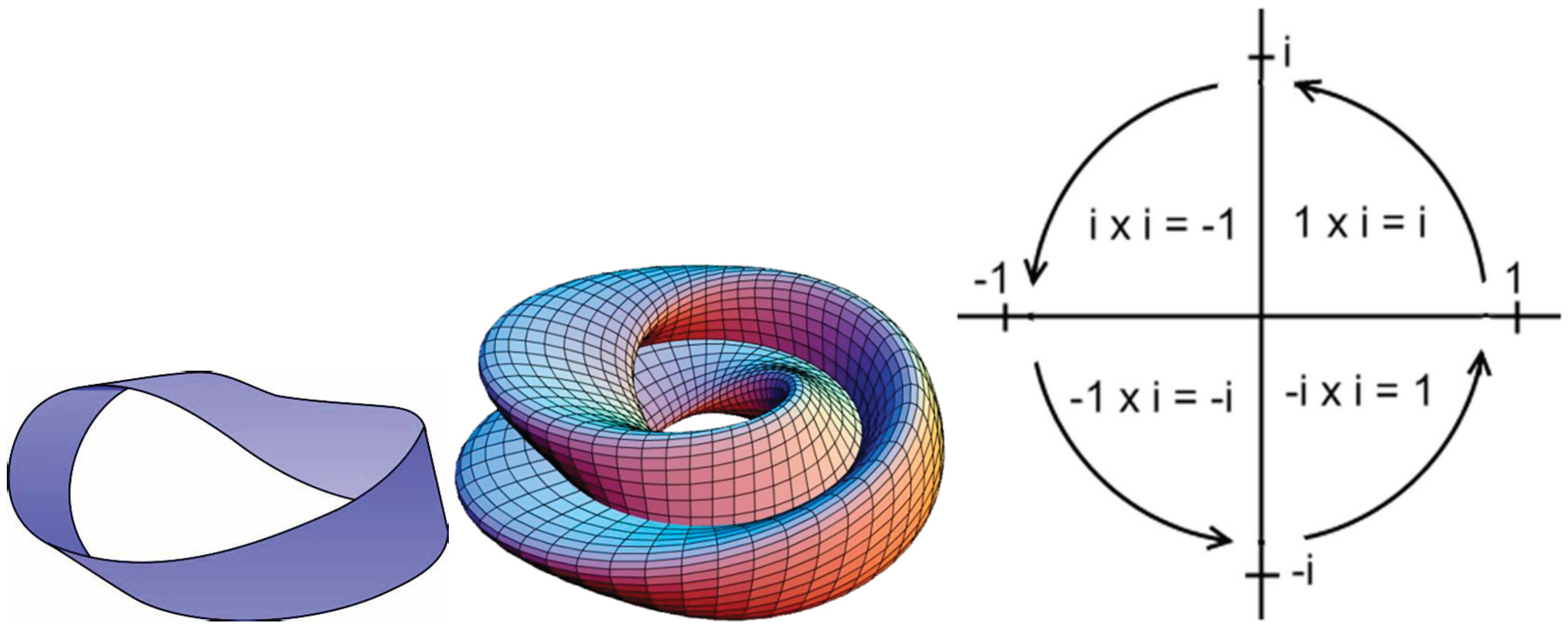
7] Therefore, avoiding a cosmological end from entropy requires the universe to be static. When a particle appears to be in more than one place at once, the holographic principle can be combined with quantum certainty. Then the particle obeys common sense and, like a macroscopic object, would actually be in one place (quantum entangled). The cosmos appears to be infinite and eternal, neither expanding nor contracting - the lack of expansion/contraction means the universe would be a static (in one place) and macroscopic version of one of its particles. Referring to the right side of
Figure 1, note that the Klein bottle’s two different colors (representing positive and negative curvature) fit together to produce the outline of a doughnut. A doughnut (or strictly, a torus) is technically flat. If continuously deformed like a mass of clay, it has the same topological properties as a flat surface (like a piece of paper). When many figure-8 Klein bottles are grouped together, a procedure analogous to computer art’s Sky Replacement will cause binary digits to fill in any gaps or holes in the same way that computers can make a sky that’s blue from horizon to horizon. In other words, the digits “smooth out” the Klein bottles to produce General Relativity’s regular space (often likened to a rubber sheet). But the Klein doesn’t become multiply connected like the doughnut. Only the doughnut’s outline (with its hole filled in) is adopted and the bottle retains the property of simple connectedness. (Informally, if an object in space consists of one piece [the outline of one filled-in doughnut] - and has no holes passing all the way through it, it is called simply-connected.) According to the paper ”Cosmic Topology”, a flat universe that is also simply connected implies an infinite universe that extends endlessly in all directions. [
8]
The switching of bits - bi(nary) (digi)ts - between “one” and “zero” is comparable to the “quantum fluctuations” associated with Big Bang theory. The following speculation proposes a method whereby a universe that’s infinite and eternal - neither expanding nor contracting - could share another correspondence with the Big Bang viz a definite time of creation. Creating something which has always existed seems to be a paradox - whose definition is “a seemingly absurd or contradictory statement or proposition which when investigated may prove to be well founded or true”. On the subject of paradox, 20th-century physicist Niels Bohr said, “How wonderful that we have met with a paradox. Now we have some hope of making progress”. He also said, “Your theory is crazy, but it’s not crazy enough to be true”. Hopefully, the crazy ideas in this article are “crazy enough to be true”. So, how might it be done? A model of the cosmos might be built that uses the infinite number pi and imaginary time, and resides in Virtual Reality (artificial, computer-generated simulation). The entanglement (both quantum and macroscopic) in the simulated universe is unable to remain separate from the entanglement existing in our perceived reality because computers using so-called “imaginary time” (which is defined by numbers with the property i^2 = -1) remove all boundaries between the two universes. This enables them to become one Augmented Reality (known now as technology that layers computer-generated enhancements onto an existing reality but seen here as the related layering of virtual reality onto other points in time and space). The poorly named imaginary time of physics and mathematics unites with pi, an “infinite decimal” whose digits after the decimal point go on forever (both are necessary to generate a non-Big-Bang cosmos i.e. an infinite universe which, because space and time can never be separated, is eternal). The augmented reality which is layered on “other” points in space-time actually isn’t transmitted to other points - because of the quantum entanglement of every particle (massive or massless) in spacetime, only one ever exists. Thus, transmissions to any (apparently other) places or times wouldn’t be restricted to the speed of light but are instantaneous. (Paragraph from [
9])
Aharonov-Bohm Effect and Magnetic Monopole
A very interesting comment by Prof. ‘t Hooft in Zeeya Merali’s article is the “discovery that unifying the forces of physics requires the existence of magnetic monopoles”. Here are some monopolar thoughts -
As a thought experiment, suppose that electricity and magnetism are exactly the same thing - this thought experiment will be backed up in the text underneath
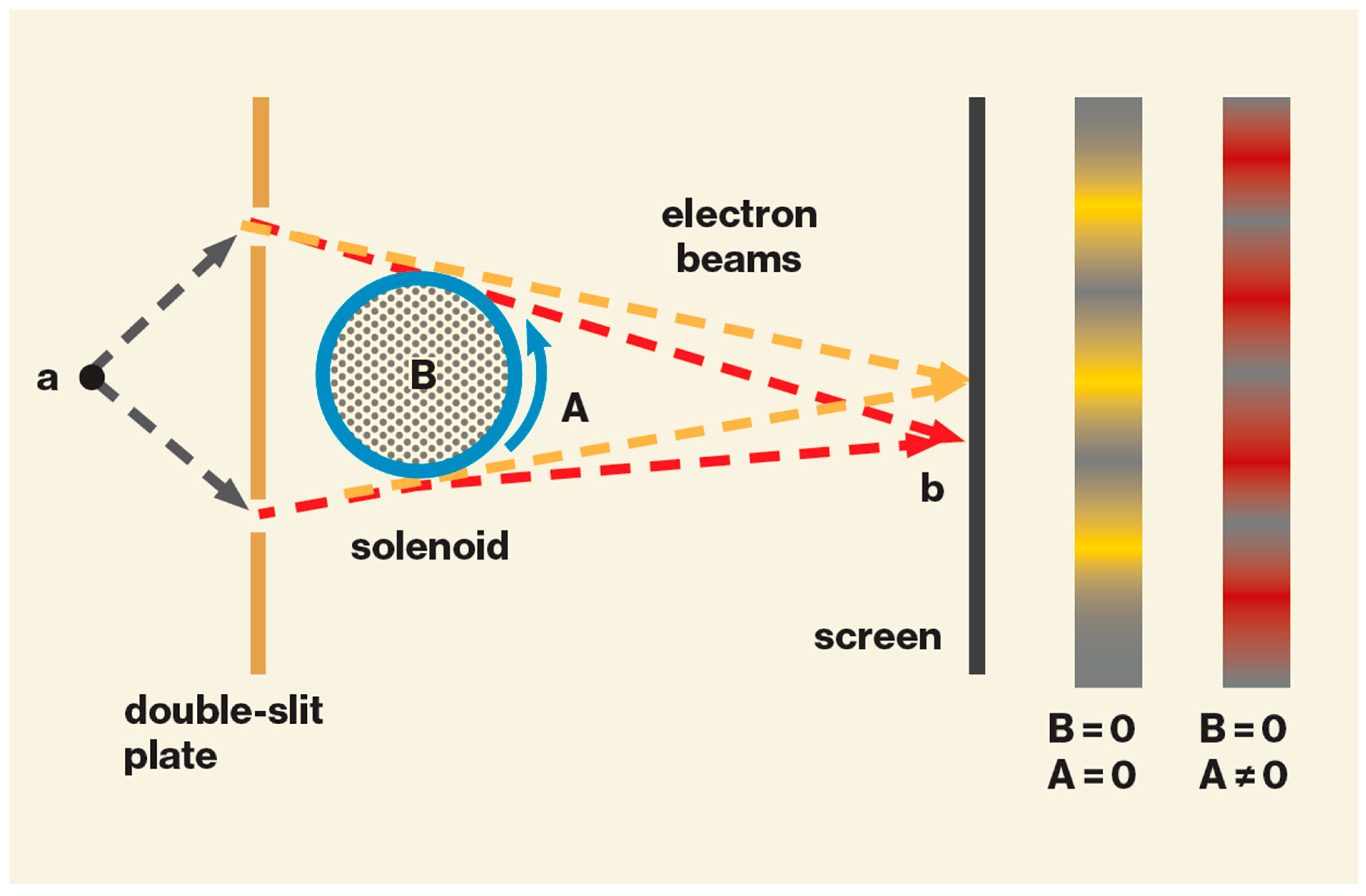
Figure 2 and its caption by the scientific experiment conducted in 1986 by Akira Tonomura and his colleagues. [
10] The only apparent difference between them is the frame of reference.
While an observer stationary with respect to an electric charge will see it as a source of electric field only, a second observer moving relative to the first will see the same charge as a source of both electric and magnetic fields in a way dictated by special relativity. [
11]
Every particle of matter has a quantum spin of ½ which means it must be completely rotated twice (through 720 degrees) to resume the same quantum state. And a Mobius strip needs to be travelled around twice to reach the starting point. A possible result is that the Mobius is involved in the composition of particles. Instead of focusing on the mass of particles following the contours of the strip, we could imagine the electric charges of all the universe’s particles - positive, negative, totally canceling and neutral, or partly cancelling and reduced - obeying the undulations of the Mobius.
Recalling the frames of reference, this waviness can also represent magnetic polarity. A classical view could be adopted in which magnetic polarity is associated with positive/negative/neutral/reduced charges of individual particles. Then it’d be natural to believe that, just as particles can have (overall) either positive or negative electric fields, they can also possess the single polarity of either a North or South magnetic field. Or a topological interpretation could be adopted. Since this involves Mobius strips as components of matter, it might be called a quantum-mechanical interpretation. In this, attention is not concentrated on individual and separate particles. Quantum Mechanics and General Relativity are combined to show how the topological and subatomic quantum world might be joined with the cosmic world. In the cosmic, the collection of the universe’s particles, electric fields, and magnetic fields are united by obeying one thing - the following of Mobius undulations. This quantum mechanical - or unified field - view doesn’t say individual particles include magnetic monopoles. It says the cosmos itself may be the monopole. If the universe only has either a North or South pole, this SuperAsymmetry of known temperature-magnetism interactivity might account for Hemispherical Power Asymmetry where the Cosmic Microwave Background (CMB) has very slight temperature differences in its celestial hemispheres.
What if the Electric Dipole Moment of a universe’s particles cause the positive and negative charges to precisely cancel and make the universe neutral? The condition of electric and magnetic fields being identical means cosmic magnetism would be “neutral” at the largest scale, and the universe would not be a magnetic monopole. Nor would the CMB have Hemispherical Power Asymmetry (HPA). This is not a problem at all - just a reason to think harder about monopolarity. Electric charge can be seen as a source of both electric and magnetic fields. It’s known that charges exist, so cosmic magnetism cannot be neutral - the universe really can be the monopole and account for SuperAsymmetry. The concept of neutrality is better applied to the electric dipole moment and the perfect cancellation of positive and negative charges to produce the neutral photon and graviton.
The electromagnetic equations of 19th century Scottish physicist James Clerk Maxwell had been written in terms of both the electric (E) and magnetic (B) fields and a concept called the “potentials.” There are 2 electromagnetic potentials - an electric scalar one, often denoted by ϕ ; and a magnetic vector potential, written as A. An electrically charged particle like an electron is affected by A, despite being confined to a region in which both the magnetic field and electric field are zero. The physical reality of electromagnetic potentials (A not equalling zero) was shown by the experiment of Dr. Tonomura et al.
Referring to
Figure 2 - the vector potential causes the shift of the interference pattern but it could be said that magnetism affects the charged electrons by causing the shift since the vector potential is magnetic. If an electric and magnetic field are identical (except for the frame of reference), then the electric charges will also affect the solenoid’s magnetic field. By extension, the combined charges of all the particles in the universe will affect cosmic magnetism. The
magnetic Aharonov–Bohm effect is also closely related to Paul Dirac’s argument that the existence of a magnetic monopole can be accommodated by Maxwell’s equations if both electric and magnetic charges are quantized. An electron and its charge are quantum (subatomic) and quantized - see
QUANTUM CERTAINTY PLUS HOLOGRAPHIC PRINCIPLE (and proposed composition of spacetime). Magnetism would also be quantized if an electric and magnetic field are identical (apart from the reference frame). The universe’s combined charges can thus shift cosmic magnetism away from the human- or astronomic-scale detection of magnetic fields of individual particles, objects, even galaxies. They’d shift magnetism to a universal scale with the cosmos itself being the magnetic monopole and possibly accounting for the Cosmic Microwave Background’s
Hemispherical Power Asymmetry.
References
- Bartlett, R. (2025). A Different Perspective on Cosmological and Quantum Phenomena That Involves the Temporal Multiverse and the Static Universe. IPI Letters, 3 (1), O29-O37. [CrossRef]
- Tegmark, Max (November 1998). Is ‘the Theory of Everything’ Merely the Ultimate Ensemble Theory?. Annals of Physics. 270 (1): 1–51. [CrossRef]
- Tegmark, M., Our Mathematical Universe. Random House/Knopf, January 2014.
- Polthier, Konrad. ”Imaging maths- Inside the Klein bottle”. http://plus.maths.org/content/os/issue26/features/mathart/ index.
- Einstein, Albert (1919). “Spielen Gravitationfelder im Aufbau der Elementarteilchen eine Wesentliche Rolle?” [Do gravitational fields play an essential role in the structure of elementary particles?]. Sitzungsberichte der Preussischen Akademie der Wissenschaften, [Math. Phys.], 349-356, Berlin.
- Afshordi, N. Coriano, C. Delle Rose, L. Gould, E. Skenderis, K. From Planck Data to Planck Era: Observational Tests of Holographic Cosmology. Phys. Rev. Lett. 118, 041301. (2017). https://journals.aps.org/prl/abstract/10.1103/PhysRevLett.118.041301.
- Vopson, M. (2025). On the Second Law of Infodynamics from Cosmological Thermodynamics. IPI Letters, 3 (1), N6-N9. [CrossRef]
- Jean-Pierre Luminet and Marc Lachi‘eze-Rey, Cosmic Topology, Physics Reports 254 [3]: 135–214, (1995). www.arXiv:gr-qc/ 9605010.
- Rodney Bartlett. Wheels are turning for John Wheeler. September 2024. [CrossRef]
- onomura et al. Evidence for Aharonov-Bohm effect with magnetic field completely shielded from electron wave. Phys. Rev. Lett. 56, 792 – Published 24 February, 1986. [CrossRef]
- “electromagnetism” article in Penguin Encyclopedia 2006 - edited by David Crystal - 3rd edition, 2006.
|
Disclaimer/Publisher’s Note: The statements, opinions and data contained in all publications are solely those of the individual author(s) and contributor(s) and not of MDPI and/or the editor(s). MDPI and/or the editor(s) disclaim responsibility for any injury to people or property resulting from any ideas, methods, instructions or products referred to in the content. |
© 2025 by the authors. Licensee MDPI, Basel, Switzerland. This article is an open access article distributed under the terms and conditions of the Creative Commons Attribution (CC BY) license (http://creativecommons.org/licenses/by/4.0/).