

Submitted:
20 April 2025
Posted:
21 April 2025
You are already at the latest version
Abstract
I propose a hypothesis that interprets quantum entanglement as a projection of a single quantum entity embedded in a compactified higher-dimensional configuration space. The entangled wavefunction is extended as: Ψ(X) = ψ₄(x₁, x₂) ⊗ δ(y₁ - y₂) suggesting that the apparent nonlocal correlation is a geometric consequence of dimensional projection. The framework is formalized via an effective Lagrangian: L(Ψ) = ∫ dⁿy₁ dⁿy₂ δ(y₁ - y₂) Ψ* Ĥ Ψ which parallels structures in D-brane theory and noncommutative geometry. This perspective aligns with the ER=EPR conjecture and suggests testable predictions, including curvature-dependent deviations in entanglement behavior. This letter proposes a speculative interpretation of quantum entanglement by integrating concepts from string theory, higher-dimensional compactification, and nonlocal correlations. It aims to provide an intuitive, higher-dimensional explanation for the apparent superluminal correlation observed in entangled particles. This letter proposes a speculative interpretation of quantum entanglement by integrating concepts from string theory, higher-dimensional compactification, and nonlocal correlations. It aims to provide an intuitive, higher-dimensional explanation for the apparent superluminal correlation observed in entangled particles such as electrons.
Keywords:
Quantum Entanglement
; Higher-Dimensional Physics
; M-Theory
; Compactified Dimensions
; Nonlocality
; Wavefunction Projection
; Dimensional Identity
Introduction
Quantum entanglement challenges conventional understandings of locality and causality. When two entangled particles are spatially separated, a measurement on one appears to instantaneously affect the other. Einstein, Podolsky, and Rosen (1935) framed this tension in their famous critique of quantum mechanics [1]. While Bell’s theorem and subsequent experiments confirmed the statistical predictions of quantum theory, the ontological interpretation of entanglement remains open to inquiry.
I explore the hypothesis that entangled particles are not truly separate in a fundamental sense, but are projections of a single entity embedded in a compactified higher-dimensional manifold. Our aim is to reframe quantum correlations as geometrical artifacts of dimensional reduction rather than acausal phenomena.
Mathematical Suggestion
Let ψ(x₁, x₂) represent the entangled wavefunction of two electrons at spacetime positions x₁ and x₂. In conventional quantum mechanics:
ψ(x₁, x₂) = (1/√2) [|↑⟩₁|↓⟩₂ ± |↓⟩₁|↑⟩₂]
However, consider embedding this in a higher-dimensional configuration space H where:
Ψ(X) = ψ₄(x₁, x₂) ⊗ φ_h(y₁, y₂)
Here, X = (x₁, x₂, y₁, y₂), where y₁, y₂ ∈ compactified higher dimensions. If y₁ = y₂, and φ_h represents a delta-function identity in higher dimensions, then ψ₄ behaves as a projection of a single entity split in appearance only.
Thus:
φ_h(y₁, y₂) = δ(y₁ - y₂) ⇒ ‘Same object in higher dimensions’
This formalism hints that the entanglement may emerge from a single quantum object ‘split’ across our 4D observation plane.
To strengthen the physical rigor of the proposed hypothesis, I introduce a formal framework for embedding entangled states in higher-dimensional configuration space. The central idea is that conventional 4D entangled wavefunctions are projections of a single quantum entity unified in compactified extra dimensions.
I define the wavefunction in extended space X = (x₁, x₂, y₁, y₂) as:
Ψ(X) = ψ₄(x₁, x₂) ⊗ φ_h(y₁, y₂)
Assuming φ_h(y₁, y₂) = δ(y₁ - y₂), this reflects perfect geometric identity in higher dimensions. A corresponding effective Lagrangian density can be postulated as:
L(Ψ) = ∫ dⁿy₁ dⁿy₂ δ(y₁ - y₂) Ψ*(x₁, x₂, y₁, y₂) Ĥ Ψ(x₁, x₂, y₁, y₂)
Here, Ĥ denotes a higher-dimensional Hamiltonian operator. This formulation implies that observable entanglement correlations emerge from delta-constrained compact geometry. The structure is conceptually parallel to D-brane configurations in string theory and projections in noncommutative geometry.
Under this framework, apparent nonlocality arises from constraints on the compactified dimensions, offering an interpretation of quantum entanglement that does not require superluminal signaling. This enhances the theoretical plausibility and places the hypothesis in dialog with formal models of higher-dimensional physics.
Illustrative Diagram
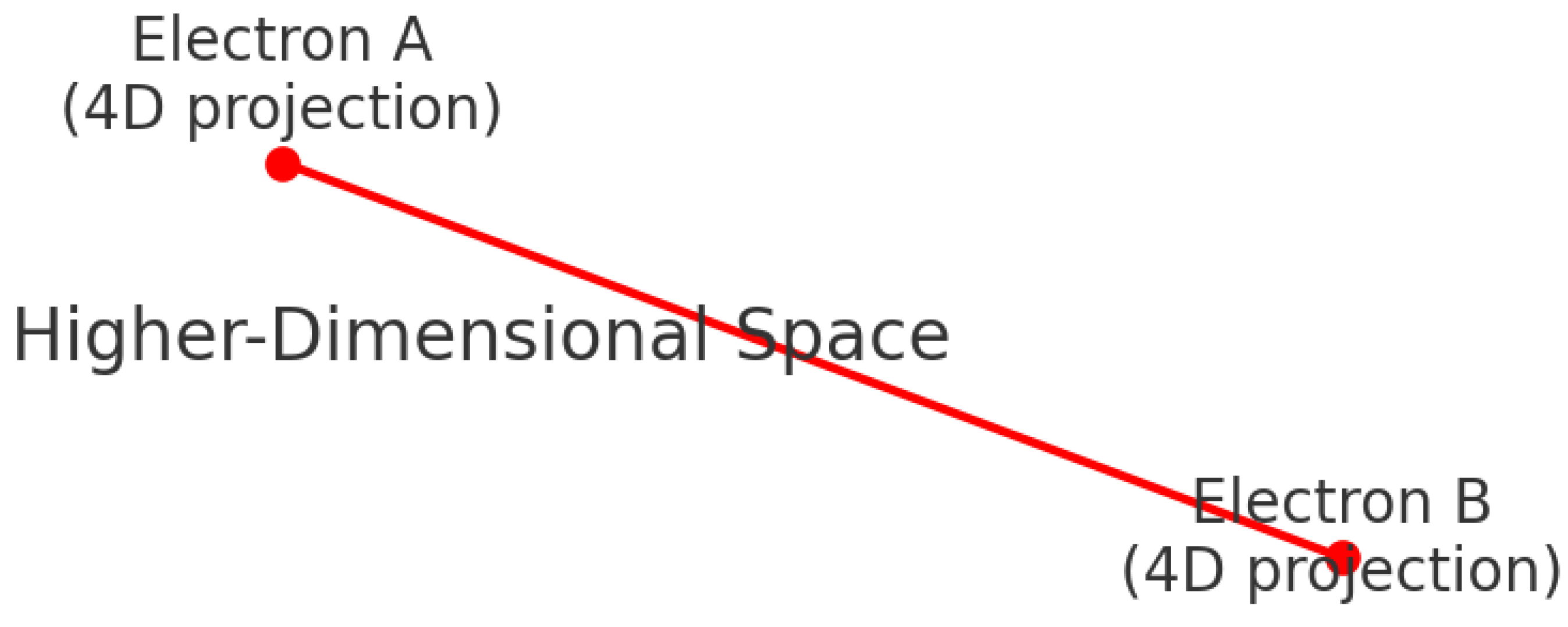
The following diagram illustrates the concept of two entangled particles being projections of a single higher-dimensional entity.
Discussion
The projection from higher-dimensional unity to separated 4D entities can be analogized via fiber bundles. Each observed particle corresponds to a section over spacetime, while the fiber encodes higher-dimensional degrees of freedom. From this perspective, instantaneous correlations are manifestations of the underlying geometric identity.
The proposed hypothesis introduces an intuitive geometric model to explain quantum entanglement as a manifestation of a unified object in higher-dimensional space. This aligns conceptually with ideas such as the ER=EPR conjecture [2], where entangled particles are connected by non-traversable wormholes, and with models that embed quantum behavior into higher-dimensional classical frameworks [3].
Unlike interpretations relying purely on information-theoretic nonlocality, this model postulates that observed correlations arise not from faster-than-light communication, but from the projection of a single quantum object onto separate points in 4D spacetime. This addresses the tension between quantum mechanics and relativity by reframing the phenomenon as a dimensional artifact.
The notion that particles might share identity in higher dimensions is loosely connected to approaches in string theory and M-theory [4,5], where multiple dimensions beyond the observable three are compactified. Additionally, compactified dimensions have been used to explain hierarchy problems in physics [6], suggesting physical reality may extend well beyond our perceptual constraints.
Though presently speculative, this model suggests potential observable implications:
- -
- Deviations in entanglement correlation functions under high curvature or energy.
- -
- Quantum simulations of delta-correlated compact dimensions.
- -
- Modulations in Bell test experiments conditioned on geometric embedding.
Testing this hypothesis would require indirect evidence, possibly through the behavior of entangled systems under extreme conditions, or via advanced simulations of compactified geometry effects. If future high-energy experiments or quantum gravity models reveal deviations that fit this framework, it could provide insight into the deep structure of spacetime and entanglement.
Furthermore, the incorporation of compactified dimensions introduces testable frameworks if deviations from standard quantum behavior can be observed under extreme physical conditions, such as near black holes or within high-energy particle collisions. While speculative, this hypothesis can stimulate further theoretical work, particularly in unifying geometric approaches in string theory with quantum informational models.
Conclusions
Reframing entangled particles as projections of a single entity in a higher-dimensional configuration space provides a conceptually elegant explanation for quantum nonlocality. This interpretation may bridge aspects of quantum mechanics and general relativity by revealing a common geometric substrate. Future theoretical and experimental exploration may reveal testable consequences of this higher-dimensional unity.
Conflict of Interest:
Each author certifies that he or she has no commercial associations (eg, consultancies, stock ownership, equity interest, patent/licensing arrangements, etc) that might pose a conflict of interest in connection with the submitted article.
References
- Einstein, A.; Podolsky, B.; Rosen, N. Can quantum-mechanical description of physical reality be considered complete? Physical Review 1935, 47, 777. [Google Scholar] [CrossRef]
- Maldacena, J.; Susskind, L. Cool horizons for entangled black holes. Fortschritte der Physik 2013, 61, 781–811. [Google Scholar] [CrossRef]
- Maldacena, J. The large-N limit of superconformal field theories and supergravity. International journal of theoretical physics 1999, 38, 1113–1133. [Google Scholar] [CrossRef]
- Green, M.B.; Schwarz, J.H.; Witten, E. (1987). Superstring Theory Vol. 1 & 2. Cambridge University Press.
- Polchinski, J. (1998). String theory Vol. 1 & 2. Cambridge University Press.
- Arkani-Hamed, N.; Dimopoulos, S.; Dvali, G. The hierarchy problem and new dimensions at a millimeter. Physics Letters B 1998, 429, 263–272. [Google Scholar] [CrossRef]
Disclaimer/Publisher’s Note: The statements, opinions and data contained in all publications are solely those of the individual author(s) and contributor(s) and not of MDPI and/or the editor(s). MDPI and/or the editor(s) disclaim responsibility for any injury to people or property resulting from any ideas, methods, instructions or products referred to in the content. |
© 2025 by the authors. Licensee MDPI, Basel, Switzerland. This article is an open access article distributed under the terms and conditions of the Creative Commons Attribution (CC BY) license (http://creativecommons.org/licenses/by/4.0/).
Copyright: This open access article is published under a Creative Commons CC BY 4.0 license, which permit the free download, distribution, and reuse, provided that the author and preprint are cited in any reuse.