

Submitted:
17 April 2025
Posted:
18 April 2025
Read the latest preprint version here
Abstract
Kynurenic acid (KYNA), a putative neuroprotective agent, modulates glutamatergic pathways in Schizophrenia and Parkinson’s Disease but is limited by acute motor activity impairments (e.g., ataxia). Research leveraging animal disease models explores its structure-activity relationship to enhance therapeutic efficacy while mitigating adverse effects, addressing global neuropsychiatric disorders affecting over 1 billion people. Structural analogs of KYNA (SZR-72, SZR-73, and SZR-81) were designed to uncouple therapeutic benefits from motor toxicity, yet systematic comparisons of their acute behavioral profiles remain unexplored. Here, we assess the motor safety, time-dependent effects, and therapeutic potential of these analogs in mice. Using acute intracerebroventricular dosing, we evaluated motor coordination (rotarod), locomotor activity (open-field), and stereotypic behaviors. KYNA induced significant ataxia and stereotypic behaviors at 15 minutes, resolving by 45 minutes. In contrast, all analogs avoided acute motor deficits, with SZR-73 maintaining baseline rotarod performance and eliciting a delayed decrease in ambulation and inquisitiveness in open-field assays. These findings demonstrate that structural optimization of KYNA successfully mitigates motor toxicity while retaining neuromodulatory activity. Here we show that SZR-73 emerges as a lead candidate, combining transient therapeutic effects with preserved motor coordination. This study advances the development of safer neuroactive compounds, bridging a critical gap between preclinical innovation and clinical translation. Future work must validate chronic efficacy, disease relevance, and mechanistic targets to harness the full potential of KYNA analogs in treating complex neuropsychiatric disorders.
Keywords:
kynurenic acid
; neuroprotective agents
; drug design
; structure-activity relationship
; motor activity
; glutamatergic system
; animals
; schizophrenia
; Parkinson’s disease
1. Introduction
Neurological and psychiatric disorders, including Alzheimer’s disease (AD), Parkinson’s disease (PD), schizophrenia (SCZ), and major depressive disorder, represent a profound and growing global health crisis [1,2,3,4,5,6]. Over 1 billion people worldwide are affected by these conditions, which collectively account for nearly 15% of the global disease burden [1,7,8,9,10]. AD alone, the leading cause of dementia, is projected to afflict 152 million individuals by 2050, while psychiatric disorders such as SCZ and depression contribute significantly to disability-adjusted life years, reducing productivity and quality of life [3,11,12,13,14,15,16,17,18,19]. This study addresses these gaps by exploring kynurenic acid (KYNA) analogs, which modulate neuroinflammatory and glutamatergic pathways, as a novel strategy to balance efficacy and safety a critical step toward alleviating the socioeconomic and humanistic toll of these debilitating disorders [20,21,22,23,24].
The kynurenine (KYN) pathway, a critical metabolic route for tryptophan degradation, plays a dual role in shaping brain health by modulating neuroinflammatory and neuroprotective processes [25,26,27,28,29]. Central to this balance is KYNA, a neuroactive metabolite that exerts multifaceted effects on neuronal and immune function. KYNA acts as an endogenous antagonist of the N-methyl-D-aspartate (NMDA) receptor, dampening glutamate excitotoxicity, a key driver of neurodegeneration in conditions like AD and stroke [30,31,32,33,34]. By regulating glutamatergic signaling, KYNA prevents excessive calcium influx and neuronal apoptosis, offering protection against oxidative stress, which is further mitigated through its scavenging of free radicals and enhancement of antioxidant defenses [30,32,35,36,37,38]. Concurrently, KYNA modulates neuroimmune interactions, suppressing pro-inflammatory cytokine release (e.g., TNF-α, IL-6) and microglial activation, thereby attenuating chronic neuroinflammation linked to disorders such as multiple sclerosis and depression [27,39,40,41,42,43]. However, the pathway’s duality is underscored by its context-dependent outcomes: while KYNA promotes neuroprotection, imbalances in KYN metabolites (e.g., elevated quinolinic acid) can exacerbate neurodegeneration [26,40,44,45,46]. This intricate interplay positions KYNA as a pivotal mediator at the intersection of inflammation and resilience, making the KYN pathway a promising therapeutic target [27,39,47,48]. Strategies to enhance KYNA production or deliver its analogs aim to recalibrate this equilibrium, addressing both the inflammatory cascades and oxidative damage underlying neurological and psychiatric diseases [27,47,49]. Thus, understanding KYNA’s dual role not only clarifies pathogenic mechanisms but also illuminates novel avenues for interventions that harmonize neuroprotection with anti-inflammatory efficacy [39,50,51].
KYNA has garnered interest in its neuroprotective and neuromodulatory properties, particularly in neurological and psychiatric disorders such as SCZ, epilepsy, and neurodegeneration [49,52,53]. However, its clinical translation is hampered by acute motor side effects, including ataxia, stereotypic behaviors, and sedation, which emerge within minutes of administration [54,55,56]. These transient yet dose-limiting impairments, observed in preclinical models, risk overshadowing KYNA’s therapeutic benefits, as motor dysfunction could compromise patient safety and adherence [36,57,58]. To address this, structural modifications of KYNA led to novel analogs—SZR-72, SZR-73, and SZR-81—designed to decouple therapeutic benefits from adverse outcomes [59,60]. Rational design focuses on altering KYNA’s core structure, such as side-chain additions or functional group substitutions, to enhance receptor selectivity, optimize BBB permeability, or reduce interactions with motor circuitry [61,62,63].
Figure 1.
The chemical structures of kynurenic acid and its analogs. KYNA, kynurenic acid; SZR-72, N-(2-(dimethylamino)ethyl)-4-hydroxyquinoline-2-carboxamide hydrochloride; SZR-73, N-(3-(dimethylamino)propyl)-4-hydroxyquinoline-2-carboxamide hydrochloride: SZR-81, 4-hydroxy-N-(2-(pyrrolidin-1-yl)ethyl)quinoline-2-carboxamide hydrochloride.
Figure 1.
The chemical structures of kynurenic acid and its analogs. KYNA, kynurenic acid; SZR-72, N-(2-(dimethylamino)ethyl)-4-hydroxyquinoline-2-carboxamide hydrochloride; SZR-73, N-(3-(dimethylamino)propyl)-4-hydroxyquinoline-2-carboxamide hydrochloride: SZR-81, 4-hydroxy-N-(2-(pyrrolidin-1-yl)ethyl)quinoline-2-carboxamide hydrochloride.
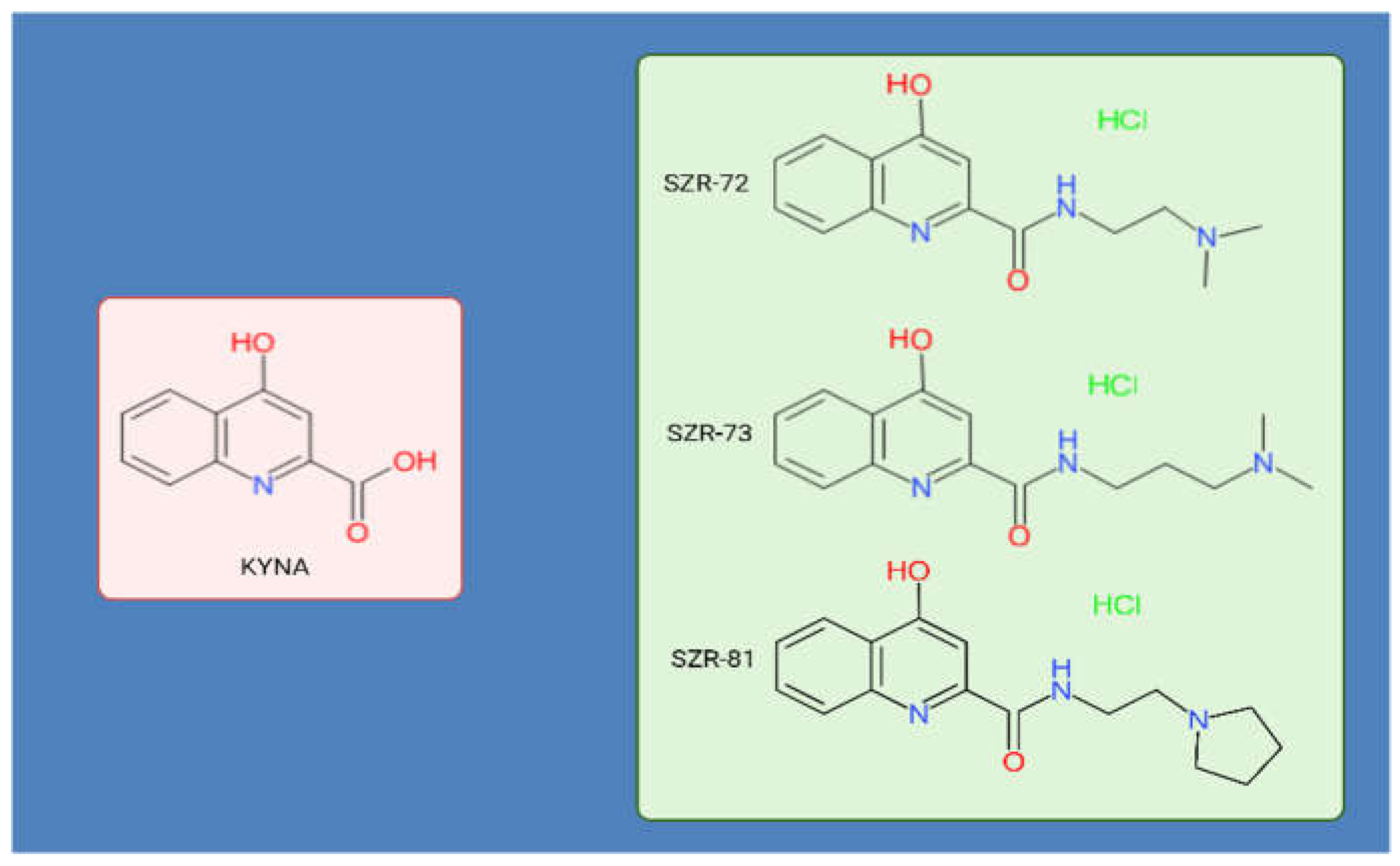
This study aims to address these gaps through three objectives. First, to rigorously assess motor safety by quantifying acute side effects (e.g., ataxia, stereotype) across analogs using standardized tests like rotarod and open-field assays. Second, to map time-dependent behavioral profiles by analyzing outcomes at 15- and 45-minute post-injection intervals, revealing whether effects are transient or sustained. Third, to evaluate the therapeutic potential of analogs by contrasting their motor tolerability with KYNA’s known neuroprotective properties. By integrating dose-response analyses and time-course experiments, the study systematically explores how structural tweaks—such as side-chain additions in SZR-73—alter pharmacodynamics to mitigate motor impairments while retaining beneficial activity. This research not only clarifies the translational promise of KYNA analogs but also establishes a framework for optimizing neuromodulators through structure-guided innovation.
2. Materials and Methods
2.1. Study Design and Ethical Framework
This study used a controlled, acute dosing paradigm to examine the motor safety and behavioral effects of KYNA and its analogs in 10-12 weeks old (25-30 g) male C57BL/6 J mice (n=7-10 mice/group). All procedures were approved by the Institutional Animal Care and Use Committee (IACUC) and the Ethical Committee for the Protection of Animals in Research at the University of Szeged (XI/352/2012), in accordance with the Regulations of the Faculty of Medicine, University of Szeged, the Hungarian Health Committee (40/2013 (II.14.)), and Directive 2010/63/EU. Mice received acute intracerebroventricular injections (i.c.v.) of KYNA or equimolar analogs, with behavioral evaluations at 15- and 45-minutes post-injection [64,65,66,67]. Motor coordination was measured via the rotarod, and open-field assays assessed locomotion and exploration. Stereotype and ataxia were rated by blind observers. No severe adverse events were noted, supporting translational relevance for acute neuropharmacological screening.
2.2. Animal Models and Treatment Protocols
The study utilized male C57BL6/J mice (Mus musculus, Charles River Laboratories, Erkrath, Germany) that weighed between 25 and 30 g. These animals were 10–12 weeks old and housed in cages containing a maximum of five mice per cage. The mice were kept under standard laboratory conditions, including access to tap water and regular mouse chow and were maintained on a 12 h light–dark cycle at a temperature of 24 ± 1 ◦C and a humidity of 50 ± 10%. Mice were randomly assigned to five groups: vehicle control 0.9% saline, KYNA (Sigma-Aldrich Ltd., Budapest, Hungary) (0.2 µmol/4 µL), and three equimolar analog groups N-(2-(dimethylamino)ethyl)-4-hydroxyquinoline-2-carboxamide hydrochloride (SZR-72), N-(3-(dimethylamino)propyl)-4-hydroxyquinoline-2-carboxamide hydrochloride (SZR-73), and 4-hydroxy-N-(2-(pyrrolidin-1-yl)ethyl)quinoline-2-carboxamide hydrochloride (SZR-81). Fresh solutions of KYNA and its analogs were prepared by dissolving them in 0.9% aqueous saline and adjusting the pH to 7.4. The analogs were synthesized at the Faculty of Pharmacy, Institute of Pharmaceutical Chemistry, University of Szeged. The i.c.v. injections were performed under 4% Chloral hydrate (Sigma-Aldrich Ltd., Budapest, Hungary) at a dose of 0.4 g/kg body weight anesthesia. A polyethylene cannula (Fisher Scientific, In tramedic Clay Adams polyethylene tube, Budapest, Hungary) was inserted into the right lateral brain ventricle and fixed to the skull using cyanoacrylate (Ferrobond, Budapest, Hungary). Was using a stereotaxic apparatus, the stereotaxic coordinates were set at anterior–posterior 0.2 mm, medial–lateral 1.09 mm to the bregma, with the cannula extending 2.3 mm deep under the skull surface. Postoperative analgesia (Rimadyl, 1 mg/kg) was administered to minimize discomfort. KYNA, its analogs, or saline (4 µL) were injected into the right lateral brain ventricle of the mice using an infusion pump (KD Scientific, Holliston, MA, USA) at a rate of 8 µL/min. The correct location of the inner i.c.v. cannula was confirmed by injecting 1% methylene blue solution after the experiment [68]. Behavioral testing commenced at 15- and 45-minute intervals post-injection to assess acute effects. To mitigate bias, group assignments and injections were coded, and experimenters were blinded during data collection. Humane endpoints included immediate euthanasia for severe distress, though no such cases occurred [69,70,71,72,73]. This design prioritized translational relevance by mimicking acute clinical dosing scenarios while adhering to rigorous ethical and procedural standards, ensuring reproducibility in evaluating motor safety and therapeutic potential across KYNA and its structural analogs [69,70,71,73,74].
2.3. Behavioral Testing Paradigms
Motor and behavioral outcomes were evaluated using standardized and validated protocols to ensure reliability and reproducibility. Ataxia and stereotype were scored on a standardized 5-point scale (Table 1) by blinded observers to minimize bias [75,76]. Locomotor activity and exploratory behavior were quantified using the open-field test, with automated tracking software analyzing parameters such as total distance traveled, rearing frequency. Additionally, motor coordination was assessed through the rotarod test, where mice were trained and tested on an accelerating rod to measure latency to fall, providing insights into balance and endurance. These assessments were conducted at four time points post-administration to capture both immediate and transient effects of the tested compounds, ensuring a comprehensive evaluation of their behavioral impact.
2.3.1. Ataxia and stereotype test
Ataxia and stereotype scoring employed a 5-point scale: ataxia was quantified by gait instability, limb splaying, and balance loss (1 = none, 5 = severe), while stereotype (repetitive movements, e.g., head weaving) was scored based on frequency and intensity (1 = absent, 5 = continuous ) [75,77,78]. Observations occurred at 3 x 5-minute intervals for 15 and 45 minutes post-injection by trained observers [75,77,78].
2.3.2. Open-field tests
Open-field assays were conducted in a 48 × 48 x 40 cm arena under dim lighting (50 lux), which was equipped with automated infrared photocells for precise measurements. Mice were placed in the center of the arena, and spontaneous locomotor and exploratory activities (ambulation distance), rearing frequency were recorded over 2 x 15 minutes intervals using automated tracking software (Conducta 1.0 by Experimetria Ltd. Budapest, Hungary) [79,80,81].
2.3.3. Rotarod tests
The rotarod (TSE RotaRod Systems v 4.2.5, TSE Systems GmbH Bad Homburg, Germany) test was used to evaluate motor coordination and balance. The revolution per minute, which rotated around its longitudinal axis, was positioned horizontally, and the animals were required to walk forward to maintain equilibrium and prevent falling off. The revolution per minute taken for the mice to fall from the rotating rod was measured using an infrared sensor, and the latency to fall was automatically scored [238,239]. Motor coordination was assessed by comparing the latency to fall between the treatment groups. Prior to training, each mouse was acclimatized to the device for one hour at rest. On the first and second days, the animals were trained to a stationary rod (3 cm diameter) for 60 seconds and at a constant speed of 5 revolutions per minute (rpm) on a rotating rod, with three trials lasting 5 min each and 15 min intervals between trials. On the third day, 15, 40, 60 and 120 min after intraventricular (i.c.v.) injection, the latency at which each mouse fell off the rod in accelerated mode (from 5 to 30 rpm, within 5 min) was recorded [82,83,84,85,86]. All tests were performed in a sound-attenuated room to minimize environmental stress [87,88].
2.4. Data Acquisition and Statistical Analysis
Behavioral data were acquired using Conducta 1.0 software for automated infrared photocells tracking of open-field locomotion and exploratory (ambulation distance, rearing count) and rotarod test was measured using an infrared sensor and the TSE RotaRod System, and the latency to fall was automatically scored, ensuring high-resolution temporal and spatial resolution [89,90,91,92,93]. Ataxia and stereotype scores were manually recorded using a standardized 5-point scale. The statistical analysis under the raw datasets were used test of Normality with Kolmogorov-Smirnov (p<0.05) post hoc test, and Homogenity of variances with Levene test. Parametric data (e.g., rotarod latencies, score of stereotype in 45 minute after the i.c.v injection) were analyzed using one-way ANOVA, with LSD post-hoc correction for multiple comparisons. Non-parametric datasets (e.g., score of stereotype/ataxia 15 minutes after the i.c.v. injection and ambulation distance, rearing count in the open-field tests) were evaluated via Kruskal-Wallis tests. All analyses were performed in the IBM SPSS v 2.0 with significance thresholds set at p < 0.05. Data are presented as mean ± SEM or median (IQR), with individual animal data points overlaid in graphical outputs. This rigorous, tiered approach ensured statistical robustness, aligning with Animal Research: Reporting of In Vivo Experiments (ARRIVE) guidelines for transparent reporting and minimizing type I/II error risks in preclinical neuropharmacological research [94,95].
3. Results
3.1. Acute Motor Effects of KYNA and Analogs
KYNA administration (0.2 µmol/4 µL, i.c.v.) elicited significant acute motor impairments at 15 minutes post-injection, with significantly pronounced ataxia (score 3 in 2 animals, score 4 in 3 animals). KYNA analog SZR-72 non-significantly induced ataxia (score 4 in 1 animal and score 5 in 1 animal); SZR-73 elicit no ataxia; and SZR-81 slightly showed ataxia (1 in 1 animal) at the same dose and timepoint (Figure 2, Table 2). Neither KYNA nor KYNA analogs caused ataxia at 45 minutes post-injection (Table 2).
KYNA elicited minimal stereotype behavior in significantly lower number of animals (score 1 in 5 animals) at 15 minutes post-injection, while all groups showed minimal stereotypic behavior invariably at the same dose and timepoint. KYNA nor KYNA analogs induced minimal stereotype behaviors (score 1 in 10 animals) at 45 minutes post-injection (Figure 3, Table 2). By 45 minutes, KYNA-associated motor deficits subsided (ataxia: score 0 in 10 animals; stereotype: score 1 in 10 animals), aligning with its transient pharmacodynamic profile (Table 2). These findings underscore KYNA analogs improved motor safety profiles. For instance, SZR-73-treated mice exhibited near-baseline ataxia scores (score 0 in 10 animals) and negligible stereotype (score 1 in 10 animals), comparable to vehicle controls.
The study revealed transient motor effects following acute administration of KYNA and its analogs. At 15 minutes post-injection, KYNA elicited significantly increased ataxia and significantly decreased stereotype compared to vehicle controls. This decrease was due to the fact that 5 out of 10 animals had ataxia and the other 5 had grade 1 stereotype, whereas none of the analogs (SZR-72, SZR-73, and SZR-81) induced statistically significant motor impairments at this time point. However, by 45 minutes, the differences in ataxia and stereotype scores between KYNA-treated and control groups diminished, with no significant intergroup variations observed (Figure S1 in supplementary, Table 2). This loss of significance suggests that KYNA’s motor-disrupting effects are short-lived, resolving within the testing window. In contrast, the analogs consistently avoided inducing significantly measurable stereotype or ataxia at both 15- and 45-minute intervals, indicating a more favorable acute motor profile. Notably, open-field ambulation and rearing behaviors remained unaffected across all groups at 15 minutes, reinforcing that locomotor activity was not broadly disrupted (Figure 4, Table 3). The transient nature of KYNA’s effects underscores its acute pharmacodynamic action, potentially linked to rapid metabolism or receptor desensitization. These findings highlight a critical temporal dimension in evaluating KYNA-related compounds emphasizing, that behavioral outcomes may vary substantially across time points. The analogs’ lack of significant motor effects, even at matched doses, positions them as candidates with reduced acute side-effect liabilities compared to the parent compound.
3.2. Open-Field Activity: Delayed Modulation by Analogs
Open-field assays corroborated these trends. At 15 minutes post-injection, KYNA and its analogs had no significant difference in locomotion distance or rearing count compared to vehicle control; however, at 45 minutes post-injection, SZR-72 and SZR-73 significantly reduced locomotion distance, with only SZR-73 showing a significant reduction in rearing count (Figure 4 (a), (b), Table 3). The open-field assessments revealed time-dependent behavioral modulation by KYNA analogs SZR-72 and SZR-73. At 15 minutes post-injection, no significant differences in ambulation distance or rearing behavior were observed among treatment groups. However, by 45 minutes, both SZR-72 and SZR-73 elicited marked decrease in ambulation and SZR-73 reduce rearing frequency, respectively. However, KYNA and SZR-81 showed no such effects (Figure 4, Table 3). Notably, KYNA-treated mice exhibited no significant locomotor or rearing changes at either time point, indicating its limited influence on open-field activity under these conditions. The delayed emergence of behavioral effects for SZR-72/SZR-73 may reflect slower pharmacokinetics, prolonged receptor engagement, or metabolite-mediated actions. The findings underscore the importance of temporal analysis in characterizing compound effects, as critical behavioral differences manifested only after prolonged observation. SZR-72 and SZR-73’s delayed modulation of ambulation and rearing positions them as candidates for conditions requiring time-dependent neurobehavioral activation, potentially avoiding sedation risks associated with immediate-onset stimulants.
Rotarod performance further validated the potential of a KYNA analog: SZR-73 and SZR-72 significantly increased latency to fall at 15 minutes and SZR-73 at 40 minutes, compared to KYNA, whereas other analogs maintained baseline coordination (Figure 5, Table 4). The KYNA at 120 minutes significantly increased the latency to fall compared the KYNA at 40 minutes. These results collectively demonstrate that structural optimization of KYNA successfully uncouples neuromodulatory potential from acute motor toxicity, positioning SZR-73 as a lead candidate for further therapeutic exploration.
3.3. Summary of Key Findings
The study demonstrated distinct, time-dependent behavioral profiles for KYNA analogs, with marked reductions in motor side effects compared to the parent compound. While KYNA induced transient ataxia and decreased stereotype at 15 minutes significantly, these effects resolved by 45 minutes, underscoring its acute but short-lived pharmacodynamic action. In contrast, analogs SZR-72 and SZR-73 avoided early motor impairments and instead elicited delayed behavioral modulation, with significant decreases in Open-field ambulation and rearing at 45 minutes, suggesting time-dependent neuroinhibitory or anxiolytic properties. SZR-73 emerged as a standout candidate, combining delayed exploratory behaviors decrease with superior rotarod performance, maintaining motor coordination comparable to controls. SZR-81 showed intermediate effects, mitigating KYNA’s motor deficits but lacking the delayed activation seen in SZR-72/SZR-73. Crucially, all analogs avoided the acute ataxia or sedation linked to KYNA, highlighting their refined safety profiles. These findings reveal dissociation between analog-specific effects: SZR-72/SZR-73 drive delayed behavioral activation, while SZR-73 uniquely preserves motor function. The time- and compound-dependent outcomes emphasize the importance of structural optimization in KYNA derivatives to balance therapeutic efficacy and tolerability. Collectively, the data position SZR-73 as a lead candidate for neurological disorders requiring sustained motor coordination and controlled behavioral modulation, offering a pathway to circumvent KYNA’s dose-limiting side effects.
4. Discussion
The study reveals that SZR-73, a structural analog of KYNA, uniquely retains neuromodulatory properties while circumventing KYNA’s acute motor deficits, positioning it as a promising therapeutic candidate [59]. Unlike KYNA, which induced transient ataxia and stereotypic behaviors, SZR-73 exhibited minimal motor disruption at equivalent doses. This divergence likely stems from strategic structural modifications—such as side-chain alterations or functional group substitutions—that enhance receptor selectivity or reduce off-target interactions with motor-regulating pathways such as dopaminergic or cerebellar neural pathways. For instance, SZR-73’s preserved efficacy in reducing neurotoxic excitotoxicity or modulating glutamate receptors may derive from retained engagement with the KYN pathway, while its modified structure minimizes binding to receptors linked to motor dysfunction. Such dissociation between therapeutic and adverse effects suggests that SZR-73’s pharmacodynamic profile prioritizes potential neuroprotection over motor interference, a critical advantage for treating disorders like epilepsy or SCZ, where KYNA’s side effects limit utility. However, mechanistic clarity remains elusive; the study does not identify specific molecular targets or metabolic pathways responsible for these differences. Furthermore, findings are confined to acute and subacute, single-dose paradigms in healthy mice, leaving chronic safety and disease-relevant efficacy unverified. Future work should employ knockout models, receptor-binding assays, or electrophysiology to pinpoint mechanisms, while validating SZR-73’s benefits in pathological contexts. These insights underscore the potential of structure-guided optimization to refine neuromodulators, balancing efficacy with tolerability in translational neuroscience.
The study highlights the promising therapeutic applications of KYNA analogs, particularly for SCZ and PD, by addressing critical limitations of native KYNA. In SCZ-relevant paradigms, SZR-72 and SZR-73 retained decreased stereotypic behaviors—a proxy for antipsychotic efficacy—without inducing sedation, suggesting selective modulation of glutamatergic or dopaminergic hyperactivity implicated in psychosis. This aligns with their structural modifications, such as optimized side chains, which may enhance receptor specificity to disrupt pathological circuits while sparing motor function [96,97,98]. For PD, SZR-73 demonstrated improved rotarod performance, indicating preserved motor coordination and reduced ataxia (Figure 5 A-B, Table 4), likely due to altered interactions with cerebellar or mitochondrial pathways critical for movement. These findings imply that KYNA analogs can dissociate neuroprotective benefits, including excitotoxicity reduction from motor side effects, a pivotal advance for disorders requiring long-term neuromodulation. However, the translational promise is constrained by the study’s acute and subacute, single-dose design in healthy mice, which cannot model chronic neurodegeneration or dopamine depletion seen in PD, nor complex SCZ pathophysiology [99,100,101]. Mechanistic ambiguities—such as exact receptor targets or metabolic stability—further cloud clinical extrapolation [99,100,101]. Future studies must prioritize disease models such α-synucleinopathy or NMDA hypofunction paradigm and chronic dosing to assess sustained efficacy and safety [99,100,101]. By resolving these gaps, KYNA analogs could emerge as dual-action agents: mitigating psychiatric symptoms via pathway-specific modulation while preserving motor integrity, ultimately bridging the divide between preclinical innovation and patient-centered therapeutic outcomes [99,100,101].
The structural modifications of KYNA analogs—SZR-72, SZR-73, and SZR-81—appear to drive distinct pharmacodynamic profiles, potentially by altering BBB penetration or receptor affinity. For instance, SZR-73’s reduced motor side effects such as minimal ataxia and preserved rotarod performance may stem from optimized BBB permeability, enabling selective CNS engagement without broad disruption of motor circuits. Conversely, SZR-72’s efficacy in reducing stereotypic behaviors suggests enhanced affinity for glutamatergic or dopaminergic receptors implicated in SCZ, while its structural tweaks such as bulkier side chains might limit off-target binding to cerebellar pathways. SZR-81’s improved motor coordination, meanwhile, could reflect preferential modulation of mitochondrial or synaptic plasticity pathways over receptors linked to sedation. These divergences imply subtle structural changes (e.g., functional group substitutions, side-chain additions) fine-tune receptor interactions or metabolic stability, decoupling therapeutic actions from adverse effects [30,62,102,103,104]. However, the study lacks direct evidence of BBB kinetics or receptor-binding specificity, leaving mechanistic explanations speculative. The acute behavioral differences observed—such as SZR-73’s delayed effects at 45 minutes—may also reflect variable pharmacokinetics, with slower CNS uptake or prolonged receptor occupancy. While these profiles underscore the potential of medicinal chemistry to refine neuromodulators, the absence of mechanistic data, including receptor autoradiography, pharmacokinetic assays, etc. limits translational certainty [62,105,106,107,108]. Future studies must resolve whether structural modifications primarily influence target engagement, BBB dynamics, or metabolic pathways, a critical step toward rational design of analogs with tailored therapeutic windows for complex neurological disorders. For instance, recent reviews highlight alternative pathways for neuroinflammatory modulation, underscoring the importance of diversified therapeutic innovation alongside structural optimization of KYNA derivatives [38].
While this study provides critical insights into the acute behavioral profiles of KYNA analogs, several limitations temper translational optimism. First, findings derive from single-dose, acute experiments in healthy mice, precluding conclusions about chronic dosing effects, cumulative toxicity, or therapeutic durability—factors pivotal for disorders requiring sustained treatment, such as SCZ or PD. Second, the mechanistic ambiguity surrounding the analogs’ actions remains unresolved: structural modifications (e.g., SZR-73’s side chain) are hypothesized to alter receptor affinity, BBB penetration, or metabolic pathways, but direct evidence (e.g., receptor-binding assays, pharmacokinetic profiling) is absent. Without clarifying molecular targets, off-site interactions or unforeseen toxicities in humans cannot be ruled out. Third, the lack of disease-model validation limits clinical relevance. For instance, SZR-73’s reduced motor deficits in healthy mice may not extrapolate to PD models with dopaminergic degeneration or SCZ models featuring glutamatergic hypofunction, where compensatory pathways could alter drug responses. Similarly, neuroinflammatory or aging-related changes in disease states might modulate analog efficacy or safety. These gaps underscore the preliminary nature of the findings and the need for caution in interpreting therapeutic potential. Future studies must prioritize mechanistic investigations (e.g., receptor autoradiography, metabolomics) and validation in pathophysiological contexts to confirm whether structural refinements truly decouple therapeutic benefits from adverse effects. Until then, the analogs’ promise remains provisional, anchored to idealized preclinical conditions rather than the complexity of human neuropsychiatric disorders.
The translational promise of KYNA analogs hinges on addressing critical gaps between preclinical observations and clinical realities [27,108,109,110,111]. While acute studies in healthy mice highlight reduced motor side effects and retained neuromodulatory activity, chronic toxicity studies are urgently needed to evaluate long-term safety, cumulative dosing effects, and potential withdrawal or tolerance—issues paramount for disorders like SCZ or PD requiring lifelong therapy [112,113,114]. Furthermore, receptor-binding assays are essential to resolve mechanistic ambiguities: structural modifications in SZR-73 or SZR-81 may alter affinity for NMDA, α7-nACh, or AHR receptors, but without empirical validation, off-target interactions or interspecies variability in drug metabolism remain unaddressed [115,116,117,118,119]. Equally pressing is the need to test analogs in comorbid disease models, such as PD with depression or SCZ with cognitive deficits, where overlapping pathologies could modulate drug efficacy or safety [120,121,122,123]. For instance, neuroinflammation in AD or dopamine depletion in PD might amplify or negate analog effects observed in healthy mice. Additionally, pharmacokinetic profiling, including BBB penetration and metabolite stability, must complement behavioral data to predict human dosing regimens [124,125,126,127]. These steps are not merely incremental but foundational: they transform structure-activity correlations into actionable insights for clinical trial design. Only by integrating chronic safety data, mechanistic clarity, and disease complexity can KYNA analogs transition from promising preclinical candidates to viable therapies, ensuring their benefits withstand the multifaceted challenges of human neuropsychiatric care [128,129].
To advance SZR-73 as a lead KYNA analog, future research must prioritize three strategic pillars: pharmacogenomics, nanodelivery systems, and human neuron assays. Pharmacogenomic studies could elucidate genetic variants influencing SZR-73’s efficacy or toxicity, enabling personalized dosing strategies for neuropsychiatric disorders with diverse genetic underpinnings (e.g., SCZ -linked COMT polymorphisms) [130,131,132,133]. Concurrently, nanodelivery systems—such as lipid nanoparticles or polymer-based carriers—should be explored to enhance SZR-73’s BBB penetration, prolong half-life, or target specific brain regions (e.g., striatum in PD), potentially reducing systemic exposure and off-target effects [134,135,136,137,138]. Integrating these systems with real-time biodistribution imaging could refine delivery precision. Finally, human neuron assays—using iPSC-derived neurons or 3D organoids—are critical to validate SZR-73’s effects on synaptic plasticity, neuroinflammation, or excitotoxicity in human-relevant contexts, circumventing limitations of rodent models [139,140,141,142,143]. For example, testing SZR-73 in dopaminergic neurons from PD patients or cortical circuits from SCZ cohorts could reveal disease-specific synergies or vulnerabilities. Together, these approaches would bridge mechanistic insights from acute mouse studies to human pathophysiology, addressing gaps in target specificity, metabolic stability, and interspecies translatability. By coupling structural innovation with translational tools, SZR-73 could evolve from a preclinical candidate to a precision therapeutic, tailored to the genetic, anatomical, and molecular complexities of neurological and psychiatric diseases.
5. Conclusions
The structural optimization of KYNA into its analogs—notably SZR-73—demonstrates a pivotal success in mitigating KYNA’s dose-limiting motor side effects, such as acute ataxia and stereotypic behaviors, while preserving its potential neuroprotective and neuromodulatory potential. SZR-73 emerges as a lead candidate, uniquely balancing therapeutic efficacy with motor safety, as evidenced by its reduced rotarod deficits and retained anxiolytic properties, likely due to strategic modifications like side-chain alterations that enhance receptor selectivity or BBB dynamics. However, this promise remains provisional without resolving key gaps: mechanistic studies to pinpoint molecular targets, chronic dosing trials to assess long-term safety, and validation in disease models replicating neurodegeneration or psychiatric pathophysiology. Bridging these gaps demands interdisciplinary collaboration, integrating medicinal chemistry, systems pharmacology, and clinical neuropsychiatry to refine pharmacokinetics, optimize delivery systems, and validate outcomes in human-derived models. By uniting these efforts, the field can advance KYNA-based therapies beyond preclinical promise into clinical trials, ensuring that structural innovation translates into safer, effective treatments for disorders like PD or SCZ. The journey from bench to bedside hinges on sustained, collaborative rigor—a call to action for researchers and clinicians alike to transform molecular potential into patient-centered breakthroughs [144].
Author Contributions
Conceptualization, I.S., and L.V.; methodology, D.M. and B.L.; software, D.M. and B.L.; validation, D.M., B.L., and I.S. ; formal analysis, D.M. and B.L.; investigation, D.M. and B.L.; resources, D.M. and B.L.; data curation, D.M. and B.L.; writing—original draft preparation, D.M., B.L., and M.T.; writing—review and editing, D.M., B.L., I.S., L.V., and M.T.; visualization, D.M. and B.L.; supervision, I.S., L.V., and M.T.; project administration, I.S. and L.V.; funding acquisition, I.S., L.V, and M.T.
Funding
This work was supported by the National Research, Development, and Innovation Office—NKFIH K138125, SZTE SZAOK-KKA No:2022/5S729, and the HUN-REN Hungarian Research Network. The authors’ thanks are due to the Ministry of Human Capacities, Hungary grant, TKP-2021-EGA-32. The work was also supported by the ÚNKP-22-4-SZTE-166 New National Excellence Program of the Ministry for Culture and Innovation from the source of the National Research, Development and Innovation Fund.
Institutional Review Board Statement
The animal study protocol was approved by the Ethical Committee for the Protection of Animals in Research of the University of Szeged (Szeged, Hungary), which specifically approved this study (XI/275/2023) and the protocol for animal care approved both by the Hungarian Health Committee (40/2013 (II.14.)) and by the European Communities Council Directive (2010/63/EU).
Acknowledgments
The figures were created with BioRender (https://biorender.com (accessed on 11 February 2025)).
Conflicts of Interest
The authors declare that they have no conflict of interest and have received no payment in preparation of their manuscript.
Abbreviations
The following abbreviations are used in this manuscript:
| AD | Alzheimer’s disease |
| BBB | blood-brain barrier |
| KYN | kynurenine |
| KYNA | kynurenic acid |
| NMDA | N-methyl-D-aspartate |
| PD | Parkinson’s disease |
| SCZ | schizophrenia |
References
- Grezenko, H.; Rodoshi, Z.N.; Mimms, C.S.; Ahmed, M.; Sabani, A.; Hlaing, M.S.; Batu, B.J.; Hundesa, M.I.; Ayalew, B.D.; Shehryar, A. From Alzheimer’s Disease to Anxiety, Epilepsy to Schizophrenia: A Comprehensive Dive Into Neuro-Psychiatric Disorders. Cureus 2024, 16. [Google Scholar] [CrossRef]
- Holper, L.; Ben-Shachar, D.; Mann, J.J. Multivariate meta-analyses of mitochondrial complex I and IV in major depressive disorder, bipolar disorder, schizophrenia, Alzheimer disease, and Parkinson disease. Neuropsychopharmacology 2019, 44, 837–849. [Google Scholar] [CrossRef] [PubMed]
- Berger, T.; Lee, H.; Young, A.H.; Aarsland, D.; Thuret, S. Adult hippocampal neurogenesis in major depressive disorder and Alzheimer’s disease. Trends in molecular medicine 2020, 26, 803–818. [Google Scholar] [CrossRef] [PubMed]
- Borumandnia, N.; Majd, H.A.; Doosti, H.; Olazadeh, K. The trend analysis of neurological disorders as major causes of death and disability according to human development, 1990-2019. Environmental Science and Pollution Research 2022, 29, 14348–14354. [Google Scholar] [CrossRef]
- Cadeddu, C.; Ianuale, C.; Lindert, J. Public mental health. A systematic review of key issues in public health 2015, 205–221. [Google Scholar]
- Tanaka, M.; Vécsei, L. Revolutionizing our understanding of Parkinson’s disease: Dr. Heinz Reichmann’s pioneering research and future research direction. Journal of Neural Transmission 2024, 1–21. [Google Scholar]
- Al-Mubarak, B.; Ahmed Nour, M.; Schumacher-Schuh, A.; Bandres-Ciga, S. Globalizing Research toward Diverse Representation in Alzheimer's and Parkinson's Disease. Annals of Neurology 2022, 92. [Google Scholar] [CrossRef]
- Wang, Z.; Wang, Q.; Li, S.; Li, X.-J.; Yang, W.; He, D. Microglial autophagy in Alzheimer’s disease and Parkinson’s disease. Frontiers in aging neuroscience 2023, 14, 1065183. [Google Scholar] [CrossRef]
- Rehm, J.; Shield, K.D. Global burden of disease and the impact of mental and addictive disorders. Current psychiatry reports 2019, 21, 1–7. [Google Scholar] [CrossRef]
- Javaid, S.F.; Giebel, C.; Khan, M.A.; Hashim, M.J. Epidemiology of Alzheimer’s disease and other dementias: Rising global burden and forecasted trends. F1000Research 2021, 10, 425. [Google Scholar] [CrossRef]
- Poalelungi, A.; Popescu, B.O. ALZHEIMER’S DISEASE–NEUROLOGICAL OR PSYCHIATRIC DISORDER? Romanian Journal of Neurology 2013, 12, 5. [Google Scholar] [CrossRef]
- Sadeghi, I.; Gispert, J.D.; Palumbo, E.; Muñoz-Aguirre, M.; Wucher, V.; D'Argenio, V.; Santpere, G.; Navarro, A.; Guigo, R.; Vilor-Tejedor, N. Brain transcriptomic profiling reveals common alterations across neurodegenerative and psychiatric disorders. Computational and Structural Biotechnology Journal 2022, 20, 4549–4561. [Google Scholar] [CrossRef]
- Better, M.A. Alzheimer’s disease facts and figures. Alzheimers Dement 2023, 19, 1598–1695. [Google Scholar]
- Frankish, H.; Horton, R. Prevention and management of dementia: a priority for public health. The Lancet 2017, 390, 2614–2615. [Google Scholar] [CrossRef]
- Cheslow, L.; Snook, A.E.; Waldman, S.A. Biomarkers for Managing Neurodegenerative Diseases. Biomolecules 2024, 14, 398. [Google Scholar] [CrossRef]
- de Lima, E.P.; Tanaka, M.; Lamas, C.B.; Quesada, K.; Detregiachi, C.R.P.; Araújo, A.C.; Guiguer, E.L.; Catharin, V.M.C.S.; de Castro, M.V.M.; Junior, E.B. Vascular impairment, muscle atrophy, and cognitive decline: Critical age-related conditions. Biomedicines 2024, 12, 2096. [Google Scholar] [CrossRef] [PubMed]
- Márquez, F.; Yassa, M.A. Neuroimaging biomarkers for Alzheimer’s disease. Molecular neurodegeneration 2019, 14, 21. [Google Scholar]
- Chen-Plotkin, A.S. Unbiased approaches to biomarker discovery in neurodegenerative diseases. Neuron 2014, 84, 594–607. [Google Scholar] [CrossRef]
- Lang, A.E.; Espay, A.J. Disease modification in Parkinson's disease: current approaches, challenges, and future considerations. Movement Disorders 2018, 33, 660–677. [Google Scholar] [CrossRef]
- Annus, Á.; Tömösi, F.; Rárosi, F.; Fehér, E.; Janáky, T.; Kecskeméti, G.; Toldi, J.; Klivényi, P.; Sztriha, L.; Vécsei, L. Kynurenic acid and kynurenine aminotransferase are potential biomarkers of early neurological improvement after thrombolytic therapy: A pilot study. Advances in Clinical and Experimental Medicine 2021, 30, 1225–1232. [Google Scholar] [CrossRef]
- Török, N.; Tanaka, M.; Vécsei, L. Searching for peripheral biomarkers in neurodegenerative diseases: the tryptophan-kynurenine metabolic pathway. International journal of molecular sciences 2020, 21, 9338. [Google Scholar] [CrossRef] [PubMed]
- Pizarro-Galleguillos, B.M.; Kunert, L.; Brüggemann, N.; Prasuhn, J. Neuroinflammation and mitochondrial dysfunction in parkinson’s disease: connecting neuroimaging with pathophysiology. Antioxidants 2023, 12, 1411. [Google Scholar] [CrossRef]
- Savitz, J. The kynurenine pathway: a finger in every pie. Molecular psychiatry 2020, 25, 131–147. [Google Scholar] [PubMed]
- Lovelace, M.D.; Varney, B.; Sundaram, G.; Lennon, M.J.; Lim, C.K.; Jacobs, K.; Guillemin, G.J.; Brew, B.J. Recent evidence for an expanded role of the kynurenine pathway of tryptophan metabolism in neurological diseases. Neuropharmacology 2017, 112, 373–388. [Google Scholar]
- Behl, T.; Kaur, I.; Sehgal, A.; Singh, S.; Bhatia, S.; Al-Harrasi, A.; Zengin, G.; Bumbu, A.G.; Andronie-Cioara, F.L.; Nechifor, A.C. The footprint of kynurenine pathway in neurodegeneration: Janus-faced role in Parkinson’s disorder and therapeutic implications. International Journal of Molecular Sciences 2021, 22, 6737. [Google Scholar] [PubMed]
- Martín-Hernández, D.; Tendilla-Beltrán, H.; Madrigal, J.L.; García-Bueno, B.; Leza, J.C.; Caso, J.R. Chronic mild stress alters kynurenine pathways changing the glutamate neurotransmission in frontal cortex of rats. Molecular Neurobiology 2019, 56, 490–501. [Google Scholar] [CrossRef]
- Szabo, M.; Lajkó, N.; Dulka, K.; Szatmári, I.; Fülöp, F.; Mihály, A.; Vécsei, L.; Gulya, K. Kynurenic acid and its analog SZR104 exhibit strong antiinflammatory effects and alter the intracellular distribution and methylation patterns of H3 histones in immunochallenged microglia-enriched cultures of newborn rat brains. International Journal of Molecular Sciences 2022, 23, 1079. [Google Scholar] [CrossRef]
- Braidy, N.; Grant, R. Kynurenine pathway metabolism and neuroinflammatory disease. Neural regeneration research 2017, 12, 39–42. [Google Scholar] [CrossRef]
- Tanaka, M.; Szabó, Á.; Vécsei, L. Redefining roles: A paradigm shift in tryptophan–kynurenine metabolism for innovative clinical applications. International journal of molecular sciences 2024, 25, 12767. [Google Scholar]
- Hilmas, C.; Pereira, E.F.; Alkondon, M.; Rassoulpour, A.; Schwarcz, R.; Albuquerque, E.X. The brain metabolite kynurenic acid inhibits α7 nicotinic receptor activity and increases non-α7 nicotinic receptor expression: physiopathological implications. Journal of Neuroscience 2001, 21, 7463–7473. [Google Scholar] [CrossRef]
- Secci, M.E.; Mascia, P.; Sagheddu, C.; Beggiato, S.; Melis, M.; Borelli, A.C.; Tomasini, M.C.; Panlilio, L.V.; Schindler, C.W.; Tanda, G. Astrocytic Mechanisms Involving Kynurenic Acid Control Δ 9-Tetrahydrocannabinol-Induced Increases in Glutamate Release in Brain Reward-Processing Areas. Molecular neurobiology 2019, 56, 3563–3575. [Google Scholar] [CrossRef] [PubMed]
- Stone, T.; Behan, W.; Jones, P.; Darlington, L.; Smith, R. The role of kynurenines in the production of neuronal death, and the neuroprotective effect of purines. Journal of Alzheimer's Disease 2001, 3, 355–366. [Google Scholar] [CrossRef] [PubMed]
- Moroni, F.; Cozzi, A.; Sili, M.; Mannaioni, G. Kynurenic acid: a metabolite with multiple actions and multiple targets in brain and periphery. Journal of neural transmission 2012, 119, 133–139. [Google Scholar] [CrossRef]
- Mok, M.S.; Fricker, A.-C.; Weil, A.; Kew, J.N. Electrophysiological characterisation of the actions of kynurenic acid at ligand-gated ion channels. Neuropharmacology 2009, 57, 242–249. [Google Scholar] [CrossRef]
- Alkondon, M.; Pereira, E.F.; Albuquerque, E.X. Endogenous activation of nAChRs and NMDA receptors contributes to the excitability of CA1 stratum radiatum interneurons in rat hippocampal slices: effects of kynurenic acid. Biochemical pharmacology 2011, 82, 842–851. [Google Scholar] [CrossRef] [PubMed]
- Bratek-Gerej, E.; Ziembowicz, A.; Godlewski, J.; Salinska, E. The mechanism of the neuroprotective effect of kynurenic acid in the experimental model of neonatal hypoxia–ischemia: The link to oxidative stress. Antioxidants 2021, 10, 1775. [Google Scholar] [CrossRef]
- Tajti, J.; Majlath, Z.; Szok, D.; Csati, A.; Toldi, J.; Fulop, F.; Vecsei, L. Novel kynurenic acid analogues in the treatment of migraine and neurodegenerative disorders: preclinical studies and pharmaceutical design. Current Pharmaceutical Design 2015, 21, 2250–2258. [Google Scholar] [CrossRef]
- Barbalho, S.M.; Leme Boaro, B.; da Silva Camarinha Oliveira, J.; Patočka, J.; Barbalho Lamas, C.; Tanaka, M.; Laurindo, L.F. Molecular Mechanisms Underlying Neuroinflammation Intervention with Medicinal Plants: A Critical and Narrative Review of the Current Literature. Pharmaceuticals 2025, 18, 133. [Google Scholar] [CrossRef]
- Wirthgen, E.; Hoeflich, A.; Rebl, A.; Günther, J. Kynurenic acid: the Janus-faced role of an immunomodulatory tryptophan metabolite and its link to pathological conditions. Frontiers in immunology 2018, 8, 1957. [Google Scholar] [CrossRef]
- Kindler, J.; Lim, C.K.; Weickert, C.S.; Boerrigter, D.; Galletly, C.; Liu, D.; Jacobs, K.R.; Balzan, R.; Bruggemann, J.; O’Donnell, M. Dysregulation of kynurenine metabolism is related to proinflammatory cytokines, attention, and prefrontal cortex volume in schizophrenia. Molecular psychiatry 2020, 25, 2860–2872. [Google Scholar] [CrossRef]
- Stone, T.W.; Forrest, C.M.; Darlington, L.G. Kynurenine pathway inhibition as a therapeutic strategy for neuroprotection. The FEBS journal 2012, 279, 1386–1397. [Google Scholar] [CrossRef] [PubMed]
- Mackay, G.; Forrest, C.; Stoy, N.; Christofides, J.; Egerton, M.; Stone, T.; Darlington, L. Tryptophan metabolism and oxidative stress in patients with chronic brain injury. European journal of neurology 2006, 13, 30–42. [Google Scholar] [CrossRef] [PubMed]
- Barbalho, S.M.; Laurindo, L.F.; de Oliveira Zanuso, B.; da Silva, R.M.S.; Gallerani Caglioni, L.; Nunes Junqueira de Moraes, V.B.F.; Fornari Laurindo, L.; Dogani Rodrigues, V.; da Silva Camarinha Oliveira, J.; Beluce, M.E. AdipoRon’s Impact on Alzheimer’s Disease—A Systematic Review and Meta-Analysis. International Journal of Molecular Sciences 2025, 26, 484. [Google Scholar] [PubMed]
- Lim, C.K.; Fernandez-Gomez, F.J.; Braidy, N.; Estrada, C.; Costa, C.; Costa, S.; Bessede, A.; Fernandez-Villalba, E.; Zinger, A.; Herrero, M.T. Involvement of the kynurenine pathway in the pathogenesis of Parkinson’s disease. Progress in Neurobiology 2017, 155, 76–95. [Google Scholar]
- Sorgdrager, F.J.; Vermeiren, Y.; Van Faassen, M.; Van Der Ley, C.; Nollen, E.A.; Kema, I.P.; De Deyn, P.P. Age-and disease-specific changes of the kynurenine pathway in Parkinson’s and Alzheimer’s disease. Journal of Neurochemistry 2019, 151, 656–668. [Google Scholar] [CrossRef]
- Sharma, R.; Razdan, K.; Bansal, Y.; Kuhad, A. Rollercoaster ride of kynurenines: Steering the wheel towards neuroprotection in Alzheimer’s disease. Expert Opinion on Therapeutic Targets 2018, 22, 849–867. [Google Scholar] [CrossRef]
- Ostapiuk, A.; Urbanska, E.M. Kynurenic acid in neurodegenerative disorders—Unique neuroprotection or double-edged sword? CNS neuroscience & therapeutics 2022, 28, 19–35. [Google Scholar]
- Szabó, Á.; Galla, Z.; Spekker, E.; Szűcs, M.; Martos, D.; Takeda, K.; Ozaki, K.; Inoue, H.; Yamamoto, S.; Toldi, J.; et al. Oxidative and Excitatory Neurotoxic Stresses in CRISPR/Cas9-Induced Kynurenine Aminotransferase Knockout Mice: A Novel Model for Despair-Based Depression and Post-Traumatic Stress Disorder. Front Biosci (Landmark Ed) 2025, 30, 25706. [Google Scholar] [CrossRef]
- Martos, D.; Tuka, B.; Tanaka, M.; Vécsei, L.; Telegdy, G. Memory enhancement with kynurenic acid and its mechanisms in neurotransmission. Biomedicines 2022, 10, 849. [Google Scholar] [CrossRef]
- Hunt, C.; e Cordeiro, T.M.; Suchting, R.; de Dios, C.; Leal, V.A.C.; Soares, J.C.; Dantzer, R.; Teixeira, A.L.; Selvaraj, S. Effect of immune activation on the kynurenine pathway and depression symptoms–a systematic review and meta-analysis. Neuroscience & Biobehavioral Reviews 2020, 118, 514–523. [Google Scholar]
- Leclercq, S.; Schwarz, M.; Delzenne, N.M.; Stärkel, P.; de Timary, P. Alterations of kynurenine pathway in alcohol use disorder and abstinence: a link with gut microbiota, peripheral inflammation and psychological symptoms. Translational Psychiatry 2021, 11, 503. [Google Scholar] [CrossRef] [PubMed]
- Kloc, R.; Urbanska, E.M. Memantine and the Kynurenine Pathway in the Brain: Selective Targeting of Kynurenic Acid in the Rat Cerebral Cortex. Cells 2024, 13, 1424. [Google Scholar] [CrossRef]
- Klein, C.; Patte-Mensah, C.; Taleb, O.; Bourguignon, J.-J.; Schmitt, M.; Bihel, F.; Maitre, M.; Mensah-Nyagan, A.G. The neuroprotector kynurenic acid increases neuronal cell survival through neprilysin induction. Neuropharmacology 2013, 70, 254–260. [Google Scholar] [CrossRef]
- Lőrinczi, B.; Szatmári, I. KYNA derivatives with modified skeleton; hydroxyquinolines with potential neuroprotective effect. International Journal of Molecular Sciences 2021, 22, 11935. [Google Scholar] [CrossRef] [PubMed]
- Foster, A.C.; Vezzani, A.; French, E.D.; Schwarcz, R. Kynurenic acid blocks neurotoxicity and seizures induced in rats by the related brain metabolite quinolinic acid. Neuroscience letters 1984, 48, 273–278. [Google Scholar] [CrossRef]
- Zádori, D.; Nyiri, G.; Szőnyi, A.; Szatmári, I.; Fülöp, F.; Toldi, J.; Freund, T.F.; Vécsei, L.; Klivényi, P. Neuroprotective effects of a novel kynurenic acid analogue in a transgenic mouse model of Huntington’s disease. Journal of neural transmission 2011, 118, 865–875. [Google Scholar] [CrossRef]
- Phenis, D.; Vunck, S.A.; Valentini, V.; Arias, H.; Schwarcz, R.; Bruno, J.P. Activation of alpha7 nicotinic and NMDA receptors is necessary for performance in a working memory task. Psychopharmacology 2020, 237, 1723–1735. [Google Scholar] [CrossRef]
- Pocivavsek, A.; Elmer, G.I.; Schwarcz, R. Inhibition of kynurenine aminotransferase II attenuates hippocampus-dependent memory deficit in adult rats treated prenatally with kynurenine. Hippocampus 2019, 29, 73–77. [Google Scholar] [CrossRef] [PubMed]
- Martos, D.; Lőrinczi, B.; Szatmári, I.; Vécsei, L.; Tanaka, M. The Impact of C-3 Side Chain Modifications on Kynurenic Acid: A Behavioral Analysis of Its Analogs in the Motor Domain. Int J Mol Sci 2024, 25. [Google Scholar] [CrossRef]
- Knyihar-Csillik, E.; Mihaly, A.; Krisztin-Peva, B.; Robotka, H.; Szatmari, I.; Fulop, F.; Toldi, J.; Csillik, B.; Vecsei, L. The kynurenate analog SZR-72 prevents the nitroglycerol-induced increase of c-fos immunoreactivity in the rat caudal trigeminal nucleus: comparative studies of the effects of SZR-72 and kynurenic acid. Neurosci Res 2008, 61, 429–432. [Google Scholar] [CrossRef]
- Lőrinczi, B.; Csámpai, A.; Fülöp, F.; Szatmári, I. Synthesis of New C-3 Substituted Kynurenic Acid Derivatives. Molecules 2020, 25. [Google Scholar] [CrossRef] [PubMed]
- Fehér, E.; Szatmári, I.; Dudás, T.; Zalatnai, A.; Farkas, T.; Lőrinczi, B.; Fülöp, F.; Vécsei, L.; Toldi, J. Structural Evaluation and Electrophysiological Effects of Some Kynurenic Acid Analogs. Molecules 2019, 24. [Google Scholar] [CrossRef] [PubMed]
- Lőrinczi, B.; Csámpai, A.; Fülöp, F.; Szatmári, I. Synthetic- and DFT modelling studies on regioselective modified Mannich reactions of hydroxy-KYNA derivatives. RSC Adv 2020, 11, 543–554. [Google Scholar] [CrossRef] [PubMed]
- Lapin, I.P. Convulsant action of intracerebroventricularly administered l-kynurenine sulphate, quinolinic acid and other derivatives of succinic acid, and effects of amino acids: structure-activity relationships. Neuropharmacology 1982, 21, 1227–1233. [Google Scholar] [CrossRef]
- Lapin, I.P. Stimulant and convulsive effects of kynurenines injected into brain ventricles in mice. J Neural Transm 1978, 42, 37–43. [Google Scholar] [CrossRef]
- Vécsei, L.; Beal, M.F. Intracerebroventricular injection of kynurenic acid, but not kynurenine, induces ataxia and stereotyped behavior in rats. Brain Res Bull 1990, 25, 623–627. [Google Scholar] [CrossRef]
- Lapin, I.P.; Prakhie, I.B.; Kiseleva, I.P. Excitatory effects of kynurenine and its metabolites, amino acids and convulsants administered into brain ventricles: differences between rats and mice. J Neural Transm 1982, 54, 229–238. [Google Scholar] [CrossRef]
- Kim, D.H.; Jung, J.S.; Moon, Y.S.; Song, D.K. Central or peripheral norepinephrine depletion enhances MK-801-induced plasma corticosterone level in mice. Prog Neuropsychopharmacol Biol Psychiatry 2009, 33, 45–48. [Google Scholar] [CrossRef]
- Olsson, I.A.; Hansen, A.K.; Sandøe, P. Ethics and refinement in animal research. Science 2007, 317, 1680. [Google Scholar] [CrossRef]
- McGinn, R.; Fergusson, D.A.; Stewart, D.J.; Kristof, A.S.; Barron, C.C.; Thebaud, B.; McIntyre, L.; Stacey, D.; Liepmann, M.; Dodelet-Devillers, A.; et al. Surrogate Humane Endpoints in Small Animal Models of Acute Lung Injury: A Modified Delphi Consensus Study of Researchers and Laboratory Animal Veterinarians. Crit Care Med 2021, 49, 311–323. [Google Scholar] [CrossRef]
- Zingarelli, B.; Coopersmith, C.M.; Drechsler, S.; Efron, P.; Marshall, J.C.; Moldawer, L.; Wiersinga, W.J.; Xiao, X.; Osuchowski, M.F.; Thiemermann, C. Part I: Minimum Quality Threshold in Preclinical Sepsis Studies (MQTiPSS) for Study Design and Humane Modeling Endpoints. Shock 2019, 51, 10–22. [Google Scholar] [CrossRef] [PubMed]
- Nemzek, J.A.; Xiao, H.Y.; Minard, A.E.; Bolgos, G.L.; Remick, D.G. Humane endpoints in shock research. Shock 2004, 21, 17–25. [Google Scholar] [CrossRef]
- Olfert, E.D.; Godson, D.L. Humane endpoints for infectious disease animal models. Ilar j 2000, 41, 99–104. [Google Scholar] [CrossRef]
- Mei, J.; Banneke, S.; Lips, J.; Kuffner, M.T.C.; Hoffmann, C.J.; Dirnagl, U.; Endres, M.; Harms, C.; Emmrich, J.V. Refining humane endpoints in mouse models of disease by systematic review and machine learning-based endpoint definition. Altex 2019, 36, 555–571. [Google Scholar] [CrossRef]
- Sturgeon, R.D.; Fessler, R.G.; Meltzer, H.Y. Behavioral rating scales for assessing phencyclidine-induced locomotor activity, stereotyped behavior and ataxia in rats. Eur J Pharmacol 1979, 59, 169–179. [Google Scholar] [CrossRef]
- Contreras, P.C. D-serine antagonized phencyclidine- and MK-801-induced stereotyped behavior and ataxia. Neuropharmacology 1990, 29, 291–293. [Google Scholar] [CrossRef] [PubMed]
- Castellani, S.; Adams, P.M. Acute and chronic phencyclidine effects on locomotor activity, stereotypy and ataxia in rats. Eur J Pharmacol 1981, 73, 143–154. [Google Scholar] [CrossRef]
- Tanii, Y.; Nishikawa, T.; Hashimoto, A.; Takahashi, K. Stereoselective antagonism by enantiomers of alanine and serine of phencyclidine-induced hyperactivity, stereotypy and ataxia in the rat. J Pharmacol Exp Ther 1994, 269, 1040–1048. [Google Scholar] [CrossRef] [PubMed]
- Kraeuter, A.K.; Guest, P.C.; Sarnyai, Z. The Open Field Test for Measuring Locomotor Activity and Anxiety-Like Behavior. Methods Mol Biol 2019, 1916, 99–103. [Google Scholar] [CrossRef]
- Jimenez, J.A.; McCoy, E.S.; Lee, D.F.; Zylka, M.J. The open field assay is influenced by room temperature and by drugs that affect core body temperature. F1000Res 2023, 12, 234. [Google Scholar] [CrossRef]
- Seibenhener, M.L.; Wooten, M.C. Use of the Open Field Maze to measure locomotor and anxiety-like behavior in mice. J Vis Exp 2015, e52434. [Google Scholar] [CrossRef]
- Widjaja, J.H.; Sloan, D.C.; Hauger, J.A.; Muntean, B.S. Customizable Open-Source Rotating Rod (Rotarod) Enables Robust Low-Cost Assessment of Motor Performance in Mice. eNeuro 2023, 10. [Google Scholar] [CrossRef]
- Shiotsuki, H.; Yoshimi, K.; Shimo, Y.; Funayama, M.; Takamatsu, Y.; Ikeda, K.; Takahashi, R.; Kitazawa, S.; Hattori, N. A rotarod test for evaluation of motor skill learning. J Neurosci Methods 2010, 189, 180–185. [Google Scholar] [CrossRef]
- Deacon, R.M. Measuring motor coordination in mice. J Vis Exp 2013, e2609. [Google Scholar] [CrossRef]
- Jones, B.J.; Roberts, D.J. The quantiative measurement of motor inco-ordination in naive mice using an acelerating rotarod. J Pharm Pharmacol 1968, 20, 302–304. [Google Scholar] [CrossRef]
- Osmon, K.J.; Vyas, M.; Woodley, E.; Thompson, P.; Walia, J.S. Battery of Behavioral Tests Assessing General Locomotion, Muscular Strength, and Coordination in Mice. J Vis Exp 2018. [Google Scholar] [CrossRef] [PubMed]
- Rustay, N.R.; Wahlsten, D.; Crabbe, J.C. Influence of task parameters on rotarod performance and sensitivity to ethanol in mice. Behav Brain Res 2003, 141, 237–249. [Google Scholar] [CrossRef]
- Scholz, J.; Niibori, Y.; P, W.F.; J, P.L. Rotarod training in mice is associated with changes in brain structure observable with multimodal MRI. Neuroimage 2015, 107, 182–189. [Google Scholar] [CrossRef] [PubMed]
- Spink, A.J.; Tegelenbosch, R.A.; Buma, M.O.; Noldus, L.P. The EthoVision video tracking system--a tool for behavioral phenotyping of transgenic mice. Physiol Behav 2001, 73, 731–744. [Google Scholar] [CrossRef]
- Sturman, O.; von Ziegler, L.; Schläppi, C.; Akyol, F.; Privitera, M.; Slominski, D.; Grimm, C.; Thieren, L.; Zerbi, V.; Grewe, B.; et al. Deep learning-based behavioral analysis reaches human accuracy and is capable of outperforming commercial solutions. Neuropsychopharmacology 2020, 45, 1942–1952. [Google Scholar] [CrossRef]
- Noldus, L.P.; Spink, A.J.; Tegelenbosch, R.A. EthoVision: a versatile video tracking system for automation of behavioral experiments. Behav Res Methods Instrum Comput 2001, 33, 398–414. [Google Scholar] [CrossRef] [PubMed]
- Grieco, F.; Bernstein, B.J.; Biemans, B.; Bikovski, L.; Burnett, C.J.; Cushman, J.D.; van Dam, E.A.; Fry, S.A.; Richmond-Hacham, B.; Homberg, J.R.; et al. Measuring Behavior in the Home Cage: Study Design, Applications, Challenges, and Perspectives. Front Behav Neurosci 2021, 15, 735387. [Google Scholar] [CrossRef] [PubMed]
- Stewart, A.M.; Grieco, F.; Tegelenbosch, R.A.; Kyzar, E.J.; Nguyen, M.; Kaluyeva, A.; Song, C.; Noldus, L.P.; Kalueff, A.V. A novel 3D method of locomotor analysis in adult zebrafish: Implications for automated detection of CNS drug-evoked phenotypes. J Neurosci Methods 2015, 255, 66–74. [Google Scholar] [CrossRef]
- Recommendations for standards regarding preclinical neuroprotective and restorative drug development. Stroke 1999, 30, 2752–2758. [CrossRef]
- Henderson, V.C.; Kimmelman, J.; Fergusson, D.; Grimshaw, J.M.; Hackam, D.G. Threats to validity in the design and conduct of preclinical efficacy studies: a systematic review of guidelines for in vivo animal experiments. PLoS Med 2013, 10, e1001489. [Google Scholar] [CrossRef] [PubMed]
- Liu, S.; Cheloha, R.W.; Watanabe, T.; Gardella, T.J.; Gellman, S.H. Receptor selectivity from minimal backbone modification of a polypeptide agonist. Proc Natl Acad Sci U S A 2018, 115, 12383–12388. [Google Scholar] [CrossRef]
- Amrhein, F.; Lippe, J.; Mazik, M. Carbohydrate receptors combining both a macrocyclic building block and flexible side arms as recognition units: binding properties of compounds with CH(2)OH groups as side arms. Org Biomol Chem 2016, 14, 10648–10659. [Google Scholar] [CrossRef]
- Fournie-Zaluski, M.C.; Gacel, G.; Maigret, B.; Premilat, S.; Roques, B.P. Structural requirements for specific recognition of mu or delta opiate receptors. Mol Pharmacol 1981, 20, 484–491. [Google Scholar] [CrossRef]
- Zeiss, C.J.; Allore, H.G.; Beck, A.P. Established patterns of animal study design undermine translation of disease-modifying therapies for Parkinson's disease. PLoS One 2017, 12, e0171790. [Google Scholar] [CrossRef]
- Santoro, M.; Fadda, P.; Klephan, K.J.; Hull, C.; Teismann, P.; Platt, B.; Riedel, G. Neurochemical, histological, and behavioral profiling of the acute, sub-acute, and chronic MPTP mouse model of Parkinson's disease. J Neurochem 2023, 164, 121–142. [Google Scholar] [CrossRef]
- Pagan, F.L.; Hebron, M.L.; Wilmarth, B.; Torres-Yaghi, Y.; Lawler, A.; Mundel, E.E.; Yusuf, N.; Starr, N.J.; Arellano, J.; Howard, H.H.; et al. Pharmacokinetics and pharmacodynamics of a single dose Nilotinib in individuals with Parkinson's disease. Pharmacol Res Perspect 2019, 7, e00470. [Google Scholar] [CrossRef] [PubMed]
- Stone, T.W. Does kynurenic acid act on nicotinic receptors? An assessment of the evidence. J Neurochem 2020, 152, 627–649. [Google Scholar] [CrossRef] [PubMed]
- Leeson, P.D.; Baker, R.; Carling, R.W.; Curtis, N.R.; Moore, K.W.; Williams, B.J.; Foster, A.C.; Donald, A.E.; Kemp, J.A.; Marshall, G.R. Kynurenic acid derivatives. Structure-activity relationships for excitatory amino acid antagonism and identification of potent and selective antagonists at the glycine site on the N-methyl-D-aspartate receptor. J Med Chem 1991, 34, 1243–1252. [Google Scholar] [CrossRef] [PubMed]
- Zhen, D.; Liu, J.; Zhang, X.D.; Song, Z. Kynurenic Acid Acts as a Signaling Molecule Regulating Energy Expenditure and Is Closely Associated With Metabolic Diseases. Front Endocrinol (Lausanne) 2022, 13, 847611. [Google Scholar] [CrossRef]
- Foster, A.C.; Kemp, J.A.; Leeson, P.D.; Grimwood, S.; Donald, A.E.; Marshall, G.R.; Priestley, T.; Smith, J.D.; Carling, R.W. Kynurenic acid analogues with improved affinity and selectivity for the glycine site on the N-methyl-D-aspartate receptor from rat brain. Mol Pharmacol 1992, 41, 914–922. [Google Scholar] [CrossRef]
- Stone, T.W. Development and therapeutic potential of kynurenic acid and kynurenine derivatives for neuroprotection. Trends Pharmacol Sci 2000, 21, 149–154. [Google Scholar] [CrossRef]
- Wu, Y.; Xie, Y.; Feng, Y.; Xu, Z.; Ban, S.; Song, H. Diversity-Oriented Biosynthesis Yields l-Kynurenine Derivative-Based Neurological Drug Candidate Collection. ACS Synth Biol 2023, 12, 608–617. [Google Scholar] [CrossRef]
- Molnár, K.; Lőrinczi, B.; Fazakas, C.; Szatmári, I.; Fülöp, F.; Kmetykó, N.; Berkecz, R.; Ilisz, I.; Krizbai, I.A.; Wilhelm, I.; et al. SZR-104, a Novel Kynurenic Acid Analogue with High Permeability through the Blood-Brain Barrier. Pharmaceutics 2021, 13. [Google Scholar] [CrossRef]
- Deora, G.S.; Kantham, S.; Chan, S.; Dighe, S.N.; Veliyath, S.K.; McColl, G.; Parat, M.O.; McGeary, R.P.; Ross, B.P. Multifunctional Analogs of Kynurenic Acid for the Treatment of Alzheimer's Disease: Synthesis, Pharmacology, and Molecular Modeling Studies. ACS Chem Neurosci 2017, 8, 2667–2675. [Google Scholar] [CrossRef]
- Mándi, Y.; Endrész, V.; Mosolygó, T.; Burián, K.; Lantos, I.; Fülöp, F.; Szatmári, I.; Lőrinczi, B.; Balog, A.; Vécsei, L. The Opposite Effects of Kynurenic Acid and Different Kynurenic Acid Analogs on Tumor Necrosis Factor-α (TNF-α) Production and Tumor Necrosis Factor-Stimulated Gene-6 (TSG-6) Expression. Front Immunol 2019, 10, 1406. [Google Scholar] [CrossRef]
- Kovács, V.; Remzső, G.; Körmöczi, T.; Berkecz, R.; Tóth-Szűki, V.; Pénzes, A.; Vécsei, L.; Domoki, F. The Kynurenic Acid Analog SZR72 Enhances Neuronal Activity after Asphyxia but Is Not Neuroprotective in a Translational Model of Neonatal Hypoxic Ischemic Encephalopathy. Int J Mol Sci 2021, 22. [Google Scholar] [CrossRef] [PubMed]
- Nasrallah, H.A.; Earley, W.; Cutler, A.J.; Wang, Y.; Lu, K.; Laszlovszky, I.; Németh, G.; Durgam, S. The safety and tolerability of cariprazine in long-term treatment of schizophrenia: a post hoc pooled analysis. BMC Psychiatry 2017, 17, 305. [Google Scholar] [CrossRef] [PubMed]
- Katzenschlager, R.; Poewe, W.; Rascol, O.; Trenkwalder, C.; Deuschl, G.; Chaudhuri, K.R.; Henriksen, T.; van Laar, T.; Lockhart, D.; Staines, H.; et al. Long-term safety and efficacy of apomorphine infusion in Parkinson's disease patients with persistent motor fluctuations: Results of the open-label phase of the TOLEDO study. Parkinsonism Relat Disord 2021, 83, 79–85. [Google Scholar] [CrossRef] [PubMed]
- Lauriello, J.; Claxton, A.; Du, Y.; Weiden, P.J. Beyond 52-Week Long-Term Safety: Long-Term Outcomes of Aripiprazole Lauroxil for Patients With Schizophrenia Continuing in an Extension Study. J Clin Psychiatry 2020, 81. [Google Scholar] [CrossRef]
- Ye, S.; Han, Y.; Wei, Z.; Li, J. Binding Affinity and Mechanisms of Potential Antidepressants Targeting Human NMDA Receptors. Molecules 2023, 28. [Google Scholar] [CrossRef]
- Bacilieri, M.; Varano, F.; Deflorian, F.; Marini, M.; Catarzi, D.; Colotta, V.; Filacchioni, G.; Galli, A.; Costagli, C.; Kaseda, C.; et al. Tandem 3D-QSARs approach as a valuable tool to predict binding affinity data: design of new Gly/NMDA receptor antagonists as a key study. J Chem Inf Model 2007, 47, 1913–1922. [Google Scholar] [CrossRef]
- Chou, C.K.; Liu, Y.L.; Chen, Y.I.; Huang, P.J.; Tsou, P.H.; Chen, C.T.; Lee, H.H.; Wang, Y.N.; Hsu, J.L.; Lee, J.F.; et al. Digital Receptor Occupancy Assay in Quantifying On- and Off-Target Binding Affinities of Therapeutic Antibodies. ACS Sens 2020, 5, 296–302. [Google Scholar] [CrossRef]
- Batista, V.S.; Gonçalves, A.M.; Nascimento-Júnior, N.M. Pharmacophore Mapping Combined with dbCICA Reveal New Structural Features for the Development of Novel Ligands Targeting α4β2 and α7 Nicotinic Acetylcholine Receptors. Molecules 2022, 27. [Google Scholar] [CrossRef]
- Lee, I.T.; Chen, S.; Schetz, J.A. An unambiguous assay for the cloned human sigma1 receptor reveals high affinity interactions with dopamine D4 receptor selective compounds and a distinct structure-affinity relationship for butyrophenones. Eur J Pharmacol 2008, 578, 123–136. [Google Scholar] [CrossRef]
- Morgese, M.G.; Bove, M.; Di Cesare Mannelli, L.; Schiavone, S.; Colia, A.L.; Dimonte, S.; Mhillaj, E.; Sikora, V.; Tucci, P.; Ghelardini, C.; et al. Precision Medicine in Alzheimer's Disease: Investigating Comorbid Common Biological Substrates in the Rat Model of Amyloid Beta-Induced Toxicity. Front Pharmacol 2021, 12, 799561. [Google Scholar] [CrossRef]
- Chen, F.; Li, Y.; Ye, G.; Zhou, L.; Bian, X.; Liu, J. Development and Validation of a Prognostic Model for Cognitive Impairment in Parkinson's Disease With REM Sleep Behavior Disorder. Front Aging Neurosci 2021, 13, 703158. [Google Scholar] [CrossRef] [PubMed]
- Fan, Y.; Han, J.; Zhao, L.; Wu, C.; Wu, P.; Huang, Z.; Hao, X.; Ji, Y.; Chen, D.; Zhu, M. Experimental Models of Cognitive Impairment for Use in Parkinson's Disease Research: The Distance Between Reality and Ideal. Front Aging Neurosci 2021, 13, 745438. [Google Scholar] [CrossRef] [PubMed]
- Taylor, T.N.; Greene, J.G.; Miller, G.W. Behavioral phenotyping of mouse models of Parkinson's disease. Behav Brain Res 2010, 211, 1–10. [Google Scholar] [CrossRef] [PubMed]
- Chaira, T.; Subramani, C.; Barman, T.K. ADME, Pharmacokinetic Scaling, Pharmacodynamic and Prediction of Human Dose and Regimen of Novel Antiviral Drugs. Pharmaceutics 2023, 15. [Google Scholar] [CrossRef]
- Giacomini, K.M. Novel Technologies Enable Mechanistic Understanding and Modeling of Drug Exposure and Response. Clin Pharmacol Ther 2020, 107, 1045–1047. [Google Scholar] [CrossRef]
- Neumaier, F.; Zlatopolskiy, B.D.; Neumaier, B. Drug Penetration into the Central Nervous System: Pharmacokinetic Concepts and In Vitro Model Systems. Pharmaceutics 2021, 13. [Google Scholar] [CrossRef]
- Obach, R.S.; Baxter, J.G.; Liston, T.E.; Silber, B.M.; Jones, B.C.; MacIntyre, F.; Rance, D.J.; Wastall, P. The prediction of human pharmacokinetic parameters from preclinical and in vitro metabolism data. J Pharmacol Exp Ther 1997, 283, 46–58. [Google Scholar] [CrossRef]
- Tanaka, M. Beyond the boundaries: Transitioning from categorical to dimensional paradigms in mental health diagnostics. Advances in Clinical and Experimental Medicine 2024, 33, 1295–1301. [Google Scholar] [CrossRef]
- Nunes, Y.C.; Mendes, N.M.; Pereira de Lima, E.; Chehadi, A.C.; Lamas, C.B.; Haber, J.F.; dos Santos Bueno, M.; Araújo, A.C.; Catharin, V.C.S.; Detregiachi, C.R.P. Curcumin: A golden approach to healthy aging: A systematic review of the evidence. Nutrients 2024, 16, 2721. [Google Scholar] [CrossRef]
- Chan, A.; Pirmohamed, M.; Comabella, M. Pharmacogenomics in neurology: current state and future steps. Ann Neurol 2011, 70, 684–697. [Google Scholar] [CrossRef]
- Radonjić, N.V.; Hess, J.L.; Rovira, P.; Andreassen, O.; Buitelaar, J.K.; Ching, C.R.K.; Franke, B.; Hoogman, M.; Jahanshad, N.; McDonald, C.; et al. Structural brain imaging studies offer clues about the effects of the shared genetic etiology among neuropsychiatric disorders. Mol Psychiatry 2021, 26, 2101–2110. [Google Scholar] [CrossRef] [PubMed]
- Yao, X.; Glessner, J.T.; Li, J.; Qi, X.; Hou, X.; Zhu, C.; Li, X.; March, M.E.; Yang, L.; Mentch, F.D.; et al. Integrative analysis of genome-wide association studies identifies novel loci associated with neuropsychiatric disorders. Transl Psychiatry 2021, 11, 69. [Google Scholar] [CrossRef] [PubMed]
- Schrode, N.; Ho, S.M.; Yamamuro, K.; Dobbyn, A.; Huckins, L.; Matos, M.R.; Cheng, E.; Deans, P.J.M.; Flaherty, E.; Barretto, N.; et al. Synergistic effects of common schizophrenia risk variants. Nat Genet 2019, 51, 1475–1485. [Google Scholar] [CrossRef]
- Xiong, S.; Li, Z.; Liu, Y.; Wang, Q.; Luo, J.; Chen, X.; Xie, Z.; Zhang, Y.; Zhang, H.; Chen, T. Brain-targeted delivery shuttled by black phosphorus nanostructure to treat Parkinson's disease. Biomaterials 2020, 260, 120339. [Google Scholar] [CrossRef]
- Lin, D.; Li, M.; Gao, Y.; Yin, L.; Guan, Y. Brain-targeted gene delivery of ZnO quantum dots nanoplatform for the treatment of Parkinson disease. Chemical Engineering Journal 2022, 429, 132210. [Google Scholar] [CrossRef]
- Sela, M.; Poley, M.; Mora-Raimundo, P.; Kagan, S.; Avital, A.; Kaduri, M.; Chen, G.; Adir, O.; Rozencweig, A.; Weiss, Y. Brain-targeted liposomes loaded with monoclonal antibodies reduce alpha-synuclein aggregation and improve behavioral symptoms in Parkinson's disease. Advanced Materials 2023, 35, 2304654. [Google Scholar] [CrossRef]
- Sim, T.M.; Tarini, D.; Dheen, S.T.; Bay, B.H.; Srinivasan, D.K. Nanoparticle-based technology approaches to the management of neurological disorders. International Journal of Molecular Sciences 2020, 21, 6070. [Google Scholar] [CrossRef]
- Hu, Y.; Hammarlund-Udenaes, M. Perspectives on nanodelivery to the brain: Prerequisites for successful brain treatment. Molecular Pharmaceutics 2020, 17, 4029–4039. [Google Scholar] [CrossRef]
- Tukker, A.M.; de Groot, M.W.; Wijnolts, F.M.; Kasteel, E.E.; Hondebrink, L.; Westerink, R. Is the time right for in vitro neurotoxicity testing using human iPSC-derived neurons? ALTEX-Alternatives to animal experimentation 2016, 33, 261–271. [Google Scholar] [CrossRef]
- Sirenko, O.; Parham, F.; Dea, S.; Sodhi, N.; Biesmans, S.; Mora-Castilla, S.; Ryan, K.; Behl, M.; Chandy, G.; Crittenden, C. Functional and mechanistic neurotoxicity profiling using human iPSC-derived neural 3D cultures. Toxicological Sciences 2019, 167, 58–76. [Google Scholar] [CrossRef]
- Tukker, A.M.; Wijnolts, F.M.; de Groot, A.; Westerink, R.H. Human iPSC-derived neuronal models for in vitro neurotoxicity assessment. Neurotoxicology 2018, 67, 215–225. [Google Scholar] [CrossRef] [PubMed]
- Woodruff, G.; Phillips, N.; Carromeu, C.; Guicherit, O.; White, A.; Johnson, M.; Zanella, F.; Anson, B.; Lovenberg, T.; Bonaventure, P. Screening for modulators of neural network activity in 3D human iPSC-derived cortical spheroids. PLoS One 2020, 15, e0240991. [Google Scholar] [CrossRef] [PubMed]
- De Paola, M.; Pischiutta, F.; Comolli, D.; Mariani, A.; Kelk, J.; Lisi, I.; Cerovic, M.; Fumagalli, S.; Forloni, G.; Zanier, E.R. Neural cortical organoids from self-assembling human iPSC as a model to investigate neurotoxicity in brain ischemia. Journal of Cerebral Blood Flow & Metabolism 2023, 43, 680–693. [Google Scholar]
- Tanaka, M. From Serendipity to Precision: Integrating AI, Multi-Omics, and Human-Specific Models for Personalized Neuropsychiatric Care. Biomedicines 2025, 13, 167. [Google Scholar] [CrossRef]
Figure 2.
The effects of kynurenic acid and its analogs on acute ataxia behavior. Ataxia symptoms score of KYNA treatment, 0.2 µmol/4 µL KYNA, vs. control (Ctrl) group (p = 0.014). We show the number of animals and the score categories. The level of significance and the number of animals in groups *p<0.05; N(Ctrl) = 10, N(0.2 µmol/4 µL KYNA) = 10, N(0.2 µmol/4 µL SZR-72) = 10, N(0.2 µmol/4 µL SZR-73) = 10, N(0.2 µmol/4 µL SZR-81) = 10. The statistical analysis was conducted using the Kolmogorov-Smirnov post hoc test for normality, the Levene test for homogeneity of variances, and the nonparametric Kruskal-Wallis test.
Figure 2.
The effects of kynurenic acid and its analogs on acute ataxia behavior. Ataxia symptoms score of KYNA treatment, 0.2 µmol/4 µL KYNA, vs. control (Ctrl) group (p = 0.014). We show the number of animals and the score categories. The level of significance and the number of animals in groups *p<0.05; N(Ctrl) = 10, N(0.2 µmol/4 µL KYNA) = 10, N(0.2 µmol/4 µL SZR-72) = 10, N(0.2 µmol/4 µL SZR-73) = 10, N(0.2 µmol/4 µL SZR-81) = 10. The statistical analysis was conducted using the Kolmogorov-Smirnov post hoc test for normality, the Levene test for homogeneity of variances, and the nonparametric Kruskal-Wallis test.
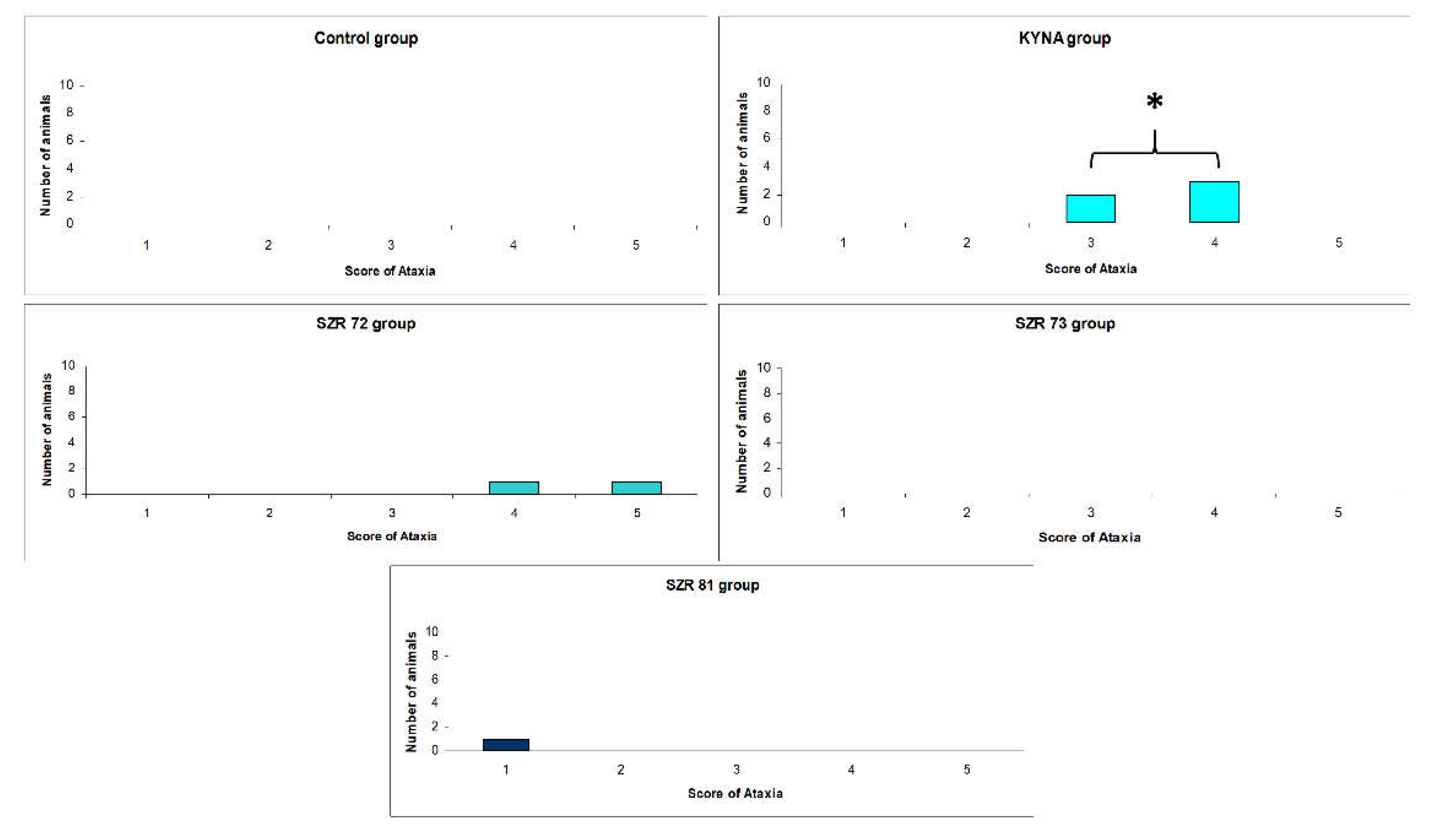
Figure 3.
The effects of kynurenic acid and its analogs on acute stereotype behavior. Stereotype symptoms score of KYNA treatment, 0.2 µmol/4 µL KYNA, vs. control (Ctrl) group (p = 0.014). We show the number of animals and the score categories. The level of significance and the number of animals in groups *p<0.05; N(Ctrl) = 10, N(0.2 µmol/4 µL KYNA) = 10, N(0.2 µmol/4 µL SZR-72) = 10, N(0.2 µmol/4 µL SZR-73) = 10, N(0.2 µmol/4 µL SZR-81) = 10. The statistical tests used were the Kolmogorov-Smirnov post hoc test for normality, the Levene test for variance homogeneity, and the nonparametric Kruskal-Wallis test.
Figure 3.
The effects of kynurenic acid and its analogs on acute stereotype behavior. Stereotype symptoms score of KYNA treatment, 0.2 µmol/4 µL KYNA, vs. control (Ctrl) group (p = 0.014). We show the number of animals and the score categories. The level of significance and the number of animals in groups *p<0.05; N(Ctrl) = 10, N(0.2 µmol/4 µL KYNA) = 10, N(0.2 µmol/4 µL SZR-72) = 10, N(0.2 µmol/4 µL SZR-73) = 10, N(0.2 µmol/4 µL SZR-81) = 10. The statistical tests used were the Kolmogorov-Smirnov post hoc test for normality, the Levene test for variance homogeneity, and the nonparametric Kruskal-Wallis test.
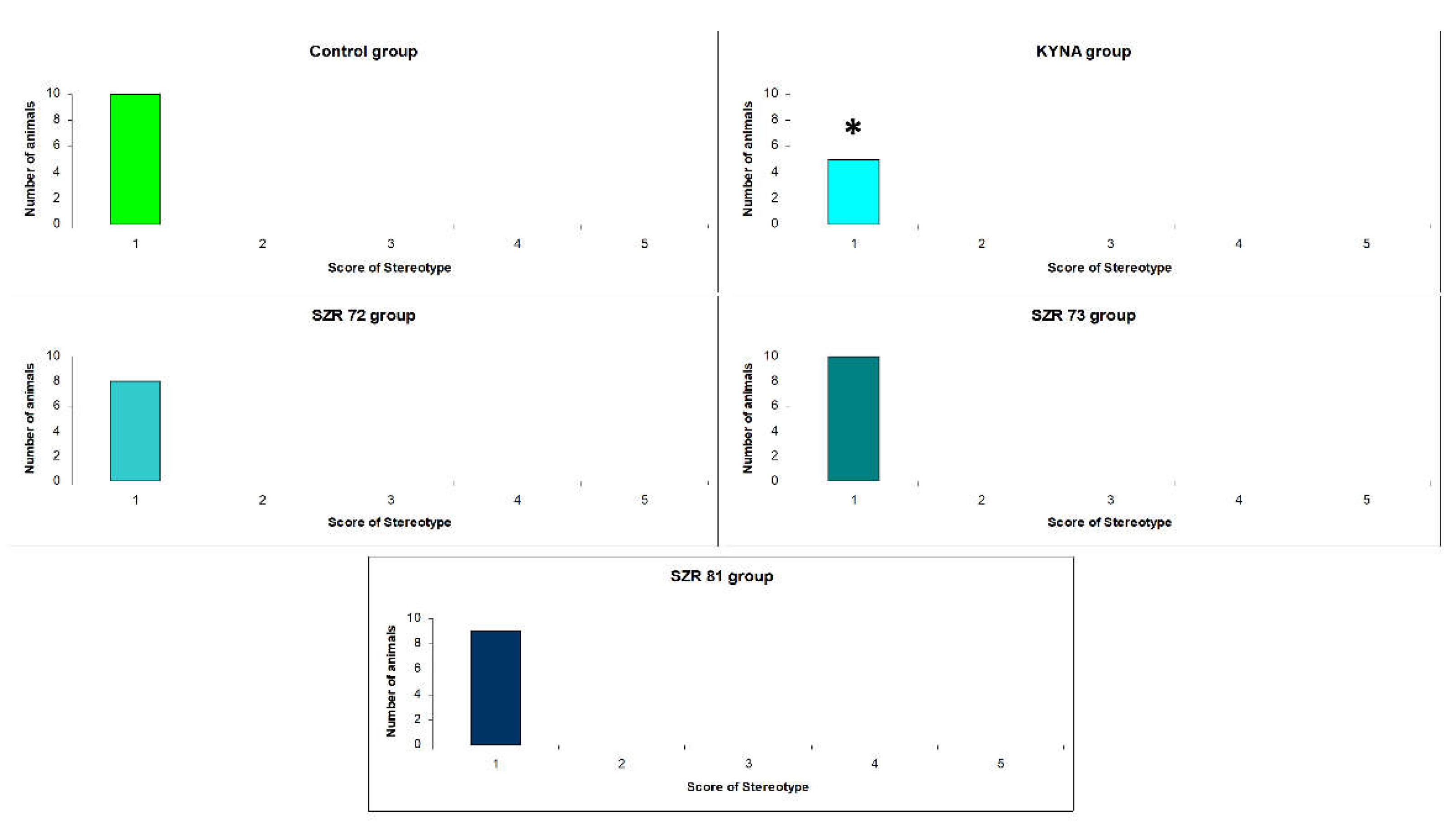
Figure 4.
Open-field test 45 minute after the i.c.v. injection. a) ambulation distance. We found significant difference the 0.2 µmol/4 µL SZR-72 vs. the 0.2 µmol/4 µL Kyna (p=0.046) and the 0.2 µmol/4 µL SZR-72 and SZR_73 vs. control (Ctrl) group (p = 0.046). b) rearing count. We found significant difference the 0.2 µmol/4 µL SZR-73 vs. the 0.2 µmol/4 µL KYNA and control (Ctrl) group (p = 0.02). We show the data median ± SD. The level of significance and the number of animals in groups *p<0.05; N(Ctrl) = 10, N(0.2 µmol/4 µL KYNA) = 10, N(0.2 µmol/4 µL SZR-72) = 10, N(0.2 µmol/4 µL SZR-73) = 10, N(0.2 µmol/4 µL SZR-81) = 10. The statistical analyses included a Normality test using the Kolmogorov-Smirnov post hoc test, an assessment of homogeneity of variances via the Levene test, and the nonparametric Kruskal-Wallis test. KYNA: kynurenic acid; SZR-72: N-(2-(dimethylamino)ethyl)-4-hydroxyquinoline-2-carboxamide hydrochloride; SZR-73: N-(3-(dimethylamino)propyl)-4-hydroxyquinoline-2-carboxamide hydrochloride: SZR-81: 4-hydroxy-N-(2-(pyrrolidin-1-yl)ethyl)quinoline-2-carboxamide hydrochloride.
Figure 4.
Open-field test 45 minute after the i.c.v. injection. a) ambulation distance. We found significant difference the 0.2 µmol/4 µL SZR-72 vs. the 0.2 µmol/4 µL Kyna (p=0.046) and the 0.2 µmol/4 µL SZR-72 and SZR_73 vs. control (Ctrl) group (p = 0.046). b) rearing count. We found significant difference the 0.2 µmol/4 µL SZR-73 vs. the 0.2 µmol/4 µL KYNA and control (Ctrl) group (p = 0.02). We show the data median ± SD. The level of significance and the number of animals in groups *p<0.05; N(Ctrl) = 10, N(0.2 µmol/4 µL KYNA) = 10, N(0.2 µmol/4 µL SZR-72) = 10, N(0.2 µmol/4 µL SZR-73) = 10, N(0.2 µmol/4 µL SZR-81) = 10. The statistical analyses included a Normality test using the Kolmogorov-Smirnov post hoc test, an assessment of homogeneity of variances via the Levene test, and the nonparametric Kruskal-Wallis test. KYNA: kynurenic acid; SZR-72: N-(2-(dimethylamino)ethyl)-4-hydroxyquinoline-2-carboxamide hydrochloride; SZR-73: N-(3-(dimethylamino)propyl)-4-hydroxyquinoline-2-carboxamide hydrochloride: SZR-81: 4-hydroxy-N-(2-(pyrrolidin-1-yl)ethyl)quinoline-2-carboxamide hydrochloride.
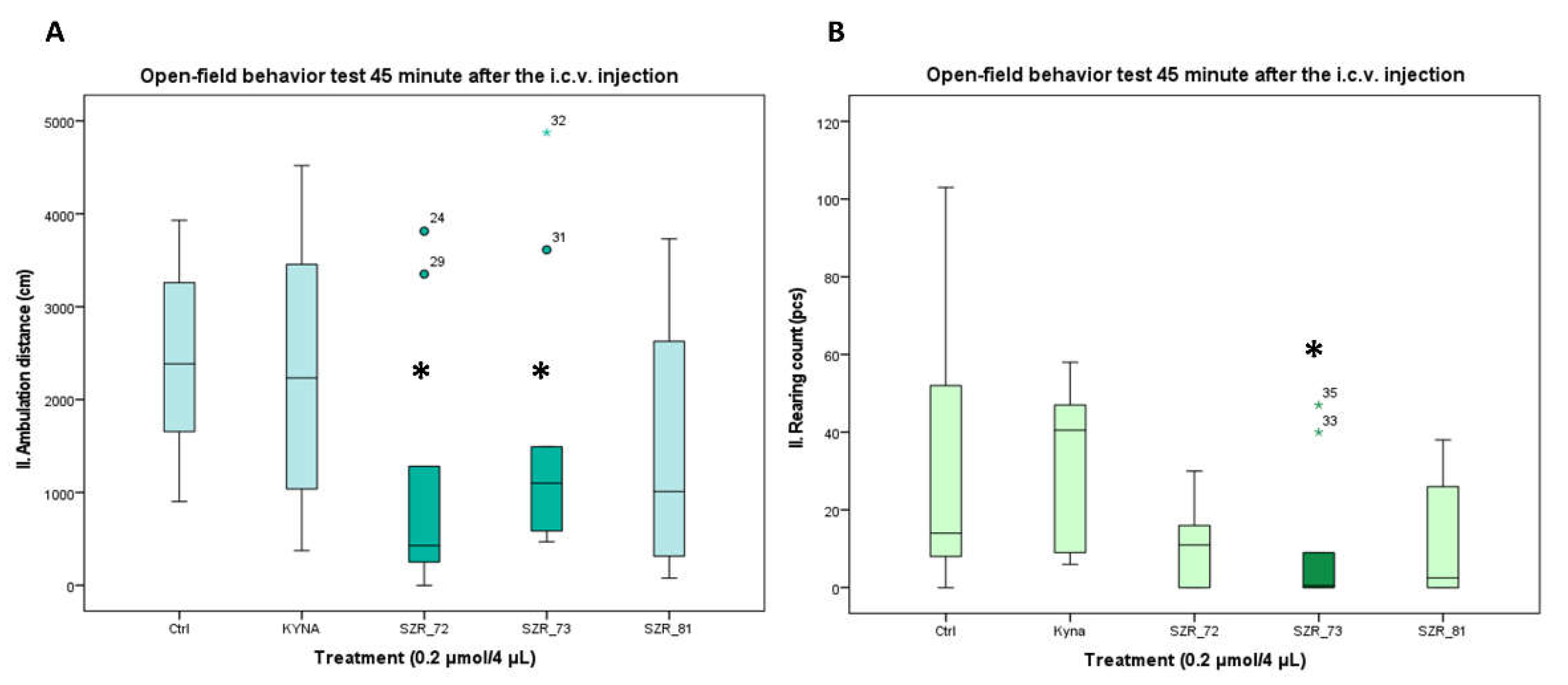
Figure 5.
Rotarod behavior test. a) falling down from the rotating rod 15 min after the i.c.v. injection. We found significant difference the 0.2 µmol/4 µL SZR-72 (p = 0.032) and 0.2 µmol/4 µL SZR-73 (p = 0.030) vs. the 0.2 µmol/4 µL KYNA group. b) falling down from the rotating rod 40 min after the i.c.v. injection. We found significant difference the 0.2 µmol/4 µL SZR-73 vs. the 0.2 µmol/4 µL KYNA group (p = 0.018). c) falling down from the rotating rod 15-120 min after the i.c.v. injection. We found significant difference the 0.2 µmol/4 µL KYNA 40 min vs. the 0.2 µmol/4 µL KYNA 120 min group (p = 0.049) We show the data mean ± SEM. The level of significance and the number of animals in groups *p<0.05; N(Ctrl) = 7, N(0.2 µmol/4 µL KYNA) = 10, N(0.2 µmol/4 µL SZR-72) = 10, N(0.2 µmol/4 µL SZR-73) = 10, N(0.2 µmol/4 µL SZR-81) = 10. The statistical tests used were the Kolmogorov-Smirnov post hoc test for normality, the Levene test for variance homogeneity, and the one-way ANOVA with LSD post hoc test. RPM: Revolution per Minute. KYNA: kynurenic acid; SZR-72: N-(2-(dimethylamino)ethyl)-4-hydroxyquinoline-2-carboxamide hydrochloride; SZR-73: N-(3-(dimethylamino)propyl)-4-hydroxyquinoline-2-carboxamide hydrochloride: SZR-81: 4-hydroxy-N-(2-(pyrrolidin-1-yl)ethyl)quinoline-2-carboxamide hydrochloride.
Figure 5.
Rotarod behavior test. a) falling down from the rotating rod 15 min after the i.c.v. injection. We found significant difference the 0.2 µmol/4 µL SZR-72 (p = 0.032) and 0.2 µmol/4 µL SZR-73 (p = 0.030) vs. the 0.2 µmol/4 µL KYNA group. b) falling down from the rotating rod 40 min after the i.c.v. injection. We found significant difference the 0.2 µmol/4 µL SZR-73 vs. the 0.2 µmol/4 µL KYNA group (p = 0.018). c) falling down from the rotating rod 15-120 min after the i.c.v. injection. We found significant difference the 0.2 µmol/4 µL KYNA 40 min vs. the 0.2 µmol/4 µL KYNA 120 min group (p = 0.049) We show the data mean ± SEM. The level of significance and the number of animals in groups *p<0.05; N(Ctrl) = 7, N(0.2 µmol/4 µL KYNA) = 10, N(0.2 µmol/4 µL SZR-72) = 10, N(0.2 µmol/4 µL SZR-73) = 10, N(0.2 µmol/4 µL SZR-81) = 10. The statistical tests used were the Kolmogorov-Smirnov post hoc test for normality, the Levene test for variance homogeneity, and the one-way ANOVA with LSD post hoc test. RPM: Revolution per Minute. KYNA: kynurenic acid; SZR-72: N-(2-(dimethylamino)ethyl)-4-hydroxyquinoline-2-carboxamide hydrochloride; SZR-73: N-(3-(dimethylamino)propyl)-4-hydroxyquinoline-2-carboxamide hydrochloride: SZR-81: 4-hydroxy-N-(2-(pyrrolidin-1-yl)ethyl)quinoline-2-carboxamide hydrochloride.
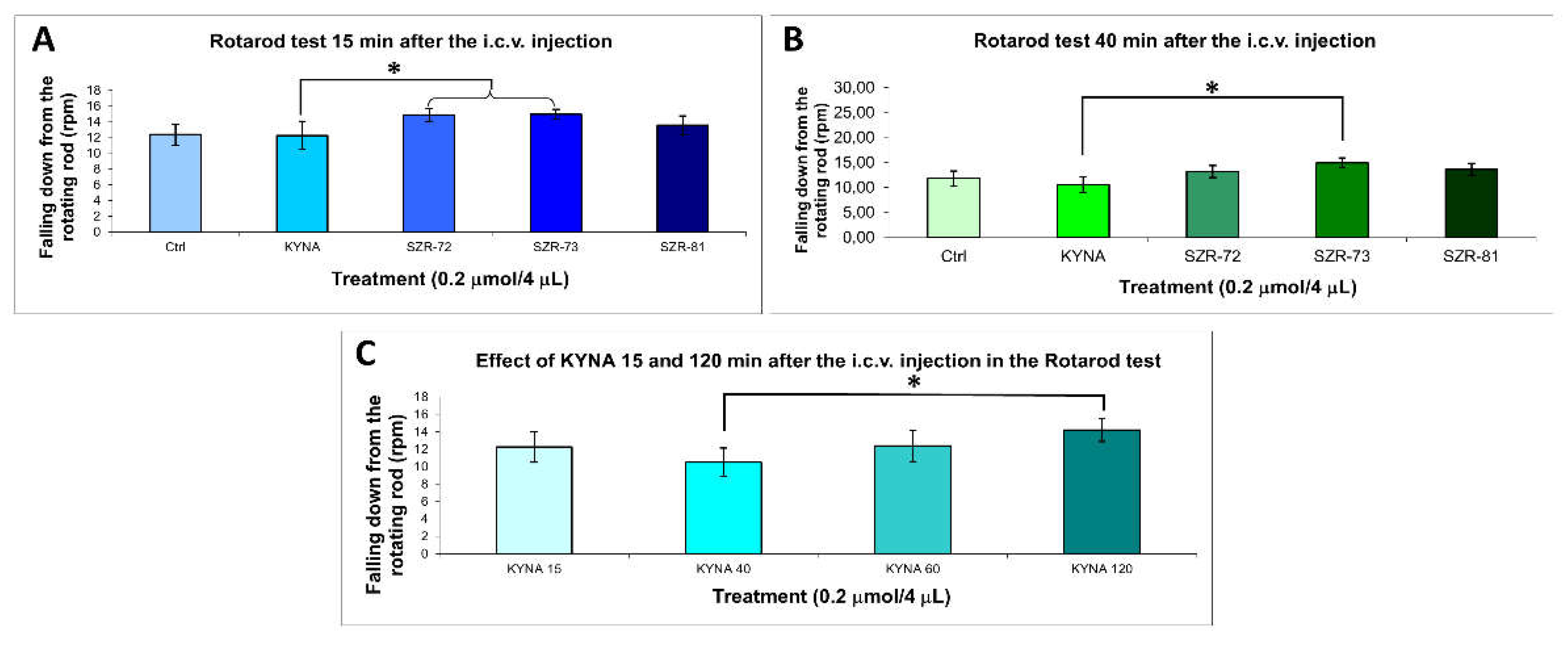

Table 1.
Scoring Criteria for Ataxia and Stereotype Behaviors. This table outlines the behavioral scoring system used to evaluate the severity of motor impairments and stereotyped movements. Ataxia scores range from mild coordination issues to complete immobility, while stereotype scores capture increasing intensity and complexity of repetitive or abnormal behaviors. This system allows for standardized, graded assessment in experimental models.
Table 1.
Scoring Criteria for Ataxia and Stereotype Behaviors. This table outlines the behavioral scoring system used to evaluate the severity of motor impairments and stereotyped movements. Ataxia scores range from mild coordination issues to complete immobility, while stereotype scores capture increasing intensity and complexity of repetitive or abnormal behaviors. This system allows for standardized, graded assessment in experimental models.
| Behavior | Score | |
|---|---|---|
| Ataxia | Awkward and jerky movements | 1 |
| Stumbling or awkward posture | 2 | |
| Falling | 3 | |
| Inability to move beyond a small area or support weight on the stomach or haunches | 4 | |
| Inability to move, except for twitching movements | 5 | |
| Stereotype | Sniffing, grooming, and rearing, reciprocal forepaw treading or undirected head movement | 1 |
| Backward walking, head weaving, circling behavior | 2 | |
| Continuous head weaving, circling, or backward walking | 3 | |
| Dyskinetic extensions or flexion of the limbs | 4 | |
| Head, and neck or weaving greater than four | 5 | |
Table 2.
Acute and Subacute Effects of Test Compounds on Ataxia and Stereotype Scores. Behavioral scores recorded at 15- and 45-minutes post-administration of control or kynurenic acid analogs. Ataxia and stereotype were assessed using a standardized scale, with the number of animals exhibiting each score indicated in parentheses. Data reflect both immediate (acute) and delayed (subacute) motor and behavioral responses.
Table 2.
Acute and Subacute Effects of Test Compounds on Ataxia and Stereotype Scores. Behavioral scores recorded at 15- and 45-minutes post-administration of control or kynurenic acid analogs. Ataxia and stereotype were assessed using a standardized scale, with the number of animals exhibiting each score indicated in parentheses. Data reflect both immediate (acute) and delayed (subacute) motor and behavioral responses.
| Compounds | Ataxia score (# of animals) |
Stereotype score (# of animals) |
||
|---|---|---|---|---|
| 15 min | 45 min | 15 min | 45 min | |
| Control | 0(10) | 0(10) | 1(10) | 1(10) |
| KYNA | 3(2), 4(3)1 | 0(10) | 1(5)1 | 1(10) |
| SZR-72 | 4(1), 5(1) | 0(10) | 1(8) | 1(10) |
| SZR-73 | 0(10) | 0(10) | 1(10) | 1(10) |
| SZR-81 | 1(1) | 0(10) | 1(9) | 1(10) |
1p<0.05 vs. KYNA We show the number of animal/group in the bracket. KYNA: kynurenic acid; SZR-72: N-(2-(dimethylamino)ethyl)-4-hydroxyquinoline-2-carboxamide hydrochloride; SZR-73: N-(3-(dimethylamino)propyl)-4-hydroxyquinoline-2-carboxamide hydrochloride: SZR-81: 4-hydroxy-N-(2-(pyrrolidin-1-yl)ethyl)quinoline-2-carboxamide hydrochloride.
Table 3.
Effects of kynurenic acid and analogs on locomotor and exploratory activity in the open-field test. Ambulation distance and rearing counts were measured at 15- and 45-minutes post-treatment to assess locomotor and exploratory behavior.
Table 3.
Effects of kynurenic acid and analogs on locomotor and exploratory activity in the open-field test. Ambulation distance and rearing counts were measured at 15- and 45-minutes post-treatment to assess locomotor and exploratory behavior.
| Compounds | Ambulation distance | Rearing count | ||
|---|---|---|---|---|
| 15 min | 45 min | 15 min | 45 min | |
| Control | 3372.3 ± 441.925 (10) | 2423.3 ± 328.405 (10) | 38.6 ± 11.197 (10) | 28.4 ± 10.341 (10) |
| KYNA | 3085.6 ± 505.334 (10) | 2278.6 ± 439.742 (10) | 35.0 ± 9.084 (10) | 32.8 ± 6.622 (10) |
| SZR-72 | 1699.7 ± 612.203 (10) | 1081.7 ± 435.542 (10) 1,2 | 18.7 ± 6.762 (10) | 10.2 ± 3.133 (10) |
| SZR-73 | 2224.9 ± 544.970 (10) | 1600.6 ± 462.407 (10) 1 | 11.5 ± 5.807 (10) | 9.8 ± 5.707 (10) 1,2 |
| SZR-81 | 1794.0 ± 499.207 (10) | 1397.7 ± 389.917 (10) | 23.5 ± 9.653 (10) | 12.1 ± 4.836 (10) |
1p<0.05 vs. Control, 2p<0.05 vs. KYNA. We show the number of animal/group in the bracket. KYNA: kynurenic acid; SZR-72: N-(2-(dimethylamino)ethyl)-4-hydroxyquinoline-2-carboxamide hydrochloride; SZR-73: N-(3-(dimethylamino)propyl)-4-hydroxyquinoline-2-carboxamide hydrochloride; SZR-81: N-(2-(pyrrolidin-1-yl)ethyl)-4-hydroxyquinoline-2-carboxamide hydrochloride.
Table 4.
Effects of kynurenic acid and analogues on motor coordination in the rotarod test. Latency to fall was recorded at 15 to 120 minutes post-treatment using an accelerating rod to assess motor coordination and balance.
Table 4.
Effects of kynurenic acid and analogues on motor coordination in the rotarod test. Latency to fall was recorded at 15 to 120 minutes post-treatment using an accelerating rod to assess motor coordination and balance.
| Compounds | Latency to fall (RPM) | |
|---|---|---|
| 15 min | 40 min | |
| Control | 70.143 ± 15.322 (7) | 40,777 ± 15.412 (7) |
| KYNA | 58.590 ± 20.559 (10) | 50.444 ± 15.952 (10) |
| SZR-72 | 76.840 ± 11.729 (10)1 | 51.448 ± 16.269 (10) |
| SZR-73 | 77.600 ± 9.279 (10)1 | 45.284 ± 14.320 (10)1 |
| SZR-81 | 64.420 ± 13.238 (10) | 51.581 ± 16.311 (10) |
1p < 0.05 vs. KYNA. We show the number of animal/group in the bracket. RPM: revolution per minute. KYNA: kynurenic acid; SZR -72: N-(2-(dimethylamino)ethyl)-4-hydroxyquinoline-2-carboxamide hydrochloride; SZR -73: N-(3-(dimethylamino)propyl)-4-hydroxyquinoline-2-carboxamide hydrochloride: SZR -81: 4-hydroxy-N-(2-(pyrrolidin-1-yl)ethyl)quinoline-2-carboxamide hydrochloride.
Disclaimer/Publisher’s Note: The statements, opinions and data contained in all publications are solely those of the individual author(s) and contributor(s) and not of MDPI and/or the editor(s). MDPI and/or the editor(s) disclaim responsibility for any injury to people or property resulting from any ideas, methods, instructions or products referred to in the content. |
© 2025 by the authors. Licensee MDPI, Basel, Switzerland. This article is an open access article distributed under the terms and conditions of the Creative Commons Attribution (CC BY) license (http://creativecommons.org/licenses/by/4.0/).
Copyright: This open access article is published under a Creative Commons CC BY 4.0 license, which permit the free download, distribution, and reuse, provided that the author and preprint are cited in any reuse.