

Submitted:
08 April 2025
Posted:
09 April 2025
Read the latest preprint version here
Abstract
Innovation in science and technology arises from balanced supports for fundamental research, applied studies, and societal implementation. However, changes in Japanese science policy that shifts toward top-down, evaluation-based, and competitive funding practices have undermined Japan’s long-term research sustainability and innovation potential. “Selection and concentration” strategy (prioritization of specific research areas) and the “competition principle” introduced in Japanese science policy have significantly altered Japan’s research environment for the worse. An excessive shift toward competitive grants, combined with the introduction of fixed-term contracts in academia, has increased instability at both the institutional and individual levels, diminishing the time and resources available for long-term basic research. These changes threaten the potential for scientific discoveries that lead to innovation. Although recently initiatives such as the introduction of University Research Administrators (URAs) have been implemented to support researchers, it is still insufficient to counterbalance the systemic challenges faced by Japan’s research ecosystem. To reestablish a stable research environment, a fundamental policy shift may be necessary, reconsidering the fundamental process of innovation: sustainable career pathways and funding allocations to basic science that foster seeds for future innovation.
Keywords:
Science Policy
; Japan
; Research Management
; Research Administration
; University Research Administrator (URA)
; Graduate School
; Postdoctoral Researchers
; Tenure-track Positions
; Ministry of Education
; Culture
; Sports
; Science and Technology (MEXT)
; University
1. Introduction
Scientific research plays a crucial role in driving technological advancements and fostering economic growth. In Japan, where natural resources are limited, science and technology have been fundamental pillars of national strength. Over the past few decades, the Japanese government has implemented various policies to enhance research and innovation, with the aim of maintaining the country's global competitiveness. However, contrary to their original intentions, these policies have significantly impacted the structure, sustainability, and overall productivity of scientific research in Japan.
This review examines Japanese science policies and their impact on the country’s research ecosystem, in terms of “money”, “time”, and “humans”. The corporatization of national universities, coupled with declining government subsidies, has eroded stable research environments. Moreover, the shift toward top-down, evaluation-based funding mechanisms, the prioritization of goal-directed research, and the government's increased allocation of resources to competitive grants—at the expense of basic research funding—have destabilized Japan’s academic system. These reforms and policy changes have increased the administrative burden on researchers, significantly reducing the time they can dedicate to conducting research. In addition, the introduction of fixed-term employment policies has undermined researcher career stability and long-term research sustainability. This is a failure to value human capital, the very foundation of academic progress and technological innovation.
To address some of these challenges, this review also examines the role of University Research Administrators (URAs), a recently introduced profession in academia, whose purpose is to alleviate the administrative burden on researchers and restore valuable research time. This review aims to provide insights into balancing research funding allocations, ensuring sustainable career pathways, and reinvesting in fundamental science to revitalize Japan’s scientific foundation.
2. Japan: Science and Technology-Driven Country
Japan, which is scarce in natural resources, should base its national strength on scientific research and technological development(Omi 1996). This belief is embodied by the Science and Technology Basic Law, enacted in 1995, which requires formulation of a new basic plan every five years. The plan guides science and technology policy for the relevant period. The first plan started in 1995, was renamed at 6th plan in 2021 as the “Science, Technology, and Innovation Basic Plan”, in accordance with the amendment of the above law as the “Science, Technology and Innovation Basic Law” enforced in 2020. This change was made to put more stress on fostering innovation and redirecting universities toward implementation of the research and development for the society, rather than conducting just curiosity–driven researches. These plans describes specific science policy measures to be executed and thus drive the advancement of science and technology, and realize innovation in Japan. The Science, Technology and Innovation Basic Plan is formulated with an eye on trends in the Japanese economy. It includes a target ratio of research funding to Gross Domestic Product (GDP) and specific strategies and policies to stimulate scientific research development(Mitsubishi Research Institute Inc. 2016).
When expressed as a percentage of GDP, Japan's research and development expenditure has not significantly increased over the past 15 years compared to that of other science-oriented countries in the G7 and neighboring regions (Figure 1). In the 5th Science and Technology Basic Plan that covered 2016-2020 period, a target was set to achieve research and development (R&D) investment of at least 4% of GDP through both public and private sector contributions. However, this goal has not yet been achieved. In 2023, a record-high research and development (R&D) investment of 3.7% of GDP was recorded. (Source: 2024 (Reiwa 6) Report on the Survey of Research and Development, Statistics Bureau, Ministry of Internal Affairs and Communications) (https://www.stat.go.jp/data/kagaku/index.html). Thus, Japan's research and development investments remain insufficient to support its self-proclaimed status as a science-driven nation.
3. Stagnation of Economy and Decrease of Scientific Strength in Japan
Because economic growth is closely interrelated with advances in science and technology—each reinforcing the other(Watanabe and Hemmert 1998)—stagnation in one has a severe impact on the other. Now Japan is suffering from staggering in both. Japanese economic growth has been staggering over the last 30 years as shown in the comparison among G7 countries and Japan’s neighbors (Figure 2, Data from IMF at https://www.imf.org/external/datamapper/). Besides, Japan is the only country in G7 that showed virtually no increase of average wages over the last 30 years(Asia Pacific Dept International Monetary Fund (IMF) 2023). Japan, therefore, cannot be regarded as a rich country anymore. Given the interrelationships between science and economy, it may not be surprising that Japanese research activities has also been staggering, which was demonstrated as decreases in the ranking of number of scientific publications, and top 10% most cited papers (13th in the ranking measured during 2019-2021)(Ikarashi 2023; National Institute of Science and Technology Policy (NISTEP) 2024). The decline of scientific activity has been readily recognized, warned, and discussed(Mainichi Shimbun Investigative Team 2019; Toyoda 2019; Iwamoto 2019 ).
Does this indicate that the overall budget for science and development has been reduced in recent years? Not necessarily. The issue is not the total amount of funding, but rather the manner in which these funds are allocated. In recent years, changes in Japanese science policies—such as the introduction of the "competition principle" and "selection and concentration"—have notably affected basic research in particular. The targeted allocation of funds is only one factor that has impacted scientific research in Japan. Other factors include issues related to "people" and "time": a decrease in the number of doctoral students and tenure-track researchers, as well as insufficient time dedicated to research. In the following sections, we will examine these factors in detail.
4. Corporatization of National Universities and Its Consequences: Funding, Faculty, and Competition
In Japan, basic scientific research, which serves as a critical source of technological innovation, is primarily conducted by universities, whereas industrial research tends to be more application-oriented. In particular, national universities have a primary role since more than half of the national budget for basic research, KAKENHI granted by MEXT, are distributed to national universities. For example, KAKENHI in 2024 were awarded to national universities with 59.8% (34.9 billion yen), private universities with 20.9% (12.2 billion yen), public universities with 6.0% (3.5 billion yen), and other institutes for the rest (MEXT statistics https://www.jsps.go.jp/file/storage/kaken_27_kohyo6-1/0-1_r6.pdf). Therefore, any changes in policies regarding national universities have significant influences on the research activities in Japan.
One that is frequently argued as a cause of the decline of Japanese scientific research is the corporatization of national universities conducted in 2004(Shimada 2022). Transformation of the universities into university corporation was intended to implement a competitive framework within universities, originally aimed at encouraging self-driven management of the university rather than being managed by the government, allowing the universities more freedom to be unique and attractive for the prospective students and other stake holders. The corporatization of national universities was implemented alongside a reduction of the economic support by the government: 1% reduction of the Management Expenses Grants for National University Corporations" each year, that would result in 10% reduction in 10 years. This was realized as a result of the Ministry of Finance's strong intent. The Ministry of Finance's argument was that if universities became competitive enough and gained the ability to generate their own revenue, there would be no need to allocate as much funding for basic research(Mainichi Shimbun Investigative Team 2019). The routine research and development funding per faculty member has decreased in tandem with reductions in operating expense grants(Igami and Kanda 2024). While the operational budget was decreased, the ratio of competitive grans increased. For example, the FY2004 and FY2018 were compared, while total science budget decreased by 5% from 1.93 trillion yen to 1.84 trillion yen, the competitive grant increased from 0.36 trillion yen to 0.43 trillion yen, or 18.7% to 23.2% of the total amount(MEXT 2018).
Another factor that affected university finances was the extension of the retirement age for national university faculty, implemented during the same period (2001-2013). At the University of Tokyo, for example, the retirement age was gradually raised from 60 to 65. This policy required increased budget allocations and also led to a reduction in new permanent hires(Gokami 2019). Since a major portion of the Management Expenses Grants was used to fund faculty salaries, many universities had to halt the hiring of new young faculty members after senior faculty retired (Nakatomi 2011).
These drastic changes have contributed to intensified competition in the academic job market(Young Academy of Japan 2014).
5. “Selection and Concentration”: A Shift Toward Top-Down, Targeted Budget Allocation Prioritizing Specific Research Areas
Alongside the introduction of competitive principles, the notion of “selection and concentration” has been upheld as a tenet. This targeted budget allocation approach, whereby the Japanese government directs funds toward select research areas, first emerged in the Second Basic Plan for Science and Technology (FY2001–FY2005). The second plan concentrated investment on four specific fields chosen by the government, and the tendency toward prioritization in budget distribution has grown ever more pronounced in subsequent years. Because the overall science and technology budget was not increased, areas not prioritized—and even essential expenditures such as operating subsidies for national universities—experienced budget cuts.
A key proponent of this prioritization approach is the Council for Science, Technology and Innovation (CSTI). Although the CSTI originally did not have authority over budget allocation, a 2013 amendment to the Act for Partial Revision of the Act for the Establishment of the Cabinet Office enabled the Cabinet Office to secure its own budget. Consequently, the CSTI evolved from an organization that objectively assessed budgets into one that allocates its own funds and administers large-scale research grant programs(Suda 2021). Another notable aspect of this targeted budget allocation is its application-oriented nature, which tends to overlook basic science. Research proposals that present a clear pathway to practical implementation are more likely to receive funding. Yet, groundbreaking innovations are rarely predictable at the stage when their foundational ideas are conceived in basic research; their significance is often recognized only in hindsight.
In the preceding sections, the focus has been on “money.” We now turn to the issue of “people.” At the heart of scientific progress are the individuals engaged in research. Without exceptionally talented scientists, no meaningful advances in science can be achieved.
6. Introduction of the Fixed-Term Employment System Into National and Public Universities Institutes and Its Drawbacks
A common argument about the factor hindering university research is the presence of aging faculty whose activity levels are declining. In order to foster continual academic exchange and acceptance of diverse expertise—vital for energizing education and research, in 1997, at national universities, fixed-term employment was introduced, as outlined by the law “Act on Term of Office of University Teachers, etc.”. By this law, positions other than full professorships and tenure-track associate or assistant professorships in national and public universities became subject to fixed-term contracts. This had a huge impact on scientific research community in Japan. The contracts typically last five years with only one possible renewal, resulting in a maximum tenure of ten years before mandatory departure. Although postdoctoral researchers were already in unstable positions due to short-term contracts ranging from one to several years, assistant professors—who are mostly non-tenured in Japan—as well as higher-ranked lecturers and associate professors without tenure, also found themselves in precarious situations. Even if they produced notable results and built strong publication records, this did not necessarily lead to a permanent position due to extremely limited job availability. In some cases, individuals even reverted from assistant or associate professorships back to postdoctoral positions, further highlighting the severe instability of the system.
Fixed-term positions come with obvious drawbacks in Japanese science development. First, in this situation, many young researchers are compelled to choose research topics that yield short-term results, leaving them little room to take on ambitious projects that could lead to significant innovation. Second, researchers must constantly search for their next position, preventing them from fully dedicating themselves to their work. Third, fixed-term faculty members often feel compelled to prioritize their own career progression over student education. Moreover, the limited prospects for securing a permanent position create tremendous psychological pressure, affecting not only the researchers but also their families, as they must continue under highly precarious conditions. This stress is frequently cited as a reason for scientific misconduct, with individuals claiming they could not bear the pressure to secure promotion or recruitment, given the stringent requirement for timely, high-profile journal publications in academia.
The former president of the University of Tokyo, Dr. Makoto Gokami succinctly captures the current state of academia in his book, A Vision for the Future of Universities: Building a Knowledge-Intensive Society (tentative translation) (2019), stating: "Researchers hired on fixed-term contracts are not necessarily granted permanent positions, even if they achieve significant research accomplishments. As a result, many young researchers are forced to conduct their work under constant uncertainty about their future." This situation significantly influences the career decisions of undergraduate students in the lab, as they witness firsthand how even accomplished senior researchers struggle to secure permanent positions. Thus, research positions no longer constitute a genuine profession, rendering them unappealing as a career path for younger generations.
7. Non-Renewal of Contracts and Its Negative Effect on the Sustainability of Japanese Science
Non-renewal of contracts—commonly known as “Yatoi-dome” in Japanese—has become a pervasive issue in Japanese academia, undermining the sustainability of scientific research(The Science Council of Japan's Executive Committee 2022; Katayama 2022). This practice affects a wide range of fixed-term employees, including postdoctoral researchers, laboratory technicians, and university administrative staff as well as university faculty. Originally, the amended Labor Contract Act—effective from April 1, 2013—introduced the “indefinite-term conversion rule” with an intention to ensure job stability for temporary workers. Under this rule, employees in administrative or educational positions gain the right to convert their contracts to indefinite employment after five years, while those in research-related roles (including fixed-term faculty and researchers, and lab technicians) obtain this right after ten years. The intent of this law was to secure long-term employment; however, the rule has produced an unintended consequence.Many researchers and staff are employed on time-limited grants, and universities often lack the budget to offer permanent positions. To avoid triggering the right to indefinite employment, institutions frequently terminate contracts just before the requisite five- or ten-year thresholds are reached. This deliberate non-renewal forces highly skilled personnel to leave their positions despite ongoing research needs. In many cases, the same positions are refilled with new individuals—sometimes even with the same person after a six-month “cooling-off” period—highlighting that the issue stems not from a genuine budgetary shortfall, but from a systemic workaround to evade the conversion mandate (Sasaki 2018).
The non-renewal practice has adverse effects on Japanese science research system: individuals lose job security, the laboratory head face difficulty in managing the research project, and thus no one is benefitted. Although these practices are widely criticized as being contrary to the spirit of the law—and there are instances where their legal impropriety has led to litigation—many affected employees refrain from pursuing legal action, likely due to concerns about potential negative impacts on their careers. While the indefinite-term conversion rule was designed to promote job stability, it has ironically jeopardized the careers of personnel including people engaged in scientific research, compromising the overall research activity in Japan.
8. Expansion of Graduate Education and the “10,000 Postdocs Project” and Their Consequences
In academia, it is widely believed that the deconstruction of the research ecosystem began with the “strategic focus on graduate schools” policy implemented in the 1990s(Motomura 2009). This reform involved expanding graduate education, reassigning faculty affiliations from undergraduate schools to graduate schools, and reorganizing graduate school majors—all supported by preferential government budget allocations. The shift in focus resulted in increased graduate student enrollment without a significant rise in faculty numbers, nearly doubling the student-to-faculty ratio(MEXT 2018). Because most Ph.D. students pursued academic careers—and were not necessarily welcomed by industry(Enoki and Hamanaka 2014)—the academic job market became oversaturated with applicants(Motomura 2009).
One of the factors that worsened the academic job market for scientists in Japan was the “10,000 Postdocs Project”, introduced under the 1st Science and Technology Basic Plan (1995–2000)(Science and Technology Policy Symposium Executive Committee 2010). The Japanese government implemented an employment funding subsidy program aimed at doubling the number of postdocoral fellows, more than ten thousand postdocs, to strengthen Japanese research activity. The plan assumed that a significant amount of postdoctoral fellows would make transition into industry jobs, but this expectation was not met. In reality, Japanese industries are generally reluctant to hire PhD holders who are too highly specialized and older, as they do not align well with the company’s career path system(Enoki and Hamanaka 2014). Meanwhile, job opportunities in academia remain extremely limited, as previously described. Another contributing factor is that many graduate students tend to pursue academic careers rather than industry positions. This further intensifies the competition for academic jobs, making the job market even more challenging(Kobayashi 2016 ). The number of postdocs were indeed nearly doubled by the plan, from 6,224 postdocs in 1996 to 11,127 in 2002 (https://www.mext.go.jp/b_menu/shingi/chukyo/chukyo4/008/gijiroku/03112101/004/009.pdf), but job opportunities did not increase for them. As a result, many postdoctoral researchers struggle to secure permanent positions and find themselves repeatedly moving from one temporary postdoc position to another as their contracts expire. This cycle has resulted in an aging postdoctoral population, with 20.7% of postdocs aged 35–39 and 16.4% over 40, out of a total of 14,237 postdoctoral fellows in the fiscal year 2012 (https://www.nistep.go.jp/wp/wp-content/uploads/NISTEP-postdoc2012-PressJ.pdf). According to fiscal year 2021 data, of the 13,657 postdocs, 11.5% were between 40 and 44 years old, 6.8% were between 45 and 49 years old, and 11.6% were over 50, showing significant increase of aged postdocs (30% of postdocs were over the age of 40) (https://doi.org/10.15108/rm337).
Given that Japanese science policy prioritizes the careers of young researchers, the oversupply of postdoctoral researchers produced under the 10,000-Postdocs Plan has led to increasingly limited opportunities for securing permanent academic positions as they age. Consequently, this cohort appears to have become a neglected generation. No party has assumed responsibility for the shortcomings of the 10,000 Postdocs Project. Instead, on March 26, 2024, MEXT announced a similar initiative—this time aimed at tripling the number of PhD holders—titled “Get a PhD—Doctoral Human Resources Action Plan.” The plan sets a goal of increasing the number of PhDs per one million population to one of the highest levels worldwide by 2040 (a threefold increase relative to the 2020 level). Although MEXT calls on industry to expand its recruitment of PhD holders, it remains uncertain whether industry is adequately prepared to integrate such highly qualified individuals into its workforce.
9. Decreased Number of Graduate Students, the Main Driving Force Behind Research
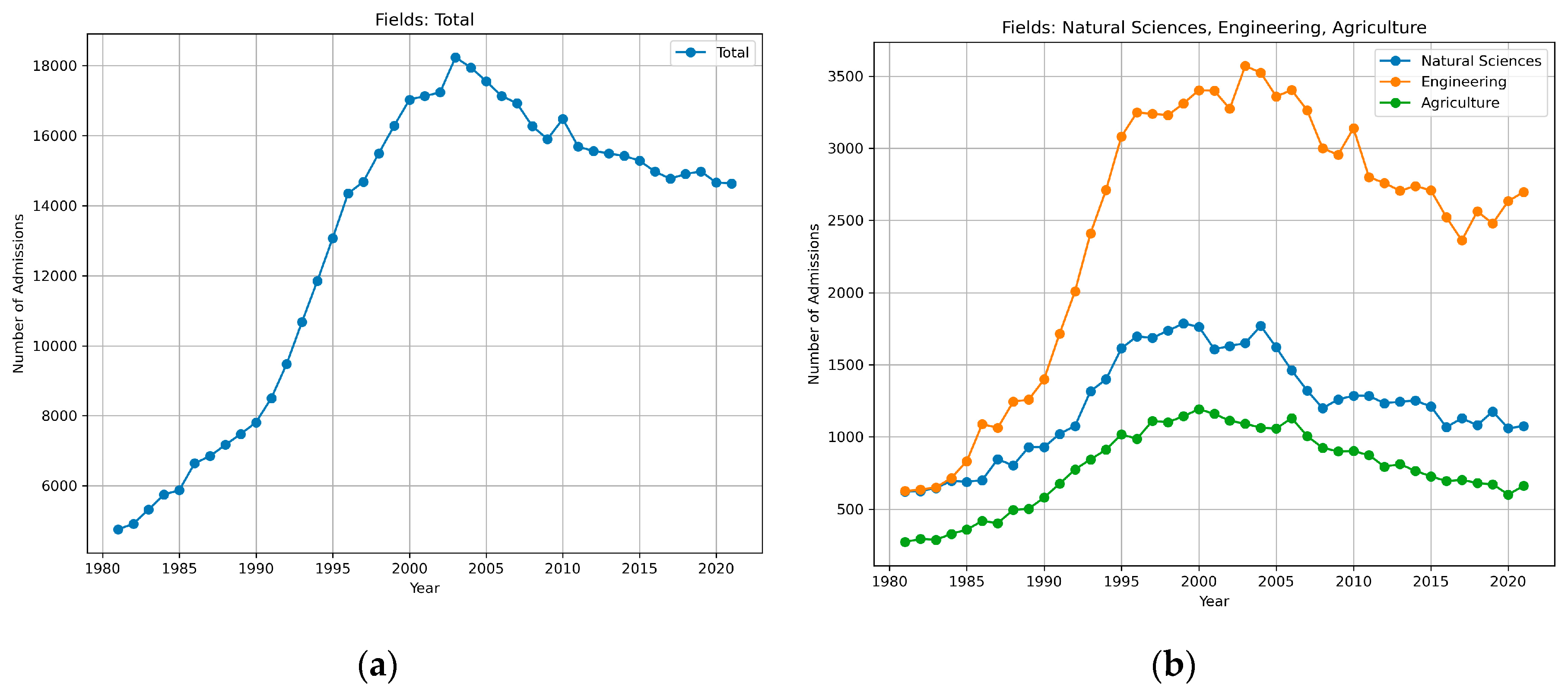
One of the primary factors contributing to the decline in Japan's research activity is the decrease in the number of graduate students (Figure 3). With the situation where even productive postdoctoral researchers and fixed-term faculty struggle to secure permanent positions, many undergraduate students have opted to enter the workforce rather than pursue graduate studies. According to a survey, the most frequently cited reasons for choosing employment over enrolling in a doctoral program include the difficulty of securing a stable financial outlook while in a doctoral program, concerns about job prospects after graduation, and the perception that the cost of pursuing a doctoral degree does not justify the expected lifetime earnings(Watanabe, Kawamura, and Tsuchiya 2023). The decline in graduate student enrollment has led to a reduction in research lab activity, as graduate students have traditionally been the primary driving force of research. Consequently, it can be argued that graduate schools are becoming hollowed out.
Thus far, we have examined issues concerning financial resources and human capital in research. Next, we turn our attention to the significant impact that university reforms and the increased ratio of competitive funding have had on the dimension of time.
10. Declining Research Time Amid Increasing Administrative Demands
Regarding research time, the introduction of competition among universities and the reallocation of budgets based on institutional evaluations have substantially reduced the time available for scholarly investigation. To respond to the demands of university reform, faculty members are compelled to allocate significant time to administrative tasks—such as fulfilling evaluation requirements, preparing proposal documentation, and drafting proposals for competitive funding—in addition to their educational responsibilities, rather than devoting their efforts to research. Notably, the proportion of research time among faculty across all universities declined markedly from 46.5% in 2002 to 37.2% in 2008, and, according to the available data, remained largely unchanged until 2018(Igami and Kanda 2020). This reduction in dedicated research time underscores the urgent need to provide specialized support to help alleviate the administrative load and enable researchers to focus more effectively on their scholarly pursuits.
11. Expectation for the Research Administrators (URAs) for the Support of Researchers in Academia
A shortage of dedicated time for research in universities is often cited as one of the major causes of decreased research capabilities in Japan (Toyoda 2019). University researchers are too busy with administrative tasks related to university reforms, institutional evaluations, and preparing extramural grant proposals. To reduce these administrative burdens, the role of supporting specialists—namely, University Research Administrators (URAs), a new profession introduced in 2011—has been expanded. URAs are similar to research management and administration professionals (RMAs) who work closely with researchers at universities in Europe and North America (Yang-Yoshihara, Poli, and Kerridge 2023). Although Japan's URA system was modeled after U.S. research administrators (Takahashi 2023), Japanese URAs are expected to work more closely with researchers to drive research development rather than merely managing research budgets, as dedicated officials already handle the administrative aspects of research expenditures (Yamano 2016). By the Japanese government's initiatives to implement URAs in academia, the number of URAs has increased significantly over the past decade, reaching 1,512 at 172 institutions in FY2022(Takahashi and Ito 2023). Research Administration and Management in Japna (RMAN-J) , a professional organization for URA members, was established in March 2015 to support their activities and to formalize the new profession (Takahashi and Ito 2023). URAs are expected to become a catalyst for innovation in Japan(Ito 2024).
Presently, URAs are expected to fulfill a broad array of roles—including pre-award and post-award support, facilitating industry-academia collaborations, and research management (Takahashi 2016; Takahashi et al. 2018). However, for URAs to serve as the driving force in fundamentally addressing the decline in Japan's research capacity, it is desirable that they not be confined solely to an expert role but also assume positions that allow them to contribute to university management and science and technology policy (Mitsubishi Research Institute Inc. 2017). Enhancing their status and expanding their influence would significantly strengthen efforts to restore Japan's research capabilities.
12. What Strategies Can Best Maximize the Possibility for Innovation to Happen?
Various science and technology policies have been implemented on the assumption that innovation driven by enhanced research capabilities is key to revitalizing Japan’s declining economy. However, it is necessary to reexamine and assess whether these policies have been effective.
Japan has tended to allocate research budgets in a highly targeted manner, investing significant funds in a select few scientists and top-tier research universities. Critics argue that this approach is akin to trying to buy a winning lottery ticket rather than fostering widespread innovation. To maximize the potential for innovation, research funding should be distributed more broadly, enabling a larger number of scientists to pursue basic research. In fact, one report indicates that broadly distributing small grants is more effective in promoting the emergence of new topics in the life sciences and medicine than the targeted allocation of large grants(Ohniwa, Takeyasu, and Hibino 2023).
If we examine the origins of some Nobel Prize-winning research projects, we find that innovation often begins in ways that even the researchers themselves cannot initially foresee. Osamu Shimomura was fascinated by the chemical properties of bioluminescent proteins and identified green fluorescent protein (GFP) as a byproduct while characterizing aequorin from jellyfish(Shimomura 2005). As we now know, GFP went on to revolutionize cell biology research. Similarly, Tasuku Honjo accidentally discovered the PD-1 molecule while searching for factors involved in programmed cell death. PD-1 was later found to play a crucial role in immune regulation, ultimately leading to the development of immune checkpoint inhibitors that have profoundly transformed cancer treatment strategies(Okazaki and Honjo 2007). Yoshizumi Ishino identified an unusual repeated DNA sequence in the E. coli genome during the molecular characterization of an enzyme gene—a sequence that, decades later, became known as Clustered Regularly Interspaced Short Palindromic Repeats (CRISPR)(Ishino, Krupovic, and Forterre 2018). As we all know, this discovery has given humanity the ability to edit our own genome at will. Shinya Yamanaka demonstrated that terminally differentiated mammalian cells can be dedifferentiated to a state of pluripotency—known as induced pluripotent stem (iPS) cells—with great potential in regenerative medicine(Yamanaka 2020). This innovation originated from a basic science discovery made by John Gurdon more than forty years ago, which demonstrated the reversibility of cell differentiation(Gurdon 1962). No one can predict where these seeds of innovation may be found—they could emerge from a small laboratory at a modest university. Thus, a diversified funding approach is necessary to nurture these seeds for innovation(Aagaard, Kladakis, and Nielsen 2019; Ishikawa 2024; Kobayashi 2008). Budgets cannot simply be allocated as if buying a winning lottery ticket, as such outcomes are inherently unpredictable.
Innovation involves several steps: the discovery of fundamental phenomena in basic science(Machado 2021), the subsequent development of these seeds in applied sciences, and finally, the implementation of intellectual property that impacts society. Each of these steps is indispensable for innovation to occur and transform our lives. However, the discovery phase of basic research is often the most expensive, time-consuming, and unpredictable part of the entire process. Consequently, it is imperative that the government allocates substantial funding to this phase, as industry is generally reluctant to undertake that part.
Because basic research requires a long-term perspective, researchers need secure employment—ideally, permanent positions or at least contracts that can be renewed indefinitely based on performance evaluations. Currently, even researchers with steady publication records and successful grant applications face job insecurity due to the extremely limited availability of permanent or tenure-track positions in academia, a situation that was not the case before university reforms in the 1990s. The most fundamental issue behind the decline in scientific research capability is that being a scientist is no longer seen as a viable profession. Researchers on fixed-term contracts often feel that they are easily disposed of and replaced when their contracts expire(Hornyak 2022; Katayama 2022). As a result, many talented undergraduates tend to avoid academia and instead pursue careers in industry, where they receive better salaries and greater job security. It is obvious that the most important remedy for the decline in Japanese science is to restore the appeal of a scientific career by ensuring fair and appropriate treatment for researchers who consistently achieve outstanding results in academia.
13. Conclusion
Innovation requires a series of essential stages—from fundamental discoveries in basic science, which plant the seeds of innovation, to the development of applied research and the societal implementation of new technologies. Every stage is indispensable. However, Japan's science policy has introduced a 'selection and concentration' strategy and overemphasized competitive principles, placing disproportionate focus on later stages. As a result, increases in competitive research funds and government-led funding allocations aimed at societal implementation have come at the expense of budgets critical to the operational foundations of universities. Furthermore, the introduction of fixed-term appointments for faculty at national universities has imposed excessive competitive pressures on researchers. Consequently, long-term projects have become unfeasible, and even maintaining a viable livelihood is increasingly difficult. Additionally, the demands of evaluation have further deprived researchers of the time needed to conduct meaningful research. These shifts in science policy have rendered Japan's research environment highly unstable, particularly undermining the sustainability of basic science. Although some measures—such as the introduction of research support positions (i.e., University Research Administrators, or URAs)—have been implemented, fundamental reforms are urgently needed to restore a stable research infrastructure.
Funding
This research was funded by Japan Society for Promotion of Science (JSPS), grant number KAKENHI JP20K03260 and KAKENHI JP25K06356.
Acknowledgments
I thank Prof. Hiroyasu Nakano for encouragement.
Conflicts of Interest
The author declares no conflicts of interest.
Abbreviations
The following abbreviations are used in this manuscript:
| GDP | Gross Domestic Produce |
| MEXT | Ministry of Education, Culture, Sports, Science and Technology |
| URA | University Research Administrator |
| GDP | Gross Domestic Produce |
References
- Aagaard, Kaare, Alexander Kladakis, and Mathias Wullum Nielsen. 2019. 'Concentration or dispersal of research funding?', Quantitative Science Studies, 1: 117-49.
- Asia Pacific Dept International Monetary Fund (IMF). 2023. 'Structural Barriers to Wage Income Growth in Japan', IMF Staff Country Reports, 2023: A003.
- Enoki, Eisuke, and Junko Hamanaka. 2014. 'The Reality of Underutilized Highly Educated Talent in Japan: Why Do Japanese Companies Not Recruit and Utilize PhD Holders?', Works: 6-8.
- Gokami, Makoto. 2019. The Future Landscape of Universities: Creating a Knowledge-Based Society (Translated from Japanese) (Chikumashobo Ltd).
- Gurdon, J. B. 1962. 'The developmental capacity of nuclei taken from intestinal epithelium cells of feeding tadpoles', J Embryol Exp Morphol, 10: 622-40.
- Hornyak, T. 2022. ''I feel disposable': Thousands of scientists' jobs at risk in Japan', Nature. 2022. [Google Scholar]
- Igami, Masatsura, and Yumiko Kanda. 2020. "Detailed analyses on full-time equivalent R&D expenditure and the number of researchers in Japanese universities " In Technical Report. National Institute of Science and Technology Policy (NISTEP).
- ———. 2024. "Temporal Changes in R&D Expenditures at the University Faculty Level: A Trial Using the Survey of Research and Development." In NISTEP DISCUSSION PAPER. National Institute of Science and Technology Policy.
- Ikarashi, A. 2023. 'Japanese research is no longer world class - here's why', Nature, 623: 14-16.
- Ishikawa, Taro. 2024. "The 'selection and concentration' of research funding—aimed at sowing the seeds of a Nobel Prize—is hardly the optimal solution (Translation of Japanese ノーベル賞の種をどう蒔くか:最適解とは言い難い研究費の「選択と集中」)." In Japanese Association of Science & Technology Journalists, 5. Japanese Association of Science & Technology Journalists.
- Ishino, Yoshizumi, Mart Krupovic, and Patrick Forterre. 2018. 'History of CRISPR-Cas from Encounter with a Mysterious Repeated Sequence to Genome Editing Technology', Journal of Bacteriology, 200. [CrossRef]
- Ito, Takeo. 2024. 'URA as a Catalyst for Innovation in Japan : From the Case Study of Kyoto University', The journal of Information Science and Technology, 74: 22-27.
- Iwamoto, Noa. 2019 Scientists are Disappearing: Japan May No Longer Win Nobel Prizes (Translation of Japanese 科学者が消える: ノーベル賞が取れなくなる日本) (Toyo Keizai Inc.).
- Katayama, Satoshi. 2022. 'Mass Non-Renewals of Researchers and Faculty at National University Corporations and R&D Organizations (Translation of Japanese 国立大学法人,研究開発法人等における研究者,教員の大量雇止め)', Journal of Japanese Scientists, 57: 44-45.
- Kobayashi, Shinichi. 2008. 'University Research Funding Allocation in the Era of Innovation: Rethinking 'Selection and Concentration' (Translation of Japanese イノベーション時代の大学研究資金配分:「選択と集中」再考))', Organizational science, 42: 26-36.
- Kobayashi, Takehiko. 2016 'The Postdoc Problem and Workforce Mobility: Saving Japanese Science (Translation of Japanese ポスドク問題と人材の流動化—日本のサイエンスを救うために—))', Science Portal (Japan Science and Technology Agency), Accessed 2025.02.21.
- Machado, D. 2021. "Quantitative indicators for high-risk/high-reward research." In OECD Science, Technology and Industry Working Papers. 2021. [Google Scholar]
- Mainichi Shimbun Investigative Team. 2019. The Decline and Fall of the Japanese Scientific Empire (The Mainichi Newspapers Co., Ltd.).
- MEXT. 2018. "Overview of the Key Developments and Structural Factors Behind Japan's Declining Research Capacity (Reference Data Collection)(Translation of Japanese 日本の研究力低下の主な経緯・構造的要因案(参考データ集)) " In Materials for the 68th Academic Subcommittee Meeting edited by Culture Ministry of Education, Sports, Science and Technology (MEXT).
- Mitsubishi Research Institute Inc. 2016. "Analysis of Government R&D Investment Target Setting and Investment Effects (Translation of Japanese)." In Investigation and Analysis Report on Policy Issues Concerning the Promotion of "Science for Policy" in Science and Technology Innovation Policies (Translation from Japanese 政府研究開発投資目標の設定・投資効果の分析 科学技術イノベーション政策における「政策のための科学」推進に関する政策課題についての調査分析). Mitsubishi Research Institute.
- ———. 2017. "Survey Report on the Challenges for Strengthening the URA System (Translation of Japanese URAシステム強化に向けた諸課題に関する調査)." In MEXT FY2016 Commissioned Project for the Development of Science and Technology Human Resources.
- Motomura, Yukiko. 2009. 'What exactly was the strategic focus on graduate schools?', Chemistry & Chemical Industry, 62: 873-76.
- Nakatomi, Koichi. 2011. 'Restructuring of academic freedom in national university corporations', The quarterly of the Ritsumeikan University Law Association, 333/334: 2495-523.
- National Institute of Science and Technology Policy (NISTEP). 2024. "Japanese Science and Technology Indicators 2024." In.
- Ohniwa, R. L., K. Takeyasu, and A. Hibino. 2023. 'The effectiveness of Japanese public funding to generate emerging topics in life science and medicine', PLoS One, 18: e0290077.
- Okazaki, Taku, and Tasuku Honjo. 2007. 'PD-1 and PD-1 ligands: from discovery to clinical application', International Immunology, 19: 813-24.
- Omi, Koji. 1996. Fundamental Law of Science and Technology (Yomiuri Shimbun).
- Sasaki, Dan. 2018. 'The 2018 Issue at National Universities and Its Resolution: A Case Study of the University of Tokyo (Translation of Japanese 国立大学における二〇一八年問題とその解決│東京大学の事例)', The Zenei: 1-8.
- Science and Technology Policy Symposium Executive Committee. 2010. "Recommendations for Addressing the Issues Facing Young Researchers (e.g., Postdocs)." In.
- Shimada, Shinji 2022. 'Toward the Revival of Japan as a Nation of Science and Technology - Is Japan finished?', Proceedings for The 96th Annual Meeting of the Japanese Pharmacological Society, 96: 2-B-SL09.
- Shimomura, O. 2005. 'The discovery of aequorin and green fluorescent protein', J Microsc, 217: 1-15.
- Suda, Momoko. 2021. 'The Transformation of the “Control Tower” for Science and Technology and the Decline of Japan’s Research Capabilities (Translation of Japanese 「科学技術の司令塔」の変質と日本の研究力衰退 )', Gakujutsu no Doko 26.
- Takahashi, Makiko. 2016. 'The function of URA skill standard for unified comprehension to diversified roels of URAs and related professionals', Journal of the Japan Society for Intellectual Production, 12: 19-29.
- ———. 2023. 'Research Managers and Administrators in Asia: History and Future Expectations.' in Simon Kerridge, Susi Poli and Mariko Yang-Yoshihara (eds.), The Emerald Handbook of Research Management and Administration Around the World (Emerald Publishing Limited).
- Takahashi, Makiko, Yoko Furusawa, Kazuma Edamura, and Koichi Sumikura. 2018. "Human Resources for Research Promotion and Application in Japanese Academia -From Competition to Cooperation of University-Industry Cooperation Coordinators and University Research Administrators-." In GRIPS DISCUSSION PAPER. National Graduate Institute for Policy Studies (GRIPS).
- Takahashi, Makiko, and Shin Ito. 2023. 'The Profession of Research Management and Administration in Japan.' in Simon Kerridge, Susi Poli and Mariko Yang-Yoshihara (eds.), The Emerald Handbook of Research Management and Administration Around the World (Emerald Publishing Limited).
- The Science Council of Japan's Executive Committee. 2022. 'Aiming to Resolve the So-Called ”Yatoi-dome”(Non-Renewal) Issue for Fixed-Term Researchers and University Faculty (Translation of Japanese 有期雇用研究者・大学教員等のいわゆる「雇止め」問題の解決を目指して)', Trends in the sciences, 27: 7-9.
- Toyoda, Nagayasu. 2019. Japan’s Crisis as a Science and Technology Powerhouse (Translation of Japanse 科学立国の危機 失速する日本の研究力) (Toyo Keizai Inc.).
- Watanabe, Chihiro, and Martin Hemmert. 1998. 'The interaction between Technology and economy.' in M. Hemmert and C. Oberländer (eds.), Technology and Innovation in Japan: Policy and Management for the Twenty-First Century (Routledge).
- Watanabe, Eiichiro, Mari Kawamura, and Takahiro Tsuchiya. 2023. "The 2021 Survey of Japan Master’s Human Resource Profiling." In NISTEP RESEARCH MATERIAL Tokyo: National Institute of Science and Technology Policy.
- Yamanaka, S. 2020. 'Pluripotent Stem Cell-Based Cell Therapy-Promise and Challenges', Cell Stem Cell, 27: 523-31.
- Yamano, Masahiro. 2016. 'Comparative Understanding of Change of University Research Administrators (URA) between Japan and the USA: Expansion of the Role of Research Development (RD)', The journal of management and policy in higher education: 67-82.
- Yang-Yoshihara, Mariko, Susi Poli, and Simon Kerridge. 2023. 'Evolution of Professional Identity in Research Management and Administration.' in Simon Kerridge, Susi Poli and Mariko Yang-Yoshihara (eds.), The Emerald Handbook of Research Management and Administration Around the World (Emerald Publishing Limited).
- Young Academy of Japan. 2014. "Proposal of a Methodology for Enhancing Japan's Science and Technology through Support for Early-Career Researchers and the Utilization of Research Support Personnel (Translation of Japanese 若手研究者支援・研究支援人材活用を通じた日本の科学技術を高めていく方法論の提案)." In.: Science Council of Japan.
Figure 1.
Research & Development expenditure as % of Gross Domestic Product (GDP) during 1990 – 2022. Graph was made by the author based on the Science and Technology Indicators 2024 by the National Institute of Science and Technology Policy (NISTEP), Ministry of Education, Culture, Sports, Science and Technology (MEXT).
Figure 1.
Research & Development expenditure as % of Gross Domestic Product (GDP) during 1990 – 2022. Graph was made by the author based on the Science and Technology Indicators 2024 by the National Institute of Science and Technology Policy (NISTEP), Ministry of Education, Culture, Sports, Science and Technology (MEXT).
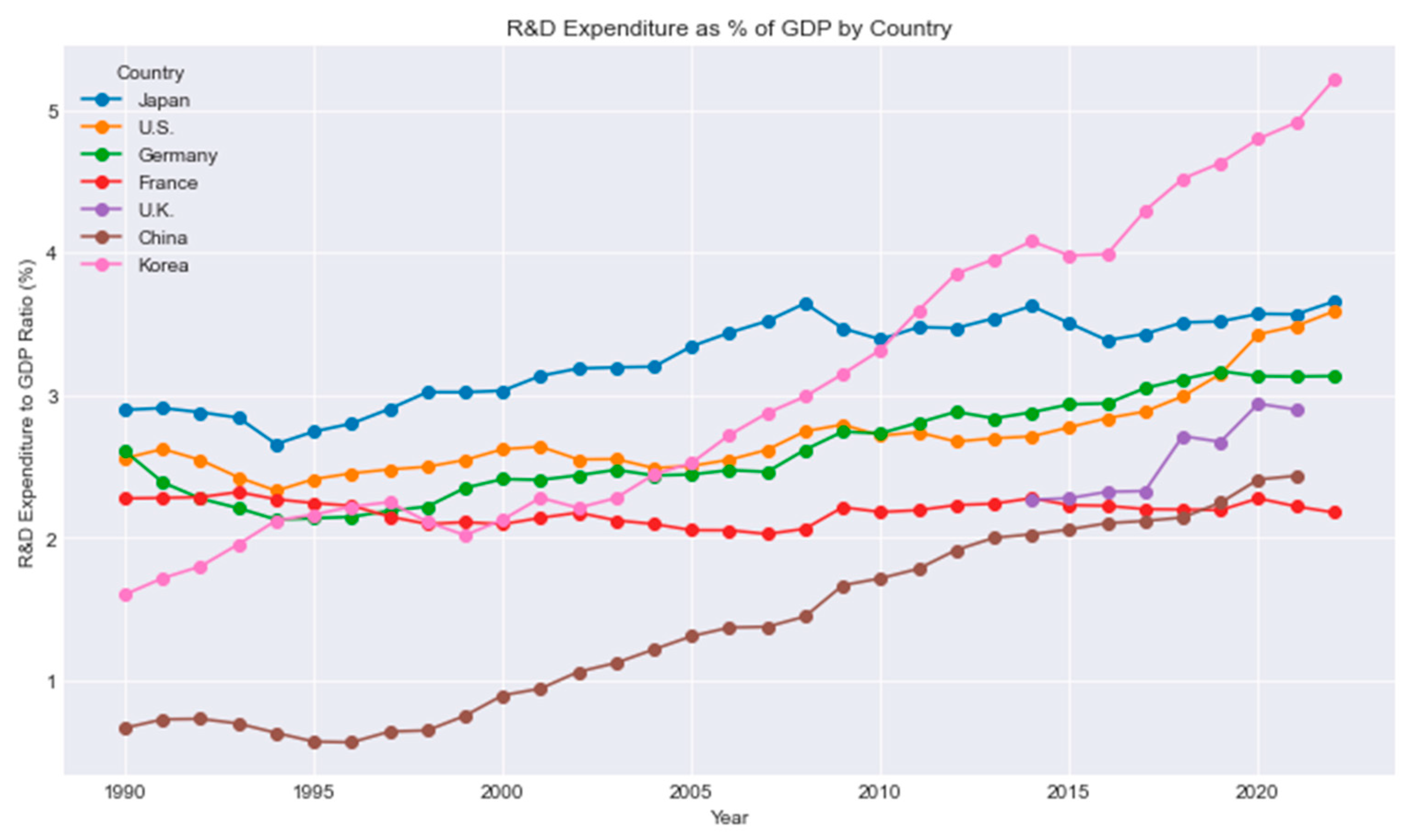
Figure 2.
GDP per Capita during the period of 1990 -2024 in G7 countries and neighbors. (data from https://www.imf.org/external/datamapper/).
Figure 2.
GDP per Capita during the period of 1990 -2024 in G7 countries and neighbors. (data from https://www.imf.org/external/datamapper/).
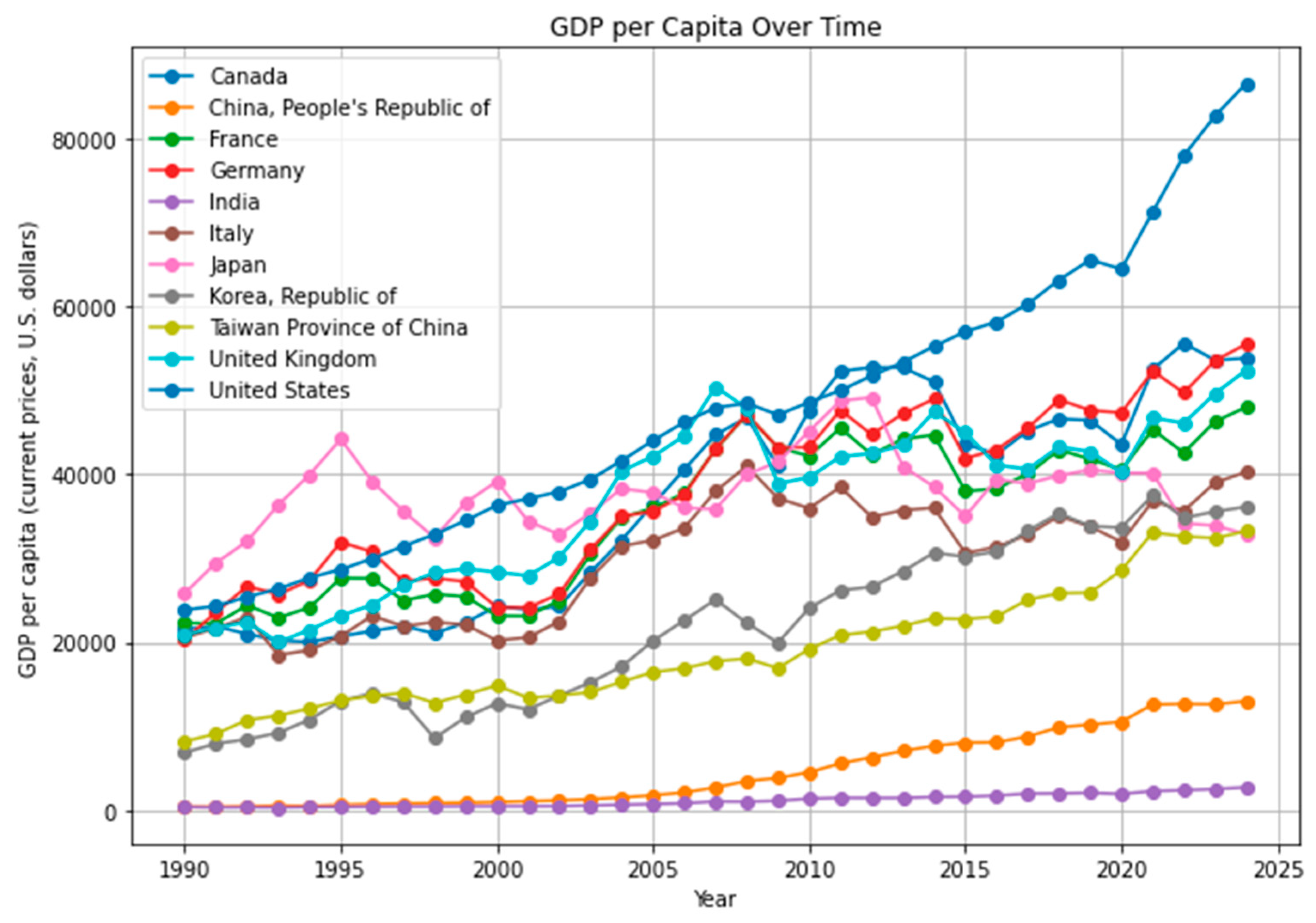
Figure 3.
Graduate school enrollment. (a) All departments (b) Natural sciences, engineering and agriculture departments. There are drastic decreases of graduate students in science and technology areas compared to their peaks at around 2003. Data from Science and Technology Indicators 2022, NISTEP, MEXT.
Figure 3.
Graduate school enrollment. (a) All departments (b) Natural sciences, engineering and agriculture departments. There are drastic decreases of graduate students in science and technology areas compared to their peaks at around 2003. Data from Science and Technology Indicators 2022, NISTEP, MEXT.
Disclaimer/Publisher’s Note: The statements, opinions and data contained in all publications are solely those of the individual author(s) and contributor(s) and not of MDPI and/or the editor(s). MDPI and/or the editor(s) disclaim responsibility for any injury to people or property resulting from any ideas, methods, instructions or products referred to in the content. |
© 2025 by the authors. Licensee MDPI, Basel, Switzerland. This article is an open access article distributed under the terms and conditions of the Creative Commons Attribution (CC BY) license (http://creativecommons.org/licenses/by/4.0/).
Copyright: This open access article is published under a Creative Commons CC BY 4.0 license, which permit the free download, distribution, and reuse, provided that the author and preprint are cited in any reuse.