

Submitted:
17 May 2025
Posted:
19 May 2025
You are already at the latest version
Abstract
Innovation in science and technology arises from balanced supports for basic research, applied research, and societal implementation. However, changes in Japanese science policy that shifts toward top-down, evaluation-based, and competitive funding practices appear to have undermined Japan’s long-term research sustainability and innovation potential. The “selection and concentration” strategy (prioritization of specific research areas) and “competition principle,” combined with persistent reduction in Management Expenses Grants, have significantly altered Japan’s research environment for the worse. Together with these policy changes, the introduction of fixed-term contracts in academia has increased instability at both the institutional and individual levels and has diminished the time and resources available for long-term basic research. Academic careers in science have become less attractive, as evidenced by declining doctoral student enrollment. These changes threaten the potential for scientific discoveries that lead to innovation. Although initiatives such as the introduction of University Research Administrators (URAs) have been implemented to support researchers, such efforts remain insufficient to counterbalance the systemic challenges faced by Japan’s research ecosystem. To reestablish a stable research environment, rethinking the strategy may be necessary, including restoration of stable institutional funding, sustainable career pathways, and balanced funding allocation to basic science that foster seeds for future innovation.
Keywords:
science policy
; Japan
; research management
; research administration
; University Research Administrator (URA)
; graduate school
; postdoctoral researchers
; tenure-track positions
; Ministry of Education
; culture
; sports
; science and technology (MEXT)
; University
1. Introduction
Scientific research plays a crucial role in driving technological advancements and fostering economic growth. In Japan, where natural resources are limited, science and technology have been fundamental pillars of national strength. Over the past few decades, the Japanese government has implemented various policies to enhance research and innovation, with the aim of maintaining the country's global competitiveness (Ministry of Internal Affairs and Communications 2016). However, contrary to their original intentions, these policies have significantly impacted the structure, sustainability, and overall productivity of scientific research in Japan.
This review examines how science policy changes have affected Japan's research ecosystem over recent decades. To address these challenges, it also explores potential remedies, including the role of University Research Administrators (URAs), a recently introduced profession in academia (Takahashi and Ito 2023). The review highlights the need for more balanced research funding allocations, sustainable career development, and reinvestment in fundamental science to revitalize Japan's scientific foundation.
2. Analytical Framework
The impact of Japanese science and technology policy reforms is assessed through an analytical framework structured around three key dimensions: financial resources ("money"), temporal resources ("time"), and human capital ("people"). These well-established categories are widely acknowledged in the science policy literature as central to sustaining long-term, curiosity-driven research (Igami 2017). "Money" refers to changes in national-level research funding structures, including the shift toward competitive grants and targeted allocations, and their effects on basic science (Aagaard, Kladakis, and Nielsen 2019). "Time" refers to the reduction in time researchers can devote to scientific work due to increasing administrative and institutional demands(Monde 2024). "People" addresses the rise of fixed-term employment and increasing employment precarity, which have contributed to psychological strain among researchers, as well as the declining number of graduate students (Hornyak 2022).
By organizing the analysis along these three dimensions, this paper provides a systematic framework through which to evaluate the cumulative effects of policy reforms on Japan's research ecosystem. This approach allows the discussion to move beyond individual policy components and toward an integrated understanding of how financial resources, time, and people—three core pillars of scientific work—have been reshaped by policy-driven institutional reforms.
3. Japan: Science and Technology-Driven Country
Japan, which is scarce in natural resources, should base its national strength on scientific research and technological development (Omi 1996). This belief is embodied by the Science and Technology Basic Law, enacted in 1995, which requires formulation of a new basic plan every five years. The plan guides science and technology policy for the relevant period. The first plan started in 1995, was renamed at 6th plan in 2021 as the “Science, Technology, and Innovation Basic Plan”, in accordance with the amendment of the above law as the “Science, Technology and Innovation Basic Law” enforced in 2020. This change was made to put more stress on fostering innovation and redirecting universities toward implementation of the research and development for the society, rather than conducting just curiosity–driven researches. These plans describes specific science policy measures to be executed and thus are supposed to drive the advancement of science and technology and realize innovation.
The Science, Technology and Innovation Basic Plan is formulated with consideration of trends in the Japanese economy. It includes a target ratio of research funding to Gross Domestic Product (GDP), as well as specific strategies and policies to stimulate scientific research development (Mitsubishi Research Institute Inc. 2016). However, Japan’s research and development (R&D) expenditure, as a percentage of GDP, has remained relatively flat over the past 15 years, particularly in comparison with other science-oriented G7 countries and neighboring economies (Figure 1). In the 5th Science and Technology Basic Plan that covered 2016-2020 period, a target was set to achieve research and development (R&D) investment of at least 4% of GDP through both public and private sector contributions. This goal has not yet been achieved. In 2023, a record-high research and development (R&D) investment of 3.7% of GDP was recorded (Statistics Bureau of Japan 2024). Thus, Japan's research and development investments remain insufficient to support its self-proclaimed status as a science-driven nation.
4. Stagnation of Economy and Decrease of Scientific Strength in Japan
Because economic growth is closely interrelated with advances in science and technology—each reinforcing the other (Watanabe and Hemmert 1998)—stagnation in one has a severe impact on the other. Now Japan is suffering from staggering in both. Japanese economic growth has been staggering over the last 30 years as shown in the comparison among G7 countries and Japan’s neighbors (Figure 2). Besides, Japan is the only country in G7 that showed virtually no increase of average wages over the last 30 years (Asia Pacific Dept International Monetary Fund (IMF) 2023). These trends suggest that Japan’s relative economic position has weakened in recent decades. Given the interrelationships between science and economy, it may not be surprising that Japanese research activities have also been staggering, which was demonstrated as decreases in the ranking of number of scientific publications, and top 10% most cited papers (13th in the ranking measured during 2019-2021)(Ikarashi 2023; National Institute of Science and Technology Policy (NISTEP) 2024). The decline of scientific activity has been readily recognized, warned, and discussed (Mainichi Shimbun Investigative Team 2019; Toyoda 2019; Iwamoto 2019).
Does this indicate that the overall budget for science and technology has been reduced in recent years? Not necessarily. Although there have been periods of stagnation and even slight declines, the government’s budget for science and technology has generally increased over the past few decades (Figure 3). The issue is not the total amount of funding, but rather the manner in which these funds are allocated. In recent years, changes in Japanese science policies—such as the introduction of the "competition principle" and "selection and concentration"—have notably affected basic research in particular. Nonetheless, the targeted allocation of funds is only one factor that has impacted scientific research in Japan. Other factors include issues related to "people" and "time": a decrease in the number of doctoral students and tenure-track researchers, as well as insufficient time dedicated to research. These issues have been empirically documented. Toyoda (Toyoda 2019), through extensive quantitative analysis of publication trends and indicators such as the number of university faculty members and their time allocated to research, demonstrates the severity of Japan’s declining research capacity. In the following sections, we will examine these factors in detail.
5. Corporatization of National Universities: Intended Reforms and Unintended Consequences
In Japan, basic scientific research, which serves as a critical source of technological innovation, is primarily conducted by universities, whereas industrial research tends to be more application-oriented. National universities, in particular, play a central role, as more than half of the national budget for basic research—distributed through KAKENHI grants by MEXT—is allocated to them. For example, KAKENHI in 2024 were awarded to national universities with 59.8% (34.9 billion yen), private universities with 20.9% (12.2 billion yen), public universities with 6.0% (3.5 billion yen), and other institutes for the rest (MEXT 2024). Therefore, any changes in policies regarding national universities have significant influences on the research activities in Japan.
In 2004, the Japanese government transformed national universities into corporate entities under a new legal framework . This corporatization was implemented with the aim of enhancing managerial autonomy, enabling universities to operate more flexibly, and fostering competition among institutions to improve performance and global visibility (Amano 2006). According to MEXT, the shift was intended to allow each university to define its own strategic direction, streamline operations, and develop distinctive educational and research profiles (MEXT 2023).
After corporatization, national universities in Japan steadily increased their industry-academia collaborations, boosting the number and value of joint and commissioned research projects (Figure 4). Many universities established dedicated liaison offices, set up incentive systems for faculty engagement, and strengthened intellectual property management (Yamamoto (Ed.) 2007). As a result, self-generated income from commissioned research, intellectual property licensing, and donations significantly increased, leading to greater financial autonomy and improved transparency in university management (Yoshida 2007). In an interview (Yomiuri Shimbun 2018), Makoto Gokami, President of the University of Tokyo states that corporatization was inevitable, with no real alternatives available at the time. He notes that the deterioration of national universities had already become a serious problem by the 1980s, and suggests that had the situation been allowed to continue, the outcome would have been even more disastrous. He defined the university as a "hub for driving social transformation" and has undertaken reforms in university management, including the issuance of Japan’s first university bonds in 2020, through which 20 billion yen was raised.(Gokami 2019; Murata 2021; Hanawa 2021). Overall, corporatization opened up new avenues for national universities to strengthen their financial autonomy, promote innovation, and enhance their role as drivers of societal transformation.
However, despite these benefits, the implementation of corporatization has also produced negative consequences for Japan's academic research system (Yamagiwa and Fujii 2018; Asahi Shimbun Investigative Team 2024; Mainichi Shimbun Investigative Team 2019). Most notably, the policy was accompanied by a steady reduction in the "Management Expenses Grants for National University Corporations"—a key source of stable institutional funding. The grants were reduced by approximately 1% annually, resulting in a 10% decrease over a decade (Figure 5), based on the assumption that universities would compensate for the shortfall through increased competitiveness and external income generation. This reduction was implemented under strong pressure from the Ministry of Finance (Mainichi Shimbun Investigative Team 2019; Yamagiwa and Fujii 2018). The routine research and development funding per faculty member has decreased in tandem with reductions in operating expense grants (Igami and Kanda 2024). In practice, this reduction in core funding has severely limited the resources available for research infrastructure and daily operations, impacting research output (Toyoda 2019).
Obviously, the corporatization of national universities and the reduction of Management Expense Grants for National University Corporations are two distinct issues and should not be conflated. Indeed, during the process of enacting the National University Corporation Act, the following supplementary resolution was adopted: "In calculating the amount of management expense grants and other funding, efforts must be made to secure an amount that ensures education and research activities at each national university can be carried out even more reliably than before, taking into full account the level of public funding provided prior to incorporation." (The National Diet of Japan 2003). Contrary to this resolution, however, the reduction of Management Expense Grants has been implemented alongside corporatization (Mizuta 2024). Akito Arima, former president of the University of Tokyo, who played a leading role in promoting the corporatization of national universities during his tenure as Minister of Education, later expressed regret, characterizing the reform as a failure due to the government's failure to uphold its initial promises (Nakayama 2020).
Policies that gradually extended the retirement age from 60 to 65 implemented during the same period (2001-2013) further tightened the budgets in national universities. Since a major portion of the Management Expenses Grants was used to fund faculty salaries, many institutions were forced to freeze new permanent hires, leading to a shortage of younger faculty and a decline in faculty diversity (Nakatomi 2011; Gokami 2019).
While the overall operational budget decreased, the proportion of funding distributed through competitive grants increased. For example, the FY2004 and FY2018 were compared, while total science budget decreased by 5% from 1.93 trillion yen to 1.84 trillion yen, the competitive grant increased from 0.36 trillion yen to 0.43 trillion yen, or 18.7% to 23.2% of the total amount (MEXT 2018a). In 2019, the government went further and introduced MEXT-evaluation based differential allocation for approximately 10% of the Management Expenses Grants for National University Corporations, despite the grants’ original purpose of serving as a source of fundamental research funding (Asahi Shimbun Investigative Team 2024; Takeuchi 2019; Miyaki 2024; Mizuta 2024). Thus, the trend toward increasingly competitive allocation of funding shows no sign of abating and has had a significant impact on the basic operation of scientific research.
In sum, while corporatization was introduced as a means to modernize governance and improve agility, the simultaneous reduction of core institutional funding has significantly weakened Japan’s research ecosystem, raising deep concerns about its long-term resilience and international competitiveness. (Shimada 2022; Asahi Shimbun Investigative Team 2024).
6. “Selection and Concentration”: A Shift Toward Top-Down, Targeted Budget Allocation Prioritizing Specific Research Areas
Alongside the introduction of competitive principles, the notion of “selection and concentration” has been upheld as a tenet. This targeted budget allocation approach, whereby the Japanese government directs funds toward selected research areas, first emerged in the Second Basic Plan for Science and Technology (FY2001–FY2005)(Cyranoski 2001). The second plan concentrated investment on four specific fields chosen by the government, and the tendency toward prioritization in budget distribution has grown ever more pronounced in subsequent years. Because the overall science and technology budget was not increased, areas not prioritized—and even essential expenditures such as operating subsidies for national universities—experienced budget cuts.
A key proponent of this prioritization approach is the Council for Science, Technology and Innovation (CSTI), formerly known as the Council for Science and Technology Policy (CSTP) (Cyranoski 2001). Although the CSTI did not originally have authority over budget allocation, a 2013 partial amendment to the Cabinet Office Establishment Act granted the Cabinet Office the power to manage its own research budget. As a result, the CSTI has transformed from a budget-assessing advisory body into a funding authority that allocates its own funds and administers large-scale research grant programs (Suda 2021).
Another notable aspect of this targeted budget allocation is its application-oriented nature, which tends to overlook basic science. Research proposals that present a clear pathway to practical implementation are more likely to receive funding (Hirao and Hoshino 2024). This emphasis on immediate applicability risks overlooking the unpredictable nature of breakthroughs, which often emerge from curiosity-driven basic research and are appreciated only in retrospect.
In the preceding sections, the focus has been on “money.” We now turn to the issue of “people” the individuals at the heart of scientific progress.
7. The Introduction of Fixed-Term Employment at National and Public Universities and Its Drawbacks
The presence of aging faculty with reduced research engagement is frequently identified as a constraint on university research productivity (Sabharwal 2013; Blackburn and Lawrence 1986; Cole 1979). In order to foster continual academic exchange and acceptance of diverse expertise—vital for energizing education and research, in 1997, at national universities, fixed-term employment was introduced, as outlined by the Fixed-Term Faculty Act. By this law, positions other than full professorships and tenure-track associate or assistant professorships in national and public universities became subject to fixed-term contracts. This had a huge impact on the academic community in Japan (Maeda 1997). The contracts typically last five years with only one possible renewal, with a maximum contract duration of ten years before mandatory departure (Kondo 2016). Although postdoctoral researchers were already in unstable positions due to short-term contracts ranging from one to several years, assistant professors—who are mostly non-tenured in Japan—as well as higher-ranked lecturers and associate professors without tenure, also found themselves in precarious situations. In some cases, individuals even reverted from assistant professorship back to postdoctoral positions, highlighting the severe instability of the system (Young Academy of Japan 2014). A more recent survey (EPMEWSE 2023), targeted members of academic societies affiliated with EPMEWSE, shows no improvement in the highly competitive academic job market. The survey included both employed and unemployed researchers (n = 4,918). Among the unemployed researchers at the time of the survey (n = 175), respondents reported their former job titles as follows: associate professor (7.5%), lecturer (2.3%), a position ranked between associate and assistant professor in Japan, assistant professor (4.0%), and researcher (28.7%).
Fixed-term positions come with obvious drawbacks in Japanese science development. First, in this situation, many young researchers are compelled to choose research topics that yield short-term results, leaving them little room to take on ambitious projects that could lead to significant innovation. Second, researchers must constantly search for their next position, preventing them from fully dedicating themselves to their work. Third, fixed-term faculty members are often required to focus on their own research projects, making it difficult to provide consistent supervision and guidance to students (Okumura and Ikuta 2021).
The limited prospects for securing a permanent academic position have been associated with elevated psychological stress among researchers. This issue has been highlighted in various reports, including a 2022 Nature article in which early-career scientists in Japan describe feeling “disposable” under fixed-term employment arrangements (Hornyak 2022). Similarly, Katayama (2022) documents numerous cases of forced contract terminations, suggesting systemic instability in research employment (Katayama 2022). In some instances, stress arising from job insecurity has been mentioned in connection with scientific misconduct (MEXT 2014a), though comprehensive psychological studies on this relationship remain limited. These observations indicate the need for further empirical investigation into how employment conditions affect research ethics and morale in Japan’s academic system.
The former president of the University of Tokyo, Dr. Makoto Gokami succinctly captures the current state of academia in his book, A Vision for the Future of Universities: Building a Knowledge-Intensive Society (tentative translation) (2019), stating: "Researchers hired on fixed-term contracts are not necessarily granted permanent positions, even if they achieve significant research accomplishments.” As a result, many young researchers are forced to conduct their work under constant uncertainty about their future (Hornyak 2022; Okumura and Ikuta 2021). This situation significantly influences the career decisions of undergraduate students in the lab, as they witness how even accomplished senior researchers struggle to secure permanent positions. Thus, research positions no longer seem to constitute a genuine profession, rendering them unappealing as a career path for younger generations.
8. Non-Renewal of Contracts and Its Negative Effect on the Sustainability of Japanese Science
With an intention to ensure job stability for temporary workers, the amended Labor Contract Act—effective from April 1, 2013—introduced the “indefinite-term conversion rule,” which allows fixed-term employees to gain indefinite status after a certain period. The threshold is five years for those in administrative or educational positions, and ten years for those in fixed-term employees engaged in highly specialized work, such as researchers, laboratory technicians, and fixed-term faculty (CSTI 2013). The intent of this law was to secure long-term employment; however, the rule has produced an unintended consequence. Many researchers and staff are employed on time-limited grants, and universities often lack the budget to offer permanent positions. Institutions frequently terminate contracts at or just before the five- or ten-year thresholds, at which the right to indefinite employment would otherwise be granted (Katayama 2022). This practice of non-renewal, often referred to as yatoi-dome in Japanese, has been criticized for undermining the purpose of the indefinite-term conversion rule (The Science Council of Japan's Executive Committee 2022). This non-renewal forces highly skilled personnel to leave their positions despite ongoing research needs (Kanai 2024). In many cases, the same positions are refilled with new individuals—sometimes even with the same person after a six-month “cooling-off” period—highlighting that the issue stems not from a genuine budgetary shortfall, but from a systemic workaround to evade the conversion mandate (Sasaki 2018; scienceinjapan.org 2024).
A 2024 survey of 2,465 respondents affiliated with universities and research institutions—including faculty, postdoctoral researchers, technical staff, and students (scienceinjapan.org 2024)—revealed persistent and systemic employment instability among fixed-term researchers. Approximately 60% of respondents reported that the 2013 amended Labor Contract Act had negatively affected their employment, suggesting that the legislation has undermined, rather than improved, job security. Nearly half of the respondents submitted open-ended comments that described the realities of contract non-renewal and expressed stress and anxiety related to unstable employment. The survey also documented the widespread use of “cooling-off” periods to circumvent eligibility for indefinite-term conversion. These findings indicate that the so-called “non-renewal problem” remains far from resolved. Notably, the survey also indicated that some universities and research institutes do not engage in such evasive practices, highlighting significant variation in employment policies across institutions.
The non-renewal practice adversely affects Japan’s research system: it strips individuals of job security, impairs project continuity for lab leaders, and benefits no one. Although these practices are widely criticized as being contrary to the spirit of the law—and there are instances where their legal impropriety has led to litigation(Takahashi 2023a; Kanai 2024)—many affected employees refrain from pursuing legal action, likely due to concerns about potential negative impacts on their careers. While the indefinite-term conversion rule was designed to promote job stability, it has ironically jeopardized the careers of personnel including people engaged in scientific research, compromising the overall research activity in Japan (The Science Council of Japan's Executive Committee 2022; EPMEWSE 2023; scienceinjapan.org 2024).
9. Expansion of Graduate Education and the “10,000 Postdocs Project” and Their Consequences
In academia, it is widely believed that the deconstruction of the research ecosystem began with the “strategic focus on graduate schools” policy implemented in the 1990s (Motomura 2009). This reform involved expanding graduate education, reassigning faculty affiliations from undergraduate schools to graduate schools, and reorganizing graduate school majors—all supported by preferential government budget allocations. The shift in focus resulted in increased graduate student enrollment without a significant rise in faculty numbers, nearly doubling the student-to-faculty ratio (MEXT 2018b). Because most Ph.D. students pursued academic careers—and were not necessarily welcomed by industry (Enoki and Hamanaka 2014)—the academic job market became oversaturated with applicants (Motomura 2009).
One of the factors that worsened the academic job market for scientists in Japan was the “10,000 Postdocs Project”, introduced under the first Science and Technology Basic Plan (1995–2000)(Science and Technology Policy Symposium Executive Committee 2010). The Japanese government implemented an employment funding subsidy program aimed at doubling the number of postdoctoral fellows, more than ten thousand postdocs, to strengthen Japanese research activity. The plan assumed that a significant amount of postdoctoral fellows would make transition into industry jobs, but this expectation was not met. In reality, Japanese industries are generally reluctant to hire PhD holders who are too highly specialized and older, as they do not align well with the company’s career path system (Enoki and Hamanaka 2014). Meanwhile, job opportunities in academia remain extremely limited, as previously described. Another contributing factor is that many graduate students tend to pursue academic careers rather than industry positions (MEXT 2022; Matsuzawa 2019; NISTEP 2023). This further intensifies the competition for academic jobs, making the job market even more challenging (Kobayashi 2016). The number of postdocs were indeed nearly doubled by the plan, from 6,224 postdocs in 1996 to 11,127 in 2002 (MEXT 2002), but job opportunities did not increase for them. As a result, many postdoctoral researchers struggle to secure permanent positions and find themselves repeatedly moving from one temporary postdoc position to another as their contracts expire. This cycle has resulted in an aging postdoctoral population, with 20.7% of postdocs aged 35–39 and 16.4% over 40, out of a total of 14,237 postdoctoral fellows in the fiscal year 2012 (MEXT 2014b). According to fiscal year 2021 data, of the 13,657 postdocs, 11.5% were between 40 and 44 years old, 6.8% were between 45 and 49 years old, and 11.6% were over 50, showing significant increase of aged postdocs (30% of postdocs were over the age of 40)(NISTEP 2024a).
Given that Japanese science policy prioritizes the careers of young researchers, the oversupply of postdoctoral researchers produced under the 10,000-Postdocs Plan has led to increasingly limited opportunities for securing permanent academic positions as they age. Consequently, this cohort has come to be seen as a neglected generation—one that grew older without ever receiving the benefits of policies designed to support early-career researchers (EPMEWSE 2023). No party has assumed responsibility for the shortcomings of the 10,000 Postdocs Project. Instead, on March 26, 2024, MEXT announced a similar initiative—this time aimed at tripling the number of PhD holders—titled “Get a PhD—Doctoral Human Resources Action Plan.” The plan sets a goal of increasing the number of PhDs per one million population to one of the highest levels worldwide by 2040 (a threefold increase relative to the 2020 level). Although MEXT calls on industry to expand its recruitment of PhD holders, it remains uncertain whether industry is adequately prepared to integrate such highly qualified individuals into its workforce.
10. Decreased Number of Graduate Students, the Core Driving Force of Research
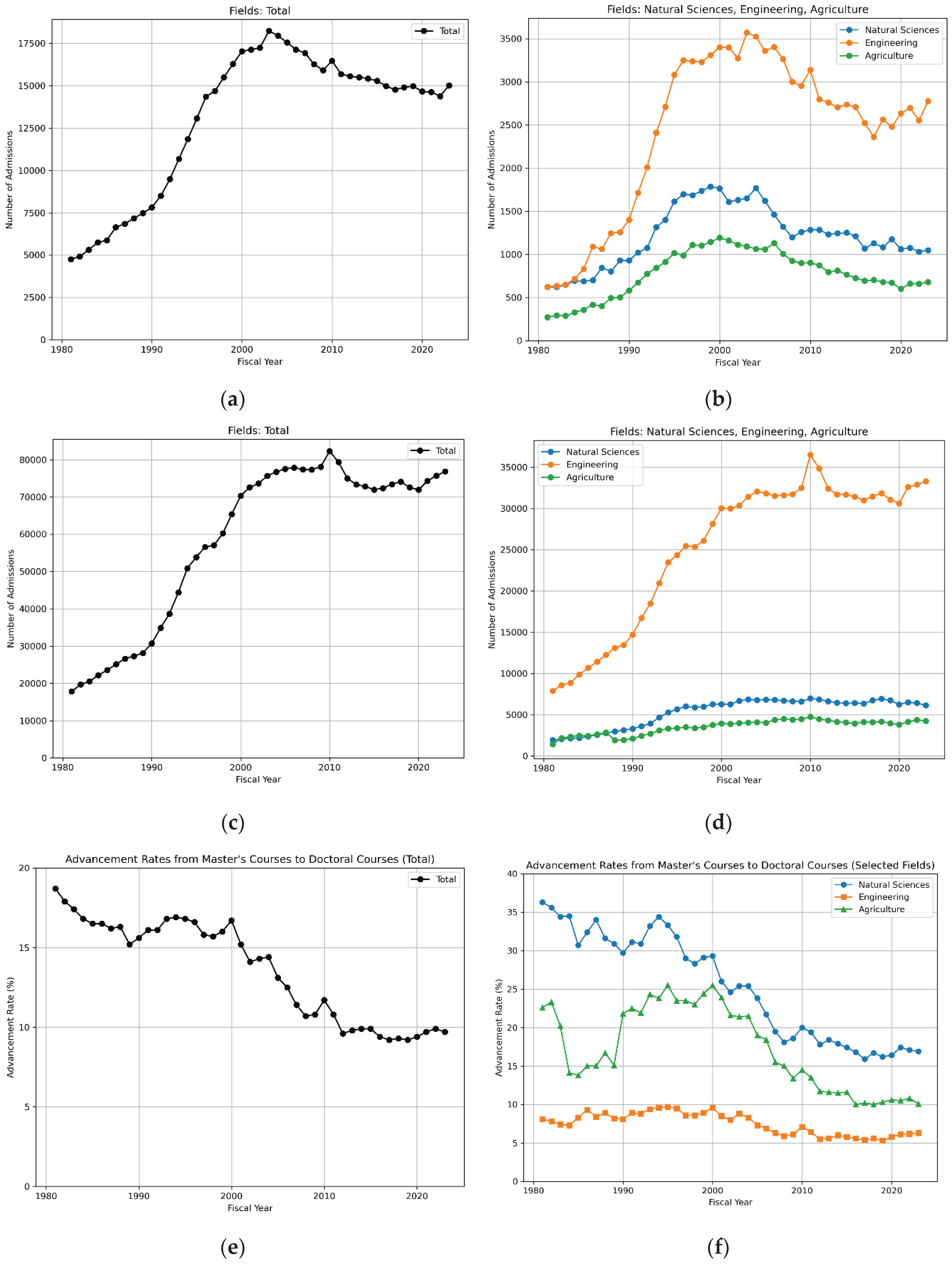
One of the significant manifestations of the decline in Japan’s research activity is the marked decrease in the number of graduate students in science and technology fields, as illustrated in Figure 6. Since the early 2000s, the number of students enrolling in graduate programs—particularly doctoral courses—has steadily declined. One might assume that this trend could be attributed to demographic shifts, such as Japan’s declining birthrate (Yonezawa 2020). In fact, the 18-year-old population peaked at 2.05 million in 1992 and has steadily declined since then, reaching 1.09 million in 2023—a reduction of nearly half over 30 years—according to a MEXT document (MEXT 2025b). In contrast, the number of university entrants and the university enrollment rate have shown a steady increase over the past 30 years (MEXT 2025b). While the number of enrollments in master's programs at graduate schools has not shown as drastic a decrease as that observed in doctoral programs, a notable trend is the significant decline in the advancement rate from master’s to doctoral programs (Figure 6e, 6f). These statistics suggest that the declining birthrate is unlikely to be the primary cause of the trend. Rather, as discussed below, the issue seems to lie in the diminishing motivation among undergraduate and master’s students to pursue doctoral study.
Surveys conducted by the National Institute of Science and Technology Policy (NISTEP) indicate that students forgo doctoral education primarily due to economic hardship and structural issues in the academic labor market. Key concerns include financial insecurity (Enoki 2001) during graduate study (38.4%), uncertainty about career prospects after obtaining a PhD (31.1%), poor return (e.g., lifetime earnings) relative to the cost of pursuing a doctoral degree (30.4%), and low perceived attractiveness of academic careers (27.0%)(survey respondents: n=17,525) (Watanabe, Kawamura, and Tsuchiya 2023). These concerns are reinforced by structural trends within academia itself, including the proliferation of fixed-term contracts, limited prospects for secure academic employment, and the overall lack of sustainable career pathways for early-career researchers.
This convergence of evidence—statistical trends in enrollment, survey responses, and structural labor conditions—points to a fundamental issue: the erosion of research careers as a viable and attractive option for young people (Iwamoto 2019). Graduate students have traditionally been the primary engine of university-based research, and their decreasing numbers are affecting the overall research capacity of Japanese universities. In a recent MEXT survey, university faculty identified the shortage of graduate students (master’s and doctoral) as the most critical constraint in the category of research personnel, followed by the lack of postdoctoral researchers and other research staff (MEXT 2025a). This perception underscores the growing concern that doctoral programs are becoming hollowed out, raising alarms about a future decline in the number of researchers (Iwamoto 2019). This issue is also reflected in national policy discussions. The Fifth Science Technology Plan notes that “Challenges remain in creating environments that enable young researchers to demonstrate their abilities, and there is growing reluctance among highly capable students to pursue doctoral studies”(Japan Cabinet Office 2016). A more explicit concern is expressed in a call for proposals for a new funding program, in which MEXT describes the current situation as follows: "In Japan, financial insecurity during doctoral programs and uncertainty regarding future career paths have led to a decline in doctoral enrollment and made it the only major country where the number of PhD recipients is decreasing. Many capable students have become disillusioned with a career in research, raising serious concerns about the hollowing-out of the nation’s future capacity for science, technology, and innovation."(MEXT 2020) There is an urgent need to incentivize doctoral study and postdoctoral research by providing adequate support and career prospects (Nagane 2024).
Thus far, we have examined issues concerning financial resources and human capital in research. Next, we turn our attention to the significant impact that university reforms and the increased ratio of competitive funding have had on the dimension of time.
11. Declining Research Time Amid Increasing Administrative Demands
Regarding research time, the introduction of competition among universities and the reallocation of budgets based on institutional evaluations have substantially reduced the time available for research activities. To respond to the demands of university reform, faculty members are compelled to allocate significant time to administrative tasks—such as fulfilling evaluation requirements, preparing proposal documentation, and drafting proposals for competitive funding—in addition to their educational responsibilities, rather than devoting their efforts to publication of research output (NISTEP 2024b). Notably, the proportion of research time among faculty across all universities declined markedly from 46.5% in 2002 to 37.2% in 2008, and, according to the available data, remained largely unchanged until 2018 (Igami and Kanda 2020). According to a 2022 MEXT survey, the top constraint on faculty research performance was lack of time (76.4%), followed by insufficient funding (56.1%), inadequate research environment (33.7%), and shortage of research personnel (30.1%)(MEXT 2025a).The reduction in dedicated research time underscores the urgent need to provide specialized support to help alleviate the administrative load and enable researchers to focus more effectively on their scholarly pursuits.
12. Expectation for the Research Administrators (URAs) for the Support of Researchers in Academia
A shortage of dedicated time for research in universities is often cited as one of the major causes of decreased research capabilities in Japan (Toyoda 2019). University researchers are increasingly occupied with administrative tasks related to university reforms, institutional evaluations, and the preparation of extramural grant proposals. To reduce these administrative burdens, the role of supporting specialists—namely, University Research Administrators (URAs), a new profession introduced in 2011—has been expanded. URAs are similar to research management and administration professionals (RMAs) who work with researchers at universities in Europe and North America (Yang-Yoshihara, Poli, and Kerridge 2023). Although Japan's URA system was modeled after U.S. research administrators (Takahashi 2023b), Japanese URAs are expected to work more closely with researchers to play an active role in fostering research rather than merely managing research budgets, as dedicated officials already handle the administrative aspects of research expenditures (Yamano 2016).
By the Japanese government's initiatives to implement URAs in academia, the number of URAs has increased significantly over the past decade, reaching 1,512 at 172 institutions in FY2022 (Takahashi and Ito 2023). Research Administration and Management in Japna (RMAN-J) , a professional organization for URA members, was established in March 2015 to support their activities and to formalize the new profession (Takahashi and Ito 2023). URAs are expected to become a catalyst for innovation in Japan (Ito 2024).
URAs in Japan are highly skilled professionals—often holding a Ph.D. in science—who work closely with researchers to reduce administrative burdens and enhance research capacity (Institute for Future Engineering 2018; Yano, Murakami, and Hayashi 2013). Their responsibilities span a wide range of activities, including support for university evaluations, grant proposal preparation, pre- and post-award administration, research management, facilitation of industry–academia collaboration, and the planning of interdisciplinary research initiatives (Takahashi 2016; Takahashi et al. 2018). However, for URAs to serve as a driving force in fundamentally addressing the decline in Japan's research capacity, it is desirable that they not be confined solely to an expert roles but also assume positions that enable them to contribute to university management (Mitsubishi Research Institute Inc. 2017) and ultimately to science and technology policy formation at the governmental level. Enhancing their status and expanding their influence would significantly strengthen efforts to restore Japan's research capabilities.
13. Maximizing the Possibility for Innovation to Happen: Rebalancing Japan's Research Funding
In recent decades, Japan has increasingly embraced a strategy of targeted funding—concentrating national research investments in a limited number of strategic fields such as AI, quantum technology, and biotechnology (Japan Cabinet Office 2021). This approach seeks to align scientific output with national priorities and generate economic and societal impact. Indeed, some targeted programs have yielded visible successes: for example, government support played a significant role in advancing iPS cell research, which culminated in Nobel Prize-winning work (Japan Cabinet Office 2013) and has since led to high-profile translational applications (Soma et al. 2024; Sawamoto et al. 2025). These outcomes demonstrate that targeted investment can be effective, especially when national goals are clear and long-term institutional support is provided.
However, targeted funding has its own limitations and trade-offs. Emphasizing alignment with predefined goals and short-term outcomes may constrain researchers’ flexibility and creativity. Basic science—by its very nature—requires time, tolerance for failure, and freedom from rigid performance metrics (Osumi 2023). A retrospective analysis of several Nobel Prize-winning discoveries illustrates this point. Osamu Shimomura, fascinated by the chemical properties of bioluminescent proteins, identified green fluorescent protein (GFP) as a byproduct while characterizing aequorin from jellyfish (Shimomura 2005). GFP later revolutionized cell biology. Similarly, Tasuku Honjo discovered the PD-1 molecule while investigating programmed cell death, a finding that ultimately led to immune checkpoint inhibitors and transformed cancer therapy (Okazaki and Honjo 2007) Yoshizumi Ishino accidentally identified unusual repeated DNA sequences in the E. coli genome, later known as CRISPR, which laid the groundwork for genome editing technologies (Ishino, Krupovic, and Forterre 2018). Shinya Yamanaka demonstrated that terminally differentiated mammalian cells could be reprogrammed into induced pluripotent stem (iPS) cells. His work was based on John Gurdon's earlier discovery of reversible cell differentiation (Yamanaka 2020; Gurdon 1962).
These groundbreaking innovations were not the result of top-down directives but rather emerged from investigator-driven curiosity and long-term support for fundamental research. They often originated from modest laboratories without the expectation of immediate societal impact. Just as a favorable outcome in a lottery cannot be selected in advance, future transformative discoveries cannot be produced solely through targeted investment. Therefore, striking the right balance between targeted and broad-based funding is essential. While strategic investment can catalyze progress in key national areas, a healthy research environment also depends on distributed, stable support for bottom-up, curiosity-driven science. Broadly distributing small- to mid-scale grants—as demonstrated in life sciences and medicine (Ohniwa, Takeyasu, and Hibino 2023)—is more effective at promoting the emergence of new research topics than concentrating large grants among a few elite institutions. Japan’s future research policy should not pose these funding models as mutually exclusive, but rather aim to optimize their coexistence.
Rebalancing the current funding structure—by restoring baseline institutional support, invigorating small- and mid-scale competitive grants, and safeguarding academic career pathways—should help revitalize scientific creativity, sustain diverse research cultures, and secure long-term innovation capacity. Such measures are essential to maintaining the research diversity and flexibility necessary for enabling unpredictable but high-impact scientific breakthroughs.
14. Japan’s Unique Challenges
Although this review has focused on the unintended consequences of science policy reforms in Japan, many of the mechanisms discussed—such as fixed-term academic employment, competitive research grants, and targeted funding—are not unique to Japan. Across countries, similar policies have been implemented to enhance researcher mobility, the agility of scientific research, and alignment with national innovation goals. Fixed-term contracts are indeed common in the early stages of academic careers, such as postdoctoral positions. However, successful performance during this phase typically leads to clear advancement pathways, including tenure-track appointments or permanent academic positions (Castellacci and and Viñas-Bardolet 2021). In contrast, Japan’s academic system structurally lacks mechanisms to ensure career continuity based on research performance (Maeda 1997), often leading to the expiration of contracts even for researchers with a strong record of academic publications, as discussed in the previous sections.
While institutional and legal reforms are important, they may not be immediately feasible. More fundamentally, however, the persistent reduction in baseline institutional funding—particularly the Management Expenses Grants—has severely limited universities’ ability to secure stable research positions. One key issue is the lack of rigorous policy evaluation: science and technology reforms are often implemented without systematic assessment of their outcomes, allowing unintended consequences to persist unaddressed while new, similarly structured initiatives are introduced. Reversing this trend and restoring stable public funding would be essential for rebuilding institutional capacity and ensuring long-term career pathways for researchers. In the meantime, practical measures—such as strengthening research management through the deployment of University Research Administrators (URAs)—can help mitigate adverse effects within the current system, but cannot substitute for fundamental reform of the research ecosystem.
15. Limitations and Future Directions
15.1. Limitations of the Present Study
This review is subject to several methodological constraints that warrant acknowledgment. First, since research activities are influenced by multiple interrelated factors, establishing a causal relationship between a specific science policy and its outcomes is inherently challenging (Tomizawa 2025). Second, the analysis relies primarily on policy documents, institutional reports, and aggregate statistical data, thereby lacking systematic tracking of individual researchers' career trajectories in relation to their academic achievements. The absence of longitudinal data linking research performance to career outcomes constitutes a significant limitation in understanding the human impact of policy reforms. Moreover, the scope remains confined to the Japanese context, precluding comprehensive international comparative analysis.
While this review examines available macro-level data and institutional perspectives, it cannot fully capture the experiences of researchers who have transitioned out of academia, nor can it adequately assess the correlation between research productivity and career sustainability at the individual level.
15.2. Directions for Future Research
While comprehensive analyses of Japan's declining research capacity exist, notably Toyoda's extensive quantitative examination of publication trends and research performance indicators (2019), systematic evaluations linking specific policy reforms to individual career outcomes remain limited. A critical gap is the absence of longitudinal studies that correlate researchers' academic achievements with their career trajectories, particularly given the methodological challenges of tracking researchers across institutional boundaries.
Future research should develop methodologies that capture both quantitative performance metrics and qualitative career experiences, examining how structural employment policies affect research continuity at the individual level. Such studies are essential for understanding the relationship between research productivity and career sustainability within the current academic system.
16. Conclusions
Innovation requires a continuum from basic research to applied development and societal implementation. Japan's shift toward 'selection and concentration' policies and competitive funding has undermined this ecosystem, particularly compromising curiosity-driven basic research that historically yielded transformative discoveries.
The persistent reduction in Management Expenses Grants has created cascading effects: fixed-term employment contracts destabilize research careers, doctoral enrollment has declined as academic paths lose appeal, and researchers' time for actual research has diminished under administrative burdens. These structural changes threaten Japan's long-term innovation capacity.
While initiatives like University Research Administrators could provide partial relief, fundamental reforms remain essential. Restoring baseline institutional funding, rebalancing competitive grants, and establishing sustainable career pathways are critical for revitalizing Japan's scientific ecosystem and securing its future as a science-driven nation.
Funding
This research was funded by Japan Society for Promotion of Science (JSPS), grant number KAKENHI JP20K03260 and KAKENHI JP25K06356.
Acknowledgments
I would like to thank Professor Hiroyasu Nakano for his encouragement. I am also grateful to the National Institute of Science and Technology Policy (NISTEP) for making well-structured public data available.
Conflicts of Interest
The author is currently employed as a University Research Administrator (URA), but declares no conflict of interest related to the content or conclusions of this manuscript.
Abbreviations
The following abbreviations are used in this manuscript:
| GDP | Gross Domestic Produce |
| MEXT | Ministry of Education, Culture, Sports, Science and Technology |
| CSTI | Council for Science, Technology and Innovation, Cabinet Office, |
| URA | University Research Administrator |
| NISTEP | The National Institute of Science and Technology Policy |
| EPMEWSE | The Japan Inter-Society Liaison Association Committee for Promoting Equal Participation of Men and Women in Science and Engineering |
References
- Aagaard, Kaare, Alexander Kladakis, and Mathias Wullum Nielsen. 2019. 'Concentration or dispersal of research funding?', Quantitative Science Studies, 1: 117-49.
- Amano, Ikuo. 2006. 'Corporatization of National Universities: Current Status and Challenges (Translation of Japanese 国立大学の法人化 : 現状と課題)', Nagoya journal of higher education, 6: 147-69.
- Asahi Shimbun Investigative Team. 2024. The National Universities at the Brink: Twenty Years After Corporatization, What Is Eroding Japan’s Universities? (Translation of 限界の国立大学——法人化20年、何が最高学府を劣化させるのか?).
- Asia Pacific Dept International Monetary Fund (IMF). 2023. 'Structural Barriers to Wage Income Growth in Japan', IMF Staff Country Reports, 2023: A003.
- Blackburn, Robert T., and Janet H. Lawrence. 1986. 'Aging and the Quality of Faculty Job Performance', Review of Educational Research, 56: 265-90.
- Castellacci, Fulvio, and Clara and Viñas-Bardolet. 2021. 'Permanent contracts and job satisfaction in academia: evidence from European countries', Studies in Higher Education, 46: 1866-80. [CrossRef]
- Cole, Stephen. 1979. 'Age and Scientific Performance', American Journal of Sociology, 84: 958-77.
- CSTI. 2013. ""Actions by CSTI and Related Bodies Leading up to the Amendment of the Labor Contract Act", Expert–Lawmaker Roundtable (December 19, 2013): "On Special Provisions of the Labor Contract Act," Meeting Materials 1–7 (Translation of Japanese 「労働契約法改正に伴う総合科学技術会議等の動き」, 総合科学技術会議 有識者議員懇談会「労働契約法の特例について」平成25年12月19日 会議資料 1-7 )." In.
- Cyranoski, David. 2001. 'Scientists fear new guidelines will stifle basic research', Nature, 412: 364-64. [CrossRef]
- Enoki, Eisuke. 2001. 'Japan's funding cuts hit the future of science', Nature, 414: 485-85. [CrossRef]
- Enoki, Eisuke, and Junko Hamanaka. 2014. 'The Reality of Underutilized Highly Educated Talent in Japan: Why Do Japanese Companies Not Recruit and Utilize PhD Holders?', Works: 6-8.
- EPMEWSE. 2023. "First Survey Analysis Report – Working Group on Employment Issues of Young Researchers." In.: The Japan Inter-Society Liaison Association Committee for Promoting Equal Participation of Men and Women in Science and Engineering (EPMEWSE).
- Gokami, Makoto. 2019. The Future Landscape of Universities: Creating a Knowledge-Based Society (Translated from Japanese 大学の未来地図:「知識集約型社会」を創る) (Chikumashobo Ltd).
- Gurdon, J. B. 1962. 'The developmental capacity of nuclei taken from intestinal epithelium cells of feeding tadpoles', J Embryol Exp Morphol, 10: 622-40. [CrossRef]
- Hanawa, Takeo. 2021. 'Repayment Resources of "University Bond" and Equal Opportunity of the National University Corporations in Japan ; Reviewing the Revenue Bonds of Public Universities in the United States', The annual bulletin of social science, 55: 161-78.
- Hirao, Takashi, and Yusuke Hoshino. 2024. 'The Dysfunction of Mission-Oriented Innovation Policy: Impeding the Accumulation of Scientific Knowledge in the Japanese Academic Sector', Administrative Sciences, 14: 115. [CrossRef]
- Hornyak, T. 2022. ''I feel disposable': Thousands of scientists' jobs at risk in Japan', Nature.
- Igami, Masatsura. 2017. 'A consideration on the background of the recent stagnation of Japanese scientific research : Evidence from research results of the National Institute of Science and Technology Policy (NISTEP) 日本の科学研究力の停滞の背景をよむ : 科学技術・学術政策研究所の調査研究より', Kagaku, 87: 744-55.
- Igami, Masatsura, and Yumiko Kanda. 2020. "Detailed analyses on full-time equivalent R&D expenditure and the number of researchers in Japanese universities " In Technical Report. National Institute of Science and Technology Policy (NISTEP).
- ———. 2024. "Temporal Changes in R&D Expenditures at the University Faculty Level: A Trial Using the Survey of Research and Development." In NISTEP DISCUSSION PAPER. National Institute of Science and Technology Policy.
- Ikarashi, A. 2023. 'Japanese research is no longer world class - here's why', Nature, 623: 14-16.
- Institute for Future Engineering. 2018. "Report on the Survey Analysis for Quality Assurance of Research Administrators: FY 2017 MEXT Commissioned Project (Translation of 平成 29 年度文部科学省委託事業 リサーチ・アドミニストレーターの質保証に 向けた調査分析 調査報告書)." In.
- Ishino, Yoshizumi, Mart Krupovic, and Patrick Forterre. 2018. 'History of CRISPR-Cas from Encounter with a Mysterious Repeated Sequence to Genome Editing Technology', Journal of Bacteriology, 200: 10.1128/jb.00580-17. [CrossRef]
- Ito, Takeo. 2024. 'URA as a Catalyst for Innovation in Japan : From the Case Study of Kyoto University', The journal of Information Science and Technology, 74: 22-27.
- Iwamoto, Noa. 2019. Scientists are Disappearing: Japan May No Longer Win Nobel Prizes (Translation of Japanese 科学者が消える: ノーベル賞が取れなくなる日本) (Toyo Keizai Inc.).
- Japan Cabinet Office. 2013. ""The awarding of the Nobel Prize in Physiology or Medicine to Professor Shinya Yamanaka of Kyoto University", Document 7: Reference Material for Handout 3 — “The Project for Realization of Regenerative Medicine,” Distributed at the 104th Meeting of the Expert Panel on Evaluation, Council for Science, Technology and Innovation (CSTI), Cabinet Office, Government of Japan." In.
- Japan Cabinet Office, Council for Science and Technology Policy. 2021. "The Sixth Science and Technology Basic Plan." In.
- Japan Cabinet Office, Council for Science and Technology Policy 2016. "The Fifth Science and Technology Basic Plan." In.
- Kanai, Yasuyuki. 2024. 'Employment and Research at RIKEN: Researchers and Technicians Treated as Disposable Labor (Translation from Japanese 理化学研究所における雇用と研究 : 使い捨てられる研究者・技術者)', Journal of Japanese Scientists, 59: 574-79.
- Katayama, Satoshi. 2022. 'Mass Non-Renewals of Researchers and Faculty at National University Corporations and R&D Organizations (Translation of Japanese 国立大学法人,研究開発法人等における研究者,教員の大量雇止め)', Journal of Japanese Scientists, 57: 44-45.
- Kobayashi, Takehiko. 2016. 'The Postdoc Problem and Workforce Mobility: Saving Japanese Science (Translation of Japanese ポスドク問題と人材の流動化—日本のサイエンスを救うために—))', Science Portal (Japan Science and Technology Agency), Accessed 2025.02.21.
- Kondo, Akio. 2016. 'The Legal Nature of the Civil Service Working Relationship', Chuo law review, 123: 339-69.
- Maeda, Tatsuo 1997. 'Implementation of Japan’s Fixed-Term Faculty Act and Emerging Issues Related to Non-Tenured Academic Positions (Translation of Japanese 大学教員任期法の施行と任期制をめぐる今後の課題)', University Journal, 21: 1-10.
- Mainichi Shimbun Investigative Team. 2019. The Decline and Fall of the Japanese Scientific Empire (The Mainichi Newspapers Co., Ltd.).
- Matsuzawa, Takaaki. 2019. "Survey for the career path of PhD students: Interest in transferable skills, and awareness of overseas students." In NISTEP DISCUSSION PAPER .
- MEXT. 2002. 'Support Measures for Postdoctoral Researchers, Council for Science and Technology, Human Resource Committee 13th Meeting, Document 2 (Translation of Japanese ポストドクター等に関する支援状況等 科学技術・学術審議会 人材委員会 第13回 資料2)'.
- ———. 2014a. "Guidelines for Responding to Misconduct in Research." In.
- ———. 2014b. "Survey on the Employment and Career Paths of Postdoctoral Researchers —A Complete Survey of Universities and Public Research Institutions (FY2012 Data)(Translation of Japanese ポストドクター等の雇用・進路に関する調査 -大学・公的研究機関への全数調査(2012 年度実績)-)." In.
- ———. 2018a. "Historical Developments and Potential Structural Causes of the Decline in Japan’s Research Capability: Document 2-2 for the 68th Meeting of the Subdivision on Science of the Council for Science and Technology, July 3, 2018." In.
- ———. 2018b. "Overview of the Key Developments and Structural Factors Behind Japan's Declining Research Capacity (Reference Data Collection)(Translation of Japanese 日本の研究力低下の主な経緯・構造的要因案(参考データ集))." In Materials for the 68th Academic Subcommittee Meeting, edited by Culture Ministry of Education, Sports, Science and Technology (MEXT).
- ———. 2020. "Call for Proposals: University Fellowship Program for the Creation of Science, Technology, and Innovation (Translation of Japanese 科学技術イノベーション創出に向けた大学フェローシップ創設事業 公募要領)." In, edited by Culture Ministry of Education, Sports, Science and Technology (MEXT) and Science and Technology Policy Bureau.
- ———. 2022. "Minutes of the 93rd Meeting of the Committee on Human Resources, Council for Science and Technology. Ministry of Education, Culture, Sports, Science and Technology (25 April 2022) (Translation of Japanese 文部科学省 科学技術・学術審議会 人材委員会(第93回)議事録 令和4年4月25日)." In.
- ———. 2023. "The historical development of national university corporatization in Japan (Translation of Japanese 国立大学の法人化の経緯)." In.
- ———. 2024. "On the Allocation of Grants-in-Aid for Scientific Research (KAKENHI), FY2024 (Translation of Japanese 令和 6 年度科学研究費助成事業の配分について) " In, edited by 文部科学省 研究振興局 学術研究推進課.
- ———. 2025a. "FY2023 Survey on Full-Time Equivalent (FTE) Data in Universities and Related Institutions (Translation of Japanese 令和5年度 大学等におけるフルタイム換算データに関する調査)." In.
- ———. 2025b. "Reference Material 1: Related Data Collection, Distributed Materials for the Joint Meeting of the 181st Subdivision on Universities and the 15th Special Committee on the Future of Higher Education, January 28, 2025 (Translation of Japanese 大学分科会(第181回)・高等教育の在り方に関する特別部会(第15回)合同会議配付資料 令和7年1月28日【参考資料1】関係データ集).
- " In.
- Ministry of Internal Affairs and Communications. 2016. Survey Report on the Promotion of Innovation Policy (Translation of Japanese イノベーション政策の推進に関する調査結果報告書) (総務省行政評価局).
- Mitsubishi Research Institute Inc. 2016. "Analysis of Government R&D Investment Target Setting and Investment Effects (Translation of Japanese)." In Investigation and Analysis Report on Policy Issues Concerning the Promotion of "Science for Policy" in Science and Technology Innovation Policies (Translation from Japanese 政府研究開発投資目標の設定・投資効果の分析 科学技術イノベーション政策における「政策のための科学」推進に関する政策課題についての調査分析). Mitsubishi Research Institute.
- ———. 2017. "Survey Report on the Challenges for Strengthening the URA System (Translation of Japanese URAシステム強化に向けた諸課題に関する調査)." In MEXT FY2016 Commissioned Project for the Development of Science and Technology Human Resources.
- Miyaki, Miki. 2024. 'Performance-Based Allocation of Management Expenses Grants to National University Corporations: An Analysis and Assessment Focused on Core Funding During the Third Mid-Term Plan Period (Translation of Japanese 国立大学法人運営費交付金における業績連動型配分の実態と検証 ―第3期中期目標期間中の基幹経費に着目して―)', IERCU Discussion Paper, 404.
- Mizuta, Kensuke. 2024. 'Historical transitions in critical issues of national university corporations' finance 国立大学法人の制度・会計・財務状況に関する論点と変遷', The Doshisha business review 75: 591-627.
- Monde, Kenji. 2024. 'More Research Time for Researchers (Translation of Japanese 研究者にもっと研究時間を)', Journal of Synthetic Organic Chemistry, 82: 115-15.
- Motomura, Yukiko. 2009. 'What exactly was the strategic focus on graduate schools?', Chemistry & Chemical Industry, 62: 873-76.
- Murata, Hirofumi. 2021. 'Promoting University Bonds and Academia-Industry Collaboration: Reflections on Six Years as President of the University of Tokyo — Makoto Gonokami on the University’s Role as a Driver of Societal Transformation (Translation of Japanse 大学債発行、産学連携を推進-。総長在任6年を総括 変革期の大学の使命 東京大学総長・五神真の「大学は、社会変革を駆動する拠点として」)', Zaikai 69: 16-21.
- Nagane, Hiromi. 2024. 'Fostering and Leveraging Doctoral Researchers: Achieving Balance in the Doctoral Labor Market (Translation of Japanese 博士人材の育成と活用:博士労働市場の均衡にむけて)', The journal of Information Science and Technology.
- Nakatomi, Koichi. 2011. 'Restructuring of academic freedom in national university corporations', The quarterly of the Ritsumeikan University Law Association, 333/334: 2495-523.
- Nakayama, Reiko. 2020. ""The Corporatization of National Universities Was a Failure" — Regret Expressed by Akito Arima, Former President of the University of Tokyo and Former Minister of Education (Translation of Japanese 「国立大学法人化は失敗だった」 有馬朗人元東大総長・文相の悔恨)." In Nikkei Business.
- National Institute of Science and Technology Policy (NISTEP). 2024. "Japanese Science and Technology Indicators 2024." In.
- NISTEP. 2023. "Survey on Career Awareness and Financial Assistance to 1st year of Doctoral Students - A Survey from December 2022 to January 2023 -." In.
- ———. 2024a. "The 2021 Survey on Postdoctoral Fellows Regarding Employment and Careers in Japan." In.
- ———. 2024b. "Analytical Report of Comprehensive Survey on the State of Science and Technology in Japan (NISTEP TEITEN Survey 2023)." In NISTEP REPORT,.
- Ohniwa, R. L., K. Takeyasu, and A. Hibino. 2023. 'The effectiveness of Japanese public funding to generate emerging topics in life science and medicine', PLoS One, 18: e0290077. [CrossRef]
- Okazaki, Taku, and Tasuku Honjo. 2007. 'PD-1 and PD-1 ligands: from discovery to clinical application', International Immunology, 19: 813-24. [CrossRef]
- Okumura, Sachiko, and Chisato Ikuta. 2021. 'Report on the Career Path Survey.
- —From the 24th Subcommittee on Astronomy and Astrophysics, Science Council of Japan—', The Astronomical Herald, 114: 11.
- Omi, Koji. 1996. Fundamental Law of Science and Technology (Yomiuri Shimbun).
- Osumi, Yoshinori. 2023. 'Interview with Professor Yoshinori Ohsumi, Honorary Professor at Tokyo Institute of Technology (Translation of Japanese 東京工業大学栄誉教授 大隅良典先生 インタビュー)', Trends in the sciences, 28: 4_12-4_24.
- Sabharwal, Meghna. 2013. 'Comparing Research Productivity Across Disciplines and Career Stages', Journal of Comparative Policy Analysis: Research and Practice, 15: 141-63. [CrossRef]
- Sasaki, Dan. 2018. 'The 2018 Issue at National Universities and Its Resolution: A Case Study of the University of Tokyo (Translation of Japanese 国立大学における二〇一八年問題とその解決│東京大学の事例)', The Zenei: 1-8.
- Sawamoto, Nobukatsu, Daisuke Doi, Etsuro Nakanishi, Masanori Sawamura, Takayuki Kikuchi, Hodaka Yamakado, Yosuke Taruno, Atsushi Shima, Yasutaka Fushimi, Tomohisa Okada, Tetsuhiro Kikuchi, Asuka Morizane, Satoe Hiramatsu, Takayuki Anazawa, Takero Shindo, Kentaro Ueno, Satoshi Morita, Yoshiki Arakawa, Yuji Nakamoto, Susumu Miyamoto, Ryosuke Takahashi, and Jun Takahashi. 2025. 'Phase I/II trial of iPS-cell-derived dopaminergic cells for Parkinson’s disease', Nature. [CrossRef]
- Science and Technology Policy Symposium Executive Committee. 2010. "Recommendations for Addressing the Issues Facing Young Researchers (e.g., Postdocs)." In.
- scienceinjapan.org. 2024. "Survey Results on the So-Called "Non-Renewal Problem" at Universities and Research Institutions." In.
- Shimada, Shinji 2022. 'Toward the Revival of Japan as a Nation of Science and Technology - Is Japan finished?', Proceedings for The 96th Annual Meeting of the Japanese Pharmacological Society, 96: 2-B-SL09. [CrossRef]
- Shimomura, O. 2005. 'The discovery of aequorin and green fluorescent protein', J Microsc, 217: 1-15. [CrossRef]
- Soma, Takeshi, Yoshinori Oie, Hiroshi Takayanagi, Shoko Matsubara, Tomomi Yamada, Masaki Nomura, Yu Yoshinaga, Kazuichi Maruyama, Atsushi Watanabe, Kayo Takashima, Zaixing Mao, Andrew J. Quantock, Ryuhei Hayashi, and Kohji Nishida. 2024. 'Induced pluripotent stem-cell-derived corneal epithelium for transplant surgery: a single-arm, open-label, first-in-human interventional study in Japan', The Lancet, 404: 1929-39.
- Statistics Bureau of Japan. 2024. 'Results of the Survey of Research and Development FY2024 (Reiwa 6)'.
- Suda, Momoko. 2021. 'The Transformation of the “Control Tower” for Science and Technology and the Decline of Japan’s Research Capabilities (Translation of Japanese 「科学技術の司令塔」の変質と日本の研究力衰退 )', Gakujutsu no Doko 26.
- Takahashi, Kenji. 2023a. 'The Validity of Non-Renewal in Relation to the Right to Request Conversion to an Indefinite-Term Contract — An Analysis of Recent Judicial Precedents Concerning the Right to Request Indefinite-Term Conversion — (Translation of Japanese 無期転換申込権に関連する雇止めの有効性 : 無期転換申込権に関する最近の裁判例の分析)', Chuo law review, 129: 443-73.
- Takahashi, Makiko. 2016. 'The function of URA skill standard for unified comprehension to diversified roels of URAs and related professionals', Journal of the Japan Society for Intellectual Production, 12: 19-29.
- ———. 2023b. 'Research Managers and Administrators in Asia: History and Future Expectations.' in Simon Kerridge, Susi Poli and Mariko Yang-Yoshihara (eds.), The Emerald Handbook of Research Management and Administration Around the World (Emerald Publishing Limited).
- Takahashi, Makiko , Yoko Furusawa, Kazuma Edamura, and Koichi Sumikura. 2018. "Human Resources for Research Promotion and Application in Japanese Academia -From Competition to Cooperation of University-Industry Cooperation Coordinators and University Research Administrators-." In GRIPS DISCUSSION PAPER. National Graduate Institute for Policy Studies (GRIPS).
- Takahashi, Makiko, and Shin Ito. 2023. 'The Profession of Research Management and Administration in Japan.' in Simon Kerridge, Susi Poli and Mariko Yang-Yoshihara (eds.), The Emerald Handbook of Research Management and Administration Around the World (Emerald Publishing Limited).
- Takeuchi, Kenta. 2019. 'The Future of Management Expense Grants for National University Corporations: Debates over Performance-Based Allocation (Translation of 国立大学法人運営費交付金の行方 : 「評価に基づく配分」をめぐって)', Legislation and Research (立法と調査): 67-76.
- The National Diet of Japan. 2003. "Supplementary Resolutions to the National University Corporation Act." In.
- The Science Council of Japan's Executive Committee. 2022. 'Statement by the Executive Board of the Science Council of Japan: Aiming to Resolve the So-Called ”Yatoi-dome”(Non-Renewal) Issue for Fixed-Term Researchers and University Faculty (Translation of Japanese 有期雇用研究者・大学教員等のいわゆる「雇止め」問題の解決を目指して)', Trends in the sciences, 27: 7-9.
- Tomizawa, Hiroyuki. 2025. 'Causes and Effects of Japan’s ‘Stagnation in Research Capacity’', The Journal of Science Policy and Research Management, 40: 2-4.
- Toyoda, Nagayasu. 2019. Japan’s Crisis as a Science and Technology Powerhouse (Translation of Japanse 科学立国の危機 失速する日本の研究力) (Toyo Keizai Inc.).
- Watanabe, Chihiro, and Martin Hemmert. 1998. 'The interaction between Technology and economy.' in M. Hemmert and C. Oberländer (eds.), Technology and Innovation in Japan: Policy and Management for the Twenty-First Century (Routledge).
- Watanabe, Eiichiro , Mari Kawamura, and Takahiro Tsuchiya. 2023. "The 2021 Survey of Japan Master’s Human Resource Profiling." In NISTEP RESEARCH MATERIAL Tokyo: National Institute of Science and Technology Policy.
- Yamagiwa, Juichi , and Satoshi Fujii. 2018. 'Interview with Kyoto University President Juichi Yamagiwa: Japan’s Universities Are Being Destroyed by "Austerity" and "Reform" (Translation of Japanese 京都大学 山極寿一総長インタビュー 日本の大学は今、「緊縮」と「改革」で滅びつつある)', Criterion: 134-48.
- Yamamoto (Ed.), Kiyoshi. 2007. A Study on the Financial and Managerial Reforms Following the Corporatization of National Universities (Translation of Japanese 国立大学法人化後の財務・経営に関する研究).
- Yamanaka, S. 2020. 'Pluripotent Stem Cell-Based Cell Therapy-Promise and Challenges', Cell Stem Cell, 27: 523-31. [CrossRef]
- Yamano, Masahiro. 2016. 'Comparative Understanding of Change of University Research Administrators (URA) between Japan and the USA: Expansion of the Role of Research Development (RD)', The journal of management and policy in higher education: 67-82.
- Yang-Yoshihara, Mariko, Susi Poli, and Simon Kerridge. 2023. 'Evolution of Professional Identity in Research Management and Administration.' in Simon Kerridge, Susi Poli and Mariko Yang-Yoshihara (eds.), The Emerald Handbook of Research Management and Administration Around the World (Emerald Publishing Limited).
- Yano, Masaharu, Toshie Murakami, and Teruyuki Hayashi. 2013. 'The current situation and system design of research administration in Japan 我が国のリサーチ・アドミニストレーターの現状と制度設計 : 東京大学の事例を中心として', Research in higher education, 45: 83-96.
- Yomiuri Shimbun. 2018. 'Exchange of Opinions, No. 41 "Corporatization Was Inevitable — The Strongest Scenario for All National Universities" An Interview with Makoto Gonokami, President of the University of Tokyo (Translation of Japanese 異見交論41「法人化は必然 全国立大で最強のシナリオ」五神 真氏(東京大学学長))'. https://kyoiku.yomiuri.co.jp/rensai/contents/41-1.php.
- Yonezawa, Akiyoshi. 2020. 'Challenges of the Japanese higher education Amidst population decline and globalization', Globalisation, Societies and Education, 18: 43-52. [CrossRef]
- Yoshida, Kana. 2007. 'Chapter 10: Management Expense Grants and Independent Revenue (Translation of Japanese 第10章 運営費交付金と自己収入). .' in Kiyoshi Yamamoto (ed.), A Study on the Financial and Managerial Reforms Following the Corporatization of National Universities (Translation of Japanese 国立大学法人化後の財務・経営に関する研究).
- Young Academy of Japan. 2014. "Proposal of a Methodology for Enhancing Japan's Science and Technology through Support for Early-Career Researchers and the Utilization of Research Support Personnel (Translation of Japanese 若手研究者支援・研究支援人材活用を通じた日本の科学技術を高めていく方法論の提案)." In.: Science Council of Japan.
Figure 1.
Research and development (R&D) expenditures as a percentage of gross domestic product (GDP), 1990–2022. Expenditures on R&D in science and technology include personnel, materials, operating, and capital costs across industry and academia. Data are from Science and Technology Indicators 2024, compiled by the National Institute of Science and Technology Policy (NISTEP), Ministry of Education, Culture, Sports, Science and Technology (MEXT).
Figure 1.
Research and development (R&D) expenditures as a percentage of gross domestic product (GDP), 1990–2022. Expenditures on R&D in science and technology include personnel, materials, operating, and capital costs across industry and academia. Data are from Science and Technology Indicators 2024, compiled by the National Institute of Science and Technology Policy (NISTEP), Ministry of Education, Culture, Sports, Science and Technology (MEXT).
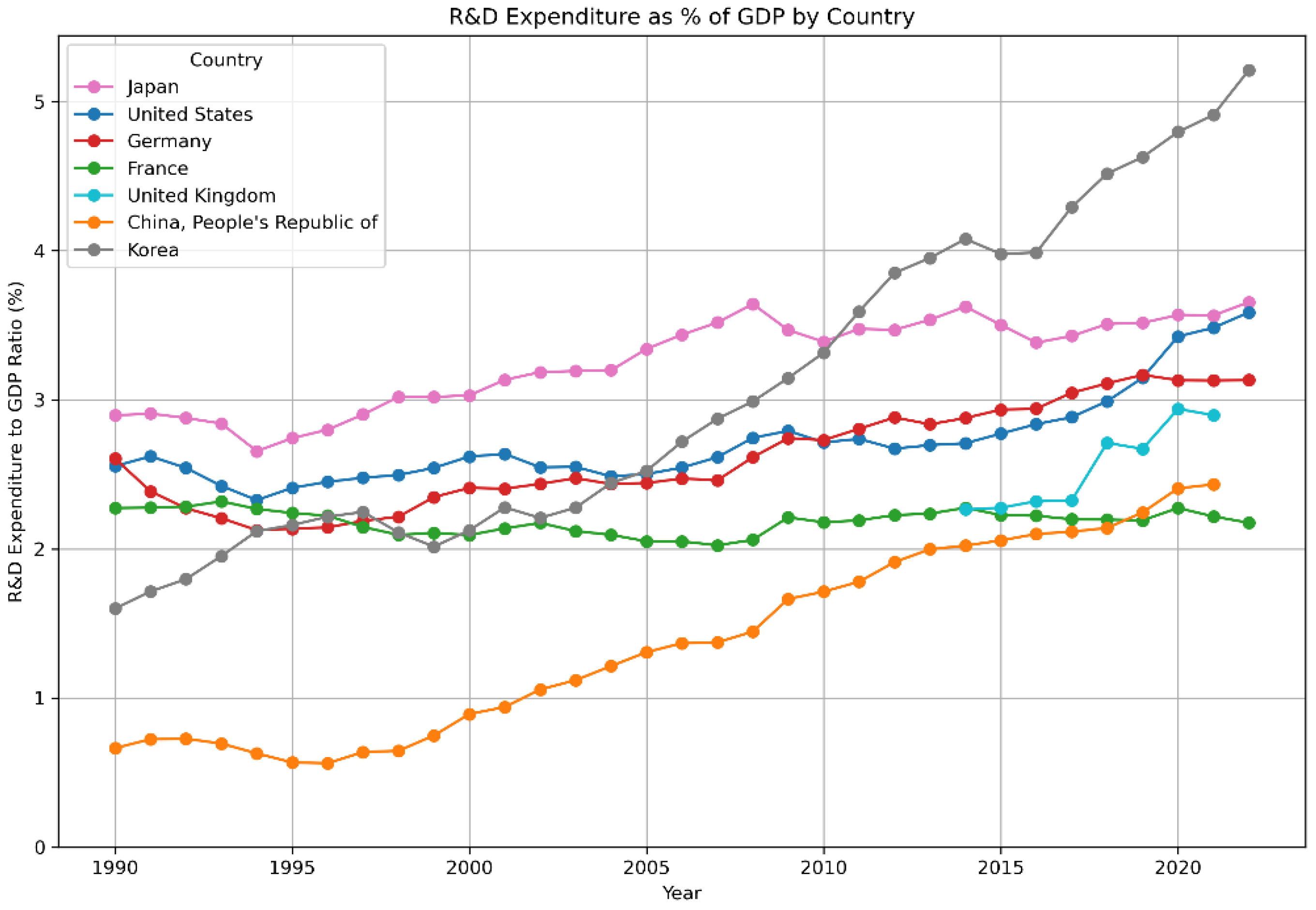
Figure 2.
GDP per Capita during the period of 1990 -2024 in G7 countries and neighbors. (data from https://www.imf.org/external/datamapper/).
Figure 2.
GDP per Capita during the period of 1990 -2024 in G7 countries and neighbors. (data from https://www.imf.org/external/datamapper/).
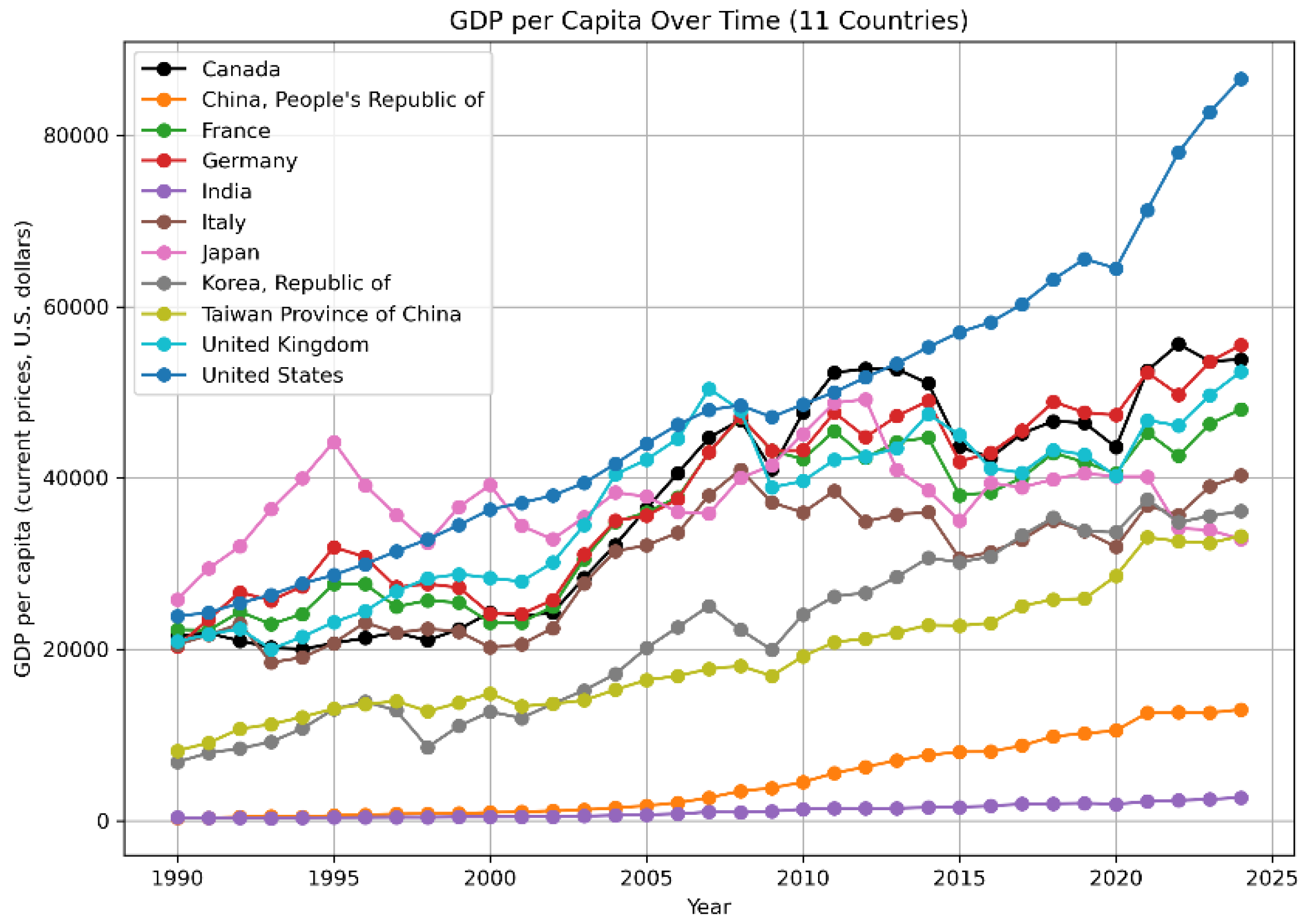
Figure 3.
Trends in Japan's Science and Technology Budget. Japanese Government’s Initial Budget for Science and Technology during FY2000–FY2024 in trillion yen (Data from MEXT NISTEP Science and Technology Indicators 2024).
Figure 3.
Trends in Japan's Science and Technology Budget. Japanese Government’s Initial Budget for Science and Technology during FY2000–FY2024 in trillion yen (Data from MEXT NISTEP Science and Technology Indicators 2024).
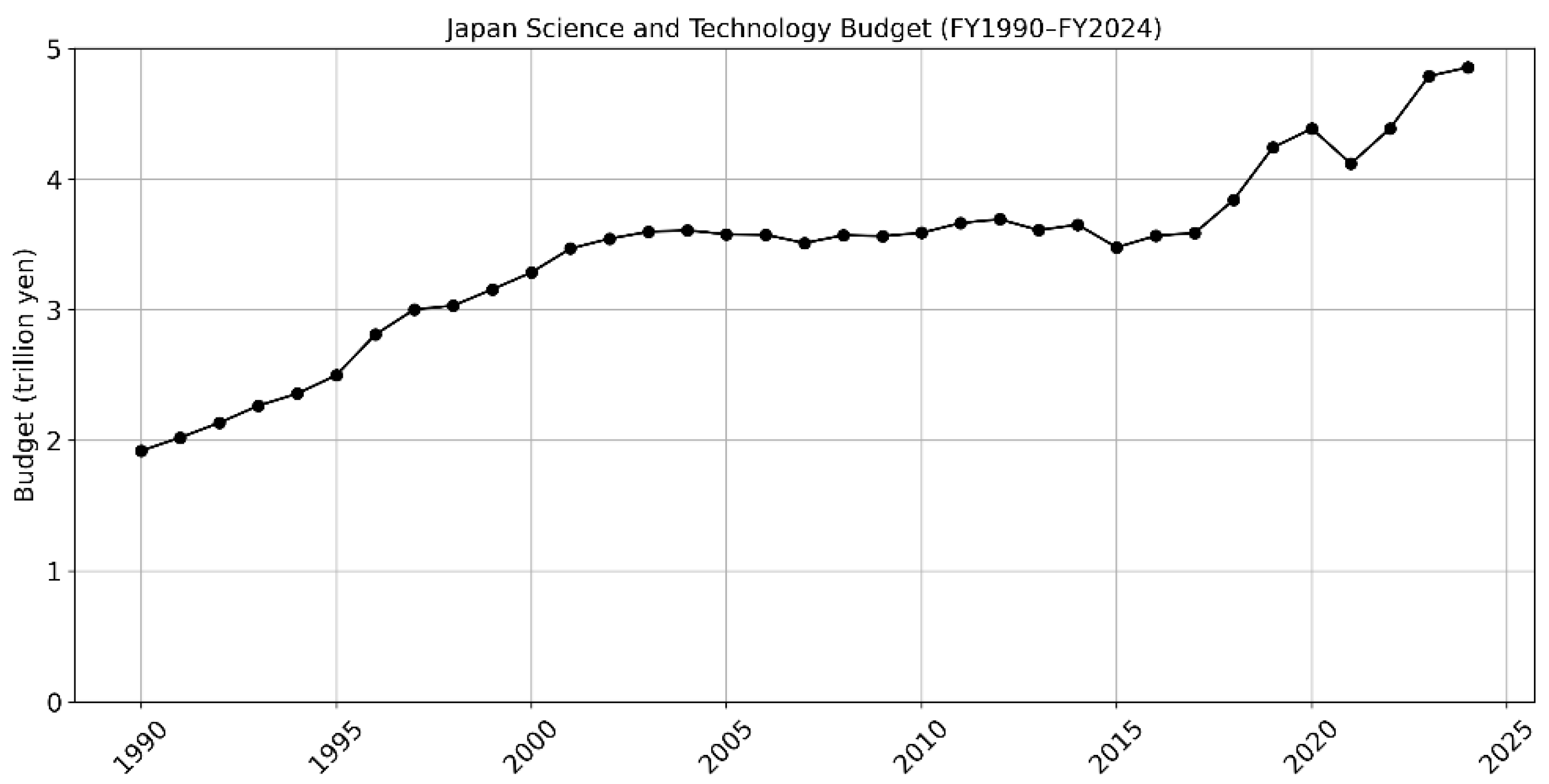
Figure 4.
Trends in Industry-Academia Collaboration: Joint Research Projects and Funding Received (Fiscal Years 2003–2023). The number of joint research projects with industry (solid line) and the amount of funding received by academic institutions from companies (dashed line). Data from “Status of Industry-Academia Collaboration and Related Activities at Universities and Other Institutions” (https://www.mext.go.jp/a_menu/shinkou/sangaku/sangakub.htm).
Figure 4.
Trends in Industry-Academia Collaboration: Joint Research Projects and Funding Received (Fiscal Years 2003–2023). The number of joint research projects with industry (solid line) and the amount of funding received by academic institutions from companies (dashed line). Data from “Status of Industry-Academia Collaboration and Related Activities at Universities and Other Institutions” (https://www.mext.go.jp/a_menu/shinkou/sangaku/sangakub.htm).
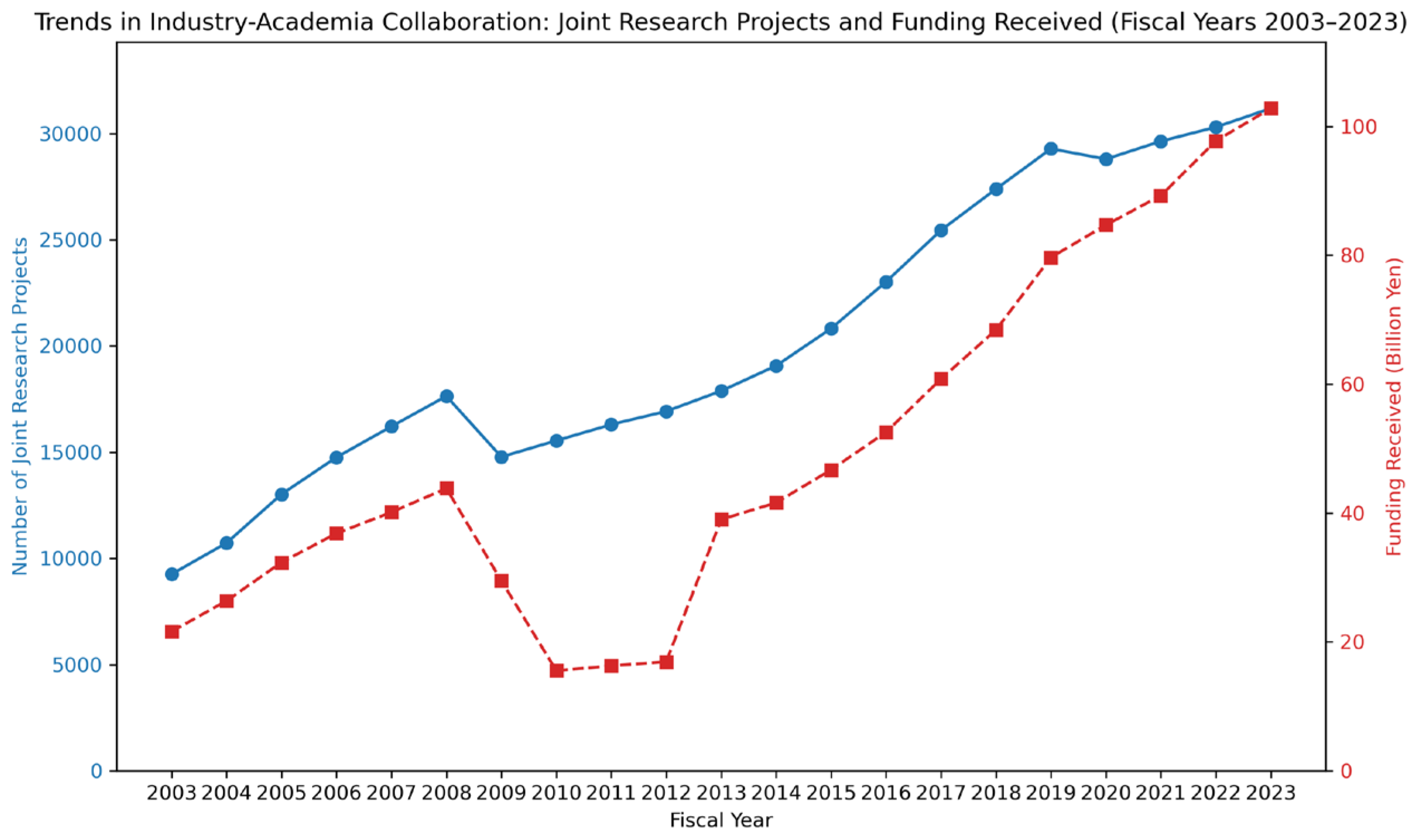
Figure 5.
Changes in the Amount of Management Expenses Grants for National University Corporations Over Time. Data from the Reference Materials for the MEXT Study Group on the Future of Operational Subsidies for National University Corporations during the Fourth Medium-Term Objective Period (18 June 2021 meeting). (https://www.mext.go.jp/b_menu/shingi/chousa/koutou/108/toushin/mext_00003.html).
Figure 5.
Changes in the Amount of Management Expenses Grants for National University Corporations Over Time. Data from the Reference Materials for the MEXT Study Group on the Future of Operational Subsidies for National University Corporations during the Fourth Medium-Term Objective Period (18 June 2021 meeting). (https://www.mext.go.jp/b_menu/shingi/chousa/koutou/108/toushin/mext_00003.html).
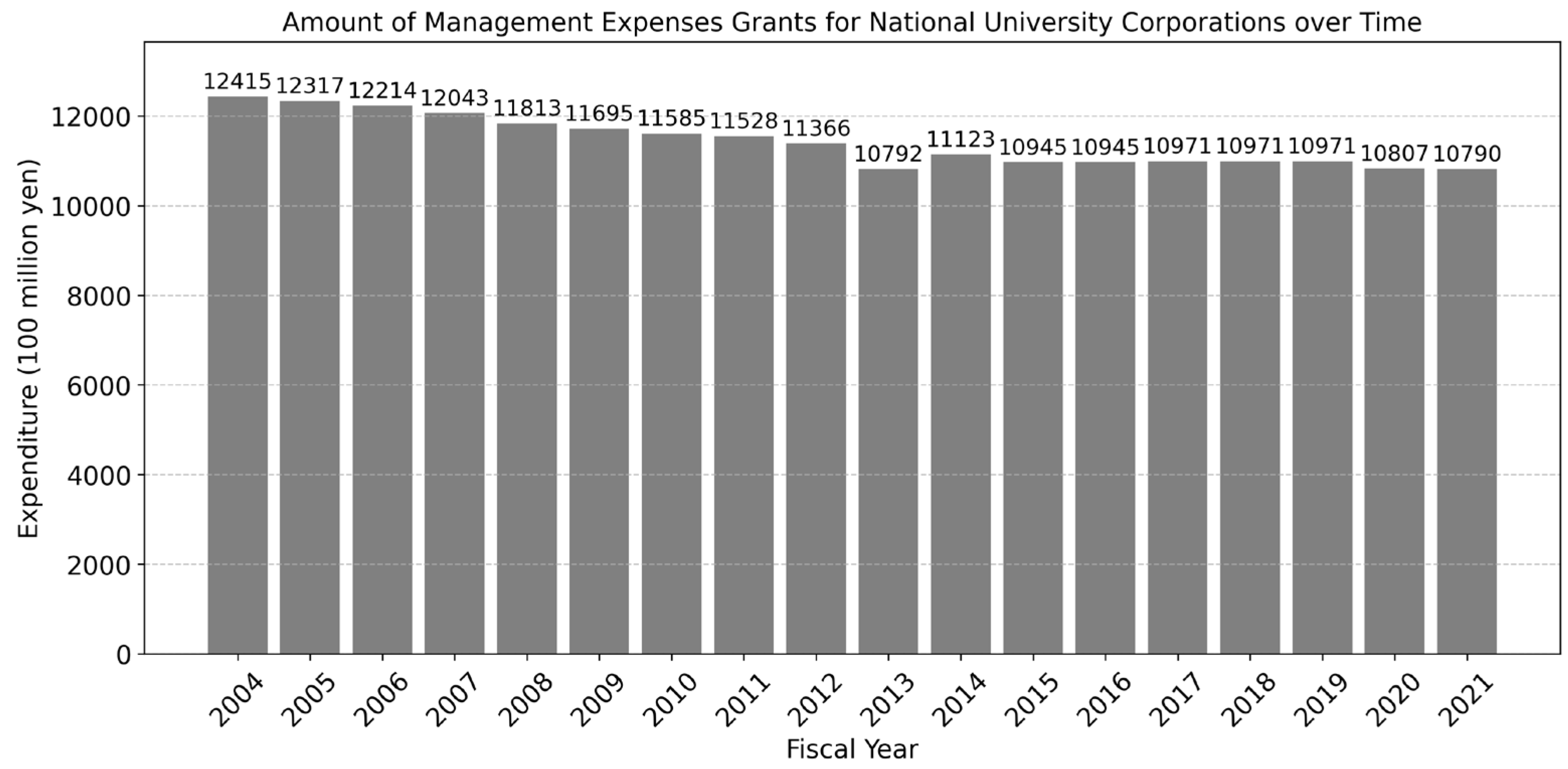
Figure 6.
Graduate School Enrollment Trends. (a) Number of admissions from master’s courses to doctoral courses across all departments; (b) Number of admissions from master’s courses to doctoral courses in selected departments (natural sciences, engineering, and agriculture); (c) Number of admissions from undergraduate programs to master’s courses across all departments; (d) Number of admissions from undergraduate programs to master’s courses in selected departments; (e) Advancement rates from master’s courses to doctoral courses across all departments; (f) Advancement rates from master’s courses to doctoral courses in selected departments. Doctoral enrollment has declined markedly since 2003, whereas enrollment at the master’s level has been largely maintained over time. Data from Science and Technology Indicators 2024, NISTEP, MEXT.
Figure 6.
Graduate School Enrollment Trends. (a) Number of admissions from master’s courses to doctoral courses across all departments; (b) Number of admissions from master’s courses to doctoral courses in selected departments (natural sciences, engineering, and agriculture); (c) Number of admissions from undergraduate programs to master’s courses across all departments; (d) Number of admissions from undergraduate programs to master’s courses in selected departments; (e) Advancement rates from master’s courses to doctoral courses across all departments; (f) Advancement rates from master’s courses to doctoral courses in selected departments. Doctoral enrollment has declined markedly since 2003, whereas enrollment at the master’s level has been largely maintained over time. Data from Science and Technology Indicators 2024, NISTEP, MEXT.
Disclaimer/Publisher’s Note: The statements, opinions and data contained in all publications are solely those of the individual author(s) and contributor(s) and not of MDPI and/or the editor(s). MDPI and/or the editor(s) disclaim responsibility for any injury to people or property resulting from any ideas, methods, instructions or products referred to in the content. |
© 2025 by the authors. Licensee MDPI, Basel, Switzerland. This article is an open access article distributed under the terms and conditions of the Creative Commons Attribution (CC BY) license (http://creativecommons.org/licenses/by/4.0/).
Copyright: This open access article is published under a Creative Commons CC BY 4.0 license, which permit the free download, distribution, and reuse, provided that the author and preprint are cited in any reuse.


