

Submitted:
08 April 2025
Posted:
09 April 2025
You are already at the latest version
Abstract
Worldwide, there are few applications aimed at psychosocial rehabilitation, and none of them specifically address psychosocial rehabilitation projects. This justifies the need to build an application to assist mental health professionals in the construction and management of psychosocial rehabilitation projects in the Brazilian context. This investigation aimed to describe the development of the webapp "App Reabilita Psicossocial" through a technological development study conducted between May 2024 and February 2025. The webapp development process was carried out in 5 stages (theoretical foundation, requirements gathering, prototyping, and development), adapted from the Novak Method. With the active and collaborative participation of the principal researcher (psychiatric nurse) and two software engineering students, supervised by a software engineer and nursing professor, interactions occurred through video calls, WhatsApp, and email. These interactions were transcribed by the Transkriptor software and later inserted into the Atlas Ti software for thematic analysis. The webapp "App Reabilita Psicossocial" has an initial registration screen, and screens structured in the phases of the psychosocial rehabilitation project (assessment, diagnoses, goals, intervention, agreement, and evaluation), home, resources, and functions (add new/search project, and search for mental health support services) that facilitate its operation and streamline the construction of the psychosocial rehabilitation project by mental health professionals. The thematic analysis reflected 3 themes and 7 codes that describe the entire development process with interaction between participants in a collaborative and interrelational work. The collaborative approach between researchers and developers was crucial to translate the complexity of the psychosocial rehabilitation project into practical and usable functionalities for future users, the mental health professionals.
Keywords:
Projetos
; Reabilitação Psiquiátrica
; Aplicações Móveis
; Saúde mental
1. Introduction
There are approximately more than 10 thousand applications ( apps) developed on mental health in the world [1,2,3]. These are mostly related to cognitive-behavioral therapy techniques to collaborate in the treatment of anxiety and depression in psychiatric patients and few developed to support psychosocial rehabilitation [1,4,5,6,7].
It has been proven that apps based on psychosocial rehabilitation can contribute to the development of autonomy and social functionality, as well as improving the quality of life of psychiatric patients [7]. But applying the Psychosocial Rehabilitation (RP) theory in the practice of mental health professionals is something challenging, as it is complex in relation to its theory, which has also been systematized by the Psychosocial Rehabilitation Project (PRP) [8,9,10,11,12,13,14].
The challenge of applying psychosocial rehabilitation by mental health professionals is amplified by barriers related to the configuration of the Psychosocial Care Network (RAPS) belonging to the Brazilian public health system (SUS), which undermines the process of psychosocial rehabilitation of psychiatric patients, such as the fragmentation of care, disarticulation of health actions mental health, insufficient and unattended communication between mental health professionals [8,10,11,15,16,17].
Therefore, an application (app) for the construction of psychosocial rehabilitation projects, is identified as a technological tool that can computerize and streamline the psychosocial rehabilitation project, optimizing interprofessional communication and integrating RAPS during planning, evaluation, construction, monitoring/monitoring, and (re)evaluation of psychosocial rehabilitation projects carried out by mental health professionals [1,8,18,19].
Therefore, in previous investigations the authors of this work will carry out the theoretical foundation that justifies the development of an app for the construction of psychosocial rehabilitation projects with their therapeutic purpose in supporting mental health professionals in planning, evaluation, construction, monitoring/monitoring, monitoring of psychosocial rehabilitation projects in your work area [20].
And, later, they will build their prototype using Marvel software, called Prototype of the web app “Project Psychosocial Rehabilitation App” – PWAPPR (see link: https://marvelapp.com/prototype/31b02f26), which was based on the prototype requirements obtained through the integrative review of literature and the conduct of focus group interviews with professionals of mental health of the Psychosocial Care Center, also considering suggestions received from the perfection carried out by health professionals during the validation of its content and appearance [21].
The PWAPPR presents 27 screens that graphically represent how the login resources, registration of the mental health professional, presentation of the structure for the construction of a psychosocial rehabilitation project, evaluation, user support and credit of the web app “Psychosocial Rehabilitation Project App” would be. Its content and appearance validation (N=15 mental health professionals) resulted in Content Validity Indexes (CVIs) for objectives, appearance, structure and organization, and relevance by more than 0.90 [21].
Therefore, the general objective of this work is to report the development of the web app “App Project for Psychosocial Rehabilitation”, which puts the development of an app for the construction of mental health rehabilitation projects, specifically in the context of Brazilian public health, if it proves promising as support in the management and care of health professionals mental health to psychiatric patients [5,7,21,22,23,24,25,26].
2. Method
This investigation reports the development of the web app “Project Psychosocial Rehabilitation App”, supporting the experience reporting method [27] and the multimethod approach [28,29,30], following the recommendations of the SRQR [31,32]. The investigation was approved by the Ethics and Research Committee of the School of Nursing of the University of São Paulo (EERP-USP), through the Dictamen del n. 6,605,152 of January 3, 2024 (CAAE: 75372623.5.0000.5393).
Complementing the experience reporting method, the investigation uses the Participant Observation (OP) technique to systematize the data collection. La OP, as suggested by Correia (2009) [33], França et al. (2022) [34] and Mónico et al. (2017) [35], it is a valuable tool to observe, understand and interact with participants during the development and validation of the web app “Project Psychosocial Rehabilitation App” . The records of these observations were carried out in an investigation diary, in the possession of the main investigator, in accordance with the recommendations of Kroef, Gavillon and Ramm (2020) [36].
Therefore, the web app “Project Psychosocial Rehabilitation App” was developed by Technology and Information (TIC) professionals, based on guidelines adapted from the APA (2021) [37] together with recommendations from the Martinez-Martin study; Greely; Cho (2021) [38], described Box 1, along with adjustments and changes for improvements made in the prototype, the PWAPPR, which was carried out in the Marvel software, as presented in a previously published study [21]:
In this way, in virtual meetings and video calls on Google Meet and text messages on Whatsapp, the main researcher and ICT professionals will discuss, in a collaborative and highly participatory context, with the objective of creating, the PWAPPR, aesthetically pleasing, simple, coherent and adapted to the technological support of a mental health application, without forgetting the recommendations defined in it Box 1. Which are displayed lower, in Box 2:
3. Results
A report of the experience in the development of the web app “Psychosocial Rehabilitation Project App” is presented.
3.1. Starting with the Adaptation of the Web App Prototype “Psychosocial Rehabilitation Project App”
The web app “Psychosocial Rehabilitation Project App” appears as an incipient technological project, born with the desire to help mental health professionals in the construction of psychosocial rehabilitation projects in a dynamic, easy way, retrieving information and, mainly, with the ability to optimize interprofessional communication around a care network structured, so that psychosocial rehabilitation is carried out in a real way.
In this context, the web app is understood as an application developed with the lowest costs of incipient research projects, in comparison with applications developed for the Android or iOS operating systems, being a resource accessible through a link without hardware restrictions or the user’s mobile operating system.
(...) The last applications that people have done (...) have been in this line of thinking, as “projects” are involved without financial cumulus, they are easier to achieve when it comes to maintenance costs. (...) And on the web app, you can have them available in one place, where the person accesses via a link, but from her cell phone it appears... that she is accessing an application (Technological Development Supervisor).
For the development of the web app “Project Psychosocial Rehabilitation App”, it was necessary, in addition to the researcher understanding the web app, to explain and “translate” in a collaborative, informal and cordial language, the PWAPPR to its developers, to clarify their doubts regarding this prototype and the functionalities demonstrated.
- This is stupid. When “inserting the new psychosocial rehabilitation project”, are the psychosocial rehabilitation projects for patients? (Developer 1). - Yes, my patients. But in the sense (...) that, for example, when carrying out a psychosocial rehabilitation project, by “inserting the new psychosocial rehabilitation project” (...), the mental health professional is inserting this project that is about the patient, and the idea is that it will appear, the patient, his name and the project that is in construction or completed (Principal Researcher). - Ya see! So does the patient represent a psychosocial rehabilitation project? (Developer 1). - This is a psychosocial rehabilitation project for each patient (…) ... (Principal Researcher).
These conversations oriented towards the understanding of the PAPRP, and subsequently, the development of the web app “App Proyecto Rehabilitation Psychosocial” were marked by collaborative work and interactions with the exchange of knowledge, professional experiences, and mutual learning between the main researcher and developers, in order to connect the theory and practice of mental health to the technological resources and functions of the web app “Psychosocial Rehabilitation Project App”, with explanations of the resources and technological elements by the developers, and how the psychosocial rehabilitation project is operationalized/conceptualized by the researcher.
- This small screen here, (called the name of the main researcher), is called Drawer. What is the Drawer? The Drawer is when the person or healthcare professional clicks on their photo. Then this screen appears, slides vertically and the user profile information appears (...). (Developer 1).
(…)
- (...) (The) Psychosocial Rehabilitation Project, is not limited to what is happening, but is also macro, in establishing goals and interventions for psychosocial rehabilitation and quality of life of the patient. (…) ... (Principal Researcher).
However, there are moments of difficulties in making the app ’s functionalities useful and coherent with the needs of mental health professionals presented by the main researcher, such as conflicting questions about when to require the CPF (Brazilian person identification document) as a requirement for the professional registration of psychiatric patients.
- You probably wouldn’t link the project, because you didn’t have anyone registered yet, but you would link the patients (…) together with the healthcare professional (Developer 1). - It’s worth it, but here, how, for example, if you haven’t had the first contact with the patient, who will be the first person to enter this CPF? (…), and then we may have a problem of not getting the registration... (Principal Researcher). - You can leave that there. To (…) then you do it, no?, maybe… (Developer 2).
The meetings and meetings of clarification and understanding of the PWAPPR culminated in the definition of the appearance and functioning requirements for the development of the web app “Project Psychosocial Rehabilitation App”, structured in Box 3, but required the provision of the main researcher to allow its changes and refinement, when it was important judgment by developers.
(...) - So that we can talk about the requirements... (...) then (...) about the design of the application. If we change the design, but we keep all the features, is it fine? (Developer 1). (…) - No problem! (Principal Researcher). - Perfect, then. So, at Home we can see it as a presentation of the app (...). (...). This button here from Start, would it be like a beginning for the videos? - (Developer 1). - This part was just to show (…) (give) the Start... Now I’m thinking that it doesn’t make sense… (…). Let’s go back to home (that) (…) fell very good. Let’s go solo to cut. Let’s make a video alone. Because then we don’t have much information… (…) (Principal Researcher).
The requirements (Board 3) were synthesized didactically between three major elements: screens, functions and data base, structuring the web app “Psychosocial Rehabilitation Project App”. With the objective of integrating the construction of psychosocial rehabilitation projects by mental health professionals.
- (...) This is a psychosocial rehabilitation project for each patient, (...), so each patient will have a psychosocial rehabilitation project, (...), which (...) (has) this structure (...): patient data, situational diagnosis, goals, interventions, pacts, case study agenda and evaluation (Principal Researcher). - (Y) (...) the (...) evolution is (...) an important category because I am going to be able, (...) to refill all of it (...), it is as if this evolution was a general record of the follow-up of this patient... (Developer 1).
(…)
-(...) So here we have a compartment of patient information, as if we were generating reports. This format, do you think it would be in PDF? How do you imagine it? (Developer 1). - I had imagined a link opening (via) the internet or it could be a PDF, there was no problem (Principal Researcher). - Of course, I understand (Developer 1). - This search is to (...) enter the patient direction, which are the psychiatric patient support network devices, (...)... All according to your PRP and programmed and managed by the mental health professional (Principal Researcher).
Next, Box 3 is presented, which details the functionalities and appearance of the web app “Psychosocial Rehabilitation Project App”. Meeting the essential requirements for its construction and development. Integrating the construction and management of psychosocial rehabilitation projects by mental health professionals, with a focus on psychosocial rehabilitation.
Therefore, the developers present the instructional design for the development of the web app “Project Psychosocial Rehabilitation App” (Figure 1), which adjusts to your appearance and functionality requirements (Box 3), encompassing the changes in perfection and improvement made in meetings and interactions/meetings virtual.
This design guides and facilitates expert technicians in the development of the web app “Psychosocial Rehabilitation Project App”, serving as a reference for the creation of its screens and technological resources, and reducing the development time of this application.
-(...) Here is a high-fidelity prototype. So, you can use it as if it were really the application. What
you can’t, for example, in a field, you can’t write on it, precisely because it’s a prototype, you know?, it doesn’t have that type of function. For example, profile, go out, you can see the flow, how it is, (...) here we have the shadow of things, we have the cards (Figure 7). (...) We cream the screen, we cream its function. And here, for example, this is a screen that is under construction, now we are at the beginning, you take so many details of this, we will start working first (...) (Developer 1).
Based on the instructional design for developing the web app “App project for psychosocial rehabilitation” presented previously, which facilitated the construction of the web app, the development of the web app “Psychosocial Rehabilitation Project App” was carried out, using the most suitable technologies for its execution. In this sense, the continuation will detail the technological characteristics that support its functionality and efficiency.
3.2. Getting to Know The Web App “Psychosocial Rehabilitation Project App”
The application “Psychosocial Rehabilitation Project App” was developed using Flutter, a Google framework that allows the creation of native applications for multiple platforms from a single code, standing out for generating modern, high-performance interfaces. The programming language used was Dart, which is distinguished by its simplicity, efficiency and support for asynchronous programming, guaranteeing fluidity and performance. Data storage is carried out using Firebase, specifically using Cloud Firestore, a non-relational database that offers flexibility and scalability [22,26].
El Storage is used to store files, such as photos and documents, directly in the cloud. Authentication takes care of the login and user registration, as well as email/passwords. El Functions allows you to automate tasks, such as sending emails automatically when a user registers. App Check helps protect the application against unauthorized access, ensuring greater security and Hosting serves to host websites and applications, making them available online quickly.
Furthermore, Firebase provides additional features such as user authentication and notification sending. The combination of these technologies allows the development of an efficient, safe and easy to maintain solution, satisfying the dynamic needs of the web app “Psychosocial Rehabilitation Project App” allowing the construction and management of psychosocial rehabilitation projects by mental health professionals during the psychosocial rehabilitation process in their context’s labors [22,26].
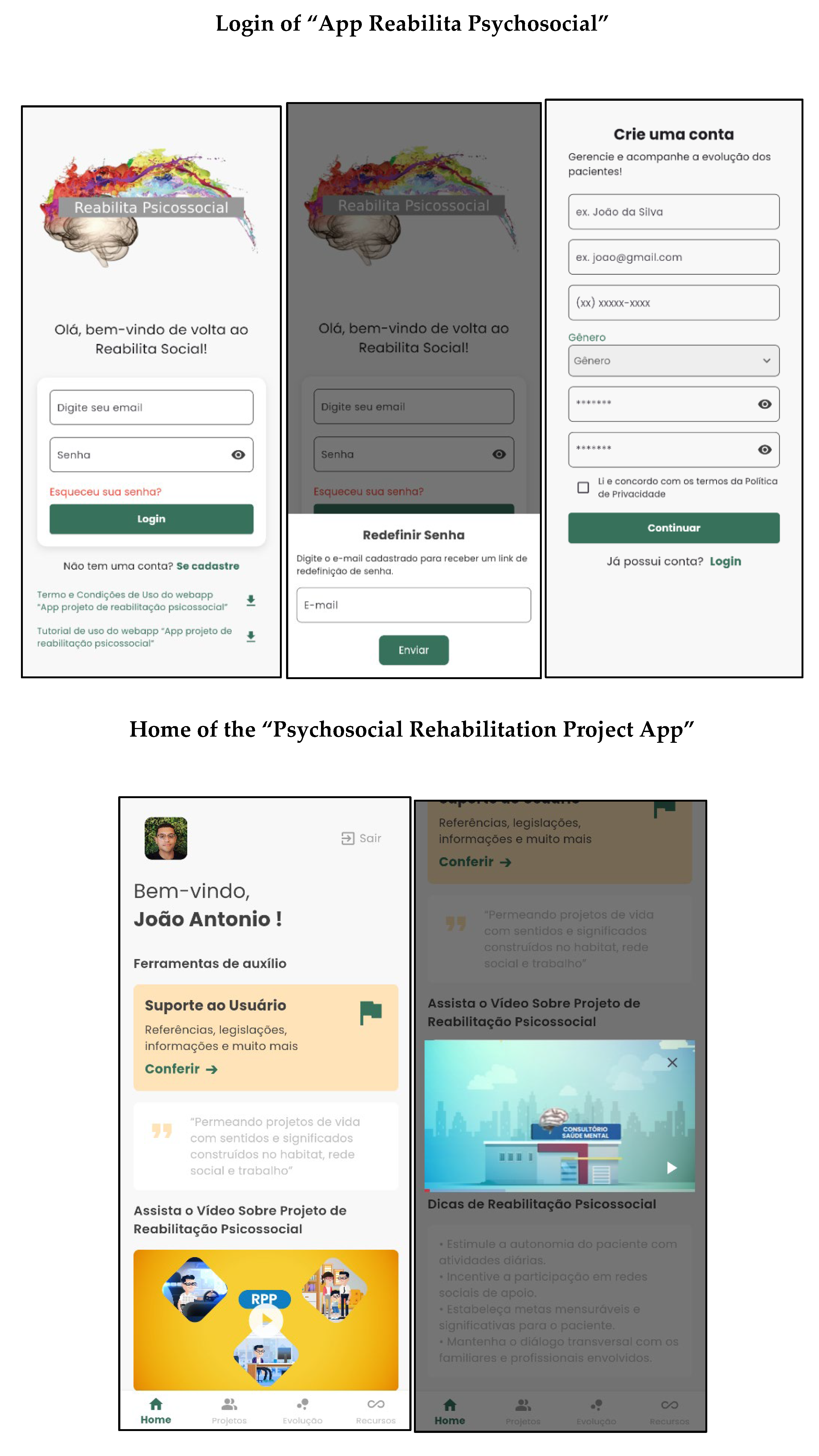
Therefore, the screens of the web app “Psychosocial Rehabilitation Project App”, which in accordance with the appearance, functionality and database requirements, demonstrated in box 3, have a screen for mental health professional login (e-mail and password), “Resource Bar” for the function: “Home”, “Projects”, “Evolution” and “Resources”.
“Home”: Help tool, Video on psychosocial rehabilitation project and Psychosocial rehabilitation advice.
“Projects”: Function to search for projects by patient name and button for “Add Proyecto” (New project).
“Evolution”: Screen that demonstrates the projects by photos, by clicking on the professional you can see the evolutions over time and add new developments.
“Resources”: Edit Profile, Help and Support, Term of Use, Technical Information, Developments and Thanks.
In particular, the “Help and Support” resource, the professional can access references on mental health, legislation, search for mental health services through the patient’s direction, record productivity with codes of procedures available and standardized by the Brazilian Ministry of Health [53,54].
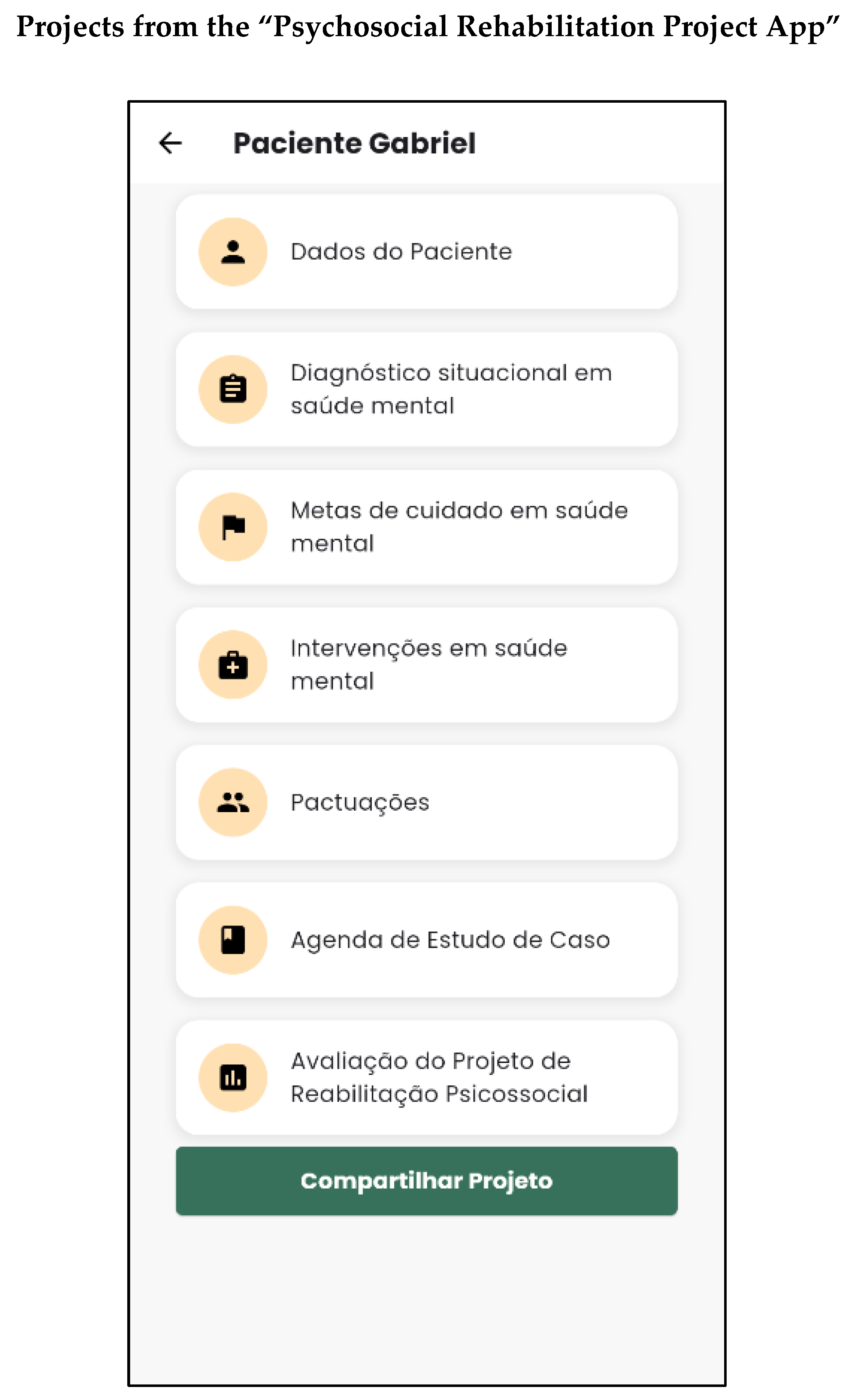
Below are the screens and functionalities of the web application. Due to trade name/commercial reasons, it has been renamed “App Reabilita Psicossocial” (formerly “Psychosocial Rehabilitation Project App” (Figure 2).
4. Discussion
App’s due to their natural omnipresent nature in the daily lives of users [23], must be easy to use, flexible and have simple and intuitive interfaces, adapting to the user’s professional or social environment [55]. Web apps, in particular, are recommended for their compatibility with different operating systems, accessible through a link [25].
Developing a web app to optimize the functions of mental health professionals can increase acceptance, commitment, use and satisfaction with its use and usability [23,24]. Studies highlight the importance of the interactive participation of the main researcher, as a means of unity between users and developers [22,23,56,57], demanding flexibility and interpersonal skills, co-design, commitment and collaboration [58].
The participation of mental health professionals as co-designers, under the leadership of the main researcher, guarantees that the app in development is aligned with the desired therapeutic purpose [59], promoting an environment of continuous collaboration and interdisciplinary work [60].
The translation of the needs of mental health professionals into an app, such as the web app “Psychosocial Rehabilitation Project App”, is a complex challenge [58]. The Principal Researcher must prioritize horizontal dialogue, collaboration, understanding and empathy, to be understood by the developers. These, in turn, require high unconditional understanding, empathy and active listening, to minimize “failures in translation”.
It is crucial to understand the justifying theory and purpose of the web app “Psychosocial Rehabilitation Project App”: the construction and direction of the psychosocial rehabilitation project for mental health professionals in their work context, in a dynamic and effective way [8,13,61]. This guarantees long-term user acceptability, usability and commitment [23,24].
The development of a web app in mental health involves human interaction aimed at “real life”, guided by practical rationality and permeated by socio-technical aspects such as cordial dialogue and collaborative attitudes [61]. The data collection technique used, participant observation not systematized, enabled the freedom to observe, collaborate and actively participate in the development of the web app [33,34,35], motivated to contribute with theoretical and practical knowledge, and professional experiences, as well. how to learn from technology professionals [8,13,27].
The process of mutual and collaborative learning, although rewarding, is challenging, especially for the Principal Researcher, when experiencing contact with resources and technological tools that are rarely addressed in their professional training.
The creation of the prototype of the app, followed by its development by technology professionals, demonstrates the increasing participation and collaboration of researchers with training in mental health, contributing to the contextualization and applicability of the app to professional practice [26], and aligning it with its purpose, as it construction and management of psychosocial rehabilitation projects by mental health professionals [59].
The perfection changes made in the web app “Psychosocial Rehabilitation Project App” focused on the appearance, layout and organization, seeking a coherent app with technological support, and little content, which is linked to the theoretical structure of the psychosocial rehabilitation project [8,13,24].
Studies corroborate the need for modifications to the prototype, covering screen layout, functional requirements [26], content, layout/aesthetics/design, appearance and functionalities [23,62]. Other studies focused on content for theoretical support, pleasant appearance with colorful icons [24], accessibility and applicability to the professional environment of mental health workers [22].
The studies also confirm that changes in the prototype are necessary throughout the development process, whenever researchers and developers consider it important [26].
The web app “Psychosocial Rehabilitation Project App” is aligned with the needs of mental health professionals with resources that facilitate and support clinical decision-making, streamlining diagnosis, patient registration, information storage and data storage [25]. However, the author warns about the importance of data privacy [25], corroborated by other studies that emphasize responsibility for data security [1,24,40,63,64,65].
5. Conclusion
The development of the web app “Psychosocial Rehabilitation Project App” represents a significant contribution to the field of mental health, offering a technological tool designed to optimize the construction and management of psychosocial rehabilitation projects by mental health professionals. This process was characterized by a collaborative approach, where the main researcher acted as a bridge between the practical needs of mental health professionals during the management and construction of psychosocial rehabilitation projects, and the technical capabilities of technology professionals.
Throughout the investigation, horizontal dialogue and mutual empathy were crucial to translating the complexity of the psychosocial rehabilitation project into coherent and usable functionalities within the professional environment. The adjustments made in the instructional design of development, as well as in its functionalities and technological resources, specifically in the web app “Psychosocial Rehabilitation Project App”, highlight the importance of adaptability during all stages of development, ensuring that the web app reflects both the technical demands and the theoretical and therapeutic purposes aligned with methodological support for the psychosocial rehabilitation project.
The active participation of the Principal Researcher allowed for a synergy between theory and practice, which ensured that the web app “Psychosocial Rehabilitation Project App” on the ground was functional, but also aligned with the real needs of mental health professionals during the psychosocial rehabilitation process. This reinforces certain previous findings in literature, which highlight how co-design and interdisciplinary collaboration increase acceptance, commitment and usability of mental health technologies.
Furthermore, the web app “Psychosocial Rehabilitation Project App”, which can be accessed from any device with an internet connection, presents itself as an inclusive and versatile technological solution, suitable for the work context of mental health professionals in the continuous process of systematizing the psychosocial rehabilitation project.
On the other hand, concerns regarding the security and privacy of patient data emerge as fundamental challenges that demand constant attention from researchers and technology professionals, and especially from mental health professionals who in the future will be users of the web app “Psychosocial Rehabilitation Project App”.
A limitation of this work was that, despite the development process having been very collaborative, taking into account the needs of mental health professionals, a field implementation was not carried out that allowed us to observe the effectiveness, usability and continued acceptance of the web app “Psychosocial Rehabilitation Project App”. This gap suggests the need for future studies that involve its implementation in mental health work contexts specifically in relation to psychosocial rehabilitation to evaluate its effectiveness over a short and long term.
Finally, the “Psychosocial Rehabilitation Project App” on the ground offers an innovative and applicable tool in the professional environment, which also exemplifies how interdisciplinary collaboration, and the integration of knowledge can overcome the challenges associated with the development of technologies in mental health. This study, therefore, opens new possibilities for future investigations that continue to prioritize empathy, adaptability and ethics in technological products with innovative potential and aimed at improving the quality of life of patients and professional practice in mental health.
Author Contributions
Conceptualization, F.A.A.C.C., M.F.M., J.C.S.G., GLGS., JALA., ECC., and C.A.A.V.; methodology, F.A.A.C.C., M.F.M., J.C.S.G., GLGS., JALA., ECC., and C.A.A.V.; software, GLGS., JALA., ECC., and F.A.A.C.C.; validation, F.A.A.C.C., M.F.M., and F.B.F.; formal analysis, F.A.A.C.C.; investigation, F.A.A.C.C.; resources, F.A.A.C.C.; data curation, F.A.A.C.C.; writing—original draft preparation, F.A.A.C.C., F.B.F., M.F.M., GLGS., JALA., ECC., C.A.A.V., and J.C.S.G.; writing—review and editing, F.A.A.C.C., F.B.F., M.F.M., C.A.A.V., and J.C.S.G.; visualization, F.A.A.C.C., F.B.F., and M.F.M.; supervision, F.B.F., M.F.M., C.A.A.V., and J.C.S.G.; project administration, F.A.A.C.C., M.F.M., C.A.A.V., and J.C.S.G.; writ-ing—review and editing, F.A.A.C.C., F.B.F., M.F.M., C.A.A.V., and J.C.S.G.; visualization, F.A.A.C.C., F.B.F., M.F.M., C.A.A.V., and J.C.S.G.; supervision, F.A.A.C.C., F.B.F., M.F.M., C.A.A.V., and J.C.S.G.; funding acquisition, F.A.A.C.C. All authors have read and agreed to the published version of the manuscript.
Funding
The authors.
Consent for Publication
All authors consent to the publication of the manuscript.
Availability of Data and Materials
The data is in the manuscript.
Competing Interests
Not applicable.
References
- Martinengo L, Stona AC, Griva K, Dazzan P, Pariante CM, von Wangenheim F, et al. Self-guided Cognitive Behavioral Therapy Apps for Depression: Systematic Assessment of Features, Functionality, and Congruence With Evidence. J Med Internet Res [Internet]. 2021 Jul 30;23(7):e27619. Available from: https://www.jmir.
- Magalhães BB, Andrade JKML de, Carvalho AFM de, Costa JV, Jesuíno ADSA, Dantas Neta NB, et al. Aplicação de softwares na saúde mental – benefícios e limitações: revisão de literatura integrativa. Research, Society and Development. 2022 Nov 30;11(16):e93111637908.
- Khademian F, Aslani A, Bastani P. The effects of mobile apps on stress, anxiety, and depression: overview of systematic reviews. Int J Technol Assess Health Care. 2021 Dec 14;37(1):e4.
- Lipschitz, J.M.; Van Boxtel, R.; Torous, J.; Firth, J.; Lebovitz, J.G.; E Burdick, K.; Hogan, T.P. Digital Mental Health Interventions for Depression: Scoping Review of User Engagement. J. Med Internet Res. 2022, 24, e39204. [Google Scholar] [CrossRef] [PubMed]
- A Rosenfeld, E.; Lyman, C.; E Roberts, J. Development of an mHealth App–Based Intervention for Depressive Rumination (RuminAid): Mixed Methods Focus Group Evaluation. JMIR Form. Res. 2022, 6, e40045. [Google Scholar] [CrossRef] [PubMed]
- Denecke, K.; Schmid, N.; Nüssli, S. Implementation of Cognitive Behavioral Therapy in e–Mental Health Apps: Literature Review. J. Med Internet Res. 2022, 24, e27791. [Google Scholar] [CrossRef] [PubMed]
- Lopes, R.P.; Barroso, B.; Deusdado, L.; Novo, A.; Guimarães, M.; Teixeira, J.P.; Leitão, P. Digital Technologies for Innovative Mental Health Rehabilitation. Electronics 2021, 10, 2260. [Google Scholar] [CrossRef]
- Campos FAAC, Silva JCB da, Almeida JM de, Feitosa FB. Reabilitação Psicossocial: o Relato de um Caso na Amazônia. Saúde em Redes [Internet]. 2021;7(Supl. 2):1–18. Available from: http://revista.redeunida.org.br/ojs/index.
- Baptista, J.Á.; Camatta, M.W.; Filippon, P.G.; Schneider, J.F. Singular therapeutic project in mental health: an integrative review. Rev. Bras. de Enferm. 2020, 73, e20180508. [Google Scholar] [CrossRef]
- Antonio CR, Mangini FN da R, Lunkes AS, Marinho L de CP, Zubiaurre P de M, Rigo J, et al. Projeto terapêutico singular: potencialidades e dificuldades na saúde mental. Linhas Críticas. 2023;29(e45423):1–14.
- Zubiaurre P de M, Wasum FD, Tisott ZL, Barroso TMMD de A, De Oliveira MAF, De Siqueira DF. O desenvolvimento do projeto terapêutico singular na saúde mental: revisão integrativa. Arquivos de Ciências da Saúde da UNIPAR [Internet]. 2023 Jun 21;27(6):2788–804. Available from: https://ojs.revistasunipar.com.br/index.
- Guerra AMC. Reabilitação psicossocial no campo da reforma psiquiátrica: uma reflexão sobre o controverso conceito e seus possíveis paradigmas. Rev Latinoam Psicopat Fund. 2004;7(2):1–14.
- Godinho DM, Peixoto Junior CA. Clínica em movimento: a cidade como cenário do acompanhamento terapêutico. Fractal (Niterói). 2019 Nov 2;31(3):320–7.
- Gainsford, K.; Fitzgibbon, B.; Fitzgerald, P.B.; E Hoy, K. Transforming treatments for schizophrenia: Virtual reality, brain stimulation and social cognition. Psychiatry Res. 2020, 288, 112974. [Google Scholar] [CrossRef]
- Acebal JS, Barbosa GC, Domingos T da S, Bocchi SCM, Paiva ATU. O habitar na reabilitação psicossocial: análise entre dois Serviços Residenciais Terapêuticos. Saúde em Debate [Internet]. 2020 Dec;44(127):1120–33. Available from: http://www.scielo.br/scielo.php?
- Gómez-Beneytoa, M. Evaluación del modelo comunitario de atención a los trastornos mentales en España. Rev Asoc Esp Neuropsiq. 2018;38(133):19–43.
- Silva AFL da, Mendes AMP. REABILITAÇÃO PSICOSSOCIAL E CIDADANIA: O TRABALHO E A GERAÇÃO DE RENDA NO CONTEXTO DA OFICINA DE PANIFICAÇÃO DO CAPS GRÃO-PARÁ. Cadernos Brasileiros de Saúde mental. 2020;12(33):55–74.
- Lima ICS, Galiza DDF de, Ferreira Júnior AR, Cavalcante ASP, Nascimento CEM do, Sampaio JJC. Produção de práticas de saúde mental integradas em rede de atenção à saúde. Diálogos Interdisciplinares em Psiquiatria e Saúde Mental [Internet]. 2023 Aug 21;2(2):1–14. Available from: https://revistas.uece.br/index.
- Lin, X.; Martinengo, L.; Jabir, A.I.; Ho, A.H.Y.; Car, J.; Atun, R.; Car, L.T. Scope, Characteristics, Behavior Change Techniques, and Quality of Conversational Agents for Mental Health and Well-Being: Systematic Assessment of Apps. J. Med Internet Res. 2023, 25, e45984. [Google Scholar] [CrossRef]
- Ardisson Cirino Campos FA, Sánchez García JC, Biasotto Feitosa F, De Oliveira Reis I, Caritá EC, Moll MF, et al. Fundamentos teóricos e bioéticos para o desenvolvimento do aplicativo de projeto de reabilitação psicossocial. Saúde em Redes [Internet]. 2025 Feb 17;11(1):4430. Available from: https://revista.redeunida.org.br/index.
- Campos FAAC, García JCS, Feitosa FB, Moll MF, Rodriguez TDM, Ventura CAA. Construction and validation of the content and appearance of the application prototype of a Psychosocial Rehabilitation Project. Enfermería Global. 2025;24(1).
- Cunha LPC, Reis PLC dos, Casarin RG, Caritá EC, Silva SS. Desenvolvimento de aplicativo móvel como estratégia de educação para o matriciamento em saúde mental. Debates em Educação Científica e Tecnológica (DECT) [Internet]. 2023;13(x):165–85. Available from: http://ojs.ifes.edu.br/index.
- Birrell, L.; Furneaux-Bate, A.; Debenham, J.; Spallek, S.; Newton, N.; Chapman, C. Development of a Peer Support Mobile App and Web-Based Lesson for Adolescent Mental Health (Mind Your Mate): User-Centered Design Approach. JMIR Form. Res. 2022, 6, e36068. [Google Scholar] [CrossRef]
- Callan, J.A.; Jacob, J.D.; Siegle, G.J.; Dey, A.; Thase, M.E.; Dabbs, A.D.; Kazantzis, N.; Rotondi, A.; Tamres, L.; Van Slyke, A.; et al. CBT MobileWork©: User-Centered Development and Testing of a Mobile Mental Health Application for Depression. Cogn. Ther. Res. 2020, 45, 287–302. [Google Scholar] [CrossRef]
- Pokhrel, P.; Karmacharya, R.; Salisbury, T.T.; Carswell, K.; Kohrt, B.A.; Jordans, M.J.D.; Lempp, H.; Thornicroft, G.; Luitel, N.P. Perception of healthcare workers on mobile app-based clinical guideline for the detection and treatment of mental health problems in primary care: a qualitative study in Nepal. BMC Med Informatics Decis. Mak. 2021, 21, 1–12. [Google Scholar] [CrossRef]
- Bezerra EA do AC, Ferreira AA, Bezerra SAC, Portela L da C, Bezerra Júnior SAC. Desenvolvimento de um protótipo móvel para auxiliar enfermeiros: Diagnóstico de enfermagem em saúde mental. Revista Contemporânea [Internet]. 2023 Aug 10;3(8):11228–46. Available from: https://ojs.revistacontemporanea.com/ojs/index.
- Mussi RF de F, Flores FF, Almeida CB de. Pressupostos para a elaboração de relato de experiência como conhecimento científico. Práxis Educacional. 2021 Sep 1;17(48):1–18.
- Paranhos R, Filho DBF, Da Rocha EC, Júnior JA da S, Freitas D. Uma introdução aos métodos mistos. Sociologias. 2016;18(42):384–411.
- Oliveira FL, de. Triangulação metodológica e abordagem multimétodo na pesquisa sociológica: vantagens e desafios. Ciências Sociais Unisinos. 2015 Feb 6;51(2).
- Gusmão ECR. CONSTRUÇÃO E VALIDAÇÃO DE UM APLICATIVO DE IDENTIFICAÇÃO DAS HABILIDADES ADAPTATIVAS DE CRIANÇAS E ADOLESCENTES COM DEFICIÊNCIA INTELECTUAL. [Belo Horizonte]: Universidade Federal de Minas Gerais; 2019.
- Dossett, L.A.; Kaji, A.H.; Cochran, A. SRQR and COREQ Reporting Guidelines for Qualitative Studies. JAMA Surg. 2021, 156, 875–876. [Google Scholar] [CrossRef] [PubMed]
- O’Brien, B.C.; Harris, I.B.; Beckman, T.J.; Reed, D.A.; Cook, D.A. Standards for reporting qualitative research: A synthesis of recommendations. Acad. Med. 2014, 89, 1245–1251. [Google Scholar] [CrossRef] [PubMed]
- Correia M da, CB. A observação participante enquanto técnica de investigação. Pensar Enfermagem. 2009;13(2):1–7.
- França A de, Costa FLP, Fernandes R dos S, Mota W de L, Gutierrez Denise Machado Duran. A observação participante: um panorama histórico - conceitual. Revista Ensino de Ciências e Humanidades. 2022;6(2):106–17.
- Mónico LS, Alferes VR, Castro PA, Parreira PM. A Observação Participante enquanto metodologia de investigação qualitativa. Atas CIAIQ. 2017;3:724–33.
- Kroef RF da S, Gavillon PQ, Ramm LV. Diário de Campo e a Relação do(a) Pesquisador(a) com o Campo-Tema na Pesquisa-Intervenção. Estudos e Pesquisas em Psicologia. 2020 Jul 9;20(2):464–80.
- Lagan, S.; Emerson, M.R.; King, D.; Matwin, S.; Chan, S.R.; Proctor, S.; Tartaglia, J.; Fortuna, K.L.; Aquino, P.; Walker, R.; et al. Mental Health App Evaluation: Updating the American Psychiatric Association’s Framework Through a Stakeholder-Engaged Workshop. Psychiatr. Serv. 2021, 72, 1095–1098. [Google Scholar] [CrossRef] [PubMed]
- Martinez-Martin, N.; Greely, H.T.; Cho, M.K. Ethical Development of Digital Phenotyping Tools for Mental Health Applications: Delphi Study. JMIR mHealth uHealth 2021, 9, e27343. [Google Scholar] [CrossRef]
- Huckvale, K.; Nicholas, J.; Torous, J.; E Larsen, M. Smartphone apps for the treatment of mental health conditions: status and considerations. Curr. Opin. Psychol. 2020, 36, 65–70. [Google Scholar] [CrossRef]
- Bush, N.E.; Armstrong, C.M.; Hoyt, T.V. Smartphone apps for psychological health: A brief state of the science review. Psychol. Serv. 2019, 16, 188–195. [Google Scholar] [CrossRef]
- Pereira FGF, da Rocha DJL, Melo GAA, Jaques RMPL, Formiga LMF. Building and validating a digital application for the teaching of surgical instrumentation. Cogitare Enfermagem. 2019;24.
- Machado neto, OJ. Usabilidade da interface de dispositivos móveis: heurísticas e diretrizes para o design [Dissertação]. [São Carlos]: Universidade de São Paulo; 2013.
- Ramos, G.; Ponting, C.; Labao, J.P.; Sobowale, K. Considerations of diversity, equity, and inclusion in mental health apps: A scoping review of evaluation frameworks. Behav. Res. Ther. 2021, 147, 103990. [Google Scholar] [CrossRef]
- Lemon, C.; Huckvale, K.; Carswell, K.; Torous, J. A Narrative Review of Methods for Applying User Experience in the Design and Assessment of Mental Health Smartphone Interventions. Int. J. Technol. Assess. Heal. Care 2020, 36, 64–70. [Google Scholar] [CrossRef]
- Nordgreen, T.; Rabbi, F.; Torresen, J.; Skar, Y.S.; Guribye, F.; Inal, Y.; Flobakk, E.; Wake, J.D.; Mukhiya, S.K.; Aminifar, A.; et al. Challenges and possible solutions in cross-disciplinary and cross-sectorial research teams within the domain of e-mental health. J. Enabling Technol. 2021, 15, 241–251. [Google Scholar] [CrossRef]
- Kruzan, K.P.; Reddy, M.; Washburn, J.J.; Mohr, D.C. Developing a Mobile App for Young Adults with Nonsuicidal Self-Injury: A Prototype Feedback Study. Int. J. Environ. Res. Public Heal. 2022, 19, 16163. [Google Scholar] [CrossRef]
- Ferro, K. As percepções de estudantes universitários com deficiência visual sobre a acessibilidade aos materiais acadêmicos e as repercussões desse acesso sobre suas trajetórias acadêmicas [Monografia]. Repositório Universitário da Ânima. [Florianópolis Trajano]: UNISUL ; 2021.
- Klüber, TE. Atlas/t.i como instrumento de análise em pesquisa qualitativa de abordagem fenomenológica. ETD - Educação Temática Digital. 2014 Mar 24;16(1):5–23.
- Romualdo, JF. Formação do médico de família e comunidade no contexto da pandemia da Covid -19 [Dissertação]. [Santos]: Unifesp; 2022.
- Silva Junior LA, Leão MBC. O software Atlas.ti como recurso para a análise de conteúdo: analisando a robótica no Ensino de Ciências em teses brasileiras. Ciência & Educação (Bauru). 2018 Sep;24(3):715–28.
- Walter SA, Bach TM. ADEUS PAPEL, MARCA-TEXTOS, TESOURA E COLA: INOVANDO O PROCESSO DE ANÁLISE DE CONTEÚDO POR MEIO DO ATLAS.TI. Administração: Ensino e Pesquisa. 2015 Jun 30;16(2):275.
- Ng, M.M.; Firth, J.; Minen, M.; Torous, J. User Engagement in Mental Health Apps: A Review of Measurement, Reporting, and Validity. Psychiatr. Serv. 2019, 70, 538–544. [Google Scholar] [CrossRef] [PubMed]
- Brasil M da Saúde. Instrutivo Técnico da Rede de Atenção Psicossocial-Raps-no Sistema Único de Saúde-SUS [Internet]. Ministério da Saúde. 2022. Available from: http://bvsms.saude.gov.br/bvs/publicacoes/instrutivo_tecnico_raps_sus.
- Coelho VAA, Pauferro ALM, Silva MA e, Guimarães DA, Gama CAP da, Modena CM, et al. Rede de Atenção Psicossocial: desenvolvimento e validação de um instrumento multidimensional para avaliação da implantação (IMAI-RAPS). Physis (Rio J) [Internet]. 2023;33:e33004–e33004. Available from: http://www.scielosp.org/scielo.php?
- Castro Rocha L, C Andrade RM, Libório Sampaio A. Heurísticas para avaliar a usabilidade de aplicações móveis: estudo de caso para aulas de campo em Geologia. Nuevas Ideas en Informática Educativa TISE. 2014.
- Burn, A.-M.; Ford, T.J.; Stochl, J.; Jones, P.B.; Perez, J.; Anderson, J.K. Developing a Web-Based App to Assess Mental Health Difficulties in Secondary School Pupils: Qualitative User-Centered Design Study. JMIR Form. Res. 2022, 6, e30565. [Google Scholar] [CrossRef] [PubMed]
- Giovanelli, A.; Karver, T.S.; Roundfield, K.D.; Woodruff, S.; Wierzba, C.; Wolny, J.; Kaufman, M.R. The Appa Health App for Youth Mental Health: Development and Usability Study. JMIR Form. Res. 2023, 7, e49998. [Google Scholar] [CrossRef] [PubMed]
- Kushniruk, A.W.; Turner, P. Who's users? Participation and empowerment in socio-technical approaches to health IT developments.. 2011, 164, 280–5. [Google Scholar]
- Na, H.; Jo, M.; Lee, C.; Kim, D. Development and Evaluation: A Behavioral Activation Mobile Application for Self-Management of Stress for College Students. Healthcare 2022, 10, 1880. [Google Scholar] [CrossRef]
- Vial, S.; Boudhraâ, S.; Dumont, M.; Tremblay, M.; Riendeau, S. Developing A Mobile App With a Human-Centered Design Lens to Improve Access to Mental Health Care (Mentallys Project): Protocol for an Initial Co-Design Process. JMIR Res. Protoc. 2023, 12, e47220. [Google Scholar] [CrossRef]
- Berg, M.; Aarts, J.; van der Lei, J. ICT in Health Care: Sociotechnical Approaches. Methods Inf. Med. 2003, 42, 297–301. [Google Scholar] [CrossRef]
- Rosenfeld, L.; Torous, J.; Vahia, I.V. Data Security and Privacy in Apps for Dementia: An Analysis of Existing Privacy Policies. Am. J. Geriatr. Psychiatry 2017, 25, 873–877. [Google Scholar] [CrossRef]
- Alqahtani, F.; Al Khalifah, G.; Oyebode, O.; Orji, R. Apps for Mental Health: An Evaluation of Behavior Change Strategies and Recommendations for Future Development. Front. Artif. Intell. 2019, 2. [Google Scholar] [CrossRef]
- Chan, A.H.Y.; Honey, M.L.L. User perceptions of mobile digital apps for mental health: Acceptability and usability - An integrative review. J. Psychiatr. Ment. Heal. Nurs. 2021, 29, 147–168. [Google Scholar] [CrossRef]
- Timakum, T.; Xie, Q.; Song, M. Analysis of E-mental health research: mapping the relationship between information technology and mental healthcare. BMC Psychiatry 2022, 22, 1–17. [Google Scholar] [CrossRef]

Box 1.
Presents guidelines adapted from the APA and recommendations by Martinez-Martin; Greely; Cho, (2021) [37] as guides for the development of the web app “Psychosocial Rehabilitation Project App”.
Box 1.
Presents guidelines adapted from the APA and recommendations by Martinez-Martin; Greely; Cho, (2021) [37] as guides for the development of the web app “Psychosocial Rehabilitation Project App”.
| APA Guidelines [37] | Web app “Psychosocial Rehabilitation Project App” | Recommendations from the Martinez-Martin studio; Greely; Cho (2021) [38] |
|---|---|---|
| Evidence Evaluation | 1. Psychosocial Rehabilitation Project Theory [8,13]. | Evidence and Validity |
| Determination of Risk, Privacy and Security | 2. Contract for the use of the web app “Psychosocial Rehabilitation Project App” made available before it is hired by users. This contract protects data security and privacy [39] 3. Encryption [40]. |
Security and Privacy |
| Transparency | ||
| Responsibility | ||
| Evaluation of Ease of Use | 4. Content validation and appearance and usability with mental health professionals [41]. | |
| Interoperability/Interface | 6. Verification (Validation) of usability by heuristics with technology and information professionals [42]. | |
| 7. Clear, objective and stigma-free guidance, functionalities adaptable to the user’s device [38,43,44,45,46]. | Social Justice | |
| Ability to Collect Basic Information/Data | 7. The web app “Psychosocial Rehabilitation Project App” adapts the stages of the psychosocial rehabilitation project, enabling the collection of information/data on psychiatric patients by mental health professionals [8,13]. |
Source: Do the authors (2024).
Box 2.
Presents virtual meetings and appointments for the development of the web app “Psychosocial Rehabilitation Project App”.
Box 2.
Presents virtual meetings and appointments for the development of the web app “Psychosocial Rehabilitation Project App”.
| Type/Date/Agenda | Participant(s) | Platform | Meeting/Appointment Summary |
|---|---|---|---|
| First Meeting (05/14/2024): Connecting researchers with technology professionals. | Team of ICT professionals: made up of Developer 1, Developer 2, Technological Development Supervisor and the main researcher. | Google Meet | Research procedures are presented, the objective of which is to develop an app for psychosocial rehabilitation. The technological team proposes a web app for its accessibility and low cost. The importance of data security was emphasized, following the APA guides and recommendations by Martínez-Martín et al. (2021). |
| Second Meeting (22/05/2024) – Adjust and personalize the main page and the characteristics of the user profile. | Developer 1 and Principal Researcher | Google Meet | Aline the presentation of the home page and videos about the PRP (panel 5 of the PWAPPR), structure of the psychosocial rehabilitation project (panels 3, 4, 7, 8 to 14 of the PWAPPR). The characteristics of the user profile record (mental health professional) were discussed and constructed. |
| Unofficial conversation (26/05/2024): Need for additional clarifications on screen 7 (of the PWAPPR). | Developer 1 and Principal Researcher | The main researcher explained to develop 1 that the rubrics on screen 7 describe the structure of a psychosocial rehabilitation project and which must be editable, easy to manage and cyclical. For its part, the Developer 1 suggested improvements to allow the user to insert screen captures, photos and edit them in a way that meets their needs during the construction of the psychosocial rehabilitation project. | |
| Third Meeting (06/05/2024) – Presentation of the first graphic design to support the development of the web app application “Psychosocial Rehabilitation Project App”. | Developer 1, Developer 2 and Principal Researcher | Google Meet | Presentation of the initial instructional graphic design for the development of the web app “Psychosocial Rehabilitation Project App”. Discussing the patient’s CPF will be a requirement for the first professional registration, without reaching a consensus. I propose as the main message on the home page: “Building life projects with meaning and meaning in home, social networks and work. Furthermore, it is suggested to include a solo explanatory video about the psychosocial rehabilitation project on the home page. Regarding the structure of the web app during the construction of the project, we proposed a resource to insert images and documents in the following sections: Patient Data, Situational Diagnosis in Mental Health, Agreement and Evaluation. As, the possibility of sharing and printing project items was created, allowing professionals to control what information is relevant and which is shared. It is agreed that the evolution of the project will be recorded in one line of time at a close and hourly rate, allowing all professionals who have access to the patient to record their actions. Screen 17 (User Support) will be included in the “User Support” submenu near the user profile. |
| Informal conversation (06/05/2024): Adjustment and adaptation of the first graphic design to support the development of the web app “Psychosocial Rehabilitation Project App”. | Developer 1 and Principal Researcher | While registering the patient’s CPF, the Principal Researcher suggested that this was used as an access control for the patient. I proposed to the developers that the CPF had not been registered in the user registry, but that they had been requested at the time of patient registration by the mental health professional, thus conditioning access to the rehabilitation project. It was planned to create an administrator profile to control access permissions to the web app “Psychosocial Rehabilitation Project App”. | |
| Official conversations (07/02/2024, 07/03/2024 and 07/22/2024): Hiring of the animated video service for the main page of the web app “Psychosocial Rehabilitation Project App”. | Principal Researcher, Project Manager and Screenwriter | Contact with a company developing animated videos to create a short video on the main topics and concepts of the psychosocial rehabilitation project, synthesized from a narrative review carried out by the researcher [20]. | |
| Fourth Meeting (07/12/2024): Need to adjust and adapt the first graphic design to support the development of the web app application “Psychosocial Rehabilitation Project App”. | Developer 1, Developer 2 and Principal Researcher | Google Meet | It was suggested to create an administrator user profile to validate the records of users of the web app “Psychosocial Rehabilitation Project App”. Please ask for the “User Support” section to include bibliographies, legislation and productivity records. Developers advised against the use of artificial intelligence due to its incipient state and doubts about its reliability in the management of mental health data. |
| Fifth Meeting (07/16/2024): Presentation of the final graphic design of the web app “Psychosocial Rehabilitation Project App” to start its development. | Developer 1, Developer 2 and Principal Researcher | Google Meet | Presentation of the advanced instructional graphic design for the development of the web app “Psychosocial Rehabilitation Project App” developed by technology professionals (see link: https://www.figma.com/design/fav5XGcsRa0c0BrD4FQt9T/ReabilitaPSocial---Projeto-de-Reabilita%C3%A7%C3%A3o-Psicossocial?node-id=132-398&t=bqx25wi60EM9K6nz-0 ). The function of adding a photo of the patient to your data/avatar has been included, as well as the option to share the content of the patient’s project. Previously prototyped tables have been replaced by threads to improve readability. The medication field has been modified to include text fields for medication, quantity and frequency. In the intervention topic, the following group was added: habitat, social network and work. |
| Official conversations (19/08/2024 and 20/08/2024): Contracting of legal services for the elaboration of Terms and Conditions of Use of the web app “Psychosocial Rehabilitation Project App”. | Investigator and lawyer | The lawyer agreed to elaborate the Terms and Conditions of Use of the web app “Psychosocial Rehabilitation Project App”, based on the information provided by the main researcher. It is agreed that adjustments and adaptations will be made to suit the project research context. | |
| Official conversation (09/23/2024): Approval of Terms and Conditions of Use of the web app “Psychosocial Rehabilitation Project App”. | Investigator and lawyer | The main researcher exhaustively reviews the terms and conditions of use of the web app “Psychosocial Rehabilitation Project App”, drawn up by the lawyer, and gives its approval. These terms will form part of the contract that will be signed between those responsible for the app and its future users. | |
| Official meeting (10/10/2024): Approval of the final graphic design of the web app “Psychosocial Rehabilitation Project App”. | Developer 1, Developer 2 and Principal Researcher | Google Meet | The finalized instructional graphic design is presented, which will serve as a model for the development of the application. The developers explained that the final application will have improved functionalities and features. |
| Official conversation (27/11/2024): Approval of the animated video script for the main page of the web app “Psychosocial Rehabilitation Project App”. | Principal Researcher and Screenwriter | The company sends the animated video script for your approval. The researcher suggested including an image of a consultation, the theme of rehabilitation theory and finalizing the video highlighting the web app. | |
| Informal conversation (27 and 28/11/2024): The Developer 2 requested clarifications on the “agreements” heading and its deadlines. | Principal Researcher and Developer 2 | The researcher clarified that the number of “Agreement” could be numerous and vary according to the needs of the professional, and could be carried out with the patient, other professionals and services. The evaluation of these “Agreements” will be carried out each month, as established in the psychosocial rehabilitation project. | |
| Sixth Meeting (11/29/2024): Preliminary presentation of the web app “Psychosocial Rehabilitation Project App” to the main researcher. | Developer 1, Developer 2 and Principal Researcher | Google Meet | The developers presented the development of the web app on the Visual Studio Code platform, performing a demonstration of the user/administrator registration, the main screen (home) and the functionality of creating a “New Psychosocial Rehabilitation Project”, including the compilation of patient and project data. Furthermore, please note that the database is hosted on Firebase. |
| Official meeting (12/12/2024): Reception and approval of the animated video rolled out to the main page of the application “Psychosocial Rehabilitation Project App”. | Principal Researcher and Administrator | The main researcher receives the animated video developed for the web app “App project for psychosocial rehabilitation” (available at: https://drive.google.com/file/d/1D1hCciMdHDO41AXumbduZeXlwa0kvjS2/view?usp=sharing(chenchen)), which has been approved for its coherence with the content and theoretical framework of the project. The video will be delivered to the developers for integration on the main page of the web app. | |
| Meeting (12/19/2024) – Presentation of the web app “Psychosocial Rehabilitation Project App” with 90 percent development. | Developer 1, Developer 2 and Principal Researcher | Google Meet | The Developer 2 presents the access link to the web app application “Psychosocial Rehabilitation Project App”: www.reabilitapsicossocial.com (hosted on the HostGator website), providing access credentials for professionals and administrators. The need to update the “User Support” section with updated information on psychosocial rehabilitation, legislation and procedures to record productivity was identified. |
| Meeting (01/13/2025; 01/14/2025; 01/15/2025; 01/24/2025): Final adjustments on the web app “Psychosocial Rehabilitation Project App”. | Developer 1, Developer 2 and Principal Researcher | Google Meet | The TIC 2 presented the improvements requested by the researcher in the previous meeting, including the correction of technical instabilities such as the duplication of projects and errors when changing screens, as well as small spelling and design corrections to guarantee the coherence and adequacy of the web app “Psychosocial Rehabilitation Project App” research project. Furthermore, we request that the improvements be implemented in a way that does not compromise the functionality of the system and that it adapts to version 2 of the prototype (PWAPPR), validated by mental health professionals. |
| Official Meeting (27/01/2025; 10/02/2025): Test and alpha evaluation with the researcher and ICT professionals developing the “Psychosocial Rehabilitation Project App”. | Developer 1, Developer 2 and Principal Researcher | Google Meet | Alpha test (pilot) of the web app “App project for psychosocial rehabilitation”, corrections of spelling errors, interface failures (screen duplication or absence of screens), before making it available for beta validation by mental health and technology professionals. |
Box 3.
Presentation of the appearance and functionality requirements of the web app “Psychosocial Rehabilitation Project App”.
Box 3.
Presentation of the appearance and functionality requirements of the web app “Psychosocial Rehabilitation Project App”.
| Screens | The beginning is carried out by accepting the Terms and Conditions of Use of the web app “Psychosocial Rehabilitation Project App” | Mental Health Professional | ||||
| Tutorial on using the web app “Psychosocial Rehabilitation Project App” | ||||||
| Home | Short video about Psychosocial Rehabilitation Project (PRP) | |||||
| User support | Edit Profile | Help and Support | Usage Report | Technical Information | Developers | |
| PRP Topics | Patient Data (Registry) | Description | ||||
| Name, age, direction, profession, income, support network and technical reference. | ||||||
| Situational Diagnosis in Mental Health | Clinical history and multidisciplinary diagnoses in mental health, individual resources and skills, potentialities, desires and successes, personal, collective and structural difficulties, medications in use, clinical illnesses, other relevant information and identified problems. | |||||
| Mental Health Care Goals | Short-term goals (less than 2 months), medium-term goals (6 months to 12 months) and long-term goals (greater than 12 months). | |||||
| Mental health interventions | Problems, interventions, responsibilities, goals and deadlines. | |||||
| Agreements | Patient, family, reference technician, RAPS, others, interventions and appointments. | |||||
| Case Study Agenda | Close and schedule the meeting, order the day and required participants. | |||||
| Scheduled Evaluation of the PRP | Interventions/agreements, responsibility, partial do, No do and observations. | |||||
| Evolution | Close the evolution time (space for the insertion of the evolution text). | |||||
| Functions | Share | You can send a link generating a PDF (to print or save on devices or in the cloud) or share via WhatsApp, email, etc. | ||||
| Mental Health Support Services | Search for RAPS services by patient location. | |||||
| Create a new psychosocial rehabilitation project |
It is possible to launch a new psychosocial rehabilitation project based on patient data about care. | |||||
| Search project by patient name | You can search for the patient’s Project by its name, to facilitate its location between several created projects | |||||
| Database | Firebase offers a set of tools that simplify application development, allowing developers to focus on the logic of the application rather than worrying about the infrastructure. | |||||
Source: Do by the authors (2024).
Figure 1.
Examples of screens of the instructional design for the development of the web app “Project Psychosocial Rehabilitation App” created by the developers. Source: Figma Software (2024).
Figure 1.
Examples of screens of the instructional design for the development of the web app “Project Psychosocial Rehabilitation App” created by the developers. Source: Figma Software (2024).
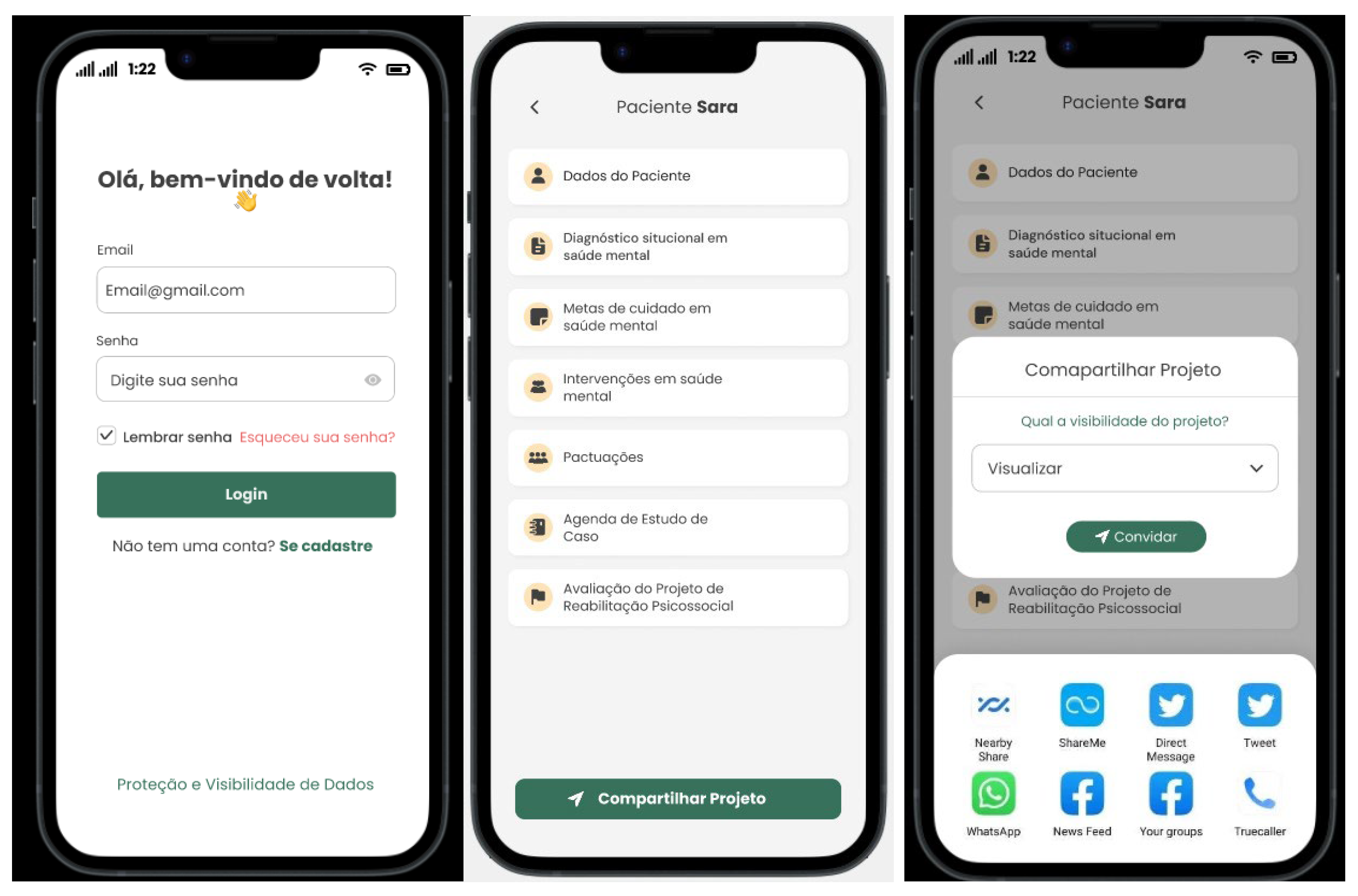
Figure 2.
Examples of screens of “Psychosocial Rehabilitation Project App”. Source: “App Reabilita Psychosocial” (2025). Available in: < www.reabilitapsicossocial.com >.
Figure 2.
Examples of screens of “Psychosocial Rehabilitation Project App”. Source: “App Reabilita Psychosocial” (2025). Available in: < www.reabilitapsicossocial.com >.
Disclaimer/Publisher’s Note: The statements, opinions and data contained in all publications are solely those of the individual author(s) and contributor(s) and not of MDPI and/or the editor(s). MDPI and/or the editor(s) disclaim responsibility for any injury to people or property resulting from any ideas, methods, instructions or products referred to in the content. |
© 2025 by the authors. Licensee MDPI, Basel, Switzerland. This article is an open access article distributed under the terms and conditions of the Creative Commons Attribution (CC BY) license (http://creativecommons.org/licenses/by/4.0/).
Copyright: This open access article is published under a Creative Commons CC BY 4.0 license, which permit the free download, distribution, and reuse, provided that the author and preprint are cited in any reuse.


