

Submitted:
07 April 2025
Posted:
08 April 2025
You are already at the latest version
Abstract
The Icelandic government, and in particular the Minister of Justice, Mrs. Guðrún Hafsteinsdóttir and the Minister of Social Affairs and the Labour Market, Mr. Guðmundur Ingi Guðbrandsson, are encouraged to review the legislation surrounding work permits for students from outside of the European Economic Area. The right to work should automatically be granted alongside student residence permits. This would vastly improve the quality of life of these students, reduce the workload of the Directorate of Immigration and the Directorate of Labour, contribute to the Icelandic economy and ensure cohesion with other European countries. This suggestion along with the other reform recommendations below are explained in depth in this proposal.
Keywords:
Diversity
; Inclusion
; Icelandic immigration policy
; student work permits
; right to work
; student residence permits
; legislative reform
; international student rights
; labor market access
; quality of life
; social cohesion
; higher education policy
; economic contribution
; administrative burden reduction
; comparative immigration policy
; right to work for international students
; foreign student integration policies
; bureaucratic efficiency in immigration governance
; student mobility and labor rights
“Be better Iceland, I love being here. I want to contribute to the Icelandic society. Help me help you.”
Recommendations (in Order of Priority)
- Grant the right to work simultaneously with the granting of a student residence permit.
- Allow work permits to be tied to the individual, not to a specific job.
- Allow applicants (not their employer) to submit their application for a work permit.
- Automatically grant the renewal of a work permit if conditions are unchanged.
- Let applications be submitted directly to the Directorate of Labour, not the Directorate of Immigration.
- Set a deadline for applications to be forwarded from the Directorate of Immigration to the Directorate of Labour.
- Create an electronic application portal.
- Create FAQs and step-by-step videos about how to apply for a work permit.
- Improve communication with applicants (including about delays in processing).
- Ensure that case workers have the knowledge and time to offer correct and polite guidance.
Introduction
Prompted by numerous enquiries from international students, the International Committee of the University of Iceland Student Council conducted a survey on the challenges of students from outside of the European Economic Area (EEA) when applying for a work permit in Iceland.
These students are not allowed to work in Iceland without a work permit, which can take several months to acquire and requires the involvement of the student’s employer, their union and two different public authorities. As living costs in Iceland rise, these students are at risk of not being able to survive, and much less dedicate themselves to their studies as they have no way of securing an income in Iceland.
The survey was prepared with input from international students at the University of Iceland, and relevant parties within the university, including the UI Equality Officer and Diversity Officer. The survey was sent out to all University of Iceland students with foreign citizenship on January 17th and January 25th, 2024, and shared across the International Committee’s social media. Representatives at other Icelandic universities were asked to distribute it to relevant students at their institution.
The survey received 266 responses of which 194 were from students who had applied for a work permit in Iceland before. According to data provided by the Directorate of Labour, 642 applications for granting or renewal of student work permits were processed in 2023. The survey sample is therefore considered representative of the experience of non-European students.
Current Rules [1]
Conditions for a Work Permit
According to the Foreign Nationals’ Right to Work Act, foreign nationals may not enter into a job in Iceland unless a work permit has been granted [2]. Nationals of EEA countries are exempt from this requirement [3]. Foreign nationals holding a residence permit in connection with studies can be granted a work permit under slightly more lenient conditions [4].
Conditions for granting such a work permit are (1) that the relevant trade union has commented on the application, (2) that an employment contract guaranteeing certain terms has been signed, and (3) that the employer has taken out health insurance for the foreign national for at least ISK 2,000,000 from an Icelandic insurance company [5].
A work permit cannot be granted for a job exceeding 60 % of full-time employment except during school vacation periods. This limit was raised from 40 % to 60 % in June 2023 [6], but as the authorities did not update already granted work permits and as the current English translation of the law does not reflect this change, many students are unaware and working only 40 % [7].
A work permit is not normally granted for longer than twelve months, and in no case for longer than the student’s residence permit or the period of employment. A work permit may be extended during the study period provided that the same conditions are met [8].
The work permit is restricted to work for a specific employer and the foreign national may not begin work for another employer before a new permit has been granted [9].
Application Process
Applications for work permits are submitted in writing by the prospective employer to the Directorate of Immigration in Kópavogur, which shall forward them as soon as possible to the Directorate of Labour. The Directorate of Labour shall take a decision on whether to grant a work permit as soon as possible, and no later than two months after it receives the application. When a case delay is foreseeable the party to the case shall be informed about the reason for the delay, and given an indication of when a decision may be expected.
Results of the Survey
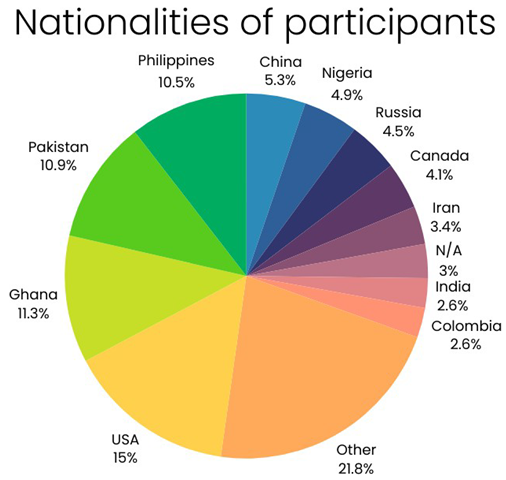
Citizens of 41 different nationalities participated in the survey, with most representation from USA, Ghana, Pakistan and the Philippines.
27.4 % are currently studying a Bachelor’s degree, 41.4 % are studying a Master’s degree, 17.7 % are in a PhD program and 11.7 % are in a diploma program [12].
46.3 % began their studies in Iceland in 2023-2024, 35.4 % began in 2021-2022, 9.4% in 2019-2020 and 8.6 % before 2019.
72.9 % of the participants have applied for a work permit in Iceland before and were asked questions about this experience, whilst 24.4 % had not applied for a work permit before and were instead asked questions about their experience with applying for jobs in Iceland.
Participants who had applied before were asked to rate the ease of applying from 1-10, with 1 being extremely difficult and 10 being extremely easy. 57.8 percent rated the experience 1-3 (very/extremely difficult), 31.4 % rated 4-6 (neither difficult, nor easy) and only 10.7 % rated 7-10 (very/extremely easy). By a large margin, participants found processing time to be the biggest issue with 68.6 % selecting this option. 9.3 % found unclear instructions on how to apply to be the biggest issue.
Processing Time
According to data provided by the Directorate of Labour in April of 2024, the average processing time within the Directorate of Labour in 2023 was 42 days (6 weeks) for the granting of a new work permit. In the first quarter of 2024 this was reduced to 23 days (3.3 weeks) [13].
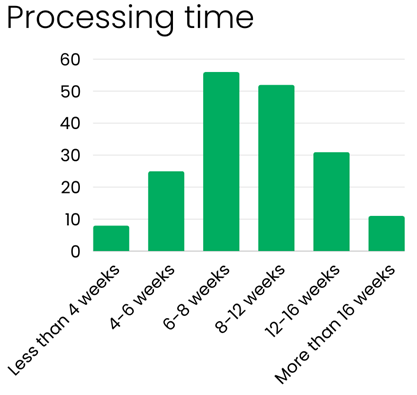
Participants in the survey were asked about the total processing time of their work permit. 4.1 % answered that their application was processed in less than 4 weeks, 12.9 % answered 4-6 weeks, 28.9 %
answered 6-8 weeks, 26.8 %
answered 8-12 weeks, 16 %
answered 12-16 weeks and 5.7
% answered more than 16 weeks).
These processing times clearly do not correspond to the numbers provided by the Directorate of Labour. There are a number of possible explanations for this.
It could be due to delays within the Directorate of Immigration, as this is not accounted for in the data from the Directorate of Labour. Although processing time within the Directorate of Immigration should be no more than a few days in order for them to check the validity of the individual’s residence permit, many participants report that the Directorate of Immigration were frustratingly slow at forwarding their applications, and sometimes even losing the documents, leading to the applicant having to reapply. This could be mitigated by letting applications be submitted directly to the Directorate of Labour.
Another reason for the discrepancy could be applicants not having sufficient insight into the state of their application, since their employer is in charge of submitting and following up on the application. This could be improved by letting applicants apply themselves, putting them in charge of the process as well as by increasing the transparency of the application process, either by making an electronic application portal, where applicants can see the application status or by more consistently informing applicants about their case. Applying electronically would also allow applicants to avoid physically having to travel to the Directorate of Immigration office in Kópavogur.
The participants were asked if there were any problems with their application, causing a delay in the processing time. Of the participants who answered that it took over 8 weeks to process their application, 51 % answered that there were no problems with their application, causing the delay. Such a large percentage indicates that applicants are typically not made aware of foreseeable delays and thus have no way of predicting when they can start working.
A number of participants felt that issues with their case easily could have been solved by additional communication. They report being told not to ask about processing time, and at the same time not being given an explanation for the delay.
This underlines the importance of improving communication with applicants, including about delays.
Quality of Service
A number of participants commented on the directions for applying for work permits being unclear; including who has to apply, and to which agency, which forms should be used and what information is required. 56.7 % found the instructions for applying sufficiently clear and easily accessible, whilst 40.7 % did not.
Although the Directorate of Labour does have explanations and checklists for how to apply on its website [14], the process is so complicated, that even detailed directions are not sufficient, unless you are familiar with the system - which most applicants and employers are not.
Participants in the survey would like to have FAQs and step-by-step videos made available.
When asked about the quality of service provided by the Directorate of Immigration, 45 % answered 1-3 (Poor service, not helpful and rude attitude), 26.2 % answered 4-6 and 28.7 % answered 7-10 (Great service, helpful and polite attitude).
For the same question about the service provided by the Directorate of Labour, 33 % answered 1-3, 34 % answered 4-6 and 33 % answered 7-10.
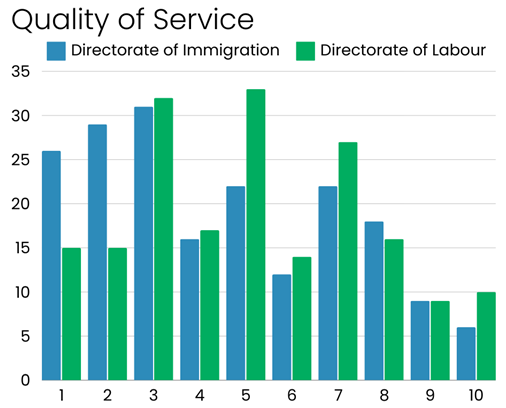
The Directorate of Immigration was worst rated by participants from Europe and North America. The Directorate of Labour on the other hand was worst rated by participants from Africa.
Participants in the survey report being met with rudeness from the directorates, and having to rely on individual nice case workers to move their case forward. This can on the other hand also lead to frustration, as the service appears to be random, depending on which case worker you are assigned. When calling the Directorate of Labour, participants have reported receiving wrongful advice and getting the impression that the staff were not familiar enough with the rules.
It is therefore of utmost importance that resources are dedicated towards ensuring that case workers have the knowledge and time to offer correct and polite guidance.
Consequences for Other Aspects of Life
“Having to wait for the processing of the work permit make us vulnerable to abuse. It affects our mental health that we have to wait for a month or more. It also make us financially unstable.”
63.4 % of survey respondents reported that waiting for a work permit put them in an unstable financial situation, whilst 32.5 % said it did not. As these students are typically not eligible for an Icelandic student loan, a student job is usually the only way to secure an income. Improving access to work permits will vastly improve the economic and social stability of non-European students, which is a keystone in ensuring equal opportunities to education.
“A more streamlined and efficient process would not only alleviate the stress on students but also contribute to a more positive and supportive environment for international students in Iceland.”
72.2 % of respondents said that the waiting period affected their mental health, whilst 25.8 % said it did not. A number of participants elaborated on their experience, with how this has lead to anxiety, depression and even suicidal thoughts.
55.7 % said that the process had affected their academic performance or experience as a student. 41.8 % said it had not. 47.9 % said that the wait affected their decision to continue or discontinue their studies in Iceland, whilst 42.3 % said that it did not.
These numbers are highly alarming and speak to the quality of life of international students in Iceland, which should not be taken lightly. It is critically important that the Icelandic government act on this information.
Access to the Labour Market
Of the people who did not have experience with applying for a work permit, 61.5 % had refrained from applying to a job due to the process of applying for a work permit, whilst 30.8 % had not. This is illustrative of how the work permit process blocks people from joining the working force and contributing to the economy.
Of all 266 participants, 59 % suspected that they had been rejected from one or more jobs due to the employer having to apply for a work permit, whilst 23.7 % did not suspect this. Allowing a work permit to be general and not connected to a specific work place would allow employers to hire foreigners more easily.
Participants furthermore report that unions are not cooperative and that employers are very impatient. Many highlight that the current system promotes working illegally, whilst the permit is being processed as that is the only way to get hired.
“There are jobs available and people willing to do them and pay taxes, so I don’t see why UTL should be allowed to create this bottleneck in the economy. If anything, it promotes an under-the-counter system where unscrupulous employers and employees are willing to operate cash-in-hand without work permits. I also know of fellow students doing this.”
In a similar vein, having to apply for a work permit forces students to stay in a job they are not comfortable with, or where they are being treated unfairly, or subject to abuse or exploitation.
“The difficulty of the process is pushing students to enter into the unregulated economy and exposing them to maintain work relationships with abusive employers, which they depend on.”
“Only employers who know how to exploit non-European students [...] hire us because we work more and get paid less. They can easily harass and bully us without consequences because they can easily fire us.“
Comparison to Other Countries
Out of the 27 European Union (EU) member states, only 3 (Spain, Austria and the Netherlands) require non-European students with a valid residence permit to acquire a work permit before starting work. In addition to this, 3 states (Luxembourg, Cyprus and Malta) require some kind of authentication or notification by government authorities prior to the student commencing work [15].
This does not mean that non-European students are not subject to any restrictions when working in the remaining 21 EU countries, in fact most of the member states have some form of limitation of how many hours these students are allowed to work alongside their studies. They are however able to commence work as soon as they are granted a residence permit, without having to apply for a work permit separately.
International Conventions
It can be argued that the system of requiring students with a valid residence permit to apply for a work permit and wait months for it to be processed, de facto limiting their access to the labour market and their right to work is in violation of several international conventions that Iceland is a party to [16]. To ensure brevity, this is not further explored here, but the Icelandic government is encouraged to ensure compliance with Iceland’s international obligations.
Reform Proposal
The clear and ideal solution is to issue general work permits simultaneously with students residence permits.
This would remove the burden of processing these cases from the Directorate of Immigration and the Directorate of Labour and allow employers to hire students immediately upon their arrival to Iceland. As mentioned, the biggest issue with the current system is the processing time, which this solution would completely eliminate. This system would also correspond to the rules in most other European states.
“Having to apply for permits when changing jobs all the time is not progressive as it wastes time and effort. When on a student permit, it should automatically allow you to work for student hours during school sessions. ”
Moreover, this solution has already been recommended by a working group established by the Prime Minister to review the right to work of foreigners outside of the EEA. According to the working group, a simple and effective application process for residence and work permits is a key condition for Iceland to appear attractive and competitive [17].
If this solution faces opposition, smaller changes, such as submitting the work permit application directly to the Directorate of Labour, or allowing a work permit to follow the person instead of the specific job, could also have a considerable impact in reducing processing time and improving employment possibilities for this group of students.
Another way to alleviate processing time for applications for renewal of a work permit is to automatically grant a renewal, if the conditions are unchanged, for example if the student’s residence permit has been renewed and they are still working for the same employer. This would be especially relevant for PhD students who typically have a three-year contract, and still has to reapply for their work permit every single year.
According to the preparatory work of the law proposal behind the current rules, the main reasoning for making student obtain work permits, is that foreigners should not be able to abuse a student residence permit in order to enter the Icelandic labour market, as the main purpose of foreigners with a student residence permit should be to pursue their studies [18].
Whilst this is a valid purpose, it can be achieved by less invasive measures, for example by limiting how many hours these students can work per week, which has already been implemented into the law, with a limitation to 40 % in 2016, which was in fact increased to 60 % in 2023, in order to ease the adjustment of foreign students to Icelandic society and ensure their subsistence whilst pursuing their studies [19].
Additionally, the granting of a student residence permit is subject to a number of conditions and can normally only be granted for a period of up to 12 months. To get a student residence permit renewed, the student must complete at least 75 % of a full study load in the study year [20]. Students from outside of the EEA do therefore not have a shortcut into the Icelandic Labour market, as they have to be committed students to continue to have their student residence permit renewed.
On the contrary, these students are already residing legally in Iceland and want to contribute to the Icelandic economy, but are being met with an overwhelming number of obstacles.
“We are here, we are willing to work, we are willing to do a good job, and we can’t wait to pay taxes to a functional system. So what’s the problem?”
The Icelandic government, in particular the Minister of Justice, Mrs. Guðrún Hafsteinsdóttir and the Minister of Social Affairs and the Labour Market, Mr. Guðmundur Ingi Guðbrandsson, are therefore encouraged to review the legislation surrounding work permits for students with consideration of the recommendations listed on page 1.
The Role of Universities
The University of Iceland has almost 1,200 non-EEA students according to UI facts and figures [21]. As the university is the reason why most of these students decide to come to Iceland, it has a responsibility to ensure that they can live a fulfilling student life here. It should therefore be a cooperative effort between the ministers, the directorates and the universities to improve the process of obtaining work permits for these students.
A majority of participants in the survey indicated that they did not feel that the university could do much to improve the situation surrounding work permits as the issues require systemic change to be solved properly, but they wished that the university would apply pressure to the Icelandic government.
Initiatives within the university should however not be underestimated, as the university can serve as an important source of guidance and support.
91.3 % of survey participants would like the university to produce informative material (video or written guide) for students on the rules of work permits. 61.1 % said that they would take part in a network where students could share information about applying for work permits, 9.1 % said no and 29.1 % said maybe.
Survey participants also suggested other initiatives, such as personal consultations, rather than guides. This could be achieved by hiring a liaison to work specifically with this area, or to provide the Directorate of Immigration with a desk on campus where students could register. Other ideas were to offer guidance about Icelandic work culture, collaborate with local employers to create awareness about the benefits of hiring international students and keep a list, where employers or companies who are interested in hiring foreign employees can sign up.
Finally, it was requested to have a session on this during student orientation week, which is planned to be implemented by the International Committee in the fall of 2024.
Acknowledgements
This proposal was produced by the International Officer for the University of Iceland Student Council 2023-2024, Nana Bruhn Rasmussen, with contributions from the following: International Committee 2023-2024: Ali Haider Khokhar, Sopuruchi Joseph Agoha, Moses Osabutey, Hannes Lúðvíksson and Garðar Árni Garðarsson, Juan Camilo Roman Estrada, Diversity Officer Armando Garcia Teixeira, international student.
References
- The current rules for granting a work permit are described briefly here, but not all details are included.
- Foreign Nationals’ Right to Work Act, No. 97/2002, fourth paragraph of Article 6. See www.government.is/library/04-Legislation/Foreign%20Nationals%20Right%20to%20Work% 20Act%20as%20amended%202018.pdf.
- Ibid., Article 22.
- Ibid., Article 13 with changes according to Lög um breytingu á lögum um útlendinga, nr. 80/2016 (dvalarleyfi), 5. m.gr. 19. gr. See www.althingi.is/altext/stjt/2023.056.html.
- Ibid., Article 13, cf. article 7 and Regulation on foreign nationals’ right to work, No. 339/2005, Article 10. See www.government.is/media/velferdarraduneyti-media/media/ Reglugerdir-enska/Regulations-on-foreign-nationals’-rights-to-work-No-339-2005.pdf.
- Lög um breytingu á lögum um útlendinga, nr. 80/2016 (dvalarleyfi), 5. m.gr. 19. gr.
- Foreign Nationals’ Right to Work Act, No. 97/2002, Article 13.
- Ibid.
- Ibid., Article 20.
- Ibid., Article 19 and 32.
- Ibid., Article 24.
- As most questions included an option to not answer the question or to answer something other than the given options, the percentages in this proposal will usually not add to 100 %, as a remainder will have not answered the question or answered something that did not fit into a category.
- The average processing time for rejected work permits was 116 days for new applications in 2022, but the Directorate of Labour explains that this is due to asking for faults in the application to be remedied several times before rejecting the application. As a limited number of applications are ultimately rejected, this is not explored further here.
- See www.vinnumalastofnun.is/en/employer/work-permits/temporary-work-permits/ a-temporary-work-permit-in-connection-with-study.
- EU Immigration Portal. See immigration-portal.ec.europa.eu/index_en.
- Such as the Universal Declaration of Human Rights, International Covenant on Economic, Social and Cultural Rights, and International Convention on the Elimination of All Forms of Racial Discrimination (CERD).
- Atvinnuréttindi útlendinga, Tillögur starfshóps, page 10, 14 and 17. See samradapi.island.is/api/Documents/%7b5663273b-b4bd-ed11-9bb8-005056bcce7e%7d.
- Frumvarp til laga um atvinnuréttindi útlendinga, 127. löggjafarþing 2001–2002. Þskj. 229, 204. mál.See www.althingi.is/altext/127/s/0229.html.
- Frumvarp til laga um útlendinga, 145. löggjafarþingi 2015–2016. Þingskjal 1180, 728. mál and frumvarp til laga um breytingu á lögum um útlendinga, nr. 80/2016 (dvalarleyfi), 153. löggjafarþing 2022–2023. Þingskjal 1476, 944. mál. See www.althingi.is/altext/145/s/1180.html and www.althingi.is/altext/153/s/1476.html.
- Foreign Nationals’ Right to Work Act, No. 97/2002, Article 65.
- HÍ í Tölum, Nemendur, Erlendir nemendur 2023-2024. See www.hi.is/kynningarefni/nemendur.
Disclaimer/Publisher’s Note: The statements, opinions and data contained in all publications are solely those of the individual author(s) and contributor(s) and not of MDPI and/or the editor(s). MDPI and/or the editor(s) disclaim responsibility for any injury to people or property resulting from any ideas, methods, instructions or products referred to in the content. |
© 2025 by the authors. Licensee MDPI, Basel, Switzerland. This article is an open access article distributed under the terms and conditions of the Creative Commons Attribution (CC BY) license (http://creativecommons.org/licenses/by/4.0/).
Copyright: This open access article is published under a Creative Commons CC BY 4.0 license, which permit the free download, distribution, and reuse, provided that the author and preprint are cited in any reuse.


