

Submitted:
02 April 2025
Posted:
03 April 2025
You are already at the latest version
Abstract
Multi-key homomorphic encryption is widely applied into outsourced computing and privacy-preserving applications in multi-user scenarios. However, the existence of CRS weakens the ability of users to independently generate public keys, and it is difficult to implement in decentralized systems or scenarios with low trust requirements. In order to reduce excessive reliance on public parameters, a multi-key homomorphic encryption scheme without pre-setting CRS is proposed based on a distributed key generation protocol. The proposed scheme does not require the pre-generation and distribution of CRS, which enhances the security and decentralization of the scheme. Furthermore, in order to further protect the plaintext privacy from each user, by embedding the specified target user into the ciphertext, this paper proposes an enhanced multi-key homomorphic encryption scheme that only allows only the target user to decrypt. Finally, this paper applies the proposed lattice-based multi-key homomorphic encryption scheme into the data submission stage of the perceived users, and thereby proposes a crowd-sensing scheme with privacy preservation.
Keywords:
multi-key homomorphic encryption
; lattice
; CRS model
; <
; span style="mso-fareast-font-family: DengXian
; mso-fareast-theme-font
1. Introduction
With the continuous advancement of technologies such as the Internet, the Internet of Things, big data, and artificial intelligence, the demand for computing power and storage resources by enterprises and individuals has increased exponentially. Traditional local computing and storage methods can no longer meet the needs of modern society for data processing speed and capacity [1]. Outsourcing computing allows users to entrust complex computing tasks or data processing work to a third party (such as a cloud service provider) to perform computing tasks through a cloud platform or distributed computing resources, saving users a lot of time and computing costs[2].
Although outsourced computing provides flexibility and efficiency, it is also accompanied by some potential risks. In outsourced computing, users usually need to upload data to cloud service providers for processing. These outsourced data may contain some sensitive user information, such as personal privacy, commercial secrets or key business data[3,4,5]. Homomorphic encryption technology allows specific operations (such as addition or multiplication) to be performed directly on encrypted data without decrypting the data. The decrypted result is consistent with the result of performing the same operation on the plaintext[6]. User data remains encrypted during the calculation process, ensuring the privacy of the data throughout the calculation process, and users do not need to trust the cloud service provider.
Multi-key homomorphic encryption solves the above problem by allowing each user to encrypt data with his or her own key, while still supporting joint computing of encrypted data. The computing results can be obtained by collaborative decryption of the private keys of multiple users[7,8,9].
In a multi-key homomorphic encryption scheme, in order to enable multiple users to jointly perform homomorphic operations on ciphertext (for example, perform homomorphic operations such as addition and multiplication) and collaboratively decrypt the ciphertext after homomorphic operations, a mechanism is needed to coordinate and combine the public keys of different users[10]. The Common Random String (CRS) provides a shared public parameter based on which all users can generate their own public keys. Through the public parameters provided by the CRS, multiple public keys with the same parameters are integrated into an aggregate public key. Multiple users can perform homomorphic operations on ciphertext under the aggregate public key and collaboratively decrypt through a distributed decryption protocol.
CRS can simplify the scheme design and key generation process, but it also brings some problems: On the one hand, the existence of CRS means that the system relies on a public, predefined random string. This assumption may affect the independence and flexibility of the encryption scheme, which is difficult to meet in decentralized systems or scenarios with low trust requirements. On the other hand, the security and correctness of the scheme directly depend on the integrity and reliability of CRS. Dependence on CRS seriously affects the credibility of the scheme and even causes security vulnerabilities[12].
In order to avoid excessive reliance on public parameters, a multi-key homomorphic encryption scheme without pre-setting CRS is proposed based on a distributed key generation protocol. Furthermore, based on ciphertext expansion technology, a distributed ciphertext decryption method is proposed. In order to further protect the plaintext messages of each user, this paper proposes an enhanced multi-key homomorphic encryption scheme that only allows the target user to decrypt, by embedding the specified target user into the ciphertext.
Finally, by applying the proposed the lattice-based multi-key homomorphic encryption scheme into crowd sensing scenario, a crowd sensing scheme is proposed to protect the privacy of crowd sensing data.
The contributions of this paper are as follows:
- In order to avoid excessive reliance on public parameters, this paper proposes a multi-key homomorphic encryption scheme based on a distributed key generation protocol. Each user independently generates his or her own public and private key pair, and enhances the security and decentralization of the scheme. Based on ciphertext expansion technology, this paper proposes a distributed ciphertext decryption method suitable for multi-key scenarios. By expanding the ciphertext structure, multiple users can collaboratively participate in the decryption process.
- In order to further protect the plaintext privacy from each user, by embedding the specified target user into the ciphertext, this paper proposes an enhanced multi-key homomorphic encryption scheme that only allows only the target user to decrypt.
- By applying the proposed lattice-based multi-key homomorphic encryption scheme into the data submission stage, a crowd-sensing scheme is proposed, protecting the privacy of the users. This ensures that the data is not leaked during transmission and processing, and all entities except the data requester cannot obtain the perception results.
2. Materials and Methods
2.1. Symbols and Definitions
In this paper, is used to denote the security parameter, and the dot product of two vectors u and v is denoted by . Let denote a finite field and be a probability distribution defined on , then denotes that an element is randomly selected from the distribution [13]. denotes a cyclotomic polynomial ring, where is a ring of polynomials whose coefficients are taken from , and denotes a cyclotomic polynomial of order [14].
Definition 1.
-bounded distribution. Let be a random distribution. If any sampled from satisfies , then is called a -bounded distribution[15].
Definition 2.
RLWE Problem. RLWE is a generalization of the LWE problem, which extends the vector operations in LWE to polynomial ring[16]. Given a polynomial ring , where is an irreducible polynomial, define a ring modulo . Select a secret vector , and give a RLWE sample pair , where , and is a random noise sampled from the noise distribution [17]. Depending on the goal, the RLWE problem is divided into two types: search RLWE problem and decision RLWE problem[18].
Definition 3.
Decision RLWE Problem. The goal of the decision RLWE problem is to distinguish between two distributions: distribution 1 is an RLWE distribution, where the sample pair satisfies , where is the secret vector and is the random error term; distribution 2 is a uniform distribution, where and in the sample pair are independently and uniformly randomly sampled from [8]. The RLWE assumption means that there is no effective polynomial algorithm that can distinguish between these two distributions, that is, for a probabilistic polynomial time algorithm and security parameter , we have
2.2. Multi-Key Homomorphic Encryption
Multi-key homomorphic encryption allows users to encrypt their data using their own public keys and perform homomorphic operations on the ciphertext. At the same time, the calculation results are decrypted by all users collaboratively, which is more suitable for multi-user collaborative scenarios[19,20]. A multi-key homomorphic encryption scheme usually consists of six polynomial time algorithms, namely , , , , , and . The specific descriptions are as follows:
- -
- : Input security parameter and output public parameter .
- -
- : Input public parameters and output the user's public key and private key .
- -
- : For the plaintext that needs to be encrypted, input the public key and output a ciphertext .
- -
- : Input the public keys of users and the ciphertext encrypted by the -th public key , and output the expanded ciphertext .
- -
- : Given a function , input extended ciphertexts , and output the ciphertext after homomorphic operation.
- -
-
: Input the private keys of users and the homomorphic operation ciphertext , and output the plaintext . The decryption process is divided into two steps, as follows:
- : Input the private key of the -th user and the homomorphic operation ciphertext , and output the partial decryption result .
- : Input the partial decryption results of users and output the plaintext .
3. Lattice-Based Multi-Key Homomorphic Encryption Scheme Without CRS
In order to reduce the dependence on public parameters and enhance the ability of users to independently generate public keys, this section proposes a lattice-based multi-key homomorphic encryption scheme without CRS. Through a distributed key generation protocol, all users independently generate their keys. Based on the ciphertext expansion technology, a distributed ciphertext decryption method in a multi-key scenario is proposed, thereby realizing cross-user homomorphic addition operations without public parameters. In order to further protect the plaintext messages of each user, this section embeds the target user's information in the ciphertext, so that the encryption process supports the designated target user as the only decryptor, providing more flexible privacy preservation.
3.1. Securrity Model
IND-CPA security requirement: For any probabilistic polynomial time adversary , its advantage under the "chosen plaintext attack" is negligible. IND-CPA security is defined by the interactive game between challenger and adversary . The specific steps are as follows.
- Initialization phase: Input security parameter , runs algorithm to generate system public parameter . runs algorithm to generate key pairs for users and key pair for target user , and sends , to .
- Query phase: maintains a query record table , which is empty at initialization and records all ciphertext query indexes initiated by during the entire query process. can adaptively select any plaintext and initiate a query request. runs the algorithm to generate the ciphertext and returns it to . This phase allows to perform a polynomial number of queries.
- Challenge phase: After finishes the query, it requests the challenge ciphertext. selects two plaintexts , of equal length and the target public key set , and sends them to . randomly selects a bit , calculates the challenge ciphertext , and returns to .
-
Guessing stage: outputs a guess bit based on . If , wins and the game output is 1; otherwise, the output is 0.If and only if for all PPT adversaries , there exists a negligible function such that:
Where is a security parameter, the multi-key homomorphic encryption scheme without CRS is IND-CPA secure, that is, it satisfies semantic security.
3.2. Scheme Construction
The lattice-based multi-key homomorphic encryption scheme without CRS includes nine algorithms, namely: algorithm, algorithm, algorithm, algorithm, algorithm, algorithm, algorithm, algorithm, and algorithm. The specific description of each algorithm is as follows.
- System Initialization
Step 1. Let the security parameter be , the circuit depth be , and the number of users be . Let the dimension of the polynomial ring be , and the ciphertext modulus be . Let be the key distribution on , and be the error distribution on .
Step 2. Returns the system common parameters .
- 2.
- Key generation algorithm
Step 1. selects and sets its private key to . randomly samples , , calculates , and sets its public key to .
Step 2. selects and sets its private key to . randomly samples , , calculates , and sets its public key to .
- 3.
- Coding
Step 1. The message of user is a complex vector , where is the dimension of the polynomial ring. The complex vector is scaled to retain decimal precision, and is calculated, where is the scaling factor.
Step 2. The complex vector is mapped to the polynomial ring through mapping, that is, .
Step 3. Output integer coefficient plaintext polynomial .
- 4.
- Encryption algorithm
Step 1. randomly samples , , and sets , , , .
Step 2. uses public keys and to encrypt its plaintext and do the following calculation.
The output ciphertext is .
- 5.
- Ciphertext expansion algorithm
Step 1. User expands its ciphertext to a higher dimension and outputs the expanded ciphertext .
Step 2. sends its extended ciphertext to CSP for homomorphic operation.
- 6.
- Homomorphic operation algorithm
Step 1. After CSP collects the extended ciphertexts of all users , it performs homomorphic computation as follows. , , , and outputs the aggregated ciphertext .
Step 2. CSP sends the aggregate ciphertext to the target user for decryption.
- 7.
- Partial decryption algorithm
Step 1. User uses his private key to partially decrypt his ciphertext and calculates his decryption share , where .
Step 2. sends its decrypted share to for final decryption.
- 8.
- Final decryption algorithm
Step 1. After receiving the aggregate ciphertext and the decryption shares , uses its own private key to perform the final decryption, calculate and output the aggregate plaintext value as follows.
- 9.
- Decoding
Step 1. Use mapping to map and calculate .
Step 2. Perform an inverse scaling operation on m to restore the accuracy of the original data, that is, , where Δ is the scaling factor used during encoding.
Step 3. Output the aggregate plaintext value in the form of a complex vector.
3.3. Correctness Analysis
Given security parameter and circuit depth , set modulus , , and is a -bounded distribution on . Given the ciphertext under user public keys and the private keys of user connections, we have
Among them, , and . Therefore, given the plaintext aggregation value and the corresponding aggregation ciphertext , according to the definition of algorithm and algorithm, we can calculate
where and . Therefore, if , the lattice-based multi-key homomorphic encryption scheme without CRS can be correctly decrypted.
3.4. Security Analysis
Theorem 3.1.
Assuming that the RLWE problem is difficult, if there is no adversary that can win the following security game with non-negligible probability, then the lattice-based multi-key homomorphic encryption scheme without CRS is IND-CPA secure, that is, it satisfies semantic security.
Proof of Theorem 3.1.
Given an adversary and a challenger , the theorem is proved by defining the following game sequence.
Game 0. Given public parameters and vector , challenger runs algorithm to generate public key , and sends to adversary , where . The distribution of at this stage is the same as that of MFHE scheme.
Game 1. Except for the key generation phase, the steps of other phases are the same as Game 0. The distribution of public keys is redefined in Game 1. Given public parameters and vector , generate public key , where . According to the difficulty and cyclic security assumed by RLWE, the computational difference between and cannot be distinguished, so and are also computationally indistinguishable, so the advantage of the attacker distinguishing Game 0 from Game 1 can be ignored.
Within a certain period of time, challenges and sends the challenge plaintext . randomly selects , runs the algorithm to output the challenge ciphertext , and then sends the ciphertext to . outputs the guess result of the scheme and outputs . If , output 1, otherwise output 0. Protection Since the probability of distinguishing and can be ignored, the multi-key homomorphic encryption scheme without CRS proposed in this paper is IND-CPA secure, that is, it satisfies semantic security. □
4. Crowd-sensing Scheme with privacy preservation
Crowd sensing refers to a mode in which a large number of sensing devices (usually personal smartphones, wearable devices, sensors, etc.) distributed in different geographical locations work together to collect, process and share information[22]. This mode usually involves multiple participants collaborating to complete a task without central control, especially in the fields of environmental monitoring, urban management, intelligent transportation, etc.[23].
In a crowd sensing system, the task issued by the data requester requires multiple sensing users to upload sensing data to the sensing platform, and the platform aggregates and calculates these data to obtain the sensing results. However, the data uploaded by users may contain personal sensitive information, such as location information, health data, etc. On the other hand, the sensing platform cannot be fully trusted, that is, users are worried that the platform may abuse or leak the sensing result data. Multi-key homomorphic encryption allows the data of multiple users to be calculated in an encrypted state, which can achieve secure data calculation under the premise of protecting user privacy data. In order to solve the data privacy problem of sensing users, this section applies the lattice-based multi-key homomorphic encryption scheme without CRS to the data submission stage of sensing users, thereby designing a crowd sensing scheme with privacy protection. Specifically, users encrypt data before uploading it, and the perception platform only aggregates multiple data ciphertexts. The perception results are obtained by decryption by the data requester, ensuring that the data is not leaked during transmission and processing. At the same time, no other entity except the data requester can obtain the perception results.
4.1. System Model
This section proposes a crowd sensing scheme based on multi-key homomorphic encryption. The entities involved in this scheme are sensing users, sensing platforms, and data receivers.
- Sensing users
Sensing users are data providers in the crowd sensing system, responsible for collecting data using their own devices (such as smartphones, wearable devices, environmental sensors, etc.). For example, smartphone users can provide data such as location, acceleration, and temperature; health monitoring device users can provide physiological data such as steps, heart rate, and sleep quality. Their data usually contains personal privacy information, so the data needs to be encrypted before uploading to the sensing platform.
- 2.
- Sensing platform
Sensing platform is an intermediary platform between sensing users and data requesters in the crowd sensing system, responsible for receiving encrypted data from multiple sensing users and performing homomorphic operations, and feeding the results back to the data requester.
- 3.
- Data requester
Data requester is the subject that uses the crowd sensing results, usually a government department, enterprise, or individual. According to their own needs (such as traffic management, environmental monitoring, health management, etc.), they publish data request tasks, receive aggregated ciphertext from the perception platform and decrypt it, and then analyze the perception data to make decisions, provide services or optimize operations.
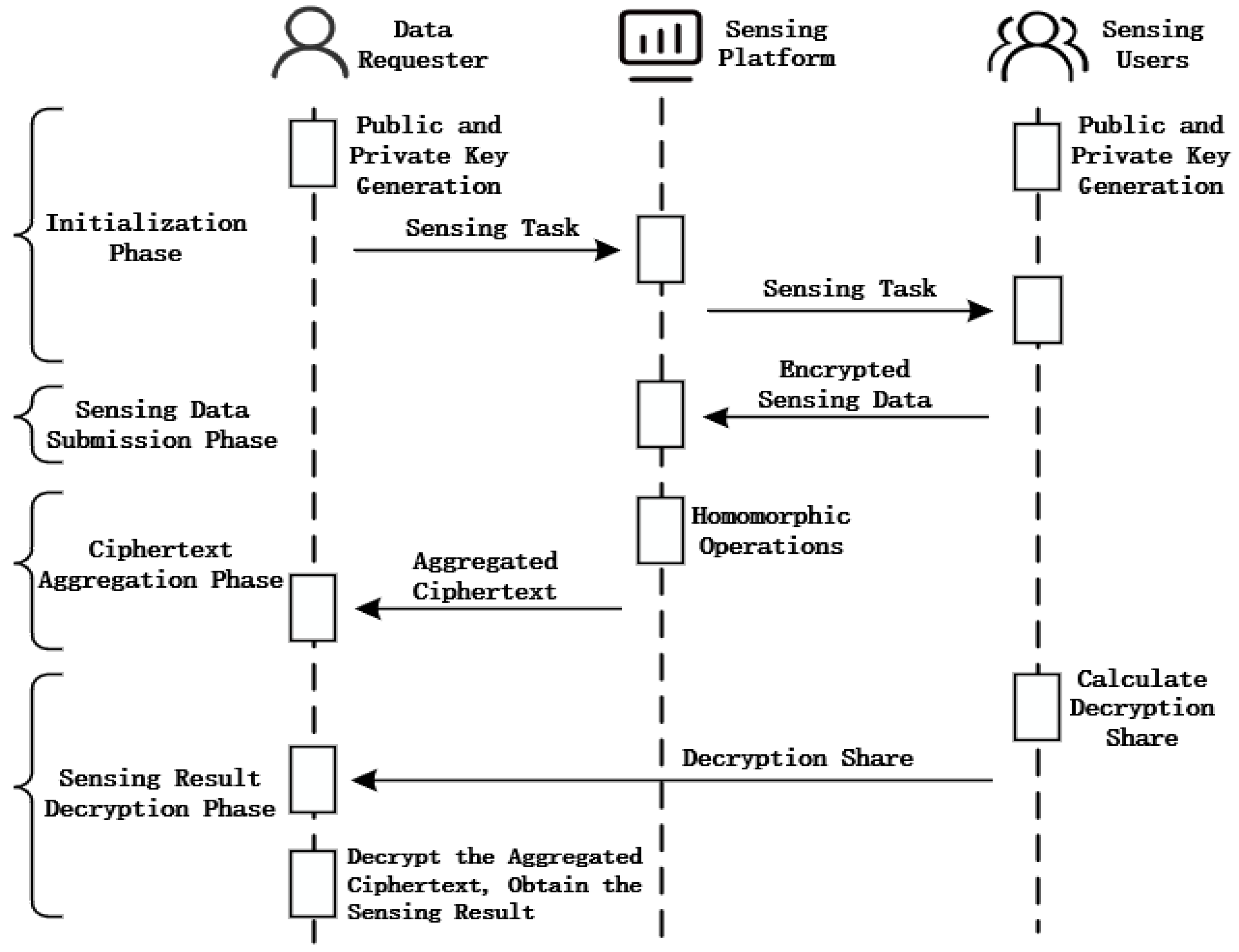
The crowd intelligence perception scheme based on multi-key homomorphic encryption proposed in this section is divided into four stages: initialization, perception data submission, ciphertext aggregation, and perception result decryption. Figure 1 shows the four stages of the scheme and the interaction process between perception users, perception platforms, and data requesters.
The crowd-sensing solution based on multi-key homomorphic encryption proposed in this section contains five core functional modules, namely task management module, data collection module, encryption module, ciphertext aggregation module, and access control module. The introduction of each functional module is as follows.
Task management module is responsible for allocating and coordinating user tasks to ensure the effectiveness of data collection. In crowd-sensing, different tasks need to be assigned to different perception users, and tasks need to be dynamically allocated, taking into full consideration factors such as user location and device capabilities.
Data collection module is responsible for the collection of environmental information or data by crowd-sensing terminals (such as smartphones and IoT devices). Data may need to be pre-processed such as denoising, format conversion, and data compression to reduce communication overhead and computing burden.
Encryption module is responsible for encrypting the collected data to ensure privacy preservation during data transmission and calculation. The perception user encrypts the data with his own public key and then submits the ciphertext.
Ciphertext aggregation module is the perception platform performs homomorphic calculations on the ciphertexts of multiple perception users without decrypting the data.
Access control module allows the perception user embeds the public key information of the data requester in the ciphertext to ensure that only the data requester has the right to decrypt the aggregated ciphertext and thus access the perception results to ensure privacy protection and security.
4.2. Construction of Crowd-sensing Scheme Based on Multi-key Homomorphic Encryption
4.2.1. Initialization Phase
Define data requester and perception users . Perception user runs algorithm to generate its key pair , and data requester runs algorithm to generate its key pair .
Data requesters publish perception tasks to the perception platform according to their needs. The perception platform is responsible for organizing appropriate users to collect and upload data according to the tasks. The perception platform selects perception users that meet the task requirements and sends task invitations to the selected perception users . Users can choose to accept or reject.
4.2.2. Perception Data Submission Phase
The perceptual user who receives the task collects data through its perceptual device and runs the algorithm to encode the collected data into . uses its own public key and the public key of the data requester to encrypt , and runs the algorithm to obtain the ciphertext , where , , , , , .
The perceptual user sends the ciphertext to the perceptual platform. The platform can only store and homomorphically compute encrypted data and cannot view the user's plaintext data .
4.2.3. Ciphertext Aggregation Phase
The perception platform receives the ciphertext from the perception users and performs homomorphic computation without decryption. The perception platform runs the algorithm to calculate the aggregated ciphertext . The aggregated ciphertext is still encrypted, and the perception platform cannot decrypt it to obtain the perception result. The perception platform sends to the data requester for result decryption.
4.2.4. Perception Result Decryption Phase
The decryption phase of the perception result is divided into two steps: partial decryption and final decryption. In the partial decryption step, the perception user runs the algorithm to calculate the decryption share , where , and then sends to the data requester . In the final decryption step, after receiving the decryption shares of all perception users, the data requester uses its own private key to decrypt the aggregated ciphertext, runs the algorithm for final decryption, and obtains the perception result. The data obtained after decoding is the perception result required by the data requester . The perception result is the aggregated perception data, not the data of a single perception user, to ensure user privacy.
5. Security Analysis of Crowd-sensing Scheme Based on Multi-key Homomorphic Encryption
In the crowd sensing scheme based on multi-key homomorphic encryption, the entire sensing process is completed through information transmission between three entities: the sensing user, the sensing platform, and the data requester. Therefore, the security of the scheme will be discussed from two aspects: the sensing user and the sensing platform.
Theorem 5.1.
In the crowd sensing scheme based on multi-key homomorphic encryption, no entity can obtain the plaintext data of a single sensing user, that is, the privacy data of the sensing user is safe.
Proof of Theorem 5.1.
In the crowd sensing scheme based on multi-key homomorphic encryption, the sensing user does not need to trust the sensing platform or other users, and generates its key independently according to the distributed key generation protocol, and the data is encrypted locally. The plaintext data of the sensing user is encrypted locally into the ciphertext , and is uploaded to the sensing platform through the network. 's data remains encrypted during transmission. According to Theorem 3.1, the ciphertext is computationally indistinguishable from the uniform distribution on . The security of IND-CPA based on the RLWE problem ensures that the ciphertext cannot be cracked, that is, the plaintext data cannot be recovered from . Therefore, even if an attacker or data requester intercepts the ciphertext of the perceived user , no information related to can be inferred from it. □
Theorem 5.2.
In the crowd-sensing scheme based on multi-key homomorphic encryption, no entity other than the data requester can decrypt the aggregated ciphertext to obtain the perception result, that is, the perception result is secure.
Proof of Theorem 5.2.
In the crowd-sensing scheme based on multi-key homomorphic encryption, the perception platform only stores and homomorphically calculates the ciphertext , but does not hold any user's private key , so it is impossible to decrypt the ciphertext of a single user. The result after homomorphic calculation is still encrypted, and the perception platform cannot deduce the plaintext data through calculation. The decryption of the aggregated ciphertext requires the decryption shares of all users and the private key of the data requester. Only the data requester can decrypt and obtain the perception result. Even if the perception platform obtains the aggregated ciphertext and the decryption shares , its calculation
In addition to the aggregated plaintext , the calculation result also contains the partial ciphertext encrypted by . Since the perception platform does not have the private key of the data requester, it cannot eliminate in the calculation result, so it is impossible to obtain the aggregated plaintext data through calculation. □
6. Conclusion
In multi-user scenarios, CRS, as a centralized public information, not only provides a basis for collaboration for participating users, but also simplifies the process of key generation and management, so that the encrypted data of multiple users can be effectively operated in the same computing environment. However, the existence of CRS weakens the ability of users to independently generate public keys, and it is difficult to achieve in decentralized systems or scenarios with low trust requirements. This section proposes a lattice-based multi-key homomorphic encryption scheme without CRS, aiming to eliminate the dependence on public parameters and improve the system's anti-attack capability. The proposed scheme not only solves the problems of privacy preservation and data security, but also maintains high efficiency and scalability in large-scale distributed systems. Multi-key full homomorphic encryption scheme will be our research direction in future for more wide application.
Acknowledgement
This study is sponsored by the Science and Technology Innovation Program of China Metallurgical Geology Bureau (Grant no. CMGBKY202407).
References
- Liu, L.; Zhang, J.; Song, S.H. Client-edge-cloud hierarchical federated learning. ICC 2020-2020 IEEE International Conference on Communications (ICC).
- Kim, M.; Harmanci, A.O.; Bossuat, J.P. Ultrafast homomorphic encryption models enable secure outsourcing of genotype imputation. Cell systems 2021, 12, 1108–1120.e4. [Google Scholar] [CrossRef] [PubMed]
- Kim, H.I.; Kim, H.J.; Chang, J.W. ; A secure kNN query processing algorithm using homomorphic encryption on outsourced database. Data & knowledge engineering 2019, 123, 101602. [Google Scholar]
- Yang, Y.; Huang, X.; Liu, X. A comprehensive survey on secure outsourced computation and its applications. IEEE Access 2019, 7, 159426–159465. [Google Scholar] [CrossRef]
- Sun, J.; Xu, G.; Zhang, T. Verifiable, fair and privacy-preserving broadcast authorization for flexible data sharing in clouds. IEEE Transactions on Information Forensics and Security 2022, 18, 683–698. [Google Scholar] [CrossRef]
- Kadykov, V.; Levina, A.; Voznesensky, A. Homomorphic encryption within lattice-based encryption system. Procedia Computer Science 2021, 186, 309–315. [Google Scholar] [CrossRef]
- Chen, H.; Dai, W.; Kim, M. Efficient multi-key homomorphic encryption with packed ciphertexts with application to oblivious neural network inference. Proceedings of the 2019 ACM SIGSAC Conference on Computer and Communications Security. 2019: 395-412.
- Xu, K.; Tan, B.H.M.; Wang, L.P. Multi-key fully homomorphic encryption from NTRU and (R) LWE with faster bootstrapping. Theoretical Computer Science 2023, 968, 114026. [Google Scholar] [CrossRef]
- Biswas, C.; Dutta, R. Secure and efficient multi-key FHE scheme supporting multi-bit messages from LWE preserving non-interactive decryption. Journal of Ambient Intelligence and Humanized Computing 2023, 14, 16451–16464. [Google Scholar] [CrossRef]
- Zhou, T.; Chen, L.; Che, X. Multi-key Fully Homomorphic Encryption Scheme with Compact Ciphertexts. Cryptology ePrint Archive, 2021.
- Li, H.; Li, X.; Gao, J. Multi-hop Multi-key Homomorphic Encryption with Less Noise Under CRS Model. International Symposium on Cyberspace Safety and Security. Cham: Springer International Publishing, 2022: 342-357.
- Luo, F.; Wang, H.; Saif, A.K. Multi-key fully homomorphic encryption without CRS from RLWE. Computer Standards & Interfaces 2023, 86, 103742. [Google Scholar]
- Ma, J.; Naas, S.A.; Sigg, S. Privacy-preserving federated learning based on multi-key homomorphic encryption. International Journal of Intelligent Systems 2022, 37, 5880–5901. [Google Scholar] [CrossRef]
- Ganesh, B.; Palmieri, P. Secure Search over Multi-key Homomorphically Encrypted Data. 2023 7th International Conference on Cryptography, Security and Privacy (CSP). IEEE, 2023: 145-151.
- Li, X.; Li, H.; Gao, J. Privacy preserving via multi-key homomorphic encryption in cloud computing. Journal of Information Security and Applications 2023, 74, 103463. [Google Scholar] [CrossRef]
- Chen, Y.; Dong, S.; Li, T. Dynamic multi-key FHE in asymmetric key setting from LWE. IEEE Transactions on Information Forensics and Security 2021, 16, 5239–5249. [Google Scholar] [CrossRef]
- Antwi-Boasiako, E.; Zhou, S.; Liao, Y. An LWE-Based Multi-Key Privacy-Preserving Distributed Deep Learning. 2021 IEEE 23rd Int Conf on High Performance Computing & Communications, 2021: 533-542.
- Che, X.; Zhou, H.; Yang, X. Efficient multi-key homomorphic encryption scheme on ring LWE. Journal of Xidian University 2023, 48, 87–95. [Google Scholar]
- Li, N.; Zhou, T.; Che, X. Research on multi-key homomorphic encryption. Journal of Cryptologic Reshearch 2020, 7, 713–734. [Google Scholar]
- Pathak, V. Lattices, homomorphic encryption, and ckks. arXiv preprint 2022, arXiv:2205.03511. [Google Scholar]
- Qiu, F.; Yang, H.; Zhou, L. Privacy preserving federated learning using ckks homomorphic encryption. International Conference on Wireless Algorithms, Systems, and Applications. Cham: Springer Nature Switzerland, 2022: 427-440.
- Li, J.; Zhu, Y.; Hua, Y. Crowdsourcing sensing to smartphones: A randomized auction approach. IEEE Transactions on Mobile Computing 2017, 16, 2764–2777. [Google Scholar] [CrossRef]
- Zheng, X.; Cui, L.; Zhang, L. The perception results based on encryption technology can verify the privacy preservation group intelligence perception scheme. Journal of Beijing Institute of Technology(Nature Edition) 2024, 44, 413–420. [Google Scholar]
Figure 1.
Flowchart of crowd-sensing scheme based on multi-key homomorphic encryption.
Disclaimer/Publisher’s Note: The statements, opinions and data contained in all publications are solely those of the individual author(s) and contributor(s) and not of MDPI and/or the editor(s). MDPI and/or the editor(s) disclaim responsibility for any injury to people or property resulting from any ideas, methods, instructions or products referred to in the content. |
© 2025 by the authors. Licensee MDPI, Basel, Switzerland. This article is an open access article distributed under the terms and conditions of the Creative Commons Attribution (CC BY) license (http://creativecommons.org/licenses/by/4.0/).
Copyright: This open access article is published under a Creative Commons CC BY 4.0 license, which permit the free download, distribution, and reuse, provided that the author and preprint are cited in any reuse.


