
Submitted:
02 April 2025
Posted:
03 April 2025
You are already at the latest version
Abstract
The present work was carried out in the laboratory and at the experimental station of the Oujda Faculty of Science, where we undertook a cultivation trial of two provenances of Argania spinosa from Morocco and Tunisia to see their germination and growth behavior. After one month's germination of Argania spinosa seeds in the laboratory, the germination rates of seeds from Foum El Hassen and Miouzour were the highest compared with seeds from the Faculté des Sciences d'Oujda and the Béni-Snassen region. In fact, seeds from Tunisia had an advantage over those from Morocco in terms of germination capacity. Monitoring growth over time showed no significant differences between seedlings of Tunisian and Moroccan origin. The growth in height of four provenances showed a similarity in the general growth pattern.
Keywords:
Argania spinosa L. Skeels
; germination
; growth
; provenance
; Morocco
; Tunisia
1. Introduction
In many developing countries, rural populations meet a large part of their food and energy needs thanks to trees, which also contribute to quality of life. Efforts to conserve forests, while making them more productive, would benefit from a better understanding of the resources of multipurpose woody species and how they can improve not only the nutritional situation of rural populations, but also their economic resources [1].
A typically multi-use tree, it is the mainstay of agroforestry systems that have so far succeeded in meeting the needs of local inhabitants [4]. It is a forest species of great importance to the country, both biologically and in terms of phylogenetic and ecological biodiversity, as well as economically and socially. [5].
It is a specifically Moroccan endemic species. It is the only Moroccan representative of an essentially tropical family [6].
The most remarkable tree in Morocco, it is thorny, can reach 8 to 10 meters in height [6,7,8] and is very hardy, with a lifespan of up to 150 to 200 years [1].
Despite all these advantages, argan groves are declining at an alarming rate, both in terms of surface area and density. This decline is exacerbated by the almost total absence of natural regeneration [4]. This is a real ecological threat, given the decisive role played by the argan tree in combating erosion and desertification, thanks in particular to its powerful root system. The threat is also socio-economic, since the argan tree provides more than 7 million days of family work per year, with the population living directly or indirectly from the argan tree estimated at between 2.5 and 3 millions Moroccans [9].
Reforestation or assisted regeneration would be the only way to ensure the species' continuity [10].
With this in mind, and with the aim of increasing the body of knowledge and adding elements to the solutions likely to contribute to the regeneration and rehabilitation of the argan tree, we have undertaken an experiment to determine the germination and growth capacity of four different provenances of Argania spinosa L. from Morocco and Tunisia. Our results will lead us to propose orientations that could contribute to the protection and development of this species.
2. Materials and Methods Aim of the Test
The aim of this comparison is to determine which provenance can give the highest germination rate and growth dynamics in the shortest time and in the highest proportion. To achieve this objective, we soaked all the argan seeds in water at room temperature for 48h. The choice of soaking as a pre-treatment technique is based on studies by [11,12] .who showed that soaking for 48h in ambient water is sufficient to obtain good germination.
2.1. Germination
2.1.1. Plant Material
In our trial, we compared four Moroccan and Tunisian provenances of Argania spinosa: the first two from Morocco were harvested from the Faculté des Sciences d'Oujda and the Béni-Snassen region (eastern Morocco), and the other two from Tunisia were harvested from Foum El Hassen and Miouzour (INEGREF: Institut National de Recherche en Génie Rural et Eaux et Forêts).
- Pr 1 : Seeds from the Oujda Faculty of Science (Oujda,Morocco)
- Pr 2 : Seeds from JbelTikermine, Béni-Snassen (Berkane, Morocco)
- Pr 3 : Seeds from Foum El-Hassen of INRGREF (Tunis)
- Pr 4 : Seeds from Tigue Miouzour at INRGREF (Tunis).
2.1.2. Experimental Set-Up
The trial was carried out in a completely randomized design with four replicates. The number of seeds used was 50 per provenance and 200 seeds per repetition, for a total of 800 seeds for the whole trial.
2.1.3. Test Set-Up and Operation
The trial was carried out in the laboratory of the Oujda Faculty of Science. Before germination, argania spinosa seeds were disinfected with a solution containing 10% concentrated bleach for five minutes, then rinsed three times with tap water. Seeds were germinated in polyethylene bags containing peat. The bags were kept in the dark in an oven at a constant temperature of 30°C. The seeds were aerated by stirring the sachets daily to prevent the development of mold.
2.1.4. Measurements
Counting involves counting the number of germinated seeds every day. A seed is considered germinated when it emits a radicle. The germination rate, which represents the percentage of germinated seeds in relation to the total number of seeds sown, is thus determined. And secondly, the germination speed, which expresses the percentage of germination as a function of time.
2.2. Growth
2.2.1. Plant Material
The seedlings used came from the germination trial, and were transported in perforated polyethylene bags, 30cm high and 16.5cm in diameter.
2.2.2. Experimental Set-Up
The trial was carried out in a completely randomized design with four replicates. A batch of 160 seedlings was selected, with 40 seedlings per repeat and 10 seedlings per origin.
2.2.3. Measurement Method
The length of the stem axis was measured using a graduated ruler over a 4-month period. The parameters measured were :
- Growth rate : this is the evolution of growth in stem height as a function of time.
- Height growth rate : calculated using the following formula :
(TC) = (HF - HI) / HI × 100 (in %)
With :
- TC : Height growth rate in percent.
- HF : Plant height after one year in cm.
- HI : Initial plant height in cm.
2.2.4. Statistical Analysis
The data obtained underwent an analysis of variance using SPSS version 11.5 (Statistical Package for the Social Sciences). This analysis of variance was followed by a classification of means using Duncan's test, which was used to perform all analyses of variance (ANOVA). The values obtained are the statistical mean of three repetitions, with a confidence interval calculated at the 5% threshold.
3. Results and Discussion
3.1. Germination
3.1.1. Germination Rate
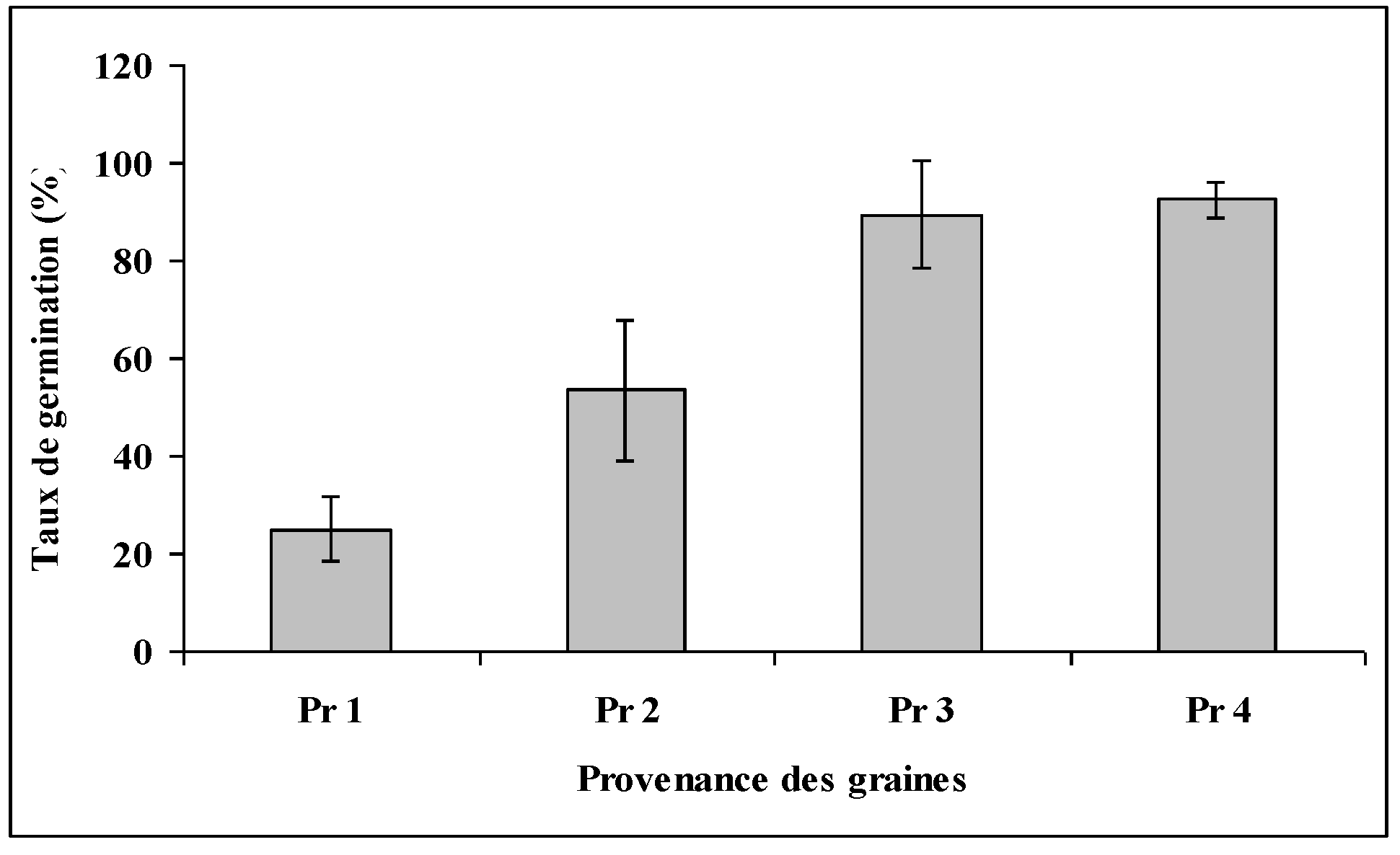
A study of the germination of argania spinosa seeds according to seed origin showed a significant difference (p<0.05). Seeds from Tunisia showed higher germination rates than those from Morocco, at 92.5% and 89.5% respectively for Miouzour and Foum el Hassen, followed by 53.5% for Béni-Snassen and 25% for the Faculté des Sciences d'Oujda (Figure 1).
The results show that argan seeds from Tunisia have a higher germination capacity than seeds from Morocco, perhaps due to seed quality, storage conditions, harvest date and tree genotype.
Our results are in line with those of [11,12], who have shown that the germinative capacity of seeds varies according to harvest date and tree type.
As well as the work of [13,14,15] which assert that the ripening and physiological decline of argan fruits in response to unfavorable climatic conditions are variable according to the tree's genotype. Furthermore, the difference in germination ability observed in seeds from different trees highlights the interference of genotype in seed growth, which is known for its great genetic diversity.
3.1.2. Germination Speed
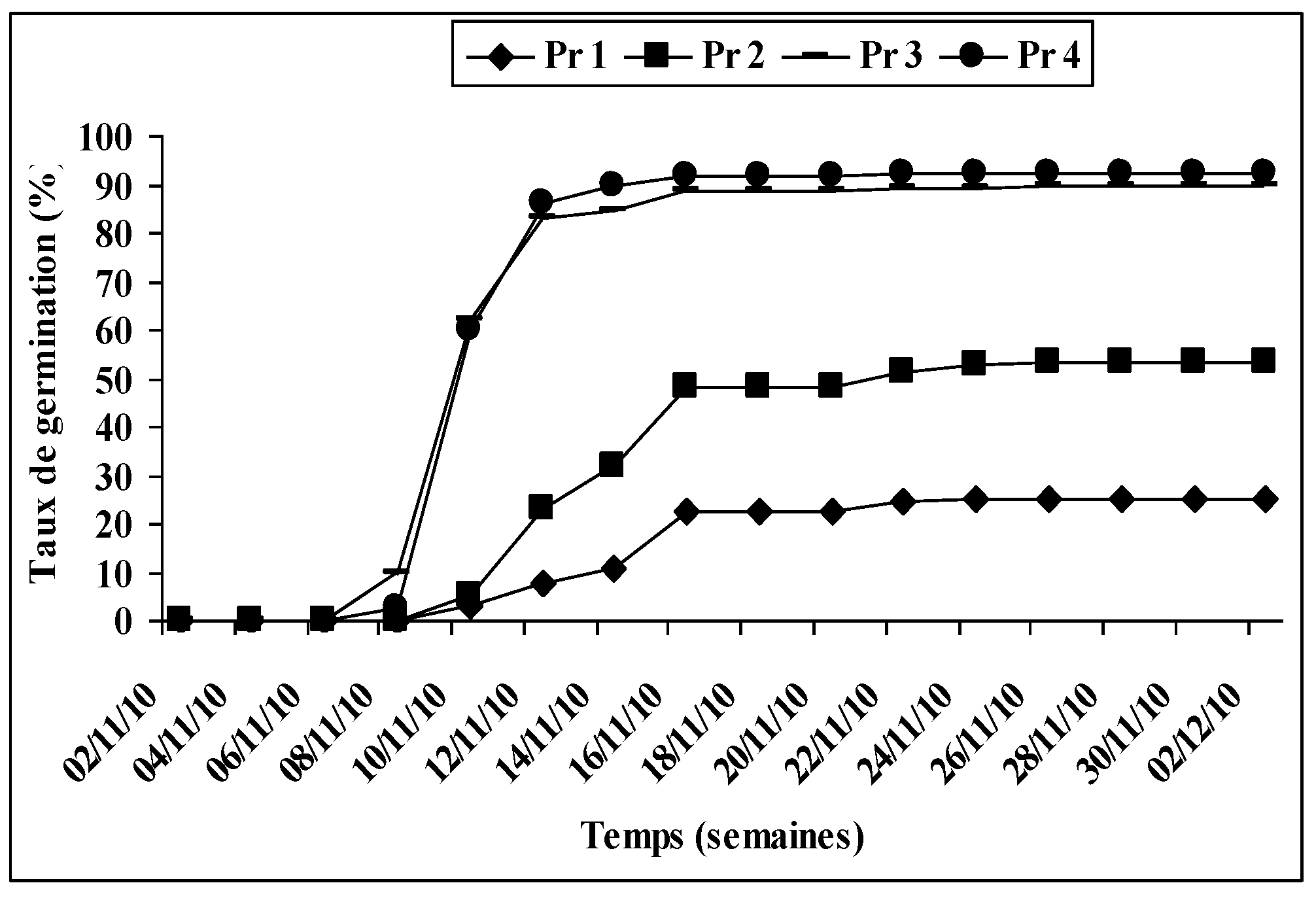
Germination began on day 6ème for the plants from Tigue Miouzour and Foum el Hassen. The seeds from Béni-Snassen and the Oujda Faculty of Science began germinating on day 10 .ème Low germination percentages were observed during the first week in the two provenances from Tigue Miouzour and Foum el Hassen, with rates of 10 and 2.5% respectively. On the other hand, seeds from Béni-Snassen and the Faculté des Sciences d'Oujda have not yet begun to germinate.
During the second week, the germination rate gradually increased with time, reaching 92% for seeds from Tigue Miouzour and 88.5% for seeds from Foum el Hassen. Seeds from Béni-Snassen and the Faculté des Sciences d'Oujda had germination rates of 48% and 22.5% respectively.
After three weeks, the germination rate showed a relative change, but only slightly to reach the maximum rates for all provenances. Germination rates reached 92.5, 89.5, 53.5 and 25% respectively for seeds from Tigue Miouzour, Foum el Hassen, Béni-Snassen and the Faculté des Sciences d'Oujda.
Figure 2.
Germination rate of Argania spinosa seeds from different provenances as a function of time.
Figure 2.
Germination rate of Argania spinosa seeds from different provenances as a function of time.
3.2. Growth
The growth of argan seedlings from different provenances as a function of time is not significant (p>0.05).
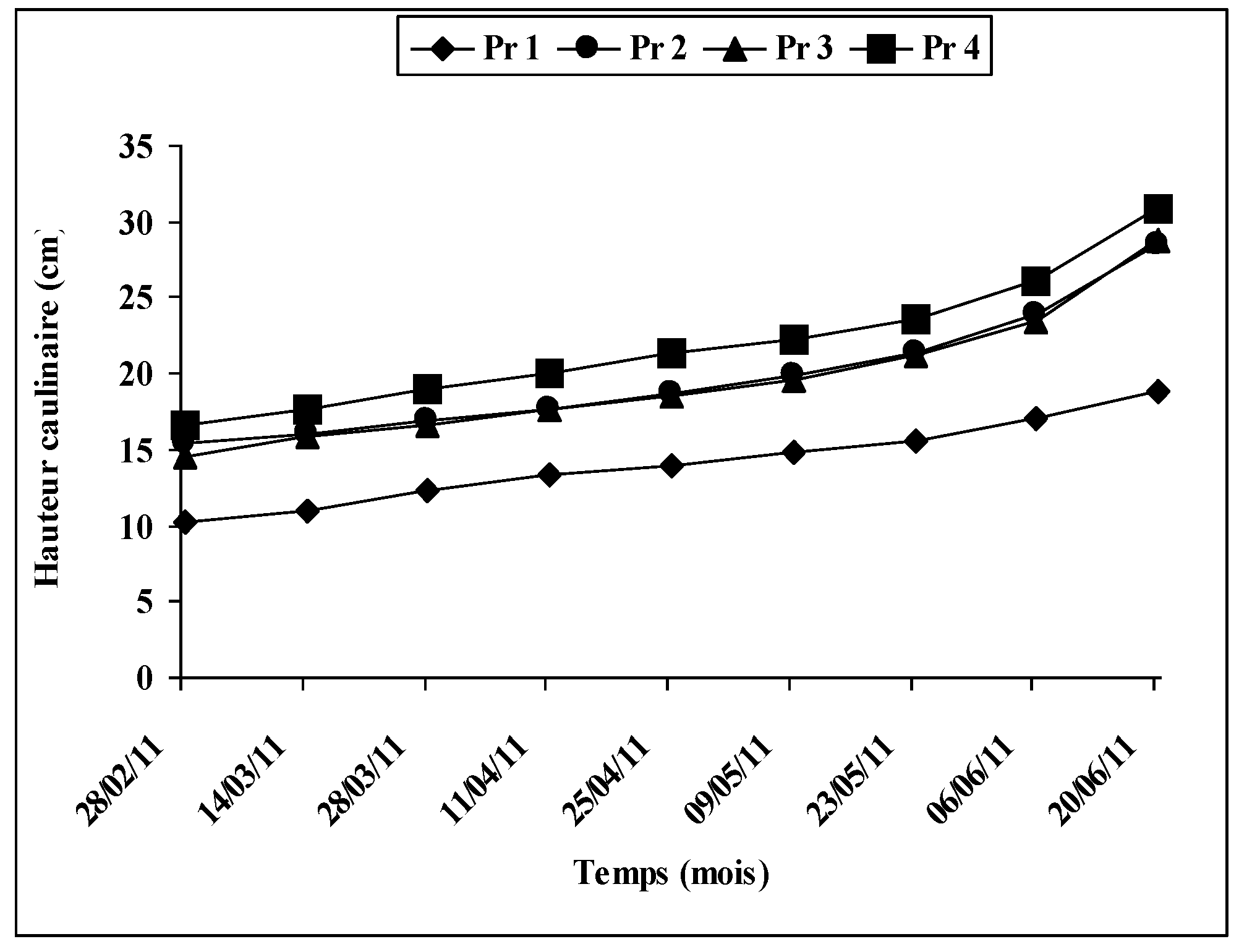
The average initial height of the transplanted plants was 10.18, 15.47, 14.58 and 16.60 cm respectively for provenance from the Faculté des Sciences d'Oujda, Béni-Snassen, Foum el Hassen and Tigue Miouzour. The heights measured after four months' growth were 18.90; 28.45; 28.72 and 30.90 cm for the same age classes. Growth rates in height are 85.70, 83.91, 96.98 and 86.15% respectively for the same classes.
Seedlings from Tigue Miouzour and Foum el Hassen had average lengths of 14.30 and 14.14 cm respectively after 4 months' growth. Whereas seedlings from the Faculté des Sciences d'Oujda and BéniSnassen had average lengths of 8.72 and 12.98 cm respectively.
Growth in height of four provenances showed a similarity in the general pattern of growth, from which two evolutionary phases could be distinguished.
The first phase lasted two months, with seedling height gains of 37.65, 20.96, 27.57 and 28.62 respectively for provenance from the Faculté des Sciences d'Oujda, Béni-Snassen, Foum el Hassen and Tigue Miouzour.
The second phase began in the third month for the four provenances and lasted two months, with seedling height gains of 34.90, 52.38, 54.41 and 44.73% respectively for the same provenances.
Growth in length is low when temperatures are low (February-March-April), then accelerates as temperatures rise in early May.
We can see that growth is slow until the beginning of May, when we notice an increase in stem length. This growth towards the beginning of May is explained by the fact that the species is thermophilic.
Figure 3.
Growth in stem height of Argania spinosa seedlings from different provenances as a function of time.
Figure 3.
Growth in stem height of Argania spinosa seedlings from different provenances as a function of time.
4. Discussion
Traditionally, the assessment of seedlings is based on morphological criteria such as seed germination rate and cauline height. Based on this principle, the study of seed germination and the monitoring of young argan seedlings over a 4-month period enabled us to compare the four argan provenances studied (Faculté des Sciences d'Oujda, Béni-Snassen, Foum el Hassen and Tigue Miouzour).
The results of the trials show that seeds from Tunis have the best germination rate and speed. Even though all trials had the same treatments. This may lead us to think of the tree and climate factors in the harvesting areas, as the argan tree shows great genetic variability in kernel, fruit, leaf and tree habit, and it turns out that germinative power is a characteristic of the seed tree [15],
Seeds from Foum El Hassen and Miouzour showed a higher germination rate than seeds from the Faculté des Sciences d'Oujda and the Béni-Snassen region. The germination rate of seeds from Tunisia was higher than that of seeds from Morocco, at 92.5% and 89.5% respectively for Miouzour and Foum el Hassen. This compares with 37.5% and 25% respectively for seeds from Béni-Snassen and the Faculté des Sciences d'Oujda. Two phases of growth can be distinguished, a first slow phase during the February-April period and a second phase of relatively strong growth starting in May, especially for Tunis seeds (T2 and T3), which confirms that the argan tree is a thermophilic species.
The development of an organism over time is reflected in two series of modifications : firstly, an increase in dimensions that constitute growth, and secondly, the acquisition of new properties that can be included in the terms development and differentiation. In fact, the description of the shape of plants taken as a whole is based on the mode of growth, branching and morphological differentiation of the stem axes [16,17,18].
The argan tree is often described as a thermophilous and xerophilous species, capable of adapting to arid and semi-arid conditions in its area of distribution [19,20]. Time-dependent growth showed differences between the Tunisian and Moroccan clones, with seedling lengths of 14.13 cm, 19.81 cm, 19.60 cm and 21.94 cm respectively for seedlings from seeds from the Oujda Faculty of Science, seeds from Jbel Tikermine, seeds from the Foum El Hassan clone (Tunis) and seeds from the Tigue Miouzour clone (Tunis).
Growth was reported to be slow until the beginning of May, when a slight increase was observed. This growth towards the end of May can be explained by the fact that the species is thermophilic. Growth in length is low when temperatures are low, then accelerates as temperatures
8
rise. The water regime is not in question, as the seedlings were regularly irrigated with sufficient quantities of water.
This difference could be explained by the fact that the seeds belonging to the Tunisian clones were harvested from welltended plants in a favorable geographical location, while the seed lot we received contained large-calibre seeds.
It should also be noted that seedlings of all origins were able to double their length during the trial period, thus showing the same growth rate. As for the height growth of the seedlings, according to our results, it showed a similarity in general appearance.
5. Conclusions
Comparing seed germination and growth of argan seedlings (Argania spinosa L.) of Moroccan and Tunisian origin, we came up with the following results: seeds from Tunis showed the best germination rate and speed. Even though all trials received the same treatments. This may point to the tree and climate factors in the harvesting areas, as the argan tree shows great genetic variability in kernel, fruit, leaf and tree habit, and it turns out that germinability is a characteristic of the seed tree.
Work on cultivation conditions, the nature of the substrate, irrigation frequencies and harvesting and storage conditions for argan seeds will be carried out to gain a better understanding of the factors influencing germination. All these studies will contribute to the development of a technical itinerary for the production of argan seedlings.
The fight against the disappearance of the argan grove can only succeed if it is part of an overall development strategy.
References
- Djaballah F. et Boussaide A., 2012. Etude comparative entre deux provenances d’Argania spinosa. Revue des BioRessources. Vol 2 N 1 Juin 2012. p 41-49.
- M’hirit, O. L’arganier : une espèce fruitière forestière à usage multiple. Séminaire sur les espèces ligneuses à usage multiple des zones arides méditerranéennes. Institut Agronomique Mediterranean, Saragosse, Espagne, 25-26 septembre. 1987.
- Bellefontaine, R. De la domestication à l’amélioration variétale de l’arganier (Argania spinosa L. Skeels) ? Sécheresse, 2010, 21, 42–53. [Google Scholar] [CrossRef]
- Nouaim, Echairi, kaaya, Chaussod, 2007. Contribution à la domestication de l’arganier pour la production d’huile. Cahiers d’études et de recherches francophones /Agricultures. Volume 16, Numéro 3, 199-204, Mai – juin 2007, Etude originale.
- Errouati, A. Problématique de la régénération assistée et des reboisements à base d’Argania spinosa dans la région du massif forestier d’Amsitten (Province d’Essaouira). Mémoire de 3ème Cycle, ENFI, Salé, Maroc, 42p + Annexes. 2005.
- Emberger, L. Les arbres du Maroc et comment les reconnaître, 271-277, Ed. Larose, Paris. 1938.
- Jaccard, P. 1926. L’Arganier, Sapotaceae oléagineuse du Maroc. 1926. [Google Scholar]
- Wagret, P. 1962. L’Arganeraie du Sud Marocain relique du tertiaire et providence des populations. Nature Science Progrès, 1962, 390-393.
- Alaoui, K. L’arganier ou la richesse d’un patrimoine. Phytothérapie 2009, 7, 150–156. [Google Scholar] [CrossRef]
- Khay, M. Traitements sylvicoles et aménagement. In : Formation Forestière Continue, thème "l'arganier", Station de Recherche Forestière, Rabat, 13-17 mars 1989, 59-64.
- Mokhtari, M. 2002. Production rapide des plants d’Arganier apte à la transplantation. Bulletin mensuel d’information et de liaison du programme national de transfert de technologie en agriculture, N°95. Pages 3-4.
- Bezzala A, 2005. Essai d’introduction de l’arganier (Argania spinosa L. Skeels) dans la zone de M’doukel et évaluation de quelques paramètres de résistance à la sécheresse. Magistère en sciences agronomiques. Université El Hadj Lakhdar Faculté des Sciences, Algérie.
- Alouani, M., & Bani-Aameur, F. (2014). Viabilité et vieillissement des semences d’arganier (Arganiaspinosa (L.) Skeels. Afrique Science : Revue Internationale des Sciences et Technologie, 10(1).
- .
- Ferradous A., Bani aameur F. et Dupuis P. Climat stationnel, phénologie et fructification de l’arganier. Actes de l’institut agronomique et vétérinaire Hassan II. 1996, 17, 51–60.
- Bani-Aameur F., Louali L., Dupuis P. Maturation et chute des fruits de l'arganier. Actes de l'Institut agronomique et vétérinaire Hassan II 1998, 18, 137–144.
- Tazi, M. R., Berrichi, A., & Haloui, B. (2003). Esquisse cartographique de l'aire de l’arganier Argania spinosa (L.) Skeels au Maroc nord-oriental. Bulletin de l’Institut scientifique. Rabat, 53-55.
- Bezzala A, 2005. Essai d’introduction de l’arganier (Argania spinosa L. Skeels) dans la zone de M’doukel et évaluation de quelques paramètres de résistance à la sécheresse. Magistère en sciences agronomiques. Université El Hadj Lakhdar Faculté des Sciences, Algérie.
- Zugmeyer, L. PROJET DE developpement sylvo pastoral de l’arganeraie marocaine. 2006.
- Bani-Aameur, F. Argania spinosa (L.) Skeels flowering phenology. Genetic Resources and Crop Evolution 2002, 49, 11–1. [Google Scholar] [CrossRef]
Figure 1.
Germination rate of Argania spinosa seeds according to seed origin.
Disclaimer/Publisher’s Note: The statements, opinions and data contained in all publications are solely those of the individual author(s) and contributor(s) and not of MDPI and/or the editor(s). MDPI and/or the editor(s) disclaim responsibility for any injury to people or property resulting from any ideas, methods, instructions or products referred to in the content. |
© 2025 by the authors. Licensee MDPI, Basel, Switzerland. This article is an open access article distributed under the terms and conditions of the Creative Commons Attribution (CC BY) license (http://creativecommons.org/licenses/by/4.0/).
Copyright: This open access article is published under a Creative Commons CC BY 4.0 license, which permit the free download, distribution, and reuse, provided that the author and preprint are cited in any reuse.


