

Submitted:
30 March 2025
Posted:
31 March 2025
You are already at the latest version
Abstract
This study investigates the relationship between Research Intensity (RI) and a range of Environmental, Social, and Governance (ESG) variables for Italian regions using machine learning algorithms and panel data models. The study seeks to identify the most predictive variables of research intensity from a range of cultural, environmental, socio-economic, and governance indicators. Support Vector Machine, Random Forest, k-Nearest Neighbors, and Neural Network algorithms are used to ascertain comparative predictive power. Feature importance analysis identifies education levels, in particular tertiary education qualifications, and technological infrastructure as most predictive of research intensity. Regional differences in research intensity are also investigated on the basis of political representation, healthcare accessibility, material consumption, and cultural investment variables. Results indicate that economically developed regions with sufficient research capacity are more research-intensive but can also face environmental sustainability and social inclusiveness issues. The study concludes that policy measures to enable education, technological innovation, environmental management, and governance improvement are required to spur research capacity in Italian regions. The study also provides insight into the use of research intensity in informing broader ESG objectives, including policy intervention for mitigating regional imbalances. Future studies should provide insight into the dynamic interaction effects of research intensity and ESG variables over time using more sophisticated machine learning techniques to further enhance predictive power.
Keywords:
Research Intensity
; ESG Factors
; Machine Learning
; Panel Data Models
; Italian Regions
1. Introduction
The examination of research intensity (RI) in the context of Environmental, Social, and Governance (ESG) models is a novel and promising field of inquiry that can help expand the current stock of knowledge on regional development in Italy. While the theoretical and empirical literature has exhaustively dealt with the role of research intensity in stimulating economic growth, innovation, and technological advancement, the relationship between research intensity and ESG variables remains largely under-explored. This research tries to fill this gap in knowledge by examining the interdependence between research intensity and various indicators of ESG at the Italian regional level through the application of high-performance machine learning algorithms and panel data models. Research intensity, classically measured as the share of GDP invested in intra-muros R&D activities, is a pertinent indicator of the scientific research, technological development, and innovation commitment of a region. High research intensity is typically associated with stronger institutional structures, high-quality school systems, and vibrant innovation systems. However, the impact of research intensity on the other dimensions of ESG, such as environmental sustainability, social equity, and good governance, remains under-investigated. The originality of this research lies in the effort to offer an encompassing framework linking research intensity with ESG variables at the Italian regional level. By employing machine learning algorithms such as Support Vector Machine, Random Forest, k-Nearest Neighbors, and Neural Network models, the research offers a stringent comparison of predictive performance. Furthermore, the use of panel data models enables interesting implications on regional heterogeneity and time dynamics that are central to the design of effective policies for promoting sustainable growth. Italian regions are extremely socio-economically and environmentally heterogeneous. Northern regions such as Lombardy, Emilia-Romagna, and Veneto are typified by high intensity of research driven by strong industrial bases, cutting-edge education systems, and heavy investment in innovation. On the other hand, southern regions such as Calabria, Sicily, and Apulia are plagued by economic underdevelopment, weak research infrastructure, and heterogeneity in governance quality. An understanding of how research intensity interacts with ESG factors in these heterogeneous regions is needed in order to come up with policy initiatives that are carefully targeted. Environmental, Social, and Governance dimensions provide a comprehensive framework with which to investigate regional performance. Environmental dimensions encompass such variables as wastewater treatment, materials consumption, and climate change aspects. Social dimensions encompass education, access to healthcare, employment security, and housing affordability. Governance dimensions encompass metrics such as political representation, efficiency of the judiciary, and health infrastructure. Investigating research intensity within the framework of this ESG structure, this study intends to unearth patterns that can be utilized by policymakers to achieve balanced regional growth. One of the key contributions of this study is the application of machine learning algorithms to investigate the interaction between the intensity of research and the ESG indicators. Classical econometric models tend not to be adequately equipped to manage complexity and non-linearity in such an interaction. Machine learning algorithms, nonetheless, provide the ability to unearth complex patterns and interaction between the variables, and thereby enhance predictive capability and strength. In addition, the application of panel data models allows regional variations to be investigated more closely over time, and therefore provide greater insight into the dynamic pattern of the intensity of research and its impact on the ESG factors. Feature importance analysis suggests some variables have high influence on predicting research intensity in Italian regions. For example, educational achievement—proxied as the percentage of tertiary qualified individuals—manifests as a central driver. This finding aligns with current literature on the role of human capital in precipitating innovation and technological progress. However, the interaction of research and education intensity also highlights regional disparities, with economically advanced regions likely to have higher educational achievement and, consequently, greater research activity. Furthermore, the analysis identifies that environmental sustainability-related factors, such as climate change concern and wastewater treatment, have ambiguous relationships with research intensity. In some regions, greater research intensity is accompanied by more advanced environmental management practice, suggestive of an innovation-driven sustainability commitment. In others, however, the focus on technological development may detract from environmental agendas, particularly where economic development is prioritized over ecological preservation.
Social factors also condition research intensity at a fundamental level. Job security, housing affordability, and access to health exert varying degrees of influence across territories. The interdependence of research intensity and job security, for example, illustrates that intensive research activity is accompanied by more secure and stable employment. Low research intensity territories, on the other hand, struggle more to transition from precarious to permanent work, betraying latent socio-economic weaknesses. Governance factors, including political representation, efficiency of the judiciary, and health infrastructure, also condition territorial variation in research intensity. The research illustrates that territories with increased political representation for women have more intensive research activity, suggesting that more representative government can drive innovation. Efficiency of the judicial system is also positively linked to research intensity, suggesting the role of institutional quality in facilitating research and development. The use of machine learning algorithms is a new strength of this research, facilitating systematic comparison of predictive performance across models. The findings illustrate that the k-Nearest Neighbors algorithm is the best predictor, followed by Random Forest and Support Vector Machine. The findings suggest that non-linear models are particularly well-suited to modeling complex interactions between research intensity and ESG factors. The panel data analysis also produces informative temporal dynamics of research intensity across Italian territories. By modeling a number of years' worth of data, this research teasing out trends and patterns not evident in cross-sectional analyses. Territories with long-run investments in research infrastructure, for example, tend to demonstrate long-run improvements in ESG performance, while territories with intermittent funding struggle more to unlock sustainable growth.
The empirical results of this study are policy-relevant. An understanding of the interconnection between research intensity and ESG variables can be the foundation of policy for sustainable regional development. For example, the development of education infrastructure and education attainment support can be an effective tool for assisting research intensity in lagging economic regions. Similarly, environmental sustainability through targeted investment in wastewater treatment, climate change, and resource management can improve the performance of regions on ESG dimensions. The study also underscores the necessity of interrelated policies that can tackle more than one ESG dimension simultaneously. Regions with adequate performance on research intensity but social imbalance or environmental unsustainability issues can be tackled through targeted intervention to re-align such misalignments. Conversely, regions with good governance institutions but low-level research activity can be assisted with policy interventions to catalyze innovation potential. Overall, this study contributes to the literature on regional development by offering an integrated analysis of research intensity under the ESG framework. The innovation of the study is the use of machine learning algorithms and panel data models in capturing the complexity of interrelationships between research intensity and a number of ESG indicators. By bringing to light regional imbalances and salient drivers of research activity, this study has significant policy implications for policymakers interested in catalyzing sustainable growth in Italian regions.
The article continues as follows: the second section presents a literature review, the third session analyses the data, variables and methodologies, the fourth section analyses the E-Environment component, the fifth section investigates the S-Social component, the sixth section shows the results of the analysis of the G-Governance component, the seventh section addresses the policy implications, the eighth section concludes.
2. Literature Review
Several studies identify the positive impact of R&D investments on ESG performance and green innovation. Xu et al. (2021) and Rauf et al. (2024), for instance, identify that R&D investment has a significantly positive impact on the green innovation performance of corporations through improved environmental practices and better ESG reporting. Yang et al. (2024) also illustrate a U-shaped relationship between ESG ratings and green innovation, meaning that corporations have to reach a threshold of ESG performance before sustainable innovation performance is realized. This also implies that early investment in ESG practices may not be immediately rewarding but is essential for long-term business value creation. Costantiello and Leogrande (2023) provide a broader scope of analysis by observing how R&D expenditure influences ESG models of the world economy. They agree with Wang et al. (2024), who argue that good ESG practices can create great value for businesses by building corporate reputation, driving innovation, and enhancing financial performance. Koo and Kim (2023) also identify the joint impacts of ESG ratings and R&D investment on corporate value relevance, meaning that the conjunction of both leads to superior financial performance. The literature also identifies regional differences in how R&D, ESG, and innovation are interconnected. China-centric studies by Xu et al. (2021), Shen et al. (2023), and Yang et al. (2024) specifically identify the role of government policy and regulatory mechanisms in shaping corporate ESG practices. The impact of China's Environmental Protection Tax Law, studied by He et al. (2023), suggests that such policies can effectively nudge companies toward better ESG performance, especially when coupled with technological innovation efforts. Additionally, Zeng et al. (2024) and Shen et al. (2023) provide illuminating descriptions of the evolution of ESG standards in China, identifying gaps in current practices and suggesting future research directions for strengthening corporate sustainability. Several authors also address the role of technological innovation in enhancing ESG performance. Yu et al. (2024) argue that ESG-driven technological innovation can foster high-quality corporate growth through improved resource utilization and environmental governance. Similarly, Zhang and Jin (2022) describe green technology innovation as an essential driver of sustainable development, calling for technological innovation to be coupled with ESG objectives. Bibliometric studies, such as Senadheera et al. (2022) and Zeng et al. (2024), also provide helpful descriptions of the research landscape, noting dominant trends, productive authors, and new themes in the domain of ESG research. The studies emphasize the increasing importance of ESG practices across industries, with specific reference to developing economies where the establishment of ESG frameworks is still in its early stages.
Wan, Fu, and Zhong (2024) highlight that regional market development and state-owned enterprises are important moderators of the effect of ESG performance on the innovation efficiency of companies. This is consistent with the evidence shown by Lin, Wu, and Li (2021), who demonstrate that both ESG practices and R&D activities have positive effects on corporate value in the Chinese Fin-Tech industry. Similarly, Li et al. (2023) investigate the effect of ESG rating events on corporate innovation, highlighting that favorable ESG ratings can foster innovation through enhanced financial investment behavior. The role of digital transformation in enhancing ESG performance is also evident. Zheng et al. (2024) investigate the effect of ICT development on ESG performance, providing international evidence that technological advancement can aid sustainability practices across different industries. This is also complemented by Chen, Han, and Yuan (2022), who investigate the interaction between urban digital economy development, enterprise innovation, and ESG performance in China. Their evidence shows that technological innovation can significantly improve ESG performance, particularly when supplemented by good corporate governance practices. The mining and industrial sectors receive particular attention in the literature. Bondarenko et al. (2023) propose a novel concept for sustainable mining that integrates ESG principles with the complex exploitation of mineral resources. Their work emphasizes the necessity of applying ESG frameworks to industries traditionally seen as environmentally destructive, suggesting the application of technological innovation to mitigate negative impacts. Furthermore, Sierdovski, Pilatti, and Rubbo (2022) highlight the necessity of building organizational competencies to foster ESG criteria in the industrial sector, observing that successful ESG integration requires technological competences as well as strategic planning. Additionally, several papers explore the interaction between ESG performance and financial performance. Chen et al. (2023) find that better ESG performance is associated with lower costs of equity capital in China, suggesting that investors perceive good ESG practices as an indicator of reduced financial risk. This corroborates the findings of Chen, Song, and Gao (2023), who demonstrate that good ESG performance positively influences financial performance through the enhancement of corporate reputation and risk reduction. Interestingly, some articles point out the importance of integrating ESG practices with technological innovation. For instance, Tan et al. (2024) demonstrate that ESG dimensions and technological innovation synergistically enhance firm value, particularly in emerging economies. Similarly, Hao et al. (2025) find that good ESG ratings can promote digital technology innovation, providing firms with competitive edge in rapidly changing markets. Another intriguing theme is the need for a comprehensive regulatory framework to support ESG investments. Datsii et al. (2021) propose the creation of regulatory frameworks for ESG investment in multimodal transport, emphasizing the importance of consistent policies in promoting sustainability in complex systems. Delgado-Ceballos et al. (2023) emphasize the relevance of aligning corporate ESG strategies with the Sustainable Development Goals (SDGs), suggesting that double materiality is required to attain broader sustainability objectives.
The impact of digital transformation on ESG development is prominently discussed by Zhong, Zhao, and Yin (2023), who suggest that resource bundling through enterprise digitalization can enhance ESG performance. This aligns with the findings of Li et al. (2024), who demonstrate that big data development positively influences enterprise ESG performance in China. Both studies emphasize the role of digital tools in promoting transparency, efficiency, and sustainability, indicating that technological advancements are critical enablers of improved ESG practices. Additionally, innovation and corporate value creation through ESG practices are explored by various authors. Dicuonzo et al. (2022) highlight the positive influence of innovation on enhancing environmental, social, and governance practices. Similarly, Yang et al. (2024) emphasize that manufacturing enterprises can achieve sustainable development through improved ESG performance, market-based environmental regulation, and green technological innovation. These findings are supported by Lee, Kim, and Cho (2024), who provide empirical evidence that ESG participation positively impacts firm innovation on a global scale. Corporate culture is another critical factor influencing ESG performance. Bai, Shang, and Huang (2024) investigate the role of corporate culture in enhancing ESG practices, demonstrating that organizational values and leadership commitment are essential for achieving sustainability goals. This perspective is consistent with Lee, Raschke, and Krishen (2022), who argue that firms’ ESG signals in interconnected environments can enhance brand valuation by promoting corporate reputation and stakeholder trust. Furthermore, several studies highlight the relevance of integrating ESG strategies with broader corporate social responsibility (CSR) frameworks. Jiang et al. (2024) present updated global ESG indexes, emphasizing the need for consistent and transparent reporting standards. Chopra et al. (2024) reinforce this argument, highlighting the challenges and opportunities associated with ESG reporting, particularly in achieving broader sustainable development goals. The need for standardized guidelines is also discussed by Litvinenko et al. (2022), who emphasize the importance of professional competencies in natural resource extraction engineers to align with ESG principles and sustainable development goals. However, the relationship between R&D intensity and ESG disclosure remains complex. Ramadhan, Mulyany, and Mutia (2023) argue that R&D intensity may not always align with ESG disclosure, especially among top-listed companies in global Islamic indices. Their findings suggest that innovative activities do not necessarily translate into improved ESG performance unless guided by coherent corporate strategies and reporting frameworks. The financial implications of ESG practices are also a key area of focus. He, Liu, and Chen (2023) investigate the impact of ESG factors on firm risk, noting that effective ESG practices can reduce financing constraints and enhance corporate resilience. This perspective aligns with Wang et al. (2022), who find that FinTech development enhances corporate ESG performance, particularly in emerging markets.
Yuan, Luan, and Wang (2024) discuss how ESG rating events influence corporate green technology innovation under informal environmental regulations. Their findings show that good ESG ratings nudge companies towards seeking innovative environmental solutions, particularly when social systems exert informal regulatory pressure. Similarly, Li and Pang (2023) look into how digital inclusive finance influences corporate ESG performance, demonstrating that financial accessibility triggers green innovation as it encourages investment in eco-friendly technology. The intersection of AI and digital transformation is also a prevalent theme. Zhang and Yang (2024) and Liu, Ma, and Ren (2024) both cover AI’s potential to upgrade ESG performance by boosting efficiency, transparency, and data accuracy. While Zhang and Yang focus on AI’s ability to streamline decision-making processes, Liu et al. underline China's digital frontier, where AI applications can make corporate sustainability efforts dramatically better. In the same vein, Wang et al. (2023) conclude that digital transformation positively influences manufacturing firms’ ESG performance by improving resource efficiency and promoting environmentally friendly behavior. The necessity for balancing technological innovation with the higher goals of sustainability is also evident. Işık et al. (2024) propose a roadmap for sustainable global supply chain distribution, citing the need to integrate ECON-ESG considerations with the development of technology to achieve the Sustainable Development Goals (SDGs). The perspective is echoed by Pu et al. (2023), who utilize bibliometrics-based visualization to highlight the interplay between knowledge-based economies and ESG performance. Some studies also encompass potential pitfalls, such as greenwashing. Treepongkaruna et al. (2024) warn that firms can use greenwashing to artificially enhance their ESG ratings, compromising genuine sustainability efforts. They propose intensified monitoring and transparent reporting to ensure credibility. Investor focus is also marked as an important consideration. Zhang and Zhang (2024) illustrate that increased investor focus positively affects corporate ESG performance, indicating that companies are likely to improve their sustainability strategies under the spotlight. Chang and Lee (2022) also discuss how ESG activities affect firm value in different industries, noting the significance of contextual influences on whether or not ESG strategies are effective.
3. Data and Methodology
This article applies a comprehensive methodological framework combining panel data analysis and machine learning models to assess the impact of various Environmental, Social, and Governance (ESG) indicators on Research Intensity (RI) across Italian regions. By leveraging Fixed-Effects (FE) and Random-Effects (RE) estimators alongside machine learning algorithms such as k-Nearest Neighbors (k-NN), Support Vector Machine, Random Forest, Neural Network, and Boosting Regression, the analysis captures both linear and non-linear relationships. The data encompasses diverse ESG variables, including education, healthcare, environmental sustainability, cultural investment, and socio-economic indicators, providing robust insights into regional disparities and factors influencing research capacity. Specifically we have used the variables indicated in the following Table 1.
Methodology. This study combines machine learning models and panel data analysis for investigating the impact of various ESG-related variables on Research Intensity (RI) across Italian regions. The combination of the two approaches offers a comprehensive framework that exploits the advantages of each methodology and overcomes their respective limitations. Panel data models, including Fixed-Effects (FE) and Random-Effects (RE) estimators, are well-suited to the investigation of longitudinal datasets where multiple observations are collected on various entities across time. The advantage of these models is that they account for unobserved heterogeneity, allowing us to control for region-specific characteristics that remain constant over time. By modeling temporal variation within regions, panel data analysis also allows us to learn about the impact of changes in the ESG indicators on Research Intensity over multiple years. In addition, the Hausman test is employed to determine whether FE or RE models are suitable, ensuring robust and consistent estimates. Still, traditional econometric models may fall short in identifying complex, non-linear relationships between variables when interactions between the elements of ESG and Research Intensity are not easily quantifiable. To alleviate these limitations, machine learning algorithms are incorporated into the investigation. Algorithms such as k-Nearest Neighbors, Support Vector Machine, Random Forest, Neural Network, and Boosting Regression are employed to enhance predictive power and examine non-linear trends in the data. The role of machine learning models is threefold. First, they can handle large datasets consisting of multiple predictors and, as such, are well-suited for examining the extensive and multi-dimensional ESG indicators examined here. Second, machine learning models are more flexible than traditional econometric approaches, and as such, they allow for the identification of complex interactions and dependencies that may not be evident from traditional regression analysis. Third, feature importance scores generated by these algorithms are helpful in determining which variables contribute the most to predicting Research Intensity.
This hybrid approach is particularly innovative in overcoming the limitations of a mono-methodology strategy. While panel data models provide a stringent framework for modeling regional variation and temporal trends, machine learning models introduce predictive capability and reveal latent relationships in the data. Synergies between the methodologies ensure a more robust analysis, with the potential to reveal complex patterns that would otherwise remain opaque. Furthermore, the application of machine learning algorithms allows for the extraction of feature importance metrics, including Mean Dropout Loss, Mean Decrease in Accuracy, and Total Increase in Node Purity. These provide quantitative estimates of the contribution of each variable to the prediction of Research Intensity, painting a finer-grained picture of the manner in which ESG variables of different types interact with research capacity across Italian regions. The choice to apply multiple machine learning algorithms allows for comparative testing of model performance. Metrics such as Mean Squared Error (MSE), Root Mean Squared Error (RMSE), Mean Absolute Error (MAE), and R² are applied in order to ascertain the accuracy of each algorithm. Normalization procedures are also applied in order to ensure comparability between heterogeneous models and minimize the impact of differences in scale between the variables. The application of k-Nearest Neighbors (k-NN) was particularly effective, with the highest R² value and lowest error metrics on normalization. This suggests that k-NN is particularly well-suited to modeling non-linear relationships between ESG indicators and Research Intensity, particularly where regional profiles are highly divergent. Random Forest and Support Vector Machine models also demonstrated competitive performance, suggesting their aptness to modeling complex interactions in the dataset.
The combined use of machine learning algorithms and panel data models also provides complementary findings. While machine learning models enhance predictive power and detect important factors explaining Research Intensity, panel data models are more effective in explaining variance through fixed or random effects and in ensuring consistency over time. For example, the k-NN model detected education level (GTQ) and healthcare accessibility (BHAS) as significant variables, whereas panel data analysis showed the significance of cultural investment (CEMC) and environmental sustainability (CCC). The methodological innovation of this approach lies in the fact that traditional econometric models can be combined with state-of-the-art machine learning algorithms with the aim of obtaining a more detailed analysis of Research Intensity in the framework of the ESG approach. By combining the approaches, the analysis informs on the impact of various ESG factors on research capacity within Italian regions, and captures linear and non-linear relationships explaining regional disparities. Lastly, the application of these methodologies provides a rigorous analytical framework to assess Research Intensity in the framework of ESG factors. This approach not only enhances predictive power, but also provides valuable inputs to policymakers willing to promote sustainable growth through targeted policies addressing the improvement of education level, healthcare infrastructure, governance quality, and environmental management.
4. Estimating of the Impact of the E-Environmental Determinants Within the ESG Model on the Research Intensity Across the Italian Regions
In the following section we analyse the impact of the E-Environmental determinants of the ESG models on the Research Intensity across the Italian regions through panel data and machine learning regressions.
4.1. Panel Data Regressions for the Estimation of the Impact of the E-Environmental Determinants Within the ESG Model on the Research Intensity Across the Italian Regions
We have estimated the following equation:
where, i=20 and t=[2004,2023]. The results are indicated in the following Table 2.
The positive relationship between research intensity and current expenditure of municipalities for culture. There is a positive relationship between research intensity and the municipalities' current expenditure on culture among Italian regions. The regions with higher levels of research activity also spend more on cultural expenditures, reflecting an overall commitment to the development of knowledge, creativity, and innovation. This may be due to the fact that regions with higher research activity also have more developed institutional structures, including universities, research centers, and cultural centers, which cumulatively demand more investment in culture (Stratta, 2009). Regions with higher research intensity also have more economic development, which leaves municipalities with more financial resources to invest in culture. Investing in culture is also a strategic way of enhancing regional attractiveness, which can also enhance research and innovation (Dalle Nogare & Galizzi, 2011). Investment in culture also facilitates the development of social capital, the stimulation of creativity, and the provision of a conducive environment for knowledge diffusion and collaboration. Italian regions that are culturally rich also tend to be those with vibrant research networks, suggesting a reinforcing impact. The positive relationship between the two variables suggests the importance of integrated policies that support cultural as well as research sectors, given their combined contribution to economic development, social cohesion, and regional development (Alessandrini et al., 2018). The trend reflects the role of cultural policies in the broader research and innovation context.
The positive relationship between research intensity and Pressure of extractive activities. The relationship between research intensity and extractive activity pressure among Italian regions is a complex one where economic and environmental factors intersect. More research-intensive regions are subject to more pressure from extractive activities due to their advanced industrial bases and technological sophistication. This is particularly true for regions like Lombardy and Emilia-Romagna, where industrialization and resource extraction are accompanied by research and innovation activities aimed at improving efficiency and sustainability (Trotti et al., 2005; Dino et al., 2020). Increased research intensity, however, can also mitigate the negative impacts of extractive activities by promoting the development of cleaner technologies and more efficient resource utilization practices. Where the research infrastructure is less developed, such as in Calabria or Sicily, extractive pressure is more environmentally damaging due to the lesser availability of innovative solutions (Loperte et al., 2019). Moreover, the asymmetry in research intensity across areas explains varying levels of environmental degradation as those areas with more research capacity are in a better position to balance economic growth with ecological preservation. The overall correlation suggests that the rise in research intensity across all areas may contribute to more sustainable extractive processes, balancing economic development with environmental conservation.
The positive relationship between research intensity and population exposed to the risk of landslides. Across the Italian regions, there is a positive relationship between research intensity and population exposure to landslide risk due to the necessity to manage natural hazards to human settlements. Regions characterized by high research intensity, particularly in the presence of universities, research centers, and technological clusters, are more likely to be endowed with the capacity to monitor, assess, and mitigate landslide risks (Ghaderpour et al., 2024; Narcisi et al., 2024). This relationship holds because regions with higher research capacity are likely to attract investment, expertise, and technological innovation in a bid to understand and manage geological hazards. Moreover, such areas are more likely to implement innovative land-use planning measures, early warning systems, and infrastructure resilience. On the contrary, regions with high population exposure to landslides are more likely to prioritize research as a strategic tool to enhance safety and resilience. As a result, research efforts are usually concentrated in areas with high-risk profiles to counter vulnerabilities and increase disaster preparedness (Dadkhah et al., 2024). This relationship is also influenced by regional policies that promote collaboration among scientific communities and local governments in finding solutions to particular issues posed by landslides. The positive relationship of research intensity with exposed population is, therefore, a manifestation of a pragmatic response to environmental threats, where scientific advancement is immediately converted into actions for threat reduction and community protection.
The positive relationship between research intensity and Dispersion from municipal water network. The positive relationship between research intensity and dispersion from the municipal water network across Italian regions suggests that regions that have more research activity will tend to experience more challenges in distributing water effectively. This may be because there are more industrial activities, urbanization, and population density in regions that are research-intensive, and these may put additional pressure on existing water infrastructure (Di Natale & Rossi, 2020). As these areas focus on economic growth and technological change, the old or poorly maintained water systems might not be in a position to cope with the rising demand and level of sophistication of use. Further, regions with high research intensity might appeal to a broad range of activities, including manufacturing, agriculture, and services, all of which translate to higher water consumption and potential dispersion issues (Nascimento et al., 2024). Furthermore, research-intensive fields can be more sensitive to environmental issues, which can be reflected in more stringent monitoring and reporting practices, rendering inefficiencies in the water network more visible compared to less research-intensive fields (Caloiero et al., 2021). While innovation and economic growth are brought about by research intensity, it also demands more intense management of infrastructure to avert water dispersion problems. Solving such challenges can be achieved by incorporating cutting-edge technologies, streamlining resource distribution, and encouraging sustainable water utilization practices, eventually coupling research advancements with infrastructural durability.
The negative relationship between research intensity and Wastewater treatment. The negative relationship between research intensity and wastewater treatment across Italian regions is possible due to some structural and economic factors. Research-intensive regions prefer technological innovation, industrialization, and service sectors over traditional infrastructural development such as wastewater treatment plants (Ranieri et al., 2024). This focus on advanced research and innovation can potentially divert financial investment and policy attention away from environmental management activities. Moreover, regions with stronger research capabilities can experience accelerated urbanization and industrialization, with increased wastewater generation without proportional investments in appropriate treatment infrastructures (Ocagli et al., 2025). The specialization in research-intensive industries, such as pharmaceuticals, biotechnology, and high-tech manufacturing, can also generate complex wastewater profiles more challenging to manage with conventional systems. Furthermore, regions with a high concentration of research centers can be inhabited by a more educated population that demands more quality services but for which research and development investment is not returned through improved public services or environmental infrastructure. The disparity between research intensity and wastewater treatment may also be a reflection of regional economic disparities, whereby more prosperous, research-based regions invest in economic development and technological progress but may be overlooking basic environmental management strategies (Retta et al., 2023). This imbalance necessitates the adoption of comprehensive policies that address both innovation-driven growth and sustainable environmental management in Italian regions.
The positive relationship between research intensity and Swimming sea coasts. It would appear that there is a positive relationship between research intensity and the presence of extensive swimming sea coasts in Italian regions. Coastal areas, particularly those with famous swimming destinations, have a tendency to attract economic activities in tourism, hospitality, and environmental conservation. Such economic vibrancy can enhance funding opportunities for research institutions and universities located in coastal regions (Mooser et al., 2023). In addition, regions with extensive coastlines tend to invest in environmental and marine research, thanks to their closeness to vital natural resources. Investigations on coastal ecosystems, climate change, water quality, and biodiversity tend to be prioritized, promoting higher research intensity (Delle Rose & Martano, 2023). Tourism-based economies may also drive technological advancement and innovation for improving sustainability, safety, and attractiveness of coastal areas. Coastal regions such as Liguria, Tuscany, and Apulia, well-known for their beautiful coasts, naturally have research institutions that focus on marine biology, environmental sciences, and tourism studies. Natural laboratories generated by the sea enhance the potential of scientific research and collaboration with international researchers. Regional policies for sustainable coastal tourism and nature conservation can also boost research activities (Pranzini et al., 2024). The interdependence of prosperous coastal tourism and research ecosystems that are in good health creates a reinforcing cycle that benefits the regional economy and scientific advancement, showing a positive, strong correlation between research intensity and Italian coastal regions.
The positive relationship between research intensity and Internal material consumption. The positive relationship between research intensity and Internal Material Consumption (IMC) among Italian regions means that regions that invest more in research and innovation consume more materials in their economies. This is because technological change and innovative processes require high material inputs, especially in industrialized regions where manufacturing and high-tech industries prevail (Trotta, 2020). Regions with intense research activity, such as Lombardy, Emilia-Romagna, and Veneto, are endowed with a strong industrial base, and therefore they tend to use more domestic material naturally. Moreover, innovation in production processes driven by research can potentially render production more efficient but not necessarily more saving in terms of material, particularly if economic growth is pursued in resource-intensive industries (Huang et al., 2020). Moreover, research intensity can result in the development of new products and technologies that require new materials, thus inducing increased IMC. For example, in Italy, where there are geographical disparities in the stage of economic development and research potential, this positive relationship can also reflect the concentration of research and industrial activity in the more developed northern areas compared to the less developed southern areas. Also, the desire for technological advancement and innovation may at times take precedence over environmental sustainability, further entrenching the link between research intensity and material consumption (Grandone et al., 2021).
The negative relationship between research intensity and urban waste produced. The negative correlation between research intensity and urban waste generated suggests that regions with higher research and development (R&D) activities have lower urban waste generation. The negative relationship could be attributed to various factors, including increased technological innovation, innovation in waste treatment technologies, and high emphasis on sustainability initiatives. Italian regions that are more research-active have a greater likelihood of investing in green technologies, recycling efficiency, and circular economy models. Research, for example, has shown how integrated supply chain models, if applied in the Italian textile and fashion industry, increase sustainable practices and reduce the generation of waste through circular economy approaches (Disperati & Salomè, 2023). In addition to this, these regions also have higher awareness of environmental issues, supported by knowledge transfer from academic and research institutions. As a result of the abundance of innovation, municipalities and industries are driven to implement practices that minimize the production of wastes through improved resource efficiency and cleaner production processes. This can be observed in the Emilia-Romagna region, where innovation in urban waste management systems has resulted in recycling processes that are more efficient, and general waste production that is minimized (Magrini et al., 2021). Additionally, heightened R&D spending can aid in the development of biodegradable products and smart waste processing systems, reducing overall urban waste. Emerging strategies, such as the development of digital material banks for the management of construction and demolition waste, demonstrate the contribution technology can make to render cities more sustainable (Cocco & Ruggiero, 2023). The availability of green startups and industry-academia partnerships in these fields can also aid in the minimization of waste. In general, the inverse link demonstrates the prospects of research fields in promoting the practice of sustainable development and thus, the lower the rate of urban waste generation. The results are helpful in policy-making for the development of research activities as a pathway toward environmental sustainability for the regions of Italy.
The negative relationship between research intensity and concern for climate change. Among Italian regions, the negative relationship between research intensity and climate change concern can be attributed to a set of socio-economic and cultural factors. More research-intensive regions with more developed industrial activities and technological progress might be more concerned with economic growth and innovation than with short-term environmental concerns. Preoccupation with technological development might generate the false impression that technological solutions can mitigate climate-related problems and thus reduce the urgency of the public concern (Bertin & Fabian, 2023). In addition, wealthier regions with more research institutions can be more capable of adapting to climate impacts, which can weaken perceived vulnerability. This is supported by evidence that more economically developed urban systems in Italy are more prepared to achieve climate neutrality through technological adaptation and resilience strategies (Bertin & Fabian, 2023). On the other hand, less research-intensive regions, which could be more founded upon traditional industry or agriculture, can be more immediately and directly susceptible to the effects of climate change and therefore be more concerned. To illustrate, studies of regional climate planning initiatives quote disparities in vulnerability perception and policy prioritization across Italian NUTS2 regions, with the suggestion that less research-intensive regions are potentially more susceptible to environmental impacts since they rely more on climate-sensitive sectors (Santopietro et al., 2025). There can also be cultural and educational differences among regions influencing public opinion on climate issues, where technological progress can be advocated in some regions to reduce environmental risks for economic motives. Political and institutional factors can also be involved, where regions having leading research industries would also possess greater lobbying power influencing public discourse and policy agendas. Survey statistics also show how climate change concern can directly influence individual tax willingness, particularly in regions where the effects of climate change are more apparent (Cascavilla, 2023).
The combined impact of research intensity on the environmental components of the ESG model across the Italian regions is a heterogeneous picture, with both positive and negative effects. Research intensity is positively correlated with municipal expenditure on culture, suggesting that more research-intensive regions can spend more on the promotion of culture, which can lead to higher environmental awareness. It is also positively correlated with the pressure of extractive activities and internal material consumption, indicators that can be symptomatic of intense industrialization and exploitation of natural resources. Its positive correlation with population exposure to landslide risk and municipal water network dispersion can be symptomatic of less efficient management of infrastructure despite high research. The negative aspects are the inverse correlation with wastewater treatment and urban waste production, suggesting that technological advancement is not always paired with tangible environmental enhancement. The negative correlation with concern for climate change also suggests that high-research-intensity regions can view the problem as less urgent or more easily solved by technological means. In all, research intensity brings partial improvement in environmental components but with conspicuous contradictions.
4.2. Machine Learning Regressions for the Estimation of the Impact of the E-Environmental Determinants Within the ESG Model on the Research Intensity Across the Italian Regions
This study applies machine learning algorithms and panel data models to analyze the interrelationship between Research Intensity (RI) and various environmental determinants in Italian regions. Different algorithms are applied and compared in terms of performance. Results are indicated in the following Table 3.
The comparison of the algorithms on normalized performance metrics shows clear differences in their performance. On the whole, Random Forest Regression performs the best with the highest score of 1.000 in MSE, RMSE, MAE/MAD, and R², indicating its best predictive strength and power. K-Nearest Neighbors performs very well as well, particularly in R² with a score of 0.941, indicating that it is very good at identifying the underlying pattern in the data. Decision Tree Regression and Neural Network Regression perform modestly with scores of between 0.348 and 0.703 for most metrics. Boosting Regression performs mixed with comparatively low scores in R² and MAE/MAD but moderately better in MSE and RMSE. Regularized Linear and Support Vector Machine are the worst performing in the group, particularly Regularized Linear with a score of 0.000 in MSE (scaled) and R². Support Vector Machine, while somewhat better, still performs badly in most metrics. On the whole, on all metrics, Random Forest Regression is the best-performing algorithm with the most balanced and correct predictions. Results are indicated in the following Table 4.
The findings obtained from the Random Forest Regression model provide interesting information on the relationship between Research Intensity (RI) and environmental, cultural, and socio-economic factors in Italian regions. The most significant variables in predicting RI, based on Mean Decrease in Accuracy, are Concern for Climate Change (CCC), Current Expenditure of Municipalities for Culture (CEMC), and Pressure of Extractive Activities (PEA), with values of 0.159, 0.125, and 0.107, respectively. These variables also exhibit high values in Total Increase in Node Purity, indicating that they are largely responsible for the model's predictive capacity for RI. The high values of Mean Dropout Loss for CCC, CEMC, and PEA also confirm their relevance in explaining variations in RI. The strong relationship between CCC and RI indicates that regions with higher research intensity may also exhibit higher concern for climate change, perhaps due to greater awareness and technological advancements. Similarly, the positive relationship with CEMC indicates that investment in culture may be linked to higher research activity, perhaps due to economically advanced regions with well-developed cultural and research infrastructures. The relevance of PEA suggests that regions engaged in extractive activities may also invest in research, perhaps to abate environmental problems or improve industrial efficiency. In contrast, variables such as Wastewater Treatment (WWT) and Population Exposed to the Risk of Landslides (PERL) are not important, as indicated by their close-to-zero Mean Decrease in Accuracy and low Total Increase in Node Purity values. Their low Mean Dropout Loss values also confirm that these factors do not significantly influence RI in Italian regions. In general, the analysis highlights that Concern for Climate Change, Cultural Expenditure, and Pressure of Extractive Activities are the most relevant variables in explaining Research Intensity across Italian regions. On the contrary, wastewater management and environmental vulnerability variables do not appear to be influential, with the suggestion that research intensity is more likely to be associated with cultural investment and economic activities rather than explicit environmental threats (Figure 1).
The data provided are additive descriptions of Research Intensity (RI) predictions for Italian regions across a set of environmental, cultural, and socio-economic variables. Predicted RI values for the five cases range from 0.763 to 1.093, with a baseline value of 0.981 for all cases. The baseline is presumably an average or expected RI value before the contribution of each variable is added. Among variables, Current Expenditure of Municipalities for Culture (CEMC) and Pressure of Extractive Activities (PEA) have consistently negative contributions to RI across all cases, at -0.132 and -0.160 respectively. This suggests that greater expenditure on culture and greater extractive activities are associated with lower research intensity. The negative impact of PEA may suggest that areas with dominant industrial or extractive economies have greater priority for economic over research activities. The negative contribution of CEMC may be because spending on culture does not necessarily accrue to research-related activities. Concern for Climate Change (CCC) has the most consistent and positive contribution across all cases, with a value of 0.183. This suggests that greater concern or awareness of climate change has a positive impact on research intensity, perhaps because regions where there is environmental concern generate research activity or because technological solutions are being actively sought. Variables with infrastructure and environmental condition themes, including Wastewater Treatment (WWT), Swimming Sea Coasts (SSC), and Dispersion from Municipal Water Network (DMWN), have small positive contributions, indicating a small positive association with research intensity. Internal Material Consumption (IMC) and Urban Waste Produced (UWP) have trivial and non-uniform contributions, suggesting that they have no influence on research intensity. Interestingly, Population Exposed to the Risk of Landslides (PERL) consistently posts near-zero contributions, which implies that environmental susceptibility to landslides has little or no influence on research intensity in the Italian regions in question. In total, the analysis finds Concern for Climate Change to be the strongest positive Research Intensity determinant, with extractive activities and cultural spending likely to impact it negatively. The trend shows that regions with strong concern for climate change are more likely to post high research intensity, while industrial or culturally oriented regions may have rival priorities (Table 5).
5. Estimating of the Impact of the S-Social Determinants Within the ESG Model on the Research Intensity Across the Italian Regions
In the following section we analyse the impact of the S-Social determinants of the ESG models on the Research Intensity across the Italian regions through panel data and machine learning regressions.
5.1. Panel Data Regressions for the Estimation of the Impact of the S-Social Determinants Within the ESG Model on the Research Intensity Across the Italian Regions
We have estimated the following equation:
where, i=20 and t=[2004,2023]. The results are indicated in the following Table 6.
The positive relationship between research intensity and graduates and other tertiary qualifications (30-34 years). The positive relationship between research intensity and the proportion of graduates and other tertiary attainment among 30-34-year-olds across Italian regions implies a self-reinforcing mechanism between education and research progress. More research-intensive regions are more likely to have universities, research centers, and innovation poles that develop and attract more highly skilled individuals (Binassi et al., 2021). They will be more inclined to invest in educational infrastructure and further training programs, building a quality workforce that can support and augment research activity. The existence of research capability and knowledge economy can also affect young individuals to go to university, particularly in the STEM disciplines of science, technology, engineering, and mathematics (Trotta, 2020). Conversely, regions with more graduates and tertiary-qualified personnel can contribute to feeding research intensity with their knowledge, skills, and innovation potential. An educated workforce will most likely engage in research exercises, generate new knowledge, and apply innovative practices, and thereby enhance regional research performance. The availability of a quality workforce can also attract public and private research institutions to invest, stimulating a virtuous cycle of education and research development (Auci & Vignani, 2021). In general, the positive correlation reproduces the role of tertiary education in supporting regional research capacity and indicates that investment in education is to be considered a primary driver in order to increase research intensity in Italian regions.
The negative relationship between research intensity and inadequate literacy skills (students in third grade of secondary school. The negative relationship between research intensity and low literacy proficiency in third-grade secondary school pupils by Italian regions shows that higher research intensity is associated with better literacy performance. More research-intensive regions are likely to have better educational infrastructure, higher quality teaching materials, and greater investment in innovative teaching methods (Marcozzi et al., 2023). These locations are also likely to have a more academic atmosphere that supports literacy and general academic success. Being close to universities and research centers can also help improve school systems through collaboration, outreach, and knowledge diffusion (Palmieri et al., 2020). Less research-intensive areas can provide fewer quality learning experiences, particularly in low-income or disadvantaged areas. Fewer opportunities for exposure to innovative learning technologies, lower investment in professional development for teachers, and less exposure to pedagogical practices based on research can be the reasons behind low literacy proficiency (Marcozzi et al., 2024). Moreover, lack of connections between research institutions and schools can hinder the application of effective methods of teaching that can increase literacy levels. Overall, the negative relationship shows that the rise in research intensity across the regions in Italy can create positive spillover effects on education levels, particularly literacy levels. Greater collaboration between research institutions and schools, innovation in education, and equal access to quality resources can neutralize differences in literacy proficiency between regions.
The positive relationship between research intensity and Transformations from unstable to stable jobs. The positive relationship between research intensity and the shift from unstable to stable employment in Italian regions suggests that increased research activity can generate increased job stability. Regions with higher research intensity are more likely to be linked with more stable innovation systems, highly established research institutions, and a more diversified economy. These are conditions that can favor the shift from temporary or precarious employment towards more stable and secure employment (Boldrini & Grimaldi, 2023). More research activity will necessitate more competencies that are specialized and higher levels of knowledge, which can fuel the demand for labor that is high-skilled and encourage long-term contracting or permanent employment. Industries that are research-intensive can also be more attractive to investment and can energize the development of high-tech industries, which further encourages employment stability (Calegari et al., 2022). Supply of stable jobs may also be guaranteed by having universities and research institutions offering continuous education and training, which would render the labor force more employable and integratable into the labor market. Research would also have the effect of generating newer entrepreneurship opportunities and collaborations with private companies, which would lead to the availability of more stable and structured jobs. However, this positive relationship is not equally true for all Italian regions. Heterogeneity in economic development, industrial specialization, and regional policies can affect the extent to which research intensity is converted into stable employment opportunities (Redaelli et al., 2022).
The negative relationship between research intensity and fatal accident rate and permanent disability. The negative relationship between the level of research and the incidence of fatal accidents and permanent disability across Italian regions suggests that regions with higher research intensity are likely to experience lower levels of severe workplace accidents and permanent disabilities. This can be attributed to a series of factors that are common in regions with higher research intensity. More technologically developed regions are likely to have improved safety protocols, better monitoring mechanisms, and higher levels of awareness of occupational health standards (Antonelli et al., 2024). Investments in research and innovation can lead to improved equipment safety, more efficient safety training programs, and improved emergency response methods. Moreover, research-intensive areas are economically more developed, with more industries that are more concerned about employee welfare and are under stricter safety regulations (Biondi & Mazzocchi, 2024). Training and education on occupational safety are also more probable in areas with better research infrastructures, which contributes to a safer working environment. Less research-intensive areas, however, may be more reliant on traditional industries, i.e., agriculture or extractive industries, which have higher accident risks and less sophisticated safety systems (Redaelli et al., 2022). Overall, the negative relationship suggests that developing research intensity in Italian regions can result in improved workplace safety, reduced accident rates, and fewer permanent disability incidents.
The negative relationship between research intensity and employees working from home. The negative relationship between research intensity and employees working from home in Italian regions may reflect several structural and economic factors. Regions with high research intensity are often characterized by robust industrial activities, research laboratories, and technological infrastructure that require physical presence. Industries such as manufacturing, engineering, and scientific research typically demand on-site work to access specialized equipment and collaborate in controlled environments. As a result, remote work opportunities may be limited in these sectors, leading to a negative correlation between research intensity and employees working from home. Additionally, Italian regions with higher research intensity are frequently urbanized and economically developed areas where work culture emphasizes productivity through in-person collaboration. Universities and research centers located in these regions often rely on practical and laboratory-based research that is difficult to conduct remotely. Conversely, regions with lower research intensity may have a higher prevalence of service-oriented sectors where remote work is more feasible. The COVID-19 pandemic highlighted these differences, as remote work adoption was more prevalent in administrative, educational, and service sectors rather than research-intensive industries. Moreover, infrastructural limitations in some research fields may further discourage remote work, reinforcing the negative relationship. Overall, the negative correlation suggests that high research intensity is associated with work environments that require direct interaction, specialized tools, and physical collaboration.
The positive relationship between research intensity and housing cost overload. The positive relationship between research intensity and housing price overload among Italian regions indicates that the regions in which more research activity is taking place are also experiencing more economic pressure on housing affordability. High research intensity regions are also likely to be high economic growth regions with technological advancement and the presence of universities, research centers, and high-tech companies. These have the impact of attracting human capital, students, and professionals that increase the demand for housing and drive housing prices higher (Morano et al., 2024). This impact is most pronounced where there are high concentrations of universities and research centers, i.e., Milan, Rome, and Bologna. In addition, more research activity will also be more likely to be accompanied by economic development, rising incomes, and improved infrastructure, which can make some locations more attractive but also drive housing expenses higher (Tajani et al., 2021). However, the positive relationship between research intensity and housing affordability burden also captures socio-economic imbalances where the benefits of research-driven economic growth are not evenly distributed. While, on the one hand, lucrative opportunities are being harvested by some, others can be negatively affected by rising living expenses. In Italian regions, this correlation captures the challenge in balancing innovation-driven growth with social inclusiveness and affordability (Wolfgring, 2023). One of the solutions to this issue is to implement policies to allow affordable housing alternatives in research-based communities so the benefits of local development can be more fairly shared.
5.2. Machine Learning Regressions for the Estimation of the Impact of the S-Social Determinants Within the ESG Model on the Research Intensity Across the Italian Regions
This section applies machine learning algorithms and panel data models to analyze the interrelationship between Research Intensity (RI) and various social determinants in Italian regions. Different algorithms are applied and compared in terms of performance. Based on the normalized scores, Support Vector Machine (SVM) is the best-performing algorithm. Most impressively, it performs extremely well in the R² metric, with the highest possible rate of 1.000, indicating very good predictive power and the model's explanation of variance in the data. Furthermore, it has the lowest error rates for all the metrics, most notably MSE, MSE (scaled), RMSE, and MAE/MAD, all with rates of 0.000. K-Nearest Neighbors and Neural Network are other high-scoring algorithms, particularly so in R² (0.497 and 0.543, respectively), though their error rates are considerably higher than Support Vector Machine's. Random Forest, though high-scoring in MSE (scaled), performs badly in R² (0.000), which indicates overfitting or poor generalization. Boosting Regression, Decision Tree, and Regularized Linear Regression all exhibit medium performance for all the metrics, with no very high rates. Regularized Linear Regression is particularly consistent in its poor performance, especially for R². Overall, the Support Vector Machine gives the most balanced and accurate predictions across the metrics considered and is therefore the most suitable algorithm for this exercise. Results are indicated in the following Table 7.
The analysis attempts to assess the impact of Research Intensity (RI) in Italian regions according to a Support Vector Machine (SVM) model. The importance of various socio-economic and education factors is identified on the basis of Mean Dropout Loss measures, where the greater the value, the greater the impact on the model's predictive power. Graduates and other tertiary qualifications (GTQ) score the highest Mean Dropout Loss (0.733), which demonstrates that education is the most determining factor in the configuration of Research Intensity in Italian regions. This fact confirms that the regions with more individuals having tertiary qualifications tend to be research-active, highlighting the crucial role of skilled human capital in promoting innovation. Employees working from home (EWH) also scores a high impact (0.517), demonstrating a positive association between remote working practices and Research Intensity. This connection may be an indication of the existence of technologically advanced and research-oriented regions where remote working facilities are more prevalent and integrated. Fatal accident rate and permanent disability (FARPD) and Transformations from unstable to stable jobs (TUSJ) both score a Mean Dropout Loss of 0.483, demonstrating moderate importance. These factors may have an indirect effect in enhancing Research Intensity through promoting economic stability, safety, and improved working conditions conducive to an effective research climate. Inadequate literacy skills (ILS) and Housing cost overload (HCO) score the lowest Mean Dropout Loss measures (0.443 and 0.424, respectively). While these factors are important, their impact on Research Intensity appears to be less significant compared to more impactful factors. The Support Vector Machine model shows education and flexible working arrangements as the most determining factors in affecting Research Intensity in Italian regions. Conversely, literacy problems and housing affordability appear to have a comparatively lesser impact (Table 8).
The results from the application of Support Vector Machine (SVM) to forecast Research Intensity (RI) for Italian regions provide information on the impact of a set of socio-economic and educational variables. The base for all cases is 0.954, which is the mean or baseline forecast for RI before considering the impact of specific features. Graduates and other tertiary qualifications (GTQ) has an effect on RI that varies. In Cases 3 and 4, GTQ has positive contributions with high values of 0.968 and 0.848, respectively, suggesting that tertiary levels of education significantly increase RI in these regions. In Cases 1, 2, and 5, however, GTQ has a negative impact on the forecast (-0.214), suggesting that tertiary education does not necessarily increase research intensity in all regions in the same way. Inadequate literacy skills (ILS) has a modest effect in all cases with positive contributions (0.057) in the majority of cases except in Cases 3 and 4, where the contributions are negative (-0.241 and -0.295). This suggests that lower literacy levels may have a negative impact on research intensity in some regions but not in a uniform way. Transformations from unstable to stable jobs (TUSJ) has modest and mainly negative contributions (-0.152), suggesting that it has a limited impact on research intensity. However, the positive contribution (0.212) in Case 3 suggests that in some regions, job stability may have a positive impact on research activity. Fatal accident rate and permanent disability (FARPD) has positive and negative impacts. Positive contributions (0.101) are uniform in Cases 1, 2, and 5, while negative values are in Cases 3 and 4 (-0.328 and -0.353). This difference may suggest that workplace safety has differential impacts on research intensity depending on regional characteristics. Employees working from home (EWH) has a positive contribution (0.106) in most cases, suggesting that flexible work conditions favor research activity. Negative values for Cases 3 and 4 (-0.266 and -0.928), however, indicate that this variable is either less significant or even negative in some areas. Housing cost overload (HCO) has mainly positive contributions, particularly for Cases 1 (0.162) and 5 (0.064), suggesting that regions with more costly housing are also likely to be more research-intensive. Its impact, however, appears very minimal relative to the other variables. Generally, the analysis highlights that educational attainment (GTQ) is the most influential factor for predicting Research Intensity but that its impact varies by area. Flexible work conditions (EWH) and housing costs (HCO) also have positive contributions in most cases. The differential impact of other variables, such as employment stability and workplace safety, suggests that regional characteristics have a determining influence on the Research Intensity of Italian regions (Table 9).
6. Estimating of the Impact of the G-Governance Determinants Within the ESG Model on the Research Intensity Across the Italian Regions
In the following section we analyse the impact of the G-Governance determinants of the ESG models on the Research Intensity across the Italian regions through panel data and machine learning regressions.
6.1. Panel Data Regressions for the Estimation of the Impact of the G-Governance Determinants Within the ESG Model on the Research Intensity Across the Italian Regions
We have estimated the following equation:
where, i=20 and t=[2004,2023]. The results are indicated in the following Table 10.
The positive relationship between research intensity and women and political representation at local level. The positive relationship between research intensity and the political representation of women at a regional level across the Italian regions points to a reinforcing mechanism between social development and research-driven development. More research-intensive regions will also be more socio-economically developed, more educated, and receptive to innovation. Such milieux will more probably be linked to more inclusive political environments where the contribution of women to decision-making is valued and welcomed (Bernardi et al., 2023). More research activity can also be a sign of more established institutional frameworks, educational systems, and awareness of the gender equality issue, which enable policies permitting the political representation of women. Highly educated individuals who are positively disposed to progressive social policies, like gender equality in political representation, will also be attracted to regions with a high level of research activity (Isernia et al., 2024). Conversely, greater female political representation at a local level can also boost research intensity. Women in office can make policymaking more representative, for instance, in investments in education, innovation, and research. Furthermore, more representative institutions are associated with higher degrees of transparency and accountability, which can be mirrored in policy efficiency and effectiveness in the area of research (Bolgherini et al., 2021). This relationship suggests that the development of women's political representation can also indirectly affect research intensity, particularly in fields where gender inequalities still exist. Overall, the findings emphasize the necessity to consider gender inclusivity as a source of regional research potential and innovation.
The positive relationship between research intensity and duration of civil proceedings. The positive relationship between research intensity and duration of civil proceedings among Italian regions reflects the complex interdependence between economic development, institutional efficiency, and regional specificities. More research-intensive regions are more economically advanced regions with greater population density, more developed economic activity, and greater demand for judicial services. Greater demand can put judicial systems under pressure, increasing the duration of civil proceedings (Esposito et al., 2023). Other than this, research-intensive sectors will also experience an increased number of cases relating to technological innovation, intellectual property, and complex commercial cases, all of which require expert legal practitioners and can delay judicial processes (Manowska, 2024). The second reason lies in the fact that in economically advanced countries, the judicial system does not expand its capacity as quickly as the degree of economic development and research activity. As research intensity attracts investment, new companies, and additional population inflows, the existing legal infrastructure can be strained by heightened demands. In addition, investment in research and technological development may precede investment in institutional efficiency, i.e., the justice system (Caroli, 2023). Overall, the positive correlation between research intensity and long civil proceedings suggests the necessity to enhance institutional efficiency in research-intensive activities. Eliminating such inefficiencies can be a fundamental driver towards the creation of a more conducive environment for innovation and economic growth in Italian regions.
The positive relationship between research intensity and Beds in residential socio-assistance and socio-health facilities. The positive relationship between research intensity and the availability of beds in residential socio-assistance and socio-health facilities across Italian regions reflects the general trend of social and economic development. The more research-intensive regions would have higher economic growth, developed infrastructure, and increased accessibility to healthcare and social services. The availability of beds in socio-assistance and socio-health facilities is an indicator of the capacity of a region to provide integrated care for vulnerable social groups, disabled, elderly, and those in need of long-term health care (Leogrande et al., 2023). The positive relationship could be a sign of regions with higher research intensity to spend more on social welfare and health infrastructure due to higher public expenditure, increased institutional capacity, and better welfare policies (Neri, 2021). The regions with higher research activity can also absorb more human capital that is skilled and educated, and this again generates higher demands for quality of healthcare and social services. The regions can also spend more on carrying out research for health problems and thus the indication of higher availability of specialized facilities. The positive relationship, however, can be a sign of regional disparities where economically and technologically advanced regions have higher healthcare infrastructure. The reduction of these gaps could be ensured through policies of equal access to health and social services in Italy and particularly for the regions with low research intensity (Pecoraro et al., 2020).
The positive relationship between research intensity and General practitioners with a number of patients above the threshold. The positive relationship between research intensity and the proportion of general practitioners (GPs) with a patient number above the threshold among Italian regions reflects a complex interaction between research activity and the demand for healthcare. Regions with higher research intensity would be economically advanced regions with established infrastructures, universities, and research institutions. These regions would have more inhabitants due to the creation of more employment opportunities and quality of life, and thus, they would have higher population density and, consequently, higher demand for healthcare services (Gerbotto et al., 2024). For this reason, GPs in these regions would have higher patient loads, which would be above normal thresholds. Second, regions with high research intensity would have higher exposure to healthcare innovations and specialized medical care, which would receive patients from neighboring regions, further increasing the workload of general practitioners (Kurotschka et al., 2021). This effect may also reflect higher health awareness and utilization of medical services among the residents of research-intensive regions. However, the positive relationship may indicate inefficiency in the healthcare system, in which the concentration of research institutions and economic activities results in an imbalanced distribution of resources. Overloaded GPs may have challenges in the provision of adequate care despite being in areas of high research intensity (Di Monte et al., 2020). The correction of this imbalance may require policies aimed at improving healthcare access and the allocation of resources, particularly in regions with high research activity.
The negative relationship between research intensity and doctors. The inverse relationship between research intensity and medical doctor density across Italian regions suggests that high research intensity regions are different from high medical doctor density regions. The trend can explain the distinction between technological, industrial, or cultural research and healthcare service specialization regions. High research intensity regions such as Lombardy, Emilia-Romagna, and Lazio are more likely to be dominated by powerful industrial groups, innovative firms, and research institutions with potential greater specialization in technological and scientific research rather than healthcare-oriented research (Leogrande et al., 2023). High doctor density regions such as Lazio and Tuscany, in contrast, are more likely to specialize in healthcare service provision rather than research production (Nova et al., 2023). Secondly, the inverse relationship can explain the fact that healthcare services, although critical, do not necessarily entail research activity, especially where research intensity is quantified by technological innovation or academic publication rather than medical research. Budget and institutional priority are just as likely explanations, where investment in healthcare infrastructure is not necessarily greater research intensity. In addition, regions with heavy investment in clinical services can emphasize practical medical treatment rather than academic or experimental research. The difference is stark during healthcare crises such as the COVID-19 pandemic, where healthcare capacity and research intensity are not necessarily comparable (Roncati et al., 2023). In brief, the inverse relationship explains an expected distinction between healthcare availability and research activity, such that high research intensity does not necessarily coincide with regions specializing in or investing heavily in healthcare services.
6.2. Machine Learning Regressions for the Estimation of the Impact of the G-Governance Determinants Within the ESG Model on the Research Intensity Across the Italian Regions
This section applies machine learning algorithms and panel data models to analyze the interrelationship between Research Intensity (RI) and various governance determinants in Italian regions. Different algorithms are applied and compared in terms of performance. According to the normalized measures, K-Nearest Neighbors is the top-performing algorithm. It has the highest R² score (1.000), indicating very good predictive power and the ability of the model to explain the variance in data. It also has the lowest error scores on all of the measures, i.e., MSE, MSE (scaled), RMSE, and MAE/MAD, with a score of 0.000. This indicates that the model is predicting very precise values with very minimal deviation from the original values. Random Forest also improves with normalization, with a high R² score (0.828) and low MSE score (0.038). But it cannot match the accuracy and consistency indicated in the performance of K-Nearest Neighbors. Boosting Regression has a comparatively high R² score (0.682) but performs very poorly on the normalized error measures when compared to the top-performing models. Decision Tree, Regularized Linear, and Support Vector Machine have inferior performance on most of the metrics. Neural Network is very poor, with an R² score of 0.000, indicating poor predictive power after normalization. Overall, the normalization process reaffirms the reality that K-Nearest Neighbors is providing the most accurate and consistent predictions among the models applied and hence is the best model in this research. Results are indicated in the following Table 12.
The analysis compares the impact of different socio-political and health variables on Research Intensity (RI) between Italian regions using the k-Nearest Neighbors algorithm. Mean Dropout Loss statistics are employed to estimate the feature importance, with higher values indicating the higher contribution of the variable to the predictive capacity of the model. Beds for high-assistance specialties (BHAS) has the highest Mean Dropout Loss (0.493), which implies that it is the most influential factor in explaining Research Intensity in the k-Nearest Neighbors model. The implication is that regions with more capable healthcare infrastructure for high-assistance specialties will also be inclined towards increased research activity, with better medical facilities facilitating research activity. General practitioners with a number of patients above threshold (GPPT) comes next (0.438), implying that accessibility of healthcare and general practitioner workload are issues of concern for research intensity. The k-Nearest Neighbors model suggests that regions with overburdened general practitioners might be indicative of more profound systemic issues in the healthcare system that indirectly impact research productivity. Beds in residential socio-assistance and socio-health facilities (BRSH) has a moderate influence (0.333). The implication is that social and healthcare infrastructure does play a role, but is less influential than specialist medical infrastructure in favoring research intensity. Women and political representation at the local level (WPRL) has the Mean Dropout Loss of 0.295, which implies that it has a moderate influence. The k-Nearest Neighbors model suggests that greater political representation of women might be among the determinants of regional divergence in research activity, potentially indicating wider social and institutional determinants. Duration of civil proceedings (DCP) and Doctors (DOC) have the lowest Mean Dropout Loss values (0.267 and 0.238, respectively). This suggests that legal efficiency and the simple presence of physicians are of lesser significance in explaining Research Intensity in the k-Nearest Neighbors algorithm. Overall, the k-Nearest Neighbors analysis suggests that well-developed medical infrastructure (BHAS) and healthcare accessibility (GPPT) are the most relevant variables linked with Research Intensity. Political representation, legal efficiency, and general practitioner density play a comparatively less significant role (Table 13).
The analysis aims to predict Research Intensity (RI) for Italian regions with a prediction using the k-Nearest Neighbors algorithm based on a number of socio-political and health-related indicators. All instances have a baseline measurement of 0.958, which is the mean or baseline RI prediction without taking into account the influence of every feature. The output indicates BHAS (Beds for high-assistance specialties) has a consistently positive contribution to RI in most instances. The highest positive contributions are in Case 1 (0.281) and Case 2 (0.407), which suggests that regions with high such medical infrastructure that can provide high-assistance care tend to have high research intensity. BRSH (Beds in residential socio-assistance and socio-health facilities) also has positive contributions in most instances, the most being Case 1 (0.544), an indicator of its significance to research intensity. This is plausible considering available support healthcare infrastructure that indirectly powers research activity. DCP (Duration of civil proceedings) contributes mostly positively, most being Case 3 (0.262) and Case 2 (0.103), suggesting that more effective legal systems lead to higher research intensity. WPRL (Women and political representation at the local level) has both positive and negative contributions, positive ones being in Case 3 (0.342) and negative values in other cases, most being Case 5 (-0.170). This is suggestive of intricate relations between political representation and research intensity that vary significantly in regions. GPPT (General practitioners with a number of patients above the threshold) has positive and negative contributions. Positive contributions are in Cases 2 (0.131) and 3 (0.218), while negative ones are in Cases 1 (-0.156) and 5 (-0.261). This variation shows that healthcare accessibility impacts research intensity differently according to regional peculiarities. Physicians (DOC) have limited positive and negative influences, reflecting an insignificant contribution to research intensity. Overall, the k-Nearest Neighbors model highlights the importance of medical infrastructure (BHAS and BRSH) and legal efficiency (DCP) for predicting Research Intensity. However, the influence of political representation, healthcare accessibility, and physician availability appears to be less stable and context-dependent (Table 14).
7. Policy Implications
The empirical findings of this research have some important policy implications for the complex relationship between ESG determinants and research intensity across Italian regions. Through the use of a combined framework of machine learning algorithms and panel data models, this research provides a fine-grained insight into the effects of different environmental, social, and governance determinants on research capacity within regional contexts (Serino & Campanella, 2024). Policymakers need to use these findings to underpin balanced regional development and enhance research intensity as a driver of innovation, sustainability, and economic growth. The creation of education infrastructure emerges as a priority intervention area in this regard, given the strong positive correlation between education and research intensity. This research establishes that regions with higher rates of tertiary qualification, particularly those with established university systems and research institutions, have greater research capacity (Paolucci & Menicucci, 2024). Expanding access to higher education and enhancing educational attainment, particularly at the tertiary level, are critical to the formation of research intensity. Policymakers need to prioritize investments in universities, research institutions, and vocational training centers to create skilled human capital that can underpin technological progress and scientific discovery. This is particularly important for economically disadvantaged regions where educational infrastructure is underdeveloped or poorly funded. Addressing these imbalances through targeted investments in higher education can help towards narrowing the research divide between northern and southern Italian regions, underpinning more inclusive and equitable regional development. Secondly, policies for enhancing research collaboration between universities, research centers, and private companies can have a fundamental role to play in enhancing research intensity. Public-private partnerships that foster innovation, knowledge transfer, and applied research are key to the creation of a strong research ecosystem that enables economic resilience and sustainability.
Promoting inclusive governance is another necessity for developing research intensity across Italian regions. The positive relationship between women’s political representation and research intensity shows that inclusive governance arrangements contribute to the development of regional research capacity. Policies inducing gender-balanced representation in regional councils and other decision-making bodies are necessary to promote diversity and inclusiveness in policy design and implementation (Ermini et al., 2023). Enhancing women's participation in government can lead to more comprehensive and effective research and innovation policies since diversified teams trigger more balanced regional development strategies. Furthermore, gender equality promotion within government is not only a matter of social justice but also a fundamental component of sustainable development. Women's adequate representation in political and institutional setups can strengthen regional performance across different ESG dimensions, including research intensity (Boldrini & Grimaldi, 2023). In addition, the governance quality, as embodied in indicators of political representation, judicial efficacy, and access to healthcare, also has a primary role to play in the encouragement of research activities. Policymakers need to work towards strengthening governance institutions by encouraging transparency, accountability, and efficiency in institutional processes. Improved healthcare accessibility and infrastructure also emerges as a significant determinant of boosting research intensity. This study finds that strongly developed healthcare infrastructure, particularly beds in high-assistance specialties and socio-assistance facilities, positively affects research capacity. Policymakers are recommended to promote investments in healthcare systems, especially in less developed regions, to boost research capacity and foster innovation in medical and healthcare-related industries (Ardito et al., 2024). Building robust healthcare infrastructure can also result in improved quality of life, economic sustainability, and regional performance in general. Effective healthcare systems are needed not just to provide immediate health care but also to enable long-term research and innovation in various fields like biomedical research, epidemiology, and health care technology. Regions with highly developed health care facilities are more inclined to perform cutting-edge research that resolves relevant health challenges, thereby contributing to regional development and sustainability. In addition, access to healthcare is intimately linked with broader social determinants, such as housing affordability and job security. The policymakers need to have an integrated approach that coordinates healthcare policy with other ESG considerations to ensure that research intensity supports broader social and economic objectives.
A trade-off between environmental sustainability and economic growth is another key policy challenge. The study highlights that research-intensive areas also face more pressure from extractive activities, material consumption, and other environmentally relevant practices. While research intensity is likely to be associated with technological advancement and economic growth, these benefits might come at a cost to environmental quality if due precautions are not taken (Bonsinetto & Falco, 2013). Policymakers must implement policies that promote sustainable resource management and trigger clean technology innovation. For instance, investment in research programs focusing on renewable energies, circular economy patterns, and sustainable agriculture has the capacity to mitigate negative environmental impacts while triggering economic growth (Disperati & Salomè, 2023). Also, integrating environmental considerations into regional development plans can promote the alignment of research intensity with overall sustainability objectives. This necessitates the collaboration of regional authorities, universities, and private companies to devise creative solutions to environmental issues. Furthermore, environmental sustainability must be incorporated as a significant dimension of research performance assessment and funding. Policymakers must encourage research activities aimed at sustainability, particularly in regions where environmental issues are serious. Decreasing territorial imbalances is perhaps the most fundamental challenge for policymakers who aim to increase research intensity in Italian regions. There are significant north-south disparities in research potential, educational attainment, access to health, quality of governance, and the environment. These disparities are often rooted in historical, economic, and institutional determinants and are therefore particularly difficult to address (Cataldo, 2023). However, targeted interventions that consider the specific needs and characteristics of each region can help promote balanced regional development. For example, the establishment of educational infrastructure and the promotion of higher education attainment in economically backward regions can effectively enhance research intensity. This can include the establishment of new universities and research centers, the offering of funding support to students, and the promotion of collaborative research activities between multiple regions. Similarly, addressing healthcare access in developing areas can assist in building research capacity by promoting research associated with health and innovation in health services.
In addition, promoting inclusive governance arrangements that involve a diversity of stakeholders, such as women, minorities, and underrepresented groups, can result in more inclusive policy environments that promote research and innovation (Menicucci & Paolucci, 2023). Governance quality is equally crucial in ensuring research programs are effectively implemented and resources are allocated equitably. Policymakers must seek to enhance institutional arrangements and promote transparency, accountability, and efficiency in decision-making (Menicucci & Paolucci, 2023). Additionally, a balance between economic growth and environmental sustainability is required in ensuring that research intensity contributes to broader social and ecological objectives. By implementing policies that promote sustainable management of resources and stimulate innovation in green technologies, policymakers can ensure that research capacity contributes positively to regional development (Bonsinetto & Falco, 2013). Lastly, enhancing research intensity among Italian regions entails an integrated perspective that draws on educational, governance, healthcare, and environmental dimensions. Policymakers must adopt an integrated perspective that recognizes the interconnectedness of ESG factors and their collective impact on research capacity. Additionally, the combined use of machine learning models and panel data analysis provides insightful perspectives on regional variations and the determinants of research intensity. By leveraging these analytical tools, policymakers are better placed to design more targeted interventions that respond to specific challenges and opportunities confronting regions (Serino & Campanella, 2024). Fostering research intensity within the overall ESG framework not only strengthens regional competitiveness but also underpins sustainable growth and social equity. This integrated perspective provides a roadmap for achieving balanced and inclusive regional development in Italy.
8. Conclusions
The research was conducted with the aim to explore the relationship between Research Intensity (RI) and a wide range of ESG (Environmental, Social, and Governance) indicators in the Italian regions, by using panel data regression models and machine learning techniques. The primary aim was to understand the effect of various socio-economic, environmental, and governance drivers of research intensity at a regional level, with the aim to derive implications for the formulation of adequate policies for sustainable development and innovation.
The findings indicate that educational, technological infrastructure, and governance determinants have significant influence on research intensity. Among them, educational level represented by the proportion of individuals with tertiary education (GTQ) was among the most determining factors. Those regions with a greater percentage of graduates exhibit greater research intensity, suggesting the necessity to invest in tertiary education to move forward with innovation and research capability.
Environmentally, the results illustrate a complex relationship between research intensity and a variety of sustainability indicators. For instance, pressure of extractive activities (PEA) and internal material consumption (IMC) are both positively related to research intensity. This may be because regions with advanced industrial activities or high resource consumption are also more likely to invest in research, perhaps to improve efficiency and curtail environmental impact. A contradiction of sorts also exists: consideration for wastewater treatment (WWT) and urban waste production (UWP) is negatively related to research intensity. This would suggest that, despite high research activity, environmental concerns can continue to be secondary to economic progress.
At the social level, the analysis validates that regions with higher research intensity are linked to lower precarious work rates and lower serious workplace accident rates, corroborating the fact that research can contribute to employment stability and workplace safety. The negative relationship between research intensity and workers working at home, however, highlights the fact that some research activities still demand high physical presence, especially in scientific and technological research. The positive relationship between research intensity and housing cost overload (HCO) also reveals that the regions with higher research activity also experience greater economic pressure on housing affordability. This impact is more evident in metropolitan regions where research centers and universities are clustered, such as Milan, Rome, and Bologna.
Governance indicators also matter. Regions with greater political representation of women (WPRL) and more efficient judicial systems (DCP) would also have greater research intensity. This would suggest that institutional efficiency and inclusive governance positively affect research activity. However, the negative relationship between research intensity and the number of doctors (DOC) suggests a potential mismatch between healthcare provision and research activity. High research intensity is not necessarily coupled with regions that are investing significantly in healthcare services, pointing to imbalances that will need to be adjusted.
Random Forest and k-Nearest Neighbors machine learning algorithms employed were effective in picking the most significant variables for research intensity. The findings show that investment in education, technological infrastructure, and quality of governance can significantly raise research capacity. The analysis also highlights the necessity for comprehensive policies addressing multiple ESG dimensions simultaneously. Research intensity front-runner territories that are trailing in social equity or environmental sustainability may require specific interventions to address such imbalances. In contrast, territories with sound governance structures but low research activity can be assisted by innovation capacity building programs.
Overall, this study contributes to the broader literature on regional development by providing a comprehensive evaluation of research intensity within the ESG framework context. By offering insights into regional disparities and determinants of research activity, the findings provide valuable information to policymakers to support sustainable development in Italian regions. Future research must keep investigating dynamic relationships between research intensity and ESG factors over time with more sophisticated machine learning models to attain greater predictive power.
References
- Alessandrini, S., Billi, A., & Valeriani, E. (2018). Local impact of cultural investments. An application for Southern Italy. Economia della Cultura, 28(4), 433-450.
- Antonelli, M. A., Castaldo, A., Forti, M., Marrocco, A., & Salustri, A. (2024). Workplace accidents, economic determinants and underreporting: an empirical analysis in Italy. International Journal of Manpower, 45(8), 1555–1572. [CrossRef]
- Ardito, N., Tartaglia Polcini, P., Ferullo, D., & Aversano, N. (2024). The impact of board gender diversity on healthcare financial performance during Covid-19: Evidence from Italian Healthcare Organizations. Management Control, (2), 223–245. [CrossRef]
- Auci, S., & Vignani, D. (2021). Irrigation water intensity and climate variability: an agricultural crops analysis of Italian regions. Environmental Science and Pollution Research, 28(45), 63794–63814. [CrossRef]
- Back, K. (2024). ESG for the hospitality and tourism research: Essential demanded research area for all. Tourism Management, 105. [CrossRef]
- Bai, F., Shang, M., & Huang, Y. (2024). Corporate culture and ESG performance: Empirical evidence from China. Journal of Cleaner Production, 437. [CrossRef]
- Bernardi, S., Fulgenzi, M. B., Rovera, A., Rinaldi, F., Trichilo, S., & Bianchi, S. (2023). Dentistry and Gender Gap: An Overview of the Italian Situation. Healthcare, 11(6), 828. [CrossRef]
- Bertin, M., & Fabian, L. (2023). Spread Is Better: Suitability for Climate Neutrality of Italian Urban Systems. Sustainability, 15(18), 13710. [CrossRef]
- Binassi, S., Luca, C., Francesco, C., & Silvia, G. (2021). Tertiary Education in Italy: Territorial Gaps, Southern University Students’ Mobility and the Economic Impact on the South of Italy’s Regions. Rivista economica del Mezzogiorno, (1), 61-100.
- Biondi, B., & Mazzocchi, M. (2024). An empirical analysis of the effect of economic activity and COVID-19 restrictions on road traffic accidents in Italy. Socio-Economic Planning Sciences, 92. [CrossRef]
- Boldrini, M., & Grimaldi, S. (2023). Career models in the new tripolar order. political profiles of the italian MPs after the 2022 general elections. Italian Journal of Electoral Studies (IJES), 86(1), 51-65.
- Bolgherini, S., Grimaldi, S., & Valbruzzi, M. (2021). Italian regional elections 2018–2020. Re-alignment beyond populism?. Contemporary Italian Politics, 13(4), 396-401.
- Bollani, L., Di Zio, S., & Fabbris, L. (2023). Chapter Remote working in Italy: Just a pandemic accident or a lesson for the future?. In ASA 2022 Data-Driven Decision Making. Firenze University Press, Genova University Press.
- Bondarenko, V., Salieiev, I., Kovalevska, I., Chervatiuk, V., Malashkevych, D., Shyshov, M., & Chernyak, V. (2023). A new concept for complex mining of mineral raw material resources from DTEK coal mines based on sustainable development and ESG strategy. Mining of Mineral Deposits, 17(1), 1–16. [CrossRef]
- Bonsinetto, F., & Falco, E. (2020). Analysing Italian regional patterns in green economy and climate change: can Italy leverage on Europe 2020 strategy to face sustainable growth challenges? Journal of Urban and Regional Analysis, 5(2). [CrossRef]
- Calegari, E., Fabrizi, E., & Mussida, C. (2021). Disability and work intensity in Italian households. Review of Economics of the Household, 20(2), 533–552. [CrossRef]
- Caloiero, T., Caroletti, G. N., & Coscarelli, R. (2021). IMERG-Based Meteorological Drought Analysis over Italy. Climate, 9(4), 65. [CrossRef]
- Caroli, P. (2023). German Crimes and Italian Money?. Journal of International Criminal Justice, 21(1), 211–231. [CrossRef]
- Cascavilla, A. (2023). Does climate change concern alter individual tax preferences? Evidence from an Italian survey. Journal of Economic Studies, 50(8), 1601–1617. [CrossRef]
- Cataldo, G. (2023). Courts as an arena of societal change? The Italian Constitutional Court's self-restraint facing the legislator's uncertain discretion in seabed mining: A concrete counter-example. European Law Journal, 29(3-6), 326–339. [CrossRef]
- Chang, Y., & Lee, B. (2022). The Impact of ESG Activities on Firm Value: Multi-Level Analysis of Industrial Characteristics. Sustainability, 14(21), 14444. [CrossRef]
- Chen, G., Han, J., & Yuan, H. (2022). Urban digital economy development, enterprise innovation, and ESG performance in China. Frontiers in Environmental Science, 10, 955055.
- Chen, S., Song, Y., & Gao, P. (2023). Environmental, social, and governance (ESG) performance and financial outcomes: Analyzing the impact of ESG on financial performance. Journal of Environmental Management, 345, 118829. [CrossRef]
- Chen, Y., Li, T., Zeng, Q., & Zhu, B. (2022). Effect of ESG performance on the cost of equity capital: Evidence from China. International Review of Economics & Finance, 83, 348–364. [CrossRef]
- Chopra, S. S., Senadheera, S. S., Dissanayake, P. D., Withana, P. A., Chib, R., Rhee, J. H., & Ok, Y. S. (2024). Navigating the Challenges of Environmental, Social, and Governance (ESG) Reporting: The Path to Broader Sustainable Development. Sustainability, 16(2), 606. [CrossRef]
- Cocco, P. L., & Ruggi̇ero, R. (2023). From rubbles to digital material bank. A digital methodology for construction and demolition waste management in post-disaster areas. Environmental Research and Technology, 6(2), 151–158. [CrossRef]
- Costantiello, A., & Leogrande, A. (2023). The Impact of Research and Development Expenditures on ESG Model in the Global Economy.
- Dadkhah, H., Rana, D., Ghaderpour, E., Ferrarotti, M., & Mazzanti, P. (2024, July 7–12). Multi-Sensor Approach to Assessing the Wildfire Severity-Induced Landslide Risk: A Case of Ischia Island, Italy. IGARSS 2024 - 2024 IEEE International Geoscience and Remote Sensing Symposium, Athens, Greece.
- Nogare, C. D., & Galizzi, M. M. (2011). The political economy of cultural spending: evidence from Italian cities. Journal of Cultural Economics, 35(3), 203–231. [CrossRef]
- Datsii, O., Levchenko, N., Shyshkanova, G., Platonov, O., & Abuselidze, G. (2021). Creating a Regulatory Framework for the ESG-investment in the Multimodal Transportation Development. Rural Sustainability Research, 46(341), 39–52. [CrossRef]
- Daugaard, D., & Ding, A. (2022). Global Drivers for ESG Performance: The Body of Knowledge. Sustainability, 14(4), 2322. [CrossRef]
- Delgado-Ceballos, J., Ortiz-De-Mandojana, N., Antolín-López, R., & Montiel, I. (2022). Connecting the Sustainable Development Goals to firm-level sustainability and ESG factors: The need for double materiality. BRQ Business Research Quarterly, 26(1), 2–10. [CrossRef]
- Rose, M. D., & Martano, P. (2023). Wind–Wave Conditions and Change in Coastal Landforms at the Beach–Dune Barrier of Cesine Lagoon (South Italy). Climate, 11(6), 128. [CrossRef]
- Di Monte, C., Monaco, S., Mariani, R., & Di Trani, M. (2020). From resilience to burnout: psychological features of Italian general practitioners during COVID-19 emergency. Frontiers in psychology, 11, 567201.
- Di Natale, M., & Rossi, G. (2020). Management of municipal water services. Water Resources of Italy: Protection, Use and Control, 179-203.
- Dicuonzo, G., Donofrio, F., Ranaldo, S., & Dell'Atti, V. (2022). The effect of innovation on environmental, social and governance (ESG) practices. Meditari Accountancy Research, 30(4), 1191-1209.
- Ding, H., Han, W., & Wang, Z. (2024). Environmental, Social and Corporate Governance (ESG) and Total Factor Productivity: The Mediating Role of Financing Constraints and R&D Investment. Sustainability, 16(21), 9500. [CrossRef]
- Dino, G. A., Cavallo, A., Rossetti, P., Garamvölgyi, E., Sándor, R., & Coulon, F. (2020). Towards Sustainable Mining: Exploiting Raw Materials from Extractive Waste Facilities. Sustainability, 12(6), 2383. [CrossRef]
- Disperati, F. M., & Salomè, M. A. (2023). Integrated supply chain models in Italy. Cases study of circular economy in the Italian textile and fashion field. AHFE INTERNATIONAL, 112, 344-351.
- Donati, S., Toscano, F., & Zappalà, S. (2024). Advantage of remote workstation and job performance: the impact of worktime autonomy and remote work intensity. Ergonomics, 1–15. [CrossRef]
- Dranev, Y. (2023). Impact of ESG activities on the innovation development and financial performance of firms. Кoрпoративные финансы, 17(3), 152-159.
- Egorova, A. A., Grishunin, S. V., & Karminsky, A. M. (2022). The Impact of ESG factors on the performance of Information Technology Companies. Procedia Computer Science, 199, 339–345. [CrossRef]
- Ermini, B., Santolini, R., & Ciommi, M. (2023). Equitable and sustainable well-being in Italian municipalities: Do women in politics make the difference?. Socio-Economic Planning Sciences, 90. [CrossRef]
- Esposito, A., Di Martino, B., Ammendolia, R., Lupi, P., Orlando, M., & Liang, W. (2023). Time anomaly detection in the duration of civil trials in Italian justice. Connection Science, 35(1). [CrossRef]
- Folqué, M., Escrig-Olmedo, E., & Santamaría, T. C. (2021). Sustainable development and financial system: IntegratingESGrisks through sustainable investment strategies in a climate change context. Sustainable Development, 29(5), 876–890. [CrossRef]
- Gerbotto, E., Giustetto, G., Lecchi, R., & Costabella, L. M. (2024). Medical practices in places of culture and intense architecture: how the visit experience changes. Recenti progressi in medicina, 115(10), 447–454. [CrossRef]
- Ghaderpour, E., Masciulli, C., Zocchi, M., Bozzano, F., Mugnozza, G. S., & Mazzanti, P. (2024). Estimating Reactivation Times and Velocities of Slow-Moving Landslides via PS-InSAR and Their Relationship with Precipitation in Central Italy. Remote Sensing, 16(16), 3055. [CrossRef]
- Grandone, E., Mastroianno, M., di Mauro, L., Caroli, A., Tiscia, G., & Ostuni, A. (2022). Blood supply, transfusion demand and mortality in Italian patients hospitalised during nine months of COVID-19 pandemic. Blood Transfusion, 20(4), 292–298. [CrossRef]
- Hao, P., Alharbi, S. S., Hunjra, A. I., & Zhao, S. (2024). How do ESG ratings promote digital technology innovation?. International Review of Financial Analysis, 97. [CrossRef]
- He, G., Liu, Y., & Chen, F. (2023). Research on the impact of environment, society, and governance (ESG) on firm risk: An explanation from a financing constraints perspective. Finance Research Letters, 58. [CrossRef]
- He, Y., Zhao, X., & Zheng, H. (2023). How does the environmental protection tax law affect firm ESG? Evidence from the Chinese stock markets. Energy Economics, 127. [CrossRef]
- Hu, J., & Zhang, X. (2023). ESG Performance, Research and Development Investment and Enterprise Green Technology Innovation. SHS Web of Conferences, 170, 02020. [CrossRef]
- Huang, C., Chan, Y., & Hsieh, M. Y. (2022). The Determinants of ESG for Community LOHASism Sustainable Development Strategy. Sustainability, 14(18), 11429. [CrossRef]
- Huang, C., Tarbali, K., & Galasso, C. (2020). Correlation properties of integral ground-motion intensity measures from Italian strong-motion records. Earthquake Engineering & Structural Dynamics, 49(15), 1581–1598. [CrossRef]
- Huang, Y., Liu, S., Gan, J., Liu, B., & Wu, Y. (2024). How does the construction of new generation of national AI innovative development pilot zones drive enterprise ESG development? Empirical evidence from China. Energy Economics, 140. [CrossRef]
- Isernia, P., Martini, S., Olmastroni, F., & Verzichelli, L. (2024). The Italian political class: two multilevel datasets on the profiles and opinions of elected politicians. Italian Political Science Review/Rivista Italiana di Scienza Politica, 1–11. [CrossRef]
- Işık, C., Ongan, S., Islam, H., & Menegaki, A. N. (2024). A roadmap for sustainable global supply chain distribution: Exploring the interplay of ECON-ESG factors, technological advancement and SDGs on natural resources. Resources Policy, 95. [CrossRef]
- Işık, C., Ongan, S., Islam, H., Balsalobre-Lorente, D., & Sharif, A. (2024). ECON-ESG factors on energy efficiency: Fostering sustainable development in ECON-growth-paradox countries. Gondwana Research, 135, 103–115. [CrossRef]
- Jiang, P., Feng, G., & Yang, H. (2022). New measurement of sovereign ESG index. Innovation and Green Development, 1(2). [CrossRef]
- Jiang, P., Feng, G., Wang, H., & Chang, C. (2024). CSR from different perspectives: The global ESG indexes updated. Corporate Social Responsibility and Environmental Management, 31(5), 4694–4714. [CrossRef]
- Khoruzhy, L. I., Semenov, A. V., Averin, A. V., & Mustafin, T. A. (2022). ESG investing in the AI era: Features of developed and developing countries. Frontiers in Environmental Science, 10. [CrossRef]
- Koo, J. H., & Kim, S. I. (2023). The joint effects of ESG ratings and R&D on value relevance. Global Business & Finance Review (GBFR), 28(2), 53–68. [CrossRef]
- Kurotschka, P. K., Serafini, A., Demontis, M., Serafini, A., Mereu, A., Moro, M. F., Carta, M. G., & Ghirotto, L. (2021). General Practitioners' Experiences During the First Phase of the COVID-19 Pandemic in Italy: A Critical Incident Technique Study. Frontiers in Public Health, 9, 623904. [CrossRef]
- Lee, J., Kim, J., & Cho, J. (2024). The Impact of ESG Participation on Firm Innovation: Empirical Findings from International Data. Sage Open, 14(2). [CrossRef]
- Lee, M. T., Raschke, R. L., & Krishen, A. S. (2022). Signaling green! firm ESG signals in an interconnected environment that promote brand valuation. Journal of Business Research, 138, 1–11. [CrossRef]
- Leogrande, A., Costantiello, A., & Leogrande, D. (2023). The Socio-Economic Determinants of the Number of Physicians in Italian Regions.
- Leogrande, A., Costantiello, A., Leogrande, D., & Anobile, F. (2023). Beds in Health Facilities in the Italian Regions: A Socio-Economic Approach.
- Li, C., Ba, S., Ma, K., Xu, Y., Huang, W., & Huang, N. (2022). ESG Rating Events, Financial Investment Behavior and Corporate Innovation. Economic Analysis and Policy, 77, 372–387. [CrossRef]
- Li, R. Y. M., Li, B., Zhu, X., Zhao, J., Pu, R., & Song, L. (2022). Modularity clustering of economic development and ESG attributes in prefabricated building research. Frontiers in Environmental Science, 10. [CrossRef]
- Li, T., Wang, K., Sueyoshi, T., & Wang, D. D. (2021). ESG: Research Progress and Future Prospects. Sustainability, 13(21), 11663. [CrossRef]
- Li, W., & Pang, W. (2023). The impact of digital inclusive finance on corporate ESG performance: based on the perspective of corporate green technology innovation. Environmental Science and Pollution Research, 30(24), 65314–65327. [CrossRef]
- Li, Y., Zheng, L., Xie, C., & Fang, J. (2024). Big data development and enterprise ESG performance: Empirical evidence from China. International Review of Economics & Finance, 93, 742–755. [CrossRef]
- Lian, Y., Li, Y., & Cao, H. (2023). How does corporate ESG performance affect sustainable development: A green innovation perspective. Frontiers in Environmental Science, 11. [CrossRef]
- Lin, S. L., Wu, S. C., & Li, Q. (2021). Do R&D aud ESG affect the corporate value? Evidence from China Fin-Tech Industry. Journal of Accounting, Finance & Management Strategy, 16(2), 159-205.
- Litvinenko, V., Bowbriсk, I., Naumov, I., & Zaitseva, Z. (2022). Global guidelines and requirements for professional competencies of natural resource extraction engineers: Implications for ESG principles and sustainable development goals. Journal of Cleaner Production, 338. [CrossRef]
- Liu, X., Ma, C., & Ren, Y. (2024). How AI powers ESG performance in China's digital frontier?. Finance Research Letters, 70. [CrossRef]
- Long, H., Feng, G., Gong, Q., & Chang, C. (2023). ESG performance and green innovation: An investigation based on quantile regression. Business Strategy and the Environment, 32(7), 5102–5118. [CrossRef]
- Loperte, S., Calvello, M., Faruolo, M., Giocoli, A., Stabile, T. A., & Trippetta, S. (2019). The contribution of the scientific research for a less vulnerable and more resilient community: the Val d’Agri (Southern Italy) case. Geomatics, Natural Hazards and Risk, 10(1), 873–897. [CrossRef]
- Magrini, C., Biagini, G., Bellaera, F., Palumbo, L., & Bonoli, A. (2021). Evolution of the urban waste management system in the Emilia-Romagna region. Detritus, 15(15), 152–166. [CrossRef]
- Manowska, M. (2024). Model of Judicial Management of Evidence-Taking Proceedings in the Italian Civil Trial (Cartabia Reform). Ius Novum, 18(1), 99–117. [CrossRef]
- Marcozzi, B., Rosano, A., Unim, B., De Castro, P., Cadeddu, C., Lorini, C., Donfrancesco, C., Bonaccorsi, G., Galeone, D., & Palmieri, L. (2023). Health Literacy, lifestyles, and socio-economic factors in the Italian population: a national survey. European Journal of Public Health, 33(Supplement). [CrossRef]
- Marcozzi, B., Unim, B., Rosano, A., Lorini, C., Bonaccorsi, G., Donfrancesco, C., Zanobini, P., Noce, C. L., Galeone, D., & Palmieri, L. (2024). Health literacy and access to health services: insights from a national survey in Italy. European Journal of Public Health, 34(Supplement). [CrossRef]
- Menicucci, E., & Paolucci, G. (2022). ESG dimensions and bank performance: an empirical investigation in Italy. Corporate Governance: The international journal of business in society, 23(3), 563–586. [CrossRef]
- Mohd Daud, S. N., Ghazali, N. S., & Mohammad Ismail, N. H. (2024). ESG, innovation, and economic growth: an empirical evidence. Studies in Economics and Finance, 41(4), 845-870.
- Mooser, A., Anfuso, G., Pranzini, E., Rizzo, A., & Aucelli, P. P. C. (2023). Beach Scenic Quality versus Beach Concessions: Case Studies from Southern Italy. Land, 12(2), 319. [CrossRef]
- Morano, P., Di Liddo, F., & Tajani, F. (2024). The House-Scale Effects of the COVID-19 Pandemic in the Italian Property Market. Land, 13(10), 1681. [CrossRef]
- Narcisi, R., Pappalardo, S. E., Taddia, G., & De Marchi, M. (2024). Assessing climate impacts on slow-moving landslides in the western Alps of Piemonte: integration of monitoring techniques for detecting displacements. Frontiers in Earth Science, 12, 1365469. [CrossRef]
- Nascimento, E. S., Galo, M. d. L. B. T., & Benini, S. M. (2022). Detection of the effect of the current water crisis on the reduction of the water surface of the Po River, Italy. Periódico Eletrônico Fórum Ambiental da Alta Paulista, 18(2). [CrossRef]
- Neri, S. (2021). Has healthcare rationalisation been rationale? Hospital beds and Covid-19 in Italy. SALUTE E SOCIETÀ, (2), 133–151. [CrossRef]
- Nova, A., Fazia, T., & Bernardinelli, L. (2023). Investigating mortality trends in Italy during the COVID-19 pandemic: life expectancy changes within provinces and vaccination campaign impact up to December 2022. Public Health, 225, 168–175. [CrossRef]
- Ocagli, H., Zambito, M., Da Re, F., Groppi, V., Zampini, M., Terrini, A., Rigoli, F., Amoruso, I., Baldovin, T., Baldo, V., Russo, F., & Gregori, D. (2025). Wastewater Monitoring During the COVID-19 Pandemic in the Veneto Region, Italy: Longitudinal Observational Study. JMIR Public Health and Surveillance, 11, e58862–e58862. [CrossRef]
- Palmieri, L., Cadeddu, C., Rosano, A., Donfrancesco, C., Elia, R. D., Mastrilli, V., De Castro, P., Noce, C. L., Acampora, A., Giampaoli, S., & Galeone, D. (2020). Abstract P532: The Italian Pilot of the Health Literacy Survey 2019 in the Cuore Project for the Who Action Network on Measuring Population and Organizational Health Literacy (m-pohl). Circulation, 141(Suppl_1). [CrossRef]
- Menicucci, E., & Paolucci, G. (2024). Women on Board and ESG Performance: Insights from the Italian Utilities Sector. International Journal of Business and Management, 19(3), p73. [CrossRef]
- Pecoraro, F., Clemente, F., & Luzi, D. (2020). The efficiency in the ordinary hospital bed management in Italy: An in-depth analysis of intensive care unit in the areas affected by COVID-19 before the outbreak. PLOS ONE, 15(9), e0239249. [CrossRef]
- Pranzini, E., Cinelli, I., & Anfuso, G. (2024). Beaches’ Expulsion from Paradise: From a Natural to an Artificial Littoral in Tuscany (Italy). Coasts, 4(4), 697–725. [CrossRef]
- Pu, R., Chankoson, T., Dong, R. K., & Song, L. (2022). Bibliometrics-based visualization analysis of knowledge-based economy and implications to environmental, social and governance (ESG). Library Hi Tech, 41(2), 622–641. [CrossRef]
- Ramadhan, M. A., Mulyany, R., & Mutia, E. (2023). The irrelevance of R&D intensity in the ESG disclosure? Insights from top 10 listed companies on global Islamic indices. Cogent Business & Management, 10(1). [CrossRef]
- Ranieri, E., D'Onghia, G., Lopopolo, L., Gikas, P., Ranieri, F., Gika, E., Spagnolo, V., Herrera, J. A., & Ranieri, A. C. (2023). Influence of climate change on wastewater treatment plants performances and energy costs in Apulia, south Italy. Chemosphere, 350, 141087. [CrossRef]
- Rauf, F., Wanqiu, W., Naveed, K., & Zhang, Y. (2024). Green R & D investment, ESG reporting, and corporate green innovation performance. Plos one, 19(3), e0299707.
- Redaelli, M., van Engen, M. L., & André, S. (2022). Perceived Covid-19-crisis intensity and family supportive organizational perceptions as antecedents of parental burnout: A study conducted in Italy in March/April 2021 and 2022. Frontiers in Psychology, 13, 1001076. [CrossRef]
- Retta, B., Coppola, E., Ciniglia, C., & Grilli, E. (2023). Constructed Wetlands for the Wastewater Treatment: A Review of Italian Case Studies. Applied Sciences, 13(10), 6211. [CrossRef]
- Roncati, L., Bartolacelli, G., Galeazzi, C., & Caramaschi, S. (2023). Trends in the COVID-19 Pandemic in Italy during the Summers of 2020 (before Mass Vaccination), 2021 (after Primary Mass Vaccination) and 2022 (after Booster Mass Vaccination): A Real-World Nationwide Study Based on a Population of 58.85 Million People. Pathogens, 12(12), 1376. [CrossRef]
- Santopietro, L., Pietrapertosa, F., Pilogallo, A., & Salvia, M. (2024). Current efforts in regional climate planning: A dataset from Italian NUTS2 regions. Data in Brief, 58, 111223. [CrossRef]
- Saxena, A., Singh, R., Gehlot, A., Akram, S. V., Twala, B., Singh, A., ... & Priyadarshi, N. (2022). Technologies empowered environmental, social, and governance (ESG): An industry 4.0 landscape. Sustainability, 15(1), 309.
- Sciarelli, M., Cosimato, S., Landi, G., & Iandolo, F. (2021). Socially responsible investment strategies for the transition towards sustainable development: the importance of integrating and communicating ESG. The TQM Journal, 33(7), 39–56. [CrossRef]
- Senadheera, S. S., Gregory, R., Rinklebe, J., Farrukh, M., Rhee, J. H., & Ok, Y. S. (2022). The development of research on environmental, social, and governance (ESG): A bibliometric analysis. Sustainable Environment, 8(1). [CrossRef]
- Serino, L., & Campanella, F. (2024). ESG Practices and the Cost of Debt: Evidence from Italian SMEs. International Journal of Academic Research in Accounting, Finance and Management Sciences, 14(3). [CrossRef]
- Shen, H., Lin, H., Han, W., & Wu, H. (2023). ESG in China: A review of practice and research, and future research avenues. China Journal of Accounting Research, 16(4). [CrossRef]
- Sierdovski, M., Pilatti, L. A., & Rubbo, P. (2022). Organizational Competencies in the Development of Environmental, Social, and Governance (ESG) Criteria in the Industrial Sector. Sustainability, 14(20), 13463. [CrossRef]
- Stratta, B. (2009). Spesa pubblica per la cultura nelle regioni italiane: dinamiche recenti e modelli. Economia della cultura, 19(2), 149-166.
- Tajani, F., Morano, P., Di Liddo, F., Guarini, M. R., & Ranieri, R. (2021). The effects of Covid-19 pandemic on the housing market: a case study in Rome (Italy). In Computational Science and Its Applications–ICCSA 2021: 21st International Conference, Cagliari, Italy, September 13–16, 2021, Proceedings, Part VI 21 (pp. 50-62). Springer International Publishing.
- Tan, W., Cai, Y., Luo, H., Zhou, M., & Shen, M. (2024). ESG, technological innovation and firm value: evidence from china. International Review of Financial Analysis, 96. [CrossRef]
- Teplova, T., Sokolova, T., Gubareva, M., & Sukhikh, V. (2022). The Multifaceted Sustainable Development and Export Intensity of Emerging Market Firms under Financial Constraints: The Role of ESG and Innovative Activity. Complexity, 2022(1). [CrossRef]
- Tobia, L., Vittorini, P., Di Battista, G., D’onofrio, S., Mastrangeli, G., Di Benedetto, P., & Fabiani, L. (2024). Study on Psychological Stress Perceived among Employees in an Italian University during Mandatory and Voluntary Remote Working during and after the COVID-19 Pandemic. International Journal of Environmental Research and Public Health, 21(4), 403. [CrossRef]
- Treepongkaruna, S., Au Yong, H. H., Thomsen, S., & Kyaw, K. (2024). Greenwashing, carbon emission, and ESG. Business Strategy and the Environment, 33(8), 8526-8539.
- Trotta, G. (2020). Assessing drivers of energy consumption and progress toward energy targets in Italy. Energy Sources, Part B: Economics, Planning, and Policy, 15(3), 137–156. [CrossRef]
- Trotti, F., Bucci, S., Dalzocchio, B., Zampieri, C., Lanciai, M., Innocenti, C., ... & Belli, M. (2005). Towards the identification of work activities involving NORM in Italy. In Radioactivity in the Environment (Vol. 7, pp. 973-984). Elsevier.
- Truant, E., Borlatto, E., Crocco, E., & Bhatia, M. (2023). ESG performance and technological change: Current state-of-the-art, development and future directions. Journal of Cleaner Production, 429. [CrossRef]
- Wan, H., Fu, J., & Zhong, X. (2023). ESG performance and firms' innovation efficiency: the moderating role of state-owned firms and regional market development. Business Process Management Journal, 30(1), 270–290. [CrossRef]
- Wang, D., Peng, K., Tang, K., & Wu, Y. (2022). Does Fintech Development Enhance Corporate ESG Performance? Evidence from an Emerging Market. Sustainability, 14(24), 16597. [CrossRef]
- Wang, H., Jiao, S., Bu, K., Wang, Y., & Wang, Y. (2023). Digital transformation and manufacturing companies’ ESG responsibility performance. Finance Research Letters, 58. [CrossRef]
- Wang, N., Pan, H., Feng, Y., & Du, S. (2023). How do ESG practices create value for businesses? Research review and prospects. Sustainability Accounting, Management and Policy Journal, 15(5), 1155–1177. [CrossRef]
- Wolfgring, C. (2023). Public housing and the PINQuA in Italy. Urban Research & Practice, 16(5), 837–845. [CrossRef]
- Wu, L., Yi, X., Hu, K., Lyulyov, O., & Pimonenko, T. (2024). The effect of ESG performance on corporate green innovation. Business Process Management Journal, 31(8), 24–48. [CrossRef]
- Xu, J., Liu, F., & Shang, Y. (2020). R&D investment, ESG performance and green innovation performance: evidence from China. Kybernetes, 50(3), 737–756. [CrossRef]
- Yang, C., Zhu, C., & Albitar, K. (2024). ESG ratings and green innovation: A U-shaped journey towards sustainable development. Business Strategy and the Environment, 33(5), 4108–4129. [CrossRef]
- Yang, J., Zuo, Z., Li, Y., & Guo, H. (2024). Manufacturing enterprises move towards sustainable development: ESG performance, market-based environmental regulation, and green technological innovation. Journal of Environmental Management, 372, 123244. [CrossRef]
- Yang, P., Hao, X., Wang, L., Zhang, S., & Yang, L. (2023). Moving toward sustainable development: the influence of digital transformation on corporate ESG performance. Kybernetes, 53(2), 669–687. [CrossRef]
- Yang, X., Li, Z., Qiu, Z., Wang, J., & Liu, B. (2024). ESG performance and corporate technology innovation: Evidence from China. Technological Forecasting and Social Change, 206. [CrossRef]
- Yu, P., Zuo, Z., & Lian, D. (2024). Fostering High-Quality Corporate Development through ESG-Driven Technological Innovation: A Moderated Mediation Analysis. Journal of the Knowledge Economy, 15(4), 17598–17629. [CrossRef]
- Yuan, H., Luan, H., & Wang, X. (2024). The Impact of ESG Rating Events on Corporate Green Technology Innovation under Sustainable Development: Perspectives Based on Informal Environmental Regulation of Social Systems. Sustainability, 16(19), 8308. [CrossRef]
- Zeng, L., Li, H., Lin, L., Hu, D. J. J., & Liu, H. (2024). ESG Standards in China: Bibliometric Analysis, Development Status Research, and Future Research Directions. Sustainability, 16(16), 7134. [CrossRef]
- Zhang, C., & Jin, S. (2022). What Drives Sustainable Development of Enterprises? Focusing on ESG Management and Green Technology Innovation. Sustainability, 14(18), 11695. [CrossRef]
- Zhang, C., & Yang, J. (2024). Artificial intelligence and corporate ESG performance. International Review of Economics & Finance, 96. [CrossRef]
- Zhang, Y., & He, Y. (2024). How does the green financial system affect environmentally friendly firms' ESG? Evidence from Chinese stock markets. Energy Economics, 130. [CrossRef]
- Zhang, Z., & Zhang, L. (2023). Investor attention and corporate ESG performance. Finance Research Letters, 60. [CrossRef]
- Zhao, M., Fu, X., Fang, G., Cui, L., & Nassani, A. A. (2024). Exploring the impact of ESG ratings on enterprises' green technology innovation. Environment, Development and Sustainability, 1–30. [CrossRef]
- Zheng, M., Niu, B., Yang, H., & Chang, C. (2024). The impact of ICT development on ESG performance: International evidence. Oeconomia Copernicana, 15(4), 1427–1463. [CrossRef]
- Zhong, Y., Zhao, H., & Yin, T. (2023). Resource Bundling: How Does Enterprise Digital Transformation Affect Enterprise ESG Development?. Sustainability, 15(2), 1319. [CrossRef]
- Zhou, G., Liu, L., & Luo, S. (2022). Sustainable development, ESG performance and company market value: Mediating effect of financial performance. Business Strategy and the Environment, 31(7), 3371–3387. [CrossRef]
Figure 1.
Mean Decrease in Accuracy and Total Increase in Node Purity.
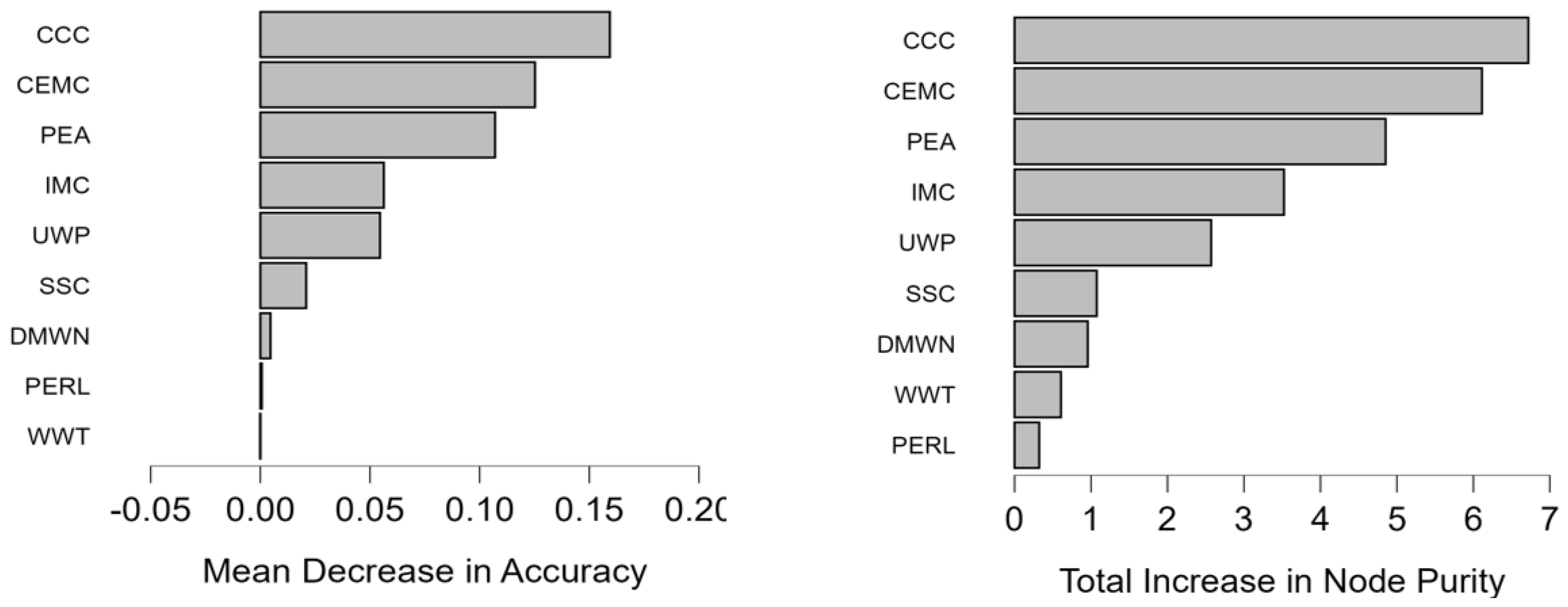

Table 1.
Data and Variables.
| Variables | Abbreviation | Definition |
|---|---|---|
| Research intensity | RI | The percentage of expenditure for intra-muros R&D measures spending by businesses, institutions, universities, and non-profits relative to GDP. Expressed in millions of euros, it indicates research intensity. Higher percentages reflect stronger investment in innovation, highlighting regional strengths, disparities, and the effectiveness of policies promoting research. |
| Current expenditure of municipalities for culture | CEMC | Payments for the protection and enhancement of cultural assets and activities represent the funds allocated per capita, measured in euros. This indicator reflects investment in preserving, promoting, and developing cultural heritage, including museums, historical sites, and cultural events. |
| Pressure of extractive activities | PEA | The pressure of extractive activities measures the volume of non-energy mineral resources extracted per square kilometer, expressed in cubic meters. This indicator reflects the intensity of resource extraction within a region, providing insights into environmental impact, economic activity, and territorial exploitation, especially in regions with significant mining operations. |
| Population exposed to the risk of landslides | PERL | Population exposed to landslide risk refers to the percentage of residents living in areas classified as having high or very high landslide hazard. This indicator highlights regional vulnerability to geological risks, emphasizing the need for effective monitoring, prevention measures, and policies aimed at safeguarding communities and reducing potential damage. |
| Dispersion from municipal water network | DMWN | Water network dispersion measures the percentage of total water losses in municipal distribution systems. It is calculated as the difference between the volume of water supplied to the network and the authorized volume delivered, divided by the total water introduced. High dispersion indicates inefficiencies in water distribution infrastructure. |
| Wastewater treatment | WWT | Wastewater treatment measures the percentage of pollutant loads directed to secondary or advanced treatment plants, expressed in population equivalents. It compares treated urban wastewater to total generated loads (Aetu). Higher percentages indicate better wastewater management, reflecting improved environmental protection and compliance with sanitation standards. |
| Swimming sea coasts | SSC | Swimmable sea coasts represent the percentage of authorized coastal areas suitable for bathing, measured against the total shoreline length according to current regulations. This indicator reflects water quality, environmental protection, and compliance with health standards, contributing to tourism attractiveness and regional sustainability in coastal areas. |
| Internal material consumption | IMC | Internal material consumption measures the amount of material, excluding water and air, used annually by the socio-economic system and released into the environment or accumulated in anthropogenic stocks. This includes emissions, waste, capital goods, and durable products, indicating resource use efficiency, environmental impact, and sustainability of regional economies. |
| Urban waste produced | UWP | Urban waste produced measures the amount of municipal waste generated per inhabitant. This indicator reflects consumption patterns, waste management efficiency, and environmental sustainability. Higher values suggest greater pressure on waste disposal systems, while lower values may indicate effective recycling practices, reduced consumption, or improved waste management policies. |
| Concern for climate change | CCC | Concern for climate change measures the percentage of individuals aged 14 and over who consider climate change, greenhouse effect, or ozone depletion among the top five environmental concerns. This indicator reflects public awareness, environmental consciousness, and regional priorities regarding climate-related issues and ecological sustainability. |
| Graduates and other tertiary qualifications (30-34 years) | GTQ | Graduates and other tertiary qualifications (30-34 years) measure the percentage of individuals aged 30-34 who have attained a tertiary education degree (ISCED levels 5, 6, 7, or 8). This indicator reflects educational achievement, skill levels, and human capital development within a region, influencing innovation and economic growth. |
| Inadequate literacy skills (students in third grade of secondary school) | ILS | Inadequate literacy skills measure the percentage of third-grade lower secondary school students who do not achieve a sufficient level of literacy competence (Level I + Level II out of five levels). This indicator reflects educational shortcomings, highlighting areas where improvements in literacy education are needed to enhance overall academic performance. |
| Transformations from unstable to stable jobs | TUSJ | Transformations from unstable to stable jobs measure the percentage of workers transitioning from temporary or precarious employment to permanent, secure positions. This indicator reflects labor market stability, job quality, and economic resilience. Higher values suggest improved employment conditions, social security, and better opportunities for long-term professional growth. |
| Fatal accident rate and permanent disability | FARPD | The fatal accident rate and permanent disability measure the incidence of work-related fatalities and injuries resulting in permanent disability. This indicator reflects workplace safety, health standards, and labor protection policies. Higher rates indicate greater occupational risks, while lower rates suggest effective safety regulations and improved working conditions. |
| Employees working from home | EWH | Employees working from home measures the percentage of employed individuals who have worked from home at least once in the past four weeks, relative to the total employed population. This indicator reflects flexible work practices, technological infrastructure, and adaptation to remote work, contributing to productivity, work-life balance, and regional innovation. |
| Housing cost overload | HCO | Housing cost overload measures the percentage of individuals living in households where total housing expenses exceed 40% of net household income. This indicator reflects housing affordability, economic pressure, and social inequality. High values suggest financial stress and potential barriers to adequate living conditions, particularly in economically disadvantaged regions. |
| Women and political representation at local level | WPRL | Women and political representation at the local level measures the percentage of women elected to regional councils relative to the total number of elected officials. This indicator reflects gender equality, inclusiveness, and diversity in political decision-making, highlighting progress toward balanced representation and promoting fair governance across regions. |
| Duration of civil proceedings | DCP | Duration of civil proceedings measures the average actual time, in days, required to conclude cases in ordinary courts within the Civil Sector, excluding activities related to guardianship, preventive technical assessment in welfare matters, and sworn declarations since 2017. This indicator reflects judicial efficiency, procedural effectiveness, and regional legal performance. |
| Beds in residential socio-assistance and socio-health facilities | BRSH | Beds in residential socio-assistance and socio-health facilities measure the number of beds available in residential care institutions providing social and healthcare services, calculated per 10,000 inhabitants. This indicator reflects the capacity and accessibility of support services for vulnerable populations, including the elderly, disabled, and individuals requiring long-term care. |
| Beds for high-assistance specialties | BHAS | Beds for high-assistance specialties measure the number of beds available for high-assistance specialties in ordinary inpatient care at public and private healthcare facilities, calculated per 10,000 inhabitants. This indicator reflects the capacity of specialized healthcare services, accessibility, and the ability to address complex medical needs within a region. |
| General practitioners with a number of patients above the threshold | GPPT | General practitioners with a number of patients above the threshold measure the percentage of general practitioners exceeding the maximum limit of 1,500 patients as established by their contract. This indicator reflects healthcare system pressure, workload distribution, and potential challenges in providing adequate care and accessibility within a region. |
| Doctors | DOC | Doctors measure the number of medical professionals per 1,000 inhabitants. This indicator reflects healthcare availability, accessibility, and capacity within a region. Higher values suggest better medical coverage and potentially improved health outcomes, while lower values may indicate inadequate healthcare resources or uneven distribution of medical services. |
Table 2.
Statistical Results for the estimations of the E-Environmental component within the ESG model.
Table 2.
Statistical Results for the estimations of the E-Environmental component within the ESG model.
| Random-effects (GLS), using 355 observations | Fixed-effects, using 355 observations | |||||
| Coefficient | Std. Error | z | Coefficient | Std. Error | t-ratio | |
| Costant | 0.898041*** | 0.0764474 | 11.75 | 0.902803*** | 0.0211912 | 42.60 |
| RI | 0.0144863*** | 0.00161059 | 8.994 | 0.0143448*** | 0.00162909 | 8.805 |
| CEMC | 0.00150251*** | 0.000136447 | 11.01 | 0.00149706*** | 0.000137432 | 10.89 |
| PEA | 0.0366341*** | 0.00765409 | 4.786 | 0.0370686*** | 0.00768529 | 4.823 |
| PERL | 0.00417882*** | 0.000901755 | 4.634 | 0.00425275*** | 0.000905882 | 4.695 |
| DMWN | −0.00281457*** | 0.000746765 | −3.769 | −0.00287448*** | 0.000749879 | −3.833 |
| WWT | 0.00389138*** | 0.000516470 | 7.535 | 0.00396369*** | 0.000520809 | 7.611 |
| SSC | 0.00376110*** | 0.00103044 | 3.650 | 0.00368563*** | 0.00103585 | 3.558 |
| IMC | −0.000217721*** | 8.40591e-05 | −2.590 | −0.000216666*** | 8.45699e-05 | −2.562 |
| UWP | −0.0102253*** | 0.000544453 | −18.78 | −0.0102362** | 0.000546867 | −18.72 |
| CCC | 0.898041*** | 0.0764474 | 11.75 | 0.902803*** | 0.0211912 | 42.60 |
| Statistics | Mean dependent var | 0.942197 | 0.942197 | |||
| Sum squared resid | 47.97826 | 14.47479 | ||||
| Log-likelihood | −148.4800 | 64.22520 | ||||
| Schwarz criterion | 355.6812 | 41.84101 | ||||
| rho | 0.559468 | 0.559468 | ||||
| S.D. dependent var | 0.526264 | 0.526264 | ||||
| S.E. of regression | 0.372378 | 0.210716 | ||||
| Akaike criterion | 316.9601 | −70.45040 | ||||
| Hannan-Quinn | 332.3644 | −25.77791 | ||||
| Durbin-Watson | 0.869103 | 0.869103 | ||||
| Test | 'Between' variance = 0.0997363 'Within' variance = 0.0407741 mean theta = 0.849884 Joint test on named regressors – Asymptotic test statistic: Chi-square(9) = 910.59 with p-value = 3.23307e-190 Breusch-Pagan test - Null hypothesis: Variance of the unit-specific error = 0 Asymptotic test statistic: Chi-square(1) = 1203.95 with p-value = 8.4666e-264 Hausman test - Null hypothesis: GLS estimates are consistent Asymptotic test statistic: Chi-square(9) = 7.50592 with p-value = 0.584597 |
Joint test on named regressors - Test statistic: F(9, 326) = 100.037 with p-value = P(F(9, 326) > 100.037) = 2.77131e-88 Test for differing group intercepts - Null hypothesis: The groups have a common intercept Test statistic: F(19, 326) = 37.2612 with p-value = P(F(19, 326) > 37.2612) = 5.43382e-70 |
||||
Table 3.
Machine Learning Results.
| Model Performance Metrics | Boosting Regression | Decision Tree Regression | K-Nearest Neighbors | Neural Network Regression | Random Forest Regression | Regularized Linear | Support Vector Machine |
| MSE | 0.283 | 0.283 | 0.800 | 0.000 | 1.000 | 0.179 | 0.120 |
| MSE (scaled) | 0.423 | 0.703 | 0.943 | 0.524 | 1.000 | 0.000 | 0.334 |
| RMSE | 0.348 | 0.348 | 0.762 | 0.000 | 1.000 | 0.183 | 0.135 |
| MAE / MAD | 0.360 | 0.675 | 0.879 | 0.247 | 1.000 | 0.280 | 0.699 |
| R² | 0.407 | 0.685 | 0.941 | 0.584 | 1.000 | 0.000 | 0.286 |
Table 4.
Feature Importance Metrics of Random Forest Regression.
| Mean decrease in accuracy | Total increase in node purity | Mean dropout loss | |
| CCC | 0.159 | 6.719 | 0.443 |
| CEMC | 0.125 | 6.113 | 0.373 |
| PEA | 0.107 | 4.852 | 0.364 |
| IMC | 0.056 | 3.524 | 0.310 |
| UWP | 0.055 | 2.571 | 0.301 |
| SSC | 0.021 | 1.074 | 0.270 |
| DMWN | 0.005 | 0.957 | 0.268 |
| WWT | -3.871×10⁻⁵ | 0.607 | 0.265 |
| PERL | 6.808×10⁻⁴ | 0.323 | 0.258 |
Note. Mean dropout loss (defined as root mean squared error (RMSE) is based on 50 permutations.
Table 5.
Additive Explanations for Predictions of Test Set Cases.
| Case | Predicted | Base | CEMC | PEA | PERL | DMWN | WWT | SSC | IMC | UWP | CCC |
| 1 | 1.093 | 0.981 | -0.132 | -0.160 | 0.001 | 0.046 | 0.084 | 0.007 | -0.039 | 0.121 | 0.183 |
| 2 | 0.955 | 0.981 | -0.132 | -0.160 | -2.069×10⁻⁴ | 0.009 | -9.915×10⁻⁴ | 9.123×10⁻⁴ | -0.039 | 0.113 | 0.183 |
| 3 | 0.955 | 0.981 | -0.132 | -0.160 | -2.069×10⁻⁴ | 0.009 | -9.915×10⁻⁴ | 9.123×10⁻⁴ | -0.039 | 0.113 | 0.183 |
| 4 | 0.763 | 0.981 | -0.132 | -0.160 | -0.004 | 0.002 | 1.401×10⁻⁴ | -5.931×10⁻⁴ | -0.039 | -0.067 | 0.183 |
| 5 | 0.776 | 0.981 | -0.132 | -0.160 | -0.004 | 0.002 | 8.190×10⁻⁴ | -5.931×10⁻⁴ | -0.039 | -0.055 | 0.183 |
Note. Displayed values represent feature contributions to the predicted value without features (column 'Base') for the test set.
Table 6.
Results of the regressions for the estimation of S-Social component of the ESG model.
| Fixed-effects, using 337 observations | Random-effects (GLS), using 337 observations | |||||
| Coefficient | Std. Error | t-ratio | Coefficient | Std. Error | z | |
| Const | 1.08624*** | 0.0408855 | 26.57 | 1.07347*** | 0.104704 | 10.25 |
| GTQ | 0.0223283*** | 0.00443713 | 5.032 | 0.0226925*** | 0.00442358 | 5.130 |
| ILS | −0.0185354*** | 0.00134528 | −13.78 | −0.0184570*** | 0.00134173 | −13.76 |
| TUSJ | 0.0133228*** | 0.00122740 | 10.85 | 0.0134224*** | 0.00122414 | 10.96 |
| FARPD | 0.0159775*** | 0.00504362 | 3.168 | 0.0153673*** | 0.00502658 | 3.057 |
| EWH | −0.0909151*** | 0.00492972 | −18.44 | −0.0904198*** | 0.00491540 | −18.40 |
| HCO | −0.0143082*** | 0.00454755 | −3.146 | −0.0134798*** | 0.00451960 | −2.983 |
| Statistics | Mean dependent var | 1.003086 | 1.003086 | |||
| Sum squared resid | 8.624137 | 60.97767 | ||||
| Log-likelihood | 139.4575 | −190.1189 | ||||
| Schwarz criterion | −133.4129 | 420.9783 | ||||
| rho | 0.324154 | 0.324154 | ||||
| S.D. dependent var | 0.491267 | 0.491267 | ||||
| S.E. of regression | 0.166257 | 0.429212 | ||||
| Akaike criterion | −228.9150 | 394.2377 | ||||
| Hannan-Quinn | −190.8493 | 404.8961 | ||||
| Durbin-Watson | 1.203740 | 1.203740 | ||||
| Tests | Joint test on named regressors - Test statistic: F(6, 312) = 139.396 with p-value = P(F(6, 312) > 139.396) = 3.43003e-85 Test for differing group intercepts - Null hypothesis: The groups have a common intercept Test statistic: F(18, 312) = 84.9513 with p-value = P(F(18, 312) > 84.9513) = 1.3568e-108 |
'Between' variance = 0.1647 'Within' variance = 0.0255909 mean theta = 0.906764 Joint test on named regressors - Asymptotic test statistic: Chi-square(6) = 839.232 with p-value = 5.12652e-178 Breusch-Pagan test - Null hypothesis: Variance of the unit-specific error = 0 Asymptotic test statistic: Chi-square(1) = 1356.73 with p-value = 5.30215e-297 Hausman test - Null hypothesis: GLS estimates are consistent Asymptotic test statistic: Chi-square(6) = 13.1298 |
||||
Table 7.
Results of the machine learning estimations.
| Model Performance Metrics | Boosting Regression | Decision Tree | K-Nearest | Neural Network | Random Forest | Regularized Linear | Support Vector Machine |
| MSE | 0.737 | 0.726 | 0.315 | 0.330 | 0.368 | 0.421 | 0.000 |
| MSE (scaled) | 0.772 | 0.450 | 0.331 | 0.290 | 1.000 | 0.526 | 0.000 |
| RMSE | 0.733 | 0.721 | 0.345 | 0.362 | 0.408 | 0.467 | 0.000 |
| MAE / MAD | 0.741 | 0.560 | 0.368 | 0.403 | 0.435 | 0.348 | 0.000 |
| R² | 0.099 | 0.367 | 0.497 | 0.543 | 0.000 | 0.316 | 1.000 |
Table 8.
Feature Importance Metrics of the Support Vector Machine.
| Variables | Mean dropout loss |
| GTQ | 0.733 |
| EWH | 0.517 |
| FARPD | 0.483 |
| TUSJ | 0.483 |
| ILS | 0.443 |
| HCO | 0.424 |
Note. Mean dropout loss (defined as root mean squared error (RMSE)) is based on 50 permutations.
Table 9.
Additive Explanations for Predictions of Test Set Cases.
| Case | Predicted | Base | GTQ | ILS | TUSJ | FARPD | EWH | HCO |
| 1 | 1.015 | 0.954 | -0.214 | 0.057 | -0.152 | 0.101 | 0.106 | 0.162 |
| 2 | 0.868 | 0.954 | -0.214 | 0.057 | -0.152 | 0.101 | 0.106 | 0.015 |
| 3 | 1.256 | 0.954 | 0.968 | -0.241 | 0.212 | -0.328 | -0.266 | -0.042 |
| 4 | 0.028 | 0.954 | 0.848 | -0.295 | -0.152 | -0.353 | -0.928 | -0.047 |
| 5 | 0.917 | 0.954 | -0.214 | 0.057 | -0.152 | 0.101 | 0.106 | 0.064 |
Note. Displayed values represent feature contributions to the predicted value without features (column 'Base') for the test set.
Table 10.
Estimations of the G-Governance component within the ESG model.
| Random-effects (GLS), using 368 observations | Fixed-effects, using 368 observations | |||||
| Coefficient | Std. Error | z | Coefficient | Std. Error | t-ratio | |
| Constant | −0.0543770 | 0.0831284 | −0.6541 | −0.0458096 | 0.0364553 | −1.257 |
| WPRL | 0.00799390*** | 0.00175636 | 4.551 | 0.00795767*** | 0.00176564 | 4.507 |
| DCP | 0.000397798*** | 8.75966e-05 | 4.541 | 0.000411298*** | 8.82844e-05 | 4.659 |
| BRSH | 0.00175261*** | 0.000331245 | 5.291 | 0.00175584*** | 0.000333208 | 5.270 |
| BHAS | 0.187023*** | 0.0123734 | 15.11 | 0.186695*** | 0.0125227 | 14.91 |
| GPPT | 0.0152970*** | 0.00139639 | 10.95 | 0.0153107*** | 0.00141887 | 10.79 |
| DOC | −0.0576331*** | 0.0156592 | −3.680 | −0.0591447*** | 0.0157657 | −3.751 |
| Mean dependent var | 0.953940 | 0.953940 | ||||
| Sum squared resid | 45.46997 | 8.872641 | ||||
| Log-likelihood | −137.4197 | 163.2509 | ||||
| Schwarz criterion | 316.1960 | −172.8917 | ||||
| rho | 0.561927 | 0.561927 | ||||
| S.D. dependent var | 0.523917 | 0.523917 | ||||
| S.E. of regression | 0.354412 | 0.161070 | ||||
| Akaike criterion | 288.8394 | −274.5019 | ||||
| Hannan-Quinn | 299.7079 | −234.1332 | ||||
| Durbin-Watson | 0.866855 | 0.866855 | ||||
| Tests | 'Between' variance = 0.104464 'Within' variance = 0.0241104, mean theta = 0.888394, Joint test on named regressors - Asymptotic test statistic: Chi-square(6) = 1780.22, with p-value = 0 Breusch-Pagan test - Null hypothesis: Variance of the unit-specific error = 0 Asymptotic test statistic: Chi-square(1) = 1792.11 with p-value = 0 Hausman test - Null hypothesis: GLS estimates are consistent Asymptotic test statistic: Chi-square(6) = 6.13334 with p-value = 0.408421 |
Joint test on named regressors - Test statistic: F(6, 342) = 294.604 with p-value = P(F(6, 342) > 294.604) = 7.92931e-132 Test for differing group intercepts - Null hypothesis: The groups have a common intercept Test statistic: F(19, 342) = 68.8318 with p-value = P(F(19, 342) > 68.8318) = 1.95087e-104 |
||||
Table 12.
Results of Machine Learning Regressions.
| Statistics | Boosting Regression | Decision Tree | K-Nearest Neighbors | Neural Network | Random Forest | Regularized Linear | Support Vector Machine |
| MSE | 0.151 | 0.308 | 0.000 | 0.538 | 0.038 | 0.679 | 0.538 |
| MSE (scaled) | 0.175 | 0.401 | 0.000 | 1.000 | 0.110 | 0.500 | 0.854 |
| RMSE | 0.153 | 0.402 | 0.000 | 0.577 | 0.096 | 0.673 | 0.577 |
| MAE / MAD | 0.297 | 0.315 | 0.000 | 0.580 | 0.230 | 0.682 | 0.659 |
| R² | 0.682 | 0.417 | 1.000 | 0.000 | 0.828 | 0.363 | 0.155 |
Table 13.
Feature Importance Metrics.
| Variables | Mean dropout loss |
| BHAS | 0.493 |
| GPPT | 0.438 |
| BRSH | 0.333 |
| WPRL | 0.295 |
| DCP | 0.267 |
| DOC | 0.238 |
Note. Mean dropout loss (defined as root mean squared error (RMSE) is based on 50 permutations.
Table 14.
Additive Explanations for Predictions of Test Set Cases.
| Case | Predicted | Base | WPRL | DCP | BRSH | BHAS | GPPT | DOC |
| 1 | 1.670 | 0.958 | -0.068 | 0.050 | 0.544 | 0.281 | -0.156 | 0.061 |
| 2 | 1.810 | 0.958 | -0.106 | 0.103 | 0.168 | 0.407 | 0.131 | 0.148 |
| 3 | 2.200 | 0.958 | 0.342 | 0.262 | 0.137 | 0.166 | 0.218 | 0.116 |
| 4 | 0.530 | 0.958 | -0.033 | 0.011 | -0.196 | -0.071 | -0.214 | 0.075 |
| 5 | 0.630 | 0.958 | -0.170 | -0.005 | 0.191 | 0.125 | -0.261 | -0.208 |
Note. Displayed values represent feature contributions to the predicted value without features (column 'Base') for the test set.
Disclaimer/Publisher’s Note: The statements, opinions and data contained in all publications are solely those of the individual author(s) and contributor(s) and not of MDPI and/or the editor(s). MDPI and/or the editor(s) disclaim responsibility for any injury to people or property resulting from any ideas, methods, instructions or products referred to in the content. |
© 2025 by the authors. Licensee MDPI, Basel, Switzerland. This article is an open access article distributed under the terms and conditions of the Creative Commons Attribution (CC BY) license (http://creativecommons.org/licenses/by/4.0/).
Copyright: This open access article is published under a Creative Commons CC BY 4.0 license, which permit the free download, distribution, and reuse, provided that the author and preprint are cited in any reuse.


