

Submitted:
24 March 2025
Posted:
25 March 2025
You are already at the latest version
Abstract
Zinc oxide (ZnO), a cheap, abundant, biocompatible, and wide band gap semiconductor material with easy tunable morphologies and properties, makes it one of the mostly studied metal oxides in the area of materials science, physics, chemistry, biochemistry, and solid-state electronics. Its versatility, easy bandgap engineering with transitional and rare earth metals, as well as the diverse nanomorphology empower ZnO as a promising photocatalyst. The use of ZnO as a functional material is attracting increased attention both for academia and industry, especially under the current energy paradigm shift towards clean and renewable sources. Extensive work has been performed in recent years using ZnO as an active component for different photocatalytic applications. Therefore, a thorough and timely review of the process is necessary. The aim of this review is to provide a general summary of the current state of ZnO nanostructures, synthesis strategies, and modification approaches, with the main application focus on varied photocatalysis applications, serving as an introduction, a reference, and an inspiration for future research.
Keywords:
ZnO nanomaterials
; Photocatalysis
; Dye photo degradation
; Water treatment
; H2 generation
; CO2 reduction
1. Introduction
Zinc oxide (ZnO) is a low cost, abundant and safe material that has wide applications in many important areas of our daily life. For instance, in rubber industry, ZnO is used as a vulcanization accelerator activator for tire production, consuming between 50% and 60% of ZnO usage in general. It is also used to modify the ceramic properties in concrete manufacturing including mechanical properties, workability, and appearance. In skin ointments and sunblock creams, ZnO is used to absorb UV light, offering a protection layer. While, in food industry, ZnO is used as a source of zinc. As one of the most important semiconductors, ZnO has been extensively studied for gas sensors [1,2,3,4], solar cells [5], transducers [6,7], photodetectors [8], transistors [9], catalysts [10,11,12] and so on. The detailed ZnO nanomaterial applications are summarized and shown in Figure 1.
ZnO is the second most abundant metal oxide in the Earth's crust, after iron. It's found as the mineral zincite, and appears as a white powder that's nearly insoluble in water. There is a long history of ZnO use and scientific study. Since at least two millennia B.C., ZnO has been used in ointments for treatment of adverse skin conditions in ancient Egypt and later in Rome. ZnO ore was used in brass production in Europe and more importantly in central and eastern Asia since the middle ages. The widespread use of ZnO as a pigment started in the 18th century and applications in watercolors in the 19th century, including ZnO pigment for oil painting using the so-called French process [13]. ZnO has been scientifically studied since at least 1912 [14], and research on its semiconductor properties has been conducted since the 1950s and 1970s. In 1960, ZnO was discovered to have piezoelectric properties, and was used as a thin electron layer in surface acoustic wave devices. ZnO has many unique chemical and physical properties, such as high chemical stability, high electrochemical coupling coefficient, broad range of radiation absorption and high photostability, which make it one of the key metal oxides for technological material and its wide applications. In terms of the optical and electrical properties, ZnO has good transparency, high electron mobility, an outsized exciton binding energy (60 meV), wide band gap (3.37 eV), strong room temperature luminescence, high thermal and mechanical stability at room temperature, broad range of radiation absorption and high photostability, making ZnO one of the most favorite multitasking materials. As a result of its distinctive optical and electrical properties, it is considered to be a possible material in electronic applications, optoelectronic applications and laser technology. What is more, the physical and chemical behaviors of zinc oxide nanoparticles can be easily tuned by manipulating its nano-morphology through various synthesis routes and using different precursors [13].
ZnO has three different crystal structures, wurtzite, rock-salt, and zinc-blende; at ambient conditions, wurtzite structure is the most thermodynamically stable phase. As shown in Figure 2, ZnO has a hexagonal wurtzite crystal structure with a, b, and c lattice parameters, where a=b= 0.3296 nm and c= 0.52065 nm. In the hexagonal wurtzite structure, O2− ions occupy the hexagonal close packing (hcp) array of lattice sites while Zn2+ ions place themselves in alternate tetrahedral holes. The ZnO primitive unit cell (outlined with a thicker black line in Figure 2) contains two formula units, either one zinc ion surrounded by four oxygen ions in a tetrahedral coordination or vice versa [15]. ZnO has (partial) ionic bonding and lacks a center of inversion which results in its piezoelectricity. The noncentrosymmetric tetrahedral coordination in ZnO also results in a crystallographic polarity, and is the key factor for its crystal growth and defect generation.
Under current energy and chemical synthesis scheme shifts to green and sustainable approach, developing efficient energy harvesting and chemical production methods using solar energy has been the focus of both industry and academia. Metal oxides (MOs) are promising photocatalysts for environmental remediation and electronics due to the easy charge carrier’s generation when stimulated with solar energy. They are cost-effective, environmentally friendly, and usually have high surface areas. Titanium dioxide (TiO2) is the most studied metal oxide photocatalyst for wastewater treatment and hydrogen production [16,17]. However, it's only active under ultraviolet light. In comparison, ZnO as a semiconductor with a wide band gap, high thermal conductivity, and high electron mobility, has many advantages for photocatalytic applications compared to TiO2. As summarized in Table 1, compared to TiO2, ZnO has several advantages, including: higher electron mobility, better light absorption across a wider solar spectrum, potentially lower cost, and in some cases, improved photocatalytic activity for certain pollutants, especially when considering bacterial inactivation. ZnO has a broad direct band gap energy of ∼ 3.37 eV. The large band gap of ZnO enables its better utilization of UV range light. Besides, ZnO also exhibits excellent antifouling and antimicrobial properties. It is anticipated that ZnO can also express better photocatalytic performance due to a higher electron mobility of ZnO (100−300 cm2/V·s) compared to that of TiO2 (0.1–4.0 cm2/V·s). What is more, the valence band (VB) position of ZnO is lower than that of TiO2 which can generate hydroxyl radical with higher oxidation potential [18]. Therefore, based on the superior properties, ZnO is considered as a promising alternative for TiO2. Some studies have shown that zinc oxide even has a higher photocatalytic efficiency than TiO2 in degrading hard-to-degrade organic compounds [19].
The focus of ZnO research has now mostly shifted into the realm of novel nanostructures development, where the easily fabricated unipolar n-type ZnO with highly developed surfaces and nanoscale morphologies can be an excellent material for many applications. This is evident in the publication statistics, as shown in Figure 3. In terms of ZnO application in the realm of photocatalysis, publications have increased from less than 50 per year to ~450 in 2023 and the trend is still ongoing. Majority of the papers focus on ZnO nanomaterials dopant engineering, composite material formulation and structure engineering to increase the charge transfer efficiency, aiming to achieve higher solar energy utilization efficiency and catalyst activity.
Despite the extensive efforts and enduring interest on ZnO photocatalysis, its wide application and commercialization still suffer from many limitations, such as difficult catalyst-solvent separation, low light utilization efficiency due to fast electron-hole recombination, water corrosion, and limited light absorption etc. Many approaches have been conducted to tackle the challenges ranging from doping, defect engineering, surface engineering, heterojunction construction to composite formulation etc. Therefore, based on the fast-evolving photocatalytic applications of ZnO based materials, this review paper aims to provide a timely general summary of the current state of ZnO and its related materials’ nanostructures, synthesis strategies, working mechanism, and catalytic performance. Specifically, its use towards photocatalytic applications will be the main focus of the work, including modification and engineering approaches for achieving elevated ZnO photocatalytic performance. At the end, current challenges and future directions in terms of ZnO photocatalysis will be discussed, aiming to serve as an introduction, a reference, and an inspiration for the coming research.
2. ZnO Nanostructure Synthesis
ZnO can be synthesized with a variety of morphologies, including nanoparticles, rods, wires, flakes, flowers, and sheets with semiconducting, piezoelectric, & pyroelectric properties. To name a few, 1D ZnO structures include nano-rods, nanoneedles, nanohelixes, nanosprings, nanorings, nanoribbons, nanotubes, nanobelts, nanowires and nanocombs. Nanoplates/nanosheets and nanopellets are their 2D forms while flowers, dandelions, snow-flakes, coniferous urchin-like structures, etc. count as the 3D morphologies. Novel nanostructures engineering and development has been a hot topic and is till the modern ZnO research trends due to the ease of fabrication using a wide array of methods with many possible shapes and sizes, offering tunable properties. In terms of ZnO nanomaterials synthesis, concentration, composition of the reagents, growth time, temperature, pH of the solution, and the presence of different capping agents all play important role in determining the final ZnO nano morphology. According to work of Vjaceslavs Gerbreders et al. [20], depending different synthesis parameters used, the ZnO morphology can vary from nano particle to nanoplates, nanowalls, and even hollow nanospheres. There are many review papers focusing on the ZnO nanostructure study. For nanostructure, thin film, epitaxial alignment and large ZnO crystal synthesis, reference [21] can be viewed with detailed summary and papers cited. For a detailed synthesis summary (methods, chemical, and synthesis conditions) of different ZnO nanomaterials, [13] can be referred, with a specific focus on green synthesis approaches. Most of the reports on ZnO nanostructure formation in the literature are based on the chemical synthesis approach where Zn salts (acetate, nitrate, etc.) are combined with bases to initiate a reaction leading to zinc hydroxide formation. Zinc hydroxide is then oxidized thermally to create ZnO and increase its crystallinity. The reaction usually occurs in a solvent and the products can be collected as a powder or adsorbed onto a substrate. Besides, physical synthesis also offers a powerful tool. A collection of nanostructures of ZnO can be synthesized under controlled conditions by thermal evaporation of solid powders is shown in Figure 4.
Up to date, ZnO nanostructure including nanospheres, nanoplates, nanorods, nanotubes, nanoneedles, nanoribbons, nanobelts, nanosheets, nanotrees, nanodendrites, nanoflowers, nanoshells, nanocorals, nanovolcanoes, nanopyramids, nanocolumns, nanotowers, nanocombs, nanorings, nanosprings, nanowires, nanocages, nanopencils, nano-pin-cushion cactus, and more have been successfully synthesized. In the work, a simple review on the ZnO nanostructure synthesis approaches for photocatalytic application will be presented with slight touch on their pros and cons. The nanostructures of ZnO are divided into 0, 1D, 2D, and 3D in this review paper. An illustration of the different ZnO nanostructures can be viewed in Figure 5.
2.1. 0D Structure
0D ZnO structure represents nanoparticles (NPs). NPs are known as controlled or manipulated particles at the atomic level of 1–100 nm. They show size-related properties significantly different from bulk materials. Despite its simple morphology, ZnO NPs have been widely studied and applied in catalysis, electronics, rubber, food industry, agriculture [24], dentistry and antimicrobial area etc. It also encompasses a high potential for modifications and properties tuning through surface and structure engineering. ZnO NPs synthesis can be achieved through various chemical and physical methods, including sol-gel, hydrothermal, co-precipitation, microwave synthesis, PVD, ball milling, and biological approaches etc., each offering unique advantages for controlling particle size, shape, and properties. Since ZnO NPs have been extensively studied with many papers summarizing the synthesis methods in the literature. 0D ZnO will not be discussed in detail here. For a detailed synthesis methods and applications, the following review papers can provide ample information [24,25,26].
2.2. 1D Structure
1D ZnO nanostructures have two physical dimensions in the range of 1∼100 nm and a larger third dimension. They have been the focus of intense interest in both academic research and industrial applications as functional materials and building blocks for advanced structures. Generally, four types of 1D NMs have been reported in the literature, including nanotubes (NTs), nanowires (NWs), nanorods (NRs), and nanobelts (NBs) [27]. Owing to their physical dimensions, such NMs have exhibited novel optical, mechanical, and electronic properties. The basic mechanism of 1D ZnO structures’ fabrication is that ZnO seeding can have many growth surfaces with dynamic parameters, serving as a key for different 1D structure growth. There are many methods for the controllable preparation of 1D-ZnO. Based on the growth mechanism, it can be divided into gas–liquid–solid (VLS) growth [28], gas–solid (VS) growth, dislocation induced growth, and polar plane induced growth. Based on the state of the preparation phases, they are mainly classified into the gas-phase method and liquid-phase method [29,30].
Vapor deposition methods have been widely applied for ZnO 1D structure synthesis and include physical vapor deposition (PVD) and chemical vapor deposition (CVD). According to different synthesis methods and products, the source materials can be zinc, zinc oxide, carbon, or other powder materials. PVD generates raw material vapor through a physical process and then deposits it on the substrate. No chemical change occurs during the phase or state transition. The synthesis of 1D ZnO by PVD includes evaporation and deposition steps. Firstly, ZnO powder transforms into ZnO vapor at high temperatures. Then, ZnO vapor goes through deposition and formation of solid nanostructures, such as nanowires, nanobelts, and so on. Due to the high evaporation temperature of ZnO which is around 1975 °C, 1300–1400 °C process temperature is used for ZnO nanostructures preparation under PVD [29]. Compared to PVD, CVD includes not only a physical process but also a chemical process. In the process, Zn powder can be used as starting material for zinc vapor production at high temperature and then following a reaction with oxygen to produce ZnO. In the vapor phase growth process, by controlling the growth kinetics, 1D ZnO with various morphology can be prepared. By precisely controlling the reaction temperature, atmosphere (gas type, gas pressure, and flow rate), deposition temperature, catalyst type, state, substrate type, and position, etc., different 1D structure can be achieved. In the CVD process, metal catalysts are usually used and play an important role for. In the work of Elisabetta Comini et al. [31], Au, Pt, Ag and Cu nanoparticles (NPs) were used to grow 1D ZnO with a VLS mechanism. They observed that morphology transition from nanowires to nanorods of ZnO can realized by using Au as catalyst with increased deposition temperature. While, ZnO (Au) nanowires and nanorods, ZnO (Pt) nanowires and ZnO (Cu) nanowires polycrystalline structure have preferred orientation for (002) growth. The morphology and surface difference finally result in a varied sensing performance for different gasses. Based on the VLS nanowire growth mechanism, positional, orientational, diameter, and density control of 1D ZnO nanowire can also be achieved [28].
The liquid phase reaction offers an easy 1D ZnO synthesis approach and includes liquid phase direct reaction, electrochemical deposition, and sol–gel methods. Solution-based synthesis methods can be conducted at low temperatures (25–200 °C), allowing for its compatibility with many organic substrate materials and offering additional advantages such as straightforward processing, low cost, and ease of scale up [30]. The liquid phase direct reaction mainly includes the hydrothermal reaction method and solvothermal reaction method. The hydrothermal reaction method is to make the raw materials in the aqueous solution under a specific temperature and pressure. Another advantage of solution-based synthesis is the capability to integrate 1D-ZnO on a complex 3D substrate which has pores and spaces where vapor cannot easily get in. Hydrothermal method is the most commonly used way of preparing 1D-ZnO nanorod arrays on a substrate.
Compared to liquid phase methods, advantages of vapor-phase 1D ZnO growth include highly crystalline ZnO nanostructures produced with minimal defects, which is essential for optoelectronic and sensor applications; controlled morphology (nanowires, nanorods, and nanotubes) by easy adjusting of growth parameters such as temperature, pressure, carrier gas flow, and catalyst presence; scalability for industrial applications; high aspect ratio 1D ZnO synthesized and versatility of substrate usage (e.g., silicon, sapphire, and glass). While, there are many limiting factors, such as high temperature requirement, complex equipment system, limited growth control, slow growth rate and potential catalyst contamination. For solution-based approach, it offers a low temperature growth environment with cost effectiveness, high scalability, doping and tunable possibilities for various large area and complicated substrates. Solution based methods are particularly suitable for applications in sensors, photocatalysis, and bioelectronics where large-area deposition and chemical flexibility are advantageous. Therefore, vapor phase and solution phase synthesis approaches both provide valuable merits. Depending on different applications, vapor or solution-based methods need to be carefully considered.
2.3. 2D Structure
2D ZnO structures are materials where the ZnO is reduced to a sheet-like structure with a thickness of a few nanometers or less. 2D single crystals can be used as building blocks for 3D crystals preparation. 2D ZnO structures include nanosheets, nanoribbons, nanowalls, nanoflakes, nanoplates, nanodisks, nanoweb, and nanoring etc. [32]. Due to the high surface to volume ratio, 2D structures can provide a large specific surface area and active sites. Combined with the fast charge transfer ability and tunable chemical and physical properties, 2D ZnO materials are promising in the batteries, supercapacitors, electronics/optoelectronics, photocatalysis, sensing, and piezoelectronic applications [33]. Two synthetic approaches, top–down and bottom–up, are mainly employed for preparing ZnO 2D nanomaterials. However, owing to better results in producing defect-free nanostructures, homogenous chemical composition, etc., the bottom–up approach is more often applied. A top–down approach can be mechanical exfoliation, liquid exfoliation, etc. and a bottom–up approach can be chemical vapor deposition (CVD), wet chemical synthesis, etc.
Top-down methods for synthesizing 2D Zinc Oxide (ZnO) involve breaking down bulk ZnO material into smaller, 2D structures like nanosheets, and include techniques like mechanical grinding, laser ablation, and milling etc. For instance, a liquid metal exfoliation technique is used obtain ZnO nanosheets with lateral dimensions in the millimeter scale and thickness down to 5 nm that takes advantage of the van der Waals forces between the interfacial oxide and the chosen substrate [34]. A wet-chemical etching method is used for 2D spiral ZnO nanocrystals preparation from pyramid ZnO nanoparticles in a solvent mixture of oleic acid (OA) and 1-octylamine [35]. The formation of spiral structure is due to dislocations in the spiral shape surrounding the c-axis formed during the growth of the pyramid ZnO nanoparticles.
A bottom–up synthesis method includes chemical reactions that can be performed under optimized parameters and controlled precursor concentration. Strategies based on bottom–up synthesis are generally more adaptable to yield defect-free 2D ZnO nanosheets. A detailed summary of literature on 2D ZnO nanomaterials synthesis can be viewed in the previous reviews [33]. Using bottom-up approach, 2D ZnO nanosheets were grown by a solid vapor deposition process by Pingsun Qiu et al. at 1000 °C [36]. Reagent grade powders of ZnO, lead oxide and graphite with molar ratio of 3:10:15 were mixed, ground, and placed in a tube furnace. They successfully grown cluster of silk-like nanosheets ZnO onto a polycrystalline alumina substrate. The grown nanosheets are single crystals with a thickness around 50–70 nm, breadth of 50–100 μm and length of 4–6 mm. The same method can also be used for preparing ZnO dendritic nanowires [37]. In the work, spontaneous formation of ZnO dendritic nanowires has been achieved on the faceted surfaces of polyhedral Zn microcrystals by oxidization at 600 °C. The Zn vapor was generated by evaporation of pure Zn metallic powder at 600 °C and transported by Ar gas. Then the synthesized sample was post annealed at 300-600 °C in an open tube at atmospheric condition. The authors found that higher temperature and longer oxidation time can lead to longer wires and an increased number of branches for the nanoweb structure. What is more, 2D ZnO nanosheets with 350–450 nm in transverse size and 80 nm in thickness are also synthesized and dispersed on both the surface and inside of the cellulose based thin films using a ZnCl2 precursor through a two–step hydrothermal synthesis method at room temperature [38].
2.4. 3D Structure
Three-dimensional (3D) zinc oxide (ZnO) structures are made up of nano building blocks that have been assembled into complex hierarchical structures through self-assembly. They have a number of unique properties, including: high surface area with a large surface area to volume ratio, porous structure, improved physical and chemical properties (better electron and ion transportation, increased reaction sites, and enhanced light harvesting etc.). 3D ZnO structures have many applications, including: photocatalysis for hydrogen energy production, gas sensing [39], electrochemical sensors, and electrodes for lithium ion batteries [40] etc. So far, many synthesis strategies based on physical (physical and chemical vapor deposition, laser ablation, ball milling, lithographic, etc.), chemical (gas phase reaction, various solution phase synthesis), or biological methods have been well established to obtain 3D ZnO hierarchical nanostructures. Solution phase based synthesis is still the main method used and includes precipitation, microemulsions, hydrothermal/solvothermal, sol-gel, electrochemical deposition, chemical bath deposition, and so on [41]. Generally, 3D ZnO hierarchical nanostructures can be prepared by using hydrothermal method in combination with heat treatment. A porous structure can be obtained by decomposition of precursor during the high temperature process. At the same time, oxygen vacancies can be introduced and their content can be tuned through calcination atmosphere. Based on the strategies used towards different hierarchical ZnO nanostructures and nanocomposites synthesis, the methods can include multistep sequential growth routes, template-based synthesis, template-free self-organization and precursor or self-templating strategies [42]. A collection of 3D hierarchical ZnO synthesized through different methods can be viewed in Figure 6.
To name a few, ZnO nanorod bundles were prepared through a simple hydrothermal reaction combined with calcination using Zinc acetylacetonate (1.2 mmol) and urea (3.6 mmol) in a mixture of anhydrous methanol (25 mL) and deionized water (5 mL) by Lihua Huo et al. [39]. The bundle structure shows high gas response and selectivity for different drug analytes. Flower-like ZnO hierarchical nanostructures [43] with oxygen vacancies were prepared by the hydrothermal method and calcination treatment in different atmosphere. The effect of calcination atmosphere on the oxygen vacancies and photocatalytic performance of ZnO hierarchical nanostructures were investigated. Hierarchical ZnO nanowires (ZNWs) and nanodisks (ZNDs) are prepared through a two-step synthesis including sequential nucleation and growth following a hydrothermal process by Ravi P. Silva et al [44]. The hierarchical structure is assembled from initial ZnO nanostructures using a two-step seeded growth approach. It is learnt that the formation of these hierarchical structures depends significantly on the concentration of the growth precursor solution, growth time and capping agent concentration. In another work, by using a template-assisted electrodeposition, a bottom-up epitaxial growth of 3D macroporous ZnO self-assembled nanostructures is coated on a p-type silicon substrate [45]. The ZnO formation is due to a chemical reaction between the Zn cations and the OH− molecules that were present in the electrolyte. ZnO hexagonal micro-pyramid/nanosheet has also been prepared using a solvothermal method [46]. The 3D structure is composed of dense nanosheet-built networks that stand on a hexagonal-pyramid-like microcrystal. The hierarchical structure formation depends on the concentration of the EDA solution as well as on the type of zinc source through a two-step sequential growth model.
Up to date, the most commonly used method of engineering diverse morphologies of 3D-ZnO superstructures is through the addition of a “growth modifier”. The modifier can affect the rate of nucleation and growth, and promote or suppress crystal growth in a certain direction, resulting in face-controlled growth. Surfactants, template agents, surface-directing agents, capping agents, or other chemical agents are typically considered growth modifiers, and are utilized to grow the hierarchy in 3D-ZnO superstructures. For instance, surfactants, directing agent and template agent such as Ammonia, Trisodium citrate dihydrate, Triethylamine, Sodium dodecyl sulfate, Polygalacturonic acid, CTAB, Heparin Glycol, Glycerol, Cinnamon champora leaf, and Eryngium foetidum L. can be used to produce 3D ZnO nanostructure as nanoforest, nanoflower, hexagonal ring, plate [51], multi-cage, donut-like [52], wool-ball, and spherical shape [41]. To be noted, under certain circumstance, several growth modifiers are necessary for either single or mixed forms. 3D ZnO structures can also be fabricated using other advanced methods, including: “proximity field nanopatterning” (PnP), a fabrication technique that relies on a conformable phase mask with sub-wavelength features of relief embossed onto its surface. The strategy is developed by Prof. John Rogers and Prof. Paul Braun at UIUC. The PnP process [53] involves three components: (i) a light source, which determines the wavelength, the intensity, and the angular and spectral bandwidth for the photo-exposure, (ii) a soft, elastomeric phase mask, which represents all of the necessary optics, and (iii) a photosensitive material capable of forming a solid structure in the geometry of the 3D distribution of intensity created by passing exposure light through the mask. A step by step PnP fabrication illustration is shown in Figure 7. In the work of Seokwoo Jeon et al. [54], they fabricated a 3D ZnO/ZIF-8 HNS as a highly sensitive and selective light-activated room temperature gas sensor. The 3D nanostructure fabricated using the PnP method shows an ordered and periodic nanostructure that offers effective gas diffusion and enhanced light absorption. There are a few literatures available using PnP method for 3D ZnO synthesis for photocatalysis applications mainly due to its drawbacks including potential alignment issues, limitations in pattern complexity, and the need for precise control over the gap between the mask and the substrate for optimal patterning quality. Other methods include robocasting technique (direct ink writing) [55], Micro-Patterned Lithography (MPL), and ACG can also be used to fabricate complex 3D ZnO nano structures. Despite the ability of creating complex 3D ZnO structures, those advanced methods are still in the R&D stage. Cost reduction and lack of easy scalability are the key issues for their wide applications.
In summary, there are many methods that can be used for 0D, 1D, 2D, and 3D ZnO structure synthesis. Even the same method can be tuned and altered to create different ZnO nanostructures. Therefore, it is important to choose a proper method based on the applications purpose. A summary of the ZnO nanostructure synthesis methods is shown in Figure 8. Currently, low temperature solution-based approach is the most widely used way of ZnO synthesis. By tuning the reaction chemicals and conditions, easy alternation of the ZnO nanostructure can be realized. For instance, Suib et al. [56] used Zinc acetylacetonate as the zinc source with solvothermal syntheses method for varied ZnO structure synthesis. In the work, cauliflower-like, truncated hexagonal conical, tubular and rod-like, hourglass-like, nanorods, and spherical shapes were produced when THF, decane, water, toluene, ethanol, and acetone were used as the solvent, respectively. Fibers (1D), rhombic flakes (2D), and spheres (3D) can be prepared using the same sol-gel method with ZnAc as the solute and various polyols as solvents (EG, G, and DEG) [57]. According to the authors, the morphology difference could be resulted from the chemical interactions between zinc ion and the solvents, forming different coordination configuration. After a rough introduction of the synthesis methods for different ZnO structures. The following part will briefly discuss the mechanism of ZnO in the photocatalysis process including pollutants degradation, H2 generation, VOCs abatement, and CO2 reduction etc.
3. Mechanism of ZnO Photocatalysis
Photocatalysts are essentially semiconductors that catalyze the reaction upon exposure to light. In recent years, photocatalysts evolved as benchmark green catalysts owing to their hazardless and biocompatibility nature. Upon exposure to light, an electron-hole pair can be generated within the semiconductor material. Notable examples of photocatalysts include TiO2 [58], ZnO [59], ferric (III) oxide (Fe2O3) [60], zirconia (ZrO2), vanadium oxide (V2O5), niobium pentoxide (Nb2O5), and tungsten trioxide (WO3) etc. Among the mentioned catalysts, TiO2 is the most widely used followed by ZnO [61,62]. The working mechanism of all the photocatalysts follows the same rules. First, sunlight, UV radiation, and visible light are used as the sources of photonic energy. Electron (e-) and hole (h+) pairs are produced by photons with energy larger than or equal to the photocatalyst band gap (BG). In the generation process of e- and h+ pairs, electrons from valence band (VB) will be excited to conduction band (CB) to release e- and h+ will be formed in the VB. For the photocatalyst to work, both oxidation reactions by h+ and reduction reactions by e- must take place concurrently [63].
In terms of photocatalytic mechanism of ZnO for different applications, when ZnO is exposed to light with a photon energy greater than its band gap energy, electrons in the VB are transferred to the CB, creating electron-hole (e−/h+) pairs. The e−/h+ pairs then travel to the ZnO surface and undergo redox reactions. h+ combines with water and hydroxide ions to create hydroxyl radicals. While e− combines with oxygen to create superoxide radical anions or H2O2. When the generated active species encounter organic pollutants, the organic pollutants are degraded into CO2 and H2O through redox reaction. A detailed mechanism for the photocatalytic oxidation steps involved in the use of ZnO can be found in the work of [64,65]: (i) initially, the pollutants disseminate from the liquid phase to the outer surface of ZnO where adsorption takes place. (ii) During the adsorption process, redox reactions take place followed by desorption of the products. (iii) Finally, the polluted products are removed from the interface. Figure 9 illustrates the detailed mechanism of ZnO photocatalysis. There are mainly three reactions illustrated using ZnO as a photocatalyst agent, namely H2 generation, H2O2 generation and pollutants degradation. Similar photocatalytic mechanisms are involved for the three types of reactions with the difference on reduction reactions where e− goes. For H2O2, when exposed to light, ZnO acts as a photocatalyst, generating electron-hole pairs which can then react with dissolved O2 to produce H2O2 through a two-step process: initially forming superoxide radicals (O2-) and then further reducing them to H2O2 by gaining additional e- [66]. In terms of H2 generation, in redox reactions at the surface of ZnO, H+ in water will be reduced by e− to produce H2 gas, while the h+ oxidizes water to generate O2- [67].
4. Photocatalytic Applications of ZnO
ZnO nanomaterials photocatalytic applications are mainly focused on environmental remediation, biomedical application and clean energy production [68], namely wastewater treatment, air purification, biomedical applications (antimicrobial, anti-cancer, and bioimaging), water splitting, hydrogen peroxide generation, and CO2 reduction etc. Detailed application for each will be discussed in the following parts.
4.1. Wastewater Treatment
Currently, ZnO used along is not sufficient for wastewater treatment. The primary challenges of using ZnO for photocatalytic wastewater treatment include its limited light absorption (primarily UV), rapid recombination of photogenerated electrons and holes, and potential for photo corrosion (leaching of Zn(II) ions), which can reduce its lifespan and introduce secondary pollutants. Therefore, most of the academia efforts are focused on ZnO modifications for improved photocatalytic efficiency and material stability. ZnO nanostructures and its composites have been extensively used for photocatalytic degradation of various pollutants, including organic dyes (like methylene blue (MB), methyl orange (MO), methyl red (MR), Rhodamine B, and Azo dye etc.), pharmaceutical drug (viz., anticancer, antidepressant, antibiotics etc.), heavy metal ion, ammonia and other contaminants in wastewater.
Organic dye photocatalytic degradation is the largest application arena for ZnO in the wastewater treatment with most of the papers published. For instance, modification of ZnO using precious metals is generally applied. High specific surface area and crystalline Ag-ZnO nanoparticle photocatalysts were synthesized by a one-step flame spray pyrolysis and tested for MB photodegradation [69]. The flame-made Ag-ZnO samples showed higher MB degradation efficiency than the wet-made ZnO and reference Titania powders. The increased photocatalytic performance is due to the incorporation of Ag clusters acting to trap photo-induced electrons, retarding the electron–hole recombination process, and thereby, promoting the photocatalytic activity. Similar Ag–ZnO hybrid plasmonic nanostructures have also been prepared by a facile wet-chemical method using citrate as a directing agent [70]. Increased citrate concentration tended to form aggregated nanoparticles and a nano-disk shape at high concentration. The photocatalytic activity of Ag–ZnO hybrid nanostructures towards sun-light driven degradation of MB have been investigated and 94% of MB degradation can be achieved within 20 min duration much higher than 52% performance of bare ZnO due to the decoration of ZnO nanostructures with Ag nanoparticles, suppressing the recombination of photo-generated electrons and holes with improved sun-light utilization from plasmonic response of Ag nanoparticles. Ag–ZnO nanocomposites were also fabricated via a sol–gel route [71]. The catalyst photocatalytic activity was investigated for MB degradation under xenon lamp irradiation. The photocatalytic activity of ZnO was significantly improved after Ag modification. The degradation degree of 97.1% MB for 1% Ag–ZnO can be achieved after 15 min light irradiation. Through a scavenger approach, the author proved that ˙O2− radicals are the main active species responsible for the photodegradation process, and Ag–ZnO heterojunctions can generate more ˙O2− radicals. Besides, TiO2 and ZnO (TZO) semiconductor-semiconductor (S–S) heterojunction nanoparticle with low bandgap energy has been synthesized [72]. Antibacterial properties were evaluated using E-coli and photocatalytic degradation efficiency was performed using both MB and methylene red (MR) dyes under direct sunlight. The TZO has showed high antibacterial effect with a 15±0.8 mm of inhibition zone in gram (-ve) Bactria comparing to that of ZnO NPs (12±0.2) mm. While, photocatalytic degradation of the TZO showed close to 25% and 13% for MB and MR dyes in direct sunlight, respectively. There are more organic pollutants with varied structure and chemical composition that can be degraded through ZnO photocatalytic degradation. More detailed information of the pollutants is summarized in Table 2. Many recent reviews have been published for ZnO’s applications for wastewater treatment. A recent review [73] on photodegradation of organic pollutants using modified ZnO can also be referred. Specific review on drug degradation can be found in [74,75]. Tons of papers have been published using ZnO and its derivatives for organic pollutants photodegradation. However, limited commercialization has been demonstrated. Therefore, detailed review paper summarizing the commercial challenges toward wastewater treatment is much needed.
Heavy metal ions stand for a huge group of wastewater pollutants and pose great threat to human beings. Photocatalytic removal of heavy metal ions is a safe, green and cost-effective approach and shows great promise. Heavy metal ions removal using ZnO particles synthesized through solid precipitation technique has been conducted to study the removal mechanism [76]. The capabilities of ZnO particles in removal of Cu(II), Ag(I), Pb(II), Cr(VI), Mn(II), Cd(II), and Ni(II) ions in aqueous solution under UV light and visible light condition was assessed. The results showed that heavy metal ions such as Cu(II), Ag(I) and Pb(II) ions had a high removal efficiency >85% under exposure of 1 hour of UV light. However, poor removal efficiency, i.e. <15% was observed for Cr(VI), Mn(II), Cd(II) and Ni(II) ions. Through various characterization tools for ZnO particles before and after heavy metal removal tests, two types of heavy metal ions removal mechanisms by ZnO particles are proposed, i.e. (i) physical adsorption and (ii) reduction/oxidation by photo-generated electron-hole pairs. In brief, the heavy metal ions can be removed by ZnO particles either by one of the mechanisms or combined mechanisms depend on the types of metal ions and types of light sources. In another work, Ag-tipped ZnO nanorod arrays decorated with glutathione-protected Au clusters (ZnO-Ag-Au NRAs) have been successfully prepared via photodeposition method and electrostatic self-assembly method [77]. Photocatalytic reduction of Cr (VI) over the samples has been evaluated under UV–vis light (300 nm < λ < 800 nm). The ZnO-Ag-Au sample showed a 60% of Cr reduction within 2 h test with a well maintained tipped and crystalline structure. Controlled experiments have been carried out by utilizing different light irradiation conditions to decipher the photocatalytic mechanism of ZnO-Ag-Au NRAs. Through constructing a semiconductor-metal/metal cluster heterostructures in which Ag nanoparticles are demonstrated to act as an electron mediator and Au clusters serve as a visible light photosensitizer to generate additional charge carriers; increased charge separation and transfer can be achieved. Using a green synthesis approach, N-ZnO@Zeolite was prepared with efficient removal Cr6+ (93%) and Cd2+ (89%) under sunlight irradiation. The removal of the heavy metal ions includes adsorption and photocatalytic reduction. For a detailed summary of ZnO-based nanostorbents such as pristine ZnO NPs, doped ZnO nanostrutes, ZnO nanocomposites, and surface-modified ZnO NPs along with the comparisons of their maximum adsorption capacity for different heavy metal ions (Cd2+, Hg2+, As3+, Pb2+, Cr6+, Ni2+, Co2+, and Cu2+), the review paper [78] can be referred.
Ammonia removal in wastewater using ZnO photocatalysts represents another great opportunity and extensive work have been conducted. Usually, ZnO along shows limited photocatalytic ammonia degradation efficiency. Composites are synthesized to increase the charge transfer, electron and hole generation. Chitin/ZnO was prepared via a sol-gel method to explore its photocatalytic activity for aquaculture wastewater treatment under UV irradiation [79]. Through orthogonal experiments with optimum conditions, 88.73% NH4+–N removal from 60 mg/L synthetic wastewater can be achieved by direct illumination for 120 min using the catalyst. Besides, the results show that purification operation factors including mass ratio rate, dosage, calcination temperature, initial NH4+–N concentration and illumination conditions have a great impact on the NH4+–N removal effectiveness. CuO/ZnO photocatalyst immobilized over rough surface of pottery plate was also prepared by an economical and easy method and used for water ammonia photodegradation [80]. In the optimum conditions, 77.2% ammonia removal from synthetic wastewater could be achieved at pH=10.5. A two-step ZnO-modified strategy (Cu-doped ZnO nanoparticles, immobilized on reduced graphene oxide (rGO) sheets) for the promotion of photocatalytic degradation of NH4+–N under visible light, was also reported [81]. Up to 83.1% of NH4+–N (initial concentration 50 mg·L−1, catalyst dosage 2 g·L−1, pH 10) can be removed within 2 h under Xe lamp irradiation and the major by-product is N2. What is more, the composite shows a ~0.6% photocatalytic decrease after five successive trials. The catalyst is also tested under domestic wastewater conditions with simultaneous removal of chemical oxygen demand (COD), N, and P. The results show that the COD, total nitrogen (TN) and total phosphorus (TP) removal efficiencies can reach 84.3, 80.7, and 90.3%, respectively, indicating its potential commercial applications.
Besides removal of each type of contaminants in wastewater in a single time, multiple contaminants removal at same time can be achieved with proper materials design and is much preferred in practical working conditions. To achieve the goal, multi-functionality engineering on nanocomposite by combining 1D ZnO nanorod and 2D reduced graphene oxide (rGO) for efficient water remediation has been performed [82]. The nano-engineered ZnO NR-rGO nanocomposites showed efficient water remediation in terms of degradation of methylene blue (MB), methyl orange (MO) and rhodamine B (RhB), and removal of Cu (II) and Co (II) heavy metal ions under visible light. The bifunctionality is a result from the high surface area and electron transport of ZnO and rGO combination. Similarly, a CuO–ZnO tetrapodal hybrid nanocomposite was prepared through a facile hydrothermal method [83]. The CuO/ZnO-T nanocomposite exhibited superior photocatalytic efficiency (80% RY-145 dye removal and 86% BV-3 dye removal) and adsorption capacity (99% Cr (VI) removal and 97% Pb (II) removal) as compared to pristine ZnO-T under solar light. With various characterizations performed, the authors concluded that the dye removal is due to ZnO photocatalytic activity, while the heavy metal ions removal is due to adsorption. Other methods of improving the wastewater treatment efficiency is through construction of a hybrid system of photocatalyst materials and microorganisms [84]. The merit of this approach is to use photocatalyst materials to harvest free sun energy and provide high-quality photogenerated electrons to speed up the limiting step of microbial process, i.e. denitrification process. Therefore, the bottleneck of traditional technology in reaction kinetics and treatment efficiency can be tackled. Wastewater photocatalytic treatment contains many opportunities and requirements for novel and high efficiency photocatalysts development. Despite significant research efforts, effective approach to handle all the waste water organic pollutants is still lacking.
4.2. Air Purification
Volatile Organic Compounds (VOCs) have attracted extensive research attention and become one of the main public concerns. VOCs, including aromatics, alcohols, ketones, alkanes, esters, and secondary organic pollutants (such as tropospheric ozone and peroxyacetyl nitrate) pose a serious threat to human health. VOCs can be removed through photocatalytic oxidation, adsorption, absorption, bio-filtration, membrane filtration, incineration, and combustion etc. Among the methods, photocatalytic oxidation offers an effective way for sustainable, green, and large-scale approach for VOCs removal, especially for outdoor environment. ZnO nanoparticles, when exposed to UV light, can oxidize VOCs and other pollutants, converting them into less harmful substances like CO2 and H2O. For example, photocatalytic removal of 480 ppb NO under visible light over Cr-doped ZnO nanoparticles (Cr–ZnO NPs) has been performed by Viet Van Pham et al [85]. In the study, Cr–ZnO NPs are synthesized by a sol–gel method with a narrow band gap. The results show that enhanced NO photocatalytic degradation performance (24.44% for 30 min under visible light), low NO2 conversion yield, and high stability under visible light could be achieved compared to plain ZnO. Ag/ZnO photocatalysts were prepared for effectively decomposition of ethyl acetate, toluene, and ethanol separately and in a mixed state. Due to significantly reduction of the photoelectron-hole pairs recombination in Ag/ZnO, 82%, 78%, and 73% of degradation efficiency, respectively, under visible light, can be achieved [86]. ZnO@Au core-shell structure with Au as core and ZnO as a thin shell was prepared for VOCs photocatalytic abatement [87]. The ZnO@Au showed excellent performance in the total oxidation of toluene (95%) and formaldehyde (85%) with the consequent formation of only CO2 and water as by-products due to efficient electronic communication between the gold core and the zinc oxide shell. A hierarchically structured Ag/ZnO/nBC sample based on biochar is developed for VOC photocatalysis with both mesopores and micropores, aiming to achieve a fast VOC capture and diffusion [88]. The Ag/ZnO/nBC can maximize the reactive oxygen species (e.g., ·OH and ·O2−) production and shows a 7.8 times higher degradation rate of formaldehyde than ZnO with high universality and stability. Chlorobenzene photocatalytic degradation is also demonstrated using metal doped ZnO nanoparticles (Ag/ZnO, Cd/ZnO and Pb/ZnO) [89]. About 100% of chlorobenzene removal efficiency can be obtained using Pb/ZnO nanoparticle within a short duration (< 120 min) under visible light source, indicating the high potential of using modified ZnO as VOC photocatalyst. Work has also been conducted to increase ZnO photo-corrosion-resistance. Nanodiamond-decorated ZnO (ND-ZnO) catalysts have been prepared using a simple dehydration condensation process between the hydroxyl groups on the surface of ZnO and the oxygen-containing functional groups on ND [90]. Almost 100% of toluene degradation within 120 min can be achieved under UV light. Through mechanism study, it is learnt that both ZnO and ND could be excited to generate e−/h+ pairs under UV-365 light irradiation. After decorated with ND, free electrons of ND can transfer to ZnO, forming a built-in electric field. Then the h+ of ZnO can be transferred to ND to react with toluene instead of ZnO itself, thereby inhibiting the photo-corrosion of ZnO effectively. The above-mentioned VOCs degradation testing are carried out in a batch process. A continuous plug flow photoreactor under UV irradiation of 254 nm was also applied for hexane elimination using ZnO impregnated into perlite granules [91]. Despite the low hexane to CO2 conversion (25%) and ZnO deactivation, the work provided valuable experience for realizing continuous VOCs photocatalytic abatement. The research on the VOCs photocatalytic degradation has been moving forward in a fast speed. The state-of-art of recently published papers on high-efficiency photocatalyst VOCs abatement can be viewed in [92]. Specifically, for carbon-based nanocomposites, the paper [93] can be referred.
A table summary for ZnO photocatalytic applications including dye degradation, heavy metal removal, ammonia oxidation, and VOCs abatement is shown in Table 2.
4.3. Antimicrobial Application
Despite the successful control and deactivation of viruses and bacteria using artificial synthesized chemicals, the extensive use of antibiotics and antibacterial drugs has led to strong drug resistance in viruses and bacteria, which further exacerbates the spread of biological infectious diseases. Therefore, it is vital to find an alternative way for the purpose while with minimum adverse effects induced. Semiconductor materials and novel nanomaterials have blazed new trails for the application in the fields of photocatalysis and bacterial inactivation. ZnO-based nanomaterials are widely recognized as promising antibacterial agents due to its strong photocatalytic antibacterial activity, low toxicity, abundance, and tunability etc. Photocatalytic antimicrobial in water treatment using ZnO-based nanostructures has been extensively studied [111]. Besides, ZnO has also been integrated in construction materials (paint, mortar, concrete, wood, others). While the applications are still in the development stage and further investigation of the ZnO nanomaterials effect on the physical-chemical properties and durability of construction materials is needed [112]. The mechanisms of ZnO based materials’ antimicrobial properties are summarized in Figure 10. The mechanism can be divided into non-contact and contact modes. Three main non-contact chemical antibacterial mechanisms exist: (1) generation of reactive oxygenated species (ROS), (2) release of Zn2+ ions, and (3) photoinduced production of H2O2. The chemical antibacterial mechanism is a non-contact mechanism, meaning that ZnO doesn't need to directly touch the bacteria to exert its antimicrobial effect. Besides, ZnO nanoparticles can physically interact with bacterial cell membranes, causing membrane disruption and loss of cellular integrity also known as contact mechanism. The interaction can lead to leakage of intracellular contents and ultimately cell death. During most of the antimicrobial processes, chemical and physical mechanism both present and work together to achieve the goal. For instance, PVP-ZnO NPs have been prepared via a co-precipitation method using polyvinylpyrrolidone (PVP) as a surfactant [113]. The ZnO NPs have a size of 22.13 nm with a spherical-shape. The prepared PVP-ZnO NPs exhibits high photocatalytic activity, achieving 88% and nearly 95% degradation of reactive red-141 azo dye with 10 mg and 20 mg catalyst dosages, respectively. The antibacterial properties of the NPs are also demonstrated against Escherichia coli and Bacillus subtilis, with inhibition zones of 24 mm and 20 mm, respectively. The authors conclude that ROS species’ generation is the main factor for photocatalytic and antimicrobial studies using a profound 2,2-diphenyl-1-picrylhydrazyl (DPPH) free radical scavenging assessment. ZnO nano- and microparticles shapes and sizes also play an important role on cytotoxicity towards cancer cells and bacteria [114]. Different ZnO nano- and microparticles (nanoparticles-NP, nanorods-NR, hierarchical structures-HS, and tetrapods-TP) have been synthesized and tested for antibacterial activity against Escherichia coli and Staphylococcus aureus. The results indicated that for all samples, the bacteria number decreased in a concentration-dependent manner and specific surface area has a significant impact on their antibacterial performance. For ZnO NP, NRs, and HS antibacterial activity, the generation of reactive oxygen species is the main mechanism. Whereas NRs and NPs interact directly with bacterial cell walls and cell membranes. Although ZnO-based nanomaterials have shown great potential in organic pollutants removal and antibacterial properties in aqueous phase, there are still many challenges need to be further resolved, such as long-term exposure toxicity for human with the nanocomposites, better visible light response and utilization, performance under real-life working conditions, and solubility and difficulty in recycling etc.
4.4. Other Applications
Besides the aforementioned applications, there are more challenging and complicated photocatalytic applications using ZnO based nanomaterials, such as H2 generation, H2O2 production, and CO2 reduction etc.
Light-driven photocatalytic water splitting for H2 generation presents a promising route towards solar-to-chemical energy conversion, offering a possible solution for current energy crisis. Rh/GaN–ZnO photocatalyst modified with Al2O3 has been prepared for water splitting reaction. The results show that Ru can suppress reverse reactions to a great extent and consequently enhance the photocatalytic overall water splitting activity by more than an order of magnitude, with an apparent quantum efficiency increase from 0.3% to 7.1% at 420 nm [115]. Water splitting for H2 generation using TiO2 nanoparticles (TiO2 NPs), TiO2 nanotubes (TiO2 NTs), ZnO nanowires (ZnO NWs) and ZnO@TiO2 core–shell structures has been studied under simulated sunlight [116]. The highest photocurrent density and photo-conversion efficiency can be obtained with the ZnO@TiO2 core–shells and with the TiO2 NTs. The core–shell heterostructure reaches up to 0.63 mA cm−2 at 1.7 VRHE and has a maximum STHE of 0.073% (at 0.9 VRHE) under sunlight illumination of AM1.5G (100 mW cm−2). The enhanced performance of the core–shell samples can be attributed to the high electron mobility within the monocrystalline 1D ZnO nanostructure and high specific surface area of the TiO2 polycrystalline shell. Doping of ZnO is an effective way of improving its photo response. P type ZnO is especially the focus. Recent advances of p-type ZnO employed in photocatalytic water splitting can be found in the paper [117]. Despite many advancements in the area, the lack of rigor and reproducibility in the data collection and analysis of experimental results has hindered progress. Therefore, it is important to follow a robust protocol, proper characterization and evaluation methods for overall water splitting. In particular, various pitfalls in photocatalysis research, best practices for reproducibility and reliable methods for conducting rigorous experiments can be found in the review paper [118]. Besides, timely summary and analysis of the past work are equally important to find out future directions and current challenges.
Hydrogen peroxide (H2O2) is widely applied in industrial processes including sterilization, wastewater treatment, fuel cells, and chemical synthesis due to tis effective, versatile and green oxidant characteristics. H2O2 is also regarded as a promising sustainable energy carrier with no harmful byproducts’ formation. H2O2 can be produced either by a direct two-electron O2 reduction process (O2 + 2H+ + 2e− → H2O2) or by a consecutive single-electron O2 reduction route (O2 + e− → ·O2− followed by ·O2− + e− + 2H+ → H2O2). Photocatalytic H2O2 production, as a cheap and clean process, shows great promise. In the regards, ZnO based materials can provide many merits and extensive work has been performed. For instance, a novel COF-based ZnO/TpPa-Cl composite is prepared by electrostatic self-assembly for H2O2 production under simulated solar light [119]. Maximum H2O2 evolution rate of 2443 μmol·g−1·h−1 under simulated solar light irradiation can be achieved. Similar work has been conducted using a ZnO/WO3 step-scheme [66]. Highest H2O2-production rate of 6788 μmol L−1 h−1 can be realized. The enhanced photocatalytic activity is attributed to the formation of interfacial internal electric field (IEF) in the S-scheme heterojunction, boosting the spatial separation of charge carriers and enabling electrons with the strongest reduction power to participate in H2O2 production. There are still many challenges need to be tackled for ZnO based photocatalysts, such as easy recombination of electron-hole pairs, low visible light utilization, and poor product selectivity. Future directions of photocatalysts for H2O2 production can include efficiency improvement, mechanism understanding, selectivity improvement and commercialization efforts. A strategies overview for improving the H2O2 production efficiency can be viewed in the review work [120], including a detailed table summary for reaction conditions and reaction pathway summary of photocatalytic H2O2 production.
For CO2 applications, photocatalytic reduction of CO2 with H2O is most often applied for a clean process formulation and the products are usually C1 species such as methane (CH4), methanol (CH3OH), carbon monoxide (CO), formic acid (HCOOH), and formaldehyde (HCHO). Varied Zn based materials have been applied for CO2 photocatalytic reduction. Zn based M(salen)-COFs have been synthesized and tested for CO2 reduction to syngas under UV irradiation [121]. Among the materials prepared, Co-TAPT-COF-1 exhibited distinct nanotube superstructures and showed the highest activity towards syngas production with CO and H2 production rates of 8.39 mmol g−1 h−1 and 11.31 mmol g−1 h−1, respectively. The results showed that by changing the metal species, coordination environments, and ligands in the M(salen)-COFs, tunable syngas proportions (CO to H2 ratio) could be easily achieved. To improve the process efficiency, Ag-Cu2O/ZnO nanorods (NRs) hybrid photocatalysts are synthesized [122] and photocatalytic reduction of CO2 using H2O vapor is performed. The hybrid catalysts show efficient charge carrier separation/transfer and CO2 adsorption capacity with much improved activity for photocatalytic CO2 reduction to CO under UV–vis light in comparison with the bare ZnO NRs. Mechanistic studies reveal that the deposited Cu2O enhances the CO2 chemisorption and the formation of Z-scheme structure between Cu2O and ZnO facilitates photogenerated charge separation. While, the use of Ag nanoparticles (NPs) onto Cu2O is able to further promote the transfer of electrons due to a “electron sink” effect of Ag. As such, the synergy effect of strong CO2 chemisorption and multiple electrons transfer results in the boosted photocatalytic activity of the Ag-Cu2O/ZnO NRs. Besides single products generation, a mixed product of CO, CH3OH, CH4 and ethanol can also be produced using ZnO/g-C3N4 photocatalyst with CO as the dominant product [123]. As known, producing products with more than one carbon for CO2 photocatalytic reduction is still challenging. The high photoactivity of ZnO/g-C3N4 photocatalyst is due to a synergetic effect between ZnO and g-C3N4. Besides experimental act, modeling work based on first-principles calculations is also conducted to exploit two-dimensional (2D) zinc oxide (ZnO) sheets as a prototype system for CO2 photoreduction [124]. The results shown that not only do they have favorable band edge positions and optical absorbance, but the 2D ZnO sheets can also provide active sites for CO2 reduction with selectivity intrinsically depending on the number of layers and activity being correlated to the O 2p band center. Despite the fact that ZnO is a promising photocatalyst for CO2 reduction, its wide bandgap and visible light absorption limitations, along with challenges in product selectivity and reaction mechanism understanding, still hinder its practical applications. Besides, the reaction mechanisms still need to be further understood to guide future catalyst design. A review speficially focuses on photocatalytic conversion of CO2 using ZnO semiconductor through hydrothermal method is cited here [125].
4.5. Strategies for ZnO Photocatalytic Performance Enhancement
As mentioned in the previous section, the photocatalytic applications of ZnO for different processes basically suffer from the same challenges. Therefore, there are four main approaches to improve a ZnO’s photocatalytic performance independent of the applications, including: (1) employing a semiconductor with a low band gap Eg; (2) creating a localized state just above the valence band or creating a localized state just beneath the conduction band; (3) forming a color center in the band gap, and (4) surface modification. Specifically, the following techniques can be used to do the work: (i) metal and non-metal doping, (ii) co-doping, (iii) composites construction, (iv) substitution, (v) sensitization, and (vi) various other methods [111,117,118,120,126]. For instance, alteration in the properties of ZnO can be done by the introduction of foreign elements through metal doping, nonmetal doping, and formation of coupled materials with other semiconductor materials. The introduction of foreign elements not only shifts the absorption but also increases the life span of the photoproduced charged species. Interestingly, defects can be formed via simple ball-milling treatment, and part of the defects can also be repaired via annealing treatment. The photocatalytic activity of the ZnO sharply decreased as the ball-milling speed and milling time increased [127]. Besides, the surface properties can be engineered by various synthesis methods and addition of surfactant during the synthesis. For a detailed modification strategies summary, such as tailoring the intrinsic defects, surface modification with organic compounds, doping with foreign ions, noble metal deposition, heterostructure with other semiconductors and modification with carbon nanostructures in terms of photoactivity and stability improvement of ZnO, the review paper provides a good reference [128]. Due to the extensive literature available for ZnO based photocatalytic applications, limited content is covered in this work. Therefore, a summary of the previously published review papers is listed in Table 3 for an easy topic looking up based on certain foci.
5. Discussion of Current Challenges and Future Opportunities
ZnO nanostructures have been extensively studied and shown to be a potential photocatalyst candidate for solar-driven photodegradation of persistent organic pollutants, VOCs abatement, antimicrobial agents, and chemical synthesis, attributing to its low production cost (75% lower in comparison to TiO2 and Al2O3), non-toxic and ability to absorb larger fraction of solar spectrum compared to TiO2. Tons of literature have been published with a fast speed, focusing on modification of ZnO with introduction of doping, other metal, metal oxides or non-metal. The varied and wide photocatalytic applications of ZnO related materials make a clear and thorough summary challenging. Despite many advancements in the lab conditions, there are few commercialization efforts. For instance, most of the work for organic pollutants photodegradation are conducted using simulated single or multiple compounds, far from the real-life working conditions. Many of the materials need incorporation of precious metals (Table 2), making the large-scale production questionable. Besides, ZnO in powder form is usually applied, making the recycling and recovery a problem.
There are mainly three technical challenges facing ZnO related materials photocatalytic applications, namely, the high recombination of electron-hole pairs, low visible light utilization, and poor product selectivity. Photogenerated electron-hole pairs can recombine quickly, which decreases the lifetime of active species. Besides, many materials are only active under ultraviolet light, which is expensive to produce with limited access. Interfacial charge recombination and long-term stability have collectively yielded poor electron injection efficiency and thereby low current density and efficiency of the ZnO based photocatalytic samples. What is more, poor control of the properties of individual building blocks and low device-to-device reproducibility are further areas that require further improvement. Currently, structure engineering, construction of heterogeneous structure, surface engineering, and doping are the main approaches used to tackle the challenges. However, the photocatalytic efficiency for certain applications are still not satisfying. Therefore, future work can be focused on development of a photocatalyst with a wider light absorption; commercialization of ZnO based materials for environmental applications; green synthesis method with high sustainability and less environmental adverse effect, and mathematical models’ establishment for photocatalytic operations/systems in order to predict the quantum yield, kinetics and optimum conditions of the corresponding processes.
Author Contributions
The authors confirm contribution to the paper as follows: Review paper structure formulation, topic pick, literature search, data analysis and summary, and draft manuscript preparation: Chunxiang Zhu; literature collection, analysis and draft manuscript preparation: Xihui Wang. All authors reviewed the results and approved the final version of the manuscript.
Funding
This research received no external funding.
Data Availability Statement
No new data were created or analyzed in this study.
Acknowledgments
There are no acknowledgments for this work.
Conflicts of Interest
The authors declare no conflicts of interest.
References
- Zhang, B.; Sun, J.; Salahuddin, U.; Gao, P.-X. Hierarchical and Scalable Integration of Nanostructures for Energy and Environmental Applications: A Review of Processing, Devices, and Economic Analyses. Nano Futures 2020, 4, 012002. [Google Scholar] [CrossRef]
- Zhang, B.; Gao, P.-X. Metal Oxide Nanoarrays for Chemical Sensing: A Review of Fabrication Methods, Sensing Modes, and Their Inter-Correlations. Front Mater 2019, 6. [Google Scholar] [CrossRef]
- Zhang, B.; Sun, J.; Gao, P. Single Bimodular Sensor for Differentiated Detection of Multiple Oxidative Gases. Adv Mater Technol 2020, 5. [Google Scholar] [CrossRef]
- Zhang, B.; Sun, J.Y.; Gao, P.X. Low-Concentration NOx Gas Analysis Using Single Bimodular ZnO Nanorod Sensor. ACS Sens 2021, 6, 2979–2987. [Google Scholar] [CrossRef]
- Wibowo, A.; Marsudi, M.A.; Amal, M.I.; Ananda, M.B.; Stephanie, R.; Ardy, H.; Diguna, L.J. ZnO Nanostructured Materials for Emerging Solar Cell Applications. RSC Adv 2020, 10, 42838–42859. [Google Scholar] [CrossRef]
- Ti, J.; Li, J.; Fan, Q.; Ren, W.; Yu, Q.; Wang, C. Magnetron Sputtering of ZnO Thick Film for High Frequency Focused Ultrasonic Transducer. J Alloys Compd 2023, 933, 167764. [Google Scholar] [CrossRef]
- Liu, W.; Shan, L.; Lin, Z.; Wan, B.; Yang, B.; Zeng, X.; Yang, B.; Pelenovich, V. Dual-Wave ZnO Film Ultrasonic Transducers for Temperature and Stress Measurements. Sensors 2024, 24, 5691. [Google Scholar] [CrossRef]
- Deka Boruah, B. Zinc Oxide Ultraviolet Photodetectors: Rapid Progress from Conventional to Self-Powered Photodetectors. Nanoscale Adv 2019, 1, 2059–2085. [Google Scholar] [CrossRef]
- Jiang, L.; Li, J.; Huang, K.; Li, S.; Wang, Q.; Sun, Z.; Mei, T.; Wang, J.; Zhang, L.; Wang, N.; et al. Low-Temperature and Solution-Processable Zinc Oxide Transistors for Transparent Electronics. ACS Omega 2017, 2, 8990–8996. [Google Scholar] [CrossRef]
- Sun, J.; Liu, F.; Salahuddin, U.; Wu, M.; Zhu, C.; Lu, X.; Zhang, B.; Zhao, B.; Xie, Z.; Ding, Y.; et al. Optimization and Understanding of ZnO Nanoarray Supported Cu-ZnO-Al2O3 Catalyst for Enhanced CO2 -Methanol Conversion at Low Temperature and Pressure. Chemical Engineering Journal 2022. [Google Scholar] [CrossRef]
- Zhu, C.; Du, S.; Wang, S.; Lu, X.; Zhang, M.; Zhang, B.; Liu, F.; Xiao, W.; Guo, Y.; Ding, J.; et al. PGM-Free Metal Oxide Nanoarray Forests for Water-Promoted Low-Temperature Soot Oxidation. Appl Catal B 2024, 341, 123336. [Google Scholar] [CrossRef]
- Spencer, M.S. The Role of Zinc Oxide in Cu/ZnO Catalysts for Methanol Synthesis and the Water-Gas Shift Reaction. Top Catal 1999, 8, 259–266. [Google Scholar] [CrossRef]
- Raha, S.; Ahmaruzzaman, M. ZnO Nanostructured Materials and Their Potential Applications: Progress, Challenges and Perspectives. Nanoscale Adv 2022, 4, 1868–1925. [Google Scholar] [PubMed]
- Sharma, P.; Hasan, M.R.; Mehto, N.K. ; Deepak; Bishoyi, A.; Narang, J. 92 Years of Zinc Oxide: Has Been Studied by the Scientific Community since the 1930s- An Overview. Sensors International.
- Samadi, M.; Zirak, M.; Naseri, A.; Khorashadizade, E.; Moshfegh, A.Z. Recent Progress on Doped ZnO Nanostructures for Visible-Light Photocatalysis. Thin Solid Films 2016, 605, 2–19. [Google Scholar] [CrossRef]
- Lu, X.; Tang, W.; Du, S.; Wen, L.; Weng, J.; Ding, Y.; Willis, W.S.; Suib, S.L.; Gao, P.X. Ion-Exchange Loading Promoted Stability of Platinum Catalysts Supported on Layered Protonated Titanate-Derived Titania Nanoarrays. ACS Appl Mater Interfaces 2019. [Google Scholar] [CrossRef]
- Lu, X.; Dang, Y.; Li, M.; Zhu, C.; Liu, F.; Tang, W.; Weng, J.; Ruan, M.; Suib, S.L.; Gao, P.X. Synergistic Promotion of Transition Metal Ion-Exchange in TiO2 Nanoarray-Based Monolithic Catalysts for the Selective Catalytic Reduction of NOx with NH3. Catal Sci Technol 2022, 12, 5397–5407. [Google Scholar] [CrossRef]
- Turkten, N.; Bekbolet, M. Photocatalytic Performance of Titanium Dioxide and Zinc Oxide Binary System on Degradation of Humic Matter. J Photochem Photobiol A Chem 2020, 401, 112748. [Google Scholar] [CrossRef]
- O’Neill, S.; Robertson, J.M.C.; Héquet, V.; Chazarenc, F.; Pang, X.; Ralphs, K.; Skillen, N.; Robertson, P.K.J. Comparison of Titanium Dioxide and Zinc Oxide Photocatalysts for the Inactivation of Escherichia Coli in Water Using Slurry and Rotating-Disk Photocatalytic Reactors. Ind Eng Chem Res 2023. [Google Scholar] [CrossRef]
- Gerbreders, V.; Krasovska, M.; Sledevskis, E.; Gerbreders, A.; Mihailova, I.; Tamanis, E.; Ogurcovs, A. Hydrothermal Synthesis of ZnO Nanostructures with Controllable Morphology Change. CrystEngComm 2020, 22, 1346–1358. [Google Scholar] [CrossRef]
- Borysiewicz, M.A. ZnO as a Functional Material, a Review. Crystals (Basel) 2019, 9. [Google Scholar] [CrossRef]
- Wang, Z.L. Nanostructures of Zinc Oxide. Materials Today 2004, 7, 26–33. [Google Scholar] [CrossRef]
- Gautam, P.; Gupta, S.; Siddiqui, I.; Lin, W.-Z.; Sharma, D.; Ranjan, A.; Tai, N.-H.; Lu, M.-Y.; Jou, J.-H. 0, 1, 2, and 3-Dimensional Zinc Oxides Enabling High-Efficiency OLEDs. Chemical Engineering Journal 2024, 495, 153220. [Google Scholar] [CrossRef]
- Wang, Z.; Wang, S.; Ma, T.; Liang, Y.; Huo, Z.; Yang, F. Synthesis of Zinc Oxide Nanoparticles and Their Applications in Enhancing Plant Stress Resistance: A Review. Agronomy 2023, 13, 3060. [Google Scholar] [CrossRef]
- Dey, S.; Mohanty, D. lochan; Divya, N.; Bakshi, V.; Mohanty, A.; Rath, D.; Das, S.; Mondal, A.; Roy, S.; Sabui, R. A Critical Review on Zinc Oxide Nanoparticles: Synthesis, Properties and Biomedical Applications. Intelligent Pharmacy 2024. [Google Scholar] [CrossRef]
- Sirelkhatim, A.; Mahmud, S.; Seeni, A.; Kaus, N.H.M.; Ann, L.C.; Bakhori, S.K.M.; Hasan, H.; Mohamad, D. Review on Zinc Oxide Nanoparticles: Antibacterial Activity and Toxicity Mechanism. Nanomicro Lett 2015, 7, 219–242. [Google Scholar] [CrossRef]
- Udom, I.; Ram, M.K.; Stefanakos, E.K.; Hepp, A.F.; Goswami, D.Y. One Dimensional-ZnO Nanostructures: Synthesis, Properties and Environmental Applications. Mater Sci Semicond Process 2013, 16, 2070–2083. [Google Scholar] [CrossRef]
- Yang, P.; Yan, H.; Mao, S.; Russo, R.; Johnson, J.; Saykally, R.; Morris, N.; Pham, J.; He, R.; Choi, H.-J. Controlled Growth of ZnO Nanowires and Their Optical Properties. Adv Funct Mater 2002, 12, 323. [Google Scholar] [CrossRef]
- Zhao, X.; Li, Q.; Xu, L.; Zhang, Z.; Kang, Z.; Liao, Q.; Zhang, Y. Interface Engineering in 1D ZnO-Based Heterostructures for Photoelectrical Devices. Adv Funct Mater 2022, 32. [Google Scholar] [CrossRef]
- Weintraub, B.; Zhou, Z.; Li, Y.; Deng, Y. Solution Synthesis of One-Dimensional ZnO Nanomaterials and Their Applications. Nanoscale 2010, 2, 1573. [Google Scholar] [CrossRef]
- Moumen, A.; Kaur, N.; Poli, N.; Zappa, D.; Comini, E. One Dimensional ZnO Nanostructures: Growth and Chemical Sensing Performances. Nanomaterials 2020, 10, 1–16. [Google Scholar] [CrossRef]
- Srivastava, A.; Katiyar, A. Zinc Oxide Nanostructures. In Ceramic Science and Engineering; Elsevier, 2022; pp. 235–262.
- Patil, S.A.; Jagdale, P.B.; Singh, A.; Singh, R.V.; Khan, Z.; Samal, A.K.; Saxena, M. 2D Zinc Oxide – Synthesis, Methodologies, Reaction Mechanism, and Applications. Small 2023, 19. [Google Scholar] [CrossRef]
- Krishnamurthi, V.; Ahmed, T.; Mohiuddin, M.; Zavabeti, A.; Pillai, N.; McConville, C.F.; Mahmood, N.; Walia, S. A Visible-Blind Photodetector and Artificial Optoelectronic Synapse Using Liquid-Metal Exfoliated ZnO Nanosheets. Adv Opt Mater 2021, 9. [Google Scholar] [CrossRef]
- Han, X.; Zhou, X.; Jiang, Y.; Xie, Z. The Preparation of Spiral ZnO Nanostructures by Top-down Wet-Chemical Etching and Their Related Properties. J Mater Chem 2012, 22, 10924. [Google Scholar] [CrossRef]
- Deng, G.; Ding, A.; Cheng, W.; Zheng, X.; Qiu, P. Two-Dimensional Zinc Oxide Nanostructure. Solid State Commun 2005, 134, 283–286. [Google Scholar] [CrossRef]
- Fan, H.J.; Scholz, R.; Kolb, F.M.; Zacharias, M. Two-Dimensional Dendritic ZnO Nanowires from Oxidation of Zn Microcrystals. Appl Phys Lett 2004, 85, 4142–4144. [Google Scholar] [CrossRef]
- Zhou, X.; Li, X.; Gao, Y.; Li, L.; Huang, L.; Ye, J. Preparation and Characterization of 2D ZnO Nanosheets/Regenerated Cellulose Photocatalytic Composite Thin Films by a Two-Step Synthesis Method. Mater Lett 2019, 234, 26–29. [Google Scholar] [CrossRef]
- Gao, R.; Cheng, X.; Gao, S.; Zhang, X.; Xu, Y.; Zhao, H.; Huo, L. Highly Selective Detection of Saturated Vapors of Abused Drugs by ZnO Nanorod Bundles Gas Sensor. Appl Surf Sci 2019, 485, 266–273. [Google Scholar] [CrossRef]
- Xu, X.; Cao, K.; Wang, Y.; Jiao, L. 3D Hierarchical Porous ZnO/ZnCo 2 O 4 Nanosheets as High-Rate Anode Material for Lithium-Ion Batteries. J Mater Chem A Mater 2016, 4, 6042–6047. [Google Scholar] [CrossRef]
- Wang, X.; Ahmad, M.; Sun, H. Three-Dimensional ZnO Hierarchical Nanostructures: Solution Phase Synthesis and Applications. Materials 2017, 10, 1304. [Google Scholar] [CrossRef]
- Xia, Y.; Wang, J.; Chen, R.; Zhou, D.; Xiang, L. A Review on the Fabrication of Hierarchical ZnO Nanostructures for Photocatalysis Application. Crystals (Basel) 2016, 6, 148. [Google Scholar] [CrossRef]
- Bi, T.; Du, Z.; Chen, S.; He, H.; Shen, X.; Fu, Y. Preparation of Flower-like ZnO Photocatalyst with Oxygen Vacancy to Enhance the Photocatalytic Degradation of Methyl Orange. Appl Surf Sci 2023, 614, 156240. [Google Scholar] [CrossRef]
- Alenezi, M.R.; Henley, S.J.; Emerson, N.G.; Silva, S.R.P. From 1D and 2D ZnO Nanostructures to 3D Hierarchical Structures with Enhanced Gas Sensing Properties. Nanoscale 2014, 6, 235–247. [Google Scholar] [CrossRef]
- Naderi, N.; Ahmad, H.; Yasin, M. Bottom-up Self-Assembly of Macroporous ZnO Nanostructures for Photovoltaic Applications. Ceram Int 2023, 49, 26994–27002. [Google Scholar] [CrossRef]
- Lu, F.; Cai, W.; Zhang, Y. ZnO Hierarchical Micro/Nanoarchitectures: Solvothermal Synthesis and Structurally Enhanced Photocatalytic Performance. Adv Funct Mater 2008, 18, 1047–1056. [Google Scholar] [CrossRef]
- Zhang, D.-F.; Sun, L.-D.; Zhang, J.; Yan, Z.-G.; Yan, C.-H. Hierarchical Construction of ZnO Architectures Promoted by Heterogeneous Nucleation. Cryst Growth Des 2008, 8, 3609–3615. [Google Scholar] [CrossRef]
- Xu, C.; Wang, Y.; Chen, H. Rapid and Simple Synthesis of 3D ZnO Microflowers at Room Temperature. Mater Lett 2015, 158, 347–350. [Google Scholar] [CrossRef]
- Zhang, Y.; Xu, J.; Xiang, Q.; Li, H.; Pan, Q.; Xu, P. Brush-Like Hierarchical ZnO Nanostructures: Synthesis, Photoluminescence and Gas Sensor Properties. The Journal of Physical Chemistry C 2009, 113, 3430–3435. [Google Scholar] [CrossRef]
- Li, J.; Fan, H.; Jia, X. Multilayered ZnO Nanosheets with 3D Porous Architectures: Synthesis and Gas Sensing Application. The Journal of Physical Chemistry C 2010, 114, 14684–14691. [Google Scholar] [CrossRef]
- Kakarndee, S.; Nanan, S. SDS Capped and PVA Capped ZnO Nanostructures with High Photocatalytic Performance toward Photodegradation of Reactive Red (RR141) Azo Dye. J Environ Chem Eng 2018, 6, 74–94. [Google Scholar] [CrossRef]
- Li, M.; Bao, L.; Yin, Z.; Ji, X. Heparin-Mediated Growth of Self-Organized ZnO Quasi-Microspheres with Twinned Donut-Like Hierarchical Structures. ChemistrySelect 2019, 4, 7805–7810. [Google Scholar] [CrossRef]
- Shir, D.J.; Jeon, S.; Liao, H.; Highland, M.; Cahill, D.G.; Su, M.F.; El-Kady, I.F.; Christodoulou, C.G.; Bogart, G.R.; Hamza, A. V.; et al. Three-Dimensional Nanofabrication with Elastomeric Phase Masks. J Phys Chem B 2007, 111, 12945–12958. [Google Scholar] [CrossRef] [PubMed]
- Lee, J.; Lee, H.; Bae, T.-H.; Cho, D.; Choi, M.; Bae, G.; Shim, Y.-S.; Jeon, S. 3D ZnO/ZIF-8 Hierarchical Nanostructure for Sensitive and Selective NO 2 Sensing at Room Temperature. Small Struct 2024, 5. [Google Scholar] [CrossRef]
- Tubío, C.R.; Guitián, F.; Gil, A. Fabrication of ZnO Periodic Structures by 3D Printing. J Eur Ceram Soc 2016, 36, 3409–3415. [Google Scholar] [CrossRef]
- Xu, L.; Hu, Y.-L.; Pelligra, C.; Chen, C.-H.; Jin, L.; Huang, H.; Sithambaram, S.; Aindow, M.; Joesten, R.; Suib, S.L. ZnO with Different Morphologies Synthesized by Solvothermal Methods for Enhanced Photocatalytic Activity. Chemistry of Materials 2009, 21, 2875–2885. [Google Scholar] [CrossRef]
- Tseng, Y.-K.; Chuang, M.-H.; Chen, Y.-C.; Wu, C.-H. Synthesis of 1D, 2D, and 3D ZnO Polycrystalline Nanostructures Using the Sol-Gel Method. J Nanotechnol 2012, 2012, 1–8. [Google Scholar] [CrossRef]
- Lu, X.; Liu, F.; Dang, Y.; Li, M.; Ruan, M.; Wu, M.; Zhu, C.; Mani, T.; Suib, S.L.; Gao, P.-X. Transition-Metal Doped Titanate Nanowire Photocatalysts Boosted by Selective Ion-Exchange Induced Defect Engineering. Appl Surf Sci 2022, 591, 153116. [Google Scholar] [CrossRef]
- Ghamarpoor, R.; Fallah, A.; Jamshidi, M. A Review of Synthesis Methods, Modifications, and Mechanisms of ZnO/TiO2-Based Photocatalysts for Photodegradation of Contaminants. ACS Omega 2024, 9, 25457–25492. [Google Scholar] [CrossRef]
- Arzaee, N.A.; Betti, N.; Al-Amiery, A.; Roslam Wan Isahak, W.N. The Role of Tin Species in Doped Iron (III) Oxide for Photocatalytic Degradation of Methyl Orange Dye under UV Light. Heliyon 2023, 9, e18076. [Google Scholar] [CrossRef]
- Ola, O.; Maroto-Valer, M.M. Review of Material Design and Reactor Engineering on TiO2 Photocatalysis for CO2 Reduction. Journal of Photochemistry and Photobiology C: Photochemistry Reviews 2015, 24, 16–42. [Google Scholar] [CrossRef]
- Armaković, S.J.; Savanović, M.M.; Armaković, S. Titanium Dioxide as the Most Used Photocatalyst for Water Purification: An Overview. Catalysts 2022, 13, 26. [Google Scholar] [CrossRef]
- Chakravorty, A.; Roy, S. A Review of Photocatalysis, Basic Principles, Processes, and Materials. Sustainable Chemistry for the Environment 2024, 8, 100155. [Google Scholar] [CrossRef]
- Ong, C.B.; Ng, L.Y.; Mohammad, A.W. A Review of ZnO Nanoparticles as Solar Photocatalysts: Synthesis, Mechanisms and Applications. Renewable and Sustainable Energy Reviews 2018, 81, 536–551. [Google Scholar] [CrossRef]
- Mohamed, K.M.; Benitto, J.J.; Vijaya, J.J.; Bououdina, M. Recent Advances in ZnO-Based Nanostructures for the Photocatalytic Degradation of Hazardous, Non-Biodegradable Medicines. Crystals (Basel) 2023, 13, 329. [Google Scholar] [CrossRef]
- Jiang, Z.; Cheng, B.; Zhang, Y.; Wageh, S.; Al-Ghamdi, A.A.; Yu, J.; Wang, L. S-Scheme ZnO/WO3 Heterojunction Photocatalyst for Efficient H2O2 Production. J Mater Sci Technol 2022, 124, 193–201. [Google Scholar] [CrossRef]
- Dagareh, M.I.; Hafeez, H.Y.; Mohammed, J.; Kafadi, A.D.G.; Suleiman, A.B.; Ndikilar, C.E. Current Trends and Future Perspectives on ZnO-Based Materials for Robust and Stable Solar Fuel (H2) Generation. Chemical Physics Impact 2024, 9, 100774. [Google Scholar] [CrossRef]
- Sun, Y.; Zhang, W.; Li, Q.; Liu, H.; Wang, X. Preparations and Applications of Zinc Oxide Based Photocatalytic Materials. Advanced Sensor and Energy Materials 2023, 2, 100069. [Google Scholar] [CrossRef]
- Height, M.J.; Pratsinis, S.E.; Mekasuwandumrong, O.; Praserthdam, P. Ag-ZnO Catalysts for UV-Photodegradation of Methylene Blue. Appl Catal B 2006, 63, 305–312. [Google Scholar] [CrossRef]
- Kuriakose, S.; Choudhary, V.; Satpati, B.; Mohapatra, S. Enhanced Photocatalytic Activity of Ag–ZnO Hybrid Plasmonic Nanostructures Prepared by a Facile Wet Chemical Method. Beilstein Journal of Nanotechnology 2014, 5, 639–650. [Google Scholar] [CrossRef]
- Zhu, X.; Wang, J.; Yang, D.; Liu, J.; He, L.; Tang, M.; Feng, W.; Wu, X. Fabrication, Characterization and High Photocatalytic Activity of Ag–ZnO Heterojunctions under UV-Visible Light. RSC Adv 2021, 11, 27257–27266. [Google Scholar] [CrossRef]
- Mousa, H.M.; Alenezi, J.F.; Mohamed, I.M.A.; Yasin, A.S.; Hashem, A.-F.M.; Abdal-hay, A. Synthesis of TiO2@ZnO Heterojunction for Dye Photodegradation and Wastewater Treatment. J Alloys Compd 2021, 886, 161169. [Google Scholar] [CrossRef]
- Rasheed, H.M.; Aroosh, K.; Meng, D.; Ruan, X.; Akhter, M.; Cui, X. A Review on Modified ZnO to Address Environmental Challenges through Photocatalysis: Photodegradation of Organic Pollutants. Mater Today Energy 2025, 48, 101774. [Google Scholar] [CrossRef]
- Majumder, S.; Chatterjee, S.; Basnet, P.; Mukherjee, J. ZnO Based Nanomaterials for Photocatalytic Degradation of Aqueous Pharmaceutical Waste Solutions – A Contemporary Review. Environ Nanotechnol Monit Manag 2020, 14, 100386. [Google Scholar] [CrossRef]
- Manikanika; Chopra, L. Photocatalytic Activity of Zinc Oxide for Dye and Drug Degradation: A Review. Mater Today Proc 2022, 52, 1653–1656. [Google Scholar] [CrossRef]
- Le, A.T.; Pung, S.-Y.; Sreekantan, S.; Matsuda, A.; Huynh, D.P. Mechanisms of Removal of Heavy Metal Ions by ZnO Particles. Heliyon 2019, 5, e01440. [Google Scholar] [CrossRef] [PubMed]
- Xie, Y.S.; Zhang, N.; Tang, Z.R.; Anpo, M.; Xu, Y.J. Tip-Grafted Ag-ZnO Nanorod Arrays Decorated with Au Clusters for Enhanced Photocatalysis. Catal Today 2020, 340, 121–127. [Google Scholar] [CrossRef]
- Dhiman, V.; Kondal, N. ZnO Nanoadsorbents: A Potent Material for Removal of Heavy Metal Ions from Wastewater. Colloid Interface Sci Commun 2021, 41, 100380. [Google Scholar] [CrossRef]
- Lin, X.; Yang, A.; Huang, G.; Zhou, X.; Zhai, Y.; Chen, X.; McBean, E. Treatment of Aquaculture Wastewater through Chitin/ZnO Composite Photocatalyst. Water (Basel) 2019, 11, 310. [Google Scholar] [CrossRef]
- Shavisi, Y.; Sharifnia, S.; Mohamadi, Z. Solar-Light-Harvesting Degradation of Aqueous Ammonia by CuO/ZnO Immobilized on Pottery Plate: Linear Kinetic Modeling for Adsorption and Photocatalysis Process. J Environ Chem Eng 2016, 4, 2736–2744. [Google Scholar] [CrossRef]
- He, S.; Hou, P.; Petropoulos, E.; Feng, Y.; Yu, Y.; Xue, L.; Yang, L. High Efficient Visible-Light Photocatalytic Performance of Cu/ZnO/RGO Nanocomposite for Decomposing of Aqueous Ammonia and Treatment of Domestic Wastewater. Front Chem 2018, 6. [Google Scholar] [CrossRef]
- Ranjith, K.S.; Manivel, P.; Rajendrakumar, R.T.; Uyar, T. Multifunctional ZnO Nanorod-Reduced Graphene Oxide Hybrids Nanocomposites for Effective Water Remediation: Effective Sunlight Driven Degradation of Organic Dyes and Rapid Heavy Metal Adsorption. Chemical Engineering Journal 2017, 325, 588–600. [Google Scholar] [CrossRef]
- Sharma, M.; Poddar, M.; Gupta, Y.; Nigam, S.; Avasthi, D.K.; Adelung, R.; Abolhassani, R.; Fiutowski, J.; Joshi, M.; Mishra, Y.K. Solar Light Assisted Degradation of Dyes and Adsorption of Heavy Metal Ions from Water by CuO–ZnO Tetrapodal Hybrid Nanocomposite. Mater Today Chem 2020, 17, 100336. [Google Scholar] [CrossRef]
- Liu, N.; Sun, Z.; Zhang, H.; Klausen, L.H.; Moonhee, R.; Kang, S. Emerging High-Ammonia-nitrogen Wastewater Remediation by Biological Treatment and Photocatalysis Techniques. Science of The Total Environment 2023, 875, 162603. [Google Scholar] [CrossRef] [PubMed]
- Nguyen, S.N.; Truong, T.K.; You, S.-J.; Wang, Y.-F.; Cao, T.M.; Pham, V. Van Investigation on Photocatalytic Removal of NO under Visible Light over Cr-Doped ZnO Nanoparticles. ACS Omega 2019, 4, 12853–12859. [Google Scholar] [CrossRef]
- Nakhostin Panahi, P.; Alimohammadi, S.; Norouzi, F. Gas-Phase Photocatalytic Degradation of a Mixture of VOCs on Ag NPs Decorated ZnO. ChemistrySelect 2024, 9. [Google Scholar] [CrossRef]
- Fiorenza, R.; Spitaleri, L.; Perricelli, F.; Nicotra, G.; Fragalà, M.E.; Scirè, S.; Gulino, A. Efficient Photocatalytic Oxidation of VOCs Using ZnO@Au Nanoparticles. J Photochem Photobiol A Chem 2023, 434, 114232. [Google Scholar] [CrossRef]
- Zhang, Y.; Zhao, G.; Chen, Z.; Lian, H.; Gan, L.; Pan, M. Hierarchically Nanostructured Ag/ZnO/NBC for VOC Photocatalytic Degradation: Dynamic Adsorption and Enhanced Charge Transfer. J Environ Chem Eng 2022, 10, 108690. [Google Scholar] [CrossRef]
- Nagaraju, P.; Puttaiah, S.H.; Wantala, K.; Shahmoradi, B. Preparation of Modified ZnO Nanoparticles for Photocatalytic Degradation of Chlorobenzene. Appl Water Sci 2020, 10, 137. [Google Scholar] [CrossRef]
- Liu, J.; Wang, P.; Qu, W.; Li, H.; Shi, L.; Zhang, D. Nanodiamond-Decorated ZnO Catalysts with Enhanced Photocorrosion-Resistance for Photocatalytic Degradation of Gaseous Toluene. Appl Catal B 2019, 257, 117880. [Google Scholar] [CrossRef]
- Saucedo-Lucero, J.O.; Arriaga, S. Study of ZnO-Photocatalyst Deactivation during Continuous Degradation of n-Hexane Vapors. J Photochem Photobiol A Chem 2015, 312, 28–33. [Google Scholar] [CrossRef]
- Almaie, S.; Vatanpour, V.; Rasoulifard, M.H.; Koyuncu, I. Volatile Organic Compounds (VOCs) Removal by Photocatalysts: A Review. Chemosphere 2022, 306, 135655. [Google Scholar] [CrossRef]
- Zou, W.; Gao, B.; Ok, Y.S.; Dong, L. Integrated Adsorption and Photocatalytic Degradation of Volatile Organic Compounds (VOCs) Using Carbon-Based Nanocomposites: A Critical Review. Chemosphere 2019, 218, 845–859. [Google Scholar] [CrossRef]
- Chen, X.; Wu, Z.; Liu, D.; Gao, Z. Preparation of ZnO Photocatalyst for the Efficient and Rapid Photocatalytic Degradation of Azo Dyes. Nanoscale Res Lett 2017, 12. [Google Scholar] [CrossRef]
- Yang, L.Y.; Dong, S.Y.; Sun, J.H.; Feng, J.L.; Wu, Q.H.; Sun, S.P. Microwave-Assisted Preparation, Characterization and Photocatalytic Properties of a Dumbbell-Shaped ZnO Photocatalyst. J Hazard Mater 2010, 179, 438–443. [Google Scholar] [CrossRef]
- Sun, J.-H.; Dong, S.-Y.; Wang, Y.-K.; Sun, S.-P. Preparation and Photocatalytic Property of a Novel Dumbbell-Shaped ZnO Microcrystal Photocatalyst. J Hazard Mater 2009, 172, 1520–1526. [Google Scholar] [CrossRef] [PubMed]
- Mirzaeifard, Z.; Shariatinia, Z.; Jourshabani, M.; Rezaei Darvishi, S.M. ZnO Photocatalyst Revisited: Effective Photocatalytic Degradation of Emerging Contaminants Using S-Doped ZnO Nanoparticles under Visible Light Radiation. Ind Eng Chem Res 2020, 59, 15894–15911. [Google Scholar] [CrossRef]
- Serrà, A.; Zhang, Y.; Sepúlveda, B.; Gómez, E.; Nogués, J.; Michler, J.; Philippe, L. Highly Active ZnO-Based Biomimetic Fern-like Microleaves for Photocatalytic Water Decontamination Using Sunlight. Appl Catal B 2019, 248, 129–146. [Google Scholar] [CrossRef]
- Cantarella, M.; Di Mauro, A.; Gulino, A.; Spitaleri, L.; Nicotra, G.; Privitera, V.; Impellizzeri, G. Selective Photodegradation of Paracetamol by Molecularly Imprinted ZnO Nanonuts. Appl Catal B 2018, 238, 509–517. [Google Scholar] [CrossRef]
- Ajala, F.; Hamrouni, A.; Houas, A.; Lachheb, H.; Megna, B.; Palmisano, L.; Parrino, F. The Influence of Al Doping on the Photocatalytic Activity of Nanostructured ZnO: The Role of Adsorbed Water. Appl Surf Sci 2018, 445, 376–382. [Google Scholar] [CrossRef]
- Ahmad, M.; Ahmed, E.; Zhang, Y.; Khalid, N.R.; Xu, J.; Ullah, M.; Hong, Z. Preparation of Highly Efficient Al-Doped ZnO Photocatalyst by Combustion Synthesis. Current Applied Physics 2013, 13, 697–704. [Google Scholar] [CrossRef]
- Bai, X.; Wang, L.; Zong, R.; Lv, Y.; Sun, Y.; Zhu, Y. Performance Enhancement of ZnO Photocatalyst via Synergic Effect of Surface Oxygen Defect and Graphene Hybridization. Langmuir 2013, 29, 3097–3105. [Google Scholar] [CrossRef]
- Sansenya, T.; Masri, N.; Chankhanittha, T.; Senasu, T.; Piriyanon, J.; Mukdasai, S.; Nanan, S. Hydrothermal Synthesis of ZnO Photocatalyst for Detoxification of Anionic Azo Dyes and Antibiotic. Journal of Physics and Chemistry of Solids 2022, 160, 110353. [Google Scholar] [CrossRef]
- Uddin, Md.T.; Hoque, Md.E.; Chandra Bhoumick, M. Facile One-Pot Synthesis of Heterostructure SnO 2 /ZnO Photocatalyst for Enhanced Photocatalytic Degradation of Organic Dye. RSC Adv 2020, 10, 23554–23565. [Google Scholar] [CrossRef] [PubMed]
- El Golli, A.; Fendrich, M.; Bazzanella, N.; Dridi, C.; Miotello, A.; Orlandi, M. Wastewater Remediation with ZnO Photocatalysts: Green Synthesis and Solar Concentration as an Economically and Environmentally Viable Route to Application. J Environ Manage 2021, 286. [Google Scholar] [CrossRef]
- Ahmad, M.; Rehman, W.; Khan, M.M.; Qureshi, M.T.; Gul, A.; Haq, S.; Ullah, R.; Rab, A.; Menaa, F. Phytogenic Fabrication of ZnO and Gold Decorated ZnO Nanoparticles for Photocatalytic Degradation of Rhodamine B. J Environ Chem Eng 2021, 9. [Google Scholar] [CrossRef]
- Amano, M.; Hashimoto, K.; Shibata, H. Preparation and Photocatalytic Activity of Hexagonal Plate-like ZnO Particles Using Anionic Surfactants. J Oleo Sci 2022, 71, 927–932. [Google Scholar] [CrossRef]
- Widiyandari, H.; Ketut Umiati, N.A.; Dwi Herdianti, R. Synthesis and Photocatalytic Property of Zinc Oxide (ZnO) Fine Particle Using Flame Spray Pyrolysis Method. J Phys Conf Ser 2018, 1025, 012004. [Google Scholar] [CrossRef]
- Vipin; Rani, M. ; Shanker, U.; Sillanpää, M. Green Synthesis of N-Doped ZnO@Zeolite Nanocomposite for the Efficient Photo-Adsorptive Removal of Toxic Heavy Metal Ions Cr6+ and Cd2+. Inorg Chem Commun 2023, 157, 111401. [Google Scholar] [CrossRef]
- Samad, A.; Furukawa, M.; Katsumata, H.; Suzuki, T.; Kaneco, S. Photocatalytic Oxidation and Simultaneous Removal of Arsenite with CuO/ZnO Photocatalyst. J Photochem Photobiol A Chem 2016, 325, 97–103. [Google Scholar] [CrossRef]
- Xin, Z.; He, Q.; Wang, S.; Han, X.; Fu, Z.; Xu, X.; Zhao, X. Recent Progress in ZnO-Based Nanostructures for Photocatalytic Antimicrobial in Water Treatment: A Review. Applied Sciences 2022, 12, 7910. [Google Scholar] [CrossRef]
- Klienchen de Maria, V.P.; Guedes de Paiva, F.F.; Tamashiro, J.R.; Silva, L.H.P.; da Silva Pinho, G.; Rubio-Marcos, F.; Kinoshita, A. Advances in ZnO Nanoparticles in Building Material: Antimicrobial and Photocatalytic Applications – Systematic Literature Review. Constr Build Mater 2024, 417, 135337. [Google Scholar] [CrossRef]
- Singh, K.; Nancy; Bhattu, M. ; Singh, G.; Mubarak, N.M.; Singh, J. Light-Absorption-Driven Photocatalysis and Antimicrobial Potential of PVP-Capped Zinc Oxide Nanoparticles. Sci Rep 2023, 13, 13886. [Google Scholar] [CrossRef]
- Babayevska, N.; Przysiecka, Ł.; Iatsunskyi, I.; Nowaczyk, G.; Jarek, M.; Janiszewska, E.; Jurga, S. ZnO Size and Shape Effect on Antibacterial Activity and Cytotoxicity Profile. Sci Rep 2022, 12, 8148. [Google Scholar] [CrossRef] [PubMed]
- Li, Z.; Li, R.; Jing, H.; Xiao, J.; Xie, H.; Hong, F.; Ta, N.; Zhang, X.; Zhu, J.; Li, C. Blocking the Reverse Reactions of Overall Water Splitting on a Rh/GaN–ZnO Photocatalyst Modified with Al2O3. Nat Catal 2023, 6, 80–88. [Google Scholar] [CrossRef]
- Hernández, S.; Hidalgo, D.; Sacco, A.; Chiodoni, A.; Lamberti, A.; Cauda, V.; Tresso, E.; Saracco, G. Comparison of Photocatalytic and Transport Properties of TiO2 and ZnO Nanostructures for Solar-Driven Water Splitting. Physical Chemistry Chemical Physics 2015, 17, 7775–7786. [Google Scholar] [CrossRef]
- Cao, C.; Zhang, B.; Lin, S. P-Type ZnO for Photocatalytic Water Splitting. APL Mater 2022, 10. [Google Scholar] [CrossRef]
- Nishioka, S.; Osterloh, F.E.; Wang, X.; Mallouk, T.E.; Maeda, K. Photocatalytic Water Splitting. Nature Reviews Methods Primers 2023, 3, 42. [Google Scholar] [CrossRef]
- Zhang, Y.; Qiu, J.; Zhu, B.; Fedin, M.V.; Cheng, B.; Yu, J.; Zhang, L. ZnO/COF S-Scheme Heterojunction for Improved Photocatalytic H2O2 Production Performance. Chemical Engineering Journal 2022, 444, 136584. [Google Scholar] [CrossRef]
- Chen, Z.; Yao, D.; Chu, C.; Mao, S. Photocatalytic H2O2 Production Systems: Design Strategies and Environmental Applications. Chemical Engineering Journal 2023, 451, 138489. [Google Scholar] [CrossRef]
- Zhou, W.; Wang, X.; Zhao, W.; Lu, N.; Cong, D.; Li, Z.; Han, P.; Ren, G.; Sun, L.; Liu, C.; et al. Photocatalytic CO2 Reduction to Syngas Using Metallosalen Covalent Organic Frameworks. Nat Commun 2023, 14. [Google Scholar] [CrossRef]
- Zhang, F.; Li, Y.-H.; Qi, M.-Y.; Tang, Z.-R.; Xu, Y.-J. Boosting the Activity and Stability of Ag-Cu2O/ZnO Nanorods for Photocatalytic CO2 Reduction. Appl Catal B 2020, 268, 118380. [Google Scholar] [CrossRef]
- He, Y.; Wang, Y.; Zhang, L.; Teng, B.; Fan, M. High-Efficiency Conversion of CO2 to Fuel over ZnO/g-C3N4 Photocatalyst. Appl Catal B 2015, 168–169, 1–8. [Google Scholar] [CrossRef]
- Zhao, Y.; Liu, N.; Zhou, S.; Zhao, J. Two-Dimensional ZnO for the Selective Photoreduction of CO 2. J Mater Chem A Mater 2019, 7, 16294–16303. [Google Scholar] [CrossRef]
- Adegoke, K.A.; Iqbal, M.; Louis, H.; Jan, S.U.; Mateen, A.; Bello, O.S. Photocatalytic Conversion of Co2 Using Zno Semiconductor by Hydrothermal Method. Pakistan Journal of Analytical and Environmental Chemistry 2018, 19, 1–27. [Google Scholar] [CrossRef]
- Kumar, N.; Yadav, S.; Mittal, A.; Kumari, K. Photocatalysis by Zinc Oxide-Based Nanomaterials. In Nanostructured Zinc Oxide; Elsevier, 2021; pp. 393–457.
- Chen, D.; Wang, Z.; Ren, T.; Ding, H.; Yao, W.; Zong, R.; Zhu, Y. Influence of Defects on the Photocatalytic Activity of ZnO. The Journal of Physical Chemistry C 2014, 118, 15300–15307. [Google Scholar] [CrossRef]
- Kumar, S.G.; Rao, K.S.R.K. Zinc Oxide Based Photocatalysis: Tailoring Surface-Bulk Structure and Related Interfacial Charge Carrier Dynamics for Better Environmental Applications. RSC Adv 2015, 5, 3306–3351. [Google Scholar] [CrossRef]
- Klingshirn, C.F. ZnO: Material, Physics and Applications. ChemPhysChem 2007, 8, 782–803. [Google Scholar]
- Krishna, M.S.; Singh, S.; Batool, M.; Fahmy, H.M.; Seku, K.; Shalan, A.E.; Lanceros-Mendez, S.; Zafar, M.N. A Review on 2D-ZnO Nanostructure Based Biosensors: From Materials to Devices. Mater Adv 2022, 4, 320–354. [Google Scholar] [CrossRef]
- Mohd Raub, A.A.; Bahru, R.; Mohamed, M.A.; Latif, R.; Mohammad Haniff, M.A.S.; Simarani, K.; Yunas, J. Photocatalytic Activity Enhancement of Nanostructured Metal-Oxides Photocatalyst: A Review. Nanotechnology 2024, 35. [Google Scholar]
- Mao, T.; Liu, M.; Lin, L.; Cheng, Y.; Fang, C. A Study on Doping and Compound of Zinc Oxide Photocatalysts. Polymers (Basel) 2022, 14. [Google Scholar] [CrossRef]
- Abdullah, F.H.; Bakar, N.H.H.A.; Bakar, M.A. Current Advancements on the Fabrication, Modification, and Industrial Application of Zinc Oxide as Photocatalyst in the Removal of Organic and Inorganic Contaminants in Aquatic Systems. J Hazard Mater 2022, 424, 127416. [Google Scholar] [CrossRef]
Figure 1.
A summary of applications of ZnO nanomaterials.
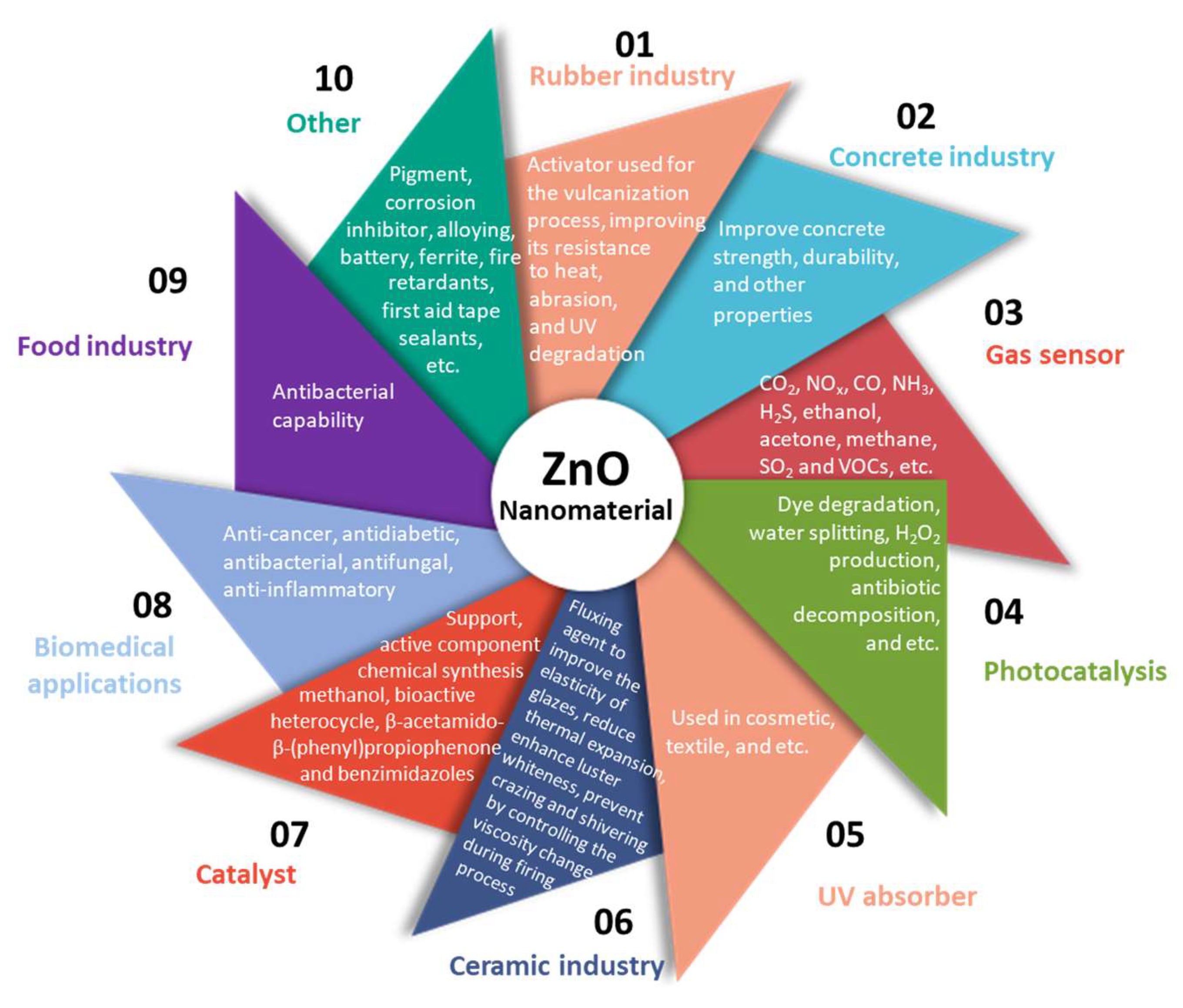
Figure 2.
Wurtzite crystal structure of ZnO with hexagonal unit cell and different crystallographic facets. Adopted from ref. [15].
Figure 2.
Wurtzite crystal structure of ZnO with hexagonal unit cell and different crystallographic facets. Adopted from ref. [15].
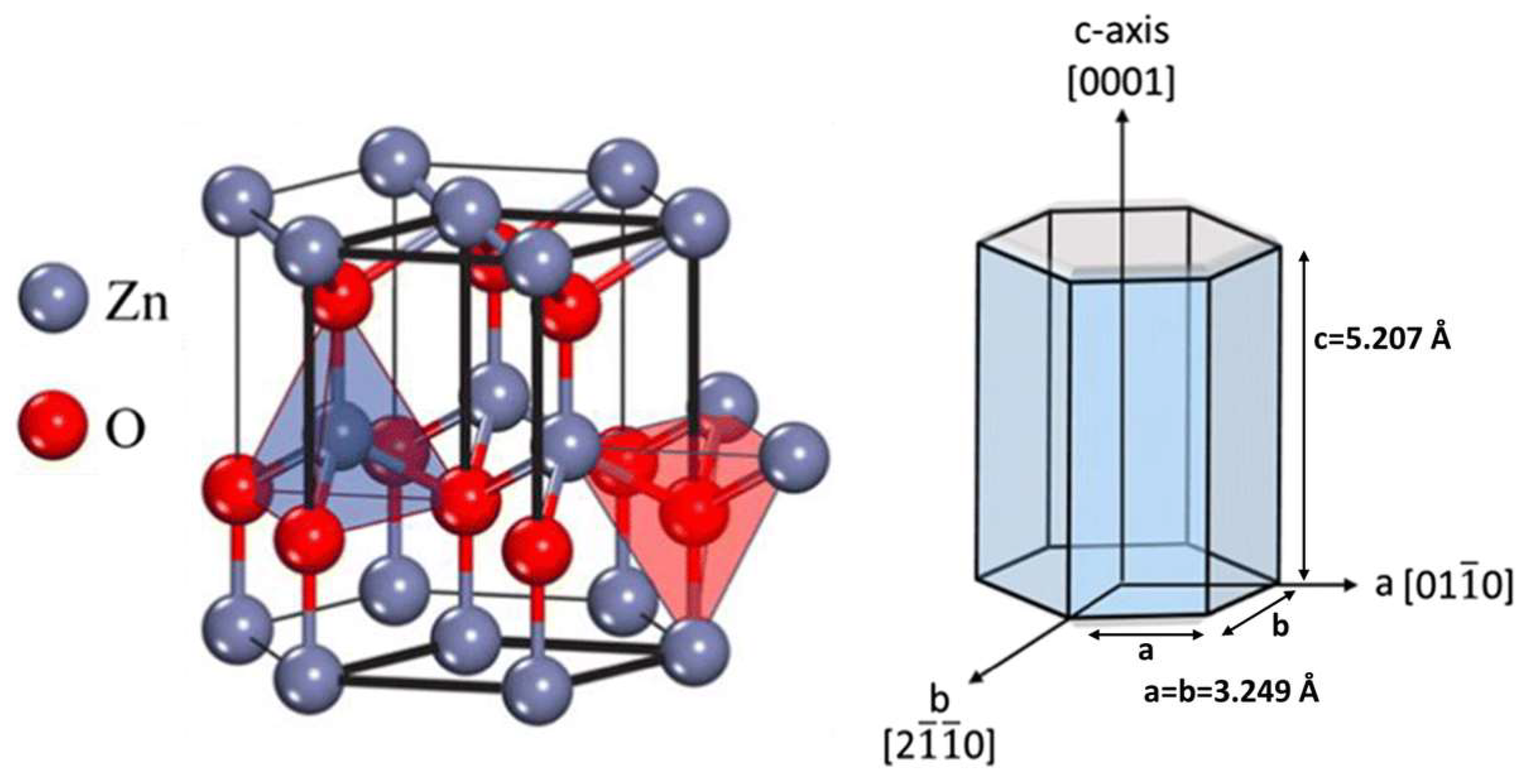
Figure 3.
Number of publications per year for ZnO related photocatalysis from Web of Science search. Searching criteria: ZnO and photocatalysis*. Data extraction date: 08/05/2024.
Figure 3.
Number of publications per year for ZnO related photocatalysis from Web of Science search. Searching criteria: ZnO and photocatalysis*. Data extraction date: 08/05/2024.
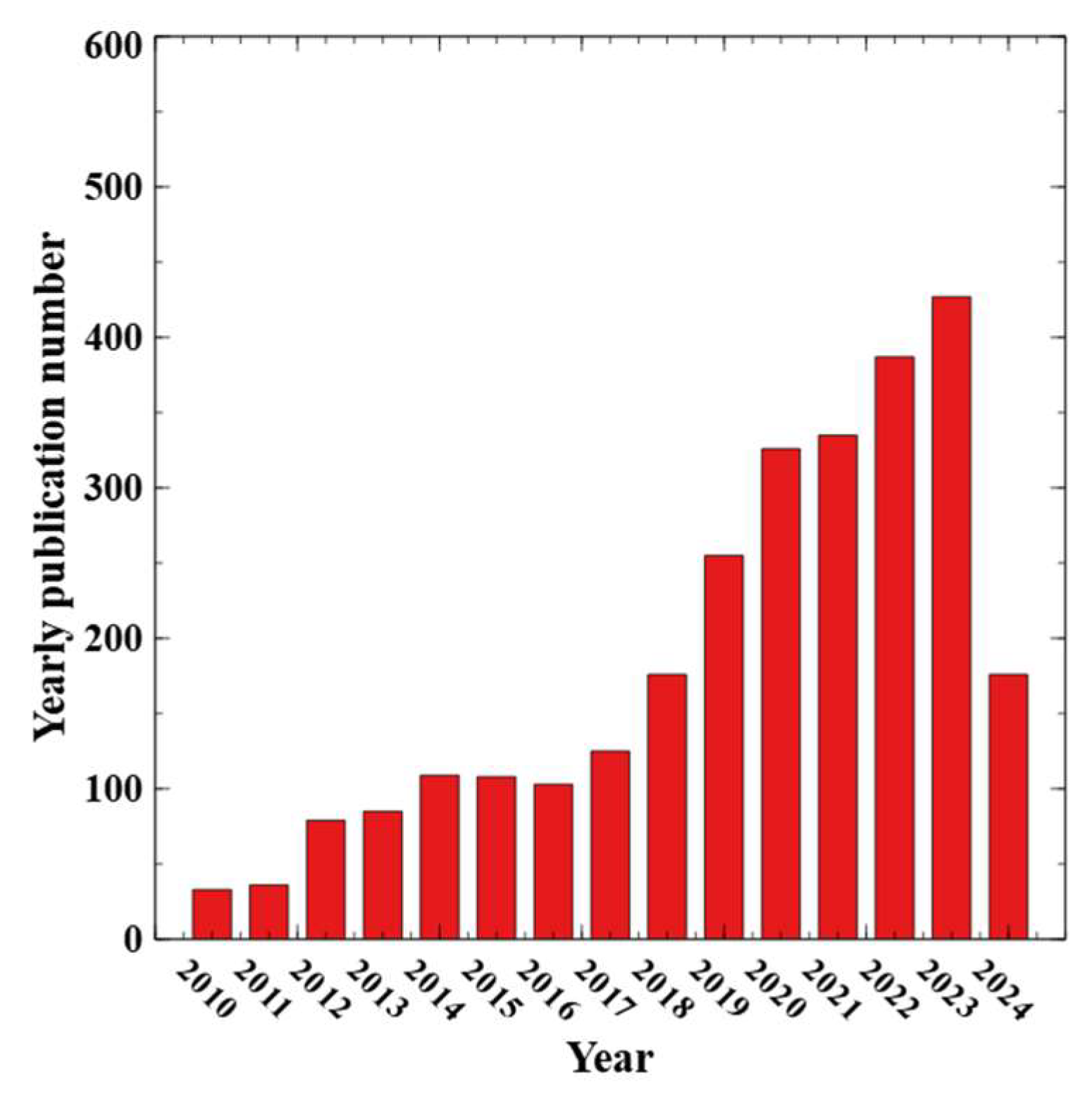
Figure 4.
A collection of nanostructures of ZnO synthesized under controlled conditions by thermal evaporation of solid powders. Most of the structures presented can be produced with 100% purity. (nanobows, nanopropellers, nanowires, nanoring, nanowire, nanohelix, nanotube, and nanocages of ZnO.). Adopted from ref. [22].
Figure 4.
A collection of nanostructures of ZnO synthesized under controlled conditions by thermal evaporation of solid powders. Most of the structures presented can be produced with 100% purity. (nanobows, nanopropellers, nanowires, nanoring, nanowire, nanohelix, nanotube, and nanocages of ZnO.). Adopted from ref. [22].

Figure 5.
Graphical illustration for nanomaterials of dimensions of 0D, 1D, 2D, and 3D. Adopted from ref. [23].
Figure 5.
Graphical illustration for nanomaterials of dimensions of 0D, 1D, 2D, and 3D. Adopted from ref. [23].
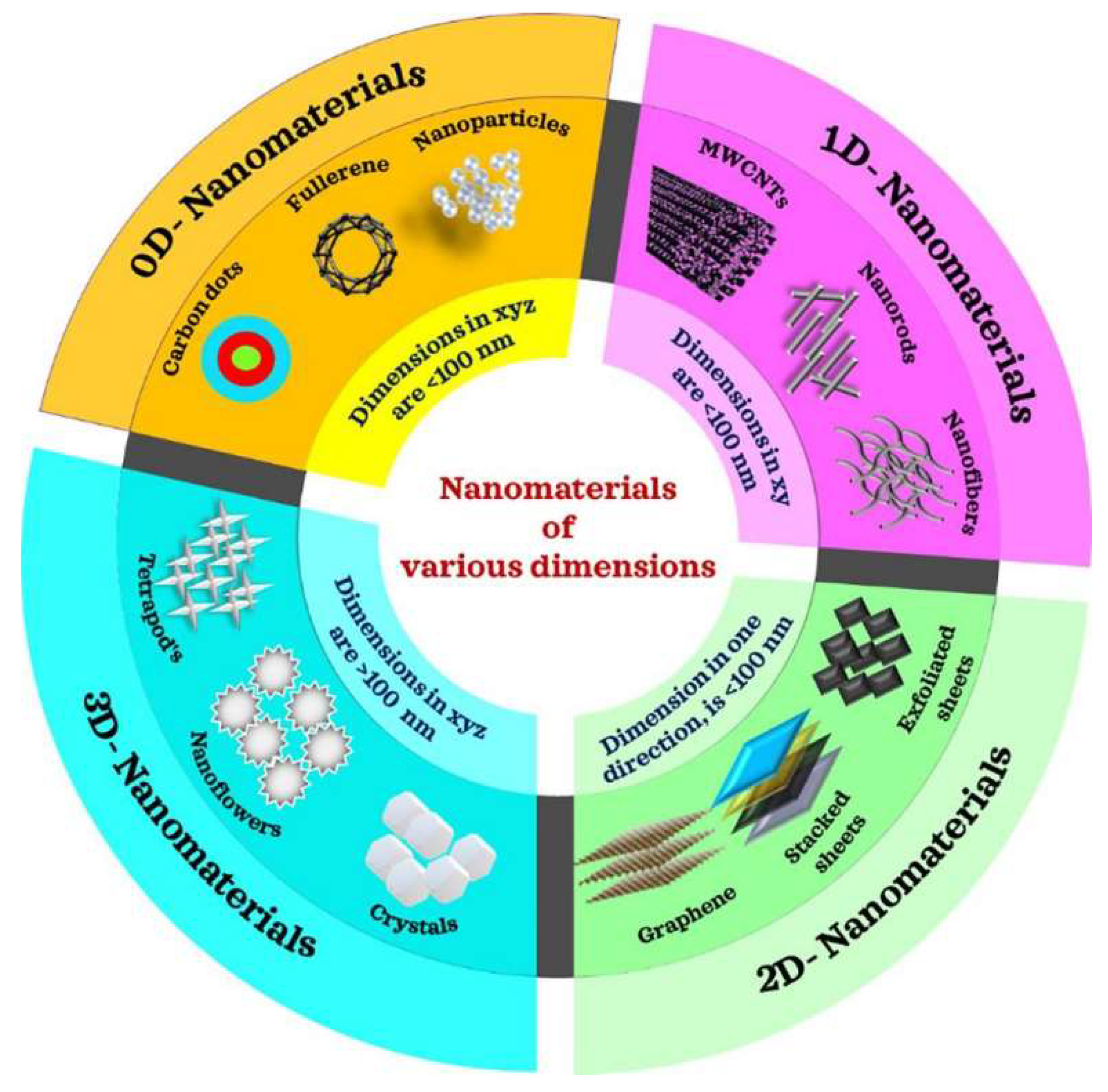
Figure 6.
A collection of 3D hierarchical ZnO synthesized through different methods. a and d [47], b nanoflower [48], c micropyramid/nanosheet [46], e nanobrush [49], and f porous nanosheet [50].
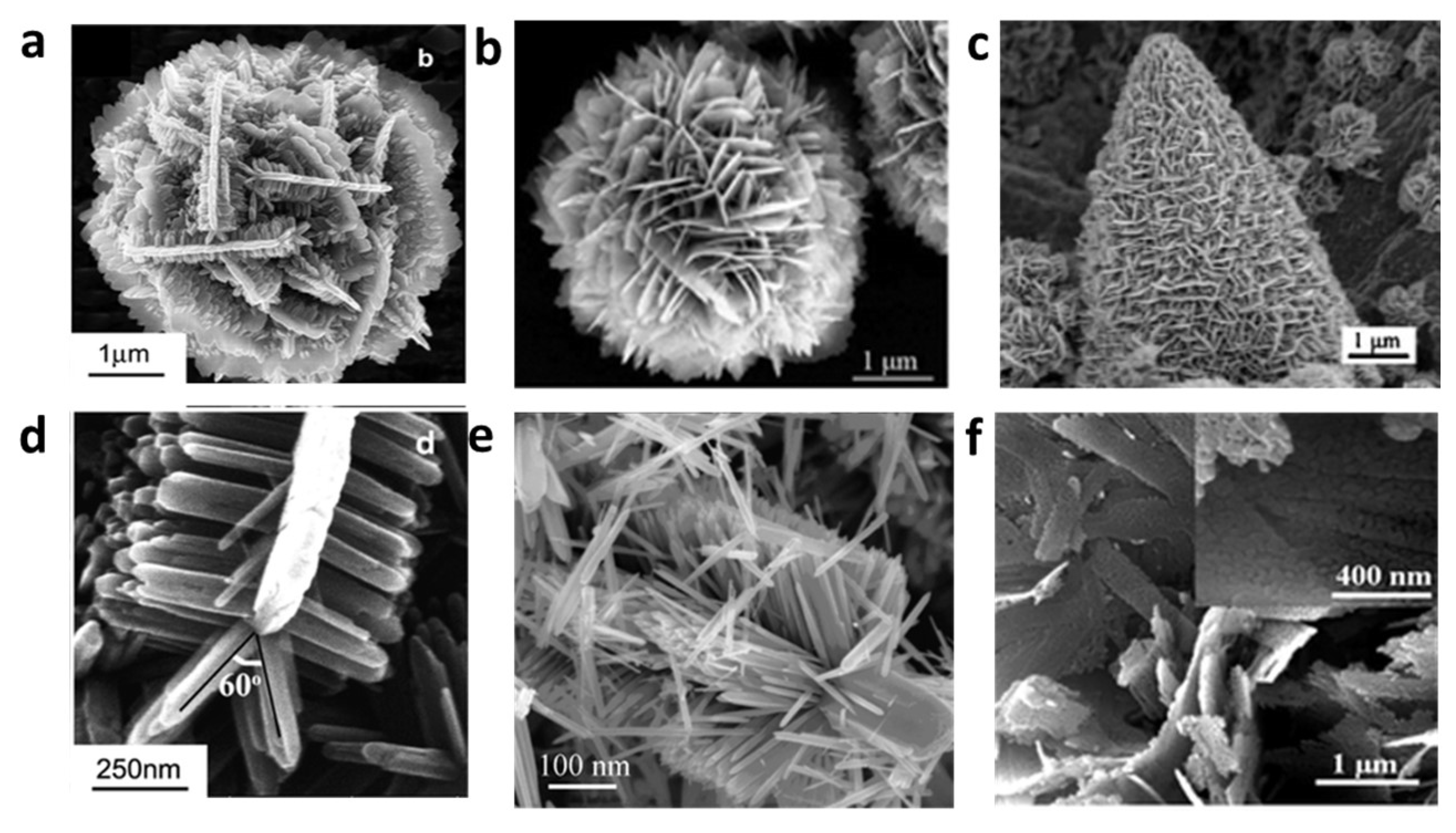
Figure 7.
Schematic illustration of process steps for a procedure, referred to as proximity field nanopatterning (PnP), that uses high-resolution conformable, elastomeric phase masks to produce three-dimensional (3D) nanostructures. Adopted from ref. [53].
Figure 7.
Schematic illustration of process steps for a procedure, referred to as proximity field nanopatterning (PnP), that uses high-resolution conformable, elastomeric phase masks to produce three-dimensional (3D) nanostructures. Adopted from ref. [53].
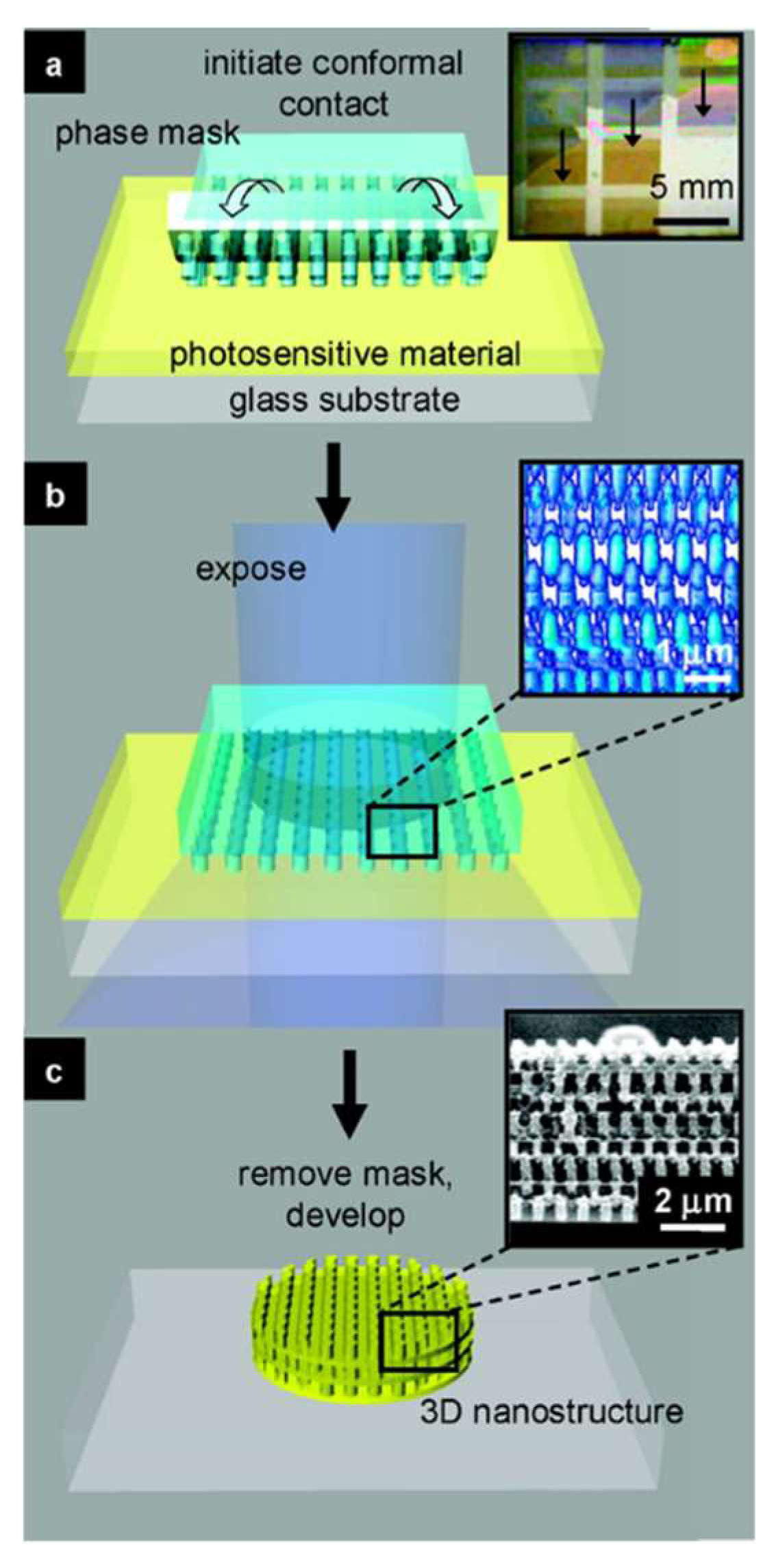
Figure 8.
A summary of ZnO nanomaterials synthesis routes [32].
Figure 8.
A summary of ZnO nanomaterials synthesis routes [32].
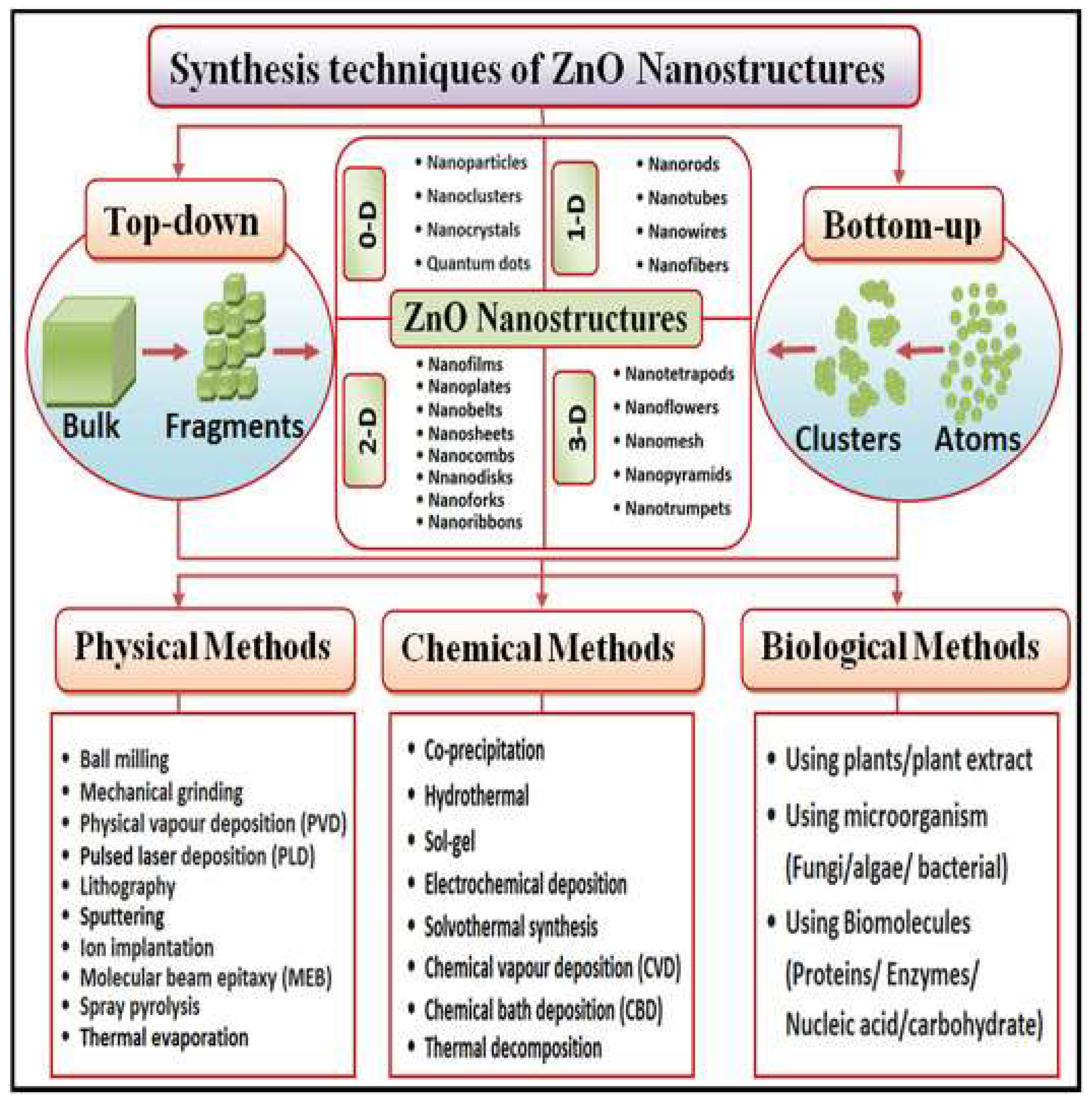
Figure 9.
Photocatalytic mechanism illustration of ZnO for various reactions, including H2 generation, H2O2 generation, and pollutants degradation.
Figure 9.
Photocatalytic mechanism illustration of ZnO for various reactions, including H2 generation, H2O2 generation, and pollutants degradation.
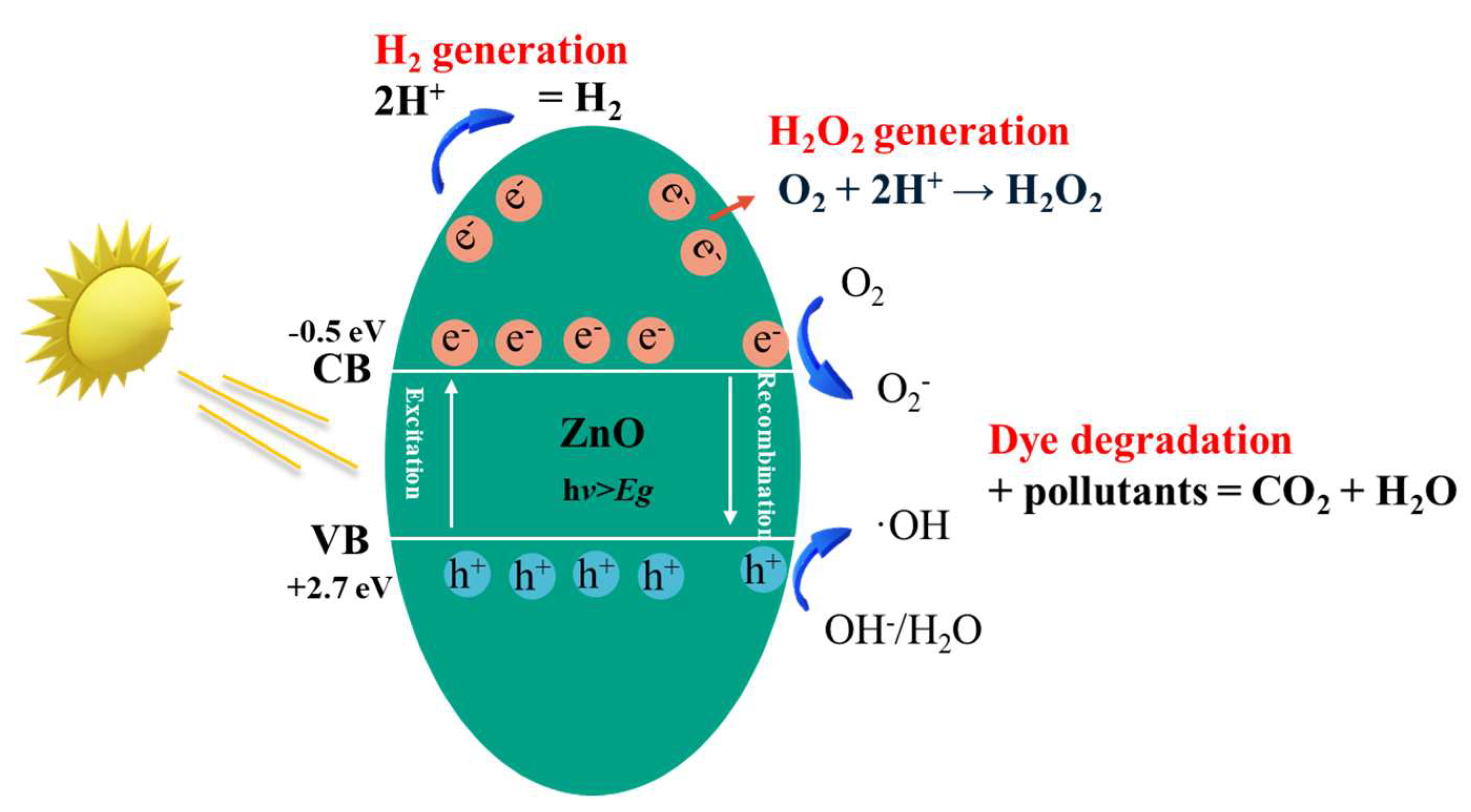
Figure 10.
Multifaceted Antimicrobial Mechanisms of Nanostructured ZnO: A Comprehensive Illustration. [112].
Figure 10.
Multifaceted Antimicrobial Mechanisms of Nanostructured ZnO: A Comprehensive Illustration. [112].
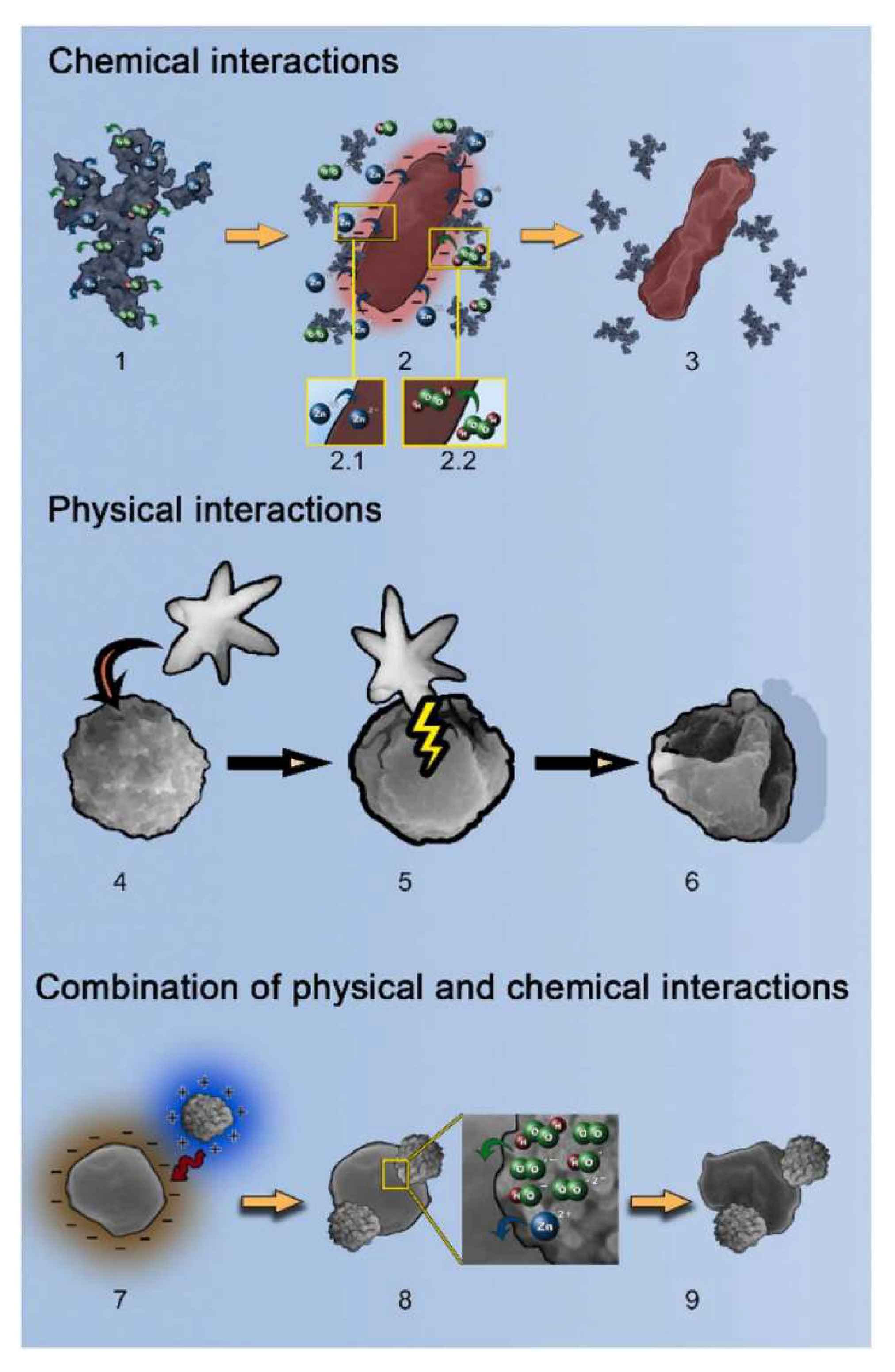

Table 1.
Properties summary between ZnO and TiO2.
| Material | Bandgap | Carrier mobility | Crystalline structure | UV adsorption | Growth mode | Surface activity | Stability |
|---|---|---|---|---|---|---|---|
| ZnO | Direct, 3.37 eV | 100-300 cm2 V−1 · s | Single crystalline | UVA absorption. Broad spectrum adsorption | Anisotropic | Mediate surface area | Easy for water corrosion |
| TiO2 | Indirect 3.2 eV for anatase 3.0 eV for rutile |
< 1 cm2 V−1 · s | Mainly in polycrystalline |
UVB absorption | Isotropic | High surface area Ultra-high for anatase phase |
Stable |
Table 2.
A table summary for ZnO photocatalytic applications including dye degradation, heavy metal removal and VOCs abatement.
Table 2.
A table summary for ZnO photocatalytic applications including dye degradation, heavy metal removal and VOCs abatement.
| Year | Catalyst | Application | Synthesis method | Dye | Concentration | Light Source | Conversion | Time duration | Reference |
|---|---|---|---|---|---|---|---|---|---|
| 2017 | ZnO nanoparticles | Dye degradation | sol-gel, Zinc acetate as precursor | Methyl orange | 200 mg/L | UV light | 99.70% | 30 min | [94] |
| 2010 | Dumbbell ZnO | Dye degradation | Microwave assisted hydrothermal |
Methylene Blue | 15 mg/L | 365 nm light | 99.60% | 75 min | [95] |
| 2009 | Dumbbell ZnO | Dye degradation | Hydrothermal | Crystal Violet, Methyl Violet and Methylene Blue |
15 mg/L | 365 nm light | CV: 68.0% MV: 99.0% MB: 98.5% |
75 min | [96] |
| 2020 | S-doped ZnO | Dye degradation | Hydrothermal | Rhodamine B and phenol |
5 ppm | Visible light | Rhb: 100% Phenol: 53% |
Rhb: 60 min Phenol: 180 min |
[97] |
| 2019 | Fern ZnO | Dye degradation | Electrochemical deposition | Methylene blue, nitrophenol, and Rhodamine B |
MB: 10 ppm NP:10ppm Rh-B: 5 ppm |
UV light, natural UV-filtered sunlight | MB: 99.1% NP: 98.2% Rh-B: 97.1% |
120 min | [98] |
| 2018 | ZnO nanonuts | Photodegradation of paracetamol |
Co-precipitation molecular imprinting |
Paracetamol, methyl orange dye, and phenol |
5×10⁻⁵ M | UV light | Paracetamol: 100% Phenol: 61% |
180 min | [99] |
| 2018 | Al doped ZnO | Dye degradation | Sol-gel | Indigo Carmine | Hg lamp | 97% | 180 min | [100] | |
| 2013 | Al doped ZnO-AZO |
Dye degradation | Combustion | Methyl orange | 10 mg/L | Visible light and sunlight |
99.50% | 90 min | [101] |
| 2013 | ZnO1-x/graphene hybrid | Dye degradation | ZnO reduction and GO dispersion | Methylene Blue | 1×10⁻⁵ M | UV and visible light |
97% | 300 min | [102] |
| 2022 | ZnO nanoparticles |
Dye and antibiotic degradation |
Hydrothermal | RR141, CR, and OFL | 10 mg/L | Sunlight | RR141: 100% CR: 100% OFL: 97.1% |
RR141: 20 min CR: 60 min OFL: 180 min |
[103] |
| 2020 | SnO2/ZnO | Dye degradation | One step polyol method |
Methylene Blue | na | UV | 98% | 30 min | [104] |
| 2021 | Green synthesized ZnO nanorod and nano particle | Dye degradation | Precipitation | Methylene Blue | 10 ppm | Concentrated Sunlight | 94% | 120 min | [105] |
| 2021 | Ag-ZnO | Dye degradation | Sol-gel | Methylene Blue | 10 mg/L | UV | 97.10% | 15 min | [71] |
| 2020 | Green Au/ZnO | Dye degradation | Precipitation | Rhodamine B | 10 ppm | UV | 95% | 180 min | [106] |
| 2022 | Hexagonal Plate like ZnO Particles |
Dye degradation | Hydrothermal | Methylene Blue | 1×10⁻⁵ M | UV | 100% | 60 min | [107] |
| 2018 | Plat ZnO | Dye degradation | Chemical precipitation |
Azo dye | 10 mg/L | UV and solar light | UV: 95% Solar: 88% |
UV: 240 min Solar: 80 min |
[51] |
| 2019 | ZnO nanosheet/Cellulose composite | Dye degradation | Hydrothermal | methyl orange | 20 mg/L | UV | 100% | 50 min | [38] |
| 2018 | ZnO fine particle | Dye degradation | Flame spray pyrolysis | Amaranth Dye | 10 ppm | Solar light | 95.30% | 75 min | [108] |
| 2006 | Ag-ZnO | Dye degradation | Flame spray pyrolysis | Methylene Blue | 10 ppm | 8 W UV tube | 55% | 60 min | [69] |
| 2014 | Ag-ZnO | Dye degradation | Wet chemical | Methylene Blue | 10 μM | Sun light | 94% | 20 min | [70] |
| 2021 | TiO2@ZnO heterojunction | Dye degradation | Template | Methylene Blue Methylene red |
10 ppm | Sun light | MB: 25% MR: 13% |
120 min | [72] |
| 2019 | ZnO nanoparticle | Heavy metal removal | Solid precipitation | Cu(II), Ag(I), Pb(II),Cr(VI), Mn(II), Cd(II), Ni(II) | 50 ppm | UV and visible light | Cu(II), Ag(I), Pb(II) >85% Cr(VI), Mn(II), Cd(II) and Ni(II) <15% |
60 min | [76] |
| 2020 | CuO/ZnO-T | Dye degradation Heavy metal removal |
Hydrothermal | BV-3, RY-145 Cr (VI) and Pb(II) |
40 ppm- dye 10-60 mg/L- heavy metal ion |
Sun light | 80% RY-145 86% BV-3 99% Cr (VI) 97% Pb(II) |
30 min | [83] |
| 2023 | N-doped ZnO@Zeolite |
Heavy metal removal | Dip-coating | Cr (VI), Cd(II) | 10-100 mg/L | Sun light | 93% Cr (VI) 89% Cd(II) |
60 min | [109] |
| 2016 | CuO/ZnO | Photocatalytic oxidation | Mechnical mixing | As(III) solution | 30 mg/L | UV light | 94% | 240 min | [110] |
| 2018 | Ternary ZnO-Ag-Au nanorod array | Reduction of aqueous heavy metal ions |
Photodeposition method and electrostatic self-assembly |
Cr solution | 5 mg L–1 | 300 W Xe arc lamp | 60% | 120 min | [77] |
| 2016 | CuO/ZnO-Pottery plate | Ammonia degradation | Dip-coating | Ammonia | 85-510 mg/L | Visible/UV (280–390 nm) | 77.20% | 30 min | [80] |
| 2018 | Cu/ZnO/rGO | Ammonia degradation | Dip-coating | Ammonia | 50 mg/L | Visible light | 83.10% | 120 min | [81] |
| 2024 | Ag/ZnO | VOC abatement | Photoreduction method |
ethanol, ethyl acetate, and toluene | -- | Visible light | ethanol: 82% ethyl acetate: 78% toluene: 73% |
-- | [86] |
| 2023 | ZnO@Au core-shell | VOC abatement | -- | toluene, formaldehyde, ethanol | -- | Visible light | formaldehyde: 85% toluene: 95% |
-- | [87] |
| 2020 | Ag/ZnO, Cd/ZnO and Pb/ZnO |
VOC abatement | Solgel | Colorobenzene | 20 µg/L | Fluorescent light, UV light, tungsten light and LED light |
100% under visible light | 120 min | [89] |
| 2019 | Nanodiamand-ZnO | VOC abatement | Dehydration condensation | toluene | 50 ppm in air | xenon lamp | 100.00% | 120 min | [90] |
Table 3.
A table summary for the recent reviews published for ZnO photocatalytic related topics.
| Year | Title | Content | Reference |
|---|---|---|---|
| 2022 | 92 years of zinc oxide: has been studied by the scientific community since the 1930s- An overview | Brief introduction of ZnO history, properties, and benefits, fabrication methods of ZnO, and prospective implementations of ZnO in many fields of industry. | [14] |
| 2007 | ZnO: Material, Physics and Applications | Summary of material growth, fundamental properties of ZnO and ZnO-based nanostructures and doping as well as present and future applications with emphasis on the electronic and optical properties including stimulated emission. | [129] |
| 2022 | ZnO nanostructured materials and their potential applications: progress, challenges and perspectives | Chemical methods of preparation of ZnO NPs. Green method for the synthesis of ZnO NPs. Modifications of ZnO with organic and inorganic compounds and multitudinous applications of ZnO NPs. | [13] |
| 2019 | ZnO as a Functional Material, a Review | Review of current state of ZnO structures and synthesis technologies, with the main development directions underlined as epitaxial, thin film, thick film or nanostructure. | [21] |
| 2022 | Recent Advances in ZnO-Based Nanostructures for the Photocatalytic Degradation of Hazardous, Non-Biodegradable Medicines | Review of comprehensive understanding of the degradation of antibiotics using ZnO-based nanomaterials (bare, doped, and composites) for effective treatment of wastewater containing antibiotics. | [65] |
| 2023 | A review on 2D-ZnO nanostructure based biosensors: from materials to devices | The review reports on the main advances in2D-ZnO nanostructure-based biosensors, including syntheis method, biomolecule immobilization on ZnO nanostructure, and classification of ZnO biosensors. | [130] |
| 2024 | Photocatalytic activity enhancement of nanostructured metal-oxides photocatalyst: a review | The paper provides an in-depth analysis of the photocatalytic activity of nanostructured metal oxides, including the photocatalytic mechanism, factors affecting the photocatalytic efficiency, and approaches taken to boost the photocatalytic performance throughstructure or material modifications. THE paper also highlights an overview of the recent applications and discusses the recent advancement of ZnO-based nanocomposite as a promising photocatalytic material for environmental remediation, energy conversion, and biomedical applications. | [131] |
| 2023 | Recent Advances in ZnO-Based Nanostructures for the Photocatalytic Degradation of Hazardous, Non-Biodegradable Medicines | The paper presents and discusses recent advances in the photocatalytic degradation of widely used drugs by ZnO-based nanostructures, namely (i) antibiotics; (ii) antidepressants; (iii) contraceptives; and (iv) anti-inflammatories. The work endows a comprehensive understanding of the degradation of antibiotics using ZnO-based nanomaterials (bare, doped, and composites) for effective treatment of wastewater containing antibiotics. | [65] |
| 2022 | A Study on Doping and Compound of Zinc Oxide Photocatalysts | The paper summarizes the research on this aspect at home and abroad in recent years, introduces the doping of transition metal ions by zinc oxide, the compounding of zinc oxide with precious metals or other semiconductors | [132] |
| 2024 | Current trends and future perspectives on ZnO-based materials for robust and stable solar fuel (H2) generation | The review examines ZnO-based photocatalytic H2 generation via water splitting with different modification strategies and explores future outlooks for improving performance of ZnO. | |
| 2023 | Preparations and applications of zinc oxide based photocatalytic materials | The review summarizes the preparation and application of ZnO-based composites with high catalytic performance, including modification strateties, applications, and future challenges. | [68] |
| 2021 | Photocatalysis by zinc oxide-based nanomaterials | In the book chapter, the authors have focused on the various techniques to modify the characteristics of ZnO and recent advancements in the synthetic strategy to develop highly efficient materials. The alteration in the properties of ZnO can be done by the introduction of foreign elements in three ways, that is, metal doping, nonmetal doping, and formation of coupled materials with other semiconductor materials. | [126] |
| 2021 | ZnO Nanoadsorbents: A potent material for removal of heavy metal ions from wastewater | The authors systematically review the use of ZnO nanostructures for removing poisonous heavy metal ions from water. Various ZnO-based nanostorbents such as pristine ZnO NPs, doped ZnO nanostrutes, ZnO nanocomposites, and surface-modified ZnO NPs are reviewed thoroughly along with the comparisons of their maximum adsorption capacity for different heavy metal ions (Cd2+, Hg2+, As3+, Pb2+, Cr6+, Ni2+, Co2+, and Cu2+) in a tabular form. | [78] |
| 2025 | A review on modified ZnO to address environmental challenges through photocatalysis: Photodegradation of organic pollutants | This review aims to examine the current research progress on ZnO-based nanomaterials developed for the photocatalytic organic contaminant degradation. | [73] |
| 2022 | Photocatalytic activity of zinc oxide for dye and drug degradation: A review | In this review paper photocatalytic degradation of zinc oxide has been highlighted. Nanoparticles of ZnO have been investigated as photocatalysts that can be applied for degradation of dyes, drugs and other pollutants. | [75] |
| 2020 | ZnO based nanomaterials for photocatalytic degradation of aqueous pharmaceutical waste solutions – A contemporary review | The current review highlights the ongoing advancements being catered to modify conventional ZnO into its advanced NCs counterpart as photocatalyst for degradation of PDs. Further, based on Literature, the detailed mechanisms of common PDs degradation by ZnO based NCs have also been reviewed. | [74] |
| 2022 | Current advancements on the fabrication, modification, and industrial application of zinc oxide as photocatalyst in the removal of organic and inorganic contaminants in aquatic systems | The current review summarizes the recent advances in the fabrication, modification, and industrial application of ZnO photocatalyst based on the analysis of the latest studies from different aspects including ZnO overview, modifications, applicability, industries use, and bio-inspired ZnO. | [133] |
| 2022 | Volatile organic compounds (VOCs) removal by photocatalysts: A review | This review tries to investigate the state-of-art of recently published papers on this subject with a focus on the high-efficiency photocatalyst. | [92] |
| 2019 | Integrated adsorption and photocatalytic degradation of volatile organic compounds (VOCs) using carbon-based nanocomposites: A critical review | This review provides a critical review of the related literature with focuses on: (1) the advantages and disadvantages of various carbon-based nanocomposites for the applications of VOC adsorption and photocatalytic degradation; (2) models and mechanisms of adsorptive-photocatalytic removal of VOCs according to the material properties; and (3) major factors controlling adsorption-photocatalysis processes of VOCs. | [93] |
| 2022 | Recent Progress in ZnO-Based Nanostructures for Photocatalytic Antimicrobial in Water Treatment: A Review | This review is a comprehensive overview of recent progress in the following: (i) preparation methods of ZnO-based nanomaterials and comparison between methods; (ii) types of nanomaterials for photocatalytic antibacterials in water treatment; (iii) methods for studying the antimicrobial activities and (iv) mechanisms of ZnO-based antibacterials. Subsequently, the use of different doping strategies to enhance the photocatalytic antibacterial properties of ZnO-based nanomaterials is also emphatically discussed. Finally, future research and practical applications of ZnO-based nanomaterials for antibacterial activity are proposed. | [111] |
| 2022 | p-type ZnO for photocatalytic water splitting | In the Perspective, the authos discuss recent advances in the fabrication of p-type ZnO by different dopants and describe the benefits of p-type ZnO compared to n-type ZnO for photocatalytic applications. Finally, we analyze the difficulties and challenges of p-type ZnO employed in photocatalytic water splitting and consider the future advancement of p-type ZnO in an emerging area. | [117] |
| 2023 | Photocatalytic H2O2 production Systems: Design strategies and environmental applications | This review article introduces the strategies for improving the H2O2 production efficiency based on the recombination of electron-hole pairs, low visible light utilization, and poor product selectivity. | [120] |
Disclaimer/Publisher’s Note: The statements, opinions and data contained in all publications are solely those of the individual author(s) and contributor(s) and not of MDPI and/or the editor(s). MDPI and/or the editor(s) disclaim responsibility for any injury to people or property resulting from any ideas, methods, instructions or products referred to in the content. |
© 2025 by the authors. Licensee MDPI, Basel, Switzerland. This article is an open access article distributed under the terms and conditions of the Creative Commons Attribution (CC BY) license (http://creativecommons.org/licenses/by/4.0/).
Copyright: This open access article is published under a Creative Commons CC BY 4.0 license, which permit the free download, distribution, and reuse, provided that the author and preprint are cited in any reuse.