

Submitted:
18 March 2025
Posted:
19 March 2025
You are already at the latest version
Abstract
Grounded in the existing literature on administrative burden and using a community-engaged research approach, the research team held in-person and virtual focus groups and interviews with 40 adults with disabilities, older adults, and family members of people with disabilities who resided in rural areas of the U.S. State of New Hampshire in 2024 to examine administrative burden experienced in accessing disability, retirement, and survivor’s benefits from the Social Security Administration (SSA). The qualitative analysis revealed that rural residents, regardless of type of SSA benefit receipt, were experiencing high levels of administrative burden in their interactions with SSA and preferred to turn to in-person assistance at local SSA field offices (rather than phone, mail, or web-based service options) to address these concerns. Overall, people living in rural counties that do not have local SSA field offices voiced a distinct disadvantage in terms of knowing where to turn with questions about their benefits. A lack of ready and reliable access to information and advice led to endangering their own economic stability and to increased calls and visits to SSA. Persons with stronger social networks were better able to overcome these barriers to services.
Keywords:
administrative burden
; Social Security
; disability
; retirement
; older adults
Introduction
The Social Security Administration (SSA) administers social insurance and income assistance programs that improve economic security for many Americans by providing monthly benefits (i.e., income) to eligible individuals (Romig, 2023a). In fiscal year 2024 (FY24), Old-Age and Survivors Insurance (OASI), the program that provides monthly retirement and survivors benefits to qualified workers and their family members, provided benefits to an average of 59 million people per month (Social Security Administration, 2024). Disability Insurance (DI) provided benefits to over eight million workers who became disabled and their families each month in FY24 (Social Security Administration, 2024). Supplemental Security Income (SSI) provided monthly benefits to an average of 7.4 million aged, blind, and disabled adults who had limited income and resources in FY24 (Social Security Administration, 2024). Older adults who meet eligibility for two programs can concurrently receive OASI and SSI, while disabled working-age adults can concurrently receive DI and SSI. Nearly 2.5 million individuals received benefits concurrently (Social Security Administration, 2024).
People that reside in rural areas of the U.S., areas that have lower population density than urban or suburban areas, rely more heavily on SSA benefits as a share of personal income than non-rural residents and are disproportionately Old Age and Survivors’ and Disability Insurance beneficiaries (Bishop & Gallardo, 2011; King et al., 2007; Michaud et al., 2019). Despite this overrepresentation of SSA participation among people living in rural areas, rural residents face higher barriers in accessing information from and communicating with government offices.
Theoretical Framework
Administrative burden is a term that is used to describe the onerous nature that citizens encounter when interacting with government (Halling & Baekgaard, 2024; Moynihan et al., 2015). Such burden can be conceptualized as occurring in three areas: learning costs, compliance costs, and psychological costs (Herd et al., 2023). Learning costs are “the challenges that people face finding out about a program’s existence and benefits, determining whether they are eligible for the program and what benefits they might receive, as well as understanding how to apply for, retain, and redeem benefits” (Herd et al., 2023 pg. 4). Compliance costs involve the time and effort spent on administrative tasks such as filling out forms, driving to government offices, waiting on hold for phone services, documenting status, and responding to bureaucratic requests (Herd et al., 2023). Psychological costs are the anxiety, stigma, and stress caused by applying for or maintain access to benefits and services (Herd et al., 2023).
Higher levels of administrative burden can hinder access to services and benefits and can reinforce existing social inequities (Chudnovsky & Peeters, 2021; Halling & Baekgaard, 2024; Herd et al., 2023). Administrative burden is experienced differently by different subpopulations, with people living in poverty, people with disabilities, and people with limited social networks experiencing higher levels of burden compared to others (Carey et al., 2021; Christensen et al., 2020; Chudnovsky & Peeters, 2021; Herd, 2023).
The quality of frontline service delivery and government communication can increase or decrease administrative burden (Halling & Baekgaard, 2024). A scoping review that examined the communication preferences of populations served by a variety of government programs including those provided by SSA identified agency communication with rural populations as an area in need of more in-depth study (Henly et al., 2023). This synthesis of prior research found that the mode of communication affects the public’s knowledge and benefits enrollment and that communication approaches that consider community-specific contexts are most effective. In addition, this research highlighted some of the unique barriers that people residing in rural areas might face, including lack of internet access, no local government offices to visit in person, or a lack of transportation. Additional research has highlighted the inverse relationship between higher rates of poverty and lower access to social services found in rural counties in the U.S. (Shapiro, 2021). This suggests that people living in rural areas have less access to formal social networks (e.g., case managers at health or social service agencies; advocates) which may further hinder their ability to learn about and apply for SSA benefits when eligible (Boswell & Smedley, 2023).
Further, although SSA has increased access to online services, SSA agency staff in rural areas have noted continued challenges with slow internet speeds and low bandwidth (Government Accountability Office, 2022). Without consistent internet services, SSA beneficiaries experience heightened levels of disadvantage. As a recent GAO report noted:
(SSA) faces challenges reaching and providing services to certain groups who may face disproportionate barriers, including lack of consistent access to technology. These vulnerable populations include older adults, those with limited English proficiency, those experiencing homelessness, those in rural areas, individuals with low incomes, individuals with disabilities, and those without legal representation in the disability appeals process. The transition to remote services disproportionately affected vulnerable groups, according to those we interviewed, because of their previous reliance on in-person services. (Government Accountability Office, 2022, p. 33).
Yet, SSA may, due to limitations in its administrative budget, need to develop methods of service delivery that rely more heavily on automated or electronic processes rather than hard copy or in-person forms of service delivery. In fact, reductions in SSA’s administrative budget have substantially reduced its staff and resources and impacted its ability to effectively serve all eligible beneficiaries (Romig, 2023b). As SSA strives to ensure it is providing equitable access to support all communities with these limited levels of resources, understanding the impact of the current service delivery environment on certain subpopulations is particularly important.
With this background in mind, we embarked on a community-engaged research project to explore how rural persons with disabilities and rural older adults are interacting with SSA, and to identify action steps at both the community and the SSA levels that can improve communication and service delivery. Our initial research questions were:
(1) What service-related barriers do individuals living in rural areas face when seeking SSA benefits and how do these individuals prefer to communicate with SSA when seeking benefits (e.g., online, by telephone, in-person)?
(2) How do these service-related barriers and communication preferences vary by sociodemographic groups (e.g., educational attainment, age) within rural populations?
(3) How do service perceptions (e.g., satisfaction) and outcomes (e.g., wait times) vary by sociodemographic characteristics?
Community Engagement
Community-engaged research approaches are becoming increasingly expected from federal and state research funders to ensure that the lived experiences of people are included in intentional, meaningful ways. We followed a community-engaged process for this study which involves members of the community in all stages of research, drawing on approaches outlined in the literature (Daley et al., 2010; Harb & Taylor, 2024; Israel et al., n.d.; Joosten et al., 2015). Figure 1 shows how we engaged with members of the community at three different stages of our study: (Stage 1) At the outset of our study, (Stage 3) After data collection; and (Stage 5) At dissemination.
Stage 1 community engagement
Before beginning the data collection phase of our study, we sought input from a dozen members of the community in New Hampshire (NH), including those with lived experience with disability, family members of persons with disabilities, older adults, and other stakeholders to refine research questions, develop our focus group protocol, and solicit recommendations for recruitment. In this phase of the project, we shared an overview of our project, a draft focus group guide developed based on prior research (Henly et al., 2023), and our initial ideas about recruitment strategies with members of our target populations to solicit their input. We recruited members for this first phase of community input through our contacts at the University of New Hampshire (UNH). We met with these members of the community in four meetings, with individuals only participating in one meeting each. Of the four meetings, two meetings were one-on-one meetings held over Zoom. One meeting was hybrid, with one member of our research team attending in-person, one attending on Zoom, and nine attendees. The final meeting was conducted one-on-one by phone.
At each meeting, we first described our overall study aims and clarified that we were only seeking input on possible focus group questions and recruitment methods and that we could not use any information from these meetings as ‘research results’ as we were using this formative stage of community engagement to inform the development of our Institutional Review Board (IRB) materials. In essence, the community members who participated in this stage were considered research collaborators, not participants. Each meeting lasted approximately 30-45 minutes. We reviewed the draft set of focus group questions that we had developed and solicited recommendations for improving the types and content of questions, adding additional questions, or removing some. Once review and discussion were complete, we asked for suggestions about how we could best recruit people to participate in our in-person focus groups. Last, we asked participants if they would be willing to be reconnected with us after we completed our focus groups to help discuss and provide input into interpreting our findings. Participants were not reimbursed by this study for their input at this phase. However, some participants were compensated for their time as a member of a different community advisory council.
While we did not have diversity by race/ethnicity for this phase of our project, we did have diversity in age, sex, and connection to the older adult and/or disability communities. The youngest person we spoke with was a 30-year-old male who had a disability. The oldest person who contributed input at this stage was a female in her 70s, who was also a family member of an adult person with a disability. Overall, we met with three people with disabilities, seven people who were family members of people with disabilities, and two people who were involved with disability advocacy or direct support professional roles. Of these twelve, two were older adults as well as family members of people with disabilities. As mentioned, many of these people, who were familiar with DI and SSI, also had experience with other SSA benefits, including retirement and survivors’ benefits, and thus represented an appropriate community to guide this study.
We synthesized this community input to frame our final focus group protocol and recruitment strategies. These community members first suggested we simplify our questions. They also suggested that we place a strong emphasis on understanding how initial enrollment in an SSA program occurred, as it is important to understand how people even knew that they might be eligible for benefits. They reinforced the view that older adults and people with disabilities may have limited digital literacy as well as limited or no access to smart phones, computers, or printers. The community members reminded us that people are often not clear on what type of benefit they are receiving. They raised additional points about accessibility and accommodations and how this can impact enrollment or continued communication with SSA. Some members raised issues of trust. From a civic trust level, one mentioned that some people do not want benefits from the government. From a more general trust perspective, one mentioned that some people do not trust any online means of communication. They shared possible contacts for recruitment and some also (although unsolicited at this point) shared ideas for policy recommendations.
The community input changed our research aims slightly to focus more on understanding the lived experience of SSA applicants and beneficiaries in terms of their communications and customer service experiences with SSA and less on how sociodemographic differences might influence such experiences. Our final set of research questions were: 1) What barriers do people living in rural areas face when applying for and maintaining SSA benefits? 2) How have rural residents experienced interacting with SSA in terms of comfort level and satisfaction with timeliness, ability to get the answers needed, and understandability of the information provided? 3) How do rural residents experience providing necessary documentation to SSA? 4) How have rural residents been satisfied with the service they experienced when visiting their local SSA field office? visited ? 5) How comfortable and/or able are rural residents with using technology (e.g., online, by smart phone) to communicate with SSA? 6) What recommendations do rural residents suggest community-level organizations and/or the SSA implement to improve interaction (or communication) with SSA?
We include a comparison of our initial focus group guide and the revised focus group guide in Appendix A. We submitted IRB materials to our institution’s IRB in the Spring of 2024 and were approved shortly thereafter.
Methods
Design
Overview of Focus Group and Interview Research
We held six focus groups and three interviews, achieving a final sample of 40 people. We provide details below about the characteristics of these data collection activities.1
Location/dates of focus groups and interviews. Four of the nine focus groups were held virtually on Zoom. The five others were held in various community locations in rural counties in NH. Table 1 shows the details of these focus groups. Counties that include an asterisk (*) after their names do not have a local SSA field office.
Study setting. The study was based in NH and run by faculty and staff at a research institute within the state’s public university. The research institute is well connected with the local disability and older adult communities. The study was limited to rural residents in NH. NH is a geographically small state in Northern New England with a population of nearly 1.4 million people. Seven of its ten counties are classified as ‘rural’ according to the federal Office of Management and Budget (OMB) (Cromartie & Bucholtz, n.d.) and four of these rural NH counties do not have a local SSA field office. Trust in government is low among NH residents, ranging from 44 % having trust in local government to only 14 % having trust in the federal government in 2019 (Mallory, 2024). About 21 % of NH’s population is aged 65 years and older and approximately 12 % of working-age persons in NH have a disability (Thomas et al., 2025). NH’s population is predominantly white with 1.2 million people reporting as white alone, not Hispanic or Latino (88% of the population). NH has a slightly larger proportion of residents with a bachelor’s degree or higher (41%) than the nation as a whole (36%). In 2023, the median household income in NH was higher than the national median household income ($96,838 and $77,719, respectively) (United States Census Bureau [USCB], 2025a; USCB, 2025b).
To provide some context for our target population, Table 2 shows the percentage of working-age adults with disabilities (among all working-age adults) and the percentage of older adults (among total county population) for each NH county as of 2023. The table also notes whether a county is rural and indicates the counties in which SSA field offices are located. Rural counties generally have higher proportions of residents who are aged 18-64, who have a disability and are older adults. Four of the seven rural counties in NH do not have an SSA field office.
Personnel involved in focus groups. Three research team members attended each focus group: Dr. Debra Brucker, Dr. Megan Henly, and Ms. Stacia Bach. Ms. Bach handled logistics, participant screening, recording/transcribing, and participant payments. Dr. Brucker reviewed informed consent, the meeting purpose, and the meeting structure at the start of each focus group. She and Dr. Henly both posed questions during the groups. All three took notes to supplement the transcription resulting from audio recording. One or two members attended each of the interviews, which were also recorded and transcribed.
As we recognize that our lived experiences may impact the lens through which we interpret the focus groups, we share some detailed information about our personae. All five research team members are white and cisgender. Four are middle-aged and one is a young adult. Four are women and one is male. Two people identify as neurodivergent. Two members of the research team have lived experience of living in rural areas. Members of the research team have lived experience with chronic health conditions, mental health disabilities, substance use disorder, post-traumatic stress disorder, and law enforcement-induced trauma. The research team has educational backgrounds that include economics, public administration, public policy, social work, and sociology. Their work experience, outside of academia, includes experiences as a child protective social worker, a direct support professional, professional guardian of a person with a disability, a psychiatric technician, a Social Security claims representative, and a social worker.
Description of consent process. At the in-person focus groups and interviews, a member of the research team verbally reviewed the IRB-approved consent form and then participants reviewed and signed the form. For the virtual focus groups and interviews, participants were mailed or e-mailed versions of the consent form prior to participation and, in cases where participants had not been able to return signed copies prior to the focus group or interview, the research team provided a verbal overview and recorded verbal consent.
Facilitator guide. The draft guide was informed by current literature and previous research conducted by members of the research team. Twelve community NH members helped us refine our focus group guide to include questions pertinent to our study population. Our guide covered the following topic areas: 1) How and approximately when a participant heard about SSA benefits and decided to apply; 2) Comfort levels in speaking or interacting with someone at SSA (on the phone; in-person); 3) Satisfaction with timeliness, accuracy of information, and clarity of information when interacting with SSA; 4) Experiences with paperwork; 5) In-person visits to field offices; 6) Comfort using technology; and; 7) Community and SSA-level recommendations for improving communication/understanding of SSA benefits.
Participant recruitment. After obtaining IRB approval, we worked with UNH partners, including community engagement participants, to assist us with our recruitment efforts to organize in-person focus groups within rural counties. Active recruitment occurred between May and October 2024. We initially used word-of-mouth and self-referral recruitment in the hopes of finding people who were not using social media or were not formally connected to local advocacy or service groups. In this phase, we e-mailed and mailed hard copy flyers to local contacts, including libraries, disability and older adult organizations, and senior centers. We also placed ads in local printed newspapers. Recruitment using these strategies was slow, therefore we shifted our strategy to include social media approaches in early July 2024. We also modified our IRB to allow for individual interviews (in-person, by phone, by Zoom) and for Zoom focus groups in addition to in-person focus groups. We redesigned our flyer, simplifying it for readability and accessibility. The new flyer did not explicitly detail the geographic region in which this study took place (NH’s rural counties). To determine if an applicant met geographic inclusion characteristics, we asked which city or town they lived in and determined eligibility by the county in which their town is located. Leaving out this detail helped filter out potential scammers during the recruitment process who dishonestly reported meeting all eligibility criteria in order to receive the incentive being offered. We also shifted to using more direct outreach (e.g., phone calls, e-mails, attendance at existing meetings to share study information) to specific organizations that we identified through our contacts at UNH. These direct approaches yielded a much stronger response. Reaching out to key personnel at community-based organizations was helpful, as they connected us to the communities they support and serve. All the in-person focus groups were a direct result of connecting with community based organizations. We utilized their spaces to host the focus groups. They actively contributed to recruiting participants by promoting the study at their centers, and by helping interested community members apply for the study.
Criteria and methods for selecting participants. Interested applicants reached out by calling or emailing the contact information on the flyer. A member of the research team followed up within two business days to schedule a time to conduct a screening call. During the screening call, the research team member followed a screening script that we had developed as part of our IRB package to determine whether the person met the following study inclusion criteria: 1) At least 18 years of age; 2) Primarily speak English at home; 3) Reside in a rural county of NH; and 4) Meet one of the following three descriptions: a) have a cognitive, communication, mental health, physical, sensory (hearing/vision) disability which limits your ability to work; b) are a family member of a person with intellectual and developmental disabilities who receives Social Security benefits; or c) are near or in retirement age. After determining if they met the qualifications, we informed them of the time, date, and location of the focus group or interview.
In some cases, where focus groups were organized through a contact at a specific community-based organization, we conducted participant screening on-site. The screening process allowed us to provide more details about our study and participation expectations and ensured that participants meet our inclusion criteria. During either the phone or in-person screenings, we also gathered some demographic information and collected basic information about how people currently or have ever interacted with SSA. We captured this screening information in a spreadsheet so that we had full information about eligible candidates as we moved to scheduling focus groups and/or interviews in particular parts of the state. People that met our screening criteria were enrolled in the study by assigning them to attend a specific focus group or interview.
E-mail was a means for interested participants to contact us during this screening phase, however, it did lead to unwanted bot responses. Therefore, we had to screen out fictitious participants who had contacted us using bots (a computer application that automatically sends many e-mails from different e-mail addresses) or some other means. The monetary incentive made screening for bots important. Of 65 verified applicants for the study, we had to exclude two people from invitations to participate as neither were giving appropriate answers to the screening questions.
We faced another challenge in that some people who initially expressed interest were wary of the research team calling them back and asking for more information, given their concerns about possibly being scammed. We addressed these concerns by using a combination of emails and phone calls to verify that we were part of a legitimate research study based at a university.
Enrollment process and number of participants in each group. We were most successful at scheduling in-person focus groups at local organizations when our meetings were held immediately before or after previously scheduled community events with our populations of interest. For example, we held two focus groups, one immediately before and one immediately after a free ‘congregate lunch’ and on location at a senior center. As another example, we met with an advocacy group at the end of their regularly scheduled meeting at a restaurant to coordinate member attendance at a focus group. We also held a focus group on-site at an U.S. Department of Housing and Urban Development (HUD)-assisted rental housing complex that houses older adults and persons with disabilities. We held our final in-person focus group on-site at a behavioral health peer support organization. As an alternative to these in-person focus groups, we also held three virtual Zoom focus groups and two individual interviews. Table 2 describes the focus group features.
We audio recorded the focus groups and interviews, and generated transcripts. We provided physical $50 gift cards to participants at the conclusion of each focus group or interview, in-person for the in-person events and by mail for the virtual events.
Participants. Of the 40 focus group participants, only 39 disclosed sociodemographic information. Table 3 provides a sociodemographic description of study participants on whom this information was collected (n=40). Most (n=29) of participants were age 55 and older and most (n=28) were female. Only three participants were non-white. More than half (n=21) of the participants had a high school or less than a high school education. Twenty-nine identified as having a disability. All participants either received some form of Social Security benefit or were family members of a person who received a Social Security benefit.
Analysis
Summary of analytic approach. We entered participant demographic information into a spreadsheet to allow for compiling descriptive statistics. We de-identified and uploaded transcripts into NVivo software for analysis. One team member completed initial open coding while having frequent iterative check-ins with the other team members to discuss emerging codes and themes. The final set of codes and themes was agreed upon by the research team. We discuss each of the themes in our Results section below.
Results
The findings from the focus groups and interviews can be conceptualized as falling within six overarching themes, as shown in Table 4. While not all of the themes relate to administrative burden, we do denote in the narrative below where these themes overlap with the administrative burden literature.
Theme One: Initial Applications for Benefits
1a. Within this theme, participants noted that the process of applying for SSA disability benefits was much more complicated than applying for other types of benefits and usually required assistance from others to either alert them that they may be eligible for benefits and/or to manage the application and maintenance process. As one participant noted: “I did look into Social Security for disability benefits. But like (another participant) has said, the red tape and paperwork was just overwhelming, and I didn't get very far.” This alludes to the learning cost of administrative burden. People who were successful in being awarded disability benefits relied on formal and informal social networks for their knowledge. Among people who were receiving disability benefits, most had received assistance from medical personnel, lawyers, or other service providers (case workers, etc.) to notify them that disability benefits were an option and to initiate the application process. One participant noted that she was hospitalized three times for a mental health condition (over a decade ago) before a doctor mentioned that disability benefits (and its associated health insurance) could be an option for her. She stated, “I didn't know that I could get it for mental health. I thought you had to have a physical disability or [be] retired.” Yet other participants who had mental health conditions mentioned the ease of being approved for benefits the first time they applied, although they too usually had a medical or social service advocate help them with the process. Another participant, in speaking generally about disability benefits, noted:
People should not have to rely on a lawyer in order to initially apply for Social Security. I think that … if they're looking for SSI and they need SSDI … They're not applying for those benefits because they have resources. And they don't have the money to hire a lawyer and many of them feel like that's the only way they're gonna get benefits. That's not cool.
1b. Many rural residents expressed that getting copies of paperwork to apply for benefits was challenging. To address these compliance costs, many people rely on a social network (e.g., family/friends), libraries, or field office staff to make copies for them. “The library charges and they normally, Social Security, they don't charge. Yeah, usually they say ‘I'll make a copy for you’ and they'll give you back the original. Depends on who's at the desk, too. You know, [if] they're nice enough to do that for you.”
1c. The application process was much more straightforward for people seeking retirement benefits, with most retirees noting easy access. Some, including this woman below, stated that their employers helped them with the process of applying for retirement benefits. An individual shared, “Oh, I started getting Social Security. I believe when I was 62, it may have been 62 or it may have been 65. I'm not sure which. But I had a very good experience. … I retired from ________, which was a wonderful place to work, and they helped a lot in telling me what I should be doing while I was doing the application.”
1d. People on disability benefits usually saw benefits as a last resort and something they did not want to have. This can be construed as the psychological cost of administrative burden. Most would prefer to work. “I'm keeping it (disability benefits) because I need it and I know I can't get a full-time job, but if I could handle a full-time job, I'd probably just get rid of that [disability benefits],” said one participant. Another participant shared concern with: “… the whole process of not being able to work like I used to.” He continued: “I still have a problem talking about disability or me being on disability because I've been working since I was 15. All physical labor I used to do.”
1e. Nevertheless, people recognized the importance of SSA benefits for improving their economic security and worried about being able to keep benefits once they had been awarded benefits. One participant noted the psychological costs this way:
The system, because, boy, it really came into play and helped us. It helped me when I had my little children. … So, I had enough money to pay my bills when I had my little children, and if I hadn't had that I would have been in a deep pickle, which is why it's so anxiety producing. Because you're counting on it.
Another person stated: “If I didn't have it, I'd be homeless, [but it] doesn't pay enough to live decently.”
Theme Two: SSA Customer Service
2a.Participants noted high levels of satisfaction with in-person service when they could access it at a local field office. This finding suggests that high quality front line services reduce administrative burden. While 16 of our 39 participants resided in counties without field offices, those that were able to visit a field office were generally quite satisfied. In describing the local field office staff, one participant stated: “They were really kind, very helpful. Toward the end … they were sick of me. And I was sick of them. But they were so good and so kind. I wish I could remember their name.” An older adult noted, “I would say we're lucky in the town, because we have the office right here, very convenient. People that don't have an office right in their town have to travel.” Many participants noted a strong preference for visiting a field office in-person over communicating with SSA through other means: “When you try to reach them [SSA] by phone or you try to get on the computer, it's a whole different story [compared to visiting a field office] … So, I feel bad for people who don't have an office.” Field offices were also useful in helping people decipher information received from SSA through the mail, as one participant stated: “If I received something I didn't understand, I went [to the field office] either with my daughter who was a nurse … A lot of it, I didn’t understand.”
Participants who had visited field offices were generally satisfied with the location, hours, and staff. Still, for certain participants, visiting a field office incurred psychological costs. Some noted that having a guard on-site, rather than helping ensure a feeling of safety, felt intimidating:
There's usually a police officer there. And it is a little scary in there, you know, like for me, because I'm not used to being in a room for long periods of time, at least. In my experience it was long periods of time. Thank God there was a bathroom, but sort of waiting, and having being guarded with an armed person in the room, you know, so for me, that's intimidating to be there.
Another participant, although noting that the guard was “friendly and helpful” stated that “other staff seem annoyed but aren't outwardly rude. But part of the issue with going to an office is that [I] struggle to go outside some days due to disability” so visiting a field office is difficult because it raises anxiety, even though she had a vehicle and lived somewhat close to the field office.
2b. Transportation to field offices was a concern for these rural residents, even for those that had a field office in their county. This finding relates to compliance costs as it added to the time and effort required to access services. People who resided in congregate housing were sometimes able to use transportation provided by the facility to travel to a field office. Most, however, did not have access to any sort of affordable public transportation. Concerns were heightened for people living in counties that did not have field offices as they mentioned that they would need to travel an hour or more to the closest office. One person mentioned how some of the choices he needed to make while living on a limited income impacted his ability to travel:
There should be more offices …[It’s] so far … from here. About an hour and 40 minutes. I don't know about everybody else, but everybody might not have cars to get there. Transportation is a real problem. Me personally, I'm homeless living in my car. It's real hard, you know, since you’re using gas money just to heat up the car like and then that takes away going to Social Security if I need to. And it's hard.
Some participants who did not have a field office in their county discussed and dismissed using cabs as an travel option (“The cab guy, they would come get you, but I mean, it costs money a lot of money. It's like $25 one way.”). Relying on family or friends for transportation was a concern due to expense also (“Most people can't afford to bring you anywhere from here.”) and inconvenience. As one disability beneficiary noted:
You know, I have to let my wife know, who you know, works 40-hour weeks that you know I have to … be here at a certain time, so she'll have to take the day off for just me to go there, which you know she will. She understands but … it's an inconvenience a little bit.
2c. Participants continually shared that communicating by mail, phone, or on the internet was less valued and leads to misunderstanding, missed opportunities, and increased in-person visits for clients. The high levels of learning, compliance, and psychological costs that participants were experiencing were not alleviated by these modes of SSA communication. Participants expressed some concerns related to the language that SSA used to communicate information. “A lot of their [SSA] words [written or online] … sometimes I don't understand,” said one participant. Another stated: “Sometimes when they write something that doesn't make sense, we have to call and find out what's going on.” One person noted that navigating the SSA website was complicated. They shared that going to the field office is easier compared to online because “you don’t need to know the terminology [that you need to look online].”
Participants had mixed reviews about the service they received from SSA over the phone. They shared stories about long wait times (with one participant comically noting that he was sad when SSA stopped having Beethoven music while on hold). One participant shared positive views about the call-back system: “I'm pretty happy because they always call me back.”
Many participants expressed frustration in calling and getting different people each time who did not seem to know the participant record (prior calls, etc.). One older adult noted:
On the phone … you have to tell them a lot of details about your situation and everything else, over and over and over again, the same way, and then they usually say something like, ‘Gosh! You know my system's down,’ or ‘Gosh! Sorry, but you know I don't have that information,’ or ‘You're gonna get it in the mail,’ and that ‘You should get it within two weeks.’ And then you can talk to them two weeks later, saying that never came, ‘Oh, check back another month.’…. So, there's … a lot of waiting and not knowing and feeling vulnerable, feeling exposed. It's not particularly user friendly and very, I would say, uncomfortable on the whole. And so, nobody likes to ask for a handout. But when you're dealt the hand your dealt with, and you have to deal with life, it feels like it shouldn't have to be such a burden, but it is.
Similarly, a different participant noted:
Customer service is horrible... I understand the calls are recorded, but for some reason it's not getting to the Social Security Administration … They know nothing that I called, and I'm like, ‘well, I just called and tried to set up an appointment here, but you know nothing about it so…’ And they're … looking at me like I'm lying to them, and I'm like, ‘Man, I called, and they said to come in.’ So, you know, and they look at me like I'm just making something up trying to get in there, so on, you know. So, I'm not sure why the calls that you call the 1 800 number doesn't go to Concord [NH] or the main [local] offices. For some reason, I'm not sure where it goes. But there's no notes on their computer that I called or anything like [another participant] said, it's weird because you go in there [to the field office]. And then when they look at you like that, it's like I'm not trying to make something up. I was told to come in, you know.
Participants also noted frustration in receiving different answers from different SSA staff. “They're just as confused in person, usually. And then when you call on the phone, those are confused, too” said one participant. “And you can get, if you call three times about the same topic, you'll most likely get three different answers, because … I think the information on the whole system is so changeable, plus very vast, that any one person doesn't really know the answer to your question.”
2d. Participants noted some successes and some concerns with the disability accessibility within SSA processes and offices. Some people experienced higher compliance costs than others, related to the type of disability or limitations they experienced. Positively, one rural resident was pleased with how SSA accommodated his visual disability by calling him and reading aloud their letters to him. A person with a traumatic brain injury reported that even though “I sometimes have a hard time understanding things … they've always been willing to explain to (me).” Concerningly, one person with a musculoskeletal condition noted: “So, from the beginning of the process, there was a lot of paperwork. For me, it was, I found it to be overwhelming, especially [because] I couldn't use my hands, and everything is online now. So, I had to have someone do the paperwork for me. It was overwhelming, honestly, it was long and tedious, and I have major anxiety. So, it was very hard.” In terms of visual accessibility, one person mentioned a concern that “[It’s hard for] someone who can’t see very well to know that they’re supposed to rip the two sides and pop off to get [benefit information for a tax return]”. Another participant who had light sensitivity noted that the bright lighting at the field offices discouraged her from visiting the field office: “(To) go into the office can be difficult. It's way too bright.”
Theme Three: Beneficiary Concerns
3a. Participants expressed concerns related to not understanding SSA processes. These learning costs related to those who were receiving disability benefits in that many stated that they struggled to understand the processes related to working while receiving benefits. For some, this complexity served as a barrier to work: “I wanted to try going back to work. And I thought about calling them because it's hard. I looked into it on the website … It was confusing. Then I would just hold off.”
3b. Participants shared that they are worried about privacy and security concerns when dealing with SSA, particularly over the phone. This concern increases the psychological costs associated with accessing SSA benefits and services. Many residents had heard about the possibility of scams where bad actors pretended to be SSA and that SSA had been very clear with them that they would never text them. Some rural residents had been the victims of scams unrelated to Social Security, which increased their level of wariness. “I mean … I don't want to give out a lot of information on the computer”, said one resident. Another shared: “Yeah, I think they tell you straight up, we will never text you exactly, they've always said ‘we will not do this’. So, if you know, if you get a text, it's not them. They usually don't even call you unless you ask them to return a call. They don't bug you. Like right now on the internet it says, [though] if you want more money in your disability.something.something.com (click here).” One person stated: “If you get online and you're talking to somebody, how do you know you're talking to somebody at Social Security
(or) … on the other side of that phone, unless you're calling them? … That's why I'd rather go there and talk to somebody in person because then I know you're not going to rip me off. It's true.”
Theme Four: Technology Experience
4a.Most rural adults were not comfortable using technology to communicate with SSA. Some of their hesitation to use technology was related to concerns about scams but more often this hesitation occurred due to a lack of access to reliable technology and a lack of knowledge about how to use technology. “So elderly folks up here, many of them don't have computers. The only access could be at the local library. But they don't know how to use computers. So, having access at the local library is already a huge barrier,” stated one older adult. One woman described the challenges her husband faced in using technology to apply for retirement benefits: “For someone who's not super savvy [with computers] … it's not an easy process, and that was his only option as to how to apply was doing it online.”
4b.Smart phone access to SSA is not the answer. Many people had smart phones but were not savvy about using them (“But do I know how to really use my smartphone? That's a whole ‘nother story.”) or could not afford to use data on their phones (“Yeah, just because some people have smartphones doesn't mean that they have enough money for the data that can go on the internet.”). In addition, cell and internet service stability varied throughout these rural counties, with some people having stable service and others experiencing frequent (and sometimes multi-day) outages or spotty service. A few people mentioned still having land line telephones. When asked what participants would think if SSA developed an app to communicate with clients, one person stated: “I don't think I would get a straighter answer from an app. From the few apps that I do use and knowing that they're not perfect by any means, I don't know if I want to go to one more type of thing with the Social Security Administration. It's already confusing enough as it is.”
4c. Although they were in the minority among people we spoke with, rural residents who had higher levels of education and/or had work experience that involved working with computers were more willing to engage with technology to access information from or provide information to SSA. “I know there are some elderly people that don't want to be bothered with a cell phone or all of that, but I bank online and I love technology,” said one older adult who had worked for many years in the insurance industry.
4d. For people who were able to look at the SSA website, most did not find it to be user-friendly. Accessing the website did not lessen administrative burden. “To me, it hasn't worked out very well to try to get it through that way,” said one rural resident. Some found it confusing: “It's awfully confusing. I wouldn't get very far in the web,” said one older adult. Another stated: “Don't get me wrong, there's not, there's nothing wrong with how it's placed, but trying to navigate when you go on one page, and you're like, Oh, you have to go to another after you click on that and then go back because you have the wrong one. It's just all these pages are opening up.” One participant shared that she wished the website had more functionality: “I like their website, but it doesn't allow you to do everything through that.”
Theme Five: SSA Policy and Practices
5a.Efficiency. People who received either survivor or retirement benefits experienced lower levels of administrative burden. They were pleased with how efficient the application process was and particularly liked how their benefits were direct deposited each month. “I just love the fact I've never once had a problem with getting my Social Security in all those years,” said one participant who was speaking about her receipt of retirement benefits. She further stated “I just think that it’s doing the very best. I wish that all of the government services were as good as [the] Social Security Administration is.”
5b. Some disability benefit recipients expressed concerns about how the lengthy application and award process impacted their lives. One such person shared how delays in being awarded disability benefits and the requirement that he not work at all while he was waiting led to his imprisonment. He eventually had a lawyer helping him gather the necessary documentation but repeatedly got denied:
I had to wait three years, you know. Yes, you get a retro check and so on, but at that time I had to pay child support…. I was like ‘I'm not allowed to work.’ If I work … Social Security will deny you for trying to work, you know, and, you know, I was denied one time for that. Because I had no choice, I went to jail for almost six months because I couldn't pay my… child support which I was waiting for disability. So, I was in a weird situation then. But you know no one told me. No one from the community told me how it was, or so on. I had to figure it out myself by going to jail at least.
An older woman, who had work experience helping people apply for SSA disability benefits in addition to having lived experience in interacting with SSA, stated that “maybe SSA should streamline its disability determination process.” She continued:
So many people are denied and end up on appeal. I mean, I think I don't know what the percentage is anymore. I know it used to be pretty high. And then on appeal, they get it. And it doesn't make any sense to me that someone would have to go through the whole appeal process once or twice, even before they're eligible for benefits, because if they're eligible for benefits on appeal, they were eligible for benefits at application. And to me that's a waste of manpower in Social Security. And it's a waste and people who are applying for DI or SSI and doing it because they need the funds. And yes, I know it's retro, but retro doesn't help if you have to support a family. And what do you do in the meantime?
Theme Six: Recommendations to Improve the Beneficiary Experience.
6a. First, several people suggested that it would be helpful to have someone from SSA serve as a more personal advocate or come to people’s homes to help with applications and questions. As a way to reduce administrative burden, one person offered this suggestion:
Maybe Social Security ought to have an internal advocate or whatever that helps people, helps walk people through the system. So that they don't have to hire a lawyer, I mean, you know, that's not there to try and prevent benefits, but that's there to try, you know, … that person who (can) hold their hand through the process.
6b. Second, SSA should consider better ways to serve the population that is unhoused as the lack of physical address and place to receive mail is a large barrier to effective communication. Some wondered if the SSA field office could please receive and hold their mail for them. One person stated: “But it's not that easy. If Social Security says, oh, you don't have a physical address or you don't have a mailbox, we're not giving you your money. That's not right because then how am I going to be able to live.” Relying on a P.O. box was deemed too expensive:
And you need that check through the mail, then you have to rely on your family members or a P.O. box. And those P.O. boxes are not cheap because I used to do that too. It's $166 for a year. Yeah. I can't afford that just to get mail.
6c. Third, some participants suggested that benefit amounts were too low. In speaking about disability benefits, one person mentioned:
I think that every year they should increase. Right now, everything is so [expensive] right now and I only make so much a month and I can't do anything. And if you're only making, let's say 800 a month on your disability and everything is going up so high, you will never survive. And it's too bad that disability couldn't come up with a program that maybe every two years, we'll give you a $500 income [bonus]. Because the [way] that we're going right now and the way everything's going right now pretty soon we're going to be paying $5,000 a month (for rent) and there's no way on disability. Everybody on disability will end up wanting to be dead because you can't … we can't go buy groceries. You can't do anything on disability because once you pay your rent, your gas, everything else you're doing, you're broke.”
Another stated: “Yeah, I don't know how anyone with a family can live on disability.”
6d.One person suggested allowing for more time between deadlines stated in formal mail from SSA and mail receipt. While this person believed that sending information through the mail is the “traditional way that SSA communicates and is a good process,” this person stated that if SSA is requesting a “drastic change, [they] can’t send the letter and expect people to respond the same day they receive it. People work or may not get mail their mail regularly. They may need a few days or maybe up to ten days to respond.”
6e. In terms of community-level recommendations, most participants noted the general lack of social services available in their rural areas. One person who was unhoused stated:
You know, they b**** about all the homeless people here in this town, right? And all they do is just kick them out, arrest them. You got it here … Go, move, next town. That's not okay. We were here, we owned an apartment, you know, we lived here, we worked here, and somehow things get messed up and now we're homeless and you're just (shoving) us away, not helping us. That's wrong for the town to do. That's wrong for the state to do. And they all know it. So no, there's nothing here.
Another person stated that many social services agencies that serve older adults and people with disabilities are understaffed:
But you have less services here … [For example], we have home health [but] we don't have any workers. …Yes, you can get them to homes, you can get them to state independent living. But there's no one working for those people. So even though you qualify, you don't.
6f. As some rural residents are able to rely heavily on other community-based organizations or staff for assistance with SSA related tasks, many suggested expanding these options. For formal social network assistance with SSA-related tasks, some people relied on community-based case managers or social workers while others relied on staff at residential facilities. These types of supports did not seem to come from one particular type of community-based organization and access to these types of people seemed to vary greatly. One of our participants had prior experience as a town selectman and so was knowledgeable about government agencies and was able to help her friends. Overall, these ‘helpers’ provided different types of assistance, including helping people with phone calls (i.e., putting the phone on speaker so that the helper and the SSA client could jointly answer questions), taking people to the field office, navigating the internet, interpreting SSA communications, and preparing paperwork.
Stage 3 community-engagement. Upon completion of the qualitative analysis, we invited our initial set of twelve community members to help us review and verify the findings at a virtual meeting. In December 2024, we held the virtual Zoom meeting where the three primary research team members presented our preliminary themes and illustrative quotes to the subset of this group that chose to attend. We asked participants to react to the identified themes and to share policy and practice suggestions at the community and SSA levels.
These community members verified the validity of our findings, suggested further community-level and SSA-level recommendations, and provided ideas for dissemination of the study findings. In terms of community-level recommendations, these community members suggested that a ‘one stop’ way of providing services would be the most beneficial to this population as many people are involved with multiple service providers and systems who do not provide comprehensive assistance. Vocational rehabilitation was mentioned as a possible resource although these members did not view it as providing effective services in NH. New Hampshire’s ten Aging and Disability Resource Centers (e.g. Service Link) were mentioned although the community members stated that they primarily just provide referral services.
In terms of SSA-level recommendations, one community member questioned why SSA could not hold mail for people who are homeless and who do not have a physical address or mailbox, as a form of accommodation, as one of our focus group participants who had a visual limitation had noted that the field office received his SSA related mail and called and read it to him. Another community engagement member suggested that SSA staff ensure that they ask about need for all types of accommodations, not just physical or visual.
These community members thought that the findings of this study should be shared broadly including with NH field offices and regional (Boston) SSA staff, with community-based organizations in NH, and with school social workers so that parents of children with disabilities would be aware of some of complications they may face in accessing and maintaining SSA benefits.
Discussion
The results of this study extend prior research that has examined administrative burden and federal agency communication with target populations in rural areas by providing new information that is particularly relevant for agencies communicating with and serving people with disabilities and older adults who reside in rural areas of the U.S. We briefly summarize the key points from the findings from the focus group and interview participants discussed above, discuss some limitations of this study, and provide concluding remarks.
In general, this rural population is experiencing high levels of administrative burden when interacting with SSA. To alleviate this burden, older adults and people with disabilities residing in rural areas still very much prefer having access to a local field office where they can interact in-person with SSA staff. While other studies have documented the effects of field office closures on applications, backlog, and wait times (Deshpande & Li, 2019; Farid et al., 2024; Romig, 2023b), our study provides details about the first hand experiences of people who live in rural areas and who have been challenged by a lack of access to in-person services. The rural residents who participated in our study were generally very satisfied with in-person services and were glad to have this resource to help address the learning, compliance, and psychological costs associated with their interactions with government. Many residents reported using in-persons services to address questions that might arise when they receive information from SSA by other means. For example, rural residents who received information from SSA in the mail reported that they often needed to visit a field office in-person to have someone there help them to interpret the information they received from SSA or to address the administrative tasks necessary to maintain their benefits. While most (54%) of the rural residents we spoke with had only high school or less levels of education, this finding held true across educational levels.
The alternatives to in-person services were not effective in reducing administrative burden. If rural residents were not able to visit a field office, some tried to use the 800-number to contact SSA. In general, however, people were dissatisfied with SSA’s phone service given that they usually faced long wait times, didn’t know what questions to ask, didn’t have SSA staff who appeared to have electronic access to their call history, and sometimes received different answers from different staff. Others, who had access to the internet, attempted to use the SSA website but usually faced challenges in navigating the website. These findings about SSA phone and web-based services underscore the importance of having local field offices available.
High levels of administrative burden can provide negative consequences to the agencies in question. For example, in the study conducted here, high levels of administrative burden were noted as limiting whether people on disability benefits attempted to return to work. Lessening the administrative burden associated with decisions to attempt work could be expected then to increase the proportion of disability beneficiaries who are working. As another example, several participants noted issues with receiving overpayments of disability benefits from SSA, which creates more administrative work for SSA in correcting those overpayments and taking steps to collect the overpaid amounts from beneficiaries. Listening to the policy recommendations of people who have lived experience can provide some guidance about how to reduce administrative burden.
For most rural residents, travel burden was a concern and so many recommended increasing the availability of field offices in rural areas. These rural residents further advocated for increased community-based and SSA resources to assist with SSA tasks. At the state level, this may mean increasing the services available through existing disability and aging resource centers or through vocational rehabilitation, community mental health centers, area agencies on disability. At the SSA level, this may mean providing more SSA staff in rural areas to increase outreach and services, perhaps by having these staff interact more closely and on-site with senior centers, schools, or other community agencies. Rural residents also suggested that SSA improve the accessibility of its services for people with all types of disabilities.
Overall, people living in rural counties that do not have local SSA field offices voiced a distinct disadvantage in terms of knowing where to turn with questions about SSA disability, retirement, or survivors’ benefits. As these residents noted, a lack of ready and reliable access to information and advice led to endangering their own economic stability and to increased calls and visits to SSA.
Limitations
We note that this study faced several limitations. First, it was possible that people who had complaints about SSA were more likely to participate in the study. This limitation was perhaps minimized a bit when we changed our strategy to visit community-based locations that were frequented by our target populations. Second, we realize now that it might have been helpful to expand our inclusion criteria to include representative payees and also other community-based people that help people apply for SSA benefits so that we could more fully understand communication and customer service barriers. Third, we acknowledge a lack of racial diversity in our focus groups. We did, however, have diversity in terms of age, disability type, education, employment, and gender. Future studies held in states with more diverse populations can address this limitation. Fourth, we acknowledge that the lived experience of our research team and their prior research related to SSA programs may have impacted the lens through which we analyzed our results. Having community engagement members review and verify our findings helps to minimize this limitation. Fifth, this study was conducted within NH, which has a state motto (Live free to die) that alludes to the independent nature and general mistrust of government felt by many NH residents. Studies conducted in different areas of the country may find different results. Last, we note that we were unable to fully engage with the northernmost (and most rural) county in NH. This limitation provides a reminder that the findings presented here actually do not represent the people who are most isolated in rural areas. As a result, our findings are not generalizable to a broader population but do provide some key insights about the rural experience with SSA.
Conclusions
In 2024, rural residents, regardless of type of SSA benefit receipt, were experiencing high levels of administrative burden in their interactions with SSA and preferred to turn to in-person assistance at local field offices to address these concerns. Most rural residents did not prefer or were not able to use technology to communicate with SSA. Future research should examine, from an administrative standpoint, the inherent costs that accrue to SSA (e.g., additional beneficiary contacts, missed opportunities to discuss return to work options, costs associated with resolving overpayment issues) when beneficiaries are not able to connect with SSA in person and whether such costs outweigh the costs associated with keeping field offices open and sufficiently staffed.
Rural residents suggested that existing community-based agencies such as aging, independent living, mental health services, or vocational rehabilitation agencies could provide more targeted support to rural communities about SSA programs. They further suggested that SSA increase its own level of in-person outreach and assistance from SSA to assist people with SSA-related tasks. These types of supports, at both the community and SSA levels, could include presentations at community centers to larger groups of people as well as one on one guidance that would assist with SSA processes. Future research, conducted in collaboration with rural community members and organizations, could develop and test the impact of such supports on not only the administrative burden experienced by these residents but also on the need for additional customer contacts and administrative actions on the part of SSA.
Acknowledgments
The authors express gratitude to the community members in rural New Hampshire who provided community-engaged research support and to the research participants who participated in the focus groups and interviews described here. We are also grateful for the participant recruitment assistance we received from Amy Chamberlain, Jacqueline Drake, Romy Eberle, Kate Filanoski-Russell, and Tracey Parent at the University of New Hampshire. A portion of the work reported herein was performed pursuant to a grant from the U.S. Social Security Administration (SSA) funded as part of the Retirement and Disability Research Consortium through the Michigan Retirement and Disability Research Center Award RDR23000008. The opinions and conclusions expressed are solely those of the author(s) and do not represent the opinions or policy of SSA or any agency of the Federal Government. Neither the United States Government nor any agency thereof, nor any of their employees, makes any warranty, express or implied, or assumes any legal liability or responsibility for the accuracy, completeness, or usefulness of the contents of this report. Reference herein to any specific commercial product, process or service by trade name, trademark, manufacturer, or otherwise does not necessarily constitute or imply endorsement, recommendation or favoring by the United States Government or any agency thereof.
Appendix A. Comparison of Initial Focus Group Guide to Final Focus Group Guide
|
Focus group questions draft 1 These first questions ask about any service-related barriers individuals living in rural areas face when seeking information or benefits from the Social Security Administration (SSA), including survivor/retirement benefits and disability benefits (Social Security Disability Insurance and Supplemental Security Income).
|
Focus group questions FINAL These first questions ask about any service-related barriers individuals living in rural areas face when seeking information or benefits from the Social Security Administration (SSA), including survivor/retirement benefits and disability benefits (Social Security Disability Insurance and Supplemental Security Income).
To wrap up, if you had a magic wand to improve the way you contact and receive information from SSA, what would you suggest at both a community and an SSA level and why? (probe if needed: Is there a resource in your local community that would be helpful in helping you to give and receive information with SSA? If you could have SSA change one thing about the exchange of information, what would that be?) |
References
- Bishop, B., & Gallardo, R. (2011). Rural Counties More Dependent on Social Security | The Daily Yonder [Online post]. The Daily Yonder. https://dailyyonder.com/rural-more-dependent-social-security/2011/10/31/. /.
- Boswell, J. , & Smedley, S. (2023). The Potential of Meta-ethnography in the Study of Public Administration: A Worked Example on Social Security Encounters in Advanced Liberal Democracies. Journal of Public Administration Research & Theory, 33(4), 593–605. [CrossRef]
- Carey, G. , Malbon, E., & Blackwell, J. (2021). Administering inequality? The National Disability Insurance Scheme and administrative burdens on individuals. Australian Journal of Public Administration, 80(4), 854–872. [CrossRef]
- Christensen, J. , Aarøe, L., Baekgaard, M., Herd, P., & Moynihan, D. P. (2020). Human Capital and Administrative Burden: The Role of Cognitive Resources in Citizen-State Interactions. Public Administration Review, 80(1), 127–136. [CrossRef]
- Chudnovsky, M. , & Peeters, R. (2021). The unequal distribution of administrative burden: A framework and an illustrative case study for understanding variation in people’s experience of burdens. Social Policy & Administration, 55(4), 527–542. [CrossRef]
- Cromartie, J. , & Bucholtz, S. (n.d.). New Hampshire—Three rural definitions based on Census place, U.S. Department of Agriculture, Economic Research Service. https://www.ers.usda.gov/webdocs/DataFiles/53180/25584_NH.pdf?v=0.
- Daley, C. M. , James, A. S., Ulrey, E., Joseph, S., Talawyma, A., Choi, W. S., Greiner, K. A., & Coe, M. K. (2010). Using Focus Groups in Community-Based Participatory Research: Challenges and Resolutions. Qualitative Health Research, 20(5), 697–706. [CrossRef]
- Deshpande, M. , & Li, Y. (2019). Who Is Screened Out? Application Costs and the Targeting of Disability Programs. American Economic Journal: Economic Policy, 11(4), 213–248. [CrossRef]
- Farid, M. , Anderson, M. T., Freeman, G., & Earles, C. (2024). Technology and disability: The relationship between broadband access and disability insurance awards. Chestnut Hill, MA: Center for Retirement Research. https://crr.bc.edu/wp-content/uploads/2022/10/wp_2022-13.pdf.
- Government Accountability Office. (2022). Social Security Administration: Remote service delivery increased during COVID-19, but more could be done to assist vulnerable populations, (GAO-23-104650). faidnbmnnnibpcajpcglclefindmkaj/https://www.gao.gov/assets/gao-23-104650.pdf.
- Halling, A. , & Baekgaard, M. (2024). Administrative Burden in Citizen–State Interactions: A Systematic Literature Review. Journal of Public Administration Research and Theory, 34(2), 180–195. [CrossRef]
- Harb, C. A. , & Taylor, M. J. (2024). The utility of community-based participatory research: Increasing research engagement among minoritized ethnoracial groups. Psychiatric Rehabilitation Journal, 47(1), 22–29. [CrossRef]
- Henly, M. , Paul, S., Brucker, D. L., Houtenville, A., Nye-Lengerman, K., & Bach, S. (2023). Barriers and Communications Preferences of Rural Populations: A Scoping Review | MRDRC, (WP 2023-465). University of Michigan. https://mrdrc.isr.umich.edu/project/barriers-and-communications-preferences-of-rural-populations-a-scoping-review/.
- Herd, P. (2023). Improving Older Adults’ Health by Reducing Administrative Burden. The Milbank Quarterly, 101(S1), 507–531. [CrossRef]
- Herd, P. , Hoynes, H., Michener, J., & Moynihan, D. (2023). Introduction: Administrative Burden as a Mechanism of Inequality in Policy Implementation. RSF: The Russell Sage Foundation Journal of the Social Sciences, 9(4), 1–30. [CrossRef]
- Israel, T. L., Farrow, H., Joosten, Y. A., & Vaughn, Y. (n.d.). Community Engagement Studio Toolkit 2.0. Vanderbilt University. https://www.meharry-vanderbilt.org//sites/vumc.org.meharry-vanderbilt/files/public_files/CESToolkit%202.0.pdf.
- Joosten, Y. A. , Israel, T. L., Williams, N. A., Boone, L. R., Schlundt, D. G., Mouton, C. P., Dittus, R. S., Bernard, G. R., & Wilkins, C. H. (2015). Community Engagement Studios: A Structured Approach to Obtaining Meaningful Input From Stakeholders to Inform Research. Academic Medicine, 90(12), Article 12. [CrossRef]
- King, K. G., Nelson, G. L., & Thompson, J. L. (2007). Social Security policy and rural communities, with comparisons to urban communities. National Center for Food and Agricultural Policy. ://efaidnbmnnnibpcajpcglclefindmkaj/https://ncfap.org/documents/socialsecurity/PolicyBrief.pdf.
- Mallory, B. (2024). Social, Civic, and Institutional Trust: Necessary Conditions for a Pluralistic Democracy. University of New Hampshire. https://carsey.unh.edu/publication/social-civic-institutional-trust-necessary-conditions-pluralistic-democracy.
- Michaud, A., Moore, T. J., & Wiczer, D. G. (2019). Understanding the Geographic Variation in Social Security Disability Insurance (DRC NB18-03). NBER. https://www.nber.org/programs-projects/projects-and-centers/retirement-and-disability-research-center/center-papers/drc-nb18-03.
- Moynihan, D. , Herd, P., & Harvey, H. (2015). Administrative Burden: Learning, Psychological, and Compliance Costs in Citizen-State Interactions. Journal of Public Administration Research and Theory, 25(1), 43–69. [CrossRef]
- Romig, K. (2023a, July 12). Key Principles for Strengthening Social Security | Center on Budget and Policy Priorities. Senate Budget Committee. https://www.cbpp.org/research/social-security/key-principles-for-strengthening-social-security.
- Romig, K. (2023b, September 22). Social Security Administration Needs Additional Funding to Avoid Exacerbating Customer Service Crisis | Center on Budget and Policy Priorities. https://www.cbpp.org/blog/social-security-administration-needs-additional-funding-to-avoid-exacerbating-customer-service.
- Shapiro, S. (2021). Inequality of the Safety Net: The Rural-Urban Continuum, County-Level Poverty, and Nonprofit Human Services Expenditures. Social Service Review, 95(4), 652–692. [CrossRef]
- Social Security Administration. (2024). Agency Financial Report: Fiscal Year 2024. https://www.ssa.gov/finance/2024/Full%20FY%202024%20AFR.pdf.
- Thomas, N., Bach, S., & Houtenville, A. (2025). Annual Disability Statistics Compendium: 2023 (Custom Table). Durham, NH: University of New Hampshire, Institute on Disability. Source: U.S. Census Bureau, American Community Survey 1-year estimates. https://data.census.gov. Based on a sample and subject to sampling variability.
- United States Census Bureau. (2025a). New Hampshire State Profile. Profiles. https://data.census.gov/profile/New_Hampshire?g=040XX00US33.
- United States Census Bureau. (2025b). United States Profile. Profiles. https://data.census.gov/profile?g=010XX00US.
- Michaud, A., Moore, T. J., & Wiczer, D. G. (2019). Understanding the Geographic Variation in Social Security Disability Insurance (DRC NB18-03). NBER. https://www.nber.org/ programs-projects/projects-and-centers/retirement-and-disability-research-center/center-papers/drc-nb18-03.
- Federal Communications Commission. (2020). 2020 Broadband Deployment Report (FCC 2050). Federal Communications Commission. https://www.fcc.gov/reportsresearch/ reports/broadband-progress-reports/2020-broadband-deployment-report.
- Butrica, B. & Schwabish, J. (2022). Technology and disability: The relationship between broadband access and disability insurance awards. Chestnut Hill, MA: Center for Retirement Research. https://crr.bc.edu/wp-content/uploads/2022/10/wp_2022-13.pdf.
- SSA Data for Field Office and Resident Station Information for Application Developers. (2023). https://www.ssa.gov/open/data/FO-RS-Address-Open-Close-Time-App-Devs.html.
- Kallio, H. , Pietila, A-M, Johnson, M. & Docent, M.K. (2016). Systematic methodological review: Developing a framework for a qualitative semi-structured interview guide. Journal of Advanced Nursing, 72, 12: 2954-2965. 2965. [Google Scholar] [CrossRef]
- Joostens, Y.A. , Israel, T.L., Williams, N.A., Boone, L.R., Schlundt D.G., Mouton, C.P., Dittus, R.S., Bernard, G.R., & Wilkins, C.H. (2015). Community Engagement Studios: A structured approach to obtaining meaningful input from stakeholder to inform research. Academy of Medicine, 90(12): 1646-50. [CrossRef]
Figure 1.
Community engagement throughout the research project.
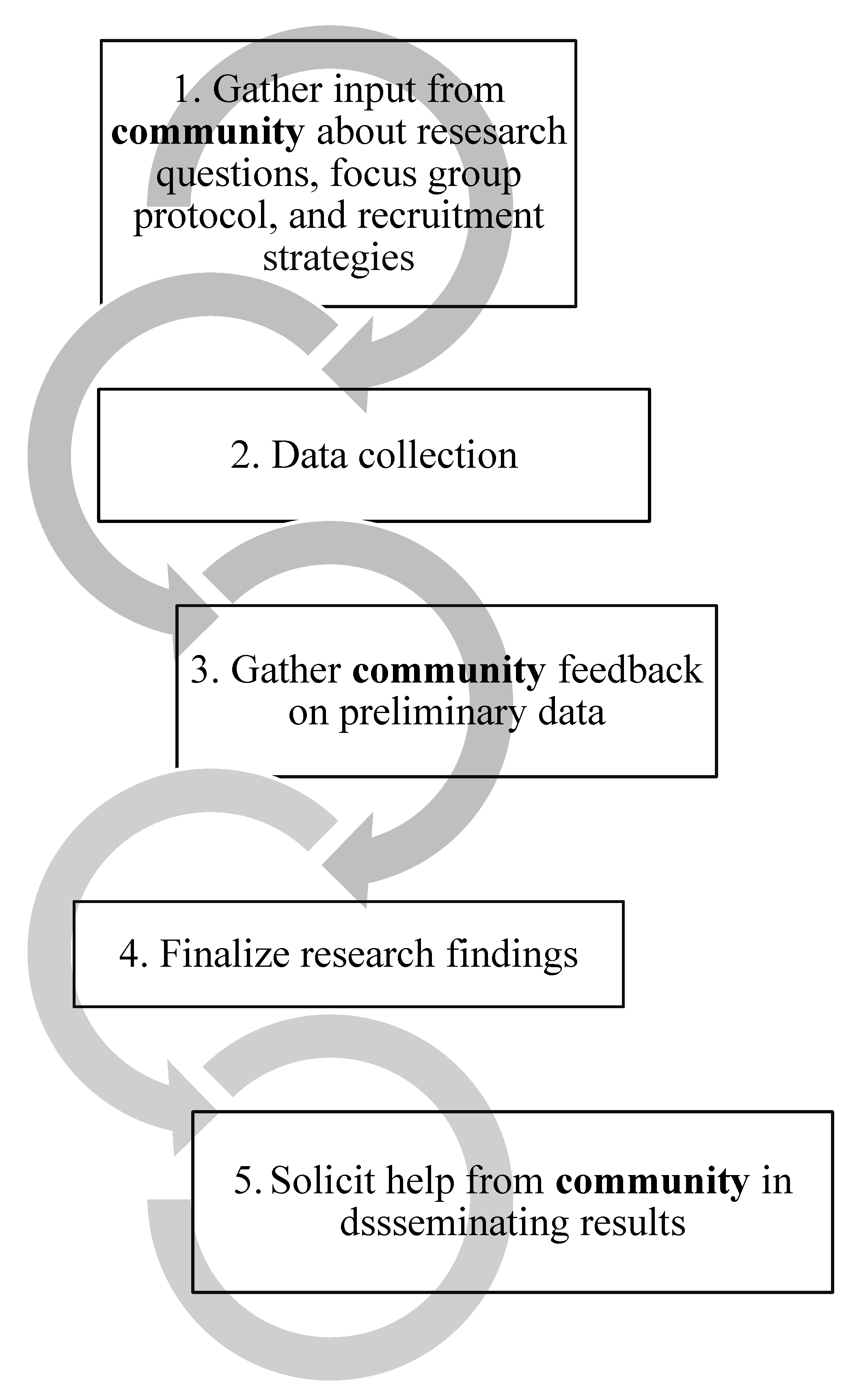

Table 1.
Focus Groups and Interviews.
| Meeting No. | Total Participants | Date | Meeting Location | |
|---|---|---|---|---|
| Focus group 1 | 5 | 7/23/2024 | Grafton County | |
| Focus group 2 | 5 | 7/23/2024 | Grafton County | |
| Focus group 3 | 3 | 8/22/2024 | Virtual - Merrimack County | |
| Focus group 4 | 8 | 9/17/2024 | Grafton County | |
| Focus group 5 | 2 | 9/26/2024 | Virtual - Belknap County* | |
| Focus group 6 | 14 | 10/23/2024 | Carroll County* | |
| Interview 1 | 1 | 7/24/2024 | Coos County* | |
| Interview 2 | 1 | 10/24/2024 | Virtual - Merrimack County | |
| Interview 3 | 1 | 10/25/2024 | Virtual - Merrimack County | |
| TOTAL | 40 |
* County does not have an SSA field office.
Table 2.
Rurality, SSA Field Office, and Target Populations by NH County, 2023.
| County | Rural | Has SSA Office | Working-age (Aged 18-64) | Aged 65 and Over | |||
|---|---|---|---|---|---|---|---|
| Population | % Disability† | Population | % 65*‡ | ||||
| Belknap | Yes | No | 37,686 | 13% | 64,459 | 23% | |
| Carroll | Yes | No | 27,940 | 14% | 50,844 | 30% | |
| Cheshire | Yes | Yes | 46,262 | 12% | 76,273 | 21% | |
| Coos | Yes | No | 16,993 | 18% | 29,526 | 25% | |
| Grafton | Yes | Yes | 56,320 | 11% | 90,928 | 22% | |
| Merrimack | Yes | Yes | 94,318 | 13% | 151,745 | 19% | |
| Sullivan | Yes | No | 25,415 | 14% | 43,063 | 23% | |
| Hillsborough | No | Yes (2 offices) | 268,075 | 10% | 420,612 | 16% | |
| Rockingham | No | Yes | 194,751 | 8% | 315,032 | 19% | |
| Strafford | No | No | 85,354 | 11% | 130,021 | 16% | |
| TOTAL | 853,114 | 10% | 1,372,503 | 19% | |||
Note. Sourced from 2023 ACS 5-Year Data from Census Table Builder, Table ID: S1810. †Represents the percentage of working aged people (aged 18-64) with a disability. ‡Represents the percentage of the total population who are aged 65 and over.
Table 3.
Participant Sociodemographic Characteristics (N=40).
| Characteristics | Participants | |
|---|---|---|
| n | % | |
| Age | ||
| Mean | 64.4 | -- |
| 18-34 | 3 | 7.5% |
| 35-44 | 1 | 2.5% |
| 45-54 | 5 | 12.5% |
| 55-64 | 9 | 22.5% |
| 65+ | 20 | 50.0% |
| Not stated | 2 | 5.0% |
| Gender | ||
| Male | 11 | 27.5% |
| Female | 28 | 70.0% |
| Other | 1 | 2.5% |
| Race | ||
| White | 37 | 92.5% |
| Other | 3 | 7.5% |
| Education | ||
| Not stated | 2 | 5.0% |
| Less than HS | 2 | 5.0% |
| HS | 19 | 47.5% |
| Some college & associates | 14 | 35.0% |
| Bachelor's or more | 3 | 7.5% |
| Disability | ||
| Yes | 29 | 72.5% |
| No | 10 | 25.0% |
| Not stated | 1 | 2.5% |
| County | ||
| Belknap* | 2 | 5.0% |
| Carroll* | 14 | 35.0% |
| Coos* | 1 | 2.5% |
| Grafton | 18 | 45.0% |
| Merrimack | 5 | 12.5% |
* No SSA field office.
Table 4.
Thematic Findings from Focus Groups and Interviews.
| Themes |
|---|
| One: Applying for Benefits |
| Two: SSA Customer Service |
| Three: Administrative Burden |
| Four: Technology Experience |
| Five: SSA Policy and Practices |
| Six: Recommendations to Improve the Beneficiary Experience |
Disclaimer/Publisher’s Note: The statements, opinions and data contained in all publications are solely those of the individual author(s) and contributor(s) and not of MDPI and/or the editor(s). MDPI and/or the editor(s) disclaim responsibility for any injury to people or property resulting from any ideas, methods, instructions or products referred to in the content. |
© 2025 by the authors. Licensee MDPI, Basel, Switzerland. This article is an open access article distributed under the terms and conditions of the Creative Commons Attribution (CC BY) license (http://creativecommons.org/licenses/by/4.0/).
Copyright: This open access article is published under a Creative Commons CC BY 4.0 license, which permit the free download, distribution, and reuse, provided that the author and preprint are cited in any reuse.