

Submitted:
20 March 2025
Posted:
21 March 2025
You are already at the latest version
Abstract
This study explores the publication and dissemination of the Pilu Canon 毗卢藏, engraved by followers of Bao'en Wanshou Hall in Houshan Village, Fujian, during the Yanyou reign of the Yuan Dynasty. Funded through donations, this canon was part of a broader initiative to republish the four major Buddhist canons. Its engraving style blends influences from Yan Zhenqing, Ouyang Xun, and Zhao Mengfu, with rounder characters and more spacious layouts compared to earlier Song editions. The project, supported by the White Lotus Society, involved various engravers and resulted in diverse transcription practices. Although no complete set survives, scattered volumes are housed in different institutions. The Pilu Canon provides valuable insights into the evolution of Buddhist scripture layout, the White Lotus Society's influence, and the interaction between Buddhist texts and secular society in medieval China.
Keywords:
Pilu Canon
; Buddhist Canon Engraving
; Textual Transmission
; Print Culture in Yuan Dynasty
; Materiality of Buddhist Scriptures
1. Introduction
The Pilu Canon 毗卢藏, published during the Yuan Dynasty (1271-1368), represents a pivotal example of Buddhist Canon engraving during this period. Engraved at the Bao'en Wanshou Hall 报恩万寿堂 in Houshan Village 后山村, Jianyang County 建阳县, Fujian Circuit (福建道), this edition of the Pilu Canon (hereafter referred to as the Yuan Pilu Canon) holds significant historical value. However, due to its fragmented survival, no complete copies remain, with only scattered volumes preserved in various locations across China. The Yuan Pilu Canon follows the catalog structure of the Pilu Canon from the Kaiyuan Temple 开元寺 in the Song Dynasty (hereafter referred to as the Song Pilu Canon), and it influenced later editions, including those produced at Miaoyan Temple 妙严寺 in Wuxi 无锡 and Huzhou 湖州.Scholars such as He Mei何梅i, Barend ter Haar田海ii, and Xiaochuanguanyi小川贯弌iii have explored this canon, recognizing its importance in the history of Buddhist Canon engraving. Despite these efforts, the fragmented nature of the surviving copies, along with their scattered distribution, has made it challenging to gain a comprehensive understanding of the canon's publishing and dissemination.
From 2008 to 2009, the zero edition of Pilu collection published in Yuan Dynasty was successively selected into the first and second batch of the national list of precious ancient books. ivThe author has collected the zero books and pictures of major collection institutions in China, paid attention to the auction of rare ancient books at home and abroad, and read many fragments of the existing yuan journal Pilu collection. He has some new understanding of the publishing process and distribution of this collection. The following is an introduction to the key issues of the yuan issue Pilu Canon, followed by a textual research focusing on the key issues of the publication and distribution of Pilu Canon.
2. Engraving Origin of the Yuan Pilu Canon
The engraving of the Yuan Pilu Canon is closely linked to the popularization of the four major Buddhist canons of Chan Buddhism, namely Da Bore Boluomiduo Jing大般若波罗蜜多经, Da Baoji Jing大宝积经, Da Fangguangfohuoyan Jing大方广佛华严经, and Da Boniepan Jing大般涅槃经. As He Mei noted in Research on Chinese Tripitaka, "The aims of re-engraving the Pilu Canon in the Yuan Dynasty was to republish the four minor canons: Bore Jing 般若经, Baoji Jing 宝积经, Huayan Jing 华严经, and Niepan Jing 涅槃经."vDai Fanyu also referred to the four canons in his work Spreading of Chinese Buddhist Canon Carving Origin, statingvi:
"The private edition of the Tripitaka (Yuan Dynasty) was engraved and stored by Guan Zhuba管主八, as mentioned above. In addition to the Da Puning TempleCanon, there were only four minor canons published by the White Lotus Society. "
In the second year of the Yanyou reign延祐年间, Chen Juelin陈觉琳 from Bao'en Wanshou Hall in Houshan Village后山报恩万寿堂, Jianyang County建阳县, Jianning Lu建宁路, Fujian Circuit福建道raised funds through solicitation and engraved four minor canons四大部经: 600 volumes of Da Bore Jing大般若经; 120 volumes of Da Baoji Jing大宝积经; 40 volumes of Da Bore Niepan Jing大般若涅槃经; 2 volumes of Da Bore Niepan Jing Houfen大般若涅槃经后分; and 80 volumes of Da Huayan Jing大华严经, all stored in 84 book wrappers. All the investors were from the commoner class. Each line contained 17 characters, and six lines were arranged on each side of the scriptures. The fonts were elegant and superior to the edition in the Puning Temple."vii
As Dai Fanyu further observed, "In the second year of the Yanyou reign, the White Lotus Society engraved the Pilu Canon in Jianyang."viiiThis suggests that the Bore Jing, Baoji Jing, Huayan Jing, and Niepan Jing engraved by Chen Juelin and others were the only verifiable private block-printing activities of Buddhist scriptures in the Yuan Dynasty, besides the Puning Canon, with each scripture engraved to a high standard.
The primary goal of publishing the Yuan Pilu Canon was to republish the "four Buddhist canons," which were in high demand at that time.ixCurrently, only scattered volumes of this canon are preserved, with copies held in institutions such as Yongquan Temple涌泉寺 on Mount Gu 鼓山in Fujian, the National Library of China, Nanjing Library, Shanxi Library, and Sichuan University Library. No modern records detailing the printing and publication process of the Yuan Pilu Canon have been uncovered. Only 15 volumes of Da Bore Jing and one volume of Da Baoji Jing from this canon have been found in printed copies, which were used for supplementary matching and appear in the A Photocopy of Song Qisha Canon碛砂藏, published during the Republic of China period.
3. The Publishing and Engraving of the Yuan Pilu Canon
The Pilu Canon, engraved during the early years of the Yuan Dynasty, is a significant example of Buddhist canon engraving that provides valuable insights into the development of scriptural printing in medieval China. This section examines key aspects of its publication, including the engraving time and location, as well as the changes in the typefaces and characters used in comparison to earlier editions such as the Song Pilu Canon. Through these details, we gain a deeper understanding of the evolution of Buddhist canons and the cultural and religious dynamics surrounding their dissemination during the Yuan period.
3.1. Engraving Timeline and Geographic Scope
The Yuan Pilu Canon is notable for its detailed engraving records, which provide crucial information about the time and place of its creation. Three key lines of engraving records state: "Chen Juelin of Bao'en Wanshou Hall in Houshan Village, Jianyang County建阳县, Jianning Lu建宁路, Fujian Circuit福建道, in order to pray for the eternal longevity of the current emperor and to wish prosperity and high positions for all civil and military officials, solicited public support to carve the printing blocks of the Buddhist Canon, so that it could be circulated and recited by the people. Respectfully inscribed in the second year of Yanyou reign."x
These inscriptions offer a clear timeline, indicating that the canon was engraved in the second year of the Yanyou reign (1315). Typically, a rectangular wooden inscription indicating the donor’s contribution is placed at the end of the Buddhist Canon title. Following this record, there is another inscription that states: “The Grand Promoter of Donations, Ronglu Grand Master, specially conferred with the honorary title of Kaifuyitongsansi开府仪同三司, Wu Guogong 吴国公(Duke Wu) Yihei–mi–shi (Yïγmïš) 亦黑迷失.” At the very end of each volume, phonetic transcriptions of the Buddhist texts are included, providing further details about the pronunciation of terms.
Based on these engraving records, it is clear that the Da Baoji Jing in the Yuan Pilu Canon was engraved at Bao'en Wanshou Hall in Jianyang, Fujian, during the second year of the Yanyou reign. This edition is now scattered across several locations. The Da Baoji Jing is currently stored in several locations, including the National Library of China, Nanjing Library, and the National Central Library of Taiwan. The latter holds the largest collection, with five volumes (volumes 18, 29, 50, 83, and 84), all bound in the folding style, with six lines per fold and 17 characters per line. The calligraphy was executed in the style of Ouyang Xun欧阳询 (557-641). At the end of the volume, the phonetic explanation was provided first, followed by the inscription soliciting donations.
As illustrated in Table 1,Fujian during this period was part of the Jiang-Zhe Province, bordering Jiangxi and Henan. The engraving records attached to these volumes reveal that the influence of the Pilu Canon, engraved through fundraising efforts by Chen Juelin and Chen Jueyuan, had already spread to surrounding areas. This monumental engraving project not only received enthusiastic support from followers in distant regions but also garnered the backing of Yïγmïš, the chief official of the Fujian Provincial Administration Commission. As a result, the Pilu Canon was successfully engraved and published, ensuring its widespread dissemination.xi
The location of Bao'en Wanshou Hall in Jianyang County is significant. Known historically as the "Land of Books" 图书之府, Jianyang was an ideal place for such a major engraving project. Chen Juelin, who led the project, was a follower of the White Lotus Society, which played a crucial role in organizing the funding and engraving of the Pilu Canon. xiiA deeper understanding of the political context can be drawn from additional historical records. For example, The History of the Yuan Dynasty reveals that in the 21st year of the Zhiyuan 至元 reign of Emperor Shizu世祖 (1284), Yïγmïš was sent to the foreign country of Simhala 僧迦剌国 to view the Buddha's alms bowl and relics. In the 24th year of the Zhiyuan reign, he was dispatched as an envoy to the Kingdom of Ma'bar 马八儿国 to retrieve the Buddha's alms bowl and relics.
This marked the beginning of his karmic connection with Buddhism.xiiiIn the 29th year of the Zhiyuan reign至元年间, the Fujian province was established, and Yïγmïš was appointed as Chief Administrator (Pingzhang Zhengshi 平章政事). Later, as Grand Master of Honors and Treasury (Ronglu Dafu 荣禄大夫) and Chief Administrator, he became the head of the Jixian Academy 集贤院 and took charge of affairs related to Hui Tong Hall. 会同馆事Following his retirement, Emperor Renzong仁宗, in recognition of his extensive missions to remote regions, issued an imperial edict conferring upon him the title of Duke Wu.吴国公 xivIt is clear that Yïγmïš, an important court official during Emperor Renzong's reign, was appointed Chief Promoter of the engraving of scriptures雕经都大劝缘 shortly after being granted the title of Wu Duke. His influence was pivotal in the success of the Pilu Canon engraving project. As a result, the Pilu Canon was engraved in the second year of the Yanyou reign period, centered in Jianyang County, and its influence radiated over a vast area.
3.2. Typefaces and Characters Used in Engraving
The Pilu Canon was originally engraved during the Song Dynasty and later re-engraved in the Yuan Dynasty. One notable difference between the two editions is the layout of the pronunciation explanation section. In the Yuan Pilu Canon, this section was moved to the end of each volume, whereas in the Song Dynasty edition, it was a separate volume placed at the end. This shift in layout reflects the evolving style of the Yuan Dynasty engraving.
In the Song Dynasty editions of the Pilu Canon, the typefaces were primarily influenced by the calligraphy of Yan Zhenqing 颜真卿(709–785), one of the most famous calligraphers of the Tang Dynasty. Yan’s calligraphy style is characterized by a mix of light horizontal strokes and heavy vertical strokes, sharp tips, strong pauses, and blunt hooks. The Song editions of the Pilu Canon, particularly those based on the Chongning Canon崇宁藏, adhered to this style, maintaining Yan's distinctive calligraphy throughout the engraving process.
The Puning Canon, another important Buddhist canon of the Song Dynasty, also initially used Ouyang Xun’s 欧阳询(557–641) calligraphy style. However, in its later stages, it transitioned to the more refined style of Zhao Mengfu赵孟頫(1254–1322), merging the strengths of both. This combination of styles marked the Puning Canon’s long engraving period. In contrast, the Yuan Pilu Canon fully adopted Ouyang Xun’s calligraphy style, which is noted for its smoother, thinner strokes compared to Yan Zhenqing’s heavier and more robust style. The Yuan edition's writing appears more refined, with greater fluidity and less visual heaviness than the Song edition.
The typefaces used in the Yuan Pilu Canon display a blend of different influences, showing both continuity and change in the engraving process. Some sections of the canon retain Yan Zhenqing's 颜真卿characteristic style from the Southern Song editions, with sharp edges and thick strokes, particularly in the vertical strokes, which contrast with lighter horizontal strokes,as illustrated in Figure 1 Left. This stylistic similarity makes it easy to confuse the Yuan edition with earlier Song editions.xv However, other parts of the canon feature more fluid strokes and a more elegant structure, with fewer sharp edges. The characters in these sections are well-balanced and neatly written, displaying characteristics that lie somewhere between Ouyang Xun's 欧阳询and Zhao Mengfu's 赵孟頫calligraphy styles,as illustrated in Figure 1 Right. These features are typical of the Yuan Dynasty editions. Compared to the Song Dynasty editions, the typefaces of the Yuan Pilu Canon are rounder and more forceful. xviThe spaces between characters in the folded parts of the canon are wider, giving the layout a more open and expansive feel. This shift reflects the evolving aesthetics and practical considerations of printing during the Yuan Dynasty.
As illustrated in Table 2,Calligraphic Hybridity as Sectarian Aesthetics,the Yuan Pilu Canon’s fusion of Yan Zhenqing’s solemnity (颜体), Ouyang Xun’s angularity (欧体), and Zhao Mengfu’s fluidity (赵体) was not merely a technical choice but a visual rhetoric legitimizing the White Lotus Society’s doctrinal innovations. While the Song edition adhered strictly to Yan-style orthodoxy, the Yuan version’s rounded strokes and wider spacing (Figure 2) accommodated lay readership, reflecting the sect’s populist outreach. This contrasts with the contemporaneous Puning Canon, which retained monastic rigidity through standardized Ou-style scripts. Such stylistic hybridity, paralleling the sect’s blending of Pure Land devotion and Chan pragmatism, epitomizes how material features of texts mediated religious reform in late imperial China."
The Yuan Pilu Canon also features a greater presence of vulgar and variant forms of characters. Over time, texts from different dynasties often exhibit variations in character forms, and even different editions of the same text can display distinct styles of glyphs.xviiEngraved by followers of the White Lotus Society through a fundraising effort, the Yuan Pilu Canon involved numerous engravers, each responsible for one or more volumes. Due to the large number of individuals involved, differences in transcription and engraving styles naturally emerged. As a result, vulgar and variant forms of characters became common, particularly between the earlier and later stages of the engraving process. By examining these variations over time, we can trace the evolution of Chinese Buddhist canons from their "original manuscript forms" to the "printed editions" during the transitional period between the Song and Yuan Dynasties.
3.3. Founding of the Work
The Yuan Pilu Canon does not record the names of individual engravers. Instead, the inscription at the end of each volume lists the solicitors of donations for that particular volume. This practice contrasts with other official Tripitaka engravings, where large teams of engravers, typically funded by the state, were responsible for the work. In these official state-sponsored projects, such as the Qisha Canon 碛砂藏 and Yuanguan Canon 元官藏, each engraver was usually tasked with several layouts. These large-scale projects were often managed by state institutions or official religious bodies.
In comparison, the Puning Canon, although privately funded, was engraved under the direction of the Tripitaka Bureau 大藏经局, a specialized institution associated with the Dapuning Temple 大普宁寺 on South Mountain. The Tripitaka Bureau was specifically dedicated to the task of scripture engraving, and its involvement ensured a unified approach to the canon's production.
However, the Yuan Pilu Canon differs significantly in its organizational structure. Unlike the Song Pilu Canon, which recorded the names of engravers in the center of each layout, the Yuan Pilu Canon does not provide this level of detail. The Song editions, initiated by temples, had more unified funding sources, which allowed for a more formalized process of engraving. In contrast, the Yuan Pilu Canon was primarily funded through the efforts of local followers and donors, such as those from Bao'en Hall in Houshan Village, Jianyang County. The engraving process was less formalized, and the workload was generally lighter. Each engraver was responsible for only one volume or a few pages. Once the engraving was completed, the donors directly paid the engravers’ wages. Only a select group of donors was recorded on the scripture printing blocks, reflecting the decentralized nature of the project.
The primary solicitors for the Yuan Pilu Canon were followers of the White Lotus Society, a religious movement that played a significant role in funding this massive engraving effort. Among the main figures were Chen Juelin of Bao'en Wanshou Hall, who raised funds in Fujian, and Chen Jueyuan, who solicited donations in Henan. He Mei, in her book Research on Chinese Tripitaka, co-authored with Li Fuhua, suggested that Chen Juelin and Chen Jueyuan may have been relatives or from the same clan, based on the fact that the first two characters of their names were identical.xviii
4. The Socio-Religious Context of the Yuan Pilu Canon
In the Yuan Dynasty, the fundraising and engraving of the Pilu Canon involved a diverse group of contributors, many of whom were also its solicitors. Most of these individuals came from the secular class and displayed a strong sense of religious homogenization, primarily linked to the White Lotus Society. By examining the religious names used by these followers, we gain a deeper understanding of their relationships and the overall nature of the Pilu Canon.
4.1. Religious Names of the White Lotus Society Followers
Yang Ne's Research on the White Lotus Society in the Yuan Dynasty provides substantial information on the religious names of its followers. For instance, Wei Su 危素, a figure from Jinxi, Jiangxi, who lived during the Yuan Dynasty, was known by the courtesy name Tai Pu 太朴 and authored the Wei Taipu Ji 危太朴集. In this collection, he mentions Tu Wenzheng 屠文正, a member of the White Lotus Society, who used the religious name Jueyuan, while his son adopted the name Juexing觉兴.xixSimilarly, the head monk of Shanfa Hall at Donglin Temple东林寺 on Mt. Lushan 庐山Pudu普度, from Danyang丹阳 (modern Jiangsu), also had a secular surname, Jiang 蒋. Pudu’s family had practiced Buddhism for generations, and he himself became a monk at the age of twenty. xxHe wrote the Mirror of the White Lotus Society in Mt. Lushan, in which he describes the growing misunderstandings among people, even those who aspired to the right path. Despite their intentions, many fell into heretical sects, and various disputes about right and wrong arose. As he observes:
"The age of the sages has long passed, and many have fallen into misunderstanding. Though they yearn for the right path, they have instead veered into heretical sects. The mediocre and confused are but mere sentient beings. Consequently, countless heresies spread lies to deceive, and sects of all kinds flourish simultaneously. Disputes over right and wrong erupt like swarms of bees, and empty words are endless. These debates seem to cut through the void, as each faction slanders and attacks the others. There are those who cling to the characters pu普and jue觉of our sect, while others promote the characters miao妙 and dao道of other sects. All these people secretly appropriate this mirror and bring it into the heretical realms of others, where it is covered in dust and dirt, obscured from the true essence of the sect. Though they claim to possess the name of this mirror, they are unable to use it."xxi
From this, it is clear that within the White Lotus Society, followers used the characters pu, jue miao and dao as identifiers for different sects within the broader movement. This suggests that internal divisions had already taken shape, with various factions competing for influence."
An example of the complex relationships within the society can be found in Lu Qi’s 卢琦 poem Expressing My Feelings While Staying at Shanying Temple in Pingnan, which recounts the history of Shanying Temple 善应庵. A follower named Chen Juejian donated his private residence to the temple, and his disciples, including Chen Jueqing and Chen Juezheng, were Taoists, while his grandson, Chen Juezhen, later shaved his head and became a monk. Many White Lotus Society members shared the surname Chen, with familial and teacher-disciple relationships intertwining, reflecting the society’s grassroots support for the Pilu Canon in Jianyang.
4.2. Relationships of Solicitors
The fundraising and engraving efforts for the Yuan Pilu Canon spanned a wide geographical area, with solicitors and donors coming from places such as Jian'an, Jianyang, Zhenghe, Shaowu, Jianning, Chongren, Gushi, and Lu'an, covering regions in both Fujian and Jiangxi provinces, as well as parts of Henan and Guangdong.xxiiThe contributors to this canon largely came from the lower strata of society, with the majority of solicitors being followers of the White Lotus Society, along with some non-affiliated individuals. The colophon at the beginning of the volume reveals that the engraving of Buddhist scriptures, a significant undertaking by the White Lotus Society, received considerable support from various quarters. While the financiers came from diverse locations, the majority were concentrated in the regions south of the Yangtze River, with relatively few coming from the north. This may be attributable to the comparatively weaker influence of the White Lotus Society in northern China. xxiii
Many followers of the White Lotus Society incorporated religious characters into their names, such as dao道, zhi智, yuan圆, pu普, miao妙, and jue 觉. According to Barend ter Haar’s research, over half of the 45 lay Buddhists mentioned in the engraving records of the Pilu Canon had religious characters in their names. Specifically, 19 had the character jue 觉 and 6 had miao妙. Following the Buddhist tradition of adopting religious names, both Chen Juelin and Chen Jueyuan were of the jue generation and members of the White Lotus Society.xxiv
The use of standardized dharma names in the Yuan Dynasty White Lotus Society was not merely a nominal practice but a deliberate strategy to construct collective religious identity. The recurrence of ‘Jue’ in key figures like Chen Juelin and Chen Jueyuan (likely kin or master-disciple relations) highlights a structured hierarchy that reinforced internal cohesion. This naming convention, akin to the pu普and dao道branches mentioned in Pudu’s Mirror of the White Lotus Society, reflects doctrinal divisions and competing claims to orthodoxy within the sect. By anchoring the canon’s production to these dharma names, the White Lotus Society transformed scripture engraving into a ritual act of devotion, thereby consolidating its spiritual authority among lay followers.This reflects the Dharma Name System and Sectarian Identity of the White Lotus Society.
Shi Weize 释惟则, a scholar from the Yuan Dynasty, wrote a ten-volume work titled Interpretation of Dafoding Shoulengyan Jing大佛顶首楞严经会解. Today, we can see a revised version of this work, published during the Zhizheng reign of the Yuan Dynasty by the Shizilin in Gusu. The edition includes a woodcut illustration of Sakyamuni preaching the Dharma at the beginning of the volume, along with a colophon at the front. This version is preserved in the National Central Library of Taiwan. The descendants of Shi Weize later wrote a narration of the Interpretation. This canon, engraved in the late Yuan Dynasty, presents a form and structure distinct from those of earlier Buddhist scriptures. It is not included in the official Buddhist Canon, which makes determining its system of classification difficult. However, a publishing record found at the end of Volume Three offers some insight. The record notes:
“The local deity of the He family in Chenghua Li Village, Changshu Prefecture, crossed the Yangtze River and came to the deity’s shrine. There, my disciple Yan Xian and his wife Zhang Miaozhen generously funded the engraving and printing of the third volume of the scriptures. Their aim was to accumulate merit in this life and plant the seeds of good fortune for future lives. They dedicated their contribution to the compassionate Acalanatha Bodhisattva, whose mercy extends to all sentient beings and the Dharma realm. I hope that through this merit, I could swiftly attain the highest enlightenment, save countless sentient beings, and repay the Buddha’s kindness.”xxv
Based on the religious character of Zhang Miaozhen, the wife of Yan Xian, Ms. Zhang might have been a female follower of the White Lotus Society. She was the donors who sponsored the production of Volume Three of Interpretation of Dafoding Shoulengyan Jing, might have had something in common in terms of belief with those who solicited donations for the carving of the Yuan Pilu Canon.
Most of the solicitors for the engraving of the Yuan Pilu Canon were followers of the White Lotus Society, and occasionally there were people outside the society. According to the names such as Xie Juejie, Song Juehui, Liu Juezhi, Li Jueqing, Huang Juegui, Xie Miaoxin, Gong Miaozhen, Chen Miaoqing, Wang Miaofa and Yang Miaoyi in the engraving records, it seemed that the male followers in the Bao’en WanShou Hall in the Houshan village took jue觉 as part of their religious names, while the female followers took miao妙 as part of their religious names. Therefore, we have grounds to think that Chen Juelin and Chen Jueyuan just share the same surname and belong to the same generation with the character jue in the society. By observing these religious names, it becomes apparent that the solicitors were primarily ordinary followers of the society, contributing to the collective effort of engraving the canon.This correspondence relationship explicitly links dharma names to sectarian identity and doctrinal conflicts and integrates primary sources to contextualize naming practices.
4.3. The Grassroots and Sectarian Nature of the Yuan Pilu Canon
The engraving records at the end of the volume reveal that the solicitors for the engraving of the Yuan Pilu Canon can be categorized into two groups. The first group consisted of followers from within the White Lotus Society, primarily male and female devotees from the Bao’en Hall in Houshan Village. These individuals, who bore religious names with jue and miao, played a leading role in the engraving process. The second group included supporters from outside the society—individuals who, though not yet formally initiated into the White Lotus Society, aligned with its doctrines. Examples include donors such as Shisan Niang十三娘(Lady Thirteen) and Zhu Dage朱大哥(Brother Zhu). Their active participation provided crucial support for the scripture-engraving project. Several signatures, including those of Wu Duke, Yïγmïš, and his entourage, appear multiple times in the engraving records, indicating that the scripture-engraving activity had official authorization and financial backing. Yïγmïš, in this context, can be identified as the publishing authorizer.
The Yuan Pilu Canon was a privately engraved Buddhist canon. During this period, the Yuan government imposed strict control over religious publishing, especially the activities of non-governmental groups. The inclusion of civil and military officials in the records, particularly at the beginning of the volume, can be seen as a form of disclaimer. This disclaimer, issued by the person in chargen in charge (such as Chen Juelin), served to confirm that the engraving process had received the necessary official approval. This strategic inclusion of officials helped smooth the progress of the project and secure the necessary permissions for publication. As the head of several officials, Yïγmïš provided both financial and institutional guarantees for the engraving.
In addition to this institutional support, Dai Fanyu’s statement that "all the investors were from the commoner class" further highlights the grassroots nature of the canon’s production. It underscores the wide participation of both White Lotus Society followers and individuals from outside the sect, emphasizing the canon’s privately funded and community-driven character. The involvement of both sectarian members and outsiders not only expanded the influence of the White Lotus Society but also marked the Yuan Pilu Canon as an example of grassroots religious publishing.
5. Dissemination of the Yuan Pilu Canon
The dissemination path of the Yuan Pilu Canon remains uncertain within the academic community. There are two main reasons for this ambiguity. First, the canon’s limited circulation has led to relatively little attention from scholars. Second, due to insufficient historical records, this canon has often been mistakenly identified as a version from the Song Dynasty. As a result, it is necessary to correct these misunderstandings and, based on this, clarify the spreading of the canon.
5.1. The Scriptures Bestowed to One Hundred Monasteries: The Edition from the Song Dynasty
Following the engraving of the Yuan Pilu Canon, the scripture was distributed across various temples, including those in Dadu, Henan, Ningxia, Lianghuai, Jiangsu, Zhenjiang, and Fujian. It was regularly exhibited for public reading by followers. A notable record exists on a stone stele in the Minglun Hall in Quanzhou, erected by Yïγmïš, titled Stele Inscription of Reading Sutras in One Hundred Huge Monasteries. This inscription details how Yïγmïš took charge of the scripture-engraving effort during the second year of the Yanyou reign in the Yuan Dynasty. His plan was to evaluate one hundred major temples nationwide, with each selected temple receiving one hundred ding of Zhongtong banknotes. The annual interest from these notes was designated to fund the regular monthly readings of the Sancheng Shengjiao 三乘圣教Canon. In addition, other temples, nunneries, and halls would receive donations of fields and banknotes, which would support the reading of other significant scriptures, such as the Huayan Jing and the Fahua Jiang, as well as the lighting and maintenance of eternal lamps for Buddha worship. xxvi
The stele inscriptions offer a comprehensive account of the entire engraving and publication process of the Four Major Buddhist Scriptures, including the temples that received copies of the Pilu Canon. Among these were 37 temples located in places such as Fuzhou, Quanzhou, and Xinghua, excluding Yongquan Temple on Mount Gu. Unfortunately, the Buddhist canons from many of these later temples have been lost, which makes the scattered copies preserved at Yongquan Temple particularly valuable.xxvii
However, it is important to note that the Pilu Canon mentioned in the Stele Inscription of Reading Sutras in One Hundred Huge Monasteries is not the same as the Yuan Pilu Canon. Xu Xiaowang suggested that the Pilu Canon contained 6,117 volumes, with engraving beginning in the Song Dynasty and completing during the Yanyou reign of the Yuan Dynasty.xxviii However, after further investigation, Wang Tiefan discovered that the Pilu Canon was not engraved in one hundred copies for distribution to one hundred temples. Instead, it was engraved in 37 copies, which were stored in 37 temples, as recorded on the stele.xxixSince the Fahua Jing 法华经(Lotus Sutra) is not part of the Four Major Buddhist Scriptures in the Pilu Canon, and comparing the volumes of the Pilu Canon as stated by Xu, we can conclude that the Pilu Canon referenced here corresponds to the edition from Kaiyuan Temple 开元寺in Fuzhou during the Song Dynasty.
5.2. The Four Major Buddhist Canons as the Core
Zhan Shichuang and others have noted that Yïγmïš, the Chief Administrator of Fujian, initiated the engraving of the Pilu Canon. Although it was never fully completed, the four major scriptures—Bore Jing, Baoji Jing, Huayan Jing, and Niepan Jing—also known as the Yanyou Canon, were stored at Yongquan Temple on Mount Gu in Fuzhou City until the Republic of China period.xxxThis suggests that, by that time, only Yongquan Temple and Chongshan Temple in Taiyuan, Shanxi, held copies of the Pilu Canon, though all of these copies were incomplete.xxxi
In 1932, the Japanese scholar Long Chiqing visited Mount Gu in Fuzhou City to survey the Buddhist scriptures, discovering more than 40,000 volumes in the temple. Among them were 600 volumes of the Bore Jing from the Yuan Pilu Canon. Long Chiqing praised the calligraphy as graceful and more exquisite than that of the Puning Canon.xxxiiFan Hui also remarked that, despite being incomplete, the characters in the Yuan Pilu Canon were exceptionally fine, surpassing those in the Puning Temple editions.xxxiiiThe abbot of Yongquan Temple, who participated in the restoration of the three major Buddhist scriptures during the Republic of China period, detailed the entire process in his Postscript of Repairing Ancient Scriptures, describing how Buddhist master Faxin hand-copied these scriptures:xxxiv
The 600 volumes of the Da Bore Jing, 120 volumes of the Da Baoji Jing, and 40 volumes of the Da Niepan Jing were all engraved by the follower Chen Juelin from Fujian Province during the Yanyou reign. These scriptures were stored in the Fa Hall at Yongquan Temple for generations. Since the Ming and Qing Dynasties, Yongquan Temple on Mount Gu in Fujian has been the recipient of the Long Canon龙藏 on four occasions. However, these copies had long remained unread, and it was uncertain whether they were complete. This summer, my disciple Guanben Mingyi 观本明一 took the initiative to examine these scriptures. It was discovered that the three texts were missing over forty volumes in total. In response, the Guest Master Qingfu清福 raised funds for their binding and restoration. The Chief Seat Master Cizhou, the Western Hall Master Baoshan, and Masters Zongshou, Xingzheng, Tonghua, Shengxiu, Chunguo, Fazhen, Longguang, Shenzu, Chuandao, Chenglang, Youding, Nengfu, among others, were also inspired to hand-copy the missing volumes. As a result, these ancient and precious scriptures were fully restored to their original state, appearing as new.
Respectfully inscribed by Xu Yun, the abbot of Yongquan湧泉寺 Temple, in the 21st year of the Republic of China (1932), late autumn of the Ren Shen year.
From this postscript, we can see that the three Buddhist scriptures—Bore Jing, Baoji Jing, and Niepan Jing—remained incomplete until the Republic of China period. It was through the collective efforts of Cizhou and the Buddhist masters at Yongquan Temple that the missing volumes were supplemented. In 1957, Wang Tiefan visited Mount Gu to survey the cultural relics and found a total of 762 volumes of the Four Buddhist Scriptures, with approximately 50 volumes being supplementary handwritten copies.xxxvTherefore, the four Buddhist scriptures published in Jianyang during the Yanyou reign were considered the main sections of the Pilu Canon. This minor canon from the Yuan Dynasty was not unique. The Buddhist canons engraved and published by Miaoyan Temple in Wuxing during the Yuan Dynasty also formed a minor canon, consisting of the four texts—Bore Jing, Baoji Jing, Niepan Jing, and Huayan Jing. Its format was similar to that of the Qisha Canon.xxxvi
Thus, traditionally, the compilation and publication of these four minor canons trace their origins to the Pilu Canon published at Bao’en Wanshou Hall in Houshan village, Jianyang, which was later finalized as the Buddhist Canon of Miaoyan Temple in Wuxing, Huzhou.
5.3. The Yanyou Canon as a Separate Text
The Yuan Pilu Canon, engraved during the Yanyou reign, has often been referred to as the Yanyou Canon in various scholarly works. In the summer of 1984, He Mei referred to three scattered volumes of Yuan Dynasty-engraved canons as the Yanyou Canon. However, the Yanyou Canon discussed by He Mei is a different text from the Pilu Canon, and there are several key differences between the two:
1.Different Engraving Dates.The Yanyou Canon began engraving in the third year of the Yanyou reign (1316),as illustrated in Figure 2. Right,while the Pilu Canon was started in the second year of the Yanyou reign (1315). Therefore, the Yanyou Canon was engraved a year after the Pilu Canon,as illustrated in Figure 2. Left.
2.Different Nature.The Yanyou Canonxxxvii was engraved under official authority, while the Pilu Canon was privately commissioned.
3.Different Version Genealogies.According to He Mei’s research, the Yanyou Canon was a re-engraving of the Jin Canon in the Yuan Dynasty.xxxviiiBoth the Yanyou Canon and the Jin Canonxxxix are bound in scroll format, share similar glyphs, fonts, and layouts, and belong to the northern category of Chinese Buddhist canons. In contrast, the Pilu Canon was primarily engraved in Jianyang, Fujian, representing the southern category of the canon.
The Yanyou Canon was another Chinese Buddhist canon engraved by the authorities during the Yuan Dynasty, alongside the Pilu Canon published in the same period. In addition to the engraving activities carried out by the Bao’en Wanshou Hall in Houshan Village, two versions of the Pilu Canon were engraved during the Yuan Dynasty. The first was the Da Pilu Canon, funded by disciples on the eastern side of Yuanming Hall at Ni Mountain in Shanji Fang, the southern district of Quanzhou city, under the guidance of Lin Deshi and Decheng. The second was the Pilu Fabao Da Canon, engraved and printed by Shuilu Temple in the Quanzhou Road area of Fujian Circuit, in the first year of the Zhida reign (1308, Year of Wushen). Both reprinted editions were based on the Pilu Canon published during the Song Dynasty. To this day, only two boxes of worn and fragmented pages (a total of 1363 pages) remain at Kaiyuan Temple in Quanzhou, with some pages still bearing the wooden stamp ink prints from Shuilu Temple.水陆寺xl
5.4. Dissemination and Fragmentation of the Yuan Pilu Canon: Impact of Historical Turmoil
In 1936, the renowned writer Yu Dafu mentioned a Buddhist Canon held at Yongquan Temple on Gu Mount, which, based on the survey report of Japanese scholar Tokiwa Daijo (1929-1936), can undoubtedly be identified as the Pilu Canon published during the Yuan Dynasty.xli
By the 1960s and 1970s, the scriptures bestowed by the Emperor during the Kangxi and Qianlong reigns of the Qing Dynasty were still preserved at Gu Mount, alongside the Nan Canon from the Ming Dynasty, Sanskrit copies from the Qing Dynasty, the Book Canon, and the Narration Canon, totaling 20,346 volumes. Additionally, there were 7,586 volumes of various scriptures printed at Gu Mount during the Ming and Qing Dynasties and in modern times, along with 225 volumes of handwritten scriptures from the Qing Dynasty, 657 volumes of blood-written scriptures, and 7 volumes of the Beiye Jing from Myanmar. However, the Pilu Canon was notably absent. In China, only scattered copies of the four major Buddhist Canons remain, with no complete sets to be found. According to Tokiwa Daijo’s records on the spread of the Pilu Canon, it is evident that the destruction of this canon was due to the upheavals of the time.xlii
In China, complete sets of the Yuan Pilu Canon are no longer available. However, over 460 volumes of scattered scriptures are stored in institutions such as the National Library of China, Shanxi Library, Hubei Provincial Library, Peking University Library, Shanghai Library, Tianjin Library, Nanjing Library, Lvshun Museum, and Kaiyuan Temple in Quanzhou. Incomplete copies are also dispersed abroad, with fewer than 10 volumes found in the United States.xliiiCurrently, the Beijing Rushi Institute of Artificial Intelligence Technology is digitizing various Chinese Buddhist Canons from the Song and Yuan Dynasties, which may offer the opportunity to view these photocopies in the future.
6. Conclusions
This paper examines the Yuan Pilu Canon, an often-overlooked subject in academic discourse, and explores its fragmented state through an analysis of engraving records, typefaces, and layout features. By comparing the Yuan Pilu Canon with other prominent engraved canons, particularly the Song Dynasty’s Yanyou Canon, the study sheds light on the Pilu Canon’s position within the broader history of scripture engraving and its unique characteristics.
Several key conclusions emerge from this study. First, the process of scripture engraving is inherently cross-regional. The typefaces used, including variations in stroke development and form, reflect regional characteristics. By examining the layout features, one can discern the system of editions used. Second, private scripture engravings often relied on funds raised from various sources, and the engravers came from diverse regions. It was common for sponsors to inscribe their names on the scriptures. However, due to the simplified employment process and smaller workload, the details about the engravers were frequently omitted. Third, as wood was the primary material for printing plates and knives were used instead of pens, engravers inevitably left their own stylistic imprints.
This resulted in variations in aspects like stroke width, writing style, and the form of characters.xlivA comparison of the engraving characteristics between privately commissioned and official scriptures provides a fresh perspective on the history of publishing and printing during the Song and Yuan Dynasties. Furthermore, the time indicated in the engraving records of Buddhist canons must be interpreted dialectically. For minor canons with short engraving cycles and narrow time spans, the time reflected in the engraving records may indeed correspond to the publication time. However, it is essential to examine these records in different stages and to approach the entire scripture engraving project from a diachronic perspective.
This paper also highlights the significant role non-governmental groups played in scripture publishing and printing activities, often functioning on par with official institutions. The interaction between scripture engraving and publishing and the non-religious classes manifested in three key areas: economy, culture, and society. Economically, scripture engraving and publishing were costly endeavors that required substantial financial backing from the non-religious classes. Culturally, the involvement of these classes in the engraving and related tasks fostered the integration of religious and secular cultures. Socially, scripture engraving served as a public welfare undertaking, offering non-religious participants the opportunity to expand their social networks and enhance their social prestige. Moreover, through their engagement with religious communities, folk religious groups were able to extend their social influence.
Note
-
iThe Yuan Pilu Canon元毗卢藏 is referred to as the re-engraved Pilu Canon. For detailed discussion, see He Mei's 何梅Research on Several Issues Concerning the Pilu Canon 《毗卢大藏经》若干问题考(Studies in World Religions世界宗教研究, Issue 3, 1999) and Research on Chinese Tripitaka汉文佛教大藏经研究 (China Religious Culture Publisher, 2003).
-
iiBarend ter Haar 田海argued that the Pilu Canon published in the Yuan Dynasty was a re-engraved edition覆刻本 of the Qisha Canon碛砂藏. However, Barend ter Haar cited the Taiwan version台湾版 of the Zhonghua Buddhist Canon 中华大藏经 (first series), which included a photocopy of the Song Dynasty Qisha Canon published in Shanghai between 1931 and 1936. During the compilation of this photocopy, it was discovered that parts of the Qisha Canon were missing. Due to limited resources at the time, various versions of the Qisha Canon from the Song宋, Yuan元, and Ming明 Dynasties were used to supplement the missing sections, resulting in a version resembling a patchwork edition. Since Barend ter Haar did not have access to the original Qisha Canon or its photocopied version影印本, he referenced the re-photocopied edition, which no longer preserved the original appearance of the Song Dynasty Qisha Canon.Barend ter Haar 田海Zhong guo li shi shang de bai lian jiao中国历史上的白莲教 (The White Lotus Society in Chinese History), translated by Wang Rui and Liu Ping. Beijing: The Commercial Press, 2017.
-
iiiXiaochuanguanyi 小川贯弌was the first to propose identifying the fundraising groups behind the Pilu Canon published in the Yuan Dynasty. He argued that the White Lotus Sect白莲宗 referred only to certain White Lotus societies 白莲教led by well-known monks无名僧 and adhering to strict religious doctrines, such as those at Donglin Temple东林寺 on Mount Lushan庐山. In contrast, White Lotus societies widespread among the common people with less rigorous religious doctrines and lacking the guidance of prominent monks could be classified as the White Lotus Society, but not the White Lotus Sect. Xiaochuan believed that the hall associated with the Pilu Canon belonged to a mass religious group with shallow doctrines and no guidance from prominent monks, thus falling under the White Lotus Society.Please refer to Xiaochuan’s Carved Stories of Bai Lianjiao in the Yuan Dynasty (Chinese Buddhist History), 1943, Vol. 7, Issue 1, pp. 4-14)
-
ivIn 2008, two volumes of scattered copies of the Da Baoji Jing from the Pilu Canon published in the Yuan Dynasty, housed in the National Library of China, along with one volume of the Da Fang guang fo hua yan Jing大方广佛华严经 from the same canon, held in the Shanxi Library山西省图书馆, were included in the first National Rare Ancient Book Directory第一批国家珍贵古籍名录. In 2009, one volume each of the Da Baoji Jing, Da Boniepan Jing, and 27 volumes of the Da Bore Boluomiduo Jing from the Pilu Canon, collected in the Nanjing Library, as well as one volume of the Da Bore Boluomiduo Jing from the Pilu Canon, held in the Hubei Provincial Library, were added to the second list第二批国家珍贵古籍名录. Currently, the Nanjing Library holds the largest collection.
-
vLi, Fuhua 李富华He Mei 何梅 Hanwen fojiao dazangjing yanjiu汉文佛教大藏经硏究(Research on Chinese Tripitaka) ,Beijing: China Religions Culture Publisher, 2003. P. 354.
-
vi Dai, Fanyu 戴蕃豫Zhong guo fo dian kan ke yuan liu yan jiu中國佛典刊刻源流研究(Spreading of Chinese Buddhist Canon Carving Origin) ,Beijing: Bibliography and Document Publishing House, 1995.P. 101.
-
viiThe Buddhist Canon at Puning Temple大普宁寺 refers to the Puning Canon,普宁藏 engraved by Bai Yunzong白云宗. No complete sets of this canon exist in China, and it is currently primarily housed at Zojo-ji Temple增上寺 in Japan.
-
viiiDai, 1995, p.51
-
ixIn Zen Buddhism, the Huayan Jing华严经, Niepan Jing涅槃经, Baoji Jing宝积经, and Bore Jing 般若经are referred to as the four major Buddhist canons. The "Fangshan department part"房山部 in New Visits to Monuments in the Capital includes 新日下访碑录records of the continued engraving of these four major canons on the East Peak of Yunju Temple on Baidai Mountain in Zhuozhou. 涿州白带山云居寺东峰续镌成四大部经记The four canons mentioned in this context are the same as those referred to above. This shows that the term "four major Buddhist canons" 四大部经was consistently applied.
-
xLi and He. 2003.P. 354.
-
xiJianchang Prefecture 建昌州was originally part of Haihun County 海昏县during the Han Dynasty汉代. In the Liu-Song Dynasty刘宋, Haihun was divided and incorporated into Jianchang. During the Yuan Dynasty, it was renamed Jianchang Prefecture and came under the jurisdiction of Jiangxi Province江西省. Luan Prefecture陆安州, which was part of Luzhou Road 庐州路in Henan Province河南省 during the Yuan Dynasty, had its administrative offices in Hefei合肥.
-
xiiHuang, Zhongzhao, 黄仲昭Ba min tong zhi八闽通志(Bamin Annals, in Fujian Local Chronicles Collection) , vol. 76 .Fuzhou: Fujian People's Publishing House, 1991.P. 813.
-
xiiiSong Lian et al,宋濂Yuan shi元史(The Yuan History).Beijing: Zhonghua Book Company, 2013.pp 3198-3200.
-
xivIbid, pp. 3198-3200.
-
xvThis image is quoted from the website of the Imperial Household Agency's Shuling Department in Japan日本宫内厅书陵部Website:https://db2.sido.keio.ac.jp/kanseki/bib_frame?id=007075_0082.
-
xviThis zero species has been selected for the "First Batch of National Precious Ancient Books List" and is currently stored in the Shanxi Provincial Library.This image is quoted from the National Rare Ancient Books List database国家珍贵古籍名录数据库Website:http://gjml.nlc.cn/#/exploration.
-
xviiZhen, Dacheng 真大成Jia qiang han wen fo jing yi ti zi quan mian yan jiu加强汉文佛经异体字全面研究(Strengthen the comprehensive research on variant characters in Chinese Buddhist scriptures), Chinese Social Science Today, April 8th, 2022.
-
xviiiLi and He, 2003, pp. 43-51.
-
xixYang Ne 杨讷Yuandai bailianjiao yanjiu元代白莲教研究(Research on the White Lotus Society in the Yuan Dynasty), Shanghai: Shanghai Chinese Classics Publishing House, 2017. pp.72-73.
-
xxYang Ne 杨讷Yuandai bailianjiao yanjiu ziliao hui bian元代白莲教研究资料汇编(Compilation of Research Materials on the White Lotus Society in the Yuan Dynasty), Beijing: Zhonghua Book Company, 1989. pp.3.
-
xxiIbid, p. 66.
-
xxiiLi and He, 2003, pp. 355-356.
-
xxiiiYou Biao 游彪 foxing yu renxing:songdai minjian fojiao xinyang de zhenshi zhuangtai佛性与人性:宋代民间佛教信仰的真实状态(Buddhist Nature and Human Nature: The True Status Quo of Buddhist Belief among the People in the Song Dynasty),Journal of Beijing Normal University (Social Science), no. 5 (2011): 93-100.
-
xxivBarend ter Haar 田海Zhong guo li shi shang de bai lian jiao中国历史上的白莲教 (The White Lotus Society in Chinese History), translated by Wang Rui and Liu Ping. Beijing: The Commercial Press, 2017. p40.
-
xxvThe engraving records are cited from volume 3 the of The Interpretation of Dafoding Shoulengyan Jing 大顶首楞严经stored in the Taiwan National Central Library台湾“国家图书馆”. Website:https://rbook.ncl.edu.tw/NCLSearch/Search/SearchDetail?item=87b031c02ef3444faa3f786e8bc0c33afDc0OTA00.rH0eIummlsBsfF_rfGyzVCqzp91Amg5PIply32ZhzmQ_&image=1&page=&whereString=&sourceWhereString=&SourceID=
-
xxviEdited by Chen, Binqiang, Chen, Donglong, Wang, Wanying. Quan zhou hai shang si chou zhi lu li shi wen xian hui bian chu bian泉州海上丝绸之路历史文献汇编初编(The First Compilation of Historical Documents on the Quanzhou Maritime Silk Road), Xiamen: Xiamen University Press, 2020.P. 595-596.
-
xxviiFan Hui 梵辉Fu jian ming shan da si cong tan福建名山大寺丛谈(Conversations on Famous Mountains and Grand Temples in Fujian, Fuzhou: Fujian Yixian Art Academy), 1985, P. 14.
-
xxviiiXu, Xiaowang 徐晓望.Yuan dai Fu jian shi元代福建史(History of Fujian in the Yuan Dynasty), Beijing: Jiuzhou Press, 2023,P.242.
-
xxixWang, Tiefan 王铁藩.Min du cong hua闽都丛话(Conversations on Mindu, Fuzhou: Haichao Photography Art publishing House), 1995, P. 432.
-
xxxChen, Zhiping 陈支平, Zhan, Shichuang詹石窗. Tou shi zhong guo dong nan透视中国东南(Insight into Southeast China), Xiamen: Xiamen University Press, 2003,P. 717.
-
xxxiWang Tiefan王铁藩. 2023, P. 431
-
xxxiiZhu Xi. 祝熹Xi chu que li,yun shui tao yuan西出阙里,云水桃源(Leaving Queli in the west, going into a haven of clouds and waters), Nanping: Research Office of Party History and Local Chronicles of Jianyang District Committee, Nanping City, CPC, 2019. P. 246.
-
xxxiiiFan Hui.1985, P. 15.
-
xxxivEdited by Jing Hui. Xuyunheshangquanji虚云和尚全集A Collection of Master Hsu-Yun’s Works, volume 2, Zhengzhou: Zhongzhou Ancient Books Publishing House, P. 135.
-
xxxvWang Tiefan. 2023. P. 432
-
xxxviXiaochuanguanyi 小川贯弌Lin,Ziqing 林子青.Wuxing miao yan si ban zang jing za ji吴兴妙严寺版藏经杂记(Miscellaneous Records of the Tripitaka Printed at Miaoyan Temple in Wuxing), The Voice of Dharma, Issue 10, 1988.P. 28-30.
-
xxxviiHe Mei 何梅Beijing zhihuasi yanyouzang ben kao北京智化寺元《延祐藏》本考(An Examination of the Yanyou Canon of Yuan Dynasty in Beijing Zhihua Temple), Studies in World Religions. Issue 4, 2005. P. 26-32.
-
xxxviiiThis figure was cited from National Library of China 中国国家图书馆Website: http://read.nlc.cn/OutOpenBook/OpenObjectBook?aid=892&bid=199344.0. This figure is cited from He Mei 何梅
-
xxxixBeijing zhihuasi yanyouzang ben kao北京智化寺元《延祐藏》本考(An Examination of the Yanyou Canon of Yuan Dynasty in Beijing Zhihua Temple), Studies in World Religions. Issue 4, 2005.p27.
-
xlZhang, Xiumin 张秀民Zhongguo yinshuashi中国印刷史(Zhang Xiumin history of Chinese Printing), Hangzhou: Zhejiang Ancient Books Publishing House, 2006. pp. 223-224.
-
xliYu, Dafu 郁达夫mentioned in the Min you di li闽游滴沥(Travel Sketches of Fujian): “Regarding this scripture, two years ago, a Japanese scholar specializing in Buddhist scriptures came to stay at our temple to make photocopies... And now he is sorting them out in Tokyo. If this photocopied version is sorted out and published, it will cause an earth-shattering stir in the history of Buddhist studies.” It can be inferred that, the Yanyou Canon was in the Yongquan Temple涌泉寺 on Gu Mount鼓山 in 1936, and Yu Dafu had seen this canon. However, judging by the engraving era and scale, the Yanyou Canon is the Pilu Canon engraved by the Bao’en wan shou Hall in Houshan Village后山报恩万寿堂, as detailed in the Fuzhou shi hua cong shu feng ming san shan福州史话丛书·凤鸣三山(Fuzhou History Series: The Singing of the Phoenix to Fuzhou) ,Fuzhou: Fuzhou Evening News, 1995. p219.
-
xliiFuzhou shihuacongshu feng ming sanshan福州史话丛书·凤鸣三山(Fuzhou History Series: The Singing of the Phoenix to Fuzhou) ,Fuzhou: Fuzhou Evening News, 1995. pp. 220-221.
-
xliiiDeng, Meiling 邓美玲Zhongguo chanzongyou chanzong suyuan zhilv中国禅宗游·禅宗溯源之旅(Travels of Chinese Zen Buddhism: Journey to Trace the Origin of Zen), Beijing: Jiuzhou Press, 2005. P. 255.
-
xlivCheng, Zhangcan 程章灿Shi kewenxian zhi “sibenlun”石刻文献之“四本论”(The Four Versions of Stone Inscription as Literature) ,in Journal of Sichuan University Philosophy and Social Science Edition, Issue 5, 2022. P. 48.
Funding
This research received no external funding.
Conflicts of Interest
The author declares no conflicts of interest.
References
- Huang, Zhongzhao, 黄仲昭Ba min tong zhi八闽通志(Bamin Annals, in Fujian Local Chronicles Collection), vol. 76.Fuzhou: Fujian People's Publishing House, 1991.
- Song Lian et al,宋濂Yuan shi元史(The Yuan History).Beijing: Zhonghua Book Company, 2013.
- Edited by Jing Hui.净慧Xu yun he shang quan ji虚云和尚全集(A Collection of Master Hsu-Yun’s Works), volume 2.
- Zhengzhou: Zhongzhou Ancient Books Publishing House.
- National Library of China 中国国家图书馆, and China National Center for the Protection of Ancient Books 中国国家古籍保护中心,eds. 2010. Diyipi Guojia Zhengui Guji Minglu Tulu 第一批国家珍贵古籍名录图录(the antique catalog of first National Rare Ancient Book Directory). Beijing: Guojia Tshuguan Chubanshe, vol. 3.
- National Library of China 中国国家图书馆, and China National Center for the Protection of Ancient Books 中国国家古籍保护中心,eds. 2012. Dierpi Guojia Zhengui Guji Minglu Tulu 第二批国家珍贵古籍名录图录(the antique catalog of second National Rare Ancient Book Directory). Beijing: Guojia Tshuguan Chubanshe, vol. 2.
- Li, Fuhua 李富华He Mei 何梅 Hanwen fojiao dazangjing yanjiu汉文佛教大藏经硏究(Research on Chinese Tripitaka),Beijing: China Religions Culture Publisher, 2003.
- Dai, Fanyu 戴蕃豫Zhong guo fo dian kan ke yuan liu yan jiu中國佛典刊刻源流研究(Spreading of Chinese Buddhist Canon Carving Origin),Beijing: Bibliography and Document Publishing House, 1995.
- Zhen, Dacheng 真大成Jia qiang han wen fo jing yi ti zi quan mian yan jiu加强汉文佛经异体字全面研究(Strengthen the comprehensive research on variant characters in Chinese Buddhist scriptures), Chinese Social Science Today, April 8th, 2022.
- Yang Ne 杨讷Yuandai bailianjiao yanjiu元代白莲教研究(Research on the White Lotus Society in the Yuan Dynasty), Shanghai: Shanghai Chinese Classics Publishing House, 2017.
- Yang Ne 杨讷Yuandai bailianjiao yanjiu ziliao hui bian元代白莲教研究资料汇编(Compilation of Research Materials on the White Lotus Society in the Yuan Dynasty), Beijing: Zhonghua Book Company, 1989.
- You Biao 游彪 foxing yu renxing:songdai minjian fojiao xinyang de zhenshi zhuangtai佛性与人性:宋代民间佛教信仰的真实状态(Buddhist Nature and Human Nature: The True Status Quo of Buddhist Belief among the People in the Song Dynasty),Journal of Beijing Normal University (Social Science), no. 5 (2011): 93-100.
- Barend ter Haar 田海Zhong guo li shi shang de bai lian jiao中国历史上的白莲教 (The White Lotus Society in Chinese History), translated by Wang Rui and Liu Ping. Beijing: The Commercial Press, 2017.
- Edited by Chen, Binqiang, Chen, Donglong, Wang, Wanying. Quan zhou hai shang si chou zhi lu li shi wen xian hui bian chu bian泉州海上丝绸之路历史文献汇编初编(The First Compilation of Historical Documents on the Quanzhou Maritime Silk Road), Xiamen: Xiamen University Press, 2020.
- Fan Hui 梵辉Fu jian ming shan da si cong tan福建名山大寺丛谈(Conversations on Famous Mountains and Grand Temples in Fujian, Fuzhou: Fujian Yixian Art Academy), 1985.
- Xu, Xiaowang 徐晓望.Yuan dai Fu jian shi元代福建史(History of Fujian in the Yuan Dynasty), Beijing: Jiuzhou Press, 2023.
- Wang, Tiefan 王铁藩.Min du cong hua闽都丛话(Conversations on Mindu, Fuzhou: Haichao Photography Art publishing House), 1995.
- Chen, Zhiping 陈支平, Zhan, Shichuang詹石窗. Tou shi zhong guo dong nan透视中国东南(Insight into Southeast China), Xiamen: Xiamen University Press, 2003.
- Zhu Xi 祝熹Xi chu que li,yun shui tao yuan西出阙里,云水桃源(Leaving Queli in the west, going into a haven of clouds and waters), Nanping: Research Office of Party History and Local Chronicles of Jianyang District Committee, Nanping City, CPC, 2019.
- Xiaochuanguanyi 小川贯弌Lin,Ziqing 林子青.Wuxing miao yan si ban zang jing za ji吴兴妙严寺版藏经杂记(Miscellaneous Records of the Tripitaka Printed at Miaoyan Temple in Wuxing), The Voice of Dharma, Issue 10, 1988.
- He Mei 何梅Beijing zhihuasi yanyouzang ben kao北京智化寺元《延祐藏》本考(An Examination of the Yanyou Canon of Yuan Dynasty in Beijing Zhihua Temple), Studies in World Religions. Issue 4, 2005.
- Zhang, Xiumin 张秀民Zhongguo yinshuashi中国印刷史(Zhang Xiumin history of Chinese Printing), Hangzhou: Zhejiang Ancient Books Publishing House, 2006.
- Fuzhou shihuacongshu feng ming sanshan福州史话丛书·凤鸣三山(Fuzhou History Series: The Singing of the Phoenix to Fuzhou),Fuzhou: Fuzhou Evening News, 1995.
- Deng, Meiling 邓美玲Zhongguo chanzongyou chanzong suyuan zhilv中国禅宗游·禅宗溯源之旅(Travels of Chinese Zen Buddhism: Journey to Trace the Origin of Zen), Beijing: Jiuzhou Press, 2005.
- Cheng, Zhangcan 程章灿Shi kewenxian zhi “sibenlun”石刻文献之“四本论”(The Four Versions of Stone Inscription as Literature),in Journal of Sichuan University Philosophy and Social Science Edition, Issue 5, 2022.
Figure 1.
Left:Volume 28 of Da Fangguangfo Huayan Jing in the Song Pilu Canon. Right:Volume 28 of Da Fangguangfo Huayan Jing in the Song Pilu Canon.
Figure 1.
Left:Volume 28 of Da Fangguangfo Huayan Jing in the Song Pilu Canon. Right:Volume 28 of Da Fangguangfo Huayan Jing in the Song Pilu Canon.
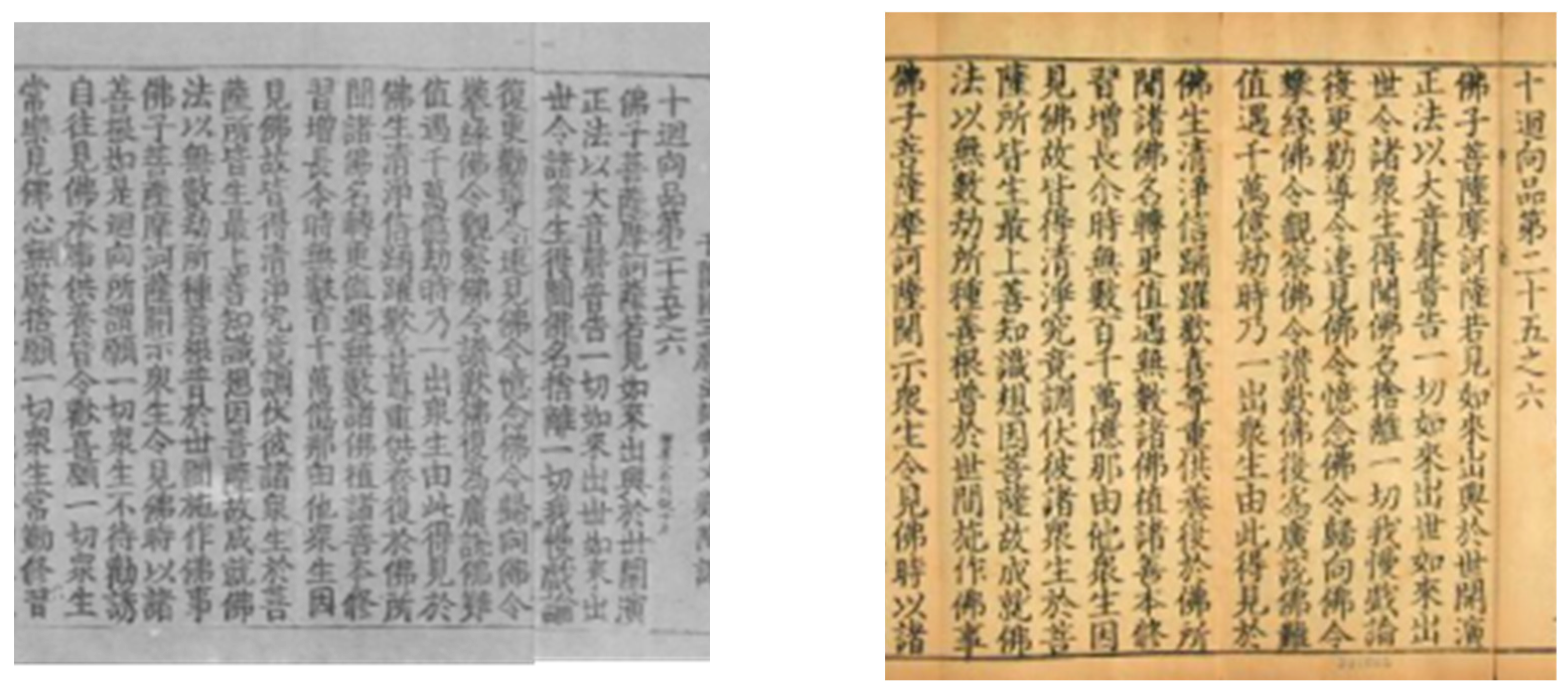
Figure 2.
Left:Foshuo Dajinsekongquewang Zhoujing of the Yanyou Canon in Zhihua Temple. Right:Foshuo Dajinsekongquewang Zhoujing of the Jin Canon in the National Library of China.
Figure 2.
Left:Foshuo Dajinsekongquewang Zhoujing of the Yanyou Canon in Zhihua Temple. Right:Foshuo Dajinsekongquewang Zhoujing of the Jin Canon in the National Library of China.
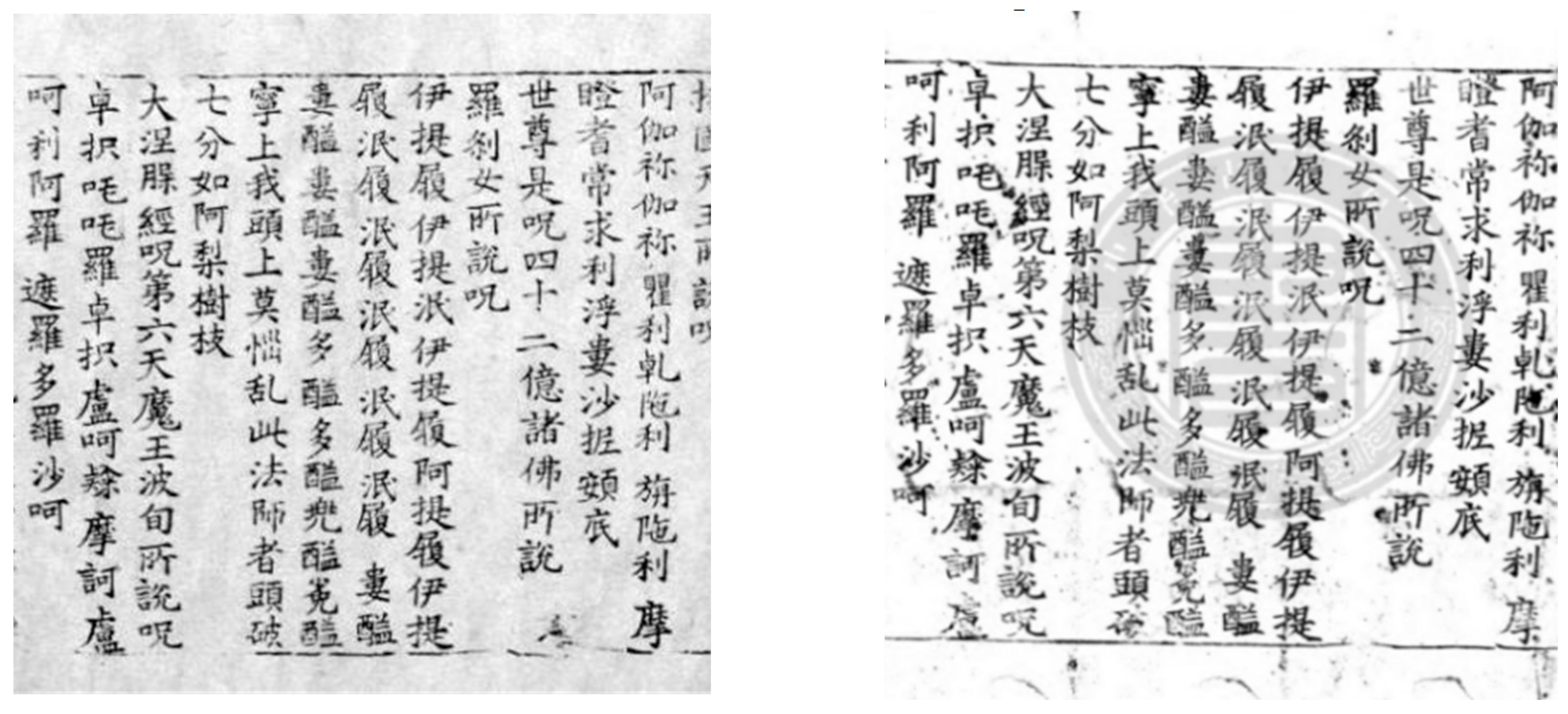

Table 1.
Engraving Records of Da Baoji Jing in the Yuan Pilu Canon.
| Volume | Serial Numbers Based on the Thousand Characters Engraving Records | Colophon |
|---|---|---|
| 10 | Long 龍 | 黄州路麻城县龚氏妙真、刘显祥、陈氏妙清、林德广、胡仲胜、程普寿、水氏一娘、朱大哥、熊觉明、李觉福、那氏五娘、邹氏一娘、宫文仲、王氏妙法、杨氏妙义,已上各刊一纸,共成一卷,报资恩有者。 |
| Gong Mizhen, Liu Xianxiang, Chen Miaoqing, Lin Deguang, Hu Zhongsheng, Cheng Pushou, Shui Yiniang, Brother Zhu, Xiong Jueming, Li Jiaofu, Na Wu Niang, Zou Yiniang, Gong Wenzhong, Wang Miaofa, Yang Miaoyi from Macheng County, Huangzhou Road. Each engraved one sheet, collectively completing one volume to repay kindness and blessings. | ||
| 18 | Shi 師 | 陆安州陆安县晏觉灯同妻子丁氏妙明共刊五纸,周觉力刊五纸,刘氏妙持同夫邹觉悔共刊二纸,高觉海刊一纸,共成一卷,报资恩有者。 |
| Yan Juedeng from Lu'an County, Lu'an Prefecture, with his wife Ding Miaoming, engraved five sheets. Zhou Jueli engraved five sheets. Liu Miaochi, with her husband Zou Juehui, engraved two sheets. Gao Juehai engraved one sheet. Altogether, they completed one volume to repay kindness and blessings. | ||
| 20 | Shi 師 | 光州固始县李觉性、胡氏三娘各刊二纸,祝有才、李诚、张汉用各刊一纸,帅氏妙清刊半纸;陆安州陆安县吴明祖同妻吴氏五娘、周氏妙新、周觉愿、胡氏四娘、尤德明、李觉广、朱氏七娘,已上各刊一纸,共成一卷,上报四恩,下资三有。 |
| Li Juexing and Hu Sanniang from Gushi County, Guangzhou, each engraved two sheets. Zhu Youcai, Li Cheng, and Zhang Hanyong each engraved one sheet. Shuai Miaoxing engraved half a sheet. Wu Mingzu from Lu'an County, Lu'an Prefecture, with his wife Wu Wu Niang, Zhou Miaoxin, Zhou Jueyuan, Hu Siniang, You Deming, Li Jueguang, and Zhu Qiniang, each engraved one sheet. Altogether, they completed one volume to repay the Four Great Kindnesses above and benefit the Three Realms below. | ||
| 29 | Huo 火 | 建昌州控鹤乡津济堂周觉布、男周觉德舍刊一函报资恩有者。 |
| Zhou Juebu and his son Zhou Juede from Jinji Hall in Konghe Country, Jianchang Prefecture, donated the engraving of one set of scriptures to repay kindness and blessings. | ||
| 50 | Wu (烏) | 江西道赣州人谢觉戒施三十两,僧久珩、谢妙心、宋觉会、四会乡大安里居何逢元、刘觉直、李八都居住温才英、李氏三各施十两,共中统三定,刊经一卷。上报四恩,下资三有,惟愿世世生生同生净土者。 |
| Xie Juejie from Ganzhou in Jiangxi Circuit donated thirty taels of silver. Monks Jiuheng, Xie Miaoxin, Song Juehui, He Fengyuan from Da'anli, Sihui Country, Liu Juezhi, Wen Caiying from Li Badu, and Li Shisan each donated ten taels of silver. Together, they donated three ding of Zhongtong banknotes and engraved one volume of scriptures, hoping to repay the Four Great Kindnesses above, benefit the Three Realms below, and be reborn in the Pure Land. | ||
| 59 | Guan 官 | 河南江北道汴梁省汝宁府光州固始县 龙山古心堂陈觉圆募众喜舍四十五定,谨刊斯经一十五卷,上报四恩,下资三有者。 |
| Chen Jueyuan from Guxin Hall on Huilong Mountain in Gushi County, Guangzhou, solicited donations from the public and received forty-five ding in contributions. He carefully engraved fifteen volumes of these scriptures to repay the Four Great Kindnesses above and benefit the Three Realms below. | ||
| 83 | Shi 始 | 江西抚州崇仁宁克伸舍刊一卷,祈荐父母宗亲,超生净界者。 |
| Ning Keshen from Chongren, Fuzhou, Jiangxi, donated the engraving of one volume of scriptures, praying for his parents and relatives to be reborn in the Pure Land. | ||
| 84 | Shi 始 | 福建道建宁路建阳县后山报恩万寿堂嗣教陈觉琳,恭为今上皇帝,祝延圣寿万安,文武官僚同资禄位,募众雕刊《毗卢大藏经》板,流通读诵者,延祐二年 月 日谨题。 |
| Chen Juelin of Bao'en Wanshou Hall in Houshan Village, Jianyang County, Jianning Road, Fujian Circuit, solicited public donations to carve the printing blocks of the Buddhist Canon, praying for the eternal longevity of the emperor and prosperity for civil and military officials. Respectfully inscribed in the second year of Yanyou reign. |
Table 2.
Comparison of Character Styles in the Pilu Canon Published During the Song and Yuan Dynasties.
Table 2.
Comparison of Character Styles in the Pilu Canon Published During the Song and Yuan Dynasties.
|
The Standard Form |
The Vulgar Forms of the Song Pilu Canon |
The Vulgar Forms of the Yuan Pilu Canon |
| 藏 软 多 差 复 教 切 往 厌 此 比 |
 |
 |
Disclaimer/Publisher’s Note: The statements, opinions and data contained in all publications are solely those of the individual author(s) and contributor(s) and not of MDPI and/or the editor(s). MDPI and/or the editor(s) disclaim responsibility for any injury to people or property resulting from any ideas, methods, instructions or products referred to in the content. |
© 2025 by the authors. Licensee MDPI, Basel, Switzerland. This article is an open access article distributed under the terms and conditions of the Creative Commons Attribution (CC BY) license (http://creativecommons.org/licenses/by/4.0/).
Copyright: This open access article is published under a Creative Commons CC BY 4.0 license, which permit the free download, distribution, and reuse, provided that the author and preprint are cited in any reuse.


