
Submitted:
17 March 2025
Posted:
18 March 2025
You are already at the latest version
Abstract
Resistive gas sensors are among the most widely used sensors for detection of various gases. In this type of gas sensors, gas sensing capability is linked to surface properties of sensing layer and accordingly, modification of sensing surface is of importance to improve sensing output. Plasma treatment is a promising way to modify the surface properties of gas sensors, mainly by changing of amounts of oxygen ions that have a central role on the gas sensing reactions. In this review paper we are focusing on the role of plasma treatment of gas sensing features of resistive gas sensors. After an introduction about air pollution and toxic gases followed by an introduction about resistive gas sensors, the main concepts about plasma are presented. In the next part, the impact of plasma treatment on the sensing characteristics of various sensing materials are discussed. As gas sensing field is an interdisciplinary field, we believe that present review paper is highly interesting for researchers with various backgrounds working on gas sensors.
Keywords:
Plasma treatment
; Toxic gas
; Gas sensor
; Sensing mechanism
1. Introduction to Toxic Gases
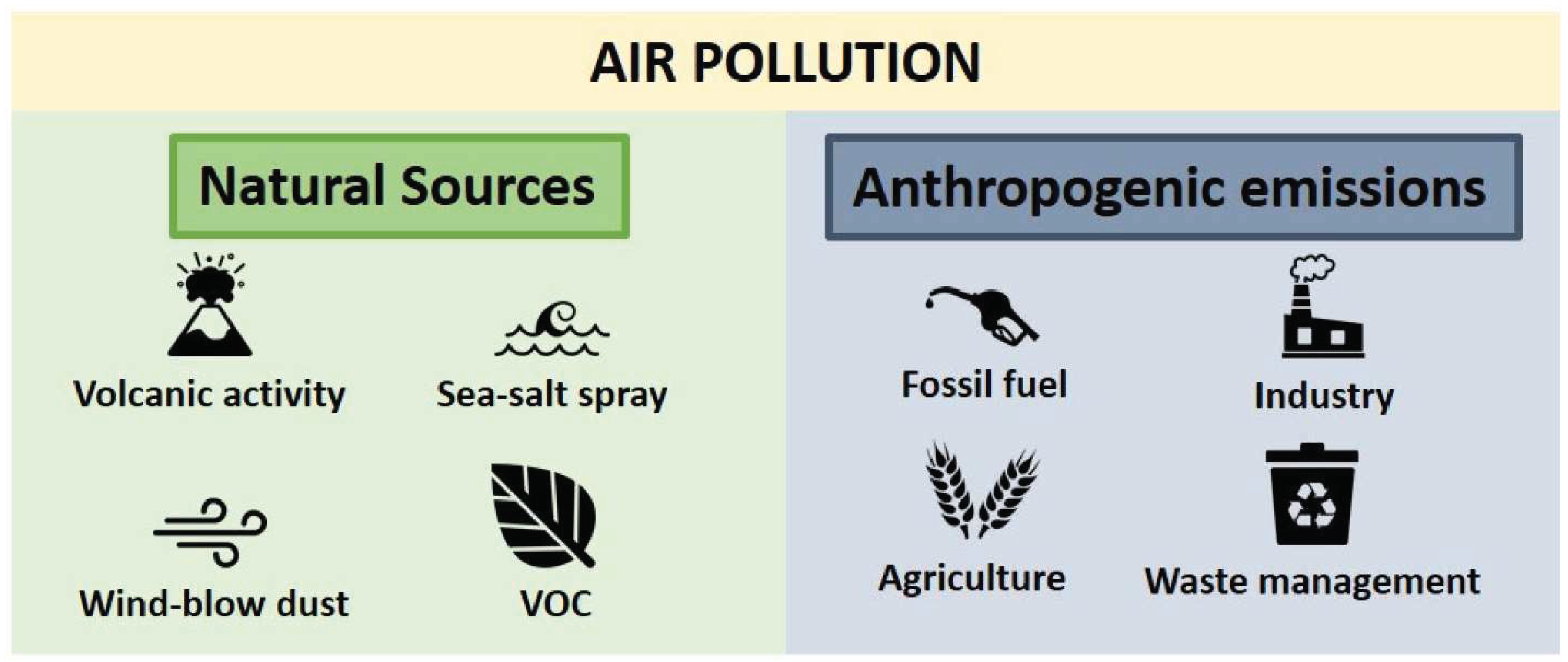
Air pollution is due to the existence of unwanted substances in air, affecting its cleanness and quality. It is a serious issue in most countries, leading to 4.14 million premature deaths in worldwide in 2019 alone [1]. In addition to particulate matter, toxic gases are among the main components of a polluted air. NO2, SOx, O3, and CO gases are among the most dangerous gases often found in a polluted air. Air pollution sources are natural such as volcano eruptions, wind-blow dust and anthropogenic sources are fossil fuel burning, agricultural activities, waste management and so on (Figure 1) [2].
Figure 1.
Sources of air pollution [2]. With permission from MDPI.
Figure 1.
Sources of air pollution [2]. With permission from MDPI.
Air pollution has many negative effects on animals [3] as well as on environment [4]. For example, NOx and SO2 gases in polluted air, can directly affect photosynthesis, and bringing about premature leaf senescence, eventually decreasing crop yields [5,6]. Besides, it has detrimental effects on the human health. Air pollutants may influence influenza transmission [7], intensifies COVID-19 mortality [8], induces respiratory diseases[9] such as bronchoconstriction[10], asthma[11], and lung cancer[12], affects the pregnancy and related things such as low birth weight, preterm birth, and fetal hyperinsulinism [13], cardiovascular diseases [14,15], and immune system [16]. Since about 90% people live in places with polluted air [17], it is necessary to precisely monitor the air quality. In this regards, the development of reliable gas sensors is vital.
2. Resistive Gas Sensors: An Introduction
There are various types of gas sensors to detect toxic gases. The most common gas sensors are optical [18], electrochemical [19], surface acoustic wave [20], and resistive [21] gas sensors. Resistive sensors have high response, high stability, swift dynamics, ease of design and fabrication, compact size, and low price. They are realized from semiconducting materials and currently, semiconducting metal oxides are widely used for this purpose. However, metal oxide gas sensors have some drawbacks such as poor selectivity, high sensing temperature, and humidity-interference [22]. Thus, recently, other semiconductors such as carbon-based materials including carbon nanotubes [23], and graphene [24], reduced oxide graphene [25], conducting polymers [26], transition metal dichalcogenides (TMDs) [27], and MXenes have been employed for fabrication of resistive gas sensors in order to reduce sensing temperature and increase the selectivity to a specific gas.
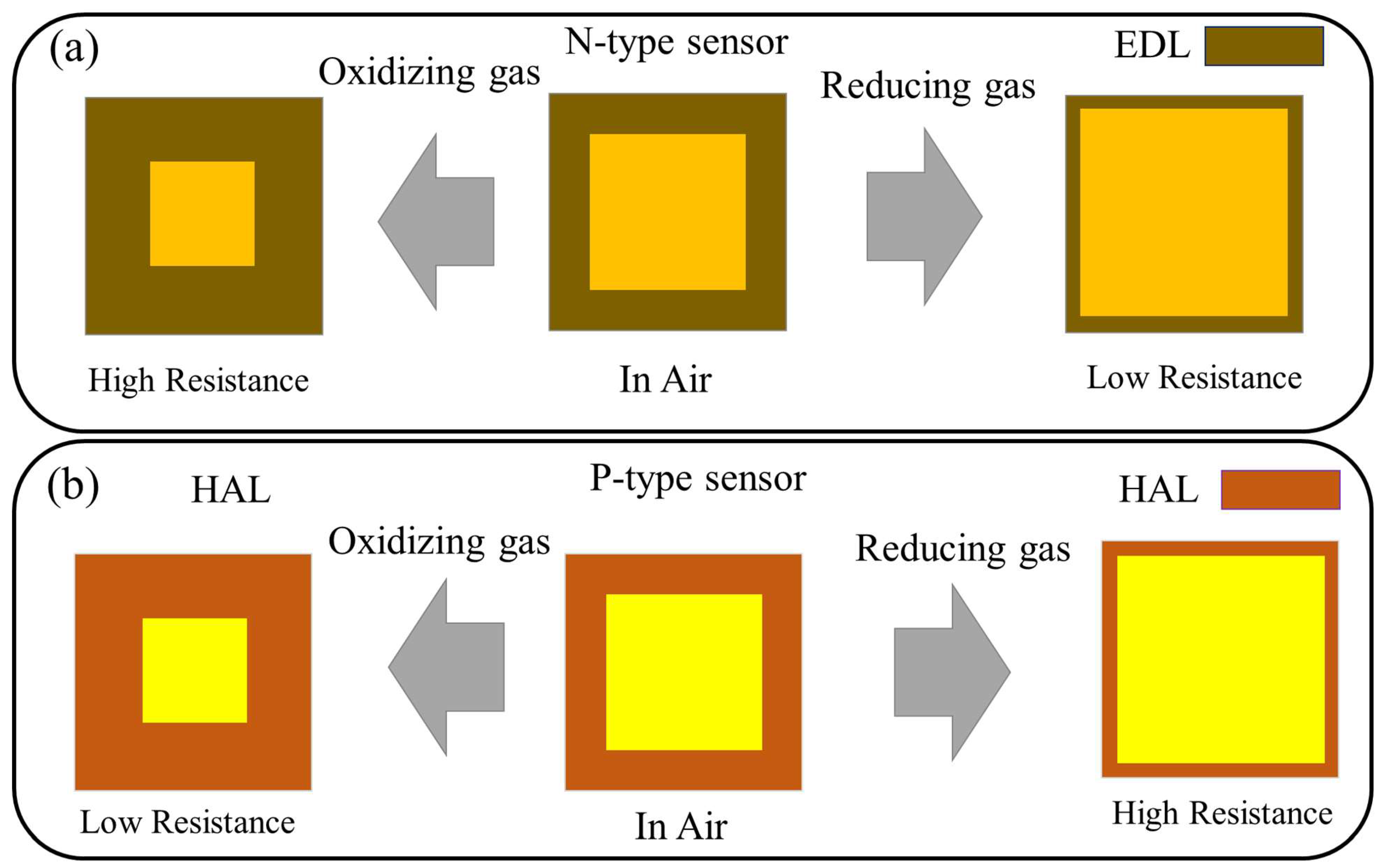
In resistive gas sensors, the sensing layer is applied on the surface of an insulating substrate such as alumina which is equipped with electrodes. Also, sometimes a micro-heater is attached on substrate to provide sufficient heat for increasing of sensing device to desired temperature[28]. Principle of gas sensing mechanism of resistive sensors is based on variation of resistance in the presence of target gas. In general, there are two types of semiconducting materials based on majority of the charge carriers. In the n- and p-type gas sensors electrons and holes are the main charge carriers, respectively. When a resistive gas sensor is exposed to air, oxygen gas will be adsorbed on it and thanks to its high electrophilic nature, it takes electrons from the sensor surface. Accordingly, on n-type gas sensors a so-called electron depletion layer (EDL) will be appeared in which the concentration of electrons is lower relative to the inner part. Hence, the resistance of n-type gas sensors increases in air relative to vacuum condition. Also, on the surface of p-type ones a hole accumulation layer (HAL) will be appeared in which the concentrations of holes are higher than those in core part of sensor. When an n-type sensor is put in a reducing gas atmosphere, the gas reacts with adsorbed oxygen on the sensor surface, releasing electrons back to the sensor. Hence, the thickness of EDL decreases, bringing about the decrease of sensor resistance. Upon exposure to oxidizing gas, the gas takes further electrons from the sensor surface, leading to expansion of EDL and increase of sensor resistance (Figure 2 (a)). For a p-type sensor, the release of electrons in the presence of n-type gas leads to narrowing of HAL and increase of sensor resistance, while in an oxidizing gas atmosphere, the further abstraction of electrons leads to expansion of HAL and decrease of resistance [29,30,31] (Figure 2 (b)).
Figure 2.
Basic sensing mechanism of resistive gas sensors (a) n- and (b) p-type sensors.
There are various techniques to boost sensing performance of resistive sensors. Heterojunction formation [32], doping [33], noble metal decoration [34], morphology engineering [35], high energy irradiation [36], and plasma exposure are among the most widely used techniques. In particular, plasma exposure causes the change of oxygen ions on the surface of gas sensors and since oxygen species are engage in sensing reactions, by adjusting of these species during plasma treatment, gas sensing properties can be tuned. So far, there was no review paper dealing with the effect of plasma treatment on the gas sensing properties of resistive sensors. Hence, we will review the effect of plasma treatment on the sensing features of resistance sensors.
3. The Plasma Concept
When energy is supplied to a gas, its temperature increases, and by further providing of energy, kinetic energy of gas molecules increase, leading to collision of more gas molecules. Hence, electrons and ions are formed in the gas, leading to the existence of electrical charge in the gas. This state of matter is known as plasma, originated from Greek which means ‘something molded’, indicating a glow gas which alters its shape based on the container. Gases are often electrical insulators, while plasms have an equal amount of positive and negative charge carriers along with neutral particles, giving them electrical conductivity [37].
In equilibrium plasma, local thermodynamic equilibrium exists among the plasma species and collision processes, where heavy particles and electrons will be at almost identical temperatures. In contrast non-equilibrium plasma or cold plasma involves a thermodynamic imbalance among electrons and heavy particles, and the temperature of the heavy particles is much lower than that of electrons. During cold plasma production, heating the entire gas stream (air or individual gases like Ar and He) is undesirable; thus, energy is directed to the electrons via the electrical discharge in the gas [38]. Corona discharge, dielectric barrier discharge (DBD), and cold plasma jet are among the most common ways to generate cold plasma. To generate cold plasmas at atmospheric pressure, high voltage is required for a gas discharge and the discharge easily proceeds to the arc discharge. Furthermore, energy should selectively transfer to electrons using effective ways without raising the temperature of a gas [37].
Cold plasma treatment is an environmentally friendly technique without production of toxic waste and thanks to its operation under atmospheric pressure, it is an appropriate technique for treatment of low melting point or heat sensitive materials and substrates [39]. In particular, flexible polymeric substrates, have low surface energy and poor wettability, which weakens the adhesion between electrodes and substrate. Hence, plasma surface modification of polymeric substances can overcome these shortages [40].
In both corona discharge and DBD, the sample to be plasma treated is put between electrodes in a fixed space under atmospheric pressure. In a corona discharge by applying a DC electrical source in a pulsed mode, a lighting crown is build out of many streamers, while in a DBD a high frequency source is employed. During a corona discharge, cathode is a conductive wire and the anode is the sample. A DBD reactor usually has two parallel metal electrodes in a fixed distance covered with a dielectric material and the sample is placed between them. The formed plasma has many homogeneously distributed micro-streamers across the electrodes [41].
Plasma treatment is a flexible, fast, green, and non-contaminated way to change surface morphology and composition. Compared to conventional routes this method is faster and needs lesser amounts of reagents. Also, only the surface area is affected by plasma treatment without affecting the bulk of material. By optimizing the plasma parameters including plasma power, exposure time, and type of gas, various functional groups with different amounts can be applied on the surface of materials to be plasma-treated [42]. Also, plasma treatment can be performed at atmospheric pressure, facilitating large scale treatment for mass production [43]. Furthermore, plasma can be employed to deposition of thin layers over the substrate in a process called plasma spray [44,45]. In following parts, we will discuss the impact of plasma treatment on the gas sensing properties of resistive gas sensors.
4. Plasma-Treated Gas Sensors
4.1. Plasma-Treated Carbon Nanotube Gas Sensors
Carbon nanotubes (CNTs) are one dimensional materials with high conductivity, large surface area and possibility of functionality[46,47]. Nevertheless, homogeneous dispersion of CNTs is a challenge due to the presence of attractive Vander Waals forces between CNTs, leading to agglomeration and weak solubility in most solvents. Hence, it is required to change the surface of CNTs via surface treatment or chemical functionalization to improve the dispersion of CNTs in solvents[48]. Compared to surface treatment of CNTs using strong acids such as HNO3 and H2SO4 which is time consuming and dangerous, the plasma treatment using oxygen is a simple, clean, and effective way to functionalize CNTs. Acid treatment leads to the presence of carboxylic acids, ethers, and so on the surface of CNTs, while oxygen plasma treatment increases the amount of oxygen-bearing defects on the entire surface of the CNTs. Also, the hydrophilic nature of CNTs can be boosted thanks to the presence of oxygen-containing species on the surface of CNTs. Furthermore, bulk features of CNTs remains untouched, without structural destruction [49]. As a result of oxygen plasma treatment, oxygenated vacancies and functional groups will be presented on the surface of CNTs, which are very reactive species and act as favorable sites for gas molecules [50]. Therefore, plasma treatment has been extensively applied on CNTs to increase their gas sensing performance [51,52,53,54,55].
In this regards, Bannov et al.[56] functionalized the surface of multi-walled CNTs (MWCNTs) using oxygen plasma exposure followed by maleic anhydride (MA)-C2H2 plasma treatment. The MWCNTs were comprised of intertwined MWCNTs with the diameter of 20-50 nm. After plasma treatment most of the MWCNTs were strongly etched by oxygen plasma and only a few MWCNT bundles were remained. Based on XPS study, plasma treatment led to the presence of high amount of oxygen-containing surface groups on MWCNTs. The sensor resistance was increased after plasma treatment due to the oxidation of MWCNTs and the loss of the connections among MWCNT networks. At room temperature (RT), the response of fabricated sensor to 500 ppm NH3 was only 11.7%, while after plasma treatment it was increased to 31.4%, demonstrating promising role of plasma treatment. The increase of sensor response was related to the enhanced NH3 adsorption by the oxygen-rich surfaces as a result of plasma treatment. Due to reducing nature of NH3 gas, it should react with adsorbed oxygen to release the electrons on the sensor surface. Hence, higher amounts of oxygen species on the sensor surface as a result of plasma exposure led to higher probability of reaction with NH3, resulting in a higher response. The same group [57] investigated the effect of oxygen plasma exposure time (3, 5, and 7 min) on the NH3 gas sensing properties of MWCNTs. The sensor exposed to oxygen plasma for 5 min exhibited the highest response to NH3 gas which was related to the presence of the highest amount of adsorbed oxygen species on the surface of CNTs. In another study, Dong et al. [58] studied the effect of various plasmas using Ar, O2, CF4, and SF6 gases on gas sensing properties of single-walled CNTs (SWCNTs). Thanks to reactive ion etching defects were generated on SWCNTs. Based on Raman analysis, the ID/IG ratio of pristine sample was only 0.14, while after plasma treatment by above mentioned gases, it was changed to 0.23, 0.36, 0.33, and 0.5, respectively. Therefore, more defects were generated on plasma treated samples. Pristine sensor not only showed a very low response to NO2 and NH3 gases, but also the recovery time was very long (more than 20 min). Also, the resistance did not completely return to the initial value. However, the plasma-treated sensor showed better sensing performance. The sensor treated with O2 plasma revealed higher response to NO2 gas, thanks to the presence of defect sites and adsorbed oxygen species groups which led to better adsorption and reaction of NO2 gas on the sensor surface. Also, the responses of the sensors treated with CF4 and SF6 were higher to NH3 gas relative to other gases which was attributed to the sufficient adsorption energies and easy charge transfer between NH3 and C–F bonds of plasma (CF4 and SF6) treated MWCNTs.
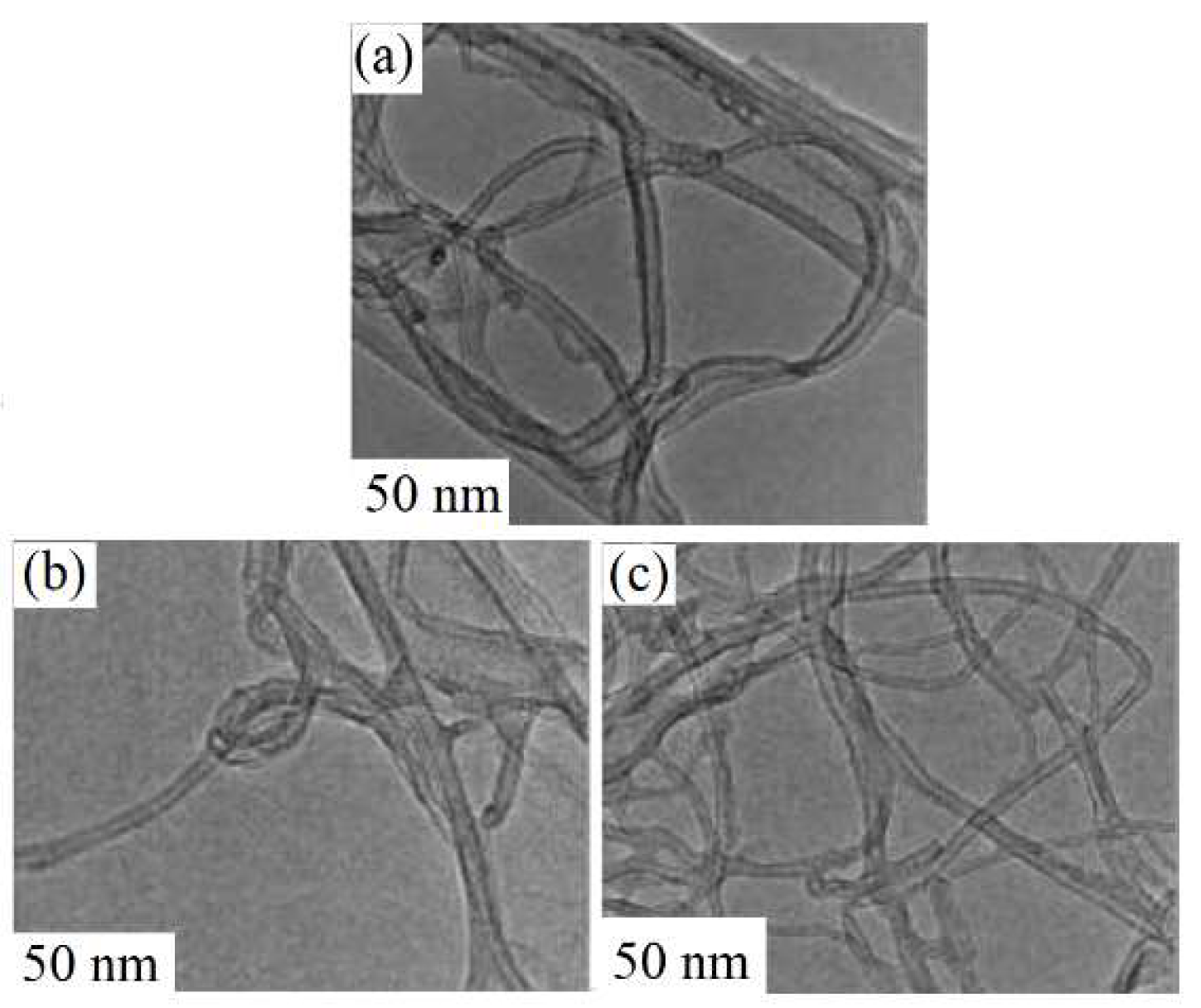
Santosh et al.[59] used Ar and oxygen plasma treatment using a fixed 100 sccm of gas for 3 min on MWCNTs for improvement of gas sensing capacity. The sensor treated with Ar plasma, revealed higher response to other gas sensors which was related to the greater extent of surface modifications by the Ar plasma. At 65°C, maximum response to ethanol gas was observed with a response [(Ra-Rg)/Ra] of 1.7 to 100 ppm ethanol. Argon is much heavier than He and hence, more defects were generated on MWCNTs after Ar treatment. The diameter of the MWCNTs decreased after plasma exposure due to the etching effect of plasma (Figure 3 (a)-(c)). Besides, based on Raman analysis, the amorphous wrinkled layer on pristine sensor was removed after plasma treatment, which eventually improved the crystalline behavior of MWCNTs. Furthermore, thanks to higher crystallinity and carbon defects, the conductivity increased after plasma exposure and enhanced the interaction of the MWCNTs with ethanol. Also, plasma-treatment led the formation of dangling bonds which acted as favorable sites for ethanol gas adsorption.
Figure 3.
TEM view of MWCNTs of (a) pristine (b) He-and (c) Ar-treated MWCNTs [59]. With permission from Elsevier. Copyright (2020).
Figure 3.
TEM view of MWCNTs of (a) pristine (b) He-and (c) Ar-treated MWCNTs [59]. With permission from Elsevier. Copyright (2020).
Ham et al. [60] modified MWCNTs by oxygen plasma for 10-50 s. The morphology of the MWCNTs did not change up to 20 s plasma exposure. However, by increasing of treatment time to more than 30 s, the surface become highly rough and MWCNTs were partially etched. The plasma treated sensor for 20 s showed higher response to NH3 gas relative to other gas sensors, indicating that the sensitivity of the MWCNT gas sensors can be enhanced through defect generation and adding of oxygenated functional groups. The enhanced sensitivity was ascribed to the generation of hydrogen bonds between NH3 gas with surface oxygen groups on MWCNTs.
The sensing performance of nitrogen plasma treated SWCNT gas sensors is rarely investigated. In this regards, Zamansky et al.[61] synthesized SWCNTs via CVD method and then, used nitrogen plasma to modify their surfaces. Based on characterization results, defects were introduced on SWCNTs after plasma treatment. In particular, with longer plasma exposure the amount of substitutional N defects relative to -NH2 surface groups increased, indicating incorporation of N into the SWCNT lattice. Also, due to exposure of MWCNTs to air after plasma treatment, many oxygen containing defects were detected. While, pristine sensor was almost insensitive to gases, the sensor treated for 19 min exhibited a response of 121% to 50 ppm NO2, and its response to 50 ppm NH3 was 36 % at RT. The enhanced performance was related to the existence of oxygen and nitrogen related defects which served as desirable adsorption sites for gas molecules. Also, the amount of metallic SWCNTs with poor gas sensing decreased after etching. Based on DFT calculations, adsorption on defect sites was more favorable compared to basal plane sites. Also, while NH3 sensing was accelerated by hydrogen bond formation with surface groups such as COOH, the adsorption of NO2 was mainly caused by the oxidation of carbon defect regions and physisorption.
Ham et al. [62] investigated the impact of plasma treatment on the NH3 sensing properties of SWCNTs with different amounts of semiconducting SWCNTs (66 and 90%). After oxygen plasma treatment, the sensor with 66% semiconducting SWCNT exhibited 5.5 times increase in sensitivity relative to pristine sensor, while the sensor with 90% semiconducting SWCNT revealed 13 times increase in sensitivity compared to pristine sensor. While pristine SWCNT sensor revealed a very long response time and incomplete recovery, plasma treated sensors showed much quicker dynamics, with complete recovery of base resistance after treatment. Based on XPS study, the amount of oxygen functional groups was significantly improved after plasma treatment. The NH3 molecule formed strong hydrogen bonds with oxygen ions on the oxidized SWCNTs. Therefore, significant response improvement was observed. Also, in the sample with 90% semiconducting SWCNT, the sp3/sp2 ratio increased from 0.256 to 0.611 after plasma treatment, indicating the more semiconducting nature of plasma-treated SWCNTs and the existence of sp3 defects provided adsorption sites for NH3 gas.
CPs with high conductance, flexibility, simple synthesis procedure, and low cost are among the most promising materials for room temperature gas sensing purposes [63,64]. Hence, composite of CNTs and CPs are favorable for RT gas sensing while plasma exposure can further increases their performance [65]. In this regards, Yoo et al.[66] studied the effect of oxygen plasma treatment (10, 30, 60, and 90 s) on the NH3 sensing capability of MWCNT-polyaniline (PANI) composite. Based on Raman analysis, the amount of defects on MWCNTs increased with increasing of plasma time. During plasma exposure, oxygen ions destroyed the structure MWCNTs by turning them into carbon particles or amorphous carbon along with creation of more defects relative to pristine MWCNTs. Based on XPS study, the concentration of surface oxygen increased with increasing plasma exposure time up to 60 s, and then decreased by longer treatment to 90 s, which was attributed to chemically etching of MWCNTs. This resulted in thinning or bending of MWCNTs, At RT, the response of plasma treated MWCNT was three times of that pristine sensor thanks to the the formation of hydrogen bonds between polar NH3 with oxygen-containing defects on the MWCNTs. Also, plasma-treated MWCNT-PANI composite sensor revealed higher response to plasma treated MWCNT, thanks to the presence of PANI with high intrinsic response to NH3 gas. NH3 molecule abstracted protons from the PANI, forming energetically more favorable NH4+ ions, while the PANI changed into its base form, with a different conductivity, resulting in generation of a high sensing signal.
During the synthesis of CNTs some impurities and contaminants are introduced into CNTs and purification procedure can be detrimental for gas sensing properties of CNTs. In this regards, Kim et al. [67] investigated the impact of thermal annealing (T>300°C), and plasma treatment with oxygen on the characteristics and NH3 gas sensing properties of CNTs. The pristine SWCNT had a hydrophobic nature with a water contact angle (WCA) of 84.91°. Thermal treated SWCNTs again showed a hydrophobic nature with a WCA of 79.07°, while plasma treated SWCNTs showed a WCA of only 5.15°, indicating increasing of hydrophobic nature after plasma treatment due to the adding of oxygen surface groups on SWCNTs. Plasma treated SWCNT showed a decrease in sp2 bonding with an increase in sp3 bonding, indicating change of electrical conductivity. Among the three sensors, the plasma treated SWNTs sensor exhibited the highest response and the fastest response time to NH3 gas. Besides, the pristine and thermally treated SWNTs sensors exhibited incomplete recovery of their resistance. While thermal cleaning of the SWCNT removed impurities from the surface of SWCNTs, plasma treatment includes cleaning and functionalization of the SWNT at the same time to a greater extent, resulting in better sensing capability after plasma treatment.
Zhao et al.[68] applied plasma on CNTs for CO gas sensing. The plasma treated CNTs was able to detect down to 5 ppm CO at RT, while the pristine CNTs showed no response to this gas. The improved sensing response was related to converting of metallic CNTs to semiconducting CNTs after plasma treatment along with promising effect of surface oxygen addition for sensing reactions with CO gas.
4.2. Plasma-Treated Graphene and Graphene Oxide Gas Sensors
Pristine graphene (G) has high surface are and high conductivity, showing its potential for sensing applications[69]. However, it generally has poor selectivity since gas adsorption on G is based on Van der Waals interactions with gases, which limit its selectivity [24]. To address this issue, plasma treatment can be used [70]. In this regards, Masterapa et al. [71] applied plasma treatment on CVD-grown graphene for 5, 10, 20, and 30 s. The sample treated with plasma for 30 s revealed higher amounts of defects as demonstrated by Raman analysis and hence it showed higher response to NO2 and NH3 gases relative to other sensors. However, the response time of all sensors were very long (10 min) and the recovery curves were not shown possibly due to very long recovery times.
Fluorination surface treatment could change the intrinsic properties of G. In this regards, Zhang et al.[72] synthesized monolayer fluorinated graphene (FG) by a SF6 plasma treatment (5-90 s). The concentration of F in the samples increased with increasing of plasma treated time up to 20 s and then it decreased. During plasma treatment, the fluorine atoms attacked to carbon atoms to form the C−F bonds which introduced F ions on the surface of G. After a critical time, F atoms broken down the some previously formed C−F bonds and hence the F atoms were released from the surface of G. The pristine G sensor exhibited slow dynamics and even after 500 s of recovery, only ∼66.7% of the initial resistance was recovered. The sensor treated with plasma for 20 s, exhibited a response of 3.8% to 100 ppm NH3 gas at RT, with complete recovery of base line resistance in less than 200 s. Based on DFT results, the improved performance was ascribed to the opening up of the band gap after fluorination and enhanced adsorption of NH3 in the presence of surface functional groups.
Chung et al. [73] synthesized G film using CVD route and then, G films were ozone treated for 60, 70, 80, and 90 s. Among fabricated sensors, the graphene sensor with the ozone treatment time of 70 s, showed a response of 19.7% to 10 ppm NO2 gas at RT, which was two times higher than that of pristine G sensor. Also, the sensor was able to detect as low as 200 ppb NO2 gas. Further increasing of plasma treatment time resulted in decrease of sensing response due to extensive oxidation of G with high baseline resistance. The presence of sufficient amounts of oxygen groups on the surface of G, resulted in increasing of adsorption sites and sensing reactions with NO2 gas. However, the sensors showed long dynamics and all sensors showed long recovery time of ~ 20 min or longer.
CO2 is the main gas responsible for the greenhouse effect [74]. Hence, the development of sensitive CO2 sensors is crucial for environmental and industrial applications. Casanova-Chafer et al. [75] synthesized G-CsPbBr3 nanocomposite and subsequently applied oxygen plasma treatment on it. The sensor exposed to 5 min of oxygen plasma treatment exhibited a 3-fold improvement in sensing compared to pristine sensor, with a limit of detection of 6.9 ppm. The improved sensing performance was attributed to the promising role of oxygen species, facilitating sensing reactions with CO2 gas on the sensor surface.
Graphene oxide is oxidized form of G with two key advantages. First, the synthesis route of GO is easy using graphite as raw material and hence, its large scale production is feasible. Second, in contrast to G, GO exhibits has good hydrophilicity, making it possible to prepare stable aqueous colloids [76,77]. Nonetheless, GO main shortage is its high resistance, making it difficult for sensing applications [78]. In this regards, plasma treatment is a promising technique, allowing reduction of GO by removing oxygen atoms during plasma exposure, without disrupting the GO lattice. Hydrogen or hydrogen containing plasma with mild treatment conditions is an efficient and alternative route to the complex procedures for GO reduction. The hydrogen plasma contains radicals and atoms which provide energies for dissociation of oxygen functional groups. It effectively removes oxygen functional groups at the edges and both basal planes while restoring C=C bonds [79]. After reduction of GO it becomes converted to reduced graphene oxide (rGO) with high conductivity, surface defects and some oxygen surface groups along with high surface area, all making it a good choice for gas sensing applications. Hamzaj et al. [80], used hydrogen plasma treatment for 10 s, 20 s, 40 s, 120 s, and 240 s on GO to reduce it for gas sensing applications. Based on resistance measurement studies, the resistance gradually decreased with increasing of hydrogen plasma treatment (Figure 4) which effectively removed the oxygen groups from GO and partially restored the sp2-bounded carbon network, resulting in enhanced conductivity. Besides, during plasma exposure, the amorphous phases were etched which contributed to the improved conductance. Based on various characterizations, pristine GO had an oxygen content of 30 at.% and after plasma treatment for 240 s, it was decreased to 20 at%, confirming reduction effect of plasma exposure on GO.
Figure 4.
A possible physisorption/chemisorption-assisted sensing mechanism towards ammonia in plasma rGO sensors. With permission from [80], Elsevier. Copyright (2024).
Figure 4.
A possible physisorption/chemisorption-assisted sensing mechanism towards ammonia in plasma rGO sensors. With permission from [80], Elsevier. Copyright (2024).
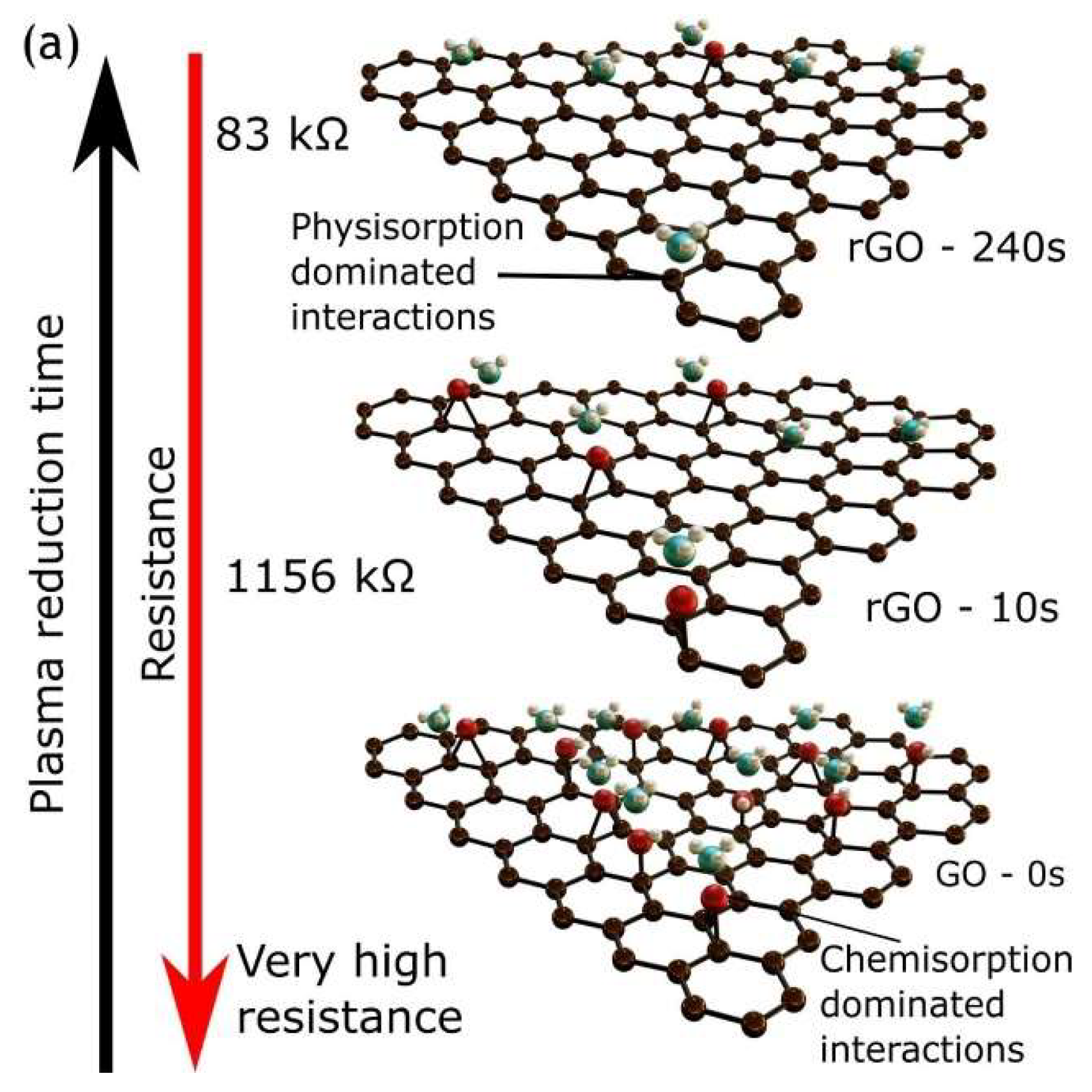
Among different gas sensors, the sensor exposed to plasma for 20 s revealed the highest response to NH3 gas at RT. After 20 s of plasma reduction, the oxygen groups were not extensively removed and hence provided sufficient channels for the physisorption of NH3 and meanwhile chemisorption of NH3 facilitated due to the presence of oxygen groups. This led to achieving the optimal sensing performance by providing a balance between both chemisorption and physisorption phenomena.
4.3. Plasma-Treated ZnO Gas Sensors
The response of ZnO sensors also can be remarkably increased by plasma treatment [81,82,83]. In this context, Hou et al. [84] prepared ZnO thin films by sol-gel spin-coating deposition. Then, they were treated with O2 plasma for 3, 5, 8, 11, and 15 min. During plasma treatment for 3 and 5 min, crystallinity increased thanks to decrease of oxygen vacancies, while further increase of plasma time exposure led to decrease of crystallinity due to the formation of zinc vacancies. Also, the roughness of pristine ZnO thin film was 5.5 nm which decreased to 3.6 nm after plasma treatment and then increased to 4.3 and 5 nm with further increase of the treatment time to 8 and 11, respectively. The sensor with 8 min plasma exposure revealed the higher response of 65% to 50 ppm NH3 at RT compared to other sensors. It manifested a higher base resistance relative to pristine sensor, hence, more reactions occurred between oxygen and NH3 gas, contributing to a higher response.
Gui et al. [85] produced ZnO nanorods (NRs) with diameters of 300 nm on the ceramic tubes by in-situ hydrothermal growth method at 140 °C. Then, they were exposed to oxygen plasma for for 30, 60, and 90 s. Upon plasma exposure not only the surface became rough, but also oxygen vacancies increased up to plasma exposure time of 60 s. The sensor exposed to plasma for 60 s, manifested a high response of 198 to 100 ppm N-methyl pyrrolidone (NMP) at 210 °C, which was 3 times higher than that of pristine sensor. The improved performance was originated from the presence of highest amount of oxygen vacancies, which acted as highly active sites for oxygen adsorption and subsequent increase of reactions with target gas. Based on DFT calculations, the adsorption energy of NMP on the oxygen plasma treated ZnO was higher than that of pristine ZnO. Furthermore, the adsorption energy of NMP on ZnO was the largest (−1.06 eV) compared to other gases, leading to better selectivity to NMP gas (Figure 5).
Figure 5.
Adsorption energies of different gases pristine and plasma exposed (60 s) ZnO [85]. With permission from Elsevier. Copyright (2024).
Figure 5.
Adsorption energies of different gases pristine and plasma exposed (60 s) ZnO [85]. With permission from Elsevier. Copyright (2024).

Although chemical solution method is widely used for sensing film deposition, it still suffers from poor adhesion between film and substrate and poor reproducibility. In this regards, atomic layer deposition (ALD) is a highly reliable way for film deposition, allowing precise control of the thickness of the film control over the number of ALD cycles. Furthermore, it can be used for deposition of uniform sensing layers on a substrate, with high reproducibility [86,87]. In this regards, Li et al. [88] deposited ultrathin ZnO films (20 nm) by ALD technique followed by Ar plasma treatment for 1, 5, and 10 min. Among different samples, that exposed to plasma for 5 min, exhibited the highest amount of oxygen vacancies as confirmed by XPS and EPR analyses. It revealed a maximum response of 21.6 to 100 ppm TEA at 250°C with a low limit of detection of 22 ppb. The high selectivity to TEA was ascribed to the presence of active C‒N bonds in TEA and the high electron-denoting properties of TEA. Furthermore, oxygen vacancies acted as electron donors and decreased the band gap of ZnO, eventually facilitated the adsorption and activation of TEA.
4.4. Plasma-Treated SnO2 Gas Sensors
SnO2 is among the most widely sensing materials, thanks to its high stability, high mobility of electrons, ease of synthesis, low price, nontoxicity and abundance[89,90]. Plasma-treatment has been used on SnO2 to modifies its sensing properties [91,92]. Srivastava et al.[93] were among the leading researchers reporting enhanced gas sensing properties of SnO2 sensors under oxygen and hydrogen plasma exposure. The sensitivity of sensor treated in oxygen plasma was found to be about 10 times more than that of pristine sensor, while in the case of hydrogen plasma, the response of plasma treated (15 min) sensor was seven times higher than that of pristine sensor. Also, the same group [94] reported the enhanced gas sensing response of elemental doped SnO2 gas sensors.
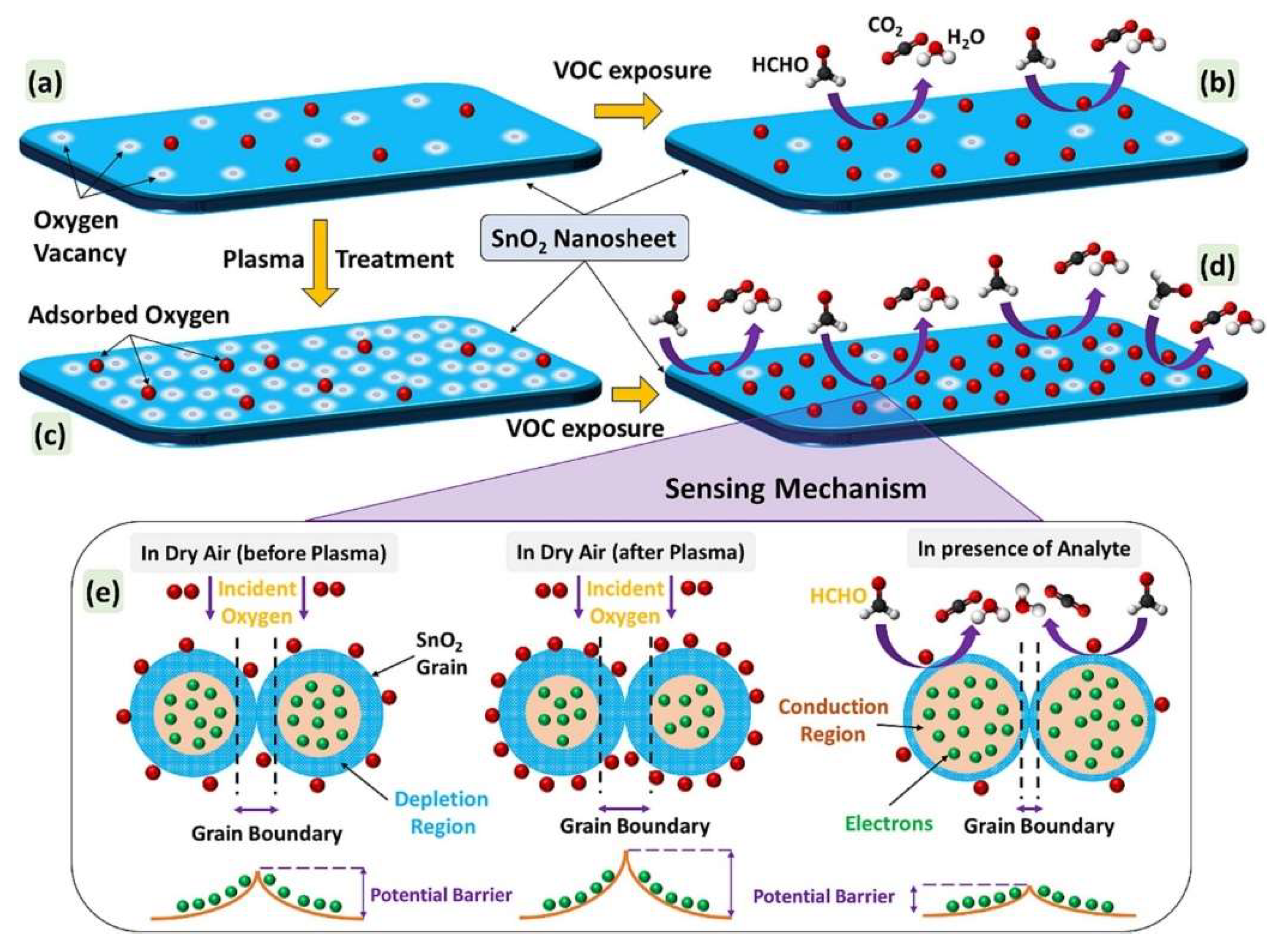
Acharyya et al. [95] synthesized SnO2 nanosheets (NSs) through a hydrothermal route at 200 °C for 12 h. Then they were exposed to Ar plasma for 2, 4, 7, 10 min. At 270°C, the sensor Ar treated for 7 min revealed the highest response of 25 to 10 ppm HCHO gas. Also, smaller molecule size and lowest activation energy of HCHO compared to other gases accounted for selective response to gas. The content of oxygen vacancies was highest in the sensor exposed to plasma for 7 min. This caused more oxygen and HCHO gas adsorption on the surface of SnO2 NSs, leading to higher response relative to pristine sensor (Figure 6 (a)-(d)). Furthermore, as indicated in Figure 6(e), the SnO2-SnO2 homojunctions were formed in air and the height of barriers was lower relative to that of plasma exposed sensor. Hence, in the presence of HCHO gas, significant reduction of homojunctions height in case of plasma treated sensor led to higher sensing response relative to pristine sensor.
Figure 6.
Schematic illustration of sensing mechanism of SnO2 NSs to VOCs (a, b) pristine SnO2 NSs (c, d) plasma-treated SnO2 NSs (e) modulation of double Schottky barrier in the presence of plasma and VOC [95]. With permission from Elsevier. Copyright (2024).
Figure 6.
Schematic illustration of sensing mechanism of SnO2 NSs to VOCs (a, b) pristine SnO2 NSs (c, d) plasma-treated SnO2 NSs (e) modulation of double Schottky barrier in the presence of plasma and VOC [95]. With permission from Elsevier. Copyright (2024).
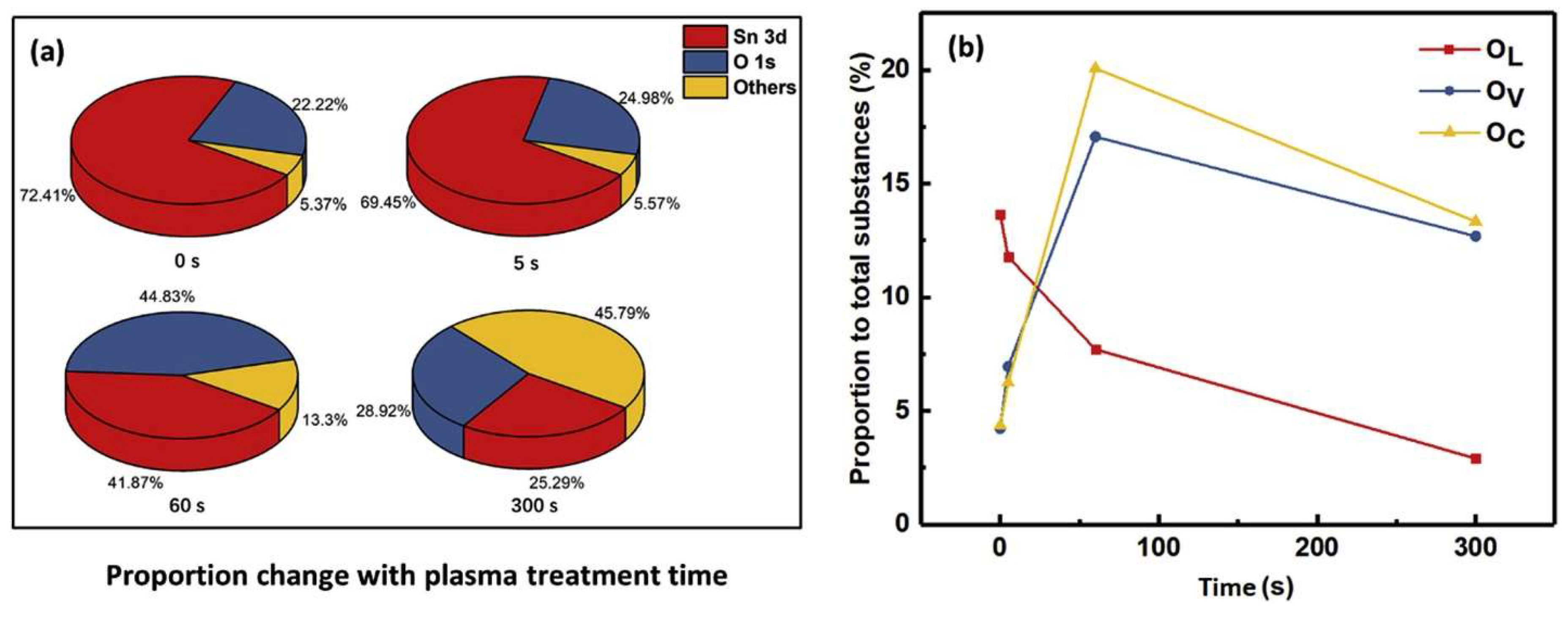
Pd is a good catalyst for H2 gas dissociation and therefore is widely used as decoration on the surface of resistive gas sensors[96,97]. Hu et al. [98] synthesized Pd-decorated SnO2 nanofibers (NFs) using electrospinning of SnO2 NFs followed by decoration of Pd NPs using sputtering. Then, the samples were exposed to Ar plasma treatment for 5, 60 and 300 s. Based on XPS analysis, the content of oxygen vacancies and adsorbed oxygen species increased after plasma treatment. The Sn-O bonds in SnO2 dissociate during the collision with Ar ions, resulting in generation of oxygen vacancies. Furthermore, the dissociated oxygen was chemisorbed at the oxygen vacancy sites. The sensor exposed to plasma for 60 s reveled the highest response of 53 to 500 ppm H2 gas at 130°C. Figure 7 (a)-(b) show the amounts of different enlacement as a function of plasma exposure time. The sensor exposed during 60 s, exhibited the highest amount of oxygen vacancy and adsorbed oxygen species, both were highly beneficial for gas H2 gas sensing. However, extensive plasma exposure to 300 s, led to degradation of sensing performance due to the decrease of both oxygen vacancy and adsorbed oxygen species. Also, catalytic effect of Pd towards H2 dissociation was effective on the high response towards H2 gas.
Figure 7.
(a)-(b) amounts of different species on Pd-SnO2 NFs versus plasma exposure time. With permission from [98], Elsevier. Copyright (2020).
Figure 7.
(a)-(b) amounts of different species on Pd-SnO2 NFs versus plasma exposure time. With permission from [98], Elsevier. Copyright (2020).
Chaturvedi et al.[99] used plasma treatment on Pd-doped SnO2 gas sensors. The synthesized materials were exposed to O2, H2, N2, and Ar-plasma for 15 min. In all cases, the plasma treated sensor revealed higher response to CCl4, CO, LPG, C3H7OH, N2O and CH4 gases relative to pristine sensor due to the release of a greater number of electrons upon interaction with the adsorbed gas molecules. Oxygen-treatment sensor showed higher response relative to other gas sensors, however, it showed weak selectivity. The non-stoichiometry was the highest in case of oxygen plasma treated sensor, where the sensitivity was maximum. At RT, hydrogen plasma treated sensor was highly selective to CO, while nitrogen treated sensor manifested a moderate response to all the gases, without selectivity. Also, argon plasma treated sensor did not show noticeable sensitivity to any gas.
Nanowires (NWs) are among the most popular morphologies for gas sensing applications thanks to their high surface area and numerous adsorption sites for gas adsorption. In this context, Pan et al. [100] synthesized SnO2 NWs through a CVD method and then used O2/Ar plasma to change compositions to more non-stoichiometric. The plasma power was varied between 10-80 W, while plasma duration was fixed to 240 s. The samples exposed to plasma under 10, 20, and 40 W had some amounts of SnO, Sn2O3, and Sn3O4 phases due to gradual reduction of tetragonal SnO2 and removing of oxygen atoms from SnO2. Also, further increase of plasma power (80 W) resulted in extensive reduction of SnO2 to metallic Sn, resulting in poor sensing performance. Among different gas sensors, the sensor treated with a power of 40 W, revealed enhanced response to ethanol gas, thanks to co-existence of SnO2-Sn3O4 phases, in which potential barriers at interfaces act as powerful sources of resistance modulation, high surface area thanks to NW morphology and the presence of oxygen vacancies.
In another study, Huang et al. [101] synthesized SnO2 thin film using plasma enhance CVD, and then exposed it to oxygen plasma for 20 min. Pristine sensor manifested a low response of 3.9 to 1000 ppm CO at 330°C. The plasma treated sensor showed the highest response 31.7 to same gas concentrations at 250 °C. Interestingly, SnO2 nanorods (NRs) were grown on SnO2 thin films after plasma treatment by the sputtering-redeposition mechanism, where the films were sputtered by the bombardment of heavy ions in the plasma, then SnO2 NRs were generated by the sputtering redeposited, and rearranged on the films. Hence, surface area was significantly increased relative to pristine SnO2 thin film due to the presence of both the 1D NRs and 2D thin film. Accordingly, numerous adsorption sites were available for gas molecules, resulting in the boosted sensing response.
Huang et al.[102] synthesized SnO2 nanocolumn arrays with aspect ratios of 20 using liquid immersion PECVD and the impacts of the thermal annealing (600°C/2h) and O2 plasma treatment on the sensing response toward CO and H2 gases was investigated. The response of pristine sensor to 1000 ppm H2 at 400 °C was 17, which was higher than the response to CO gas. Based on compositional analysis some residual carbon species were remained on pristine sensor, decreasing its sensing performance. After thermal annealing, the response was increased due to removal of carbon impurities. Also, after plasma treatment for 40 min, the sensing response to both 1000 ppm CO and H2 increased around seven times. Compositional analysis demonstrated that the amount of surface oxygen species significantly increased due to chemisorbed oxygen species on the surface during plasma treatment, which reacted with target gases to release electrons on the sensor surface.
Hu et al. [103] synthesized ZnO-SnO2 heterojunction NFs (200–500 nm) using electrospinning followed by Ar plasma exposure for 5, 20, and 60 min. Overall, all sensors treated with plasma exhibited higher response to pristine sensor. Also, at 300°C, the sensor exposed to plasma for 20 min revealed a response of 18 to 100 ppm H2 gas (Figure 8 (a)-(b)).
Figure 8.
(a) Response to H2 gas versus temperature and (b) calibration curves of plasma-treated gas sensors (c) Mechanism of plasma treatment on a ZnO nano grain [103]. With permission from Elsevier. Copyright (2020).
Figure 8.
(a) Response to H2 gas versus temperature and (b) calibration curves of plasma-treated gas sensors (c) Mechanism of plasma treatment on a ZnO nano grain [103]. With permission from Elsevier. Copyright (2020).
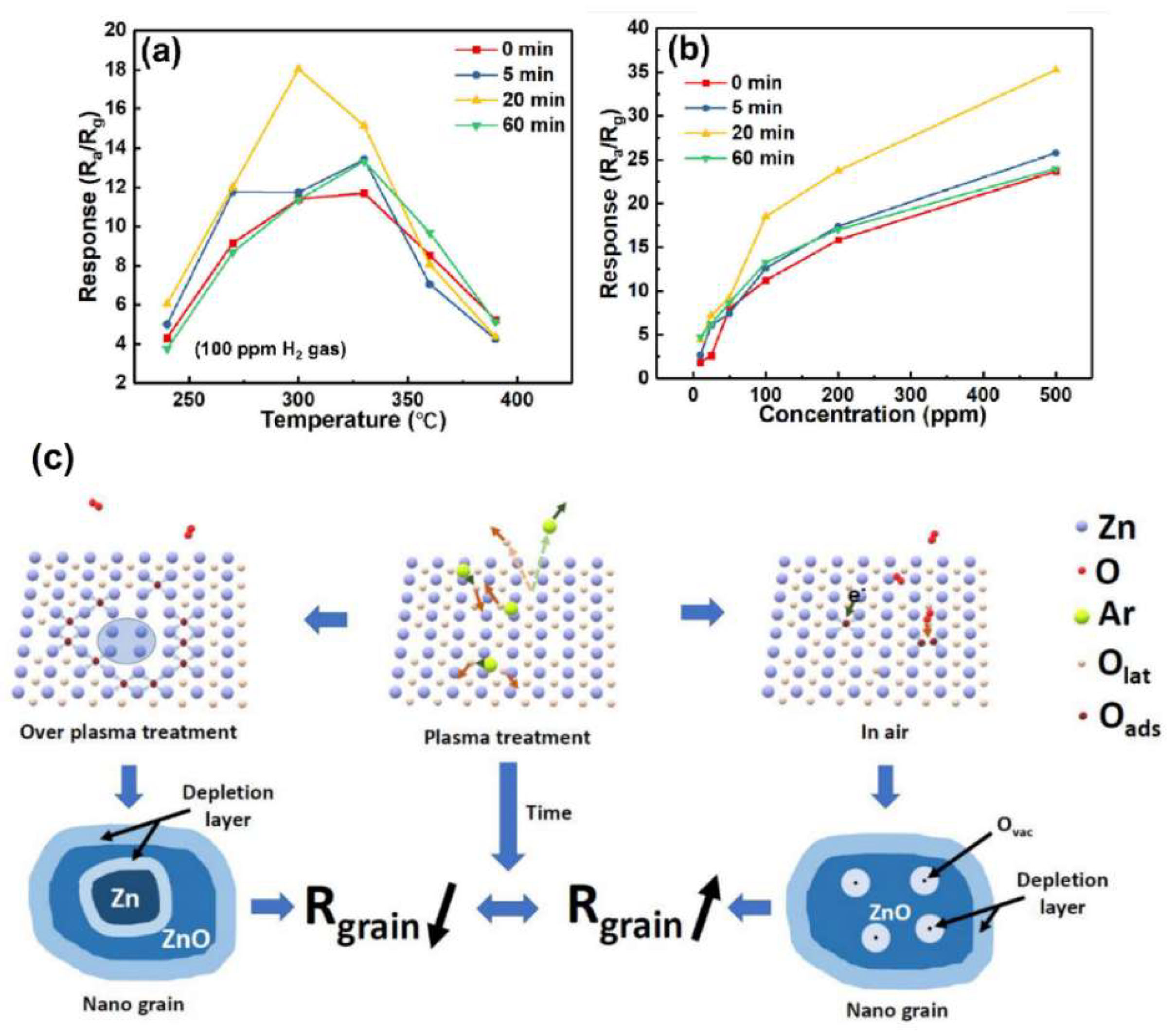
Based on XPS analysis, amount of adsorbed oxygen species was highest in the optimal sensor. When the plasma was exposed to ZnO, some Zn-O bonds were broken, resulting in formation of oxygen vacancy. Then, oxygen molecules from air were adsorbed on the oxygen vacancy sites and thanks to highly electrophilic nature of oxygen, they abstract electrons from conduction band of ZnO, leading to expansion of EDL relative to pristine ZnO and increase of resistance. Excess plasma exposure led to reduction of ZnO to Zn, reducing the overall resistance (Figure 8 (c)). In optimal gas sensor, plasma exposure time caused formation of EDL with high thickness and when the sensor was exposed to gas, the release of electrons significantly modulated the sensor resistance. Furthermore, heterojunctions were formed between ZnO and SnO2, acting as resistance sources for the gas sensor.
In another study[104], SnO2/In2O3 composite NFs were produced using electrospinning and then were exposed to oxygen plasma for 30 min. After plasma exposure, morphology of SnO2 changed to nanoneedles while that of In2O3 changed to nanotapers. The surface area before plasma treatment was 16.5 m2/g, and after plasma exposure it increased to 31 m2/g. This was due to the fact that the surface was rough and porous after plasma exposure. While pristine sensor showed a response of 8 to 10 ppm formaldehyde at 375°C, the response of plasma-treated sensor was 14 at 290°C. Furthermore, selective response was related to the small bond dissociation energy of H-CHO, where it was easily broken and reacted with adsorbed oxygen species, releasing electrons on the sensor surface. Due to plasma treatment more oxygen species were adsorbed on the surface of sensor, leading to more sensing reactions with formaldehyde gas. In another similar study by the same group [105], SnO2 NFs revealed enhanced response to HCHO gas after oxygen plasma treatment. The response of pristine SnO2 NFs was only 4.5 to 100 ppm HCHO at 300°C, while after plasma treatment it increased to 6.9 at 200°C.
4.5. Plasma Treated In2O3 Gas Sensors
One of main shortages of metal oxide gas sensors is humidity interference which limits their applications in humid environment [106]. Hence, development of anti-humidity gas sensors is vital. Du et al. [107], synthesized In2O3 by roasting of In2SO4 at 550 °C and then fluorocarbon (CF) was grafted on it by RF magnetron sputtering. The surface of CF-In2O3 was evenly wrapped by the CF layers with thickness of ~2 nm. While, In2O3 films exhibited a low WCA of ∼16°, the CF-In2O3 films showed a hydrophobic nature with a large WCA of ∼137°, thanks to the presence of low energy CF on the surface of In2O3. The In2O3 recorded a response of ∼18 to 1 ppm NO2 gas at 200°C. However, CF-In2O sensor revealed a lower response of 13 at optimal temperature of 100°C, due to the covering of CF on surface of In2O3 with lower sensing properties relative to In2O3. In the presence of 92 % RH, the response of CF-In2O3 was not significantly decreased, demonstrating anti-humidity properties of CF-In2O3. However, the response of In2O3 dramatically decreased. Two reasons were accounted for humidity interference of optimal sensor (i) The hydrophobic CF layer absorbed sufficient amount of H2O molecules to increase the electron concentration and hence more NO2 molecules were adsorbed. (ii) the hydrophobic CF layer suppressed the reaction between NO2 with H2O molecules, therefore concentration of adsorbed and reacted NO2 gas molecules on the surface of sensor did not changed.
In another study, Du et al.[108] synthesized In2O3 NFs and then exposed them to hydrogen and oxygen plasma for 30 min. The surface of oxygen plasma treated In2O3 was rougher and the diameter of NFs were thicker than those of hydrogen plasma In2O3. However, diameters of nanograins on the surface of NFs were smaller for oxygen plasma treated sample. Also, the surface areas of pristine, oxygen-, and hydrogen plasma treated samples were 18, 32, and 29 m2/g, respectively. Thus, the surface area was increased thanks to the formation of many new small pores on the surface of In2O3 NFs. Based on XPS study, the oxygen content greatly increased by oxygen plasma, which was vital for sensing reactions with acetone gas. As expected, the sensor exposed to oxygen plasma revealed the largest response of 37 to 500 ppm acetone at 275°C. High surface area and the presence of large amount of adsorbed oxygen species contributed to the enhanced sensing of acetone.
4.6. Other Plasma Treated Gas Sensors
ZnGa2O4 is a semiconducting material (5.1 eV) with features like ease of fabrication, low cost, and high stability[109]. Chang et al. [110] synthesized the ZnGa2O4 epilayer (125 nm thick) on a sapphire substrate using MOCVD technique. Then, Ar plasma was used for 5, 10, and 15 min. Spindle nanostructures changed to the smaller sizes and near-spherical particles after Ar plasma treatment for 15 min due to the Ar plasma bombardment and the coalescence of nanostructures (Figure 9 (a)-(d)). Furthermore, Ar plasma treatment introduced Ar atoms, radicals, and ions to the epilayer surface, resulting in chemical changes after plasma treatment.
Figure 9.
SEM micrographs of ZnGa2O4 epilayer (a) before and after Ar plasma treatment (b) 5, (c) 10 , and (d) 15 min [110]. With permission from Elsevier. Copyright (2023).
Figure 9.
SEM micrographs of ZnGa2O4 epilayer (a) before and after Ar plasma treatment (b) 5, (c) 10 , and (d) 15 min [110]. With permission from Elsevier. Copyright (2023).
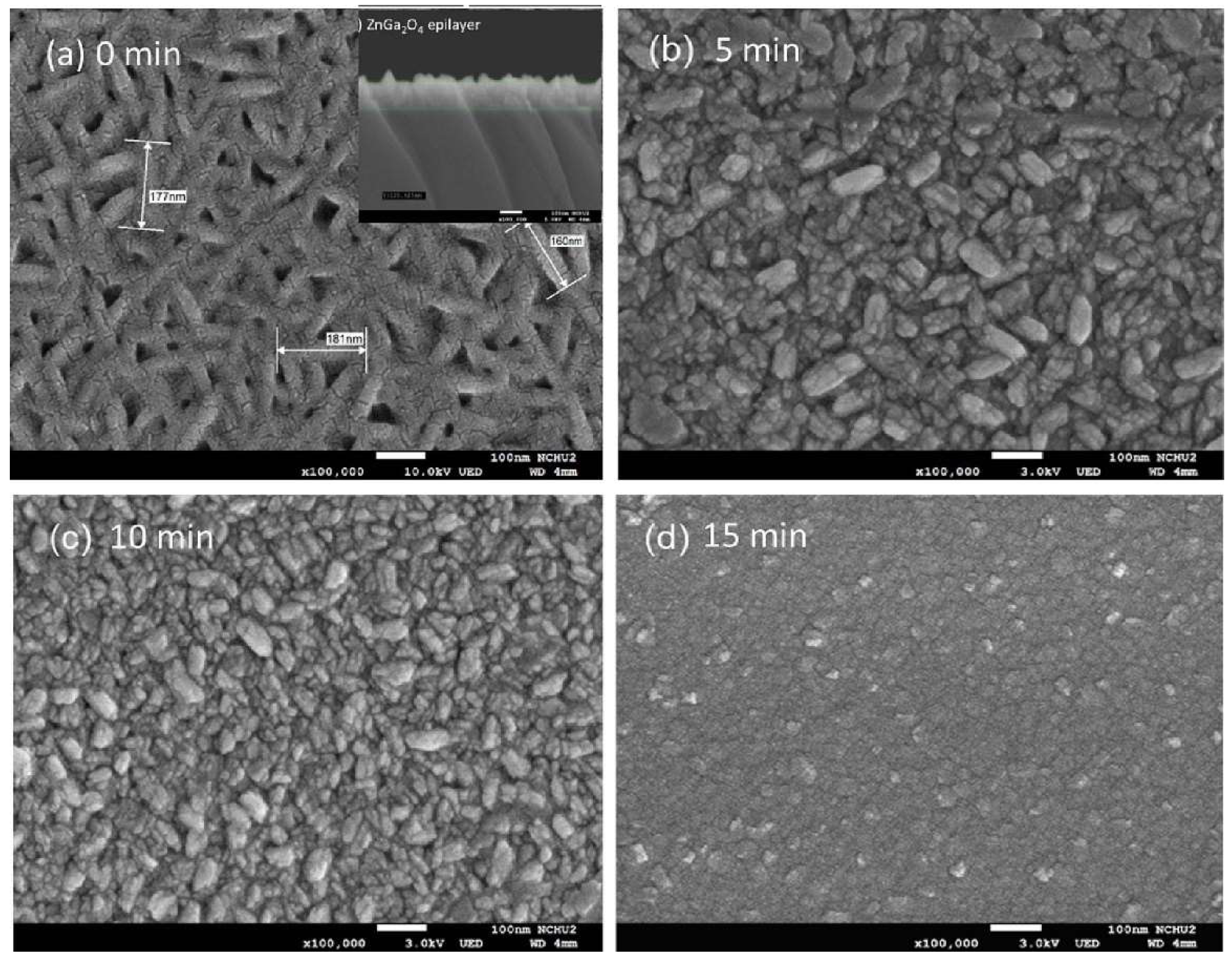
Among different sensors that treated with plasma for 10 min revealed enhanced response at 300°C with a response of 1300% to 5 ppm NO gas. The main reasons for sensing enhancement were related to higher surface area and the presence of more oxygen dangling bonds, leading to increase of reactions with NO gas. Also, based on DFT calculations, ZnGa2O4 with surface oxygen groups had a greater tendency to adsorb NO molecules.
Polypyrrole (PPy) as a CP, is a promising sensing material due to its high conductance, simple preparation, high response, and RT operation [111]. Similar to metal oxides, plasma treatment on CPs can increase their performance[112]. Zhang et al. [113] applied hydrogen and oxygen plasma on PPy for 20 min and investigated the response to gases. At 25°C, the response of hydrogen treated sensor to 50 ppm NO2 gas was 6 which was 1.6 and 1.2 times higher than that of pristine and oxygen treated sensors, respectively. Based on DFT calculations, the adsorption energy of NO2 on hydrogen treated sensor was significantly higher (−1.72 eV) than that on pristine (−0.58 eV) and oxygen treated (−0.69 eV) sensors, respectively. This implied that hydrogen plasma treatment was more efficient for NO2 gas adsorption enhancement. Besides, increase of surface area by formation of pores after plasma exposure, contributed to the sensing improvement. In another study, related to oxygen plasma treated PANI, the response to hydrogen at RT was significantly improved relative to pristine sensor [114].
MXenes are a new category of 2D materials with high conductivity, large surface area and tunable band gaps [115]. They have general formula of Mn+1XnTx in which A is a transition metal, X is C/or N, and Tx shows surface functional groups. They are synthesized from their parent MAX phases which can be represented as Mn+1AnX , where A is an element in group IIIA or group IVA [116,117]. In this context, Wang et al. [118] synthesize Ti3C2Tx MXene via liquid exfoliation and subsequently, exposed it to oxygen plasma treatment. The sensor exhibited a response of 13.8% to 10 ppm NO2 gas at RT. The enhanced performance was related to the present of numerous oxygen surface functional groups as a result of plasma treatment.
Transition dichalcogenides are 2D semiconductors with high conductivity and large surface areas. They have general formula of MX2 in which M is a transition metal and X is a chalcogenide such as S, Se, or Te [119,120]. Seo et al.[121] applied Ar plasma treatment on MoS2 NSs for 2 s. As a result of plasma exposure, sulfur vacancies were created on MoS2. Then, it was exposed to 3-mercaptopropionic acid (MPA) solution to form coordinate bonds between the HS groups in MPA and sulfur vacancies. Based on XPS study, the pristine MoS2 exhibited the ideal S/Mo ratio of 1.91, while after plasma exposure it was decreased to 1.51, indicating sulfur vacancy formation. Based on NH3 gas sensing studies, the pristine sensor revealed a response of 1.25 to 130 ppm NH3 gas at RT, and after treatment by plasma and MPA, the response increased to 4.45. The boosted sensing capability was related to the presence of oxygen and carboxyl groups (−COO) on the surface of sensor.
5. Conclusion and Outlooks
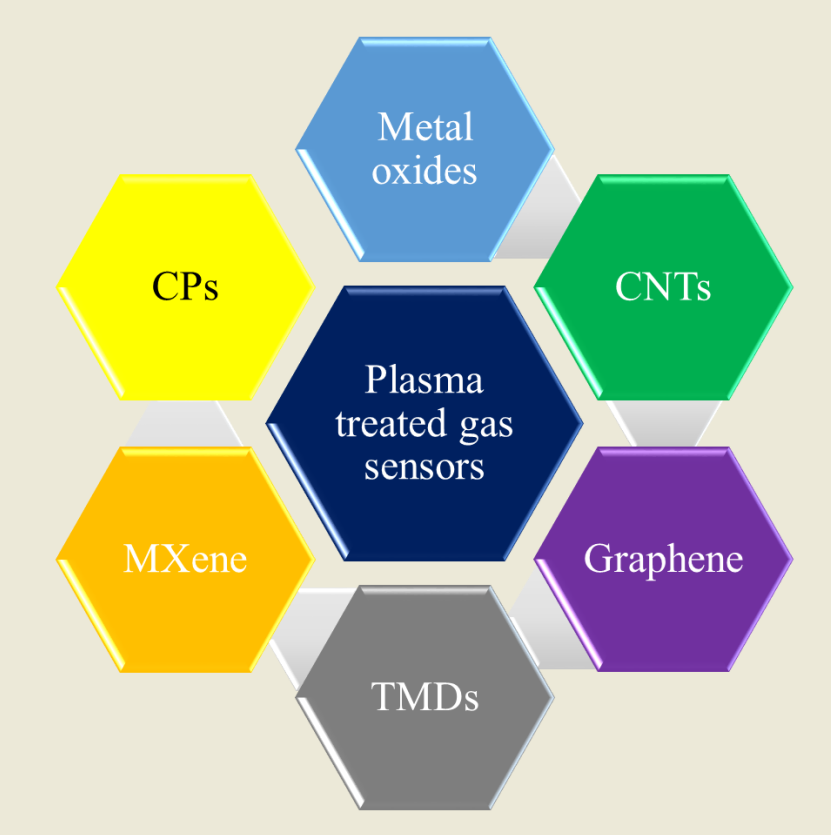
We reviewed the effect of plasma treatment on the gas sensing characteristics of gas sensors. In general, plasma exposure affects the amount of oxygen species on the sensor surface and hence oxygen ions are highly required for gas sensing reactions, plasma treatment significantly affects the gas sensing of resistive sensors through modulation of the amount of oxygen ions. Generally, oxygen plasma causes addition of surface oxygen functional groups on the sensor surface and hence the reactions between adsorbed gases with oxygen increases, leading to higher sensing performance relative to pristine sensor. Also, exposure to other plasma atmospheres such as Ar or He, causes generation of oxygen defects which acted as favorable sites for oxygen adsorption and hence contribute to the enhanced sensing performance. Regardless the type of plasma used, both plasma power and plasma exposure times should be optimized to achieve the highest gas sensing performance. However, in most cases, the focus is on the optimization of plasma time rather than plasms power. Thus, this aspect needs more attention in future studies. Different sensing materials such as metal oxides, TMDs, MXenes, CNTs, graphene, and CPs have been subjected to plasma treatment. In this regards, combination of plasma exposure other high irradiation techniques such as ion-beams, electron beams and gamma ray can lead to interesting results.
Author Contributions
M. T. C: investigation, writing original paper; A. M; investigation, Conceptualization, writing—review and editing.
Funding
This research received no external funding.
Acknowledgment
The authors are thankful to Shiraz University of Technology.
Conflicts of Interest
The authors declare no conflicts of interest.
References
- Vos, T.; Lim, S.S.; Abbafati, C.; Abbas, K.M.; Abbasi, M.; Abbasifard, M.; Abbasi-Kangevari, M.; Abbastabar, H.; Abd-Allah, F.; Abdelalim, A.; et al. Global Burden of 369 Diseases and Injuries in 204 Countries and Territories, 1990–2019: A Systematic Analysis for the Global Burden of Disease Study 2019. The Lancet 2020, 396, 1204–1222. [Google Scholar] [CrossRef] [PubMed]
- Le Quilliec, E.; Fundere, A.; Al-U’datt, D.G.F.; Hiram, R. Pollutants, Including Organophosphorus and Organochloride Pesticides, May Increase the Risk of Cardiac Remodeling and Atrial Fibrillation: A Narrative Review. Biomedicines 2023, 11. [Google Scholar] [CrossRef] [PubMed]
- Gal, O.; Eitan, O.; Rachum, A.; Weinberg, M.; Zigdon, D.; Assa, R.; Price, C.; Yovel, Y. Air Pollution Likely Reduces Hemoglobin Levels in Urban Fruit Bats. iScience 2025, 28, 111997. [Google Scholar] [CrossRef]
- Manisalidis, I.; Stavropoulou, E.; Stavropoulos, A.; Bezirtzoglou, E. Environmental and Health Impacts of Air Pollution: A Review. Frontiers in Public Health 2020, 8. [Google Scholar] [CrossRef]
- Hong, C.; Zhong, R.; Xu, M.; He, P.; Mo, H.; Qin, Y.; Shi, D.; Chen, X.; He, K.; Zhang, Q. Interactions Among Food Systems, Climate Change, and Air Pollution: A Review. Engineering 2025, 44, 215–233. [Google Scholar] [CrossRef]
- Bell, J.N.B.; Honour, S.L.; Power, S.A. Effects of Vehicle Exhaust Emissions on Urban Wild Plant Species. Environmental Pollution 2011, 159, 1984–1990. [Google Scholar] [CrossRef]
- Gao, Q.; Jiang, B.; Tong, M.; Zuo, H.; Cheng, C.; Zhang, Y.; Song, S.; Lu, L.; Li, X. Effects and Interaction of Humidex and Air Pollution on Influenza: A National Analysis of 319 Cities in Mainland China. Journal of Hazardous Materials 2025, 490, 137865. [Google Scholar] [CrossRef]
- Semczuk-Kaczmarek, K.; Rys-Czaporowska, A.; Sierdzinski, J.; Kaczmarek, L.D.; Szymanski, F.M.; Platek, A.E. Association between Air Pollution and COVID-19 Mortality and Morbidity. Internal and Emergency Medicine 2022, 17, 467–473. [Google Scholar] [CrossRef] [PubMed]
- Aithal, S.S.; Sachdeva, I.; Kurmi, O.P. Air Quality and Respiratory Health in Children. Breathe 2023, 19. [Google Scholar] [CrossRef]
- Van Meerbeke, S.W.; McCarty, M.; Petrov, A.A.; Schonffeldt-Guerrero, P. The Impact of Climate, Aeroallergens, Pollution, and Altitude on Exercise-Induced Bronchoconstriction. Immunology and Allergy Clinics 2025, 45, 77–88. [Google Scholar] [CrossRef]
- Tiotiu, A.I.; Novakova, P.; Nedeva, D.; Chong-Neto, H.J.; Novakova, S.; Steiropoulos, P.; Kowal, K. Impact of Air Pollution on Asthma Outcomes. International Journal of Environmental Research and Public Health 2020, 17. [Google Scholar] [CrossRef] [PubMed]
- Chen, K.-C.; Tsai, S.-W.; Shie, R.-H.; Zeng, C.; Yang, H.-Y. Indoor Air Pollution Increases the Risk of Lung Cancer. International Journal of Environmental Research and Public Health 2022, 19. [Google Scholar] [CrossRef]
- Syama, K.P.; Blais, E.; Kumarathasan, P. Maternal Mechanisms in Air Pollution Exposure-Related Adverse Pregnancy Outcomes: A Systematic Review. Science of The Total Environment 2025, 970, 178999. [Google Scholar] [CrossRef] [PubMed]
- Bayart, N.-E.; Pereira, G.; Reid, C.M.; Nyadanu, S.D.; Badamdorj, O.; Lkhagvasuren, B.; Rumchev, K. Effects of Outdoor Air Pollution on Hospital Admissions from Cardiovascular Diseases in the Capital City of Mongolia. Atmospheric Pollution Research 2024, 102338. [Google Scholar] [CrossRef]
- Aryal, A.; Harmon, A.C.; Dugas, T.R. Particulate Matter Air Pollutants and Cardiovascular Disease: Strategies for Intervention. Pharmacology & Therapeutics 2021, 223, 107890. [Google Scholar] [CrossRef]
- Glencross, D.A.; Ho, T.-R.; Camiña, N.; Hawrylowicz, C.M.; Pfeffer, P.E. Air Pollution and Its Effects on the Immune System. Free Radical Biology and Medicine 2020, 151, 56–68. [Google Scholar] [CrossRef]
- Sicard, P.; Agathokleous, E.; Anenberg, S.C.; Marco, A.D.; Paoletti, E.; Calatayud, V. Trends in Urban Air Pollution over the Last Two Decades: A Global Perspective. Science of The Total Environment 2023, 858, 160064. [Google Scholar] [CrossRef]
- Li, P.; Li, J.; Song, S.; Chen, J.; Zhong, N.; Xie, Q.; Liu, Y.; Wan, B.; He, Y.; Karimi-Maleh, H. Recent Advances in Optical Gas Sensors for Carbon Dioxide Detection. Measurement 2025, 239, 115445. [Google Scholar] [CrossRef]
- Fundamentals and Principles of Solid-State Electrochemical Sensors for High Temperature Gas Detection. Available online: https://www.mdpi.com/2073-4344/12/1/1 (accessed on 4 January 2025).
- Kumar, A.; Prajesh, R. The Potential of Acoustic Wave Devices for Gas Sensing Applications. Sensors and Actuators A: Physical 2022, 339, 113498. [Google Scholar] [CrossRef]
- El-Muraikhi, M.D.; Ayesh, A.I.; Mirzaei, A. Resistive Gas Sensors Based on Inorganic Nanotubes: A Review. Journal of Alloys and Compounds 2025, 1020, 179585. [Google Scholar] [CrossRef]
- Mirzaei, A.; Neri, G. Microwave-Assisted Synthesis of Metal Oxide Nanostructures for Gas Sensing Application: A Review. Sensors and Actuators B: Chemical 2016, 237, 749–775. [Google Scholar] [CrossRef]
- Guo, S.-Y.; Hou, P.-X.; Zhang, F.; Liu, C.; Cheng, H.-M. Gas Sensors Based on Single-Wall Carbon Nanotubes. Molecules 2022, 27. [Google Scholar] [CrossRef] [PubMed]
- Mirzaei, A.; Bharath, S.P.; Kim, J.-Y.; Pawar, K.K.; Kim, H.W.; Kim, S.S. N-Doped Graphene and Its Derivatives as Resistive Gas Sensors: An Overview. Chemosensors 2023, 11. [Google Scholar] [CrossRef]
- Kiranakumar, H. V.; Thejas, R.; Naveen, C.S.; Khan, M.I.; Prasanna G, D; Reddy, S.; Oreijah, M.; Guedri, K.; Bafakeeh, O.T.; Jameel, M. A Review on Electrical and Gas-Sensing Properties of Reduced Graphene Oxide-Metal Oxide Nanocomposites. Biomass Conversion and Biorefinery 2024, 14, 12625–12635. [Google Scholar] [CrossRef]
- Matindoust, S.; Farzi, G.; Nejad, M.B.; Shahrokhabadi, M.H. Polymer-Based Gas Sensors to Detect Meat Spoilage: A Review. Reactive and Functional Polymers 2021, 165, 104962. [Google Scholar] [CrossRef]
- Hu, Y.; Zheng, W.; Fan, S.; Zhang, J.; Liu, X. Noble-Transition-Metal Dichalcogenides-Emerging Two-Dimensional Materials for Sensor Applications. Applied Physics Reviews 2023, 10, 031306. [Google Scholar] [CrossRef]
- Amiri, V.; Roshan, H.; Mirzaei, A.; Neri, G.; Ayesh, A.I. Nanostructured Metal Oxide-Based Acetone Gas Sensors: A Review. Sensors 2020, 20. [Google Scholar] [CrossRef]
- Bonyani, M.; Zebarjad, S.M.; Mirzaei, A.; Kim, T.-U.; Kim, H.W.; Kim, S.S. Electrospun ZnO Hollow Nanofibers Gas Sensors: An Overview. Journal of Alloys and Compounds 2024, 1001, 175201. [Google Scholar] [CrossRef]
- El-Muraikhi, M.D.; Ayesh, A.I.; Mirzaei, A. Review of Nanostructured Bi2O3, Bi2WO6, and BiVO4 as Resistive Gas Sensors. Surfaces and Interfaces 2025, 60, 106003. [Google Scholar] [CrossRef]
- El-Muraikhi, M.D.; Mirzaei, A.; Ayesh, A.I. Nanostructured Nb2O5 as Chemiresistive Gas Sensors. Ceramics International 2024, 50, 54897–54911. [Google Scholar] [CrossRef]
- Zappa, D.; Galstyan, V.; Kaur, N.; Arachchige, H.M.M.M.; Sisman, O.; Comini, E. “Metal Oxide -Based Heterostructures for Gas Sensors”- A Review. Analytica Chimica Acta 2018, 1039, 1–23. [Google Scholar] [CrossRef] [PubMed]
- Degler, D.; Weimar, U.; Barsan, N. Current Understanding of the Fundamental Mechanisms of Doped and Loaded Semiconducting Metal-Oxide-Based Gas Sensing Materials. ACS Sens. 2019, 4, 2228–2249. [Google Scholar] [CrossRef]
- Zhu, L.-Y.; Ou, L.-X.; Mao, L.-W.; Wu, X.-Y.; Liu, Y.-P.; Lu, H.-L. Advances in Noble Metal-Decorated Metal Oxide Nanomaterials for Chemiresistive Gas Sensors: Overview. Nano-Micro Letters 2023, 15, 89. [Google Scholar] [CrossRef] [PubMed]
- Mirzaei, A.; Ansari, H.R.; Shahbaz, M.; Kim, J.-Y.; Kim, H.W.; Kim, S.S. Metal Oxide Semiconductor Nanostructure Gas Sensors with Different Morphologies. Chemosensors 2022, 10. [Google Scholar] [CrossRef]
- Majhi, S.M.; Mirzaei, A.; Navale, S.; Kim, H.W.; Kim, S.S. Boosting the Sensing Properties of Resistive-Based Gas Sensors by Irradiation Techniques: A Review. Nanoscale 2021, 13, 4728–4757. [Google Scholar] [CrossRef]
- Kim, J. H.; Lee, M. A.; Han, G. J.; Cho, B. H. Plasma in Dentistry: A Review of Basic Concepts and Applications in Dentistry. Acta Odontologica Scandinavica 2013, 72, 1–12. [Google Scholar] [CrossRef]
- Bayati, M.; Lund, M.N.; Tiwari, B.K.; Poojary, M.M. Chemical and Physical Changes Induced by Cold Plasma Treatment of Foods: A Critical Review. Comprehensive Reviews in Food Science and Food Safety 2024, 23, e13376. [Google Scholar] [CrossRef] [PubMed]
- Bezerra, J. de A.; Lamarão, C.V.; Sanches, E.A.; Rodrigues, S.; Fernandes, F.A.N.; Ramos, G.L.P.A.; Esmerino, E.A.; Cruz, A.G.; Campelo, P.H. Cold Plasma as a Pre-Treatment for Processing Improvement in Food: A Review. Food Research International 2023, 167, 112663. [Google Scholar] [CrossRef]
- Nimbekar, A.A.; Deshmukh, R.R. Plasma Surface Modification of Flexible Substrates to Improve Grafting for Various Gas Sensing Applications: A Review. IEEE Transactions on Plasma Science 2022, 50, 1382–1394. [Google Scholar] [CrossRef]
- Alemán, C.; Fabregat, G.; Armelin, E.; Buendía, J.J.; Llorca, J. Plasma Surface Modification of Polymers for Sensor Applications. J. Mater. Chem. B 2018, 6, 6515–6533. [Google Scholar] [CrossRef]
- Saka, C. Overview on the Surface Functionalization Mechanism and Determination of Surface Functional Groups of Plasma Treated Carbon Nanotubes. Critical Reviews in Analytical Chemistry 2017, 48, 1–14. [Google Scholar] [CrossRef] [PubMed]
- Leghrib, R.; Felten, A.; Demoisson, F.; Reniers, F.; Pireaux, J.-J.; Llobet, E. Room-Temperature, Selective Detection of Benzene at Trace Levels Using Plasma-Treated Metal-Decorated Multiwalled Carbon Nanotubes. Carbon 2010, 48, 3477–3484. [Google Scholar] [CrossRef]
- Ambardekar, V.; Sahoo, S.; Srivastava, D.K.; Majumder, S.B.; Bandyopadhyay, P.P. Plasma Sprayed CuO Coatings for Gas Sensing and Catalytic Conversion Applications. Sensors and Actuators B: Chemical 2021, 331, 129404. [Google Scholar] [CrossRef]
- Ambardekar, V.; Bandyopadhyay, P.P.; Majumder, S.B. Plasma Sprayed Copper Oxide Sensor for Selective Sensing of Carbon Monoxide. Materials Chemistry and Physics 2021, 258, 123966. [Google Scholar] [CrossRef]
- Choi, M.S.; Bang, J.H.; Mirzaei, A.; Na, H.G.; Kwon, Y.J.; Kang, S.Y.; Choi, S.-W.; Kim, S.S.; Kim, H.W. Dual Sensitization of MWCNTs by Co-Decoration with p- and n-Type Metal Oxide Nanoparticles. Sensors and Actuators B: Chemical 2018, 264, 150–163. [Google Scholar] [CrossRef]
- Kwon, Y.J.; Mirzaei, A.; Kang, S.Y.; Choi, M.S.; Bang, J.H.; Kim, S.S.; Kim, H.W. Synthesis, Characterization and Gas Sensing Properties of ZnO-Decorated MWCNTs. Applied Surface Science 2017, 413, 242–252. [Google Scholar] [CrossRef]
- Lavagna, L.; Nisticò, R.; Musso, S.; Pavese, M. Functionalization as a Way to Enhance Dispersion of Carbon Nanotubes in Matrices: A Review. Materials Today Chemistry 2021, 20, 100477. [Google Scholar] [CrossRef]
- Jian, J.; Guo, X.; Lin, L.; Cai, Q.; Cheng, J.; Li, J. Gas-Sensing Characteristics of Dielectrophoretically Assembled Composite Film of Oxygen Plasma-Treated SWCNTs and PEDOT/PSS Polymer. Sensors and Actuators B: Chemical 2013, 178, 279–288. [Google Scholar] [CrossRef]
- Leghrib, R.; Pavelko, R.; Felten, A.; Vasiliev, A.; Cané, C.; Gràcia, I.; Pireaux, J.-J.; Llobet, E. Gas Sensors Based on Multiwall Carbon Nanotubes Decorated with Tin Oxide Nanoclusters. Sensors and Actuators B: Chemical 2010, 145, 411–416. [Google Scholar] [CrossRef]
- Min, S.; Kim, J.; Park, C.; Jin, J.-H.; Min, N.K. Long-Term Stability of Superhydrophilic Oxygen Plasma-Modified Single-Walled Carbon Nanotube Network Surfaces and the Influence on Ammonia Gas Detection. Applied Surface Science 2017, 410, 105–110. [Google Scholar] [CrossRef]
- Yeo, S.; Choi, C.; Woong Jang, C.; Lee, S.; Min Jhon, Y. Sensitivity Enhancement of Carbon Nanotube Based Ammonium Ion Sensors through Surface Modification by Using Oxygen Plasma Treatment. Applied Physics Letters 2013, 102, 073108. [Google Scholar] [CrossRef]
- Zhang, X.; Wu, X.; Yang, B.; Xiao, H. Enhancement of Gas Sensing Characteristics of Multiwalled Carbon Nanotubes by CF4 Plasma Treatment for SF6 Decomposition Component Detection. Journal of Nanomaterials 2015, 2015, 171545. [Google Scholar] [CrossRef]
- Clément, P.; Ramos, A.; Lazaro, A.; Molina-Luna, L.; Bittencourt, C.; Girbau, D.; Llobet, E. Oxygen Plasma Treated Carbon Nanotubes for the Wireless Monitoring of Nitrogen Dioxide Levels. Sensors and Actuators B: Chemical 2015, 208, 444–449. [Google Scholar] [CrossRef]
- Zhang, X.; Yang, B.; Wang, X.; Luo, C. Effect of Plasma Treatment on Multi-Walled Carbon Nanotubes for the Detection of H2S and SO2. Sensors 2012, 12, 9375–9385. [Google Scholar] [CrossRef] [PubMed]
- Bannov, A.G.; Jašek, O.; Manakhov, A.; Márik, M.; Nečas, D.; Zajíčková, L. High-Performance Ammonia Gas Sensors Based on Plasma Treated Carbon Nanostructures. IEEE Sensors Journal 2017, 17, 1964–1970. [Google Scholar] [CrossRef]
- Bannov, A.G.; Manakhov, A.M.; Shtansky, D.V. Plasma Functionalization of Multi-Walled Carbon Nanotubes for Ammonia Gas Sensors. Materials 2022, 15. [Google Scholar] [CrossRef]
- Dong, K.-Y.; Ham, D.-J.; Kang, B.H.; Lee, K.; Choi, J.; Lee, J.-W.; Choi, H.H.; Ju, B.-K. Effect of Plasma Treatment on the Gas Sensor with Single-Walled Carbon Nanotube Paste. Talanta 2012, 89, 33–37. [Google Scholar] [CrossRef] [PubMed]
- Santhosh, N.M.; Vasudevan, A.; Jurov, A.; Korent, A.; Slobodian, P.; Zavašnik, J.; Cvelbar, U. Improving Sensing Properties of Entangled Carbon Nanotube-Based Gas Sensors by Atmospheric Plasma Surface Treatment. Microelectronic Engineering 2020, 232, 111403. [Google Scholar] [CrossRef]
- Ham, S.W.; Hong, H.P.; Kim, J.H.; Min, S.J.; Min, N.K. Effect of Oxygen Plasma Treatment on Carbon Nanotube-Based Sensors. Journal of Nanoscience and Nanotechnology 2014, 14, 8476–8481. [Google Scholar] [CrossRef]
- Zamansky, K.K.; Osipova, A.A.; Fedorov, F.S.; Kopylova, D.S.; Shunaev, V.; Alekseeva, A.; Glukhova, O.E.; Nasibulin, A.G. Sensitivity Enhancement of SWCNT Gas Sensors by Nitrogen Plasma Treatment. Applied Surface Science 2023, 640, 158334. [Google Scholar] [CrossRef]
- Ham, S.W.; Hong, H.P.; Kim, J.W.; Kim, J.H.; Kim, K.B.; Park, C.W.; Min, N.K. Comparison of Gas Sensors Based on Oxygen Plasma-Treated Carbon Nanotube Network Films with Different Semiconducting Contents. Journal of Electronic Materials 2015, 44, 1344–1350. [Google Scholar] [CrossRef]
- Farea, M.A.; Mohammed, H.Y.; Shirsat, S.M.; Sayyad, P.W.; Ingle, N.N.; Al-Gahouari, T.; Mahadik, M.M.; Bodkhe, G.A.; Shirsat, M.D. Hazardous Gases Sensors Based on Conducting Polymer Composites: Review. Chemical Physics Letters 2021, 776, 138703. [Google Scholar] [CrossRef]
- Liu, X.; Zheng, W.; Kumar, R.; Kumar, M.; Zhang, J. Conducting Polymer-Based Nanostructures for Gas Sensors. Coordination Chemistry Reviews 2022, 462, 214517. [Google Scholar] [CrossRef]
- Guo, X.; Jian, J.; Lin, L.; Zhu, H.; Zhu, S. O2 Plasma-Functionalized SWCNTs and PEDOT/PSS Composite Film Assembled by Dielectrophoresis for Ultrasensitive Trimethylamine Gas Sensor. Analyst 2013, 138, 5265–5273. [Google Scholar] [CrossRef]
- Yoo, K.-P.; Kwon, K.-H.; Min, N.-K.; Lee, M.J.; Lee, C.J. Effects of O2 Plasma Treatment on NH3 Sensing Characteristics of Multiwall Carbon Nanotube/Polyaniline Composite Films. Sensors and Actuators B: Chemical 2009, 143, 333–340. [Google Scholar] [CrossRef]
- Kim, J.H.; Song, M.-J.; Kim, K.B.; Jin, J.-H.; Min, N.K. Evaluation of Surface Cleaning Procedures in Terms of Gas Sensing Properties of Spray-Deposited CNT Film: Thermal- and O2 Plasma Treatments. Sensors 2017, 17. [Google Scholar] [CrossRef]
- Zhao, W.; Fam, D.W.H.; Yin, Z.; Sun, T.; Tan, H.T.; Liu, W.; Tok, A.I.Y.; Boey, Y.C.F.; Zhang, H.; Hng, H.H.; et al. A Carbon Monoxide Gas Sensor Using Oxygen Plasma Modified Carbon Nanotubes. Nanotechnology 2012, 23, 425502. [Google Scholar] [CrossRef]
- Schedin, F.; Geim, A.K.; Morozov, S.V.; Hill, E.W.; Blake, P.; Katsnelson, M.I.; Novoselov, K.S. Detection of Individual Gas Molecules Adsorbed on Graphene. Nature Materials 2007, 6, 652–655. [Google Scholar] [CrossRef] [PubMed]
- Wu, H.; Bu, X.; Deng, M.; Chen, G.; Zhang, G.; Li, X.; Wang, X.; Liu, W. A Gas Sensing Channel Composited with Pristine and Oxygen Plasma-Treated Graphene. Sensors 2019, 19. [Google Scholar] [CrossRef]
- Capote Mastrapa, G.; Freire Jr., F. L. Plasma-Treated CVD Graphene Gas Sensor Performance in Environmental Condition: The Role of Defects on Sensitivity. Journal of Sensors 2019, 2019, 5492583. [Google Scholar] [CrossRef]
- Zhang, H.; Fan, L.; Dong, H.; Zhang, P.; Nie, K.; Zhong, J.; Li, Y.; Guo, J.; Sun, X. Spectroscopic Investigation of Plasma-Fluorinated Monolayer Graphene and Application for Gas Sensing. ACS Appl. Mater. Interfaces 2016, 8, 8652–8661. [Google Scholar] [CrossRef]
- Chung, M.G.; Kim, D.H.; Lee, H.M.; Kim, T.; Choi, J.H.; Seo, D. kyun; Yoo, J.-B.; Hong, S.-H.; Kang, T.J.; Kim, Y.H. Highly Sensitive NO2 Gas Sensor Based on Ozone Treated Graphene. Sensors and Actuators B: Chemical 2012, 166–167, 172–176. [Google Scholar] [CrossRef]
- Zhang, C.; Xu, K.; Liu, K.; Xu, J.; Zheng, Z. Metal Oxide Resistive Sensors for Carbon Dioxide Detection. Coordination Chemistry Reviews 2022, 472, 214758. [Google Scholar] [CrossRef]
- Casanova-Chafer, J.; Garcia-Aboal, R.; Llobet, E.; Atienzar, P. Enhanced CO2 Sensing by Oxygen Plasma-Treated Perovskite–Graphene Nanocomposites. ACS Sens. 2024, 9, 830–839. [Google Scholar] [CrossRef]
- Chowdhury, I.; Duch, M.C.; Mansukhani, N.D.; Hersam, M.C.; Bouchard, D. Colloidal Properties and Stability of Graphene Oxide Nanomaterials in the Aquatic Environment. Environ. Sci. Technol. 2013, 47, 6288–6296. [Google Scholar] [CrossRef] [PubMed]
- Dimiev, A.M.; Tour, J.M. Mechanism of Graphene Oxide Formation. ACS Nano 2014, 8, 3060–3068. [Google Scholar] [CrossRef]
- Thangamani, G.J.; Deshmukh, K.; Kovářík, T.; Nambiraj, N.A.; Ponnamma, D.; Sadasivuni, K.K.; Khalil, H.P.S.A.; Pasha, S.K.K. Graphene Oxide Nanocomposites Based Room Temperature Gas Sensors: A Review. Chemosphere 2021, 280, 130641. [Google Scholar] [CrossRef] [PubMed]
- Hafiz, S.M.; Ritikos, R.; Whitcher, T.J.; Razib, N.M.; Bien, D.C.S.; Chanlek, N.; Nakajima, H.; Saisopa, T.; Songsiriritthigul, P.; Huang, N.M.; et al. A Practical Carbon Dioxide Gas Sensor Using Room-Temperature Hydrogen Plasma Reduced Graphene Oxide. Sensors and Actuators B: Chemical 2014, 193, 692–700. [Google Scholar] [CrossRef]
- Hamzaj, A.K.; Donà, E.; Santhosh, N.M.; Shvalya, V.; Košiček, M.; Cvelbar, U. Plasma-Modification of Graphene Oxide for Advanced Ammonia Sensing. Applied Surface Science 2024, 660, 160006. [Google Scholar] [CrossRef]
- Gruber, D.; Kraus, F.; Müller, J. A Novel Gas Sensor Design Based on CH4/H2/H2O Plasma Etched ZnO Thin Films. Sensors and Actuators B: Chemical 2003, 92, 81–89. [Google Scholar] [CrossRef]
- Law, J.B.K.; Thong, J.T.L. Improving the NH3 Gas Sensitivity of ZnO Nanowire Sensors by Reducing the Carrier Concentration. Nanotechnology 2008, 19, 205502. [Google Scholar] [CrossRef]
- Wang, G.; Chen, T.; Guo, L.; Wang, W.; Wang, H.; Wang, Y.; Zeng, H.; Liu, X.; Wang, J.; Yang, Y. Highly Response Gas Sensor Based the Au-ZnO Films Processed by Combining Magnetron Sputtering and Ar Plasma Treatment. Physica Scripta 2023, 98, 075609. [Google Scholar] [CrossRef]
- Hou, Y.; Jayatissa, A.H. Enhancement of Gas Sensor Response of Nanocrystalline Zinc Oxide for Ammonia by Plasma Treatment. Applied Surface Science 2014, 309, 46–53. [Google Scholar] [CrossRef]
- Gui, Y.; Zhao, S.; Tian, K.; Wu, J.; Guo, H.; Qin, X.; Qin, X.; Guo, D.; Zheng, G.; Guo, Y. Oxygen Plasma Treatment to Enhance the Gas-Sensing Performance of ZnO to N-Methyl Pyrrolidone: Experimental and Computational Study. Ceramics International 2024, 50, 47418–47427. [Google Scholar] [CrossRef]
- George, S.M. Atomic Layer Deposition: An Overview. Chem. Rev. 2010, 110, 111–131. [Google Scholar] [CrossRef]
- Xu, Y.; Zheng, W.; Liu, X.; Zhang, L.; Zheng, L.; Yang, C.; Pinna, N.; Zhang, J. Platinum Single Atoms on Tin Oxide Ultrathin Films for Extremely Sensitive Gas Detection. Mater. Horiz. 2020, 7, 1519–1527. [Google Scholar] [CrossRef]
- Li, Z.; Liu, X.; Zhou, M.; Zhang, S.; Cao, S.; Lei, G.; Lou, C.; Zhang, J. Plasma-Induced Oxygen Vacancies Enabled Ultrathin ZnO Films for Highly Sensitive Detection of Triethylamine. Journal of Hazardous Materials 2021, 415, 125757. [Google Scholar] [CrossRef]
- Das, S.; Jayaraman, V. SnO2: A Comprehensive Review on Structures and Gas Sensors. Progress in Materials Science 2014, 66, 112–255. [Google Scholar] [CrossRef]
- Masuda, Y. Recent Advances in SnO2 Nanostructure Based Gas Sensors. Sensors and Actuators B: Chemical 2022, 364, 131876. [Google Scholar] [CrossRef]
- Hiyoto, K.A.M.; Fisher, E.R. Utilizing Plasma Modified SnO2 Paper Gas Sensors to Better Understand Gas-Surface Interactions at Low Temperatures. Journal of Vacuum Science & Technology A 2020, 38, 043202. [Google Scholar] [CrossRef]
- Stuckert, E.P.; Miller, C.J.; Fisher, E.R. The Effect of Ar/O2 and H2O Plasma Treatment of SnO2 Nanoparticles and Nanowires on Carbon Monoxide and Benzene Detection. ACS Appl. Mater. Interfaces 2017, 9, 15733–15743. [Google Scholar] [CrossRef] [PubMed]
- Srivastava, R.; Dwivedi, R.; Srivastava, S.K. Effect of Oxygen and Hydrogen Plasma Treatment on the Room Temperature Sensitivity of SnO2 Gas Sensors. Microelectronics Journal 1998, 29, 833–838. [Google Scholar] [CrossRef]
- Chaturvedi, A.; Mishra, V.N.; Dwivedi, R.; Srivastava, S.K. Response of Oxygen Plasma-Treated Thick Film Tin Oxide Sensor Array for LPG, CCl4, CO and C3H7OH. Microelectronics Journal 1999, 30, 259–264. [Google Scholar] [CrossRef]
- Acharyya, S.; Guha, P.K. Enhanced Formaldehyde Sensing Performance Employing Plasma-Treated Hierarchical SnO2 Nanosheets through Oxygen Vacancy Modulation. Applied Surface Science 2024, 655, 159640. [Google Scholar] [CrossRef]
- Mirzaei, A.; Yousefi, H.R.; Falsafi, F.; Bonyani, M.; Lee, J.-H.; Kim, J.-H.; Kim, H.W.; Kim, S.S. An Overview on How Pd on Resistive-Based Nanomaterial Gas Sensors Can Enhance Response toward Hydrogen Gas. International Journal of Hydrogen Energy 2019, 44, 20552–20571. [Google Scholar] [CrossRef]
- Zhu, M.; Zhang, H.; Zhang, S.; Yao, H.; Shi, X.; Xu, S. Chemoresistive Gas Sensors Based on Noble-Metal-Decorated Metal Oxide Semiconductors for H2 Detection. Materials 2025, 18. [Google Scholar] [CrossRef]
- Hu, K.; Wang, F.; Liu, H.; Li, Y.; Zeng, W. Enhanced Hydrogen Gas Sensing Properties of Pd-Doped SnO2 Nanofibres by Ar Plasma Treatment. Ceramics International 2020, 46, 1609–1614. [Google Scholar] [CrossRef]
- Chaturvedi, A.; Mishra, V.N.; Dwivedi, R.; Srivastava, S.K. Selectivity and Sensitivity Studies on Plasma Treated Thick Film Tin Oxide Gas Sensors. Microelectronics Journal 2000, 31, 283–290. [Google Scholar] [CrossRef]
- Pan, J.; Ganesan, R.; Shen, H.; Mathur, S. Plasma-Modified SnO2 Nanowires for Enhanced Gas Sensing. J. Phys. Chem. C 2010, 114, 8245–8250. [Google Scholar] [CrossRef]
- Huang, H.; Tan, O.K.; Lee, Y.C.; Tran, T.D.; Tse, M.S.; Yao, X. Semiconductor Gas Sensor Based on Tin Oxide Nanorods Prepared by Plasma-Enhanced Chemical Vapor Deposition with Postplasma Treatment. Applied Physics Letters 2005, 87, 163123. [Google Scholar] [CrossRef]
- Huang, H.; Lee, Y.C.; Chow, C.L.; Tan, O.K.; Tse, M.S.; Guo, J.; White, T. Plasma Treatment of SnO2 Nanocolumn Arrays Deposited by Liquid Injection Plasma-Enhanced Chemical Vapor Deposition for Gas Sensors. Sensors and Actuators B: Chemical 2009, 138, 201–206. [Google Scholar] [CrossRef]
- Hu, K.; Wang, F.; Shen, Z.; Liu, H.; Zeng, W.; Wang, Y. Ar Plasma Treatment on ZnO–SnO2 Heterojunction Nanofibers and Its Enhancement Mechanism of Hydrogen Gas Sensing. Ceramics International 2020, 46, 21439–21447. [Google Scholar] [CrossRef]
- Du, H.; Wang, J.; Sun, Y.; Yao, P.; Li, X.; Yu, N. Investigation of Gas Sensing Properties of SnO2/In2O3 Composite Hetero-Nanofibers Treated by Oxygen Plasma. Sensors and Actuators B: Chemical 2015, 206, 753–763. [Google Scholar] [CrossRef]
- Du, H.-Y.; Wang, J.; Yu, P.; Yu, N.-S.; Sun, Y.-H.; Tian, J.-L. Investigation of Gas Sensing Materials Tin Oxide Nanofibers Treated by Oxygen Plasma. Journal of Nanoparticle Research 2014, 16, 2216. [Google Scholar] [CrossRef]
- Jyothilal, H.; Shukla, G.; Walia, S.; Kundu, S.; Angappane, S. Humidity Sensing and Breath Analyzing Applications of TiO2 Slanted Nanorod Arrays. Sensors and Actuators A: Physical 2020, 301, 111758. [Google Scholar] [CrossRef]
- Du, B.; Qi, T.; Li, J.; He, Y.; Yang, X. Improving Anti-Humidity Property of In2O3 Based NO2 Sensor by Fluorocarbon Plasma Treatment. Sensors and Actuators B: Chemical 2021, 344, 130268. [Google Scholar] [CrossRef]
- Du, H.; Wang, H.; Yao, P.; Wang, J.; Sun, Y. In2O3 Nanofibers Surface Modified by Low-Temperature RF Plasma and Their Gas Sensing Properties. Materials Chemistry and Physics 2018, 215, 316–326. [Google Scholar] [CrossRef]
- Wu, M.-R.; Li, W.-Z.; Tung, C.-Y.; Huang, C.-Y.; Chiang, Y.-H.; Liu, P.-L.; Horng, R.-H. NO Gas Sensor Based on ZnGa2O4 Epilayer Grown by Metalorganic Chemical Vapor Deposition. Scientific Reports 2019, 9, 7459. [Google Scholar] [CrossRef]
- Chang, T.-Y.; Singh, A.K.; Shao, J.-H.; Huang, C.-Y.; Shieh, J.-M.; Wuu, D.-S.; Liu, P.-L.; Horng, R.-H. Performance Improvement of MOCVD Grown ZnGa2O4 Based NO Gas Sensors Using Plasma Surface Treatment. Applied Surface Science 2023, 637, 157929. [Google Scholar] [CrossRef]
- Das, M.; Roy, S. Polypyrrole and Associated Hybrid Nanocomposites as Chemiresistive Gas Sensors: A Comprehensive Review. Materials Science in Semiconductor Processing 2021, 121, 105332. [Google Scholar] [CrossRef]
- Suzuki, T.; Tanner, P.; Thiel, D.V. O2 Plasma Treated Polyimide-Based Humidity Sensors. Analyst 2002, 127, 1342–1346. [Google Scholar] [CrossRef]
- Zhang, Z.; Zhao, L.; Du, H.; Chu, J. Improved NO2 Gas-Sensing Performance of PPy by Hydrogen Plasma Treatment: Experimental Study and DFT Verification. Sensors and Actuators A: Physical 2023, 364, 114848. [Google Scholar] [CrossRef]
- Kunzo, P.; Lobotka, P.; Micusik, M.; Kovacova, E. Palladium-Free Hydrogen Sensor Based on Oxygen-Plasma-Treated Polyaniline Thin Film. Sensors and Actuators B: Chemical 2012, 171–172, 838–845. [Google Scholar] [CrossRef]
- Cao, W.; Nie, J.; Cao, Y.; Gao, C.; Wang, M.; Wang, W.; Lu, X.; Ma, X.; Zhong, P. A Review of How to Improve Ti3C2Tx MXene Stability. Chemical Engineering Journal 2024, 496, 154097. [Google Scholar] [CrossRef]
- Mirzaei, A.; Kim, J.-Y.; Kim, H.W.; Kim, S.S. Resistive Gas Sensors Based on 2D TMDs and MXenes. Acc. Chem. Res. 2024, 57, 2395–2413. [Google Scholar] [CrossRef]
- Mirzaei, A.; Kim, J.-Y.; Kim, J.H.; Nam, M.-S.; Kim, H.W.; Kim, S.S. Accordion-like Ti3C2Tx MXene with High Flexibility for NH3 Sensing in Self-Heating Mode. Ceramics International 2025, 51, 2930–2946. [Google Scholar] [CrossRef]
- Wang, Y.; Fu, J.; Xu, J.; Hu, H.; Ho, D. Atomic Plasma Grafting: Precise Control of Functional Groups on Ti3C2Tx MXene for Room Temperature Gas Sensors. ACS Appl. Mater. Interfaces 2023, 15, 12232–12239. [Google Scholar] [CrossRef]
- Ansari, H.R.; Mirzaei, A.; Shokrollahi, H.; Kumar, R.; Kim, J.-Y.; Kim, H.W.; Kumar, M.; Kim, S.S. Flexible/Wearable Resistive Gas Sensors Based on 2D Materials. J. Mater. Chem. C 2023, 11, 6528–6549. [Google Scholar] [CrossRef]
- Sharma, R.; Laishram, R.; Gupta, B.K.; Srivastva, R.; Sinha, O.P. A Review on MX2 (M = Mo, W and X = S, Se) Layered Material for Opto-Electronic Devices. Advances in Natural Sciences: Nanoscience and Nanotechnology 2022, 13, 023001. [Google Scholar] [CrossRef]
- Seo, W.S.; Kim, D.K.; Han, J.-H.; Park, K.-B.; Ryu, S.C.; Min, N.K.; Kim, J.H. Functionalization of Molybdenum Disulfide via Plasma Treatment and 3-Mercaptopropionic Acid for Gas Sensors. Nanomaterials 2020, 10. [Google Scholar] [CrossRef]
Disclaimer/Publisher’s Note: The statements, opinions and data contained in all publications are solely those of the individual author(s) and contributor(s) and not of MDPI and/or the editor(s). MDPI and/or the editor(s) disclaim responsibility for any injury to people or property resulting from any ideas, methods, instructions or products referred to in the content. |
© 2025 by the authors. Licensee MDPI, Basel, Switzerland. This article is an open access article distributed under the terms and conditions of the Creative Commons Attribution (CC BY) license (http://creativecommons.org/licenses/by/4.0/).
Copyright: This open access article is published under a Creative Commons CC BY 4.0 license, which permit the free download, distribution, and reuse, provided that the author and preprint are cited in any reuse.


