

Submitted:
12 March 2025
Posted:
13 March 2025
You are already at the latest version
Abstract
The smart grid (SG) idea was created to give the power lattice the elements and abilities it requirements to effectively integrate environmentally renewable energy sources (RES) and achieve versatility. Since energy sources like sun oriented and wind power are innately unstable and unusual, controlling in shrewd organizations can be troublesome. This study proposes an original answer for this issue by combining the upsides of particle swarm optimisation (PSO) and extreme learning machine (ELM) approaches. The proposed approach models and conjectures sustainable power age utilizing ELM, taking into account more exact preparation and determining. PSO guarantees maximized execution and effectiveness by improving the ELM calculation's boundaries in the meantime. Using a dataset of sun based energy yield, this study surveyed the proposed procedure and stood out its outcomes from those of other improvement techniques. The findings demonstrate that our ELM-PSO method lowers energy costs in smart grids and greatly increases the accuracy of predictions for renewable energy. Because the proposed approach can be employed to a range of RS sources, including hydroelectric power plants, wind turbines and solar panels, this investigation has wide-ranging implications. It can build a more robust and sustainable energy future by increasing the effectiveness and dependability of using renewable energy.
Keywords:
smart grid
; renewable energy
; efficiency
; power system
; PSO
I. Introduction
The issue with RES is that they are no longer a reliable supply of electricity for energy power systems (EPSs), especially wind and photovoltaic power plants. To align their capabilities with the technological necessities of the EPS, RES power generation must be compensated for its reliance on weather variability [1,2]. However, same issues occur when RES supply power in an independent power supply system as well as when they run concurrently with other EPS power plants.In any event, reserve energy sources that could offset the inherent instability of RES generation are required to guarantee the effective RES operation in the power system and a consistent supply of electricity to customers. There may be a number of solutions available today, each with unique technological and financial features [3,4,5,6].
As the world's electrical industry moves towards using RESs to supply demand, it is currently confronted with a number of difficulties. Currently, the availability of natural oil resources is the primary problem impacting the energy sector.Although renewable energy (RE) sources make it easier to create a sustainable electrical supply, their stochastic, uncontrollable, changeable, and generally unpredictable nature has a substantial impact on power quality and reliability.Furthermore, the majority of widely used RE technologies lack inertia support, leaving the grid susceptible to fault circumstances.More auxiliary support systems and—above all—a network for communication and monitoring are needed to overcome these obstacles. In order to maintain grid flexibility to accommodate grid transformation and diversification [7,8] and to accommodate the short- and long-term unknowns brought about by RE integration, the current grid needs to be upgraded for a number of operational aspects, including generation, transmission [9], and distribution, including operation and power system planning.
The system of distribution underwent significant modifications as a result of electricity transmission becoming bidirectional and losing its passive network. Utilities can now exchange energy with private businesses and low-voltage distribution network users thanks to the opening of the energy markets. Therefore, interoperability across a wide range of domains is required, covering distribution, creation, and users. A SG, which may include more data, continuous tracking support, smart meters, automated operation, and user engagement methods, is gradually replacing the antiquated electrical infrastructure. Future SG technology and roadmaps are being developed by numerous organisations and entities [10,11].
By tackling the inherent variability and intermittency of RES, SG implementation makes it easier to integrate them efficientl [12]. Advanced metering infrastructure (AMI), demand response (DR) initiatives, and grid automation technologies are used to accomplish this capacity, which together improve the electricity system's stability and dependability [13]. Additionally, the SG promotes localised and prosumer energy solutions by integrating distributed energy resources (DERs) such rooftop solar panels and small-scale wind turbines, which let consumers to actively participate in the energy market [14].
Energy storage solutions are crucial to the SG ability to balance the supply and demand equation. Promising substitutes for storing extra energy produced during periods of high RS output and releasing it during periods of high demand or low generation include advancements in battery technology, super capacitors, and thermal storage devices [15]. Effective energy storage methods are crucial to lowering RES intermittency and ensuring a consistent supply of electricity [16].
This study examines the benefits, drawbacks, and difficulties of several machine learning approaches that can be applied to smart grids to maximise the management of renewable energy. Recent studies in this area as well as possible future paths for improving the management of RE in smart grids are covered in the paper.
II. Literature Review
A. Smart Grid Technologies
The integration of sophisticated communication, control, and energy management technologies with conventional power networks to improve the grid's overall sustainability, dependability, and efficiency is known as the "smart grid." One of the primary problems with conventional power grids was their unidirectionality, which allowed electricity to only go from centralised power plants to consumers. The smart grid's unveiling has created a two-way flow that permits Distributed Energy Resources (DERs) and customer involvement in energy management [17]. The necessity to handle the growing number of RES and solve the issues these systems face due to their unpredictability and intermittency is what is driving this evolution [18].
To effectively handle upcoming difficulties, grid dependability needs must be clearly established using real-time metrical methodologies and wide area situational awareness. However, depending on customer needs, it might be necessary to differentiate between the available reliability of various grids [19].Additionally, it should be mentioned that while there needs to be constant work done to build new standards and leverage existing ones, this shouldn't stop us from moving forward with implementing the new ecosystem. In other words, we need to improve on what we already have, with a focus on current solutions like energy use, smart devices, better prediction, compatibility, and requirements, and grid reliability solutions.
B. Integration of Renewable Energy
A crucial element of modernising electrical infrastructure with the purpose of boosting efficiency, effectiveness, and reliability is the introduction of RES into SG [20]. By offering a range of clean substitutes for fossil fuels, RES such as solar, wind, and hydropower significantly reduce greenhouse gas emissions and dependency on non-renewable resources [21]. Yet, this change carries with it various mechanical and functional difficulties that SG developments are exceptional to address.
The natural eccentricism and discontinuity of RES are one of the primary combination issues. The critical reliance of wind and sun oriented power age on climate and season of day prompts motions in the energy supply [22].By utilizing complex determining and continuous checking advancements that expect energy age and adjust network activities properly, shrewd frameworks help to keep away from these issues. To expand energy appropriation and protect matrix soundness, these frameworks utilize colossal volumes of information from sensors and meteorological stations [23].
III. Methodology
The exploration method for savvy framework enhancement of environmentally friendly power the executives adopts an all encompassing strategy that interfaces various significant components.
Its essential center is energy the executives, which includes electrical energy execution checking, correspondence, control, and improvement. This lays out the establishment for advancing RES, such wind and sunlight based, and adjusting its effective joining into the SG. Then, the actual SG is dissected, covering different points such market activities, functional administration, mass and non-mass age, transmission and circulation frameworks, client and specialist organization the executives, and establishment emotionally supportive networks. The examination can pinpoint regions that require improvement by grasping these areas. It indicates various sub-spaces inside these areas that are crucial for the most ideal administration of RE. Dispersed energy sources, energy capacity gadgets, nano and miniature frameworks, improved security frameworks, correspondence organizations, client empowering techniques, foundation for module vehicles, and request reaction programs are a couple of models. The review philosophy offers an exhaustive methodology for maximizing the board in SG by associating these components. It is fit for examining information from a few sources, determining designs popular and supply energy, improving energy conveyance and capacity, and ensuring lattice solidness and constancy.
The examination can pinpoint regions that require enhancement by understanding these areas. It indicates various sub-spaces inside these spaces that are vital for the most ideal administration of RE. Circulated energy sources, energy capacity gadgets, nano and miniature frameworks, improved security frameworks, network specialized, techniques for client empowering, foundation for module vehicles, and request reaction programs are a couple of models. The review system offers an exhaustive procedure for maximising RE the executives in SG by associating these components. It is fit for dissecting information from a few sources, determining designs in energy organic market, improving energy dissemination and capacity, and ensuring network security and dependability. Because of its uncommon speed and precision, the ELM model is an ideal fit for this review, empowering us to focus on additional perplexing issues and advance development around here.
A. Machine Model for Extreme Learning (ELM)
High velocity preparing of single-layer feedforward networks (SLFNs) is made conceivable by the Extreme Learning Machine (ELM) idea. The loads among the result layer and the last secret layer are the main boundaries that should be prepared. Contrasting the ELM calculation with regular SLFNs, exploratory information from prior investigations have shown its adequacy by considering extraordinarily fast preparation with great speculation execution.
Where:L is the number of units that are hidden.An activation function is denoted by g.x in a vector input.
B. ELM Optimisation Making Use of PSO
PSO can be used to optimise the ELM model in order to determine the ideal values for the bias vector b and the input-to-hidden weight matrix W. The mean squared error (MSE) among the actual and expected output of the ELM procedure serves as the fitness function in the PSO method. The location vector for every swarm particle, or a collection of values for b and W, represents a potential solution to the optimisation issue. The extent and orientation of the positional change are indicated by the velocity of each particle. If the fitness value increases, the personal best position of each particle gets revised, and if the personal best position of a particle gets better, the global best position of the swarm is adjusted. The ideal values of b and W can be used to forecast both demand and supply of energy trends, optimise energy distribution and storage, and enhance RES management in SG once the PSO procedure has converged.
IV. Empirical Results
The proposed ELMPSO and the current ANN have different values, as shown in Mean Square Error Comparison Table 1. The suggested ELMPSO yields superior outcomes as compared to the current method. The suggested ELMPSO values range from 1.541 to 2.01, while the current algorithm values range from 2.31 to 2.61. The suggested approach yields excellent outcomes.
The MSE values for the proposed ELMPSO (Extreme Learning Machine with Particle Swarm Optimisation) and the ongoing Artificial Neural Network (ANN) are analyzed in Figure 1. The realistic shows the MSE values for a few datasets, with the dataset on the x-axis and the mistake rate on the y-hub. Contrasted with the present ANN calculation, which creates MSE values among 2.31 and 2.61, the recommended ELMPSO yields impressively lower MSE values, going from 1.41 to 2.01. This examination abundantly delineates the proposed ELMPSO technique's better exhibition and ability to yield more exact discoveries.
The Normalised MSE values for the recommended ELMPSO and the ongoing ANN are differentiated in Table 2. When contrasted with the ongoing ANN calculation, the proposed ELMPSO procedure obviously performs better. Specifically, the recommended ELMPSO produces diminished mistake rates, going from 1.51 to 2.15, while the ongoing ANN produces upsides of blunder going from 2.51 to 2.68. This examination shows the recommended ELMPSO strategy's better presentation and its true capacity for expanded effectiveness and precision.
The performance of the suggested ELMPSO and the current ANN is demonstrated in Figure 2, which displays the Normalised Mean Square Error. The dataset is represented by the x-axis, while the error rate is shown by the y-axis. The suggested ELMPSO achieves noticeably lower error rates, ranging from 1.51 to 2.15, than the current ANN algorithm, which produces error rates between 2.51 and 2.68. This comparison demonstrates how well the suggested ELMPSO approach performs.
V. The Benefits of Using Smart Grid Technology for the Integration of Renewable Energy
A strong and effective energy system is becoming more and more necessary, and the idea of integrating renewable energy is gaining popularity quickly. Herein lies the role of smart grid technologies. Smart grids are the perfect way to integrate renewable energy sources since they offer a comprehensive approach to energy management and distribution.
A. Enhanced Efficiency
Smart grid technology makes energy management and distribution more efficient. Control of energy consumptionandReal-time monitoring helps energy businesses spot problems early and take appropriate action. Energy from renewable sources can be redirected to regions with high energy demand thanks to smart grid technologies. This guarantees that energy is used effectively and facilitates the management of the energy supply. Thus, SG technology helps to reduce energy waste and promotes the effective utilisation RE resources.
B. Improved Integration of RES
The capacity of smart grid technology to integrate RES like wind, hydro, and solar power is one of its major benefits. The intermittent and decentralised nature of renewable energy sources makes energy distribution challenging to control. On the other hand, smart grids can effortlessly control the energy flow from renewable sources, guaranteeing its efficient use. Energy firms can store excess energy produced by renewable sources throughout periods of low demand and transfer it throughout periods of high demand by utilising smart networks.
C. Cost-Effective
In the long haul, savvy matrix innovation is practical. By upgrading energy conveyance, the framework assists energy suppliers with eliminating energy waste and lift grid efficiency. Thusly, this brings down the complete expense of creation of energy and dissemination. Energy firms can reduce their dependence on fossil fuels, which are getting increasingly costly, by adding renewable energy power sources to the energy mix.
D. Enhanced Reliability
The power framework is more dependable in light of the fact that to smart grid's advancements. It permits energy suppliers to watch out for the power grid’s progressively, spot issues, and instantly right them. Furthermore, smart grid’s let energy supplier’s better control energy dispersion, which keeps the power network consistent in any event, during spikes sought after. This brings down the opportunity of blackouts and works on the grid’s steadfastness.
VI. Conclusions
This study has uncovered a notable improvement in renewable energy management that could essentially change our energy climate. We've fostered a clever strategy that expands energy forecast as well as diminishes costs by using ELM and PSO. This makes the way for a greener, cleaner and more manageable energy future.
Suppose the public in which RE is a reality as opposed to only an unrealistic fantasy. a general public where steadfastness and energy effectiveness are the standard instead of the exemption. More than only a philosophy, our ELM-PSO approach is a ray of trust and a splendid representation of what is conceivable when specialized development and human creativity come along.
As it remains at the crossing point of this new energy wilderness, it is an honor to be at the very front of this change. Something beyond a commitment, this exploration fills in as a source of inspiration for cooperation in building a really encouraging, supportable energy future for all. We should make a move to construct an environmentally friendly power controlled, human-plausibility driven planet.
References
- J. G. Kassakian, D. J. Perreault, G. C. Verghese, and M. F. Schlecht, Principles of Power Electronics. Cambridge, U.K.: Cambridge Univ. Press, 2023.
- L. Ji, X. Li, L. Han, Z. Yang, C. Zhang, and Y. Li, "Research on LLC Resonant Converter Control Strategy Based on Sliding Mode Active Disturbance Rejection Control," IEEE Access, 2024.
- S. E. Boukebbous and K. Djallel, "New strategy control of bidirectional quazi z source inverter with batteries and supercapacitors energy storage in grid connected photovoltaic system," Int. J. Power Electron. Drive Syst., vol. 8, no. 1, pp. 335, 2017.
- H. Matsumori, T. Kosaka, K. Sekido, K. Kim, T. Egawa, and N. Matsui, "Isolated DC-DC converter utilizing GaN power device for automotive application," in Proc. IEEE Appl. Power Electron. Conf. Expo. (APEC), Mar. 2019, pp. 1704–1709.
- J. Ning, J. Zeng, and X. Du, "A four-port bidirectional DC-DC converter for renewable energy-battery-DC microgrid system," in Proc. IEEE Energy Convers. Congr. Expo. (ECCE), Sep. 2019, pp. 6722–6727.
- Z. Yi, Z. Chen, K. Yin, L. Wang, and K. Wang, "Sensing as the key to the safety and sustainability of new energy storage devices," Prot. Control Mod. Power Syst., vol. 8, no. 2, pp. 1–22, 2023.
- M. Zhang, D. Yang, J. Du, H. Sun, L. Li, L. Wang, and K. Wang, "A review of SOH prediction of Li-ion batteries based on data-driven algorithms," Energies, vol. 16, no. 7, pp. 3167, 2023.
- D. Alfred, D. Czarkowski, and J. Teng, "Reinforcement Learning-Based Control of a Power Electronic Converter," Mathematics, vol. 12, no. 5, pp. 671, 2024.
- P. S. Shenoy, M. Amaro, J. Morroni, and D. Freeman, "Comparison of a buck converter and a series capacitor buck converter for high-frequency, high-conversion-ratio voltage regulators," IEEE Trans. Power Electron., vol. 31, no. 10, pp. 7006–7015, 2015.
- M. Abdurraqeeb, A. A. Al-Shamma’a, A. Alkuhayli, A. M. Noman, and K. E. Addoweesh, "RST digital robust control for DC/DC buck converter feeding constant power load," Mathematics, vol. 10, no. 10, pp. 1782, 2022.
- J. Y. Rumbo-Morales et al., "Geometric Control and Structure-at-Infinity Control for Disturbance Rejection and Fault Compensation Regarding Buck Converter-Based LED Driver," Mathematics, vol. 12, no. 9, pp. 1277, 2024.
- G. Chen et al., "Integrated multiple-output synchronous buck converter for electric vehicle power supply," IEEE Trans. Veh. Technol., vol. 66, no. 7, pp. 5752–5761, 2016.
- M. Berešet al., "Efficiency Enhancement of Non-Isolated DC-DC Interleaved Buck Converter for Renewable Energy Sources," Energies, vol. 14, no. 14, pp. 4127, 2021.
- S. Gupta, K. Deep, S. Mirjalili, and J. H. Kim, "A modified sine cosine algorithm with novel transition parameter and mutation operator for global optimization," Expert Syst. Appl., vol. 154, pp. 113395, 2020.
- D. Izci, B. Hekimoğlu, and S. Ekinci, "A new artificial ecosystem-based optimization integrated with Nelder-Mead method for PID controller design of buck converter," Alexandria Eng. J., vol. 61, no. 3, pp. 2030–2044, 2022.
- Y. Liu, U. K. Madawala, R. Mai, and Z. He, "An optimal multivariable control strategy for inductive power transfer systems to improve efficiency," IEEE Trans. Power Electron., vol. 35, no. 9, pp. 8998–9010, 2020.
- J. Cvejn and D. Vrančić, "The magnitude optimum tuning of the PID controller: Improving load disturbance rejection by extending the controller," Trans. Inst. Meas. Control, vol. 40, no. 5, pp. 1669–1680, 2018.
- M. P. E. Rajamani, R. Rajesh, and M. WilljuiceIruthayarajan, "Design and experimental validation of PID controller for buck converter: A multi-objective evolutionary algorithms based approach," IETE J. Res., vol. 69, no. 1, pp. 21–32, 2023.
- S. Chincholkar, M. Tariq, M. Poshtan, and M. Sharaf, "Normalized Error-Based PI Controller and Its Application to the DC–DC Buck Converter," Mathematics, vol. 12, no. 2, pp. 240, 2024.
- M. A. F. Al-Qaisi, M. A. Shehab, A. Al-Gizi, and M. Al-Saadi, "High performance DC/DC buck converter using sliding mode controller," Int. J. Power Electron. Drive Syst., vol. 10, no. 4, pp. 1806, 2019.
- Z. Q. Li, X. L. Zhang, and X. Wen, "Simulation Research on Control Strategy for Push-pull Forward DC-DC Converter," in Proc. Int. Conf. Comput. Eng. Inf. Syst., Nov. 2016, pp. 220–223.
- P. S. Malik et al., "Transient Response Improvement of DC to DC Converter by Using Auto-tuned PID Controller," in Proc. Int. Conf. Inventive Commun. Comput. Technol. (ICICCT), Apr. 2018, pp. 546–549.
- Ebrahimnejad, and H. Motameni, "Elite artificial bees' colony algorithm to solve robot's fuzzy constrained routing problem," Comput. Intell., vol. 36, no. 2, pp. 659–681, 2020.
- G. I. Sayed, M. M. Soliman, and A. E. Hassanien, "A novel melanoma prediction model for imbalanced data using optimized SqueezeNet by bald eagle search optimization," Comput. Biol. Med., vol. 136, pp. 104712, 2021.
- H. Alrezaamiri, A. Ebrahimnejad, and H. Motameni, "Parallel multi-objective artificial bee colony algorithm for software requirement optimization," Requir. Eng., vol. 25, no. 3, pp. 2020.
Figure 1.
Mean Square Error comparison graph.
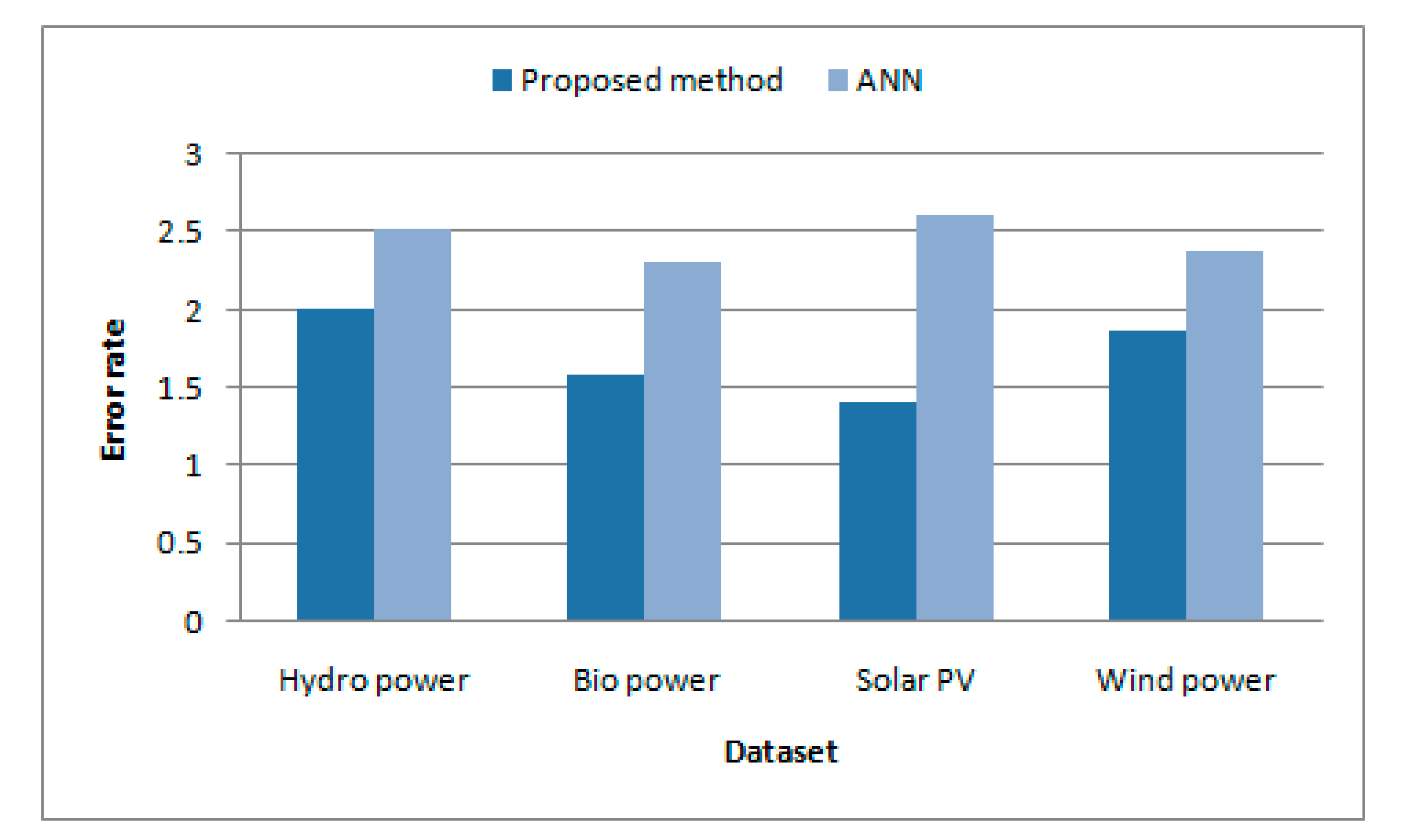
Figure 2.
Normalised mean square error graph.
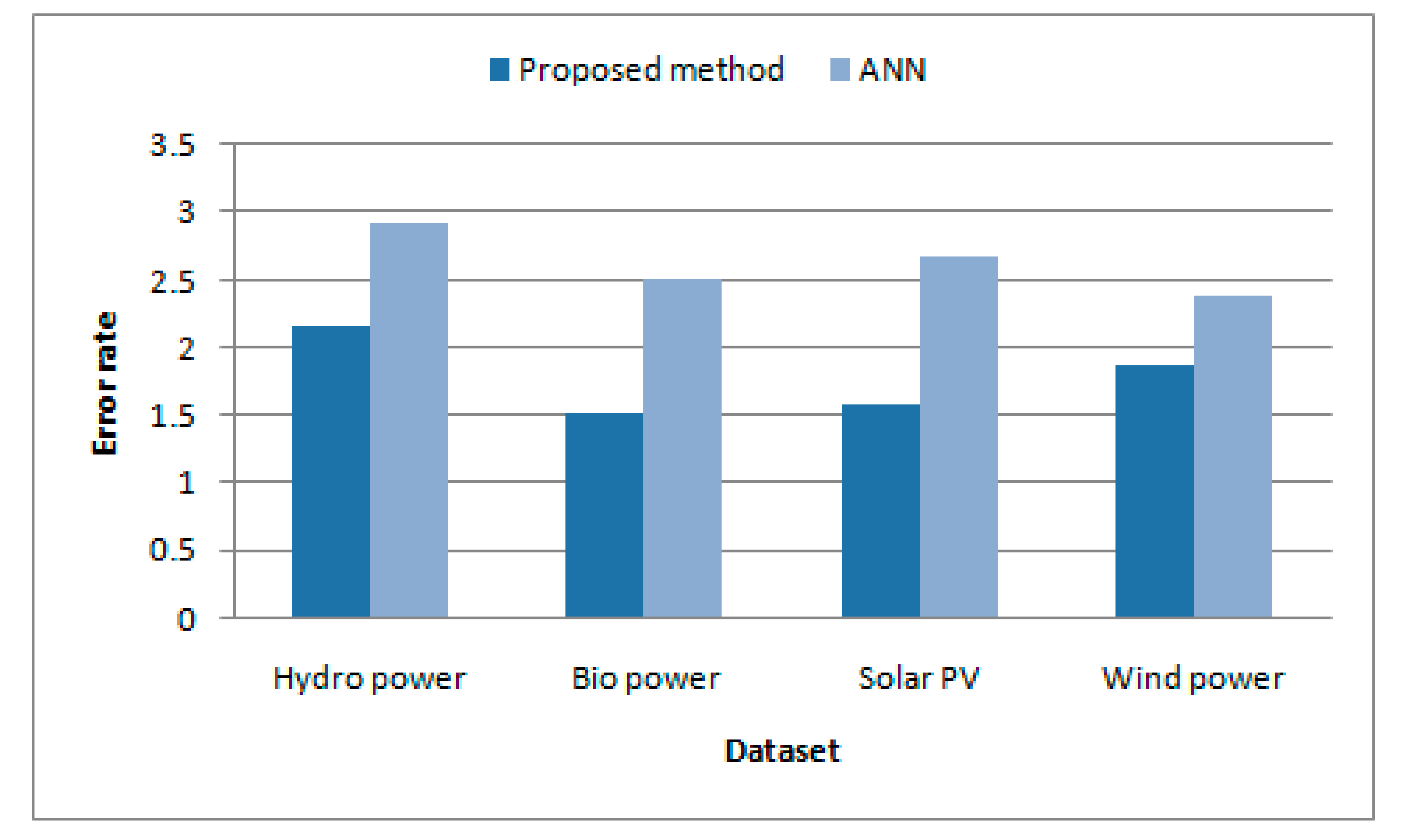

Table 1.
Mean Square Error Comparison.
| Dataset | Proposed method | ANN |
|---|---|---|
| Hydro power | 2.01 | 2.52 |
| Bio power | 1.58 | 2.31 |
| Solar PV | 1.41 | 2.61 |
| Wind power | 1.86 | 2.38 |
Table 2.
Normalised Mean Square Error Comparison Table.
| Dataset | Proposed method | ANN |
|---|---|---|
| Hydro power | 2.15 | 2.92 |
| Bio power | 1.51 | 2.51 |
| Solar PV | 1.58 | 2.68 |
| Wind power | 1.86 | 2.38 |
Disclaimer/Publisher’s Note: The statements, opinions and data contained in all publications are solely those of the individual author(s) and contributor(s) and not of MDPI and/or the editor(s). MDPI and/or the editor(s) disclaim responsibility for any injury to people or property resulting from any ideas, methods, instructions or products referred to in the content. |
© 2025 by the authors. Licensee MDPI, Basel, Switzerland. This article is an open access article distributed under the terms and conditions of the Creative Commons Attribution (CC BY) license (http://creativecommons.org/licenses/by/4.0/).
Copyright: This open access article is published under a Creative Commons CC BY 4.0 license, which permit the free download, distribution, and reuse, provided that the author and preprint are cited in any reuse.


