

Submitted:
12 March 2025
Posted:
12 March 2025
You are already at the latest version
Abstract
The various speculations about the so - called "Japan Sinks" have been widely circulated, to the extent that movies have even been made on this topic. The "2024 MW 7.6 Noto Peninsula Earthquake" has triggered contemplation about the specific mechanisms of the "Japan Sinks". The article synthesizes and explores the connection among the 2024 MW 7.6 Noto Peninsula Earthquake, the 1993 MW 6.6 Off Noto Earthquake and the future fate of the Japanese archipelago. Both earthquakes occurred at the same inflection point in the central part of the paleo-rift beneath the Sea of Japan, indicating continuous impacts. This suggests that multiple impacts may have led to the complete breaking of the inflection point, resulting in a full revival of the entire paleo-rift. Over time, the paleo-rift will evolve into a new subduction zone, similar to the Benioff Zone, causing the Japanese archipelago to subduct westward beneath the Japan Sea. Recent scientific studies support this assertion. The dangers depicted in the Japanese movie "Japan Sinks" could be real, even though it might not sink into the Pacific as depicted in the movie, but rather would submerge in the Sea of Japan.
Keywords:
The 2024 MW 7.6 Noto Peninsula Earthquake
; The 1993 MW 6.6 Off Noto Earthquake
; Submerged paleo-forests
; Paleo-rift
; New subduction zone
; "Japan Sinks"
Highlights
1. The 2024 MW 7.6 Noto Earthquake shared the same epicenter as the 1993 MW 6.6 Off
Noto Earthquake.
2. A successfully predicted earthquake has greater persuasive power to explain its
mechanism.
3. Subducting westward beneath the Sea of Japan could be the true way for the Japanese
archipelago to sink.
1. Introduction
The various speculations about the so-called “sinking of Japan” have been widely circulated, to the extent that movies have even been made on this topic. The 2024 MW 7.6 Noto Peninsula Earthquake has triggered contemplation in this review article about the specific mechanisms of the “sinking of Japan”.
Given that review articles allow authors to cite their previous research findings to support their arguments, this article provides detailed quotes for the author’s prediction of the 1993 MW 6.6 Off Noto Earthquake. This is because the author believes that a successfully predicted earthquake has greater persuasive power to explain its mechanism.
The outbreak of the 2024 MW 7.6 Noto Peninsula Earthquake prompted me to revisit the 1993 MW 6.6 Off Noto Earthquake, which occurred in the same epicentral area. I pondered the origins of the Noto Earthquakes and reflected on the relevance between these two earthquakes, especially any profound scientific implications for the so-called “Japan Sinks”. This constitutes the background for the writing of this article.
For convenience of analysis and summarization, I have cited my previously published papers and relevant images. I have clearly indicated the source of each of my own previously published papers in the citations and references. When referring to the previously written work, I have rewritten the content. Appropriate alterations were made for the use of previously published images.
I arrange the essence of the relevant papers in italicized and small font at appropriate positions so that readers can have a clear understanding and save time by not having to go through the specific content of the papers.
2. A Successfully Predicted Earthquake Has Greater Persuasive Power to Explain Its Mechanism
2.1. Based on a lot of Parameters of the Focal Mechanism
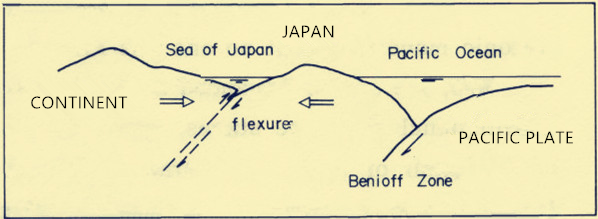
According to the theory of plate tectonics, submarine earthquakes beneath the Sea of Japan are expected to be the result of the westward subduction of the Pacific and Philippine Sea Plates with speeds of ~ 8 and 3-5 cm/yr along the trenches, with focal depths ranging from 200 to 520 km (Choi et al. 2012). Please see Figure 1 (Sun 1994, Sun 2018).
However, I discovered that this theory did not provide a comprehensive explanation for all instances. Among the 530 destructive earthquakes that occurred in Far East Asia between 1933 and 1964, two earthquakes beneath the Japan Sea had a focal depth of only 30 km (Aver’yanova 1973). Moreover, an earthquake with a magnitude of 7.7, which occurred beneath the Central Japan Sea in May 1983, had a focal depth of only 40 km (Satake 1985). These three shallow destructive earthquakes (Table 1) cannot be explained by the subduction of the Pacific Plate. In the Sea of Japan, there must be an unknown significant tectonic movement that has yet to be discovered.
2.2. Established a Mechanical Model
During the Early Miocene, the Japan Sea formed, causing Japan to separate from the Asian continent (Miyake 1985, Okada et al. 2012).
This separation subsequently led to the development of a linearly - spreading rift. With the expansion of the sea, rift activity gradually ceased, and the rift became deeply buried under sediment transported from the mainland, forming a huge scar (paleo-rift) in the sea basin. This geological process resulted in the creation of a notable paleo-rift within the basin of the sea.
Due to the existence of this paleo-rift and some factors requiring immediate investigation, Japan Island gradually and slowly subducted westward in a flexural manner (Sun 1987, Bodri et al. 1989, Bodri et al. 1991, Sun 1994, Sun 2018, Wallis et al. 2021, Goto et al. 2022) during the recent geological epoch. Please see Figure 1.
The flexural and creeping deformations occurring beneath the Japan Sea basin are closely related to the high heat flux caused by the reactivation of the paleo-rift in the Japan Sea.
Evidence discovered later supports it:
- “Results show a marked rheological stratification of the lithosphere controlled primarily by the thermal regime... At locations with very high heat flows (~ 100–120 mW m−2), only the upper crust remains brittle and plastic flow of rocks may start here from the depths of 10–15 km.” (Bodri et al. 1991)
- “Many flexure scarps have been detected beneath the Japan Sea basin, most are west-dipping, with the hanging wall pushed eastward” (Goto et al. 2022).
Because of the slow westward subduction in a flexure manner (see Figure 1), sunken ancient forests exist on the continental shelf near Toyama that date back to approximately 2,000 years. Over the past 2,000 years, the western coast of Japan has experienced submergence of approximately 20 m (Fuji et al. 1986). Although multiple marginal seas with island arcs can be found in different regions across the globe, why do such submerged paleo-forests not exist in other marginal seas besides the Japan Sea?
The epicenters of the three aforementioned strong earthquakes that occurred off the coast of the Japan Sea are shown in Figure 2 (Sun 1994, Sun 2018). Please refer to Table 1 for details. The data used for this information were translated from a Russian earthquake book (Aver’yanova 1973).
All three earthquakes occurred along the paleo-rift of the Japan Sea and exhibited identical Northwest-dipping thrust fault mechanisms (Aver’yanova 1973, Kenji 1985).
Evidence discovered later supports it:
- “... most west-dipping thrust faults inversed from the normal fault, which developed during the rifting in the Early Miocene” (Okada et al. 2012)
- “Because these topographic characteristics would present the typical hanging wall anticlines of reverse faults, we determine that these faults are northwest-dipping reverse faults with cumulative repeated displacements.” (Goto et al. 2022)
- “Northwest-dipping thrust faults and anticline deformations near the north side of the faults are also observed in the sediment of the Early Miocene to Pliocene sediment (Okamura et al., 1996), which are concordant with the interpretation of the tectonic landforms, as aforementioned.” (Goto et al. 2022)
- “After the opening of the Japan Sea terminated, around 3 Ma compressional stress field across the arc was produced, most of the Miocene normal faults have been reactivated as reverse faults.” (Sato 1994)
- “As previously described, the Torimiguri and Kamaguri faults are identified as northwest-dipping active submarine faults based not only on seismic profile records similar to the E06 and E05, respectively, on Research and examination meeting about the large-scale earthquake in the Sea of Japan (2014) but also on tectonic geomorphological interpretation.” (Goto et al. 2022)
Observing the clear pattern of southward migration of the epicenters, as shown in Figure 2, I hypothesized that the northern end of the paleo-rift was initially affected by underthrusting of the Pacific Plate. As a result, tectonic stress concentrated in the northern part of the paleo-rift caused to the occurrence of strong shallow earthquakes. This indicates that the paleo-rift experienced rebreakage, starting from the northern part and propagating toward the south.
2.3. Foreign Professor’s Reply Letter of My Prediction Paper
Based on the aforementioned facts, I have written a manuscript on medium-term prediction and clearly stated the following: “In the paleo-rift of the Japan Sea, a shallow strong earthquake with a focal depth of 30 km, magnitude exceeding 7, and accompanied by a tsunami, will occur before 1993. The epicenter will be located in the central part of the Japan Sea.” The potential range of the epicenter for an upcoming earthquake is shown in Table 1 and Figure 2.
In October 1983, I sent my manuscript titled “Forecast of a Shallow Strong Earthquake in the Central Sea of Japan” to Professor Robert S. Dietz at Arizona State University, USA and to Professor R. C. Searle and Dr. Girdler at the Institute of Oceanographic Sciences, UK. Shortly thereafter, I received responses from all of them. Please refer to Figure 3 (Sun 1994, Sun 2018).
These professors have suggested that I submit my manuscript to the Earthquake Research Institute at Tokyo University.
2.4. An International Registered Mail Receipt of the Prediction Paper Sent to Tokyo University’s Earthquake Research Institute
Therefore, I sent my manuscript to the Earthquake Research Institute at Tokyo University by international registered mail on December 10, 1983. Please refer to the scanned copy in Figure 4 (Sun 1994, Sun 2018).
2.5. Six Years Before the Earthquake Occurred, I Attended an International Symposium and Presented My Prediction Paper
In August 1987, I attended the International Symposium on Tectonic Evolution and Dynamics of Continental Lithosphere in Beijing, where I presented my paper titled “Forecast of a Shallow Strong Earthquake in the Central Japan Sea.” This paper was included in the proceedings of the symposium. Please refer to the scanned copies as shown in Figure 5 (Sun 2018).
Because it is a reactivation of the paleo-rift in the Japan Sea, earthquakes occurring along the Japan Sea paleo-rift should be shallow. In addition, the causative fault for Japan Sea earthquakes is a subduction (or thrust-reverse) fault, so it should often trigger a tsunami. This is why the author can confidently forecast both the focal depth and tsunami.
Evidence discovered later supports it:
- “Tsunamis are often associated with subduction faults on the sea floor” (Takashimizu et al. 2020).
2.6. MyMedium-Term Prediction Basically Came True
The M6.6 Off Noto Peninsula Earthquake occurred under the Central Japan Sea (37.39°N, 137.17°E) on February 7th, 1993, with a focal depth of 29 km and a small tsunami (Japan Meteorological Agency 1993, Tsukuda et al. 1994, Abe et al. 1995). This event demonstrates that my medium-term prediction was accurate, albeit with a delay of more than 38 days (see Table 2).
In 1994, one of Japan’s authoritative academic journals, the Journal of the Geodetic Society of Japan, published my paper titled “Medium-Term Prediction of the Off Noto Earthquake on February 7th, 1993” (Sun 1994), confirming the results of my prediction.
The prediction of earthquakes remains a challenging task. Successful medium-term earthquake predictions that accurately forecast the four elements (origin time, epicenter, magnitude, and focal depth) and even tsunamis caused by an earthquake are rare. My prediction regarding a strong shallow earthquake under the Japan Sea may fit into this category, despite the 38-day window. Moreover, the process of predicting earthquakes is rigorous, and the evidence for earthquake prediction is reliable.
Now, let us compare this with the other two medium-term predictions (see Table 2) (Sun 2018):
Therefore, this medium-term prediction of mine has achieved success and has received extensive coverage in the news media (Chen 1993, Gu 1993, Mi 1993, Gu 1994).
The success of this prediction can bridge the gap in earthquake predictions. This article provides a notable example of a successfully predicted earthquake, encompassing aspects such as the location, timing, magnitude, focal depth, and even the occurrence of a tsunami.
The success of the prediction based on the migration pattern of large shallow earthquakes under the Japan Sea should provide an impetus to similar investigation elsewhere.
3. Discussion
Number 4 in Figure 2 represents an inflection point. The stress concentration at the inflection point causes a rebound of stress, leading to subsequent strong shallow earthquakes that may occur back and forth within a region (between 1 and 4 in Figure 2).
In 2018, the author of this article made a further prediction: Such a chain-saw downward process may occur multiple times until the inflection point is fully fractured (Sun 2018).
Evidence discovered later supports it:
- ”The history of reverse fault earthquakes occurring in the off Noto of Japan actually dates back more than at least one thousand years” (Shishikura et al. 2009).
- “Several past damaging earthquakes [e.g., the 1729 Noto earthquake (M 6.8); the 1892 Noto earthquake (M 6.4); the 1896 Noto-Hanto earthquake (M 5.7); the 1933 Noto earthquake (M 6.0); and the 1993 Noto-Hanto Oki earthquake (Mw 6.6)]” (Padhy et al. 2011).
- “The Japan Meteorological Agency announced that a strong earthquake with a magnitude of 7.1 occurred off shore of Noto, Ishikawa, Japan (37.3N, 136.5E) on March 25, 2007, with a focal depth of 50 kilometers and Reverse-fault mixed type” (Japan Meteorological Agency 2007, Mori 2008, Shishikura et al. 2009).
- On New Year’s Day in 2024, a 7.6-magnitude earthquake occurred off the coast of the Noto Peninsula in Japan (37.5o N, 137.2o E). The earthquake is now called “The 2024 MW 7.6 Noto Peninsula Earthquake”. It had a depth of 10-30 kilometers. This earthquake triggered a 5-meter tsunami (China Earthquake Network 2024), and as of Jan. 15, 2024, the number of “disaster-related deaths” has reached 222(Huaxia 2024). This earthquake occurred in almost the same location and with the same focal mechanism of thrust fault (Ishikawa & Bai 2024) as the 6.6 magnitude earthquake in the Noto Outer Sea on February 7, 1993 (now called The 1993 MW 6.6 Off Noto Earthquake, please see the number 4 in Figure 2).
- On June 3, 2024, a magnitude 6.0 earthquake with a depth of 14 kilometers occurred again in the Noto Peninsula, Japan (37.5°N, 137.3°E), confirming that the ancient rift inflection point has once again suffered an impact (Anonymous 2024).
- on November 26, 2024, another strong shallow earthquake with a magnitude of 6.3 and the focal depth of 60 kilometers, occurred in the waters off the Noto Peninsula (37.00°N, 136.40°E) . Once again confirmed that the inflection point of the ancient rift in the Sea of Japan has been continuously under strong impact. Please look at : http://news.cnr.cn/sq/20241126/t20241126_526989778.shtml
It should be emphasized that, judging from the epicenter location of this earthquake, it appears to have crossed the inflection point of the ancient rift in the Sea of Japan (Figure 6) (China Earthquake Networks Center 2024). Could it indicate that this inflection point has been completely ruptured?If so, the earthquakes along the ancient rift in the Sea of Japan would likely cross this inflection point and develop towards the Korean Channel at the southwestern end of this ancient rift (see Figure 2).
In 2018, the author of this article further predicted that this chainsaw-like downward process may have already occurred and could continue to occur multiple times until the inflection point is completely broken (Sun 2018):
Eventually, when a shallow strong earthquake occurs near the Korean Channel (westsouthern end of the paleo-rift), the entire paleo-rift will enter a completely different stage. At that time, the Japanese archipelago would be exposed to significant danger.
Over time, it is highly probable that the paleo-rift in the Sea of Japan will evolve into a new subduction zone, creating a phenomenon of overlapping subduction (Figure 1).
Evidence discovered later supports it:
- “The eastern margin of the Japan Sea is a nascent convergent plate boundary” (Sato et al. 1999, Yoshida et al. 2020).
The Japanese archipelago will subduct westward along this fully reactivated paleo-rift, eventually sinking beneath the Sea of Japan and Asian continent. This could potentially lead to “Japan Sinks”. Please see Figure 1.
Evidence discovered later supports it:
- “The Torimiguri and Kamaguri faults are identified as northwest-dipping active submarine faults based not only on seismic profile records similar to the E06 and E05, respectively, on Research and examination meeting about the large-scale earthquake in the Sea of Japan (2014) but also on tectonic geomorphological interpretation.” (Goto et al. 2022).
4. Conclusion
The 2024 MW 7.6 Noto Peninsula Earthquake shares the same epicenter as the 1993 MW 6.6 Off Noto Earthquake, indicating that both earthquakes occurred at the same inflection point in the central part of the paleo-rift beneath the Sea of Japan.
This confirms that the inflection point was continuously impacted. This process may occur multiple times until the inflection point is completely broken. Eventually, when a shallow strong earthquake occurs near the Korean Channel (westsouthern end of the paleo-rift), the entire paleo-rift will enter a completely different stage. At that time, the Japanese archipelago would be exposed to significant danger.
Over time, it is highly probable that the paleo-rift in the Sea of Japan will evolve into a new subduction zone, creating a phenomenon of overlapping subduction (Figure 1).
The Japanese archipelago will subduct westward along this fully reactivated paleo-rift, eventually sinking beneath the Sea of Japan and Asian continent. This could potentially lead to the sinking of Japan.
In conclusion, the dangers depicted in the Japanese movie “Japan Sinks” could be real, even though it might not sink into the Pacific as depicted in the movie, but rather would submerge in the Sea of Japan.
Funding Information
No funding was received for this article.
Declaration of Interests
The author declares no competing interests.
Acknowledgements
I would like to extend my appreciation to Professor Hiroshi Sato of Hirosaki University, Japan for his invaluable guidance and unwavering support. In addition, Ms. Xu Xiaoyun (徐小云) from Australia has contributed significantly to the creation of the puzzle for this article and the online search for references. I would like to express my thanks to her.
Open Research
The data on which this article is mainly based are available in: “Aver’yanova,V. Seismic Foci in the Far East Asia, (Wiener Bindery Ltd., Israel. 1973).”
References
- Anonymous. (2024). http://read.qsbdc.com/html/202406/25794.html.
- Abe, K., & Okada, M. (1995). “Source model of Noto-Hanto-Oki earthquake tsunami of 7 February 1993”, Pure and Applied Geophysics, 144(3), 621-631.
- Aver’yanova,V. Seismic Foci in the Far East Asia, (Wiener Bindery Ltd., Israel. 1973).
- Bakun, W.H., & McEvilly, T.V. (1984). ” Recurrence models and Parkfield, California, earthquakes”, Journal of Geophysical Research: Solid Earth, 89, 3051-3058. [CrossRef]
- Bodri, B., Iizuka, S., & Hayakawa, M. (1989). Modeling of deep temperatures and heat flow in Central Honshu, Japan. Journal of Geodynamics. 11, (2) 105-129. [CrossRef]
- Bodri, B., Iizuka,S., Hayakawa, M. (1991). Geothermal and rheological implications of intracontinental earthquakes beneath the Kanto-Tokai region, Central Japan. Tectonophysics. 194, Issue 4, 337-347. [CrossRef]
- Chen, H.X. (1993). “Verification was obtained for Tianxi Sun’s earthquake prediction, who studied plate breakup a decade ago.” Suzhou Daily, 1993-2-11(1) (in Chinese).
- China Earthquake Network (2017). http://www.nxgy.gov.cn/xwzx/dzgs/zqxx/201707/t20170713_436320.html.
- China Earthquake Network (2024). https://weibo.com/2817059020/NzPuigkpl?pagetype=profilefeed.
- China Earthquake Networks Center (2024). http://news.cnr.cn/sq/20241126/t20241126_526989778.shtml.
- Choi, H., Hong,T., He, X., & Baag, C.E. (2012). Seismic evidence for reverse activation of a paleo-rifting system in the East Sea (Sea of Japan). Tectonophysics. 572–573, 123-133. [CrossRef]
- Fuji, S., Nasu, N., & Smith, A.J. (1986). Submerged Forest off Nyuzen, Kurobegawa Alluvial Fan,Toyama Bay, Central Japan. Boreas. 18(4), 265-277.
- Goto, H., Moriki, H., Kumamoto, T., & Nakata, T. (2022). Revealing the distribution of active submarine faults off the coast of Oga Peninsula using high-resolution stereoscopic topographic images. Geomorphology. 418, 108465. [CrossRef]
- Gu, X.S. (1993). “A Japan earthquake occurred 8 days earlier, which was an early prediction made 10 years ago”, Shanghai Liberation Daily, 1993-2-15(5) (in Chinese).
- Gu, X.S. (1994). “A Chinese forecast was acknowledged by a Japanese journal.”, Shanghai Liberation Daily, 1994-5-14(4) (in Chinese).
- Gupta, H.K. (1988). “Medium-term earthquake prediction”, In: Eos Transactions American Geophysical Union, 69(49), 1620–1630.
- Hamada, M., Hiramatsu, Y., Oda, M., & Yamaguchi, H. (2016). Fossil tubeworms link coastal uplift of the northern Noto Peninsula to rupture of the Wajima-oki fault in AD 1729, Tectonophysics, 670, 38-47. [CrossRef]
- Harris, RA., Langbein, J. & Arrowsmith, JR. (2006). The 2004 Parkfield Earthquake and the Parkfield Earthquake Prediction Experiment. Bulletin of the Seismological Society of America.
- Huaxia, (2024). Two weeks after Japan’s Noto quakes, concerns grow over damage, disaster-related deaths. https://english.news.cn/20240115/cb6a691d99cf445ba4bd5d0d03a46e80/c.html.
- Ishiyama, T., Sato, H., Kato, N., Koshiya, S., Abe, S., Shiraishi, K., & Matsubara, M. (2017). Structures and active tectonics of compressionally reactivated back-arc failed rift across the Toyama trough in the Sea of Japan, revealed by multiscale seismic profiling, Tectonophysics, 710–711, 21-36. [CrossRef]
- Ishikawa, Y., & Bai, L. (2024). The 2024 Mj7.6 Noto Peninsula, Japan earthquake caused by the fluid flow in the crust, Earthquake Research Advances, Available online 16 February 2024, 100292. [CrossRef]
- Japan Meteorological Agency (1993). http://www.docin.com/p-824450507.html.
- (Chinese translation version).
- Japan Meteorological Agency (2007). https://news.sina.com.cn/w/2007-03-25/121112608758.shtml.
- Lallemand, S., & Jolivet, L. (1986). Japan Sea: a pull-apart basin? Earth and Planetary Science Letters, 76, 375-389. [CrossRef]
- Mi, X. (1993). “An earthquake prediction made ten years ago came true last month.”, Jiangsu Province TV: News. 1993-3-17.
- Miyake,Y. (1985). MORB-like tholeiites formed within the Miocene forearc basin, Southwest Japan, Lithos, 18, 23-34. [CrossRef]
- Mori, P.J. (2008). The 2007 noto peninsula, japan, earthquake (m_w6.7):damage to wooden structures. Seismological research letters, 79(1).
- No, T., Sato, T., Kodaira, S., Ishiyama, T., Sato, H., Takahashi, N., & Kaneda, Y. (2014). The source fault of the 1983 Nihonkai–Chubu earthquake revealed by seismic imaging, Earth and Planetary Science Letters, 400 (15) 14-25. [CrossRef]
- Okada, S., & Ikeda, Y. (2012). Quantifying crustal extension and shortening in the back-arc region of Northeast Japan. J. Geophy. Res. 117, B01404. [CrossRef]
- Padhy, S., Mishra, O.P., Wei, W., & Zhao, D. (2011). Crustal heterogeneity in the 2007 Noto-Hanto earthquake area and its geodynamical implications, Tectonophysics, 509, (1–2), 55-68. [CrossRef]
- Satake, K. (1985). The mechanism of the 1983 Japan Sea earthquake as inferred from long-period surface waves and tsunamis. Physics of the Earth and Planetary Interiors. 37(4), 249-260.
- Sato, H. (1994). The relationship between late Cenozoic tectonic events and stress field and basin development in Northeast Japan. J. Geophy. Res. 99, 22261–22274.
- https://doi.org/10.1029/94JB00854/s40623-014-0158-y.
- Sato, T., Fujie, G., Koresawa, S., Kasahara, J., Tanaka, K., Honda, S., Yokota, T., Nakamura, K., Naito, H., Ishikawa, Y., & Hirasawa, T. (1999). Seismic observations at a seismic gap in the eastern margin of the Japan Sea using ocean bottom seismometers, Tectonophysics, 302, (1–2), 1-7. [CrossRef]
- Sato,T., No, T., Miura, S., & Kodaira, S. (2018). Crustal characteristic variation in the central Yamato Basin, Japan Sea back-arc basin, deduced from seismic survey results. Tectonophysics. 726, 1-13. [CrossRef]
- Shishikura, M., Echigo, T., & Namegaya, Y. (2009). Evidence for coseismic and aseismic uplift in the last 1000 years in the focal area of a shallow thrust earthquake on the Noto Peninsula, west-central Japan. Geophysical Research Letters. 36(2), n/a-n/a. [CrossRef]
- Sun, T.X. (1987). “Forecast of Shallow Strong Earthquake in the Central Japan Sea”. In: International Symposium on Tectonic Evolution and Dynamics of Continental Lithosphere, Beijing. Abstracts II. 50.
- Sun, T.X. (1994). Medium-Term Prediction of the Off Noto Earthquake of 7th Feb 1993. J.Geod.Soc.Japan. 40(1), 87-88. [CrossRef]
- Sun, T.X. (2018). Why is earthquake prediction the only restricted research area? International Journal of Current Advanced Research. 7(6H), 13604-13608.
- http://dx.doi.org/10.24327/ijcar.2018.13608.2438.
- Takashimizu, Y., Kawakami, G., & Urabe, A. (2020). Tsunamis caused by offshore active faults and their deposits, Earth-Science Review, 211, 103380. [CrossRef]
- Tsukuda, T., Wada, H., Sakai, K., & Ito, K. (1994). “Aftershock Distribution of the 1993 M6.6 Earthquake Off Noto Peninsula and its Relation to Tectonic Features”, Bulletin of the Earthquake Research Institute University of Tokyo, 69, 1-18. https://repository.dl.itc.u-tokyo.ac.jp/record/32710/files/ji0691001.pdf.
- Wallis, S.R., Maeno, F., & Toda, S. (2021). Japan and the Korean Peninsula, Encyclopedia of Geology (Second Edition), 526-543. [CrossRef]
- Yamaji, A., Sakai, T., Arai, K., & Okamura, Y. (2003). Unstable forearc stress in the eastern Nankai subduction zone for the last 2 million years, Tectonophysics, 369, (1–2), 103-120. [CrossRef]
- Yoshida, K., Uchida, N., Hiarahara, S., Nakayama, T., Matsuzawa, T., Okada, T., Matsumoto, Y., & Hasegawa, A. (2020). 2019 M6.7 Yamagata-Oki earthquake in the stress shadow of 2011 Tohoku-Oki earthquake: Was it caused by the reduction in fault strength? Tectonophysics, 793, 228609. [CrossRef]
Figure 1.
Cross-sectional illustration depicting the tectonic model of the Japan Island-Arc. *Dashed lines illustrate subduction motion beneath the Sea of Japan.
Figure 1.
Cross-sectional illustration depicting the tectonic model of the Japan Island-Arc. *Dashed lines illustrate subduction motion beneath the Sea of Japan.
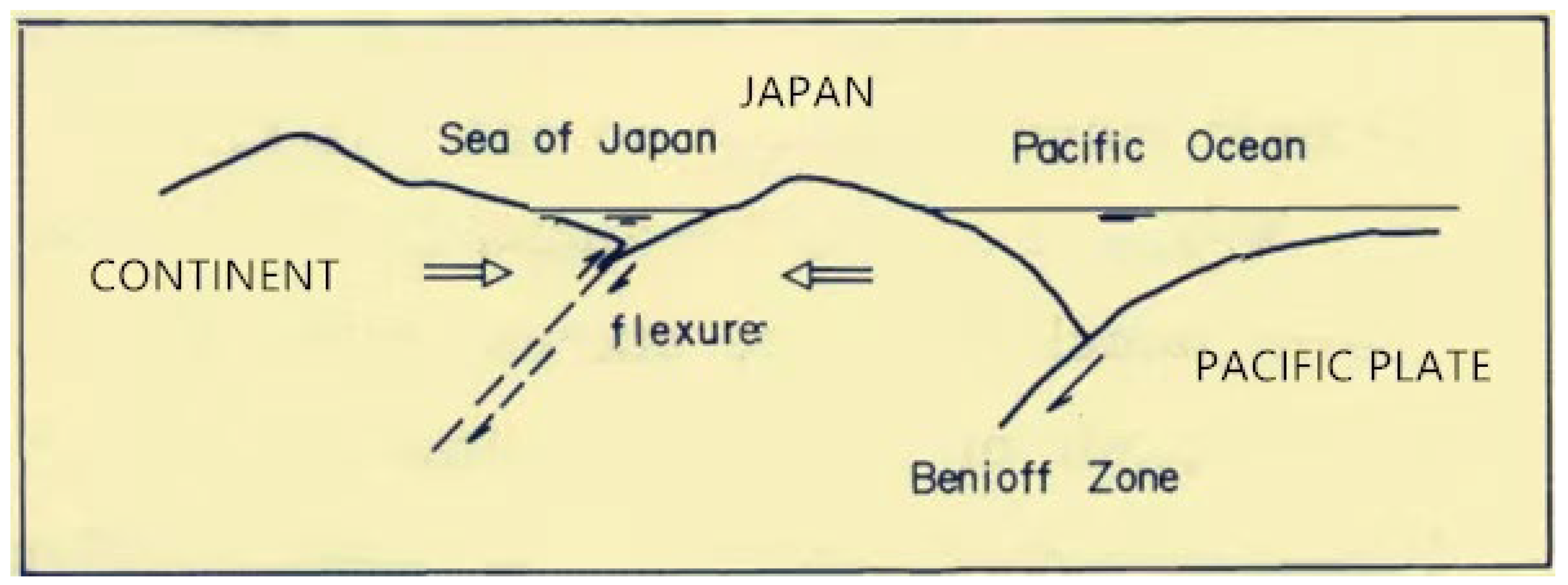
Figure 2.
A schematic map depicting paleo-rifts, recent instances of intense shallow earthquakes, and the potential range of future shallow earthquakes in the Central Japan Sea. *A: Direction in which strong shallow earthquakes migrate. B: Locations of epicenters of strong shallow earthquakes in the Sea of Japan. C: Potential area within which the epicenter of the predicted earthquake could occur.
Figure 2.
A schematic map depicting paleo-rifts, recent instances of intense shallow earthquakes, and the potential range of future shallow earthquakes in the Central Japan Sea. *A: Direction in which strong shallow earthquakes migrate. B: Locations of epicenters of strong shallow earthquakes in the Sea of Japan. C: Potential area within which the epicenter of the predicted earthquake could occur.
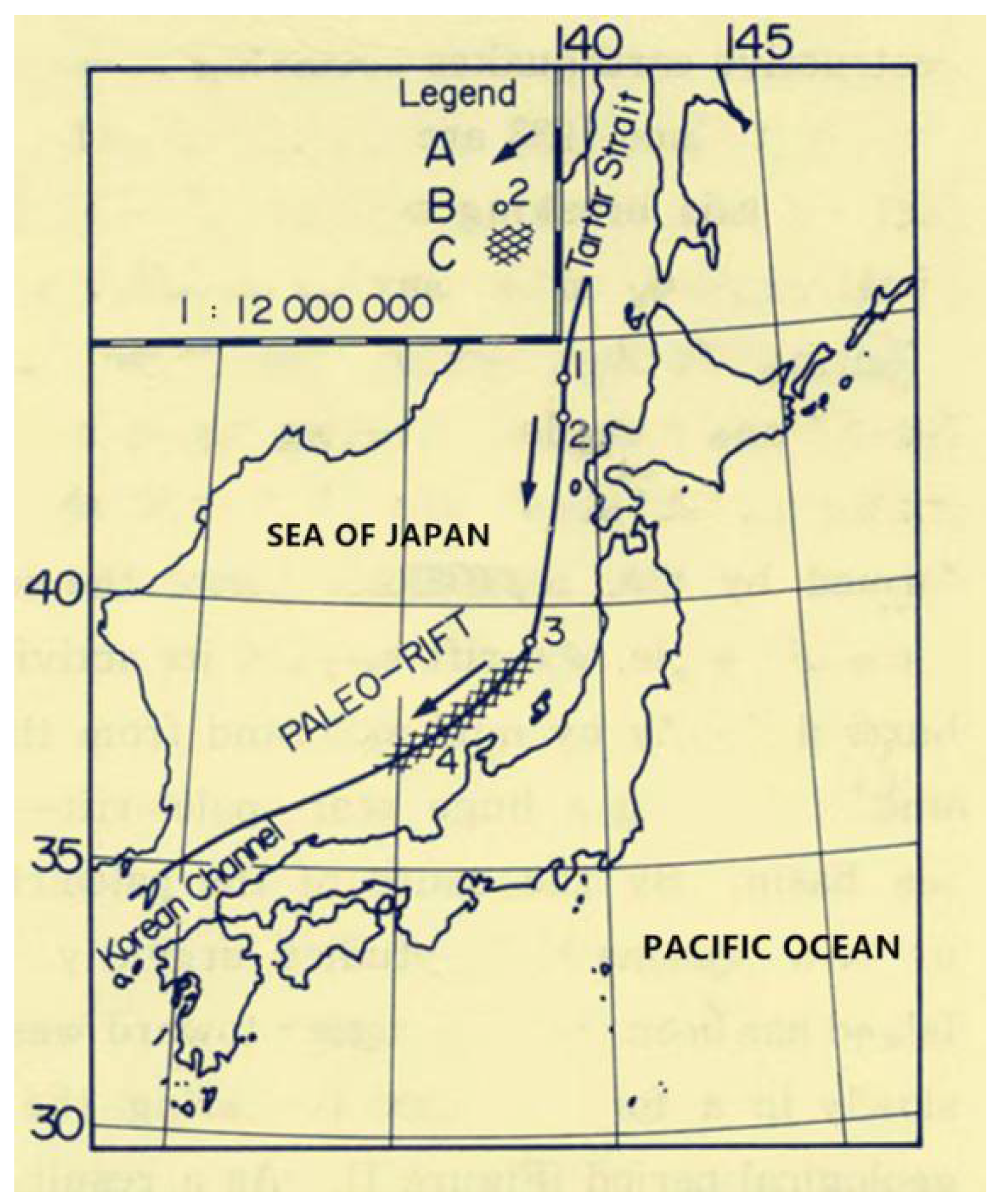
Figure 3.
Reply letters from Prof. R.S. Dietz and Prof. R.C. Searle.
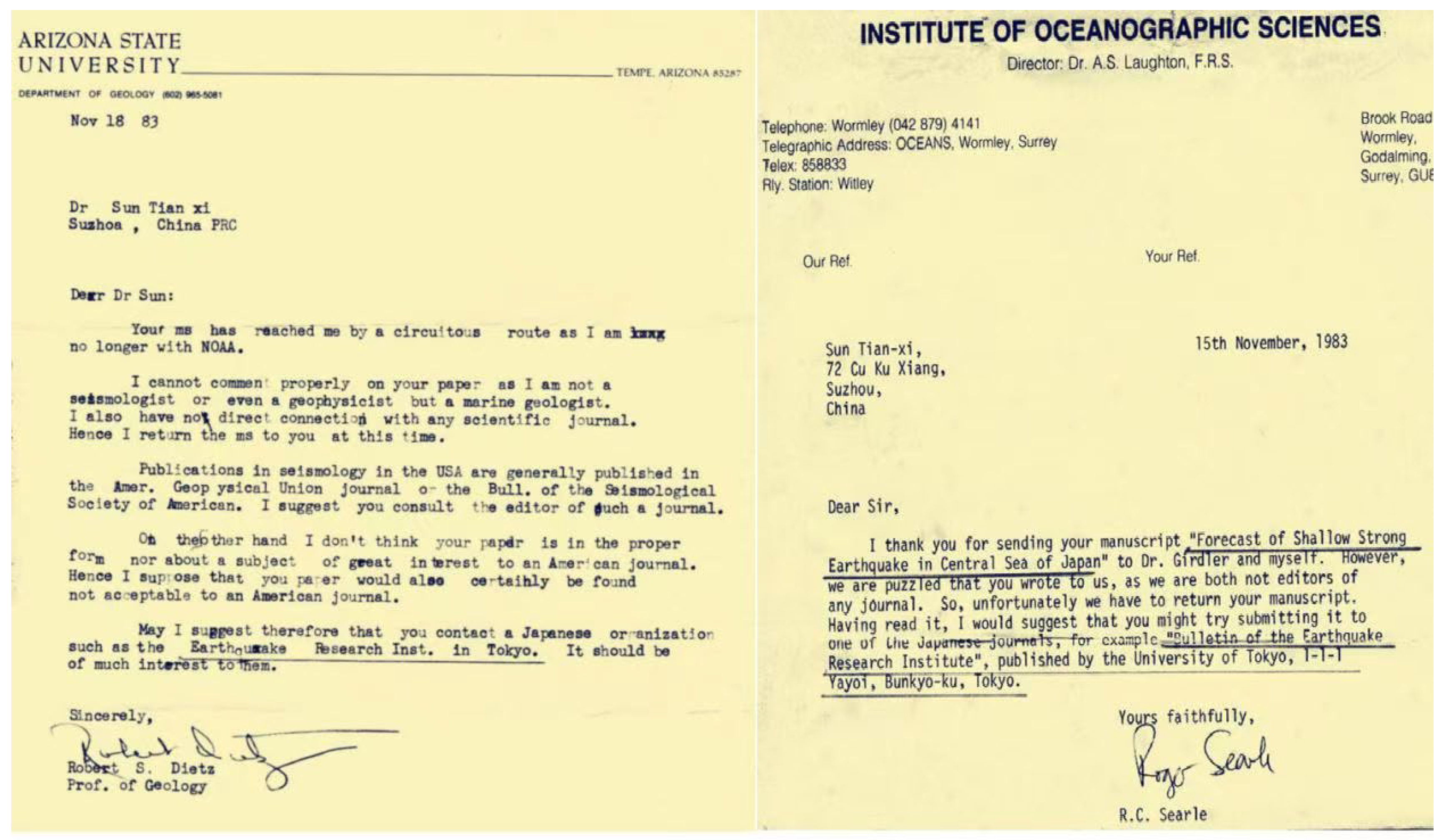
Figure 4.
An International Registered Mail Receipt.
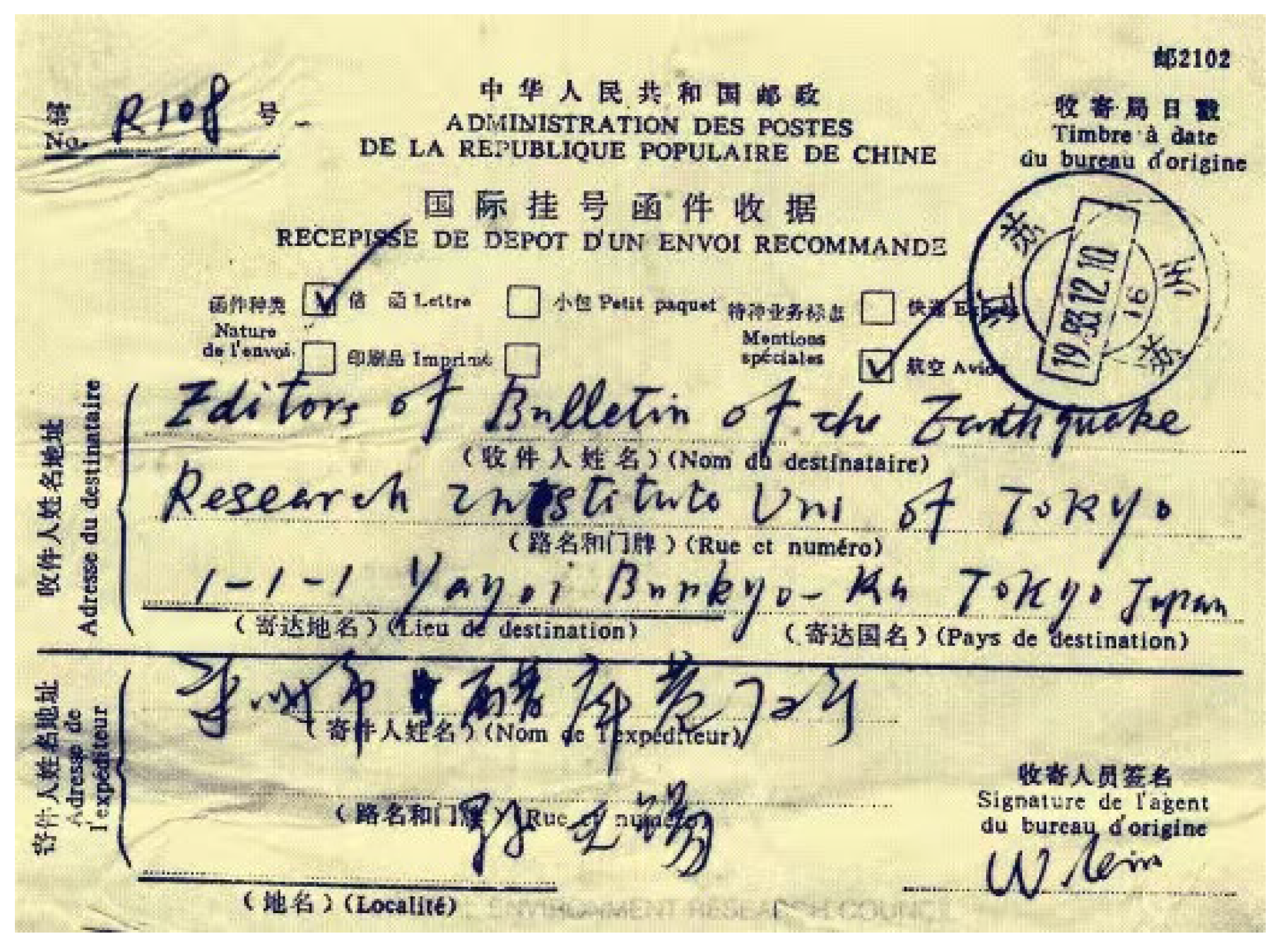
Figure 5.
Front cover of the colloquium of theses / Abstract of my paper.
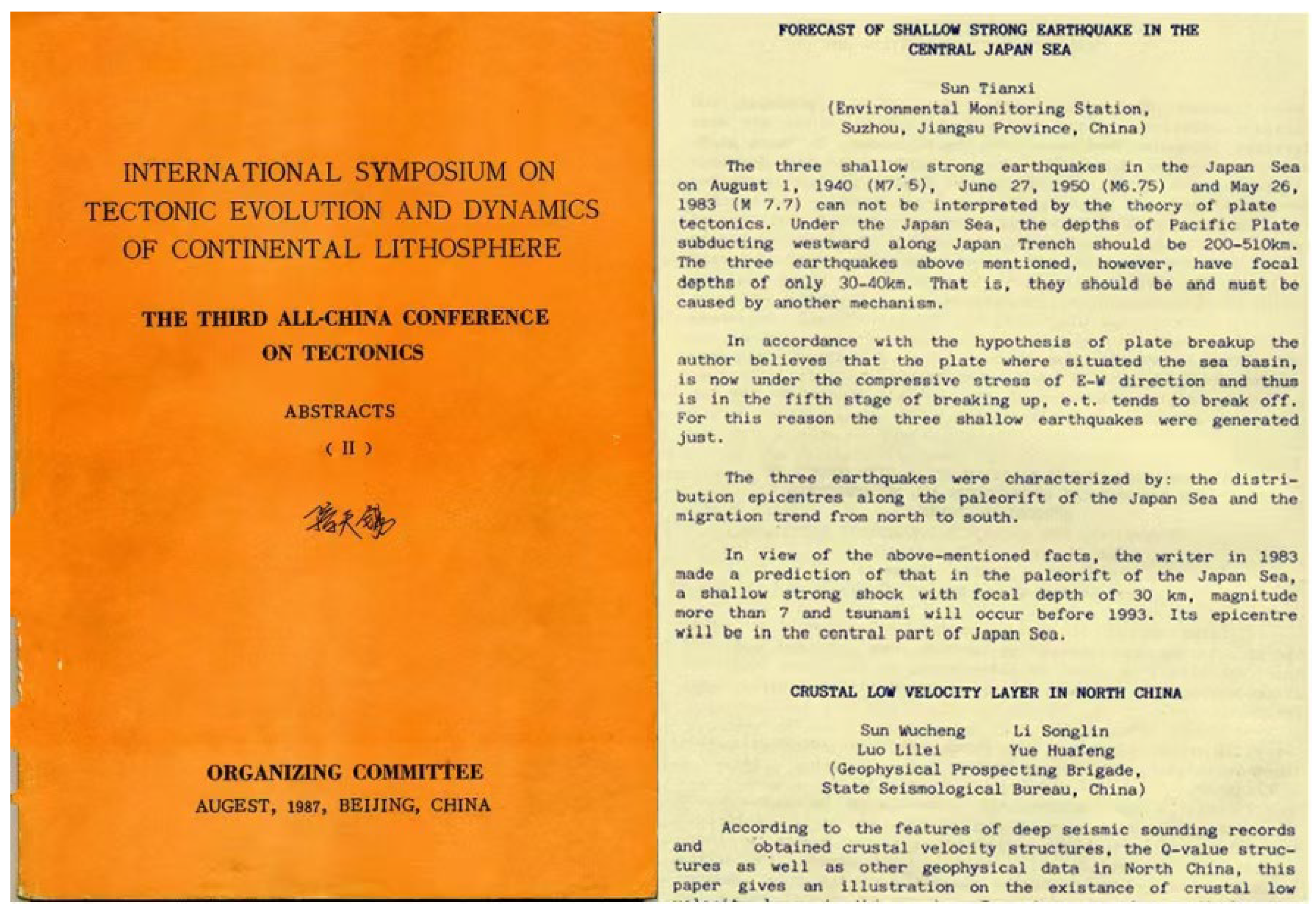
Figure 6.
Off Noto Peninsula Earthquake on November 26, 2024.
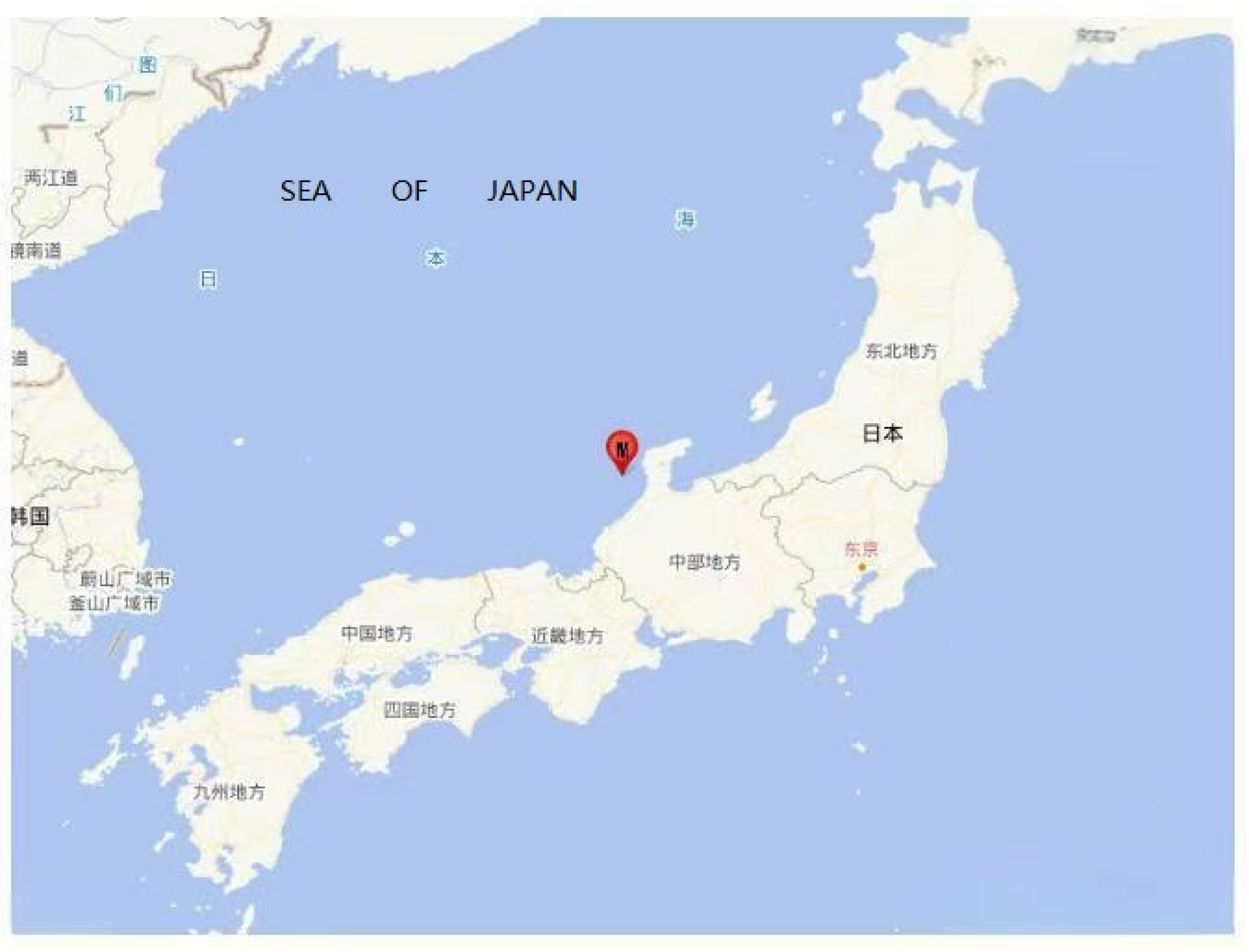

Table 1.
Shallow Strong Earthquakes in the Japan Sea.
| Serial number |
Time | The epicenter coordinates | Magnitude (M) |
Focal depth (Km) |
|||
| Y | M | D | N | E | |||
| 1 | 1940 | 08 | 01 | 44.2 o | 139.1 o | 7.5 | 30 |
| 2 | 1950 | 06 | 27 | 43.5 o | 139.1 o | 6.75 | 30 |
| 3 | 1983 | 05 | 26 | 39.9 o | 138.1 o | 7.7 | 40 |
| 4 Coming One |
before 1993 |
In the central part of Japan Sea |
more than 7.0 | 30 | |||
(Aver’yanova 1973, Sun 1987, Sun 1994, Sun 2018).
Table 2.
Comparison of the Three Medium-Term Predictions.
| The Earthquake between India and Burma | The Parker Field Earthquake (USA) |
The Off Noto Earthquake (Japan) |
||
| Who predicted the earthquake |
Prof. H. K. Gupta (Gupta 1988) |
Professors. T. V. McEvilly & W. H. Bakun (Bakun & McEvilly 1984) |
Professorial Senior Engineer Tianxi Sun (孙天锡) (Sun 1987) |
|
| When to make the prediction |
1986~1988 |
1984 |
1983~1987 | |
| Origin Time | Predict | Before 1990 | between 1983 and 1993 | Before 1993 |
| In fact | 6 August 1988 (correct) (Gupta 1988) |
28 September 2004 (almost 11 years window) (Harris et al. 2006) |
7 February 1993 (38 days window) (Tsukuda et al. 1994) |
|
| Epicenter | Predict | 20o N~26o N 92o E~98o E |
Parker Field California, USA |
37oN~39o N 135oE~138o E |
| In fact | 25o N 95o E |
Parker Field California, USA |
37.39o N 137.18o E “around a sea rise” (Tsukuda et al. 1994) |
|
| Magnitude | Predict | 6.1 | 5.5-6.0 | 7.0 |
| In fact | 7.5 | 6.0 |
6.6 (Tsukuda et al. 1994) |
|
| Focal Depth | Predict | / | / | 30 km |
| In fact | / | / | “H=29 km” (Japan Meteorological Agency 1993) “10-15km”(for its aftershocks) (Tsukuda et al. 1994) |
|
| Tsunami | Predict | / | / | tsunami |
| In fact | / | / | “small tsunami ” (Abe & Okada 1995) |
|
Biographical Endnote
| Mr. Tianxi Sun(孙天锡)is a Professorial Senior Engineer in China. He was born in Suzhou, Jiangsu Province, China on November 4, 1945. He graduated from East China Normal University in Shanghai in 1968. He formerly worked for the East China Hydroelectric Power Survey & Design Institute and is now with the Suzhou Ecological Environment Bureau. He retired in 2005. He has completed several interdisciplinary studies, such as the following: Sun, T. -X., Hydrogen ice within lunar polar craters. International Journal of Hydrogen Energy, 47, 34825 - 34830 (2022). https://doi.org/10.1016/j.ijhydene.2022.08.071 |
 |
| Author’s Photo. |
Disclaimer/Publisher’s Note: The statements, opinions and data contained in all publications are solely those of the individual author(s) and contributor(s) and not of MDPI and/or the editor(s). MDPI and/or the editor(s) disclaim responsibility for any injury to people or property resulting from any ideas, methods, instructions or products referred to in the content. |
© 2025 by the authors. Licensee MDPI, Basel, Switzerland. This article is an open access article distributed under the terms and conditions of the Creative Commons Attribution (CC BY) license (http://creativecommons.org/licenses/by/4.0/).
Copyright: This open access article is published under a Creative Commons CC BY 4.0 license, which permit the free download, distribution, and reuse, provided that the author and preprint are cited in any reuse.


