
Submitted:
12 March 2025
Posted:
12 March 2025
You are already at the latest version
Abstract
Uganda, just like its counterparts around the globe, is transforming its land tenure systems, from communal systems to private individual ownership systems. However, through the establishment of privatized land rights, several criticisms and collisions have continuously marred the government's well-intentioned vision. They claim that this will negatively impact vulnerable groups, such as women, the disabled, and children. In Uganda, while structural transformation occurred in the economy at least thirty years ago, followed by the enactment of the land policy, the issue of rights through titling of individual ownership is not fully implemented to even 50% in the rural areas. This tenure security and ownership empowerment continues to bleed confusion and reportedly leads to the weakening of traditional communal land tenure systems and erosion of land rights, thus hampering sustainable agricultural production and investment. This paper, therefore, examines rural land rights, markets, and land structural transformation in Uganda, with a specific focus on the rural areas. In this work, several papers are reviewed to get facts about existing land rights, land market structure, performance, and challenges associated with them. Review analysis reveals three main issues: there's a lack of awareness of the new land policies and their implementation, land tenure security is not yet guaranteed, and therefore the vulnerable groups are not fully secure, and land markets, though not yet efficient, are increasing exponentially in many areas. In conclusion, this paper recommends the sensitization of the public, especially the rural landowners and institutions, continuous incentivization of formalization and acquisition of land documents, and finally the need to harmonize with different institutions on the implementation of existing land laws and policies.
Keywords:
land rights
; land market
; structural land transformation
1. Introduction
In the year 1995, the government of Uganda enacted its constitution after going through several years of political turmoil, right from its independence in 1962 to 1986. After its constitution promulgation, the National Land Policy was also enacted in 1998 [1]. The main target was to guarantee an effective, just, and optimal use and management of Uganda’s land resources for poverty decrease, wealth creation, and ultimate socio-economic development [2]. The policy in its spirit aimed at ensuring that natural resources are optimally used and sustainably managed. This is mainly through restoration, maintenance, and enhancement of the integrity of natural resources. Additionally, all land use practices follow recommended plans and principles of sound environmental management, including biodiversity preservation, soil and water protection, conservation, and sustainable land management (Land Policy, 1998). Consequently, for equitable access to land, security of tenure, and elimination of historical injustices among others, the Land Policy was justified [1,3,4]. In the area of climate change, the policy intends to mitigate and adapt to the impacts of climate change. From the routine monitoring, evaluation, and review framework for the implementation of the Policy, the government developed a monitoring and evaluation system and undertakes periodic reviews of the land sector performance and the policy by identifying persistent and/or new issues requiring further policy interventions at least every 5 years, this has calumniated in the 2013 land policy amendments [1].
With the Ugandan population projected to exceed 80 million by 2050, demand for sustainable sources of livelihood amidst the threat of climate change will increasingly exert pressure on the inelastic production resource-land [5]. The projected population increase is not unique to Uganda but to the whole of Africa (except a few countries at war) [6]. The highest population explosion will happen in Africa by the year 2050, and in the same breath, Africa houses the largest number of economies dependent on agriculture for subsistence and primary source of livelihood [7]. Land is a critical resource for any country, and in an agricultural-dependent nation like Uganda, it is of particular importance. Consequently, in Uganda, farming majorly occurs on small family farms that depend on tilling land that is rain-fed, as a source of livelihood [8]. Additionally, some of these farms are co-owned by both women and men, where men are usually the household heads with over-arching decision-making powers [9]. These factors present the policy need to continue making the necessary structural reforms and transformation to ensure sustainable land rights with efficient markets. This paper, therefore, presents reviews of literature about land rights, markets, and the necessary structural transformation in Uganda since the promulgation of the current constitution and Land Policy of 1998.
Several land tenure systems exist in Uganda, and these have links to the historical times, culture, tradition, beliefs, and colonial administration in the years before its independence [10]. Though transformation has occurred in the land sector, a significant number of rural land rights are still ambiguous and don’t offer the security of tenure and thus are not easily enforceable under the current law [3,11]. Uganda’s land tenure systems differ greatly from one region to another, in some areas ownership and administration are communal under the stewardship of the clan heads [12]. This has been for a long-time hampered development, and thus prospective investors have been unable to fully acquire rights in this region for commercial agricultural production, due to lack of individual security of tenure that characterizes this form of the land tenure system and limits its efficient transfer of rights of use [13]. Land markets have not structurally transformed as most settlements and rights are not formalized with the rampant reported land evictions that have occurred in this decade [14]. This has emanated from the insecure land rights that create an enabling environment for encroachment on both public and private lands [15]. These challenges are exacerbated by climate change and its impacts; for example, in the Eastern part of Uganda, due to recurrent flooding, mud, and landslides, several households have been rendered homeless and landless [16]. The current slow structural transformation of landownership and tenure systems continues to render rural communities less resilient to the impacts of climate change [8]. Public investment in terms of infrastructure has become more expensive and most of the time impaired due to the “liberal” land rights that have allowed some people with titled land to demand exorbitant compensation for their land in case the government intends to use their lands for public infrastructure development [17]. This creates market failure and raises the cost of public expenditure on infrastructure, and, worse still, the funds usually used for such projects are borrowed from developmental partners like the World Bank, China, and the European Union payable at a certain interest [18].
Transforming 39% of the subsistence farmers to commercial market-oriented households, which is the core mandate of the Ministry of Agriculture Animal Industry and Fisheries (MAAIF) and the current theme of Uganda’s Budget for the Years 2023-2024, requires that land should not be fragmented, thus encouraging the use of machinery and other modern technologies like irrigation [19]. The high levels of land fragmentation in most regions in Uganda present land rights and markets that are less formally structured, and therefore, hinder the forces of demand and supply to freely operate to facilitate efficient transfer of land by consolidation for large-scale production purposes [1,3]. With the constantly changing climate, the Ugandan agricultural-based economy is less resilient [20]. The current system of transfer of land rights and ownership among individuals is to a greater extent not computerized, and the government cannot trace and follow these transfers, yet current Ugandan land law requires that these transactions should be reported to the local authorities at the sub-county or division levels for formalization purposes [21]. The outcome of these transactions is that there’s less security of tenure for the buyers of these lands, as the documents involved are not certified by the relevant authorities. Consequently, according to the local income tax, these land transfers should be subjected to a tax that forms revenue for the nation [21]. This is also some form of land market failure, as these can be taken to be “black land markets”. Government and “mailo” landowners are sometimes unable to get taxes and rent from the occupants of the lands under these tenure systems[17]. "Mailo tenure is a system of owning land in which there is an owner of the land, called a landlord, and there are recognized occupants on the land, called tenants, it is common in Uganda's Central Region and the Buganda Kingdom" [4]. On the micro level, land may mean soil, and therefore, for sustainable production amidst climate change, arable land should be protected and used sustainably for the current and future generations [22]. With improvement in the security of land rights, there will be stability in the investments in sustainable land management practices [17]. This paper presents a systematic review of the land rights in Uganda, markets, and structural transformations, under the theme “Rural land rights, markets and structural transformation for poverty reduction”. From these themes, policy insights on how land rights and markets can be structurally transformed in the 21st century to cater to current and future land use sustainably.
2. Definition of Terms
Rural Land rights are legally established rights that individuals, groups, families or communities, and partners have over land use in each area (in this case, not in urban areas) at a given time [23].These rights are essential in many aspects, including reducing poverty when used as a livelihood source [15]. They help the owners to use, transfer, exchange distribute and manage the land resource for all acceptable uses while protecting the environment and social justice [21].
Land markets in this case means the systems, mechanisms, and processes through which land resource is bought, sold, leased, rented, or else relocated between individuals, partners, groups, communities, entities, or governments under some form of agreement [24]. Land markets form an essential element of real estate development, industrial development, and agricultural production among others, and this transfer may have significant economic, social, and environmental impacts, especially in ensuring equity in resource allocation [25]. Usually in these markets, the major aspect/outcome is the transfer of rights [26].
Land structural transformation refers to the fundamental changes and shifts that occur in the structure of land use, land ownership, and land-related activities within a region or country [27]. This transformation is often associated with economic development, mining, agricultural land use changes, real estate development, infrastructure development, urbanization, and changes in land and resource management practices [28]. Some key aspects of land structural transformation may occur due to natural or manmade factors like climate change, population increase, improvement in standards of living, discoveries, and exploration among others. This process is usually facilitated by functional land markets with associated enablers from other formal and non-formal institutions [21].
3. Methodology
This review paper used a systematic approach, to get data and information on rural land rights, markets, and structural adjustments in Uganda covering the last 28 years of the operationalization of the Ugandan Land Policy [14]. Online accessible published articles, papers, book chapters, and government documents about land rights and land markets in Uganda available on official government websites, Google Scholar, Scopus, and Web of Science, among others, were utilized in getting this information, and were able to synthesize and come up with this review paper. The search covered published research articles, reports, and papers in the period from 1995 to 2023. This is the period when there were significant reforms in terms of land policies, and there is substantial literature for reference purposes. Table 1 and subsequent section indicate the method used to obtain information, and how it was analyzed. The details on the primary methodology used in the articles cited in this paper review can be systematically followed up in the reference list at the end. Due to the limited published information available on this area of study, some of the published information may be more than ten years old, but if it was found relevant, it was still included in this paper.
During my online search, using the guiding words; Rural Land Rights, Markets, and Structural Adjustment, 65 articles were obtained. On reviewing the abstracts, only 28 were retained for use in this paper as indicated in Table 1.
4. Results Based on Thematic Areas
These themes were summarized from each of the articles, and they were analyzed contextually on how each of the aspects was reported on with evidence. These helped assess and refine the conclusion and recommendations.
4.1. Status of Rural Land Rights
Studies by [12,29,30,31,32,33,34,35,43] indicate that the existing land rights did not necessarily translate to an increase in the security of tenure, especially for women. Ref. [35] assert the ambiguity in the land tenure systems still obscures the efficient investment in land in certain regions of Uganda. They continue to indicate that in both 1998 and through several amendments, formalization to facilitate investment still has some grey areas, even in the case of titled land. Ref. [3] findings indicate that women still lack critical information about the new land laws, and issues surrounding the security of land tenure that were prescribed in the Ugandan 1998 Land Act. Both [29,30] found that the land policy has inadequacies in addressing the tenure security of vulnerable groups, especially women and children, even when registration is formalized. Additionally, the rights of vulnerable people are not well catered for, for example, the rights of rural women who are not married or have children. Though there’s recognition that the Land Act has made significant strides in addressing some of the land-related rights.
Also, studies by [34,36] reveal that women's inequality over the means of land tenure because of gender-conservative norms is still an overarching issue that impacts many different aspects of life, including but not limited to land tenure. since in many rural communities, norms of gender equality are not fully accepted, men's dominance is still visible in terms of more access compared to women. With increased pressure on land due to population pressure, Women’s inability to protect their land diminishes quite often within these dispute situations. Most women are skeptical about the law's ability to protect them, and they end up running to the elders, though in many cases the elders are still unable to protect they’re on their land. Furthermore, the study by [31] asserts that the customary institutional framework for land administration and justice has been severely weakened especially in the Teso sub-region, thus making vulnerable groups such as women and children more marginalized. There’s a wide gender gap between men and women, and this is even more prevalent in the case of the titled land, for married people, women’s ownership rights get lost as soon as the marriage is dissolved. The study points out skepticism about the sustainability of the current land rights, implying something can come up and overturn the status quo [12].
Ref. [32] indicate that there exist intermediate documents that provide some form of security of tenure to the people, especially in rural areas. They are recognized as legitimate property of ownership and provide some form of security to the occupants. However, they don’t carry the same bundle of rights as the land tenure systems, for example, when seeking credit and when seeking compensation. Studies by [12,33] show that gendered joint land ownership is common in rural areas, but complex, as under such formal land ownership does not imply having full rights. However, women's names are usually not reflected in the titles. Also, the study by [33] indicates that with increased levels of urbanization in rural areas, land markets have also been transformed, however, the case of areas with mailo land tenure systems, it has been associated with the increase of tenants losing the right of access to the landlords and it has also exacerbated the levels of land grabbing.
However, the reports by [1,37,38] reveal differing opinions as they indicate that available legal provisions do strengthen the rights of existing occupants and land users. However, dissemination of existing land policy provisions to rural landowners can have significant benefits, there’s already a significant demand for land certificates that are backed up by a realistic willingness to pay. There is a need to establish cost-effective land registration and administration of legal provisions. The Ugandan 1998 Land Policy gives full protection of private land rights, even to vulnerable groups like women and children.
4.2. Structural Changes in the Land Markets and Rights
Under this theme, different findings from several researchers are presented covering what has been happening in the land markets, especially how rights of access, use, and distribution have been performing with the existence of the Land Policy of 1998 and associated amendments.
Ref. [35] emphasize that Reforms to the 1998 land policy were intended to make land a commodity easily traded in the market. Definition of roles of each of the stakeholders involved and ways of resolving conflicts related to land. Ref. [39] report the urgency of transforming land titles into digital formats while maintaining the evidence and integrity of the body in charge of land registration and administration. This is premised on the critical land use aspects of rights to access, use, distribution, and transfer of ownership. Studies by [40,41] assert that the level of participation in the land markets has increased as the wealth constraint diminishes, this is seen as a positive impact on the land policy as it even allows women to gain access to land and associated rights through the markets. The study postulates that land markets in the central region have facilitated the reallocation of land from the minority (haves) and the majority (have-nots). Ref. [29] postulates that rural land markets are dismally small and associated with imperfections that would not easily allow mortgaging for agricultural production. This is only possible for commerce and urban real estate. Markets in the inheritance systems have tended to sub-divide land in certain places, yet the adoption of productivity-enhancing technologies requires structural reorganization of the land use systems to allow systematic expansion of rural farming lands to exploit the advantages of economies of scale.
Ref. [42] indicate the relevance of migration in causing market restructuring, in that it transfers ownership from communal to individual /private. It provides evidence that communities with high rural-rural migration have higher tendencies of having this shift in the land tenure system as compared to “closed” communities with less migration. This implies that migration results in increased agricultural productivity and efficiency in the long run. The study by [43] presents the ambiguity between the land reforms and the communal land tenure systems and the relevant district, the Local Council, LCIII and LCI authorities that are supposed to administer the land policy. The conflict between the state and non-state organs in the implementation of the land policy. The policy delegitimizes the role of family elders in the customary land tenure issues, however, when there’s a conflict, they are consulted as they are said to have relevant, important history about the land. The report recommends a clear understanding of how the stakeholders and institutions are supposed to collaborate to ensure the security and transfer of tenure, as “there is no single best practice in this”. Addressing this conflict will facilitate land market performance in rural areas.
Ref. [44] assert that the tenant farmers in central Uganda are being crowded out, because of increased land market prices and increased state interventions in the central region as well as social dynamics and the now common acceptance that titled land is the way forward; tenant farmers in these areas are slowly being replaced by middle-income people interested in farming lands close to the city. This is one of the structural transformations of land use systems in the peri-urban areas. As a result of state and market shifts, through easing the process of titling, and the issuance of land certificates, the value of titled land automatically appreciates. Tenants with titled land can quickly and easily transfer ownership to middle-income farmers. However, this does not entirely benefit the rural farmers, but it eases the transfer of ownership as the buyer does not labor much in carrying out due diligence.
Ref. [45] impute that children inheriting large landholdings are more likely to bequeath part of the land through land sales, contrary to those with little or no inheritance, who usually have the incentive to accumulate land through land purchases in the market. This helps, in the long run, to restore the balance in land rights by facilitating land market performance. Ref. [46] affirm that land markets do not function perfectly in all countries under study, land rental markets perform an important function in the process of structural transformation by offering opportunities to those with better non-farm opportunities to move out of the villages, thus allowing land-poor, but labor-rich productive households to increase the amount of land they cultivate. Ref. [29] proposes structural market reforms that are cognizant of the unique political, social, and economic structural set-up of the Ugandan communities, and shouldn’t have been imposed as a worldwide reform. For example, it does not compel the movement of land from the inefficient to more efficient farmers that can till it through a feasible land market. However, what is happening now is isolated cases of land sales to pay for household school fees, health, to mention but a few.
Findings by [47] indicate that renting on land enhances household welfare, although there’s lower productivity on rented-in parcels. They also state that less than 10 % of households have land certificates. The study concludes that land market participation cannot be fully harnessed by only strengthening and clarifying land rights but through the adoption of modern agricultural inputs such as chemical fertilizers. Additionally, ref. [10,33] conclude that more than 80 percent of the rural land in Uganda is owned under customary tenure and is unregistered. There’s a need for national land policy to be supported by the local communities, to be rendered legitimate, as it’s recognized that even in the national land policy, the communal land tenure system is considered as legal ownership status. Ref. [29] proposes recognition of the customary land tenure system in the Land Act to curb the issues of premature evictions. For the mailo land, it’s noted that the Land Act set uneconomically very low rental fees, and in the situation of landlord-tenancy, productivity is impaired as the tenant with small land and low security cannot expand.
Studies by [10,48] show that there is a high level of distrust by the locals in the Teso sub-region, towards the Central Government’s intentions toward the land; customary tenure is still seen as a legitimate form of tenure, although the statutory and customary institutional framework for land administration and justice has been severely weakened. There’s a series of assertions that customary tenure systems as opposed to individual ownership have impeded land markets and economic development, and this has been rooted way back to historical times. However, some scholars still believe this system should not be replaced.
4.3. Challenges Associated with Current Land Rights
Under this theme, scholars indicate impediments that existing land use, access, ownership, distribution, and transfers, including general perpetuity of tenure rights.
Findings by [10,49] indicate that challenges have been raised, including conflicts (between landlords and tenants, resisting compulsory land acquisition by the investors, inter-border, and inter-districts). These are to be heightened as the Ugandan population increases at a rate of 3% per annum or higher. The study by [3] asserts that most of the women do not trust the law to protect them but prefer to utilize their elders, even though in many cases, however, the elders sometimes are unable to protect them and their land. This study recommends a system that is more gender inclusive, as women are the ones who are looking for productive opportunities and they're the most affected by tenure insecurity. Furthermore, Tenure insecurity is also greatly affected by increased pressure on land because of population increase and family disputes, both of which seem to be deeply affected by gender norms.
In the report by[1] it is indicated that Colonial and historical policies are partly responsible for the current existing land insecurity in Uganda, as some of the tenure systems in the current policy are rooted back in the colonial administration. These were meant to serve the interests of the then governments and the monarchies and chiefdoms that assisted the colonialists in accessing resources. [33]assert that land rights can be broken down into several specific rights, including access, withdrawal, management, exclusion, and alienation, and most of the rural land in Uganda being communally owned implies different rights that a group of people may have over the land. for example, women and children may not have exclusion and alienation rights in the same household. This increases the complexity of land rights in the rural setting in Uganda. With increased interests from powerful investors and government agents, to acquire land, especially under the widespread communal land tenure system, there’s an increased risk of marginalized groups like women losing their land. Ref. [50] in their study on customary land ownership and underdevelopment in Northern, found that there’s a strong relationship between the customary land tenure system and underdevelopment, low agricultural productivity, and conflicts among others.
5. Results and Discussion
Most of the reviewed papers allude to the fact that land markets do function, though imperfectly. In some areas, land rental markets perform an important function in the process of structural transformation by offering opportunities to those with better non-farm opportunities to move out of the villages, thus allowing land-poor, but labor-rich productive households to increase the amount of land they cultivate [27,51]. Unfortunately, on rented land, households do not usually make substantial agricultural investments like planting perennial cash crops as there's no guarantee of security of tenure, thus may not quickly solve the rural poverty that is common in the rural land tenure systems [52]. Furthermore, individuals do not simply farm because they have titles to land; they must be able to realize a profit [53]. This implies that formalization of the land tenure system through titling is not an end, though it may imply opening the land to opportunities for market transfer and security of ownership.
5.1. Rural Land Rights
The thematic breakdown of articles indicates that the greatest areas of interest and gaps exist in the arena of rural land rights, markets, and challenges (Figure 1). They all acknowledge the continued lack of proper definition and implementation of rural land rights and structural adjustment in the management, distribution, and administration of land rights especially in the patriarchal societies of Uganda [54]. According to the papers reviewed, the majority allude to the fact that the current law and the amendments that have been passed, there’s a good spirit of providing ground for the protection of the land rights of the minority and the vulnerable groups. For example, in the recent amendment, there’s an article about “bona fide occupants”. This in part, gives the squatters who have stayed on the land for about 12 years, before the coming into force of the 1995 Land Act, the right to negotiate with the land on getting a share of the land from where they’ve been settling [32].
Additionally, one of the objectives of the Land Policy is to enhance agricultural investment and productivity improvement. However, this could not be fully realized, partly due to the existing and historical linkage of the rural tenure systems and their patriarchal nature that tends to limit the rights of vulnerable groups. This could be the reason that in some regions, massive investment in agriculture has not been attained, even after over 25 years of legislation [36].
The administration of justice has faced serious contestation, and some areas hit a dead end. This is because some people, because of their vested interests, tend to overlook the bodies/entities responsible for land registration and titling and go ahead to process the titles. When the titles are later contested, they cannot get witnesses and evidence of ownership from the locals, as the traditional leaders and clan heads or older persons with knowledge of the area were never consulted. Arbitration and court judgments in such scenarios have not been forthcoming as would be expected [55]. Cases of widening gaps between married couples have been raised in some areas. Even with the increased levels of registration and titling in some areas, it was noted that in some cases, women's names do not appear on the titles of co-owned land, especially in patriarchal societies. If there’s a divorce, the woman may have no rights to claim ownership or be part of the parties in possession [36].
5.2. Land Markets and Structural Transformation
The establishment of a robust land administration system right from the village, where most farmers are under a communal land tenure system, will serve to create sustainable markets. Involvement of all the stakeholders in the land industry, small, medium, and large scale, needs to appreciate the strategy of streamlining land user rights and formalizing ownership to create a market environment that works for all. Reducing the impacts of climate change through sustainable land use management is an important pathway for achieving Vision 2040 and sustainable development goals [56]. There’s a need for land users to make investments in land that increase productivity while providing the necessary livelihood. This can be done by providing security of tenure. For example, the establishment of an accurate computerized land data management system at all levels will offer equity in land rights and enhance investment in land use, especially climate-smart technologies. This will result in sustainable competitive markets that will offer far-reaching positive impacts on all forms of land tenure systems in Uganda.
On the other hand, land in Uganda is the most reliable collateral/security, that can be presented to the financial institutions that offer credit for loan requests [57]. Even under the current ambiguity in the security of rural land ownerships and rights, credit offering institutions still require that most of the individual loan applicants provide some basic authentic documents about their land, for them to successfully get loan advances[35]. Sometimes, such documents can be easily forged or duplicated, and therefore financial institutions may find it difficult to prove that the holders of these documents are true owners of the land offered as collateral. This has a significant effect on the borrower and lending institution, as this raises the cost of transactions and the risk of proof of ownership rights due to higher information asymmetry.
Uganda has been steadfast on Foreign Direct Investment as also stated in the National Development Plan III (NDPIII), in attracting foreign investors to invest especially in agriculture and mining and extraction for job creation through the industrialization of the economy [58]. This has been significantly hampered as most of these have to acquire the land rights as land remains the major primary fact of production, and yet the land market is not competitive due to its imperfect nature caused by issues related to security of tenure and due to information asymmetry[58]. This has affected the creation of viable public industrial parks and estate farming, as the government sometimes must purchase land for the prospective investors, expensively, or end up allocating the investors to marginal areas like wetlands, which will, in the long run, heighten climate change and its impacts.
5.3. Challenges Associated with Current Land Rights
Due to the widely scattered understanding and implementation of land policy, the adoption of formal land rights, transfer of ownership and therefore its usage, have resulted in numerous conflicts [55]. For example, because of the slow process of digitalizing land registration and titling, dishonest individuals capitalize on these to process titles for lands that are already titled. Cases of lands with multiple titles have been reported widely in all the regions in Uganda. This continues to discourage investment and creates misinformation in the land markets, resulting in market failure. Fast-tracking the digitalizing of land registration and sensitization of the public about the Land Act and associated Ugandan laws will be of great importance, especially in securing the land rights of vulnerable groups and smallholder farmers in rural areas [39]. This will sustainably boost the land markets as it will address the information asymmetry that is widespread.
At the beginning of the 21st century, Uganda embarked on oil and gas exploration in the Albertine region. This pronouncement received a great deal of attention from all the stakeholders both locally and internationally, spurring interest in investment in this sector. The crude oil mined will be transferred to Tanzania under the Tripartite arrangement for processing; in what has been referred to as the longest oil pipeline in the Sub-Saharan region [59]. This has sparked off interests in the land in this region, and along with the proposed stretch of the pipeline, causing significant distortions in the shadow and real prices for land and aggravating cases of land grabbing in the region, causing loss of land rights [60]. The proponents of this expect to get substantial compensation from the government and oil companies in question to acquire their lands. These capitalize on the weaknesses in the current land policy and associated information asymmetry.
A structural adjustment that happened in Uganda around 1989, after the current government ascended to power, centered mainly on the liberalization of the economy, and did not tackle issues of land rights. It maintained the status quo of what was drafted during the colonial administration, which still crept into the current land policy [12,61]. For example, the private mailo land established by the colonial administrators in the central part of Uganda is still presently recognized in the current land policy of 1998, and the Ugandan constitution [12,62]. It is in this region that high cases of insecurity of land rights are reported, and high cases of land grabbing both in the rural and urban settlements, as this area was highly preferred for its high fertility levels and moderate climate due to its strategic location near Lake Victoria and Kyoga.
Land rights as they are being implemented now still do not fully address the issues of gender, especially in giving the women power to easily purchase, protect, and utilize land in most parts of Uganda [17,63]. The 1998 Land Act does not have a clear provision for dual ownership of land among married couples. Most of the current tenure systems require masculinity to be defended. This is mostly marred by violence, as even with the titles in their hands, in some areas, women still cannot fully utilize their lands. This could be partly due to the existing social constructs and insecurities surrounding land rights.
5.4. Limitations of This Study
This study only utilized the papers that are published in the English language and openly accessible and thus could have missed out on some relevant information outside this search coverage.
6. Conclusions/Recommendations
Sensitization of the public, especially the rural landowners/settlers, is very important in the actualization of the good strategies and guidelines that are embedded in the current land policy. Some of the stereotypes that are deeply culturally rooted need to be countered through mass sensitization of both the empowered and the vulnerable groups. This should not downplay the importance of the communal systems that are in place, and whose roles go beyond creating a balanced societal system that respects its historically established values.
Continuous incentivization of formalization and acquisition of land documents (certificates and titles) will fix some of the rural land tenure challenges, and, in the long run, turn land into a reliable commodity with competitive prices in the rural areas and across the country. Due to the small land parcels owned by smallholder farmers who are generally highly resource-constrained, they may not be able to pay the costs of the surveyors or also facilitate the committees and boards at the grassroots, involved in the physical planning and starting up the land registration and titling processes. Physical planning committees and land boards at the sub-county and district respectively, need to be sensitized and well-equipped with the necessary gadgets and should work at a high level of integrity in establishing the right lands to be titled.
While in the 1998 land policy and its associated amendments, issues of gender have been given due attention, there’s a need to harmonize with different institutions that are formal and informal, government and non-governmental, local, regional, and national. This must be in terms of the roles and responsibilities of each of these institutions and stakeholders in the land issues, especially in the rural areas. The existing friction and delay in the implementation of some of the amendments is mainly due to the collision and opacity in the definition of roles and boundaries of the stakeholders involved in the system.
Formalization of landownership and empowerment of private land ownership rights is not an end, especially in trying to build efficient land markets. This is because even with the existence of less than 30% of tilted and officially registered land in Uganda, land markets continue to grow exponentially in both rural and urban settlements. A study needs to be carried out to determine the relationship between the formalization of land tenure systems and land markets, especially in the rural regions of Uganda. This will guide what type of tenure system should be emphasized and tailored for the sustainable development of rural areas for equitable ownership and management of land resources.
Author Contributions
The first author (corresponding) made all the conceptualization, reviewing, analysis, summarizing, and drafting of this paper. The second Author reviewed, realigned, and corrected errors, and typos, advised on the interpretation, and coherence of the ideas, and corrected mistakes that were made in preparing the article.
Funding
The review study did not receive any specific financial assistance from any public funding agency, profit, or non-profit organizations.
Data availability
Non-numerical secondary published information was utilized in the preparation of this paper.
Declaration of Competing Interest
The author declares having no competing financial interest(s), personal associations, or affiliations that could have affected the work conveyed in this paper.
References
- Tatwangire, A., Holden, S.T. 2013. Land Tenure Reforms, Land Market Participation and the Farm Size — Productivity Relationship in Uganda. In: Holden, S.T., Otsuka, K., Deininger, K. (eds) Land Tenure Reform in Asia and Africa. Palgrave Macmillan, London. [CrossRef]
- Food and Agriculture Organization of the United Nations. 2023. Sustainable Land Management in Practice. Retrieved from https://www.fao.org/4/i1861e/i1861e.pdf.
- McDonald, E. 2011. Women and tenure transition: An examination of land access and gendered land rights in Kanungu District, Uganda. PSU McNair Scholars Online Journal, 5(1), 19. [CrossRef]
- Ministry of Lands, Housing and Urban Development. 2013. The Uganda National Land Policy. https://faolex.fao.org/docs/pdf/uga163420.pdf.
- World Population Prospects 2022: The 2022 Revision. United Nations Department of Economic and Social Affairs 2022. https://population.un.org/wpp.
- Kyaddondo, B. 2012. Uganda population stabilization report. Population Trends and Policy Options in Selected Developing Countries, 202. https://www.researchgate.net/publication/258207258_Population_Trends_and_Policy_Options_in_Selected_Developing_Countries_2012_edited_by_Dr_Joe_Thomas.
- World Bank 2024. Health Nutrition and Population Statistics: Population Estimates and Projections. Retrieved from https://databank.worldbank.org/source/health-nutrition-and-population-statistics: -population-estimates-and-projections.
- World Bank 2018. Making Farming More Productive and Profitable for Ugandan Farmers. https://www.worldbank.org/en/country/uganda/publication/making-farming-more-productive-and-profitable-for-ugandan-farmers.
- Stanley, V., & Lisher, J. 2023. Why Land and Property Rights Matter for Gender Equality. https://scholar.google.com/scholar?hl=en&as_sdt=0%2C5&q=Stanley%2C+V.%2C+%26+Lisher%2C+J.+%282023%29.+Why+Land+and+Property+Rights+Matter+for+Gender+Equality&btnG=.
- Rugadya, M. A. 2009. Escalating land conflicts in Uganda. A Review of Evidence from Recent Studies and Surveys. The International Republican Institute, The Uganda Round Table Foundation. https://scholar.google.com/scholar?hl=en&as_sdt=0%2C5&q=Rugadya%2C+M.+A.+%282009%29.+Escalating+land+conflicts+in+Uganda.+A+Review+of+Evidence+from+Recent++Studies+and+Surveys.+The+International+Republican+Institute%2C+The+Uganda+Round+Table+Foundation.&btnG=.
- Nkuba, M. R., Chanda, R., Mmopelwa, G., Adedoyin, A., Mangheni, M. N., Lesolle, D., & Kato, E. 2020. Barriers to climate change adaptation among pastoralists: Rwenzori Region, Western Uganda. African Handbook of Climate Change Adaptation, 1-18. [CrossRef]
- Doss, C., Meinzen-Dick, R., & Bomuhangi, A. 2014. Who owns the land? Perspectives from rural Ugandans and implications for large-scale land acquisitions. Feminist economics, 20(1), 76-100. [CrossRef]
- Stickler, M. M. 2012. Governance of large-scale land acquisitions in Uganda: The role of the Uganda Investment Authority. In International Conference on Global Land Grabbing II (pp. 17-19). https://scholar.google.com/scholar?hl=en&as_sdt=0%2C5&q=Stickler%2C+M.+M.+%282012%2C+October%29.+Governance+of+large-scale+land+acquisitions+in+Uganda%3A+The+role++of+the+Uganda+Investment+Authority.+In+International+Conference+on+Global+Land+Grabbing+II+%28pp.+17-19%29.&btnG=.
- Obaikol, E. 2014. Draft final report on the implementation of the land governance assessment framework in Uganda. Washington, D, C: World Bank Group. https://scholar.google.com/scholar?hl=en&as_sdt=0%2C5&q=Obaikol%2C+E.+%282014%29.+Draft+final+report+on+the+implementation+of+the+land+governance+assessment++framework+in+Uganda.+Washington%2C+D%2C+C%3A+World+Bank+Group.&btnG=.
- Mabikke, S. B. 2016. Historical continuum of land rights in Uganda: a review of land tenure systems and approaches for improving tenure security. Journal of Land and Rural Studies, 4(2), 153-171. [CrossRef]
- Bagonza, R. A. 2014. Gender and vulnerability to disasters and disaster/climate risk management in Uganda: A participatory characterization. https://scholar.google.com/scholar?hl=en&as_sdt=0%2C5&q=Bagonza%2C+R.+A.+%282014%29.+Gender+and+vulnerability+to+disasters+and+disaster%2Fclimate+risk++management+in+Uganda%3A+A+participatory+characterisation.&btnG=.
- Deininger, K., & Enemark, S. 2010. Land governance and the millennium development goals. In Innovations in land rights recognition, administration, and governance (pp. 1-11). World Bank Publications. https://scholar.google.com/scholar?hl=en&as_sdt=0%2C5&q=Deininger%2C+K.%2C+%26+Enemark%2C+S.+%282010%29.+Land+governance+and+the+millennium+development+goals.++In+Innovations+in+land+rights+recognition%2C+administration%2C+and+governance+%28pp.+1-11%29.+World+Bank+Publications.+&btnG=.
- Ogwang, T., & Vanclay, F. 2021. Resource-financed infrastructure: thoughts on four Chinese-financed projects in Uganda. Sustainability, 13(6), 3259. [CrossRef]
- Ministry of Finance, Planning and Economic Development. 2023. National budget speech for FY 2023/24. https://budget.finance.go.ug/sites/default/files/National%20Budget%20docs/NATIONAL%20BUDGET%20SPEECH%20FOR%20FY%202023-24.pdf.
- World Bank. 2019. Ugandan government steps up efforts to mitigate and adapt to climate change. World Development Indicators. https://www.worldbank.org/en/news/feature/2019/05/31/ugandan-government- steps-up-efforts-to-mitigate-and-adapt-to-climate-change.
- Rugadya, M. A. 2020. Land tenure as a cause of tensions and driver of conflict among mining communities in Karamoja, Uganda: Is secure property rights a solution? Land Use Policy, 94, 104495. [CrossRef]
- World Bank. 2021. Uganda economic update: Uganda can achieve greener, resilient, and inclusive growth by investing in sustainable land management. World Development Indicators. https://uganda.un.org/en/sdgs/13.
- Zhang, Y. 2018. Rural Land System and Rights. In: Insights into Chinese Agriculture. Springer, Singapore. [CrossRef]
- Wineman, A., & Liverpool-Tasie, L. S. 2017. Land markets and the distribution of land in northwestern Tanzania. Land Use Policy, 69, 550-563. http://dx.doi.org/10.1016/j.landusepol.2017.09.043.
- Giddings, S. W. 2009. The land market in Kampala, Uganda, and its effect on settlement patterns. International Housing Coalition, Washington DC, USA, 33. https://scholar.google.com/scholar?hl=en&as_sdt=0%2C5&q=Giddings%2C+S.+W.+%282009%29.+The+land+market+in+Kampala%2C+Uganda+and+its+effect+on+settlement++patterns.+International+Housing+Coalition%2C+Washington+DC%2C+USA%2C+33.&btnG=.
- Wallace, J., & Williamson, I. 2006. Building land markets. Land use policy, 23(2), 123-135. [CrossRef]
- Jin, S., & Deininger, K. 2009. Land rental markets in the process of rural structural transformation: Productivity and equity impacts from China. Journal of Comparative Economics, 37(4), 629-646. [CrossRef]
- Liu, Y., Li, J., & Yang, Y. (2018). Strategic adjustment of land use policy under the economic transformation. Land use policy, 74, 5-14. [CrossRef]
- Bazaara, N. 2002. Politics, legal land reform and resource rights in Uganda. Centre for Basic Research, Kampala. https://scholar.google.com/scholar?hl=en&as_sdt=0%2C5&q=Bazaara%2C+N.+%282002%29.+Politics%2C+legal+land+reform+and+resource+rights+in+Uganda.+Centre+for+Basic++Research%2C+Kampala.+Search+in.&btnG=.
- Kamusiime, H. R., Obaikol, E., & Rugadya, M. 2005. Gender and the Land Reform Process in Uganda, Assessing Gains and Losses for Women in Uganda. Land research series, (2). https://scholar.google.com/scholar?hl=en&as_sdt=0%2C5&q=Kamusiime%2C+H.+R.%2C+Obaikol%2C+E.%2C+%26+Rugadya%2C+M.+%282005%29.+Gender+and+the+Land+Reform+Process+in++Uganda%2C+Assessing+Gains+and+Losses+for+Women+in+Uganda.+Land+research+series%2C+%282%29.&btnG=.
- Rugadya, M. A., Nsamba-Gayiiya, E., & Kamusiime, H. 2008. Northern Uganda land study. Analysis for Post Conflict Land Policy and Land Administration: A Survey of IDP Return and Resettlement Issues and Lesson from Acholi and Lango Regions. Kampala, Uganda, World Bank. https://scholar.google.com/scholar?hl=en&as_sdt=0%2C5&q=Rugadya%2C+M.+A.%2C+NsambaGayiiya%2C+E.%2C+%26+Kamusiime%2C+H.+%282008%29.+Northern+Uganda+land+study.++Analysis+for+Post+Conflict+Land+Policy+and+Land+Administration%3A+A+Survey+of+IDP+Return+and+Resettlement+Issues+and+Lesson+from+Acholi+and+Lango+Regions.+Kampala%2C+Uganda%2C+World+Bank.&btnG=.
- Gondo, T., & Kyomuhendo, V. 2011. Between reality and rhetoric in land conflicts. An anecdotal anatomy of the lawful, bonafide occupants and customary tenants in Kyenjonjo district, Uganda. Land Tenure Journal, (1). https://scholar.google.com/scholar?hl=en&as_sdt=0%2C5&q=Gondo%2C+T.%2C+%26+Kyomuhendo%2C+V.+%282011%29.+Between+reality+and+rhetoric+in+land+conflicts.+An++anecdotal+anatomy+of+the+lawful%2C+bonafide+occupants+and+customary+tenants+in+Kyenjonjo+district%2C+Uganda.+Land+Tenure+Journal%2C+%281%29.&btnG=.
- Bomuhangi, A., Doss, C., & Meinzen-Dick, R. 2011. Who owns the land? perspectives from rural Ugandans and implications for land acquisitions. IFPRI-Discussion Papers, (1136).https://scholar.google.com/scholar?hl=en&as_sdt=0%2C5&q=Bomuhangi%2C+A.%2C+Doss%2C+C.%2C+%26+MeinzenDick%2C+R.+%282011%29.+Who+owns+the+land%3F+perspectives+from++rural+Ugandans+and+implications+for+land+acquisitions.+IFPRI-Discussion+Papers%2C+%281136%29.&btnG=.
- Doss, C., Truong, M., Nabanoga, G., & Namaalwa, J. 2012. Women, marriage, and asset inheritance in Uganda. Development Policy Review, 30(5), 597-616. [CrossRef]
- Pedersen, R. H., Spichiger, R., Alobo, S., Kidoido, M., Bashaasha, B., & Munk Ravnborg, H. 2012. Land tenure and economic activities in Uganda: A literature review (No. 2012: 13). DIIS Working Paper. http://hdl.handle.net/10419/122257.
- Gärber, B. 2013 Women’s land rights and tenure security in Uganda: Experiences from Mbale, Apac and Ntungamo. Stichproben. Wiener Zeitschrift für kritische Afrikastu dien, 24,32.https://scholar.google.com/scholar?hl=en&as_sdt=0%2C5&q=G%C3%A4rber%2C+B.+%282013%29.+Women%E2%80%99s+land+rights+and+tenure+security+in+Uganda%3A+Experiences+from+Mbale%2C++Apac+and+Ntungamo.+Stichproben.+Wiener+Zeitschrift+f%C3%BCr+kritische+Afrikastu+dien%2C+24%2C+1-32.+&btnG=.
- The Republic of Uganda. (2008). The National Land Use Policy. available on; https://mlhud.go.ug/wp-content/uploads/2013/08/National-Land-use-Policy.pdf./.
- Deininger, K.; Ali, D. A.; Yamano, T. 2008. Legal Knowledge and Economic Development: The Case of Land Rights in Uganda. Land Economics, 84(4), 593–619. [CrossRef]
- Luyombya, D., & Obbo, D. F. 2013. The state of digitization of the land registry operations in Uganda. Journal of the South African Society of Archivists, 46, 25-25. https://www.ajol.info/index.php/jsasa/article/view/100086.
- Deininger, K. W., & Mpuga, P. 2003. Land markets in Uganda: Incidence, impact, and evolution over time. [CrossRef]
- Baland, J. M., Gaspart, F., Place, F., & Platteau, J. P. 2000. The distributive impact of land markets in Central Uganda. https://scholar.google.com/scholar?hl=en&as_sdt=0%2C5&q=Baland%2C+J.+M.%2C+Gaspart%2C+F.%2C+Place%2C+F.%2C+%26+Platteau%2C+J.+P.+%282000%29.+The+distributive+impact+of+land++markets+in+Central+Uganda.+&btnG=.
- Mwesigye, F., Matsumoto, T., & Otsuka, K. 2017. Population pressure, rural-to-rural migration and evolution of land tenure institutions: The case of Uganda. Land Use Policy, 65, 1-14. [CrossRef]
- Van Leeuwen, M. 2014. Renegotiating customary tenure reform–Land governance reform and tenure security in Uganda. Land use policy, 39, 292-300. [CrossRef]
- Chalin, V., Golaz, V., & Médard, C. 2015. Land titling in Uganda crowds out local farmers. Journal of Eastern African Studies, 9(4), 559-573. [CrossRef]
- Ainembabazi, J. H., & Angelsen, A. 2016. Land inheritance and market transactions in Uganda. Land Economics, 92(1), 28-56. [CrossRef]
- Deininger, Klaus and Xia, Fang and Savastano, Sara and Savastano, Sara. 2015. Smallholders? Land Ownership and Access in Sub-Saharan Africa: A New Landscape?World Bank Policy Research Working Paper No. 7285, Available at SSRN: https://ssrn.com/abstract=2613753.
- Kijima, Y., & Tabetando, R. 2020. Efficiency and equity of rural land markets and the impact on income: Evidence in Kenya and Uganda from 2003 to 2015. Land Use Policy, 91, 104416. [CrossRef]
- Mugambwa, J. 2007. A comparative analysis of land tenure law reform in Uganda and Papua New Guinea. https://scholar.google.com/scholar?hl=en&as_sdt=0%2C5&q=Mugambwa%2C+J.+%282007%29.+A+comparative+analysis+of+land+tenure+law+reform+in+Uganda+and+Papua++New+Guinea.&btnG=.
- Nakayi, R., & Twesiime-Kirya, M. 2017. The Legal Jurisprudential Analysis Report on Land Justice in Uganda. https://scholar.google.com/scholar?hl=en&as_sdt=0%2C5&q=Nakayi%2C+R.%2C+%26+TwesiimeKirya%2C+M.+%282017%29.+The+Legal+Jurisprudential+Analysis+Report+on+Land++Justice+in+Uganda.&btnG=.
- Amone, C., & Lakwo, C. 2014. Customary land ownership and underdevelopment in Northern Uganda. International Journal of Social Science and Humanities Research, 2(3), 117-125. https://scholar.google.com/scholar?hl=en&as_sdt=0%2C5&q=Amone%2C+C.%2C+%26+Lakwo%2C+C.+%282014%29.+Customary+land+ownership+and+underdevelopment+in+Northern++Uganda.+International+Journal+of+Social+Science+and+Humanities+Research%2C+2%283%29%2C+117-125.&btnG=.
- Holden, S. and Ghebru, H. 2016. Land Rental Market Legal Restrictions in Rural Ethiopia. Land Economics, 92(3), pp. 536-557. [CrossRef]
- Adenuga, A. H., Jack, C., & McCarry, R. 2021. The case for long-term land leasing: a review of the empirical literature. Land, 10(3), 238. [CrossRef]
- Carter, M. R., Wiebe, K. D. and Blarel, B. 1990. Land Titles, Tenure Security, and Agricultural Productivity: Theoretical Issues and an Econometric Analysis of Mediating Factors in Njoro Division, Kenya. https://scholar.google.com/scholar?hl=en&as_sdt=0%2C5&q=Carter%2C+M.+R.%2C+Wiebe%2C+K.+D.+and+Blarel%2C+B.+%281990%29.+Land+Titles%2C+Tenure+Security%2C+and+Agricultural++Productivity%3A+Theoretical+Issues+and+an+Econometric+Analysis+of+Mediating+Factors+in+Njoro+Division%2C+Kenya&btnG=.
- Naybor, D. 2015. Land as a fictitious commodity: the continuing evolution of women's land rights in Uganda. Gender, Place & Culture, 22(6), 884-900. [CrossRef]
- Chan, K., Agard, J., Liu, J., de Aguiar, A. P., Armenteras, D., Boedhihartono, A. K., ... & Xue, D. 2019. Pathways towards a sustainable future. https://scholar.google.com/scholar?hl=en&as_sdt=0%2C5&q=Chan%2C+K.%2C+Agard%2C+J.%2C+Liu%2C+J.%2C+de+Aguiar%2C+A.+P.%2C+Armenteras%2C+D.%2C+Boedhihartono%2C+A.+K.%2C+...+%26+Xue%2C+D.++%282019%29.+Pathways+towards+a+sustainable+future.&btnG=.
- Petracco, C. K., & Pender, J. 2009. Evaluating the impact of land tenure and titling on access to credit in Uganda (Vol. 853). Intl Food Policy Res Inst. https://books.google.hu/books?hl=en&lr=&id=IKCCDuC0XQAC&oi=fnd&pg=PP5&dq=Petracco,+C.+K.,+%26+Pender,+J.+(2009).+Evaluating+the+impact+of+land+tenure+and+titling+on+access+to++credit+in+Uganda+(Vol.+853).+Intl+Food+Policy+Res+Inst.+&ots=repNCrWGI8&sig=Er3zBNeUvhjEMMVTvzHwpdugBHQ&redir_esc=y#v=onepage&q&f=false.
- Note, C. 2021. African Development Bank Group. https://scholar.google.com/scholar?hl=en&as_sdt=0%2C5&q=Note%2C+C.+%282021%29.+African+Development+Bank+Group.&btnG=.
- Nkunyingi, F. 2016. The Geopolitics of Access to Oil Resources. https://scholar.google.com/scholar?hl=en&as_sdt=0%2C5&q=Nkunyingi%2C+F.+%282016%29.+The+Geopolitics+of+Access+to+Oil+Resources.&btnG=.
- Byamugisha, F. F., & Kampala, U. 2014. Land reform and investments in agriculture for socio-economic transformation of Uganda. https://scholar.google.com/scholar?hl=en&as_sdt=0%2C5&q=Byamugisha%2C+F.+F.%2C+%26+Kampala%2C+U.+%282014%29.+Land+reform+and+investments+in+agriculture+for+socio-+economic+transformation+of+Uganda.&btnG=.
- Dmitry, D., Pozhidaev. 2021. Thirty-Five Years of Reforms in Uganda: Is the Glass Half Full or Half Empty? [CrossRef]
- Lastarria-Cornhiel, S. 2003. Uganda country brief: Property rights and land markets. https://scholar.google.com/scholar?hl=en&as_sdt=0%2C5&q=Lastarria-Cornhiel%2C+S.+%282003%29.+Uganda+country+brief%3A+Property+rights+and+land+markets.&btnG=.
- Brunton, K. A. 2015. The Decentralization of Power and Institutional Adaptations: Decentralized Land Reform in Kayunga, Uganda (Doctoral dissertation, Université d'Ottawa/University of Ottawa). https://scholar.google.com/scholar?hl=en&as_sdt=0%2C5&q=Brunton%2C+K.+A.+%282015%29.+The+Decentralization+of+Power+and+Institutional+Adaptations%3A++Decentralized+Land+Reform+in+Kayunga%2C+Uganda+%28Doctoral+dissertation%2C+Universit%C3%A9+d%27Ottawa%2FUniversity+of+Ottawa%29.+&btnG=.
Figure 1.
Number of Articles analyzed per topic.
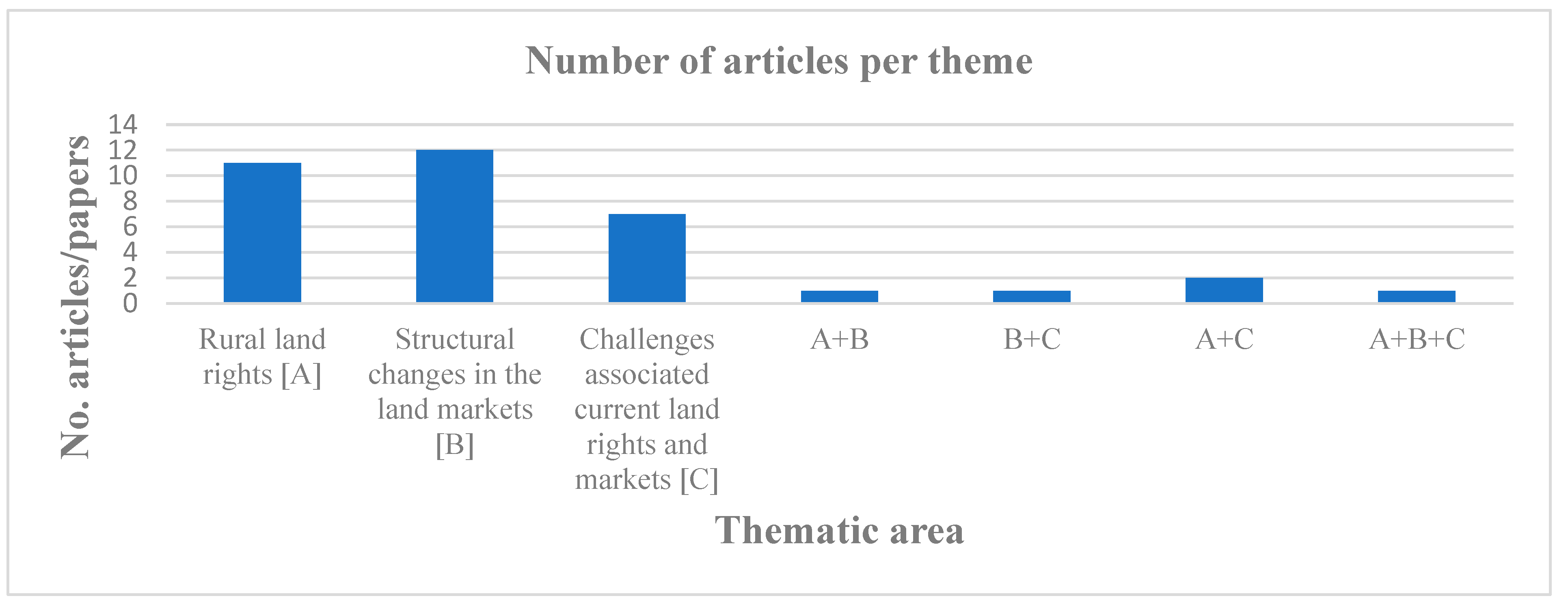

Table 1.
Criteria for exclusion and exclusion from The resources utilized in this review were obtained from online published, Journal articles, theses, book chapters, and conference papers.
Table 1.
Criteria for exclusion and exclusion from The resources utilized in this review were obtained from online published, Journal articles, theses, book chapters, and conference papers.
| Criteria for inclusion or exclusion | Number of articles included: 28 | Number of articles dropped: 65 | Justification of criteria used |
|---|---|---|---|
| Year of Publication | Between 1995 and 2023 | Before 1995 | This database would give a good historical perspective on the land rights, markets, and challenges after the promulgation of the current constitution of Uganda. |
| Language of publication | Only those in English | Not in English | Most of the impactful research in this area is published in the English language |
| Publication theme | Land rights, land markets, land structural transformation | Keywords in the title or abstract missing at least one of these: Land rights, land markets, land structural transformation, and challenges | To be able to cover the content scope for this review |
| Availability of the article online | Available | Not available | Lack of access to non-open-source literature |
| Study location | Uganda | Outside Uganda | To maintain the geographical scope of interest |
Disclaimer/Publisher’s Note: The statements, opinions and data contained in all publications are solely those of the individual author(s) and contributor(s) and not of MDPI and/or the editor(s). MDPI and/or the editor(s) disclaim responsibility for any injury to people or property resulting from any ideas, methods, instructions or products referred to in the content. |
© 2025 by the authors. Licensee MDPI, Basel, Switzerland. This article is an open access article distributed under the terms and conditions of the Creative Commons Attribution (CC BY) license (http://creativecommons.org/licenses/by/4.0/).
Copyright: This open access article is published under a Creative Commons CC BY 4.0 license, which permit the free download, distribution, and reuse, provided that the author and preprint are cited in any reuse.