1. Introduction
Globally, the trend of utilizing underground space has evolved from early-stage spatial utilization to a means of solving urban problems. This has become an inevitable path for urban renewal [
1]. However, urban heritage is inherently vulnerable in the face of large-scale development and construction. The historical value of urban heritage is accumulated over time, with much of it buried underground and irreplaceable. A lack of attention during underground development may lead to irreversible destruction.
Heritage protection in underground resource development is an unavoidable issue, as it is about not just preserving the past for the past’s sake, but respecting the past for the present [
2]. In European countries such as the UK, France, and Germany, the purpose of underground space utilization is to protect the urban environment, natural landscapes, and historical sites. Hence, a fundamental principle of urban infrastructure construction in Europe is to place facilities that would otherwise obstruct cityscapes underground [
3]. Scholars have conducted extensive research in this field, which can be categorized into four areas: 1). Comprehensive Underground Resource Development in Historic Cities: Archer argues that if underground heritage is neither fully utilized nor well understood, even a cultural metropolis like Paris cannot effectively manage its vast underground space [
4]. Varriale emphasizes the importance of strengthening underground cultural spaces as valuable resources for urban identity and tourism development [
5]. 2). Underground Development and Protection of Individual and Clustered Heritage Sites: Salvarani states that urban underground spaces are often symbolically used for rituals and memorial ceremonies and are closely linked to local community culture [
6]. Hiroi systematically analyzed the integrated and multifunctional underground development of historic Japanese cities [
7]. 3). Heritage Protection Near Underground Rail Transit: Giuseppe suggests that underground transport development should be designed to minimize its impact on heritage buildings in historic city centers [
8]. 4). Underground Archaeological Site Protection: Bayraktar and Ayşe propose that developing archaeological parks can preserve ancient landscapes in open spaces while promoting heritage conservation and tourism, thereby driving economic growth [
9]. Varriale notes that reconstructing underground building heritage (UBH) for sustainable reuse is becoming increasingly popular and is a key focus of several internationally funded projects [
10]. He also highlights that underground archaeology can utilize and repurpose abandoned underground cultural heritage, contributing to cultural, social, and urban renewal [
5]. These studies demonstrate that from a holistic urban perspective, cultural heritage remains inseparable from urban underground development. Ultimately, the issue revolves around the efficient and integrated use of underground space while balancing development and preservation concerns.
The suitability of underground resource development is a highly complex and interdisciplinary issue, involving not only geological factors such as geological structures but also economic, social, transportation, and locational factors [
11]. Many scholars have already studied and constructed various evaluation systems for the suitability of urban underground space development [
12,
13,
14,
15]. However, there is an inherent contradiction between the practical needs of urban underground development and the objective necessity of cultural heritage protection. A lack of respect and understanding for historical preservation, local cultural context, and the spirit of place often arises [
16]. Compared to regular urban land, cultural heritage areas are more fragile and possess unique heritage value. Therefore, underground resource development in heritage sites must consider not only the factors typically involved in underground development but also the intrinsic value of the heritage itself and the impact of development on it. Many heritage sites are located in old urban districts, where underground development could potentially alleviate urban issues such as traffic congestion, parking shortages, and inadequate infrastructure—problems that otherwise threaten the historical landscape.Existing research on heritage underground resource development evaluation [
17,
18] has mainly focused on heritage impact assessment [
19,
20]. For example, Wang Qian argues that a rapid and accurate risk assessment of the impact of China’s rapidly developing urban rail transit systems on surrounding architectural heritage is crucial [
21].
Clearly, there is an inherent contradiction between the demand for urban underground development and the protection of cultural heritage areas. Overemphasizing underground development at the cost of urban heritage or excessively prioritizing heritage preservation at the expense of urban comfort and ecological balance can both hinder the harmonious and organic growth of a city. However, underground resource development in heritage sites does not necessarily lead to destruction; it can be transformed into a means of protecting heritage and utilizing its value. Whether a heritage site should undergo underground development requires an understanding of the influencing factors affecting both development and preservation. A comprehensive approach that integrates all relevant factors must be taken to formulate a protection plan for the entire heritage site. Therefore, evaluating the suitability of underground development in heritage areas is a crucial issue that must be addressed before making policy and planning decisions.
A scientific and comprehensive feasibility assessment of underground cultural heritage resource development will provide a strong basis for guiding such projects. This study examines the factors influencing the suitability of underground heritage development and analyzes their impact on decision-making. By constructing an indicator system and using the authors’ “Dependency Analytic Process, DAP” [
22] to determine factor weights, the study explores heritage underground development and protection. The contributions of this research, compared to previous studies, are as follows: First, it conducts an in-depth analysis of the factors influencing the suitability of heritage underground development and constructs an evaluation index system along with scoring standards. Second, it carries out an on-site investigation of heritage sites in the old city of Xuzhou, incorporating the current state of heritage, discussions with local government officials and experts, and identified heritage protection issues to prepare for subsequent evaluation work. 3. Two typical case studies are selected, evaluated using the author’s previously developed DAP, and analyzed for factor interrelationships. These case studies further demonstrate the practicality, superiority, and innovation of the method. 4. Based on the evaluation results, the study discusses the interconnections between factors influencing underground heritage development and provides targeted policy recommendations. In summary, this research aims to provide technical guidance for underground heritage resource development while also showcasing the applicability and comprehensiveness of the DAP in holistic evaluations.
2. Methods
2.1. Establishment of Evaluation System
Through a comprehensive analysis of domestic and international research on heritage protection and utilization in underground development, it is evident that cultural heritage areas possess unique heritage value. Therefore, the suitability of underground development for heritage sites should not only consider conventional underground development factors but also the intrinsic value of the heritage, its feasibility for development, indirect impact factors, and the spatial needs of local residents. Many heritage sites are located in old urban districts, where underground development could help alleviate urban issues such as traffic congestion, parking shortages, and inadequate infrastructure, which threaten the historical landscape. Feasibility and indirect impact factors primarily refer to the systematic evaluation of development resistance and potential benefits, all of which affect development suitability. This study asserts that the influencing factors should not be evaluated in isolation but rather in terms of their interdependencies and mutual support, forming the principles of this evaluation system.
Based on the “Principles for the Conservation of Heritage Sites in China”, and respecting existing research [
17,
23,
24,
25,
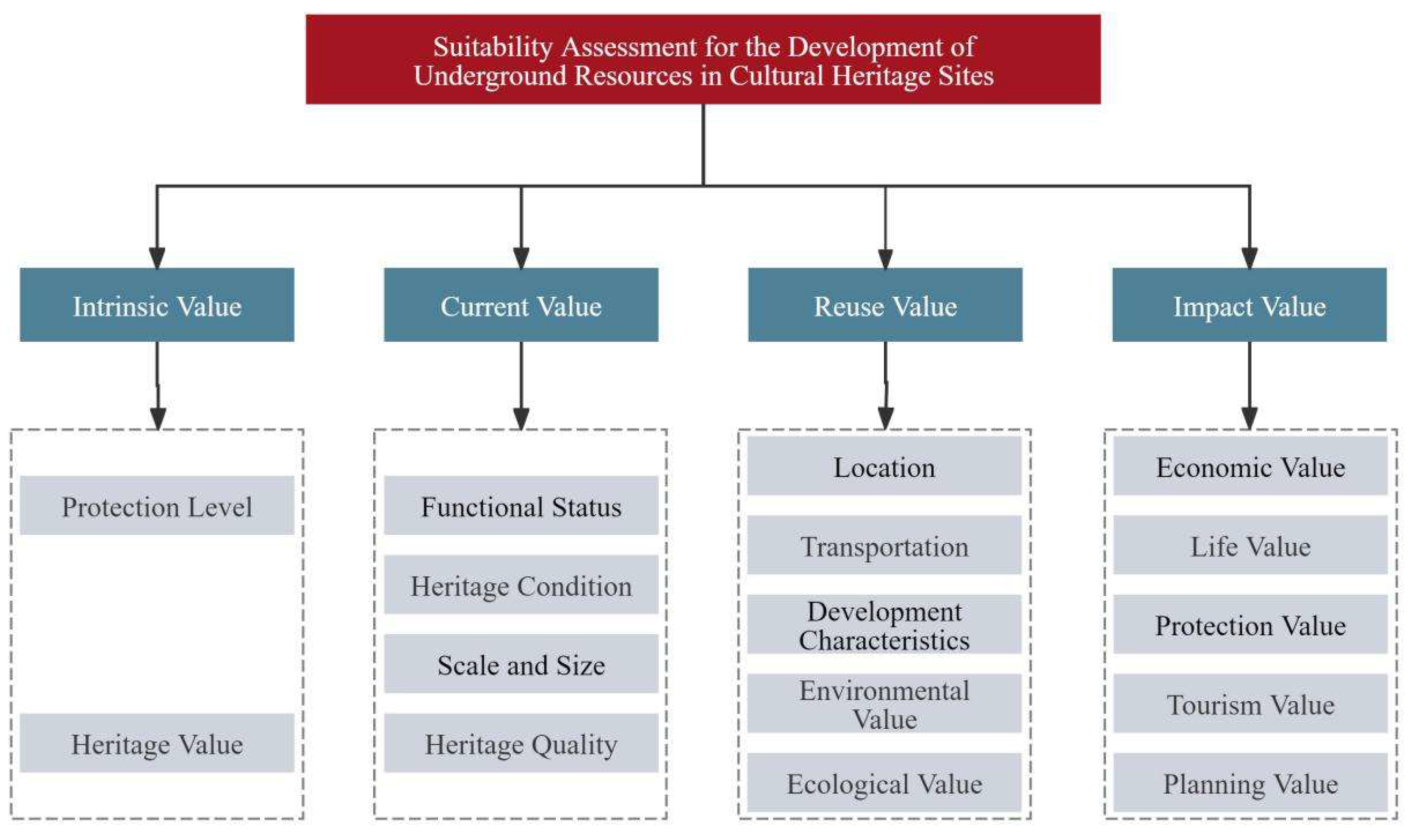
26], an initial framework for assessing the suitability of underground resources development of cultural heritage has been established, as shown in
Figure 1. This framework consists of four core values: intrinsic value, current status value, reuse value, and impact value. The intrinsic value means that the higher the heritage protection level, the less suitable it is for underground development. The current status value means whether the current function of the heritage site is reasonable, whether it has already been developed, whether it is above or underground, the preservation status, quality, and scale of the remains. The reuse value refers to the location, transportation, development potential, environmental, and ecological values, which influence future protection and utilization. The impact value is the future development value of the heritage, including its economic and commercial value, public recognition, transportation development, and urban planning significance.
To refine the evaluation system, field surveys were conducted, and discussions were held with experts, scholars, and planners on aspects such as the current state of heritage sites, heritage protection status, and future development plans. As a result, a three-tier evaluation index for underground resources development of cultural heritage suitability was formulated, as shown in
Table 1. These indicators determine the methods and strategies for future heritage protection and utilization. Successful examples, such as Rome and Paris, highlight the economic and cultural tourism benefits generated by architectural heritage conservation.
2.2. Establishment of Scoring Criteria
The URDSIS-CH comprehensive evaluation system proposed in this study includes many indicators that can be accurately scored, such as heritage protection level, zoning control, building density, and construction status. However, some indicators are difficult to quantify precisely and can only be represented within a fuzzy range, such as the commercial economic value of heritage conservation and transportation (urban planning) value. To standardize evaluation, this study adopts a direct quantitative scoring approach, using quantifiable indicators as the benchmark for defining scoring standards. According to China’s Cultural Relics Protection Law, Chapter 1, Article 3, heritage protection levels in China are divided into National Key Cultural Relics Protection Units, Provincial-Level Cultural Relics Protection Units, Municipal and County-Level Cultural Relics Protection Units. Heritage zoning control areas are categorized as strict construction restriction zones, limited construction zones, appropriate construction zones, and developed zones. Protection methods are classified into preservation, restoration, renovation, and reconstruction. Based on the characteristics of the evaluation system, the assessment levels are divided into five grades using a five-point scale (5, 4, 3, 2, 1). The URDSIS-CH evaluation system takes heritage value as its foundation and the feasibility of underground development as its objective, assigning scores to different factors based on the characteristics of each heritage site, thus establishing the corresponding scoring standard, as shown in
Table 2. Using this standard, data is collected through field surveys, random interviews, and structured discussions, providing a foundation for data calculation and result analysis.
Evaluation results are classified into four levels—excellent, good, medium, and poor—following previous research [
17]. Development suitability is categorized into four levels are presented in
Table 3.
2.3. Comprehensive Evaluation
Once the URDSIS-CH evaluation system and scoring standards are established, a comprehensive assessment can be conducted to determine whether a cultural heritage site is suitable for underground development. This study investigates the current use of underground space in Xuzhou’s cultural heritage areas, organizes findings from field research [
27], and applies the DAP, which developed by the author to refine the heritage protection and utilization evaluation. Given the interdependencies and interactions between evaluation indicators, the DAP method is well-suited for optimizing decision-making in heritage conservation and utilization.
3. Research Area
Xuzhou City has a large number of heritage sites, making it essential to conduct development suitability assessments to prevent irreversible damage to cultural heritage. However, not all heritage sites require underground development, as decisions should consider factors such as heritage protection level, physical condition, transportation accessibility, economic value, and urban planning significance.
Heritage site investigation and evaluation involve a multidisciplinary approach. During the initial assessment, detailed records of heritage attributes, natural environment, and social environment in detail according to
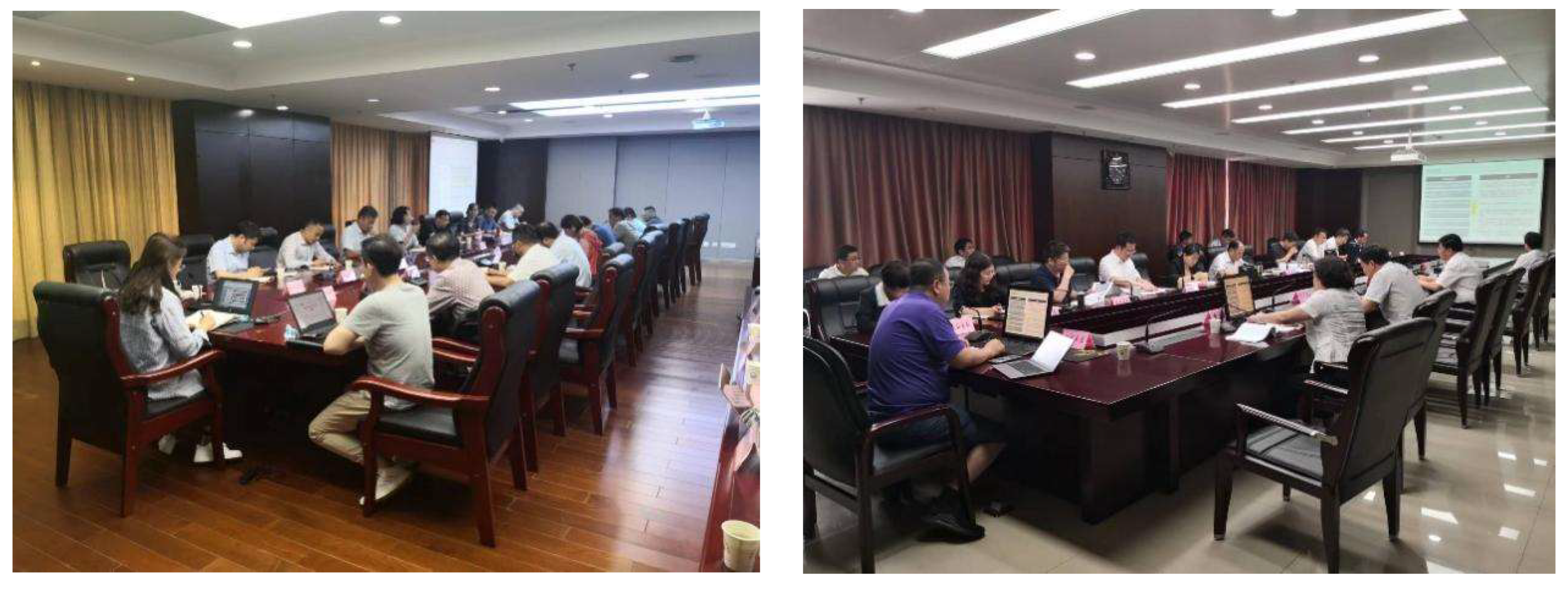
Table 4 were compiled. To enhance research and analysis, multiple structured meetings were held with local authorities to supplement and refine survey records, as shown in
Figure 2. These discussions provided insights into local protection policies, management conditions, socio-economic conditions, and planning developments, ensuring that the evaluation was scientifically robust and free from future controversies that could arise in heritage protection and utilization decisions.
During the investigation, it was found that the Pengcheng Subterranean Ruins, located in the city center, lie beneath the intersection of two subway lines. It is a municipal-level cultural relics protection unit, well known locally, and a key project in Xuzhou’s 14th Five-Year Plan for Cultural and Tourism Development. Given the government’s interest in its underground development, assessing its suitability for underground development is crucial for its future protection, cultural education initiatives, and urban ecological landscape improvement.
The Hubu Mountain Ancient Architecture Complex (1624), located in Hubu Mountain, Xuzhou, was designated as a National Key Cultural Relics Protection Unit in 2006 (6th batch). The site consists of 13 well-preserved ancient residential courtyards and over 500 traditional dwellings, offering high historical and cultural research value.
Based on on-site investigations and comprehensive analyses of Xuzhou’s old city heritage sites, these two sites were selected for underground development suitability evaluation using the DAP.
4. Results
4.1. Underground Development of Pengcheng Subterranean Ruins
After conducting on-site investigations and data collection for the Pengcheng Subterranean Ruins, discussions were held with the project team to refine the original evaluation materials and scoring. On this basis, six professionals (including two heritage protection experts, two architectural designers, and two urban planners) assessed the heritage value and feasibility of underground development, as well as the indirect impact factors. Based on their evaluations, a suitability assessment score for underground development of the Pengcheng Subterranean Ruins was obtained as shown in
Table 5.
Following the support evaluation for underground development of cultural heritage, the six professionals analyzed and rated the interdependencies among evaluation indicators. The DAP method was applied to calculate the weighting of these dependencies. For example, within the first-level indicator Heritage Value (A), the second-level indicator Heritage Protection Level (A1) has a self-dependency score of 1. Additionally, 30% of A1’s value is derived from its Historical Value (A2), meaning A1’s dependency on A2 is 0.3. The Heritage Protection Level (A1) contributes 10% due to its Archaeological Value (A3), so the dependency degree of indicator A1 on A3 is 0.1. Similarly, the dependency degree of indicator A2 on A1 is 0.3, A2 on A2 is 1, and A2 on A3 is 0.2. The dependency degree of A3 on A1 is 0.3, A3 on A2 is 0.3, and A3 on A3 is 1. This results in the mutual dependency scores among the Second-Level Indicators within the First-Level Indicator of Heritage Value (A), as shown in
Table 6.
Using the DAP algorithm, within First-Level Indicator A, Heritage Protection Level (A1) depends on Archaeological Value (A3) with a dependency score of 0.1. Archaeological Value (A3) depends on Heritage Protection Level (A1) with a dependency score of 0.3. Thus, the correlation score between A1 and A3 is 0.2. Through this method, the Second-Level correlation matrix for the First-Level Indicator Heritage Value (A) is established.
The sum of the correlation degrees of indicators with other indicators are: Since is the largest, so = corresponds to indicator . The second largest is , so = corresponds to indicator , ……,Following this logic, the indicators ranked by descending correlation degrees are: ,,,.
The eigenvalue of
A calculated by Matlap is:
The sum of the eigenvalues of a matrix is equal to the sum of its diagonal elements, and the weight vector of the Second-Level Indicators is:
Calculate the score of indicator
A:
By analyzing the dependency degrees of the Second-Level Indicators within other First-Level Indicators, the correlation matrix of the Second-Level Indicators is calculated as follows:
Using the same method, the evaluation scores for other First-Level Indicators are calculated as follows:
The interdependence among the factors in the first-level index layer is shown in
Table 7.
The correlation matrix of each factor in the First-Level Indicators is calculated:
Using the same method for the First-Level Indicators, the eigenvalues of
calculated with Matlab are:
The weight vector of the underground development suitability index of the Pengcheng Subterranean Ruins in Xuzhou City is calculated as follows:
The sum of the correlation degrees of each indicator is 0.3, 0.4, 0.55, 0.5, 0.3 and 0.65 respectively, and the corresponding indicators are ranked as
, the indicator score values are
.
In special circumstances (e.g., policy shifts, technical
constraints, or extreme outliers), control variables ε are used to
adjust the evaluation. Generally, these control variables receive a score of 0,
unless a critical issue arises. For instance, if a geological hazard is severe
enough to make underground development entirely unfeasible, a negative score is
assigned (a veto factor). However, in most cases where underground cultural
relics exist, geological conditions are not severe enough to make development
impossible.
The final evaluation score for Pengcheng Subterranean Ruins exceeds 3. According to the grading criteria in
Table 3, underground development is recommended for the Pengcheng Subterranean Ruins in Xuzhou, and formulate development strategies. Integrate the underground museum, subway system, underground commerce spaces, and pedestrian pathways into a cohesive structure, creating a “Hub + Landmark + Museum” complex. This will enable the entire underground space to ensure efficient pedestrian flow and transit connections in the city center while protecting and showcasing the underground heritage.
4.2. Underground Development of Hubu Mountain Ancient Architecture Complex
Similarly, relevant data on the Hubu Mountain Ancient Architecture Complex was collected, and on-site investigations and analysis were conducted. The same six professionals evaluated the suitability of underground development, and the evaluation scores for the Hubu Mountain Ancient Architecture Complex were obtained, as shown in
Table 8.
In the same way as above, we can calculate:
According to the evaluation results, the necessity for underground resource development in the Hubu Mountain Ancient Architecture Complex is relatively low, and development should be approached with caution. The primary consideration could be the addition of underground parking facilities to alleviate ground-level parking congestion without disrupting the heritage site’s structure.
5. Discussion
The results of the underground development suitability evaluation for the Pengcheng Subterranean Ruins and Hubu Mountain Ancient Architecture Complex reveal several key insights. First, Heritage protection level does not determine the necessity of underground resource development, and not all National-Level Protected Sites require underground development. Second, the Urban and commercial centers influence the economic value and clustering effect of an area. Heritage sites located in city centers are often considered landmarks, enhancing urban image and attracting attention from governments and the public. Third, existing underground spaces should be integrated and improved as part of heritage conservation planning. Fourth, the demand for underground development is proportional to surface-level functional needs and deficiencies. Last, the decision to develop underground resources is linked to the current state of heritage preservation. These conclusions underscore the holistic nature of comprehensive evaluations, where multiple interdependent factors must be considered.
When applying the evaluation system established in this research, the following points should be noted: 1) The evaluation criteria should adopt a broad perspective, integrating historical landscapes, ecological environment, urban planning, and cultural continuity, ensuring a comprehensive assessment of heritage protection and utilization. 2) This evaluation system is not a conventional assessment of heritage intrinsic value. Instead, it is focuses on non-use values, with multiple indicators aimed at protection and utilization, such as environmental value and economic use value, which are closely tied to the use value derived from heritage conservation efforts. 3) Whenever possible, evaluation criteria should be quantified as much as possible. For instance, heritage protection level and current condition should have clear quantifiable standards. For less tangible indicators (e.g., natural conditions, future development potential), evaluations should be based on research, field surveys, and expert consultation to approximate reality. 4) The three-tier indicator system presented in this study includes representative indicators, but it can be refined and expanded in actual evaluations. 5) If the project involves factors such as geological hazards, water quality conditions, and engineering site conditions that are unsuitable for underground development, a “one-vote veto” decision-making power can be applied, preventing underground development in unsuitable locations. 6) The final evaluation score should not be the sole determinant of underground development feasibility. Instead, it should serve as a scientific reference for cultural heritage underground development and related protection strategies. In practice, multidisciplinary research and analysis will be involved, requiring collaborative efforts from various fields.
Through the analysis of the indicator system, some indicators, such as Height of Ground Buildings, Scale of Heritage Site, and Depth of Underground Development, pose challenges in determining their relative importance. Many indicators are interdependent, requiring a structured analysis. For instance, Heritage Protection Level is closely related to Historical Value and Archaeological Value significance. Higher historical and archaeological value often leads to higher heritage protection level.Therefore, when evaluating such an indicator system, To address such interdependencies,the author’s created DAP addresses the theoretical challenge of determining the importance of indicators.
Heritage protection is a highly specialized field, and any underground development must comply with local laws and regulations. Currently, in China, national and local planning standards rarely mention heritage site underground development explicitly. Only the Cultural Relics Protection Law and related cultural relics protection plans include legal references for the protection of underground sites. However, this study goes beyond underground archaeological site protection to discuss comprehensive underground development, including old city underground developments, subsurface development of individual and clustered heritage sites and heritage protection around underground transit system.To guide underground space development in historic districts, restrictive policy frameworks should be established. The protection planning should prioritize: integrating underground development with heritage protection, coordinating above-ground and underground design, ensuring authenticity protection for immovable cultural relics, defining underground archaeological zones based on archaeological findings, creating systematic plans for dispersed heritage sites, and strengthening connectivity between underground and surface heritage sites to preserve urban cultural continuity, and Ultimately promote the restoration of heritage landscape in historical areas.
Several limitations in this study warrant discussion. Firstly, this research is based on the context of China’s heritage protection laws, planning regulations, and policy environment. The strategies proposed are China-specific and may not be directly applicable to other countries. Heritage status, geographic conditions, conservation experience, policy frameworks, and cultural beliefs vary globally, affecting underground development feasibility. Developing nations, in particular, face unique challenges in this regard. Secondly, our analysis of Xuzhou’s heritage sites combines field investigations, government-published information, Research institution findings, media observations, and data obtained from consultations with institutions such as the Natural Planning Bureau. However, time constraints may have led to gaps in observation, potentially affecting the accuracy of our judgment on heritage information. Further research should incorporate more objective data sources to enhance accuracy.Lastly, while this study focuses on the Suitability factors underground development at heritage sites in Xuzhou, but results indicate that heritage underground development is a multidimensional issue involving social, economic, environmental, and cultural factors. These factors include: current function of underground space, accessibility of underground transportation, commercial economic value, the sense of identity among user groups, and the rationality of current use of heritage. These aspects are critical in deciding underground development feasibility and should be explored in future research.
6. Conclusions
The author believes that the social value of underground development in cultural heritage sites is not only an opportunity for urban spatial development but also a means to ensure the preservation of urban cultural heritage while providing cultural and educational value to society. This study organizes, selects, expands, and refines evaluation factors based on the research objectives, initially constructing a relatively comprehensive URDSIS-CH framework for assessing the suitability of underground development of cultural heritage. By applying this evaluation system to empirical analysis, Using the DAP method created by the author before, the study aims to resolve the conflict between underground space development and cultural heritage protection through technical and methodological approaches, ensuring a more scientific approach to heritage Protection and utilization.
The research findings of this paper are expected to contribute to the future development of underground resources by integrating feasibility assessments into heritage Protection strategies. This would help address many challenges faced in cultural heritage protection, balancing modern urban development with historical and cultural preservation. Moreover, it is hoped that these findings will provide valuable planning insights for the overall protection of the cultural landscape in Xuzhou’s old town, which characterized by large-scale heritage sites and historical relics, as well as for other similar historic urban areas striving to achieve urban renewal and sustainable development through heritage Protection and utilization.
Author Contributions
Conceptualization, C.H. and J.Q.; Methodology, C.H. and T.H.; Software, T.H.; Validation, C.H., J.Q. and T.H.; Formal Analysis, C.H. and J.Q.; Investigation, C.H.; Resources, J.Q and X.T.; Data Curation, C.H. and T.H.; Writing – Original Draft Preparation, C.H.; Writing – Review & Editing, J.Q.; Visualization, C.H.; Supervision, J.Q.; Project Administration, J.Q.; Funding Acquisition, C.H. and J.Q. All authors have read and agreed to the published version of the manuscript.
Funding
This research was funded by the National Natural Science Foundation of China “Study on the Urban and Rural Spatial Influence Mechanism and Planning Regulation along the Railway Construction Line in Complex and Difficult Plateaus” (Grant No. 52478071), the National Natural Science Foundation of China “Research on Urban Spatial Coupling Mechanism Between Urban Epidemic Spreading and Vulnerability and Planning Response in Chengdu-Chongqing Area” (Grant No. 52078423), the Major Program of Sichuan Provincial Scientific Research “Research and Demonstration of Resilient Collaborative Planning and Design for Park Cities” (Grant No. 2020YFS0054), the Sichuan Provincial Science and Technology Innovation Platform and Talent Plan “Research on the Construction and Development Strategies of Several Major Infrastructure Systems for New Smart Cities” (Grant No. 2022JDR0356), the National Key Research and Development Program of China “Research on key technologies for spatial optimization design guided by the improvement of human centered performance in high-intensity areas” (No. 2023YFC3807404), and the sub-project of National Key Research and Development Program of China “Optimization technology for spatial participatory based on experience sensation” (No. 2023YFC3807404-4).
Data Availability Statement
The data for this study are available from the authors upon request.
Conflicts of Interest
The authors declare no conflicts of interest.
References
- Tang, Y.Q.; Wang, M.W.; Wu, X.Z.; Wang, X.Y. Strategy and Layout of Underground Space Planning for Organic Renewal in Old Urban Areas. Planners 2022, 38, 134–139. [Google Scholar]
- F. Gibert, et al., translated by Cheng Yao. Town Design, B: State Engineering and Construction Press, 1983.
- Tang, Y.Q. Urban Underground Space Planning. China Architecture and Building Press: Beijing, China, 2019.
- Archer, C. Paris Underground. Mark Batty Publishers: Brooklyn, NY, USA, 2005.
- Varriale, R.; Parise, M.; Genovese, L.; Leo, M. Underground Built Heritage in Naples: From Knowledge to Monitoring and Enhancement. In Handbook of Cultural Heritage Analysis; D’Amico, S., Venuti, V., Eds.; Springer: Cham, 2022. [Google Scholar] [CrossRef]
- Salvarani, R.; Edizioni, R. CNR. Symbolic significance of the use and reuse of underground urban space, historical interpretation framework. Undergr Buildin Herit Val. 2021 Rome, Italy. Pp. 21-30.
- Hiroi Yū, Underground Street Disaster Prevention Research Society. Hidden Underground Streets. Kawade Shobō Shinsha, 2018.
- Giuseppe, M.; Gaspari, N.G.; Prathap, M. Underground tunneling to match social development and preservation of historical and cultural heritage: Bangalore metro line UG-1. Engineering Geology for Society and Territory. Preserv. Cult. Heri 2015, 8, 129–133. [Google Scholar]
- Bayraktar, S,; Student, M,; Kubat, A. S. Archaeological Parks and their Integration to Urban Layout of Istanbul. 2010.
- Varriale, R. ‘Underground Built Heritage’: A theoretical approach for the definition of an international class. Herit. 2021, 4, 1092–1118. [Google Scholar] [CrossRef]
- Li, P.Y.; Han, H.D.; Wang, D.H.; Wang, C.S. Current situation and development trends of suitability evaluation of urban underground space resources. Sediment. Geol. & Tethyan Geol. 2021, 41, 121–128. [Google Scholar]
- Tong, L.X.; Zhu, W.J. Evaluation and develop planning of urban underground space. China State Engineering and Construction Press: China, 2009.
- Jiang, X.; Wang, T.T.; Mu, J. Research on the Application of Suitability and Resources in Underground Space Development. Chin. J. Underground Space Eng. 2018, 14, 1145–1153. [Google Scholar]
- Xiong, F.; Li, X.; Liu, M.L.; Pang, S.D.; Guan, S.Y. Suitability Evaluation of Underground Space Exploitation: a Case Study of Changjiang New Town in Wuhan. Chin. J. Underground Space Eng. 2022, 18, 12–19. [Google Scholar]
- Duan, Y.Q.; Jie, Z.Q.; Lin, M.N.; Zuo, X.Q.; Hou, Z.Q. Suitability Evaluation of Underground Space Development Based on Index Scale-AHP. Chin. J. Underground Space Eng. 2021, 17, 8–15. [Google Scholar]
- Zhang, S. The Idea and Path of Establishing the Mechanism of Preserving the Urban Living Heritage: Shanghai’s Experience and Challenges in Historic Townscape Preservation. Urban Plan. Forum. 2021, 6, 100–108. [Google Scholar]
- Zhang, P.; Xiao, Y. Suitability evaluation method for historic relic underground space resource development. J. PLA Univ. Sci. Technol. (Nat. Sci. Ed.), 2014, 15, 203–208. [Google Scholar]
- Zhang, P.; Cheng, Z.L. Evaluation on the quality of Underground Space Resource in Historic District: A Case Study on Yangzhou old City. C. Plann. Rev. 2012, 0, 29–32. [Google Scholar]
- Yang, J.B. Research and practice on the influence of underground construction on historical buildings. Tongji University Press: Shanghai, China, 2019.
- Zhu. W. Rick Evaluation of Impact of Foundation Pit Excavation on Adjacent Historic Building Based on AHP. Building Construction. 2016, 38, 860–862. [Google Scholar]
- Wang, Q.; Yang, C.M.; Lu, J.G. Safety Risk Assessment of Adjacent Heritage Building under the Influence of Subway Construction. Sci. Technol. Eng. 2020, 20, 9615–9621. [Google Scholar]
- Huang, C.; Qiu, J.; Huang, T.M. Mode selection of post-earthquake recovery and reconstruction of traditional villages using dependency analytic process: Taking Xiluo-Buzi village in the 2022 M6.8 Luding earthquake as an example. Front. Public. Health. 2023, 11, 1240573. [Google Scholar] [CrossRef]
- Zhao, X.D.; Zhang, P.; Chen, Z.L. Fuzzy Synthesis Evaluation for Resource Quality of Underground Space in Historic and Cultural Blocks. Chin. J. Underground Space Eng. 2014, 10, 739–744. [Google Scholar]
- Zhu, Y.G.; Zhao, J.W.; Huang, Z.Y. Evaluation of Underground Space Development in Historical District Based on AHP. Chin. J. Underground Space Eng. 2018, 14, 1437–1444. [Google Scholar]
- Wang, Z.L. GIS-Based Suitability Assessment of Underground Space in Historic and Cultural Blocks: A Case Study of the Central Urban Area of Tianjin. Tianjin University, Tianjin, China, 2019.
- Liu, J.W.H. Method for Evaluating the Implementable Stock of Underground Space in Modern Historic and Cultural Blocks: A Case Study of Jiefang North Road Historic and Cultural Block, Hebei University of Engineering, 2019.
- Huang, C.; Qiu, J.; Tan, X.H. The Urban Heritage Protection Strategy of Seeking Space from Underground in Central City——Taking Xuzhou City as an Example. J. Southwest Jiaotong Univ. (Soc. Sci.), 2023, 24, 99–117. [Google Scholar]
|
Disclaimer/Publisher’s Note: The statements, opinions and data contained in all publications are solely those of the individual author(s) and contributor(s) and not of MDPI and/or the editor(s). MDPI and/or the editor(s) disclaim responsibility for any injury to people or property resulting from any ideas, methods, instructions or products referred to in the content. |
© 2025 by the authors. Licensee MDPI, Basel, Switzerland. This article is an open access article distributed under the terms and conditions of the Creative Commons Attribution (CC BY) license (http://creativecommons.org/licenses/by/4.0/).