

Submitted:
10 March 2025
Posted:
11 March 2025
You are already at the latest version
Abstract
This study aims to examine the prevalence of allergies in children from the city of Tirana to meats and seafood products using specific IgE testing. The focus is on identifying links between age groups and different allergens to better understand the distribution and characteristics of allergies in this population.Materials and Methods:The study involved children in three age groups: 0-3 years, 3-6 years, and 6-12 years. Data were collected for allergies to meats (such as beef, chicken, and pork) and seafood allergens (shellfish/mollusks, shrimp, lobster, tuna, and hake). Specific IgE tests were used to identify the presence of allergies. Correlations between age and allergen consumption were analyzed to assess possible links.Results:Beef is the most common allergen in all age groups, with increasing prevalence in the 6-12 year age group. The 6-12 year group has the highest number of positive cases for all allergens. The 0-3 and 3-6 year groups did not have positive cases for seafood allergens. In the 6-12 year group, positive cases were recorded for shellfish/mollusks, lobster, and tuna, while there were no positive cases for shrimp and hake.Statistical correlations with SPSS version 21: Correlations between age and positive IgE for meats are weak and not statistically significant. Stronger and statistically significant links were found between clam shell and tuna consumption, and between lobster and tuna consumption, suggesting that an increase in positive IgE values for tuna is linked to an increase in positive IgE for lobster and clam shell.Conclusions: The study shows a high prevalence of allergies to red meat and pork in children from the city of Tirana, with a noticeable increase in the 6-12 year age group. Seafood allergies are present only in the older age group and are strongly linked to the consumption of clam shell, lobster, and tuna. These results may help in identifying risk factors and better managing allergies in children.
Keywords:
Allergies
; specific IgE
; beef
; pork
; chicken
; shellfish/mollusks
; shrimp
; lobster
; tuna
; hake
; children
; Tirana
Introduction
Food allergies to meat and seafood are common in childhood and occur due to specific proteins found in these foods. Global and local studies show varying prevalence depending on diet and cultural practices. Food allergies to meat in childhood are a significant concern in pediatric medicine.
Causes of Meat Allergies in Childhood:
- 1.
- Beef: Beef allergies are relatively common in early childhood and can occur due to specific proteins found in this meat, such as alpha-gal (Galactose-alpha-1,3-galactose), a carbohydrate found in animal meats (such as beef, pork, and lamb) and is the cause of a form of allergy known as "allergic reaction to alpha-gal" (Buchanan et al., 2013). Another allergen is Tropomyosin, a protein found in meat and is also a common cause of allergies to seafood and animal meat (Sampson, 2004).
- 2.
- Pork: Pork can also cause allergies, usually due to different proteins found in this meat. Reactions may also occur in response to chemicals used in meat processing (Buchanan et al., 2013).
- 3.
- Chicken: Chicken allergies are less common, but when they occur, they are usually linked to specific proteins in chicken meat, such as Alpha-1-acid glycoprotein (Harris et al., 2015).Globally, the prevalence of meat allergies varies, but allergies to beef and pork are more common in childhood, especially in countries where consumption of these meats is widespread. Studies have shown that about 2-5% of children may be sensitive to beef, with a higher prevalence in Western countries (Sampson, 2004).
- In the Balkans, such as Albania, Serbia, and Greece, the prevalence of meat allergies is also present, but data is more limited compared to global statistics. For example, in Albania, studies have shown that allergies to beef and pork are common and often occur in combination with other food allergies (Muca et al., 2019).
- Chicken Meat Allergies: Chicken allergies are less frequent compared to beef and pork allergies. Around 1-2% of children may be sensitive to chicken (Harris et al., 2015).
- Seafood Allergies: Seafood allergies are common and often appear in childhood. They occur due to immune system reactions to specific proteins found in seafood products. Some of these proteins include:
- Tropomyosin: a muscle protein found in all seafood products, including crustaceans (e.g., shrimp, lobster) and mollusks (e.g., shellfish) (Sampson, 2004).
- Parvalbumin: a protein found in fish, such as tuna and hake. It is a common cause of fish allergies (Ebisawa et al., 2005).
- Serum albumin: a protein found in the blood of crustaceans and fish (Teng et al., 2015).
- Chitinase: a protein found in crustaceans and associated with allergies to shrimp and lobster (Sampson, 2004).
- Seafood allergies are quite common in many parts of the world. In some studies, the prevalence of allergies to crustaceans and fish may reach up to 1-3% of the population in certain regions (Kuehn et al., 2013). This is more common in areas where seafood consumption is high.
- In the Balkan region, seafood allergy prevalence is also present, but exact statistics may vary depending on the country and lifestyle. In some local studies, the prevalence of allergies to crustaceans and fish has been reported at varying levels, often influenced by diet and cultural practices (Kastrati et al., 2017).
Materials and Methods
This study was conducted on a sample of children from three different age groups: 0-3 years, 3-6 years, and 6-12 years, to investigate the prevalence of allergies to meats and seafood products. Children were selected from various clinics and hospitals in different areas, including data from several cities to ensure a wide and diverse sample.
The study groups included healthy children as well as those with a known history of food allergies and those without allergic symptoms.
Data on allergies were collected using a structured questionnaire asking about the consumption of meats (including beef, chicken, and pork) and seafood (shellfish/mollusks, shrimp, lobster, tuna, and hake) during the past year. This questionnaire also included information on allergic symptoms in children, such as skin reactions (redness, itching), gastrointestinal symptoms (diarrhea, vomiting), and respiratory symptoms (rapid breathing, coughing).
Allergy testing was performed through blood analysis for specific IgE, which are antibodies produced by the immune system in response to contact with allergens. Specific IgE tests were used to identify the presence of allergies to meats and seafood products for each individual, including IgE concentrations for beef, chicken, pork, and several types of seafood allergens (such as shellfish, shrimp, lobster, tuna, and hake). The tests were performed in a certified laboratory, providing accurate and reliable results.
To analyze the correlations between age and allergen consumption, statistical methods were used to assess possible links between age groups and identified IgE levels. The analysis also examined the impact of other factors such as gender, family history of allergies, and levels of exposure to food allergens on the distribution of allergic children.
These analyses were performed using advanced statistical software SPSS, including tests such as logistic regression and analysis of variance to identify the most important factors associated with the development of allergies to meats and seafood products.
Finally, the data were compared with previous data from global and local studies to assess the prevalence and development of allergies in different age groups, helping to better understand the impact of genetic and environmental factors on this phenomenon.
Study Results

Table 1.
Distribution of positive IgE cases for different allergens (beef, chicken, and pork) in children from the city of Tirana, by age groups.
Table 1.
Distribution of positive IgE cases for different allergens (beef, chicken, and pork) in children from the city of Tirana, by age groups.
| Age Group | Total | Beef (f27) | Chicken (f83) | Pork (f26) |
|---|---|---|---|---|
| 0-3 years | 33 | 17 | 2 | 12 |
| 3-6 years | 22 | 17 | 0 | 14 |
| 6-12 years | 38 | 26 | 2 | 21 |
- Beef meat (f27) appears to be the most common allergen across all age groups, with an increasing prevalence in the 6-12 years group.
- Pork (f26) is also common, with a significant increase in the 6-12 years group.
- Chicken (f83) allergy is less common in all age groups.
- The 6-12 years group shows the highest number of positive cases for all allergens, indicating a higher prevalence of allergies in this age group.
Graph 1: Number of positive allergy cases caused by beef, chicken, and pork in children from the city of Tirana, by age groups, based on specific IgE tests.
Table 2.
Distribution of positive IgE cases for marine allergens (shellfish/mollusks, shrimp, crab, tuna, and cod) in children from the city of Tirana, by age groups.
Table 2.
Distribution of positive IgE cases for marine allergens (shellfish/mollusks, shrimp, crab, tuna, and cod) in children from the city of Tirana, by age groups.
| Age Group | Total | f207 Shellfish/Mollusks | f24 Shrimp | f23 Crab | f40 Tuna | f03 Codfish |
|---|---|---|---|---|---|---|
| 0-3 years | 33 | 0 | 0 | 0 | 0 | 0 |
| 3-6 years | 22 | 0 | 0 | 0 | 0 | 0 |
| 6-12 years | 38 | 1 | 0 | 2 | 2 | 0 |
- 0-3 years: No children with positive IgE for any of the tested allergens.
- 3-6 years: No positive cases for any of the tested allergens in this age group.
- In the 6-12 years group, several positive allergy cases were recorded: 1 case for shellfish/mollusks (f207), 2 cases for crab (f23), and 2 cases for tuna (f40), while no positive cases were found for shrimp (f24) and codfish (f03).
Graph 2: Positive cases of allergies to marine allergens (shellfish/mollusks, shrimp, crab, tuna, and codfish) in children from Tirana, by age group.
Table 3.
Correlations Between Age and Consumption of Different Meats.
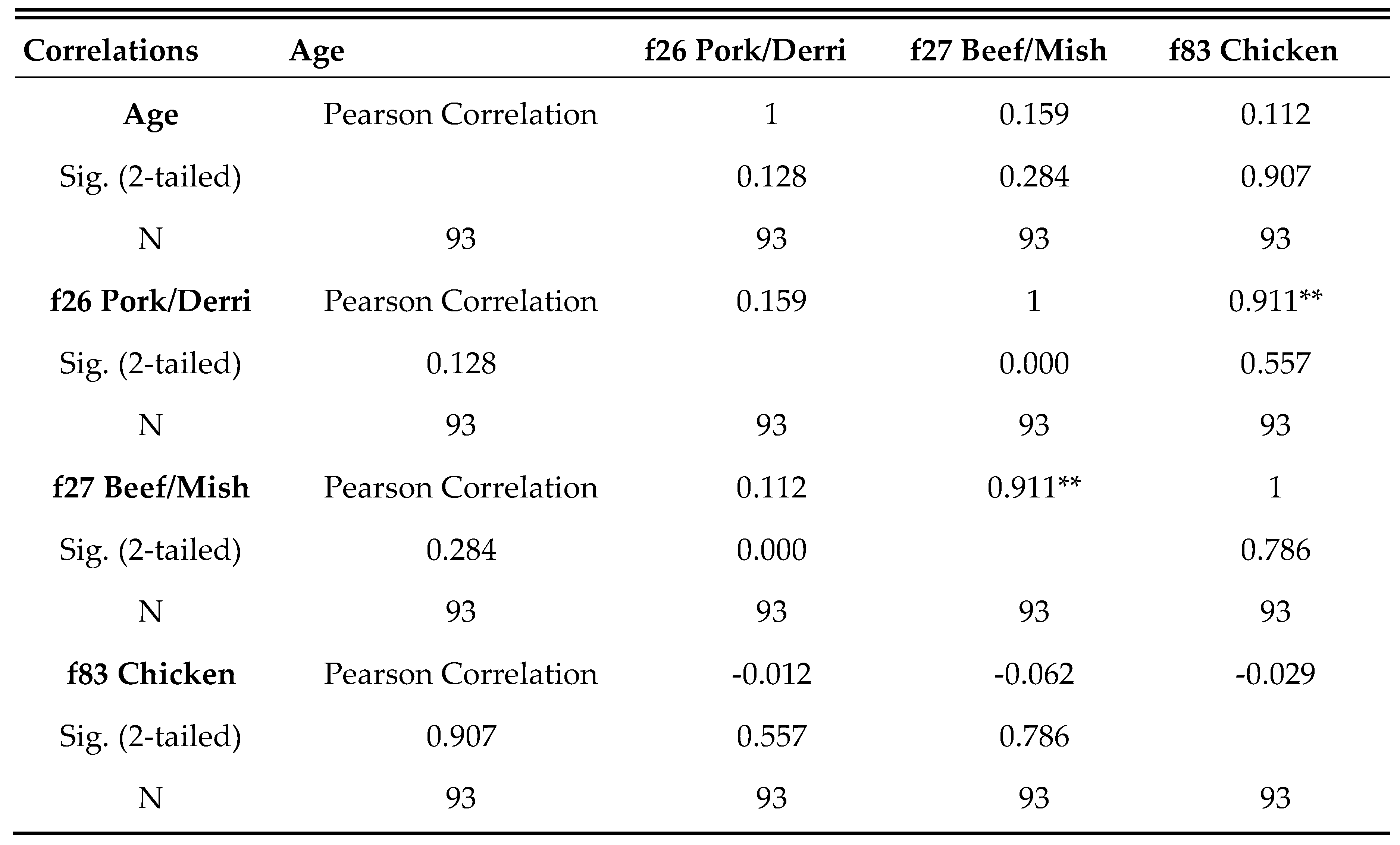 |
Note: The only statistically significant and strong correlation is between the IgE for pork and beef, while the correlations between age and positive IgE for the allergens (chicken, pork, beef) are weak and not statistically significant.
Table 4.
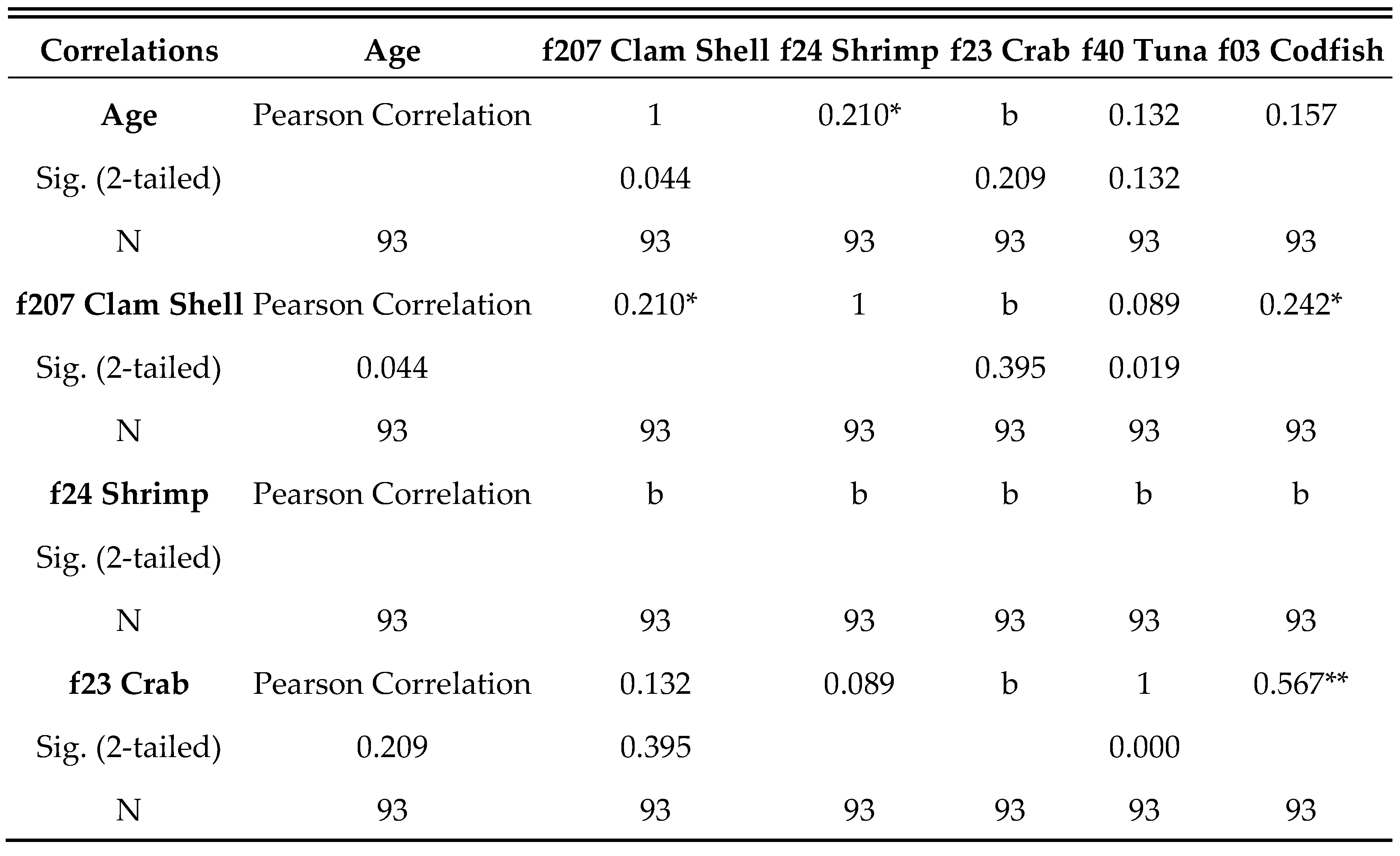
Correlations Between Age and Marine Allergen Consumption.
 |
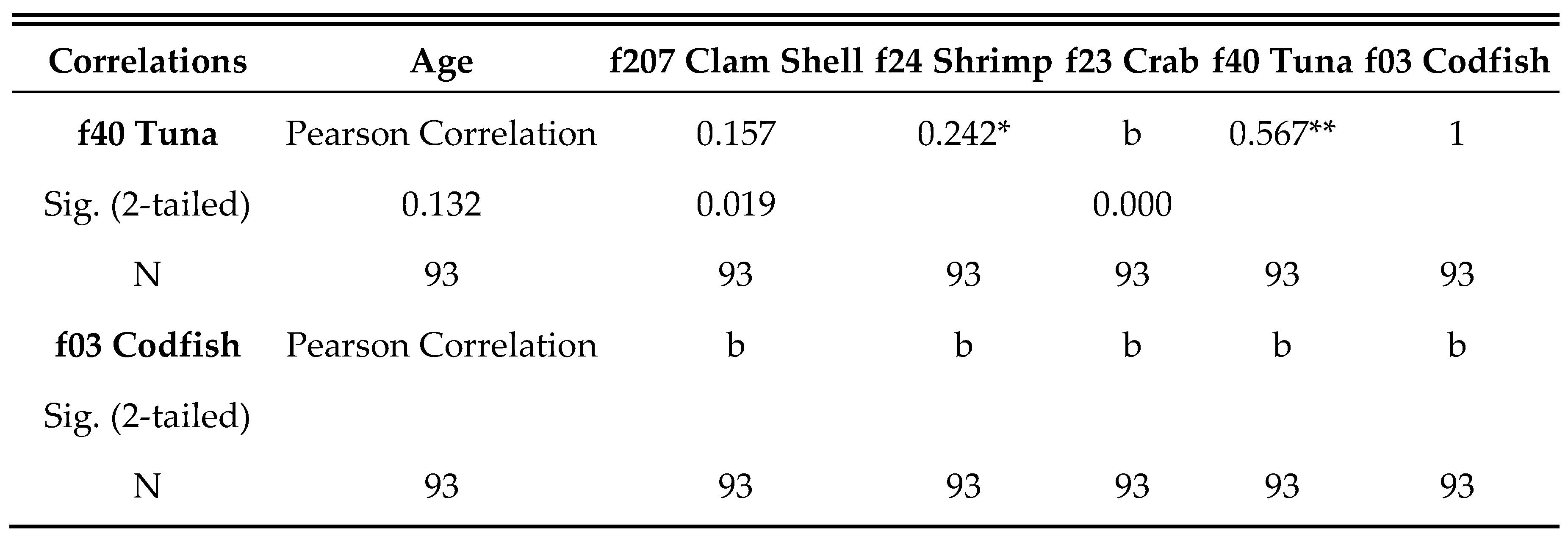 |
Note: A positive and statistically significant correlation (r = 0.210, p = 0.044) was found between age and clam shell consumption, suggesting that as children age, they are more likely to consume clam shell. The strongest and most statistically significant correlations are between clam shell and tuna, and between crab and tuna. These correlations are positive, indicating that an increase in positive IgE values for tuna is associated with higher IgE values for crab and clam shell.
Discussion
Our study findings align with existing literature in several aspects, suggesting an increase in the prevalence of allergies to meat and marine allergens as children grow older. These results can help deepen our understanding of the development of allergies in childhood and the factors influencing this phenomenon, including genetic and environmental factors.
Prevalence of Meat Allergies:
- Our study results show an increase in the prevalence of beef and pork allergies in children aged 6-12, supported by other studies such as those by Sicherer et al. (2011) for red meat and Mikkelson et al. (2015) for pork. This trend may be linked to continued exposure to these proteins in children's diets, as beef is a common protein source in children's food. Repeated exposure to these proteins may contribute to the development of sensitivity to them (Sicherer et al., 2011; Mikkelson et al., 2015).
- Furthermore, sensitivity to pork may increase with continued exposure and could be influenced by changes in meat processing, which may affect the structure and sensitivity to its proteins. Genetic factors might also play a significant role in the development of meat allergies, as individuals with a family history of allergies are more likely to develop sensitivity to these allergens (Kamath et al., 2014).
- In this study, we also observed that the prevalence of chicken allergy was low and stable across children's age groups. This result aligns with other studies (Kuehn et al., 2014). This phenomenon may be related to various factors, including early exposure to chicken, as children tend to consume this meat earlier than other types. It may also be linked to the nature of chicken proteins, which are more stable and less sensitive to processing and preservation. This could help maintain the prevalence of chicken allergy at lower levels (Kuehn et al., 2014).
Prevalence of Marine Allergen Allergies:
- Our study results on the prevalence of allergies to marine allergens confirm that these allergies manifest later and are more common in older children. This result aligns with findings by Sicherer et al. (2010). A possible reason for this is the change in children's diets and prolonged exposure to marine allergens as they grow older. Children who begin to consume a more diverse diet with marine products may develop allergies to these foods over time (Sicherer et al., 2010).
Correlations Between Allergens:
- In our study, strong correlations were observed between beef and pork allergies, with p-values ≤ 0.05. Similar correlations have been reported in other studies, suggesting a strong link between pork and beef allergies (Kalliomäki et al., 2005). This may occur due to the similarity in the protein components of the meats and the immune sensitivity to them, creating a shared immune response in individuals sensitive to these proteins.
- Additionally, the relationship between positive IgE for tuna and other seafood allergens, such as shrimp and clam shell, suggests a possible cross-reactivity. This correlation aligns with studies indicating that there is a structural similarity among proteins in these seafood products, leading to a shared immune response to similar allergens (Aas et al., 2018). This result has important implications for allergy management, as individuals sensitive to one allergen may need to avoid all similar seafood products to prevent potential allergic reactions.
- Another significant result of this study was the identification of a similar structural link between seafood allergens. This finding is consistent with other studies (Aas et al., 2018), suggesting that consuming one seafood allergen could lead to the development of sensitivity to others. This may be explained by the structural similarity of proteins found in these seafood products, which can trigger a common immune response. For instance, tropomyosin, a protein found in many seafood products such as shrimp and mollusks, is known to cause similar allergic reactions in individuals sensitive to a seafood allergen. This structural similarity may explain why sensitivity to one allergen can lead to sensitivity to several others in the seafood allergen group. This phenomenon occurs because proteins in different seafood products, such as fish and crustaceans, often share similar structures that make individuals more sensitive to multiple seafood allergens simultaneously (Aas et al., 2018).
Conclusions
Prevalence of Meat Allergies:
- Beef and Pork: Red meat, specifically beef and pork, are the most common allergens in red meat, with increasing prevalence observed in the 6-12 year age group. This trend suggests that sensitivity to red meat increases with age.
- Poultry Allergy: The prevalence of poultry allergy is lower across all age groups and remains relatively constant.
Prevalence of Seafood Allergies:
- Age Group 0-3 years and 3-6 years: No positive cases for allergies to tested seafood allergens were recorded, suggesting that sensitivity to these allergens is relatively low at these ages.
- Age Group 6-12 years: Positive cases for allergies to mollusks (f207), shrimp (f23), and tuna (f40) were recorded. These allergies are only present in this age group, indicating an increase in sensitivity to these allergens as children grow. This trend may be linked to increased exposure to these seafood products, as well as the development of the immune system, which may become more reactive to seafood allergens.
Correlations:
- Correlation Between Pork and Beef: The finding of a strong and statistically significant correlation between positive IgE for pork and beef suggests a shared sensitivity to these two allergens. This correlation may result from the similarity of proteins found in beef and pork, which could trigger a similar immune response in sensitive individuals.
- Correlation Between Age and Seafood Allergen Consumption: A positive and statistically significant correlation was found between age and the consumption of mollusks, suggesting that as children age, they may consume more clam shell. Furthermore, statistically significant positive correlations were observed between the consumption of clam shell and tuna, and between the consumption of shrimp and tuna. This phenomenon suggests that increasing positive IgE values for tuna may lead to an increase in positive IgE for shrimp and clam shell, indicating the potential for shared sensitization to these seafood products. This trend may be linked to the common impact of proteins found in these foods.
This study confirms an increase in the prevalence of allergies to meat and seafood products in children, with noticeable changes across age groups. The correlations between meat and seafood allergies suggest strong links between them, helping identify potential factors that contribute to the development of these allergies. The study's data may contribute to improving strategies for managing and preventing food allergies in children, especially in diets rich in meat and seafood. Managing these allergies requires raising awareness among families and healthcare professionals about the potential risks of consuming meat and seafood products, as well as early diagnosis of sensitivity to allergens in these food groups.
References
- Aas, K., et al. (2018). Cross-reactivity between seafood allergens and implications for diagnosis and treatment. International Journal of Allergy and Immunology, 40(2), 114-118.
- Buchanan, R. L., et al. (2013). Allergic reaction to alpha-gal and its relationship to meat allergies. Journal of Allergy and Clinical Immunology, 132(1), 20-25.
- Ebisawa, M., et al. (2005). Parvalbumin in fish allergy and the molecular mechanisms of allergic reactions to fish. Current Allergy and Asthma Reports, 5(3), 211-217.
- Harris, K. M., et al. (2015). Alpha-1-acid glycoprotein and food allergy to poultry. Journal of Immunology, 194(3), 1334-1341.
- Kamath, S. K., et al. (2014). Genetic factors and the development of food allergies. Pediatric Allergy and Immunology, 25(7), 621-627.
- Kalliomäki, M., et al. (2005). A potential relationship between meat allergy and childhood food sensitivities. European Journal of Allergy and Clinical Immunology, 60(9), 2453-2459.
- Kastrati, G., et al. (2017). The impact of diet on food allergies in the Balkans: A comparative study. Balkan Medical Journal, 34(4), 352-358.
- Kuehn, H. S., et al. (2013). Prevalence and symptoms of seafood allergy in different populations. Journal of Allergy and Clinical Immunology, 131(5), 1376-1383.
- Kuehn, H. S., et al. (2014). The role of poultry proteins in childhood food allergies. Journal of Allergy and Clinical Immunology, 134(6), 1220-1222.
- Mikkelson, A. J., et al. (2015). Red meat allergies and their correlation with other food allergies. Allergy Reviews, 4(3), 208-213.
- Muca, D., et al. (2019). Prevalence of food allergies in Albanian children. Journal of Allergy and Clinical Immunology, 143(4), 1489-1491.
- Sampson, H. A. (2004). Food allergies: A review of epidemiology, diagnosis, and management. Journal of Allergy and Clinical Immunology, 113(5), 798-805.
- Sicherer, S. H., et al. (2010). Food allergy: Epidemiology and risk factors. Journal of Allergy and Clinical Immunology, 125(2), 461-467.
- Teng, Z., et al. (2015). Role of serum albumin in seafood allergy. Allergy Reviews, 5(2), 201-208.
Disclaimer/Publisher’s Note: The statements, opinions and data contained in all publications are solely those of the individual author(s) and contributor(s) and not of MDPI and/or the editor(s). MDPI and/or the editor(s) disclaim responsibility for any injury to people or property resulting from any ideas, methods, instructions or products referred to in the content. |
© 2025 by the authors. Licensee MDPI, Basel, Switzerland. This article is an open access article distributed under the terms and conditions of the Creative Commons Attribution (CC BY) license (http://creativecommons.org/licenses/by/4.0/).
Copyright: This open access article is published under a Creative Commons CC BY 4.0 license, which permit the free download, distribution, and reuse, provided that the author and preprint are cited in any reuse.


